log in
Website Items

Website Items (1257)

Children categories

The Book of the Bee

The Book of the Bee (19)

THE BOOK OF THE BEE

THE SYRIAC TEXT

EDITED FROM THE MANUSCRIPTS IN LONDON, OXFORD, AND MUNICH

WITH AN ENGLISH TRANSLATION

BY ERNEST A. WALLIS BUDGE, M.A.

LATE SCHOLAR OF CHRIST'S COLLEGE, CAMBRIDGE, AND TYRWHITT SCHOLAR ASSISTANT IN THE DEPARTMENT OF EGYPTIAN AND ASSYRIAN ANTIQUITIES, BRITISH MUSEUM

OXFORD AT THE CLARENDON PRESS 1886.


View items...
The Book of the Cave of Treasures

The Book of the Cave of Treasures (32)

THE BOOK OF THE CAVE OF TREASURES

A HISTORY OF THE PATRIARCHS AND THE KINGS
THEIR SUCCESSORS FROM THE CREATION
TO THE CRUCIFIXION OF CHRIST

TRANSLATED FROM THE SYRIAC TEXT OF THE
BRITISH MUSEUM MS. ADD. 25875

BY

SIR E. A. WALLIS BUDGE, KT.

M.A., LITT.D. (CAMBRIDGE), M.A., D.LITT. (OXFORD),
D.LIT. (DURHAM), F.S.A.
SOMETIME KEEPER OF EGYPTIAN AND ASSYIRIAN ANTIQUITIES, BRITISH MUSEUM;
CORRESPONDING MEMBER OF THE ACADEMY OF SCIENCES, LISBON; AND
CORRESPONDING MEMBER OF THE PHILOSOPHICAL SOCIETY OF AMERICA
With 16 plates and 8 illustrations in the text

LONDON
THE RELIGIOUS TRACT SOCIETY

MANCHESTER, MADRID, LISBON, BUDAPEST

1927


Front piece

Imdugud, in Imgig, the lion-headed eagle of Ningirsu, the great god of Lagash

cave-00-front

Sumerian relief in copper on wood representing Imdugud, or Imgig, the lion-headed eagle of Ningirsu, the great god of Lagash, grasping two stags by their tails. It is probable that it was originally placed over the door of the temple of Nin-khursag or Damgalnun at the head of the stairway leading on to the temple platform. This remarkable monument was made about 3100 B.C., and was discovered by Dr. H. R. Hall in 1919 at Tall al-`Ub, a sanctuary at "Ur of the Chaldees" in Lower Babylonia. It is now in the British Museum (No. 114308).


View items...
The Book of Enoch

The Book of Enoch (6)

The Book of Enoch

 A page of the Book of Enoch

enoch-index

A page of the Ethiopic text of the "Book of Enoch" (British Museum MS. Orient. No. 485, Fol. 83b) containing a description of one of Enoch's visits to heaven, and how the archangel Michael took him by the hand and showed him the mysteries of heaven.


From The Apocrypha and Pseudepigrapha of the Old Testament R.H. Charles Oxford: The Clarendon Press


View items...
The Forgotten Books of Eden

The Forgotten Books of Eden (34)

THE FORGOTTEN BOOKS OF EDEN

 Translated in the late 1800's

by

Dr. S. C. Malan and Dr. E. Trumpp.

Translated into King James English from both the Arabic version and the Ethiopic version which was then published in The Forgotten Books of Eden in 1927 by The World Publishing Company.

In 1995, the text was extracted from a copy of The Forgotten Books of Eden and converted to electronic form by Dennis Hawkins.


View items...
The Book of Jasher

The Book of Jasher (93)

The Book of Jasher

Referred to in Joshua and Second Samuel

Faithfully Translated

FROM THE ORIGINAL HEBREW INTO ENGLISH

SALT LAKE CITY: PUBLISHED BY J.H. PARRY & COMPANY 1887.


NOTE : According to some sources, this book was once the original start of the Bible. Originally translated from Hebrew in A.D. 800, "The Book of Jasher" was suppressed, then rediscovered in 1829 when it was once again suppressed. Reemerged again, in his preface Alcuin writes the reference to Jasher in 2 Samuel authenticates this book .

The root of the first book of Jasher must be written BEFORE the time of Joshua and Samuel in the Bible because both books refers to the book of Jasher.

"Is not this written in the Book of Jasher?"--Joshua, 10,13.

"Behold it is written in the Book of Jasher."--II. Samuel, 1,18


View items...
The Book of Jubilees

The Book of Jubilees (1030)

The Book of Jubilees

From The Apocrypha and Pseudepigrapha of the Old Testament

by R.H. Charles, Oxford: Clarendon Press,

1913.

Scanned and Edited by Joshua Williams, Northwest Nazarene College.


A page of the Book of Jubilees

jubilees-main

A page of the Ethiopic version of the apocryphal work known to ecclesiastical writers as the "Lesser Genesis," and the "Apocalypse of Moses" (British Museum MS. Orient. No. 485, Fol. 83b). Because each of the periods of time described in the book contains forty-nine to fifty years, the Ethiopians called it MAZHAFA K i.e. the "Book of Jubilees." The passage here reproducted describes the tale of Joseph in the 17th year of his age, his going down to Egypt, and his life in that country.


 See the video about Jubilees in 20 parts:

{youtube}Kq_0-D5UnxM{/youtube}
View items...
The Kebra Nagast

The Kebra Nagast (25)

The QUEEN of SHEBA
AND HER ONLY SON
MENYELEK

being

THE 'BOOK OF THE GLORY OF KINGS'

(KEBRA NAGAST)

A WORK WHICH IS ALIKE THE TRADITIONAL HISTORY OF THE ESTABLISH- MENT OF THE RELIGION OF THE HEBREWS IN ETHIOPIA, AND THE PATENT OF SOVEREIGNTY WHICH IS NOW UNIVERSALLY ACCEPTED IN ABYSSINIA AS THE SYMBOL OF THE DIVINE AUTHORITY TO RULE WHICH THE KINGS OF THE SOLOMONIC LINE CLAIMED TO HAVE RECEIVED THROUGH THEIR DESCENT FROM THE HOUSE OF DAVID

Translated from the Ethiopic

by SIR E. A. WALLIS BUDGE M.A., LITT.D., D.LITT., LIT.D. F.S.A.

Sometime Scholar of Christ's College, Cambridge Tyrwhitt Hebrew Scholar, and Keeper of the Department of Egyptian and Assyrian Antiqui- ties in the British Museum.

WITH THIRTY-TWO PLATES

MCMXXXII

OXFORD UNIVERSITY PRESS LONDON : HUMPHREY MILFORD

{Reduced to HTML by Christopher M. Weimer, September 2002}

 
View items...
The Book of Abraham

The Book of Abraham (10)

THE BOOK OF ABRAHAM

ITS AUTHENTICITY ESTABLISHED AS A DIVINE AND ANCIENT RECORD

WITH COPIOUS REFERENCES TO ANCIENT AND MODERN AUTHORITIES

BY ELDER GEO. REYNOLDS.

1879 SALT LAKE CITY, UTAH

DESERET NEWS PRINTING AND PUBLISHING ESTABLISHMENT.


View items...
The Writings of Abraham

The Writings of Abraham (2)

The Writings of Abraham

from the papyri found in Egypt 1831


View items...

The Cave of Treasures, Source

THE BOOK OF THE CAVE OF TREASURES

part of the "forgotten" books of Eden


SOURCE

INTRODUCTION

THE SOURCES OF THE "CAVE OF TREASURES" AND ITS CONTENTS.

IN the centuries immediately preceding the Christian Era certain professional Jewish scribes composed a number of works which may well be described as "historical romances," and which were based on the histories of the patriarchs and others as found in the four main divisions of the text of the Hebrew Bible. There is little doubt that most of these works were written either in Hebrew or in the Palestinian vernacular of the period. One of the oldest of such works appears to be the "Book of Jubilees", (also called the "Lesser Genesis" and the "Apocalypse of Moses"), which derives its name from the fact that the periods of time described in it are Jubilees, i.e. each period contains forty-nine years. It is more or less a Commentary on the Book of Genesis. That a version of this book existed in Greek is proved by the quotations given by Epiphanius, Bishop of Salamis in Cyprus (born about A.D. 320, and died in 403 or 404), in his work on "Heresies" (chapter xxxix). The author claimed boldly that his work contains the revelations which were made to Moses by the command of God by the Archangel Michael, who is frequently described as the "Angel of the Face," The book is not wholly original, for it contains narratives and traditions derived from the works of earlier writers; and some of the legends appear to have been taken from early Babylonian sources. The Hebrew, or Aramean, original is lost, and the complete work is only found in Ethiopic, in which language it is known as "K" or "Sections." The Ethiopic translation was made from Greek.

Another pre-Christian work, also written by a Jew, is the "Book of Enoch," which exists now in a more or less complete form, only in an Ethiopic translation, which was made from the Greek. This work is quoted by St. Jude, and there is little doubt that for some three or four centuries its authority, both among the Jews and the Christians of the first and second centuries of our Era, was very great. Whether the "Book of Enoch," as made known to us by the Ethiopic version, truly represents the original Hebrew work is fairly open to doubt; in fact, it seems certain that it does not. It contains a series of fragments or parts of works, of somewhat similar character, which has been strung together, and then added to by writers of different schools of religious thought at different periods. In some parts of it traces have been found of beliefs which are neither Jewish nor Christian.

From time to time during the early centuries of the Christian Era apocryphal works dealing with our Lord and His Apostles and disciples appeared, and, though they were written by Christians, they contained many legends and traditions which their authors borrowed from the works of earlier Jewish and Christian writers. Such works were very popular among the Christian communities of Egypt and Syria, for the thirst for information about our Lord and His life and works, and the adventures and successes of the Apostles in Africa, Western Asia, India and other countries was very great. Side by side with this apocryphal literature there appeared works in Egypt and Syria which dealt with Old Testament History and endeavoured to explain its difficulties. But though Patriarch and Bishop and Priest read the Scriptures and the commentaries on them to the people, and instructed their congregations orally on every possible occasion, there was much in the ancient Jewish Religion, out of which many of the aspects of the Christian Religion had developed, which the laity did not understand. On the one hand, the unlettered Christian folk heard the Jews denouncing Christ and His followers, and on the other, their teachers taught them that Christ was a descendant of King David and Abraham, and that the great and essential truths and mysteries of the Christian Religion were foreshadowed by events which had taken place in the lives of the Jewish patriarchs.

Some of the Fathers of the Church in the Vth and VIth centuries wrote sermons and dissertations on the Birth of our Lord, and His Baptism, Temptation, Passion and Death and Resurrection, and proved by quotations from the Prophets that the son of the Virgin Mary was indeed the Messiah and the Saviour of the world. But copies of these works were not multiplied for the use of their congregations, most of the members of which were unlettered folk, and the influence of all written discourses was much circumscribed in consequence. The great monastic institutions possessed copies of the Old and New Testaments written in Greek and Syriac, but these were not available for study by the laity in general, and it is probable that only well-to-do people could afford to have copies of the Books of the Bible made for their private use. Thus the circumstances of the time made it necessary that the Fathers of the Church, or some of the learned scribes, should compile comprehensive works on the history of God's dealings with man as described in the Old Testament, and show the true relationship of the Christian Religion to the Religion of the Hebrew Patriarchs and the to kings of Israel and Judah. There is little doubt that many such works were written, and that their authors based their histories on the writings of their predecessors, and that Christian writers borrowed largely from the Hebrew "Book of Enoch" and the "Book of Jubilees," as well as the Histories and Chronicles which were then extant in Greek. Some of the latter works, i.e. those in Greek, were written by men who had access to information which was derived from Babylonian and Assyrian histories written in cuneiform, and, thanks to the labours of Assyriologists, the statements based on such information can, in many cases, be checked and verified. Further reference to this point will be made later on.

The oldest of the Christian works on the history of God's dealing with man from Adam to Christ is probably the "Book of Adam and Eve", which, in its original form, was written sometime in the Vth or VIth century of our Era; its author is unknown. As there is no doubt whatever that the writer of the "Cave of Treasures" borrowed largely from the "Book of Adam and Eve," or from the same source from which its writer derived his information, it is necessary to give here a brief description of the object and contents of this work.

The oldest manuscript of the "Book of Adam and Eve" known to us is in Arabic and is not older than the XIth century. But many of the legends and traditions found in it are identical in form and expression with those found in the "Annals" of Sa` bin al-Batr, or Eutychius, Patriarch of Alexandria (A.D. 933-939), and in the "Eight Books of Mysteries" written by Clement about A.D. 750, and in the "Cave of Treasures," which is now generally thought to have been written, or perhaps re-edited, in the VIth century. The Arabic version of the "Book of Adam and Eve" contains two main sections. The first contains a History of the Creation, which claims to be a translation of the "Hexemeron" of Epiphanius, Bishop in Cyprus. In it are given an account of the work of the six days of Creation, the Vision of Gregory concerning the Fall of Satan, a description of the Four Heavens, the Creation of Man, the temptation of Eve, and the expulsion of Adam and Eve from Paradise. The title, "Book of the Aksis," would lead one to suppose that the whole work was devoted to the Creation, but it is not, for the second Section contains "The History of the departure of Adam and Eve from Paradise, and their arrival in the Cave of Treasures by the command of God."

The writer of the "Book of Adam and Eve" meant the two sections to form a complete work. The first shows how Adam fell, and the second tells us how God fulfilled the promise which He made to Adam more than once, that after five and a half weeks, i.e. 5,500 years, He would send a Redeemer into the world who would save both Adam and his descendants from the destruction which his sin in Paradise had incurred, The writer of the book gives the History of Adam and Eve in full, adding as he progresses in his work the various legends and traditions which he found in the works of his predecessors. This plan he follows until he comes to the Flood, and on to the time of Melchisedek; but, having settled this king in Salem, the rest of his work becomes a bald recital of genealogies, only rarely interspersed with explanations and generalizations. Whether he was a Jacobite or Nestorian there is nothing to show in his work, and it seems that he hated the Jews not because of their religion, but because they had crucified Christ, and had also, in his opinion, promulgated a false genealogy of Joseph and the Virgin Mary.

Of the author of the "Book of Adam and Eve" nothing is known. Some have thought that he was a pious and orthodox Egyptian, who wrote in Coptic and derived the legends and traditions which he incorporated in his book from documents written in Greek or Syriac or from native works of the Coptic Church. Dr. W. Meyer discovered and published (in the Abhandlungen of the Bavarian Academy, Bd. XIV, III Abth.) two versions of the Life of Adam and Eve, one in Greek and the other in Latin. The Greek version is called the Αποκάλυψις Αδὰμ {Greek: Apokupsis Ad}. (Apocalypse of Adam), and the Latin "Vita Adae et Evae." Their contents differ materially, and neither version can be regarded as derived from the "Book of Adam and Eve" described above. Like the "Book of Jubilees" and the "Book of Enoch," the "Book of Adam and Eve" exists in a complete form only in Ethiopic, where it is called "GADLA AD WA H," i.e. "The Fight of Adam and Eve (against Satan)." The best known text is given in a manuscript in the British Museum (Oriental No. 751. See Wright, Catalogue No. cccxx, page 213), which was written in the reign of Bakf king of Abyssinia, 1721-1730. lt was one of the chief authorities used by Trumpp in the preparation of his edition of the Ethiopic text which appeared at Munich in 1880. The forms of several of the Biblical names indicate that the Ethiopic translation was made from Arabic. Translations of the complete book have been made by Dillmann, Das Christliche Adambuch, Gtingen, 1853, and Malan, The Book of Adam and Eve, London, 1882.

{See Here for an example of the Syrian text.}

The discovery of the existence of the Book called the "Cave of Treasures" we owe to Assem the famous author of the Catalogues of Oriental Manuscripts in the Vatican Library, which he printed in Bibliotheca Orientalis in four thick volumes folio. In Vol. ii. page 498 he describes a Syriac manuscript containing a series of apocryphal works, and among them is one the title of which he translates by "Spelunca Thesaurorum." He read the MS. carefully and saw that it contained the history of a period of 5,500 years, i.e. from the creation of Adam to the birth of Christ, and that it was a historical chronicle based upon the Scriptures. He says that fables are found in it everywhere, and especially in that part of it which treats of the antediluvian Patriarchs, and the genealogy of Christ and His Mother. He mentions that the Patriarch Eutychius also describes a cave of treasures in which gold, frankincense, and myrrh were laid up, and refers to the "portentosa feminarum nomina," who were the ancestresses of Christ. No attempt was made to publish the Syriac text; in fact, little attention was paid to it until Dillmann began to study the " Book of Adam and Eve" in connection with it, and then he showed in Ewald's Jahrbhern (Bd. V. 1853) that the contents of whole sections of the "Book of the Cave of Treasures" in Syriac and the "Book of Adam and Eve" in Ethiopic were identical. And soon after this Dillmann and others noticed that an Arabic MS. in the Vatican (No. XXXIX; see Assem Bibl. Orient. i. page 281) contained a version of the "Cave of Treasures," which had clearly been made from the Syriac. In 1883 Bezold published a translation of the Syriac text of the "Cave of Treasures" made from three manuscripts (Die Schatzhle, Leipzig, 1883), and five years later published the Syriac text of it, accompanied by the text of the Arabic version.

In 1885 I was engaged in preparing an edition, of the Syriac text of the "DEBHH" i.e. the "Bee," a "Book of Gleanings" composed by the Nestorian Bishop Solomon of Basra (i.e. al-Basrah) about A.D. 1222. Whilst making the English translation of this work I found that the "Bee" contained many of the legends and traditions which appeared in the "Cave of Treasures," and to show how greatly the Nestorian Bishop Solomon had borrowed from the work of the Jacobite author of the "Cave of Treasures" in the earlier part of his work, I printed several lengthy extracts from the Syriac from the fine manuscript in the British Museum, together with English translations (see The Book of the Bee, the Syrian Text with an English translation, Oxford, 1886; Anecdota Oxoniensia, Semitic Series, Vol. I, Part II), and these were thought to emphasize the general importance of the "Cave of Treasures."

The author of the Book which is commonly known as the "Cave of Treasures" called his work "The Book of the order of the succession of Generations (or Families)," the Families being those of the Patriarchs and Kings of Israel and Judah; and his chief object was to show how Christ was descended from Adam. He did not accept the genealogical tables which were commonly in use among his unlearned fellow-Christians, because he was convinced that all the ancient tables of genealogies which the Jews had possessed were destroyed by fire by the captain of Nebuchadnezzar's army immediately after the capture of Jerusalem by the Babylonians. The Jews promptly constructed new tables of genealogies, which both Christians and Arabs regarded as fictitious. The Arabs were as deeply interested in the matter as the Christians, for they were descended from Abraham, and the genealogy of the descendants of Hagar and Ishmael was of the greatest importance in their sight, and it is due to their earnest desire to possess correct genealogical tables of their ancestors that we owe the Arabic translations of the "Cave of Treasures." The Nubians and Egyptians were also interested in such matters, for the former were the descendants of Kh, and the latter the descendants of Mizraim, and Ham was the great ancestor of both these nations. And it is clear that Syrians, Arabs, Egyptians and Ethiopians regarded the "Cave of Treasures" as an authoritative work on their respective pedigrees.

In the title "Cave of Treasures" which was given to the "Book of the order of the succession of Generations" there is probably a double allusion, namely, to the Book as the storehouse of literary treasures, and to the famous Cave in which Adam and Eve were made to dwell by God after their expulsion from Paradise, and which by reason of the gold, and frankincense, and myrrh that was laid up in it, is commonly called "The Cave of Treasures" (in Syriac "Me`ath Gazz" in Arabic "Ma`ah al-Kan," and in Ethiopic "Ba`a Mazebet"). Now the Syriac work, though called the "Cave of Treasures," tells us very little about the real Cave, which was situated in the side of a mountain below Paradise, and nothing about the manner of life which Adam and Eve lived in it. But in the "Book of Adam and Eve" the whole of the first main section is devoted to the latter subject, and from this the following notes are taken:--

When Adam and Eve left Paradise they went into a strange land, and were terrified at the stones and sand which they saw before them, and became like dead folk. Then God sent His Word to them, and He told them that after five and a half weeks, i.e. 5,500 years, He would come in the flesh and save man. He had already made them this promise in Paradise, when they stood by the tree of forbidden fruit. The Cave of Treasures was a dark and gloomy place, and over it hung a huge rock, and when Adam and Eve entered it they were sorely troubled. God sent the birds, and beasts, and reptiles to Adam, and ordered them to be friendly to him and his descendants, and every kind of creature came to him except the serpent. In their grief Adam and Eve tried to drown themselves, but an angel was sent to drag them out of the water which flowed from the roots of the Tree of Life, and the Word restored them to life. Whilst they were living there God taught them how to wash their bodies, and told them what to eat and drink, and made known to them the use of wheat, and showed them how to clothe themselves with the skins of beasts, and other essentials of civilization. There was no night in Paradise, and when the sun set and night fell on Adam his terror was great; at length God told him that the night was made for the beasts and himself to rest in, and explained to him the divisions of time, years, months, days, etc.

During the period of the abode of Adam and Eve in the Cave, Satan came and tempted them fourteen times, but whenever God saw that they were in danger of life or limb through the devilish wiles of the Evil One, He sent an angel to deliver them and put the Devil to flight. Adam suffered sorely from the heat of the sun, which caused him to fall down a precipice, and wound himself so severely that his blood flowed out of his body on to the ground. When God raised him up, he took stones, and builded an altar. And having wiped up his blood with leaves, and collected the dust which was saturated with blood, he offered both the leaves and the dust as an offering to God, Who accepted this, Adam's first offering, and sent a fire to consume it. As Adam shed his blood, and died through his wounds--which God healed--so also did the Word shed His blood and suffer death. Thus the blood-offering originated with Adam.

When God saw that Adam was terrified by the darkness of the night, He sent Michael into Judea, and told him to bring back tablets of gold, and when they arrived God set them in the Cave to lighten the darkness of the night therein. And God sent Gabriel into Paradise to fetch incense, and Raphael to bring myrrh from the same place, and these symbolic substances being placed in the Cave, Adam was comforted. Because the Cave contained these precious substances, it was called the "Cave of Treasures." A little later God permitted figs to be brought to Adam from Paradise, and taught Adam and Eve to cook food on the fire which was brought to them out of the hand of the fiery angel who stood at the entrance to Paradise holding a fiery sword in his hand. As Adam could not obtain a supply of blood to maintain the blood-offering, he laid upon the altar outside the Cave an offering made of wheat, presumably a loaf or cake baked in hot ashes, and God accepted it and sent a fire to consume it, the Holy Ghost being present. And God said that He would, when He came down upon the earth, make it to be His flesh, which was to be offered up continually upon an altar for forgiveness and mercy. And an angel took a part of the offering with a pair of fire-tongs, and administered it to Adam and Eve. Thereupon Adam established the custom of offering the wheat-offering thrice in the week, viz. on the first, fourth, and sixth days of the week.

After Adam had lived two hundred and twenty-three days in the Cave, God sent His angels to tell him to take Eve to wife, and to give the gold plates in the Cave to Eve as a betrothal gift. Adam obeyed the divine command, and in due course Eve bore him twins, Cain and his sister L in a cave under the huge rock which Satan once hurled at Adam, wishing to kill him. Later, Eve again brought forth twins, Abel and his sister, Aklemy The remainder of the first section of the "Book of Adam and Eve" records the story of the murder of Abel by Cain, and tells how the earth rejected thrice Abel's body which Cain tried to bury in it.

It is now generally thought that the Syriac work which is called the "Cave of Treasures" was written in the VIth century of our Era, and in the absence of any evidence to the contrary this view may be accepted. In the title it is attributed to Ephraim the Syrian, and this indicates that the Syrians themselves were prepared to believe that it was written early in the IVth century, for this great writer died A.D. 373. Even if this attribution be wrong, it is important as suggesting that, if not written by Ephrem himself, one of his disciples, or some member of his school, may have been the author of the book.

Where the writer lived is not known, but it is most probable that it was written in Edessa or Nisibis; in any case, it must have been written in Mesopotamia, and the writer was certainly a Syrian Jacobite who was proud of his native language. Thus, having spoken of the migration of his people to Shinar, he says, "They all sat down there, and from Adam until the present time they were all of one speech and one language. They all speak this language, that is to say, 'Sury#39; (Syriac), which is '#39; (Aramean), and this language is the king of all languages. Now, ancient writers have erred in that they said that Hebrew was the first (language), and in this matter they have mingled an ignorant mistake in their writing. For all the languages that are in the world are derived from Syriac, and all the languages in books are mingled with it". And in another place he says that Pilate did right in writing the inscription which was placed on the Cross in Greek, Latin, and Hebrew only, and that he did not add a translation of it in Syriac because no Syrian played any part in the crucifixion of our Lord. And he goes on to say that the Syrians had no hand in shedding the blood of Christ, because Abhgar, King of Edessa, wanted to go and take Jerusalem, and slay the Jews who had crucified Him. And, as Bezold pointed out, the name of Noah's wife, Haikal-bath-N, and the names of several other women, appear to be of Syrian origin.

The writer's boast that Syriac is the oldest of all languages is probably not strictly true, but there is no doubt, in my opinion, that it is one of the oldest of the northern Semitic dialects. This is proved by the inscriptions on the Cappadocian tablets which have been acquired during the last few years by the British Museum. These tablets were written in connection with the commercial transactions of a settlement of Semitic traders, who flourished in the region of Caesarea about 2400 B.C. They conducted a brisk trade with Assyria in metals and textile fabrics, the latter coming from the Bulgar Dagh, and the former from the great cotton-growing districts which lay along the Kh. The cuneiform texts of a large number of these commercial documents and letters have been published by Sidney Smith (Cuneiform Texts from Cappadocian Tablets, London, 1921 and following years), and in Part I he has given (pages 6 and 7) a long list of words used in connection with the weaving industry, which can be paralleled in Syriac by words of precisely the same roots. And this will probably be found to apply to the other objects of daily life, for the Syriac writers of the early centuries of the Christian Era knew of hundreds of words used in the affairs and business of daily life which they had no opportunity to use when writing the lives of saints, commentaries on the Scriptures, and works of a purely religious character.

Of the subsequent history of the Syriac Cave of Treasures very little is known. The knowledge of parts of it made its way into Armenia soon after the book was written, and more than one translation of it was made into Arabic, probably in the VIIth and VIIIth centuries. In connection with the Arabic translations it must be noted that they all end with the account of the cruelties perpetrated by Archelaus and S after the death of Herod. (See Bezold's text, page 247.) The last paragraph of the Arabic text mentions the twelve Apostles who went about with Christ, and refers to His baptisim by John the Baptist, and says that He lived on the earth thirty-three years, and then ascended into heaven. Thus for the last twenty-six pages of the Syriac text there is no equivalent in the Arabic version or translation. And the same is substantially true for the Ethiopic text of the "Book of Adam and Eve" The section of the Syriac for which there is no rendering in Arabic or Ethiopic contains a series of statements addressed by the author to his "brother Nemesius." It is possible that these have been added to the work by a later writer, but I do not think so. As they do not deal with matters of genealogy, and do treat almost exclusively of the life of Christ and His crucifixion, it is probable that they failed to interest the Arab translator, and he left them untranslated. It may be, however, that the complete Arabic translation has not come down to us.

Of the "brother Nemesius" mentioned above we know nothing. Judging by the form in which the author of the "Cave of Treasures" put his information before him, we might conclude that he was a friend whom he was specially anxious to convince of the truth of what he was going to write. Or, he may have been an opponent with whom he was conducting an argument on the birth, and life, and crucifixion of our Lord, and whom he was anxious to convert. Among the ancient celebrities who bore the name of Nemesius, the best known are Nemesius, the governor of Cappadocia, and friend of Gregory Nazianzen, Bishop of Sasima and Constantinople, and Nemesius, the Bishop of Emesa; both flourished in the latter half of the IVth century. The former was a pagan, but he was favourably disposed towards Christianity; whether Gregory succeeded in converting him is not known. It is clear from the "Cave of Treasures" that the Nemesius addressed by its author was a person of great importance, and some have thought that the governor of Cappadocia is the person referred to. He can hardly have been the Bishop of Emesa, who was, of course, a believing Christian. If the Nemesius mentioned was the governor of Cappadocia, it would support the view taken by the Syrians that the "Cave of Treasures" in its original form dates from the time of Ephrem the Syrian, i.e. the IVth century.

That the Syriac "Cave of Treasures" was known and used by Solomon, Bishop of Perh Maish (Al-Basrah) in 1222 is proved by the earlier chapters of his work the "Book of the Bee." He excerpted from it many of the legends of the early Patriarchs, although his object was not to write a table of genealogical succession, but a full history of the Christian Dispensation according to the views of the Nestorians. It is interesting to note that we owe the best manuscript of the "Cave of Treasures" which we have to the Nestorians, for Brit. Mus. MS. Add. 25875, was written by a Nestorian scribe in the Nestorian village of Alkh, and was bound up by him in a volume which included a copy of the "Book of the Bee," whose author, Solomon, was the Nestorian Bishop of Al-Basrah early in the XIIIth century.

What exactly were the sources from which the author of the "Cave of Treasures" derived his information it is impossible to say. He was well acquainted with the contents of the Old and New Testaments, and it seems that, either at first hand or through translations, he was familiar with the legends concerning the Creation and the early Patriarchs, which were current among the Hebrews. There is no evidence that he knew Greek, but there is little doubt that much of the information which he gives was derived at second, or third or fourth hand from works written in Greek. Some of these dealt with the history of Babylonia, and the accounts of the early rulers of that country given in them were derived from records written in cuneiform. It is well known that some learned Greeks made their way to Babylon and became acquainted with the history, and religion and language of the country, and then wrote down in their own language the information which they had acquired there at first hand from the native records and chronicles. According to Strabo (XVII. 6) there were several native Babylonians who were acquainted with the Greek language, and he gives the names of some of them, e.g. Kida, Naburianos, Sudinos and Seleukos, who were mathematicians and astronomers. And we are justified in assuming that there were also native scholars who dealt with history and chronography, and who either wrote in Greek, as well as cuneiform, or whose works were translated by Greeks who could read the cuneiform inscriptions also.

The section of the "Cave of Treasures" which deals with Abraham, and his father Terah and his grandfather Nu>h shows that its author's information was based on a more or less historical foundation. The date when Abraham was called by the divine Voice to leave "Ur of the Chaldees " may be placed at about 2000 B.C., i.e. about the time when Khammurabi was making himself master of all Babylonia. In the days of Serug, the great grandfather of Abraham, the worship of idols entered the world. All the people were pagans, and objects celestial and terrestrial were generally worshipped. The author of the "Cave of Treasures" tells us that at that period men made golden images of their fathers and set them up over their graves, and that the devils who lived in these images called upon the sons of the dead to sacrifice their own sons to them. Now we know from the monuments which have been excavated in Babylonia that in the last centuries of the third millennium B.C. the Babylonians became great experts in the art of sculpture, and that they made images of both men and gods. The excavations have proved that gold masks were laid on the faces of the dead, and we may assume that gold masks were placed on the faces of statues, when they were "dressed" for festival occasions, as in Egypt. Abraham was prepared to sacrifice his son Isaac, according to the custom of his people, but when God stayed his hand, and provided a ram for the blood-sacrifice, he realized that a human blood-sacrifice was not acceptable to Him, and that he must break with the traditions of his people, and leave the country. The custom of sacrificing children to devils seems to have been general in the days of Nu>h, and it may have been introduced into the country by the hordes who came down from the north as a result of the conquests of Khammurabi. Be this as it may, in the 100th year of the life of Nu>h God determined to put an end to the custom, and He made the Wind Flood. He opened the storehouses of the winds, and set free the whirlwinds and hurricanes, and sent a blast of wind over all the earth. This wind swept through Babylonia, and dashed the idols against each other, and smashed them, and then it threw down upon them the buildings in which they had stood, and piled up their ruins in high mounds above the images and the devils that dwelt in them. The cities of Ur and Erech were laid waste, and their sites were only known from the huge mounds of rubbish which were piled up by the Wind Flood.
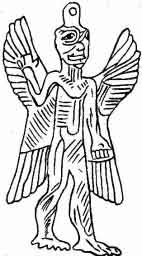
Amulet formed by the figure of Pazuzu, the god of storms, cyclones and hurricanes.

"Amulet formed by the figure of Pazuzu,
the god of storms, cyclones and hurricanes."

Now there is no record of this Wind Flood in the Bible, and it is only mentioned in the "Cave of Treasures," and in works based upon it, e.g. the Book of the Bee and the Book of Adam and Eve. Some light is thrown upon this Wind Flood by the cuneiform inscriptions, and the author of the "Cave of Treasures" must have derived his knowledge of it from documents based upon them. Nabonidus, king of Babylon, displeased the gods, and they made manifest their anger by making the storm wind to blow. And in one text it is distinctly said that the cities of Erech and Nippur were destroyed by a wind storm. (See Sidney Smith, Babylonian Historical Texts, London, 1924, page 93, note 20.) The most terrible of all the storm-wind gods was Pazuzu, whose strength and violence were believed to be so great that he could overthrow even the mountains (Revue d'Assyriologie, vol. XI, page 57). Figures of this monster in stone and bronze may be seen in the British Museum.
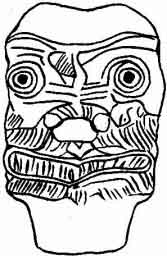
Limestone head of the Storm-god Pazuzu. (British Museum.)

Limestone head of the Storm-god
Pazuzu. (British Museum.)

Terah, the father of Abraham, followed in his father's footsteps, and, according to the legend quoted on made figures of the gods, or idols, in clay and stone, and sent his son Abraham into the baz to sell them. Fact underlies this legend, for a large number of terra-cotta figures of gods and demons have been found by many excavators during the course of their work on the sites of ancient cities in Babylonia; the commonest of these are the so-called "Papsukkal figures," which were believed to protect houses.
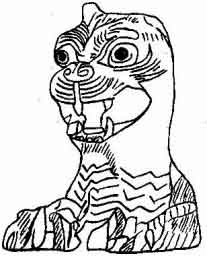
Baked clay figure of the god of the South-east Wind. (British Museum.)

"Baked clay figure of the god of the
South-east Wind. (British Museum.)"

The materials by which to check the statements made in the "Cave of Treasures" are not available at the present time, but it is very possible that in future years inscribed tablets will be found in Babylonia and Assyria which will contain the original forms of the legends and historical facts that have come down to us. The story of Nimrod and his cult of fire and the white horse, and his visit to the wise man Yt, of his skill as a magician, and the cities which he built, may be somewhat garbled, but it is based on genuine historical documents. The narrative of the descents made by Seth and his companions from the mountain of Paradise into the plain is certainly based on historical fact; and though Melchisedek has not yet been identified in the cuneiform inscriptions, there is every reason to believe that he existed, and that he was a founder of a pure form of religion, and a great ruler as well as priest.

The principal object of the writer of the "Cave of Treasures" was to trace the descent of Christ back to Adam, and to show that the Christian Dispensation was foreshadowed in the history of the Patriarchs and their successors the kings of Israel and Judah by means of types and symbols. The Christian Trinity existed before the world and man were made, for "the Spirit of God" which hovered over the waters was the Holy Spirit, and when God said "Let Us make man" by "Us" the Trinity was referred to. The Sabbath was instituted by God Who Himself rested on the seventh day. When Adam stood up upright after his creation he set his feet on the centre of the earth, on the exact spot on which the Cross of our Lord was set up, in Jerusalem. Adam, like Elijah, ascended into heaven in a chariot of fire. The angels carried crosses of light on which the names of the Persons of the Trinity were inscribed, and with them vanquished Satan and his hosts of devils when he rebelled, as the Cross of Christ destroyed the powers of darkness. The Garden of Eden is symbolic of the Holy Church, and as Adam was priest as well as prophet and king, he ministered in it. The Tree of Life prefigured the Cross of Christ, the veritable Tree of Life. On his expulsion from Paradise God told Adam that He would send His Son to redeem him, and ordered him to make arrangements for the embalming of his body and its preservation in the Cave of Treasures.

Adam and Eve lived on bread and wine in Paradise, and Melchisedek administered bread and wine to Abraham, according to the command of Methuselah, and so foreshadowed the institution of the Sacrament. The Cave of Treasures, with the gold, frankincense and myrrh which Adam collected in it, symbolized not only the Temple, or house of prayer, but the cave in which the Magi presented their gifts to Christ. Adam was the first priest, and was present when Cain and Abel made their offerings, and the lamp which he placed by the side of Abel's body in the Cave of Treasures was the prototype of the sanctuary lamp. Adam's body was buried in the Cave of Treasures, which became a family mausoleum, for several of his sons and descendants were also buried there. Noah took Adam's body from the Cave and carried it into Noah's Ark, and it was in due course brought to Jerusalem by him, and deposited in the opening in the earth which the earth itself made to receive it. There it remained until the Cross of Christ was set up above it on Golgotha, and then, when Longinus pierced our Lord's side, the blood and water flowed down into the place where Adam was. The blood gave him life, and he was baptized by the water.

Noah's Ark, bearing the body of Adam, which occupied the centre of it, and divided the men from the women, sailed over the waters until it reached the mountain on which Paradise was situated, and it travelled from east to west, and from north to south, and thus it made the sign of the Cross on the waters of the Flood. When the foremost part of the Flood reached the skirts of the mountain of Paradise, it bowed low and kissed the ground, and then withdrew to continue its work of destruction. The first dove sent out by Noah was a type of the Old Covenant, which was not accepted by the Jews, and the second dove was a type of the New Covenant, which rested on the people through the waters of baptism. One of the legends states that Abraham was circumcised by Gabriel, who was assisted by Michael. Abraham circumcised Isaac, and foresaw the crucifixion of Christ. The angels who were on Jacob's Ladder were Zechariah, and Mary, and the Magi and the Shepherds, and the Lord who stood at the head of it symbolized Christ on the Cross. The watering of the flocks by Jacob at the well symbolized the baptism of the nations. The stone which he set up and anointed was a type of the Christian altar, and the oil he used symbolized the oil used at the Christian altar. The crown of glory which Adam wore prefigured the crown of thorns which was placed on the head of Christ. Adam was three hours in Paradise, and Christ was in Pilate's Hall of Judgment three hours. Adam was naked for three hours, and Christ was naked on the Cross for three hours. The mother of mortal offspring (Eve) proceeded from the right side of Adam, and Baptism, the mother of immortal offspring, went forth from the right side of Christ during His crucifixion.

Adam's descent from Paradise typified the descent of Christ into Sheol; Adam was the prototype of Christ in every respect. Isaac was a symbol of Christ, and the thicket in which the ram, his substitute, was caught symbolized the wood of the Cross. The thread of scarlet of Rahab the harlot typified the red blood of Christ, and the window from which it issued His side. The seamless garment of Christ was the symbol of the indivisible Orthodox Faith.

One of the most important sections of the "Cave of Treasures" is that which contains a description of the Magi and their visit to Jerusalem, for it appears to be based upon the work of some writer who had exact knowledge of their methods. They are here grouped with the Chaldeans, who were presumably Babylonians, but they themselves are called the "wise men of Persia." Both these bodies of sages had studied the motions of the "Malwh" or Signs of the Zodiac, for centuries, and through them they felt that they were able to forecast with accuracy the course of events on this earth. The Magi were terrified at the appearance of the star, which led them subsequently to Bethlehem, and thought that the king of the Greeks was about to attack the land of Nimrod. At length they consulted their great astrological work which is here called "Gelydhe Nemrh," i.e. the "Revelation of Nimrod," and there they learned that a king was born in Judah. What this "Revelation of Nimrod" was cannot be said, but it was evidently one of the large series of Omen-texts of which so many examples exist in the British Museum. These texts are being copied and translated by Mr. C. J. Gadd of the British Museum, and when the work is done we may learn something of the book which the Magi consulted. The "Cave of Treasures" says that the Magi were three kings, and gives their names, and thus repeats the tradition which was general in the early centuries of the Christian Era. On the other hand, the "Book of the Bee," following a very ancient Oriental tradition, says they were twelve in number, and gives their names; but it must be noted that some of the names are only found at a comparatively late period of Persian History.

The sources of the genealogy of Christ which is found in the "Cave of Treasures" are unknown, but the author states that he is certain about its correctness, and by inserting it in their copies of the work the scribes have shown that it is worthy of credence. It is probably quite true that when the captain of Nebuchadnezzar's host burnt the books of the Jews after the capture of Jerusalem their tables of genealogy perished with them.

The Book of the Bee - Preface

THE BOOK OF THE BEE

THE SYRIAC TEXT

EDITED FROM THE MANUSCRIPTS IN LONDON, OXFORD, AND MUNICH


PREFACE.

OF the author of 'the Book of the Bee,' the bishop Shel or Solomon, but very little is known. He was a native of Khilu>t or Akhlu>t (in Armenia, at the western end of lake V), and by religious profession a Nestorian. He became metropolitan bishop of al-Basra (in al-`Iru>k, on the right bank of the united streams of the Tigris and Euphrates) about A.D. 1222, in which year he was present at the consecration of the catholicus or Nestorian patriarch Sabr-h (Hope-in-Jesus) (see Assem Bibl. Orient., t. ii, p. 453, no. 75; Bar-hebraeus, Chron. Eccl., t. ii, p. 371). In the Catalogue of Ecclesiastical Works compiled by `Eb-yh or `Abd-h (the-Servant-of-Jesus) he is stated to have written, besides 'the Bee,' a treatise on the figure of the heavens and the earth, and sundry short discourses and prayers (see Assem Bibl. Orient., t. iii, pt. i, p. 309, where there is a lengthy analysis of the contents of 'the Bee'). A Latin translation of 'the Bee' by Dr. J. M. Schoenfelder appeared at Bamberg in 1866; it is based upon the Munich MS. only, and is faulty in many places.

The text of 'the Bee,' as contained in this volume, is edited from four MSS., indicated respectively by the letters A, B, C and D.

The MS. A belongs to the Library of the Royal Asiatic Society of Great Britain and Ireland. It is dated A.Gr. 1880 = A.D. 1569, and consists of 188 paper leaves, measuring about 8 in. by 5. Each page is occupied by one column of writing, generally containing 25 lines. This MS. is so stained and damaged by water in parts that some of the writing is illegible. The quires are twenty-one in number and, excepting the last two, are signed with letters. Leaves are wanting after folios 6, 21,49, 125, 166 and 172; and in several pages there are lacunae of one, two and more lines. The volume is written in a good Nestorian hand, with numerous vowel-points. Originally it was the property of the priest Ward son of the deacon Moses, who was prior of the convent of M Ezekiel. Later on, it belonged to one M John of Enzelli (near Resht, on the south shore of the Caspian Sea). In the year A.Gr. 1916 = A.D. 1605 it was bound by a person whose name has been erased. The Book of the Bee occupies foll. 26 a to 92 b, and the colophon runs: 'By the help of our Lord and our God, this Book of the Bee was completed on the 16th day of the month of Tammuz, on the Saturday that ushers in the Sunday which is called Nd, in the year 1880 of the blessed Greeks, by the hands of the sinful servant the faulty Elias. Amen.'

The MS. B is on paper, and is numbered Add. 25,875 in the British Museum. See Wright's Catal., p. 1064, no. dccccxxii, ff. 81 b-158 a. It is written in a good Nestorian hand, with numerous vowel-points, etc., and is dated A.Gr. 2020 = A.D. 1709. The colophon runs:--

'It was finished in the year 2020 of the Greeks, on Friday the 22nd of the blessed month Tamm, by the wretched sinner, the deacon Hof Alkh. I entreat you to pray for him that perchance he may obtain mercy with those upon whom mercy is freely shewn in the day of judgment, Amen. And to Jah be the glory, Amen.

'The illustrious priest and pure verger, the priest Joseph, the son of the late deacon Hormizd of Hdaphn took pains and was careful to have this book written: may Christ make his portion in the kingdom of heaven! Amen. He had it written for the holy church called after the name of our Lady Mary the pure and virgin mother, which is in the blessed and happy village of Hdaphn in the district of `Am. From now and henceforth this book remains the property of the (above-) mentioned church, and no man shall have power over it to carry it off for any reprehensible cause of theft or robbery, or to give it away without the consent of its owners, or to abstract it and not to return it to its place. Whosoever shall do this, he shall be banned and cursed and execrated by the word of our Lord; and all corporeal and incorporeal beings shall say "Yea and Amen."'

From the manner in which B ends, it would seem either that the MS. from which it was copied was imperfect, or that the scribe Homitted to transcribe the last leaf of the MS. before him, probably because it contained views on man's future state which did not coincide with his own.

The MS. C, belonging to the Royal Library at Munich, consists of 146 paper leaves, measuring about 12 1/8 in. by 8. There are two columns, of twenty-four lines each, to a page; the right-hand column is Syriac, the left Kshor Arabic in Syriac characters. The MS. is beautifully written in a fine Nestorian hand, and vowels and diacritical points have been added abundantly. The headings of the chapters are in Estrangel The last two or three leaves have been torn out, and on fol. 147 a there are eighteen lines of Kshin another hand, which contain the equivalent in Arabic of B, fol. 157 a, col. 2, lines 10 to 24.

On the fly-leaf are five lines of Arabic, which run:--

'This book is the property of the church of M Cyriacus the Martyr at Batne. The deacon Peter bar Saumhas purchased it for the church with its own money, and therefore it has become the lawful property of the church. Whosoever taketh it away without the consent of the directors of the church, committeth sin and is bound to restore it. This was on the 17th of the month of h in the year of our Lord 1839, in the protected city of Mosul.'

Dr. Schoenfelder in the preface to his translation, p. ii, assigns this MS. to the fourteenth century ('ad saeculum decimum quartum procul dubio pertinet'). From this view, however, I differ for the following reasons. The MS. B, dated A.Gr. 2020 = A.D. 1709, is written upon water-lined paper, having for water-mark upon each leaf three crescents of different sizes, and a sign like a V:--

The paper is smooth and thick. The Munich MS. C is written upon rather rougher paper, but with the same water-mark exactly, only the three crescents are on one leaf, and the V-shaped mark upon that next to it. Therefore Dr. E. Maunde Thompson, keeper of the MSS. in the British Museum, who has kindly given me the benefit of his great experience in these matters, considers that the paper on which these two MSS. are written was made at the same manufactory and about the same time. Add to this that the writing of both MSS. is almost identical, and that the signatures of the quires and the style of ornamentation is the same, and it will be evident that the Munich MS. belongs rather to the end of the seventeenth or the beginning of the eighteenth century than to the fourteenth.

The MS. D, belonging to the Bodleian Library, Oxford, consists of 405 paper leaves, measuring 8 5/8 in. by 6. There is one column of twenty-one lines, in Kshi or Arabic in Syriac characters, to each page. The MS. is written in a fine bold hand, the headings of the chapters, names, and diacritical points being in red. It is dated Friday the 28th day of , A.Gr. 1895 = A.D. 1584, and was transcribed by Peter, the son of Jacob.

The Arabic version of 'the Bee' contained in this MS. borders at times on a very loose paraphrase of the work. The writer frequently repeats himself, and occasionally translates the same sentence twice, though in different words, as if to make sure that he has given what he considers to be the sense of the Syriac. He adds paragraphs which have no equivalents in the three Syriac copies of 'the Bee' to which I have had access, and he quotes largely from the Old and New Testaments in support of the opinions of Solomon of Basrah. The order of the chapters is different, and the headings of the different sections into which the chapters are divided will be found in the selections from the Arabic versions of 'the Bee'. This MS. is of the utmost importance for the study of 'the Bee,' as it contains the last chapter in a perfect and complete state; which is unfortunately not the case either with the bilingual Munich MS. or the copy in Paris.

Assemsays in the Bibl. Orient., t. iii, pt. i, p. 310, note 4, that there are two codices of 'the Bee' in the Vatican Library, and he has described them in his great work--MSS. Codicum Bibliothecae Apostol. Vatic. Catalogus, t. iii, nos. clxxvi and clxxvii. The latter is incomplete, containing only forty chapters (see Bibl. Orient., t. ii, p. 488, no. ix); but the former is complete (see Bibl. Orient., t. i, p. 576, no. xvii). It was finished, according to a note at the end, on Wednesday, 14th of Shebu>t in the year of Alexander, the son of Nectanebus, 1187, which Assemcorrects into 1787 = A.D. 1476. The name of the scribe was Gabriel, and he wrote it for the 'priest John, son of the priest Jonah' (Yaun), living at the village of ### in the district of Baz, (see Hoffmann, Ausze aus syr. Akten pers. Martyrer, pp. 204-5). At a subsequent time it belonged to the church of M Cyriacus in the village of Sekh, in the district of Barwar, (see Hoffmann, op. cit., pp. 193, 204).

My translation aims at being literal, and will, I hope, be found more correct in some places than that of Dr. Schoenfelder. I have added brief notes only where it seemed absolutely necessary. A few Syriac words, which are either wanting or not sufficiently explained in Castell-Michaelis's Lexicon, have been collected in a 'Glossary,' on the plan of that in Wright's Kalilah and Dimnah. The Index will probably be useful to the English reader. {The glossary and index are not included in this version.}

My thanks are due to Mr. E. B. Nicholson and Dr. A. Neubauer of the Bodleian Library, to the authorities of the Royal Library at Munich, and to the late W. S. W. Vaux, Secretary of the Royal Asiatic Society, for the loan of the MSS. of 'the Bee' preserved in their respective collections. Professor Wright has edited the extracts from the Arabic versions of 'the Bee,' and read a proof of each sheet of the whole book from first to last, besides giving me much general help and guidance in the course of my work. I dedicate this book to him as a mark of gratitude for a series of kindnesses shewn to me during the past nine years.

E. A. WALLIS BUDGE.

LONDON,
October 23, 1886.

The Book of the Bee - Notes

THE BOOK OF THE BEE

THE SYRIAC TEXT

EDITED FROM THE MANUSCRIPTS IN LONDON, OXFORD, AND MUNICH


The Book of the Bee

notes to the hypertext transcription


The Book of the Bee is a Nestorian Christian sacred history.

According to Budge it was written ca. A.D. 1222 by a Syrian bishop named Solomon (Shel).

There is very little known about the work itself in the Preface to this edition, it is being concerned primarily with the manuscript sources.

In the Introduction to the Book of the Cave of Treasures, Budge says that Solomon's object in writing the Book of the Bee was to present "a full history of the Christian Dispensation according to the Nestorians.".

Transcription standards and notes:

This edition was written primarily for philologists, and the printed version contains the entire text in Syriac, as well as extensive selections from Arabic translations.

There are also lengthy footnotes in Syriac, many words in Arabic and Hebrew, and references to the pagination of the Syriac text embedded in the English translation.

Almost all of this apparatus has been removed and is normally not noted. Where the existence of a Syriac word is crucial to the understanding of a footnote, it has been noted with the symbol ###, as I am incompetent to transcribe Syriac.

Underlines represent breve (short) markings over vowels, and dots under consonants, ` and represent right and left pointing apostrophes in transcriptions of Semitic words.

The Book of the Bee - Intro

THE BOOK OF THE BEE

THE SYRIAC TEXT

EDITED FROM THE MANUSCRIPTS IN LONDON, OXFORD, AND MUNICH


THE BOOK OF THE BEE.

TRUSTING in the power of our Lord Jesus Christ, we begin to write this book of gleanings called 'The Bee,' which was composed by the saint of God, M Solomon, metropolitan of Perath-Maish, that is Bassorah (al-Basrah), one of His companions. O Lord, in Thy mercy help me. Amen.

FIRST, THE APOLOGY.

'The children ought not to lay up treasures for the parents, but the parents for the spiritual children,' saith the blessed Paul; therefore we are bound to repay thee the debt of love, O beloved brother and staff of our old age, saint of God, M Narses, bishop of KhSh Bh-Wik. We remember thy solicitude for us, and thy zeal for our service, which thou didst fulfil with fervent love and Christ-like humility. And when we had loving meetings with each other from time to time, thou wert wont to ask questions and to make enquiries about the various things which God hath wrought in His dispensation in this material world, and also as to the things that He is about to do in the world of light. But since we were afflicted with the Mosaic defect of hesitancy of speech, we were unable to inform thee fully concerning the profitable matters about which, as was right, thou didst enquire; and for this reason we were prevented from profitable discourse upon the holy Books. Since, then, God has willed and ruled our separation from each other, and the sign of old age, which is the messenger of death, hath appeared in us, and we have grown old and come into years, it has seemed good to us, with the reed for a tongue and with ink for lips, to inform thee briefly concerning God's dispensation in the two worlds. And, behold, we have gleaned and collected and gathered together chapters and sections relating to this whole universe from the garden of the divine Books and from the crumbs of the Fathers and the Doctors, having laid down as the foundation of our building the beginning of the creation of this world, and concluding with the consummation of the world to come. We have called this book the 'Book of the Bee,' because we have gathered of the blossoms of the two Testaments and of the flowers of the holy Books, and have placed them therein for thy benefit. As the common bee with gauzy wings flies about, and flutters over and lights upon flowers of various colours, and upon blossoms of divers odours, selecting and gathering from all of them the materials which are useful for the construction of her handiwork; and having first of all collected the materials from the flowers, carries them upon her thighs, and bringing them to her dwelling, lays a foundation for her building with a base of wax; then gathering in her mouth some of the heavenly dew which is upon the blossoms of spring, brings it and blows it into these cells; and weaves the comb and honey for the use of men and her own nourishment: in like manner have we, the infirm, hewn the stones of corporeal words from the rocks of the Scriptures which are in the Old Testament, and have laid them down as a foundation for the edifice of the spiritual law. And as the bee carries the waxen substance upon her thighs because of its insipidity and tastelessness, and brings the honey in her mouth because of its sweetness and value; so also have we laid down the corporeal law by way of substratum and foundation, and the spiritual law for a roof and ceiling to the edifice of the spiritual tower. And as the expert gardener and orchard-keeper goes round among the gardens, and seeking out the finest sorts of fruits takes from them slips and shoots, and plants them in his own field; so also have we gone into the garden of the divine Books, and have culled therefrombranches and shoots, and have planted them in the ground of this book for thy consolation and benefit. When thou, O brother, art recreating thyself among these plants, those which appear and which thou dost consider to be insipid and tasteless, leave for thy companions, for they may be more suitable to others (than to thee); but, upon those which are sweet, and which sweeten the palate of thy understanding, do thou feed and satisfy thy hunger. If, however, owing to their fewness, they do not fill thee, seek in succession for their roots, and from thence shall thy want be satisfied. Know also, O brother, that where there is true love, there is no fear and where there is freedom of speech, there is no dread; and we should not dare to be so rash as to enter upon these subjects, which are beyond the capacity of our simple understanding, unless we relied upon thy immaculate love; because, in the words of one of the inspired. When thou findest honey, eat (only) so much as is sufficient for thee, lest, when thou art sated, thou vomit it that is to say, do not enquire (too closely) into the divine words.

The Book of the Bee 56 - 60

THE BOOK OF THE BEE

THE SYRIAC TEXT

EDITED FROM THE MANUSCRIPTS IN LONDON, OXFORD, AND MUNICH


CHAPTER LVI.

OF DEATH AND THE DEPARTURE OF THE SOUL FROM THE BODY.

THE foundation of all good and precious things, of all the greatness of God's gifts, of His true love, and of our arriving in His presence, is Death. Men die in five ways. Naturally; as David said, 'Unless his day come and he die,' alluding to Saul. Voluntarily; as when Saul killed himself in the battle with the Philistines. By accident; such as a fall from a roof, and other fatal accidents. By violence, from devils and men and wild beasts and venomous reptiles. By (divine) chastisement; as the flood in the days of Noah, and the fire which fell upon the Sodomites, and other such like things. But (side by side) with all these kinds of fatalities runs the providence of God's government, which cannot be comprehended by the creatures, restraining (them) where it is meet (to restrain), and letting (them) loose where it is fitting (to let loose). This government is not comprehended in this world, neither by angels nor by men; but in the world which is to come all rational beings will know it. When the soul goes forth from the body, as AbbIsaiah says, the angels go with it: then the hosts of darkness go forth to meet it, seeking to seize it and examine it, if there be anything of theirs in it. Then the angels do not fight with them, but those deeds which the soul has wrought protect it and guard it, that they come not near it. If its deeds be victorious, then the angels sing praises before it until it meets God with joy. In that hour the soul forgets every deed of this world. Consequently, no one who does not obtain remission (of sins) in this world can be free from the penalty of examination in that day. Not that there is torture or pleasure or recompense before the resurrection; but the soul knows everything that it has done whether of good or evil.

As to where the souls abide from the time they leave their bodies until the resurrection, some say that they are taken up to heaven, that is, to the region of spirit, where the celestial hosts dwell. Others say that they go to Paradise, that is, to the place which is abundantly supplied with the good things of the mystery of the revelations of God; and that the souls of sinners lie in darkness in the abyss of Eden outside Paradise. Others say that they are buried with their bodies; that is to say, as the two were buried in God at baptism, so also will they now dwell in Him until the day of the resurrection. Others say that they stand at the mouth of the graves and await their Redeemer; that is to say, they possess the knowledge of the resurrection of their bodies. Others say that they are as it were in a slumber, because of the shortness of the time; for they point out in regard to them that what seems to us a very long time is to them as a momentary nod (or wink) in its shortness. And just as he that is sunk in slumber departs from the life of this world, and yet does not arrive at absolute mortality, so also are they in an intermediate knowledge which is higher than that of this world, and yet attain not to that which is after the resurrection. Those who say that they are like an infant which has no knowledge, shew that they call even the knowledge of the truth ignorance in comparison with that knowledge of the truth which shall be bestowed upon them after the resurrection.

That the souls of the righteous pray, and that their prayers assist those who take refuge with them, may be learned from many, especially from M Theodore in his account of the blessed Thecla. Therefore it is right for those who have a holy man for a friend, to rejoice when he goes to our Lord in Paradise, because their friend has the power to help them by his prayers. Like the blind disciple of one of the saints mentioned in the Book of the Paradise, who, when his master was dying, wept bitterly and said, 'To whose care dost thou leave the poor blind man?' And his master encouraged him, and said to him, 'I believe in God that, if I find mercy in His sight, at the end of a week thou wilt see;' and after some days he did see. The souls of the righteous also hold spiritual conversation with each other, according to the Divine permission and command which moves them to this by necessary causes. Neither those who have departed this life in the flesh are hindered from this (intercourse), nor those who are still clad in their fleshly garments, if they live their life in them holily.


CHAPTER LVII.

OF THE QUICKENING AND THE GENERAL RESURRECTION, THE CONSUMMATION OF THE MATERIAL WORLD AND THE BEGINNING OF THE NEW WORLD.

AFTER Elijah comes and conquers the son of destruction, and encourages the believers, for a space and a time which is known to God alone, there will appear the living sign of our Lord's Cross, honoured and borne aloft in the hands of the Archangel Gabriel. Its light will overpower the light of the sun, to the reproach and putting to shame of the infidels and the crucifying Jews. As soon as the life-giving Cross appears before our Lord, as the Doctor saith, 'His victory comes before Him,' etc., then a powerful light will fill the whole vaulted space between the heavens and the earth, the radiance and light whereof will be above all (other) lights; and suddenly will the mighty sound of the first trumpet of the Archangel be heard, concerning which our Lord said, 'At midnight there will be a cry, "Behold the Bridegroom cometh, go ye forth to meet Him."' At this trumpet the sun shall become dark, the moon shall not display its light, the stars shall drop from the heavens like leaves, and the powers of the heavens shall be moved. The earth shall totter and tremble, the mountains and hills shall melt, the sea shall be disturbed and shall cause terrible sounds to be heard. The rivers shall submerge the earth, the trees shall be uprooted, buildings shall fall, towns and villages shall be overturned, and high walls and strong towers shall be thrown down. The wild beasts and cattle and fowl and fish shall come to an end and perish; and everything shall be destroyed, except a few human beings who shall remain alive, and whom the resurrection shall overtake, of whom Paul has said, 'We who are left shall not overtake them that sleep,' meaning to say that those who are found alive at the time of the resurrection will not sleep the sleep of death; as the apostle says again, 'Behold I tell you a mystery; we shall not all sleep, but we shall all be changed.' As touching the heavens, some say that they will be rent, and that the waters which are above the firmament will descend, for it is not possible for the substance of water to pass through the substance of the firmament. Others say that as water passes through a tree or a piece of pottery, and sweat through the skin, so also will men enter into heaven and not be prevented, and (in like manner too) will the waters descend from above. Others say that the firmament will be rolled up like the curtain of a tent.

The second trumpet is that at the sound of which the firmament will be opened, and our Lord will appear from heaven in splendour and great glory. He will come down with the glory of His divinity as far as two-thirds of the distance between the firmament and the earth, whither Paul ascended in the spirit of revelation. He will then make an end of the son of perdition, and destroy him body and soul, and He will hurl Satan and the devils into Gehenna.

The third trumpet is the last, at which the dead will rise, and the living be changed, as the blessed Paul says, 'Swiftly, as in the twinkling of an eye, at the last trumpet when it sounds; and the dead shall rise without corruption, and we shall be changed.' So swiftly and speedily will the resurrection of all men be wrought, according to the spiritual nature of the new world. For the swiftness of the resurrection will surpass the swiftness of understanding, and the spiritual hosts alone see and know in what manner it will take place, every man being suddenly found standing in his spirituality. Some men therefore have a tradition that the resurrection of the righteous and the just and the believers will precede that of other men, who are remote from the true faith; but according to the opinion of the truthful and of people generally, the resurrection of the whole human race will take place quicker than lightning and than the twinkling of an eye; from the generation of Adam to the latest generation they shall rise at the last trumpet. And though, according to the opinion of the Expositor, many sounds will be heard on that night, each one of which is a sign of what will happen, yet, according to the consent of the greater part of the expositors and of Scripture, three distinct trumpets will sound by which the whole work of the resurrection will be completed and finished. Michael the expositor and exegete, however, says otherwise in the book of Questions, speaking as follows: 'The world will not pass away and be dissolved before the vivification of the dead, but the coming of our Lord will be seen first of all, who will come with the spiritual hosts; and immediately our Lord's power will compel the earth to give up the parts of the bodies of men who have been slain and have become dust and ashes within it; and there will be a making ready and preparation of the souls to receive their bodies all together. If, before the vivification of the dead, the world and all that is therein were to pass away, from whence pray would the dead rise? Those who say that the world will pass away before the vivification of the dead are fools and simpletons; for Christ will not make the world pass away before the vivification of the dead, but He will first of all raise the dead, and men will see with their eyes the passing away of the world, the uprooting of the elements, and the destruction of the heavens and the earth and the sun and the moon and the stars; and from here sorrow will begin to reign in the mind of the wicked, and endless joy in the mind of the righteous.


CHAPTER LVIII.

OF THE MANNER AND STATE IN WHICH MEN WILL RISE IN THE DAY OF THE RESURRECTION.

ALL classes and conditions of men will rise from the dead in the state of the perfect form of Christ, about thirty-three years of age, even as our Redeemer rose from the grave. We shall rise with all our limbs perfect, and with the same constitutions, without addition or diminution. Some say that the hair and nails and prepuce will rise, and some say they will not; as if they were superfluous for the completion of the nature of man. Some say concerning the resurrection that a likeness only will rise, without parts and without the composition of the limbs of man; a mere similitude of hands and feet and hardness of bones. Others say that the whole man will be cast into one crystalline substance, and that all his parts will be mingled together; and they do not grant him an ordered arrangement of composition. Others say that the vessels which are inside the belly, such as the bowels, liver, etc., will not rise; but they err and stray from the truth, and do not understand that if one of the parts of the body perish, it is not perfect. For Paul shewed plainly and laid down an example of the resurrection in the grain of wheat: just as that grows up entire with its glory, without any portion of it having perished, even so we; for the whole man shall rise with all his limbs and parts, and ordered in his composition as now, only having acquired purification from the humours. And this is not surprising, that if an earthen vessel acquires firmness and lightness when it goes into the fiery furnace, without any change taking place in its shape or form, but is lightened of its heaviness and density, whilst it preserves its shape uninjured; so also should the Holy Spirit burn us in the furnace of the resurrection and drive forth from us all the foul material of the present (life), and clothe us with incorruptibility. 'It is sown an animal body; it rises a spiritual body.' We shall neither see nor hear with all our bodily members, although some men have thought that the whole man will be sight and hearing; but we shall carry out action with these same usual limbs, if it happen to be necessary; although we shall not there need speech and conversation with one another, because each other's secrets will be revealed to us.

The things which certain stupid men invent, who indulge their fancy, and give bodily form to the punishment of sinners and the reward of the just and righteous, and say that there is at the resurrection a reckoning and a pair of scales, the Church does not receive; but each one of us carries his light and his fire within him, and his heaviness and his lightness is round in his own pature. Just as stone and iron naturally possess the property of falling to the earth, and as the air naturally ascends upward on account of its rarity and its lightness; so also in the resurrection, he that is heavy and lying in sins, his sins will bring him down; and he that is free from the rust of sin, his purity will make him rise in the scale. And our Lord will ascend to heaven, and the angels (will go) before Him like ambassadors, and the just and the righteous will be upon His right hand and His left, and the children behind Him in the form of the life-giving Cross.


CHAPTER LIX.

OF THE HAPPINESS OF THE RIGHTEOUS AND THE TORMENT OF SINNERS, AND IN WHAT STATE THEY ARE THERE.

IT is right for us to know and explain how those suffer, who suffer in Gehenna. If they do suffer, how can we say that they are impassible? and if they do not suffer, then there is no torture for sinners; and if there be no torture for sinners in proportion to their sins, neither can there be happiness for the righteous as a reward for their labours. The suffering wherewith the Fathers say that sinners will suffer in Gehenna is not one that will pain the limbs, such as the blows of sticks, the mutilation of the flesh, and the breaking of the bones, but one that will afflict the soul, such as grief for the transgression of what is right, repentance for shameful deeds, and banishment from one to whom he is bound in love and for whom his affection is strong. For in the resurrection we shall not be without perception, like the sun which perceives not his splendour, nor the moon her brilliancy, nor the pearl its beauty; but by the power of reason we shall feel perfectly the delight of our happiness or the keen pain of our torture. So then by that which enables the righteous to perceive the pleasure of their happiness, by that selfsame thing will the wicked also perceive the suffering of their torment; (that is) by the power capable of receiving pleasure, which is the intelligence. Hence it is right for us to be certain that intelligence will not be taken away from us, but it will receive the utmost purification and refinement. The glorious and good things of the world which is to come are not to be compared with those of this world; for if all the glorious and good things and delights of this world were given to us in the world which is to come, we should look upon them as hateful and abominable, and they would not be able to give us pleasure or to gladden us; and our nature by the blessedness of its immortality would be exalted above all their glory and desirability. And if all the torments and afflictions and troubles of this world were brought near to us in the world which is to come, the pain of them would make no impression upon our immortal and immutable nature. Hence the pleasure of that world is something beyond all comparison more glorious and excellent and exalted than those of this world; and the torment of yonder is likewise something beyond all comparison more severe and more bitter than any that is here.

It is also right for us to explain the quality of the light of the righteous. The light of the righteous is not of a natural origin like this elemental light (of ours), but some of the light of our Lord--whose splendour surpasses ten thousand suns--is diffused and shed upon them. Each saint shines in proportion to his purity, and holiness and refinement and sincerity, as the blessed Paul has said, 'One star surpasseth another in glory, so also is the resurrection of the dead.' And although all the saints will be happy in one kingdom, yet he who is near to the King or the Bridegroom will be separated from him whose place is at the end of the guest-chamber, even though his place be in the same chamber. So also with the sinners in Gehenna; their sentence will not be alike, for in proportion to the sin of each will be his torment. And as the light of the sun is not to be compared with the light of the moon, nor is the light of the moon like that of the stars, so also will the happiness of the righteous be, although the name and honour of righteousness be laid upon and spread over all of them. And as the light of our Lord's humanity will pass over all our limbs without distinction, and take the place of dress and ornament for us, so also with all our members shall we perceive the suffering and torment of Gehenna. The festal garments which our Lord has prepared for His saints, the children of light, are impassibility; and the filthy garments which hinder us from entering into the spiritual bridal-chamber are the passions. In the new world there will be no distinctive names for ranks and conditions of human beings; and as every name and surname attributed to God and the angels had its origin from this world, and names for human beings were assigned and distributed by the government of this world, in the world of spiritual and intellectual natures there will be neither names nor surnames among them, nor male nor female, nor slave nor free, nor child nor old man, nor Ethiopian nor Roman (Greek); but they will all rise in the one perfect form of a man thirty-three years of age, as our Lord rose from the dead. In the world to come there will be no companies or bands but two; the one of the angels and the righteous, who will mingle and form one Church, and the other of the devils and sinners in Gehenna.


CHAPTER LX.

WHETHER MERCY WILL BE SHEWN TO SINNERS AND THE DEVILS IN GEHENNA, AFTER THEY HAVE BEEN TORMENTED AND SUFFERED AND BEEN PUNISHED, OR NOT? AND IF MERCY IS TO BE SHEWN TO THEM, WHEN WILL IT BE?

SOME of the Fathers terrify us beyond our strength and throw us into despair; and their opinion is well adapted to the simple-minded and trangressors of the law. Others of them encourage us and bid us rely upon Divine mercy; and their opinions are suitable and adapted to the perfect and those of settled minds and the pious. In the 'Book of Memorials' it is thus written: 'This world is the world of repentance, but the world which is to come is the world of retribution. As in this world repentance saves until the last breath, so in the world to come justice exacts to the uttermost farthing. And as it is impossible to see here strict justice unmingled with mercy, so it is impossible to find there strict justice mingled with mercy.' M Isaac says thus: 'Those who are to be scourged in Gehenna will be tortured with stripes of love; they who feel that they have sinned against love will suffer harder and more severe pangs from love than the pain that springs from fear.' Again he says: 'The recompense of sinners will be this: the resurrection itself will be their recompense instead of the recompense of justice; and at the last He will clothe those bodies which have trodden down His laws with the glory of perfection. This act of grace to us after we have sinned is greater than that which, when we were not, brought our nature into being.' Again he says: 'In the world which is to come grace will be the judge and not justice.' M Theodore the Expositor says: 'Those who have here chosen fair things will receive in the world to come the pleasure of good things with praises; but the wicked who have turned aside to evil things all their life, when they are become ordered in their minds by penalties and the fear that springs from them, and choose good things, and learn how much they have sinned by having persevered in evil things and not in good things, and by means of these things receive the knowledge of the highest doctrine of the fear of God, and become instructed to lay hold of it with a good will, will be deemed worthy of the happiness of the Divine liberality. For He would never have said, "Until thou payest the uttermost farthing," unless it had been possible for us to be freed from our sins through having atoned for them by paying the penalty; neither would He have said, "he shall be beaten with many stripes," or "he shall be beaten with few stripes," unless it were that the penalties, being meted out according to the sins, should finally come to an end.' These things the Expositor has handed down in his books clearly and distinctly.

So also the blessed Diodorus, who says in the 'Book of the Dispensation:' 'A lasting reward, which is worthy of the justice of the Giver, is laid up for the good, in return for their labours; and torment for sinners, but not everlasting, that the immortality which is prepared for them may not be worthless. They must however be tormented for a short time, as they deserve, in proportion to the measure of their iniquity and wickedness, according to the amount of the wickedness of their deeds. This they will have to bear, that they suffer for a short time; but immortal and unending happiness is prepared for them. If it be then that the rewards of good deeds are as great (in proportion to them) as the times of the immortality which are prepared for them are longer than the times of the limited contests which take place in this world, the torments for many and great sins must be very much less than the greatness of mercy. So then it is not for the good only that the grace of the resurrection from the dead is intended, but also for the wicked; for the grace of God greatly honours the good, but chastises the wicked sparingly.'

Again he says: 'God pours out the wages of reward beyond the measure of the labours (wrought), and in the abundance of His goodness He lessens and diminishes the penalty of those who are to be tormented, and in His mercy He shortens and reduces the length of the time. But even thus He does not punish the whole time according to (the length of) the time of folly, seeing that He requites them far less than they deserve, just as He does the good beyond the measure and period (of their deserts); for the reward is everlasting. It has not been revealed whether the goodness of God wishes to punish without ceasing the blameworthy who have been found guilty of evil deeds (or not), as we have already said before. * * * * * * * * * * * * * * But if punishment is to be weighed out according to sin, not even so would punishment be endless. For as regards that which is said in the Gospel, 'These shall go away into everlasting punishment, but the righteous into life eternal;' this word 'eternal' (le-`am) is not definite: for if it be not so, how did Peter say to our Lord, 'Thou shalt never wash my feet,' and yet He washed him? And of Babylon He said, 'No man shall dwell therein for ever and ever,' and behold many generations dwell therein. In the 'Book of Memorials' he says: 'I hold what the most celebrated of the holy Fathers say, that He cuts off a little from much. The penalty of Gehenna is a man's mind; for the punishment there is of two kinds, that of the body and that of the mind. That of the body is perhaps in proportion to the degree of sin, and He lessens and diminishes its duration; but that of the mind is for ever, and the judgment is for ever.' But in the New Testament le-`am is not without end. To Him be glory and dominion and praise and exaltation and honour for ever and ever. Amen and Amen.

The Book of the Bee 53 - 55

THE BOOK OF THE BEE

THE SYRIAC TEXT

EDITED FROM THE MANUSCRIPTS IN LONDON, OXFORD, AND MUNICH


CHAPTER LIII.

OF THE END OF TIMES AND THE CHANGE OF KINGDOMS; FROM THE BOOK OF METHODIUS, BISHOP OF ROME.

IN this seventh and last millennium will the kingdom of the Persians be destroyed. In it will the children of Ishmael go forth from the wilderness of Yathrib (al-Medah), and they will all come and be gathered together in Gibeah of Ramah, and there shall the fat ones of the kingdom of the Greeks, who destroyed the kingdoms of the Hebrews and the Persians, be destroyed by Ishmael, the wild ass of the desert; for in wrath shall he be sent against the whole earth, against man and beast and trees, and it shall be a merciless chastisement. It is not because God loves them that He has allowed them to enter into the kingdoms of the Christians, but by reason of the iniquity and sin which is wrought by the Christians, the like of which has never been wrought in any one of the former generations. They are mad with drunkenness and anger and shameless lasciviousness; they have intercourse with one another wickedly, a man and his son committing fornication with one woman, the brother with his brother's wife, male with male, and female with female, contrary to the law of nature and of Scripture, as the blessed Paul has said, 'Male with male did work shame, and likewise also the women did work lewdness, and, contrary to nature, had intercourse with one another.' Therefore they have brought upon themselves the recompense of punishment which is meet for their error, women as well as men, and hence God will deliver them over to the impurity of the barbarians, that their wives may be polluted by the sons of pollution, and men may be subjected to the yoke of tribute; then shall men sell everything that they have and give it to them, but shall not be able to pay the debt of the tribute, until they give also their children to them into slavery. And the tyrant shall exalt himself until he demands tribute and poll-tax from the dead that lie in the dust, first oppressing the orphans and defrauding the widows. They will have no pity upon the poor, nor will they spare the miserable; they will not relieve the afflicted; they will smite the grey hairs of the aged, despise the wise, and honour fools; they will mock at those who frame laws, and the little shall be esteemed as the great, and the despised as the honourable; their words shall cut like swords, and there is none who shall be able to change the persuasive force of their words. The path of their chastisement shall be from sea to sea, and from east to west, and from north to south, and to the wilderness of Yathrib. In their latter days there shall be great tribulation, old men and old women hungering and thirsting, and tortured in bonds until they account the dead happy. They will rip up the pregnant woman, and tear infants away from their mothers' bosoms and sell them like beasts, and those that are of no use to them will they dash against the stones. They will slay the priests and deacons in the sanctuary, and they will lie with their wives in the houses of God. They will make clothes for themselves and their wives out of the holy vestments, and they will spread them upon their horses, and work impurity upon them in their beds. They will bring their cattle into the churches and altars, and they will tie up their dogs by the shrines of the saints. In those days the spirit of the righteous and of them that are well versed in signs will be grieved. The feeble will deny the true faith, the holy Cross, and the life-giving mysteries; and without compulsion many will deny Christ, and become rebels and slanderers and boasters, denying the faith. With this chastisement shall the Christians be tried. For at that time the righteous, the humble, the peaceful and the gentle will not be sought after, but liars and slanderers and accusers and disturbers and the obscene and those who are destitute of mercy, and those who scoff at their parents and blaspheme the life-giving mysteries. And the true believers shall come into troubles and persecutions until they despair of their lives. Honour shall be taken away from the priests, and the pastors shall become as the people. When the measure of their (i.e. the Ishmaelites') victory is full, tribulation will increase, and chastisement will be doubled upon man and beast. And there shall be a great famine, and the dead bodies of men shall lie in the streets and squares without any one to bury them, and (just) reckoning shall vanish and disappear from the earth, And men shall sell their brass and their iron and their clothes, and shall give their sons and their daughters willingly to the heathen. A man shall lie down in the evening and rise in the morning, and shall find at his do or two or three exactors and officers to carry off by force; and two or three women shall throw themselves upon one man and say, 'We will eat our own bread, and wear our own apparel, only let us take refuge beneath thy skirts.' When men are oppressed and beaten, and hunger and thirst, and are tormented by that bitter chastisement; while the tyrants shall live luxuriously and enjoy themselves, and eat and drink, and boast in the victory they have won, having destroyed nations and peoples, and shall adorn themselves like brides, saying, 'The Christians have neither a God nor a deliverer;' then all of a sudden there shall be raised up against them pains like those of a woman in childbirth; and the king of the Greeks shall go forth against them in great wrath, and he shall rouse himself like a man who has shaken off his wine. He shall go forth against them from the sea of the Cushites, and shall cast the sword and destruction into the wilderness of Yathrib and into the dwelling-place of their fathers. They shall carry off captive their wives and sons and daughters into the service of slavery, and fear of all those round about them shall fall upon them, and they shall all be delivered into the hand of the king of the Greeks, and shall be given over to the sword and to captivity and to slaughter, and their latter subjection shall be one hundred times more severe than their (former) yoke. They shall be in sore tribulation from hunger and thirst and anxiety; they shall be slaves unto those who served them, and bitter shall their slavery be. Then shall the earth which has become desolate of its inhabitants find peace, and the remnant that is left shall return every man to his own land and to the inheritance of his fathers; and men shall increase like locusts upon the earth which was laid waste. Egypt shall be ravaged, Arabia shall be burnt with fire, the land of Hebron shall be laid waste, and the tongue of the sea shall be at peace. All the wrath and anger of the king of the Greeks shall have full course upon those who have denied Christ. And there shall be great peace on earth, the like of which has not been from the creation of the world until its end; for it is the last peace. And there shall be great joy on earth, and men shall dwell in peace and quiet; convents and churches shall be restored, cities shall be built, the priests shall be freed from taxes, and men shall rest from labour and anxiety of heart. They shall eat and drink; there shall be neither pain nor care; and they shall marry wives and beget children during that true peace. Then shall the gates of the north be opened, and the nations shall go forth that were imprisoned there by Alexander the king.


CHAPTER LIV.

OF GOG AND MAGOG, WHO ARE IMPRISONED IN THE NORTH.

WHEN Alexander was king and had subdued countries and cities, and had arrived in the East, he saw on the confines of the East those men who are of the children of Japhet. They were more wicked and unclean than all (other) dwellers in the world; filthy peoples of hideous appearance, who ate mice and the creeping things of the earth and snakes and scorpions. They never buried the bodies of their dead, and they ate as dainties the children which women aborted and the after-birth. People ignorant of God, and unacquainted with the power of reason, but who lived in this world without understanding like ravening beasts. When Alexander saw their wickedness, he called God to his aid, and he gathered together and brought them and their wives and children, and made them go in, and shut them up within the confines of the North. This is the gate of the world on the north, and there is no other entrance or exit from the confines of the world from the east to the north. And Alexander prayed to God with tears, and God heard his prayer and commanded those two lofty mountains which are called 'the children of the north,' and they drew nigh to one another until there remained between them about twelve cubits. Then he built in front of them a strong building, and be made for it a door of brass, and anointed it within and without with oil of Thesnakt, so that if they should bring iron (implements) near it to force it open, they would be unable to move it; and if they wished to melt it with fire, it would quench it; and it feared neither the operations of devils nor of sorcerers, and was not to be overcome (by them). Now there were twenty-two kingdoms imprisoned within the northern gate, and tbeir names are these: G, M, N, Eshken, Denh, Pakt Welu>t Humn Parz Dakl Thaubel Darmet Kawkeb Dog-men (Cynocephali), Emderh Garm, Cannibals, Therk P, Denk Saltr At the end of the world and at the final consummation, when men are eating and drinking and marrying wives, and women are given to husbands; when they are planting vineyards and building buildings, and there is neither wicked man nor adversary, on account of the assured tranquillity and certain peace; suddenly the gates of the north shall be opened and the hosts of the nations that are imprisoned there shall go forth. The whole earth shall tremble before them, and men shall flee and take refuge in the mountains and in caves and in burial places and in clefts of the earth; and they shall die of hunger; and there will be none to bury them, by reason of the multitude of afflictions which they will make men suffer. They will eat the flesh of men and drink the blood of animals; they will devour the creeping things of the earth, and hunt for serpents and scorpions and reptiles that shoot out venom, and eat them. They will eat dead dogs and cats, and the abortions of women with the after-birth; they will give mothers the bodies of their children to cook, and they will eat them before them without shame. They will destroy the earth, and there will be none able to stand before them. After one week of that sore affliction, they will all be destroyed in the plain of Joppa, for thither will all those (people) be gathered together, with their wives and their sons and their daughters; and by the command of God one of the hosts of the angels will descend and will destroy them in one moment.


CHAPTER LV.

OF THE COMING OF THE ANTICHRIST, THE SON OF PERDITION.

IN a week and half a week after the destruction of these wretches shall the son of destruction appear. He shall be conceived in Chorazin, born in Bethsaida, and reared in Capernaum. Chorazin shall exult because he was conceived in her, Bethsaida because he was born in her, and Capernaum because he was brought up in her; for this reason our Lord proclaimed Woe to these three (cities) in the Gospel. As soon as the son of perdition is revealed, the king of the Greeks will go up and stand upon Golgotha, where our Lord was crucified; and he will set the royal crown upon the top of the holy Cross, upon which our Lord was crucified; and he will stretch out his two hands to heaven; and will deliver over the kingdom to God the Father. The holy Cross will be taken up to heaven, and the royal crown with it; and the king will die immediately. The king who shall deliver over the kingdom to God will be descended from the seed of Khath the daughter of P, the king of the Ethiopians; for Armelaus (Romulus) the king of the Greeks took Khath to wife, and the seed of the Ethiopians was mingled with that of the Greeks. From this seed shall a king arise who shall deliver the kingdom over to God, as the blessed David has said, 'Cush will deliver the power to God.' When the Cross is raised up to heaven, straightway shall every head and every ruler and all powers be brought to nought, and God will withdraw His providential care from the earth. The heavens will be prevented from letting fall rain, and the earth from producing germs and plants; and the earth shall remain like iron through drought, and the heavens like brass. Then will the son of perdition appear, of the seed and of the tribe of Dan; and he will shew deluding phantasms, and lead astray the world, for the simple will see the lepers cleansed, the blind with their eyes opened, the paralytic walking, the devils cast out, the sun when he looks upon it becoming black, the moon when he commands it becoming changed, the trees putting forth fruit from their branches, and the earth making roots to grow. He will shew deluding phantasms (of this kind), but he will not be able to raise the dead. He will go into Jerusalem and will sit upon a throne in the temple saying, 'I am the Christ;' and he will be borne aloft by legions of devils like a king and a lawgiver, naming himself God, and saying, 'I am the fulfilment of the types and the parables.' He will put an end to prayers and offerings, as if at his appearance prayers are to be abolished and men will not need sacrifices and offerings along with him. He becomes a man incarnate by a married woman of the tribe of Dan. When this son of destruction becomes a man, he will be made a dwelling-place for devils, and all Satanic workings will be perfected in him. There will be gathered together with him all the devils and all the hosts of the Indians; and before all the Indians and before all men will the mad Jewish nation believe in him, saying, 'This is the Christ, the expectation of the world.' The time of the error of the Antichrist will last two years and a half, but others say three years and six months. And when every one is standing in despair, then will Elijah (Elias) come from Paradise, and convict the deceiver, and turn the heart of the fathers to the children and the heart of the children to the fathers; and he will encourage and strengthen the hearts of the believers.

The Book of the Bee 52

THE BOOK OF THE BEE

THE SYRIAC TEXT

EDITED FROM THE MANUSCRIPTS IN LONDON, OXFORD, AND MUNICH


CHAPTER LII.

THE NAMES OF THE KINGS WHO HAVE REIGNED IN THE WORLD FROM THE FLOOD UNTIL NOW.

THE MEDIAN KINGS WHO REIGNED IN BABYLON.

Darius the son of Vashtasp (Hystaspes) reigned 24 years.

Ahshesh (Xerxes) his son, 20 years.

Artahshisht the long-hand (Artaxerxes Longimanus), 41 years.

Daryash (Darius) the son of the concubine, 20 years.

Artahshisht (Artaxerxes) the ruler, 30 years.

Arses the son of Ochus, 4 years.

Daryash (Darius) the son of sham (Arsanes), 6 years.

THE YEARS OF THE EGYPTIAN KINGS.

Alexander the son of Philip, 12 years. Ptolemy the son of Lag, 40 years. Ptolemy Philadelphus, 38 years. In his third year the fifth millennium ended. This (king) asked the captive Jews who were in Egypt, and seventy old men translated the Scriptures for him, from Hebrew into Greek, in the island of Pharos. In return for this he set them free, and gave back to them also the vessels of their temple. Their names are these. Josephus, Hezekiah, Zechariah, John, Ezekiel, Elisha; these were of the tribe of Reuben. Judah, Simon, Samuel, Addai, Mattathias, Shalm these were of the tribe of Simeon. Nehemiah, Joseph, Theodosius, B Adonijah, Du>k these were of the tribe of Levi. Jothan, Abd Elisha, Ananias, Zechariah, Hilkiah; these were of the tribe of Judah. Isaac, Jacob, Jesus, Sambu>t (Sabbateus), Simon, Levi; these were of the tribe of Issachar. Judah, Joseph, Simon, Zechariah, Samuel, Shaml these were of the tribe of Zebulon. Sambu>t (Sabbateus), Zedekiah, Jacob, Isaac, Jesse, Matthias; these were of the tribe of Gad. Theodosius, Jason, Joshua, John, Theodotus, Jothan; these were of the tribe of Asher. Abraham, Theophilus, Arsam, Jason, Jeremiah, Daniel; these were of the tribe of Dan. Jeremiah, Eliezer, Zechariah, Benaiah, Elisha, Dath these were of the tribe of Naphtali. Samuel, Josephus, Judah, Jonathan, Dositheus, Caleb; these were of the tribe of Joseph. Isalus, John, Theodosius, Arsam, Abijah, Ezekiel; these were of the tribe of Benjamin.

After Ptolemy Philadelphus arose Ptolemy Euergetes; (he reigned) 26 years.

Ptolemy Philopator, 17 years.

Ptolemy Epiphanes, 24 years.

Ptolemy Philometor, 35 years. The time of the Maccabees extended to this (reign), and in it the old Covenant came to an end.

Ptolemy Soter, 17 years.

Ptolemy Alexander, 18 years.

Ptolemy Dionysius, 30 years.

THE YEARS OF THE ROMAN EMPERORS.

Gaius Julius, 4 years.

Augustus, 57 years. In the forty-third year of his reign our Lord Christ was born.

Tiberius, 23 years. In the fifteenth year of his reign our Lord was baptised; and in the seventeenth year He suffered, died, rose again, and ascended to heaven.

Gaius (Caligula), 4 years.

Claudius, 14 years.

Nero, 14 years.

Vespasian, 10 years. Immediately after he came to the throne, he sent his son Titus against Jerusalem, and he besieged it for two years, until he uprooted it and destroyed it.

Titus, 2 years.

Domitian, 15 years.

Trajan, 20 years. John, the son of Zebedee, lived until the seventh year of his reign.

Hadrian, 20 years.

Antoninus, 20 years.

Verus, 20 years.

Commodus, 14 years.

Severus, 20 years.

The house of Antoninus.

Alexander the son of Mammaea, 13 years.

Maximinius and Gordianus, 9 years.

Philip and Gallus, 10 years.

Valerianus and Gallius (Gallienus), 15 years.

Claudius and Tacitus, 16 years.

Diocletian and those that were with him, 20 years.

Constantine, 33 years.

THE KINGS OF THE PERSIANS FROM SH (SAPOR) THE SON OF HORMIZD.

In the fourth year of Constantine Caesar the Victorious, Sh reigned in Persia 70 years.

Ardash his brother, 20 years.

Vahr (Bahr) and Sh, the sons of Ardash, 20 years.

Yazdagerd, the son of Sh, 20 years.

Vahr (Bahr), the son of Yazdagerd, 20 years.

P, the son of Yazdagerd, 27 years.

Balh, the son of P, 4 years.

Kaw, the son of P, 41 years.

Chosrau, the son of Kaw, 47 years.

Hormizd, the son of Chosrau, 12 years.

From Sh to this fifteenth year of Chosrau the son of Hormizd, in which he destroyed D is three hundred and six years. The sum of all the years from Adam to this fifteenth year of Chosrau the conqueror, which is the nine hundred and sixteenth year of the Greeks, is 5861 years. From Adam to the Crucifixion is 5280 years. The whole of the Jewish economy therefore, from the time they went out of Egypt until Jerusalem was destroyed by Titus, was 1601 years. From Abraham to this year is 2031 years.

OF THE YEARS THAT HAVE PASSED AWAY FROM THE WORLD.

From Adam to the Flood was 2262 years. From the Flood to Abraham was 1015 years. From Abraham to the Exodus of the people from Egypt was 430 years. From the Exodus of the people by the hand of Moses to Solomon and the building of the Temple was 400 years. From Solomon to the first Captivity, which Nebuchadnezzar led away captive, was 495 years. From the first Captivity to the prophesying of Daniel was 180 years. From the prophesying of Daniel to the Birth of our Lord was 483 years. All these years make 5345 years. From Alexander to our Lord was 303 years. From our Lord to Constantine was 341 years. In the year 438 of Alexander the Macedonian, the kingdom of the Persians had its beginning. Know, O my brother readers, that from the beginning of the creation of Adam to Alexander was 5180 years.

The Book of the Bee 50 - 51

THE BOOK OF THE BEE

THE SYRIAC TEXT

EDITED FROM THE MANUSCRIPTS IN LONDON, OXFORD, AND MUNICH


CHAPTER L.

OF SOME MINOR MATTERS.

THESE are they who were married among the apostles: Peter, the chief of the apostles; Philip the Evangelist; Paul; Nathaniel, who is Bartholomew; Labbaeus, who is Thaddaeus, who is Judah the son of Jacob; Simon the Cananite, who is Zelotes, who is Judah the son of Simon.

The child whom our Lord called and set (in the midst), and said, 'Except ye be converted, and become as children, ye shall not enter into the kingdom of heaven,' was Ignatius, who became patriarch of Antioch. He saw in a vision the angels ministering in two bands, and he ordained that (men) should minister in the church in like manner. After some time this order was broken through; and when Diodorus went with his father on an embassy to the land of Persia, and saw that they ministered in two bands, he came to Antioch his country, and re-established the custom of their ministering in two bands.

The children whom they brought near to our Lord, that He might lay His hand upon them and pray, were Timothy and Titus, and they were deemed worthy of the office of bishop.

The names of the Maries who are mentioned in the Gospels. Mary the Virgin, the mother of our Lord; Mary the wife of Joseph; Mary the mother of Cleopas and Joseph; Mary the wife of Peter, the mother of Mark the Evangelist; and Mary the sister of Lazarus. Some say that Mary the sinner is Mary of Magdala; but others do not agree with this, and say that she was other than the Magdalene. Those who say that she was the Magdalene tell us that she built herself a tower with the wages of fornication; and those who say that she was other than the Magdalene, say that Mary Magdalene was called after the name of her town Magdala, and that she was a pure and holy woman.


CHAPTER LI.

THE NAMES OF THE EASTERN CATHOLICS, THE SUCCESSORS OF THE APOSTLES ADDAI AND M

1. Addai was buried in Edessa.

2. M(was buried) in the convent of K

3. Abr, called in Greek A(m)brosius; the place of his grave is unknown; he was of the laying on of hands of Antioch.

4. Abraham was of the laying on of hands of Antioch; he was descended from the family of Jacob the son of Joseph; his grave is in Ctesiphon.

5. James, of the laying on of hands of Antioch, was also of the family of Joseph the husband of Mary; his grave is in Ctesiphon.

6. Ahdabh was of the laying on of hands of Antioch; his grave is in Ctesiphon.

7. Shahlhwas of the laying on of hands of Ctesiphon, and he was buried there.

8. P his grave is at Ctesiphon.

9. Simon bar Sabbwas martyred at Shh.

10. Shah-dt was buried in Ctesiphon.

11. Bar-Be`esh-shem was martyred and buried in Elam (Khist).

12. Tarswas buried in Ctesiphon.

13. Kwas buried in Ctesiphon; he abdicated the patriarchate, and another was put in his place, and was before him until he died.

14. Isaac was buried in Ctesiphon.

15. Ahwas buried in Ctesiphon.

16. Yab-alwas of the school of M `Abd he was buried in Ctesiphon.

17. Ma`ndwelt in Persia and was buried there.

18. D-h was buried in Ht In his days the strife between Nestorius and Cyril (of Alexandria) took place.

19. B was martyred and buried in Ht

20. Akak (Acacius) was of the family of B the Catholicus; he was buried in al-Madn.

21. Bai took a wife, and was buried at Ctesiphon,

22. Shtook a wife, and was buried in his convent beside Aw

23. Paul was buried in Ctesiphon.

24. M(-abwas buried in Ht and was a martyr without bloodshed.

25. Ezekiel was buried in Ht

26. h-yab of Arz was buried in Ht

27. Sabr-h was buried in Ht

28. Gregory was buried in . . . . . .

29. h-yab of Gedwas buried in . . . . . .

30. M(-emm was buried in Ketiy(?).

31. h-yab of Adiabene was buried in Bh-`

32. George was buried in . . . . . .

33. John was buried in . . . . . .

34. Hen-h was buried in . . . . . .

35. Selzekhwas buried in Ctesiphon.

36. Pethi was buried in Ctesiphon.

37. M(-abwas buried in al-Madn.

38. Jacob was buried in . . . . . .

39. Hen-h was buried in . . . . . .

40. Timothy was buried in his own convent.

41. h (Joshua) the son of N (Nun) was buried in the convent of Timothy.

42. George was buried in the same convent.

43. Sabr-h was buried in the same convent.

44. Abraham was buried in the same convent.

45. Athanasius was buried in the same convent.

46. Sergius was buried in the same convent.

47. Anh (Enos) was buried in the same convent.

48. John the son of Narsai was buried in the Greek Palace (at Baghd).

49. Joannes was buried in the Greek Palace.

50. John was buried in the Greek Palace.

51. Abraham was buried in the convent of `Abd.

52. Emmanuel was buried in the Greek Palace.

53. Israel was buried in the Greek Palace.

54. `Abd-h was buried in the Greek Palace.

55. Mwas buried in the Greek Palace.

56. Joannes was buried in the Greek Palace.

57. John was buried in the Greek Palace.

58. h-yab was buried in the Grek Palace.

59. Elijah (El was buried in the Greek Palace.

60. John was buried in the Greek Palace.

61. Sabr-h was buried in the Greek Palace.

62. `Abd-h was buried in the Greek Palace.

63. Makkhwas buried in the Greek Palace.

64. Elijah (El was buried in the Greek Palace.

65. Bar-saumwas buried in the Greek Palace.

66. `Abd-h was buried . . . . . .

67. h-yab was buried in the church of M Sabr-h.

68. Elijah (El was buried in the church of M Sabr-h.

69. Yab-alwas buried in the church of Mt( Maryam (my lady Mary).

70. Sabr-h was buried in the church of Mt( Maryam.

71. Sabr-h was buried . . . . . .

72. (M Makkhwas buried . . . . . .

73. M Denhwas buried . . . . . .

74. M Yab-althe Turk was buried . . . . . .

75. M Timothy was buried . . . . . .

76. M Denhwas buried . . . . . .

77. M Simon was buried . . . . . .

78. M Elijah (El was buried . . . . . .

79. M Simon of our days, may he live for ever!)

The names of the Catholics who were deposed and dismissed (from office): M(-bht, Narsai, Elisha, Joseph and S.

The Book of the Bee 46 - 49

THE BOOK OF THE BEE

THE SYRIAC TEXT

EDITED FROM THE MANUSCRIPTS IN LONDON, OXFORD, AND MUNICH


CHAPTER XLVI.

OF THE ASCENSION OF OUR LORD TO HEAVEN.

AFTER our Redeemer had risen from the grave, and had gone about in the world forty days, He appeared to His disciples ten times, and ate and drank with them by the side of the Sea of Tiberias. At this point the heathen say to us, that if our Lord really ate and drank after His resurrection, there will certainly be eating and drinking after (our) resurrection; but if He did not really eat and drink, then all the actions of Christ are mere phantasms. To these we make answer, that this world is a world of need for food; therefore He ate and drank, that it might not be thought He was a phantom; and because many who have risen from the dead have eaten and drunk in (this) world until they departed and died, as, for example, the dead (child) whom Elisha raised, and the dead whom our Lord raised. Our Lord did not eat after His resurrection because He needed food, but only to make certain His humanity: for, behold, He once remained in the desert forty days without food, and was not injured by hunger. Some say that after His resurrection our Lord ate food like unto that which the angels ate in the house of Abraham, and that the food was dissipated and consumed by the Divine Power, just as fire licks up oil without any of it entering into its substance. Our Lord remained upon the earth forty days, even as He had fasted forty days, and as Elijah fasted forty days, and as Moses fasted forty days at two several times, and as the rain continued for forty days during the flood, and as God admonished the Ninevites for forty days, and as the spies remained (absent) for forty days, and as the children of Israel wandered about in the wilderness for forty years, and like the child whose fashioning in the womb is completed in forty days. After forty days, our Lord took up His disciples to the Mount of Olives, and laid His hand upon them, and blessed them, and commanded them concerning the preaching and teaching of the nations. And it came to pass that while He was blessing them, He was separated from them, and went up to heaven; and they worshipped Him. And there appeared to them angels, encouraging them and saying, 'This Jesus, who has been taken up from you to heaven, is about to come again even as ye have seen Him go up to heaven.' Then they returned to that upper chamber where they were, and stayed there ten days, until they received the Holy Spirit in the form of tongues of fire. Simon Peter said to his fellow-disciples, 'It is right for us to put some one in the place of Judas to complete the number of twelve;' and they cast lots, and the lot fell upon Matthias, and he was numbered with the eleven apostles.

As concerning the manner in which our Lord entered heaven without cleaving it, some say that He went in as He did through the closed doors; and as He came forth from the virgin womb, and Mary's virginity returned to its former state; and like the sweat from the body; and as water is taken up by the roots of the olive and other trees, and reaches in the twinkling of an eye the leaves, flowers and fruits, as if through certain ducts, without holes or channels being pierced in them. Thus by an infinite and ineffable miracle our Lord entered into heaven without cleaving it. And if the bodies of us who are accustomed to drink water and wine pour out sweat without our flesh being rent or our skin pierced, how very much easier is it for the Divine Power to go in through closed doors and within the firmament of heaven without rending or cleaving it?

As regards the upper chamber in which our Lord held His Passover, some say that it belonged to Lazarus, and others to Simon the Cyrenian, and others to Joseph the senator; but Joshua the son of Nun, the Catholicus, says that it belonged to Nicodemus. The apostles remained in the upper chamber ten days after the Ascension, being constant in fasting and prayer, and expecting the Spirit, the Comforter, which our Lord Jesus Christ promised them.


Footnotes

In the Oxford MS. there follows here a long discussion on the divine and human natures of Christ, in the middle of which (fol. 178 b) is a Syriac passage in which the names of Athanasius and Gregory are mentioned. The view there maintained is that Christ is God and man in the unity of one Person.


CHAPTER XLVII.

OF THE DESCENT OF THE HOLY SPIRIT UPON THE APOSTLES IN THE UPPER CHAMBER.

TEN days after our Lord's Ascension, when the holy apostles were assembled in the upper chamber waiting for the promise of our Lord, of a sudden, at the third hour of the holy Sunday of Pentecost, a mighty sound was heard, so that all men were terrified and marvelled at the mightiness of the sound; and the chamber was filled with an ineffably strong light. And there appeared over the head of each one of them (something) in the form of tongues of fire, and there breathed forth from thence a sweet odour which surpassed all aromas in this world. The eyes of their hearts were opened, and they began interpreting new things and uttering wonderful things in the languages of all nations. When the Jews saw them, they thought within themselves that they had been drinking new wine and were drunk, and that their minds were depraved. On that day they participated in the mystery of the body and blood of our Lord, and sanctified the leavened bread of the sign of the cross (the eucharistic wafers) and the oil of baptism.

Some men have a tradition that when our Lord broke His body for His disciples in the upper chamber, John the son of Zebedee hid a part of his portion until our Lord rose from the dead. And when our Lord appeared to His disciples and to Thomas with them, He said to Thomas, 'Hither with thy finger and lay it on My side, and be not unbelieving, but believing.' Thomas put his finger near to our Lord's side, and it rested upon the mark of the spear, and the disciples saw the blood from the marks of the spear and nails. And John took that piece of consecrated bread, and wiped up that blood with it; and the Easterns, M Addai and M M took that piece, and with it they sanctified this unleavened bread which has been handed down among us. The other disciples did not take any of it, because they said, 'We will consecrate for ourselves whenever we wish.' As for the oil or baptism, some say that it was part of the oil with which they anointed the kings; others say that it was part of the unguent wherewith they embalmed our Lord; and many agree with this (statement). Others again say that when John took that piece of consecrated bread of the Passover in his hand, it burst into flame and burnt in the palm of his hand, and the palm of his hand sweated, and he took that sweat and hid it for the sign of the cross of baptism. This account we have heard by ear from the mouth of a recluse and visitor (περιοδευτής {Greek: periodeuths}), and we have not received it from Scripture. The word Pentecost is interpreted 'the completion of fifty days.'


CHAPTER XLVIII.

OF THE TEACHING OF THE APOSTLES, AND OF THE PLACES OF EACH ONE OF THEM, AND OF THEIR DEATHS.

NEXT we write the excellent discourse composed by M Eusebius of Caesarea upon the places and families of the holy apostles.

Know then that the apostles were twelve and seventy. When the apostles had received the gift of the Holy Spirit, on the day following they fasted this feast of the apostles (which we keep); but the Malk(Melchites) say that the apostles fasted eight days after. Their names are as follows.

Simon, the chief of the apostles, was from Bethsaida, of the tribe of Naphtali. He first preached in Antioch, and built there the first of all churches, which was in the house of Cassianus, whose son he restored to life. He remained there one year, and there the disciples were called Christians. From thence he went to Rome, where he remained for twenty-seven years; and in the three hundred and seventy-sixth year of the Greeks, the wicked Nero crucified him head downwards.

Andrew his brother preached in Scythia and Nicomedia and Achaia. He built a church in Byzantium, and there he died and was buried.

John the son of Zebedee (Zabhdai) was also from Bethsaida, of the tribe of Zebulun. He first preached in Asia (Ephesus), and was afterwards cast into exile in the island of Patmos by Tiberius Caesar. He then went to Ephesus, and built in it a church. Three of his disciples went with him: Ignatius, who was afterwards bishop of Antioch, and who was thrown to the beasts in Rome; Polycarp, who was afterwards bishop of Smyrna, and was crowned by fire; and John, to whom he committed the priesthood and the bishopric after him. When John had lived a long time, he died and was buried at Ephesus; and John, the disciple of the Evangelist, who became bishop of Ephesus, buried him; for he commanded them that no one should know the place of his burial. The graves of both of them are in Ephesus; the hidden one of the Evangelist, and the other of his disciple John, the author of the Revelation; he said that everything he had written down, he had heard from John the Evangelist.

James, the brother of John, preached in his city Bethsaida, and built a church there. Herod Agrippas slew him with the sword one year after the Ascension of our Lord. He was laid in u>k, a city of Marmu>k

Philip also was from Bethsaida, of the tribe of Asher. He preached in Phrygia, Pamphylia and Pisidia; he built a church in Pisidia, and died and was buried there. He lived twenty-seven years as an apostle.

Thomas was from Jerusalem, of the tribe of Judah. He taught the Parthians, Medes and Indians; and because he baptised the daughter of the king of the Indians, he stabbed him with a spear and he died. Habb the merchant brought his body, and laid it in Edessa, the blessed city of Christ our Lord. Others say that he was buried in Mahlh, a city in the land of the Indians.

Matthew the Evangelist was from Nazareth, of the tribe of Issachar. He preached in Palestine, Tyre and Sidon, and went as far as Gabb He died and was buried in Antioch, a city of Pisidia.

Bartholomew was from Endor, of the tribe of Issachar. He preached in inner Armenia, Ardesh, Ketarb, Radb, and Prarm. After he had lived thirty years as an apostle, Hstthe king of the Armenians crucified him, and he was buried in the church which he built in Armenia.

Jude, the son of James, who was surnamed Thaddaeus (Taddai), who is also Lebbaeus (Lebbai), was from Jerusalem, of the tribe of Judah. He preached in Laodicea and in Antaradus and Arw. He was stoned in Arw, and died and was buried there.

Simon Zeles was from Galilee, of the tribe of Ephraim. He preached in Shemh (Samosa), P (Perrh, Zeugma, H (Aleppo), Mabb (Manbig), and Kenneshr (Kinnesr). He built a church in Kyrrhos, and died and was buried there.

James, the son of Alphaeus (Halphai), was from the Jordan, of the tribe of Manasseh. He preached in Tadmor (Palmyra), Kirkion (Kirkiy, and Callinos (ar-Rakkah), and came to Batn of Ser (Sar), where he built a church, and died and was buried there.

Judas Iscariot, the betrayer, was from the town of Sekharyu>t of the tribe of Gad, though some say that he was of the tribe of Dan. He was like unto the serpent that acts deceitfully towards its master, because like a serpent, he dealt craftily with his Lord. Matthias, of the tribe of Reuben, came in in his stead. He preached in Hellas, and in Sicily, where he built a church, and died and was buried in it.

While James the brother of our Lord was teaching the Jews in Jerusalem, they cast him down from a pinnacle of the temple; and while his life was yet in him, a fuller of cloth smote him upon the head with a club and beat it in; and afterwards they stoned him with stones.

John the Baptist was of the tribe of Levi. Herod the tetrarch slew him, and his body was laid in Sebastia.

Ananias (Hanany the disciple of the Baptist taught in Damascus and Arb. He was slain by P, the general of the army of Aretas, and was laid in the church which he built at Arb (Irbil).

Paul of Tarsus was a Pharisee by sect, of the tribe of Ephraim. When he had been baptised by Ananias, he wrought many miracles, and taught great cities, and bore and suffered dangers not a few for the name of Christ. Afterwards he went to Peter at Rome. When they divided the world between them, and the heathen fell to Paul's lot, and the Jewish nation to Peter, and they had turned many to the truth of Christ, Nero commanded that they should both die a cruel death. Then Simon asked to be crucified head downwards, that he might kiss that part of the cross where the heels of his Master had been. As they were going forth to be slain, they gave the laying on of hands of the priesthood to their disciples, Peter to Mark, and Paul to Luke. When Peter had been crucified, and Paul slain, together with many of those who had become their disciples, Mark and Luke went forth by night, and brought their bodies into the city. Now Paul's head was lost among the slain, and could not be found. Some time after, when a shepherd was passing by the spot where the slain were buried, he found Paul's head, and took it upon the top of his staff, and laid it by his sheep-fold. At night he saw a fire blazing over it, and he went in (to the city) and informed the holy bishop Xystus (Sixtus) and the clergy of the church; and they all recognised that it was Paul's head. Xystus said to them, 'Let us watch and pray the whole night, and let us bring out the body and lay the head at its feet; and if it joins again to its neck, it will be certain that it is Paul's.' And when they had done so, the whole body was restored, and the head was joined to its neck as if the vertebrae had never been severed; and those who saw it were amazed and glorified God. From his call to the end of his life was thirty-five years; he went about in every place for thirty-one years; for two years he was in prison at Caesarea, and for two years at Rome. He was martyred in the thirty-sixth year after the Passion of our Lord, and was laid with great honour in the magnificent royal catacombs in Rome. They celebrate every year the day of his commemoration on the twenty-ninth of the month of Tamm.

Luke the physician and Evangelist was first of all a disciple of Lazarus, the brother of Mary and Martha, and was afterwards baptised by Philip in the city of Beroea. He was crowned with the sword by Hos, the judge (or governor) of the emperor Tiberius, while he was preaching in Alexandria, and was buried there.

Mark the Evangelist preached in Rome, and died and was buried there. Some say that he was the son of Simon Peter's wife, others that he was the Son of Simon; and Rhoda was his sister. He was first called John, but the Apostles changed his name and called him Mark, that there might not be two Evangelists of one name.

Addai was from Paneas, and he preached in Edessa and in Mesopotamia in the days of Abgar the king; and he built a church in Edessa. After Abgar died, Herod Abgar's son slew him in the fortress of Agg. His body was afterwards taken and carried to Rome; but some say that he was laid in Edessa.

Aggai his disciple was first of all a maker of silks for Abgar, and became a disciple. After Abgar's death, his son reigned, and he required of Aggai to weave silks for him; and when he consented not, saying, 'I cannot forsake teaching and preaching to return to weaving,' he smote him with a club upon his legs and brake them, and he died.

Thaddaeus (Taddai) came after him at Edessa, and Herod, the son of Abgar, slew him also; he was buried at Edessa.

Zacchaeus (Zaccai) the publican and the young man whom our Lord brought to life were both slain together while they were preaching in Mount H.

The Jews smote Simon the leper while he was teaching in Ramah, and he died (there).

Joseph the Senator taught in Galilee and Decapolis; he was buried in his town of Ramah.

Nicodemus the Pharisee, the friend of our Lord, received and honoured the Apostles in Jerusalem; and he died and was buried there.

Nathaniel was stoned while he was teaching in Mount H, and died.

Simon the Cyrenian was slain while he was teaching in the island of Chios.

Simon the son of Cleopas became bishop of Jerusalem. When he was an old man, one hundred years of age, Irenaeus the chiliarch crucified him.

Stephen the martyr was stoned with stones at Jerusalem, and his body was laid in the village of Kephar Gaml

Mark, who was surnamed John, taught at Nyssa and Nazianzus. He built a church at Nazianzus, and died and was buried there. Some say that he is the Evangelist, as we have mentioned.

Cephas, whom Paul mentions, taught in Baalbec, Hims (Emesa) and Nathr (Bathar). He died and was buried in Sh.

Barnabas taught in Italy and in K he died and was buried in Samos.

Titus taught in Crete, and there he died and was buried.

Sosthenes taught in the country of Pontus and Asia. He was thrown into the sea by the command of Nonnus the prefect.

Criscus (Crescens) taught in Dalmatia; he was imprisoned in Alexandria, where he died of hunger and was buried.

Justus taught in Tiberias and in Caesarea, where he died and was buried.

Andronicus taught in Illyricum, where he died and was buried.

The people of Zeugma slew Rufus while he was teaching in Zeugma.

Patrobas taught in Chalcedon, and he died and was buried there.

Hermas the shepherd taught in Antioch, and he died and was buried there.

Narcissus taught in Hellas, and he died and was buried there.

Asyncritus went to Beth-H(Khist), and there he died and was buried.

Aristobulus taught in Isauria, and there he died and was buried.

Onesimus was the slave of Philemon, and he fled from him and went to Paul, while he was in prison; because of this Paul calls him 'the son whom I have begotten in my bonds.' His legs were broken in Rome.

Apollos the elect was burnt with fire by Sparacleus (?), the governor of Gangra.

Olympas, Stachys and Stephen were imprisoned in Tarsus, and there they died in prison.

Junias was captured in Samos, and there he was slain and died.

Theocritus died while teaching in Ilios, and was buried there.

Martalus (?) was slain while teaching the barbarians.

Niger taught in Antioch, and died and was buried there.

They dragged Lucius behind a horse, and thus he ended his life.

While Alexander was teaching in Heracleolis, they threw him into a pit and he died.

Milus, while he was teaching in Rhodes, was thrown into the sea and drowned.

Silvanus and Hi (Rhi) were slain while they were preaching in the city of Acc

Silas taught in Sarapolis (Hierapolis ?), and died and was buried there.

Timothy taught in Ephesus, and died and was buried there.

Manael was burnt with fire while teaching in Acc and died.

The Eunuch whom Philip baptised, the officer of Candace the queen of the Ethiopians, went to Ethiopia and preached there. Afterwards, while he was preaching in the island of Parparchia (?), they strangled him with a cord.

Jason and Sosipatrus were thrown to the wild beasts while they were teaching in Olmius (?).

Demas taught in Thessalonica, and there he died and was buried.

Omius (Hymenaeus) taught in Melitene, and there he died and was buried.

They threw Thraseus into a fiery furnace, while he was teaching at Laodicea.

Bistorius (Aristarchus ?) taught in the island of K and there he died and was buried.

Abrios (?) and Mu>tos (?) went to the country of the Ethiopians, and there they died and were buried.

Levi was slain by Charmus, while he was teaching in Paneas.

Nicetianus (Nicetas) was sawn in two while teaching in Tiberias.

While John and Theodorus were preaching in the theatre of Baalbec, they threw them to the beasts.

The prefect Methalius (?) slew Euchestion (?) and Simon in Byzantium.

Ephraim (Aphrem) taught in Baish, and he died and was buried there.

Justus was slain at Corinth.

James taught and preached in Nicomedia, and he died and was buried there.


Footnotes

The Oxford MS. says that when the crucifiers knew that Nicodemus had become a Christian, they seized his property and slew him; and that his brother Gamaliel buried him in Kephar Gaml It then gives the following account of Gamaliel. Gamaliel was a friend of the crucifying Jews, but was afterwards baptised together with his son: he lived for twenty years after this. When they died, they were buried by the side of Nicodemus in Kephar Gaml where Stephen was buried. Many years after (about A.D. 415), God revealed their place of burial to one of the saints (Lucian), and they sought for the remains of the bodies by digging, and found them; and there they built a church. Foll. 187 b, 188 a. See also Migne, Biog. Chr., ii. 73; Wright, Cat. Syr. MSS., iii, p. 1047, i. 8.


CHAPTER XLIX.

THE NAMES OF THE APOSTLES IN ORDER.

THE names of the twelve. Simon Peter; Andrew his brother; James the son of Zebedee; John his brother; Philip; Bartholomew; Thomas; Matthew the publican; James the son of Alphaeus; Labbaeus, who was surnamed Thaddaeus; Simon the Cananite; Judas Iscariot, in whose stead came in Matthias.

The names of the seventy. James, the son of Joseph; Simon the son of Cleopas; Cleopas his father; Joses; Simon; Judah; Barnabas; Manaeus (?); Ananias, who baptised Paul; Cephas, who preached at Antioch; Joseph the senator; Nicodemus the archon; Nathaniel the chief scribe; Justus, that is Joseph, who is called Barshabb Silas; Judah; John, surnamed Mark; Mnason, who received Paul; Mana, the foster-brother of Herod; Simon called Niger; Jason, who is (mentioned) in the Acts (of the Apostles); Rufus; Alexander; Simon the Cyrenian, their father; Lucius the Cyrenian; another Judah, who is mentioned in the Acts (of the Apostles); Judah, who is called Simon; Eurion (Orion) the splay-footed; Thus (?); Thorus (?); Zabdon; Zakron. These are the seven who were chosen with Stephen: Philip the Evangelist, who had three daughters that used to prophesy; Stephen; Prochorus; Nicanor; Timon; Parmenas; Nicolaus, the Antiochian proselyte; Andronicus the Greek; Titus; Timothy.

These are the five who were with Peter in Rome: Hermas; Plt Patrobas; Asyncritus; Hermas.

These are the six who came with Peter to Cornelius: Criscus (Crescens); Milichus; Ku>t (Crito); Simon; Gaius, who received Paul; Abrazon (?); Apollos.

These are the twelve who were rejected from among the seventy, as Judas Iscariot was from among the twelve, because they absolutely denied our Lord's divinity at the instigation of Cerinthus. Of these Luke said, 'They went out from us, but they were not of us;' and Paul called them 'false apostles and deceitful workers.' Simon; Levi; Bar-Kubb Cleon; Hymenaeus; Candarus; Clithon (?); Demas; Narcissus; Slpus (?); Thaddaeus; Mh In their stead there came in these: Luke the physician; Apollos the elect; Ampelius; Urbanus; Stachys; Popillius (or Publius); Aristobulus; Stephen (not the Corinthian); Herodion the son of Narcissus; Olympas; Mark the Evangelist; Addai; Aggai; M Mi.

It is said that each one of the twelve and of the seventy wrote a Gospel; but in order that there might be no contention and that the number of 'Acts' might not be multiplied, the apostles adopted a plan and chose two of the seventy, Luke and Mark, and two of the twelve, Matthew and John.


Footnotes

See Assem Bibl. Orient., iii, pt. i, pp. 319-320, where lists of the twelve apostles and seventy disciples are given from the Vatican MS. of the Book of the Bee, from the Commentary of Bar-Hebraeus on St. Matthew, and from the Synopsis of `Amr and Mi, etc.

The Book of the Bee 41 - 45

THE BOOK OF THE BEE

THE SYRIAC TEXT

EDITED FROM THE MANUSCRIPTS IN LONDON, OXFORD, AND MUNICH


CHAPTER XLI.

OF JOHN THE BAPTIST, AND OF THE BAPTISM OF OUR LORD.

JOHN the Baptist lived thirty yeats in the desert with the wild beasts; and after thirty years he came from the wilderness to the habitations of men. From the day when his father made him flee to the desert, when he was a child, until he came (again), he covered himself with the same clothes both summer and winter, without changing his ascetic mode of life. And he preached in the wilderness of Judaea, saying, 'Repent, the kingdom of God draweth nigh;' and he baptised them with the baptism of repentance for the remission of their sins. He said to them, 'Behold, there cometh after me a man who is stronger than I, the latchets of whose shoes I am not worthy to unloose. I baptise you with water for repentance, but He who cometh after me is stronger than I; He will baptise you with the Holy Spirit and with fire:' thereby referring to that which was about to be wrought on the apostles, who received the Holy Spirit by tongues of fire, and this took the place of baptism to them, and by this grace they were about to receive all those who were baptised in Christ. Jesus came to John at the river Jordan to be baptised by him; but John restrained Him, saying, 'I need to be baptised by Thee, and art Thou come to me?' Jesus said to him, 'It is meet thus to fulfil the words of prophecy.' When Jesus had been baptised, as soon as He had gone up from the water, He saw that the heavens were rent, and the Spirit like a dove descended upon Him, and a voice from heaven said, 'This is My beloved Son, in whom I am well pleased.' On this day the Trinity was revealed to men; by the Father who cried out, and by the Son who was baptised, and by the Holy Spirit which came down upon Him in the corporeal form of a dove. Touching the voice which was heard from heaven, saying, 'This is My beloved Son, in whom I am well pleased, hear ye Him,' every one heard the voice; but John only was worthy to see the vision of the Spirit by the mind. The day of our Lord's birth was the fourth day of the week, but the day of His baptism was the fifth. When John rebuked Herod, saying that it was not lawful for him to take his brother Philip's wife, he seized John, and cast him into the prison called Machaer. And it came to pass on a certain day, when Herod on his birthday made a feast for his nobles, that B the daughter of Herodias, came in and danced before the guests; and she was pleasing in the sight of Herod and his nobles. And he said to her, 'Ask of me whatsoever thou desirest and I will give it to thee;' and he sware to her saying that whatever she asked he would give it to her, unto the half of his kingdom. She then went in to Herodias her mother and said to her, 'What shall I ask of him?' She said to her, 'The head of John the Baptist;' for the wretched woman thought that when John should be slain, she and her daughter would be free from the reprover, and would have an opportunity to indulge their lust: for Herod committed adultery with the mother and with her daughter. Then she went in to the king's presence and said to him, 'Give me now the head of John the Baptist on a charger.' And the king shewed sorrow, as if, forsooth, he was not delighted at the murder of the saint; but by reason of the force and compulsion of the oath he was obliged to cut off John's head. If, O wretched Herod, she had demanded of thee the half of thy kingdom, that she might sit upon the throne beside thee and divide (it) with thee, wouldst thou have acceded to her, and not have falsified thy oath, O crafty one? And the king commanded an executioner, and he cut off the head of the blessed man, and he put it in a charger and brought and gave it to the damsel, and the damsel gave it to her mother. Then she went out to dance upon the ice, and it opened under her, and she sank into the water up to her neck; and no one was able to deliver her. And they brought the sword with which John's head had been cut off, and cut off hers and carried it to Herodias her mother. When she saw her daughter's head and that of the holy man, she became blind, and her right hand, with which she had taken up John's head, dried up; and her tongue dried up, because she had reviled him, and Satan entered into her, and she was bound with fetters. Some say that the daughter of Herodias was called B but others say that she also was called by her mother's name Herodias. When John was slain, his disciples came and took his body and laid him in a grave; and they came and told Jesus. The two disciples whom John sent to our Lord, saying, 'Art thou He that should come, or do we look for another,' were Stephen the martyr and deacon, and Hananyah (Ananias) who baptised Paul. Some say that the wild honey and locusts, which he fed upon in the wilderness, was manna,--which was the food of the children of Israel, and of which Enoch and Elijah eat in Paradise,--for its taste is like that of honey. Moses compares it to coriander seed, and the anchorites in the mountains feed upon it. Others say that it was a root like unto a carrot; it is called Ku>s, and its taste is sweet like honey-comb. Others say that the locusts were in reality some of those which exist in the world, and that the honey-comb was that which is woven by the little bees, and is found in small white cakes in desert places.


CHAPTER XLII.

OF OUR LORD'S FAST; OF THE STRIFE WHICH HE WAGED WITH THE DEVIL; AND OF THE MIGHTY DEEDS THAT HE WROUGHT.

TWO days after His baptism, He chose eight of the twelve disciples; and on the third day He changed the water into wine in the city of Cana. After He went forth from the wilderness, He completed the number of the twelve, according to the number of the tribes of the children of Israel and according to the number of the months. After the twelve disciples, He chose seventy and two, according to the number of the seventy-two elders. When He went out to the desert after He had changed the water into wine, He fasted forty days and forty nights Some say that our Lord and the devil were waging war with one another for forty days; others say that the three contests took place in one day. After He had conquered the devil by the power of His Godhead, and had given us power to conquer him, He began to teach the nations. He wrought miracles, healed the sick, cleansed the lepers, cast out devils, opened the eyes of the blind, made the lame walk, made cripples stand, gave hearing to the deaf, and speech of tongue to the dumb. He satisfied five thousand with five loaves, and there remained twelve basketfuls; and with seven loaves and two fishes He satisfied four thousand (men), besides women and children, and there remained seven basketfuls. And some writers say that our Lord satisfied forty thousand men and women and children with five loaves. He walked upon the water and the sea as upon dry land. He rebuked the sea when it was disturbed, and it ceased from its disturbance. He raised up four dead; the daughter of Jairus, the widow's son, the servant of the centurion, and His friend Lazarus after (he had been dead) four days. He subjected Himself to the ancient law of Moses, that it might not be thought He was opposed to the divine commandments; and when the time came for Him to suffer, and to draw nigh to death that He might make us live by His death, and to slay sin in His flesh, and to fulfil the prophecies concerning Him, first of all He kept the Passover of the law; He dissolved the old covenant, and then He laid the foundation for the new law by His own Passover.


CHAPTER XLIII.

OF THE PASSOVER OF OUR LORD.

WHEN the time of the Passover came, He sent two of His disciples to a man with whom they were not acquainted, saying, 'When ye enter the city, behold, there will meet you a man carrying a pitcher of water; follow him, and wheresoever he entereth, say ye to the master of the house, "Our Master saith, Where is the guest-chamber, where I may eat the Passover with My disciples?" and behold, he will shew a large upper chamber made ready and prepared; there make ye ready for us.' And because at that time crowds of people were flocking thickly into Jerusalem to keep the feast of the Passover, so that all the houses of the inhabitants of Jerusalem were filled with people by reason of the great crowd which was resorting thither, our Lord, by the power of His Godhead, worked upon the master of the house to make ready a large upper chamber without his being aware for whom he was preparing it, but he thought that perhaps some great man among the nobles and grandees of the Jews was about to come to him, and that it was right to keep a room for him furnished with all things (needful); because all those who came from other places to Jerusalem were received into their houses by the people of the city, and whatsoever they required for the use of the feast of the Passover they supplied. Hence the master of the house made ready that upper chamber with all things (needful), and permitted no man to enter therein, being restrained by the power of our Lord. Because a mystical thing was about to be done in it, it was not meet for Him to perform the hidden mystery when others were near. M Basil says: 'On the eve of the Passion, after the disciples had received the body and blood of our Lord, He poured water into a basin and began to wash the feet of His disciples; this was baptism to the apostles. They were not all made perfect, because they were not all pure, for Judas, the son of perdition, was not sanctified; and because that basin of washing was in truth baptism, as our Lord said to Simon Peter, "If I wash thee not, thou hast no part with Me," that is to say, "If I baptise thee not, thou art not able to enter into the kingdom of heaven." Therefore, every one who is not baptised by the priests, and receives not the body and blood of Christ our Lord, enters not into the kingdom of heaven.' M D-h says in his commentary on AbbIsaiah: 'When our Lord at the Passover had washed the feet of His disciples, He kissed the knees of Judas, and wiped the soles of his feet with the napkin which was girt round His loins, like a common slave; for everything which our Lord did, He did for our teaching.' M Basil in his 'Questions' advises Christians to eat oil, drink wine and break their fast on this evening; for in it was the old covenant finished, and the new one inaugurated; and in it was the (chosen) people stripped of holiness, and the nations were sanctified and pardoned. Although this saint permits (this), yet the other fathers do not give leave (to do) this, neither do we, nor those of our confession.


CHAPTER XLIV.

OF THE PASSION OF OUR LORD.

THREE years and three months after His baptism, Judas Iscariot the son of Simon betrayed his Lord to death. He was called Iscariot (Sekhariu>t from the name of his town (Sekhariu>t), and he had the sixth place among the disciples before he betrayed our Lord. Our Lord was crucified at the third hour of Friday, the ninth of Nisan. Caiaphas, who condemned our Lord, is Josephus. The name of Bar-Abbwas Jesus. The name of the soldier who pierced our Lord with the spear, and spat in His face, and smote Him on His cheek, was Longinus; it was he who lay upon a sick bed for thirty-eight years, and our Lord healed him, and said to him, 'Behold, thou art healed; sin no more, lest something worse than the first befall thee.' The watchers at the grave were five, and these are their names: Issachar, Gad, Matthias, Barnabas and Simon; but others say they were fifteen, three centurions and their Roman and Jewish soldiers. Some men have a tradition that the stone which was laid upon the grave of our Lord was the stone which poured out water for the children of Israel in the wilderness. The grave in which our Redeemer was laid was prepared for Joshua the son of Nun, and was carefully guarded by the Divine will for the burial of our Lord. The purple which they put on our Lord mockingly, was given in a present to the Maccabees by the emperors of the Greeks; and they handed it over to the priests for dressing the temple. The priests took it and brought it to Pilate, testifying and saying, 'See the purple which He prepared when He thought to become king,' The garment which the soldiers divided into four parts indicates the passibility of His body, The robe without seam at the upper end which was not rent, is the mystery of the Godhead which cannot admit suffering. As touching the blood and water which came forth from His side, John the son of Zebedee was deemed worthy to see that vivifying flow from the life-giving fountain. M John Chrysostom says: 'When His side was rent by the soldiers with the spear, there came forth immediately water and blood. The water is a type of baptism, and the blood is the mystery of His precious blood, for baptism was given first, and then the cup of redemption. But in the gospel it is written, "There went forth blood and water,"' As to the tree upon which our Redeemer was crucified, some have said that He was crucified upon those bars with which they carried the ark of the covenant; and others that it was upon the wood of the tree on which Abraham offered up the ram as an offering instead of Isaac. His hands were nailed upon the wood of the fig-tree of which Adam ate, and behold, we have mentioned its history with that of Moses' rod. The thirty pieces of silver (z which Judas received, and for which he sold his Lord, were thirty pieces according to the weight of the sanctuary, and were equal to six hundred pieces according to the weight of our country. Terah made these pieces for Abraham his son; Abraham gave them to Isaac; Isaac bought a village with them; the owner of the village carried them to Pharaoh; Pharaoh sent them to Solomon the son of David for the building of his temple; and Solomon took them and placed them round about the door of the altar. When Nebuchadnezzar came and took captive the children of Israel, and went into Solomon's temple and saw that these pieces were beautiful, he took them, and brought them to Babylon with the captives of the children of Israel. There were some Persian youths there as hostages, and when Nebuchadnezzar came from Jerusalem, they sent to him everything that was meet for kings and rulers. And since gifts and presents had been sent by the Persians, he released their sons and gave them gifts and presents, among which were those pieces of silver about which we have spoken; and they carried them to their parents. When Christ was born and they saw the star, they arose and took those pieces of silver and gold and myrrh and frankincense, and set out on the journey; and they came to the neighbourhood of Edessa, and these kings fell asleep by the roadside. And they arose and left the pieces behind them, and did not remember them, but forgot that anything of theirs remained behind. And certain merchants came and found them, and took these pieces, and came to the neighbourhood of Edessa, and sat down by a well of water. On that very day an angel came to the shepherds, and gave them the garment without seam at the upper end, woven throughout. And he said to them, 'Take this garment, in which is the life of mankind.' And the shepherds took the garment, and came to the well of water by the side of which were those merchants. They said to them, 'We have a garment without seam at the upper end; will ye buy it?' The merchants said to them, 'Bring it here.' When they saw the garment, they marvelled and said to the shepherds: 'We have thirty pieces of silver which are meet for kings; take them and give us this garment.' When the merchants had taken the garment, and had gone into the city of Edessa, Abgar the king sent to them and said, 'Have ye anything meet for kings, that I may buy it from you?' The merchants said to him, 'We have a garment without seam at the upper end.' When the king saw the garment, he said to them, 'Whence have ye this garment?' They said to him, 'We came to a well by the gate of thy city, and we saw it in the hands of some shepherds, and we bought it from them for thirty pieces of stamped silver, which were also meet for kings like thyself.' The king sent for the shepherds, and took the pieces from them, and sent them together with the garment to Christ for the good that He had done him in healing his sickness. When Christ saw the garment and the pieces, He kept the garment by Him, but He sent the pieces to the Jewish treasury. When Judas Iscariot came to the chief priests and said to them, 'What will ye give me that I may deliver Him to you?' the priests arose and brought those pieces, and gave them to Judas Iscariot; and when he repented, he returned them to the Jews, and went and hanged himself. And the priests took them and bought with them a field for a burial-place for strangers.

Of Joseph the senator (βουλευτής {Greek: Bouleuths}), and why he was thus called. The senators were a class very much honoured in the land of the Romans; and if it happened that no one could be found of the royal lineage, they made a king from among this class. If one of them committed an offence, they used to beat his horse with white woollen gloves instead of him. This Joseph was not a senator by birth, but he purchased the dignity, and enrolled himself among the Roman senate, and was called Senator.

As for the committal of Mary to John the son of Zebedee by our Lord, He said to her, 'Woman, behold thy son;' and to John He said, 'Behold thy mother;' and from that hour he took her into his house and ministered unto her. Mary lived twelve years after our Lord's Ascension: the sum of the years which she lived in the world was fifty-eight years, but others say sixty-one years. She was not buried on earth, but the angels carried her to Paradise, and angels bore her bier. On the day of her death all the apostles were gathered together, and they prayed over her and were blessed by her. Thomas was in India, and an angel took him up and brought him, and he found the angels carrying her bier through the air; and they brought it nigh to Thomas, and he also prayed and was blessed by her.

As regards the name of `arht(i.e. the eve of the Jewish Sabbath), it was not known until this time, but that day was called the sixth day. And when the sun became dark, and the Divine Care also set and abandoned the Israelitish people, then that day was called `arht

Touching the writing which was written in Greek, Hebrew and Latin, and set over Christ's head, there was no Aramean written upon the tablet, for the Arameans or Syrians had no part in (the shedding of) Christ's blood, but only the Greeks and Hebrews and Romans; Herod the Greek and Caiaphas the Hebrew and Pilate the Roman. Hence when Abgar the Aramean king of Mesopotamia heard (of it), he was wroth against the Hebrews and sought to destroy them.


Footnotes

In the Oxford MS. a long account of the baptism of Adam is Melchior, one of the Persian Magi, offered to Christ thirty pieces of gold, which had been coined by Terah the father of Abraham. Joseph paid them into the treasury of Sheba for spices to embalm Jacob, and the queen of Sheba gave them to Solomon, Sandys, Christmas Carols, London, 1883, p, lxxxiii foll.

So also in the Oxford MS.; but in the History of the Virgin, MS. A, fol. 157 b, we read: 'And the blessed Mary departed this life in the year of Alexander three hundred and ninety-four (i.e. A.D.82-3). At the Annunciation she was thirty years old, and she lived also the (thirty)-three years of the Dispensation; and after the Crucifixion she lived fifty-eight years. The years which she lived were one hundred and twenty-one.'

In the History of the Virgin, fol. 156 a, we read as follows: 'And Mary remained in Jerusalem, and grieved because of her separation from our Lord Jesus Christ, and the absence of the apostles from her. And she prayed and cast frankincense into the fire, and lifted up her eyes and spread out her hands to heaven, and said, "O Christ, the Son of the living God, hearken unto the voice of Thy handmaiden, and send unto me Thy friend John the young with his fellow-apostles, that I may see them and be comforted by the sight of them before the day of my death; and I will praise and adore Thy goodness." And straightway it was revealed by the Holy Spirit to each one of the apostles, in whatever country he was in, that the blessed Mary was about to depart from this world into the never-ending life. And the Spirit summoned them, along with those of them who were dead, to be gathered together at daybreak to the blessed Mary for her to see them: and each one of them came to her from his own land at dawn by the agency of the Holy Spirit, and they saluted Mary and each other, and adored her.' See Wright, Contributions to the Apoc. Lit. of the New Test.


CHAPTER XLV.

OF THE RESURRECTION OF OUR LORD.

SINCE the history of our Lord's Passion and Resurrection is recorded in the Gospel, there is no need to repeat it (here). After our Lord rose from the dead, He appeared ten times. First, to Mary Magdalene, as John the Evangelist records. Secondly, to the women at the grave, as Matthew mentions. Thirdly, to Cleopas and his companion, as Luke says. The companion of Cleopas, when they were going to Emmaus, was Luke the Evangelist. Fourthly, to Simon Peter, as Luke says. Fifthly, to all the disciples, except Thomas, on the evening of the first day of the week, when he went in through the closed doors, as Luke and John say. Sixthly, eight days after, to the disciples, and to Thomas with them, as John says. Seventhly, on the mount, asMatthew says. Eighthly, upon the sea of Tiberias, as John says. The reason that Simon Peter did not recognise Him was because he had denied Him, and was ashamed to look upon Him; but John, because of his frank intimacy with our Lord, immediately that he saw Him, knew Him. Ninthly, when He was taken up to heaven from the Mount of Olives, as Mark and Luke say. Tenthly, to the five hundred at once, who had risen from the dead, as Paul says. After His Ascension, He appeared to Paul on the way to Damascus, when He blinded his eyes; and also to Stephen, the martyr and deacon, when he was stoned.

Subscribe to this RSS feed

Log in or create an account