log in
The Book of Jubilees

The Book of Jubilees (1030)

The Book of Jubilees

From The Apocrypha and Pseudepigrapha of the Old Testament

by R.H. Charles, Oxford: Clarendon Press,

1913.

Scanned and Edited by Joshua Williams, Northwest Nazarene College.


A page of the Book of Jubilees

jubilees-main

A page of the Ethiopic version of the apocryphal work known to ecclesiastical writers as the "Lesser Genesis," and the "Apocalypse of Moses" (British Museum MS. Orient. No. 485, Fol. 83b). Because each of the periods of time described in the book contains forty-nine to fifty years, the Ethiopians called it MAZHAFA K i.e. the "Book of Jubilees." The passage here reproducted describes the tale of Joseph in the 17th year of his age, his going down to Egypt, and his life in that country.


 See the video about Jubilees in 20 parts:


Children categories

The Book of Earths

The Book of Earths (36)

The Book of Earths

This is a compendium of theories of the shape of the Earth, along with a great deal of 'Earth Mystery' lore. Richly illustrated, the Book of Earths includes many unusual theories, including Columbus' idea that the Earth is literally pear-shaped, modern theories that the Earth was originally tetrahedral, and so on. Kenton also covers many traditional theories including the ancient Babylonians and Egyptians, Hindu and Buddhist cosmology, and those of the Peruvians, Aztecs and Mongols.


View items...
Compendium of World History

Compendium of World History (92)

COMPENDIUM OF WORLD HISTORY

by Dr. Herman L. Hoeh

A Dissertation Presented to The Faculty of the Ambassador College Graduate School of Education In Partial Fulfillment of the Requirements for the Degree Doctor of Philosophy

1963 1966, 1969 Edition

Note : I have published this book for educational purposes only. This publication will be removed on first request of the rightful owner's of the copyright. L.C.Geerts, earth-history.com


View items...
The Lost Lemuria

The Lost Lemuria (507)

THE LOST LEMURIA

BY W. SCOTT-ELLIOT

THE THEOSOPHICAL PUBLISHING HOUSE, LTD.; LONDON

[1904]

Scanned at sacred-texts.com, March 2004. John Bruno Hare, redactor. This text is in the public domain in the United States. These files may be used for any non-commercial purpose, provided this notice of attribution is left intact.

View items...
The Sacred theory of the Earth

The Sacred theory of the Earth (191)

THE SACRED THEORY OF THE EARTH

Containing an Account
OF THE
Original of the Earth
AND OF ALL THE

GENERAL CHANGES

Which it hath already undergone

OR

IS TO UNDERGO

Till the CONSUMMATION of all Things

by Thomas Burnet

The Second Edition,

LONDON

Printed by R. Norton, for Walter Kettilby, at the Biƒhops-Head in St. Paul's Church-Yard

[1691]

Thomas Burnet, born 1635 deceased 1715

NOTICE OF ATTRIBUTION

Scanned at sacred-texts.com, July 2005. Proofed and formatted by John Bruno Hare. This text is in the public domain worldwide. These files may be used for any non-commercial purpose provided this notice of attribution accompanies all copies.

Frontispiece
Click to enlarge
Frontispiece

Title Page
Click to enlarge
Title Page


View items...
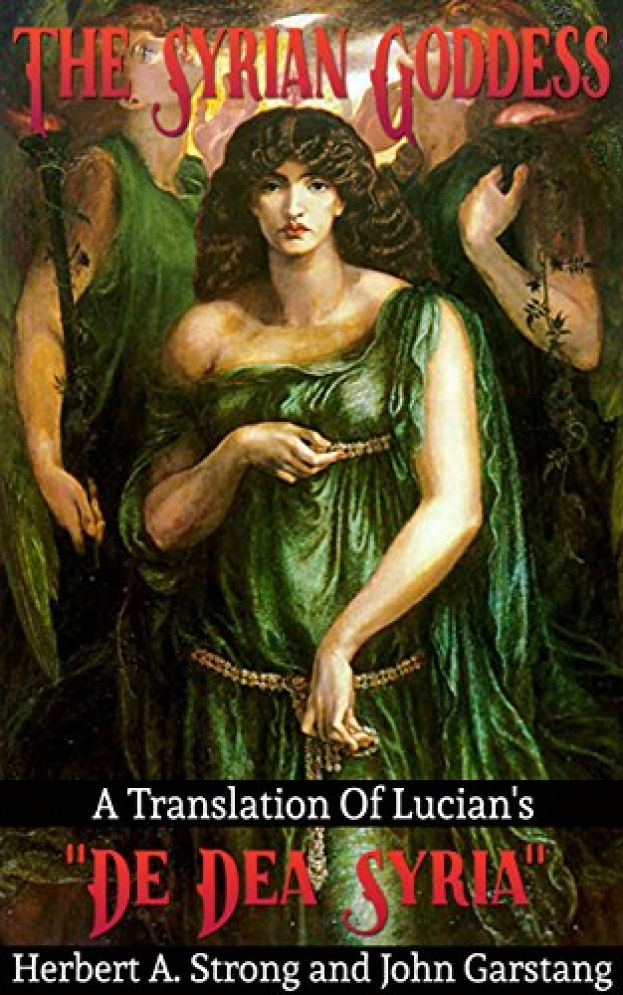
The Syrian Goddess

The Syrian Goddess (153)

Astarte Syriaca (1875-1877), by Dante Gabriel Rossetti (Public Domain Image)

Click to enlarge)

The Syrian Goddess

De Dea Syria, by Lucian of Samosata

by Herbert A. Strong and John Garstang

[1913]


View items...

The Syrian Goddess, Appendix

APPENDIX. EXTRACT I. From Maundrell's Travels. Page 153 (6th ed. 1749).

AN ACCOUNT OF THE AUTHOR'S JOURNEY TO THE BANKS OF THE EUPHRATES, ETC., IN HIS "JOURNEY FROM ALEPPO TO JERUSALEM." 1697.

Wednesday, April19th.

WE went east and by north, and in four hours arrived at Bambych. This place has no remnants of its ancient greatness, but its walls, which may be traced all round, and cannot be less than three miles in compass. Several fragments of them remain on the east side, especially at the east gate; and another piece of eighty yards long, with towers of large square stone extremely well built. On the north side I found a stone with the busts of a man and woman, large as life; and under, two Eagles carved on it. Not far from it, on the side of a large well, was fixed a stone with three figures carved on it, in Basso Relievo. They were two Syrens, which twining their fishy tails together, made a seat, on which was placed sitting a naked woman, her arms and the Syrens on each side mutually entwined.

On the west side is a deep pit of about 100 yards diameter. It was low, and had now water in it, and seemed to have had great buildings all round it; with the pillars and ruins of which, it is now in part filled up; but not so much, but that there was still water in it.

Here are a multitude of subterraneous aqueducts brought to the city; the people attested no fewer than fifty. You can ride nowhere about the city, without seeing them. We pitched by one about a quarter of a mile east of the city, which yields a fine stream; and emptying itself into a valley, waters it, and makes it extremely fruitful. Here perhaps were the pastures of the beasts designed for sacrifices. Here are now only a few poor inhabitants, tho anciently all the north side was well inhabited by Saracens; as may be seen by the remains of a noble Mosque and a Bagnio a little without the walls.

EXTRACT II. POCOCK'S DESCRIPTION OF THE EAST. Vol. II., Pt. I. (1745); pp. 166 and 167..

. . . Bambouch, commonly called by the Franks Bambych, and by the ancients Hierapolis, which was the Greek name that was given it by Seleucus; it was called also Bambyce, which seems to be the Syrian name still retained; and it is very remarkable that Hierapolis in Asia Minor has much the same name, being called Pambouk Calasi (the cotton castle). The Tables make it twenty-four miles distant from Zeuma on the Euphrates and from Ceciliana: They place it also seventy-two miles from Berya, though this is not above fifty from Aleppo. One of the Syrian names of this place was Magog; 1 which was a city of the Cyrrhestica, and is situated at the south end of a long vale, which is about a quarter of a mile broad, watered with a stream that is approached by the aqueducts of Bambych; and, to preserve the water from being wasted, it passes through this vale in an artificial channel or aqueduct which is built of stone on a level with the ground. The form of this site was irregular; some parts of the walls which remain entire, are nine feet thick, and above thirty feet high; they are cased with hewn stone both inside and out, and are about two miles in circumference; there was a walk all round on top of the walls, to which there is an ascent by a flight of stairs, which are built on arches; the wall is defined by towers on five sides, at the distance of fifty paces from each other, and there is a low fosse without the walls. The four gates of the city are about fifteen feet wide, and defended by a semi-circular tower on each side; the water that supplied the town, as I was informed, comes from a hill about twelve miles to the south, and the city being on the advanced ground, the water runs in a channel, which is near twenty feet below the surface of the earth, and in several parts of the city there are holes down to the water about five feet wide, and fifteen long, with two stones across, one about five feet, the other about ten feet from the top, in order, as may be supposed, to facilitate the descent of the water; it is probable that they had some machines to draw up the water at these holes. In the side of one of them I saw a stone about four feet long, and three wide, on which there was a relief of two winged persons holding a sheet behind a woman a little over her head; they seem to carry her on their fishy tails which join together, and were probably designed to represent the Zephyrs, carrying Venus to the sea.

At the west part of the town there is a dry bason, which seemed to have been triangular; it is close to the town wall; at one corner of it there is a round building which seems to have extended into a bason, and probably was designed in order to behold with greater conveniency some religious ceremonies or public sports. This may be the lake where they had sacred fishes that were tame.

About two hundred paces within the east gate there is a raised ground, on which probably stood a temple of the Syrian goddess Atargatis, thought to be the same as Ashteroth of the Sidonians, and Cybele of the Romans, for whose worship this place was so famous. I conjectured it to be about two hundred feet in front. It is probable that this is the high ground from which they threw people headlong in their religious ceremonies, and sometimes even their own children, though they must inevitably perish. I observed a low wall running from it to the gate, so that probably it had such a grand avenue as the temple at Gerrhae; and the enclosure of the city is irregular in this part, as if some ground had been taken in after the building of the walls to make that grand entrance; it is probable that all the space north of the temple belonged to it. A court is mentioned to the north of the temple, and a tower likewise before the temple, which was built on a terrace twelve feet high. If this tower was on the high ground I mentioned, the temple must have been west of it, of which I could see no remains; it possibly might have been where there are now some ruins of a large building, which seems to have been a church with a tower; to the west of which there are some ruinous arches, which might be part of a portico. It is said that not only Syria, Cilicia, and Cappadocia, contributed to the support of this temple, but even Arabia, and the territories of Babylon: To the west of the town there is a high ground, and some burial places; and so there are also to the north-east, where I saw inscriptions in the oriental languages, and several crosses. At a little distance from the north-east corner of the town there is a building like a church, but within it there is some Gothic work, such as is seen in antient mosques; and there is a room on each side of the south end; the whole is ruinous, but very strongly built, and they call it the house of Phila.

EXTRACT III. THE EXPEDITION TO THE EUPHRATES AND TIGRIS. By COLONEL CHESNEY. London, 1850. Vol. I., Ch. XVIII., pp. 420 and 421.

[Nine miles below the mouth of the Sajur, the fine Saracenic structure of Kal-at-en-Nejm commands the remains of the great Zeugma leading to Seroug, Haran, etc., and 11 miles directly south by west from thence on four hills, are the extensive remains of the castle and town of Kara Bambuche, or Buyuk Munbedj, 1 which contains some fine excavations near the river, and also a Zeugma, but in a more dilapidated state, being without the slopes which, when passing at Kal-at-en-Nejm, served for landing places at different heights of the river.]

Sixteen miles west by south of the latter, and 11 miles south-west of the former passage, at about 600 feet above the river Euphrates, the ruins of the Magog of the Syrians occupy the centre of a rocky plain, where, by its isolated position, the city must not only have been deprived of running water, but likewise of every other advantage which was likely to create and preserve a place of importance. Yet we know that the Syrian city of Ninus Vetus 1 flourished under the name of Bambyce 2 and subsequently of Hierapolis, 3 or the Sacred City of the Greeks, 4 and that it contained the rich temple which was plundered by Crassus; 5 finally it bore the name of Munbedj 6 or Bambuche, and had a succession of sovereigns in the 5th century of the Hijrah 7 . The ancient city was near the eastern extremity of Commagene, or Euphratensis, which had Samosat at the opposite extremity. 8

Some ruined mosques and square Saracenic towers, with the remains of its surrounding walls and ditch, marked the limits of the Muslim city; within which are four large cisterns, a fine sarcophagus, and, among other ancient remains the sculptured ruins of an acropolis, and those of two temples. Of the smaller, the enclosure and portions of seven columns remain; but it seems to possess little interest compared with the larger, which may have been that of the Assyrian and Phnician Astarte, 9 or Astroarche (queen of stars), which afterwards became the Syrian Atargatis, 1 or Venus Decerto. 2 Amongst the remains of the latter are some fragments of massive architecture, not unlike the Egyptian, and 11 arches from one side of a square paved court, over which are scattered the shafts of columns and capitals displaying the lotus.

A little way westward of the walls there is an extensive necropolis, which contains many Turkish, with some Pagan, Seljukian, and Syriac tombs; the last having some almost illegible inscriptions in the ancient character.


Footnotes

92:1 Caele habet--Bambycen, quae alio nomine Hierapolis vocatur, Syris vero Magog. Ibi prodigiosa Atargatis, Graecis autem Derceto dicta, colitur. Plin. Nat. Hist.V. 19.
95:1 Jisr Munbedj, two days from Haran. Jaubert's Edrisi, p. 155, tome VI.; Recueil dc Voyages, etc. Paris, 1840.
96:1 Ammian. Mar., XIV., c. viii.
96:2 The Syrian name of the city, which the Greeks afterwards called Hierapolis. Strabo, XVI., p. 747.
96:3 Ammian. Mar., XIV., c. viii.
96:4 Hierapolis, or Magog, in Syriac. Plin. lib. V., c. xxiii.
96:5 Plutarch in Crassus.
96:6 It was first built by the Persians, who had a fine temple there. Muhammed Ibn Sepahi's Clear Knowledge of Cities and Kingdoms.
96:7 Des Guignes, His. des Huns, tome II., p. 275.
96:8 Amm. Mar. XIV., c. viii.
96:9 There were temples of this goddess in Palestine. Jos. Ant., lib. V., c. xiv. 8; at Tyre, ibid.; against Apion, lib. I., s. 19; and at Sidon, 1. Kings, c. v., and v. 33.
97:1 Strabo, XVI., p. 748.
97:2 Herod., lib. I., c. cv., mentions the temple of Venus at Askalon, which, in Diod. Sic., lib. II., is called that of Decerto. There was another temple of Venus, or Atargatis, at Joppa. Plin., lib. V., c. xiii. and xxiii.

The Syrian Goddess, Analysis

LUCIAN'S "DE DEA SYRIA." ANALYSIS OF THE SUBJECT-MATTER.


PAGE


INTRODUCTORY


§ 1 .

The Sacred City

41

2 .

Origins of Temples and Shrines

42


THE OLDEST SHRINES AND CULTS OF SYRIA.


3 .

Hercules of Tyre

43

4 .

The Phœnician Astarte at Sidon. Legend of Europa

44

6 .

Aphrodite of Byblos and the Legend of Adonis

45

7 .

Legend of Osiris at Byblos

47

8 .

The Adonis River; its red colour

47

9 .

Cult of Aphrodite in the Lebanon at Aphaca

48

10 .

Hierapolis: The greatest Sanctuary. Its Pilgrims

49


LEGENDS OF FOUNDATION.


12 .

Ascribed by some to Deukalion. Story of the Deluge

50

13 .

Story of the Chasm

51

14 .

Assigned by others to Semiramis. Derceto, the Fish-Goddess

52

15 .

By others again to the Lydian Attis

55

16 .

Lucian shares the View that it was founded by Dionysus

57

17 .

Re-built by Stratonice

58

19 .

Story of Stratonice and Combabus

60


DESCRIPTION OF THE TEMPLE AND SHRINES.


31 .

The Inner Sanctuary. The Effigies

69

32 .

Comprehensive Character of the Goddess

71

33 .

Object between the God and Goddess

73

34 .

The Sun God

74

35 .

A Bearded Apollo

74

36 .

Image of the God borne by the Priests in Divination

75

§ 38 .

Atlas and other Images

77

41 .

Sacred Animals

78

42 .

The Priests and Temple Attendants

79


RITES AND CEREMONIES.


44 .

The Sacrifices

80

45 .

Sacred Lake and Fishes

81

47 .

Ceremony at the Lake

81

48 .

Ceremony at the Euphrates ("The Sea")

82

49 .

Festival of the Pyre

83


CUSTOMS AND INSTITUTIONS.


50 .

The Galli

84

51 .

Their Initiation Ceremonies

84

52 .

Their Burial

85

54 .

Animals used in Sacrifice. Sanctity of the Dove

85 , 86

55 .

Tonsure and other Customs of Pilgrims

87

57 .

Method of Sacrifice. The Libation

87 , 88

58 .

Human Sacrifice

88

59 .

Tattoo

89

60 .

Sacrifice of Hair

89

The Syrian Goddess, Introduction

INTRODUCTION THE SYRIAN GODDESS IN HISTORY AND ART.

THE dawn of history in all parts of Western Asia discloses the established worship of a nature-goddess in whom the productive powers of the earth were personified. 1 She is our Mother Earth, known otherwise as the Mother Goddess or Great Mother. Among the Babylonians 2 and northern Semites she was called Ishtar: she is the Ashtoreth of the Bible, and the Astarte of Phnicia. In Syria her name was Athar, and in Cilicia it had the form of Ate (Atheh). At Hierapolis, with which we are primarily concerned, it appears in later Aramaic as Atargatis, a compound of the Syrian and Cilician forms. 3 In Asia Minor, where the influence of the Semitic language did not prevail, her various names have not survived, though it is recorded by a later Greek writer as "Ma" at one of her mountain shrines, and as Agdistis amongst one tribe of the Phrygians 4 and probably at Pessinus. These differences, however, are partly questions of local tongue; for in one way and another there was still a prevailing similarity between the essential attributes and worship of the nature-goddess throughout Western Asia. 5

The "origins" of this worship and its ultimate development are not directly relevant to our present enquiry; but we must make passing allusion to a point of special interest and wide significance. As regards Asia Minor, at least, a theory that explains certain abnormal tendencies in worship and in legend would attribute to the goddess, in the primitive conception of her, the power of self-reproduction, complete in herself, a hypothesis justified by the analogy of beliefs current among certain states of primitive society. 6 However that may be, a male companion is none the less generally associated with her in mythology, even from the earliest historical vision of Ishtar in Babylonia, 7 where he was known as Tammuz. While evidence is wanting to define clearly the original position of this deity in relation to the goddess, 8 the general tendency of myth and legend in the lands of Syria and Asia Minor, with which we are specially concerned, reveals him as her offspring, 9 the fruits of the earth. The basis of the myth was human experience of nature, particularly the death of plant life with the approach of winter and its revival with the spring. In one version accordingly "Adonis" descends for the six winter months to the underworld, until brought back to life through the divine influence of the goddess. The idea that the youth was the favoured lover of the goddess belongs to a different strain of thought, if indeed it was current in these lands at all in early times. In Asia Minor at any rate the sanctity of the goddess's traditional powers was safeguarded in popular legend by the emasculation of "Attis," and in worship by the actual emasculation of her priesthood, 10 perhaps the most striking feature of her cult. The abnormal and impassioned tendencies of her developed worship would be derived, according to this theory, from the efforts of her worshippers to assist her to bring forth notwithstanding her singleness. However that may be, the mourning for the death of the youthful god, and rejoicing at his return, were invariable features of this worship of nature. It is reasonable to believe that long before the curtain of history was raised over Asia Minor the worship of this goddess and her son had become deep-rooted.

There then appeared the Hittites. In relation with Babylonia and Egypt, these peoples had already become known at the close of the third millennium B.C.; 11 and, to judge from the Biblical accounts, numbers of them had settled here and there throughout Syria and Palestine as early as the days of the patriarchs. 12 Nothing is known of their constitution and organization in these days, however; it is not until their own archives speak that we find them in the fourteenth century B.C. an already established constitutional power, with their capital at Boghaz-Keui. 13 Their sway extended southward into Syria as far as the Lebanon, eastward to the Euphrates, and at times into Mesopotamia, westward as far as Lydia, and probably to the sea coast. 1

FIG. 1.--THE HITTITE
Click to enlarge
FIG. 1.--THE HITTITE

Their chief deity was a God omnipotent, the "Lord of Heaven," 15 with lightning in his hand, the controller of storms ruling in the skies, and, hence identified with the sun. At Senjerli, in the north of (Seep. 6 .) Syria, he was represented simply with trident and hammer, 16 the emblems of the lightning and the thunder. But a sculpture at Malia, on their eastern frontier, shows him standing on the back of a bull, the emblem of creative powers, 17 and bearing upon his shoulder a bow, identifying him with a God of Arms, as was natural amongst warlike tribes,

FIG. 2.--THE CHIEF HITTITE GOD AND GODDESS AT BOGHAZ-KEUI. Click to enlarge
FIG. 2.--THE CHIEF HITTITE GOD AND GODDESS AT BOGHAZ-KEUI.

His enshrined image is found carved upon a rocky peak of the Kizil Dagh, 18 a ridge that rises from the southern plains on the central plateau of Asia Minor. In the sanctuary near Boghaz-Keui, clad like their other deities in the Hittite warrior garb, he has assumed a conventional and majestic appearance, bearded, with the lightning emblem in one hand and his sceptre in the other, 19 a prototype of Zeus. The scene of which this sculpture is a part represents the ceremonial marriage of the god with the Great Mother, 20 with the rites and festivities that accompanied the celebration, so far as mural decoration permits of treatment of such a theme. From these sculptures we learn that which is fundamental in the Hittite religion, namely, the recognition of a chief god and goddess, and though doubtless the outcome of the political conditions, the mating of these two deities at the proper season would seem to have been peculiarly natural and appropriate to the old established religion of the land. In this union, moreover, each god preserved its dignity and individuality, each cult maintained its proper ceremonies, yet the pair could be worshipped in common as the divine Father and Mother, the source of all life, human, animal, and vegetable.

With the goddess there is in these sculptures the image of the youth 21 who, in the original tradition, was her necessary companion, representing clearly, in this instance, her offspring, the fruits of the earth. 22 Indeed a later sculpture at Ivr seems to show this god, changed in form but still recognizable, 23 as the patron of agriculture, with bunches of grapes in one hand and ears of corn in the other. Even at Boghaz-Keui, this youthful deity is already accorded a smaller adjacent sanctuary, 24 devoted to his cult alone. Following the great deities are many other figures, forming, as it were, two groups. Accompanying the god are the minor gods of the Hittite States, who, for the most part, are similar to himself in general appearance. 25

FIG. 3.--THE HITTITE BULL-GOD AT EYUK. Click to enlarge
FIG. 3.--THE HITTITE BULL-GOD AT EYUK.

They are followed by priests and men who are taking part in the celebration, in which it would appear revelry and dancing were not omitted. In the train of the goddess, who like her son stands upon the back of a lioness, there follow two other goddesses of smaller size, but similar to herself in appearance, grouped together on a double-headed eagle. 26 These are followed by a number of figures of priestesses clad like the goddess; and, surveying all, the noble figure of the King-Priest clad in a toga-like garment, and holding a curving lituus, the emblem of his sacred office. 27

That which seems to us in our present enquiry the chief feature of these sculptures is that the worship is clearly common to the god and the goddess, who occupy the leading positions in equal prominence. 28 This interpretation is supported substantially by sculptures which decorate the main entrance of the neighbouring Hittite city of Eyuk. The corner stone on the right represents the goddess seated, 29 receiving the worship of her priests; while the corresponding corner stone on the left shows a Bull-God on a pedestal, 30 with the High Priest and Priestess ministering at his altar. The Bull we have seen to be identified with the chief Hittite deity, which he seems here to replace.

This conclusion is of importance in our present subject, for Lucian (in 31 ) describes the chief sanctuary of the great Syrian temple at Hierapolis as containing the common shrine of "Zeus" and "Hera." His very use of these names suggests the wedded character of the deities. Had the shrine been that of the Great Mother alone, the god would not have been accorded an equal prominence near the common altar; he would have been an "Attis," not a "Zeus." The goddess herself would have been in the Greek mind a Rhea or Aphrodite, not a Hera; and Lucian was sufficiently familiar with his subject to be able to discriminate. As it is, he is perplexed in his identification of the goddess by her very comprehensive attributes, which included the many virtues and powers to which the Greek mind assigned separate personifications, known by different names. Speaking generally," he says, "she is undoubtedly Hera, but she has something of the attributes of Athene and of Aphrodite, and of Selene and of Rhea and of Artemis and of Nemesis and of the Fates."

To sum up this stage of our argument, the chief Hittite deity is a god of the skies, identified with the sun; he is all powerful, and in symbolism is identified with the Bull. In formal sculpture he resembles Zeus. The chief Hittite goddess is of comprehensive character: the emblems in her hand and her youthful companion reveal the nature-goddess; while the mural crown, the lion, and double axe are special symbols of the Great Mother surviving with the Phrygian Kybele (or Rhea). 31 The central Hittite cult is that of this mated pair, the Bull-god Zeus and the Lion nature-goddess. The central cult-images of Hierapolis, as described by Lucian, are exactly similar. There are the mated pair of deities: the god is indistinguishable from Zeus, 32 and he is seated on bulls; while the goddess, who is called for brevity "Hera," as the consort of "Zeus," embodies attributes of the nature-goddess or Great Mother, and she is seated on lions.

The central cult at Hierapolis is thus apparently identical with that which the Hittites had established in the land 1500 years before Lucian wrote. It remains to examine such independent evidences as are available from literary and archaeological sources, to see whether they bear out the argument. We shall find our main conclusion remarkably substantiated. But before passing from the evidence of the Hittite monuments, inasmuch as Lucian's narrative is chiefly descriptive of the developed cult of the nature-goddess (with the god submerged), it is of special interest to notice how widespread are the evidences of her worship in the Hittite period. We have spoken of two of her shrines in the interior, at Boghaz-Keui and Eyuk. There is a third at Fraktin, in the mountainous country south of Carea. Here the sculptures are carved on the living rock overlooking a stream. 33 The goddess is represented seated behind an altar on which appears her bird. She seems in this case uniquely to wear the Hittite hat, but the carving is not carried out in detail. Before the altar her priestess is pouring an oblation. The counterpart to this group is a Hittite god and worshipper, while between them is a draped altar of special character. 34 One of the earliest of her images, according to Pausanias, 35 is that which may still be seen on Mount Sipylus, near to Smyrna on the western coast a gigantic figure of the goddess seated, carved in the living rock, and distinguished as Hittite handiwork by certain hieroglyphs carved in the niche. 36 Further east, in Phrygia, one of different character has been found at Yarre. 37 In this sculpture, which is on a movable stone, we have one of a series of representations in which the goddess, seated as always, is worshipped in a ceremonial feast or communion. The funerary character of this class of monument is attested by a similar sculpture from Karaburshlu, 38 near Senjerli, in the north of Syria, and other illustrations are found at Marash, where the cup, mirror, and girdle are instructive details of the scene. 39 The conception of the Great Mother as goddess of the dead is by no means strained or unnatural, for the resurrection and future life is a dominant theme in the universal myth associated with her. And just as the dead year revived in springtime through her mediation, so she may have been entreated on behalf of the dead for their well-being or their return to life. 40 Thus a second class of similar monument represents the goddess enshrined, with a votary in the act of worship or adoration. Such are the two sculptures at Eyuk, one from Sakje-Geuzi, and three from Marash, in the north of Syria. In one of these, from the last-named place, the goddess is distinguished by the child upon her knee, and a mirror and bird accompany the group, which is further remarkable for the lyre before her upon the altar. In others from this place, a bow appears, held in one case in the hand of the worshipper, who proffers it towards her above the altar as though dedicating it to her service and entreating her blessing. A further sculpture in which the goddess plays a part has been found at Carchemish, but details of the scene are not yet available. Other sculptures, resembling these in general appearance, at Senjerli, 41 Malia, and possibly at Boghaz-Keui itself, in which the personages taking part in this ceremonial feast are male and female, may possibly be modifications representing the local king and queen as High Priest and Priestess, or impersonating the god and goddess in the communion rite.

In Glyptic art 42 two varieties of goddess are apparent; the one is robed and seated, and for the most part resembles the deity in her distinctively Hittite character 43 ; the other is naked, and she has been supposed to have had her origin in this aspect in Syria, whence she penetrated further east. 44 This latter form of goddess has its counterpart in numerous small clay and bronze images, of votive character, which may be found in many places of Northern Syria. 45 In these the goddess is represented as naked, with her hands proffering her breasts. A similar deity, though winged, is represented on a sculptured but undated monument from Carchemish. 46 This is not, however, the Hittite goddess as she is known in Asia Minor, where she is uniformly represented as seated and robed, and commonly wearing a veil which is thrown back from the face. Nor is she the Dea Syria described by Lucian, 47 though commonly identified with her by modern writers. The reason for this identification is probably to be found in the general tendency towards the development of human passions in connection with the Syrian cults, and emphasized in the special characteristics of Astarte of Phnicia as the goddess presiding over human birth. 48

The Hittites came and went; their dominion over Asia Minor was subject to repeated onslaughts on every side, from the Egyptians, the Assyrians, the Vannic tribes, the Cimmerians, the Muski and the Phrygians. Their empire, moreover, was held together only insecurely by a system of confederation and alliance which was not apparently of mutual seeking, but imposed by the Hatti during the period of their supremacy at Boghaz-Keui; and from the 12th century B.C. it began rapidly to disintegrate. There is little record of the subsequent events: the Assyrian annals reveal only a series of sporadic coalitions in Syria, to resist their oncoming, and a temporary revival of the Hittite States in that region during the 10th and 9th centuries B.C. Before 700 B.C. the fall of Carchemish, followed by the submission of the region of Taurus and Marash, brought all semblance of Hittite power to an end. What had happened meanwhile in Asia Minor in the struggles between the Phrygians and the Hittites can only be imagined, but in any case by the year 550 B.C., when Crsus of Lydia crossed the Halys and took possession of Pteria (Boghaz-Keui), he found it still in the hands of a Syro-Cappadocian population: thereafter the political history of Asia Minor becomes largely that of Persia and Macedonia, of Greece and Rome.

With the Hittites fell their chief god from his predominant place in the religion of the interior. Whether, indeed, he did not survive elsewhere than at Hierapolis, in various local guises or legends, noticeably at Doliche, 49 is a problem into which it would be irrelevant to enter. But the Great Mother lived on, being the goddess of the land. Her cult, modified, in some cases profoundly, by time and changed political circumstances, was found surviving at the dawn of Greek history in several places in the interior. Prominent among these sites is Pessinus in Phrygia, a sacred city, with which the legend of Kybele and Attis is chiefly associated. Other districts developed remarkable and even abnormal tendencies in myth and worship. At Comana, in the Taurus, where the Assyrian armies were resisted to the last, and the ancient martial spirit still survives, she became, like Isthar, a goddess of war, identified by the Romans with Bellona: 50 In Syria, again, a different temper and climate emphasized the sensuous tendency of human passions. In all these cases, however, there survived some uniformity of ceremonial and custom. At each shrine numerous priests, called Galli, numbering at Comana as many as 5,000, took part in the worship. Women dedicated their persons as an honourable custom, which in some cases was not even optional, to the service of the goddess. The great festivals were celebrated at regular seasons with revelry, music, and dancing, as they had been of old, coupled with customs which tended to become, in the course of time, more and more orgiastic. These are, however, matters of common knowledge and may be studied in the classical writings. Lucian himself adds considerably to our understanding of these institutions; indeed his tract has been long one of the standard sources of information, supplying details which have been applied, perhaps too freely, to the character of the general cult. Religion in the East is a real part of life, not tending so much as in the West to become stereotyped or conventionalized, but changing with changes of conditions, adapted to the circumstances and needs of the community. 51 So, wherever the goddess was worshipped there would be variety of detail. It is, however, remarkable in this case, that throughout the Hittite period, though wedded and in a sense subordinate to a dominant male deity, and subsequently down to the age at which Lucian wrote, she maintained, none the less, her individuality and comprehensive character. Thus, while Lucian is concerned in his treatise with the cult of an apparently local goddess of northern Syria, we recognize her as a localised aspect of the Mother-goddess, whose worship in remoter times had already been spread wide, and so explain at once the points of clear resemblance in character and in worship to other nature-goddesses of Syria and Asia Minor.

From this general enquiry among the most ancient monuments of the country into the historical origins of the dual cult at Hierapolis, and the character of the goddess, we pass in conclusion to the particular local evidences, more nearly of Lucian's age, that serve to illustrate and amplify his descriptions. There are two chief sources: firstly, the local coins, 52 ranging in date from the time of Alexander down to the 3rd century A.D.; and secondly, the literary allusions of Macrobius, who lived and wrote about A.D. 400. The feature of these branches of evidence that first strikes the enquirer is their obvious reference to a cult and worship which did not change in its essential features throughout the seven centuries of political turmoil which they cover. This enables us to realize how the cult might have been originally established during the remoter days of Hittite supremacy in the land.

The coins are not numerous, but they are profoundly instructive: in particular, one of these, which we shall presently describe, furnishes a direct illustration of Lucian's description of the sanctuary; while two others, which are among the earliest, corroborate in certain details the main point of our argument. In general also, these coins, even those of the later dates, uniformly reveal the goddess as a lion deity; for wherever her full form is shown, she is seated on a lion 53 or on a lion-borne throne. 54 Commonly, however, only her head or bust is given, e.g., in one case, the full face 55 with dishevelled or possibly "radiate" hair; in another, the profile, 56 showing upon her head a mural crown with her veil thrown back. Her name, Atargatis, is recognizable on these coins, though it takes several forms. 57 On this point, therefore, the local evidence confirms the records of Strabo, Pliny, and Macrobius. 58 The male deity has almost disappeared in the later coins, surviving chiefly in his symbol, the bull, which in some cases occurs singly as a counterpart to the lion or lion-goddess on the opposite side of the coin, 59 and in other cases is shown in the grip of the lion as though reminiscent of the ultimate triumph of the cult of the goddess over that of the god. 60 In similar fashion, the coins of the Roman Empire show an imperial eagle triumphing above the lion 61 in several examples.

In two cases, however, the figure of the god does survive. One of these coins of the period of Alexander, 62 shows upon the obverse the figure of the god seated upon a throne, holding in his left hand a long sceptre, and in the right hand something which is not distinct. On the reverse side of the coin, the goddess is represented clad in long robes, with girdle, seated upon a lion; she holds in her left hand, it would seem, the lightning trident. 63

Instructive as this coin is, it yields in interest to another of the 3rd century A.D., in which the two deities are shown seated on their thrones, 64 on either side of a central object, surmounted by a bird, exactly like the picture of the sanctuary, which Lucian describes in 32 . The reverse of the coin bears the legend ΘΕΩΙ CϒΡΙΑC (ΙΕΡΟΠ)ΟΛΙΤΩΝ. The object in the centre is an icula, surmounted by a dove, and enclosing apparently a Roman standard. 65 To the right is the god, bearded, clad in a long tunic, with a tall calathoson his head, a sceptre in his right hand; he is seated, as it were, upon bulls, but actually upon a throne to which the head and forepart of bulls form the side-piece. On the right-hand side, Atargatis, the Syrian Goddess, is seated similarly upon a throne which two lions support; she is clothed and girdled, and wears a broad calathosor crown upon her head. In the field of the coin, below these representations, there appears a lion. The subject of this coin, is, as we have said, an actual illustration of Lucian's description of the sanctuary: his words are as follows:--"In this shrine are placed the statues, one of which is Hera, the other Zeus, though they call him by another name. Both are sitting; Hera is supported by lions, Zeus is sitting on bulls. . . . Between the two there stands another image of gold, no part of it resembling the others: this possesses no special form of its own, but recalls the characteristics of the other gods. The Syrians speak of it as Semen [σημήϊον], 66 its summit is crowned by a golden pigeon." It is only in reference to this central object that the description fails, though, in both cases, a bird is perched upon the top; and doubtless therefore, the design upon the coin is intended to illustrate something similar to that which Lucian describes.

FIG. 4.--HITTITE DRAPED ALTAR-PEDESTAL: FRAKTIN. Click to enlarge
FIG. 4.--HITTITE DRAPED ALTAR-PEDESTAL: FRAKTIN.

The object upon he coin is formal, architectural, and Roman in character; while Lucian tells us particularly that the object between the deities "recalled characteristics of the other gods." We are reminded by this reference of a feature in Hittite sculptures, notably those at Fraktin. Here the pillars of the altars of the goddess and of the god take the form of a human body from the waist downwards, swathed in many folds of a fringed garment or robe; and upon the altar of the goddess appears a bird, doubtless a pigeon or dove, which was in all tradition her peculiar emblem. 67 Lucian's description is more aptly explained by this symbolism: the object as seen upon the coin had clearly become conventionalized in Roman times. However that may be, the dual character of the cult, the god identified with the bull, the goddess with the lion, is remarkably substantiated.

Further instructive details with regard to these deities are given by Macrobius, and we may appropriately quote from him the following significant passage 68 :--"The Syrians give the name Adadto the god, which they revere as first and greatest of all; his name signifies The One.' They honour this god as all powerful, but they associate with him the goddess named Adargatis, and assign to these two divinities supreme power over everything, recognizing in them the sunand the earth. Without expressing by numerous names the different aspects of their power, their predominance is implied by the different attributes assigned to the two divinities. For the statue of Adadis encircled by descending rays, which indicate that the force of heaven resides in the rays which the sun sends down to earth: the rays of the statue of Adargatisrise upwards, a sign that the power of the ascending rays brings to life everything which the earth produces. Below this statue are the figures of lions, emblematic of the earth; for the same reason that the Phrygians so represent the Mother of the gods, that is to say, the earth, borne by lions." The character, then, of the god and goddess in the sanctuary of the temple, the heart of the cult, remained still the same in the fourth century A.D. as it had been in the beginning. The words which Macrobius uses would be equally descriptive of the special attributes of the Hittite Sun-God and the Hittite Earth-Goddess, which we have described, and the reference to Cybele of Phrygia is also significant. 69 There is indeed a faint memory in tradition of a son to Atargatis, 70 corresponding to the youthful companion of the Hittite goddess at Boghaz-Keui, and hence doubtless to the "Tammuz" and "Attis" of the various legends; and in one of the effigies at Hierapolis it is possible to see a later aspect of this deity corresponding to the Hittite Sandan-Hercules of Ivr. 71

If any doubt remained as to the historical origins of the cult at Hierapolis, it would be dispelled by another coin, one of the earliest of the site, on the face of which is the picture and name of the goddess, Atargatis. 72 On the reverse of the coin is seen the priest-dynast of the age (about 332 B.C.): his name is Abd-Hadad, the "servant of Hadad."

FIG. 5.--COIN OF HIERAPOLIS, DATE B. C. 332 Click to enlarge
Atargatis, the Syrian Goddess. Abd-Hadad, the Priest-King. FIG. 5.--COIN OF HIERAPOLIS, DATE B. C. 332. (Note IN THE BIBL. NATIONALE, PARIS.) Scale 3: 2.

He is represented at full length, but owing to the wearing of the coin, some of the details are lost. The robe upon him, however, recalls that of the Hittite priest; and the hat which he wears is unmistakably the time-honoured conical hat distinctive of the Hittite peoples. Except in such local religious survival as is here illustrated, this hat must have long fallen into disuse.

In short, the words of Macrobius, which corroborate and amplify Lucian's description of the central cult at Hierapolis, are strictly apposite to the chief Hittite god and goddess. The coins of the site illustrate the same motive; and on one of the earliest of them, features of Hittite costume are found still surviving four hundred years after the final overthrow of the Hittite States in Northern Syria.

J. G.

Footnotes

1:1 We do not wish to imply a necessarily common "origin" or real identity in the various local aspects of this divinity.
1:2 Among the pre-Semitic population she appears as Nanai. Cf. Ed. Meyer in Roscher's Lexikon--ASTARTE.
1:3 See n. 57 , p. 21 , and n. 25 , p. 9 . Cf. Frazer, Adonis, Attis, and Osiris, p. 130, n. 1; Ed. Meyer, Gesch. des Alth., i. (1st edn.), p. 247, 205.
1:4 Strabo, x. iii. 12; xii. ii. 3.

The probable mention of "Astarte of the Land of the Hittites," as the leading Hittite goddess among the witnesses to the treaty with Egypt (c. B.C. 1271), must be assumed at present to refer to Northern Syria. The allusion is none the less significant, implying an identification of the Hittite deity with Ishtar. This rendering of the Egyptian text is due to an emendation suggested by Mler (Vorderas. Ges. VII., 5), and accepted as probable by Breasted, Ancient Records of Egypt, III., 386, n. a.
2:5 Cf. Inter alia, De Vog, Manges darchlogie orientale, pp. 45, 46, and Hauvette-Besnault, "Fouilles de Dos," Bull. Corr. Hell. (1882), p. 484. ff.
2:6 Cf. Frazer, Adonis, Attis, and Osiris, pp. 80, 220; Farnell, Cults of the Greek States, ii., p. 628, iii., p. 305; Ed. Meyer, Die Androgyne Astarte, Z. D. M. G.(1875), p. 730.
2:7 Cf. Pinches, on the Cult of Ishtar and Tammuz, Proc. S. B. A., xxxi. 1909, p. 21.
2:8 Cf. the words, "My son, the fair one" (Pinches, Proc. S. B. A.1895, p. 65, col. 1, l. 9, of the Lamentation). On the other hand, in W. Asia Inscr., ii. pl. 59, 1, 9, Tammuz is said to have been the son of Sirdu. In the epic of Gilgamesh (Ed. Unguad, Das Gilgamesch-Epos, 1911, l. 46, 47) Tammuz is described as the Beloved of [Ishtar's] Youth (cf. King, Babylonian Relig., p. r60). Cheyne, Encyc. Bib., col. 4,893, pointed out that one interpretation of this name refers to Tammuz as a son of life--true divine child.
3:9 By some ancient writers Attis was definitely regarded as the son of Kybele, e.g., Schol. on Lucian, Jupiter Tragus, 8 (p. 60, Ed. Rabe); Hippolytus, Refutatio omn. Haeresium, v. 9, cited by Frazer, op. cit., p. 219, q.v.: cf. also Farnell, Greece and Babylon, p. 254, and Cults, ii., p. 644, iii. 300, etc. The legends appear in Ovid (Fast. iv. 295 ff.), Pausanias (vii. 17, ix. 10). Though commonly regarded as of shepherd origin (cf. Diod. iii., iv., Theocr. xx. 40; Tertul. de Nat.i.), he was deified and worshipped in common with Kybele in the Phrygian temples (Paus. vii. xx. 2). It is, of course, to his character or fundamental attributes that we allude in our narrative.
3:10 This is not, however, the explanation suggested by Frazer (op. cit., p. 224-237); or by Farnell (Cults, iii., pp. 300-301; Greece and Babylon, p. 257, and n. 1). On the custom itself, see the stirring poem by Catullus, "The Atys," No. LXIII.
4:11 King, Chronicles i., pp. 168, 169; Garstang, Land of the Hittites(hereafter cited as L. H.), p. 323, notes 2, 3; L. H.p. 77, p. 1, p. 323, n. 4.
4:12 Genesis xxiii., xxv. 9, xxvi. 34, xlix. 29, 32. Cf. Ezekiel, xvi. 3, 45; L. H., p. 324, n. 2.
4:13 Winckler, Mitt. d. Deut. Orient. Ges., 1907, No. 35, pp. I, 75. The texts are translated in chronological order by Williams, Liv. Ann. Arch., iv. 1911, pp. 90, 98.
4:14 L. H., p. 326. The sculptures of Sipylus and Karabel (ibid., pp. 167-173) are evidence of the extension of the Hittites to near the western coast.
5:15 Egyptian treaty. Cf. L. H., p. 348. The name of the god in Hittite is not known. Among the Vannic tribes it appears as TESHUB; in Syria, etc., as HADAD; indeed the latter is the general Semitic name, for Lehmann-Haupt has shown that the name of the Assyrian storm-god, as ideographically written, should be read Adad rather than Ramman. (Sitz. Berl. Ak. Wis., 1899, p. 119.) On points of resemblance to YAHWEH see the suggestive paper by Hayes Ward, Am. Jour. Sem. Lang. and Lit., xxv., p. 175.
5:16 L. H., pl. lxxvii., p. 291. Ausgr. in Sendschirli, pl. xli. (i). On the hammer or axe as an emblem of the thunder, etc., cf. Montelius, "The Sun-god's Axe and Thor's Hammer," in Folk-lore, xxi., 1910, p. 60.
6:17 Our Fig. 1, L. H., pl. xliv., Liv. Annals Arch., ii. (1909), pl. xli (4). Cf. the familiar representation in glyptic art of Hadad leading a bull, e.g., Ward, Seal Cyl. of West Asia, Ch. xxx., figs. 456, 459, 461, etc.
6:18 Proc. S. B. A., 1909 (March), pl. vii.; L. H., p. 180, n. 2. The god is identified by an ideogram in the inscription.
7:19 See our Fig. 2 , drawn from casts exhibited in the Liverpool Public Museums. Cf. L. H., pl. lxv.
7:20 L. H., p. 239. That this is a divine marriage scene is generally accepted (Frazer, op. cit., p. 108; Farnell, Greece and Babylon, p. 264; cf. Perrot and Chipiez, Histoire de lArt, iv., p. 630), but it is the recognition that the chief god concerned is not a Tammuz or Attis (as supposed by Frazer, op. cit.p. 105; Ramsay, Journ. Roy. A. S., 1885, pp. 113-120, and others), but the Hittite "Zeus," a form of Teshub or Hadad, that is new in our interpretation and important for our present subject. On the general question of the Hieros Gamos, cf. Daremberg, Saglio and Pottier, Dictionnaire des Antiquit, 1904, p. 177; Farnell, Cults, i., p. 184 ff; Pausanias, ix., 3; and Frazer, The Golden Bough(1890), pp. 102-103. An oriental version of the rite is suggested in the legend recorded by ian (Nat. Animalium, xii. 30) that Hera bathed in the Chaboras, a tributary of the Euphrates, after her marriage with Zeus. Cf. the marriage of Nin-gir-su and Bain Babylonian mythology (Thu. Dangin, Vorderas Bibl., i., p. 77; cf. Jastrow, Relig. of Bab. and Assyr., 1898, p. 59). The details of the scene seem to indicate that the shrine is essentially that of the goddess (cf. Kybele as a goddess of caves, Farnell, Cults, iii., p. 299, and Ramsay, Relig. of Anatolia, in Hastings' Dict. Bibl., extra vol., p. 120), and that the image of the god was carried thereto for this ceremony. (Cf. our note 48 , p. 77 , also Farnell, Greece and Babylon, p. 268). It is of interest to recall Miss Harrison's arguments, Classical Rev.(1893), p. 24, that Hera had a husband previous to Zeus; also the association of Dodonian Zeus (Homer, Il., xvi. 233; Od., xiv. 327, xvi. 403; Hesiod ap. Strabo, p. 328) with the Earth-Mother in Greece (cf. Farnell, Cults, i., p. 39).
8:21 L. H., pl. lxv. Representations of the youthful god are rare (cf. Farnell, Greece and Babylon, p. 252); the alternative interpretation would be to see in this image an Attis-priest, clad like the god; similarly the second of the two female forms on the double eagle would be the priestess of the goddess in front. This would seem to be made possible by the analogy of a sculpture from Carchemish (Hogarth, Liv. Annals. Arch., pl. xxxv., i.); but the symbols defining all the figures indicate equally their divine rank. This view is accepted by Frazer, op. cit., p. 106.
8:22 For the tradition of a son to Atargatis, completing the analogy of a divine triad, see below, n. 70 .
8:23 L. H., pl. lvii. and p. 195. Frazer, op. cit., pp. 98, 100.
8:24 L. H., pl. lxxi. and p. 241.
9:25 The first two may be varied aspects of the great god; the seventh is, however, identical with the local deity of Malia. L. H.pl. xliv. (ii.).
9:26 L. H., lxv. The double eagle is found at Eyuk: we may see in this group the nature-goddess in a local dual aspect.
10:27 L. H., pl. lxviii. On his head a cap (cf. Lucian, 42). His kingly rank is denoted by the winged disc surmounting his emblems.
10:28 That the male god was really dominant would appear from the fact that his name takes first place in the list of Hittite deities in the Egyptian treaty. L. H., p. 348. This agrees with Macrobius' allusion to Hadad of Hierapolis (see below, p. 25 ). The general prevalence of his worship among the Hittite and kindred peoples is seen in the Hittite archives, the Tell el Amarna tablets, and the Vannic inscriptions. The dual character of the cult is suggested by the seals of the treaty in question, by some of the T. A. letters (e.g., Winckler, Nos. 16, 20, from which the name of the chief goddess among the Mitanni would seem to be accepted as Ishtar), and possibly by the Hittite-Mitanni treaty.
10:29 L. H., pl. lxxiii.
10:30 See our Fig. 3 . The bull freely replaces the god on coins of Hierapolis, Tarsus, etc. (B. M. Cat., Galatia, etc. Cf. also Babon, Les Penses Achides, pl. li., vol. 8, pl. xxiv., pp. 20, 22). So also in glyptic art (cf. Hayes Ward, Seal Cyl. of West Asia, ch. lii.). Both at Eyuk and at Malia, in the sculpture described above, rams and goats are seen led to the altar as for sacrifice, and the goat accompanies the leading god at Boghaz-Keui. It is interesting to recall the term αἰγοφάγος applied to Zeus (Farnell, Cults, pp. 96, 750, n. 48), and the βουφόνια, a chief rite in the Athenian Diipoleia in the festival of Zeus Polieus. So also in the Cult of Zeus of Attica, a god of agriculture, eating the ox was regarded as a sacrament, the ox p. 11 being regarded as of kin to the worshippers of the god. On Dionysus as a bull and a goat, see Frazer, The Golden Bough, V. (1912), ch. ix. Cf. also our n. 60 , p. 22 .
12:31 See note 69 below.
12:32 Cf. 31 , p. 70 . "The effigy of Zeus recalls Zeus in all its details--his head, his robes, his throne, nor even if you wished it could you take him for another deity." The term ZEUS-HADAD would aptly describe the Hittite deity: it is suggested by the fact that the god of Hierapolis identified with "Zeus" by Lucian is called "Hadad" by Macrobius. Cf. below, p. 25 .
13:33 L. H., pp. 150, 151 and pl. xlvii.
13:34 See Fig. 4 , and below, p. 24 .
13:35 Paus. iii., xxii. 4.
13:36 L. H., pp. 168-170 and pl. liii.
13:37 Jour. Hell. Stud., xix., pp. 40-45 and Fig. 4; L. H., pp. 164-165.
13:38 Corp. Inscr. Hit.(Messerschmidt) (1900), p. 20 and p. xxvi. L. H., pp. 99100, Cf. ibid., p. 100, n. 2.
14:39 Humann and Puchstein, Reisen, Atlas, pl. xlvii-xlix.; L. H., pp. III-112, 119.
14:40 The power of Ishtar to raise the dead is implied in her threat to do so, should the door of Hades not be opened to her. Cf. Pinches, Proc. S. B. A., xxxi. (1909), p. 26. On Kybele (Matar Kubile) as Goddess of the Dead in Phrygian art, see Ramsay, Jour. Hell. Stud., v., p. 245.
15:41 L. H., pl. lxxv., No. 1, etc.
15:42 Cf. Hayes-Ward, The Seal Cylinders of Western Asia, esply. Chs. xlix., 1.
15:43 E.g., ibid., No. 898, where she wears the Hittite hat, and the feet of her throne suggest lion's paws. The lion appears definitely below the throne in No. 908. In No. 907, curiously, she stands on a bull. She is accompanied by a bird in these, as in Nos. 904, 908, 943.
15:44 Ibid., p. 162. The myth of Ishtar's Descent to Hades, however, reveals the goddess naked at one stage of her yearly journey. Ed. Meyer is of opinion (Roscher's Lexikon--ASTARTE) that some of the Babylonian clay figures of the naked goddess are archaic and local.
15:45 Specimens are exhibited in the Hittite gallery of the Liverpool Public Museums.
15:46 Hogarth, Liv. Ann. Arch., ii. (1909), p. 170, Fig. 1.
16:47 Atargatis of Hierapolis is always represented as robed on coins of the site, see below, p. 21 , and Figs. 5 and 7 , also the frontispiece . There is a small bronze figure in the Ashmolean Museum at Oxford (Aleppo, 1889, No. 794), which possibly represents the goddess. The head-dress is debased; but the other features--hair, necklace, dress, and facial expression--are' characteristic and instructive. On the character and relations of the goddess in general, cf. Cumont, "Dea Syria," Real Encyc.(Wissowa), iv., col. 2237.
16:48 Prof. Lehmann-Haupt reminds me that the name Mylitta or Mullitta applied to the goddess by Herodotus (I., 131, 199) is derived from muallidatu: The Giver (or Helper) of Birth.
17:49 Doliche is near Aintab, not far north-west from Hierapolis. The worship of Jupiter Dolichenus was introduced to the Roman army by Syrian soldiers (cf. Cumont, Oriental Religions in Roman Paganism, pp. 113, 117, 147 and 263, n. 23; also in Wissowa's Real Encyc.iv., DEA SYRIA, col. 2243). The god stands on a bull holding the lightning and the double axe. (See the illustration in Roscher's Lexikon, DOLICHENUS, and especially the fine sculpture at Wiesbaden, published in the Bonner Jahrbher, 1901, pl. viii., and compare with the Hittite Hadad of Malia, our Fig. 1 ). His consort is a lion goddess. She is described on inscriptions (C. I. L., vi. 367, 413) by the name "Hera Sancta," which is parallel to the references to the Syrian goddess on inscriptions found at Delos, where the cult had been established by colonists during the second century B.C. ("Fouilles Delos," Bull. Corr. Hell., 1882, p. 487); thus (in No. 15), Ἁγνῃ Ἃφροδίτῃ Ἀταργάτι καὶ Ἀδάδου; (No. 18) Ἀταργάτει ἁγνῇ θεῷ; (No. 19) ἁγνῆι θεῶι Ἀταργάτει. (Cf. Cumont, DEA SYRIA, loc. cit.col. 2240; also the "Zeus Hagios" of a Phnician coin, p. 18 Hill. Jour. Hell. Stud., xxxi., p. 62). The Anatolian character of the god is recognised by Kan, De Jovis Dolicheni cultu(1901), p. 3 ff. Cf. also, F. C. Andreas (in Sarre's D. Oriental. Feldzeichen), in KLIO III. (1903), pp. 342-343. So, too, the god and goddess of Heliopolis (Baalbek), identified with the bull and lion respectively, resemble the Hadad and Atargatis of Hierapolis and the original Hittite pair of divinities (cf. Dussaud in Rev. Arch., 1904, pt. ii., p. 246, etc.). Cf. also, the "Jupiter" of the Venasii, Strabo, xii., ii. 6. The subject of the Phnician and Cilician analogous mated divinities is more complex, but both regions were at one time or another within the Hittite political sphere of influence. An instructive cubical seal from near Tarsus, now in the Ashm. Mus., Oxford (publ. Sayce, Jour. Arch. Inst., 5887, pl. xliv., Messerschmidt, Corpus Inscr. Hit., pl. xliii., i.), shows upon its chief face the two Hittite divinities in characteristic aspect, but the other faces are devoted to the cult of the goddess.
18:50 An emblem of the priesthood of Bellona was the double axe. Cf. Guigniant, Nouv. Gall. Mythol., p. 120; also Montelius, in Folk Lore, xxi. (1910), i. p. 60 ff.
19:51 Cf. the pertinent remarks by Robertson-Smith, Relig. Sem., especially p. 58, on the change of the Mother Goddess from an unmarried to a married state.
20:52 Our chief sources in this regard have been the coins in the Num. Dept. of the Brit. Mus. and in the Bib. Nationale, Paris; Wroth, Cat. of Coins of Galatia, Cappadocia, and Syria(1899); Waddington, in Revue Numismatique, (1861). Six, in Num. Chron.(1878). Babon, Les Perses Achides(1890); Luynes, Satrapies et Phicie, (1846); Neumann, (Pop. et Regum) Numi Veteres inediti(1783). Hill, on some "Gro-Phoen. Shrines" (Jour. Hell. Stud., xxxi. 9, 11), and "Some Palestinian Cults" (Proc. Brit. Acad., v, 1912). To Mr. Hill we are specially indebted for suggestions and help in this enquiry.
21:53 See our frontispiece , No. 8; Num. Chron., loc. cit.; also B. M. bronzes, No. 51 (date, Caracalla; cf. Wroth, Cat., pl. xvii., No. 16).
21:54 See frontispiece , No. 4, also Fig. 7 ; Num. Vet., loc. cit.; also B. M. bronzes, Nos. 47, 48, 49 (date, Caracalla, 198-217 A.D.).
21:55 Num. Chron., loc. cit., pl. vi., No. 3.
21:56 Our frontispiece, No. 5 (ibid., No. 4).
21:57 The familiar reading is ‏עתרעתה‎ (see frontispiece , No. 2, and Fig. 5 , p. 27 ), which is separable without difficulty into ‏עתר‎ (Atar), the Aramaic form of ‏עשתרת‎ (Astarte) and ‏עתה‎ (Ator Atheh); reading thus Atar-ate. See note 25 , p. 52 ; and cf. Dussaud, "Notes mythol. Syriees," in Rev. Arch.(1904), p. 226. The legend ‏יכונעתה‎, Yekun-ate (Six, loc. cit., No. 3), indicates the separability of Ate (Atheh) as a distinct name. The legend on our No. 8, ‏עתהט‎, is possibly a contraction of ‏עתה‎ and (‏ובה‎)‏ט‎, Cf. Six, op. cit., p. 107; cf. also Movers, Phn., i., pp. 307, 600. But see Ed. Meyer, Gesch. des Alth., i., pp. 307-308.
21:58 See p. 25 .
22:59 E.g., Brit. Mus. silver coin of Ant. Pius (Wroth, Cat., Gal., Cap. and Syria, pl. xvii., No. 2, also No. 8).
22:60 E.g., Babon, op. cit., pl. li., No. 18; Num. Chron.(1861), p. 103, rev. Coins of other sites, e.g., Aradus, Byblos, Tarsus, etc., freely illustrate the same themes. Cf. the epithet applied to the Lions of Kybele by Sophocles, Philoktetes, i. 401 (ἰὼ μάκαιρα ταυροκτόνων λεόντων ἔφεδρε). On this point, see Crowfoot, J. H. S., 1900, p. 118, who argues the theme to be symbolical of the death of the god, whether Attis or Dionysus. So Ishtar, in the epic of Gilgamesh, is accused of being the cause of the death of Tammuz, and of her lion (Ungnad, Das Gilgamesch Epos, p. 31, ll. 52 f).
22:61 Cf. Wroth, op. cit., pl. xvii., etc.
22:62 Frontispiece , No. 8; published by Six, Num. Chr.(1878), pl. vi., p. 104, No. 2.
22:63 We have discussed the legend of this coin in n. 57 . M. Six (loc. cit.), following Movers, accepts the theoretical reading "Baal-Kevan" as the name of the god.
23:64 See our Fig. 7 , p. 70 . Publ. Numi vet., pt. ii., tab. iii., 2.
23:65 Six (Num. Chron., loc. cit., p. 119) describes the object as a legionary eagle; but this is somewhat misleading.
24:66 Professor Bosanquet suggests that the Greek word was possibly used in the sense of the Latin Signum.
25:67 See pp. 14 , 15 , and n. 65 , pp. 85 , 86 .
25:68 "Saturnalia": end of Ch. xxiii.
26:69 In general aspect the Phrygian goddess is indeed hardly distinguishable from the Hierapolitan goddess as described by Lucian. Compare our illustration of Rhea or Kybele, from a Roman lamp (Fig. 8 , p. 72 ), with the representation in Fig. 7 , p. 70 . This resemblance is further seen in a relief in the Vatican (Vatican Kat., i., Plates, Gall.-Lapidara, Tf. 30, No. 152), described in C. I. L., vi., No. 423: "Superne figura Rhecornu copi timone, modio ornat stans inter duos leones"--which, however, Drexler (in Roscher's Lexikon, I., col. 1991) proposes to identify with Atargatis rather than Rhea.
26:70 Xanthos the Lydian relates that "Atargatis" was taken prisoner by the Lydian Mopsus and thrown into the lake at Ascalon (sacred to Derceto; see n. 25 , p. 52 ), with her son Ἰχθύς (Athen. viii. 37). On the proposed identification of the son with Simios, the lover of Atargatis (Diod. ii. 4), etc., see Dussaud, Rev. Arch.(1904), ii., p. 257, who indicates the analogy of the "Hierapolitan triad, Hadad, Atargatis and Simios," with the Heliopolitan, Jupiter, Venus and Mercury. He believes (p. 259) the triad of Hadad to have been of Babylonian origins, implanted at Hierapolis, to reign there through Syria, Palestine and Phnicia. "Il ne nous appartient pas de rechercher ses migrations et ses influences en Asie Mineure." There is an interesting representation of a Syrian triad in the Ashmolean Museum, Oxford (1912, 83).
26:71 See n. 47 , p. 76 .
27:72 See our Fig. 5 , and frontispiece , No. 2. Publ. Num. Chron., p. 105, No. 5. Choix de Mon. Grecq, pl. xi. 24; Rev. Arch.(1904), ii., pl. 240, Fig. 24 (photo).


The Syrian Goddess, Life Of Lucian

LIFE OF LUCIAN

THERE is no ancient biography of Lucian extant excepting an unsatisfactory sketch by Suidas; but we can gather many facts as to his life from his own writings. He expressly tells us that he was a Syrian or Assyrian, and that Samosata was his native place, the capital of Commagene, situated on the right or western bank of the Euphrates. He was probably born about the year 125 A.D., and his career extends over the greater part of the second century after the Christian era. He was of humble extraction; he tells us that his mother's family were hereditary sculptors (λιθοξόοι). This fact is interesting as enabling us to suppose that he would examine with an accurate and critical eye the different statues which he saw and described in his various travels, and especially those in the great temple at Hierapolis. He tells us, however, that he Evidenced but a sorry sculptor, and nothing was left him but to apply himself to the study of literature and to adopt the profession of a sophist. He could not even, according to his own account, speak pure Greek, and with the view of purifying his language he visited successively the rhetorical schools of Ionia and Greece proper, where he made the acquaintance of the Platonic philosopher Nigrinus, and no doubt contracted much of the admiration for Plato which reveals itself in his writings. We see him next at Antioch practising as a lawyer in the Courts; he enjoyed in this capacity such a reputation for oratory that he felt entitled to gratify his spirit of restlessness and intellectual curiosity by travel, and adopting the career of a travelling sophist. In this capacity he visited Syria, Phnicia and Egypt, probably in the years 148 and 149 A.D. He tells us in the De Dea Syriathat he had been at Hierapolis, Byblus, Libanus, and Sidon; and we know from his own description how carefully he inspected these great seats of Oriental beliefs.

He likewise tells us that he visited Egypt, but that he went to no other part of Libya. He arrived at Rome about 150 A.D., suffering from bad eyesight and anxious to consult a good oculist. After a sojourn of two years in Italy he passed into Gaul, where he had heard that there was a good opening for a public lecturer, and here he stayed for some ten years. He learned so much while among the Gauls that he was able to retire from the profession of lecturer and to devote himself to the study of philosophy. He returned to the East .through Macedonia, staying to lecture at Thessalonica, and travelling through Asia Minor reached Samosata in 164 A.D. There he found his father still living, and removed him and his family to Greece, whither he followed them in the following year. On his way he visited Abonoteichos, afterwards Ionopolis, in Cappadocia, where he visited the false prophet Alexander, and nearly met his end owing to a trick played upon him by that impostor. He passed by Aegialos and proceeded to Amastris, whence he travelled into Greece with Peregrinus Proteus, and he says that he was present when that most marvellous of charlatans burnt himself alive at Olympia. He then settled down at Athens, devoting himself to the study of philosophy, and he seems to have passed a happy and prosperous life of learned leisure. At the end of the century he found his resources failing and once more betook himself to the employment of his youth; and he was glad to be relieved from this drudgery by a good and lucrative appointment conferred on him by the Emperor Severus in connexion with the Law Courts of Alexandria. Of the date of his death we know nothing.

The tract on "The Syrian Goddess" is thought to have been one of his earliest works, written when he was fresh from the East, as appears among other things from his calling Deucalion by his Syrian name, Σκύθης, meaning Σικύδης, i.e., Xisuthrus. 1 It has been doubted by some scholars whether this tract was really by Lucian, on the ground that it is written in the Ionic dialect, the employment of which Lucian derides in Quomodo Historiam, 18. But the scholiast on the Nubes of Aristophanes certainly ascribes it to Lucian, and it is quite in keeping with the versatility of his genius to adopt a style at an early period of his literary career, and, at a later period to mock at the affectations of his early productions. In any case, whether the tract is by Lucian or not, it gives a singular picture of the beliefs and practices in Hierapolis, and is worthy of the attention of archlogists and students of comparative religions.

"Lucian was at one time secretary to the prefect of Egypt, and he boasts that he had a large share in writing the laws and ordering the justice of that province. Here this laughing philosopher found a broad mark for his humour in the religion of the Egyptians, their worship of animals and water-jars, their love of magic, the general mourning through the land on the death of the bull Apis, their funeral ceremonies, their placing their mummies round the dinner table as so many guests, and pawning a father or a brother when in want of money."--Sharpe's History of Egypt, Chap. xv., 51.

It is especially noteworthy that he wrote this treatise in the Ionic dialect in imitation of Herodotus, who adopted that form of Greek for his great work, and it speaks much for the powers of Lucian as a linguist and as a stylist that he was able to pass from the Ionic dialect to the pure Attic Greek in which the rest of his works are composed.

It is no part of our aim to criticise Lucian fully as an author; it will be plain from the short sketch of his life that he was singularly attracted by the spirit of curiosity to obtain all possible information about the strange Oriental cults among which he had been brought up. He gives us information at first hand on the religion of the Assyrians, and much of this is of extreme interest as tallying with what we read in the Old Testament. The flood which destroyed all mankind for their wickedness; the salvation of one man and his family; the animals which went into the ark in pairs; the special sanctity ascribed to pigeons among the Syrians, all recall memories of Jewish traditions. Stratonice's guilty love for Combabus and his rejection of her advances recall other passages of the Old Testament; and the consecration of their first beard and their locks by the young men and maidens respectively recalls passages in Catullus and Vergil, and seems to show that this custom was an importation from the East. The tract on the Dea Syria differs from Lucian's other works by its simplicity and freedom from persiflage. It is the work of an intelligent traveller conversant with architecture and with the technique of statuary, and anxious to record the facts that he had been able to ascertain as to the strange Oriental cults practised in his native country. His attitude is that of an interested sceptic, but he confesses himself unable to explain all the miracles which he witnessed at Hierapolis, though he probably deemed that they owed their existence to some tricks of the priests such as he had seen performed on other occasions.

The following passage from one of a series of lectures to clergy at Cambridge 1 may be added to this brief account:--

"It is the peculiar distinction of Lucian in the history of letters that he was the first to employ the form of dialogue, not on grave themes, but as a vehicle of comedy and satire. He intimates this claim in the piece entitled The Twice Accused, which is so called because Lucian is there arraigned by personified Rhetoric on the one part and by Dialogue on the other. Rhetoric upbraids him with having forsaken her for the bearded Dialogus, the henchman of philosophy: while Dialogus complained that the Syrian has dragged him from his philosophical heaven to earth, and given him a comic instead of a tragic mask. Lucian's dialogues blend an irony in which Plato had been his master with an Aristophanic mirth and fancy. His satire ranges over the whole life of his time, and he has been an originating source in literature. His true history is the prototype of such works as Gulliver's Travels: his Dialogues of the Deadwere the precursors of Landor's Imaginary Conversations."

Mler and Donaldson quote Sir Walter Scott as affirming that "from the True History of LucianCyrano de Bergerac took his idea of a Journey to the Moon, and Rabelais derived his yet more famous Voyage of Pantagruel."

As the tract De Dea Syriais mainly descriptive it is unnecessary here to enter fully into Lucian's views of religion and philosophy. It may, however, be remarked that the belief in religion, whether as represented by the ancient and national gods of Rome and Greece, or by the Oriental deities, had lost its hold on both the educated and uneducated classes. The disappearance of religion was succeeded by superstition in various forms, which was exploited to their own advantage by such charlatans and adventurers as Alexander and Peregrinus Proteus. Lucian's attitude is that of a detached and scornful observer, who, however, in spite of his contempt for the silliness of his fellow men, sees the pathos of human affairs, and would fain make them regard conduct as the standard of life. Professor Dill 1 has remarked that the worldly age in which Lucian's lot was cast was ennobled by a powerful protest against worldliness. This protest was none other than the lives of the best of the philosophers who waged unceasing war against selfishness and superstition in a selfish and superstitious age. Lucian mocks indeed at these philosophers without, however, apparently having thought it worth his while to study any system of philosophy very deeply. "Yet the man who was utterly sceptical as to the value of all philosophic effort, in the last resort approaches very nearly to the view of human life which was preached by the men whom he derides. . . . There are many indications in the dialogues that if Lucian had turned Cynic preacher he would have waged the same war on the pleasures and illusory ambitions of man, he would have outdone the Cynics in brutal frankness of exposure and denunciation, as he would have surpassed them in rhetorical and imaginative charm of style."

Lucian has heard of Christianity, but seems to have regarded it as an ordinary Oriental cult. He refers to it twice; the first passage is in the memoirs of Alexander, in which the false prophet is alleged to have proclaimed: "If any atheist, Christian, or Epicurean has come to spy out the sacred rites, let him flee"; and in the same tract ( 25) he couples Christians and atheists. The second passage is in the treatise on the death of Peregrinus the impostor, who, according to Lucian, was a renegade from Christianity and indeed had occupied an important post among that community. The translation is Sir Richard Jebb's.

"He had thoroughly learnt," says Lucian, "the wondrous philosophy of the Christians, having consorted in Palestine with their priests and scribes. What would you expect? He speedily showed that they were mere children in his hands: he was their prophet, the chief of their religious fraternity (θιασιάρχης), the convener of their meetings (συναγωγεύς) --in short, everything to them. Some of their books he interpreted and elucidated; many of them he wrote himself. They regarded him as a god, made him their law-giver, and adopted him as their champion (προστάτην ἐπεγράφοντο)."

Concerning their tenets he says, "They still reverence that great one (τὸν μέγαν ἐκεῖνον), the man who was crucified in Palestine because he brought this new mystery into the world. The poor creatures have persuaded themselves that they will be altogether immortal and live for ever; wherefore they despise death and in many cases give themselves to it voluntarily. Then their first Law-giver (i.e., Christ) persuaded them that they were all brethren, when they should have taken the step of renouncing all the Hellenic gods, and worshipping that crucified one, their sophist, and living after his laws. So they despise all things alike (i.e., all dangers and sufferings) and hold their goods in common: though they have received such traditions without any certain warrant. If then an artful impostor comes among them, an adroit man of the world, he very soon enriches himself by making these simple folk his dupes."

It is fair to say that by some writers of repute 1 Peregrinus is regarded as a conscientious mystic, and Lucian as unqualified to understand mysticism and religious enthusiasm. In any case it is clear that Lucian for all the scorn with which he regards the various religions and philosophies of his age, showed considerable interest in collecting facts about them, and those which he gives us in the tract on The Syrian Goddessare as instructive as any.

The tract on The Syrian Goddesshas been translated at the instance of the Liverpool Institute of Archlogy. The text followed is that of Dindorf (Paris, 1884). The memoir on Lucian is mainly based upon the History of the Literature of Ancient Greece(Mler and Donaldson), Sir Richard Jebb's "Lucian" in his Essays and Addresses(Cambridge University Press), Sir Samuel Dill's Roman Society from Nero to Marcus Aurelius, and Glover's Conflict of Religions in the Early Roman Empire.

H. A. S.

Footnotes

31:1 See the references in Mler and Donaldson, Vol. III., p. 223, from whose work most of these facts have been taken.
33:1 Essays and Addresses(Cambridge University Press, 1907).
35:1 See Roman Society from Nero to Marcus Aurelius(Macmillan, 1905), p. 339.
37:1 E.g., Mr. T. R. Glover in The Conflict of Religions in the Early Roman Empire, p. 212.

The Syrian Goddess, List of Illustrations

LIST OF ILLUSTRATIONS

Plate.

THE SYRIAN GODDESS, ETC., ON COINS OF HIERAPOLIS

Frontispiece


PAGE

FIG. 1.

THE HITTITE "HADAD" AT MALIA

5

" 2.

THE CHIEF HITTITE GOD AND GODDESS AT BOGHAZ-KEUI

6

" 3.

THE HITTITE BULL-GOD AT EYUK

9

" 4.

THE HITTITE DRAPED ALTAR-PEDESTAL AT FRAKTIN

24

" 5.

ATARGATIS AND HER PRIEST, B.C. 332. (From a Coin)

27

" 6.

TEMPLE OF BYBLOS. (From a Coin)

45

" 7.

THE GOD AND GODDESS OF HIERAPOLIS. (From a Coin)

70

" 8.

THE PHRYGIAN GODDESS (KYBELE) IN THE WEST. (From a Roman Lamp)

72


The Syrian Goddess, Summary of Contents

SUMMARY OF CONTENTS

PAGE EDITOR'S PREFACE

vii -ix

LIST OF ILLUSTRATIONS

xiii

INTRODUCTION--THE SYRIAN GODDESS IN HISTORY AND ART, BY PROFESSOR GARSTANG

1

LIFE OF LUCIAN, BY PROFESSOR STRONG.

29

LUCIAN'S TEXT: ANALYSIS OF SUBJECT-MATTER

39

TRANSLATION BY PROFESSOR STRONG, WITH NOTES BY PROFESSOR GARSTANG

41

APPENDIX-DESCRIPTIONS OF THE SITE OF HIERAPOLIS SYRI THE SACRED CITY, BY MAUNDRELL, POCOCK, AND CHESNEY

91

BIBLIOGRAPHY

99

INDEX

103


The Syrian Goddess, Editor's Preface

EDITOR'S PREFACE

To the student of oriental religions the Dea Syriais brimful of interest. It describes the cult and worship of the goddess of Northern Syria, Atargatis, at her sacred city, Hierapolis, now Mumbij. The time when Lucian wrote would be the middle of the second century B.C. We do not see any reason to reject the traditional authorship of the treatise: on the contrary, the work seems to reveal the famous satirist at home, taking a natural interest in local memories and institutions, while making, doubtless, mental notes that were to Evidence of use in the works for which he is best known.

Of the many writers who refer to the Dea Syria, no one dwells upon the fundamental character of the cult at Hierapolis, nor deals with the problem of its historical origins. It is this aspect of inquiry, therefore, with which we chiefly deal in the Introduction and the foot notes. Lucian's description, amplified by the later account of Macrobius, and further illustrated by the local coinage of Hierapolis, reveals the central cult as that of a divine pair. The male god, a form of Hadad, is symbolised by the bull, and is hence both "Lord of Heaven" and "Creator." The female deity is shown by her very name, "Atargatis," to be a form of Ishtar or Astarte. Being mated with the god, whom Lucian calls "Zeus," she is called by him "Hera": but she wears a mural crown, and is symbolised by the lion; and Lucian recognises in her traces of Kybele, Aphrodite, Artemis, and other aspects of the Mother Goddess. An examination of the materials which modern research has made available, shows this cult to be attributable historically to the Hittites, the earliest known masters of the soil. The argument is developed in our Introduction.

If some of our notes to Lucian's narrative appear elementary and superfluous--they were originally prepared for lecture purposes--it may be urged as an excuse for retaining them, that the eastern horizon of many of the classical students in our universities is still bounded, like that of Homer, by the Halys River. The life-work of Ramsay, Sayce, Winckler and others, in developing our knowledge of the interior of Asia Minor, is passed over in a casual or cursory fashion; and their results are relegated with vague mistrust and misgiving to the orientalist. If anyone should be tempted, however, to pursue his studies in this wider field, he will find in these notes many references to the writings and discussions of authorities like the late Robertson-Smith, Ed. Meyer, Professor Frazer, Mr. Farnell, Messieurs Cumont, Dussaud and others, that will at once introduce him to a fuller bibliography of the various aspects of Anthropology and Comparative Religions towards which this treatise naturally leads. He would do well, however, to prepare for such a study, by making himself familiar with the broad principles of these subjects, explained in Tylor's Primitive Cultureand his Anthropology, and Jevon's Introduction to the History of Religion. Otherwise he will be likely to have his mind perplexed by seemingly irreconcilable differences of opinion and interpretation.

We are indebted for assistance, suggestion and facilities, freely and generously given, to Mr. Hill and Mr. King, of the British Museum; Mr. Hogarth, Keeper of the Ashmolean Museum; M. Babon, of the Bibliothue Nationale; Professor Kubilschek, of Vienna; and to our colleagues, Professor Lehmann-Haupt, Professor Bosanquet, Professor Newberry and Dr. Pinches.

J. G.

INSTITUTE OF ARCHLOGY,
UNIVERSITY OF LIVERPOOL,
November, 1912.


The Syrian Goddess, Index

Astarte Syriaca (1875-1877), by Dante Gabriel Rossetti (Public Domain Image)

Click to enlarge)

The Syrian Goddess

De Dea Syria, by Lucian of Samosata

by Herbert A. Strong and John Garstang

[1913]


Lucian of Samosata's De Dea Syria, (the Syrian Goddess) is one of the most 'notorious' classical writings. Not only does it acknowledge that at one time a paramount Goddess was worshipped in regions of the Ancient Near East, it goes into details of the practices of her devotees which later generations considered reprehensible. Nonetheless De Deaplayed an important role in the development of modern Neopaganism; Robert Graves cited it as one of the few actual accounts of ancient Goddess-worship.

Lucian recounts, his personal observations of the worship of the Goddess Atargatis (a form of Isthar or Astarte) at the temple of Hierapolis, in what is today Turkey. Lucian writes in the style of Herodotus, and, remarkably, in Herodotus' dialect of Greek, which at that time was over five hundred years old. Lucian describes huge phalliform idols, cross-dressing priests who castrated themselves, ritual prostitution of female worshippers, and occasional infant human sacrifice. Unlike most of the other writings of Lucian, he is not being explicitly satirical or ironic, nor is he writing fiction. Strong and Garstang claim that this was largely a historically valid description, supported by other ancient writers, texts, and archaeology. Among other passages of interest, there is a variant account of the Greek flood myth of Deucalion which is here blended with pre-biblical Ancient Near Eastern deluge accounts.

Victorian and early 20th century scholars found this text difficult to process. It is conspicuously absent from the expurgated Fowler and Fowler translation of Lucian's Works of 1905. While A.M. Harmon included De Deain volume four of the Loeb Classics Library Lucianin 1925, he rendered it in middle English! Harmon's rationale was that Lucian wrote De Deain an archaic dialect of Greek, so this was an attempt to convey the experience of a contemporary of Lucian reading this. But it is not helpful for the modern non-academic reader. Fortunately, Strong had translated De Deainto clear modern English in 1913, and so this is the edition which I used. However, the Strong translation has never been reprinted and used copies are almost impossible to come by. I had to obtain a copy of this book by interlibrary loan from a small college in Pennsylvania. Even still, Strong and Garstang wreathe the translation in a thick nimbus of apparatus, which gives the appearance of a scholarly distancing tactic. This tendency has continued into the 21st century: a recent academic edition ran to 600 pages--all for a text about the length of a short magazine article. (Lucian, On the Syrian Goddess, J.L. Lightfoot, Oxford University Press [2003])

Lucian's authorship of De Deahas been questioned. One issue is the archaic dialect. In addition, his other works are quite cynical about religion. And where is Lucian's relentless humor? The effect is like watching Robin Williams do a completely straight reading of the Gettysburg Address. Is he being absurdist by affecting not only a different dialect, but a pious attitude, as some have suggested? Or is he being serious, for once? There is one clue: in a personal note at the end, Lucian says that a lock of his youthful hair was dedicated to the Goddess at this temple. This may hold the key to why he wrote this piece.


Title Page and Front Matter
Editor's Preface
Summary of Contents
List of Illustrations
Introduction
Life Of Lucian
Analysis of the Subject-Matter
Translation and Notes
Appendix
Bibliography
Index
Advertisement: The Land of the Hittites

The Syrian Goddess, Title Page

Cover
Click to enlarge
Cover

Frontispiece.<br> THE SYRIAN GODDESS, ON COINS OF HIERAPOLIS.
Click to enlarge
Frontispiece.
THE SYRIAN GODDESS, ON COINS OF HIERAPOLIS.

Cf. Figs. 5 , 7 . (Scale3:4.) Seep. 21 . THE SYRIAN GODDESS THE

SYRIAN GODDESS

BEING A TRANSLATION OF
LUCIAN'S "DE DEA SYRIA," WITH
A LIFE OF LUCIAN
BY

PROFESSOR HERBERT A. STRONG, M.A. LL.D.

EDITED
WITH NOTES AND AN INTRODUCTION
BY

JOHN GARSTANG, M.A. D.Sc.

AUTHOR OF "THE LAND OF THE HITTITES"

WITH ILLUSTRATIONS

LONDON

CONSTABLE & COMPANY LTD

10 ORANGE STREET LEICESTER SQUARE WC

[1913]

Title Page
Click to enlarge
Title Page

NOTICE OF ATTRIBUTION
Scanned at sacred-texts.com, March, 2006. evicenceed and formatted by John Bruno Hare. This text is in the public domain in the United States because it was published prior to January 1st, 1923. These files may be used for any non-commercial purpose provided this notice of attribution is left.

Verso

intac t in  all copies. 
Click to enlarge
Verso

TO THE REV. PROFESSOR A. H. SAYCE, Magistro Discipulus.

Book II: Chapter XI

THE SACRED THEORY OF THE EARTH

by Thomas Burnet

THE THEORY OF THE EARTH

Book 2

Concerning the PRIMAL EARTH, AND PARADISE.


CHAPTER XI

Concerning NATURAL PROVIDENCE.

Several incroachments upon Natural Providence, or misrepresentations of it, and false methods of Contemplation; A true method proposed, and a true representation of the Universe. The Mundane Idea, and the Universal System of Providence; Several subordinate Systems, That of our Earth and Sublunary World; The course and Periods of it; How much of this is already treated of, and what remains. The Conclusion.

WE have set bounds to Nature in the foregoing Chapter, and placed her Author and Governour upon his Throne, to give Laws to her Motions, and to direct and limit her Power in such ways and methods as are most for his honour. Let us now consider Nature under the conduct of Providence, or consider Natural Providence, and the extent of it; And as we were cautious before not to give too much power or greatness to Nature, considered apart from Providence, so we must be careful now, under this second consideration, not to contract her bounds too much; lest we should by too mean and narrow thoughts of the Creation, Eclipse the glory of its Author, whom we have so lately owned as a Being infinitely perfect.

And to use no further Introduction, In the first place, we must not by any means admit or imagine, that all Nature, and this great Universe, was made only for the sake of Man, the meanest of all Intelligent Creatures that we know of; Nor that this little Planet where we sojourn for a few days, is the only habitable part of the Universe; These are Thoughts so groundless and unreasonable in themselves, and also so derogatory to the infinite Power, Wisdom, and Goodness of the First Cause, that as they are absurd in Reason, so they deserve far better to be marked and censured for Heresies in Religion, than many Opinions that have been censured for such, in former Ages. How is it possible that it should enter into the thoughts of vain Man, to believe himself the principal part of God's Creation: or that all the rest was ordained for him, for his service or pleasure? Man, whose follies we laugh at every day, or else complain of them; whose pleasures are vanity, and his Passions stronger than his Reason; Who sees himself every way weak and impotent, hath no power over external Nature, little over himself; cannot execute so much as his own good resolutions; mutable, irregular, prone to evil. Surely if we made the least reflection upon our selves with impartiality, we should be ashamed of such an arrogant Thought. How few of these Sons of Men, for whom, they say, all things were made, are the Sons of Wisdom? how few find the paths of Life? They spend a few days in folly and sin, and then go down to the Regions of death and misery. And is it possible to believe, that all Nature, and all Providence, are only, or principally for their sake? Is it not a more reasonable character or conclusion which the Prophet hath made, Surely every Man is vanity? Man that comes into the World at the pleasure of another, and goes out by an hundred accidents; His Birth and Education generally determine his fate here, and neither of those are in his own power; His wit also is as uncertain as his fortune; He hath not the moulding of his own Brain: however a knock on the Head makes him a Fool, stupid as the Beasts of the Field; and a little excess of passion or melancholy makes him worse, Mad and frantick. In his best Senses, he is shallow, and of little understanding: and in nothing more blind and ignorant than in things Sacred and Divine; He falls down before a stock or a stone, and says, Thou art my God; He can believe nonsence and contradictions, and make it his Religion to do so. And is this the great Creature which God hath made by the might of his Power, and for the honour of his Majesty?upon whom all things must wait, to whom all things must be subservient? Methinks we have noted weaknesses and follies enough in the Nature of Man, this need not be added as the top and accomplishment, That with all these he is so Vain, as to think that all the rest of the World was made for his sake.

And as due humility and the consideration of our own meanness, ought to secure us from any such vain opinion of our selves, so the perfection of other Beings ought to give us more respect and honour for them. With what face can we pretend, that Creatures far superiour to us, and more excellent both in Nature and condition, should be made for our sake and service? How preposterous would it be to ascribe such a thing to our Maker, and how intolerable a vanity in us to affect it? We that are next to the Brutes that perish, by a sacrilegious attempt, would make our selves more considerable than the highest Dignities. It is thought to have been the crime of Lucifer, who was thrown down from Heaven to Hell, that he affected an equality with the Almighty; and to affect to be next to the Almighty is a crime next to that. We have no reason to believe, but that there are, at least, as many orders of Beings above us, as there are ranks of Creatures below us; there is a greater distance sure betwixt us and God Al-mighty, than there is betwixt us and the meanest Worm: and yet we should take it very ill, if the Worms of the Earth should pretend that we were made for them. But to pass from the invisible World to the visible and Corporeal, . . . .

Was that made only for our sake? King Davidwas more wise, and more just both to God and man, in his 8thPsalm; where he says, He wonders, when he considers the Heavens, that the Maker of them could think on Man. He truly supposes the Celestial Bodies and the Inhabitants of them, much more considerable than we are, and reckons up only Terrestrial things as put in subjection to Man. Can we then be so fond as to imagine all the Corporeal Universe made for our use? ’Tis not the millioneth part of it that is known to us, much less useful; We can neither reach with our Eye, nor our imagination, those Armies of Stars that lie far and deep in the boundless Heavens. If we take a good Glass, we discover innumerably more Stars in the Firmament than we can with our single Eye; And yet if you take a second Glass, better than the first, that carries the sight to a greater distance, you see more still lying beyond the other; And a third Glass that pierceth further, still make new discoveries of Stars; and so forwards, indefinitely and inexhaustedly for any thing we know, according to the immensity of the Divine Nature and Power. Who can reckon up the Stars of the Galaxy, or direct us in the use of them? And can we believe that those and all the rest were made for us? Of those few Stars that we enjoy, or that are visible to the Eye, there is not a tenth part that is really useful to Man; And no doubt if the principal end of them had been our pleasure or conveniency, they would have been put in some better order in respect of the Earth; They lie carelessly scattered, as if they had been sown in the Heaven, like Seed, by handfuls; and not by a skilful hand neither. What a beautiful Hemisphere they would have made, if they had been placed in rank and order, if they had been all disposed into regular figures, and the little ones set with due regard to the greater, Then all finisht and made up into one fair piece or great Composition, according to the rules of Art and Symmetry. What a surprizing beauty this would have been to the Inhabitants of the Earth? what a lovely Roof to our little World? This indeed might have given one some temptation to have thought that they had been all made for us; but lest any such vain imagination should now enter into our thoughts, Providence (besides more important Reasons) seems on purpose to have left them under that negligence or disorder which they appear in to us.

The second part of this opinion supposeth this Planet, where we live, to be the only habitable part of the Universe; And this is a natural consequence of the former; If all things were made to serve us, why should any more be made than what is useful to us. But ’tis only our ignorance of the System of the World, and of the grandeur of the works of God, that betrays us to such narrow thoughts. If we do but consider what this Earth is, both for littleness and deformity, and what its Inhabitants are, we shall not be apt to think that this miserable Atome hath engrossed and exhausted all the Divine favours, and all the riches of his goodness, and of his Providence. But we will not inlarge upon this part of the opinion, lest it should carry us too far from the subject, and it will fall, of its own accord, with the former. Upon the whole we may conclude, that it was only the Sublunary World that was made for the sake of Man, and not the Great Creation, either Material or Intellectual; and we cannot admit or affirm any more, without manifest injury, depression, and misrepresentation of Providence, as we may be easily convinced from these four Heads; Themeanness of Man and of this Earth, Theexcellency of other Beings, Theimmensity of the Universe, And Theinfinite perfection of the first Cause. Which I leave to your further meditation, and pass on to the second rule, concerning Natural Providence.

In the second placethen, if we would have a fair view and right apprehensions, of Natural Providence, we must not cut the chains of it too short, by having recourse, without necessity, either to the First Cause, in explaining the Origins of things: or to Miracles, in explaining particular effects. This, I say, breaks the chains of Natural Providence, when it is done without necessity, that is, when things are otherwise intelligible from second Causes. Neither is any thing gained by it to God Almighty; for ’tis but, as the Evidencerb says, to rob Peterto pay Paul, to take so much from his ordinary Providence, and place it to his extraordinary. When a new Religion is brought into the World, ’tis very reasonable and decorous that it should be ushered in with Miracles, as both the Jewishand Christianwere; but afterwards things return into their Chanel, and do not change or overflow again, but upon extraordinary occasions or revolutions. The power Extraordinaryof God is to be accounted very Sacred, not to be touched or exposed for our pleasure or conveniency; but I am afraid we often make use of it only to conceal our own ignorance, or to save us the trouble of inquiring into Natural Causes. Men are generally unwilling to appear ignorant, especially those that make profession of knowledge, and when they have not skill enough to explain some particular effect in a way of Reason, they throw it upon the First Cause, as able to bear all; and so placing it to that account, they excuse themselves, and save their credit; for all men are equally wise, if you take away Second Causes; as we are all of the same colour, if you take away the Light.

But to state this matter, and see the ground of this rule more distinctly, we must observe and consider, that The Course of Nature is truly the Will of God; and as I may so say, his first Will; from which we are not to recede, but upon clear evidence and necessity. And as in matter of Religion, we are to follow the known revealed will of God, and not to trust to every impulse or motion of Enthusiasm, as coming from the Divine Spirit, unless there be evident marks that it is Supernatural, and cannot come from our own; So neither are we, without necessity, to quit the known and ordinary Will and Power of God establisht in the course of Nature, and fly to Supernatural Causes, or his extraordinary Will; for this is a kind of Enthusiasm or Fanaticism, as well as the other: And no doubt that great prodigality and waste of Miracles which some make, is no way to the honour of God or Religion. ’Tis true, the other extream is worse than this, for to deny all Miracles, is in effect to deny all revealed Religion; therefore due measures are to be taken betwixt these two, ƒo as neither to make the Divine Power too mean and cheap, nor the Power of Nature illimited and all-sufficient.

In the Third Place, To make the Scenes of Natural Providence considerable, and the knowledge of them satisfactory to the Mind, we must take a true Philosophy, or the true principles that govern Nature, which are Geometrical and Mechanical. By these you discover the footsteps of the Divine Art and Wisdom, and trace the progress of Nature step by step, as distinctly as in Artificial things, where we see how the Motions depend upon one another, in what order and by what necessity. God made all things in Number, Weightand Measure, which are Geometrical and Mechanical Principles; He is not said to have made things by Formsand Qualities, or any combination of qualities, but by these three principles, which may be conceived to express the subject of three Mathematical Sciences, Number, of Arithmetick; Weight, of Staticks; and Measure and Proportion, of Geometry; If then all things were made according to these principles, to understand the manner of their construction and composition, we must proceed in the search of them by the same principles, and resolve them into these again. Besides, the nature of the subject does direct us sufficiently; for when we contemplate or treat of Bodies, and the Material World, we must proceed by the modes of Bodies and their real properties, such as can be represented, either to Sense or Imagination, for these faculties are made for Corporeal things; but Logical Notions, when applied to particular Bodies, are meer shadows of them, without light or substance. No man can raise a Theory upon such grounds, nor calculate any revolutions of Nature; nor render any service, or invent any thing useful in Humane Life: And accordingly we see, that for these many Ages, that this dry Philosophy hath governed Christendom, it hath brought forth no fruit, produced nothing good, to God or Man, to Religion or Humane Society.

To these true principles of Philosophy, we must joyn also the true System of the World. That gives scope to our thoughts, and rational grounds to work upon; but the vulgar System, or that which Aristotleand others have proposed, affords no matter of contemplation. All above the Moon, according to him, is firm as Adamant, and as immutable; no change or variation in the Universe, but in those little removes that happen here below, one quality or form shifting into another; there would therefore be no great exercise of Reason or Meditation in such a World, no long Series's of Providence; The Regions above being made of a kind of immutable Matter, they would always remain in the same form, structure, and qualities: so as we might lock up that part of the Universe as to any further Inquiries, and we should find it ten thousand years hence in the same form and state wherein we left it. Then in this Sublunary World there would be but very small doings neither, things would lie in a narrow compass, no great revolution of Nature, no new Form of the Earth, but a few anniversary Corruptionsand Generations, and that would be the short and the long of Nature, and of Providence, according to Aristotle. But if we consider the Earth, as one of those many Planets that move about the Sun, and the Sun as one of those innumerable fixt Stars that adorn the Universe, and are the Centers of its greatest Motions; and all this subject to fate and change, to corruptions and renovations; This opens a large Field for our Thoughts, and gives a large subject for the exercise and expansion of the Divine Wisdom and Power, and for the glory of his Providence.

In the last place, Having thus prepared your Mind, and the subject, for the Contemplation of Natural Providence, do not content yourself to consider only the present face of Nature, but look back into the first Sourcesof things, into their more simple and original states; and observe the progress of Nature from one form to another, through various modes and compositions. For there is no single Effect, nor any single state of Nature, how perfect soever, that can be such an argument and demonstration of Providence, as a Period of Nature, or a revolution of several states consequential to one another; and in such an order and dependance, that as they flow and succeed, they shall still be adjusted to the periods of the moral World; so as to be ready always to be the ministers of the Divine Justice or beneficence to Mankind. This shows the manifold riches of the Wisdom and Power of God in Nature. And this may give us just occasion to reflect again upon Aristotle's System and method, which destroys Natural Providence in this respect also; for he takes the World as it is now, both for Matter and Form, and supposeth it to have been in this posture from all Eternity, and that it will continue to Eternity in the same; so as all the great turns of Nature, and the principal scenes of Providence in the Natural World are quite struck out; and we have but this one Scene for all, and a pitiful one too, if compared with the infinite Wisdom of God, and the depths of Providence. We must take things in their full extent, and from their Origins, to comprehend them well, and to discover the mysteries of Providence, both in the Causes and in the Conduct of them. That method which Davidfollowed in the contemplation of the Little World, or in the Body of Man, we should also follow in the Great; take it in its first mass, in its tender principles and rudiments, and observe the progress of it to a compleat form; In these first stroaks of Nature are the secrets of her Art; The Eye must be placed in this point to have a right prospect, and see her works in a true light. Davidadmires the Wisdom of God in the Origin and formation of his Body; My Body, says He, was not hid from thee, when I was made in secret, curiously wrought in the lower parts of the Earth; Thine eyes did see my substance being yet unperfect, and in thy Book all my members were written; which in continuance were fashioned, when as yet there was none of them, or being at first in no form. How precious are thy Thoughts to me, O God, &c. This was the subject of David's Meditations, how his Body was wrought from a shapeless mass into that marvellous composition which it had when fully framed; and this, he says, was under the Eye of God all along, and the model of it, as it were, was designed and delineated in the Book of Providence, according to which it was by degrees fashioned and wrought to perfection. Thine eyes did see my substance yet being imperfect, in thy Book all my members were drawn, &c. Jobalso hath aptly exprest those first rudiments of the Body, or that little Chaos out of which it riseth, Hast thou not poured me out as Milk, and crudled me like Cheese? Thou hast cloathed me with Skin and Flesh, and fenced me with Bones and Sinews. Where he notes the first Matter and the last Form of his Body, its compleat and most incompleat state. According to these examples we must likewise consider the Greater Bodies of Nature, The Earth and the Sublunary World; we must go to the Origin of them, the Seminal Mass, the Chaos out of which they rise; Look upon the World first as an Embryo-world, without form or shape, and then consider how its Members were fashioned, how by degrees it was brought into that diversity of parts and Regions, which it consists of, with all their furniture, and with all their ornaments. The Ideaof all which was beforehand, according to David's expression, written in the Divine Mind; and we partake of that wisdom, according to our capacity, in seeing and admiring the methods of it.

These seem to be necessary preparatives or directions to those that would contemplate, with profit, Natural Providence, and the great works of God in the visible Creation. We considered Nature in the precedent Chapter abstractly, and in her self, and now we consider her under the Conduct of Providence, which we therefore call Natural Providence; And as we have endeavoured to remove those false notions and suppositions that lay as Clouds upon her face, so we must now endeavour to represent her in a better light, and in a fuller beauty. By Natural Providencetherefore we understand, The Form or Course of Universal Nature, as actuated by the Divine Power: with all the changes, Periods, and vicissitudes, that attend it, according to the method and establishment made at first, by the Author of it. I said of Universal Nature, through all the orders of Beings in the Intellectual World, and all the Regions and Systems of Matter in the Corporeal. For, having Evidenced in the foregoing Chapter, that there is an Author of Nature, A Being infinitely Perfect, by whose power and influence alone all finite Natures exist and act, we have an assured ground to conclude, that nothing can come to pass, throughout the whole Creation, without the prescience and permission of its Author; and as it is necessary to suppose, that there is an Ideain the Divine Understanding of all the mass of Beings produced or Created, according to the several ranks and orders wherein they stand; so there is also an Ideathere, according to which this great Frame moves, and all the parts of it, in beauty and harmony

And these two things, The Essencesof all Beings, and the Series of their Motions, compose the MUNDANE IDEA, as I may so call it; or that great All-comprehensive Thought in the Divine Understanding, which contains the System of Universal Providence, and the state of all things, past, present, or to come. This glorious Ideais the express Image of the whole Creation, of all the works of God, and the disposition of them; here lie the mysteries of Providence, as in their Original; The successive Forms of all Nature; and herein, as in a Glass, may be viewed all the Scenes of Time or Eternity. This is an Abysse of Sacred Wisdom, The inexhausted treasure of all Science, The Root of Truth, and Fountain of Intellectual Light; And in the clear and full contemplation of this is perfect happiness, and a truly beatifick Vision.

But what concerns the Intellectual World in this Idea, and the Orders or Natures that compose it, is not our present business to pursue; We are to speak of the Corporeal Universe, whereof we will make now a short and general Survey, as it lies under Providence. The Corporeal Universe, how immense soever it be, and divided into innumerable Regions, may be considered all as one System, made up of several subordinate Systems. And there is also one immense design of Providence co-extended with it, that contains all the fate, and all the revolutions of this great Mass. This, I say, is made up of several subordinate Systems, involving one another, and comprehending one another, in greater and greater Orbs and Compositions; and the Aggregate of all these is that which we call the Universe. But what the Form of these Compositions is, and what the Design of Providence that runs thorough them all, and comprehends them all, this is unsearchable, not only to Humane Understanding, but even to Angels and Archangels.

Wherefore leaving those greater Systems and Compositions of the Universe, as matter of our admiration, rather than of our knowledge, There are two or three kinds of lesser Systems that are visible to us, and bring us nearer to our subject, and nearer home. Thatof a Fixt Star, single; Thatof a Fixt Star with its Planets, and Thatof a single Planet, Primary or Secondary. These three Systems we see and enjoy more or less. No doubt there are Fixt Stars single, or that have no Planets about them, as our Sun hath; nay, ’tis probable, that at first the whole Universe consisted only of such; Globes of liquid Fire, with Spheres about them of pure Light and Æther: Earths are but the dirt and skum of the Creation, and all things were pure as they came at first out of the hands of God. But because we have nothing particular taught us, either by the light of Nature or Revelation, concerning the Providence that governs these single Stars, of what use they are to Intellectual Beings, how animated by them, what diversity there is amongst those Ethereal Worlds, what Periods they have, what Changes or Vicissitudes they are capable to undergo; because such Inquiries would seem too remote, and carry us too far from our subject, we leave these Heavenly Systems to the enjoyment and contemplation of higher and more noble Creatures.

The Sun, with all the Planets that move about him, and depend upon him, make a second sort of System; not considerable indeed, if compared with the whole Universe, or some of the greater Compositions in it, but in respect of us, the System of the Sun is of vast extent; We cannot measure the greatness of his Kingdom, and his Dominion is without end. The distance from the highest Planet to the nearest fixt Star in the Firmament is unmeasurable, and all this belongs to the Empire of the Sun; besides the several Planets and their Orbs, which cast themselves closer about his Body, that they may receive a warmer and stronger influence from him; for by him they may be said to liveand move. But those vast spaces that lie beyond these opake Bodies, are Regions of perpetual light; One Planet may eclipse the Sun to another, and one Hemisphere of a Planet to the other Hemisphere makes night and darkness, but nothing can eclipse the Sun, or intercept the course of his light to these remote Ethereal Regions; They are always luminous, and always pure and serene. And if the worst and Planetary parts of his Dominions be replenisht with Inhabitants, we cannot suppose the better to lie as Desarts, uninjoyed and uninhabited; his Subjects then must be numerous, as well as his Dominions large; And in both respects, this System of a Fixt Star, with its Planets (of which kind we may imagine innumerable in the Universe, besides this of the Sun, which is near and visible to us) is of a noble Character and Order, being the habitation of Angels and glorified Spirits, as well as of mortal Men.

A Planetary System is the last and lowest; And of these, no doubt, there is great variety, and great differences; not only of Primary and Secondary, or of the principal Planet, and its Moons or Attendants, but also amongst Planets of the same rank; for they may differ both in their original constitution, and according to the form and state they are under at present; of which sort of differences we have noted 1 some amongst our Planets, though they seem to be all of much-what the same original constitution. Besides, according to external circumstances, their distance, manner of motion, and posture to the Sun, which is the Heart of the whole System, they become different in many things. And we may observe, that those leading differences, though they seem little, draw after them innumerable others, and so make a distinct face of Nature, and a distinct World; which still shows the riches and fecundity of Divine Providence, and gives new matter of contemplation to those that take pleasure in studying the works and ways of God. But leaving all other Planets or Planetary Systems to our meditations only, we must particularly consider our own.

Having therefore made this general Survey of the great Universe, run thorough the boundless Regions of it, and with much ado found our way home to that little Planet where our concerns lie, This Earth or Sublunary World, we must rest here as at the end of our course; And having undertaken to give the general Theory of this Earth, to conclude the present Treatise, we'll reflect upon the whole work, and observe what progress we have hitherto made in this Theory, and what remains to be treated of hereafter. This Earth, though it be a small part or particle of the Universe, hath a distinct System of Providence belonging to it, or an Order establisht by the Author of Nature for all its Phænomena(Natural or Moral) throughout the whole Period of its duration, and every interval of it; for as there is nothing so great as to be above the Divine care, so neither is there any thing so little as to be below it. All the Changes of our World are fixt, How, or how often to be destroyed, and how renewed; What different faces of Nature, and what of Mankind, in every part of its Course; What new Scenes to adorn the Stage, and what new parts to be Acted; What the Entrance, and what the Consummation of all. Neither is there any sort of knowledge more proper, or of more importance to us that are the Inhabitants of this Earth, than to understand this its Natural and Sacred History, as I may so call it, both as to what is past, and what is to come. And as those greater Volumes and Compositions of the Universe are proportioned to the understanding of Angels and Superiour Beings, so these little Systems are Compendium's of the Divine Wisdom, more fitted to our capacity and comprehension.

The Providence of the Earth, as of all other Systems, consists of two parts, Natural, and Sacred or Theological. I call that Sacred or Theological that respects Religion, and the dispensations of it; the government of the Rational World, or of Mankind, whether under the light of Nature only, or of a Revelation; the method and terms of their happiness and unhappiness in a future life; The State, Oeconomy, and Conduct of this, with all the Mysteries contained in it, we call Theological Providence; in the head whereof stands the Soul of the Blessed Messiah, who is Lord of both Worlds, Intellectual and Material. When we call the other part of Providence Natural, we use that word in a restrained sence, as respecting only the Material World; and accordingly this part of Providence orders and superintends the state of the Earth, the great Vicissitudes and Mutations of it; for we must not imagine, but that these are under the eye of Providence, as well as Humane affairs, or any revolutions of States and Empires. Now seeing both in the Intellectual and Corporeal World there are certain Periods, Fulnesses of Time, and fixt Seasons, either for some great Catastrophe, or some great Instauration, ’Tis Providence that makes a due harmony or Synchronism betwixt these two, and measures out the concurrent fates of both Worlds, so as Nature may be always a faithful minister of the Divine pleasure, whether for rewards or punishments, according as the state of Mankind may require. But Theological Providence not being the subject of this work, we shall only observe, as we said before, what account we have hitherto given of the Natural state of the Earth, and what remains to be handled in another Treatise, and so conclude.

I did not think it necessary to carry the story and original of the Earth, higher than the Chaos, as Zoroasterand Orpheusseem to have done; but taking That for our Foundation, which Antiquity Sacred and Profane doth suppose, and Natural Reason apEvidence and confirm, we have formed the Earth from it. But when we say the Earth rise from a Fluid Mass, it is not to be so crudely understood, as if a rock of Marble, suppose, was fluid immediately before it became Marble; no, Things had a gradual progression from one form to another, and came at length to those more permanent forms they are now setled in: Stone was once Earth, and Earth was once Mud, and Mud was once fluid. And so other things may have another kind of progression from fluidity; but all was once fluid, at least all the exteriour Regions of this Earth. And even those Stones and Rocks of Marble which we speak of, seem to confess they were once soft or liquid, by those mixtures we find in them of Heterogeneous Bodies, and those spots and Veins disperst thorough their substance; for these things could not happen to them after they were hard and impenetrable, in the form of Stone or Marble. And if we can soften Rocks and Stones, and run them down into their first Liquors, as these observations seem to do, we may easily believe that other Bodies also that compose the Earth, were once in a fluid Mass, which is that we call a Chaos.

We therefore watched the motions of that Chaos, and the several transformations of it, while it continued Fluid; and we found at length what its first Concretion would be, and how it setled into the form of an habitable Earth. But that form was very different from the present form of the Earth, which is not deducible from a Chaos, by any known laws of Nature, or by any wit of Man; as every one, that will have patience to examine it, may easily be satisfied. That first Earth was of a smooth regular surface, as the Concretions of Liquors are, before they are disturbed or broken; under that surface lay the Great Abysse, which was ready to swallow up the World that hung over it, and about it, whensoever God should give the command, and the Vault should break; And this constitution of the Primæval Earth gave occasion to the first Catastrophe of this World, when it perisht in a Deluge of Water. For that Vault did break, as we have shown at large, and by the dissolution and fall of it, the Great Deep was thrown out of its bed, forced upwards into the Air, and overflowed, in that impetuous Commotion, the highest tops of the Fragments of the ruined Earth, which now we call its Mountains. And as this was the first great and fatal Period of Nature; so upon the issue of this, and the return of the Waters into their Chanels, the second face of Nature appeared, or the present broken form of the Earth, as it is Terraqueous, Mountainous, and Cavernous. These things we have explained fully in the first Book, and have thereby setled two great Points, given a rational account of the Universal Deluge, And shown the Causes of the irregular form of the present or Post-diluvian Earth. This being done, we have applied our selves, in the Second Book, to the description of the Primæval Earth, and the examination of its properties; And this hath led us by an easie tract to the discovery of Paradise, and of the true Notion and Mystery of it; which is not so much a spot of ground where a fine Garden stood, as a course of Nature, or a peculiar state of the Earth; Paradisiacalin many parts, but especially in one Region of it; which place or Region we have also endeavoured to determine, though not so much from the Theory, as from the suffrages of Antiquity.

THUS much is finisht, and this contains the Natural Theory of the Earth till this present time; for since the Deluge all things have continued in the same state, or without any remarkable change. We are next to enter upon new Matter and new Thoughts, and not only so, but upon a Series of Things and Times to come, which is to make the Second part of this Theory. Dividing the duration of the World into two parts, Past and Future, we have dispatched the first and far greater part, and come better half our way; And if we make a stand here, and look both ways, backwards to the Chaos, and the Beginning of the World, and forwards to the End and consummation of all things, though the first be a longer prospect, yet there are as many general Changes and Revolutions of Nature in the remaining part as have already happened; and in the Evening of this long Day the Scenes will change faster, and be more bright and illustrious. From the Creation to this Age the Earth hath undergone but one Catastrophe, and Nature hath had two different faces; The next Catastrophe is the CONFLAGRATION, to which a new face of Nature will accordingly suceed, New Heavensand a New Earth, Paradiserenewed, and so it is called the Restitutionof things Ἀτοκατά ζασις ναλιγζενεσία.}, or Regeneration of the World. And that Period of Nature and Providence being expired, then follows the Consummation of all things, or the General Apotheosis; when Death and Hell shall be swallowed up in victory; When the great Circle of Time and Fate is run; or according to the language of Scripture, When the Heavens and the Earth shall pass away, and Time shall be no more.

MAY we, in the mean time, by a true Love of God above all things, and a contempt of this Vain World which passeth away; By a careful use of the Gifts of God and Nature, the Light of Reason and Revelation, prepare our selves, and the state of things, for the great Coming of our Saviour. To whom be Praise and Honour for evermore.


Footnotes

225:1 Book1, chap. last, p. 128, &c.


Next: Title Page (Book III and IV)

Subscribe to this RSS feed

Log in or create an account