THE BOOK OF EARTHS
By
EDNA KENTON
New York: William Morrow & Company
[1928, No renewal]
Trees of the World
THERE ARE TWO UNIVERSAL WORLD-FIGURES, found everywhere, among all races--the World Tree, and the World Mountain. For man could draw analogies--his traditions Evidence it almost better than his written records. He knew that he had been born, that he was living, that he must die; yet of birth he remembered nothing, and death he would not know until too late. But in the animal world--above all in the vegetable world, he could watch the recurrent miracles of life and death, rebirth and growth, sleeping and waking states more easily than he could note the same miracles in his own sphere. And so he came very early and easily to see a correspondence between humanity, greatest of the animal world, and the Tree, mightiest of its kingdom. It is true that in every great cosmological system and in great and lesser cosmogonies, there stands the figure of the World Tree, with its seed, its roots, its trunk, its resting perches, its knitting knots, its pith, its main branch, its leaves, its flowers and their sweet smell, its refreshing shade, its immortal sap, and the spot where it grows, all brought into close and exquisite analogy with man and his universe.
"Without doubt," sings one of the greatest of the Vedic poets, "though possessed of density, trees have space within them. The putting forth of flowers and fruits is always taking place in them. They have heat within them in consequence of which leaf, bark, fruit and flower are seen to droop. They sicken and dry up. That shows they have perception of touch. Through sound of wind and fire and thunder, their fruits and flowers drop down. Sound is perceived through the ear. Trees have, therefore, ears, and do hear. A creeper winds round a tree and goes all about its sides. A blind thing cannot find its way. For this reason it is evident that trees have vision. Then again trees recover vigour and put forth flowers in consequence of odours good and bad, of the sacred perfume of various kinds of dhupas. It is plain that trees have scent. They drink water by their roots. They catch diseases of divers kinds. Those diseases again are cured by different operations. From this it is evident that trees have perception of taste. As one can suck up water through a bent lotus stalk, trees also, with the aid of the wind, drink through their roots. They are susceptible of pleasure or pain, and grow when cut or lopped off. From these circumstances I see that trees have life. They are not inanimate. Fire and wind cause the water thus sucked up to be digested. Accordingly again, to the quantity of water taken up, the tree advances in growth and becomes humid. In the bodies of all subtile things the five elements occur. In each the proportions are different."
According again to the races of men, the type of the World Tree varied. The Date-palm was the sacred Asherah of the Assyrians. To the Greeks, and to the Norsemen, the cosmic Ash was the World Tree. But also to the Greeks, and to the Germans, the Oak was the life-giver and the life-sustainer. And the Greeks made the vine the "sacred tree" of Dionysos. Persian legends centre about the haoma tree, and the Egyptians had a mythical golden gem-bearing tree of the heavens, where the Sky goddess Nut had her abode. The Japanese believed that a great metal-pine grew far to the north at the centre of the world, and the Russians have a legend of an Iron Tree whose root "is the power of God," and whose head sustains the three worlds--the heavenly ocean of air, the Earth, and Hell with its burning fire. To the branches of the Jambu or Rose Apple tree, the Hindu dead clung and climbed to immortality. India has also her incredible banyan tree, declared to be more like man than man himself. Unlike plants, man can move at will over the surface of the Earth, but this sacred Indian Fig Tree bears the name of the Tree of Many Feet, because its seed, rarely rooting in the ground, ordinarily sends down its hanging garden of roots from its nest in the crown of palms, where it has been deposited by birds. These aerial roots, touching the Earth, sink into it, glide through it and from it spring upward again to send down other drooping branches that root themselves, and so, over and over, until the prodigious grove--myriad parts of a single tree sprung from one air-nested seed--eventually destroys the Palm that cradled it.
Countless books have been written about the origin of the myth of the Cosmic Tree, but the gist of them all can be stated very briefly. First of all, Heaven and Earth are separated. They must be, therefore, at one and the same time held apart--lest the heavens fall down and crush the Earth--and they must be also united by some subtle path of communication, some bridge over the monstrous interval. If a mushroom, delicate as a butterfly, can work a miracle in a night and raise a rock, a tree rooted in the Earth may support the sky. But no tree of Earth could reach to heaven unless it were itself divine, born somehow of the gods; and so we find a host of literal "parent trees," said to be produced from the body moisture of deities, and capable therefore, in their turn, of producing man. In its more developed form, this parent tree became the Tree of Life, the Tree of Knowledge, offering men immortality and the wisdom of the gods. There is a Tibetan tree called Tarayanaor the Way of Safety which grows by the side of the great river separating the worlds, and only by grace of its overhanging branches may men pass from the mortal to the immortal bank.
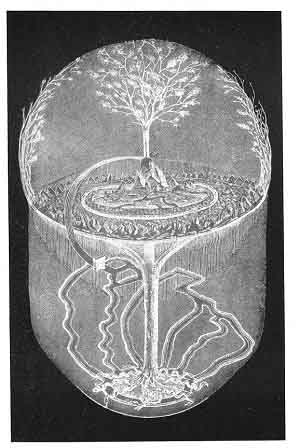
PLATE XVIII. Yggdrasil, the World Tree of the Norsemen. After Finn Magnusen's
The oldest World Tree? who shall say? When in search of the "oldest" we always think of the ancient East; but no one can assert--and Evidence--that Yggdrasil, the Cosmic Ash, the World Tree of the Norsemen, had its origin in the Orient, however remarkably its ideas coincide with the sacred trees of Asia. Let us begin for a change with the Occident and Yggdrasil.
"The chief and most holy seat of the gods," say the Eddas, "is by the Ash Yggdrasil. There the gods meet in council every day. It is the greatest and best of all trees. Its branches spread over the world and reach above heaven. Three roots sustain the tree and stand wide apart; one is with Asa; the second is with the Frost giants; the third reaches into Niflheim, and under it is Hvergelmar, where Nidhug gnaws the roots from below. But under the second root, which extends to the Frost giants, is the well of Mimir, wherein knowledge and wisdom are concealed. The third root of the Ash is in Heaven, and beneath it is the most sacred fountain of Urd. Here the gods have their doomstead. The Asa ride thither every day over the Bi-frost, which is also called Asa-bridge. There stands a beautiful hall near the fountain beneath the Ash. Out of it come three maids. These maids shape the lives of men, and we call them the Norns. On the boughs of the Ash sits an eagle, who knows many things. Between his eyes, sits the hawk, called Vedfolner. A squirrel, by name Ratatk, springs up and down the tree and bears words of hate between the eagle and Nidhug. Four stags leap about in the branches of the Ash and bite the buds. The Norns that dwell by the fountain of Urd every day take water from the fountain, and clay that lies around the fountain, and sprinkle therewith the Ash, in order that its branches may not wither or decay." 1
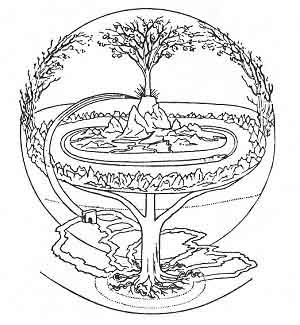
FIGURE 44. Yggdrasil, the Cosmic Ash(From Finn Magnusen's''Eddalen.'')
(From The Sacred Tree, or The Tree in Religion and Myth; Mrs. J. H. Philpot, 1897.)There are a number of interesting things to note here, because of their constant recurrence in other world-concepts widely separated in time and race. One is the close association of the World Tree with the World Mountain; one springs from the other, take them in what order we will. Another is the division of the Universe into nine worlds. Another, for the sake of comparison with a Mayan World Tree farther on, is the squirrel Ratatk. Another is the Bi-frost or Asa-bridge.
In the beginning of all things, says the Norse story of the Creation, there were two worlds, Niflheim, the world of ice in the north, and Muspelheim, the world of fire in the south, with all the space between an empty abyss, called Ginungagap. The fierce flames in Muspelheim blew constantly over into the abyss many sparks which confronted only nothingness, until, from the ice-bound Niflheim, a great spring opened and sent down twelve rivers, some of which flowed into the abyss and formed great layers of frozen vapour. At last the sparks of fire met the frozen air, and Ymir the giant was created, and then, in turn,
From Ymir's flesh
the earth was formed,
and from his bones the hills,
the heaven from the skull
of that ice-cold giant
and from his blood the sea.
Of the nine worlds Asgard was the highest and was the world of the gods. Below it was Mitgard or Earth, the world of men, a flat disc surrounded by the River Ocean.
Beyond the River Ocean, but surrounding Mitgard, was Junheim, the upper giant world, and, beneath the Earth plane, was the great underworld divided into four worlds. In the North was the lower giant world of Niflheim; at the South Urd and her two sisters ruled over the kingdom of the dead, and between North and South was Mimir's land, where dwelt the wisest of the gods, and, with him, Day, Night, Dawn and the Sun and Moon. Below Niflheim again was the world of torture, and below Urd's realm of the dead, the land of subterranean fire.
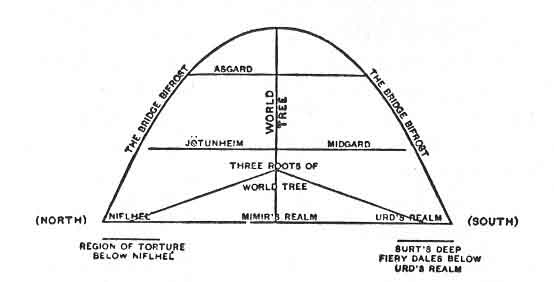
FIGURE 45. Diagram of the Nine Worlds, supported by the World Tree Yggdrasil.
(From The Nine Worlds; Mary Elizabeth Litchfield, 1890.)Just two things bound these worlds together, the tree Yggdrasil, and the Asa-bridge, or Bi-frost. And a third--the spirit of heaven, the great Energiser, passing ever to and fro, guiding, controlling all the universe, from the first world to the ninth; at home everywhere, abiding no-where, stirless when moving and moving when still; that without which there would be nothing--here shown as merely a tiny timid nimble squirrel.
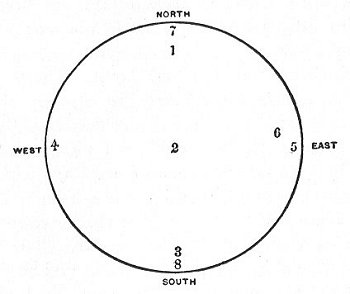
FIGURE 46. Diagram of the Scandinavian Cosmos.1 Spring Hvergelmir, in Niflhel or Niflheim, under Yggdrasil's northern root.
2 Well of Wisdom in Mimir's Realm, under Yggdrasil's middle root.
3 Urd's Well in her Realm, under Yggdrasil's southern root.
4 Home of the Vanir.
5 Home of the Elves in Mimir's Realm.
6 Castle where Baldur dwelt with the Asmir.
7 Northern End of Bifrt, guarded by Heimdall.
8 Southern End of Bifrt, near Urd's Well.
(From The Nine Worlds; Mary Elizabeth Litchfield, 1890.)
But what was the binding and the separating bridge, the Bi-frost?
Again, who knows? Its arch was over Asgard, world of the gods; its northern tip resting upon the mountains of the ice-girt Niflheim; its southern end in the realm of the dead, where Urd and her sisters ruled. Some say the Milky Way is the original of Bi-frost or the Trembling Bridge, as some say the Milky Way is the very trunk of the Celestial Tree. Others believe that the Rainbow is the prototype for Bi-frost and all the "bridges of the world." For the World bridges are as universal as the "trees" and "mountains" of the world. Earth was cut off from Heaven--yet somewhere, if man could only find it, there was a path that might lead back home. The Bi-frost at its northern end was inviolately guarded by the great Heimdall, "World-Judge" or "World-Divider," "whose ears were so good that he could hear the grass pushing up through the ground, and the wool growing on the backs of sheep, and he needed less sleep than a bird." The gods crossed it every day on their way to the judgment hall in the realm of Urd, but the way was barred against all others, lest some thief in the night should find his way into Heaven. Yet it was the bridge also on which the souls of all the dead began their passage to the land of Urd.
The Persians had their Chinvat bridge, which is to say also, the Bridge of the Judge, over which all souls, good and evil, passed--"that bridge," says one of their sacred books, "like a beam of many sides, of whose edges there are some which are broad, and there are some which are thin and sharp; its broad sides are so large that its width is of twenty-seven reeds, and its sharp sides are so contracted that in thinness it is just like the edge of a razor." Mohammed too placed a way over the middle of hell, "which is sharper than a sword and finer than a hair, over which all must pass."
Certainly the North American Indians considered the Milky Way to be the "bridge" to the Land of Souls--a great village situated "where the Sun sets." "They call the milky way Tchipai meskenau, the path of souls, because they think that the souls raise themselves through this way in going to that great village," wrote Paul Le Jeune in 1634 of the Montagnais. One hundred years later Pierre Aulneau wrote of the Crees of upper Lake Superior, that they believed in a paradise of feasts and great hunts for the immortalsouls of the dead. "But, before reaching it, there is a spot of extreme peril--the souls have to cross a wide ditch. One side of the way it is full of muddy water, offensive to the smell and covered with scum; while on the other the pit is filled with fire, which rises in fierce tongues of flame. The only means of crossing it is on a fir tree, the ends of which rest. on either bank. Its bark is ever freshly moistened and besmeared with a substance which makes it as slippery as ice. If the souls who wish to cross to the enchanting plains have the misfortune to fall at this dangerous passage, there is no help left; they are doomed forever to drink of the foul stagnant water or to burn in the flames, according to the side on which they fall." Sometimes the "bridge-building fiend" made the bridging spar a snake or a swinging log.
A "Sketch of the World," by a Thompson River Indian, illustrates this exactly. They believe that the Earth is square, level in the centre and rising towards the north from whence comes the cold, that it rises also in great mountain ranges about its borders, and that these mountains or lands are topped by mountains of air--the clouds and mists rising from the encircling lake of the world. All the rivers of the world rise in the north and flow south.
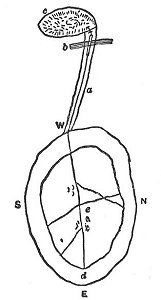
FIGURE 47. Sketch of the World, by a Thompson River Indian.
a. Trail leading from the earth to the land of the ghosts, with tracks of the souls; b. River and log on which the souls cross; c. Land of the ghosts and dancing souls; d. Lake surrounding the earth; e. Earth, with rivers and villages; N. S. E. W. points of the compass.(From Memoirs of the American Museum of Natural History, Vol. II, 1900, p. 343.)
This trail to the soul-world has been minutely described by James Teit in his The Thompson River Indians of British Columbia. 1 According to him, the country of souls is underneath us, towards the sunset, and its path is one of perils, storms, narrow bridges, and gaping chasms. The trail leads through a dim twilight; along it are always visible the tracks of the people who last went over it, and also the tracks of their dogs, if they had any with them. It winds along until it meets another road, which the shamans, or medicine-men (their nearest approach to priests) use as a short cut when trying to intercept a soul. From here on, the trail is much smoother and straighter, and is painted red with ochre. Farther on it winds to the westward, descends a long gentle slope, and ends at a wide shallow stream of very clear mirror-like water. This stream is spanned by a long slender log, on which the tracks of souls may be seen again. After crossing the "bridge," if the traveller is fortunate enough to hold his footing on the slippery edge between the worlds, he finds himself again on the trail, which is now an ascending one. At a certain height is heaped a great pile of clothes; this marks the spot on the journey where the souls must leave behind them all that they have brought from the other world. And from here on the trail not only seems level, but little by little the dimness and twilight confusion disappear.
Three guardians are stationed along the trail of the souls--one on each side of the river that must be crossed, and the third at the very end of the trail of the ghosts.
The first of these, on the hither side of the stream, has built for himself a sweat house where he spends most of his time. It is the duty of all three to send back to the land of the living any soul not yet ready to enter the land of the dead, even though he may have by some miracle of accident crossed the bridge. For sometimes it happens that a soul succeeds in passing the first two guardians, only to be turned back by the third, who is the chief of the three, and who now and then, being a great orator, sends back messages to the world of the living through the medium of souls who, having survived all other tests of courage and merit, fail in the final test of being judged worthy by the guardian of the gate of life to pass through.
But, having been permitted by him to pass, the soul at last reaches a large lodge at the end of the trail. It is made of a hard white material, like limestone or white clay. It extends a long distance from east to west, and is much shorter from north to south. Its top is "like a round mound or ant-hill." The doors to this white lodge are at the east and west, and the trail leads up to the eastern door, which is very small, barely large enough to let a soul pass through. But the western door, through which the soul passes to the land of ghosts, is much higher and wider. Through the entire length of the lodge there is a double row of fires, for when the deceased friends of a person expect his soul to arrive, they go in a body to this lodge to talk about his death and prepare to welcome him. As the newly arrived soul reaches the entrance to the lodge of the dead, he finds some one standing at the door to greet him and call him by name, while others sing, dance, and beat upon drums. The air is always pleasant and still, and it is always light and warm. There are sweet smells of flowers, an abundance of grass, and berry-bushes laden with ripe fruit. The rest is hunting, feasting, and dancing through eternity, for the dancing, or immortal, souls.
The Wakwak Tree is a fabulous tree growing on a fabulous island somewhere in the Southern Ocean--or somewhere near Japan, or near the western (or the eastern) coast of Africa--it all depends on the traveller who tells the legend. It appears to have had nothing to do with America or the American Indians; yet here is a curious bit of Sioux lore, which, in connection with one of the legends of the lost continent of the Pacific, has an odd interest here.
The Sioux Indians have a special reverence for what they call the waka dacedar. Waka da, according to W. J. McGee, 1 who has made a special study of the word in his The Siouan Indians, is a very curious word indeed. It has, he says, as many connotations as the Sanscrit word Karma, and, like Karma, is not to be translated by any single English word. The Sun, for instance, is not "the" or "a" waka da, but simply waka da. So is thunder, so is lightning, the stars, the winds, and especially waka dacedar, by which they mean precisely the state of being which makes a cedar human and more than human. Even a man might be waka da. The term, he says, may be translated by "mystery" more satisfactorily than by any other single English word; nevertheless, with its vague implications of "power," "sacred," "ancient," "grandeur," "animate," "immortal," "not even an English sentence of ordinary length could quite convey the sum total of the aboriginal idea expressed by the term waka da." Perhaps all its meaning is conveyed when, applied to the cedar, they say it is that state of being which makes a cedar human and more than human.
Now of the Wakwak tree which bore human fruit, Turkey, Arabia, Persia, and India all had a tradition; that in the Southern Ocean--or some other unexplored waste of waters--was an island called Wakwak--or a great mountain called Wakwak--because on it grew a tree which produced fruit with a human head, or fruit in the form of a human body, or even in the form of animals, and these beings, at dawn and at sunset, cried aloud, so that all might know the passage of the Sun, "Wak! wak!" The island and the mountain are mentioned in The Thousand and One Nights--Hasan al-Basri went there to find his wife and children. The tree is described without being named by Friar Odorico of Pordenone who in the fourteenth century left Italy to make the grand tour of the East. Arrived at Malabar, he wrote thus: "And here I heard tell that there be trees which bear men and women like fruit upon them. They are about a cubit in measurement, and are fixed in the tree up to the navel, and there they be; and when the wind blows they be fresh, but when it does not blow they are all dried up. This I saw not in sooth, but I heard it told by people who had seen it." Plate XIX gives a drawing of the Wakwak tree, taken from an old Turkish History of Western India and Its Wonders, published at Constantinople in 1729. It represents the fruit of this fabulous tree not by human heads but by seven pendent bodies. The two great birds at the foot of the tree are as fabulous as the rest of it.
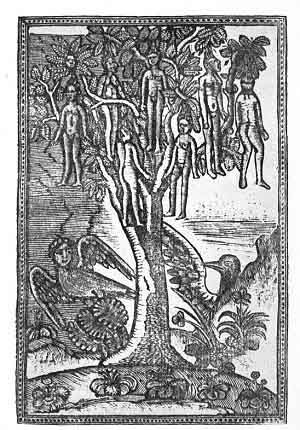
PLATE XIX. THE WAKWAK TREE
(From Tarikhal-Hind al-Gharbi. Constantinople, 1729)
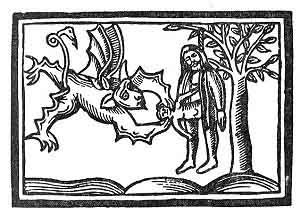
FIGURE 48. The Tree of Judas.
(From Maundevile's Voiage and Travailes, 1839 reprint.)Sometimes these souls were imagined as suspended with their heads downwards, alive, but clinging and climbing on a reversed path back to heaven. In an old Hindu legend it is related that Garuda, lord of all birds, coursing one day towards a gigantic banyan tree, with the fleetness of the mind, to sit thereon and "eat the elephant and the tortoise," in alighting broke one of the branches. As it broke he caught it and saw to his wonder that a tribe of Rishis called Valikhilyas were hanging from it head downwards, engaged in "ascetic penances." And gathering together all of his strength, the lord of birds soared high into the heavens with his burden of hanging men, and saved them. Sometimes, when the air is quiet, trees will move and their leaves rustle--this very common phenomenon had for the ancients a mystic meaning; at such times the invisible souls were talking to each other of their trials and triumphs on the journey back to heaven.
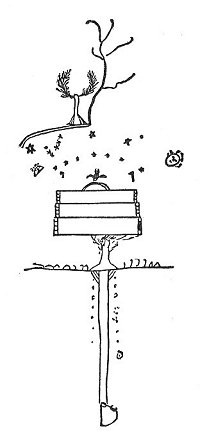
FIGURE 49. Osage Chart of the Universe, drawn by Red Corn.
(From Picture-Writing of the American Indians; Garrick Mallery, 1894, p. 251.)
In their "Sketch of the World," the Thompson River Indians incorporated one form of the World Tree, in the bridge between the worlds, literally, "the path of life." The Osage Indians, in their chart of the universe, have another. Few world-pictures can be found more simply and beautifully drawn than this by Red Corn, with its Earth plane, its "stages" or heavens, and its Tree of Life. Like the Lenape pictograph, it is the "score" of a tradition chanted by members of a secret society of his tribe. It is explained by J. Owen Dorsey as follows: 1
The tree at the top represents the tree of life. By this flows a river. The tree and the river are described later in the degrees. When a woman is initiated, she is required by the head of her gens to take four sips of water (symbolising the river), then he rubs cedar on the palms of his hands, with which he rubs her from head to foot. If she belongs to a gens on the left side of a tribal circle, her chief begins on the left side of her head, making three passes, and pronouncing the sacred name three times. Then he repeats the process from her forehead down; then on the right side of her head; then at the back of her head; four times three times, or twelve passes in all.
Beneath the river are the following objects: The Watse tuka, male slaying animal (?), or morning star, which is a red star. 2. Six stars called the "Elm rod" by the white people in the Indian Territory. 3. The evening star. 4. The little star. Beneath this are the moon, seven stars, and sun. Under the seven stars are the peace pipe and war hatchet; the latter is close to the sun, and the former and the moon are on the same side of the chart. Four parallel lines extending across the chart represent four heavens or upper worlds through which the ancestors of the Tsicu people passed before they came to this earth. The lowest heaven rests on an oak tree; the ends of the others appear to be supported by pillars or ladders. The tradition begins below the lowest heaven, on the left side of the chart, under the peace pipe. Each space on the pillar corresponds with a line of the chant; and each stanza (at the opening of the tradition) contains four lines. The first stanza precedes the arrival of the first heaven, pointing to a time when the children of the "former end" of the race were without human bodies as well as human souls. The bird hovering over the arch denotes an advance in the condition of the people; then they had human souls in the bodies of birds. Then followed the progress from the fourth to the first heaven, followed by the descent to earth. The ascent to our heaven, and the descent to three, makes up the number seven.
When they alighted, it was on a beautiful day, when the earth was covered with luxuriant vegetation. From that time the paths of the Osages separated; some marched to the right, being the war gentes, while those on the left were peace gentes, including the Tsicu whose chart this is.
Then the Tsicu met the black bear, called in the tradition Ke-wsan' (Crow-bone-white), in the distance. He offered to become their messenger, so they sent him to the different stars for aid. According to the chart, he went to them in the following order: Morning star, sun, moon, seven stars, evening star, little star.
Then the black bear went to the Wacia-cutse, a female red bird sitting on her nest. This grandmother granted his request. She gave them human bodies, making them out of her own body.
The earth-lodge at the end of the chart denotes the village of Haa utakantsi, who were a very war-like people. Buffalo skulls were on the tops of the lodges, and the bones of the animals on which they subsisted whitened on the ground. The very air was rendered offensive by the decaying bodies and offal.
The whole of the chart was used mnemonically. Parts of it, such as the four heavens, and the four ladders, were tattooed on the throat and chest of the men belonging to the order.Another Siouan tribe, the Sia Indians of New Mexico, believe that in each of the six regions of the world--they name these as the four quarters, zenith and nadir--there was a giant mountain bearing a giant tree, at whose foot was a spring, in which dwelt one of the "cloud-rulers," each attended by one of the six primal priestesses of the Sia, who interceded constantly with the six cloud rulers to send rain to the Sia. The six varieties of their World Trees were the spruce, the pine, the aspen, the cedar, and two varieties of the oak.
It would be a brave, not to say a reckless scientist, who would say to-day how young or how old the Mayan civilisation is. Thirty years ago, answers would have come easily enough; but that was before the excavations of the great buried cities in Central America began, which may very well result in the uncovering of records which ante-date the oldest we have. Already we know that America, youngest of the continents historically, is older prehistorically than we yet dare to say. And, although we never knew more than a little about the Mayas and their beliefs, we know to-day how fragmentary and isolated those bits of knowledge are, and how untrustworthy the conclusions we have drawn from them.
Nevertheless, under the date of 1640, there has come down to us a picture of the Mayan Universe, copied by Father Cogolludo from the central design of the Chilam Balam, or Sacred Book, of Mani, and inserted in his Historia de Yucathan, written at the end of twenty-one years spent among the Mayas (Plate XX ).
At the bottom of the "universe" lies a cube, which has long been recognised as representing in the Mayan cosmogony the Earth. Above the Earth cube, resting on four legs which rest in turn on the four quarters of the Earth, is the heavenly vase, Cum, which holds the celestial waters--the treasures of the snow and of the hail, of the rains and the showers, on which all life, vegetable, animal and human, depends. Above this vase hang the rain clouds, and within it grows the Yax che, the Green Tree or the Tree of Life, its upper branches bearing on their tips the flowers or fruits of life on Earth, olor yol; that is to say, the soul or immortal principle of man. Under the Green Tree Yax che, the souls who have passed through Mitnaor the underworld, dwell in happiness, while the others sink into a region where they suffer eternal cold and hunger. In Brinton's Primer of Mayan Hieroglyphics, the inner figure of the cube, the vase, the clouds and the tree, is reproduced, lettered according to readings from other of the Sacred Books. The Earth cube in that picture is not lettered IUM, Earth, but tem, the Altar. "The Earth signifies the great Altar of the gods, and the offering upon it is Life."
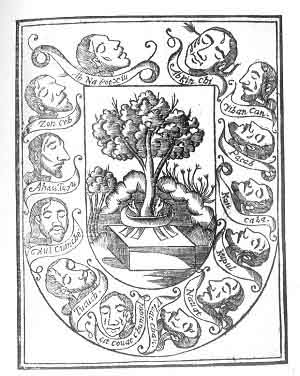
PLATE XX. THE WORLD TREE OF THE MAYAS
(From Historia de Yucathan; Diez Lopez Cogolludo, 1640)The thirteen heads surrounding the World Tree signify, according to Brinton, the thirteen ahau katuna, or greater cycles of years. They also may signify the thirteen possible directions of Space. That is, the complete terrestrial globe is symbolised by the four cardinal points, zenith, and nadir, with man in the centre making the seventh, and the complete celestial sphere is symbolised by adding the six directions, with man, the focal point, remaining the same. "The border therefore," says Brinton, "expresses the totality of Time and Space, and the design itself symbolises Life within Time and Space."
Another Mayan world-picture is shown in Fig. 50 , which is the central design of the Tableau of the Bacabs. Instead of the thirteen ahau katunaor greater cycles of years, this design is surrounded by "the signs of the twenty days," which extend in the original design, beyond the figure here given, to the four cardinal points and to the gods and time-cycles connected with them. "Again," says Brinton, "it is Life within Time and Space."
Here, sitting beneath the shade of the Green Tree, at its root, are the divine First Pair, Cuculcan, the feathered or winged serpent god, and Xmucanehis spouse,--"the Creator and the Former," says the Popol Vuh, "Grandfather and Grandmother of the race . . . two-fold grand-mother, two-fold grandfather . . . the Maker, the Former, the Ruler, the Serpent clothed in feathers, they who beget, they who impart life, they rest upon the waters like a glowing light, they are clothed in colour green and blue, therefore their name is Gucumatz, 'Feathered Serpent.'"
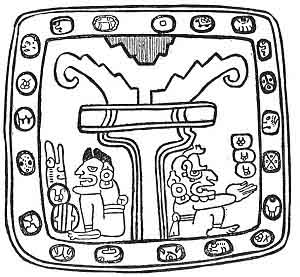
FIGURE 50. Our First Parents. From the Codex Cortesianus.
(From A Primer of Mayan Hieroglyphics; Daniel G. Brinton, 1894.)
The resemblances between the divisions of this Mayan tree and the Norse tree Yggdrasil are obvious, but here is a correspondence in ideas that is very curious. Between the nine Norse worlds, it will be recalled, from the roots of the tree to its topmost branch, ran Ratatk, scamperer between men and gods, matter and spirit, Space and Time--the great Energiser under the guise of a tiny squirrel. It is rather interesting to discover that under the green cosmic tree Yax cheof Yucatan sits a figure whose name, Cuculcan, is derived from a Mayan verb, cucul, meaning to "revolve," "to move round and round," as they moved their great calendar wheels to accomplish the rotation of time; and that this rotation itself is called cuceb, "the squirrel," derived directly from the same verb cucul, "to revolve, to move round and round."
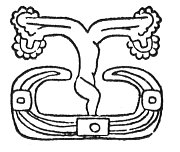
One more Mayan Tree of Life, too beautiful not to be included in any group of "Cosmic Trees," particularly as it shows the mystery of metamorphosis almost in the act of transmutation from one form to another is given in Fig. 51 . In the original drawing the god of the north star rests upon it, as it rises from the heavenly vase that holds the heavenly waters. And, to show that Egypt and Yucatan were not separated in fancy at least by oceans]Atlantic or Pacific, here is a little drawing of the Sacred Tree of the Egyptians, with Heaven, or the Sky goddess Nut, bestowing knowledge on man and his soul.
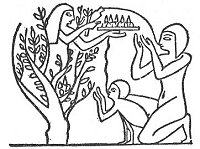
FIGURE 52. Sacred Tree of the Egyptians.
(From Egyptian Mythology and Egyptian Christianity; Samuel Sharpe, 1863.)"THE WHOLE WORLD," says an old Hebrew writing, "is like a gigantic tree full of branches and leaves, the root of which is the spiritual world of the Sphroth; or it is like a firmly united chain the last link of which is attached to the upper world; or like an immense sea, which is constantly filled by a spring, everlastingly gushing forth its streams."
When we take up the Kabbala, to interpret anything in it, we touch a book on which literally thousands of interpretative books have been written. The Arber Sephirothecais perhaps its keystone figure, and the interpretations of the relation and meaning of the ten Sephiroth which compose the "tree" differ so that any summary of them is not only hopeless but useless here. It is possible, however, to sketch largely and with no detail, a general explanation of this Hebrew World Tree.
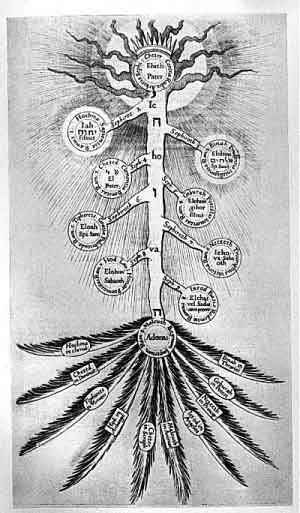
PLATE XXI. ARBER SEPHIROTHECA
(From Utriusque Cosmi; Robert Fludd, 1621. Vol. II)
First of all, what are the ten Sephiroth? First of all then, they are indicated by the first ten letters of the primitive alphabet in which, as we have noted before, Gods were Letters, Letters were Ideas, Ideas were Numbers, and Numbers were perfect Signs. They may mean either "to count" (that is, they may mean "numbers"), or "brilliance" or "spheres." Or they may mean "qualities," standing for the several grades or stages of wisdom. Or they may mean "emanations."
The Arber Sephirotheca(Plate XXI ) shows the Hebrew scheme of Creation--the esoteric side of the Genesis story, beginning with the assumption that Creation began, not from the act of God, but from the emanation of God, due to his voluntary self-withdrawal in order that the universe might be created. "When the Holy Aged, the concealed of all concealed," says the Zohar, "assumed a form, he produced everything in the form of male and female, for Wisdom expanded, and Intelligence, the third Sephirah, proceeded from it, and thus were obtained male and female, viz., Wisdom the father, and Intelligence the mother, from whose union other pairs of Sephiroth successively emanated." The first Triad, then, which is represented, is Hochma or Wisdom, Binah, or Intelligence, and Cheter the Crown or the equilibrising force. These three in one are the Balance of forces, otherwise the Reason of the Universe. This Reason is not represented separately. It is held to be inherent in the relation existing between and in the first group of three.
Then, from this first group of three forces, or its result, Reason, came the second group of three, Chesed or Mercy, the father, Geburah or Justice, the mother, which together produce Tipherets, or Beauty. This sixth again represents Balance or equilibrium in forms about to be materialised, the mediator between the Crown or Creator and the Kingdom or Creation.
The third triad consists of Netzeth or Victory, the father (explained sometimes as the eternal triumph of Intelligence and Justice, the two mothers), Hod or Glory, the mother, from which two springs Iesod, the Foundation, the Absolute.
The three triads, three forms each of the intellectual, the spiritual, and the material qualities, combine to form the tenth Sephirah, Malcuth or the Kingdom--or Sovereignty over the Kingdom or universe, manifested in the ten branching leaves. These branching leaves manifest, in turn, the direct relation existing between the ten Sephiroth and Adam Kadmon, the primordial, heavenly, incorruptible man, created in this way only "in the image of God." Adam Kadmon is the branching fruit of the Tree of Knowledge, and holds the middle place between the En Soph or All in All and the ten emanations; holds, that is, the point of Balance or equilibrium. In this sense Adam Kadmon here, as in Plate IV , is regarded as the supporter and upholder of the universe. Nothing could be at first sight more unlike than these two images of the three worlds, but there are enormous likenesses between them.
Another way of expressing this interrelation between the ten emanations is that the first Sephirah, by virtue of its equilibrising power, unites the second and third--Wisdom and Intelligence; that the sixth Sephirah, Beauty, by the same virtue, unites the fourth and fifth--Mercy and Justice; that the ninth Sephirah, Foundation or Absolute, unites the seventh and eighth--Victory and Glory, and by union with all, sends forth the tenth Sephirah, the Kingdom or the Universe. Again, the first three Sephiroth form the world of Reason; the second three, the world of Spirit; the last four, the world of the Body.
A tree must have a soil in which to grow; soul and spirit must have a body; moving energy must take a form. And a very beautiful and subtle interpretation of the World Tree myth may be found in an old black-figured kylix by Exekias, dating from the sixth century B.C. It is called "Dionysos in the Ship," and its reading depends entirely on an understanding of what the story of Dionysos meant to the Greeks and all the peoples who came under their influence (Plate XXII ).
The story of Dionysos is always the story of Dionysos-and-Apollo. There is not such a thing as even half of this story; one without the other does not exist. It veiled one of the greatest of the Greek mysteries, this conflict between these two gods, and the final reconciling of their struggle. It symbolised the conflict between light and darkness, between spirit and form--quite literally, the conflict between spirit and body. It was a mythological drama based on the old cry of man, "I feel two natures struggling within me." The first impulse of antagonism is to defeat, even to destroy; it seldom occurs to two opponents that there is a middle point, an equilibrium or balance, where peace abides. The story of Dionysos-Apollo is not one of destruction, but of final reconcilement between two opposing forces. Neither was to be rightly judged on the basis of "good" or of "evil," but on the basis of incompleteness only. Each needed the complementary force of the other; without the other neither was whole. It was not Dionysos alone, nor Apollo alone, but the two reconciled and united that solved the struggle. In this kylix, Dionysos-Apollo floats on the aethereal ocean. The body or boat--a great fish--carries the unified god. The two are one, and from them united spring two great vines laden with fruit and leaves. About the living boat seven dolphins, "spies of the sea," keep guard to forecast storms and to warn the pilot. In this Dionysian vine picture the myth-cycle of the World Tree rounds upon itself. The Tree, given by the gods to mortal man, is itself re-born through man reconciled and made immortal, and is given back to heaven as a celestial vine. Dionysos-Apollo had escaped the Wheel of Fate, and could forever mediate between the remnants of man still bound to it, and the Olympian gods.
The mystery of the relation between Darkness and Light, which is the mystery of Dionysos-Apollo, had another representation in the seventeenth century, when Robert Fludd based the whole scheme of Creation upon it (Plate XXIII ). It will be interesting to compare this drawing with some Chinese conceptions of the primal causal cosmic struggle between Light and Darkness (pp. 147 -150).
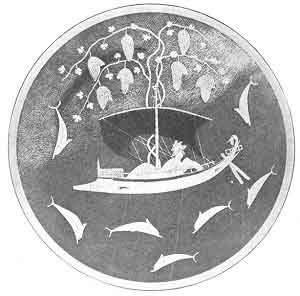
PLATE XXII. DIONYSOS IN THE SHIP
A black-figured kylix by Exekias(6th cen. B.C.). in Munich(Furtwgler-Reichhold; Griechische Vasenmalerei, No. 42).
(From Mythology of All Races, 1927. Vol. I, Plate XLIX)
"At the top of the figure," says Fludd, "is expressed the Head, or the Root, of all things, both in the simplicity of His unity and the duality of His universal attributes, namely, One God, One Supreme Being, One Essence or Divine Mind, whether willing or non-willing. In the negative aspect it withdraws within itself, and refrains from sending Itself forth from Itself.
"B. is the effect of the divine potency, or non-willing, in which state all things were formless and in potency only, before the beginning of the world. B., in other words, is a hieroglyphic Image of God thus far altogether non-willing; in which stage God is in His true Essence, shining within Himself, but not sending Himself forth from Himself. Such was the primal Chaos, from the bowels of which the materials of the Universe were originally drawn forth.
"Just as B. was the hieroglyph of the latent God, so C. is the representation of His glorious Emanation for the Creation of the World. This Emanation is the Word of God.
"From the union of these two comes one World [D. E.] in the Image of One Who participates in it both in His positive and negative aspects. That is to say, from the two opposites the World is born in the Image of its Creator. The World is in God, which means that the World is partly created and partly uncreated. Created, if we consider the material World, but uncreated if we consider its Maker.
"According to the mystical theology of Orpheus, Hesiod, Euripides, and chylus (who involved the divine mysteries in allegory), the Sun is taken in Archetype, as that divine source from which all ornament and beauty, embracing a multiple harmony of life, is derived. In His right hand is pity and benevolence, in His left, severity and punishment [F. G.]."
One aspect of this divine mystery of the Sun visible and the Sun invisible, they concealed, he says, under the name of Apollo, god of Day and of Light, the other under the name of Dionysos, god of Night and of Darkness. Each was but half of the other; only the two are one; yet each one, though separate, had within him the seeds of Darkness and Light. Hence, they argued that God is both destruction and creation, corruption and generation, author and actor; that "just as he composes by the number 7, so he destroys by the number 7, for the sacred number 7 is attributed to the God of life." Night in its darkness, or Dionysos, symbolised God in His negative aspect of withdrawal within Himself, and Day in its light, or Apollo, symbolised God in his positive aspect of giving forth by emanation from himself.
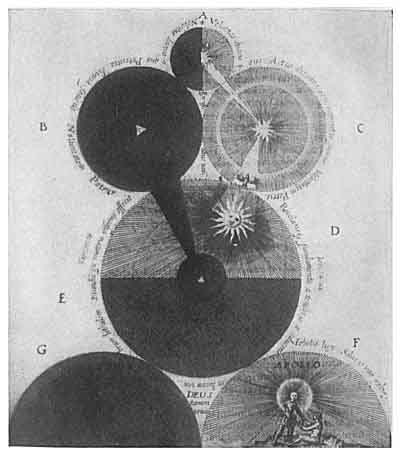
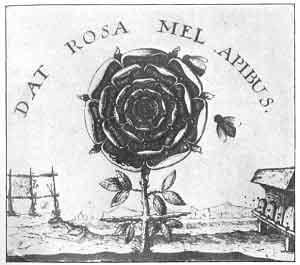
PLATE XXIII. ''And God said, Let there be Light, and there was Light.''
(From Medicina Catholica; Robert Fludd, 1629)
THE FAMOUS ROSE TREE of the Rosicrucians has a Dionysian connection, for the Rose as well as the Vine was sacred to this god. It has also a Peruvian connection; the Peruvian Eve--there is a native drawing of her later on--sinned not by eating the apple, but by picking roses, which were, in the Peruvian tradition, the fruit of the Tree." The bee is almost as much a part of this drawing (Plate XXIV ) as the Rose Tree--here are a few odd myths of this marvellous being. According to Porphyrios, the Moon was called a bee; according to Virgil, the bee alone of all animate things descended from Paradise, is a part of the mind of God, never perishes, and alone of all animate things, ascends alive into heaven. Dionysos is sometimes identified with the Moon, and is said in some traditions to have been born again as a bee. Again, the wax of bees produces light, hence bees are those that feed on fire. As for the rose, its bud resembles the acuminated or pointed sphere that symbolises ether in the ancient Stupa (Fig. 1 ), and the opened rose, to the Rosicrucians, symbolised the Universe spread out like a book, which he who could might read.
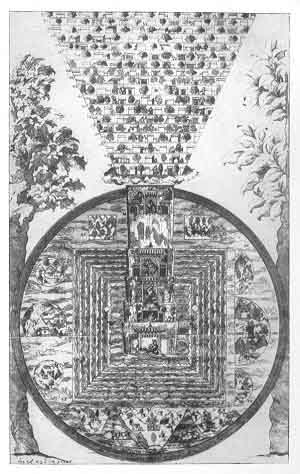
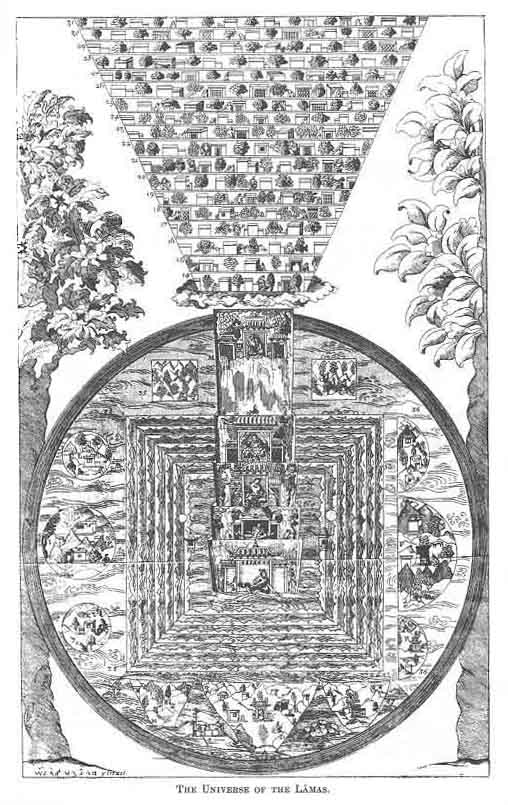
This representation of the universe by a rose appears to be a later development of a very ancient figuration of the universe by an onion--also a plant sacred to the old gods. Rather, the universe was represented by the layers of the onion--the Egyptians and the Hebrews and the Tibetans have used this over and over again. The core, to which the layers cling, may be the axis of the world, or the polar mountain of the world. In the Tibetan universe the onion's core is Mount Meru, surrounded by fifteen opaque, semi-transparent layers of oceans and mountains and oceans again until the outer skin is reached, which is the wall of iron about the universe. And all the heavens are one above the other, like the layers of an onion," says the Kabbala. ". . . And our companions who live in the South, have seen in the First Book and in the Book of Adam, that all these earths which are Below, are like the firmaments Above, that upon that, and this upon this, and between each earth, a heaven (firmament) is spread out between each other (like the fine skin of the layers on the onion)."
Footnotes
94:1 The Prose of Younger Edda, translated by G. W. Dasent, p. 16.
101:1 Memoirs of the American Museum of Natural History, Vol. II, 1900, pp. 342-43.
103:1 U.S. Bur. Ethnol. Rep., 1893-94, p. 182."
107:1 Picture Writing of the American Indians: Garrick Mallery, 1894, pp. 251-252.