

The Cave of Treasures, Source
THE BOOK OF THE CAVE OF TREASURES
part of the "forgotten" books of Eden
SOURCE
INTRODUCTION
THE SOURCES OF THE "CAVE OF TREASURES" AND ITS CONTENTS.
IN the centuries immediately preceding the Christian Era certain professional Jewish scribes composed a number of works which may well be described as "historical romances," and which were based on the histories of the patriarchs and others as found in the four main divisions of the text of the Hebrew Bible. There is little doubt that most of these works were written either in Hebrew or in the Palestinian vernacular of the period. One of the oldest of such works appears to be the "Book of Jubilees", (also called the "Lesser Genesis" and the "Apocalypse of Moses"), which derives its name from the fact that the periods of time described in it are Jubilees, i.e. each period contains forty-nine years. It is more or less a Commentary on the Book of Genesis. That a version of this book existed in Greek is proved by the quotations given by Epiphanius, Bishop of Salamis in Cyprus (born about A.D. 320, and died in 403 or 404), in his work on "Heresies" (chapter xxxix). The author claimed boldly that his work contains the revelations which were made to Moses by the command of God by the Archangel Michael, who is frequently described as the "Angel of the Face," The book is not wholly original, for it contains narratives and traditions derived from the works of earlier writers; and some of the legends appear to have been taken from early Babylonian sources. The Hebrew, or Aramean, original is lost, and the complete work is only found in Ethiopic, in which language it is known as "K" or "Sections." The Ethiopic translation was made from Greek.
Another pre-Christian work, also written by a Jew, is the "Book of Enoch," which exists now in a more or less complete form, only in an Ethiopic translation, which was made from the Greek. This work is quoted by St. Jude, and there is little doubt that for some three or four centuries its authority, both among the Jews and the Christians of the first and second centuries of our Era, was very great. Whether the "Book of Enoch," as made known to us by the Ethiopic version, truly represents the original Hebrew work is fairly open to doubt; in fact, it seems certain that it does not. It contains a series of fragments or parts of works, of somewhat similar character, which has been strung together, and then added to by writers of different schools of religious thought at different periods. In some parts of it traces have been found of beliefs which are neither Jewish nor Christian.
From time to time during the early centuries of the Christian Era apocryphal works dealing with our Lord and His Apostles and disciples appeared, and, though they were written by Christians, they contained many legends and traditions which their authors borrowed from the works of earlier Jewish and Christian writers. Such works were very popular among the Christian communities of Egypt and Syria, for the thirst for information about our Lord and His life and works, and the adventures and successes of the Apostles in Africa, Western Asia, India and other countries was very great. Side by side with this apocryphal literature there appeared works in Egypt and Syria which dealt with Old Testament History and endeavoured to explain its difficulties. But though Patriarch and Bishop and Priest read the Scriptures and the commentaries on them to the people, and instructed their congregations orally on every possible occasion, there was much in the ancient Jewish Religion, out of which many of the aspects of the Christian Religion had developed, which the laity did not understand. On the one hand, the unlettered Christian folk heard the Jews denouncing Christ and His followers, and on the other, their teachers taught them that Christ was a descendant of King David and Abraham, and that the great and essential truths and mysteries of the Christian Religion were foreshadowed by events which had taken place in the lives of the Jewish patriarchs.
Some of the Fathers of the Church in the Vth and VIth centuries wrote sermons and dissertations on the Birth of our Lord, and His Baptism, Temptation, Passion and Death and Resurrection, and proved by quotations from the Prophets that the son of the Virgin Mary was indeed the Messiah and the Saviour of the world. But copies of these works were not multiplied for the use of their congregations, most of the members of which were unlettered folk, and the influence of all written discourses was much circumscribed in consequence. The great monastic institutions possessed copies of the Old and New Testaments written in Greek and Syriac, but these were not available for study by the laity in general, and it is probable that only well-to-do people could afford to have copies of the Books of the Bible made for their private use. Thus the circumstances of the time made it necessary that the Fathers of the Church, or some of the learned scribes, should compile comprehensive works on the history of God's dealings with man as described in the Old Testament, and show the true relationship of the Christian Religion to the Religion of the Hebrew Patriarchs and the to kings of Israel and Judah. There is little doubt that many such works were written, and that their authors based their histories on the writings of their predecessors, and that Christian writers borrowed largely from the Hebrew "Book of Enoch" and the "Book of Jubilees," as well as the Histories and Chronicles which were then extant in Greek. Some of the latter works, i.e. those in Greek, were written by men who had access to information which was derived from Babylonian and Assyrian histories written in cuneiform, and, thanks to the labours of Assyriologists, the statements based on such information can, in many cases, be checked and verified. Further reference to this point will be made later on.
The oldest of the Christian works on the history of God's dealing with man from Adam to Christ is probably the "Book of Adam and Eve", which, in its original form, was written sometime in the Vth or VIth century of our Era; its author is unknown. As there is no doubt whatever that the writer of the "Cave of Treasures" borrowed largely from the "Book of Adam and Eve," or from the same source from which its writer derived his information, it is necessary to give here a brief description of the object and contents of this work.
The oldest manuscript of the "Book of Adam and Eve" known to us is in Arabic and is not older than the XIth century. But many of the legends and traditions found in it are identical in form and expression with those found in the "Annals" of Sa` bin al-Batr, or Eutychius, Patriarch of Alexandria (A.D. 933-939), and in the "Eight Books of Mysteries" written by Clement about A.D. 750, and in the "Cave of Treasures," which is now generally thought to have been written, or perhaps re-edited, in the VIth century. The Arabic version of the "Book of Adam and Eve" contains two main sections. The first contains a History of the Creation, which claims to be a translation of the "Hexemeron" of Epiphanius, Bishop in Cyprus. In it are given an account of the work of the six days of Creation, the Vision of Gregory concerning the Fall of Satan, a description of the Four Heavens, the Creation of Man, the temptation of Eve, and the expulsion of Adam and Eve from Paradise. The title, "Book of the Aksis," would lead one to suppose that the whole work was devoted to the Creation, but it is not, for the second Section contains "The History of the departure of Adam and Eve from Paradise, and their arrival in the Cave of Treasures by the command of God."
The writer of the "Book of Adam and Eve" meant the two sections to form a complete work. The first shows how Adam fell, and the second tells us how God fulfilled the promise which He made to Adam more than once, that after five and a half weeks, i.e. 5,500 years, He would send a Redeemer into the world who would save both Adam and his descendants from the destruction which his sin in Paradise had incurred, The writer of the book gives the History of Adam and Eve in full, adding as he progresses in his work the various legends and traditions which he found in the works of his predecessors. This plan he follows until he comes to the Flood, and on to the time of Melchisedek; but, having settled this king in Salem, the rest of his work becomes a bald recital of genealogies, only rarely interspersed with explanations and generalizations. Whether he was a Jacobite or Nestorian there is nothing to show in his work, and it seems that he hated the Jews not because of their religion, but because they had crucified Christ, and had also, in his opinion, promulgated a false genealogy of Joseph and the Virgin Mary.
Of the author of the "Book of Adam and Eve" nothing is known. Some have thought that he was a pious and orthodox Egyptian, who wrote in Coptic and derived the legends and traditions which he incorporated in his book from documents written in Greek or Syriac or from native works of the Coptic Church. Dr. W. Meyer discovered and published (in the Abhandlungen of the Bavarian Academy, Bd. XIV, III Abth.) two versions of the Life of Adam and Eve, one in Greek and the other in Latin. The Greek version is called the Αποκάλυψις Αδὰμ {Greek: Apokupsis Ad}. (Apocalypse of Adam), and the Latin "Vita Adae et Evae." Their contents differ materially, and neither version can be regarded as derived from the "Book of Adam and Eve" described above. Like the "Book of Jubilees" and the "Book of Enoch," the "Book of Adam and Eve" exists in a complete form only in Ethiopic, where it is called "GADLA AD WA H," i.e. "The Fight of Adam and Eve (against Satan)." The best known text is given in a manuscript in the British Museum (Oriental No. 751. See Wright, Catalogue No. cccxx, page 213), which was written in the reign of Bakf king of Abyssinia, 1721-1730. lt was one of the chief authorities used by Trumpp in the preparation of his edition of the Ethiopic text which appeared at Munich in 1880. The forms of several of the Biblical names indicate that the Ethiopic translation was made from Arabic. Translations of the complete book have been made by Dillmann, Das Christliche Adambuch, Gtingen, 1853, and Malan, The Book of Adam and Eve, London, 1882.
{See Here for an example of the Syrian text.}
The discovery of the existence of the Book called the "Cave of Treasures" we owe to Assem the famous author of the Catalogues of Oriental Manuscripts in the Vatican Library, which he printed in Bibliotheca Orientalis in four thick volumes folio. In Vol. ii. page 498 he describes a Syriac manuscript containing a series of apocryphal works, and among them is one the title of which he translates by "Spelunca Thesaurorum." He read the MS. carefully and saw that it contained the history of a period of 5,500 years, i.e. from the creation of Adam to the birth of Christ, and that it was a historical chronicle based upon the Scriptures. He says that fables are found in it everywhere, and especially in that part of it which treats of the antediluvian Patriarchs, and the genealogy of Christ and His Mother. He mentions that the Patriarch Eutychius also describes a cave of treasures in which gold, frankincense, and myrrh were laid up, and refers to the "portentosa feminarum nomina," who were the ancestresses of Christ. No attempt was made to publish the Syriac text; in fact, little attention was paid to it until Dillmann began to study the " Book of Adam and Eve" in connection with it, and then he showed in Ewald's Jahrbhern (Bd. V. 1853) that the contents of whole sections of the "Book of the Cave of Treasures" in Syriac and the "Book of Adam and Eve" in Ethiopic were identical. And soon after this Dillmann and others noticed that an Arabic MS. in the Vatican (No. XXXIX; see Assem Bibl. Orient. i. page 281) contained a version of the "Cave of Treasures," which had clearly been made from the Syriac. In 1883 Bezold published a translation of the Syriac text of the "Cave of Treasures" made from three manuscripts (Die Schatzhle, Leipzig, 1883), and five years later published the Syriac text of it, accompanied by the text of the Arabic version.
In 1885 I was engaged in preparing an edition, of the Syriac text of the "DEBHH" i.e. the "Bee," a "Book of Gleanings" composed by the Nestorian Bishop Solomon of Basra (i.e. al-Basrah) about A.D. 1222. Whilst making the English translation of this work I found that the "Bee" contained many of the legends and traditions which appeared in the "Cave of Treasures," and to show how greatly the Nestorian Bishop Solomon had borrowed from the work of the Jacobite author of the "Cave of Treasures" in the earlier part of his work, I printed several lengthy extracts from the Syriac from the fine manuscript in the British Museum, together with English translations (see The Book of the Bee, the Syrian Text with an English translation, Oxford, 1886; Anecdota Oxoniensia, Semitic Series, Vol. I, Part II), and these were thought to emphasize the general importance of the "Cave of Treasures."
The author of the Book which is commonly known as the "Cave of Treasures" called his work "The Book of the order of the succession of Generations (or Families)," the Families being those of the Patriarchs and Kings of Israel and Judah; and his chief object was to show how Christ was descended from Adam. He did not accept the genealogical tables which were commonly in use among his unlearned fellow-Christians, because he was convinced that all the ancient tables of genealogies which the Jews had possessed were destroyed by fire by the captain of Nebuchadnezzar's army immediately after the capture of Jerusalem by the Babylonians. The Jews promptly constructed new tables of genealogies, which both Christians and Arabs regarded as fictitious. The Arabs were as deeply interested in the matter as the Christians, for they were descended from Abraham, and the genealogy of the descendants of Hagar and Ishmael was of the greatest importance in their sight, and it is due to their earnest desire to possess correct genealogical tables of their ancestors that we owe the Arabic translations of the "Cave of Treasures." The Nubians and Egyptians were also interested in such matters, for the former were the descendants of Kh, and the latter the descendants of Mizraim, and Ham was the great ancestor of both these nations. And it is clear that Syrians, Arabs, Egyptians and Ethiopians regarded the "Cave of Treasures" as an authoritative work on their respective pedigrees.
In the title "Cave of Treasures" which was given to the "Book of the order of the succession of Generations" there is probably a double allusion, namely, to the Book as the storehouse of literary treasures, and to the famous Cave in which Adam and Eve were made to dwell by God after their expulsion from Paradise, and which by reason of the gold, and frankincense, and myrrh that was laid up in it, is commonly called "The Cave of Treasures" (in Syriac "Me`ath Gazz" in Arabic "Ma`ah al-Kan," and in Ethiopic "Ba`a Mazebet"). Now the Syriac work, though called the "Cave of Treasures," tells us very little about the real Cave, which was situated in the side of a mountain below Paradise, and nothing about the manner of life which Adam and Eve lived in it. But in the "Book of Adam and Eve" the whole of the first main section is devoted to the latter subject, and from this the following notes are taken:--
When Adam and Eve left Paradise they went into a strange land, and were terrified at the stones and sand which they saw before them, and became like dead folk. Then God sent His Word to them, and He told them that after five and a half weeks, i.e. 5,500 years, He would come in the flesh and save man. He had already made them this promise in Paradise, when they stood by the tree of forbidden fruit. The Cave of Treasures was a dark and gloomy place, and over it hung a huge rock, and when Adam and Eve entered it they were sorely troubled. God sent the birds, and beasts, and reptiles to Adam, and ordered them to be friendly to him and his descendants, and every kind of creature came to him except the serpent. In their grief Adam and Eve tried to drown themselves, but an angel was sent to drag them out of the water which flowed from the roots of the Tree of Life, and the Word restored them to life. Whilst they were living there God taught them how to wash their bodies, and told them what to eat and drink, and made known to them the use of wheat, and showed them how to clothe themselves with the skins of beasts, and other essentials of civilization. There was no night in Paradise, and when the sun set and night fell on Adam his terror was great; at length God told him that the night was made for the beasts and himself to rest in, and explained to him the divisions of time, years, months, days, etc.
During the period of the abode of Adam and Eve in the Cave, Satan came and tempted them fourteen times, but whenever God saw that they were in danger of life or limb through the devilish wiles of the Evil One, He sent an angel to deliver them and put the Devil to flight. Adam suffered sorely from the heat of the sun, which caused him to fall down a precipice, and wound himself so severely that his blood flowed out of his body on to the ground. When God raised him up, he took stones, and builded an altar. And having wiped up his blood with leaves, and collected the dust which was saturated with blood, he offered both the leaves and the dust as an offering to God, Who accepted this, Adam's first offering, and sent a fire to consume it. As Adam shed his blood, and died through his wounds--which God healed--so also did the Word shed His blood and suffer death. Thus the blood-offering originated with Adam.
When God saw that Adam was terrified by the darkness of the night, He sent Michael into Judea, and told him to bring back tablets of gold, and when they arrived God set them in the Cave to lighten the darkness of the night therein. And God sent Gabriel into Paradise to fetch incense, and Raphael to bring myrrh from the same place, and these symbolic substances being placed in the Cave, Adam was comforted. Because the Cave contained these precious substances, it was called the "Cave of Treasures." A little later God permitted figs to be brought to Adam from Paradise, and taught Adam and Eve to cook food on the fire which was brought to them out of the hand of the fiery angel who stood at the entrance to Paradise holding a fiery sword in his hand. As Adam could not obtain a supply of blood to maintain the blood-offering, he laid upon the altar outside the Cave an offering made of wheat, presumably a loaf or cake baked in hot ashes, and God accepted it and sent a fire to consume it, the Holy Ghost being present. And God said that He would, when He came down upon the earth, make it to be His flesh, which was to be offered up continually upon an altar for forgiveness and mercy. And an angel took a part of the offering with a pair of fire-tongs, and administered it to Adam and Eve. Thereupon Adam established the custom of offering the wheat-offering thrice in the week, viz. on the first, fourth, and sixth days of the week.
After Adam had lived two hundred and twenty-three days in the Cave, God sent His angels to tell him to take Eve to wife, and to give the gold plates in the Cave to Eve as a betrothal gift. Adam obeyed the divine command, and in due course Eve bore him twins, Cain and his sister L in a cave under the huge rock which Satan once hurled at Adam, wishing to kill him. Later, Eve again brought forth twins, Abel and his sister, Aklemy The remainder of the first section of the "Book of Adam and Eve" records the story of the murder of Abel by Cain, and tells how the earth rejected thrice Abel's body which Cain tried to bury in it.
It is now generally thought that the Syriac work which is called the "Cave of Treasures" was written in the VIth century of our Era, and in the absence of any evidence to the contrary this view may be accepted. In the title it is attributed to Ephraim the Syrian, and this indicates that the Syrians themselves were prepared to believe that it was written early in the IVth century, for this great writer died A.D. 373. Even if this attribution be wrong, it is important as suggesting that, if not written by Ephrem himself, one of his disciples, or some member of his school, may have been the author of the book.
Where the writer lived is not known, but it is most probable that it was written in Edessa or Nisibis; in any case, it must have been written in Mesopotamia, and the writer was certainly a Syrian Jacobite who was proud of his native language. Thus, having spoken of the migration of his people to Shinar, he says, "They all sat down there, and from Adam until the present time they were all of one speech and one language. They all speak this language, that is to say, 'Sury#39; (Syriac), which is '#39; (Aramean), and this language is the king of all languages. Now, ancient writers have erred in that they said that Hebrew was the first (language), and in this matter they have mingled an ignorant mistake in their writing. For all the languages that are in the world are derived from Syriac, and all the languages in books are mingled with it". And in another place he says that Pilate did right in writing the inscription which was placed on the Cross in Greek, Latin, and Hebrew only, and that he did not add a translation of it in Syriac because no Syrian played any part in the crucifixion of our Lord. And he goes on to say that the Syrians had no hand in shedding the blood of Christ, because Abhgar, King of Edessa, wanted to go and take Jerusalem, and slay the Jews who had crucified Him. And, as Bezold pointed out, the name of Noah's wife, Haikal-bath-N, and the names of several other women, appear to be of Syrian origin.
The writer's boast that Syriac is the oldest of all languages is probably not strictly true, but there is no doubt, in my opinion, that it is one of the oldest of the northern Semitic dialects. This is proved by the inscriptions on the Cappadocian tablets which have been acquired during the last few years by the British Museum. These tablets were written in connection with the commercial transactions of a settlement of Semitic traders, who flourished in the region of Caesarea about 2400 B.C. They conducted a brisk trade with Assyria in metals and textile fabrics, the latter coming from the Bulgar Dagh, and the former from the great cotton-growing districts which lay along the Kh. The cuneiform texts of a large number of these commercial documents and letters have been published by Sidney Smith (Cuneiform Texts from Cappadocian Tablets, London, 1921 and following years), and in Part I he has given (pages 6 and 7) a long list of words used in connection with the weaving industry, which can be paralleled in Syriac by words of precisely the same roots. And this will probably be found to apply to the other objects of daily life, for the Syriac writers of the early centuries of the Christian Era knew of hundreds of words used in the affairs and business of daily life which they had no opportunity to use when writing the lives of saints, commentaries on the Scriptures, and works of a purely religious character.
Of the subsequent history of the Syriac Cave of Treasures very little is known. The knowledge of parts of it made its way into Armenia soon after the book was written, and more than one translation of it was made into Arabic, probably in the VIIth and VIIIth centuries. In connection with the Arabic translations it must be noted that they all end with the account of the cruelties perpetrated by Archelaus and S after the death of Herod. (See Bezold's text, page 247.) The last paragraph of the Arabic text mentions the twelve Apostles who went about with Christ, and refers to His baptisim by John the Baptist, and says that He lived on the earth thirty-three years, and then ascended into heaven. Thus for the last twenty-six pages of the Syriac text there is no equivalent in the Arabic version or translation. And the same is substantially true for the Ethiopic text of the "Book of Adam and Eve" The section of the Syriac for which there is no rendering in Arabic or Ethiopic contains a series of statements addressed by the author to his "brother Nemesius." It is possible that these have been added to the work by a later writer, but I do not think so. As they do not deal with matters of genealogy, and do treat almost exclusively of the life of Christ and His crucifixion, it is probable that they failed to interest the Arab translator, and he left them untranslated. It may be, however, that the complete Arabic translation has not come down to us.
Of the "brother Nemesius" mentioned above we know nothing. Judging by the form in which the author of the "Cave of Treasures" put his information before him, we might conclude that he was a friend whom he was specially anxious to convince of the truth of what he was going to write. Or, he may have been an opponent with whom he was conducting an argument on the birth, and life, and crucifixion of our Lord, and whom he was anxious to convert. Among the ancient celebrities who bore the name of Nemesius, the best known are Nemesius, the governor of Cappadocia, and friend of Gregory Nazianzen, Bishop of Sasima and Constantinople, and Nemesius, the Bishop of Emesa; both flourished in the latter half of the IVth century. The former was a pagan, but he was favourably disposed towards Christianity; whether Gregory succeeded in converting him is not known. It is clear from the "Cave of Treasures" that the Nemesius addressed by its author was a person of great importance, and some have thought that the governor of Cappadocia is the person referred to. He can hardly have been the Bishop of Emesa, who was, of course, a believing Christian. If the Nemesius mentioned was the governor of Cappadocia, it would support the view taken by the Syrians that the "Cave of Treasures" in its original form dates from the time of Ephrem the Syrian, i.e. the IVth century.
That the Syriac "Cave of Treasures" was known and used by Solomon, Bishop of Perh Maish (Al-Basrah) in 1222 is proved by the earlier chapters of his work the "Book of the Bee." He excerpted from it many of the legends of the early Patriarchs, although his object was not to write a table of genealogical succession, but a full history of the Christian Dispensation according to the views of the Nestorians. It is interesting to note that we owe the best manuscript of the "Cave of Treasures" which we have to the Nestorians, for Brit. Mus. MS. Add. 25875, was written by a Nestorian scribe in the Nestorian village of Alkh, and was bound up by him in a volume which included a copy of the "Book of the Bee," whose author, Solomon, was the Nestorian Bishop of Al-Basrah early in the XIIIth century.
What exactly were the sources from which the author of the "Cave of Treasures" derived his information it is impossible to say. He was well acquainted with the contents of the Old and New Testaments, and it seems that, either at first hand or through translations, he was familiar with the legends concerning the Creation and the early Patriarchs, which were current among the Hebrews. There is no evidence that he knew Greek, but there is little doubt that much of the information which he gives was derived at second, or third or fourth hand from works written in Greek. Some of these dealt with the history of Babylonia, and the accounts of the early rulers of that country given in them were derived from records written in cuneiform. It is well known that some learned Greeks made their way to Babylon and became acquainted with the history, and religion and language of the country, and then wrote down in their own language the information which they had acquired there at first hand from the native records and chronicles. According to Strabo (XVII. 6) there were several native Babylonians who were acquainted with the Greek language, and he gives the names of some of them, e.g. Kida, Naburianos, Sudinos and Seleukos, who were mathematicians and astronomers. And we are justified in assuming that there were also native scholars who dealt with history and chronography, and who either wrote in Greek, as well as cuneiform, or whose works were translated by Greeks who could read the cuneiform inscriptions also.
The section of the "Cave of Treasures" which deals with Abraham, and his father Terah and his grandfather Nu>h shows that its author's information was based on a more or less historical foundation. The date when Abraham was called by the divine Voice to leave "Ur of the Chaldees " may be placed at about 2000 B.C., i.e. about the time when Khammurabi was making himself master of all Babylonia. In the days of Serug, the great grandfather of Abraham, the worship of idols entered the world. All the people were pagans, and objects celestial and terrestrial were generally worshipped. The author of the "Cave of Treasures" tells us that at that period men made golden images of their fathers and set them up over their graves, and that the devils who lived in these images called upon the sons of the dead to sacrifice their own sons to them. Now we know from the monuments which have been excavated in Babylonia that in the last centuries of the third millennium B.C. the Babylonians became great experts in the art of sculpture, and that they made images of both men and gods. The excavations have proved that gold masks were laid on the faces of the dead, and we may assume that gold masks were placed on the faces of statues, when they were "dressed" for festival occasions, as in Egypt. Abraham was prepared to sacrifice his son Isaac, according to the custom of his people, but when God stayed his hand, and provided a ram for the blood-sacrifice, he realized that a human blood-sacrifice was not acceptable to Him, and that he must break with the traditions of his people, and leave the country. The custom of sacrificing children to devils seems to have been general in the days of Nu>h, and it may have been introduced into the country by the hordes who came down from the north as a result of the conquests of Khammurabi. Be this as it may, in the 100th year of the life of Nu>h God determined to put an end to the custom, and He made the Wind Flood. He opened the storehouses of the winds, and set free the whirlwinds and hurricanes, and sent a blast of wind over all the earth. This wind swept through Babylonia, and dashed the idols against each other, and smashed them, and then it threw down upon them the buildings in which they had stood, and piled up their ruins in high mounds above the images and the devils that dwelt in them. The cities of Ur and Erech were laid waste, and their sites were only known from the huge mounds of rubbish which were piled up by the Wind Flood.
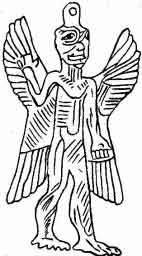
"Amulet formed by the figure of Pazuzu,
the god of storms, cyclones and hurricanes."
Now there is no record of this Wind Flood in the Bible, and it is only mentioned in the "Cave of Treasures," and in works based upon it, e.g. the Book of the Bee and the Book of Adam and Eve. Some light is thrown upon this Wind Flood by the cuneiform inscriptions, and the author of the "Cave of Treasures" must have derived his knowledge of it from documents based upon them. Nabonidus, king of Babylon, displeased the gods, and they made manifest their anger by making the storm wind to blow. And in one text it is distinctly said that the cities of Erech and Nippur were destroyed by a wind storm. (See Sidney Smith, Babylonian Historical Texts, London, 1924, page 93, note 20.) The most terrible of all the storm-wind gods was Pazuzu, whose strength and violence were believed to be so great that he could overthrow even the mountains (Revue d'Assyriologie, vol. XI, page 57). Figures of this monster in stone and bronze may be seen in the British Museum.
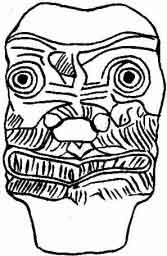
Limestone head of the Storm-god
Pazuzu. (British Museum.)
Terah, the father of Abraham, followed in his father's footsteps, and, according to the legend quoted on made figures of the gods, or idols, in clay and stone, and sent his son Abraham into the baz to sell them. Fact underlies this legend, for a large number of terra-cotta figures of gods and demons have been found by many excavators during the course of their work on the sites of ancient cities in Babylonia; the commonest of these are the so-called "Papsukkal figures," which were believed to protect houses.
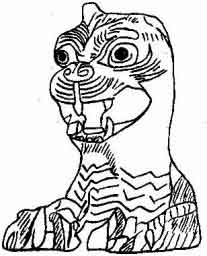
"Baked clay figure of the god of the
South-east Wind. (British Museum.)"
The materials by which to check the statements made in the "Cave of Treasures" are not available at the present time, but it is very possible that in future years inscribed tablets will be found in Babylonia and Assyria which will contain the original forms of the legends and historical facts that have come down to us. The story of Nimrod and his cult of fire and the white horse, and his visit to the wise man Yt, of his skill as a magician, and the cities which he built, may be somewhat garbled, but it is based on genuine historical documents. The narrative of the descents made by Seth and his companions from the mountain of Paradise into the plain is certainly based on historical fact; and though Melchisedek has not yet been identified in the cuneiform inscriptions, there is every reason to believe that he existed, and that he was a founder of a pure form of religion, and a great ruler as well as priest.
The principal object of the writer of the "Cave of Treasures" was to trace the descent of Christ back to Adam, and to show that the Christian Dispensation was foreshadowed in the history of the Patriarchs and their successors the kings of Israel and Judah by means of types and symbols. The Christian Trinity existed before the world and man were made, for "the Spirit of God" which hovered over the waters was the Holy Spirit, and when God said "Let Us make man" by "Us" the Trinity was referred to. The Sabbath was instituted by God Who Himself rested on the seventh day. When Adam stood up upright after his creation he set his feet on the centre of the earth, on the exact spot on which the Cross of our Lord was set up, in Jerusalem. Adam, like Elijah, ascended into heaven in a chariot of fire. The angels carried crosses of light on which the names of the Persons of the Trinity were inscribed, and with them vanquished Satan and his hosts of devils when he rebelled, as the Cross of Christ destroyed the powers of darkness. The Garden of Eden is symbolic of the Holy Church, and as Adam was priest as well as prophet and king, he ministered in it. The Tree of Life prefigured the Cross of Christ, the veritable Tree of Life. On his expulsion from Paradise God told Adam that He would send His Son to redeem him, and ordered him to make arrangements for the embalming of his body and its preservation in the Cave of Treasures.
Adam and Eve lived on bread and wine in Paradise, and Melchisedek administered bread and wine to Abraham, according to the command of Methuselah, and so foreshadowed the institution of the Sacrament. The Cave of Treasures, with the gold, frankincense and myrrh which Adam collected in it, symbolized not only the Temple, or house of prayer, but the cave in which the Magi presented their gifts to Christ. Adam was the first priest, and was present when Cain and Abel made their offerings, and the lamp which he placed by the side of Abel's body in the Cave of Treasures was the prototype of the sanctuary lamp. Adam's body was buried in the Cave of Treasures, which became a family mausoleum, for several of his sons and descendants were also buried there. Noah took Adam's body from the Cave and carried it into Noah's Ark, and it was in due course brought to Jerusalem by him, and deposited in the opening in the earth which the earth itself made to receive it. There it remained until the Cross of Christ was set up above it on Golgotha, and then, when Longinus pierced our Lord's side, the blood and water flowed down into the place where Adam was. The blood gave him life, and he was baptized by the water.
Noah's Ark, bearing the body of Adam, which occupied the centre of it, and divided the men from the women, sailed over the waters until it reached the mountain on which Paradise was situated, and it travelled from east to west, and from north to south, and thus it made the sign of the Cross on the waters of the Flood. When the foremost part of the Flood reached the skirts of the mountain of Paradise, it bowed low and kissed the ground, and then withdrew to continue its work of destruction. The first dove sent out by Noah was a type of the Old Covenant, which was not accepted by the Jews, and the second dove was a type of the New Covenant, which rested on the people through the waters of baptism. One of the legends states that Abraham was circumcised by Gabriel, who was assisted by Michael. Abraham circumcised Isaac, and foresaw the crucifixion of Christ. The angels who were on Jacob's Ladder were Zechariah, and Mary, and the Magi and the Shepherds, and the Lord who stood at the head of it symbolized Christ on the Cross. The watering of the flocks by Jacob at the well symbolized the baptism of the nations. The stone which he set up and anointed was a type of the Christian altar, and the oil he used symbolized the oil used at the Christian altar. The crown of glory which Adam wore prefigured the crown of thorns which was placed on the head of Christ. Adam was three hours in Paradise, and Christ was in Pilate's Hall of Judgment three hours. Adam was naked for three hours, and Christ was naked on the Cross for three hours. The mother of mortal offspring (Eve) proceeded from the right side of Adam, and Baptism, the mother of immortal offspring, went forth from the right side of Christ during His crucifixion.
Adam's descent from Paradise typified the descent of Christ into Sheol; Adam was the prototype of Christ in every respect. Isaac was a symbol of Christ, and the thicket in which the ram, his substitute, was caught symbolized the wood of the Cross. The thread of scarlet of Rahab the harlot typified the red blood of Christ, and the window from which it issued His side. The seamless garment of Christ was the symbol of the indivisible Orthodox Faith.
One of the most important sections of the "Cave of Treasures" is that which contains a description of the Magi and their visit to Jerusalem, for it appears to be based upon the work of some writer who had exact knowledge of their methods. They are here grouped with the Chaldeans, who were presumably Babylonians, but they themselves are called the "wise men of Persia." Both these bodies of sages had studied the motions of the "Malwh" or Signs of the Zodiac, for centuries, and through them they felt that they were able to forecast with accuracy the course of events on this earth. The Magi were terrified at the appearance of the star, which led them subsequently to Bethlehem, and thought that the king of the Greeks was about to attack the land of Nimrod. At length they consulted their great astrological work which is here called "Gelydhe Nemrh," i.e. the "Revelation of Nimrod," and there they learned that a king was born in Judah. What this "Revelation of Nimrod" was cannot be said, but it was evidently one of the large series of Omen-texts of which so many examples exist in the British Museum. These texts are being copied and translated by Mr. C. J. Gadd of the British Museum, and when the work is done we may learn something of the book which the Magi consulted. The "Cave of Treasures" says that the Magi were three kings, and gives their names, and thus repeats the tradition which was general in the early centuries of the Christian Era. On the other hand, the "Book of the Bee," following a very ancient Oriental tradition, says they were twelve in number, and gives their names; but it must be noted that some of the names are only found at a comparatively late period of Persian History.
The sources of the genealogy of Christ which is found in the "Cave of Treasures" are unknown, but the author states that he is certain about its correctness, and by inserting it in their copies of the work the scribes have shown that it is worthy of credence. It is probably quite true that when the captain of Nebuchadnezzar's host burnt the books of the Jews after the capture of Jerusalem their tables of genealogy perished with them.
- Published in The Book of the Cave of Treasures
- 0