log in
The Sacred theory of the Earth

The Sacred theory of the Earth (191)

THE SACRED THEORY OF THE EARTH

Containing an Account
OF THE
Original of the Earth
AND OF ALL THE

GENERAL CHANGES

Which it hath already undergone

OR

IS TO UNDERGO

Till the CONSUMMATION of all Things

by Thomas Burnet

The Second Edition,

LONDON

Printed by R. Norton, for Walter Kettilby, at the Biƒhops-Head in St. Paul's Church-Yard

[1691]

Thomas Burnet, born 1635 deceased 1715

NOTICE OF ATTRIBUTION

Scanned at sacred-texts.com, July 2005. Proofed and formatted by John Bruno Hare. This text is in the public domain worldwide. These files may be used for any non-commercial purpose provided this notice of attribution accompanies all copies.

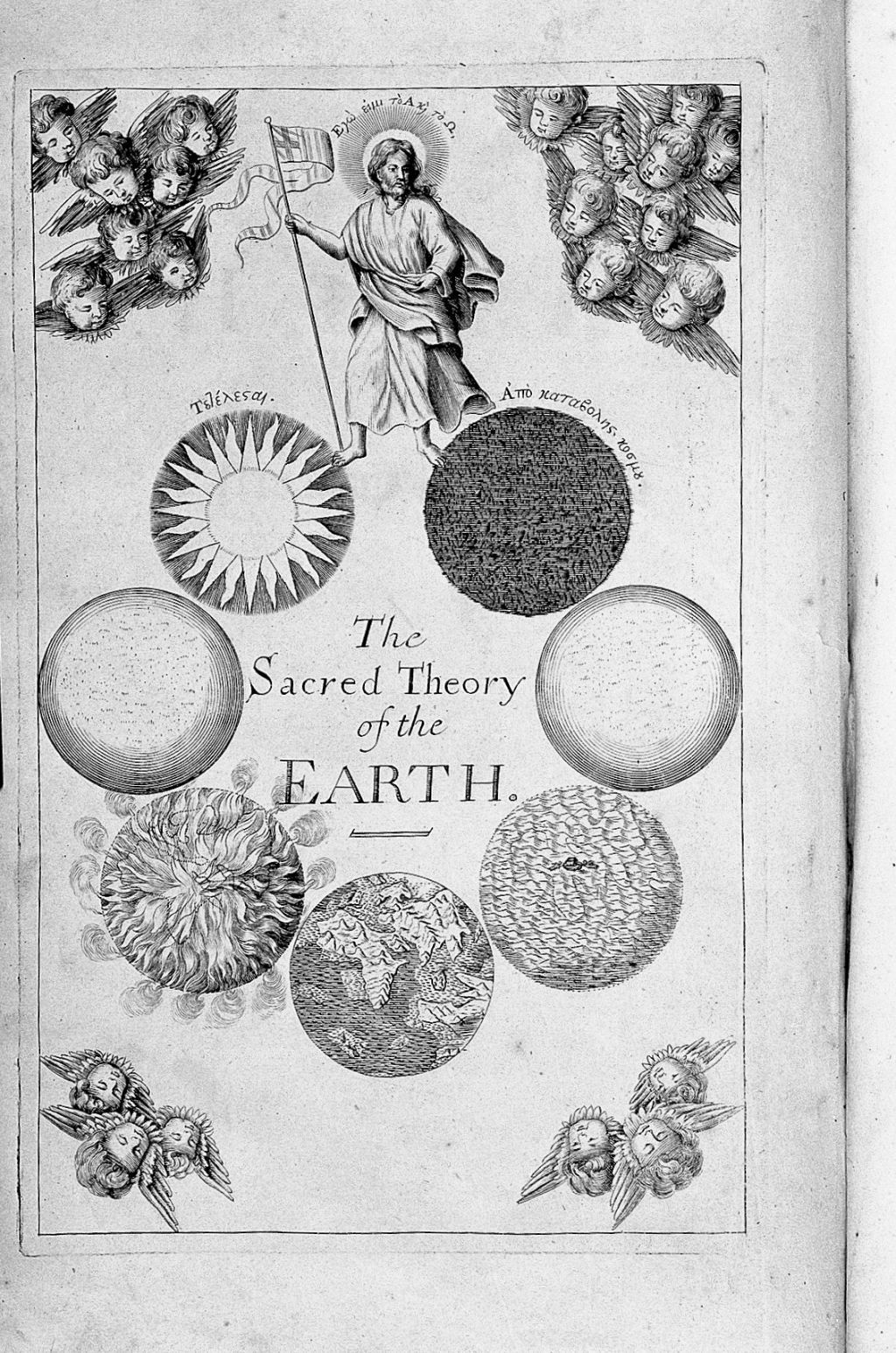
Frontispiece
Click to enlarge
Frontispiece

Title Page
Click to enlarge
Title Page


Children categories

Atlantis, the Antediluvian World

Atlantis, the Antediluvian World (39)

donnelly-index

Atlantis the Antediluvian World

 by Ignatius Donnelly

[1882]


View items...
A Dweller on two Planets

A Dweller on two Planets (55)

phylos-title

phylos-title

A DWELLER ON TWO PLANETS

OR

THE DIVIDING OF THE WAY

BY

PHYLOS THE THIBETAN

(Otherwise named, in fulness, Yol Gorro, author of this book.)

phylos-title


View items...
Ragnarok

Ragnarok (35)

Ragnarok

THE AGE OF FIRE AND GRAVEL.

BY

IGNATIUS DONNELLY

AUTHOR OF "ATLANTIS: THE ANTEDILUVIAN WORLD."

[1883]


View items...

Preface to the Reader

THE SACRED THEORY OF THE EARTH

by Thomas Burnet


PREFACE TO THE READER

HAVING given an account of this whole Work in the first Chapter, and of the method of either Book, whereof this Volume consists, in their proper places, there remains not much to be said here to the Reader. This Theory of the Earth may be called Sacred, because it is not the common Physiology of the Earth, or of the Bodies that compose it, but respects only the great Turns of Fate, and the Revolutions of our Natural World; such as are taken notice of in the Sacred Writings, and are truly the Hinges upon which the Providence of this Earth moves; or whereby it opens and shuts the several successive Scenes whereof it is made up. This EnglishEdition is the same in substance with the Latin, though, I confess, tis not so properly a Translation, as a new Composition upon the same ground, there being several additional Chapters in it, and several new-moulded.

As every Science requires a peculiar Genius, so likewise there is a Genius peculiarly improper for every one; and as to Philosophy, which is the Contemplation of the works of Nature, and the Providence that governs them, there is no temper or Genius, in my mind, so improper for it, as that which we call a meanand narrow Spirit; and which the Greekscall Littleness of Soul. This is a defect in the first make of some Men's minds, which can scarce ever be corrected afterwards, either by Learning or Age. And as Souls that are made little and incapacious cannot enlarge their thoughts to take in any great compass of Times or Things; so what is beyond their compass, or above their reach, they are apt to look upon as Fantastical, or at least would willingly have it pass for such in the World. Now as there is nothing so great, so large, so immense, as the works of Nature, and the methods of Providence, men of this complexion must needs be very unfit for the contemplation of them. Who would set a purblind man at the top of the Mast to discover Land? or upon an high Tower to draw a Landskip of the Country round about? for the same reason, short-sighted minds are unfit to make Philosophers, whose proper business it is to discover and describe in comprehensive Theories the Phomenaof the World, and the Causes of them.

This original disease of the Mind is seldom cured by Learning, which cures many others; Tis like a fault in the first Staminaof the Body, which cannot easily be rectified afterwards. Tis a great mistake to think that every sort of Learning makes a Man a competent Judge of Natural Speculations; We see unhappy examples to the contrary amongst the Christian Fathers, and particularly in St. Austin, who was unquestionably a Man of Parts and Learning, but interposing in a controversie where his Talent did not lie, showed his zeal against the Antipodesto very ill purpose, though he drew his Reasons partly from Scripture. And if within a few Years, or in the next Generation, it should Evidence as certain and demonstrable, that the Earth is moved, as it is now, that there are Antipodes; those that have been zealous against it, and ingaged the Scripture in the Controversie, would have the same reason to repent of their forwardness, that St. Austin would have now, if he was alive. Tis a dangerous thing to ingage the authority of Scripture in disputes about the Natural World, in opposition to Reason; lest Time, which brings all things to light, should discover that to be evidently false which we had made Scripture to assert: And I remember St. Austin in his Exposition upon Genesis, hath laid down a rule to this very purpose, though he had the unhappiness, it seems, not to follow it always himself. The reason also, which he gives there for his rule, is very good and substantial: 1 For, saith He, if the Unbelievers or Philosophers shall certainly know us to be mistaken, and to erre in those things that concern the Natural World, and see that we alledge our(Sacred) Books for such vain opinions, how shall they believe those same Books when they tell them of the RESURRECTION of the Dead, and the World to come, if they find them to be fallaciously writ in such things as lie within their certain knowledge?

We are not to suppose that any truth concerning the Natural World can be an Enemy to Religion; for Truth cannot be an Enemy to Truth, God is not divided against himself; and therefore we ought not upon that account to condemn or censure what we have not examined or cannot disEvidence; as those that are of this narrow Spirit we are speaking of, are very apt to do. Let every thing be tried and examined in the first place, whether it be Trueor False; and if it be found false, tis then to be considered, whether it be such a falsity as is prejudicial to Religion or no. But for every new Theory that is proposed, to be alarumed, as if all Religion was falling about our Ears, is to make the World suspect that we are very ill assured of the foundation it stands upon. Besides, do not all Men complain, even These as well as others, of the great ignorance of Mankind? how little we know, and how much is still unknown? and can we ever know more, unless something new be Discovered? It cannot be old when it comes first to light, when first invented, and first proposed. If a Prince should complain of the poorness of his Exchequer, and the scarcity of Money in his Kingdom, would he be angry with his Merchants, if they brought him home a Cargoof good Bullion, or a Mass of Gold out of a foreign Countrey? and give this reason only for it, Hewould have no new Silver; neither should any be Currant in his Dominions but what had his own Stamp and Image upon it: How should this Prince or his People grow rich? To complain of want, and yet refuse all offers of a supply, looks very sullen, or very fantastical.

I might mention also upon this occasion another Genius and disposition in Men, which often makes them improper for Philosophical Contemplations; not so much, it may be, from the narrowness of their Spirit and Understanding, as because they will not take time to extend them. I mean Men of Wit and Parts, but of short Thoughts, and little Meditation, and that are apt to distrust every thing for a Fancy or Fiction that is not the dictate of Sense, or made out immediately to their Senses. Men of this Humour and Character call such Theories as these, Philosophick Romances, and think themselves witty in the expression; They allow them to be pretty amusements of the Mind, but without Truth or reality. I am afraid if an Angel should write the Theory of the Earth, they would pass the same judgment upon it; Where there is variety of Parts in a due Contexture, with something of surprising aptness in the harmony and correspondency of them, this they call a Romance; but such Romances must all Theories of Nature, and of Providence be, and must have every part of that Character with advantage, if they be well represented. There is in them, as I may so say, a Plotor Mysterypursued through the whole Work, and certain Grand Issues or Events upon which the rest depend, or to which they are subordinate; but these things we do not make or contrive our selves, but find and discover them, being made already by the Great Author and Governour of the Universe: And when they are clearly discovered, well digested, and well reasoned in every part, there is, me-thinks, more of beauty in such a Theory, at least a more masculine beauty, than in any Poem or Romance; And that solid truth that is at the bottom, gives a satisfaction to the Mind, that it can never have from any Fiction, how artificial soever it be.

To enter no farther upon this matter, tis enough to observe, that when we make Judgments and Censures upon general presumptions and prejudices, they are made rather from the temper and model of our own Spirits, than from Reason; And therefore, if we would neither impose upon ourselves, nor others, we must lay aside that lazy and fallacious method of Censuring by the Lump, and must bring things close to the test of Trueor False, to explicit proof and evidence; And whosoever makes such Objections against an Hypothesis, hath a right to be heard, let his Temper and Genius be what it will. Neither do we intend that any thing we have said here, should be understood in another sence.

To conclude, This Theory being writ with a sincere intention to justifie the Doctrines of the Universal Deluge, and of a Paradisiacalstate, and protect them from the Cavils of those that are no well-wishers to Sacred History, upon that account it may reasonably expect fair usage and acceptance with all that are well-disposed; And it will also be, I think, a great satisfaction to them to see those pieces of most ancient History, which have been chiefly preserved in Scripture, confirmed anew, and by another Light, that of Nature and Philosophy; and also freed from those misconceptions or misrepresentations which made them sit uneasie upon the Spirits even of the best Men, that took time to think. Lastly, In things purely Speculative, as these are, and no ingredients of our Faith, it is free to differ from one another in our Opinions and Sentiments; and so I remember St. Austin hath observed upon this very subject of Paradise; Wherefore as we desire to give no offence our selves, so neither shall we take any at the difference of Judgment in others; provided this liberty be mutual, and that we all agree to study Peace, Truth, and a good Life.


Footnotes

15:1 Gen. ad lit. lib. I, c. 19. Plerumque accidit ut aliquid de Terr de Co, de ceris hujus mundi elementis, &c. C enim quenquam Christianorum in ere quam optimnunt, errare deprehenderint, & vanam sententiam suam ex nostris libris asserere, quo pacto illis libris credituri sunt de Resurrectione Mortuorum, & spe vita ernregnue corum, quando de his rebus quas jam experiri vel indubitatis numeris percipere potuerunt, fallaciter putaverint esse conscriptos?


Dedication to the Queen

THE SACRED THEORY OF THE EARTH

by Thomas Burnet

THE THEORY OF THE EARTH

THE TWO LAST BOOKS

Concerning theBURNING of theWORLD AND Concerning the NEW HEAVENS and NEW EARTH.

LONDON,

Printed by R. Norton, for Walter Kettilby, at the Biƒhops-Head in S. Paul's Church-Yard, 1690.


TO THE QUEEN'S MOST Excellent Majesty

MADAM,

HAVING had the honour to present the first part of this Theory to Your ROYAL UNCLE, I presume to offer the Second to Your Majesty. This part of the Subject, I hope, will be no less acceptable, for certainly ’tis of no less importance. They both indeed agree in this, That there is a WORLD made and destroyed in either Treatise. But we are more concerned in what is to come, than in what is past. And as the former Books represented to us the Rise and Fall of the First World; so These give an account of the present Frame of Nature labouring under the last Flames, and of the Resurrection of it in the New Heavensand New Earth:which, according to the Divine Promises, we are to expect.

Cities that are burnt, are commonly rebuilt more beautiful and regular than they were before. And when this World is demolished by the last Fire, He that undertakes to rear it up again, will supply the defects, if there were any, of the former Fabrick. This Theory supposes the present Earth to be little better than an Heap of Ruines: where yet there is room enough for Sea and Land, for Islands and Continents, for several Countries and Dominions: But when these are all melted down, and refined in the general Fire, they will be cast into a better mould, and the Form and Qualities of the Earth will become Paradisiacal.

But, I fear, it may be thought no very proper address, to shew Your Majesty a World laid in ashes, where You have so great an interest Your Self, and such fair Dominions; and then, to recompence the loss by giving a Reversion in a Future Earth. But if that future Earth be a second Paradise, to be enjoyed for a Thousand Years; with Peace, Innocency, and constant health: An Inheritance there will be an happy exchange for the best Crown in this World.

I confess, I could never perswade my self, that the Kingdom of Christ and of his Saints, which the Scripture speaks of so frequently, was designed to be upon this present Earth. But however, upon all suppositions, They that have done some eminent Good in this Life, will be sharers in the happiness of that State. To humble the Oppressors, and rescue the Oppressed, is a work of Generosity and Charity that cannot want its reward; Yet, MADAM, They are the greatest Benefactors to Mankind, that dispose the World to become Vertuous: and by their example, Influence, and Authority, retrieve that TRUTHand JUSTICE, that have been lost, amongst men, for many Ages. The School-Divines tell us, Those that act or suffer great things for the Publick Good, are distinguished in Heaven by a Circle of Gold about their Heads. One would not willingly vouch for that: but one may safely for what the Prophet says, which is far greater: namely, that They shall shine like Stars in the Firmament, that turn many to Righteousness. Which is not to be understood, so much, of the Conversion of single Souls, as of the turning of Nations and People, The turning of the World to Righteousness. They that lead on that great and happy Work, shall be distinguished in Glory from the rest of Mankind.

We are sensible, MADAM, from Your Great Example, that Piety and Vertue seated upon a Throne, draw many to imitation, whom ill Principles, or the course of the World, might have led another way. These are the best, as well as easiest Victories, that are gained without Contest. And as Princes are the Vicegerents of God upon Earth, so when their Majesty is in Conjunction with Goodness, it hath a double Character of Divinity upon it: and we owe them a double Tribute, of Fear and Love. Which, with constant Prayers for Your MAJESTY'Spresent and future Happiness, shall be always Dutifully paid, by

YOUR MAJESTY'S

Most Humble and most

Obedient Subject,

T. BURNET.


Dedication: To the King's Most Excellent Majesty

THE SACRED THEORY OF THE EARTH

by Thomas Burnet


TO THE KING'S MOST Excellent Majesty

SIR,

NEW-found Lands and Countries accrew to the Prince, whose Subject makes the first Discovery; And having retrieved a World that had been lost, for some thousands of Years, out of the Memory of Man, and the Records of Time, I thought it my Duty to lay it at Your Majesty's Feet. Twill not enlarge Your Dominions, tis past and gone; nor dare I say it will enlarge Your Thoughts; But I hope it may gratifie Your Princely curiosity to read the Description of it, and see the Fate that attended it.

We have still the broken Materials of that first World, and walk upon its Ruines; while it stood, there was the Seat of Paradise, and the Scenes of the Golden Age; when it fell, it made the Deluge; And this unshapen Earth we now inhabit, is the Form it was found in when the Waters had retired, and the dry Land appeared. These things, Sir, I propose and presume to Evidence in the following Treatise, which I willingly submit to Your Majesty's judgment and Censure; being very well satisfied, that if I had sought a Patron in all the List of Kings, Your Contemporaries: Or in the Roll of Your Nobles, of either Order: I could not have found a more competent judge in a Speculation of this Nature. Your Majesty's Sagacity, and happy Genius for Natural History, for Observations and Remarks upon the Earth, the Heavens, and the Sea, is a better preparation for Inquiries of this kind, than all the dead Learning of the Schools.

Sir, This Theory, in the full extent of it, is to reach to the last Period of the Earth, and the End of all things; But this first Volume takes in only so much as is already past, from the Origin of the Earth, to this present time and state of Nature. To describe in like manner the Changes and Revolutions of Nature that are to come, and see thorough all succeeding Ages, will require a steddy and attentive Eye, and a retreat from the noise of the World; Especially so to connect the parts, and present them all under one view, that we may see, as in a Mirrour, the several faces of Nature, from First to Last, throughout all the Circle of Successions.

Your Majesty having been pleased to give encouragement to this Translation, I humbly present it to Your Gracious Acceptance. And tis our Interest, as well as Duty, in Disquisitions of this Nature, to Address our selves to Your Majesty, as the Defender of our Philosophick Liberties;against those that would usurp upon the Fundamental priviledge and Birth-right of Mankind, The Free use of Reason. Your Majesty hath always appeared the Royal Patron of Learning and the Sciences, and tis suitable to the Greatness of a Princely Spirit, to favour and promote whatsoever tends to the enlargement of Humane Knowledge, and the imEvidencement of Humane Nature. To be Good and Gracious, and a Lover of Knowledge, are, methinks, two of the most amiable things in this World; And that Your Majesty may always bear that Character, in present and future Ages, and after a long and prosperous Reign, enjoy a blessed Immortality, is the constant Prayer of

YOUR MAJESTY'S

Most Humble and most

Obedient Subject,

THOMAS BURNET.


Sacred Theory of the Earth, Title page book I and II

THE SACRED THEORY OF THE EARTH

Containing an Account of the Original of the Earth AND OF ALL THE GENERAL CHANGES Which it hath already undergone OR IS TO UNDERGO Till the CONSUMMATION of all Things

THE TWO FIRST BOOKS

Concerning the DELUGE

AND

Concerning PARADISE

by Thomas Burnet

The Second Edition,

LONDON

Printed by R. Norton, for Walter Kettilby, at the Bihops-Head in St. Paul's Church-Yard [1691]

Thomas Burnet, born 1635? deceased 1715.

NOTICE OF ATTRIBUTION

Scanned at sacred-texts.com, July 2005. Proofed and formatted by John Bruno Hare. This text is in the public domain worldwide. These files may be used for any non-commercial purpose provided this notice of attribution accompanies all copies.


Frontispiece Click to enlarge
Frontispiece
Title Page Click to enlarge
Title Page


Sacred Theory of the Earth: Chapter 2

THE SACRED THEORY OF THE EARTH

by Thomas Burnet

A REVIEW OF THE THEORY OF THE EARTH And of its evicenceS: ESPECIALLY IN REFERENCE TO SCRIPTURE

LONDON,

Printed by R. Norton, for Walter Kettilby, at the Bihop's-Head in St. Paul's Church-Yard. [1690]


Chapter II

SO much for Natural Evidence, from the Causes or Effects. We now proceed to Scripture, which will make the greatest part of this Review. The Sacred Basis upon which the whole Theory stands, is the doctrine of St. Peter, delivered in his Second Epistleand Third Chapter, concerning the Triple Orderand Succession of the Heavens and the Earth. That comprehends the whole extent of our Theory: which indeed is but a large Commentary upon St. Peter's Text. The Apostle sets out a threefold state of the Heavens and Earth: with some general properties of each: taken from their different Constitution and different Fate. The Theory takes the same threefold state of the Heavens and the Earth: and explains more particularly, wherein their different Constitution consists: and how, under the conduct of Providence, their different fate depends upon it. Let us set down the Apostle's words, with the occasion of them: and their plain sence, according to the most easie and natural explication.

Ver. 3. Knowing this first, that there shall come in the last days scoffers, walking after their own lusts.

4. And saying, Where is the promise of his coming? for since the fathers fell asleep, all things continue as they were from the beginning of the creation.
5. For this they willingly are ignorant of, that by the word of God, the heavens were of old, and the earth consisting of water and by water.
6. Whereby the world that then was, being overflowed with water, perished.
7. But the heavens and the earth that are now, by the same word, are kept in store, reserved unto fire against the day of judgment, and perdition of ungodly men. . . . . .
10. The day of the Lord will come as a thief in the night, in the which the heavens shall pass away with a great noise, and the elements shall melt with fervent heat; the earth also and the works that are therein shall be burnt up.
13. Nevertheless we, according to his promise, look for new heavens and a new earth, wherein dwelleth righteousness.

This is the whole Discourse so far as relates to our Subject. St. Peter, you see, had met with some that scoffed at the future destruction of the World, and the coming of our Saviour; and they were men, it seems, that pretended to Philosophy and Argument; and they use this argument for their opinion, Seeing there hath been no change in Nature, or in the World, from the beginning to this time, why should we think there will be any change for the future?

The Apostle answers to this, That they willingly forget or are ignorant that there were Heavens of old, and an Earth, so and so constituted; consisting of Water and by Water; by reason whereof that World, or those Heavens and that Earth, perished in a Deluge of Water. But, saith he, the Heavens and the Earth that are now, are of another constitution, fitted and reserved to another fate, namely to perish by Fire. And after these are perished, there will be New Heavens and a New Earth, according to God's promise.

This is an easie Paraphrase, and the plain and genuine sence of the Apostle's discourse; and no body, I think, would ever look after any other sence, if this did not draw them into paths they do not know, and to conclusions which they do not fancy. This sence, you see, hits the objection directly, or the Cavil which these scoffers made; and tells them, that they vainly pretend that there hath been no change in the World since the beginning, for there was one sort of Heavens and Earth before the Flood, and another sort now; the first having been destroyed at the Deluge. So that the Apostle's argument stands upon this Foundation, That there is a diversity betwixt the present Heavens and Earth, and the Ante-diluvian Heavens and Earth; take away that, and you take away all the force of his Answer.

Then as to his New Heavens and New Earthafter the Conflagration, they must be material and natural, in the same sence and signification with the former Heavens and Earth; unless you will offer open violence to the Text. So that this Triplicity of the Heavens and the Earth, is the first, obvious, plain sence of the Apostle's discourse: which every one would readily accept, if it did not draw after it a long train of Consequences, and lead them into other Worlds than they ever thought of before, or are willing to enter upon now.

But we shall have occasion by and by, to examine this Text more fully in all its circumstances. Give me leave in the mean time to observe, that St. Paulalso implyes that triple Creationwhich St. Peterexpresses. St. Paul, I say, in the 8thchap. to the Rom. ver. 20, 21. tells us of a Creationthat will be redeemed from Vanity:which are the new Heavens and new Earth to come. A Creation in subjection to Vanity:which is the present state of the World. And a Creation that was subjected to Vanity, in hopes of being restor'd: which was the first Paradisiacal Creation. And these are the three states of the Natural World, which make the subject of our Theory.

To these two places of St. Peterand St. Paul, I might add that third in St. John, concerning the new Heavens and new Earth; with that distinguishing Character, that the Earth was without a Sea. As this distinguisheth it from the present Earth, so, being a Restitutionor Restauration, as we noted before, it must be the same with some former Earth: and consequently, it implies that there was another precedent state of the natural World, to which this is a Restitution. These three places I alledge, as comprehending and confirming the Theory in its full extent. But we do not suppose them all of the same force and clearness. St. Peterleads the way, and gives light and strength to the other two. When a Point is Evidenced by one clear Text, we allow others, as auxiliaries, that are not of the same clearness; But being opened, receive light from the primary Text, and reflect it upon the Argument.

So much for the Theory in general. We will now take one or two principal heads of it, which vertually contain all the rest, and examine them more strictly and particularly, in reference to their agreement with Scripture. The two Heads we pitch upon, shall be, our Explication of the Deluge, and our Explication of the new Heavens and new Earth. We told you before, these two were as the Hinges, upon which all the Theory moves, and which holds the parts of it in firm union one with another. As to the Deluge, if I have explained that aright, by the Disruption of the Great Abyss, and the Dissolution of the Earth that covered it, all the rest follows in such a chain of consequences, as cannot be broken. Wherefore in order to the evicence of that explication, and of all that depends upon it, I will make bold to lay down this Proposition, That our Hypothesis concerning the universal Deluge, is not onely more agreeable to Reason and Philosophy than any other yet proposed to the World, but is also more agreeable to Scripture. Namely, to such places of Scripture, as reflect upon the Deluge, the Abyss, and the form of the first Earth. And particularly, to the History of Noah's Flood, as recorded by Moses. If I can make this good, it will, doubtless, give satisfaction to all intelligent Persons. And I desire their patience, if I proceed slowly.

We will divide our task into. parts, and examine them separately: First, by Scripture in general, and then by Moseshis history and description of the Flood.

Our Hypothesis of the Deluge consists of three principal Heads, or differs remarkably in three things from the common explication. First, in that we suppose the Antediluvian Earth to have been of another Form and constitution from the present Earth: with the Abyss placed under it.

Secondly, in that we suppose the Deluge to have been made, not by any inundation of the Sea, or overflowing of Fountains and Rivers: nor (principally) by any excess of rains: but by a real dissolution of the exteriour Earth, and disruption of the Abyss which it covered. These are the two principal points, to which may be added, as a Corollary.

Thirdly, that the Deluge was not in the nature of a standing Pool: the Waters lying every where level, of an equal depth and with an uniform Surface: but was made by a fluctuation and commotion of the Abyss upon the disruption: which commotion being over, the Waters retired into their Chanels, and let the dry Land appear.

These are the most material and fundamental parts of our Hypothesis: and these being Evidenced consonant to Scripture, there can be no doubt of the rest.

We begin with the first: That the Ante-diluvian Earth was of another form and constitution from the present Earth, with the Abyss placed under it. This is confirmed in Scripture, both by such places as assert a diversity in general: and by other places that intimate to us, wherein that diversity consisted, and what was the form of the first Earth. That discourse of St. Peter's, which we have set before you, concerning the past, present, and future, Heavens and Earth, is so full a evicence of this diversity in general, that you must either allow it, or make the Apostle's argumentation of no effect. He speaks plainly of the natural World, The Heavens and the Earth: And he makes a plain distinction, or rather opposition, betwixt those before and after the Flood: so that the least we can conclude from his words, is a diversity betwixt them; In answer to that Identity or immutability of Nature, which the Scoffers pretended to have been ever since the beginning.

But tho’ the Apostle, to me, speaks plainly of the Natural World, and distinguishes that which was before the Flood, from the present: Yet there are some that will allow neither of these to be contained in St. Peter's words; and by that means would make this whole Discourse of little or no effect, as to our purpose. And seeing we, on the contrary, have made it the chief Scripture-basis of the whole Theory of the Earth, we are obliged to free it from those false glosses or misinterpretations, that lessen the force of its testimony, or make it wholly ineffectual.

These Interpreters say, that St. Petermeant no more than to mind these Scoffers, that the World was once destroyed by ..a Deluge of Water: meaning the Animate World, Mankind and living Creatures. And that it shall be destroyed again by another Element, namely by Fire. So as there is no opposition or diversity betwixt the two Natural Worlds, taught or intended by the Apostle; but onely in reference to their different fate or manner of perishing, and not of their different nature or constitution.

Here are two main points, you see, wherein our interpretations of this discourse of the Apostles, differ. First, in that they make the Apostle (in that sixth verse) to understand onely the World Animate, or men and brute Creatures. That these were indeed destroyed, but not the Natural World, or the form and constitution of the then Earth and Heavens. Secondly, that there is no diversity or opposition made by St. Peterbetwixt the ancient Heavens and Earth, and the present, as to their form and constitution. We pretend that these are misapprehensions, or misrepresentations of the sence of the Apostle in both respects, and offer these reasons to Evidence them to be so.

For the first point; That the Apostle speaks here of the natural World, particularly in the 6th. Verse; and that it perished, as well as the animate, these Considerations seem to Evidence.

First, because the argument or ground these Scoffers went upon, was taken from the natural World, its constancy and permanency in the same state from the beginning; therefore if the Apostle answers ad idem, and takes away their argument, he must understand the same natural World, and show that it hath been changed, or hath perished.

You will say, it may be, the Apostle doth not deny, nor take away the ground they went upon, but denies the consequence they made from it; that therefore there would be no change, because there had been none. No, neither doth he do this, if by the Worldin the 6th. Verse, he understands Mankind onely; for their ground was this, there hath been no change in the natural World; Their consequence, this, therefore there will be none, nor any Conflagration. Now the Apostle's answer, according to you, is this, you forget that Mankind hath been destroyed in a Deluge. And what then? what's this to the natural World, whereof they were speaking? this takes away neither antecedent nor consequent, neither ground nor inference; nor any way toucheth their argument, which proceeded from the natural World to the natural World. Therefore you must either suppose that the Apostle takes away their ground, or he takes away nothing.

Secondly, what is it that the Apostle tells these Scoffers they were ignorant of? that there was a Deluge, that destroyed Mankind? They could not be ignorant of that, nor pretend to be so; It was therefore the constitution of those old Heavens and Earth, and the change or destruction of them at the Deluge, that they were ignorant of, or did not attend to; and of this the Apostle minds them. These Scoffers appear to have been Jewsby the phrase they use, since the Fathers fell asleep, which in both parts of it is a Judaical expression; And does St. Petertell the Jewsthat had Mosesread to them every Sabbath, that they were ignorant that Mankind was once destroyed with a Deluge in the Days of Noah? or could they pretend to be ignorant of that without making themselves ridiculous both to Jewsand Christians? Besides, these do not seem to have been of the vulgar amongst them, for they bring a Philosophical argument for their opinion; and also in their very argument they refer to the History of the Old Testament, 1 in saying, Since the Fathers fell asleep, amongst which Fathers, Noahwas one of the most remarkable.

Thirdly, the design of the Apostle is to Evidence to them, or to dispose them to the belief of the Conflagration, or future destruction of the World; which I suppose you will not deny to be a destruction of the natural World; therefore to Evidence or perswade this, he must use an argument taken from a precedent destruction of the natural World; for to give an instance of the perishing of Mankind onely, would not reach home to his purpose. And you are to observe here that the Apostle does not proceed against them barely by authority; for what would that have booted? If these Scoffers would have submitted to authority, they had already the authority of the Prophets and Apostles in this point: but he deals with them at their own weapon, and opposes reasons to reasons; What hath been done may be done, and if the natural World hath been once destroyed, ’tis not hard, nor un-reasonable, to suppose those Prophecies to be true, that say it shall be destroyed again.

Fourthly, unless we understand here the natural World, we make the Apostle both redundant in his discourse, and also very obscure in an easie argument. If his design was onely to tell them that Mankind was once destroyed in a Deluge, what's that to the Heavens and the Earth? the 5th. Verse would be superfluous; which yet he seems to make the foundation of his discourse. He might have told them how Mankind had perished before with a Deluge, and aggravated that destruction as much as he pleased, without telling them how the Heavens and the Earth were constituted then; what was that to the purpose, if it had no dependance or connection with the other? In the precedent Chapter, Verse 5th. when he speaks onely of the Floods destroying Mankind, he mentions nothing of the Heavens or the Earth: and if you make him to intend no more here, what he says more is superfluous.

I also add, that you make the Apostle very obscure and operose in a very easie argument. How easie had it been for him, without this Apparatus, to have told them, as he did before, that God brought a Flood upon the World of the ungodly; and not given us so much difficulty to understand his sence, or such a suspicion and appearance, that he intended something more; for that there is at least a great appearance and tendency to a further sence, I think none can deny; And St. Austin, Didymus, Alex. Bede, as we shall see hereafter, understood it plainly of the natural World: Also modern Expositors and Criticks; as Cajetan, Estius, Drusius, Heinsius, have extended it to the natural World, more or less; tho’ they had no Theory to mislead them, nor so much as an hypothesis to support them; but attended onely to the tenor of the Apostle's discourse, which constrained them to that sence, in whole or in part.

Fifthly, the opposition carries it upon the natural World. The opposition lies betwixt the of ο κπαλαι ορανο κα γ and ο νν ορανο κα γ the Heavens that were of old, and the Earth, and the present Heavens and Earth, or the two natural Worlds. And if they will not allow them to be opposed in their natures (which yet we shall Evidence by and by) at least they must be opposed in their fate; and as This is to perish by fire, so That perished by water; And if it perished by water, it perished; which is all we contend for at present.

Lastly, if we would be as easily governed in the exposition of this place, as we are of other places of Scripture, it would be enough to suggest, that in reason and fairness of interpretation, the same World is destroyed in the 6thverse, that was described in the foregoing verse; but it is the Natural World that is described there, the Heavens and the Earth, so and so constituted; and therefore in fairness of interpretation they ought to be understood here; that World being the subject that went immediately before, and there being nothing in the words that restrains them to the animate World or to Mankind. In the 2d ch. ver. 5. the Apostle does restrain the word κόσμος by adding σεβν, the World of the ungodly; but here ’tis not only illimited, but according to the context, both preceding and following, to be extended to the Natural World. I say by the following context too, for so it answers to the World that is to perish by Fire; which will reach the frame of Nature as well as Mankind.

For a conclusion of this first point, I will set down St. Austin's judgment in this case; who in several parts of his works hath interpreted this place of St. Peter, of the natural world. As to the heavens, he hath these words in his Exposition upon Genesis, Hosetiam aerios cœlos quondam periisse Diluvio, in quâdam earum quæ Canonica appellantur, Epistolâ legimus. We read in one of the Epistles called Canonical, meaning this of St. Peter's that the aerial heavens perished in the Deluge. And he concerns himself there to let you know that it was not the starry heavens that were destroyed; the waters could not reach so high; but the regions of our air. Then afterwards he hath these words Faciliùs eos(cœlos) secundum illius Epistolæ authoritatem credimus periisse, & alios, sicut ibi scribitur, repositos. We do more easily believe, according to the authority of that Epistle, those heavens to have perished; and others, as it is there written, substituted in their place. In like manner, and to the same sence, he hath these words upon Psal. 101. Aerii utique cœli perierunt ut propinqui Terris, secundum quod dicuntur volucres cœli; sunt autem & cœli cœlorum, superiores in Firmamento, sed utrùm & ipsi perituri sint igni, an hi soli, qui etiam diluvio perierunt, disceptatio est aliquanto scrupulosior inter doctos. And in his Book de Civ. Dei, he hath several passages to the same purpose, Quemadmodum in Apostolicâ illâ Epistolâ â toto pars accipitur, quod diluvio periisse dictus est mundus, quamvis sola ejus cum suis cœlis pars ima perierit. These being to the same effect with the first citation, I need not make them English; and this last place refers to the Earth as well as the Heavens, as several other places in St. Austindo, whereof we shall give you an account, when we come to shew his judgment concerning the second point, the diversity of the ante-diluvian and post-diluvian World. This being but a foretaste of his good will and inclinations towards this doctrine.

These considerations alledged, so far as I can judge, are full and unanswerable evicences, that this discourse of the Apostle's comprehends and refers to the Natural World; and consequently they warrant our interpretation in this particular, and destroy the contrary. We have but one step more to make good, That there was a change made in this natural world at the Deluge, according to the Apostle; and this is to confute the second part of their interpretation, which supposeth that St. Petermakes no distinction or opposition betwixt the antediluvian Heavens and Earth, and the present Heavens and Earth, in that respect.

This second difference betwixt us, methinks, is still harsher than the first; and contrary to the very form, as well as to the matter of the Apostle's discourse. For there is a plain antithesis, or opposition made betwixt the Heavens and the Earth of old (ver. the5th) and the Heavens and the Earth that are now (verse the7th) of ο κπαλαι ορανο κα γ and of ο νν ορανο κα γ, and the adversative particle, but, 1 you see marks the opposition; so that it is full and plain according to Grammar and Logick. And that the parts or members of this opposition differ in nature from one another, is certain from this, because otherwise the Apostle's argument or discourse is of no effect, concludes nothing to the purpose; he makes no answer to the objection, nor Evidences any thing against the Scoffers, unless you admit that diversity. For they said, All things had been the same from the beginning in the Natural World, and unless he say, as he manifestly does, that there hath been a change in Nature, and that the Heavens and Earth that are now, are different from the ancient Heavens and Earth, which perished at the Flood, he says nothing to destroy their argument, nor to confirm the Prophetical doctrine of the future destruction of the Natural World.

This, I think, would be enough to satisfie any clear and free mind concerning the meaning of the Apostle; but because I desire to give as full a light to this place as I can, and to put the sence of it out of controversie, if possible, for the future, I will make some further remarks to confirm this exposition.

And we may observe that several of those reasons which we have given to Evidence, That the Natural Worldis understood by St. Peter, are double reasons; and do also Evidence the other point in question, a diversity betwixt the two Natural Worlds, the Anti-diluvian and the present. As for instance, unless you admit this diversity betwixt the two natural Worlds, you make the 5thversein this Chaptersuperfluous and useless: and you must suppose the Apostle to make an inference here without premises. In the 6thversehe makes an inference, 2 Wherebythe World, that then was, perished in a Deluge; what does this wherebyrelate to? by reasonof what? sure of the particular constitution of the Heavens and the Earth immediately before described. Neither would it have signified any thing to the Scoffers, for the Apostle to have told them how the Ante-diluvian Heavens and Earth were constituted, if they were constituted just in the same manner as the present.

Besides, what is it, as I asked before, that the Apostle tells these Scoffers they were ignorant of? does he not say formally and expresly (ver. 5.) that they were ignorant that the Heavens and the Earth were constituted so and so, before the Flood? but if they were constituted as these present Heavens and Earth are, they were not ignorant of their constitution; nor did pretend to be ignorant, for their own (mistaken) argument supposeth it.

But before we proceed any further, give me leave to note the impropriety of our Translation, in the 5th. Verse, or latter part of it; ξ δατος κα δ δάτων (vel δ δατος) συνεσα, This we translate standing in the water, and out of the water, which is done manifestly in compliance with the present form of the Earth, and the notions of the Translators: and not according to the natural force and sence of the Greekwords. If one met with this sentence 1 in a Greek Author, who would ever render it standing in the water and out of the water?nor do I know any Latin Translator that hath ventured to render them in that sence; nor any Latin Father; St. Austinand St. JeromeI’me sure do not, but Consistens ex aquâ, or de aquâ, & per aquam:for that later phrase also συνεάναι δ δατος does not with so good propriety signifie to stand in the water, as to consist or subsist by water, or by the help of water, Tanquam per causam sustinentem; as St. Austinand Jeromerender it. Neither does that instance they give from 1 Pet. 3. 20. Evidence any thing to the contrary, for the Ark was sustained by the waters, and the Englishdoes render it accordingly.

The Translation being thus rectified, you see the ante-diluvian Heavens and Earth consisted of Water, and by water; which makes way for a second observation to Evidence our sence of the Text; for if you admit no diversity betwixt those Heavens and Earth, and the present, shew us ’pray how the present Heavens and Earth consist of water, and by water. What watery constitution have they? The Apostle implies rather, that The now Heavens and Earthhave a fiery constitution. We have now Meteors of all sorts in the air, winds, hail, snow, lightning, thunder, and all things engendered of fiery exhalations, as well as we have rain; but according to our Theory, the ante-diluvian Heavens, of all these Meteors had none but dews and rain, or watery Meteors onely; and therefore might very aptly be said by the Apostle to be constituted of water, or to have a watery σασις. Then the Earth was said to consist by water, because it was built upon it, and at first was sustained by it. And when such a Key as this is put into our hands, that does so easily unlock this hard passage, and makes it intelligible, according to the just force of the words, why should we pertinaciously adhere to an interpretation, that neither agrees with the words, 2 nor makes any sence that is considerable?

Thirdly, If the Apostle had made the ante-diluvian Heavens and Earth the same with the present, his apodosis in the 7th. Verse, should not have beenι δε νν ορανο, but κα ο υτο ορανο κα γ τεθησαυρισμένοι εσί, &c. I say, it should not have been by way of antithesis, but of identity or continuation; And the same Heavens and Earth are kept in store reserved unto fire, &c. Accordingly we see the Apostle speaks thus, as to the Logos, or the Word of God, Verse 7. τ υτο λόγ, by the same Word of God; where the thing is the same, he expresseth it as the same; And if it had been the same Heavens and Earth, as well as the same Word of God, Why should he use a mark of opposition for the one, and of identity for the other? to this I do not see what can be fairly answered.Fourthly, the ante-diluvian Heavens and Earth were different from the present, because, as the Apostle intimates, they were such, and so constituted, as made them obnoxious to a Deluge; whereas ours are of such a form, as makes them incapable of a Deluge, and obnoxious to a Conflagration; the just contrary fate.

If you say there was nothing of natural tendency or disposition in either World to their respective fate, but the first might as well have perished by fire, as water, and this by water as by fire, you unhinge all Nature and natural providence in that method, and contradict one main scope of the Apostle in this discourse. His first scope is to assert, and mind them of that diversity there was betwixt the ancient Heavens and Earth, and the present; and from that, to Evidence against those Scoffers, that there had been a change and revolution in Nature; And his second scope seems to be this, to show that diversity to be such, as, under the Divine conduct, leads to a different fate, and exposed that World to a Deluge; for when he had described the constitution of the first Heavens and Earth, he subjoyns, δ ν τοτε κόσμος δατι κατακλυσθες πόλετο. Quià talis erat, saith Grotius, qualem diximus, constitutio & Terra & Cœli. WHEREBY the then World perished in a Flood of Water. This wherebynotes some kind of causal dependance, and must relate to some means or conditions precedent. It cannot relate to Logos, or the Word of God, Grammar will not permit that; therefore it must relate to the state of the ante-diluvian Heavens and Earth immediately premised. And to what purpose indeed should he premise the description of those Heavens and Earth, if it was not to lay a ground for this inference?

Having given these Reasons for the necessity of this Interpretation; in the last place, let's consider St. Austin's judgment, and his sence upon this place, as to the point in question. As also the reflections that some other of the Ancients have made upon this doctrine of St. Peter's. Didymus Alexandrinus, who was for some time St. Jerome's Master, made such a severe reflection upon it, that he said this Epistle was corrupted, and should not be admitted into the Canon, because it taught the doctrine of a Tripleor Triform Worldin this third Chapter. As you may see in his Enarr. in Epist. Canonicas. Now this threefold World is first that in the 6thVerse, The World that then was. In the 7th. Verse, The Heavens and the Earth, that are now. And in the 13th. Verse, We expect new Heavens and a new Earth, according to his promise. This seems to be a fair account that St. Petertaught the doctrine of a triple World; And I quote this testimony, to show what St. Peter's words do naturally import, even in the judgment of one that was not of his mind. And a Man is not prone to make an exposition against his own Opinion, unless he think the words very pregnant and express.

But St. Austinowns the authority of this Epistle, and of this doctrine, as derived from it, taking notice of this Text of St. Peter's in several Parts of his Works. We have noted three or four places already to this purpose, and we may further take notice of several passages in his Treatise, de Civ. Dei, which confirm our exposition. In his 10th. Book, ch. 24. he disputes against Porphyry, who had the same Principles with these Æternalists in the Text; or, if I may so call them, Incorruptarians; and thought the World never had, nor ever would undergo any change, especially as to the Heavens. St. Austincould not urge Porphyry with the authority of St. Peter, for he had no veneration for the Christian Oracles; but it seems he had some for the Jewish, and arguing against him, upon that Text in the Psalms, Cœli peribunt, he shows upon occasion how he understands St. Peter's destruction of the Old World. Legitur Cœlum & Terra transibunt, Mundus transit, sed puto quod præterit, transit, transibunt aliquantò mitiùs dicta sunt quàm peribunt. In Epistolâ quoque Petri Apostoli, ubi aquâ inundatus, qui tum erat, periisse dictus est Mundus, satis clarum est quæ pars mundi à toto significata est, & quatenùs periisse dicta sit, & qui cœli repositi igni reservandi. This he explains more fully afterwards by subjoyning a caution (which we cited before) that we must not understand this passage of St. Peter's, concerning the destruction of the ante-diluvian World, to take in the whole Universe, and the highest Heavens, but onely the aerial Heavens, and the sublunary World. In Apostolicâ iliâ Epistolâ à toto pars accipitur, quod Diluvio periisse dictus est mundus, quamvis sola ejus, cum suis cœlis, pars ima perierit. In that Apostolical Epistle, a part is signified by the whole, when the World is said to have perished in the Deluge, although the lower part of it onely, with the Heavens belonging to it, perished:that is, the Earth with the regions of the Air that belong to it. And consonant to this, in his exposition of that hundred and first Psalm, upon those words, The Heavens are the work of thy hands, They shall perish, but thou shalt endure. This perishing of the Heavens, he says, St. Petertells us, hath been once done already, namely, at the Deluge; Apertè dixit hoc Apostolus Petrus, Cœli erant olim & Terra, de aquâ & per aquam constituti, Dei verbo; per quod qui factus est mundus, aquâ inundatus deperiit; Terra autem & cœli qui nunc sunt, igni reservantur. Jam ergo dixit periisse cœlos per Diluvium.

These places shew us that St. Austinunderstood St. Peter's discourse to aim at the natural World, and his periitor periisse(verse6.) to be of the same force as peribuntin the Psalms, when ’tis said the Heavens shall perish; and consequently that the Heavens and the Earth, in this Father's opinion, were as really changed and transformed at the time of the Flood, as they will be at the Conflagration. But we must not expect from St. Austinor any of the Ancients a distinct account of this Apostolical doctrine, as if they knew and acknowledged the Theory of the first World; that does not at all appear; but what they said was either from broken Tradition, or extorted from them by the force of the Apostle's words and their own sincerity.

There are yet other places in St. Austinworthy our consideration upon this subject; especially his exposition of this 3d. chap. of St. Peter, as we find it in that same Treatise de Civ. Dei. There he compares again, the destruction of the World at the Deluge, with that which shall be at the Conflagration, and supposeth both the Heavens and Earth to have perished. Apostolus commemorans factum ante Diluvium, videtur admonuisse quodammodò quatenùs in fine hujus seculi mundum istum periturum esse credamus. Nam & illo tempore periisse dixit, qui tunc erat, mundum; nec solum orbem terra, verùm etiam cœlos, Then giving his usual caution, That the Stars and starry heavens should not be comprehended in that mundane destruction, He goes on, Atque hoc modo(penè totus aer) cum terra perierat; cujus Terræ utique prior facies(nempe ante-diluviana) fuerat deleta Diluvio. Qui autem nunc sunt cœli & terra eodem verbo repositi sunt igni reservandi; Proinde qui cœli & qua Terra, id est, qui mundus, pro eo mundo qui Diluvio periit, ex eâdem aquâ repositus est, ipse igni novissimo reservatur. Here you see St. Austin's sence upon the whole matter; which is this, That the natural World, the Earth with the Heavens about it, was destroyed and changed at the Deluge into the present Heavens and Earth; which shall again in like manner be destroyed and changed by the last fire. Accordingly in another place, to add no more, he saith the figure of the (sublunary) world shall be changed at the Conflagration, as it was changed at the Deluge. Tunc figura hujus mundi, &c.cap. 16.

Thus you see, we have St. Austinon our side, in both parts of our interpretation; that St. Peter's discourse is to be referred to the natural inanimate World, and that the present natural World is distinct and different from that which was before the Deluge. And St. Austinhaving applyed this expresly to St. Peter's doctrine by way of Commentary, it will free us from any crime or affectation of singularity in the exposition we have given of that place.

Venerable Bedehath followed St. Austin's footsteps in this doctrine; for, interpreting St. Peter's Original World(Αρχαος Κόσμος) 2 Pet. 2. 5. he refers both that and this (chap. 3. 6.) to the natural inanimate World, which he supposeth to have undergone a change at the Deluge. His words are these, idem ipse mundus est(nempe quoad materiam) in uqo nunc humanum genus habitat, quem inhabitaverunt hi qui ante diluvium fuerunt, sed tamen rectè Originalis Mundus, quasi alius, dicitur; quia sicut in consequentibus hujus Epistolæ scriptum continetur, Ille tune mundus aquâ inundatus periit. Cœlis videlicet qui erant priùs, id est, cunctis aeris hujus turbulenti spaciis, aquarum accrescentium altitudine consumptis, ac Terrâ in alteram faciem, excedentibus aquis, immutatâ. Nam etsi montes aliqui atque convalles ab initio facti creduntur, non tamen tanti quanti nunc in orbe cernuntur universo. ’Tis the same World(namely, as to the matter and substance of it) which mankind lives in now, and did live in before the Flood, but yet that is truly called the ORIGINAL WORLD, being as it were another from the present. For ’tis said in the sequel of this Epistle that the World that was then, perished in the Deluge; namely, the regions of the air were consumed by the height and excess of the waters, and by the same waters the Earth was changed into another form or face. For although some Mountains and Valleys are thought to have been made from the beginning, yet not such great ones as now we see throughout the whole Earth.

You see this Author does not only own a change made at the Deluge, but offers at a further explication wherein that change consisted, viz. that the Mountains and inequalities of the Earth were made greater than they were before the Flood; and so he makes the change or the difference betwixt the two Worlds gradual, rather than specifical, if I may so term it. But we cannot wonder at that, if he had no principles to carry it further, or to make any other sort of change intelligible to him. Bede also pursues the same sence and notion in his interpretation of that fountain, Gen. 2. 5. that watered the face of the Earth before the Flood. And many other transcribers of Antiquity have recorded this Tradition concerning a difference, gradual or specifical, both in the Ante-diluvian heavens (Gloss. Ordin. Gen. 9. de Iride. Lyran. ibid. Hist. Scholast: c. 35. Rab. Maurus&Gloss. Inter. Gen. 2. 5, 6. Alcuin. Quæst. in Gen. inter. 135.) and in the Ante-diluvian Earth, as the same Authors witness in other places. As Hist. Schol. c.34. Gloss. Ord. in Gen.7. Alcuin. Inter.118,&c. Not to instance in those that tell us the properties of the Ante-diluvian World under the name and notion of Paradise.

Thus much concerning this remarkable place in St. Peter, and the true exposition of it; which I have the more largely insisted upon, because I look upon this place as the chief repository of that great natural mystery, which in Scripture is communicated to us, concerning the Triple state or revolution of the World. And of those men that are so scrupulous to admit the Theory we have propos'd, I would willingly know whether they believe the Apostle in what he says concerning the New Heavensand the New Earth to come, ver. 13. and if they do, why they should not believe him as much concerning the Old Heavensand the Old Earth, past; ver. 5, & 6. which he mentions as formally, and describes more distinctly than the other. But if they believe neither past nor to come, in a natural sence, but an unchangeable state of Nature from the Creation to its annihilation, I leave them then to their Fellow Eternalists in the Text, and to the character or censure the Apostle gives them, Κατ τς δίας ατν πιθυμίας πορευόμγυοι, men that go by their own private humour and passions, and prefer that to all other evidence.

They deserve this censure, I am sure, if they do not only disbelieve, but also scoff, at this Prophetick and Apostolick doctrine concerning the Vicissitudes of Nature and a triple World; The Apostle in this discourse does formally distinguish three Worlds (for ’tis well known that the Hebrewshave no word to signifie the natural World, but use that Periphrasis, The Heavensand the Earth) and upon each of them engraves a name and title, that bears a note of distinction in it; He calls them the Old Heavens and Earth, the Present Heavens and Earth, and the New Heavens and Earth. ’Tis true, these three are one, as to matter and substance; but they must differ as to form and properties; otherwise what is the ground of this distinction and of these three different appelations? Suppose the Jewshad expected Ezekiel's Temple for the Third, and last, and most perfect; and that in the time of the second Temple they had spoke of them with this distinction, or under these different names, The Old Temple, the Present Temple, and the New Templewe expect: Would any have understood those three of one and the same Temple; never demolished, never changed, never rebuilt; always the same both as to materials and form? no, doubtless, but of three several Temples succeeding one another. And have we not the same reason to understand this Temple of the World, whereof St. Peterspeaks, to be threefold in succession? seeing he does as plainly distinguish it into the Oldheavens and earth, the Presentheavens and earth, and the Newheavens and earth. And I do the more willingly use this comparison of the Temple, because it hath been thought an Emblem of the outward World.

I know we are naturally averse to entertain any thing that is inconsistent with the general frame and texture of our own thoughts; That's to begin the World again; and we often reject such things without examination. Neither do I wonder that the generality of Interpreters beat down the Apostle's words and sence to their own notions; They had no other grounds to go upon, and Men are not willing, especially in natural and comprehensible things, to put such a meaning upon Scripture, as is unintelligible to themselves; They rather venture to offer a little violence to the words, that they may pitch the sence at such a convenient height, as their Principles will reach to. And therefore though some of our modern Interpreters, whom I mentioned before, have been sensible of the natural tendency of this discourse of St. Peter's, and have much ado to bear off the force of the words, so as not to acknowledge that they import a real diversity betwixt the two worlds spoken of; yet having no Principles to guide or support them in following that Tract, they are forced to stop or divert another way. ’Tis like entering into the mouth of a Cave, we are not willing to venture further than the light goes. Nor are they much to blame for this; the fault is onely in those Persons that continue wilfully in their darkness, and when they cannot otherwise resist the light, shut their eyes against it, or turn their head another way. . . . . . but I am afraid I have staid too long upon this argument: not for my own sake, but to satisfie others.

You may please to remember that all that I have said hitherto, belongs onely to the first Head: To Evidence a Diversity in generalbetwixt the Ante-diluvian Heavens and Earth, and the present: not expressing what their particular form was. And this general diversity may be argued also by observations taken from Moseshis history of the World, before and after the Flood. From the Longevity of the Ante-diluvians: The Rain-bow appearing after the Deluge: and the breaking open an Abyss capable to overflow the Earth. The Heavens that had no Rainbow, and under whose benign and steddy influence, Men lived seven, eight, nine hundred years and upwards, must have been of a different aspect and constitution from the present Heavens. And that Earth that had such an Abyss, that the disruption of it made an universal Deluge, must have been of another form than the present Earth. And those that will not admit a diversity in the two worlds, are bound to give us an intelligible account of these Phænomena: How they could possibly be in Heavens and Earth, like the present. Or if they were there once, why they do not continue so still, if Nature be the same.

We need say no more, as to the Ante-diluvian Heavens: but as to the Earth, we must now, according to the second Part of the first Head; enquire, If that Particular Form, which we have assigned it before the Flood, be agreeable to Scripture. You know how we have described the Form and situation of that Earth: namely, that it was built over the Abyss, as a regular Orb, covering and incompassing the waters round about: and founded, as it were, upon them. There are many passages of Scripture that favour this description: Some more expresly, others upon a due explication. To this purpose there are two express Texts in the Psalms: as Psal. 24. 1, 2. The Earth is the Lords, and the fulness thereof: The habitable World, and they that dwell therein. FOR he has founded it upon 1 the Seas, and established it upon the Floods. An Earth founded upon the Seas, and established upon the Waters, is not this the Earth we have described? the first Earth, as it came from the hands of its Maker. Where can we now find in Nature, such an Earth as has the Seas and the Water for its foundation? Neither is this Text without a second, as a fellow-witness to confirm the same truth: For in the 136. Psalm, ver. 4, 5, 6, we read to the same effect, in these words: To him, who alone does great wonders: To him that by wisdom made the Heavens: To him that stretched out the Earth above the Waters. We can hardly express that form of the Ante-diluvian Earth, in words more determinate than these are; Let us then in the same simplicity of heart, follow the words of Scripture; seeing this literal sence is not repugnant to Nature, but, on the contrary, agreeable to it upon the strictest examination. And we cannot, without some violence, turn the words to any other sence. What tolerable interpretation can these admit of, if we do not allow the Earth once to have encompassed and overspread the face of the Waters? To be foundedupon the waters, to be establishedupon the waters, to be extendedupon the waters, what rational or satisfactory account can be given of these phrases and expressions from any thing we find in the present situation of the Earth: or how can they be verified concerning it? Consult Interpreters, ancient or modern, upon these two places: see if they answer your expectation, or answer the natural importance of the words, unless they acknowledge another form of the Earth, than the present. Because a Rock hangs its nose over the Sea, must the body of the Earth be said to be stretched over the waters?Or because there are waters in some subterraneous cavities, is the Earth therefore founded upon the Seas?Yet such lame explications as these you will meet with; and while we have no better light, we must content our selves with them; but when an explication is offered, that answers the propriety, force, and extent of the words, to reject it, onely because it is not fitted to our former opinions, or because we did not first think of it, is to take an ill method in expounding Scripture. This Foundationor Establishmentof the Earth upon the Seas, this Extensionof it above the waters, relates plainly to the body, or whole circuit of the Earth, not to parcels and particles of it; as appears from the occasion, and its being joyned with the Heavens, the other part of the World. Besides, Davidis speaking of the Origin of the World, and of the Divine power and wisdom in the construction and situation of our Earth, and these attributes do not appear from the holes of the Earth, and broken Rocks; which have rather the face of a ruine, than of wisdom; but in that wonderful libration and expansion of the first Earth over the face of the waters, sustained by its own proportions, and the hand of his Providence.

These two places in the Psalms being duly considered, we shall more easily understand a third place, to the same effect, in the Evidencerbs; delivered by WISDOM, concerning the Origin of the World, and the form of the first Earth, in these words, Chap. 8. 27. When he prepared the Heavens I was there, when HE SET an Orb or Sphere upon the face of the Abyss. We render it, when we set a Compassupon the face of the Abyss; but if we have rightly interpreted the Prophet David, ’tis plain enough what compass is here to be understood; not an imaginary circle, (for why should that be thought one of the wonderful works of God) but that exterior Orb of the Earth that was set upon the waters. That was the Master-piece of the Divine art in framing of the first Earth, and therefore very fit to be taken notice of by Wisdom. And upon this occasion, I desire you to reflect upon St. Peter's expression, concerning the first Earth, and to compare it with Solomon's to see if they do not answer one another. St. Petercalls it γ καθεσα δ δάτων, An Earth consisting, standing, or sustained by the waters. And Solomoncalls it חוּג צַל פְנֵי תְהום. An Orb drawn upon the face of the Abyss. And St. Petersays, that was done τ λόγ το Θεο· by the wisdom of God: which is the same Λόγος or wisdom, that here declares her self, to have been present at this work. Add now to these two places, the two forementioned out of the Psalmist; An Earth founded upon the Seas, (Psal. 24. 2.) and an Earth stretched out above the waters:(Psal. 136. 6.) Can any body doubt or question, but all these four Texts refer to the same thing? And seeing St. Peter's description refers certainly to the Ante-diluvian Earth, they must all refer to it; and do all as certainly and evidently agree with our Theory concerning the form and situation of it.

The pendulous form and posture of that first Earth being Evidenced from these four places, ’tis more easie and emphatical to interpret in this sence that passage in Jobch. 26. 7. He stretcheth out the North over the Tohu, (for so it is in the original) and hangeth the Earth upon nothing. And this strange foundation or no foundation of the exteriour Earth seems to be the ground of those noble questions proposed to Job by God Almighty, ch. 38. Where wast thou when I laid the foundations of the Earth? Declare if thou hast understanding. Whereupon are the foundations thereof fastned, and who laid the corner stone?There was neither foundation, nor corner stone, in that piece of Architecture; and that was it which made the art and wonder of it. But I have spoken more largely to these places in the Theory it self. And if the four Texts before-mentioned be considered without prejudice, I think there are few matters of natural Speculation that can be so well Evidenced out of Scripture, as the Form which we have given to the Antediluvian Earth.

But yet it may be thought a just, if not a necessary appendix to this discourse, concerning the form of the ante-diluvian Earth, to give an account also of the ante-diluvian Abyss, and the situation of it according to Scripture; for the relation which these two have to one another, will be a further means to discover if we have rightly determined the form of that Earth. The Abyssor Tehom-Rabbahis a Scripture notion, and the word is not used, that I know of, in that distinct and peculiar sence in Heathen Authors. ’Tis plain that in Scripture it is not always taken for the Sea (as Gen. 1. 2. & 7. 11. & 49. 25. Deut. 33. 13. Job28. 14. & 38. 16. Ps. 33. 7. & 71. 20. & 78. 15. & 135. 6. Apoc. 20. 1. 3.) but for some other mass of waters, or subterraneous storehouse. And this being observed, we may easily discover the nature, and set down the history of the Scripture-Abyss.

The Mother-Abyss is no doubt that in the beginning of Genesis, ver. 2. which had nothing but darkness upon the face of it, or a thick caliginous air. The next news we hear of this Abyss is at the Deluge, (Gen. 7. 11.) where ’tis said to be broke open, and the waters of it to have drowned the World. It seems then this Abyss was closed up some time betwixt the Creation and the Deluge, and had got another cover than that of darkness. And if we will believe Wisdom, (Prov. 8. 27.) who was there present at the formation of the Earth, an Orb was set upon the face of the Abyss at the beginning of the World.

That these three places refer to the same Abyss, I think, cannot be questioned by any that will compare them and consider them. That of the Deluge, Mosescalls there Tehom-Rabbah, the Great Abyss; and can there be any greater than the forementioned Mother-Abyss? And WISDOME, in that place in the Evidencerbs, useth the same phrase and words with Moses, Gen. 1. 2. ;צַל פְּנֵיּ תְחומ֥ upon the face of the Deepor of the Abyss; changing darknessfor that Orbof the exteriour Earth which was made afterwards to inclose it. And in this vault it lay, and under this cover, when the Psalmist speaks of it in these words (Ps. 33. 7.) He gathereth the waters of the Sea, as in a 1 bag; he layeth up the Abyss in storehouses. Lastly, we may observe that ’twas this Mother-Abyss whose womb was burst at the Deluge, when the Sea was born, and broke forth as if it had issued out of a womb; as God expresseth it to Job, ch. 38. 8. in which place the ChaldeeParaphrase reads it, when it broke forth, coming out of the Abyss. Which disruption at the Deluge seems also to be alluded to Job12. 14, 15, and more plainly, Prov. 3. 20. by his knowledge the Abysses are broken up.

Thus you have already a threefold state of the Abyss, which makes a short History of it; first, Open, at the beginning; then covered, till the Deluge. Then broke openagain, as it is at present. And we pursue the History of it no further; but we are told, Apoc. 20. 3. That it shall be shut up again, and the great Dragon in it, for a Thousand years. In the mean time we may observe from this form and posture of the Ante-diluvian Abyss, how suitable it is and coherent with that form of the Ante-diluvian Earth which St. Peterand the Psalmisthad described, sustained by the waters; founded upon the waters; strecht above the waters; for if it was the cover of this Abyss (and it had some cover that was broke at the Deluge) it was spread as a Crust or Ice upon the face of those waters, and so made an orbis Terrarum, an habitable sphere of Earth about the Abyss.


Footnotes

389:1 There was a Sect amongst the Jewsthat held this perpetuity and immutability of Nature; and Maimonideshimself was of this principle, and gives the same reason for it with the Scoffers here in the Text, Quod mundus retinet & sequitur consuetudinem suam. And as to those of the Jews that were Aristoteleans, it was very suitable to their principles to hold the incorruptibility of the World, as their Master did. Vid. Med. in loc.
392:1 δ
392:2 δ ν, per que. Vulgat. Quamobrem, Beza. Quâ de causâ, Grot. Nemo interpretum reddiditδ ν per quas; subintelligendoaquas. Hoc enim argumentationem Apostolicana tolleret, supponeretque illusores illos ignorâsse quod olim fuerit Diluvium; Quod supponi non posse supra ostendimus.
393:1 This phrase or manner of speech συνιζάνα κvel ξ is not unusual inGreek Authors, and upon a like subject; Platosaith, τόν δε κόσμον συνιάναι κ πυρς, δατος, ερος, γς, but he that should translate Plato, The world stands out of fire, water, &c. would be thought neither Græcian, nor Philosopher. The same phrase is used in reciting Heraclitushis opinion, τ πάντα κ πυρς συνεναι, κα οίς τοτο ναλεως. And also in Thaleshis, which is still nearer to the subject, κ το δατός, φηοι, συνιζάναι πάντα, which Cicero renders, ex aquâ, dixit, constare omnia. So that it is easie to know the true importance of this phrase, and how ill it is rendered in the English, standing out of the water.
393:2 Whether you refer the words ξ δατ. κα δ δατ. separately, to the Heavens and the Earth, or both to the Earth, or both to both, it will make no great difference as to our interpretation.
398:1 I know some would make this place of no effect by rendering the Hebrewparticle על juxta, by or near to; so they would read it thus, He hath founded the Earth by the Sea-side, and established it by the Floods. What is there wonderful in this, that the shores should lie by the Sea-side; Where could they lie else? What reason or argument is this, why the Earth should be the Lord's? The Earth is the Lord's forhe hath founded it near the Seas, Where is the consequence of this? But if he founded it upon the Seas, which could not be done by any other hand but his, it shows both the Workman and the Master. And accordingly in that other place, Psal. 136. 6, if you render it, he stretchedout the Earth nearthe Waters, How is that one of God's great wonders? as it is there represented to be. Because in some few places this particle is rendered otherwise, where the sense will bear it, must we therefore render it so when we please, and where the sence will not bear it? This being the most usual signification of it, and there being no other word that signifies abovemore frequently or determinately than this does, Why must it signifie otherwise in this place? Men will wriggle any way to get from under the force of a Text, that does not suit to their own Notions.
401:1 This reading or translating is generally followed, (Theor. book 1, p. 86.) though the English translation readon a heap, unsuitably to the matter and to the sence.


Ragnarok, The age of fire and gravel, THE AFTER-WORD, chapter 8

RAGNAROK

THE AGE OF FIRE AND GRAVEL.

BY

IGNATIUS DONNELLY

AUTHOR OF "ATLANTIS: THE ANTEDILUVIAN WORLD."

[1883]

PART IV

Conclusions

CHAPTER VIII

THE AFTER-WORD

WHEN that magnificent genius, Francis Bacon, sent forth one of his great works to the world, he wrote this prayer:

"Thou, O Father, who gavest the visible light as the first-born of thy creatures, and didst pour into man the intellectual light as the top and consummation of thy workmanship, be pleased to protect and govern this work, which coming from thy goodness returneth to thy glory. . . . We humbly beg that this mind may be steadfastly in us; and that thou, by our hands and the hands of others, on whom thou shalt bestow the same spirit, wilt please to convey a largess of new alms to thy family of mankind."

And again he says:

"This also we beg, that human things may not prejudice such as are divine; neither that from the unlocking of the gates of sense, and the kindling of a greater natural light, anything of incredulity, or intellectual night, may arise in our minds toward divine mysteries."

In the same spirit, but humbly halting afar after this illustrious man, I should be sorry to permit this book to go out to the world without a word to remove the impression which some who read it, and may believe it, may form, that such a vast catastrophe as I have depicted militates against the idea that God rules and cares for his world and his creatures. It will be asked, If "there is a special providence even in the fall of a sparrow," how could He have permitted such a calamity as this to overtake a beautiful, populous, and perhaps civilized world?

Here we fall again upon the great debate of Job, and we may answer in the words which the author of that book puts into the mouth of God himself, when from out the whirlwind he answered him:

"Shall he that contendeth with the Almighty instruct him "He that reproveth God, let him answer."

In other words, Who and what is man to penetrate the counsels and purposes of the Creator; and who are you, Job?--

"Where wast thou when I laid the foundations of the earth? Declare it, if thou hast understanding.

"Who hath laid the measures thereof, if thou knowest? Or who has stretched the line upon it?

"Whereupon are the foundations thereof fastened? Or who laid the corner-stone thereof?

"When the morning stars sang together, and all the sons of God shouted for joy."

Consider, Job, the littleness of man, the greatness of the universe; and what right have you to ask Him, who made all this, the reasons for his actions?

And this is a sufficient answer: A creature seventy inches long prying into the purposes of an Awful Something, whose power ranges so far that blazing suns are seen only as mist-specks!

But I may make another answer:

Although it seems that many times have comets smitten the earth, covering it with dris, or causing its rocks to boil, and its waters to ascend into the heavens, yet, considering all life, as revealed in the fossils, from the first cells unto this day, nothing has perished that was worth preserving.

So far as we can judge, after every cataclysm the world has risen to higher levels of creative development.

If I am right, despite these incalculable tons of matter piled on the earth, despite heat and cyclones and darkness and ice and floods, not even a tender tropical plant fit to adorn or sustain man's life was blotted out; not an animal valuable for domestication was exterminated; and not even the great inventions which man had attained to, during the Tertiary Age, were lost. Nothing died but that which stood in the pathway of man's development,--the monstrous animals, the Neanderthal races, the half-human creatures intermediate between man and the brute. The great centers of human activity to-day in Europe and America are upon the Drift-deposits; the richest soils are compounded of the so-called glacial clays. Doubtless, too, the human brain was forced during the Drift Age to higher reaches of development under the terrible ordeals of the hour.

Surely, then, we can afford to leave God's planets in God's hands. Not a particle of dust is whirled in the funnel of the cyclone but God identifies it, and has marked its path.

If we fall again upon

"Axe-ages, sword-ages,
Wind-ages, murder-ages--

if "sensual sins grow huge"; if "brother spoils brother" if Sodom and Gomorrah come again--who can say that God may not bring out of the depths of space a rejuvenating comet?

Be assured of one thing--this world tends now to a deification of matter.

Dives says: "The earth is firm under my feet; I own my possessions down to the center of the earth and up to the heavens. If fire sweeps away my houses, the insurance company reimburses me; if mobs destroy them, the government pays me; if civil war comes, I can convert them into bonds and move away until the storm is over; if sickness comes, I have the highest skill at my call to fight it back; if death comes, I am again insured, and my estate makes money by the transaction; and if there is another world than this, still am I insured: I have taken out a policy in the ----- church, and pay my premiums semiannually to the minister."

And Dives has an unexpressed belief that heaven is only a larger Wall Street, where the millionaires occupy the front benches, while those who never had a bank account on earth sing in the chorus.

Speak to Dives of lifting up the plane of all the underfed, under-paid, benighted millions of the earth--his fellow-men--to higher levels of comfort, and joy, and intelligence--not tearing down any but building up all--and Dives can not understand you.

Ah, Dives! consider, if there is no other life than this, the fate of these uncounted millions of your race! What does existence give to them? What do they get out of all this abundant and beautiful world?

To look down the vista of such a life as theirs is like gazing into one of the corridors of the Catacombs: an alley filled with reeking bones of dead men; while from the cross-arches, waiting for the poor man's coming on, ghastly shapes look out:--sickness and want and sin and grim despair and red-eyed suicide.

Put yourself in his place, Dives, locked up in such a cavern as that, and the key thrown away!

Do not count too much, Dives, on your lands and houses and parchments; your guns and cannon and laws; your insurance companies and your governments. There may be even now one coming from beyond Arcturus, or Aldebaran, or Coma Berenices, with glowing countenance and horrid hair, and millions of tons of dris, to overwhelm you and your possessions, and your corporations, and all the ant-like devices of man in one common ruin.

Build a little broader, Dives. Establish spiritual relations. Matter is not everything. You do not deal in certainties. You are but a vitalized speck, filled with a fraction of God's delegated intelligence, crawling over an egg-shell filled with fire, whirling madly through infinite space, a target for the bombs of a universe.

Take your mind off your bricks and mortar, and put out your tentacles toward the great spiritual world around you. Open communications with God. You can not help God. For Him who made the Milky Way you can do nothing. But here are his creatures. Not a nerve, muscle, or brain-convolution of the humblest of these but duplicates your own; you excel them simply in the coordination of certain inherited faculties which have given you success. Widen your heart. Put your intellect to work to so readjust the values of labor, and increase the productive capacity of Nature, that plenty and happiness, light and hope, may dwell in every heart, and the Catacombs be closed for ever.

And from such a world God will fend off the comets with his great right arm, and the angels will exult over it in heaven.

Conclusions ch. 6, THE UNIVERSAL BELIEF OF MANKIND

RAGNAROK

THE AGE OF FIRE AND GRAVEL.

BY

IGNATIUS DONNELLY

AUTHOR OF "ATLANTIS: THE ANTEDILUVIAN WORLD."

[1883]

PART IV

Conclusions

CHAPTER VI

THE UNIVERSAL BELIEF OF MANKIND

THERE are some thoughts and opinions which we seem to take by inheritance; we imbibe them with our mothers' milk; they are in our blood; they are received insensibly in childhood.

We have seen the folk-lore of the nations, passing through the endless and continuous generation of children, unchanged from the remotest ages.

In the same way there is an untaught but universal feeling which makes all mankind regard comets with fear and trembling, and which unites all races of men in a universal belief that some day the world will be destroyed by fire.

There are many things which indicate that a far-distant, prehistoric race existed in the background of Egyptian and Babylonian development, and that from this people, highly civilized and educated, we have derived the arrangement of the heavens into constellations, and our divisions of time into days, weeks, years, and centuries. This people stood much nearer the Drift Age than we do. They understood it better. Their legends and religious beliefs were full of it. The gods carved on Hindoo temples or painted on the walls of Assyrian, Peruvian, or American structures, the flying dragons, the winged gods, the winged animals, Gucumatz, Rama, Siva, Vishnu, Tezcatlipoca, were painted in the very colors of the clays which came from the disintegration of the granite, "red, white, and blue," the very colors which distinguished the comet; and they are all reminiscences of that great monster. The idols of the pagan world are, in fact, congealed history, and will some day be intelligently studied as such.

Doubtless this ancient astronomical, zodiac-building, and constellation-constructing race taught the people the true doctrine of comets; taught that the winding serpent, the flying dragon, the destructive winged dog, or wolf, or lion, whose sphinx-like images now frown upon us from ancient walls and door-ways, were really comets; taught how one of them had actually struck the earth; and taught that in the lapse of ages another of these multitudinous wanderers of space would again encounter our globe, and end all things in one universal conflagration.

And down through the race this belief has come, and down through the race it will go, to the consummation of time.

We find this "day of wrath" prefigured in the words of Malachi, (chap. iv, v. 1):

"1. For behold the day cometh that shall burn as an oven; and all the proud, yea, and all that do wickedly, shall be stubble: and the day that cometh shall burn them up, saith the Lord of hosts, that it shall leave them neither root nor branch.

"2. But unto you that fear my name shall the sun of righteousness arise with healing in his wings; and ye shall go forth, and grow up as calves of the stall.

"3. And ye shall tread down the wicked; for they shall be ashes under the soles of your feet in the day that I shall do this, saith the Lord of hosts."

We find the same great catastrophe foretold in the book of Revelation, (chap. xii, v. 3):

"And there appeared another wonder in heaven; and behold a great red dragon, having seven heads and ten horns, and seven crowns upon his heads.

"4. And his tail drew the third part of the stars of heaven, and did cast them to the earth."

And again, (chap. vi):

"12. And I beheld when he had opened the sixth seal, and, lo, there was a great earthquake; and the sun became black as sackcloth of hair, and the moon became as blood;

"13. And the stars of heaven fell unto the earth, even as a fig-tree casteth her untimely figs, when she is shaken of a mighty wind.

"14. And the heaven departed as a scroll when it is rolled together; and every mountain and island were moved out of their places.

"15. And the kings of the earth, and the great men, and the rich men, and the chief captains, and the mighty men, and every bondman and every freeman, hid themselves in the dens and in the rocks of the mountains;

"16. And said to the mountains and the rocks, Fall on us, and hide us from the face of him that sitteth on the throne, and from the wrath of the Lamb

17. For the great day of his wrath is come, and who shall be able to stand?"

Here we seem to have the story of Job over again, in this prefiguration of the future.

The Ethiopian copy of the apocryphal book of Enoch contains a poem, which is prefixed to the body of that work, and which the learned author of "Nimrod" supposes to be authentic. It certainly dates from a vast antiquity. It is as follows:

"Enoch, a righteous man, who was with God, answered and spoke while his eyes were open, and while he saw a holy vision in the heavens. . . .

"Upon this account I spoke, and conversed with him who will go forth from his habitation, the holy and mighty One, the God of the world.

"Who will hereafter tread upon the mountain Sinai, and appear with his hosts, and he manifested in the strength of his power from heaven.

"All shall be afraid, and the watchers be terrified. Great fear and trembling shall seize even to the ends of the earth.

"The lofty mountains shall be troubled, and the exalted hills depressed, melting like honeycomb in the flame.

"The earth shall be immerged, and all things which are in it perish. . . .

"He shall preserve the elect, and toward them exercise clemency. . . . The whole earth is full of water."

This is either history or prophecy.

In the Second Epistle General of Peter, (chap. iii,) we have some allusions to the past, and some prophecies based upon the past, which are very curious:

Verse 5. "For this they willingly are ignorant of, that by the word of God the heavens were of old, and the earth standing out of the water and in the water."

That is to say, the earth was, as in Ovid and Ragnarok, and the legends generally, an island, "standing out of the water and in the water."

Verse 6. "Whereby the world that then was, being overflowed with water, perished."

This seems to refer to the island Atlantis, "overflowed with water," and destroyed, as told by Plato; thereby forming a very distinct connection between the Island of Poseidon and the Deluge of Noah.

We read on:

Verse 7. "But the heavens and the earth, which are now, by the same word are kept in store, reserved unto fire against the day of judgment and perdition of ungodly men."

Verse 10. "But the day of the Lord will come as a thief in the night; in the which the heavens shall pass away with a great noise, and the elements shall melt with fervent heat, the earth also and the works that are therein shall be burned up."

The Gothic mythology tells us that Surt, with his flaming sword, "shall come at the end of the world; he shall vanquish all the gods; he shall give up the universe a prey to the flames."

This belief in the ultimate destruction of the world and all its inhabitants by fire was found among the American races as well as those of the Old World:

"The same terror inspired the Peruvians at every eclipse; for some day--taught the Amantas--the shadow will veil the sun for ever, and land, moon, and stars will be wrapped in a devouring conflagration, to know no regeneration." [1]

The Algonquin races believed that some day Michabo "will stamp his foot on the ground, flames will burst forth to consume the habitable land; only a pair, or only, at most, those who have maintained inviolate the institutions he ordained, will he protect and preserve to inhabit the new world he will then fabricate."[2]

Nearly all the American tribes had similar presentiments. The Chickasaws, the Mandans of the Missouri, the Pueblo Indians of New Mexico, the Muyscas of Bogota, the Botocudos of Brazil, the Araucanians of Chili, the Winnebagoes, all have possessed such a belief from time immemorial. The Mayas of Yucatan had a prediction which Father Lizana, curof Itzamal, preserved in the Spanish language:

"At the close of the ages, it hath been decreed,
Shall perish and vanish each weak god of men,
And the world shall be purged with ravening fire."

We know that among our own people, the European races, this looking forward to a conflagration which is to end all things is found everywhere; and that everywhere a comet is regarded with terror. It is a messenger of woe and disaster; it is a dreadful threat shining in the heavens; it is "God's rod," even as it was in Job's day.

[1. Brinton's "Myths," p. 235.

2. Ibid.]

I could fill pages with the proofs of the truth of this statement.

An ancient writer, describing the great meteoric shower of the year 1202, says:

"The stars flew against one another like a scattering swarm of locusts, to the right and left; this phenomenon lasted until daybreak; people were thrown into consternation and cried to God, the Most High, with confused clamor." [1]

The great meteoric display of 1366 produced similar effects. An historian of the time says:

"Those who saw it were filled with such great fear and dismay that they were astounded, imagining that they were all dead men, and that the end of the world had come." [2]

How could such a universal terror have fixed itself in the blood of the race, if it had not originated from some great primeval fact? And all this terror is associated with a dragon.

And Chambers says:

"The dragon appears in the mythical history and legendary poetry of almost every nation, as the emblem of the destructive and anarchical principle; . . . as misdirected physical force and untamable animal passions. . . . The dragon proceeds openly to work, running on its feet with expanded wings, and head and tail erect, violently and ruthlessly outraging decency and propriety, spouting fire and fury from both mouth and tail, and wasting and devastating the whole land." [3]

This fiery monster is the comet.

[1. Popular Science Monthly," June, 1882, p. 193.

2. Ibid., p. 193.

3. "Chambers's Encyclopaedia," vol. iii, p. 655.]

And Milton speaks from the same universal inspiration when he tells us:

"A comet burned,
That fires the length of Ophiucus huge
In th' arctic sky, and from its horrid hair
Shakes pestilence and war."

And in the Shakespeare plays [1] we read:

"Hung be the heavens with black, yield day to night!
Comets, importing change of times and states,
Brandish your crystal tresses in the sky;
And with them scourge the bad revolting stars."

Man, by an inherited instinct, regards the comet as a great terror and a great foe; and the heart of humanity sits uneasily when one blazes in the sky. Even to the scholar and the scientist they are a puzzle and a fear; they are erratic, unusual, anarchical, monstrous--something let loose, like a tiger of the heavens, athwart an orderly, peaceful, and harmonious world. They may be impalpable and harmless attenuations of gas, or they way be loaded with death and ruin; but in any event man can not contemplate them without terror.

[1. 1 Henry VI, 1, 1.]

Conclusions ch. 4, OBJECTIONS CONSIDERED

RAGNAROK

THE AGE OF FIRE AND GRAVEL.

BY

IGNATIUS DONNELLY

AUTHOR OF "ATLANTIS: THE ANTEDILUVIAN WORLD."

[1883]

PART IV

Conclusions

CHAPTER IV

OBJECTIONS CONSIDERED

LET ME consider, briefly, those objections to my theory which have probably presented themsevles {sic} to some of my readers.

First, it may be said:

"We don't understand you. You argue that there could not have been such an ice-age as the glacialists affirm, and yet you speak of a period of cold and ice and snow."

True: 'but there is a great difference between such a climate as that of Scotland, damp and cold, snowy and blowy, and a continental ice-sheet, a mile or two thick, reaching from John o' Groat's House to the Mediterranean. We can see that the oranges of Spain can grow to-day within a comparatively short distance of Edinburgh; but we can not realize that any tropical or semitropical plant could have survived in Africa when a precipice of ice, five thousand feet high, frowned on the coast of Italy; or that any form of life could have survived on earth when the equator in South America was covered with a continental ice-sheet a mile in thickness, or even ten feet in thickness. We can conceive of a glacial age of snow-storms, rains, hail, and wind--a terribly trying and disagreeable climate for man and beast--but we can not believe that the whole world was once in the condition that the dead waste of ice-covered Greenland is in now.

Secondly, it may be said--

"The whole world is now agreed that ice produced the Drift; what right, then, has any one man to set up a different theory against the opinions of mankind? "

One man, Mohammed said, with God on his side, is a majority; and one man, with the truth on his side, must become a majority.

All recognized truths once rested, solitary and alone, in some one brain.

Truth is born an acorn, not an oak.

The Rev. Sydney Smith once said that there was a kind of men into whom you could not introduce a new idea without a surgical operation. He might have added that, when you had once forced an idea into the head of such a man, you could not deliver him of it without instruments.

The conservatism of unthinkingness is one of the potential forces of the world. It lies athwart the progress of mankind like a colossal mountain-chain, chilling the atmosphere on both sides of it for a thousand miles. The Hannibal who would reach the eternal city of Truth on the other side of these Alps must fight his way over ice and hew his way through rocks.

The world was once agreed that the Drift was due to the Deluge. It abandoned this theory, and then became equally certain that it came from icebergs. This theory was, in turn, given up, and mankind were then positive that glaciers caused the Drift. But the glaciers were found to be inadequate for the emergency; and so the continents were lifted up fifteen hundred feet, and the ice-sheets were introduced. And now we wait to hear that the immense ice-masses of the Himalayas have forsaken their elevations and are moving bodily over the plains of India, grinding up the rocks into clay and gravel as they go, before we accept a theory which declares that they once marched over the land in this fashion from Hudson's Bay to Cape Horn, from Spitzbergen to Spain.

The universality of an error proves nothing, except that the error is universal. The voice of the people is only the voice of God in the last analysis. We can safely appeal from Caiaphas and Pilate to Time.

But, says another:

"We find deep grooves or striations under the glaciers of to-day; therefore the glaciers caused the grooves."

But we find striations on level plains far remote from mountains, where the glaciers could not have been; therefore the glaciers did not cause the striations. "A short horse is soon curried." Superposition is not paternity. A porcelain nest-egg found under a hen is no proof that the hen laid it.

But, says another

"The idea of a comet encountering the earth, and covering it with dris, is so stupendous, so out of the usual course of nature, I refuse to accept it."

Ah, my friend, you forget that those Drift deposits, hundreds of feet in thickness, are there. They are out of the usual course of nature. It is admitted that they came suddenly from some source. If you reject my theory, you do not get clear of the phenomena. The facts are a good deal more stupendous than the theory. Go out and look at the first Drift deposit; dig into it a hundred feet or more; follow it for a few hundred miles or more; then come back, and scratch your head, and tell me where it came from! Calculate how many cart-loads there are of it, then multiply this by the area of your own continent, and multiply that again by the area of two or three more continents, and then again tell me where it came from!

Set aside my theory as absurd, and how much nearer are you to solving the problem? If neither waves, nor icebergs, nor glaciers, nor ice-sheets, nor comets, produced this world-cloak of dris, where did it come from?

Remember the essential, the incontrovertible elements of the problem:

1. Great heat.

2. A sudden catastrophe.

3. Great evaporation of the seas and waters.

4. Great clouds.

5. An age of floods and snows and ice and torrents.

6. The human legends.

Find a theory that explains and embraces all these elements, and then, and not until then, throw mine aside.

Another will say:

"But in one place you give us legends about an age of dreadful and long-continued heat, as in the Arabian tale, where no rain is said to have fallen for seven years; and in another place you tell us of a period of constant rains and snows and cold. Are not these statements incompatible?"

Not at all. This is a big globe we live on: the tropics are warmer than the poles. Suppose a tremendous heat to be added to our natural temperature; it would necessarily make it hotter on the equator than at the poles, although it would be warm everywhere. There can be no clouds without condensation, no condensation without some degree of cooling. Where would the air cool first? Naturally at the points most remote from the equator, the poles. Hence, while the sun was still blazing in the uncovered heavens of the greater part of the earth, small caps of cloud would form at the north and south poles, and shed their moisture in gentle rain. As the heat brought to the earth by the comet was accidental and adventitious, there would be a natural tendency to return to the pre-comet condition. The extraordinary evaporation would of itself have produced refrigeration. Hence the cloud-caps would grow and advance steadily toward the equator, casting down continually increasing volumes of rain. Snow would begin to form near the poles, and it too would advance. We would finally have, down to say the thirty-fifth degree of north and south latitude, vast belts of rain and snow, while the equator would still be blazing with the tropical heat which would hold the condensation back. Here, then, we would have precisely the condition of things described in the "Younger Edda" of the Northmen:

"Then said Jafnhar: 'All that part of Ginungagap' (the Atlantic) 'that turns toward the north was filled with thick, heavy ice and rime,' (snow,) 'and everywhere within were drizzling gusts and rain. But the south part of Ginungagap was lighted up by the glowing sparks that flew out of Muspelheim' (Africa?). Added Thride: 'As cold and all things grim proceeded from Niflheim, so that which bordered on Muspelheim was hot and bright, and Ginungagap' (the Atlantic near Africa?) 'was as warm and mild as windless air.'"

Another may say:

"But how does all this agree with your theory that the progenitors of the stock from which the white, the yellow, and the brown races were differentiated, were saved in one or two caverns in one place? How did they get to Africa, Asia, and America?"

In the first place, it is no essential part of my case that man survived in one place or a dozen places; it can not, in either event, affect the question of the origin of the Drift. It is simply an opinion of my own, open to modification upon fuller information. If, for instance, men dwelt in Asia at that time, and no Drift deposits fell upon Asia, races may have survived there; the negro may have dwelt in India at that time; some of the strange Hill-tribes of China and India may have had no connection with Lif and Lifthraser.

But if we will suppose that the scene of man's survival was in that Atlantic island, Atlantis, then this would follow:

The remnant of mankind, whether they were a single couple, like Lif and Lifthraser; or a group of men and women, like Job and his companions; or a numerous party, like that referred to in the Navajo and Aztec legends, in any event, they would not and could not stay long in the cave. The distribution of the Drift shows that it fell within twelve hours; but there were probably several days thereafter during which the face of the earth was swept by horrible cyclones, born of the dreadful heat. As soon, however, as they could safely do so, the remnant of the people must have left the cave; the limited nature of their food-supplies would probably drive them out. Once outside, their condition was pitiable indeed. First, they encountered the great heat; the cooling of the atmosphere had not yet begun; water was a pressing want. Hence we read in the legends of Mimer's well, where Odin pawned his eye for a drink. And we are told, in an American legend, of a party who traveled far to find the life-giving well, and found the possessor sitting over it to hide it. It was during this period that the legends originated which refer to the capture of the cows and their recovery by demi-gods, Hercules or Rama.

Then the race began to wander. The world was a place of stones. Hunger drove them on. Then came the clouds, the rains, the floods, the snows, the darkness; and still the people wandered. The receded ocean laid bare the great ridges, if they had sunk in the catastrophe, and the race gradually spread to Europe, Africa, and America.

"But," says one, "how long did all this take?

Who shall say? It may have been days, weeks, months, years, centuries. The Toltec legends say that their ancestors wandered for more than a hundred years in the darkness.

The torrent-torn face of the earth; the vast rearrangement of the Drift materials by rivers, compared with which our own rivers are rills; the vast continental regions which were evidently flooded, all testify to an extraordinary amount of moisture first raised up from the seas and then cast down on the lands. Given heat enough to raise this mass, given the cold caused by its evaporation, given the time necessary for the great battle between this heat and this condensation, given the time to restore this body of water to the ocean, not once but many times,--for, along the southern border of the floods, where Muspelheim. and Niflheim met, the heat must have sucked up the water as fast almost as it fell, to fall again, and again to be lifted up, until the heat-area was driven back and water fell, at last, everywhere on the earth's face, and the extraordinary evaporation ceased,--this was a gigantic, long-continued battle.

But it may be asked:

"Suppose further study should disclose the fact that the Drift is found in Siberia and the rest of Asia, and over all the world, what then? "

It will not disprove my theory. It will simply indicate that the dris did not, as I have supposed, strike the earth instantaneously, but that it continued to fall during twenty-four hours. If the comet was split into fragments, if there was the "Midgard-Serpent" as well as the "Fenris Wolf" and "the dog Garm," they need not necessarily have reached the earth at the same time.

Another says:

"You supposed in your book, 'Atlantis,' that the Glacial Age might have been caused by the ridges radiating from Atlantis shutting off the Gulf Stream and preventing the heated waters of the tropics from reaching the northern shores of the world."

True; and I have no doubt that these ridges did play an important part in producing climatic changes, subsequent to the Drift Age, by their presence or absence, their elevation or depression; but on fuller investigation I find that they are inadequate to account for the colossal phenomena of the Drift itself--the presence of the clay and gravel, the great heat and the tremendous downfall of water.

It may be asked,

"How does your theory account for the removal of great blocks, weighing many tons, for hundreds of miles from their original site?

The answer is plain. We know the power of the ordinary hurricanes of the earth. "The largest trees are uprooted, or have their trunks snapped in two; and few if any of the most massive buildings stand uninjured." [1]If we will remember the excessive heat and the electrical derangements that must have accompanied the Drift Age, we can realize the tremendous winds spoken of in many of the legends. We have but to multiply the hurricane of the West Indies, or the cyclone of the Mississippi Valley, a hundred or a thousand fold, and we shall have power enough to move all the blocks found scattered over the face of the Drift deposits or mixed with its material.

[1. Appletons' "American Cyclopia," vol. ix, p. 80.]

Another asks:

"How do you account for the fact that this Drift material does not resemble the usual aolites, which are commonly composed of iron, and unlike the stones of the earth?"

I nave shown that aolites have fallen that did not contain any iron, and that could not be distinguished from the material native to the earth. And it must be remembered that, while the shining meteoroids that blaze in periodical showers from radiant points in the sky are associated with comets, and are probably lost fragments of comet-tails, these meteoroids do not reach the earth, but are always burned out, far up in our atmosphere, by the friction produced by their motion. The iron aolite is of different origin. It may be a product of space itself, a condensation of metallic gases. The fact that it reaches the earth without being consumed would seem to indicate that it belongs at a lower level than the meteoric showers, and has, consequently, a less distance to fall and waste.

And these views are confirmed by a recent writer, [1]who, after showing that the meteoroids, or shooting-stars, are very different from meteorites or aolites, and seldom or never reach the earth, proceeds to account for the former. He says:

"Many theories have been advanced in the past to account for these strange bodies, but the evidence now accumulated proves beyond reasonable doubt that they are near relatives, and probably the dris of comets.

"Tempel's comet is now known to be traveling in the same orbit as the November meteors, and is near the head of the train, and it appears, in like manner, that the second comet of 1862 (Swift's comet) is traveling in the orbit of the August meteors. And the first comet of 1881 seems to be similarly connected with the April meteors. . . .

[1. Ward's "Science Bulletin," E. E. II., 1882, p. 4.]

"Although few scientific men now question a relationship between comets and the ordinary meteors, there are those, and among them some of our ablest men, who think that the large meteors, or bolides, and aolites, may be different astronomically, and perhaps physically, from the ordinary shooting-stars, and in the past some contended that they originated in our atmosphere others that they were ejected from terrestrial volcanoes. . . And at the present time the known facts, and all scientific thought, seem to point to the conclusion that the difference between them and ordinary shooting-stars is analogous to that between rain and mist, and, in addition to the reasons already given for connecting them with comets, may be mentioned the fact that meteorites bring with them carbonic acid, which is known to form so prominent a part of comets' tails; and if fragments of meteoric iron or stone be heated moderately in a vacuum, they yield up gases consisting of oxygen, carbon, hydrogen, and nitrogen, and the spectrum of these gases corresponds to the spectrum of a cornet's coma and tail.

"By studying their microscopical structure, Mr. Sorby has been able to determine that the material was at one time certainly in a state of fusion; and that the most remote condition of which we have positive evidence was that of small, detached, melted globules, the formation of which can not be explained in a satisfactory manner, except by supposing that their constituents were originally in the state of vapor, as they now exist in the atmosphere of the sun; and, on the temperature becoming lower, condensed into these "ultimate cosmical particles." These afterward collected into larger masses, which have been variously changed by subsequent metamorphic action, and broken up by repeated mutual impact, and often again collected together and solidified. The meteoric irons are probably those portions of the metallic constituents which were separated from the rest by fusion when the metamorphism was carried to that extreme point.'"

But if it be true, as is conceded, that all the planets and comets of the solar system were out-throwings from the sun itself, then all must be as much of one quality of material as half a dozen suits of clothes made from the same bolt of cloth. And hence our-brother-the-comet must be made of just such matter as our earth is made of. And hence, if a comet did strike the earth and deposited its ground-up and triturated material upon the earth's surface, we should find nothing different in that material from earth-substance of the same kind.

But, says another:

"If the Drift fell from a comet, why would not this clay-dust and these pebbles have been consumed before reaching the earth by the friction of our atmosphere just as we have seen the meteoroids consumed; or, if not entirely used up, why would these pebbles not show a fused surface, like the iron aolites? "

Here is the difference: a meteorite, a small or large stone, is detached, isolated, lone-wandering, lost in space; it comes within the tremendous attractive power of our globe; it has no parental attraction to restrain it; and it rushes headlong with lightning-like rapidity toward the earth, burning itself away as it falls.

But suppose two heavenly bodies, each with its own center of attraction, each holding its own scattered materials in place by its own force, to meet each other; then there is no more probability of the stones and dust of the comet flying to the earth, than there is of the stones and dust of the earth flying to the comet. And the attractive power of the comet, great enough to bold its gigantic mass in place through the long reaches of the fields of space, and even close up to the burning eye of the awful sun itself, holds its dust and pebbles and bowlders together until the very moment of impact with the earth. In short, they, the dust and stones, do not continue to follow the comet, because the earth has got in their way and arrested them. It was this terrific force of the comet's attraction, represented in a fearful rate of motion, that tore and pounded and scratched and furrowed our poor earth's face, as shown in the crushed and striated rocks under the Drift. They would have gone clean through the earth to follow the comet, if it had been possible.

If we can suppose the actual bulk of the comet to have greatly exceeded the bulk of the earth, then the superior attraction of the comet may have shocked the earth out of position. It has already been suggested that the inclination of the axis of the earth may have been changed at the time of the Drift; and the Esquimaux have a legend that the earth was, at that time, actually shaken out of its position. But upon this question I express no opinion.

But another may say:

"Your theory is impossible; these dense masses of clay and gravel could not have fallen from a comet, because the tails of comets are composed of material so attenuated that sometimes the stars are seen through them."

Granted: but remember that the clay did not come to the earth as clay, but as a finely comminuted powder or dust; it packed into clay after having been mixed with water. The particles of this dust must have been widely separated while in the comet's tail; if they had not been, instead of a deposit of a few hundred feet, we should have had one of hundreds of miles in thickness. We have seen, (page 94, ante,) that the tail of one comet was thirteen million miles broad; if the particles of dust composing that tail had been as minute as those of clay-dust, and if they had been separated from each other by many feet in distance, they would still have left a deposit on the face of any object passing through them much greater than the Drift. To illustrate my meaning: you ride on a summer day a hundred miles in a railroad-car, seated by an open window. There is no dust perceptible, at least not enough to obscure the landscape; yet at the end of the journey you find yourself covered with a very evident coating of dust. Now, suppose that, instead of traveling one hundred miles, your ride had been prolonged a million miles, or thirteen million miles; and, instead of the atmosphere being perfectly clear, you had moved through a cloud of dust, not dense enough to intercept the light of the stars, and yet dense enough to reflect the light of the sun, even as a smoke-wreath reflects it, and you can readily see that, long before you reached the end of your journey, you would be buried alive under hundreds of feet of dust. To creatures like ourselves, measuring our stature by feet and inches, a Drift-deposit three hundred feet thick is an immense affair, even as a deposit a foot thick would be to an ant; but, measured on an astronomical scale, with the foot-rule of the heavens, and the Drift is no more than a thin coating of dust, such as accumulates on a traveler's coat. Even estimating it upon the scale of our planet, it is a mere wrapping of tissue-paper thickness. In short, it must be remembered that we are an infinitely insignificant breed of little creatures, to whom a cosmical dust-shower is a cataclysm.

And that which is true of the clay-dust is true of the gravel. At a million miles' distance it, too, is dust; it runs in lines or streaks, widely separated; and the light shines between its particles as it does through the leaves of the trees

"And glimmering through the groaning trees
Kirk Alloway seems in a blaze;
Through every bore the beams are glancing."

But another says:

"Why do you think the finer parts of the material of the comet are carried farthest back from the head?"

Because the attractive power lodged in the nucleus acts with most force on the largest masses; even as the rock is not so likely to leave the earth in a wind-storm as the dust; and in the flight of the comet through space, at the rate of three hundred and sixty-six miles per second, its lighter substances would naturally trail farthest behind it; for--

"The thing that's heavy in itself
Upon enforcement flies with greatest speed."

And it would seem as if in time this trailing material of the comet falls so far behind that it loses its grip, and is lost; hence the showers of meteoroids.

Another says:

"I can not accept your theory as to the glacial clays they were certainly deposited in water, formed like silt, washed down from the adjacent continents."

I answer they were not, because:--

1. If laid down in water, they would be stratified; but they are not.

2. If laid down in water, they would be full of the fossils of the water, fresh-water shells, sea-shells, bones of fish, reptiles, whales, seals, etc.; but they are non-fossiliferous.

3. If laid down in water, they would not be made exclusively from granite. Where are the continents to be found which are composed of granite and nothing but granite?

4. Where were the continents, of any kind, from which these washings came? They must have reached from pole to pole, and filled the whole Atlantic Ocean. And how could the washings of rivers have made this uniform sheet, reaching over the whole length and half the breadth of this continent?

5. If these clays were made from land-washings, how comes it that in some places they are red, in others blue, in others yellow? In Western Minnesota you penetrate through twenty feet of yellow clay until you reach a thin layer of gravel, about an inch thick, and then pass at once, without any gradual transition, into a bed of blue clay fifty feet thick; and under this, again, you reach gravel. What separated these various deposits? The glacialists answer us that the yellow clay was deposited in fresh water, and the blue clay in salt water, and hence the difference in the color. But how did the water change instantly from salt to fresh? Why was there no interval of brackish water, during which the blue and yellow clays would have gradually shaded into each other? The transition from the yellow clay to the blue is as immediate and marked as if you were to lay a piece of yellow cloth across a piece of blue cloth. You can not take the salt out of a vast ocean, big enough to cover half a continent, in a day, a month, a year, or a century. And where were the bowl-like ridges of land that inclosed the continent, and kept out the salt water during the ages that elapsed while the yellow clay was being laid down in fresh water? And, above all, why are no such clays, blue, yellow, or red, now being formed anywhere on earth, under sheet-ice, glaciers, icebergs, or anything else? And how about the people who built cisterns, and used coins and iron implements before this silt was accumulated in the seas, a million years ago, for it must have taken that long to create these vast deposits if they were deposited as silt in the bottom of seas and lakes.

It may be asked:

"What relation, in order of time, do you suppose the Drift Age to hold to the Deluge of Noah and Deucalion? "

The latter was infinitely later. The geologists, as I have shown, suppose the Drift to have come upon the earth--basing their calculations upon the recession of the Falls of Niagara--about thirty thousand years ago. We have seen that this would nearly accord with the time given in Job, when he speaks of the position of certain constellations. The Deluge of Noah probably occurred somewhere from eight to eleven thousand years ago. Hence, about twenty thousand years probably intervened between the Drift and the Deluge. These were the "myriads of years" referred to by Plato, during which mankind dwelt on the great plain of Atlantis.

And this order of events agrees with all the legends.

In the Bible a long interval elapsed between the fall of man, or his expulsion from paradise, and the Deluge of Noah; and during this period mankind rose to civilization; became workers in the metals, musicians, and the builders of cities.

In the Egyptian history, as preserved by Plato, the Deluge of Deucalion, which many things prove to have been identical with the Deluge of Noah, was the last of a series of great catastrophes.

In the Celtic legends the great Deluge of Ogyges preceded the last deluge.

In the American legends, mankind have been many times destroyed, and as often renewed.

But it may be asked:

"Are you right in supposing that man first rose to civilization in a great Atlantic island?

We can conceive, as I have shown, mankind at some central point, like the Atlantic island, building up anew, after the Drift Age, the shattered fragments of pre-glacial civilization, and hence becoming to the post-glacial ancient world the center and apparent fountain of all cultivation. But in view of the curious discoveries made, as I have shown, in the glacial clays of the United States, further investigations may prove that it was on the North American Continent civilization was first born, and that it was thence moved eastward over the bridge-like ridges to Atlantis.

And it is, in this connection, remarkable that the Bible tells us (Genesis, chap. ii, v. 8):

"And the Lord God planted a garden eastward, in Eden; and there he put the man that he had formed."

He had first (v. 7) "formed man of the dust of the ground," and then he moves him eastward to Eden, to the garden.

And, as I have shown, when the fall of man came, when the Drift destroyed the lovely Tertiary conditions, man was again moved eastward; he was driven out of Eden, and the cherubims guarded the eastern extremity of the garden, to prevent man's return from (we will say) the shores of Atlantis. In other words, the present habitat of men is, as I have shown, according to the Bible, east of their former dwelling-place.

In the age of man's declension he moved eastward. In the age of his redemption he moves westward.

Hence, if the Bible is to be relied on, before man reached the garden of Eden, he had been created in some region west of the garden, to wit, in America; and here he may have first developed the civilization of which we find traces in Illinois, showing a metal-working race sufficiently advanced to have an alphabet and a currency.

But in all this we do not touch upon the question of where man was first formed by God.

The original birthplace of the human race who shall tell? It was possibly in some region now under the ocean, as Professor Winchell has suggested; there he was evolved during the mild, equable, gentle, plentiful, garden-age of the Tertiary; in the midst of the most favorable conditions for increasing the vigor of life and expanding it into new forms. It showed its influence by developing mammalian life in one direction into the monstrous forms of the mammoth and the mastodon, the climax of animal growth; and in the other direction into the more marvelous expansion of mentality found in man.

There are two things necessary to a comprehension of that which lies around us--development and design, evolution and purpose; God's way and God's intent. Neither alone will solve the problem. These are the two limbs of the right angle which meet at the first life-cell found on earth, and lead out until we find man at one extremity and God at the other.

Why should the religious world shrink from the theory of evolution? To know the path by which God has advanced is not to disparage God.

Could all this orderly nature have grown up out of chance, out of the accidental concatenation of atoms? As Bacon said:

"I would rather believe all the fables in the Talmud and the Koran than that this universal frame is without a mind!"

Wonderful thought! A flash of light through the darkness.

And what greater guarantee of the future can we have than evolution? If God has led life from the rudest beginnings, whose fossils are engraved, (blurred and obscured,) on the many pages of the vast geological volume, up to this intellectual, charitable, merciful, powerful world of to-day, who can doubt that the same hand will guide our posterity to even higher levels of development? If our thread of life has expanded from Cain to Christ, from the man who murders to him who submits to murder for the love of man, who can doubt that the Cain-like in the race will gradually pass away and the Christ-like dominate the planet?

Religion and science, nature and spirit, knowledge of God's works and reverence for God, are brethren, who should stand together with twined arms, singing perpetual praises to that vast atmosphere, ocean, universe of spirituality, out of which matter has been born, of which matter is but a condensation; that illimitable, incomprehensible, awe-full Something, before the conception of which men should go down upon the very knees of their hearts in adoration.

Conclusions ch. 3, THE BRIDGE

RAGNAROK

THE AGE OF FIRE AND GRAVEL.

BY

IGNATIUS DONNELLY

AUTHOR OF "ATLANTIS: THE ANTEDILUVIAN WORLD."

[1883]

PART IV

Conclusions

CHAPTER III

THE BRIDGE

THE deep-sea soundings, made of late years in the Atlantic, reveal the fact that the Azores are the mountaintops of a colossal mass of sunken land; and that from this center one great ridge runs southward for some distance, and then, bifurcating, sends out one limb to the shores of Africa, and another to the shores of South America; while there are the evidences that a third great ridge formerly reached northward from the Azores to the British Islands.

When these ridges--really the tops of long and continuous mountain-chains, like the Andes or the Rocky Mountains, the backbone of a vast primeval Atlantic-filling, but, even then, in great part, sunken continent, were above the water, they furnished a wonderful feature in the scenery and geography of the world; they were the pathways over which the migrations of races extended in the ancient days; they wound for thousands of miles, irregular, rocky, wave-washed, through the great ocean, here expanding into islands, there reduced to a narrow strip, or sinking into the sea; they reached from a central civilized land--an ancient, long-settled land, the land of the godlike race--to its colonies, or connections, north, south, east, and west; and they impressed themselves vividly on the imagination and the traditions of mankind, leaving their image even in the religions of the world unto this day.

As, in process of time, they gradually or suddenly settled into the deep, they must at first have formed long, continuous strings of islands, almost touching each other, resembling very much the Aleutian Archipelago, or the Bahama group; and these islands continued to be used, during later ages, as the stepping-stones for migrations and intercourse between the old and the new worlds, just as the discovery of the Azores helped forward the discovery of the New World by Columbus; he used them, we know, as a halting-place in his great voyage.

When Job speaks of "the island of the innocent," which was spared from utter destruction, he prefaces it by asking, (chap. xxii):

"15. Hast thou marked the old way which wicked men have trodden?

"16. Which were (was?) cut down out of time, whose foundation was overflown with a flood."

And in chapter xxviii, verse 4, we have what may be another allusion to this "way," along which go the people who are on their journey, and which "divideth the flood," and on which some are escaping.

The Quiche manuscript, as translated by the AbbBrasseur de Bourbourg, [1]gives an account of the migration of the Quiche race to America from some eastern land in a very early day, in "the day of darkness," ere the sun was, in the so-called glacial age.

When they moved to America they wandered for a long time through forests and over mountains, and "they had a long passage to make, through the sea, along the shingle and pebbles and drifted sand." And this long passage was through the sea "which was parted for their passage." That is, the sea was on both sides of this long ridge of rocks and sand.

[1. Tylor's "Early Mankind," p. 308.]

The abbadds:

"But it is not clear how they crossed the sea; they passed as though there had been no sea, for they passed over scattered rocks, and these rocks were rolled on the sands. This is why they called the place 'ranged stones and torn-up sands,' the name which they gave it in their passage within the sea, the water being divided when they passed."

They probably migrated along that one of the connecting ridges which, the sea-soundings show us, stretched from Atlantis to the coast of South America.

We have seen in the Hindoo legends that when Rama went to the Island of Lanka to fight the demon Ravana, he built a bridge of stone, sixty miles long, with the help of the monkey-god, in order to reach the island.

In Ovid we read of the "settling down a little" of the island on which the drama of Phaon was enacted.

In the Norse legends the bridge Bifrost cuts an important figure. One would be at first disposed to regard it as meaning, (as is stated in what are probably later interpolations,) the rainbow; but we see, upon looking closely, that it represents a material fact, an actual structure of some kind.

Gylfe, who was, we are told, A king of Sweden in the ancient days, visited Asgard. He assumed the name of Ganglere, (the walker or wanderer). I quote from the "Younger Edda, The Creation":

"Then asked Ganglere, 'What is the path from earth to heaven?'"

The earth here means, I take it, the European colonies which surround the ocean, which in turn surrounds Asgard; heaven is the land of the godlike race, Asgard. Ganglere therefore asks what is, or was, in the mythological past, the pathway from Europe to the Atlantic island.

"Har answered, laughing, 'Foolishly do you now ask. Have you not been told that the gods made a bridge from earth to heaven, which is called Bifrost? You must have seen it. It may be that you call it the rainbow. It has three colors, is very strong, and is made with more craft and skill than other structures. Still, however strong it is, it will break when the sons of Muspel come to ride over it, and then they will have to swim their horses over great rivers in order to get on.'"

Muspel is the blazing South, the land of fire, of the convulsions that accompanied the comet. But how can Bifrost mean the rainbow? What rivers intersect a rainbow?

"Then said Ganglere, 'The gods did not, it seems to me, build that bridge honestly, if it shall be able to break to pieces, since they could have done so if they had desired.' Then made answer Har: 'The gods are worthy of no blame for this structure. Bifrost is indeed a good bridge, but there is nothing in the world that is able to stand when the sons of Muspel come to the fight.'"

Muspel here means, I repeat, the heat of the South. Mere heat has no effect on rainbows. They are the product of sunlight and falling water, and are often most distinct in the warmest weather.

But we see, a little further on, that this bridge Bifrost was a real structure. We read of the roots of the ash-tree Ygdrasil, and one of its roots reaches to the fountain of Urd:

Here the gods have their doomstead. The Asas ride hither every day over Bifrost, which is also called Asa-bridge."

And these three mountain-chains going out to the different continents were the three roots of the tree Ygdrasil, the sacred tree of the mountain-top; and it is to this "three-pronged root of the world-mountain" that the Hindoo legends refer, (see page 238, ante): on its top was heaven, Olympus; below it was hell, where the Asuras, the comets, dwelt; and between was Meru, (Mero Merou,) the land of the Meropes, Atlantis.

The Asas were clearly a human race of noble and godlike qualities. The proof of this is that they perished in Ragnarok; they were mortal. They rode over the bridge every day going from heaven, the heavenly land, to the earth, Europe.

We read on:

"Kormt and Ormt,
And the two Kerlaugs
These shall Thor wade
Every day,
When he goes to judge
Near the Ygdrasil ash;
For the Asa-bridge
Burns all ablaze--
The holy waters roar."

These rivers, Kormt and Ormt and the two Kerlaugs, were probably breaks in the long ridge, where it had gradually subsided into the sea. The Asa-bridge was, very likely, dotted with volcanoes, as the islands of the Atlantic are to this day.

"Then answered Ganglere, 'Does fire burn over Bifrost?' Har answered: 'The red which you see in the rainbow is burning fire. The frost-giants and the mountain-giants would go up to heaven if Bifrost were passable for all who desired to go there. Many fair places are there in heaven, and they are protected by a divine defense.'"

We have just seen (p. 371, ante) that the home of the godlike race, the Asas, to wit, heaven, Asgard, was surrounded by the ocean, was therefore an island; and that around the outer margin of this ocean, the Atlantic, the godlike race had given lands for the ice-giants to dwell in. And now we read that this Asa-bridge, this Bifrost, reached from earth to heaven, to wit, across this gulf that separated the island from the colonies of the ice-giants. And now we learn that, if this bridge were not defended by a divine defense, these troublesome ice-giants would go up to heaven; that is to say, the bold Northmen would march across it from Great Britain and Ireland to the Azores, to wit, to Atlantis. Surely all this could not apply to the rainbow.

But we read a little further. Har is reciting to Ganglere the wonders of the heavenly land, and is describing its golden palaces, and its mixed population of dark and light colored races, and he says:

"Furthermore, there is a dwelling, by name Himinbjorg, which stands at the end of heaven, where the Bifrost bridge is united with heaven."

And then we read of Heimdal, one of the gods who was subsequently killed by the comet:

"He dwells in a place called Himinbjorg, near Bifrost. He is the ward," (warder, guardian,) "of the gods, and sits at the end of heaven, guarding the bridge against the mountain-giants. He needs less sleep than a bird; sees an hundred miles around him, and as well by night as by day. His teeth are of gold."

This reads something like a barbarian's recollection of a race that practiced dentistry and used telescopes. We know that gold filling has been found in the teeth of ancient Egyptians and Peruvians, and that telescopic lenses were found in the ruins of Babylon.

But here we have Bifrost, a bridge, but not a continuous structure, interrupted in places by water, reaching from Europe to some Atlantic island. And the island-people regarded it very much as some of the English look upon the proposition to dig a tunnel from Dover to Calais, as a source of danger, a means of invasion, a threat; and at the end of the island, where the ridge is united to it, they did what England will probably do at the end of the Dover tunnel: they erected fortifications and built a castle, and in it they put a ruler, possibly a sub-king, Heimdal, who constantly, from a high lookout, possibly with a field-glass, watches the coming of the turbulent Goths, or Gauls, or Gael, from afar off. Doubtless the white-headed and red-headed, hungry, breekless savages had the same propensity to invade the civilized, wealthy land, that their posterity had to descend on degenerate Rome.

The word Asas is not, as some have supposed, derived from Asia. Asia is derived from the Asas. The word Asas comes from a Norse word, still in use in Norway, Aas, meaning a ridge of high land.[1]Anderson thinks there is some connection between Aas, the high ridge, the mountain elevation, and Atlas, who held the world on his shoulders.

The Asas, then, were the civilized race who inhabited a high, precipitous country, the meeting-point of a number of ridges. Atlas was the king, or god, of Atlantis. In the old time all kings were gods. They are something more than men, to the multitude, even yet.

And when we reach "Ragnarok" in these Gothic legends, when the jaw of the wolf Fenris reached from the earth to the sun, and he vomits fire and poison, and when Surt, and all the forces of Muspel, "ride over Bifrost, it breaks to pieces." That is to say, in this last great catastrophe of the earth, the ridge of land that led from the British Islands to Atlantis goes down for ever.

[1. The Younger Edda," Anderson, note, p. 226.]

And in Plato's description of Atlantis, as received by Solon from the Egyptian priests, we read:

"There was an island" (Atlantis) "situated in front of the straits which you call the Columns of Hercules; the island was larger than Libya and Asia put together, and was the way to other islands, and from the islands you might pass through the whole of the opposite continent," (America,) "which surrounds the true ocean."

Now this is not very clear, but it may signify that there was continuous land communication between Atlantis and the islands of the half-submerged ridge, and from the islands to the continent of America. It would seem to mean more than a passage-way by boats over the water, for that existed everywhere, and could be traversed in any direction.

I have quoted on p. 372, ante, in the last chapter, part of the Sanskrit legend of Adima and Ha, as preserved in the Bagaveda-Gita, and other sacred books of the Hindoos. It refers very distinctly to the bridge which united the island-home of primeval humanity with the rest of the earth. But there is more of it:

When, under the inspiration of the prince of demons, Adima and Ha begin to wander, and desire to leave their island, we read:

"Arriving at last at the extremity of the island"--

We have seen that the bridge Bifrost was connected with the extremity of Asgard--

"they beheld a smooth and narrow arm of the sea, and beyond it a vast and apparently boundless country," (Europe?) "connected with their island by a narrow and rocky pathway, arising from the bosom of the waters."

This is probably a precise description of the connecting ridge; it united the boundless continent, Europe, with the island; it rose out of the sea, it was rocky; it was the broken crest of a submerged mountain-chain.

What became of it? Here again we have a tradition of its destruction. We read that, after Adima and Ha had passed over this rocky bridge--

"No sooner did they touch the shore, than trees, flowers, fruit, birds, all that they had seen from the opposite side, vanished in an instant, amidst terrible clamor; the rocks by which they had crossed sank beneath the waves, a few sharp peaks alone remaining above the surface, to indicate the place of the bridge, which had been destroyed by divine displeasure."

Here we have the crushing and instant destruction by the Drift, the terrific clamor of the age of chaos, and the breaking down of the bridge Bifrost under the feet of the advancing armies of Muspel; here we have "the earth" of Ovid "settling down a little" in the ocean; here we have the legends of the Cornishmen of the lost land, described in the poetry of Tennyson; here we have the emigrants to Europe cut off from their primeval home, and left in a land of stones and clay and thistles.

It is, of course, localized in Ceylon, precisely as the mountain of Ararat and the mountain of Olympus crop out in a score of places, wherever the races carried their legends. And to this day the Hindoo points to the rocks which rise in the Indian Ocean, between the eastern point of India and the Island of Ceylon, as the remnants of the Bridge; and the reader will find them marked on our maps as" Adam's Bridge" (Palam Adima). The people even point out, to this day, a high mountain, from whose foot the Bridge went forth, over which Adima and Ha, crossed to the continent; and it is known in modern geography as "Adam's Peak." So vividly have the traditions of a vast antiquity come down to us! The legends of the Drift have left their stamp even in our schoolbooks.

And the memory of this Bridge survives not only in our geographies, but in our religions.

Man reasons, at first, from below upward; from godlike men up to man-like gods; from Car, the soldier, up to Car, the deity.

Heaven was, in the beginning, a heavenly city on earth; it is transported to the clouds; and there its golden streets and sparkling palaces await the redeemed.

This is natural: we can only conceive of the best of the spiritual by the best we know of the material; we can imagine no musical instrument in the bands of the angels superior to a harp; no weapon better than a sword for the grasp of Gabriel.

This disproves not a spiritual and superior state; it simply shows the poverty and paucity of our poor intellectual apparatus, which, like a mirror, reflects only that which is around it, and reflects it imperfectly.

Men sometimes think they are mocking spiritual things when it is the imperfection of material nature, (which they set so much store by,) that provokes their ridicule.

So, among all the races which went out from this heavenly land, this land of high intelligence, this land of the master race, it was remembered down through the ages, and dwelt upon and sung of until it moved upward from the waters of the Atlantic to the distant skies, and became a spiritual heaven. And the ridges which so strangely connected it with the continents, east and west, became the bridges over which the souls of men must pass to go from earth to heaven.

For instance:

The Persians believe in this bridge between earth and paradise. In his prayers the penitent in his confession says to this day:

"I am wholly without doubt in the existence of the Mazdayaian faith; in the coming of the resurrection of the latter body; in the stepping over the bridge Chinvat; as well as in the continuance of paradise."

The bridge and the land are both indestructible.

Over the midst of the Moslem hell stretches the bridge Es-Sirat, "finer than a hair and sharper than the edge of a sword."

In the Lyke-Wake Dirge of the English north-country, they sang of

The Brig of Dread
Na braider than a thread."

In Borneo the passage for souls to heaven is across a long tree; it is scarcely practicable to any except those who have killed a man.

In Burmah, among the Karens, they tie strings across the rivers, for the ghosts of the dead to pass over to their graves.

In Java, a bridge leads across the abyss to the dwelling-place of the gods; the evil-doers fall into the depths below.

Among the Esquimaux the soul crosses an awful gulf over a stretched rope, until it reaches the abode of "the great female evil spirit below" (beyond?) "the sea."

The Ojibways cross to paradise on a great snake, which serves as a bridge.

The Choctaw bridge is a slippery pine-log.

The South American Manacicas cross on a wooden bridge.

Among many of the American tribes, the Milky Way is the bridge to the other world.

The Polynesians have no bridge; they pass the chasm in canoes.

The Vedic Yama of the Hindoos crossed the rapid waters, and showed the way to our Aryan fathers.

The modern Hindoo hopes to get through by holding on to the cow's tail!

Even the African tribes, the Guinea negroes, believe that the land of souls can only be reached by crossing a river.

Among some of the North American tribes "the souls come to a great lake," (the ocean,) "where there is a beautiful island, toward which they have to paddle in a canoe of white stone. On the way there arises a storm, and the wicked souls are wrecked, and the heaps of their bones are to be seen under the water, but the good reach the happy island." [1]

The Slavs believed in a pathway or road which led to the other world; it was both the rainbow (as in the Gothic legends) and the Milky Way; and, since the journey was long, they put boots into the coffin, (for it was made on foot,) and coins to pay the ferrying across a wide sea, even as the Greeks expected to be carried over the Styx by Charon. This abode of the dead, at the end of this long pathway, was an island, a warm, fertile land, called Buyau. [2]

In their effort to restore the dead men to the happy island-home, the heavenly land, beyond the water, the Norsemen actually set their dead heroes afloat in boats on the open ocean. [3]

Subsequently they raised a great mound over boat, warrior, horses, weapons, and all. These boats are now being dug up in the north of Europe and placed in the great museums. They tell a marvelous religious and historical story.

[1. Tylor's "Early Mankind," p. 362.

2. Poor, "Sanskrit and Kindred Literatures," pp. 3 71, 372.

3. Ibid.]

I think the unprejudiced reader will agree with me that these legends show that some Atlantic island played an important part in the very beginning of human history. It was the great land of the world before the Drift; it continued to be the great land of the world between the Drift and the Deluge. Here man fell; here he survived; here he renewed the race, and from this center he repopulated the world.

We see also that this island was connected with the continents east and west by great ridges of land.

The deep-sea soundings show that the vast bulk of land, of which the Azores are the outcroppings, are so connected yet with such ridges, although their crests are below the sea-level; and we know of no other island-mass of the Atlantic that is so united with the continents on both sides of it.

Is not the conclusion very strong that Atlantis was the island-home of the race, in whose cave Job dwelt; on whose shores Phaon fell; on whose fields Adam lived; on whose plain Sodom and Gomorrah stood, and Odin and Thor and Citli died; from which the Quiches and the Aztecs wandered to America; the center of all the races; the root of all the mythologies?

Subscribe to this RSS feed

Log in or create an account