log in
A Dweller on two Planets

A Dweller on two Planets (55)

phylos-title

phylos-title

A DWELLER ON TWO PLANETS

OR

THE DIVIDING OF THE WAY

BY

PHYLOS THE THIBETAN

(Otherwise named, in fulness, Yol Gorro, author of this book.)

phylos-title


Book 3 Chapter 5, "MAN'S INHUMANITY TO MAN"

A DWELLER ON TWO PLANETS

OR

THE DIVIDING OF THE WAY

BY PHYLOS THE THIBETAN

The Third Book

CHAPTER V

"MAN'S INHUMANITY TO MAN"

Again the dead past revealed another scene. I saw myself in the person of an ill-fed, ill-treated slave, ever hungry, wretched, too much so to feel resentment. I died hungry, and then had a devachan of seeming realization of my wants. 'Then again rebirth, and through a karma not here to be explained, the new man had ease, wealth, plenty. But a physical karma pursued, and he was ever hungry in the midst of plentitude, and lazy when action was necessary. This state begot disease, and the product of (in his previous life) "man's inhumanity to man," was afflicted with cancer of the stomach. This killed the ferocious appetite, and the sybarite, free of this, set to work to cure himself. Finding he must fail, he sought comfort in religion, and went forth to the wilderness to become a religious hermit. Now, a hermit's life is one of uselessness to mankind. In that lone state my individuality lost opportunities to cultivate moral strength by worldly contact, and behold me after death come again to life as Zailm, weak enough to sin with Lolix and beget then a karma that lasted, with newly got vigor, till only a few years ago, punishing me more bitterly than death, as thou, knowest. If Zailm, had sorrow, thou knowest he had also joy. So every life-karma is made up of sunshine and shadow. "A tooth for a tooth?" Yea! But also "for a kiss a kiss."

Book 3 Chapter 4, THE FALL OF ATLANTIS

A DWELLER ON TWO PLANETS

OR

THE DIVIDING OF THE WAY

BY PHYLOS THE THIBETAN

The Third Book

CHAPTER IV

THE FALL OF ATLANTIS

Again we looked over Atlantis, and saw many things else. The Zailm time possessed a peculiar interest. I saw that dim, distant past, a past old in the earth and ancient when Earth was yet a babe in the cradle of time. Atl, chiefest of the prehistoric races, numbering at home in Poseid, and abroad in the colonies, almost three hundred millions of souls; Atl, known through the olden earth as Atlan, Queen of the Seas," and her people as "Children of Incal," i. e., "Of the Sun," and as the "Sons of God." How are the mighty fallen! For now I behold her ancient site as part of the bed of the restless sea, covered with ocean ooze and slime, and to be known as the haunt of man only through the clear vision of the perfected eyes which scan astral records. Again the scene was presented so that we saw it as the eyes of my poor, weak, and pitifully mortal personality of Zailm had seen it. There was stately Caiphul, the Royal; and there, far away, and not so stately, Marzeus, its towers and turrets and chimneystacks and lofty buildings marking where had stood the greatest of Atlan manufacturing centers, where the machine shops and the mills had been which supplied Poseid with vailx, and naims, and all sorts of machines and instruments; with the products of the looms, the cereals and endless articles of use, and of art. Over a million artisans there by day, but by night scarce fifty thousand, all gone by car or vailx to their homes anywhere from fifty to a hundred miles away, a few minutes' ride. And all this to perish because of man's iniquity, a few short hundreds of years later. Here and there I caught glimpses of canals, distributing either natural rivers or streams, or the product of aqua-aerial generators, such as Zailm had a small model of in his last days in Umaur.

We saw the world as Zailm. saw it: Suern, with its millions of people; Necropan, with its ninety-odd millions; Europe, then a barbarian land, only about one-sixth its present area; and Asia, not so large in extent then as now, but containing over a half million of souls. But the sparkling, brilliant civilization which was more than peer of even proud to-day, that was glorious Atl! Eleven hundred millions of people, civilized or but semi-civilized, and as many more scattered over the continent and islands of the seas who were utter barbarians--such was the world of Zailm, generally viewed. The numbers of the human race, and especially their increase during several generations, has appalled the pessimists. But the greatest of pessimists, Malthus, need have felt no alarm had he but known. Because:

"The world goes up and the world goes down,
And the sunshine follows he rain."

There are a varying number of people always in the world; now more, now less; for as a soul comes to Earth (having been in devachan) a soul passes from Earth into devachan. But now two come while one goes, or two go while one comes, relatively. Wherefore the world is apparently encroaching upon the sources of supply, or again the supply of all things exceeds demand. But only a fixed number of Human Rays went forth from the Father, and only so many have Life, or ever will have. But these come and go as the tides ebb and flow, now on Earth, now in Heaven. Malthusians need not fear.

Zailm had been my personality.

Thirty centuries later, approximately, we saw again this land. But how changed. Now had Caiphul lost something. Not the tangible matter visible to earthly men-no, this was not gone. But the men we saw were not the high, lofty, noble-souled men known to Zailm and to Anzimee. And when manhood suffers decadence, degradation, all nature with which he has to do also sensibly alters for the worse. Marzeus, the city of manufacturing arts, was no more; it had gone down before corruption. Art had not suffered so much as had science. But the science which drew upon the mysterious forces of Nature the "navaz"--this had so far disappeared that airships were forgotten, or at most were semi-mythical history. So were many other instruments which Zailm. had known--the naima, those wonderful, wireless, combined telephonic and photographic image transmitters. And the vocaligrapha, the caloriveyant instruments and the water-generators-all were lost in the night of time. But the men of the twentieth century shall find them all again. Twenty-eight decades of centuries hath Day now here continued, and soon it shall be proclaimed,

"The evening and the morning are the seventh day." Ye who hear all my message are the men and the women of this new day, and shall inherit all things from our Father forever. And the full eventide of that day which cometh shall behold you caught up "into the heavens" to escape the end of all things, when the earth also, and the works that are therein, shall be burned up.

But I should deal with the past, not with the future. The seeds of corruption sown in the hearts of men by the Evil One, master over Mainin, germinated and throve, and then began, some centuries after the time of Gwauxln and Zailm, a long, steadily downward course which weakened the self-respect, manhood and womanhood of Poseid, a loss revealed in countless ways, culminating in national depravity and ruin.

It was upon one of these phases of ruin that we next gazed. We saw a woman upon whose face rested a light almost divine in the power of its transfiguring beauty. Her slight figure seemed not so much of Earth as of Heaven. The loose robe of gray which she wore fluttered in the breeze, the long tresses of brown hair, unrestrained, swept back from the glorious face, on which sat pity and despair, yet mingled with a wonderful radiance of appealing, entreating, agonized hope that some might hear and turn away from the course they were following. Her appeal assumed that most perilous form, for the champion, which an appeal can assume, that of sharp denunciation. She denounced the hideous system of blood-sacrifice in religion as being in diametrical opposition to right, to God, to man, and m responsible for the corruption of the people. At this, the priests among the crowd uttered hoarse cries of rage. In a voice, the astral record of which rings yet, and forever, for those who have ears to hear such psychic tones, she cried, from her high place on the pedestal of the monument, twenty feet from the ground and the upturned faces below:

"Oh, ye! Think ye that Incal will accept the blood of innocent animals for your crimes? Whose sayeth this doth lie! Incal, God, will never take blood of anything, nor symbol of any sort which placeth an innocent in a guilty one's stead! And the Incalithlon, and the Holy Seat, and the Maxin Light axe dishonored whenever a priest layeth an animal on the Teo Stone, and striketh a knife to its heart, tears it out and tosses it as sacrifice into the Unfed Light. Yea, the Unfed Light doth truly destroy it instantly. But think ye because of this that merciful Incal is pleased. O ye brood of vipers, ye priests that are charlatans and sorcerers?'

An angry Incali stooped as she uttered this, and picked up a jagged bit of stoneware. In front of him was a litter borne by sad-visaged slaves. On this, reclining amidst soft silken cushions, was a woman of languorous beauty, the very impersonation of shameless abandon. In the warm, tropical atmosphere she lay, innocent of any covering, except that the heavy waves of the hair of her beautiful, if wicked, head partially concealed her nakedness. The shameless sight did not attract notice because of its shamelessness; the only attention bestowed by the dense and wrathful crowd around her was that of sensual admiration from one or another. Such sights were all too common in these last days of Atl. Seeing the priest pick up the sherd, this woman said:

"What wouldst thou with it?"

`Naught," answered the priest.

"Naught, forsooth! I know thou wouldst throw it at yon blasphemer, if thou hadst courage!"

"Courage, I lack not," was the sullen reply.

A voice in the surging crowd now called out that the blasphemer of religion ought to be sacrificed on the Teo, Stone, and her heart given to the Maxin.

"Listen to that! The people and the Incali would be with thee," said the wanton. "Throw the piece, and see if perchance thou mightest not reach the game."

The ecclesiastic raised his hand back, and poised the missile, while the crowd nearest him gazed with eager eyes. Then the cruel bit of pottery hurtled through the air towards the fair speaker overhead. Her temple was presented, and the missile she might have avoided had she noted its coming, struck full on the dainty mark. With a cry of pain she threw up her hands, reeled, and then fell outwards, downwards, the twenty feet to the hard pavement below. The crowd, which had hushed an instant, now uttered fierce growls, and those nearest ran to the victim of the coward priest. Several of the sacerdotal caste picked the poor body up, and carrying it by the feet, arms and hair, quite as if the assault had been preconcerted, instead of being the work of one miserable fiend, started off to the Incalithlon, whose vast pyramid loomed not far away.

"See!" said Phyris, "the first human sacrifice in Caiphul! Me, even me, they slew, for trying to stem the tide of depravity and ecclesiastical criminality. I repeated to them the prophecy of the Maxin, and they heeded not, but slew me. For that woman was my personality when I reincarnated, three thousand years after thou, as Zailm, did leave me, as Anzimee."

With a strange ecstacy of crime, the priests, scarce an instant pausing, placed the still unconscious victim on the Teo. Then the chief priest, still called the Incalix, stepped from the Holy Seat, as it once had truly been. By the side of the victim he stopped and profaned not God, but Man, by a prayer to God; for no man can injure God except through injuring Man. Then he threw open the gray robe and bared the white breast. Swiftly he raised aloft the keen edged knife, then smote. A shudder shook the reviving victim, who was about recovering consciousness. The murderer then tore out the quivering heart and cast it into the Unfed Light, where it disappeared and made no sign. Then the flesh was divided piecemeal amongst the murderous crowd, together with the bloodstained garments. But the most of the blood had run into a depression in the Teo, made for sacrificial blood. To this the priests added liquor, and in maddened frenzy quaffed the mixture from golden goblets. The scene was sickening, and I felt my very being revolt! And that poor murdered woman, a virgin--who had given her life to rescue her nation from sin--that was she, who had long centuries before been Anzimee, and now was Phyris, part of myself, and I part of her being, for our Spirit was one reunited. I could forgive the crime I looked back upon, for the criminals knew not what they did. And they have suffered for it, and yet shall suffer, for it is their karma. When Death, the conqueror of all mortals, garnered his harvest in Atl, these souls, which had sown sin and grown tares. were reaped by the Great Reaper, and the tares were sown with the good wheat when next those souls reincarnated. And they have had to glean and uproot as they could, and so must continue to tear up the evil weeds till every one be uprooted. Then will they have atoned unto God. There is time enough, lives enough, but O friends, none to waste!

After this human sacrifice the thirst for blood which the people manifested became unappeasable. They demanded the life of the priest who struck down the woman, for they were not yet accustomed to the rights the Incali had so newly arrogated, those of human sacrifice. They claimed that he had really murdered the woman, that they were unprepared to go so far, that therefore he who threw the missile must die. The tumult became so violent, and insurrection seemed so imminent, that the wretched priest was dragged out and offered by his fellows as the woman had been. But now came the denouement. When the high priest turned to cast the heart of the last victim into the Maxin, he staggered as if struck, his hand fell by his side, the heart dropped on the pavement, and the stricken man fell forward unconscious! The tall taper of the Unfed Light was gone; the Maxin book was gone! In its place stood a human form, that of a Son of the Solitude. In his left hand was a sword, in his right a pen.

"Behold, the day of destruction is at hand which was foretold ages age! Atlan shall won be no more beheld by the sun in his whole course for the sea shall swallow you all! Attend ye!"

Then the dread apparition vanished. But the Unfed Light came not again. The people fled, shrieking, leaving the priest who had fainted lying on the floor. It was as well, for when venturesome ones came into the Incalithlon many days later he still lay as he fell, for he was dead. In his greater knowledge, for wicked as he was he yet was chief, he knew, sorcerer that he was, that there really was a power of right which was destined to bring the corruption of Poseid low and uproot the hideous mockery of sin enslaving the nation. And in his knowledge his soul had gone forth from his body in desperate fear, to return no more.

But the stupid sensualism of the masses, finding that after a few years nothing terrible occurred, gradually lapsed till worse than before, for human sacrifices became common, lust, gluttony and drunkenness ran riot, and the moral night's deep darkness closed in yet more blackly.

One man and his family who lived apart partook not of the general wickedness. True, he and his mate, like the ordinary people about him, were not married, save as the higher animals monogamize. Nor were his sons and their wives any better. But blood sacrifice he nor they would do. And when the monarch proclaimed that all must worship according to the new standard, and sacrifice babes and women, these men, giants in stature, and far superior, any one of them, to a dozen of the corrupt slaves of the Rai, refused to obey the mandate. Fruits and treasure they offered, but not blood. In his seclusion the father, Nepth, had a revelation. It came from the Sons of the Solitude, who were nowise altered from the ancient high standard, but Nepth thought it direct from God. The revelation was but a repetition of the prophecy of doom, but the knowledge of that prophecy having been centuries neglected, bore to Nepth all the force of a new revelation. So he came to know of the coming destruction of Atl, he and his sons. And they considered how to escape. Vailx were unknown. Nepth and his sons were unskilled builders. But they received instructions from the befriending Sons of the Solitude, who came to them in astral shape. And so these better men of Atlantis began to build a great vessel. It was clumsy, but secure, and had room to receive several of all kinds of useful animals found in Atl, and to simple ignorant Nepth these constituted every animal on earth, for he knew nothing of other lands across seas, scarce knew of the provinces in Incalia or Umaur, for in these last days communication was not closely kept up. His neighbors and friends jeered and reviled him as a blasphemer, and he and his sons as men crazed. But the years lapsed, and the great ark of refuge grew, until one day it was complete. Then Nepth and his sons provided it with ample stores, and they took the animals from the pens wherein they had placed them as they captured them in years past. Indeed, most of these animals had been born in captivity and were tame, so long had Nepth carried on all works together, not knowing just when the dread prophecy was to be fulfilled. The final preparations were none too soon completed. Only a few days elapsed ere the earth shook and trembled in a frightful manner. Rivers left their beds, or sank through vast crevices in the earth; mountains shook till they were left as hills, and

"Bowed their tall heads to the plain."

A crevice opened close by the vessel of refuge, and the river which, half a mile wide, had flowed past to the ocean, fifty miles away, now poured with a mighty roar into the opening. For three days this awful turmoil continued. A man came, beseeching for admittance. But Nepth said: "Nay, thou wouldst never believe in other days. I told thee then this land should sink under the seas, and thou didst revile me. Now go thy way and tell all thou dost meet that 'Nepth spake truly.'"

Three days of horror, and three nights. Death stalked through the land, for the mountains fell on the plains and floods swept unrestrained. But the worst was to come. On the morning of the fourth day it seemed as if the rains of heaven would drown all, yet the thundering and turmoil was not lessened.

The gates of heaven and of the great deep were yet to be broken, and the continent, yea, much also of the world to be drowned. The people not yet destroyed were myriad, and were gathered in the high places. Suddenly it seemed as if the foundations of the world were withdrawn, for by one frightful, universal motion the lands left unflooded began to sink. With never a pause to the hideous, sickening sensation, all things sank, down, down, down--one, two, a dozen feet! Then a period of rest. The rains, which came in sheets, instead of drops; the wild blasts of furious wind; the sinking motion-all ceased while men might count a score. One score, two, three, yet no resumption. The wretched people, hidden in such poor shelter as they could find and dared avail themselves of, began to breathe easier--perhaps the fearful ruin was at last stayed! But, no! A slight tremble, scarcely noticeable after the mad three days, and then with one swift leap down to death the great continent of Atlantis sank as a stone sinks in water! Not a paltry dozen feet, nor even a hundred, but almost a mile it sunk at one horrible bound!

Nepth? In the middle of the third day his vessel of refuge had floated to the ocean on an outgoing rush of the floods, and there the winds had carried him until, when Atl sped down to death, he and his storm-beaten ark were a couple of hundred miles away. A very few other people had been similarly forced seawards, and these, after weary weeks, at last came around the southern promontory of Africa, and drifted northeasterly, to land on the west coast of Umaur. Here, too, the destruction had left but a few miserable survivors. But the few hundreds thus left founded the race which, repopulating that land, was found by Pizarro after many centuries upon centuries had elapsed. And a few thus became many. They would not permit blood sacrifice, but yet, like Nepth, offered fruits to Incal, and retained the name, slightly modified, so as to be Inca, a name bestowed upon their rulers. A few survivors landed further north, and repopulated the land conquered by Cortez, the Spaniard, a few short centuries ago. But these heeded not the lesson, for no sooner were they landed on the desolated shores than they slew a woman as a thanksgiving for their escape. But Nepth? For many days his vessel drifted over the silent seas, with only the ceaseless roar of rain upon the roof to break the stillness. At last the vessel grounded. He knew not where he was, for he was an ignorant man. But the aspect of things was changed wholly. When at last he descended, and let loose his living freight, though he knew it not, he was in Asia. This land had not suffered as other lands, but yet floods had covered all the western part of Asia. The eastern portions, and what there was of Europe and America, had not remained inundated after the quick subsidence of the enormous tidal-wave, which, thirteen hundred feet in height, swept outward from Atlantis' site upon the recoil of the engulfing ocean. Thus closed the scene for us; the great deluge was over.

Then Phyris and I turned to other phases of the mysterious, past. These, though not less interesting, may not enter these pages. Rai Gwauxln was come to be Mendocus, while Rai Ernon of Suern was with us now, Mol Lang. Sohma was that, Son of the Solitude whom I took on my vailx when I was Zailm, away from Suern. So we saw the interweaving of the life lines. Then we saw the course of the lost soul, Mainin, from remote ages when Atlantis was not known in the earth, a sin-laden man then, until we found him, serving Satan, an outcast from human ranks, blasted thence by that Son of God, "first fruit of them that (had reincarnated) slept."

Looking, we saw that early Rai of Poseid, him of the Maxin Stone and the Unfed Light, the Lawgiver. We knew him for the Christ, illumining man then, and later as Buddha, and again overshining that greater than Buddha, the Nazarene. "Before Abraham was, I am." Whosoever the Christ-Spirit entereth into and abideth in, becometh a Son of God, and equal with Gautama; but into no one will it enter who doth not travel the Path. That mighty One blasted Mainin. Yet we saw that because Mainin had crossed our life then, I was thereby made the instrument of mercy to him by Christ, and that occasion was yet to come.

Back of the time of Zailm we gazed upon a scene on the great continent of Lemuria, or Lemorus. We saw a great house built of stone, standing on a grassy sward, a plain, over which roamed herds of cattle, and queer little horses, having three toes to each foot and high shoulders. Far to the east was a blue mountain range, beyond that a great ocean. But between the manse and mountains flashed a silvery lake. Within the house were many people, servitors all to two people, a woman and her son. Gloom overspread all faces, the gloom of blood. To a chief among subordinates the son gave orders. This slave, grim, ferocious, a very incarnation of cruelty, attracted my notice. His brown skin was swarthy, his hands talon-like. Only a breech-cloth apparelled him. Receiving his orders, he disappeared, but soon came again, pushing two manacled people, plainly of a different race from any there. One was a youth, lithe, erect, rather haughty of mien, his hair brown, his features symmetrical; that individuality of twenty-three thousand years ago is now Sohma. The other captive was a fair girl, sister to the youth, it seemed. Her beauty was delicate, but voluptuous. The fierce, cruel eyes, gleaming like live coals from under the shaggy brows of the master of the house, lighted with admiration as he saw the girl. His heavy-set figure, his coarse jaw, thick neck, and round, shaven head, all fitted him to be master of the brutish crowd around him. This man extended his hand as if to touch the captive maiden. She shrank away, and drew her figure erect in a queenly scorn.

"Ha! Unyielding as ever!" quoth the master. "We shall see."

He nodded to the chief slave, who threw the captive boy on a sort of altar beside him. He bound him. But the victim said firmly: "Sister, yield not; die first." Her eyes shone with an awful light of horror.

"Stop his voice," exclaimed the master; and the slave, nothing loath, cut out the poor boy's tongue!

"Beast!" hissed the girl to the master.

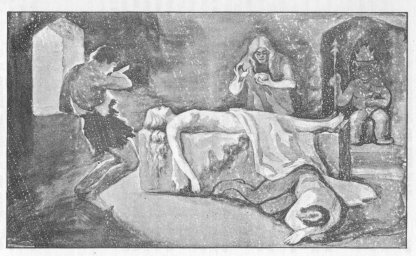
phylos-chapter-3-04FIRST SACRIFICE OF SELF FOR LOVE OF ANOTHER

"Ha!" he replied, "I will prove that true," and he struck the bared breast of the tongueless lad with his own dagger, and tearing out the heart, threw it at the sister's feet. A goblet of the blood was caught and the master's mother, a priestess, who stood by the block, took it and gazed into it. Then she said:

"The gods say that the girl also must die."

"Say they so? By all the powers I will not obey," shouted the master. "Not though my troops of war fail, and the King fails!"

"My son," said the priestess, "thou mayest not avoid this sacrifice and live, say the gods."

"No? Then the gods be served. Give me that knife." He felt its keen edge, and then asked, without taking his eyes from the weapon, "Say the gods yet so?"

"Even yet," said the priestess.

"Bind the maid," and his orders were obeyed, though the girl had fainted. The executioner laid his ear to her breast; a faint smile relaxed his features, and he said in his soul, "She is dead." He laid his hand on her breast, stood erect and said:

"Accept, ye gods, this sacrifice."

An instant the knife glittered overhead, the next he had buried it in his own heart. So had the heart that knew no mercy yielded to love; the stern warrior was dead. The gods must have blood, he thought, but he gave his own. What personality was he, was the girl, dead from horror? Myself! and Phyris!

Book 3 Chapter 3, "Fair forms and hoary seers of ages put, an in one mighty sepulcher."

A DWELLER ON TWO PLANETS

OR

THE DIVIDING OF THE WAY

BY PHYLOS THE THIBETAN

The Third Book

CHAPTER III

"Fair forms and hoary seers of ages put, an in one mighty sepulcher."

For a little while yet Phyris and I were not wholly one entity. But we were come to retrospection. With arms clasping each other, we walked slowly onward, till by the banks of the babbling brook we seated ourselves. Then I said:

"My twin, let us scan the past; let us draw aside the curtain of bygone ages, and see the record of the Book of Life, mirror of all events, sights, sounds, shapes, all things. We can do this, because we are karmaless, deathless, and are at one with the Father of Being, seeing, knowing as he knows, because He is in us."

We pondered the scenes of our Atlantean life, lives, and I saw ill-fated, sweet Princess Lolix, to whom I had been her ideal. Where had her sad soul gone when Mainin petrified its clay? In the imperishable record we saw where her life-line crossed ours. In her Poseid devachan she had found her dream of life seem realized. Reborn into activity, again her life-line crossed mine, her heritage pursued her, and she conquered it, for Lolix's individuality was Elizabeth's (my wife). Her crime in Poseid was expiated, and so, too, was mine. Karma was fulfilled there.

Man's course upward to God is so blind, so untaught, instinctively like the sunward turning vine. I had so confidently, in the Sagum, taken a step irrevocable, except for Mendocus; and then had fallen again into blind darkness, despair, but instinctively true to law and to Elizabeth, the object of my efforts--so upward, till at last I had gained the immortal heights. So had my alter ago, Phyris. Down below were the deserts of life, and fair appearing fruits, apples of Sodom. These ashes are good, for they cause the soul to essay the heights.

Poseid, and all the lives, had meted us a large share of gall fruit, but our errors required it, and Karma is a sure paymaster.

Sin begot karma and karma had exacted pay. Thus had I, for I am not relating Phyris' history, given up hopes, happiness, as one gives his open veins in the Sahara to quench the thirst of his friend. By this abdication I had lost my life and found it again. Karma, as the long record showed, was not always requiring pay; for every good act I had ever done I saw that I had been fully paid in kind my every jot. These were providences and benefices of life. There is no accident in life; allow that a man may die "by accident" and no man could be sure whether the ensuing night might not find the earth dropping into, or else away from, the sun; or, seeing the sun set, could feel sure it would rise again. All things, small or great, are ordered. Not always from any pre-existent incarnation; sometimes from one's last year's or yesterday's action the fruit springs. In short, I, we, saw that the lesson of life was, "whatsoever a man soweth, that shall he also reap," cause and effect. There are those who will make cavilling argument, contend that "accident does exist, and all is not order." I argue not, for "they that have ears to hear" will understand. One cannot see over a mountain range save he stand on a taller peak. To the greater vision, accident is but an are of design, and disorder is but an arc of order.

Book 3 Chapter 2, JOB xxxviii:7

A DWELLER ON TWO PLANETS

OR

THE DIVIDING OF THE WAY

BY PHYLOS THE THIBETAN

The Third Book

CHAPTER II

JOB xxxviii:7

Contemplating the victory in us of the Father, we chanted a song in answer to that of the Sons of God who were our fellows. Perfect at last, in rapport with all the law fulfilled, karmaless, immortal, beside Jesus, no more need to incarnate, Life was ended, but Being just commenced. Paradoxical? In all the aeons of time we had Life, but Being, which hath no beginning, neither end, and is not under the dominion of Time, every ego hath ever from the Father. But Life hath beginning, so also it must have end; it hath end. If its conditions are strong enough to enchain for aye, then the soul is diverted from its ego to the tracks of Life, and is then heritor of death. Only if a soul forfeit not to Life its hold on Being-on its ego-shall it not die. Sin is the error of turning from Being unto Life, whereof the shadow is death. The soul that sinneth and turneth not away from finite life and the conditions thereof, it shall die.

Down all the realms of light echoed the paeans of praise, as when the "Morning stars sang together and the Sons of God shouted for joy."

Book 3 Chapter I, YE SHALL REAP AS YE HAVE SOWN. THE PERCEPTION

A DWELLER ON TWO PLANETS

OR

THE DIVIDING OF THE WAY

BY PHYLOS THE THIBETAN

The Third Book

CHAPTER I

YE SHALL REAP AS YE HAVE SOWN. THE PERCEPTION

Suppose the struggle had proven me wanting, and the verdict had been, "Mene Mene Tekel Upharsin"? 'Then my--our--fate would have been that of Mainin of Caiphul. To me who know the dread meaning of this fate, it is more utterly frightful to contemplate than it can be to thee. It means being a brother to devils, and subjection to Satan, who could so cunningly, awfully tempt as we were tempted, and when successful, make a servant of the victim, ever to pile up fresh karma. And such karma as Satan's service makes is worse in a moment than the wickedest man could pile up in a long lifetime. It means such servitude until--when? Forever? Until the end of material things. Then, when the heavens are rolled as a scroll and melt in fervent heat, Satan (Lucifer) shall, with his minions, be cast into that lake of fire which is the second death: which meaneth that the force, the energy of the rebels, that which has made them distinct, potent souls through all the past, shall become depersonalized, and disindividualized, cast into the sum of the Fire of Elements, which form the forces of Nature, the winds, odic and magnetic and electric forces. But annihilation there is not, death there is not, though there be such a change as constitutes the destruction of the union between soul and Spirit, the return of the ]first to the great impersonal Vis Natura, the return of the other to Him who created life. Then, after millions of years the Father will gather the fervid elements into nebulae, star-plasm, worlds, suns, systems, and a "new heaven and a new earth" shall come forth. Then will the depersonalized rebel host begin to reincarnate in protoplasmic life, and thence evolutionize up, up, up along the myriad incarnations until, after an eternity of matter, they come once more to human conditions, to another Crisis, to win or fail, and either, like Sisyphus, run again the weary course, or else inherit hard-won entrance to unconditional being. There is not nor can be, any death of the Spirit, but of the individuality only. Study this well, my friend, for such is the fate of evildoers who sell to Satan, because such is Satan's portion. Our Father hath provided a Way. It is the sharp, knife-edge Path, whereon all things so evenly balance that there is turning neither to the right nor left, but steady, even pursuit of the Path, wherein all who travel that way, contain themselves in all things, in eating and drinking, in sleeping and all those things which cause the cares of this world. Those who shall be accounted worthy, without further incarnation, to obtain the resurrection from the body of materiality neither marry nor are given in marriage, but must receive the Kingdom of God even as if still little children. Yet whoso doeth not so, it shall not be eternally counted against them, but only till another incarnation. It must be that the things of sensation which are an offense unto the Spirit occur, but karmic woe will attend the offender until he finds the Path and travels therein. Hear, if hearing and understanding be in thee, for these are the words of the Master.

Book 2 Chapter 11, TEXT: ST. MATTHEW IV

A DWELLER ON TWO PLANETS

OR

THE DIVIDING OF THE WAY

BY PHYLOS THE THIBETAN

The Second Book

CHAPTER XI

TEXT: ST. MATTHEW IV

"To be, or not to be: that in the question." --HAMLET.

That was indeed the question when I arose one morning, and knew that the event of the Crisis would that day decide whether or not I had Eternal Life, whether I was for the Spirit, or the Second Death.

I arose and went forth into the wilderness of the mountains, accompanied only by a pet animal, somewhat resembling a fawn, which went with me everywhere. In a woodland mountain meadow I traced with my staff the symbol △, and it instantly became crimson fire, which leaped and rose and fell, unbroken, continuously. I was inside, the pet animal grazed on the meadow. After making the symbol △, the Good Being introduced to my knowledge by Mol Lang was with me, and it spake much to me, and I to It. It said.

"Lo! Thy time cometh when I △ must leave thee, although I △ would do for thee, but it is so that no being can endure for another the fierce Trial, neither help them in its midst. Yet I △ say unto thee, I △ believe thou wilt win, for have I not known thee, lo! many ages? But now is that Trial come for thee, when thy past, in all days and lives thou hast ever had, shall rise tip and thou shalt be judged thereby, whether thou shalt become perfect, and thy name be Phylos phylos-chapter-2-11, or whether thou shalt fail, and have again all the bitterness of life to go through during ages to come. The Father saith through the Spirit, 'Every idle word that men speak, they shall give an account thereof.' How much more then of their actions?"

I listened mutely, for what record was against me? It might be evil, or good, or, worse, that lukewarmness which the Spirit will not entertain, but rather heat or coldness of nature.

"Fear not," said Ovias, △ "for not in vain hast thou lived. Neither expect a record written concerning thee. For know this that the principles inculcated by the Christ-Spirit which overshone Buddha and all the mightiest of the Earth, incarnating in each, and Itself being Son of God, not they, until by union of It they became Sons of God--know that if thou hast made these principles both warp and woof of thy character, thou hast no need to fear. For this sort of fabric is strong, and was that which Jesus meant when He said, and says ever, Timeless One that He is, "Lo, I am with you always even until the end of the world." Not one individual act shall be brought forth to accuse thee, but each, all and every greatest thought, and least, and word or deed, in all thy many incarnations--these have formed thy character. Is that character, then, woven of the woof provided by Christ, and shown forth in the Divine personality of Jesus, and illuminating Buddha, and Zoroaster, Moses, Manu and other Salvators? If that be the cloth, then indeed shalt thou prevail, though no one sustain thine arm. But if not that weaving, lo! thou shalt fail, and not even I △ could save thee. I △ go. Be thou brave, and may the Comforter be in thee. Peace."

All that day I stood there, and was not weary. Night came About the midnight hour my pet cried out in terror, and came leaping toward me. As it came I warded it from the △ flame, and it stood outside, trembling. But I saw nothing to alarm it, save Mol Lang, approaching over the level around me. He hesitated not, but seemed about to cross the line of fire, as he could, but mindful of my perilous position I said:

"Stop! If thou art Mol Lang, then come. But if only a tempting shape, woe unto thee if thou shalt cross that line, for △ It shall punish thee as only an immortal can punish."

He came not; instead he ceased to appear as Mol Lang, and was another sort. This tempter said:

"If thou art proof against me, who so seemed thy loved preceptor that thou really knew not, then thou art conqueror over death and sin. I have no power over thee, and thou art free to enter eternal life, wherein shall no more incarnations occur. I go."

This Shape withdrew, but the Voice in my soul whispered:

"Beware yet awhile."

I stayed on unmolested until I caught myself napping, and knowing this to be the fatigue of the flesh, I regretted that I had not met the Trial in astral form.

"Not so," whispered the Voice, "all thine elements, both physical and psychic, must attend thee here."

But again I dozed, and quickly aroused myself, for the scene all about me was changed. The mountain meadow was gone, and in place of night seemed day. I gazed, seemingly, on a scene where all the races of men and immortals were gathered under the sweep of my prescient eye. I seemed to be taken over this realm, and a fair, godlike being in appearance was my guide. Yet in caution, I sheathed myself from head to foot in the △ flame as in an armor, at which my guide smiled, but said nothing. He took me with the speed of thought, so that we seemed to go from star to star, now crossing vast interstellar spaces, now come on fresh realms. All these realms were inhabited by creatures of human shape, or at least they had human attributes. Before me they all bowed and worshipped, for my guide said to them: "See thy master." Otherwise they were all engaged in pursuit of pleasure. The multiplex passions of man on Earth were indulged without fear of penalty. My fair guide said:

"These are souls in whom I created certain passions and appetites, and shall I punish them for indulging, without stint, traits I have given? Now, tell me, why should all creation not have free license to get pleasure as it may? My creatures do. There is no sort of restraint placed by me on their free pursuit of carnal things, lusts, appetites. See, they are happy! For a time I am giving thee control of them. Through indulgence of their passions they beget a sort of vital magnetism, and as their present ruler, it thrills thee like new wine."

As my guide said, the sight and sensing of all this license did thrill me ecstatically, and was affecting me with a delirious, carnal joy. I put it away and refused to feel. Whereat the beautiful Being said:

"Oh! thou art blind! Behold, thou shalt have these realms for thine, and have absolute authority, so thy word shall be life or death to these people, if thou wilt. Here, too, into this eternal joy, thou mayest bring Phyris, and lo! forever thou shalt with her do thy will, and hers, and no penalty be exacted. Wilt thou take this gift of supremacy? It is free; I ask no return for it all. Only take it."

Oh! where was my knowledge, gained from the many lives, and from the Voice? Gone! Gone, else I had known at once not to accept the alluring gift. I was offered all this free, thereby violating the divine law, which never allows something for nothing. But I gathered my △ armor about me, lest this Being, who seemed so fair and good, were not so, and if not good, its touch might be fatal. Then I said:

"It must be that thou art arrayed in the livery of heaven to serve Satan better. Demon, thou offerest that which subordinates all other beings in these realms to my will. This realm is governed by pleasure, passion, appetite, lust, all selfish; and no penalty set upon wild license. These carnalities would conquer me, too, if I accepted-me, who am otherwise about to become immortal, more than Man, karmaless. These are selfish. Pleasure so gotten is the essence of selfishness. Truly, thou must be creator of it all, since it is selfish. It is thine. It could be mine? Yea, but only because over me thou wouldst reign. I am not now thy subject; nor will I be. Only the Unknown God is my Master. Get thee hence, behind me!"

The scene slowly faded, like mist in the sunlight. There came a lull, and I hoped the battle was over, for I was weary. But I stood on the meadow again, with the △ fire leaping, quivering in crimson pulses around the lines. Nothing could break that guardian flame, for it was a symbol of the perfect state of being of another, but non-human, race. Only perfection could avail against it. Perfection of good might; so, too, perfection of evil might; but the latter had not yet come against it. I even doubted the existence of any perfection of evil. What offer, after all, had been made but of the things which were mine by reason of the divine Sonship? God giveth his children control over each other for good, and for evil also, through mental influence. What more absolute sovereignty is there than love, exercised as He hath ordained. None. While I reflected, a soft and lovely vision came, and lo, Phyris stood before me.

"Art thou Phyris?" I asked.

"Could any but Phyris disregard the △ flame about thee?" she replied, penetrating the barrier, and sinking by my side. This seemed truth, for Ovias △ was perfect being of Its own condition. Only perfection can stand with perfection.

At last I heard her sigh softly, sadly. Her eyes brimmed with tears.

"Why this sorrow, Phyris?"

"Phylos, thou enquirest? I reply. Because of my confession to make. I, too, am on trial as thyself. A sad story of sin is mine. Woe is me if thou shouldst spurn me for it." She hesitated.

"Speak," I answered, apprehensively.

"This, then. In a far Poseid day, when I had a personality called Anzimee, and thou hadst one called Zailm, thou knowst the day? Aye, and with sorrow e'en yet! When thou hadst gone in thy vailx, fugitive from memory of Lolix, I sorrowed intensely. And I knew not thine abode then. When thou returned not, crazed, I went to Mainin the Incalix. He marveled at my frenzy; then said:

"'Lovest thou Zailm, Rainu?'

"'As my own soul, Incalix.'

"'I marvel thereat. But never mind. Aid thee to find him? What if I love thee, I who am a vowed celibate? What if, in my ability, I say Zailm shall no more come back?'

"Then, Phylos, I begged for thee as for my own life! I implored his mercy. At last the stern lines of his face relaxed, and he kindly said: 'I would not keep thee apart; I was but testing thy love for him. Yet my aid must receive compensation. Not money, nor jewels, nor power; these have I in abundance. One only thing in thy gift will I have; listen: in other days, when I came to knowledge of Nature's deeper secrets, I was curious to experiment, and I sought the aid, all confident of my power to subdue my servant, of the host of Satan, one demon. But my power I overestimated, and I was subdued, a victim. So one day coming my soul is forfeit to Lucifer to pay my debt and its ever growing size. One only way can I avert this, by delivering another, although less experienced soul, in place of mine. Ere this night a maiden and her lover will seek me at the hour of worship, that I may solemnize their marriage already long published. But I shall be gone, purposely. Thou wilt be there, and except thee, only those two. Now, they are weak, but have never sinned.

"Their natures incline to error. All I ask of thee is that when they ask for me, tell thou them I am gone, but say, 'Thou art come to be wed?' then smile and say, again, 'Only the simple folk publish their matings; the wise are never wedded, yet are wedded in verity.' Say no more. If they take that mild hint, they will sin, and lose their souls, but I, the great Incalix, shall be saved. I will in any event bring thee Zailm again, for perchance thy hint will not be acted upon.'

"Mainin ceased speaking. I recoiled in horror. Yet even as I was about to refuse, he said, 'Remember, only thou canst save Zailm.'

"I thought him a fiend. Then I thought, it is but natural for him to wish to save his own soul, even at another's cost. And oh! I so desired the return of my Zailm! Tearfully Bobbing, my soul whispering the wrong of it, but my heart pleading me to be blind for that once to wrong or right, I yielded and said, 'Even as thou requirest, so will I do.'

"I did so. But false to Incal, Mainin was false to me, and he brought not Zailm back. When Rai Gwauxln told me of Zailm's death, I, too, died of shame and a broken heart. The man and woman took my hint, and died after years of well-concealed, direful crime. But I Phylos? In my consent to Mainin's will, I sold my soul to the Arch Fiend, Mainin's master. So my life is forfeit unless I can be helped. Forfeit, much though I know, and hard as I have striven to do right and atone, all in vain! Yet, my twin soul, thou art able to save me. If thou savest me not, then shall the Eternal Law cause me to die the second death. My soul will be annihilated, my Spirit, which was unable to unite with my soul, shall go back to the Source, our Father. And then, being a soul, but thy Spirit also my Spirit, thou must also perish. Save thyself then as well as me."

"How?" I queried, soul-sick to the depths, and suffering such intensity of misery as almost of itself to cut off my life. Sick, because I felt Phyris, my other self, my pure angel, to be in mortal danger, herself in a fatal mire, and threatened with soul death. And because she was, I was also, for our Spirit was the same.

"How?" I again queried, whispered.

"Thus! The man whom, as Anzimee, I led astray, hath incarnated several times since then, each time worse and worse, until now, a man on Earth, he is about to confront a temptation which, if he fall, will aim his course ever henceforth for evil, and final death of his soul. If he yield not now, he may or may not at last escape, but the delay will put him beyond use to us, and we shall surely die, whether he does or not. Aye! we shall if thou actest not now. If his soul is now made forfeit, we shall surely escape; so saith Mainin, who is blasted and in outer darkness, yet owneth me; 'tis an only, though slender hope. O Phylos, think! think!! On the one hand eternal life, brightness, and a chance to atone for all our sins, perhaps even rescue this man at last, but on the other, death, blasting into outer darkness and eternal demonhood."

In the calm night she stood before me and besought me to act for her, her hands clasped, her eyes streaming, her agony fearful to see. Act for her whom I loved better than life, and for myself; save our lives that all might be well. How? By using my occult power to whisper to a man, already sin-sodden, on a distant planet, a man who might not conquer his temper even though I withheld my influence. Do what? Influence him to sign his name as Governor of a great state to a denial of pardon to two men about to die for murder. Yet they were innocent. I knew it; the Governor knew it, because he had already sinned horribly in using his office, money and power to weave a net of circumstantial evidence which would hang his two enemies for a murder committed by his own hand. He would, in an hour more, sign or not sign the fateful paper, for at the last his courage was faltering. All I needed to do was to occultly encourage him. Already so sinful, was it likely he ever would turn from evil ways to good? Barely possible. But I was to psychologize him to pass this opportunity and complete his double murder, in order to save Phyris, whom I so loved, whose Spirit was my Spirit, whose soul's destruction meant my soul's destruction also. It was so easy to do!

All crimes are easy. But while the agony of despair numbed me, a ray of hope came, and the question arose, would this act save us? Had not God said, "Thou shalt not kill"; and would not the double murder be on me as much as on the Governor? Then I arose, and said, calmly,--Oh! how frightfully, despairingly calm!

"Lo, then. If we shall both die into outer darkness, yet will I never do this thing. Thou, who art more precious than mine own life, must not ask this! Saith not our Father: 'Whoso shall do evil, of him will be exacted the penalty, of some thirty, some sixty, some an hundredfold'? And if I, we, shall consign a soul to darkness, thinkest thou, oh! my spirit mate, we shall not the more surely go thither ourselves? Then, although these words seal thy death, and mine, yet will I refuse to sin. I will not do thy will. I have not erred so but that I can put fort h my hand and, by the aid of the Christ-Spirit, cut off the progress of thy sin, and thou mayest go back to the time, place, where thy soul was ere thine error, and recarnify on Earth so often as needful to expunge and atone this sinful act. And I will await thee where my soul is now progressed, during the years, though they be tens of thousands, until pure, thou mayest rejoin me. I will guide thee, so that thou wilt sin no more during expiation. Aye, except that I must stay to so guide, I would go again into the life of Earth with thee; but I must stay that my light be clear. All this will I do, or if vicarious atonement were a possibility in the Universe, I would go for thee, and let thee stay. But condemn the man on Earth, and ourselves with him, no! I can not so sin."

With a convulsive shudder, and a despair in her starry eyes that smote me so that I cried aloud to God in my agony, Phyris said in a mournful wail, as of a lost soul:

"O Phylos, think well; for it might be that thou art hedged about with that sort of righteousness that maketh the Angels to weep and the Fiend to smile!"

"Phyris, beloved, I have spoken! I alter not."

She moved away with her hands covering her agonized face, sobbing in her intensity of despair. When she came to the △ fire she said:

"Phylos, I could enter. My power is fled, and I can not go out; put it aside."

I looked from where I lay almost dying in my pain of an immortal hurt, and found that I too was too weak to lower the barrier. Then I looked within my being, and I saw that no more was the Light of the Spirit within me, but gone forth. And then I knew what that awful appeal of Jesus of Nazareth meant, that He, too, in the fearful strain of his Human trial of the Crisis had beheld the Spirit in Him wane, when He cried out: "Eloi, Eloi, Lama Sabacthani." Like Him I cried out to the Father, and in that instant the Light returned, and with a roll as of mighty thunder the darkness broke, and the night which had been around me fled, so I saw that the sun was high in the heavens, and I alone had been in a local gloom. The △ flame paled, and "Phyris" knelt before me and implored mercy. Then I knew that Phyris, had not been near. I knew that God the Father was entered in me to dwell forever, and that the perfection of evil had failed in its last, most subtle, horrible and insidious attack, its last attempt to open the door to downwardness for me. My strength out of all the lives had withstood, and, all fainting, I was come unto Christ. All the weary way of woe I had journeyed, atoning as I came. And now my karma I had blotted out, and in me was Life Everlasting. Gloria in Excelsis! Laus Deo! The song I heard was the song of the starry hosts of God.

Then the Voice spoke: "Thy trial is over; I am well pleased. It is written in sacred Scripture, 'Ye must be born again, of water and of the Spirit.' Even so hast thou been born now. Of water, which is the world of matter. And of the Spirit, which is I entered in. But the death of the carnal body, and rebirth in the new, is but night after day, and day after night. To these successive days and nights of the soul, that Scripture refers not. Thou hast been born in the Earth many times, and each time thy carnal body hath died. But the rebirth was not that rebirth of the waters and of me. Those incarnations did but prepare thee out of the waters of materiality for Me. But now thou art born of that and of Me, and become a Son of Light, and at one with the All-Father, and like unto the Nazarene. Carry thou My Word unto all men, that all may come likewise unto Me who will, even as thou, following the first Man who came unto Me, have thyself also come."

Now when I saw Phyris come, I knew that it was she in verity. She, too, had had her Trial, and equal temptations had been offered her, and been withstood, ninety centuries of years before, however. How say ye: "I thought twin souls must fight the final fight together, and now you say nine thousand years were between?" Behold, friend, time is but measure of energy exerted. We wrought the same work, so were together. Is Paul more saved than the latest regenerated soul? Yet Paul knew Jesus Christ near two thousand years earlier. It had seemed to us both that the Great Crisis had occupied centuries. Unto us, as we stood clasping each other, came a glorious vision, and the Voice spoke, saying:

"Behold. Look back over the mighty past. And when thou hast so done, look on Earth, and see how there to effect the work of giving the people of Earth thy life history. That shall take but a moment for thee, but that moment shall seem years to thine agents on Earth. Then again, look; I am thy Voice and thy Spirit. Thy souls shall unite. Behold, thou shalt presently hereafter have no more two bodies, but one only, and it thy Spirit body. Mine, for without Me thou art nothing. Peace is thine forevermore."

Friend, thou mayest have trouble in understanding this strange union. Yet, ponder it deeply, for it is to be thy experience some day if thou art true to thy Savior and follow Him, drinking of the cup which He drank, and triumphing at the Critical Ordeal.

End of Second Book.

Book 2 Chapter 10, AFTER THE YEARS, RETURN

A DWELLER ON TWO PLANETS

OR

THE DIVIDING OF THE WAY

BY PHYLOS THE THIBETAN

The Second Book

CHAPTER X

AFTER THE YEARS, RETURN

Sparing details, what was the appearance of Phyris after the flight of the years? When I left she was a bright, beautiful maiden, in the budding days of womanhood, having the divine, spiritual glory which characterizes the higher race of the perfect Human grade. How looked she now? Different only in the maturity of rounded womanhood, the prime which in Venus withers not with age, because there the animal is subdued, and there are no excesses, indulgences, nor any of that feverish grasping after unattainable things which the "children of a larger growth" who dwell in the human-animal plane of Earth to-day. Phyris, the dark-haired, starry-eyed girl who was yet more than a girl, was a woman divinely fair, was again before me. Again I beheld the sweetly natural, dignified mien that reminded me of the first time I ever saw Mol Lang, that air of quiet, but marvelous power. Enhanced by this appearance, as is a gem by its setting, her sweet, pure selfhood shone forth, that sweet spirit which in Phyris was divine, yet had lost none of the human characteristics which have rendered Jesus so dear to mankind. The spirit was there, the perfect human, also, but the animal, the nature of Man on Earth, was reduced to its place of servitude. When I met the fair, beautiful woman I was abashed. At that moment the tide of the years overflowed my soul and awed me. Sometimes I had known of Phyris when the Hesperian astral controlled me. But far oftener of later years, the years of duty, this astral did not come, and then I knew Phyris only as an ideal, and with the attributes of that ideal I tried to endue Elizabeth, and the failure was agony to me.

Wonderingly, wholly delighted, I looked on Phyris now, nor deemed it lack of propriety that she should kiss me and 'whisper, "Home again," her eyes lighted with the peaceful joy reflected from my gaze.

No passion was in me, no prompting to be sentimental--no, that was gone with Earth's feverish dream.

How familiar all things appeared when at last I was come home. For six Hesperian months 1 I did nothing but wander in my psychic form in this Elysium, this stellar garden of the Hesperides. In the other time most of my visit was spent in the company of Sohma or Mol Lang. But now Sohma was otherwise engaged. Mol Lang, too, was occupied in the work that attracted him, that of guiding, teaching and helping mankind, en masse, as well as individually; that portion of our race yet on Earth. Unconscious of his agency, or of how, with others equally great, Mol Lang was influencing the affairs of men, these men on Earth went on with their doings, fondly thinking that themselves were doing all. How little humanity on Earth knows that it is thus guided. Yet our Father gives it to His occult children to lead their lesser brethren, just as He gave it to Jesus, one of the Sons of Light, higher than any other, who was an incarnation of the Christ. Perhaps human acts were not, are not, guided individually, as a rule, although exceptions exist. But just as shot, running in grooves, is checked by the leaden pellets before and behind, so the acts of one man depend on the acts of others; these on others still, until finally it appears that the mass is influenced in the whole, and every individual in the mass has his or her acts unconsciously controlled by what are termed circumstances, fates, adverse or propitious, inexorable, the grooves in which they run. That is to say, humanity is ordered in its action by what may be named the Universal Karma. So long as men grope in the dark, ignorant of occult laws, so long must they produce this inexorable karma. It is fate, self-made, running from life to life, incarnation after incarnation, unavoidable, for it is horn of the infraction of the laws of the Creator. Even Mol Lang, before he passed and triumphed at the Crisis, to which I was soon to come, and which he experienced a century ago, was controlled by the great, Universal Karma. But in passing that ordeal he passed from finite life to everlasting, and became a law unto himself. And then, free of karma, he returned to minister to those bound by circumstances. Mol, Lang was become more than man. He had taken of the Tree of Knowledge, also of the Tree of Life. Such as he utilize the elementals, those non-human, non-embodied powers of the air. They find in mankind the tendency to sin, and use it, so that the erring ones mount the ladder on rungs, each of which is a conquered fault. The great religious movements, wars, and the fields of commerce, all furnish experiences for mankind. Do some seem cruel, evil? Yet each is a part of the scheme of the Creator, each is a tool in the hands of His ministers, and all teach that except a man, as part of the Eternal Whole, works for that Whole, subduing the selfish animal in himself, he can in no wise come to the Father.

"Except by My Path," says the Savior.

If Sohma and Mol Lang could no longer be with me as companions, who then could? Phyris. She became my tutor, my guide, and led me farther on towards the point where soon I must take the Key and enter alone on the dread struggle, with only my faith in God to sustain me.

One day Mol Lang said, "Phylos, come with me."

I went to his special apartments. There he said:

"Hitherto thou hast but an astral body, but now thou needest a physical body as a base of action, for now must thou learn of thine own self. Sleep, that I may gather material atoms about thine astral."

I immediately slept, as I lay on the couch where he had bidden me recline. When I awoke be was regarding me, and, for a moment forgetful, I sat up.

"Arise," said Mol Lang. I obeyed, and found myself clothed in flesh. Thus I became a Hesperite. I was now of the same apparent age as Phyris, and was thereby seemingly dispossessed of some twenty-five years. Before any lengthy period there came to shine in me somewhat of the Spirit-nature, and as the same ego shone in Phyris, so therefore we grew into similitude of each other. Because of this indwelling Spirit, Nature was become an open book, and occult wisdom addressed me from all sides. Soon I could leave the body at will. Other steps succeeded, and I grew with marvelous rapidity to know many of the minor things reserved by our Father for His aspiring children.

With me now was abiding a Voice, and as it demanded of me, I answered and knew. It said:

"What is heredity?"

And I answered from my spirit, knowing this thing:

"Heredity is the sum of experience which the souls of men carry from one life through devachan into reincarnation. It is in nowise transmitted from parent to child, but its leading trait is attracted by the like trait in the parents. The lesser traits are educed by cultivation, or else lie dormant, according to environment."

Again the Voice said:

"It is not well; thou who hast reaped, must now saw. I am the Eternal Spirit in thee; obey me. Thou art now able to stand in my presence; able to see; able to hear; able to speak; conqueror of desire, attainer of self-knowledge. Thou hast seen thy soul in its bloom, heard the voice of Peace. Go thou and read my writing in the Hall of Learning, which is My Works. Read.

"To stand--is to have confidence. To hear--is to have opened the door of thy soul. To see is to have attained perception of My Works. To speak--is to have gotten the power of helping others. To have conquered desire-is to have acquired control of self. To have self-knowledge-is to have come unto Me, whence thou art able impartially to view the personal man that was thyself. To have seen thy soul in its bloom-is to have had a momentary glimpse of that transfiguration which shall eventually make thee more than Man.

"Stand aside in the coming battle, and though thou fightest, be not thou the warrior. Look for Me, and let Me fight in thee. Obey My orders for battle. Obey Me as if I were thyself. My orders thy desires--for I am thyself, yet infinitely more than thee. Look for Me, lest in the fever of battle thou pass Me. I will not know thee if thou knowest not Me. If thy cry come to Me, lo! I will fight in thee and will fill the void in thee. Then shalt thou be unwearied. Without Me thou shalt fall; with Me thou canst not fall, for I am the Spirit.

"Listen now to the song of life in thy heart. Say not, 'It is not there.' Listen deeper. This song is in every breast; it may be obscure, yet it is there. Not the most wretched outcast but it is in him, for all are children of the Father, which is I. Listen to My Song, for while thou art yet but man, I shall not speak continually, and thy strength must sometimes be in memory of Me. Inquire now of the Earth-matter; of the air, of the water, the wind; and seek the treasurers of the snow. My Peace I give unto thee."

At last I saw; I heard; and, my friend who readeth this, I speak. My words go to the multiplication by types, and then by myriad copies through the world, to be known by those that "seeing, see and comprehend." And with each copy shall go my love and greater, mine eye shall note each hungered seeker for the truth, and, be it in the palace, or cottage, there, too, will I be, not figuratively, but my Spirit.

I had gone into a lonely mountain spot to hear this Voice, and now as I walked, a Being not Man joined me. Its presence was one of light and glory and goodness. With it came Mol Lang, saying:

"This is one of the Beings of Good. Behold, Phylos, our Father's House hath many Mansions, and in these are Beings created by Him, and endowed with volition like as Man, yet they are not human, never were, nor ever will be. Man shall be perfect when the Spirit of the Father entereth him. Then shall he know all things, and be perfect. What is perfection? Absolute harmony with His Infinite Creation. So there may be perfect men; also perfect Beings which are not Men, as this one with us. This is a Good Being. But there is an opposite in the Things of the Creation. There are perfect Evil Beings, which likewise are not, never were, nor ever will be human. What are these? They are in perfect harmony with the laws of their existence, but those laws and their conditions are absolutely opposed to ours, and to good. Hence such are inimical to our life and so, evil. Yet this sort seek us not, nor we them. In the scheme of Creation evil and good are evenly balanced. What disturbs, harmony with us, therefore, disturbs them by disadjustment of balance. Hence they seek not our harm. But Satan, know ye him? He was an Angel of Light, fallen, and come to so much the greater fall in that his height was so lofty. He is a rebel, and out of harmony.

"Life, Phylos, is limited, for it is but the action in the Mansion of Human environment. But existence is not limited.

Hence this Good Being with us is not Life, but of Existence. See, It goes. This is Its symbol, and the name of Its Mansion △. And when thy trials are thickest, draw about thee on the ground that figure and stand in it; go not out, but call on the Father. He will send His △ Beings to aid thee. Peace go with thee."

Mol Lang disappeared, and I was alone.

Men dread most those insidious diseases, which attack not openly, but the weakest and most unguarded point. So, in the last, final Trial of the Crisis, I should be likewise insidiously attacked by the Satanic hosts. Earth has tried me during many lives; now was to come a trial greater than Earth. The attacks of mere human error differ from that of the well-organized, intelligent assault of those to whom evil has become natural, to Lucifer and his fellow-rebels.

Of what nature is this Trial of the Crisis? It is the deciding whether in the long series of incarnate lives the soul has improved its opportunities for good; if it, in the main, followed the Path which Jesus pointed. If so, it has or will have strength to cope with the best efforts of the Satanic foe. If not, it must fall and die the second death. His incarnate life made the soul forgiving of all wrongs, forgetful of selfish interests, helpful to those having less light, more gloom, misery and sin to encounter, a self-contained nature? Has it become like the Man of Sorrows, full of faith, hope and charity? Then it hath beard the Voice, and will not fail. But if the soul is not like that, then, although it have the prophetic sight, and knoweth all things, though it have faith to removing mountains, yet shall it be only the more like Satan, and the worse its fate.

"Go into the Holy Place."

And I, knowing obedience, went into a room built of stone, apart from the house. Then was I in the Presence where I had been as Zailm when Priest Mainin was blasted: It was the Presence of the living Christ. It was Man, yet more, for it was the Spirit; as much more than Man as the sun is more than a glow-worm. Then a wondrous Voice said:

"Be not afraid; it is I."

phylos-chapter-2-10
SYMBOLIC PICTURE IN THE "HOLY PLACE"

Around that Holy Place were forms of fire. Ink and paper can give little idea of the semblance. Yet look at the picture and try, with my aid, to see. The bolt blazed as a thing of flame, so also the Great Star and all the lesser ones. The Leaf was as life, and the cross the open Way, to the House thereof, while the Ring, I knew, symbolized the Eternal One, endless, beginningless. The Book was the Word, and it blazed with scintillant, crimson flame. But over all, a Personified Presence, was the Eye, the Eternal, sleepless, omnipotent omniscient Supervisor. So stood I in the presence of the Father, made manifest for me. As I remained, I knew all things of His Works, for the Spirit entered in. But not to abide, for as yet the Trial was not come to pass.

For weeks I stayed in the Holy Place, and came not out to eat or drink, for I was wholly sustained by the Spirit. At the day of the Great Peace this Spirit must enter in and I be in It and It be in me forever more. But no guide could exist, no law for the Trial, except my strength of ages. Even the Spirit would be veiled in that ordeal.

Footnotes

1 About 112 terrestrial days. The solar you of Venus is 224.7 earthly days.

Book 2 Chapter 9, THEY WHO HEED HAVE PEACE

A DWELLER ON TWO PLANETS

OR

THE DIVIDING OF THE WAY

BY PHYLOS THE THIBETAN

The Second Book

CHAPTER IX

THEY WHO HEED HAVE PEACE

Once during the wanderings before my marriage, and while I was in Hindustan, I met an old man of unprepossessing figure, whose faded eyes no sooner rested on me than he said:

"You are he of whom Mendocus told me, and charged me concerning, saying 'tell him certain things for me.' This I will do. Young man, your life shall be sad and bitter on Earth, but sweet after that. Things will transpire because of which your animal soul shall embrace itself and say, 'This is joy.' But immediately the still voice of the human soul in you shall say, 'This joy is but a Sodom apple,' and in that moment you will know that it is so. Hence you will have ever a war between your animal soul, which is innate depravity, and. your spirit, which is of God, Brahma, the One. See in it the allegory of Adam and original sin; it pulls your human soul down to death; the other, the Spirit, draws the human upward. Attend then its sayings; I will render them for you:

"Before your eyes can see God they must be incapable of shedding tears for any suffering of your own. Before your ears can hear, they must have lost sensitiveness. Your voice may not speak eternal wisdom until it has no power to wound. Before your self can stand in the presence of the Eternal, its feet must have been bathed in the blood of suffering, penance, restitution. Then kill the ambition to excel in the poor paths of Fame. Cease to regard this life as your best possession.

"Then work for God as earnestly as others work for Mammon; and respect thy life as those respect life who treasure it most, and be happy as those who live for happiness. In the hearts of all is the source of all error, in disciple as well as in the man of desire. Study a plant of mustard, witness it grow and bud. But if thou shalt hew it down so that it never beareth seed, behold a strange thing, it will sprout again and grow through the years, if it never beareth. And this although it is only a material form. Now, therefore, if a human soul shall not be cut down, yet shall not enter into life as a creator by reason that it wills not, then the Spirit of life everlasting shall go into it, and it shall contain itself, and therefore live forever. Study the truth of mustard life. Only the strong in God can act upon this teaching and hold the lower nature. The weak must wait its maturity and then will come their struggle. It will strive to keep the feet from the Path; and may succeed. But if once all its power be wiped out; if once thou doest the will of the Father earnestly, is His obedient child, that is the atonement, for it shall give strength to do every work of the Creator of Being. It will seem to take the very life. That is because it takes the animal soul and throttles it. But the human soul will recover, and the Spirit come into it. This is the time of the Silence of the Soul. Then it shall be clear to you how dark are the lives of those who are around you and have no goal of union with the Spirit towards which to race. And you will see and know karma. Also you will. see that because of your past incarnations your karma is inextricably interwoven with the karma of the world. This is that saying which the Nazarene answered when it was asked of Him, 'Who is my neighbor?' If, Walter Pierson, you shall once be able to know the Peace of Silence, you shall then learn of all things about you, for the Earth is Brahm's, and all in it teaches His works."

I was surprised at being called by name, and also of being told of Mendocus. The old man said further:

"If your soul once knows this Peace, no storm of sin or of sorrow can ever more ward you far aside from the Path, for its knowledge is an abiding wisdom. Heed also the words of Mendocus, read your Bible, read the Vedas, read Manu; and study. It shall all be a staff to your hand and a lamp to your feet. Peace be with you."

"And to you, peace," I replied as he turned and walked away into the crowd, for we had stood by a public drinking fountain.

Now that Elizabeth was found and was my wife, I pondered deeply these things I had heard of the occult lore. Not that she had connection with it. But because, as the years went by, I found she knew and cared little about these abstruse studies, which I did. So our lives drew apart. But she was oblivious of this fact, and I was glad because she was. She had her churchwork and I aided her in all her sweet charities. To us came two lovely little daughters, the greatest treasures of our lives, and oh, so carefully taught regarding life and shielded from its dangers. So long as these little ones were with us, I was content. And yet I felt, in an ill-defined sorrow, that Earth's experiences were but Sodom apples.

Sometimes I found my lonelier hours disturbed by a strange voice which whispered to my inner consciousness. As time passed it grew stronger, and one day it appeared before my sight as a wraith. The Shape talked. What it said made me eager to hear more, so I cultivated it. It became thenceforth a regular visitor, and from that to being always present when I was otherwise alone was but a step. It spoke of having been on a distant planet which it called "Pertoz," sometimes "Hesperus," again "Venus." It spoke of persons whose names were strange, calling one "Mol Lang", another "Sohma" and a third "Phyris." Then it described these people, and I listened eagerly. Who were they, and what human soul was this which had gone to Venus? The ghost looked marvelously like myself. But my slumbers at night were as sound as if it visited me not.

I called it my ghost. How unconsciously true It told of everything related to my being with Mol Lang, and in Venus; it drew my mind's eye to the psychic scene in the bed of the Atlantic. It told of a visit to the sun with Sohma, of which I neglected mention in sequence. Briefly, Sohma went with me to the sun, and showed me that it was a vibrant body of less size than astronomers believe, but of enormous density. I saw its oceans--they were heavier than Mercury. But it had no life forms which I took as such. Yet life of some sort there is everywhere. Perhaps, indeed, not animal, nor vegetable, but from the high standpoint of those who know much of the works of the All-Father, forms that no earthly man would call life are such, nevertheless. But the sun is a force of such fearful vibrative pulsing that even my subtle astral body was not unaffected. Sohma said of it:

"See the immediate center of our solar system. Thou wouldst call it a dynamo, the great dynamo of the system. Right wouldst thou be, and wrong also. The attempt to define the sun as an analogue to a dynamo-electric machine has much to support it. But to define it as identical is erroneous. The trouble with that theory is the trouble which lies at the root of and weakens all other theories to account for sun-heat and sun-light. It is that science does not assign a sufficiently high value to the sun. The combustion theory is invalid; the solar mass contraction theory is but partially tenable and meteoric showers do not account better than the first two. Neither does the electric-dynamo theory. Truly, the latter explains how sun-heat and sun-light may coexist and not be inharmonious with the awful degree of cold between earth, the planets and the sun. It explains that which denies the simple combustion theory so completely, viz. that the farther one goes from the earth center, either in a balloon or on a high mountain, the colder and darker the air gets, so that inter-stellar space is several hundred degrees below zero, and black as midnight, with the sun a luminous disc, without rays. But the dynamo theory does not explain the solar spectrum, nor the bands of spectra, nor coronal 'flames,' nor 'sun spots,' nor solar nor lunar eclipses."

The above statements were made by Sohma, as will be remembered by the reader, while I was still-in the Hesperian astral state and for the time was unconscious of a previous terrene existence. I had therefore no memory of the mundane knowledge and was unbiased in my judgment of the remarks of my friend. He had ceased to speak after uttering the word "eclipses." I waited for him to continue, but as be did not, I finally interrogated, "Well, what does explain all? What is the truth?" Thus questioned, he resumed:

"I have said that the value accorded by astronomers is too small. Seeing a fire, they would seek to explain by its means the sun. Finding this untenable, and aware that a contracting mass gives off heat, they next essay explanation on that hypothesis. But this will not do, nor will meteoric showers, nor any hypothesis based on facts now known, all are too low in aim; the Infinite cannot be explained by the finite, nor will less explain greater; fire is energy, and electricity is energy, and God is energy. But fire will not solve the query, 'What is electricity?' nor will electricity answer 'What is God?' but God will explain both the others, for the sum of the parts is equal to the whole. But a man does not know the full number of the parts, the partial sum he does know will not explain God."

Sohma ceased again. But I, filled with some vagrant earth memory, allowed no time of pause; I was too eager to wait, and I said:

"But this does not tell me what the solar puzzle is."

"Thou art impatient, my brother; know then, what was at one time known upon the earth, but is now for ages forgotten; that Nature has a dual aspect, is double, is positive and negative; that the great positive side is the side known to mundane science, while the other or negative, or 'Night Side,' or, as it was once known in the earth by the men of Atla, 'Navaz,' is a side all unknown, and scarcely guessed in the most exceeding flights of speculation, left unbroached, secretly kept by a few, who know not that they entertain an angel, an angelic wisdom that in a century more, yea, less time! shall overturn much of the face of terrene things, shall bestow aerial vessels, and all else once known to those men of Atl of whom I spoke. Thou. dost not yet understand?"

I said that I did not; that I thought he referred to some domain of the physical forces not yet known; but what had this to do with the sun?

"This: the suns of systems are centers of forces of the Night Side of Nature whereof I spoke, and are force, and matter of a higher value than are planets and satellites, just as water above a cataract is water, truly, but being above and mobile, flows over and down, developing energy. In other words, out of the cold, dark, negative side, or 'night side,' force emerges, drawn to the positive polarity which constitutes in its outgoing flow that termed Nature, and develops in its fall, magnetism, electricity, light, color, heat and sound, in order of descent, and lastly solid matter, for this latter is a child of energy, not its parent. When the Navaz forces drop to light, if the light waves enter a spectroscope, they will emerge as colors; these correspond to the various spectrum bands, and will, as the descent progresses, give the noted fines of the solar spectrum, as the great 'B' line of oxygen, the conspicuous '1474' line, and the brilliant 'H' and 'K' violet bands."

I thought I now saw the truth; but I saw only a part; a grand vista was yet to open. I saw it when my companion resumed:

"Thus the evidence of flames, and metals on fire, and all that leads astronomers to think sun and stars flaming hells. But their 'fires' will not decrease, for the Father is immanent, and the forces of 'Navaz' are perpetually fed by Him. The graphic picture of a 'burned-out sun' is a dream, never to be fulfilled. A day will come again in the earth when instruments will be made which Atlantis once well knew, when the prismatic rays from a spectroscope will be found to be a source of heat, and of sound, so that the so-called 'flames' of the sun, and of the stars will produce music, harmonies divine. Yea, further, for going on down, the dark green solar spectrum of iron will be made to yield iron for use in the arts, and so with the other bands and lines, the intense greens, blues, and blue-greens give copper, lead, antimony and so on. It is by these Navaz currents that the circulation in the universe is kept up, as blood in a man's arteries. The suns are the systemic hearts. But thou art tired, my brother, or I would explain yet more, that the planets which receive all these currents must return their equivalent. And thus would another vast field open before thy sight. This last would explain that which so worries science on earth, the molten terrene interior. That also is something of an error. All the phenomena which seem to declare the earth to be in a melted condition inside do not prove it so in truth; all point to the return currents, the positive; all exhibit the venous currents of our universe, back to its hearts."

Sohma concluded with an apostrophe to the leading minds of the Earth which was beautiful indeed:

"O Science of Earth, in thee is the hope of the world, when thou shalt become handmaiden of God. Look up, value His works highly, and thou shalt read clearly many things which now puzzle thee sadly. Thou art the Joseph, and Religion the Mary, and ye twain shall show forth the Light of Life. Blessed art thou."

When my "ghost" retold me this conversation I seized my hat and went out to look sunwards and marvel if all were true, and astounded, reflect again, "Who is this Sohma?"

The puzzle grew, and my discontent with life grew; the lump was becoming leavened. The more I studied the truth of the mustard plant, the clearer grew my perceptions, and I knew that never in my present body could I attain much progress, for in our union Elizabeth and I had passed by the mustard unheeding, writing another karmic chapter.

For a time my "ghost" was amenable to my will as regarded its comings and goings; but it now seemed to have entered in and coalesced with me. I no longer heard or saw it, but instead was often one with it, and saw and heard its visions and perceptions as if they were my own; and indeed, as you know, this was a fact. It was in verity the record of my visit to Pertoz, and was a true cast in all ways of my life there.

Ofttimes my soul was torn by steadfastness to the duty of life as pointed out by Mendocus. And then my only escape from trouble was to allow myself to rest in the Hesperian astral to the exclusion of that of Earth. At such times I was living again the life with Phyris and the loved ones of Pertoz. Elizabeth sorrowed over this aberration, as she thought it; and my blessed little daughters grew to regard "papa" as "funny" and I was held in awe. Not a pleasant experience, my friends. My wife would look at me sadly and I know she wept when alone because I often absently called her "Phyris." Indeed, Elizabeth was my closest realization of the Phyris of whom I knew but could not find on Earth. Under all this I grew thin and pale, and aimlessly wandered about possessed of a huge disgust for worldly interests or amusements, filled with sorrow for the sorrow I saw the world held, and yearning for the high plane which I at last knew was not a fantasy, and where Phyris was, and Sohma, and Mol Lang. But I could not get there; and they came not to me, therefore I studied the rules of the Path, because torn with crazed regret when the lower nature triumphed and I fell in sinful error, but although I fell, I rose again. Then the effect this had on my sweet, loving wife came home to me. Was this doing as I would be done by? No. So I set my will in firm resolve and subdued my own sorrows, and made my nature a tool for my soul, not a master over me.

Then once again I smiled, and the color and flesh came back to me. So Elizabeth was happy once more; and I? I had found the true Path at last. Service. I no longer wept for myself; my ears were no more sensitive, my tongue no longer wounded any one with its morose utterances; chiefest triumph of all, my feet were bathed in the life blood of the animal nature, so that I lived unselfishly, my whole being bent on doing my best, living as happily as if solely for happiness, as earnestly as if for ambitious motives. Then it was that the Peace of the Silence came, and I waited for the Savior to take me and fight in me and do His work with my hands. The Paraclete was come into my life.

It was a sad blow when my little daughters died of epidemic scarlatina in the year 1878. Thereafter I used my life to comfort the sweet woman whose vital breath nearly died in that cruel loss. I think Elizabeth never cared for anything in life after that, except my loving devotion. And I gave it, for I knew Phyris would have me do so, and I waited on Earth now only to make it tolerable for the woman I had sworn to cherish. She waited in anticipation of rejoining her children in heaven, and meanwhile devoted all her time and energy, with feverish application, to doing all the good she could, using our unlimited money for the purpose. How exultant I was that the money was drawn from the gravel of the mines, and not come to me from harassed debtors.

It was less than two years after Dora and Maydie, our two little girls, had gone to the Summerland, ere Elizabeth followed after them.

I felt the need of a radical change in living methods for the sake of my health, and so, under an assumed name, secured a situation as mate on an American sailer, a splendid vessel. My purpose was to expose myself to the toil of a sea life for a season in the idea of recuperation coming from active duty.

Nothing would satisfy Elizabeth, except going as a passenger on the same vessel; she refused to leave me out of her care. The captain knew her relation to me, so did the crew, so that her being a passenger was natural.

Near the Bermudas a terrible storm came up, and I ordered the sails close reefed; then the squall struck, the mainmast went over, the vessel sprang a leak, the pumps were inadequate, and the boats were swamped, all but one, as fast as they were lowered. Into that went the crew, and I would have put Elizabeth in, but the men, seeing the boat full, pushed off and left her, Captain Washburne and me to our fate. Hardly five minutes elapsed when our noble vessel pitched bows on under the engulfing waves, carrying us with it.

I had lashed myself to the deck cleats to avoid being washed overboard. So now I was doomed to die--and was glad. As the waters swept overhead, I called out in my soul: "Phyris! at last! at last I come!" I saw Mendocus as I lost consciousness, and when I next came to knowledge, I found myself in the Sagum in California. Yet my body drowned off Bermuda's .coast! Here was Phyris, and--yes! Mol Lang. It was not long ere I again bade Mendocus farewell, and with Phyris and Mol Lang went home to Pertoz, home now, my own attained plane, and "Earth with its dark and dreadful ills" left behind forever, but not Earth with its mighty secrets of life. Yes, Terre, is. if insignificant, a point whence the Human soul reaches out into the boundless sidereal universe and formulates its laws, knows them, and is greater than all. I was come to leave the Earth where so many incarnations had known me.

'Twas a time
For memory and for tears. Within the deep
Still chambers of the heart a specter dim,
Whose voice was like the wizard tones of Time
Heard from the Tomb of Ages, points its cold
And solemn finger to the beautiful
And holy visions that have passed away,
And left no shadow of their loveliness
On the dead waste of life. That specter lifts
The coffin lid of Hope and Joy and Love."

O Earth! point in the heavens, yet type of all the stellar universe.

Shall I descend a moment to figures? Shall I speak numbers almost inconceivable? I will. Just for a moment think of what we have come to know in the schools of Earth, think of our human civilization that permits us new comprehensions, see the parallel of how we measure time and distance compared to the Indian, who measures one by "moons" and the other by "looks," one being the interval between one full, or new moon and the next; the other being how far he can look and distinguish a man. Civilized man measures by years and by miles, and science by "light-years." "How much is a light-year? In the time of one second light travels one hundred and ninety-two thousand miles, approximately. In one year there are thirty-one million, five hundred and fifty-six thousand, nine hundred and twenty-nine seconds; hence the distance of a light-year is the multiplied product of one figure by the other, briefly, the inconceivable distance of sixty trillion, five hundred and fifty-three billion, ten hundred and fifty thousand miles. All that, and yet we see a star in the northern heavens said to be one hundred and eighty-one light-years distant from the earth around which our own sun revolves, one of its satellites, as the moon is satellite to the earth. Such is the material universe, an infinitude, one of God's Works, but only one, and yet it is comprehensible mechanism, not, from the material point of view, comparable to the value of one soul of Man. Why do I thus digress? Friends, to let you know what proud place Man occupies. Think of all that nearly interminable distance to Arcturus, and then reflect that that bright member of the constellation Bootes is only a little way out in the boundless universe! That vast bulk of matter, capable of being seen nearly one hundred and twenty million times farther than the distance between the earth and the sun. How great is that bulk? Estimated by comparison it is more than half a thousand million times larger than the combined mass of the Earth, Venus, Mars, Saturn, Neptune and Mercury. And yet the human mind reaches into this almost infinite thing called the universe and grapples understandingly with its problems of matter, force, time, space, eternity, infinity! Laus Deo! Thus Arcturus is our yardstick in the sidereal universe, which in itself is in the House of our Father only one mansion! Besides it are "many mansions," and, friends, there is one mansion of the many to which I have called your attention, that of the Soul. The Soul is not material, and one loved one who shall go away out of your home into the "Unknown Country" is farther away from you than Arcturus, for it is in another condition of being. Wondrous privilege. You stand on the threshold, for you are embodied children of the Creator. You can learn His Ways, and go unto the loved ones gone before; or you can leave matter behind and go into the psychic mansion, and reenter matter wheresoever you will; be in the World one instant, in the astral the next and in Arcturus the next I speak no idle tales--who hath ears to hear, let him hear.

Now I had left the world for a new life, a new vantage point. So far I had lived a life purely one of sacrifice to duty sad that duty one to Elizabeth, all the later while knowing myself, through my other astral, to be far from home and Phyris and knowledge. And now the release had come; my sacrifice to Elizabeth was completed, my charity had covered a multitude of sins, oh! many more than I knew at the time of the completed sacrifice. And yet, I had not quite atoned for all the weary errors of past incarnations. Almost free, however, almost free!

While yet living with Elizabeth, my obedience to the rules of which I have spoken and others of which I have not spoken, all from Mol Lang and Mendocus, had given me insight into somewhat of the past. Thus I had learned a little of the dead personality known to the reader as Zailm of Poseid. I knew that Zailm's spirit, human soul, his individuality, were also mine; that I, Pierson, had been Zailm. I was able to form a fair remembering of Zailm's life, and of its events and his friends. I knew that the acts he did and the sins he committed were my inheritance and that I was responsible for them, because though his personality was not my personality, his individuality was, and is, mine. Although I knew not who Lolix was, or that she lived, yet for Zailm's (my) sin with her and for her tragic death, I must atone. To whom? Anybody in the Earth whom I could serve as CHRIST had said in declaring, "Even unto the least of these." I served with the sacrifice of my living happiness the duty I contracted to Elizabeth, by living for her, and dying on my ship that she might have the chance to escape. I had rescued her from a nameless sin of life in ---------- City, and brought her to saving faith in JESUS, THE CHRIST. If as Zailm, I, the Me, had tripped with Lolix, I, as Walter Pierson, had arisen with another (?) soul to salvation. So karma balanced there. Karma, self-made fate, binds the soul to make reparation in some life or lives for its sins in others. It bound me; I paid the debt. It binds you for debts contracted sometime, somewhere, and will you not follow the Path, and after paying the debt, be with the free forever more? Charity is great: its least worthy aspect alms giving, for although I give all my goods to feed the poor, and have not (that) charity (which is love) it profiteth me nothing."

I have said that my wife, Elizabeth, cared little for my esoteric studies. But to infer that she cared nothing would be wrong. She once found me in my library, using an occult needle. This was a steel bar seven inches long, square, and one-third of an inch thick, pointed quadramidally, with gold tips. It swung in a glass case suspended by a hair over the symbol.

Could you have been gifted with clairvoyant sight, and have looked upon me as Elizabeth found me, you would have seen that needle hanging motionless, and all about it a golden light or aura. From either end went a beam of this odic luminosity -one to me, and one to a distance. Looking along the latter you could have seen at its end a man, standing beside a dining room sideboard; in his hand a glass of brandy. That man was a dear friend of mine, with but one grave fault, inebriety. As he poised the cup to drink I said firmly:

"No! 'Touch not, taste not, handle not!' Neither now nor henceforth! Heed my voice, or you shall not enter the Kingdom of Heaven."

Willis Murchison, the would-be drinker, let the glass fall to the floor, where it broke to fragments. A day or so later I met him, and he related that he had had a vision, and heard a voice from God, saying that he should no more drink lest he lose his chance of heaven. He never did touch liquor again. He heard the mysterious voice and heeded; yet he had not heeded his friends. By the occult secret of that aurant tipped needle whose power enlisted the service of spirits not human, I held mesmeric power over him. Herein is the peril of letting the masses know these things, for had I been unscrupulous, lawless, a sorcerer, I could as easily have moved Murchison to any crime.

Elizabeth asked what I was doing there in the dark. Having achieved my purpose with my friend, I said to my wife, "Let me tell you certain things." I told her of the law of karma, and much besides. When nearly through, I willed the gold pointed needle to connect her mind psychically with mine. Between us the line of light was established. I whispered then:

"Look! See your past life on earth, and know it. Then tell me, nor forget what you learn."

She was silent for a few moments, then her breath came as in sleep. Presently she said:

"A noble, wonderful man is guiding me. I see him seemingly uncover a remote age of the world; it is the day of a mighty nation, who sail the air in what they call 'Vailx.' A splendid city is about me. Now I am in a vast temple; the interior of it is ornamented with real stalactites. I stand by a large cube of crystal quartz, and on this is a strange flame which burns without fuel. I see a young couple whom a grave, priestly man is uniting in marriage. Ah, it seems as if I loved the one to be wed better than I love life! I implore the one in the assemblage who seems to be a ruler of the nation to prohibit the wedding. Then the priest turns to me, now he looks at me, and, oh! my God! his look chills me in death! I seem to rise above the scene and yet my body still stands in a stony, petrified rigidity.--------Now it seems some time elapses, and I see the young man who was to be wed. I see the Monarch, too, and they are both in the temple. Now the young man lifts the--my body of stone, and lets it drop into the Light on the great quartz cube, and it disappears instantly. But a foot was broken off, and this the young man hides in his mantle and carries away. It seems all this was due to some evil done by him, and by me through love of him. I--ah-h-h!"

Elizabeth sighed and then awoke to her surroundings. I lighted the study-lamp, and she watched me curiously. Suddenly she said:

"Why, husband, that young man I saw was--was you! Oh, I believe now in all these things you have told, but which I never believed till now I have seen this."

This experience had a great effect on her, so that she looked more and more into the strange learning, and as a result redoubled her efforts to do good in the world. Thus did she observe the Scripture, "Be ye doers of the word, not hearers only," for strange though this learning seemeth, it is not so to Christian Esoterists, but only to mere bearers, and in a less measure to doers on the exterior plane of Christian service. Thus had I, who led Lolix astray, led Elizabeth back into His deeper Path. But I first had to travel in it somewhat myself, ere I could guide her. This occurred only a few months before her last voyage with me, the Bermuda trip. But she had learned enough to know we were both doomed on the occasion of the wreck, and when I would have placed her in the boat, she said:

"Husband! Walter! I will not go into that boat, for out of the past I know that now we change. I have come to know that in esoterically doing His word, and not hearing it only, is there alone Life. Now I see again into a past age. And you and I are together, and a little babe is before us, wailing to us. You take it bleeding, into your arms, and me also you clasp. Then you ask God for mercy. Generously you took all the blame; yet I, too, having broken the law, had to share the penalty. Then said One who was verily the Christ, although then we knew it not, Therefore in a far day thou shalt gather a sorrowful harvest of woe, and repay all thou art, indebted. When thou art come again, also she with thee, and again are ready to go into Navazzamin, thou wilt find thyselves free of Earth forever: My dear, dear friend, it must be that we both die now; I fear not, for we will of necessity meet again. Farewell, my love, till then; kiss me. Is not my karma paid in full, so far as Lolix's error is? More even, possibly? And Christ, shall He not receive me now?"

And I said: "Yes, dear wife, it must be! Good-by, and God bless you, for we will truly meet again, beyond the great deep River, with Him." And so in death I held her close.

Do you longer marvel at her contented smile in the photographically true picture of the death scene executed by Phyris? And I, friend? Was not the special crime of Zailm atoned for, in that I brought her to know God's law, karma, and in making my life a living sacrifice for, and at the last dying in an effort to save her to happiness and enlightenment, was that score not requited, fulfilled, and Jesus the Christ obeyed? Sins, evil deeds, lies, thefts, adulteries, murders even, axe in themselves only the shadows of lives turned to face away from God into outer darkness; they are weak places in the chain of character; unsymmetrical places in what Christ our Lord would have perfect, even as He is perfect. For in Him, the Perfect One, are none of these things, nor shadow of turning. He beseeches us, saying, "Be ye likewise perfect." "Come unto Me, all ye weary, and I will give you rest." So, in His divine love He proposes Himself to take all these (to Him) shadows that to us are so horribly real. Of ourselves we can do nothing, for as we undo through the lapse of ages, we also do fresh evil. Not shadows to us. But He is the Light of the world. So the glooms we see while we look from His way, will cease to be if we turn to His following. If we have kept a the laws from youth upwards, yet, that is but doing no sin of commission. Behind is an unrequited eternity. And, brethren, friends, the time is short (Cor. vii: 29.) He will take these sins, and it shall be to us as if we took a boxful of shadow from a cellar and opened it out in the noontide rays of the sun. But while the sins are all by Him atoned; while when the days mount to years, the one robbed or tied about, or otherwise injured, finds the Father's laws have made it a up to him, if he only also knows that Father too, still we have a work. Jesus, the Great Master, took all when we, aweary, asked him. But we, while doing these crimes, walked in darkness. The tree of our lives could grow nothing but sickly growths, pale leaves, dwarfed buds, blighted fruits, in that darkness of the soul. We may have ever seemed righteous to others; may have even cried "Lord, Lord" with our lips. But if our deeds knew Him not we were growing our life-tree with fair bark, but decayed wood. So, after He has taken on Himself our sins, and they are ceased, yet with our faces to Himwards, we see our tree of character, pale, sickly, with few leaves, and no fruit, standing in God's karmic light. Will we work to make green leaves, and fruit in plenty? If we follow Him, yes. For He always said in language unmistakable to those having ears to hear, that only those who obeyed the Father's law, God's Will, could hope to win salvation. He will remove our burdens; will mediate and atone, but we must undo the errors with the strength He gives; we must take each our cross and follow Him, and He, the Good Shepherd, will lead us Home, to the immortal heights, where is no more death, nor sin, nor suffering, neither parting. In Him we have, all of us, time, strength, opportunity to undo, after He has atoned and shown us the way. He is that Way. And we, letting Him dwell in us, make our life the Path. Them can be no homegoing till, in Him, we become our own Path. If there was another way, I would tell you. For I am come before His second coming. It is near. Beware, lest night find you idle. Say not I knew Him not, either as Zailm, or as Pierson. To know Him by lip service is one; to know Him by life lived as He bade us, is another. Having lived, now I speak. Be ye doers of the Word, not hearers only.

Book 2 Chapter 8, OLD TEACHERS TAUGHT OF GOD

A DWELLER ON TWO PLANETS

OR

THE DIVIDING OF THE WAY

BY PHYLOS THE THIBETAN

The Second Book

CHAPTER VIII

OLD TEACHERS TAUGHT OF GOD

I awoke. The place was in one of the smallest rooms of the Sagum; it seemed not unfamiliar, although I had theretofore been only in the greater apartment. Mendocus sat by my side. There was a sense of having lost something; I knew not what, but the loss made me inexpressibly sad. I felt hampered, as if my freedom had contracted. Otherwise, too, I felt weak, as if long ill. But Mendocus put his hand over my eyes, and I slept.

The next conscious moment came, and the weariness was gone, but not wholly so the sense of loss, of restricted freedom. It was one thing to lose prehension of memory and events; to have entirely forgotten Hesperus and Phyris, and Mol Lang and Sohma, as I had done; but it was a wholly different and impossible thing to forget or in any wise put away the growth of my soul during my five weeks of absence from the Earth. Yes, five weeks, for despite the seeming months in devachan, and the time in Pertoz, all but one part in a thousand of my time of absence had been spent in Hesperus. Five weeks of Earth time.

It would have been impossible for me to have remained in Pertoz and been happy. It would be impossible for you, my friends. Why? Because it was a plane of soul life so exalted above our familiar Earth that only growth can introduce the soul there, long, slow, ofttimes painful, but growth. To me, then, or to you now, irrevocable transference to such a high plane of life would be fearful punishment; all our ordinary powers of life, all our present selves put away, and an entirely different set of sensibilities and a new, unknown, untried self in their place, knowledge in the use of all which, amidst wholly strange phenomena and unlearned laws, the misplaced soul would have to acquire through long, unhappy years. It is a divine blessing to humanity that sudden transition from one plane to a higher is as impossible as is any real retrogression.

I sat up, and then stood up, Mendocus assisting me, for I was weak and dizzy I remained at the Sach until several days had elapsed, learning of various occurrences and making various decisions and resolutions. Asking for Quong, I was told he was dead, and knowing now nothing of the past five weeks, I accepted the news with keen regret.

Mendocus told me that I was a man yet possessed of earthly appetites and passions, although I had lately been where humanity was of the heavenly order, as measured by terrestrial standards, where no sensuality ever invaded, although the people were not austere, nor was life there devoid of pleasure.

I assented for the sake of courtesy, without knowing anything of whom or what he spoke, more than an untraveled commoner of a great city knows of interior Africa, He saw my ignorance and became silent.

His remarks about social sin I felt inapplicable to myself, for although I mingled with the people of this world, I did not sin in the meaning of the term as he applied it. Perhaps from environment I was not free, but free of these errors I was, and without any pharisaical self-praise.

Speaking of the fallen, however, where was the really sweet noble girl I had tried to raise, and who, seconding my efforts, had gone to Melbourne? Life interests were again claiming me. The animal soul was reasserting itself, and warring as strongly as its feeble selfhood allowed with the human soul and the stirring spirit which cannot sin nor err, because it is one with the Over Soul, and so ever draws the human soul upward, whilst the animal pulls it downward.

Then said Mendocus to me:

"Mr. Pierson, the sins thou dost condemn in thy fellow-creatures were once thine, and, if thou shalt condemn the doer, may become thine again. That thou judgest, thou art not past danger of committing.

"Judge not, lest thou be judged. But in thine inner soul these past five weeks have placed a light, a lamp from God. Hide it not, but let it so shine that it give light to the Sinful who have no light. Pity them, deplore their error, but if thou condemn them thou wilt not follow Him who said 'neither do I condemn thee; go and sin no more.'"

Mol Lang had set a proper estimate on my powers in refusing to make irrevocable my ascent to the Hesperian plane. I had stood ready with the torch of desire to fire my earthly ships. If I could have known of my escape I would have felt thankful. As it was, Hesper was become an unmeaning name, and the ships were not burned. Pleased as a child I had gone to the devachanic plane, where all things that the child in experience desired, although it wished never so foolishly, seemed to occur. Now the child having confronted the sober fact that inexorable laws govern all the reign of being, had become stricken, broken-hearted at his failure; had returned to his own sphere, and, blessed mercy, was enabled to forget it all until such time as the five weeks' leaven had leavened the whole, and return was possible in the circumstances of one coming to his own. Friend, never assume the attitude of childishness toward the sublime--you may not escape as lightly as I did. Count the cost, or else plod along with the commonplace masses. Both roads lead to the goal, one short but inexpressibly severe, the other long, and, alas! quite severe enough. It is no paradox to say that the shortest road is the longest; life is not always measured by years--some lives are but a few short years--but oh, the bitternesses and not impossibly, sweets, too, crowded in them would require a thousand years of other and less marked lives to essay.

Before I left the Sagum, Mendocus laid down esoteric rules for my guidance in the days to come, days when sole dependence must be stayed on my knowledge of these rules, since no esoterist would be near to counsel me,

"Mr. Pierson," said the grand old sage, "I have here a Bible. Lo! I have read it, the Old Testament, eighty-seven times; the New, even more times. Yet I see ever now beauties in the Book. I have here the Books of Manu, and also the Vedas. All are authorized by the Christ-Spirit, under different human names, truly, and in different ages. All are more or less allegorical; all require His Light to interpret; without it, serious errors may arise as they have arisen heretofore in the world with sad frequency and fearfully long lived persistency.

"I will therefore declare unto thee a guidance from them. Knock, and it shall be opened unto thee. But see thou knockest with the will of the Spirit, for although the mind knock, forever, the Way shall not be opened.

"Ask, and it shall be given. But although the animal man ask ever, no answer shall be given, for this meaneth also except the request be made by the Spirit in thee for the Truths of God, and not for earthly things; these last follow as shade the sun.

"Whatsoever is asked of the Father in the Christ's name, that shall He grant. But consider that asking in the name of the Christ is asking for the things of His Kingdom. With the gift of these things all lesser things shall be added, food, raiment and all else the body bath need for. This is hard for the natural mind to comprehend. He will not let thee perish though thou die of hunger.

"Whatsoever a man soweth, that shall he also reap. This is karma and the law, and every jot of it must be fulfilled. Man is a creature of many incarnations, each earth life one personality, strung on the unbreakable string of his egoic individuality, which reacheth from everlasting to everlasting, from the East unto the West.

"No demand of karma may be ignored; all must be paid in the course of the lives.

"Then 'do unto others as thou wouldst be done by,' and remember, as thou doest unto the least of thy fellow creatures, in that manner and measure is it done unto our Savior, and unto the Father, and shall be done unto thee again.

"Keep all the commandments; thou shalt so come to everlasting, where is all wisdom."

That evening I went out of the sacred precincts and back to the town.

There I learned of things various. My mining partners were now willing to buy my share without further parley. From that sale I received approaching three hundred thousand dollars, paid in installments, seven quarterly payments of nearly forty-three thousand dollars gold coin, each one.

The arrangement having been made for depositing these sums, as they fell due, with my bankers in Washington, D. C., I was overcome with a desire to travel; this and my ability to gratify it took me to nearly every civilized land. Yet no object except unrest prompted this nomadism.

Almost two years had passed since I left ------------ City, the scene of my esoteric experiences. I was in Norway, away from the wide, wide world, in a little hamlet close to a celebrated fjord, where I had arrived the previous day. My guide and general utility man spoke English sufficiently well to make himself readily intelligible. He proved to have been a sailor on the ship in which I took my first voyage, and had returned to his native land to minister to the wants of travelers, in which service his knowledge of Anglo-Saxon did him good stead. He was delighted to see me, a feeling which I reciprocated. His name? Certainly, Hans Christison.

Hans said that four or five other summer travelers were staying in the village, "One ish ein young leddy; she haf a crazy for paint und brushes--ish ein nardist, I think so."

A week elapsed before I met this "purty leddy," and meantime Hans guided me, equipped with gun and fish rod, he rowing our light skiff. One afternoon I took the skiff and went off alone to a rock jutting out of the fjord, whereon grew several birch trees of graceful beauty. I tied the skiff, and then climbed out and sat down to read the letters forwarded to me from New York.

While reading these I heard a little sound behind me as of some person else on the tiny island. Turning my head I saw a woman, and then I laid down my paper and sprang to my feet. I was too much surprised to raise my cap or even to speak, and she seemed equally astonished. Then I said the one word:

"Lizzie!"

"Mr. Pierson!" she replied.

"How came you here?" was our next exchange. I told her of my aimless wanderings, and she related her life since we parted in ------------ City. From Melbourne she had gone to New York and thence to Washington. There she bought a residence and established an art studio, assuming the name of Harland. People were told little and learned less of her antecedents, and were allowed to suppose that she was a young Australian widow of moderate wealth. Each of the two summers after her advent to life at the capital had been spent abroad, and this, the third summer, she was spending in Norway. Her pictures had sold well, and she had made up the entire sum which she had used from what she called my "loan." This she insisted on giving back to me, but I laughed, and tentatively agreed, saying, "Before I leave, if you insist." I stayed four weeks, there, stayed until I learned from a chance remark that she was going away in a few days for a little stay among the Scottish lakes. Then without saying anything to Mrs. Harland, I bade Hans take me by night to the steamer which visited the little port once a fortnight, and was then due, and going on board, paid Hans, adding a douceur. As the ropes were being cast off, I said:

"Hans, let the 'young leddy' know that I am gone; tell her, if she asks, I am going to St. Petersburg. Good bye, Hans."

To the Capital of the Czar I went, and was there a week.

Then back to Paris, then to London, and in another week I sailed for New York, thence to Washington.

A year passed. One afternoon as I strolled up Pennsylvania Avenue, I carne face to face with Elizabeth Harland. We stopped, spoke, and then I turned and walked with her. The old surged over us; I remembered the days in California; then more tenderly, the peaceful month in Norway, when I had come to really believe I loved this girl, not only for her radiant beauty and sedately sweet womanhood, but for her tremendous effort to triumph over error, and her success, wherefore she was come forth from the fire, pure gold.

Before we parted I learned her address, and resolved to call as soon as an opportunity offered.

Next evening a bank messenger came to my apartments, and left a packet. It held two hundred bank notes of the value of one hundred dollars each, and a letter. This I opened hastily and read:

Sept. 3rd, 1869.

"Mr. Walter Pierson:

"Enclosed find the sum of my indebtedness to you, and accept my heartfelt gratitude for the same. And we will be friends; you are ever welcome to come to the home of

Your sincere friend,

Elizabeth Harland."

I pondered the situation, and when the moment of decision came made up my mind very suddenly. The money which she had returned I put into my pocketbook, took my hat and, being in proper attire, went down the street until I found a cab. Entering this, I gave directions to the driver to take me to No. --, -------- Street.

It was a pretty place. When I rang the bell it was answered by Mrs. Harland herself. Her manner was cordial, but I fancied somewhat constrained.

On the wall of the parlor hung a picture of rare merit. A man whose face and mien was as expressive of divinity as it lies in the power of paint and brush to depict, stood looking on a woman whose face was hidden by her hands. In the dust at his feet were characters written. The environment was that of the architecture of the Holy Land. Under the painting, which was half life size, were the words, "St. John, VII:11."

I sat down in a proffered chair, and for a moment silence reigned. My hostess broke this, saying:

"You received the money, Mr. Pierson?"

"Yes." I drew it out of my pocket and following my resolve, and waiving all prefatory remarks, I said:

"Except you give me yourself with this money, I will not take it out of the house. Will you be my wife, Elizabeth?" I asked as I knelt by her side.

Her eyes gazed into mine a moment, and she said.

"For myself, because you love me, and veil the past with the success of the present?" tears in her eyes, tears in her voice as she spoke.

"Yes, darling!"

With a convulsive sob she rested in my arms, and cried as if her heart would break. At length she said, tremulously.

"All the world is less worth than this true love."

Our wedding was quiet, and after it we went for a brief trip abroad, going only to England, and in a short time returned home.

Book 2 Chapter 7, "THE DESERT IS BEFORE THY FEET"

A DWELLER ON TWO PLANETS

OR

THE DIVIDING OF THE WAY

BY PHYLOS THE THIBETAN

The Second Book

CHAPTER VII

"THE DESERT IS BEFORE THY FEET"

So the days passed. It was over two weeks of the local time that I had been in Hesperian environs. And during this interval the longing for the past life grew; the few occasions when Mol Lang, Sohma or Phyris had recalled the vivid memories of Earth had been seized upon by my Pertozian astral, and thus each such event renewed the certitude of my having had a put in which all my surroundings had been familiar. It saddened Phyris to know that every time I was left alone my thoughts yearned with increased longing for that past. At times a strong effort of my own will would successfully bring it before me, bring, in fact, my earthly astral from Earth to me, that astral which was the sum of my experiences and memories of Earth. Then, being in Venus, I yet knew myself a man of Earth, and a stranger, and my yearning grew strong for America, my "ain countree." That was home to me, oh! so much more home, although I had no relatives living, all gone to devachan's rest, and no friends comparable to those I had so strangely found in Hesper. My friend, it is the soul that is chained, not the body of man. Unchain thy souls, oh, brethren, and seek to know the things of heaven, of the high life with God, and all things else shall be added unto you, yea, even to the ability to explore the stars in person. Mine was bound to Earth by love of home and native land. Then these moments of knowledge of Earth would cease, because my will power was not strong enough to hold the astral summoned, and it gravitated to its own level, which was the world. Again I would be left unconscious of the Earth life and brooding over the puzzle, until some of the family banished the mental state producing it! No, I was a soul not at home except on Earth; I was here on a higher plane; I might be born after devachan into the level of the Hesperian, but the fact ever obtruded with increased emphasis that as yet I had not been so born.

It was a pleasure to me to sit at table when my friends took their simple repasts, for though I could not eat, nor indeed did I need food, it was agreeable to be with them when they collected thus together.

The next day after I had seen Phyris grow the fruits to eat, I was at supper with the family when Mol Lang, speaking to his son, said:

"Sohma, is it wise to tell our guest so much philosophy as thou said sister have done and contemplate doing?"

"Wherefore keep secret the truth, my father?"

"Because, son, Phylos must return to Earth; it is so fated. He can not know these things, for hearing is not knowing, nor is seeing. He hath no faculties developed whereby to know them, and thou nor I can not permanently enter our knowledge into his soul. Jesus of Nazareth, except He entered into the souls of His hearers as into a temple, could tell them nothing. Caiaphas, the High Priest, and all the Israelites heard the Savior with their ears and saw His doings, yet were blind and deaf and comprehended not. But unto those who were His disciples and followers He entered, and they saw and heard and profited. That was the Spirit which the Master awakened in them and they followed the Word, even as Jesus followed it. But the world has had to read the printed Word for these many centuries, and though many have believed, yet none, no, not one, has been illuminated by the Spirit like unto Paul. What thou wouldst say to Phylos will come to him in astral form when he begins to yearn for Hesperus, even as his astral of Earth now comes to him as he yearns for Earth. And, having forgotten Pertoz, forgotten us, yet will he utter these bits of occult lore, and will suffer therefor. Suffer, because some hearers will by mystified, others scornful, and none, himself included, able to explain or understand."

"Yes, my parent, thou speakest wisely. Yet let me say, he will utter truth. Truth is mighty and will prevail. If, at the time, it be misunderstood, not less must it cause some act in both speaker and hearer. I need not say thoughts are things, for all things are thoughts. Even a stone is a thought concept of the Eternal Spirit, and the stone seen by ordinary eyes is but the externalization of the idea. If, then, Phylos shall think, and his hearers think on his utterances, that is an action, Making the actor responsible. If a small thought, then a small hot; it will doubtless finish its karma in the life of its utterance. But if a great thought, or deed, it will make its doer his or her own legatee, and then? I speak to thee also now, Phylos --the inheritor of his own actions shall find the deed become part of the great karma of the human race, and himself responsible for its fruition, because, 'Till heaven and earth pass, one jot or one tittle hall in no wise pass from the law till all be fulfilled.' Only thus can Phylos ever come to us again."

"Well spoken, my son!" was Mol Lang's sole comment.

Sohma then said to me: "Phylos, my brother, there is no man or woman but hath in some past as well as present life done grievous evil to one or more fellowbeings, man or animal. Whatsoever a man soweth, that shall he reap. And our Father hath ordained that in life, subsequent to the one witnessing the greater sins, he that did them must also requite them. Must do so by setting against the evil counter-balancing good. Not else shall any one come into the Kingdom. This is the law of karma."

On leaving the table I went with Sohma, into his own rooms to see a painting which adorned his wall. Its size was three and a half feet by six feet, and it was framed with rubies, sapphires, diamonds, pearls and other gems set in cement, precious stones which on Earth would be each valued into three period of figures. Not so in Hesperus, for they were produced as Phyris produced the jewel-dishes. But the picture exceeded the frame, a production of art magic which all the wealth of the world could not buy.

I saw a view of a boundless ocean, the billows lashed in tempestuous fury, seabirds skimming the crests or flitting through the air above. It seemed a sunset on the great waters, for the red beams shone through breaking clouds, lighting the aftermath of the storm with a great glory. Close at hand, so close that one could see the anxious intensity of mingling emotions on their faces, two men and a boy clung to a floating spar. One of the men was held by his mates as he wildly waved his arms to a ship that lay, an acute silhouette against the monstrous disc, right in the very middle of the vermilion sun.

"Such a scene could not be worth so great a sum as I named?"

Truly, it were idle to attach a figure to what no money could buy. But what think you when I say that the pictured billows rose and fell as does real water? And the wind scudding along caught the combing, breaking billows and hurled spray and spume for what seemed hundreds of feet. The petrels and gulls dipping their feet in the water left a momentary ripple as they rose again. Clouds flitted across the horizon, and coming athwart the great sun were lit by its crimson, while, even as I looked, the blazing orb sank its lower edge beneath the waters. The tall ship had sailed to the edge of the shield and, looking, I saw a flag raised and lowered as if in answer to the men on the spar. Then a boat, a mere dot at the distance, was launched. But the castaways were too near the level to see these things and, as the sun sank wholly from view, one of them raised his arms in wild despair and slipped from the spar to his grave in the depths. After a time the light of the full moon replaced that of the set sun, the clouds cleared away, and in the pale, silvery light I saw the approaching boat, seeking the castaways. I saw them, now floated to one side of the canvas, but the searchers at first did not. They rowed here and there, and finally were successful. Lifting the perishing man and the boy into the boat, they pulled away to where the lights of their ship gleamed in the night. Then the watery waste was left lifeless as the boat disappeared in the gloom towards the ship, which, as I looked, sailed out at one side of the picture, as if the whole scene was one beheld through an open window, and the vessel had sailed behind the window casement. The canvas slowly whitened, and presently was perfectly blank of color or figures.

While I yet gazed, out from the side on the right of the frame appeared a black point, coming slowly into view, and tossing up and down. Waves grew in green sullenness across the whole canvas, and Sohma said:

"See, it is about to repeat itself. By watching thou shalt am the whole again. It is a, scene of a shipwreck on the Atlantic Ocean, on the distant Earth. As often as it is all completed it turns white, and then is repeated. It is another example of the power of an occult mind over matter; the artist's will changes the speed of the color, and either reduces or raises it so that the vibrations making red are increased and range up through all degrees of color-force, always exactly in harmony with the astral image put on the canvas by the creative power of the occult artist. 'Who painted this, dost thou ask?' Phyris. She painted it ere thou camest to Hesperus, when thou didst rescue a woman from a life of shame. This scene is prophetic. It is that of a time coming on Earth, when that rescued woman shall be lost at sea, years hence. But look at the picture."

I looked, and saw that though the storm was yet only a menace, it was surely coming and would overtake the proud vessel that now had appeared in full perspective, half a mile over the waters from me, as it seemed. At the mainmast floated the Stars and Stripes, Flag of the Union. The sight brought my astral to me, and memories of Earth and homeland filled my eyes with tears. But Sohma put away the sad feeling, leaving me but partially conscious of the past. I could see a sailor go to the ship's bell and ring "eight bells," see, but of course not hear, four o'clock in the afternoon. The sailor had hardly struck the time ere a man came on deck and seemed to give orders to "close reef." The men swarmed into the rigging and obeyed; it was from their actions that I knew what the orders had been. Then coming back on deck, they battened down the hatches and put all safe for storm. Not a moment too soon. First a cloud overcast the sun; then a black pall in the north, obscuring the view. I could dimly see that things on shipboard began to flap in the wind, and soon the noble vessel careened far over to starboard under the white-topped rush of frightful billows. Then the fugitive craft, with its mainmast hanging over the side, began to flee before the demon of the storm. I could see it as it rose and sank in the maddened swirl, while it seemed as if the vessel was in rapid motion, giving the effect of flight. Presently a squad of seamen made a rush across the decks for the pumps, at which they worked with the energy of despair. A woman came from the one hatch left open for passage below decks, and winding the cordage of the stump of the mainmast about her slight form, cheered the men in their desperate toil. The foremast now snapped, and was cut adrift. The vessel was filling faster than the men could pump out the leakage, and a jump for the boats was made. One by one these were lost, swamped as they touched the water, till only one remained. Into this the captain ordered his men. Two more men than there was possible room for in the boat; and the captain with his mate and the woman, whom he held in his arms, stayed. The boat was not seemingly a hundred feet distant when the gallant ship pitched forward, prow first, and went down. A spar floating by the lone boat was the salvation of some of those in the frail shell, which I saw overturned by the heavy waves. A moment I saw white faces, for the boat was near in the foreground. I saw the woman's face as she sank, and she was near enough so that I saw, not terror, but a peaceful smile depicted on her features. Then I saw two men and a boy, clinging to a spar, and the scene was come to the repetition, for on that spar, when two days had elapsed (in seeming), I saw them as at the beginning of this description. "In seeming?" Yes, because the canvas depicted that night's blackness, the next day's sombre light, another night and the second day. The whole scene took about two actual hours for its rendition.

Sohma said no more concerning occult wisdom. He knew that my mind, ignorant of the philosophy of this higher life, was not in touch with its significance, and that I wearied of it as a child does of studies at school; abstruse occupations presenting to its limited comprehension no actual connection with the facts of its little world.

Mol Lang taught me yet one thing more there in Hesper, saying it was for my guidance, and that I would not forget it at any time. We were beside the great river which flowed past his abode at a few hundred yards distant. I sat on the gravel of the shore; Mol Lang sat above me on the bank, close enough to touch me. He planted a seed, and over it held his hands, palms downward. It grew fast, and soon stood mature at the height of his head. Banana-like fruit hung amongst its broad leaves. He plucked some of the fruit and ate it.

"See, Phylos, such is plant life. Thou hast said: 'Why not take animal life to nourish our bodies,' and 'If it be wrong to take life of animals is it not wrong to take that of vegetable growths?' My son, where any form, mineral, plant or animal, exists, there also is an entity created by the Spirit; the matter-form is nothing but clothing to the astral, and this to the soul. Now there are plant souls, animal souls, human souls, all children of our Father, but not evolutionable one into the other in any given period of planetary activity; but all progress towards the Creator as plants draw sunward. No man can make even a plant soul exist; but if he know the law, he can find a plant soul and give it a body of plant shape, if the body be a higher type than it had before. He can--I can incarnate such a plant soul. It is a simple experience; it begins by sprouting of seed, by growth of the young plant body, by maturity, budding, flowering, fruiting and ripening more seeds, seven simple actions. I can hasten these, and crowd them all into a few minutes. Then have I given the plant soul its little experience. Left alone it would have no others, but would die, the last experience in its incarnation. Very well; I take its body, but cut off no needed process. It is m virtually my body as my own flesh, for I made it and loaned it to the plant soul. Out of me went strength to do it. Reverse the process, eat the plant, into me returns my strength. But no man could forsee the experiences which each day, hour and minute bring to an animal soul, each and every one necessary, for it is growing toward the Eternal, and each experience is a responsible link, making it a karma which shall bring its animal soul into a next incarnate life. Kill it, and thou canst not compensate it for its opportunities; but to a plant thou mayest. Compensation is God's law. If thou doest a thing and can not compensate for it, that is sin; but if thou art able to make proper balance, it is no sin. Hence the Master of Nazareth did no sin in the matter of filling the fisherman's net; but thou wouldst have sinned in doing likewise, for in thee the manifest Spirit is not made One with thee. As thou canst not compensate an animal soul for its bodily life, thou sinnest in killing. And the flesh is accursed by reason of that sin. Behold, I say truly, if thou shalt do such sin, thou shalt reap the penalty; no butcher can see God in His Kingdom: he must cease to be a butcher ere he can have hope of knowing the occult realm which is His Kingdom."

Mol Lang arose, and I did also. He put his arm about me and said:

"My son, the desert is before thy feet. Its hot sands will scorch their soles, yet heed thine own intuition which reveals God unto thy soul, and thou shalt come out of that desert. Be thou faithful unto death, and thou shalt have a crown of life from our Father. God be with thee and keep thee; I, also, will guard thee."

My friends, years elapsed ere I again saw Mol Lang, weary years of sorrow and trial. He left me there by the river, and there Phyris found me not long after.

Soon gathered about us other people, mostly young persons, even some children. In Hesper, the Seventh Principle has a fair beginning of growth, while as for their physical perfection, any Hesperian has an almost godlike beauty and grace. But to illustrate how great is the height of that plane above anything earthly, and how many seemingly miraculous powers have there become characteristic of humanity, so as to be common inheritance of every ego theron incarnate, instance this: A little child, only four years of age, but very mature in demeanor, while essentially childlike in many things, came and stood beside me. Though the little one laughed and chatted with me, if I had at first been disposed to think her babyish, I soon regarded her differently. Young as she was, and of course unacquainted with any deep occult laws, yet as child of a branch of humanity advanced to the perfect human plane, and upon the threshold of the spiritual, she herself was fitted to be there by untold. previous incarnations. As heritage of these many lives the little maid possessed astonishing powers which earthly men and women must acquire by the slow process of study through years.

Study first to conquer the animal nature, then meditate on the principles which, for those who have the will to know, are in these pages. Do only as they teach. Follow the Way. One shall guide all who earnestly ask Him, even before the Day of Man.

Apparently satisfied regarding my appearance, remember that I should have been invisible to non-clairvoyant eyes, but was not so to her inherited psychic sight, the little one remarked in sweet confidence:

"My father hath often told me of a numerous branch of the human race, compared to which we Pertozians are as the leaves of a single tree to those of a forest. He hath pointed out the planet where these dwell; I have never seen any of these lower human beings until now I see thee. Is it not strange? And they tell me, too, that neither thou, nor the mass of people are yet come to have knowledge of the karma, nor other occult powers, do foolishly scoff at it, indeed. It is strange. Still thou, and they also, will grow in knowledge. God demands it. Then thy personal appearance will become more pleasing." (!)

I was wholly abashed. To hear a mere child talk thus, and conclude with the remark that I would grow, well, grow to grace, was most astonishing. It was pleasing, too, for though it exhibited the vast gap between the Earthly man and the spirituality of Hesper, yet it showed the vista of human possibilities with a clearness which nothing else had done. Man needs comparisons to enable him to judge of relative values. St. Peter's Church at Rome is the greatest building the world now knows. But these vast buildings must be set about with others, themselves large, to enable the human mind to comprehend how vast they are. So with spiritual truths: until this little child revealed it, I had not had anything but a vague conception of the exalted truths I had heard. Mol Lang's marvelous actions, those of Sohma and Phyris even, had impressed me as acts of a superior being, whose side I could never gain as an equal. Truly, Mol Lang said he came there by study and, further, faith in the Father. But my eyes saw not his progress; they but saw his attainment; neither had I seen this child acquire her position, but my soul could recognize the fact of her growth being still in progress. In place of vague desires, I began to feel the thrill of hope and a knowledge that I also might grow. Until that moment I had accepted the statements of my friends that I could grow up to them. Faith was now replaced by knowledge. Through this little one my life was lifted and linked to the higher life of Pertoz, that of man perfect. I was ready to say in earnestness, "Of such is the kingdom of heaven."

The dozen or more friends present asked me to tell my life story, in order that hearing the living voice, they might study me as I spoke. I complied. At last I finished. I had told of my hopes in life, and they were lofty, noble hopes, like those which throng the breast, subduing the animal nature, when one listens to music whose chords thrill the soul to do and dare for the high reward of hearing Him say: "Well done, thou good and faithful servant."

To me then spoke Phyris, slowly, but how sweetly only one can know who puts away all that sullies the human soul. I noted that she no longer used the ordinary personal pronouns, but in this last conversation reverted to the solemn style though using the familiar English language.

"Phylos, thou hast related of thy life all that thou knowest. I know much more, and I will tell thee also, though thou goest to Earth, forgetting us, forgetting me."

"Phyris, say not so, I can never forget you!" I said sadly.

"Yea, Phylos, thou wilt forget me, because only thy Hesperian memory knoweth me, and it must yield to thine Earthly astral when thou hast returned thither. Yet it will but sleep, not perish, until the time again cometh for it to govern thy life. When the years of karma are flown, thou wilt once more come hither, and then thou wilt no more yearn for Earth, as now. My. twin, I fain would keep thee here; I can not, for karma is set against me, and karma is the Christ law, saying, 'Whatsoever a man soweth, that shall he also reap.' Though forgetting Hesper, yet thou shalt have an astral record, and it will at times come to thee, even as thine earthly record cometh here, disturbing thee, and it will be a strange thing, for it will seem as thyself, yet thou shalt not recognize its words as thine own history, so it shall seem also some one else.

"Thou hast told thy life so far as thou knowest it; but back of it thou hast heard that thou hast had myriad other lives. And in these I have been involved. Naturally so, for my spirit is also thy spirit, though our souls are not now near together as they have been in other times. I could tell thee much concerning this eternity past, which thou hast had and known, but forgotten page by page as the Angel of Death turned the leaves of thy book of life. But I will not tell thee, Phylos, though I could remember it from that living, eternal record of cause and effect, of the mutual action and reaction of the forms of life and of matter; 'tis the astral record, the Father's 'Book of Life.' Memory is but the power of the soul to read this great astral record. I have that power; thou hast it not; but I will not tell thee, but leave thee to find all this thyself; to know this past from thine own coming wisdom. Then thou shalt know me as one with thyself. And I will in that time write the long history of our lives from the remote days when thou and I lived in old Lemuria, days ere the Earth had known the continent of Atlantis, or the glacial epoch of geologists--'twas the golden age. But we will know farther back than that, even to the time when Earth did not exist, nor Venus nor Mars, neither the sun nor any star. But of this I will not try to tell the world all, not that it might not be told, but no reader could comprehend that state wherein Man that is, was a race not become Man as yet. When I say Man I say also all associate animals, for every sort of being that lives on the Earth is Man, there being men and animals, lesser men. No, they who heard the words could in nowise comprehend beings neither animal, plant nor mineral, which nevertheless lived. I will therefore deal solely with the later time which came ere the last glacial epoch, and still later with the time of Zailm, and when of him, of thyself, for my Phylos is but Zailm reincarnate, returned from devachan."

I raised my head, which I had kept bowed while Phyris talked. We were alone, the others of our party having withdrawn. Phyris continued:

"I will write of Anzimee, and so of myself; and I will write of others also. But now I speak of ourselves.

"When Man was born into the earth from Mars, as he is eventually to be born from the Earth into Hesper, that was the basis of the allegory of Adam and Eve, but back of them came all their lesser brethren, the animals of land, sea and air. And back of the race birth were the race lives on Man, and ere then lives on two other planets, neither of which are of matter which the Earthly eye could perceive. There is in them now no life process, for these world souls are resting, and so also is Mars. Thus have I spoken of four of the seven planets of which the human race makes cyclic visits, going from One to Two, to Three, to Four (which is the Earth), to Five (Hesper), to the one to which Man will go after his years on Hesper, and thence to the Seventh or Sabbatic world. These two last, like the two first, are imperceptible to the eyes of man on Earth. Seven are the worlds, and seven times the race of Man circles them; three times already hath Man circled the series and arrived en masse at the fourth of the number in this, his fourth round. So, Phylos, I speak of all these many race-lives; of Earth, of Hesper, of Mars, and all other human planets, after the ordinary sense. But whosoever wills may go with our Great Master, escaping the Rounds, and of that Life, no words can tell. But such will is rare, and few there be that find that Way. Yet here are some of the signs along that Path; hear them, heed, and thus find--me. Use all things as abusing none. Drugs, as drugs; food, as not gluttonously; drinks, as not bibulously; society, as a study; marriage as a Way, but continency as His Highway. The most of our race must go by the lower path, for the Cliff-brow Way is too dizzy; none can walk it, save He holds their hands, and few there be that will to let Him, for desires tempt them. But they that refuse that Life now, how shall they find it again? They will not, and so shall cease with the world. Then will have come true that which is written, 'There shall be time, and times and half a time.' Alas that it should be so. A message of this judgment shalt thou render in a day not afar off. Being in the middle of its sojourn upon the Earth, the race is half through an experience of life that hath engaged it for a period of time too vast for thy real comprehension."

"Will you not tell me?" I inquired. "I am curious."

"Tell thee? Yes, and in words thou canst understand, yet the figures can convey but vaguely to thee, who know not what all the period hath seen transpire. These are the figures," and Phyris solemnly counted a period of time which my mind confronted as one helpless, lost in thought. "But see thou convey to none other this knowledge, until our atonement hath recurred. Such is the lapse of Time since the Universe was without form and void, and darkness was upon the face of the deep. Each man we see, except those who have been transfigured, is but a semi-ego, and each woman the same, two of these having one spirit. When the perfection time cometh, all the halves shall unite, each with its own, and lo! this is the marriage made in heaven. But first comes the Trial, the Crisis of Transfiguration."

"And if," I asked, "if a soul pass not, why not, and what will happen, and if one half, one mate, shall fall, shall the other also?"

"Oh, my twin! If a soul pass not, it will be because the waywardness of its many lives hath clipped the wings of its strength so that it can not fly above the concentrated temptations of that trial. Such a fate is the portion of all failures in this supremest trial. And lastly, personally, if thou dost fail? Thy soul shall go into the Second Death, and because of that, so also shall mine, for we, and all egoic mates fight this last fight with our combined strength. On me thy eternal life depends; on thee my hope rests; but upon the Spirit rests all our hope. And we can not find It if we follow not the Path shown us by Christ; if we seek It not, It will not seek us. Save Christ is ours and in us we must fail in that fearful trial. But come, Phylos, and see the Earth as it was in the days of Zailm. and Anzimee, and seeing that time, behold it now."

Thus speaking, she arose and touched me, and I perceived for the first time that she, like myself, was in astral form. I seemed to sleep momentarily, yet was conscious of motion, the sort of motion that one experiences when passing from deep sleep to full wakefulness at once. This was the passage from Hesperus to Earth. The sensation was due to the fact that my present astral was in some sort material; as I had not even an astral when coming from the Earth, and so nothing material, therefore I could not be conscious of that transition. The sleeping unconsciousness was now due to Phyris, who wished to draw my attention from her words and--herself.

Once more all the scenes of Earth appeared. I saw the broad waters of the Atlantic. Phyris said:

"Names are appropriate; see here is the Atlantic Ocean where was the Atlantean Continent. And now we descend into it; above are its waters, and around us. They harm us not, for our psychicality is superior to their psychicality. Behold the psychic record of the past, the concrete history of the world, imperishable until time shall be no more. Wouldst thou read of a first destruction of Poseid? Seek it in thy Bible, and find it as the Noachian deluge. This was before the age of Zailm, or of history which they knew, many thousands of years. Wouldst learn of the destruction of Lemorus, that great people who were in the Earth before the Age of Ice, when the world knew no cold, nor snow, nor frost; who antedated Poseid by countless ages? Turn to the book of Job and read of how the 'deep boiled like a pot,' and reading, thou shalt learn that Lemuria perished of fire from out the interplanetary depths. So one cycle of mankind dieth of fire, and the next of water. And again, the next dieth of fire. The races of Earth to-day shall come, afar off as is yet that day, to perish of fire, and the Earth be blasted and rolled together as a scroll, find thou its prophecy in the second Book of Peter III:10. Yet knowledge of all this is not from my telling. I have spoken. And now, my other self, I take thee yet awhile to fulfill the law and the prophets and thy karma. And I will abide thy coming again unto me; we part, see, here is the Sagum, there Mendocus. Aye, beloved, we part, but it is for a little while, and then for eternity we shall be one together. Let some dim perception of me awaken in thy mind, and sweeten thy life, and lead thee ever upward. My peace, so much as it is such, be with thee, and keep thee!"

She put her arms about me, and held me long, while our eyes looked into each others souls. Then her lips met mine in one ecstatic throb, and---she was gone!

Subscribe to this RSS feed

Log in or create an account