log in
Famous Men of the Middle Ages

Famous Men of the Middle Ages (35)

Entry of the Crusaders into Jerusalem, by Eugene Delacroix [1840] (Public Domain Image)

Famous Men of

the Middle Ages

BY JOHN HENRY HAAREN, LL.D.

District Superintendent of Schools

The City of New York

and A. B. POLAND, Ph.D.

Superintendent of Schools
Newark, N.J.

AMERICAN BOOK COMPANY
NEW YORK * CINCINNATI * CHICAGO

1904


Scanned and proofed by Eliza Yetter, March 2007. HTML Formatting by John Bruno Hare at sacred-texts.com. This text is in the public domain in the United States because it was published prior to January 1st, 1923. These files may be used for any purpose without restriction.


Famous Men of the Middle Ages: Edward The Confessor. King From 1042-1066

EDWARD THE CONFESSOR

KING FROM 1042-1066

I

THE Danish kings who followed Canute were not like him. They were cruel, unjust rulers and all the people of England hated them. So when in the year 1042 the last of them died, Edward, the son of the Saxon Ethelred, was elected king.

He is known in history as Edward the Confessor. He was a man of holy life and after his death was made a saint by the Church, with the title of "the Confessor." Though born in England, he passed the greater part of his life in Normandy as an exile from his native land. He was thirty-eight years old when he returned from Normandy to become king.

As he had lived so long in Normandy he always seemed more like a Norman than one of English birth. He generally spoke the French language and he chose Normans to fill many of the highest offices in his kingdom.

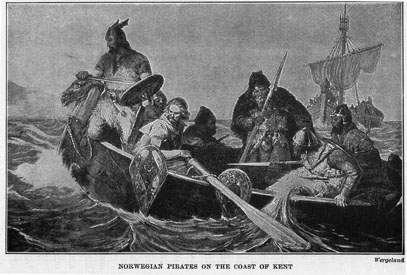
For the first eight years of his reign there was perfect peace in his kingdom, except in the counties of Kent and Essex, where pirates from the North Sea made occasional attacks.

fmma21

These pirates were mostly Norwegians, whose leader was a barbarian named Kerdric. They would come sweeping down upon the Kentish coast in many ships, make a landing where there were no soldiers, and fall upon the towns and plunder them. Then, as swiftly and suddenly as they had come, they would sail away homeward, before they could be captured.

One day Kerdic's fleet arrived off the coast, and as no opposing force was visible, the pirates landed and started toward the nearest town to plunder it.

By a quick march a body of English soldiers reached the town before the pirates, and when the latter arrived they found a strong force drawn up to give them battle. A short struggle took place. More than half of the pirates were slain and the remainder were taken prisoners.

After the prisoners had been secured the English ships that were stationed on the coast attacked the pirate fleet and destroyed it.

II

EDWARD took part in the events upon which Shakespeare, five hundred years later, founded his famous tragedy of "Macbeth."

There lived in Scotland during his reign an ambitious nobleman named Macbeth, who invited Duncan, the King of Scotland, to his castle and murdered him. He tried to make it appear that the murder had been committed by Duncan's attendants and he caused the king's son and heir, Prince Malcolm, to flee from the land. He then made himself king of Scotland.

Malcolm hastened to England and appealed to King Edward for help.

When the king was told the number of soldiers Malcolm would probably need he gave orders for double that number to march into Scotland. Malcolm with this support attacked Macbeth, and after several well-fought battles drove the usurper from Scotland and took possession of the throne.

Edward did a great deal during his reign to aid the cause of Christianity. He rebuilt the ancient Westminster Abbey in London and erected churches and monasteries in different parts of England.

Edward was long supposed to have made many just laws, and years after his death the English people, when suffering from bad government, would exclaim, "Oh, for the good laws and customs of Edward the Confessor!" What he really did was to have the old laws faithfully carried out.

He died in 1066 and was buried in Westminster Abbey.

Famous Men of the Middle Ages: The Cid

THE CID

LATE one sunny afternoon one and twenty knights were riding along the highway in the northern part of Spain. As they were passing a deep mire they heard cries for help, and turning, saw a poor leper who was sinking in the mud. One of the knights, a handsome young man, was touched by the cries. He dismounted, rescued the poor fellow, took him upon his own horse, and thus the two rode to the inn. The other knights wondered at this.

When they reached the inn where they were to stop for the night, they wondered still more, for their companion gave the leper a seat next to himself at the table. After supper the knight shared his own bed with the leper. If the knight had not done this, the leper would have been driven out of the town, with nothing to eat and no place in which to sleep. At midnight, while the young man was fast asleep, the leper breathed upon his back. This awakened the knight, who turned quickly in his bed and found that the leper was gone.

The knight called for a light and searched, but in vain. While he was wondering about what had happened, a man in shining garments appeared before him and said, "Rodrigo, art thou asleep or awake?" The knight answered, "I am awake, but who art thou that bringest such brightness?"  The vision replied, "I am St. Lazarus, the leper to whom thou wast so kind. Because I have breathed upon thee thou shalt accomplish whatever thou shalt undertake in peace or in battle. All shall honor thee. Therefore, go on and evermore do good."

With that the vision vanished.

The promise of St. Lazarus was fulfilled. In time young Rodrigo became the great hero of Spain.  The Spaniards called him Campeador, or Champion. The Saracens called him "The Cid," or Lord. His real name was Rodrigo Diaz de Bivar, but he is usually spoken of as "The Cid."

The Goths, after the death of Alaric, had taken Spain away from the Romans. The Saracens, or, as they were usually called, the Moors, had crossed the sea from Africa and in turn had taken Spain from the Goths. In the time of Charles Martel the Goths had lost all Spain except the small mountain district in the northern part. In the time of the Cid the Goths, now called Spaniards, had driven the Moors down to about the middle of Spain. War went on all the time between the two races, and many men spent their lives in fighting. The Spanish part of the country then comprised the kingdoms of Castile, Leon, Aragon and others.

fmma20

The Cid was a subject of Fernando of Castile. Fernando had a dispute with the king of Aragon about a city which each claimed. They agreed to decide the matter by a combat. Each was to choose a champion. The champions were to fight, and the king whose champion won was to have the city. Fernando chose the Cid, and though the other champion was called the bravest knight in Spain, the youthful warrior vanquished him.

When Alfonzo, a son of Fernando, succeeded to the throne, he became angry with the Cid without just cause and banished him from Christian Spain.

The Cid was in need of some money, so he filled two chests with sand and sent word to two wealthy money lenders that he wished to borrow six hundred Spanish marks, and would put into their hands his treasures of silver and gold which were packed in two chests, but the money lenders must solemnly swear not to open the chests until a full year had passed. To this they gladly agreed. They took the chests and loaned him six hundred marks.

The Cid was now ready for his journey. Three hundred of his knights went into banishment with him. They crossed the mountains and entered the land of the Moors. Soon they reached the town of Alcocer, and after a siege captured it and lived in it.

Then the Moorish king of Valencia ordered two chiefs to take three thousand horsemen, recapture the town and bring the Cid alive to him.

So the Cid and his men were shut up in Alcocer and besieged. Famine threatened them and they determined to cut their way through the army of the Moors. Suddenly and swiftly they poured from the gate of Alcocer, and a terrible battle was fought. The two Moorish chiefs were taken prisoners and thirteen hundred of their men were killed in the battle. The Cid then became a vassal of the Moorish king of Saragossa.

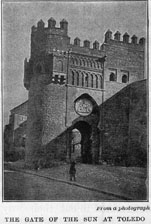
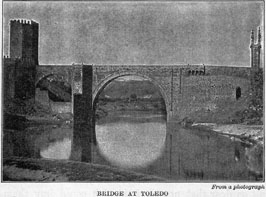
After a while Alfonzo recalled the Cid from banishment and gave him seven castles and the lands adjoining them. He needed the Cid's help in the greatest of all his plans against the Moors. He was determined to capture Toledo. He attacked it with a large army in which there were soldiers from many foreign lands. The Cid is said to have been the commander. After a long siege the city fell and the victorious army marched across the great bridge built by the Moors, which you would cross to-day if you went to Toledo.

Valencia was one of the largest and richest cities in Moorish Spain. It was strongly fortified, but the Cid determined to attack it.

The plain about the city was irrigated by streams that came down from the neighboring hills.  To prevent the Cid's army from coming near the city the Saracens flooded the plain. But the Cid camped on high ground above the plain and from that point besieged the city. Food became very scarce in Valencia. Wheat, barley and cheese were all so dear that none but the rich could buy them. People ate horses, dogs, cats and mice, until in the whole city only three horses and a mule were left alive.

Then on the fifteenth of June, 1094, the governor went to the camp of the Cid and delivered to him the keys of the city. The Cid placed his men in all the forts and took the citadel as his own dwelling. His banner floated from the towers. He called himself the Prince of Valencia.

fmma20

When the king of Morocco heard of this he raised an army of fifty thousand men. They crossed from Africa to Spain and laid siege to Valencia. But the Cid with his men made a sudden sally and routed them and pursued them for miles. It is said that fifteen thousand soldiers were drowned in the river Guadalquivir which they tried to cross.

The Cid was now at the height of his power and lived in great magnificence. One of the first things he did was to repay the two friends who had lent him the six hundred marks. He was kind and just to the Saracens who had become his subjects. They were allowed to have their mosques and to worship God as they thought right.

In time the Cid's health began to fail.  He could lead his men forth to battle no more. He sent an army against the Moors, but it was so completely routed that few of his men came back to tell the tale. It is said by a Moorish writer that "when the runaways reached him the Cid died of rage" (1099).

There is a legend that shortly before he died he saw a vision of St. Peter, who told him that he should gain a victory over the Saracens after his death.

So the Cid gave orders that his body should be embalmed. It was so well preserved that it seemed alive. It was clothed in a coat of mail, and the sword that had won so many battles was placed in the hand. Then it was mounted upon the Cid's favorite horse and fastened into the saddle, and at midnight was borne out of the gate of Valencia with a guard of a thousand knights.

All silently they marched to a spot where the Moorish king, with thirty-six chieftains, lay encamped, and at daylight the knights of the Cid made a sudden attack. The king awoke. It seemed to him that there were coming against him full seventy thousand knights, all dressed in robes as white as snow, and before them rode a knight, taller than all the rest, holding in his left hand a snow-white banner and in the other a sword which seemed of fire. So afraid were the Moorish chief and his men that they fled to the sea, and twenty thousand of them were drowned as they tried to reach their ships.

There is a Latin inscription near the tomb of the Cid which may be translated:
Brave and unconquered, famous in triumphs of war,
Enclosed in this tomb lies Roderick the Great of Bivar.

Famous Men of the Middle Ages: Canute The Great. King From 1014-1035

CANUTE THE GREAT

KING FROM 1014-1035

I

THE Danes, you remember, had the eastern and northern parts of England in the time of Alfred. Alfred's successors drove them farther and farther north, and at length the Danish kingdom in England came to an end for a time.

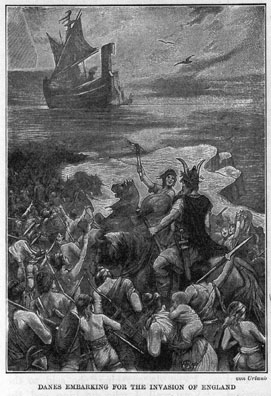
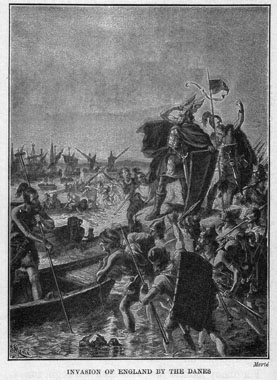
But the Danes in Denmark did not forget that there had been such a kingdom and in the year 1013 Sweyn, King of Denmark, invaded England and defeated the Anglo-Saxons. Ethelred, their king, fled to Normandy.

Sweyn now called himself the king of England; but in a short time he died and his son Canute succeeded to his throne. Canute was nineteen years old. He had been his father's companion during the war with the Anglo-Saxons, and thus had had a good deal of experience as a soldier.

After the death of Sweyn some of the Anglo-Saxons recalled King Ethelred and revolted against the Danes.

Canute, however, went to Denmark and there raised one of the largest armies of Danes that had ever been assembled. With this powerful force he sailed to England. When he landed Northumberland and Wessex acknowledged him as king. Shortly after this Ethelred died.

Canute now thought he would find it easy to get possession of all England. This was a mistake.

Ethelred left a son named Edmund Ironside who was a very brave soldier. He became, by his father's death, the king of Saxon England and at once raised an army to defend his kingdom. A battle was fought and Edmund was victorious. This was the first of five battles that were fought in one year. In none of them could the Danes do more than gain a slight advantage now and then.

However, the Saxons were at last defeated in a sixth battle through the act of a traitor. Edric, a Saxon noble, took his men out of the fight and his treachery so weakened the Saxon army that Edmund Ironside had to surrender to Canute.

fmma19

But the young Dane had greatly admired Edmund for the way in which he had fought against heavy odds, so he now treated him most generously. Canute took certain portions of England and the remainder was given to Edmund Ironside.

Thus for a short time the Anglo-Saxon people had at once a Danish and a Saxon monarch.

II

EDMUND died in 1016 and after his death Canute became sole ruler.

He ruled wisely. He determined to make his Anglo-Saxon subjects forget that he was a foreign conqueror. To show his confidence in them he sent back to Denmark the army he had brought over the sea, keeping on a part of his fleet and a small body of soldiers to act as guards at his palace.

He now depended on the support of his Anglo-Saxon subjects and he won their love.

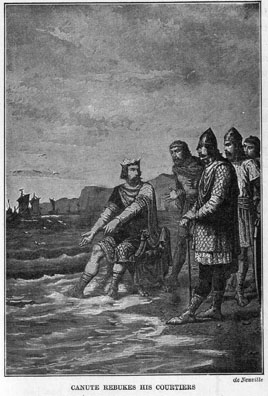
Although a king--and it is generally believed that kings like flattery--Canute is said to have rebuked his courtiers when they flattered him. On one occasion, when they were talking about his achievements, one of them said to him:

"Most noble king, I believe you can do anything."

Canute sternly rebuked the courtier for these words and then said:

"Come with me, gentlemen."

He led them from the palace grounds to the sea-shore where the tide was rising, and had his chair placed at the edge of the water.

fmma19

"You say I can do anything," he said to the courtiers.  "Very well, I who am king and the lord of the ocean now command these rising waters to go back and not dare wet my feet."

But the tide was disobedient and steadily rose and rose, until the feet of the king were in the water. Turning to his courtiers, Canute said:

"Learn how feeble is the power of earthly kings. None is worthy the name of king but He whom heaven and earth and sea obey."

During Canute's reign England had peace and prosperity and the English people have ever held his memory dear.

Famous Men of the Middle Ages: Henry The Fowler. King From 919-936

HENRY THE FOWLER

KING FROM 919-936

I

ABOUT a hundred years had passed since the death of Charlemagne, and his great empire had fallen to pieces. Seven kings ruled where he had once been sole emperor.

West of the Rhine, where the Germans lived, the last descendant of Charlemagne died when he was a mere boy. The German nobles were not willing for any foreign prince to govern them, and yet they saw that they must unite to defend their country against the invasions of the barbarians called Magyars. So they met and elected Conrad, duke of Franconia, to be their king.

However, although he became king in name, Conrad never had much power over his nobles. Some of them refused to recognize him as king and his reign was disturbed by quarrels and wars. He died in 919, and on his death-bed he said to his brother, "Henry, Duke of Saxony, is the ablest ruler in the empire. Elect him king, and Germany will have peace."

A few months after Conrad's death, the nobles met at Aix-la-Chapelle and elected Henry to be their king.

At this time it was the custom in Europe to hunt various birds, such as the wild duck and partridge, with falcons. The falcons were long-winged birds of prey, resembling hawks. They were trained to perch on their master's wrist and wait patiently until they were told to fly. Then they would swiftly dart at their prey and bear it to the ground. Henry was very fond of falconry and hence was known as Henry the Fowler, or Falconer.

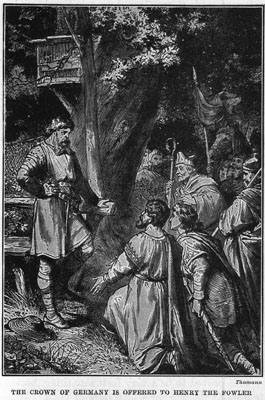
As soon as the other dukes had elected him king a messenger was sent to Saxony to inform him of the honor done him. After a search of some days he was at last found, far up in the Hartz Mountains, hunting with his falcons. Kneeling at his feet, the messenger said:

"God save you, Henry of Saxony. I come to announce the death of King Conrad and to tell you that the nobles have elected you to succeed him as king of the Germans."

fmma18

For a moment the duke was speechless with amazement. Then he exclaimed:

"Elected me king?  I cannot believe it. I am a Saxon, and King Conrad was a Frank and a bitter enemy to me."

"It is true," replied the messenger. "Conrad, when dying, advised that the nobles should choose you as his successor."

Henry was silent for while and then he said, "King Conrad was a good man. I know it now; and I am sorry that I did not understand him better when he was alive.  I accept the position offered to me and I pray that I may be guided by Heaven in ruling his people."

So Henry the Fowler left the chase to take up his duties as king of the Germans.

II

IN proper time Henry was proclaimed king of Germany; but he was hardly seated on the throne when the country was invaded by thousands of Magyars, from the land which we now know as Hungary.

As soon as possible Henry gathered an army and marched to meet the barbarians. He came upon a small force under the command of the son of the Magyar king. The Germans easily routed the Magyars and took the king's son prisoner.

This proved to be a very fortunate thing, because it stopped the war for a long term of years. When the Magyar king learned that his son was a prisoner in the hands of King Henry he was overwhelmed with grief. He mourned for his son day and night and at last sent to the German camp a Magyar chief with a flag of truce, to bet that the prince might be given up.

"Our king says that he will give whatever you demand for the release of his son," said the chief to the German monarch.

"I will give up the prince on this condition only," was the reply, "the Magyars must leave the soil of Germany immediately and promise not to war on us for nine years. During those years I will pay to the king yearly five thousand pieces of gold."

"I accept the terms in the king's name," responded the chief.  The prince was, therefore, given up and the Magyars withdrew.

During the nine years of truce King Henry paid great attention to the organization of an army. Before this the German soldiers had fought chiefly on foot, not, as the Magyars did, on horseback. For this reason they were at a great disadvantage in battle. The king now raised a strong force of horsemen and had them drilled so thoroughly that they became almost invincible. The infantry also were carefully drilled.

Besides this, Henry built a number of forts in different parts of his kingdom and had all the fortified cities made stronger.

The following year the Magyar chief appeared at the German court and demanded a tenth payment.

"Not a piece of gold will be given you," replied King Henry. "Our truce is ended."

In less than a week a vast body of Magyars entered Germany to renew the war. Henry held his army in waiting until lack of food compelled the barbarians to divide their forces into two separate bodies. One division was sent to one part of the country, the other to another part.

Henry completely routed both divisions, and the power of the Magyars in Germany was broken.

The Danes also invaded Henry's kingdom, but he defeated them and drove them back.

Henry reigned for eighteen years; and when he died all Germany was peaceful and prosperous. His son Otto succeeded him. He assumed the title of "Emperor," which Charlemagne had borne more than a hundred years before.

From that time on, for nearly one thousand years, all the German emperors claimed to be the successors of Charlemagne. They called their domain "the Holy Roman Empire," and took the title "Emperor" or "Emperor of the Romans," until the year 1806, when Francis II resigned it.

Famous Men of the Middle Ages: Alfred The Great. King From 871-901

ALFRED THE GREAT

KING FROM 871-901

I

THE Danes were neighbors of the Norwegian Vikings, and like them were fond of the sea and piracy. They plundered the English coasts for more than a century; and most of northern and eastern England became for a time a Danish country with Danish kings.

What saved the rest of the country to the Saxons was the courage of the great Saxon king, Alfred.

Alfred was the son of Ethelwulf, king of the West Saxons. He had a loving mother who brought him up with great care. Up to the age of twelve, it is said, he was not able to read well, in spite of the efforts of his mother and others to teach him.

When Alfred was a boy there were no printed books. The wonderful art of printing was not invented until about the year 1440--nearly six hundred years later than Alfred's time. Moreover, the art of making paper had not yet been invented. Consequently the few books in use in Alfred's time were written by skillful penmen, who wrote generally on leaves of parchment, which was sheepskin carefully prepared so that it might retain ink.

One day Alfred's mother showed him and his elder brothers a beautiful volume which contained a number of the best Saxon ballads. Some of the words in this book were written in brightly colored letters, and upon many of the leaves were painted pictures of gaily-dressed knights and ladies.

"Oh, what a lovely book!" exclaimed the boys.

"Yes, it is lovely," replied the mother. "I will give it to whichever of you children can read it the best in a week."

Alfred began at once to take lessons in reading, and studied hard day after day. His brothers passed their time in amusements and made fun of Alfred's efforts. They thought he could not learn to read as well as they could, no matter how hard he should try.

At the end of the week the boys read the book to their mother, one after the other. Much to the surprise of his brothers, Alfred proved to be the best reader and his mother gave him the book.

While still very young Alfred was sent by his father to Rome to be anointed by His Holiness, the Pope. It was a long and tiresome journey, made mostly on horseback.

With imposing, solemn ceremony he was anointed by the Holy Father. Afterwards he spent a year in Rome receiving religious instruction.

II

IN the year 871, when Alfred was twenty-two years old, the Danes invaded various parts of England. Some great battles were fought, and Alfred's elder brother Ethelred, king of the West Saxons, was killed. Thus Alfred became king.

The Danes still continued to fight the Saxons, and defeated Alfred in a long and severe struggle. They took for themselves the northern and eastern parts of England.

Moreover, Danes from Denmark continued to cross the sea and ravage the coast of Saxon England. They kept the people in constant alarm. Alfred therefore determined to meet the pirates on their own element, the sea. So he built and equipped the first English navy, and in 875 gained the first naval victory ever won by the English.

A few years after this, however, great numbers of Danes from the northern part of England came pouring into the Saxon lands. Alfred himself was obliged to flee for his life.

fmma17

For many months he wandered through forests and over hills to avoid being taken by the Danes. He sometimes made his home in caves and in the huts of shepherds and cowherds. Often he tended the cattle and sheep and was glad to get a part of the farmer's dinner in pay for his services.

Once, when very hungry, he went into the house of a cowherd and asked for something to eat. The cowherd's wife was baking cakes and she said she would give him some when they were done.

"Watch the cakes and do not let them burn, while I go across the field to look after the cows," said the woman, as she hurried away. Alfred took his seat on the chimney-corner to do as he was told. But soon his thoughts turned to his troubles and he forgot about the cakes.

When the woman came back she cried out with vexation, for the cakes were burned and spoiled. "You lazy, good-for-nothing man!" she said, "I warrant you can eat cakes fast enough; but you are too lazy to help me bake them."

With that she drove the poor hungry Alfred out of her house. In his ragged dress he certainly did not look like a king, and she had no idea that he was anything but a poor beggar.

III

SOME of Alfred's friends discovered where he was hiding and joined him. In a little time a body of soldiers came to him and a strong fort was built by them. From this fort Alfred and his men went out now and then and gave battle to small parties of the Danes. Alfred was successful and his army grew larger and larger.

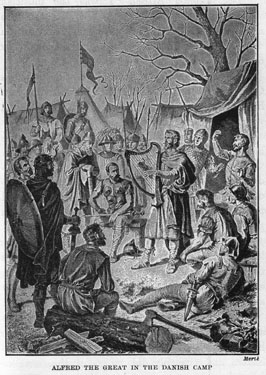
One day he disguised himself as a wandering minstrel and went into the camp of the Danes. He strolled here and there, playing on a harp and singing Saxon ballads. At last, Guthrum, the commander of the Danes, ordered the minstrel to be brought to his tent.

Alfred went. "Sing to me some of your charming songs," said Guthrum. "I never heard more beautiful music." So the kingly harper played and sang for the Dane, and went away with handsome presents. But better than that, he had gained information that was of the greatest value.

In a week he attacked the Danish forces and defeated them with great slaughter in a battle which lasted all day and far into the night. Guthrum was taken prisoner and brought before Alfred.

Taking his harp in his hands, Alfred played and sang one of the ballads with which he had entertained Guthrum in the camp. The Dane started in amazement and exclaimed:

"You, then, King Alfred, were the wandering minstrel?"

fmma17

"Yes," replied Alfred, "I was the musician whom you received so kindly. Your life is now in my hands; but I will give you your liberty if you will become a Christian and never again make war on my people."

"King Alfred," said Guthrum, "I will become a Christian, and so will all my men if you will grant liberty to them as to me; and henceforth, we will be your friends."

Alfred then released the Danes, and they were baptized as Christians.

An old road running across England from London to Chester was then agreed upon as the boundary between the Danish and Saxon kingdoms; and the Danes settled in East Anglia, as the eastern part of England was called.

Years of peace and prosperity followed for Alfred's kingdom. During these years the king rebuilt the towns that had been destroyed by the Danes, erected new forts, and greatly strengthened his army and navy.

He also encouraged trade; and he founded a school like that established by Charlemagne. He himself translated a number of Latin books into Saxon, and probably did more for the cause of education than any other king that ever wore the English crown.

Famous Men of the Middle Ages: Rollo The Viking, died 931

ROLLO THE VIKING

DIED 931

I

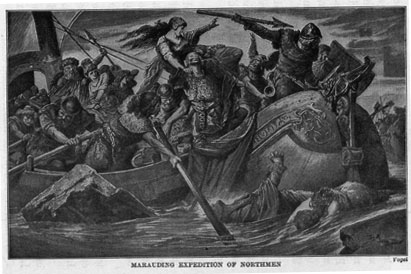
For more than two hundred years during the Middle Ages the Christian countries of Europe were attacked on the southwest by the Saracens of Spain, and on the northwest by the Norsemen, or Northmen. The Northmen were so called because they came into Middle Europe from the north. Sometimes they were called Vikings, or pirates, because they were adventurous sea-robbers who plundered all countries which they could reach by sea.

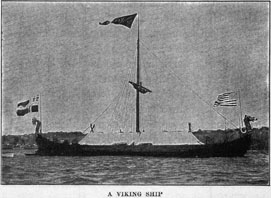
Their ships were long and swift  In the center was placed a single mast, which carried one large sail. For the most part, however, the Norsemen depended on rowing, not on the wind, and sometimes there were twenty rowers in one vessel.

The Vikings were a terror to all their neighbors; but the two regions that suffered most from their attacks were the Island of Britain and that part of Charlemagne's empire in which the Franks were settled.

fmma16

Nearly fifty times in two hundred years the lands of the Franks were invaded. The Vikings sailed up the large rivers into the heart of the region which we now call France and captured and pillaged cities and towns. Some years after Charlemagne's death they went as far as his capital, Aix, took the place, and stabled their horses in the cathedral which the great emperor had built.

In the year 860 they discovered Iceland and made a settlement upon its shores. A few years later they sailed as far as Greenland, and there established settlements which existed for about a century.

These Vikings were the first discoverers of the continent on which we live. Ancient books found in Iceland tell the story of the discovery. It is related that a Viking ship was driven during a storm to a strange coast, which is thought to have been that part of America now known as Labrador.

When the captain of the ship returned home he told what he had seen. His tale so excited the curiosity of a young Viking prince, called Leif the Lucky, that he sailed to the newly discovered coast.

Going ashore, he found that the country abounded in wild grapes; and so he called it Vinland, or the land of Vines. Vinland is thought to have been a part of what is now the Rhode Island coast.

The Vikings were not aware that they had found a great unknown continent. No one in the more civilized parts of Europe knew anything about their discovery; and after a while the story of the Vinland voyages seems to have been forgotten, even among the Vikings themselves.

So it is not to them that we owe the discovery of America, but to Columbus; because his discovery, though nearly five hundred years later than that of the Norsemen, actually made known to all Europe, for all time, the existence of the New World.

II

THE Vikings had many able chieftains. One of the most famous was Rollo the Walker, so called because he was such a giant that no horse strong enough to carry him could be found, and therefore he always had to walk. However, he did on foot what few could do on horseback.

In 885 seven hundred ships, commanded by Rollo and other Viking chiefs, left the harbors of Norway, sailed to the mouth of the Seine, and started up the river to capture the city of Paris.

Rollo and his men stopped on the way at Rouen, which also was on the Seine, but nearer its mouth. The citizens had heard of the giant, and when they saw the river covered by his fleet they were dismayed. However, the bishop of Rouen told them that Rollo could be as noble and generous as he was fierce; and he advised them to open their gates and trust to the mercy of the Viking chief. This was done, and Rollo marched into Rouen and took possession of it. The bishop had given good advice, for Rollo treated the people very kindly.

Soon after capturing Rouen he left the place, sailed up the river to Paris, and joined the other Viking chiefs. And now for six long miles the beautiful Seine was covered with Viking vessels, which carried an army of thirty thousand men.

A noted warrior named Eudes was Count of Paris, and he had advised the Parisians to fortify the city. So not long before the arrival of Rollo and his companions, two walls with strong gates had been built round Paris.

It was no easy task for even Vikings to capture a strongly walled city.  We are told that Rollo and his men built a high tower and rolled it on wheels up to the walls.  At its top was a floor well manned with soldiers.  But the people within the city shot hundreds of arrows at the besiegers, and threw down rocks, or poured boiling oil and pitch upon them.

The Vikings thought to starve the Parisians, and for thirteen months they encamped round the city.  At length food became very scarce, and Count Eudes determined to go for help.  He went out through one of the gates on a dark, stormy night, and rode post-haste to the king.  He told him that something must be done to save the people of Paris.

fmma16

So the king gathered an army and marched to the city.  No battle was fought--the Vikings seemed to have been afraid to risk one. They gave up the siege, and Paris was relieved.

Rollo and his men went to the Duchy of Burgundy, where, as now, the finest crops were raised and the best of wines were made.

III

PERHAPS after a time Rollo and his Vikings went home; but we do not know what he did for about twenty-five years. We do know that he abandoned his old home in Norway in 911. Then he and his people sailed from the icy shore of Norway and again went up the Seine in hundreds of Viking vessels.

Of course, on arriving in the land of the Franks, Rollo at once began to plunder towns and farms.

Charles, then king of the Franks, although his people called him the Simple, or Senseless, had sense enough to see that this must be stopped.

So he sent a message to Rollo and proposed that they should have a talk about peace. Rollo agreed and accordingly they met. The king and his troops stood on one side of a little river, and Rollo with his Vikings stood on the other. Messages passed between them. The king asked Rollo what he wanted.

"Let me and my people live in the land of the Franks; let us make ourselves home here, and I and my Vikings will become your vassals," answered Rollo. He asked for Rouen and the neighboring land. So the king gave him that part of Francia; and ever since it has been called Normandy, the land of the Northmen.

When it was decided that the Vikings should settle in Francia and be subjects of the Frankish king, Rollo was told that he must kiss the foot of Charles in token that he would be the king's vassal. The haughty Viking refused. "Never," said he, "will I bend my knee before any man, and no man's foot will I kiss." After some persuasion, however, he ordered one of his men to perform the act of homage for him. The king was on horseback and the Norseman, standing by the side of the horse, suddenly seized the king's foot and drew it up to his lips. This almost made the king fall from his horse, to the great amusement of the Norsemen.

Becoming a vassal to the king meant that if the king went to war Rollo would be obliged to join his army and bring a certain number of armed men--one thousand or more.

Rollo now granted parts of Normandy to his leading men on condition that they would bring soldiers to his army and fight under him. They became his vassals, as he was the king's vassal.

The lands granted to vassals in this way were called feuds, and this plan of holding lands was called the Feudal System.

It was established in every country of Europe during the Middle Ages.

The poorest people were called serfs. They were almost slaves and were never permitted to leave the estate to which they belonged. They did all the work. They worked chiefly for the landlords, but partly for themselves.

Having been a robber himself, Rollo knew what a shocking thing it was to ravage and plunder, and he determined to change his people's habits. He made strict laws and hanged robbers. His duchy thus became one of the safest parts of Europe.

The Northmen learned the language of the Franks and adopted their religion.

The story of Rollo is especially interesting to us, because Rollo was the forefather of that famous Duke of Normandy who, less than a hundred and fifty years later, conquered England and brought into that country the Norman nobles with their French language and customs.

Famous Men of the Middle Ages: Egbert, King from 802-837

EGBERT

KING FROM 802-837

I

EGBERT the Saxon lived at the same time as did Harun-al-Rashid and Charlemagne. He was the first king who ruled all England as one kingdom. Long before his birth the people who are known to us as Britons lived there, and they gave to the island the name Britain.

But Britain was invaded by the Romans under Julius Cesar and his successors, and all that part of it which we now call England was added to the Empire of Rome. The Britons were driven into Wales and Cornwall, the western sections of the island.

The Romans kept possession of the island for nearly four hundred years. They did not leave it until 410, the year that Alaric sacked the city of Rome. At this time the Roman legions were withdrawn from Britain.

Some years before this the Saxons, Angles and Jutes, German tribes, had settled near the shores of the North Sea. They learned much about Britain; for trading vessels, even at that early day, crossed the Channel. Among other things, the men from the north learned that Britain was crossed with good Roman roads, and dotted with houses of brick and stone; that walled cities had taken the place of tented camps, and that the country for miles round each city was green every spring with waving wheat, or white with orchard blossoms.

fmma15

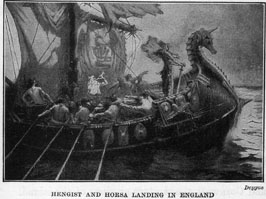
After the Roman legions had left Britain, the Jutes, led, it is said, by two great captains named Hengist and Horsa, landed upon the southeastern coast and made a settlement.

Britain proved a pleasant place to live in, and soon the Angles and Saxons also left the North Sea shores and invaded the beautiful island.

The new invaders met with brave resistance. The Britons were headed by King Arthur, about whom many marvelous stories are told. His court was held at Caerleon, in North Wales, where his hundred and fifty knights banqueted at their famous "Round Table."

The British king and his knights fought with desperate heroism. But they could not drive back the Saxons and their companions and were obliged to seek refuge in the western mountainous parts of the island, just as their forefathers had done when the Romans invaded Britain. Thus nearly all England came into the possession of the three invading tribes.

II

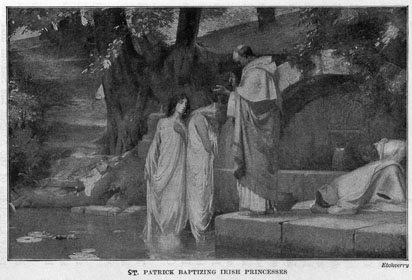
ARTHUR and his knights were devoted Christians. For the Romans had not only made good roads and built strong walls and forts in Britain, but they had also brought the Christian religion into the island. And at about the time of the Saxon invasion St. Patrick was founding churches and monasteries in Ireland, and was baptizing whole clans of the Irish at a time. It is said that he baptized 12,000 persons with his own hand. Missionaries were sent out by the Irish Church to convert the wild Picts of Scotland and at a later day the distant barbarians of Germany and Switzerland.

The Saxons, Angles, and Jutes believed in the old Norse gods, and Tiew and Woden, Thor and Friga, or Frija, were worshiped on the soil of Britain for more than a hundred years.

The Britons tried to convert their conquerors, but the invaders did not care to be taught religion by those whom they had conquered; so the British missionaries found the work unusually hard.  Aid came to them in a singular way. At some time near the year 575 A.D., the Saxons quarreled and fought with their friends, the Angles. They took some Angles prisoners and carried them to Rome to be sold in the great slave-market there. A monk named Gregory passed one day through the market and saw these captives. He asked the dealer who they were. "Angles," was the answer.

"Oh," said the monk, "they would be angels instead of Angles if they were only Christians; for they certainly have the faces of angels."

fmma15

Years after, when that monk was the Pope of Rome, he remembered this conversation and sent the monk Augustine to England to teach the Christian religion to the savage but angel-faced Angles. Augustine and the British missionaries converted the Anglo-Saxons two hundred years before the German Saxons were converted.

Still, though both Angles and Saxons called themselves Christians, they were seldom at peace; and for more than two hundred years they frequently fought. Various chiefs tried to make themselves kings; and at length there came to be no less than seven small kingdoms in South Britain.

In 784 Egbert claimed to be heir of the kingdom called Wessex; but the people elected another man and Egbert had to flee for his life. He went to the court of Charlemagne, and was with the great king of the Franks in Rome on Christmas Day, 800, when the Pope placed the crown on Charles' head and proclaimed him emperor.

Soon after this a welcome message came to Egbert. The mind of the people in Wessex had changed and they had elected him king. So bidding farewell to Charlemagne, he hurried to England.

Egbert had seen how Charlemagne had compelled the different quarreling tribes of Germany to yield allegiance to him and how after uniting his empire he had ruled it well.

Egbert did in England what Charlemagne had done in Germany. He either persuaded the various petty kingdoms of the Angles, the Saxons and the Jutes to recognize him as their ruler, or forced them to do so; and thus under him all England became one united kingdom.

But Egbert did even better than this. He did much to harmonize the different tribes by his wise conciliation. The name "England" is a memorial of this; for though Egbert himself was a Saxon, he advised that to please the Angles the country should be called Anglia, that is, Angleland or England, the land of the Angles, instead of Saxonia, or Saxonland.

Famous Men of the Middle Ages: Harun-al-Rashid. Caliph From 786-809

HARUN-AL-RASHID

CALIPH FROM 786-809

I

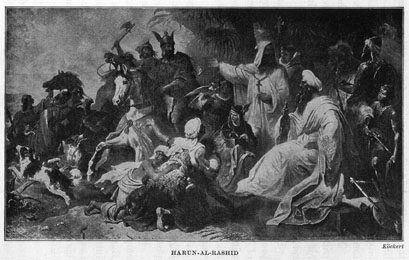
THE most celebrated of all Mohammedan caliphs was Harun-al-Rashid, which means, in English, Aaron the Just. Harun is the hero of several of the stories of the "Arabian Nights," a famous book, which perhaps you have read. There are many curious and wonderful tales in it.

When Harun was only eighteen years old he showed such courage and skill as a soldier that his father, who was then caliph, allowed him to lead an army against the enemies of the Mohammedans; and he won many great victories.

He afterwards commanded an army of ninety-five thousand Arabs and Persians, sent by his father to invade the Eastern Roman Empire, which was then ruled by the Empress Irene. After defeating Irene's famous general, Nicetas, Harun marched his army to Chrysopolis, now Scutari, on the Asiatic coast, opposite Constantinople. He encamped on the heights, in full view of the Roman capital.

The Empress saw that the city would certainly by taken by the Moslems. She therefore sent ambassadors to Harun to arrange terms; but he sternly refused to agree to anything except immediate surrender.

Then one of the ambassadors said, "The Empress has heard much of your ability as a general. Though you are her enemy, she admires you as a soldier."

These flattering words were pleasing to Harun. He walked to and fro in front of his tent and then spoke again to the ambassadors.

"Tell the Empress," he said, "that I will spare Constantinople if she will pay me seventy thousand pieces of gold as a yearly tribute. If the tribute is regularly paid Constantinople shall not be harmed by any Moslem force."

The Empress had to agree to these terms. She paid the first year's tribute; and soon the great Moslem army set out on its homeward march.

When Harun was not quite twenty-one years old he became caliph.

He began his reign by appointing very able ministers, who carried on the work of the government so well that they greatly improved the condition of the people.

Harun built a palace in Bagdad, far grander and more beautiful than that of any caliph before him. Here he established his court and lived in great splendor, attended by hundreds of courtiers and slaves.

He was very anxious that his people should be treated justly by the officers of the government; and he was determined to find out whether any had reason to complain. So he sometimes disguised himself at night and went about through the streets and bazaars, listening to the talk of those whom he met and asking them questions. In this way he learned whether the people were contented and happy, or not.

In those times Bagdad in the east and the Mohammedan cities of Spain in the west were famed for their schools and learned men. Arabian teachers first introduced into Western Europe both algebra and the figures which we use in arithmetic. It is for this reason that we call these figures the "Arabic numerals."

Harun-al-Rashid gave great encouragement to learning. He was a scholar and poet himself and whenever he heard of learned men in his own kingdom, or in neighboring countries, he invited them to his court and treated them with respect.

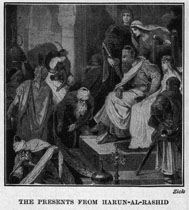
The name of Harun, therefore, became known throughout the world. It is said that a correspondence took place between him and Charlemagne and that, as you have learned, Harun sent the great emperor a present of a clock and an elephant.

fmma14

The tribute of gold that the Empress Irene agreed to pay Harun was sent regularly for many years. It was always received at Bagdad with great ceremony. The day on which it arrived was made a holiday. The Roman soldiers who came with it entered the gates in procession. Moslem troops also took part in the parade.

When the gold had been delivered at the palace, the Roman soldiers were hospitably entertained, and were escorted to the main gate of the city when they set out on their journey back to Constantinople.

II

IN 802 Nicephorus usurped the throne of the Eastern Empire. He sent ambassadors with a letter to Harun to tell him that the tribute would no longer be paid. The letter contained these words:

"The weak and faint-hearted Irene submitted to pay you tribute. She ought to have made you pay tribute to her. Return to me all that she paid you; else the matter must be settled by the sword."

As soon as Harun had read these words the ambassadors threw a bundle of swords at his feet. The caliph smiled, and drawing his own sword, or cimeter, he cut the Roman swords in two with one stroke without injuring the bald, or even turning the edge of his weapon.

Then he dictated a letter to Nicephorus, in which he said:

"Harun-al-Rashid, Commander of the Faithful to Nicephorus, the Roman dog: I have read thy letter. Thou shalt not hear, thou shalt see my reply."

fmma14

Harun was as good as his word. He started that day with a large army to punish the emperor. As soon as he reached Roman territory he ravaged the country and took possession of everything valuable that he found. He laid siege to Heraclea, a city on the shores of the Black Sea, and in a week forced it to surrender. Then he sacked the place.

Nicephorus was now forced to agree to pay the tribute. Scarcely, however, had the caliph reached his palace in Bagdad when the emperor again refused to pay.

Harun, consequently, advanced into the Roman province of Phrygia, in Asia Minor, with an army of 15,000 men. Nicepherus marched against him with 125,000 men. In the battle which followed the emperor was wounded, and 40,000 of his men were killed.

After this defeat Nicephorus again promised payment of the tribute, but again failed to keep his promise.

Harun now vowed that he would kill the emperor if he should ever lay hands upon him. But as he was getting ready to march once more into the Roman provinces a revolt broke out in one of the cities of his own kingdom; and while on his way to suppress it the great caliph died of an illness which had long given him trouble.

Famous Men of the Middle Ages: Charlemagne. King From 768-814

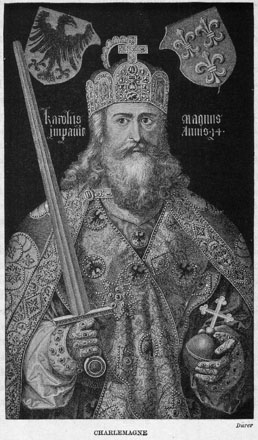
CHARLEMAGNE

KING FROM 768-814

I

Pepin had two sons Charles and Carloman. After the death of their father they ruled together, but in a few years Carloman died, and then Charles became sole king.

This Charles was the most famous of the kings of the Franks. He did so many great and wonderful things that he is called Charlemagne, which means Charles the Great.

He was a great soldier. For thirty years he carried on a war against the Saxons. Finally he conquered them, and their great chief, Wittekind, submitted to him. The Saxons were a people of Germany, who then lived near the land of the Franks. They spoke the same language and were of the same race as the Franks, but had not been civilized by contact with the Romans.

They were still pagans, just as the Franks had been before Clovis became a Christian. They actually offered human sacrifices.

After Charlemagne conquered them he made their lands part of his kingdom. A great number of them, among whom was Wittekind, then became Christians and were baptized; and soon they had churches and schools in many parts of their country.

Another of Charlemagne's wars was against the Lombards.

Pepin, as you have read, had defeated the Lombards and given to the Pope part of the country held by them. The Lombard king now invaded the Pope's lands and threatened Rome itself; so the Pope sent to Charlemagne for help.

Charlemagne quickly marched across the Alps and attacked the Lombards. He drove them out of the Pope's lands and took possession of their country.

After he had conquered the Lombards he carried on war, in 778, in Spain. A large portion of Spain was then held by the Moorish Saracens. But a Mohammedan leader from Damascus had invaded their country, and the Moors invited Charlemagne to help them. He therefore led an army across the Pyrenees. He succeeded in putting his Moorish friends in possession of their lands in Spain and then set out on his return to his own country.

fmma13

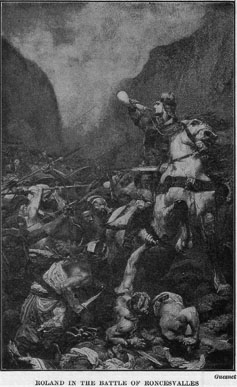
On the march his army was divided into two parts.  The main body was led by Charlemagne himself. The rear guard was commanded by a famous warrior named Roland. While marching through the narrow pass of Roncesvalles, among the Pyrenees, Roland's division was attacked by a tribe called the Basques, who lived on the mountain slopes of the neighboring region.

High cliffs walled in the pass on either side. From the tops of these cliffs the Basques hurled down rocks and trunks of trees upon the Franks, and crushed many of them to death. Besides this, the wild mountaineers descended into the pass and attacked them with weapons. Roland fought bravely; but at last he was overpowered, and he and all his men were killed.

Roland had a friend and companion named Oliver, who was as brave as himself. Many stories and songs have been written telling of the wonderful adventures they were said to have had and of their wonderful deeds in war.

The work of Charlemagne in Spain was quickly undone; for Abd-er-Rahman, the leader of the Mohammedans who had come from Damascus, soon conquered almost all the territory south of the Pyrenees.

fmma13

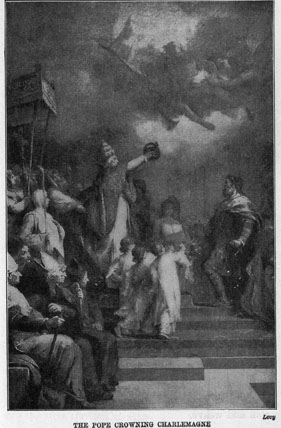
For more than forty years Charlemagne was king of the Franks; but a still greater dignity was to come to him. In the year 800 some of the people in Rome rebelled against the Pope, and Charlemagne went with an army to put down the rebellion. He entered the city with great pomp and soon conquered the rebels. On Christmas day he went to the church of St. Peter, and as he knelt before the altar the Pope placed a crown upon his head, saying:

"Long live Charles Augustus, Emperor of the Romans."

The people assembled in the church shouted the same words; and so Charlemagne was now emperor of the Western Roman Empire, as well as king of the Franks. [FOOTNOTE: The emperors of Constantinople still called themselves Roman Emperors, and still claimed Italy, Germany and France as parts of their empire, though really their authority had not been respected in these countries for more than 300 years.]

Charlemagne built a splendid palace at Aix-la-Chapelle, a town in Germany, where perhaps he was born.

Charlemagne was a tall man, with long, flowing beard, and of noble appearance.  He dressed in very simple style; but when he went into battle he wore armor, as was the custom for kings and nobles, and often for ordinary soldiers in his day.

fmma13

Armor was made of leather or iron, or both together. There was a helmet of iron for the head, and a breastplate to cover the breast, or a coat of mail to cover the body. The coat of mail was made of small iron or steel rings linked together, or fastened on to a leather shirt. Coverings for the legs and feet were often attached to the coat.

II

CHARLEMAGNE was a great king in may other ways besides the fighting of battles. He did much for the good of his people. He made many excellent laws and appointed judges to see that the laws were carried out. He established schools and placed good teachers in charge of them. He had a school in his palace for his own children, and he employed as their teacher a very learned Englishman named Alcuin.

In those times few people could read or write. There were not many schools anywhere, and in most places there were none at all. Even the kings had little education. Indeed, few of them could write their own names, and most of them did not care about sending their children to school. They did not think that reading or writing was of much use; but thought that it was far better for boys to learn to be good soldiers, and for girls to learn to spin and weave.

Charlemagne had a very different opinion. He was fond of learning; and whenever he heard of a learned man, living in any foreign country, he tried to get him to come and live in Frankland.

The fame of Charlemagne as a great warrior and a wise emperor spread all over the world. Many kings sent messengers to him to ask his friendship, and bring him presents.  Harun-al-Rashid, the famous caliph, who lived at Bagdad, in Asia, sent him an elephant and a clock which struck the hours.

The Franks were much astonished at the sight of the elephant; for they had never seen one before. They also wondered much at the clock. In those days there were in Europe no clocks such as we have; but water-clocks and hour-glasses were used in some places. The water-clock was a vessel into which water was allowed to trickle. It contained a float which pointed to a scale of hours at the side of the vessel. The float gradually rose as the water trickled in.

The hour-glasses measured time by the falling of fine sand from the top to the bottom of a glass vessel made with a narrow neck in the middle for the sand to go through. They were like the little glasses called egg-timers, which are used for measuring the time for boiling eggs.

fmma13

Charlemagne died in 814. He was buried in the church which he had built at Aix-la-Chapelle. His body was placed in the tomb, seated upon a grand chair, dressed in royal robes, with a crown on the head, a sword at the side, and a Bible in the hands.

This famous emperor is known in history as Charlemagne, which is the French word for the German name Karl der Grosse (Charles the Great), the name by which he was called at his own court during his life. The German name would really be a better name for him; for he was a German, and German was the language that he spoke. The common name of his favorite residence, Aix-la-Chapelle, also is French, but he knew the place as Aachen.

The great empire which Charlemagne built up held together only during the life of his son.  Then it was divided among his three grandsons. Louis took the eastern part, Lothaire took the central part, with the title of emperor, and Charles took the western part.

Famous Men of the Middle Ages: Charles Martel, 714-741 A.D. And Pepin, 741-768

CHARLES MARTEL, 714-741

AND

PEPIN, 741-768

I

AFTER the death of Mohammed the Saracens, as Mohammedans are also called, became great warriors. They conquered many countries and established the Mohammedan religion in them. In 711 the Saracens invaded and conquered a great part of Spain and founded a powerful kingdom there, which lasted about seven hundred years.

They intended to conquer the land of the Franks next, and then all Europe.

They thought it would be easy to conquer the Franks, because the Frankish king at that time was a very weak man. He was one of a number of kings who were called the "Do-nothings."  They reigned from about 638 to 751. They spent all their time in amusements and pleasures, leaving the affairs of the government to be managed by persons called Mayors of the Palace.

The mayors of the palace were officers who at first managed the king's household. Afterwards they were made guardians of kings who came to the throne when very young. So long as the king was under age the mayor of the palace acted as chief officer of the government in his name.  And as several of the young kings, even when they were old enough to rule, gave less attention to business than to pleasure, the mayors continued to do all the business, until at last they did everything that the king ought to have done. They made war, led armies in battle, raised money and spent it, and carried on the government as they pleased, without consulting the king.

The "Do-nothings" had the title of king, but nothing more. In fact, they did not desire to have any business to do. The things they cared for were dogs, horses and sport.

One of the most famous of the mayors was a man named Pepin. Once a year, it is said, Pepin had the king dressed in his finest clothes and paraded through the city of Paris, where the court was held. A splendid throng of nobles and courtiers accompanied the king, and did him honor as he went along the streets in a gilded chariot drawn by a long line of beautiful horses. The king was cheered by the people, and he acknowledged their greetings most graciously.

After the parade the king was escorted to the great hall of the palace, which was filled with nobles. Seated on a magnificent throne, he saluted the assemblage and made a short speech.  The speech was prepared beforehand by Pepin, and committed to memory by the king. At the close of the ceremony the royal "nobody" retired to his country house and was not heard of again for a year.

II

PEPIN died in 714 A.D., and his son Charles, who was twenty-five years old at that time, succeeded him as mayor of the palace. This Charles is known in history as Charles Martel. He was a brave young man. He had fought in many of his father's battles and so had become a skilled soldier. His men were devoted to him.

While he was mayor of the palace he led armies in several wars against the enemies of the Franks. The most important of his wars was one with the Saracens, who came across the Pyrenees from Spain and invaded the land of the Franks, intending to establish Mohammedanism there. Their army was led by Abd-er-Rahman, the Saracen governor of Spain.

fmma12

On his march through the southern districts of the land of the Franks Abd-er-Rahman destroyed many towns and villages, killed a number of the people, and seized all the property he could carry off. He plundered the city of Bordeaux, and, it is said, obtained so many valuable things that every soldier "was loaded with golden vases and cups and emeralds and other precious stones."

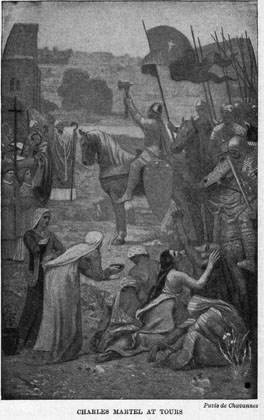
But meanwhile Charles Martel was not idle. As quickly as he could he got together a great army of Franks and Germans and marched against the Saracens. The two armies met between the cities of Tours and Poitiers in October, 732. For six days there was nothing but an occasional skirmish between small parties from both sides; but on the seventh day a great battle took place.

Both Christians and Mohammedans fought with terrible earnestness. The fight went on all day, and the field was covered with the bodies of the slain. But towards evening, during a resolute charge made by the Franks, Abd-er-Rahman was killed.  Then the Saracens gradually retired to their camp.

It was not yet known, however, which side had won; and the Franks expected that the fight would be renewed in the morning.

But when Charles Martel, with his Christian warriors, appeared on the field at sunrise there was no enemy to fight. The Mohammedans had fled in the silence and darkness of the night and had left behind them all their valuable spoils. There was now no doubt which side had won.

The battle of Tours, or Poitiers, as it should be called, is regarded as one of the decisive battles of the world. It decided that Christians, and not Moslems, should be the ruling power in Europe.

Charles Martel is especially celebrated as the hero of this battle. It is said that the name Martel was given to him because of his bravery during the fight. Marteau is the French word for hammer, and one of the old French historians says that as a hammer breaks and crushes iron and steel, so Charles broke and crushed the power of his enemies in the battle of Tours.

But though the Saracens fled from the battlefield of Tours, they did not leave the land of the Franks; and Charles had to fight other battles with them, before they were finally defeated. At last, however, he drove them across the Pyrenees, and they never again attempted to invade Frankland.

After his defeat of the Saracens Charles Martel was looked upon as the great champion of Christianity; and to the day of his death, in 741, he was in reality, though not in name, the king of the Franks.

III

CHARLES MARTEL had two sons, Pepin and Carloman. For a time they ruled together, but Carloman wished to lead a religious life, so he went to a monastery and became a monk. Then Pepin was sole ruler.

Pepin was quite low in stature, and therefore was called Pepin the Short. But he had great strength and courage. A story is told of him, which shows how fearless he was.

One day he went with a few of his nobles to a circus to see a fight between a lion and a bull. Soon after the fight began, it looked as though the bull was getting the worst of it. Pepin cried out to his companions:

"Will one of you separate the beasts?"

But there was no answer. None of them had the courage to make the attempt. Then Pepin jumped from his seat, rushed into the arena, and with a thrust of his sword killed the lion.

In the early years of Pepin's rule as mayor of the palace the throne was occupied by a king named Childeric III. Like his father and the other "do-nothing" kings, Childeric cared more for pleasures and amusements than for affairs of government. Pepin was the real ruler, and after a while he began to think that he ought to have the title of king, as he had all the power and did all the work of governing and defending the kingdom.

So he sent some friends to Rome to consult the Pope. They said to His Holiness:

"Holy father, who ought to be the king of France--the man who has the title, or the man who has the power and does all the duties of king?"

"Certainly," replied the Pope, "the man who has the power and does the duties."

"Then, surely," said they, "Pepin ought to be the king of the Franks; for he has all the power."

The Pope gave his consent, and Pepin was crowned king of the Franks; and thus the reign of Childeric ended and that of Pepin began.

During nearly his whole reign Pepin was engaged in war. Several times he went to Italy to defend the Pope against the Lombards. These people occupied certain parts of Italy, including the province still called Lombardy.

Pepin conquered them and gave as a present to the Pope that part of their possessions which extended for some distance around Rome. This was called "Pepin's Donation." It was the beginning of what is known as the "temporal power" of the Popes, that is, their power as rulers of part of Italy.

Pepin died in 768.

Subscribe to this RSS feed

Log in or create an account