log in
The Legends of the Jews

The Legends of the Jews (168)

THE LEGENDS OF THE JEWS

BY LOUIS GINZBERG

[1909]

TRANSLATED FROM THE GERMAN MANUSCRIPT

This is a massive collation of the Haggada--the traditions which have grown up surrounding the Biblical narrative.

These stories and bits of layered detail are scattered throughout the Talmud and the Midrash, and other sources, including oral. In the 19th century Ginzberg undertook the task of arranging the Haggada into chronological order, and this series of volumes was the result.


Children categories

Anabalis by Xenophon

Anabalis by Xenophon (8)

Xenophon

Anabasis

or March Up Country


View items...
The Argonautica

The Argonautica (5)

Apollonius Rhodius

(fl. 3rd Century B.C.)

THE ARGONAUTICA

Originally written in Ancient Greek sometime in the 3rd Century B.C. by the Alexandrian poet Apollonius Rhodius ("Apollonius the Rhodian").

Translation by R.C. Seaton, 1912.

The text of this edition is based on that published as "Apollonius Rhodius: Argonautica", edited and translated by R.C. Seaton (Harvard University Press, Cambridge MA, 1912)


View items...
The Illiad by Homer

The Illiad by Homer (25)

Homer

c.800 BC

THE ILIAD

Translation: Samuel Henry Butcher (1850-1910) and Andrew Lang (1844-1912)


View items...
The Age of Fable or stories of Gods and Heroes

The Age of Fable or stories of Gods and Heroes (42)

BULFINCH'S MYTHOLOGY

THE AGE OF FABLE

OR STORIES OF GODS AND HEROES

by Thomas Bulfinch

[1855]


View items...
Myths of Crete and Pre-Hellecic Europe

Myths of Crete and Pre-Hellecic Europe (17)

MYTHS OF CRETE & PRE-HELLENIC EUROPE

By DONALD A. MACKENZIE

mckenzie-title

With Illustrations in Colour by John Duncan, A.R.S.A. and from Photographs

THE GRESHAM PUBLISHING COMPANY LIMITED

66 CHANDOS STREET COVENT GARDEN LONDON

[1917]

mckenzie-title

Ladies of the Minoan Court From the painting by John Duncan, A.R.S.A.


View items...
The Odyssey by Homer

The Odyssey by Homer (25)

Homer

c.800 BC

THE ODYSSEY

Translation: Samuel Henry Butcher (1850-1910) and Andrew Lang (1844-1912)


View items...
The Peloponnesian War by Thucydides

The Peloponnesian War by Thucydides (9)

The Peloponnesian War

by

THUCYDIDES

thucydides-biography

(ca 450-400 BC.)


View items...

MYTHS OF CRETE & PRE-HELLENIC EUROPE, Chapter 4 Schliemann's Discoveries

MYTHS OF CRETE & PRE-HELLENIC EUROPE

By DONALD A. MACKENZIE

THE GRESHAM PUBLISHING COMPANY LIMITED

66 CHANDOS STREET COVENT GARDEN LONDON

[1917]

CHAPTER IV

History in Myth and Legend--Schliemann's Discoveries

The Hellenes and Pelasgians--Evidence of Folk-legends--Thucydides on Cretan Origin of ean Civilization--Solar-myth Theories--Achilles and Odysseus as Sun-gods--The "Aryans" and the Iliad--Trojan War and Vedic Myths--Schliemann's Faith in Tradition--Story of his Life--Resolution in Boyhood to excavate Troy--How he became a Merchant Prince--Troy located at Hissarlik--Early Discoveries--First Treasure Hoard--Trouble with Turkish Officials--Excavations in Greece--Work at Tiryns--The Cyclopean Walls--Legends of Giant and Fairy Artisans--Hittite Method of Building--Excavations at Mycen-The Lion Gate--Ramsay's Finds in Phrygia--The Rich Mycenn Graves--"Agamemnon's Tomb"--A Famous Telegram--Later Excavations--Schliemann's Scheme to explore in Crete--Death of the Famous Excavator.

THE knowledge possessed by European scholars a generation ago regarding pre-Hellenic civilization was of slight and doubtful character. Histories of Greece devoted small space to the Heroic Age. These usually began by stating that Greece was so called by the Romans, that it had been anciently known as Hellas and embraced several States--Attica, Arcadia, Ach, Botia.--and that the term Hellas had wider significance than was attached to it in modern times, having been used to denote the country of the Hellenes wherever they might happen to be settled, so that Cyrene in North Africa and Miletus in Asia Minor, for instance, were as essentially parts of Hellas as Arcadia or Botia. It was also recognized that the Hellenes were not the earliest inhabitants of Greece proper. Before these invaders entered into possession of the country it had been divided between various "barbarous tribes", including the Pelasgi and their congeners the Caucones and Leleges. Thirlwall, among others, expressed the view "that the name Pelasgians was a general one, like that of Saxons, Franks, or Alemanni, and that each of the Pelasgian tribes had also one peculiar to itself". The Hellenes did not exterminate the aborigines, but constituted a military aristocracy. Aristotle was quoted to show that their original seat was near Dodona, in Epirus, and that they first appeared in Thessaly about 1384 B.C. It was believed that the Hellenic conquerors laid the foundation of Greek civilization.

Grote, on the other hand, declined to accept the theory that the Pelasgians constituted the sole indigenous element in Greece. "In going through historical Greece", he said, "we are compelled to accept the Hellenic aggregate with its constituent elements as a primary fact to start from. . . . By what circumstances, or out of what pre-existing elements, the aggregate was brought together and modified, we find no evidence entitled to credit. There are, indeed, various names affirmed to designate the ante-Hellenic inhabitants of many parts of Greece--the Pelasgi, the Leleges, the Kuretes, the Kaukones, the Aones, the Temmikes, the Hyantes, the Telchines, the Botian Thracians, the Telebo the Ephyri, the Phlegy These are names belonging to legendary, not to historical Greece-extracted out of a variety of conflicting legends by the logographers and subsequent historians, who strung together out of them a supposed history of the past, at a time when the conditions of historical evidence were very little understood. That these names designated real nations may be true but here our knowledge ends. We have no well-informed witness to tell us of their times, their limits of residence, their acts, or their character; nor do we know how far they are identical with or diverse from the historical Hellenes, whom we are warranted in calling, not the first inhabitants of the country, but the first known to us upon any tolerable evidence." The attitude assumed by this cautious historian regarding the Pelasgians is still defensible in these days when different archlogists apply the term in different ways, one holding, for instance, that the Pelasgians were the eans of Mediterranean race, and another that they were a late "wave" of pre-Hellenic conquerors. Grote insisted that all Herodotus knew about the Pelasgians was that they occupied a few scattered and inconsiderable townships in historical Greece and spoke a barbarous language. 1 He pointed out, however, that our term "barbarian" does not express the same idea as the Hellenic word, "which involved associations of repugnance", although derived from it. "The Greeks", he explained, "spoke indiscriminately of the extra-Hellenic world with all its inhabitants whatever might be the gentleness of their character and whatever might be their degree of civilization". All non-Hellenes were, as the Chinese put it, "foreign devils".

Historians who were more inclined than Grote to attach weight to folk-traditions were yet unable to gather much from those of the Hellenes regarding their origin, except that they professed to have come from "the East" and claimed to be descendants of an eponymous ancestor called Hellen. The story of this patriarch and his family is given in the Hesiodic version of the World's Ages myth. When Zeus resolved to destroy the wicked Bronze Race by sending a great flood, he spared Deucalion and his wife Pyrrha, who took refuge in an ark. According to one tradition, this couple, on praying to Zeus, were enabled to repeople the devastated world by throwing over their shoulders stones which were transformed into human beings. These were "the Stone Folk". Another tradition made Deucalion the ancestor of the whole Greek race, through his son Hellen, who had three children, named Dorus and lus, the ancestors of the Dorians and lians, and Xuthus, whose sons Achs and Ion, were the progenitors of the Achns and Ionians.

The period that elapsed between the early settlement of the Hellenes and the siege of Troy was called the Heroic Age, after the fourth Hesiodic Age of the World, or the Homeric Age, during which the civilization depicted in those great epics the Iliad and the Odyssey had full development.

Historians parted company when they came to deal with the prehistoric period. Thirlwall was inclined to sift historical matter from the legends. Grote, however, was frankly sceptical. "That which I note as Terra Incognita", he said, "is in his (Thirlwall's) view a land which may be known up to a certain point, but the map which he draws of it contains so few ascertained places as to differ very little from absolute vacuity." 2 Dealing with the Trojan war, he declared that, "though literally believed, reverentially cherished, and numbered among the gigantic phenomena of the past by the Grecian public, it is in the eyes of modern enquiry essentially a legend and nothing more". His answer to the question as to whether the war ever took place was: "As the possibility of it cannot be denied, so neither can the reality of it be affirmed". 3 We who are "wise after the event" may rail at Grote, but it must be remembered that he wrote at a time when little was known regarding ancient Egypt, Babylonia, and Assyria, except what could be derived from classical writers and Biblical references. He, however, recognized that the myths had a psychological if not a historical value when he wrote: "Two courses, and two only, are open: either to pass over the myths altogether, which is the way in which modern historians treat the old British fables, or else to give an account of them as myths; to recognize and respect their specific nature, and to abstain from confounding them with ordinary and certifiable history. There are good reasons for pursuing the second method in reference to the Grecian myths, and when so considered they constitute an important chapter in the history of the Grecian mind, and, indeed, in that of the human race generally." 4 He did not agree with those, however, who believed that the Homeric picture of life was wholly fictitious. Indeed, he drew, like others, upon the epics for evidence regarding customs and manners of life in early Greek times, although he held they contained "no historical facts".

It was generally recognized that the petty states of Greece were ruled over by hereditary chiefs, whose power was limited by a military aristocracy. "Piracy was an honourable occupation," as one writer put it, "and war the delight of noble souls." Some historians added, on the authority of Thucydides, 5 that the commencement of Grecian civilization might be dated from the reign of King Minos of Crete, who had cleared the ean Sea of pirates. Grote could not, on the other hand, believe that the Minos legends had any historical value. "Here we have", he wrote, "conjectures derived from the analogy of the Athenian maritime empire of historical times, substituted in place of the fabulous incidents and attached to the name of Minos." 6

It should not surprise us that the so-called "doubting Thomases" among the historians hesitated to make use of myths and legends. Grote held that if he were to proceed with a view to detect a historical base in the stories of Troy and Thebes, he would be compelled to deal similarly with the myths of "Zeus in Crete, of Apollo and Artemis in Delos, of Hermes and of Prometheus". If Achilles was to be taken seriously, although he was of supernatural origin, what of Bellerophon, Perseus, Theseus, and Hercules? These would also have to be "handled objectively".

In time the exponents of the new science of Comparative Mythology, which at its inception was based chiefly on philological evidence, attracted much attention and impressed not a few serious students of classical history with their theory that classical legends were renderings of immemorial religious myths, the gods and goddesses having been transformed into human heroes and heroines. "In Greek mythology", it was contended, "each different aspect of nature had many different names, because a few simple elements crystallized into many different forms. This is why there are so many gods and goddesses." As much may be granted, although, as is now believed, the view is somewhat narrow. But when the theory was given practical application it led to rather too sweeping conclusions of rather fanciful character. "Zeus", wrote one authority, "is married to many different wives. The bright sky must look down on many lands. His visits to different countries are thus explained. . . . Achilles is child of the sea-goddess; so the sun often appears to rise out of the water. His bride is torn from him, and he sulks in his tent; so the sun must leave the dawn and be hidden by dark clouds. He lends his armour to Patroclus except the spear; none other can wield the spear of Achilles: so no other can equal the power of the sun's rays." And so on until the absurdity concluded with: "Achilles tramples on the dead body of Hector, but Hector is of dark powers, though noble in himself; so a blazing sunset tramples down the darkness. Finally, Achilles is slain by an arrow from a Trojan. He is vulnerable only in the heel, but the arrow finds him there. So the sun is conquered by the darkness in his turn, and disappears, a short-lived brilliant thing."

The hero of the Odyssey met a similar fate. "Odysseus is the sun in another character, as a wanderer, and his adventures describe the general phenomena of daytime from the rising to the setting of the sun. . . . His journey is full of strange changes, of happiness and misery, successes and reverses, like the lights and shadows of a gloomy day."

The Iliad, as a narrative, was regarded with contempt. "There is nothing noble or elevated in the gods or heroes", remarked one solar-symbolist, who referred to himself as "one of the advanced thinkers". "Everyone knows", he went on, with unconscious humour, "that the Iliad is a poem which tells two stories: of a war between the Greeks and Trojans to recover a Grecian woman named Helen, who had run away from her lawful husband with a Trojan hero named Paris, and carried a great treasure with her; also of the anger of Achilles, a Grecian hero, and the dreadful consequences it brought upon the Grecian army encamped upon the plains around Troy." A physical explanation of this "petty legend" had to be sought for. Professor Max Mler declared: "The siege of Troy is a repetition of the daily siege of the East by the solar powers that are robbed of their brightest treasures in the West". One of his critics and followers, Mr. Cox, remarked with much justification that this was "not quite plain", but he only added to the confusion by urging a new hypothesis. "Few will venture to deny", he remarked, with the characteristic confidence of the theorist, "that the stealing of the bright clouds of sunset by the dark powers of night, the weary search for them through the long night, the battle with the robbers, as the darkness is driven away by the advancing chariot of the lord of light, are favourite subjects with the Vedic poets." So was Greece robbed of its heroes and Troy swept out of existence. "If such a war took place", Mr. Cox argued, "it must be carried back to a time preceding the dispersion of the Aryan tribes from their original home."

But while these and other examples of what Mr. Andrew Lang has characterized as "scholarly stupidity" impressed not a few prominent men, a small band of students strenuously declined to regard the Homeric legends as products of traditional myths "based on the various phenomena of the earth and heavens". One of these was the self-educated merchant, Henry Schliemann, whose faith in Homer led him to make discoveries which have thrown a flood of light on early ean civilization, and incidentally shattered forever the theories of the solar mythologists. "The Trojan War," he wrote in 1878, "has for a long time past been regarded by many eminent scholars as a myth, of which however they vainly endeavoured to find the origin in the Vedas. But in all antiquity the siege and conquest of Ilium by the Greek army under Agamemnon was considered as an undoubted historical fact, and as such it is accepted by the great authority of Thucydides. 7 The tradition has even retained the memory of many details of that war which have been omitted by Homer. For my part, I have always firmly believed in the Trojan War; my full faith in Homer and in the tradition has never been shaken by modern criticism, and to this faith of mine I am indebted for the discovery of Troy and its treasure." 8

The story of Heinrich Schliemann's life is a fitting prelude to an account of his epoch-making discoveries in Asia Minor and Greece which "led up", as Mr. Hawes says, "to the revelations in Crete from 1900 onwards". He was born on 6th January, 1822, in the little German town of Neu Buckow, in the duchy of Mecklenberg-Schwerin, and was scarcely twelve months old when his father, a Protestant clergyman, removed to Ankershagen, near Waren. At this village the future archlogist, who was a precocious child, received impressions before he was ten years old which influenced his whole life and prompted him to achieve renown as a pioneer in the domain of pre-Hellenic research. Ankershagen was enveloped in an old-world atmosphere; it was indeed an ideal "homeland", with its antiquities, legends, and superstitions, for one of Heinrich Schliemann's temperament and mental leanings. The summer-house in the manse garden was reputed to be haunted by the ghost of his father's predecessor, Pastor von Russdorf, and near at hand was a small pond out of which each night at the stroke of twelve a spirit maid was believed to rise up, grasping a silver cup in her hand. In the village a ditch-surrounded mound--one of the kind called a Hunengrab, or "Hun's grave"--had attached to it a story about a great robber who buried in it his favourite child in a golden cradle. Legends of similar character are told regarding "giants' graves" in these islands. Treasure was also said to lie concealed under a round tower in the local land-proprietor's garden. "My faith in these treasures was so great", Schliemann wrote in after years, "that whenever I heard my father complain of his poverty, I expressed my astonishment that he did not dig up the silver bowl or the golden cradle and so become rich." 9

An ancient castle also made a strong appeal to the boy's imagination. It was supposed to have the usual long underground passage leading to somewhere, and to be visited nightly by awesome spectres. At one time, the legend ran, it was the abode of a notorious robber knight, Henning Bradenkirl, who buried his treasure and committed suicide when, revelation having been made of his designs on the life of the Duke of Mecklenberg, his stronghold was besieged by that great nobleman. Henning found no rest in his grave, and it was whispered among the young folks that time and again he had thrust out one of his legs with purpose apparently to visit the spot where his hoard was concealed. "I often begged my father", Schliemann has told, "to excavate the tomb, in order to see why the foot no longer grew out." This belief that there was a kernel of truth in ancient legends caused him ultimately to search for traces of ancient Troy, and open the graves of heroes who, according to classic narratives, had been buried with their armour and rich ornaments. "My firm faith in the traditions", he wrote in 1877, "made me undertake my late excavations in the Acropolis (of Mycen and led to the discovery of the five tombs, with their immense treasures." 10 So the boy was "father of the man".

The impecunious clergyman of Ankershagen cast over the mind of his son, Heinrich, the romantic glamour of classic myth and legend. The nursery stories he related were not of elves and giants, but of the last days of Pompeii and Herculaneum, which were then being excavated and greatly talked about, and of the great deeds of Homer's heroes on the windy plain of Troy.

It was a memorable day in Heinrich's life when he received as a Christmas present, in his eighth year, an illustrated child's history of the world-one of those popular works which stimulate young minds with the desire to acquire knowledge. An engraving depicted the last scene in the siege of Troy. The "topless towers of Ilium" were wrapped in flames, and amidst the smoke and confusion the wounded warrior eas was seen taking flight, carrying his father Anchises on his broad back, and leading by the hand his son Ascanius. From that hour the spectacle of mighty Troy haunted the mind of the little German boy, and the Trojan War became as familiar to him as if it had been waged on the village green and Ankershagen, instead of Troy, had been sacked.

Heinrich failed in his attempts to impress his boy friends with glowing versions of Homer's narrative, but he infected with his enthusiasm the minds of two girl companions. One of these, Minna Meincke, a farmer's daughter, promised to marry him when she grew up, and assist him to discover the Hun robber's golden cradle, the silver cup of the pond nymph, the treasure concealed by Henning, and to accompany him to the land of dreams to explore the ruins of ancient Troy. Strange to relate, half a century afterwards, not Minna, but another who became Mrs. Henry Schliemann, actually did help her husband in his famous excavations, and one of the results of their joint labours was the finding of the most valuable treasure any archlogists have ever had the luck to uncover.

Heinrich's father intended to give him a classical education, but fell into financial difficulties, with the result that when the boy was fourteen he became apprenticed to a village grocer. At nineteen he injured himself when lifting a heavy cask, and went to Hamburg, where he secured a situation as a cabin-boy on a brig bound for Venezuela. The vessel however, was wrecked on a sand-bank off the Island of Texel during stormy weather, but fortunately the crew escaped in a small boat. Heinrich afterwards secured a situation at a Hamburg warehouse. Having a good deal of leisure time at his disposal, he studied languages with so much success that he acquired a wonderful knowledge of Dutch, English, Spanish, French, Italian, and Portuguese.

At twenty-four he was employed by the firm of B. H. Schroder & Co., and, having by this time obtained a knowledge of Russian, he was sent to St. Petersburg. He prospered there and began to trade on his own account, dealing chiefly in indigo. At forty he found himself a millionaire. Ere he retired, however, he studied modern and ancient Greek and Latin under Professor Ludgwig von Muralt.

Having wound up his affairs, he began to travel extensively. For several months he resided in China and Japan, and wrote on his return his first book La Chine et Le Japon, which was published at Paris, where he settled down to study archlogy. The time was drawing nigh when he could visit the scenes of Homeric glory, and make search for traces of ancient Troy and the graves containing treasure. He was resolved to realize the dream of his boyhood, which he had treasured during the years so full of business anxieties and cares. "Father," he had once said, when his childish eyes were fascinated by the engraving of Troy, "if such walls once existed, they cannot possibly have been completely destroyed; vast ruins of them must still remain, but they are hidden beneath the dust of ages." His father had shaken his head, but, to pleasure the lad, admitted that it was possible, and then agreed that when they were able to do so they would both search for and excavate the ruins of the famous city.

In 1868 Schliemann paid his first visit to the scenes of his future triumphs and wrote a book entitled Ithaca, the Peloponnesus, and Troy, in which he ran counter to the theories of those contemporary scholars who believed that Troy had existed, by locating its site, not on an inland summit near Bunarbashi, but farther north and near the seashore on the top of the hillock of Hissarlik. He also announced where he believed the graves of the Atreidat Mycencould be located. For this original treatise he received his doctor's degree at Rostock.

In the spring of 1870 Dr. Schliemann put his theories to the test by beginning to dig at Hissarlik. At the depth of 16 feet the first wall was laid bare, and he was then fully convinced that success would crown his efforts. Accordingly he made preparations for excavation work on an extensive scale. The Turkish authorities hampered him greatly, however, and it was not until late in the following year that he could proceed with the work. In the following year a great depth had been reached, but although a broad trench laid bare a series of walls and a fine piece of Greek sculpture, no definite conclusions could be reached from the results, promising and suggestive as these were. Work was resumed early in 1873, when the weather was so cold that "of an evening", wrote Dr. Schliemann, "we had nothing to keep us warm except an enthusiasm for discovering Troy". The weeks went past, and at length Fortune smiled and the dreams of boyhood began to find rich realization. One day, during the dinner hour, when no workmen were near, Dr. Schliemann and his wife discovered a treasure hoard of gold and diadems and daggers, silver jars and copper vessels and weapons, which they hurriedly carried off and concealed. Its mere monetary value was not far short of 1000. During the winter Dr. Schliemann wrote an account of his discoveries which was published in book form under the title Trojan Antiquities. He had cut through several successive towns on the hillock of Hissarlik. The second city from the bottom was named by him "Homer's Troy"; he called its largest building "Priam's Palace", and the hoard he had discovered with his wife, "Priam's Treasure". Most archlogists now believe, however, that the sixth city, which was much more extensive than the second, was the capital celebrated by Homer.

Schliemann's theories were ridiculed by the "authorities" in every country in Europe. He was a "rank outsider" and regarded with suspicion by the theorists who were convinced that Troy could not possibly have been situated at Hissarlik. Comic papers made fun of him as a dreamer of vain dreams, but a few open-minded scholars were profoundly impressed and anxious for more information. Schliemann was not discouraged either by learned criticism or superficial ridicule. What concerned him most was the attitude assumed by the Turkish Government, which was not entirely free from the suspicion or blackmailing propensities. Operations at Hissarlik had to be suspended, but the undaunted pioneer did not waste his time. He turned his back upon Troy and was led to Mycen in Greek territory, by the ghost of Agamemnon. There and at Tiryns his excavations resulted in the discovery of traces of a culture similar to that found in the sixth city at Hissarlik. The results of this archlogical "campaign", which was carried on during 1876-7, were published in Mycenin 1878. A preface contributed by the late Mr. W. E. Gladstone contains several passages which reflect the interest which was aroused throughout Europe at the time by Schliemann's work. "When the disclosures at Tiryns and Mycenwere announced in England," wrote Mr. Gladstone, "my own first impression was that of a strangely bewildered admiration, combined with a preponderance of sceptical against believing tendencies, in regard to the capital and dominating subject of the Tombs in the Agora. I am bound to say that reflection and fuller knowledge have nearly turned the scales the other way. . . . I find, upon perusing the volume of Dr. Schliemann, that the items of evidence, which connect his discoveries generally with the Homeric poems, are more numerous than I had surmised from the brief outline with which he favoured us upon his visit to England in the spring." 11

Tiryns, now called Palcastron, was, according to Pausanias, named after Tiryns, a son of Argos. It was the reputed birthplace of Hercules, and famed for its Cyclopean walls. "The circuit wall," wrote Pausanias, "which is the only remaining ruin, was built by the Cyclopes. It is composed of unwrought stones, each of which is so large that a team of mules cannot even shake the smallest one: small stones have been interposed in order to consolidate the large blocks." 12

Mycenwas also reputed to have been built by these giant artisans, who numbered seven, and came from Lycia. It was probably on account of this legend that, as Schliemann suggested, the whole of the Argolis was referred to by Euripides as "Cyclopean land". Similarly, many ruins in Asia Minor and Mesopotamia were credited by tradition to Semiramis, while the Egyptian Sesostris was supposed to have erected gigantic works in various localities. This habit of accounting for ancient remains as the handiwork of mythical and semi-mythical persons was of great antiquity and widespread character. Fairies and elves and giants were supposed to have erected dolmens and stone circles. Gaelic-speaking people in Lewis at the present day, for instance, refer to the standing stones at Callernish as Tursachan, a name which has been derived from the Norse word Thurs, a giant or goblin. In Cumberland another circle is associated with the memory of the mythical giantesses "Long Meg and her daughters". Several promontories in different localities have been credited likewise to fairy artisans who were endeavouring to bridge over an arm of the sea. Thor, according to the Teutonic wonder-tales, formed valleys by smiting a mountain range with his great hammer, while the "Flint Hills" were formed by the fragments he shattered from the great flint boulder flung towards him by a giant enemy. In Scotland numerous hillocks are referred to as spillings from the creel of the giantess (Cailleach) who erected mountain houses for her children. This custom of attributing not only hills, but also buildings, to supernatural agencies has survived even into Christian times. Not a few ruins of early chapels in these islands have still associated with them folk-tales about fairy builders, who accomplished their work in a single night.

Schliemann did not attach historical importance to the legends of Hercules, who was reputed to have held sway at Tiryns for a prolonged period. Indeed, like Max Mler, he was inclined to regard the famous folk-hero as a sun-god.

mckenzie-04

THE LION GATE, MYCEN

But he was convinced that the Cyclopean walls were of great antiquity, and engaged in systematic excavations with purpose to obtain evidence which would connect the civilization of Tiryns with that of his Homeric Troy. He found a number of terra-cotta female idols, with exaggerated breasts, and terra-cotta cows, which had evidently a religious significance. These he connected with the goddess Hera. Examples of primitive pottery were also brought to light, including hand-polished black vases and bulky jars. When he reached the prehistoric strata he collected obsidian knives, whorls of blue and green stone. In some places he found the remains of walls built on the rock and of water conduits of rough unhewn stones. The stones of the ancient Cyclopean wall measured about 7 feet long and 3 feet thick in most cases, but some were of even greater dimensions.

At Mycen "situated in the depth of the horse-feeding Argos", as Homer sang, 13 Schliemann's early researches were more productive. Here he set out to prove his theory that the graves of the Atreidwere situated not outside but inside the citadel wall. He found that the wall revealed three different methods of construction, which he assigned to three separate periods. These are the Cyclopean, in which large boulders were secured by small blocks; the Polygonal, with accurately hewn joints; and the Rectangular, in which the blocks were "dovetailed".

In the north-west corner he cleared the famous "Lion's Gate". It measured 10 feet 8 inches in height, and was 9 feet 6 inches wide at the top, and 10 feet 3 inches at the bottom. The great lintel, which excited admiration, was found to be 15 feet long and 8 feet broad. At this point the wall, constructed on the Rectangular system, is composed of stones 6 and 7 feet in length, many of which are notched to fit into the corners, or jutting points, hewed in others. This system of rough "dovetailing" is characteristic of Hittite buildings. The Euphrates River wall at Carchemish, the oldest known engineering construction in the world, which has been utilized by the engineers in connection with a "Bagdad railway" bridge at this point, is a characteristic example of the Rectangular style of architecture.

Above the great lintel of the principal entrance to the Acropolis of Mycen lies the great limestone slab sculptured in relief, on which two lions rampant, heraldically opposed, rest their forepaws on the "altar" with its shapely pillar "crowned by a curious capital, composed of a fillet, moulding, roll, and abacus". Similar lion and pillar groups have been found by Professor Ramsay in Phrygia. In one instance the goddess Cybele takes the place of the pillar. "The idea of the lions as guardians of the gate arose", Professor Ramsay considers, "in a country where Cybele was worshipped, and where the dead chief was believed to be gathered to his mother, the goddess. . . . The Phrygians adapted an old heraldic type to represent the idea. . . . In the interchange of artistic forms and improvements in civilization which obtained between Phrygia and the Greeks, the lion type passed into Mycenduring the ninth, or more probably the eighth century B.C." 14

Schliemann's guide to Mycenwas Pausanias, who wrote 15 : "Amongst other remains of the wall is the gate on which stand lions. They (the walls and the gate) are said to be the work of the Cyclopes, who built the wall for Proteus at Tiryns. In the ruins of Mycenis the fountain called Perseia, and the subterranean buildings of Atreus and his children, in which they stored their treasures. There is the sepulchre of Atreus, and the tombs of the companions of Agamemnon, who on their return from Ilium were killed at a banquet by isthus. The identity of the tomb of Cassandra is called in question by the Lacedonians of Amycl There is the tomb of Agamemnon and that of his charioteer Eurymedon, and of Electra. Teledamus and Pelops were buried in the same sepulchre, for it is said that Cassandra bore these twins, and that, while as yet infants, they were slaughtered by isthus together with their parents. Hellanicus (495-411 B.C.) writes that Pylades, who was married to Electra with the consent of Orestes, had by her two sons, Medon and Strophius. Clytemnestra and isthus were buried at a little distance from the wall, because they were thought unworthy to have their tombs inside of it, where Agamemnon reposed and those who were killed together with him."

This passage had been misinterpreted by certain writers, and Schliemann insisted, before he began to dig, that the wall referred to was not the city wall, as they believed, but the wall of the Acropolis. The city, besides, he argued, was in ruins in Pausanias's day (170 A.D.), and he might not have seen the remnants of the smaller city wall. Schliemann put his theory to proof by sinking a number of shafts, and then undertaking extensive excavations. When he had cleared away the debris from the Lion's Gate, some of which had been cast there when the Argives captured the Acropolis in the fifth century B.C., he found evidence that the city had been partially reoccupied after its fall, although Diodorus Siculus 16 and Strabo 17 had made statements to the contrary.

Schliemann penetrated to the lower and earlier city of Mycenand there made discovery of great "beehive tombs", which were the "Treasuries" of Pausanias.

Schliemann excavated also five shaft tombs, and believed they were those of Agamemnon and his companions, who on their return from Troy were murdered by Clytemnestra and her paramour isthus. They were of similar construction, and the burials appeared to him to have been simultaneous. "The five tombs of Mycen or, at least, three of them," he wrote, "contained such enormous treasuries that they cannot but have belonged to members of the royal family." Thousands of pounds worth of antique valuables were discovered in these mysterious underground chambers.

An immense impression was made all over Europe on the publication of the following characteristic telegram which Schliemann dispatched to the King of Greece, announcing his great discovery.

"MYCEN 16th (28th) November, 1876.

"With extreme joy I announce to Your Majesty that I have discovered the tombs which tradition, as echoed by Pausanias, designates as the sepulchre of Agamemnon, of Cassandra, of Eurymadon and their companions and their comrades, all slain during the repast by Clytemnestra and her lover isthus. These tombs were surrounded by a double parallel circle of plaques, which can only have been erected in the honour of great personages. I have found in the sepulchres immense treasures in the way of archaic objects of pure gold. These treasures of themselves are enough to fill a large museum which shall be the most marvellous in the world, and which during centuries to come will draw to Greece thousands of visitors from every country. As I work purely for the love of science, I make naturally no claim to these treasures, which I give with the liveliest enthusiasm intact to Greece. May it be God's will that these treasures will become the corner stone of an immense national wealth.

"HEINRICH SCHLIEMANN."

It is not believed nowadays that Schliemann located the tombs of Agamemnon and his followers, but happened instead on those of royal personages who flourished in a different age. The authority of Pausanias is not sufficient to settle the problem. When that distinguished writer visited the ruins of Mycenover a thousand years had elapsed since Troy had fallen. Agamemnon bulked prominently in folk-imagination, and was identified with the memorials of forgotten rulers. The process involved is a familiar one. In our own country King Arthur has similarly had attached to his memory the deeds of mythical beings who dwelt in Fairyland or selected high hills as their seats, while in the Highlands as recent a hero as Prince Charlie has been associated with hiding-places, in districts he never visited, as far north as Caithness.

But Schliemann's confident statement regarding the "tomb of Agamemnon" need not detract from the value of the services he has rendered to archlogy. In making search for traces of the heroes of his boyhood he achieved well-deserved renown as the pioneer who "opened to us the door into one of the sealed chambers of the past". He has caused early Greek history to be rewritten, and it is due to his example and triumphs that it is now possible to present a partial reconstruction of several thousand years of ean civilization.

It is indirectly to Schliemann, too, that we owe the late Mr. Andrew Lang's famous sonnet on Homeric Unity.

The sacred keep of Ilion is rent
By shaft and pit; foiled waters wander slow
Through plains where Simois and Scamander went
To war with gods and heroes long ago.
Not yet to tired Cassandra, lying low
In rich Mycen do the Fates relent:
The bones of Agamemnon are a show,
And ruined is his royal monument.

The dust and awful treasures of the Dead,
Hath Learning scattered wide, but vainly thee,
Homer, she meteth with her tool of lead,
And strives to rend thy songs; too blind to see
The crown that burns on thine immortal head
Of indivisible supremacy.

Flushed with his Mycenn successes, Schliemann was ready to return to Troy in the summer of 1878. But his difficulties with the Turkish officials delayed him. These, however, were overcome on his behalf by another famous explorer, Sir Austen Henry Layard, of Assyrian fame, who happened to be at the time British Ambassador at Constantinople. "I fulfil a most agreeable duty", Schliemann wrote in his Ilios, "in now thanking his Excellency publicly and most cordially for all the services he has rendered me, without which I could never have brought my work to a close."

While waiting for his firman from the Turkish Government, Schliemann began operations on the Island of Ithaca, and discovered on Mount os a king's palace and nearly two hundred houses of Cyclopean construction. Then he proceeded to Troy, where he was hampered for a time by a Turkish commissioner. In the following year Professor Virchow joined him, and he received visits also from other scholars of repute. In 1880 he published his great work Ilios, Dr. Dpfeld joined him in 1882, and together they operated chiefly in the city which has now been identified with Homer's Troy. In 1884 the results of later exploration were recorded in Schliemann's Troja, to which a preface was contributed by Professor Sayce. The tireless excavator then resumed operations at Tiryns, where an ancient palace was discovered. The work was continued here in the following year by Dr. Dpfeld, who wrote several chapters in Schliemann's next book, to which a preface was contributed by Professor F. Adler.

Schliemann next turned attention to Egypt, where he excavated with Virchow with much success, and he desired also to operate in Crete, on Knossos Hill, but the political conditions on the island made systematic archlogical work in that quarter an impossibility, while the Turkish Government showed no enthusiasm regarding his proposal. It was not considered desirable that the islanders should be reminded of the greatness of their ancestors. He had therefore to abandon his scheme to make search in Crete for "the original home of Mycenn civilization."

In 1890 Dr. C. Schuchardt, Director of the Kestner Museum, in Hanover, published his critical work on Schliemann's excavations, in which he wrote: "Dr. Schliemann is now in his sixty-ninth year, but his activity and love of enterprise show no signs of decay. We may still look to him for many additions to science, and we hope to thank him for disclosing the heroic age of Greece in the periods of its prime and of its decadence, which may perhaps be found in Crete, the land of Minos." 18

On 26th December in the same year, however, Schliemann expired suddenly in Naples. His body was taken to Athens and buried in the Greek cemetery near the Ilissos, a lofty monument being erected to his memory. "He lies", writes Mr. Sellers, "in the land he loved so well; but the example of noble ambition and patient research which he set before the world will long abide as a living spirit, not only among archlogists, but among all who anywhere in the civilized world have caught something of his devotion and enthusiasm for classical learning and antiquity."

Among the honours conferred upon the great man during the closing years of his life was the degree of D.C.L. of Oxford and the fellowship of Queen's College. The Royal Institute of British Architects awarded him a gold medal, in which he took great pride. It is of interest to note that he was a naturalized American citizen.

Footnotes

1 History of Greece, Vol. II, pp. 350 et seq.
2 History of Greece, Vol. II, p. 358.
3 Ibid., Vol. I, pp. 434-5.
4 History of Greece, Vol. I, pp. 65
5 History of the Peloponnesian War, I, 3-4.
6 History of Greece, Vol. I, p. 311.
7 Thucydides, I, 8, 10.
8 Mycen p. 334.
9 Ilios, pp. 1 et seq.
10 Mycenpp. 335.
11 Mycen Preface, p, vi.
12 Pausanias, II, 25, 8, and Mycen pp. 2-3.
13 Odyssey, III, 163.
14 Journal of the Hellenic Society, Vol. V, p. 242.
15 Pausanias, II, 16, 6, and Mycen pp. 59, 60.
16 XI, 65.
17 VIII, p. 372.
18 Schliemann's Excavations, translated by E. Sellers, p. 16.

MYTHS OF CRETE & PRE-HELLENIC EUROPE, Chapter 3 People of the Goddess Cult

MYTHS OF CRETE & PRE-HELLENIC EUROPE

By DONALD A. MACKENZIE

THE GRESHAM PUBLISHING COMPANY LIMITED

66 CHANDOS STREET COVENT GARDEN LONDON

[1917]

CHAPTER III

Ancient Peoples of the Goddess Cult

Crete and Pallithic Man--Traces in Malta, Egypt, Palestine, and Phoenicia--Links between Pallithic and Neolithic Ages--Azilian Culture in France, Denmark, and Britain--Evidence of Geology and Folk--tales--Pallithic Types in Modern England--Coming of Neolithic Man of Mediterranean Race--The Cretan Snake--goddess, Dove--goddess, and "Lady of Wild Creatures"--The "Mother" of Crete--Identified with Rhea--Primitive Goddesses as Destroyers--Black Annis of England and Black Kali of India--The Black, Green, and Yellow Demeter (Ceres)--The Green Neith of Libya--Babylonian Labartu and Black Scoto-Irish Hag--The "Terrible" Sekhet of Egypt--Tree and Mountain Worship--Oak and Maypole and "Swain Motes"--Earth Oaths in Greece and Scotland--The Greek Ga--Cailleach and Artemis--Wind Hags--Goddess Cult and Status of Women--Process of Myth-making.

No Pallithic skulls have been yet discovered in Crete, although traces have been forthcoming of an early stage of culture not unlike the Azilian. As the island was at one time connected with the mainland, it may be that the bones of the early races and the animals associated with them lie buried in the ean Sea, which, during the Inter-glacial periods, was a broad plain watered by noble rivers and covered by dense forests. The extensive land depression along the North African coast has similarly hidden from us the secrets of prehistoric Libya.

In Malta, where ancient sites favoured by man Were liable to less disturbance by builders than in Crete, skulls of the middle Pallithic periods have been discovered. There are eleven specimens from Hal Saflieni in the Valetta museum. Some are of mixed types, but two have distinct Mousterian characteristics and especially the protruding brow ridges which distinguished the men of the Third Glacial Period.

One skull from Hagiar Kim has negroid traits and appears to link with those found in the Grimaldi cave near Mentone. As has been stated, steatopygous figures have been taken from Neolithic Maltese graves and sanctuaries, a sure indication that the Aurignacian proto-Bushmen were known to the early settlers of the Mediterranean race. Some of these figures are nude and others wear the flounced gown usually called "Cretan", and it is of interest to note here that they are associated among burial relics with perforated axe amulets of polished stone. No Cro-Magnon skulls have been discovered in Malta, but some race quite as tall must have mingled there with the early Neolithic folk. A male skeleton found at Santa Verna measures 5 feet 9 inches in length. "The man was of a noble type," writes an excavator; "he must have stood 6 feet high, his skull is massive and shapely, the jaws and teeth are even and regular, and the limbs powerful." 1 The Mediterranean Neolithic man was of slight build and medium stature.

The earliest Cretans were of the Mediterranean racial type, but among them were alien broad-heads. Ere the Neolithic folks settled on the island they came into contact, apparently, with mountaineers from the north, or descendants of Pallithic races. Steatopygous figurines have been found in Cretan Neolithic strata.

In Egypt there was no hiatus between the Pallithic and Neolithic Ages. Not only have steatopygous figurines been found in pre-Dynastic Egyptian and Nubian graves, but also flints which show that the artifacts of the later period were developed from those of the earlier. A reference to the "Smiting of the Troglodytes" on the Palermo stone of the First Dynasty may refer to descendants of the Pallithic cave-dwellers.

Palestine, the high road from Egypt into eastern Europe, has yielded numerous relics of the early stages of culture. Chellean and Acheulian flints "have been picked up on the maritime plain, in yet greater numbers on the plateau south of Jerusalem, and in considerable quantities in the region to the south of Amman, east of Jordan. Some have also been discovered far to the south, in the region of Petra." Professor Macalister, from whom we quote, notes that "Pallithic man in Palestine missed, however, the higher developments attained by his brother in France". Mousterian cave-settlements in Phoenicia have yielded characteristic flints and bone instruments, including needles. Dr. Max Blanckenhorn has assigned the date 10,000 B.C. to the earliest Neolithic settlement in this region. Sherds of pottery have been discovered in the Phnician cave of Harajel "side by side with the bones of extinct fauna, especially the woolly rhinoceros". In the natural Gezer caves of a later age finds have been made of "rude pottery, ornamented with coarse moulding or roughly painted red lines; flint flakes, knives and scrapers; millstones; rounded stone pebbles, that could be used for a variety of purposes-hearth stones; heating stones; missiles; polishers.", and "an amulet or two of bone or slate, perforated for suspension". 2

In France the most remarkable link between the Pallithic and later ages is formed by the Cro-Magnon racial type which first appeared in the Dordogne valley in the Aurignacian Period, before the Fourth Glacial Epoch. The "most curious and significant trait" of these people is that they have long heads and broad faces: that is, they have skulls with Mediterranean characteristics and faces which resemble those of the broad-headed Armenoids of the mountains. Summarizing the evidence of Dr. Collignon regarding the present-day inhabitants of the Dordogne valley, Professor Ripley says: "The people we have described above agree in physical characteristics with but one other type of men known to anthropologists. This is the celebrated Cro-Magnon race, long ago identified by archlogists as having inhabited the south-west of Europe in prehistoric times." Varieties of the type have occurred owing to the proximity of other races, but it is still common and easily detected. Individuals with the Cro-Magnon skull and "disharmonic face" are also found among present-day Berbers. 3 Skeletons of Cro-Magnon man of the Pallithic Period have been found as far north as Belgium. Dr. Schliz finds traces at the present time of Cro-Magnon man throughout western Europe, and believes that even the Neanderthal-Spy (Mousterian) type has also left a slight but recognizable impress. 4 The high average stature and weight of the Scottish people, which has long puzzled ethnologists, may be due to a strong Pallithic intermixture in early Neolithic times. The evidence obtained from the Glasgow graveyard, referred to in the Introduction, is suggestive in this connection.

Interesting evidence has been forthcoming at Mas d'Azil, in France, of the transition period between the late Pallithic and early Neolithic culture. This stage of culture is called Azilian. It was of long continuance. Artifacts called "Azilian" found in Scotland may have been separated by a considerable period of time from those discovered at Mas d'Azil. Cro-Magnon and Magdalenian men lived through and survived the Fourth Glacial Epoch. Then during the subsequent period of minor oscillations of climate the reindeer and other animals of the chase migrated northwards. These were followed, it would appear, by the huntsmen, a proportion of whom, however, remained behind and adopted new habits of life. As the Cro-Magnon folks of the Dordogne valley had domesticated animals, they no doubt found the struggle for existence in the homeland less arduous than their contemporaries, the small men of Magdalenian culture, who were hunters and fishermen and naught else.

Subsequent to the Fourth Glacial Period there was a re-elevation of land, and the Magdalenian wanderers were able to walk over the bed of the English Channel. The reindeer entered the British Isles also and survived in Scotland until the Middle Ages. A deer-horn implement, carved with a scene of the chase, which was picked up on the slopes of Ben Wyvis, was shown to the writer shortly after it was discovered. It lay for several years in the vestibule of a Dingwall hotel, but unfortunately has gone amissing. It appears to have been a relic of Pallithic culture of the late period which must be assigned to it in northern Highlands. The carving had Magdalenian characteristics.

Professor James Geikie shows that after the Fourth Glacial Epoch genial conditions prevailed in Scotland. This is the period of the great forests, relics of which are embedded in peat mosses. He terms it "Lower Forestian". A cold period followed and glaciers once again descended from the mountains, and some of these were not melted before they touched the sea. The forests decayed and the peat formed above the great trees which perished as each succeeding winter grew colder and each succeeding summer shorter and wetter. Meanwhile the land sunk and the sea washed round the 45 to 50 feet beaches. Another Inter-glacial Period followed, during which the forests again flourished. It constitutes Geikie's "Upper Forestian" Epoch. The last, or sixth, Glacial Period followed, with its small and local glaciers, during which the land sunk again, and the later peat beds covered great fallen trees. Thereafter the present Age was inaugurated by the raising of the land to more or less its present level with a gradual improvement of the climate.

Traces of man in the Azillan stage of culture have been found in Scotland. 5 The MacArthur cave, which overlooks Oban, was inhabited when the sea was 30 feet above its present level, and the Highland troglodytes--the earliest visitors--who were hunters and fishermen, left behind bone and horn implements, including the Azilian harpoon invented during the Magdalenian stage of culture of the Fourth Glacial Epoch in southern France. At Stirling harpoons of the same type were utilized at a period when whales spouted not far from the castle rock. Of late an interesting cave-dwelling, excavated at Rosemarkie in the Black Isle, has yielded a variety of bone and other implements, and human remains. A large fire-place, with upright smoke-blackened stones and surrounded by a cobbled floor, was laid bare. The cave is situated about 15 feet above the present sea-level.

Associated with these caves and other early settlements, chiefly on the ridges of the old coast-lines, are heaps of shells. These have been found as far north as Caithness. 6

Those early settlers, of the "river-bed" race, are believed to be of the same mixed stock, surviving from Pallithic times, as the famous "beach-combers" of the Danish "kitchen middens". When the earliest Mediterranean racial pioneers of the Neolithic Age entered these islands, they met and mingled with the troglodytes who are referred to in Gaelic folk-tales. 7

"It may quite well be", says Professor James Geikie, that Neolithic man appeared in southern Europe before Pallithic man had vanished from the Pyrenean region, and the two races may possibly have here come into contact." Most archlogists have abandoned the old hiatus theory. Dr. Robert Munro argues, after reviewing the latest evidence, that in Europe there was "no break in the continuity of human occupation from late Pallithic to Neolithic times", and accepts Dr. Keith's view that "Pallithic blood is as rife in the British people of today as in those of the European continent". 8 Dr. Keith finds everywhere in England numerous representatives of the "river-bed" Pallithic folks.

The Neolithic folks, who came into contact with the remnants of the Pallithic races in various parts of Europe, were representatives of the widespread Mediterranean or Brown Race. They were men of medium stature, with long heads and high but narrow foreheads, refined faces, dark eyes and hair, and slim bodies. Their brunette complexions suggest that their area of characterization was on the North African coast. Some ethnologists incline to the view that the homeland of this stock was Somaliland, the Punt of the Egyptian records, which, like Arabia, favoured the production of a larger population than it was capable of sustaining permanently. In Egypt they adopted the agricultural mode of life long before the dawn of history. Periodic folk-waves, drifting westward and east, entered Europe across the Straits of Gibraltar and through Palestine and Asia Minor by the coast-line route. In the process of time they overspread southern, central, and western Europe, and entered the British Isles. Probably they crossed over to Ireland from Scotland. Their burial customs indicate that their religious beliefs were well developed prior to the period of "folk-wandering". The Neolithic graves in Europe and Africa are constructed on similar lines, and the great majority of the skeletons they contain are remarkable for their uniformity of type. "So striking", writes Professor Elliot Smith, "is the family likeness between the early Neolithic peoples of the British Isles and the Mediterranean and the bulk of the population, both ancient and modern, of Egypt and East Africa, that the description of the bones of an Early Briton of that remote epoch might apply in all essential details to an inhabitant of Somaliland." 9

It is not necessary to assume that they waged a war of extermination against the Pallithic huntsmen and fishermen of Europe, so as to account for their ultimate superiority of numbers. Their pastoral and agricultural mode of life made it possible for them to live in larger communities and prosper in smaller areas than the Pallithic huntsman, whose activities had necessarily to extend over wide stretches of country. At any rate, they never overcame the Dordogne valley men of Cro-Magnon type. It is possible that in districts in western Europe, as well as in the British Isles, the Neolithic and late Pallithic peoples formed mixed communities.

mckenzie-03

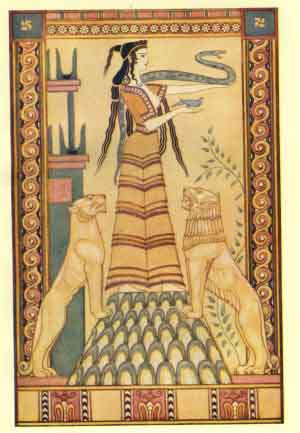
THE SNAKE GODDESS OF CRETE

From the painting by John Duncan, A.R.S.A.

Dr. Robert Munro suggests that the latter became the servants and "clodhoppers" of the agriculturists.

The Neolithic, like the late Pallithic peoples, were goddess-worshippers. They believed that the "Great Mother" had given origin to the world, the gods, the demons, and the races of mankind. In the various countries in which early Neolithic civilization was developed traces still survive of this early belief, and it will be found that the conception of the "Great Mother" is as varied as were the degrees of culture attained by the separated communities of common stock. Primitive ideas appear to have persisted longer in isolated districts where ethnic disturbances were least frequent and habits of life less liable to undergo change.

In Crete there were three outstanding forms of the mother-goddess-the snake-goddess, the dove-goddess, and the "lady of wild creatures". These may have been different forms of an original deity, or representative of a group composed of mother and daughters. As in Egypt and Babylonia, it is found that the one goddess tends to absorb the attributes of the other. It is possible that the Mother was supposed to manifest herself in different forms, at different seasons, and in different districts, and that one of the results of local ritualistic development was to emphasize a particular form of the original deity. But there can be no doubt that the conception of the Mother was an essential part of the Cretan faith.

The great goddess was depicted wearing a flounced gown suspended from her slim waist, round which a girdle is clasped (Chapter VI). The upper part of the body is bare, and she has enormous breasts. Sometimes she stands on a mountain top, guarded by two great lions, and sometimes she is seated beside trees or plants. In addition to the lions, her wild animals include the wild goat, the horned sheep, the bull, the red deer, the snake, and the dove; and among the symbols associated with her are the horns of the bull, the double axe, the sacred pillar, the moon crescent, and a staff or wand. She was apparently a goddess of death, battle, fertility, and the chase. Offerings were made to her in a mountain-cave she was supposed to inhabit.

It must be recognized at the outset that this ancient deity, like others of her kind, was not necessarily an attractive personality. Our conception of her must not be based solely on Greek sculpture, for instance. She is believed to be identical with Rhea, the mother of Vesta, Demeter, Hera, Hades, Poseidon, and Zeus, and that deity was depicted by Phidias as a benign mother of great dignity and tenderness and beauty. The original mother was worshipped and propitiated because she was feared. She was the Fate who measured the lives of men, who sent disasters as well as blessings, and was associated with lions and snakes as well as doves and deer. Withal, she was a voluptuous wanton. Like the Babylonian Ishtar, who was the lover of Gilgamish in one hour and his unrelenting enemy in the next, she was fickle and changeable as the wind and the seasons. She gloried with callous heart in her power to destroy, and was untouched by tender emotions for mankind, when--

Looking over wasted lands,
Blight and famine, plague and earthquake, roaring deeps and fiery sands,
Clanging fights, and flaming towns, and sinking ships and praying hands.

Greek mythology, in which the beliefs of various ethnic elements were fused, and savage traditions were ultimately transformed by philosophic speculations, survives to us mainly as the product of a cultured Age. But the poets and artists did not divest it wholly of its primitive traits. it is now generally recognized that the savagery of Cronus is not mere symbolism, or the wrath of Artemis, who required the sacrifice of a beautiful maiden, simply a myth based on natural phenomena and not a reflection of "old unhappy far-off things"--a reminiscence of primitive rites performed to propitiate a bloodthirsty deity.

In those parts of ancient Europe in which ancient rites were perpetuated till a comparatively late period the worship of pagan deities was a gloomy memory. The Irish Cromm Cruaich put prostrated hosts under "deadly disgrace" before his golden image--

To him without glory
They would kill their piteous, wretched offspring,
With much wailing and peril,
To pour their blood around Cromm Cruaich.

Milk and corn
They would ask from him speedily
In return for one-third of their healthy issue:
Great was the horror and the scare of him. 10

The mother-goddess of ancient Europe was similarly remembered as a devourer of children. She survives in English folk-lore as a fierce demon. In Leicestershire she is Black Annis, who is associated with the Easter "hare hunt", and has a "cat Anna" form. The earliest reference to her appears in the following extract from an eighteenth-century title-deed: "All that close or parcel of land commonly called or known by the name 'Black Anny's Bower Close'."

It must not be assumed, however, that Black Annis was a comparatively recent importation. She appears to be of as great antiquity as the customs associated with her name. It is impossible to limit the age of these and other customs and beliefs which survive to the present day, not only in rural districts, but even in cities and among the cultured classes, after so many centuries of Christian teaching. If they have persisted so long, in spite of the combined influences of Church, printing-press, and school, like rank weeds among flowers, for how long a period, it may be asked, did they flourish before they were condemned and shown to be unworthy of civilized communities? There can be little doubt that some have been inherited from the earliest settlers in these islands, who brought from the Continent in one of the Inter-glacial Epochs, and again in the Late Stone Age, the prototypes of the charms like the lucky pigs which now dangle from watch-chains and the mascots that figure on motor-cars and aeroplanes as they once figured on coracles, and boats hollowed from trunks of trees.

It is not to be marvelled at that the ancient goddess should be remembered in Leicester district. The city's name is fragrant with ancient memories. It was called after Llyr, the British sea-god, 11 who became the King Lear of the legend on which one of Shakespeare's great dramas was based. "He (King Lear) it was", wrote Geoffrey of Monmouth in the twelfth century, "that builded the city on the River Soar, that in the British is called Kaerleir, but in the Saxon Leicester (Leirchester)." 12

Black Annis Bower was a cave upon the Dane Hills, 13 which, during the past century, became filled up with earth. Over the cave grew an oak-tree, in the branches of which the bag was wont to conceal herself so that she might pounce out unawares and seize human victims, especially children. A local poet has immortalized the hag and her cave:

An oak, the pride of all the mossy dell,
Spreads its broad arms above the stony cell;
And many a bush, with hostile thorns arrayed,
Forbids the secret cavern to invade.

Here Black Annis "held her solitary reign, the dread and wonder of the neighbouring plain". Shepherds attributed to her the loss of lambs, and mothers their loss of children. According to a local writer, the children of a past generation "who went to run on Dane Hills were assured that Black Anna lay in wait there to snatch them away to her 'bower'."

"Oft the gaunt maid the frantic mother cursed",

sang the poet, who has left the following interesting description of the hag:--

'T is said the soul of mortal man recoiled
To view Black Annis' eye, so fierce and wild.
Vast talons, foul with human flesh, there grew
In place of hands, and features livid blue
Glar'd in her visage; whilst the obscene waist
Warm skins of human victims close embraced. 14

She appears to be identical with the "Yellow Muilearteach" of Gaelic legend:

Her face was blue black of the lustre of coal,
And her bone-tufted tooth was like red rust.
In her head was one deep pool-like eye
Swifter than a star in a winter sky. 15

Another description of her runs:

The name of the dauntless spectre
Was the bald-red, white-maned Muilearteach.
Her face was dark-grey of the hue of coals,
The teeth of her jaw were slanting red;
There was one flabby eye in her head
That quicker moved than lure pursuing mackerel.
Her head bristled dark and grey,
Like scrubwood before hoar-frost.

But the Scoto-Irish hag did not wear "warm skins of human victims".

Oscar caught
The embroidered skirt that was round her body;
They took the apple from the wretch.

She had also a "girdle" like Aphrodite. 16 In India there is a ferocious goddess, who resembles Annis of Leicester. This is Black Kali. She is usually depicted dancing the "dance of fertility", like the Aurignacian and Bushman deities. Modern artists have given her normal eyes, but have retained also the primitive forehead eye. She wears a necklace of human or giant heads, and from her girdle dangle the hands and skins of victims. It would appear that Kali, whose body was smeared with the sacrificial blood, was a form of the earth-goddess; her harvest form was Jagadgauri, the yellow woman; while as the love and fertility deity she was the beautiful Lakshmi or Sri, she was Durga as the goddess of war. 17 The Greek goddess Demeter was black at Phigalia (Chapter VIII), but the ancient black statue of her was only a memory in the days of Pausanias. No doubt the rites associated with her worship were abandoned when "old times had gone and manners changed". Still the memory of Black Demeter survived as the mother of Persephone, the young corn-goddess. The "Green Demeter" was the green corn, and the "yellow Demeter" the ripened harvest grain. As the Roman Ceres her name is perpetuated in cereals--the gifts of the goddess. 18

The Libyan goddess Neith was depicted with a green face. Her symbols included the "shuttle" or thunderbolt, the bow and arrows of deities of fertility, lightning, rain, and war. In Babylonia, where the demoniac forms of gods and goddesses were perpetuated in metrical charms and incantations, the "Labartu" (Sumerian "Dimme") was a female demon. She resembled the English Annis and the Scoto-Irish Muilearteach. This primitive goddess haunted mountain and marsh, and devoured stray children who were not protected against her by wearing magical charms attached to neck-cords. The Egyptian Sekhet-Hathor was similarly a destroyer. In her primitive lion-headed Sekhet form, crowned with the solar disk and urs serpent, she was sometimes depicted with a naked dagger grasped tightly in her right hand, and sometimes with a magic wand. Isis-Hathor, who personified all the goddesses of Egypt in late times, is referred to significantly in a Philae text as follows:--

Kindly is she as Bast (the cat-goddess)
Terrible is she as Sekhet. 19

The association of the Cretan mother-goddess with trees and mountains will be dealt with more intimately in a later chapter. Here, however, it is of interest to note that the demoniac English deity, Black Annis, was a tree as well as a cave deity. Offerings of children were probably made to her in the archlogical Hunting Period, as they were to the Irish Cromm Cruaich in the Agricultural Period in return for milk and corn. The oak in Leicestershire was reverenced as the habitation of the goddess. In Charnwood Forest the "copt oak" was a "trysting-place in olden time". It was long "a place of assembly. . . . Swain motes (courts for the common people) were held for regulation of rights and claims on the forest." In the Highlands Gaelic-speaking people who attend a court at the present day refer to it as a "mote". Trials were conducted at these assemblies, and it is not surprising to find that near the Leicestershire "swain's hill" is situated "Hangman's Stone". "Royal Oak Day" (May 29th) is the "May Day" for Leicestershire children.

In early times the maypole, usually made of oak, was the symbol of authority and justice, as well as of fertility. "The column of May", suggests one writer on the subject, "was the great standard of justice in the Ey Commons, or Fields of May. Here it was that the people, if they saw cause, deposed or punished their governors, their barons, or their kings." When the maypole was brought from the forest the youths and maidens joined in singing songs, of which the chorus was: "We have brought the Summer home". 20 Scrimmages took place between youths who were attired to represent winter and spring. A seventeenth-century writer says that "a company of yonkers, on May-day morning, before day, went into the country to fetch home a maypole with drumme and trumpet, whereat the neighbouring inhabitants were affrighted, supposing some enemies had landed to sack them. The pole being thus brought home and set up, they began to drink healths about it till they could not stand so steady as the pole did." 21 The maypole customs and the "motes" held under oak-trees are evidently relics of tree-worship. Probably the human representative of the Cretan goddess, seated below her tree, dispensed justice and ushered in the season of fertility and growth, like the May Queen.

In Scotland., where there are "motes" also, it is found that certain "church lands" were anciently associated with magical and religious ceremonies. 22 Twisting paths leading to wells and hillocks remain as "rights of way". It is of interest to find, too, that the habit of swearing by the earth was also prevalent. In a Gaelic story it is related that when the heroes formed a compact to avenge insults and injuries suffered by one of their number they "lifted a little piece of earth and shouted 'Vengeance'". They thus effected a ceremonial connection with the Earth Mother. In Greece "the most current formula of the public oath, when a treaty was to be ratified or an alliance cemented, was", writes Dr. Farnell, "the invocation of Zeus, Helios, and Ge (the Earth Mother). "And doubtless", he adds, "one of the earliest forms of oath taken was some kind of primitive communion, whereby both parties place themselves in sacred contact with some divine force." 23

Ge or Gaia was a vague and ancient deity who was sometimes identified with the "earth snake". She was the mother of Titans, Cyclopes, and Hecatoncheires. Similarly the Scoto-Irish hag known as "Cailleach" (old wife), "Grey Eyebrows", "Muilearteach"., was mother of the giants (Fomorians) who had monstrous forms, and against whom gods and mortals waged war. A black lamb was offered to Gaia. The Cailleach was apparently offered the "black boar", or the "green boar", slain by the heroes of folk-tales.

As the Earth Mother was sworn by, she must have been conceived of as an active force, capable of assuming concrete form. Rhea, Demeter, Artemis, and other deities were probably forms or manifestations of her at various seasons.

The Cailleach, with blue-black face and roaring mouth, appears to have been recognized in her Muilearteach form as the spirit of tempest on sea and land. As the mountain-spirit of the Hunting Period she moved restlessly among the hills, followed by herds of wild animals, including deer, goats, and swine. In her right hand she grasped a "hammer", or "magic wand", like the gigantic Cretan goddess on her lion-supported mountain-peak. When standing-stones were struck with the "magic wand", they were immediately transformed into giant warriors, fully armed and ready for battle. After throwing away this, her symbol of fertility and authority, the Cailleach herself was transformed into a standing-stone "looking over the sea". She was also associated with rivers and lakes and overflowing wells.

This hag, who, according to one folk-tale, "existed from the long eternity of the world", was not only the mother of giants but also the ancestress of the various tribes of mankind. In Ireland she appears to have been the earlier Danu, the mother of the Danann gods and people, and Anu, the mountain-hag associated with "the Paps of Anu". As the "Old Woman of Beare" she had "seven periods of youth one after another", writes Professor Kuno Meyer, "so that every man who had lived with her came to die of old age, and her grandsons and great-grandsons were tribes and races". 24 In several stories she appears before a hero as a repulsive hag and suddenly transforms herself into a beautiful girl.

As the patroness of wild animals the Cailleach resembles Artemis, whom Browning, like certain of the Greek poets, idealized and consequently robbed of her primitive savage character.

I shed in Hell o'er my pale people peace,
On Earth, I, caring for the creatures, guard
Each pregnant yellow wolf and foxbitch sleek
And every feathered mother's callow brood,
And all that love green haunts and loneliness.

Artemis occasionally appeared in the form of a hare, a hind, or a bear. As a goddess of the chase she might be depicted seated on the back of a stag or standing with bow in hand beside a hill surmounted by a boar's head. Human sacrifices appear to have been offered to her, and myths were formed in the process of time to justify the substitution of wild animals for girls and lads. Spartan boys were flogged and sprinkled with blood at rites connected with Artemis worship. As a wind-goddess she demanded the sacrifice of Agamemnon's daughter when the fleet assembled at Aulis in Botia ready to sail against Troy. The Scoto-Irish Cailleach had similarly control over the winds, as had also the hags who "brewed breezes" on Jochgrimm mountain in Tyrol. Artemis haunted the mountains Erymanthus and Taygetus and the banks of the River Eurotas in Laconia. It was in Crete that she was fabled to have slain the giant Orion because he loved her.

It will be seen that the idea of the mother-goddess prevailed in ancient times from India to Ireland and throughout Egypt. Although she was closely associated with the Mediterranean or Brown Race, which included the Neolithic Europeans, the proto-Egyptians, the Sumerians, Southern Persians, and Aryo-Indians, she was also a conspicuous figure in the Late Pallithic Period. Long before the ideal types of her had evolved in Greece, she was a terror-inspiring conception among the common people. In isolated areas, which were untouched by Greek idealism, her memory was perpetuated as a repulsive and blood-thirsty hag who terrorized the people and demanded annual dues of human and animal victims. She was associated with the worship of stones, trees, wild animals, wells and rivers, mountains and mounds. As an earth-goddess she was a deity of death, destruction, fertility, and growth; hunters preyed on her flocks and had accordingly to propitiate her; pastoralists made offerings to her to secure the supply of grass, and the agricultural peoples recognized her as the mother of the corn-spirits, male and female. She reflected the culture of various stages of human development, and she assumed the character of the various communities who developed the ritual of her worship; she also mirrored the natural phenomena of the different countries in which she received recognition. Yet she was never wholly divested of her primitive traits. As in Aurignacian times, she remained as the Mother who was the ancestress of all and the source of good and evil, or luck and misfortune. In Crete she was well developed before the earliest island settlers began to carve her images on gems and seals or depict them in frescoes. She symbolized the island and its social life and organization. The Cretans, according to Plutarch, spoke of Crete as their motherland and not their fatherland.

As the mother-goddess in her various forms reflected the habits of life and the degree of civilization attained by her worshippers, it is possible also that the prominence given to the female principle in religious life caused women to be held in higher esteem than among the peoples of the god cult. Mr. J. R. Hall, in his Ancient History in the Far East, referring to the social status of the women in Crete, says that "it is certain they must have lived on a footing of greater equality with men than in any other ancient civilization. . . . We see in the frescoes of Knossos conclusive indications of an open and free association of men and women, corresponding to our idea of 'Society', at the Minoan Court, unparalleled till our own day." Car remarked on the matriarchal conditions which prevailed in certain parts of ancient Britain. Among the Scottish Picts descent was reckoned by the female line, as in the royal families of Egypt and southern European states. It is possible that in Aurignacian times the women of the tribes similarly exercised considerable influence. They appear to have been prominent in the performance of magical and religious rites. Indeed, it is the opinion of some anthropologists, like Bachofen, that women exercised a greater influence than men in developing primitive religious ideas. "Wherever", he comments "gyncracy meets us, the mystery of religion is bound up with it, and lends to motherhood an incorporation of some divinity." 25 The evidence gleaned from certain folktales suggests that women trained young huntsmen and warriors to perform feats of strength and skill. When the Irish Cuchullin visited Alban, to complete his military education, he was tested by an Amazon. Brynhild, of Iceland fame, like Brunhild of the Nibelungenlied, overcame many warriors ere she was won.

The comparative evidence dealt with in this chapter emphasizes the fact that in dealing with the Cretan and pre-Hellenic deities account must be taken of the primitive modes of thought which are traceable n the accumulated myths and legends attached to them. In the process of myth-making many influences were at work. Historical happenings had to be dealt with as well as the experiences of everyday life in a new environment. The growth of civilization changed the character of religious beliefs also. When old savage practices were abandoned, myths were framed to justify innovations, as when, for instance, the innocent girl Iphigenia was to be sacrificed to Artemis but was substituted by a stag. It was related that the goddess carried her off in a cloud and decided that she should become a priestess. The practice of offering up strangers in sacrifice obtained probably when a community began to abhor the idea of offering up one of its own members.

In the next chapter it will be shown how the study of ancient myths has led to the discovery of those traces of ancient civilization in Crete and the ean which has made it possible to reconstruct two thousand years of pre-Hellenic civilization.

Footnotes

1 Malta and the Mediterranean Race, R. N. Bradley, pp. 72 et seq.
2 History of Civilization in Palestine, pp. 9 et seq.
3 The Races of Europe, pp. 172 et seq.
4 Archiv f Anthropologie, Band 351 St. 239 et seq.
5 For earlier traces of Pallithic man see The Stone Ages in North Britain and Ireland, by Rev. Frederick Smith (London & Glasgow, 1909). Dr. A. H. Keane calls the author the "Boucher de Perthes of Scotland".
6 Huxley & Laing's Prehistoric Remains in Caithness (London, 1886).
7 A cave-dweller in a Fingalian story is called Ciofach Mac a' Ghoill ("Ciofach, son of the stranger"). Another version refers to him as Ciuthach (pronounce "Kew'-ach"). Dealing with the legend of the Ciuthach, Professor W. J. Watson considers that he was a hero "of a different race from the Gael" (Celtic Review, January, 1914).
8 Prehistoric Britain, p. 234. (London, 1914 ).
9 The Ancient Egyptians, p. 58.
10 Celtic Myth and Legend, p. 39.
11 Celtic Myth and Legend, pp. 252 et seq.
12 "Kaer" and "Chester" signify cities. London was "Kaer-lud", called after the god Lud, whose name lingers also in "Ludgate".
13 It is suggested that "Dane" is a corruption of the Celtic "Danann".
14 County Folk-lore (Leicestershire and Rutland), by C. J. Billson, Vol. I., London, 1895 (Folk-lore Society's Publications).
15 Campbell's West Highland Tales, Vol. III, p. 138.
16 Waifs and Strays of Celtic Tradition, Vol. IV, pp. 142 et seq. (London, 1891).
17 Indian Myth and Legend, pp. xl. and 149-50.
18 Golden Bough ("Spirits of the Corn and the Wild"), Vol. I, pp. 35 et seq. (third edition).
19 Religion of the Ancient Egyptians, A. Wiedemann, p. 138 (London, 1897).
20 Quoted in County Folk-lore, Vol. I, pp. 29 et seq.
21 Brand's Antiquities, Vol. I, pp. 238 et seq.
22 According to Caesar, the Druids of Gaul held sessions at consecrated places of meeting which, from other sources, we learn were called nemeta. In old Irish the term appears as nemed, and in modern Scottish Gaelic it is neimhidh, which signifies "church land". The English rendering is Navity or Nevity.--Professor W. J. Watson in Celtic Review (1915), Vol. X, pp. 263 et seq.
23 Cults of the Greek States, Vol. III, p. 5.
24 Ancient Irish Poetry, p. 88.
25 Das Mutterrecht, p. xv.

MYTHS OF CRETE & PRE-HELLENIC EUROPE, Chapter 1: Primitive Europeans of the Glacial and Inter-glacial Periods

MYTHS OF CRETE & PRE-HELLENIC EUROPE

By DONALD A. MACKENZIE

THE GRESHAM PUBLISHING COMPANY LIMITED

66 CHANDOS STREET COVENT GARDEN LONDON

[1917]

CHAPTER I

Primitive Europeans of the Glacial and Inter-glacial Periods

Geological and Mythical Ages of the World--Myths as Products of Environment--The Deluge and Great Winter Legends--New World Cataclysms--Doctrines of Decadence and Evolution in World's Ages Myths--Sages of the "Wandering Jew" Type--The Monsters of Geology and Mythology--Story of the Pleistocene Age--First Glacial Period--Mauer (Heidelberg) Man--Second Glacial Period--The Age of Chellean Culture--The Piltdown Skull--Acheulian Culture Stage--Third Glacial Period and Mousterian Man--Cro--Magnon Race and Grimaldi "Bushmen"--Aurignacian Cave Pictures and Beliefs--Solutrean Culture--Fourth Glacial Period and Magdalenian Man--The Problem of Eoliths--Approximate Duration of Pallithic Age.

THE system which obtains among modern scientists, of dividing the history of the earth into geological epochs and the pre-history of man into cultural periods, was anticipated by the priestly theorists of ancient civilizations, who established the doctrine of the mythical Ages of the World. These early teachers were:, no doubt, as greatly concerned about justifying their own pretensions and the tenets of their cults as in gratifying the growing thirst for knowledge among the educated classes. When they undertook to reveal the process of creation and throw light on the origin and purpose of mankind, they exalted local deities in opposition to those regarded supreme at rival centres of culture and political influence. Many rival systems of a national religion were thus perpetuated. But the various city priesthoods of a particular country found it necessary to deal also with problems of common concern. Among other things, they had to account for the various races of whom they had knowledge and to give divine sanction to existing social conditions; nor could they overlook the accidental discoveries which were occasionally made of the relics of elder and unknown peoples and the bones of extinct animals.

These mythology-makers, of course, possessed but meager knowledge of their country's past, and were accordingly compelled to draw freely upon their imaginations; but they should not be regarded on that account as merely dreamers of dreams and inventors of miraculous stories. Indications are forthcoming which show that they were not wholly devoid of the scientific spirit. They were close observers of natural phenomena, and sometimes made deductions which, considering the narrowness of areas available to them for investigation, were not unworthy of thinking men. It seemed perfectly reasonable to the Babylonian and Egyptian scientists, who saw land growing from accumulations of river-borne silt, and desert wastes rendered cultivable by irrigation, to conclude, for instance, that water was the primary element and the source of all that existed.

This doctrine, which holds that the Universe is derived from one particular form of matter, has been called "Materialistic Monism". Ultimately, when mind was exalted above matter, the belief obtained that the inanimate forces of nature were subject to the control of the supreme Mind, which was the First Cause. This later doctrine is known as "Idealistic Monism". It was embraced by various cults in Babylonia, India, and Egypt. In the latter country, for instance, the great god of Memphis was addressed:

Ptah, the great, is the mind and tongue of the gods. . . .
It (the mind) is the one which bringeth forth every successful issue. . . .
It was the fashioner of all gods.
At a time when every divine word
Came into existence by the thought of the mind
And the command of the tongue. 1

In Egypt and Babylonia, where inundations of river valleys were of periodic occurrence, and where, at rare intervals, floods of excessive volume caused great destruction and loss of life, and even brought about political changes, it was concluded that the old Ages were ended and new Ages inaugurated by world-devastating deluges.

The deductions of the early scientists in northern Europe were similarly drawn from the evidence afforded by environment, and similarly influenced by persistent modes of thought. They saw shoals formed and beaches overlaid by sand washed up by the sea from, as it appeared, some sand-creating source, and conceived that on the floor of ocean there stood a great "World Mill" propelled by giantesses, which ground the bodies of primeval world-giants into earth meal. "'Tis said", a saga author set forth, "that far out, off yonder ness, the Nine Maids of the Island mill stir amain the host-cruel skerry-quern--they who in ages past ground Hamlet's meal. The good chieftain furrows the hull's lair with his ship's beaked prow." 2

In the Elder Edda the god of the mill, who appears to be identical with Frey and the original Hamlet, is called Mundlefore, "the handle-mover":

The Mover of the Handle is father of Moon
And the father eke of Sun.

This "World Mill" caused the heavens to revolve round a fixed point marked by the polar star, which was called veraldar nagli, the "world-spike".

Believing that sun and moon rose from the ocean, and that therefore light came from darkness, they concluded that winter preceded summer at the beginning.

Untold winters ere Earth was fashioned
Roaring Bergelm was born;
His father was Thrudgelm of Mighty Voice,
Loud-sounding Ymer his grandsire. 3

In the north it was observed also that growth was promoted when the ice melted, and the teachers reasoned that the first being, Ymer, came into existence when sparks from the southland, or "poison drops from the sea", fell upon the primeval icebergs, and caused drops of trickling water to fertilize the clay.

From Stormy-billow sprang poison drops
Which waxed into Jotun form.

The Babylonians, on the other hand, who were familiar with the part played by reeds in accumulating mud and binding river-banks, taught that-

Marduk (Merodach) laid a reed upon the face of the waters.
He formed dust and poured it out beside the reed. . . .
He formed mankind. 4

It may be, too, that the ancient teachers, who framed creation myths and expounded local forms of the doctrine of the World's Ages, mingled at times with their pseudoscientific deductions and brilliant imaginings dim and confused racial traditions of early migrations and varied experiences in different areas of settlement. Some of these traditions may have had origin before the dawn of the Neolithic or Late Stone Age. As will be shown, certain customs, which are familiar to students of ancient civilizations, were prevalent among primitive peoples in the vast Pallithic or Early Stone Age. With these customs may have survived in localities legends associated with or based upon them. The possibility remains, therefore, that in Persian mythology there are memories not only of an area of settlement among the mountains where severe winters were as greatly dreaded as exceptional floods in river valleys, but even of one of the last recurring phases of the Ice Age. A poetic narrative relates that the patriarch Yima, who afterwards became Lord of the Dead, constructed a shelter to afford safe protection for mankind and their domesticated animals during the "evil winter", with its "hard, killing frost". He had been forwarned of this approaching world-disaster by the supreme god Ahura Mazda (Ormuzd). Perhaps the "shelter" was a southern valley to which the proto-Persians were compelled to migrate on account of the growing severity of successive winters and the lowering of the perpetual snow-line around mountain-fringed plateaus they were accustomed to inhabit. It is related in the Avesta, one of the Persian sacred books, that "before the winter the land had meadows. . . . The water was wont to flow over it and the snow to melt." A similar prolonged winter is foretold in Icelandic mythology. According to the Prose Edda, which is a patchwork of fragmentary legends of uncertain origin and antiquity, it will precede the destruction of the universe by the giants of frost and fire (lightning). "In the first place will come the winter, called Fimbul winter, during which snow will fall from the four corners of the world; the frosts will be very severe, the wind piercing, the weather tempestuous, and the sun impart no gladness." 5

From the Voluspa poem of the Elder Edda we gather details of--

A Sword Age, Axe Age--shields are cloven,
A Wind Age, Wolf Age, ere the world sinks.

Then, after describing a period of universal destruction, the soothsayer proceeds:

I see uprising a second time
Earth from the ocean, green anew:
The waters fall, on high the eagle
Flies o'er the fell and catches fish. 6

Various accounts of universal cataclysms come from the New World. Representative of these are the legends of the Arawaks of North Brazil regarding periods of flood, storm, and darkness, and those of the Mexicans, which deal with the destruction of early races by deluges caused by several succeeding suns perishing from lack of sustenance.

The most highly developed doctrinal systems of World Ages which have survived from antiquity are found, however, in the Mythologies of India, Greece, and Ireland. There is more than one account in Aryo-Indian literature of the periodic Ages called Yugas. These are embraced in longer Ages of sufficient duration to satisfy the requirements of modern geologists. Four Yugas extend over a period of "divine years" equal to 4,320,000 years of mortals, and a thousand of the combined Yugas comprise a "Day of Brahma", the individualized "World Soul". The Yugas begin with the Krita or Perfect Age, which is White, and decline from that to the Treta, which is Red, and the Dwara, which is Yellow, to Kali Yuga, "the Black or Iron Age".

Hesiod, in his Work and Days, begins the Greek system with the perfect Golden Age, which is followed by the Silver and Bronze Ages, and the two Ages of Heroes and Iron, which may have been local subdivisions of the fourth Age, represented in India by Kali Yuga.

Both in India and Greece, man it will be noted, was believed to have relapsed from a primitive state of perfection. The system found in Ireland, which was probably imported from Gaul with the doctrine of transmigration of souls and the custom of widow-burning or slaying, follows, on the other hand, an evolutionary process. The first Irish Age, that of Partholon and his race, is an Age of folly. It is followed by Nemed's Age, which was distinguished for cruelty, and the Age of the Fir Bolgs, in which the power of evil was supreme. Then comes the Danann Age of benevolent deities and heroes, who are the reputed "ancestors of the men of learning in Erin". The last Age is the Milesian, and during it St. Patrick reached Ireland and preached Christianity.

This ancient doctrine of the World's Ages, which may be traced in Egypt and Babylonia, where certain gods lived for periods upon earth as human. kings, was adapted to suit the needs of different cults in different areas of localization. In India the four great castes were each connected with a Yuga: the Brahmans had origin in the White Age, the Kshatriyas (military aristocrats) in the Red Age, the Vaisyas (traders and agriculturists) in the Yellow Age, and the Sudras (Dravidians and pre-Dravidians) in the Black Age. In Greece an Age was devoted to the Trojan heroes, and in Ireland the Fir Bolgs, Dananns, and Milesians were identified with existing racial types whom St. Patrick found there.

One of the versions of the Indian legend of Mythical Ages is related by the deathless sage Markandeya, who lived through all the Yugas, and was protected during the Deluge by the child-god Narayana. The Irish account was put into the mouth of Tuan MacCarell. He had been a contemporary of Partholon, and afterwards existed for periods as a stag, a boar, a vulture or eagle, and a salmon. In the end his salmon form was devoured by the wife of King Carell, with the result that he was reborn as her son. Another sage of this class is the famous Mus of the Icelandic Bragda Mus saga, who renewed his youth periodically by casting his skin. He also figures in the Charlemagne romances.

If the ancient teachers, who professed to have received revelations from sages like the "Wandering Jew", had been acquainted with the scientific data which is now available, their narratives of past Ages would have described greater changes than ever they conceived of. Nor would these be lacking either in picturesqueness or imaginative appeal. The priestly sages would have no cause to lament with the poet:

Do not all charms fly
At the mere touch of cold philosophy?
There was an awful rainbow once in heaven:
We know her woof and texture; she is given
In the dull catalogue of common things.

Even greater and more ferocious monsters than were dreamt of in their philosophy might have figured in their wonder-compelling and fearsome legends. Instead of the composite demons of Egypt and Babylonia, the Eur-Asian dragons, the flying serpents of the Nile valley, and the great snakes of ocean, they could have told of the gigantic reptiles of the Triassic and Jurassic systems, the great mammals of the Tertiary Period, and those contemporaries of man in the Pleistocene Age, the hairy mammoths, bulky with fat and fur, the fierce woolly rhinoceroses, the huge cave-bears, and the immense sabre-toothed tigers. No ancient legend of fabled monsters surpasses the modern scientist's account of extinct gigantic fauna. Nor can the creation-myths on Egyptian papyri, Babylonian bricks, or Indian palm-leaf books approach in grandness and charm the dramatic story of the four great geological Ages of the World.

The author of the Tuan MacCarell legend would in our day begin his narrative with the dawn of the Pleistocene Age, which endured for at least 620,000 years, and was yet much shorter than any of the four Tertiary Ages--the Eocene, Oligocene, Miocene, or Pliocene.

In the post-Pliocene, or early Pleistocene period, Tuan, let it be supposed, awakens from magic sleep in Europe. He gazes with wonder on forests of strange and mighty trees. Monstrous wild animals come and go. Several resemble elephants, and the greatest of these is the long-tusked mastodon of colossal bulk. Hippopotami snort in the rivers, on the banks of which crouch, basking in sunshine, ponderous Dinotheriums, resembling sea-cows, with downward-curving tusks and short trunks. Across verdurous plains gallop herds of little horses with divided hoofs. The dreaded sabre-toothed tiger crouches in the jungle ready to pounce upon its prey.

Tuan, who alternately sleeps for long centuries and wanders about the earth like the legendary Jew, continues his narrative. "When next I awoke", he tells, "I found that Europe had been completely transformed. No great forests flourished on its central plains; bare stretches of frozen ground extended far and near. From northern Germany to the Pole, valleys and rivers were shrouded by ice and seas were frozen over. Great mountain-peaks towered grimly above curving glaciers like rocky islands in a foam-white ocean. Icebergs drifted down the Atlantic past the coast of Spain. This was the First Glacial Period.

"When next I awoke the ice was vanishing, the rivers surged from the melting glaciers) many valleys were flooded, and vegetation flourished. In the years that followed I saw the forests extending northward from the Mediterranean coast, and the ocean ebbing gradually farther and farther away, owing to the widespread elevation of land, until great islands became uplands in vast plains, and continents linked with continents around the world. I must describe Europe as it appeared to me before I next fell asleep. The Mediterranean Sea was divided into two great lakes when Italy became attached to a triangular plain which jutted out from the north African coast. The Strait of Gibraltar was closed, and a broad valley united Spain with Morocco. Corsica and Sardinia formed a promontory when the Gulf of Genoa vanished, and the Balearic Isles were mountains on a finger of land attached to western Spain. The Baltic Sea became a shrunken inland lake, the English Channel and the North Sea had disappeared. The British Isles were then joined to the Continent, and the plains which enclosed them extended far westward beyond Land's End, the western coast-line of Ireland and that of the Scottish Hebrides, and stretched north-eastward beyond the Shetland Isles to the coast of Norway. A "land-bridge", which shrank to a narrow neck 100 miles north-west of Cape Wrath, united Scotland and Iceland) and narrowed again ere it met the extended coast of Greenland. The Rivers Elbe and Rhine drained the broad valley which had been the North Sea, and were united about 150 miles eastward from the Aberdeenshire coast after the Rhine had received the waters of the Forth and Tay. The Conon poured through the valley which had been the Moray Firth, and, sweeping eastward past the Orkney and Shetland Islands, entered the sea 20 miles westward from the mouth of the Elbe. The Seine cut through the valley of the English Channel, and the Severn united, 100 miles westward from Land's End, with a river flowing from a long narrow loch which divided Ireland from Scotland, and extended southward to Carnsore Point in Wexford.

"Over the Eur-African land-bridges came many of the great animals which I saw during the first period of the Pleistocene Age. Attracted by the genial temperature, even the rhinoceros came north, and with the sabre-toothed tiger prowled on the upland plains of England, where I saw also the giant sloth, the hippopotamus, the mastodon, the triple-toed horse, great tortoises, the giant fallow deer, the well-armoured glyptodon, 7 as big as an ox, and numerous great snakes and nimble apes.

"For a long period I searched in vain for traces of mankind, but at length I discovered a tribe of most primitive savages at Mauer, on the banks of the River Neckar, then very broad and deep, near where Heidelberg now stands. They hunted down the horse and the elk, and dreaded greatly the rhinoceros and the cave-lion. Their homes were among the branches of high trees. In aspect they were extremely repulsive: they had low, sharply-retreating foreheads, squat noses, big bulging mouths, and chinless jaws. 8 I never saw these savages except in this First Interglacial Period.

"When next I awoke from the slumber of centuries I found that Europe had once more been transformed. The Mediterranean Sea had snapped the Italian land-bridge and flowed through the Dardanelles to the Black Sea; a blue strait separated Gibraltar from Morocco. The British Islands were entirely isolated. Roaring tides swept up and down the English Channel, and the broad North Sea, overswept by foam-churning tempest, was dotted over by innumerable icebergs. Each succeeding winter the ocean encroached farther and farther inland, burying in deep sand-banks the great trunks of forest trees, creeping up river valleys and forming stony beaches where wild flowers had bloomed and birds had carolled and built their nests. At length the advancing billows shaped out a rough shore-line round the island coasts over 40 feet above their present level. In time the land was re-elevated and the sea shrank back again.

"The snow-line of Scottish mountains crept down gradually lower and lower, and glaciers appeared once more. Ultimately vast fields of ice jutted across the North Sea, and the Baltic remained frozen during the months of summer. Icebergs were stranded on Dogger Bank and drifted down the English Channel in early summer through veils of white fog into the Bay of Biscay and round Cape Finisterre.

"Ere I went to sleep again the ice-fields had obliterated Holland and Belgium and crept up the Elbe valley almost to the plain of Bohemia, where the climate was sub-arctic and tundra conditions prevailed as in northern Siberia at the present time. Scotland, Ireland, and Wales were ice-locked, and England was covered over as far south as Essex on the east and Gloucester on the west, except where the battling glaciers left bare patches in the middle districts and in the East Riding of Yorkshire. This was the Second Glacial Period. When it had reached its maximum, I wandered southward through France, then a dreary waste, and saw herds of musk-oxen and reindeer, lumbering woolly rhinoceroses, and fat mammoths with great recurving tusks and shaggy red manes.

"I had sought shelter from a blinding dust-storm in a cave on a bare hill-side, and slept there. When next I awoke and crept forth, I found myself in a deep shady forest. It was a fragrant morning of bright sunshine, and although it seemed to be midsummer, the sweet spring season had not yet spent itself. The rivers at this, the dawn of the Second Inter-glacial Period, ran broad and deep, swollen by the melting glaciers, but they shrank gradually as weeks of heat and dryness went past. Wide shallow lakes grew smaller each succeeding summer until they vanished entirely, and their dark beds grew verdant with long grasses. When I went northward I found that the British Isles were once again a part of the Continent. The African hippopotamus snorted in the Thames, the rhinoceros lumbered along the plains of the English Channel, and through the forests of the North Sea valley herds of elephants ranged as far north as the banks of the Forth. I saw many tribes of human beings. I first met them at Chelles, on the banks of the Seine, 8 miles eastward from the site of Paris. The Chellean men were of higher type than the grotesque tree-dwellers of Mauer. Their dark skins bespoke their southern origin, and they resembled certain tribes of Australian savages. They were entirely devoid of clothing. The men carried long staves, which were sharpened to points, with which they speared fish and hunted the little wild horse. I saw them chipping flint and shaping "hand-axes", 9 which they used for a variety of purposes-cutting branches from trees, skinning and dividing animals, and weapons. They also made small flint scrapers and small flint daggers with rough curved hefts.

"I saw these men hunting in England and in Central and Western Europe. They crossed over to Africa by the Italian land-bridge, round the rock of Gibraltar, and along the Palestinian coast., and they were numerous in Persia and India. Ere I fell asleep I was transported round the world, and saw thousands of human beings following the edible animals over the northern land-bridge from Asia to Canada, and down the western sea-coast to South America. Then I slumbered again.

"Long centuries went past as I slept. When next I awoke I found that Europe had once again become changed. The sea was washing round the shores of the British Isles, and the Italian land-bridge to Africa had been severed. Crete was no longer a part of the main land, and the green mountains which had towered on the well-watered valley connecting Greece with Asia Minor were islands in the ean Sea. The temperature had suffered decline. Summer was shorter and winter longer and of growing severity. During the warm weather the southern animals wandered through France, and, when the snow began to fall, the mammoth, the woolly rhinoceros, and the reindeer came down from the north in search of food. I saw new types of humanity which had arrived from Asia. They mingled with Chellean men in some localities, and in others fought with them for possession of hunting-grounds. Many tribes were isolated in Britain when the land was lowered and the sea advanced. There were Asiatics in Sussex, and I saw some camping on the banks of the Ouse at Piltdown, near Uckfield. 10 During the winter these people sought shelter in caves.

"The change of climate had intensified the struggle for existence) and sharpened the wits of men. At St. Acheul, at Amiens, in the Somme valley, I found the flint-workers displaying increased skill and producing several new implements which the altered conditions of life had made necessary. Acheulian man had achieved a considerable degree of progress in other directions. Those tribes which remained in western and central Europe, owing to the winter season found it necessary to provide themselves with skin clothing, but the great majority migrated to genial climes, and these continued their old habits of life. I fell asleep at the close of this the Second Interglacial Period, which was longer and more genial than any of the others.

"The Third Glacial Epoch was well advanced when next I set forth a wanderer through the valleys of Europe. It was less widespread than the second. Two-thirds of England and about a fourth of Ireland were clear of ice, nor was the Zuyder Zee frozen during summer. The site of Berlin, however, was well within the glacial area, as was also that of Warsaw. The Alpine snow-line had crept down over 3000 feet. Yet although Europe resembled in some parts Greenland and in others North Siberia in the present Age, I saw numerous tribes of human beings. They were of small stature but muscular and active. Their heads were narrow but of great size, and their faces, although not devoid of intelligence, were exceedingly rugged; their big dark eyes were overshadowed by enormous brow ridges, they had broad flattened noses, projecting mouths, and chinless jaws. 11 They made their homes in caves, and in these they lit fires, round which they sat to chip their flints and fashion their skin garments.

"I will describe what I saw when I sought shelter with a tribe of these people at Le Moustier, in the valley of Dordogne, in south-western France. The River Ve then flowed go feet higher than in modern times. I entered a cave on a damp and chilly summer day. Haunches of venison were being roasted on a fire-place constructed of upright stones, and near it several workmen were busily engaged chipping flints. They constructed a greater variety of implements than the men of the Chellean and Acheulean Periods, and showed greater skill in economizing their material: flakes were removed at a single blow and utilized for smaller artifacts, and when an implement was given form it was carefully dressed with minute chipping until it became an artistic product, exceedingly pleasing to the eye. Men took delight in their work and rivalled one another to gain the praises of their fellows. The tailors cut the dried skins with their sharp hand-axes. Then they squatted with crossed legs to sew the pieces together into not unshapely garments. They made holes, through which to thrust their dried thongs, with little flint awls. In the evening a company of hunters returned from the chase, dragging on a skin sledge the carcass of a musk-ox; and when they had feasted heavily, I heard them tell of battles with the cave-bear, of escapes from the cave-lion and the dreaded woolly rhinoceros, of the slaying

mckenzie-01

EXAMPLES OF PALLITHIC ART

The objects include: handles of knives and daggers carved in ivory and bone, line drawings of wild animals, faces of men or demons, of animal-headed demon or deity with arms uplifted (compare Egyptian "Ka" attitude of adoration), of wild horses on perforated "arrow straightener", of men stalking a bison, of seal, cow, reindeer, cave bear, and perforated amulets of a great mammoth, and of how they guarded their food-supplies against the ravages of prowling hyenas, gluttons, and arctic foxes. Meanwhile the women busily engaged themselves at the mouth of the cave cutting up the body of the musk-ox and cleaning the skin with flint scrapers. Ere night fell, the chief announced that on the morrow they would go eastward to hunt reindeer. I gathered that these people migrated northward during the summer, and returned again, on the approach of cold weather, to their southern caves. Not infrequently they had to fight with other tribes who took possession of their winter homes.

"I went to sleep during this period, and when next I awoke I found that the Third Inter-glacial Period had dawned. The glaciers melted and again there were great floods in the valleys, and the ice retreated from the lowlands of Scotland. The summers in Central Europe were exceedingly pleasant, but never so warm as during the Chellean Age, and dust-storms were of frequent occurrence. Forests were once again flourishing, and I saw in the midst of them many southern animals which were migrating farther and farther northward. During winter the mammoth and woolly rhinoceros came as far south as Prussia. Mousterian man was able to pursue the hunt high among the mountains, where he found caves in which to shelter himself from wild animals by night. He returned to the valleys when the blizzards of winter drove southward the fierce and numerous beasts of prey he dreaded most.

"I saw new types of mankind. In the Dordogne valley were tribes of slender-limbed human giants who were fearless warriors and mighty huntsmen. Some were 6 feet 6 inches in height. But it was not only in stature that they contrasted sharply with the vanishing

Mousterians, who were rarely higher than 5 feet 3 inches. They had big long heads and broad faces, high foreheads, deep-set brown eyes, prominent cheek-bones, sharply curved lips, and well-formed chins. They resembled modern Europeans more closely than any human beings I had yet met with. Their faces, tanned by wind and sun, were alert and keen, and, although rugged, were greatly softened when their ready smile laid bare their white gleaming teeth. I observed that the young men showed great respect for their elders. It was of common occurrence to see many gathered round a cave entrance listening to the counsel of some white-haired sage. An old man, who had achieved widespread renown as an explorer and leader of men, lived in a cave at Cro-Magnon, and was often approached to settle disputes and give advice regarding great undertakings; he was also skilled as a healer of wounds and a curer of disease. These men had greater regard for their dead than obtained among their Mousterian predecessors. I once saw them laying to rest a slain warrior in his family burial-grotto at Aurignac. He was clad in his skin robe. His headdress was adorned with a string of sea-shells and round his neck was a collar of the perforated teeth of a reindeer, the skeleton of the salmon of wisdom was laid on his breast, and the whole body was sprinkled with magic pigment. A fire was lit, and the warriors danced round the grave with slow, measured steps, while a sage recited the mighty deeds performed by the dead man. Women knelt near at hand, wailing a chorus of sorrow. Beside the warrior they laid his weapons and implements as well as food which had been cooked for him and water for refreshment; then the grotto was closed up with a large slab of limestone. Aurignacian man of Cro-Magnon type was a lover of his kind. saw other tribes which had entered southern France at this period from Africa. At a Grimaldi cave near Mentone I dwelt for a space with a family of dark-skinned people with broad noses and protruding mouths. They resembled somewhat the modern Bushmen of South Africa and were similarly of short stature, but their heads were larger and their faces more intelligent. Middle-aged women had enormous development of fatty tissue; their steatopygous figures were invariably exceedingly grotesque, but were yet greatly admired. 12

"These Aurignacian peoples worshipped the mother-goddess, and there were among them clever artists who carved out of ivory and bone, limestone and steatite, female figures to represent their deity. Sometimes they depicted the slim-waisted, long-haired Cro-Magnon women, and sometimes the woolly-haired bulging forms of Grimaldi type. In those districts where the Bushmen-like people were the slaves of the tall huntsmen a steatopygous woman was sometimes selected at religious ceremonies to represent the mother-goddess.

The Aurignacian artists were wont to decorate their caverns with figures of wild animals, which they sketched in outline with pointed flints, and often coloured with crayons of red ochre or painted with pigment which they carried in bone tubes. In the deep cave of Altamira, in Spain, I saw a great picture-gallery in which various artists had exhibited their skill. One part of the vaulted roof was covered with lifelike representations of edible animals, including wild horses, deer, and boars, and elsewhere I saw artistic productions of similarly high merit. In some caves, which were constantly inhabited, were impressions of human hands. These were intended to avert the influences of the evil eye and the attacks of demons. Huntsmen left records of their experiences in summer hunting districts by inscribing symbols on cave walls, so that those who came nigh might know how they were likely to fare there. They also depicted the forms of monstrous demons that had to be propitiated.

The hunters of the Aurignacian Age were the first I saw using bows and arrows. In preparing the arrow-shafts they utilized perforated bone straighteners. 13 Their flint implements were worked with skill far surpassing that of the Mousterian Age.

"How long I slept during this period I cannot tell. When next I woke up I found that the temperature had suffered sharp decline. Cro-Magnon man still inhabited a great portion of southern France, 14 but I observed also other types which were new to me. At Solutre, Saone-et-Loire, where tall and short types gave evidence of race intermixture, I fell in with highly-skilled artisans who shaped flint lance-heads of laurel-leaf and willow-leaf shape, and accomplished delicate secondary flaking by pressure with bone implements. They also made comfortable skin clothing, which they sewed with bone needles which had perforated eyes. 15 The winters grew gradually longer and more severe, and the men of the Solutrean Age achieved rapid progress in their conflict with the elements. Huntsmen favoured the horse, but slew also the reindeer.

"The Fourth Glacial Period followed, and it was suffering decline when I next went out to explore those districts that had seen so many changes. I awoke at La Madelaine, on the right bank of the Ve, which then flowed higher

mckenzie-01

PALEOLITHIC ART: REPRESENTATIVE PAINTINGS OF BISON AND DEER, FROM THE CAVE OF ALTAMIRA, NEAR SANTANDER, SPAIN

The bison was evidently painted during summer, after it had rubbed its shaggy winter coat off the greater part of its body than at the present day.

In this district the tall men of Cro-Magnon type were less numerous than the stumpy intruders of this Magdalenian Age, who had some resemblance to the present-day Esquimaux. Half-breeds, however, were not uncommon. The little men had much more refined and intelligent faces than the Mousterians; their foreheads were large and their chins prominent, and they were clad in closely-fitting skin garments to resist the sub-arctic climate. Like the cave-dwellers of the Aurignacian Age, they were skilled artists and artisans. The Grimaldi folks had migrated southward, and ivory carvings of the mother goddess were modelled on the slim-waisted female type. Artists continued to decorate the caves with paintings of animals, and they also engraved their implements and weapons, and even stones and pieces of slate. The bison and the wild horse were often depicted, but the most favoured models were the northern animals of this cold European Age. Mammoths were growing scarce, for men had acquired skill in trapping them, and the artists engraved ivory charms with their bulky forms, and numerous were their studies of reindeer grazing on snowy plains, crouched up at bay, or panting in rapid flight to escape the dogs and arrows of the huntsmen. The Magdalenian artists also drew the snarling cave-bear, the double-horned and snouted head of the woolly rhinoceros, the antelope and the chamois, and the scampering wolf with gaping jaws. Among birds they were familiar with the goose and the swan, and, as they were accomplished fishermen, they could carve in many characteristic attitudes the graceful salmon and the keen-eyed seal. Many huntsmen had the handles of their daggers fashioned to represent the animals they were wont to stalk and slay.

"During this period flint-working declined somewhat, for the fashion became prevalent of pointing lances and arrows with ivory and bone and reindeer horn. A great inventor equipped huntsmen with a new weapon-the barbed harpoon-and another provided for it a thrower made from reindeer horn, so that it could be thrown farther and directed with surer aim. A long cord was attached to the harpoon, which was utilized to catch salmon and seals. This wonderful invention was the means of increasing greatly the food-supply. It thus rendered the struggle for existence less arduous, especially when the tribes increased in number.

"Great changes took place when the Fourth Glacial Period began to decline, and more genial conditions became prevalent. The Magdalenian huntsmen migrated farther and farther northward as the ice area shrank in dimensions, because the reindeer deserted those districts which failed to yield them in sufficient abundance the lichens upon which they fed."

In the Gaelic legend of the Irish Ages it is stated that, when Tuan ended, "the auditors thanked him. . . . They remained a whole week talking with him." But his modern narrative deals with problems which are not likely to be solved In so brief a space of time. It touches the fringes of not a few controversies which have been waged vigorously for a number of years, and are likely to be continued indefinitely. In this volume, however, which deals mainly with the intellectual life of early peoples, it is unnecessary to state in detail the various conflicting views regarding the geological periods and the earliest traces of man in Europe; but a brief summary of the results of modern research may be given, so that the general reader may be familiarized with one particular phase of the subject which is pregnant with human interest.

In Tuan's references to early man in Europe, six stages of development, or levels of culture, have been referred to.

These are:

1. The Chellean, in the Second Inter-glacial Period.
2. The Acheulian, a late phase of the Chellean.
3. The Mousterian, in the Third Glacial Period and later.
4. The Aurignacian, in the Third Inter-glacial Period and later.
5. The Solutrean, in the late Third Inter-glacial Period and later.
6. The Magdalenian, in the Fourth Glacial Period.

Some archlogists place before the Chellean, Stage 1 the Mesvinian, and 2, the Strepyan, but others regard them as earlier phases of the Chellean. A still earlier stage, called the Mafflian, with which the Galley Hill (Kent) skeleton and implements were associated, has been taken down to the Strepyan Period of Chellean man. The various stages have been subdivided into Upper, Middle, and Lower Periods.

Of late years certain scientists have sought to establish a pre-Pallithic Age called the Eolithic. They thus place the appearance of man in the geological Tertiary system, not only in the Pliocene Age, which preceded the Pleistocene, but also back through the Miocene and Oligocene Ages to the Eocene. The Tertiary stages of culture are called Reutelian, and are as follows:--

1. Eocene Age, Duan (Reutelian).
2. Oligocene Age, Fagnian (Reutelian).
3. Miocene Age, Cantalian (Reutelian).
4. Pliocene Age, Kentian (Reutelian).
5. Early Pleistocene, Thames basin (Reutelian).

Then follow the Mesvinian and Strepyan phases of early Chellean culture.

Professor James Geikie confesses he is "staggered" by the theory that man existed in the Tertiary system of Ages. "Since the Eocene Period, which must date back", he says, "several millions of years, the whole mammalian fauna has undergone modifications and changes, continuous evolution having resulted in the more or less complete transformation of numerous types, while many others have long been extinct. And yet, if we accept the eoliths as proofs of man's existence in Eocene and Oligocene times, we must admit that in this case--and in this case alone--evolution must have been at a standstill during a prodigiously extended period. For it must be understood that the eoliths of the older Tertiary formations cannot be distinguished from those met with in the Miocene, Pliocene, and even Pleistocene deposits. 16

These "eoliths" are chipped flints which were either flaked by man or by natural causes--the movements of strata settling under pressure or the action of water. The problem is a difficult one. "The unprejudiced", says Professor Duckworth, "will maintain an open mind, pending the advent of more conclusive evidence than has been adduced hitherto." 17 Professor Sollas, on the other hand, is convinced that not a trace of unquestionable evidence of man's existence has been found in strata admittedly older than the Pleistocene. 18

Estimates of the approximate duration of the Pleistocene Age vary considerably. Geikie, following Penck, gives 620,000 years as a minimum; Rutot confines it to 139,000 years, and thus reduces greatly the age of his "eoliths", while Sturge estimates that a single period of it lasted for 700,000 years. The majority of leading scientists, however, have of late inclined to favour Penck's system of dating, and to allow 400,000 years as a minimum for the Pallithic or Early Stone Age, which begins with the first stages of Chellean culture. The dawn of the Neolithic, or Late Stone Age, is dated in southern Europe and Palestine at roughly 10,000 B.C.

In the next chapter consideration will be given to those traces which survive of the religious and magical beliefs of the Pallithic peoples, and it will be shown that the evidence accumulated has an important bearing on the problems raised by Cretan and pre-Hellenic discoveries, as well as upon the study of the myths and legends of Babylonia and Egypt, and those of peoples less renowned but no less important from the point of view of the student of comparative mythology.

Footnotes

1 Breasted's History of Egypt, p. 357.
2 Translated from Amlodi Saga, by F. York Powell.
3 Bergelm and Thrudgelm, nature-giants, and Ymer, the primeval world-giant. The Elder Edda, O. Bray, pp. 471 49; and Teutonic Myth and Legend, pp. 1 et seq.
4 The Seven Tablets of Creation, L. W. King, p. 129.
5 Mallet's Northern Antiquities, p. 451.
6 The Elder Edda, O. Bray, pp. 291, 295.
7 Resembling the armadillo.
8 The jaw-bone of the earliest European was found in a Mauer sand-pit, 78 feet from the surface. Sollas holds that this primitive German belonged to none of the existing races of mankind. The jaw-bone has Simian characteristics.
9 The so-called coup-de-poing of the French archlogists; also named "bouchers", after M. Boucher de Perthes, who half a century ago identified them as primitive artifacts of human contemporaries of extinct wild animals.
10 The Piltdown skull of a broad-headed woman was discovered in 1913.
11 The Neanderthal-Spy type.
12 Two Grimaldi skulls which have been discovered have distinct negroid characteristics: the jaw protrudes sharply.
13 This implement has also been called a "sceptre"; it was more probably an "arrow straightener".
14 And is still found there, as ethnologists have demonstrated.
15 The bone needle with perforated eye is an invention of this period.
16 Antiquity of Man in Europe, p. 5 (1914.).
17 Prehistoric Man, pp. 106-21 (1912).
18 Ancient Hunters, pp. 67, 69 (1911).

MYTHS OF CRETE & PRE-HELLENIC EUROPE, Chapter 2 Palæolithic Magic, Religion

MYTHS OF CRETE & PRE-HELLENIC EUROPE

By DONALD A. MACKENZIE

THE GRESHAM PUBLISHING COMPANY LIMITED

66 CHANDOS STREET COVENT GARDEN LONDON

[1917]

CHAPTER II

Pallithic Magic and Religion

Intellectual Life of Pallithic Man--Evidence from Present-day Savages--Pallithic Man progressive and big-brained--Bushmen and Cro-Magnon Culture--Chronology of Aurignacian Period--The Inspiration of Primitive Art--Steatopygous Figurines of Cave-dwellers, Babylonians, Maltese, and Egyptians--The Primitive Mother-goddess--Wasp-waisted Females in Fertility Dance--Hand Impressions in Caves--Finger-mutilation--The Indian Evil-eye Charm--Foot-print Lore--Animal Pictures as Totems--Evidence of Australia--Magdalenian Art--Charmed Weapons--Pallithic Ceremonial Burials--Ornaments as Charms--Magic and Religion--Antiquity of Animal-headed Deities--Origin of the Nude Goddess--The Aurignacian Claim.

IT will be recognized at the outset, in dealing with the intellectual life of the Pallithic Europeans, that little or no evidence can be derived from chinless jaws or skulls with protruding brow ridges, and that the artifacts of the Chellean and Acheulian phases of culture assist us only in so far as they afford evidence regarding habits of life and growing skill in craftsmanship. Not until we reach the Mousterian stage, in the Third Glacial Epoch, and find that the cave-dwelling hunters of reindeer and mammoths practised the ceremonial burial of the dead, is there any sure indication that the Pallithic mind was sufficiently concerned regarding the great problems of life and death as to formulate definite beliefs regarding the destiny of mankind. But it would be rash to draw far-reaching conclusions from negative evidence. The results that accrue from the comparative study of beliefs and customs renders highly improbable the hypothesis that Chellean and Acheulian men of the Second Inter-glacial Period took no thought of the morrow because they were on a plane of lower intellectual development than, for instance) the backward Australian savages who practise elaborate ceremonials and perpetuate myths which were anciently the products of speculative thought. Indeed, there is no savage tribe on the globe at present which can be said to be devoid of its intellectual life.

It is quite possible that the Chellean folks were even more advanced than some of the existing types of primitive peoples. This view is supported by the evidence obtained of their distinct progressive tendencies. Stages of development can be detected in Chellean culture which was raised to the Acheulian plane, and the increasing number and excellence of the artifacts show clearly that a further distinct advance was achieved when the Mousterian phase had fully developed. It is found, by the examination of surviving Mousterian skulls, that despite his rugged facial characteristics the Pallithic European was a big-brained man. Of course, skull capacity, especially in individual cases, cannot be regarded as proof of intellectual power. Still, the fact remains that the really progressive races in the world at present are those endowed with the most liberal cranial capacity. The early inhabitants of Western Europe may, therefore, have surpassed as thinkers, as they certainly did as inventors, those surviving remnants of ancient races to whom they are usually compared. The Grimaldi skulls of the Aurignacian period may have Bushmen characteristics, but they give indication of greater intellectual development than can be credited to those ill-fated and interesting African nomads who, prior to coming into contact with the white races, at whose hands they have suffered so shamefully, had not advanced much beyond the Aurignacian and Magdalenian stages of culture. The Bushmen appear, in fact, to have remained through long ages in a state of arrested development after breaking away from the ancient progressive races from whom the elements of their civilization were derived. Possibly they even degenerated in the interval.

It is probable that the Cro-Magnon peoples of the Aurignacian stage of culture represented the race of unknown origin which exercised so marked an influence on those of their contemporaries who were in touch with them. They had the largest brains of any of the ancient peoples. Indeed, according to the ethnologists, the skull capacity of their women was greater than that of the average male European in the present age.

This Aurignacian stage of culture, which some date approximately at 20,000 B.C. and others at 30,000 B.C., affords ample indications not only of intellectual activity, but also a marked degree of refinement of thought and feeling. As has been shown in the "Tuan MacCarrell" story of the Pleistocene Age, the Cro-Magnon cave-dwellers of the Late Third Inter-glacial Epoch were accomplished draughtsmen and ivory-carvers. They had an Art history which must be regarded as a reflection of their social history. Apparently they had solved the problem of securing their food-supply with a minimum of effort and had therefore leisure to cultivate the Arts; this triumph they achieved by inventing new implements and improving those inherited from the Mousterian Epoch. Withal, as one cave-picture shows, they possessed domesticated cattle which the women engaged in herding. Consequently they had advanced from the hunting to the pastoral stage of civilization.

Their activities in the sphere of Art began with rude childish efforts and culminated in the production of realistic drawings and carvings in the round, and even of decorative designs which stand comparison with those of later and more complex civilizations. It was considered incredible, when discovery was first made of their cave-pictures, that Pallithic man could have been endowed with either such intense artistic insight and feeling or technical skill as these gave evidence of.

An interesting problem arises in connection with the artistic products of the Aurignacian and Magdalenian stages of culture. Were they connected with ceremonials, and therefore symbolic of religious and magical beliefs; or should they be considered simply as the expression of an Art movement which had been gradually developed for long ages by accomplished flint-knappers who, in producing exquisitely flaked artifacts of symmetrical proportions, displayed that infinite capacity for taking pains which amounts to genius?

There can be no doubt that the finest Aurignacian figurines wrought in stone and bone and ivory were conscious impressions of feminine beauty of form, and that the artists of the Cro-Magnon race were as devoted lovers of Art for Art's sake as those who at a later period shaped the exquisite Solutrean flint lances of laurel-leaf and willow-leaf design. The absence of male figurines, however, suggests that the art of this remote period was fostered as a cult product, and that we should regard these studies of nude women as religious symbols. This inference appears to be corroborated by the finds of grotesque i steatopygous figurines, some of which display no inconsiderable degree of skilful craftsmanship. It is difficult to believe that when artists selected as models women with enormously developed hips and thighs the motif was purely an thetic one; their obvious desire was to exaggerate sexual characteristics for some special reason.

The evidence derived in this connection from other cultural areas is of undoubted value and interest. In Babylonia terra-cotta figurines, "with accentuation of the female parts", represented Ishtar in her character as the goddess of love and passion. 1 The steatopygous figurines which have been found in the prehistoric "sanctuaries" of Malta were associated with perforated axe amulets and other magical or religious ornaments. In some of the pre-Dynastic graves of Egypt occur figurines of two types: those of slim-waisted women and those of steatopygous females with short beards. 2 It is not improbable that the Aurignacian, like the early Egyptian figurines, were tribal forms of the ancient love goddess and that the original "bearded Aphrodite" had a racial significance.

In addition to these figurines there are other evidences of the practice of religious ceremonials in the remote Aurignacian Age. In a cave at Cogul, near Lerida, in Spain, a quaint painting depicts several females, with "wasp waists" and bell-mouthed gowns reaching to their knees, dancing round a nude male figure. A phallus image of this culture stage has also been discovered.

Further light is thrown on Aurignacian beliefs by the imprints on cavern walls of human hands with mutilated fingers. Some hands had been first smeared with pigment and then impressed on the naked rock; others had been held against damped rock and dusted round with either red or black substances. Not a few of the fingers show that one or more joints had been removed either by accident or design.

mckenzie-02

GROUP OF FIGURINES, IN TERRA-COTTA, FROM PALAIKASTRO

The figurines represent priestesses dancing around the Snake Goddess, the birds are doves, while the separate figure shows a worshipper with right arm raised in prayer "salute".

The practice of finger-mutilation obtained among Bushmen, certain Australian tribes, and communities of Canadian Indians. Independent investigators have ascertained that it was usually associated with burial customs and the ravages of disease. Bush women sacrificed a joint of the little finger when a near relation died, and Canadian natives acted similarly during times of pestilence "to cut off deaths". Finger mutilation in Australia was, among other things, occasionally a mark of caste. 3

References are made to finger-mutilation in Gaelic stories. After or before great heroes performed deeds of valour, fighting against monsters or famous rivals, they fell into profound slumber. Heroines had to awaken them by cutting off a finger-joint, a part of an ear, or a portion of skin from the top of the head. In the story of Conall Gulban a "great man" came to carry off the lady called "Breast of Light", while Conall, her lover, lay asleep. "Fear would not let her cut off the little finger," it is stated, "and she could not awaken Conall." 4 This savage practice had evidently a magical significance. It may have been intended to renew strength and prolong life, and perhaps also to ward off threatened perils. In the latter case it may have been associated with the ceremony of purification. Among many primitive peoples those who dug graves or touched the dead were under taboo for varying periods, and not allowed to touch individuals or even handle their own food; in some instances they had to be fed by friends until the purification ceremony was completed.

Hand lore is as widespread as it is varied. Magical signs were made by posturing certain fingers. "Children," says an old English writer, "to avoid approaching danger, are taught to double the thumb within the hand. This was much practised whilst the terrors of witchcraft remained. . . . It was the custom to fold the thumbs of dead persons within the hand, to prevent the power of evil spirits over the deceased." 5 In India the upper finger-joints are lucky, and the lower unlucky. Consequently the former only are used at prayer-counting. Throughout Europe much attention was paid to the fingers. The small finger was spat over for luck, and the forefinger of the right hand was supposed to be poisonous, and in the treatment of wounds was never utilized. It used to be considered unlucky to pare finger-nails on certain days. At any time finger-nail parings might be used by witches to work evil spells against individuals. Some mothers still hesitate to cut baby's finger-nails in the first year of life, and bite them off instead. The Scandinavian dead, who were buried with unpared nails, and therefore without ceremony, suffered torture in the Otherworld. The ship in which the demons sailed to wage war against the gods at Ragnarok was made of the nail-parings of wicked persons, and was called Naglfar, a name derived from nagl, a human nail. The fate of an individual was, and is still, believed by patrons of "palmists" to be indicated by the markings of the hand. Much attention used to be paid to dots on finger-nails; yellow spots foretold death, white spots gifts, and black spots bad luck. Hands were spat upon to seal bargains and bring luck, and kissed upon in connection with Pagan religious practices.

The Aurignacian custom of leaving imprints of hands on rocks is prevalent in modern times in Australia and elsewhere. In India it is part of a luck ceremony.

"During a marriage among the Madigas (Telugur Pariahs)", writes Mr. Edgar Thurston, a well-known investigator, "a sheep or goat is sacrificed to the marriage-pots. The sacrificer dips his hand in the blood of the animal, and impresses the blood on his palms on the wall near the door leading to the room in which the pots are kept. This is said to avert the evil eye. Among the Telugu Malas, a few days before a wedding, two marks are made, one on each side of the door, with oil and charcoal, for the same purpose. At Kadur, in the Mysore Province, I once saw impressions of the hand on the walls of Brahman houses. Impressions in red paint of a hand with outspread fingers may be seen on the walls of mosques and Mohammedan buildings." 6 In many Eur-Asian folk-tales the "Great Hand" is the only visible part of a destructive demon.

Those Indians who still charm their houses with hand imprints also trace wavy and interlacing lines in front of their doorsteps and on either side of the part approaching it. Similar lines are found on Bushman paintings of hunting-scenes and in Aurignacian cave-pictures in France and Spain. They may have been intended to snare demons as well as to cast a spell over wild animals. The hieroglyphics representing the name of a Pharaoh were surrounded by cartouches which were "name charms". On some of the sculptured stones of Brittany human footprints are depicted surrounded by meandering and serpentine lines. Perhaps these "luck lines", as they may be called, were inscribed with purpose to secure magical protection for individuals setting out on a journey. Primitive peoples rarely entered upon new undertakings without performing luck ceremonies. It is recorded in a minute of Dingwall Presbytery, dated 5th September, 1656, which refers to the prevalence of superstitious Practices in a western parish of Ross-shire, "that future events in reference especially to life and death, in takeing of Journeyis, was exspect to be manifested by a holl of a round stone quherein they tried the entering of their heade, which if they could doe, to witt, be able to put in their heads, they expect their returning to that place, and failing they considered it ominous". The writer in his boyhood took part with his contemporaries in performing various luck ceremonies which were evidently of remote origin. Before dangerous cliffs were climbed an ash-tree, named the "rock tree", was visited, and each individual ascertained, by throwing a stone into a hollow in the trunk, whether he could safely undertake the proposed enterprise or not. If a stone darted sideways, the boys shouted, "The danger goes past!" but if it returned to the feet of the thrower it was taken as a sign of ill luck for that day, and he turned homewards. A large flat stone, called "the spitting-stone", was spat upon by those that remained. The compact was thus formed; where one went everybody had to go. When a rocky chasm had to be leapt over, caps were first thrown to ensure that the owners would similarly cross lightly and land safely; those whose caps fell short refused to attempt to leap, and made a long and safe detour. When a rainbow appeared against a rain-cloud passing at a distance, the boys charmed away the threatened shower, which would render the rock slippery and more dangerous, by "breaking" the gleaming arch of colours. This they accomplished, as they believed, by laying on a boulder a withered sprig of grass, which they snapped with a single blow delivered by a small stone grasped tightly in the right hand, as Pallithic man grasped his "hand-axe". It was noted that the upper part of the rainbow faded simultaneously. Hands were spat upon when a specially difficult portion of rock had to be negotiated, and it was believed that danger was averted from trickling water by wetting the tip of a finger and moistening the lips with it. A sacred well was invariably visited for an inspiring and strengthening draught of charmed water, and much reverence was shown for the wonderful skimming flies which were supposed to cleanse it of mud after it was disturbed. Luck-drinking was not uncommon in other days. Grose says: "There is a kind of beverage called 'foot ale' required from one entering on a new occupation". 7 The "first-footing" ceremonies in Scotland and elsewhere on New Year's Day are the occasion for much eating and drinking. The familiar phrase, "putting one's foot in it", appears to have an interesting history.

"It is a world-wide superstition", says Professor Frazer, "that by injuring footprints you injure the feet that made them." 8 If, then, these line-surrounded footprints on the Brittany stones were not intended to protect individuals who visited them to perform magical ceremonies, they may have been inscribed to restrict the wanderings of the ghosts of heroes buried underneath. The primitive folks perhaps thought that when footprints were thus "snared" by "luck lines", ghosts were prevented from troubling the living.

A naked human footprint, which is not surrounded by these meandering and interlacing lines, survives on fine undisturbed sand on the floor of an Aurignacian cave (Altamira), near drawings of panting trout and a wounded bison. 9 In this case the Pallithic cave-dweller may have ensured his luck by connecting himself ceremonially with the animals he desired to obtain. "May luck follow in my footsteps," he may have exclaimed, as Highland boys, who, as they set out on bird-nesting expeditions were wont to say as they figured out eggs on a dusty highway: "May I get this and this and more."

Other signs, which appear to be magical also, are rows of dots. These figure in Australian and Bushman drawings and paintings. They figure likewise on or beside the artistic products of the Aurignacian Age, and sometimes are arranged in such a manner as to suggest constellations. More elaborate enigmatical signs, resembling birds in flight, fish, twigs, battle-axes, appear to be primitive hieroglyphics.

Some anthropologists suggest that the animals depicted by the Pallithic artists, in caves and elsewhere, were tribal or family totems. The following view is highly suggestive. "All the beasts thus represented (in caves)," says Professor Frazer, "appear to be edible, and none of them to be fierce carnivorous creatures. 10 Hence it has been ingeniously suggested by M. S. Reinach that the intention of these works of art may have been to multiply by magic the animals so represented. . . . He infers that the comparatively high development of prehistoric art in Europe . . . may have been due in large measure to the practice of sympathetic magic."

Professor Frazer, quoting from Messrs. Spencer and Gillen, 11 shows that the native Australians perform magical ceremonies "to multiply the kangaroos and emus". "The men of the emu totem in the Arunta tribe proceed as follows. They clear a small spot of level ground, and, opening veins in their arms, they let the blood stream out until the surface of the ground, for a space of about three square yards, is soaked with it. When the blood has dried and caked, it forms a hard and fairly impermeable surface, on which they paint the sacred design of the emu totem, especially the parts of the bird which they like best to eat, namely, the fat and the eggs. Round this painting men sit and sing. The men of the kangaroo totem perform a similar ceremony. They inscribe figures of kangaroos on a rocky ledge, which they also decorate with "alternate vertical stripes of red and white to indicate the red fur and white bones of the kangaroo." The rock is reputed to be inhabited by kangaroo spirits which are waiting for mothers, and they are supposed to be driven out when human blood is poured over the ledge. 12

M. S. Reinach's theory regarding the magical significance of Aurignacian art seems to be confirmed by a piece of chance evidence which has been recorded quite recently (1913). The Count Andreas Begouen,, the French archlogist, has on his estate in the district of Montesquieu-Aventes a cavern known as the Tus Ditboubert. It had long been known to bear traces of occupation during Pallithic times. Paintings could be distinguished on the walls, but few finds of importance were made in it until the count broke through a mass of stalactites that concealed an inner cavern. In this secluded part the Count discovered that Pallithic man had begun to work clay at a remote period. At the base of one of the walls were curious little clay figurines of animals in a wonderful state of preservation. "One", says a French writer, "was a male bison and another a female. The first was 26 inches long and the second 30 inches. They were almost intact, although cracked by the drying of the clay. Excavations on the floor of the cavern revealed a great number of bones of the bison, but no signs that the place had been used as a dwelling-place or as a kitchen by the cave-dwellers." In this eerie cave the Pallithic folk had evidently conducted mysterious ceremonies. But for what purpose? the Count wondered. "It was an old peasant who gave him his clue. 'It is a charm,' said he, when his eyes fell on one of the relics. Questioned regarding his statement, this man went on to tell that the peasants of the neighbourhood have an ancient custom which they believe enables them to catch the foxes which raid their chicken-yards. They made, he said, a clay image of a fox which they rubbed with the blood of a fox, and then concealed among the rocks at certain places. Close to it they buried the carcass of a fox. Then they set traps near by, and towards these foxes were drawn by the magical influence of the modelled fox and were invariably caught." It is unnecessary to emphasize the importance of this evidence. Similar practices were widespread long centuries after the Pallithic folk flourished in southern France. The Babylonians and Egyptians shaped waxen and clay images of demons and thrust them into a fire so as to injure or destroy the beings they thus depicted. Magical images were also made in Greece and Rome, and they are still being produced in various parts of the world. The Scottish Highland corp chreadh ("clay body") was an image of an individual whom the maker desired to afflict or slay magically. 13 Pins or nails were stuck into it so that the victim might suffer pain, and it was placed in running water so that he might "waste away". Images of fish, turtle, and dugong were made by the islanders of Torres Straits and taken with them when they went fishing, with the idea that the image lured the real animal to its destruction; and men of the dugong clan, who were symbolically decorated, made mimetic movements with a dead dugong to constrain others to come and be caught." 14 The Pallithic artists may have utilized the fragments of slate, stone, on which animals were depicted for a similar purpose.

The Bushman cave-pictures closely resemble the Aurignacian in many details, and even retain certain mannerisms displayed by the ancient European artists. But no direct evidence has been forthcoming that they have, or had, a magical significance. It is possible, however, that those natives who were questioned in this connection may have been as reticent regarding their secrets as most superstitious peoples usually are. In Scotland, where there are many archaic survivals, it is believed that a charm may be broken if its purpose is revealed. Secrecy is necessary for its success; it conserves energy and prevents the working of counter-charms. Not unfrequently in the past Highlanders have misled investigators who, because of their inquisitiveness, were regarded with suspicion, and in consequence earned for themselves a reputation for evasiveness and duplicity.

During the Magdalenian phase of civilization, in the Fourth Glacial Epoch, there was a great art revival. Arctic and sub-arctic fauna were depicted in a variety of forms with artistic feeling and a degree of faithfulness which betokens close and even trained observation of animals. Decorative designs display overflowing artistic fancy. Everything the Magdalenian craftsmen touched he rendered beautiful. Handles of weapons were carved out of bone, horn, or ivory to represent wild animals, which were skilfully posed so as to combine utility with artistic excellence. Decoration was evidently, as M. Piette has insisted, generated primarily by the imitative instinct. 15

Magdalenian art, like the Aurignacian, appears also to have derived inspiration from custom and belief. "Every weapon has its demon," runs an old Gaelic axiom. In the Indian epics, the Mabhata and the Rana, the spirits of celestial weapons appear before the heroes, to whom they are gifted by deities, in attitudes signifying their willingness to render obedient and helpful service. When we find Magdalenian dagger-handles carved to represent charging mammoths or scampering deer, it may be inferred that their owners believed that these possessed the strength and prestige of the one animal and the swiftness and sureness of the other. Discovery has also been made of what appears to have been the Magdalenian "bull roarer". In Australia this implement is used to invoke spirits at initiation and other ceremonies, and elsewhere to raise the wind, that is to compel the attention of the wind-god. The Egyptian sistrum similarly summoned the god when it was tinkled in temples.

Ceremonial burials, which are sure indications of the existence of religious beliefs, took place, as has been indicated, as early as the Mousterian or Middle Pallithic Period, and also in the later Aurignacian Period. Sometimes the dead were covered over with stones in their cave homes, which were then deserted. Sometimes artificial caves, or grottoes, were utilized as family or tribal burial-vaults. Certain of the skeletons appear to have been unfleshed and afterwards sprinkled over with ochre and ashes. Stone chambers were also constructed to protect the dead.

The corpse was usually laid on the right side, with the legs crouched up, the head resting on the right arm and the left arm extended. Occasionally, however, the arms appear to have been crossed. These postures suggest sleep, but it must have been believed that the dead would awake, for weapons and implements were left in the tomb, as well as cooked food. The deceased was also adorned with personal ornaments, which were evidently charms. Apparently he had need of protection, perhaps against demons. Strings of periwinkle shells were placed on the head of deceased, and were evidently worn also by the living. This custom in itself is sufficient to suggest that in these remote times belief in magic was well developed and exceedingly prevalent. Primitive peoples wear charms for a variety of reasons-to bring luck, to ward off disease, to cure, to give strength and inspire courage, to acquire the particular attributes they admire in the object, and so on. The periwinkle, which so greatly attracted the Pallithic Europeans, was not necessarily regarded as "a thing of beauty and a joy for ever". It is only in modern times, when the significance of an immemorial custom has faded, that personal ornaments are selected on account of their purely decorative qualities, their rarity or cost. Our remote ancestors were intensely practical, and in adorning their bodies expected to derive some benefit from what they wore. The virtue of the periwinkles was supposed to pass to the warriors who charmed their heads with them, just as the virtue of the crawfish toe with which Cherokee women have been wont to scratch their babies' hands was supposed to pass to the child thus treated, and give him in after life a powerful grip. 16 It appears to have been believed that the heads on which the periwinkle shell lay would be as difficult to injure and as quick to avoid attack as the heads of these elusive sea-snails. The Irish hero Cuchullin wore pearls in his hair. As frail pearls were protected by oyster shells, they possessed protective virtue for those who wore them. In this manner the ancient believers in magical charms were accustomed to reason.

Pallithic hunters also wore necklaces of deer's teeth, and these were fixed round the necks of the dead at burials. They were probably charms for swiftness of foot and endurance. African natives select for necklaces the claws of leopards, which are supposed to impart to them the fierceness and cunning of these dreaded animals, and they believe that weariness is unknown to those who have anklets of tortoise legs. When certain South American tribes go to battle they charm their bodies with the tusks of the courageous and irresistible peccary.

Some anthropologists separate magic from religion, and define the former as a process whereby the service of the god is enforced, and the latter as a process to secure by appeal and obedience the goodwill and favours of the god. Another theory is that magic was a means of leaguing oneself with the evil powers as opposed to the religious adoration of, and ceremonial connection with, the good powers. Among the most primitive peoples it is recognized that there is a right and a wrong way of obtaining supernatural aid. Individuals, like Faust, might form a compact with the devil and obtain favours denied to pious folk, who. however, secured full reward for their piety in the after-life.

The believer in magic in primitive times had no well-defined and systematized philosophy of life. He appears to have had a vague conception of world-pervading Power which issued from a hidden and inexhaustible source, and he endeavoured to "tap" the supply. This Power was manifested in many directions and in many forms. Here it specialized as the quality of strength or endurance, and there as cunning or keen-sightedness. It might also specialize as a curative influence, or be developed as a multiplying and exceedingly fertile agency. This hidden Power was also more potent at one season than another.

As man's mind developed, and he recognized his various deficiencies and needs in a world full of peril, he proceeded to increase his capabilities of acquiring a meed of this universal Power. He feasted on the body of a strong animal to increase his own strength, on a cunning animal to acquire more cunning, and, believing that life was in blood, sought to prolong his life by drinking blood. But he also believed that the virtues of an animal, for instance, were not only in its flesh and blood, but also in every part of its body. He picked up and stuck in his hair the feather of an eagle, believing that the feather would impart to him the keen-sightedness of that efficient bird of prey. His own clothing, his footprints, his saliva, his hair, his nail-parings, and so on, were so closely connected with himself that he could be injured or benefited if any of these things were brought into contact with magical energy. A man could be injured or hampered by injuring or hampering his footprints, by muttering spells over his nail-parings, by mixing his saliva with something infected with the energy of evil. There was another way of "tapping" the universal Power. It could be directed into certain channels by ceremonies, or by uttering potent words. Herein the belief is involved that a god or animal can be mesmerized by force of example and will-power. If it was desired to catch a deer, the hunter performed the part he wished the deer to play; he ran and then fell as he wished the deer to fall; fishermen acted the part of fish by wriggling as if into a net, or towards baited hooks. Sailors whistled to raise the wind, and ceased whistling when it blew hard enough. Ceremonies were similarly performed to bring on rain in season, and so on.

It appears to have been recognized at an early period that there were two kinds of magic--the one kind brought good luck and the other bad luck. By effecting a ceremonial connection with the source of good-luck magic, mankind prospered. Wells were lucky, and those who visited them wished for what they desired and left some article to ensure the constant supply of desired energy; certain trees were sources of good luck, and certain trees were sources of bad luck. An individual might guard himself against the influence of bad luck by throwing a stone, as when, for instance, he threw one on a burial-cairn, or the spot where a disaster had occurred, or by spitting when an unlucky name was mentioned or an unlucky animal passed by.

Religious beliefs, 'it is argued, developed when mankind rose to a higher intellectual plane and recognized that the world is subject to intelligent control--that there is a Divinity "which shapes our ends, rough hew them how we will". It must be recognized, however, that when this hypothesis is given practical application it has to be subjected to qualifications. In civilized communities, like those of Babylonia and Egypt, the highest religious conceptions were associated with the crudest magical beliefs and practices. Deities were supposed to exercise control over the supply of "Power", but they might also be influenced by it themselves. In Babylonia the chief god of a pantheon attained his position by becoming possessed of the "Tablets of Fate"; he directed Power into certain channels, but another and older god usually generated power. Merodach, for instance, was king of the deities, but he had to co-operate with his father, Ea, the "Great Magician" of the gods. Ea generated Power by utilizing fire and water. There are also traces of the ancient belief that the moon was the supreme fountain-head of Power, creative, curative, fertilizing, and sustaining, and it was individualized as the bi-sexual deity Nannar (Sin), who was the Father and Mother in one. In Scotland and Ireland the moon was never individualized, and the moon remained simply as a magical crucible.

We may separate magic from religion, but this was not done by the early peoples who believed in both. They were fused in the common stock of inherited beliefs and ideas. The elements of religion can be detected in communities where magic is prominent, and the elements of magic can be traced in well-developed religious systems. It would appear that in the Pallithic Age this confusion existed also. Primitive man was neither logical nor consistent. He embraced and perpetuated contradictory beliefs. Intensely conservative, he continued to cling to old ideas even after he embraced new ideas which were intended to supplant those which had become obsolete.

Religious ideas appear to have had origin when mankind were faced by crises. There came a time in every primitive community when it had to be recognized that magic failed them. A calamity visited charm-protected homes, charmed warriors fell in battle, starvation confronted a family or a tribe which had performed all the ceremonies required for procuring the food-supply. Mankind had to face disaster with faith and courage, and in doing so he faced the unknown. "Religion", says Mr. R. R. Marett, "is the facing of the unknown. It is the courage in it that brings comfort. . . . The courage involved in all live religion normally co-exists with a certain modesty or humility." 17

This religious feeling necessitated the recognition of supernatural will. It brought to the stricken heart a dim conception of a divine individuality which acted voluntarily and in response to human appeals. The god, or chief of the gods, was not controlled by Power in the same way as mankind were. As this idea developed it was believed that good luck came from the god, the friend of man, and bad luck from the demon, the enemy of man. It was necessary to win the favour of the god and secure protection against the demon.

Magic, on the other hand, gave no recognition to a supreme controlling will. It was rooted in the belief that the world was governed by natural laws. Those who practised it attained some success, but they generally failed because of their ignorance of natural laws. Their ideas about Power were based on the science of their times. They endeavoured to "harness" it as their descendants have "harnessed" the Niagara Falls, and to attract it from a recognized source as a wireless telegraphic instrument attracts vibrating waves of electrical currents. In dealing with the elements they acted vainly, but often cunningly, for rain-making ceremonies, for instance, were never practised except when rain was expected. The wily magicians rarely attempted the impossible. They invariably achieved success, however, when they sought to influence individuals. The primitive folks lived in a world of terror. Many minds were unstable; there were few who had not deranged nervous systems. Magicians achieved far-reaching results by sheer "make-believe". It was no difficult task for them to secure the co-operation of those whom they undertook to injure or cure, by hypnotic suggestion. At the present day many of the members of primitive communities are found to be exceedingly prone to hysteria, and these, of course, are excellent subjects for the magician. A savage who is prepared to face a lion or a Maxim gun, may shiver at the glance of a magician who works up excitement by performing a dance or some awesome and mysterious ceremony with purpose to influence the distribution of Power.

When, therefore, we find a particular community with individualized gods or demons, it may be recognized that they have conceived of supernatural Wills which exist apart from magical energy. All acts performed to influence these Wills in the interests of mankind are religious acts. A magical ceremony may thus be performed in a religious spirit. Some of the ancient peoples, however, performed religious acts in dealing with the gods, and practised magic when undertaking to baffle demons. "Those of the gods", said Isocrates, "who are the source to us of good things have the title of Olympians; those whose department is that of calamities and punishments have harsher titles; to the first class both private persons and states erect altars and temples; the second is not worshipped either with prayers or burnt sacrifices, but in their case we perform ceremonies of riddance." 18 In India the ritualistic Brahmans performed magical acts to prevent the demons intercepting sacrifices intended for the gods. Egyptian priests practised magic to influence the gods, although they also made offerings to them, and those of Babylonia did likewise. The fusion of religion and magic gave rise to many complex practices and systems of belief.

The Pallithic folks had their gods or demons, or both, as well as their magical beliefs. Animal-headed supernatural beings were depicted in cave-drawings, with hands and arms uplifted in the Egyptian attitude of adoration, or dancing the "dance of fertility" like the "goat-men" (satyrs) of Babylonia and the animal-headed deities of the wandering Bushmen. The fertility dance was "magical"; the dancer was a supernatural being, a religious conception.

In Babylonia the oldest deities are indistinguishable from demons. Even the benevolent Ea, who instructed his worshippers how to erect buildings, till the soil, and frame humanitarian laws, had his demoniac form. The Pallithic gods were apparently half demons also, "destroyers" as well as "preservers", "enemies of man" as well as "friends of man", "bringers of calamity" as well as "bestowers of blessings".

In shaping their gods the early people made them ideals of what they sought most or feared most. The god of the athlete was a giant big as a tree, who threw great boulders farther than a human being could fling a pebble; the goddess of love was a lawless wanton who revelled in exaggerated love-matches, and her lovers were numerous as those of Ishtar and her kind. She was worthily depicted as a steatopygous female, who was the ideal of reproducing motherhood, or as the slim beauty who charmed impressionable males. The god was a superman and the goddess a superwoman.

But the idea of gods was also affected by preconceived beliefs. Worshippers of animals, who believed that their ancestor was a particular animal, associated them with their anthropomorphic deities. Ea, the culture-god of Babylonia, was clad in the skin of the ancestral fish, whose virtues he had acquired by performing a sacrifice.

mckenzie-02

IVORY FIGURINE AND HEAD--"THE LEAPER"--FROM KNOSSOS

Reproduced from the "Annual of the British School at Athens'', by kind permission of the Committee and of Messrs. Macmillan & Co., Ltd.

The priest of a totemic cult similarly enclosed himself in the skin of the ancestral animal of his tribe or family, which provided the food-supply, or he wore a mask to represent the combination of the totem and the tribe in himself. Another theory which accounts for animal-headed deities is that they are a link between human gods and animal gods; man progressed from the worship of the "Great Beast" to the "Great Man" by degrees, the process being an evolutionary one. The problem is a difficult one, no doubt. But however we may attempt to solve it we have to deal with the fact that in the Aurignacian Age in southern and western Europe there were animal-headed gods. These therefore did not begin to be either in Egypt or Babylonia. The process, if there was a process, was well advanced ere the Tigro-Euphratean valley was rendered habitable for man, or the proto-Egyptians had begun to sow grain and reap harvests. A prolonged Age of culture had prepared for the builders of future civilization a tangled jungle of beliefs which they were to inherit and perpetuate, along with the decorative designs, invented before and during the Fourth Glacial Epoch. Even the fashions of attire were fixed in the early period. The bell-mouthed skirts, hanging from wasp waists, which have been associated with Cretan civilization, are displayed in Aurignacian cave-paintings. Even the Assyrian goddess's postures are earlier than Assyrian civilization. An ivory carving of Ishtar as an Egyptian goddess has been discovered at Kuyunjik. "The Egyptian character of the figure", writes Mr. L. W. King, 19 "leaps to the eye. . . . In fact, everything about the figure is Egyptian with one exception-the position of the hands. The fact that the goddess holds her breasts at once betrays her Asiatic character. . . . The type, in fact, is characteristic of western Asia and extends also into the ean." The type and the pose are also characteristic of the Aurignacian Age; some steatopygous figures carved in ivory similarly hold their breasts with their hands. "It is still uncertain", adds Mr. King, "whether the nude goddess is to be traced to a Babylonian, Anatolian, or ean source." She may have survived from Aurignacian times among the descendants of scattered Pallithic peoples who mingled with later immigrants into Europe at the dawn of the Neolithic Age. In the next chapter it will be shown that traces of an ancient goddess cult survive in various areas, and that certain of these were peopled by Pallithic folks in post-glacial times, who met and fused with the earliest settlers of the Mediterranean Race.

Footnotes

1 Religious Belief in Babylonia and Assyria, Morris Jastrow, pp. 136 et seq.
2 The female beards suggest that this race's area of characterization was a cold country. On the other hind, it may be held that we have here the earliest evidence of belief in "intermediate types" among the ancient Egyptians.
3 See Travels in the Interior of Southern Africa, W. J. Burchell, Vol. II., p. 61 (1824); The Native Races of South Africa, G. W. Stow, p. 129 (1905); Report on the North-Western Tribes of Canada, Representative of the British Association (1889); p. 837; and Ancient Hunters, W. J. Sollas, pp. 238 et seq. (1911).
4 Campbell's West Highland Tales, Vol. III, p. 225.
5 Hutchinson's History of Northumberland, Vol. 14 p. 4.
6 Omens and Superstitions of Southern India, p. 119 (1912), and Journal of Anthropological Institute, XIX, p. 56 (1890).
7 Brand's Antiquities, Vol. II, p. 333.
8 The Golden Bough (The Magic Art), Vol. I., pp. 207 et seq. Professor Frazer gives numerous illustrations of this belief.
9 Ancient Hunters, W. J. Sollas, p. 235.
10 Bears are depicted on stones, but evidence has been forthcoming that these were eaten. It is possible that the primitive hunters feasted also on the flesh of the mammoth and woolly rhinoceros.
11 Native Tribes of Central Australia, p. 176.
12 The Golden Bough ("The Magic Art"), Vol. I., pp. 85-8, third edition.
13 J. G. Campbell's Witchcraft and Second Sight in the Highlands and Islands of Scotland (1902), pp. 46-8. The custom is not yet obsolete.
14 Magic and Fetishism, A. C. Haddon, p. 19 (London, 1906).
15 L'Art pendant l'Age du Renne.
16 Nineteenth Annual Report of the Bureau of American Ethnology, p. 308, (Washington, 1900.)
17 The Birth of Humility and Anthropology, p. 212.
18 Isocrates, Orations, V, p. 117.
19 The Journal of Egyptian Archlogy, Vol. I, Part II, pp. 107 et seq. (1914).

BULFINCH'S MYTHOLOGY, Chapter 42 Beowulf

BULFINCH'S MYTHOLOGY

THE AGE OF FABLE

OR STORIES OF GODS AND HEROES

by Thomas Bulfinch

[1855]

CHAPTER XLII

BEOWULF

ALTHOUGH the manuscript which contains the epic of Beowulf was written about 1000 A.D., the poem itself was known and had been elaborated upon for centuries by minstrels who recited the heroic exploits of the son of Ecgtheow and nephew of Hygelac, King of the Geats, whose kingdom was what is now Southern Sweden.

In his boyhood Beowulf gave evidence of the great feats of strength and courage which in manhood made him the deliverer of Hrothgar, King of Denmark, from the monster, Grendel, and later in his own kingdom from the fiery dragon which dealt Beowulf a mortal blow.

Beowulf's first renown followed his conquest of many sea-monsters while he swam for seven days and nights before he came to the country of the Finns. Helping to defend the land of the Hetware, he killed many of the enemy and again showed his prowess as a swimmer by bringing to his ship the armor of thirty of his slain pursuers. Offered the crown of his native land, Beowulf, just entering manhood, refused it in favor of Heardred, the young son of the queen. Instead, he acted as guardian and counsellor until the boy-king grew old enough to rule alone.

For twelve years, Hrothgar, King of Denmark, suffered while his kingdom was being ravaged by a devouring monster, named Grendel. This Grendel bore a charmed life against all weapons forged by man. He lived in the wastelands and nightly prowled out to visit the hall of Hrothgar, carrying off and slaughtering many of the guests.

Beowulf, hearing from mariners of Grendel's murderous visits, sailed from Geatland with fourteen stalwart companions to render Hrothgar the help of his great strength. Landing on the Danish coast, Beowulf was challenged as a spy. He persuaded the coastguards to let him pass, and he was received and feasted by King Hrothgar. When the king and his court retired for the night, Beowulf and his companions were left alone in the hall. All but Beowulf fell asleep. Grendel entered. With a stroke he killed one of Beowulf's sleeping men, but Beowulf, unarmed, wrestled with the monster and by dint of his great strength managed to tear Grendel's arm out at the shoulder. Grendel, mortally wounded, retreated, leaving a bloody trail from the hall to his lair.

All fear of another attack by Grendel allayed. the Danes returned to the hall, and Beowulf and his companions were sheltered elsewhere. Grendel's mother came to avenge the fatal injury to her monster son and carried off a Danish nobleman and Grendel's torn-off paw. Following the blood trail, Beowulf went forth to despatch the mother. Armed with his sword, Hrunting, he came to the water's edge. He plunged in and swam to a chamber under the sea. There he fought with Grendel's mother, killing her with an old sword he found in the sea cavern. Nearby was Grendel's body. Beowulf cut off its head and brought it back as a trophy to King Hrothgar. Great was the rejoicing in the hall and greater was Beowulf's welcome when he returned to Geatland, where he was given great estates and many high honors.

Shortly afterward, Heardred, the boy-king, was killed in the war with the Swedes. Beowulf succeeded him to the throne.

For fifty years Beowulf ruled his people in peace and serenity. Then suddenly a dragon, furious at having his treasure stolen from his hoard in a burial mound, began to ravage Beowulf's kingdom. Like Grendel, this monster left its den at night on its errand of murder and pillage.

Beowulf, now an aged monarch, resolved to do battle, unaided, with the dragon. He approached the entrance to its den, whence boiling steam issued forth. Undaunted, Beowulf strode forward shouting his defiance. The dragon came out, sputtering flames from its mouth. The monster rushed upon Beowulf with all its fury and almost crushed him in its first charge. So fearful grew the struggle that all but one of Beowulf's men deserted and fled for their lives. Wiglaf remained to help his aged monarch. Another rush of the dragon shattered Beowulf's sword and the monster's fangs sunk into Beowulf's neck. Wiglaf, rushing into the struggle, helped the dying Beowulf to kill the dragon.

Before his death, Beowulf named Wiglaf his successor to the throne of Geatland and ordered that his own ashes be placed in a memorial shrine at the top of a high cliff commanding the sea. Beowulf's body was burned on a vast funeral pyre, while twelve Geats rode around the mound singing their sorrow and their praise for the good and great man, Beowulf.

BULFINCH'S MYTHOLOGY, Chapter 41 The Druids - Iona

BULFINCH'S MYTHOLOGY

THE AGE OF FABLE

OR STORIES OF GODS AND HEROES

by Thomas Bulfinch

[1855]

CHAPTER XLI

THE DRUIDS - IONA

THE DRUIDS

THE Druids were the priests or ministers of religion among the ancient Celtic nations in Gaul, Britain, and Germany. Our information respecting them is borrowed from notices in the Greek and Roman writers; compared with the remains of Welsh and Gaelic poetry still extant.

The Druids combined the functions of the priest, the magistrate, the scholar, and the physician. They stood to the people of the Celtic tribes in a relation closely analogous to that in which the Brahmans of India, the Magi of Persia, and the priests of the Egyptians stood to the people respectively by whom they were revered.

The Druids taught the existence of one god, to whom they gave a name "Be' al," which Celtic antiquaries tell us means "the life of everything," or "the source of all beings," and which seems to have affinity with the Phoenician Baal. What renders this affinity more striking is that the Druids as well as the Phoenicians identified this, their supreme deity, with the Sun. Fire was regarded as a symbol of the divinity. The Latin writers assert that the Druids also worshipped numerous inferior gods.

They used no images to represent the object of their worship, nor did they meet in temples or buildings of any kind for the performance of their sacred rites. A circle of stones (each stone generally of vast size), enclosing an area of from twenty feet to thirty yards in diameter, constituted their sacred place. The most celebrated of these now remaining is Stonehenge, on Salisbury Plain, England.

These sacred circles were generally situated near some stream, or under the shadow of a grove or wide spreading oak. In the centre of the circle stood the Cromlech or altar, which was a large stone, placed in the manner of a table upon other stones set up on end. The Druids had also their high places, which were large stones or piles of stones on the summits of hills. These were called Cairns, and were used in the worship of the deity under the symbol of the sun.

That the Druids offered sacrifices to their deity there can be no doubt. But there is some uncertainty as to what they offered, and of the ceremonies connected with their religious services we know almost nothing. The classical (Roman) writers affirm that they offered on great occasions human sacrifices; as for success in war or for relief from dangerous diseases. Caesar has given a detailed account of the manner in which this was done. "They have images of immense size, the limbs of which are framed with twisted twigs and filled with living persons. These being set on fire, those within are encompassed by the flames." Many attempts have been made by Celtic writers to shake the testimony of the Roman historians to this fact, but without success.

The Druids observed two festivals in each year. The former took place in the beginning of May, and was called Beltane or "fire of God." On this occasion a large fire was kindled on some elevated spot, in honour of the sun, whose returning beneficence they thus welcomed after the gloom and desolation of winter. Of this custom a trace remains in the name given to Whitsunday in parts of Scotland to this day. Sir Walter Scott uses the word in the "Boat Song" in the "Lady of the Lake":

"Ours is no sapling, chance sown by the fountain,
Blooming at Beltane in winter to fade;" etc.

The other great festival of the Druids was called "Samh' in," or "fire of peace," and was held on Hallow-eve (first of November), which still retains this designation in the Highlands of Scotland. On this occasion the Druids assembled in solemn conclave, in the most central part of the district, to discharge the judicial functions of their order. All questions, whether public or private, all crimes against person or property, were at this time brought before them for adjudication. With these judicial acts were combined certain superstitious usages, especially the kindling of the sacred fire, from which all the fires in the district, which had been beforehand scrupulously extinguished, might be relighted. This usage of kindling fires on Hallow-eve lingered in the British islands long after the establishment of Christianity.

Besides these two great annual festivals, the Druids were in the habit of observing the full moon, and especially the sixth day of the moon. On the latter they sought the Mistletoe, which grew on their favourite oaks, and to which, as well as to the oak itself, they ascribed a peculiar virtue and sacredness. The discovery of it was an occasion of rejoicing and solemn worship. "They call it," says Pliny, "by a word in their language, which means 'heal-all,' and having made solemn preparation for feasting and sacrifice under the tree, they drive thither two milk-white bulls, whose horns are then for the first time bound. The priest then, robed in white, ascends the tree, and cuts off the mistletoe with a golden sickle. It is caught in a white mantle, after which they proceed to slay the victims, at the same time praying that God would render his gift prosperous to those to whom he had given it." They drink the water in which it has been infused, and think it a remedy for all diseases. The mistletoe is a parasitic plant, and is not always nor often found on the oak, so that when it is found it is the more precious.

The Druids were the teachers of morality as well as of religion. Of their ethical teaching a valuable specimen is preserved in the Triads of the Welsh Bards, and from this we may gather that their views of moral rectitude were on the whole just, and that they held and inculcated many very noble and valuable principles of conduct. They were also the men of science and learning of their age and people. Whether they were acquainted with letters or not has been disputed, though the probability is strong that they were, to some extent. But it is certain that they committed nothing of their doctrine, their history, or their poetry to writing. Their teaching was oral, and their literature (if such a word may be used in such a case) was preserved solely by tradition. But the Roman writers admit that "they paid much attention to the order and laws of nature, and investigated and taught to the youth under their charge many things concerning the stars and their motions, the size of the world and the lands, and concerning the might and power of the immortal gods."

Their history consisted in traditional tales, in which the heroic deeds of their forefathers were celebrated. These were apparently in verse, and thus constituted part of the poetry as well as the history of the Druids. In the poems of Ossian we have, if not the actual productions of Druidical times, what may be considered faithful representations of the songs of the Bards.

The Bards were an essential part of the Druidical hierarchy. One author, Pennant, says, "The Bards were supposed to be endowed with powers equal to inspiration. They were the oral historians of all past transactions, public and private. They were also accomplished genealogists," etc.

Pennant gives a minute account of the Eisteddfods or sessions of the Bards and minstrels, which were held in Wales for many centuries, long after the Druidical priesthood in its other departments became extinct. At these meetings none but Bards of merit were suffered to rehearse their pieces, and minstrels of skill to perform. Judges were appointed to decide on their respective abilities, and suitable degrees were conferred. In the earlier period the judges were appointed by the Welsh princes, and after the conquest of Wales, by commission from the kings of England. Yet the tradition is that Edward I, in revenge for the influence of the Bards in animating the resistance of the people to his sway, persecuted them with great cruelty. This tradition has furnished the poet Gray with the subject of his celebrated ode, the "Bard."

There are still occasional meetings of the lovers of Welsh poetry and music, held under the ancient name. Among Mrs. Hemans' poems is one written for an Eisteddfod, or meeting of Welsh Bards, held in London, May 22, 1822. It begins with a description of the ancient meeting, of which the following lines are a part:

"...midst the eternal cliffs, whose strength defied
The crested Roman in his hour of pride;
And where the Druid's ancient cromlech frowned,
And the oaks breathed mysterious murmurs round,
There thronged the inspired of yore! on plain or height,
In the sun's face, beneath the eye of light,
And baring unto heaven each noble head,
Stood in the circle, where none else might tread."

The Druidical system was at its height at the time of the Roman invasion under Julius Caesar. Against the Druids, as their chief enemies, these conquerors of the world directed their unsparing fury. The Druids, harassed at all points on the mainland, retreated to Anglesey and Iona, where for a season they found shelter and continued their now dishonoured rites.

The Druids retained their predominance in Iona and over the adjacent islands and mainland until they were supplanted and their superstitions overturned by the arrival of St. Columba, the apostle of the Highlands, by whom the inhabitants of that district were first led to profess Christianity.

IONA.

One of the smallest of the British Isles, situated near a rugged and barren coast, surrounded by dangerous seas, and possessing no sources of internal wealth, Iona has obtained an imperishable place in history as the seat of civilization and religion at a time when the darkness of heathenism hung over almost the whole of Northern Europe. Iona or Icolmkill is situated at the extremity of the island of Mull, from which it is separated by a strait of half a mile in breadth, its distance from the mainland of Scotland being thirty-six miles.

Columba was a native of Ireland, and connected by birth with the princes of the land. Ireland was at that time a land of gospel light, while the western and northern parts of Scotland were still immersed in the darkness of heathenism. Columba with twelve friends landed on the island of Iona in the year of our Lord 563, having made the passage in a wicker boat covered with hides. The Druids who occupied the island endeavoured to prevent his settling there, and the savage nations on the adjoining shores incommoded him with their hostility, and on several occasions endangered his rife by their attacks. Yet by his perseverance and zeal he surmounted all opposition, procured from the king a gift of the island, and established there a monastery of which he was the abbot. He was unwearied in his labours to disseminate a knowledge of the Scriptures throughout the Highlands and islands of Scotland, and such was the reverence paid him that though not a bishop, but merely a presbyter and monk, the entire province with its bishops was subject to him and his successors. The Pictish monarch was so impressed with a sense of his wisdom and worth that he held him in the highest honour, and the neighbouring chiefs and princes sought his counsel and availed themselves of his judgment in settling their disputes.

When Columba landed on Iona he was attended by twelve followers whom he had formed into a religious body of which he was the head. To these, as occasion required, others were from time to time added, so that the original number was always kept up. Their institution was called a monastery and the superior an abbot, but the system had little in common with the monastic institutions of later times. The name by which those who submitted to the rule were known was that of Culdees, probably from the Latin "cultores Dei"- worshippers of God. They were a body of religious persons associated together for the purpose of aiding each other in the common work of preaching the gospel and teaching youth, as well as maintaining in themselves the fervour of devotion by united exercises of worship. On entering the order certain vows were taken by the members, but they were not those which were usually imposed by monastic orders, for of these, which are three- celibacy, poverty, and obedience,- the Culdees were bound to none except the third. To poverty they did not bind themselves; on the contrary they seem to have laboured diligently to procure for themselves and those dependent on them the comforts of life. Marriage also was allowed them, and most of them seem to have entered into that state. True, their wives were not permitted to reside with them at the institution, but they had a residence assigned to them in an adjacent locality, Near Iona there is an island which still bears the name of "Eilen nam ban," women's island, where their husbands seem to have resided with them, except when duty required their presence in the school or the sanctuary.

Campbell, in his poem of "Reullura," alludes to the married monks of Iona:

"...The pure Culdees
Were Albyn's earliest priests of God,
Ere yet an island of her seas
By foot of Saxon monk was trod,
Long ere her churchmen by bigotry
Were barred from holy wedlock's tie.
'Twas then that Aodh, famed afar,
In Iona preached the word with power,
And Reullura, beauty's star,
Was the partner of his bower."

In one of his "Irish Melodies," Moore gives the legend of St. Senanus and the lady who sought shelter on the island, but was repulsed:

"O, haste and leave this sacred isle,
Unholy bark, ere morning smile;
For on thy deck, though dark it be,
A female form I see;
And I have sworn this sainted sod
Shall ne'er by woman's foot be trod."

In these respects and in others the Culdees departed from the established rules of the Romish church, and consequently were deemed heretical. The consequence was that as the power of the latter advanced that of the Culdees was enfeebled. It was not, however, till the thirteenth century that the communities of the Culdees were suppressed and the members dispersed. They still continued to labour as individuals, and resisted the inroads of Papal usurpation as they best might till the light of the Reformation dawned on the world.

Iona, from its position in the western seas, was exposed to the assaults of the Norwegian and Danish rovers by whom those seas were infested, and by them it was repeatedly pillaged, its dwellings burned, and its peaceful inhabitants put to the sword. These unfavourable circumstances led to its gradual decline, which was expedited by the subversion of the Culdees throughout Scotland. Under the reign of Popery the island became the seat of a nunnery, the ruins of which are still seen. At the Reformation, the nuns were allowed to remain, living in community, when the abbey was dismantled.

Iona is now chiefly resorted to by travellers on account of the numerous ecclesiastical and sepulchral remains which are found upon it. The principal of these are the Cathedral or Abbey Church and the Chapel of the Nunnery. Besides these remains of ecclesiastical antiquity, there are some of an earlier date, and pointing to the existence on the island of forms of worship and belief different from those of Christianity. These are the circular Cairns which are found in various parts, and which seem to have been of Druidical origin. It is in reference to all these remains of ancient religion that Johnson exclaims, "That man is little to be envied whose patriotism would not gain force upon the plains of Marathon, or whose piety would not grow warmer amid the ruins of Iona."

In the "Lord of the Isles," Scott beautifully contrasts the church on Iona with the cave of Staffa, opposite:

"Nature herself, it seemed, would raise
A minster to her Maker's praise!
Not for a meaner use ascend
Her columns, or her arches bend;
Nor of a theme less solemn tells
That mighty surge that ebbs and swells,
And still between each awful pause,
From the high vault an answer draws,
In varied tone, prolonged and high,
That mocks the organ's melody;
Nor doth its entrance front in vain
To old Iona's holy fane,
That Nature's voice might seem to say,
Well hast thou done, frail child of clay!
Thy humble powers that stately shrine
Tasked high and hard- but witness mine!"

BULFINCH'S MYTHOLOGY, Chapter 40 Dead of Baldur

BULFINCH'S MYTHOLOGY

THE AGE OF FABLE

OR STORIES OF GODS AND HEROES

by Thomas Bulfinch

[1855]

CHAPTER XL

THE DEATH OF BALDUR - THE ELVES - RUNIC LETTERS - SKALDS - ICELAND

THE DEATH OF BALDUR

BALDUR the Good, having been tormented with terrible dreams indicating that his life was in peril, told them to the assembled gods, who resolved to conjure all things to avert from him the threatened danger. Then Frigga, the wife of Odin, exacted an oath from fire and water, from iron and all other metals, from stones, trees, diseases, beasts, birds, poisons, and creeping things, that none of them would do any harm to Baldur. Odin, not satisfied with all this, and feeling alarmed for the fate of his son, determined to consult the prophetess Angerbode, a giantess, mother of Fenris, Hela, and the Midgard serpent. She was dead, and Odin was forced to seek her in Hela's dominions. This Descent of Odin forms the subject of Gray's fine ode beginning:

"Uprose the king of men with speed
And saddled straight his coal-black steed."

But the other gods, feeling that what Frigga had done was quite sufficient, amused themselves with using Baldur as a mark, some hurling darts at him, some stones, while others hewed at him with their swords and battle-axes; for do what they would, none of them could harm him. And this became a favourite pastime with them and was regarded as an honour shown to Baldur. But when Loki beheld the scene he was sorely vexed that Baldur was not hurt. Assuming, therefore, the shape of a woman, he went to Fensalir, the mansion of Frigga. That goddess, when she saw the pretended woman, inquired of her if she knew what the gods were doing at their meetings. She replied that they were throwing darts and stones at Baldur, without being able to hurt him. "Ay," said Frigga, "neither stones, nor sticks, nor anything else can hurt Baldur, for I have exacted an oath from all of them." "What," exclaimed the woman, "have all things sworn to spare Baldur?" "All things," replied Frigga, "except one little shrub that grows on the eastern side of Valhalla, and is called Mistletoe, and which I thought too young and feeble to crave an oath from."

As soon as Loki heard this he went away, and resuming his natural shape, cut off the mistletoe, and repaired to the place where the gods were assembled. There he found Hodur standing apart, without partaking of the sports, on account of his blindness, and going up to him, said, "Why dost thou not also throw something at Baldur?"

"Because I am blind," answered Hodur, "and see not where Baldur is, and have, moreover, nothing to throw."

"Come, then," said Loki, "do like the rest, and show honour to Baldur by throwing this twig at him, and I will direct thy arm towards the place where he stands."

Hodur then took the mistletoe, and under the guidance of Loki, darted it at Baldur, who, pierced through and through, fell down lifeless. Surely never was there witnessed, either among gods or men, a more atrocious deed than this. When Baldur fell, the gods were struck speechless with horror, and then they looked at each other and all were of one mind to lay hands on him who had done the deed, but they were obliged to delay their vengeance out of respect for the sacred place where they were assembled. They gave vent to their grief by loud lamentations. When the gods came to themselves, Frigga asked who among them wished to gain all her love and good will. "For this," said she, "shall he have who will ride to Hel and offer Hela a ransom if she will let Baldur return to Asgard." Whereupon Hermod, surnamed the Nimble, the son of Odin, offered to undertake the journey. Odin's horse, Sleipnir, which has eight legs and can outrun the wind, was then led forth, on which Hermod mounted and galloped away on his mission. For the space of nine days and as many nights he rode through deep glens so dark that he could not discern anything, until he arrived at the river Gyoll, which he passed over on a bridge covered with glittering gold. The maiden who kept the bridge asked him his name and lineage, telling him that the day before five bands of dead persons had ridden over the bridge, and did not shake it as much as he alone. "But," she added, "thou hast not death's hue on thee; why then ridest thou here on the way to Hel?"

"I ride to Hel," answered Hermod, "to seek Baldur. Hast thou perchance seen him pass this way?"

She replied, "Baldur hath ridden over Gyoll's bridge, and yonder lieth the way he took to the abodes of death."

Hermod pursued his journey until he came to the barred gates of Hel. Here he alighted, girthed his saddle tighter, and remounting clapped both spurs to his horse, who cleared the gate by a tremendous leap without touching it. Hermod then rode on to the palace, where he found his brother Baldur occupying the most distinguished seat in the hall, and passed the night in his company. The next morning he besought Hela to let Baldur ride home with him, assuring her that nothing but lamentations were to be heard among the gods. Hela answered that it should now be tried whether Baldur was so beloved as he was said to be. "If, therefore," she added, "all things in the world, both living and lifeless, weep for him, then shall he return to life; but if any one thing speak against him or refuse to weep, he shall be kept in Hel."

Hermod then rode back to Asgard and gave an account of all he had heard and witnessed.

The gods upon this despatched messengers throughout the world to beg everything to weep in order that Baldur might be delivered from Hel. All things very willingly complied with this request, both men and every other living being, as well as earths, and stones, and trees, and metals, just as we have all seen these things weep when they are brought from a cold place into a hot one. As the messengers were returning, they found an old hag named Thaukt sitting in a cavern, and begged her to weep Baldur out of Hel. But she answered:

"Thaukt will wail
With dry tears
Baldur's bale-fire.
Let Hela keep her own."

It was strongly suspected that this hag was no other than Loki himself, who never ceased to work evil among gods and men. So Baldur was prevented from coming back to Asgard.*

* In Longfellow's Poems will be found a poem entitled "Tegner's Drapa," upon the subject of Baldur's death.

THE FUNERAL OF BALDUR

The gods took up the dead body and bore it to the seashore where stood Baldur's ship "Hringham," which passed for the largest in the world. Baldur's dead body was put on the funeral pile, on board the ship, and his wife Nanna was so struck with grief at the sight that she broke her heart, and her body was burned on the same pile with her husband's. There was a vast concourse of various kinds of people at Baldur's obsequies. First came Odin accompanied by Frigga, the Valkyrior, and his ravens; then Frey in his car drawn by Gullinbursti, the boar; Heimdall rode his horse Gulltopp, and Freya drove in her chariot drawn by cats. There were also a great many Frost giants and giants of the mountain present. Baldur's horse was led to the pile fully caparisoned and consumed in the same flames with his master.

But Loki did not escape his deserved punishment. When he saw how angry the gods were, he fled to the mountain, and there built himself a hut with four doors, so that he could see every approaching danger. He invented a net to catch the fishes, such as fishermen have used since his time. But Odin found out his hiding-place and the gods assembled to take him. He, seeing this, changed himself into a salmon, and lay hid among the stones of the brook. But the gods took his net and dragged the brook, and Loki, finding he must be caught, tried to leap over the net; but Thor caught him by the tail and compressed it, so that salmons ever since have had that part remarkably fine and thin. They bound him with chains and suspended a serpent over his head, whose venom falls upon his face drop by drop. His wife Siguna sits by his side and catches the drops as they fall, in a cup; but when she carries it away to empty it, the venom falls upon Loki, which makes him howl with horror, and twist his body about so violently that the whole earth shakes, and this produces what men call earthquakes.

THE ELVES

The Edda mentions another class of beings, inferior to the gods, but still possessed of great power; these were called Elves. The white spirits, or Elves of Light, were exceedingly fair, more brilliant than the sun, and clad in garments of a delicate and transparent texture. They loved the light, were kindly disposed to mankind, and generally appeared as fair and lovely children. Their country was called Alfheim, and was the domain of Freyr, the god of the sun, in whose light they were always sporting.

The black or Night Elves were a different kind of creatures. Ugly, long-nosed dwarfs, of a dirty brown colour, they appeared only at night, for they avoided the sun as their most deadly enemy, because whenever his beams fell upon any of them they changed them immediately into stones. Their language was the echo of solitudes, and their dwelling-places subterranean caves and clefts. They were supposed to have come into existence as maggots produced by the decaying flesh of Ymir's body, and were afterwards endowed by the gods with a human form and great understanding. They were particularly distinguished for a knowledge of the mysterious powers of nature, and for the runes which they carved and explained. They were the most skilful artificers of all created beings, and worked in metals and in wood. Among their most noted works were Thor's hammer, and the ship "Skidbladnir," which they gave to Freyr, and which was so large that it could contain all the deities with their war and household implements, but so skilfully was it wrought that when folded together it could be put into a side pocket.

RAGNAROK, THE TWILIGHT OF THE GODS

It was a firm belief of the northern nations that a time would come when all the visible creation, the gods of Valhalla and Niffleheim, the inhabitants of Jotunheim, Alfheim, and Midgard, together with their habitations, would be destroyed. The fearful day of destruction will not, however, be without its forerunners. First will come a triple winter, during which snow will fall from the four corners of the heavens, the frost be very severe, the wind piercing, the weather tempestuous, and the sun impart no gladness. Three such winters will pass away without being tempered by a single summer. Three other similar winters will then follow, during which war and discord will spread over the universe. The earth itself will be frightened and begin to tremble, the sea leave its basin, the heavens tear asunder, and men perish in great numbers, and the eagles of the air feast upon their still quivering bodies. The wolf Fenris will now break his bands, the Midgard serpent rise out of her bed in the sea, and Loki, released from his bonds, will join the enemies of the gods. Amidst the general devastation the sons of Muspelheim will rush forth under their leader Surtur, before and behind whom are flames and burning fire. Onward they ride over Bifrost, the rainbow bridge, which breaks under the horses' hoofs. But they, disregarding its fall, direct their course to the battlefield called Vigrid. Thither also repair the wolf Fenris, the Midgard serpent, Loki with all the followers of Hela, and the Frost giants.

Heimdall now stands up and sounds the Giallar horn to assemble the gods and heroes for the contest. The gods advance, led on by Odin, who engages the wolf Fenris, but falls a victim to the monster, who is, however, slain by Vidar, Odin's son. Thor gains great renown by killing the Midgard serpent, but recoils and falls dead, suffocated with the venom which the dying monster vomits over him. Loki and Heimdall meet and fight till they are both slain. The gods and their enemies having fallen in battle, Surtur, who has killed Freyr, darts fire and flames over the world, and the whole universe is burned up. The sun becomes dim, the earth sinks into the ocean, the stars fall from heaven, and time is no more.

After this Alfadur (the Almighty) will cause a new heaven and a new earth to arise out of the sea. The new earth filled with abundant supplies will spontaneously produce its fruits without labour or care. Wickedness and misery will no more be known, but the gods and men will live happily together.

RUNIC LETTERS

One cannot travel far in Denmark, Norway, or Sweden without meeting with great stones of different forms, engraven with characters called Runic, which appear at first sight very different from all we know. The letters consist almost invariably of straight lines, in the shape of little sticks either singly or put together. Such sticks were in early times used by the northern nations for the purpose of ascertaining future events. The sticks were shaken up, and from the figures that they formed a kind of divination was derived.

The Runic characters were of various kinds. They were chiefly used for magical purposes. The noxious, or, as they called them, the bitter runes, were employed to bring various evils on their enemies; the favourable averted misfortune. Some were medicinal, others employed to win love, etc. In later times they were frequently used for inscriptions, of which more than a thousand have been found. The language is a dialect of the Gothic, called Norse, still in use in Iceland. The inscriptions may therefore be read with certainty, but hitherto very few have been found which throw the least light on history. They are mostly epitaphs on tombstones.

Gray's ode on the "Descent of Odin" contains an allusion to the use of Runic letters for incantation:

"Facing to the northern clime,
Thrice he traced the Runic rhyme;
Thrice pronounced, in accents dread
The thrilling verse that wakes the dead,
Till from out the hollow ground
Slowly breathed a sullen sound."

THE SKALDS

The Skalds were the bards and poets of the nation, a very important class of men in all communities in an early stage of civilization. They are the depositaries of whatever historic lore there is, and it is their office to mingle something of intellectual gratification with the rude feasts of the warriors, by rehearsing, with such accomplishments of poetry and music as their skill can afford, the exploits of their heroes, living or dead. The compositions of the Skalds were called Sagas, many of which have come down to us, and contain valuable materials of history, and a faithful picture of the state of society at the time to which they relate.

ICELAND

The Eddas and Sagas have come to us from Iceland. The following extract from Carlyle's lectures on "Heroes and Hero Worship" gives an animated account of the region where the strange stories we have been reading had their origin. Let the reader contrast it for a moment with Greece, the parent of classical mythology:

"In that strange island, Iceland,- burst up, the geologists say, by fire from the bottom of the sea, a wild land of barrenness and lava, swallowed many months of every year in black tempests, yet with a wild, gleaming beauty in summer time, towering up there stern and grim in the North Ocean, with its snow yokuls [mountains], roaring geysers [boiling springs], sulphur pools, and horrid volcanic chasms, like the waste, chaotic battlefield of Frost and Fire,- where, of all places, we least looked for literature or written memorials,- the record of these things was written down. On the seaboard of this wild land is a rim of grassy country, where cattle can subsist, and men by means of them and of what the sea yields; and it seems they were poetic men these, men who had deep thoughts in them and uttered musically their thoughts. Much would be lost had Iceland not been burst up from the sea, not been discovered by the Northmen!"

BULFINCH'S MYTHOLOGY, Chapter 39 Thor's visit to Jotunheim

BULFINCH'S MYTHOLOGY

THE AGE OF FABLE

OR STORIES OF GODS AND HEROES

by Thomas Bulfinch

[1855]

CHAPTER XXXIX

THOR'S VISIT TO JOTUNHEIM

THOR'S VISIT TO JOTUNHEIM THE GIANT'S COUNTRY

ONE day the god Thor, with his servant Thialfi, and accompanied by Loki, set out on a journey to the giant's country. Thialfi was of all men the swiftest of foot. He bore Thor's wallet, containing their provisions. When night came on they found themselves in an immense forest, and searched on all sides for a place where they might pass the night, and at last came to a very large hall, with an entrance that took the whole breadth of one end of the building. Here they lay down to sleep, but towards midnight were alarmed by an earthquake which shook the whole edifice. Thor, rising up, called on his companions to seek with him a place of safety. On the right they found an adjoining chamber, into which the others entered, but Thor remained at the doorway with his mallet in his hand, prepared to defend himself, whatever might happen. A terrible groaning was heard during the night, and at dawn of day Thor went out and found lying near him a huge giant, who slept and snored in the way that had alarmed them so. It is said that for once Thor was afraid to use his mallet, and as the giant soon waked up, Thor contented himself with simply asking his name.

"My name is Skrymir," said the giant, "but I need not ask thy name, for I know that thou art the god Thor. But what has become of my glove?" Thor then perceived that what they had taken overnight for a hall was the giant's glove, and the chamber where his two companions had sought refuge was the thumb. Skrymir then proposed that they should travel in company, and Thor consenting, they sat down to eat their breakfast, and when they had done, Skrymir packed all the provisions into one wallet, threw it over his shoulder, and strode on before them, taking such tremendous strides that they were hard put to it to keep up with him. So they travelled the whole day, and at dusk Skrymir chose a place for them to pass the night in under a large oak tree. Skrymir then told them he would lie down to sleep. "But take ye the wallet," he added, "and prepare your supper."

Skrymir soon fell asleep and began to snore strongly; but when Thor tried to open the wallet, he found the giant had tied it up so tight he could not untie a single knot. At last Thor became wroth, and grasping his mallet with both hands he struck a furious blow on the giant's head. Skrymir, awakening, merely asked whether a leaf had not fallen on his head, and whether they had supped and were ready to go to sleep. Thor answered that they were just going to sleep, and so saying went and laid himself down under another tree. But sleep came not that night to Thor, and when Skrymir snored again so loud that the forest re-echoed with the noise, he arose, and grasping his mallet launched it with such force at the giant's skull that it made a deep dint in it. Skrymir, awakening, cried out, "What's the matter? Are there any birds perched on this tree? I felt some moss from the branches fall on my head. How fares it with thee, Thor?" But Thor went away hastily, saying that he had just then awoke, and that as it was only midnight, there was still time for sleep. He, however, resolved that if he had an opportunity of striking a third blow, it should settle all matters between them. A little before daybreak he perceived that Skrymir was again fast asleep, and again grasping his mallet, he dashed it with such violence that it forced its way into the giant's skull up to the handle. But Skrymir sat up, and stroking his cheek said, "An acorn fell on my head. What! Art thou awake, Thor? Methinks it is time for us to get up and dress ourselves; but you have not now a long way before you to the city called Utgard. I have heard you whispering to one another that I am not a man of small dimensions; but if you come to Utgard you will see there many men much taller than I. Wherefore I advise you, when you come there, not to make too much of yourselves, for the followers of Utgard-Loki will not brook the boasting of such little fellows as you are. You must take the road that leads eastward, mine lies northward, so we must part here."

Hereupon he threw his wallet over his shoulders and turned away from them into the forest, and Thor had no wish to stop him or to ask for any more of his company.

Thor and his companions proceeded on their way, and towards noon descried a city standing in the middle of a plain. It was so lofty that they were obliged to bend their necks quite back on their shoulders in order to see to the top of it. On arriving they entered the city, and seeing a large palace before them with the door wide open, they went in, and found a number of men of prodigious stature, sitting on benches in the hall. Going further, they came before the king, Utgard-Loki, whom they saluted with great respect. The king, regarding them with a scornful smile, said, "If I do not mistake me, that stripling yonder must be the god Thor." Then addressing himself to Thor, he said, "Perhaps thou mayst be more than thou appearest to be. What are the feats that thou and thy fellows deem yourselves skilled in, for no one is permitted to remain here who does not, in some feat or other, excel all other men?"

"The feat that I know," said Loki, "is to eat quicker than any one else, and in this I am ready to give a proof against any one here who may choose to compete with me."

"That will indeed be a feat," said Utgard-Loki, "if thou performest what thou promisest, and it shall be tried forthwith."

He then ordered one of his men who was sitting at the farther end of the bench, and whose name was Logi, to come forward and try his skill with Loki. A trough filled with meat having been set on the hall floor, Loki placed himself at one end, and Logi at the other, and each of them began to eat as fast as he could, until they met in the middle of the trough. But it was found that Loki had only eaten the flesh, while his adversary had devoured both flesh and bone, and the trough to boot. All the company therefore adjudged that Loki was vanquished.

Utgard-Loki then asked what feat the young man who accompanied Thor could perform. Thialfi answered that he would run a race with any one who might be matched against him. The king observed that skill in running was something to boast of, but if the youth would win the match he must display great agility. He then arose and went with all who were present to a plain where there was good ground for running on, and calling a young man named Hugi, bade him run a match with Thialfi. In the first course Hugi so much outstripped his competitor that he turned back and met him not far from the starting place. Then they ran a second and a third time, but Thialfi met with no better success.

Utgard-Loki then asked Thor in what feats he would choose to give proofs of that prowess for which he was so famous. Thor answered that he would try a drinking match with any one. Utgard-Loki bade his cupbearer bring the large horn which his followers were obliged to empty when they had trespassed in any way against the law of the feast. The cupbearer having presented it to Thor, Utgard-Loki said, "Whoever is a good drinker will empty that horn at a single draught, though most men make two of it, but the most puny drinker can do it in three."

Thor looked at the horn, which seemed of no extraordinary size though somewhat long; however, as he was very thirsty, he set it to his lips, and without drawing breath, pulled as long and as deeply as he could, that he might not be obliged to make a second draught of it; but when he set the horn down and looked in, he could scarcely perceive that the liquor was diminished.

After taking breath, Thor went to it again with all his might, but when he took the horn from his mouth, it seemed to him that he had drunk rather less than before, although the horn could now be carried without spilling.

"How now, Thor?" said Utgard-Loki; "thou must not spare thyself; if thou meanest to drain the horn at the third draught thou must pull deeply; and I must needs say that thou wilt not be called so mighty a man here as thou art at home if thou showest no greater prowess in other feats than methinks will be shown in this."

Thor, full of wrath, again set the horn to his lips, and did his best to empty it; but on looking in found the liquor was only a little lower, so he resolved to make no further attempt, but gave back the horn to the cupbearer.

"I now see plainly," said Utgard-Loki, "that thou art not quite so stout as we thought thee: but wilt thou try any other feat, though methinks thou art not likely to bear any prize away with thee hence."

"What new trial hast thou to propose?" said Thor.

"We have a very trifling game here," answered Utgard-Loki, "in which we exercise none but children. It consists in merely lifting my cat from the ground; nor should I have dared to mention such a feat to the great Thor if I had not already observed that thou art by no means what we took thee for."

As he finished speaking, a large grey cat sprang on the hall floor. Thor put his hand under the cat's belly and did his utmost to raise him from the floor, but the cat, bending his back, had, notwithstanding all Thor's efforts, only one of his feet lifted up, seeing which Thor made no further attempt.

"This trial has turned out," said Utgard-Loki, "just as I imagined it would. The cat is large, but Thor is little in comparison to our men."

"Little as ye call me," answered Thor, "let me see who among you will come hither now I am in wrath and wrestle with me."

"I see no one here," said Utgard-Loki, looking at the men sitting on the benches, "who would not think it beneath him to wrestle with thee; let somebody, however, call hither that old crone, my nurse Elli, and let Thor wrestle with her if he will. She has thrown to the ground many a man not less strong than this Thor is."

A toothless old woman then entered the hall, and was told by Utgard-Loki to take hold of Thor. The tale is shortly told. The more Thor tightened his hold on the crone the firmer she stood. At length after a very violent struggle Thor began to lose his footing, and was finally brought down upon one knee. Utgard-Loki then told them to desist, adding that Thor had now no occasion to ask any one else in the hall to wrestle with him, and it was also getting late; so he showed Thor and his companions to their seats, and they passed the night there in good cheer.

The next morning, at break of day, Thor and his companions dressed themselves and prepared for their departure. Utgard-Loki ordered a table to be set for them, on which there was no lack of victuals or drink. After the repast Utgard-Loki led them to the gate of the city, and on parting asked Thor how he thought his journey had turned out, and whether he had met with any men stronger than himself. Thor told him that he could not deny but that he had brought great shame on himself. "And what grieves me most," he added, "is that ye will call me a person of little worth."

"Nay," said Utgard-Loki, "it behooves me to tell thee the truth, now thou art out of the city, which so long as I live and have my way thou shalt never enter again. And, by my troth, had I known beforehand that thou hadst so much strength in thee, and wouldst have brought me so near to a great mishap, I would not have suffered thee to enter this time. Know then that I have all along deceived thee by my illusions; first in the forest, where I tied up the wallet with iron wire so that thou couldst not untie it. After this thou gavest me three blows with thy mallet; the first, though the least, would have ended my days had it fallen on me, but I slipped aside and thy blows fell on the mountain, where thou wilt find three glens, one of them remarkably deep. These are the dints made by thy mallet. I have made use of similar illusions in the contests you have had with my followers. In the first, Loki, like hunger itself, devoured all that was set before him, but Logi was in reality nothing else than Fire, and therefore consumed not only the meat, but the trough which held it. Hugi, with whom Thialfi contended in running, was Thought, and it was impossible for Thialfi to keep pace with that. When thou in thy turn didst attempt to empty the horn, thou didst perform, by my troth, a deed so marvellous that had I not seen it myself I should never have believed it. For one end of that horn reached the sea, which thou wast not aware of, but when thou comest to the shore thou wilt perceive how much the sea has sunk by thy draughts. Thou didst perform a feat no less wonderful by lifting up the cat, and to tell thee the truth, when we saw that one of his paws was off the floor, we were all of us terror-stricken, for what thou tookest for a cat was in reality the Midgard serpent that encompasseth the earth, and he was so stretched by thee that he was barely long enough to enclose it between his head and tail. Thy wrestling with Elli was also a most astonishing feat, for there was never yet a man, nor ever will be, whom Old Age, for such in fact was Elli, will not sooner or later lay low. But now, as we are going to part, let me tell thee that it will be better for both of us if thou never come near me again, for shouldst thou do so, I shall again defend myself by other illusions, so that thou wilt only lose thy labour and get no fame from the contest with me."

On hearing these words Thor in a rage laid hold of his mallet and would have launched it at him, but Utgard-Loki had disappeared, and when Thor would have returned to the city to destroy it, he found nothing around him but a verdant plain.

BULFINCH'S MYTHOLOGY, Chapter 38 Northern Mythology

BULFINCH'S MYTHOLOGY

THE AGE OF FABLE

OR STORIES OF GODS AND HEROES

by Thomas Bulfinch

[1855]

CHAPTER XXXVIII

NORTHERN MYTHOLOGY - VALHALLA - THE VALKYRIOR

NORTHERN MYTHOLOGY

THE stories which have engaged our attention thus far relate to the mythology of southern regions. But there is another branch of ancient superstitions which ought not to be entirely overlooked, especially as it belongs to the nations from which we, through our English ancestors, derive our origin. It is that of the northern nations, called Scandinavians, who inhabited the countries now known as Sweden, Denmark, Norway, and Iceland. These mythological records are contained in two collections called the Eddas, of which the oldest is in poetry and dates back to the year 1O56, the more modern or prose Edda being of the date of 1640.

According to the Eddas there was once no heaven above nor earth beneath, but only a bottomless deep, and a world of mist in which flowed a fountain. Twelve rivers issued from this fountain, and when they had flowed far from their source, they froze into ice, and one layer accumulating over another, the great deep was filled up.

Southward from the world of mist was the world of light. From this flowed a warm wind upon the ice and melted it. The vapours rose in the air and formed clouds, from which sprang Ymir, the Frost giant and his progeny, and the cow Audhumbla, whose milk afforded nourishment and food to the giant. The cow got nourishment by licking the hoar frost and salt from the ice. While she was one day licking the salt stones there appeared at first the hair of a man, on the second day the whole head, and on the third the entire form endowed with beauty, agility, and power. This new being was a god, from whom and his wife, a daughter of the giant race, sprang the three brothers Odin, Vili, and Ve. They slew the giant Ymir, and out of his body formed the earth, of his blood the seas, of his bones the mountains, of his hair the trees, of his skull the heavens, and of his brain clouds, charged with hail and snow. Of Ymir's eyebrows the gods formed Midgard (mid earth), destined to become the abode of man.

Odin then regulated the periods of day and night and the seasons by placing in the heavens the sun and moon, and appointing to them their respective courses. As soon as the sun began to shed its rays upon the earth, it caused the vegetable world to bud and sprout. Shortly after the gods had created the world they walked by the side of the sea, pleased with their new work, but found that it was still incomplete, for it was without human beings. They therefore took an ash tree and made a man out of it, and they made a woman out of an alder, and called the man Aske and the woman Embla. Odin then gave them life and soul, Vili reason and motion, and Ve bestowed upon them the senses, expressive features, and speech. Midgard was then given them as their residence, and they became the progenitors of the human race.

The mighty ash tree Ygdrasill was supposed to support the whole universe. It sprang from the body of Ymir, and had three immense roots; extending one into Asgard (the dwelling of the gods), the other into Jotunheim (the abode of the giants), and the third to Niffleheim (the regions of darkness and cold). By the side of each of these roots is a spring, from which it is watered. The root that extends into Asgard is carefully tended by the three Norns, goddesses, who are regarded as the dispensers of fate. They are Urdur (the past), Verdandi (the present), Skuld (the future). The spring at the Jotunheim side is Ymir's well, in which wisdom and wit lie hidden, but that of Niffleheim feeds the adder Nidhogge (darkness), which perpetually gnaws at the root. Four harts run across the branches of the tree and bite the buds; they represent the four winds. Under the tree lies Ymir, and when he tries to shake off its weight the earth quakes.

Asgard is the name of the abode of the gods, access to which is only gained by crossing the bridge Bifrost (the rainbow). Asgard consists of golden and silver palaces, the dwellings of the gods, but the most beautiful of these is Valhalla, the residence of Odin. When seated on his throne he overlooks all heaven and earth. Upon his shoulders are the ravens Hugin and Munin, who fly every day over the whole world, and on their return report to him all they have seen and heard. At his feet lie his two wolves, Geri and Freki, to whom Odin gives all the meat that is set before him, for he himself stands in no need of food. Mead is for him both food and drink. He invented the Runic characters, and it is the business of the Norns to engrave the runes of fate upon a metal shield. From Odin's name, spelt Woden, as it sometimes is, came Wednesday, the name of the fourth day of the week.

Odin is frequently called Alfdaur (All-father), but this name is sometimes used in a way that shows that the Scandinavians had an idea of a deity superior to Odin, uncreated and eternal.

OF THE JOYS OF VALHALLA

Valhalla is the great hall of Odin, wherein he feasts with his chosen heroes, all those who have fallen bravely in battle, for all who die a peaceful death are excluded. The flesh of the boar Schrimnir is served up to them, and is abundant for all. For although this boar is cooked every morning, be becomes whole again every night. For drink the heroes are supplied abundantly with mead from the she-goat Heidrum. When the heroes are not feasting they amuse themselves with fighting. Every day they ride out into the court or field and fight until they cut each other in pieces. This is their pastime; but when meal time comes they recover from their wounds and return to feast in Valhalla.

THE VALKYRIOR

The Valkyrior are warlike virgins, mounted upon horses and armed with helmets and spears. Odin, who is desirous to collect a great many heroes in Valhalla, to be able to meet the giants in a day when the final contest must come, sends down to every battlefield to make choice of those who shall be slain. The Valkyrior are his messengers, and their name means "Choosers of the slain." When they ride forth on their errand, their armour sheds a strange flickering light, which flashes up over the northern skies, making what men call the "Aurora Borealis," or "Northern Lights."*

* Gray's ode, "The Fatal Sisters," is founded on this superstition.

OF THOR AND THE OTHER GODS

Thor, the thunderer, Odin's eldest son, is the strongest of gods and men, and possesses three very precious things. The first is a hammer, which both the Frost and the Mountain giants know to their cost, when they see it hurled against them in the air, for it has split many a skull of their fathers and kindred. When thrown, it returns to his hand of its own accord. The second rare thing he possesses is called the belt of strength. When he girds it about him his divine might is doubled. The third, also very precious, is his iron gloves, which he puts on whenever he would use his mallet efficiently. From Thor's name is derived our word Thursday.

Frey is one of the most celebrated of the gods. He presides over rain and sunshine and all the fruits of the earth. His sister Freya is the most propitious of the goddesses. She loves music, spring, and flowers, and is particularly fond of the Elves (fairies). She is very fond of love ditties, and all lovers would do well to invoke her.

Bragi is the god of poetry, and his song records the deeds of warriors. His wife, Iduna, keeps in a box the apples which the gods, when they feel old age approaching, have only to taste of to become young again.

Heimdall is the watchman of the gods, and is therefore placed on the borders of heaven to prevent the giants from forcing their way over the bridge Bifrost (the rainbow). He requires less sleep than a bird, and sees by night as well as by day a hundred miles around him. So acute is his ear that no sound escapes him, for he can even hear the grass grow and the wool on a sheep's back.

OF LOKI AND HIS PROGENY

There is another deity who is described as the calumniator of the gods and the contriver of all fraud and mischief. His name is Loki. He is handsome and well made, but of a very fickle mood and most evil disposition. He is of the giant race, but forced himself into the company of the gods, and seems to take pleasure in bringing them into difficulties, and in extricating them out of the danger by his cunning, wit and skill. Loki has three children. The first is the wolf Fenris, the second the Midgard serpent, the third Hela (Death). The gods were not ignorant that these monsters were growing up, and that they would one day bring much evil upon gods and men. So Odin deemed it advisable to send one to bring them to him. When they came he threw the serpent into that deep ocean by which the earth is surrounded. But the monster had grown to such an enormous size that holding his tail in his mouth he encircles the whole earth. Hela he cast into Niffleheim, and gave her power over nine worlds or regions, into which she distributes those who are sent to her; that is, all who die of sickness or old age. Her hall is called Elvidner. Hunger is her table, Starvation her knife, Delay her man, Slowness her maid, Precipice her threshold, Care her bed, and Burning Anguish forms the hangings of the apartments. She may easily be recognized, for her body is half flesh colour and half blue, and she has a dreadfully stern and forbidding countenance.

The wolf Fenris gave the gods a great deal of trouble before they succeeded in chaining him. He broke the strongest fetters as if they were made of cobwebs. Finally the gods sent a messenger to the mountain spirits, who made for them the chain called Gleipnir. It is fashioned of six things, viz., the noise made by the footfall of a cat, the beards of women, the roots of stones, the breath of fishes, the nerves (sensibilities) of bears, and the spittle of birds. When finished it was as smooth and soft as a silken string. But when the gods asked the wolf to suffer himself to be bound with this apparently slight ribbon, he suspected their design, fearing that it was made by enchantment. He therefore only consented to be bound with it upon condition that one of the gods put his hand in his (Fenris's) mouth as a pledge that the band was to be removed again. Tyr (the god of battles) alone had courage enough to do this. But when the wolf found that he could not break his fetters, and that the gods would not release him, he bit off Tyr's hand, and he has ever since remained one-handed.

HOW THOR PAID THE MOUNTAIN GIANT HIS WAGES

Once on a time, when the gods were constructing their abodes and had already finished Midgard and Valhalla, a certain artificer came and offered to build them a residence so well fortified that they should be perfectly safe from the incursions of the Frost giants and the giants of the mountains. But he demanded for his reward the goddess Freya, together with the sun and moon. The gods yielded to his terms, provided he would finish the whole work himself without any one's assistance, and all within the space of one winter. But if anything remained unfinished on the first day of summer he should forfeit the recompense agreed on. On being told these terms the artificer stipulated that he should be allowed the use of his horse Svadilfari, and this by the advice of Loki was granted to him. He accordingly set to work on the first day of winter, and during the night let his horse draw stone for the building. The enormous size of the stones struck the gods with astonishment, and they saw clearly that the horse did one-half more of the toilsome work than his master. Their bargain, however, had been concluded, and confirmed by solemn oaths, for without these precautions a giant would not have thought himself safe among the gods, especially when Thor should return from an expedition he had then undertaken against the evil demons.

As the winter drew to a close, the building was far advanced, and the bulwarks were sufficiently high and massive to render the place impregnable. In short, when it wanted but three days to summer, the only part that remained to be finished was the gateway. Then sat the gods on their seats of justice and entered into consultation, inquiring of one another who among them could have advised to give Freya away, or to plunge the heavens in darkness by permitting the giant to carry away the sun and the moon.

They all agreed that no one but Loki, the author of so many evil deeds, could have given such bad counsel, and that he should be put to a cruel death if he did not contrive some way to prevent the artificer from completing his task and obtaining the stipulated recompense. They proceeded to lay hands on Loki, who in his fright promised upon oath that, let it cost him what it would, he would so manage matters that the man should lose his reward. That very night when the man went with Svadilfari for building stone, a mare suddenly ran out of a forest and began to neigh. The horse thereat broke loose and ran after the mare into the forest, which obliged the man also to run after his horse, and thus between one and another the whole night was lost, so that at dawn the work had not made the usual progress. The man, seeing that he must fail of completing his task, resumed his own gigantic stature, and the gods now clearly perceived that it was in reality a mountain giant who had come amongst them. Feeling no longer bound by their oaths, they called on Thor, who immediately ran to their assistance, and lifting up his mallet, paid the workman his wages, not with the sun and moon, and not even by sending him back to Jotunheim, for with the first blow he shattered the giant's skull to pieces and hurled him headlong into Niffleheim.

THE RECOVERY OF THE HAMMER

Once upon a time it happened that Thor's hammer fell into the possession of the giant Thrym, who buried it eight fathoms deep under the rocks of Jotunheim. Thor sent Loki to negotiate with Thrym, but he could only prevail so far as to get the giant's promise to restore the weapon if Freya would consent to be his bride. Loki returned and reported the result of his mission, but the goddess of love was quite horrified at the idea of bestowing her charms on the king of the Frost giants. In this emergency Loki persuaded Thor to dress himself in Freya's clothes and accompany him to Jotunheim. Thrym received his veiled bride with due courtesy, but was greatly surprised at seeing her eat for her supper eight salmons and a full grown ox, besides other delicacies, washing the whole down with three tuns of mead. Loki, however, assured him that she had not tasted anything for eight long nights, so great was her desire to see her lover, the renowned ruler of Jotunheim. Thrym had at length the curiosity to peep under his bride's veil, but started back in affright and demanded why Freya's eyeballs glistened with fire. Loki repeated the same excuse and the giant was satisfied. He ordered the hammer to be brought in and laid on the maiden's lap. Thereupon Thor threw off his disguise, grasped his redoubted weapon, and slaughtered Thrym and all his followers.

Frey also possessed a wonderful weapon, a sword which would of itself spread a field with carnage whenever the owner desired it. Frey parted with this sword, but was less fortunate than Thor and never recovered it. It happened in this way: Frey once mounted Odin's throne, from whence one can see over the whole universe, and looking round saw far off in the giant's kingdom a beautiful maid, at the sight of whom he was struck with sudden sadness, insomuch that from that moment he could neither sleep, nor drink, nor speak. At last Skirnir, his messenger, drew his secret from him, and undertook to get him the maiden for his bride, if he would give him his sword as a reward. Frey consented and gave him the sword, and Skirnir set off on his journey and obtained the maiden's promise that within nine nights she would come to a certain place and there wed Frey. Skirnir having reported the success of his errand, Frey exclaimed:

"Long is one night,
Long are two nights,
But how shall I hold out three?
Shorter hath seemed
A month to me oft
Than of this longing time the half."

So Frey obtained Gerda, the most beautiful of all women, for his wife, but he lost his sword.

This story, entitled "Skirnir For," and the one immediately preceding it, "Thrym's Quida," will be found poetically told in Longfellow's "Poets and Poetry of Europe."

BULFINCH'S MYTHOLOGY, Chapter 37 Eastern Myhology

BULFINCH'S MYTHOLOGY

THE AGE OF FABLE

OR STORIES OF GODS AND HEROES

by Thomas Bulfinch

[1855]

CHAPTER XXXVII

EASTERN MYTHOLOGY - ZOROASTER- HINDU MYTHOLOGY - CASTES - BUDDHA - GRAND LAMA

ZOROASTER

OUR knowledge of the religion of the ancient Persians is principally derived from the Zendavesta, or sacred books of that people. Zoroaster was the founder of their religion, or rather the reformer of the religion which preceded him. The time when he lived is doubtful, but it is certain that his system became the dominant religion of Western Asia from the time of Cyrus (550 B.C.) to the conquest of Persia by Alexander the Great. Under the Macedonian monarchy the doctrines of Zoroaster appear to have been considerably corrupted by the introduction of foreign opinions; but they afterwards recovered their ascendency.

Zoroaster taught the existence of a supreme being, who created two other mighty beings and imparted to them as much of his own nature as seemed good to him. Of these, Ormuzd (called by the Greeks Oromasdes) remained faithful to his creator, and was regarded as the source of all good, while Ahriman (Arimanes) rebelled, and became the author of all evil upon the earth. Ormuzd created man and supplied him with all the materials of happiness; but Ahriman marred this happiness by introducing evil into the world, and creating savage beasts and poisonous reptiles and plants. In consequence of this, evil and good are now mingled together in every part of the world, and the followers of good and evil- the adherents of Ormuzd and Ahriman- carry on incessant war. But this state of things will not last for ever. The time will come when the adherents of Ormuzd shall everywhere be victorious, and Ahriman and his followers be consigned to darkness for ever.

The religious rites of the ancient Persians were exceedingly simple. They used neither temples, altars, nor statues, and performed their sacrifices on the tops of mountains. They adored fire, light, and the sun as emblems of Ormuzd, the source of all light and purity, but did not regard them as independent deities. The religious rites and ceremonies were regulated by the priests, who were called Magi. The learning of the Magi was connected with astrology and enchantment, in which they were so celebrated that their name was applied to all orders of magicians and enchanters.

Wordsworth thus alludes to the worship of the Persians:

"...the Persians,- zealous to reject
Altar and Image, and the inclusive walls
And roofs of temples built by human hands,-
The loftiest heights ascending, from their tops,
With myrtle-wreathed Tiara on his brows,
Presented sacrifice to Moon and Stars,
And to the Winds and mother Elements,
And the whole circle of the Heavens, for him
A sensitive existence and a God."
Excursion, Book IV.

In "Childe Harold" Byron speaks thus of the Persian worship:

"Not vainly did the early Persian make
His altar the high places and the peak
Of earth-o'er-gazing mountains, and thus take
A fit and unwalled temple, there to seek
The Spirit, in whose honour shrines are weak,
Upreared of human hands. Come and compare
Columns and idol-dwellings, Goth or Greek,
With Nature's realms of worship, earth and air,
Nor fix on fond abodes to circumscribe thy prayer."
III. 91.

The religion of Zoroaster continued to flourish even after the introduction of Christianity, and in the third century was the dominant faith of the East, till the rise of the Mahometan power and the conquest of Persia by the Arabs in the seventh century, who compelled the greater number of the Persians to renounce their ancient faith. Those who refused to abandon the religion of their ancestors fled to the deserts of Kerman and to Hindustan, where they still exist under the name of Parsees, a name derived from Paris, the ancient name of Persia. The Arabs call them Guebers, from an Arabic word signifying unbelievers. At Bombay the Parsees are at this day a very active, intelligent, and wealthy class. For purity of life, honesty, and conciliatory manners, they are favourably distinguished. They have numerous temples to Fire, which they adore as the symbol of the divinity.

The Persian religion makes the subject of the finest tale in Moore's "Lalla Rookh," the "Fire Worshippers." The Gueber chief says:

"Yes! I am of that impious race,
Those slaves of Fire, that morn and even
Hail their creator's dwelling-place
Among the living lights of heaven;
Yes I am of that outcast crew
To Iran and to vengeance true,
Who curse the hour your Arabs came
To desecrate our shrines of flame,
And swear before God's burning eye
To break our country's chains or die."

HINDU MYTHOLOGY

The religion of the Hindus is professedly founded on the Vedas. To these books of their scripture they attach the greatest sanctity, and state that Brahma himself composed them at the creation. But the present arrangement of the Vedas is attributed to the sage Vyasa, about five thousand years ago.

The Vedas undoubtedly teach the belief of one supreme God. The name of this deity is Brahma. His attributes are represented by the three personified powers of creation, preservation, and destruction, which under the respective names of Brahma, Vishnu, and Siva form the Trimurti or triad of principal Hindu gods. Of the inferior gods the most important are: 1. Indra, the god of heaven, of thunder, lightning, storm, and rain; 2. Agni, the god of fire; 3. Yama, the god of the infernal regions; 4. Surya, the god of the sun.

Brahma is the creator of the universe, and the source from which all the individual deities have sprung, and into which all will ultimately be absorbed. "As milk changes to curd, and water to ice, so is Brahma variously transformed and diversified, without aid of exterior means of any sort." The human soul, according to the Vedas, is a portion of the supreme ruler, as a spark is of the fire.

VISHNU

Vishnu occupies the second place in the triad of the Hindus, and is the personification of the preserving principle. To protect the world in various epochs of danger, Vishnu descended to the earth in different incarnations, or bodily forms, which descents are called Avatars. They are very numerous, but ten are more particularly specified. The first Avatar was as Matsya, the Fish, under which form Vishnu preserved Manu, the ancestor of the human race, during a universal deluge. The second Avatar was in the form of a Tortoise, which form he assumed to support the earth when the gods were churning the sea for the beverage of immortality, Amrita.

We may omit the other Avatars, which were of the same general character, that is, interpositions to protect the right or to punish wrong-doers, and come to the ninth, which is the most celebrated of the Avatars of Vishnu, in which he appeared in the human form of Krishna, an invincible warrior, who by his exploits relieved the earth from the tyrants who oppressed it.

Buddha is by the followers of the Brahminical religion regarded as a delusive incarnation of Vishnu, assumed by him in order to induce the Asuras, opponents of the gods, to abandon the sacred ordinances of the Vedas, by which means they lost their strength and supremacy.

Kalki is the name of the tenth Avatar, in which Vishnu will appear at the end of the present age of the world to destroy all vice and wickedness, and to restore mankind to virtue and purity.

SIVA

Siva is the third person of the Hindu triad. He is the personification of the destroying principle. Though the third name, he is, in respect to the number of his worshippers and the extension of his worship, before either of the others. In the Puranas (the scriptures of the modern Hindu religion) no allusion is made to the original power of this god as a destroyer; that power not being to be called into exercise till after the expiration of twelve millions of years, or when the universe will come to an end; and Mahadeva (another name for Siva) is rather the representative of regeneration than of destruction.

The worshippers of Vishnu and Siva form two sects, each of which proclaims the superiority of its favourite deity, denying the claims of the other, and Brahma, the creator, having finished his work, seems to be regarded as no longer active, and has now only one temple in India, while Mahadeva and Vishnu have many. The worshippers of Vishnu are generally distinguished by a greater tenderness for life, and consequent abstinence from animal food, and a worship less cruel than that of the followers of Siva.

JUGGERNAUT

Whether the worshippers of juggernaut are to be reckoned among the followers of Vishnu or Siva, our authorities differ. The temple stands near the shore, about three hundred miles southwest of Calcutta. The idol is a carved block of wood, with a hideous face, painted black, and a distended blood-red mouth. On festival days the throne of the image is placed on a tower sixty feet high, moving on wheels. Six long ropes are attached to the tower, by which the people draw it along. The priests and their attendants stand round the throne on the tower, and occasionally turn to the worshippers with songs and gestures. While the tower moves along numbers of the devout worshippers throw themselves on the ground, in order to be crushed by the wheels, and the multitude shout in approbation of the act, as a pleasing sacrifice to the idol. Every year, particularly at two great festivals in March and July, pilgrims flock in crowds to the temple. Not less than seventy or eighty thousand people are said to visit the place on these occasions, when all castes eat together.

CASTES

The division of the Hindus into classes or castes, with fixed occupations, existed from the earliest times. It is supposed by some to have been founded upon conquest, the first three castes being composed of a foreign race, who subdued the natives of the country and reduced them to an inferior caste. Others trace it to the fondness of perpetuating, by descent from father to son, certain offices or occupations.

The Hindu tradition gives the following account of the origin of the various castes: At the creation Brahma resolved to give the earth inhabitants who should be direct emanations from his own body. Accordingly from his mouth came forth the eldest born, Brahma (the priest), to whom he confided the four Vedas; from his right arm issued Shatriya (the warrior), and from his left, the warrior's wife. His thighs produced Vaissyas, male and female (agriculturists and traders), and lastly from his feet sprang Sudras (mechanics and labourers).

The four sons of Brahma, so significantly brought into the world, became the fathers of the human race, and heads of their respective castes. They were commanded to regard the four Vedas as containing all the rules of their faith, and all that was necessary to guide them in their religious ceremonies. They were also commanded to take rank in the order of their birth, the Brahmans uppermost, as having sprung from the head of Brahma.

A strong line of demarcation is drawn between the first three castes and the Sudras. The former are allowed to receive instruction from the Vedas, which is not permitted to the Sudras. The Brahmans possess the privilege of teaching the Vedas, and were in former times in exclusive possession of all knowledge. Though the sovereign of the country was chosen from the Shatriya class, also called Rajputs, the Brahmans possessed the real power, and were the royal counsellors, the judges and magistrates of the country; their persons and property were inviolable; and though they committed the greatest crimes, they could only be banished from the kingdom. They were to be treated by sovereigns with the greatest respect, for "a Brahman, whether learned or ignorant, is a powerful divinity."

When the Brahman arrives at years of maturity it becomes his duty to marry. He ought to be supported by the contributions of the rich, and not to be obliged to gain his subsistence by any laborious or productive occupation. But as all the Brahmans could not be maintained by the working classes of the community, it was found necessary to allow them to engage in productive employments.

We need say little of the two intermediate classes, whose rank and privileges may be readily inferred from their occupations. The Sudras or fourth class are bound to servile attendance on the higher classes, especially the Brahmans, but they may follow mechanical occupations and practical arts, as painting and writing, or become traders or husbandmen. Consequently they sometimes grow rich, and it will also sometimes happen that Brahmans become poor. That fact works its usual consequence, and rich Sudras sometimes employ poor Brahmans in menial occupations.

There is another class lower even than the Sudras, for it is not one of the original pure classes, but springs from an unauthorized union of individuals of different castes. These are the Pariahs, who are employed in the lowest services and treated with the utmost severity. They are compelled to do what no one else can do without pollution. They are not only considered unclean themselves, but they render unclean everything they touch. They are deprived of all civil rights, and stigmatized by particular laws regulating their mode of life, their houses, and their furniture. They are not allowed to visit the pagodas or temples of the other castes, but have their own pagodas and religious exercises. They are not suffered to enter the houses of the other castes; if it is done incautiously or from necessity, the place must be purified by religious ceremonies. They must not appear at public markets, and are confined to the use of particular wells, which they are obliged to surround with bones of animals, to warn others against using them. They dwell in miserable hovels, distant from cities and villages, and are under no restrictions in regard to food, which last is not a privilege, but a mark of ignominy, as if they were so degraded that nothing could pollute them. The three higher castes are prohibited entirely the use of flesh. The fourth is allowed to use all kinds except beef, but only the lowest caste is allowed every kind of food without restriction.

BUDDHA

Buddha, whom the Vedas represent as a delusive incarnation of Vishnu, is said by his followers to have been a mortal sage, whose name was Gautama, called also by the complimentary epithets of Sakyasinha, the Lion, and Buddha, the Sage.

By a comparison of the various epochs assigned to his birth, it is inferred that he lived about one thousand years before Christ.

He was the son of a king; and when in conformity to the usage of the country he was, a few days after his birth, presented before the altar of a deity, the image is said to have inclined its head as a presage of the future greatness of the new-born prophet. The child soon developed faculties of the first order, and became equally distinguished by the uncommon beauty of his person. No sooner had he grown to years of maturity than he began to reflect deeply on the depravity and misery of mankind, and he conceived the idea of retiring from society and devoting himself to meditation. His father in vain opposed this design. Buddha escaped the vigilance of his guards, and having found a secure retreat, lived for six years undisturbed in his devout contemplations. At the expiration of that period he came forward at Benares as a religious teacher. At first some who heard him doubted of the soundness of his mind; but his doctrines soon gained credit, and were propagated so rapidly that Buddha himself lived to see them spread all over India. He died at the age of eighty years.

The Buddhists reject entirely the authority of the Vedas, and the religious observances prescribed in them and kept by the Hindus. They also reject the distinction of castes, and prohibit all bloody sacrifices, and allow animal food. Their priests are chosen from all classes; they are expected to procure their maintenance by perambulation and begging, and among other things it is their duty to endeavour to turn to some use things thrown aside as useless by others, and to discover the medicinal power of plants. But in Ceylon three orders of priests are recognized; those of the highest order are usually men of high birth and learning, and are supported at the principal temples, most of which have been richly endowed by the former monarchs of the country.

For several centuries after the appearance of buddha, his sect seems to have been tolerated by the Brahmans, and Buddhism appears to have penetrated the peninsula of Hindustan in every direction, and to have been carried to Ceylon, and to the eastern peninsula. But afterwards it had to endure in India a long-continued persecution, which ultimately had the effect of entirely abolishing it in the country where it had originated, but to scatter it widely over adjacent countries. Buddhism appears to have been introduced into China about the year 65 of our era. From China it was subsequently extended to Corea, Japan, and Java.

THE GRAND LAMA

It is a doctrine alike of the Brahminical Hindus and of the Buddhist sect that the confinement of the human soul, an emanation of the divine spirit, in a human body, is a state of misery, and the consequence of frailties and sins committed during former existences. But they hold that some few individuals have appeared on this earth from time to time, not under the necessity of terrestrial existence, but who voluntarily descended to the earth to promote the welfare of mankind. These individuals have gradually assumed the character of reappearances of Buddha himself, in which capacity the line is continued till the present day, in the several Lamas of Thibet, China, and other countries where Buddhism prevails. In consequence of the victories of Gengis Khan and his successors, the Lama residing in Thibet was raised to the dignity of chief pontiff of the sect. A separate province was assigned to him as his own territory, and besides his spiritual dignity he became to a limited extent a temporal monarch. He is styled the Dalai Lama.

The first Christian missionaries who proceeded to Thibet were surprised to find there in the heart of Asia a pontifical court and several other ecclesiastical institutions resembling those of the Roman Catholic church. They found convents for priests and nuns, also processions and forms of religious worship, attended with much pomp and splendour; and many were induced by these similarities to consider Lamaism as a sort of degenerated Christianity. It is not improbable that the Lamas derived some of these practices from the Nestorian Christians, who were settled in Tartary when Buddhism was introduced into Thibet.

PRESTER JOHN

An early account, communicated probably by travelling merchants, of a Lama or spiritual chief among the Tartars, seems to have occasioned in Europe the report of a Presbyter or Prester John, a Christian pontiff resident in Upper Asia. The Pope sent a mission in search of him, as did also Louis IX of France, some years later, but both missions were unsuccessful, though the small communities of Nestorian Christians, which they did find, served to keep up the belief in Europe that such a personage did exist somewhere in the East. At last in the fifteenth century, a Portuguese traveller, Pedro Covilham, happening to hear that there was a Christian prince in the country of the Abessines (Abyssinia), not far from the Red Sea, concluded that this must be the true Prester John. He accordingly went thither, and penetrated to the court of the king, whom he calls Negus. Milton alludes to him in "Paradise Lost," Book XI., where, describing Adam's vision of his descendants in their various nations and cities, scattered over the face of the earth, he says,-

"...Nor did his eyes not ken
Th' empire of Negus, to his utmost port,
Ercoco, and the less maritime kings,
Mombaza and Quiloa and Melind."
Subscribe to this RSS feed

Log in or create an account