

MYTHS OF CRETE & PRE-HELLENIC EUROPE, Chapter 2 Palæolithic Magic, Religion
MYTHS OF CRETE & PRE-HELLENIC EUROPE
By DONALD A. MACKENZIE
THE GRESHAM PUBLISHING COMPANY LIMITED
66 CHANDOS STREET COVENT GARDEN LONDON
[1917]
CHAPTER II
Pallithic Magic and Religion
Intellectual Life of Pallithic Man--Evidence from Present-day Savages--Pallithic Man progressive and big-brained--Bushmen and Cro-Magnon Culture--Chronology of Aurignacian Period--The Inspiration of Primitive Art--Steatopygous Figurines of Cave-dwellers, Babylonians, Maltese, and Egyptians--The Primitive Mother-goddess--Wasp-waisted Females in Fertility Dance--Hand Impressions in Caves--Finger-mutilation--The Indian Evil-eye Charm--Foot-print Lore--Animal Pictures as Totems--Evidence of Australia--Magdalenian Art--Charmed Weapons--Pallithic Ceremonial Burials--Ornaments as Charms--Magic and Religion--Antiquity of Animal-headed Deities--Origin of the Nude Goddess--The Aurignacian Claim.
IT will be recognized at the outset, in dealing with the intellectual life of the Pallithic Europeans, that little or no evidence can be derived from chinless jaws or skulls with protruding brow ridges, and that the artifacts of the Chellean and Acheulian phases of culture assist us only in so far as they afford evidence regarding habits of life and growing skill in craftsmanship. Not until we reach the Mousterian stage, in the Third Glacial Epoch, and find that the cave-dwelling hunters of reindeer and mammoths practised the ceremonial burial of the dead, is there any sure indication that the Pallithic mind was sufficiently concerned regarding the great problems of life and death as to formulate definite beliefs regarding the destiny of mankind. But it would be rash to draw far-reaching conclusions from negative evidence. The results that accrue from the comparative study of beliefs and customs renders highly improbable the hypothesis that Chellean and Acheulian men of the Second Inter-glacial Period took no thought of the morrow because they were on a plane of lower intellectual development than, for instance) the backward Australian savages who practise elaborate ceremonials and perpetuate myths which were anciently the products of speculative thought. Indeed, there is no savage tribe on the globe at present which can be said to be devoid of its intellectual life.
It is quite possible that the Chellean folks were even more advanced than some of the existing types of primitive peoples. This view is supported by the evidence obtained of their distinct progressive tendencies. Stages of development can be detected in Chellean culture which was raised to the Acheulian plane, and the increasing number and excellence of the artifacts show clearly that a further distinct advance was achieved when the Mousterian phase had fully developed. It is found, by the examination of surviving Mousterian skulls, that despite his rugged facial characteristics the Pallithic European was a big-brained man. Of course, skull capacity, especially in individual cases, cannot be regarded as proof of intellectual power. Still, the fact remains that the really progressive races in the world at present are those endowed with the most liberal cranial capacity. The early inhabitants of Western Europe may, therefore, have surpassed as thinkers, as they certainly did as inventors, those surviving remnants of ancient races to whom they are usually compared. The Grimaldi skulls of the Aurignacian period may have Bushmen characteristics, but they give indication of greater intellectual development than can be credited to those ill-fated and interesting African nomads who, prior to coming into contact with the white races, at whose hands they have suffered so shamefully, had not advanced much beyond the Aurignacian and Magdalenian stages of culture. The Bushmen appear, in fact, to have remained through long ages in a state of arrested development after breaking away from the ancient progressive races from whom the elements of their civilization were derived. Possibly they even degenerated in the interval.
It is probable that the Cro-Magnon peoples of the Aurignacian stage of culture represented the race of unknown origin which exercised so marked an influence on those of their contemporaries who were in touch with them. They had the largest brains of any of the ancient peoples. Indeed, according to the ethnologists, the skull capacity of their women was greater than that of the average male European in the present age.
This Aurignacian stage of culture, which some date approximately at 20,000 B.C. and others at 30,000 B.C., affords ample indications not only of intellectual activity, but also a marked degree of refinement of thought and feeling. As has been shown in the "Tuan MacCarrell" story of the Pleistocene Age, the Cro-Magnon cave-dwellers of the Late Third Inter-glacial Epoch were accomplished draughtsmen and ivory-carvers. They had an Art history which must be regarded as a reflection of their social history. Apparently they had solved the problem of securing their food-supply with a minimum of effort and had therefore leisure to cultivate the Arts; this triumph they achieved by inventing new implements and improving those inherited from the Mousterian Epoch. Withal, as one cave-picture shows, they possessed domesticated cattle which the women engaged in herding. Consequently they had advanced from the hunting to the pastoral stage of civilization.
Their activities in the sphere of Art began with rude childish efforts and culminated in the production of realistic drawings and carvings in the round, and even of decorative designs which stand comparison with those of later and more complex civilizations. It was considered incredible, when discovery was first made of their cave-pictures, that Pallithic man could have been endowed with either such intense artistic insight and feeling or technical skill as these gave evidence of.
An interesting problem arises in connection with the artistic products of the Aurignacian and Magdalenian stages of culture. Were they connected with ceremonials, and therefore symbolic of religious and magical beliefs; or should they be considered simply as the expression of an Art movement which had been gradually developed for long ages by accomplished flint-knappers who, in producing exquisitely flaked artifacts of symmetrical proportions, displayed that infinite capacity for taking pains which amounts to genius?
There can be no doubt that the finest Aurignacian figurines wrought in stone and bone and ivory were conscious impressions of feminine beauty of form, and that the artists of the Cro-Magnon race were as devoted lovers of Art for Art's sake as those who at a later period shaped the exquisite Solutrean flint lances of laurel-leaf and willow-leaf design. The absence of male figurines, however, suggests that the art of this remote period was fostered as a cult product, and that we should regard these studies of nude women as religious symbols. This inference appears to be corroborated by the finds of grotesque i steatopygous figurines, some of which display no inconsiderable degree of skilful craftsmanship. It is difficult to believe that when artists selected as models women with enormously developed hips and thighs the motif was purely an thetic one; their obvious desire was to exaggerate sexual characteristics for some special reason.
The evidence derived in this connection from other cultural areas is of undoubted value and interest. In Babylonia terra-cotta figurines, "with accentuation of the female parts", represented Ishtar in her character as the goddess of love and passion. 1 The steatopygous figurines which have been found in the prehistoric "sanctuaries" of Malta were associated with perforated axe amulets and other magical or religious ornaments. In some of the pre-Dynastic graves of Egypt occur figurines of two types: those of slim-waisted women and those of steatopygous females with short beards. 2 It is not improbable that the Aurignacian, like the early Egyptian figurines, were tribal forms of the ancient love goddess and that the original "bearded Aphrodite" had a racial significance.
In addition to these figurines there are other evidences of the practice of religious ceremonials in the remote Aurignacian Age. In a cave at Cogul, near Lerida, in Spain, a quaint painting depicts several females, with "wasp waists" and bell-mouthed gowns reaching to their knees, dancing round a nude male figure. A phallus image of this culture stage has also been discovered.
Further light is thrown on Aurignacian beliefs by the imprints on cavern walls of human hands with mutilated fingers. Some hands had been first smeared with pigment and then impressed on the naked rock; others had been held against damped rock and dusted round with either red or black substances. Not a few of the fingers show that one or more joints had been removed either by accident or design.

GROUP OF FIGURINES, IN TERRA-COTTA, FROM PALAIKASTRO
The figurines represent priestesses dancing around the Snake Goddess, the birds are doves, while the separate figure shows a worshipper with right arm raised in prayer "salute".
The practice of finger-mutilation obtained among Bushmen, certain Australian tribes, and communities of Canadian Indians. Independent investigators have ascertained that it was usually associated with burial customs and the ravages of disease. Bush women sacrificed a joint of the little finger when a near relation died, and Canadian natives acted similarly during times of pestilence "to cut off deaths". Finger mutilation in Australia was, among other things, occasionally a mark of caste. 3
References are made to finger-mutilation in Gaelic stories. After or before great heroes performed deeds of valour, fighting against monsters or famous rivals, they fell into profound slumber. Heroines had to awaken them by cutting off a finger-joint, a part of an ear, or a portion of skin from the top of the head. In the story of Conall Gulban a "great man" came to carry off the lady called "Breast of Light", while Conall, her lover, lay asleep. "Fear would not let her cut off the little finger," it is stated, "and she could not awaken Conall." 4 This savage practice had evidently a magical significance. It may have been intended to renew strength and prolong life, and perhaps also to ward off threatened perils. In the latter case it may have been associated with the ceremony of purification. Among many primitive peoples those who dug graves or touched the dead were under taboo for varying periods, and not allowed to touch individuals or even handle their own food; in some instances they had to be fed by friends until the purification ceremony was completed.
Hand lore is as widespread as it is varied. Magical signs were made by posturing certain fingers. "Children," says an old English writer, "to avoid approaching danger, are taught to double the thumb within the hand. This was much practised whilst the terrors of witchcraft remained. . . . It was the custom to fold the thumbs of dead persons within the hand, to prevent the power of evil spirits over the deceased." 5 In India the upper finger-joints are lucky, and the lower unlucky. Consequently the former only are used at prayer-counting. Throughout Europe much attention was paid to the fingers. The small finger was spat over for luck, and the forefinger of the right hand was supposed to be poisonous, and in the treatment of wounds was never utilized. It used to be considered unlucky to pare finger-nails on certain days. At any time finger-nail parings might be used by witches to work evil spells against individuals. Some mothers still hesitate to cut baby's finger-nails in the first year of life, and bite them off instead. The Scandinavian dead, who were buried with unpared nails, and therefore without ceremony, suffered torture in the Otherworld. The ship in which the demons sailed to wage war against the gods at Ragnarok was made of the nail-parings of wicked persons, and was called Naglfar, a name derived from nagl, a human nail. The fate of an individual was, and is still, believed by patrons of "palmists" to be indicated by the markings of the hand. Much attention used to be paid to dots on finger-nails; yellow spots foretold death, white spots gifts, and black spots bad luck. Hands were spat upon to seal bargains and bring luck, and kissed upon in connection with Pagan religious practices.
The Aurignacian custom of leaving imprints of hands on rocks is prevalent in modern times in Australia and elsewhere. In India it is part of a luck ceremony.
"During a marriage among the Madigas (Telugur Pariahs)", writes Mr. Edgar Thurston, a well-known investigator, "a sheep or goat is sacrificed to the marriage-pots. The sacrificer dips his hand in the blood of the animal, and impresses the blood on his palms on the wall near the door leading to the room in which the pots are kept. This is said to avert the evil eye. Among the Telugu Malas, a few days before a wedding, two marks are made, one on each side of the door, with oil and charcoal, for the same purpose. At Kadur, in the Mysore Province, I once saw impressions of the hand on the walls of Brahman houses. Impressions in red paint of a hand with outspread fingers may be seen on the walls of mosques and Mohammedan buildings." 6 In many Eur-Asian folk-tales the "Great Hand" is the only visible part of a destructive demon.
Those Indians who still charm their houses with hand imprints also trace wavy and interlacing lines in front of their doorsteps and on either side of the part approaching it. Similar lines are found on Bushman paintings of hunting-scenes and in Aurignacian cave-pictures in France and Spain. They may have been intended to snare demons as well as to cast a spell over wild animals. The hieroglyphics representing the name of a Pharaoh were surrounded by cartouches which were "name charms". On some of the sculptured stones of Brittany human footprints are depicted surrounded by meandering and serpentine lines. Perhaps these "luck lines", as they may be called, were inscribed with purpose to secure magical protection for individuals setting out on a journey. Primitive peoples rarely entered upon new undertakings without performing luck ceremonies. It is recorded in a minute of Dingwall Presbytery, dated 5th September, 1656, which refers to the prevalence of superstitious Practices in a western parish of Ross-shire, "that future events in reference especially to life and death, in takeing of Journeyis, was exspect to be manifested by a holl of a round stone quherein they tried the entering of their heade, which if they could doe, to witt, be able to put in their heads, they expect their returning to that place, and failing they considered it ominous". The writer in his boyhood took part with his contemporaries in performing various luck ceremonies which were evidently of remote origin. Before dangerous cliffs were climbed an ash-tree, named the "rock tree", was visited, and each individual ascertained, by throwing a stone into a hollow in the trunk, whether he could safely undertake the proposed enterprise or not. If a stone darted sideways, the boys shouted, "The danger goes past!" but if it returned to the feet of the thrower it was taken as a sign of ill luck for that day, and he turned homewards. A large flat stone, called "the spitting-stone", was spat upon by those that remained. The compact was thus formed; where one went everybody had to go. When a rocky chasm had to be leapt over, caps were first thrown to ensure that the owners would similarly cross lightly and land safely; those whose caps fell short refused to attempt to leap, and made a long and safe detour. When a rainbow appeared against a rain-cloud passing at a distance, the boys charmed away the threatened shower, which would render the rock slippery and more dangerous, by "breaking" the gleaming arch of colours. This they accomplished, as they believed, by laying on a boulder a withered sprig of grass, which they snapped with a single blow delivered by a small stone grasped tightly in the right hand, as Pallithic man grasped his "hand-axe". It was noted that the upper part of the rainbow faded simultaneously. Hands were spat upon when a specially difficult portion of rock had to be negotiated, and it was believed that danger was averted from trickling water by wetting the tip of a finger and moistening the lips with it. A sacred well was invariably visited for an inspiring and strengthening draught of charmed water, and much reverence was shown for the wonderful skimming flies which were supposed to cleanse it of mud after it was disturbed. Luck-drinking was not uncommon in other days. Grose says: "There is a kind of beverage called 'foot ale' required from one entering on a new occupation". 7 The "first-footing" ceremonies in Scotland and elsewhere on New Year's Day are the occasion for much eating and drinking. The familiar phrase, "putting one's foot in it", appears to have an interesting history.
"It is a world-wide superstition", says Professor Frazer, "that by injuring footprints you injure the feet that made them." 8 If, then, these line-surrounded footprints on the Brittany stones were not intended to protect individuals who visited them to perform magical ceremonies, they may have been inscribed to restrict the wanderings of the ghosts of heroes buried underneath. The primitive folks perhaps thought that when footprints were thus "snared" by "luck lines", ghosts were prevented from troubling the living.
A naked human footprint, which is not surrounded by these meandering and interlacing lines, survives on fine undisturbed sand on the floor of an Aurignacian cave (Altamira), near drawings of panting trout and a wounded bison. 9 In this case the Pallithic cave-dweller may have ensured his luck by connecting himself ceremonially with the animals he desired to obtain. "May luck follow in my footsteps," he may have exclaimed, as Highland boys, who, as they set out on bird-nesting expeditions were wont to say as they figured out eggs on a dusty highway: "May I get this and this and more."
Other signs, which appear to be magical also, are rows of dots. These figure in Australian and Bushman drawings and paintings. They figure likewise on or beside the artistic products of the Aurignacian Age, and sometimes are arranged in such a manner as to suggest constellations. More elaborate enigmatical signs, resembling birds in flight, fish, twigs, battle-axes, appear to be primitive hieroglyphics.
Some anthropologists suggest that the animals depicted by the Pallithic artists, in caves and elsewhere, were tribal or family totems. The following view is highly suggestive. "All the beasts thus represented (in caves)," says Professor Frazer, "appear to be edible, and none of them to be fierce carnivorous creatures. 10 Hence it has been ingeniously suggested by M. S. Reinach that the intention of these works of art may have been to multiply by magic the animals so represented. . . . He infers that the comparatively high development of prehistoric art in Europe . . . may have been due in large measure to the practice of sympathetic magic."
Professor Frazer, quoting from Messrs. Spencer and Gillen, 11 shows that the native Australians perform magical ceremonies "to multiply the kangaroos and emus". "The men of the emu totem in the Arunta tribe proceed as follows. They clear a small spot of level ground, and, opening veins in their arms, they let the blood stream out until the surface of the ground, for a space of about three square yards, is soaked with it. When the blood has dried and caked, it forms a hard and fairly impermeable surface, on which they paint the sacred design of the emu totem, especially the parts of the bird which they like best to eat, namely, the fat and the eggs. Round this painting men sit and sing. The men of the kangaroo totem perform a similar ceremony. They inscribe figures of kangaroos on a rocky ledge, which they also decorate with "alternate vertical stripes of red and white to indicate the red fur and white bones of the kangaroo." The rock is reputed to be inhabited by kangaroo spirits which are waiting for mothers, and they are supposed to be driven out when human blood is poured over the ledge. 12
M. S. Reinach's theory regarding the magical significance of Aurignacian art seems to be confirmed by a piece of chance evidence which has been recorded quite recently (1913). The Count Andreas Begouen,, the French archlogist, has on his estate in the district of Montesquieu-Aventes a cavern known as the Tus Ditboubert. It had long been known to bear traces of occupation during Pallithic times. Paintings could be distinguished on the walls, but few finds of importance were made in it until the count broke through a mass of stalactites that concealed an inner cavern. In this secluded part the Count discovered that Pallithic man had begun to work clay at a remote period. At the base of one of the walls were curious little clay figurines of animals in a wonderful state of preservation. "One", says a French writer, "was a male bison and another a female. The first was 26 inches long and the second 30 inches. They were almost intact, although cracked by the drying of the clay. Excavations on the floor of the cavern revealed a great number of bones of the bison, but no signs that the place had been used as a dwelling-place or as a kitchen by the cave-dwellers." In this eerie cave the Pallithic folk had evidently conducted mysterious ceremonies. But for what purpose? the Count wondered. "It was an old peasant who gave him his clue. 'It is a charm,' said he, when his eyes fell on one of the relics. Questioned regarding his statement, this man went on to tell that the peasants of the neighbourhood have an ancient custom which they believe enables them to catch the foxes which raid their chicken-yards. They made, he said, a clay image of a fox which they rubbed with the blood of a fox, and then concealed among the rocks at certain places. Close to it they buried the carcass of a fox. Then they set traps near by, and towards these foxes were drawn by the magical influence of the modelled fox and were invariably caught." It is unnecessary to emphasize the importance of this evidence. Similar practices were widespread long centuries after the Pallithic folk flourished in southern France. The Babylonians and Egyptians shaped waxen and clay images of demons and thrust them into a fire so as to injure or destroy the beings they thus depicted. Magical images were also made in Greece and Rome, and they are still being produced in various parts of the world. The Scottish Highland corp chreadh ("clay body") was an image of an individual whom the maker desired to afflict or slay magically. 13 Pins or nails were stuck into it so that the victim might suffer pain, and it was placed in running water so that he might "waste away". Images of fish, turtle, and dugong were made by the islanders of Torres Straits and taken with them when they went fishing, with the idea that the image lured the real animal to its destruction; and men of the dugong clan, who were symbolically decorated, made mimetic movements with a dead dugong to constrain others to come and be caught." 14 The Pallithic artists may have utilized the fragments of slate, stone, on which animals were depicted for a similar purpose.
The Bushman cave-pictures closely resemble the Aurignacian in many details, and even retain certain mannerisms displayed by the ancient European artists. But no direct evidence has been forthcoming that they have, or had, a magical significance. It is possible, however, that those natives who were questioned in this connection may have been as reticent regarding their secrets as most superstitious peoples usually are. In Scotland, where there are many archaic survivals, it is believed that a charm may be broken if its purpose is revealed. Secrecy is necessary for its success; it conserves energy and prevents the working of counter-charms. Not unfrequently in the past Highlanders have misled investigators who, because of their inquisitiveness, were regarded with suspicion, and in consequence earned for themselves a reputation for evasiveness and duplicity.
During the Magdalenian phase of civilization, in the Fourth Glacial Epoch, there was a great art revival. Arctic and sub-arctic fauna were depicted in a variety of forms with artistic feeling and a degree of faithfulness which betokens close and even trained observation of animals. Decorative designs display overflowing artistic fancy. Everything the Magdalenian craftsmen touched he rendered beautiful. Handles of weapons were carved out of bone, horn, or ivory to represent wild animals, which were skilfully posed so as to combine utility with artistic excellence. Decoration was evidently, as M. Piette has insisted, generated primarily by the imitative instinct. 15
Magdalenian art, like the Aurignacian, appears also to have derived inspiration from custom and belief. "Every weapon has its demon," runs an old Gaelic axiom. In the Indian epics, the Mabhata and the Rana, the spirits of celestial weapons appear before the heroes, to whom they are gifted by deities, in attitudes signifying their willingness to render obedient and helpful service. When we find Magdalenian dagger-handles carved to represent charging mammoths or scampering deer, it may be inferred that their owners believed that these possessed the strength and prestige of the one animal and the swiftness and sureness of the other. Discovery has also been made of what appears to have been the Magdalenian "bull roarer". In Australia this implement is used to invoke spirits at initiation and other ceremonies, and elsewhere to raise the wind, that is to compel the attention of the wind-god. The Egyptian sistrum similarly summoned the god when it was tinkled in temples.
Ceremonial burials, which are sure indications of the existence of religious beliefs, took place, as has been indicated, as early as the Mousterian or Middle Pallithic Period, and also in the later Aurignacian Period. Sometimes the dead were covered over with stones in their cave homes, which were then deserted. Sometimes artificial caves, or grottoes, were utilized as family or tribal burial-vaults. Certain of the skeletons appear to have been unfleshed and afterwards sprinkled over with ochre and ashes. Stone chambers were also constructed to protect the dead.
The corpse was usually laid on the right side, with the legs crouched up, the head resting on the right arm and the left arm extended. Occasionally, however, the arms appear to have been crossed. These postures suggest sleep, but it must have been believed that the dead would awake, for weapons and implements were left in the tomb, as well as cooked food. The deceased was also adorned with personal ornaments, which were evidently charms. Apparently he had need of protection, perhaps against demons. Strings of periwinkle shells were placed on the head of deceased, and were evidently worn also by the living. This custom in itself is sufficient to suggest that in these remote times belief in magic was well developed and exceedingly prevalent. Primitive peoples wear charms for a variety of reasons-to bring luck, to ward off disease, to cure, to give strength and inspire courage, to acquire the particular attributes they admire in the object, and so on. The periwinkle, which so greatly attracted the Pallithic Europeans, was not necessarily regarded as "a thing of beauty and a joy for ever". It is only in modern times, when the significance of an immemorial custom has faded, that personal ornaments are selected on account of their purely decorative qualities, their rarity or cost. Our remote ancestors were intensely practical, and in adorning their bodies expected to derive some benefit from what they wore. The virtue of the periwinkles was supposed to pass to the warriors who charmed their heads with them, just as the virtue of the crawfish toe with which Cherokee women have been wont to scratch their babies' hands was supposed to pass to the child thus treated, and give him in after life a powerful grip. 16 It appears to have been believed that the heads on which the periwinkle shell lay would be as difficult to injure and as quick to avoid attack as the heads of these elusive sea-snails. The Irish hero Cuchullin wore pearls in his hair. As frail pearls were protected by oyster shells, they possessed protective virtue for those who wore them. In this manner the ancient believers in magical charms were accustomed to reason.
Pallithic hunters also wore necklaces of deer's teeth, and these were fixed round the necks of the dead at burials. They were probably charms for swiftness of foot and endurance. African natives select for necklaces the claws of leopards, which are supposed to impart to them the fierceness and cunning of these dreaded animals, and they believe that weariness is unknown to those who have anklets of tortoise legs. When certain South American tribes go to battle they charm their bodies with the tusks of the courageous and irresistible peccary.
Some anthropologists separate magic from religion, and define the former as a process whereby the service of the god is enforced, and the latter as a process to secure by appeal and obedience the goodwill and favours of the god. Another theory is that magic was a means of leaguing oneself with the evil powers as opposed to the religious adoration of, and ceremonial connection with, the good powers. Among the most primitive peoples it is recognized that there is a right and a wrong way of obtaining supernatural aid. Individuals, like Faust, might form a compact with the devil and obtain favours denied to pious folk, who. however, secured full reward for their piety in the after-life.
The believer in magic in primitive times had no well-defined and systematized philosophy of life. He appears to have had a vague conception of world-pervading Power which issued from a hidden and inexhaustible source, and he endeavoured to "tap" the supply. This Power was manifested in many directions and in many forms. Here it specialized as the quality of strength or endurance, and there as cunning or keen-sightedness. It might also specialize as a curative influence, or be developed as a multiplying and exceedingly fertile agency. This hidden Power was also more potent at one season than another.
As man's mind developed, and he recognized his various deficiencies and needs in a world full of peril, he proceeded to increase his capabilities of acquiring a meed of this universal Power. He feasted on the body of a strong animal to increase his own strength, on a cunning animal to acquire more cunning, and, believing that life was in blood, sought to prolong his life by drinking blood. But he also believed that the virtues of an animal, for instance, were not only in its flesh and blood, but also in every part of its body. He picked up and stuck in his hair the feather of an eagle, believing that the feather would impart to him the keen-sightedness of that efficient bird of prey. His own clothing, his footprints, his saliva, his hair, his nail-parings, and so on, were so closely connected with himself that he could be injured or benefited if any of these things were brought into contact with magical energy. A man could be injured or hampered by injuring or hampering his footprints, by muttering spells over his nail-parings, by mixing his saliva with something infected with the energy of evil. There was another way of "tapping" the universal Power. It could be directed into certain channels by ceremonies, or by uttering potent words. Herein the belief is involved that a god or animal can be mesmerized by force of example and will-power. If it was desired to catch a deer, the hunter performed the part he wished the deer to play; he ran and then fell as he wished the deer to fall; fishermen acted the part of fish by wriggling as if into a net, or towards baited hooks. Sailors whistled to raise the wind, and ceased whistling when it blew hard enough. Ceremonies were similarly performed to bring on rain in season, and so on.
It appears to have been recognized at an early period that there were two kinds of magic--the one kind brought good luck and the other bad luck. By effecting a ceremonial connection with the source of good-luck magic, mankind prospered. Wells were lucky, and those who visited them wished for what they desired and left some article to ensure the constant supply of desired energy; certain trees were sources of good luck, and certain trees were sources of bad luck. An individual might guard himself against the influence of bad luck by throwing a stone, as when, for instance, he threw one on a burial-cairn, or the spot where a disaster had occurred, or by spitting when an unlucky name was mentioned or an unlucky animal passed by.
Religious beliefs, 'it is argued, developed when mankind rose to a higher intellectual plane and recognized that the world is subject to intelligent control--that there is a Divinity "which shapes our ends, rough hew them how we will". It must be recognized, however, that when this hypothesis is given practical application it has to be subjected to qualifications. In civilized communities, like those of Babylonia and Egypt, the highest religious conceptions were associated with the crudest magical beliefs and practices. Deities were supposed to exercise control over the supply of "Power", but they might also be influenced by it themselves. In Babylonia the chief god of a pantheon attained his position by becoming possessed of the "Tablets of Fate"; he directed Power into certain channels, but another and older god usually generated power. Merodach, for instance, was king of the deities, but he had to co-operate with his father, Ea, the "Great Magician" of the gods. Ea generated Power by utilizing fire and water. There are also traces of the ancient belief that the moon was the supreme fountain-head of Power, creative, curative, fertilizing, and sustaining, and it was individualized as the bi-sexual deity Nannar (Sin), who was the Father and Mother in one. In Scotland and Ireland the moon was never individualized, and the moon remained simply as a magical crucible.
We may separate magic from religion, but this was not done by the early peoples who believed in both. They were fused in the common stock of inherited beliefs and ideas. The elements of religion can be detected in communities where magic is prominent, and the elements of magic can be traced in well-developed religious systems. It would appear that in the Pallithic Age this confusion existed also. Primitive man was neither logical nor consistent. He embraced and perpetuated contradictory beliefs. Intensely conservative, he continued to cling to old ideas even after he embraced new ideas which were intended to supplant those which had become obsolete.
Religious ideas appear to have had origin when mankind were faced by crises. There came a time in every primitive community when it had to be recognized that magic failed them. A calamity visited charm-protected homes, charmed warriors fell in battle, starvation confronted a family or a tribe which had performed all the ceremonies required for procuring the food-supply. Mankind had to face disaster with faith and courage, and in doing so he faced the unknown. "Religion", says Mr. R. R. Marett, "is the facing of the unknown. It is the courage in it that brings comfort. . . . The courage involved in all live religion normally co-exists with a certain modesty or humility." 17
This religious feeling necessitated the recognition of supernatural will. It brought to the stricken heart a dim conception of a divine individuality which acted voluntarily and in response to human appeals. The god, or chief of the gods, was not controlled by Power in the same way as mankind were. As this idea developed it was believed that good luck came from the god, the friend of man, and bad luck from the demon, the enemy of man. It was necessary to win the favour of the god and secure protection against the demon.
Magic, on the other hand, gave no recognition to a supreme controlling will. It was rooted in the belief that the world was governed by natural laws. Those who practised it attained some success, but they generally failed because of their ignorance of natural laws. Their ideas about Power were based on the science of their times. They endeavoured to "harness" it as their descendants have "harnessed" the Niagara Falls, and to attract it from a recognized source as a wireless telegraphic instrument attracts vibrating waves of electrical currents. In dealing with the elements they acted vainly, but often cunningly, for rain-making ceremonies, for instance, were never practised except when rain was expected. The wily magicians rarely attempted the impossible. They invariably achieved success, however, when they sought to influence individuals. The primitive folks lived in a world of terror. Many minds were unstable; there were few who had not deranged nervous systems. Magicians achieved far-reaching results by sheer "make-believe". It was no difficult task for them to secure the co-operation of those whom they undertook to injure or cure, by hypnotic suggestion. At the present day many of the members of primitive communities are found to be exceedingly prone to hysteria, and these, of course, are excellent subjects for the magician. A savage who is prepared to face a lion or a Maxim gun, may shiver at the glance of a magician who works up excitement by performing a dance or some awesome and mysterious ceremony with purpose to influence the distribution of Power.
When, therefore, we find a particular community with individualized gods or demons, it may be recognized that they have conceived of supernatural Wills which exist apart from magical energy. All acts performed to influence these Wills in the interests of mankind are religious acts. A magical ceremony may thus be performed in a religious spirit. Some of the ancient peoples, however, performed religious acts in dealing with the gods, and practised magic when undertaking to baffle demons. "Those of the gods", said Isocrates, "who are the source to us of good things have the title of Olympians; those whose department is that of calamities and punishments have harsher titles; to the first class both private persons and states erect altars and temples; the second is not worshipped either with prayers or burnt sacrifices, but in their case we perform ceremonies of riddance." 18 In India the ritualistic Brahmans performed magical acts to prevent the demons intercepting sacrifices intended for the gods. Egyptian priests practised magic to influence the gods, although they also made offerings to them, and those of Babylonia did likewise. The fusion of religion and magic gave rise to many complex practices and systems of belief.
The Pallithic folks had their gods or demons, or both, as well as their magical beliefs. Animal-headed supernatural beings were depicted in cave-drawings, with hands and arms uplifted in the Egyptian attitude of adoration, or dancing the "dance of fertility" like the "goat-men" (satyrs) of Babylonia and the animal-headed deities of the wandering Bushmen. The fertility dance was "magical"; the dancer was a supernatural being, a religious conception.
In Babylonia the oldest deities are indistinguishable from demons. Even the benevolent Ea, who instructed his worshippers how to erect buildings, till the soil, and frame humanitarian laws, had his demoniac form. The Pallithic gods were apparently half demons also, "destroyers" as well as "preservers", "enemies of man" as well as "friends of man", "bringers of calamity" as well as "bestowers of blessings".
In shaping their gods the early people made them ideals of what they sought most or feared most. The god of the athlete was a giant big as a tree, who threw great boulders farther than a human being could fling a pebble; the goddess of love was a lawless wanton who revelled in exaggerated love-matches, and her lovers were numerous as those of Ishtar and her kind. She was worthily depicted as a steatopygous female, who was the ideal of reproducing motherhood, or as the slim beauty who charmed impressionable males. The god was a superman and the goddess a superwoman.
But the idea of gods was also affected by preconceived beliefs. Worshippers of animals, who believed that their ancestor was a particular animal, associated them with their anthropomorphic deities. Ea, the culture-god of Babylonia, was clad in the skin of the ancestral fish, whose virtues he had acquired by performing a sacrifice.
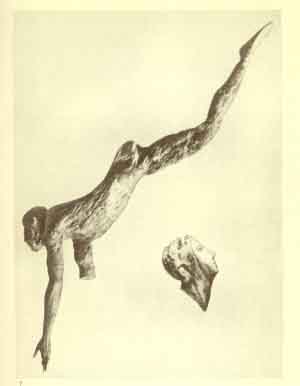
IVORY FIGURINE AND HEAD--"THE LEAPER"--FROM KNOSSOS
Reproduced from the "Annual of the British School at Athens'', by kind permission of the Committee and of Messrs. Macmillan & Co., Ltd.
The priest of a totemic cult similarly enclosed himself in the skin of the ancestral animal of his tribe or family, which provided the food-supply, or he wore a mask to represent the combination of the totem and the tribe in himself. Another theory which accounts for animal-headed deities is that they are a link between human gods and animal gods; man progressed from the worship of the "Great Beast" to the "Great Man" by degrees, the process being an evolutionary one. The problem is a difficult one, no doubt. But however we may attempt to solve it we have to deal with the fact that in the Aurignacian Age in southern and western Europe there were animal-headed gods. These therefore did not begin to be either in Egypt or Babylonia. The process, if there was a process, was well advanced ere the Tigro-Euphratean valley was rendered habitable for man, or the proto-Egyptians had begun to sow grain and reap harvests. A prolonged Age of culture had prepared for the builders of future civilization a tangled jungle of beliefs which they were to inherit and perpetuate, along with the decorative designs, invented before and during the Fourth Glacial Epoch. Even the fashions of attire were fixed in the early period. The bell-mouthed skirts, hanging from wasp waists, which have been associated with Cretan civilization, are displayed in Aurignacian cave-paintings. Even the Assyrian goddess's postures are earlier than Assyrian civilization. An ivory carving of Ishtar as an Egyptian goddess has been discovered at Kuyunjik. "The Egyptian character of the figure", writes Mr. L. W. King, 19 "leaps to the eye. . . . In fact, everything about the figure is Egyptian with one exception-the position of the hands. The fact that the goddess holds her breasts at once betrays her Asiatic character. . . . The type, in fact, is characteristic of western Asia and extends also into the ean." The type and the pose are also characteristic of the Aurignacian Age; some steatopygous figures carved in ivory similarly hold their breasts with their hands. "It is still uncertain", adds Mr. King, "whether the nude goddess is to be traced to a Babylonian, Anatolian, or ean source." She may have survived from Aurignacian times among the descendants of scattered Pallithic peoples who mingled with later immigrants into Europe at the dawn of the Neolithic Age. In the next chapter it will be shown that traces of an ancient goddess cult survive in various areas, and that certain of these were peopled by Pallithic folks in post-glacial times, who met and fused with the earliest settlers of the Mediterranean Race.
Footnotes
1 Religious Belief in Babylonia and Assyria, Morris Jastrow, pp. 136 et seq.
2 The female beards suggest that this race's area of characterization was a cold country. On the other hind, it may be held that we have here the earliest evidence of belief in "intermediate types" among the ancient Egyptians.
3 See Travels in the Interior of Southern Africa, W. J. Burchell, Vol. II., p. 61 (1824); The Native Races of South Africa, G. W. Stow, p. 129 (1905); Report on the North-Western Tribes of Canada, Representative of the British Association (1889); p. 837; and Ancient Hunters, W. J. Sollas, pp. 238 et seq. (1911).
4 Campbell's West Highland Tales, Vol. III, p. 225.
5 Hutchinson's History of Northumberland, Vol. 14 p. 4.
6 Omens and Superstitions of Southern India, p. 119 (1912), and Journal of Anthropological Institute, XIX, p. 56 (1890).
7 Brand's Antiquities, Vol. II, p. 333.
8 The Golden Bough (The Magic Art), Vol. I., pp. 207 et seq. Professor Frazer gives numerous illustrations of this belief.
9 Ancient Hunters, W. J. Sollas, p. 235.
10 Bears are depicted on stones, but evidence has been forthcoming that these were eaten. It is possible that the primitive hunters feasted also on the flesh of the mammoth and woolly rhinoceros.
11 Native Tribes of Central Australia, p. 176.
12 The Golden Bough ("The Magic Art"), Vol. I., pp. 85-8, third edition.
13 J. G. Campbell's Witchcraft and Second Sight in the Highlands and Islands of Scotland (1902), pp. 46-8. The custom is not yet obsolete.
14 Magic and Fetishism, A. C. Haddon, p. 19 (London, 1906).
15 L'Art pendant l'Age du Renne.
16 Nineteenth Annual Report of the Bureau of American Ethnology, p. 308, (Washington, 1900.)
17 The Birth of Humility and Anthropology, p. 212.
18 Isocrates, Orations, V, p. 117.
19 The Journal of Egyptian Archlogy, Vol. I, Part II, pp. 107 et seq. (1914).
- Published in Myths of Crete and Pre-Hellecic Europe
- 0
