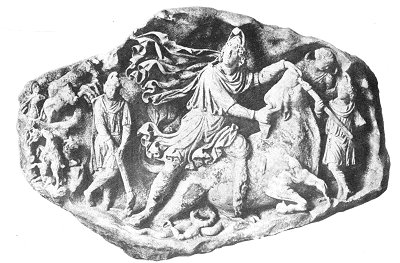
THE MYSTERIES OF MITHRA
by Franz Cumont
translated from the second revised French edition by Thomas J. McCormack
Chicago, Open Court
[1903]
MITHRAISM AND THE RELIGIONS OF THE EMPIRE
THE acts of the Oriental martyrs bear eloquent testimony to the intolerance of the national clergy of the Persia of the Sassanids; and the Magi of the ancient empire, if they were not persecutors, at least constituted an exclusive caste, and possibly even a privileged race. The priests of Mithra afford no evidence of having assumed a like attitude. Like the Judaism of Alexandria, Mazdaism. had been softened in Asia Minor by the Hellenic civilization. Transported into a strange world, it was compelled to accommodate itself to the usages and ideas there prevailing; and the favor with which it was received encouraged it to persevere in its policy of conciliation. The Iranian gods who accompanied Mithra in his peregrinations were worshipped in the Occident under Greek and Latin names; the Avestan yazata assumed there the guise of the immortals enthroned on Olympus, and these facts are in themselves sufficient to prove that far from exhibiting hostility toward the ancient Gro-Roman beliefs, the Asiatic religion sought to accommodate itself to them, in appearance at least. A pious mystic could, without renouncing his faith, dedicate a votive inscription to the Capitoline triad,--Jupiter, Juno, and Minerva; he merely invested these divine names with a different meaning from their ordinary acceptation.
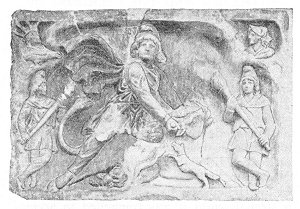
Fig. 40.
TAUROCTONOUS MITHRA
In the possession of Mr. S. H. Janes, Janes Buildings, Toronto, Canada. With the usual accessories. In the upper left-hand corner a bust of the Sun, and in the upper right-hand corner a bust of the Moon. The left hand of the god, which has been broken off, apparently grasps a horn and not the nostrils of the bull. In all probability partly restored, it being scarcely possible that the dadophori could both have held upright torches.
If the injunction to refrain from participating in other Mysteries, which is said to have been imposed upon Mithraic initiates, was ever obeyed it was not long able to withstand the syncretic tendencies of imperial paganism. For in the fourth century the "Fathers of the Fathers" were found performing the highest offices of the priesthood. in temples of all sorts.
Everywhere the sect knew how to adapt itself with consummate skill to the environment in which it lived. In the valley of the Danube it exercised on the indigenous cult an influence that presupposes a prolonged contact between them. In the region of the Rhine, the Celtic divinities were worshipped in the crypts of the Persian god, or at least alongside of them. Thus, the Mazdean theology, according to the country in which it flourished, was colored with variable tints, the precise gradations of which it is now impossible for us to follow. But these dogmatic shadings merely diversified the subordinate details of the religion, and never imperilled its fundamental unity. There is not the slightest evidence that these deviations of a flexible doctrine provoked heresies. The concessions which it made were matters of pure form. In reality, Mithraism having arrived in the Occident in its full maturity, and even showing signs of decrepitude, no longer assimilated the elements that it borrowed from the surrounding life. The only influences that profoundly modified its character were those to which it was subjected in its youth amidst the populations of Asia.
The close relation in which Mithra stood to certain gods of this country is explained not only by the natural affinity which united all Oriental immigrants in opposition to the paganism of Greece and Rome. The ancient religious hostility of the Egyptians and Persians persisted even in Rome under the emperors, and the Iranian Mysteries appear to have been separated from those of Isis by secret rivalry if not by open opposition. On the other hand, they associated readily with the Syrian cults that had emigrated with them from Asia and Europe. Their doctrines, thoroughly imbued with Chaldn theories, must have presented a striking resemblance to that of the Semitic religions. Jupiter Dolichenus, who was worshipped simultaneously with Mithra in Commagene, the land of his origin, and who like the latter remained a preinently military divinity, is found by his side in all the countries of the Occident. At Carnuntum in Pannonia, a mithrm and a dolichenum 1 adjoined each other. Baal, the lord of the heavens, was readily identified with Ormazd, who had become Jupiter-Cus, and Mithra was easily likened to the solar god of the Syrians. Even the rites of the two liturgies appear to have offered some resemblances. As in Commagene, so also in Phrygia, Mazdaism had sought a common ground of understanding with the religion of the country. In the union of Mithra and Anita the counterpart was found of the intimacy between the great indigenous divinities Attis and Cybele, and this harmony between the two sacred couples persisted in Italy. The most ancient mithrm known to us was contiguous to the metroon 2 of Ostia, and we have every reason to believe that the worship of the Iranian god and that of the Phrygian goddess were conducted in intimate communion with each other throughout the entire extent of the empire. Despite the profound differences of their character, political reasons drew them together. In conciliating the priests of the Mater Magna, the sectaries of Mithra obtained the support of a powerful and officially recognized clergy, and so shared in some measure in the protection afforded it by the State. Further, since men only were permitted to take part in the secret ceremonies of the Persian liturgy, other Mysteries to which women were admitted must have formed some species of alliance with the former, to make them complete. The Great Mother succeeded thus to the place of Anita; she had her Matres or "Mothers," as Mithra had his "Fathers"; and her initiates were known among one another as "Sisters," just as the votaries of her associate called one another "Brothers."
This alliance, fruitful generally in its results, was especially profitable to the ancient cult of Pessinus, now naturalized at Rome. The loud pomp of its festivals was a poor mask of the vacuity of its doctrines, which no longer satisfied the aspirations of its devotees. Its gross theology was elevated by the adoption of certain Mazdean beliefs. There can be scarcely any doubt that the practice of the taurobolium, with the ideas of purification and immortality appertaining to it, had passed under the Antonines from the temples of Anita into those of the Mater Magna. The barbarous custom of allowing the blood of a victim slaughtered on a latticed platform to fall down upon the mystic lying in a pit below, was probably practised in Asia from time immemorial. According to a wide-spread notion among primitive peoples, the blood is the vehicle of the vital energy, and the person who poured it upon his body and moistened his tongue with it, believed that he was thereby endowed with the courage and strength of the slaughtered animal. This sacred bath appears to have been administered in Cappadocia in a great number of sanctuaries, and especially in those of M the great indigenous divinity, and in those of Anita. These goddesses, to whom the bull was consecrated, had been generally likened by the Greeks to their Artemis Tauropolos, and the ritualistic baptism practised in their cult received the name of tauropolium (ταυροπόλιον), which was transformed by the popular etymology into taurobolium (ταυροβόλιον).
But under the influence of the Mazdean beliefs regarding the future life, a more profound significance was attributed to this baptism of blood. In taking it the devotees no longer imagined they acquired the strength of the bull; it was no longer a renewal of physical strength that the life-sustaining liquid was now thought to communicate, but a renovation, temporary or even perpetual, of the human soul. 3
When, under the empire, the taurobolium was introduced into Italy, it was not quite certain at the outset what Latin name should be given the goddess in whose honor it was celebrated. Some saw in her a celestial Venus; others compared her to Minerva, because of her warlike character. But the priests of Cybele soon introduced the ceremony into their liturgy,--evidently with the complicity of the official authorities, for nothing in the ritual of this recognized cult could be modified without the authorization of the quindecemvirs. Even the emperors are known to have granted privileges to those who performed this hideous sacrifice for their salvation, though their motives for this special favor are not clearly apparent. The efficacy which was attributed to this bloody purification, the eternal new birth that was expected of it, resembled the hopes which the mystics of Mithra attached to the immolation of the mythical bull. 4 The similarity of these doctrines is quite naturally explained by the identity of their origin. The taurobolium, like many rites of the Oriental cults, is a survival of a savage past which a spiritualistic theology had adapted to moral ends. It is a characteristic fact that the first immolations of this kind that we know to have been performed by the clergy of the Phrygian goddess took place at Ostia, where the metroon, as we saw above, adjoined a Mithraic crypt.
The symbolism of the Mysteries certainly saw in the Magna Mater the nourishing Earth which the Heavens yearly fecundated. So the Gro-Roman divinities which they adopted changed in character on entering their dogmatic system. Sometimes, these gods were identified with the Mazdean heroes, and the barbaric legends then celebrated the new exploits which they had performed. Sometimes, they were considered the agents that produced the various transformations of the universe. Then, in the center of this pantheon, which had again become naturalistic, as it was at its origin, was placed the Sun, for he was the supreme lord that governed the movements of all the planets and even the revolutions of the heavens themselves,--the one who suffused with his light and his heat all of life here below. This conception, astronomical in its origin, predominated more and more according as Mithra entered into more intimate relations with Greek thought and became a more faithful subject of the Roman state.
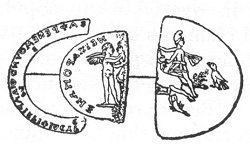
Mithra slaying the bull. On the reverse Cupid and Psyche (broken).
Obverse: The sun-god standing upright on his quadriga and holding in his hand the globe on which the four quarters are indicated. Reverse: Mithra leading off the bull. (Metropolitan Museum of Art, New York.)
Fig. 41.
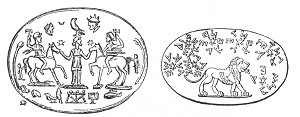
MITHRAIC GEMS.
Green jasper.
The worship of the Sun, the outcome of a sentiment of recognition for its daily benefactions, augmented by the observation of its tremendous re in the cosmic system, was the logical upshot of paganism. When critical thought sought to explain the sacred traditions and discovered in the popular gods the forces and elements of nature, it was obliged perforce to accord a predominant place to the star on which the very existence of our globe depended. "Before religion reached the point where it proclaimed that God should be sought in the Absolute and the Ideal, that is to say, outside the world, one cult only was reasonable and scientific and that was the cult of the Sun." 5 From the time of Plato and Aristotle, Greek philosophy regarded the celestial bodies as animate and divine creatures; Stoicism furnished new arguments in favor of this opinion; while Neo-Pythagorism and Neo-Platonism insisted still more emphatically on the sacred character of the luminary which is the ever-present image of the intelligible God. These beliefs, approved by the thinkers, were widely diffused by literature, and particularly by the works in which romantic fiction served to envelop genuinely theological teachings.
If heliolatry was in accord with the philosophical doctrines of the day, it was not less in conformity with its political tendencies. We have essayed to show the connection which existed between the worship of the emperors and that of the Sol invictus. When the Cars of the third century pretended to be gods descended from heaven to the earth, the justification of their imaginary claims had as its corollary the establishment of a public worship of the divinity from whom they believed themselves the emanations. Heliogabalus had claimed for his Baal of Emesa the supremacy over the entire pagan pantheon.
Fig. 42.
MITHRAIC CAMEO (RED JASPER).
Principal face: In the center, the tauroctonous Mithra, with the dog, the scorpion, the two torchbearers, etc. Reverse: A lion with a bee in his mouth; above, seven stars surrounded by magic Greek inscriptions.
The eccentricities and violences of this unbalanced man resulted in the lamentable wreck of his undertaking; but it answered to the needs of the time and was soon taken up again with better success. Near the Flaminian Way, to the east of the Field of Mars, Aurelian consecrated a colossal edifice to the tutelary god that had granted him victory in Syria. The religion of state that he constituted must not be confounded with Mithraism. Its imposing temple, its ostentatious ceremonies, its quadrennial games, its pontifical clergy, remind us of the great sanctuaries of the Orient and not of the dim caves in which the Mysteries were celebrated.
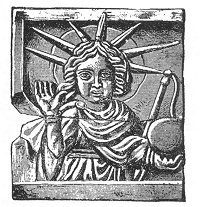
Fig. 43.
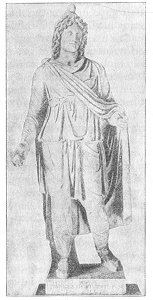
SOL THE SUN-GOD.
Installed by Mithra as the governor of the world. To the right the globe of power.
Nevertheless, the Sol invictus, whom the emperor had intended to honor with a pomp hitherto unheard of, could well be claimed as their own by the followers of Mithra.
The imperial policy gave the first place in the official religion to the Sun, of which the sovereign was the emanation, just as in the Chaldn speculations propagated by the Mithraists the royal planet held sway over the other stars. On both sides, the growing tendency was to see in the brilliant star that illuminated the universe the only God, or at least the sensible image of the only God, and to establish in the heavens a monotheism in imitation of the monarchy that ruled on earth. Macrobius (400 A.D.), in his Saturnalia, has learnedly set forth that the gods were ultimately reducible to a single Being considered under different aspects, and that the multiple names by which they were worshipped were the equivalent of that of Helios (the Sun). The theologian Vettius Agorius Prextatus who defended this radical syncrasy was not only one of the highest dignitaries of the empire, but one of the last chiefs of the Persian Mysteries.
Mithraism, at least in the fourth century, had therefore as its end and aim the union of all gods and all myths in a vast synthesis,--the foundation of a new religion in harmony with the prevailing philosophy and political constitution of the empire. This religion would have been as far removed from the ancient Iranian Mazdaism as from Gro-Roman paganism, which accorded the sidereal powers a minimal place only. It had in a measure traced idolatry back to its origin, and discovered in the myths that obscured its comprehension the deification of nature.
Breaking with the Roman principle of the nationality of worship, it would have established the universal domination of Mithra, identified with the invincible Sun. Its adherents hoped, by concentrating all their devotion upon a single object, to impart new cohesion to the disintegrated beliefs. Solar pantheism was the last refuge of conservative spirits, now menaced by a revolutionary propaganda that aimed at the annihilation of the entire ancient order of things.
At the time when this pagan monotheism sought to establish its ascendency in Rome, the struggle between the Mithraic Mysteries and Christianity had long begun. The propagation of the two religions had been almost contemporaneously conducted, and their diffusion had taken place under analogous conditions. Both from the Orient, they had spread because of the same general reasons, viz., the political unity and the moral anarchy of the empire. Their diffusion had been accomplished with like rapidity, and toward the close of the second century they both numbered adherents in the most distant parts of the Roman world. The sectaries of Mithra might justly lay claim to the hyperbolic utterance of Tertullian: "Hesterni sumus et vestra omnia implevimus." If we consider the number of the monuments that the Persian religion has left us, one may easily ask whether in the epoch of the Severi its adepts were not more numerous than the disciples of Christ. Another point of resemblance between the two antagonistic creeds was that at the outset they drew their proselytes chiefly from the inferior classes of society; their propaganda was at the origin essentially popular; unlike the philosophical sects, they addressed their endeavors less to cultivated minds than to the masses, and consequently appealed more to sentiment than to reason.
But by the side of these resemblances considerable differences are to be remarked in the methods of procedure of the two adversaries. The initial conquests of Christianity were favored by the Jewish diaspora, and it first spread in the countries inhabited by Israelitic colonies. It was therefore chiefly in the countries washed by the Mediterranean that its communities developed. They did not extend their field of action outside the cities, and their multiplication is due in great part to missions undertaken with the express purpose of "instructing the nations." The extension of Mithraism, on the other hand, was essentially a natural product of social and political factors; namely, of the importation of slaves, the transportation of troops, and the transfer of public functionaries. It was in government circles and in the army that it counted its greatest number of votaries,--that is, in circles where very few Christians could be found because of their aversion to official paganism. Outside of Italy, it spread principally along the frontiers and simultaneously gained a foothold in the cities and in the country. It found its strongest points of support in the Danubian provinces and in Germany, whereas Christianity made most rapid progress in Asia Minor and Syria. The spheres of the two religious powers, therefore, were not coincident, and they could accordingly long grow and develop without coming directly into conflict. It was in the valley of the Rhone, in Africa, and especially in the city of Rome, where the two competitors were most firmly established, that the rivalry, during the third century, became particularly brisk between the bands of Mithra's worshippers and the disciples of Christ.
The struggle between the two rival religions was the more stubborn as their characters were the more alike. The adepts of both formed secret conventicles, closely united, the members of which gave themselves the name of "Brothers." 6 The rites which they practised offered numerous analogies. The sectaries of the Persian god, like the Christians, purified themselves by baptism; received, by a species of confirmation, the power necessary to combat the spirits of evil; and expected from a Lord's Supper salvation of body and soul. Like the latter, they also held Sunday sacred, and celebrated the birth of the Sun on the 25th of December, the same day on which Christmas has been celebrated, since the fourth century at least. They both preached a categorical system of ethics, regarded asceticism as meritorious, and counted among their principal virtues abstinence and continence, renunciation and self-control. Their conceptions of the world and of the destiny of man were similar. They both admitted the existence of a Heaven inhabited by beatified ones, situate in the upper regions, and of a Hell peopled by demons, situate in the bowels of the earth. They both placed a Flood at the beginning of history; they both assigned as the source of their traditions a primitive revelation; they both, finally, believed in the immortality of the soul, in a last judgment, and in a resurrection of the dead, consequent upon a final conflagration of the universe.
We have seen that the theology of the Mysteries made of Mithra a "mediator" equivalent to the Alexandrian Logos. Like him, Christ also was a μεσίτης, an intermediary between his celestial father and men, and like him he also was one of a trinity. These resemblances were certainly not the only ones that pagan exegesis established between the two religions, and the figure of the tauroctonous god reluctantly immolating his victim that he might create and save the human race, was certainly compared to the picture of the redeemer sacrificing his own person for the salvation of the world.
Fig. 44.
THE PASSION OF THE GOD.
The Dying Alexander, so called. Type of a group of sculptures from the school of Pergamon, dating from the second century before Christ. The idealized portrait of Alexander as solar god has been discovered in the head of the celebrated Mithraic statue of the Capitol (see Fig. 4, page p. 21), and the facial expressions of dolor, pathos, and compassion which characterize this work are shared by all the more important representations of the Mithraic sacrifice. The present sculpture has been partly restored, and it is therefore impossible to determine absolutely whether it originally formed part of an Asiatic group of the tauroctonous Mithra.
On the other hand, the ecclesiastical writers, reviving a metaphor of the prophet Malachi, contrasted the "Sun of justice" with the "invincible Sun," and consented to see in the dazzling orb which illuminated men a symbol of Christ, "the light of the world." Should we be astonished if the multitudes of devotees failed always to observe the subtle distinctions of the doctors, and if in obedience to a pagan custom they rendered to the radiant star of day the homage which orthodoxy reserved for God? In the fifth century, not only heretics, but even faithful followers, were still wont to bow their heads toward its dazzling disc as it rose above the horizon, and to murmur the prayer, "Have mercy upon us."
The resemblances between the two hostile churches were so striking as to impress even the minds of antiquity. From the third century, the Greek philosophers were wont to draw parallels between the Persian Mysteries and Christianity which were evidently entirely in favor of the former. The Apologists also dwelt on the analogies between the two religions, and explained them as a Satanic travesty of the holiest rites of their religion. If the polemical works of the Mithraists had been preserved, we should doubtless have heard the same accusation hurled back upon their Christian adversaries.
We cannot presume to unravel to-day a question which divided contemporaries and which shall doubtless forever remain insoluble. We are too imperfectly acquainted with the dogmas and liturgies of Roman Mazdaism, as well as with the development of primitive Christianity, to say definitely what mutual influences were operative in their simultaneous evolution. But be this as it may, resemblances do not necessarily suppose an imitation. Many correspondences between the Mithraic doctrine and the Catholic faith are explicable by their common Oriental origin. Nevertheless, certain ideas and certain ceremonies must necessarily have passed from the one cult to the other; but in the majority of cases we rather suspect this transference than clearly perceive it.
Apparently the attempt was made to discern in the legend of the Iranian hero the counterpart of the life of Jesus, and the disciples of the Magi probably drew a direct contrast between the Mithraic worship of the shepherds, the Mithraic communion and ascension, and those of the Gospels. The rock of generation, which had given birth to the genius of light, was even compared to the immovable rock, emblem of Christ, upon which the Church was founded; and the crypt in which the bull had perished was made the counterpart of that in which Christ is said to have been born at Bethlehem. 7 But this strained parallelism could result in nothing but a caricature. It was a strong source of inferiority for Mazdaism that it believed in only a mythical redeemer. That unfailing wellspring of religious emotion supplied by the teachings and the passion of the God sacrificed on the cross, never flowed for the disciples of Mithra.
On the other hand, the orthodox and heretical liturgies of Christianity, which gradually sprang up during the first centuries of our era, could find abundant inspiration in the Mithraic Mysteries, which of all the pagan religions offered the most affinity with Christian institutions. We do not know whether the ritual of the sacraments and the hopes attaching to them suffered alteration through the influence of Mazdean dogmas and practices. Perhaps the custom of invoking the Sun three times each day,--at dawn, at noon, and at dusk,--was reproduced in the daily prayers of the Church, and it appears certain that the commemoration of the Nativity was set for the 25th of December, because it was at the winter solstice that the rebirth of the invincible god, 8 the Natalis invicti, was celebrated. In adopting this date, which was universally distinguished by sacred festivities, the ecclesiastical authority purified in some measure the profane usages which it could not suppress.
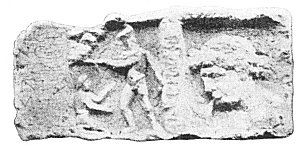
Fig. 45.
BAS-RELIEF OF MAYENCE.
Mithra drawing his bow; and the god of the winds.
The only domain in which we can ascertain in detail the extent to which Christianity imitated Mithraism is that of art. The Mithraic sculpture, which had been first developed, furnished the ancient Christian marble-cutters with a large number of models, which they adopted or adapted. For example, they drew inspiration from the figure of Mithra causing the living waters to leap forth by the blows of his arrows, 9 to create the figure of Moses smiting with his rod the rock of Horeb (Fig. 45). Faithful to an inveterate tradition, they even reproduced the figures of cosmic divinities, like the Heavens and the Winds, the worship of which the new faith had expressly proscribed; and we find on the sarcophagi, in miniatures, and even on the portals of the Romance Churches, evidences of the influence exerted by the imposing compositions that adorned the sacred grottos of Mithra. 10
It would be wrong, however, to exaggerate the significance of these likenesses. If Christianity and Mithraism offered profound resemblances, the principal of which were the belief in the purification of souls and the hope of a beatific resurrection, differences no less essential separated them. The most important was the contrast of their relations to Roman paganism. The Mazdean Mysteries sought to conciliate paganism by a succession of adaptations and compromises; they endeavored to establish monotheism while not combating polytheism, whereas the Church was, in point of principle, if not always in practice, the unrelenting antagonist of idolatry in any form. The attitude of Mithraism was apparently the wiser; it gave to the Persian religion greater elasticity and powers of adaptation, and it attracted toward the tauroctonous god all who stood in dread of a painful rupture with ancient traditions and contemporaneous society. The preference must therefore have been given by many to dogmas that satisfied their aspirations for greater purity and a better world, without compelling them to detest the faith of their fathers and the State of which they were citizens. As the Church grew in power despite its persecutors, this policy of compromise first assured to Mithraism much tolerance and afterward even the favor of the public authorities. But it also prevented it from freeing itself of the gross and ridiculous superstitions which complicated its ritual and its theology; it involved it, in spite of its austerity, in an equivocal alliance with the orgiastic cult of the beloved of Attis; and it compelled it to carry the entire weight of a chimerical and odious past. If Romanized Mazdaism had triumphed, it would not only have preserved from oblivion all the aberrations of pagan mysticism, but would also have perpetuated the erroneous doctrine of physics on which its dogmatism reposed. The Christian doctrine, which broke with the cults of nature, remained exempt from these impure associations, and its liberation from every compromising attachment assured it an immense superiority. Its negative value, its struggle against deeply-rooted prejudices, gained for it as many souls as did the positive hopes which it promised. It performed the miraculous feat of triumphing over the ancient world in spite of legislation and the imperial policy, and the Mithraic Mysteries were promptly abolished the moment the protection of the State was withdrawn and transformed into hostility.
Mithraism reached the apogee of its power toward the middle of the third century, and it appeared for a moment as if the world was on the verge of becoming Mithraic. But the first invasions of the barbarians, and especially the definitive loss of Dacia (275 A.D.), soon after followed by that of the Agri Decumates, administered a terrible blow to the Mazdean sect, which was most powerful in the periphery of the orbis Romanus. In all Pannonia, and as far as Virunum, on the frontiers of Italy, its temples were sacked. By way of compensation, the authorities, menaced by the rapid progress of Christianity, renewed their support to the most redoubtable adversary that they could oppose to it. In the universal downfall the army was the only institution that remained standing, and the Cars created by the legions were bound perforce to seek their support in the favored religion of their soldiers. In 273 A.D., Aurelian founded by the side of the Mysteries of the tauroctonous god a public religion, which he richly endowed, in honor of the Sol invictus. Diocletian, whose court with its complicated hierarchy, its prostrations before its lord, and its crowds of eunuchs, was, by the admission of contemporaries, an imitation of the court of the Sassanids, was naturally inclined to adopt doctrines of Persian origin, which flattered his despotic instincts. The emperor and the princes whom he had associated with himself, meeting in conference at Carnuntum in 307 A.D., restored there one of the temples of the celestial protector of their newly-organized empire. 11 The Christians believed, not without some appearance of reason, that the Mithraic clergy were the instigators of the great persecutions under Galerius. In the Roman empire as in Iran, a vaguely monistic heliolatry appeared on the verge of becoming the sole, intolerant religion of state. But the conversion of Constantine shattered the hopes which the policy of his predecessors had held out to the worshippers of the sun. Although he did not persecute the beliefs which he himself had shared, 12 they ceased to constitute a recognized cult and were tolerated only. His successors were outspokenly hostile. To latent defiance succeeded open persecution. Christian polemics no longer restricted its attacks to ridiculing the legends and practices of the Mazdean Mysteries, nor even to taunting them for having as their founders the irreconcilable enemies of Rome; it now stridently demanded the total destruction of idolatry, and its exhortations were promptly carried into effect. When a rhetorician 13 tells us that under Constantius no one longer dared to look at the rising or setting sun, that even farmers and sailors refrained from observing the stars, and tremblingly held their eyes fixed upon the ground, we have in these emphatic declarations a magnified echo of the fears that then filled all pagan hearts.
The proclamation of Julian the Apostate (331-363 A.D.) suddenly inaugurated an unexpected turn in affairs. A philosopher, seated on the throne by the armies of Gaul, Julian had cherished from childhood a secret devotion for Helios. He was firmly convinced that this god had rescued him from the perils that menaced his youth; he believed that he was entrusted by him with a divine mission, and regarded himself as his servitor, or rather as his spiritual son. He dedicated to this celestial "king" a discourse in which the ardor of his faith transforms in places a cold theological dissertation into an inflamed dithyrambic, and the fervor of his devotion for the star that he worshipped never waned to the moment of his death.
The young prince had been presumably drawn to the Mysteries by his superstitious predilection for the supernatural. Before his accession, perhaps even from youth, he had been introduced secretly into a Mithraic conventicle by the philosopher Maximus of Ephesus. The ceremonies of his initiation must have made a deep impression on his feelings. He imagined himself thenceforward under the special patronage of Mithra, in this life and in that to come. As soon as he had cast aside his mask and openly proclaimed himself a pagan, he called Maximus to his side, and doubtless had recourse to extraordinary ablutions and purifications to wipe out the stains which he had contracted in receiving the baptism and the communion of the Christians. Scarcely had he ascended the throne (361 A.D.) than he made haste to introduce the Persian cult at Constantinople; and almost simultaneously the first taurobolia were celebrated at Athens.
On all sides the sectaries of the Magi lifted their heads. At Alexandria the patriarch George, in attempting to erect a church on the ruins of a mithrm, provoked a sanguinary riot. Arrested by the magistrates, he was torn from his prison and cruelly slain by the populace on the 24th of December, 361, the eve of the Natalis invicti. The emperor contented himself with addressing a paternal remonstrance to the city of Serapis.
But the Apostate soon met his death in the historic expedition against the Persians, to which he had possibly been drawn by the secret desire to conquer the land which had given him his faith and by the assurance that his tutelary god would accept his homage rather than that of his enemies. Thus perished this spasmodic attempt at reaction, and Christianity, now definitively victor, addressed itself to the task of extirpating the erroneous doctrine that had caused it so much anxiety. Even before the emperors had forbidden the exercise of idolatry, their edicts against astrology and magic furnished an indirect means of attacking the clergy and disciples of Mithra. In 371 A.D., a number of persons who cultivated occult practices were implicated in a pretended conspiracy and put to death. The mystagogue Maximus himself perished as the victim of an accusation of this kind.
It was not long before the imperial government legislated formally and directly against the disgraced sect. In the provinces, popular uprisings frequently anticipated the interference of the magistrates. Mobs sacked the temples and committed them to the flames, with the complicity of the authorities. The ruins of the mithrms bear witness to the violence of their devastating fury. Even at Rome, in 377 A.D., the prefect Gracchus, seeking the privilege of baptism, offered as a pledge of the sincerity of his conversion the "destruction, shattering, and shivering," 14 of a Mithraic crypt, with all the statues that it contained. Frequently, in order to protect their grottoes from pillage by making, them inaccessible, the priests walled up the entrances, or conveyed their sacred images to well-protected hiding-places, convinced that the tempest that had burst upon them was momentary only, and that after their days of trial their god would cause again to shine forth the light of final triumph.
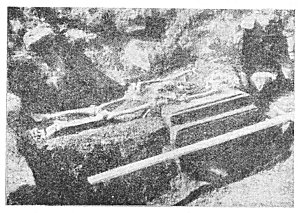
Fig. 46.
CHAINED SKELETON.
Discovered in the ruins of a Mithraic temple at Sarrebourg, in Lorraine.
On the other hand, the Christians, in order to render places contaminated by the presence of a dead body ever afterward unfit for worship, sometimes slew the refractory priests of Mithra and buried them in the ruins of their sanctuaries, now forever profaned (Fig. 46).
The hope of restoration was especially tenacious at Rome, which remained the capital of paganism. The aristocracy, still faithful to the traditions of their ancestors, supported the religion with their wealth and prestige. Its members loved to deck themselves with the titles of "Father and Herald of Mithra Invincible," and multiplied the offerings and the foundations. They redoubled their generosity toward him when Gratian in 382 A.D. despoiled their temples of their wealth. A great lord recounts to us in poor verses how he had restored a splendid crypt erected by his grandfather near the Flaminian Way, boasting that he was able to dispense with public subsidies of any kind. 15 The usurpation of Eugenius appeared for a moment to bring on the expected resurrection. The prefect of the prorium, Nicomachus Flavianus, celebrated solemn taurobolia and renewed in a sacred cave the Mysteries of the "associate god" (deum comitem) of the pretender. But the victory of Theodosius, 394 A.D., shattered once and for all the hopes of these belated partisans of the ancient Mazdean belief.
A few clandestine conventicles may, with stubborn persistence, have been held in the subterranean retreats of the palaces. The cult of the Persian god possibly existed as late as the fifth century in certain remote cantons of the Alps and the Vosges. For example, devotion to the Mithraic rites long persisted in the tribe of the Anauni, masters of a flourishing valley, of which a narrow defile closed the mouth. But little by little its last disciples in the Latin countries abandoned a religion tainted with moral as well as political decadence. It maintained its ground with greater tenacity in the Orient, the land of its birth. Driven out of the rest of the empire, it found a refuge in the countries of its origin, where its light only slowly flickered out.
Nevertheless, the conceptions which Mithraism had diffused throughout the empire during a period of three centuries were not destined to perish with it. Some of them, even those most characteristic of it, such as its ideas concerning Hell, the efficacy of the sacraments, and the resurrection of the flesh, were accepted even by its adversaries; and in disseminating them it had simply accelerated their universal domination. Certain of its sacred practices continued to exist also in the ritual of Christian festivals and in popular usage. Its fundamental dogmas, however, were irreconcilable with orthodox Christianity, outside of which only they could maintain their hold. Its theory of sidereal influences, alternately condemned and tolerated, was carried down by astrology to the threshold of modern times; but it was to a religion more powerful than this false science that the Persian Mysteries were destined to bequeath. along with their hatred of the Church, their cardinal ideas and their influence over the masses.
Manichsm, although the work of a man and not the product of a long evolution, was connected with these Mysteries by numerous affinities. The tradition according to which its original founders had conversed in Persia with the priests of Mithra may be inexact in form, but it involves nevertheless a profound truth. Both religions had been formed in the Orient from a mixture of the ancient Babylonian mythology with Persian dualism, and had afterward absorbed Hellenic elements. The sect of Manichs spread throughout the empire during the fourth century, at the moment when Mithraism was expiring, and it was called to assume the latter's succession. Mystics whom the polemics of the Church against paganism had shaken but not converted were enraptured with the new conciliatory faith which suffered Zoroaster and Christ to be simultaneously worshipped. The wide diffusion which the Mazdean beliefs with their mixture of Chaldsm had enjoyed, prepared the minds of the empire for the reception of the new heresy. The latter found its way made smooth for it, and this is the secret of its sudden expansion. Thus renewed, the Mithraic doctrines were destined to withstand for centuries all persecutions, and rising again in a new form in the Middle Ages to shake once more the ancient Roman world.
Footnotes
1 A temple of Jupiter Dolichenus.--Tr.
2 A temple of Cybele.--Tr.
3 These pages summarize the conclusions of a study entitled Le taurobole et le culte de Bellone, published in the Revue d' histoire et de littature religieuses.
4 See above, p. 146.
5 Renan, Lettre Berthelot (Dialogues et fragments philosophiques), p. 168.
6 I may remark that even the expression "dearest brothers" had already been used by the sectaries of Jupiter Dolichenus (CIL, VI, 406 = 30758: fratres carissimos et conlegas hon [estissimos]) and probably also in the Mithraic associations.
7 M. Jean Rille (udes publis en hommage la facult de thlogie de Montauban, 1901, pp. 339 et seq.) thinks that the Gospel story of the birth of Christ and the adoration of the Magi was suggested by the Mithraic legend; but he remarks that we have no proof of the supposition. So also M. A. Dieterich in a recent article (Zeitschr. f. Neutest. Wiss., 1902, p. 190), in which he has endeavored not without ingenuity to explain the formation of the legend of the Magi kings, admits that the worship of the shepherds was introduced into Christian tradition from Mazdaism. But I must remark that the Mazdean beliefs regarding the advent of Mithra into the world have strangely varied. (Cf. T. et M., Vol. I., pp. 160 et seq.)
8 See above, p. 167.
9 See above, p. 138.
10 See p. 227.
11 See above, pp. 88-89.
12 Cf. Preger, Konstantinos-Helios (Hermes, XXXVI), 1901, p. 457.
13 Mamert., Grat. actio in Iulian., c. 23.
14 St. Jerome, Epist. 107 ad Lam (T. et M., Vol. II., p. 18), subvertit, fregit, excussit.
15 CIL, VI, (T. et M., Vol. II., p. 94, No. 13).