log in
LC Geerts

LC Geerts

Website URL:

THE ORIGINS OF MITHRAISM

THE MYSTERIES OF MITHRA

by Franz Cumont

translated from the second revised French edition by Thomas J. McCormack

Chicago, Open Court

[1903]

THE ORIGINS OF MITHRAISM

IN THAT unknown epoch when the ancestors of the Persians were still united with those of the Hindus, they were already worshippers of Mithra. The hymns of the Vedas celebrated his name, as did those of the Avesta, and despite the differences obtaining between the two theological systems of which these books were the expression, the Vedic Mitra and the Iranian Mithra have preserved so many traits of resemblance that it is impossible to entertain any doubt concerning their common origin. Both religions saw in him a god of light, invoked together with Heaven, bearing in the one case the name of Varuna and in the other that of Ahura; in ethics he was recognized as the protector of truth, the antagonist of falsehood and error. But the sacred poetry of India has preserved of him an obscured memory only. A single fragment, and even that partially effaced, is all that has been specially dedicated to him. He appears mainly in incidental allusions,--the silent witnesses of his ancient grandeur. Still, though his physiognomy is not so distinctly limned in the Sanskrit literature as it is in the Zend writings, the faintness of its outlines is not sufficient to disguise the primitive identity of his character.

According to a recent theory, this god, with whom the peoples of Europe were unacquainted, was not a member of the ancient Aryan pantheon. Mitra-Varuna, and the five other Adityas celebrated by the Vedas, likewise Mithra-Ahura and the Amshaspands, who, according to the Avestan conception surround the Creator, are on this theory nothing but the sun, the moon, and the planets, the worship of which was adopted by the Indo-Iranians "from a neighboring people, their superiors in the knowledge of the starry firmament," who could be none other than the Accadian or Semitic inhabitants of Babylonia. 1 But this hypothetical adoption, if it really took place, must have occurred in a prehistoric epoch, and, without attempting to dissipate the obscurity of these primitive times, it will be sufficient for us to state that the tribes of Iran never ceased to worship Mithra from their first assumption of worldly power till the day of their conversion to Islam.

In the Avesta, Mithra is the genius of the celestial light. He appears before sunrise on the rocky summits of the mountains; during the day he traverses the wide firmament in his chariot drawn by four white horses, and when night falls he still illumines with flickering glow the surface of the earth, "ever waking, ever watchful." He is neither sun, nor moon, nor stars, but with "his hundred ears and his hundred eyes" watches constantly the world. Mithra hears all, sees all, knows all: none can deceive him. By a natural transition he became for ethics the god of truth and integrity, the one that was invoked in solemn oaths, that pledged the fulfilment of contracts, that punished perjurers.

The light that dissipates darkness restores happiness and life on earth; the heat that accompanies it fecundates nature. Mithra is "the lord of wide pastures," the one that renders them fertile. "He giveth increase, he giveth abundance, he giveth cattle, he giveth progeny and life." He scatters the waters of the heavens and causes the plants to spring forth from the ground; on them that honor him, he bestows health of body, abundance of riches, and talented posterity. For he is the dispenser not only of material blessings but of spiritual advantages as well. His is the beneficent genius that accords peace of conscience, wisdom, and honor along with prosperity, and causes harmony to reign among all his votaries. The devas, who inhabit the places of darkness, disseminate on earth along with barrenness and suffering all manner of vice and impurity. Mithra, "wakeful and sleepless, protects the creation of Mazda" against their machinations. He combats unceasingly the spirits of evil; and the iniquitous that serve them feel also the terrible visitations of his wrath. From his celestial eyrie he spies out his enemies; armed in fullest panoply he swoops down upon them, scatters and slaughters them. He desolates and lays waste the homes of the wicked, he annihilates the tribes and the nations that are hostile to him. On the other hand he is the puissant ally of the faithful in their warlike expeditions. The blows of their enemies "miss their mark, for Mithra, sore incensed, receives them"; and he assures victory unto them that "have had fit instruction in the Good, that honor him and offer him the sacrificial libations." 2

This character of god of hosts, which has been the predominating trait of Mithra from the days of the Achenides, undoubtedly became accentuated in the period of confusion during which the Iranian tribes were still at war with one another; but it is after all only the development of the ancient conception of struggle between day and night. In general, the picture that the Avesta offers us of the old Aryan deity, is, as we have already said, similar to that which the Vedas have drawn in less marked outlines, and it hence follows that Mazdaism left its main primitive foundation unaltered.

Still, though the Avestan hymns furnish the distinctest glimpses of the true physiognomy of the ancient god of light, the Zoroastrian system, in adopting his worship, has singularly lessened his importance. As the price of his admission to the Avestan Heaven, he was compelled to submit to its laws. Theology had placed Ahura-Mazda on the pinnacle of the celestial hierarchy, and thenceforward it could recognize none as his peer. Mithra was not even made one of the six Amshaspands that aided the Supreme Deity in governing the universe. He was relegated, with the majority of the ancient divinities of nature, to the host of lesser genii or yazatas created by Mazda. He was associated with some of the deified abstractions which the Persians had learned to worship. As protector of warriors, he received for his companion, Verethraghna, or Victory; as the defender of the truth, he was associated with the pious Sraosha, or Obedience to divine law, with Rashnu, Justice, with Arsht, Rectitude. As the tutelar genius of prosperity, he is invoked with Ashi-Vahi, Riches, and with Pe Abundance. In company with Sraosha and Rashnu, he protects the soul of the just against the demons that seek to drag it down to Hell, and under their guardianship it soars aloft to Paradise. This Iranian belief gave birth to the doctrine of redemption by Mithra, which we find developed in the Occident.

At the same time, his cult was subjected to a rigorous ceremonial, conforming to the Mazdean liturgy. Sacrificial offerings were made to him of "small cattle and large, and of flying birds." These immolations were preceded or accompanied with the usual libations of the juice of Haoma, and with the recitation of ritual prayers,--the bundle of sacred twigs (baresman) always in the hand. But before daring to approach the altar, the votary was obliged to purify himself by repeated ablutions and flagellations. These rigorous prescriptions recall the rite of baptism and the corporeal tests imposed on the Roman neophytes before initiation.

Mithra, thus, was adopted in the theological system of Zoroastrianism; a convenient place was assigned to him in the divine hierarchy; he was associated with companions of unimpeachable orthodoxy; homage was rendered to him on the same footing with the other genii. But his puissant personality had not bent lightly to the rigorous restrictions that had been imposed upon him, and there are to be found in the sacred text vestiges of a more ancient conception, according to which he occupied in the Iranian pantheon a much more elevated position. Several times he is invoked in company with Ahura: the two gods form a pair, for the light of Heaven and Heaven itself are in their nature inseparable. Furthermore, if it is said that Ahura created Mithra as he did all things, it is likewise said that he made him just as great and worthy as himself. Mithra is indeed a yazata, but he is also the most potent and most glorious of the yazata. "Ahura-Mazda established him to maintain and watch over all this moving world." 3 It is through the agency of this ever-victorious warrior that the Supreme Being destroys the demons and causes even the Spirit of Evil, Ahriman himself, to tremble.

Compare these texts with the celebrated passage in which Plutarch 4 expounds the dualistic doctrine of the Persians: Oromazes dwells in the domain of eternal light "as far above the sun as the sun is distant from the earth"; Ahriman reigns in the realm of darkness, and Mithra occupies an intermediary place between them. The beginning of the Bundahish 5 expounds a quite similar theory, save that in place of Mithra it is the air (Vayu) that is placed between Ormazd and Ahriman. The contradiction is only one of terms, for according to Iranian ideas the air is indissolubly conjoined with the light, which it is thought to support. In fine, a supreme god, enthroned in the empyrean above the stars, where a perpetual serenity exists; below him an active deity, his emissary and chief of the celestial armies in their ceaseless combat with the Spirit of Darkness, who from the bowels of Hell sends forth his devas to the surface of the earth,--this is the religious conception, far simpler than that of Zoroastrianism, which appears to have been generally accepted among the subjects of the Achenides.

The conspicuous re that the religion of the ancient Persians accorded to Mithra is attested by a multitude of proofs. He alone, with the goddess Anita, is invoked in the inscriptions of Artaxerxes alongside of Ahura-Mazda. The "great kings" were certainly very closely attached to him, and looked upon him as their special protector. It is he whom they call to bear witness to the truth of their words, and whom they invoke on the eve of battle. They unquestionably regarded him as the god that brought victory to monarchs; he it was, they thought, who caused that mysterious light to descend upon them which, according to the Mazdean belief, is a guaranty of perpetual success to princes, whose authority it consecrates.

The nobility followed the example of the sovereign. The great number of theophorous, or god-bearing, names, compounded with that of Mithra, which were borne by their members from remotest antiquity, is proof of the fact that the reverence for this god was general among them.

Mithra occupied a large place in the official cult. In the calendar the seventh month was dedicated to him and also doubtless the sixteenth day of each month. At the time of his festival, the king, if we may believe Ctesias, 6 was permitted to indulge in copious libations in his honor and to execute the sacred dances. Certainly this festival was the occasion of solemn sacrifices and stately ceremonies. The Mithrakana were famed throughout all Hither Asia, and in their form Mihrag were destined, in modern times, to be celebrated at the commencement of winter by Mussulman Persia. The fame of Mithra extended to the borders of the ean Sea; he is the only Iranian god whose name was popular in ancient Greece, and this fact alone proves how deeply he was venerated by the nations of the great neighboring empire.

The religion observed by the monarch and by the entire aristocracy that aided him in governing his vast territories could not possibly remain confined to a few provinces of his empire. We know that Artaxerxes Ochus had caused statues of the goddess Anita to be erected in his different capitals, at Babylon, Damascus, and Sardis, as well as at Susa, Ecbatana, and Persepolis. Babylon, in particular, being the winter residence of the sovereigns, was the seat of a numerous body of official clergy, called Magi, who sat in authority over the indigenous priests. The prerogatives that the imperial protocol guaranteed to this official clergy could not render them exempt from the influence of the powerful sacerdotal caste that flourished beside them. The erudite and refined theology of the Chaldns was thus superposed on the primitive Mazdean belief, which was rather a congeries of traditions than a well -established body of definite dogmas. The legends of the two religions were assimilated, their divinities -were identified, and the Semitic worship of the stars (astrolatry), the monstrous fruit of long-continued scientific observations, became amalgamated with the nature-myths of the Iranians. Ahura-Mazda was confounded with Bel, who reigned over the heavens; Anita was likened to Ishtar, who presided over the planet Venus; while Mithra became the Sun, Shamash. As Mithra in Persia, so Shamash in Babylon is the god of justice; like him, he also appears in the east, on the summits of mountains, and pursues his daily course across the heavens in a resplendent chariot; like him, finally, he too gives victory to the arms of warriors, and is the protector of kings. The transformation wrought by Semitic theories in the beliefs of the Persians was of so profound a character that, centuries after, in Rome, the original home of Mithra was not infrequently placed on the banks of the Euphrates. According to Ptolems, 7 this potent solar deity was worshipped in all the countries that stretched from India to Assyria.

But Babylon was a step only in the propagation of Mazdaism. Very early the Magi had crossed Mesopotamia and penetrated to the heart of Asia Minor. Even under the first of the Achenides, it appears, they established themselves in multitudes in Armenia, where the indigenous religion gradually succumbed to their cult, and also in Cappadocia, where their altars still burned in great numbers in the days of the famous geographer Strabo. They swarmed, at a very remote epoch, into distant Pontus, into Galatia, into Phrygia. In Lydia even, under the reign of the Antonines, their descendants still chanted their barbaric hymns in a sanctuary attributed to Cyrus. These communities, in Cappadocia at least, were destined to survive the triumph of Christianity and to be perpetuated until the fifth century of our era, faithfully transmitting from generation to generation their manners, usages, and modes of worship.

At first blush the fall of the empire of Darius would appear to have been necessarily fatal to these religious colonies, so widely scattered and henceforward to be severed from the country of their birth. But in point of fact it was precisely the contrary that happened, and the Magi found in the Diadochi, the successors of Alexander the Great, no less efficient protection than that which they enjoyed under the Great King and his satraps. After the dismemberment of the empire of Alexander (323 B.C.), there were established in Pontus, Cappadocia, Armenia, and Commagene, dynasties which the complaisant genealogists of the day feigned to trace back to the Achenian kings. Whether these royal houses were of Iranian extraction or not, their supposititious descent nevertheless imposed upon them the obligation of worshipping the gods of their fictitious ancestors. In opposition to the Greek kings of Pergamon and Antioch, they represented the ancient traditions in religion and politics. These princes and the magnates of their entourage took a sort of aristocratic pride in slavishly imitating the ancient masters of Asia. While not evincing outspoken hostility to other religions practised in their domains, they yet reserved especial favors for the temples of the Mazdean divinities. Oromazes (Ahura-Mazda), Omanos (Vohumano), Artagnes (Verethraghna), Anais (Anita), and still others received their homage. But Mithra, above all, was the object of their predilection. The monarchs of these nations cherished for him a devotion that was in some measure personal, as the frequency of the name Mithradates in all their families attests. Evidently Mithra had remained for them, as he had been for Artaxerxes and Darius, the god that granted monarchs victory,--the manifestation and enduring guaranty of their legitimate rights.

This reverence for Persian customs, inherited from legendary ancestors, this idea that piety is the bulwark of the throne and the sole condition of success, is explicitly affirmed in the pompous inscription 8 engraved on the colossal tomb that Antiochus I., Epiphanes, of Commagene (69-34 B.C.), erected on a spur of the mountain-range Taurus, commanding a distant view of the valley of the Euphrates (Figure I). But, being a descendant by his mother of the Seleucidof Syria, and supposedly by his father of Darius, son of Hystaspes, the king of Commagene merged the memories of his double origin, and blended together the gods and the rites of the Persians and the Greeks, just as in his own dynasty the name of Antiochus alternated with that of Mithridates.

Similarly in the neighboring countries, the Iranian princes and priests gradually succumbed to the growing power of the Grecian civilization. Under the Achenides, all the different nations lying between the Pontus Euxinus and Mount Taurus were suffered by the tolerance of the central authority to practise their local cults, customs, and languages. But in the great confusion caused by the collapse of the Persian empire, all political and religious barriers were demolished. Heterogeneous races had suddenly come in contact with one another, and as a result Hither Asia passed through a phase of syncretism analogous to that which is more distinctly observable under the Roman empire.

cumom04

KING ANTIOCHUS AND MITHRA.
(Bas-relief of the colossal temple built by Antiochus I. of Commagene, 69-31 B.C., on the Nemrood Dagh, a spur of the Taurus Mountains.

The contact of all the theologies of the Orient and all the philosophies of Greece produced the most startling combinations, and the competition between the different creeds became exceedingly brisk. Many of the Magi, from Armenia to Phrygia and Lydia, then doubtless departed from their traditional reserve to devote themselves to active propaganda, and like the Jews of the same epoch they succeeded in gathering around them numerous proselytes. Later, when persecuted by the Christian emperors, they were obliged to revert to their quondam exclusiveness, and to relapse into a rigorism that became more and more inaccessible.

It was undoubtedly during the period of moral and religious fermentation provoked by the Macedonian conquest that Mithraism received approximately its definitive form. It was already thoroughly consolidated when it spread throughout the Roman empire. Its dogmas and its liturgic traditions must have been firmly established from the beginning of its diffusion. But unfortunately we are unable to determine precisely either the country or the period of time in which Mazdaism assumed the characteristics that distinguished it in Italy. Our ignorance of the religious movements that agitated the Orient in the Alexandrian epoch, the almost complete absence of direct testimony bearing on the history of the Iranian sects during the first three centuries before our era, are our main obstacles in obtaining certain knowledge of the development of Parseeism. The most we can do is to unravel the principal factors that combined to transform the religion of the Magi of Asia Minor, and endeavor to show how in different regions varying influences variously altered its original character.

In Armenia, Mazdaism had coalesced with the national beliefs of the country and also with a Semitic element imported from Syria. Mithra remained one of the principal divinities of the syncretic theology that issued from this triple influence. As in the Occident, some saw in Mithra the genius of fire, others identified him with the sun; and fantastic legends were woven about his name. He was said to have sprung from the incestuous intercourse of Ahura-Mazda with his own mother, and again to have been the offspring of a common mortal. We shall refrain from dwelling upon these and other singular myths. Their character is radically different from the dogmas accepted by the Occidental votaries of the Persian god. That peculiar admixture of disparate doctrines which constituted the religion of the Armenians appears to have had no other relationship with Mithraism than that of a partial community of origin.

In the remaining portions of Asia Minor the changes which Mazdaism underwent were far from being as profound as in Armenia. The opposition between the indigenous cults and the religion whose Iranian origin its votaries delighted in recalling, never ceased to be felt. The pure doctrine of which the worshippers of fire were the guardians could not reconcile itself easily with the orgies celebrated in honor of the lover of Cybele. Nevertheless, during the long centuries that the emigrant Magi lived peacefully among the autochthonous tribes, certain amalgamations of the conceptions of the two races could not help being effected. In Pontus, Mithra is represented on horseback like Men, the lunar god honored throughout the entire peninsula. In other places, he is pictured in broad, slit trousers (anaxyrides), recalling to mind the mutilation of Attis. In Lydia, Mithra-Anita became Sabazius-Anais. Other local divinities likewise lent themselves to identification with the powerful yazata. It would appear as if the priests of these uncultured countries had endeavored to make their popular gods the compeers of those whom the princes and nobility worshipped. But we have too little knowledge of the religions of these countries to determine the precise features which they respectively derived from Parseeism or imparted to it. That there was a reciprocal influence we definitely know, but its precise scope we are unable to ascertain. Still, however superficial it may have been, 9 it certainly did prepare for the intimate union which was soon to be effected in the West between the Mysteries of Mithra and those of the Great Mother.
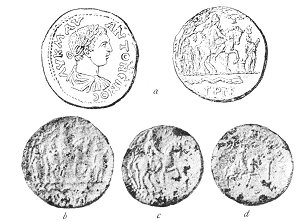
cumom04

Fig. 2.
IMPERIAL COINS OF TRAPEZUS (TREBIZOND), A CITY OF PONTUS.

Representing a divinity on horseback resembling both Men and Mithra, and showing that in Pontus the two were identified.

a. Bronze coins. Obverse: Bust of Alexander Severus, clad in a paludamentum; head crowned with laurel. Reverse: The composite Men-Mithra in Oriental costume, wearing a Phrygian cap, and mounted on a horse that advances toward the right. In front, a flaming altar. On either side, the characteristic Mithraic torches, respectively elevated and reversed. At the right, a tree with branches overspreading the horseman. In front, a raven bending towards him. (218 A.D.)

b. A similar coin.

c. Obverse: Alexander Severus. Reverse: Men-Mithra on horseback advancing towards the right. In the foreground, a flaming altar; in the roar, a tree upon which a raven is perched.

d. A similar coin, having on its obverse the bust of Gordianus III.
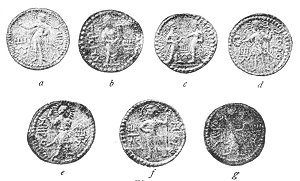
cumom04

Fig. 3.
BACTRIAN COINS.

On the coins of the Scythian kings Kanerkes and Hooerkes, who reigned over Kabul and the Northwest of India from 87 to 120 A.D., the image of Mithra is found in company with those of other Persian, Greek, and Hindu gods. These coins have little direct connection with the Mysteries as they appeared in the Occident, but they merit our attention as being the only representations of Mithra which are found outside the boundaries of the Roman world.

a. Obverse: An image of King Kanerkes. Reverse: An image of Mithra.

b. The obverse has a bust of King Hooerkes, and the reverse an image of Mithra as a goddess.

c. Bust of Hooerkes with a lunar and a solar god (Mithra) on its reverse side.

d. Bust of Hooerkes, with Mithra alone on its reverse.

e, f, g. Similar coins.

When, as the outcome of the expedition of Alexander (334-323 B.C.), the civilization of Greece spread throughout all Hither Asia, it impressed itself upon Mazdaism as far east as Bactriana. Nevertheless, Iranism, if we may employ such a designation, never surrendered to Hellenism. Iran proper soon recovered its moral autonomy, as well as its political independence; and generally speaking, the power of resistance offered by Persian traditions to an assimilation which was elsewhere easily effected is one of the most salient traits of the history of the relations of Greece with the Orient. But the Magi of Asia Minor, being much nearer to the great foci of Occidental culture, were more vividly illumined by their radiation. Without suffering themselves to be absorbed by the religion of the conquering strangers, they combined their cults with it. In order to harmonize their barbaric beliefs with the Hellenic ideas, recourse was had to the ancient practice of identification. They strove to demonstrate that the Mazdean heaven was inhabited by the same denizens as Olympus: Ahura-Mazda as Supreme Being was confounded with Zeus; Verethraghna, the victorious hero, with Heracles; Anita, to whom the bull was consecrated, became Artemis Tauropolos, and the identification went so far as to localize in her temples the fable of Orestes. Mithra, already regarded in Babylon as the peer of Shamash, was naturally associated with Helios; but he was not subordinated to him, and his Persian name was never replaced in the liturgy by a translation, as had been the case with the other divinities worshipped in the Mysteries.
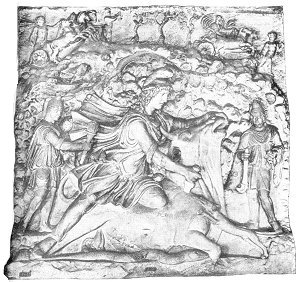
cumom04

Fig. 4
TYPICAL REPRESENTATION OF MITHRA.
(Famous Borghesi bas-relief in white marble, now in the Louvre, Paris, but originally taken from the mithrm of the Capitol.)

Mithra is sacrificing the bull in the cave. The characteristic features of the Mithra monuments are all represented here: the youths with the upright and the inverted torch, the snake, the dog, the raven, Helios, the god of the sun, and Selene, the goddess of the moon. Owing to the Phrygian cap, the resemblance of the face to that of Alexander, and the imitation of the motif of the classical Greek group of Nike sacrificing a bull,--all characteristics of the Diadochian epoch,--the original of all the works of this type has been attributed to an artist of Pergamon. (T. et M., p. 194.)
cumom04

Fig. 5.
TAUROCTONOUS MITHRA.

Artistic Type.

(Bas-relief, formerly in domo AndreCinquin now in St. Petersburg.

The synonomy thus speciously established between appellations having no relationship did not remain the exclusive diversion of the mythologists; it was attended with the grave consequence that the vague personifications conceived by the Oriental imagination now assumed the precise forms with which the Greek artists had invested the Olympian gods.

cumom04

Fig. 6.
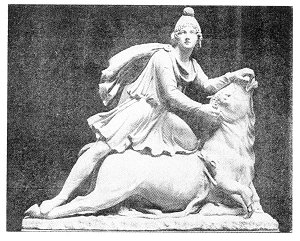
TAUROCTONOUS MITHRA.

Artistic Type (Second Century).

(Grand group of white marble, now in the Vatican.

Possibly they had never before been represented in the guise of the human form, or if images of them existed in imitation of the Assyrian idols they were doubtless both grotesque and crude. In thus imparting to the Mazdean heroes all the seductiveness of the Hellenic ideal, the conception of their character was necessarily modified; and, pruned of their exotic features, they were rendered more readily acceptable to the Occidental peoples. One of the indispensable conditions for the success of this exotic religion in the Roman world was fulfilled when towards the second century before our era a sculptor of the school of Pergamon composed the pathetic group of Mithra Tauroctonos, to which universal custom thenceforward reserved the place of honor in the apse of the spel. 10
cumom04

Fig. 7.
TAUROCTONOUS MITHRA.

Early Artistic Type.

(Bas-relief of white marble, Rome, now in the Museum of Fine Arts, Boston.)

But not only did art employ its powers to soften the repulsive features which these rude Mysteries might possess for minds formed in the schools of Greece; philosophy also strove to reconcile their doctrines with its teachings, or rather the Asiatic priests pretended to discover in their sacred traditions the theories of the philosophic sects. None of these sects so readily lent itself to alliance with the popular devotion as that of the Stoa, and its influence on the formation of Mithraism was profound. An ancient myth sung by the Magi is quoted by Dion Chrysostomos 11 on account of its allegorical resemblance to the Stoic cosmology; and many other Persian ideas were similarly modified by the pantheistic conceptions of the disciples of Zeno. Thinkers accustomed themselves more and more to discovering in the dogmas and liturgic usages of the Orientals the obscure reflections of an ancient wisdom, and these tendencies harmonized too much with the pretensions and the interest of the Mazdean clergy not to be encouraged by them with every means in their power.

But if philosophical speculation transformed the character of the beliefs of the Magi, investing them with a scope which they did not originally possess, its influence was nevertheless upon the whole conservative rather than revolutionary. The very fact that it invested legends which were ofttimes puerile with a symbolical significance, that it furnished rational explanations for usages which were apparently absurd, did much towards insuring their perpetuity. If the theological foundation of the religion was sensibly modified, its liturgic framework remained relatively fixed, and the changes wrought in the dogma were in accord with the reverence due to the ritual. The superstitious formalism of which the minute prescriptions of the Vendidad were the expression is certainly prior to the period of the Sassanids. The sacrifices which the Magi of Cappadocia offered in the time of Strabo (circa 63 B.C.-21 A.D.) are reminiscent of all the peculiarities of the Avestan liturgy. It was the same psalmodic prayers before the altar of fire; and the same bundle of sacred twigs (baresman); the same oblations of milk, oil, and honey; the same precautions lest the breath of the officiating priest should contaminate the divine flame. The inscription of Antiochus of Commagene (69-34 B.C.) in the rules that it prescribes gives evidence of a like scrupulous fidelity to the ancient Iranian customs. The king exults in having always honored the gods of his ancestors according to the tradition of the Persians and the Greeks; he expresses the desire that the priests established in the new temple shall wear the sacerdotal vestments of the same Persians, and that they shall officiate conformably to the ancient sacred custom. The sixteenth day of each month, which is to be specially celebrated, is not to be the birthday of the king alone, but also the day which from time immemorial was specially consecrated to Mithra.

cumom04

Fig. 8.
KING ANTIOCHUS AND AHURA-MAZDA.

(Bas-relief of the temple of Antiochus I. of Commagene, 69-34 B.C., on the Nemrood Dagh, a spur of the Taurus Mountains.

Many, many years after, another Commagenean, Lucian of Samosata, in a passage apparently inspired by practices he had witnessed in his own country, could still deride the repeated purifications, the interminable chants, and the long Medean robes of the sectarians of Zoroaster. 12 Furthermore, he taunted them with being ignorant even of Greek and with mumbling an incoherent and unintelligible gibberish. 13

The conservative spirit of the Magi of Cappadocia, which bound them to the time-worn usages that had been handed down from generation to generation, abated not one jot of its power after the triumph of Christianity; and St. Basil 14 has recorded the fact of its persistence as late as the end of the fourth century. Even in Italy it is certain that the Iranian Mysteries never ceased to retain a goodly proportion of the ritual forms that Mazdaism had observed in Asia Minor time out of mind. 15 The principal innovation consisted in substituting for the Persian as the liturgic language, the Greek, and later perhaps the Latin. This reform presupposes the existence of sacred books, and it is probable that subsequently to the Alexandrian epoch the prayers and canticles that had been originally transmitted orally were committed to writing, lest their memory should fade forever. But this necessary accommodation to the new environments did not prevent Mithraism from preserving to the very end a ceremonial which was essentially Persian.

The Greek name of "Mysteries" which writers have applied to this religion should not mislead us. The adepts of Mithraism did not imitate the Hellenic cults in the organization of their secret societies, the esoteric doctrine of which was made known only after a succession of graduated initiations. In Persia itself the Magi constituted an exclusive caste, which appears to have been subdivided into several subordinate classes. And those of them who took up their abode in the midst of foreign nations different in language and manners were still more jealous in concealing their hereditary faith from the profane. The knowledge of their arcana gave them a lofty consciousness of their moral superiority and insured their prestige over the ignorant populations that surrounded them. It is probable that the Mazdean priesthood in Asia Minor as in Persia was primitively the hereditary attribute of a tribe, in which it was handed down from father to son; that afterwards its incumbents consented, after appropriate ceremonies of initiation, to communicate its secret dogmas to strangers, and that these proselytes were then gradually admitted to all the different ceremonies of the cult. The Iranian diaspora is comparable in this respect, as in many others, with that of the Jews. Usage soon distinguished between the different classes of neophytes, ultimately culminating in the establishment of a fixed hierarchy. But the complete revelation of the sacred beliefs and practices was always reserved for the privileged few; and this mystic knowledge appeared to increase in excellence in proportion as it became more occult.

All the original rites that characterized the Mithraic cult of the Romans unquestionably go back to Asiatic origins: the animal disguises used in certain ceremonies are a survival of a very widely-diffused prehistoric custom which still survives in our day; the practice of consecrating mountain caves to the god is undoubtedly a heritage of the time when temples were not yet constructed; the cruel tests imposed on the initiated recall the bloody mutilations that the servitors of Mand of Cybele perpetrated. Similarly, the legends of which Mithra is the hero cannot have been invented save in a pastoral epoch. These antique traditions of a primitive and crude civilization subsist in the Mysteries by the side of a subtle theology and a lofty system of ethics.

An analysis of the constituent elements of Mithraism, like a cross-section of a geological formation, shows the stratifications of this composite mass in their regular order of deposition. The basal layer of this religion, its lower and primordial stratum, is the faith of ancient Iran, from which it took its origin.

Above this Mazdean substratum was deposited in Babylon a thick sediment of Semitic doctrines, and afterwards the local beliefs of Asia Minor added to it their alluvial deposits. Finally, a luxuriant vegetation of Hellenic ideas burst forth from this fertile soil and partly concealed from view its true original nature.

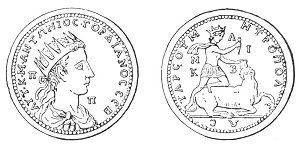
This composite religion, in which so many heterogeneous elements were welded together, is the adequate expression of the complex civilization that flourished in the Alexandrian epoch in Armenia, Cappadocia, and Pontus. If Mithridates Eupator had realized his ambitious dreams, this Hellenized Parseeism would doubtless have become the state-religion of a vast Asiatic empire. But the course of its destinies was changed by the vanquishment of this great adversary of Rome (66 B.C.). The dris of the Pontic armies and fleets, the fugitives driven out by the war and flocking in from all parts of the Orient, disseminated the Iranian Mysteries among that nation of pirates that rose to power under the protecting shelter of the mountains of Cilicia. Mithra became firmly established in this country, in which Tarsus continued to worship him until the downfall of the empire (Figure 9). Supported by its bellicose religion, this republic of adventurers dared to dispute the supremacy of the seas with the Roman colossus. Doubtless they considered themselves the chosen nation, destined to carry to victory the religion of the invincible god. Strong in the consciousness of his protection, these audacious mariners boldly pillaged the most venerated sanctuaries of Greece and Italy, and the Latin world rang for the first time with the name of the barbaric divinity that was soon to impose upon it his adoration.
cumom04

Fig. 9.
MITHRAIC MEDALLION OF BRONZE FROM TARSUS, CILICIA.

Obverse: Bust of Gordianus III., clad in a paludamentum and wearing a rayed crown. Reverse: Mithra, wearing a rayed crown and clad in a floating chlamys, a tunic covered by a breast-plate, and anaxyrides (trousers), seizes with his left band the nostrils of the bull, which he has forced to its knees, while in his right hand he holds aloft a knife with which he is about to slay the animal.

Footnotes

1 Oldenberg, Die Religion des Veda, 1894, p. 185.
2 Zend-Avesta, Yasht, X., Passim.
3 Yasht, X., 103.
4 Plutarch, De Iside et Osiride, 46-47; Textes et monuments, Vol. II., p. 33.
5 West, Pahlavi Texts, I. (also, Sacred Books of the East, V.), 1890, p. 3, et seq.
6 Ctesias apud Athen., X., 45 (Textes et monuments, hereafter cited as "T. et M.," Vol. II., p. 10).
7 Ptol., Tetrabibl., II., 2.
8 Michel, Recueil inscr. gr., No. 735. Compare T. et M., Vol. II., p. 89, No. 1.
9 M. Jean Rille (udes de thlogie et d'hist. publ. en hommage la facultde Montauban, Paris 1901, p. 336) is inclined to accord a considerable share in the formation of Mithraism to the religions of Asia; but it is impossible in the present state of our knowledge to form any estimate of the extent of this influence.
10 Compare the Chapter on ''Mithraic Art."
11 Dion Chrys., Or., XXXVI., 39, et seq. (T. et M., Vol. II., p. 60, No. 461).
12 Luc., Menipp., c. 6 (T. et M., Vol. II., p. 22).
13 Luc., Deorum conc., c. 9, Jup. Trag., c. 8, c. 13 (T. et M., ibid.)
14 Basil., Epist. 238 ad Epiph. (T. et M., Vol. I., p. 10, No. 3). Compare Priscus, fr. 31 (I. 342 Hist. min., Dind.).
15 See the Chapter on "Liturgy, Clergy."

The Origin and Deeds of the Goths, Index

JORDANES

THE ORIGIN AND DEEDS OF THE GOTHS

551 AD

translated by Charles C. Mierow

Princeton University Press, 1915

Introductory Note

Jordanes, as he himself tells us a couple of times, was of Gothic descent and wrote this work as a summary of Cassiodorus' much longer treatment of the history of the Goths. Because Cassiodorus' book no longer survives, Jordanes' treatment is often our only source for some of the Gothic history it describes. He wrote the Getica during the later stages of the reign of Justinian, not too long after the demise of the Ostrogothic kingdom in Italy.

Jordanes divided his work, apart from the brief introduction and conclusion, into four main sections (reflected in the contents below). These are :

1) a Geographical Introduction;

2) the United Goths;

3) the Visigoths;

4) and the Ostrogoths.

Other large sections, such as the discussion of the Huns, he treats as digressions of a sort (the more interesting or important of these have been added to the contents below). Mierow prefaces his translation with a detailed literary analysis of all the topics in the text; this is not, however, reproduced here.

The text of the translation presented here was scanned from a printed copy of Mierow's book and checked carefully for errors (a few misprints in that book have been corrected as well). This hypertext version has been designed for the use of students of Ancient History at the University of Calgary. I have included the (Roman) chapter and (arabic) section numbers to facilitate specific citation (or to find a specific reference; these numbers may be found in Mierow's translation as well, though the section numbers are in his margins) and have added internal links for purposes of navigation.

J. Vanderspoel,

Department of Greek, Latin and Ancient History, University of Calgary

Contents

  1. Preface

  2. Geographical Introduction

  3. The United Goths

  4. The Goths in the Third Century A.D.

  5. Origin of the Huns

  6. The Divided Goths (Visigoths)

  7. Attila the Hun; The Battle of the Catalaunian Fields

  8. The Divided Goths (Ostrogoths)

  9. Conclusion

The Origin and Deeds of the Goths, Conclusions

JORDANES

THE ORIGIN AND DEEDS OF THE GOTHS

551 AD

translated by Charles C. Mierow

Princeton University Press, 1915

Conclusion

And now we have recited the origin of the Goths, the noble line of the Amali and the deeds of brave men. This glorious race yielded to a more glorious prince and surrendered to a more valiant leader, whose fame shall be silenced by no ages or cycles of years; for the victorious and triumphant Emperor Justinian and his consul Belisarius shall be named and known as Vandalicus, Africanus and Geticus.

Thou who readest this, know that I have followed the writings of my ancestors, and have culled a few flowers from their broad meadows to weave a chaplet for him who cares to know these things. Let no one believe that to the advantage of the race of which I have spoken--though indeed I trace my own descent from it--I have added aught besides what I have read or learned by inquiry. Even thus I have not included all that is written or told about them, nor spoken so much to their praise as to the glory of him who conquered them.

The Origin and Deeds of the Goths, The Divided Goths: Ostrogoths

JORDANES

THE ORIGIN AND DEEDS OF THE GOTHS

551 AD

translated by Charles C. Mierow

Princeton University Press, 1915

The Divided Goths: Ostrogoths

Since I have followed the stories of my ancestors and retold to the best of my ability the tale of the period when both tribes, Ostrogoths and Visigoths, were united, and then clearly treated of the Visigoths apart from the Ostrogoths, I must now return to those ancient Scythian abodes and set forth in like manner the ancestry and deeds of the Ostrogoths. It appears that at the death of their king, Hermanaric, they were made a separate people by the departure of the Visigoths, and remained in their country subject to the sway of the Huns; yet Vinitharius of the Amali retained the insignia of his rule.

He rivalled the valor of his grandfather Vultuulf, although he had not the good fortune of Hermanaric. But disliking to remain under the rule of the Huns, he withdrew a little from them and strove to show his courage by moving his forces against the country of the Antes. When he attacked them, he was beaten in the first encounter. Thereafter he did valiantly and, as a terrible example, crucified their king, named Boz, together with his sons and seventy nobles, and left their bodies hanging there to double the fear of those who had surrendered.

When he had ruled with such license for barely a year, Balamber, king of the Huns, would no longer endure it, but sent for Gesimund, son of Hunimund the Great. Now Gesimund, together with a great part of the Goths, remained under the rule of the Huns, being mindful of his oath of fidelity. Balamber renewed his alliance with him and led his army up against Vinitharius. After a long contest, Vinitharius prevailed in the first and in the second conflict, nor can any say how great a slaughter he made of the army of the Huns.

But in the third battle, when they met each other unexpectedly at the river named Erac, Balamber shot an arrow and wounded Vinitharius in the head, so that he died. Then Balamber took to himself in marriage Vadamerca, the grand-daughter of Vinitharius, and finally ruled all the people of the Goths as his peaceful subjects, but in such a way that one ruler of their own number always held the power over the Gothic race, though subject to the Huns.

And later, after the death of Vinitharius, Hunimund ruled them, the son of Hermanaric, a mighty king of yore; a man fierce in war and of famous personal beauty, who afterwards fought successfully against the race of the Suavi. And when he died, his son Thorismud succeeded him, in the very bloom of youth. In the second year of his rule he moved an army against the Gepidae and won a great victory over them, but is said to have been killed by falling from his horse.

When he was dead, the Ostrogoths mourned for him so deeply that for forty years no other king succeeded in his place, and during all this time they had ever on their lips the tale of his memory. Now as time went on, Valamir grew to man's estate. He was the son of Thorismud's cousin Vandalarius. For his son Beremud, as we have said before, at last grew to despise the race of the Ostrogoths because of the overlordship of the Huns, and so had followed the tribe of the Visigoths to the western country, and it was from him Veteric was descended. Veteric also had a son Eutharic, who married Amalasuentha, the daughter of Theodoric, thus uniting again the stock of the Amali which had divided long ago. Eutharic begat Athalaric and Mathesuentha. But since Athalaric died in the years of his boyhood, Mathesuentha was taken to Constantinople by her second husband, namely Germanus, a cousin of the Emperor Justinian, and bore a posthumous son, whom she named Germanus.

But that the order we have taken for our history may run its due course, we must return to the stock of Vandalarius, which put forth three branches. This Vandalarius, the son of a brother of Hermanaric and cousin of the aforesaid Thorismud, vaunted himself among the race of the Amali because he had begotten three sons, Valamir, Thiudimer and Vidimer. Of these Valamir ascended the throne after his parents, though the Huns as yet held the power over the Goths in general as among other nations.

It was pleasant to behold the concord of these three brothers; for the admirable Thiudimer served as a soldier for the empire of his brother Valamir, and Valamir bade honors be given him, while Vidimer was eager to serve them both. Thus regarding one another with common affection, not one was wholly deprived of the kingdom which two of them held in mutual peace. Yet, as has often been said, they ruled in such a way that they respected the dominion of Attila, king or the Huns. Indeed they could not have refused to fight against their kinsmen the Visigoths, and they must even have committed parricide at their lord's command. There was no way whereby any Scythian tribe could have been wrested from the power of the Huns, save by the death of Attila,--an event the Romans and all other nations desired. Now his death was as base as his life was marvellous.

Shortly before he died, as the historian Priscus relates, he took in marriage a very beautiful girl named Ildico, after countless other wives, as was the custom of his race. He had given himself up to excessive joy at his wedding, and as he lay on his back, heavy with wine and sleep, a rush of superfluous blood, which would ordinarily have flowed from his nose, streamed in deadly course down his throat and killed him, since it was hindered in the usual passages. Thus did drunkenness put a disgraceful end to a king renowned in war. On the following day, when a great part of the morning was spent, the royal attendants suspected some ill and, after a great uproar, broke in the doors. There they found the death of Attila accomplished by an effusion of blood, without any wound, and the girl with downcast face weeping beneath her veil.

Then, as is the custom of that race, they plucked out the hair of their heads and made their faces hideous with deep wounds, that the renowned warrior might be mourned, not by effeminate wailings and tears, but by the blood of men. Moreover a wondrous thing took place in connection with Attila's death. For in a dream some god stood at the side of Marcian, Emperor of the East, while he was disquieted about his fierce foe, and showed him the bow of Attila broken in that same night, as if to intimate that the race of Huns owed much to that weapon. This account the historian Priscus says he accepts upon truthful evidence. For so terrible was Attila thought to be to great empires that the gods announced his death to rulers as a special boon.

We shall not omit to say a few words about the many ways in which his shade was honored by his race. His body was placed in the midst of a plain and lay in state in a silken tent as a sight for men's admiration. The best horsemen of the entire tribe of the Huns rode around in circles, after the manner of circus games, in the place to which he had been brought and told of his deeds in a funeral dirge in the following manner:

"The chief of the Huns, King Attila, born of his sire Mundiuch, lord of bravest tribes, sole possessor of the Scythian and German realms--powers unknown before--captured cities and terrified both empires of the Roman world and, appeased by their prayers, took annual tribute to save the rest from plunder. And when he had accomplished all this by the favor of fortune, he fell, not by wound of the foe, nor by treachery of friends, but in the midst of his nation at peace, happy in his joy and without sense of pain. Who can rate this as death, when none believes it calls for vengeance?"

When they had mourned him with such lamentations, a strava, as they call it, was celebrated over his tomb with great revelling. They gave way in turn to the extremes of feeling and displayed funereal grief alternating with joy. Then in the secrecy of night they buried his body in the earth. They bound his coffins, the first with gold, the second with silver and the third with the strength of iron, showing by such means that these three things suited the mightiest of kings; iron because he subdued the nations, gold and silver because he received the honors of both empires. They also added the arms of foemen won in the fight, trappings of rare worth, sparkling with various gems, and ornaments of all sorts whereby princely state is maintained. And that so great riches might be kept from human curiosity, they slew those appointed to the work--a dreadful pay for their labor; and thus sudden death was the lot of those who buried him as well as of him who was buried.

After they had fulfilled these rites, a contest for the highest place arose among Attila's successors,--for the minds of young men are wont to be inflamed by ambition for power,--and in their rash eagerness to rule they all alike destroyed his empire. Thus kingdoms are often weighed down by a superfluity rather than by a lack of successors. For the sons of Attila, who through the license of his lust formed almost a people of themselves, were clamoring that the nations should be divided among them equally and that warlike kings with their peoples should be apportioned to them by lot like a family estate.

When Ardaric, king of the Gepidae, learned this, he became enraged because so many nations were being treated like slaves of the basest condition, and was the first to rise against the sons of Attila. Good fortune attended him, and he effaced the disgrace of servitude that rested upon him. For by his revolt he freed not only his own tribe, but all the others who were equally oppressed; since all readily strive for that which is sought for the general advantage. They took up arms against the destruction that menaced all and joined battle with the Huns in Pannonia, near a river called Nedao.

There an encounter took place between the various nations Attila had held under his sway. Kingdoms with their peoples were divided, and out of one body were made many members not responding to a common impulse. Being deprived of their head, they madly strove against each other. They never found their equals ranged against them without harming each other by wounds mutually given. And so the bravest nations tore themselves to pieces. For then, I think, must have occurred a most remarkable spectacle, where one might see the Goths fighting with pikes, the Gepidae raging with the sword, the Rugi breaking off the spears in their own wounds, the Suavi fighting on foot, the Huns with bows, the Alani drawing up a battle-line of heavy-armed and the Heruli of light-armed warriors.

Finally, after many bitter conflicts, victory fell unexpectedly to the Gepidae. For the sword and conspiracy of Ardaric destroyed almost thirty thousand men, Huns as well as those of the other nations who brought them aid. In this battle fell Ellac, the elder son of Attila, whom his father is said to have loved so much more than all the rest that he preferred him to any child or even to all the children of his kingdom. But fortune was not in accord with his father's wish. For after slaying many of the foe, it appears that he met his death so bravely that, if his father had lived, he would have rejoiced at his glorious end.

When Ellac was slain, his remaining brothers were put to flight near the shore of the Sea of Pontus, where we have said the Goths first settled. Thus did the Huns give way, a race to which men thought the whole world must yield. So baneful a thing is division, that they who used to inspire terror when their strength was united, were overthrown separately. The cause of Ardaric, king of the Gepidae, was fortunate for the various nations who were unwillingly subject to the rule of the Huns, for it raised their long downcast spirits to the glad hope of freedom. Many sent ambassadors to the Roman territory, where they were most graciously received by Marcian, who was then emperor, and took the abodes allotted them to dwell in.

But the Gepidae by their own might won for themselves the territory of the Huns and ruled as victors over the extent of all Dacia, demanding of the Roman Empire nothing more than peace and an annual gift as a pledge of their friendly alliance. This the Emperor freely granted at the time, and to this day that race receives its customary gifts from the Roman Emperor.

Now when the Goths saw the Gepidae defending for themselves the territory of the Huns and the people of the Huns dwelling again in their ancient abodes, they preferred to ask for lands from the Roman Empire, rather than invade the lands of others with danger to themselves. So they received Pannonia, which stretches in a long plain, being bounded on the east by Upper Moesia, on the south by Dalmatia, on the west by Noricum and on the north by the Danube. This land is adorned with many cities, the first of which is Sirmium and the last Vindobona.

But the Sauromatae, whom we call Sarmatians, and the Cemandri and certain of the Huns dwelt in Castra Martis, a city given them in the region of Illyricum. Of this race was Blivila, Duke of Pentapolis, and his brother Froila and also Bessa, a Patrician in our time. The Sciri, moreover, and the Sadagarii and certain of the Alani with their leader, Candac by name, received Scythia Minor and Lower Moesia.

Paria, the father of my father Alanoviiamuth (that is to say, my grandfather), was secretary to this Candac as long as he lived. To his sister's son Gunthigis, also called Baza, the Master of the Soldiery, who was the son of Andag the son of Andela, who was descended from the stock of the Amali, I also, Jordanes, although an unlearned man before my conversion, was secretary. The Rugi, however, and some other races asked that they might inhabit Bizye and Arcadiopolis. Hernac, the younger son of Attila, with his followers, chose a home in the most distant part of Lesser Scythia. Emnetzur and Ultzindur, kinsmen of his, won Oescus and Utus and Almus in Dacia on the bank of the Danube, and many of the Huns, then swarming everywhere, betook themselves into Romania, and from them the Sacromontisi and the Fossatisii of this day are said to be descended.

There were other Goths also, called the Lesser, a great people whose priest and primate was Vulfila, who is said to have taught them to write. And to-day they are in Moesia, inhabiting the Nicopolitan region as far as the base of Mount Haemus. They are a numerous people, but poor and unwarlike, rich in nothing save flocks of various kinds and pasture-lands for cattle and forests for wood. Their country is not fruitful in wheat and other sorts of grain. Certain of them do not know that vineyards exist elsewhere, and they buy their wine from neighboring countries. But most of them drink milk.

Let us now return to the tribe with which we started, namely the Ostrogoths, who were dwelling in Pannonia under their king Valamir and his brothers Thiudimer and Vidimer. Although their territories were separate, yet their plans were one. For Valamir dwelt between the rivers Scarniunga and Aqua Nigra, Thiudimer near Lake Pelso and Vidimer between them both. Now it happened that the sons of Attila, regarding the Goths as deserters from their rule, came against them as though they were seeking fugitive slaves, and attacked Valamir alone, when his brothers knew nothing of it.

He sustained their attack, though he had but few supporters, and after harassing them a long time, so utterly overwhelmed them that scarcely any portion of the enemy remained. The remnant turned in flight and sought the parts of Scythia which border on the stream of the river Danaper, which the Huns call in their own tongue the Var. Thereupon he sent a messenger of good tidings to his brother Thiudimer, and on the very day the messenger arrived he found even greater joy in the house of Thiudimer. For on that day his son Theodoric was born, of a concubine Erelieva indeed, and yet a child of good hope.

Now after no great time King Valamir and his brothers Thiudimer and Vidimer sent an embassy to the Emperor Marcian, because the usual gifts which they received like a New Year's present from the Emperor, to preserve the compact of peace, were slow in arriving. And they found that Theodoric, son of Triarius, a man of Gothic blood also, but born of another stock, not of the Amali, was in great favor, together with his followers. He was allied in friendship with the Romans and obtained an annual bounty, while they themselves were merely held in disdain.

Thereat they were aroused to frenzy and took up arms. They roved through almost the whole of Illyricum and laid it waste in their search for spoil. Then the Emperor quickly changed his mind and returned to his former state of friendship. He sent an embassy to give them the past gifts, as well as those now due, and furthermore promised to give these gifts in future without any dispute. From the Goths the Romans received as a hostage of peace Theodoric, the young child of Thiudimer, whom we have mentioned above. He had now attained the age of seven years and was entering upon his eighth. While his father hesitated about giving him up, his uncle Valamir besought him to do it, hoping that peace between the Romans and the Goths might thus be assured. Therefore Theodoric was given as a hostage by the Goths and brought to the city of Constantinople to the Emperor Leo and, being a goodly child, deservedly gained the imperial favor.

Now after firm peace was established between Goths and Romans, the Goths found that the possessions they had received from the Emperor were not sufficient for them. Furthermore, they were eager to display their wonted valor, and so began to plunder the neighboring races round about them, first attacking the Sadagis who held the interior of Pannonia. When Dintzic, king of the Huns, a son of Attila, learned this, he gathered to him the few who still seemed to have remained under his sway, namely, the Ultzinzures, and Angisciri, the Bittugures and the Bardores. Coming to Bassiana, a city of Pannonia, he beleaguered it and began to plunder its territory.

Then the Goths at once abandoned the expedition they had planned against the Sadagis, turned upon the Huns and drove them so ingloriously from their own land that those who remained have been in dread of the arms of the Goths from that time down to the present day.

When the tribe of the Huns was at last subdued by the Goths, Hunimund, chief of the Suavi, who was crossing over to plunder Dalmatia, carried off some cattle of the Goths which were straying over the plains; for Dalmatia was near Suavia and not far distant from the territory of Pannonia, especially that part where the Goths were then staying.

So then, as Hunimund was returning with the Suavi to his own country, after he had devastated Dalmatia, Thiudimer the brother of Valamir, king of the Goths, kept watch on their line of march. Not that he grieved so much over the loss of his cattle, but he feared that if the Suavi obtained this plunder with impunity, they would proceed to greater license. So in the dead of night, while they were asleep, he made an unexpected attack upon them, near Lake Pelso. Here he so completely crushed them that he took captive and sent into slavery under the Goths even Hunimund, their king, and all of his army who had escaped the sword. Yet as he was a great lover of mercy, he granted pardon after taking vengeance and became reconciled to the Suavi. He adopted as his son the same man whom he had taken captive, and sent him back with his followers into Suavia.

But Hunimund was unmindful of his adopted father's kindness. After some time he brought forth a plot he had contrived and aroused the tribe of the Sciri, who then dwelt above the Danube and abode peaceably with the Goths. So the Sciri broke off their alliance with them, took up arms, joined themselves to Hunimund and went out to attack the race of the Goths. Thus war came upon the Goths who were expecting no evil, because they relied upon both of their neighbors as friends. Constrained by necessity they took up arms and avenged themselves and their injuries by recourse to battle.

In this battle, as King Valamir rode on his horse before the line to encourage his men, the horse was wounded and fell, overthrowing its rider. Valamir was quickly pierced by his enemies' spears and slain. Thereupon the Goths proceeded to exact vengeance for the death of their king, as well as for the injury done them by the rebels. They fought in such wise that there remained of all the race of the Sciri only a few who bore the name, and they with disgrace. Thus were all destroyed.

The kings [of the Suavi], Hunimund and Alaric, fearing the destruction that had come upon the Sciri, next made war upon the Goths, relying upon the aid of the Sarmatians, who had come to them as auxiliaries with their kings Beuca and Babai. They summoned the last remnants of the Sciri, with Edica and Hunuulf, their chieftains, thinking they would fight the more desperately to avenge themselves. They had on their side the Gepidae also, as well as no small reforcements from the race of the Rugi and from others gathered here and there. Thus they brought together a great host at the river Bolia in Pannonia and encamped there.

Now when Valamir was dead, the Goths fled to Thiudimer, his brother. Although he had long ruled along with his brothers, yet he took the insignia of his increased authority and summoned his younger brother Vidimer and shared with him the cares of war, resorting to arms under compulsion. A battle was fought and the party of the Goths was found to be so much the stronger that the plain was drenched in the blood of their fallen foes and looked like a crimson sea. Weapons and corpses, piled up like hills, covered the plain for more than ten miles.

When the Goths saw this, they rejoiced with joy unspeakable, because by this great slaughter of their foes they had avenged the blood of Valamir their king and the injury done themselves. But those of the innumerable and motley throng of the foe who were able to escape, though they got away, nevertheless came to their own land with difficulty and without glory.

After a certain time, when the wintry cold was at hand, the river Danube was frozen over as usual. For a river like this freezes so hard that it will support like a solid rock an army of foot-soldiers and wagons and carts and whatsoever vehicles there may be,--nor is there need of skiffs and boats. So when Thiudimer, king of the Goths, saw that it was frozen, he led his army across the Danube and appeared unexpectedly to the Suavi from the rear. Now this country of the Suavi has on the east the Baiovari, on the west the Franks, on the south the Burgundians and on the north the Thuringians.

With the Suavi there were present the Alamanni, then their confederates, who also ruled the Alpine heights, whence several streams flow into the Danube, pouring in with a great rushing sound. Into a place thus fortified King Thiudimer led his army in the winter-time and conquered, plundered and almost subdued the race of the Suavi as well as the Alamanni, who were mutually banded together. Thence he returned as victor to his own home in Pannonia and joyfully received his son Theodoric, once given as hostage to Constantinople and now sent back by the Emperor Leo with great gifts.

Now Theodoric had reached man's estate, for he was eighteen years of age and his boyhood was ended. So he summoned certain of his father's adherents and took to himself from the people his friends and retainers,--almost six thousand men. With these he crossed the Danube, without his father's knowledge, and marched against Babai, king of the Sarmatians, who had just won a victory over Camundus, a general of the Romans, and was ruling with insolent pride. Theodoric came upon him and slew him, and taking as booty his slaves and treasure, returned victorious to his father. Next he invaded the city of Singidunum, which the Sarmatians themselves had seized, and did not return it to the Romans, but reduced it to his own sway.

Then as the spoil taken from one and another of the neighboring tribes diminished, the Goths began to lack food and clothing, and peace became distasteful to men for whom war had long furnished the necessaries of life. So all the Goths approached their king Thiudimer and, with great outcry, begged him to lead forth his army in whatsoever direction he might wish. He summoned his brother and, after casting lots, bade him go into the country of Italy, where at this time Glycerius ruled as emperor, saying that he himself as the mightier would go to the east against a mightier empire. And so it happened.

Thereupon Vidimer entered the land of Italy, but soon paid the last debt of fate and departed from earthly affairs, leaving his son and namesake Vidimer to succeed him. The Emperor Glycerius bestowed gifts upon Vidimer and persuaded him to go from Italy to Gaul, which was then harassed on all sides by various races, saying that their own kinsmen, the Visigoths, there ruled a neighboring kingdom. And what more? Vidimer accepted the gifts and, obeying the command of the Emperor Glycerius, pressed on to Gaul. Joining with his kinsmen the Visigoths, they again formed one body, as they had been long ago. Thus they held Gaul and Spain by their own right and so defended them that no other race won the mastery there.

But Thiudimer, the elder brother, crossed the river Savus with his men, threatening the Sarmatians and their soldiers with war if any should resist him. From fear of this they kept quiet; moreover they were powerless in the face of so great a host. Thiudimer, seeing prosperity everywhere awaiting him, invaded Naissus, the first city of Illyricum. He was joined by his son Theodoric and the Counts Astat and Invilia, and sent them to Ulpiana by way of Castrum Herculis.

Upon their arrival the town surrendered, as did Stobi later; and several places of Illyricum, inaccessible to them at first, were thus made easy of approach. For they first plundered and then ruled by right of war Heraclea and Larissa, cities of Thessaly. But Thiudimer the king, perceiving his own good fortune and that of his son, was not content with this alone, but set forth from the city of Naissus, leaving only a few men behind as a guard. He himself advanced to Thessalonica, where Hilarianus the Patrician, appointed by the Emperor, was stationed with his army.

When Hilarianus beheld Thessalonica surrounded by an entrenchment and saw that he could not resist attack, he sent an embassy to Thiudimer the king and by the offer of gifts turned him aside from destroying the city. Then the Roman general entered upon a truce with the Goths and of his own accord handed over to them those places they inhabited, namely Cyrrhus, Pella, Europus, Methone, Pydna, Beroea, and another which is called Dium.

So the Goths and their king laid aside their arms, consented to peace and became quiet. Soon after these events, King Thiudimer was seized with a mortal illness in the city of Cyrrhus. He called the Goths to himself, appointed Theodoric his son as heir of his kingdom and presently departed this life.

When the Emperor Zeno heard that Theodoric had been appointed king over his own people, he received the news with pleasure and invited him to come and visit him in the city, appointing an escort of honor. Receiving Theodoric with all due respect, he placed him among the princes of his palace. After some time Zeno increased his dignity by adopting him as his son-at-arms and gave him a triumph in the city at his expense. Theodoric was made Consul Ordinary also, which is well known to be the supreme good and highest honor in the world. Nor was this all, for Zeno set up before the royal palace an equestrian statue to the glory of this great man.

Now while Theodoric was in alliance by treaty with the Empire of Zeno and was himself enjoying every comfort in the city, he heard that his tribe, dwelling as we have said in Illyricum, was not altogether satisfied or content. So he chose rather to seek a living by his own exertions, after the manner customary to his race, rather than to enjoy the advantages of the Roman Empire in luxurious ease while his tribe lived in want. After pondering these matters, he said to the Emperor: "Though I lack nothing in serving your Empire, yet if Your Piety deem it worthy, be pleased to hear the desire of my heart."

And when as usual he had been granted permission to speak freely, he said: "The western country, long ago governed by the rule of your ancestors and predecessors, and that city which was the head and mistress of the world,--wherefore is it now shaken by the tyranny of the Torcilingi and the Rugi? Send me there with my race. Thus if you but say the word, you may be freed from the burden of expense here, and, if by the Lord's help I shall conquer, the fame of Your Piety shall be glorious there. For it is better that I, your servant and your son, should rule that kingdom, receiving it as a gift from you if I conquer, than that one whom you do not recognize should oppress your Senate with his tyrannical yoke and a part of the republic with slavery. For if I prevail, I shall retain it as your grant and gift; if I am conquered, Your Piety will lose nothing--nay, as I have said, it will save the expense I now entail."

Although the Emperor was grieved that he should go, yet when he heard this he granted what Theodoric asked, for he was unwilling to cause him sorrow. He sent him forth enriched by great gifts and commended to his charge the Senate and the Roman People.

Therefore Theodoric departed from the royal city and returned to his own people. In company with the whole tribe of the Goths, who gave him their unanimous consent, he set out for Hesperia. He went in straight march through Sirmium to the places bordering on Pannonia and, advancing into the territory of Venetia as far as the bridge of the Sontius, encamped there.

When he had halted there for some time to rest the bodies of his men and pack-animals, Odoacer sent an armed force against him, which he met on the plains of Verona and destroyed with great slaughter. Then he broke camp and advanced through Italy with greater boldness. Crossing the river Po, he pitched camp near the royal city of Ravenna, about the third milestone from the city in the place called Pineta. When Odoacer saw this, he fortified himself within the city. He frequently harassed the army of the Goths at night, sallying forth stealthily with his men, and this not once or twice, but often; and thus he struggled for almost three whole years.

But he labored in vain, for all Italy at last called Theodoric its lord and the Empire obeyed his nod. But Odoacer, with his few adherents and the Romans who were present, suffered daily from war and famine in Ravenna. Since he accomplished nothing, he sent an embassy and begged for mercy.

Theodoric first granted it and afterwards deprived him of his life.

It was in the third year after his entrance into Italy, as we have said, that Theodoric, by advice of the Emperor Zeno, laid aside the garb of a private citizen and the dress of his race and assumed a costume with a royal mantle, as he had now become the ruler over both Goths and Romans. He sent an embassy to Lodoin, king of the Franks, and asked for his daughter Audefleda in marriage.

Lodoin freely and gladly gave her, and also his sons Celdebert and Heldebert and Thiudebert, believing that by this alliance a league would be formed and that they would be associated with the race of the Goths. But that union was of no avail for peace and harmony, for they fought fiercely with each other again and again for the lands of the Goths; but never did the Goths yield to the Franks while Theodoric lived.

Now before he had a child from Audefleda, Theodoric had children of a concubine, daughters begotten in Moesia, one named Thiudigoto and another Ostrogotho. Soon after he came to Italy, he gave them in marriage to neighboring kings, one to Alaric, king of the Visigoths, and the other to Sigismund, king of the Burgundians.

Now Alaric begat Amalaric. While his grandfather Theodoric cared for and protected him--for he had lost both parents in the years of childhood--he found that Eutharic, the son of Veteric, grandchild of Beremud and Thorismud, and a descendant of the race of the Amali, was living in Spain, a young man strong in wisdom and valor and health of body. Theodoric sent for him and gave him his daughter Amalasuentha in marriage.

And that he might extend his family as much as possible, he sent his sister Amalafrida (the mother of Theodahad, who was afterwards king) to Africa as wife of Thrasamund, king of the Vandals, and her daughter Amalaberga, who was his own niece, he united with Herminefred, king of the Thuringians.

Now he sent his Count Pitza, chosen from among the chief men of his kingdom, to hold the city of Sirmium. He got possession of it by driving out its king Thrasaric, son of Thraustila, and keeping his mother captive. Thence he came with two thousand infantry and five hundred horsemen to aid Mundo against Sabinian, Master of the Soldiery of Illyricum, who at that time had made ready to fight with Mundo near the city named Margoplanum, which lies between the Danube and Margus rivers, and destroyed the Army of Illyricum.

For this Mundo, who traced his descent from the Attilani of old, had put to flight the tribe of the Gepidae and was roaming beyond the Danube in waste places where no man tilled the soil. He had gathered around him many outlaws and ruffians and robbers from all sides and had seized a tower called Herta, situated on the bank of the Danube. There he plundered his neighbors in wild license and made himself king over his vagabonds. Now Pitza came upon him when he was nearly reduced to desperation and was already thinking of surrender. So he rescued him from the hands of Sabinian and made him a grateful subject of his king Theodoric.

Theodoric won an equally great victory over the Franks through his Count Ibba in Gaul, when more than thirty thousand Franks were slain in battle. Moreover, after the death of his son-in-law Alaric, Theodoric appointed Thiudis, his armor-bearer, guardian of his grandson Amalaric in Spain. But Amalaric was ensnared by the plots of the Franks in early youth and lost at once his kingdom and his life. Then his guardian Thiudis, advancing from the same kingdom, assailed the Franks and delivered the Spaniards from their disgraceful treachery. So long as he lived he kept the Visigoths united.

After him Thiudigisclus obtained the kingdom and, ruling but a short time, met his death at the hands of his own followers. He was succeeded by Agil, who holds the kingdom to the present day. Athanagild has rebelled against him and is even now provoking the might of the Roman Empire. So Liberius the Patrician is on the way with an army to oppose him. Now there was not a tribe in the west that did not serve Theodoric while he lived, either in friendship or by conquest.

When he had reached old age and knew that he should soon depart this life, he called together the Gothic counts and chieftains of his race and appointed Athalaric as king. He was a boy scarce ten years old, the son of his daughter Amalasuentha, and he had lost his father Eutharic. As though uttering his last will and testament Theodoric adjured and commanded them to honor their king, to love the Senate and Roman People and to make sure of the peace and good will of the Emperor of the East, as next after God.

They kept this command fully so long as Athalaric their king and his mother lived, and ruled in peace for almost eight years. But as the Franks put no confidence in the rule of a child and furthermore held him in contempt, and were also plotting war, he gave back to them those parts of Gaul which his father and grandfather had seized. He possessed all the rest in peace and quiet. Therefore when Athalaric was approaching the age of manhood, he entrusted to the Emperor of the East both his own youth and his mother's widowhood. But in a short time the ill-fated boy was carried off by an untimely death and departed from earthly affairs.

His mother feared she might be despised by the Goths on account of the weakness of her sex. So after much thought she decided, for the sake of relationship, to summon her cousin Theodahad from Tuscany, where he led a retired life at home, and thus she established him on the throne. But he was unmindful of their kinship and, after a little time, had her taken from the palace at Ravenna to an island of the Bulsinian lake where he kept her in exile. After spending a very few days there in sorrow, she was strangled in the bath by his hirelings.

When Justinian, the Emperor of the East, heard this, he was aroused as if he had suffered personal injury in the death of his wards. Now at that time he had won a triumph over the Vandals in Africa, through his most faithful Patrician Belisarius. Without delay he sent his army under this leader against the Goths at the very time when his arms were yet dripping with the blood of the Vandals.

This sagacious general believed he could not overcome the Gothic nation, unless he should first seize Sicily, their nursing-mother. Accordingly he did so. As soon as he entered Trinacria, the Goths, who were besieging the town of Syracuse, found that they were not succeeding and surrendered of their own accord to Belisarius, with their leader Sinderith. When the Roman general reached Sicily, Theodahad sought out Evermud, his son-in-law, and sent him with an army to guard the strait which lies between Campania and Sicily and sweeps from a bend of the Tyrrhenian Sea into the vast tide of the Adriatic.

When Evermud arrived, he pitched his camp by the town of Rhegium. He soon saw that his side was the weaker. Coming over with a few close and faithful followers to the side of the victor and willingly casting himself at the feet of Belisarius, he decided to serve the rulers of the Roman Empire. When the army of the Goths perceived this, they distrusted Theodahad and clamored for his expulsion from the kingdom and for the appointment as king of their leader Vitiges, who had been his armor bearer.

This was done; and presently Vitiges was raised to the office of king on the Barbarian Plains. He entered Rome and sent on to Ravenna the men most faithful to him to demand the death of Theodahad. They came and executed his command. After King Theodahad was slain, a messenger came from the king--for he was already king in the Barbarian Plains--to proclaim Vitiges to the people.

Meanwhile the Roman army crossed the strait and marched toward Campania. They took Naples and pressed on to Rome. Now a few days before they arrived, King Vitiges had set forth from Rome, arrived at Ravenna and married Mathesuentha, the daughter of Amalasuentha and grand-daughter of Theodoric, the former king. While he was celebrating his new marriage and holding court at Ravenna, the imperial army advanced from Rome and attacked the strongholds in both parts of Tuscany. When Vitiges learned of this through messengers, he sent a force under Hunila, a leader of the Goths, to Perusia which was beleaguered by them.

While they were endeavoring by a long siege to dislodge Count Magnus, who was holding the place with a small force, the Roman army came upon them, and they themselves were driven away and utterly exterminated. When Vitiges heard the news, he raged like a lion and assembled all the host of the Goths. He advanced from Ravenna and harassed the walls of Rome with a long siege. But after fourteen months his courage was broken and he raised the siege of the city of Rome and prepared to overwhelm Ariminum.

Here he was baffled in like manner and put to flight; and so he retreated to Ravenna. When besieged there, he quickly and willingly surrendered himself to the victorious side, together with his wife Mathesuentha and the royal treasure.

And thus a famous kingdom and most valiant race, which had long held sway, was at last overcome in almost its two thousand and thirtieth year by that conquerer of many nations, the Emperor Justinian, through his most faithful consul Belisarius. He gave Vitiges the title of Patrician and took him to Constantinople, where he dwelt for more than two years, bound by ties of affection to the Emperor, and then departed this life.

But his consort Mathesuentha was bestowed by the Emperor upon the Patrician Germanus, his cousin. And of them was born a son (also called Germanus) after the death of his father Germanus. This union of the race of the Anicii with the stock of the Amali gives hopeful promise, under the Lord's favor, to both people.

Subscribe to this RSS feed

Log in or create an account