log in
LC Geerts

LC Geerts

Website URL:

Famous Men of the Middle Ages: Theodoric The Ostrogoth. King From 475-526

THEODORIC THE OSTROGOTH

KING FROM 475-526

I

THE Ostrogoths, or East Goths, who had settled in Southern Russia, at length pushed southward and westward to the mouth of the Danube.

They were continually invading countries belonging to the Romans and their warlike raids were dreaded by the emperors of the Eastern Roman Empire, who lived at Constantinople. One emperor gave them land and money, and thus stopped their invasions for a time.

The most famous of the Ostrogoth kings was Theodoric the Great. He was the son of Theodemir, who was also a king of the Ostrogoths. When Theodoric was eight years old he was sent to Constantinople to be held as a hostage by Leo, the Emperor of the East. In former times, when kings made treaties with one another, it was customary for one to give to the other a pledge or security that he would fulfill the conditions of the treaty. The pledge usually given was some important person or persons, perhaps the king's son or a number of his chief men. Persons so given as a security were called hostages. When Theodoric was a boy he was given as a hostage for his father's good faith in carrying out a treaty with the Emperor and was sent to Constantinople to live. Here the youth was well treated by Leo. He was educated with great care and trained in all the exercises of war.

Theodemir died in 475, and then Theodoric returned to his own country and became king of the Ostrogoths. At this time he was eighteen years of age. He was handsome and brave and people loved him, for in those days a man who was tall and strong and brave was liked by everybody.

II

FOR some years after he became king Theodoric had frequent wars with other Gothic kings and also with the Roman Emperor Zeno. He was nearly always successful in battle, and at last Zeno began to think it would be better to try to make friends with him. So he gave Theodoric some rich lands and made him commander of the Imperial Guard of Constantinople.

But the Emperor soon became tired of having the Ostrogoth king at his court, and to get rid of him he agreed that Theodoric should go with his army to Italy, and take that country from Odoacer. Theodoric was delighted at the proposal and began at once to make his preparations.

Odoacer was at that time king of Italy. Before he became king he had been a general in the army of Romulus Augustulus, the Western Roman Emperor. The soldiers of the army were not satisfied with their pay, and when they asked for more they did not get it. Then they drove Romulus Augustulus from the throne, and chose Odoacer to succeed him. But Odoacer would not take the name of emperor. He was called the "patrician" of Italy, and he ruled the country well.

Theodoric started for Italy, not only with a great army, but with all the people of his country. He meant to take Italy and be its king and settle in it with all his Ostrogoths. When he set out he had with him two hundred and fifty thousand persons--men, women, and children--with a great number of horses and wagons to carry them and their things. He had also an army of sixty thousand brave soldiers.

It was a long and weary journey from the shores of the Black Sea overland to the foot of the Alps Mountains and across the Alps into Italy. Here and there on the way they met savage tribes that tried to stop them, but Theodoric defeated the savages and took a great many of them prisoners. He made these prisoners, women as well as men, help carry the baggage and do other work.

fmma08

The journey took months, but at last the Ostrogoths reached the top of the Alps. Then they could see, stretched out before them, the beautiful land of Italy. They were all delighted. They shouted and danced with joy, and Theodoric cried out:

"There is the country which shall be our home. Let us march on. It certainly shall be ours."

Then they passed quickly down, and soon they were in Italy. Odoacer had heard of their coming and he got ready an army to drive them away. Theodoric also got his fighting men ready. The two armies met, and there was a great battle near the town of Aquileia. Odoacer was defeated. Then he tried to get Theodoric to leave Italy by offering him a large sum of money.

"I will give you," said he, "thousands of pounds of gold and silver if you agree to go back to your own country."

But Theodoric would not go. He said he had as good a right to be king of Italy as Odoacer, and he would remain and conquer the country and be its king. Soon after there was another battle, near Verona, and Odoacer was again defeated.

Theodoric came very near being killed in battle. He was saved only by the courage of his mother. She was in his camp, and at one time she saw a number of the Ostrogoths running away from that part of the battle-field where her son was fighting, thus leaving him without support. The mother rushed forward and stopped the fleeing men. She made them feel that it was a shame for them to desert their leader, and they at once returned to the field and fought beside their king until the battle was won.

After the battle of Verona, Odoacer went with his army to the city of Ravenna, and remained there for some time. Theodoric followed with his Ostrogoths and tried to take the city, but there was a very strong wall around it, and the Ostrogoths could not capture it. Although Theodoric was not able to take Ravenna, he did not remain idle. He marched off to other parts of the country, and took possession of towns and districts wherever he went.

After a while Odoacer got together a better army than he had before, and made another effort to defeat Theodoric. But he again failed. Theodoric defeated him in another great battle, which was fought on the banks of the River Adda. After this battle Odoacer again fled to Ravenna. Theodoric followed again and laid siege to the city. This time his army surrounded it and kept provisions from being sent in, and at last, when there was no food in the city for the soldiers or the people to eat, Odoacer had to surrender.

A treaty was then made between the two kings and both agreed that they should rule together over Italy, each to have equal power. But a few days afterwards Theodoric murdered Odoacer while sitting at a banquet, and then made himself the sole king of Italy. He divided one-third of the land of the country among his own followers. So the Ostrogoths settled in Italy, and Ostrogoths, Romans, and Visigoths were governed by Theodoric as one people.

Theodoric died at the age of seventy-one after ruling Italy for thirty-three years.

Famous Men of the Middle Ages: Genseric The Vandal. King From 427-477

GENSERIC THE VANDAL

KING FROM 427-477

I

THE Vandals were another wild and fierce tribe that came from the shores of the Baltic and invaded central and southern Europe in the later times of the Roman Empire.

In the fifth century some of these people occupied a region in the south of Spain. One of their most celebrated kings was name Genseric. He became king in 427, when he was but twenty-one years of age. He was lame in one leg and looked as if he were a very ordinary person.

Like most of the Vandals, he was a cruel and cunning man, but he had great ability in many ways. He fought in battles even when a boy and was known far and wide for his bravery and skill as a leader.

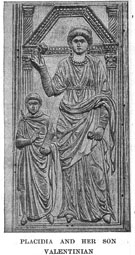
About the time that Genseric became king, the governor of the Roman province in the north of Africa, on the Mediterranean coast, was a man called Count Boniface. This Count Boniface had been a good and loyal officer of Rome; but a plot was formed against him by Aetius, the general who had fought Attila at Chalons. The Roman emperor at the time of the plot was Valentinian III. He was then too young to act as ruler, so the affairs of government were managed by his mother Placidia (Pla-cid'i-a).

fmma07

Aetius advised Placidia to dismiss Boniface and call him home from Africa. He said the count was a traitor, and that he was going to make war against Rome. At the same time he wrote secretly to Count Boniface and told him that if he came to Rome the empress would put him to death.

Boniface believed this story, and he refused to return to Rome. He also sent a letter to Genseric, inviting him to come to Africa with an army.

Genseric was greatly delighted to receive the invitation from Boniface. He had long wanted to attack Rome and take from her some of the rich countries she had conquered, and now a good opportunity offered. So he got ready a great army of his brave Vandals, and they sailed across the Strait of Gibraltar to Africa.

They soon gained possession of that part of the African coast on which they had landed, and marched into other parts of the coast and captured towns and cities. By this time Boniface had learned all about the wicked plot of Aetius. He now regretted having invited the Vandals to Africa and tried to induce them to return to Spain, but Genseric sternly refused.

"Never," he said, "shall I go back to Spain until I am master of Africa."

"Then," cried Boniface, "I will drive you back."

Soon afterwards there was a battle between the Romans and Vandals, and the Romans were defeated. They were also defeated in several other battles. At last they had to flee for safety to two or three towns which the Vandals had not yet taken. One of these towns was Hippo.

Genseric captured this town after a siege of thirteen months. Then he burned the churches and other buildings, and laid waste the neighboring country. This was what the Vandals did whenever they took a town, and so the word vandal came to mean a person who needlessly or wantonly destroys valuable property.

A great many of the natives of Africa joined the army of Genseric. They had for a long time been ill-treated by the Romans and were glad to see them defeated. Genseric continued his work of conquest until he took the city of Carthage, which he made the capital of his new kingdom in Africa.

But he was not content with conquering merely on land. He built great fleets and sailed over the Mediterranean, capturing trading vessels. For many years he plundered towns along the coasts, so that the name of Genseric became a terror to the people of all the countries bordering the Mediterranean.

II

ONE day a Roman ship came to Carthage with a messenger from the Empress Eudoxia to Genseric. Eudoxia was the widow of Valentinian III. After ruling several years, Valentinian had just been murdered by a Roman noble named Maximus, who had at once made himself emperor.

When the messenger entered the room where Genseric was, he said:

"Great king, I bring you a message from the Empress Eudoxia. She begs your help. She and her two beautiful daughters are in danger in Rome. She wishes you to protect them against Maximus. She invites you to come with an army to Rome and take the city. She and her friends will help you as much as they can."

With a cry of joy Genseric sprang to his feet and exclaimed:

"Tell the empress that I accept her invitation. I shall set out for Rome immediately. I shall protect Eudoxia and her friends."

Genseric then got ready a fleet and a great army, and sailed across the Mediterranean to the mouth of the Tiber. When the Emperor Maximus heard that the Vandals were coming he prepared to flee from the city, and he advised the Senate to do the same. The people were so angry at this that they put him to death and threw his body into the river.

fmma07

Three days later Genseric and his army were at the gates of Rome. There was no one to oppose them, and they marched in and took possession of the city. It was only forty-five years since Alaric had been there and carried off all the valuable things he could find. But since then Rome had become again grand and wealthy, so there was plenty for Genseric and his Vandals to carry away. They spent fourteen days in the work of plunder. They sacked the temples and public buildings and private houses and the emperor's palace, and they took off to their ships immense quantities of gold and silver and jewels and furniture, and destroyed hundreds of beautiful and priceless works of art.

The Vandal king also put to death a number of Roman citizens and carried away many more as slaves. He took Eudoxia and her daughters with him to Carthage. One of the daughters was soon afterwards married to Genseric's eldest son, Hunneric.

III

SOME years after the capture of Rome by Genseric, there was a Roman emperor named Majorian. He was a good ruler and a brave man. The Vandals still continued to attack and plunder cities in Italy and other countries belonging to Rome, and Majorian resolved to punish them. So he got together a great army and built a fleet of three hundred ships to carry his troops to Carthage.

But he first marched his men across the Alps, through Gaul, and down to the seaport of Carthagena in Spain, where his fleet was stationed. He took this route because he expected to add to his forces as he went along. Before sailing with his army for Carthage he wished very much to see with his own eyes what sort of people the Vandals were and whether they were so powerful at home as was generally believed.

So he dyed his hair and disguised himself in other ways and went to Carthage, pretending that he was a messenger or ambassador from the Roman emperor, coming to talk about peace. Genseric received him with respect and entertained him hospitably, not knowing that he was the Emperor Majorian. Of course peace was not made. The emperor left Carthage after having got as much information as he could.

But Genseric did not wait for the Roman fleet to come to attack him in his capital. When he got word that it was in the Bay of Carthagena, he sailed there with a fleet of his own and in a single day burned or sank nearly all the Roman ships.

After this the Vandals became more than ever the terror of the Mediterranean and all the countries bordering upon it. Every year their ships went round the coasts from Asia Minor to Spain, attacking and plundering cities on their way and carrying off prisoners.

All the efforts of the Romans failed to put a stop to these ravages. The Emperor Leo, who ruled over the eastern division of the Empire, fitted out a great fleet at Constantinople to make another attempt to suppress the pirates. There were more than a thousand ships in this fleet and they carried a hundred thousand men. The command of the expedition was given to Basilicus, the brother of Emperor Leo's wife.

Basilicus sailed with his ships to Africa and landed the army not far from Carthage. Genseric asked for a truce for five days to consider terms of peace, and the truce was granted. But the cunning Vandal was not thinking of peace. He only wanted time to carry out a plan he had made to destroy the Roman fleet.

One dark night, during the truce, he filled the largest of his ships with some of the bravest of his soldiers, and they sailed silently and cautiously in among the Roman ships, towing behind them large boats filled with material that would easily burn.

These boats were set on fire and floated against the Roman vessels, which also were soon on fire. The flames quickly spread, and in a very short time a great part of the Roman fleet was destroyed. Basilicus fled with as many ships as he could save, and returned to Constantinople.

This was the last attempt of the Romans to conquer the Vandals. Genseric lived to a good old age, and when he died, in 477, all the countries he had conquered during his life still remained parts of the Vandal dominions.

Famous Men of the Middle Ages: Attila The Hun. King From 434-453

ATTILA THE HUN

KING FROM 434-453

I

THE fierce and warlike tribe, called the Huns, who had driven the Goths to seek new homes, came from Asia into Southeastern Europe and took possession of a large territory lying north of the River Danube.

During the first half of the fifth century the Huns had a famous king named Attila. He was only twenty-one years old when he became their king. But although he was young, he was very brave and ambitious, and he wanted to be a great and powerful king.

Not far from Attila's palace there was a great rocky cave in the mountains. In this cave lived a strange man called the "Hermit of the Rocks." No one knew his real name, or from what country he had come. He was very old, with wrinkled face and long gray hair and beard.

Many persons believed that he was a fortune-teller, so people often went to him to inquire what was to happen to them. One day, shortly after he became king, Attila went to the cave to get his fortune told.

"Wise man," said he, "look into the future and tell me what is before me in the path of life."

The hermit thought for a few moments, and then said, "O King, I see you a famous conqueror, the master of many nations. I see you going from country to country, defeating armies and destroying cities until men call you the 'Fear of the World.' You heap up vast riches, but just after you have married the woman you love grim death strikes you down."

With a cry of horror Attila fled from the cave. For a time he thought of giving up his idea of becoming a great man. But he was young and full of spirit, and very soon he remembered only what had been said to him about his becoming a great and famous conqueror and began to prepare for war. He gathered together the best men from the various tribes of his people and trained them into a great army of good soldiers.

II

ABOUT this time one of the king's shepherds, while taking care of cattle in the fields, noticed blood dripping from the foot of one of the oxen. The shepherd followed the streak of blood through the grass and at last found the sharp point of a sword sticking out of the earth. He dug out the weapon, carried it to the palace, and gave it to King Attila. The king declared it was the sword of Tiew, the god of war. He then strapped it to his side and said he would always wear it.

fmma06

"I shall never be defeated in battle," he cried, "as long as I fight with the sword of Tiew."

As soon as his army was ready he marched with it into countries which belonged to Rome. He defeated the Romans in several great battles and captured many of their cities. The Roman Emperor Theodosius had to ask for terms of peace. Attila agreed that there should be peace, but soon afterwards he found out that Theodosius had formed a plot to murder him. He was so enraged at this that he again began war. He plundered and burned cities wherever he went, and at last the emperor had to give him a large sum of money and a portion of country south of the Danube.

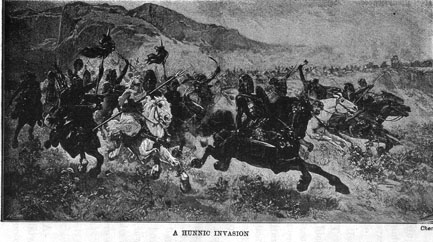
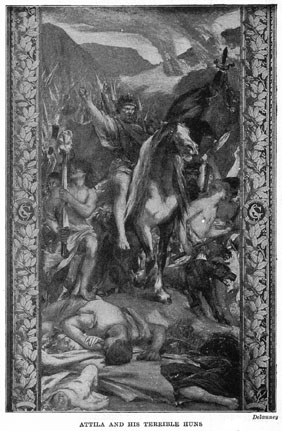
This made peace, but the peace did not last long. In a few years Attila appeared at the head of an army of 700,000 men. With this great force he marched across Germany and into Gaul. He rode on a beautiful black horse, and carried at his side the sword of Tiew. He attacked and destroyed towns and killed the inhabitants without mercy. The people had such dread of him that he was called the "Scourge of God" and the "Fear of the World."

III

ATTILA and his terrible Huns marched through Gaul until they came to the city of Orleans. Here the people bravely resisted the invaders. They shut their gates and defended themselves in every way they could. In those times all towns of any great size were surrounded by strong walls. There was war constantly going on nearly everywhere, and there were a great many fierce tribes and chiefs who lived by robbing their neighbors. So the towns and castles in which there was much money or other valuable property were not safe without high and strong walls.

Attila tried to take Orleans, but soon after he began to attack the walls he saw a great army at a distance coming towards the city. He quickly gathered his forces together, marched to the neighboring plain of Champagne and halted at the place where the city of Chalons now stands.

fmma06

The army which Attila saw was an army of 300,000 Romans and Visigoths. It was led by a Roman general name Aetius and the Visigoth king Theodoric. The Visigoths after the death of Alaric had settled in parts of Gaul, and their king had now agreed to join the Romans against the common enemy--the terrible Huns. So the great army of the Romans and Visigoths marched up and attacked the Huns at Chalons. It was a fierce battle. Both sides fought with the greatest bravery. At first the Huns seemed to be winning. They drove back the Romans and Visigoths from the field, and in the fight Theodoric was killed.

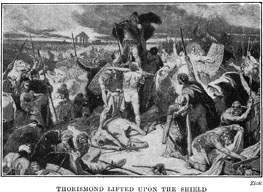
Aetius now began to fear that he would be beaten, but just at that moment Thorismond, the son of Theodoric, made another charge against the Huns. He had taken command of the Visigoths when his father was killed, and now he led them on to fight. They were all eager to have revenge for the death of their king, so they fought like lions and swept across the plain with great fury. The Huns were soon beaten on every side, and Attila himself fled to his camp. It was the first time he had ever been defeated. Thorismond, the conqueror, was lifted upon his shield on the battle-field and hailed as king of the Visigoths.

When Attila reached his camp he had all his baggage and wagons gathered in a great heap. He intended to set fire to it and jump into the flames if the Romans should come there to attack him.

"Here I will perish in the flames," he cried, "rather than surrender to my enemies."

But the Romans did not come to attack him, and in a few days he marched back to his own country.

fmma06

Very soon, however, he was again on the war path. This time he invaded Italy. He attacked and plundered the town of Aquileia, and the terrified inhabitants fled for their lives to the hills and mountains. Some of them took refuge in the islands and marshes of the Adriatic Sea. Here they founded Venice.

fmma06

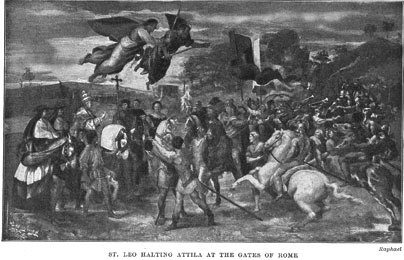
The people of Rome and the Emperor Valentinian were greatly alarmed at the approach of the dreaded Attila. He was now near the city, and they had no army strong enough to send against him. Rome would have been again destroyed if it had not been for Pope Leo I who went to the camp of Attila and persuaded him not to attack the city. It is said that the barbarian king was awed by the majestic aspect and priestly robes of Leo. It is also told that the apostles Peter and Paul appeared to Attila in his camp and threatened him with death if he should attack Rome. He did not go away, however, without getting a large sum of money as ransom.

IV

Shortly after leaving Italy Attila suddenly died. Only the day before his death he had married a beautiful woman whom he loved very much.

The Huns mourned their king in a barbarous way. They shaved their heads and cut themselves on their faces with knives, so that their blood, instead of their tears, flowed for the loss of their great leader. They enclosed his body in three coffins--one of gold, one of silver, and one of iron--and they buried him at night, in a secret spot in the mountains. When the funeral was over, they killed the slaves who had dug the grave, as the Visigoths had done after the burial of Alaric.

After the death of Attila we hear little more of the Huns.

Famous Men of the Middle Ages: Alaric The Visigoth. King From 394-410

ALARIC THE VISIGOTH

KING FROM 394-410

I

LONG before the beginning of the period known as the Middle Ages a tribe of barbarians called the Goths lived north of the River Danube in the country which is now known as Roumania. It was then a part of the great Roman Empire, which at that time had two capitals, Constantinople--the new city of Constantine--and Rome. The Goths had come from the shores of the Baltic Sea and settled on this Roman territory, and the Romans had not driven them back.

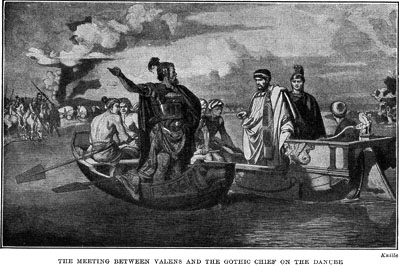
During the reign of the Roman Emperor Valens some of the Goths joined a conspiracy against him. Valens punished them for this by crossing the Danube and laying waste their country. At last the Goths had to beg for mercy. The Gothic chief was afraid to set foot on Roman soil, so he and Valens met on their boats in the middle of the Danube and made a treaty of peace.

fmma05

For a long time the Goths were at war with another tribe of barbarians called Huns. Sometimes the Huns defeated the Goths and drove them to their camps in the mountains. Sometimes the Goths came down to the plains again and defeated the Huns.

At last the Goths grew tired of such constant fighting and thought they would look for new settlements. They sent some of their leading men to the Emperor Valens to ask permission to settle in some country belonging to Rome. The messengers said to the emperor:

"If you will allow us to make homes in the country south of the Danube we will be friends of Rome and fight for her when she needs our help."

The emperor at once granted this request. He said to the Gothic chiefs:

"Rome always needs good soldiers. Your people may cross the Danube and settle on our land. As long as you remain true to Rome we will protect you against your enemies."

These Goths were known as Visigoths, or Western Goths. Other tribes of Goths who had settled in southern Russia, were called Ostrogoths, or Eastern Goths.

After getting permission from the Emperor Valens a large number of the Visigoths crossed the Danube with their families and their cattle and settled in the country now called Bulgaria.

In course of time they became a very powerful nation, and in the year 394 they chose as their king one of the chiefs named Alaric. He was a brave man and a great soldier. Even when a child he took delight in war, and at the age of sixteen he fought as bravely as the older soldiers.

One night, not long after he became king, Alaric had a very strange dream. He thought he was driving in a golden chariot through the streets of Rome amid the shouts of the people, who hailed him as emperor. This dream made a deep impression on his mind. He was always thinking of it, and at last he began to have the idea that he could make the dream come true.

"To be master of the Roman Empire," he said to himself, "that is indeed worth trying for; and why should I not try? With my brave soldiers I can conquer Rome, and I shall make the attempt."

So Alaric called his chiefs together and told them what he had made up his mind to do.

fmma05

The chiefs gave a cry of delight for they approved of the king's proposal. In those days fighting was almost the only business of chiefs, and they were always glad to be at war, especially when there was hope of getting rich spoils. And so the Visigoth chiefs rejoiced at the idea of war against Rome, for they knew that if they were victorious they would have the wealth of the richest city of the world to divide among themselves.

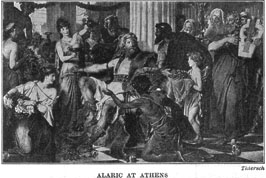
Soon they got ready a great army. With Alaric in command, they marched through Thrace and Macedonia and before long reached Athens. There were now no great warriors in Athens, and the city surrendered to Alaric. The Goths plundered the homes and temples of the Athenians and then marched to the state of Elis, in the southwestern part of Greece. Here a famous Roman general named Stilicho besieged them in their camp. Alaric managed to force his way through the lines of the Romans and escaped. He marched to Epirus. This was a province of Greece that lay on the east side of the Ionian Sea. Arcadius, the Emperor of the East, now made Alaric governor of this district and a large region lying near it. The whole territory was called Eastern Illyricum and formed part of the Eastern Empire.

II

ALARIC now set out to make an attack on Rome, the capital of the Western Empire. As soon as Honorius, Emperor of the West, learned that Alaric was approaching, he fled to a strong fortress among the mountains of North Italy. His great general Stilicho came to his rescue and defeated Alaric near Verona. But even after this Honorius was so afraid of Alaric that he made him governor of a part of his empire called Western Illyricum and gave him a large yearly income.

Honorius, however, did not keep certain of his promises to Alaric, who consequently, in the year 408, marched to Rome and besieged it. The cowardly emperor fled to Ravenna, leaving his generals to make terms with Alaric. It was agreed that Alaric should withdraw from Rome upon the payment of 5,000 pounds of gold and 30,000 pounds of silver.

When Honorius read the treaty he refused to sign it. Alaric then demanded that the city be surrendered to him, and the people, terrified, opened their gates and even agreed that Alaric should appoint another emperor in place of Honorius.

This new emperor, however, ruled so badly that Alaric thought it best to restore Honorius. Then Honorius, when just about to be treated so honorably, allowed a barbarian chief who was an ally of his to make an attack upon Alaric. The attack was unsuccessful, and Alaric immediately laid siege to Rome for the third time. The city was taken and Alaric's dream came true. In a grand procession he rode at the head of his army through the streets of the great capital.

Then began the work of destruction. The Goths ran in crowds through the city, wrecked private houses and public buildings and seized everything of value they could find. Alaric gave orders that no injury should be done to the Christian churches, but other splendid buildings of the great city were stripped of the beautiful and costly articles that they contained, and all the gold and silver was carried away from the public treasury.

fmma05

In the midst of the pillage Alaric dressed himself in splendid robes and sat upon the throne of the emperor, with a golden crown upon his head.

While Alaric was sitting on the throne thousands of Romans were compelled to kneel down on the ground before him and shout out his name as conqueror and emperor. Then the theaters and circuses were opened, and Roman athletes and gladiators had to give performances for the amusement of the conquerors. After six days of pillage and pleasure Alaric and his army marched through the gates, carrying with them the riches of Rome.

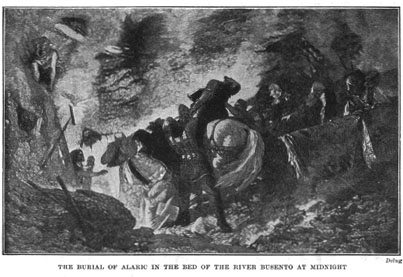
Alaric died on his way to Sicily, which he had thought to conquer also. He felt his death coming and ordered his men to bury him in the bed of the river Busento and to put into his grave the richest treasures that he had taken from Rome.

This order was carried out. A large number of Roman slaves were set to work to dig a channel and turn the water of the Busento into it. They made the grave in the bed of the river, put Alaric's body into and closed it up. Then the river was turned back to its old channel. As soon as the grave was covered up, and the water flowed over it, the slaves who had done the work were put to death by the Visigoth chiefs.

Subscribe to this RSS feed

Log in or create an account