log in
LC Geerts

LC Geerts

Website URL:

Egyptian Myth and Legend Chapter 20, The Hyksos and their Strange God

EGYPTIAN MYTH AND LEGEND

With Historical Narrative, Notes on Race Problems, Comparative Beliefs, etc.
by

Donald Mackenzie

Gresham Publishing Co., London

[1907]

CHAPTER XX

The Hyksos and their Strange God

The Sebek-Ra Rulers--A Great Pharaoh--The Shadow of Anarchy--Coming of the "Shepherd Kings"--Carnival of Destruction--A Military Occupation --Causes of World--wide Unrest--Dry Cycles--Invasions of Pastoral Peoples--History in Mythology--Tribal Father and Mother Deities--Sutekh, Thor, Hercules--Mountain Deities and Cave Demons--Hyksos Civilization--Trade with Europe and Asia--The Horse--Hittite Influence in Palestine--Raid on Babylon--Kassites and Aryans--Aryan Gods in Syria--Mitanni Kingdom.

AFTER the close of the Golden Age the materials for Egyptian history become somewhat scanty. The Thirteenth Dynasty opened peacefully, and the Sebek-Ra names of its kings indicate that the cults of the crocodile and the sun held the balance of power. The influence exercised by the Pharaohs, however, appears to have been strictly circumscribed. Some of them may have reigned in Crocodilopolis or its vicinity, but Thebes ultimately became the capital, which indicates that the Delta region, with its growing foreign element, was considered insecure for the royal house. The great kings of the Twelfth Dynasty had established their power in the north, where they found it necessary to keep watchful eyes on the Libyan and Syrian frontiers.

Succession to the throne appears to have been regulated by descent in the female line. Evidently the Legitimists were resolved that alien influence should not predominate at Court, and in this regard they must have received the support of the great mass of the Egyptian people, of whom Herodotus said: "They contentedly adhere to the customs of their ancestors, and are averse from foreign manners". It is significant to find that the father of one of the Sebekhotep kings was a priest who achieved greatness because he married a princess. This Sebekhotep was followed by his son, who had a Hathor name, but he was dethroned after a brief reign. The next Pharaoh was the paternal uncle of the fallen monarch. His royal name was Neferkhara-Sebekhotep, and he proved to be the greatest ruler of this obscure period. He controlled the entire kingdom, from the shores of the Mediterranean to the second cataract, where records were made of the rise of the Nile. On the island of Argo, near the third cataract, he erected two granite statues over 20 feet in height, which stood in front of a large temple. Nubian aggression must have been held firmly in check by a considerable garrison. But not for long. After two weak kings had reigned, the throne was seized by Neshi, "the negro", a worshipper of Ra and Set. His colossal statue of black granite testifies to the supremacy achieved by the Nubian raiders. In the north another usurper of whom we have trace is Mermenfatiu, "Commander of the Soldiers".

The shadow of anarchy had again fallen upon Egypt. Once more, too, the feudal lords asserted themselves, and the kingdom was broken up into a number of petty states. A long list of monarchs is given by Manetho, and these may include many of the hereditary nome governors who became Pharaohs in their own domains and waged war against their neighbours. Thebes remained the centre of the largest area of control, which may have enjoyed a meed of prosperity, but the rest of Egypt must have suffered greatly on account of the lack of supervision over the needful distribution of water. Peasants may well have neglected to till the soil in districts ever open to the raids of plunderers, exclaiming, in the words of the Twelfth-Dynasty prophet: "What is the good of it? We know what is coming."

Egypt was thoroughly disorganized and unable to resist its enemies. These were ever watchful for an opportunity to strike. The Nubians had already achieved some success, although they were ultimately expelled by the Thebans; the Libyans must have been active in the north, while the Asiatics were pouring over the Delta frontier and possessing themselves of great tracts of territory. Then came the Hyksos invaders, regarding whose identity much controversy has been waged. They were evidently no disorganized rabble, and there are indications that under their sway Egypt became, for an uncertain period, a part of a great empire of which we, as yet, know very little.

Josephus, the patriotic Jewish historian, who believed that the Hyksos were "the children of Israel", quoted Manetho as saying that "they were a people of ignoble race who had confidence to invade our country, which they subdued easily without having to fight a battle. They set our towns on fire; they destroyed the temples of the gods, and caused the people to suffer every kind of barbarity. During the entire period of their dynasty they waged war against the people of Egypt, desiring to exterminate the whole race. . . . The foreigners were called Hyksos, which signifies 'Shepherd Kings'."

Manetho's reference to a carnival of destruction is confirmed by the inscription of Queen Hatshepsut of the Eighteenth Dynasty, who declared with characteristic piety:

I have restored what was cast down,
I have built up what was uncompleted,

Since the Asiatics were in Avaris of the north land,
And the barbarians were among them, destroying buildings,
While they governed, not knowing Ra.

But if the hated Hyksos were wreckers of buildings, so were the Egyptians, who were ever prone to obliterate all records of unpopular rulers. Khufu's enduring pyramid defied them, but they destroyed his mummy and perpetuated his memory in a spirit of undeniable bitterness, although he was one of their greatest men. He was an enemy of their gods, which means that he laid too firm a hand upon the ambitious and acquisitive priests. Thutmose III and Akenaton also undertook in their day the vengeful work of erasing inscriptions, while Rameses II and others freely appropriated the monuments of their predecessors. It is not surprising, therefore, to find that few traces of the Hyksos rulers survive, and that, in a folktale, they are referred to as "the impure". They ruled "not knowing Ra", and were therefore delivered to oblivion. Manetho, who compiled his history about a thousand years after they were driven from the country, was unable to ascertain much about them. Only a few of the kings to whom he makes reference can be identified, and these belong to the Fifteenth Dynasty. Of the Sixteenth Dynasty he knew little or nothing, but in dealing with the Seventeenth he was on surer ground, because Upper Egypt had then regained its freedom, and was gradually reconquering lost territory in the north.

The Hyksos overwhelmed the land at the close of the Fourteenth Dynasty. Then they chose for a king "one of their own people". According to Manetho his name was Salatis, and with him begins the Fifteenth Dynasty. He selected Memphis as his capital, and there "he made Upper and Lower Egypt pay tribute", while he left garrisons at places which were "considered to be proper for them". Did the Hyksos, therefore, effect merely a military occupation of Egypt and compel the payment of tribute to a controlling power in Asia? On this point we obtain no clear idea from Manetho, who proceeds to state that the foreigners erected a strongly fortified town called Avaris--afterwards destroyed by the Egyptians--and there they kept a garrison of 240,000 men, so as to secure the frontier from the attacks of the Assyrians, "who, they foresaw, would invade Egypt". Salatis held military reviews to overawe all foreigners.

Whatever enemy the Hyksos feared, or prepared to meet, it was certainly not the Assyrians, who were at the time fully occupied with their own affairs; they had not yet attained to that military strength which subsequently caused the name of their god Ashur to be dreaded even in the Nile valley.

The reference, however, may be to Babylonia, where, as we shall see, an aggressive people had made their appearance.

In absence of reliable records regarding the Hyksos people, or perhaps we should say peoples, for it is possible that there was more than one invasion, we must cross the frontier of Egypt to obtain some idea of the conditions prevailing in Asia during this obscure but fascinating period.

Great changes were passing over the civilized world. Old kingdoms were being broken up, and new kingdoms were in process of formation. The immediate cause was the outpourings of pastoral peoples from steppes and plateaus in quest of "fresh woods and pastures new", because herbage had grown scanty during a prolonged "dry cycle" in countries like Arabia, Turkestan, and the Iranian plateau. Once these migrations by propulsion began, they were followed by migrations caused by expulsion. The movements were in some districts accompanied by constant fighting, and a people who displayed the best warlike qualities ultimately became conquerors on a gradually increasing scale. Another cause of migration was the growth of population. When an ancestral district became crowded, the surplus stock broke away in "waves". But movements of this kind invariably followed the line of least resistance, and did not necessarily involve marked changes in habits of life, for pastoral peoples moved from upland to upland, as did agriculturists from river valley to river valley and seafarers from coast to coast. When, however, peaceful settlements were effected by nomads in highly civilized areas an increased impetus must have been given to migration from their native country, where their kindred, hearing of their prosperity, began to dream dreams of the land of plenty. Nomads who entered Babylon or Egypt became "the outposts" of those sudden and violent migrations of wholesale character which occurred during prolonged periods of drought. The Hyksos conquest of Egypt is associated with one of these "dry cycles".

In an earlier chapter 1 we have referred to the gradual expansion from North Africa of the early Mediterranean "long heads", who spread themselves over the unoccupied or sparsely populated valleys and shores of Palestine, Asia Minor, and Europe. Simultaneously, or not much later, Asiatic "broad heads" moved in successive "waves" along the mountain ranges; these are the Alpine people of the ethnologists, and they are traced from the Himalayas to Brittany and the British Isles. The beliefs and tribal customs of the Mediterraneans appear to have been mainly of Matriarchal character, while those of the Alpine folk were mainly Patriarchal.

The mixture of these peoples caused the development of a great civilization in Asia Minor, and so, it is believed, had origin the Hittite kingdom. Other races were embraced, however, in the Hittite confederacy. Mongols from Turkestan moved southward during a dry period apparently, and became a strong element in the Hittite area of control, while Semites from Arabia, who appeared at very early times in Syria, became allies of the rising people, with whom they fused in some districts. The eagle-nosed, bearded Alpine Hittites are believed to be represented by the present-day Armenians and the Mongolian Hittites by the Kurds. Some ethnologists are of opinion that the characteristic Jewish nose indicates an early fusion of Hittites and Syrians. There was also an Alpine blend in Assyria, where the Semites had facial characteristics which distinguished them from the ancestral stock in Arabia.

Hittite theology is of special interest to us because its influence can be traced in Egypt immediately before and especially during the Hyksos period. Some of the tribes of Asia Minor worshipped the Great Mother deity Ma or Ammas, who, like the Libyan Neith and other virgin goddesses of the Delta, was self-created and had a fatherless son. She was essentially an earth goddess, and of similar character to Astarte, Aphrodite, the Cretan serpent goddess, "Our Lady of Doves" in Cyprus, the Celtic Anu or Danu in Ireland, and the Scottish Cailleach Bheur who shaped the hills, let loose the rivers, and waved her hammer over the growing grass.

In Cilicia the male deities predominated, and in southern Cappadocia, where primitive tribal beliefs appear to have fused early, we find a great rock sculpture, depicting, it is believed, the marriage of the Great Father and Great Mother deities of the Alpine and Mediterranean peoples.

The Great Father god of the Hittites is Pappas or Attis ("father"), who was best known to the Egyptians as Sutekh. He is identified with Baal, "the lord," a deity no longer regarded as Semitic in origin. It was the moon god Sin, for instance, who gave his name to Sinai, and the Arabian sun deity was female.

Sutekh is depicted on a cliff near Smyrna as a bearded god with curly hair and a high, curving nose. He looks a typical mountaineer, clad in a tunic which is tightened round the waist by the "hunger belt" so familiar in Scottish hill lore, and wearing boots with turned-up toes, specially suited for high snow-covered altitudes.

Sutekh was a sky and atmosphere deity who caused the storms and sent thunder. He was a god of war, and wore goat's horns to symbolize fertility and the male principle. As Tark or Tarku he is depicted carrying in one hand a hammer and in the other three wriggling flashes of lightning, suggesting the Teutonic Thor. He is also shown grasping a mace and trident or a double battleaxe. As Ramman 2 with double horns, and bearing his axe and three thunderbolts, he received adoption in Babylonia after the Hittite conquest.

When the Great Mother was wedded to the Great Father, her son may have been regarded as the son of Tarku also. It was probably the younger deity who was identified by the Greeks with Hercules, son of Zeus. But we need not expect a continuity of well-defined ideas regarding deities of common origin who have developed separately. These two gods, the Great Father and the son of the Great Mother, are sometimes indistinguishable. They not only varied in different districts, but also at different periods. In the latest phase of Hittite religion the Great Father, the conquering war god of the Alpine people, predominated, and he absorbed the attributes of other deities in localities where Hittite influence became supreme.

The Hittite deities were associated with mountains and mysterious caves, which indicates that in their earliest stages they were giants and hags of the type familiar among the Tyrol mountains, in the Scottish highlands, and in Scandinavia. They had also their animal affinities and were depicted standing on the backs of lions and lionesses. The double-headed eagle and the three-legged symbol had also religious significance.

In addition to the deities there were fearsome demons. The Hittite Typhoon, like the Egyptian Set and Apep serpent, warred against the gods. He was half-human and half-reptile--the upper part of his body was that of a man and the lower that of a serpent. He lived in a cave which was connected by an underground passage with the cave of the gods. Tempests issued from his jaws and lightning flashed from his terrible flaming eyes. He was slain by Tarku, as the Hydra was slain by Hercules, and the various dragons of European story were slain by heroes of popular romance.

Egypt also had its somewhat colourless dragon legend, which was probably imported. In one of the Horus stories, Set became a "roaring serpent", and in this form he concealed himself in a hole (a cave) which, by command of the ubiquitous Ra, he was not permitted to leave. He thus became identified with the Apep serpent. Sutekh, the later Set, who was regarded in the Delta as the true sun god, displaced Ra and Horus and figured as the "dragon slayer". The earlier Set was not originally a demon. He was, it would appear, the god of a foreign people who entered Egypt in pre-Dynastic times and were ultimately associated with all that was evil and impure, like the later Hyksos who worshipped Sutekh.

In Syria and Mitanni, prior to the Hyksos period, the Great Father deity of the Hittites became the supreme god. The most reasonable inference is that he was the divine representative of the conquering people in Asia Minor. He bore several territorial names: he was Hadad or Dad in Syria and Teshub (or Teshup) in Mitanni; he was Tarku farther north. But that he was identical with Sutekh there can be little doubt, for when Rameses II entered into a treaty with the Hittites, Sutekh and Amon Ra were referred to as the chief representative gods of the two great empires.

Now it is a significant fact that the Hittite war god was the chief deity of the Hyksos. Like Ra-Tum of Heliopolis and Horus of Edfu his appearance in Egypt points to a definite foreign influence. He was the deity of a people who exercised control over subject states--a strange god who was adopted by compulsion because he represented the ruling Power. The Hyksos kings endeavoured to compel the Egyptians to recognize Sutekh, their official non-Arabian god--an indication that their organization had a religious basis.

From Manetho's references to this obscure period we gather that the invaders of Egypt were well organized indeed. Their raid was not followed by those intertribal feuds which usually accompanied forcible settlement in a country by Semitic hordes from Arabia. They did not break up into warring factions, like the early invaders of Palestine. Before reaching Egypt they must have come under the influence of a well-organized State. They had attained, at any rate, that stage of civilization when a people recognize the necessity for establishing a strong central government.

The Hyksos must be credited with military and administrative experience, seeing that they garrisoned strategic points, and maintained a standing army like the greatest of the Pharaohs. The collection of tribute is also significant In like manner did the later Egyptian emperors extract revenue from the petty kings of subject states in Syria. What Power received the tribute gathered by the Hyksos? All the indications point to the Hittites. If the Hyksos people were not wholly from Asia Minor, it is highly probable that the army of occupation was under Hittite control.

It may be that the invading forces included Semites from Arabia, plundering Bedouins, Amorites, and even Phoenicians who had migrated from the north of the Persian Gulf to the Palestine coast, --and that assistance was given by the Libyans, reinforced by mercenaries from Crete or the ean Peninsula. But it is inconceivable that a hungry horde of desert dwellers, or an uncontrolled and homogeneous rabble from Arabia, could have maintained firm control of Egypt for a prolonged period. The nomads, however, who accompanied the Hyksos forces, may have been "the barbarians in the midst of them" who are referred to in the inscription of Queen Hatshepsut. No doubt the invaders were welcomed and assisted by those troublesome alien peoples, who, during the Twelfth Dynasty, had settled in Egypt and absorbed its civilization. But the army of occupation was ever regarded as a foreign element, and in all probability it was reinforced mainly from without. The country must have been well governed. Queen Hatshepsut admits as much, for she condemns the Hyksos chiefly on religious grounds; they destroyed the temples--perhaps some were simply allowed to fall into disrepair--and they ruled "not knowing Ra". Had the foreign kings followed the example of some of the most popular Pharaohs, they might have purchased the allegiance of the priests of the various cults; but their desire was to establish the worship of the Hittite Sutekh as a result, it may be inferred, of political influence exercised by the foreign power which received the tribute. One or two of the Hyksos kings affected a preference for Egyptian gods.

We must take at a discount the prejudiced Egyptian reference to the hated alien rulers. During the greater part of the Hyksos period peaceful conditions prevailed not only in Egypt but over a considerable area in Asia. The great trade routes were reopened, and commerce appears to have been in a flourishing condition. Agriculture, therefore, must have been fostered; a surplus yield of corn was required not only to pay tribute but also to offer in exchange for the commodities of other countries. We meet, in Manetho's King Ianias, a ruler who was evidently progressive and enterprising. He is identified with Ian, or Khian, whose name appears on Hyksos relics which have been found at Knossos, Crete, and Bagdad in Persia. His non-Egyptian title "ank adebu", which signifies "Embracer of Countries", suggests that he was a representative of a great power which controlled more than one conquered kingdom. Breasted, the American Egyptologist, translates Hyksos as "rulers of countries", which means practically the same thing, although other authorities show a preference for Manetho's rendering, "Shepherd Kings", or its equivalent "Princes of Desert Dwellers". It may be, of course, that "Hyksos" was a term of contempt for a people whom the proud Egyptians made scornful reference to as "the polluted" or "the impure". To this day Europeans are regarded in China as "foreign devils".

We regard the Hyksos period as "a dark age" mainly because of the absence of those records which the Egyptians were at pains to destroy. Perhaps we are also prone to be influenced by their denunciations of the foreigners. We have no justification for assuming, however, that progress was arrested for a prolonged period extending over about two centuries. The arts did not suffer decline, nor did the builders lose their skill. So thoroughly was the kingdom reorganized that the power of the feudal lords was completely shattered. Even the Twelfth-Dynasty kings were unable to accomplish as much. The Hyksos also introduced the domesticated horse into Egypt, but at what period we are unable to ascertain. Manetho makes no reference to it in his brief account of the invasion. If, however, there were charioteers in the foreign army when it swept over the land, they could not have come from Arabia, and Bedouins were not likely to be able to manufacture or repair chariots. Only a rich country could have obtained horses at this early period. They had newly arrived in western Asia and must have been scarce and difficult to obtain.

Whence, then, came the horse which shattered and built up the great empires? It was first tamed by the Aryans, and its place of origin is signified by its Assyrian name "the ass of the East". How it reached Western Asia and subsequently made its appearance in the Nile valley, is a matter of special interest to us in dealing with the Hyksos problems.

We must first glance, however at the conditions which prevailed in the immediate neighbourhood of Egypt prior to the invasion. During the "Golden Age" the Pharaohs were much concerned about maintaining a strongly defended north-eastern frontier. No Egyptian records survive to throw light on the relations between Egypt and Syria, but the large number of Twelfth-Dynasty ornaments, scarabs, and amulets, bearing hieroglyphic inscriptions, which have been excavated at Gezer and elsewhere, indicate that trade was brisk and continuous. A great change had meantime passed over Palestine. "Sometime about 2000 to 1800 B.C.", says Professor Macalister, the well-known Palestinian explorer, "we find a rather sudden advance in civilization to have taken place. This, like all the other forward steps of which recent excavation in the country has revealed traces, was due to foreign interference. The Semitic nations, Amorite, Hebrew, or Arab, never invented anything; they assimilated all the elements of their civilization from without."

During the Twelfth Dynasty, therefore, Palestine came under the sway of a people who had attained a high degree of culture. But they could not have been either Assyrian or Babylonian, and Egypt exercised no control beyond its frontier. The great extending Power at the time was the Hittite in the north. Little is known regarding the early movements of its conquering peoples, who formed small subject states which were controlled by the central government in Asia Minor. That they penetrated into southern Palestine as traders, and effected, at least, a social conquest, is certain, because they were known to Amenemhet I, although he never crossed the Delta frontier. The northern war god was established at an early period in Syria and in Mitanni, and Biblical references indicate that the Hittites were prominent land owners. They were probably the people who traded with Egypt at Gezer, and with whom the Twelfth-Dynasty Pharaohs arrived at some understanding. It is unlikely that the influential foreign princesses who were worthy to be introduced into the royal harem were the daughters of rough desert dwellers. The Dashur jewellery suggests that the ladies were of refined tastes and accustomed to luxurious living.

We have no means of ascertaining why Senusert III, the son of one of the alien wives, invaded Syria and fought a battle at Gezer. It may be that the Hittites had grown restless and aggressive and it is also possible that he co-operated with them to expel a common enemy--perhaps Semites from Arabia.

Some time prior to the Hyksos invasion the Hittites raided Babylon and overthrew the Hammurabi Dynasty. But they were unable to enjoy for long the fruits of conquest. An army of Kassites pressed down from the mountains of Elam and occupied northern Babylonia, apparently driving the Hittites before them. The Kassites are a people of uncertain origin, but associated with them were bands of Aryans on horseback and in chariots. This is the first appearance in history of the Indo-European people.

A westward pressure of tribes followed. The Kassites and Aryans probably waged war against the Hittites for a period, and the Hyksos invasion of Egypt may have been an indirect result of the migrations from the Iranian plateau and the conquest of Babylonia. At any rate it is certain that the Aryans continued to advance, for, prior to the close of the Hyksos period, they had penetrated Asia Minor and reached the Syrian coastland. Whether or not they entered Egypt we have no means of knowing. All foreigners were Hyksos to the Egyptians at this time, as all northern barbarians were Celts to the Greeks at a later period. Some change occurred, however, for there was a second Hyksos Dynasty. What we know for certain is that a military aristocracy appeared in Mitanni, where Tushratta, who had an Aryan name, subsequently paid tribute to Egypt in the time of Amenhotep III and his son Akhenaton. He is believed to have been educated in the land of the Pharaohs, and his ancestors must have been the expellers from Mesopotamia of the Hittite rulers; the Mitanni rulers were for a period overlords of Assyria. In addition to the Hittite Sutekh-Teshub, the Mitanni Pantheon then included Indra, Mithra, and Varuna, the well-known Iranian gods. These had been introduced into the Punjab by an earlier Aryan "wave" which swept towards India about the beginning of the Twelfth Egyptian Dynasty.

It may also be noted here that when the Egyptians expelled the weakened Hyksos army of occupation they possessed horses and chariots. They afterwards pressed into Syria, but the danger of subsequent invasion was not secured until Thutmose III overcame the Mitanni Power, which apparently was not unconnected with the later "Hyksos" overlordship of Egypt.

During the Hyksos period the children of Israel appear to have settled in Egypt.

Footnotes

1 Chapter III.
2 "When I bow down myself in the house of Riminon, the Lord pardon thy servant in this thing."--2 Kings, V, 18.

Egyptian Myth and Legend Chapter 19, The Island of Enchantment

EGYPTIAN MYTH AND LEGEND

With Historical Narrative, Notes on Race Problems, Comparative Beliefs, etc.
by

Donald Mackenzie

Gresham Publishing Co., London

[1907]

CHAPTER XIX

The Island of Enchantment

A Sailor's Story--Shipwrecked--The Sole Survivor--A Lonely Island--A Voice like Thunder--The Giant Serpent God--A Threat--Sailor given Protection--Sacrifice of Asses--Rescued by a Ship--The Parting--A Man of Wisdom.

ONCE upon a time a ship set forth on a voyage to the mines of Sinai, and it was swamped in a storm. All the sailors were drowned save one, who swam to the Isle of Enchantment, which was inhabited by the "manes"--serpent gods who have heads and arms like to human beings and are able to hold converse in speech.

When this man returned to Egypt he related his wonderful story unto his lord, saying: "Now, be well satisfied that I have come back although alone. Your ship on which I have returned is safe, and no men are missing. I was rescued by it, and I had no other means of escape. When you have cleansed your limbs, I pray you to inform the Pharaoh of the things which have befallen me."

The master said: "So you persist in repeating this tale of yours. But speak on. I will hear you to the end, and, perchance, your words will betray the truth. But lower your voice and say what you have to say without excitement."

The sailor said: "I will begin at the beginning, and relate what happened to myself. I voyaged towards the mines in your great ship, in which were 150 of the finest sailors in Egypt. They were all stout-hearted men. Now, some said that the wind would be unfavourable, and others said that there would be no wind at all. As it chanced., a great storm arose, and the ship was tossed about in the midst of high billows so that it was swamped. When I found myself in the angry waters., I clung to a floating spar. All the others were drowned. In time I was cast ashore, and I found myself on a lonely island, where I lay helplessly for three days and three nights. Then I began to revive. I was faint with hunger and thirst, and went to search for food, and I found fruit and birds and fishes, and ate thereof. I gave thanks to the god because that I was alive, and offered up a sacrifice.

"No sooner had I given thanks in this manner than I heard a loud noise like to thunder, and the earth trembled beneath me and the trees were stricken as with tempest. I hid my face with terror, and after I had lain a time on the ground I looked up and beheld a giant serpent god with human face and arms. He wore a long beard, and his body was golden and blue.

"I prostrated myself before him, and he spake, saying: 'Speak and tell, little fellow, speak and tell why you have come hither. If you do not speak without delay, I will cause your life to end. If you do not tell me what I have not heard and what I do not know, 1 I will cause you to pass out of existence like a flame which has been extinguished.'

"Ere I answered him he carried me inland and set me down without injury, whereupon I said that I had come from the land of Egypt in a great ship which perished in the storm, and that I had clung to a spar and was washed ashore.

"The serpent god heard, and said: 'Do not be terrified, little fellow, do not be terrified, and be cheerful of countenance, for it is the god who sent you hither to me. Here you may dwell until four moons wax and wane; then a ship will come, and you will depart in it and return once again to the land of Egypt. . . . It is pleasant to hold converse. Know, then, that I dwell here with my kind, and I have children, and there is also a girl who perished by accident in a fire. I will take you to my home, and you will return to yours again in time.'

"When the giant serpent god had spoken thus I prostrated myself before him, and I said: 'To the King of Egypt I will relate the things I have seen. I will laud your name, and offerings of oil and perfumes will be made to you. Asses 2 and birds will I sacrifice to you, and the king will send you rich offerings because you are a benefactor of mankind.'

"'I need not your perfumes,' answered the serpent god. 'I am a ruler of Punt, and these I possess in abundance, but I have no oil of Egypt here. But know that when you go away this island will never again be seen by any man; it will vanish in the midst of the sea.'

"When four moons had waxed and waned, a ship appeared as the serpent god had foretold. I knelt down and bade farewell to the inhabitants of the island of enchantment, and the great god gave me gifts of perfumes and ivory and much treasure, and he gave me also rare woods and baboons. I took my leave with grateful heart, and I thanked the god because of my deliverance. Then I went to the shore and hailed the ship, and was taken aboard it.

These are the things which happened unto me, my lord and master. Now conduct me, I pray you, before His Majesty that I may present him with the gifts of the serpent god. . . . Look upon me, for I have returned to tell of the wonders I did behold with mine eyes. . . . In my youth I was instructed to acquire wisdom so that I might be highly esteemed. Now I have become a wise man indeed."

Apparently "the master" was convinced by this wonderful story, which was duly recorded by a scribe of the temple of Amon.

Footnotes

1 The Norse giant Vafthrudner similarly puts to death those who cannot tell him something he does not know.
2 The reference is unique. Set is associated with the wild ass, but except in this tale there is no indication that asses were sacrificed in Egypt. The Aryans sacrificed the horse.

Egyptian Myth and Legend Chapter 18, Myths and Lays of the Middle Kingdom

EGYPTIAN MYTH AND LEGEND

With Historical Narrative, Notes on Race Problems, Comparative Beliefs, etc.
by

Donald Mackenzie

Gresham Publishing Co., London

[1907]

CHAPTER XVIII

Myths and Lays of the Middle Kingdom

Foreign Brides--Succession by Male and Female Lines--New Religious Belief--Sebek the Crocodile God--Identified with Set and Sutekh--The Crocodile of the Sun--The Friend and Foe of the Dead--Sebek Kings--The Tame Crocodile--Usert, the Earth Goddess--Resemblance to Isis and Neith --Sutekh and Baal--Significance of Dashur Jewellery--The Great Sphinx--Literary Activity--Egyptian Folksongs--Dialogue of a Man with his Soul--"To be or not to be"--Sun Cult Doctrines--"The Lay of the Harper".

DURING the Twelfth Dynasty Babylon fell and Crete was invaded. Egypt alone among the older kingdoms successfully withstood the waves of aggression which were passing over the civilized world. It was not immune, however to foreign influence. A controlling power in Syria had evidently to be reckoned with, for raiding bands were constantly hovering on the frontier. It has been suggested that agreements were concluded, but no records of any survive. There are indications, however, that diplomatic marriages took place, and these may have been arranged for purposes of conciliation. At any rate foreign brides were entering the royal harem, and the exclusive traditions of Egypt were being set at defiance.

Senusert II had a favourite wife called Nefert, "the beautiful", who appears to have been a Hittite. Her son, Senusert III, and her grandson, Amenemhet III, have been referred to as "new types". 1 Their faces, as is shown plainly in the statuary, have distinct non-Egyptian and non-Semitic characteristics; they are long and angular--the third Senusert's seems quite Mongoloid--with narrow eyes and high cheek bones. There can be no doubt about the foreign strain.

It is apparent that Senusert III ascended the throne as the son of his father. This fact is of special interest, because, during the Twelfth Dynasty, succession by the female line was generally recognized in Egypt. Evidently Senusert II elevated to the rank of Crown Prince the son of his foreign wife. Amenemhet III appears to have been similarly an arbitrary selection. No doubt the queens and dowager queens were making their presence felt, and were responsible for innovations of far-reaching character, which must have aroused considerable opposition. It may be that a legitimist party had become a disturbing element. The high rate of mortality in the royal house during the latter years of the Dynasty suggests the existence of a plot to remove undesirable heirs by methods not unfamiliar in Oriental Courts.

Along with the new royal faces new religious beliefs also came into prominence. The rise of Sebek, the crocodile god, may have been due to the tendency shown by certain of the Pharaohs to reside in the Fayum. The town of Crocodilopolis was the chief centre of the hitherto obscure Sebek cult. It is noteworthy, however, that the reptile deity was associated with the worship of Set-not the familiar Egyptian Set, but rather his prototype, Sutekh of the Hittites. Apparently an old tribal religion was revived in new and developed form.

In the texts of Unas, Sebek is referred to as the son of Neith, the Libyan "Earth Mother", who personified the female principle, and was believed to be self-sustaining, as she had been self-produced. She was "the unknown one" and "the hidden one", whose veil had never been uplifted. Like other virgin goddesses, she had a fatherless son, the "husband of his mother", who may have been identified with Sebek as a result of early tribal fusion.

It is suggested that in his crocodile form Sebek was worshipped as the snake was worshipped, on account of the dread he inspired. But, according to Diodorus, crocodiles were also regarded as protectors of Egypt, because, although they devoured the natives occasionally, they prevented robbers from swimming over the Nile. Opinions, however, differed as to the influence exercised by the crocodile on the destinies of Egypt. Some Indian tribes of the present day worship snakes, and do everything they can to protect even the most deadly specimens. In Egypt the crocodile was similarly protected in particular localities, while in others it was hunted down by sportsmen. 2 We also find that in religious literature the reptile is now referred to as the friend and now as the enemy of the good Osiris. He brings ashore the dead body of the god to Isis in one legend, 3 and in another he is identified with his murderers. In the "Winged Disk" story the followers of Set are crocodiles and hippopotami, and are slain by Horus because they are "the enemies of Ra". Yet Sebek was in the revolutionary Sixth Dynasty identified with the sun god, and in the Book of the Dead there is a symbolic reference to his dwelling on Sunrise Hill, where he was associated with Hathor and Horus--the Great Mother and son.

Sebek-Tum-Ra ultimately became the crocodile of the sun, as Mentu became "bull of the sun", and he symbolized the power and heat of the orb of day. In this form he was the "radiant green disk"-"the creator", who rose from Nu "in many shapes and in many colours".

At Ombos, Sebek was a form of Seb, the earth giant, the son of Nut, and "husband of his mother". He was called the "father of the gods" and "chief of the Nine Bow Barbarians".

In his Set form, Sebek was regarded in some parts as an enemy and devourer of the dead. But his worshippers believed that he would lead souls by "short cuts" and byways to the Egyptian paradise. In the Pyramid Texts he has the attributes of the elfin Khn whose dwarfish images were placed in tombs to prevent decay, for he renews the eyes of the dead, touches their tongues so that they can speak, and restores the power of motion to their heads.

The recognition which Sebek received at Thebes may have been due to the influence of the late kings of the Twelfth Dynasty, and those of the Thirteenth who had Sebek names. The god is depicted as a man with a crocodile's head, and he sometimes wears Amon plumes with the sun disk; he is also shown simply as a crocodile. He was familiar to the Greeks as Sukhos. Strabo, who visited Egypt in the Roman period, relates that he saw a sacred crocodile in an artificial lake at Crocodilopolis in the Fayum. It was quite tame 4 and was decorated with gold ear-rings, set with crystal, and wore bracelets on its fore paws. The priests opened its jaws and fed it with cakes, flesh, and honey wine. When the animal leapt into the water and came up at the other side, the priests followed it and gave it a fresh offering. Herodotus tells that the fore feet of the sacred crocodile which he saw were secured by a chain. It was fed not only with choice food, but with "the flesh of sacred victims". When the reptile died its body was embalmed, and, having been deposited in a sacred chest, was laid in one of the lower chambers of the Labyrinth. These subterranean cells were reputed to be of great sanctity, and Herodotus was not permitted to enter them.

The deity Usert, whose name is associated with the kings Senusert (also rendered Usertesen), was an earth goddess. She is identified with Isis, and closely resembles Neith-the Great Mother with a son whose human incarnation is the Pharaoh. Usert worship may have been closely associated, therefore, with Sebek worship, because Sebek was the son of an earth goddess. He rose from Nu, the primordial deep, as the crocodile rose from Lake Mris, the waters of which nourished the "earth mother", and caused green verdure to spring up where formerly there was but sandy desert. 5 Sebek was thus in a new sense a form of Ra, and a "radiant green sun disk". His association with Set was probably due to Asiatic influence, and the foreign strain in the royal house may have come from a district where Set was worshipped as Sutekh. The Egyptian Set developed from an early conception of a tribal Sutekh as a result of Asiatic settlement in the eastern Delta in pre-Dynastic times. The Hittite Sutekh was a sun god and a weather god. But there were many Sutekhs as there were many Baals. Baal signifies "lord" or "chief god", and in Egypt was identified with Set and with Mentu, the bull of war. At Tanis he was "lord of the heaven". Sutekh, also a "baal" or "lord", appears to have been similarly adaptable in tendency. If it was due to his influence that the crocodile god of the Fayum became a solar deity, the foreign ladies in the Pharaoh's harem must have been Hittites, whose religious beliefs influenced those of their royal sons.

eml18

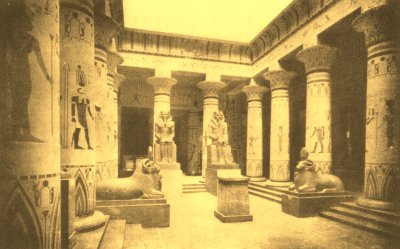
COURTYARD OF AN EGYPTIAN TEMPLE (RESTORED)

eml18 eml18 eml18

Khn(ram-headed)

Sebek, Crocodile God

Min

eml18   eml18

Bes


Anubis

LOCAL GODS WITH ADDED SOLAR AND OTHER ATTRIBUTES

Exquisite jewellery has been found at Dashur, where Amenemhet II and his grandson Senusert III resided and erected their pyramids--two diadems of princesses of the royal house, the daughters of the second Senusert's foreign wife, at Dashur. One is a mass of little gold flowers connected by gold wires, which recall the reference, in Exodus, xxxlx, 3, to the artisans who "did beat the gold into thin plates, and cut it into wires". The design is strengthened by large "Maltese crosses" set with gems. 6 Other pieces of Twelfth-Dynasty jewellery are similarly "innovations", and of the character which, long centuries afterwards, became known as Etruscan. But they could not have come from Europe at this period. They resemble the work for which the Hittites were famous.

The great sphinx may have also owed its origin to the influence exercised by the Hittites, whose emblem of power was a lion. Certain Egyptologists 7 are quite convinced that it was sculptured during the reign of Amenemhet III, whose face they consider it resembles. Nilotic gods had animal heads with human bodies. The sphinx, therefore, could not have been a god of Egypt. Scarab beetle seals were also introduced during the Twelfth Dynasty. The Dynastic civilization of Egypt began with the use of the Babylonian seal cylinder.

The "Golden Age" is distinguished not only for its material progress, but also for its literary activity. In this respect it may be referred to as the "Elizabethan Age" of Ancient Egypt. The compositions appear to have been numerous, and many were of high quality. During the great Dynasty the kingdom was "a nest of singing birds", and the home of storytellers. There are snatches of song even in the tomb inscriptions, and rolls of papyri have been found in mummy coffins containing love ditties, philosophic poems, and wonder tales, which were provided for the entertainment of the dead in the next world.

It is exceedingly difficult for us to enter into the spirit of some of these compositions. We meet with baffling allusions to unfamiliar beliefs and customs, while our ignorance of the correct pronunciation of the language make some ditties seem absolutely nonsensical, although they may have been regarded as gems of wit; such quaint turns of phrase, puns, and odd mannerisms as are recognizable are entirely lost when attempts are made to translate them. The Egyptian poets liked to play upon words. In a Fifth-Dynasty tomb inscription this tendency is apparent. A shepherd drives his flock over the wet land to tramp down the seed, and he sings a humorous ditty to the sheep. We gather that he considers himself to be in a grotesque situation, for he "salutes the pike", and is like a shepherd among the dead, who converses with strange beings as he converses with fish. "Salutes" and "pike" are represented by the same word, and it is as if we said in English that a fisherman "flounders like flounders" or that joiners "box the box".

A translation is therefore exceedingly bald.

The shepherd is in the water with the fish;
He converses with the sheath fish;
He salutes the pike;
From the West--the shepherd is a shepherd from the West.

"The West" is, of course, the land of the dead.

Some of the Twelfth-Dynasty "minor poems" are, however, of universal interest because their meaning is as clear as their appeal is direct. The two which follow are close renderings of the originals.

THE WOODCARVER

The carver grows more weary
Than he who hoes all day,
As up and down his field of wood
His chisel ploughs away.
No rest takes he at even,
Because he lights a light;
He toils until his arms drop down
Exhausted, in the night.

THE SMITH

A smith is no ambassador--
His style is to abuse;
I never met a goldsmith yet
Able to give one news.
Oh, I have seen a smith at work,
Before his fire aglow--
His "claws" are like a crocodile;
He smells like fish's roe.

The Egyptian peasants were great talkers. Life was not worth living if there was nothing to gossip about. A man became exceedingly dejected when he had to work in solitude; he might even die from sheer ennui. So we can understand the ditty which tells that a brickmaker is puddling all alone in the clay at the time of inundation; he has to talk to the fish. "He is now a brickmaker in the West." In other words, the lonely task has been the death of him.

This horror of isolation from sympathetic companionship pervades the wonderful composition which has been called "The Dialogue of a Man with his Soul". The opening part of the papyrus is lost, and it is uncertain whether the lonely Egyptian was about to commit suicide or was contemplating with feelings of horror the melancholy fate which awaited him when he would be laid in the tomb. He appears to have suffered some great wrong; his brothers have deserted him, his friends have proved untrue, and--terrible fate!--he has nobody to speak to. Life is, therefore, not worth living, but he dreads to die because of the darkness and solitude of the tomb which awaits him. The fragment opens at the conclusion of a speech made by the soul. Apparently it has refused to accompany the man, so that he is faced with the prospect of not having even his soul to converse with.

"In the day of my sorrow", the man declares, "you should be my companion and my sympathetic friend. Why scold me because I am weary of life? Do not compel me to die, because I take no delight in the prospect of death; do not tell me that there is joy in the 'aftertime'. It is a sorrowful thing that this life cannot be lived over again, for in the next world the gods will consider with great severity the deeds we have done here."

He calls himself a "kindly and sympathetic man", but the soul thinks otherwise and is impatient with him. "You poor fool," it says, "you dread to die as if you were one of these rich men."

But the Egyptian continues to lament his fate; he has no belief in joy after death. The soul warns him, therefore, that if he broods over the future in such a spirit of despondency he will be punished by being left forever in his dark solitary tomb. The inference appears to be that those who lack faith will never enter Paradise.

"The thought of death", says the soul, "is sorrow in itself, it makes men weep; it makes them leave their homes and throw themselves in the dust."

Men who display their unbelief, never enjoy, after death, the light of the sun. Statues of granite may be carved for them, their friends may erect pyramids which display great skill of workmanship, but their fate is like that of "the miserable men who died of hunger at the riverside, or the peasant ruined by drought or by the flood--a poor beggar who has lost everything and has none to talk to except the fishes".

The soul counsels the man to enjoy life and to banish care and despondency. He is a foolish fellow who contemplates death with sorrow because he has grown weary of living; the one who has cause to grieve is he whose life is suddenly cut short by disaster. Such appears to be the conclusion which should be drawn from the soul's references to some everyday happenings of which the following is an example:--

"A peasant has gathered in his harvest; the sheaves are in his boat; he sails on the Nile, and his heart is filled with the prospect of making merry. Suddenly a storm comes on. He is compelled to remain beside his boat, guarding his harvest. But his wife and his children suffer a melancholy fate. They were coming to meet him, but they lost their way in the storm, and the crocodiles devoured them. The poor peasant has good cause to lament aloud. He cries out, saying:

"'I do not sorrow for my beloved wife, who has gone hence and will never return, so much as for the little children who, in the dawn of life, met the crocodile and perished.'"

The man is evidently much impressed by the soul's reasoning. He changes his mind, and praises the tomb as a safe retreat and resting place for one who, like himself, cannot any longer enjoy life. Why he feels so utterly dejected we cannot tell; the reason may have been given in the lost portion of the old papyrus. There is evidently no prospect of enjoyment before him. His name has become hateful among men; he has been wronged; the world is full of evil as he is full of sorrow.

At this point the composition becomes metrical in construction:

Hateful my name! . . . more hateful is it now
Than the rank smell of ravens in the heat;
Than rotting peaches, or the meadows high
Where geese are wont to feed; than fishermen
Who wade from stinking marshes with their fish,
Or the foul odour of the crocodile;
More hateful than a husband deems his spouse
When she is slandered, or his gallant son
Falsely accused; more hateful than a town
Which harbours rebels who are sought in vain.

Whom can I speak to? . . . Brothers turn away;
I have no friend to love me as of yore;
Hearts have turned cold and cruel; might is right;
The strong are spoilers, and the weakly fall,
Stricken and plundered. . . . Whom can I speak to?

The faithful man gets sorrow for reward--
His brother turns his foe--the good he does,
How swiftly 'tis undone, for thankless hearts
Have no remembrance of the day gone past.
Whom can I speak to? I am full of grief--
There is not left alive one faithful man;
The world is full of evil without end.

Death is before me like a draught prepared
To banish sickness; or as fresh, cool air
To one who, after fever, walks abroad.
Death is before me sweet as scented myrrh;
Like soft repose below a shelt'ring sail
In raging tempest. . . . Death before me is
Like perfumed lotus; like a restful couch
Spread in the Land of Plenty; or like home
For which the captive yearns, and warriors greet
When they return. . . . Ah! death before me is
Like to a fair blue heaven after storm--
A channel for a stream--an unknown land
The huntsman long has sought and finds at last.

He who goes Yonder rises like a god
That spurns the sinner; lo! his seat is sure
Within the sun bark, who hath offered up
Choice victims in the temples of the gods;
He who goes Yonder is a learn man,
Whom no one hinders when he calls to Ra.

The soul is now satisfied, because the man has professed his faith in the sun god. It promises, therefore, not to desert him. "Your body will lie in the earth," it says, "but I will keep you company when you are given rest. Let us remain beside one another."

It is possible that this composition was intended to make converts for the sun cult. The man appears to dread the judgment before Osiris, the King of the Dead, who reckons up the sins committed by men in this world. His soul approves of his faith in Ra, of giving offerings in the temples, and of becoming a "learned man"--one who has acquired knowledge of the magic formulwhich enables him to enter the sun bark. This soul appears to be the man's Conscience. It is difficult to grasp the Egyptian ideas regarding the soul which enters Paradise, the soul which hovers over the mummy, and the conscious life of the body in the tomb. These were as vague as they appear to have been varied.

One of the most popular Egyptian poems is called "The Lay of the Harper". It was chanted at the banquets given by wealthy men. "Ere the company rises," wrote Herodotus, "a small coffin which contains a perfect model of the human body is carried round, and is shown to each guest in rotation. He who bears it exclaims: 'Look at this figure. . . . After death you will be like it. Drink, therefore, and be merry.'" The "lay" in its earliest form was of great antiquity. Probably a real mummy was originally hauled through the banquet hall.

LAY OF THE HARPER

'Tis well with this good prince; his day is done,
His happy fate fulfilled. . . . So one goes forth
While others, as in days of old, remain.
The old kings slumber in their pyramids,
Likewise the noble and the learned, but some
Who builded tombs have now no place of rest,
Although their deeds were great. . . .
Lo! I have heard The words Imhotep and Hordadaf spake--
Their maxims men repeat. . . . Where are their tombs?--
Long fallen . . . e'en their places are unknown,
And they are now as though they ne'er had been.

No soul comes back to tell us how he fares--
To soothe and comfort us ere we depart
Whither he went betimes. . . . But let our minds
Forget of this and dwell on better things. . . .
Revel in pleasure while your life endures
And deck your head with myrrh. Be richly clad
In white and perfumed linen; like the gods
Anointed be; and never weary grow
In eager quest of what your heart desires--
Do as it prompts you . . . until that sad day

Of lamentation comes, when hearts at rest
Hear not the cry of mourners at the tomb,
Which have no meaning to the silent dead.
Then celebrate this festal time, nor pause--
For no man takes his riches to the grave;
Yea, none returns again when he goes hence.

Footnotes

1 Newberry and Garstang, and Petrie.
2 Herodotus says: "Those who live near Thebes, and the Lake Mris, hold the crocodile in religious veneration. . . . Those who live in or near Elephantine make the beasts an article of food."
3 This is of special interest, because Hittite gods appear upon the backs of animals.
4 The god was not feared. It had been propitiated and became the friend of man.
5 When the Nile rises it runs, for a period, green and foul, after running red with clay. The crocodile may have been associated with the green water also.
6 The Maltese cross is believed to be of Elamite origin. It is first met with in Babylon on seals of the Kassite period. It appears on the neolithic pottery of Susa.
7 Newberry and Garstang.

Egyptian Myth and Legend Chapter 17, Egypt's Golden Age

EGYPTIAN MYTH AND LEGEND

With Historical Narrative, Notes on Race Problems, Comparative Beliefs, etc.
by

Donald Mackenzie

Gresham Publishing Co., London

[1907]

CHAPTER XVII

Egypt's Golden Age

A Leader of Men--Gloomy Prophecy--Agriculture flourishing--The Chief Treasurer and his Auditors--Great Irrigation Scheme--Lake Mris formed--Military Expeditions--A Murdered King--Disturbing Race Movements--First Mention of Hittites--Abraham in Egypt--Syria invaded--The Labyrinth--Like Mazy Cretan Palaces--Fall of Knossos--Bronze in Egypt--Copper and Iron--Trade in Tin--The British Mines--Spiral Ornament in Egypt and Europe.

THE Twelfth Dynasty, which embraces about two centuries, was a period of industrial and intellectual activity, and is appropriately called "The Golden Age of Egypt". It was ushered in, as we have seen, by Amenemhet I, whose name signifies "Amon leads". The king was, in a true sense, a leader of men; he displayed great military and administrative genius, and proved to be a saviour of the people. He rose to power at a time when a great crisis was approaching. The kingdom had grown weak as a result of prolonged internal dissensions, and its very existence as a separate power was being threatened by invaders on the northern and southern frontiers. The hour had come, and with it the man.

Amenemhet subdued the Nubians, who were as warlike and aggressive as the modern Sudanese; he cleared the eastern Delta of hordes of Asiatics, attracted thither by the prospects of plunder and the acquisition of desirable territory, and he reduced by shattering blows the growing power of the Libyans. His administrative reforms were beneficial to the great mass of the people, for the establishment of a strong central government protected them from brigandage and periodic visitations of devastating famines. Agriculture was promoted, and the revival of trade ensured a more equitable distribution of wealth. As the influence of the feudal lords declined, it became possible for capable men of humble rank to attain high official positions.

In a striking literary production of the age, a prophetic scribe, named Apura, stands before his king, uttering grave warnings of approaching national disaster. He pictures Egypt in the throes of revolution; brothers contend against brothers; men cease to till the soil. The prophet exclaims:

In vain will the Nile rise in flood, for the land will lie barren. Men who were wont to plough will say: "What is the good of it? We know what is coming." No children will be born in Egypt. Poor people will seize upon treasure. A man hitherto unable to purchase sandals will obtain possession of much grain. Diseases will decimate all classes; a terrible plague will smite the land; there will be war and much shedding of blood. Rich men will sorrow and poor men will laugh. All the cities will desire to throw off the yoke of their rulers. . . . Slaves will plunder their masters, and their wives will be decked with fine jewellery. Royal ladies will be driven from their homes; they will sit in the dust, wailing: "Oh! that we had bread to eat."

Thus, he declared, Egypt would suffer from the Conquest of Evil. But a more terrible conquest would immediately follow. Suddenly foreigners would enter the land to set up barbarous rule. Then all classes of Egyptians would endure great afflictions.

Having drawn this dark and terrible picture, the prophet foretells that a great deliverer is to arise. He will "cool the fire of oppression" and will be called "The Shepherd of his People". He will gather together his wandering flocks; he will smite the wrongdoer; he will stir up enthusiasm in the hearts of the men of Egypt and become their leader. "May he indeed be their deliverer!" exclaims the scribe. "Where is he to be found? Is he already here, waiting among the people?"

It is possible that at this period contemporary historical events were narrated in the prophetic manner, and that the scribe was eulogizing the reigning Pharaoh and justifying his reforms. In the "Instruction of Amenemhet" the old king reflects with astonishment that those he set free should rise up against him. A more literal rendering of his remark is: "He struggles for an ox that is bound who hath no memory of yesterday". Amenemhet had set the people free, and those who had received benefits showed that they failed to appreciate them by espousing the cause of their old oppressors. Was it their desire to become serfs again?

The condition of the past is reflected in the tomb inscription of one of the nome lords whose family owed its rise to its loyalty to the monarch. He boasts that every available piece of land under his jurisdiction was thoroughly cultivated. He protected the lives of the people. None starved, for he saw that all received food. A widow was treated in the same manner as a woman whose husband was alive, and when relief was given the poor received the same treatment as the powerful. Lord Kitchener has recently commented upon the financial embarrassments of the present-day fellahin of Egypt. Apparently the problem is one of long standing, for this governor--Ameni of the Gazelle nome--states that when the river rose high, and there was an abundance of produce, he "did not oppress the peasant because of his arrears".

It was the duty of the Chief Treasurer to see that the various nomes were administered in such a manner that they yielded adequate surpluses. A "sinking fund" was instituted for bad years, and relief was given in those localities where harvests were insufficient. The problem of irrigation received constant attention, and it became customary to measure the rise of the Nile on the rocks of the second cataract. The statistics thus obtained made possible the calculation of the probable yield of grain, so that the assessments might be fixed in the early part of each year. The royal auditors were constantly engaged throughout the land "taking stock" and checking the transactions of those who collected taxes "in kind", and references are made to their operations in tomb inscriptions. Their returns were lodged in the office of the Chief Treasurer at Memphis, who was ever in a position to advise the Pharaoh regarding the development of a particular district, and, in times of distress, to know where to find supplies to relieve the needy.

During the reign of Amenemhet Ill, the sixth monarch of the Dynasty, a great water storage and irrigation scheme was successfully carried out. The possibilities of the swampy Fayum had been recognized by certain rulers. King Den, of the First Dynasty, began the work of reclamation there, and some of his successors continued to deal with the problem. Amenemhet's operations were conducted on a grand scale. The famous Lake Mris was formed by the erection of a reclaiming wall which extended for nearly thirty miles. It was connected with the Nile by a broad canal, and its largest circumference was 150 miles, while its area was about 750 square miles. It served the same purpose as the Assouan dam of the present day, but of course benefited only the province of the Fayum and the district below it. Strabo, writing long centuries after it was constructed, said: "The Lake Mris, by magnitude and depth, is able to sustain the superabundance of water which flows into it when the river rises, without overflowing the inhabited and cultivated parts of the country. When the river falls the lake distributes the excess of water through its canal, and both the lake and the canal retain a remainder which is used for irrigation. . . . There are locks on both mouths of the canal, and the engineers use these to store up and distribute the water."

When the scheme was completed the area of land reclaimed embraced., according to Major R. H. Brown, R.E., about 27,000 acres. He has calculated that a sufficient quantity of water was conserved to double the flow of the Nile during the period between April and July, when it is very low. The extension of the cultivatable area increased greatly the drawings of the Chief Treasurer. Pharaoh, in a generous moment, being, no doubt, well pleased with the success of the scheme. made over the revenue from the fishing rights of the lake to his queen, so that she might provide luxurious attire and jewellery for herself and her train.

Senusert I, the friend of Sentihet, was an able and vigorous ruler. During his reign of about forty years he appears to have engaged himself mainly in carrying out the policy inaugurated by his father. The results were eminently satisfactory. Peace was maintained with a firm hand on the northern frontier, and the Libyans were kept at bay. He found it necessary, however, to lead in person a strong army into Nubia. There does not appear to have been much fighting, for in the tomb of his general, the favoured Ameni, it is recorded that the losses were insignificant. Apparently the most notable event of the campaign was the capture of an elephant. Other expeditions followed, the last being in the year before the king's death. The Nubians never ceased to give trouble.

Senusert restricted at every opportunity the powers of the feudal lords, and pursued the diplomatic policy of conciliating the various religious cults. He erected a great temple at Heliopolis, and its site is marked today by a stately obelisk which bears his name. He also repaired or extended temples at Coptos, Abydos, Hierakonpolis, and Karnak, and his monuments were judiciously distributed throughout the land.

Two years before his death Senusert appointed as regent his son, who became the second Amenemhet. After reigning for thirty years, Amenemhet II lost his life, according to Manetho, in a palace revolution. Senusert II, who followed, appears to have resided chiefly at Illahun, a town which is of special interest to us, because a plan of it was discovered by Petrie in the royal tomb. We are not impressed by the accommodation provided for the great mass of the inhabitants. The workers resided in narrow slums. Many of the living rooms in the blocks run one into another, so that there could not have been either great comfort or much privacy.

A new type of face begins to appear in the royal house, as is shown by the smaller sculpture work of the time. This matter will be dealt with in the next chapter. Nomadic tribes were also settling in Egypt. In the well-known Beni-hassan tomb of the loyal nome governor Khnotep ("the god Khnis satisfied") appears an interesting and significant wall painting of a company of Semites, who are presenting gifts of perfumes to the Pharaoh. They are accompanied by their wives and families, as if they desired to become faithful subjects in the land of prosperity and good government.

Syria at this period was in a state of constant unrest. Great race movements were in progress over a considerable area in Asia and Europe. These were caused by one of those periodic waves of migration from Arabia, the southward and westward pressure of hill tribes in middle Asia, and by the aggressive tendencies of the Hittites. The earliest mention of the latter is made in the reign of Amenemhet I. Their seat of power was at Boghaz-Kol in Asia Minor, and they were raiding Mesopotamia and gradually pressing down through northern Syria. The smaller tribes were displaced by the larger, and migrations by propulsion were, in consequence, frequent and general. Many privations were endured by the scattered people, and of course agricultural operations must have been completely suspended in some districts.

About this time Abraham sojourned in Egypt, because "the famine was grievous in the land" (Canaan). After he returned he purchased from Ephron, the Hittite, the cave of Machpelah, in which to bury his dead. This landowner was evidently a pioneer settler from Asia Minor. He was friendly to the patriarch, whom he addressed as "a mighty prince among us". The Hittites may have penetrated Canaan as far south as Jerusalem.

Owing to the unrest on his northern frontier Senusert III found it necessary to invade Syria. A stela of his has been found at Gezer. It is recorded at Abydos that a battle was fought in which the Asiatics were defeated, and Sebek-khu, an Egyptian dignitary, to whom we are indebted for this scrap of interesting history, boasts of the gifts he received from the Pharaoh for his bravery on the field. Nubia was also giving trouble again during this reign. A vigorous campaign against the restless warriors resulted in the extension of the Egyptian frontier to the third cataract. Two great forts were afterwards erected and garrisoned. It was also decreed that no negroes with cattle or merchandise should pass northward by land or water beyond a certain point. Traders were followed by colonists, and then fighting men desired to take forcible possession of territory. A second campaign was conducted against the dusky tribes eight years after the first, and three years later there was another. The flesh pots of Egypt were attracting all sorts and conditions of peoples.

The interests of the next king, Amenemhet III, were centred chiefly in the Fayum, where he saw completed the great Lake Mris scheme. His reign, which lasted for nearly half a century, was peaceful and prosperous. He was one of the great Pharaohs of Egypt. Under his jurisdiction the country developed rapidly, commerce increased, and the industries were fostered. Instead of sending periodic expeditions to Sinai for copper and turquoise, as had been the custom hitherto, he established a colony there. A reservoir was constructed and a temple built to the goddess Hathor. The colonists suffered greatly from the heat during the summer months. A nobleman recorded on a stela the hardships endured by a pioneer expedition which visited the mines at an earlier date than usual, before permanent settlement was effected in that tropical land. "The mountains are hot," he says, "and the rocks brand the body." He endured his hardships with exemplary fortitude, and expressed the hope that others would similarly show their readiness to obey royal commands.

It was a building age, and Amenemhet honoured the gods and at the same time humoured the growing communities of priests by erecting and enlarging temples. He gave special recognition to Osiris at sacred Abydos, where many Egyptians of all ranks continued to seek sepulture; to Amon, the family deity at Karnak; and to Her-shef at Heracleopolis. Ptah, the god of the artisans, appears to have been neglected, which seems to indicate that he had absorbed, or was absorbed by, Her-shef, whom he so closely resembles.

This Amenemhet is credited with having erected the great Labyrinth in the vicinity of Lake Mris. The mosque-building Arabs must have used it as a quarry, for no trace of it remains. It appears to have been an immense temple, with apartments for each of the Egyptian gods. "All the works of Greece", declared Herodotus, "are inferior to it, both in regard to workmanship and cost." The Greek historian was of opinion that it surpassed even the Pyramids. There were twelve covered courts with entrances opposite to each other--six to the north and six to the south, and the whole was enclosed by a wall. Of the three thousand apartments half were underground. "The numerous winding passages through the various courts", Herodotus wrote, "aroused my warmest admiration. I passed from small apartments to spacious halls, and from these to magnificent courts, almost without end. Walls and ceilings were of marble, the former being sculptured and painted, and pillars of polished marble surrounded the courts." At the end of the labyrinth stood Pharaoh's Pyramid, with figures of animals carved upon its casement. "No stranger", Strabo informs us, "could find his way in or out of this building without a guide." The brick pyramids of the Twelfth Dynasty were also constructed with winding passages to baffle the tomb robbers; but they were "jerry built", compared with those of the Khufu type, and survive to us in various stages of decay.

The idea of a labyrinth may have come from Crete. The palaces of the island kingdom were of mazy character, and the earliest at Knossos and Phaestos were erected in the First Middle Minoan period, which is parallel with the Eleventh Egyptian Dynasty. Their fame must have reached the Nile valley, for the influence of the island kingdom's architecture is traceable in the construction of Mentuhotep's complicated temple at Der el Bahari. A people who appear to have been "broad-headed" mountaineers invaded Crete at the close of its Second Middle Minoan period, which is parallel with the Twelfth Egyptian Dynasty. Their success culminated in the destruction of the earlier palace of Knossos. At a later age, when a similar invasion occurred, large numbers of Cretans fled to Asia Minor, and it is possible that in the time of Amenemhet III many of the island refugees settled in the Nile valley. If these included architects and skilled artisans, they must have received most hospitable welcome.

Egypt, we know, was at this period in close touch with Crete. The numerous relics of the Twelfth Dynasty which have been found in the palace ruins of the island show how free and continuous was the sea trade between the two kingdoms. No doubt it was greatly stimulated by the Egyptian demand for tin. We find that bronze came into more general use during the Twelfth Dynasty than had previously been the case. In Old-Kingdom times tools were made chiefly of copper, and occasionally of iron. The latter was called "The Metal of Heaven", and is referred to in the Pyramid texts of King Unas. If it was obtained originally from meteorites, as has been suggested, we can understand why, in Egypt as elsewhere, it was supposed to possess magical qualities. It does not seem to have been excavated in great quantities by the early Egyptians; the difficulty of smelting it must have been great, owing to the scarcity of timber.

Copper was used in the late pre-Dynastic period, when expeditions from the southern kingdom began to visit the mines of the Sinaitic peninsula. The Delta people may have also obtained it from Cyprus, where the earliest weapons and pottery resemble Egyptian forms. At the close of the Third Dynasty bronze was introduced or manufactured; the bronze "rod of Medum" was found deeply embedded in the fillings of a mastaba associated with the pyramid of King Sneferu. A bronze socketed hoe of the Sixth Dynasty bears resemblances to examples from Cyprus and South Russia preserved in the British Museum. Trade with the copper island did not assume any dimensions, however, until the Eighteenth Dynasty, and the Cypriote weapons which were imported into the Nile valley before that period may have come along the trade route through Syria, if they were not captured in frontier conflicts with Asiatic invaders.

Egypt manufactured its own bronze, and the suggestion of W. M. Muller, that certain figures on a Sixth-Dynasty relief are "eans bringing tin into Egypt" is therefore of special interest. If such a trade existed, it must have been hampered greatly, if not entirely cut off, during the disturbed period prior to the rise of Amenemhet I.

Whence were the liberal supplies of bronze obtained by the Egyptians in the Twelfth Dynasty? The unrest in Asia must have interrupted trade along the great caravan routes to the ancient tin mines of Khorassan in Persia, from which Babylonia received supplies. The Phnician mariners had scarcely yet begun to appear in the Mediterranean. Tin must have come mainly through Crete therefore; indeed the island traders could not have had anything more valuable to offer in exchange for the corn of Egypt.

Crete had long been familiar with bronze. The First Early Minoan period, which marks the transition from stone, began in Egypt's Third Dynasty, or slightly earlier. Was its tin obtained from Central Europe or Brittany? Dr. Duncan Mackenzie, the distinguished archlogist, says in this connection: "By the beginning of the Bronze Age (in Crete) the valley of the Rhone must have played a dominant re of communication between the great world of the Mediterranean and the north; by that time it was probably the high continental trade route towards the tin mines of Britain". If so, the tin-mining industry of Cornwall and the Scilly islands must have been increased greatly by the demand created by the tin-importing and temple-building Pharaohs of the Twelfth Dynasty, who flourished long before Joseph appeared in the land of Egypt.

Another link between ancient Britain and the Nile valley is the spiral ornament, which appears in "degenerate form" on the so-called "spectacle stones" of Scotland. The spiral is common on Egyptian scarabs of the Twelfth Dynasty. We find that it passed to Crete, and then along the Danube trade route to Denmark, where the ornaments on which it appeared were possibly given in exchange for the much-sought-for Baltic amber. It spread in time through Scandinavia. The spiral must also have followed the Rhone-valley route, for it was passed on from France to the British Isles, through which it was widely diffused in the Bronze Age. In Ireland it was carved on the stones of the famous New Grange barrow, County Meath.

The brilliant Twelfth Dynasty came to an end soon after the death of the great Amenemhet III. His closing years were shadowed by domestic grief, for his favourite son, Ewib-ra, predeceased him. A wooden statue of the prince is preserved in the Cairo museum, and is that of a handsome and dignified youth. The next king, Amenemhet IV, ruled for about nine years. He left no son, and was succeeded by Queen Sebeknefru-ra, a daughter of Amenemhet III, and the last of her "line", who sat on the throne for four years. With her passed away the glory and grandeur of the "Golden Age", the latter half of which had special features of much interest. These are dealt with in the next chapter.

Subscribe to this RSS feed

Log in or create an account