log in
LC Geerts

LC Geerts

Website URL:

Legends of the Gods, A LEGEND OF KHENSU NEFER-HETEP AND THE PRINCESS OF BEKHTEN

Legends of the Gods

The Egyptian Texts, edited with Translations

by E. A. Wallis Budge

London: Kegan Paul, Trench and Trner & Co. Ltd.

[1912]

VI

A LEGEND OF KHENSU NEFER-HETEP 1 AND THE PRINCESS OF BEKHTEN

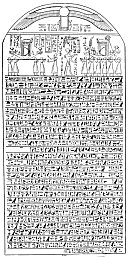
THE text of this legend is cut in hieroglyphics upon a sandstone stele, with a rounded top, which was found in the temple of Khensu at Thebes, and is now preserved in the Bibliothue Nationale at Paris; it was discovered by Champollion, and removed to Paris by Prisse d'Avennes in 1846. The text was first published by Prisse d'Avennes, 2 and it was first translated by Birch 3 in 1853.

The text was republished and translated into French by E. de Rougin 1858, 4 and several other renderings have been given in German and in English since that date. 5 When the text was first published, and for some years afterwards, it was generally thought that the legend referred to events which were said to have taken place under a king who was identified as Rameses XIII., but this misconception was corrected by Erman, who showed 6 that the king was in reality Rameses II.

By a careful examination of the construction of the text he proved that the narrative on the stele was drawn up several hundreds of years after the events described in it took place, and that its author was but imperfectly acquainted with the form of the Egyptian language in use in the reign of Rameses II. In fact, the legend was written in the interests of the priests of the temple of Khensu, who wished to magnify their god and his power to cast out devils and to exorcise evil spirits; it was probably composed between B.C. 650 and B.C. 250. 7

The legend, after enumerating the great names of Rameses II., goes on to state that the king was in the "country of the two rivers," by which we are to understand some portion of Mesopotamia, the rivers being the Tigris and Euphrates, and that the local chiefs were bringing to him tribute consisting of gold, lapis-lazuli, turquoise, and logs of wood from the Land of the God. It is difficult to understand how gold and logs of wood from Southern Arabia and East Africa came to be produced as tribute by chiefs who lived so far to the north.

Among those who sent gifts was the Prince of Bekhten, and at the head of all his tribute he sent his eldest daughter, bearing his message of homage and duty. Now the maiden was beautiful, and the King of Egypt thought her so lovely that be took her to wife, and bestowed upon. her the name "Ra-neferu," which means something like the "beauties of Ra." He took her back with him to Egypt, where she was installed as Queen.

During the summer of the fifteenth year of his reign, whilst Rameses II. was celebrating a festival of Amen-Ra in the Temple of Luxor, one came to him and reported that an envoy had arrived from the Prince of Bekhten, bearing with him many gifts for the Royal Wife Ra-neferu. When the envoy had been brought into the presence, he addressed words of homage to the king, and, having presented the gifts from his lord, he said that he had come to beg His Majesty to send a "learned man," i.e., a magician, to Bekhten to attend Bent-enth-resh, His Majesty's sister-in-law, who was stricken with some disease.

Thereupon the king summoned the learned men of the House of Life, i.e., the members of the great College of Magic at Thebes, and the qenbetu officials, and when they had entered his presence, he commanded them to select a man of "wise heart and deft fingers" to go to Bekhten. The choice fell upon one Tehuti-em-heb, and His Majesty sent him to Bekhten with the envoy. When they arrived in Bekhten, Tehuti-em-heb found that the Princess Bent-enth-resh was possessed by an evil spirit which refused to be exorcised by him, and he was unable to cast out the devil.

The Prince of Bekhten, seeing that the healing of his daughter was beyond the power of the Egyptian, sent a second envoy to Rameses II., and besought him to send a god to drive out the devil. This envoy arrived in Egypt in the summer of the twenty-sixth year of the reign of Rameses II., and found the king celebrating a festival in Thebes. When he heard the petition of the envoy, he went to the Temple of Khensu Nefer-hetep "a second time," and presented himself before the god and besought his help on behalf of his sister-in-law.

Then the priests of Khensu Nefer-hetep carried the statue of this god to the place where was the statue of Khensu surnamed "Pa-ari-sekher," i.e., the "Worker of destinies," who was able to repel the attacks of evil spirits and to drive them out. When the statues of the two gods were facing each other, Rameses II. entreated Khensu Nefer-hetep to "turn his face towards," i.e., to look favourably upon Khensu. Pa-ari-sekher, and to let him go to Bekhten to drive the devil out of the Princess of Bekhten.

The text affords no explanation of the fact that Khensu Nefer-hetep was regarded as a greater god than Khensu Pa-ari-sekher, or why his permission had to be obtained before the latter could leave the country. It is probable that the demands made upon Khensu Nefer-hetep by the Egyptians who lived in Thebes and its neighbourhood were so numerous that it was impossible to let his statue go into outlying districts or foreign lands, and that a deputy-god was appointed to perform miracles outside Thebes.

This arrangement would benefit the people, and would, moreover, bring much money to the priests. The appointment of a deputy-god is not so strange as it may seem, and modern African peoples are familiar with the expedient. About one hundred years ago the priests of the god Bobowissi of Winnebah, in the Tshi region of West Africa, found their business so large that it was absolutely necessary for them to appoint a deputy.

The priests therefore selected Brahfo, i.e., "deputy," and gave out that Bobowissi had deputed all minor matters to him, and that his utterances were to be regarded as those of Bobowissi. Delegates were ordered to be sent to Winnebah in Ashanti, where they would be shown the "deputy" god by the priests, and afterwards he would be taken to Mankassim, where he would reside, and do for the people all that Bobowissi had done hitherto. 8

When Rameses II. had made his petition to Khensu Nefer-hetep, the statue of the god bowed its head twice, in token of assent. Here it is clear that we have an example of the use of statues with movable limbs, which were worked, when occasion required, by the priests. The king then made a second petition to the god to transfer his sa, or magical power, to Khensu Pa-ari-sekher so that when he had arrived in Bekhten he would be able to heal the Princess.

Again the statue of Khensu Nefer-hetep bowed its head twice, and the petition of the king was granted. The text goes on to say that the magical power of the greater god was transferred to the lesser god four times, or in a fourfold measure, but we are not told how this was effected. We know from many passages in the texts that every god was believed to possess this magical power, which is called the "sa of life," or the "sa of the god,".9 This sa could be transferred by a god or goddess to a human being, either by an embrace or through some offering which was eaten.

Thus Temu transferred the magical power of his life to Shu and Tefnut by embracing them, 10 and in the Ritual of the Divine Cult 11 the priest says, The two vessels of milk of Temu are the sa 12 of my limbs." The man who possessed this sa could transfer it to his friend by embracing him and then "making passes" with his hands along his back. The sa could be received by a man from a god and then transmitted by him to a statue by taking it in his arms, and this ceremony was actually performed by the king in the Ritual of the Divine Cult. 13

The primary source of this sa was Ra, who bestowed it without measure on the blessed dead, 14 and caused them to live for ever thereby. These, facts make it tolerably certain that the magical power of Khensu Nefer-hetep was transferred to Khensu Pa-ari-sekher in one of two ways: either the statue of the latter was brought near to that of the former and it received the sa by contact, or the high priest first received the sa from the greater god and then transmitted it to the lesser god by embraces and "passes" with his hands.

Be this as it may, Khensu Pa-ari-sekher received the magical power, and having been placed in his boat, he set out for Bekhten, accompanied by five smaller boats, and chariots and horses which marched on each side of him.

When after a journey of seventeen months Khensu Pa-ari-sekher arrived in Bekhten, he was cordially welcomed by the Prince, and, having gone to the place where the Princess who was possessed of a devil lived, he exercised his power to such purpose that she was healed immediately. Moreover, the devil which had been cast out admitted that Khensu Pa-ari-sekher was his master, and promised that he would depart to the place whence he came, provided that the Prince of

Bekhten would celebrate a festival in his honour before his departure. Meanwhile the Prince and his soldiers stood by listening to the conversation between the god and the devil, and they were very much afraid. Following the instructions of Khensu Pa-ari-sekher the Prince made a great feast in honour of the supernatural visitors, and then the devil departed to the "place which he loved," and there was general rejoicing in the land.

The Prince of Bekhten was so pleased with the Egyptian god that he determined not to allow him to return to Egypt. When the statue of Khensu Pa-ari-sekher had been in Bekhten for three years and nine months, the Prince in a vision saw the god, in the form of a golden hawk, come forth from his shrine, and fly up into the air and direct his course to Egypt. Realizing that the. statue of the god was useless without its indwelling spirit, the Prince of Bekhten permitted the priests of Khensu Pa-ari-sekher to depart with it to Egypt, and dismissed them with gifts of all kinds. In due course they arrived in Egypt and the priests took their statue to the temple of Khensu Nefer-hetep, and handed over to that god all the gifts which the Prince of Bekhten had given them, keeping back nothing for their own god.

After this Khensu Pa-ari-sekher returned to his temple in peace, in the thirty-third year of the reign of Rameses II., having been absent from it about eight years.

Footnotes

1 In the headlines of this section, p. 106 ff., for Ptah Nefer-hetep read Khensu Nefer-hetep.
2 Choix de Monuments yptiens, Paris, 1847, plate xxiv.
3 Transactions of the Royal Society of Literature, New Series, vol. iv., p. 217 ff.
4 Journal Asiatique (ude sur une Ste yptienne), August, 1856, August, 1857, and August-Sept., 1858, Paris, 8vo, with plate.
5 Brugsch, Geschichte Aegyptens, 1877, p. 627 ff.; Birch, Records of the Past, Old Series, vol. iv., p. 53 ff.; Budge, Egyptian Reading Book, text and transliteration, p. 40 ff.; translation, p. xxviii. ff.
6 Aeg. Zeit., 1883, pp. 54-60.
7 Maspero, Les Contes Populaires, 3rd edit., p. 166.
8 Thus the king must have invoked the help of Khensu on the occasion of the visit of the first envoy.
9 Ellis, Tshi-speaking Peoples, p. 55.
10 Text of Unas, line 562.
11 Pyramid Texts, Pepi I., l. 466.
12 Ed. Moret, p. 21.
13 Ibid., p. 99.
14 Pepi I., line 666.

Legends of the Gods, LEGEND OF THE BIRTH OF HORUS, SON OF ISIS AND OSIRIS

Legends of the Gods

The Egyptian Texts, edited with Translations

by E. A. Wallis Budge

London: Kegan Paul, Trench and Trner & Co. Ltd.

[1912]

V

LEGEND OF THE BIRTH OF HORUS, SON OF ISIS AND OSIRIS

PLATE XIV.

gods-10summary5

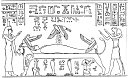
The Procreation of Horus, son of Isis.

THE text which contains this legend is found cut in hieroglyphics upon a stele which is now preserved in Paris. Attention was first called to it by Chabas, who in 1857 gave a translation of it in the Revue Archlogique, p. 65 ff., and pointed out the importance of its contents with his characteristic ability.

The hieroglyphic text was first published by Ledrain in his work on the monuments of the Bibliothue Nationale in Paris, 1 and I gave a transcript of the text, with transliteration and translation, in 1895. 2

The greater part of the text consists of a hymn to Osiris, which was probably composed under the XVIIIth Dynasty, when an extraordinary development of the cult of that god took place, and when he was placed by Egyptian theologians at the head of all the gods.

Though unseen in the temples, his presence filled all Egypt, and his body formed the very substance of the country. He was the God of all gods and the Governor of the Two Companies of the gods, he formed the soul and body of Ra, he was the beneficent Spirit of all spirits, he was himself the celestial food on which the Doubles in the Other World lived. He was the greatest of the gods in On (Heliopolis), Memphis, Herakleopolis, Hermopolis, Abydos, and the region of the First Cataract, and so. He embodied in his own person the might of Ra-Tem, Apis and Ptah, the Horus-gods, Thoth and Khnemu, and his rule over Busiris and Abydos continued to be supreme, as it had been for many, many hundreds of years.

He was the source of the Nile, the north wind sprang from him, his seats were the stars of heaven which never set, and the imperishable stars were his ministers. All heaven was his dominion, and the doors of the sky opened before him of their own accord when he appeared. He inherited the earth from his father Keb, and the sovereignty of heaven from his mother Nut. In his person he united endless time in the past and endless time in the future.

Like Ra he had fought Seba, or Set, the monster of evil, and had defeated him, and his victory assured to him lasting authority over the gods and the dead. He exercised his creative power in making land and water, trees and herbs, cattle and other four-footed beasts, birds of all kinds, and fish and creeping things; even the waste spaces of the desert owed allegiance to him as the creator. And he rolled out the sky, and set the light above the darkness.

The last paragraph of the text contains an allusion to Isis, the sister and wife of Osiris, and mentions the legend of the birth of Horus, which even under the XVIIIth Dynasty was very ancient, Isis, we are told, was the constant protectress of her brother, she drove away the fiends that wanted to attack him, and kept them out of his shrine and tomb, and she guarded him from all accidents.

All these things she did by means of spells and incantations, large numbers of which were known to her, and by her power as the "witch-goddess." Her "mouth was trained to perfection, and she made no mistake in pronouncing her spells, and her tongue was skilled and halted not." At length came the unlucky day when Set succeeded in killing Osiris during the war which the "good god" was waging against him and his fiends. Details of the engagement are wanting, but the Pyramid Texts state that the body of Osiris was hurled to the ground by Set at a place called Netat, which seems to have been near Abydos. 3

The news of the death of Osiris was brought to Isis, and she at once set out to find his body. All legends agree in saying that she took the form of a bird, and that she flew about unceasingly, going hither and thither, and uttering wailing cries of grief. At length she found the body, and with a piercing cry she alighted on the ground.

The Pyramid Texts say that Nephthys was with her that "Isis came, Nephthys came, the one on the right side, the other on the left side, one in the form of a Hat bird, the other in the form of a Tchert bird, and they found Osiris thrown on the ground in Netat by his brother Set." The late form of the legend goes on to say that Isis fanned the body with her feathers, and produced air, and that at length she caused the inert members of Osiris to move, and drew from him his essence, wherefrom she produced her child Horus.

This bare statement of the dogma of the conception of Horus does not represent all that is known about it, and it may well be supplemented by a passage from the Pyramid Texts, 4 which reads, "Adoration to thee, O Osiris. 5 Rise thou up on thy left side, place thyself on thy right side. This water which I give unto thee is the water of youth (or rejuvenation). Adoration to thee, O Osiris! Rise thou up on thy left side, place thyself on thy right side.

This bread which I have made for thee is warmth. Adoration to thee, O Osiris! The doors of heaven are opened to thee, the doors of the streams are thrown wide open to thee. The gods in the city of Pe come [to thee], Osiris, at the sound (or voice) of the supplication of Isis and Nephthys. . . . . . . Thy elder sister took thy body in her arms, she chafed thy hands, she clasped thee to her breast [when] she found thee [lying] on thy side on the plain of Netat."

PLATE XV

gods-10summary5

PLATE XVI

gods-10summary5

The Stele recording the casting out of a devil from the Princess of Bekhten.

And in another place we read: 6 "Thy two sisters, Isis and Nephthys, came to thee, Kam-urt, in thy name of Kam-ur, Uatchet-urt, in thy name of Uatch-ur" . . . . . . . "Isis and Nephthys weave magical protection for thee in the city of Saut, for thee their lord, in thy name of 'Lord of Saut,' for their god, in thy name of 'God.' They praise thee; go not thou far from them in thy name of 'Tua.' They present offerings to thee; be not wroth in thy name of 'Tchentru.' Thy sister Isis cometh to thee rejoicing in her love for thee. 7 Thou hast union with her, thy seed entereth her. She conceiveth in the form of the star Septet (Sothis). Horus-Sept issueth from thee in the form of Horus, dweller in the star Septet. Thou makest a spirit to be in him in his name 'Spirit dwelling in the god Tchentru.' He avengeth thee in his name of 'Horus, the son who avenged his father.' Hail, Osiris, Keb hath brought to thee Horus, he hath avenged thee, he hath brought to thee the hearts of the gods, Horus hath given thee his Eye, thou hast taken possession of the Urert Crown thereby at the head of the gods. Horus hath presented to thee thy members, he hath collected them completely, there is no disorder in thee.

Thoth hath seized thy enemy and hath slain him and those who were with him." The above words are addressed to dead kings in the Pyramid Texts, and what the gods were supposed to do for them was believed by the Egyptians to have been actually done for Osiris. These extracts are peculiarly valuable, for they prove that the legend of Osiris which was current under the XVIIIth Dynasty was based upon traditions which were universally accepted in Egypt under the Vth and VIth Dynasties.

The hymn concludes with a reference to the accession of Horus, son of Isis, the flesh and bone of Osiris, to the throne of his grandfather Keb, and to the welcome which he received from the Tchatcha, or Administrators of heaven, and the Company of the Gods, and the Lords of Truth, who assembled in the Great House of Heliopolis to acknowledge his sovereignty. His succession also received the approval of Neb-er-tcher, who, as we saw from the first legend in this book, was the Creator of the Universe.

Footnotes

1 Les Monuments yptiens (Cabinet des Mailles et Antiques), In the Bibliothue de l'ole des Hautes udes, Paris, 1879-1882, plate xxii. ff.
2 First Steps in Egyptian, pp. 179-188.
3 Pepi I., line 475; Pepi II., line 1263.
4 Mer-en-Ra, line 336; Pepi II., line 862.
5 I omit the king's names.
6 Teta, line 274; Pepi I., line 27; Mer-en-Ra, line 37; and Pepi II., line 67.
7 Pyramid Text, Teta, l. 276.

Legends of the Gods, THE LEGEND OF HERU-BEHUTET AND THE WINGED DISK

Legends of the Gods

The Egyptian Texts, edited with Translations

by E. A. Wallis Budge

London: Kegan Paul, Trench and Trner & Co. Ltd.

[1912]

IV

THE LEGEND OF HERU-BEHUTET AND THE WINGED DISK

THE text of this legend is cut in hieroglyphics on the walls of the temple of Edfu in Upper Egypt, and certain portions of it are illustrated by large bas-reliefs. Both text and reliefs were published by Professor Naville in his volume entitled Mythe d'Horus, fol., plates 12-19, Geneva, 1870. A German translation by Brugsch appeared in the Ahandlungen der Gtinger Akademie, Band xiv., pp. 173-236, and another by Wiedemann in his Die Religion, p. 38 ff. (see the English translation p. 69 ff.).

PLATE I

gods-09summary4

Horus holding the Hippopotamus-fiend with chain and spear. Behind stand Isis and Heru Khenti-Khatti.

PLATE II

gods-09summary4

Horus driving his spear into the Hippopotamus-fiend; behind him stands one of his "Blacksmiths".

PLATE III

gods-09summary4

Horus driving his spear into the belly of the Hippopotamus-fiend as he lies on his back; behind stands on of his "Blacksmiths".

PLATE IV

gods-09summary4

Horus and Isis capturing the Hippopotamus-fiend.

The legend, in the form in which it is here given, dates from the Ptolemaic Period, but the matter which it contains is far older, and it is probable that the facts recorded in it are fragments of actual history, which the Egyptians of the late period tried to piece together in chronological order. We shall see as we read that the writer of the legend as we have it was not well acquainted with Egyptian history, and that in his account of the conquest of Egypt he has confounded one god with another, and mixed up historical facts with mythological legends to such a degree that his meaning is frequently uncertain. The great fact which he wished to describe is the conquest of Egypt by an early king, who, having subdued the peoples in the South, advanced northwards, and made all the people whom he conquered submit to his yoke. Now the King of Egypt was always called Horus, and the priests of Edfu wishing to magnify their local god, Horus of Behutet, or Horus of Edfu, attributed to him the conquests of this human, and probably predynastic, king. We must remember that the legend assumes that Ra, was still reigning on earth, though he was old and feeble, and had probably deputed his power to his successor, whom the legend regards as his son.

In the 363rd year of his reign Ra-Harmakhis 1 was in Nubia with his army with the intention of destroying those who had conspired against him; because of their conspiracy (auu) Nubia is called "Uaua" to this day. From Nubia Ra-Harmakhis sailed down the river to Edfu, where Heru-Behutet entered his boat, and told him that his foes were conspiring against him. Ra-Harmakhis in answer addressed Heru-Behutet as his son, and commanded him to set out without delay and slay the wicked rebels. Then Heru-Behutet took the form of a great winged Disk, and at once flew up into the sky, where he took the place of Ra, the old Sun-god. Looking down from the height of heaven he was able to discover the whereabouts of the rebels, and he pursued them in the form of a winged disk. Then he attacked them with such violence that they became dazed, and could neither see where they were going, nor hear, the result of this being that they slew each other, and in a very short time they were all dead. Thoth, seeing this, told Ra that because Horus had appeared as a great winged disk he must be called "Heru-Behutet," and by this name Horus was known ever after at Edfu. Ra embraced Horus, and referred with pleasure to the blood which he had shed, and Horus invited his father to come and look upon the slain. Ra set out with the goddess Ashthertet (Ashtoreth) to do this, and they saw the enemies lying fettered on the ground. The legend here introduces a number of curious derivations of the names of Edfu, , which are valueless, and which remind us of the derivations of place-names propounded by ancient Semitic scribes.

PLATE V

gods-09summary4

Horus standing on the back of the Hippopotamus-fiend, and spearing him in the presence of Isis.

PLATE VI

gods-09summary4

The "Butcher-priest" slicing open the Hippopotamus-fiend.

In gladness of heart Ra proposed a sail on the Nile, but as soon as his enemies heard that he was coming, they changed themselves into crocodiles and hippopotami, so that they might be able to wreck his boat and devour him. As the boat of the god approached them they opened their jaws to crush it, but Horus and his followers came quickly on the scene, and defeated their purpose. The followers of Horus here mentioned are called in the text "Mesniu," i.e., "blacksmiths," or "workers in metal," and they represent the primitive conquerors of the Egyptians, who were armed with metal weapons, and so were able to overcome with tolerable ease the indigenous Egyptians, whose weapons were made of flint and wood. Horus and his "blacksmiths" were provided with iron lances and chains, and, baying cast the chains over the monsters in the river, they drove their lances into their snouts, and slew 651 of them. Because Horus gained his victory by means of metal weapons, Ra decreed that a metal statue of Horus should be placed at Edfu, and remain there for ever, and a name was given to the town to commemorate the great battle that had taken place there. Ra applauded Horus for the mighty deeds which be had been able to perform by means of the spells contained in the "Book of Slaying the Hippopotamus." Horus then associated with himself the goddesses Uatchet and Nekhebet, who were in the form of serpents, and, taking his place as the winged Disk on the front of the Boat of Ra, destroyed all the enemies of Ra wheresoever he found them. When the remnant of the enemies of Ra, saw that they were likely to be slain, they doubled back to the South, but Horus pursued them, and drove them down the river before him as far as Thebes. One battle took place at Tchetmet, and another at Denderah, and Horus was always victorious; the enemies were caught by chains thrown over them, and the deadly spears of the Blacksmiths drank their blood.

After this the enemy fled to the North, and took refuge in the swamps of the Delta, and in the shallows of the Mediterranean Sea, and Horus pursued them thither. After searching for them for four days and four nights he found them, and they were speedily slain. One hundred and forty-two of them. and a male hippopotamus were dragged on to the Boat of Ra, and there Horus dug out their entrails, and hacked their carcases in pieces, which he gave to his Blacksmiths and the gods who formed the crew of the Boat of Ra. Before despatching the hippopotamus, Horus leaped on to the back of the monster as a mark of his triumph, and to commemorate this event the priest of Heben, the town wherein these things happened, was called "He who standeth on the back ever after.

The end of the great fight, however, was not yet. Another army of enemies appeared by the North Lake, and they were marching towards the sea; but terror of Horus smote their hearts, and they fled and took refuge in Mertet-Ament, where they allied themselves with the followers of Set, the Arch-fiend and great Enemy of Ra. Thither Horus and his well-armed Blacksmiths pursued them, and came up with them at the town called Per-Rerehu, which derived its name from the "Two Combatants," or "Two Men," Horus and Set. A great fight took place, the enemies of Ra were defeated with great slaughter, and Horus dragged 381 prisoners on to the Boat of Ra, where he slew them, and gave their bodies to his followers.

PLATE VII

gods-09summary4

Horus of Behutet and Ra-Harmakhis in a shrine.

PLATE VIII

gods-09summary4

Horus of Behutet and Harmakhis in a shrine.

PLATE IX

gods-09summary4

Ashthertet ('Ashtoreth') driving her chariot over the prostrate foe.

PLATE X

gods-09summary4

Left: Horus of Behutet spearing a Typhonic animal, and holding his prisoners with rope.
Right: Horus of Behutet, accompanied by Ra-Harmakhis and Menu, spearing the Hippopotamus-fiend.

Then Set rose up and cursed Horus because he had slain his allies, and he used such foul language that Thoth called him "Nehaha-her," i.e., "Stinking Face," and this name clung to him ever after. After this Horus and Set engaged in a fight which lasted a very long time, but at length Horus drove his spear into the neck of Set with such violence that the Fiend fell headlong to the ground. Then Horus smote with his club the mouth which had uttered such blasphemies, and fettered him with his chain. In this state Horus dragged Set into the presence of Ra, who ascribed great praise to Horus, and special names were given to the palace of Horus and the high priest of the temple in commemoration of the event. When the question of the disposal of Set was being discussed by the gods, Ra ordered that he and his fiends should be given over to Isis and her son Horus, who were to do what they pleased with them. Horus promptly cut off the heads of Set and his fiends in the presence of Ra and Isis, and be dragged Set by his feet through the country with his spear sticking in his head and neck. After this Isis appointed Horus of Behutet to be the protecting deity of her son Horus.

The fight between the Sun-god and Set was a very favourite subject with Egyptian writers, and there are many forms of it. Thus there is the fight between Heru-ur and Set, the fight between Ra and Set, the fight between Heru-Behutet and Set, the fight between Osiris and Set, and the fight between Horus, son of Isis, and Set. In the oldest times the combat was merely the natural opposition of light to darkness, but later the Sun-god became the symbol of right and truth as well as of light, and Set the symbol of sin and wickedness as well as of darkness, and ultimately the nature myth was forgotten, and the fight between the two gods became the type of the everlasting war which good men wage against sin. In Coptic literature we have the well-known legend of the slaughter of the dragon by St. George, and this is nothing but a Christian adaptation of the legend of Horus and Set.

After these things Horus, son of Ra, and Horus, son of Isis, each took the form of a mighty man, with the face and body of a hawk, and each wore the Red and White Crowns, and each carried a spear and chain. In these forms the two gods slew the remnant of the enemies. Now by some means or other Set came to life again, and he took the form of a mighty hissing or "roaring" serpent, and hid himself in the ground, in a place which was ever after called the "place of the roarer." In front of his hiding-place Horus, son of Isis, stationed himself in the form of a hawk-headed staff to prevent him from coming out. In spite of this, however, Set managed to escape, and he gathered about him the Smai and Seba fiends at the Lake of Meh, and waged war once more against Horus; the enemies of Ra were again defeated, and Horus slew them in the presence of his father.

PLATE XI

gods-09summary4

Horus of Behutet and Thoth spearing human victims with the assistance of Isis.

PLATE XII

gods-09summary4

Horus of Behutet and Thoth spearing Set in the form of a crocodile.

Horus, it seems, now ceased to fight for some time, and devoted himself to keeping guard over the "Great God" who was in An-rut-f, a district in or near Herakleopolis. This Great God was no other than Osiris, and the duty of Horus was to prevent the Smai fiends from coming by night to the place. In spite of the power of Horus, it was found necessary to summon the aid of Isis to keep away the fiends, and it was only by her words of power that the fiend Ba was kept out of the sanctuary. As a reward for what he had already done, Thoth decreed that Horus should be called the "Master-Fighter." Passing over the derivations of place-names which occur here in the text, we find that Horus and his Blacksmiths were again obliged to fight bodies of the enemy who had managed to escape, and that on one occasion they killed one hundred and six foes. In every fight the Blacksmiths performed mighty deeds of valour, and in reward for their services a special district was allotted to them to dwell in.

The last great fight in the North took place at Tanis, in the eastern part of the Delta. When the position of the enemy had been located, Horus took the form of a lion with the face of a man, and he put on his head the Triple Crown. His claws were like flints, and with them he dragged away one hundred and forty-two of the enemy, and tore them in pieces, and dug out their tongues, which he carried off as symbols of his victory.

Meanwhile rebellion had again broken out in Nubia, where about one-third of the enemy had taken refuge in the river in the forms of crocodiles and hippopotami. Ra counselled Horus to sail up the Nile with his Blacksmiths, and when Thoth had recited the "Chapters of protecting the Boat of Ra" over the boats, the expedition set sail for the South. The object of reciting these spells was to prevent the monsters which were in the river from making the waves to rise and from stirring up storms which might engulf the boats of Ra and Horus and the Blacksmiths. When the rebels and fiends who had been uttering, treason against Horus saw the boat of Ra, with the winged Disk of Horus accompanied by the goddesses Uatchet and Nekhebet in the form of serpents, they were smitten with fear, and their hearts quaked, and all power of resistance left them, and they died of fright straightway. When Horus returned in triumph to Edfu, Ra ordered that an image of the winged Disk should be placed in each of his sanctuaries, and that in every place wherein a winged Disk was set, that sanctuary should be a sanctuary of Horus of Behutet. The winged disks which are seen above the doorways of the temples still standing in Egypt show that the command of Ra, was faithfully carried out by the priests.

PLATE XIII

gods-09summary4

Horus of Behutet in the form of a lion slaying his foes.

Footnotes

1 I.e., Ra on the horizon.

Legends of the Gods, THE LEGEND OF RA AND ISIS

Legends of the Gods

The Egyptian Texts, edited with Translations

by E. A. Wallis Budge

London: Kegan Paul, Trench and Trner & Co. Ltd.

[1912]

III

THE LEGEND OF RA AND ISIS

The original text of this very interesting legend is written in the hieratic character on a papyrus preserved at Turin, and was published by Pleyte and Rossi in their Corpus of Turin Papyri. 1 French and German translations of it were published by Lefure, 2 and Wiedemann 3 respectively, and summaries of its contents were given by Erman 4 and Maspero. 5 A transcript of the hieratic text into hieroglyphics, with transliteration and translation, was published by me in 1895. 6

It has already been seen that the god Ra, when retiring from the government of this world, took steps through Thoth to supply mankind with words of power and spells with which to protect themselves against the bites of serpents and other noxious reptiles.

The legend of the Destruction of Mankind affords no explanation of this remarkable fact, but when we read the following legend of Ra and Isis we understand why Ra, though king of the gods, was afraid of the reptiles which lived in the kingdom of Keb. The legend, or "Chapter of the Divine God," begins by enumerating the mighty attributes of Ra as the creator of the universe, and describes the god of "many names" as unknowable, even by the gods.

At this time Isis lived in the form of a woman who possessed the knowledge of spells and incantations, that is to say, she was regarded much in the same way as modern African peoples regard their "medicine-women," or "witch-women." She had used her spells on men, and was tired of exercising her powers on them, and she craved the opportunity of making herself mistress of gods and spirits as well as of men.

She meditated how she could make herself mistress both of heaven and earth, and finally she decided that she could only obtain the power she wanted if she possessed the knowledge of the secret name of Ra, in which his very existence was bound up. Ra guarded this name most jealously, for he knew that if he revealed it to any being he would henceforth be at that being's mercy.

Isis saw that it was impossible to make Ra declare his name to her by ordinary methods, and she therefore thought out the following plan. It was well known in Egypt and the Sudan at a very early period that if a magician obtained some portion of a person's body, e.g., a hair, a paring of a nail, a fragment of skin, or a portion of some efflux from the body, spells could be used upon them which would have the effect of causing grievous harm to that person. Isis noted that Ra had become old and feeble, and that as he went about he dribbled at the mouth, and that his saliva fell upon the ground.

Watching her opportunity she caught some of the saliva of the and mixing it with dust, she moulded it into the form of a large serpent, with poison-fangs, and having uttered her spells over it, she left the serpent lying on the path, by which Ra travelled day by day as he went about inspecting Egypt, so that it might strike at him as he passed along. We may note in passing that the Banyoro in the Sudan employ serpents in killing buffaloes at the present day.

They catch a puff-adder in a noose, and then nail it alive by the tip of its tail to the round in the middle of a buffalo track, so that when an animal passes the reptile may strike at it. Presently a buffalo comes along, does what it is expected to do, and then the puff-adder strikes at it, injects its poison, and the animal dies soon after. As many as ten buffaloes have been killed in a day by one puff-adder. The body of the first buffalo is not eaten, for it is regarded as poisoned meat, but all the others are used as food. 7

Soon after Isis had placed the serpent on the Path, Ra passed by, and the reptile bit him, thus injecting poison into his body. Its effect was terrible, and Ra cried out in agony. His jaws chattered, his lips trembled, and he became speechless for a time; never before had be suffered such pain.

The gods hearing his cry rushed to him, and when he could speak he told them that he had been bitten by a deadly serpent. In spite of all the words of power which were known to him, and his secret name which had been hidden in his body at his birth, a serpent had bitten him, and he was being consumed with a fiery pain.

He then commanded that all the gods who had any knowledge of magical spells should come to him, and when they came, Isis, the great lady of spells, the destroyer of diseases, and the revivifier of the dead, came with them. Turning to Ra she said, "What hath happened, O divine Father?" and in answer the god told her that a serpent had bitten him, that he was hotter than fire and colder than water, that his limbs quaked, and that he was losing the power of sight.

Then Isis said to him with guile, "Divine Father, tell me thy name, for he who uttereth his own name shall live." Thereupon Ra proceeded to enumerate the various things that he had done, and to describe his creative acts, and ended his speech to Isis by saying, that he was Khepera in the morning, Ra at noon, and Temu in the evening. Apparently he thought that the naming of these three great names would satisfy Isis, and that she would immediately pronounce a word of power and stop the pain in his body, which, during his speech, had become more acute.

Isis, however, was not deceived, and she knew well that Ra had not declared to her his hidden name; this she told him, and she begged him once again to tell her his name. For a time the god refused to utter the name, but as the pain in his body became more violent, and the poison passed through his veins like fire, he said, "Isis shall search in me, and my name shall pass from my body into hers."

At that moment Ra removed himself from the sight of the gods in his Boat, and the Throne in the Boat of Millions of Years had no occupant. The great name of Ra was, it seems, hidden in his heart, and. Isis, having some doubt as to whether Ra would keep his word or not, agreed with Horus that Ra must be made to take an oath to part with his two Eyes, that is, the Sun and the Moon. At length Ra allowed his heart to be taken from his body, and his great and secret name, whereby he lived, passed into the possession of Isis.

Ra thus became to all intents and purposes a dead god. Then Isis, strong in the power of her spells, said: "Flow, poison, come out of Ra. Eye of Horus, come out of Ra, and shine outside his mouth. It is I, Isis, who work, and I have made the poison to fall on the ground. Verily the name of the great god is taken from him, Ra shall live and the poison shall die; if the poison live Ra shall die."

This was the infallible spell which was to be used in cases of poisoning, for it rendered the bite or sting of every venomous reptile harmless. It drove the poison out of Ra, and since it was composed by Isis after she obtained the knowledge of his secret name it was irresistible. If the words were written on papyrus or linen over a figure of Temu or Heru-hekenu, or Isis, or Horus, they became a mighty charm.

If the papyrus or linen were steeped in water and the water drunk, the words were equally efficacious as a charm against snake-bites. To this day water in which the written words of a text from the Kur'an have been dissolved, or water drunk from a bowl on the inside of which religious texts have been written, is still regarded as a never-failing charm in Egypt and the Sudan. Thus we see that the modern custom of drinking magical water was derived from the ancient Egyptians, who believed that it conveyed into their bodies the actual power of their gods.

Footnotes


1 Papyrus de Turin, pll. 31, 77, 131-138.
2 Z., 1883, p. 27 ff.
3 Die Religion, p. 29.
4 Aegypten, p. 359 ff.
5 Les Origines, V. 162-4.
6 First Steps in Egyptian, p. 241 ff.
7 Johnston, Uganda, vol. ii., p. 584. The authority for this statement is Mr. George Wilson, formerly Collector in Unyoro.

Subscribe to this RSS feed

Log in or create an account