log in
LC Geerts

LC Geerts

Website URL:

The Legends ch. 8, LEGENDS OF THE AGE OF DARKNESS

RAGNAROK

THE AGE OF FIRE AND GRAVEL.

BY

IGNATIUS DONNELLY

AUTHOR OF "ATLANTIS: THE ANTEDILUVIAN WORLD."

[1883]

PART III

The Legends

CHAPTER VIII

LEGENDS OF THE AGE OF DARKNESS

ALL the cosmogonies begin with an Age of Darkness; a damp, cold, rainy, dismal time.

Hesiod tells us, speaking of the beginning of things

"In truth, then, foremost sprung Chaos. . . . But from Chaos were born Erebus and black Night; and from Night again sprang forth her and Day, whom she bare after having conceived by union with Erebus."

Aristophanes, in his "Aves," says: [1]

"Chaos and Night and black Erebus and wide Tartarus first existed." [2]

Orpheus says:

"From the beginning the gloomy night enveloped and obscured all things that were under the ether" (the clouds). "The earth was invisible on account of the darkness, but the light broke through the ether" (the clouds), "and illuminated the earth."

By this power were produced the sun, moon, and stars. [3]

It is from Sanchoniathon that we derive most of the little we know of that ancient and mysterious people, the Phnicians. He lived before the Trojan war; and of his writings but fragments survive--quotations in the writings of others.

[1. "The Theogony."

2. Faber's "Origin of Pagan Idolatry," vol. i, p. 255.

3. Cory's "Fragments," p. 298.]

He tells us that--

"The beginning of all things was a condensed, windy air, or a breeze of thick air, and a chaos turbid and black as Erebus.

"Out of this chaos was generated M, which some call Ilus," (mud,) "but others the putrefaction of a watery mixture. And from this sprang all the seed of the creation, and the generation of the universe. . . . And, when the air began to send forth light, winds were produced and clouds, and very great defluxions and torrents of the heavenly waters."

Was this "thick air" the air thick with comet-dust, which afterward became the mud? Is this the meaning of the "turbid chaos"?

We turn to the Babylonian legends. Berosus wrote from records preserved in the temple of Belus at Babylon. He says:

"There was a time in which there existed nothing but darkness and an abyss of waters, wherein resided most hideous beings, which were produced of a twofold principle."

Were these "hideous beings" the comets?

From the "Laws of Menu," of the Hindoos, we learn that the universe existed at first in darkness.

We copy the following text from the Vedas:

"The Supreme Being alone existed; afterward there was universal darkness; next the watery ocean was produced by the diffusion of virtue."

We turn to the legends of the Chinese, and we find the same story:

Their annals begin with "Pwan-ku, or the Reign of Chaos." [1]

[1. "The Ancient Dynasties of Berosus and China," Rev. T. P. Crawford, D. D., p. 4.]

And we are told by the Chinese historians that--

"P'an-ku came forth in the midst of the great chaotic void, and we know not his origin; that he knew the rationale of heaven and earth, and comprehended the changes of the Darkness and the Light."[1]

He "existed before the shining of the Light." [2]He was "the Prince of Chaos."

"After the chaos cleared away, heaven appeared first in order, then earth, then after they existed, and the atmosphere had changed its character, man came forth." [3]

That is to say, P'an-ku lived through the Age of Darkness, during a chaotic period, and while the atmosphere was pestilential with the gases of the comet. Where did he live? The Chinese annals tell us:

"In the age after the chaos, when heaven and earth had just separated."

That is, when the great mass of cloud had just lifted from the earth:

"Records had not yet been established or inscriptions invented. At first even the rulers dwelt in caves and desert places, eating raw flesh and drinking blood. At this fortunate juncture Pan-ku-sze came forth, and from that time heaven and earth began to be heaven and earth, men and things to be men and things, and so the chaotic state passed away." [4]

This is the rejuvenation of the world told of in so many legends.

And these annals tell us further of the "Ten Stems," being the stages of the earth's primeval history.

"At Wu--the Sixth Stem--the Darkness and the Light unite with injurious effects--all things become solid," (frozen?), "and the Darkness destroys the growth of all things.

[1. Compendium of Wong-shi-Shing 1526-1590," Crawford, p. 3.

2. Ibid.

3. Ibid., p. 2.

4. Ibid., p. 3.]

"At Kung--the Seventh Stem--the Darkness nips all things."

But the Darkness is passing away:

"At Jin--the Ninth Stem--the Light begins to nourish all things in the recesses below.

"Lastly, at Tsze, all things begin to germinate." [1]

The same story is told in the "Twelve Branches."

"1. K'wun-tun stands for the period of chaos, the cold midnight darkness. It is said that with it all things began to germinate in the hidden recesses of the under-world."

In the 2d--Ch'i-fun-yoh--"light and heat become active, and all things begin to rise in obedience to its nature." In the 3d--Sheh-ti-kuh--the stars and sun probably appear, as from this point the calendar begins. In the 5th--Chi-shii--all things in a torpid state begin to come forth. In the 8th--Hn-hia--all things harmonize, and the present order of things is established; that is to say, the effects of the catastrophe have largely passed away. [2]

The kings who governed before the Drift were called the Rulers of heaven and earth; those who came after were the Rulers of man.

"Cheu Ching-huen says: 'The Rulers of man succeeded to the Rulers of heaven and the Rulers of earth in the government; that then the atmosphere gradually cleared away, and all things sprang up together; that the order of time was gradually settled, and the usages of society gradually became correct and respectful." [3]

And then we read that "the day and night had not yet been divided," but, after a time, "day and night were distinguished from each other." [4]

[1. "Compendium of Wong-shi-Shing 1526-1590," Crawford, pp. 4, 5.

2. Ibid., p. 8.

3. Ibid.

4. Ibid., p. 7.]

Here we have the history of some event which changed the dynasties of the world: the heavenly kingdom was succeeded by a merely human one; there were chaos, cold, and darkness, and death to vegetation; then the light increases, and vegetation begins once more to germinate; the atmosphere is thick; the heavens rest on the earth; day and night can not be distinguished from one another, and mankind dwell in caves, and live on raw meat and blood.

Surely all this accords wonderfully with our theory.

And here we have the same story in another form:

"The philosopher of Oraibi tells us that when the people ascended by means of the magical tree, which constituted the ladder from the lower world to this, they found the firmament, the ceiling of this world, low down upon the earth--the floor of this world."

That is to say, when the people climbed up, from the cave in which they were bidden, to the surface of the earth, the dense clouds rested on the face of the earth.

"Machito, one of their gods, raised the firmament on his shoulders to where it is now seen. Still the world was dark, as there was no sun, no moon, and no stars. So the people murmured because of the darkness and the cold. Machito said, 'Bring me seven maidens'; and they brought him seven maidens; and he said, 'Bring me seven baskets of cotton-bolls'; and they brought him seven baskets of cotton-bolls; and he taught the seven maidens to weave a magical fabric from the cotton, and when they had finished it he held it aloft, and the breeze carried it away toward the firmament, and in the twinkling of an eye it was transformed into a beautiful and full-orbed moon; and the same breeze caught the remnants of flocculent cotton, which the maidens had scattered during their work, and carried them aloft, and they were transformed into bright stars. But still it was cold; and the people murmured again, and Machito said, 'Bring me seven buffalo-robes'; and they brought him seven buffalo-robes, and from the densely matted hair of the robes he wove another wonderful fabric, which the storm carried away into the sky, and it was transformed into the full-orbed sun. Then Machito appointed times and seasons, and ways for the heavenly bodies; and the gods of the firmament have obeyed the injunctions of Machito from the day of their creation to the present." *

Among the Thlinkeets of British Columbia there is a legend that the Great Crow or Raven, Yehl, was the creator of most things:

"Very dark, damp, and chaotic was the world in the beginning; nothing with breath or body moved there except Yehl; in the likeness of a raven he brooded over the mist; his black winds beat down the vast confusion; the waters went back before him and the dry land appeared. The Thlinkeets were placed on the earth--though how or when does not exactly appear--while the world was still in darkness, and without sun, moon, or stars." [2]

The legend proceeds at considerable length to tell the doings of Yehl. His uncle tried to slay him, and, when he failed, "he imprecated with a potent curse a deluge upon all the earth. . . . The flood came, the waters rose and rose; but Yehl clothed himself in his bird-skin, and soared up to the heavens, where he stuck his beak into a cloud, and remained until the waters were assuaged." [3]

This tradition reminds us of the legend of the Thessalian Cerambos, "who escaped the flood by rising into the air on wings, given him by the nymphs."

I turn now to the traditions of the Miztecs, who dwelt on the outskirts of the Mexican Empire; this legend was taken by Fray Gregoria Garcia [4]from a book found in a convent in Cuilapa, a little Indian town, about a league and a half south of Oajaca; the book had been compiled by the vicar of the convent, "just as they themselves were accustomed to depict and to interpret it in their primitive scrolls":

[1. "Popular Science Monthly," October, 1879, p. 800.

2. Bancroft's "Native Races," vol. iii, p. 98.

3. Ibid., p. 99.

4. "Origen de los Ind.," pp. 327-329.]

"In the year and in the day of obscurity and darkness," (the days of the dense clouds?), "yea, even before the days or the years were," (before the visible revolution of the sun marked the days, and the universal darkness and cold prevented the changes of the seasons?), "when the world was in great darkness and chaos, when the earth was covered with water, and there was nothing but mud and slime on all the face of the earth--behold a god became visible, and his name was the Deer, and his surname was the Lion-snake. There appeared also a very beautiful goddess called the Deer, and surnamed the Tiger-snake. These two gods were the origin and beginning of all the gods."

This lion-snake was probably one of the comets; the tiger-snake was doubtless a second comet, called after the tiger, on account of its variegated, mottled appearance. It will be observed they appeared before the light had returned,

These gods built a temple on a high place, and laid out a garden, and waited patiently, offering sacrifices to the higher gods, wounding themselves with flint knives, and "praying that it might seem good to them to shape the firmament, and lighten the darkness of the world, and to establish the foundation of the earth; or, rather, to gather the waters together so that the earth might appear--as they had no place to rest in save only one little garden."

Here we have the snakes and the people confounded together. The earth was afterward made fit for the use of mankind, and at a later date there came--

"A great deluge, wherein perished many of the sons and daughters that had been born to the gods; and it is said that, when the deluge was passed, the human race was restored, as at the first, and the Miztec kingdom populated, and the heavens and the earth established." [1]

Father Duran, in his MS. "History Antique of New Spain," written in A. D. 1585, gives the Cholula legend, which commences:

"In the beginning, before the light of the sun had been created, this land was in obscurity and darkness and void of any created thing."

In the Toltec legends we read of a time when--

"There was a tremendous hurricane that carried away trees, mounds, houses, and the largest edifices, notwithstanding which many men and women escaped, principally in caves, and places where the great hurricane could not reach them. A few days having passed, they set out to see what had become of the earth, when they found it all populated with monkeys. All this time they were in darkness, without seeing the light of the sun, nor the moon, that the wind had brought them." [2]

In the Aztec creation-myths, according to the accounts furnished by Mendieta, and derived from Fray Andres de Olmos, one of the earliest of the Christian missionaries among the Mexicans, we have the following legend of the "Return of the Sun":

"Now, there had been no sun in existence for many years; so the gods being assembled in a place called Teotihuacan, six leagues from Mexico, and gathered at the time around a great fire, told their devotees that he of them who should first cast himself into that, fire should have the honor of being transformed into a sun. So, one of them, called Nanahuatzin . . . flung himself into the fire. Then the gods" (the chiefs?) "began to peer through the gloom in all directions for the expected light, and to make bets as to what part of heaven. he should first appear in. Some said 'Here,' and some said 'There'; but when the sun rose they were all proved wrong, for not one of them had fixed upon the east."

[1. Bancroft's "Native Races," vol. iii, pp. 71-73.

2. "North Americans of Antiquity," p. 239.]

In the long-continued darkness they had lost all knowledge of the cardinal points. The ancient landmarks, too, were changed.

The "Popul Vuh," the national book of the Quiches, tells us of four ages of the world. The man of the first age was made of clay; he was "strengthless, inept, watery; he could not move his head, his face looked but one way; his sight was restricted, he could not look behind him," that is, he had no knowledge of the past; "he had been endowed with language, but he had no intelligence, so he was consumed in the water." [1]

Then followed a higher race of men; they filled the world with their progeny; they had intelligence, but no moral sense"; "they forgot the Heart of Heaven." They were destroyed by fire and pitch from heaven, accompanied by tremendous earthquakes, from which only a few escaped.

Then followed a period when all was dark, save the white light "of the morning-star--sole light as yet of the primeval world"--probably a volcano.

"Once more are the gods in council, in the darkness, in the night of a desolated universe."

Then the people prayed to God for light, evidently for the return of the sun:

"'Hail! O Creator they cried, 'O Former! Thou that hearest and understandest us! abandon us not! forsake us not! O God, thou that art in heaven and on earth; O Heart of Heaven I O Heart of Earth! give us descendants, and a posterity as long as the light endure.'" . . .

In other words, let not the human race cease to be.

[1. Bancroft's "Native Races," vol. iii, p. 46.]

"It was thus they spake, living tranquilly, invoking the return of the light; waiting the rising of the sun; watching the star of the morning, precursor of the sun. But no sun came, and the four men and their descendants grew uneasy. 'We have no person to watch over us,' they said; 'nothing to guard our symbols!' Then they adopted gods of their own, and waited. They kindled fires, for the climate was colder; then there fell great rains and hail-storms, and put out their fires. Several times they made fires, and several times the rains and storms extinguished them. Many other trials also they underwent in Tulan, famines and such things, and a general dampness and cold--for the earth was moist, there being yet no sun."

All this accords with what I have shown we might expect as accompanying the close of the so-called Glacial Age. Dense clouds covered the sky, shutting out the light of the sun; perpetual rains and storms fell; the world was cold and damp, muddy and miserable; the people were wanderers, despairing and hungry. They seem to have come from an eastern land. We are told:

"Tulan was a much colder climate than the happy eastern land they had left."

Many generations seem to have grown up and perished under the sunless skies, "waiting for the return of the light"; for the "Popul Vuh" tells us that "here also the language of all the families was confused, so that no one of the first four men could any longer understand the speech of the others."

That is to say, separation and isolation into rude tribes had made their tongues unintelligible to one another.

This shows that many, many years--it may be centuries--must have elapsed before that vast volume of moisture, carried up by evaporation, was able to fall back, in snow and rain to the land and sea, and allow the sun to shine through "the blanket of the dark." Starvation encountered the scattered fragments of mankind.

And in these same Quiche legends of Central America we are told:

"The persons of the godhead were enveloped in the darkness which enshrouded a desolated world." [1]

They counseled together, and created four men of white and yellow maize (the white and yellow races?). It was still dark; for they had no light but the light of the morning-star. They came to Tulan.

And the AbbBrasseur de Bourbourg gives further details of the Quiche legends:

Now, behold our ancients and our fathers were made lords, and had their dawn. Behold we will relate also the rising of the sun, the moon, and the stars! Great was their joy when they saw the morning-star, which came out first, with its resplendent face before the sun. At last the sun itself began to come forth; the animals, small and great, were in joy; they rose from the water-courses and ravines, and stood on the mountain-tops, with their heads toward where the sun was coming. An innumerable crowd of people were there, and the dawn cast light on all these people at once. At last the face of the ground was dried by the sun: like a man the sun showed himself, and his presence warmed and dried the surface of the ground. Before the sun appeared, muddy and wet was the surface of the ground, and it was before the sun appeared, and then only the sun rose like a man. But his heat had no strength, and he did but show when he rose; he only remained like" (an image in) "a mirror and it is not, indeed, the same sun that appears now, they say, in the stories." [2]

[1. "North Americans of Antiquity," p. 214.

2. Tylor's "Early History of Mankind," p. 308.]

How wonderfully does all this accord with what we have shown would follow from the earth's contact with a comet!

The earth is wet and covered with mud, the clay; the sun is long absent; at last he returns; he dries the mud, but his face is still covered with the remnants of the great cloud-belt; "his heat has no strength"; he shows himself only in glimpses; he shines through the fogs like an image in a mirror; he is not like the great blazing orb we see now.

But the sun, when it did appear in all its glory, must have been a terrible yet welcome sight to those who had not looked upon him for many years. We read in the legends of the Thlinkeets of British Columbia, after narrating that the world was once "dark, damp, and chaotic," full of water, with no sun, moon, or stars, how these luminaries were restored. The great hero-god of the race, Yehl, got hold of three mysterious boxes, and, wrenching the lids off, let out the sun, moon, and stars.

"When he set up the blazing light" (of the sun) "in heaven, the people that saw it were at first afraid. Many hid themselves in the mountains, and in the forests, and even in the water, and were changed into the various kinds of animals that frequent these places." [1]

Says James Geikie:

"Nor can we form any proper conception of how long a time was needed to bring about that other change of climate, under the influence of which, slowly and imperceptibly, this immense sheet of frost melted away from the lowlands and retired to the mountain recesses. We must allow that long ages elapsed before the warmth became such as to induce plants and animals to clothe and people the land. How vast a time, also, must have passed away ere the warmth reached its climax!" [2]

[1. Bancroft's "Native Races," vol. iii, p. 100.

2. "The Great Ice Age," p. 184.]

And all this time the rain fell. There could be no return of the sun until all the mass of moisture sucked up by the comet's heat had been condensed into water, and falling on the earth had found its way back to the ocean; and this process had to be repeated many times. It was the age of the great primeval rain.

ragnarok-3-08

THE PRIMEVAL STORM.

In the Andes, Humboldt tells us of a somewhat similar state of facts:

"A thick mist during a particular season obscures the firmament for many months. Not a planet, not the most brilliant stars of the southern hemisphere--Canopus, the Southern Cross, nor the feet of Centaur--are visible. It is frequently almost impossible to discover the position of the moon. If by chance the outlines of the sun's disk be visible during the day, it appears devoid of rays."

Says Croll:

"We have seen that the accumulation of snow and ice on the ground, resulting from the long and cold winters, tended to cool the air and produce fogs, which cut off the sun's rays." [1]

The same writer says:

"Snow and ice lower the temperature by chilling the air and condensing the rays into thick fogs. The great strength of the sun's rays during summer, due to his nearness at that season, would, in the first place, tend to produce an increased amount of evaporation. But the presence of snow-clad mountains and an icy sea would chill the atmosphere and condense the vapors into thick fogs. The thick fogs and cloudy sky would effectually prevent the sun's rays from reaching the earth, and the snow, in consequence, would remain unmelted during the entire summer. In fact, we have this very condition of things exemplified in some of the islands of the Southern Ocean at the present day. Sandwich Land, which is in the same parallel of latitude as the north of Scotland, is covered with ice and snow the entire summer; and in the Island of South Georgia, which is in the same parallel as the center of England, the perpetual snow descends to the very sea-beach. The following is Captain Cook's description of this dismal place: 'We thought it very extraordinary,' he says, 'that an island between the latitudes of 54 and 55 should, in the very height of summer, be almost wholly covered with frozen snow, in some places many fathoms deep. . . . The head of the bay was terminated by ice-cliffs of considerable height, pieces of which were continually breaking off, which made a noise like cannon. Nor were the interior parts of the country less horrible.

[1. "Climate and Time," p. 75.]

The savage rocks raised their lofty summits till lost in the clouds, and valleys were covered with seemingly perpetual snow. Not a tree nor a shrub of any size was to be seen.'"

I return to the legends.

The Gallinomeros of Central California also recollect the day of darkness and the return of the sun:

"In the beginning they say there was no light, but a thick darkness covered all the earth. Man stumbled blindly against man and against the animals, the birds clashed together in the air, and confusion reigned everywhere. The Hawk happening by chance to fly into the face of the Coyote, there followed mutual apologies, and afterward a long discussion on the emergency of the situation. Determined to make some effort toward abating the public evil, the two set about a remedy. The Coyote gathered a great heap, of tules" (rushes) "rolled them into a ball, and gave it to the Hawk, together with some pieces of flint. Gathering all together as well as he could, the Hawk flew straight up into the sky, where he struck fire with the flints, lit his ball of reeds, and left it there whirling along all in a fierce red glow as it continues to the present; for it is the sun. In the same way the moon was made, but as the tules of which it was constructed were rather damp, its light has always been somewhat uncertain and feeble." [2]

The Algonquins believed in a world, an earth, "anterior to this of ours, but one without light or human inhabitants. A lake burst its bounds and submerged it wholly."

This reminds us of the Welsh legend, and the bursting of the lake Llion (see page 135, ante).

The ancient world was united in believing in great cycles of time terminating in terrible catastrophes:

[1. Captain Cook's "Second Voyage," vol. ii, pp. 232-235;

2. "Climate and Time," Croll, pp. 60, 61.

3. Powers's Pomo MS., Bancroft's "Native Races," vol. iii, p. 86.]

Hence arose the belief in Epochs of Nature, elaborated by ancient philosophers into the Cycles of the Stoics, the great Days of Brahm, long periods of time rounding off by sweeping destructions, the Cataclysms and Ekpyrauses of the universe. Some thought in these all things perished, others that a few survived. . . . For instance, Epietetus favors the opinion that at the solstices of the great year not only all human beings, but even the gods, are annihilated; and speculates whether at such times Jove feels lonely. [1]Macrobius, so far from agreeing with him, explains the great antiquity of Egyptian civilization by the hypothesis that that country is so happily situated between the pole and the equator, as to escape both the deluge and conflagration of the great cycle." [2]

In the Babylonian Genesis tablets we have the same references to the man or people who, after the great disaster, divided the heavens into constellations, and regulated, that is, discovered and revealed, their movements. In the Fifth Tablet of the Creation Legend [3]we read:

"1. It was delightful all that was fixed by the great gods.

2. Stars, their appearance (in figures) of animals he arranged.

3. To fix the year through the observation of their constellations,

4. Twelve months or signs of stars in three rows he arranged,

5. From the day when the year commences unto the close.

6. He marked the positions of the wandering stars to shine in their courses,

7. That they may not do injury, and may not trouble any one."

[1. Discourses," book iii, chapter xiii.

2. Brinton's Myths of the New World," p. 215.

3. Proctor's Pleasant Ways," p. 393.]

That is to say, the civilized race that followed the great cataclysm, with whom the history of the event was yet fresh, and who were impressed with all its horrors, and who knew well the tenure of danger and terror on which they held all the blessings of the world, turned their attention to the study of the heavenly bodies, and sought to understand the source of the calamity which had so recently overwhelmed the world. Hence they "marked," as far as they were able, "the positions of the 'comets,'" "that they might not" again "do injury, and not trouble any one." The word here given is Nibir, which Mr. Smith says does not mean planets, and, in the above account, Nibir is contradistinguished from the stars; they have already been arranged in constellations; hence it can only mean comets.

And the tablet proceeds, with distinct references to the Age of Darkness:

"8. The positions of the gods Bel and Hea he fixed with him,

9. And he opened the great gates in the darkness shrouded.

10. The fastenings were strong on the left and right.

11. In its mass, (i. e., the lower chaos,) he made a boiling.

12. The god Uru (the moon) he caused to rise out, the night he overshadowed,

13. To fix it also for the light of the night until the shining of the day.

14. That the month might not be broken, and in its amount be regular,

15. At the beginning of the month, at the rising of the night,

16. His (the sun's) horns are breaking through to shine on the heavens.

17. On the seventh day to a circle he begins to swell,

18. And stretches toward the dawn further,

19. When the god Shamas, (the in the horizon of heaven, in the east,

20 . . . . formed beautifully and . . .

21 . . . . to the orbit Shamas was perfected."

Here the tablet becomes illegible. The meaning, however, seems plain:

Although to left and right, to east and west, the darkness was fastened firm, was dense, yet "the great gods opened the great gates in the darkness," and let the light through. First, the moon appeared, through a "boiling," or breaking up of the clouds, so that now men were able to once more count time by the movements of the moon. On the seventh day, Shamas, the sun, appeared; first, his horns, his beams, broke through the darkness imperfectly; then he swells to a circle, and comes nearer and nearer to perfect dawn; at last he appeared on the horizon, in the east, formed beautifully, and his orbit was perfected; i. e., his orbit could be traced continuously through the clearing heavens.

But how did the human race fare in this miserable time?

In his magnificent poem "Darkness," Byron has imagined such a blind and darkling world as these legends depict; and he has imagined, too, the hunger, and the desolation, and the degradation of the time.

We are not to despise the imagination. There never was yet a great thought that had not wings to it; there never was yet a great mind that did not survey things from above the mountain-tops.

If Bacon built the causeway over which modern science has advanced, it was because, mounting on the pinions of his magnificent imagination, he saw that poor struggling mankind needed such a pathway; his heart embraced humanity even as his brain embraced the universe.

The river which is a boundary to the rabbit, is but a landmark to the eagle. Let not the gnawers of the world, the rodentia, despise the winged creatures of the upper air.

Byron saw what the effects of the absence of the sunlight would necessarily be upon the world, and that which he prefigured the legends of mankind tell us actually came to pass, in the dark days that followed the Drift.

He says:

"Morn came, and went--and came, and brought no day,
And men forgot their passions in the dread
Of this their desolation, and all hearts
Were chilled into a selfish prayer for light. . . .
A fearful hope was all the world contained;
Forests were set on fire--but hour by hour
They fell and faded,--and the crackling trunks
Extinguished with a crash,--and all was black.
The brows of men by the despairing light
Wore an unearthly aspect, as by fits
The flashes fell upon them; some lay down
And bid their eyes and wept; and some did rest
Their chins upon their clinch hands and smiled;
And others hurried to and fro, and fed
Their funeral piles with fuel, and looked up
With mad disquietude on the dull sky,
The pall of a past world; and then again
With curses cast them down upon the dust,
And gnashed their teeth and howled. . . .
And War, which for a moment was no more,
Did glut himself again--a meal was bought
With blood, and each sat sullenly apart,
Gorging himself in gloom, . . . and the pang
Of famine fed upon all entrails;--men
Died, and their bones were tombless as their flesh
The meager by the meager were devoured,
Even dogs assailed their masters."

How graphic, how dramatic, how realistic is this picture! And how true!

For the legends show us that when, at last, the stones and clay had ceased to fall, and the fire had exhausted itself, and the remnant of mankind were able to dig their way out, to what an awful wreck of nature did they return.

Instead of the fair face of the world, as they had known it, bright with sunlight, green with the magnificent foliage of the forest, or the gentle verdure of the plain, they go forth upon a wasted, an unknown land, covered with oceans of mud and stones; the very face of the country changed--lakes, rivers, hills, all swept away and lost. They wander, breathing a foul and sickening atmosphere, under the shadow of an awful darkness, a darkness which knows no morning, no stars, no moon; a darkness palpable and visible, lighted only by electrical discharges from the abyss of clouds, with such roars of thunder as we, in this day of harmonious nature, can form no conception of. It is, indeed, "chaos and ancient night." All the forces of nature are there, but disorderly, destructive, battling against each other, and multiplied a thousand-fold in power; the winds are cyclones, magnetism is gigantic, electricity is appalling.

The world is more desolate than the caves from which they have escaped. The forests are gone; the fruit-trees are swept away; the beasts of the chase have perished; the domestic animals, gentle ministers to man, have disappeared; the cultivated fields are buried deep in drifts of mud and gravel; the people stagger in the darkness against each other; they fall into the chasms of the earth; within them are the two great oppressors of humanity, hunger and terror; hunger that knows not where to turn; fear that shrinks before the whirling blasts, the rolling thunder, the shocks of blinding lightning; that knows not what moment the heavens may again open and rain fire and stones and dust upon them.

God has withdrawn his face; his children are deserted; all the, kindly adjustments of generous Nature are gone. God has left man in the midst of a material world without law; he is a wreck, a fragment, a lost particle, in the midst of an illimitable and endless warfare of giants.

Some lie down to die, hopeless, cursing their helpless gods; some die by their own bands; some gather around the fires of volcanoes for warmth and light--stars that attract them from afar off; some feast on such decaying remnants of the great animals as they may find projecting above the dris, running to them, as we shall see, with outcries, and fighting over the fragments.

The references to the worship of "the morning star," which occur in the legend, seem to relate to some great volcano in the East, which alone gave light when all the world was lost in darkness. As Byron says, in his great poem, "Darkness":

And they did live by watch-fires--and the thrones,
The palaces of crown kings--the huts,
The habitations of all things which dwell,
Were burnt for beacons; cities were consumed,
And men were gathered round their blazing homes
To look once more into each other's face;
Happy were they who dwelt within the eye
Of the volcanoes and their mountain-torch."

In this pitiable state were once the ancestors of all mankind.

If you doubt it, reader, peruse again the foregoing legends, and then turn to the following Central American prayer, the prayer of the Aztecs, already referred to on page 186, ante, addressed to the god Tezcatlipoca, himself represented as a flying or winged serpent, perchance the comet:

"Is it possible that this lash and chastisement are not given for our correction and amendment, but only for our total destruction and overthrow; that the sun will never more shine upon us, but that we must remain in perpetual darkness? . . . It is a sore thing to tell how we are all in darkness. . . . O Lord, . . . make an end of this smoke and fog. Quench also the burning and destroying fire of thine anger; let serenity come and clearness," (light); "let the small birds of thy people begin to sing and approach the sun."

There is still another Aztec prayer, addressed to the same deity, equally able, sublime, and pathetic, which it seems to me may have been uttered when the people had left their biding-place, when the conflagration had passed, but while darkness still covered the earth, before vegetation had returned, and while crops of grain as yet were not. There are a few words in it that do not answer to this interpretation, where it refers to those "people who have something"; but there may have been comparative differences of condition even in the universal poverty; or these words may have been an interpolation of later days. The prayer is as follows:

"O our Lord, protector most strong and compassionate, invisible and impalpable, thou art the giver of life; lord of all, and lord of battles. I present myself here before thee to say some few words concerning the need of the poor people of none estate or intelligence. When they lie down at night they have nothing, nor when they rise up in the morning; the darkness and the light pass alike in great poverty. Know, O Lord, that thy subjects and servants suffer a sore poverty that can not be told of more than that it is a sore poverty and desolateness. The men have no garments, nor the women, to cover themselves with, but only certain rags rent in every part, that allow the air and the cold to pass everywhere.

"With great toil and weariness they scrape together enough for each day, going by mountain and wilderness seeking their food; so faint and enfeebled are they that their bowels cleave to their ribs, and all their body reechoes with hollowness, and they walk as people affrighted, the face and body in likeness of death. If they be merchants, they now sell only cakes of salt and broken pepper; the people that have something despise their wares, so that they go out to sell from door to door, and from house to house; and when they sell nothing they sit down sadly by some fence or wall, or in some corner, licking their lips and gnawing the nails of their hands for the hunger that is in them; they look on the one side and on the other at the mouths of those that pass by, hoping peradventure that one may speak some word to them.

"O compassionate God, the bed on which they lie down is not a thing to rest upon, but to endure torment in; they draw a rag over them at night, and so sleep; there they throw down their bodies, and the bodies of children that thou hast given them. For the misery that they grow up in, for the filth of their food, for the lack of covering, their faces are yellow, and all their bodies of the color of earth. They tremble with cold, and for leaness they stagger in walking. They go weeping and sighing, and full of sadness, and all misfortunes are joined to them; though they stay by afire, they find little heat." [1]

The prayer continues in the same strain, supplicating God to give the people "some days of prosperity and tranquillity, so that they may sleep and know repose"; it concludes:

"If thou answerest my petition it will be only of thy liberality and magnificence, for no one is worthy to receive thy bounty for any merit of his, but only through thy grace. Search below the dung-hills and in the mountains for thy servants, friends, and acquaintance, and raise them to riches and dignities." . . .

"Where am I? Lo, I speak with thee, O King; well do I know that I stand in an eminent place, and that I talk with one of great majesty, before whose presence flows a river through a chasm, a gulf sheer down of awful depth; this, also, is a slippery place, whence many precipitate themselves, for there shall not be found one without error before thy majesty.

[1. Bancroft's "Native Races," vol. iii, p. 204.]

I myself, a man of little understanding and lacking speech, dare to address my words to thee; I put myself in peril of falling into the gorge and cavern of this river. I, Lord, have come to take with my hands, blindness to mine eyes, rottenness and shriveling to my members, poverty and affliction to my body; for my meanness and rudeness this it is that I merit to receive. Live and rule for ever in all quietness and tranquillity, O thou that art our lord, our shelter, our protector, most compassionate, most pitiful, invisible, impalpable."

It is true that much of all this would apply to any great period of famine, but it appears that these events occurred when there was great cold in the country, when the people gathered around fires and could not get warm, a remarkable state of things in a country possessing as tropical a climate as Mexico. Moreover, these people were wanderers, "going by mountain and wilderness," seeking food, a whole nation of poverty-stricken, homeless, wandering paupers. And when we recur to the part where the priest tells the Lord to seek his friends and servants in the mountains, "below the dung-hills," and raise them to riches, it is difficult to understand it otherwise than as an allusion to those who had been buried under the falling slime, clay, and stones. Even poor men do not dwell under dung-hills, nor are they usually buried under them, and it is very possible that in transmission from generation to generation the original meaning was lost sight of. I should understand it to mean, "Go, O Lord, and search and bring back to life and comfort and wealth the millions thou hast slaughtered on the mountains, covering them with hills of slime and refuse."

And when we turn to the traditions of the kindred and more ancient race, the Toltecs, [1]we find that, after the fall of the fire from heaven, the people, emerging from the seven caves, wandered one hundred and four years, "suffering from nakedness, hunger, and cold, over many lands, across expanses of sea, and through untold hardships," precisely as narrated in the foregoing pathetic prayer.

[1. "North Americans of Antiquity," p. 240.]

It tells of the migration of a race, over the desolated world, during the Age of Darkness. And we will find something, hereafter, very much like it, in the Book of Job.
The Legends ch. 5, THE CONFLAGRATION OF PHAËTON

RAGNAROK

THE AGE OF FIRE AND GRAVEL.

BY

IGNATIUS DONNELLY

AUTHOR OF "ATLANTIS: THE ANTEDILUVIAN WORLD."

[1883]

PART III

The Legends

CHAPTER V

THE CONFLAGRATION OF PHAON

Now let us turn to the mythology of the Latins, as preserved in the pages of Ovid, one of the greatest of the poets of ancient Rome. [1]

Here we have the burning of the world involved in the myth of Phaon, son of Phbus--Apollo--the Sun--who drives the chariot of his father; he can not control the horses of the Sun, they run away with him; they come so near the earth as to set it on fire, and Phaon is at last killed by Jove, as he killed Typhon in the Greek legends, to save heaven and earth from complete and common ruin.

This is the story of the conflagration as treated by a civilized mind, explained by a myth, and decorated with the flowers and foliage of poetry.

We shall see many things in the narrative of Ovid which strikingly confirm our theory.

Phaon, to prove that he is really the son of Phbus, the Sun, demands of his parent the right to drive his chariot for one day. The sun-god reluctantly consents, not without many pleadings that the infatuated and rash boy would give up his inconsiderate ambition. Phaon persists. The old man says:

[1. "The Metamorphoses," book xi, fable 1.]

"Even the ruler of vast Olympus, who hurls the ruthless bolts with his terrific right hand, can not guide this chariot; and yet, what have we greater than Jupiter? The first part of the road is steep, and such as the horses, though fresh in the morning, can hardly climb. In the middle of the heaven it is high aloft, whence it is often a source of fear, even to myself, to look down upon the sea and the earth, and my breast trembles with fearful apprehensions. The last stage is a steep descent, and requires a sure command of the horses. . . . Besides, the heavens are carried round with a constant rotation, and carrying with them the lofty stars, and whirl them with rapid revolution. Against this I have to contend; and that force which overcomes all other things does not overcome me, and I am carried in a contrary direction to the rapid world."

Here we seem to have a glimpse of some higher and older learning, mixed with the astronomical errors of the day: Ovid supposes the rapid world to move, revolve, one way, while the sun appears to move another.

But Phaon insists on undertaking the dread task. The doors of Aurora are opened, "her halls filled with roses"; the stars disappear; the Hours yoke the horses, "filled with the juice of ambrosia," the father anoints the face of his son with a hallowed drug that he may the better endure the great heat; the reins are handed him, and the fatal race begins. Phbus has advised him not to drive too high, or "thou wilt set on fire the signs of the heavens"--the constellations;--nor too low, or he will consume the earth.

"In the mean time the swift Pyroeis, and Eo and hon, the horses of the sun, and Phlegon, the fourth, fill the air with neighings, sending forth flames, and beat the barriers with their feet. . . . They take the road . . . they cleave the resisting clouds, and, raised aloft by their wings, they pass by the east winds that had arisen from the same parts. But the weight" (of Phaon) "was light, and such as the horses of the sun could not feel; and the yoke was deficient of its wonted weight. . . . Soon as the steeds had perceived this they rush on and leave the beaten track, and run not in the order in which they did before. He himself becomes alarmed, and knows not which way to turn the reins intrusted to him; nor does he know where the way is, nor, if he did know, could he control them. Then, for the first time, did the cold Triones grow warm with sunbeams, and attempt, in vain, to be dipped in the sea that was forbidden to them. And the Serpent, which is situate next to the icy pole, being before torpid with cold, and formidable to no one, grew warm, and regained new rage for the heat. And they say that thou, Boes, scoured off in a mighty bustle, although thou wert but slow, and thy cart hindered thee. But when from the height of the skies the unhappy Phaon looked down upon the earth lying far, very far beneath, he grew pale, and his knees shook with a sudden terror; and, in a light so great, darkness overspread his eyes. And now he could wish that he had never touched the horses of his father; and now he is sorry that he knew his descent, and prevailed in his request; now desiring to be called the son of Merops."

"What can he do? . . . He is stupefied; he neither lets go the reins, nor is able to control them. In his fright, too, he sees strange objects scattered everywhere in various parts of the heavens, and the forms of huge wild beasts. There is a spot where the Scorpion bends his arms into two curves, and, with his tail and claws bending on either side, he extends his limbs through the space of two signs of the zodiac. As soon as the youth beheld him, wet with the sweat of black venom, and threatening wounds with the barbed point of his tail, bereft of sense he let go the reins in a chill of horror."

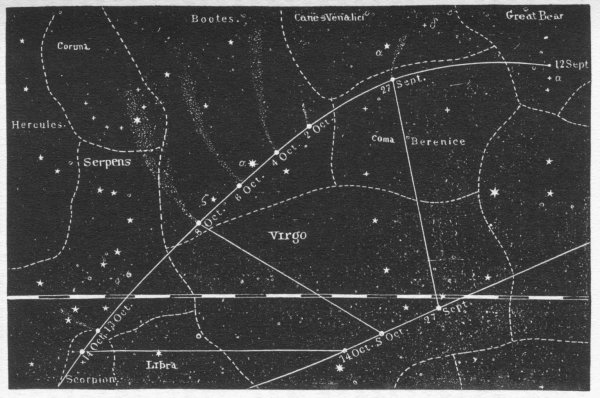
Compare the course which Ovid tells us Phaon pursued through the constellations, past the Great Serpent and Boes, and close to the venomous Scorpion, with the orbit of Donati's comet in 1858, as given in Schellen's great work.[1]

[1. "Spectrum Analysis," p. 391.]

ragnarok-3-05

The path described by Ovid shows that the comet came from the north part of the heavens; and this agrees with what we know of the Drift; the markings indicate that it came from the north.

The horses now range at large; "they go through the air of an unknown region; . . . they rush on the stars fixed in the sky"; they approach the earth.

"The moon, too, wonders that her brother's horses run lower than her own, and the scorched clouds send forth smoke, As each region is most elevated it is caught by the flames, and cleft, it makes vast chasms, its moisture being carried away. The grass grows pale; the trees, with their foliage, are burned up, and the dry, standing corn affords fuel for its own destruction. But I am complaining of trifling ills. Great cities perish, together with their fortifications, and the flames turn whole nations into ashes; woods, together with mountains, are on fire. Athos burns, and the Cilician Taurus, and Tmolus, and ta, and Ida, now dry but once most famed for its springs, and Helicon, the resort of the virgin Muses, and Hus, not yet called agrian. na burns intensely with redoubled flames, and Parnassus, with its two summits, and Eryx, and Cynthus, and Orthrys, and Rhodope, at length to be despoiled of its snows, and Mimas, and Dindyma, and Mycale, and Cithon, created for the sacred rites. Nor does its cold avail even Scythia; Caucasus is on fire, and Ossa with Pindus, and Olympus, greater than them both, and the lofty Alps, and the cloud-bearing Apennines.

"Then, indeed, Phaon beholds the world see on fire on all sides, and he can not endure heat so great, and he inhales with his mouth scorching air, as though from a deep furnace, and perceives his own chariot to be on fire. And neither is he able now to bear the ashes and the emitted embers; and on every side he is involved in a heated smoke. Covered with a pitchy darkness, he knows not whither he is going, nor where he is, and is hurried away at the pleasure of the winged steeds. They believe that it was then that the nations of the hiopians contracted their black hue, the blood being attracted. into the surface of the body. Then was Libya" (Sahara?) "made dry by the heat, the moisture being carried off; then with disheveled hair the Nymphs lamented the springs and the lakes. Botia bewails Dirce, Argos Amymone, and Ephyre the waters of Pirene. Nor do rivers that have banks distant remain secure. Tanais smokes in the midst of its waters, and the aged Peneus and Teuthrantian Caus and rapid Ismenus. . . . The Babylonian Euphrates, too, was on fire, Orontes was in flames, and the swift Thermodon and Ganges and Phasis and Ister. Alpheus boils; the banks of Spercheus burn; and the gold which Tagus carries with its stream melts in the flames. The river-birds, too, which made famous the Mnian banks with song, grew hot in the middle of Caster. The Nile, affrighted, fled to the remotest parts of the earth and concealed his head, which still lies hid; his seven last mouths are empty, seven channels without any streams. The same fate dries up the Ismarian rivers, Hebeus together with Strymon, and the Hesperian streams, the Rhine, the Rhone, and the Po, and the Tiber, to which was promised the sovereignty of the world."

In other words, according to these Roman traditions here poetized, the heat dried up the rivers of Europe, Asia, and Africa; in short, of all the known world.

Ovid continues:

"All the ground bursts asunder, and through the chinks the light penetrates into Tartarus, and startles the infernal king with his spouse."

We have seen that during the Drift age the great clefts in the earth, the fiords of the north of Europe and America, occurred, and we shall see hereafter that, according to a Central American legend, the red rocks boiled up through the earth at this time.

"The ocean, too, is contracted," says Ovid, "and that which lately was sea is a surface of parched sand, and the mountains which the deep sea has covered, start up and increase the number of the scattered Cyclades" (a cluster of islands in the ean Sea, surrounding Delos as though with a circle, whence their name); "the fishes sink to the bottom, and the crooked dolphins do not care to raise themselves on the surface into the air as usual. The bodies of sea-calves float lifeless on their backs on the top of the water. The story, too, is that even Nereus himself and Doris and their daughters lay hid in the heated caverns."

All this could scarcely have been imagined, and yet it agrees precisely with what we can not but believe to have been the facts. Here we have an explanation of how that vast body of vapor which afterward constituted great snow-banks and ice-sheets and river-torrents rose into the air. Science tells us that to make a world-wrapping ice-sheet two miles thick, all the waters of the ocean must have been evaporated; [1] to make one a mile thick would take one half the waters of the globe; and here we find this Roman poet, who is repeating the legends of his race, and who knew nothing about a Drift age or an Ice age, telling us that the water boiled in the streams; that the bottom of the Mediterranean lay exposed, a bed of dry sand; that the fish floated dead on the surface, or fled away to the great depths of the ocean; and that even the sea-gods "hid in the heated caverns."

Ovid continues:

"Three times had Neptune ventured with stern countenance to thrust his arms out of the water; three times he was unable to endure the scorching heat of the air."

This is no doubt a reminiscence of those human beings who sought safety in the water, retreating downward into the deep as the heat reduced its level, occasionally lifting up their heads to breathe the torrid and tainted air.

"However, the genial Earth, as she was surrounded by the sea, amid the waters of the main" (the ocean); "the springs dried up on every side which had hidden themselves in the bowels of their cavernous parent, burnt up, lifted up her all-productive face as far as her neck, and placed her hand to her forehead, and, shaking all things with a vast trembling, she sank down a little and retired below the spot where she is wont to be."

[1. "Science and Genesis," p. 125.]

Here we are reminded of the bridge Bifrost, spoken of in the last chapter, which, as I have shown, was probably a prolongation of land reaching from Atlantis to Europe, and which the Norse legends tell us sank down under the feet of the forces of Muspelheim, in the day of Ragnarok:

"And thus she spoke with a parched voice: 'O sovereign of the gods, if thou approvest of this, if I have deserved it, why do thy lightnings linger? Let me, if doomed to perish by the force of fire, perish by thy flames; and alleviate my misfortune by being the author of it. With difficulty, indeed, do I open my mouth for these very words. Behold my scorched hair, and such a quantity of ashes over my eyes' (the Drift-deposits), 'so much, too, over my features. And dost thou give this as my recompense? This as the reward of my fertility and my duty, in that I endure wounds from the crooked plow and harrows, and am harassed all the year through, in that I supply green leaves for the cattle, and corn, a wholesome food, for mankind, and frankincense for yourselves.

"'But still, suppose I am deserving of destruction, why have the waves deserved this? Why has thy brother' (Neptune) 'deserved it? Why do the seas delivered to him by lot decrease, and why do they recede still farther from the sky? But if regard neither for thy brother nor myself influences thee, still have consideration for thy own skies; look around on either side, see how each pole is smoking; if the fire shall injure them, thy palace will fall in ruins. See! Atlas himself is struggling, and hardly can he bear the glowing heavens on his shoulders.

"'If the sea, if the earth, if the palace of heaven, perish, we are then jumbled into the old chaos again. Save it from the flames, if aught still survives, and provide for the preservation of the universe.'

"Thus spoke the Earth; nor, indeed, could she any longer endure the vapor, nor say more, and she withdrew her face within herself, and the caverns neighboring to the shades below.

"But the omnipotent father, having called the gods above to witness, and him, too, who had given the chariot to Phaon, that unless he gives assistance all things will perish in direful ruin, mounts aloft to the highest eminence, from which he is wont to spread the clouds over the spacious earth; and from which he moves his thunders, and burls the brandished lightnings. But then he had neither clouds that he could draw over the earth, nor showers that he could pour down from the sky."

That is to say, so long as the great meteor shone in the air, and for some time after, the heat was too intense to permit the formation of either clouds or rain; these could only come with coolness and condensation.

He thundered aloud, and darted the poised lightning from his right ear, against the charioteer, and at the same moment deprived him both of life and his seat, and by his ruthless fires restrained the flames. The horses are affrighted, and, making a bound in the opposite direction, they shake the yoke from their necks, and disengage themselves from the torn harness. In one place lie the reins, in another the axle-tree wrenched from the pole, in another part are the spokes of the broken wheels, and the fragments of the chariot torn in pieces are scattered far and wide. But Phaon, the flames consuming his yellow hair, is hurled headlong, and is borne in a long track through the air, as sometimes a star is seen to fall from the serene sky, although it really has not fallen. Him the great Eridanus receives in a part of the world far distant from his country, and bathes his foaming face. The Hesperian Naiads commit his body, smoking from the three-forked flames, to the tomb, and inscribe these verses on the stone: 'Here is Phaon buried, the driver of his father's chariot, which, if he did not manage, still he miscarried in a great attempt.'

"But his wretched father" (the Sun) "had hidden his face overcast with bitter sorrow, and, if only we can believe it, they say that one day passed without the sun. The flames" (of the fires on the earth) "afforded light, and there was some advantage in that disaster."

As there was no daily return of the sun to mark the time, that one day of darkness was probably of long duration; it may have endured for years.

Then follows Ovid's description of the mourning of Clymene and the daughters of the Sun and the Naiads for the dead Phaon. Cycnus, king of Liguria, grieves for Phaon until he is transformed into a swan; reminding one of the Central American legend, (which I shall give hereafter,) which states that in that day all men were turned into goslings or geese, a reminiscence, perhaps, of those who saved themselves from the fire by taking refuge in the waters of the seas:

"Cycnus becomes a new bird; but he trusts himself not to the heavens or the air, as being mindful of the fire unjustly sent from thence. He frequents the pools and the wide lakes, and, abhorring fire, he chooses the streams, the very contrary of flames.

"Meanwhile, the father of Phaon" (the Sun), "in squalid garb and destitute of his comeliness, just as he is wont to be when he suffers an eclipse of his disk, abhors both the light, himself, and the day; and gives his mind up to grief, and adds resentment to his sorrow."

In other words, the poet is now describing the age of darkness, which, as we have seen, must have followed the conflagration, when the condensing vapor wrapped the world in a vast cloak of cloud.

The Sun refuses to go again on his daily journey; just as we shall see hereafter, in the American legends, he refuses to stir until threatened or coaxed into action.

"All the deities," says Ovid, "stand around the Sun as he says such things, and they entreat him, with suppliant voice, not to determine to bring darkness over the world." At length they induce the enraged and bereaved father to resume his task.

"But the omnipotent father" (Jupiter) "surveys the vast walls of heaven, and carefully searches that no part, impaired by the violence of the fire, may fall into ruin. After he has seen them to be secure and in their own strength, he examines the earth, and the works of man; yet a care for his own Arcadia is more particularly his object. He restores, too, the springs and the rivers, that had not yet dared to flow, he gives grass to the earth, green leaves to the trees; and orders the injured forests again to be green."

The work of renovation has begun; the condensing moisture renews the springs and rivers, the green mantle of verdure once more covers the earth, and from the waste places the beaten and burned trees put forth new sprouts.

The legend ends, like Ragnarok, in a beautiful picture of a regenerated world.

Divest this poem of the myth of Phaon, and we have a very faithful tradition of the conflagration of the world caused by the comet.

The cause of the trouble is a something which takes place high in the heavens; it rushes through space; it threatens the stars; it traverses particular constellations; it is disastrous; it has yellow hair; it is associated with great heat; it sets the world on fire it dries up the seas; its remains are scattered over the earth; it covers the earth with ashes; the sun ceases to appear; there is a time when he is, as it were, in eclipse, darkened; after a while he returns; verdure comes again upon the earth, the springs and rivers reappear, the world is renewed. During this catastrophe man has hidden himself, swanlike, in the waters; or the intelligent children of the earth betake themselves to deep caverns for protection from the conflagration.

How completely does all this accord, in chronological order and in its details, with the Scandinavian legend; and with what reason teaches us must have been the consequences to the earth if a comet had fallen upon it!

And the most ancient of the ancient world, the nation that stood farthest back in historical time, the Egyptians, believed that this legend of Phaon really represented the contact of the earth with a comet.

When Solon, the Greek lawgiver, visited Egypt, six hundred years before the Christian era, he talked with the priests of Sais about the Deluge of Deucalion. I quote the following from Plato ("Dialogues," xi, 517, Tims):

"Thereupon, one of the priests, who was of very great age, said, 'O Solon, Solon, you Hellenes are but children, and there is never an old man who is an Hellene.' Solon, hearing this, said, 'What do you mean?' 'I mean to say,' he replied, 'that in mind you are all young; there is no old opinion handed down among you by ancient tradition, nor any science which is hoary with age. And I will tell you the reason of this: there have been, and there will be again, many destructions of mankind arising out of many causes. There is a story which even you have preserved, that once upon a time Phahon, the son of Helios, having yoked the steeds in his father's chariot, because he was not able to drive them in the path of his father, burnt up all that was upon the earth, and was himself destroyed by a thunder-bolt. Now, this has the form of a myth, but really signifies a declination of the bodies moving around the earth and in the heavens, and a great conflagration of things upon the earth recurring at long intervals of time: when this happens, those who live upon the mountains and in dry and lofty places are more liable to destruction than those who dwell by rivers or on the sea-shore."'

The Legends ch. 3, LEGENDS OF THE COMING OF THE COMET

RAGNAROK

THE AGE OF FIRE AND GRAVEL.

BY

IGNATIUS DONNELLY

AUTHOR OF "ATLANTIS: THE ANTEDILUVIAN WORLD."

[1883]

PART III

The Legends

CHAPTER III

LEGENDS OF THE COMING OF THE COMET

WE turn now to the legends of mankind.

I shall try to divide them, so as to represent, in their order, the several stages of the great event. This, of course, will be difficult to do, for the same legend may detail several different parts of the same common story; and hence there may be more or less repetition; they will more or less overlap each other.

And, first, I shall present one or two legends that most clearly represent the first coming of the monster, the dragon, the serpent, the wolf, the dog, the Evil One, the Comet.

The second Hindoo "Avatar" gives the following description of the rapid advance of some dreadful object out of space, and its tremendous fall upon the earth:

"By the power of God there issued from the essence of Brahma a being shaped like a boar, white and exceeding small; this being, in the space of an hour, grew to the size of an elephant of the largest size, and remained in the air."

That is to say, it was an atmospheric, not a terrestrial creature.

"Brahma was astonished on beholding this figure, and discovered, by the force of internal penetration, that it could be nothing but the power of the Omnipotent which had assumed a body and become visible. He now felt that God is all in all, and all is from him, and all in him; and said to Mareechee and his sons (the attendant genii): 'A wonderful animal has emanated from my essence; at first of the smallest size, it has in one hour increased to this enormous bulk, and, without doubt, it is a portion of the almighty power.'"

Brahma, an earthly king, was at first frightened by the terrible spectacle in the air, and then claimed that he had produced it himself!

"They were engaged in this conversation when that vara, or 'boar-form,' suddenly uttered a sound like the loudest thunder, and the echo reverberated and shook all the quarters of the universe."

This is the same terrible noise which, as I have already shown, would necessarily result from the carbureted hydrogen of the comet exploding in our atmosphere. The legend continues:

"But still, under this dreadful awe of heaven, a certain wonderful divine confidence secretly animated the hearts of Brahma, Mareechee, and the other genii, who immediately began praises and thanksgiving. That vara (boar-form) figure, hearing the power of the Vedas and Mantras from their mouths, again made a loud noise, and became a dreadful spectacle. Shaking the full flowing mane which hung down his neck on both sides, and erecting the humid hairs of his body, he proudly displayed his two most exceedingly white tusks; then, rolling about his wine-colored (red) eyes, and erecting his tail, he descended from the region of the air, and plunged headforemost into the water. The whole body of water was convulsed by the motion, and began to rise in waves, while the guardian spirit of the sea, being terrified, began to tremble for his domain and cry for mercy.[1]

flow fully does this legend accord with the descriptions of comets given by astronomers, the "horrid hair," the mane, the animal-like head! Compare it with Mr.

[1. Maurice's "Ancient History of Hindustan," vol. i, p. 304.]

Lockyer's account of Coggia's comet, as seen through Newell's large refracting telescope at Ferndene, Gateshead, and which he described as having a head like "a fan-shaped projection of light, with ear-like appendages, at each side, which sympathetically complemented each other at every change either of form or luminosity."

We turn to the legends of another race:

The Zendavesta of the ancient Persians [1] describes a period of "great innocence and happiness on earth."

This represents, doubtless, the delightful climate of the Tertiary period, already referred to, when endless summer extended to the poles.

"There was a 'man-bull,' who resided on an elevated region, which the deity had assigned him."

This was probably a line of kings or a nation, whose symbol was the bull, as we see in Bel or Baal, with the bull's horns, dwelling in some elevated mountainous region.

"At last an evil one, denominated Ahriman, corrupted the world. After having dared to visit heaven" (that is, he appeared first in the high heavens), "he descended upon the earth and assumed the form of a serpent."

That is to say, a serpent-like comet struck the earth.

"The man-bull was poisoned by his venom, and died in consequence of it. Meanwhile, Ahriman threw the whole universe into confusion (chaos), for that enemy of good mingled himself with everything, appeared everywhere, and sought to do mischief above and below."

We shall find all through these legends allusions to the poisonous and deadly gases brought to the earth by the comet: we have already seen that the gases which are proved to be associated with comets are fatal to life.

[1. Faber's "HorMosaic" vol. i, p. 72.]

And this, be it remembered, is not guess-work, but the revelation of the spectroscope.

The traditions of the ancient Britons [1]tell us of an ancient time, when

"The profligacy of mankind had provoked the great Supreme to send a pestilential wind upon the earth. A pure poison descended, every blast was death. At this time the patriarch, distinguished for his integrity, was shut up, together with his select company, in the inclosure with the strong door. (The cave?) Here the just ones were safe from injury. Presently a tempest of fire arose. It split the earth asunder to the great deep. The lake Llion burst its bounds, and the waves of the sea lifted themselves on high around the borders of Britain, the rain poured down from heaven, and the waters covered the earth."

Here we have the whole story told briefly, but with the regular sequence of events:

1. The poisonous gases.

2. The people seek shelter in the caves.

3. The earth takes fire.

4. The earth is cleft open; the fiords are made, and the trap-rocks burst forth.

5. The rain pours down.

6. There is a season of floods.

When we turn to the Greek legends, as recorded by one of their most ancient writers, Hesiod, we find the coming of the comet clearly depicted.

We shall see here, and in many other legends, reference to the fact that there was more than one monster in the sky. This is in accordance with what we now know to be true of comets. They often appear in pairs or even triplets. Within the past few years we have seen Biela's comet divide and form two separate comets, pursuing

[1. "Mythology of the British Druids," p. 226.]

their course side by side. When the great comet of 1811 appeared, another of almost equal magnitude followed it. Seneca informs us that Ephoras, a Greek writer of the fourth century before Christ, had recorded the singular fact of a comet's separation into two parts.

"This statement was deemed incredible by the Roman philosopher. More recent observations of similar phenomena leave no room to question the historian's veracity." [1]

The Chinese annals record the appearance of three comets--one large and two smaller ones--at the same time, in the year 896 of our era.

"They traveled together for three days. The little ones disappeared first and then the large one."

And again:

"On June 27th, A. D. 416, two comets appeared in the constellation Hercules, and pursued nearly the same path."[2]

If mere proximity to the earth served to split Biela's comet into two fragments, why might not a comet, which came near enough to strike the earth, be broken into several separate forms?

So that there is nothing improbable in Hesiod's description of two or three aial monsters appearing at or about the same time, or of one being the apparent offspring of the other, since a large comet may, like Biela's, have broken in two before the eyes of the people.

Hesiod tells us that the Earth united with Night to do a terrible deed, by which the Heavens were much wronged. The Earth prepared a large sickle of white iron, with jagged teeth, and gave it to her son Cronus, and stationed him in ambush, and when Heaven came, Cronus, his son, grasped at him, and with his "huge sickle, long and jagged-toothed," cruelly wounded him.

[1. Kirkwood, "Comets and Meteors," p. 60.

2. Ibid., p. 51.]

Was this jagged, white, sickle-shaped object a comet?

"And Night bare also hateful Destiny, and black Fate, and Death, and Nemesis."

And Hesiod tells us that "she," probably Night--

"Brought forth another monster, irresistible, nowise like to mortal man or immortal gods, in a hollow cavern; the divine, stubborn-hearted Echidna (half-nymph, with dark eyes and fair cheeks; and half, on the other hand, a serpent, huge and terrible and vast), speckled, and flesh-devouring, 'neath caves of sacred Earth. . . . With her, they say that Typhaon (Typhon) associated in love, a terrible and lawless ravisher for the dark-eyed maid. . . . But she (Echidna) bare Chima, breathing resistless fire, fierce and huge, fleet-footed as well as strong; this monster had three heads: one, indeed, of a grim-visaged lion, one of a goat, and another of a serpent, a fierce dragon; in front a lion, a dragon behind, and in the midst a goat, breathing forth the dread strength of burning fire. Her Pegasus slew and brave Bellerophon."

ragnarok-3-03

COMET OF 1862. Aspect of the head of the comet at nine in the evening, the 23d August, and the 24th August at the same hour.

The astronomical works show what weird, and fantastic, and goblin-like shapes the comets assume under the telescope. Look at the representation on page 137, from Guillemin's work,[1] of the appearance of the comet of 1862, giving the changes which took place in twenty-four hours. If we will imagine one of these monsters close to the earth, we can readily suppose that the excited people, looking at "the dreadful spectacle," (as the Hindoo legend calls it,) saw it taking the shapes of serpents, dragons, birds, and wolves.

And Hesiod proceeds to tell us something more about this fiery, serpent-like monster:

"But when Jove had driven the Titans out from Heaven, huge Earth bare her youngest-born son, Typhus (Typhaon, Typhus, Typhon), by the embrace of Tartarus (Hell), through golden Aphrodite (Venus), whose hands, indeed, are apt for deeds on the score of strength, and untiring the feet of the strong god; and from his shoulders there were a hundred heads of a serpent, a fierce dragon playing with dusky tongues" (tongues of fire and smoke?), "and from the eyes in his wondrous heads are sparkled beneath the brows; whilst from all his heads fire was gleaming, as he looked keenly. In all his terrible heads, too, were voices sending forth every kind of voice ineffable. For one while, indeed, they would utter sounds, so as for the gods to understand, and at another time, again, the voice of a loud-bellowing bull, untamable in force and proud in utterance; at another time, again, that of a lion possessing a daring spirit; at another time, again, they would sound like to whelps, wondrous to hear; and at another, he would hiss, and the lofty mountains resounded.

[1. "The Heavens," p. 256.]

"And, in sooth, then would there have been done a deed past remedy, and he, even he, would have reigned over mortals and immortals, unless, I wot, the sire of gods and men had quickly observed him. Harshly then he thundered, and heavily and terribly the earth re-echoed around; and the broad heaven above, and the sea and streams of ocean, and the abysses of earth. But beneath his immortal feet vast Olympus trembled, as the king uprose and earth groaned beneath. And the heat from both caught the dark-colored sea, both of the thunder and the lightning, and fire from the monster, the heat arising from the thunder-storms, winds, and burning lightning. And all earth, and heaven, and sea, were boiling; and huge billows roared around the shores about and around, beneath the violence of the gods; and unallayed quaking arose. Pluto trembled, monarch over the dead beneath; and the Titans under Tartarus, standing about Cronus, trembled also, on account of the unceasing tumult and dreadful contention. But Jove, when in truth he had raised high his wrath, and had taken his arms, his thunder and lightning, and smoking bolt, leaped up and smote him from Olympus, and scorched all around the wondrous heads of the terrible monster.

"But when at length he had quelled it, after having smitten it with blows, the monster fell down, lamed, and huge Earth groaned. But the flame from the lightning-blasted monster flashed forth in the mountain hollows, hidden and rugged, when he was stricken, and much was the vast earth burnt and melted by the boundless vapor, like as pewter, heated by the art of youths, and by the well-bored melting-pit, or iron, which is the hardest of metals, subdued in the dells of the mountain by blazing fire, melts in the sacred earth, beneath the hands of Vulcan. So, I wot, was earth melted in the glare of burning fire. Then, troubled in spirit, he hurled him into wide Tartarus." [1]

Here we have a very faithful and accurate narrative of the coming of the comet:

[1. "Theogony."]

Born of Night a monster appears, a serpent, huge, terrible, speckled, flesh-devouring. With her is another comet, Typhaon; they beget the Chima, that breathes resistless fire, fierce, huge, swift. And Typhaon, associated with both these, is the most dreadful monster of all, born of Hell and sensual sin, a serpent, a fierce dragon, many-headed, with dusky tongues and fire gleaming; sending forth dreadful and appalling noises, while mountains and fields rock with earthquakes; chaos has come; the earth, the sea boils; there is unceasing tumult and contention, and in the midst the monster, wounded and broken up, falls upon the earth; the earth groans under his weight, and there he blazes and burns for a time in the mountain fastnesses and desert places, melting the earth with boundless vapor and glaring fire.

We will find legend after legend about this Typhon he runs through the mythologies of different nations. And as to his size and his terrible power, they all agree. He was no earth-creature. He moved in the air; he reached the skies:

"According to Pindar the head of Typhon reached to the stars, his eyes darted fire, his hands extended from the East to the West, terrible serpents were twined about the middle of his body, and one hundred snakes took the place of fingers on his hands. Between him and the gods there was a dreadful war. Jupiter finally killed him with a flash of lightning, and buried him under Mount Etna."

And there, smoking and burning, his great throes and writhings, we are told, still shake the earth, and threaten mankind:

And with pale lips men say,
'To-morrow, perchance to-day,
Encelidas may arise! "'

The Legends ch. 2, DID MAN EXIST BEFORE THE DRIFT ?

RAGNAROK

THE AGE OF FIRE AND GRAVEL.

BY

IGNATIUS DONNELLY

AUTHOR OF "ATLANTIS: THE ANTEDILUVIAN WORLD."

[1883]

PART III

The Legends

CHAPTER II

DID MAN EXIST BEFORE THE DRIFT ?

FIRST, let us ask ourselves this question, Did man exist before the Drift?

If he did, he must have survived it; and he could hardly have passed through it without some remembrance of such a terrible event surviving in the traditions of the race.

If he did not exist before the Drift, of course, no myths descriptive of it could have come down to us.

This preliminary question must, then, be settled by testimony.

Let us call our witnesses

"The pallithic hunter of the mid and late Pleistocene river-deposits in Europe belongs, as we have already shown, to a fauna which arrived in Britain before the lowering of the temperature produced glaciers and icebergs in our country; he may, therefore, be viewed as being probably pre-glacial." [1]

Man had spread widely over the earth before the Drift; therefore, he had lived long on the earth. His remains have been found in Scotland, England, Ireland, France, Spain, Italy, Greece; in Africa, in Palestine, in India, and in the United States. [2]

"Man was living in the valley of the lower Thames before the Arctic mammalia had taken full possession of

[1. Dawkins's "Early Man in Britain," p. 169.

2. Ibid., pp. 165, 166.]

the valley of the Thames, and before the big-nosed rhinoceros had become extinct." [1]

Mr. Tidderman [2] writes that, among a number of bones obtained during the exploration of the Victoria Cave, near Settle, Yorkshire, there is one which Mr. Busk has identified as human. Mr. Busk says:

"The bone is, I have no doubt, human; a portion of an unusually clumsy fibula, and in that respect not unlike the same bone in the Mentone skeleton."

The deposit from which the bone was obtained is overlaid "by a bed of stiff glacial clay, containing ice-scratched bowlders." "Here then," says Geikie, "is direct proof that men lived in England prior to the last inter-glacial period." [3]

The evidences are numerous, as I have shown, that when these deposits came upon the earth the face of the land was above the sea, and occupied by plants and animals.

ragnarok-3-02

SECTION AT ST. ACHEUL.

The accompanying cut, taken from Sir John Lubbock's "Prehistoric Times," page 364, represents the strata at St. Acheul, near Amiens, France.

[1. Dawkins's "Early Man in Britain," p. 137.

2. "Nature," November 6, 1873.

3. "The Great Ice Age," p. 475.]

The upper stratum (a) represents a brick earth, four to five feet in thickness, and containing a few angular flints. The next (b) is a thin layer of angular gravel, one to two feet in thickness. The next (c) is a bed of sandy marl, five to six feet in thickness. The lowest deposit (d) immediately overlies the chalk; it is a bed of partially rounded gravel, and, in this, human implements of flint have been found. The spot was used in the early Christian period as a cemetery; f represents one of the graves, made fifteen hundred years ago; e represents one of the ancient coffins, of which only the nails and clamps are left, every particle of the wood having perished.

And, says Sir John Lubbock:

"It is especially at the lower part" of these lowest deposits "that the flint implements occur."

The bones of the mammoth, the wild bull, the deer, the horse, the rhinoceros, and the reindeer are found near the bottom of these strata mixed with the flint implements of men.

"All the fossils belong to animals which live on land; . . . we find no marine remains."

Remember that the Drift is unfossiliferous and unstratified; that it fell en masse, and that these remains are found in its lower part, or caught between it and the rocks below it, and you can form a vivid picture of the sudden and terrible catastrophe. The trees were imbedded with man and the animals; the bones of men, smaller and more friable, probably perished, ground up in the tempest, while only their flint implements and the great bones of the larger animals, hard as stones, remain to tell the dreadful story. And yet some human bones have been found; a lower jaw-bone was discovered in a pit at Moulinguignon, and a skull and other bones were found in the valley of the Seine by M. Bertrand.[1]

And these discoveries have not been limited to river-gravels. In the Shrub Hill gravel-bed in England, "in the lowest part of it, numerous flint implements of the pallithic type have been discovered." [2]

We have, besides these sub-drift remains, the skulls of men who probably lived before the great cataclysm,--men who may have looked upon the very comet that smote the world. They represent two widely different races. One is "the Engis skull," so called from the cave of Engis, near Lie, where it was found by Dr. Schmerling. "It is a fair average human skull, which might," says Huxley, "have belonged to a philosopher, or might have contained the thoughtless brains of a savage." [3]It represents a

ragnarok-3-02

THE ENGIS SKULL.

civilized, if not a cultivated, race of men. It may represent a victim, a prisoner, held for a cannibalistic feast or a trader from a more civilized region.

[1. "Prehistoric Times," p. 360.

2. Ibid., p. 351.

3. "Man's Place in Nature," p. 156.]

In another cave, in the Neanderthal, near Hochdale, between Dseldorf and Elberfeld, a skull was found which is the most ape-like of all known human crania. The mail to whom it belonged must have been a barbarian brute of the rudest possible type. Here is a representation of it.

ragnarok-3-02

THE NEANDERTHAL SKULL.

I beg the reader to remember these skulls when he comes to read, a little further on, the legend told by an American Indian tribe of California, describing the marriage between the daughter of the gods and a son of the grizzly bears, from which union, we are told, came the Indian tribes. These skulls represent creatures as far apart, I was about to say, as gods and bears. The "Engis skull," with its full frontal brain-pan, its fine lines, and its splendidly arched dome, tells us of ages of cultivation and development in some favored center of the race; while the horrible and beast-like proportions of "the Neanderthal skull" speak, with no less certainty, of undeveloped, brutal, savage man, only a little above the gorilla in capacity;--a prowler, a robber, a murderer, a cave-dweller, a cannibal, a Cain.

We shall see, as we go on in the legends of the races on both sides of the Atlantic, that they all looked to some central land, east of America and west of Europe, some island of the ocean, where dwelt a godlike race, and where alone, it would seem, the human race was preserved to repeople the earth, while these brutal representatives of the race, the Neanderthal people, were crushed out.

And this is not mere theorizing. It is conceded, as the result of most extensive scientific research:

1. That the great southern mammalia perished in Europe when the Drift came upon the earth.

2. It is conceded that these two skulls are associated with the bones of these locally extinct animals, mingled together in the same deposits.

3. The conclusion is, therefore, logically irresistible, that these skulls belonged to men who lived during or before the Drift Age.

Many authorities support this proposition that man--pallithic man, man of the mammoth and the mastodon--existed in the caves of Europe before the Drift.

"After having occupied the English caves for untold ages, pallithic man disappeared for ever, and with him vanished many animals now either locally or wholly extinct." [1]

Above the remains of man in these caves comes a deposit of stalagmite, twelve feet in thickness, indicating a vast period of time during which it was being formed, and during this time man was absent. [2]

Above this stalagmite comes another deposit of cave-earth:

"The deposits immediately overlying the stalagmite and cave-earth contain an almost totally different assemblage

[1. "The Great Ice Age," p. 411.

2. Ibid., p. 411.]

of animal remains, along with relics of the neolithic, bronze, iron, and historic periods.

"There is no passage, but, on the contrary, a sharp and abrupt break between these later deposits and the underlying pallithic accumulations." [1]

Here we have the proof that man inhabited these caves for ages before the Drift; that he perished with the great mammals and disappeared; and that the twelve feet of stalagmite were formed while no men and few animals dwelt in Europe. But some fragment of the human race had escaped elsewhere, in some other region; there it multiplied and replenished the earth, and gradually extended and spread again over Europe, and reappeared in the cave-deposits above the stalagmite. And, in like manner, the animals gradually came in from the regions on which the Drift had not fallen.

But the revelations of the last few years prove, not only that man lived during the Drift age, and that he dwelt on the earth when the Drift fell, but that he can be traced backward for ages before the Drift; and that he was contemporary with species of great animals that had run their course, and ceased to exist centuries, perhaps thousands of years, before the Drift.

I quote a high authority:

"Most of the human relics of any sort have been found in the more recent layers of the Drift. They have been discovered, however, not only in the older Drift, but also, though very rarely, in the underlying Tertiary. For instance, in the Upper Pliocene at St. Prest, near Chartres, were found stone implements and cuttings on bone, in connection with relics of a long-extinct elephant (Elephas meridionalis) that is wholly lacking in the Drift. During the past two years the evidences of human existence in the Tertiary period, i. e., previous to the age of mammoths

[1. "The Great Ice Age," p. 411.]

of the Diluvial period, have multiplied, and by their multiplication give cumulative confirmation to each other. Even in the lower strata of the Miocene (the middle Tertiary) important discoveries of stone knives and bone-cuttings have been made, as at Thenay, department of Marne-et-Loire, and Billy, department of Allier, France. Professor J. D. Whitney, the eminent State geologist of California, reports similar discoveries there also. So, then, we may believe that before the last great upheaval of the Alps and Pyrenees, and while the yet luxuriant vegetation of the then (i. e., in the Tertiary period) paradisaic climate yet adorned Central Europe, man inhabited this region." [1]

We turn to the American Continent and we find additional proofs of man's pre-glacial existence. The "American Naturalist," 1873, says:

"The discoveries that are constantly being made in this country are proving that man existed on this continent as far back in geological time as on the European Continent; and it even seems that America, really the Old World, geologically, will soon prove to be the birthplace of the earliest race of man. One of the late and important discoveries is that by Mr. E. L. Berthoud, which is given in full, with a map, in the 'Proceedings of the Philadelphia Academy of Sciences for 1872,' p. 46. Mr. Berthoud there reports the discovery of ancient fire-places, rude stone monuments, and implements of stone in great number and variety, in several places along Crow Creek, in Colorado, and also on several other rivers in the vicinity. These fire-places indicate several ancient sites of an unknown race differing entirely from the mound-builders and the present Indians, while the shells and other fossils found with the remains make it quite certain that the deposit in which the ancient sites are found is as old as the Pliocene, and perhaps as the Miocene. As the fossil shells found with the relies of man are of estuary forms, and as the sites of the ancient towns are on extended

[1. "Popular Science Monthly," April, 1875, p. 682.]

points of land, and at the base of the ridges or bluffs, Mr. Berthoud thinks the evidence is strongly in favor of the locations having been near some ancient fresh-water lake, whose vestiges the present topography of the region favors."

I quote the following from the "Scientific American" (1880):

"The finding of numerous relies of a buried race on an ancient horizon, from twenty to thirty feet below the present level of country in Missouri and Kansas, has been noted. The St. Louis 'Republican' gives particulars of another find of an unmistakable character made last spring (1880) in Franklin County, Missouri, by Dr. R. W. Booth, who was engaged in iron-mining about three miles from Dry Branch, a station on the St. Louis and Santa FRailroad. At a depth of eighteen feet below the surface the miners uncovered a human skull, with portions of the ribs, vertebral column, and collar-bone. With them were found two flint arrow-heads of the most primitive type, imperfect in shape and barbed. A few pieces of charcoal were also found at the same time and place. Dr. Booth was fully aware of the importance of the discovery, and tried to preserve everything found, but upon touching the skull it crumbled to dust, and some of the other bones broke into small pieces and partly crumbled away; but enough was preserved to fully establish the fact that they are human bones.

"Some fifteen or twenty days subsequent to the first finding, at a depth of twenty-four feet below the surface, other bones were found--a thigh-bone and a portion of the vertebra, and several pieces of charred wood, the bones apparently belonging to the first-found skeleton. In both cases the bones rested on a fibrous stratum, suspected at the time to be a fragment of coarse matting. This lay upon a floor of soft but solid iron-ore, which retained the imprint of the fibers. . . .

"The indications are that the filled cavity had originally been a sort of cave, and that the supposed matting was more probably a layer of twigs, rushes, or weeds, which the inhabitants of the cave had used as a bed, as the fiber marks cross each other irregularly. The ore-bed in which the remains were found, and part of which seems to have formed after the period of human occupation of the cave, lies in the second (or saccharoidal) sandstone of the Lower Silurian."

Note the facts: The remains of this man are found separated--part are eighteen feet below the surface, part twenty-four feet--that is, they are six feet apart. How can we account for this condition of things, except by supposing that the poor savage had rushed for safety to his shallow rock-shelter, and had there been caught by the world-tempest, and torn to pieces and deposited in fragments with the dris that filled his rude home?

In California we encounter a still more surprising state of things.

The celebrated Calaveras skull was found in a shaft one hundred and fifty feet deep, under five beds of lava and volcanic tufa, and four beds of auriferous gravel.

The accompanying cut represents a plummet found in digging a well in the San Joaquin Valley, California, thirty feet below the surface.

ragnarok-3-02

PLUMMET FROM SAN JOAQUIN VALLEY, CAL.

Dr. Foster says:

"In examining this beautiful relic, one is led almost instinctively to believe that it was used as a plummet, for the purpose of determining the perpendicular to the horizon [for building purposes?]; . . . when we consider its symmetry of form, the contrast of colors brought out by the process of grinding and polishing, and the delicate drilling of the hole through a material (syenite) so liable to fracture, we are free to say it affords an exhibition of the lapidary's skill superior to anything yet furnished by the Stone age of either continent." [1]

[1. "The Prehistoric Races of the United States," p. 55.]

In Louisiana, layers of pottery, six inches thick, with remnants of matting and baskets, were found twelve feet below the surface, and underneath what Dr. Foster believes to be strata of the Drift. [1]

I might fill pages with similar testimony; but I think I have given enough to satisfy the reader that man did exist before the Drift.

I shall discuss the subject still further when I come to consider, in a subsequent chapter, the question whether pre-glacial man was or was not civilized.

[1. "The Prehistoric Races of the United States," p. 56.]

Subscribe to this RSS feed

Log in or create an account