log in
LC Geerts

LC Geerts

Website URL:

The Drift Chapter 5, WAS IT CAUSED BY GLACIERS ?

RAGNAROK

THE AGE OF FIRE AND GRAVEL.

BY

IGNATIUS DONNELLY

AUTHOR OF "ATLANTIS: THE ANTEDILUVIAN WORLD."

[1883]

PART I

The Drift

CHAPTER V

WAS IT CAUSED BY GLACIERS ?

WHAT is a glacier? It is a river of ice, crowded by the weight of mountain-ice down into some valley, along which it descends by a slow, almost imperceptible motion, due to a power of the ice, under the force of gravity, to rearrange its molecules. It is fed by the mountains and melted by the sun.

The glaciers are local in character, and comparatively few in number; they are confined to valleys having some general slope downward. The whole Alpine mass does not move down upon the plain. The movement downward is limited to these glacier-rivers.

The glacier complies with some of the conditions of the problem. We can suppose it capable of taking in its giant paw a mass of rock, and using it as a graver to carve deep grooves in the rock below it; and we can see in it a great agency for breaking up rocks and carrying the detritus down upon the plains. But here the resemblance ends.

That high authority upon this subject, James Geikie, says:

"But we can not fail to remark that, although scratched and polished stones occur not infrequently in the frontal moraines of Alpine glaciers, yet at the same time these moraines do not at all resemble till. The moraine consists for the most part of a confused heap of rough angular stones and blocks, and loose sand and dris; scratched stones are decidedly in the minority, and indeed a close search will often fail to show them. Clearly, then, the till is not of the nature of a terminal moraine. Each stone in the 'till' gives evidence of having been subjected to a grinding process. . . .

"We look in vain, however, among the glaciers of the Alps for such a deposit. The scratched stones we may occasionally find, but where is the clay? . . . It is clear that the conditions for the gathering of a stony clay like the I till' do not obtain (as far as we know) among the Alpine glaciers. There is too much water circulating below the ice there to allow any considerable thickness of such a deposit to accumulate." [1]

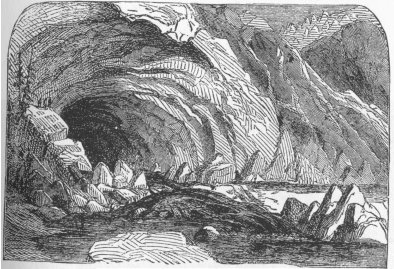
But it is questionable whether the glaciers do press with a steady force upon the rocks beneath so as to score them. As a rule, the base of the glacier is full of water; rivers flow from under them. The opposite picture, from Professor Winchell's "Sketches of Creation," page 223, does not represent a mass of ice, bugging the rocks, holding in its grasp great gravers of stone with which to cut the face of the rocks into deep grooves, and to deposit an even coating of rounded stones and clay over the face of the earth.

On the contrary, here are only angular masses of rock, and a stream which would certainly wash away any clay which might be formed.

Let Mr. Dawkins state the case:

"The hypothesis upon which the southern extension is founded--that the bowlder-clays have been formed by ice melting on the land--is open to this objection, that no similar clays have been proved to have been so formed, either in the Arctic regions, where the ice-sheet has retreated, or in the districts forsaken by the glaciers in the Alps or Pyrenees, or in any other mountain-chain. . . .

The English bowlder-clays, as a whole, differ from the moraine profonde in their softness, and the large area which they cover.

[1. "The Great Ice Age," pp. 70-72.]

Strata of bowlder-clay at all comparable to the great clay mantle covering the lower grounds of Britain, north of the Thames, are conspicuous by their absence from the glaciated regions of Central Europe and the Pyrenees, which were not depressed beneath the sea."
ragnarok-1-5

A RIVER ISSUING FROM A SWISS GLACIER.

Moreover, the Drift, especially the "till," lies in great continental sheets of clay and gravel, of comparatively uniform thickness. The glaciers could not form such sheets; they deposit their material in long ridges called "terminal moraines."

Agassiz, the great advocate of the ice-origin of the Drift, says:

"All these moraines are the land-marks, so to speak, by which we trace the height and extent, as well as the progress and retreat, of glaciers in former times.

Suppose, for instance, that a glacier were to disappear entirely. For ages it has been a gigantic ice-raft, receiving all sorts of materials on its surface as it traveled onward, and bearing them along with it; while the hard particles of rocks set in its lower surface have been polishing and fashioning the whole surface over which it extended. As it now melts it drops its various burdens to the ground; bowlders are the milestones marking the different stages of its journey; the terminal and lateral moraines are the frame-work which it erected around itself as it moved forward, and which define its boundaries centuries after it has vanished." [1]
ragnarok-1-5

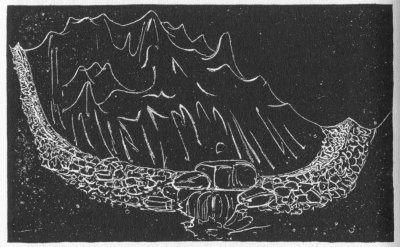
TERMINAL MORAINE.

And Professor Agassiz gives us, on page 307 of the same work, the above representation of a "terminal moraine."

[1. "Geological Sketches," p. 308.]

The reader can see at once that these semicircular ridges bear no resemblance whatever to the great drift-deposits of the world, spread out in vast and nearly uniform sheets, without stratification, over hills and plains alike.

And here is another perplexity: It might naturally be supposed that the smoothed, scratched, and smashed appearance of the underlying rocks was due to the rubbing and rolling of the stones under the ice of the glaciers; but, strange to say, we find that--

"The scratched and polished rock-surfaces are by no means confined to till-covered districts. They are met with everywhere and at all levels throughout the country, from the sea-coast up to near the tops of some of our higher mountains. The lower hill-ranges, such as the Sidlaws, the Ochils, the Pentlands, the Kilbarchan and Paisley Hills, and others, exhibit polished and smoothed rock-surfaces on their very crest. Similar markings streak and score the rocks up to a great height in the deep valleys of the Highlands." [1]

We can realize, in our imagination, the glacier of the mountain-valley crushing and marking the bed in which it moves, or even the plain on which it discharges itself; but it is impossible to conceive of a glacier upon the bare top of a mountain, without walls to restrain it or direct its flow, or higher ice accumulations to feed it.

Again:

"If glaciers descended, as they did, on both sides of the great Alpine ranges, then we would expect to find the same results on the plains of Northern Italy that present themselves on the low grounds of Switzerland. But this is not the case. On the plains of Italy there are no traces of the stony clay found in Switzerland and all over Europe. Neither are any of the stones of the drift of Italy scratched or striated." [2]

[1. "The Great Ice Age," p. 73.

2. Ibid., pp. 491, 492.]

But, strange to say, while, as Geikie admits, no true "till" or Drift is now being formed by or under the glaciers of Switzerland, nevertheless "till" is found in that country disassociated from the glaciers. Geikie says:

"In the low grounds of Switzerland we get a dark, tough clay, packed with scratched and well-rubbed stones, and containing here and there some admixture of sand and irregular beds and patches of earthy gravel. This clay is quite unstratified, and the strata upon which it rests frequently exhibit much confusion, being turned up on end and bent over, exactly as in this country the rocks are sometimes broken and disturbed below till. The whole deposit has experienced much denudation, but even yet it covers considerable areas, and attains a thickness varying from a few feet up to not less than thirty feet in thickness." [1]

Here, then, are the objections to this theory of the glacier-origin of the Drift:

I. The glaciers do not produce striated stones.

II. The glaciers do not produce drift-clay.

III. The glaciers could not have formed continental sheets of "till."

IV. The glaciers could not have existed upon, and consequently could not have striated, the mountain-tops.

V. The glaciers could not have reached to the great plains of the continents far remote from valleys, where we still find the Drift and drift-markings.

VI. The glaciers are limited in number and confined in their operations, and were utterly inadequate to have produced the thousands of square miles of drift-dris which we find enfolding the world.

[1. "The Great Ice Age," p. 373.]

The Drift Chapter 1, THE CHARACTERISTICS OF THE DRIFT

RAGNAROK

THE AGE OF FIRE AND GRAVEL.

BY

IGNATIUS DONNELLY

AUTHOR OF "ATLANTIS: THE ANTEDILUVIAN WORLD."

[1883]

PART I

The Drift

CHAPTER I

THE CHARACTERISTICS OF THE DRIFT.

READER,--Let us reason together:--

What do we dwell on? The earth. What part of the earth? The latest formations, of course. We live upon the top of a mighty series of stratified rocks, laid down in the water of ancient seas and lakes, during incalculable ages, said, by geologists, to be from ten to twenty miles in thickness.

Think of that! Rock piled over rock, from the primeval granite upward, to a height four times greater than our highest mountains, and every rock stratified like the leaves of a book; and every leaf containing the records of an intensely interesting history, illustrated with engravings, in the shape of fossils, of all forms of life, from the primordial cell up to the bones of man and his implements.

But it is not with the pages of this sublime volume we have to deal in this book. It is with a vastly different but equally wonderful formation.

Upon the top of the last of this series of stratified rocks we find THE DRIFT.

What is it?

Go out with me where yonder men are digging a well. Let us observe the material they are casting out.

First they penetrate through a few inches or a foot or two of surface soil; then they enter a vast deposit of sand, gravel, and clay. It may be fifty, one hundred, five hundred, eight hundred feet, before they reach the stratified rocks on which this drift rests. It covers whole continents. It is our earth. It makes the basis of our soils; our railroads cut their way through it; our carriages drive over it; our cities are built upon it; our crops are derived from it; the water we drink percolates through it; on it we live, love, marry, raise children, think, dream, and die; and in the bosom of it we will be buried.

Where did it come from?

That is what I propose to discuss with you in this work,--if you will have the patience to follow me.

So far as possible, [as I shall in all cases speak by the voices of others] I shall summon my witnesses that you may cross-examine them. I shall try, to the best of my ability, to buttress every opinion with adequate proofs. If I do not convince, I hope at least to interest you.

And to begin: let us understand what the Drift is, before we proceed to discuss its origin.

In the first place, it is mainly unstratified; its lower formation is altogether so. There may be clearly defined strata here and there in it, but they are such as a tempest might make, working in a dust-heap: picking up a patch here and laying it upon another there. But there are no continuous layers reaching over any large extent of country.

Sometimes the material has been subsequently worked over by rivers, and been distributed over limited areas in strata, as in and around the beds of streams.

But in the lower, older, and first-laid-down portion of the Drift, called in Scotland "the till," and in other countries "the hard-pan," there is a total absence of stratification.

James Geikie says:

"In describing the till, I remarked that the irregular manner in which the stones were scattered through that deposit imparted to it a confused and tumultuous appearance. The clay does not arrange itself in layers or beds, but is distinctly unstratified." [1]

"The material consisted of earth, gravel, and stones, and also in some places broken trunks or branches of trees. Part of it was deposited in a pell-mell or unstratified condition during the progress of the period, and part either stratified or unstratified in the opening part of the next period when the ice melted." [2]

"The unstratified drift may be described as a heterogeneous mass of clay, with sand and gravel in varying proportions, inclosing the transported fragments of rock, of all dimensions, partially rounded or worn into wedge-shaped forms, and generally with surfaces furrowed or scratched, the whole material looking as if it had been scraped together." [3]

The "till" of Scotland is "spread in broad but somewhat ragged sheets" through the Lowlands, "continuous across wide tracts," while in the Highland and upland districts it is confined principally to the valleys. [4]

[1. "The Great Ice Age," p. 21.

2. Dana's "Text-Book," p. 220.

3. "American Cyclopia," vol. vi, p. 111.

4. "Great Ice Age," Geikie, p. 6.]

"The lowest member is invariably a tough, stony clay, called 'till' or 'hard-pan.' Throughout wide districts stony clay alone occurs."[1]

"It is hard to say whether the till consists more of stones or of clay."[2]

This "till," this first deposit, will be found to be the strangest and most interesting.

In the second place, although the Drift is found on the earth, it is unfossiliferous. That is to say, it contains no traces of pre-existent or contemporaneous life.

This, when we consider it, is an extraordinary fact:

Where on the face of this life-marked earth could such a mass of material be gathered up, and not contain any evidences of life? It is as if one were to say that he had collected the detritus of a great city, and that it showed no marks of man's life or works.

"I would reiterate," says Geikie, [3]"that nearly all the Scotch shell-bearing beds belong to the very close of the glacial period; only in one or two places have shells ever been obtained, with certainty, from a bed in the true till of Scotland. They occur here and there in bowlder-clay, and underneath bowlder-clay, in maritime districts; but this clay, as I have shown, is more recent than the till--fact, rests upon its eroded surface."

"The lower bed of the drift is entirely destitute of organic remains." [4]

Sir Charles Lyell tells us that even the stratified drift is usually devoid of fossils:

"Whatever may be the cause, the fact is certain that over large areas in Scotland, Ireland, and Wales, I might add throughout the northern hemisphere, on both sides of the Atlantic, the stratified drift of the glacial period is very commonly devoid of fossils." [5]

[1. "Great Ice Age," Geikie, p. 7.

2. Ibid., p. 9.

3. Ibid., p. 342.

4. Rev. O. Fisher, quoted in "The World before the Deluge," p. 461.

5. "Antiquity of Man," third edition, p. 268.]

In the next place, this "till" differs from the rest of the Drift in its exceeding hardness:

"This till is so tough that engineers would much rather excavate the most obdurate rocks than attempt to remove it from their path. Hard rocks are more or less easily assailable with gunpowder, and the numerous joints and fissures by which they are traversed enable the workmen to wedge them out often in considerable lumps. But till has neither crack nor joint; it will not blast, and to pick it to pieces is a very slow and laborious process. Should streaks of sand penetrate it, water will readily soak through, and large masses will then run or collapse, as soon as an opening is made into it."

ragnarok-1-1

TILL OVERLAID WITH BOWLDER-CLAY, RIVER STINCHAR. r, Rock; t, Till; g, Bowlder-Clay; x, Fine Gravel, etc.

The accompanying cut shows the manner in which it is distributed, and its relations to the other deposits of the Drift.

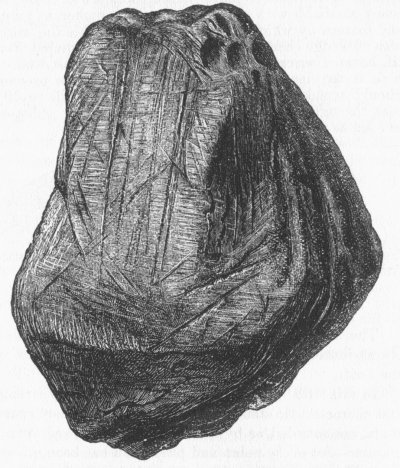
In this "till" or "hard-pan" are found some strange and characteristic stones. They are bowlders, not water-worn, not rounded, as by the action of waves, and yet not angular--for every point and projection has been ground off. They are not very large, and they differ in this and other respects from the bowlders found in the other portions of the Drift. These stones in the "till" are always striated--that is, cut by deep lines or grooves, usually running lengthwise, or parallel to their longest diameter. The cut on the following page represents one of them.

Above this clay is a deposit resembling it, and yet differing from it, called the "bowlder-clay." This is not so tough or hard. The bowlders in it are larger and more angular-sometimes they are of immense size; one at

ragnarok-1-1

SCRATCHED STONE (BLACK SHALE), FROM THE TILL.

Bradford, Massachusetts, is estimated to weigh 4,500,000 pounds. Many on Cape Cod are twenty feet in diameter. One at Whitingham, Vermont, is forty-three feet long by thirty feet high, or 40,000 cubic feet in bulk. In some cases no rocks of the same material are found within two hundred miles. [1]

These two formations--the "till" and the "bowlder-clay"--sometimes pass into each other by insensible degrees. At other times the distinction is marked. Some of the stones in the bowlder-clay are furrowed or striated, but a large part of them are not; while in the "till" the stone not striated is the rare exception.

Above this bowlder-clay we find sometimes beds of loose gravel, sand, and stones, mixed with the remains of man and other animals. These have all the appearance of being later in their deposition, and of having been worked over by the action of water and ice.

This, then, is, briefly stated, the condition of the Drift.

It is plain that it was the result of violent action of some kind.

And this action must have taken place upon an unparalleled and continental scale. One writer describes it as,

"A remarkable and stupendous period--a period so startling that it might justly be accepted with hesitation, were not the conception unavoidable before a series of facts as extraordinary as itself."[2]

Remember, then, in the discussions which follow, that if the theories advanced are gigantic, the facts they seek to explain are not less so. We are not dealing with little things. The phenomena are continental, world-wide, globe-embracing.

[1. Dana's "Text-Book," p. 221.

2. Gratacap, "Ice Age," "Popular Science Monthly," January, 1878.]

Ragnarok, The age of fire and gravel, Contents

RAGNAROK

THE AGE OF FIRE AND GRAVEL.

BY

IGNATIUS DONNELLY

AUTHOR OF "ATLANTIS: THE ANTEDILUVIAN WORLD."

[1883]

CONTENTS

PART I.

THE DRIFT.

  • Chapter I .--THE CHARACTERISTICS OF THE DRIFT
  • Chapter II .--THE ORIGIN OF THE DRIFT NOT KNOWN
  • Chapter III .--THE ACTION OF WAVES
  • Chapter IV .--WAS IT CAUSED BY ICEBERGS?
  • Chapter V .--WAS IT CAUSED By GLACIERS?
  • Chapter VI .--WAS IT CAUSED BY A CONTINENTAL ICE-SHEET?
  • Chapter VII .--THE DRIFT A GIGANTIC CATASTROPHE
  • Chapter VIII .--GREAT HEAT A PREREQUISITE

PART II.

THE COMET.

  • Chapter I .--A COMET CAUSED THE DRIFT
  • Chapter II .--WHAT IS A COMET?
  • Chapter III .--COULD A COMET STRIKE THE EARTH?
  • Chapter IV .--THE CONSEQUENCES TO THE EARTH

PART III.

THE LEGENDS.

  • Chapter I .--THE NATURE OF MYTHS
  • Chapter II .--DID MAN EXIST BEFORE THE DRIFT?
  • Chapter III .--LEGENDS OF THE COMING OF THE COMET
  • Chapter IV .--RAGNAROK
  • Chapter V .--THE CONFLAGRATION OF PHAON
  • Chapter VI .--OTHER LEGENDS OF THE CONFLAGRATION
  • Chapter VII .--LEGENDS OF THE CAVE-LIFE
  • Chapter VIII .--LEGENDS OF THE AGE OF DARKNESS
  • Chapter IX .--THE TRIUMPH OF THE SUN
  • Chapter X .--THE FALL OF THE CLAY AND GRAVEL
  • Chapter XI .--THE ARABIAN MYTHS
  • Chapter XII .--THE BOOK OF JOB
  • Chapter XIII .--GENESIS READ BY THE LIGHT OF THE COMET

PART IV.

CONCLUSIONS.

  • Chapter I .--WAS PRE-GLACIAL MAN CIVILIZED?
  • Chapter II .--THE SCENE OF MAN'S SURVIVAL
  • Chapter III .--THE BRIDGE
  • Chapter IV .--OBJECTIONS CONSIDERED
  • Chapter V .--BIELA'S COMET
  • Chapter VI .--THE UNIVERSAL BELIEF OF MANKIND 424
  • Chapter VII .--THE EARTH STRUCK BY COMETS MANY TIMES
  • Chapter VIII .--THE AFTER-WORD

Ragnarok, The age of fire and gravel, Title page

RAGNAROK

THE AGE OF FIRE AND GRAVEL.

BY

IGNATIUS DONNELLY

AUTHOR OF "ATLANTIS: THE ANTEDILUVIAN WORLD."

[1883]

"I am not inclined to conclude that man had no existence at all before the epoch of the great revolutions of the earth. He might have inhabited certain districts of no great extent, whence, after these terrible events, he repeopled the world. Perhaps, also, the spots where he abode were swallowed up, and the bones lie buried under the beds of the present seas."--CUVIER.

ragnarok-title

THE GEOGRAPHICAL DISTRIBUTION OF THE DRIFT.

Subscribe to this RSS feed

Log in or create an account