

The Civilization of Atlantis ch. 2
ATLANTIS
THE ANTEDILUVIAN WORLD
by Ignatius Donnelly
[1882]
PART III
THE CIVILIZATION OF THE OLD WORLD AND NEW COMPARED
CHAPTER II
THE IDENTITY OF THE CIVILIZATIONS OF THE OLD WORLD AND THE NEW
Architecture.--Plato tells us that the Atlanteans possessed architecture; that they built walls, temples, and palaces.
We need not add that this art was found in Egypt and all the civilized countries of Europe, as well as in Peru, Mexico, and Central America. Among both the Peruvians and Egyptians the walls receded inward, and the doors were narrower at, the top than at the threshold.
The obelisks of Egypt, covered with hieroglyphics, are paralleled by the round columns of Central America, and both are supposed to have originated in Phallus-worship. "The usual symbol of the Phallus was an erect stone, often in its rough state, sometimes sculptured." (Squier, "Serpent Symbol," p. 49; Bancroft's "Native Races," vol. iii., p. 504.) The worship of Priapus was found in Asia, Egypt, along the European shore of the Mediterranean, and in the forests of Central America.
The mounds of Europe and Asia were made in the same way and for the same purposes as those of America. Herodotus describes the burial of a Scythian king; he says, "After this they set to work to raise a vast mound above the grave, all of them vying with each other, and seeking to make it as tall as possible." "It must be confessed," says Foster ("Prehistoric Races," p. 193), "that these Scythic burial rites have a strong resemblance to those of the Mound Builders." Homer describes the erection of a great symmetrical mound over Achilles, also one over Hector. Alexander the Great raised a great mound over his friend Hephtion, at a cost of more than a million dollars; and Semiramis raised a similar mound over her husband.
 MOSAICS AT MITLA, MEXICO.
The pyramids of Egypt, Assyria, and Phnicia had their duplicates in Mexico and Central America.
The grave-cists made of stone of the American mounds are exactly like the stone chests, or kistvaen for the dead, found in the British mounds.
 CARVING ON THE BUDDHIST TOWER, SARNATH, INDIA.
(Fosters "Prehistoric Races," p. 109.) Tumuli have been found in Yorkshire enclosing wooden coffins, precisely as in the mounds of the Mississippi Valley. (Ibid., p. 185.) The articles associated with the dead are the same in both continents: arms, trinkets, food, clothes, and funeral urns. In both the Mississippi Valley and among the Chaldeans vases were constructed around the bones, the neck of the vase being too small to permit the extraction of the skull. (Foster's "Prehistoric Races," p. 200.)
The use of cement was known alike to the European and American nations.
The use of the arch was known on both sides of the Atlantic.
The manufacture of bricks was known in both the Old and New Worlds.
The style of ornamentation in architecture was much the same on both hemispheres, as shown in the preceding designs, pages 137, 139.
Metallurgy.--The Atlanteans mined ores, and worked in metals; they used copper, tin, bronze, gold, and silver, and probably iron.
The American nations possessed all these metals. The age of bronze, or of copper combined with tin, was preceded in America, and nowhere else, by a simpler age of copper; and, therefore, the working of metals probably originated in America, or in some region to which it was tributary. The Mexicans manufactured bronze, and the Incas mined iron near Lake Titicaca; and the civilization of this latter region, as we will show, probably dated back to Atlantean times. The Peruvians called gold the tears of the sun: it was sacred to, the sun, as silver was to the moon.
Sculpture.--The Atlanteans possessed this art; so did the American and Mediterranean nations.
Dr. Arthur Schott ("Smith. Rep.," 1869, p. 391), in describing the "Cara Gigantesca," or gigantic face, a monument of Yzamal, in Yucatan, says, "Behind and on both sides, from under the mitre, a short veil falls upon the shoulders, so as to protect the back of the head and the neck. This particular appendage vividly calls to mind the same feature in the symbolic adornments of Egyptian and Hindoo priests, and even those of the Hebrew hierarchy." Dr. Schott sees in the orbicular wheel-like plates of this statue the wheel symbol of Kronos and Saturn; and, in turn, it may be supposed that the wheel of Kronos was simply the cross of Atlantis, surrounded by its encircling ring.
Painting.--This art was known on both sides of the Atlantic. The paintings upon the walls of some of the temples of Central America reveal a state of the art as high as that of Egypt.
Engraving.--Plato tells us that the Atlanteans engraved upon pillars. The American nations also had this art in common with Egypt, Phnicia, and Assyria.
Agriculture.--The people of Atlantis were pre-eminently an agricultural people; so were the civilized nations of America and the Egyptians. In Egypt the king put his hand to the plough at an annual festival, thus dignifying and consecrating the occupation of husbandry. In Peru precisely the same custom prevailed. In both the plough was known; in Egypt it was drawn by oxen, and in Peru by men. It was drawn by men in the North of Europe down to a comparatively recent period.
Public Works.--The American nations built public works as great as or greater than any known in Europe. The Peruvians had public roads, one thousand five hundred to two thousand miles long, made so thoroughly as to elicit the astonishment of the Spaniards. At every few miles taverns or hotels were established for the accommodation of travellers. Humboldt pronounced these Peruvian roads "among the most useful and stupendous works ever executed by man." They built aqueducts for purposes of irrigation some of which were five hundred miles long. They constructed magnificent bridges of stone, and had even invented suspension bridges thousands of years before they were introduced into Europe. They had, both in Peru and Mexico, a system of posts, by means of which news was transmitted hundreds of miles in a day, precisely like those known among the Persians in the time of Herodotus, and subsequently among the Romans. Stones similar to mile-stones were placed along the roads in Peru. (See Prescott's "Peru,")
Navigation.--Sailing vessels were known to the Peruvians and the Central Americans. Columbus met, in 1502, at an island near Honduras, a party of the Mayas in a large vessel, equipped with sails, and loaded with a variety of textile fabrics of divers colors.
Manufactures.--The American nations manufactured woollen and cotton goods; they made pottery as beautiful as the wares of Egypt; they manufactured glass; they engraved gems and precious stones.
 ANCIENT IRISH VASE OF THE BRONZE AGE.
The Peruvians had such immense numbers of vessels and ornaments of gold that the Inca paid with them a ransom for himself to Pizarro of the value of fifteen million dollars.
Music.--It has been pointed out that there is great resemblance between the five-toned music of the Highland Scotch and that of the Chinese and other Eastern nations. ("Anthropology," p. 292.)
Weapons.--The weapons of the New World were identically the same as those of the Old World; they consisted of bows and arrows, spears, darts,
 ANCIENT VASE FROM THE MOUNDS OF THE UNITES STATES
short swords, battle-axes, and slings; and both peoples used shields or bucklers, and casques of wood or hide covered with metal. If these weapons had been derived from separate sources of invention, one country or the other would have possessed implements not known to the other, like the blow-pipe, the boomerang, etc. Absolute identity in so many weapons strongly argues identity of origin.
Religion.--The religion of the Atlanteans, as Plato tells us, was pure and simple; they made no regular sacrifices but fruits and flowers; they worshipped the sun.
In Peru a single deity was worshipped, and the sun, his most glorious work, was honored as his representative. Quetzalcoatl, the founder of the Aztecs, condemned all sacrifice but that of fruits and flowers. The first religion of Egypt was pure and simple; its sacrifices were fruits and flowers; temples were erected to the sun, Ra, throughout Egypt. In Peru the great festival of the sun was called Ra-mi. The Phnicians worshipped Baal and Moloch; the one represented the beneficent, and the other the injurious powers of the sun.
Religious Beliefs.--The Guanches of the Canary Islands, who were probably a fragment of the old Atlantean population, believed in the immortality of the soul and the resurrection of the body, and preserved their dead as mummies. The Egyptians believed in the immortality of the soul and the resurrection of the body, and preserved the bodies of the dead by embalming them. The Peruvians believed in the immortality of the soul and the resurrection of the body, and they too preserved the bodies of their dead by embalming them. "A few mummies in remarkable preservation have been found among the Chinooks and Flatheads." (Schoolcraft, vol. v., p. 693.) The embalmment of the body was also practised in Central America and among the Aztecs. The Aztecs, like the Egyptians, mummified their dead by taking out the bowels and replacing them with aromatic substances. (Dorman, "Origin Prim. Superst.," p. 173.) The bodies of the kings of the Virginia Indians were preserved by embalming. (Beverly, p. 47.)
Here are different races, separated by immense distances of land and ocean, uniting in the same beliefs, and in the same practical and logical application of those beliefs.
The use of confession and penance was known in the religious ceremonies of some of the American nations. Baptism was a religious ceremony with them, and the bodies of the dead were sprinkled with water.
Vestal virgins were found in organized communities on both sides of the Atlantic; they were in each case pledged to celibacy, and devoted to death if they violated their vows. In both hemispheres the recreant were destroyed by being buried alive. The Peruvians, Mexicans, Central Americans, Egyptians, Phnicians, and Hebrews each had a powerful hereditary priesthood.
The Phnicians believed in an evil spirit called Zebub; the Peruvians had a devil called Cupay. The Peruvians burnt incense in their temples. The Peruvians, when they sacrificed animals, examined their entrails, and from these prognosticated the future.
I need not add that all these nations preserved traditions of the Deluge; and all of them possessed systems of writing.
The Egyptian priest of Sais told Solon that the myth of Phahon, the son of Helios, having attempted to drive the chariot of the sun, and thereby burning up the earth, referred to "a declination of the bodies moving round the earth and in the heavens" (comets), which caused a "great conflagration upon the earth," from which those only escaped who lived near rivers and seas. The "Codex Chimalpopoca"--a Nahua, Central American record--tells us that the third era of the world, or "third sun," is called, Quia Tonatiuh, or sun of rain, "because in this age there fell a rain of fire, all which existed burned, and there fell a rain of gravel;" the rocks "boiled with tumult, and there also arose the rocks of vermilion color." In other words, the traditions of these people go back to a great cataclysm of fire, when the earth possibly encountered, as in the Egyptian story, one of "the bodies moving round the earth and in the heavens;" they had also memories of "the Drift Period," and of the outburst of Plutonic rocks. If man has existed on the earth as long as science asserts, be must have passed through many of the great catastrophes which are written upon the face of the planet; and it is very natural that in myths and legends he should preserve some recollection of events so appalling and destructive.
Among the early Greeks Pan was the ancient god; his wife was Maia. The Abb Brasseur de Bourbourg calls attention to the fact that Pan was adored in all parts of Mexico and Central America; and at Panuco, or Panca, literally Panopolis, the Spaniards found. upon their entrance into Mexico, superb temples and images of Pan. (Brasseur's Introduction in Landa's "Relacion.") The names of both Pan and Maya enter extensively into the Maya vocabulary, Maia being the same as Maya, the principal name of the peninsula; and pan, added to Maya, makes the name of the ancient capital Mayapan. In the Nahua language pan, or pani, signifies "equality to that which is above," and Pentecatl was the progenitor of all beings. ("North Americans of Antiquity," p. 467.)
The ancient Mexicans believed that the sun-god would destroy the world in the last night of the fifty-second year, and that he would never come back. They offered sacrifices to him at that time to propitiate him; they extinguished all the fires in the kingdom; they broke all their household furniture; they bung black masks before their faces; they prayed and fasted; and on the evening of the last night they formed a great procession to a neighboring mountain. A human being was sacrificed exactly at midnight; a block of wood was laid at once on the body, and fire was then produced by rapidly revolving another piece of wood upon it; a spark was carried to a funeral pile, whose rising flame proclaimed to the anxious people the promise of the god not to destroy the world for another fifty-two years. Precisely the same custom obtained among the nations of Asia Minor and other parts of the continent of Asia, wherever sun-worship prevailed, at the periodical reproduction of the sacred fire, but not with the same bloody rites as in Mexico. (Valentini, "Maya Archaeology," p. 21.)
To this day the Brahman of India "churns" his sacred fire out of a board by boring into it with a stick; the Romans renewed their sacred fire in the same way; and in Sweden even now a "need-fire is kindled in this manner when cholera or other pestilence is about." (Tylor's "Anthropology," p. 262.)
A belief in ghosts is found on both continents. The American Indians think that the spirits of the dead retain the form and features which they wore while living; that there is a hell and a heaven; that hell is below the earth, and heaven above the clouds; that the souls of the wicked sometimes wander the face of the earth, appearing occasionally to mortals. The story of Tantalus is found among the Chippewayans, who believed that bad souls stand up to their chins in water in sight of the spirit-land, which they can never enter. The dead passed to heaven across a stream of water by means of a narrow and slippery bridge, from which many were lost. The Zus set apart a day in each year which they spent among the graves of their dead, communing with their spirits, and bringing them presents--a kind of All-souls-day. (Dorman, "Prim. Superst.," p. 35.) The Stygian flood, and Scylla and Charybdis, are found among the legends of the Caribs. (Ibid., p. 37.) Even the boat of Charon reappears in the traditions of the Chippewayans.
The Oriental belief in the transmigration of souls is found in every American tribe. The souls of men passed into animals or other men. (Schoolcraft, vol. i., p. 33.) The souls of the wicked passed into toads and wild beasts. (Dorman, "Prim. Superst.," p. 50.)
Among both the Germans and the American Indians lycanthropy, or the metamorphosis of men into wolves, was believed in. In British Columbia the men-wolves have often been seen seated around a fire, with their wolf-hides hung upon sticks to dry! The Irish legend of hunters pursuing an animal which suddenly disappears, whereupon a human being appears in its place is found among all the American tribes.
That timid and harmless animal, the hare, was, singularly enough, an object of superstitious reverence and fear in Europe, Asia, and America. The ancient Irish killed all the hares they found on May-day among their cattle, believing them to be witches. Car gives an account of the horror in which this animal was held by the Britons. The Calmucks regarded the rabbit with fear and reverence. Divine honors were paid to the hare in Mexico. Wabasso was changed into a white rabbit, and canonized in that form.
The white bull, Apis, of the Egyptians, reappears in the Sacred white buffalo of the Dakotas, which was supposed to possess supernatural power, and after death became a god. The white doe of European legend had its representative in the white deer of the Housatonic Valley, whose death brought misery to the tribe. The transmission of spirits by the laying on of hands, and the exorcism of demons, were part of the religion of the American tribes.
The witches of Scandinavia, who produced tempests by their incantations, are duplicated in America. A Cree sorcerer sold three days of fair weather for one pound of tobacco! The Indian sorcerers around Freshwater Bay kept the winds in leather bags, and disposed of them as they pleased.
Among the American Indians it is believed that those who are insane or epileptic are "possessed of devils." (Tylor, "Prim. Cult.," vol. ii., pp. 123-126.) Sickness is caused by evil spirits entering into the sick person. (Eastman's "Sioux.") The spirits of animals are much feared, and their departure out of the body of the invalid is a cause of thanksgiving. Thus an Omaha, after an eructation, says, "Thank you, animal." (Dorman, "Prim. Superst.," p. 55.) The confession of their sins was with a view to satisfy the evil spirit and induce him to leave them. (Ibid., p. 57.)
In both continents burnt-offerings were sacrificed to the gods. In both continents the priests divined the future from the condition of the internal organs of the man or animal sacrificed. (Ibid., pp. 214, 226.) In both continents the future was revealed by the flight of birds and by dreams. In Peru and Mexico there were colleges of augurs, as in Rome, who practised divination by watching the movements and songs of birds. (Ibid., p. 261.)
Animals were worshipped in Central America and on the banks of the Nile. (Ibid., p. 259.)
The Ojibbeways believed that the barking of a fox was ominous of ill. (Ibid., p. 225). The peasantry of Western Europe have the same belief as to the howling of a dog.
The belief in satyrs, and other creatures half man and half animal, survived in America. The Kickapoos are Darwinians. "They think their ancestors had tails, and when they lost them the impudent fox sent every morning to ask how their tails were, and the bear shook his fat sides at the joke." (Ibid., p. 232.) Among the natives of Brazil the father cut a stick at the wedding of his daughter; "this was done to cut off the tails of any future grandchildren." (Tylor, vol. i., p. 384.)
Jove, with the thunder-bolts in his hand, is duplicated in the Mexican god of thunder, Mixcoatl, who is represented holding a bundle of arrows. "He rode upon a tornado, and scattered the lightnings." (Dorman, "Prim. Superst.," p. 98.)
Dionysus, or Bacchus, is represented by the Mexican god Texcatzoncatl, the god of wine. (Bancroft, vol. iii., p. 418.)
Atlas reappears in Chibchacum, the deity of the Chibchas; he bears the world on his shoulders, and when be shifts the burden from one shoulder to another severe earthquakes are produced. (Bollt, pp. 12, 13.)
Deucalion repeopling the world is repeated in Xololt, who, after the destruction of the world, descended to Mictlan, the realm of the dead, and brought thence a bone of the perished race. This, sprinkled with blood, grew into a youth, the father of the present race. The Quiche hero-gods, Hunaphu and Xblanque, died; their bodies were burnt, their bones ground to powder and thrown into the waters, whereupon they changed into handsome youths, with the same features as before. (Dorman, "Prim. Superst.," p. 193.)
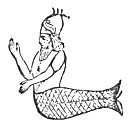
Witches and warlocks, mermaids and mermen, are part of the mythology of the American tribes, as they were of the European races. (Ibid., p. 79.) The mermaid of the Ottawas was "woman to the waist and fair;" thence fish-like. (Ibid., p. 278.)
The snake-locks of Medusa are represented in the snake-locks of At-otarho, an ancient culture-hero of the Iroquois.
A belief in the incarnation of gods in men, and the physical translation of heroes to heaven, is part of the mythology of the Hindoos and the American races. Hiawatha, we are told, rose to heaven in the presence of the multitude, and vanished from sight in the midst of sweet music.
The vocal statues and oracles of Egypt and Greece were duplicated in America. In Peru, in the valley of Rimac, there was an idol which answered questions and became famous as an oracle. (Dorman, "Prim. Superst.," p. 124.)
The Peruvians believed that men were sometimes metamorphosed into stones.
The Oneidas claimed descent from a stone, as the Greeks from the stones of Deucalion. (Ibid., p. 132.)
Witchcraft is an article of faith among all the American races. Among the Illinois Indians "they made small images to represent those whose days they have a mind to shorten, and which they stab to the heart," whereupon the person represented is expected to die. (Charlevoix, vol. ii., p. 166.) The witches of Europe made figures of wax of their enemies, and gradually melted them at the fire, and as they diminished the victim was supposed to sicken and die.
A writer in the Popular Science Monthly (April, 1881, p. 828) points out the fact that there is an absolute identity between the folk-lore of the negroes on the plantations of the South and the myths and stories of certain tribes of Indians in South America, as revealed by Mr. Herbert Smith's "Brazil, the Amazons, and the Coast." (New York: Scribner, 1879.) Mr. Harris, the author of a work on the folk-lore of the negroes, asks this question, "When did the negro or the North American Indian come in contact with the tribes of South America?"
Customs.--Both peoples manufactured a fermented, intoxicating drink, the one deriving it from barley, the other from maize. Both drank toasts. Both had the institution of marriage, an important part of the ceremony consisting in the joining of hands; both recognized divorce, and the Peruvians and Mexicans established special courts to decide cases of this kind. Both the Americans and Europeans erected arches, and had triumphal processions for their victorious kings, and both strewed the ground before them with leaves and flowers. Both celebrated important events with bonfires and illuminations; both used banners, both invoked blessings. The Phnicians,
Hebrews, and Egyptians practised circumcision. Palacio relates that at Azori, in Honduras, the natives circumcised boys before an idol called Icelca. ("Carta," p. 84.) Lord Kingsborough tells us the Central Americans used the same rite, and McKenzie (quoted by Retzius) says he saw the ceremony performed by the Chippeways. Both had bards and minstrels, who on great festivals sung the deeds of kings and heroes. Both the Egyptians and the Peruvians held agricultural fairs; both took a census of the people. Among both the land was divided per capita among the people; in Judea a new division was made every fifty years. The Peruvians renewed every year all the fires of the kingdom from the Temple of the Sun, the new fire being kindled from concave mirrors by the sun's rays. The Romans under Numa had precisely the same custom. The Peruvians had theatrical plays. They chewed the leaves of the coca mixed with lime, as the Hindoo to-day chews the leaves of the betel mixed with lime. Both the American and European nations were divided into castes; both practised planet-worship; both used scales and weights and mirrors. The Peruvians, Egyptians, and Chaldeans divided the year into twelve months, and the months into lesser divisions of weeks. Both inserted additional days, so as to give the year three hundred and sixty-five days. The Mexicans added five intercalary days; and the Egyptians, in the time of Amunoph I., had already the same practice.
Humboldt, whose high authority cannot be questioned, by an elaborate discussion ("Vues des Cordilleras," p. 148 et. seq., ed. 1870), has shown the relative likeness of the Nahua calendar to that of Asia. He cites the fact that the Chinese, Japanese, Calmucks, Mongols, Mantchou, and other hordes of Tartars have cycles of sixty years' duration, divided into five brief periods of twelve years each. The method of citing a date by means of signs and numbers is quite similar with Asiatics and Mexicans. He further shows satisfactorily that the majority of the names of the twenty days employed by the Aztecs are those of a zodiac used since the most remote antiquity among the peoples of Eastern Asia.
Cabera thinks he finds analogies between the Mexican and Egyptian calendars. Adopting the view of several writers that the Mexican year began on the 26th of February, be finds the date to correspond with the beginning of the Egyptian year.
The American nations believed in four great primeval ages, as the Hindoo does to this day.
"In the Greeks of Homer," says Volney, "I find the customs, discourse, and manners of the Iroquois, Delawares, and Miamis. The tragedies of Sophocles and Euripides paint to me almost literally the sentiments of the red men respecting necessity, fatality, the miseries of human life, and the rigor of blind destiny." (Volney's "View of the United States.")
The Mexicans represent an eclipse of the moon as the moon being devoured by a dragon; and the Hindoos have precisely the same figure; and both nations continued to use this expression long after they had discovered the real meaning of an eclipse.
The Tartars believe that if they cut with an axe near a fire, or stick a knife into a burning stick, or touch the fire with a knife, they will "cut the top off the fire." The Sioux Indians will not stick an awl or a needle into a stick of wood on the fire, or chop on it with an axe or a knife.
Cremation was extensively practised in the New World. The dead were burnt, and their ashes collected and placed in vases and urns, as in Europe. Wooden statues of the dead were made.
There is a very curious and apparently inexplicable custom, called the "Couvade," which extends from China to the Mississippi Valley; it demands "that, when a child is born, the father must take to his bed, while the mother attends to all the duties of the household." Marco Polo found the custom among the Chinese in the thirteenth century.
The widow tells Hudibras--
"Chineses thus are said
To lie-in in their ladies' stead."
The practice remarked by Marco Polo continues to this day among the hill-tribes of China. "The father of a new-born child, as soon as the mother has become strong enough to leave her couch, gets into bed himself, and there receives the congratulations Of his acquaintances." (Max Mler's "Chips from a German Workshop," vol. ii., p. 272.) Strabo (vol. iii., pp. 4, 17) mentions that, among the Iberians of the North of Spain, the women, after the birth of a child, tend their husbands, putting them to bed instead of going themselves. The same custom existed among the Basques only a few years ago. "In Biscay," says M. F. Michel, "the women rise immediately after childbirth and attend to the duties of the household, while the husband goes to bed, taking the baby with him, and thus receives the neighbors' compliments." The same custom was found in France, and is said to exist to this day in some cantons of Brn. Diodorus Siculus tells us that among the Corsicans the wife was neglected, and the husband put to bed and treated as the patient. Apollonius Rhodius says that among the Tibereni, at the south of the Black Sea, "when a child was born the father lay groaning, with his head tied up, while the mother tended him with food and prepared his baths." The same absurd custom extends throughout the tribes of North and South America. Among the Caribs in the West Indies (and the Caribs, Brasseur de Bourbourg says, were the same as the ancient Carians of the Mediterranean Sea) the man takes to his bed as soon as a child is born, and kills no animals. And herein we find an explanation of a custom otherwise inexplicable. Among the American Indians it is believed that, if the father kills an animal during the infancy of the child, the spirit of the animal will revenge itself by inflicting some disease upon the helpless little one. "For six months the Carib father must not eat birds or fish, for whatever animals he eats will impress their likeness on the child, or produce disease by entering its body." (Dorman, "Prim. Superst.," p. 58.) Among the Abipones the husband goes to bed, fasts a number of days, "and you would think," says Dobrizboffer, "that it was he that had had the child." The Brazilian father takes to his hammock during and after the birth of the child, and for fifteen days eats no meat and hunts no game. Among the Esquimaux the husbands forbear hunting during the lying-in of their wives and for some time thereafter.
Here, then, we have a very extraordinary and unnatural custom, existing to this day on both sides of the Atlantic, reaching back to a vast antiquity, and finding its explanation only in the superstition of the American races. A practice so absurd could scarcely have originated separately in the two continents; its existence is a very strong proof of unity of origin of the races on the opposite sides of the Atlantic; and the fact that the custom and the reason for it are both found in America, while the custom remains in Europe without the reason, would imply that the American population was the older of the two.
The Indian practice of depositing weapons and food with the dead was universal in ancient Europe, and in German villages nowadays a needle and thread is placed in the coffin for the dead to mend their torn clothes with; "while all over Europe the dead man had a piece of money put in his hand to pay his way with." ("Anthropology," p. 347.)
The American Indian leaves food with the dead; the Russian peasant puts crumbs of bread behind the saints' pictures on the little iron shelf, and believes that the souls of his forefathers creep in and out and eat them. At the cemetery of Pe-la-Chaise, Paris, on All-souls-day, they "still put cakes and sweetmeats on the graves; and in Brittany the peasants that night do not forget to make up the fire and leave the fragments of the supper on the table for the souls of the dead." (Ibid.. p. 351.)
The Indian prays to the spirits of his forefathers; the Chinese religion is largely "ancestor-worship;" and the rites paid to the dead ancestors, or lares, held the Roman family together." ("Anthropology," p. 351.)
We find the Indian practice of burying the dead in a sitting posture in use among the Nasamonians, tribe of Libyans. Herodotus, speaking of the wandering tribes of Northern Africa, says, "They bury their dead according to the fashion of the Greeks. . . . They bury them sitting, and are right careful, when the sick man is at the point of giving up the ghost, to make him sit, and not let him die lying down."
The dead bodies of the caciques of Bogota were protected from desecration by diverting the course of a river and making the grave in its bed, and then letting the stream return to its natural course. Alaric, the leader of the Goths, was secretly buried in the same way. (Dorman, "Prim. Superst.," p. 195.)
Among the American tribes no man is permitted to marry a wife of the same clan-name or totem as himself. In India a Brahman is not allowed to marry a wife whose clan-name (her "cow-stall," as they say) is the same as his own; nor may a Chinaman take a wife of his own surname. ("Anthropology," p. 403.) "Throughout India the hill-tribes are divided into septs or clans, and a man may not marry a woman belonging to his own clan. The Calmucks of Tartary are divided into hordes, and a man may not marry a girl of his own horde. The same custom prevails among the Circassians and the Samoyeds of Siberia. The Ostyaks and Yakuts regard it as a crime to marry a woman of the same family, or even of the same name." (Sir John Lubbock, "Smith. Rep.," p. 347, 1869.)
Sutteeism--the burning of the widow upon the funeral-pile of the husband--was extensively practised in America (West's "Journal," p. 141); as was also the practice of sacrificing warriors, servants, and animals at the funeral of a great chief (Dorman, pp. 210-211.) Beautiful girls were sacrificed to appease the anger of the gods, as among the Mediterranean races. (Bancroft, vol. iii., p. 471.) Fathers offered up their children for a like purpose, as among the Carthaginians.
The poisoned arrows of America had their representatives in Europe. Odysseus went to Ephyra for the man-slaying drug with which to smear his bronze-tipped arrows. (Tylor's "Anthropology," p. 237.)
"The bark canoe of America was not unknown in Asia and Africa" (Ibid., p. 254), while the skin canoes of our Indians and the Esquimaux were found on the shores of the Thames and the Euphrates. In Peru and on the Euphrates commerce was carried on upon rafts supported by inflated skins. They are still used on the Tigris.
The Indian boils his meat by dropping red-hot stones into a water-vessel made of hide; and Linns found the Both land people brewing beer in this way--"and to this day the rude Carinthian boor drinks such stone-beer, as it is called." (Ibid., p. 266.)
In the buffalo dance of the Mandan Indians the dancers covered their heads with a mask made of the head and horns of the buffalo. To-day in the temples of India, or among the lamas of Thibet, the priests dance the demons out, or the new year in, arrayed in animal masks (Ibid., p. 297 ); and the "mummers" at Yule-tide, in England, are a survival of the same custom. (Ibid., p. 298.) The North American dog and bear dances, wherein the dancers acted the part of those animals, had their prototype in the Greek dances at the festivals of Dionysia. (Ibid., p. 298.)
Tattooing was practised in both continents. Among the Indians it was fetichistic in its origin; "every Indian had the image of an animal tattooed on his breast or arm, to charm away evil spirits." (Dorman, "Prim. Superst.," p. 156.) The sailors of Europe and America preserve to this day a custom which was once universal among the ancient races. Banners, flags, and armorial bearings are supposed to be survivals of the old totemic tattooing. The Arab woman still tattoos her face, arms, and ankles. The war-paint of the American savage reappeared in the woad with which the ancient Briton stained his body; and Tylor suggests that the painted stripes on the circus clown are a survival of a custom once universal. (Tylor's "Anthropology," p. 327.)
In America, as in the Old World, the temples of worship were built over the dead., (Dorman, "Prim. Superst.," p. 178.) Says Prudentius, the Roman bard, "there were as many temples of gods as sepulchres."
The Etruscan belief that evil spirits strove for the possession of the dead was found among the Mosquito Indians. (Bancroft, "Native Races," vol. i., p. 744.)
The belief in fairies, which forms so large a part of the folklore of Western Europe, is found among the American races. The Ojibbeways see thousands of fairies dancing in a sunbeam; during a rain myriads of them bide in the flowers. When disturbed they disappear underground. They have their dances, like the Irish fairies; and, like them, they kill the domestic animals of those who offend them. The Dakotas also believe in fairies. The Otoes located the "little people" in a mound at the mouth of Whitestone River; they were eighteen inches high, with very large heads; they were armed with bows and arrows, and killed those who approached their residence. (See Dorman's "Origin of Primitive Superstitions," p. 23.) "The Shoshone legends people the mountains of Montana with little imps, called Nirumbees, two feet long, naked, and with a tail." They stole the children of the Indians, and left in their stead the young of their own baneful race, who resembled the stolen children so much that the mothers were deceived and suckled them, whereupon they died. This greatly resembles the European belief in "changelings." (Ibid., p. 24.)
In both continents we find tree-worship. In Mexico and Central America cypresses and palms were planted near the temples, generally in groups of threes; they were tended with great care, and received offerings of incense and gifts. The same custom prevailed among the Romans--the cypress was dedicated to Pluto, and the palm to Victory.
Not only infant baptism by water was found both in the old Babylonian religion and among the Mexicans, but an offering of cakes, which is recorded by the prophet Jeremiah as part of the worship of the Babylonian goddess-mother, "the Queen of Heaven," was also found in the ritual of the Aztecs. ("Builders of Babel," p. 78.)
In Babylonia, China, and Mexico the caste at the bottom of the social scale lived upon floating islands of reeds or rafts, covered with earth, on the lakes and rivers.
In Peru and Babylonia marriages were made but once a year, at a public festival.
Among the Romans, the Chinese, the Abyssinians, and the Indians of Canada the singular custom prevails of lifting the bride over the door-step of her husband's home. (Sir John Lubbock, "Smith. Rep.," 1869, p. 352.)
"The bride-cake which so invariably accompanies a wedding among ourselves, and which must always be cut by the bride, may be traced back to the old Roman form of marriage by 'conferreatio,' or eating together. So, also, among the Iroquois the bride and bridegroom used to partake together of a cake of sagamite, which the bride always offered to her husband." (Ibid.)
Among many American tribes, notably in Brazil, the husband captured the wife by main force, as the men of Benjamin carried off the daughters of Shiloh at the feast, and as the Romans captured the Sabine women. "Within a few generations the same old habit was kept up in Wales, where the bridegroom and his friends, mounted and armed as for war, carried off the bride; and in Ireland they used even to hurl spears at the bride's people, though at such a distance that no one was hurt, except now and then by accident--as happened when one Lord Hoath lost an eye, which mischance put an end to this curious relic of antiquity." (Tylor's "Anthropology," p. 409.)
Marriage in Mexico was performed by the priest. He exhorted them to maintain peace and harmony, and tied the end of the man's mantle to the dress of the woman; he perfumed them, and placed on each a shawl on which was painted a skeleton, "as a symbol that only death could now separate them from one another." (Dorman, "Prim. Superst.," p. 379.)
The priesthood was thoroughly organized in Mexico and Peru. They were prophets as well as priests. "They brought the newly-born infant into the religious society; they directed their training and education; they determined the entrance of the young men into the service of the state; they consecrated marriage by their blessing; they comforted the sick and assisted the dying." (Ibid., p. 374.) There were five thousand priests in the temples of Mexico. They confessed and absolved the sinners, arranged the festivals, and managed the choirs in the churches. They lived in conventual discipline, but were allowed to marry; they practised flagellation and fasting, and prayed at regular hours. There were great preachers and exhorters among them. There were also convents into which females were admitted. The novice had her hair cut off and took vows of celibacy; they lived holy and pious lives. (Ibid., pp. 375, 376.) The king was the high-priest of the religious orders. A new king ascended the temple naked, except his girdle; he was sprinkled four times with water which had been blessed; he was then clothed in a mantle, and on his knees took an oath to maintain the ancient religion. The priests then instructed him in his royal duties. (Ibid., p. 378.) Besides the regular priesthood there were monks who were confined in cloisters. (Ibid., p. 390.) Cortes says the Mexican priests were very strict in the practice of honesty and chastity, and any deviation was punished with death. They wore long white robes and burned incense.
Dorman, "Prim. Superst.," p. 379.) The first fruits of the earth were devoted to the support of the priesthood. (Ibid., p. 383.) The priests of the Isthmus were sworn to perpetual chastity.
The American doctors practised phlebotomy. They bled the sick man because they believed the evil spirit which afflicted him would come away with the blood. In Europe phlebotomy only continued to a late period, but the original superstition out of which it arose, in this case as in many others, was forgotten.
There is opportunity here for the philosopher to meditate upon the perversity of human nature and the persistence of hereditary error. The superstition of one age becomes the science of another; men were first bled to withdraw the evil spirit, then to cure the disease; and a practice whose origin is lost in the night of ages is continued into the midst of civilization, and only overthrown after it has sent millions of human beings to untimely graves. Dr. Sangrado could have found the explanation of his profession only among the red men of America.
Folk-lore.--Says Max Mler: "Not only do we find the same words and the same terminations in Sanscrit and Gothic; not only do we find the same name for Zeus in Sanscrit, Latin, and German; not only is the abstract Dame for God the same in India, Greece, and Italy; but these very stories, these 'Mrchen' which nurses still tell, with almost the same words, in the Thuringian forest and in the Norwegian villages, and to which crowds of children listen under the Pippal-trees of India--these stories, too, belonged to the common heirloom of the Indo-European race, and their origin carries us back to the same distant past, when no Greek had set foot in Europe, no Hindoo had bathed in the sacred waters of the Ganges."
And we find that an identity of origin can be established between the folk-lore or fairy tales of America and those of the Old World, precisely such as exists between the, legends of Norway and India.
Mr. Tylor tells us the story of the two brothers in Central America who, starting on their dangerous journey to the land of Xibalba, where their father had perished, plant each a cane in the middle of their grandmother's house, that she may know by its flourishing or withering whether they are alive or dead. Exactly the same conception occurs in Grimm's "Mrchen," when the two gold-children wish to see the world and to leave their father; and when their father is sad, and asks them how he shall bear news of them, they tell him, "We leave you the two golden lilies; from these you can see how we fare. If they are fresh, we are well; if they fade, we are ill; if they fall, we are dead." Grimm traces the same idea in Hindoo stories. "Now this," says Max Mler, "is strange enough, and its occurrence in India, Germany, and Central America is stranger still."
Compare the following stories, which we print in parallel columns, one from the Ojibbeway Indians, the other from Ireland:
|
THE OJIBBEWAY STORY. The birds met together one day to try which could fly the highest. Some flew up very swift, but soon got tired, and were passed by others of stronger wing. But the eagle went up beyond them all, and was ready to claim the victory, when the gray linnet, a very small bird, flew from the eagle's back, where it had perched unperceived, and, being fresh and unexhausted, succeeded in going the highest. When the birds came down and met in council to award the prize it was given to the eagle, because that bird had not only gone up nearer to the sun than any of the larger birds, but it had carried the linnet on its back. For this reason the eagle's feathers became the most honorable marks of distinction a warrior could bear. |
THE IRISH STORY. The birds all met together one day, and settled among themselves that whichever of them could fly highest was to be the king of all. Well, just as they were on the hinges of being off, what does the little rogue of a wren do but hop up and perch himself unbeknown on the eagle's tail. So they flew and flew ever so high, till the eagle was miles above all the rest, and could not fly another stroke, he was so tired. "Then," says he, "I'm king of the birds." "You lie!" says the wren, darting up a perch and a half above the big fellow. Well, the eagle was so mad to think how he was done, that when the wren was coming down he gave him a stroke of his wing, and from that day to this the wren was never able to fly farther than a hawthorn-bush. |
Compare the following stories:
|
THE ASIATIC STORY. In Hindoo mythology Urvasi came down from heaven and became the wife of the son of Buddha only on condition that two pet rams should never be taken from her bedside, and that she should never behold her lord undressed. The immortals, however, wishing Urvasi back in heaven, contrived to steal the rams; and, as the king pursued the robbers with his sword in the dark, the lightning revealed his person, the compact was broken, and Urvasi disappeared. This same story is found in different forms among many people of Aryan and Turanian descent, the central idea being that of a man marrying some one of an aerial or aquatic origin, and living happily with her till he breaks the condition on which her residence with him depends, stories exactly parallel to that of Raymond of Toulouse, who chances in the hunt upon the beautiful Melusina at a fountain, and lives with her happily until he discovers her fish-nature and she vanishes. |
THE AMERICAN STORY. Wampee, a great hunter, once came to a strange prairie, where be heard faint sounds of music, and looking up saw a speck in the sky, which proved itself to be a basket containing twelve most beautiful maidens, who, on reaching the earth, forthwith set themselves to dance. He tried to catch the youngest, but in vain; ultimately he succeeded by assuming the disguise of a mouse. He was very attentive to his new wife, who was really a daughter of one of the stars, but she wished to return home, so she made a wicker basket secretly, and, by help of a charm she remembered, ascended to her father. |
If the legend of Cadmus recovering Europa, after she has been carried away by the white bull, the spotless cloud, means that "the sun must journey westward until he sees again the beautiful tints which greeted his eyes in the morning," it is curious to find a story current in North America to the effect that a man once had a beautiful daughter, 'whom he forbade to leave the lodge lest she should be carried off by the king of the buffaloes; and that as she sat, notwithstanding, outside the house combing her hair, "all of a sudden the king of the buffaloes came dashing on, with his herd of followers, and, taking her between his horns, away be cantered over plains, plunged into a river which bounded his land, and carried her safely to his lodge on the other side," whence she was finally recovered by her father.
Games.--The same games and sports extended from India to the shores of Lake Superior. The game of the Hindoos, called pachisi, is played upon a cross-shaped board or cloth; it is a combination of checkers and draughts, with the throwing of dice, the dice determining the number of moves; when the Spaniards entered Mexico they found the Aztecs playing a game called patolli, identical with the Hindoo pachisi, on a similar cross-shaped board. The game of ball, which the Indians of America were in the habit of playing at the time of the discovery of the country, from California to the Atlantic, was identical with the European chueca, crosse, or hockey.
One may well pause, after reading this catalogue, and ask himself, wherein do these peoples differ? It is absurd to pretend that all these similarities could have been the result of accidental coincidences.
These two peoples, separated by the great ocean, were baptized alike in infancy with blessed water; they prayed alike to the gods; they worshipped together the sun, moon, and stars; they confessed their sins alike; they were instructed alike by an established priesthood; they were married in the same way and by the joining of hands; they armed themselves with the same weapons; when children came, the man, on both continents, went to bed and left his wife to do the honors of the household; they tattooed and painted themselves in the same fashion; they became intoxicated on kindred drinks; their dresses were alike; they cooked in the same manner; they used the same metals; they employed the same exorcisms and bleedings for disease; they believed alike in ghosts, demons, and fairies; they listened to the same stories; they played the same games; they used the same musical instruments; they danced the same dances, and when they died they were embalmed in the same way and buried sitting; while over them were erected, on both continents, the same mounds, pyramids, obelisks, and temples. And yet we are asked to believe that there was no relationship between them, and that they had never had any ante-Columbian intercourse with each other.
If our knowledge of Atlantis was more thorough, it would no doubt appear that, in every instance wherein the people of Europe accord with the people of America, they were both in accord with the people of Atlantis; and that Atlantis was the common centre from which both peoples derived their arts, sciences, customs, and opinions. It will be seen that in every case where Plato gives us any information in this respect as to Atlantis, we find this agreement to exist. It existed in architecture, sculpture, navigation, engraving, writing, an established priesthood, the mode of worship, agriculture, the construction of roads and canals; and it is reasonable to suppose that the, same correspondence extended down to all the minor details treated of in this chapter.
- Published in Atlantis, the Antediluvian World
- 0


 THE GOD OF THE FLOOD