The Canaanite Gods
Biblical Beginnings in Canaan
Anthology

The Canaanite God 'El'
The Mighty Bronze Age Empire
- John Fulton, 'A New Chronology - Synopsis of David Rohl's book 'A Test of Time' '
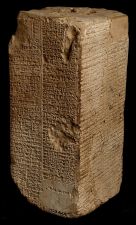
'In 1964, Dr. Paolo Matthiae, professor of Near East archaeology at the University of Rome began to excavate Tell Mardikh in north-western Syria [forty kilometers south of Aleppo]. It soon became clear that they were excavating the ruins of the ancient city of Ebla. In 1975, as the dig progressed down to Early Bronze Age levels, a remarkable find was made in the form of nearly 20,000 clay tablets which constituted the royal archives of the city. These tablets date back to the middle of the 3rd millennium BC, almost 4,500 years ago. They are written in Sumerian wedge-shaped cuneiform script which is the world's oldest known written language.Deciphering these tablets, Professor Pettinato, also of the University of Rome, found the language used to be what he called Old Canaanite' even though the script was cuneiform Sumerian. This very ancient language is closer in vocabulary and grammar to biblical Hebrew than any other Canaanite dialect', including Ugaritic; this therefore gives evidence as to the age of the Hebrew language.'
- Magnus Magnusson, BC - The Archaeology of the Bible Lands
'The documents 'reveal the existence of a mighty Canaanite empire in Syria that also embraced Palestine around 2400 BC which no one had suspected before; its capital was at Tell Mardikh - an ancient, all-but-forgotten city called Ebla.'
- John Fulton, 'A New Chronology - Synopsis of David Rohl's book 'A Test of Time''
'The city was a large one of 260,000 inhabitants; it traded widely over the known world at that time. A flourishing civilisation existed with many skilled craftsmen in metals, textiles, ceramics, and woodwork. It existed 1,000 years before David and Solomon and was destroyed by the Acadians (Babylonians?)in around 1600 BC.
Note: The author made here an error because the Accadian empire was conquered in the 18th century BC. by the Babylonians.---
- Magnus Magnusson, BC - The Archaeology of the Bible Lands
'Amongst the hundreds of place names in the commercial and diplomatic texts, of special interest to Biblical scholars are references to places and vassal cities in Palestine like Hazor, Gaza, Lachish, Megiddo, Akko, Sinai, and even Jerusalem itself (Urusalima).
Note: Here we can find proof that Jerusalem was originally not a Jewish city and already existed for about 700 years before David conquered the city about 1050 BC.---
'But perhaps the most intriguing names are those personal names which also appear in the Bible; names from the 'Patriarchal Age' like Ab-ra-mu (Abraham), E-sa-um (Esau), Ish-ma-ilu (Ishmael), even Is-ra-ilu (Israel), and from later periods, names like Da-'u'dum (David) and Sa-'u-lum (Saul).The most tantalizing adumbration is the name of Ebrum (Biblical Eber), third and greatest of the six kings of the Ebla dynasty between 2400 and 2250 BC. He seems to have been placed on the throne of Ebla by Sargon the Great of Akkad after a punitive expedition in which Ebla was subjugated.But after Sargon died (c.2310 BC), Ebrum turned the tables on Akkad and reduced its cities to vassalage in turn. It was not until 2250 that Sargon's grandson, Narum-Sin of Akkad, was able to throw off the yoke of Ebla by conquering the city and putting it to the torch.'
'It may be pure coincidence that this powerful king of Ebla, King Ebrum, should have had the same name as Eber, from whom the Hebrews traced their descent....(coincidentally, Arab historians have traditionally dated Abraham to c.2300 BC).'
- John Fulton, 'A New Chronology - Synopsis of David Rohl's book 'A Test of Time''
'Tablet 1860 names the five cities of Genesis 14:2 in the same order, i.e. Sodom, Gomorrah, Admah, Zeboiim and Zoar. Up until the discovery of the Ebla tablets, the existence of these biblical cities was questioned; yet, here they are mentioned as trade partners of Ebla. This record predates the great catastrophy involving Lot when Sodom and Gomorrah were destroyed.
'Also included in the archive are very early Canaanite creation and flood stories which very closely resemble that of the Bible.'
- John Romer, Testament
'...The rich coastal city of Ugarit [destroyed in 1200 BC]...traded widely throughout the Fertile Crescent and across the Mediterranean....Ugarit's accountants used a twenty-six letter cuneiform alphabet, an invention that would take writing out of the atmosphere of the ancient temples, away from the sacred obscurities of pictographs into a secular, demotic script which people of many different nations could easily adapt. This was a direct forerunner of modern Western alphabets as well as biblical Hebrew.'
'Its literature was Canaanite and it is the traditions of that society that influenced the Old Testament. Even so, the scribes of Ugarit well knew of the city Jerusalem and its nearby holy Mount Zion; for the hill was known by that same name, which in Ugaritic Canaanite means 'the seat of a god'.
Many Old Testament characters, too, have typically Canaanite names: Absalom and Solomon even hold in them the name of the Canaanite god of the evening star, Solom, just as does the name of Jerusalem itself. That numerous biblical terms for the articles of daily life, for clothes, perfumes and furniture were also Ugaritic, emphasizes the fact that this influence was not only linguistic but extended into the paraphernalia of daily life.'
- Ninian Smart, The Religious Experience of Mankind
'According to the Biblical narrative, the migration into Canaan [of the Hebrew tribes] was led by Abraham, who came from the region of Haran that lies in the angle of the Euphrates northeast of Syria.There is good evidence that this was his ancestral home;archaeological findings have confirmed that customs presupposed in Genesis existed in this area. It is also recorded that Abraham moved to Haran from Ur in Chaldea, where he had settled; his move that may reflect the fact that in the nineteenth century B.C., Ur was destroyed by invading Elamites....Abraham's religion, so far as we can tell, centered on his belief in a god whom he called El-Shaddai, 'Divinity of the Mountains'. There is evidence that his tribe also venerated ancestral images.'
- The Israelites
Although the Bible refers 'Ur of the Chaldeas', the Chaldean kingdom did not exist until many centuries after Abraham, but was contemporaneous with the date when Genesis was set down in writing.
'One chapter of Genesis recounts that the god commanded Abraham to slay his son Isaac, then eight years old, but stayed Abraham's hand at the last moment and asked him to slaughter a ram instead. Religious interpretations explain the episode as a test of Abraham's faith. But some scholars see the story as evidence that human sacrifice as a religious practice was not beyond the patriarchs' acceptance. It is known that the Canaanites of the Second Millennium BC did follow the custom (although it apparently was waning), because excavations a shrine near the city of Gezer have yielded clay jars containing the charred bones of babies.'
Background on the Old Testament
- Clement of Alexandra (150-215 CE.) , Miscellanies
As for the scholars whom have spent much time as to when the various books of the Old Testament were written, and who the writers were, its interesting to note the numerous theories that have burst forth and instead of trying to find verifiable evidence to proof credibility for those beliefs have instead sought after a following of credulous peers and subordinates.
Some have stated that it is hard to date the writings because of the long period of time that has transpired since the works were composed and compiled; and that they 'may' have undergone innumerable changes as the result of 'editors' and/or 'copyists' over the years. Yet some have no problems in stating that the works were someone's whimsical attempt to glorify the Israelites and was made up around the tenth century BC. Many of these scholars have overlooked the history of the Scriptures and seem to ignore that their present form came into being only two thousand four hundred years ago; and that these works of history and prophesy are condensed from what were much larger works of the Israelites that were lost between the second and forth centuries CE. From this period the changes in the scriptures are well recorded or known to us, however the original works from which they came hopefully are safe somewhere still, that we may find them and be able to settle the disputes and throw away the erroneous theories.
'At that time Jorobabel, having by his wisdom overcame his opponents, and obtained leave from Darius for the rebuilding of Jerusalem, returned with Ezra to his native land, and by him inspired oracles were effected; and the Passover of the deliverance celebrated, and marriage with aliens dissolved.'
- Rev. Robert Palmer (private correspondence)
Later in his book he (Clement of Alexandria) mentions that the historian Philadelphus, writing on the origins of the Greek translations of the Old Testament, stated that the Scriptures had perished during the captivity of the Jews while in Babylon.And that at the time of Artxerxes king of the Persians, that Ezra the Levite priest having become inspired in the exercise of prophesy then restored again the whole of the ancient Scriptures.
So Ezra compiled and catalogued the books of the Israelite writings from sources from Persia to Egypt; and through his research wrote the books containing his peoples histories and the writings of the prophets (much of the histories were contained in the body of the prophetic works), quoting as much as he was inspired; he included their genealogy and his commentary in the Scriptures. This is evidenced as one reads through the various books; of Genesis; Exodus; Numbers; Joshua; Judges; Samuel; Kings; Chronicles: and the prophets (especially Isaiah).
The list of books used to put together the scriptures are mentioned in many places. For convenience I will list them here:
The book of the beginnings;The books of Eden;The acts of the Patriarchs;The acts of Moses;The book of the laws given to Moses (Joshua 23:6);The book of Numbers;The book of Wars of the Lord (Numbers 21:14);The book of Jashar, the upright (Joshua 10:13, II Samuel 1:18);The acts of Joshua;The oracles of Balaam (Numbers 23:24);The books of the Judges of Israel (a separate one for each judge);The words and deeds of Samuel the seer (I Chronicles 29:29);The acts of David (I Chronicles 27:24), which the Psalms were found;The words of the days of Nathan the seer (I Chronicles 29:29;The words of the days of Gad the seer (I Chronicles 2:29);The acts of Solomon (II Chronicles 9:29),which contained the song of Solomon, the proofrbs and ecclesiastics:The prophesy of Ahi'zah (II Chronicles 9:29);The visions of Iddo (II Chronicles 9:29);The words of the days of Iddo (II Chronicles 13:22);The words of the days of Shemai'ah (Samaria (II Chronicles 12:15);The words of the days of Jehu the seer, son of Hana'ni (II Chronicles 20:34);The words of the days of Isaiah the prophet, son of Amos (II Chronicles 26:20);Commentary on the writings of the Kings (II chronicles 24:27);The words of the days of the seers (II Kings 21:17);The writings of the days of the kings of Judah (by Jehu);The writings of the kings of Israel (by Jehu).There are some other sources as well, but due to wars throughout the near and Middle East within the last two thousand years, many of these have been lost or destroyed to a point that when found does not make much sense....There were several non Hebrew historians that mention times for the best known of the kings and some others, but these works have rarely been found wholly intact. The early church fathers in Alexandra did however, in a lot of their writings included quotations from authors of quite a few works that were a part of the famed Library there in Egypt. What we know about the sources that Ezra used is that these works have been shown to contain words and phrases that originated or were common use in four distinct time periods; these are the 24th to 22nd, 14th, 10th, and 5th centuries BC. The fact that the Scriptures contain words and phrases of ancient origin which in surrounding cultures had been discontinued shows continuity of understanding of the language of which the text was written to be from those times, not of a more recent period and not some concoction.
Looking into the Babylonian writings of the sixth and seventh centuries BC., it appears that this culture had a imperfect knowledge of Jewish Scriptures as well as the people themselves due to the loss of the sacred writings upon their captivity, but this did not stop the Babylonians from trying to copy the tales of Jewish people. The tradition of every male of Israel to keep a verse of the sacred writings with them stems in memory of the total loss of their most precious heritage when lead into exile.
One of the last items faced concerning the Scriptures is of more recent origin and may account for the vast majority of the linguistic problems that occur. I refer to the reworking of the Hebrew language by the Masorites and Tiberians, between the 6th to 12th centuries CE. The Masorites were responsible for many of the alterations in the vowels and definitions of the Hebrew words. In that the language had not been a spoken one for at least a hundred years before their endeavor, and not until 1948 was it brought back to life again after not being spoken for nearly 1600 years. This is one reason why meanings of a number of words are unknown thus making it difficult for the modern scholar to rely solely on the Hebrew version as the last authority. This is why the tablets from Ebla are still important as the language is akin to the Hebrew and can give us a clearer understanding of 'uncertain' words.
The Assembly of Gods
- Paul Trejo
'...Genesis is in two parts: 1:1 - 11:9 is the first part, and is probably Babylonian in origin, since it ends with the founding of Babylon. The second part, 11:10 - 50:9 is probably Arabian in origin, since it focuses on desert tribes, and their God, El. El is the most common Babylonian-Syrian-Arabian name for God.'
- John Gray, Near Eastern Mythology
'The Canaanites evidently knew nothing of the elaborate pantheon and cosmogony of the Mesopotamians, which probably reflects the relative simplicity of their lives. Their interest was to correlate and explain the various forces of nature and society in all the complexity of harmony and tension, but to declare their dependence on the gods and to placate them'
'Corresponding to Anu in Mesopotamia, the king paramount in the celestial court was El ('God'), who give his sanction to all decisions among the gods affecting nature and society. He is father of the divine family and president of the divine assemblyon the 'mount of assembly', the equivalent of Hebrew har mo'ed, which became through the Greek transliteration Armageddon.In Canaanite mythology he is known as 'the Bull', symbolizing his strength and creative force, and is probably represented in the elderly god who is blessing a worshipper on a limestone sculpture from Ras Shara. In the myths he is termed bny bnwt, which might mean 'Creator of Created Things', but which we take to mean 'Giver of Potency', according to his role in two royal legends from Ras Shamra, but he is generally depicted as sitting aloof and indeed remote, enthroned at 'the outflowing of the (two) streams'. This recalls the Biblical Garden of Eden, from which a river flowed to form the four rivers, Tigris, Euphrates, Gihon and Pishon.'
Note: The Babylonian God Anu was in my opinion the same as the Sumerian God An. His son, Enlil, was the God called El (the Moslem God Allah).
- Magnus Magnusson, BC - The Archaeology of the Bible Lands
'Thou givest them water from the flowing stream of thy delights (gan 'eden, the Garden of Eden.) For with thee is the fountain of life.' - Psalm 36:9
El 'was known as the Creator God, the Kindly One, the Compassionate One. He expressed the concept of ordered government and social justice. It is noteworthy that the Bible never stigmatizes the Canaanite worship of El, whose authority in social affairs was recognized by the Patriarchs. His consort was Asherah, the mother goddess, represented in Canaanite sanctuaries by a natural or stylized tree (Hebrew ashera).
- John Gray, Near Eastern Mythology
In Canaan, the king 'is described as 'the Servant of El', as King David was 'the Servant of God'.This describes the status of the king as the executive of the will of the divine king. This duty is understood to be a privilege as well as a burden.'
- Magnus Magnusson, BC - The Archaeology of the Bible Lands
'All names like Ishmael, Michael and Israel are theophoric in form - that is to say, the suffix element (-iluor -el) represents a divine name, in this case the paramount god El. But during the reign of Ebrum, Dr Pettinato noted a change in the theophoric element, from -elto -ya(w), so that Mi-ka-ilu became Mi-ka-ya(w) and so on. It is quite clear that both of the endings are divine names, either names of gods or words simply meaning 'god'; so it looks as if Ebrum made some major alteration in the religion of Ebla at this time. Whether -ya(w)is related to the Biblical Yahweh, the one God of Israel whose name replace the earlier form of El, is a matter for debate...'
- John Gray, Near Eastern Mythology
'We sometimes find the most surprising survival of Canaanite mythology in monotheistic Israel. An example is the conception of God as president of a court of the gods, bene'el, whether thought of as a divine guild or as the divine family, 'el here of course of a proper name, El (God) the King Paramount. The psalm in Deuteronomy 32 begins by rating Israel for her lapses from the faith and ends with the assurance of the destruction of her enemies. The history of Israel is depicted as originating in the apportionment of Israel to her God Yahweh by the Most High in the assembly of 'the sons of El' (so the ancient Greek version for the meaningless Hebrew 'the sons of Israel', a desperate effort to avoid embarrassment). The date of this poem is a matter of dispute. The condemnation of Israel's gross apostasy, the statement of the divine chastisement and particularly the assurance of relief and the affliction of her enemies is reminiscent of the framework of the narratives of the great Judges in Judges 3:7-12:6, which may be dated c. 900 B.C. Deuteronomy 32:8 f then represents the first stage of the Israelite adaptation of the conception of God's presidency of the divine court from Canaanite mythology. The conception of God simply as first among divine peers was not one with which Israel could remain long content, and was soon countered by the specific rebuke of the divine court.'
- John Gray, Near Eastern Mythology
'God has taken His place in the assembly of the gods (lit. 'sons of El'),He declares His judgment among the gods: 'How long will you give crooked judgment,and favor the wicked?You ought to sustain the case of the weak and the orphan;You ought to vindicate the destitute and down-troddenYou ought to rescue the weak and the poor,To deliver them from the power of the wickedYou (Hebrew 'they') walk in darknessWhile all earth's foundations are giving away.I declare 'Gods you may be,Sons of the Most high, all of you;Yet you shall die as men,You shall fall as one of the bright ones.'- Psalm 82:1-7'In the final line we read sharimfor sarim('princes'), from which it is indistinguishable in the Hebrew manuscripts, and find another reference to the fall of Athtar the bright Venus star in Isaiah 14:12 and in the myth of Baal.'
Yahweh, the God of Israel
- Bible Lands
'In the Middle Bronze age, groups of Canaanites moved into northern Egypt and established a local dynasty called the Hyksos, who eventually took over the whole of Egypt. Only in the Late Bronze Age, in about 1550 BC, did the Egyptian pharaohs expel the Hyksos, launch a military campaign against Canaan, and bring it under Egyptian control. Egypt imposed heavy taxes on Canaan, but in return the Canaanite cities gained security and better access to international markets. In the reign of Ramses II (1304-1237 BC), the empire was reorganized. Key strategic cities like Beth Shan and Gaza were strengthened, others were allowed to decline. Many people were made homeless and migrated to the Judean hill country, where they established small farming settlements. These dispossessed Canaanites, known to the Egyptians as Hapiru (or Hebrews), formed the basis of what was to become Israel.'
- Bryant G. Wood of Associates for Biblical Research, 'The Merneptah Stela'
'...A popular theory among Biblical scholars today is that Israel emerged from peoples indigenous to Canaan in the mid 12th century BC. If this is true, then Biblical history and chronology prior to ca. 1150 BC would have to be jettisoned. Proponents of the '12th century emergence theory' maintain that the Israelites did not come into Canaan from outside to conquer the land around 1400 BC, as the Bible indicates. The emergence scenario would also reject the historicity of the Wilderness Wanderings, Exodus, Egyptian Sojourn and the Patriarchal narratives. However, if Israel were an established entity in Canaan already in 1210 BC, as the Merneptah Stela implies, then the 12th century emergence theory would be refuted (Bimson 1991, 'Merenptah's Israel and recent Theories of Israelite Origins'. Journal for the Study of the Old Testament49: 3-29). If Israel was well established by the end of the 13th century, it could not have come into being in the middle of the next century.'
- John Rogerson and Philip Davies, The Old Testament World
'....Israel was initially an association of villages in the Bethel and Samaria hills from about 1230 BC. This group of people possessed oral traditions about a common ancestor, Jacob, and stories about the struggles of tribal leaders with Canaanite cities (cp. Genesis 34, Judges 4-5 and 9, and possibly Joshua 9 and 12). The villages may also have been united by faith in Yahweh, who had delivered the ancestors of some of those now settled in Canaan from slavery in Egypt. Among these people there was probably a group who were custodians of the stories about the Exodus and who observed the Passover. Judah was a separate entity with traditions about an ancestor, Abraham, who had settled in the Hebron area, and traditions about tribal leaders who had fought against Canaanite cities (cp. Judges 1: 11-17, and possibly Joshua 10). We are not suggesting that the traditions as now written down in the Old Testament are identical with their oral form or content in the period 1230 to 1050 BC.'
- Great Events of Bible Times
The Protoindo European god Yayash, Yaor Yave, a protective god whose symbol was a tree, signifying possibly ''walking', 'going', 'a pilgrim', has been dated back to the Indus River valley, circa2900 BC. He has been identified with the Turko Syrian Yahveh, a 'sacred animal or organization'.
'Yahweh appears to have been originally a sky god - a god of thunder and lightning. He was associated with mountains and was called by the enemies of Israel 'a god of the hills'. His manifestation was often as fire, as at Mount Sinai and in the burning bush.'
'A shorter form, 'Yah', was also used (Exodus 15:2) and some scholars believe that this is the older form, originating in an exclamation to God - 'Yah!' - which came to be accepted as the divine name. Others claim that it is from the root 'hayah', 'to be' or 'to become', and that it meant 'I am that I am' or I will be that I will be'. According to one tradition of the call of Moses, the divine name Yahweh was revealed to him in Egypt:'
- Sir James Frazer, The Golden Bough
'To Abraham, Isaac and Jacob I appeared as El Shaddai, but I did not make the name Yahweh known to them'.'
- Exodus 6:3
'Every Egyptian magician...believed that he who possessed the true name possessed the very being of god or man, and could force even a deity to obey him as a slave obeys his master. Thus the art of the magician consisted in obtaining from the gods a revelation of their sacred names, and he left no stone unturned to accomplish his end.'
- Graham Hancock, The Sign and the Seal
'God instructed Moses that he should return to Egypt in order to lead his people out of their bondage there. Before agreeing, however, the prophet asked the name of the strange and powerful being who had addressed him ['in a flame of fire out of the midst of a bush']....The Lord, however did not respond directly to the prophet's question. Instead he replied briefly and enigmatically with these words: 'I AM WHO I AM'. By way of further clarification he then added: 'I am the God of thy father, the God of Abraham, the God of Isaac and the God of Jacob'[Exodus 3:14 and 3:6].'
- Marshall Cavendish, Genesis & Exodus
'To the Hebrew mind the 'name' stands for 'nature', and in answer to Moses' plea to be given an immediate sight of God, God promises to reveal just as much of his 'nature' that mortal man could bear.'
- Magnus Magnusson, BC - The Archaeology of the Bible Lands
In Exodus 'God was no longer simply 'El' (plural 'Elohim'), but YHWH ('I am that I am'), which in the Authorized Version was transliterated as 'Jehovah' by combining the Hebrew consonants and the vowels of the Hebrew word for 'Lord' when excessive reverence had made later Jews reluctant to pronounce the divine name itself, nowadays called Yahweh. The covenant with Yahweh elevated the concept of worship from a hopeful appeasement of the willful and haphazard forces of nature to a dynamic and determined arrangement with none other than the sole creator of the universe.'
- Laurence Gardner, Bloodline of the Holy Grail, p. 18
'Originally, these four consonants [in YHWH] represented the four members of the Heavenly Family: Y represented El the Father; H was Asherah the Mother; W corresponded to He the Son; and H was the Daughter Anath.'
- Great Events of Bible Times
'When all the people witnessed the thunder and lighting, the sound of the trumpet, and the mountain smoking, they were afraid and trembled and stood at a distance...'
- Exodus 20:18
'As specifically the name of the Covenant God, it was thereafter used of the Israelite deity, often in contrast with the gods of other peoples. With the Covenant, Yahweh had adopted Israel as his people and, as a jealous god, demanded total allegiance from them. They were to worship no other god but Yahweh. Much later, the Jewish exiles in Babylon were given an explicit statement of Yahwistic monotheism. 'I am Yahweh, and there is no other, there is no other god but me' (Isaiah 45:5).'
- Robin Lane Fox, The Unauthorized Version
'The stories of this meeting are told in Exodus 19-34, chapters which combine several different sources, laws and notions of God's encounters with his people. They are a wonderful jungle, parts of which are now dated, convincingly, by scholarly argument to the seventh and sixth centuries BC.'
- 'The Text: What is Its Age and Who Wrote It'
'The 'P' scribe is usually associated with the opening version of the creation story (Genesis 1) as well as with the use of the term Yahweh for God. He is also claimed to be the later of the two that is to have drafted this version approximately around the 5th century during the Babylonian exile. The 'J' scribe is usually viewed as the author responsible for the earlier rendition of the story (Genesis 2,3,4) and to have drafted this account around 8th century BC. He is also commonly associated with the scribe using the term Elohim for God.'
- The Israelites
'...When the Israelites came to worship their god under the name of Yahweh...the term El as a name for 'god' survived only in the old narrative about the patriarchs and in some literary forms, such as the Psalms. In much the same way, the obsolete 'thee' and 'thou' survive in modern liturgical usage and in poetry, although the words long ago dropped out of spoken English.'
- Christopher Knight & Robert Lomas, The Hiram Key: Pharaohs, Freemasons and the Discovery of the Secret Scrolls of Jesus
'One of the earliest heroes from the time of the initial invasion was the warrior Jerubbaal who later changed his name to Gideon. (His original name was certainly Canaanite honoring the god Baal, which probably illustrates that at the time Yahweh was not as entrenched as the later authors of the Old Testament would like us to believe.)'
'For many, Yahweh was no more than the Israelite war god, useful in time of battle but a fairly lowly figure when viewed against the full pantheon of the gods. The names given to notable Israelites down the ages whose a strong respect for Baal, and even the most ardent Yahwist would not pretend that the Jews of this period believed in only one god.'
- Robin Lane Fox, The Unauthorized Version
'The servants of the king of Aram said to him, 'Their gods are gods of the hills, and so they were stronger than we; but let us fight against them in the plain, and surely we shall be stronger than they.''
- I Kings 20:23
'In Moab, the Number One was called Chemosh; in Israel, people looked especially (but not solely) to Yahweh: it is most striking that Saul, the first king, gave one of his sons a name after the god Baal and that his other so, Jonathan did the same. From time to time Chemosh or Yahweh might be angry with their worshippers, and, as a result (people believed), their wars or weather could be unpredictable. To win Chemosh or Yahweh's favor, they had to offer animals and pay worship in their temples. Eventually, the gods' anger would moderate (in due course people's fortunes improofd, if only from bad to less bad), and meanwhile the priests lived off the necessary offerings. All the while, worshippers were realistic about death. At best there might be a ghostly existence for a few people in an underworld, but when they died, they died for ever. Their bodies returned to earth which nobody would judge or bring back to life.'
- Oxford Companion to the Bible
'Beginning in the seventh and sixth centuries BC, several Israelite writers (especially Jeremiah, the Deuteronomist, and Second Isaiah) explicitly rejected the notion that there were gods other that Yahweh, and depicted the 'hosts of heaven' as a foreign intrusion in Israelite monotheism.'
- Published in Various Publications
- 0