log in
LC Geerts

LC Geerts

Website URL:

The Deluge

THE BOOK OF EARTHS

By

EDNA KENTON

New York: William Morrow & Company

[1928, No renewal]


The Deluge

The third and fourth catastrophes of the Earth are the Deluge, and the sinking of Atlantis--Atlantis the fabulous continent, not the little Island remnant. Their time sequence in the old traditions is a little mixed, not that it matters. Suppose we take first the Deluge.

The Comet, that blazing terror of the skies, that erratic wanderer of the heavens, has always been given more than its probable share of blame for terrestrial bad luck. It has been called the cause of the birth of the Moon; it has also been held responsible for the universal Deluge. This is another of those untraceably old traditions, but we begin with the Comet of 1680, and the remarkable egg laid at Rome on December 4 of the Comet-year; because this Comet and this egg are responsible for two "Theories of Earth" written within the next twenty years, both by Englishmen. William Whiston worked out a complete theory of a deluged, because Comet-riven, Earth, and Thomas Burnet developed his theory of Earth as the Mundane Egg whose broken shell unlocked the "waters of the deep."

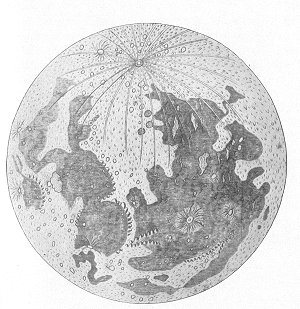
PLATE XIII. <i>One of the oldest drawings of the Moon. by Pere Capucin Marie de Rheita</i> (<i>1645</i>). <i>At the top Tycho is seen in full view, with its diverging rays</i>.<br> (From <i>Iter Exstaticum Coeleste</i>; Athanasius Kircher, 1660)
PLATE XIII. One of the oldest drawings of the Moon. by Pere Capucin Marie de Rheita(1645). At the top Tycho is seen in full view, with its diverging rays.
(From Iter Exstaticum Coeleste; Athanasius Kircher, 1660)

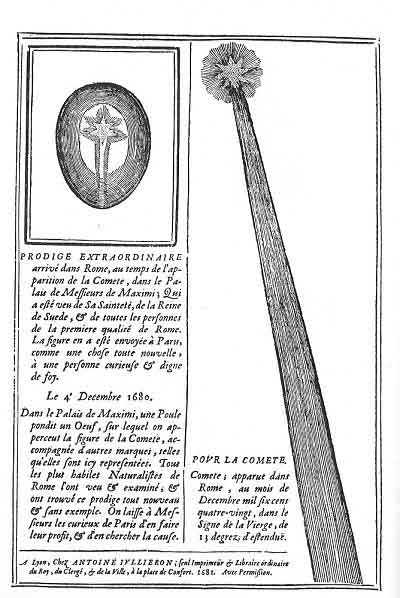
The evidence in the case is at hand in the shape of the elaborate frontispiece to Lettre dun gentil-homme de province une dame de qualitsur le sujet de la Comete, a brief little labour of informative love published anonymously in 1681, but known now to have been written by Claude Franis Manestrier. "An extraordinary freak of nature," it reads, "occurred in Rome, at the time of the appearance of the Comet, in the Palace of the Maximi, which was seen by His Holiness, by the Queen of Sweden, and by all persons of the first rank in Rome. The design of it was sent to Paris, as an entirely new thing, by a per-son greatly interested and worthy of confidence. On the 4th of December, 1680, in the Palace of the Maximi, a hen laid an egg, on which could be discerned the figure of the Comet, accompanied by other markings such as are here represented. All the most skilled naturalists of Rome saw and examined it, and found it to be a freak of nature unique and unparalleled. It is left to the curious gentlemen of Paris to make profitable use of it and to seek the cause."

FIGURE 41. The Comet of 1680 and the marvellous Egg.<br> (Frontispiece of <i>Lettre dun gentil-homme de province une dame de qualitsur le sujet de la Comete</i>; Claude Franis Manestrier, 1681.)
FIGURE 41. The Comet of 1680 and the marvellous Egg.
(Frontispiece of Lettre dun gentil-homme de province une dame de qualit sur le sujet de la Comete; Claude Franis Manestrier, 1681.)
Now it has always been extremely difficult for the extremely exact among the theorists to account for the sources of waters great enough to bring about a universal Deluge. No rains of forty days and nights explain it, even when these rains from heaven are united with all the external waters of the Earth. There were, to be sure, the "fountains of the great deep," but how were they to be broken up! And it is said that the Comet-Egg of this Comet-year gave good Will Whiston the idea he needed for solving the mystery of the Deluge. He published, in 1690, A New Theory of Earth, in which he set forth "the other main Cause of the Deluge, the breaking up of the fountains of the great deep," by the deadly weight of the waters in the tail of a Comet active in the heavens while Noah was building the Ark. "For when the near approach of the Comet to the Earth had rendered the Shape of that internal dense Fluid, on which its upper Crust rested, so very oblong and oval, and its Surface so much larger than before, as to occasion the opening of its perpendicular Fissures, which are visible at this day, . . . the vast weight of the additional Waters from the Comet would attempt to press this upper Earth deeper into the dense Fluid below . . . and so join the subterraneous to the cometical waters, for the supply of a Quantity sufficient for so vast a Purpose as that of a universal Deluge."

Whiston went even farther in his "cometical" theory; he supposed the Earth to have been originally a Comet; to have had a lop-sided form without beauty or proportion; subject to all the misfortunes of Comets, "sometimes a thousand times hotter than melted iron; at other times a thousand times colder than ice." These alternations of hot and cold were "Chaos," a dense though fluid atmosphere which surrounded the solid contents of the Earth, and which was in a state of continuous agitation and shock from its unharmoniously mingled substances. It was the Comet's atmosphere or tail, filled with water, which "struck" the Earth and broke its surface; and Whiston describes minutely just how the antediluvian Comet involved the antediluvian Earth in its tail, until all of Earth, even the mountain of the world, was submerged.

Burnet's theory of the Earth as the Mundane Egg will come farther on, but no better place could be found in this collection of world-pictures than just here, for one of his beautiful drawings of the Deluge, the second Chaos, when, "upon this Chaos rid the distrest Ark that bore the small remains of Mankind," a ship whose cargo was no less than a whole world (Plate XIV ). It is at once a picture of the Deluge after the dove was sent forth from the Ark, and a "Roughe Globe"; a delicate tracery of the broken Earth seen through water, as one looks down into a clear lake. There are vague glinting hints of lost or sunken continents that never emerged when the Earth dried and the waters ran off; a misty figuration of the new Earth, its pattern defined long before the Ark of Noah came to rest on Ararat; with some lost Lemuria, some sunk Atlantis, some shattered Pan or Mu still lingering along the declining edges of the continents about to be. Many of the modern "maps" of the Atlantean and Lemurian lands resemble very much this drawing of Burnet's, where continent seems to overlay continent until the oceans seem little more than spring floods in mountain valleys. Burnet speaks of Plato, who "supposeth his Atlantis to have been greater than Asia and Africa together, and yet to have sunk all into the Sea," and he concludes that great alterations in the face of the land and the sea would take place for a long time after the Deluge; that many of the fragments of land would change their posture, and that there would be a succession of sinkings and eruptions and lesser floods until all became poised and settled once again.

PLATE XIV ''AND AGAIN HE SENT FORTH THE DOVE OUT OF THE ARK''<br> (From <i>The Theory of the Earth</i>; Thomas Burnet, 1697)
PLATE XIV ''AND AGAIN HE SENT FORTH THE DOVE OUT OF THE ARK''
(From The Theory of the Earth; Thomas Burnet, 1697)


Earth-Moon Catastrophe

THE BOOK OF EARTHS

By

EDNA KENTON

New York: William Morrow & Company

[1928, No renewal]


Earth-Moon Catastrophe

The second catastrophe to afflict the Earth in the beginning of things was the Earth-Moon catastrophe; and this, by the way, is not only one of the most ancient of traditions, but it is also a modern theory of causes with which science has been flirting for half a century. So difficult is it to find anything new, even a new theory, which cannot be traced back along some old tangled thread of folk-lore. It is difficult, however, to find anything older in man's consciousness than the riddle of the Moon. What is it, that changeless, ever-changing, flat-faced disc in the sky, forever turning about the Earth, yet never turning

PLATE X. A. <i>The Heavenly Goose</i>.<br> (From Ancient Mythology: Jacob Bryant, 1774, Vol. II)
PLATE X. A. The Heavenly Goose.
(From Ancient Mythology: Jacob Bryant, 1774, Vol. II)

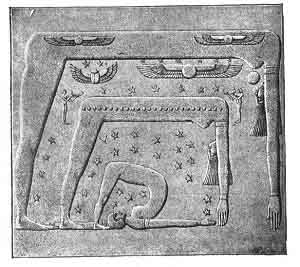
PLATE X. B. <i>The Sky Goddess Nut represented double</i>.<br> (From <i>The Dawn of Astronomy</i>; J. Norman Lockyer, 1894)
PLATE X. B. The Sky Goddess Nut represented double.
(From The Dawn of Astronomy; J. Norman Lockyer, 1894)


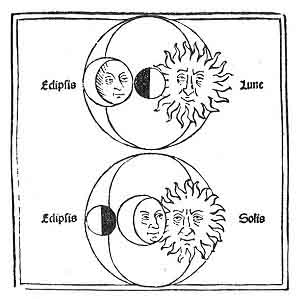
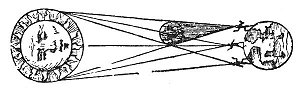
FIGURE 36. <i>Lunar and Solar Eclipses</i>.<br> (From <i>Spha Mundi</i>; Joannes Sacro Bosco, Venice, 1482.)
Click to enlarge
FIGURE 36. Lunar and Solar Eclipses.
(From Spha Mundi; Joannes Sacro Bosco, Venice, 1482.)
FIGURE 37. <i>The Figure of the Dragon: the Lunar Nodes</i>.<br> (From <i>Blundeville His Exercises</i>; London, 1606.)
FIGURE 37. The Figure of the Dragon: the Lunar Nodes.
(From Blundeville His Exercises; London, 1606.)

FIGURE 38. ''<i>When the Moone is betwixt the Sunne and the Earth</i>.''<br> (From <i>Blundeville His Exercises</i>; London, 1606.)
FIGURE 38. ''When the Moone is betwixt the Sunne and the Earth.''
(From Blundeville His Exercises; London, 1606.)its other face to the Earth? What mysterious other-world, under-world, over-world, dead or alive, lies on its secret side? What is the relation of the Moon to the Earth and to man? what the relation of the hidden life of the Earth and of man to the Moon? Tradition had doubled these two bodies as a pair acted upon by the Sun, long before astronomers had given us the image of Earth-Moon as a beautiful double planet moving among the stars; long before mathematicians had constructed from the interrelated "pull" of Sun and Moon and Earth the baffling "problem of three bodies," before which many a wise man has fallen.

Here is the ancient story of the genesis of the Moon.

Long after the separation of Heaven and Earth, and while Earth was still in process of being made ready for human life, but before man had been yet created, it chanced that the line of its course in the heavens was crossed by that of a great Comet, and that by some heavenly accident, the two enormous bodies collided. The terrific impact resulted in the cracking of the Earth's hard shell, and a huge fragment--some traditions say two--was torn away as violently as Nut was torn, in the Egyptian myth, from the body of Seb. This fragment of Earth promptly went into space, and became known as the Moon; and ever since that time Earth and Moon, Mother and Daughter, have been following each other through the heavens. As to which is the pursued, which the pursuer, old accounts vary. But there is always the stable myth of Ceres and Proserpina to fall back on.

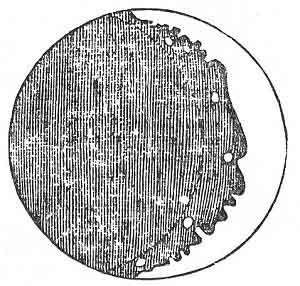
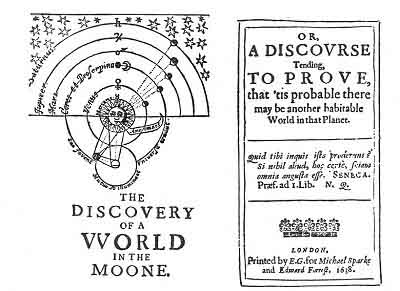
Very soon after Galileo made the first drawing of the Moon, in 1610, John Wilkins, Lord Bishop of Chester, devised a highly curious little book, entitled The Discovery of a New World in the Moone, or, A Discourse tending to Evidence that tis probable there may be another habitable World in that Planet. Wilkins bulwarks his "guess" with similar ones of the ancients: "Pythagoreans in general did affirm," he says, "that the Moone also was Terrestrial, and that she was inhabited as this lower World.

FIGURE 39. <i>The first drawing of the Moon</i>, by Galileo, 1610.<br> (From <i>The Discovery of a World in the Moone</i>; John Wilkins, 1638.)
FIGURE 39. The first drawing of the Moon, by Galileo, 1610.
(From The Discovery of a World in the Moone; John Wilkins, 1638.)

To this opinion of Pythagoras did Plato also assent . . . we may read often in him and his followers of an hera terraand a lunares populi--an hereal Earth and Inhabitants in the Moone." As their world is our Moon, so our world is their Moon, he declares, and quotes others of antiquity, whose Heavens and Elysian Fields were there, where the air is most quiet and pure. In the frontispiece to his book, he attempts to show just this relation between them. He goes back to the old Greek myth of the Earth, and calls the two Ceres and Proserpina. "By the fable of Ceres," he says, "continually wandering in search of her daughter Proserpina, it meant nothing else but the longing desire of Men, who live upon Ceres, Earth, to attain a Place in Proserpina, the Moon or Heaven," and he held that "tis possible for some of our Posterity to find out a Conveyance to this other World; and, if there be inhabitants there, to have Commerce with them."

PLATE XI.<br> OMNIA PER IPSUM FACTA SUNT<br> <i>Matter in motion, figure, rest: adde Grade.<br> This is the very somme of All God made:<br> Att first of nought bys power in six dayes space.<br> Now nature acts it's part; here after Grace</i>.<br> (From <i>Bybel Printen</i>; Matthaeus Merian, 1650)
PLATE XI.
OMNIA PER IPSUM FACTA SUNT
Matter in motion, figure, rest: adde Grade.
This is the very somme of All God made:
Att first of nought bys power in six dayes space.
Now nature acts it's part; here after Grace.
(From Bybel Printen; Matthaeus Merian, 1650)

FIGURE 40. <i>Frontispiece and Title-page of </i>''<i>The Discovery of a World in the Moone</i>''; <i>John Wilkins</i>, <i>1638</i>.
FIGURE 40. Frontispiece and Title-page of ''The Discovery of a World in the Moone''; John Wilkins, 1638.

Buffon seems to have been the first of modern scientists to voice the modern theory of the genesis of the Moon from this then moonless planet. He followed the push of tradition and made a Comet responsible for the split. This was in the eighteenth century. But in 1879, George H. Darwin lifted tradition to the dignity of an hypothetical guess, and suggested, as a part of his theory of Tidal Evolutions, that the Moon was formerly a part of the Earth; that it was originally much nearer the Earth than it is at present, and is now slowly receding from it; that at the time of the separation of the Earth into Earth and Moon, the planet was hardly larger than it is to-day; that it was hot, solid, ellipsoidical, with an interior more or less liquid, revolving on its axis once every four or five hours, its density increasing and its volume diminishing as it cooled; that, as its volume lessened, its speed of rotation increased, until by centrifugal force, the Moon was born, carrying with it, in its flight into Space, three-quarters of the Earth's crust.

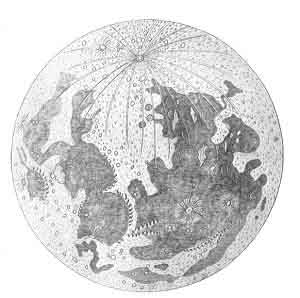
A good deal of interesting discussion followed this new type of Darwinian theory, and a number of scientists began to speculate on the precise place of the origin of the Moon, granted that Darwin was right. Of course--and here again tradition guided them--or had at least preceded them--they chose the Pacific Ocean basin that holds apart the scarred coast lines of western North and South America, and eastern Asia, the East Indies, New Zealand, and the Antarctics. One of these speculators amused himself to good purpose: Plate XII, shows George D. Swazey's extraordinarily imaginative "quarter Earth" which remained after the Moon had flown, cracked by great lines of cleavage that were to slowly split the plastic floating crust into two major continental masses.

PLATE XII. THE EARTH AFTER THE EARTH-MOON CATASTROPHE<br> (Drawn by George D. Swazey for <i>Popular Astronomy</i>, Aug.-Sept., 1907.)
PLATE XII. THE EARTH AFTER THE EARTH-MOON CATASTROPHE
(Drawn by George D. Swazey for Popular Astronomy, Aug.-Sept., 1907.)

Among the old drawings of the Moon, it is difficult to choose--they are all so beautiful. One drawing, however, must always stand for an example of the miracles man has wrought in this quest of his--the first drawing of the Moon (Fig. 39 ), made in 1610 by Galileo through his "Glasse." That tiny lens, compared to the gigantic telescopes of to-day, amounted to considerably less than a child's toy. But it magnified a surface three times, and with it Galileo essayed to Evidence or disEvidence Aristotle's theory that "the form and images of the Ocean appear in the Moon as in a Mirror." "Leaving aside these terrestrial things," he said, "I have directed my researches towards the. heavens, beginning with the Moon." He decided very quickly that the Moon had no mirror-like surface, for he discovered mountains, circular hollows, and many bright spots which he compared to the eyes in a peacock's tail. Before he died, he had succeeded in making a glass which magnified surfaces thirty-two times, and it was not long before the surface of the Moon was mapped out and named. It was a world so similar in many of its formations to those of the Earth, that its first map-maker, Hevelius, simply transferred to the Moon the names of the cities and seas and mountains of the Earth. But Riccioli, in 1651, renamed its mountains and craters and supposed lakes and seas, not after places of the Earth, but after the learned men of the Earth, choosing rather to place their names in the sky. Instead of lunar Alps or Apennines, there arose on the Moon great mountain ranges, or plains, or craters bearing the names of Plato, Ptolemy, Copernicus, Kepler, Tycho; instead of lunar seas called Caspian, Mediterranean, and the like, there were instead the Seas of Storms, of Clouds, of Rains: the Seas of Tranquillity, of Serenity, and the Lake of Dreams--enchanting names which linger to this day.


The Egyptian Universe

THE BOOK OF EARTHS

By

EDNA KENTON

New York: William Morrow & Company

[1928, No renewal]


The Egyptian Universe

IN THE METROPOLITAN MUSEUM of the City of New York, rests the grey diorite sarcophagus of Uresh-Nofer, one time priest of the "watery" goddess Mut, in Egypt. On the upper half of the sarcophagus lid is engraved the figure of the Sky goddess Nut "bending over the Earth," a marvellous picture of the Egyptian Universe.

"The Sky Goddess Nut bending over the Earth," and the succeeding Plate, "The Goddess Nut represented Double," bring up so clearly the first of the major traditional catastrophes of the Earth, that it would be timely just now to consider them briefly. There have been five, one so dimly related that it shall be left till the last. But there are four great timeless traditions of great disasters. The first is the violent separation of Earth from Heaven. The second is the appalling Earth-Moon catastrophe. The third is the Deluge, and the fourth is the sinking of Atlantis. Or, it may be, the third in point of "time" is the sinking of Atlantis, and the fourth is the Deluge. Or, again, it may be that these two catastrophes, though individual, were coincident with each other. Tradition however is, happily, not logic, and so, even in a disorderly order, we may take up the outstanding afflictions of the planet we call Earth.

First, then, the violent separation of Earth from Heaven, which these Egyptian world-pictures illustrate so beautifully.

Nut was goddess of the starry sky. Sometimes she is represented as powdered with stars; sometimes, as here, with but a line of them along her spine; once at least, on the sarcophagus lid of Uresh-Nofer, with the three discs or spheres of universal significance--body, spirit, soul--connected by eight stars and by six. Sometimes the band of stars was accompanied by a band of water flowing over her spine--the celestial Nile, as the Egyptians called the mysterious heavenly waters that covered the world. Sometimes the path of the celestial Nile is called the path of the Milky Way; and often the path of the Milky Way is called the path of souls." Through her husband, Seb, she gave birth to the Sun, which was ever after re-born each morning: daily it made its journey from east to west beneath her body until, sinking below the western horizon, it passed into the mouth of Nut, traversed her body during the night, to be born again at dawn. Nut also gave birth to the Moon, which came forth from her breasts as milk. And to countless other heavenly bodies as well whose genealogy would take us too far.

This is the story of Nut or Heaven and of Seb or Earth.

PLATE IX THE SKY GODDESS NUT BENDING OVER THE EARTH<br> <i>From the Sarcophagus of Uresh-Nofer, Priest of the Goddess Mut</i> (XXX<i>th dynasty</i>, <i>378-341 B.C.</i>)<br> (In the Metropolitan Museum of the City of New York)
PLATE IX THE SKY GODDESS NUT BENDING OVER THE EARTH
From the Sarcophagus of Uresh-Nofer, Priest of the Goddess Mut(XXXth dynasty, 378-341 B.C.)
(In the Metropolitan Museum of the City of New York)
In the beginning--that stirless rest in which all myths of the original Creation begin--Heaven and Earth were together, wedded gods, from whom was to spring all that has been, is, and shall ever be. Time was not yet, sings one of the old world-hymns, nor Universal Mind, nor Thought, nor Word. Bliss was not. Misery was not. Darkness alone filled the boundless All, for Father-Mother-Son were once more one, and the Son had not yet awakened for the new Wheel and his new Pilgrimage. The Universe was still concealed in the Divine Thought and the Divine Bosom.

But the day of Creation came, and a new god, Shu, god of Air or of Sunlight, sprang out of the primordial waters. He slipped between the two, and tearing Nut with force from the body of Seb her husband, raised her to the sky. Her star-spangled body marked the extent of the firmament; and her hands and feet hanging down were the four pillars of the firmament and the four quarters of the Earth. There ever since she has remained, bending over the Earth, eternally watching the Earth and the children of Earth.

Of Seb the Earth it is related that he did not endure the violent separation from Nut without a struggle. He sought to rise, that he might fight and overcome the newly created god. But as he struggled, just roused from deep dreamless sleep, he was arrested and held in the curious position he has ever since maintained (Plate X, B ), without power to change it. He has been veiled each spring with plants and herbs and grasses; and winter has wrapped him in ice an now; while along his back has passed the endless panorama of the generations of animals and men. Through him is given to them all they have; he gives and they ungratefully take, never asking if he has a need they might supply, a sorrow they might soothe. Often he sleeps, and, sleeping, dreams of Nut, forgetting for a time his grief and pain; forgetting for a time that between him and his mate, forever separating them, stands Shu, god of Air or of Sunlight. But he may never again sink into dreamless sleep; sooner or later the circle of his dreams rounds on itself, and he is roused by pain to his state of suffering again. This is why Earth eternally questions Heaven until, wearied with waiting for answers that never come, he sinks again into slumber. Some say that Heaven answers Earth when he dreams, but because the path of his dreaming is a circle, he has forgotten most of Heaven's answers when he awakes.

And some have quite another story of Seb the Earth; namely, that Seb is concealed under the form of a colossal gander, whose mate laid the Sun Egg, and perhaps still lays it every day. Or again there is another story of Shu, which is that as the divine Son, he had later in his turn begotten Seb and Nut, the two deities he had separated.

Such then is the first catastrophe--every religion has recognised it; that the Earth is cut off, disinherited, a troubled, troublesome, perturbed, perturbating, turbulent, storm-swept, dream-sodden, staggering, breathless, complaining planet; and that all of its children have inherited its qualities.


The Babylonian Universe

THE BOOK OF EARTHS

By

EDNA KENTON

New York: William Morrow & Company

[1928, No renewal]


The Babylonian Universe

WHAT PEOPLE AT WHAT TIME first imagined the Earth as a hollow hemispherical shell floating on the world-waters we cannot know. But it is another of the "oldest figures of Earth." This idea of the Earth as "boat-shaped" had its origin probably in the almost universal myth of the Deluge; the transition from an Ark floating right side up, to the Earth, itself a boat, floating upside down, is an easy one. But "boat-shaped" is a word which, thanks to our modern patterns, has lost its early significance. The ancient world had, however, among a certain people, a boat built on exactly such an hemi- spherical model. To-day, on the Euphrates River, these same kufasfloat--the round boats of the ancient Chaldeans, made of skins, stretched and sewed into a hollow hemisphere. And to-day, likewise, on the same river, fishermen ride at ease on the same inflated cushions or air-boats of skin that were in use thousands of years ago. Nothing skimmed the waters more swiftly than these circular boats, and nothing floated more safely than these hollow hemispheres of stretched skin upturned on the waters.
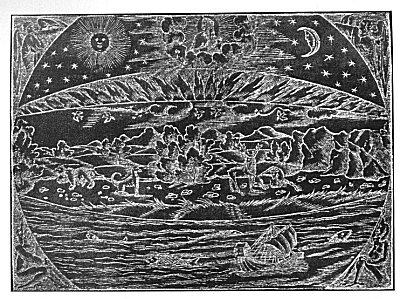
PLATE VI. THE PRIMORDIAL EARTH AND SEA<br> (From <i>Cosmographia Universalis</i>, Sebastian Muenster, 1599).
PLATE VI. THE PRIMORDIAL EARTH AND SEA
(From Cosmographia Universalis, Sebastian Muenster, 1599).There is a curious relation between the ancient boats and the Assyrian story of the Creation. If these boats were hemispheres of stretched skin, so were the Heavens and the Earth. Merodach, the world-maker of this legend, lay for a long time helpless like the other gods under the blind rule of Chaos-Tiemat, from whom sprang everything and who created unceasingly, but who had yet created neither Heaven nor Earth. From her issued spontaneously monstrous animals and figures, men with two wings and others with four, with two faces or four, with goats' legs and horns, or with the hindparts of a horse and the foreparts of a man; animals with human heads or fishes' tails; other forms in which every sort of animal shape was united in confusion, and this confusion of creation run mad never ceased.

But finally Merodach arose, alone of all the gods, to meet her, and then it was that Space witnessed its most terrific combat. He finally slew her, but matters were hardly bettered, for Tiemat's great dead body stretched throughout all Space. "He placed his foot upon her," reads the Assyrian story, "and with his unerring knife he cut into the upper part of her; then he cut the blood vessels, and caused the blood to be carried by the north wind to the hidden places. . . . He contemplated the great corpse, raised it and wrought marvels. He split it in two as one does a fish for drying; then he hung up one of the halves on high, which became the heavens." The other half he spread out under his feet to form the Earth, and immediately all the creatures that were in her disappeared. Merodach again surveyed the empty world; then he cut off his own head, and, having kneaded the blood flowing from it with the Earth, formed men, who were thus endowed with a surviving particle of understanding and with a surviving particle of divine thought.

This odd conception of the heavens as made of "skin" is found over and over among primitive races. The Yakuts say that the sky is made of several skins, tightly stretched and overlapping. The Buriats call the Milky Way a "stitched seam" in the sky, and they speak with awe of a "certain being" who murmurs from time to time, "Long, long ago, when I was young, I sewed the sky together."

The picture of the kufa(Plate VII, A ) is given to make clearer what most of the writers on the old Akkadian cosmogony mean when they say, "The Akkadians or Chaldeans considered the Earth to be hollow and boat-shaped." For "boat-shaped" meant to them no elongated oval figure, but distinctly a hollow hemisphere, a round shell, even a "stretched skin." Plate VII, B shows Myer's construction of their world on just this model, and his interpretation is followed below. 1

Briefly, E is the convex side of the hollow Earth shell. From C to E stretches the Lower Firmament, or zone of the atmosphere--winds, storms and clouds; this zone rests firmly upon the convex Earth shell. From C to A is the Upper Firmament, divided into two layers; from A to B is the zone of the spirit of the heavens; and from B to C is the zone of the planets--"sheep," or "wanderers," or "watchers." This is the zone also of lightning and of thunder. A, in this diagram, represents the Zodiac, which is "in Space and the Great Celestial Ocean," called also the "Deep" and the "Abyss." Thom, the Great Dragon of this Great Sea, was also called Tiemat, and it was really looked upon as the Primordial Abyss out of which everything in the Universe, including Heaven and Earth, came. The arrangement of the seven planets, between B and C, are, according to Myer, a. Saturn, b. Jupiter, c. Mars, d. Sun, e. Venus, f. Mercury, g. Moon, and Earth the centre.

FF is the concave side of the Earth shell, with seven zones described, "answering," says Myer, "as shadows, to the orbits of the seven planets." This was the realm of the king of the ghost-world, the king of the dead. Curiously enough, it was believed to have been ruled over at one time by Ea, deity of Wisdom. G was the Nadir, and I was the mountain of the East, or the mountain of the world, which supported the Upper Firmament and the Great Celestial Ocean. II is the Great Chaotic Crystalline Sea, extending to an unknown distance beyond the Zodiacal zone. III is the pivot of the Star zone, on the top of the World mountain, upon which the firmament revolves. IV are the guarded gates to the Underworld, abode of the dead, or home of the dark spirits, or a place for punishment. Yet in it are concealed the waters of life, and through this region of the Underworld the nightly journey of the Sun takes place, from west to east.

Disregarding any number of merely technical differences between them, this diagram of Myer's will serve as a fair picture of any cosmogony based on the idea that the Earth is a hollow hemisphere with an underworld. But there is sharp disagreement over whether after all the ancient Assyrian people--certainly the Chaldeans and Babylonians--believed that the Earth was a hemispherical shell, or whether they believed that it was something quite other than that.

Babylon was mighty, and it perished utterly. Of all its wisdom, only battered fragments of texts remain; which present-day scholars have worked for years to interpret. Within a period of just twenty years, from 1888 to 1908, eight different diagrams of the supposed figure of this Babylonian Universe were offered by eight different men, of which Myer's diagram was the first. The last of these is Dr. William Fairfield Warren's, first published in The Journal of the Royal Asiatic Society, 1908. As he points out, no two of the other seven agree; certainly no one of the other seven bears any likeness to this beautiful construction of eight crystalline spheres surrounding a cubical, pyramidal, antipodal Earth-figure (Plate VIII ).

"For the reconstruction of the Babylonian universe," he says, "we have no less than twelve most valuable data derived from the study of ancient Babylonian texts." Following is an abstract of the twelve data on which he modelled this translucent universe. 1
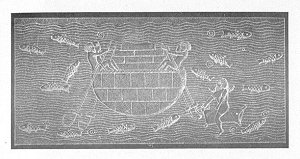
PLATE VII. A. <i>A kufa laden with stoner and manned by a crew of four men. Drawn by Faucher-Gudin from a bas-relief at Koyunjik</i>.<br> (From <i>The Dawn of Civilization</i>; Gaston Maspero, 1894)
PLATE VII. A. A kufa laden with stoner and manned by a crew of four men. Drawn by Faucher-Gudin from a bas-relief at Koyunjik.
(From The Dawn of Civilization; Gaston Maspero, 1894)
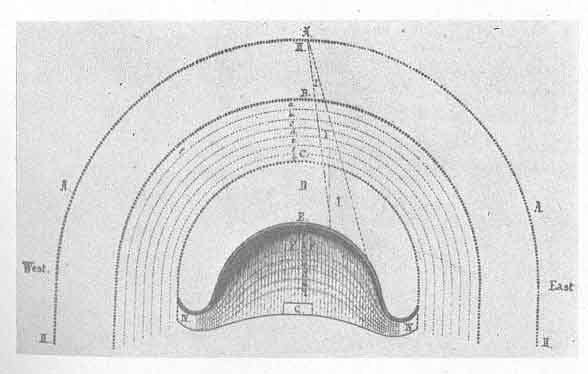
PLATE VII. B. Construction of the Akkadian, Chaldean and Babylonian Universe.<br> (From <i>Qaballah</i>; Isaac Myer, 1888)
PLATE VII. B. Construction of the Akkadian, Chaldean and Babylonian Universe.
(From Qaballah; Isaac Myer, 1888)
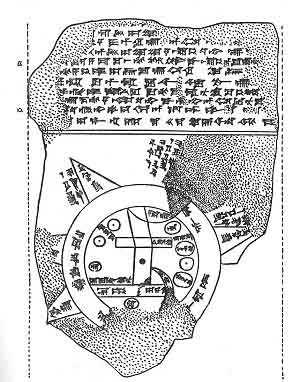
FIGURE 35. <i>Babylonian</i> ''<i>Mappa Mundi</i>'' <i>inscribed on a Babylonian geographical tablet in the British Museum, No. 92,687. Showing the ocean surrounding the world, and marking the position of Babylon on the Euphrates as its centre. It shows also the mountains at the source of the river, the land of Assyria, Bit-Iakinu, and the swamps at the mouth of the Euphrates</i>.<br> (From <i>Cuneiform Texts from Babylonian Tablets, etc., in the British Museum</i>, 1906: Part XXII, Plate 48. The reading is taken from <i>The Babylonian Legends of the Creation</i>. Brit. Mus. Pubs., 1921, p. 3.)
FIGURE 35. Babylonian''Mappa Mundi'' inscribed on a Babylonian geographical tablet in the British Museum, No. 92,687. Showing the ocean surrounding the world, and marking the position of Babylon on the Euphrates as its centre. It shows also the mountains at the source of the river, the land of Assyria, Bit-Iakinu, and the swamps at the mouth of the Euphrates.
(From Cuneiform Texts from Babylonian Tablets, etc., in the British Museum, 1906: Part XXII, Plate 48. The reading is taken from The Babylonian Legends of the Creation. Brit. Mus. Pubs., 1921, p. 3.)
1. In the Babylonian conception of the universe the earth occupied the central place. It was the accepted centre of their planetary system.

2. The northern half of the earth was called the upper, associated with life and light. The southern half was called the under, associated with darkness and death. The South and the Underworld are identical.

3. The upper or northern half of the earth was regarded as consisting of seven stages (tupukati), ranged one above the other in the form of a staged pyramid. The staged Temple of Nippur, according to Sayce, was a model of the Earth according to the belief of those who built it.

4. Correspondingly, the antarctic or under half of the Earth was supposed to consist of seven similar stages. The seven tupukatiof the underworld are a facsimile of the seven tupukatiof the over world.

5. Like the quadrilateral temple modelled after it, the Earth of the Babylonians was four-cornered. In this particular it agreed with the conception ascribed to the ancient Egyptians, Hebrews, Chinese, and to the Indo-Aryans of the Rig-Veda period.

6. In Babylonian thought there were seven heavens and seven hells. This belief is one of untraceable antiquity.

7. Above the seventh heaven was another, the "highest heaven," that of the fixed stars, called by the Babylonians the "heaven of Anu," after the name of one of their oldest and highest gods.

8. This eighth heaven was divided by the Zodiac into two corresponding portions, an upper, or Arctic, and an under, or Antarctic. At the upper pole Anu had his palace and throne.

9. In Babylonian thought, the north pole of the heavens was the true zenith of the cosmic system, and the axis of the system upright; consequently the diurnal movements of the sun and moon were regarded as occurring in a horizontal plane.

10. Proceeding outward from the central Earth, the order of the seven known planets was as follows: Moon, Sun, Mercury, Venus, Mars, Jupiter, Saturn. That their respective distances from the Earth were not uniform was already known.

11. In order to pass from the upper half of the Earth to its under half, that is, from the abode of living men to the abode of the dead, it was necessary to cross a body of water which on every side separated the two abodes.

12. According to Diodorus Siculus, the Babylonians considered that the twelve designated stars south of the Zodiac stood in the same relation to the dead as do the twelve corresponding stars north of the Zodiac to men in the land of the living. This representation clearly makes the living and the dead the residents respectively of antipodal surfaces of one and the same heaven-enclosed Earth. According to the Babylonian Creation Tablets (V, line 8) Anu and Ea are antipodally located gods, Anu being enthroned at the north pole of the heavens, and Ea at the south pole.

These twelve propositions, says Dr. Warren, are the fundamental features of the ancient Babylonian world-concept, and each of the twelve requirements is met by this figure. The upright central line represents the polar axis of the heavens and Earth in perpendicular position. The two central seven-staged pyramids represent the upper and lower halves of E-KUR, the Earth; the upper is the abode of living men, the lower the abode of the dead. The separating waters are the four seas. The seven dotted half circles above the Earth represent the "seven heavens," and the corresponding seven hemispheres below the earth, the "seven hells." The seven inner concentric spheres are respectively the domains and abodes of Sin, Shamash, Nabu, Ishtar, Nergal, Marduk, and Ninib, each being a "world-ruler" in his own planetary sphere. (The order of these spheres has been given above as Moon, Sun, Mercury, Venus, Mars, Jupiter, and Saturn.) The outer-most sphere (with its upper half cut away, as are the upper seven heavens, to show better the interior of the system) is the sphere of the antipodal gods, Anu and Ea, and the heaven of the fixed stars. It is to be noted further, Dr. Warren explains, that the spaces between the spheres widen rapidly at each remove from the Earth, so rapidly that in a world-view the size of this, they cannot be represented other than as in this plate.
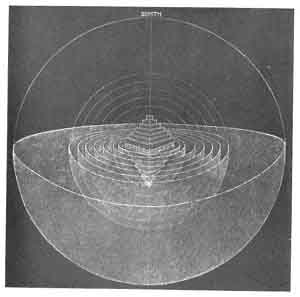
PLATE VIII. THE BABYLONIAN UNIVERSE<br> (From <i>The Universe as pictured in Milton's Paradise Lost</i>;<br> William Fairfield Warren, 1915)
PLATE VIII. THE BABYLONIAN UNIVERSE
(From The Universe as pictured in Milton's Paradise Lost;
William Fairfield Warren, 1915)

Dr. 'Warren calls this "The Babylonian Universe" principally because Babylonia is almost the limit of our back-ward reach to the wisdom of the past, and our retracing of the persistent recurrences of so many of these principles--the "four-cornered Earth," or the cubical Earth, the "seven heavens," "Earth and counter-Earth," the "crystalline spheres," the "mountains of the world," and so on--must end there. But its origin, he says, was among a people antedating the Babylonians. "A truer name therefore for the system would be the Pre-Babylonian. The East-Semites received it from their predecessors in the possession of the Euphratean valley, the Akkado-Sumarians. At least such is the opinion and the teaching of our highest experts. Did the system originate among those non-Semitic predecessors in the valley? This has been assumed, but no man can pretend to know."


Footnotes

56:1 Qabbalah; Isaac Myer, 1888, pp. 448-450.
58:1 Journal Royal Asiatic Society of Great Britain and Ireland, 1908, pp. 977-983.

Subscribe to this RSS feed

Log in or create an account