SUMERIAN MYTHOLOGY
A Study of Spiritual and Literary Achievement in the Third Millennium B.C.
SAMUEL NOAH KRAMER
REVISED EDITION
University of Pennsylvania PressPhiladelphia[1944, revised 1961]
CHAPTER II
MYTHS OF ORIGINS
The most significant myths of a given culture are usually the cosmogonic, or creation myths, the sacred stories evolved and developed in an effort to explain the origin of the universe, the presence of the gods, and the existence of man. And so we shall devote this chapter, by far the longest in our monograph, to the creation theories and concepts current in Sumer in the third millennium B. G. The subject lends itself to treatment under three heads:
(1) the creation of the universe(2) the organization of the universe(3) the creation of man.
THE CREATION OF THE UNIVERSE
The major source for the Sumerian conception of the creation of the universe is the introductory passage to a Sumerian poem which I have entitled "Gilgamesh, Enkidu, and the Nether World." The history of its decipherment is illuminating and not uninteresting. In 1934, when I first tried to decipher the contents, I found that eight pieces belonging to the poem--seven excavated in Nippur and one in Ur--had already been copied and published, thus: Hugo Radau, once of the University Museum, published two from Philadelphia in 1910; Stephen Langdon published two from Istanbul in 1914; Edward Chiera published one from Istanbul in 1924 and two more from Philadelphia in 1934; C. J. Gadd, of the British Museum, published an excellently preserved tablet from Ur in 1930.32 But an intelligent reconstruction and translation of the myth were still impossible, largely because the tablets and fragments, some of which seemed to duplicate each other without rhyme or reason and with but little variation in their wording, could not be properly arranged. In 1936, after I had sent off to the Revue d'assyriologiemy first translations of the myth "Inanna's Descent to the Nether World", I decided to make a serious effort to reconstruct the contents of the poem, which obviously seemed to contain a charming and significant story. And it was then that I came upon the clue which enabled me to arrange the pieces in their proper order.
This clue crystallized from an effective utilization of two stylistic features which characterize Sumerian poetry. The first is one which ranks very low in the scale of artistic technique but which from the point of view of the decipherer is truly a boon. It may be described as follows. When the poet finds it advisable to repeat a given description or incident, he makes this repeated passage coincide with the original to the very last detail. Thus when a god or hero orders his messenger to deliver a message, this message, no matter how long and detailed, is given twice in the text, first when the messenger is instructed by his master, and a second time when the message is actually delivered. The two versions are thus practically identical, and the breaks in the one passage may be restored from the other.
As for the second stylistic feature, it may be thus sketched. The Sumerian poet uses twodialects in his epic and mythic compositions, the maindialect, and another known as the Emesaldialect. The latter resembles the main dialect very closely and differs only in showing several regular and characteristic phonetic variations. What is more interesting, however, is the fact that the poet uses this Emesal dialect in rendering the direct speech of a female, not male, deity; thus the speeches of Inanna, queen of heaven, are regularly rendered in the Emesal dialect.33 And so, on examining carefully the texts before me, I realized that what in the case of several passages had been taken to be a mere meaningless and unmotivated duplication, actually contained a speech of the goddess Inanna in which she repeats in the Emesaldialect all that the poet had previously described in narrative form in the maindialect. With this clue as a guide I succeeded in piecing together the first part of this poem; this was published in 1938.34 The latter half of the poem still remained largely unintelligible, and even the first and published part had several serious breaks in the text. In 1939 I found in Istanbul a broken prism inscribed with the poem. And in the course of the past year I identified and copied 7 additional pieces in the University Museum at Philadelphia.35 As a result we now have 16 pieces inscribed with the poem; over two hundred and fifty lines of its text can now be intelligently reconstructed and, barring a passage here and there, be correctly translated.
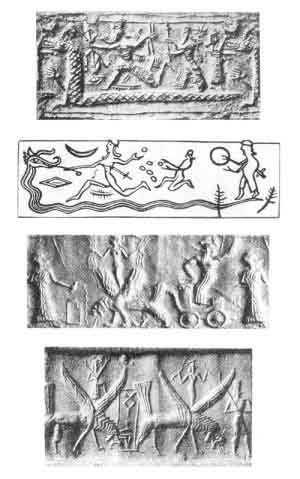
PLATE VII. GODS AND THE NETHER WORLD
One of the more remarkable contributions to art made by Mesopotamia is the cylinder seal. Invented primarily for the purpose of identifying and safeguarding ownership of goods shipped or stored, it came to be used in time as a kind of signature for legal documents. The procedure consisted merely of rolling the cylinder over wet clay and thus impressing the seal's design upon it. It is the contents of these designs engraved by the seal-cutters on the stone cylinders which are of considerable value for our study of Sumerian mythology. Especially is this true of the cylinder seals current in Sumer in the latter half of the third millennium B. C., not a few of whose designs are religious and mythological in character.31
The upper design clearly attempts to portray a more or less complicated mythological story. Three of the deities can be identified with reasonable certainty. Second from the right is the water-god Enki, with the flowing streams of water and the swimming fishes. Immediately behind him is his Janus-faced messenger Isimud, who plays an important role in several of our Enki myths. Seemingly rising out of the lower regions is Utu, the sun-god, with his saw-knife and fiery rays. The female figure standing on top of the mountain, near what seems to be a rather desolate tree, may perhaps be Inanna. If the figure to the left with bow in hand is intended to be Gilgamesh, we have in this design most of the protagonists of the tale "Gilgamesh, Enkidu, and the Nether World." However, it is to be noted that Enkidu is missing, and Isimud, who is pictured in the design, plays no part in the story. And so any close connection between the design and the epic tale is improbable.
In the central design none of the figures can be identified with reasonable certainty. In the left half of the picture we note a deity who seems to be rising out of the lower regions and is presenting a macelike object to a goddess. To the left is a god, perhaps Gilgamesh, who seems to be chopping down a tree whose trunk is bent to a curve. The right half of the design seems to depict a ritual scene.
The lower design may illustrate graphically the meaning of such a phrase as, "The nether world has seized him". In the right half of the scene we note a god actually within a flaming mountain (in Sumerian the word meaning "mountain" is the word used regularly for "nether world"). To the right of the mountain is a god who may be putting it to flame with a torch. Behind this deity is a goddess with fiery rays and ring who may perhaps be identified as Inanna. The left half of the design portrays a god holding a bull-man by the tail; both are inside a mountain.
(Reproduced, by permission of the Macmillan Company, from Henri Frankfort, Cylinder Seals(London, 1939), plates XIXa, XXIa, and XVIIIj.)
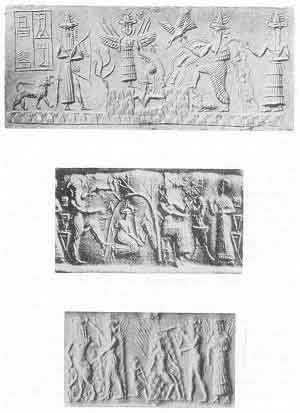 PLATE VII
GODS AND THE NETHER WORLD (For description, see opposite page.)
The story of our poem, briefly sketched, runs as follows: Once upon a time there was a huluppu-tree, perhaps a willow; it was planted on the banks of the Euphrates; it was nurtured by the waters of the Euphrates. But the South Wind tore at it, root and crown, while the Euphrates flooded it with its waters. Inanna, queen of heaven, walking by, took the tree in her hand and brought it to Erech, the seat of her main sanctuary, and planted it in her holy garden. There she tended it most carefully. For when the tree grew big, she planned to make of its wood a chair for herself and a couch.
Years passed, the tree matured and grew big. But Inanna found herself unable to cut down the tree. For at its base the snake "who knows no charm" had built its nest. In its crown, the Zu-bird--a mythological creature which at times wrought mischief--had placed its young. In the middle Lilith, the maid of desolation, had built her house. And so poor Inanna, the light-hearted and ever joyful maid, shed bitter tears. And as the dawn broke and her brother, the sun-god Utu, arose from his sleeping chamber, she repeated to him tearfully all that had befallen her huluppu-tree.
Now Gilgamesh, the great Sumerian hero, the forerunner of the Greek Heracles, who lived in Erech, overheard Inanna's weeping complaint and chivalrously came to her rescue. He donned his armour weighing fifty minas--about fifty pounds--and with his "ax of the road," seven talents and seven minas in weight--over four hundred pounds--he slew the snake "who knows no charm" at the base of the tree. Seeing which, the Zu-Bird fled with his young to the mountain, and Lilith tore down her house and fled to the desolate places which she was accustomed to haunt. The men of Erech who had accompanied Gilgamesh now cut down the tree and presented it to Inanna for her chair and couch.
What did Inanna do? Of the base of the huluppu-tree she made an object called the pukku(probably a drum), and of its crown she made another related object called the mikku(probably a drumstick), and gave them both to Gilgamesh, evidently as a reward for his gallantry. Follows a passage of twelve lines describing Gilgamesh's activity with these two objects whose meaning I am still unable to penetrate, although it is in perfect shape. When our story becomes intelligible again, it continues with the statement that "because of the cry of the young maidens" the pukkuand the mikkufell into the nether world, evidently through a hole in the ground. Gilgamesh put in his hand to retrieve them but was unable to reach them; he put in his foot but was quite as unsuccessful. And so he seated himself at the gate of the nether world and cried with fallen face:j
My pukku, who will bring it up from the nether world?
My mikku, who will bring it up from the "face" of the nether world?
His servant, Enkidu, his constant follower and companion, heard his master's cries, and said to him:
My master, why dost thou cry, why is thy heart sick?
Thy pukku, I will bring it up from the nether world,
Thy mikku, I will bring it up from the "face" of the nether world.
Thereupon Gilgamesh warned him of the dangers involved in his plan to descend to the nether world--a splendid passage, brief and concise in describing the taboos of the lower regions. Said Gilgamesh to Enkidu:
If now thou wilt descend to the nether world,
A word I speak to thee, take my word,
Advice I offer thee, take my advice.
Do not put on clean clothes,
Lest the (dead) heroeswill come forth like enemies;
Do not anoint thyself with the good oil of the vessel,
Lest at its smell they will crowd about thee.
Do not throw the throw-stick in the nether world,
Lest they who were struck down by the throw-stick will surround thee;
Do not carry a staff in thy hand,
Lest the shades will flutter all about thee.
Do not put sandals on thy feet,
In the nether world make no cry;
Kiss not thy beloved wife,
Kiss not thy beloved son,
Strike not thy hated wife,
Strike not thy hated son,
Lest thy "cry" of the nether world will seize thee;
(The cry) forher who is lying, for her who is lying,
The mother of the god Ninazu who is lying,
Whose holy body no garment covers,
Whose holy breast no cloth wraps.
But Enkidu heeded not the advice of his master and he did the very things against which Gilgamesh had warned him. And so he was seized by the nether world and was unable to reascend to the earth. Thereupon Gilgamesh, greatly troubled, proceeded to the city of Nippur and wept before the great air-god Enlil, the god who in the third millennium B. C. was the leading deity of the Sumerian pantheon:
O Father Enlil, my pukkufell into the nether world,
My mikkufell into the nether world;
I sent Enkidu to bring them up to me, the nether world has seized him.
Namtar (a demon) has not seized him, Ashak (a demon) has not seized him,
The nether world has seized him.
Nergal, the ambusher, who spares no one, has not seized him,
The nether world has seized him.
In battles where heroism is displayed he has not fallen,
The nether world has seized him.
But Enlil refused to stand by Gilgamesh, who then proceeded to Eridu and repeated his plea before the water-god Enki, the "god of wisdom." Enki ordered the sun-god Utu to open a hole in the nether world and to allow the shade of Enkidu to ascend to earth. The sun-god Utu did as bidden and the shade of Enkidu appeared to Gilgamesh. Master and servant embraced and Gilgamesh questioned Enkidu about what he saw in the nether world. The passage from here to the end of the poem is badly broken, but the following partly extant colloquy will serve as an illustration:k
Gilgamesh: "Him who has one son hast thou seen!"
Enkidu: "I have seen."
Gilgamesh: "How is he treated?"
Enkidu: (Answer broken)
Gilgamesh: "Him who has two sons hast thou seen?"
Enkidu: "I have seen."
Gilgamesh: "How is he treated?"
Enkidu: (Answer broken)
Gilgamesh: "Him who has three sons hast thou seen?"
Enkidu: "I have seen."
Gilgamesh: "How is he treated?"
Enkidu: ". . . much water he drinks."
PLATE VIII. THE SEPARATION OF HEAVEN AND EARTH
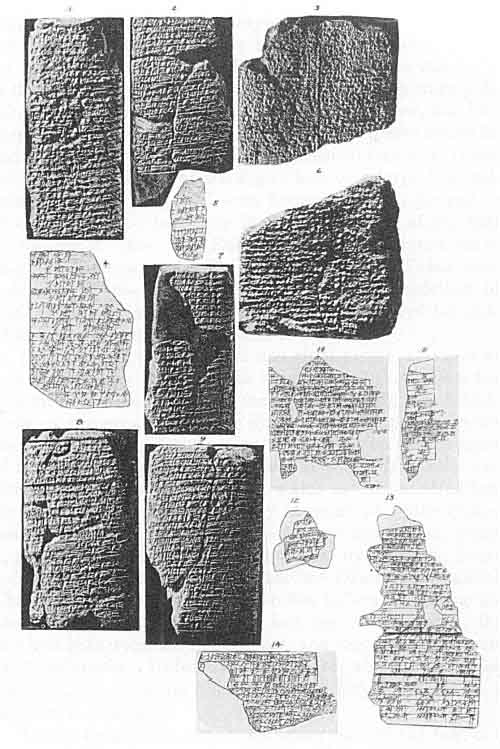
The two pieces illustrated here are duplicates belonging to the epic tale, "Gilgamesh, Enkidu, and the Nether World." The one to the left is a tablet (14068 in the Nippur collection of the University Museum) published by Chiera in 1934.36 The one to the right (4429 in the Nippur collection of the Museum of the Ancient Orient at Istanbul) is a fragment of a prism copied by the author and hitherto unpublished. The marked passages contain the lines significant for the creation of the universe; for the translation and the transliteration, see note 37 .
PLATE IX. ENLIL SEPARATES HEAVEN AND EARTH
The tablet (13877 in the Nippur collection of the University Museum) illustrated38 here is one of the 20 duplicating pieces utilized to reconstruct the text of the poem, "The Creation of the Pickax". Its first five lines are significant for the Sumerian concepts of the creation of the universe; for the translation and the transliteration, see note 39 .
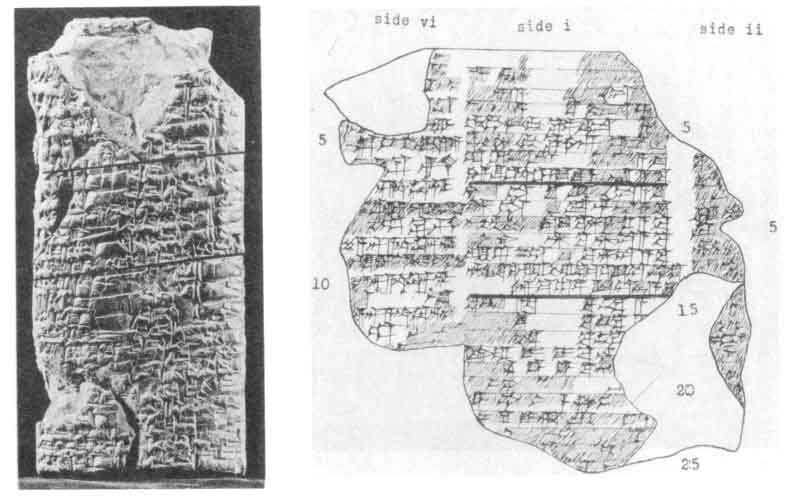 PLATE VIII.
THE SEPARATION OF HEAVEN AND EARTH
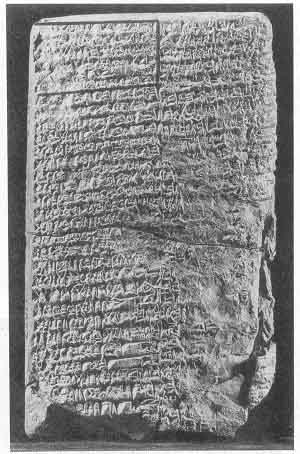 PLATE IX
ENLIL SEPARATES HEAVEN AND EARTH
Gilgamesh: "Him who has four sons hast thou seen!"
Enkidu: "I have seen."
Gilgamesh: "How is he treated?"
Enkidu: "Like . . . his heart rejoices."
Gilgamesh: "Him who has five sons hast thou seen!"
Enkidu: "I have seen."
Gilgamesh: "How is he treated?"
Enkidu: "Like a good scribe, his arm has been opened, He brings justice to the palace."
Gilgamesh: "Him who has six sons hast thou seen?"
Enkidu: "I have seen."
Gilgamesh: "How is he treated?"
Enkidu: "Like him who guides the plow his heart rejoices."
Gilgamesh: "Him who has seven sons hast thou seen!"
Enkidu: "I have seen."
Gilgamesh: "How is he treated?"
Enkidu: "As one close to the gods, he . . ."
Another of the questions runs thus:
Gilgamesh: "Him whose dead body lies (unburied) in the plain hast thou seen?"
Enkidu: "I have seen."
Gilgamesh: "How is he treated?"
Enkidu: "His shade finds no rest in the nether world."l
And so our poem ends.40 It is the introductionto this composition which furnishes the most significant material for the Sumerian concepts of the creation of the universe. The intelligible part of the introduction reads as follows:
After heaven had been moved away from earth,
After earth had been separated from heaven,
After the name of man had been fixed;
After An had carried off heaven,
After Enlil had carried off earth,
After Ereshkigal had been carried off into Kur as its prize;
After he had set sail, after he had set sail,
After the father for Kur had set sail,
After Enki for Kur had set sail;
Against the king the small ones it (Kur) hurled,
Against Enki, the large ones it hurled;
Its small ones, stones of the hand,
Its large ones, stones of . . . reeds,
The keel of the boat of Enki,
In battle, like the attacking storm, overwhelm;
Against the king, the water at the head of the boat,
Like a wolf devours,
Against Enki, the water at the rear of the boat,
Like a lion strikes down.
If we paraphrase and analyze the contents of this passage, it may be worded as follows: Heaven and earth, originally united, were separated and moved away from each other, and thereupon the creation of man was ordained. An, the heaven-god, then carried off heaven, while Enlil, the air-god, carried off earth. All this seems to be according to plan. Then, however, occurred something disruptive. For the goddess Ereshkigal, the counterpart of the Greek Persephone, whom we know as queen of the nether world, but who originally was probably a sky-goddess, was carried off into the nether world, perhaps by Kur. No doubt to avenge this deed, the water-god Enki set sail to attack Kur. The latter, evidently to be conceived as a monster or dragon, did not stand idly by, but hurled stones, large and small, against the keel of Enki's boat, while the primeval waters attacked Enki's boat front and rear. Our poem does not give the result of this struggle between Enki and Kur, since the entire cosmogonic or creation introduction has nothing to do with the basic contents of our Gilgamesh composition; it was placed at the head of the poem only because the Sumerian scribes were accustomed to begin their stories with several introductory lines dealing with creation.
It is from the first half of this introduction that we obtain therefore the following cosmogonic concepts:
1. At one time heaven and earth were united.
2. Some of the gods existed before the separation of heaven and earth.
3. Upon the separation of heaven and earth, it was, as might have been expected, the heaven-god An who carried off heaven, but it was the air-god Enlil who carried off the earth.
Among the crucial points not statedor impliedin this passage are the following:
1. Were heaven and earth conceived as created, and if so, by whom?
2. What was the shape of heaven and earth as conceived by the Sumerians?
3. Who separated heaven from earth?
Fortunately, the answers to these three questions can be gleaned from several other Sumerian texts dating from our period. Thus:
1. In a tablet which gives a list of the Sumerian gods,41 the goddess Nammu, written with the ideogram for "sea," is described as "the mother, who gave birth to heaven and earth." Heaven and earth were therefore conceived by the Sumerians as the created products of the primeval sea.
2. The myth "Cattle and Grain", which describes the birth in heaven of the spirits of cattle and grain, who were then sent down to earth to bring prosperity to mankind, begins with the following two lines:
After on the mountain of heaven and earth,
An had caused the Anunnaki (his followers) to be born. . . .
It is not unreasonable to assume, therefore, that heaven and earth united were conceived as a mountain whose base was the bottom of the earth and whose peak was the top of the heaven.
3. The myth "The Creation of the Pickax", which describes the fashioning and dedication of this valuable agricultural implement, is introduced with the following passage:
The lord, that which is appropriateverily he caused to appear,
The lord whose decisions are unalterable,
Enlil, who brings up the seed of the land from the earth,
Took careto move away heaven from earth,
Took careto move away earth from heaven.
And so we have the answer to our third question; it was the air-god Enlil, who separated and removed heaven from earth.
If now we sum up the cosmogonic or creation concepts of the Sumerians, evolved to explain the origin of the universe, they may be stated as follows:
1. First was the primeval sea. Nothing is said of its origin or birth, and it is not unlikely that the Sumerians conceived it as having existed eternally.
2. The primeval seabegot the cosmic mountainconsisting of heaven and earth united.
3. Conceived as gods in human form, An (heaven) was the male and Ki (earth) was the female. From their union was begotten the air-god Enlil.
PLATE X. MISCELLANEOUS MYTHOLOGICAL SCENES
The upper design depicts the rising of Utu, the sun-god, identifiable by his fiery rays and saw-knife. He places his left foot on a mountain while attending deities throw open the gates.
In the second design two of the deities are identifiable. At the extreme right is Enki, the water-god, enthroned in his "sea house," perhaps the very house described in "Enki and Eridu". To the left of the center is Utu, the sun-god, with fiery rays and saw-knife. He stands with one foot on a winged lion while the other steps on a crouching deity. The kneeling figure at the left, holding a gatepost, is probably an attendant of Enki. The deity between Utu and Enki, who is climbing a mountain, is still unidentifiable.
The third design depicts an unidentified god with fiery rays, travelling in his boat; the scene is reminiscent of Nanna's journey to Nippur. The stem of the boat ends in the head of a snake, while the prow ends in the body of a god who is working a punting pole. In the boat are various pots, agricultural implements, and a human-headed lion. On the shore is a vegetation goddess, perhaps to be identified as Uttu, the goddess of plants, or Ashnan, the goddess of grain.
The lower design depicts what is probably a divine connubium.
(Reproduced, by permission of the Macmillan Company, from Henri Frankfort, Cylinder Seals, plates XVIIIa, k, XIXe, and XVI.)
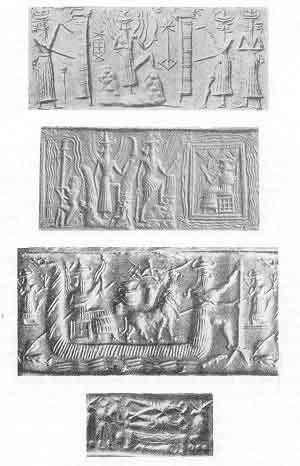 PLATE X
MISCELLANEOUS MYTHOLOGICAL SCENES
4. Enlil, the air-god, separated heaven from earth, and while his father An carried off heaven, Enlil himself carried off his mother Ki, the earth. The union of Enlil and his mother Ki-in historical times she is perhaps to be identified with the goddess called variously Ninmah, "great queen"; Ninhursag, "queen of the (cosmic) mountain"; Nintu, "queen who gives birth"--set the stage for the organization of the universe, the creation of man, and the establishment of civilization."
THE ORGANIZATION OF THE UNIVERSE
The Sumerian expression for "universe" is an-ki, literally "heaven-earth." The organization of the universe may therefore be subdivided into that of heaven and that of earth. Heaven consists of the sky and the space above the sky which is called the "great above"; here dwell the sky-gods. Earth consists of the surface of the earth and the space below which is called the "great below"; here dwell the underworld or chthonic deities. For the organization of heaven the relatively little mythological material which is available to date may be sketched as follows: Nanna, the moon-god, the major astral deity of the Sumerians, is born of Enlil, the air-god, and his wife Ninlil, the air-goddess. Nanna, the moon-god, is conceived as travelling in a gufa across the heavens, thus bringing light to the pitch-dark lapis lazuli sky. The "little ones," the stars, are scattered about him like grain while the "big ones," perhaps the planets, walk about him like wild oxen."43
Nanna, the moon-god, and his wife Ningal are the parents of Utu, the sun-god, who rises in the "mountain of the east" and sets in the "mountain of the west." As yet we find no mention of any boat or chariot used by the sun-god Utu to traverse the sky. Nor is it clear just what he does at night.m The not unnatural assumption that upon reaching the "mountain of the west" at the end of the day he continues his journey at night through the nether world, arriving at the "mountain of the east" at dawn, is not borne out by the extant data. Indeed to judge from a prayer to the sun-god which reads:44
O Utu, shepherd of the land, father of the black-headed people,
When thou liest down, the people, too, lie down,
O hero Utu, when thou risest, the people, too, rise.
or from a description of the break of dawn which reads:
As light broke forth, as the horizon grew bright. . . .
As Utu came forth from his ganunu,
or from a description of the setting of the sun which reads:46
Utu has gone forth with lifted head to the bosom of his mother Ningal;
the Sumerians seemed to have conceived of Utu as sleeping through the night.
Turning to the organization of the earth, we learn that it was Enlil, the air-god, who "caused the good day to come forth"; who set his mind to "bring forth seed from the earth" and to establish the hegal, that is, plenty, abundance, and prosperity in the land. It was this same Enlil who fashioned the pickax and probably the plow as prototypes of the agricultural implements to be used by man; who appointed Enten, the farmer-god, as his steadfast and trustworthy field-worker. On the other hand it was the water-god Enki who begot Uttu, the goddess of plants. It is Enki, moreover, who actually organizes the earth, and especially that part of it which includes Sumer and its surrounding neighbors, into a going concern. He decrees the fates of Sumer, Ur, and Meluhha, and appoints the various minor deities to their specific duties. And it is both Enlil and Enki, that is, both the air-god and the water-god, who send Labar, the cattle-god, and Ashnan, the grain-goddess, from heaven to earth in order to make abundant its cattle and grain.
The above outline of the organization of the universe is based upon nine Sumerian myths whose contents we now have wholly or in large part. Two of these involve the moon-god Nanna; they are: Enlil and Ninlil. the Begettingof Nanna; The Journey of Nanna to Nippur. The remaining seven are of prime importance for the Sumerian concepts of the origin and establishment of culture and civilization on earth. These are Emesh and Enten: Enlil Chooses the Farmer-god; The Creation of the Pickax; Cattle and Grain; Enki and Ninhursag: the Affairs of the Water-god; Enki and Sumer: the Organization of the Earth and its Cultural Processes; Enki and Eridu: the Journey of the Water-god to Nippur; Inanna and Enki: the Transfer of the Arts of Civilization from Eridu to Erech. We shall now proceed to sketch briefly the contents of each of these myths; their wealth and variety, it is hoped, will enable the reader to evaluate the Sumerian mythological concepts together with their spiritual and religious implications.
ENLIL AND NINLIL: THE BEGETTING OF NANNAn
This delightful myth, consisting of 152 lines of text,49 is almost complete. It seems to have been evolved to explain the begetting of the moon-god Nanna as well as that of the three underworld deities, Nergal, Ninazu, and a third whose name is illegible. If rightly interpreted this poem furnishes us with the first known example of the metamorphosis of a god; Enlil assumes the form of three different individuals in impregnating his wife Ninlil with the three nether world deities.
The poem begins with an introductory passage descriptive of the city of Nippur, a Nippur that seems to be conceived as having existed before the creation of man:
Behold the "bond of heaven and earth," the city, . . .
Behold Nippur, the city, . . .
Behold the "kindly wall," the city, . . .
Behold the Idsalla, its pure river,
Behold the Karkurunna, its quay,
Behold the Karasarra, its quay where the boats stand,
Behold the Pulal, its well of good water,
Behold the Idnunbirdu, its pure canal,
Behold Enlil, its young man,
Behold Ninlil, its young maid,
Behold Nunbarshegunu, its old woman.
After this brief background sketch the actual story begins. Nunbarshegunu, the "old woman" of Nippur, Ninlil's mother, instructs her daughter how to obtain the love of Enlil:
In those days the mother, her begetter, gave advice to the maid,
Nunbarshegunu gave advice to Ninlil:
"At the pure river, O maid, at the pure river wash thyself,
O Ninlil, walk along the bank of the Idnunbirdu,
The bright-eyed, the lord, the bright-eyed,
The 'great mountain,' father Enlil, the bright-eyed, will see thee,
The shepherd . . . who decrees the fates, the bright-eyed, will see thee,
He will . . . . he will kiss thee."
Ninlil follows her mother's instructions and as a consequence is impregnated by "the water" of Enlil and conceives the moon-god Nanna. Enlil then departs from Nippur in the direction of the nether world, but is followed by Ninlil. As he leaves the gate he instructs the "man of the gate" to give the inquisitive Ninlil no information of his whereabouts. Ninlil comes up to the "man of the gate" and demands to know whither Enlil has gone. Enlil then seems to take the form of the "man of the gate" and answers for him. The passage involved is as yet unintelligible; it seems to contain a refusal to divulge Enlil's whereabouts. Ninlil thereupon reminds him that while, true enough, Enlil is his king, she is his queen. Thereupon Enlil, still impersonating "the man of the gate," cohabits with her and impregnates her. As a result Ninlil conceives Meslamtaea, more commonly known as Nergal, the king of the nether world. In spite of the unintelligible parts, the flavor of this remarkable passage will be readily apparent from the following quotations:
PLATE XI. ENLIL AND NINLIL: THE BEGETTING OF NANNA
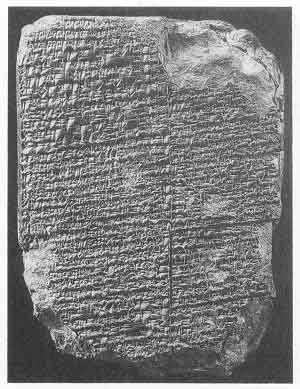
PLATE XI.
ENLIL AND NINLIL: THE BEGETTING OF NANNA
This illustrates the obverse of a tablet (9205 in the Nippur collection of the University Museum) that was published by the late George Barton as early as 1918.47 Its contents, though obviously most significant for Sumerian mythology, have remained largely unintelligible all these years. Sumerological progress in the course of the past quarter-century and the discovery by the author of nine additional fragments (eight in the University Museum and one in the Museum of the Ancient Orient)48 have now made the reconstruction and translation of this poem possible. The marked passage contains the following lines:
den-l-li du dnin-l in-u
dnu-nam-nir du ki-sikil mu-un- . . .
den-l-li lkgal-ra gmu-na-de
lkgal lgisi-gar-ra
lgiu-di-e lgisi-gar-kug-ga
nin-zu-dnin-l-li i-im-du
u4-da -mu mu-ra-tar-ra
za-e ki-mu nam-mu-ni-in-p-dp>Enlil . . . departed from the city,
Nunamnir (a name of Enlil) . . . departed from the city.
Enlil walked, Ninlil followed,
Nunamnir walked, the maid followed,
Enlil says to the man of the gate:
"O man of the gate, man of the lock,
O man of the bolt, man of the pure lock,
Thy queen Ninlil is coming;
If she asks thee about me,
Tell her not where I am."
Ninlil approached the man of the gate:
"O man of the gate, man of the lock,
O man of the bolt, man of the pure lock,
Enlil, thy king, where is he going?"
Enlil answers her forthe man of the gate:
"Enlil, the king of all the lands, has commanded me":
Four lines follow containing the substance of this command but their meaning is obscure. Then comes the following dialogue between Ninlil and Enlil, the latter impersonating the "man of the gate":
Ninlil: "True, Enlil is thy king, but I am thy queen."
Enlil: "If now thou art my queen, let my hand touch thy . . ."
Ninlil: "The 'water' of thy king, the bright 'water' is in my heart,
The 'water' of Nanna, the bright 'water' is in my heart."
Enlil: "The 'water' of my king, let it go toward heaven, let it go toward earth,
Let my 'water,' like the 'water' of my king, go toward earth."
Enlil, asthe man of the gate, lay down in the
He kissed her, be cohabited with her,
Having kissed her, having cohabited with her,
The "water" of . . . Meslamtaea he caused to flow over(her) heart.
The poem then continues with the begetting of the nether world deity Ninazu; this time it is the "man of the river of the nether world, the man-devouring river" whom Enlil impersonates. In all other respects, the passage is a repetition of that describing the begetting of Meslamtaea; thus:
Enlil walked, Ninlil followed,
Nunamnir walked, the maid followed,
Enlil says to the man of the river of the nether world, the man-devouring river:
"O man of the river of the nether world, the man-devouring river,
Thy queen Ninlil is coming;
If she asks thee about me,
Tell her not where I am."
Ninlil approached the man of the river of the nether world, the man-devouring river:
"O man of the river of the nether world, the man-devouring river,
Enlil, thy king, where is he going?"
Enlil answers her forthe man of the river of the nether world, the man-devouring river:
"Enlil, the king of all the lands, has commanded me."
The substance of the command is unintelligible. Follows the dialogue between Ninlil and Enlil, the latter impersonating the "man of the river of the nether world, the man-devouring river":
Ninlil: "True, Enlil is thy king, but I am thy queen."
Enlil: "If now thou art my queen, let my hand touch thy . . ."
Ninlil: "The 'water' of thy king, the bright 'water' is in my heart,
The 'water' of Nanna, the bright 'water' is in my heart."
Enlil: "The 'water' of my king, let it go toward heaven, let it go toward earth,
Let my 'water,' like the 'water' of my king, go toward earth."
Enlil, asthe man of the river of the nether world, the man-devouring river, lay down in the . . . .
He kissed her, he cohabited with her,
Having kissed her, having cohabited with her,
The "water" of Ninazu, the king of . . ., he caused to flow over(her) heart.
The poem then continues with the begetting of the third underworld deity whose name is illegible; this time it is the "man of the boat" whom Enlil impersonates. Our myth then comes to a close with a brief hymnal passage in which Enlil is exalted as the lord of abundance and the king whose decrees are unalterable.
THE JOURNEY OF NANNA TO NIPPUR
To the Sumerians of the third millennium B. C., Nippur was the spiritual center of their country. Its tutelary deity, Enlil, was the leading god of the Sumerian pantheon; his temple, Ekur, was the most important temple in Sumer. And so, the blessing of Enlil was a prime essential for the establishment of prosperity and abundance in the other important cities of Sumer, such as Eridu and Ur. To obtain this blessing, the tutelary deities of these cities were conceived as travelling to Nippur laden with gifts for its god and temple. Our myth50 describes just such a journey from Ur to Nippur of the moon-god Nanna (also known as Sin and Ashgirbabbar), the tutelary deity of Ur. In this myth, as in the preceding Enlil-Ninlil composition, the cities such as Nippur and Ur seem to be fully built and rich in animal and plant life, although man seems to be still nonexistent.
Beginning with a description of the glory of Nippur, our poem continues a passage describing Nanna's decision to visit his father's city:
To go to his city, to stand before his father,
Ashgirbabbar set his mind:
"I, the hero, to my city I would go, before my father I would stand;
I, Sin, to my city I would go, before my father I would stand,
Before my father Enlil I would stand;
I, to my city I would go, before my mother Ninlil I would stand,
Before my father I would stand."
And so he loads up his gufa with a rich assortment of trees, plants, and animals. On his journey from Ur to Nippur, Nanna and his boat make stop at five cities: Im (?), Larsa, Erech, and two cities whose names are illegible; in each of these Nanna is met and greeted by the respective tutelary deity. Finally he arrives at Nippur:
At the lapis lazuli quay, the quay of Enlil, Nanna-Sin drew up his boat, At the white quay, the quay of Enlil, Ashgirbabbar drew up his boat, On the . . . of the father, his begetter, he stationed himself,
To the gatekeeper of Enlil he says:
At the lapis lazuli quay, the quay of Enlil,
Nanna-Sin drew up his boat,
At the white quay, the quay of Enlil,
Ashgirbabbar drew up his boat,
On the . . . of the father, his begetter, he stationed himself,
To the gatekeeper of Enlil he says:
"Open the house, gatekeeper, open the house,
Open the house, O protecting genie, open the house,
Open the house, thou who makest the trees come forth, open the house,
O . . ., who makest the trees come forth, open the house,
Gatekeeper, open the house, O protecting genie, open the house."
The gatekeeper opens the door for Nanna:
Joyfully, the gatekeeper joyfully opened the door;
The protecting genie who makes the trees come forth, joyfully,
The gatekeeper joyfully opened the door;
He who makes the trees come forth, joyfully,
The gatekeeper joyfully opened the door;
With Sin, Enlil rejoiced.
The two gods feast; then Nanna addresses Enlil his father as follows:
"In the river give me overflow,
In the field give me muchgrain,
In the swampland give me grassand reeds,
In the forests give me . . .
In the plain give me . . .
In the palm-grove and vineyard give me honey and wine,
In the palace give me long life,
To Ur I shall go."
And Enlil accedes to his son's request:
He gave him, Enlil gave him,
To Ur he went.
In the river he gave him overflow,
In the field he gave him muchgrain,
In the swampland he gave him grassand reeds,
In the forests he gave him . . .,
In the plain he gave him . . . .
In the palm-grove and vineyard he gave him honey and wine,
In the palace he gave him long life.
EMESH AND ENTEN: ENLIL CHOOSES THE FARMER-GOD
This myth51 is the closest extant Sumerian parallel to the Biblical Cain-Abel story, although it ends with a reconciliation rather than a murder. It consists of over three hundred lines, only about half of which are complete; because of the numerous breaks, the meaning of the text is therefore often difficult to penetrate. Tentatively the contents of the poem may be reconstructed as follows:
Enlil, the air-god, has set his mind to bring forth trees and grain and to establish abundance and prosperity in the land. For this purpose two cultural beings, the brothers Emesh and Enten, are created, and Enlil assigns to each specific duties. The text is so badly damaged at this point that it is impossible to make out the exact nature of these duties; the following very brief intelligible passages will at least indicate their general direction:
Enten caused the ewe to give birth to the lamb, the goat to give birth to the kid,
Cow and calf he caused to multiply, much fat and milk he caused to be produced,
In the plain, the heart of the wild goat, the sheep, and the donkey he made to rejoice,
The birds of the heaven, in the wide earth he had them set up their nests.
The fish of the sea, in the swampland he had them lay their eggs,
In the palm-grove and vineyard he made to abound honey and wine,
The trees, wherever planted, he caused to bear fruit,
The furrows . . .,
Grain and cropshe caused to multiply,
Like Ashnan (the grain goddess), the kindly maid, he caused strengthto appear.
Emesh brought into existence the trees and the fields, he made wide the stables and sheepfolds,
In the farmshe multiplied the produce,
The . . . he caused to cover the earth,
The abundant harvest he caused to be brought into the houses, he caused the granaries to be heaped high.
But whatever the nature of their original duties, a violent quarrel breaks out between the two brothers. Several arguments ensue, and finally Emesh challenges Enten's claim to the position of "farmer of the gods." And so they betake themselves to Nippur where each states his case before Enlil. Thus Enten complains to Enlil:
PLATE XII. GODS OF VEGETATION
Three of the designs depict a deity in close relation with a plow. In the upper design two gods are guiding a plow, which is perhaps drawn by a lion and a wormlike dragon. In the second, a seated god is holding a plow in front of him. Behind him is a mountain from which sprouts a plant and on which an ibex is ascending; in front of him a deity leads a worshipper carrying a gazelle in his arms. In the lower design an unidentified deity holding a plow is travelling in a boat whose stern ends in a snake and whose prow ends in the body of a god who is propelling the boat.
The third design seems to depict an offering scene to the right of the inscription. A worshipper carrying a gazelle is followed by a goddess holding a vase, from which flow two streams of water. The worshipper stands before another goddess who may perhaps be identified as Inanna in the role of the goddess of war. But it is the two deities to the left of the inscriptions which interest us here mostly. Both seem to have ears of grain sprouting from their shoulders, but the male god is equipped with club and bow, while a ram frolics at his feet. He may perhaps be identified as Lahar, the cattle-god, while the goddess facing him may be Ashnan, the grain goddess.
(Reproduced, by permission of the Macmillan Company, from Henri Frankfort, Cylinder Seals, plates XXa, d, e, and XIXe.)
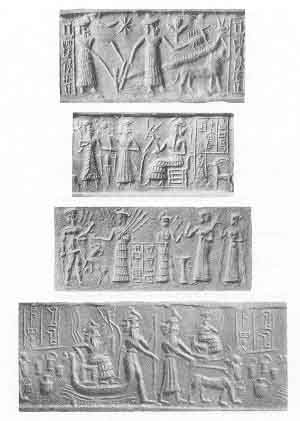
PLATE XII
GODS OF VEGETATION
"O father Enlil, knowledgethou hast given me, I brought the water of abundance,
FarmI made touch farm, I heaped high the granaries,
Like Ashnan, the kindly maid, I caused strengthto appear;
Now Emesh, the . . . . the irreverent, who knows not the heart of the fields,
On my first strength, on my first power, is encroaching;
At the palace of the king . . ."
Emesh's version of the quarrel, which begins with several flattering phrases cunningly directed to win Enlil's favor, is brief but as yet unintelligible. Then:
Enlil answers Emesh and Enten:
"The life-producing water of all the lands, Enten is its 'knower,'
As farmer of the gods he has produced everything,
Emesh, my son, how dost thou compare thyself with Eaten, thy brother?"
The exalted word of Enlil whose meaning is profound,
The decision taken, is unalterable, who dares transgress it!
Emesh bent the knees before Enten,
Into his house he brought . . ., the wine of the grape and the date,
Emesh presents Enten with gold, silver, and lapis lazuli,
In brotherhood and friendship, happily, they pour out libations,
Together to act wisely and well they determined.
In the struggle between Emesh and Enten,
Enten, the steadfast farmer of the gods, having proved greater than Emesh,
. . . O father Enlil, praise!
THE CREATION OF THE PICKAX
This poem consisting of 108 lines52 is practically complete, although not a few of the passages still remain obscure and unintelligible. It begins with a long introductory passage which is of prime significance for the Sumerian conception of the creation and organization of the universe. If the following translation of this important passage seems sodden, stilted, and obscure, the reader is asked to remember that although the meanings of most of the Sumerian words and phrases are known, we still have little insight into their overtones, into their connotations and implications.
For the background and situation which these words and phrases imply and assume, still elude us; and it is this background and situation, part and parcel of the Sumerian mythological and religious pattern and well known to the Sumerian poet and his "reader," which are so vital to a full understanding of the text. It is only with the gradual accumulation of living contexts from Sumerian literature that we may hope to overcome this difficulty; as yet it is best to hew close to the literal word. The introductory passage reads:o
The lord, that which is appropriate verily he caused to appear,
The lord whose decisions are unalterable,
Enlil, who brings up the seed of the land from the earth,
Took careto move away heaven from earth,
Took careto move away earth from heaven.
In order to make grow the creature which came forth,
In the "bond of heaven and earth" (Nippur) he stretched out the . . .
He brought the pickax into existence, the "day" came forth,
He introduced labor, decreed the fate,
Upon the pickax and basket he directs the "power."
Enlil made his pickax exalted,
His pickax of gold, whose head is of lapis lazuli,
The pickax of his house, of . . . silver and gold,
His pickax whose . . . is of lapis lazuli,
Whose toothis a one-horned ox ascending a large wall.
The lord called up the pickax, decrees its fate,
He set the kindu, the holy crown, upon his head,
The head of man he placed in the mould,
Before Enlil he(man?) covershis land,
Upon his black-headed people he looked steadfastly.
The Anunnaki who stood about him,
He placed it(the pickax?) as a gift in their hands,
They soothe Enlil with prayer,
They give the pickax to the black-headed people to hold.
After Enlil had created the pickax and decreed its exalted fate, the other important deities add to its powers and utility. The poem concludes with a long passage in which the usefulness of the pickax is described in glowing terms; the last lines read:
The pickax and the basket build cities,
The steadfast house the pickax builds, the steadfast house the pickax establishes,
The steadfast house it causes to prosper.
The house which rebels against the king,
The house which is not submissive to its king,
The pickax makes it submissive to the king.
Of the bad . . . plants it crushes the head,
Plucks at the roots, tears at the crown,
The pickax sparesthe . . . plants;
The pickax, its fate decreed by father Enlil,
The pickax is exalted.
CATTLE AND GRAIN
The myth53 involving Lahar, the cattle-god, and his sister Ashnan, the grain-goddess, represents another variation of the Cain-Abel motif in Near East mythology. Labar and Ashnan, according to our myth, were created in the creation chamber of the gods in order that the Annunnaki, the children and followers of the heaven-god An, might have food to eat and clothes to wear. But the Anunnaki were unable to make effective use of the products of these deities; it was to remedy this situation that man was created. All this is told in an introductory passage which, because of its significance for the Sumerian conception of the creation of man. The passage following the introduction is another poetic gem; it describes the descent of Lahar and Ashnan from heaven to earth and the cultural benefits which they bestow on mankind:
In those days Enki says to Enlil:
"Father Enlil, Lahar and Ashnan,
They who have been created in the Dulkug,
Let us cause them to descend from the Dulkug."
At the pure word of Enki and Enlil,
Lahar and Ashnan descended from the Dulkug.
For Lahar they (Enlil and Enki) set up the sheepfold,
Plants, herbs, and . . . they present to him;
For Ashnan they establish a house,
Plow and yoke they present to her.
Lahar standing in his sheepfold,
A shepherd increasing the bounty of the sheepfold is he;
Ashnan standing among the crops,
A maid kindly and bountiful is she.
Abundance of heaven . . . ,
Lahar and Ashnan caused to appear,
In the assembly they brought abundance,
In the land they brought the breath of life,
The decrees of the god they direct,
The contents of the warehouses they multiply,
The storehouses they fill full.
In the house of the poor, hugging the dust,
Entering they bring abundance;
The pair of them, wherever they stand,
Bring heavy increase into the house;
The place where they stand they sate, the place where they sit they supply,
They made good the heart of An and Enlil.
But then Labar and Ashnan drank much wine and so they began to quarrel in the farmsand fields. In the arguments which ensued, each deity extolled its achievements and belittled those of its opponent. Finally Enlil and Enki intervened, but the end of the poem which contains their decision is still wanting.
ENKI AND NINHURSAG: THE AFFAIRS OF THE WATER-GODp
Both for intricacy of story and for simplicity of style, this myth57 is one of the most remarkable compositions in our entire group. The hero is Enki, the great water-god of the Sumerians, one of the four creating deities of Sumer; his closest Greek counterpart is Poseidon. The place of our story is Dilmun, a district which is perhaps to be identified with eastern shores of the Persian Gulf and which in historical times, therefore, actually lay outside of Sumer proper. Our poem begins with a description of Dilmun as a land of innocence and bliss:
The land Dilmun is a pure place, the land Dilmun is a clean place,
The land Dilmun is a clean place, the land Dilmun is a bright place;
He who is all alone laid himself down in Dilmun,
The place, after Enki had laid himself by his wife,
That place is clean, that place is bright;
He who is all alone laid himself down in Dilmun,
The place, after Enki had laid himself by Ninsikil,
That place is clean, that place is bright.
In Dilmun the raven uttered no cries,
The kiteuttered not the cry of the kite,
The lion killed not,
The wolf snatched not the lamb,
Unknown was the kid-killing dog,
Unknown was the grain-devouring boar,
The bird on high . . . not its young,
The dove . . . not the head,
The sick-eyed says not "I am sick-eyed,"
The sick-headed says not "I am sick-headed,"
Its (Dilmun's) old woman says not "I am an old woman,"
Its old man says not "I am an old man,"
Its unwashed maid is not . . . in the city,
He who crossesthe river utters no . . . ,
The overseerdoes not . . . ,
The singer utters no wail,
By the side of the city he utters no lament.
What is wanting in this paradise land, however, is sweet water. And so the goddess of Dilmun, Ninsikil, pleads with Enki for fresh water. Enki heeds her plea and orders the sun-god Utu to bring forth fresh water from the earth for Dilmun.
Her city drinks the water of abundance,
Dilmun drinks the water of abundance,
Her wells of bitter water, behold they are become wells of good water,
Her fields and farmsproduced cropsand grain,
Her city, behold it is become the house of the banks andquays of the land,
Dilmun, behold it is become the house of the banks andquays of the land.
As a result: Dilmun supplied with water, our poem next describes the birth of Uttu, the goddess of plants, a birth which results from the following rather intricate process. Enki first impregnates the goddess Ninhursag, or, to give her one of her other names, Nintu, the Sumerian goddess who in an earlier day may have been identical with Ki, the mother earth. Follows a period of gestation lasting nine days, the poet being careful to note that each day corresponds to a month in the human period of gestation; of this union is begotten the goddess Ninsar. This interesting passage runs as follows:
Upon Ninhursag he caused to flowthe "water of the heart,"
She received the "water of the heart," the water of Enki.
One day being her one month,
Two days being her two months,
Three days being her three months,
Four days being her four months,
Five days (being her five months,)
Six days (being her six months,)
Seven days (being her seven months,)
Eight days (being her eight months,)
Nine days being her nine months, the months of "womanhood,"
Like . . . fat, like . . . fat, like good butter,
Nintu, the mother of the land, like . . . fat, (like . . . fat, like good butter,)
Gave birth to Ninsar.
PLATE XIII. ENKI AND NINHURSAG: THE AFFAIRS OF THE WATER-GOD
This is a photograph of a tablet (4561 in the Nippur collection of the University Museum) published by Stephen Langdon more than 25 years ago under the title, "Sumerian Epic of Paradise, the Flood, and Fall of Man."54 At the time of its publication, Sumerian grammatical and lexicographical studies had made relatively little scientific progress, and the contents of this difficult poem were largely misunderstood. The author's interpretation of the poem is largely the result of a more scientific approach to the linguistic problems, although the publication in 1930 by Henri de Genouillac of a duplicating fragment now in the Louvre u also proved of considerable help. The last 14 lines in the second column contain a passage which may be not inaptly entitled "The Birth of a Goddess"; for the translation and the transliteration, see note 56 .
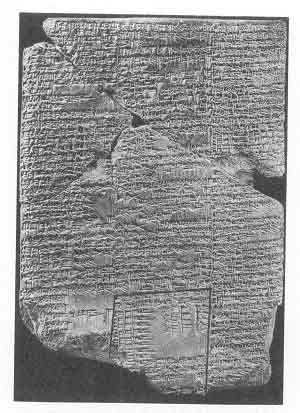
PLATE XIII.
ENKI AND NINHURSAG: THE AFFAIRS OF THE WATER-GOD
Ninsar in turn is impregnated by her father Enki and after nine days of gestation she gives birth to the goddess Ninkur. Ninkur, too, is then impregnated by Enki and so finally is born Uttu, the goddess of plants. To this plant-goddess now appears her great-grandmother Ninhursag, who offers her advice pertinent to her future relationship with Enki. Part of the passage is broken, and much of what is not broken I fail as yet to comprehend. But whatever the advice, Uttu follows it in all detail. As a result she is in turn impregnated by Enki and eight different plants sprout forth. But Enki eats up the plants; thus:
Enki, in the swampland, in the swampland, lies stretched out,
He says to his messenger Isimud:
"What is this (plant), what is this (plant)?"
His messenger, Isimud, answers him;
"My king, this is the 'tree-plant'," he says to him.
He cuts it off for him and he (Enki) eats it.
Enki: "What is this, what is this?"
Isimud: "My king, this is the 'honey-plant'."
He tears it off for him and he eats it.
And so on until Enki has eaten all the eight plants. Thereupon Ninhursag, who, it will be recalled, is actually responsible for the creation of these plants, curses Enki.58 The curse reads:
"Until thou art dead, I shall not look upon thee with the 'eye of life'."
Having uttered the curse, Ninhursag disappears. The gods are chagrined; they "sit in the dust." Up speaks the fox to Enlil:
"If I bring Ninhursag before thee, what shall be my reward?"
Enlil promises the fox a due reward and the latter succeeds in bringing her back; how he goes about this task is not clear, however, since part of the text is broken and much of the preserved part is as yet unintelligible. And so Ninhursag proceeds to remove the effects of her curse from the rapidly sinking Enki. This she achieves by giving birth to a special deity for each of Enki's pains. This passage which closes our poem runs as follows:
Ninhursag: "My brother, what hurts thee?"
Enki: "My . . . hurts me."
Ninhursag: "To the god Abu I gave birth for thee."
Ninhursag: "My brother, what hurts thee?"
Enki: "My hip hurts me."
Ninhursag: "To the god Nintul I gave birth for thee."
Ninhursag: "My brother, what hurts thee?"
Enki: "My tooth hurts me."
Ninhursag: "To the goddess Ninsutu I gave birth for thee."
Ninhursag: "My brother, what hurts thee?"
Enki: "My mouth hurts me."
Ninhursag: "To the goddess Ninkasi I gave birth for thee."
Ninhursag: "My brother, what hurts thee?"
Enki: "My . . . hurts me."
Ninhursag: "To the god Nazi I gave birth for thee."
Ninhursag: "My brother, what hurts thee?"
Enki: "My side hurts me."
Ninhursag: "To the goddess Dazimua I gave birth for thee."
Ninhursag: "My brother, what hurts thee?"
Enki: "My rib hurts me."
Ninhursag: "To the goddess Ninti I gave birth for thee."
Ninhursag: "My brother, what hurts thee?"
Enki: "My . . . hurts me."
Ninhursag: "To the god Enshagag I gave birth for thee."
Ninhursag: "Forthe little ones to which Igave birth
Enki: "Let Abu be the king of the plants,
Let Nintul be the lord of Magan,
Let Ninsutu marry Ninazu,
Let Ninkasi be (the goddess who) sates the heart,
Let Nazi marry Nindar,
Let Dazimua marry Ningishzida,
Let Ninti be the queen of the month,
Let Enshagag be the lord of Dilmun."
O Father Enki, praise!
And so, as the reader will note, the eight aches and pains which had come upon Enki as punishment for his eating the eight plants, were healed by the eight deities born of Ninhursag for that purpose. Moreover, the superficiality and barren artificiality of the concepts implied in this closing passage of our myth, although not apparent from the English translation, are brought out quite clearly by the Sumerian original. For the fact is that the actual relationship between each of the "healing" deities and the sickness which it is supposed to cure, is verbal and nominal only; this relationship manifests itself in the fact that the name of the deity contains in it part or all of the word signifying the corresponding aching part of Enki's body. In brief, it is only because the name of the deity soundedlike the sick body-member that the makers of this myth were induced to associate the two; actually there is no organic relationship between them.
ENKI AND SUMER: THE ORGANIZATION OF THE EARTH AND ITS CULTURAL PROCESSESq
This composition59 furnishes us with a detailed account of the activities of the water-god Enki, the Sumerian god of wisdom, in organizing the earth and establishing what might be termed law and order upon it. The first part of our poem, approximately one hundred lines, is too fragmentary for a reconstruction of its contents. When the poem becomes intelligible, Enki is decreeing the fate of Sumer:
O Sumer, great land, ofthe landsof the universe,
Filled with steadfast brightness, the people from sunrise to sunset obedient to the divine decrees,
Thy decrees are exalted decrees, unreachable,
Thy heart is profound, unfathomable,
Thy . . . is like heaven, untouchable.
"The king, begotten, adorns himself with lasting jewel,
The lord, begotten, sets crown on head,
Thy lord is an honored lord; with An, the king, he sits in the shrine of heaven,
Thy king is the great mountain, the father Enlil,
Like . . . the father of all the lands.
"The Anunnaki, the great gods,
In thy midst have taken up their dwelling place,
In thy large grovesthey consume(their) food.
"O house of Sumer, may thy stables be many, may thy cows multiply,
May thy sheepfolds be many, may thy sheep be myriad,
May thy . . . stand,
May thy steadfast . . . lift hand to heaven,
May the Anunnaki decree the fates in thy midst."
Enki then goes to Ur, no doubt the capital of Sumer at the time our poem was composed, and decrees its fate:
To Ur he came,
Enki, king of the abyss, decrees the fate:
"O city, well-supplied, washed by much water, firm standing ox,
Shrine of abundance of the land, knees opened, green like the 'mountain,'
Hashur-forest, wide shade. . . . heroic, Thy perfected decrees he has directed,
The great mountain, Enlil, in the universe has uttered thy exalted name;
O thou city whose fates have been decreed by Enki,
O thou shrine Ur, neck to heaven mayest thou rise."
Enki then comes to Meluhha, the "black mountain," perhaps to be identified with the eastern coast of Africa. Remarkably enough, Enki is almost as favorably disposed to this land as to Sumer itself. He blesses its trees and reeds, its oxen and birds, its silver and gold, its bronze and copper, its human beings. From Meluhha, Enki goes to the Tigris and Euphrates Rivers. He fills them with sparkling water and appoints the god Enbilulu, the "knower" of rivers, in charge. Enki then fills the rivers with fishes and makes a deity described as the "son of Kesh" responsible for them. He next turns to the sea (Persian Gulf), sets up its rules, and appoints the goddess Sirara in charge.
Enki now calls to the winds and appoints over them the god Ishkur, who has charge of the "silver lock of the 'heart' of heaven." The plow and yoke, fields and vegetation, are next on the list:
PLATE XIV. ENKI, THE WATER-GOD
In the latter half of the third millennium the water-god Enki played a predominant role in Sumerian religion and myth. This plate gives a graphic picture of his activities. The upper design depicts Enki with flowing streams, swimming fishes, and what may be sprouting plants, travelling in a boat along the Eridu marshland. In the second design four deities are approaching the seated Enki; the second carries a plow. The third design depicts Enki sitting in judgment. His messenger, the two-faced Isimud, is followed by a deity carrying a plant; the latter is followed by another deity who carries slung over his shoulder a mace to which the accused bird-man is tied by the feet. The lower design depicts another version of the same scene. Before Enki, seated in judgment, Isimud leads the accused bird-man, who is followed by another deity and a worshipper.
(Reproduced, by permission of the Macmillan Company, from Henri Frankfort, Cylinder Seals, plates XXf, XXIe, and XXXIIId, f.)
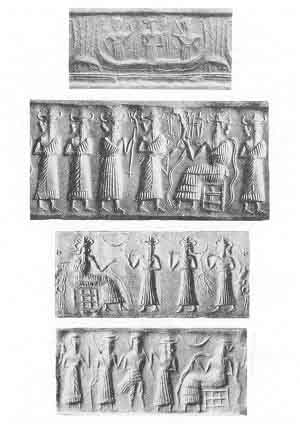
PLATE XIV
ENKI, THE WATER-GOD
The plow and the yoke he directed,
The great prince Enki caused the . . . ox to . . .
To the pure cropshe roared,
In the steadfast field he made grain grow;
The lord, the jewel and ornament of the plain,
The . . . farmer of Enlil,
Enkimdu, him of the canals and ditches,
Enki placed in their charge.
The lord called to the steadfast field, he caused it to produce much grain,
Enki made it bring forth its small and large beans . . . ,
The . . . grains he heaped up for the granary,
Enki added granary to granary,
With Enlil he increases abundance in the land;
Her whose head is . . . . whose face is . . . ,
The lady who . . . . the might of the land, the steadfast supportof the black-headed people,
Ashnan, strength of all things,
Enki placed in charge.
Enki now turns to the pickax and the brickmold, and appoints the brick-god Kabta in charge. He then directs the building implement gugun, lays foundations and builds houses, and places them under the charge of Mushdamma, the "great builder of Enlil." He then fills the plain with plant and animal life and places Sumugan, "king of the 'mountain'," in control. Finally Enki builds stables and sheepfolds, fills them with milk and fat, and puts them in the care of the shepherd-god Dumuzi. The rest of our text is destroyed and we do not know how the poem ends.
ENKI AND ERIDU: THE JOURNEY OF THE WATER--GOD TO NIPPURr
One of the oldest and most venerated cities in Sumer was Eridu, which lies buried to-day under the mound Abu-Shahrain; a thorough excavation of this significant site would in all probability immensely enrich our knowledge of Sumerian culture and civilization, especially in their more spiritual aspects. According to one Sumerian tradition, it was the oldest city in Sumer, the first of the five cities founded before the flood; our myth, on the other hand, implies that the city Nippur preceded it in age. In this city, which in ancient times must have been situated on the Persian Gulf, the water-god Enki, also known as Nudimmud, builds his "sea-house":60
After the water of creationhad been decreed,
After the name hegal(abundance), born in heaven,
Like plant and herb had clothed the land,
The lord of the abyss, the king Enki,
Enki, the lord who decrees the fates,
Built his house of silver and lapis lazuli;
Its silver and lapis lazuli, like sparkling light,
The father fashioned fittinglyin the abyss.
The (creatures of) bright countenanceand wise, coming forth from the abyss,
Stood all about the lord Nudimmud;
The pure house be built, he adorned it with lapis lazuli,
He ornamented it greatly with gold,
In Eridu he built the house of the water-bank,
Its brickwork, word-uttering, advice-giving,
Its . . . like an ox roaring,
The house of Enki, the oraclesuttering.
Follows a long passage in which Isimud, the messenger of Enki, sings the praises of the "sea-house." Then Enki raisesthe city Eridu from the abyssand makes it floatover the water like a lofty mountain. Its green fruit-bearing gardens he fills with birds; fishes, too, be makes abundant. Enki is now ready to proceed by boat to Nippur to obtain Enlil's blessing for his newly-built city and temple. He therefore rises from the abyss:
When Enki rises, the fish . . . rise,
The abyss stands in wonder,
In the sea joy enters,
Fear comes over the deep,
Terror holds the exalted river,
The Euphrates, the South Wind lifts it in waves.
And so Enki seats himself in his boat and first arrives in Eridu itself; here he slaughters many oxen and sheep. He then proceeds to Nippur where immediately upon his arrival he prepares all kinds of drinks for the gods and especially for Enlil. Then:
Enki in the shrine Nippur,
Gives his father Enlil bread to eat,
In the first place he seated An (the heaven-god),
Next to An he seated Enlil,
Nintu he seated at the "big side,"
The Anunnaki seated themselves one after the other.
And so the gods feast and banquet until their hearts become "good" and Enlil is ready to pronounce his blessing:
Enlil says to the Anunnaki:
Enlil says to the Anunnaki:
"Ye great gods who are standing about,
My son has built a house, the king Enki;
Eridu, like a mountain, he has raised up from the earth,
In a good place he has built it.
Eridu, the clean place, where none may enter,
The house built of silver, adorned with lapis lazuli,
The house directed by the seven "lyre-songs," given over to incantation,
With pure songs. . . ,
The abyss, the shrine of the goodness of Enki, befitting the divine decrees,
Eridu, the pure house having been built,
O Enki, praise!"
INANNA AND ENKI: THE TRANSFER OF THE ARTS OF CIVILIZATION FROM ERIDU TO ERECH
This magnificent myth with its particularly charming story involves Inanna, the queen of heaven, and Enki, the lord of wisdom. Its contents are of profound significance for the study of the history and progress of civilization, since it contains a list of over one hundred divine decrees governing all those cultural achievements which, according to the more or less superficial analysis of the Sumerian scribes and thinkers, made up the warp and woof of Sumerian civilization. As early as 1911 a fragment belonging to this myth and located in the University Museum at Philadelphia was published by David W. Myhrman.62 Three years later, Arno Poebel published another Philadelphia tablet inscribed with part of the composition;61 this is a large, well-preserved six-column tablet whose upper left corner was broken off. This broken corner piece I was fortunate enough to discover in 1937, twenty-three years later, in the Museum of the Ancient Orient at Istanbul.63 As early as 1914, therefore, a large part of the myth had been copied and published. However, no translation was attempted in all these years since the story seemed to make no connected sense; and what could be made out, seemed to lack intelligent motivation. In 1937 I located and copied in Istanbul a small piece64 which supplied the missing clue, and as a result, this tale of the all too human Sumerian gods can now be told.67
PLATES XV AND XVI. INANNA AND ENKI: THE TRANSFER OF THE ARTS OF CIVILIZATION FROM ERIDU TO ERECH
Plate XV is the obverse of a large six-column tablet (15283 in the Nippur collection of the University Museum) published by Poebel in 1914;61 its upper left corner is broken away. Plate XVI illustrates three fragments belonging to the same poem. The large fragment (13571 in the Nippur collection of the University Museum) was published by Myhrman in 1911.62 Below the large fragment, on the left, are the obverse and reverse of a small fragment (4151 in the Nippur collection of the Museum of the Ancient Orient) copied by the author in Istanbul and hitherto unpublished. In all probability it is the very comer piece broken away from the Philadelphia tablet illustrated on plate XV. To the right are the obverse and reverse of another small fragment (2724 in the Nippur collection of the Museum of the Ancient Orient) copied by the author in Istanbul and hitherto unpublished. Small as it is, this piece proved instrumental in supplying the motivating link to the story. For the translation and the transliteration of the first eight lines of the passage in which Enki presents the arts of civilization to the goddess Inanna, see note 65 .
Another significant verse in this passage reads:66
"O name of my power, O name of my power,
To the bright Inanna, my daughter, I shall present . . .
The arts of woodworking, metalworking, writing, toolmaking, leatherworking. . . . building, basketweaving."
Pure Inanna took them.
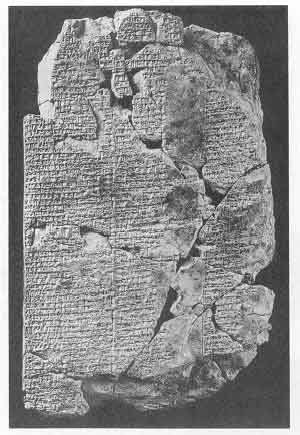
PLATE XV
INANNA AND ENKI: THE TRANSFER OF THE ARTS OF CIVILIZATION FROM ERIDU To ERECH
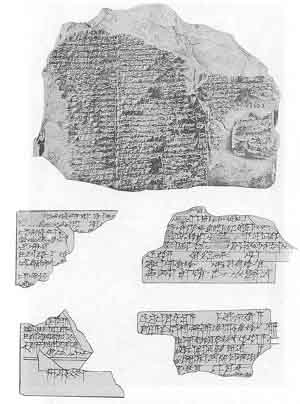
PLATE XVI
INANNA AND ENKI: THE TRANSFER OF THE ARTS OF CIVILIZATION FROM ERIDU TO ERECH
Inanna, queen of heaven, and tutelary goddess of Erech, is anxious to increase the welfare and prosperity of her city, to make it the center of Sumerian civilization, and thus to exalt her own name and fame. She therefore decides to go to Eridu, the ancient and hoary seat of Sumerian culture where Enki, the Lord of Wisdom, who "knows the very heart of the gods," dwells in his watery abyss, the Abzu. For Enki has under his charge all the divine decrees that are fundamental to civilization. And if she can obtain them, by fair means or foul, and bring them to her beloved city Erech, its glory and her own will indeed be unsurpassed. As she approaches the Abzu of Eridu, Enki, no doubt taken in by her charms, calls his messenger Isimud and thus addresses him:
"Come, my messenger, Isimud, give ear to my instructions,
A word I will say to thee, take my word.
The maid, all alone, has directed her step to the Abzu,
Inanna, all alone, has directed her step to the Abzu,
Have the maid enter the Abzu of Eridu,
Have Inanna enter the Abzu of Eridu,
Give her to eat barley cake with butter,
Pour for her cold water that freshens the heart,
Give her to drink date-wine in the 'face of the lion,'
. . . for her . . . . make for her . . .,
At the pure table, the table of heaven,
Speak to Inanna words of greeting."
Isimud does exactly as bidden by his master, and Inanna and Enki sit down to feast and banquet. After their hearts had become happy with drink, Enki exclaims:
"O name of My power, O name of my power,
To the pure Inanna, my daughter, I shall present . . ..
Lordship, . . .-ship, godship, the tiara exalted and enduring, the throne of kingship."
Pure Inanna took them.
"O name of my power, O name of my power,
To the pure Inanna, my daughter, I shall present . . . .
The exalted scepter, staffs, the exalted shrine, shepherdship, kingship."
Pure Inanna took them.
He thus presents, several at a time, over one hundred divine decrees which are the basis of the culture pattern of Sumerian civilization. And when it is realized that this myth was inscribed as early as 2000 B. C. and that the concepts involved were no doubt current centuries earlier, it is no exaggeration to state that no other civilization, outside of the Egyptian, can at all compare in age and quality with that developed by the Sumerians. Among these divine decrees presented by Enki to Inanna are those referring to lordship, godship, the exalted and enduring crown, the throne of kingship, the exalted scepter, the exalted shrine, shepherdship, kingship, the numerous priestly offices, truth, descent into the nether world and ascent from it, the "standard," the flood, sexual intercourse and prostitution, the legaltongue and the libelloustongue, art, the holy cult chambers, the "hierodule of heaven," music, eldership, heroship and power, enmity, straightforwardness, the destruction of cities and lamentation, rejoicing of the heart, falsehood, the rebel land, goodness and justice, the craft of the carpenter, metal worker, scribe, smith, leather worker, mason, and basket weaver, wisdom and understanding, purification, fear and outcry, the kindling flame and the consumingflame, weariness, the shout of victory, counsel, the troubled heart, judgment and decision, exuberance, musical instruments.
Inanna is only too happy to accept the gifts offered her by the drunken Enki. She takes them, loads them on her "boat of heaven," and makes off for Erech with her precious cargo. But after the effects of the banquet had worn off, Enki noticed that the divine decrees were gone from their usual place. He turns to Isimud and the latter informs him that he, Enki himself, had presented them to his daughter Inanna. The upset Enki greatly rues his munificence and decides to prevent the "boat of heaven" from reaching Erech at all costs. He therefore dispatches his messenger Isimud together with a group of sea monsters to follow Inanna and her boat to the first of the seven stopping stations that are situated between the Abzu of Eridu and Erech. Here the sea monsters are to seize the "boat of heaven" from Inanna; Inanna, herself, however, must be permitted to continue her journey to Erech afoot. The passage covering Enki's instructions to Isimud and Isimud's conversation with Inanna, who reproaches her father Enki as an "Indian-giver," will undoubtedly go down as a classic poetic gem. It runs as follows:
The prince calls his messenger Isimud,
The prince calls his messenger Isimud,
Enki gives the word to the "good name of heaven":
"Oh my messenger Isimud, 'my good name of heaven'."
"Oh my king Enki, here I stand, foreveris praise."
"The 'boat of heaven,' where now has it arrived?"
"At the quayIdal it has arrived."
"Go, and let the sea monstersseize it from her."
Isimud does as bidden, overtakes the "boat of heaven," and says to Inanna:
"Oh my queen, thy father has sent me to thee,
Oh Inanna, thy father has sent me to thee,
Thy father, exalted is his speech,
Enki, exalted is his utterance,
His great words are not to go unheeded."
Holy Inanna answers him:
"My father, what has he spoken to thee, what has he said to thee?
His great words that are not to go unheeded, what pray are they?"
"My king has spoken to me,
Enki has said to me:
'Let Inanna go to Erech,
But thou, bring me back the "boat of heaven" to Eridu'."
Holy Inanna says to the messenger Isimud:
"My father, why pray has he changed his word to me,
Why has he broken his righteous word to me,
Why has he defiled his great words to me?
My father has spoken to me falsehood, has spoken to me falsehood,
Falsely has he uttered the name of his power, the name of the Abzu."
Barely had she uttered these words,
The sea monstersseized the "boat of heaven."
Inanna says to her messenger Ninshubur:
"Come, my true messenger of Eanna,
My messenger of favorable words,
My carrier of true words,
Whose hand never falters, whose foot never falters,
Save the 'boat of heaven,' and Inanna's presented decrees."
This Ninshubur does. But Enki is persistent. He sends Isimud accompanied by various sea monsters to seize the "boat of heaven" at each of the seven stopping points between Eridu and Erech. And each time Ninshubur comes to Inanna's rescue. Finally Inanna and her boat arrive safe and sound at Erech, where amidst jubilation and feasting on the part of its delighted inhabitants, she unloads the divine decrees one at a time. The poem ends with a speech addressed by Enki to Inanna, but the text is seriously damaged and it is not clear whether it is reconciliatory or retaliatory in character.
THE CREATION OF MAN
The composition narrating the creation of man has been found inscribed on two duplicating tablets: one is a Nippur tablet in our University Museum; the other is in the Louvre, which acquired it from an antique dealer. In spite of the fact that by 1934 the Louvre tablet and the greater part of the University Museum tablet had already been copied and published,72 the contents remained unintelligible. Primarily responsible for this unfortunate situation is the fact that our University Museum tablet, which is better preserved than the Louvre fragment, arrived in Philadelphia some four or five decades ago, broken into four parts. By 1919 two of the pieces had already been recognized and joined; these were copied and published by Stephen Langdon.68 In 1934 Edward Chiera published the third piece69 but failed to recognize that it joined the two pieces published by Langdon in 1919. It was the discovery of this fact, together with the identifying of the fourth and still unpublished piece70 which joinsthe three published pieces, that enabled me to arrange the contents in the proper order. It should be emphasized here that the approximately one hundred and fifty lines which make up the text of our poem still present numerous crucial breaks; many of the lines are poorly preserved.73 Moreover, the linguistic difficulties in this composition are particularly burdensome; not a few of the crucial words are met here for the first time in Sumerian literature. The translation is therefore full of gaps and its tentative character must be underlined. Nevertheless it does present the fullest picture thus far available of the concepts concerned with the creation of man as current in Sumer during the third millennium B. C.
Among the oldest known conceptions of the creation of man are those of the Hebrews and the Babylonians; the former is narrated in the book of Genesis, the latter forms part of the Babylonian "Epic of Creation." According to the Biblical story, or at least according to one of its versions, man was fashioned from clay for the purpose of ruling over all the animals. In the Babylonian myth, man was made of the blood of one of the more troublesome of the gods who was killed for that purpose; he was created primarily in order to serve the gods and free them from the need of working for their bread. According to our Sumerian poem, which antedates both the Hebrew and the Babylonian versions by more than a millennium, man was fashioned of clay as in the Biblical version. The purpose for which he was created, however, was to free the gods from laboring for their sustenance, as in the Babylonian version.
The poem begins with what may be a description of the difficulties of the gods in procuring their bread, especially, as might have been expected, after the female deities had come into being. The gods complain, but Enki, the water-god, who, as the Sumerian god of wisdom, might have been expected to come to their aid, is lying asleep in the deep and fails to hear them. Thereupon his mother, the primeval sea, "the mother who gave birth to all the gods," brings the tears of the gods before Enki, saying:
"O my son, rise from thy bed, from thy . . . work what is wise,
Fashion servants of the gods, may they produce their . . ,"
Enki gives the matter thought, leads forth 'the host of "good and princely fashioners" and says to his mother, Nammu, the primeval sea:
O my mother, the creaturewhose name thou hoist uttered, it exists,
Bind upon it the . . . of the gods;
Mixthe heart of the clay that is over the abyss,
The good and princely fashionerswill thickenthe clay,
Thou, do thou bring the limbsinto existence;
Ninmah (the earth-mother goddess) will work above thee,
. . . (goddesses of birth) will stand by thee at thy fashioning;
O my mother, decree thou its (the new-born's) fate,
Ninmah will bind upon it the . . . of the gods,
. . . as man . . .
After a break of several lines, whose contents, if ever recovered, should prove most illuminating, the poem describes a feast arranged by Enki for the gods, no doubt to commemorate man's creation. At this feast Enki and Ninmah drink much wine and become somewhat exuberant. Thereupon Ninmah takes some of the clay which is over the abyss and fashions six different types of individuals, while Enki decrees their fate and gives them bread to eat. The character of only the last two types is intelligible; these are the barren woman and the sexless or eunuch type. The lines read:
PLATES XVII AND XVIII. THE CREATION OF MAN
These plates illustrate the obverse of the very same tablet. On plate XVII the tablet is still in threeseparate pieces (13396, 11327, and 2168, before "joining," in the Nippur collection of the University Museum). Actually the tablet arrived in Philadelphia in fourseparate pieces. The lower piece on plate XVII is itself composed of two fragments which had already been joined in the University Museum sometime before 1919, when it was published by Langdon68 The large upper fragment was published by Chiera in 1934.69 The fourth piece70 has hitherto remained unpublished. Plate XVIII shows the same tablet, with all the pieces joined. The lower part of the first column contains the first; part of the passage in which Enki, the water-god, instructs his mother Nammu, the goddess who begot heaven and earth and all the gods, how to fashion man. For the translation and the transliteration, see note 71 .
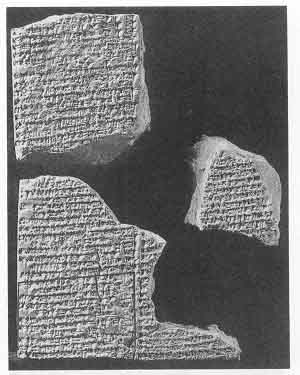
PLATE XVII
THE CREATION OF MAN
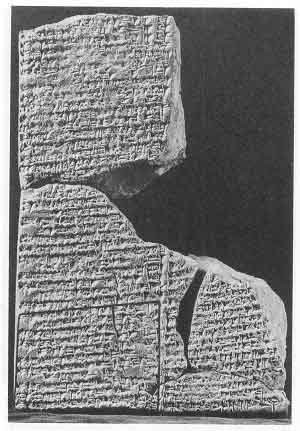
PLATE XVIII
THE CREATION OF MAN
The . . . she (Ninmah) made into a woman who cannot give birth.
Enki upon seeing the woman who cannot give birth,
Decreed her fate, destined her to be stationed in the "woman house."
The . . . she (Ninmah) made into one who has no male organ, who has no female organ.
Enki, upon seeing him who has no male organ, who has no female organ,
To stand before the king, decreed as his fate.
After Ninmah had created these six types of man, Enki decides to do some creating of his own. The manner in which he goes about it is not clear, but whatever it is that he does, the resulting creature is a failure; it is weak and feeble in body and spirit. Enki is now anxious that Ninmah help this forlorn creature; he therefore addresses her as follows:
"Of him whom thy hand has fashioned, I have decreed the fate,
Have given him bread to eat;
Do thou decree the fate of him whom my hand has fashioned,
Do thou give him bread to eat."
Ninmah tries to be good to the creature but to no avail. She talks to him but he fails to answer. She gives him bread to eat but he does not reach out for it. He can neither sit nor stand, nor bend the knees. A long conversation between Enki and Ninmah then follows, but the tablets are so badly broken at this point that it is impossible to make out the sense of the contents. Finally Ninmah seems to utter a curse against Enki because of the sick, lifeless creature which he produced, a curse which Enki seems to accept as his due.
In addition to the creation poem outlined above, a detailed description of the purpose for which mankind was created is given in the introduction to the myth "Cattle and Grain"; it runs as follows. After the Anunnaki, the heaven-gods, had been born, but before the creation of Lahar, the cattle-god, and Ashnan, the grain-goddess, there existed neither cattle nor grain. The gods therefore "knew not" the eating of bread nor the dressing of garments. The cattle-god Lahar and the grain-goddess Ashnan were then created in the creation chamber of heaven, but still the gods remained unsated. It was then that man "was given breath," for the sake of the welfare of the sheepfolds and "good things" of the gods. This introduction reads as follows:
After on the mountain of heaven and earth,
An (the heaven-god) had caused the Anunnaki (his followers) to be born
Because the name Ashnan (the grain-goddess) had not been born, had not been fashioned,
Because Uttu (the goddess of plants) had not been fashioned,
Because to Uttu no temenos had been set up,
There was no ewe, no lamb was dropped,
There was no goat, no kid was dropped,
The ewe did not give birth to its two lambs,
The goat did not give birth to its three kids.
Because the name of Ashnan, the wise, and Lahar (the cattle-god),
The Anunnaki, the great gods, did not know,
The . . . grain of thirty days did not exist,
The . . . grain of forty days did not exist,
The small grains, the grain of the mountain, the grain of the pure living creatures did not exist.
Because Uttu had not been born, because the crown (of vegetation?) had not been raised,
Because the lord . . . had not been born,
Because Sumugan, the god of the plain, had not come forth,
Like mankind when first created,
They (the Anunnaki knew not the eating of bread,
Knew not the dressing of garments,
Ate plants with their mouth like sheep,
Drank water from the ditch.
In those days, in the creation chamber of the gods,
In their house Dulkug, Lahar and Ashnan were fashioned;
The produce of Lahar and Ashnan,
The Anunnaki of the Dulkug eat, but remain unsated;
In their pure sheepfolds milk, . . ., and good things,
The Anunnaki of the Dulkug drink, but remain unsated;
For the sake of the good things in their pure sheepfolds,
Man was given breath.
The creation of man concludes our study of Sumerian cosmogony, of the theories and concepts evolved by the Sumerians to explain the origin of the universe and the existence of gods and men. It cannot be sufficiently stressed that the Sumerian cosmogonic concepts, early as they are, are by no means primitive. They reflect the mature thought and reason of the thinking Sumerian as he contemplated the forces of nature and the character of his own existence. When these concepts are analyzed; when the theological cloak and polytheistic trappings are removed (although this is by no means always possible at present because of the limited character of our material as well as of our understanding and interpretation of its contents), the Sumerian creation concepts indicate a keenly observing mentality as well as an ability to draw and formulate pertinent conclusions from the data observed. Thus rationally expressed, the Sumerian cosmogonic concepts may be summarized as follows:
1. First was the primeval sea; it is not unlikely that it was conceived by the Sumerian as eternaland uncreated.
2. The primeval sea engendered a united heaven and earth.
3. Heaven and earth were conceived as solidelements. Between them, however, and from them, came the gaseous element air, whose main characteristic is that of expansion. Heaven and earth were thus separated by the expanding element air.
4. Air, being lighter and far less dense than either heaven or earth, succeeded in producing the moon, which may have been conceived by the Sumerians as made of the same stuff as air. The sunwas conceived as born of the moon; that is, it emanated and developed from the moon just as the latter emanated and developed from air.
5. After heaven and earth had been separated, plant, animal, and humanlife became possible on earth; all life seems to have been conceived as resulting from a union of air, earth, and water; the sun, too, was probably involved. Unfortunately in this matter of production and reproduction of plant and animal life on earth, our extant material is very difficult to penetrate.
Transferred into theological language, these rationalistic Sumerian concepts may be described as follows:
1. First was the goddess Nammu, the primeval sea personified.
2. The goddess Nammugave birth to An, the male heaven-god, and Ki, the earth-goddess.
3. The union of Anand Kiproduced the air-god Enlil, who proceeded to separate the heaven-father Anfrom the earth-mother Ki.
4. Enlil, the air-god, now found himself living in utter darkness, with the sky, which may have been conceived by the Sumerians as made of pitch-dark lapis lazuli, forming the ceiling and walls of his house, and the surface of the earth, its floor. He therefore begot the moon-god Nanna to brighten the darkness of his house. The moon-god Nannain turn begot the sun-god Utu, who became brighter than his father. It is not without interest to note here that the idea that the son, the begotten one, becomes stronger than the father, the begetter--in a deeper sense this is actually what happens in the development which we term progress--is native to the philosophy and psychology of the Near East. Enlil, the air-god, for example, becomes in historical times more powerful than his father An, the heaven-god. At a later date Marduk, the god of the Semitic Babylonians, becomes more powerful than his father Enki, the water-god. In the Christian dogma, Christ, the son, becomes in many ways more significant and pertinent for man and his salvation than God, the father.
5. Enlil, the air-god, now unites with his mother Ki, the earth-goddess. It is from this union but with considerable help from Enki, the water-god, that the vegetable and animal life is produced on earth. Man, on the other hand, seems to be the product of the combined efforts of the goddess Nammu, the primeval sea; of the goddess Ninmah, who may perhaps be identified with Ki, the mother earth; and finally of the water-god Enki. Just what is involved in this particular combination-and there is every reason to believe that in view of the more or less superficial data of the times there was good logic behind it and not mere playful fantasy--it is difficult to gather from our present material and limited understanding.
NOTES TO THE REVISED EDITION
31 . To date, however, it must be frankly admitted, relatively little of this glyptic material can be interpreted with any approach to certainty. Frequently we can neither identify the gods depicted on the designs, nor interpret even roughly the acts pictured and their implications. It is quite unlikely that, with the limited space and means at their disposal, the seal-cutters attempted to portray a connected story such as that told in "Gilgamesh, Enkidu, and the Nether World" or in "Inanna's Descent to the Nether World." And if, in order to overcome their limitations, they developed a system of abbreviation and conventionalization, we are not yet in a position to penetrate it. And so, in spite of the fact that so much intelligible Sumerian mythological material has now become available, very few of the cylinder seal designs can be identified with the stories told in our epics and myths. Nevertheless, as plates VI, IX, XI, XIII, and XVIII show, some of this glyptic material is most revealing and instructive. Except for the first two designs on plate XVIII, all the illustrations are taken from Cylinder Seals, a book recently published by Henri Frankfort, of the Oriental Institute of the University of Chicago, who is the leading living authority on the subject.
32 . In detail these published texts are as follows: BE XXXI35, 55 (cf. JAOS60.246, 254; also AS No. 11, p. 89, note 128); HAV11, 12; SEM21, 22; SRT39; U 9364 (= RA30.127 ff.).
33 . GSGp. 4.
34 . AS No. 10.
35 . These are CBS10400, 15150, 29.13.438, 29.13.536, 29.15.993, 29.16.58, 29.16.463; Ni 4249.
36 . SEM21.
37 . The Sumerian transliteration of these lines reads: 1. an ki-ta ba-ra-bad-du-a-ba
2. ki an-ta ba-da-sur-ra-a-ba
3. mu-nam-llu6ba-gar-ra-a-ba
4. u4an-ni an ba-an-ir10-a-ba
5. den-l-li ki ba-an-ir10-a-ba
6. dere-ki-gal-la kur-ra sag-rig7-bi-im-ma-ab-rig7-a-ba
38 . The text is copied by Langdon in PBS X4, 16.
39 . The Sumerian transliteration of these lines reads: 1. en-e n-du7-e pa na-an-ga--mi-in-br> 2. en-nam-tar-ra-na-u-nu-bal-e-dbr> 3. den-l-numun-kalam-ma-ki-ta-e11-dbr> 4. an ki-ta bad-du-dsag na-an-ga--ma-an-sbr> 5. ki an-ta bad-du-dsag na-an-ga--ma-an-sbr> 40 . The latter half of this Sumerian poem, translated almost verbatim into Accadian, is known as the twelfth tablet of the Babylonian "Epic of Gilgamesh"; our Sumerian poem clarifies this Accadian tablet, whose meaning has remained obscure for more than half a century. A full discussion of the problems involved will be found in the critical review of F. M. Th. Bl, Het Gilgamesj-Epos(Amsterdam, 1941), which I am preparing for the JAOS.
41 . TRS10.36-37. Although treated in this list as the wife of An, her epithet ama-tu-an-ki, "the mother who gave birth to heaven and earth," reveals her original character. Cf. also SEM116 i 16 (= TRS71 i 16), where the goddess Nammu is described as ama-palil-tu-dingir---ra-ke4-ne, "the mother, the ancestress, who gave birth to all the gods."
43 . Cf. the Sin hymn restored from SRT9 and TRS21 (JAOS60.412).
44 . Cf. HAV4.8-10. It is not improbable that HAV4 is part of the epic tale "Lugalbanda and Mt. Hurrum" (cf. SL321, No. 3); the other tablets and fragments belonging to this poem are CBS7085, 29.16.228; OECT Ipl. 19 (Stevenson tablet); SEM20; TRS90.
46 . Cf. the tablet Kish 1932, 155 (JRAS62.914-921) ii 2, which can be restored from its duplicates CBS29.15.364 and 29.16.84 to read: dutu -ama-ni-dnin-gal-la sag--la mu-un-du. All these texts are part of the epic tale "Gilgamesh and Huwawa" (cf. SL321), a scientific edition of which I am now preparing.
47 . BBI4; note also the Pinches bilingual identified by Barton (BBIp. 34).
48 . These are CBS8176, 8315, 10309, 10322, 10412, 13853, 29.13.574, 29.15.611; Ni 2707. The following groups form "joins": CBS8176 + 8315 + 13853; 10309 + 10412.
49 . For the tablets and fragments utilized to reconstruct the text, cf. the two preceding notes.
50 . The poem consists of approximately 313 lines of text reconstructed from the following tablets and fragments: BL 1; CBS2244, 2284, 9804, 14026, 29.13.7, 29.13.189, 29.13.223, 29.15.35, 29.15.67, 291.15.74, 29.15.420, 29.15.650; Ni 3047, 4002; SRT24; STVC92. The following groups form "joins": 2244 + 29.15.420; 9804 + 29.15.35 + 29.15.74; 29.13.7 + 29.15.650.
51 . The poem consists of approximately 308 lines of text reconstructed from the following tablets and fragments: BBI7; CBS3167, 10431, 13857, 29.13.464, 29.16.142, 29.16.232, 29. 16.417, 29.16.427, 29.16.446, 29.16.448; Ni 2705, 3167, 4004; SEM46; SRT41; STVC125. The following groups form "joins": BBI7 + 29.16.142; 13857 + 29.16.427 +29.16.446 + 29.16.448.
52 . Cf. JAOS54.418 and JAOS60.239, note 15. To the 11 tablets and fragments there listed, the following 9 are to be added: CBS8531, 10310, 10335, 29.16.23, 29.16.436 (the number of unpublished pieces in the University Museum is therefore 5, not "at least 6" as stated in JAOS60.239, note 15); Ni 1117, 2337, 2473, 2742 (2 fragments were identified by me after the publication of JAOS60.239, note 15).
53. The poem consists of close to 200 lines of text reconstructed from the following tablets and fragments: BBI8; BE XXXI15; CBS7344, 7916, 15161, 29.15.973; HAV6; Ni 2308, 4036, 4094; SEM38, 54, 55, 56, 57; SRT25, 44. The following groups form "joins": CBS7344 + 7916 + SEM5 + SEM77; CBS29.15.973 + SEM38. All in all, therefore, we now have 17 pieces belonging to the myth, and the statement in SL322 no. 5 is to be modified accordingly (the number 9 there given resulted from the fact that the four fragments constituting the first "join" mentioned above were counted as one while the 5 pieces Ni 2308, 4036, 4044, SEM38, and SRT41 were not identified until after the publication of SL). The first 70 lines of the poem were transliterated and translated by Chiera in SRTpp. 26 ff.
54 . PBS X 1, 1; cf. also Langdon, Semitic Mythology, chapter V.
56 . The Sumerian transliteration of these lines reads: 1. dnin-ḫur-sag-gke4a-ga ba-ni-in-ri
2. a-a-ga u ba-ni-in-ti a-den-ki-ga-ka
3. u4-1- itu-1-a-ni
4. u4-2- itu-2-a-ni
5. u4-3- itu-3-a-ni
6. u4-4- itu-4-a-ni
7. u4-5-
8. u4-6-
9. u4-7-
10. u4-8-
11. u4-9- itu-9-a-ni nam-munus-a-ka
12. i?-gim i?-gim id-nun-na-gim
13. dnin-tu ama-kalam-ka -?-gim
14. dnin-sar in-tu-ud
57 . For the tablets and fragments utilized in the reconstruction of its text, cf. the two preceding notes.
58 . We may have here a prototype of the "forbidden fruit" motif of Genesis III.
59 . The extant text of the poem is reconstructed from the following tablets and fragments: CBS29.15.38; Ni 4006; PBS X2, 1; SRT44; STVC78-80 (these three fragments form a "join"); TRS36; cf. JAOS54.413 and SEMp. 5, which are to be modified accordingly.
60 . The poem consists of 128 lines of text reconstructed from the following tablets and fragments: BE XXXI20; CBS2167, 2216, 4916, 10314, 10350, 29.13.207, 29.15.337, 29.16.184, 29.16.251; HRETA23; Ni 4031; OECT Ipls. 1-4; PBS I2, 105; PBS X2, 20; SEM81-85; TRS54, 94. Cf. also JAOS54.416; JAOS60.242, note 26, where the number 6 should read 9; SL322 no. 8, where the number 21 should read 22.
61 . PBS V25.
62 . PBS II, 1.
63 . Ni 4151.
64 . Ni 2724.
65 . The Sumerian transliteration of these lines reads: 1. mu-mmu-mbr> 2. kug-dinanna-ra dumu-mu- ga-na-ab-s. . .
3. nam-en nam-si nam-dingir aga-zi-maḫ gigu-za-nam-lugal
4. kug-dinanna-ke4u ba-ti
5. mu-mmu-mbr> 6. kug-dinanna-ra dumu-mu- ga-na-ab-s. . .
7. pa-maḫ ebur-ubur bara-maḫ nam-sibad nam-lugal
8. kug-dinanna-ke4u ba-ti
66 . The Sumerian transliteration of these lines reads: 1. mu-mmu-mbr> 2. kug-dinanna-ra dumu-mu- ga-na-ab s. . .
3. nam-nagar nam-tibira nam-dub-sar nam-sumug nam-agab nam-l? nam-d nam-ad-ke4
4. kug-dinanna-ke4u ba-ti
67 . In detail the reconstruction of the lines of the text is as follows (the line numbering is approximate): 1-3, broken; 4-30 = PBS I1, I (= A) i; 31-50, broken; 51-65 = Ni 2724; 63-89 = A ii; 90-99, broken; 100-144, restored from repeated passages; 145-159 = A iii; 160-171, restored from repeated passages; 172-181, broken; 182-234, restored from repeated passages; 227-270 = A iv; 271-285, restored from repeated passages; 286-305, broken; 306-349 = A v; 350-367, restored from repeated passages; 368-391, broken; 392-402 = A vi; 403-413, broken; 413-421 = Ni 4151 obv.; 413-824 = PBS V25.
68 . PBS X4, 14.
69 . SEM116.
70 . CBS2168.
71 . The Sumerian transliteration of these lines reads: 1. ama-ni(!) mud-mu-gar-ra-zu g-la- ?-dingir-ri-e-ne kda-br> 2. a-im-ugu-abzu-ka mu-e-ni-
3. sig7-en-sig7-d im mu-e-gur4-gur4-ri-ne za-e me-GIM meni-g
4. dnin-maḫ-e an-ta-zu ḫag-e
5. dnin-? du-zi-an-na dnin-ma-da dnin-bara dnin-bara
6. dnin-zadim dsar-sar-GABA dnin-nig-na
7. tu-tu-a-zu ḫa-ra-ab-gub-bu-ne
8. ama-mu za-e nam-bi mu-e-tar dnin-maḫ-e ?-bi ḫkbr> 9. . . . ddnam-l. . . -ke4nam-llu6- . . .
72 . The Louvre tablet is published in TRS71; for the University Museum tablet, cf.
73 . In detail the reconstruction of the lines of the text is as follows: 1-35 = A (= SEM116 + PBS X4, 14 + CBS2168) i; 6-21 = B (= TRS71) i; 35-63 = B ii; 58-136 = A ii, iii, iv; 84-104 = B iii; 115-132 = B iv. Cf. SL322 no. 6 and JAOS54.418, which are to be modified accordingly.
j . For a modification of one of the episodes in this poem based upon tablets which were unknown at the time Sumerian Mythology was written, see my "Gilgamesh: Some New Sumerian Data" in the Proceedings of the Septie Rencontre Assyriologique Internationale, now in press.
k . The "question and answer passage" can now be restored almost entirely; for details see note 16 of my "Death and the Nether World According to the Sumerian Literary Texts" in a forthcoming volume of Iraq, dedicated to Leonard Woolley.
l . The first seven lines of the poem which were omitted altogether in Sumerian Mythologybecause of their fragmentary condition will now be found transliterated and translated in the article.
m . From the Pushkin Museum tablet inscribed with two elegies, we learn for the first time that the Sumerian thinkers held to the view that the sun after setting, continues its journey through the Nether World at night, turning night into day, as it were; and that the moon, too, spends its "day of rest," that is the twenty-eighth day of each month, in the Nether World.
n . A modified interpretation of the first part of the myth will now be found in History Begins at Sumer, pages 84-86.
o . Thorkild Jacobsen offers a translation in volume 5 of the Journal of Near Eastern Studieswhich differs significantly from mine, and draws the conclusion that man, after "developing" below the surface of the earth, "shot forth" from the earth through a hole made by Enlil in the top crust of the earth. But his translation of the relevant lines is by no mean, certain, as I hope to show in a future study of the composition.
p . A full edition of the myth will now be found in Supplementary StudyNo. 1 of the Bulletin of the American Schools of Oriental Research; see also Ancient Near Eastern Texts Relating to the Old Testament(James Pritchard, Editor) pages 37-40.
q . A definitive edition of this myth will appear in a forthcoming number of the Wissenschaftliche Zeitschrift der Friedrich-Schiller Universit Jena.
r . For a translation of this "hymnal" myth, see now, Adam Falkenstein in Sumerische und Akkadische Hymnen und Gebete, pp. 133-137.


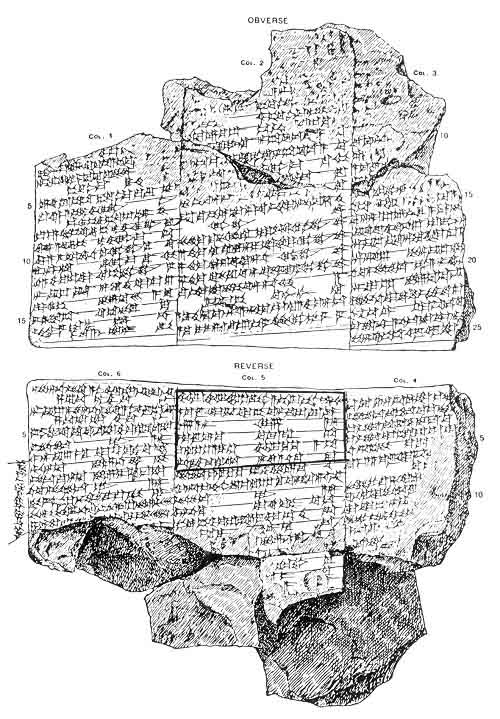 FIG. 2.