log in
LC Geerts

LC Geerts

Website URL:

Kebra Nagast Ch. 1 - 10

THE 'BOOK OF THE GLORY OF KINGS'

KEBRA NAGAST

Translated from the Ethiopic

by SIR E. A. WALLIS BUDGE M.A., LITT.D., D.LITT., LIT.D. F.S.A.

MCMXXXII

OXFORD UNIVERSITY PRESS LONDON : HUMPHREY MILFORD


THE GLORY OF KINGS

IN PRAISING GOD THE FATHER, THE SUSTAINER OF THE UNIVERSE, AND HIS SON JESUS CHRIST, THROUGH WHOM EVERYTHING CAME INTO BEING, AND WITHOUT WHOM NOTHING CAME INTO BEING, AND THE HOLY TRIUNE SPIRIT, THE PARACLETE, WHO GOETH FORTH FROM THE FATHER, AND DERIVETH FROM THE SON, WE BELIEVE IN AND ADORE THE TRINITY, ONE GOD, THE FATHER, AND THE SON, AND THE HOLY SPIRIT.

1. Concerning the Glory of Kings

The interpretation and explanation of the Three Hundred and Eighteen Orthodox (Fathers) concerning splendour, and greatness, and dignity, and how God gave them to the children of ADAM, and especially concerning the greatness and splendour of ZION, the Tabernacle (t) of the Law of God, of which He Himself is the Maker and Fashioner, in the fortress of His holiness before all created things, (both) angels and men. For the Father, and the Son, and the Holy Spirit with good fellowship and right good will and cordial agreement together made the Heavenly ZION to be the place of habitation of their Glory. And then the Father, and the Son, and the Holy Spirit said, "Let Us make man in Our similitude and likeness," and with ready agreement and good will They were all of this opinion. And the Son said, "I will put on the body of ADAM," and the Holy Spirit said, "I will dwell in the heart(s) of the Prophets and the Righteous," and this common agreement and covenant was (fulfilled) in ZION, the City of their Glory. And DAVID said, "Remember Thine agreement which Thou didst make of old for salvation, the rod of Thine inheritance, in Mount ZION wherein Thou dost dwell."

And He made ADAM in His own image and likeness, so that He might remove SATAN because of his pride, together with his host, and might establish ADAMHis own planttogether with the righteous, His children, for His praises. For the plan of God was decided upon and decreed in that He said, "I will become man, and I will be in everything which I have created, I will abide in flesh." And in the days that came after, by His good pleasure there was born in the flesh of the Second ZION the second ADAM, Who was our Saviour CHRIST. This is our glory and our faith, our hope and our life, the Second ZION.

2. Concerning the Greatness of Kings

Come then, let us go back, and let us consider, and let us begin (to state) which of the kings of the earth, from the first even unto the last, in respect of the Law and the Ordinances and honour and greatness, we should magnify or decry.

GREGORY, the worker of wonders and miracles, who was cast into a cave because of (his) love for the martyrdom of CHRIST and suffered tribulation for fifteen years, said, "When I was in the pit I pondered over this matter, and over the folly of the Kings of ARMENIA, and I said, In so far as I can conceive it, (in) what doth the greatness of kings (consist)? Is it in the multitude of soldiers, or in the splendour of worldly possessions, or in extent of rule over cities and towns? This was my thought each time of my prayer, and my thought stirred me again and again to meditate upon the greatness of kings. And now I will begin."

3. Concerning the Kingdom of ADAM

And I go up from ADAM and I say, God is King in truth, for Him praise is meet, and He appointed under Him ADAM to be king over all that He had created. And He drove him out of the Garden, because of his apostasy through the sin of the Serpent and the plotting of the Devil. And at that sorrowful moment CAIN was born, and when ADAM saw that the face of CAIN was ill-tempered (or, sullen) and his appearance evil he was sad. And then ABEL was born, and when ADAM saw that his appearance was good and his face good-tempered he said, "This is my son, the heir of my kingdom."

4. Concerning Envy

And when they had grown up together, SATAN had envy of him, and he cast this envy into the heart of CAIN, who was envious (of ABEL) first, because of the words of his father ADAM, who said, "He who hath the good-tempered face shall be the heir of my kingdom"; and secondly, because of his sister with the beautiful face, who was born with him and who had been given unto ABEL, even as God commanded them to multiply and fill the earthnow the face of the sister who had been born with ABEL resembled that of CAIN, and their father had transferred them (i.e., the two sisters) when giving them (in marriage);and thirdly, because when the two (brothers) offered up sacrifice, God accepted the offering of ABEL and rejected the offering of CAIN. And because of this envy CAIN killed ABEL. Thus fratricide was first created through SATAN'S envy of the children of ADAM. And having killed his brother, CAIN fell into a state of trembling and horrible fright, and he was repulsed by his father and his Lord. And (then) SETH was born, and ADAM looked upon him and said, "Now hath God shown compassion upon me, and He hath given unto me the light of my face. In sorrowful remembrance I will console myself (?) with him. The name of him that shall slay my heir shall be blotted out, even to his ninth generation."

5. Concerning the Kingdom of SETH

And ADAM died, and SETH reigned in righteousness. And SETH died, and H (ENOS) reigned. And H (ENOS) died, and ḲN (CAINAN) reigned. And ḲN (CAINAN) died, and MAL (MAHALALEEL) reigned. And MAL (MAHALALEEL) died, and Y (JARED) reigned. And Y died, and HH (ENOCH) reigned in righteousness, and he feared God, and (God) hid him so that he might not see death. And he became a king in his flesh in the Land of the Living. And after ENOCH disappeared M(METHUSELAH) reigned. And Mdied, and LH (LAMECH) reigned. And LH died, and N (NOAH) reigned in righteousness, and he pleased God in all his works.

6. Concerning the Sin of CAIN

And that accursed man CAIN, the murderer of his brother, multiplied evil, and his seed did likewise, and they provoked God to wrath with their wickedness. They had not the fear of God before their eyes, and they never kept in mind that He had created them, and they never prayed to Him, and they never worshipped Him, and they never called upon Him, and they never rendered service to Him in fear; nay, they ate, and they drank, and they danced, and they played upon stringed instruments, and sang lewd songs thereto, and they worked uncleanness without law, without measure, and without rule. And the wickedness of the children of CAIN multiplied, until at length in the greatness of their filthiness they introduced the seed of the ass into the mare, and the mule came into being, which God had not commandedeven like those who give their children who are believers unto those who deny God, and their offspring become the seed of the filthy GOMORRAITES, one half of them being of good and one half of them of evil seed. And as for those who do (this) wickedness, their judgment is ready, and their error is lasting.

7. Concerning NOAH

Now NOAH was a righteous man. He feared God, and kept the righteousness and the Law which his fathers had declared unto himnow NOAH was the tenth generation from ADAMand he kept in remembrance and did what was good, and he preserved his body from fornication, and he admonished his children, bidding them not to mingle with the children of CAIN, the arrogant tyrant, the divider of the kingdom, (who) walked in the counsel of the Devil, who maketh evil to flourish. And he taught them everything that God hatedpride, boastfulness of speech, self-adulation, calumniation, false accusation, and the swearing of false oaths. And besides these things, in the wickedness of their uncleanness, which was unlawful and against rule, man wrought pollution with man, and woman worked with woman the abominable thing.

8. Concerning the Flood

And this thing was evil before God, and He destroyed them with the water of the Flood, which was colder than ice. He opened the doors of heaven, and the cataracts of the Flood poured down; and He opened the fountains that were under the earth, and the fountains of the Flood appeared on the earth. And the sinners were blotted out, for they reaped the fruit of their punishment. And with them perished all beasts and creeping things, for they were all created for the gratification of ADAM, and for his glory, some to provide him with food, and some for his pleasure, and some for the names to the glorification of his Creator so that he might know them, even as DAVID saith, "And Thou hast set everything under his feet" for his sake they were created, and for his sake they were destroyed, with the exception of Eight Souls, and seven of every kind of clean beasts and creeping things, and two of every kind of unclean beast and creeping thing.

9. Concerning the Covenant of NOAH

And then NOAH the righteous man died, and SHEM reigned in wisdom and righteousness, for he was blessed by NOAH, saying, "Be God to thy brother." And to HAM he said, "Be servant to thy brother." And he said unto JAPHET, "Be thou servant to SHEM my heir, and be thou subject unto him." And again, after the Flood, the Devil, our Enemy, did not cease from his hostility against the children of NOAH, but stirred up CANAAN, the son of HAM, and he became the violent tyrant (or usurper) who rent the kingdom from the children of SHEM. Now they had divided the earth among them, and NOAH had made them swear by the Name of his God that they would not encroach on each other's boundaries, and would not eat the beast that had died of itself or had been rent (by wild animals), and that they would not cultivate harlotry against the law, lest God should again become angry with them and punish them with a Flood. And as for NOAH, he humbled himself, and offered up sacrifice, and he cried out, and groaned, and wept. And God held converse with NOAH, who said (unto Him), "If Thou wilt destroy the earth a second time with a Flood, blot Thou me out with those who are to perish." And God said unto him, "I will make a covenant with thee that thou shalt tell thy children they shall not eat the beast that hath died of itself or that hath been torn by wild beasts, and they shall not cultivate harlotry against the law; and I, on My part, (covenant) that I will not destroy the earth a second time with a Flood, and that I will give unto thy children Winter and Summer, Seedtime and Harvest, Autumn and Spring.

10. Concerning ZION

"And I swear by Myself and by ZION, the Tabernacle of My covenant, which I have created for a mercy seat and for the salvation of men, and in the latter days I will make it to come down to thy seed, that I will have pleasure in the offerings of thy children upon earth, and the Tabernacle of My covenant shall be with them for ever. And when a cloud hath appeared (in the sky), so that they may not fear and may not imagine that a Flood (is coming) I will make to come down from My habitation of ZION the Bow of My Covenant, that is to say, the rainbow, which shall the Tabernacle of My Law. And it shall come to pass that, when their sins multiply, and I am wishful to be wroth with them, I will remember the Tabernacle of My Covenant, and I will set the rainbow (in the sky), and I will put away Mine anger and will send My compassion. And I will not forget My word, and that which hath gone forth from My mouth I will not overlook. Though heaven and earth pass away My word shall not pass away."

And the Archbishops who were there answered and said to the blessed GREGORY, "Behold now, we understand clearly that before every created thing, even the angels, and before the heavens and the earth, and before the pillars of heaven, and the abysses of the sea, He created the Tabernacle of the Covenant, and this which is in heaven goeth about upon the earth."

Kebra Nagast Contents

THE 'BOOK OF THE GLORY OF KINGS'

KEBRA NAGAST

Translated from the Ethiopic

by SIR E. A. WALLIS BUDGE M.A., LITT.D., D.LITT., LIT.D. F.S.A.

MCMXXXII

OXFORD UNIVERSITY PRESS LONDON : HUMPHREY MILFORD


CONTENTS.

INTRODUCTION

The Manuscripts of the KEBRA NAGAST,.
Translation of the Arabic Version
Legends of the Queen of SHEBA in the ḲUR
Modern Legends of SOLOMON and the Queen of SHEBA
Summary of the Contents of the KEBRA NAGAST

THE CHAPTERS OF THE KEBRA NAGAST

The Glory of Kings
The Greatness of Kings
The Kingdom of ADAM
Concerning Envy
The Kingdom of SETH
The Sin of CAIN
NOAH
The Flood
The Covenant of NOAH
Concerning ZION
Declaration of the Three Hundred and Eighteen Orthodox Fathers
CANAAN
ABRAHAM
The Covenant of ABRAHAM
ISAAC and JACOB
REUBEN
The Glory of ZION
The Agreement of the Orthodox Fathers and Bishops
The Discovery of the Book KEBRA NAGAST
The Division of the Earth
The Queen of the South
TR, the Merchant
The Return of TR to ETHIOPIA
The Queen of ETHIOPIA prepares for her Journey to JERUSALEM
The Queen of ETHIOPIA comes to SOLOMON the King
The Conversation of SOLOMON with the Queen of ETHIOPIA
SOLOMON and the Workman
SOLOMON'S Instructions to the Queen
The Three Hundred and Eighteen PatriarchsNarrative of SOLOMON and the Queencontinued
SOLOMON'S Oath to the Queen of ETHIOPIA
SOLOMON'S Sign to the Queen of ETHIOPIA
The Queen brings forth her son BAYNA-LEḤKEM
BAYNA-LEḤKEM sets out for JERUSALEM
BAYNA-LEḤKEM arrives in GAZA
SOLOMON makes BAYNA-LEḤKEM Captain of his Host
SOLOMON'S Conversation with BAYNA-LEḤKEM
SOLOMON questions his son BAYNA-LEḤKEM
SOLOMON decides to send BAYNA-LEḤKEM away with the eldest sons of his nobles
BAYNA-LEḤKEM (i.e. MENYELEK) is anointed King of ETHIOPIA, and is called DAVID (II)
ZADOK'S Commands to DAVID (II)
The blessing of Kings
The Ten Commandments
The Priests and Officials of the Court of DAVID (II) in ETHIOPIA
The King must not be reviled
The Sons of the Nobles who are to go to ETHIOPIA make a plot
The Plot to steal the Tabernacle of ZION from the Temple in JERUSALEM
The Offering of AZARIAH and the King
How they stole the Tabernacle of ZION
How SOLOMON blessed his son DAVID (II)
The farewell of DAVID (II) to his father, and the grief of the people
SOLOMON bids ZADOK fetch the covering of the Tabernacle of ZION
ZADOK gives DAVID (II) the covering of the Tabernacle of ZION
The Gift of the Wagon of ZION to ETHIOPIA
How DAVID (II) prophesied and saluted ZION
How the People of ETHIOPIA Rejoiced
ZADOK the Priest discovers that the Tabernacle of ZION has been stolen
The Swooning of ZADOK the Priest
How SOLOMON rose up to slay them
SOLOMON arrives in EGYPT and questions the EGYPTIANS
SOLOMON'S Lament for the Tabernacle of ZION
SOLOMON'S Return to JERUSALEM
SOLOMON'S Resignation to the Will of God
The Elders accept SOLOMON'S View and decide to keep the theft of ZION a secret
SOLOMON marries an Egyptian Princess
The Sin of SOLOMON
SOLOMON a prototype of CHRIST
The Death Lament of SOLOMON
The Virgin Mary, Our Lady of Salvation
The Conversation of SOLOMON with the Angel concerning CHRIST
The Reign of REHOBOAM
The Virgin Mary, the daughter of DAVID
The King of R(CONSTANTINOPLE)
ADR the son of SOLOMON, becomes King of R/td>
The King of MEDY, a descendent of SHEM
The King of BABYLON, a descendent of SHEM
NEBUCHADNEZZAR, the son of KARM, a descendent of SHEM
The King of PERSIA, a descendent of TAMAR
The King of MOAB, a descendent of LOT
The King of AMALEK, a descendent of LOT
The King of PHILISTIA, a descendent of SAMSON
How AKAMḤ, the son of SAMSON, slew ṬEBR, the son of the King of the PHILISTINES
ABRAHAM'S journey into EGYPT
The King of the ISHMAELITES
How BAYNA-LEḤKEM (DAVID II) returned to ETHIOPIA
How Queen MĔDrejoiced at his coming
How Queen MĔDmade her son King of ETHIOPIA
How the Ethiopian Nobles swore fidelity to him
BAYNA-LEḤKEM describes to his Mother his anointing as King
Queen MĔD#39;S Address to the ISRAELITES in ETHIOPIA
How AZARIAH praised the Queen and her Royal City
Regulations about Meats, clean and unclean
How the Kingdom of BAYNA-LEḤKEM (DAVID II) was established in ETHIOPIA
How the Men of R(BYZANTIUM) destroyed the Faith
The first war of BAYNA-LEḤKEM (DAVID II)
How the Authority of BAYNA-LEḤKEM was universally accepted
The Prophecies concerning CHRIST
The Murmuring of the ISRAELITES against MOSES and AARON
The Rod of MOSES and the Rod of AARON
Parable of the Two Slaves, i.e. the Devil and ADAM
How the Angels rebelled against God when He created ADAM
Concerning Him that existeth in everything
The Beginning
The Horns of the Altar and their significance
The Ark of NOAH and the Talk of the Wicked
The belief of ABRAHAM
A prophecy concerning the Coming of CHRIST
CHRIST'S glorious entrance into JERUSALEM
The Wickedness of the Jews
The Crucifixion
The Resurrection
The Ascension of CHRIST and His Second Coming
The Prophets as prototypes of CHRIST
The Chariot and the Vanquisher of the Enemy
The Return of ZION
The Judgement of ISRAEL
The Chariot of ETHIOPIA
The King of Rand the King of ETHIOPIA
Colophon

Kebra Nagast Plates

LIST OF PLATES

PLATE
II. God Almighty the Ancient of Days and the four groups of four "living creatures" seen by Ezekiel.
III. Two columns of the Ethiopic text of the Kebra Nagast.
IV. Moses receiving the Table of the Law from God.
V. The angel of God appearing to Moses.
VI. Aaron holding his rod which blossomed.
VII. The Archangel Gabriel appearing to Zacharias.
VIII. An angel bringing food to Mary in the temple.
IX. Portrait of Our Blessed Lady Mary.
X. St. Luke painting the portraits of Christ and the Virgin Mary.
XI. The Nativity.
XII. The angels appearing to Mary at the birth of Christ.
XIII. Simeon carrying Christ in his arms.
XIV. The Slaughter of the Innocents.
XV. Virgin and Child and Joseph fleeing to Egypt.
XVI. The Baptism of Christ by John (Oriental MS. 481).
XVII. The Baptism of Christ by John (Oriental MS. 510).
XVIII. The Temptation of Christ in the desert.
XIX. The Gadarene swine rushing down into the sea.
XX. Christ casting a devil out of a man.
XXI. The Transfiguration.
XXII. The cock crowing after Peter's denial of our Lord.
XXIII. Christ riding into Jerusalem on the "Day of Hosanna".
XXIV. The Agony in the Garden of Gethsemane.
XXV. The soldiers binding Christ.
 
XXVI. The soldiers tying Christ's hands and spitting in His face.
XXVII. The Crucifixion.
XXVIII. Joseph of Arimathea and Nicodemus taking Christ down from the Cross.
XXIX. Christ taking Adam out of Sheol and trampling the Devil under His feet.
XXX. The Ascension.
XXXI. The Last Judgement.
XXXII. Sheol, the abode of the Devil and his angels.

Kebra Nagast Preface 2

THE 'BOOK OF THE GLORY OF KINGS'

KEBRA NAGAST

Translated from the Ethiopic

by SIR E. A. WALLIS BUDGE M.A., LITT.D., D.LITT., LIT.D. F.S.A.

MCMXXXII

OXFORD UNIVERSITY PRESS LONDON : HUMPHREY MILFORD


PREFACE TO THE FIRST EDITION

This volume contains a complete English translation of the famous Ethiopian work, The "KEBRA NAGAST", i.e. the "Glory of the Kings (of ETHIOPIA)". This work has been held in peculiar honour in ABYSSINIA for several centuries, and throughout that country it has been, and still is, venerated by the people as containing the final proof of their descent from the Hebrew Patriarchs, and of the kinship of their kings of the Solomonic line with CHRIST, the Son of God. The importance of the book, both for the kings and the people of ABYSSINIA, is clearly shown by the letter that King JOHN of ETHIOPIA wrote to the late Lord GRANVILLE in August, 1872. The king says: "There is a book called 'Kivera Negust' which contains the Law of the whole of ETHIOPIA, and the names of the SHS (i.e. Chiefs), and Churches, and Provinces are in this book. I pray you find out who has got this book, and send it to me, for in my country my people will not obey my orders without it." (See infra, p. xxxv). The first summary of the contents of the KEBRA NAGAST was published by BRUCE as far back as 1813, but little interest was roused by his somewhat bald pris. And, in spite of the labours of PRORIUS, BEZOLD, and HUGUES LE ROUX, the contents of the work are still practically unknown to the general reader in England. It is hoped that the translation given in the following pages will be of use to those who have not the time or opportunity for perusing the Ethiopic original.

The KEBRA NAGAST is a great storehouse of legends and traditions, some historical and some of a purely folk-lore character, derived from the Old Testament and the later Rabbinic writings, and from Egyptian (both pagan and Christian), Arabian, and Ethiopian sources. Of the early history of the compilation and its maker, and of its subsequent editors we know nothing, but the principal groundwork of its earliest form was the traditions that were current in SYRIA, PALESTINE, ARABIA, and EGYPT during the first four centuries of the Christian era. Weighing carefully all that has been written by DILLMANN, TRUMP, ZOTENBERG, WRIGHT, and BEZOLD, and taking into account the probabilities of the matter, it seems to me that we shall not be far wrong if we assign the composition of the earliest form of the KEBRA NAGAST to the sixth century A.D. Its compiler was probably a Coptic priest, for the books he used were writings that were accepted by the Coptic Church. Whether he lived in EGYPT, or in AKS, or in some other part of ETHIOPIA matters little, but the colophons of the extant Ethiopic MSS. of the KEBRA NAGAST suggest that he wrote in Coptic.

In the succeeding centuries, probably as a result of the widespread conquests of MUḤAMMAD and his KHALAHS, the Coptic text was in whole or part translated into Arabic, and during the process of translation many additions were made to it, chiefly from Arabic sources. Last of all this Arabic version was translated into Ethiopic, and proper names underwent curious transformations in the process. According to the colophons of the MSS. in the BRITISH MUSEUM, OXFORD, and PARIS, the Arabic translation was made from the Coptic in the 409th "year of mercy", when GABRA MASḲAL, commonly known as LAL was reigning over ETHIOPIA, i.e. between A.D. 1314 and 1344. And the same authorities say that the Ethiopic translation was made subsequently by one ISAAC, of whom nothing is known save that he was an enthusiastic Christian visionary and patriot. His knowledge of history and chronology was defective, and his comparative philology is unusually peculiar, even for the period in which he lived.

In the colophons ISAAC says: "I have toiled much for the glory of the kingdom of ETHIOPIA, and for the going forth (manifestation ?) of the heavenly ZION, and for the glory of the King of ETHIOPIA." These words throw some light upon ISAAC'S motive in translating the book, and supply the reason for his devoted labour. He firmly believed:

1. That the lawful kings of ETHIOPIA were descended from SOLOMON, King of ISRAEL.

2. That the Tabernacle of the Law of God, i.e. the Ark of the Covenant, had been brought from JERUSALEM to AKS by MENYELEK, SOLOMON'S firstborn son, according to the ETHIOPIANS.

3. That the God of ISRAEL had transferred His place of abode on earth from JERUSALEM to AKS (AXUM), the ecclesiastical and political capital of ETHIOPIA.

The means employed by MENYELEK for obtaining possession of the Ark of the Covenant did not disturb ISAAC'S conscience in the least, nay he gloried in them, for manifestly MENYELEK was performing the Will of God in removing the tabernacle of ZION from JERUSALEM. God, according to ISAAC, was satisfied that the JEWS were unworthy to be custodians of the Ark wherein His Presence was, and the Ark wished to depart. ETHIOPIA had stretched out her hands to God (Psalm lxviii. 31), and He went to her, with the Ark, to preside over MENYELEK'S kingdom, which was established in accordance with the commands that He had given to MOSES and the prophets and priests of ISRAEL.

It will be remembered that the line of kings founded by SOLOMON continued to reign even after the ETHIOPIANS became Christians under the teaching of FRUMENTIUS and ADESIUS, the slaves of the merchant MEROPIUS, and that the line continued unbroken until the tenth century of our era. ISAAC knew that God then permitted the line to be broken, and allowed the ZUkings to reign over ETHIOPIA until the reign of YĔKAML, who restored the Solomonic line in 1270, and he makes no attempt to justify God's action in this matter, or to explain it. We learn, however, from the first section of the colophon, that he wondered why God had neglected to have the Arabic version of the KEBRA NAGAST translated into the "speech of ABYSSINIA" at an earlier date, and why ABUL-IZZ and ABUL-FARAJ, who made the Arabic translation from the Coptic, did not make a rendering into Ethiopic also. In the explanation which he attempts to give, he reminds us that the Arabic translation appeared whilst the ZUkings were still reigning. As the KEBRA NAGAST was written to glorify the Solomonic line of kings, and its editors and translators regarded the ZUkings not only as non-ISRAELITES, but as "transgressors of the Law", the appearance of a translation of it in the vernacular whilst the ZUwere still on the throne would be followed by the torture and death of its producers, and the destruction of their work.

There is extant in Ethiopian literature a legend to the effect that when God made ADAM He placed in his body a "Pearl", which He intended should pass from it into the bodies of a series of holy men, one after the other, until the appointed time when it should enter the body of ḤANN and form the substance of her daughter the VIRGIN MARY. Now this "Pearl" passed through the body of SOLOMON, an ancestor of CHRIST, and CHRIST and MENYELEK, the son of SOLOMON by the Queen of SHEBA, were sons of SOLOMON, and according to Ethiopian ideas they were akin to each other. But CHRIST was the Son of God, and, therefore, being the kinsman of CHRIST, MENYELEK was divine. And ISAAC the Ethiopian, holding this view, maintains in the KEBRA NAGAST that the kings of ETHIOPIA who were descended from MENYELEK were of divine origin, and that their words and deeds were those of gods.

Now the idea of the divine origin of kings in ETHIOPIA, the S, and EGYPT, is very old, and it appears to have been indigenous. According to a legend given in the WESTCAR PAPYRUS in BERLIN, three of the great kings of the Vth dynasty in EGYPT were the sons of the god RĀ by RUṬṬEṬ, the wife of RUṬṬEṬUSER, high priest of RĀ, and before the close of that dynasty every king called himself "son of RĀ". Many a king of EGYPT states in his inscriptions that he reigned "in the egg", i.e. before he was born, and we are to understand that the egg was deposited in his mother by the form of the Sun-god, who was his father. Some of the sovereigns of the XVIIIth dynasty, certainly those who were the nominees of the priests of ȦMEN, were declared to be the actual children of ȦMEN, and to be of his substance. On the walls of the famous temple which the architect SENMUT built for Queen ḤATSHEPSUT in Western THEBES, there is a series of bas-reliefs in which the god ȦMEN is seen companying with the mother of that Queen, and ḤATSHEPSUT regarded herself as ȦMEN'S daughter. In the temple of Luxor there are bas-reliefs of a similar character, and the god ȦMEN is seen occupying the couch of the queen who became by him the mother of ȦMENḤETEP III. This king was so thoroughly convinced of his divine origin that he caused an effigy of himself to be sculptured on the walls of the temple of SB in the Egyptian S, together with the figures of the great gods of EGYPT. In fact he shared the worship of the people with the gods and goddesses of EGYPT. RAMESES THE GREAT was held to be the son of the god PTAḤ-TANEN, and in the inscription on a stele at ABU SIMBEL this god, in addressing the king, says: "I am thy father. Thou was begotten by the gods. All thy members are from the gods. I made myself assume the form of the RAM, the Lord of Tet-t, my seed stood in thy august mother"

hieroglyphics2

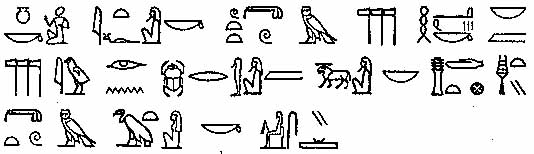
A thousand years later a story arose in EGYPT to the effect that ALEXANDER THE GREAT was the son of the god ȦMEN of EGYPT, and ALEXANDER'S councillors promptly took advantage of it to forward the fortunes of their lord. If, they argued, ALEXANDER is the son of ȦMEN, he is the lawful king of EGYPT, and the EGYPTIANS must acknowledge him as their king. But it was necessary for their purpose that ȦMEN should acknowledge ALEXANDER as his son, and they therefore took him to the Oasis of SAH in the Libyan Desert, and presented him to the god ȦMEN of LIBYA. The god admitted that ALEXANDER was his son, the priesthood of ȦMEN accepted the declaration of their god, the EGYPTIANS believed that the holy blood of ȦMEN flowed in ALEXANDER'S veins, and as a result he became the king of the South and the North, and Governor of the Domain of HORUS without striking a blow. The native novelists and story-tellers, e.g. the PSEUDO CALLISTHENES, declared that when NECTANEBUS II, the last native king of EGYPT, fled from EGYPT he went to MACEDON, where he established himself as a magician. Here he became acquainted with Queen OLYMPIAS, who wished to find out from him if her husband, PHILIP, intended to put her away. An intimacy sprang up between NECTANEBUS and OLYMPIAS, and he appeared to the queen one night in the form of the god ȦMEN of LIBYA, arrayed in all the attributes of the god, and begot ALEXANDER THE GREAT. Tradition transferred the horns of ȦMEN to ALEXANDER, and ancient Arab writers call ALEXANDER "DHUL-ḲARN", i.e. "provided with two horns", a title that translates exactly one of the titles of ȦMEN, "Sepṭ ābui" hieroglyphics

ISAAC, the editor and translator of the KEBRA NAGAST, and his fellow countrymen saw nothing strange in the fact that MĔD the virgin queen of SA, gave herself to SOLOMON, for she believed him to be of divine origin, and he was to her as a god. Moreover, he was the custodian of the "Heavenly ZION, the Tabernacle of the Law of God", whence he obtained daily the renewal of his divinity, and power, and authority. The Tabernacle of the Law had much in common with the arks or divine tabernacles of the BABYLONIANS and EGYPTIANS, which formed the places of abode of figures of gods or their most characteristic emblems. The ark of BEL, the great god of BABYLON, contained a figure of the god, and the king visited it ceremonially once a year, and sued with tears for forgiveness, and grasped the hand or hands of the sacred figure. The chamber in which the figure abode was believed to have been built by the gods. On high days and holy days the ark was carried by the priests in procession. In EGYPT the arks of the gods were kept in chambers specially constructed for the purpose, and the figures of the gods were seated on thrones inside them. These arks were placed upon sledges or in boats and were carried by the priests in procession on great days of festival or on solemn days. We know from the inscriptions that the ark of ȦMEN was provided with doors that were kept bolted and sealed. On certain occasions the king had the right to break these seals and unbolt the doors, and look upon the face of the god. Thus, after his conquest of EGYPT, the Nubian king PIĀNKHI went to visit RĀ in his sanctuary near HELIOPOLIS. He was received by the KHERḤEB priest, who prayed that the fiends might have no power over him. Having arrayed himself in the sacred seṭeb garment, and been censed and asperged, PIĀNKHI ascended the steps leading to the ark of RĀ and stood there alone. He broke the seal, drew the bolts, threw open the doors and looked upon the face of RĀ. Having adored the Māṭet and Sektet Boats he drew together the doors and sealed them with his seal. In this way PIĀNKHI was recognized by RĀ as the king of all EGYPT. It is not clear whether it was a figure of RĀ or the holy benben stone, the symbol of the god, which PIĀNKHI looked upon. Many of the sacred arks of EGYPT contained no figures of gods, but only objects symbolic of them; in the temples of Osiris the arks contained portions of the body of this god.

The Ark of the Law which MENYELEK covered and stole from the Temple of JERUSALEM was probably a copy of that made by MOSES, and to all intents and purposes it was a rectangular box, made of hard wood plated with gold, and measuring about four feet long, two feet six inches wide, and two feet six inches deep. It was provided with a cover upon which rested the Mercy seat and figures of the Cherubim. In the KEBRA NAGAST no mention is made of the Mercy seat and the Cherubim, but we read there that MOSES made a case in shape like the "belly of a ship", and in this the Two Tables of the Law were placed. To the ETHIOPIANS this case symbolized the VIRGIN MARY; the case made by MOSES carried the Word in stone, and Mary carried the Word Incarnate. It cannot be assumed that the Ark stolen by MENYELEK was carried in a sacred boat like an Egyptian shrine, even though the "belly of a ship" is mentioned in connection with it. In several chapters of the KEBRA NAGAST the "chariot of the Tabernacle of the Law" is mentioned, a fact which suggests that in later days at least the sacred box was provided with a carriage or sledge. History is silent as to the place where the Tabernacle of the Law was finally deposited, but Ethiopian tradition asserts that it survived all the troubles and disasters that fell upon the ABYSSINIANS in their wars with the Muslims, and that it was preserved at AKS until comparatively recent times.

In the short introduction that follows I have given a sketch of the literary history of the KEBRA NAGAST, with references to the authorities on the subject, and I have made an abstract of its contents in narrative form which will, I hope, be useful. A full discussion of every portion of the work, with extracts giving the original texts of the authorities used and quoted by ISAAC the scribe, would fill another volume, and the cost of printing, paper, and binding is now so great that the idea of producing such a book has been abandoned. A translation of the Arabic text describing how the Kingdom of DAVID was transferred from JERUSALEM to ETHIOPIA has been added, for this interesting document is practically unknown in England. The pictures of events described in the Old and New Testaments, given in this book, are taken from Ethiopic MSS. in the BRITISH MUSEUM; they show as nothing else can the religious beliefs and traditions of the ETHIOPIANS, and at the same time they serve as examples of the drawings and designs with which they illustrated their manuscripts. Nearly all of them depict Scriptural events described or referred to in the KEBRA NAGAST.

Subscribe to this RSS feed

Log in or create an account