log in
The Bible KJV Old Testament

The Bible KJV Old Testament (319)

The Bible KJV

Old Testament


Children categories

Antiquities of the Jews by Flavius Josephus

Antiquities of the Jews by Flavius Josephus (34)

The writings of Flavius Josephus

ANTIQUITIES OF THE JEWS

josephus-intro
View items...
The Legends of the Jews

The Legends of the Jews (168)

THE LEGENDS OF THE JEWS

BY LOUIS GINZBERG

[1909]

TRANSLATED FROM THE GERMAN MANUSCRIPT

This is a massive collation of the Haggada--the traditions which have grown up surrounding the Biblical narrative.

These stories and bits of layered detail are scattered throughout the Talmud and the Midrash, and other sources, including oral. In the 19th century Ginzberg undertook the task of arranging the Haggada into chronological order, and this series of volumes was the result.


View items...
The Biblical Antiquities of Philo

The Biblical Antiquities of Philo (78)

THE BIBLICAL ANTIQUITIES OF PHILO

TRANSLATED FROM THE OLD LATIN VERSION
BY

M. R. JAMES, LITT.D., F.B.A.

HON. LITT.D. DUBLIN, HON. LL.D. ST. ANDREWS,
PROVOST OF KING'S COLLEGE. CAMBRIDGE

London: S.P.C.K.,

[1917]

Scanned at sacred-texts.com, May 2004. John Bruno Hare, redactor. This text is in the public domain. These files may be used for any non-commercial purpose, provided this notice of attribution is left intact.

 
View items...

MYTHS OF CRETE & PRE-HELLENIC EUROPE, Plates

MYTHS OF CRETE & PRE-HELLENIC EUROPE

By DONALD A. MACKENZIE

THE GRESHAM PUBLISHING COMPANY LIMITED

66 CHANDOS STREET COVENT GARDEN LONDON

[1917]

PLATES IN COLOUR

LADIES OF THE MINOAN COURT
From the painting by John Duncan, A.R.S.A.

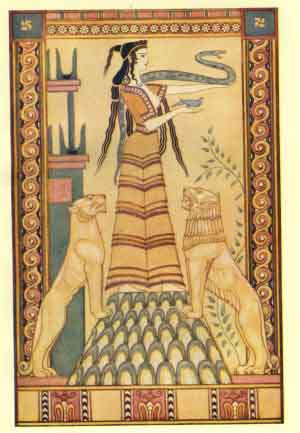
THE SNAKE GODDESS OF CRETE
From the painting by John Duncan, A.R.S.A.

THE BULL-BAITERS
From the painting by John Duncan, A.R.S.A.

SEA TRADERS FROM CRETE
From the painting by John Duncan, A.R.S.A.

PLATES IN MONOCHROME


INSCRIBED TABLETS FOUND IN CRETE

LIMESTONE SARCOPHAGUS FOUND AT AGHIA TRIADHA

VOTIVE OFFERINGS FROM THE DICTEAN CAVE

EXAMPLES OF PALLITHIC ART
From various sources

PALLITHIC ART: PAINTINGS OF BISON AND DEER
From copies of the originals by L'AbbBreuil

GROUP OF FIGURINES, IN TERRA-COTTA, FROM PALAIKASTRO

IVORY FIGURINE AND HEAD--"THE LEAPER"--FROM KNOSSOS
Reproduced from the "Annual of the British School at Athens"

THE LION GATE, MYCENFrom photograph by English Photo. Co.

BULL'S HEAD, IN STEATITE, FROM KNOSSOS

THE THRONE OF MINOS, KNOSSOS

THE CUP-BEARER, KNOSSOS
From photograph lent by Sir Arthur Evans

PAINTED PLASTER RELIEF-BULL'S HEAD-KNOSSOS
From photograph lent by Sir Arthur Evans

A GLIMPSE OF THE EXCAVATED REMAINS OF THE PALACE OF KNOSSOS

A CRETAN SHRINE: RESTORED BY SIR ARTHUR EVANS

WILD GOAT AND YOUNG: FAIENCE RELIEF, FROM KNOSSOS
Reproduced from the "Annual by the British School at Athens"

THE PRINCIPAL ROOM OF THE MUSEUM AT CANDIA, CRETE

MAGAZINE OF JARS AND KASELLES, KNOSSOS

EARLY MINOAN POTTERY, INCLUDING EXAMPLES WITH "BEAK" OR "TEAPOT SPOUTS"

THE "HARVESTER VASE" (STONE) FOUND AT AGHIA TRIADHA

GENERAL VIEW OF "THE TREASURE OF PRIAM"
From the photograph by Schliemann

GROUP OF JEWELS FROM THE ISLAND OF MOCHLOS

DECORATIVE MOTIFS AND SYMBOLS
(Minoan and Celtic patterns compared)

THE RUINS OF THE LITTLE TOWN OF GOURNIA

THE ISLAND OF MOCHLOS, OFF THE NORTH COAST OF CRETE

DECORATED POTTERY FROM PALAIKASTRO

THE GRAND STAIRCASE, PALACE OF PHTOS

THREE VASES, SCULPTURED IN STONE, FOUND AT AGHIA TRIADHA

WEAPONS AND IMPLEMENTS, IN BRONZE, FROM THE DICTEAN CAVE

BRONZE IMPLEMENTS FROM GOURNIA

PILLAR AT KNOSSOS, INCISED WITH DOUBLE-AXE SYMBOLS

MINOAN POTTERY FROM ZAKRO

RUINS OF THE "ROYAL VILLA", AGHIA TRIADHA

The Monochrome Plates, unless where otherwise stated, are reproduced from photographs by G. Maraghiannis, Candia, Crete.

mckenzie-plates

Sketch Map of Eastern Part of Crete

MYTHS OF CRETE & PRE-HELLENIC EUROPE, Chapter 14 Decline of Crete

MYTHS OF CRETE & PRE-HELLENIC EUROPE

By DONALD A. MACKENZIE

THE GRESHAM PUBLISHING COMPANY LIMITED

66 CHANDOS STREET COVENT GARDEN LONDON

[1917]

CHAPTER XIV

Decline of Crete and Rise of Greece

Contemporary Rulers of Crete, Egypt, and Babylon--Crete in the Age of Abraham--Political Changes in Western Asia--Inter--state Struggles in Crete--Relations of Palace Kings with Small Towns--Egyptian Labyrinth and Cretan Palaces--The Rise of the Hittites--Their Raid on Babylon--Fall of Knossos--Lycian Tradition of Royal Rivals--Hyksos in Egypt--Hyksos Relic in Crete--Introduction of the Horse--Cretan Culture in the Cyclades and on Greek Mainland--The Golden Age of Minos--Eighteenth Dynasty Wars of Egypt--The Cause of Racial Movements--Overthrow of Minoan Power--Crete's Trade with Egypt and Western Europe--Egyptian Beads in English Bronze-age Grave--The Tin Trade of Cornwall--Pelasgian and Achn Conquerors--Last Period of Cretan Civilization--Prehistoric Dynasties of Greece--The Northern Conquerors--Sea-raid on Egypt--The Homeric Siege of Troy--Dorian Anarchy--Ionia the Culture Cradle of Historic Greece.

CRETE'S Early Minoan Age embraces roughly about six hundred years, from 2800 B.C. till 2200 B.C. During its third period Troy II was destroyed by fire. In Egypt the Sixth Dynasty Kings, which included Pepi I and Pepi II, reigned over a powerful kingdom for a century and a half, and then followed an obscure period of three centuries, during which rival States struggled for supremacy. In the end the princely family of Thebes rose into prominence and established the Eleventh Dynasty. Babylonia was similarly divided into petty kingdoms. About 2650 B.C. the northern Semitic State of Akkad became powerful under Sargon 1, who was reputed to be of miraculous birth and to have been rescued as a babe from an ark which was set adrift on the River Euphrates. 1 His son, Naram Sin, erected the famous stele which depicts him winning a victory over a pigtailed people in a wooded and mountainous country. He flourished about the is beginning of Crete's Early Minoan II Period, and, like his father, proclaimed himself "King of the Four Quarters". It is possible that both these monarchs penetrated Syria and Palestine. They appear to have held sway over part of Elam and Sumeria. Towards the close of the Early Minoan II Period, Gudea was patesi of the Sumerian city of Lagash and traded with Syria. The power of Akkad appears to have been shattered by an invasion of the Gutium from the north. After these invaders were expelled, dynasties flourished in the Sumerian cities of Erech, Ur, and Isin. Thereafter the Amorite migration culminated in the rise of the Hammurabi Dynasty at Babylon.

Some authorities believe that the Herakleopolite Kings of Egypt of the Ninth and Tenth Dynasties were descendants of foreign conquerors who entered through the eastern Delta and destroyed the mummies of the great Pyramid Kings of the Fourth and Fifth Dynasties. This is possible, but the evidence is of so slight a character that any conclusions drawn from it cannot be regarded as definite.

When we reach Crete's Middle Minoan Period (2200-2 100 B.C.) a new Age begins to dawn over the ancient world. The Theban Kings of the Eleventh Dynasty establish their sway over the whole of Egypt. In Babylonia the Sumerian power suffers decline, and two sets of invaders, the Amorites in the north and the Elamites in the south, wage a determined struggle for supremacy. This is roughly the Age of Abraham, whose migration from Sumeria northward through Mesopotamia into Palestine appears to have been one of the results of the ethnic disturbances waged in his native land.

Troy has fallen, and invaders from Thrace have penetrated eastward through Anatolia to constitute an element in the Muski-Phrygian blend. The Hittites are powerful in Cappadocia, and are extending their sway into northern Syria.

Of special interest is the Biblical reference to the battle of four kings against five.

"And it came to pass in the days of Amraphel King of Shinar, Arioch King of Ellasar, Chedorlaomer King of Elam, and Tidal King of Nations; that these made war with Bera King of Sodom, and with Birsha King of Gomorrah, Shinab King of Admah, and Shemeber King of Zeboiim, and the King of Bela, which is Zoar." 2

Amraphel is believed to be Hammurabi of Sumer (Shinar), Arioch of Larsa, (Ellasar) a Sumerian city king who was a son of the Elamite monarch, and Tidal a Hittite ruler. This confederacy may have been formed against common enemies in the Western Land (Syria and Palestine) in the interests of trade. It could not have been of long endurance. After twelve years of subjection the western tribes rebelled, 3 and the four allies again "smote them". Thereafter Hammurabi threw off his allegiance to Elam and extended his sway over the greater part of Babylonia and Assyria, while he also included the Western Land in his sphere of influence. About the same period (2000 B.C.) the Twelfth Dynasty was established in Egypt, its first great king, being Amenemhet I.

During the Middle Minoan I Period, which is roughly contemporary with the Eleventh Dynasty of Egypt, the earlier palaces of Knossos and Phtos were erected. It is probable that they were occupied by independent rulers who occasionally came into conflict like the Babylonian city kings. Each may have had his sphere of influence on the island. At any rate it seems certain that such great buildings represented centralized power which drew into the service of the monarchs large masses of the population.

Both palaces were destroyed at a later period, but as they did not fall simultaneously they do not seem to have been attacked by a common enemy from across the sea. The fact that the first Phtos palace endured longest suggests that its monarch was the conqueror of Knossos and the destroyer of the first palace there.

The fall of Knossos occurred in the Middle Minoan II Period (C. 2100-1900 B.C.). Evidences have been forthcoming both at Knossos and Phtos of disturbances in the early part of this period. At its close the first Knossian palace was destroyed. The later palace must have been rebuilt soon afterwards, for portions of the earlier walls were utilized. Probably the stricken State made a speedy recovery. It may have, indeed, overthrown its rival in turn. When the first palace of Phtos fell, its destruction was so complete that it lay in ruins for about a century. The second palace was not erected until the Late Minoan I Period, which began about 1700 B.C. No portion of the earlier buildings were then made use of. The whole site was completely levelled and covered with cement over the Middle Minoan remains, which were happily preserved in this way among its ruins. It is possible that this second Phtian palace was erected by the ruler of Knossos. According to Strabo, Phtos was a colony of the northern State.

Before the first palaces were erected at Knossos and Phtos, small towns flourished in eastern Crete.

mckenzie-14

MINOAN POTTERY FROM ZAKRO

Including examples of "Kamares" ware. The central vessel in the lower row shows the use of the double-axe symbol.

One of these, as has been indicated, was situated near the island of Mochlos, where the tomb treasures give indications of commercial and industrial prosperity during the Early Minoan Age. Vasiliki was also, without doubt, an important trading and governing centre. Petras, on the shore of Sitia Bay, may have been the stronghold of one of the petty States then in existence.

When the first palaces of Knossos and Phtos were erected the Cretans were trading with the Twelfth Dynasty merchants of Egypt. The spiral design had become popular among Nilotic seal engravers, who combined it with the lily flower, and the Cretan potters imitated them. Middle Minoan vases from Phtos are decorated with the Egyptian lily spiral, which in one case is utilized in quite a new way. The papyrus designs were also taken over by the Cretan artists, and used with characteristic freedom. So greatly admired were the Kamares vases of Crete's Middle Minoan Period that they were freely purchased in Egypt. Professor Flinders Petrie found fragments of them in a tomb at Kahun of the Twelfth Dynasty, while a Cretan vessel was found by Professor Garstang in a grave of similar date at Abydos.

It was during the Twelfth Dynasty that the great Egyptian Labyrinth was erected. Its builder was Pharaoh Amenemhet III. According to Herodotus it had twelve covered courts and three thousand apartments, half of which were underground. "No stranger", says Strabo, "could find his way in or out of this building without a guide". It is possible that the Egyptian Labyrinth was an imitation of the mazy palaces of Crete.

Probably it was owing to its close commercial connections with Crete that Egypt received during the Twelfth Dynasty such liberal supplies of tin that bronze was freely manufactured.

Towards the close of Crete's Middle Minoan II Period the Twelfth Egyptian Dynasty came to an end, and the Sebek-Ra rulers of the Thirteenth Dynasty established their sway, which became centralized in Upper Egypt. Foreign settlers were increasing in number in the Delta region. In Asia great ethnic disturbances, due to widespread migrations, were in progress. The Hittites had grown powerful and were known both in Egypt and Babylonia. Assyria was overrun by a non-Semitic people who ultimately established a military aristocracy in northern Mesopotamia and brought into existence the Kingdom of Mitanni. In time the Hammurabi Dynasty of Babylon was overthrown by Hittite raiders, who were followed by the Kassites.

It is possible that the fall of Knossos may have not been unconnected with the social and racial changes due to the settlement on the island of roving bands of pastoral fighting-folks. These may have been employed as mercenaries by rival Cretan kings. A memory of the ancient island conflicts appears to survive in the following reference by Herodotus to the Lycians: "The Lycians", he wrote, "are in good truth anciently from Crete, which island, in former days, was wholly peopled by barbarians. 4 A quarrel arising there between the two sons of Europa, Sarpedon and Minos, as to which of them should be king, Minos, whose party prevailed, drove Sarpedon and his followers into banishment. The exiles sailed to Asia, and landed on the Milyan territory. Milyas was the ancient name of the country now inhabited by the Lycians; the Milyof the present day were, in those times, called Solymi. So long as Sarpedon reigned, his followers kept the name which they brought with them from Crete, and were called Termil as the Lycians still are by those who live in their neighbourhood. . . . Their customs are partly Cretan, partly Carian." 5 Herodotus also noted that the Lycians took "the mother's and not the father's name"--an interesting and perhaps significant fact when we consider the prominent part taken in social life by the Cretan women.

That the destruction of Knossos was due to internal revolt, which may or may not have received outside aid, is highly probable. It was rebuilt at the beginning of the Middle Minoan III Period, but before its rulers had attained to the full height of their power a long era of prosperity was in store for the smaller towns. Gournia, Zakro, Psyra, and Palaikastro began to be important trading centres before 1700 B.C., and ere the second palace of Phtos was erected. It was after the Knossian palace was remodelled that these towns were destroyed.

Ere the Middle Minoan III Period had drawn to a close the Hyksos invaders had overrun Egypt, and the Hittites, Mitannians, and Kassites were in ascendancy in Mesopotamia and Anatolia. Commercial relations between Crete and Egypt were no doubt hampered for a time, but they appear to have been resumed again. Perhaps the island kingdom received refugees from the Delta region. These may have introduced the art of writing on papyrus with a pen, which came into practice before the beginning of the Late Minoan I Period.

The Late Minoan I Period endured for about two centuries (c. 1700-1500 B.C.). Trade became exceedingly brisk, and Gournia, Palaikastro, and eastern towns reached their highest development. The fact that Zakro became important suggests intimate relations with Egypt. Sir Arthur Evans has discovered at Knossos an alabastron lid bearing the personal name of one of the late Hyksos

Pharaohs, Khian, whose throne name, Seuserenra, appears on a figure of a lion found at Baghdad. A seal impression found by the same excavator in the royal villa near the palace belongs to the early part of Late Minoan I. It is of special interest because the subject is a horse which has been carried overseas in a one-masted vessel. This animal was introduced into Babylonia by the Kassites, and was called "the ass of the east". The Mitannians, who were probably allies of the Kassites, had horses and chariots, and the horse appeared in Egypt during the Hyksos era. Perhaps the successful invasion of the Hyksos was due to the use of cavalry.

Sir Arthur Evans is of opinion that his Knossian seal impression is a record of the introduction into Crete of the thoroughbred horse. Mr. and Mrs. Hawes state, however, that they possess an Early Minoan seal stone on which a horse figures. This fact is interesting. It may not indicate that the horse was a domesticated animal, although it may have been a sacred one. The Demeter of Phigalia, as has been stated, was horse-headed. In the Pallithic Age there were wild horses in Europe, and in one of the cave-pictures of the Aurignacian Period a man is shown beside small horses with a stave on his shoulder, suggesting that he is herding them. At this remote period the animal was freely eaten. There is no evidence that the horse was used in warfare much earlier than the Kassite Period in Babylonia, and it was certainly quite unknown in Egypt before the Hyksos Age.

Cretan culture extended during the Late Minoan I times through the Cycladic islands. At Phylakopi, in Melos, a second city came into existence round its obsidian "factory". Cretan products were freely imported and Cretan script was in use. In one of its buildings, which may have been the palace, was found a well-preserved fresco showing flying fish skimming over transparent waters in which lie shells, sponges, and rocks. It was undoubtedly the work of a Cretan artist. In all probability there was a Minoan colony at Phylakopi.

But Cretan influence was not confined to the islands. Both Mycenand Tiryns on the Grecian mainland were stimulated by it as early as the Middle Minoan III Period. The contents of the shaft graves of Mycen which Schliemann assigned to the Homeric Age, are of Late Minoan I antiquity (c. 1500 B.C.), as are also boar-hunt frescoes recently found at Tiryns, which are distinctively Cretan, and the famous Vaphio cups with the bull-snaring scenes. The Peloponnesian colonies of Crete appear to have been established in the Middle Minoan III Period (c. 1800-1700 B.C.). In Botia there were settlements in Late Minoan I times, if not earlier, and tombs have yielded Cretan, and imitations of Cretan products, which confirm the traditions of the source of early Grecian culture, the religious mysteries, and so forth. With Cretan modes of life came Cretan modes of thought to a people who were not much advanced from the Neolithic stage of culture. It is probable that the islanders formed a military aristocracy from which sprung the kings who ruled the various important city States in pre-Homeric times.

Pausanias 6 tells us that the lion gate of Mycenand the walls of Tiryns were the work of the Cyclopes who laboured for Proctus. He writes, too, with conviction of the men in ancient days who "were guests at the tables of the gods in consequence of their righteousness and piety", and adds that "those who were good clearly met with honour from the gods, and similarly those who were wicked, with wrath. The gods in those days were sometimes mortals who are still worshipped, like Arists, and Britomartis of Crete, and Hercules, the son of Alcmena, and Amphiarus, the son of cles, and beside them Castor and Pollux." 7 So were the ancients who believed in giants and gods identified with them.

During the last century of the Late Minoan I Period the Hyksos were overthrown in Egypt, and the Theban Eighteenth Dynasty was established. The Cretans were known then in the Nile valley as the Keftiu, and characteristic wasp-waisted figures carrying Minoan vases were depicted in the tombs. It was during this period that the later Phtian palace was erected.

The Late Minoan II Period, also known as the "Palace" Period, began towards the close of the reign of Pharaoh Thothmes I, the father of Queen Hatshepsut. It lasted for about half a century, from c. 1500 till 1450 B.C. One by one the coast towns perished, the latest to survive being Palaikastro, which some identify as the ancient city port of Heleia. Some think that Palaikastro existed as late as the Late Minoan III Period, and was ruled by an independent prince.

It is uncertain whether the towns were plundered by piratical bands from the Cyclades and the Greek mainland, or were wiped out by the central Cretan power which was established at Knossos. The later Knossian palace was remodelled during Late Minoan II times, and did not therefore suffer from the depredations of invaders. It would seem that we now reach the age of the legendary Minos who struck down all rivals and became supreme ruler in Crete. "The first person known to us in history as having established a navy", writes Thucydides, "is Minos. He made himself master of what is now called the Hellenic Sea, and ruled over the Cyclades, into most of which he sent his first colonies, expelling the Carians and appointing his own sons governors; and thus did his best to put down piracy in those waters, a necessary step to secure the revenues for his own use. For in early times the Hellenes and the barbarians of the coast and islands, as communication by sea became more common, were tempted to turn pirates, under the conduct of their most powerful men; the motives being to serve their own cupidity and to support the needy. They would fall upon a town unprotected by walls, and consisting of a mere collection of villages, and would plunder it; indeed, this came to be the main source of their livelihood, no disgrace being yet attached to such an achievement, but even some glory. An illustration of this is furnished by the honour with which some of the inhabitants of the continent still regard a successful marauder, and by the question we find the old poets everywhere representing the people as asking the voyagers--'Are they pirates?'--as if those who are asked the question would have no idea of disclaiming the imputation, or their interrogators of reproaching them for it. The same rapine prevailed also by land." 8

The Empire of Minos appears to have embraced part of the Greek mainland. Athens was compelled to send its annual tribute of youths and maidens to Knossos, and Tiryns, Mycen Lakonia, Pylos, and Orchmenos became important centres of ean culture. The tradition that the Cyclopes who erected the walls of Tiryns came from Lycia may be due to the tendency to foreshorten historical events. It is possible, however, that Minoan traders had already settled on the Anatolian coast and maintained commercial relations with the Peloponnese and Crete.

Thothmes III of Egypt, the great conqueror, flourished during the later part of the Late Minoan II Period. In the hymn addressed to him as from the god Amon, the priestly poet declares:

I have come giving thee to smite the western land,
Keftyew (Crete) and Cyprus are in terror. 9

The activities of Thothmes did not extend to Crete, but there can be little doubt that his operations exercised a marked influence on the trade of the island kingdom. Probably it prospered greatly under the settled conditions which he brought about, as it had evidently prospered after the expulsion of the Hyksos from Egypt. A brisk demand for Cretan imports in the Nile valley may well have been one of the causes of the commercial "boom" which is suggested by the increasing wealth of Knossos during the Late Minoan II Period.

The great Egyptian wars, however, were bound in time to affect Crete in another direction. The expulsion of the Hyksos brought about a pressure of peoples in Syria, Anatolia, and south-eastern Europe, which was to test the stability of existing States. Semitic hordes poured towards Babylonia and hampered trade; at the same time they reinforced the growing power of Assyria. The Mitannian area of control was being circumscribed and Hittite prestige seriously affected in Cappadocia. Ere the Hittites were able to profit by the weakening of the Syrians and Mitannians, against whom Thothmes III was battling constantly, they must have been forced to direct their expansion westward. The plain of Troy was probably at this period the scene of many conflicts. In the Danubian area there appears to have been much ethnic friction. Invasions from Anatolia and the constant pressure exercised by northern tribes directed a steady stream of pastoral fighting-folks southward through the Balkans and into the northern States of Greece. The mainland capitals, including Mycenand Tiryns, which had become centres of ean culture and trade, must have offered strong temptations to the hardy mountaineers of Thessaly, whence the Achns are supposed to have come. Probably the migrations of the pastoralists were propelled by migrations from the north. The ultimate result of these migratory "folk-waves", which increased in volume as time went on, was the destruction not only of the Minoan Empire, but the complete overthrow of Knossian power in Crete itself. The Palace Period was the Golden Age of Cretan culture, which suffered steady decline after 1450 B.C.

It was probably during this half-century of Minoan ascendancy that Crete's overseas commerce assumed its greatest dimensions. The organized navy ensured the safe passage in the ean Sea of ships which tapped the Danube valley trade, and penetrating the Dardanelles got into touch with caravans from the cast. It also helped to foster trade with western ports. The Rhone valley route running to Marseilles appears to have been, as has been indicated, one of the sources from which British tin was received.

At what period this traffic had origin is at present wrapped in obscurity. It seems probable, however, that it was carried on as early as 1500 B.C. One of the reasons for this belief is the discovery of Egyptian relics in southern England. Among the relics taken from Bronze Age graves are numerous Egyptian beads of blue-glazed faience. "They are beads, moreover, which", writes Professor Sayce, "belong to one particular period in Egyptian history, the latter part of the age of the Eighteenth Dynasty and the earlier of that of the Nineteenth Dynasty. . . . There is a large number of them in the Devizes Museum, as they are met with plentifully in the Early Bronze Age tumuli of Wiltshire in association with amber beads and barrel-shaped beads of jet and lignite. Three of them come from Stonehenge itself. Similar beads of 'ivory' have been found in a Bronze Age cist near Warminster: if the material is really ivory it must have been derived from the East. The cylindrical faience beads, it may be added, have been discovered in Dorsetshire as well as Wiltshire." Mr. H. R. Hall, dealing with the same Egyptian relics, says: "My own interest in the matter is due to the fact that in the course of the excavations of the [Egyptian] Fund at Deir el Bahari, we discovered thousands of blue glaze beads of the exact particular type (already well known from other Egyptian diggings) of these found in Britain. Ours are, in all probability, mostly of the time of Hatshepsut, and so date to about 1500 B.C." 10 Similar beads have also been discovered in Crete and Western Europe. The British finds help to fix the age of Stonehenge, the inner circle of which, according to Professor Boyd Dawkins, is formed of stones taken from Brittany.

By whom were these Egyptian beads carried to Britain between 1500 B.C. and 1400 B.C.? Certainly not the Phnicians. The sea-traders of the Mediterranean were at the time the Cretans. Whether or not their merchants visited England we have no means of knowing. It is possible that they did. It is also possible, and even highly probable, that during the early Bronze Age in England, which may have been of greater antiquity than has hitherto been supposed, there existed a comparatively high degree of civilization, and communities of traders.

According to Diodorus Siculus, tin was carried in wagons by the people of Belerium (Land's End) to the Island of Ictis, 11 which could be reached at low tide. The tin was purchased on Ictis by traders and then shipped to Gaul, being afterwards conveyed overland to the mouth of the Rhone on pack-horses. Ships crossed the English Channel as early as Neolithic times, when the earliest settlers of the Mediterranean race migrated from Gaul. The Veneti of Brittany in Car's time had a navy, as well as trading-vessels, like the ancient Cretans. In the early Bronze Age amber was imported into England from the mouth of the Elbe, so that a connection was established between our shores and the Danubian trade route. Gold was carried from Ireland and Wales and Scotland to Scandinavia. It may have been due to the racial migrations which followed the expulsion of the Hyksos from Egypt that "the men of the round barrows" invaded these islands in the early British Bronze Age. Probably they followed in the tracks of the traders up the valleys of the Danube and the Elbe as well as from the Alpine districts towards Brittany. It need arouse no surprise that the effects of the distant Egyptian wars should have been felt in Europe. The building of the Chinese wall, which directed westward the drift of Asiatic nomads, was the indirect cause of the fall of Rome.

Crete's Late Minoan II Period of splendour and commercial prosperity was brought to an abrupt close by the sack of Knossos. This disaster must have fallen like "a bolt from the blue". It was evidently as unexpected as it was complete. Workmen were engaged in renovating the stately dwelling, new frescoes were being painted, and builders were erecting a new wing, when the invaders swept inland from the seashore, put to the sword soldier and artisan, and probably women and children, then plundered the palace and set it on fire. Phtos palace and the villa of Aghia Triadha shared similar rates.

It may be that the invaders attacked Crete when its army and navy were engaged elsewhere. The tradition recorded by Herodotus, which is of special interest in this connection, sets forth that Minos went to Sicily in search of Dalus, the great architect, and there was murdered. An expedition followed to avenge his death, and besieged Camicus for five years. Their efforts were, however, unsuccessful. On their way home their vessels were wrecked on the south coast of Italy, where they founded the town of Hyria. Thereafter, the Prians informed Herodotus, "men of various nations flocked to Crete, which was stripped of its inhabitants". 12 Memories of Minoan colonies may have mingled with this tradition. One of the several cities called Minoa was situated in Sicily.

It is generally believed that the destroyers of Knossos were not Achns alone, but the mixed peoples on the Greek coast who had come under the influence of Minoan civilization. Thucydides says that after Minos had formed his navy, and communication by sea became easier, "the coast populations began to apply themselves more closely to the acquisition of wealth, and their life became more settled; some even began to build themselves walls on the strength of their newly acquired riches". These Cretanized mainlanders were subjected to the constant pressure of the northern tribes. "The country called Hellas", wrote Thucydides, "had in ancient times no settled population; on the contrary, migrations were of frequent occurrence, the several tribes readily abandoning their homes under pressure of superior numbers. . . .

mckenzie-14

RUINS OF THE "ROYAL VILLA", AGHIA TRIADHA.

The goodness of the land favoured the aggrandizement of particular individuals, and thus created faction, which proved a fertile source of ruin. It also invited invasion." 13 It is possible, as some have urged, that Minos himself was a conqueror of Crete, and was supported by Pelasgians and Achns who had acquired the elements of Minoan culture on the mainland.

The Late Minoan III Period begins with a partial revival of Minoan civilization. A portion of the Knossian palace was reoccupied, and new houses were erected at Gournia and Palaikastro beside the ruins of those which were destroyed in the early Palace Period. Trading relations with Egypt were resumed, and hundreds of Cretan vases of Belkannen type were imported into the Nile valley. These and others were imitated in faience and alabaster by Egyptian artisans. But Cretan culture was on the down grade. The island artisans of the Late Minoan III Period were imitators of their predecessors, and sometimes slovenly imitators; they invented nothing new. It was an age of decadence and transition. Ultimately Knossos and the small towns were entirely deserted, and the people retreated to the inner mountain valleys and plateaux. The Cretans ceased to be known in Egypt as the Keftiu during the reign of Amenhotep III, the father of Akhenaton. 14 The founders of Pros, who claimed to be the "true Cretans", were no doubt descendants of the old Minoan peoples and the Ach-Pelasgian elements from the Continent.

But although Late Minoan III culture perished by slow degrees in Crete, it flourished in Cyprus. Apparently large numbers of Cretans and Cretan colonists from the mainland settled on that island and achieved a political ascendancy over the natives. Others settled on Rhodes. About the same time the Minoan colonies in Lycia and Caria were strongly reinforced, and for a period, if Greek tradition is to be relied upon, the Carians monopolized the sea trade of the ean. It is believed that large numbers of Cretans also fled to Phnicia and stimulated maritime enterprise in that quarter. "In the Homeric poems", says Professor Myres, "more visits are paid by western seafarers to Phnicia and Sidon than 'Phnician' merchants pay to the west. . . . The wide Phnician trade of historic times had clearly begun to grow as the Minoan sea-power failed." 15

About a century after the fall of Knossos, Mycen Tiryns, and other mainland towns had reached the height of their prosperity. It is possible that they owed their supremacy to Hittite influence. At any rate, persistent Greek legends associate their rulers with Anatolia. The walls of Tiryns were reputed to have been built by Cyclopes from Lycia, and Pelops, who gave his name to the Peloponnesus, was reputed to have come from Asia Minor. "The account given by those Peloponnesians", says Thucydides, "who have been the recipients of the most creditable traditions is this. First of all Pelops, arriving among a needy population from Asia with vast wealth, acquired such power that, stranger though he was, the country was called after him; and this power fortune saw fit materially to increase in the hands of his descendants." 16 The complicated family history of Pelopidand Atridis of special interest in this connection.

Atreus, son of Pelops, married his son Plisthenes to Aerope, granddaughter of King Minos of Crete. Her father had given her and her sister to the King of Euba, because it had been foretold he would die by the hand of one of his children. The sons of Aerope were Agamemnon and Menelaus. Afterwards Atreus married Aerope, his daughter-in-law, and brought up her sons, who were consequently called the Atrid But this fickle lady deserted Atreus and became the wife of his brother Thyestes. Then Atreus took to wife Pelopea, whose descendants were called the Pelopid He was not aware that this lady was his brother's daughter. Many crimes and calamities are associated with the traditions of these princes and princesses. The chief interest they have for us here is the wonderful relation the traditions regarding them bear to the history of the period. A Minoan king of Crete is to be slain by his own kin from the mainland, and invaders from Anatolia intermarry with Cretan stock in the Peloponnesus. This appears to be as good history as the reference in Ezekiel to the ethnics of Jerusalem: "Thy birth and thy nativity is of the land of Canaan; thy father was an Amorite, and thy mother an Hittite". 17 Mycen#39;s mother was a Cretan and his father an Anatolian, perhaps of Indo-European speech like the military aristocracy of the Mitannian State, which appears to have for a period achieved political ascendancy over the Hittites.

In this connection special interest attaches to our own legends about the invading giants who gave their names to Alban (Albion) and Erin. It seems probable that these giants symbolized the folks who overran Great Britain and Ireland in the early Bronze Age. "Alban" (genitive of "Alba") or "Albion" and "Alps" are derived from a common root, signifying "white". Were the invaders of ancient Britain "Whitelanders", i.e. an Alpine folk?

The Mycenn period of Greek civilization was remembered as that of the third or Bronze Race of Hesiod.

"Their gear was of bronze, they had bronze houses; they tilled the soil with bronze; black iron there was none." Nestor, in the Iliad, refers to the Bronze Age folk as the heroes of an earlier generation who were greater than Agamemnon and his host.

I lived with men, and they despised me not,
Abler in counsel, greater than yourselves.
Such men I never saw, and ne'er shall see,
As Pirithous and Dryas, wise and brave,
Cneus, Exadius, god-like Polypheme,
And Theseus, eus' more than mortal son.
The mightiest they among the sons of men. . . . 18

Another element which entered into the ethnic fusion in Mycenn Greece was the Danubian. The influence of Danubian culture extended as far south as Thessaly, where the Achns were predominant. These Achn pastoralists were drifting southward into the Peloponnesus as early as the Late Minoan I Period, and some of them may have reached Crete. But their greatest migration appears to have occurred at the close of the Pelopid Dynasty, and it is probable that they were the late conquerors of Mycenand Tiryns. After holding sway in the Peloponnesus for a period of uncertain duration, they were overthrown in turn by the Dorians.

About the time that the legendary Pelops secured the ascendancy of his stock on the Greek mainland, Crete was in a state of decay. In Egypt the brilliant reign of Amenhotep III marked the zenith of Egyptian power in the Nile valley and Syria. Mitanni, in northern Mesopotamia, which was ruled by kings with Indo-European names, was being threatened on one side by the growing power of Assyria, and on the other by that of the Hittites.

After Akhenaton, the dreamer king, ascended the Egyptian throne and inaugurated his religious revolution, the kingdom of Mitanni was overthrown, and the Egyptian Empire in northern Syria went to pieces. The Hittites had leagued themselves with the Amorites, and were pressing southward, gaining control of the trade routes from Babylonia and Egypt.

The eastward expansion of the Hittites was accompanied by a shrinkage of their power in the west. Reinforced by folk-waves from Thrace, the people of the Phrygian area then began to gather strength, and asserted themselves later as the Muski, 19 the forerunners of the historic Phrygians. The sixth city of Troy also came into prominence. It was contemporary with Mycen and Tiryns, and like these cities owed its rise to the fusion of Danubian and ean cultures, the latter predominating.

This was Homer's Troy, and so powerful did it become that when the Achns entered into possession of the Peloponnesian centres of Mycenn culture they found that it constituted a serious menace to their ascendancy.

As in Egypt, descent in Crete and its colonial settlements was by the female line. The Achn chiefs therefore followed the example of Atreus by marrying a royal princess, so as to secure the succession of their descendants to the thrones of the various States which they overpowered. Menelaus had married Helen, Queen of Sparta, and departed overseas on an expedition. During his absence, Priam, King of Troy, abducted Helen, who became the wife of his son Paris. The Trojans were thus enabled to claim Sparta as part of their dominions. On his return, the Achn monarch found it necessary to fit out a great expedition and inaugurate the famous siege of Troy, so as to recover the queen by whose right he held the Spartan throne. Such appears to be the historical germ of the Homeric narrative.

The Greeks dated the period of the Trojan war as from 1194 till 1184 B.C. This appears to be an accurate calculation. A few years previously, in 1200 B.C., the second great sea raid on Egypt took place during the reign of Rameses III of the Twentieth Dynasty. Perhaps the absence of Menelaus was not unconnected with this adventure.

The first sea raid occurred about a quarter of a century earlier, during the reign of Merne-ptah, son of Rameses II. It was conducted in conjunction with the Hittites, and taken part in by the Shardana, who may have given their name to Sardinia; the Akhaivasha, usually identified with the Achns; the Shakalsha, who may have been Cretanized Sicilians; and the Tursha, perhaps the Turseni, who were represented in Etruria. The piratical peoples were probably remnants of the Cretans and their conquerors. They were defeated by Merne-ptah, but some settled in Libya and became mercenaries in the Egyptian army.

The second raid was of great dimensions. It included the Danauna, the Danaans, the Shakalsha, the Tursha, the Tikkarai, who may have come from Zakro in Crete, and the Pulesti, the Philistines. The sea force which sailed south by Cyprus was supported by land raiders from North Syria and Anatolia. Among the latter were the Philistines, who gave their name to Palestine. Rameses III won victories on sea and land, being assisted by the raiders' kinsmen, the Shardana mercenaries.

It is suggestive to find that the siege of Homer's Troy occurred a few years afterwards. The conquerors of pre-Mycenn Greece, having been foiled in their attempt to overrun Egypt, sought expansion eastward, and had first to strike down the Phrygian city which threatened their supremacy.

Troy VI had been built about 1500 B.C., that is, about the beginning of Crete's Late Minoan II or Palace Period. It was surrounded by great stone walls 16 feet thick and 20 feet: high, which were surmounted by first a brick and then a stone parapet, which added another 6 feet to them. The walls were flanked by three great towers about 30 feet in height. As the stone-work has Egyptian characteristics, it is possible that the builders were imported from Egypt during the Eighteenth Dynasty. There were at least three city gates, and these were all on the southern side. Wells were sunk to the water-bearing strata of the hill.

When Troy VI was set on fire it did not suffer so greatly, being largely built of stone, as did the second city. The houses were, however, overthrown, and the upper portions of the walls demolished. Scarcely an object of any value survived the sack of the wealthy city. The ceramic remains are partly Mycenn, or Late Minoan III, and partly Trojan.

After the fall of Troy the European elements in Anatolia were strengthened. Carian and Lycian pirates infested the seas. There were also settlements of ean stock in Cilicia. The Muski-Phrygians, pressing eastward from central Anatolia, appear to have contributed to the overthrow of the tottering empire of the Hittites. In Palestine the Philistines gradually extended their area of control, moving steadily southward, as the Empire of Egypt shrank by slow degrees.

The Achns of Greece met in time the same fate as their predecessors of the Late Mycenn Period, the Pelopid Dynasty. About two generations after the Trojan war the Dorians, who had been gradually filtering south ward through Thessaly, gradually achieved ascendancy. In time, assisted by Illyrian allies, they overran the Peloponnese. The dispossessed Achn aristocracy and followers were forced into the land of the Ionians, which afterwards became known as Achaia. Dorians also found their way to Crete, which, like Rhodes, was eventually conquered.

For generations Greece was devastated by inter-tribal wars, and lapsed into a condition of decline. Periodic migrations took place of its merchants and traders and artisans, and these settled in Crete, Sicily, Sardinia, and Italy. Many found refuge in Anatolia, where grew up Ionian Greece along the coastland of Lycia and Caria.

"It was in ean Ionia", writes Mr. Hall, "that the torch of Greek civilization was kept alight, while the homeland was in a medial condition of comparative barbarism; Cyprus, too, helped though she was too far off for her purer Minoan culture to affect the ean peoples very greatly. It was in Ionia that the new Greek civilization arose: Ionia, in whom the old ean blood and spirit most survived, taught the new Greece, gave her coined money and letters, art and poesy, and her shipmen, forcing the Phnicians from before them, carried her new culture to what were then deemed the ends of the earth." 20

Footnotes

1 In this tradition two Semitic rulers, Sharrukin and the later Shargan-Sharri, were confused.
2 Genesis, xiv, 1-2.
3 Ibid., xiv, 4 et seq.
4 That is, non-Greeks.
5 Herodotus, I, 173.
6 III, 46.
7 VIII, 2.
8 History of the Peloponnesian War, I, 4, 5 (Richard Crawley's translation).
9 Breasted's History of Egypt. p. 319.
10 The Journal of Egyptian Archlogy (January, 1914), pp. 18-19.
11 One theory is that Ictis is the Isle of Wight. Some geologists contend that at this period the island was not entirely cut off from the mainland. The Isle of Thanet has also been identified as Ictis. Another theory is that the reference is to St. Michael's Mount on the south coast of Cornwall, which is connected with the mainland at low water by a causeway.
12 Herodotus, VII, 170, 171.
13 The Peloponnesian War, I, 2-8.
14 Before 1375 B.C.
15 The Dawn of History, p. 215.
16 The Peloponnesian War, I, 6-9.
17 Ezekiel, xvi, 3.
18 Iliad, Book I, 309-15 (Derby's translation).
19 Pronounced Moosh'ke. In the Old Testament they are referred to as "the Meshech" (Ezekiel, xxxii).
20 The Ancient History of the Near East, p. 79.

MYTHS OF CRETE & PRE-HELLENIC EUROPE, Chapter 13 Cave Deities and Symbols

MYTHS OF CRETE & PRE-HELLENIC EUROPE

By DONALD A. MACKENZIE

THE GRESHAM PUBLISHING COMPANY LIMITED

66 CHANDOS STREET COVENT GARDEN LONDON

[1917]

CHAPTER XIII

Cave Deities and their Symbols

Demeter and the Nameless Fates--Forms of Mother-goddess--The "Eagle Lady" with Snake Girdle--Prototype of Hittite and Assyrian "Winged Disk"--How Composite Monsters became Symbols--The Caves of Zeus--Lasithi Plateau--The Dictn Votive Offerings--The Chariot of a Deity--Cave of Kamares--The Plain of Nida--Sacred Cave of Mount Ida--Mountain Religion --Well Worship--The "Seven Sleepers" Belief--Cretan Tammuz a Cave God --Pillar Symbols in Crete, Egypt, and Babylonia--Pillars as Mountains and "World Spines"--The Osirian Spine Amulet--Tree and Pillar Worship--"Horns of Consecration" as Sky Pillars--Double-axe Symbol--Spirits in Weapons--The God of the Axe.

"THE Cretans say", Diodorus Siculus wrote, "that the honours rendered to the gods, the sacrifices and mysteries, are of Cretan origin, and other nations took them from them. Demeter passed from the Isle of Crete into Attica, then into Sicily, and thence into Egypt, carrying with her the cultivation of corn." 1

On the other hand Herodotus, writing of the Pelasgi, says: "In early times the Pelasgi, as I know by information I got at Dodona, offered sacrifices of all kinds and prayed to the gods, but had no distinct names or appellations for them, since they had never heard of any. They called them gods ( θεοὶ {Greek o, disposers) because they had arranged all things in such a beautiful order. After a long lapse of time, the names of the gods came to Greece from Egypt, and the Pelasgi learnt them, only as yet they knew nothing of Bacchus, of whom they first heard at a much later date. " 2

There is, no doubt, a kernel of real historical truth in these traditions. The Demeter to whom Diodorus refers is not, of course, the beautiful goddess whom the Grecian sculptors conceived of, but rather the Phigalian cave monster, the black horse-headed fury with snakes hissing from amidst her tangled locks. In early times she had many forms--terrible and mystical forms. Some idea of these is obtained from the study of the seal impressions discovered by Mr. Hogarth at Zakro. In one phase she is the eagle lady"--a woman with prominent breasts, widespread wings, and an eagle's head, wearing the snake waist girdle and the bell-shaped gown, or simply an eagle with a fan tall., and nothing human but her breasts. Several seal specimens show that this primitive form developed into a symbol which may have been a prototype of the Hittite winged disk and the Assyrian disk of Ashur. One is a column with fan tall and surmounted by winged human breasts, above which is a round beehive-shaped cap; others are variants, and then comes a fully developed symbolic object, with breasts represented by double spiral coils resting on a double bee-hive-shaped body with double outspread wings.

In another phase the goddess has a goat's head, wings, a short columnar body, and spreading skirt. A god is similarly depicted with pants and waist girdle. A ram's head appears on another seal impression of like character, and in a variant the head of a "sea horse". Winged sphinxes recall Egyptian forms. Of special interest is a bull-head deity with female breasts, wings, crouched-up legs and fan tail, which may have been bisexual. This form tends also to grow into a decorative symbol. The Minotaur was a bull-headed god.

Composite monsters include deities with human bodies and lions' heads resembling those of Egypt, two dogs' heads divided by a wing and united by a fan tail, a female sphinx with human breasts, butterfly wings and lion's legs, a human head with wings and lion's legs, and so on. The form of the Hittite and later Russian double-headed eagle is suggested by a conventionalized lion's head with birds' heads protruding from the ears, curving inward in opposition. In almost all cases the animal and composite animal forms tend to become decorative symbols.

The "Black Demeter" of Phigalia was, as has been indicated, associated with cave worship. In Crete there were many sacred caves. Of these the two most famous were those reputed in classical traditions to be the birthplace of Zeus. One is on Mount Ida and the other on Mount Dicte.

It is possible that these rival caves were sacred to rival cults. Beneath Mount Dicte was situated the city of Lyttos, which was, according to legend, hostile to Knossos and an ally of Gortyna. In references of this character there may be memories of ancient inter-state rivalries in Minoan Crete which survived into the Hellenic Period.

Hesiod, 3 dealing with the Zeus birth-legend, relates that the goddess Rhea carried her babe to Lyttos. Other writers were familiar with the legend that Zeus was nursed in the Dictn cave. Diodorus 4 apparently endeavoured to reconcile the conflicting claims on behalf of the Dictn and Idn sanctuaries by stating that the god was first concealed in the one and then transferred to the other to be educated.

According to Dionysius of Halicarnassus 5 it was the Dictn cave which Minos entered to receive from Zeus the code of Cretan laws. Lucian states that Europa, the mother of Minos, was carried thither by Zeus, his father, who had abducted her. 6

To visit the Dictn cave we must first reach the upland plain of Lasithi, to the south-east of Knossos, which is about 5 miles long, and roughly half that in breadth, and has an elevation above the sea-level of some 3000 feet. Mountains surround it on every side, the highest peaks being Aphendis Sarakinos (Mount Dicte), which rises to 5223 feet, and Selena to the north-east, which is almost as lofty. A river traverses the plain from end to end, and is fed by many hill torrents. It finds no valley outlet, but pours into a great cavern towards the north-west. According to local belief, it appears again lower down as the river Aposelemis, which enters the sea a few miles east of Candia.

This upland is approached from the west across the Pediadhan Plain, situated at an elevation of about 200 feet; the mule track then winds its way sheer up the mountain face. From the east the traveller leaves the western shore of the Gulf of Mirabello, and following the valley of the river Kalopotamos, makes a similarly difficult ascent by a zigzag path.

The Lasithi plain, embosomed among sublime mountains, is exceedingly fertile and comparatively populous. The climate resembles that of the more favoured parts of Switzerland. Neither olive trees nor carob trees grow upon it, but the vine flourishes and the grain crops are excellent. The nightingale which pipes so sweetly in lower valleys is here unheard. At morn and sweet eventide, however, the thrush and the blackbird carol amidst the pear and apple trees. On yonder grassy slopes are the familiar wild flowers of temperate climes, including the homely yellow buttercup. The winter is somewhat severe, and it is customary when it approaches to drive flocks and herds to the lower valleys, where they are sheltered and fed until the advent of Spring.

mckenzie-13

WEAPONS AND IMPLEMENTS, IN BRONZE, FROM THE DICTEAN CAVE

Including double axes, spear-heads, knives, daggers, fish hooks, fibula, tweezers, gimlet.

On one of the ridges of Mount Dicte are the ruins of the city of Lyttos, and on another, right opposite, the modern village of Psychro. Five hundred feet above Psychro is the double cavern associated with the legends of Zeus--the famous Dictn cave. As far back as the "eighties" it was known to contain archaeological relics. The earliest finds were made by goatherds who were accustomed to shelter in it, and after these passed into the hands of dealers, various archlogists paid visits to Psychro and the cave. It was not, however, until 1900 that thorough and systematic exploration of it was conducted by Mr. D. G. Hogarth.

This accomplished archlogist did not achieve success without overcoming considerable difficulties. Rock-falls had occurred in the cave, and he had to have recourse to blasting operations. Besides, part of it is ever flooded. "Water flowing in from the east has", writes Mr. Hogarth, "penetrated in two directions right and left. The main flow to southward has excavated an abyss, which falls at first sheer and then slopes steeply for some 200 feet in all to an icy pool, out of which rises a forest of stalactites." 7

Inside the cave were found portions of walls, a paved way, and bits of sawn marble an inch thick which may have covered it, an altar-like edifice beside which lay a small stone "table of offerings" and fragments of about thirty other "tables", lamps, cups, broken vases and ashes. Professor Myres found one of the cave "tables" in 1896, and another was purchased from dealers by Sir Arthur Evans in the same year.

The deposit, which was deepest and least disturbed in the north-west part of the upper cave, was divided by strata of pottery fragments and animal bones, between which lay ash and carbonized matter. The oldest pottery was of the Kamares (Middle Minoan) variety. In the surface layer were lamps of the Roman period and a silver Byzantine cross, indicating that long after the cave ceased to attract crowds of votaries, the memory of its sacred character survived among the people. Terra-cotta figurines were also found.

When the upper cave was thoroughly explored, Mr. Hogarth prepared to take his departure. Before leaving, however, he sent some of the workers down the steep slope to conduct a search in the lower cave. Here, to the astonishment of everyone, a great archlogical harvest awaited the gleaners. Hundreds of metal offerings were lying in the mud around and below the water, and among the niches formed by stalagmite, some being almost enclosed like flies in amber. In two days the lower cave was cleared. "Four days later", Mr. Hogarth relates, "I took all the bronze pieces, amounting to nearly 500, the objects in gold, hard stone, ivory, bone and terra-cotta, a selection of the stone tables of offerings and of the pottery and specimens of skulls, horns and bones found in the upper Grot, to Candia. What I left under the care of the village (Psychro) officials included no fewer than 550 unbroken specimens of the common type of little wheel-made plain cup, all obviously new at the time they were deposited in the cave, and a great store of bones." 8

The bronze figurines of human shape are of both sexes. They are usually posed in devotional attitudes, and may represent votaries or deities, or include both. One figurine is clearly Egyptian. It wears the high double plumes of the god Ra, and seems to have been deposited about 900 B.C. by some pious wanderer who believed, perhaps, that the Theban deity and the Cretan

Zeus were identical. Animal figurines include rams, bulls, and oxen. An ox and a ram with projections from their shoulders fit into a miniature chariot which may have been a god's vehicle. On a gem in Sir Arthur Evans's collection a chariot is drawn by goats, as was the car of Thor, the Germanic Zeus. Models of weapons are comparatively numerous. These include the double axe, lance-heads, darts, and knives. A knife with a slightly curved blade has a human head finely carved at the end of the handle. Among the ivory and bone ornaments special interest attaches to "three volute-like objects" which, as Mr. Hogarth remarks, "are closely paralleled by Bosnian fibula plates". They also suggest the well-known "spectacle" symbols on Scottish sculptured stones. Hairpins, needles, and brooches figure among the finds.

There are two conspicuous caves on the slopes of Mount Ida, in which votive offerings were deposited. The first, on the southern side, is situated above the village of Kamares, and is faintly visible from Phtos. Professor Myres explored it in the "nineties" and found, among other relics, the first specimens of the now famous "Kamares pottery". The other cave, towards the north. east, has been identified as the rival of the one on Mount Dicte. In front of it a colossal altar was carved out of the rock, but at what period there can be no certainty. Professor Halbherr, who conducted excavations here, was less successful than Mr. Hogarth. He obtained, however, a number of votive offerings in terra-cotta and bronze. The latter, which include shields, come down to the ninth and perhaps even the eighth centuries B.C., and show strong traces of Dorian influence.

This Zeus cave on Mount Ida can be approached from the romantic plane of Nida or Nitha, which lies about 5 miles east of the central peak of Ida at an elevation of over 3000 feet. It is about 2 miles long and mile broad. The snow vanishes in the month of May. The secluded upland is then covered with fresh green pasture, to which shepherds drive their flocks, as did their ancestors in ancient days, when the grass in the lower valleys withers in the great summer heat. Yellow wild flowers of the buttercup variety are as thick in the grass as are poppies in some fields of corn. This fact may have given rise to the classic legend that the sheep which graze on Nida plain acquire golden teeth. Modern shepherds say that the pollen of the wild flowers does leave on the teeth of their sheep a perceptible yellow stain. Travellers who have climbed up to the plain speak with enthusiasm of its cool, bracing atmosphere, and the clear starry nights of wonderful listening silence amidst the serenity and grandeur of the mountains. Ancient Cretans who worshipped their deities in such places must have experienced the feelings of awe and devotion that so profoundly impress the mind in lofty solitudes "far from the madding crowd's ignoble strife".

The practice of performing religious and magical ceremonies in caves goes back, as we have seen (Chapters I and II), to remote Pallithic times, when the huntsmen dwelt in them, buried their dead in them, and in some drew figures of animals and demons or gods on roofs and walls. In Crete, caves were sanctuaries in the Neolithic Age. The cave of Skalais at Pros, for instance, has yielded Neolithic as well as Kamares pottery. No votive offerings earlier than Middle Minoan have been found in the Dictn cave. The lowest stratum begins with that period. Outside in the terrace deposit the Neolithic fragments were apparently deposited by water. What seems probable is that the Lasithi plain was a mountain lake in Neolithic times, and that it gradually subsided as its river found a subterranean outlet.

mckenzie-13

BRONZE IMPLEMENTS FROM GOURNIA

The group shown above was taken from a carpenter's kit which had been concealed in a house in Gournia. The implements include axes, chisels, adzes, nails.

For a considerable interval afterwards the cave may have been completely filled with water. If so, it was probably regarded as sacred on that account. Elsewhere sacred caves have invariably wells, and some of these are supposed to be possessed of curative properties. Drops of water falling from roofs are said to cure deafness, restore fading eyesight, and heal wounds. In these islands "wishing wells" receive offerings of pins and other objects, especially on May Day. Rags of clothing are attached also to trees or bushes overhanging wells anciently sacred. This practice obtains in Crete as well as in the British Isles and throughout Western Europe. Writing at Aghia Triadha, Angelo Mosso has recorded: "Every day . . . I passed a curious tree covered with fetishes. . . . Near a ruined church stands an olive-tree hung with bits of rag which the peasants tie on the branches, hundreds of shreds of every colour, worn by rain and wind. . . . I asked what the curious decoration of the tree was, and was told that anyone who suffered from malarial fever binds it to the tree with a shred of his clothing, a handkerchief, or a ribbon, and says a prayer, hoping to be cured thereby. . . . Witchcraft is common in Crete. Rags and dirty bits of stuff, into which the witches profess to have banished diseases, are constantly found in the walls of churches." 9 Here we have one reason why offerings were deposited in caves and thrown into the fire at Petsofa, near Palaikastro. The "wishers" affected a ceremonial connection with a sacred place to "switch on" the good influence and "switch off" the evil influence, which was negatived by being bound.

The "seven sleepers" of various countries lie in sacred caves. They appear to be identical with the spirits of vegetation, which slumber during the winter and return in spring. At the beginning of each year the Greeks held a festival which was called "the awakening of Hercules". The god returned, like Tammuz, from the underworld to bring fertility to the earth. Deities of this class were supposed to be born anew every spring. Mr. Bosanquet found at Palaikastro, in the Hellenic temple of Jupiter Dicteon, a grey marble tablet with the following inscription:--

"Hail, O great child, son of Kronos, omnipotent, who cometh yearly to Dicta seated on the hyena, escorted by demons. Accept the song which we raise to thee accompanied by the lyre and flute, standing round thy altar, O benefactor.

In this place the Cured received thee, O immortal child, from the hands of thy mother Rhea." 10

Evidently the cave-god of Crete, whom the Hellenes identified with their Zeus, was supposed to awake from his underworld sleep each year. In other words, the Earth Mother gave birth to him in the mountain sanctuary. This young god is found associated with the goddess on Cretan seals. It has been shown in a previous chapter that there also existed a variant myth about a young goddess which survived in the Demeter-Persephone legend. At what period the myth of Rhea and her son was introduced we have no knowledge. It was possibly of Anatolian origin. The Phrygian Kybele-Attis myth is of similar character.

It would appear that we have traces in Crete of more than one religious cult. But behind all the developed conceptions and imported beliefs lay, apparently, the background of primitive religion which the earliest settlers had brought with them and adapted to local needs. The oldest religious practices survived, no doubt, among the masses of the people, just as the practice of tying rags on the olive-tree at some spot anciently sacred survives at the present day.

The comparative study of Cretan religious symbols tends to show that, like the Pelasgians, the Minoans worshipped deities of the underworld-the "hidden deities" of Egyptian religion--who were "Fates" or "Disposers", and were originally nameless. That is, they worshipped the spirits of nature and the spirits of ancestors. These symbols include pillars, the "horns of consecration", and the double axe. Withal there were sacred wells and mountains and sacred animals associated with the "Great Mother" which were represented in symbols, as is shown by the evidence of the seal impressions.

The worship of pillars seems to have been connected with the worship of trees and mountains. In Egypt it was believed by certain cults that the iron vault of heaven. was supported by two mountains. "Out of one mountain. came the sun every morning, and into the other he entered. every evening. The mountain of sunrise was called Bakhau, and the mountain of sunset Manu." 11 Another theory was that the sky rested on two pillars, and a later one, which obtained, however, before the pyramid texts; were inscribed, set forth that there were four pillars"--the pillars of Shu"--one at each cardinal point. The pillars in time were regarded as the sceptres of the gods of the four quarters. According to the teachings of the Ra sun cult, the cave-like openings which the sun entered. at evening and emerged from at morning were guarded. by lions, or the deities with lions' bodies and human heads which the Greeks called "sphinxes". The northern Egyptian lion-god was Aker.

In Babylonia it was believed that the sky was supported by the world-surrounding chain of hills. Reference is made in the Gilgamesh epic to the mountain of Mashu or Mashi; that is, "the mountain of the Sunset". Its cave-like entrance is guarded by scorpion-men, or a scorpion-man and a scorpion-woman.

Their backs mount up to the rampart of heaven,
And their foreparts reach down beneath Arallu (the Under-world) . . .
From sunrise to sunset they guard the sun. 12

There was a door on the cave, and Gilgamesh was allowed to pass through it to penetrate the dark tunnel leading to the Sea of Death, which only Shamash (the Sun) could cross. 13 Gilgamesh was the first "opener of the way". Like the Indian Yama and the Egyptian Apuatu (Osiris) he discovered the path leading to Paradise, and discovered how mortals could be ferried over the dreaded sea.

The symbols of the Babylonian gods Ea, Anu, and Enlil were tiarras, or mountain-like cones, resembling somewhat the bee-hive-shaped caps on the Zakro sealings. Temples were erected like pillars or peaks. Ea's temple at Eridu, like that of Merodach at Babylon, was called E-sagila, which signifies "temple of the high head", or "the lofty house". Enlil's temple was E-kur, "mountain house". Various deities were symbolized as pillars surmounted by heads. Nergal's symbol was a lion's head on a pillar, Zamama's a vulture's head on a pillar, Merodach's a lance-head on a pillar, and so on. Anshar, "the most high", was, in astronomical lore, the polar star, which was figured as a he-goat, or satyr, on the summit of the peak of heaven. The Assyrian Ashur was sometimes symbolized by a disk enclosing a feather-robed archer, resting on a bull's head, with spreading horns, on the summit of a standard.

Ea, in one of the myths, built the world "as an architect builds a house". 14 According to the Rigveda the Aryo-Indian god Indra similarly constructed the house of the universe, which appears to have been supported by the "world tree". 15 The world-supporting tree, Ygdrasil, figures in Teutonic mythology. Mount Meru, the Indian Olympus, which supports the Paradise of Indra, is "the world spine". In Egypt the ded (dad, or tet) amulet is the spine of Osiris in his character as the world-god.

According to Wiedemann ded means "firm", "established". This amulet was laid on the neck of the mummy to ensure resurrection. In Chapter CLV in the Book of the Dead the picture of the symbol is given, and the deceased, addressing Osiris, says: "Thy back (backbone) is thine, thou who art of the still heart (Osiris) . . . I bring unto thee the ded, whereupon thou rejoicest. These are the words to speak over a gilded ded made from the heart of the sycamore and placed on the neck of the glorified one." 16

The ded symbol is a pillar surmounted by four crossbars. Budge says that these bars "are intended to indicate the four branches of a roof-tree of a house which were turned to the four cardinal points". In the story of the search made by Isis for the slain Osiris it is related that a tree grew round his body and completely enclosed it. The King of Byblus had this tree cut down and made it a pillar for the roof of his house. Isis flew round the pillar in the form of a swallow, and was permitted subsequently to carry it away.

The body of Osiris was afterwards dismembered by Set, but Isis collected the portions. The backbone was found at the Nilotic city of Daddu or Tettu. At this cult centre Osiris was "lord of the pillars", and the hieroglyphic signs of the city include two Osirian pillars with cross-bars. Here a great festival, which the Pharaoh attended, was held once a year, and observance was made of the solemn ceremony of setting up "the pillar symbol of the backbone of Osiris". 17 Like the amulet, the pillar may have been made from "the heart" of the sycamore tree.

In his fusion with the world-god Ptah, Osiris was invariably represented as a mummy grasping in his hands in front of him a staff surmounted by the ded cross-bars, and the ankh or life symbol.

Bata, the hero of a well-known Egyptian folk-tale, who is evidently an early form of Osiris, exists for a time as a blossom on a tree-top, then as a bull, and then as two trees which grew up on either side of the entrance to the King's palace. 18

It will thus be seen that the sacred pillar, tree, or mountain was the god, or the spine of the god, which supported the universe. As the world-god Ptah sits on a mountain, his head supports the sky, and his feet reach to the underworld.

The idea that a spine was a charm for stability in life and death is probably of great antiquity. Spines of fish were laid on the bodies of the dead in Pallithic times. In Crete the necklaces made from the vertebrof an ox, or sheep, had, no doubt, a magical significance. The Ligurian and Cretan Neolithic people who carried home portions of the backbones of whales may have believed that by doing so they prolonged their lives and charmed their dwellings against attack and disaster.

The dolmens and the single standing-stones--the archlogical "Bethels"--which were set up in the Neolithic and Bronze Ages throughout Europe, may have been symbols of the god of the pillars, as well as "spirit-houses" of the dead. In India standing-stones are usually erected below trees. The tree spirit may have been believed to sleep for part of the year in the stone.

A mass of evidence has accumulated to indicate that pillars, mountains, and trees were worshipped in Crete, pre-Hellenic Greece, and Anatolia. The "Lion's Gate" of Mycenshows two lions supporting the sacred pillar. They are evidently, like the Egyptian lions, the guardians of the world deity. Cretan seals depict the mother goddess on a mountain-top supported similarly by a couple of lions, and also standing or seated between a lion and a lioness. The Cretan pillar is seen similarly guarded by lions, griffins, bulls, sphinxes, or wild goats. When the sacred tree is shown like the pillar, animals guard it also. An intaglio seal shows water-demons on either side of a sacred tree, heraldically opposed, and holding jugs above the branches. These demons have been compared to the Egyptian hippopotamus goddess Taurt. The Babylonian lion-headed eagle, a form of Nin Girsu (Tammuz), which figures on the silver vase of a Sumerian King of Lagash, is supported by two lions, on the backs of which its claws rest. The Anatolian goddess Kedesh, who was imported into Egypt in the Empire Period, stands nude on the back of a lion. The lion was evidently the symbol of the earth, and the various figures of lions devouring animals, found in various countries, probably symbolized the earth receiving its propitiatory sacrifice. Myths about the mother-serpent (the earth-serpent) attacking and disabling the eagle may have been connected with a similar belief.

Sir Arthur Evans, who first threw light on the significance of the pillar and other symbols of Crete, 19 believes that tree and pillar worship in Palestine and Anatolia was "taken over from the older stock" by Semites and Hittites. A later infusion of Minoan ideas into Anatolia and Palestine was caused by the colonizing Philistines, Carians, and Lycians who were of ean origin.

"The undoubted parallelism observable between the tree and pillar cult of the Mycenn (ean) and that of the Semitic world", writes Sir Arthur Evans, "should be always regarded from this broad aspect. . . . The coincidences that we find, so far as they are to be explained by the general resemblance presented by a parallel stage of religious evolution, may be regarded as parallel survivals due to ethnic elements with European affinities which on the east Mediterranean shores largely underlay the Semitic. . . . The worship of the sacred stone or pillar known as Massa or nosb is very characteristic of Semitic religion." There were also Semitic sacred hills and sacred trees. The two pillars, supporting the Philistine temple of Dagon, which were pulled down by Samson, no doubt had a sacred character. In Scandinavian legends the sacred tree supports the chief's dwelling. Sigmund, Volsung's son, draws from the house tree, called "Branstock", the magic sword which Odin thrust into it, saying: "He who draws the sword from the stock shall have it as a gift from me, and it will stand him in good stead". 20

In Crete altars and tables of offerings were supported on pillars. On seals a columnar form was sometimes given, as has been indicated, to animal-headed deities. Pillars were actually worshipped, being the abodes of spirits. On a cylinder from Mycen for instance, a male figure is posed in an attitude of adoration before "five columns of architectural character with vertical and spiral flutings". No doubt the pillars of Egyptian and Grecian temples had originally a religious significance. In Christian churches ancient Pagan symbols have been perpetuated as architectural conventions. The cock, which was supposed to be a charm against demons, and consequently perched as a sentinel on the "world tree" of Teutonic Mythology, still appears on spires, where it indicates how the wind blows. In Scottish Mythology the north wind brings the evil spirits and the south wind the good spirits. "Shut the windows towards the north, and open the windows towards the south, and do not let the fire go out", is an instruction given in a folk-tale by a man who desires his house to be guarded against the visits of demons. The Teutonic Jotuns were in the east. Thor always went eastward to wage war against them.

The "horns of consecration" were originally the horns of the sacred bull or sacred cow. In Egypt the cow-goddess Hathor was a world-deity. Heaven rested on her back, and the under part of her body, which is usually shown covered with stars, formed the firmament. Her four legs were thus the sky pillars. Another belief was that the sky rested on the horns of the sacred animals. Thus we find a reference in the "Book of That which is in the Underworld" to the "Horn of the West", 21 apparently the same as the "pillar of the west" and "Sunset-Hill". The sun-god Ra, who absorbed the attributes of all other deities, is referred to in the "Pyramid Texts" as the deity with "four horns, one toward each of the cardinal points". 22 In Crete the horns were of great ritual importance. "At times". Sir Arthur Evans writes, 23 "these have the appearance of being actually horns of oxen, but more generally they seem to be a conventional imitation of what must be regarded as unquestionably the original type-that is, a kind of impost or base terminating at the two ends in two horn-like excrescences. Sometimes this cult object appears on the altar. At other times it rises above the entablature of an archway connected with a sacred tree or on the roof of a shrine. It is frequently set at the foot of sacred trees." Occasionally the double axe is surmounted on a staff between the horns. A horned cult object in terra-cotta, with the eye symbol of Anatolian pottery painted on the base, was found in one of the Cretan votive caves. The horned symbol has been found associated with early Bronze Age relics in Sardinia, Italy, Switzerland, Spain, and the Balearic Islands, which were probably the Cassiterides Islands in which tin was found. It may be that the Cretan symbol was distributed by early sea-traders. In Syria the altar of Astarte had horns. The "horns of the altar" are referred to in the Bible.

The double-axe symbol was evidently of remote origin. Weapons were in the animistic stage of primitive culture believed to be possessed of spirits, and were given individual names. "Every weapon has its demon" is an ancient Gaelic axiom. The sword of the Scoto-Irish folk-hero Finn-mac-Coul was called "Mac-an-Luin". In the Indian epic, the Mahhata, the warrior Arjuna receives a celestial weapon from the god Shiva. "And that weapon then began to wait upon Arjuna", the narrative proceeds.

mckenzie-13

PILLAR AT KNOSSOS, INCISED WITH DOUBLE-AXE SYMBOLS

And the gods and the Danavas (Titans) beheld that terrible weapon in its embodied form stay by the side of Arjuna of immeasurable energy." 24 Rama of the Rana is adored by the spirits of his celestial weapons. 25 The Indian weapons were all named.

That this belief goes back to Pallithic times is suggested by the evidence of Egypt. "The common word given by the Egyptians to God, and god, and spirits of every kind, and beings of all sorts, and kinds, and forms, which were supposed to possess any superhuman or supernatural power, was", says Professor Budge, "'Neter'. The hieroglyph used as the determinative of this word, and also as an ideograph, is the axe with a handle. The common word for goddess is Netert." Professor Budge shows that "from the texts wherein the hieroglyphics are coloured it is tolerably clear that the axe head was fastened to its handle by means of thongs of leather". 26 As holes were bored in axes at an early period, Mr. Legge considers that the fastenings indicate that the symbolic use of the axe "goes back to the Neolithic and perhaps the Pallithic Age". He adds: "It is now, I think, generally accepted that the use of the stone axe precedes that of the flint arrow-head or flint knife; and it thoroughly agrees with the little we know of the workings of the mind of primitive man that this, the first weapon that came into his hands, should have been the first material object to which he offered worship". An axe is worshipped by a priest in Chaldn garb on an Assyrian agate cylinder. The axe also appears as a symbol "in the prehistoric remains of the funereal caves of the Marne, of Scandinavia and America". 27 We have already alluded to its appearance on the standing-stones of Brittany, and to the theory that Labyrinth is derived from Labrys, "the axe". Professor Maspero shows that in Egyptian "a town neterit is 'a divine town'; an arm neteri is 'a divine arm'". He adds that "neteri is employed metaphorically in Egyptian as is 'divine' in French". 28

Votive axes, too small for use, have been found in Cretan graves and sanctuaries. The earliest form was the single flat axe: the double-headed axe was first made after copper came into use. Mosso gives interesting particulars regarding votive axes found on the Continent. Some of these are of a friable sandstone, and could have served no practical purpose. 29 Small axes, which were pierced for suspension, were used as charms in Malta and elsewhere. The sacred axe survives to the present day in the Congo.

Footnotes

1 Diodorus Siculus, V. 77.
2 Herodotus, II, 52.
3 Theog., V, 477.
4 V, 170.
5 Ant. Rom., II, 61.
6 Dial. Mar., XV, 3.
7 Annual of the British School at Athens, VI, 96.
8 Annual of the British School at Athens, VI, p. 101.
9 The Palaces of Crete and their Builders, pp. 200-1.
10 Palaces of Crete and their Builders, A. Mosso, pp. 201, 202.
11 The Gods of the Egyptians, E. Wallis Budge, Vol. I, pp. 156, 157
12 King's Babylonian Religion, p. 166.
13 Babylonian Myth and Legend, p. 177.
14 Jastrow's Religious Belief in Babylonia and Assyria, p. 88.
15 Indian Myth and Legend, p. 10.
16 Religion of the Ancient Egyptians, A. Wiedemann, p. 290.
17 Budge's Gods of the Egyptians, Vol. II, p. 122.
18 Egyptian Myth and Legend, pp. 53 et seq.
19 "Mycenn Tree and Pillar Cult and its Mediterranean Relations". in The Journal of Hellenic Studies, Vol. XXI, pp. 99 et seq.
20 Teutonic Myth and Legend, pp. 289 et seq.
21 The Gods of the Egyptians, Vol. I, p. 205.
22 Development of Religion and Thought in Ancient Egypt, J. H. Breasted, p. 116.
23 Journal of Hellenic Studies, Vol. XXI, p. 135 et seq.
24 "Vana Parva" section (Roy's translation), p. 127.
25 Indian Myth and Legend, pp. 256 and 381.
26 The Gods of the Egyptians, E. Wallis Budge, Vol. I, pp. 63 et seq.
27 Proceedings of the Society of Biblical Archlogy, Vol. XXI, pp. 310, 311.
28 Etudes de Mythologie et d'Archlogie Egyptiennes, Tome II, p. 215.
29The Dawn of Mediterranean Civilization, pp. 132 et seq.

MYTHS OF CRETE & PRE-HELLENIC EUROPE, Chapter 12 The Palace of Phæstos

MYTHS OF CRETE & PRE-HELLENIC EUROPE

By DONALD A. MACKENZIE

THE GRESHAM PUBLISHING COMPANY LIMITED

66 CHANDOS STREET COVENT GARDEN LONDON

[1917]

CHAPTER XII

The Palace of Phtos

The Great Messara Plain--Site of Phtos--The Trial Pits--Neolithic Remains--The Whale's Backbone--Religious Significance of Sea-shells--Ancient Musical Instruments--The Iron Charm--Beliefs regarding Iron--Obsidian Razors--First and Second Palaces of Phtos--Grand Stairway and "Hall of State "--Villa of Aghia Triadha--Famous Cat Fresco and Egyptian Prototypes--Sculptured Stone Vases--The King and his Warriors--Boxers and Bull-baiters--Procession on "Harvester Vase--A Painted Sarcophagus--Bull Sacrifice--Charioteers of Hades--Burial Ceremony--Priests and Priestesses--The Double--axe Symbol--Beliefs about Ravens and Doves--The Otherworld.

HAVING surveyed eastern Crete we return to Candia with some knowledge of the character of the ancient civilization which culminated in the palace glories of Knossos. It remains with us next to visit the southern part of the island., which is fragrant with the memories of Minoan Phtos, and the city of Gortyna, established by the invading Greeks and rebuilt by the Romans.

We strike southward by the road which crosses and ascends the river valleys until we reach Daphnes, and find a break in the mountain spine of the island which leads us to the great Messara plain. The sea is shut off by rugged Kophino mountains that fringe the coast and divert the flow of the River Hieropotamos towards the west.

Phtos had a strategic situation. Its palace stood upon a low mountain spur commanding the western approach to the Messara Plain. When the site was located by Professor Halbherr, the Italian archlogist, slight traces only remained of its ruins in a field of rustling barley. A noble panorama of mountain scenery is here unfolded before us. To the north-east is Mount Dicte, and to the north-west the greater Mount Ida, the monarchs of sublime and massive mountain ridges. "The outline of the mountains", writes Mosso, "differs little from that of the Apennines, but the blue colour is more intense. . . . Between the ridges the slopes fade in the distance till the blue blends with the grey of the sky. The villages look like eagles' nests perched on the cliffs, each girt round with a garland of olives, they too shading into blue. . . . Before the sun sets the shadows in the ravines of Ida deepen into indigo, and the rocks of the whole chain become violet--an optical phenomenon rarely seen in the Alps. The poets of classical Greece allude to this violet colour in the mountains round Athens. In Italy only the shadows become violet, but here in Crete the rocks are violet." 1

When the palace of Phtos was excavated, it was found to be of smaller extent than that of Knossos. Beneath its ruins were found traces of an earlier building resting on a Neolithic deposit.

An interesting account is given by Mosso of trial pits he sunk below the latest palace floor to the virgin soil, with purpose to ascertain the character of the earliest strata. The deepest of these was 5 metres on a slope of the hill while the shallowest was only metre. Evidently the ground had been levelled for the foundations of the palace.

As at Knossos, it was found that the earliest settlers were in a more advanced stage of civilization than those in eastern Crete, who built stone houses and hollowed out rock shelters. This is of special interest in view of the theory, tentatively urged in some quarters, that there were settlements of peoples from North Africa and Anatolia in Neolithic times.

The deep pit at the western side of the palace yielded important finds. About 6 feet down, the foundations of a primitive dwelling were laid bare. On the floor was lying a portion of a whale's backbone, which, like similar relics from the Ligurian caves, may have been regarded as a charm. Lower down in the remains of a still older dwelling were sea-shells which had evidently a religious significance, as the Knossian shrine objects have indicated. Two varieties of well-baked pottery came to light--a dark and a red. Animal bones included those of the oxen, sheep, boars, hares, and birds. Certain pointed bone implements may have been potter's tools. The carved femora of great birds are believed by Mosso to have been mouthpieces of musical instruments--the pipes of Pan or a primitive bagpipe. 2 At a depth of 4 metres there was a roughly-shaped headless figurine of the mother-goddess. It has the characteristics of Cycladic and Trojan relics of like character. Near the figure lay a piece of magnetite. "According to the analysis", Mosso writes, "it consisted of oxydized iron. We may be certain that it was a sacred stone from the fact that the Neolithic folk had not made a weapon or a hammer of it. Possibly they believed it to be a meteoric stone: it was known at that period that these stones came from heaven, for they appear with a luminous track and fall to earth with a sound." 3

In Egypt iron was anciently known as "the metal of heaven". One theory of heaven was that it was formed of a rectangular plate of iron which rested either on the mountains that surrounded the earth or on pillars. This divine metal was used as a charm. In the Scottish Highlands it is supposed to prevent fairies and other demons from attacking mankind, and it serves a similar purpose in India and West Africa. The fact that Copts are forbidden to use it to exorcise demons indicates that it was of magical potency in ancient Egypt. Perhaps it was on account of its association with pagan religious beliefs, like the ear-rings worn by Jacob's wives, that it was not used in the construction of the Jewish altar.

Then Joshua built an altar unto the Lord God of Israel in Mount Ebal, as Moses the servant of the Lord commanded the children of Israel, as it is written in the book of the law of Moses, an altar of whole stones, over which no man hath lift up any iron. 4

A piece of magnetic iron was found in the Neolithic stratum of Troy, which also yielded small ritual dishes like those of Phtos. It has already been stated that the Phtian ceramic sequence accords with that of Knossos. Obsidian knives gave indication, as elsewhere on the island, of trading relations with Melos before the age of metal. "These knives", writes Mosso, "cut so well that during the excavation I always kept one in my pocket to cut my pencil point." 5 They continued in use long after the introduction of bronze. An excavator informed the writer that he found a worker with an obsidian razor. Asked why he used it, he remarked that his father had done so before him. In Egypt the earliest razors were of flint. A small flint razor recently found in northern Scotland had a comparatively good shaving edge, as was proved when put to the test.

The ruins of the early palace of Phtos were levelled, and formed in many parts a foundation for the later palace. Owing to this fortunate circumstance, pottery and other relics were preserved.

mckenzie-12

THE GRAND STAIRCASE, PALACE OF PHTOS

The early palace was erected in the Middle Minoan I Period (c. 2200 B.C.), and the work of constructing the second begun in the Late Minoan I Period (c. 1700 B.C.). Excellent specimens were obtained from the first buildings of the fine Middle Minoan Kamares pottery. But other finds were of scanty character. A little gold lay beside charred wood. It probably "ornamented a small piece of furniture", as Mosso suggests. Remains were also discovered "of a cabinet with quadrangular tablets of very hard terracotta which fitted together, and some cornices in repousswork with undulating designs, resembling the cornices which were in fashion at the beginning of last century". Evidently the Cretans, like the Egyptians, had excellent furniture.

The later palace was of less extent than its rival at Knossos, which, however, it resembled in many details. Nor has it yielded so many relics. The destroyers appear to have plundered it thoroughly before setting it on fire.

The most imposing feature is the "grand staircase", between 40 and 50 feet wide, which led up to the Hall of State, or Reception Hall. There is nothing to compare with this noble entrance at Knossos. It has been conjectured that state ceremonials were observed in the hall, the walls of which were probably decorated with frescoes. A small room leading off the hall is surrounded by stone benches, and may have been a "waiting-room" for guests and ambassadors. In the interior of the palace is a spacious central court, 150 feet long and 70 feet broad, surrounded by a maze of apartments, as is the one at Knossos. The theatral area was at the south-east corner.

About 2 miles towards the north-west of Phtos, at the hamlet of Aghia Triadha, there was a smaller palace picturesquely situated on a sloping mountain ridge, and overlooking the sea. It is usually referred to as a "royal villa". The ceramic remains on the site indicate that it was occupied as far back as the First Middle Minoan Period. When the villa was erected in First Late Minoan times, portions of an earlier building were utilized. It was an imposing building, and was entered by a flight of steps. Around it stood in the first period a number of substantial houses, which may have been occupied by rich traders or Cretan aristocrats. In the second period the villa appears to have been a communal dwelling.

Like the Knossian palace, the villa was, when the destroyers had wreaked their vengeance upon it, not entirely plundered of its archlogical treasures. Frescoes have been happily preserved. The most famous of these depicts a cat hunting birds in a marsh. It was evidently painted by one who had seen similar studies in Egyptian tombs at Beni Hassan and Thebes. The Cretan artists were inferior draughtsmen to their Nilotic contemporaries, but they were finer impressionists. In Egypt the cat is statuesque and cold; at Aghia Triadha the ferocity and murderous instincts of the callous animal are conveyed with impressive vivacity; the artist undoubtedly conveys the mood, although his technique is faulty. The Egyptian was essentially a stylist, and rarely produced the nervous art which was so characteristic of Crete.

Three stone vases, with figures sculptured in relief, which were found in the villa, are triumphs of Minoan art. On one is a group of warriors with shields, and two outstanding figures, one posed stiffly with outstretched right arm, and grasping a long staff or lance as if issuing a military order, and the other with a drawn sword resting on his right shoulder, standing at attention. The second vase is divided into four zones, in which appear the figures of boxers, bulls, and toreadors. Some of the boxers wear helmets, and others are bare-headed; they all appear to have something equivalent to the boxing-glove on each of their hands. The bull-baiter is seen leaping between the horns of the rearing bull. In Crete, as in Plato's "Lost Atlantis", the sport or religious ceremony of bull-baiting was conducted without weapons. The gymnast seized the approaching animal by the horns and turned a somersault over its back, coming down behind the animal. Various representations of this feat are shown on seals found on Cretan sites and at Mycen Sir Arthur Evans found at Knossos ivory figures of leaping gymnasts who were probably bull-baiters. On a gold cup from Vaphio, which is preserved in the museum at Athens, are two figures of bulls. One is charging furiously, while a female gymnast grips the left horn under one arm and the right horn between her legs. A male gymnast is falling off its back. The other bull is caught in a net. A Knossian fresco depicts two women and a man attacking a bull.

The third vase from Aghia Triadha is called by some archlogists the "Harvester Vase" and by others the "Warrior Vase". Round it marches a carved procession of animated human figures who are evidently taking part in a ceremony. That this ceremony was of religious character seems certain, because one of the men is holding up before him the Egyptian metal rattle called the sistrum, which was used to summon the god and charm away demons in Egyptian temples, and is referred to in the chants. "Do we not behold the excellent sistrum-bearer approaching to thy temple and drawing nigh," called the Isis priestess, invoking Osiris. . . . "Behold the excellent sistrum-bearer and come to thy temple. Come to thy temple immediately! Behold thou my heart, which grieveth for thee. Behold me seeking for thee. . . . Lo! I invoke thee with walling that reacheth high as heaven." 6

This sistrum-bearer on the vase has not a pinched Cretan waist, and may represent an Egyptian. He is singing or wailing, as are also three of his immediate followers who may be women with upper garments of leather. Perhaps they are invoking the spirit of the slain corn-god.

The procession appears to be led by a long-haired elderly man, wearing a bulging robe decorated with a scale pattern and heavily fringed. He carries a long round-handled staff over his right shoulder. Is he a priest, or a victim in a wicker-work cage who is about to be sacrificed? All the figures are marching in step--performing, in fact, a sort of Germanic "goose step", and most of them carry three-pronged forks, the prongs being attached by cords to the long handles. These resemble the harvesting-forks still in use in Crete. Some of them, however, are fitted with short scythe-like blades, which may have been used either for cutting corn or pruning trees. A single figure--evidently a youth, is stooping low and grasping the thighs of a man who turns round with open mouth as if shouting defiantly a ceremonial utterance of special significance.

Those who see in the procession the celebration of a naval victory hold that the three-pronged implements are really weapons. But no such weapons have been found in Crete. If the ceremony was not a harvest one, it may have been connected with the spring-time invocation of the deity of fertility. Mr. Hall, who regards the vase as one of "the finest pieces of small sculpture in the world", sees upon it "a procession of drunken roistering peasants with agricultural implements." 7 "Extraordinary technique was required". write Mr. and Mrs. Hawes, "to represent four abreast, each seen distinctly, one beyond another. The Parthenon frieze presents no more difficult problem in low relief." 8

mckenzie-12

THREE VASES, SCULPTURED IN STONE, FOUND AT AGHIA TRIADHA

The largest of the three is known as the "Boxer Vase", and measures 18 inches high. The "Harvester Vase", on the left hand of the centre subject, is shown on a larger scale in plate facing. The other small vase (actual size, 4 inches high).

Another decorated object found at Aghia Triadha is a sarcophagus of limestone shaped like a chest, which has been assigned to a period prior to 1400 B.C. It is 52 inches long, 18 inches broad, and 32 inches in depth. The body which it enclosed must have lain in a crouched position, like the bodies placed in the pre-Dynastic Egyptian graves and in those of the Late Stone and Bronze Ages in Western Europe. The sarcophagus had been covered with plaster on which were painted scenes of undoubted religious significance. At either end are chariots. In one, which is drawn by two griffins, a woman is escorting a swathed pale figure, apparently the deceased, on the way to the Otherworld; in the other, which is drawn instead by horses, are two female figures. A long panel on one of the sides is unfortunately badly damaged. It appears to represent a sacrificial scene. A bull is being slain, and a man plays on a double flute while its blood pours into a vessel. The panel on the other side is in a good state of preservation, and affords an interesting and suggestive glimpse of Cretan funerary services. At one end the swathed figure of a youth stands before a tomb or shrine beside a conventionalized representation of the sacred fig tree. In front, and facing the deceased, a priest approaches carrying the model of a boat--perhaps the "ferry boat" of Hades in which the soul is to reach the "Isle of the Blest", after crossing the valleys and mountains like the Indian Yama and Babylonian Gilgamesh. Two priests follow behind, carrying offerings. Turned in the opposite direction are three priestesses, or, as some think, two priestesses and a priest. The first pours a red liquid, either wine or the blood of the sacrificed bull, into a large vessel placed between two erect posts on pedestals. These posts are surmounted by double axes on each of which a raven is perched. The second priestess carries a couple of vases suspended from a pole, one in front and one behind, which is carried on her right shoulder. The third figure--either a priestess or a priest--plays a seven-stringed lyre held high in front.

The costumes are of special interest. Facing the deceased the three priests wear robes suspended from their waists which terminate with tail-like appendages. These are evidently the skins of animals. Egyptian priests wore panthers' skins. The first priestess, who bends down beneath the double axes, likewise wears an animal's skin, but she has also an upper garment with half sleeves and a broad blue sash which comes down under her left arm to the waist. Probably this sash formed a St. Andrew's Cross on the back like the plaid on the Petsofa figure, which Professor Myres has compared to the Scottish plaid. The second priestess wears a long blue gown suspended from her shoulders and reaching her ankles. The bodice has a floral edging and the gown is decorated. She wears a flat round cap, and appears to have a sash like that of the first priestess. The lyre player is similarly attired, but has no sash, and the head is bare.

In the next chapter the significance of the tree-pillars and double axes will be dealt with. Here it may be noted that the ravens take the place of the doves as the birds of the Mother Goddess. The reason is obvious.

Doves symbolized fertility and immortality, while ravens were associated with destruction and death. In the Scottish legends regarding Michael Scott, ravens and doves, flying from opposite directions, approach his corpse after death. The fact that the doves are the first to alight is taken as an indication that Michael's soul will go to heaven. The ravens are the messengers of Satan. Throughout Europe and Asia the ravens are birds of ill omen, who foretell death and disaster. They were associated in Greece and Italy with Apollo, the great patron of augurs. Crows were similarly of ill repute. According to some writers, a number of them fluttered over Cicero's head on the day he was murdered. Dark and melancholy birds were evidently regarded as forms of the spirits of darksome Hades. They were, it would seem, associated from an early period with a sepulchral cult. So were doves. Perhaps the raven cult believed in a gloomy after-life in a Hades as dismal as that of Babylonia, while the dove cult had hopes of ultimate happiness. In Egypt both the cults of Osiris and Ra believed in Heavens and Hells. The Ra cult associated their Paradise with the sun: it was a place of everlasting light; while their Hell was a place of darkness, lit for but a single hour in the twenty-four by the sun's rays. In it lost souls were tortured in pools of fire, or they remained in the place of outer darkness, where they suffered from extreme cold.

In this religious scene on the Cretan sarcophagus, the raven spirits of Hades, perched above the double axes, appear to be receiving a propitiatory offering of blood or wine. It may be inferred, therefore, that they could be prevailed upon to show favour to the dead. The kings and heroes of the Greek epics were transported to the "Island of the Blest", while others had to sojourn in gloomy Hades. Perhaps the Cretan who was interred in the sarcophagus was regarded as being worthy of a happy fate in the after-life. He was, no doubt, a youth of high birth. In Egypt the paradise of Ra was reserved in early times for kings and queens and their families.

Footnotes

1 Palaces of Crete and their Builders, pp. 57, 59.
2 Dawn of Modern Civilization, pp. 69, 70.
3 Palaces of Crete and their Builders, p. 29.
4 Joshua, viii, 30, 31.
5 Dawn of Mediterranean Civilization, p. 89.
6 The Burden of Isis, by J. T. Dennis, pp. 21 et seq. and 29 et seq.
7 The Ancient History of the Near East, p. 54
8Crete, the Forerunner of Greece, p. 129.

MYTHS OF CRETE & PRE-HELLENIC EUROPE, Chapter 11 Life in the Little Towns

MYTHS OF CRETE & PRE-HELLENIC EUROPE

By DONALD A. MACKENZIE

THE GRESHAM PUBLISHING COMPANY LIMITED

66 CHANDOS STREET COVENT GARDEN LONDON

[1917]

CHAPTER XI

Life in the Little Towns

Local Cultures--Power of Rulers limited--The Town of Gournia: its West-end Palace and Villas and East-end Workmen's Houses--Glimpses of Industrial and Domestic Life--The Public Shrine for Goddess Worship--Vasiliki Remains--A Strategic Key--Pottery Links with Turkestan and Spain --The Country of the Eteocretans--Port Sitia and Petras--The Seaport Town of Palaikastro--The "Fair Havens" of Paul--An Important Sanctuary--Fire Offerings--Costumes of Human Figurines--Ladies' Fashions--Their Big Hats and Elaborate Gowns--Theories regarding Fire Ceremonials--Fire Customs in Britain--Zakro's Port of Safety--Citadel and Merchants' Houses--Pros and the "True Cretans"--Mingling of Races in Crete.

ALL portions of Crete were not affected similarly during the Early Minoan Period by the progress achieved by its pioneers of civilization and the cultural influences that swept to and from the island shores northward and southward like the seasonal air currents. Indeed, the rural communities of the high plateaux and deep mountain gorges, especially in the west, were hardly touched at all, and followed as primitive ways of life as do their descendants at the present day. "It is still possible on the mountain sides, where the crop is scanty, to see", write Mr. and Mrs. Hawes, "men and women plucking the corn." 1 This simple method of harvesting obtains also on the isolated Hebridean island of St. Kilda.

Nor did the shoreland seats of Cretan progress advance on precisely the same lines. Each had its local culture, its, groups of artisans and traders, and, perhaps, its independent chief or king. Like early Egypt and Babylonia, the island appears to have been divided into a number of petty states. These may have occasionally waged war one against another before an early Minos established a central government at Knossos and codified the laws, as did Hammurabi the Great. Indeed, it is generally believed among archlogists that some of the disasters, like the burning of towns and palaces, which are still traceable on the island, were due to local wars.

It is of interest to find in this connection that in Plato's story of the "Lost Atlantis" references are made to island chiefs. These dignitaries owed allegiance to the king, whose powers, however, were limited by the constitution. When the people celebrated their annual festival, at which a bull was captured and sacrificed, "they poured libations down on the fire, and swore to do justice according to the laws on the column, to punish anyone who had previously transgressed them, and, besides that, never afterwards willingly to transgress the inscribed laws, nor ever to rule, or obey any ruler governing otherwise than according to his father's laws". There were ten chiefs at this ceremonial. "They did not allow the king authority to put to death any of his kinsmen, unless approved of by more than half of the ten." 2 Here we have, in contrast to Oriental autocracies, a system of government which is of distinctly European character. The king, like his subjects, had to act in accordance with the laws of the state. Apparently the stone benches in the "throne room" of the palace of Knossos were occupied by men whose status was defined in the constitution. We should perhaps, therefore, recognize this interesting apartment as the meeting-place of Europe's first Parliament.

One or two industrial and trading towns sprang up in Crete which appear to have been, if not entirely independent of Knossos, at anyrate sufficiently so to ensure their development. A group of these were situated on the "tail" of Crete formed by the Gulf of Mirabello, and embraced by the modern provinces of Hierapetra and Sitia. This part of the island is approached from Knossos and Phtos through twisting valleys among the Lasithi mountains, where there are many passes which could be held by small forces against large armies. The isthmus narrows to only 8 miles between the Gulf of Mirabello and the modern town of Hierapetra, and several small river valleys penetrate to the central uplands from either shore. The mountain spine of Crete is divided by the longest of these valleys, which is followed by the modern road between Hierapetra and Kavasi. To the east a rugged mountain range protects the frontier of Sitia, dominated by the peak of Aphendis Kavusi, which rises to a height of 4829 feet above the sea-level. Sitia is the ancient country of Eteocretans, who were believed by the Greeks to be the earliest settlers on the island.

In a little valley called Gournia, because of its troughlike shape, which opens on the Gulf of Mirabello, discovery was made by Mrs. Hawes, then Miss Harriet Boyd, the distinguished American archlogist, of the ruins of a compact little town. It is picturesquely situated on a limestone ridge, about a quarter of a mile from the sea beach. A little river flows past through cultivatable land, and wild carob trees surround it. The shoreland is rugged and rocky, with many murmurous creeks, and across the gulf, which narrows here like a Highland loch, are long rolling hills with here a hollowing curve and there an aspiring peak.

Gournia, like other Cretan towns, was unfortified. It had very narrow streets which were paved, and some were "cursed streets of stairs", as Byron sang of Malta. The two longest central thoroughfares ran north and south, and these were approached from west and cast by ascending streets, those on the east side being the steepest. A spacious oblong public court--the public "park"--opened from the south, and above it on the western slope was the little palace with doors opening on the streets, and elbowed by private houses like a noble cathedral in a modern town. The "west end" was evidently the fashionable part of ancient Gournia. A little beyond the palace, a narrow street leading eastward from the western main thoroughfare, slopes upward towards the public shrine of the mother-goddess. The large eastern wing of the town was the most populous and thickly built.

An excellent idea of what the houses were like is obtained from a series of enamelled plaques discovered by Sir Arthur Evans in a basement chamber of the palace of Knossos. These apparently were once part of an elaborate mosaic. The artists took pride in depicting a variety of houses, and happily paid sufficient attention to minute details, so as to convey to us across a gap over thirty centuries an excellent idea of the methods of construction, and to a certain degree the habits of life of the occupants. All the roofs were flat, but some were surmounted by small attics erected in the centre, which gave the square buildings an ink-bottle shape. The houses vary from two to four stories in height. Their aspect is somewhat modern. Single windows had four panes, and double windows from two to six. "The red pigment in the windows of the mosaic", writes Sir Arthur Evans, 3 "suggests that some substitute for window glass was in use--perhaps oiled and scarlet-tinted parchment." But all windows were not thus covered. Some were quite open, and in certain instances the windows of a second story had scarlet filling, while those of the third had none. "The upper door-like windows," Sir Arthur says, "recall a feature repeated in some of the miniature wall paintings. In these, groups of ladies are seen standing in similar openings, as upon a balcony. In other cases the women seem to be seated at open windows of a more usual type, and in one instance there is visible a part of a curtain, apparently of light material, perhaps drawn at night as a protection against mosquitoes."

One type of house has a single door; another has two doors like a modern semi-detached villa. In cases where no doors are shown, the gables or backs of houses may be represented. Tenements are suggested by plain erections, with what appear to be outside stairs ascending from basement to roof. Towers, perhaps watch-towers, are also represented. Some buildings appear to have been constructed of stone in the rectangular method, others with rubble strengthened by horizontal beams; in many cases, too, the ends are shown on a villa front of round beams, which supported the roof and the floors.

In Gournia the earlier and poorer houses had loose walls of small stones set thinly in clay. Improved methods of construction can be traced stage by stage until the masonry resembles the "Cyclopean" style, which apparently was of northern origin. Lime, plaster, and clay were used for facing walls. Upper stories, as a rule, were of brick, supported by timber.

This interesting town was entirely destroyed by fire about 1500 B.C. "The conflagration", writes Mrs. Hawes, "left proof of its strength in many parts of the excavations. Wooden steps and posts were entirely burned away, leaving deposits of charcoal and marks of smoke grime; bricks were baked bright red. In a ground-floor room of the palace lay a large tree-trunk, which had supported an upper floor or roof, completely charred through, but retaining its original shape; the central hall of the palace was choked with such timbers. Limestone was calcined, steatite was reduced to crumbling fragments; in a doorway of the palace lay a shapeless lump of bronze, once the trimmings for the door. Strangest of all was the effect on plaster. . . . The intense heat reconverted it into unslaked lime, and this, under the first rain, again formed plaster, encasing vases, or anything else on which it fell, in an air-tight, almost petrified mass. Sometimes at the core such a mass was still moist. In time, we looked to rooms where the destruction had been most complete, and where the pick struck such solid opposition, to yield us the best returns; for in them the possessions of the ancient burghers remained undisturbed, awaiting the patience of our workmen to knife them out." 4 Articles of pottery which were thus hermetically sealed for over 3000 years have retained much of their ancient beauty of colour as well as of form.

Small portions of the town at the north-western and south-western ends were reoccupied after the conflagration took place. But if an attempt was made to revive the prosperity of Gournia, it did not meet with success. The site was completely abandoned before, or during, the Homeric Age, and has since offered no attractions to settlers.

Built as it was on a limestone foundation, where every inch of space was valuable and no levelling was possible, Gournia retains few traces of its original structures. A refuse heap in its vicinity has yielded pottery fragments of the Early Minoan III Period (c. 2600-2400 B.C.), and burials on the neighbouring slopes are of even remoter date. Apparently the valley was inhabited from the beginning of the Bronze Age (c. 2800 B.C.), first by agriculturists, then by traders and artisans, for whose wares the mariners found a ready market. Finds of obsidian suggest that the site was first chosen by a community of the "crofter- fishermen" class, which produced daring seamen and enterprising traders.

The oldest buildings in the town belong to the Middle Minoan III Period (c. 1900-1700 B.C.). These are situated at the extreme north-eastern and south-western ends, and it seems possible that other dwellings intervened. The town as a whole dates from the Late Minoan I Period (c. 1700- 1500 B.C.). Possibly many of the houses of which traces survive occupy the sites of others of greater antiquity and slighter construction. A town of growing prosperity was likely to be entirely rebuilt in the process of time. Besides, political changes may have occurred and caused disasters, like those which overtook the earliest palaces of Knossos and Phtos in the Middle Minoan II Period, although no traces of these survive among the Gournia ruins, and the town as we find it may date from a first reoccupation period. Thus there may have been a Gournia I which was succeeded by Gournia II, the town with which we are dealing, and there might have been a Gournia III had the social revival, which is indicated by the few later buildings of the reoccupation period, been allowed to develop.

For some 200 years, that is, from about the late period of the Hyksos occupation of Egypt till about the beginning of the reign of Thothmes III, the great conquering Pharaoh, Gournia was a flourishing and important industrial and trading Centre. The stones which pave its little streets were worn down by the booted feet of its busy citizens. In an age when traders had to barter wares which were worthy to compete with the products of Egypt, art was stimulated by commerce.

mckenzie-11

THE RUINS OF THE LITTLE TOWN OF GOURNIA

The best pottery was of as exquisitely graceful design as the finest ceramic products of any country in any age, and the decorative designs were often as elaborate as the soft colour effects were worthy of the high degree of technical skill attained. The artists sometimes developed the spiral and geometric motives, and sometimes used with fine effect familiar seashore subjects, like the octopods, sea-urchins, sea-snails, sea-anemones, corals and shells, as well as riverside reeds and flowers waving in soft winds. Mottled designs with shading effects were also in favour, and the resulting colour effects were no doubt as pleasing to contemporary purchasers as they are to us at the present day. Some of the vessels were evidently copies of the products of metal workers, for the decorators painted on imitation rivets. One of the models was the silver cup found in the house tomb, and already referred to. It is of graceful shape, with two handles and a finely fluted rim.

The special charm of Gournia is the light it throws on the everyday life of its citizens. Bronze hooks of modern shape and a pierced leaden sinker indicate that they fished from the rocks, and visited in boats those feeding-places in the little bay where shoals were to be found at certain states of the tide. It may be because they used shell-fish for bait that they decorated their shrines and pictures with shells, thus associating them with the mother-goddess who provided the food supply. That there was a fishing community in the small towns is suggested by a fresco at Phylakopi, Melos, which depicts fishermen carrying fish, which they grasp by the tails, from the sea beach. No doubt they were sold in the market-place as, we gather from tomb pictures, was the case in Egypt.

One of the most interesting finds was a carpenter's kit which had escaped the attention of the plunderers and the ravages of fire. It lay under a floor, where it may have been concealed by a workman who, poor fellow, probably hoped to find it again. It contained, among other things, several bronze chisels, a saw, a double axe, and a pair of tweezers. In a room of the same house were storage jars, clay weights which had probably hung from a weaving-frame, a three-legged cooking-pot, cups and bowls, a jug, a whetstone, and so on. Another room yielded a bronze sword, as well as a variety of household vessels. In the storeroom stood an oil vat made by a potter. But a more complete specimen was discovered in another and older house. It rested on a stone slab, its spout projecting outward on a level with the base. "There can be little doubt as to its use", writes Mr. Bosanquet, describing a similar vat found in another Cretan town. "In the modern process the olive kernels before being pressed are drenched with hot water, and the product after pressing contains more water than oil. The oil in due course separates itself and rises to the surface, and it is necessary either to bail it out from the top or to drain away the water from the bottom. . . . The latter method is in general use, large and complicated tanks being constructed on this principle; the Pros jar illustrates the simplest form of it, in which, after the contents have been allowed to stand some time, the tap is set running and the water escapes, a watcher being ready to stop the flow and change the recipient as soon as the oil appears." 5 Spouts which were utilized to run off water and oil from the vats have also been found. Various household articles discovered in different parts of Gournia include "Ali Baba" storage jars, a. shallow dairy basin in which milk was set for cream, fillers, ewer-like jugs, clay bottles, cooking-pots, hand-lamps resembling little flower vases, cream jugs, and small saucepans. A "flaring-bowl" on three legs no doubt provided sufficient light for a well-sized room. Of special interest was the discovery in the basement of the palace ruins of seven stone and earthenware lamps, three of which were broken. Probably they were used to illuminate a large room on an upper floor, as Mrs. Hawes suggests. They are of more elaborate design than those found in the houses of burghers, being shallow shapely bowls with socketed pedestals for fixing on a stone or metal standard. Three round projections like billiard-table pockets held the floating wicks, and were connected with gutters. Apparently this lamp was made in a variety of forms.

There were no fireplaces in the Cretan houses, but on chilly evenings apartments could be warmed with portable fire-boxes, the lids and sides of which were perforated. House drain-pipes found here and there indicate that sanitary appliances were not confined to palaces.

The little town shrine, situated high on the limestone ridge, is one of the most fascinating attractions of ruined Gournia. It was approached by a narrow and ascending paved road, "a much-worn way", says Mrs. Hawes. Much worn also are the three stone steps leading into the little enclosure with low protecting walls. It was but 10 feet square, and could not therefore have accommodated more than three or four persons at a time. Here grew a sacred tree, and below it stood a round clay table, or altar, which was found entire with a fragment of a cultus vase standing upon it. There appears to have been three figures of the mother-goddess. One of crude and formal shape is almost entire. A snake curls round the waist and round one of the shoulders, and the arms are upraised in the Egyptian attitude of adoration, forming the "Ka" sign. The eyes are hollow, and the mouth is not shown. Other two heads are similarly mouthless, and one resembles the face vase designs of Troy. Two clay doves were probably associated with one of the idols. Portions of arms entwined by snakes may have belonged to the third. A double axe with a disk in relief on a fragment of clay had evidently a symbolic significance. Three tube-shaped cultus vases have the horn symbols surmounting the handles, as well as six to eight loop handles formed by conventionalized snakes. These are usually referred to as "trumpets".

In the palace and elsewhere other sacred objects were found. One is a bronze figure of a man or god standing on a pedestal with a nail-like projection, like the Babylonian votive figures. His hair is pleated in three long tails, one of which wriggles like a snake down his back, while two fall in front and, following the shoulder lines, meet across his breasts. A loin-cloth is attached to the usual waist girdle. The figure stoops forward slightly, with head tilted sideways; the left arm hangs by his side, and the right is raised and doubled in, so that the hand points towards the heart across the body. Probably this was a religious pose. Small figurines of a seated goddess, a miniature 8-form shield, a bronze cockle-shell, and an earthenware imitation of a triton shell were probably charms.

The little palace of Gournia was being gradually remodelled when the destroyers swept through it, robbing its treasures and slaying the occupants. Like the greater palace at Knossos it was erected in labyrinthine style, with narrow corridors and groups of apartments leading one from the other. There was also a central court, and an outer court which may have been a market-place. It appears to have been in some parts two, and in others three stories high, the roof of the central court being flat to form a terrace, to which access could be obtained from the windows of the second story. On the basement were storerooms, bathrooms, public rooms, and probably bedrooms. So thoroughly was the palace rifled before being set on fire, that few finds of any value have been discovered in its rubbish-heaped apartments.

A goodly number of seal stones were found in Gournia, of Middle and Late Minoan design. These were used to impress the trade-marks of merchants and others, and were attached to a belt worn round the wrist. Some of the signs look like hieroglyphs: others have a religious character. One of the most interesting of the latter class is a female figure wearing a bell-mouth skirt, standing on the back of a deer. This may be a form of the early Artemis. Hittite deities usually stand on animals' backs. Another seal shows two females, who appear to be dancing like the women in one of the Pallithic cave pictures. A third has a prancing bull, a fourth three goats dancing round in a circle with legs opposed, suggesting the Babylonian dancing he-goats, which have a stellar significance; a fifth the double axe, a sixth the familiar octopus, while a seventh is a lion crouching below a palm-tree, perhaps an Egyptian design. One of the most beautiful seals is of green onyx, on which two dragon-flies with heads opposed and wings outspread are exquisitely carved. It is worthy of the best Cretan gem-engraving artisans.

If there was a Gournia I, it must have been of much less account than Gournia II. The strongest settlement on the isthmus during Early Minoan times was at Vasiliki, which lies about 2 miles inland on the road to Hierapetra. Its oldest ceramic remains (Early Minoan II) make it contemporary with the Mochlos settlement, and antedate the pottery fragments (Early Minoan III) of the Gournia refuse-heap.

The Vasiliki remains are situated on a limestone knoll in a narrow valley, which was anciently the strategic "key" of the isthmus. The highway runs past it, and it commands a wide prospect north and south. Rough limestone ridges rise on either side. Brigands from the hills would have found it difficult to capture, and merchants could not carry their wares along the trade route if its chief were hostile.

The knoll is protected on the northern and western sides by a bare cliff about 15 feet high: its southern and eastern sides slope down to the banks of a mountain torrent. Buildings were erected on the summit, which is comparatively level.

The little citadel, or fortress town, was first built about 2500 B.C., or earlier. It was not a place of any importance during Middle and Late Minoan times, when Gournia was flourishing.

Mr. Seager, the American archlogist, who undertook the excavations at this important site, has divided the history of Vasiliki into four periods. 6

Of the buildings of Period I no traces survive. Obsidian artifacts found in this early strata are of superior type to those from Gournia. They indicate a commercial connection with Melos, perhaps through Mochlos, then a promontory. The pottery, with the exception of a few fragments, is hand-made, and had been developed from Neolithic varieties. "The goblets", says Mr. Seager, "show an advance upon a Knossian form of the First Early Minoan Period, which in turn has been compared with pottery found by Dr. Petrie in First Dynasty deposits at Abydos."

The Period II buildings can be traced. Trading relations with the Cyclades had evidently become more intimate. One of the popular wares was a buff clay handmade variety, painted in Cycladic style. It resembles fragments found at Phylakopi in Melos, and other fragments from sites in eastern Crete. Here we have a departure from the Bronze Age ceramic sequence at Knossos, indicating local development on independent lines. Obsidian was still used, bronze being evidently scarce.

Period III was the most flourishing period at Vasiliki. The houses of Period II were levelled, and the whole settlement was rebuilt. It is uncertain whether or not this change was due to a fresh ethnic infusion into the district or to intertribal strife which affected the "balance of power". Vasiliki had now apparently trading connections with Egypt, Cyprus, and Troy. A distinctive pottery, the mottled variety, displaced all others in popularity. It was wheel-made, and the Egyptian potter's wheel had therefore come into use. The wheel-made fragments of Periods I and II may have been imported, but this, of course, is uncertain. The possibility remains that there were early trading relations, direct or indirect, with the Delta region or Libya. "Some of the Vasiliki shapes", writes Mr. Seager, "occur in Cyprus, and the hard red surface of certain pieces resembles both the early incised ware of Cyprus and the black-topped pottery of Dr. Petrie's Dynastic Egyptians." The "black top" was probably the result of baking pots upside down over an open fire. Certain Vasiliki forms--the "spout vase", the "bulged bowl", the "egg-cup" and "tea-cup"--have been found in the second city of Troy, but the Trojan variety is less finely wrought than the Cretan. This mottled pottery has been discovered also on the Cycladic island of Amorgos and in Spain. Reference has already been made to its resemblance to Turkestan specimens which Mrs. Hawes has examined. It may, as has been suggested, have been distributed along the tin trade and copper trade routes which were "tapped" by Cretan mariners. At the close of Period III Vasiliki was destroyed by fire. So thoroughly was the settlement plundered that, as Mr. Seager writes, "only three pieces of bronze were found on the site: two half axe-heads . . . and a dagger of the Early Minoan triangular shape". The pottery was preserved as at Gournia among the heaps of fallen plaster from the upper stories. Lower stories were constructed of stone.

In Period IV, which was disturbed and decadent, hutlike houses were erected. The mottled pottery went out of use and was substituted by a coarse variety, with white geometric designs painted on a dark surface, similar to the Early Minoan fragments found in the Gournia refuse-heap. After a period of uncertain duration, represented by a deposit of 1 metres, the knoll was abandoned. The builders of Gournia II may have established their sway over the isthmus. It seems probable that a political upheaval took place. The Gournia crania of the Early and Middle Minoan Periods indicate that the population was mainly long-headed. Broad-headed skulls were represented by only 8.5 per cent among those found. The proportion of broad-heads increased greatly in Late Minoan times. 7

Stepping eastward from Gournia we pass the little island of Mochlos and the larger one of Psyra. Mochlos, as indicated, has yielded important relics of the Early Minoan Period. On Psyra there have been excavated the ruins of houses of Late Minoan date, which were contemporary with those of Gournia.

mckenzie-11

THE ISLAND OF MOCHLOS, OFF THE NORTH COAST OF CRETE

On which was discovered the hoard of jewellery.

In one a portion of painted relief has survived. Characteristic pottery and finely executed stone vases have also been brought to light.

Our faces are turned towards the land of the Eteocretans, the "true Cretans" of classic tradition, whose archlogical records go back to the Neolithic Period. At the village of Kavasi, our road, which is little better than a mule-track, begins to ascend, and we cross the high frontier of Sitia through a steep, rocky pass. Then we descend into a stretch of country lying between the central mountain spine of Crete and its northern shore, from which many torrent-shaped gorges and narrow valleys run inland. Several villages are passed ere we reach Sitia Bay. At Mouliana, Dr. Xanthoudides has excavated beehive tombs which contained, among other things, long bronze swords. These belong to the much-disturbed Late Minoan Period. Farther on is the village of Khamezi, where the same archlogist has assigned a house ruin to Middle Minoan times. We pass through the valley of Skopi, which leads us towards Sitia Bay. The valley of Sitia, which is embraced by the looping River Stomio, is exceedingly fertile. The olive and the vine flourish exceedingly, as do also the grain crops. Villagers elect to dwell on elevated sites on account of the malarious conditions of the low grounds.

About a mile distant from Port Sitia, along the sandy shore, is a low headland jutting out from the hills that fringe the eastern side of the valley. Round it the rough highway twists sharply, and on the summit is the little hamlet of Petras. Here the deep bay is sheltered from northerly gales, and affords a safe anchorage close to the shore. We recognize at once that Petras must have been an important place in ancient days. Like Vasiliki, it was a strategic "key" of a trade route; the highway which it dominates is the easiest approach to the Eteocretan Highlands; the natural harbour was the "nursery" of a sea trade, and the valley provided a surplus of food to promote it.

Mr. Bosanquet conducted excavations on this site in 1901. 8 The results, although not too encouraging, were not without importance. The hillock had been reclaimed fifteen years previously by a couple of Moslem brothers, who employed "a large force of labourers to demolish the ancient masonry, and to form the hill-side into cultivation terraces". The destruction wrought was "systematic and complete". Large blocks of limestone and ashlar had been built into the field walls. Traces were obtained on the west side of the village of a building nearly 19 yards long, but it was impossible to determine its breadth. In one apartment was found a Kamares jar which is probably of Middle Minoan date. A round tower once stood on a plateau above the headland, which was approached by a road cut for a few yards through the rock, and another was situated below the highway. A rubbish heap on the north-east slope of the settlement yielded "masses of Kamares pottery in all degrees of coarseness and delicacy". Mixed with the heap were stone chippings, suggesting the process of rebuilding, probably in Late Minoan times. Obsidian flakes taken from trial pits indicate that Petras was inhabited from the Early Minoan Period, if not from Neolithic days.

From Petras we follow the serpentine track along the rugged shore for a few miles, and then turn southward round the hill range surmounted by Mount Modi towards Grandes Bay. It is a lonely journey. There is an abundance of game on foot and wing, but the chief stalkers are the ground vermin. The hills are intersected by a maze of tortuous valleys, with patches of faded grass and clumps of murmuring trees, broken by bald brown ridges and bluff grey crags. Seaward we have glimpses through winding glens and over basin-shaped valleys of beetling cliffs and streaks of sandy beach fretted by foaming waves, and of blue islands girdled by the dazzling waters in bright sunshine.

At length we descend towards Palaikastro, which lies about 3 miles across a beautiful valley. Olive groves stretch from the foot-hills towards fields of waving grain that form a belt along the shoreland of gravelly ridges and yellow sand.

The bay is flanked on either side by promontories that jut seaward like the great toes of a crab. Towards the south-east its graceful inland curve is broken by a little headland with steep sides, resembling an overturned boat, but with a flat summit. Between this bluff acropolis and the southern range of hills stood the ancient town of Palaikastro. Its site is known as Roussolakkos, which signifies "the red hollow", the redness being due mainly to the crumbling bricks of ancient buildings embedded in the accumulated debris of long centuries. Part of the plain is marshy on the north side of the acropolis.

Perhaps this sheltered bay is the natural harbour referred to in the Biblical narrative of Paul's voyage in "a ship of Alexandria sailing into Italy. . . . We sailed under Crete over against Salmone; and, hardly passing it, came into a place which is called The Fair Havens, nigh whereunto was the city of Lasea." 9

Although larger and more important as a trading-centre than Gournia, Palaikastro was less compactly built. Excavations have revealed a long straggling town resembling an overgrown village. It was traversed from one end to another by a paved thoroughfare, appropriately named "Main Street" by the representatives of the British School at Athens. Towards the western end another street crossed at right angles, and a second, branching to the right in the south-east quarter, ran round a block and joined another side street. Plunderers, ancient and modern, have wrought much havoc among the buildings; some of its hewn boulders appear in the field walls of the little farms in the vicinity.

The house ruins which have been unearthed are of a Late Minoan town contemporary with Gournia. Traces have been also obtained of an earlier town of the Middle Minoan II Period, which was probably destroyed.

Outlying sites indicate that the valley was inhabited from the earliest times. One of these has been located at Magassa, the mountain village already referred to, where the coarse archaic pottery, stone houses, and obsidian flakes belong to a period long anterior to the introduction of metal. Rock shelters indicate even more primitive conditions of life.

The houses were larger than those at Gournia, and were more massively built. No doubt they resembled the villas of the Knossian mosaic with two or three stories, elaborate windows, and attics, resembling "deck houses", on the flat roofs. One or two bad spacious apartments, and it is possible that they were occupied by several families closely related.

The pottery ranged from Middle Minoan times to the Late Minoan Period of decline. In a single room of a house in Main Street were found seventeen shapely "fillers". Some are of the type carried by the "cup-bearer" of the Knossian fresco, while others are of pear form with narrow necks, jutting lips, and small handles.

mckenzie-11

DECORATED POTTERY FROM PALAIKASTRO

The central vase show an interesting treatment of an octopus motif.

In addition to these and other highly-decorated vases, special interest attaches to the many domestic utensils, including cooking-vessels, pans for baking bread, candlesticks, lamps, and portable fire-boxes.

An important sanctuary site has been excavated by Professor Myres near Palaikastro. It is situated on the ridge of hills that fringe the southern side of the valley, and rises abruptly behind the town, and on the slope of its highest eminence, called Petsofa. Here were unearthed a large number of clay votive figurines of human beings, animals, in strata enclosed by walls. Evidently there had been a sacred building here, but it cannot be described as a temple, for its ruins resemble those of the ordinary dwelling-houses at Palaikastro. Three distinct layers were cut through. The lowest is of clay, red on the surface, but containing no relics. "It doubtless represents", writes Professor Myres, 10 "the original packing of earth to level the enclosure; and in that case its red colour is due to prolonged baking by the bonfire on its surface." The next layer, which is of dark earth. was full of ashes and charcoal fragments, and "crowded with figurines". Broken. pottery and figurines were also found in the surface layer.

The male figurines have either painted or modelled upon them the characteristic Cretan loin-cloths and kilts, with waist-girdles and boots or slippers. In one instance there is a body "wrapper" in relief, which is drawn over either shoulder, and crosses at the back and over the breast. This garment presents "very close analogies", says Professor Myres, "with the Scottish plaid, which is first wound round the waist and then has the ends crossed in front, brought over the shoulders, crossed again on the back, and secured by being tucked through the waist folds, so that the ends hang down like a tail".

Most of the female figurines have the usual pinched waists, tight bodices, and bell-shaped gowns. The headdress varies, and in some cases looks startlingly modern. In one case we have a Dolly Varden hat with crimped brim and a trimming of rosettes; in another a low crown with the brim curving in front like an inverted horseshoe, and one of the expanding sides set off with a frill or plume; a third is high and conical, looking somewhat like a lamp. Sometimes the head-dress is an elaborate hair-dressing, probably on a frame, resembling a high peaked nightcap bending forward, and crossed by a couple of broad white bands. The bodice has always a low neck, the breasts being covered by a thin under-garment, or, as the frescoes suggest, a stiff model of the bust. Usually a wide standing collar rises to a point behind the back, jutting outward.

Traces of paint indicate that the costumes of the Cretan ladies were not awanting in tasteful colour-effects. Some of the hats appear to have been white, while brown, green, and black gowns were decorated with triple horizontal bands between which triple bands crossed at a slope. Like the bodices, these might also be elaborately embroidered in various colours with striking designs.

These male and female votive figurines appear to have been representations of worshippers who deposited them perhaps as charms to protect themselves against the influences of evil. Most of them are standing, but a proportion are seated on four-legged chairs or low stools with or without backs.

That cures were also supposed to be effected by placing models in the purging bonfire, is suggested by the large number of votive arms, legs, heads, and bodies. The single limbs vary in length: in one case a protruding thumb suggests that it is the affected part. There are several forearms with or without hands, and in one case the whole arm is attached to part of a female body. Detached feet and heads. the upper part of a female showing protruding breasts, and a male body with leg stumps may indicate the locations of disease. On the other hand, it is possible that those who deposited these models may have desired to increase the skill of the hand, the strength of arms and legs, the supply of human milk, and so on. A man setting out on a journey might have cast into the sacred fire the model of his legs, so as to ensure his safe return.

The Petsofa fire ceremonies may have been of similar significance to those which were anciently held in our own country. Our ancestors believed that all the forces of evil were let loose at times of seasonal change, and human beings and their domesticated animals required to be specially protected against them. At the beginning of each quarter they lit great bonfires to thwart the demons and fairies, and also to secure luck and increase. The quarter-day was the "settling-day" between mankind and the supernatural beings: those which were the source of good things were propitiated, and those which were the source of evil were baffled by the performance of ceremonies of riddance. In parts of the Scottish Highlands boys still light Beltane (May Day) fires and drive cattle over the ashes to charm them against the influence of the evil eye, the spells of witches, and the attacks of fairies. The New Year's Day bonfire is even more common. It is uncertain whether it has been called a bonfire because bones used to be burned in it or because it was the source of "boons". In England the Midsummer fires were called "Blessing Fires". 11 As in Scotland and Ireland, the folks danced round them and leapt through the flames when they burned low. Brand quotes an interesting old translation, which runs:

Then doth the joyful feast of John the Baptist take his turne,
When bonfires great, with lofty flame, in everie towne doe burne;
And yong men round about with maides doe daunce in everie streete,
With garlands wrought of motherwort, or else with vervain sweete,
And many other flowres faire, with violets in their handes,
Whereas they all do fondly thinke, that whosoever standes,
And thorow the flowres beholdes the flame, his eyes shall feel no paine.
When thus till night they daunc have, they through the fire amaine
With striving mindes doe runne, and all their hearbes they cast therein.
And then with wordes devout and prayers they solemnly begin,
Desiring God that all their illes may there consumed be;
Whereby they thinke through all that yeare from agues to be free.

Others made a wheel of fire, which they cast down at night from a mountain-top.

They suppose their mischiefes are all likewise throwne to hell,
And that from harmes and daungers now in safetie here they dwell.

Sometimes the folks are also represented at these festivals,

Supping mylk with cakes
And casting mylk to the bonefire. 12

The beliefs enshrined in these old customs, which have survived after so many centuries of Christian influence, afford us a clue to the motives of the Cretans who cast images into their fires. In addition to the male and female figurines found at Petsofa there is also a large number of models of tame and wild animals. The commonest of them is the ox, which suggests that the charming of cattle was of great antiquity. Calves, dogs, goats, and rams were probably represented for a similar purpose. It cannot be held, however, that the models of unclean animals and ground vermin were cast in the fire because men desired that they should be increased in number or protected against attack. These included the fox and weasel. the hedgehog, which was supposed to steal the milk of cows, and the pig, which was abhorred as in Egypt, Palestine, Wales, and Scotland. Apparently the offerings were made for a variety of reasons, like those made at "wishing wells" and "wishing trees" in our own country at the present day by the folks who perpetuate old customs in a playful spirit. The Cretans probably pronounced blessings over the models of domesticated animals, and curses over the bestial enemies of mankind, believing that spells were confirmed by the magical action of fire. In ancient Egypt images of the Apep devil-serpent were cursed and spat upon before being committed to the flames, so that its power of working evil might suffer decline.

Other clay models found at Petsofa include miniature cups, vases, bowls, and jugs, as well as little plaques with lumps of clay representing bread. In such cases the desire was apparently to ensure the food-supply. Tree-like objects suggest a belief that fruit-crops could be increased by the influence of the fire spell. Several symbolic objects were, no doubt, protective offerings. These included articles with four C spiral terminations and balls of clay, which may have been charms against the "evil eye" like the "luck balls" which were manufactured and sold in these islands in comparatively recent times.

Another Eteocretan seaport which drove a busy trade in the Late Minoan I Period was Zakro. It is situated about 8 miles from Palaikastro. Rather than follow the rough mule-path over the plateau and through twisting vales and narrow gorges, we prefer to sail round the rugged coast with its beetling cliffs and shingly slopes. On our way we pass the boats of the sponge divers. The famous sponges which grow along the eastern shores of Crete are still in as great demand as in the days when Hellenic warriors utilized them as comfortable pads--which also absorbed perspiration--in their helmets and boots. We wonder at the power of endurance displayed by the divers. One has been submerged for ninety seconds; here another has waited on the floor of the ocean thirty seconds longer, but we are informed that he is not a record-breaker.

We tack round a rugged headland and enter the little natural harbour of Zakro, which affords excellent anchorage near the shore. It is sheltered from every wind except the east, which, however, is of rare occurrence. The gusty north winds are deflected by the mountains, and when they rage on the open sea and toss high billows round Cape Plaka, Zakro Bay is comparatively peaceful. Many a Minoan ship must have run in here to escape a sudden meltem which was strewing the Mediterranean with ribbons of snowy foam.

The little saucer-shaped plain, fronted by a beach of sand and shingle, is marshy in part, and consequently malarious. It has, however, its vineyards, patches of cornfield, and clumps of olive-trees, and a small population. High and frowning ridges of bluish limestone enclose it on every side, and the River Zakro, which flows southward from a gorge on the western side, and turns abruptly eastward towards the sea, has a resemblance here to the letter L. The valley behind the plain stretches for about 6 miles, and varies from 1 mile to 2 miles in breadth. It is approached through narrow rocky passes, one of which leads to Upper Zakro.

On two mountain spurs on the northern side of the plain, which are separated by a dell, are ruins of houses. Their builders selected these elevated sites to escape malaria. The acropolis was on the highest part of the western spur, and could be approached from the southern side only. Here, within the area enclosed by massive walls, are the Zakro pits of archlogy. The largest was visited by Italian archlogists in the early days of Cretan research, but was not thoroughly explored until Mr. Hogarth conducted his systematic excavations in 1901. 13 The deposit was about 8 feet in depth. It yielded three obsidian flakes and fragments of implements of bone and of bronze pins and blades. There were also bits of stone vessels. "The mass of the find", Mr. Hogarth writes, "was in earthenware, and included about eighty unbroken vases among thousands of fragments." Four-fifths of the pottery was Late Minoan I, and the remainder of the Kamares variety (Middle Minoan), with Eteocretan characteristics. The Vasiliki mottled ware was represented, but there was no trace of Neolithic ceramic products. Some pottery was obtained in a second pit and among the foundations of houses.

On the opposite spur are the ruins of well-built houses of a prosperous community. The foundations of these were of stone, and the upper stories of brick supported by timber. Brick was also used for the inner walls, which were faced with plaster. Floors were covered by concrete. Evidence was forthcoming that the little town had been destroyed by fire. The buildings varied in size and design. One had fifteen apartments on the ground floor, and was probably a small palace; another had six, and a third eight.

These houses yielded some bronze relics and a good deal of pottery, including a characteristic Cretan shell-shaped crucible for smelting copper, perforated by a number of holes at one end. But the most remarkable relics were the clay seal impressions. Of these Mr. Hogarth found about five hundred, a sure evidence that Zakro was the home of rich and prosperous merchants. Trade was conducted with Anatolia, and perhaps also with Mesopotamia, along the routes terminating on its coast, as well as with Egypt. Zakro's position suggests that its trade with Egypt was direct, and not by way of Cyprus. At the present day it is the last port of call for ean craft bound for the Libyan coast, where sponges are also obtained.

The pottery from the pits indicates that there was an earlier Zakro in the Middle Minoan II Period, when Palaikastro I was founded. Apparently Zakro II was destroyed, like Gournia II and Palaikastro II, in Late Minoan II times (c. 1500-1450 B.C.).

Zakro's dead were buried in caves in the adjoining gorge. In the vicinity of Upper Zakro the scanty surviving remains of buildings, and the tombs which have been located, suggest that the valley had settlers from the Early Minoan Period until early Hellenic times. There are still a few poor villages.

In our survey of Eastern Crete we come last of all to Pros, the ancient capital of the "true Cretans". It does not lie many miles from Upper Zakro as the crow flies, but is separated from it by a ridge of rugged hills that runs north and south. The most convenient way of approach is from Sitia. This inland site is perched on a small plateau enclosed by two streams. These unite below in front of it, and form the River Sitia, which runs through a 7-miles-long valley towards Sitia Bay. Southward the road shrinks to a narrow pass, which could easily be closed against an enemy. It makes a long detour by way of Klandra and Zyro towards Zakro valley.

The Prians informed Herodotus that Crete was twice stripped of its inhabitants, only a remnant being left on each occasion. The first disaster resulted from the expedition which Minos led against Sicily, and the second after the Trojan war, when the greater part of the population was stricken by famine and pestilence. Men of various nations flocked to Crete, "but none came in such numbers as the Grecians". 14

Evidently classical writers believed that the "true Cretans" were representative of the aboriginal inhabitants--the ancient seafarers who suppressed the island pirates and colonized the mainland of Greece, the Cycladic islands, and Lycia and Caria in western Anatolia. But excavations at Pros have failed to support this hypothesis. Before the Early Hellenic Period the little town was not a place of any importance. It was certainly not a centre of Minoan civilization. The people who erected the inland stronghold were evidently invaders who came before the Greeks--perhaps they were the destroyers of Zakro and Palaikastro. It may be that, like the Hellenes, they were of Indo-European speech, and represented an early wave of mingled Achn and Pelasgian stock from the continent. 15 As there are traces that they perpetuated Minoan religion in early classical times, it may well be that they fused with the people they conquered, and were influenced by their modes of thought, and that in consequence the Greeks did not realize that they were intruders like themselves. The conquered people may have beer early settlers from Anatolia, and not of the same racial stock as the settlers of North African origin.

The Prian invasion probably occurred in the Late Minoan III Period. All the buildings which can be credited to the so-called "true Cretans" are of a later age. The earlier inhabitants, the real "true Cretans", are represented by the relics found in the cave of Skalais above the river gorge at the north side of the plateau. Here, in what may have been either a dwelling or burial-place, were found fragments of pottery of the Neolithic and Early Minoan Periods, and also some sherds of the Kamares (Middle Minoan) variety. Prior to the coming of the founders of Pros, who erected beehive tombs and worshipped a mother-goddess closely resembling the Trojan deity, the plateau was probably a grazing-place for the inhabitants of the fertile valley stretching towards Sitia Bay. In Homeric times the island had many ethnic elements. The following reference in the Odyssey is significant:--

There is a land amid the sable flood
Call'd Crete; fair, fruitful, circled by the sea.
Num'rous are her inhabitants, a race
Not to be summ'd, and ninety towns she boasts.
Diverse their language is; Achaians some,
And some indigenous are; Cydonians there,
Crest-shaking Dorians, and Pelasgians dwell. 16

In the next chapter we will visit the important sites of Southern Crete.

Footnotes

1 Crete the Forerunner of Greece, p. 37.
2 The Critias, Section XV.
3 Annual of the British School at Athens, Vol. VIII, p. 14 et seq.
4 Gournia, p. 21.
5 Annual of the British School at Athens. Vol. VIII, p. 268.
6 Gournia, pp. 49. 50.
7 Gournia, p. 59.
8 Annual of the British School as Athens, Vol. VIII, pp. 282-5.
9 Acts, xxvii, 6-8.
10 Annual of the British School at Athens, Vol. IX, pp. 356 et seq.
11 Brand's Popular Antiquities, Vol. I, p. 306.
12 Brand's Popular Antiquities, Vol. I, pp. 300 et seq.
13 Annual of the British School at Athens, Vol. VI I, pp. 122 et seq.
14 Herodotus, VII, 170, 171.
15 In classical times the Eteo Cretans did not speak Greek. They used Greek characters, however, in their inscriptions which have not yet been read. The oldest inscription belongs to the sixth century B.C. It may be that this language was not Indo-European. Professor Conway, however, thinks it was.
16Odyssey, XIX.

MYTHS OF CRETE & PRE-HELLENIC EUROPE, Chapter 10 Relations with Troy

MYTHS OF CRETE & PRE-HELLENIC EUROPE

By DONALD A. MACKENZIE

THE GRESHAM PUBLISHING COMPANY LIMITED

66 CHANDOS STREET COVENT GARDEN LONDON

[1917]

CHAPTER X

Trading Relations with Troy

Obsidian Finds in Troy--Early Shipping Traffic--Copper Age in Cyprus--Doubt about Crete--Transition from Stone to Bronze in Troy--Was Copper first worked in Egypt?--The Oldest Bronze Articles--Bronze manufactured in Crete--Probable Sources of Tin Supply--A Visit to Troy--Homeric Memories--The Nine Cities at Hissarlik--The First and Second Citadels of Troy--Hand-made and Wheel-made Pottery--Symbolic Decorations--Trojan Eye Symbol on Yorkshire Relic--The Mother--goddess--Treasure of Priam and a Cretan Hoard--Engravings of Ships with Sails--Cretan and Egyptian Jewellery--Silver Cup and Silver Bowls--Homeric References--ean Influence on Anatolian Coast--The Inland Hittite Power--Ethnics of Anatolia--Danubian Cultural Area--Troy's Connections with Thrace--Ancient Conflicts on Plain of Troy--Problem of the Jade Traffic--European Jade Objects not all imported--Crete and the European Trade Routes-- Distribution of the Developed Spiral.

THE influence of ean culture, which assumed its specific character in Crete, extended as far distant as Troad, that strip of north-western Anatolian coastland which came under the sway of the Trojans. "In the Early Minoan period 'Crete'", writes Mr. and Mrs. Hawes. 1 "was in contact with Egypt on the one hand and with Hissarlik (Troy) and the Cyclades on the other--pupil of the former, teacher of the latter." It is possible that Troy's earliest connection with Crete goes back to the Neolithic Period, for finds have been made in the stratum of the first city of flakes and small artifacts of obsidian. This highly-prized stone was probably carried over the sea from Melos rather than along an overland trade route from Sinai.

It would appear that there was a certain amount of regular shipping traffic on the ean Sea in Neolithic times. Crete, as we have seen, imported obsidian from Melos long before the introduction of metal working. The beginnings of the trade can be traced at Magasa, where the flakes were found to be associated with an extremely crude pottery of great antiquity, and it was well developed apparently during the later stage of Neolithic culture, to which the obsidian knives from Knossos are assigned. It is unlikely that Melos was uninhabited when obsidian was first worked there. Ultimately its people exchanged it for marble from Paros, which was utilized to shape rough amulets or figurines of the mother goddess. But, so far, except for the evidence afforded by these finds of obsidian, no other indications that the Cycladic islands were occupied during the Neolithic Age have been forthcoming. Stone weapons have, however, been found in southern Greece and on the large island of Euba. Some of these are so small that they seem to have been charms, or votive objects, rather than real weapons. The ean Neolithic folk were evidently a peaceful people, and it may be that island communities utilized wood freely for implements of daily use. Wooden hand ploughs and wooden bowls were used in the Scottish Hebrides until a comparatively recent date, and the Egyptian peasants carried staves to drive their herds, and found them sufficient for purposes of defence.

The early peoples who reached Crete probably came by way of the Cyclades, either from the Anatolian or Grecian coasts. Before they accomplished this feat, the art of navigation must have advanced considerably. If it is held, on the other hand, that they passed direct oversea from Cyprus or Libya, we must conclude that they were skilled mariners who possessed well-equipped vessels and were quite capable of conducting a sea traffic from the very beginning. Perhaps when the Cretan inscriptions can be read some light will be thrown on this aspect of the problem.

Among the isles, Crete, with its long record of human activity, was ever prominent in promoting commercial intercourse, and as mercantile enterprise was the principal factor in its development, Troy was probably reached by its wind-bronzed and adventurous mariners, who, having familiarized themselves with the "swan ways" of the Cyclades, undertook the exploration of the eastern and western shores of the ean Sea, gaining knowledge of prominent landmarks like Mount Athos and the massive mountain ridge of Samothrace.

Traffic by the sea, as well as by the land routes, must have been greatly stimulated after the knowledge of how to work metals became widespread. Ships could then be constructed more stoutly and with greater celerity, and must consequently have increased in number. Pharaoh Sneferu's order for a new fleet of forty odd vessels to convey timber from Phnicia is an interesting example of the manner in which ambitious monarchs might strive for mercantile supremacy. No doubt it was in consequence of the growing competition that experienced seafarers made voyages of exploration and opened up new routes in all directions. Malta, as we have seen, received obsidian from Melos; it also imported jade, which probably came from Anatolia. Jade was carried as well to Sicily, and as the Cretans imported liparite from the Lipari islands, after they had established a connection with Egypt, it was probably by them that jade objects were distributed westward.

mckenzie-10

SEA-TRADERS FROM CRETE,

From the Painting by John Duncan, A.R.S.A.

It is uncertain when Cyprus was first visited by the Cretan mariners. The Neolithic relics of that island are notably scanty, and some think it was not occupied prior to the age of metals, as it is devoid of Neolithic strata. No doubt the earliest Cypriotes, who settled in the eastern river valleys, came from the Syrian coast. Their pottery was hand-made, and ornamented with incised designs, and compares more closely to Anatolian than pre-Dynastic Egyptian or Cretan varieties. The island had its Copper Age, and towards the close of it wheel-made pottery was manufactured.

It is held by some authorities, including Myers and Hall, that copper was first worked in Cyprus. If such was the case, it is remarkable that the island has not yielded traces of early commercial connections with Crete and Egypt. "Up to the present," says Mosso, "there is no evidence that copper was worked in the Isle of Cyprus before it was used in Egypt and Crete. . . . The word Cyprus comes from the name of the plant κύπρος {Greek kros}, which is the henna (Lawsonia inermis), used for dyeing the nails red." 2 Cypriote copper blades are of later date than those found in Crete, and the earliest flat axe of copper is of Egyptian Neolithic form. 3

There can be no doubt that Cyprus had a Copper Age before the Age of Bronze. The same cannot be said with certainty, however, regarding Crete. Copper weapons have been found in tombs, but they are small and of votive character, and the larger ones, of which they were copies, were perhaps of bronze. The few copper dagger blades that have been unearthed are difficult to place, and the view has been urged that bronze is as old in Crete as copper. The island of Minos "shows", Mrs. Hawes says, "the same phenomenon as Hissarlik, 4 the sudden appearance of bronze at a date not later than 2500 B.C. On the evidence at present available no Copper Age can be predicated for the island. . . . The natural conclusion is that Crete knew nothing of copper until it knew tin also and the superiority of the alloy. This knowledge must have come through the extension of trade relations., not by conquest, for no country shows more independence in its metal series than Crete." 5

Whence was the bronze obtained by the Cretans? Was it from Egypt or Anatolia? Both Crete and Troy were able soon after the dawn of their Bronze Ages to import silver, which during the Old Kingdom Period was rarer than gold in Egypt. The silver may have come from the same region as tin. One possible source of supplies of silver was Cilicia, where silver mines are still worked; the other was Spain, in which country evidence has been forthcoming of early commercial relations with Crete.

Once the secret of how to work metals passed from centre to centre of Neolithic culture, the ingenuity expended for long Ages in the shaping of artifacts of flint, obsidian, and jade was directed into new and inspiring channels. Cretans, Trojans, Cilicians, and Cappadocians alike may have been stimulated to inaugurate a new era by foreign influences, but they did not remain as slavish imitators. The pupil not only strove to excel the teacher, but even to surpass him. As in our own day a new invention may be improved by a people who have borrowed it, so at the dawn of the Metal Age the borrowers appear to have contributed towards the development of a discovery which was to revolutionize the ancient world. ean Bronze Age culture has distinctive features which establish its independent character. It was not of sporadic development. The indigenous influences which were manifested during the lengthy Neolithic Age were not cut off by the importation of metal, but were rather given opportunity to achieve freer and more brilliant growth in every sphere of human activity. That being so, we are confronted by an exceedingly difficult problem when we seek to discover whence either Crete or Troy imported bronze, or the copper and tin with which to manufacture it. The influences exercised by local cultures tend to conceal the sources from which borrowings were made.

Copper was known in Egypt in pre-Dynastic times. Indeed, some authorities hold that it first came into use in that country. "It was the custom of the proto-Egyptian women, and possibly at times of the men also," says Professor Elliot Smith, "to use the crude copper ore, malachite, as the ingredient of a face paint; and for long ages before the metal copper was known, this cosmetic had been an article of daily use. It is quite certain that such circumstances as these were the predisposing factors in the accidental discovery of the metal. For on some occasion a fragment of malachite, or the cosmetic paste prepared from it, dropped by chance into a charcoal fire, would have provided the bead of metallic copper and the germ of the idea that began to transform the world more than sixty centuries ago." At first copper was used for small ornaments and then to make needles, one end of a copper wire being bent down to form an "eye". In time, chisels and axes and other implements were manufactured in imitation of those of stone which were in use. "Every stage in the history and evolution of the working of copper", he holds, "is represented in Egypt, and is preserved under circumstances that enable us to appreciate in some measure the motives which led the Egyptians on, step by step, to the full realization of the immensity of the power they had thus acquired." 6 Professor Elliot Smith follows Dr. Reisner in this connection. 7

Others hold that copper was first worked in Asia. Professor Myers, as we have indicated, favours Cyprus. 8 Mr. Hall, who supports the view that the knowledge of corn passed from Palestine to Egypt and Babylonia, thinks that the knowledge of metal may have come from the same quarter, Sinai, Syria and Cyprus being "the original focus of the distribution of copper over Europe and the Near East. Copper came gradually into use among the prehistoric Southern Egyptians towards the end of the predynastic age. And they must have obtained this knowledge of it from the Northerners." Mr. Hall adds: "Dr. Reisner considers the Egyptian evidence alone. and not in connection with that from the rest of the Levant". 9

It is also contended that the manufacture of bronze was not an Egyptian invention, and that Troy and Crete were probably in touch with the centre where copper was first hardened by tin and antimony. Mr. Hall suggests that this art "came from the Middle East, where tin is found, to Greece, as well as Babylonia and, eventually, to Egypt". 10 Babylonia, like Cyprus, had a long Copper Age.

No direct proof has yet been forthcoming, however, that Egypt imported its first bronze implements. The fact cannot be overlooked that the oldest bronze relics yet found come from the Nile valley. No discovery has yet been made that bronze was manufactured elsewhere prior to 3000 B.C. A few objects of bronze have been found in First Dynasty tombs. Maspero gave Angelo Mosso a piece of metal plate from an Abydos tomb to analyse. The test showed "copper 96.00 and tin 3.75 per cent". 11 Another important relic is the famous "bronze rod of Medum", which belongs to the Third Dynasty period. It was found embedded in the fillings of a mastaba associated with the pyramid of King Sneferu. Pure copper was also used extensively throughout Egypt for the manufacture of weapons and implements from pre-Dynastic times till the Twelfth Dynasty. Iron was known at an early period, and is referred to in the Pyramid texts. It probably had a religious significance.

The Egyptians may have received their earliest supplies of copper from Sinai, which they visited to obtain turquoise in the Neolithic Age. 12 We know that expeditions were sent to work in the copper mines in that region at a later period (Third Dynasty). Whence was the tin obtained to harden the copper? A possible source of supply is North-western Arabia. That it could be found there is suggested by the Biblical reference to the spoils taken by Moses from the Midianites, which included "the gold and the silver, the brass, the iron, the tin and the lead". 13 Another possible source is Anatolia, where tin is said to exist. The raiders against whom Pharaoh Sneferu of the Third Dynasty waged war on the Delta frontier may have come down an ancient trade route, having ascertained that rich plunder could be obtained in Egypt. There is also tin in Italy as well as copper, but the earliest copper weapons found in that country are of advanced Cretan type (Middle Minoan). Local forms which have been found are not of earlier date.

It may be that Egypt's scanty supplies of tin during the Old Kingdom Age came from more than one source. Mr. W. M. Muller sees on a Sixth Dynasty relief "eans bearing tin into Egypt". If the figures referred to are eans, they were certainly Cretans. It is of special interest to find in dealing with Egypt's early imports of metal that a socketed bronze hoe of the Sixth Dynasty resembles examples from Cyprus and South Russia which are preserved in the British Museum. This artifact may have come down the sea trade route by which sporadic supplies of tin and bronze were carried. The manufacture of bronze in Egypt never assumed great dimensions, on account of the difficulty experienced in obtaining tin, prior to the Twelfth Dynasty. Its early Metal Age was mainly a Copper one.

After the mariners of Crete began to bring home supplies of bronze, its traders no doubt did their utmost to acquire the secret of how to manufacture it. It may be that, like Solomon, who sent Hiram of Tyre annual supplies of wheat and oil in return for timber from Lebanon and skilled workers in metal, 14 a Cretan monarch made arrangements with an Egyptian or Anatolian Hiram to send him artisans who were skilled in the manufacture of bronze.

One of the places in Crete where bronze was cast was a headland on the Gulf of Mirabello about three miles east of Gournia. An ancient copper mine there is called by the peasants "Chrysocamino", which signifies "the oven of gold" or "the golden furnace". Describing it, Dr. Hazzidaki writes: "The seashore rises for above 100 metres, and here is the cave with so small an entrance that one has to go down and creep in on hands and knees. The cave is 52 metres long, the roof is irregular in height, about 2 metres near the entrance, that is, 2 metres from it, and in the middle it reaches a height of 20 metres, and at the far end it is 12 metres high. The walls and roof are covered with stalactites, and the rock is calcareous. Great blocks of stone have fallen from above, especially at the far end of the cave." Small fragments of primitive pottery of uncertain date were found in the cave. and also pieces of Middle Minoan times.

Smelting operations were carried on near the entrance of the cave, as is indicated by a piece of crucible found by Dr. Hazzidaki. Inside, pieces of scoria were picked up. The copper appears to have been entirely worked out. 15 Specimens of rock taken from a cliff in the vicinity have yielded a small percentage of copper.

Bronze was also cast in Gournia. This is proved "by the finding of scraps of bronze and slag, pure copper adhering to smelting vessels, a crucible pot for carrying a charge of metal, and by numerous stone moulds, into which the molten metal was run for making knives, nails, awls and chisels". Copper was used for the manufacture of bowls, jars, and other utensils, but "weapons were of bronze, containing as much as ten per cent alloy with copper". 16 Copper daggers with an extremely small percentage of tin have also been found.

But although copper could be found in Crete, the tin, as has been indicated, had to be imported. "By the beginning of the Bronze Age", 17 writes Dr. Mackenzie in this connection, "the valley of the Rhone must have played a dominant role of communication between the great world of the Mediterranean and the north; by that time it was probably already the high continental trade route towards the tin mines of Britain." Angelo Mosso also favours the hypothesis that Crete's early supplies came from England. "We know the road", he says, "followed by the caravans bringing English tin through France to the mouth of the Rhone at the end of the Neolithic period, while no trace of any trade in tin has so far been discovered in the East." 18 Mosso's reference to the "East" applies to "the mountains of China where tin is found".

Mrs. Hawes, who favours a Nearer Eastern source, writes as follows: "When the Pumpelly expedition returned from Turkestan in 1904, one of the members brought potsherds indistinguishable at first sight from the brilliantly mottled ware found at Vasiliki during the same season. . . . The strong likeness between the two fabrics, of which the writer has personal knowledge from having handled them together, is more reasonably explained by intercourse than by accident. Moreover, Dr. Hubert Schmidt, who accompanied the expedition, reports that a neighbouring tumulus (near the large one in which the pottery was found) gave him a three-sided seal-stone of Middle Minoan type, engraved with Minoan designs--man, lion, steer, and griffin. How shall we explain those evidences of ean influence in Southern Turkestan? They must be brought in line with other proofs of contact."

This distinguished lady archlogist refutes Dr. Muller's view that the eans who carried tin into Egypt obtained their supplies from a trade route that connected Central Germany with the sea coast. "The backwardness of Europe in learning to employ metal", she says, "is undeniable." Hungary, like Cyprus, had a Copper Age before bronze became known. "We see", she writes, "that at C. 2500 B.C. Asia Minor shared with the ean the knowledge of bronze, whereas three centuries later Europe was still in the Stone Age. . . . As further explanation of the priority of bronze in Asia Minor, we may now suggest the probability that, long before tin was discovered in Europe, it was being brought overland through Asia Minor, and also by way of Transcaucasia and the Black Sea from distant Khorassan, Strabo's Drangiana, where its presence has been confirmed. Excavations at Elizabethpol in Transcaucasia have revealed a culture in early contact with the ean." 19 She thinks that carriers "not unlike the swift Scythians of Herodotus, frequented both the tin-producing region south-east of the Caspian and the copper region of the Danube at an early date". 20

Troy was a probable "clearing house" of the early tin and bronze trade. We should therefore visit it before dealing with ean commercial connections with Western Europe.

Our course is a north-eastern one across the island-strewn ean Sea. This way went the Homeric Achns who fought for the possession of Helen, the heiress of the Spartan throne, and no doubt with desire also to expand their area of political influence in the interests of commerce. We cast anchor as we draw near the southern shore at the mouth of the Hellespont. Since the dawn of history myriads of vessels have passed beyond this point to navigate the narrow strait, the modern Dardanelles, that leads towards the Sea of Marmora and the great Black Sea beyond it.

The famous Troad lies before us. It is a country which does not make much appeal nowadays, but must have offered many attractions to early settlers. The valleys are suitable for agriculture; there is excellent herbage on the hillsides for flocks and herds, and an abundance of game among the mountains. During winter the south winds from the Mediterranean impart to it a milder climate than prevails in the Balkans, or the uplands of Phrygia, and the summer heat is tempered by the cool Etesian winds. Water is plentiful; there are numerous springs and generous rivers flowing from the mountains. Withal there is an abundance of timber, much good clay for brick-making, and an endless supply of limestone with which to erect dwellings and strong, high walls to protect citizens and their domesticated animals against the attacks of bears and lions and cunning wolves that prowl through the forests and up and down the green valleys, not to speak of human enemies.

We land at the mouth of the famous river Scamander, turning our backs on the unpicturesque tongue of European land known to the ancients as Chersonesus, and in our day as the peninsula of Gallipoli; we also take our eyes from the shouldering hills of the island of Imbros, behind which towers sublime Mount Saoce, the loftiest peak of Samothrace, on which the god Poseidon aforetime sat to watch the Homeric heroes performing mighty feats of arms.

Our steps are directed inland, and we proceed to cross the long and windy Plain of Troy, remembering

Old unhappy far-off things
And battles long ago.

Yonder towards the south-east, blue above the ridges of woody hills, is the Anatolian range of Mount Ida, which forms a noble frontier of the Troad; there Paris was once a shepherd; thither, too, fled eas after Troy fell. To the west is the high coastland of the ean Sea, and eastward and north-eastward are broken groups of featureless mountains divided by pleasant valleys. Less than 4 miles in front of us we can distinguish a boat-shaped hillock, on the spur of a sloping hill, rising abruptly from the plain: that is famous Hissarlik, the site of the ruins of the various citadels of Troy.

The memoried plain is bordered on either side by the Rivers Simis and Scamander. There are marshes to avoid, as in Homer's time, but these are easily detected at their utmost limits by the clumps of long grasses and weeds, and of whispering tamarisks which also fringe the steep and crumbling river banks.

The Simis has shrunk to a few inches in depth, for it is now late summer; puffs of wind blow clay dust from its clay-caked and stone-strewn bed. Down a beautiful valley it flows westward, as if to cross the plain towards the ean Sea, until it curves round a ridge of hills and directs its course to the shore of the Hellespont. The more famous Scamander is about 2 feet deep and about 20 feet in breadth. When, however, the snows are melting on the Ida range it is exceedingly turbulent, and of such great volume that it carries down trees and boulders, and occasionally overflows its reedy banks to submerge the plain. The Simis similarly rages furiously at this period.

There is an interesting reference in the Iliad to the sudden rise of the rivers after a "cloud burst". When Achilles drove one part of the Trojan army into the city and another into the Scamander,

the plain he found
All flooded o'er, and, floating, armour fair,
And many a corpse of men in battle slain.

The Scamander was supposed to be increasing for the express purpose of resisting his advance. The roar of its spring flood resounds in the sonorous hexameters of Homer, but sinks to a spray-like hiss in an English translation.

Rearing high
His crested wave, to Simis thus he 21 cried:
"Dear brother, aid me with united force
This mortal's course to check; he, unrestrained,
Will royal Priam's city soon destroy.
Nor will the Trojans his assault endure.
Haste to the rescue then, and from their source
Fill all thy stream, and all thy channels swell;
Rouse thy big waves, and roll a torrent down
Of logs and stones, to whelm this man of might." 22

We reach Hissarlik and ascend it to survey a maze of ruins. The fields around us were tilled and irrigated aforetime, when there were watchmen on the "topless towers" to give warning of the approach of raiders. These keen-eyed men could see far up the valleys; nor could vessels cross the Hellespont without their knowledge; and they had glimpses to the west, across the Scamander, of the ean Sea, which is but 3 miles distant, and were thus able to herald the approach of the galleys of Crete.

Before Schliemann began to excavate on this wonderful hillock, by cutting a deep broad trench through the various strata, it towered about 160 feet above the level of the plain; but when the earliest Neolithic people first chose it as a settlement, it was not much more than 50 feet high. Distinct traces survive of nine cities in all, the latest being the Troy of the Roman Age. Each city, after the first, had been erected on the levelled debris of the previous one. So the hill, like a stooping giant, gathered from age to age an increasing burden for its great unwearied back.

Troy I was built in the Neolithic Age. Its deposit of from 12 to 14 feet indicates that it endured for many long centuries. Portions of its walls constructed of small stories, here and there in herring-bone pattern, were laid bare by Schliemann. As the foundations, in some parts, do not reach the bedrock, it is evident that the hillock was occupied for a considerable period before stone was utilized for building purposes. The earliest defensive works may have been ramparts of earth.

Hissarlik was apparently from the earliest period the citadel of the city which lay round it on the plain. Here dwelt, in a palace, the king and his family, and here also were stored the treasure and winter food-supply of the tribe. When enemies poured down the mountain passes, or across the Hellespont from Europe, the citadel became a shelter for women and children, and for flocks and herds. Inside its walls, too, the warriors found safe retreat when attacked by overwhelming numbers. The hill forts and brochs of Scotland appear to have served a similar purpose.

Within the area of Troy's Neolithic citadel traces survive of the stone foundations of houses and of certain erections usually referred to as "sheep-folds". Of special interest are the remains of pottery which have come to light. The fragments unearthed by Schliemann were of the hand-made variety, and these are numerous and varied enough to show that the Trojan ceramic art was developed locally and attained a comparatively high degree of excellence. Invariably the pottery is dark and decorated with geometric designs, the incisions being filled in with white chalk as in Crete and Egypt. A fine surface finish was effected by the use of the smoothing-stone.

Doubt has been expressed as to whether all the bronze implements which Schliemann associated with this early stratum really belong to it. Some of these may have fallen down the sides of his trench, and got mixed up with the relics of a deposit with which they had originally no connection. It appears certain, however, that the Neolithic city was in existence at the dawn of the Metal Age in Crete, for some of the bronze implements in question are unlike those found in later strata.

The second city was erected before 2500 B.C. Whether or not there was a fresh racial infusion we have) as yet, no means of knowing. It is significant to find in this connection that there are distinct traces of development from the Neolithic period, especially in the ceramic relics, a sure indication that a considerable portion of the old stock remained. For the first time the hillock was levelled, a process which no doubt obliterated much valuable evidence, and it then stood about 100 feet above the sea-level. Retaining stone walls, which sloped inward, were also erected, and those round the south-western and western sides of the eminence can still be traced.

This was the city which Schliemann believed to be Homer's Troy, because it contained a great amount of burnt debris. But in this he was mistaken. Shortly before he died, however, he found some Mycenn potsherds which afforded a clue to the mystery and enabled Dr. Dpfeld, the distinguished German archlogist, who conducted subsequent excavations, to locate Homer's city in the sixth stratum.

Dr. Dpfeld has divided the history of the second stratum into three periods. These may be referred to as Troy II

A,

B,

C. The citadel of Troy II

A, was little more than a tribal fortress about 100 yards in diameter. There were two main entrance gates, one on the south-western side and the other on the southern. The pottery which was manufactured resembled the hand-made variety of the Neolithic settlement, but the workmanship displayed was on the whole inferior. Apparently we meet here with the decadent period during which vessels of stone were being constructed with the use of copper drills.

In the Stratum II

Bthe new pottery makes its appearance. The Egyptian potter's wheel had evidently reached Troy as well as Crete, while the enclosed baking-furnace also came into use. There can be no doubt, therefore, that a brisk trade was being conducted along the trade routes both by land and sea. Considerable progress was effected also in architectural work, brick as well as stone being largely used.

The evidence of Stratum II

Cshows that the citizens of Troy were progressing by leaps and bounds. Traces of destruction by fire of earlier buildings suggest that frequent conflicts were waged round the fortress, and it is possible, therefore, that the extensions and alterations which were effected from time to time were rendered necessary to maintain the prestige of the city in stirring and difficult times, when hordes of nomads were enabled by the acquisition of metal weapons to overrun large portions of territory.

It was during the period covered by the deposits of the second city of Troy that the great masses of Asiatic pastoral nomads pressed into Europe and conquered the more passive and more highly-cultured agriculturists of the Mediterranean race. As much is indicated by the burial remains of the Early Bronze Age in Europe, which show that a broad-headed people pressed westward, first along the uplands and then across the valleys, in increasing numbers, here adopting the funerary customs of their predecessors, and there introducing their own.

Troy continued to develop its own civilization, resisting, it would appear, for a long period the raids of plundering barbarians. That its wheel-made pottery was not imported is made evident by its distinctly local characteristics. The hand-made jars, with side projections, pierced for suspension, which were characteristic of Stratum II

A, assumed more artistic character in Stratum II

B, when the wheel came into use. Another link between earlier and later times is the "face urn". These interesting Trojan products indicate that the decoration of pottery may have had a mythological significance. Zigzag, St. Andrew's Cross, herring-bone, and V-shaped designs, as well as rippling lines, "trickle ornaments", and dots, may therefore have meant much to the people who believed that their food-supply was the gift of a deity, or group of deities, whose favours they constantly invoked by performing ceremonies and offering sacrifices. In the Odyssey the Phcians toasted the deity when they drank together. King Alcinous, addressing his guests after Odysseus had partaken of his meal, spoke as follows:--

Pontono! mingling wine, bear it around
To ev'ry guest in turn, that we may pour
To thunder-bearer Jove (Zeus) . . .
When, at length,
All had libation made, and were sufficed,
Departing to his house, each sought repose. 23

Food and drinking vessels may have been dedicated to deities as well as the potter's wheel, which, as has been indicated, was credited to the god Ptah in Egypt. The spirit of the god, or of one of his emissaries, may have been in the cup.

mckenzie-10

GENERAL VIEW OF "THE TREASURE OF PRIAM"

(From the photograph by Schliemann in "Atlas Trojanischer Alterther.)

The topmost row shows the Golden Diadems, Fillet, Ear-rings, and small Jewels. Second row--Silver "Talents" and of Silver and Gold. The Silver Vases and curious Plate of Copper. Third Row--Silver Vases and curious Plate of Copper. Fourth row--Weapons and Helmet--crests of Copper or Bronze. On floor--Vessel, Caldron, and Shield (all copper).

It is of interest, therefore, to find that the lips of some of the Troy vessels are ornamented with circles enclosing dots. One characteristic fragment shows two circles with a straight line drawn down between them. It is obvious that the potter desired to represent a face with staring eyes. Schliemann believed that the face was intended for that of an owl, and constantly made reference to "owl-headed" vases. Another fragment, however, shows clearly that the crude artistic efforts were directed towards the representation of the human face. No attempt was made to indicate the nose line, but the eyes were fairly well shaped, and above these the eyebrows were drawn also. In other examples the eyebrows and nose were shaped like a bird in flight, the eyes being represented by perforated circles, while a straight line represented the mouth.

This tendency towards realism is found to be less pronounced, however, as the vessels become of more complicated and finer construction. The arched eyebrow, the eyes and ears, yield to purely decorative tendencies, and become symbols, as do also the dots, rings, and cones representing female breasts; the swastika on the lower part of the body is evidently a fertility symbol. This process of developing symbols from natural objects can be traced even in the Pallithic Age. It does not follow, however, that the change robbed the ornaments entirely of their religious and magical character, difficult as it may be to discover where a symbol is divested of significance and a purely artistic motive begins.

The Trojan method of representing the human face, with the bird-wing-shaped nose and eyebrows and the eye dots, is paralleled by similar designs on objects from the Greek islands. Interesting examples of the same artistic motive have been found in the East Riding of Yorkshire. In a trench surrounding a burial cairn on Folkton Wold were discovered chalk drums associated with unburnt burials. These are ornamented with spirals, St. Andrew's Cross, and other characteristic ean designs, and also with the eyebrows and eye symbols. As the latter appear on standing-stones of the Marne and Gard valleys in France, and on early Bronze Age vessels in Spain, it may be that the chalk drums are interesting survivals of racial or cultural influence which reached these islands across the English Channel by way of Spain. 24

The second stratum of Troy is remarkable for its treasure hoards. Schliemann found no fewer than seventeen of these. The most famous is the "royal treasure", or, as he called it, "the treasure of Priam", which, with the assistance of his wife., he concealed during the workmen's dinner-hour. The objects were of rich and varied character. In a silver jar had been stored two great diadems of elaborate construction, which were worn by females of high rank. One is composed of four rows of small heart-shaped leaves of gold connected with fine wire, and is fringed with a row of larger pendants suggesting the human form. On either side are tails, terminating with larger pendants in a bunch. This diadem is about the breadth of the forehead, and when clasped round the head the hair was bunched above it, while the tails fell downwards and lay on the shoulders. Elaborate ear-rings were also worn, as well as rich necklaces made of small gold rings strung together, and bracelets of twisted gold. Some of the ear-rings are of spiral design. The spiral is also associated with the rosette to ornament elaborate gold hairpins and broad bracelets. A small gold eagle-shaped ornament is of special interest, as it indicates the sanctity with which that bird was invested in this region.

Included in the hoard are several bars of silver, which may, as Schliemann suggested, have been used for money. A silver dagger was no doubt a royal weapon used on occasions of great ceremony. Like the bronze daggers it was pierced so as to hold the rivet with which it was attached to the handle. One dagger handle is carved in ivory and is reminiscent of Pallithic Magdalenian Art, for it is shaped to represent a crouched animal. A bronze handle of similar design has been discovered in Etruria, and is now in the Kestner Museum at Hanover.

Among the objects in lead, special reference should be made to a figurine of the mother-goddess. It is of somewhat conventional design, like the terra-cotta figurines found in Cyprus, Mesopotamia, and Greece, and those of marble and other stone in the Cycladic islands. The face is stern, with a hard drooping mouth, and the eyes stare cold and angrily. Long curls dangle down from the ears; the neck is exaggerated and crossed with symbolic markings, and the hands are clasped across the breast. The female characteristics are pronounced, and on the lower part of the body the swastika, or hooked cross, is depicted on a V-shaped projection surrounded by round bosses. The legs are merely suggested, and may have been used as a handle, or as a spike to be thrust into the soil of a holy mound. Votive figurines found at Anau in Turkestan, and those also from Sumeria, were attached to nails, or terminated like nails, so as apparently to be driven into sacred shrines, for the same reason as the visitors to sacred wells drop pins into them, or attach rags to overhanging trees. Prayer-nailing still obtains in the East.

It may be remarked here that the third, fourth, and fifth citadels of Troy, which cover a period between about 2000 B.C. and 1500 B.C., are of no great account. The city shrank in importance after the occurrence of a great disaster which is indicated by the fire-swept remains of Stratum II

C. The sixth, or Homeric Troy, will be referred to in a subsequent chapter.

Since Schliemann's day, attempts have been made to relegate the "treasure of Priam" to a comparatively late period, one nearer Troy VI than Troy II

A. Indeed, it has been asserted that this rich hoard fell down the trench from the sixth city stratum. But although Schliemann sometimes nodded, like Homer, his location of the treasure can no longer be disputed. In 1908, Mr. Seager, the American archlogist, discovered a similar hoard on the island of Mochlos, which lies about two hundred yards off the north-eastern coast of Crete in the picturesque Gulf of Mirabello. For some 4500 years the treasure had reposed in a necropolis of the Early Minoan Period, happily secure from the attentions of generations of tomb robbers. The island is barren and without a water supply, and was consequently never suspected of containing anything of value. At one time it may have been part of a peninsula which sheltered a natural harbour much frequented by the earliest mariners.

The hoard included gold diadems, rings, pendants, hairpins, and fine chains, "as beautifully wrought", Sir Arthur Evans has remarked, "as the best Alexandrian fabrics of the beginning of our era". 25 There were no spiral designs as at Troy, but wonderful artificial leaves and flowers. Of special interest are the gold bands "with engraved repousseyes for the protective blind-folding of the dead". These, Sir Arthur suggests, were "the distant anticipations of the gold masks of the Mycengraves". Bead necklaces were probably charms. Associated with these articles were miniature stone vases of local material. Some were of Early Egyptian form, and all were of exquisite workmanship.

mckenzie-10

GROUP OF JEWELS FROM THE HOARD DISCOVERED IN THE ISLAND OF MOCHLOS

An engraving on a ring in this hoard depicts a ship with a sail and a full equipment of oars. Troy may have been visited by the men who crossed the seas in vessels of this kind. Traces of Cretan commerce have been forthcoming at Hissarlik, and Trojan artifacts have been found in Crete. In 1909 discovery was made at Phtos of a fragment of pottery which resembles fragments of the same date (Early Minoan II) found in the second city of Troy. Relics of Cretan connections with Troy have also been found at Vasiliki and other eastern sites.

Crete's reputation for metal-working was widespread among the ancients, but no one dreamed, before Mr. Seager made his important discovery, it was of such great antiquity. The remarkable technique displayed shows that the craft had a long history. It no doubt owed something to Egypt, if, indeed, it was not established on the island by Egyptian traders. "Of the jewelry worn by the Pharaoh and his nobles, in the Old Kingdom," writes Professor Breasted, "almost nothing has survived, but the reliefs in the tomb chapels often depict the goldsmith at his work) and his descendants in the Middle Kingdom have left works which show that the taste and cunning of the first dynasty had developed without cessation in the Old Kingdom." 26 The Cretan ornaments have distinct local characteristics. Like the painters and potters, the goldsmiths showed a distinct feeling for nature, as in their leaf and flower designs; one notable ornament is the Cretan equal-limbed cross. Of special interest, too, is a clover-leaf ornament-an anticipation of the Irish devotion to the shamrock.

At the time the articles in the Mochlos hoard were manufactured, there must have been many wealthy men in Crete. Those whose ships visited Troy and Spain were probably the possessors of articles of silver as well as gold. But none of these have been discovered. Perhaps some of the Early Minoan silver artifacts were so highly prized that they were kept as heirlooms. Dr. Xanthondides found two silver daggers in a tomb at Kumasa, near Gortyna, while excavating tombs of the Early Minoan III Period. They were ribbed and of triangular shape, like other daggers of bronze. Associated with these metal objects were steatite "libation vases", a rough marble figure of the mother-goddess, three miniature vases with lids on a reel-shaped stand, and an earthenware vessel of teapot shape with geometric ornamentation. Sir Arthur Evans discovered several silver bowls of the Middle Minoan Age at Knossos. Among the finds of the American archlogists at Gournia is a shapely silver cup with handles, from a house tomb, which recalls Homer's reference to "a silver cup, the work of the Sidonians". 27 It is, however, of much greater antiquity than anything which can be credited to the Phnicians. Perhaps it was won by the individual in whose grave it lay for displaying skill as a boxer. A double silver cup was awarded to the Homeric athlete Epeius, who "knocked out" Euryalus at the funeral games that followed the burning of Patroclos. 28 Joseph, 29 who was so greatly honoured by the Pharaoh, was the possessor of a silver cup, and must therefore have been wealthy as well as influential.

The Cretans may have received their supplies of silver from Troy, where, as is shown by the articles made from that metal in "Priam's treasure", it was abundant enough.

Some hold that this silver came from Spain, and their theory will be dealt with later in this chapter. Others favour the view that the Trojans and Cretans imported it from Lydia or Cilicia. It is possible that silver was obtainable by the island mariners at primitive commercial centres at or near Miletus, Ephesus, or Pitane. But of this there is no direct proof. The remarkable fact has to be given recognition in this connection that no traces of early ean trade have been found at any of these points. 30 Even the islands of Samos, Chios, and Mitylene have failed to yield any indications of commercial connections with Crete and the Cyclades during the Early Bronze Age. "Except for their north-western corner", writes Mr. Hogarth, "the Asiatic coasts of the ean lay, until very late, outside the culture-area associated with the name of that sea. But if 'tis true, 'tis strange! Why did the Cretan and other ean sea-rovers, whether pirates or merchants, or both, fail to settle on these particular coasts and isles? They had pushed their wares into Hissarlik, and had filled all the opposite shores of Europe with a culture much higher and more vigorous than any which has left a contemporary trace in Anatolia." Mr. Hogarth believes that "there must have been some strong continental power dominating all the west-central coast of Asia Minor from an inland capital. It must have been a non-maritime power, careless about developing its coast lands, but careful to keep others away from them." This power was the Hittite--the confederation of peoples controlled by the Hatti, the "white Syrians" of Greek tradition, whose ancient capital was situated at Boghaz'k. It is possible that the early ean influences which permeated Anatolia were introduced through the medium of Troy.

Troy appears to have existed during the Late Stone and Early Bronze Ages as the capital of an independent state. Its earliest settlers were probably of the Mediterranean race, and congeners of the Neolithic folk of Thrace and the Danube area, who had pressed northward through Syria and round the southern Anatolian coast, or by way of the "Cilician gates", to the western shores of the ean Sea, afterwards crossing into Europe. This racial movement, which radiated also throughout the agricultural valleys of Anatolia, appears to have taken place before the broad-headed Hatti, who were a pastoral people, became the dominant race. It may be also that there survived among the mountains descendants of the ancient Pallithic races. The Etruscans, for instance, whose racial affinities are obscure, are believed to have come from Anatolia.

The Danubian cultural area was of wide extent. It included part of southern Russia and part of southwestern Austria, the whole of Thrace and Macedonia, and a portion of Thessaly. At several centres a high form of Neolithic culture was developed. "There is reason to believe", writes Mr. Hogarth in this connection, "that some population, racially kin to that which developed the ean culture, was present on the Anatolian coasts from early times, and also that there had been very early passage of influences, and perhaps of peoples, from Balkanic Europe to Asia Minor. Not only has the earliest sub-Neolithic stratum at Hissarlik produced pottery and weapons closely resembling those of Neolithic Danubian graves, but at two other places where sub-Neolithic settlements have been explored in north-west Asia Minor, Danubian analogies are even more certainly to be remarked. Those places are Boz Eyuk in Central Phrygia, and Yortan in Mysia. The vases of the latter site, where there is a cemetery of the earliest Bronze Age, show close analogies with Cypriote forms, and suggest that the earliest migrants from Europe spread sporadically far down through the peninsula to the Levant." 31

Like Anatolia, the Danubian area was a melting-pot of races. In addition to the Armenoids of Hatti type who invariably clung to an upland habitat, but also fused in localities with the Mediterranean peoples, the fair northern peoples pressed southward to absorb the local culture and fuse with the earliest settlers. The ethnic friction which resulted caused periodic migrations of displaced peoples. There was, therefore, much crossing and re-crossing of the Hellespont and the Bosphorus in the Late Neolithic and Early Bronze Age Periods.

Troy, by reason of its situation, must have been ever a meeting ground of various ethnic elements. Many desperate conflicts, no doubt, were waged on its windy plain long ages before the Homeric era. There were rich spoils besides in its citadel to attract the invader. It lies at the end of the northern trade route which runs through Anatolia towards Mesopotamia, and must ever have been a "market-place" for traders, who could exchange there their far-carried commodities for the products of Thrace and the ean.

Various axes of green and white jade, which Schliemann found in the stratum of the first city, may be relics of an ancient trading connection with the east, as the knives and arrow-heads of obsidian appear to be of a connection with the Cyclades.

When the jade objects were first found they caused a flutter in archlogical circles. It was pointed out that scrapers and other articles made of jade had been found associated with the Swiss lake-dwellings, and at Neolithic sites in Brittany and in Ireland, as well as elsewhere throughout Europe. The belief obtained generally that these jade artifacts were imported into Europe from the borders of China, and Professor Fischer expressed the wish "that before the end of his life the fortune might be allotted to him of finding out what people brought them to Europe". 32 Professor Max Mler believed that the jade-carrying immigrants were the Aryans. "If", he wrote, "the Aryan settlers could carry with them into Europe so ponderous a tool as their language, without chipping or clipping a single facet, there is nothing so very surprising in their having carried along, and carefully preserved from generation to generation, so handy and so valuable an instrument as a scraper or a knife, made of a substance which is aere perennius." 33

It is not now believed, however, that all the jade objects found in Europe came from "a common far-distant home in the Kuen Luen Mountains". Since Mler connected his Aryans with jade, the two species of it, nephrite (jade proper) and jadeite, have been found in different parts of Europe. Nephrite has been discovered in Silesia, Austria, and North Germany, and it is believed to exist in Sweden, while jadeite, or a similar rock, was found not long since among the Alps. It is probable, therefore, that the Swiss and other scrapers were chipped from pebbles of jade picked up by the European Neolithic people. The quantity and quality of the Hissarlik axes, however, suggest an eastern source of supply, and it may be that these and the Maltese polished axe pendants of jade are genuine relics of primitive commerce. As the latter were charms, it would appear that the magical qualities of jade were given recognition at a remote period. Among the Greeks it was the "kidney stone", and among the Spaniards, who imported it from Mexico, the "colic stone". Various rare stones were believed by the ancient peoples to have curative qualities. Instances could be cited of the possession, by representatives of ancient families at the present day, of stone charms of this kind that have long been treasured as heirlooms.

Although archlogists are less inclined nowadays than they were a generation ago to believe in the existence of Neolithic trade-routes which extended from the borders of China to Brittany, or to connect certain races with relics of similar character found in widely separated districts, there can be little doubt regarding the existence of commercial relations between different cultural areas. The introduction of metal appears to have done much to stimulate international trade. In the Early Bronze Age the influence of the ean, which may have "inspired every stage of culture" at Hissarlik, as Mr. Hogarth suggests, appears to have penetrated Thrace. Evidence has been forthcoming that two main trade-routes crossed Germany, one from the head of the Adriatic, and the other from the lower Danube valley. It has been suggested that some of the amber found in Crete came down these trade routes from the Baltic. 34 France was similarly crossed by the Rhone valley trade-route, down which, in time, tin from Cornwall was carried. That the Cretans were the earliest seafarers to come into direct touch with these routes is suggested by various interesting links of evidence. The most remarkable are the Egyptian glass beads found in South Germany, and the Egyptian blue-glaze beads taken from ancient graves on Salisbury Plain, which will be dealt with in a later chapter, as they are connected with the Late Minoan Period.

Certain Continental archlogists incline to the belief that not only Crete but even Egypt was in direct touch with Western Europe at an extremely remote period. Summarizing their views, Angelo Mosso writes: "The vases found at Amerejo in Spain have the characteristic form of the Egyptian vases of the close of the Neolithic Age. The resemblance of the Egyptian idols with those of Crete and the Continent is an established fact; the burial sites are similar; the flat copper axes of Egypt cannot be distinguished from those of the Continent; the evolution of art in Southern France and in Spain went on during the Neolithic Age, and we know that navigation was general on the Mediterranean in the times preceding the introduction of copper-all these data give good reason to suppose that the pre-Dynastic Egyptians had relations with the west which enabled them to procure cassiterite, which when mixed with copper rendered it harder. . . . We hope", he adds, "that new discoveries may throw light on the relations of Egypt with England." 35

There can be little doubt that the Cretan mariners sailed westward as far as the coast of Spain, although the precise period at which they first undertook voyages in this direction may remain uncertain. Spain could supply silver, copper, and other metals. The brothers Siret 36 are of opinion that this country was the source of the earliest supplies of silver, the metal having been taken from the silver-bearing veins before the discovery was made how to extract it from lead as described by Pliny. 37

Mosso favours the view that the silver articles found in Crete were made from silver carried from Spain by the early mariners who sailed westward to fetch tin from the Cassiterides Islands. He makes no reference to the Cilician mines. 38

It is difficult to fix the movements of the early traders in chronological order. We cannot therefore ascertain from the archlogical evidence available when the Cretans came into touch with the western Iberians, with whom they apparently shared a culture of common origin. Prior to the Bronze Age a comparatively high civilization was developing in southern Spain. The votive figures found in this region resemble those of Cyprus, Hissarlik, Crete, and the Cyclades; even the sacral horns were given recognition. Spanish Early Bronze Age artifacts also show close resemblances to ean forms, and the brothers Siret found in several places in Spain goblets similar to those taken from Early Minoan strata in Crete, and others from the tombs of Abydos in Egypt. These vessels were associated with flat copper axes and copper knives with silver rivets, as well as stone and bone implements. Tin appears to have been less plentiful at the period to which these finds belong than silver. It may have come from the Balearic Islands, Brittany, or England-the first named being the most probable source.

At Marseilles, where Greek merchants established themselves in later times, the visits of the Cretans must have stimulated trade along the Rhone valley route, which became gradually suffused with ean influences. The trade-route from the head of the Adriatic, leading towards the Brenner Pass, was similarly affected. Sicily and Italy have yielded suggestive evidence of early contact with Crete. Daggers and flat axes of Cretan shape have been found in Italian tombs of the early metal age. Sardinia appears to have been visited also; it has yielded, among other things, specimens of characteristic ean axe adzes, which have also been found at Troy.

One of the most interesting links between ean, Trojan., Danubian, and Western European cultures is the spiral decoration, which appears to have been introduced along the trade-routes.

"The developed spiral", writes Mr. Hall, "appears suddenly in Egyptian art on seals and (rarely) in painting, at the beginning of the Twelfth Dynasty, 39 or shortly before," that is, "at the end of the Third Early Minoan, or beginning of the First Middle Minoan Period in Crete." 40 It appears to have been introduced into Egypt from Crete, for it occurs on objects of Early Minoan II and III date. There are spirals on the Trojan gold pins of "Priam's treasure". Mr. Hall favours the view of Much, the German archlogist, that "the spiral originated in metal wirework". He thinks it may have been "an invention of early gold workers in Lydia that reached Troy, was in the Cyclades translated into stone carving, in Crete transferred to pottery and to the designs of button seals, and as a seal design came to Egypt, where it was promptly adopted as the characteristic decoration of the new form of seal that had as suddenly become popular in the Nile land, the scarab". 41

The spiral ornament travelled along the trade-routes through Europe. Rings made of silver wire twisted in a spiral have been found by the brothers Siret in Spanish tombs which have yielded the goblets of Cretan form, already referred to. In the Danubian cultural area the spiral occurs on pottery of the early metal age. Following the road along the Moldau and the Elbe, it reached the shores of Jutland, and ultimately passed into Scandinavia.

mckenzie-10

DECORATIVE MOTIFS AND SYMBOLS

Figs. 1 to 8. Minoan and Celtic patterns compared. The treatment in different areas of motifs, which were probably of common origin, is of special interest. Numbers 7 and 8 are identical. fig. 9. The equal-limbed Cretan cross. Fig. 10, The swashtika symbol--cross with arms bent. Figs. 11, and 12. Celtic knot developed from swashtika by connecting points of bent arms by, curves--single treatment (point to point) in ii and double treatment with swashtika reversed (inner curves corner to elbow and outer curves point to point) in 12. Figs. 13 to 17. Religious Symbols, perhaps connected with belief in weapon spirits; 13, Shield and crossed arrows of Egypto-Libyan goddess Neith; 14, Mycenn 8-form shield as symbol; 5, Cretan deity on seal; 16, Scoto-Celtic "spectacle" symbol shown upright as on standing stone; 17, Scoto-Celtic "crescent and arrow" symbol.

It reached England either along the Rhone or Danube valley routes. Reference has been made to the Yorkshire chalk drums on which it was inscribed. The New Grange stones are decorated with it, and early Scottish sculptured stones show local adaptations of the design. Eastward from the Danubian area it penetrated as far as Koban in Russian Armenia, between the Caspian and Black Seas, where it occurs on objects taken from a prehistoric cemetery in which Babylonian influence is also in evidence.

The earliest connection between Crete and northern Europe is indicated by the finds of Baltic amber in Early Minoan strata. It probably had a religious significance. Amber was carried down the Elbe and Moldau route as well as through the Rhone valley to the shores of the Mediterranean, and across to England, Scotland, and Ireland. It is believed that this trade was flourishing along the Elbe route before 2000 B.C.

The manner in which early commerce was conducted between the peoples of northern and southern Europe is indicated by Herodotus, who refers to offerings sent to Delos by the Hyperboreans. "They" (the Delians), he wrote, "declare that certain offerings, packed in wheaten straw, were brought from the country of the Hyperboreans into Scythia, and that the Scythians received them and passed them on to their neighbours upon the west, who continued to pass them on until they reached the Adriatic. From hence they were sent southward, and when they came to Greece, were received first of all by the Dodonns. Thence they descended to the Maliac Gulf, from which they were carried from city to city, till they came at length to Carystus. The Carystians took them over to Tenos, without stopping at Andros; and the Tenians brought them finally to Delos." 42

Reference has been made to the engraving of a ship on a ring from the Mochlos hoard. It is shown sailing from the shrine of the mother-goddess, who evidently protected seamen as well as landsmen. A similar ship, carrying two sails as well as oars, was depicted on a seal stone of steatite, which also belongs to the Early Minoan Period. Two crescent moons above the mast seem to indicate that the voyage was to extend over a couple of months.

Other seal engravings show vessels with one, two, or even three masts. Some have complex riggings and well-braced yards. A seal from Mirabello shows a one-masted vessel with a square sail. 43 An ivory model of a ship found by Sir Arthur Evans in a tomb at Knossos has a hatch over its hold to protect the cargo. Terra-cotta and alabaster models were discovered at Aghia Triadha, near Phtos, by the Italian archlogists. A terra-cotta model from Palaikastro belongs to the Early Minoan Age.

"The modern vessels of the Cretan fishermen, and especially those of the fishers for sponges from the Isle of Kalimnos, differ little", writes Angelo Mosso, "from the ships of antiquity." 44 Occasionally Maltese boats are found to have the Horus eye on the prow, like the ancient Egyptian boats of the dead found in tombs. Beside the eye a flag is sometimes painted. There were ensigns on the prows of pre-Dynastic Nilotic vessels. Neolithic ships carved on rocks in Upper Egypt had sails and oars like the Cretan vessels, which they resemble in shape. Maltese boats retain the high prows of the prehistoric ships, and Italian cargo boats have oar helms similar to those of the Egyptian river vessels. Seafarers have ever been intensely conservative. Some of the curious superstitions that still prevail among them may be as old as the pre-Dynastic pottery of Egypt and the maritime seal stones of Crete. Early Minoan sailors may have whistled to conjure the wind spirit, like our own fisherfolks, as they steered between the rocky isles of the ean Sea, or struck out boldly now westward to Sicily, and anon eastward towards Cyprus and the Syrian coast.

Footnotes

1 Crete, the Forerunner of Greece, p. 19.
2 Dawn of Mediterranean Civilization, pp. 299 et seq.
3 Those who favour the Cypriote origin of copper-working urge that the earliest Egyptian copper artifacts are copies of those of Cyprus. It can be shown, on the other hand, that some of the Egyptian copper artifacts are copies of Neolithic forms.
4 Schliemann was wrong in asserting that Hissarlik (Troy) had a Copper Age.
5 Gournia, Mrs. Hawes and Others, p. 33. (American Exploration Society, Philadelphia, 1908.)
6 The Ancient Egyptians, pp. 3 et seq.
7 Prehistoric Cemeteries of Naga-ed-Der, Vol. I, p. 134.
8 Science Progress, 1896, p. 347.
9 The Ancient History of the Near East, pp. 89 et seq. (1913.)
10 Ibid., p. 33.
11 Dawn of Mediterranean Civilization, p. 57.
12 Ibid., p. 59.
13 Numbers, xxxi, 22.
14 I Kings, v, 1-12, and vii, 14. et seq.
15 The Dawn of Mediterranean Civilization, pp. 289-91.
16 Crete the Forerunner of Greece, pp. 289-91.
17 C. 2800 B.C.
18 The Dawn of Mediterranean Civilization, pp. 62-3.
19 Mrs. Hawes refers in this connection to E. Rsler, Zeits. f. Ethnol., XXXVII, 1905, pp. 114 et seq.
20 Gournia, p. 33.
21 Scamander.
22 Iliad, Book XXI (Derby's translation), 340 et seq.
23 Book VII (Cowper's translation).
24 British Museum Bronze Age Guide, pp. 89-91.
25 Times, 27th August, 1908.
26 A History Of Egypt. p. 94
27 Odyssey, IV, 618.
28 Iliad, XXIII, 741 et seq.
29 Genesis, xliv. 2.
30 Mrs. Hawes suggests that "the objects given in exchange by the Cretans for European products were of as inferior and ephemeral character as those with which modern traders dupe the native; hence the phenomenon noted by Burrows (The Discoveries in Crete, p. 190) that genuine ean articles are absent from districts where ean influence is undeniable" (Gournia, p. 10). Asia Minor may have received chiefly supplies of wine and food-stuffs. Pharaoh Meneptah of the XIX Dynasty sent shiploads of grain to the Hittites in time of famine (A History of Egypt, Professor Breasted, p. 465).
31 Ionia and the East, p. 58.
32 Schliemann's Ilios, p. 242.
33 Letter to Times, Dec. 18th, 1879.
34 Much of the Cretan amber is evidently from the Adriatic.
35 The Dawn of Mediterranean Civilization, p. 62.
36 Les premiers ages du metal, H. & L. Siret, p. 227.
37 Nat. History, XXXIII, 31.
38 Dawn of Mediterranean Civilization, pp. 372-3.
39 C. 2000 B.C.
40 Or Middle Minoan II, according to Hawes.
41 The Journal of Egyptian Archlogy, Part II, pp. 115, 116.
42 Herodotus, IV, 33.
43 Probably "white sails and twisted ropes of ox-hide" (Odyssey, II 425-6).
44Dawn of Mediterranean Civilization, p. 280.

MYTHS OF CRETE & PRE-HELLENIC EUROPE, Chapter 9 Cretan Culture, Commerce

MYTHS OF CRETE & PRE-HELLENIC EUROPE

By DONALD A. MACKENZIE

THE GRESHAM PUBLISHING COMPANY LIMITED

66 CHANDOS STREET COVENT GARDEN LONDON

[1917]

CHAPTER IX

Growth of Cretan Culture and Commerce

Cretan Origin of ean Civilization--The Historic Periods--Cretan and Egyptian Chronologies --Egyptian Evidence of Early Shipping-- Pottery as Evidence of Racial Drifts--Asiatic Invasions--The Libyans and Early Cretans--Evidence of Imported Sea-shells--Physical Features of Crete--Prevailing Air-currents--Why ean Mariners sailed by Night--Homeric References to Night Voyages--Fertility of Crete--Its Natural Beauties--Life on Sea-coast and among the Mountains--Corn and Wine Harvests--Surplus Products for Early Commerce--Glimpses of Early Minoan Times--Relations with Egypt in Pyramid Period--Story of the Stone jars--Invention of Potter's Wheel--Borrowings from Egypt--Cretan Ceramic Development--Problem of Sea Routes--Cretans as Ha-nebu and Keftiu.

THE discoveries in Crete have proved conclusively that its pre-Hellenic culture was of great antiquity and local growth. It had developed with unbroken continuity from Neolithic times, and so pronounced was its individual character that it could borrow from contemporary civilizations without suffering loss of identity.

Cretan civilization was immensely older than Mycenn. Indeed it had reached its "Golden Age" before Mycenassumed any degree of importance as a cultural centre. This fact has compelled archlogists to select a new name which could be appropriately applied to it. Professor Reisch favours "ean", and, all things considered, this generic term appears to be the most appropriate. It takes into account the obscure influences which were at work during the lengthy Neolithic Period, when independent communities were settled on various islands and on points on the mainland and had begun to trade one with another. The Island of Melos, for instance, as we have seen, was exporting obsidian and importing in exchange apparently the products of other localities. The influence of environment was directing into new lines the common form of culture derived from the North African homeland by the predominant race.

Mycenn civilization is placed in its proper perspective by referring to it as a late stage of ean. On the other hand, Cretan was an early and local form of it. "In Crete", says Mr. H. R. Hall, "it first developed, then spreading northwards it absorbed the kindred culture of the islands, and perhaps the Peloponnese; then it won Central Greece north of the Isthmus from its probably alien aborigines, becoming there 'Mycenn', and finally, when its own end was near, forced its way into Thessaly, having already reached the Troad in one direction, Cyprus (and Philistia later) in another, Sicily and Messapia in another." 1

Sir Arthur Evans has divided the history of ean civilization in Crete into three main periods, named after the legendary king, or Dynasties of kings, called Minos. These are:

Early Minoan.
Middle Minoan.
Late Minoan.

Each of these periods has also been divided into three stages: Early Minoan I, Early Minoan II, Early Minoan III, and so on to Late Minoan III.

The Minoan Age begins with the introduction of bronze, which occurred, however, long after ean civilization had assumed distinctive form. Crete was then able to borrow and adapt to its own use the inventions of other countries, and yet maintain the individuality of its local institutions and art products. The introduction of bronze stimulated its industries, but caused no more change in its national characteristics than has been effected in China by the introduction of electric lighting in our own day.

Cretan archlogists as a whole are agreed as to the order and relative duration of the various historic periods, and most of them have adopted the system of Sir Arthur Evans. Nor do they differ greatly regarding the approximate dating of these. It has even been found possible, although the local script cannot yet be read, to frame a provisional chronological system based on the Berlin system of minimum dating, so as to fit the story of Crete into the history of the ancient world. Important clues have been forthcoming in this connection. From an early period trading relations existed between the island kingdom and the Delta coast, and various manufactured articles were consequently exchanged, as well as wheat and barley, oil and skins, and other perishable goods. The discovery in the deposits assigned to different and well-marked historic phases, of Egyptian products in Crete and Cretan products in Egypt, has made it possible for archlogists to ascertain which periods in either country were contemporaneous.

"With the help of Egyptian synchronisms", writes Mr. H. R. Hall, "we know that the Minoan civilization was nearly, if not quite, as old as the Egyptian. . . . If we date the beginnings of Egyptian history about 3500 B.C., we have not long to wait before we find indisputable traces of connection between Egypt and Crete." 2

Early Minoan I begins, therefore, some time after the legendary Pharaoh Mena united by conquest Upper and Lower Egypt and founded the First Dynasty, and before the great pyramids near Cairo were erected. About the same period the Sumerian civilization of Babylonia was beginning to flourish, and the Hatti tribe of the Hittite confederacy had established itself in Anatolia.

Early Minoan II extended from about the period of the Fourth to that of the Sixth Egyptian Dynasty: that is from the Pyramid Age till the close of the Old Kingdom Period.

Early Minoan III covers the dark age of early Egyptian history extending from the Seventh till the Eleventh Dynasties.

Middle Minoan I commenced early in the Eleventh Dynasty Period. Middle Minoan II flourished during the part of the Twelfth and part of the Thirteenth Dynasties; and Middle Minoan III came to an end during the early period of the Hyksos occupation of Egypt.

The Late Minoan Period was the "Golden Age" of Crete. It began before the Hyksos were expelled from Egypt, and attained its highest splendour during the Eighteenth Egyptian Dynasty. During Late Minoan II, Thothmes III of Egypt received gifts from the island kingdom as well as from the Hittites.

Late Minoan III was an age of decline. Foreigners were in occupation of Crete, and the mainland towns of Tiryns and Mycenwere flourishing and influential. ean civilization had thus reached the Mycenn stage. Iron was coming into use; the sixth city of Troy had been built. It was the Age of Homer's heroes. At the close of the Mycenn period of the ean Age the northern conquerors of Greece were inaugurating the Hellenic era. "The so-called miracle of the rise of Hellenism, early in the first millennium B.C., is to be explained", writes Mr. D. G.

Hogarth, "by the re-invigoration of aboriginal societies settled for long previous ages in the ean area, and possessed of an ancient tradition and instinct of culture. . . . This process was chiefly due to the blood and influence of an immigrant population of less impaired vigour, which had long been cognizant of and participant in the mid-European culture, and was itself, both in origin and development, related to the elder society of the ean area." 3

At what period Crete began to trade with Egypt it is as yet impossible to ascertain with certainty. Professor Flinders Petrie 4 found, in the lowest levels of the temple at Abydos, black pottery which he concluded came from Crete on account of its close resemblance to fragments discovered by Sir Arthur Evans in the Late Neolithic deposits of Knossos. He also characterized as ean several vases and pieces of painted pottery discovered in tombs of the First Dynasty. He maintained further that the Cretan and other foreign imports were brought to Egypt in the galleys depicted on pre-Dynastic vases.

This view has not found general acceptance. It has been urged that the galleys were ordinary Nile boats. "They have deck shelters", writes Mr. Hall, "just like the model funerary boats of the Middle Kingdom tombs, and they carry women on board. On one vase a woman is depicted waiting, with her hands above her head; it may well be that they actually represent the ferry boats of the dead. They carry purely Egyptian emblems. Now, we know of the Egyptians that they were never seafarers; they disliked the sea, and they held the seafaring inhabitants of the Delta coast in abomination: it was never the Egyptians who went to Crete in the early days or later. . . . Finally, the boats are represented amid ostriches, oryxes, mountains, and palm-trees: that is to say, they are sailing on the Nile with the desert hills and their denizens on either hand." 5

All that seems certain in this connection is that shipping was already well advanced in pre-Dynastic times. There is no evidence to show whether the seafarers on the Delta coast, or in Crete, possessed superior galleys to those used by the navigators of the Nile. No doubt they did. The Cretans who went to Melos for obsidian must have found it necessary to build galleys capable of withstanding the buffetings of wind and wave in the ean Sea. In fact, the early settlers could not have reached Crete unless they had superior craft to the prehistoric dahabeeyahs and feluccas of the Nile. It is possible, therefore, as Professor Flinders Petrie thinks, that oil and skins were carried across the Mediterranean from Crete in pre-Dynastic times, and exchanged for the corn and beans of Egypt. But on this point the evidence afforded by the pottery cannot be held to be conclusive.

The dark pottery with geometric designs belongs to a class of widespread distribution. Specimens with similar decorations, but of different texture, have been found as far apart as Anau by the Pumpelly expeditions, which conducted important researches in Russian and Chinese Turkestan, at Susa, the ancient capital of Elam, in Persia, at Hittite sites at Sakje Geuzi in North Syria, in Cappadocia and Boghaz'k, and at points in the Balkan Peninsula. The black pottery of pre-Dynastic Egypt and Neolithic Crete may, therefore, have come from Anatolia. Some hold, indeed, that it has an ethnic significance.

mckenzie-09

MAGAZINE OF JARS AND KASELLES, KNOSSOS

The Jars ("pithoi") are made of decorated earthenware and are of huge size. The "kaselles" are the small square openings in the floor of the magazine, evidently used at one time for storage purposes.

Mr. Pumpelly's view is that the Central Asian oases were the sources of Western Asiatic culture, but the evidence he brings forward in this connection is of somewhat slight character and hardly justifies his theory that Egypt and Babylonia derived their knowledge how to grow barley and wheat, and actually received certain breeds of domesticated animals, from this part of the world. As we have seen, cattle were domesticated in southern France in the Aurignacian period of the Pallithic Age, before the Fourth Glacial Epoch.

Mr. Pumpelly 6 has, however, demonstrated that climatic changes which took place in the Transcaspian oasis caused the early civilization, of which he discovered important traces, to vanish entirely. The "Kurgans" were buried by drifting sand, and the agriculturists and pastoralists had therefore to migrate in search of "fresh woods and pastures new". It may be that their movements are indicated by the various finds of black pottery. Communities of the wanderers may have settled in Elam and Anatolia, and drifted into Egypt through Syria, and towards Crete through the Balkans. Professor Elliot Smith says that "a definitely alien strain made its appearance in the people of Egypt during the Early Dynastic period, and left its indelible impress in their physical traits for all time. The heterogeneous features appear in a form so pronounced as to justify the positive assertion that the alien element in the mixture was neither Egyptian nor did it belong to any of the kindred peoples. It was something quite foreign and certainly Asiatic in origin--that variety which Von Luschan has called Armenoid." 7 If the Anatolian "broad-heads" were the distributors of the black pottery obtained from the cast, representatives of their stock may have reached Crete as well as Egypt before the introduction of metal-working. The evidence obtained from graves shows that they were pressing westward into Europe long before the close of the Neolithic Period, although not in such great numbers as in the Copper and Bronze Ages.

Another view of the problem has been urged by Dr. Duncan Mackenzie. He considers it probable that while the Libyans were developing the black-topped style of pottery "the allied Neolithic people of the ean, in a wider European context, were creating the peculiar style of black hand-polished ware typical, for that early period, of the ean. Well on in this Neolithic epoch", he says, "must come the Egyptian-looking black-topped ware found in the Copper Age tombs of Cyprus, whose significance in this connection was first pointed out by Furtwangler as being a new indication of race connection between the Egyptian and East Mediterranean of that period, and of a northward movement of the Libyan race consequent upon, and caused by, the first appearance of the Egyptians proper in the Nile land. If, as is likely, this northward movement began before the ean civilization had attained to such consistency in itself and such influence outwards as could have had any definite echo in Egypt, then we should have sufficient explanation of the fact that of imported remains in Egypt none from the ean region go back to this early period." 8 The pottery with geometric designs found by Professor Flinders Petrie at Abydos may therefore have come from North Africa.

It will thus be seen that the problem as to whether Crete traded with Egypt in Late Neolithic and the earliest Minoan times must be left in the realm of conjecture. What seems certain, however, is that the island kingdom received cultural influences directly or indirectly either from North Africa or Anatolia at an early period in its history. This could not have occurred without navigation being well advanced. But, although such a conclusion seems highly probable, it would be rash to build upon it in absence of direct evidence regarding the existence of the regular and constant exchange of commodities, and the influence which would consequently be exercised in the development of art. "We can hardly as yet", writes Mr. H. R. Hall, "speak of relations between Egyptian and ean Art in Neolithic days, though it is by no means certain that such relations did not then exist, especially since there is a probability that the ean civilization was ultimately derived, in far-away Neolithic times, from that of Egypt, or rather from one of the primitive elements that went to form Egyptian culture." 9 It should be mentioned, however, that a piece of ivory was found in Neolithic strata at Phtos, in Crete. It may have come from Egypt. Shells have also been discovered by Italian archlogists in the caves of Liguria, which do not belong to the north Mediterranean coast, but are common along the Libyan coast. These are wave-worn and were probably carried to Italy by early navigators, but whether these were Neolithic or Early Minoan Cretans is uncertain.

The makers of pottery with geometric designs must have regarded sea-washed Crete as a veritable Paradise, whether they came from Libyan grasslands fringing yellow desert, or the Delta region with its seasonal plagues, or from the uplands of Anatolia where in winter the passes are often snow-blocked. Quite a variety of climates is offered by the picturesque island, with its great mountain spine fretted by peaks which rise from 5000 to 8000 feet above the sea-level, its sloping forests of pine and oak and chestnut, and its sheltered valleys where grow the olive and fig and vine. A sharp contrast is afforded by even its northern and southern shores, especially in winter, when the former is chilled by bleak winds from the mainland, and the latter is as balmy as the North African coast. During the greater part of the year the prevailing winds blow alternately from the north-east and north-west, and from the south-west and the south. The northern winds, ever welcomed through the ages in Egypt, attain greatest velocity in late winter and whiten the mountains of Crete with the snows they retain until July, while the currents from the south come chiefly during the months of autumn and early winter. Easterly and westerly breezes are invariably light and of short duration. "The cold current rushing over the easy north slope of the Balkan, and through the Rumelian gap, gathers force", writes Mr. D. G. Hogarth, 10 "as it nears the African vacuum. Local relief shelters the Adriatic coasts, and to some extent western Macedonia, Thessaly, and Botia; but Attica receives a full draught through the depression between its low hills, Pentelicus and Hymettus; and the isles, especially Crete, are scourged to such purpose that the higher vegetation in many districts will only grow in triangular patches to southward of sheltering rocks. The counter-current blows off the Sahara with terrific energy for almost as many days annually as the steppe wind; but the high relief of Crete breaks its force from the ean, and it is on the slopes of the White Mountains, Kedros, Psiloriti and Lasithi, and the western coasts and isles of Greece that it expends the most of its storms and rains." The north wind, however, brings more moisture to the peninsula. But the rainfall diminishes towards the south) "till little is left to Attica or the Cyclad isles but a hard cold current of more bracing and stimulating sort for the healthy human frame than is found anywhere else in the area of the Nearer East".

Between July and September the north-east or northwest wind falls in the late afternoon, and then "the overheated land begins to suck a current off the cooler sea--that familiar inbat breeze which, after a short interval of stillness following midday, sets the caiques dancing in every Levantine harbour". At midnight the land breeze commences to blow seaward.

Early navigators among the isles must have soon learned to take advantage of morning and evening breezes as they passed from harbour to harbour with their commodities.. In the Odyssey 11 the wanderer Odysseus spends his last day among the Phcians on the isle of Scheria longing for the sun to set.

He to the radiant sun
Turned wistful eyes, anxious for his decline.

After supper he was escorted to the vessel which was to convey him to Ithaca. Ere the port was cleared he "silent laid him down", and when the rowers

With lusty strokes upturned the flashing waves,
His eyelids, soon, sleep, falling as a dew,
Closed fast.

All night long the vessel sped like a falcon, "swiftest of the fowls of heaven".

The brightest star of heaven, precursor chief
Of day-spring, now arose, when at the isle
(Her voyage soon performed) the bark arrived. 12

Telemachus also sails at midnight, when

blue-eyed Pallas from the west
Called forth propitious breezes; fresh they curled
The sable deep, and, sounding, swept the waves . . .

A land breeze filled the canvas . . .
Thus all night long the galley, and till dawn,
Had brightened into day, cleared swift the flood. 13

In early spring navigation is perilous in the ean, and even in summer winds may veer suddenly without warning. It was a meltem or summer gale that caused the ship on which St. Paul was being carried to Italy to meet with disaster. The "south wind blew softly", and "they sailed close by Crete". 14 Then arose "a tempestuous wind called Euroclydon", a hard north-eastern which comes in violent gusts and covers the heaving bays with sheets of foam. "And when the ship was caught," says the Biblical narrative, "and could not bear up into the wind, we let her drive." The meltem was encountered by the captain of the vessel, who paid so little heed to St. Paul's warning, in late autumn, when, as was wonted to be said, "sailing was now dangerous because the fast was now already past". 15

Classic legends of heroes who were shipwrecked like Odysseus, and of sea monsters and syrens, are eloquent of the perils which the sea rovers of the ean confronted with unflinching courage and increasing skill wrung from hard experience. But as man has ever achieved greatest progress when confronted by difficulties, the islanders became the first traders on the Mediterranean. They were lauded for their seamanship in song and story--those self-confident men so proud and cold, of whom the goddess Athene spoke to Odysseus, the wanderer, when on the Island of Scheria:

Mark no man; question no man; for the sight
Of strangers is unusual here, and cold

The welcome by this people shown to such.
They, trusting in swift ships, by the free grant
Of Neptune traverse his wide waters, borne
As if on wings, or with the speed of thought. 16

In early Minoan times Crete must have proved as attractive to settlers as it did to traveller Lithgow in 1609, when, describing the plain of Khania, in the north-west, he wrote: "Trust me, I told along these rocks at one time, and within my sight, some sixty-seven villages; but when I entered the valley, I could not find a foote of ground unmanured, save a narrow passage way wherein I was, the olives, pomegranates, dates, figges, oranges, lemmons, and pomi del Adamo, growing all through other, and at the rootes of which trees grew wheate, malvasie, muscadine, leaticke wines, grenadiers, carnobiers, mellones, and all other sortes of fruites, and hearbes the earth can yeld to man, that for beauty, pleasure and profit it may easily be surnamed the garden of the whole universe, being the goodliest plot, the diamond sparke, and the honeyspot of all Candy (Crete). There is no land more temperate for ayre, for it hath a double spring tyde; no soyle more fertile, and therefore it is called the combat of Bacchus and Ceres; no region or valley more hospitable, in regard of the sea having such a noble haven cut through its bosome, being as it were the very resting-place of Neptune."

The year is divided into three seasons. After the gales and rainstorms of Winter comes in March a luxuriant and balmy Spring, when fragrant and many-coloured wild flowers, anciently sacred to the Earth Mother, bloom everywhere in great profusion. Flocks and herds that were "wintered" in the valleys are driven once again to the uplands, where rich fresh herbage springs up in abundance. Rivers and streams flash in the sunshine; torrents leap gladly among the rocks, and the sound of falling waters mingles with the constant hum of insects and the songs of melodious birds. In April turtle doves are numerous in passage; in Crete as in Egypt and Babylonia they were associated in other days with the goddess of love.

When the grey dusk blots out the splendour of sunset, and the olive warblers are silenced in the olive groves, the nightingale's sweet "jug-jug" and clear pensive carol ripples through the shadowy woodlands. The shepherd who has ascended the mountain slopes to his summer shelter does not hear the songster of night, but at dawn he is awakened by the wise thrush which "sings its song twice over", and ere long in the growing brightness his heart rejoices to hear once again the full-throated chorus of blackbirds and linnets and woodlarks in leafy woods. where silent lizards come out to listen to the pipes of Pan, where rough satyrs dance merrily, and wide-eyed nymphs peer shyly through congregated trees and whispering water reeds at the human intruders of their solitudes. Higher up the slopes are scented pine-woods that murmur in the breeze like the everlasting sea. Spring comes slowly up this way. Beyond the forest zone the snow retreats grudgingly, and is replaced by the bright foliage of Alpine plants in sheltered nooks, and especially on the southern mountain face. When the glistening diadem of snow is robbed from Mount Ida, and no storm-cloud comes nigh, its bald crest looms greyly across the blue Mediterranean.

There are villages on bracing upland valleys, and in these the present-day descendants of the ancient Cretans lead simple and secluded lives, like the earliest pastoralists. Herding their flocks, they climb shelves of rasping rock, wearing the quaint skin boots with protruding heel and toe pieces that were invented by their remote ancestors. Hither may have come by preference many of the booted Anatolians who were attracted to the island in Minoan times. In midsummer, when the valleys beneath are parched with heat, and their fields and gardens must needs be irrigated, a temperate climate prevails on the plateaus. The nights are cool and refreshing, and amidst the hushed silence of the mountains the voices of men who guard their flocks can be heard calling from great distances through the rarefied air, when the Sphakiots, who claim to be descendants of the Dorians, come to raid the sheepfolds.

It is on these uplands, where Artemis still cares for her nimble-footed herds, that the greatest activity is displayed in Spring-time and early Summer. In the rich alluvial valleys the small farmers have not much else to do than to survey their growing crops. Their fields were ploughed and sown before the "storm season" came on, and they secured ample nourishment from the drenching rains. The harvest falls in May on these lower grounds, but on the uplands it cannot be gathered in before July. After crops are threshed and stored, the fruit is ripe for plucking; then grape juice flows crimson from the wine press, and sweet oil from golden olives.

In ancient times Crete yielded a rich surplus of its products which was available for purposes of trade. Ships were loaded with skins and wine and oil, dried fish and sponges, dried fruits and sacks of barley, which were bartered for the commodities of other lands. The seamen visited island after island in the ean sea, and they ventured westward to Sicily; the mainland of Greece was but a day's journey; eastward lay the shores of Anatolia, where the second city of Troy had rich gifts to offer in exchange for heavy cargoes. In time Egypt attracted the fearless mariners. It lay towards the south-east, and when favourable winds were blowing could be reached in the space of two or three days. They may have heard of this rich and wonderful land on the Syrian coast, or perhaps there were Cretan traditions regarding it. Birds that flew thither may have guided them. In the story of Uenuamen, the Egyptian emissary who was forced to remain in Cyprus, that melancholy man laments, gazing across the sea, "Seest thou not the birds which fly, which fly back unto Egypt? Look at them; they go unto the cool canal. And how long do I remain abandoned here!" 17 Let us follow the island mariners to the homeland of their ancestors, voyaging in the track of migrating birds.

In the Cretan period, Early Minoan I, is embraced the Third Egyptian Dynasty (C. 2980-2900 B.C.). A change had taken place in the administration of Egypt, Pharaoh Zoser having transferred his court from the south to Memphis, the London of the Nile Valley. He was the builder of the first pyramid-the step pyramid of Sakkara; and his activities extended to Sinai, whither he sent annual expeditions to work the copper mines. Early Cretan traders must have returned home with wonderful stories of his great achievements. But they were doubtless more greatly impressed by the tireless Pharaoh Sneferu, who did so much to strengthen and consolidate united Egypt. He battled against Asian hordes which invaded the Delta region, constructed roads there, and fortified strategic points on the eastern frontier. This monarch built great river vessels for purposes of trade and defence, some of which were over a hundred and seventy feet long. As he also dispatched on one occasion, as he duly recorded, a fleet of forty ships to the Syrian coast to obtain cedars from Lebanon, it is evident that Mediterranean navigation had been well advanced ere his time. He may have been not only familiar with the achievements of Cretan mariners, but perhaps even employed them.

Sneferu was the last king of his line. The Fourth Dynasty (c. 2900-2750 B.C.) produced the stern and masterful Pharaohs--Khufu, Khafra, and Menkaura--who erected the immense pyramids near Cairo. In this Age imposing royal statues were carved from material as hard as diorite, that of Khafra being one of the triumphs of Egyptian art.

Direct evidence of Crete's connection with Egypt during this, the Old Kingdom, period is of scanty character. It is not to be wondered, however, that such should be the case. The marvel is that any traces at all should survive of trading relations conducted at such a remote period.

To emphasize the importance of the few significant finds that have enabled the Sherlock Holmeses of Archlogy to prove that such relations did exist, it should be explained that after copper came into use in Egypt, fine stone working became possible, and developed rapidly. The invention of the copper drill enabled workmen to construct shapely bowls, vases, jars, platters, and other vessels of porphyry, diorite, alabaster, and other suitable stones. Craftsmen took evident delight in their handiwork. In one of the tomb scenes, two of them are depicted squatting on the ground drilling out stone vessels. The artist imparted to their faces an expression of self-conscious reserve which suggests that they were accustomed to hear their praises sounded and took pride in their skill. Hieroglyphics placed between the figures record a characteristic conversation. "This is a very beautiful vessel," says one, and his comrade replies, "It is, indeed." 18

These stone vessels were in great demand, and displaced in the market the rough hand-made pottery, which consequently deteriorated in quality; evidently it was manufactured chiefly for sale to the poorer classes, and) as burial rites have ever been of conservative character, to be placed in graves. The same thing happened in Crete after the introduction of metal. There, too, stone vessels caused much unemployment among the potters, and less skill was displayed by those who supplied cheap vessels of baked clay to a declining market.

It is of special interest to find in this connection that the Cretan stone vases among Early Minoan relics show points of resemblance to those of Egypt. The most important evidence, however, is derived from strata of Middle Minoan I. Some fragments of carinated bowls belonging to this period resemble closely characteristic Egyptian carinated bowls of the Third and Fourth Dynasties. The Cretan vessels were made of Liparite imported from the Lipari islands, which are situated to the north of Sicily, and were apparently visited by the adventurous mariners of Crete in Early Minoan times. No doubt can remain that these Cretan bowls were copies of Egyptian models, and these were probably carried direct from the land of the Pharaohs.

The copper drill, which filled the hearts of Egyptian potters with despair, was in time surpassed by a more wonderful mechanical contrivance, which ultimately restored the prestige and popularity of their ancient craft.

mckenzie-09

EARLY MINOAN POTTERY, INCLUDING EXAMPLES WITH "BEAK" OR "TEAPOT SPOUTS"

(FROM VASILIKI).

Sometime during the Fourth Dynasty, when the industries were being stimulated by the Pyramid -building activities of the Pharaohs, and inventive minds were constantly directed towards the solution of difficult problems with purpose to simplify and expedite the work of construction, an ingenious craftsman produced the potter's wheel. He was probably a citizen of busy Memphis. As much is suggested by the fact that the new invention was afterwards associated with Ptah, the god of that city, and his southern form, Khnumu, of the First cataract colony of artisans. These deities were depicted shaping the sun and moon and the first man and woman on the potter's wheel. The discoveries and inventions of pious worshippers were always attributed to the culture deity.

As the shapely products of the potter's wheel had to be burned with more care than the old hand-made articles, the problem of firing was solved by the introduction of the enclosed furnace. Results were then obtained which placed the workmanship of the stone-vessel workers in the shade. One can imagine the proud inventor carrying his wonderful jars and vases to the royal palace to receive the congratulations of the Pharaoh, and perhaps a decoration of which he was richly deserving.

The new pottery attained speedy and widespread popularity. Both in Egypt and Crete the potters first imitated the vessels of stone and metal. Indeed the Early Minoan workers, when they decorated their productions, painted imitation rivets on the handles. The Cretan Schnabelkannen (vase form), with "beak spout", "bridge spout", or "teapot spout", had been evidently modelled on similar copper and stone vases of the Egyptian Old Kingdom Period. Trading relations between the Cretans and the Nilotic peoples must therefore have been of a direct and intimate character.

But although Crete thus borrowed from Egypt, just as any modern country may borrow an invention from another, its civilization maintained its strictly local character. It was because the island craftsmen had attained a high degree of skill that they were able to adopt new methods, and contribute to the general growth of culture. They were not mere imitators who slavishly copied the methods of their neighbours. Their own inventions were in turn borrowed by others.

The study of Cretan pottery shows that its culture was of local growth and that development was not due merely to outside influence, although outside influences may have at periods provided the stimulus which caused craftsmen to produce something new and improve upon what was being done elsewhere. The spirit of rivalry involved has ever made for progress.

Dr. Duncan Mackenzie, who has acted as Sir Arthur Evans's "lieutenant" in Crete, and is "the chief authority on Early Cretan pottery", as Professor Burrows says, 19 was the first to deal with the development of ceramic art of the island in a manner which has thrown much light on the growth of its civilization. The American and Italian archlogists acknowledge freely his influence and example as an accurate observer, and constantly refer to his "masterly analysis" of Knossian ceramic art. He has woven a wonderful narrative from the collection of fragments dug out of the soil, setting in order what had for so long been confused and obscure. 20

Trial pits were sunk at various points on the hill of Knossos and inside the palace, with purpose to ascertain the contents and depth of the Neolithic stratum. It was found that the average thickness from the virgin soil upwards was about six metres, the greatest being eight. In the lowest layer, fragments were obtained of a "sooty grey" pottery which had been hand-polished outside and inside. The primitive potters made vessels of rough shape from poorly sifted clay, which had neither necks nor differentiated bases: there was no decoration. The second metre yielded a similar ware, but a few fragments were found to be ornamented with geometrical designs, the V-shaped zigzag being either filled in with or surrounded by dots. Some authorities believe that this geometric motive is of northern origin. It appears on Late Neolithic and Bronze Age pottery in our own country and throughout the continent.

In the third and fourth metres a small percentage of the fragments are incised. Then in the fifth metre appears a new development. The incised geometric designs are found to be filled with gypsum or chalk. Here begins the "light on dark" ornamentation of Cretan pottery. This style of pottery has been found in the first stratum of Troy and also in Egypt. Whether it was imported into the Nile Valley from Crete or Asia Minor is, however, uncertain. The evidence afforded indicates either a racial drift from some cultural centre, or the existence of commercial connections between widely separated districts at a remote period in the Neolithic Age. The interval represented by this stratum was of a lengthy duration.

Another new development occurs in the fifth metre. The commonest primitive ware, which shows gradually improving workmanship, is no longer wholly plain. After the vessels were polished, some of the potters began to decorate them with waved rills which gave a rippling aspect to the surface. This style of ornamentation increased in popularity during the period represented by the sixth metre, and was not only effected on the outsides of vessels, but also inside the jutting rims.

We now approach the close of the Neolithic Period.

The pottery increases in quantity, and among the new forms which appear are cups which are evidently the prototypes of the Kamares vessels of a later age.

In the seventh metre we are in the period of transition between the Stone and Bronze Ages. It comes up to the level of the floor of the first Knossian palace, and as the ground was levelled before this building was erected, the eighth metre of the Early Minoan Period appears to have been swept away. Fragments of it may have become mixed with those in the seventh stratum.

The seventh metre is of special interest because it contains the earliest specimens of painted ware. The potters who ornamented their vessels with white-filled geometric incised designs, began to paint them instead. This departure opened up endless possibilities of development. At first the early zigzags were imitated, but in time new decorative motives evolved, and then came a free use of various colours, with variations of "light on dark" and "dark on light" designs. Varnish was also used to give a more lustrous surface than was obtained by hand-polishing. This early painted and varnished ware was hand-made. In the Latest Neolithic Period, however, the clay was finely sifted and well baked. Instead of being dark, like the earlier productions, it was of a bright brick-red colour. Apparently the enclosed furnace had come into use in Crete before the introduction of the potter's wheel. It was when the potters succeeded in baking this red ware that the "dark on light" designs came into use.

At Phtos similar results were forthcoming from a pit sunk below the palace floor. The hill had been levelled prior to the erection of the palace, and only 5 metres of the strata remained. "I was able", writes Mosso, who conducted this excavation, "to confirm the result of Dr. Mackenzie's investigation of the black pottery upon the virgin soil being plain.

mckenzie-09

THE "HARVESTER VASE" (STONE) FOUND AT AGHIA TRIADHA

(See full description in Chapter XII)

A little higher appears pottery with decoration of punctured dots and lines. In a later period the decoration of the pottery becomes more complex; imitation of basket-work is found, and the deeply incised lines are filled with white chalk. The vases become more elegant, and have decoration in white on a black ground. This pottery is identical with that found in the Troad and in Sicily." 21

When Cretan pottery attained its highest development in the Middle Minoan Period, it found a ready market in Egypt, which never produced ware so richly coloured or elaborately ornamented. In another direction the Cretans also surpassed their teachers. This was in the carving of vessels of stone. The island craftsmen began by imitating Nilotic forms, but used a softer material which allowed their artists freer play. The greatest surviving triumph of Cretan decoration on stone is the so-called Harvester vase from Aghia Triadha, near Phtos. With consummate skill the artist depicted upon it a procession of men marching four deep, who are evidently taking part in some ceremony. One of the figures holds in his right hand an Egyptian sistrum, and is followed by a number of lusty singers. The drawing is entirely devoid of Egyptian conventionalism, and possesses a degree of naturalism which is typically Cretan. It is a spirited impression of an emotional group of human beings, and strikes quite a modern note. These stone vases were manufactured in Crete long after the new pottery had displaced stone and metal vessels as articles of everyday use. It is believed they were covered with thin layers of gold, and could have been purchased only by wealthy persons.

Another direct connection between Egypt and Crete is the button seal. It came into use in Crete during the Early Minoan II and III Periods. Mr. H. R. Hall thinks it passed from the island to the Nile valley, where the cylinder seal had long been the popular form. Sir Arthur Evans, on the other hand, is inclined to regard it as being of Delta origin. Be that as it may, there can be no doubt it is a relic of direct trade oversea between the two peoples.

The interesting problem here arises: By what route did the Cretans navigate their vessels to the Egyptian coast? One view is that they sailed across the open sea to the Libyan coast and the Delta, and another that their route was along the Asiatic coast by Cyprus. Mr. H. R. Hall has pointed out in this connection that the Mediterranean tribes "who attacked Egypt in the reign of Rameses III actually did take the longer route". He grants that single ships might have directly crossed the sea. but says that "the probability remains that the longer and safer route was the original one by which connection was first established, and that it was not until the approximate position of either Egypt or Sicily was well known that the direct route could be first dared". 22

It is probable that the Cretan mariners first came into touch with the coast population of Egypt, who were known as the Haau, that is, "fen men" or "swamp men". They were a seafaring folk, and were regarded by the Dynastic Egyptians as aliens. The magical spells of the "Book of the Dead" were forbidden to them. About the time of the Sixth Dynasty references are made to the Ha-nebu, which meant "all the northerners". In the Eighteenth Dynasty it was applied to signify the Anatolians and the inhabitants of Greece. The early Cretans may have been called the Ha-nebu also. A more direct and later term applied to them was the Keftiu. Maspero has suggested that Keftiu signified the people and Keftiu the land. According to Hall, Keftiu is the same expression as Kefti, "signifying 'at the back of', or 'behind'; i.e. the land Keftiu. was the 'hinterland', the 'Back of Beyond' to the Egyptians". 23 In the Bible Crete is referred to as Caphtor.

Figures of the Keftiu in Egyptian tombs of the Empire Period are typically Cretan, with wasp waists and girdle and Minoan kilt, and hair falling over the shoulders in pleated tails. They carry vessels of Cretan shape with characteristic decorations. Towards the end of the Eighteenth Dynasty the racial designation Keftiu drops out of use, and names of tribes are given. By that time the island had been overrun by conquerors from the mainland who sacked and destroyed the palaces and overthrew the Knossian Dynasty.

Footnotes

1 The Journal of Egyptian Archlogy, Vol. I, p. iii (April, 1914).
2 The Journal of Egyptian Archlogy, Vol. I, pp. 111, 112 (April, 1914).
3 Ionia and the East, p. 99 (1909).
4 Abydos, Vol. II, p. 38.
5 Journal of Hellenic Studies, Vol. XXV., pp. 321 et seq.
6 See also The Pulse of Asia, by Professor Huntington, a member of the staff of the Pumpelly Expedition in Turkestan.
7 The Ancient Egyptians, pp. 95, 96.
8 Journal of Hellenic Studies, Vol. XXIII, pp. 155 et seq.
9 Journal of Egyptian Archlogy, Vol. I, p. 110, and Journal of Hellenic Studies, Vol. XXV, p. 337.
10 The Nearer East, pp. 99 et seq.
11 Book XIII.
12 Cowper's translation.
13 Odyssey, Book II (Cowper's translation), 530-53.
14 Acts, xxvii.
15 Ibid., xxvii, 9. The fast was the great day of atonement in the month of September.
16 Odyssey, Book VII (Cowper's translation), 39-44.
17 King and Hall's Egyptian and Western Asia in the Light of Recent Discoveries, p. 430.
18 Breasted's translation, A History of Egypt, p. 96.
19 The Discoveries in Crete, p. 48.
20 Journal of Hellenic Studies, XXIII and subsequent volumes.
21 Palaces of Crete, p. 25.
22 The Annual of the British School at Athens, VIII, pp. 157-8.
23 The Annual of the British School at Athens, VIII, pp. 159-60.

MYTHS OF CRETE & PRE-HELLENIC EUROPE, Chapter 8 Earth and Corn Mothers

MYTHS OF CRETE & PRE-HELLENIC EUROPE

By DONALD A. MACKENZIE

THE GRESHAM PUBLISHING COMPANY LIMITED

66 CHANDOS STREET COVENT GARDEN LONDON

[1917]

CHAPTER VIII

Pre-Hellenic Earth and Corn Mothers

Mythology and Floating Folk-beliefs--Legends of Egyptian Influence in Crete--Primitive Spirit Groups as "Holy Mothers"--Evidence from Modern Greece--Goddesses as Fairy Queens--The Great Mother of Gods, Demons, and Mankind--Twin Deities and Bisexual Deities--Cult of Self-created Great Father--Stages of Civilization reflected in Religious Beliefs--Female Demons of Modern Greece--The Pre-Hellenic and Hellenic Forms of Rhea, "Mother of the Gods--The Egyptian "Mothers" Neith and Nut--Earth Mother as a Serpent--Demeter as the "Barley Mother"--Rhea and the Cretan Snake-goddess--The Eleusinian Mysteries--The Mysteries of Crete and Egypt--Isis and Demeter--The Corn and Earth Goddesses of India --Demeter--Persephone Myth--Its Antiquity and Significance--The Later Tammuz--Adonis Myth--The Demeter of Phigalia--Pre-Hellenic Cult of the Earth Mother--Fusion of Myths of the Hunting Pastoral and Agricultural Periods--Osiris and Minos--Osiris and the Minotaur--Eponymus Ancestor as a Son of Earth --Minos and Pelasgus--First Man of "Lost Atlantis"--Tribal Forms of Animal-headed Gods.

IN a previous chapter 1 it has been shown that, during the Late Pallithic and Neolithic Periods, the worship of a goddess of maternity, who was at once a destroyer and preserver, obtained among tribes of Eurafrican and Eurasian peoples, and that memories of her primitive savage character have been perpetuated in these islands in folk-tales and place-names until the present Age. The past similarly lives in the present in Crete and Greece, where it is still possible to find traces of the floating material from which Homeric and Thesiodic Mythology was framed. Herodotus pondered over this aspect of the problem and wrote: 2

Whence the gods severally sprang, whether or no they had existed from eternity, what forms they bore--these are questions of which the Greeks knew nothing until the other day, so to speak, for Homer and Hesiod were the first to compose Theogonies, and give their gods their epithets, to allot them their several offices and occupations, and describe their forms; and they lived but four hundred years before my time as I believe. 3

Herodotus received his information regarding the literary conception of the deities from three priestesses of the Dodonns, who also said:

Two black doves flew away from Egyptian Thebes, and while one directed its flight to Libya, the other came to them. She alighted on an oak, and sitting there began to speak with a human voice, and told them that on the spot where she was, there should thenceforth be an oracle of Jove (Zeus). They understood the announcement to be from Heaven, so they set to work at once and erected a shrine. The dove which flew to Libya bade the Libyans to establish there the oracle of Ammon (Amon).

In Egypt Herodotus was given a different version of the legend. The priests of Jupiter (Amon) at Thebes said:

Two of the sacred women were once carried off from Thebes by the Phnicians. The story went that one of them was sold into Libya, and the other into Greece, and these women were the first founders of the oracles in the two countries.

Herodotus also held that the names of some of the deities came from Egypt.

In early times the Pelasgi, as I know by information which I got at Dodona, offered sacrifices of all kinds, and prayed to the gods, but had no distinct names or appellations for them, since they had never heard of any. They called them gods ( θεοὶ {Greek o, disposers), because they had disposed and arranged all things in such a beautiful order. After a long lapse of time the names of the gods came to Greece from Egypt, and the Pelasgi learnt them, only as yet they knew nothing of Bacchus, of whom they first heard at a much later date. Not long after the arrival of the names, they sent to consult the oracle at Dodona about them. This is the most ancient oracle in Greece, and at that time there was no other. To their question, "whether they should adopt the names that had been imported from the foreigners?" the oracle replied by recommending the use of the names of the gods, and from them the names passed afterwards to the Greeks. 4

These statements seem to bear out what the results of modern research tend to emphasize: that the systematized mythology was a creation of priests and. poets, and had a political as well as a religious significance. The most ancient conceptions and beliefs were perpetuated, however, by the masses of the people, and may still be winnowed from existing folk-beliefs and stories.

In Crete the dove and serpent goddesses appear to have evolved from primitive spirit groups. These were first conceived of as mothers. "The prominence of the idea of maternity in the Cretan religion", says Mr. Farnell, "is illustrated by the Cretan cult of 'Meteres', the 'Holy Mothers' who were transplanted at an early time from Crete to Engyon in Sicily." 5

In modern Greece the memory of the spirit groups still survives. Nymphs and Nereids haunt mountains and valleys, oceans and streams, and are ruled over by the "Queen of the mountains", the "Queen of the shore", or primitive forms of the owl-headed Athene or the beautiful and blood-thirsty Artemis. They are, in short, exceedingly like our fairies, who obey the commands of Queen Mab. Some of the Celtic goddesses exist in groups: "Proxim(the kinswomen); Dervon (the oak spirits); Niskai (the water spirits); Mair Matron Matres or Matr (the mothers); Quadrivi(the goddesses; of cross-roads). The Matr, Matr and Matronare often qualified by some local name. Deities of this type appear to have been popular in Britain, in the neighbourhood of Cologne, and in Province. . . . In some parts of Wales 'Y Mamau' (the mothers) is the name for the fairies." 6 The "seven Hathors" of Egypt who presided at birth were similarly "mothers" and "fates". The "Golden Aphrodite" of Greece was chief of the "deathless fates". Demeter's priestesses, the earthly representatives of her nymphs, conducted a religious ceremony at weddings, as a Cos inscription shows. 7 Fairies in our folk-tales are so fond of pretty children that they endeavour to steal them, and, when they are successful, substitute changelings. The Greek Nereids have, according to modern folk-belief, similar propensities. 8

Ancient and modern evidence tends to emphasize the widespread prevalence among the peoples of the Mediterranean race of the belief in the female origin and control of life. The primitive "queens" appear to have developed into goddesses, who were differentiated in localities to accord with human experiences and habits of life. Among the goddesses one was regarded as the Great Mother, who gave birth to the chief deities, male and female, the demons and the ancestors of mankind. "One is the race of men", sang Pindar, "with the race of gods; for one is the mother that gave to both one breath of life; yet sundered are they by powers wholly diverse, in that mankind is as naught, but heaven is builded of brass that abideth ever unshaken." 9

Sometimes the Great Mother is of dual personality. The Egyptian sisters Isis and Nepthys were both mothers of Osiris, as has been indicated--"the progeny of the two cows Isis and Nepthys". In the Indian epic the Mabhata, the monarch Jarasandha was similarly reputed to be the joint son of the two queens. The two parts of his body were united by Jara, the household genius, after birth, and his name signifies "united by Jara". 10 Two goddesses were associated with the Sumerian god Tammuz. These were Ishtar and Belit-sheri. Ishtar was his "mother", and he became her lover; Belit-sheri was his "sister". Isis was at once the "mother", "sister", "wife", and "daughter" of Osiris. Demeter and Kore, and Demeter and Persephone were Greek pairs who had similar functions. The model of a Mycenn shrine discovered by Schliemann is surmounted by two doves which were, no doubt, sister goddesses. Images of goddesses holding a dove in either hand have also been found.

Another mystic conception was that the Great Mother was bi-sexual. The Libyan Neith was occasionally depicted as androgyne. Isis was the Egyptian "bearded Aphrodite", "the woman who was made a male", as one of the religious chants states, "by her father, Osiris". 11 The Babylonian Ishtar and the Germanic Freya were likewise double-sexed. This idea that deities were abnormal and superhuman applied not only to goddesses. One of the Orphic hymns sets forth:

Zeus was the first of all, Zeus last, the lord of lightning;
Zeus was the head, the middle, from him all things were created;
Zeus was Man and again Zeus was the Virgin Eternal.

Adonis similarly was "both maiden and youth". The Babylonian Nannar (Sin), the moon-god, was "father" and "mother" of gods and men. So was the Syrian Baal. In India Shiva is sometimes depicted with the right side female and the left male. The Persian Mithra was a god and goddess combined. Herodotus, in fact, appears not to have known that he was other than a female deity. He says the Persians worshipped Urania, "which they borrowed from the Arabians and Assyrians. Mylitta is the name by which the Assyrians know this goddess, whom the Arabians call Alitta, and the Persians Mithra". 12

At what remote period this conception became prevalent it is impossible to ascertain. It may have had origin in the Pallithic Age, when bearded steatopygous female figurines were carved from ivory similar to those found in the pre-Dynastic graves of Egypt. Traces of the doctrine involved are found among the Esquimaux, whose artifacts so closely resemble those of the Magdalenian stage of culture, and among certain North American tribes. Another view is that the conception resulted from the early fusion of god and goddess cults, and of the rival fundamental ideas connected with them. Babylonia may have been the region from which the mystical doctrine was transferred to India on the one hand and Syria on the other. According to Richard Burton 13 "the Phnicians spread their androgynic worship over Greece".

In contrast to the conception of the peoples of the goddess cult, that life and the world was of female origin, was that of the peoples of the god cult, who believed that the first Being was the Great Father. The Scandinavians, or a section of them, believed that Ymer was the earth father, and that the underworld deities had origin from the perspiration of his armpits, while the demons sprang from his feet. One of the several creation myths in India sets forth that the world-giant Purusha was, like Ymer, the source of all life. The highest caste, the Brahman, sprang from his mouth, the second, the Kshatriya, from his arms, the third, the Vaisya, from his thighs, and the fourth, the Sudra, from his feet. 14 In Anatolia the Armenoid Hatti were father-worshippers. During the period of their political supremacy their "Lord of Heaven", a sky and atmospheric deity with solar attributes, was all powerful. "With the Hittites", says Professor Garstang, "fell their chief god from his predominant place. . . . But the Great Mother lived on, being the goddess of the land. Her cult, modified in some cases profoundly, by time and changed political circumstances, was found surviving at the dawn of Greek history in several places in the interior." 15 Zeus of the Hellenic Greeks was similarly a father god and was imposed, as has been indicated, on the pre-Hellenic inhabitants of Greece after conquest. In Egypt Ptah, the god of Memphis, who wielded a hammer like the Hittite father god, and was, therefore, a thunderer also, was a "perfect god". At the beginning he built up his body and shaped his limbs ere the sky was fashioned and the world set in order. "No father begot thee", a priestly poet declared, "and no mother gave thee birth. Thou didst fashion thyself without the aid of any other being." 16

There is no trace of beliefs of the father cult in Crete. The Hellenic Zeus, as has been shown, was little more than a name on the island. It was applied to the young god who was the son of the Great Mother.

The various representations of the Cretan goddess suggest that, if they had no totemic significance, she was supposed to assume various aspects at different seasons and under different circumstances. As the Lady of Serpents she may have been the goddess of the Underworld, and as the Lady of Trees and Doves, the goddess of birth and fertility. She was also a mountain-goddess who wielded an axe or wand. It is possible that she was never sharply defined, and was closely associated with the vague spirit group of mothers--the "meteres", over whom she may have presided as "queen".

All the ancient deities reflected the habits of life of their worshippers, and retained traces of savage conceptions after they assumed benevolent attributes among cultured peoples. The Cretan Great Mother was evidently the goddess of the Neolithic folk who adopted the agricultural mode of life and kept domesticated animals. She was the earth mother and the corn mother, and the protector and multiplier of flocks and herds. As the Neolithic folk were also huntsmen, their goddess was associated with wild animals. She had evidently existence before Osiris taught his people how to sow grain and cultivate fruit-trees. When we find her guarded by lions it becomes evident that she was the dreaded being who had to be propitiated, like Black Annis of Leicester. This savage aspect of her character must not be lost sight of. It still survives in Greek folk-belief. The mother who gave origin to demons as well as gods was evidently, like the Babylonian Tiamat and the blood-thirsty Ishtar, possessed of primitive demoniac traits. The peasants of Greece at the present day remember Lamia, the "Queen of Libya" who was loved by Zeus. Her children were robbed by Hera, and she "took up her abode in a grim and lonely cavern, and there changed into a malicious and greedy monster, who in envy and despair stole and killed the children of more fortunate mothers". Another kind of Lamia, the Gello, transforms herself into a fish, a serpent, a kite, or a skylark, and devours babes also. When one of these demons is slain, no grass grows where her blood falls. 17 In Gaelic folk-tales no grass grows under whin-bushes or holly-trees, because the Cailleach has touched the ground there with her hammer.

The Cretan mother-goddess appears to have possessed the attributes of the various goddesses who were differentiated in classic mythology. The pre-Hellenic Mother, one of whose names appears to have been Rhea, was taken over by the Greeks and given a place in the Olympian group. Her original character became vague. She was seated on a throne beside which her lion crouched in repose, and her ancient functions were performed by her children: Hestia, who resembled the Roman Vesta; Demeter, who resembled the Roman Ceres; Hera, who resembled the Roman Juno; and the gods Zeus and Poseidon, her sons, who link with the Roman Jupiter and Neptune. Her husband was the savage Cronos, who devoured his children like so many other primitive deities in various lands.

But the Hellenic Rhea, although called the "Mother of the Gods", was not a self-created being, but the daughter of Gaia, the earth mother, and Uranus, the sky father, who equate with the Aryo-Indian Dyaus, and Prithivi, the sky father and earth mother of Indra. In Egypt, on the other hand, the mother goddess was Nut of the sky, and the father the earth-god Seb. The Libyan Neith, however, who appears to have been a form of Nut, was an earth, sky, and atmospheric goddess. Her worshippers made her declare:

I am what has been, what is, and what shall be,
and those of Nut said of that Great Mother:
She hath built up life from her own body.

It would appear that the pre-Hellenic and Cretan Rhea was at once Gaia, Demeter, Artemis, and the earlier Aphrodite, and that she was originally identical with the pre-Hellenic Athene and Artemis, and the Phrygian Cybele.

Gaia was vaguely defined, yet belief in her was widespread. She was a divine prophetess, a fate, a power behind the gods. Like all primitive deities, including the Sumerian Tiamat, she had to be propitiated or fought against. Apparently one of her incarnations; was the Delphian snake, others being snakes of different cults which were oracles. The priestesses who drank the blood of bulls and entered sacred caves to prophesy were believed to hold commune with the earth mother, the divine revealer. The wisdom with which serpents were supposed to be endowed was of great antiquity. They were also protectors of tribes and households, and symbols of fertility. In Egypt Isis and Nepthys had serpent forms. The tutelary goddess of the Delta was Uazit, the winged serpent, and oracles were ascribed to her. She was the guardian of the child Horus when Set sought for him with murderous intent. Snakes, "dragons", and "worms" were protectors of hidden treasure. Sacrifices were offered to these blood-thirsty monsters, so that they might be propitiated, either as protectors of households or givers of crops and edible animals. The ancient custom of slaying a human being or animal when foundation-stones were laid or seeds were sown appears to have been connected with the belief that the earth genius must be sacrificed to so that her goodwill and co-operation might be secured. In the snake-goddess of Crete we should recognize, it would appear, the anthropomorphic form of the primitive Gaia.

The earth mother who possessed stores of hidden treasure was, as Anesidora, "she who sends up gifts". One of her gifts was the food-supply. She provided grass for flocks and herds, caused trees to blossom and bear fruit, and to her agricultural worshippers gave rich harvests.

The specialized form of the goddess most closely associated with crops was Demeter. Meter signified "mother", but the meaning of the prefix is uncertain. According to W. Mannhardt deai was the Cretan word for "barley", and the goddess was the "Barley Mother". 18 Others hold that the prefix is a dialectic variant of the word for "earth".

But although the etymology of her name may remain doubtful, her real character is otherwise revealed. Melanippides and Euripides identified her with Rhea when they called her "mother of the gods", and the fact that the "earth snake" was invariably associated with her shows that she shared the attributes of Gaia, the elder "mother", and resembled closely the snake-goddess of Crete. She was associated with tree-worship, and the story was told that she punished Erysichthon by causing him to suffer dreadful hunger for cutting down trees in her sacred grove. In one of the hymns she is petitioned to gift the apple crop. As tree-goddesses were also water-goddesses, it is interesting to find that springs were dedicated to her in Attica and elsewhere, and that Euripides referred to her wanderings over rivers and the ocean. This poet also associated her with mountains, so that she must have been a guardian of animals like the primitive Scoto-Irish Cailleach, and a mountain-goddess like the Cretan "lady" who was depicted on the summit of a high peak.

It was chiefly, however, as a provider of the food-supply that Demeter was addressed. She was asked for gifts of cattle and corn and fruit, and bulls and cows were sacrificed to her. Consequently she was a deity of fertility and a love-goddess. The pig was also sacrificed to her as to other earth spirits. As has been stated, pork was tabooed in Crete, and appears to have been eaten sacrificially only. Demeter's connection with the underworld emphasizes her character as a Fate--a goddess of birth and death, who controlled and measured the lives of mankind.

Demeter's great festival was called the Eleusina, the legendary explanation being that it was first celebrated at Eleusis, in Attica. One of its features was the mystic ceremony of initiation. Little is known regarding the Eleusinian mysteries. It would appear, however, from stray literary references to, and sculptured scenes of, the ceremony performed, that it was of elaborate character. The candidate fasted, and bathed in the sea with a young pig which was to be sacrificed. Having thus been purified, he entered the sacred place, where he drank of a posset prepared from the "first fruits"--barley or grapes. For a time his head and shoulders were covered by a cloth, so that he could not see what was happening about him. Probably he was terrorized. A priest instructed him, and he performed symbolic acts, and took vows.

The ceremony appears to have had a religious significance. "Whoever goes uninitiated to Hades", says Plato, "will lie in mud, but he who has been purified and is fully initiate, when he comes thither will dwell with the gods " 19

According to Diodorus Siculus, 20 the Cretans professed that they gave the mysteries to Greece, and that they were performed openly on their island and communicated to everyone in ancient times. The same writer says that the Cretans received the mysteries from Egypt, the mysteries of Isis being the same as those of Demeter and the mysteries of Osiris the same as those of Dionysus. 21 Plutarch expresses a similar view. 22 Herodotus, referring to the festival at Busiris, in the Delta, says that "it is in honour of Isis, who is called in the Greek tongue Demeter". 23 Apparently there were strong resemblances between the mysteries of Isis and those of Demeter.

It does not follow, however, that the Cretans had no anthropomorphic goddess, and knew naught of the mysteries until they began to trade with Egypt across the Mediterranean Sea. The resemblance between Isis and Demeter may have been due to both Egyptians and Cretans having inherited similar beliefs from their common ancestors in the area where the Mediterranean race was characterized. As much is suggested by the fact that there existed apparently in Crete, and undoubtedly in pre-Hellenic Greece, an ancient myth in which Demeter is associated, not with the young god Dionysus, who links with Osiris, Attis, and Tammuz, but with a young goddess. This myth did not survive in Egypt; that, however, it existed there at one time is suggested by the close association of Isis and Nepthys, the joint mothers of Osiris. In India the story of Sita, who was an incarnation of Lakshmi, is suggestive in this connection. This heroine of the Rana, having served her purpose on earth, departs to the Underworld.

The earth was rent and parted, and a golden throne arose,
Held aloft by jewelled Nagas 24 as the leaves enfold the rose,
And the Mother 25 in embraces held her spotless, sinless child.

Then they vanished together. "In the ancient hymns of the Rig Veda", says Romesh C. Dutt, "Sita is simply the goddess of the field furrow which bears crops for men. We find how that simple conception is concealed in the Rana, where Sita, the heroine of the epic, is still born of the field furrow, and after all her adventures returns to the earth." 26

The daughter of Demeter was Kore-Persephone. The ancient legend regarding the abduction of the young goddess is as follows.

It chanced that one day Persephone, daughter of Demeter, was wandering in a flowery meadow gathering lilies and violets, roses and crocuses, and hyacinths and narcissuses. Suddenly the earth opened, and Pluto, god of Hades, appeared, seated in a golden car. Seizing the maiden, he carried her off. Her cries were heard by the golden-haired Demeter, who assumed a dark mantle and wandered over mountains, rivers, and oceans, searching in vain for her daughter. On the tenth day she met Hecate, who conducted her to the sun-god. This all-seeing deity informed Demeter that Pluto had carried off Persephone with the consent of Zeus. On hearing this, Demeter withdrew from Olympus, and she vowed never to return until her daughter was restored to her. She also cast a blight upon the earth, and men ploughed and sowed in vain; no barley grew, nor did trees yield fruit. The goddess retired to Eleusia, and the king's daughters found her sitting at the Maiden's Well below an olive-tree. Celeus, the king, received her hospitably, and she became the nurse of his sons Triptolemus and Demophon. She desired to make Demophon an immortal, and put him one night in a fire; but his mother screamed aloud, with the result that the spell was broken, and he perished.

Similarly, Isis thrust into the fire the infant son of the King of Byblus, whom she had been engaged to nurse, when searching for Osiris. 27 Demeter compensated the parents for their loss (or sacrifice) by giving Triptolemus seeds and instructing him in the art of agriculture. She also conferred upon him a chariot which was drawn by winged dragons. Pausanias says that she instructed Triptolemus and his father in the performance of her rites and mysteries. 28

Many stories were related regarding Demeter's wanderings. One was that she fled from Poseidon as a mare, and that he assumed the form of a stallion. She afterwards became the mother of the horse Areion, which had the gift of speech. Hesiod, however, makes Medusa the spouse of Poseidon in his horse form and the mother of the winged Pegasus.

In Phigalia Pausanias 29 saw the cave "sacred to Black Demeter". Here she was fabled to have dwelt for a time sorrowing for her daughter. Meanwhile the blight remained upon the earth, and mankind were perishing from famine. The gods searched for, and Pan discovered, her hiding-place. Then Zeus sent the Fates to her, and when he was informed that she would not remove the blight until Persephone was restored to her, he commanded that she should be released by Pluto. The god of Hades accordingly restored Persephone to her mother. She was brought from Hades by Hermes, and was received with glad heart by her mother, who at once restored fertility to the earth.

Zeus, however, had made it a condition of Persephone's release that she had not eaten aught in Hades. To secure her return, Pluto gave her a pomegranate seed before her departure, and when this fact was revealed the young goddess had to return again to the gloomy Underworld. Once more Demeter sorrowed, and cursed the earth in her wrath. A compromise had, therefore, to be effected, and Zeus decreed that Persephone should spend one-third of each year on earth with her mother, and the remaining two-thirds with Pluto in Hades.

In this Demeter-Persephone myth the young goddess plays the same part as Tammuz and Adonis, who spent part of the year on earth with one goddess, and part of the year in the Underworld with the other. She is not slain and dismembered like these gods and the Egyptian Osiris. The part of Osiris is taken by Triptolemus, who received the grain seeds from Demeter, as Osiris, the deified king, received them from Isis. It is evident, therefore, that if the Cretans and pre-Hellenic Greeks borrowed the mysteries from Egypt, they did so before the Osirian myth was fully developed-that is, before the migration from North Africa of the tribes of the Mediterranean race. It is unnecessary to assume that the earliest agricultural settlers in Greece and Crete had no knowledge of the Mysteries. Even the Australian savages have their initiation and other rites.

It is evident that the primitive form of Demeter in Arcadia bore a close resemblance to the repulsive hags of England and Scotland. Like the snake-goddess of Crete, she retained in her symbols her early demoniac traits. Pausanias 30 tells that in the cave of Phigalia the ancient figure of the Black Demeter was of wood; it was seated on a rock and had a mare's head, 31 which had above it the figures of snakes and other monsters. She held a dolphin in one hand and a dove in the other. When this statue was accidentally burnt, the Phigalians neglected the festivals and ceased to offer up sacrifices. Then a terrible famine afflicted the land. An oracle was consulted, and the people were informed that they were being punished for forgetting that Demeter had introduced among them the cultivation of corn.

Professor Frazer, 32 dealing with the form of the myth as it is given in the Homeric Hymn to Demeter, regards Demeter and Persephone as personifications of the corn--the former as the old corn of last year and the latter as the seed corn in autumn and sprouting in spring. Persephone's period in Hades was the period in which the sprouting seed remained under the earth. 33 The Black Demeter appears to have been the personification of the barren earth in winter, the Green Demeter the goddess of growing corn, and the Yellow Demeter the harvest deity. In their seasonal festivals the ancient agriculturists rejoiced and sorrowed alternately in sympathy with the goddess.

It would appear that the various names of the ancient earth mother were in turn individualized as separate deities. "As pre-Homeric offshoots of Gaia", says Dr. Farnell, "we must recognize Demeter, Persephone, and Themis." 34 Themis was the Titan who became the second wife of Zeus. Kore appears, too, to have been originally identical with Demeter. "From the two distinct names", Dr. Farnell considers, "two distinct personalities arose. . . . Then as these two personalities were distinct, and yet in function and idea identical, early Greek theology must have been called upon to define their relations. They might have been explained as sisters, but as there was a male deity in the background, and Demeter's name spoke of maternity, it was more natural to regard them as mother and daughter. And apart from any myth about Demeter's motherhood, Persephone-Kore might well have been a very early cult title, meaning simply the girl-Persephone, just as Hera, the stately bride mother, was called, 'Hera the girl' at Stymphalos . . . or the facts could be brought into accord with another supposition. 'Kore' may have been detached from such a ritual name as Demeter-Kore, 'the girl-Demeter'." 35

In Crete, therefore, the snake-, dove-, and mountain-goddesses may have been seasonal forms of the Mother Earth. Until the inscriptions are read, however, it cannot be said with certainty whether or not they developed into separate personalities. All that can be said is that the legends which associate Rhea and Demeter with Crete are highly suggestive in this connection. Athene, a pre-Hellenic goddess, who was associated with the ubiquitous earth-snake, may have been a specialized form of Gaia also. Like the Libyan Neith, she developed as a war- and fertility-goddess, and was identified with that deity by Herodotus and other writers. The animals sacrificed to her were the bull, cow, sheep, and pig, and, once a year, the tabooed goat.

What appears to be certain is that in pre-Hellenic Greece and Crete, and elsewhere throughout Europe, the Earth Mother was worshipped and propitiated from an early pre-historic period. Her mysteries were performed in caves, as were also the Pallithic mysteries. In the caves there were sacred serpents, and it may be that the prophetic priestesses who entered them were serpent-charmers.

Cave worship was of immense antiquity. The cave was evidently regarded as the door of the Underworld, in which dwelt the snake form of Mother Earth. Swine were sacrificed to her, a custom which appears to have had origin in the Archlogical "Hunting Period". In the Scoto-Irish Fian (Fingalian) stories the love hero, Diarmid, the Adonis of the pre-Agricultural peoples, is slain by the boar leader of the swine-herd of Mala Lith, "Gray Eyebrows", the dark-visaged Cailleach (Old Wife), who was the mother of men and demons and wild animals. This legend may be a reminiscence of human sacrifice. Demeter's pig, like Athene's goat, was perhaps of totemic origin. The boar clan and the goat clan would have made blood offerings to their totems, as do the Australian Kangaroo and Witchetty-grub tribes to theirs, to secure the food-supply.

In the "Pastoral Period" sacrifices of bulls and cows must have become prevalent. The goddess was then the cow mother, who caused the herds to multiply, and provided them with grass. Hathor, the Egyptian goddess, had the body of a woman and the head of a cow. In one of the archaic versions of the Osirian myth Horus cuts off the head of his mother Isis, and the moon-god Thoth replaces it with a cow's head. Isis had also a serpent form, being evidently an earth-mother in origin.

When agriculture was introduced, the various tribes recognized their earth-black and grass-green mother-goddess in a new form--the harvest-haired corn spirit. But she still retained all her immemorial attributes: she did not cease to be the earth-snake, the hag huntress among the mountains and in valleys, the cow goddess of grassy steppes and green oases, and the spirit of fig-tree and olive and vine. Around her, too, hovered the animistic groups who were remembered in after time as nymphs and fairies. She also retained her association with the animal forms she assumed in season as the deity of fertility. There were serpents in her hair, a dove in one hand and a dolphin in the other, like the Demeter of the cave of Phigalia Withal, she was the standing-stone which was visited at certain phases of the moon by women who prayed for offspring. In the Scoto-Irish legend, the Cailleach, after the period of spring storms, transforms herself into "a gray stone looking over the sea". In India goats are sacrificed to the stone of the goddess Durga, which stands below a sacred tree. The legend of the birth of the Cretan Zeus is of special interest in this connection. Cronos swallowed a stone, believing it was Rhea's son, and it was afterwards set up as a sacred object at Delphi. The original Zeus was evidently worshipped as a stone pillar--the pillar which enclosed his spirit, or the spirit of his earthly representative, the priest-king.

The earliest form of the agricultural myth, judging from the Demeter-Persephone legend, appears to have been one in which goddesses only were concerned. All the ceremonies performed were based on the experiences of the sorrowing and wandering mother, the dark woman who concealed herself in a cave, and the abducted daughter condemned to pass part of the year in the Underworld.

It is possible that the Osirian legend, in which the daughter is displaced by the slain young god, came to Crete from Egypt by an indirect route-perhaps with a community of late invaders from Syria or Anatolia. After Osiris taught the Egyptians the art of agriculture he went abroad on a mission of civilization, and when he was slain, and set adrift in a chest, Isis voyaged to Byblus to recover his body. This may be a memory of the missionary enterprise of the Osirian cult. Minos, the Cretan king who resembles Osiris as an earthly king and lawgiver, became, like his prototype, a judge of the dead.

His mother, Europ a princess of Phnicia, who was abducted by the Zeus bull, may have been a form of the cow Isis.

The Minotaur may have been a still more primitive form of Osiris. That god, as Apuatu, his earliest known form, was "the opener". He was therefore identical with the animal-headed Anubis. The mother of the Minotaur was Pasipha the queen. Like the Egyptian Queen Isis, she appears to have had originally a cow form, which gave rise to the legend that Dalus constructed for her the image of a cow, which she entered. The legend that the Minotaur was slain by Theseus may have displaced an earlier myth about the slaying of the corn-god in his bull form. In the Anpu-Bata Egyptian story the sacred bull is slain so that its spirit may enter its tree incarnation. The Apis bull was periodically sacrificed in early times.

Although human sacrifices were offered to the Minotaur--the victims, no doubt, of the bull-ring--that fact need not be urged against the identification of the bloodthirsty monster with Osiris. It is not improbable that the primitive Osiris was a bull-headed man like the Minotaur, which in one of the Cretan seal impressions is depicted seated on a throne below a tree conversing with a priest; its close resemblance to Anubis and Sebek is highly suggestive of Egyptian origin. 36 Professor Breasted has proved, from the evidence of the early Pyramid texts, that Osiris had at one time as unsavoury a reputation as the Cretan Minotaur. He calls him "a dangerous god", and adds: "The tradition of his [Osiris's] unfavourable character survived in vague reminiscences long centuries after he had gained wide popularity. At that time [the prehistoric period] the dark and forbidding realm which he ruled had been feared and dreaded. In the beginning, too, he bad been local to the Delta, where he had his home in the city of Dedu, later called Busiris by the Greeks. His transformation into a friend of man and kindly ruler of the dead took place here in prehistoric ages." 37

Osiris in his later form was a deified ruler, who received knowledge of the art of agriculture from the earth-goddess, like the Greek Triptolemus. His violent death, with dismemberment, is suggestive of the sacrifice of the old king so that his spirit might pass to his successor. There can be little doubt that human sacrifices were at one time prevalent among the peoples of the Mediterranean race, although they were forbidden ultimately in Osirian texts. Isis and Demeter, as has been shown, burned children before they revealed to mankind the art of agriculture. Dr. Farnell favours the view that the ancient custom of human sacrifice has survived as a memory in the legend which relates that the daughters of Cecrops, having been driven mad by the goddess Athena, flung themselves down from the rock of the Acropolis of Athens. Of similar character is the tradition that the first lot of maidens who were sent from Locris to be priestesses and handmaidens in Athena's temple were slain and burnt, their ashes having been afterwards cast from a mountain into the sea. "It is clear", Dr. Farnell comments, "this is no mere story of murder, but a reminiscence of peculiar rites." 38

Europ as bride of Zeus, was probably, like Pasipha wife of Minos, a developed form of the Earth Mother.

mckenzie-08

THE BULL-BAITERS

From the painting by John Duncan, A.R.S.A.

Minos and the Minotaur may similarly be regarded as forms of Osiris, the former an eponymous patriarch whose spirit passed from king to son, and the latter as a link between the animal and anthropomorphic forms of the tribal deity, who was also the eponymous ancestor. According to Pausanias 39 the Arcadians believed that the first settler in their land was Pelasgus, the eponymous ancestor, apparently, of the Pelasgians. Asius, he says, referred to him as follows:--

Divine Pelasgus on the tree-clad hills
Black earth brought forth, to be of mortal race.

"And Pelasgus", he proceeds, "when he became king contrived huts that men should be free from cold and rain, and not be exposed to the fierce sun, and also garments made of the hides of pigs, such as the poor now use in Euba and Phocis. He was the inventor of these comforts. He, too, taught people to abstain from green leaves and grass and roots that were not good to eat, some even deadly to those who eat them. He discovered also that the fruit of some trees was good, especially acorns." 40

A similar legend is related by Plato regarding the patriarch of his Lost Atlantis. He states that on the hill above the palace (Knossos) lived "one of those men who in primitive times sprang from the earth, by name Evenor. His wife was Leucippe. They had only one daughter, named Clito". Clito became the wife of Poseidon, and the ancestress of all the tribes. 41

Minos, like Pelasgus, was evidently a semi-divine patriarch. Sir Arthur Evans shows that the "tomb of Zeus" was at one time called the "tomb of Minos". This "seems to record a true religious process", he says, "by which the cult of Minos passed into that of Zeus". 42

Probably the legend of the birth of Minos was appropriated by the Zeus cult. The child was suckled, according to one legend, by a sow, and to another by a goat--totemic animals, perhaps, from whom the food-supply was received. A Knossos seal impression depicts a child suckled by a horned sheep. Sir Arthur Evans refers, in this connection, to the legends of the son of Akakallis, daughter of Minos, being suckled by a bitch; of Miletos, "the mythical founder of the Cretan city of that name", being nursed by wolves; and of the fabled suckling of the Roman twins by a she-wolf. "There is", he says, "some interesting evidence of a cumulative nature, which shows that Rome itself was indebted to prehistoric Greece for some of the oldest elements in her religion." 43 The Indian heroine, Shakuntala, was guarded at birth by vultures, as Semiramis was by doves, while the eagle protected Gilgamesh and the Persian patriarch Akhamanish. In Egypt Horus was nourished and concealed by the serpent-goddess Uazit.

All the eponymous heroes had probably animal forms at the earliest period. Serpents figure prominently in the winged disk of Horus, suggesting the fusion of the falcon and serpent clans of Egypt. The young god was usually depicted with a falcon's head and a human body, and he was an eponymous ancestor. In the bull-headed Minotaur, therefore, it would appear that we have a survival of an early form of a Cretan Osiris or Horus, the link between the bestial deity and human beings.

The Minotaur, however, was not the only man monster who received recognition in Crete. At Zagros Mr. Hogarth discovered a large number of clay sealings depicting man-stags, man-lions, man-goats, eagle-women, goat-women, and so on. One of the forms of the Sumerian Tammuz-Ningirsu was a lion-headed eagle.

It may be that, before the legendary Minos established his empire, Crete was divided into petty states, each of which had its separate animal-headed god or goddess. These deities may have been originally totems. When the totem was slain the priest-king was wrapped in its skin, as was the Sumerian Ea in the skin of the fish. The priest-king was an incarnation of the totem. If the custom of depicting deities partly in bestial and partly in human form arose in this way, it was of exceedingly remote origin, for, as we have seen (Chapter II), there were animal-headed deities in the Late Pallithic Period.

Greek legends regarding Crete take no account of the stag- and eagle-headed monsters. The Minotaur with bull's head and forelegs and human body and legs overshadowed them all. This fact is highly suggestive. Possibly the explanation is that the bull clan of Minos, which was established at Knossos, attained political supremacy over the whole island, with the result that its Minotaur became the chief deity. This would account also for the myths regarding the sea-bull forms of Poseidon and Zeus, and the notorious ceremonies associated with the bull-ring at Knossos. The Minos clan may have invaded and conquered the island. Some authorities are inclined to regard Minos as a conqueror. Plato says of Atlantis that it was governed by a warrior class which lived separately in the more elevated parts, and had "common rooms of entertainment". 44

The same writer goes on to say that after a bull was captured at the annual festival, the people gathered round the fire in which it was sacrificed, to judge transgressors of the laws inscribed on a certain column. 45 The laws were probably those which were credited to Minos.

The conclusions which may be drawn from the evidence available are as follows: Traces survived in Cretan religion of various stages of culture. New settlements were effected on the island from time to time by peoples of common origin, who introduced advanced systems of religion which were grafted on to the old. The worship of the Earth Mother was ever pre-eminent. At first she was the culture deity who instructed mankind. Then the tribal hero whom she favoured was elevated to the Pantheon, the living king being his incarnation on earth, while the dead king was his incarnation in the Underworld as the judge of the dead. As this deified hero displaced an earlier man-monster, who was the son of the mother goddess, and her earthly representative, the legend arose that the hero had actually slain him. 46 Minos, who hated the Minotaur, may have been the original of the legendary Theseus. That is, Theseus may have been a real king who released Athens from the sway of the Minoan kings and absorbed the Minos-Heracles myth of Crete. The Minos clan came, perhaps, like the legendary Europ from the Syrian coast, where it had adopted the later Osirian faith. After Crete traded directly with Egypt cultural influences filtered across the Mediterranean. It is unlikely, however, that the religion of the Cretan people as a whole was so profoundly affected by the imported beliefs of the rival cults of Egypt and Libya as they were by those of kindred peoples who settled on the island and exercised direct political influence there. In pre-Hellenic times the Minoan kings colonized parts of Greece, and traditions of Crete's cultural influence survived long after the Homeric Age, although the splendour of its ancient civilization became a blurred and faded memory which in time was associated with the Lost Atlantis.

Footnotes

1 Chapter III.
2 Herodotus, II, 53-5.
3 That is during the ninth century B.C.
4 Herodotus, II, 52.
5 Cults of the Greek States, Vol. III. p. 195.
6 Celtic Religion, Prof. Anwyl, pp. 41, 48.
7 Rouse's Greek Votive Offerings, p. 246.
8 Modern Greek Folk-lore and Ancient Greek Religion, J. C. Lawson, p. 141.
9 Pindar, Nem. VI, 1, quoted by Lawson in Modern Greek Folk-lore, p. 65.
10 Indian Myth and Legend, p. 229.
11 The Burden of Isis, Dennis, p. 49. ("Wisdom of the East" Series.)
12 Herodotus, I, 131.
13 The Thousand Nights and a Night, Vol. X, p. 231 (1886).
14 Indian Myth and Legend, p. 89.
15 The Syrian Goddess, pp. 17, 18.
16 Egyptian Myth and Legend, p. 156.
17 Lawson's Modern Greek Folk-lore, pp. 173 et seq.
18 Mythologische Forschungen, pp. 292 et seq.
19 Pho, 69 c.
20 V, 77.
21 Pho, 1-96.
22 Isis et Osiris, 35.
23 II, 59.
24 Serpents.
25 Bashudha, the earth mother.
26 The Rana condensed into English verse (Temple Classics, 1898).
27 Egyptian Myth and Legend.
28 II, 14.
29 VIII, 42.
30 VIII, 42.
31 The result, apparently, of the local fusion of the old earth-goddess cult and the horse cult of invaders.
32 Golden Bough ("Spirits of the Corn and Wild"), Vol. II, pp. 37 et seq.
33 The length of the period is differently estimated by various writers.
34 Cults of the Greek States, Vol. V, pp. i 19 et seq.
35 Cults of the Greek States, Vol. V, pp. 119-24.
36 The British School at Athens, Vol. VII, p. 18.
37 Development of Religion and Thought in Ancient Egypt, p. 38 (1912).
38 Cults of the Greek States, Vol. I, pp. 260 et seq.
39 VIII, 1.
40 Pausanias, trans. by A. R. Shilleto, Vol. II, pp. 61-2.
41 The Critias, Section VIII.
42 Journal of Hellenic Studies, Vol. XXI, p. 121.
43 Journal of Hellenic Studies, Vol. XXI, pp. 128, 129.
44 The Critias, Section VI,
45 Ibid., Section XV.
46The sacrificial slaying of the sacred animal may have also survived in the legend.

MYTHS OF CRETE & PRE-HELLENIC EUROPE, Chapter 7 Myths of Neolithic Crete

MYTHS OF CRETE & PRE-HELLENIC EUROPE

By DONALD A. MACKENZIE

THE GRESHAM PUBLISHING COMPANY LIMITED

66 CHANDOS STREET COVENT GARDEN LONDON

[1917]

CHAPTER VII

Races and Myths of Neolithic Crete

The Cave--dwellers of Crete--Azilian Stage of Culture--The Neolithic Folk--Obsidian obtained from Melos--Neolithic Finds at Knossos and Phtos--Island inhabited at 10,000 B.C.--Settlers of the Mediterranean Race--The Evidence of Early Egyptian Graves--Migrations from North Africa into Europe--Appearance of Anatolians in Crete--The Agriculturists and Bearded Pastoralists--Racial Religious Beliefs in Scotland and Greece--The Various Cults of Zeus--Political Significance of Zeus Worship--Legend of the Cretan Zeus--the Tomb of the God--Traditional Holy Places appropriated by Early Christians--Cretan Zeus like Osiris, Adonis, Tammuz, Attis, and other Young Gods--Kings as Incarnations of Deities--Egyptian and Greek Mysticism--Demeter and Dionysus--Totemic Animals Tabooed--Pig Sacred in Egypt and Crete--The Sacred Goat--Bull Cult of Knossos--Links between Libya and Crete--The Double--axe Symbol--Maltese Story of "Axe Land"--Etymology and Labyrinth--Neolithic Houses in Crete--Survival of Pallithic Traditions and Customs and Types--Religious Borrowing.

WHO were the earliest inhabitants of Crete and whence came they? The problem is involved in obscurity, but certain suggestive facts may be stated which throw some light upon it. As already indicated (Chapter III) no bones of Pallithic man have been discovered on the island. Signor Taramelli, an Italian excavator, recently explored, however, the interesting grotto of Miamu, which was inhabited by early settlers who appear to have been either in the Late Magdelenian or the Azillan stage of culture. The deposit of the partly artificial cave yielded on examination a number of bone heads of weapons and bone spatulas, somewhat like the "spoon-shaped celts" of the Swiss lake-dwellings and the Rhone valley, which were probably utilized by huntsmen for scooping out marrow from the bones of roasted animals. Evidently, therefore, Crete had been occupied at a remote period by cave-dwellers. The lower grotto deposit was overlaid by Bronze Age remains.

During the long interval which followed the last glacial epoch, there was a gradual and general subsidence of land round the Mediterranean as elsewhere. But after Crete had become detached from Greece, it still remained for a period of uncertain duration connected with Asia Minor, where there were, no doubt, communities of cave-dwellers as in Phnicia and Palestine. These ancient folks of the Cretan grotto of Miamu may have been isolated from their congeners on the mainland like the "beachcombers" of the "kitchen middens" in England and Scotland. We cannot say whether they became extinct or not. It is possible that the seafaring pioneers of the Neolithic Age found inhabitants on the island.

The earliest traces of the Neolithic folk have been discovered in the vicinity of the mountain village of Magasa. Among the relics were polished stone axes, numerous bone awls, and fragments of coarse pottery belonging to a similar stage of culture to that which obtained among the Neolithic cave-dwellers of Gezer, Palestine, who, as has been indicated, made pottery also. Apparently the Magasa settlers came from the north in their many-oared galleys, resembling those depicted on the painted pre-Dynastic pottery of Egypt. As much is indicated by the finds of obsidian flakes, Neolithic man, it may be explained, not only constructed knives, saws, arrow-heads, and other small implements from flint found in chalk deposits, and chert nodules embedded in limestone, but also from obsidian, which is the "glassy" variety of volcanic rock-hardened lava--known as liparite, 1 the "frothy" variety being "pumice-stone". Now, there is no obsidian in Crete. The only source of it in the ean is the Island of Melos (now Milos, or Milo), where the famous statue of Venus de Milo was discovered. Evidently an early Neolithic civilization had local development in the Cyclades, amidst

the sprinkled isles,
Lily on lily, that o'erlace the sea,
And laugh their pride when the light wave lisps "Greece".2

Obsidian artifacts have been found in various islands of the ean, as well as on the mainland at Mycenand elsewhere, on the island of Cyprus, and as far westward as Malta, where it was imported, apparently from Melos, to be worked, for flakes as well as knives have been found, and also in Sicily. Schliemann discovered knives and flakes of obsidian in "the four lowest prehistoric cities at Hissarlik". He remarked regarding them at the time: "All are two-edged, and some are so sharp that one might shave with them". 3 The Jews still use flint and obsidian knives in religious ceremonies. Obsidian implements have also been taken from Neolithic strata near Nineveh. In Egypt, during the Old Kingdom Period, the beaten-copper statues of Pepi I and his son were given eyes of obsidian.

When Knossos and Phtos were first selected as settlements, the Cretans had advanced into the later stage of Neolithic culture. Their obsidian knives were finely wrought, and have been found associated with serpentine maces, axes of diorite and other hard stone, and, as it is of special interest to note, clay and stone spindle whorls, indicating that the art of spinning was well known.

It has been stated that the beginning of the Neolithic Age has been dated approximately 103000 B.C. The calculation has been arrived at by the comparative study of the stratified deposit at Knossos. The layers of the historic period are about 18 feet deep. Below these are the Neolithic layers, through which a depth of about 20 feet has been reached. Roughly about 3 feet was accumulated every thousand years. Allowing for variation in the deposits, the minimum date 10,000 B.C. appears to be safe; even 12,000 B.C. or 13,000 B.C. is possible. There is no trace in the first layer of a culture so low as that of Magasa. The earliest "folk-wave" which reached Knossos came with a form of culture which had been developed elsewhere.

Unfortunately no human remains have been unearthed in the Neolithic deposit to afford evidence regarding the racial affinities of these pioneers of civilization. Ethnologists are of opinion that they were representations of the Mediterranean race, and arrive at their conclusion on the following grounds: The large majority of the skulls found in Bronze Age graves are long, and are similar to those taken from Neolithic graves in Greece and elsewhere throughout Europe, especially in the south and west, as well as those from the pre-Dynastic graves of Egypt. The average stature of the Minoan Cretans was about 5 feet 4. inches. In the early Bronze Age there was a broad-headed minority.

It has been found that, as Dr. Collignon says, "when a race is well seated in a region, fixed to the soil by agriculture, acclimatized by natural selection, and sufficiently dense, it opposes an enormous resistance to absorption by the new-comers, whoever they may be". This view finds conspicuous support in the permanence of the Cro-Magnon type of mankind in the Dordogne valley. An interval of at least 20,000 years has not altered particular skull and face forms there. In Egypt at the present day the fellaheen resemble to a marked degree their Neolithic ancestors. Ethnologists explain in this connection that physical characteristics are controlled by the females of a community. Intrusions of males as traders, settlers, or conquerors may have been productive of variations, but the tendency to revert to the original type has operated to a marked degree, the "unfits" being eliminated by local diseases from generation to generation. In those districts, however, where settlers of alien type were accompanied by their wives and families, ethnic changes have been more pronounced. It is not surprising to find, in this connection, that in a country like Great Britain primitive types should be found to be still persistent. The majority of the invaders who crossed the seas were evidently males.

Since Sergi first roused a storm of criticism by advancing his theory of the North African origin of the Mediterranean race, a considerable mass of data has been accumulated which tends to confirm his conclusions. Egypt has provided evidence which sets beyond dispute the fact that once a racial type had been fixed it persisted for many thousands of years with little or no change. The problem as to why some heads are long and some are broad still remains obscure. All that can be said is that certain peoples developed in isolation during untold ages their peculiar physical characteristics, which changes of food and location have failed to alter.

Numerous graves were found during recent years in Upper Egypt in which the bodies have been preserved for a space of at least sixty centuries--"not the mere bones only", says Professor Elliot Smith, "but also the skin and hair, the muscles and organs of the body; and even such delicate tissues as the nerves and brain, and, most marvellous of all, the lens of the eye. "Thus", he adds, "we are able to form a very precise idea of the structure of the proto-Egyptian." This distinguished ethnologist's description of the early inhabitant of the Nile valley is of special interest: "The proto-Egyptian was a man of small stature, his mean height" was "a little under 5 feet 5 inches in the flesh for men, and almost 5 feet in the case of women. . . . He was of very slender build, for his bones are singularly slight and free from pronounced roughness and projecting bosses that indicate great muscular development. In fact, there is a suggestion of effeminate grace and frailty about his bones. . . . Like all his kinsmen of the Mediterranean group of peoples, the proto-Egyptian, when free from alien admixture, had a very scanty endowment of beard and almost no moustache. On neither lip were there ever more than a few sparsely scattered hairs, and in most cases also the cheeks were equally scantily equipped. But there was always a short tuft of beard under the chin." The burial customs and the ceramic and other remains of the Mediterranean peoples were of similar character everywhere. 4

In some pre-Dynastic Egyptian graves the dead were wrapped in "flaxen cloth of considerable fineness". It is probable, therefore, that the spindle whorls found in Crete were invented in Egypt. The brunette complexion of the Mediterranean Neolithic folk was probably acquired on the North African coast whence they spread into Europe. As ships were depicted on Egyptian pre-Dynastic pottery, it is possible that companies of them crossed the Mediterranean Sea. The great majority entered Europe, however, across the Straits of Gibraltar, and by the Palestine and Asia Minor route, along the ancient "way of the Philistines".

The stomachs of some of the naturally mummified bodies have been taken out, and when their undigested contents were submitted to examination) discovery was made, among other things, of fish bone and scales, fragments of mammalian bones, remains of plants used as drugs, and husks of barley and millet. The Mediterranean folks who remained in Egypt were evidently agriculturists, stock-breeders and fishermen, and non-vegetarians.

A people who had adopted the agricultural mode of life were able to occupy more limited areas than huntsmen or pastoralists. Europe must have been thinly populated at the dawn of the Neolithic Age, when the Mediterranean peoples began to "peg out claims" in its valleys, round its shores, and on green inviting islands. The Cretan pioneers were undoubtedly agriculturists. They grew peas and barley, and ground their meal in stone mortars and querns; they fenced their land, and must therefore have had land laws; and they kept herds of sheep, cattle, pigs, and goats. The fig- and olive-trees were also cultivated. In short, they had imported to Crete the agricultural and horticultural civilization which the Egyptians credited to Osiris and Isis, before they had begun to carry on a sea trade with the home country. Evidence has also been forthcoming that the Neolithic peoples of western Europe and the British Isles were similarly agriculturists. Sometimes the teeth taken from graves are found to be in a ground-down condition. This was partly due to the deposit of grit in limestone and sandstone mortars and querns, which mixed with the meal. 5 The Neolithic folk who utilized soft stones for milling must have been as familiar as some of their modern descendants with the agonies of toothache and indigestion.

The minority of broad-heads in the early Minoan period in Crete may have been survivals from Pallithic times, or the descendants of slaves. It is more probable, however, that they represented an infusion of traders and artisans from Asia Minor. Professor Elliot Smith, who believes that the Egyptians were the first to work copper, suggests that "the broad-headed, long-bearded Asiatics", of Alpine or Armenoid type, "learned of its usefulness by contact with the Egyptians in Syria", and passed on their acquired knowledge to other peoples. Referring to Crete in particular he says: "We can have no doubt these people (the Armenoids) began to make their way into Crete, from Anatolia perhaps, at the time when the diffusion of the knowledge of copper was beginning". 6 At a much later period the artisans of North Syria and Anatolia were famous as metal-workers. One of the results of the wars waged by Egypt, after the expulsion of the Hyksos, was the introduction to the Nile valley of coats of mail, gilded chariots, gold and silver vases, and other articles which were greatly prized. "At this period", writes Professor Flinders Petrie, "the civilization of Syria was equal or superior to that of Egypt. . . . Here was luxury far beyond that of the Egyptians, and technical work which could teach them, rather than be taught." 7 Many thousands of prisoners were also taken, and, when tribute was arranged for, the Pharaoh made it a condition that his vassals should send "the foreign workmen" with it. Kings and noblemen also received wives from Syria and Anatolia. During the Eighteenth Dynasty the typical Egyptian face, as a result, underwent a change. The upper and artisan classes became half foreigners. As at the present day, however, the peasants were unaffected by the alien infusion, and they constituted the large majority of the inhabitants.

The broad-heads represent an ancient stock which had an area of characterization somewhere in Central Asia. They were apparently separated, during the Late Glacial and Inter-glacial Periods, for many thousands of years from the fair northerners and the brunette Mediterraneans--long enough, at any rate, to develop distinctive physical characteristics, and also, it would appear, distinctive modes of thought. They were mainly a pastoral people, and clung to an upland habitat along the grassy steppes. In contrast to the lithe and slight agriculturists from North Africa, they were heavily bearded and muscular; they also included short and tall stocks. During the Neolithic Period these broad-heads were filtering into Europe, but it was not until the early Copper Age that their western migrations assumed greatest volume.

Evidence as to the source of early Cretan culture and the homeland of the pioneer settlers may be obtained, not only by studying physical characteristics, but also early religious beliefs. There is nothing so persistent as "immemorial modes of thought". At the present day it is possible to find, even in these islands, small communities descended from alien settlers, who have for long centuries lived beside and never mixed with the descendants of the aborigines. Round the east coast of Scotland, for instance, the fisher-folks in not a few of the small towns are endogamous-they rarely marry outside their own kindred; and they not only speak a different dialect from their neighbours, but have different superstitions. So distinctive, too, are their physical traits that they are easily distinguished in certain localities.

In ancient times peoples of different origin lived more strictly apart than is the case nowadays. Herodotus and other Greek writers sought for clues as to tribal origins by making reference to burial customs and religious beliefs.

The Carians maintain they are the aboriginal inhabitants of the part of the mainland where they now dwell, and never had any other name than that which they still bear; and in proof of this they show an ancient temple of the Carian Jove in the country of the Mylasians. 8

There is a third temple, that of the Carian Zeus, common to all Carians, in the use of which also the Lydians and Mysians participate, on the ground that they are brethren. 9

One of the interesting phases of Cretan religion was the worship of the local Zeus. The deity must not be confused, however, with the so-called Aryan or Indo-European Zeus of the philologists of a past generation. The name Zeus is less ancient than the deities to whom it was applied. It is derived from the root div, meaning "bright" or "shining". In Sanskrit it is Dyaus, in Latin Diespiter, Divus, Diovis, and Jove, in Anglo-Saxon Tiw, and in Norse Tyr; an old Germanic name of Odin was Divus or Tivi, and his descendants were the Tivar. The Greeks had not a few varieties of Zeus. These included: "Zeus, god of vintage", "Zeus, god of sailors," "Bald Zeus", "Dark Zeus" (god of death and the underworld), "Zeus-Trophonios" (earth-god), "Zeus of thunder and rain", "Zeus, lord of flies", "Zeus, god of boundaries", "Zeus Soter", as well as the "Carian Zeus" and the "Cretan Zeus". The chief gods of alien peoples were also called Zeus or Jupiter. Merodach of Babylon was "Jupiter Belus" and Amon of Thebes "Jupiter Amon", and so on.

The worship of Zeus, the father-god, had a political significance. He was imposed as the chief deity on various Pantheons by the Hellenic conquerors of prehistoric Greece, but local deities suffered little or no change except in name.

mckenzie-07

WILD GOAT AND YOUNG: FAIENCE RELIEF, FROM KNOSSOS

Reproduced from "Annual of the British School at Athens", by kind permission of the Committee and of Messrs. Macmillan & Co., Ltd.

Dionysus might be called Zeus, but he still continued to be Dionysus, the son of the Great Mother, and did not become Zeus the self-created father-god.

The legend of the Cretan Zeus is as follows: It had been prophesied by Uranus and Gaia that Cronos would be displaced by one of his own children. He endeavoured to avert this calamity by swallowing each babe that was born to his wife, Rhea. After he had thus disposed of five of his family, Rhea went to Crete, and in a mountain cave there gave birth to Zeus. She then returned to her husband and presented him with a stone dressed up as a babe, which he swallowed.

Rhea was assisted by her priests, the Curetes, who danced a war or fertility dance, and her child was fostered by nymphs (the Cretan "mothers"), who gave him honey, so that Cronos would not hear his cries. Milk for nourishment was provided by the goat Amalthea. So strong was the child that soon after birth he broke off one of the goat's horns, which he presented to the nymphs: it afterwards became known as Cornucopia, the "horn of plenty", because it became filled with whatever its owner desired.

When Zeus grew up he rescued his brothers and sisters from the stomach of Cronos, and also took forth the stone which had been substituted for himself: this stone became sacred to his worshippers. Afterwards he deposed his father and sat on the throne as chief deity. Like other ancient gods, he reigned for a time and then died. His grave was pointed out in Crete, as several classical authors have testified. 10 Perhaps it was on account of their habit of repeating this and other ancient legends that the Cretans became so notorious among orthodox Greeks. Paul wrote of them: "There are many unruly and vain talkers and deceivers . . . whose mouths must be stopped; who subvert whole houses, teaching things which they ought not. . . . One of themselves, even a prophet of their own, said, The Cretans are always liars." 11

"Later Cretan tradition", writes Sir Arthur Evans, "has persistently connected the tomb of Zeus with Mount Juktas, which rises as the most prominent height on the land side above the site of Knossos. Personal experiences obtained during two recent explorations of this peak go far to confirm this tradition. All that is not precipitous of the highest point of the ridge of Juktas is enclosed by a 'Cyclopean' wall of large roughly oblong blocks, and within this enclosure, especially towards the summit, the ground is strewn with pottery, dating from Mycenn to Roman times, and including a large number of small cups of pale clay exactly resembling those which occur in votive deposits of Mycenn date in the caves of Dikta and of Ida, also intimately connected with the cult of the Cretan Zeus."

In the vicinity is "the small church of Aphendi Kristos, or the Lord Christ, a name which in Crete clings in an especial way to the ancient sanctuaries of Zeus, and marks here in a conspicuous manner the diverted but abiding sanctity of the spot. Popular tradition, the existing cult, and the archaeological traces point alike to the fact that there was here 'a holy sepulchre' of remote antiquity." 12

Early Christian missionaries similarly appropriated elsewhere the "holy places" of the Pagan cults. St. Paul's Cathedral in London probably marks the site of the ancient sanctuary of the god Lud, which was approached by Ludgate (the way of Lud). Ancient sculptured stones are often found built into the walls of old chapels. Sometimes the local saint was worshipped after death as if he had acquired the attributes of the Pagan deity he displaced. Bulls were offered up in Applecross, Ross-shire, in 1656, "upon the 25th August", runs a minute of Dingwall Presbytery, "which day is dedicate, as they conceive, to Sn. Mourie as they call him". 13

The Cretan Zeus was a deity who each year died a violent death and came to life again. He thus resembled closely the Egyptian Osiris, the culture king, who introduced agriculture, was slain by Set (one of whose forms was the black pig), and afterwards became Judge of the Dead. We do not know what name was borne by this Cretan deity. It may have been "Velchanos", the youthful warrior of Cretan tradition. A Knossian cult may have called him Minos. As we have seen, this culture king, who during life was famed as a lawgiver, became one of the judges of the dead in the Homeric Hades. Apparently he was deified and regarded as a form of the Cretan Dionysus, who differed somewhat from the Thracian Dionysus.

At what period Zeus-Dionysus was introduced into Crete it is impossible to say with certainty. His close association with agriculture and the underworld suggests that he was known at an early period, but, as will be shown in the next chapter, not necessarily the earliest.

To the agriculturists the myths and customs associated with the sowing and reaping of grain were of as much importance as the implements they used. Every people who in early times adopted the agricultural mode of life adopted also the religious practices associated with it. Persistent folk-legends in Greece pointed to Egypt as the fountainhead of agricultural religion. Diodorus Siculus says that the mysteries of Dionysus are identical with those of Osiris, and that the Isis and Demeter mysteries are the same also, the only difference being in the names applied to the deities. 14 "Osiris", says Herodotus, "is named Dionysus (Bacchus) by the Greeks." 15

The Cretan Zeus-Dionysus links not only with Osiris, but also with Tammuz of Babylon, Ashur of Assyria, Attis of Phrygia, Adonis of Greece, Agni of India and his twin-brother Indra, the Germanic Scef and Frey and Heimdal, and the Scoto-Irish Diarmid. Each of these deities was apparently a developed form of a primitive culture-god, who was a deity of love, fertility, and vegetation; he symbolized the grass required by pastoralists, the fruit of wild and cultivated trees, the spring flowers, and the corn; in short, he was the provider of the food-supply, and he was the life-principle in the food.

In pre-historic times, when the migrating peoples had a vague conception of the mysterious Power which controlled the Universe and the lives of men, they did not give concrete and permanent form to the deities they worshipped and propitiated and controlled by the performance of magical ceremonies. They believed that the Power was manifested in various forms at different periods, and existed in all forms at one and the same time. Osiris appeared among men as a wise king who introduced agriculture and inaugurated just laws; he was at the same time the moon and the young bull, goat, or boar, who was given origin by a "ray of light" issuing from the moon. He was the ancestor of men and edible animals; he was the "vital spark" or life-essence n all that grew; he was the Nile which fertilized the sun-parched desert. Each Pharaoh was an Osiris, and each pious individual who died became one with Osiris in the agricultural heaven which he attained by obeying the laws of Osiris. Thus Proclus says, in reference to the Greek mysteries: "The gods assume many forms and change from one to another; now they are manifested in the emission of shapeless light, now they are of human shape, and anon appear in other and different forms". 16

The Cretan god was the son of the Great Mother who has been identified with Rhea. Apparently he also became her husband. Osiris was the son of Isis, or of Isis and Nepthys--"the bull begotten of the two cows Isis and Nepthys", and he was also at once the husband and father of Isis. Tammuz was the son and spouse of Ishtar, and the later Adonis the lover and son of Aphrodite.

The goddess Demeter and the god Dionysus, her son, were said to be of Cretan origin. According to Firmicus Maternus, Dionysus was the illegitimate son of King Jupiter of Crete, and was hated by Queen Juno. On one occasion, when Jupiter prepared to leave the island, he appointed Dionysus to reign in his place. Juno plotted, during her husband's absence, with the Titans, who lured the young prince away and devoured him. Minerva, his sister, however, rescued his heart and gave it to Jupiter on his return, and that high god enclosed the heart in a case and placed it in a temple which he erected, so that it might be worshipped. Other myths of similar character are told regarding the young god who was mangled like the Egyptian Osiris. One variation states that Jupiter had the heart pounded in a mortar and given to Semele, who, after eating it, gave birth once more to Dionysus.

In the Egyptian Anpu-Bata story, Bata, who is evidently a primitive god resembling Osiris, exists in various forms at different periods. His soul enters a blossom, and when the blossom is destroyed the soul enters a sacred bull; the bull is slain and the soul is enclosed in two trees: the trees are cut down, and a chip having entered the mouth of the Pharaoh's wife, that lady gives birth to a child who is no other than the original Bata.

The identification of the god with an animal suggests totemism. In one of the early culture stages it was believed that the spirit of the eponymous tribal ancestor existed in a bull, a bear, a pig, or a deer, as the case might be. Invariably the animal was an edible one--the source of the food-supply, or the guardian of it. Osiris, in one part of Egypt, was a bull and in another a goat. He appears also to have had a boar form. Set went out to hunt a wild boar when he found the body of Osiris and tore it in pieces.

The sacred animal was tabooed for a certain period of the year, or altogether. In Egypt the pig was never eaten except sacrificially. Herodotus says: "The pig is regarded among them (the Egyptians) as an unclean animal, so much so that if a man in passing accidentally touch a pig, he instantly hurries to the river and plunges in with all his clothes on. Hence, too, the swineherds, notwithstanding that they are of pure Egyptian blood, are forbidden to enter into any of the temples, which are open to all other Egyptians; and further, no one will give his daughter in marriage to a swineherd, or take a wife from among them, so that the swineherds are forced to intermarry among themselves. They do not offer swine in sacrifice to any of their gods, excepting Bacchus (Osiris) and the moon, whom they honour in this way at the same time, sacrificing pigs to both of them at the same full moon, and afterwards eating of the flesh. . . . At any other time they would not so much as taste it." 17

According to one of the Cretan legends regarding Zeus-Dionysus, as related by Athens, 18 the animal which nourished with its milk the young god of the cave was a sow. "Wherefore all the Cretans consider this animal sacred, and will not taste of its flesh; and the men of Pros perform sacred rites with the sow, making her the first offering at the sacrifice." 19 The pig taboo extended as far as Wales, Scotland, and Ireland, and is still remembered. 20

Dionysus was also associated with the goat, as we have seen. A clay impression of a gem from Knossos shows an infant sitting beside a horned sheep. 21 Possibly we have here another form of the legend. The various animals may have been totemic. Different tribes claimed descent from different animals which were associated with the culture-god whom they adopted.

It would appear that the bull tribe achieved ascendancy in Crete, for the horns of that animal, a piece of "ritual furniture", which Sir Arthur Evans refers to "by anticipation" as "the horns of consecration", is the commonest cult objective on pottery, frescoes, gems, steles, and altars. The horns were evidently a symbol of the god of fertility. It would appear that before Zeus-Dionysus was depicted in human shape he was worshipped through his symbols or attributes.

Another symbol of the god was the 8-form shield. In North Africa it is found associated with the Libyan goddess Neith, who was a Great Mother with a fatherless son. On Mycenn and Cretan signets and seals this shield is sometimes shown with human head and arms. It was used by one of the Hittite tribes, and may be identical with the Botian shield. A similar pattern also "appears as an ornamental motive on a bronze belt of the latest Bronze or earliest Hallstatt period in Hungary". 22 The so-called "spectacle marking" on the Scottish sculptured stones, which sometimes appears upright and sometimes longwise, may have been an 8-form shield of symbolic significance--an attribute of the god or goddess of fertility.

The double axe was another distinctive symbol of the Cretan god. In Malta certain folk-tales make reference to "Bufies", which is believed to signify "Axe-land", situated somewhere beyond the Sahara. "Axe-land", says Mr. R. N. Bradley, "must be one of the original homes of the axe, and therefore possibly of Neolithic culture." 23 Votive stone axes, perforated for suspension, are common in Malta, Cyprus, and other Mediterranean islands. On the sculptured stones of Brittany the double axe appears as a symbol or hieroglyph, and it is sometimes grasped by an outstretched hand. 24 In Crete the double axe with long handle was depicted between the "horns of consecration" in outline on stones of pillars of palaces and the Dictn inner cave, and inside houses, apparently as a charm. It figures on a gold signet from Mycenin elaborate form, beside a goddess, seated beneath a vine. On the upper part of the signet the sun and crescent moon are enclosed by "water rays". Hovering high on the left is the 8-form shield with human head, an uplifted arm with a staff or spear in the hand, and a single leg below.

mckenzie-07

THE PRINCIPAL ROOM OF THE MUSEUM AT CANDIA, CRETE

In the foreground is a great double axe from Aghia Triadha.

The goddess is approached by votaries, who make offerings of flowers including the iris and hyacinth. On a gem from Knossos the goddess grasps the double axe in her hand, as she does also on a mould from Palaikastro, and other objects found elsewhere. Sir Arthur Evans is of opinion that "labyrinth" is derived from labrys, the Lydian (or Carian) name for the Greek double-edged axe. 25 "The suffix in -nth has been conclusively shown", says Professor Burrows, "to belong to that interesting group of pre-Hellenic words that survives both in place-names like Corinth (Corinthos) and Zakynthos . . . and in common words that would naturally be borrowed by the invaders from the old population." Some of these are the words for "barley-cake", "basket", "hedge-sparrow", and "worm". "The similarly formed word for 'mouse'," he adds, "which remains as the ordinary Greek word. . . . is quoted by the Greek grammarians as a Cretan word." 26

Words like "absinth" and "hyacinth" are similarly survivals that have been borrowed. Professor Burrows thinks, however, that laura, lavra, or labra, signified "passage". Laburinthos would thus mean "place of passages". He notes that "the early Eastern Church called its monasteries Laurai, or Labri as they were sometimes spelt. The name must have been originally given, either from the cloisters round them, or because of the long passages, with the monks' cells leading off them; but this does not seem to have been consciously felt, and the word was used for the monastery as a whole. The name indeed is still seen in The Lavra, a monastery at Mount Athos." 27

The Cretan Zeus was, as a deity of vegetation, associated with tree- and water-worship. In the myth about Cronos swallowing the stone there is evidently a memory of stone-worship also.

It would appear that more than one folk-wave entered Crete during the thousands of years which were covered by the Neolithic Period. At Knossos the earliest settlers constructed wattle huts, plastered with mud, and were well advanced in civilization. The Magasa folks, on the other hand, who produced fewer and cruder artifacts, had more substantial houses. They built low walls of stone) and erected a timber framework, which they enclosed in brick. A similar architectural method appears to have obtained among the Anatolian Hittites in historic times. Inside the Magasa house walls were plastered, and the flat roofs were made of plastered reeds. Both these sections of Cretans, as has been shown, obtained obsidian from Melos, and worked it beside their dwellings, as the finds of flake testify. Whether, however, either or both of them were contemporaries of the dwellers in the artificial cave at Miamu is uncertain. It is suggestive, however, to find that the historic Cretans had sacred caves like the Hittites, the prehistoric people of Phoenicia, and the French and Spanish Pallithic folk of the Aurignacian and Magdalenian stages of culture. Did they adopt certain of the religious customs of the descendants of the Pallithic folks who survived on the island? Or was there among the earliest settlers a community of Libyans of mingled stock? The Cro-Magnon type survives till the present day on the North African coast, where it has been identified by Collignon and Bertholon among the Berbers. 28 It may be that there were tall men among the Cretans, who were distinguished as warriors, as was Goliath among the Philistines. The Philistines were of Cretan origin.

Some of the athletes depicted on vases and frescoes appear to have been above the average stature. It is of interest to recall, too, in this connection, that the slim waists that distinguished the Cretans were characteristic also of the Aurignacian cave-dwellers. This custom of waist-tightening may have survived from the archlogical Hunting Period. In Gaelic stories there are references to the "hunger belt". It is possible, too, that the Cretan girdle had a religious significance, like the "prayer belt" of Russia. Sir Arthur Evans found at Knossos snake girdles which had been deposited as votive offerings in a sacred place. Two snakes enfolded the hips of the snake-goddess. Aphrodite's girdle compelled love. The Germanic Brunhild's great strength lay in her girdle. The dwarf Laurin was subdued when his girdle was wrenched off by the heroic Dietrich. 29 Ishtar wore a girdle.

As has been indicated also (Chapter II), the bell-mouthed skirt worn by the Minoan women was similar to that of the Cro-Magnon women depicted in the Aurignacian caves 10,000 years ere the Neolithic folk settled in Crete. The gowns of the Egyptian women were of the "hobble" pattern.

Crete, of course, could not have maintained a large population of hunters. There can be little doubt that its inhabitants were not numerous at any period prior to the introduction of agriculture. As the great bulk of its historic population were of Mediterranean type, it would appear that North Africa was the source of the high civilization which obtained at Knossos during the Late Neolithic Period. The religion of the Cretan agriculturists resembled in essential details that of the Egyptians. Their chief deity was the Great Mother, whose son died, like Osiris, a violent death. No doubt religious borrowing took place when the Cretans traded with Egypt, and that the traditions preserved by Herodotus and other writers in this connection were not without some foundation. But, as there existed so close a resemblance between the fundamental beliefs of the separated peoples, it is impossible to discover to what extent Cretan religion was influenced by Nilotic. The Sumerian Tammuz myth, which also resembles the Osirian, was fully developed at the dawn of history, and Merodach, a fusion of Tammuz and Ramman, had for one of his names Asari, which has been identified with Asar (Osiris).

A conclusion which may be suggested is that the various sections of the Mediterranean race had, prior to their migrations to suitable areas of settlement from the North African homeland, adopted a system of religious beliefs which was closely associated with their agricultural mode of life, and passed it on afterwards to the peoples, who learned from them how to till and sow the soil and reap the harvest in season. The myths of the Phrygian Attis and the Germanic Scef are probably relics of cultural contact in bygone ages.

Footnotes

1 So called after the semi-crystalline rock emitted as lava from the chief volcano of the Lipari Islands.
2 Browning's "Cleon".
3 Ilios, p. 247.
4 The Ancient Egyptians, pp. 41 et seq.
5 The writer and a friend once tested a limestone quern and ascertained that it deposited as much grit as covered a three-penny piece in about fifteen minutes.
6 The Early Egyptians, pp. 172, 173.
7 A History of Egypt, Vol. II, pp. 146, 147.
8 Herodotus, I, 171.
9 Strabo, 659.
10 Diodorus Siculus, III, 61; Cicero, De natura deorum, III, 21, 53; Lucian, Philopseudes, 3.
11 Titus, i, 10-12.
12 Journal of Hellenic Studies, Vol. XXI, pp. 121, 122.
13 St. Maelrubha, the early Christian missionary, who gave his name to Loch Maree (formerly Loch Ewe). He flourished in the seventh century.
14 Diodorus Siculus, I, 96.
15 Herodotus, II, 144.
16 Ennead, I, 6, 9.
17 Herodotus, II, 47.
18 Pausanias, VII, 17, 5.
19 Cults of the Greek States, L. R. Farnell, Vol. I, p. 37.
20 Myths of Babylonia and Assyria, pp. 293-4, and Egyptian Myth and Legend, pp. vii, vii.
21 Journal of Hellenic Studies, Vol. XXI, p. 129.
22 British Museum Early Iron Age Guide, p. 7.
23 Malta and the Mediterranean Race, p. 126 (1912).
24 See The Mediterranean Race, G. Sergi, p. 313, for illustration or axes on one of the sculptured stones.
25 Journal of Hellenic Studies, Vol. XXI, pp. 106 et seq.
26 The Discoveries in Crete, p. 120.
27 The Discoveries in Crete, pp. 118, 119.
28 Ripley's Races of Europe, p. 177.
29Teutonic Myth and Legend, pp. 380 and 428.

MYTHS OF CRETE & PRE-HELLENIC EUROPE, Chapter 6 The Palace of Knossos

MYTHS OF CRETE & PRE-HELLENIC EUROPE

By DONALD A. MACKENZIE

THE GRESHAM PUBLISHING COMPANY LIMITED

66 CHANDOS STREET COVENT GARDEN LONDON

[1917]

CHAPTER VI

The Great Palace of Knossos

Early Discoveries in Crete--How "Tattered Legends" have been "reclothed"--Dramatic Revelations at Knossos--Famous Fresco of the Cup-bearer--Pre-Hellenic Peoples not Barbarians--The Kheftiu of the Egyptian Texts--Phnicians' Blue Dye came from Crete--Blue Robes of "Lost Atlantis" People--The Throne and Council Chamber of Minos--How Men were judged--Plaster Relief of Sacred Bull--Traces of Earlier Palace--A Visit to the Knossos--"Wooden Walls" of the Island Kingdom--Official, Religious, and Domestic Quarters--Frescoes in Queen's Megaron--Boxing and Dancing in the "Theatral Area"--Drainage Systems of Crete and Sumeria--Phcians of Homer as the Cretans--Glimpses of Palace Life from the Odyssey--Votive Offerings in Shrines and Caves--How Queen Victoria honoured an Ancient Custom--Sacred Animals and Symbols----Snake Goddess and Priestess--How Cretan Ladies were dressed--Greek and Maltese Crosses--The Star Form of Isis.

"THE ancient history of Crete", it used to be customary to write, "begins with the heroic or fabulous times. Historians and poets tell us of a king called Minos, who lived before the Trojan War. Then comes the well-known story of the Minotaur, Theseus, and Ariadne." The solar symbolists disposed of the various legends as poetic fictions.

The controversy aroused by the discoveries of Schliemann at Mycenand Tiryns was being waged with vigour and feeling when a native Cretan excavated at Knossos a few great jars and fragments of pottery of Mycenn character. The spot was afterwards visited by several archlogists, including Dr. Schliemann and Dr. Dpfeld, and a preliminary investigation brought to light undoubted indications that the remains of an ancient palace, partly built of gypsum, lay beneath the accumulated debris of ages. It was impossible, however, to make satisfactory arrangements with the local proprietors or the Turkish Government. The view expressed by Mr. W. J. Stillman, that the ruins were those of the famous Labyrinth, did not attract much attention.

In 1883 some peasants in the eastern part of the island happened upon ancient votive objects in the Dictn cave, which they had been in the habit of utilizing as a shelter for their goats. These they put on the market, and as there was a great demand for them, a brisk trade in Cretan antiquities sprang up. Archlogists were again drawn to the island, and excavations which did not produce great results were conducted in front of the cave. This made the peasants redouble their efforts to supply a growing demand, and as they met with much success the archlogists became more and more impressed by the possibilities of the island as an area for conducting important research work. In 1894 Sir Arthur Evans and Mr. Hogarth paid a visit to Crete, and examined both the site of Knossos and the Dictn cave. The times were inauspicious for their mission, for the island was seething with revolt against the Turkish authorities. Sir Arthur, however, was able to effect the purchase of part of the Knossos ground, having become convinced that great discoveries remained to be made. What interested him most at the time were the indications afforded by mysterious signs on blocks of gypsum of a system of hitherto unknown prehistoric writing. It was not, however, until 1900 that he was able to acquire by purchase the entire site of Knossos and conduct excavations on an extensive scale.

During the interval, further investigations were conducted by different archlogists at the Dictn cave, which is double-chambered. Inscribed tablets and other finds came to light, but all research work had to be abandoned in 1897, when it was found that the upper cave was blocked with fallen rock. The political unrest on the island, besides, made it unsafe for foreigners to pursue even the peaceful occupation of digging for ancient pottery and figurines of bronze and lead.

In 1900, however, Sir Arthur Evans operating at Knossos, and Mr. Hogarth at the Dictn cave, achieved results which more than fulfilled their most sanguine hopes. What they accomplished was to reveal traces of an ancient and high civilization, of which the Mycenn appeared to be an offshoot. No such important discovery had been made since Schliemann, twenty-five years previously, unearthed the graves he so confidently believed to be those of Agamemnon and his companions. "Here again", as Mr. Asquith said at the annual meeting of the subscribers to the British School at Athens, 1 "scepticism received an ugly blow. Legends", he added, "which had become somewhat ragged and tattered have been decently reclothed. The mountain on which Zeus was supposed to have rested from his labours, and the palace in which Minos invented the science of jurisprudence, are being brought out of the region of myth into the domain of possible reality."

Sir Arthur Evans went to Crete as a trained and experienced archlogist, and was assisted from the beginning, in March, 1900, by Dr. Duncan Mackenzie, who had already distinguished himself by his excavations on the island of Melos, and Mr. Fyfe, the British School of Athens architect. A large staff of workers was employed, and by the time the season's work was concluded in June a considerable portion of the Knossos palace was laid bare.

Among the most remarkable finds were the wall paintings that decorated the plastered walls of the palace corridors and apartments. These did more to arouse public interest in pre-Hellenic civilization than even the burnt city of Troy or the gold masks of kings in the graves at Mycen Here were wonderful pictures of ancient life vividly portrayed, of highly civilized Europeans who were contemporaries of the early Biblical Pharaohs, and lived in splendour and luxury long centuries before Solomon employed the skilled artisans of Phnicia to decorate his temple and palace. And what manner of people were they? Not rude barbarians awaiting the dawn of Hellenic civilization, but men and women with refined faces and graceful forms, whose costumes resembled neither those of the Egyptians, Greeks, nor Romans. There was a note of modernity in this antique and realistic art and the manners of life it portrayed. The ladies with their puffed sleeves, narrow waists, and flounced skirts, might well have walked, not from a Cretan palace, but some Paris salon of the 'eighties and 'nineties.

In his first popular account of his excavations, Sir Arthur Evans gave a vivid description of his dramatic discovery of the fresco named the "cup-bearer".

"The colours", he wrote, "were almost as brilliant as when laid down over three thousand years before. For the first time the true portraiture of a man of this mysterious Mycenn race rises before us. There was something very impressive in this vision of brilliant youth and of male beauty, recalled after so long an interval to our upper air from what had been till yesterday a forgotten world. Even our untutored Cretan workmen felt the spell and fascination.

mckenzie-06

THE CUP-BEARER, KNOSSOS

From a photograph kindly lent by Sir Arthur Evans

They, indeed, regarded the discovery of such a painting in the bosom of the earth as nothing less than miraculous, and saw in it the 'icon' of a saint! The removal of the fresco required a delicate and laborious process of under-plastering, which necessitated its being watched at night, and old Manolis, one of the most trustworthy of our gang, was told off for the purpose. Somehow or other he fell asleep, but the wrathful saint appeared to him in a dream. Waking with a start, he was conscious of a mysterious presence; the animals round began to low and neigh, and there were visions about; ' φαντάξει {Greek fantsei}', he said, in summing up his experiences next morning, 'The whole place spooks!' 2

This life-sized figure of a youth remains in a wonderful state of preservation from the thighs upwards, and is a feature of Candia museum. He carries in front a long pointed vessel, adorned with silver and gold, with "wine foam" at the brim, one raised hand grasping the handle and the other clutching it at the tapering end. His face is finely depicted in profile, the well-proportioned features are quite modern, and he is clean-shaved; the forehead is ample, the eyes dark, and the hair black and curly. Sir Arthur Evans thinks the skull is of "brachycephalic" (broad-headed) type; others regard it as "mesacephalic" (medium). Round the neck is a necklace of silver, and there is an car-ring in the only ear shown, which appears to be mounted with a blue stone. There is an armlet on the upper part of the right arm, and a bracelet with what appears to be a seal round the left wrist, which looks just like the "wristlet-watch" worn at the present day. The body is well developed, and the waist tightened by a girdle. He wears a closely-fitting loin-cloth, which is richly embroidered.

Before the famous figure was reached, the excavators had laid bare a paved corridor nearly 4 yards wide. The left wall retained traces of plaster which had been decorated with a continuous fresco of a procession of male and female dignitaries. None of the faces, however, survived. It was noted that the figures resembled closely those of the "Keftiu" depicted in Egyptian tombs.

An interesting feature of these and other frescoes was the evidence they afforded of the use of a blue dye among the Cretans. Some male figures wore bright-blue robes, and others white robes bordered with blue. Apparently the Phnicians were not the first to utilize the famous dyes which have long been so closely associated with them. Proofs were subsequently forthcoming to place this belief beyond doubt. Long before the Phnicians supplanted the Cretans as sea-traders the islanders produced bright-blue garments, which were worn, it would appear, on special ceremonial occasions. It is of interest to note in this connection that the inhabitants of Plato's Atlantis had a similar custom. After the bull was sacrificed, and the sacred cup deposited in the temple of the gods, and "the fire round the sacrifice had been cooled, all of them dressed themselves in beautiful dark-blue robes . . . and then mutually judged one another as respects any accusations of transgressing the laws. After the acts of judgment were over, when day came, they inscribed their decisions on a golden tablet, and deposited them as memorials, together with their dresses." 3

A hoard of inscribed clay tablets was discovered by Evans in a bath-shaped terra-cotta receptacle within a small chamber. These were embedded in charcoal, indicating that they had been placed in a wooden box which at some period was destroyed by fire.

As the work of excavation made progress, many remarkable discoveries were made in that first season which appealed to the imaginations of scientists and workers alike. The glimpses of life afforded by fragmentary frescoes set the ghosts of vanished Cretans walking once again; the wind rustling through the disinterred ruins by night seemed "like light footfalls of spirits" passing up and down the stately corridors; the past "out of her deep heart spoke". By day

There streamed a sunlight vapour, like the standard
Of some herial host;
Whilst from all the coast
Louder and louder, gathering round, there wandered
Over the oracular woods and divine sea
Prophesyings which grew articulate.

The prophesyings of the excavators were no vain dreams; with dramatic swiftness they were revealed almost as soon as they were conceived. Confidently search was made for tangible evidence that this palace had been occupied by the legendary Minos, or one of the kings who bore that name or title, when his very council chamber was unearthed, and the most ancient throne in Europe brought to light.

In the heart of the palace this priceless relic of an antique civilization had lain buried in debris all through the ages that saw the coming and going of Homer's heroes, the rise and fall of Assyria, the fading beauty of Babylon, the flickering loveliness of Egypt, Persian splendour, the glory of Greece and the grandeur of Rome. The kings that sat in it had long faded into the region of myth and fancy; it was believed by wise scholars that they never existed at all. And here was the royal throne to tell another story!

The "Throne Room" was situated between the upper part of the spacious central court of the palace and the "long gallery" of the western wing. It was entered, however, from the court alone. Those who sought the presence of the king had first to pass through a small ante-room about seven yards square, the rubble walls of which, the excavators found, had been plastered with day and faced with stucco made beautiful by artists who were skilled draughtsmen and brilliant colourists.

Stone benches were ranged round the walls of the council chamber, and between two of these on the north side stood the gypsum throne of the king on a raised slab. Here sat the Minos surrounded by his high officers of state. There is seating accommodation for about twenty on the benches.

The throne, which was found intact, is of graceful form. It presents an interesting contrast to that on which the statue of the Egyptian King Kafra of Pyramid fame is seated. Its back, which is higher and less severe. has an undulating outline, and resembles somewhat an oak leaf. The base broadens downward from the seat, which is hollowed to fit the body comfortably, and the sides are gracefully carved, the "double moulded arch" in front resembling "late Gothic" designs.

To this chamber may have been led such a wanderer as brave Ulysses, who desired to accelerate his return to his native home. He would have found the grave Minos enthroned amidst his councillors, who sat "side by side on polished stones", and perhaps heard him sneak like the Phcian king in the Odyssey:--

Chiefs and Senators! I speak
The dictates of my mind, therefore attend.
This guest, unknown to me, hath, wand'ring found
My palace, either from the East arrived
Or from some nation on our western side.
Safe conduct home he asks, and our consent
Here wishes ratified, whose quick return
Be it our part, as usual, to promote;
For at no time the stranger, from what coast
Soe'er, who hath resorted to our doors,
Hath long complained of his detention here.
Haste--draw ye down into the sacred Deep
A vessel of prime speed, and, from among
The people, fifty and two youths select,
Approved the best; then, lashing fast the oars,
Leave her, that at my palace ye may make
Short feast, for which myself will all provide.
Thus I enjoin the crew, but as for these
Of sceptred rank, I bid them all alike
To my own board, that here we may regale
The stranger nobly, and let none refuse.
Call, too, Demodocus, the bard divine,
To share my banquet, whom the gods have blest
With pow'rs of song delectable, unmatch'd
By any, when his genius once is fired. 4

Opposite the "high seat" of Minos in the "Throne Room" was a shallow tank with stone breastwork. Its use is uncertain. The theory that ambassadors and others washed here while awaiting the king is not convincing; there were bath-rooms elsewhere in the vast palace in which travel-wearied men could refresh and cleanse themselves. Perhaps it was simply part of the decorative scheme. Fish may have been kept here to give a touch of realism to the scenes painted on the stucco-plastered walls. Traces survive of a riverside fresco, with reeds and grasses and budding flowers beside flowing waters, which must have imparted to the chamber an air of repose. On either side of the door were two gleaming griffins, crested with peacock's plumes, "showing", says Sir Arthur Evans, "that this Indian fowl was known to the East Mediterranean world long before the days of Solomon". A flowery landscape formed a strangely-contrasting background, with ferns and palm-trees fringing the soft blue stream.

Before this chamber was swept by the fire which destroyed the palace, it must have been at once stately and beautiful. No doubt the benches were strewn with richly-embroidered rugs and cushions to complete the brilliant colour scheme of which fragmentary traces survive. The throne appears to have been richly decorated. "The whole face of the gypsum", writes Sir Arthur Evans, "had been coated with a fine white plaster wash, and this again coloured in various ways. The seat showed distinct remains of a brilliant red colour. A minute examination of the back disclosed the fact that fine lines had been traced on it such as are also visible on the wall frescoes, a technical device, borrowed from Egyptian practice, for guiding the artist's hands. It would appear, therefore, that the back of the throne had been once decorated with an elaborate colour design." 5 The paved floor was also, apparently, set in a border of gypsum covered with plaster and richly adorned.

Another interesting early find was the "wine cellar" of the palace--or rather the "cellars". In the lengthy corridors were found intact rows of great jars from which wine was drawn by the "cup-bearers" for the feast, and oil was likewise stored. Worthy of special mention is also the painted plaster relief of a bull which dignified the wall of one of the chambers. "It is life-sized, or somewhat over", its discoverer wrote at the time. "The eye has an extraordinary prominence, its pupil is yellow and the iris a bright-red, of which narrower bands again appear encircling the white towards the lower circumference of the ball.

mckenzie-06

PAINTED PLASTER RELIEF--BULL'S HEAD--KNOSSOS

From a photograph kindly lent by Sir Arthur Evans

The horn is of greyish hue. . . . Such as it is, this painted relief is the most magnificent monument of Mycenn plastic art that has come down to our time. The rendering of the bull, for which the artists of this period showed so great a predilection, is full of life and spirit. It combines in a high degree naturalism with grandeur, and it is no exaggeration to say that no figure of a bull at once so powerful and so true was produced by later classical art." 6

The first season's discoveries made it evident that the palace had been of great dimensions and splendour. Nothing was found to indicate that it flourished after the Mycenn period. It had evidently been destroyed by fire in pre-Hellenic times, before the thirteenth century B.C. Traces were also found of a still earlier palace, below which were the layers of the Neolithic (Late Stone Age) period. Regretfully Sir Arthur Evans had to suspend operations in June 1900 on such a promising site, owing to the malarious conditions and distressing dust-clouds raised by the south wind from Libya. Nine brief weeks, however, had revealed enough to satisfy even so fortunate an archlogist as Sir Arthur, who had the luck of Schliemann combined happily with richer experience and technical skill. No doubt could any longer remain that a great pre-Homeric civilization had flourished in Crete, and that Minos had been rescued from the fairyland of the solar symbolists to take his place once again among the mighty monarchs of the great days of old.

Were it possible for us, by waving the wand of a magician, to conjure before our eyes this wonderful palace, as it existed when Queen Hatshepsut reigned over Egypt and Thothmes III was fretting to seize the reins of power, we should be first of all impressed by the modernity of its aspect.

We are guided from the sea-shore, like the hero of the Odyssey, who visited the dwelling of Alcinous, the Phcian king, by a goddess in human guise. At a favourable point of vantage on the poplar-fringed highway, we are afforded the first glimpse of the palace of Knossos. It is situated beside a river 7 on a low hill in the midst of a fertile valley, about 3 miles from Candia. The dominating feature of the landscape is sacred Mount Juktas, with its notched peak. It seems as if the "hammer god" had intended to shape the mountain like an Egyptian pyramid, and, having finished one side, abandoned the task soon after beginning to splinter out the other.

The palace, which is approached by paved roadways, has a flat roof and forms a rough square, each side being about 130 yards long. No walls surround it. Crete, like "old England", is protected by its navy--its "wooden walls". The Minos kings have suppressed the island pirates who were wont to fall upon unprotected towns and plunder them, and hold command of the sea. 8

We enter the palace by the north gate, passing groups of soldiers on sentry duty. A comparatively small force could defend the narrow way between the massive walls which lead us to the great Central Court. Note these little towers and guard-houses, from which they could discharge their arrows against raiders. There are dark dungeons beneath us, over 20 feet deep, in which prisoners are fretting their lives away, thinking of "Fatherland, of child, and wife, and slave", and "the wandering fields of barren foam" on which they had ventured to defy the might of Minos.

The Central Court in the middle of the palace is over 60 yards long and about 30 yards wide. On the eastern side are the private apartments of the royal family, but these are not entered from the Court, but along mazy corridors which are elsewhere approached. The first door on the western side leads us through an ante-room to the Throne Room. Farther down, and near the centre of the Court, is the shrine of the Snake goddess. Behind it are the west and east Pillar Rooms and the room containing temple repositories; these apartments appear to have a religious significance. Farther south is the large "Court of the Altar". We pass out of the Court at the northern end, and penetrate the western wing of the palace. We find it is divided about the middle by the "Long Gallery". Walking southward, we pass, on the right, numerous store rooms, until we reach an entrance leading to the sacred apartments behind the shrine of the Snake goddess. It has already dawned upon us that we are in a labyrinthine building, if not the real Labyrinth with its intricate and tortuous passages through which the famous Theseus was able to wander freely and extricate himself from with the aid of the clue given to him by the princess Ariadne. One apartment leads to another, and when our progress is arrested by blind alleys we turn back and find it difficult, without the help of a guide, to return to the Long Gallery that opens on the zigzag route back to the Central Court. The eastern wing is similarly of mazy character. In the southern part of it are reception rooms, living-rooms, bedrooms, and bath-rooms. These include the "Hall of the Colonnades", the "Hall of the Double Axes", the "Queen's Megaron", and the "Room of the Plaster Couch". 9 Stairways lead to the upper stories.

The rooms assigned to the ladies are approached through a dark "dog's-leg corridor". We enter the "Queen's Megaron" and are silenced by its wonderful beauty. The paved floor is overlaid with embroidered rugs, and has a richly-coloured "surround" of painted plaster. Frescoes adorn the walls. Here is a woodland scene with a brilliantly-plumaged bird in flight. On the north, side is the whirling figure of a bright-eyed dancing girl, her long hair floating out on either side in rippling bird-wing curves, her arms responding to the rise and fall of the music. She leans slightly forward, poised on one foot. She wears a yellow jacket with short arms, with a zigzag border of red and blue. Other dancers are tripping near her. Beyond these are the musicians. 10 We are reminded of one of the scenes on the famous shield of Achilles:--

There, too, the skilful artist's hand had wrought,
With curious workmanship, a mazy dance,
Like that which Daedalus in Knossos erst
At fair-hair'd 11 Ariadne's bidding framed.
There, laying on each other's wrist their hand,
Bright youths and many suitor'd maidens danced:
In fair white linen these; in tunics those
Well woven, shining soft with fragrant oils . . .
Now whirl'd they round with nimble practised feet,
Easy, as when a potter, seated, turns
A wheel, new fashioned by his skilful hand,
And spins it round, to prove if true it run:
Now featly mov'd in well-beseeming ranks.
A numerous crowd, around, the lovely dance
Survey'd, delighted. 12

Another fresco is a picturesque study of sub-marine life. Fish dart to and fro above the ocean floor about two great snouted dolphins, the air bubbles darting from their fins and tails to indicate that they are in motion. 13

In the Queen's Megaton the Cretan ladies are wont to chatter over their needlework during the heat of the day. They admire the works of art on the walls, and discuss the merits of the various draughtsmen who reside elsewhere in the palace. Note how little furniture they require. They won't have anything that is not absolutely necessary in their rooms, and what they have is beautiful. The charm of wide spaces appeals to them. A broad fresco must not be interrupted by ornaments that might distract attention from such a masterpiece. It is sufficient in itself to fill a large part of the room.

Visitors who arrive dusty and weary are conducted to the bath-room, which is entered through a door at the north-west corner. Its walls are plainly painted, but relieved from the commonplace by a broad dado of flowing spirals with rosette centres. Portable tubs are provided, and attendants spray water over those who use them.

We pass from this, the south-eastern, to the north-eastern wing, and find it is occupied by artistic craftsmen who are continually employed in beautifying the palace. Art is under royal patronage. Here, too, are the rooms of musicians. Farther on are the butlers; these provide the stores for the cooks, who occupy the domestic quarters south of the Queen's Megaton and beneath it.

Once again the guards permit us to walk along the corridor of the north entrance, and we turn from their guard-houses and sentinel-boxes to visit the "Theatral Area" at the north-western corner of the palace. On two sides are tiers of stone steps on which spectators seat themselves. One is the royal "grand stand", and it has accommodation for about 200 people; the other is reserved for young people. The crowds stand round about in a circle behind the wooden barriers. Sometimes the attraction is an athletic display. Boxers and wrestlers are popular. Here, too, the dancers display their skill when the king calls upon them to "tread the circus with harmonious steps." Their dances have a religious significance.

Turning southward from the Theatral Area we walk along the broad west court outside the palace. It is paved and terraced. Almost the whole of this outer portion of the western wing is occupied by stores, and the court is the market-place. Here come the traders who sell their fruit and vegetables and wares; and here too those who pay their taxes in kind. Officials and merchants pass to and fro; here is a great consignment of goods from Egypt which is being unpacked. The scribes are busy checking invoices, and issuing orders for its disposal. A group of young people gather round a sailor, who is accompanied by a native Egyptian, and fills their ears with wonderful stories regarding the river Nile and the great cities on its banks.

Our steps are directed to the southern side of the palace. Here is the door leading to the "Court of the Altar" and other sacred rooms. Farther on is the "Court of the Sanctuary" in the southern part of the east wing. Workmen are busy near us extending the palace beyond the royal apartments.

We have now taken a rapid survey of the great square palace of Knossos. There are many details, however, that have escaped our notice. The Cretans were not only great builders, but also experienced sanitary engineers.

mckenzie-06

A GLIMPSE OF THE EXCAVATED REMAINS OF THE PALACE OF KNOSSOS

An excellent drainage system was one of the remarkable features of the palace. Terra-cotta drain-pipes, which might have been made yesterday, connect water-flushed closets "of almost modern type", and bath-rooms with a great square drain which workmen could enter to effect repairs through "manholes". Rain water was introduced into the palace, and its flow automatically controlled.

Crete, however, was not alone in anticipating modern sanitary methods. Long before the Late Minoan period, which began about 1700 B.C., the Sumero-Babylonians had a drainage system. Drains and culverts have been excavated at Nippur in stratum which dates before the reign of Sargon I (c. 2650 B.C.), as well as at Surghul, near Lagash, Fara, the site of Shuruppak, and elsewhere. It is uncertain, however, whether the Cretans derived their elaborate drainage system from Sumeria. What remains clear, however, is that on the island kingdom, and in cities of the Tigro-Euphratean valley, the problem of how to prevent the spread of water-borne diseases had been dealt with on scientific lines.

A glimpse of such a palace as that of Knossos, if not of this palace itself, is obtained in the Odyssey, and in that part from which quotation has been made in dealing with the "Throne Room".

Ulysses (Odysseus), the wanderer, is cast ashore on the island of Scheria, the seat of the Phcians, "who of old, upon a time, dwelt in spacious Hypereia". Dr. Drerup 14 and Professor Burrows 15 have independently arrived at the conclusion that Scheria is Crete, Hypereia being Sicily, "and that the origin of the Odyssey is to be sought for in Crete". Burrows adds: "It can be at once granted that attention has been unduly concentrated on Ithaca, Leukias, and Corcyra, while the numerous references in the Odyssey 16 to the topography of Crete have been neglected". Dr. Drerup draws attention to a most suggestive passage in the seventh book, in which the secret is "let out." The Phcian King, Alcinous, promises that his seamen will convey the shipwrecked stranger to his home, "even though it be much farther than Euboea, which", he explains, "certain of our men say is the farthest of lands, they who saw it, when they carried Rhadamanthus of the fair hair, to visit Tityos, son of Gaia". 17 Now Rhadamanthus was the brother of the Cretan King Minos. "What was he doing in Corcyra?" asks Professor Burrows. "The Phcians," adds the same writer, "themselves mariners, artists, feasters, dancers, are surely the Minoans of Crete."

Ulysses (Odysseus) is found on the sea-coast by the princess Nausicaa. She provides him with clothing and food, and says--

Up stranger! seek the city. I will lead
Thy steps towards my royal father's house
Where all Phcia's nobles thou shalt see.

Her proposal is to lead him to her father's farm, where he will gaze on the safe harbour in which

Our gallant barks
Line all the road, each stationed in her place,
And where, adjoining close the splendid fane
Of Neptune, 18 stands the forum with huge stones
From quarries hither drawn, constructed strong,
In which the rigging of their barks they keep
Sail cloth and cordage, and make smooth their oars.

She intends to leave him at this point, fearing that the sailors might ask, "Who is this that goes with Nausicaa? and cast imputations on her character. Apparently the gossips were as troublesome in those times as in our own. She adds naively:

I should blame
A virgin guilty of such conduct much,
Myself, who reckless of her parent's will
Should so familiar with a man consort,
Ere celebration of her spousal rites.

The princess then advises the wanderer to make his way from the royal home farm to the palace:--

Ask where Alcinous dwells, my valiant sire.
Well known is his abode, so that with ease
A child might lead thee to it.

When he is received within the court he should at once seek the queen, her mother.

She beside a column sits
In the hearth's blaze, twirling her fleecy threads
Tinged with sea purple, bright, magnificent!
With all her maidens orderly behind.

If he makes direct appeal to this royal lady he will be sure to "win a glad return to his island home".

The wanderer is much impressed by the gorgeous palace of the Phcian king, towards which he is led by the grey-eyed goddess Athene, who assumed the guise of a girl carrying a pitcher. He pauses on the threshold, gazing with wonder on the inner walls covered with brass and surrounded by a blue dado. Doors are of gold and the door-posts of silver. He has a glimpse of a feasting chamber; the seats against the wall are covered with mantles of "subtlest warp", the "work of many a female hand". There the Phcians are wont to sit eating and drinking in the flare of the torches held in the hands of golden figures of young men.

Fifty handmaidens attend on the King and Queen. Some grind the golden corn in millstones. Others sit spinning and weaving with fingers

Restless as leaves
Of lofty poplars fluttering in the breeze.

So closely do they weave linen that oil will fall off it. just as the Phcian men are skilled beyond others as mariners, so are the women the most accomplished at the loom. The goddess Athene has given them much wisdom as workers, and richest fancy.

Outside the courtyard of the palace is a large garden surrounded by a hedge. There grows many a luxuriant and lofty tree.

Pomegranate, pear, the apple blushing bright,
The honied fig, and unctuous olive smooth.
Those fruits, nor winter's cold nor summer's heat
Fear ever, fail not, wither not, but hang
Perennial . . .
Pears after pears to full dimensions swell,
Figs follow figs, grapes clust'ring grow again.
Where clusters grew, and (every apple stript)
The boughs soon tempt the gath'rer as before.
There too, well-rooted, and of fruit profuse,
His vineyard grows . . .
On the garden's verge extreme
Flow'rs of all hues smile all the year, arranged
With neatest art judicious, and amid
The lovely scene two fountains welling forth,
One visits, into every part diffus'd
The garden ground, the other soft beneath
The threshold steals into the palace court,
Whence ev'ry citizen his vase supplies.

The wanderer, having gazed with wonder about him, enters the palace. He sees men pouring out wine to keen-eyed Hermes, the slayer of Argos, before retiring for the night. Athene again comes to his aid, and wraps him in a mist so that he passes, unseen by anyone, until he reaches the queen. He tells her of his plight, and asks for safe conduct to his native land, and the great lady takes pity on him. The wanderer is given food and wine. Before he retires to rest he relates to King Alcinous how he was cast on the island shore and conducted to the farm by the princess. Recognizing that the girl has compromised herself, his majesty offers her in marriage to the stranger, promising

House would I give thee and possessions too
Were such thy choice.

He adds, however, that if he prefers to return home no man in Phcia "shall by force detain thee". The wanderer's decision is, "Grant to me to visit my native shores again". So the matter ends. Odysseus is conducted to

a fleecy couch
Under the portico, with purple rugs
Resplendent, and with arras spread beneath
And over all with cloaks of shaggy pile.

The king and queen retire to an "inner chamber".

Next morning the king and his counsellors assemble as indicated in the description of the Throne Room of Knossos palace, and arrangements are completed to give Odysseus a safe conduct home. Before he goes a feast is held, at which "the beloved minstrel", Demodocus, sings of the Trojan war. Then a visit is paid to the "Theatral Area", where athletes display feats of strength. A young man challenges the stranger boastfully. Roused to wrath by his speech, Odysseus says:

I am not, as thou sayest,
A novice in these sports but took the lead
In all, while youth and strength were on my side.
But I am now in bands of sorrow held,
And of misfortune, having much endured
In war, and buffeting the boist'rous waves.

He, however, flung a quoit and broke all records. Then he challenged the young man who taunted him

To box, to wrestle with me, or to run . . .
There is no game athletic in the use
Of all mankind, too difficult for me.

The challenge is not accepted, however. Then the king says:

We boast not much the boxer's skill, nor yet
The wrestler's; but light-footed in the race
Are we, and navigators well informed.
Our pleasures are the feast, the harp, the dance
Garments for change, the tepid bath, the bed.
Come, ye Phcians, beyond others skilled
To tread the circus with harmonious steps,
Come play before us; that our guest arrived
In his own country, may inform his friends
How far in seamanship we all excel,
In running, in the dance, and in the song. 19

In these passages we probably have, as some authorities think, real Cretan memories. It is uncertain whether or not actual Cretan poems were utilized in the Odyssey. Professor Burrows suggests that the glories of the palace of Alcinous "were sung by men who had heard of them as living realities, even if they had not themselves seen them; men who had walked the palaces (Knossos and Phtos) perhaps, if not as their masters, at least as mercenaries or freebooters". 20

It will be noted that Alcinous says the Phcians do not boast much of the skill of their boxers. Yet the Cretan pugilists are found depicted in seal impressions, on vases, suggesting that they were regarded with pride as peerless exponents of the "manly sport". It may be, however, that in the last period (Late Minoan III) the island boxers were surpassed by those among the more muscular northerners, who were settled in Crete in increasing numbers. "Late Minoan III", writes Professor Burrows, "is a long period, and marks the successive stages of a gradually decaying culture." The "Cretan memories" in the Homeric poems "refer to Late Minoan III". 21 Apparently the islanders were still famous as skilled mariners, while their dancing was much admired; but as athletes and warriors they had to acknowledge the superiority of the less cultured invaders who had descended on their shores.

Reference has been made to the sacred rooms in the great palace of Knossos. Unlike the Egyptians, the Cretans erected no temples. Their religious ceremonies were conducted in their homes, on their fields, and beside sacred mountain caves. Sir Arthur Evans discovered in the south-eastern part of the palace, near the ladies' rooms, a little shrine which could not have accommodated more than a few persons.

Another shrine was entered from the Central Court to the south of the Throne Room in the western wing. It would appear that this part of the palace was invested with special sanctity. In one of the apartments were found superficial cists in the pavement. The first two had been rifled. Then an undisturbed one was located and opened. It contained a large number of what appeared to be deposits of religious character--vessels containing burnt corn which had been offered to a deity or to deities, tablets, libation tables, and so on. Fragments of faience (native porcelain) had figures of goddesses, cows and calves, goats and kids, and floral and other designs. A number of cockles and other sea-shells artificially tinted in various colours also came to light. Apparently these cists answered the same purpose as sacred caves in which religious offerings were placed.

This custom of effecting a ceremonial connection with a holy place still survives in our own country. Portions of clothing are attached to trees overhanging wishing and curative wells. and coins and pins are also dropped into them. "Pin wells", sometimes called "Penny wells", are not uncommon. In some cases nails are driven into the tree. Special mention may be made of the well and tree of Isle Maree, on Loch Maree, in the Scottish county of Ross and Cromarty. It was visited on a Sunday in September, 1877, by the late Queen Victoria. Her Majesty read a short sermon to her gillies, and afterwards, with a smile, attached an offering to the wishing tree. Such offerings are never removed, for it is believed that a terrible misfortune would befall the individual who committed such an act of desecration. In ancient Egypt offerings were made at tombs, and in Babylonia votive figures of deities mounted on nails were driven into sacred shrines.

Seal impressions, which have been found in the Cretan palace cists, are of special interest. Among the designs were figures of owls, doves, ducks, goats, dogs, lions seizing prey, horned sheep, gods and goddesses. Flowers, sea-shells, houses, were also depicted. One clay impression of a boxer suggests that it was deposited by the pugilist himself to ensure his good luck at a great competition in the Theatral Area. The shells suggest that sailors desired protection.

mckenzie-06

A CRETAN SHRINE: RESTORED BY SIR ARTHUR EVANS

Snake Goddesses, or goddesses and priestess, "fetish cross", shells, libation jugs, stones hollowed for holding offerings.

One seal of undoubted maritime significance shows a man in a boat attacking a dog-headed sea-monster. The floral seals were probably offerings to the earth mother in Spring. No doubt the cow suckling its calf and the goat its kid were fertility symbols.

The faience relief of the wild goat and its young is one of the triumphs of Cretan art. It is of pale-green colour, with dark sepia markings. The animals are as lifelike as those depicted in the Pallithic cave-drawings. One of the kids is sucking in crouched posture, and the other bleats impatiently in front. The nimble-footed mother has passed with erect head and widely-opened eyes. She is the watchful protector and constant nourisher of her young--a symbol of maternity. The cow and calf is also a fine composition. Commenting on these, Sir Arthur Evans says that "in beauty of modelling and in living interest, Egyptian, Phnician, and, it must be added, classical Greek . . . are far surpassed by the Minoan artist".

Among the marine subjects in faience is one showing two flying fish (the "sea swallows" of the modern Greeks) swimming between rocks and over sea-shells lying on the sand.

Nothing, however, among these votive deposits can surpass in living interest the faience figures of the Snake goddess and her priestess. The former is a semi-anthropomorphic figure with the ears of a cow or some other animal. The exaggerated ear suggests "Broad Ear", one of the members of the family of the Sumerian sea-god Ea. She may have been thus depicted to remind her worshippers that she was ever ready to hear their petitions. On the other hand, it is not improbable that she had at one time the head of a cow or sow. Demeter at Phigalia was horse-headed, and there were serpents in her hair.

This goddess of Crete has a high head-dress of spiral pattern, round which a serpent has enfolded itself, and apparently its head, which is missing, protruded in front like the urs on the Egyptian "helmets" of royalty. Another snake is grasped by the head in her right hand and by the tail in the left, and its body lies wriggling along her outstretched arms, and over her shoulders, forming a loop behind, which narrows at her waist and widens out below it. Other two snakes are twined round her hips below the waist. These reptiles are of green colour with purple-brown spots. Evidently they are symbols of fertility and growth of vegetation. The goddess is attired in a bell-shaped skirt suspended from her "wasp waist", and a short-sleeved, tight-fitting jacket bodice, with short sleeves, open in front to display her ample breasts. Her skin is white, her eyes dark: she wears a necklace round her neck, and her hair falls down behind but only to her shoulders, being gathered up in a fringed arrangement at the back of the head.

The priestess, or votary, has her arms lifted in the Egyptian attitude of adoration. In each hand she grasps a small wriggling snake. A stiff girdle entwines her narrow waist. Unfortunately the head is missing. The jacket bodice is similar to that of the goddess, and the breasts are also ample and bare. "The skirt", writes Lady Evans, "consists of seven flounces fastened apparently on a 'foundation', so that the hem of each flounce falls just over the head of the one below it. . . . Over this skirt is worn a double apron or 'polonaise' similar to that of the goddess, but not falling so deeply, and not so richly ornamented. The main surface is covered with a reticulated pattern, each reticulation being filled with horizontal lines in its upper half. The general effect is that of a check or small plaid. . . . The whole costume of both figures seems to consist of garments carefully sewn and fitted to the shape without any trace of flowing draperies. 22

Among the symbols, which had evidently a religious significance, are the "horns of consecration", the sacred pillars and trees, the double axe, the "swastika" (crux gammata), a square cross with staff handles, and the plain equal-limbed cross. These are represented on seals, in faience, and on stones. Sir Arthur Evans suggests that a small marble cross he discovered--he calls it a "fetish cross"--occupied a central position in the Cretan shrine of the mother goddess. "A cross of orthodox Greek shape", he says, "was not only a religious symbol of Minoan cult, but seems to be traceable in later offshoots of the Minoan religion from Gaza to Eryx". He adds: "It must, moreover, be borne in mind that the equal-limbed eastern cross retains the symbolic form of the primitive star sign, as we see it attached to the service of the Minoan divinities. . . . The cross as a symbol or amulet was also known among the Babylonians and Assyrians. It appears on cylinders (according to Professor Sayce, of the Kassite period), apparently as a sign of divinity. As an amulet on Assyrian necklaces it is seen associated, as on the Palaikastro (Crete) mould, with a rayed (solar) and a semi-lunar emblem--in other words it once more represents a star." The Maltese cross first appears on Elamite pottery of the Neolithic Age: it was introduced into Babylonia at a later period. In Egypt it figures prominently n the famous floret coronet of a Middle Kingdom princess which was found at Dashur, and is believed by some authorities to be of Hittite origin.

If the Cretan cross was an astral symbol, it would appear that the snake or dove goddess was associated, like the Egyptian Isis and the Babylonian Ishtar, with Sirius or some other star which was connected with the food supply. The rising of Sirius in Egypt coincides with the beginning of the Mile flood. It appears on the "night of the drop". The star form of the bereaved Isis lets fall the first tear for Osiris, and as the body moisture of deities has fertilizing and creative properties, it causes the river to increase in volume so that the land may be rendered capable of bearing abundant crops. Osiris springs up in season as the rejuvenated corn spirit.

Other sites in Crete will be dealt with in the chapters which follow. But before dealing with these in detail, it will be of interest to glean evidence from the general finds regarding the early stages of civilization on the island and the first peoples who settled there, and also to compare the beliefs that obtained among the various peoples of the ancient race who, having adopted the agricultural mode of life, laid the foundations of great civilizations, among which that of Crete was so brilliant an example.

Footnotes

1 London, 30th October, 1900.
2 Monthly Review, March, 1901, p. 124.
3 The Critias, Sec. XV
4 Cowper's Odyssey, VIII, 30-54.
5 The Annual of the British School at Athens, Vol. VI, p. 38.
6 Annual of the British School at Athens, Vol. VI, pp. 52-3.
7 The river used to flow nearer the palace site than it does at present.
8 Thucydides, I, 2-4.
9 These and other names were given to the apartments by Sir Arthur Evans.
10 Only one dancing figure has survived of this fresco.
11 Or "Ariadne of the lovely tresses".
12 Iliad, XVIII, 590 et seq. (Derby's translation).
13 These dolphins resemble closely the so-called "swimming elephants" on Scottish sculptured stones. Like the doves they had evidently a religious significance. Pausanias tells of a Demeter which held in one hand a dolphin and in another a dove.
14 Homer (1903), pp. 130 et seq.
15 The Discoveries in Crete (1907), pp. 207 et seq.
16 III, 291-300; XIX, 172-9, 188-9, 200, 338.
17 Butcher and Lang's Odyssey, p. 113.
18 Poseidon in the original.
19 Extracts from the Odyssey, Books VII and VIII (Cowper's translation).
20 The Discoveries in Crete, p. 209.
21 The Discoveries in Crete, pp. 209-10.
22 The Annual of the British School at Athens, Vol. IX, pp. 74 et seq.

Subscribe to this RSS feed

Log in or create an account