log in
Website Items

Website Items (1257)

Children categories

The Book of the Bee

The Book of the Bee (19)

THE BOOK OF THE BEE

THE SYRIAC TEXT

EDITED FROM THE MANUSCRIPTS IN LONDON, OXFORD, AND MUNICH

WITH AN ENGLISH TRANSLATION

BY ERNEST A. WALLIS BUDGE, M.A.

LATE SCHOLAR OF CHRIST'S COLLEGE, CAMBRIDGE, AND TYRWHITT SCHOLAR ASSISTANT IN THE DEPARTMENT OF EGYPTIAN AND ASSYRIAN ANTIQUITIES, BRITISH MUSEUM

OXFORD AT THE CLARENDON PRESS 1886.


View items...
The Book of the Cave of Treasures

The Book of the Cave of Treasures (32)

THE BOOK OF THE CAVE OF TREASURES

A HISTORY OF THE PATRIARCHS AND THE KINGS
THEIR SUCCESSORS FROM THE CREATION
TO THE CRUCIFIXION OF CHRIST

TRANSLATED FROM THE SYRIAC TEXT OF THE
BRITISH MUSEUM MS. ADD. 25875

BY

SIR E. A. WALLIS BUDGE, KT.

M.A., LITT.D. (CAMBRIDGE), M.A., D.LITT. (OXFORD),
D.LIT. (DURHAM), F.S.A.
SOMETIME KEEPER OF EGYPTIAN AND ASSYIRIAN ANTIQUITIES, BRITISH MUSEUM;
CORRESPONDING MEMBER OF THE ACADEMY OF SCIENCES, LISBON; AND
CORRESPONDING MEMBER OF THE PHILOSOPHICAL SOCIETY OF AMERICA
With 16 plates and 8 illustrations in the text

LONDON
THE RELIGIOUS TRACT SOCIETY

MANCHESTER, MADRID, LISBON, BUDAPEST

1927


Front piece

Imdugud, in Imgig, the lion-headed eagle of Ningirsu, the great god of Lagash

cave-00-front

Sumerian relief in copper on wood representing Imdugud, or Imgig, the lion-headed eagle of Ningirsu, the great god of Lagash, grasping two stags by their tails. It is probable that it was originally placed over the door of the temple of Nin-khursag or Damgalnun at the head of the stairway leading on to the temple platform. This remarkable monument was made about 3100 B.C., and was discovered by Dr. H. R. Hall in 1919 at Tall al-`Ub, a sanctuary at "Ur of the Chaldees" in Lower Babylonia. It is now in the British Museum (No. 114308).


View items...
The Book of Enoch

The Book of Enoch (6)

The Book of Enoch

 A page of the Book of Enoch

enoch-index

A page of the Ethiopic text of the "Book of Enoch" (British Museum MS. Orient. No. 485, Fol. 83b) containing a description of one of Enoch's visits to heaven, and how the archangel Michael took him by the hand and showed him the mysteries of heaven.


From The Apocrypha and Pseudepigrapha of the Old Testament R.H. Charles Oxford: The Clarendon Press


View items...
The Forgotten Books of Eden

The Forgotten Books of Eden (34)

THE FORGOTTEN BOOKS OF EDEN

 Translated in the late 1800's

by

Dr. S. C. Malan and Dr. E. Trumpp.

Translated into King James English from both the Arabic version and the Ethiopic version which was then published in The Forgotten Books of Eden in 1927 by The World Publishing Company.

In 1995, the text was extracted from a copy of The Forgotten Books of Eden and converted to electronic form by Dennis Hawkins.


View items...
The Book of Jasher

The Book of Jasher (93)

The Book of Jasher

Referred to in Joshua and Second Samuel

Faithfully Translated

FROM THE ORIGINAL HEBREW INTO ENGLISH

SALT LAKE CITY: PUBLISHED BY J.H. PARRY & COMPANY 1887.


NOTE : According to some sources, this book was once the original start of the Bible. Originally translated from Hebrew in A.D. 800, "The Book of Jasher" was suppressed, then rediscovered in 1829 when it was once again suppressed. Reemerged again, in his preface Alcuin writes the reference to Jasher in 2 Samuel authenticates this book .

The root of the first book of Jasher must be written BEFORE the time of Joshua and Samuel in the Bible because both books refers to the book of Jasher.

"Is not this written in the Book of Jasher?"--Joshua, 10,13.

"Behold it is written in the Book of Jasher."--II. Samuel, 1,18


View items...
The Book of Jubilees

The Book of Jubilees (1030)

The Book of Jubilees

From The Apocrypha and Pseudepigrapha of the Old Testament

by R.H. Charles, Oxford: Clarendon Press,

1913.

Scanned and Edited by Joshua Williams, Northwest Nazarene College.


A page of the Book of Jubilees

jubilees-main

A page of the Ethiopic version of the apocryphal work known to ecclesiastical writers as the "Lesser Genesis," and the "Apocalypse of Moses" (British Museum MS. Orient. No. 485, Fol. 83b). Because each of the periods of time described in the book contains forty-nine to fifty years, the Ethiopians called it MAZHAFA K i.e. the "Book of Jubilees." The passage here reproducted describes the tale of Joseph in the 17th year of his age, his going down to Egypt, and his life in that country.


 See the video about Jubilees in 20 parts:

{youtube}Kq_0-D5UnxM{/youtube}
View items...
The Kebra Nagast

The Kebra Nagast (25)

The QUEEN of SHEBA
AND HER ONLY SON
MENYELEK

being

THE 'BOOK OF THE GLORY OF KINGS'

(KEBRA NAGAST)

A WORK WHICH IS ALIKE THE TRADITIONAL HISTORY OF THE ESTABLISH- MENT OF THE RELIGION OF THE HEBREWS IN ETHIOPIA, AND THE PATENT OF SOVEREIGNTY WHICH IS NOW UNIVERSALLY ACCEPTED IN ABYSSINIA AS THE SYMBOL OF THE DIVINE AUTHORITY TO RULE WHICH THE KINGS OF THE SOLOMONIC LINE CLAIMED TO HAVE RECEIVED THROUGH THEIR DESCENT FROM THE HOUSE OF DAVID

Translated from the Ethiopic

by SIR E. A. WALLIS BUDGE M.A., LITT.D., D.LITT., LIT.D. F.S.A.

Sometime Scholar of Christ's College, Cambridge Tyrwhitt Hebrew Scholar, and Keeper of the Department of Egyptian and Assyrian Antiqui- ties in the British Museum.

WITH THIRTY-TWO PLATES

MCMXXXII

OXFORD UNIVERSITY PRESS LONDON : HUMPHREY MILFORD

{Reduced to HTML by Christopher M. Weimer, September 2002}

 
View items...
The Book of Abraham

The Book of Abraham (10)

THE BOOK OF ABRAHAM

ITS AUTHENTICITY ESTABLISHED AS A DIVINE AND ANCIENT RECORD

WITH COPIOUS REFERENCES TO ANCIENT AND MODERN AUTHORITIES

BY ELDER GEO. REYNOLDS.

1879 SALT LAKE CITY, UTAH

DESERET NEWS PRINTING AND PUBLISHING ESTABLISHMENT.


View items...
The Writings of Abraham

The Writings of Abraham (2)

The Writings of Abraham

from the papyri found in Egypt 1831


View items...

Legends of the Gods, THE LEGEND OF THE GOD NEB-ER-TCHER, AND THE HISTORY OF CREATION.

Legends of the Gods

The Egyptian Texts, edited with Translations

by E. A. Wallis Budge

London: Kegan Paul, Trench and Trner & Co. Ltd.

[1912]

I.

THE LEGEND OF THE GOD NEB-ER-TCHER, AND THE HISTORY OF CREATION.
gods-06introduction

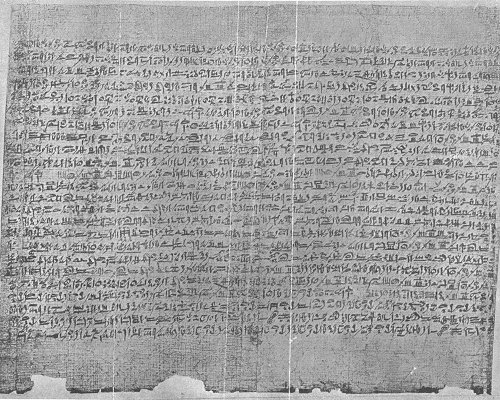
THE HISTORY OF CREATION. (Brit. Mus. Papyrus No 10,188).

The text of the remarkable Legend of the Creation which forms the first section of this volume is preserved in a well-written papyrus in the British Museum, where it bears the number 10,188. This papyrus was acquired by the late Mr. A. H. Rhind in 1861 or 1862, when he was excavating some tombs on the west bank of the Nile at Thebes. He did not himself find it in a tomb, but he received it from the British Consul at Luxor, Mustafa Agha, during an interchange of gifts when Mr. Rhind was leaving the country. Mustafa Agha obtained the papyrus from the famous hiding-place of the Royal Mummies at Der-al-Bahari, with the situation of which he was well acquainted for many years before it became known to the Egyptian Service of Antiquities. When Mr. Rhind came to England, the results of his excavations were examined by Dr. Birch, who, recognising the great value of the papyrus, arranged to publish it in a companion volume to Facsimiles of Two Papyri, but the death of Mr. Rhind in 1865 caused the project to fall through. Mr. Rhind's collection passed into the hands of Mr. David Bremner, and the papyrus, together with many other antiquities, was purchased by the Trustees of the British Museum. In 1880.

Dr. Birch suggested the publication of the papyrus to Dr. Pleyte, the Director of the Egyptian Museum at Leyden. This savant transcribed and translated some passages from the Festival Songs of Isis and Nephthys, which is the first text in it, and these he published in Recueil de Travaux, Paris, tom. iii., pp. 57-64. In 1886 by Dr. Birch's kindness I was allowed to work at the papyrus, and I published transcripts of some important passages and the account of the Creation in the Proceedings of the Society of Biblical Archaeology, 1886-7, pp. 11-26. The Legend of the Creation was considered by Dr. H. Brugsch to be of considerable value for the study of the Egyptian Religion, and encouraged by him 1 I made a full transcript of the papyrus, which was published in Archaeologia, (vol. lii., London, 1891), with transliterations and translations. In 1910 I edited for the Trustees of the British Museum the complete hieratic text with a revised translation. 2

The papyrus is about 16 ft. 8 in. in length, and is 9 in. in width. It contains 21 columns of hieratic text which are written in short lines and are poetical in character, and 12 columns or pages of text written in long lines; the total number of lines is between 930 and 940. The text is written in a small, very black, but neat hand, and may be assigned to a time between the XXVIth Dynasty and the Ptolemaic Period.

The titles, catch-words, rubrics, names of Apep and his fiends, and a few other words, are written in red ink. There are two colophons; in the one we have a date, namely, the "first day of the fourth month of the twelfth year of Pharaoh Alexander, the son of Alexander," i.e., B.C. 311, and in the other the name of the priest who either had the papyrus written, or appropriated it, namely, Nes-Menu, or Nes-Amsu.

The Legend of the Creation is found in the third work which is given in the papyrus, and which is called the "Book of overthrowing Apep, the Enemy of Ra, the Enemy of Un-Nefer" (i.e., Osiris). This work contained a series of spells which were recited during the performance of certain prescribed ceremonies, with the object of preventing storms, and dispersing rain-clouds, and removing any obstacle, animate or inanimate, which could prevent the rising of the sun in the morning, or obscure his light during the day.

The Leader-in Chief of the hosts of darkness was a fiend called Apep who appeared in the sky in the form of a monster serpent, and, marshalling all the fiends of the Tuat, attempted to keep the Sun-god imprisoned in the kingdom of darkness. Right in the midst of the spells which were directed against Apep we find inserted the legend of the Creation, which occurs in no other known Egyptian document (Col. XXVI., l. 21, to Col. XXVII., l. 6). Curiously enough a longer version of the legend is given a little farther on (Col. XXVIII., l. 20, to Col. XXIX., l. 6). Whether the scribe had two copies to work from, and simply inserted both, or whether he copied the short version and added to it as he went along, cannot be said. The legend is entitled: Book of knowing the evolutions of Ra [and of] overthrowing Apep.

This curious "Book" describes the origin not only of heaven, and earth, and all therein, but also of God Himself. In it the name of Apep is not even mentioned, and it is impossible to explain its appearance in the Apep Ritual unless we assume that the whole "Book" was regarded as a spell of the most potent character, the mere recital of which was fraught with deadly effect for Apep and his friends.

The story of the Creation is supposed to be told by the god Neb-er-tcher, This name means the "Lord to the uttermost limit," and the character of the god suggests that the word "limit" refers to time and space, and that he was, in fact, the Everlasting God of the Universe. This god's name occurs in Coptic texts, and then he appears as one who possesses all the attributes which are associated by modern nations with God Almighty. Where and how Neb-er-tcher existed is not said, but it seems as if he was believed to have been an almighty and invisible power which filled all space.

It seems also that a desire arose in him to create the world, and in order to do this he took upon himself the form of the god Khepera, who from first to last was regarded as the Creator, par excellence, among all the gods known to the Egyptians. When this transformation of Neb-er-tcher into Khepera took place the heavens and the earth had not been created, but there seems to have existed a vast mass of water, or world-ocean, called Nu, and it must have been in this that the transformation took place. In this celestial ocean were the germs of all the living things which afterwards took form in heaven and on earth, but they existed in a state of inertness and helplessness.

Out of this ocean Khepera raised himself, and so passed from a state of passiveness and inertness into one of activity. When Khepera raised himself out of the ocean Nu, he found himself in vast empty space, wherein was nothing on which he could stand. The second version of the legend says that Khepera gave being to himself by uttering his own name, and the first version states that he made use of words in providing himself with a place on which to stand. In other words, when Khepera was still a portion of the being of Neb-er-tcher, he spake the word "Khepera," and Khepera came into being. Similarly, when he needed a place whereon to stand, he uttered the name of the thing, or place, on which he wanted to stand, and that thing, or place, came into being.

This spell he seems to have addressed to his heart, or as we should say, will, so that Khepera willed this standing-place to appear, and it did so forthwith. The first version only mentions a heart, but the second also speaks of a heart-soul as assisting Khepera in his first creative acts; and we may assume that he thought out in his heart what manner of thing be wished to create, and then by uttering its name caused his thought to take concrete form. This process of thinking out the existence of things is expressed in Egyptian by words which mean "laying the foundation in the heart."

In arranging his thoughts and their visible forms Khepera was assisted by the goddess Maat, who is usually regarded as the goddess of law, order, and truth, and in late times was held to be the female counterpart of Thoth, "the heart of the god Ra." In this legend, however, she seems to play the part of Wisdom, as described in the Book of Proverbs, 3 for it was by Maat that he "laid the foundation."

Having described the coming into being of Khepera and the place on which he stood, the legend goes on to tell of the means by which the first Egyptian triad, or trinity, came into existence. Khepera had, in some form, union with his own shadow, and so begot offspring, who proceeded from his body under the forms of the gods Shu and Tefnut.

According to a tradition preserved in the Pyramid Texts 4 this event took place at On (Heliopolis), and the old form of the legend ascribes the production of Shu and Tefnut to an act of masturbation.

Originally these gods were the personifications of air and dryness, and liquids respectively; thus with their creation the materials for the construction of the atmosphere and sky came into being. Shu and Tefnut were united, and their offspring were Keb, the Earth-god, and Nut, the Sky-goddess. We have now five gods in existence; Khepera, the creative principle, Shu, the atmosphere, Tefnut, the waters above the heavens, Nut, the Sky-goddess, and Keb, the Earth-god.

Presumably about this time the sun first rose out of the watery abyss of Nu, and shone upon the world and produced day. In early times the sun, or his light, was regarded as a form of Shu.

The gods Keb and Nut were united in an embrace, and the effect of the coming of light was to separate them. As long as the sun shone, i.e., as long as it was day, Nut, the Sky-goddess, remained in her place above the earth, being supported by Shu; but as soon as the sun set she left the sky and gradually descended until she rested on the body of the Earth-god, Keb.

The embraces of Keb caused Nut to bring forth five gods at a birth, namely, Osiris, Horus, Set, Isis, and Nephthys. Osiris and Isis married before their birth, and Isis brought forth a son called Horus; Set and Nephthys also married before their birth, and Nephthys brought forth a son named Anpu (Anubis), though he is not mentioned in the legend. Of these gods Osiris is singled out for special mention in the legend, in which Khepera, speaking as Neb-er-tcher, says that his name is AUSARES, who is the essence of the primeval matter of which he himself is formed.

Thus Osiris was of the same substance as the Great God who created the world according to the Egyptians, and was a reincarnation of his great-grandfather. This portion of the legend helps to explain the views held about Osiris as the great ancestral spirit, who when on earth was a benefactor of mankind, and who when in heaven was the saviour of souls.

The legend speaks of the sun as the Eye of Khepera, or Neb-er-tcher, and refers to some calamity which befell it and extinguished its light.

This calamity may have been simply the coming of night, or eclipses, or storms; but in any case the god made a second Eye, i.e., the Moon, to which he gave some of the splendour of the other Eye, i.e., the Sun, and he gave it a place in his Face, and henceforth it ruled throughout the earth, and had special powers in respect of the production of trees, plants, vegetables, herbs, etc. Thus from the earliest times the moon was associated with the fertility of the earth, especially in connection with the production of abundant crops and successful harvests.

According to the legend, men and women sprang not from the earth, but directly from the body of the god Khepera, or Neb-er-tcher, who placed his members together and then wept tears upon them, and men and women, came into being from the tears which had fallen from his eyes. No special mention is made of the creation of beasts in the legend, but the god says that he created creeping things of all kinds, and among these are probably included the larger quadrupeds.

The men and women, and all the other living creatures which were made at that time, reproduced their species, each in his own way, and so the earth became filled with their descendants which we see at the present time.

Such is the Legend of Creation as it is found in the Papyrus of Nes-Menu. The text of both versions is full of difficult passages, and some readings are corrupt; unfortunately variant versions by which they might be corrected are lacking. The general meaning of the legend in both versions is quite clear, and it throws considerable light on the Egyptian religion.

The Egyptians believed in the existence of God, the Creator and Maintainer of all things, but they thought that the concerns of this world were committed by Him to the superintendence of a series of subordinate spirits or beings called "gods," over whom they believed magical spells and ceremonies to have the greatest influence.

The Deity was a Being so remote, and of such an exalted nature, that it was idle to expect Him to interfere in the affairs of mortals, or to change any decree or command which He had once uttered. The spirits or "gods," on the other hand, possessing natures not far removed from those of men, were thought to be amenable to supplications and flattery, and to wheedling and cajolery, especially when accompanied by gifts.

It is of great interest to find a legend in which the power of God as the Creator of the world and the sun and moon is so clearly set forth, embedded in a book of magical spells devoted to the destruction of the mythological monster who existed solely to prevent the sun from rising and shining.

Footnotes

1 Ein in mlichst wortgetreuer Uebersetzung vorglegter Papyrus-text soll den Schlussstein meines Werkes bilden. Er wird den Beweis f die Richtigkeit meiner eigenen Untersuchungen vollenden, indem er das wichtigste Zeugniss altyptischen Ursprungs den zahlreichen, von mir angezogenen Stellen aus den Inschriften hinzuft. Trotz mancher Schwierigkeit im Einzelnen ist der Gesammtinhalt des Textes, den zuerst ein englischer Gelehrter der Wissenschaft zugglich gemacht hat, such nicht im geringsten misszuverstehen (Brugsch, Religion, p. 740). He gives a German translation of the Creation Legend on pp. 740, 741, and a transliteration on p. 756.
2 Egyptian Hieratic Papyri in the British Museum, London, 1910, folio.
3 The Lord possessed me in the beginning of his way, before his works of old. I was set up from everlasting, from the beginning, or ever the earth was. When there were no depths I was brought forth . . . . . . . Before the mountains were settled, before the hills was I brought forth: while as yet he had not made the earth, nor the fields, nor the highest part of the dust of the world. When he prepared the heavens I was there: when he set a compass upon the face of the depth: when he established the clouds above: when he strengthened the fountains of the deep: when he gave to the sea his decree, . . . . . . . when he appointed the foundations of the earth: then I was by him, as one brought up with him. . . . . . ." Proverbs, viii. 22 ff.
4 Pepi I., l. 466.

Legends of the Gods, Plates

Legends of the Gods

The Egyptian Texts, edited with Translations

by E. A. Wallis Budge

London: Kegan Paul, Trench and Trner & Co. Ltd.

[1912]

LIST OF PLATES AND ILLUSTRATIONS

The History of Creation

I.

Horus holding the Hippopotamus-fiend with chain and spear

II.

Horus spearing the Hippopotamus-fiend

III.

Horus spearing the Hippopotamus-fiend

IV.

Horus and Isis capturing the Hippopotamus fiend

V.

Horus on the back of the Hippopotamus-fiend

VI.

The slaughter of the Hippopotamus-fiend

VII.

Horus of Behutet and Ra-Harmakhis in a shrine

VIII.

Horus of Behutet and Ra-Harmakhis in a shrine

IX.

Ashthertet in her chariot

X.

Horus holding captive foes and spearing Typhonic animals

XI.

Horus spearing human foes

XII.

Horus spearing the crocodile

XIII.

Horus in the form of a lion

XIV.

The Procreation of Horus, son of Isis.

XV.

The Resurrection of Osiris.

XVI.

The Bekhten Stele

XVII.

The Metternich Stele--Obverse

XVIII.

The Metternich Stele--Reverse

Legends of the Gods, Preface

Legends of the Gods

The Egyptian Texts, edited with Translations

by E. A. Wallis Budge

London: Kegan Paul, Trench and Trner & Co. Ltd.

[1912]

PREFACE

The welcome which has been accorded to the volumes of this Series, and the fact that some of them have passed into second and third editions, suggest that these little books have been found useful by beginners in Egyptology and others. Hitherto the object of them has been to supply information about the Religion, Magic, Language, and History of the ancient Egyptians, and to provide editions of the original texts from which such information was derived.

There are, however, many branches of Egyptology which need treatment in a similar manner in this Series, and it has been suggested in many quarters that the time has now arrived when the publication of a series of groups of texts illustrating EGYPTIAN LITERATURE in general might well be begun.

Seeing that nothing is known about the authors of Egyptian works, not even their names, it is impossible to write a History of Egyptian Literature in the ordinary sense of the word. The only thing to be done is to print the actual works in the best and most complete form possible, with translations, and then to put them in the hands of the reader and leave them to his judgment.

With this object in view, it has been decided to publish in the Series several volumes which shall be devoted to the reproduction in hieroglyphic type of the best and most typical examples of the various kinds of EGYPTIAN LITERATURE, with English translations, on a much larger scale than was possible in my "First Steps in Egyptian" or in my "Egyptian Reading Book." These volumes are intended to serve a double purpose, i.e., to supply the beginner in Egyptian with new material and a series of reading books, and to provide the general reader with translations of Egyptian works in a handy form.

The Egyptian texts, whether the originals be written in hieroglyphic or hieratic characters, are here printed in hieroglyphic type, and are arranged with English translations, page for page. They are printed as they are written in the original documents, i.e., the words are not divided.

The beginner will find the practice of dividing the words for himself most useful in acquiring facility of reading and understanding the language. The translations are as literal as can reasonably be expected, and, as a whole, I believe that they mean what the original writers intended to say. In the case of passages where the text is corrupt, and readings are mixed, or where very rare words occur, or where words are omitted, the renderings given claim to be nothing more than suggestions as to their meanings.

It must be remembered that the exact meanings of many Egyptian words have still to be ascertained, and that the ancient Egyptian scribes were as much puzzled as we are by some of the texts which they copied, and that owing to carelessness, ignorance, or weariness, or all three, they made blunders which the modern student is unable to correct. In the Introduction will be found brief descriptions of the contents of the Egyptian texts, in which their general bearing and importance are indicated, and references given to authoritative editions of texts and translations.

E. A. WALLIS BUDGE.

BRITISH MUSEUM, November 17,1911.

The Book of the Dead, Plate 37

THE BOOK OF THE DEAD

The Papyrus of Ani

by

E. A. WALLIS BUDGE

Late keeper of Assyrian and Egyptian Antiquities
in the British Museum

[1895]

PLATE XXXVII.

Vignette: A shrine wherein stands Sekeri-Ausar neb setait neter aa neb Neter-xert Seker-Osiris, lord of the hidden place, the great god, the lord of the underworld.

He wears the white crown with feathers, and holds in his hands the sceptre, flail, and crook.

The goddess Hathor, in the form of a hippopotamus, wearing upon her head a disk and horns; in her right hand she holds an unidentified object, and in her left the emblem of life. Before her are tables of meat and drink offerings and flowers. Behind the hippopotamus, the divine cow, Meh-urit, symbolizing the same goddess, looks out from the funeral mountain, wearing the menat on her neck. At the foot of the mountain is the tomb; and in the foreground grows a group of flowering plants.

Text: [CHAPTER CLXXXVI.] Hathor, lady of Amentet, dweller in the land of Urt, lady of Ta-sert, the Eye of Ra, the dweller in his brow, the beautiful Face in the Boat of Millions of Years. . . . . . . . .

END

The Book of the Dead, Plate 35 - 36

THE BOOK OF THE DEAD

The Papyrus of Ani

by

E. A. WALLIS BUDGE

Late keeper of Assyrian and Egyptian Antiquities
in the British Museum

[1895]

PLATES XXXV. AND XXXVI.

Vignette: A hall, within which, on the left, Ani stands before two tables of offerings bearing libation water and lotus-flowers, with hands raised, adoring Ra, hawk-headed. Next are ranged seven cows, each one couchant before a table of offerings, and each having a menat attached to the neck: and a bull standing before a table of offerings. Behind them are four rudders; and on the extreme right are four triads of gods, each triad having a table of offerings bearing a libation vase and a lotus-flower (?).

Text: [CHAPTER CXLVIII.]. Saith Osiris Ani, triumphant: "Homage to thee, O thou lord, thou lord of right and truth, the One, the lord of eternity and creator of everlastingness, I have come unto thee, O my lord Ra. I have made meat offerings unto the seven kine and unto their bull. O ye who give cakes and ale to the shining ones, grant ye to my soul to be with

you. (6) May Osiris Ani, triumphant, be born upon your thighs; may he be like unto one (7) Of you for ever and for ever; and may he become a glorious being (8) in the beautiful Amenta."

[Address to the Rudders]: " Hail, thou beautiful Power, thou beautiful it rudder of the northern heaven."

"Hail, thou who goest round about heaven, thou pilot of the world, thou beautiful rudder of the western heaven."

"Hail, thou shining one, who livest in the temple wherein are the gods in visible forms, thou beautiful rudder of the eastern heaven."

"Hail, thou who dwellest in the temple of the bright-faced ones, thou it beautiful rudder of the southern heaven."

[Address to the four Triads]: " Hail, ye gods who are above the earth, ye pilots of the underworld."

"Hail, ye mother-gods who are above the earth, who are in the underworld, and who are in the House of Osiris."

"Hail, ye gods, ye pilots of Tasert, ye who are above the earth, ye pilots of the underworld."

"Hail, ye followers of Ra, who are in the train of Osiris."

Vignette: Ani standing before a table of offerings, with both hands raised in adoration. Behind him is his wife, wearing a lotus-flower and a cone upon her head, and holding a sistrum. and lotus-flower in her left hand.

Text: [CHAPTER CLXXXV. (?)] A HYMN OF PRAISE TO OSIRIS THE DWELLER IN AMENTET, UN-NEFER WITHIN ABTU, Osiris Ani, triumphant, saith: Hail, O my lord, who dost traverse eternity, and whose existence endureth for ever. Hail, Lord of Lords, King of Kings, Prince, the God of gods who live with Thee, I have come unto Thee Make thou for me a seat with those who are in the underworld, and who adore the images of thy ka and who are among those who [endure] for millions of millions of years. . . . . . . . May no delay arise for me in Ta-mera. Grant thou that they all may come unto me, great as well as small. Mayest thou grant unto the ka of Osiris Ani [the power] to go into and to come forth from the underworld; and suffer him not to be driven back at the gates of the Tuat."

The Book of the Dead, Plate 34

THE BOOK OF THE DEAD

The Papyrus of Ani

by

E. A. WALLIS BUDGE

Late keeper of Assyrian and Egyptian Antiquities
in the British Museum

[1895]

PLATE XXXIV.

Vignette: The mummy-chamber, arranged as a plan, representing the floor and walls laid flat, in fifteen compartments. In the centre, under a canopy, is place d the bier bearing the mummy of Ani, beside which stands the god Anubis, with hands outstretched over the body. At the foot of the bier kneels the goddess Isis, and at the head the goddess Nephthys, each being accompanied by a flame of fire, which is placed in the compartment immediately behind her. The Tet occupies the compartment immediately above the bier, and the jackal--emblematic of Anubis or Ap-uat--couchant on the tomb, with a sceptre having pendent menats--occupies the compartment below. The four children of Horus, or gods of the cardinal points--Mestha, Hapi, Tuamautef, and Qebhsennuf--stand in the corners of the four adjoining compartments. In each of the two upper and outer compartments is the human-headed bird emblematic of the soul, standing on a pylon, the one on the right being turned to the west or setting sun, the other on the left facing the east or rising sun. In the right lower compartment stands the figure of the Perfected Soul; in the corresponding compartment on the left is a Ushabti figure.

Text [CHAPTER CLI.] [Isis saith:] "I have come to be a protector unto thee. I waft unto thee air for thy nostrils, and the north wind, which cometh forth from the god Tmu, unto thy nose- I have made whole thy lungs. I have made thee to be like unto a god. Thine enemies have fallen beneath thy feet. Thou hast been made victorious in Nut, and thou art mighty to prevail with the gods."

[Nephthys saith:] "I have gone round about to protect thee, brother Osiris; I have come to be a protector unto thee. [My strength shall be behind thee, my strength shall be behind thee, for ever. Ra hath heard thy cry, and the gods have granted that thou shouldst be victorious. Thou art raised up, and thou art victorious over that which hath been done unto thee. Ptah hath thrown down thy foes, and thou art Horus, the son of Hathor.]"

[The flame of Isis saith:] "I protect thee with this flame, and I drive away him (the foe) from the valley of the tomb, and I drive away the sand from thy feet. I embrace Osiris Ani, who is triumphant in peace and in right and truth."

[The flame of Nephthys saith:] "I have come to hew in pieces. I am not hewn in pieces, nor will I suffer thee to be hewn in pieces. I have come to do violence, but I will not let violence be done unto thee, for I am protecting thee."

[The Tet saith:] "I have come quickly, and I have driven back the footsteps of the god whose face is hidden. I have illumined his sanctuary. I stand behind the sacred Tet or, the day of repulsing disaster.[3] I protect thee, O Osiris."

[Mestha saith:] I am Mestha, thy son, O Osiris Ani, triumphant. I have come to protect thee, and I will make thine abode to flourish everlastingly. I have commanded Ptah, even as Ra himself commanded him."

[Hapi saith:] "I am Hapi thy son, O Osiris Ani, triumphant. I have come to protect thee. Thy head and thy limbs are knit together; and I have smitten down thine enemies beneath thee. I have given unto thee thy head for ever and for ever, O Osiris Ani, triumphant in peace."

[Tuamautef saith:] "I am thy beloved son Horus. I have come to avenge thee, O my father Osiris, upon him that did evil unto thee; and I have put him under thy feet for ever, and for ever, and for ever; O Osiris Ani, triumphant in peace."

[Qebhsennuf saith:] "I am thy son, O Osiris Ani, triumphant. I have come to protect thee. I have collected thy bones, and I have gathered together thy members. [I have brought thy heart and I have placed it upon its throne within thy body. I have made thy house to flourish after thee, O thou who livest for ever.]"

[The bird which faceth the setting sun saith]: "Praise be to Ra when he setteth in the western part of heaven. Osiris Ani, triumphant in peace in the underworld, saith: 'I am a perfected soul,'"

[The bird which faceth the rising sun saith]: "Praise be to Ra when he riseth in the eastern part of heaven from Osiris Ani, triumphant."

[The Perfected Soul saith]: "I am a perfected soul in the holy egg of the abtu fish. I am the great cat which dwelleth in the seat of right and truth wherein riseth the god Shu."

[The text near the Ushabti Figure (Chapter VI.) reads]: Osiris Ani, the overseer, triumphant, saith: " Hail, shabti figure! If it be decreed that Osiris [Ani] shall do any of the work which is to be done in the underworld, let all that standeth in the way be removed from before him; whether it be to plough the fields, or to fill the channels with water, or to carry sand from [the East to the West]." The shabti figure replies: "I will do [it]; verily I am here [when] thou callest."

Vignette: Ani, with both hands raised in adoration, standing before a table of offerings; behind him is his wife holding lotus and other flowers in her left hand.

Text: [Chapter CX.] HERE BEGIN THE CHAPTERS OF THE SEKHET-HETEPU, AND THE CHAPTERS OF COMING FORTH BY DAY, AND OF GOING INTO AND OF COMING OUT FROM THE UNDERWORLD, AND OF ARRIVING IN THE SEKHET AANRU, AND OF BEING IN PEACE IN THE GREAT CITY WHEREIN ARE FRESH BREEZES. Let me have power there. Let me become strong to plough there. Let me reap there. Let me eat there. Let me drink there. [Let me woo there.] And let me do all these things there, even as they are done upon earth.

Saith Osiris Ani, triumphant: "Set hath carried away Horus to see what is being built in the Field of Peace, and he spreadeth the air over the divine soul within the egg in its day. He hath delivered the innermost part of the body of Horus from the holy ones of Akert (?).[1] Behold I have sailed in the mighty boat on the Lake of Peace. I, even I, have crowned him in the House of Shu. His starry abode reneweth its youth, reneweth its youth. I have sailed on its Lake that I may come unto its cities, and I have drawn nigh It unto the city Hetep. For behold, I repose at the seasons [of Horus]. I have passed through the region of the company of the gods who are aged and venerable. I have pacified the two holy Fighters who keep ward upon life. I have done that which is right and fair, and I have brought an offering and have pacified the two holy Fighters. I have cut off the hairy scalp of their adversaries, and I have made aft end of the woes which befel [their] children; I have done away all the evil which came against their souls; I have gotten dominion over it, I have knowledge thereof. I have sailed forth on the waters [of the lake] that I may come unto the cities thereof. I have power over my mouth, being furnished [with] charms; let not. [the fiends] get the mastery over me, let them not have dominion over me. May I be equipped in thy Fields of Peace. What thou wishest that shalt thou do, [saith the god]."

Vignette: The Sekhet-hetepet or "Fields of Peace," surrounded and intersected with streams. They contain the following:

(a.) Thoth, the scribe of the gods, holding pen and palette, introduces Ani, who is making an offering, and his ka to three gods who have the heads of a hare, serpent, and bull respectively, and are entitled pauti, " the company of the gods." Ani and a table of offerings in a boat. Ani addressing a hawk standing on a pylon-shaped pedestal, before which are an altar and a god. Three ovals. The legend reads un em hetep sexet nifu er fent, "Being at peace in the Field [of Peace], and having air for the nostrils."

(b.) Ani reaping wheat, with the words asex Ausar, "Osiris reaps"; guiding the oxen treading out the corn; standing with hands and holding the kherp sceptre, and kneeling before two vessels of red barley and wheat. The hieroglyphics seem to mean, "the food of the shining ones." Three ovals.

(c.) Ani ploughing with oxen in a part of the Fields of Peace called "Sekhet-aanre"; with the word sekau, to plough. The two lines of hieroglyphics read:--

re en hete'et atru 1000 em au-f an t'et usex-f an un remu neb am-f an hefau nebt am-f.

Chapter of the River-horse. The river is one thousand [cubits] in its length. Not can be told its width. Not exist fishes any in it, not [exist] serpents any in it.

(d.) A boat bearing a flight of steps and floating on a stream;[1] above is the legend tehefau, (?)~ A boat of eight oars, each end shaped like a serpent's head, bearing a flight of steps; at the stern is written and at the bows meter am Un-nefer, "the god therein is Un-nefer." The stream which flows on the convex side of the small island is called ashet pet, "flood (?) of [heaven]." On the other island is placed a flight of steps, by the side of which is written The space to the left represents the abode of the blessed dead, and is described as:-- duset xu au-sen meh sexef at meh xemt an saku aqeru asexet-sen

The seat of the shining ones. Their length is cubits seven the wheat cubits three the blessed dead who are perfected they reap [it].

The Book of the Dead, Plate 33

THE BOOK OF THE DEAD

The Papyrus of Ani

by

E. A. WALLIS BUDGE

Late keeper of Assyrian and Egyptian Antiquities
in the British Museum

[1895]

PLATE XXXIII.

Vignette: A lake of fire, at each corner of which is seated a dog-headed ape.

Rubric: Osiris Ani, triumphant, is girt about with [fine] raiment, he is shod with white sandals, and he is anointed with very precious anta ointment; and a bull, and herbs, and incense, and ducks, and flowers, and ale, and cakes have been offered unto him. And behold, thou shalt limn upon a clean tile the image of a table of offerings in clean colours, and thou shalt bury it in a field whereon swine have not trampled. If this word then be written upon it, he himself shall rise again, and his children's children shall flourish even as Ra flourisheth without ceasing. He shall dwell in favour in the presence of the king among the chiefs, and cakes and cups of drink and portions of meat shall be given unto him upon the table of the great god. He shall not be thrust from any door in Amentet; he shall travel on together with the kings of the north and of the south, and he shall abide with the followers of Osiris near unto Un-nefer, for ever, and for ever, and for ever.

Vignette: a Tet,

Text: [CHAPTER CLV.] THE CHAPTER OF A TET OF GOLD: Osiris Ani, triumphant, saith: "Thou risest, O still heart! Thou shinest, O still heart! Place thou thyself upon my side. I have come arid I have brought unto thee a tet of gold; rejoice thou in it."

Appendix: In the late recension of this chapter (Lepsius, Todtenbuch, Bl. 75) the rubric is divided into two parts, which read: "To be recited over a Tet of gold inlaid (?) in sycamore wood, and placed on the neck of the shining one; and he shall pass in through the doors of the underworld by the might of the words here spoken. It shall set him in his place on the day of the new year among the followers of Osiris.

"If this chapter be known by the deceased he shall become perfect in the underworld. He shall not be thrust back at the doors of Amentet; cakes and ale and meat offerings shall be offered unto him upon the altars of Ra, or (as some say) of Osiris Un-nefer; and he shall triumph over his foes in the underworld for ever and for ever."

Vignette: A buckle, or tie.

Text: [CHAPTER CLVI.]. THE CHAPTER OF A BUCKLE OF CARNELIAN.[1]

Saith Osiris Ani, triumphant: "The blood of Isis, the charms of Isis, the power of Isis, are a protection unto me, the chief, and they crush that which I abhor."

Appendix: Rubric: This chapter shall be said over a buckle of red jasper (or carnelian) which hath been dipped in water of ankham flowers and inlaid in sycamore wood, and hath been placed on the neck of the shining one. If this chapter be inscribed upon it, it shall become the power of Isis, and it shall protect him; and Horus, the son of Isis, shall rejoice when he seeth it. No way shall be impassable to him, and one hand shall extend unto heaven, and the other unto earth. If this chapter be known [by the deceased] he shall be among those who follow Osiris Un-nefer, triumphant. The gates of the underworld shall be opened unto him, and a homestead shall be given unto him, together with wheat and barley, in the Sekhet-Aaru; and the followers of Horus who reap therein shall proclaim his name as one of the gods who are therein.

Vignette: A heart.

Text: [CHAPTER XXIXB.]. THE CHAPTER OF A HEART OF CARNELIAN. Saith Osiris Ani, triumphant: "I am the Bennu, the soul of Ra, and the guide of the gods into the underworld. The souls come forth upon earth to do the will of their ka's, and the soul of Osiris Ani cometh forth to do the will of his ka."

Vignette: A head-rest.

Text: [CHAPTER CLXVI.] THE CHAPTER OF THE PILLOW WHICH IS PLACED UNDER THE HEAD OF OSIRIS ANI, TRIUMPHANT, TO WARD OFF WOES FROM THE DEAD BODY OF OSIRIS. [Ani saith]: "Lift up thy head to the heavens, for I have knit thee together triumphantly. Ptah hath overthrown his foes and thine; all his enemies have fallen, and they shall never more rise up again, O Osiris."

The Book of the Dead, Plate 32

THE BOOK OF THE DEAD

The Papyrus of Ani

by

E. A. WALLIS BUDGE

Late keeper of Assyrian and Egyptian Antiquities
in the British Museum

[1895]

PLATE XXXII.

"Hail, Tmu in thine hour, who comest forth from Tattu, I have never cursed the king."

"Hail, thou who workest with thy will, who comest forth from Tebu, I have never fouled the water."

"Hail, thou bearer of the sistrum, who comest forth from Nu, I have not spoken scornfully."

"Hail, thou who makest mankind to flourish, who comest forth from Sa, I have never cursed God."

"Flail, Neheb-ka, who comest forth from thy hiding place, I have not stolen."

"Hail, Neheb-nefert, who comest forth from thy hiding place, I have not defrauded the offerings of the gods."

"Hail, thou who dost set in order the head, who comest forth from thy shrine, I have not plundered the offerings to the blessed dead."

"Hail, thou who bringest thy arm, who comest forth from the city of Maati, I have not filched the food of the infant, neither have I sinned against the god of my native town."

"Hail, thou whose teeth are white, why comest forth from Ta-she, I have not slaughtered with evil intent the cattle of the god."

Appendix

The following version of the Negative Confession is given in the Nebseni Papyrus (Naville, Todtenbuch, Bd. I., Bll. 134, 135), showing important variations in the text and in the order in which the gods are addressed.

"Hail, thou whose strides are long, who comest forth from Annu, I have not done iniquity. Hail, thou who art embraced by flame, who comest forth from Kher-aba, I have not robbed with violence. Hail Fenti who comest forth from Khemennu, I have not made any to suffer pain. Hail, Devourer of Shades, who comest forth from [thy] retreat, I have not robbed. Hail, thou whose limbs are terrible to look upon, who comest forth from Restau, I have done no murder. Hail, thou god who art in the form of two lions, who comest forth from heaven, I have not defrauded offerings. Hail, thou god whose two eyes are of fire, who comest forth from Sekhem, I have not done harm. Hail, Fiery god, who comest and goest, I have not robbed God. Hail, Crusher of Bones, who comest forth from Suten-henen, I have told no lies. Hail, thou who shootest thyself forth from the flame, who comest forth from Het-Ptah-ka, I have not snatched away food. Hail, Qerti, who comest forth from Amentet, I have not worked affliction. Hail, thou whose teeth are white, who comest forth from Ta-she, I have not transgressed. Hail, Devourer of blood, who comest forth from the block, I have not slaughtered the cattle which are set apart for the gods. Hail, Devourer of the inward parts, who comest forth from Mabit, I have done no evil. Hail, lord of Right and Truth, who comest forth from Maati, I have not laid waste the ploughed lands. Hail, Strider, who comest forth from Bast, I have not been an eavesdropper. Hail, Aaati, who comest forth from Annu, I have not set my lips in motion against any man. Hail, thou god of two-fold evil, who comest forth from Ati, I have not been angry without a cause. Hail, thou god who art in the likeness of a serpent, who comest forth from the torture-chamber, I have not committed adultery with the wife of any man. Hail, thou who regardest that which is brought before thee, who comest forth from Pa-Amsu, I have not polluted myself Hail, thou mighty Chief, who comest forth from the city of acacia trees, I have not caused terror. Hail, Khemi, who comest forth from Kesui, I have not done that which is abominable. Hail, thou who orderest speech, who comest forth from Urib, I have never uttered fiery words. Hail, thou Babe, who comest forth from the Heq-at nome, I have not stopped my ears against the words of Right and Truth. Hail, thou who orderest speech, who comest forth from Unes, I have not stirred up strife. Hail, Bast, who comest forth from the secret city, I have not caused [any] to weep. Hail, thou whose face is turned behind thee, I have not lusted, nor have I committed fornication, nor have I done any other abominable thing. Hail, Blazing feet, who comest forth from the darkness, I have not avenged myself Hail, Kenemti, who comest forth from Kenemti, I have never worked grief. Hail, thou who bringest thy offering, who comest forth from Sau, I have not acted insolently. Hail, lord of faces, who comest forth from Tchefet, I have never judged hastily. Hail, Sekheriu, who comest forth from Unth, I have not transgressed, nor have I vexed or angered God. Hail, lord of the two horns, who comest forth from Saui, I have not multiplied my speech overmuch. Hail, Nefer-Tmu, who comest forth from Het-Ptah-ka, I have done no harm nor have I done evil. Hail, Tmu in thine hour, who comest forth from Tattu, I have not worked treason. Hail, thou who workest in thy heart, who comest forth from Tebtu, I have never befouled the water. Hail, thou bearer of the sistrum, who comest forth from Nu, I have not spoken scornfully. Hail, thou who dost make mankind to flourish, who comest forth from thy hall, I have not cursed God. Hail, Neheb-nefert, who comest forth from . . . . . . . I have not behaved myself with arrogance (?). Hail, Neheb-kau, who comest forth from thy city, I have not been overweeningly proud. Hail, Tcheser-tep, who comest forth from thy hiding place, I have never magnified my condition beyond what was fitting. Hail, thou who bringest thine arm, who comest forth from Aukert, I have never slighted the god in my town."

In the Nebseni papyrus (Naville, Todtenbuch, Bd. I., Bll. 137, 138), the CXXVth Chapter ends as follows:--

"Homage to you, O ye gods, I know You, and I know your names. Cast me not down to your knives of slaughter, and bring not my wickedness into the presence of the god whom ye follow, and let not the time of my failings come before you. I pray you, declare me right and true in the presence of the universal God, because I have done that which is right and true in Ta-mera; I have not cursed the god . . . . . . .

"Homage to you, O ye gods who live in your hall Of Right and Truth, and who have no evil in your bodies, who feed on your own substance in the presence of Horus who liveth in his disk, deliver ye me from Baabi, who feedeth on the inwards of the mighty ones on the day of the great judgment which shall be holden by you. I have come unto you; I have committed no faults; I have not sinned; I have done no evil; I have accused no man falsely; therefore let nothing be done against me. I live in right and truth, and I feed my heart upon right and truth. That which men have bidden I have done, and the gods are satisfied thereat. I have pacified the god, for I have done his will. I have given bread unto the hungry and water unto those who thirst, clothing unto the naked, and a boat unto the shipwrecked mariner. I have made holy offerings unto the gods; and I have given meals of the tomb to the sainted dead. O, then, deliver ye me, and protect me; accuse me not before the great god. I am pure of mouth, and I am pure of hands. May those who see me say, 'Come in peace, come in peace.' For I have heard the speech which the Ass held with the Cat in the House of Hept-re. I have borne witness before him [the god] and he hath given judgment. I have beheld the dividing of the persea trees within Re-stau. I offer up prayers in the presence of the gods, knowing that which concerneth them. I have come forward to make a declaration of right and truth, and to place the balance upon its supports within the groves of amaranth. Hail, thou who art exalted upon thy resting place, thou lord of the atef crown, who declarest thy name as the lord of the winds, deliver thou me from thine angels of destruction, who make dire deeds to happen and calamities to arise, and who have no covering upon their faces, because I have done right and truth, O thou Lord of right and truth. I am pure, in my fore-parts have I been made clean, and in my hinder parts have I been purified; my reins have been bathed in the Pool of right and truth, and no member of my body was wanting. I have been purified in the pool of the south. I have rested in Hemet, on the north of the field of the grasshoppers, wherein the holy mariners do purify themselves in the night season, that they may pacify (?) the heart of the gods after I have passed over it by night and by day. May the gods say unto me, 'We let him come,' and they say unto me, 'Who art thou, and what is thy name?' My name is 'I grew among the flowers, dwelling in the olive tree.' Then shall they say unto me, 'Pass on straightway.' I have passed by the city on the north of the groves, and the gods say, 'What didst thou see there?' [I saw] the Leg and the Thigh. 'What hadst thou to do with them?' I saw rejoicings in the lands of the Fenkhu. 'What did they give thee?' They gave me a flame of fire together with a crystal tablet. 'What didst thou therewith?' I burned it at the place of Maati together with the things of the night. 'What didst thou find there at the place of Maati?' A sceptre of flint which maketh a man to prevail. 'What then is [the name] of this sceptre of flint?' 'Giver of winds' is its name. 'What then didst thou unto the flame of fire with the tablet of crystal after thou didst bury it?' I uttered words over it, I made adjuration thereby, I quenched the fire, and I used the tablet to create a pool of water. 'Come, then, pass through the door of this Hall of two-fold Maati, for thou knowest us.' 'I will not let thee enter in over me,' saith the bolt of the door, 'unless thou tell my name.' 'Weight of the place of right and truth' is thy name. I will not let thee pass in by me,' saith the right post of the door, 'unless thou tell my name.' 'Weigher of the labours of right and truth' is thy name. 'I will not let thee enter in by me,' saith the left Post of the door, 'unless thou tell my name.' 'judge of wine' (?) is thy name. 'I will not let thee pass,' saith the threshold of the door, unless thou tell my name.' 'Ox of Seb' is thy name. 'I will not open unto thee,' saith the bolt-socket of the door, 'unless thou tell my name.' 'Flesh of his mother' is thy name. I will not open unto thee,' saith the lock of the door, 'unless thou tell my name.' The utchat of Sebek, the Lord of Bakhan, liveth' is thy name. 'I will not open unto thee, and I will not let thee pass over me,' saith the dweller at the door, 'unless thou tell my name.' 'Arm of Shu that placeth itself to protect Osiris' is thy name. 'We will not let thee pass by us,' say the posts of the door, 'unless thou tell our names.' 'Serpent children of Rennut' are your names. 'Thou knowest us, pass thou by us.' 'Thou shalt not tread upon me,' saith the floor of the hall, I unless thou tell my name.' 'I am silent, I am pure.' 'I know not [the names of] thy two feet with which thou wouldst walk upon me; tell them unto me.' '. . . . . before Amsu' is the name of my right foot, 'Grief of Nephthys' is the name Of my left foot. 'Tread thou upon me, for thou knowest me.' 'I will not question thee,' saith the warder of the door of the hall, unless thou tell my name.' 'Discerner of hearts, searcher of reins' is thy name. I will question thee now. Who is the god that liveth in his hour? Say thou.' The teller of the two lands. 'Who then is the teller of the two lands?' It is Thoth. 'Come then,' saith Thoth, 'come hither (?).' And I come forward to the test. 'What, now, is thy condition?' I am pure from all evil, I am shielded from the baleful acts of those who live in their days, and I am not among them. 'I have tried thee. Who is he that goeth down into the fire, the walls whereof are [crowned] with ur, and whose paths are in the lake [of fire]?' He who passeth through it is Osiris. 'Advance thou, in very truth thou hast been tested. Thy bread is in the utchat, thine ale is in the utchat, and meals of the tomb are brought forth unto thee upon earth from the utchat. This hath been decreed for thee.'"

PLATE XXXII. (continued).

Vignette: The god Nu.

Text: The hair of Osiris Ani, triumphant, is the hair of Nu.

Vignette: Ra, hawk-headed, and wearing a disk.

Text: The face of Osiris, the scribe Ani, is the face of Ra.

Vignette: The goddess Hathor, wearing disk and horns.

Text: The eyes of Osiris Ani, triumphant, are the eyes of Hathor.

Vignette: The god Ap-uat and standard.

Text: The ears of Osiris Ani, triumphant, are the ears of Ap-uat.

Vignette: The god Anpu, jackal-headed.

Text: The lips of Osiris Ani, triumphant, are the lips of Anpu.

Vignette: The scorpion Serqet, holding the shen, and ankh.

Text: The teeth of Osiris Ani, triumphant, are the teeth of Serqet.

Vignette: The goddess Isis.

Text: The neck of Osiris Ani, triumphant, is the neck of Isis.

Vignette: The ram-headed god, with urs between the horns.

Text: The hands of Osiris Ani, triumphant, are the hands of the Ram, the lord of Tattu.

Vignette: The god Uatchit, serpent-headed.

Text: The shoulder of Osiris Ani, triumphant, is the shoulder of Uatchit.

Vignette: The goddess Mert, with outstretched hands, standing upon the emblem of gold, and having on her head a cluster of plants.

Text: The throat of Osiris Ani, triumphant, is the. blood of Mert.

Vignette: The goddess Neith.

Text: The fore-arms of Osiris Ani, triumphant, are the fore-arms of the lady of Sais.

Vignette: The god Sut.

Text: The backbone of Osiris Ani, triumphant, is the backbone of Sut.

Vignette: A god.

Text: The chest of Osiris Ani, triumphant, is the chest of the lords of Kher-aba.

Vignette: A god.

Text: The flesh of Osiris Ani, triumphant, is the flesh of the Mighty One of terror.

Vignette: The goddess Sekhet, lion-headed, wearing a disk.

Text: The reins and back of Osiris Ani, triumphant, are the reins and back of Sekhet.

Vignette: An utchat upon a pylon.

Text: The buttocks of Osiris Ani, triumphant, are the buttocks of the Eye of Horus.

Vignette: Osiris, wearing the atef crown and holding the flail and crook.

Text: The privy member of Osiris Ani, triumphant, is the privy member of Osiris.

Vignette: The goddess Nut.

Text: The legs of Osiris Ani, triumphant, are the legs of Nut.

Vignette: The god Ptah.

Text: The feet of Osiris Ani, triumphant, are the feet of Ptah.

Vignette: The star Orion.

Text: (20) The fingers of Osiris Ani, triumphant, are the fingers of Saah (Orion).

Vignette: Three Ur.

Text: The leg-bones of Osiris Ani, triumphant, are the leg-bones of the living ur.

Appendix: The complete version of the XLIInd Chapter of the Book of the Dead, referring to the identification of the body of Osiris with those of the gods, reads as follows[1]:--

[CHAPTER XLII.] THE CHAPTER OF DRIVING BACK SLAUGHTER IN SUTENHENEN. Saith Osiris: "O land of the sceptre! O white crown of the divine Form! O holy resting place! I am the Child. I am the Child. I am the Child. I am the Child. Hail, thou goddess Aburt! Thou sayest daily, 'The slaughter block is made ready as thou knowest, and thou who wert mighty hast been brought to decay.' I establish those who praise me. I am the holy knot within the tamarisk tree, more beautiful in brightness than yesterday." To be said four times. I am Ra who establish those who praise him. I am the knot within the tamarisk tree, more beautiful in brightness than the disk of yesterday. . . . . . . going forth on this. day. My hair is the hair of Nu. My face is the face of Ra. Mine eyes are the eyes of Hathor. Mine ears are the ears of Ap-uat. My nose is the nose of Khent-sheps. My lips are the lips of Anpu. My teeth are the teeth of Khepera. My neck is the neck of Isis, the divine lady. My hands are the hands of Khnemu, the lord of Tattu. My fore-arms are the fore-arms of Neith, the lady of Sa. My backbone is the backbone of Sut. My privy member is the privy member of Osiris. My reins are the reins of the lords of Kher-aba. My breast is the breast of the awful and terrible One. My belly and my backbone are the belly and backbone of Sekhet. My buttocks are the buttocks of the eye of Horus. My hips and thighs are the hips and thighs of Nut. My feet are the feet of Ptah. My fingers and leg-bones arc the fingers and leg-bones of the living ur. There is no member of my body which is not the member of some god. Thoth shieldeth my body altogether, and I am [like] unto Ra every day. None shall seize me by mine arms; none shall drag me away by my hand. And there shall do me hurt neither men, nor gods, nor sainted dead, nor they who have perished, nor any one of those of olden times, nor any mortal, nor human being. I come forth and advance, and my name is unknown. I am yesterday, and my name is 'Seer of millions of years.' I travel, I travel along the path of Horus the judge. I am the lord of eternity; I feel and I have power to perceive. I am the lord of the red crown. I am the Sun's eye, yea, I am in my egg, in my egg. It is granted unto me to live therewith. I am in the Sun's eye, when it closeth, and I live by the strength thereof I come forth and I shine; I enter in and I come to life. I am in the Sun's eye, my seat is on my throne, and I sit thereon within the eye. I am Horus who pass through millions of years. I have governed my throne and I rule it by the words of my mouth; and whether [I] speak or whether [I] keep silence, I keep the balance even. Verily my forms are changed. I am the god Unen, from season unto season; what is mine is within me. I am the only One born of an only One, who goeth round about in his course; I am within the eye of the Sun. Things are not evil nor hostile unto me, nor are they against me. I open the door of heaven. I govern my throne, and I give [new] birth to myself on this day. [I am] not the Child who trod the path of yesterday, but I am 'To-day' for untold nations. It is I who make you strong for millions of years, whether ye be in the heaven, or in the earth, or in the south, or in the north, or in the west or in the east; fear of me is in your hearts. I am the pure one who dwell within the sacred eye. I shall not die again. My hour resteth with you, but my forms are within my dwelling-place. I am he who is unknown, and the gods with rose-bright countenances are with me. I am the unveiled one. The season wherein [the god] created heaven for me and enlarged the bounds of the earth and made great the progeny thereof cannot be found Out. My name setteth itself apart and removeth from all evil things through the words which I speak unto you. I am he who riseth and shineth; the wall of walls; the only One, [son] of an only One. Ra never lacketh his form, he never passeth away, he never passeth away. Verily, I say: I am the plant which cometh forth from Nu, and my mother is Nut. Hail, O my Creator, I am he who hath no power to walk, the great knot within yesterday. My power is in my hand. I am not known, [but] I am he who knoweth thee. I cannot be held with the hand, but I am he who can hold thee in his hand. [Hail] O Egg! [Hail] O Egg! I am Horns who live for millions of years, whose flame lighteth upon your faces and blazeth in your hearts. I have the command of my throne, and I advance in mine hour. I have opened the paths, I have turned myself away from all evil. I am the ape of gold, three palms and two fingers [high], which is without legs and without arms, and which dwelleth in the House of Ptah. I go forth even as goeth forth the ape Of gold three palms and two fingers [high], which hath neither legs nor arms, and which dw

The Book of the Dead, Plate 31

THE BOOK OF THE DEAD

The Papyrus of Ani

by

E. A. WALLIS BUDGE

Late keeper of Assyrian and Egyptian Antiquities
in the British Museum

[1895]

PLATE XXXI.

Vignettes: The Hall of Double Right and Truth, wherein Ani has to address severally the forty-two gods, who are seated in a row in the middle of the, hall. At each end is a door that on the right is called "Neb-Maat-heri-tep-retui-f" and that on the left "Neb-pehti-thesu-menment." On the centre of the roof, which is crowned with a series of ur and feathers emblematic of Maat, is a seated deity with hands extended, the right over the eye of Horus and the left over a pool (see the Vignette of Plate VIII. above, p. 278). On the right, at the end of the hall (Plate XXXII.), are four small vignettes, in which are depicted: Two seated figures of the goddess Maat, with emblematic of Right and Truth, on the head, and sceptres and emblems of life in the right and left hands. Osiris, seated, wearing the atef crown, and holding in his hands the crook and flail. Before him, by the side of an altar of offerings, stands Ani, with both hands raised in adoration. A balance with the heart, symbolizing the conscience of Ani, in one scale, and emblematic of Right and Truth, in the other. Beside the balance is the tri-formed monster Amemit. Thoth, ibis-headed, seated on a pylon-shaped pedestal, painting a large feather of Maat.

Text: [THE NEGATIVE CONFESSION.]

Ani saith: "Hail, thou whose strides are long, who comest forth from Annu, I have not done iniquity."

"Hail, thou who art embraced by flame, who comest forth from Kheraba, I have not robbed with violence."

"Hail, Fentiu, who comest forth from Khemennu, I have not stolen."

"Hail, Devourer of the Shade, who comest forth from Qernet, I have done no murder; I have done no harm."

"Hail, Nehau, who comest forth from Re-stau, I have not defrauded offerings."

"Hail, god in the form of two lions, who comest forth from heaven, I have not minished oblations."

"Hail, thou whose eyes are of fire, who comest forth from Saut, I have not plundered the god."

"Hail, thou Flame, which comest and goest, I have spoken no lies."

"Hail, Crusher of bones, who comest forth from Suten-henen, I have not snatched away food."

"Hail, thou who shootest forth the Flame, who comest forth from Het-Ptah-ka, I have not caused pain."

"Hall, Qerer, who comest forth from Amentet, I have not committed fornication."

"Hail, thou whose face is turned back, who comest forth from thy hiding place, I have not caused shedding of tears."

"Hail, Bast, who comest forth from the secret place, I have not dealt deceitfully."

"Hail, thou whose legs are of fire, who comest forth out of the darkness, I have not transgressed."

"Hail, Devourer of Blood, who comest forth from the block of slaughter, I have not acted guilefully."

"Hail, Devourer of the inward parts, who comest forth from Mabet, I have not laid waste the ploughed land."

"Hail, Lord of Right and Truth, who comest forth from the city of Right and Truth, I have not been an eavesdropper."

"Hail, thou who dost stride backwards, who comest forth from the city of Bast, I have not set my lips in motion [against any man]."

(19) "Hail, Sertiu, who comest forth from Annu, I have not been angry and wrathful except for a just cause."

"Hail, thou. being of two-fold wickedness, who comest forth from Ati (?) I have not defiled the wife of any man."

"Hail, thou two-headed serpent, who comest forth from the torture-chamber, I have not defiled the wife of any man."

"Hail, thou who dost regard what is brought unto thee, who comest forth from Pa-Amsu, I have not polluted myself."

"Hail, thou Chief of the mighty, who comest forth from Amentet, I have not caused terror."

"Hail, thou Destroyer, who comest forth from Kesiu, I have not transgressed."

"Hail, thou who orderest speech, who comest forth from Urit, I have not burned with rage."

"Hail, thou Babe, who comest forth from Uab, I have not stopped my ears against the words of Right and Truth."

"Hail, Kenemti, who comest forth from Kenemet, I have not worked grief"

"Hail, thou who bringest thy offering, I have not acted with insolence."

"Hail, thou who orderest speech, who comest forth from Unaset, I have not stirred up strife."

"Hail, Lord of faces, who comest forth from Netchfet, I have not judged hastily."

"Hail, Sekheriu, who comest forth from Utten, I have not been an eavesdropper."

"Hail, Lord of the two horns, who comest forth from Sa, I have not multiplied words exceedingly."

"Hail, Nefer-Tmu, who comest forth from Het-Ptah-ka, I have done neither harm nor ill."

The Book of the Dead, Plate 29 - 30

THE BOOK OF THE DEAD

The Papyrus of Ani

by

E. A. WALLIS BUDGE

Late keeper of Assyrian and Egyptian Antiquities
in the British Museum

[1895]

PLATES XXIX. AND XXX.

Vignette (PLATE XXIX.): Ani and his wife standing with hands raised in adoration before the god Thoth, who has ankh, "life," upon his knees, and is seated on a pylon-shaped throne.

Text [CHAPTER CLXXV.]: THE CHAPTER OF NOT DYING A SECOND TIME. Saith Osiris Ani, triumphant: " Hail, Thoth! What is it that hath happened unto the holy children of Nut? They have done battle, they have upheld strife, they have done evil, they have created the fiends, they have made slaughter, they have caused trouble; in truth, in all their doings the mighty have worked against the weak. Grant, O might of Thoth, that that which the god Tmu hath decreed [may be done]! And thou regardest not evil, nor art thou provoked to anger when they bring their years to confusion and throng in and push to disturb their months; for in all that they have done unto thee they have worked iniquity in secret. I am thy writing palette, O Thoth, and I have brought unto thee thine ink jar. I am not of those who work iniquity in their secret places; let not evil happen unto me."

Saith Osiris, the scribe Ani: "Hail, Tmu! What manner [of land] is this into which I have come? It hath not water, it hath not air; it is deep unfathomable, it is black as the blackest night, and men wander helplessly therein. In it a man may not live in quietness of heart; nor may the longings of love be satisfied therein. But let the state of the shining ones be given unto me for water and for air and for the satisfying of the longings of love, and let quietness of heart be given unto me for bread and for ale. The god Tmu hath decreed that I shall see his face, and that I shall not suffer from the things which pain him. May the gods hand on their thrones for millions of years. Thy throne hath descended unto thy son Horus. The god Tmu hath decreed that his course shall be among the holy princes. In truth, he shall rule over thy throne, and he shall be heir of the throne of the dweller in the Lake of Fire. It hath been decreed that in me he shall see his likeness, and that my face shall look upon the lord Tmu. How long then have I to live? It is decreed that thou shalt live for millions of millions of years, a life of millions of years. May it be granted that I pass on unto the holy princes, for I am doing away with all that I did when this earth came into being from Nu, and when it sprang from the watery abyss even as it was in the days of old. I am Fate (?) and Osiris, and I have changed my form into the likeness of divers serpents. Man knoweth not, and the gods cannot see, the two-fold beauty which I have made for Osiris, who is greater than all the gods. I have granted that he [shall rule] in the mount of the dead. Verily his son Horus is seated upon the throne of the dweller in the double Lake of Fire, as his heir. I have set his throne in the boat of millions of years. Horus is established upon his throne, amid the friends [of Osiris] and all that belonged unto him. Verily the soul of Sut, which is greater than all the gods, hath departed to [Amenta]. May it be granted that I bind his soul in the divine boat at my will . . . . . . . . . O my Osiris, thou hast done for me that which thy father Ra did for thee. May I abide upon the earth lastingly; may I keep possession of my throne; may my heir be strong; may my tomb and my friends who are upon earth flourish; may my enemies be given over to destruction and to the shackles of the goddess Serq! I am thy son, and Ra is my father. For me likewise hast thou made life, strength and health. Horus is established upon his throne. Grant that the days of my life may come unto worship and honour."

Appendix

From the fragmentary copy of this chapter which M. Naville has published in his Todtenbuch, Bd. L, Bll. 198, 199, it is clear that the text given in the papyrus of Ani forms only about one-half of it, and that its contents refer to the glorious state of the deceased, who lives again in the form of Horus. He enters among the revered dead; shouts of joy ascend in Suten-henen, and gladness reigns in Naarutef he hath inherited the throne of Osiris, and ruleth the whole earth, and the company of the gods are content thereat; the god Sut feareth him; all sorts and conditions of men both dead and living come before him, and bow down in homage when they behold him; the god hath made all to fear him; Sut cometh unto him with head bent low to the earth; the deceased breaketh and turneth up the earth in blood in Suten-henen; (compare Chap. XVIII., G); his name shall endure for millions of millions of years; his name shall abide in Suten-henen, and he shall wear the mighty atef crown upon his head for millions, and hundreds of thousands, and tens of thousands, and thousands, and hundreds, and tens of years; bread, ale, oxen, wild fowl, all good and pure things and fresh water from the river shall in abundance be offered unto him, etc. From the concluding lines we find that the chapter was to be recited over a figure of the god Horus made of lapis-lazuli, which was to be placed near the neck of the deceased, and which was supposed to give him power upon earth with men, gods, and the shining spirits; the effect upon him would, moreover, be exceedingly beneficial if it were recited in the underworld.

Vignette I. (PLATE XXX.): The god Osiris, bearded and wearing the id white crown, stands in a shrine the roof of which is surmounted by a hawk's head and ur; at the back of his neck hangs the menat (see above p. 245), and in his hands he holds the crook, sceptre, and flail, emblems of royalty, power, and dominion. Behind him stands the goddess Isis, who rests her right hand upon his right shoulder; in her left hand she holds the sign of life. Before Osiris, upon a lotus flower, stand the four children of Horus, the gods of the cardinal points, Mestha, Hapi, Tuamautef, and Qebhsennuf.

Vignette II. (PLATE XXIX.): Ani and his wife Thuthu standing, with hands raised in adoration to Osiris, before a table of offerings.

Text [CHAPTER CXXV.]: THE CHAPTER OF ENTERING INTO THE HALL OF DOUBLE RIGHT AND TRUTH: A HYMN OF PRAISE TO OSIRIS, THE DWELLER IN AMENTET. Osiris, the scribe Ani, triumphant, saith: "I have come and I have drawn nigh to see thy beauties; my two hands are raised in adoration of thy name Right and Truth. I have drawn nigh unto the place where the acacia tree groweth not, where the tree thick with leaves existeth not, and where the ground yieldeth neither herb nor grass. And I have entered in unto the place of secret and hidden things, 1 have held converse with the god Sut . . . . . . . Osiris, the scribe Ani, hath entered into the House of Osiris, and he hath seen the hidden and secret things which are therein. The holy rulers of the pylons are in the form of shining ones. Anubis spake unto him with the speech of man when he came from Ta-mera, saying, 'He knoweth our paths and our cities, I have been pacified, and the smell of him is to me even as the smell of one of you.'"

Ani saith unto him: "I am Osiris, the scribe Ani, triumphant in peace, triumphant! I have drawn nigh to behold the great gods, and I feed upon the meals of sacrifice whereon their kas feed. I have been to the boundaries [of the lands] of the Ram, the lord of Tattu, and he hath granted that I may come forth as a bennu bird and that I may have the power of speech. I have passed through the river-flood. I have made offerings with incense. I have made my way by the side of the thick-leaved tree of the children (?). I have been in Abtu in the House of Satet. I have flooded and I have sunk the boat of my enemies. I have sailed forth upon the Lake in the neshem boat. I have seen the noble ones of Kam-ur. I have been in Tattu, and I have constrained myself to silence. I have set the divine Form upon his two feet. I have been with the god Pa-tep-tu-f, and I have seen the dweller in the Holy Temple. I have entered into the House Of Osiris, and I have arrayed myself in the apparel of him who is therein. I have entered into Re-stau, and I have beheld the hidden things which are therein. I have been swathed, but I found for myself a thoroughfare. I have entered into An-aarut-f, and I have clothed my body with the apparel which is therein. The antu unguent of women hath been given unto me . . . . . . . . Verily, Sut spake unto me the things which concern himself, and I said, I Let the thought of the trial of the balance by thee be even within our hearts.'"

The majesty of the god Anubis saith: "Dost thou know the name of this door to declare it unto me?" Osiris, the scribe Ani, triumphant, triumphant in peace, saith: "'Driven away of Shu' is the name of this door." Saith the majesty of the god Anubis: "Dost thou know the name of the upper leaf and of the lower leaf thereof?" [Osiris, the scribe Ani, triumphant in peace saith]:"' Lord of right and truth, [standing] upon his 'two feet' is the name of the upper leaf, and 'Lord of might and power, dispenser of cattle' [is the name of the lower leaf]." [The majesty of the god Anubis saith]: "Pass thou, for thou knowest [the names], O Osiris, the scribe, teller of the divine offerings of all the gods of Thebes, Ani, triumphant, lord to be revered."

Appendix: The usual introduction to the CXXVth Chapter reads (see Naville, Todtenbuch, Bd. I., Bl. 133) as follows:--

I. THE FOLLOWING SHALL BE SAID BY A MAN WHEN HE COMETH UNTO THE HALL OF DOUBLE RIGHT AND TRUTH, WHEREIN HE IS PURGED OF ALL THE SINS WHICH HE HATH DONE, AND WHEREIN HE SEETH THE FACES OF ALL THE GODS: Hail to thee, great god, the lord of Right and Truth! I have come unto thee, O my lord, and I have drawn nigh that I may look upon thy beauties. I know thee, and I know the names of the forty-two gods who dwell with thee in this Hall of Double Right and Truth, and that they may set the sinners in the gives, who live and who feed upon their blood on the day when the natures of men are accounted before Un-neferu.

Subscribe to this RSS feed

Log in or create an account