log in
Website Items

Website Items (1257)

Children categories

The Book of the Bee

The Book of the Bee (19)

THE BOOK OF THE BEE

THE SYRIAC TEXT

EDITED FROM THE MANUSCRIPTS IN LONDON, OXFORD, AND MUNICH

WITH AN ENGLISH TRANSLATION

BY ERNEST A. WALLIS BUDGE, M.A.

LATE SCHOLAR OF CHRIST'S COLLEGE, CAMBRIDGE, AND TYRWHITT SCHOLAR ASSISTANT IN THE DEPARTMENT OF EGYPTIAN AND ASSYRIAN ANTIQUITIES, BRITISH MUSEUM

OXFORD AT THE CLARENDON PRESS 1886.


View items...
The Book of the Cave of Treasures

The Book of the Cave of Treasures (32)

THE BOOK OF THE CAVE OF TREASURES

A HISTORY OF THE PATRIARCHS AND THE KINGS
THEIR SUCCESSORS FROM THE CREATION
TO THE CRUCIFIXION OF CHRIST

TRANSLATED FROM THE SYRIAC TEXT OF THE
BRITISH MUSEUM MS. ADD. 25875

BY

SIR E. A. WALLIS BUDGE, KT.

M.A., LITT.D. (CAMBRIDGE), M.A., D.LITT. (OXFORD),
D.LIT. (DURHAM), F.S.A.
SOMETIME KEEPER OF EGYPTIAN AND ASSYIRIAN ANTIQUITIES, BRITISH MUSEUM;
CORRESPONDING MEMBER OF THE ACADEMY OF SCIENCES, LISBON; AND
CORRESPONDING MEMBER OF THE PHILOSOPHICAL SOCIETY OF AMERICA
With 16 plates and 8 illustrations in the text

LONDON
THE RELIGIOUS TRACT SOCIETY

MANCHESTER, MADRID, LISBON, BUDAPEST

1927


Front piece

Imdugud, in Imgig, the lion-headed eagle of Ningirsu, the great god of Lagash

cave-00-front

Sumerian relief in copper on wood representing Imdugud, or Imgig, the lion-headed eagle of Ningirsu, the great god of Lagash, grasping two stags by their tails. It is probable that it was originally placed over the door of the temple of Nin-khursag or Damgalnun at the head of the stairway leading on to the temple platform. This remarkable monument was made about 3100 B.C., and was discovered by Dr. H. R. Hall in 1919 at Tall al-`Ub, a sanctuary at "Ur of the Chaldees" in Lower Babylonia. It is now in the British Museum (No. 114308).


View items...
The Book of Enoch

The Book of Enoch (6)

The Book of Enoch

 A page of the Book of Enoch

enoch-index

A page of the Ethiopic text of the "Book of Enoch" (British Museum MS. Orient. No. 485, Fol. 83b) containing a description of one of Enoch's visits to heaven, and how the archangel Michael took him by the hand and showed him the mysteries of heaven.


From The Apocrypha and Pseudepigrapha of the Old Testament R.H. Charles Oxford: The Clarendon Press


View items...
The Forgotten Books of Eden

The Forgotten Books of Eden (34)

THE FORGOTTEN BOOKS OF EDEN

 Translated in the late 1800's

by

Dr. S. C. Malan and Dr. E. Trumpp.

Translated into King James English from both the Arabic version and the Ethiopic version which was then published in The Forgotten Books of Eden in 1927 by The World Publishing Company.

In 1995, the text was extracted from a copy of The Forgotten Books of Eden and converted to electronic form by Dennis Hawkins.


View items...
The Book of Jasher

The Book of Jasher (93)

The Book of Jasher

Referred to in Joshua and Second Samuel

Faithfully Translated

FROM THE ORIGINAL HEBREW INTO ENGLISH

SALT LAKE CITY: PUBLISHED BY J.H. PARRY & COMPANY 1887.


NOTE : According to some sources, this book was once the original start of the Bible. Originally translated from Hebrew in A.D. 800, "The Book of Jasher" was suppressed, then rediscovered in 1829 when it was once again suppressed. Reemerged again, in his preface Alcuin writes the reference to Jasher in 2 Samuel authenticates this book .

The root of the first book of Jasher must be written BEFORE the time of Joshua and Samuel in the Bible because both books refers to the book of Jasher.

"Is not this written in the Book of Jasher?"--Joshua, 10,13.

"Behold it is written in the Book of Jasher."--II. Samuel, 1,18


View items...
The Book of Jubilees

The Book of Jubilees (1030)

The Book of Jubilees

From The Apocrypha and Pseudepigrapha of the Old Testament

by R.H. Charles, Oxford: Clarendon Press,

1913.

Scanned and Edited by Joshua Williams, Northwest Nazarene College.


A page of the Book of Jubilees

jubilees-main

A page of the Ethiopic version of the apocryphal work known to ecclesiastical writers as the "Lesser Genesis," and the "Apocalypse of Moses" (British Museum MS. Orient. No. 485, Fol. 83b). Because each of the periods of time described in the book contains forty-nine to fifty years, the Ethiopians called it MAZHAFA K i.e. the "Book of Jubilees." The passage here reproducted describes the tale of Joseph in the 17th year of his age, his going down to Egypt, and his life in that country.


 See the video about Jubilees in 20 parts:

{youtube}Kq_0-D5UnxM{/youtube}
View items...
The Kebra Nagast

The Kebra Nagast (25)

The QUEEN of SHEBA
AND HER ONLY SON
MENYELEK

being

THE 'BOOK OF THE GLORY OF KINGS'

(KEBRA NAGAST)

A WORK WHICH IS ALIKE THE TRADITIONAL HISTORY OF THE ESTABLISH- MENT OF THE RELIGION OF THE HEBREWS IN ETHIOPIA, AND THE PATENT OF SOVEREIGNTY WHICH IS NOW UNIVERSALLY ACCEPTED IN ABYSSINIA AS THE SYMBOL OF THE DIVINE AUTHORITY TO RULE WHICH THE KINGS OF THE SOLOMONIC LINE CLAIMED TO HAVE RECEIVED THROUGH THEIR DESCENT FROM THE HOUSE OF DAVID

Translated from the Ethiopic

by SIR E. A. WALLIS BUDGE M.A., LITT.D., D.LITT., LIT.D. F.S.A.

Sometime Scholar of Christ's College, Cambridge Tyrwhitt Hebrew Scholar, and Keeper of the Department of Egyptian and Assyrian Antiqui- ties in the British Museum.

WITH THIRTY-TWO PLATES

MCMXXXII

OXFORD UNIVERSITY PRESS LONDON : HUMPHREY MILFORD

{Reduced to HTML by Christopher M. Weimer, September 2002}

 
View items...
The Book of Abraham

The Book of Abraham (10)

THE BOOK OF ABRAHAM

ITS AUTHENTICITY ESTABLISHED AS A DIVINE AND ANCIENT RECORD

WITH COPIOUS REFERENCES TO ANCIENT AND MODERN AUTHORITIES

BY ELDER GEO. REYNOLDS.

1879 SALT LAKE CITY, UTAH

DESERET NEWS PRINTING AND PUBLISHING ESTABLISHMENT.


View items...
The Writings of Abraham

The Writings of Abraham (2)

The Writings of Abraham

from the papyri found in Egypt 1831


View items...

Dante's Universe

THE BOOK OF EARTHS

By

EDNA KENTON

New York: William Morrow & Company

[1928, No renewal]


Dante's Universe

COLUMBUS WAS OF GENOA a century after Dante had died at Florence. Probably he had never read his countryman's Divina Commedia; even if he had, he might have seen little of value or significance in Dante's cosmology. Dante had one, however, and his scheme brought back into modern times, that most ancient of the figures of Earth, the hills of the gods, the antipodal mountains.

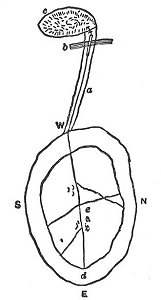
But, in Dante's Earth-figure also, as in Columbus's, the mountains have shifted. If Columbus, for some strange reason--and his reason is not at all clear--had put his mountain of Paradise at the western end of the Earth, Dante's two mountains give a still odder figure. In his Paradise Found, Dr. Warren has worked out this construction of Dante's Earth, showing that the Mountain of Paradise has slipped all of 30 below the equator. He bases this construction mainly on a few lines regarding the location of the Mountain of Purgatory (Purgatorio, Canto iv, 67-70): "Zion stands with this mountain in such wise on the earth that both have a single horison and diverse hemispheres;" and he adds: ". . . no careful reader of the Divina Commedia can fail to see that its 'Mount Zion' and the Purgatorial Montagna malagevole altissima et cinta de mareare simply unrecognised 'survivals' of prehistoric thought--antipodal world-mountains once situate at the poles, but here relocated to suit the demands of sacred medial geography. They are the Su-Meru and Ku-Meru of India figuring in Christian poetry."
FIGURE 90. <i>The Earth of Dante</i>.<br> <i>a</i>. City of Jerusalem. <i>b</i>. Mountain of Purgatory. <i>c</i>. Inferno within the Earth.<br> (From <i>Paradise Found</i>; William Fairfield Warren, 1885.)
FIGURE 90. The Earth of Dante.
a. City of Jerusalem. b. Mountain of Purgatory. c. Inferno within the Earth.
(From Paradise Found; William Fairfield Warren, 1885.)Another construction of Dante's universe is given (Fig. 91), from Studies in the History and Method of Science, edited by Charles Singer. It is Caetani's diagram of Dante's Hell, Purgatory, Earthly Paradise and the nine Heavens. Dante describes Hell as a funnel or inverted cone descending in nine diminishing whorls through the hemisphere until the centre is reached, which is also the centre of the universe, and is situated just under Jerusalem, the centre of the habitable Earth. Or, according to Caetani, he pictures it as a circular mountain, cone-like. Purgatory, Dante places at the antipodes, that is, on an island in the ocean of the uninhabitable Earth.

FIGURE 91. <i>Dante's Scheme of the Universe</i>.<br> Slightly modified from Michelangelo Caetani, duca di Sermoneta, <i>La materia della Divina Commedia di Dante Alighieri dichiarata in Vi tavole, Monte Cassino, 1855</i>.<br> (From <i>Studies in the History and Method of Science</i>, ed. by Charles Singer, 1917, Vol. I, Fig. 4.)
FIGURE 91. Dante's Scheme of the Universe.
Slightly modified from Michelangelo Caetani, duca di Sermoneta, La materia della Divina Commedia di Dante Alighieri dichiarata in Vi tavole, Monte Cassino, 1855.
(From Studies in the History and Method of Science, ed. by Charles Singer, 1917, Vol. I, Fig. 4.)From this island springs a mountain ascending in a series of stages up to the summit on which is Eden, the Earthly Paradise, home of the First Pair. Paradise includes all the spheres of heaven, through all of which Dante ascends, finding himself always on the planet that governs each sphere, until at last the Empyrean Paradise is attained, which crowns the universe.

Two regions, of air and of fire, must be crossed before the sphere of the Moon, the first star, which bounds the region of fire, is reached; and on the lower right-hand quarter of Earth is the dark forest in which Dante spent a night before he began, or in which he began, his journey. At its end he is at the foot of a hill, confronting three great beasts, from whom he is rescued by Virgil, who is to be his guide through Hell and Purgatory. The poets enter the Inferno at twilight--a world of eternal night whose ruler is the Moon. They go through the ten Pits until in the very centre of the Earth they see Lucifer, its king, at this centre of gravity, encased in eternal ice.

The passage through the centre of Earth is one of the greatest difficulty, and above it is ocean only, except for the Island of Purgatory. This division of land and water is explained to Dante thus: When Lucifer fell, all the land which existed in the mysterious hemisphere fell with him, and "fled for fear of him" escaping in what way it might around the globe, settling finally in the inhabited hemisphere. It is possible that the Earth in the interior fled also, but in the opposite direction, to form an island of land in the Purgatorial hemisphere. But, between land and land, there was left an empty space, and up this space they might climb to the island of refuge. Then comes the ascent of the stages of Purgatory to Paradise, and the flight through the heavenly spheres, until at last from the Heaven of the Stars the universe lies spread out under their feet, and Dante sees below him the purgatorial Earth, heart of the cosmos, "small and round as a threshing floor."


The Earth of Columbus

THE BOOK OF EARTHS

By

EDNA KENTON

New York: William Morrow & Company

[1928, No renewal]


The Earth of Columbus

IT IS ONE OF THE LITTLE IRONIES of life that the man who more than any other popularised the notion that the Earth was "shaped like a ball," himself believed it was shaped like a pear. Privately Columbus affirmed that the Earth was pear-shaped. We find this in his letters, and in the writings of his contemporaries. One of these latter, Pietro Martire, who accompanied Columbus on the voyage of 1498, in his Decades of the newe worldepublished in 1555, said that "the Admirall" declared such things, "the which because they seeme contrarye to the oppinions of all the Astronomers, I wyll touche them but with a drye foote as sayeth the Evidencerbe. . . .
FIGURE 89. <i>The pear-shaped Earth of Columbus</i>.<br> (From <i>Paradise Found</i>; William Fairfield Warren, 1885.)
FIGURE 89. The pear-shaped Earth of Columbus.
(From Paradise Found; William Fairfield Warren, 1885.)For he sayeth, that he . . . conjectured, that the earth is not perfectly rownde; But that when it was created, there was a certeyne heape reysed theron, much hygher than the other partes of the same. So that (as he saith), it is not rownde after the form of an apple or a bal (as others thynke) but rather lyke a peare as it hangeth on the tree. And that Pariais the Region which possesseth the super-eminente or hyghest parte thereof nerest unto heaven. In soo muche that he earnestly contendeth, the earthly Paradise to bee situate in the toppes of those three hylles, which wee sayde before, that the watche man sawe owte of the toppe castell of the shippe: And that the outragious streames of the freshe waters which soo violently issewe out of the sayde goulfes and stryve soo with the salte water, faule head-longe from the toppes of the sayde mountaynes."

Columbus himself, in a letter to Ferdinand and Isabella regarding his third voyage, wrote: 1

"I have always read that the world comprising the land and water was spherical, and the recorded experiences of Ptolemy and all the others have Evidenced this by the eclipses of the moon and other observations made from East to West, as well as the elevation of the Pole from North to South. But as I have already described, I have now seen so much irregularity that I have come to another conclusion respecting the Earth, namely, that it is not round, as they describe, but of the form of a pear, which is very round except where the stalk grows, at which part it is most prominent; or like a round ball, upon part of which is a prominence like a woman's nipple, this protrusion being the highest and nearest the sky, situated under the equinoctial line, and at the eastern extremity of this sea. [He is in the Gulf of Paria, to the north or the north-west of the mouth of the Orinoco.] . . . Ptolemy and the other philosophers who have written upon the globe thought that it was spherical; . . . but this western half of the world, I maintain, is like half a very round pear, having a raised projection for the stalk, as I have already described."

When Columbus wrote this letter to his royal helpers, he supposed himself to be in Asia's easternmost waters, but he was really in the northern part of South America, which he himself went on to describe as the Paradise of the Earth or the Mountain of the World. But the World Mountain of Columbus had dropped from its northern quarter to the western.


Footnotes

208:1 Select Letters of Columbus: Hakluyt Soc. Pub., and ed. pp. 134-138.

Maps of the Earth

THE BOOK OF EARTHS

By

EDNA KENTON

New York: William Morrow & Company

[1928, No renewal]


Maps of the Earth

THE SPANISH PRIEST BEATUS who in the year 798 died in a Benedictine convent in the Asturias, is recognised as the original draughtsman of a remarkable world-map lost except for "copies," ten of which are known to-day. This map-group is known as the Beatus Maps; they all appeared between the tenth and the thirteenth centuries, and obviously derive from one common source, but the source-map has disappeared completely.

It came out originally in Beatus's Commentary on the Apocalypse, about 776, and its aim was, probably, to portray the spread of the Christian faith over the Earth, after the analogy of the world and the kingdom of heaven to a field sown with seed. It was divided into parts or fields, each ruled over by one of the Apostles, whose locality was more or less fixed by tradition, and who was at once the sower of the seed, the tiller of the field, and the reaper of the harvest.

The Osma Beatus map (Plate XXXIV ), although one of the latest (1203), is regarded as one which is in many of its important features most like its prototype. It gives, for instance, alone of all the copies, the pictures of the Twelve Apostles in the regions over which they ruled. It also gives a realistic picture of the inhabitants of the Southern continent or Antichthones, still unknown--those monstrous beings known as Skiapodes or Shadow-footed men, who must always lie or sit in such fashion that their great feet were as umbrellas shading them from the otherwise deadly Sun.
FIGURE 83. <i>Monsters of the Antipodes</i>.<br> (From <i>Margarita philosophica</i>, 1517.)
FIGURE 83. Monsters of the Antipodes.
(From Margarita philosophica, 1517.)There were other fabulous races of this austral land; one whose huge lips, instead of feet, protected them from the scorching fire of the Sun; another whose heads had sunk to a plane almost level with their shoulders; and still another whose heads had sunk quite below the shoulders and had become absorbed in the trunk of the body. There were Dog-headed men; Ape-headed men; men without ears; men without tongues; men without noses; men without mouths, or with mouths so small that they sucked their food with great difficulty through a reed. Some never walked at all, but crawled along the ground like serpents, and ate serpents. Of these monstrous races of the Antipodes there were fourteen, we are told.

boe25

In portioning out the Earth to the Twelve Apostles, to Peter was given Rome; to Andrew, Greece or Achia; to Thomas, India; to James, Spain; to John, Asia; to Matthew, Macedonia; to Philip, Gaul; to Bartholomew, Lycaonia; to Simon Zelotes, Egypt; to Matthias, Jud; to James the brother of the Lord, Jerusalem; and to Paul, the whole world. All these localities are indicated, and also the place of Paradise, this last by a rectangle from whose centre spring four rivers.
FIGURE 84. <i>A</i> T-O <i>map of the XIIth century</i>. <i>In</i> ''<i>Imago Mundi</i>.''<br> (From Santarem's <i>Atlas</i>, 1849, Plate XIII.)
FIGURE 84. AT-O map of the XIIth century. In''Imago Mundi.''
(From Santarem's Atlas, 1849, Plate XIII.)The division of the continents was usually that of the so-called T-O maps, with Asia filling the upper or eastern half (the tops of many of the medial maps were at the East); and with the lower half divided into Europe, on the left, and Africa, in the right-hand quarter. But in the Beatus maps shown here, Southern Asia and Africa were cut by a narrow strip of ocean, below which was supposed to lie the Austral continent, the Antipodes, or Antichthones, source of romance and fable run mad for hundreds of years.

Another of the Beatus maps is the famous one known as the Turin Beatus, of the twelfth century. Unlike the Osma Beatus, its shape is a pure circle--quite likely a departure from the form of the lost source-map, which is believed to have had the ovoid form.

FIGURE 85. The Turin Beatus World-map, c. 1150.<br> (From Santarem's Atlas, 1848, Plate IX.)
FIGURE 85. The Turin Beatus World-map, c. 1150.
(From Santarem's Atlas, 1848, Plate IX.)

There is no attempt made here at any division of the world among the Twelve Apostles, but the Garden of Eden, the First Parents, the tempting serpent twined about the tree, and Mount Sinai are in evidence. The unknown continent is indicated, but its inhabitants are not shown. In many ways this copy deflects from the original; but the Turin Beatus is famous for its "Wind-blowers," seated on their inflated bags and keeping the universe to its course as they float through the aerial ocean.
boe25

IN THE LIBRARY AT STOCKHOLM, among the manuscripts of Marco Polo, fantastic traveller and man of the world of the fourteenth century, lies his own mappa-mundi. It is a combination of the first-century world-map of Pomponius Mela (Fig. 75 ), where the continent of Antichthones was first shown, and the T-O maps of the Middle Ages, but with the odds in favour of Pomponius Mela's division, for Marco Polo gives rather more than half the land of the Earth to Antichthones. Strange to think of this as the travelling map of a tourist of the then known world! But Marco Polo's Travels, glorious romancing, glorious lying as much of it is, did more to popularise the notion that the whole world was habitable, including its unknown areas, than any writer since has succeeded in doing. For we still have unknown, impassable, uninhabitable areas of the Earth, and by what we think--perhaps rightly--of the Polar zones, we can gauge a little the opinions of the ancient world and even of the Middle Ages regarding Antichthones.
FIGURE 86. <i>The World-map of Marco Polo. From one of his manuscripts in the Library at Stockholm</i>.<br> (From Santarem's <i>Atlas</i>, 1849, Plate I, No. 3.)
FIGURE 86. The World-map of Marco Polo. From one of his manuscripts in the Library at Stockholm.
(From Santarem's Atlas, 1849, Plate I, No. 3.)In any case, thanks to the Crusades, the habit of travel had laid strong hold of man, and a race of new adventurers sprang up over night. Marco Polo's contemporaries began to doubt the myths they had been bred on, and they hurried towards new ones, some of them Marco's own. His Travelspaved the way for travel, and the new adventurers dared farther and farther the still impassable ocean that separated them from what they did not know, and brought back many tales, if not of continents, of groups of islands newly found, and the wildest rumours concerning the strange lands and races that lay beyond them. Less than two centuries after Marco Polo's map was drawn, Ptolemy's model of the Earth, which left out of account its unknown areas, was to be discarded for that of a "true sphere."

FIGURE 87. <i>Title-page of Globus Mundi, originally printed at Strassburg, 1509, showing a trace of the Americas</i>.<br> (From <i>Globus Mundi</i>, reprinted at Milan (n.d.)
FIGURE 87. Title-page of Globus Mundi, originally printed at Strassburg, 1509, showing a trace of the Americas.
(From Globus Mundi, reprinted at Milan (n.d.)
For in 1509 a scrap of a book called Globus Mundiwas printed at Strassburg by an author unknown--probably he will never be known. It was published in Latin and German, and it seems to have been no more than an expository pamphlet or tract to accompany or to be sold with a real globe. This is implied by its amplified title: The World Globe. Exposition or description of the world and of the terrestrial sphere constructed as a round globe like to a solid sphere, whereby every man even of moderate learning can see with his own eyes that there are antipodes whose feet are opposite ours. What makes this extremely interesting is that only seventeen years after Columbus discovered the Americas, a tiny bit of land to the south-west of Africa, labelled N Welt, appeared on a spherical world-map. Another interesting thing about this map is the enormous size given to the African continent, under the lingering influence of the long-time belief in the impassable equatorial zone.

"This device Evidences the Earth to be a Globe" (Fig. 88 ) is a self-explanatory seventeenth-century attempt at popularising a scientific theory; no better but no worse than modern devices for popular education. The proof offered here is the outline of the shadow cast on an eclipsed Moon; if the Earth were an hexahedron, a tetrahedron, or a cube, its shadow on the Moon would not be circular in outline. But we know the shadow cast by the Earth is a circular one; therefore the Earth is a globe! That a cubical, tetrahedral, or hexahedral body rotating in Space at the Earth's supposed speed and in the diverse directions of its movements might tend to trace a curved line was not suggested.

FIGURE 88. ''<i>This device Evidences the Earth to be a Globe</i>.''<br> (From <i>Cosmographia</i>; Petrus Apianus, 1640.)
FIGURE 88. ''This device Evidences the Earth to be a Globe.''
(From Cosmographia; Petrus Apianus, 1640.)


Tartar-Mongol Worlds

THE BOOK OF EARTHS

By

EDNA KENTON

New York: William Morrow & Company

[1928, No renewal]


Tartar-Mongol Worlds

IN Picture-Writing of the American Indians, Garrick Mallery has collected a delightful group of Tartar and Mongol magic drum tops, over which a little time will not be wasted just here. These drums were used--are used--by various Tartar and Mongol tribes in religious ceremonies, and their shamans believe that the sound of one design or figure painted on the stretched skin differs essentially from that of another pattern painted, and that therefore, one drum sounded may kill or torment, while another may heal. Many of these designs are little world-pictures purely.

FIGURE 80. <i>Painted Tartar and Mongol drums</i>.<br> (From <i>Picture-Writing of the America, Indians</i>; Garrick Mallery, 1894, p. 515.)
FIGURE 80. Painted Tartar and Mongol drums.
(From Picture-Writing of the America, Indians; Garrick Mallery, 1894, p. 515.)The upper left-hand design in Fig. 80 , for instance, suggests at first glance not only a two-storied division of heaven and Earth, but a World Mountain and a World Tree. According to Mallery, the two circles with inner dots above the cross-bar represent the Moon and Sun.

Two shamans or priests of magic are pictured on the left, and with them a wild goat and five serpents. On the right are three shamans and a deer.

The upper right-hand design (b) had the same four-quarter division, with a face indicated in the top loop of the axis or tree, and with the upper heavens spangled with stars, suns and moons. Below the cross-bar are a rainbow with stars beneath it, and, above the rainbow, two "heavenly maidens." This magic drum design represents "the bringing of the horse to sacrifice."

The lower left-hand design (c), says Mallery, "is the external delineation of a head without eyes and nose." The shamans who owned this drum said that the circles, two above the cross-bar and six below, all empty, are "representations of drums, and the three human figures are masters or spirits of localities."

The fourth design (d) was explained by the shaman no further than to say that the five wave-lines on either side of the face above the cross-bar are "serpents."

The upper left-hand design in Fig. 81 has above its dividing line two trees. "On each of them sits the bird karagush with the bill turned to the left." "On the left of the tree," Mallery goes on to say, "are two circles, one dark (the moon), the other light (the sun)." But the design as given shows but one. Below the horizontal lines are three animals, a frog, a lizard, and a serpent--all of them watery animals, who appear to be swimming in the waters under the tree-bearing Earth.

The upper right-hand design (b) "has on the upper half two circles, the sun and moon; on the left side four horsemen; and under them a bowman, also on horseback.

FIGURE 81. <i>Painted Tartar and Mongol drums</i>.<br> (From <i>Picture-Writing of the American Indians</i>; Garrick Mallery, 1894, p. 516.)
FIGURE 81. Painted Tartar and Mongol drums.
(From Picture-Writing of the American Indians; Garrick Mallery, 1894, p. 516.)

The centre is occupied by a picture of a net and sieve for winnowing the nuts and seeds of the cedar tree. On the right side are two trees, beigamin (literally, the rich birch), over which two birds, the karagush, are floating. Under a division on the right and on the left side are oval objects with lattice-figures or scaly skin. These are two whales. In the middle, between them, are a frog and a deer, and below them a serpent. Above, toward the hoop of the drum, is fastened an owl's feather."

The lower left-hand design (c) has, in the upper half, seven figures "reminding one of horses, bura, going to heaven, i.e., their sacrifice." Above them are two light-giving circles, the sun and the moon; on the right of the horses are three trees; under a horizontal line on the left is a serpent, on the right a fish, "the kerbuleik, the whale according to Verbitski, literally the bay-fish."

The lower right-hand design (d) has its upper half divided into three layers, the first of which "is heaven, the second the rainbow, and in the lower stratum the stars." At the left and right are the sun and moon, below, a goat, and three trees." Mallery adds that underneath there was an undefined figure not given in this drawing which the interpreting shaman called "the bura. Some said that it meant a cloud; others that it meant heavenly horses."

The left-hand design in Fig. 82 is divided by four vertical and four horizontal lines. "The latter," says Mallery, "represent the rainbow; the vertical lines borsui. Circles with dots in the center are represented in three sections, and in the fourth one circle." Further than this, the shaman did not interpret.

The right-hand design shows in its upper section five human figures. "These, according to the shaman's own explanation, are heavenly maidens (in the original Turkish, tengriduing kuiz). Below, under a rainbow, which is represented by three arched lines, are portrayed two serpents, each having a cross inside. These are kurmos nuing tyungurey, i.e., the drums are kurmos's. Kurmos is the Altaic word for spirits, which the shamans summon."

FIGURE 82. <i>Painted Tartar and Mongol drum</i>s.<br> (From <i>Picture-Writing of the American Indians</i>; Garrick Mallery, 1894, p. 517.)
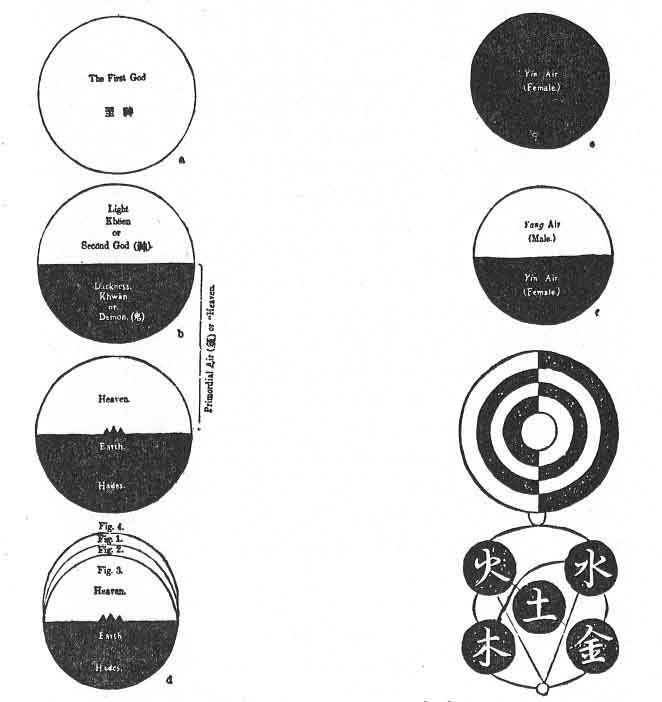
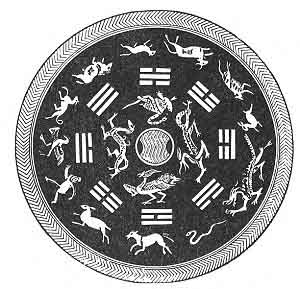
FIGURE 82. Painted Tartar and Mongol drums.
(From Picture-Writing of the American Indians; Garrick Mallery, 1894, p. 517.)The shamans of these tribes admit three worlds; the world of the Heavens (hallan jurda); the middle one of the Earth (onto-doidu); and the lower one of Hell (jedăn tiigara); the first the realm of light, the last the realm of darkness. The middle world, or Earth, has for a time been given over by the Creator (Jut-tas-olbohtah Jdan-Ai-Tojan) to the will of the devil or tempter, and the souls of men at death, according to their merit, are sent either to the upper or the lower world. When, however, "the earth world has come to an end, the souls of the two realms will wage a war against each other, and victory must remain on the side of the good souls."


The Aztec Universe

THE BOOK OF EARTHS

By

EDNA KENTON

New York: William Morrow & Company

[1928, No renewal]


The Aztec Universe

THE AZTEC WORLD-PICTURE (Plate XXXIII ) is the first sheet of the "Night Side" of the Codex Ferjvy-Mayer, an old Mexican painted book now in the Free Public Museums at Liverpool. The foundation for the series of paintings is a sort of parchment made of deerskin covered on both sides with a thin coating of an extremely adhesive paste on which the paintings were executed in the usual way--the outlines in deep black and the spaces filled in with colours. It consists of twenty-two folded shapes 17 cm. square. One side Dr. Eduard Seler, its interpreter, calls the "Night Side," the other the "Day Side."

This first sheet is the most interesting and the most famous of the entire manuscript. It represents the Five Regions of the Aztec world and their tutelary deities, spread out like a cross, all their spaces filled with figures of trees, gods, birds, rivers, and symbols of the cosmos, both of its objects and its attributes.

In the Middle Place, says Seler, 1 is the Fire deity, Xiuhtecutli, "the Mother, the Father of the gods, who dwells in the navel of the Earth." From his body four streams of blood flow towards the four cardinal points, and are continued beyond the square space enclosing the centre to the outer corners of the picture, where the signs acatl, "Reed," tecpatl, "Flint," calli, "House," and tochtli, "Rabbit," are seen on shields respectively borne by a quetzal bird, an arara, an eagle, and a green parrot. "These are the four signs by which the consecutive years are named with constant reiteration, because they are the signs which fall on the first days of those years, and therefore, since they are exhausted with the number four, have become symbols for the four cardinal points, East, North, West, and South."

The stream of blood pointing to the sign acatl(Reed), that is, to the East (left-hand above), terminates with a hand painted yellow--"the hand (ray) of the Sun god?" The stream pointing to the sign tecpatl(Flint) ends with the stump leg of the god of the North. The stream flowing towards the sign calli(House) or West (right-hand below) ends in a figure of a chest formed by the vertebrae and adjoining ribs of a skeleton. "For the West is the region of the setting (dead) Sun." The stream flowing towards the sign tochtli(Rabbit) or South ends in a head in whose hair is stuck a downy feather ball, which symbolises the "warrior in the South" and at the same time, the "warrior in the North," the dual god of the two quarters.

PLATE XXXIII. A WORLD-PICTURE OF THE AZTECS<br> <i>First page of the Codex Ferjvy-Mayer, representing the five regions of the world, and their tutelary deities</i>.<br> (From <i>Mythology of All Races</i>, 1927, Vol. XI, Plate VI)
PLATE XXXIII. A WORLD-PICTURE OF THE AZTECS
First page of the Codex Ferjvy-Mayer, representing the five regions of the world, and their tutelary deities.
(From Mythology of All Races, 1927, Vol. XI, Plate VI)

Above the upper side of the central square is a sort of platform with steps in the centre; that is to say, to the right of the corner which, owing to the shield with the sign acatl, "Reed," we have to regard as the East corner." At the level of the steps, which are painted red, is shown the image of the Sun. "This can obviously be nothing but the House of the Sun, the East."

Above the left side of the central square is a votive dish in which are a rubber ball, an agava-leaf thorn, and a bone dagger. They are the symbols of sacrifice, of blood-letting, of self-torture, voluntarily made in honour of the gods, but, says Scier, they belong to the gods of the South, and bringing them into the Northern quarter of the heavens means a reversion of the order, or an interchange of North and South."

Above the lower side of the central square is seen a monster descending from above, that is, here, from be-low. It would seem to be tolerably certain that this is intended to represent the Tzitzimim the demons which symbolise the realm of darkness, the eclipse of the Sun. I shall have more fully to explain farther on that the Tzitzimimre originally images of the stars, which, merely because at the solar eclipses the stars become visible in broad daylight, have been made demons of darkness, symbols of the devouring gloom. In any case, here the figure denotes the West, the region of the setting Sun, of the light swallowed up by the Earth."

Above the fourth or right-hand side of the central square is seen "the wide open throat of a monster hieroglyph of the Earth, which in this form is obviously thought of as the taker of life, the mictlampa, the realm of death, i.e., the North."

The flowering tree rising above the picture of the Sun (upper East side) is surmounted by a quetzal bird and guarded by Itztli, the Stone-knife god (on the left), and Tonantiuh, the Sun god, all symbolising the Eastern quarter. This tree, like all in the four quarters, has the form of a cross.

The tree above the left side of the central square is a thorn tree surmounted by an eagle, and is guarded by Tlaloc, the Rain god, and Tepeyollotli, the Heart of the Mountains or the Voice of the Jaguar in the Mountains--symbols of the North.

The tree of the West, growing out of the forehead of the Tzitzimitl, or the dragon of the eclipse, has a stem set with huge upright thorns. Instead of flowers, it bears feather balls at the tips of its branches. "On it is perched doubtless a humming bird," which according to Aztec belief, dies with the dry and revives with the rainy season. The guardian deities are Chalchiuhtlicue, goddess of flowing water, and the Earth goddess Tlazolteotl.

Above the South side (right) is a tree growing out of the open jaws of the monster symbolising the Earth; "its stem is set with notches (or fruit pods?) turned downwards, while the branches bear a kind of star-shaped blossom like that of the tree of the North." On it is perched a parrot, and it is guarded by Cinteotl, the maize god, and Mictlantecutli, god of death.

The deities depicted about the four arms of the St. Andrew's Cross, that is, in the spaces enclosed by the trapezes above the four sides of the central square, are the eight gods of the four quarters. In the central square stands the Fire god; he belongs to the Centre or the Middle Place because he represents the hearth fire which burns in the middle of the house. These nine are the deities of the Five Regions and "Lords of the Night."

Like the Tibetan and Kalmuck worlds, the four quarters of the Aztec world have their four colours, and they are: East, red; North, yellow; West, blue; and South, green. These are the colours also of the years and of the days. The whole figure symbolises the orientation of the world-powers in Space and Time-years and Earth-realms and Sky-realms.


Footnotes

190:1 Codex Ferjvy-Mayer, elucidated by Eduard Seler, 1901, pp. 5-24."

The Peruvian Universe

THE BOOK OF EARTHS

By

EDNA KENTON

New York: William Morrow & Company

[1928, No renewal]


The Peruvian Universe

THERE IS ANOTHER "SQUARE EARTH" shown in one of the rarer world-pictures in this collection--the Universe of the ancient Peruvians. Juan de Santa Cruz Pachacuti Yamqui Salcamayha, a native Peruvian, left the drawing in his Account of the Antiquities of Peru, written about 1620. His manuscript reached Spain, where it lay long forgotten among the treasures of the Biblioteca Nacional at Madrid. Salcamayha was not only a Peruvian, but he is credited with being one of the chosen recipients of the traditions of his people, and in close touch with the final glories of the Ynca empire; for his great-grandparents were living at the time of the Spanish conquest of Peru, and stories of the vanished days came to him almost from the lips of those who had witnessed them.

Salcamayha left no reading of this crudely sketched cosmos, and what follows is based largely on Beuchat's interpretation.

The World, says Beuchat, 1 was called Pacha. It was a square World, with a roof indicated, ridge-shaped, where dwelt the great God. The lowest plane was Earth, which gave support to the four quarters where dwelt the gods.

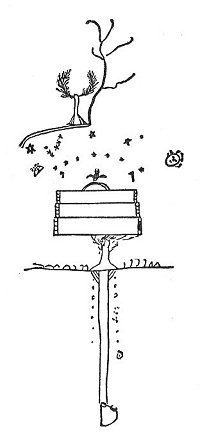
FIGURE 79. <i>World-picture of the ancient Peruvians</i>. <i>In</i>
FIGURE 79. World-picture of the ancient Peruvians
Outside the World, above it, to the left, is a small disc, so Beuchat calls it, but it far more resembles a figure of the Cosmic or Mundane Egg, surrounded, though not en-circled, by five stars. Within, in the centre of the pointed roof, this outer design appears again, much enlarged, slightly rearranged, and with the addition of a single star. In the rearrangement of the design, three of the stars have been connected along a thread, and from these three is suspended the oval figure of Huiracocha, the Creator of the World. On his left is the Sun or Inti; on his right the Moon or Quilla. The bright star below the Sun is Chascaor the planet Venus, and under Venus lies a star representing Catachillay, or the Milky Way. Between the Milky Way and Venus is a group of stars--thirteen--which are the constellations.

Below Huiracochaare five stars, but arranged differently from the group above. One is separated entirely from the other four, but the four are united by crossed lines. Beuchat ventures to believe that these also represent constellations.

Beneath the Milky Way, Catachillay, are a number of concentric semi-circles, which signify the Rainbow; the two wave-lines at the left are Thunder, and below them is the River Pillcomayo. To the right of the river and immediately beneath the rainbowed circle are "eyes," "dont," says Beuchat, "on ne voit point clairmant la signification." Far to the right is an irregular figure labelled mamacocha--"the sea," says Beuchat, and a little above it a black puma. Below these two is mallqui, "a tree." At the bottom of the picture is a rectangle, which represents Coricancha, and above the figures of a man and a woman.

In his manuscript Salcamayha explains Coricancha, accompanying the text with another oval "creation" figure. A certain Ynca, he says, after he and his people had settled at Coricanchaon whose site was reared the Temple of the Sun, "ordered the smiths to make a flat plate of fine gold, which signified that there was a Creator of Heaven and Earth, and that it was of this shape. He caused it to be fixed in a great house, called Couricancha pachaya-chachipac huasin," which is to say, "the golden place, the house of the teacher of the world."

Another reading of this world-picture gives some interesting literal translations of some of the old Indian and Spanish text. Outside of the diagram are two Indian words, Uamadoand Orcorara, followed by a bit of Spanish commentary--"which is to say (quiere decir) three stars all equal." Inside the figure at the peak of the "roof," mingled with the Sun and Moon are many Indian words, with a Spanish translation outside: "Which is to say that this is the image, or pattern, of the maker of both heaven and earth; yet this plate was simply (or crudely) (made) and not to be perceived (easily by all), because there was a lack in all the tablet (or design) of the radiance of the resurrection of Jesus the Lord."

"Lucera" written about the star Chasca, beneath the Sun, and designated by Beuchat as Venus, is a Spanish word meaning "luminous stars," as differing from fixed stars, and is applied to Venus as the morning, and to "Lucifer" as the evening, star. Under Chascaare Indian words and, in Spanish, "This is the luminous star of the morning." To the right, the star beneath the Moon carries several Indian words and, in Spanish, "This is the Evening (star)."

The five stars below Huiracochaare designated by two Indian words, Saramaniaand Chacana, followed by "en general." "Perhaps they mean Cosmogony, but this is only a guess."

The group of thirteen stars signify "summer season." And the corresponding design at the right reads "Clouds in winter (season)." The two wave-lines at the extreme left are in this reading, "Lightning." To their right, the Rainbow, above "El mundo o la tierra"--"the world or the earth."

The seven "eyes" under the "world" are said here to be Indian words.

The "black puma" above the Tree of Life is said to signify hail, "and since hail is bad for crops, they represent it by a little animal."


Footnotes

185:1 Manuel dArcheologie amicaine: H. Beuchat, 1912, pp. 630-631.

The Square Earth of Cosmos

THE BOOK OF EARTHS

By

EDNA KENTON

New York: William Morrow & Company

[1928, No renewal]


The Square Earth of Cosmas Indicopleutes

ONE OF THE STRANGEST OF WORLDS is the Square Earth of Cosmas Indicopleustes, an Egyptian monk of the sixth century A.D., who expended an astonishing ingenuity upon the development of a theory of the universe that would eliminate the increasingly popular notion that the Earth was a sphere. He was filled with a holy hatred of the heresy of the "spherists" and the antipodists, and he evolved at last a figure of the universe modelled upon the design of the Tabernacle built by Moses in the wilderness, which, he pointed out, Moses himself had declared to be constructed upon the pattern of the visible world. His own explanation of it may be read in his Christian Topography.

FIGURE 77. <i>The Square Earth of Cosmas Indicopleustes</i> (<i>6th century A.D.</i>)<br> (From <i>Flammarion's Astronomical Myths</i>, 1877.)
FIGURE 77. The Square Earth of Cosmas Indicopleustes(6th century A.D.)
(From Flammarion's Astronomical Myths, 1877.)Cosmas says that the Earth is a rectangular plane surface, whose long sides are twice the shorter ones. These are the measurements of the Tabernacle, and of the Table of Shew-bread. This Earth-table is divided into three parts: the habitable Earth, in the middle, the ocean which everywhere surrounds it, and beyond the ocean another surrounding continent, which is now altogether inaccessible to man, but which was once the seat of Paradise and the home of the human race up to the time of the Deluge, when the flood swept the Ark with its few saved men across to the "other Earth." It is true, says Cosmas, that after the Fall Paradise itself had been closed to Adam, but until the Deluge he and his descendants had dwelt on the coast edges of the First Continent of man.

Upon the edges of this outer inaccessible continent rest the four walls of heaven--four perpendicular planes joined hermetically to the edges of the trans-oceanic Earth, and cemented at the top by an enclosing roof, in form like half a cylinder. Its ends rest on the eastern and western sides of the world, and its sides on the north and south. These directions are determined by the Tabernacle Table, which was placed lengthwise from east to west. Here is a bit from Cosmas himself:

FIGURE 78. <i>The Square Earth. Its habitable plane</i>.<br> (From <i>Flammarion's Astronomical Myths</i>, 1877.)
FIGURE 78. The Square Earth. Its habitable plane.
(From Flammarion's Astronomical Myths, 1877.)"The Deity accordingly having founded the Earth, which is oblong, upon its own stability, bound together the extremities of the heaven with the extremities of the Earth, making the nether extremities of the heaven rest upon the four extremities of the Earth, while on high he formed it into a most lofty vault over-spanning the length of the Earth. Along the breadth again of the Earth he built a wall from the nethermost extremities of the heavens upwards to the summit, and having enclosed the place, made a house, as one might call it, of enormous size, like an oblong vapour bath. For, saith the Prophet Isaiah (xlix, 22), He who established heaven as a vault. With regard moreover to the glueing together of the heaven and the Earth, we find this written in Job: He has inclined heaven to earth, and it has been poured out as the dust of the earth. I have welded it as a square block of stone." 1

The interior of this "oblong vaulted vapour bath" consists, like the Tabernacle, of two parts, the outer and the inner--the veil of the Tabernacle corresponding to the firmament which divides the universe into two parts, and which is the floor of the upper and the ceiling of the lower story. The first story reaches from the Earth-plane, "the footstool of the Lord," to the firmament, and is the abode of men and angels. The presence of angels is necessary in man's world, not only for the sake of their beneficent effect on him, but also because the Sun, Moon, and stars are carried in their courses, not by the firmament which is motionless, but by angels appointed to this work until the last day.

On the Earth-plane rises a high cone-shaped mountain, which makes possible, in this world-system, the rising and the setting of the Sun, day and night, climates, seasons, etc.

With the universe enclosed within a square box, it was no longer possible for the Sun to sink in western waters, swim under the Earth, and emerge again from the eastern sea. But forever circling the conical mountain of the world, in the arms of its carrying angel, it is hidden from a part of the world all of the time, and thus comes day and night. The length of the days and nights varies, says Cosmas, according as the Sun is close to or far from its mountain screen, and from this cause spring summer and winter, storms, eclipses, heat and cold, and such phenomena. "All the stars are created," he says, "to regulate the days and nights, the months and the years, and they move, not at all by the motion of the heaven itself, but by the action of certain divine Beings, or lampadophores. God made the angels for his service, and He has charged some of them with the motion of the air, others with that of the Sun, or the Moon, or the other stars, and others again with the collecting of clouds, and preparing the rain." Cosmas also says that men are mistaken when they say that the Sun is much larger than the Earth; that it is, in reality, very much smaller; and, by measuring its shadows at the different "climates" of Ptolemy, he concludes that the sun has the size of "two climates."

Above the firmament and beneath the upper vault live the Blessed. Along the outer side of this vault which terminates the world, rest the heavenly waters. The Mosaic account of the Tabernacle and its enclosed Ark, says Cosmas, gives all the measurements and hence all the secrets of the world, and by it alone man may reconstruct the universe within himself and look down upon it, as the Creator surveys his handiwork from the vaulted roof of Cosmas's "vapour bath."

Here are some of the correspondences which Cosmas drew between the pattern of the Tabernacle and that of the visible world.

In the first Tabernacle, "Moses placed in the south of it the candlesticks, with seven lamps, after the number of days in the week--these lamps being typical of the celestial luminaries--and shining on the table placed in the north of the Earth. On this table again he ordered to be placed daily twelve loaves of shew-bread, to typify the three months between each of the four tropics. He commanded also to be wreathed all around the rim of the table a waved moulding, to represent a multitude of waters, that is, the ocean; and further, in the circuit of the waved work, a crown to be set of the circumference of the palm of the hand, to represent the land beyond the ocean, and encircling it, where in the east lies Paradise, and where also the extremities of the heaven are bound to the extremities of the Earth. And from this description we not only learn concerning the luminaries and the stars that most of them, when they rise, run their course through the south, but from the same source we are taught that the Earth is surrounded by the ocean, and further that beyond the ocean there is another Earth by which the ocean is surrounded."


Footnotes

182:1 Christian Topography of Cosmas Indicopleustes: Hakluyt Soc. Pub. 1897, p. 30.

Systems of the Universe

THE BOOK OF EARTHS

By

EDNA KENTON

New York: William Morrow & Company

[1928, No renewal]


Systems of the Universe

WHEN THE GREEKS IN THE SIXTH CENTURY B.C. took up the study of the universe, its systems multiplied. The order of the orbits of the heavenly bodies, above all, their disorder, fascinated the Greek mind. Eclipses occurred, but how? A Comet fled through the sky, and did not collide with a sister body--why? How were the Earth, Sun, Moon, and all the stars supported in space? What are the relative distances of the spaces between them? Which were the larger bodies? the smaller? What were the divisions of Space? What were the major combinations of the great elements? How were these combinations effected--and a hundred other questions.

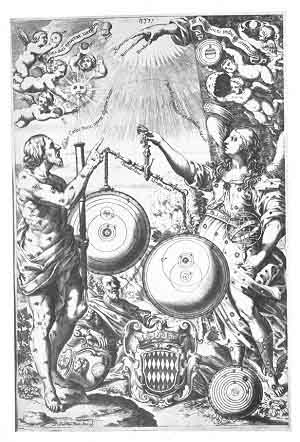
PLATE XXXII. (Frontispiece to <i>Almagestum Novum</i>; Ioannes Riccioli, 1561)
PLATE XXXII. (Frontispiece to Almagestum Novum; Ioannes Riccioli, 1561)
Homer was the first poet of the Greek universe, but Thales was its first philosopher (640-572 B.C.). He believed the Earth was a disc floating "like a piece of wood or something of that kind," on the waters which were the origin of all things, including fire and air as well as Earth; and his interest in eclipses led him into a protracted study of the movements of the Sun and the Moon and their relation to the Earth.

Anaximander (c. 611-545 B.C.) was his contemporary. He gave up the idea that the water was the origin of everything, any more than any other substance known to man. Everything originated "from the nature of the infinite," and to it returned. Hence it followed that this world was not eternal, but merely one of a procession of worlds. He described the figure of Earth as either flat or convex on the surface, but much more like a cylinder or stone column than the thin disc of Thales. Eventually he called it cylindrical, with a height equal to one-third of its breadth. This cylinder, being in the centre of the universe, was stable, in equilibrium, since it had the same relation to every part of- the universe.

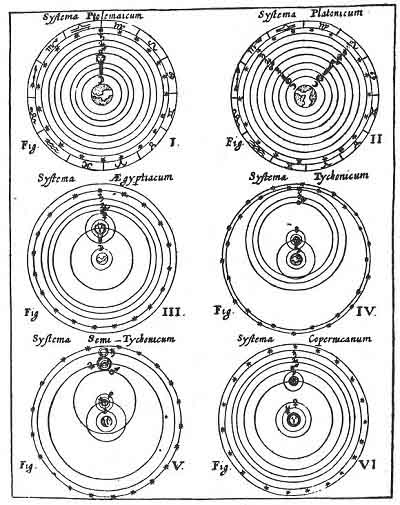
FIGURE 66. <i>The Systems of the Universe</i>.<br> (From <i>Iter exstaticum ceste</i>; Athanasius Kircher, 1660, Plate II.)
FIGURE 66. The Systems of the Universe.
(From Iter exstaticum ceste; Athanasius Kircher, 1660, Plate II.)
Above it were a series of heavens, the first of air, the second of all the stars, the third of the Moon, above that the heaven of the Sun and above all the heaven of the heavenly fire. He had an extremely complicated theory to account for a motionless heaven and moving bodies; he appears to have imagined the Sun, for instance, to be an enormous wheel filled with fire, its rim pierced by a single hole the size of the Earth.
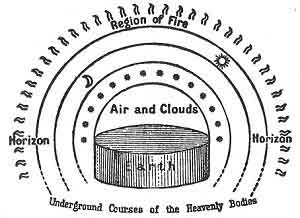
FIGURE 67. <i>The Universe according to Anaximander</i><br> (<i>c. 611-545 B.C.</i>)<br> (From <i>Dante and the Early Astronomers</i>; M. A. Orr (Mrs. John Evershed), 1913.)
FIGURE 67. The Universe according to Anaximander
(c. 611-545 B.C.)
(From Dante and the Early Astronomers; M. A. Orr (Mrs. John Evershed), 1913.)So, too, the Moon and stars rolled through their heavens; eclipses came from the holes in the Sun-wheel's rim and that of the Moon being partially or wholly stopped up. Quite exactly, his Sun and Moon were vessels filled with fire.

Of course only the upper surface of Anaximander's Earth was habitable; below it the heavenly bodies had their underworld course; for the rest, the horizon marked the limits of the known and the knowable.

He seems to have held too the curious idea that the series of worlds which come out of the infinite and go back into it may be also called gods, since, like gods, they are created, they live, they die, and are again created.

For a hundred years following Anaximander's death, the Greeks were still asking how the Earth was held in balance, and why the heavenly bodies did not fall from their places in the sky and destroy the Earth. Empedocles and Anaxagoras offered this explanation--that a great whirl-wind swept continuously round the Earth, serving the double end of holding the heavenly bodies aloft and of driving them across the sky. Anaxagoras believed that this same whirlwind was responsible for the stars themselves; that they were fragments of the Earth, torn off by the violence of the whirlwind, and that their light came from no more than the heat produced by friction. He also believed that the "heaven of the stars" was far beyond that of the Sun.

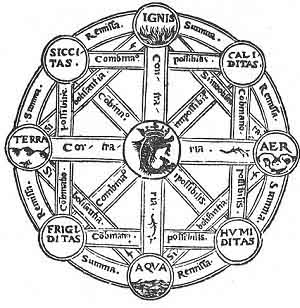
As for Empedocles, he re-asserted that everything consists of the four elements, Earth, air, fire, and water, either in a pure, or a combined, or a mixed state merely; and he said further that all these combinations and mixings were brought about by two forces alone, one attracting, and one repulsing, one Harmony, the other Disharmony, one Cord, the other Discord. He had also a very individual idea of the Moon and the Sun; the Moon is air rolled together with fire--it is flat like a disc and gets its light from the Sun. But the Sun, he said, is a reflection of the fire surrounding the Earth; it is not itself of a fiery nature, but merely a reflection of fire, "like that which is produced in water."
FIGURE 68. <i>The Universe of Leucippus</i> (<i>c. 450 B.C.</i>)<br> (From <i>Dante and the Early Astronomers</i>; M. A. Orr (Mrs. John Evershed), 1913.)
FIGURE 68. The Universe of Leucippus(c. 450 B.C.)
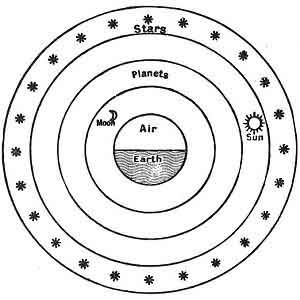
(From Dante and the Early Astronomers; M. A. Orr (Mrs. John Evershed), 1913.)Leucippus (c. 450 B.C.) changed Anaximander's figure of the universe considerably. He still held that the Earth's flat upper surface was its only habitable area, but he gave the whole mass of the Earth the shape of a tympanum or kettle drum, flat, with a slightly raised rim--according to this idea man was living on the flat top of the southern hemisphere. Above the hemisphere of Earth was the hemisphere of air, the two surrounded by the crystal sphere which held the Moon. Above the Moon's sphere was the planetary sphere; above this the sphere of the Sun, with the star-zone last, "perhaps outside." He accounted for the inclination of the axis to the horizon by saying that the Earth had sunk towards the south, which is merely the other half of the ancient saying that the Earth is raised towards the north.
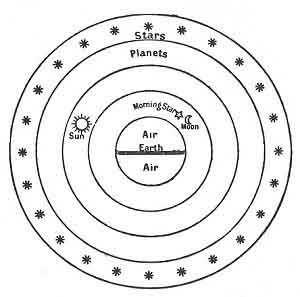
FIGURE 69. <i>The Universe of Democritus</i> (<i>c. 430 B.C.</i>)<br> (From <i>Dante and the Early Astronomers</i>; M. A. Orr (Mrs. John Evershed), 1913.)
FIGURE 69. The Universe of Democritus(c. 430 B.C.)
(From Dante and the Early Astronomers; M. A. Orr (Mrs. John Evershed), 1913.)Leucippus had a disciple, Democritus (c. 430 B.C.), who retained the thin Earth-disc of Thales, but added to it the surrounding rim of his master's Earth-drum. He changed Leucippus's Air-Earth sphere into a sphere of Air, divided horizontally through its centre by the Earth-disc. Thus, like the cylindrical Earth of Anaximander,

it rested on nothing but air. Next the Air sphere he placed the Moon and the Morning Star, then the spheres of the Sun, the planets and the fixed stars.

The Sun, he said, was ignited stone or iron, and the Sun and Moon, each a large solid mass, were none the less smaller than the Earth. Originally, he said, the Sun and the Moon had been two Earths, like this of ours, and each of them, like ours, at the core and centre of a world. But these two worlds had encountered our world, which had absorbed them both, and had taken possession of the "Earth" of each. Comets, he said, are caused by two planets approaching each other closely. The Moon was not only a solid body, but, having once been the "Earth" of another world, it still has mountains and plains and chasms, which cause the markings on its face. Anaxagoras however had said this before him, and had also asserted that the Moon was still inhabited. Democritus also taught that the light of the Milky Way was caused by a great multitude of very faint stars. Later it was said that the Milky Way was a former path of the Sun, which for some obscure reason had changed its course.

It was Pythagoras who numbered and measured and named for the Greeks the five great planets of our system, and who gave them places in the heavens equal in importance to the greater heavenly bodies. And it was Pythagoras who taught that the Earth was a perfect sphere, hanging, if not moving, freely in space, with its whole surface habitable, and with men moving freely on all its sides. For the Earth, he said, balanced in the centre of the world, cannot fall, nor can it let anything which belongs to any part of it fall. There is no below, there is no above, for our North is South to the men of the antipodes; there is nothing but the Centre, where we are, and it is illusion to believe otherwise.
FIGURE 70. <i>The Universe of Pythagoras</i> (<i>c. 540 B.C.</i>)<br> (From <i>Dante and the Early Astronomers</i>; M. A. Orr (Mrs. John Evershed), 1913.)
FIGURE 70. The Universe of Pythagoras(c. 540 B.C.)
(From Dante and the Early Astronomers; M. A. Orr (Mrs. John Evershed), 1913.)Number played the principal part in the universe of the Pythagoreans, for, said they, everything in nature is governed by number, since number is the beginning and the end of all relations. There are cosmic principles, they declared, and these cosmic principles are mathematical principles, which are living principles; numbers are the essence of the universe, the very substance of things, the cause and effect of all that is in nature.

Pythagoras separated the planets and affirmed that their distances are in exact proportion to the intervals between musical notes. Combined with the Sun and Moon into a running scale, they make up the sacred number seven, and these seven notes of the cosmic scale constitute, with the mysterious star-sphere, the cosmic octave. As each of the heavenly bodies moves in its path, different to, yet harmonious with all the others, it sounds its own individual note in the great octave that is "the music of the spheres." This music, said the Pythagoreans, is all about us and has been since our infancy, but we live beside it "as one lives beside the cataracts of the Nile"--we never know we hear it.

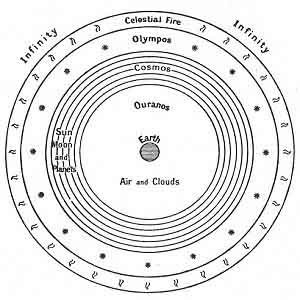
According to Aristotle, the Pythagorean universe was divided thus:

The Earth was, first of all, a sphere situated in the centre of the universe, and was surrounded by many spheres.

Ouranos or Sky stretched between the Earth and the Moon. It was the region of illusion and change, always filled with whorls of air and shifting clouds.

Cosmos was the region of "the celestial octave," the appointed place for the Sun, the Moon, and the planets. It consisted of seven concentric rings or spheres, in which these heavenly bodies, or "divine beings," lived their conscious, joyous lives.

Olympos was the Star-sphere, the pure-elemental region which completed the cosmic octave.

Beyond Olympos stretched the region of celestial fire.

Beyond the region of celestial fire was Apeiron, Infinite Air, Infinite Space, from which and into which the Cosmos breathes, and through which and by which only it lives.

FIGURE 75. <i>The Five Great Elements</i>.<br> (From <i>Spha Mundi</i>; Orantius Fineus, 1542.)
FIGURE 75. The Five Great Elements.
(From Spha Mundi; Orantius Fineus, 1542.)The Pythagoreans did not fail to take into account the five great elements, from which they believed all things were fashioned. They fitted these five "Causal Beings" into the five regular solids (Figs. 2-6 and ), to whose forms, they said, the component particles of the different elements correspond. The component particle of Earth, for instance, corresponds to the cube; of water, to the icosahedron; of air, to the octahedron; of fire, to the tetrahedron; of ether, to the dodecahedron--the form which had been God's model for the whole universe.

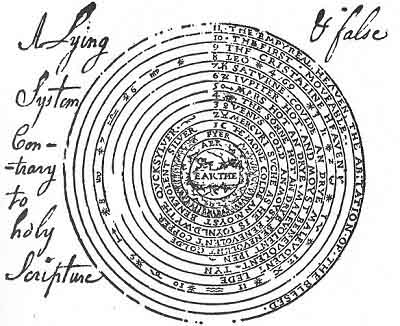
FIGURE 72. ''<i>A Figure of the whole world, wherein are set forth the two essentiall Parts, the eleven heavens, and the foure Elements</i>.
FIGURE 72. ''A Figure of the whole world, wherein are set forth the two essentiall Parts, the eleven heavens, and the foure Elements."A Figure of the Whole World" (Fig. 72 ) is the Pythagorean-Ptolemaic system, much elaborated. It begins by taking into account the "foure Elements," but it extends the number of the imaginable heavens beyond the "cristaline" to two--this was an invention of the medial astronomers. These two additional heavens were the Primum Mobile, or the "First Movable," and "The empyreal heaven, the habitation of the blesed."

FIGURE 73. <i>System of the diverse spheres</i>.<br> (From <i>Cosmographia</i>; Petrus Apianus, 1660.)
Click to enlarge

FIGURE 73. System of the diverse spheres.
(From Cosmographia; Petrus Apianus, 1660.)

This last was the Heaven of Heavens, motionless, incorruptible, the place of the eternal mysteries. None of these spheres consisted, of course, of any materially palpable substance; they were great spherical zones of aethereal space, arranged one within the other, which circled about the motionless Earth at differing rates of speed. Perhaps, instead of "spheres," or "shells," or "zones," these moving regions are better expressed by the term "velocities."

Fig. 73 represents again the same system, even more elaborately inscribed with "correspondences." By aid of these two guides through the "two essentiall Parts" of the whole world--that is to say the eleven heavens and the four elements, the six systems of the universe shown in Fig. 66 can be more or less easily followed.

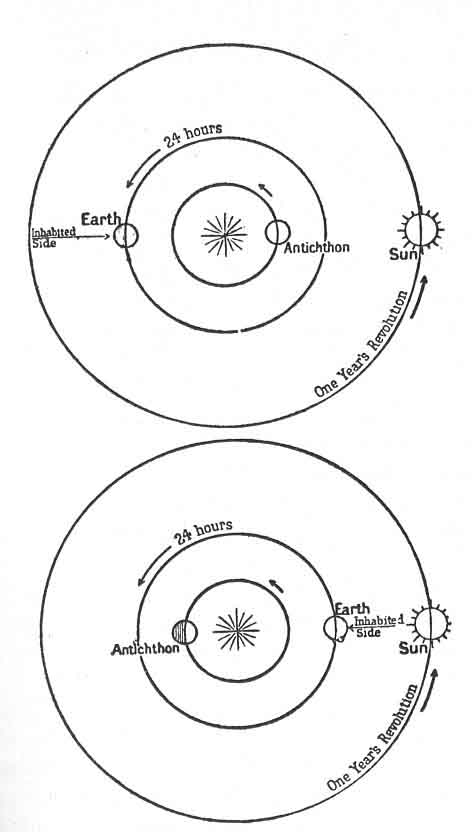
ONE DEVELOPMENT OF THE PYTHAGOREAN SYSTEM might be mentioned here--the attempt of an otherwise unknown astronomer, Philolaus, to remove the motionless Earth from its place in the centre of the universe and give it an orbit of its own. His reasons, except that he hoped by this to account better for the seemingly contrary movements of the heavens, do not concern us here. But it is a transition-picture. For by moving the Earth from the centre and letting her move in Space, he may have solved one problem, but he raised two new ones. He had left the sacred place, the Centre of the World, empty, and he had disturbed the cosmic octave by adding to it another moving body. Heretofore the Earth had been mute because it was motionless; now movement gave it its own note in a disturbed scale. So in the sacred place he put the purest of the elements, Fire, forerunner of the Central Sun. Then, more to restore the harmony of number, quite likely, than to explain Night and Day, he created another moving heavenly body, the planet Antichthon, or Counter-Earth, and gave it an orbit between the Earth and the Central Fire with one of its faces turned always to the Fire. This gave nine moving bodies, and with the star-sphere as another, the number was increased from the sacred number seven to the sacred number ten. The Earth revolved with one face turned always away from the centre; Antichthon, the new planet, was therefore always invisible. After this rearrangement was completed, explanations purporting to reconcile a geocentric with an ignicentric system were invented plenteously, some of them very interesting ones. "Those who partook of a greater knowledge," wrote Simplicius, "called the fire in the middle the creating power, which from the middle gives life to the whole Earth and again warms that which has been cooled. . . . But they called the Earth a star because it also is an instrument of time, for it is the cause of days and nights, for it makes day to the part illumined by the Sun, but night to the part which is in the cone of the shadow." And he ends by saying that the moon was called the antichthon, because it is "an aethereal Earth."

Some modern students of this confusion have suggested that the Earth and the Counter-Earth or Antichthon might have been intended to be the two halves of a single sphere, cut through a meridian and separated very slightly, with the flat sides toward each other, but with the convex side of Antichthon turned always towards the Central Fire, and the convex side of the Earth turned always away from it. This may be so, but no one knows. For the Pythagorean teachings were at the best obscure, and the Pythagorean text that has come down is scanty and corrupt.

FIGURE 74. <i>The System of Philolaus</i>.<br> (From <i>Dante and the Early Astronomers</i>; M. A. Orr (Mrs. John Evershed), 1913.)
FIGURE 74. The System of Philolaus.
(From Dante and the Early Astronomers; M. A. Orr (Mrs. John Evershed), 1913.)Upper figure: Night on Earth. Only the side turned away from the centre is inhabited; consequently the Central Fire and Antichthon are invisible.

Lower figure: Twelve hours later; Day on Earth. Earth has made half a revolution, and her outer side is now lighted by the sun, which has only moved about half a degree forward in its yearly orbit. Antichthon has also made half a revolution, therefore remains invisible.One Pythagorean, Hicatus of Syracuse, is said to have believed and taught that the heavens, the Sun, Moon, stars, and all the heavenly bodies are standing still, and that nothing in the universe is moving except the Earth, which, while it turns and twists itself with the greatest velocity round its axis, produces all the same phenomena as if the heavens were moving and the Earth were standing still."

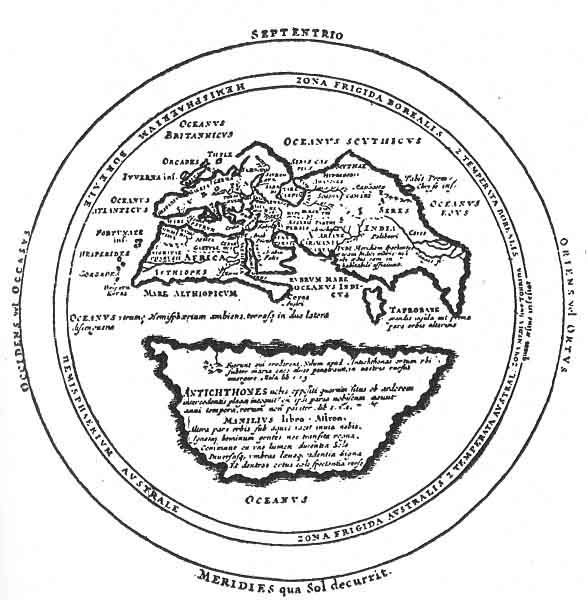
As above, so below! Philolaus placed the planet Antichthon or Counter-Earth in the heavens, perhaps five hundred years before the Christian era. In the first century A.D. Pomponius Mela, a Latin cosmographer, convinced that a spherical Earth must have a more or less balanced distribution of land and water, drew the first map on which the mysterious continent of Earth appears in the unknown half of Earth--our antipodes. This continent he inscribed with the name Antichthones, the Unknown. His pen had leaped over the impassable equatorial zone, and had drawn below it a solid, bowl-shaped mass of land which no man had seen, and which no man might ever see. And yet it must be there! It had been long known through travellers that from Greece or from Italy the eastwardly land stretched much farther than the land to the west, and it was therefore quite possible, with no proof of the existence of a great western ocean, that the northern continent of Europe-Asia-Africa might wrap around the sphere until its eastern edge touched the western shore of the known Atlantic. But it was implicitly believed that the known land stopped at the equator; the balancing continent must be therefore at the antipodes.

FIGURE 75. <i>Pomponius Mela's Map of the World, with Antichthones </i>(<i>1st century A.D.</i>)<br> (From <i>De situ Orbis</i>; Pomponius Mela, 1536.)
FIGURE 75. Pomponius Mela's Map of the World, with Antichthones (1st century A.D.)
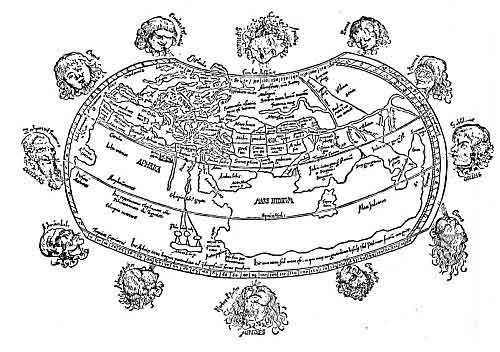
(From De situ Orbis; Pomponius Mela, 1536.)When Pomponius Mela dropped his second continent to the south, he was a mistaken man, but his Antichthones lingered in the imagination of men--lingered for nearly fifteen hundred years, until Columbus, sailing west--to India--came upon the West Indies and the Americas. The great astronomer and geographer, Claudius Ptolemy, lived in the century after Pomponius Mela. There is a legend that he was a descendant of the Egyptian kings, and knew their secret science of the heavens; certainly he brought about a revival of mathematical geography that had not been in the world since the great Alexandrian period, and he drew his maps upon a form that was to be the model of the Earth up to and through the Middle Ages.

boe20

Ptolemy believed the Earth to be a globular body, but the form on which his maps were modelled was one slightly depressed at the north, and sharply cut off a little below the equatorial line by a supposedly continuous Southern Ocean which circled the equator and flowed below it. His historians do not seem to doubt that his knowledge of the regions of the Earth extended as far as the equator, and that he himself knew this fabled zone of fire was both habitable and inhabited. But he confined himself to a map-form that included neither the unknown Polar regions nor the hemisphere of Antichthones.


Next: The Square Earth of Cosmas Indicopleutes

The Mundane Egg

THE BOOK OF EARTHS

By

EDNA KENTON

New York: William Morrow & Company

[1928, No renewal]


Earth The Mundane Egg

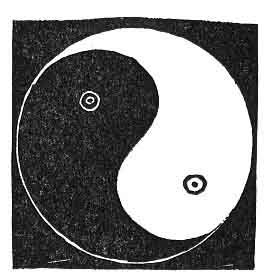
THE GREAT MONAD, or the Great Beginning, or the Great Extreme, or the Great Vacuum, or Yin and Yang, or "Heaven," is one of the old, mysterious figures of Earth. It represents all the pairs of opposites that we know--Light and Darkness, life and death, death and re-birth, heat and cold, good and evil, subtle and gross, male-female in Nature, or the great principles Yin and Yang. It is One yet All Things, the great hermaphrodite--"the indivisible monad, of itself generating itself, and out of this were formed all things." It looks like a shell, it looks like an ear; it looks like a tadpole, an embryo, a whirlpool, a claw, a comma, two eyes, strange Moon upon the Sun. It looks perhaps like the Universe itself before the creation of Heaven and Earth. It is the epitome of all the "egg-shaped" figures of Earth. It is animated Chaos, primordial Air dividing into two Airs to generate a multiplied cosmos, for they have the power to make and transmute all things. It is the Ovum Mundi--Egg of the World.
FIGURE 61. The Great Monad.<br> (From Dragon, Image and Demon; H. C. Du Bose, 1887.)
FIGURE 61. The Great Monad.
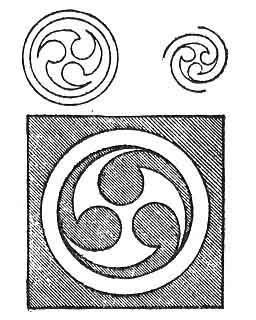
(From Dragon, Image and Demon; H. C. Du Bose, 1887.)It is never a life or a birth symbol merely; it is always associated with the idea of primal causal cosmic energy. The Japanese mitsu tomoeis a variation of the Great Monad of the Chinese; instead of the two-comma-shaped figure, its "commas" are three.

"The Great Extreme," says the Chinese philosopher Choo-tzse, writing of this ancient symbol, "moved and generated the Light; having moved to the utmost, it rested, and resting, generated the Darkness. . . .
FIGURE 62. <i>The Mitsu Tomoe of the Japanese</i>.<br> (From <i>Internationales Archiv f Ethnographie</i>; Bd. IX (1896), S. 265.)
FIGURE 62. The Mitsu Tomoe of the Japanese.
(From Internationales Archiv f Ethnographie; Bd. IX (1896), S. 265.)"The Great Extreme resembles a root which sprouts upwards, and divides into branches, and which also divides and produces blossoms and leaves, generating unceasingly. When the fruit is formed, then, it contains inside, the seed of endless generations, which generates and springs forth. This is the Infinite Great Extreme, which never ceases altogether, but only when the fruit is perfected it ceases to generate for a while. . . .

"In the beginning Heaven and Earth were just Light and Dark Air. This one Air revolved grinding round and round. When it ground quickly much sediment was compressed, which, having no means of exit, coagulated and formed the Earth in the centre. The subtle portion of the Air then became Heaven, and the Sun, Moon, and Stars which unceasingly revolve on the outside. The Earth is in the centre, and is motionless, it is not below the centre.

The Earth is the sediment of the Air; and hence it is said that the light and pure Air became Heaven; the heavy and muddy Air became Earth." 1

Here is a series of Chinese diagrams (Fig. 63 ) illustrating the process of the Creation of the universe from the beginning--the whole infinite mass of Primordial Air when in Chaos. This is represented by the black disc (e), the Ovum Mundior "Mind" of the universe, inherent in which, even in its mingled state, is the Divine Reason. In (f) is shown the separation of the Primordial Air into two Airs, the division of Subtile from Gross, of Light from Darkness. This is the beginning of all things, from which sprang the First God, All Light (a), called Reason, Fate, the Immovable Mover, or the Infinite. From this First God came the Second God, or Light, and the Demon-god or Darkness (b), which, say the Chinese, represent Mind or the two-fold Soul, contained within the body of the visible world (c). To represent the complete being of the animated cosmos the three circles or globes are placed like three bodies, one within the other (d); this is sometimes called the Three-fold Air. The Great Extreme is represented in another form in the upper half of the lower right-hand figure, whose inner circle represents the First God inherent in all things, with the Light and Dark Airs alternating unceasingly. From this ceaseless alternation are generated the Five Elements whose Chinese terms differ considerably from those we have been using--namely, earth, water, fire, air, and ether. For the first one, they say, is termed water, and by some is called black.

FIGURE 63. <i>Chinese Conception of the Creation</i>.<br> (From <i>Confucian Cosmogony</i>; Thomas MClatchie, Shanghai, 1874.)
FIGURE 63. Chinese Conception of the Creation.
(From Confucian Cosmogony; Thomas MClatchie, Shanghai, 1874.)The second is fire, and by some is termed red. The third is called wood and is therefore termed green. The fourth is called metal and is white. The fifth is called earth, and is presumed to be yellow.

Besides the Great Monad and its associated diagrams, the Chinese had yet another series of diagrams by which, they asserted, it was possible to account for all the changes and transmutations within the forces of Nature. These are the Eight Diagrams of Fuh-he, which, according to him and his disciples, manifest the Mind of Heaven and Earth, whose only purpose is to generate--that is, to change and to transmute. "That which proceeds gradually," they said, "is transmutation [like the growth of a tree]. That which is united in one and is incomprehensible is God. Transmutation is each thing succeeding in order." They tried to explain this further by saying: "That which when at Rest cannot Move, and when in Motion cannot Rest is Matter;. that which Moves yet moves not, Rests yet rests not, is God." They said, too, that the "thirty-six palaces"--the number of units that make up the Eight Diagrams--are no more than merely the strokes of the Light and the Darkness.

Each set of three lines (Fig. 64 ) represents the three powers, Heaven, Earth, and Man, and represents also the exact force exerted by each one in each of the eight combinations. The three undivided lines, for instance, indicate the tireless strength of Heaven, the three divided lines, the divided Earth. Beginning at the top and going to the left, the triads are supposed to read: river or running water, Heaven, wind, Earth, Sun, lake or dormant water, mountain, thunder. The centre of this mirror is said to represent the Sun, surrounded by four constellations, which are in turn encircled by the Eight Diagrams, and these again by the Chinese Zodiac, or Yellow Path of the Sun, with its twelve animal signs--the Mouse, Cow, Tiger, Rabbit, Dragon, Serpent, Horse, Ram, Ape, Hen, Dog, and Pig.

FIGURE 64. <i>The Chinese Zodiac. From a Mirror of the Tang Dynasty</i>.<br> (From <i>Journal of the Royal Asiatic Society of Great Britain and Ireland</i>, 1835, Vol. II.)
FIGURE 64. The Chinese Zodiac. From a Mirror of the Tang Dynasty.
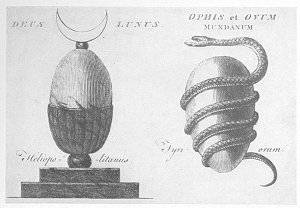
(From Journal of the Royal Asiatic Society of Great Britain and Ireland, 1835, Vol. II.)THE FIVE FIGURES OF EARTH as the Mundane Egg, given in Plates XXIX , pl30 , and XXXI , are all of them different, yet all of them the same, and they range in time and region from ancient Egypt to seventeenth-century England. The idea of the "Ophis et Ovum Mundanum" (PlateXXIX, B ) is not to be traced to its source; it is found everywhere, in the open or secret traditions of all races--this concept of the great World Serpent warming, guarding, hatching, sometimes feasting on the Earth Egg. The "Deus Luna" () is one of the old attempts, in varying forms and with more interpretations, to link the great triad of heavenly bodies, Sun, Moon, and Earth, into a figure symbolic of the whole universe. Here the Mundane Egg is held in its fiery vase very much as an acorn is held in its cup. It is guarded by the Moon, which, as a "great white bird," was supposed to rest at night upon the Earth; "like a goose," said the Egyptians, "brooding over her egg."

The third figure (Plate XXIX, C ), as much a World Mountain as a World Egg, is asserted by Flammarion to represent the world-concept of Edrisi, an Arabian geographer of the eleventh century, "who, with many others, considered the Earth to be like an egg with one-half plunged into the water." This is identical with the figure illustrating the "Theory of Two Centres" (Fig. 54 ).

PLATE XXIX. A. <i>Deus Lunus</i>. B. <i>Ophis et Ovum Mundanum</i>.<br> (From <i>Ancient Mythology</i>; Jacob Bryant, 1774, Vol. Il)
PLATE XXIX. A. Deus Lunus. B. Ophis et Ovum Mundanum.
(From Ancient Mythology; Jacob Bryant, 1774, Vol. Il)

PLATE XXIX. C. Earth as a floating Egg.<br> (From Flammarion's <i>Astronomical Myths</i>. 1877)
PLATE XXIX. C. Earth as a floating Egg.
(From Flammarion's Astronomical Myths. 1877)
It is also a modern religious rendering of the Northern hemisphere, with Jerusalem and Palestine at the apex of the world.

The last two figures bring us back again to Thomas Burnet and his Theory of the Earth, which emphatically was the theory that it is almost literally, certainly by every analogy, the Mundane Egg.

"There is another thing in Antiquity," said this great English Platonist, "relating to the form and construction of the Earth, which is very remarkable, and hath obtained throughout all learned Nations and Ages. And that is the comparison or resemblance of the Earth to an Egg. And this is not so much for its external figure, though that be true too, as for the inward composition of it; consisting of several Orbs, one including another, and in that order, as to answer the several elementary Regions on which the new-made Earth was constituted. For if we admit for the Yolka Central fire . . . and suppose the Figure of the Earth Oval, and a little extended towards the Poles . . . those two bodies do very naturally represent one another, as in this Scheme, which represents the interiour faces of both, a divided Egg, or Earth. Where, as the two inmost Regions (A. B.) represent the Yolk and the Membrane that lies next above it; so the Exteriour Region of the Earth (D.) is as the Shell of the Egg, and the Abysse (C.) under it as the White that lies under the Shell. And considering that this notion of the Mundane Egg, or that the World was Oviform, hath been the sence and language of all Antiquity, Latins, Greeks, Persians, Egyptians, and others, I thought it worthy our notice in this place."

The unknown author of De Imago Mundihad, it happens, compared not the Earth but the Universe itself to a ball, or an Egg. In his scheme, the shell corresponded to the upper heavens; the white to the upper air; the yolk to the lower air; and the pinguidinis gutta, or drop of grease in the centre, to the Earth. And, even earlier than these, the Venerable Bede had written (in the sixth century A.D.): "The Earth is an element placed in the middle of the world, as the yolk in the middle of an egg; around it is the water, like the white surrounding the yolk; outside that is the air, like the membrane of the egg; and around all is the fire, which closes it in as the shell does. . . . The ocean, which surrounds it by its waves as far as the horizon, divides it into two parts, the upper of which is inhabited by us, while the lower is inhabited by our antipodes; although not one of them can come to us, nor one of us to them." These three analogies are developed differently, but Burnet's figure of the "divided egg" will serve to illustrate all of them (Plate XXX ).

Having divided his Earth-egg to show the order of arrangement of its inner parts, Burnet then closed it up, to represent it entire, with only a reminder of the great abyss under it (Plate XXXI ), on which his whole theory of the Deluge and the dissolution of the Earth rested. Either the great abyss opened (which he doubted), "or the frame of the Earth broke and fell down into the Great Abysse." In the latter case, there would be two effects. This "smooth Earth" in which were the first scenes of the world and the first generations of mankind, which had the beauty of youth and not a wrinkle, scar or fracture in all its body, no Rocks or Mountains, no hollow Caves nor gaping Chanels," would be first submerged during the agitation of the abyss by the violent fall of the Earth into it.

PLATE XXX. ''A DIVIDED EGG, OR EARTH.''<br> (From The Theory of the Earth; Thomas Burnet, 1697)
PLATE XXX. ''A DIVIDED EGG, OR EARTH.''
(From The Theory of the Earth; Thomas Burnet, 1697)

Then, when the flood had subsided, "you would see," said he, "the true image of the present Earth in the ruines of the first" (Fig. 34 and Plate XIV ). He compared his "smooth" or primal Earth to an lipileor hollow sphere filled with water, which the heat of fire rarefies and turns into vapours and winds. "The Sun here is as the Fire," he said, "and the exteriour Earth is as the Shell of the lipile, and the Abysse as the Water within it. . . . So we see all Vapours and Exhalations enclosd within the Earth, and agitated there, strive to break out, and often shake the ground with their attempts to get loose. And in the comparison we used of an lipile, if the mouth of it be stopt that gives the vent, the Water rarefied will burst the Vessel with its force. And the resemblance of the Earth to an Egg, which we used before, holds also in this respect, for when it heats before the Fire, the moisture and Air within being rarefied, makes it often burst the Shell. And I do the more willingly mention this last comparison, because I observe that some of the Ancients, when they speak of the doctrine of the MundaneEgg, say that after a certain period of time it was broken."

Another cosmogony worked out along this same analogy is that of the Gnostics, a group that flourished during the first two centuries of the Christian era, who are said to be the descendants in wisdom of other groups far removed. But the Gnostic group was really an aggregation of groups who combined the Christian teachings with a gnosis or higher knowledge through which the inner meaning of Christianity was revealed. Their doctrines were akin to those of Pythagoras, the higher Egyptian, Indian and Chinese teachers, and to those of the Essenes who for centuries before the Christian era had dwelt apart on the shores of the Dead Sea. They strove after the knowledge of God; wisdom was their goal, and the life of man on Earth their study. For gnosis, in the words of Theodotus, is the knowledge of what we were, what we have become, where we were, into what place we have been thrown; whither we are hastening, whence we are redeemed; what is birth, and what is re-birth." Their scheme of the universe has come down to us through "the diagram of Celsus," who called it the diagram of the Ophites, a sect of the Gnostics, with whose beliefs he was most familiar.

In the beginning, said the Gnostics, was the Trinity, Light, Spirit, and Darkness, all intermingled; and from the striving of the Darkness to retain the Light and Spirit, and so to imprison life sparks in matter, and from the striving of Light and Spirit against the power of Darkness, the first great form was produced, Heaven and Earth, symbolised by the World Egg in the womb of the universe. This World Egg was represented as a circle with a serpent twined several times around it, signifying the mysterious force which first set into separating, light-producing motion the mingled Light and Darkness of the Great Monad. The great serpent, they believed, was not the Great Tempter, but the form through which Divine Will and Divine Reason incessantly moved and manifested.

PLATE XXXI. ''THE WHOLE EARTH IS AN EGG''<br> (From <i>The Theory of the Earth</i>; Thomas Burnet, 1697)
PLATE XXXI. ''THE WHOLE EARTH IS AN EGG''
(From The Theory of the Earth; Thomas Burnet, 1697)
The diagram itself is divided into two great regions, the upper and the lower, separated from each other by the thick black line called Gehennaor Tartarus. The upper region belonged to the supreme Intelligences; it was the world of the ns, or the Pleroma of the Gnostics--the World of Light. Here was perfect harmony, the state of ideal fulness or perfection.

The lower region is divided into two groups, one of ten, the other of seven, spheres, each group of spheres being enclosed within a sphere, and the two separated from each other by the band of Lower Air. The circle enclosing the seven spheres is labelled Leviathan, and represents the Soul of the World, as the body represents the spirit that dwells in it. For it chanced that, one day, the Universal Mother, brooding over the Waters, let a "Drop of Light" fall downwards into chaotic matter, and this was called Sophia, or Wisdom, the WorldMother. The waters of the her being then set in motion, formed a body for Sophia, called the Heaven-sphere. Whereupon Sophia, freeing herself, rose upwards to the Middle Region, below her Mother who was herself the bounding line of the Ideal Universe. Sophia had herself produced Ialdabaoth (child of Chaos, and also identified with Saturn), who in his turn produced a son, and so on, until there were seven in all, the Formative powers of the phenomenal world.

The second group of spheres within a sphere is labelled Behemoth--it is the terrestrial world. Its lower seven spheres carry within them the signatures of seven great animals, and, without, the names of seven angels. The higher three spheres bear only interrogation marks, but they are supposed to belong to Ialdabaoth, the ruler of terrestrial affairs, or perhaps to Sophia herself.

Concerning the signatures of animals inscribed within the seven lower spheres and their relation to the seven angels named outside, Celsus says that the first, a goat, "was shaped like a lion," and was a part of Michael the Lion-like. The second in descending order was a bull--or Suriel, the Bull-like; the third was "an amphibious sort of animal and one that hissed frightfully"--Raphael the Serpent-like; the fourth had the form of an eagle--Gabriel, the Eagle-like; the fifth had the countenance of a bear--Thauthabaoth, the Bear-like; the sixth had the face of, a dog--or Erataoth; "the seventh had the countenance of an ass and was named Thaphabaoth or Onoel."

Might any soul succeed in escaping through these seven spheres and the three empty globes or circles, he must then pass "the fence of wickedness," or "gates" subjected to the world of ruling spirits called Leviathan. Beginning with the lowest, he passed to what was called Ialdabaoth, then to Iao, to Sabaoth, to Astaphs ruler of the third gate, to Alus governor of the second, and to Hors, keeper of the first. Celsus calls this world of Leviathan "circles upon circles."

The Gnostics are famous for their strange symbolic figures. They believed in a Watcher of the World, a Mind that perceived, and they often represented this See-er of the World as a human body pierced with eyes. The extraordinary frontispiece to Riccioli's Almagestum Novum(Plate XXXII ) is by no means a Gnostic picture, but its left-hand figure is a perfect delineation of the myriad-eyed Watcher of the universe.

FIGURE 65. <i>Gnostic Diagram of the Universe</i>.<br> (From <i>Histoire critique du Gnosticisme</i>; Jacques Matter, 1826, Vol. III, Plate I, D.)
FIGURE 65. Gnostic Diagram of the Universe.
(From Histoire critique du Gnosticisme; Jacques Matter, 1826, Vol. III, Plate I, D.)

Almagestum Novumappeared at just the time when the whole universe had been turned, so to say, inside out half inside out, at least. For the Ptolemaic system of the universe, by which we know that theory which places the Earth at the centre, with the rest of the heavenly bodies revolving about it, had but lately fallen. Copernicus, after many years of hesitancy, had at last dared, in 1543, to publish his De revolutionibus, which declared the Sun to be at the centre of our world. Eighteen years later Riccioli's Almagestum Novumwas published; and this little time-scheme lends even more interest to its remarkable frontispiece. For between the "'Watcher of the World" and the "Starry One," the two great systems of the universe hang in the balance, one with the Earth, the other with the Sun, in the centre of Space. The first disc is inscribed with the new Copernican system; the second with the ancient Egyptian. At the goddess's feet lies the system known as Ptolemy's. In one hand she holds the Balance, in the other an armillary sphere. In the upper left-hand corner winged beings float, bearing orbs associated with Light; in the upper right-hand corner move the bearers of those heavenly bodies which bring Light into Darkness--the Moon, Saturn, Jupiter, and the flying serpent of the skies.


Footnotes

148:1 Confucian Cosmogony. Thomas MClatchie, Shanghai, 1874.

The Wheel of Life

THE BOOK OF EARTHS

By

EDNA KENTON

New York: William Morrow & Company

[1928, No renewal]


The Wheel of Life

CLOSELY ASSOCIATED with the World Mountains are the many Wheels of Life, by which the ancients sought to picture the relations of parts of the universe to each other and to the whole. There is a hint of this in the Tibetan world-picture, with Mount Meru the axis or hub of the world about which are placed like spokes in a wheel the four quarters of the Earth, with their three islands each, making the sum of twelve radii from the centre. The Wheel of the Zodiac was of course the great original for all such figures, particularly for the Wheels of Life. For uncounted centuries man knew the geography of the heavens better than the geography of the Earth, and whatever life on Earth meant to him, the unfailing procession of the great star-groups of the Zodiac meant certainty, law, order. There were zones written in the heavens long before man stretched his imaginary lines of the terrestrial zones over the Earth--"The circle called the Zodiac," said Plutarch, "is placed under the three that are in the midst, and lies obliquely, gently touching them all." And it is not hard to see how this great circle came to seem to man a mirror of the Earth, a storehouse of its history, its constant Watcher in the sky, and the unerring prophet of its future. The Greeks named this oblique ring of star-groups just behind the Sun when it sets or just before it when it rises, the Zodiac or Path of Animals, because the names and configurations of the groups were mostly those of animals, and by that name we know it. But no one knows how long before the days of the Greeks far earlier astronomers first linked the single groups of stars into the twelve great signs of the Star-bearing Circle.

PLATE XXVI. CREATIO UNIVERSI<br> (From Physica Sacra; Johann Jacob Scheuchzer, 1731, Vol. q, Plate I).
PLATE XXVI. CREATIO UNIVERSI
(From Physica Sacra; Johann Jacob Scheuchzer, 1731, Vol. q, Plate I).Physica Sacrais an early eighteenth-century Bible illustrated almost text for text, and Plate XXVI is its first illustration, for the first verse of the first chapter of the first book: "In the beginning God created the heaven and the Earth." Outside the Zodiacal Wheel are clouds upon clouds bearing a multitude of spheres, and, in addition, seven numbered diagrams. Fig. I in this Plate illustrates the system of the "eleven heavens," with the Earth the centre of the universe. Fig. II is the Tychonian system; Fig. III, what is known as the semi-Tychonian system; Fig IV, the blazing and effulgent Sun, containing within himself his seven children, Earth and Moon and the five great planets; Fig. V, a group of the heavenly bodies; Fig. VI, an armillary sphere; Fig. VII, an Astrolabe, which is almost to say, "the handle of the stars," and which was called by the old astronomers "the Mathematical jewel."

The Northern and Southern hemispheres of the heavens (Figs. 58 and 59 ) are merely supplementary to Scheuchzer's Creatio Universi. They are taken from an Arabic celestial globe, made of brass, in 1275 A.D., which was deposited in the Museum of the Royal Asiatic Society of Great Britain and Ireland. Near the South Pole is an inscription in Cufic characters, stating that it was "Made by the most humble in the supreme God, Mohammed ben Helah, the astronomer of Monsul, in the year of the Hegira." The Zodiac was known to the Arabs, not as The Path of Animals," but as The Girdle of the Castles," and contained, with one or two variations in name, the same signs we have to-day: Aries, Taurus and Gemini, Cancer, Leo, Virgo (this the Arabs called the Ear), Balance or Libra, Scorpio, Sagittarius, Capricornus, Aquarius, and Pisces.

FIGURE 58. <i>An ancient Arabic Celestial Sphere. Northern Hemisphere</i>.<br> (From <i>Transactions of the Royal Asiatic Society of Great Britain and Ireland</i>, 1830, Vol. II, Plate A.)
FIGURE 58. An ancient Arabic Celestial Sphere. Northern Hemisphere.
(From Transactions of the Royal Asiatic Society of Great Britain and Ireland, 1830, Vol. II, Plate A.)There are altogether, including the signs of the Zodiac, forty-seven constellations on these Arabic celestial hemi-pheres. The ones inscribed on the Northern hemisphere are: Little Bear; Greater Bear; The Dragon; Cepheus; Boes; the Northern Crown; The Kneeling Hercules; The Lyre; The Hen, or Swan; The Lady in her Chair, or Cassiopeia; The Bearer of Medusa's Head, i.e., Perseus; The Charioteer; The Charmer of Serpents, or Serpentarius; The Arrow, or Sagittarius; The Flying Eagle, or Aquila; The Dolphin; Part of the Horse (the horse's head); The Greater Horse, Pegasus; The Chain, or Andromeda; The Triangle.

FIGURE 59. <i>An ancient Arabic Celestial Sphere. Southern Hemisphere</i>.<br> (From <i>Transactions of the Royal Asiatic Society of Great Britain and Ireland</i>, 1830, Vol. II, Plate B.)
FIGURE 59. An ancient Arabic Celestial Sphere. Southern Hemisphere.
(From Transactions of the Royal Asiatic Society of Great Britain and Ireland, 1830, Vol. II, Plate B.)The constellations inscribed on the Southern hemisphere are: Ketos, the Whale; The Giant, or Orion; The River, or Acarnar; The Hare, or Lepus; the Greater Dog, or Canis; The Dog, or Procyon; The Ship, or Argo; The Hydra; The Flaggon, or Crater; The Crow, or Corvus; The Centaur, or Centaurus; The Beast, or Fera; The Censer; The Southern Crown; The Southern Fish.

OF THE TWO WHEELS OF LIFE (or Fate or Law) to be given here, we begin with the one that seems the simpler. This Chinese Wheel (Plate XXVII ) is almost a Zodiac or "path of animals," of itself. (The Chinese Zodiac, or "Yellow Path of the Sun," differed materially in its signs from the Greek-Arabic one just given; it contained twelve animals: the Mouse, the Cow, the Tiger, the Rabbit, the Dragon, the Serpent, the Horse, the Ram, the Ape, the Hen, the Dog, and the Pig.) Six of the twelve divisions are separating paths or currents, through or over which the traveller passes to the next stage. Four of the remaining divisions are the abodes of beasts, of insects, of fish, and of birds. The other two, separated from each other by one of the spiral-like rivers, are inhabited by Poor Men and Rich Men, or by Mandarins and Tillers of the Soil.

PLATE XXVII. THE WHEEL OF LIFE<br> (From <i>Dragon, Image, and Demon</i>; H. C. Du Bose, 1887)
PLATE XXVII. THE WHEEL OF LIFE
(From Dragon, Image, and Demon; H. C. Du Bose, 1887)

The second of these wheels is the one elaborately developed in the Tibetan Wheel of Life (Plate XXVIII) to which is an almost necessary Key. It is a Tibetan version of an Indian painting in one of the abandoned cave-temples of Ajanta, which L. Austine Waddell holds to be "a complete authentic account of human life from the absolute standpoint of the earliest Buddhist philosophy."

FIGURE 60. <i>Key to the Tibetan Wheel of Life</i>.<br> (From <i>The Buddhism of Tibet, or Lamaism</i>; L. Austine Waddell, 1899.)
FIGURE 60. Key to the Tibetan Wheel of Life.
(From The Buddhism of Tibet, or Lamaism; L. Austine Waddell, 1899.)

The Lamas of Tibet say that Buddha himself originated the Wheel of Life, forming it on the Earth with grains of rice from a "rice-field school room." According to the old story, while tarrying for a while at the Squirrels' Feeding Ground in the Venuvana forest near Rajagriha, Buddha instructed his disciple Ananda, to make a Wheel, for the sake of illustrating what another disciple had seen when he visited other spheres. This Wheel was to have five spokes, between which were to be shown the several hells, animals, ghosts, gods and men. In the middle a dove, a serpent, and a hog were to symbolise lust, hatred, and ignorance. Around the outer rim was to wind "the twelve-fold circle of causation," in regular and inverse order. Beings were to be shown "as being born in a supernatural way as by the machinery of a water-wheel falling from one state and being produced in another." Buddha himself, as an "Enlightened One," liberated from the fate of recurrence on the Wheel, was to be outside of it--one who had escaped. This diagram, made first of rice-grains, was later filled in (second century A.D.) with pictures by the Indian monk Nagarjuna, but these pictures are said to be not his own inventions, but the visual images of Buddha's own parables and allegories.

The Key to the Tibetan Wheel of Life will be found an aid in following the interpretation of it, which is Waddell's, and is given here much abridged. 1

The disc, symbolising the endless cycle of life, is held in the grasp of a monster who represents the horrors of Attachment, the wretchedness of Clinging-to-Life.

The broad tire of the Wheel is filled with the twelve-linked closed chain called the Causal Nexus, or "the twelve-fold circle of causation," i.e., the causes of life and of misery. At the centre or nave lie the three vices or delusions, "the Daughters of Desire," symbolising lust, ill-will, and stupidity, which lie at the core of re-birth, and are here given in the forms of a dove, a serpent, and a pig, coloured respectively red, green, and black. The body of the Wheel, filled with varied pictures, is supposed to be constantly revolving, thereby producing "The Whirling on the Wheel" of Life.

The way of escape is indicated by the twelve "links," and the first link is the connecting link between the old life and the new. It might be denominated Unconscious Will to escape. The links in the causal chain are:

I. A blind she-camel (ignorant unconscious will) led by a driver (Karma). In this picture, however, the first link is represented by a blind old woman led by a man, with its meaning the same. II. A potter modelling clay on his wheel (Conformations and impressions of and on formless clay). III. A monkey (the beginning of Consciousness; the new man is approaching to the human, but is still an unreasoning automaton). IV. A man being ferried across an Ocean (Self-consciousness--the Individual crossing the Ocean of Life). V. An empty house (Understanding achieved through "the empty house of the senses"). VI. The Kiss (or contact with the outside world). VII. An arrow entering a man's eye (Feeling or perception). VIII. A man drinking wine (Desire--or thirst). IX. A man gathering fruit and storing it in baskets (Greed, or the satisfying of Desire). X. A married woman--wife of him whose life is here traced (fuller life, Being, Becoming, even Re-birth and the continuance of Being for another existence). XI. Parent and child (Birth--of an heir). XII. A corpse being carried off to burial (Decay and Death), which leads to I, Unconscious Will for re-birth--and the cycle of the Wheel is begun again.

The ways of "life" or "re-birth" are, from highest to lowest, 1. Gods--the Sura. 2. Titans--the Asura. 3. Man--Nara, or Mi. 4. Beasts--the Du-door "best goers." 5. Tantalised Ghosts--Pretas. 6. Hell--Narakaor Nal-kam.

To live in the first three worlds is superior; to live in the last three is inferior--the highest world being Heaven, and the lowest Hell.

In Heaven, above the Titans, on the aethereal summit of Mount Meru, dwell the gods (Plate XXV ). In the lowest regions of the heavens dwell the "guardian kings of the four quarters"; Dritarashtra, the white guardian of the East; Virudhaka, the green guardian of the South; Virupaksha, the red guardian of the West; and Vaisravana, the yellow guardian of the North.

In the upper right-hand section of the Wheel of Life the Titans (the Asuraor not-gods) have their abode. Since their chief characteristic is pride, this is the world of re-birth for the "proud." The Titans correspond to Satan and his hosts, having been, like Satan, and for like cause, cast out from Heaven.

PLATE XXVIII. THE WHEEL OF LIFE<br> (From <i>The Buddhism of Tibet, or, Lamaism</i>; L. Austine Waddell, 1899)
PLATE XXVIII. THE WHEEL OF LIFE
(From The Buddhism of Tibet, or, Lamaism; L. Austine Waddell, 1899)

THE WHEEL OF LIFE<br> (From <i>The Buddhism of Tibet, or, Lamaism</i>; L. Austine Waddell, 1899), p. 108
THE WHEEL OF LIFE
(From The Buddhism of Tibet, or, Lamaism; L. Austine Waddell, 1899), p. 108

Living at the foot of Mount Meru, they hover forever between Heaven and Earth. The life of the Titans is much longer than the life of men; but it is the fate of every Titan to die warring against the gods for the fruits of the heavenly Parijatatree, whose branches are in Heaven, but whose roots are in their country--"the tree of the concentrated essence of Earth's products." The Jambu tree is, in reality, according to this reading, the "climber" which encircles the aethereal tree, and through it the quintessence of Jambudvip, or the Jambu continent" of Earth is instilled into the ParijataTree.

Man--Naraor Mi--lives in the upper left-hand region, constantly confronting the eight miseries--birth, old age, sickness, death, ungratified wishes and struggle for existence, misfortune and punishment for law-breaking, separation from relatives and cherished objects, offensive objects and sensations. Of all these and other phases of ordinary existence pictures abound within the Wheel--birth in a cottage; children at play; village scenes--people drinking wine under a tree; a flute player; women spinning and weaving; a borrower; two traders; a drunken man; workers tilling a field or gathering fuel in a forest or bent under heavy loads; the accidents of life--a man and a horse falling into a river; crime--two men fighting--another on trial--another suffering punishment; government--a king and his ministers; old age, disease--a doctor feeling a sick man's pulse; death--a corpse and funeral ceremonies; religion--a temple placed above all the other objects within the Wheel--that is, Indra's Palace.

Beasts--lower right-hand quarter--are more miserable than man. They are shown consuming each other and being consumed; hunted by men, overburdened with loads, and filled with fear. Far beneath the waters of this animal world is the region of the Nagasor Mermen (great snakes), their home preyed upon by Garuda, Lord of birds, seeking here the serpents of the deep for food.

The region of the Tantalised Ghosts--lower left-hand quarter, is situated above Hell, and hunger and thirst torture the inhabitants. Always before their eyes there are food and drink and jewels in abundance, but the Pretashave mouths no larger than the size of a needle's eye, throats no wider than a hair's diameter, and through these openings they can never satisfy their huge bodily appetites. Add to this that, when food is taken, it is changed into knives or molten metal, and their hunger and thirst can be realised as incessant and never to be appeased. The little pictures within the Wheel show flames pouring from their mouths--if they touch water, it changes to liquid fire. The great Maudgalyayanaonce descended to the Tibetan purgatory to relieve his mother's distress, but even he could not aid her, and the rice he offered her turned to fiery ashes as she touched it.

Hell, the lowest region, is "situated in the bowels of the human Earth," and is ruled over by Yama, king and judge of the dead, who must himself every day swallow molten metal. His domain is divided into many compartments, each with its special form of punishment for the expiation of different sins. In the upper part of Hell sits Yamawith his good and evil angels, ghosts of the dead, the Weigher, and the Prisoner. Below are the Hot Hells, and the Cold Hells, to each of which the damned are assigned according to their sins. The Hot Hells are sunk in the Earth, beginning at a depth of 11,900 miles, and they reach to a depth of 40,000 miles. They are of deepest black, although each is surrounded by a wall of fire. The Cold Hells are at the very edge of the Universe, circled by icy mountains and supplied with glacier water in which the victims are constantly immersed, until chilblains appear and become great sores and ulcers.

There is an exit from Hell, through a sort of borderland Hell called "the near (to re-birth) cycle." This has four divisions; the first filled with hot ashes and dead bodies and offal; the second a quagmire or "sinking sands," beyond which is a forest of spears, which must be crossed--like the razor-bridge of Mohammed, the Bi-frost of Yggdrasil, the slippery fir-tree of the American Indians, or the wide river of The Pilgrim's Progress. After--if--the bridge is crossed, there comes a river of freezing water whose farther shore is thickly set with tree stumps bearing three spiked leaves which impale the pilgrim. What is left to man after this pilgrimage is called "The Surviving Thing."


Footnotes

140:1 Buddhism, or The Lamas of Tibet; L. Austine Waddell, pp. 105-121.

Subscribe to this RSS feed

Log in or create an account