log in
Website Items

Website Items (1257)

Children categories

The Book of the Bee

The Book of the Bee (19)

THE BOOK OF THE BEE

THE SYRIAC TEXT

EDITED FROM THE MANUSCRIPTS IN LONDON, OXFORD, AND MUNICH

WITH AN ENGLISH TRANSLATION

BY ERNEST A. WALLIS BUDGE, M.A.

LATE SCHOLAR OF CHRIST'S COLLEGE, CAMBRIDGE, AND TYRWHITT SCHOLAR ASSISTANT IN THE DEPARTMENT OF EGYPTIAN AND ASSYRIAN ANTIQUITIES, BRITISH MUSEUM

OXFORD AT THE CLARENDON PRESS 1886.


View items...
The Book of the Cave of Treasures

The Book of the Cave of Treasures (32)

THE BOOK OF THE CAVE OF TREASURES

A HISTORY OF THE PATRIARCHS AND THE KINGS
THEIR SUCCESSORS FROM THE CREATION
TO THE CRUCIFIXION OF CHRIST

TRANSLATED FROM THE SYRIAC TEXT OF THE
BRITISH MUSEUM MS. ADD. 25875

BY

SIR E. A. WALLIS BUDGE, KT.

M.A., LITT.D. (CAMBRIDGE), M.A., D.LITT. (OXFORD),
D.LIT. (DURHAM), F.S.A.
SOMETIME KEEPER OF EGYPTIAN AND ASSYIRIAN ANTIQUITIES, BRITISH MUSEUM;
CORRESPONDING MEMBER OF THE ACADEMY OF SCIENCES, LISBON; AND
CORRESPONDING MEMBER OF THE PHILOSOPHICAL SOCIETY OF AMERICA
With 16 plates and 8 illustrations in the text

LONDON
THE RELIGIOUS TRACT SOCIETY

MANCHESTER, MADRID, LISBON, BUDAPEST

1927


Front piece

Imdugud, in Imgig, the lion-headed eagle of Ningirsu, the great god of Lagash

cave-00-front

Sumerian relief in copper on wood representing Imdugud, or Imgig, the lion-headed eagle of Ningirsu, the great god of Lagash, grasping two stags by their tails. It is probable that it was originally placed over the door of the temple of Nin-khursag or Damgalnun at the head of the stairway leading on to the temple platform. This remarkable monument was made about 3100 B.C., and was discovered by Dr. H. R. Hall in 1919 at Tall al-`Ub, a sanctuary at "Ur of the Chaldees" in Lower Babylonia. It is now in the British Museum (No. 114308).


View items...
The Book of Enoch

The Book of Enoch (6)

The Book of Enoch

 A page of the Book of Enoch

enoch-index

A page of the Ethiopic text of the "Book of Enoch" (British Museum MS. Orient. No. 485, Fol. 83b) containing a description of one of Enoch's visits to heaven, and how the archangel Michael took him by the hand and showed him the mysteries of heaven.


From The Apocrypha and Pseudepigrapha of the Old Testament R.H. Charles Oxford: The Clarendon Press


View items...
The Forgotten Books of Eden

The Forgotten Books of Eden (34)

THE FORGOTTEN BOOKS OF EDEN

 Translated in the late 1800's

by

Dr. S. C. Malan and Dr. E. Trumpp.

Translated into King James English from both the Arabic version and the Ethiopic version which was then published in The Forgotten Books of Eden in 1927 by The World Publishing Company.

In 1995, the text was extracted from a copy of The Forgotten Books of Eden and converted to electronic form by Dennis Hawkins.


View items...
The Book of Jasher

The Book of Jasher (93)

The Book of Jasher

Referred to in Joshua and Second Samuel

Faithfully Translated

FROM THE ORIGINAL HEBREW INTO ENGLISH

SALT LAKE CITY: PUBLISHED BY J.H. PARRY & COMPANY 1887.


NOTE : According to some sources, this book was once the original start of the Bible. Originally translated from Hebrew in A.D. 800, "The Book of Jasher" was suppressed, then rediscovered in 1829 when it was once again suppressed. Reemerged again, in his preface Alcuin writes the reference to Jasher in 2 Samuel authenticates this book .

The root of the first book of Jasher must be written BEFORE the time of Joshua and Samuel in the Bible because both books refers to the book of Jasher.

"Is not this written in the Book of Jasher?"--Joshua, 10,13.

"Behold it is written in the Book of Jasher."--II. Samuel, 1,18


View items...
The Book of Jubilees

The Book of Jubilees (1030)

The Book of Jubilees

From The Apocrypha and Pseudepigrapha of the Old Testament

by R.H. Charles, Oxford: Clarendon Press,

1913.

Scanned and Edited by Joshua Williams, Northwest Nazarene College.


A page of the Book of Jubilees

jubilees-main

A page of the Ethiopic version of the apocryphal work known to ecclesiastical writers as the "Lesser Genesis," and the "Apocalypse of Moses" (British Museum MS. Orient. No. 485, Fol. 83b). Because each of the periods of time described in the book contains forty-nine to fifty years, the Ethiopians called it MAZHAFA K i.e. the "Book of Jubilees." The passage here reproducted describes the tale of Joseph in the 17th year of his age, his going down to Egypt, and his life in that country.


 See the video about Jubilees in 20 parts:

{youtube}Kq_0-D5UnxM{/youtube}
View items...
The Kebra Nagast

The Kebra Nagast (25)

The QUEEN of SHEBA
AND HER ONLY SON
MENYELEK

being

THE 'BOOK OF THE GLORY OF KINGS'

(KEBRA NAGAST)

A WORK WHICH IS ALIKE THE TRADITIONAL HISTORY OF THE ESTABLISH- MENT OF THE RELIGION OF THE HEBREWS IN ETHIOPIA, AND THE PATENT OF SOVEREIGNTY WHICH IS NOW UNIVERSALLY ACCEPTED IN ABYSSINIA AS THE SYMBOL OF THE DIVINE AUTHORITY TO RULE WHICH THE KINGS OF THE SOLOMONIC LINE CLAIMED TO HAVE RECEIVED THROUGH THEIR DESCENT FROM THE HOUSE OF DAVID

Translated from the Ethiopic

by SIR E. A. WALLIS BUDGE M.A., LITT.D., D.LITT., LIT.D. F.S.A.

Sometime Scholar of Christ's College, Cambridge Tyrwhitt Hebrew Scholar, and Keeper of the Department of Egyptian and Assyrian Antiqui- ties in the British Museum.

WITH THIRTY-TWO PLATES

MCMXXXII

OXFORD UNIVERSITY PRESS LONDON : HUMPHREY MILFORD

{Reduced to HTML by Christopher M. Weimer, September 2002}

 
View items...
The Book of Abraham

The Book of Abraham (10)

THE BOOK OF ABRAHAM

ITS AUTHENTICITY ESTABLISHED AS A DIVINE AND ANCIENT RECORD

WITH COPIOUS REFERENCES TO ANCIENT AND MODERN AUTHORITIES

BY ELDER GEO. REYNOLDS.

1879 SALT LAKE CITY, UTAH

DESERET NEWS PRINTING AND PUBLISHING ESTABLISHMENT.


View items...
The Writings of Abraham

The Writings of Abraham (2)

The Writings of Abraham

from the papyri found in Egypt 1831


View items...

The Deluge

THE BOOK OF EARTHS

By

EDNA KENTON

New York: William Morrow & Company

[1928, No renewal]


The Deluge

The third and fourth catastrophes of the Earth are the Deluge, and the sinking of Atlantis--Atlantis the fabulous continent, not the little Island remnant. Their time sequence in the old traditions is a little mixed, not that it matters. Suppose we take first the Deluge.

The Comet, that blazing terror of the skies, that erratic wanderer of the heavens, has always been given more than its probable share of blame for terrestrial bad luck. It has been called the cause of the birth of the Moon; it has also been held responsible for the universal Deluge. This is another of those untraceably old traditions, but we begin with the Comet of 1680, and the remarkable egg laid at Rome on December 4 of the Comet-year; because this Comet and this egg are responsible for two "Theories of Earth" written within the next twenty years, both by Englishmen. William Whiston worked out a complete theory of a deluged, because Comet-riven, Earth, and Thomas Burnet developed his theory of Earth as the Mundane Egg whose broken shell unlocked the "waters of the deep."

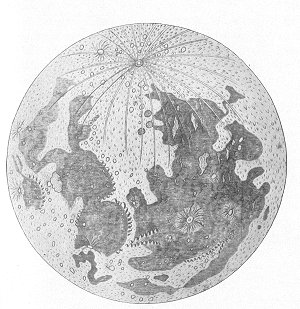
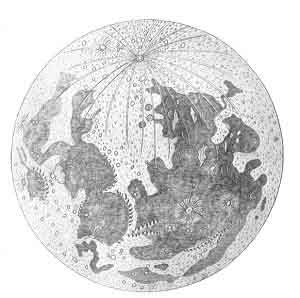
PLATE XIII. <i>One of the oldest drawings of the Moon. by Pere Capucin Marie de Rheita</i> (<i>1645</i>). <i>At the top Tycho is seen in full view, with its diverging rays</i>.<br> (From <i>Iter Exstaticum Coeleste</i>; Athanasius Kircher, 1660)
PLATE XIII. One of the oldest drawings of the Moon. by Pere Capucin Marie de Rheita(1645). At the top Tycho is seen in full view, with its diverging rays.
(From Iter Exstaticum Coeleste; Athanasius Kircher, 1660)

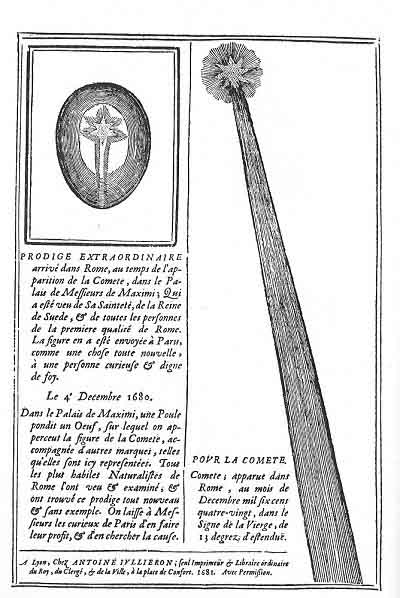
The evidence in the case is at hand in the shape of the elaborate frontispiece to Lettre dun gentil-homme de province une dame de qualitsur le sujet de la Comete, a brief little labour of informative love published anonymously in 1681, but known now to have been written by Claude Franis Manestrier. "An extraordinary freak of nature," it reads, "occurred in Rome, at the time of the appearance of the Comet, in the Palace of the Maximi, which was seen by His Holiness, by the Queen of Sweden, and by all persons of the first rank in Rome. The design of it was sent to Paris, as an entirely new thing, by a per-son greatly interested and worthy of confidence. On the 4th of December, 1680, in the Palace of the Maximi, a hen laid an egg, on which could be discerned the figure of the Comet, accompanied by other markings such as are here represented. All the most skilled naturalists of Rome saw and examined it, and found it to be a freak of nature unique and unparalleled. It is left to the curious gentlemen of Paris to make profitable use of it and to seek the cause."

FIGURE 41. The Comet of 1680 and the marvellous Egg.<br> (Frontispiece of <i>Lettre dun gentil-homme de province une dame de qualitsur le sujet de la Comete</i>; Claude Franis Manestrier, 1681.)
FIGURE 41. The Comet of 1680 and the marvellous Egg.
(Frontispiece of Lettre dun gentil-homme de province une dame de qualit sur le sujet de la Comete; Claude Franis Manestrier, 1681.)
Now it has always been extremely difficult for the extremely exact among the theorists to account for the sources of waters great enough to bring about a universal Deluge. No rains of forty days and nights explain it, even when these rains from heaven are united with all the external waters of the Earth. There were, to be sure, the "fountains of the great deep," but how were they to be broken up! And it is said that the Comet-Egg of this Comet-year gave good Will Whiston the idea he needed for solving the mystery of the Deluge. He published, in 1690, A New Theory of Earth, in which he set forth "the other main Cause of the Deluge, the breaking up of the fountains of the great deep," by the deadly weight of the waters in the tail of a Comet active in the heavens while Noah was building the Ark. "For when the near approach of the Comet to the Earth had rendered the Shape of that internal dense Fluid, on which its upper Crust rested, so very oblong and oval, and its Surface so much larger than before, as to occasion the opening of its perpendicular Fissures, which are visible at this day, . . . the vast weight of the additional Waters from the Comet would attempt to press this upper Earth deeper into the dense Fluid below . . . and so join the subterraneous to the cometical waters, for the supply of a Quantity sufficient for so vast a Purpose as that of a universal Deluge."

Whiston went even farther in his "cometical" theory; he supposed the Earth to have been originally a Comet; to have had a lop-sided form without beauty or proportion; subject to all the misfortunes of Comets, "sometimes a thousand times hotter than melted iron; at other times a thousand times colder than ice." These alternations of hot and cold were "Chaos," a dense though fluid atmosphere which surrounded the solid contents of the Earth, and which was in a state of continuous agitation and shock from its unharmoniously mingled substances. It was the Comet's atmosphere or tail, filled with water, which "struck" the Earth and broke its surface; and Whiston describes minutely just how the antediluvian Comet involved the antediluvian Earth in its tail, until all of Earth, even the mountain of the world, was submerged.

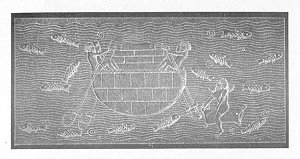
Burnet's theory of the Earth as the Mundane Egg will come farther on, but no better place could be found in this collection of world-pictures than just here, for one of his beautiful drawings of the Deluge, the second Chaos, when, "upon this Chaos rid the distrest Ark that bore the small remains of Mankind," a ship whose cargo was no less than a whole world (Plate XIV ). It is at once a picture of the Deluge after the dove was sent forth from the Ark, and a "Roughe Globe"; a delicate tracery of the broken Earth seen through water, as one looks down into a clear lake. There are vague glinting hints of lost or sunken continents that never emerged when the Earth dried and the waters ran off; a misty figuration of the new Earth, its pattern defined long before the Ark of Noah came to rest on Ararat; with some lost Lemuria, some sunk Atlantis, some shattered Pan or Mu still lingering along the declining edges of the continents about to be. Many of the modern "maps" of the Atlantean and Lemurian lands resemble very much this drawing of Burnet's, where continent seems to overlay continent until the oceans seem little more than spring floods in mountain valleys. Burnet speaks of Plato, who "supposeth his Atlantis to have been greater than Asia and Africa together, and yet to have sunk all into the Sea," and he concludes that great alterations in the face of the land and the sea would take place for a long time after the Deluge; that many of the fragments of land would change their posture, and that there would be a succession of sinkings and eruptions and lesser floods until all became poised and settled once again.

PLATE XIV ''AND AGAIN HE SENT FORTH THE DOVE OUT OF THE ARK''<br> (From <i>The Theory of the Earth</i>; Thomas Burnet, 1697)
PLATE XIV ''AND AGAIN HE SENT FORTH THE DOVE OUT OF THE ARK''
(From The Theory of the Earth; Thomas Burnet, 1697)


Earth-Moon Catastrophe

THE BOOK OF EARTHS

By

EDNA KENTON

New York: William Morrow & Company

[1928, No renewal]


Earth-Moon Catastrophe

The second catastrophe to afflict the Earth in the beginning of things was the Earth-Moon catastrophe; and this, by the way, is not only one of the most ancient of traditions, but it is also a modern theory of causes with which science has been flirting for half a century. So difficult is it to find anything new, even a new theory, which cannot be traced back along some old tangled thread of folk-lore. It is difficult, however, to find anything older in man's consciousness than the riddle of the Moon. What is it, that changeless, ever-changing, flat-faced disc in the sky, forever turning about the Earth, yet never turning

PLATE X. A. <i>The Heavenly Goose</i>.<br> (From Ancient Mythology: Jacob Bryant, 1774, Vol. II)
PLATE X. A. The Heavenly Goose.
(From Ancient Mythology: Jacob Bryant, 1774, Vol. II)

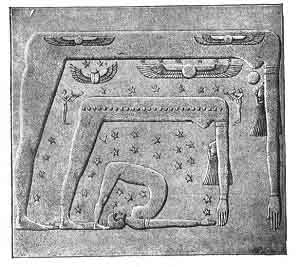
PLATE X. B. <i>The Sky Goddess Nut represented double</i>.<br> (From <i>The Dawn of Astronomy</i>; J. Norman Lockyer, 1894)
PLATE X. B. The Sky Goddess Nut represented double.
(From The Dawn of Astronomy; J. Norman Lockyer, 1894)


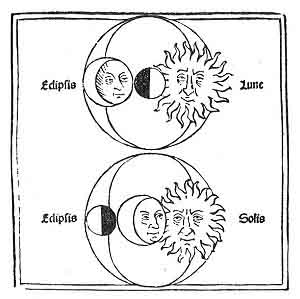
FIGURE 36. <i>Lunar and Solar Eclipses</i>.<br> (From <i>Spha Mundi</i>; Joannes Sacro Bosco, Venice, 1482.)
Click to enlarge
FIGURE 36. Lunar and Solar Eclipses.
(From Spha Mundi; Joannes Sacro Bosco, Venice, 1482.)
FIGURE 37. <i>The Figure of the Dragon: the Lunar Nodes</i>.<br> (From <i>Blundeville His Exercises</i>; London, 1606.)
FIGURE 37. The Figure of the Dragon: the Lunar Nodes.
(From Blundeville His Exercises; London, 1606.)

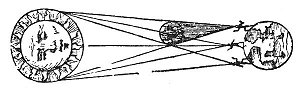
FIGURE 38. ''<i>When the Moone is betwixt the Sunne and the Earth</i>.''<br> (From <i>Blundeville His Exercises</i>; London, 1606.)
FIGURE 38. ''When the Moone is betwixt the Sunne and the Earth.''
(From Blundeville His Exercises; London, 1606.)its other face to the Earth? What mysterious other-world, under-world, over-world, dead or alive, lies on its secret side? What is the relation of the Moon to the Earth and to man? what the relation of the hidden life of the Earth and of man to the Moon? Tradition had doubled these two bodies as a pair acted upon by the Sun, long before astronomers had given us the image of Earth-Moon as a beautiful double planet moving among the stars; long before mathematicians had constructed from the interrelated "pull" of Sun and Moon and Earth the baffling "problem of three bodies," before which many a wise man has fallen.

Here is the ancient story of the genesis of the Moon.

Long after the separation of Heaven and Earth, and while Earth was still in process of being made ready for human life, but before man had been yet created, it chanced that the line of its course in the heavens was crossed by that of a great Comet, and that by some heavenly accident, the two enormous bodies collided. The terrific impact resulted in the cracking of the Earth's hard shell, and a huge fragment--some traditions say two--was torn away as violently as Nut was torn, in the Egyptian myth, from the body of Seb. This fragment of Earth promptly went into space, and became known as the Moon; and ever since that time Earth and Moon, Mother and Daughter, have been following each other through the heavens. As to which is the pursued, which the pursuer, old accounts vary. But there is always the stable myth of Ceres and Proserpina to fall back on.

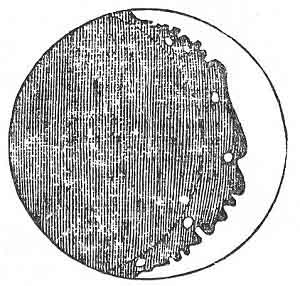
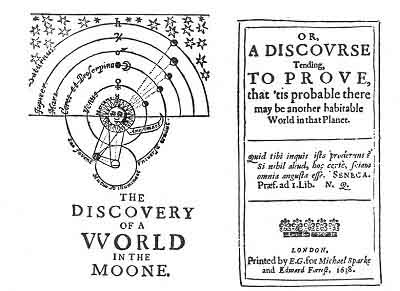
Very soon after Galileo made the first drawing of the Moon, in 1610, John Wilkins, Lord Bishop of Chester, devised a highly curious little book, entitled The Discovery of a New World in the Moone, or, A Discourse tending to Evidence that tis probable there may be another habitable World in that Planet. Wilkins bulwarks his "guess" with similar ones of the ancients: "Pythagoreans in general did affirm," he says, "that the Moone also was Terrestrial, and that she was inhabited as this lower World.

FIGURE 39. <i>The first drawing of the Moon</i>, by Galileo, 1610.<br> (From <i>The Discovery of a World in the Moone</i>; John Wilkins, 1638.)
FIGURE 39. The first drawing of the Moon, by Galileo, 1610.
(From The Discovery of a World in the Moone; John Wilkins, 1638.)

To this opinion of Pythagoras did Plato also assent . . . we may read often in him and his followers of an hera terraand a lunares populi--an hereal Earth and Inhabitants in the Moone." As their world is our Moon, so our world is their Moon, he declares, and quotes others of antiquity, whose Heavens and Elysian Fields were there, where the air is most quiet and pure. In the frontispiece to his book, he attempts to show just this relation between them. He goes back to the old Greek myth of the Earth, and calls the two Ceres and Proserpina. "By the fable of Ceres," he says, "continually wandering in search of her daughter Proserpina, it meant nothing else but the longing desire of Men, who live upon Ceres, Earth, to attain a Place in Proserpina, the Moon or Heaven," and he held that "tis possible for some of our Posterity to find out a Conveyance to this other World; and, if there be inhabitants there, to have Commerce with them."

PLATE XI.<br> OMNIA PER IPSUM FACTA SUNT<br> <i>Matter in motion, figure, rest: adde Grade.<br> This is the very somme of All God made:<br> Att first of nought bys power in six dayes space.<br> Now nature acts it's part; here after Grace</i>.<br> (From <i>Bybel Printen</i>; Matthaeus Merian, 1650)
PLATE XI.
OMNIA PER IPSUM FACTA SUNT
Matter in motion, figure, rest: adde Grade.
This is the very somme of All God made:
Att first of nought bys power in six dayes space.
Now nature acts it's part; here after Grace.
(From Bybel Printen; Matthaeus Merian, 1650)

FIGURE 40. <i>Frontispiece and Title-page of </i>''<i>The Discovery of a World in the Moone</i>''; <i>John Wilkins</i>, <i>1638</i>.
FIGURE 40. Frontispiece and Title-page of ''The Discovery of a World in the Moone''; John Wilkins, 1638.

Buffon seems to have been the first of modern scientists to voice the modern theory of the genesis of the Moon from this then moonless planet. He followed the push of tradition and made a Comet responsible for the split. This was in the eighteenth century. But in 1879, George H. Darwin lifted tradition to the dignity of an hypothetical guess, and suggested, as a part of his theory of Tidal Evolutions, that the Moon was formerly a part of the Earth; that it was originally much nearer the Earth than it is at present, and is now slowly receding from it; that at the time of the separation of the Earth into Earth and Moon, the planet was hardly larger than it is to-day; that it was hot, solid, ellipsoidical, with an interior more or less liquid, revolving on its axis once every four or five hours, its density increasing and its volume diminishing as it cooled; that, as its volume lessened, its speed of rotation increased, until by centrifugal force, the Moon was born, carrying with it, in its flight into Space, three-quarters of the Earth's crust.

A good deal of interesting discussion followed this new type of Darwinian theory, and a number of scientists began to speculate on the precise place of the origin of the Moon, granted that Darwin was right. Of course--and here again tradition guided them--or had at least preceded them--they chose the Pacific Ocean basin that holds apart the scarred coast lines of western North and South America, and eastern Asia, the East Indies, New Zealand, and the Antarctics. One of these speculators amused himself to good purpose: Plate XII, shows George D. Swazey's extraordinarily imaginative "quarter Earth" which remained after the Moon had flown, cracked by great lines of cleavage that were to slowly split the plastic floating crust into two major continental masses.

PLATE XII. THE EARTH AFTER THE EARTH-MOON CATASTROPHE<br> (Drawn by George D. Swazey for <i>Popular Astronomy</i>, Aug.-Sept., 1907.)
PLATE XII. THE EARTH AFTER THE EARTH-MOON CATASTROPHE
(Drawn by George D. Swazey for Popular Astronomy, Aug.-Sept., 1907.)

Among the old drawings of the Moon, it is difficult to choose--they are all so beautiful. One drawing, however, must always stand for an example of the miracles man has wrought in this quest of his--the first drawing of the Moon (Fig. 39 ), made in 1610 by Galileo through his "Glasse." That tiny lens, compared to the gigantic telescopes of to-day, amounted to considerably less than a child's toy. But it magnified a surface three times, and with it Galileo essayed to Evidence or disEvidence Aristotle's theory that "the form and images of the Ocean appear in the Moon as in a Mirror." "Leaving aside these terrestrial things," he said, "I have directed my researches towards the. heavens, beginning with the Moon." He decided very quickly that the Moon had no mirror-like surface, for he discovered mountains, circular hollows, and many bright spots which he compared to the eyes in a peacock's tail. Before he died, he had succeeded in making a glass which magnified surfaces thirty-two times, and it was not long before the surface of the Moon was mapped out and named. It was a world so similar in many of its formations to those of the Earth, that its first map-maker, Hevelius, simply transferred to the Moon the names of the cities and seas and mountains of the Earth. But Riccioli, in 1651, renamed its mountains and craters and supposed lakes and seas, not after places of the Earth, but after the learned men of the Earth, choosing rather to place their names in the sky. Instead of lunar Alps or Apennines, there arose on the Moon great mountain ranges, or plains, or craters bearing the names of Plato, Ptolemy, Copernicus, Kepler, Tycho; instead of lunar seas called Caspian, Mediterranean, and the like, there were instead the Seas of Storms, of Clouds, of Rains: the Seas of Tranquillity, of Serenity, and the Lake of Dreams--enchanting names which linger to this day.


The Egyptian Universe

THE BOOK OF EARTHS

By

EDNA KENTON

New York: William Morrow & Company

[1928, No renewal]


The Egyptian Universe

IN THE METROPOLITAN MUSEUM of the City of New York, rests the grey diorite sarcophagus of Uresh-Nofer, one time priest of the "watery" goddess Mut, in Egypt. On the upper half of the sarcophagus lid is engraved the figure of the Sky goddess Nut "bending over the Earth," a marvellous picture of the Egyptian Universe.

"The Sky Goddess Nut bending over the Earth," and the succeeding Plate, "The Goddess Nut represented Double," bring up so clearly the first of the major traditional catastrophes of the Earth, that it would be timely just now to consider them briefly. There have been five, one so dimly related that it shall be left till the last. But there are four great timeless traditions of great disasters. The first is the violent separation of Earth from Heaven. The second is the appalling Earth-Moon catastrophe. The third is the Deluge, and the fourth is the sinking of Atlantis. Or, it may be, the third in point of "time" is the sinking of Atlantis, and the fourth is the Deluge. Or, again, it may be that these two catastrophes, though individual, were coincident with each other. Tradition however is, happily, not logic, and so, even in a disorderly order, we may take up the outstanding afflictions of the planet we call Earth.

First, then, the violent separation of Earth from Heaven, which these Egyptian world-pictures illustrate so beautifully.

Nut was goddess of the starry sky. Sometimes she is represented as powdered with stars; sometimes, as here, with but a line of them along her spine; once at least, on the sarcophagus lid of Uresh-Nofer, with the three discs or spheres of universal significance--body, spirit, soul--connected by eight stars and by six. Sometimes the band of stars was accompanied by a band of water flowing over her spine--the celestial Nile, as the Egyptians called the mysterious heavenly waters that covered the world. Sometimes the path of the celestial Nile is called the path of the Milky Way; and often the path of the Milky Way is called the path of souls." Through her husband, Seb, she gave birth to the Sun, which was ever after re-born each morning: daily it made its journey from east to west beneath her body until, sinking below the western horizon, it passed into the mouth of Nut, traversed her body during the night, to be born again at dawn. Nut also gave birth to the Moon, which came forth from her breasts as milk. And to countless other heavenly bodies as well whose genealogy would take us too far.

This is the story of Nut or Heaven and of Seb or Earth.

PLATE IX THE SKY GODDESS NUT BENDING OVER THE EARTH<br> <i>From the Sarcophagus of Uresh-Nofer, Priest of the Goddess Mut</i> (XXX<i>th dynasty</i>, <i>378-341 B.C.</i>)<br> (In the Metropolitan Museum of the City of New York)
PLATE IX THE SKY GODDESS NUT BENDING OVER THE EARTH
From the Sarcophagus of Uresh-Nofer, Priest of the Goddess Mut(XXXth dynasty, 378-341 B.C.)
(In the Metropolitan Museum of the City of New York)
In the beginning--that stirless rest in which all myths of the original Creation begin--Heaven and Earth were together, wedded gods, from whom was to spring all that has been, is, and shall ever be. Time was not yet, sings one of the old world-hymns, nor Universal Mind, nor Thought, nor Word. Bliss was not. Misery was not. Darkness alone filled the boundless All, for Father-Mother-Son were once more one, and the Son had not yet awakened for the new Wheel and his new Pilgrimage. The Universe was still concealed in the Divine Thought and the Divine Bosom.

But the day of Creation came, and a new god, Shu, god of Air or of Sunlight, sprang out of the primordial waters. He slipped between the two, and tearing Nut with force from the body of Seb her husband, raised her to the sky. Her star-spangled body marked the extent of the firmament; and her hands and feet hanging down were the four pillars of the firmament and the four quarters of the Earth. There ever since she has remained, bending over the Earth, eternally watching the Earth and the children of Earth.

Of Seb the Earth it is related that he did not endure the violent separation from Nut without a struggle. He sought to rise, that he might fight and overcome the newly created god. But as he struggled, just roused from deep dreamless sleep, he was arrested and held in the curious position he has ever since maintained (Plate X, B ), without power to change it. He has been veiled each spring with plants and herbs and grasses; and winter has wrapped him in ice an now; while along his back has passed the endless panorama of the generations of animals and men. Through him is given to them all they have; he gives and they ungratefully take, never asking if he has a need they might supply, a sorrow they might soothe. Often he sleeps, and, sleeping, dreams of Nut, forgetting for a time his grief and pain; forgetting for a time that between him and his mate, forever separating them, stands Shu, god of Air or of Sunlight. But he may never again sink into dreamless sleep; sooner or later the circle of his dreams rounds on itself, and he is roused by pain to his state of suffering again. This is why Earth eternally questions Heaven until, wearied with waiting for answers that never come, he sinks again into slumber. Some say that Heaven answers Earth when he dreams, but because the path of his dreaming is a circle, he has forgotten most of Heaven's answers when he awakes.

And some have quite another story of Seb the Earth; namely, that Seb is concealed under the form of a colossal gander, whose mate laid the Sun Egg, and perhaps still lays it every day. Or again there is another story of Shu, which is that as the divine Son, he had later in his turn begotten Seb and Nut, the two deities he had separated.

Such then is the first catastrophe--every religion has recognised it; that the Earth is cut off, disinherited, a troubled, troublesome, perturbed, perturbating, turbulent, storm-swept, dream-sodden, staggering, breathless, complaining planet; and that all of its children have inherited its qualities.


The Babylonian Universe

THE BOOK OF EARTHS

By

EDNA KENTON

New York: William Morrow & Company

[1928, No renewal]


The Babylonian Universe

WHAT PEOPLE AT WHAT TIME first imagined the Earth as a hollow hemispherical shell floating on the world-waters we cannot know. But it is another of the "oldest figures of Earth." This idea of the Earth as "boat-shaped" had its origin probably in the almost universal myth of the Deluge; the transition from an Ark floating right side up, to the Earth, itself a boat, floating upside down, is an easy one. But "boat-shaped" is a word which, thanks to our modern patterns, has lost its early significance. The ancient world had, however, among a certain people, a boat built on exactly such an hemi- spherical model. To-day, on the Euphrates River, these same kufasfloat--the round boats of the ancient Chaldeans, made of skins, stretched and sewed into a hollow hemisphere. And to-day, likewise, on the same river, fishermen ride at ease on the same inflated cushions or air-boats of skin that were in use thousands of years ago. Nothing skimmed the waters more swiftly than these circular boats, and nothing floated more safely than these hollow hemispheres of stretched skin upturned on the waters.

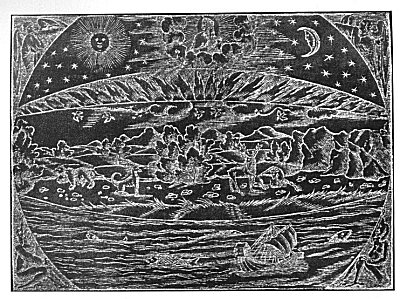
PLATE VI. THE PRIMORDIAL EARTH AND SEA<br> (From <i>Cosmographia Universalis</i>, Sebastian Muenster, 1599).
PLATE VI. THE PRIMORDIAL EARTH AND SEA
(From Cosmographia Universalis, Sebastian Muenster, 1599).There is a curious relation between the ancient boats and the Assyrian story of the Creation. If these boats were hemispheres of stretched skin, so were the Heavens and the Earth. Merodach, the world-maker of this legend, lay for a long time helpless like the other gods under the blind rule of Chaos-Tiemat, from whom sprang everything and who created unceasingly, but who had yet created neither Heaven nor Earth. From her issued spontaneously monstrous animals and figures, men with two wings and others with four, with two faces or four, with goats' legs and horns, or with the hindparts of a horse and the foreparts of a man; animals with human heads or fishes' tails; other forms in which every sort of animal shape was united in confusion, and this confusion of creation run mad never ceased.

But finally Merodach arose, alone of all the gods, to meet her, and then it was that Space witnessed its most terrific combat. He finally slew her, but matters were hardly bettered, for Tiemat's great dead body stretched throughout all Space. "He placed his foot upon her," reads the Assyrian story, "and with his unerring knife he cut into the upper part of her; then he cut the blood vessels, and caused the blood to be carried by the north wind to the hidden places. . . . He contemplated the great corpse, raised it and wrought marvels. He split it in two as one does a fish for drying; then he hung up one of the halves on high, which became the heavens." The other half he spread out under his feet to form the Earth, and immediately all the creatures that were in her disappeared. Merodach again surveyed the empty world; then he cut off his own head, and, having kneaded the blood flowing from it with the Earth, formed men, who were thus endowed with a surviving particle of understanding and with a surviving particle of divine thought.

This odd conception of the heavens as made of "skin" is found over and over among primitive races. The Yakuts say that the sky is made of several skins, tightly stretched and overlapping. The Buriats call the Milky Way a "stitched seam" in the sky, and they speak with awe of a "certain being" who murmurs from time to time, "Long, long ago, when I was young, I sewed the sky together."

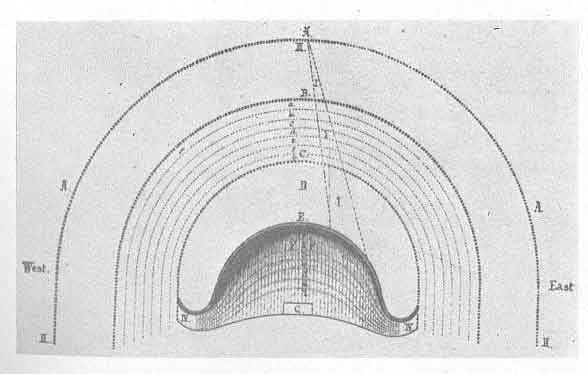
The picture of the kufa(Plate VII, A ) is given to make clearer what most of the writers on the old Akkadian cosmogony mean when they say, "The Akkadians or Chaldeans considered the Earth to be hollow and boat-shaped." For "boat-shaped" meant to them no elongated oval figure, but distinctly a hollow hemisphere, a round shell, even a "stretched skin." Plate VII, B shows Myer's construction of their world on just this model, and his interpretation is followed below. 1

Briefly, E is the convex side of the hollow Earth shell. From C to E stretches the Lower Firmament, or zone of the atmosphere--winds, storms and clouds; this zone rests firmly upon the convex Earth shell. From C to A is the Upper Firmament, divided into two layers; from A to B is the zone of the spirit of the heavens; and from B to C is the zone of the planets--"sheep," or "wanderers," or "watchers." This is the zone also of lightning and of thunder. A, in this diagram, represents the Zodiac, which is "in Space and the Great Celestial Ocean," called also the "Deep" and the "Abyss." Thom, the Great Dragon of this Great Sea, was also called Tiemat, and it was really looked upon as the Primordial Abyss out of which everything in the Universe, including Heaven and Earth, came. The arrangement of the seven planets, between B and C, are, according to Myer, a. Saturn, b. Jupiter, c. Mars, d. Sun, e. Venus, f. Mercury, g. Moon, and Earth the centre.

FF is the concave side of the Earth shell, with seven zones described, "answering," says Myer, "as shadows, to the orbits of the seven planets." This was the realm of the king of the ghost-world, the king of the dead. Curiously enough, it was believed to have been ruled over at one time by Ea, deity of Wisdom. G was the Nadir, and I was the mountain of the East, or the mountain of the world, which supported the Upper Firmament and the Great Celestial Ocean. II is the Great Chaotic Crystalline Sea, extending to an unknown distance beyond the Zodiacal zone. III is the pivot of the Star zone, on the top of the World mountain, upon which the firmament revolves. IV are the guarded gates to the Underworld, abode of the dead, or home of the dark spirits, or a place for punishment. Yet in it are concealed the waters of life, and through this region of the Underworld the nightly journey of the Sun takes place, from west to east.

Disregarding any number of merely technical differences between them, this diagram of Myer's will serve as a fair picture of any cosmogony based on the idea that the Earth is a hollow hemisphere with an underworld. But there is sharp disagreement over whether after all the ancient Assyrian people--certainly the Chaldeans and Babylonians--believed that the Earth was a hemispherical shell, or whether they believed that it was something quite other than that.

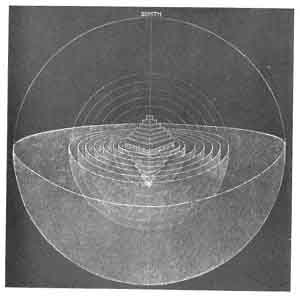
Babylon was mighty, and it perished utterly. Of all its wisdom, only battered fragments of texts remain; which present-day scholars have worked for years to interpret. Within a period of just twenty years, from 1888 to 1908, eight different diagrams of the supposed figure of this Babylonian Universe were offered by eight different men, of which Myer's diagram was the first. The last of these is Dr. William Fairfield Warren's, first published in The Journal of the Royal Asiatic Society, 1908. As he points out, no two of the other seven agree; certainly no one of the other seven bears any likeness to this beautiful construction of eight crystalline spheres surrounding a cubical, pyramidal, antipodal Earth-figure (Plate VIII ).

"For the reconstruction of the Babylonian universe," he says, "we have no less than twelve most valuable data derived from the study of ancient Babylonian texts." Following is an abstract of the twelve data on which he modelled this translucent universe. 1

PLATE VII. A. <i>A kufa laden with stoner and manned by a crew of four men. Drawn by Faucher-Gudin from a bas-relief at Koyunjik</i>.<br> (From <i>The Dawn of Civilization</i>; Gaston Maspero, 1894)
PLATE VII. A. A kufa laden with stoner and manned by a crew of four men. Drawn by Faucher-Gudin from a bas-relief at Koyunjik.
(From The Dawn of Civilization; Gaston Maspero, 1894)

PLATE VII. B. Construction of the Akkadian, Chaldean and Babylonian Universe.<br> (From <i>Qaballah</i>; Isaac Myer, 1888)
PLATE VII. B. Construction of the Akkadian, Chaldean and Babylonian Universe.
(From Qaballah; Isaac Myer, 1888)

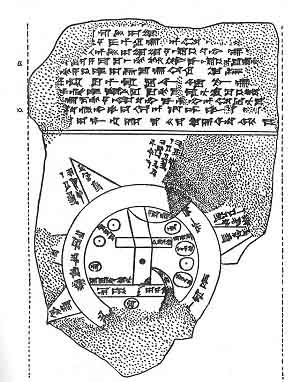
FIGURE 35. <i>Babylonian</i> ''<i>Mappa Mundi</i>'' <i>inscribed on a Babylonian geographical tablet in the British Museum, No. 92,687. Showing the ocean surrounding the world, and marking the position of Babylon on the Euphrates as its centre. It shows also the mountains at the source of the river, the land of Assyria, Bit-Iakinu, and the swamps at the mouth of the Euphrates</i>.<br> (From <i>Cuneiform Texts from Babylonian Tablets, etc., in the British Museum</i>, 1906: Part XXII, Plate 48. The reading is taken from <i>The Babylonian Legends of the Creation</i>. Brit. Mus. Pubs., 1921, p. 3.)
FIGURE 35. Babylonian''Mappa Mundi'' inscribed on a Babylonian geographical tablet in the British Museum, No. 92,687. Showing the ocean surrounding the world, and marking the position of Babylon on the Euphrates as its centre. It shows also the mountains at the source of the river, the land of Assyria, Bit-Iakinu, and the swamps at the mouth of the Euphrates.
(From Cuneiform Texts from Babylonian Tablets, etc., in the British Museum, 1906: Part XXII, Plate 48. The reading is taken from The Babylonian Legends of the Creation. Brit. Mus. Pubs., 1921, p. 3.)
1. In the Babylonian conception of the universe the earth occupied the central place. It was the accepted centre of their planetary system.

2. The northern half of the earth was called the upper, associated with life and light. The southern half was called the under, associated with darkness and death. The South and the Underworld are identical.

3. The upper or northern half of the earth was regarded as consisting of seven stages (tupukati), ranged one above the other in the form of a staged pyramid. The staged Temple of Nippur, according to Sayce, was a model of the Earth according to the belief of those who built it.

4. Correspondingly, the antarctic or under half of the Earth was supposed to consist of seven similar stages. The seven tupukatiof the underworld are a facsimile of the seven tupukatiof the over world.

5. Like the quadrilateral temple modelled after it, the Earth of the Babylonians was four-cornered. In this particular it agreed with the conception ascribed to the ancient Egyptians, Hebrews, Chinese, and to the Indo-Aryans of the Rig-Veda period.

6. In Babylonian thought there were seven heavens and seven hells. This belief is one of untraceable antiquity.

7. Above the seventh heaven was another, the "highest heaven," that of the fixed stars, called by the Babylonians the "heaven of Anu," after the name of one of their oldest and highest gods.

8. This eighth heaven was divided by the Zodiac into two corresponding portions, an upper, or Arctic, and an under, or Antarctic. At the upper pole Anu had his palace and throne.

9. In Babylonian thought, the north pole of the heavens was the true zenith of the cosmic system, and the axis of the system upright; consequently the diurnal movements of the sun and moon were regarded as occurring in a horizontal plane.

10. Proceeding outward from the central Earth, the order of the seven known planets was as follows: Moon, Sun, Mercury, Venus, Mars, Jupiter, Saturn. That their respective distances from the Earth were not uniform was already known.

11. In order to pass from the upper half of the Earth to its under half, that is, from the abode of living men to the abode of the dead, it was necessary to cross a body of water which on every side separated the two abodes.

12. According to Diodorus Siculus, the Babylonians considered that the twelve designated stars south of the Zodiac stood in the same relation to the dead as do the twelve corresponding stars north of the Zodiac to men in the land of the living. This representation clearly makes the living and the dead the residents respectively of antipodal surfaces of one and the same heaven-enclosed Earth. According to the Babylonian Creation Tablets (V, line 8) Anu and Ea are antipodally located gods, Anu being enthroned at the north pole of the heavens, and Ea at the south pole.

These twelve propositions, says Dr. Warren, are the fundamental features of the ancient Babylonian world-concept, and each of the twelve requirements is met by this figure. The upright central line represents the polar axis of the heavens and Earth in perpendicular position. The two central seven-staged pyramids represent the upper and lower halves of E-KUR, the Earth; the upper is the abode of living men, the lower the abode of the dead. The separating waters are the four seas. The seven dotted half circles above the Earth represent the "seven heavens," and the corresponding seven hemispheres below the earth, the "seven hells." The seven inner concentric spheres are respectively the domains and abodes of Sin, Shamash, Nabu, Ishtar, Nergal, Marduk, and Ninib, each being a "world-ruler" in his own planetary sphere. (The order of these spheres has been given above as Moon, Sun, Mercury, Venus, Mars, Jupiter, and Saturn.) The outer-most sphere (with its upper half cut away, as are the upper seven heavens, to show better the interior of the system) is the sphere of the antipodal gods, Anu and Ea, and the heaven of the fixed stars. It is to be noted further, Dr. Warren explains, that the spaces between the spheres widen rapidly at each remove from the Earth, so rapidly that in a world-view the size of this, they cannot be represented other than as in this plate.

PLATE VIII. THE BABYLONIAN UNIVERSE<br> (From <i>The Universe as pictured in Milton's Paradise Lost</i>;<br> William Fairfield Warren, 1915)
PLATE VIII. THE BABYLONIAN UNIVERSE
(From The Universe as pictured in Milton's Paradise Lost;
William Fairfield Warren, 1915)

Dr. 'Warren calls this "The Babylonian Universe" principally because Babylonia is almost the limit of our back-ward reach to the wisdom of the past, and our retracing of the persistent recurrences of so many of these principles--the "four-cornered Earth," or the cubical Earth, the "seven heavens," "Earth and counter-Earth," the "crystalline spheres," the "mountains of the world," and so on--must end there. But its origin, he says, was among a people antedating the Babylonians. "A truer name therefore for the system would be the Pre-Babylonian. The East-Semites received it from their predecessors in the possession of the Euphratean valley, the Akkado-Sumarians. At least such is the opinion and the teaching of our highest experts. Did the system originate among those non-Semitic predecessors in the valley? This has been assumed, but no man can pretend to know."


Footnotes

56:1 Qabbalah; Isaac Myer, 1888, pp. 448-450.
58:1 Journal Royal Asiatic Society of Great Britain and Ireland, 1908, pp. 977-983.

The Primæval Earth

THE BOOK OF EARTHS

By

EDNA KENTON

New York: William Morrow & Company

[1928, No renewal]


The Primal Earth

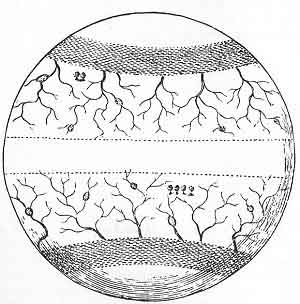
"BECAUSE IT PLEASETH more and makes a greater impression upon us," wrote the old English Platonist Thomas Burnet, "to see things represented to the Eye, than to read their description in words, we have ventured to give a model of the Primal Earth, with its Zones or greater Climates, and the general order and tracts of its Rivers. Not that we believe things to have been in the very same form as here exhibited, but this may serve as a general Idea of that Earth, which may be wrought into more exactness, according as we are able to enlarge or correct our thoughts hereafter . . . . The Rivers of that Earth, you see, were in most respects different, and in some respects contrary to ours, and if you could turn our Rivers backwards, to run from the Sea towards their Fountain-heads, they would more resemble the course of these Antediluvian Rivers; for they were greatest at their first setting out; and the Current thereafter, when it was more weak, and the Chanel more shallow, was divided into many branches, and little Rivers, like the Arteries in our Body, that carry the Blood, they are greatest at first, and the further they go from the Heart, their Source, the less they grow and divide into a multitude of little branches, which lose themselves insensibly in the habit of the flesh as these little Floods did in the Sands of the Earth." This is a very curious conception of the counter-course of "primal" rivers; it is exactly as if we conceived of the Missouri-Mississippi system, for instance, as rising in the Gulf of Mexico and flowing north until it begins to divide and subdivide into dozens of lesser streams, all of which finally dwindle away into the Earth instead of rising from it.

FIGURE 34. <i>The Primal Earth, with its Zones or greater Climates, and the general order and tracts of its Rivers</i>.<br> (From <i>The Theory of the Earth</i>; Thomas Burnet, 1697.)
FIGURE 34. The Primal Earth, with its Zones or greater Climates, and the general order and tracts of its Rivers.
(From The Theory of the Earth; Thomas Burnet, 1697.)

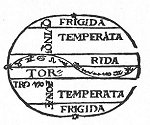
FIGURE 34A. <i>Zones or Climates of the Earth, with the Zodiac</i>.<br> (From <i>Spha emendata</i>; Joannes Sacro Bosco, Cologne, 1601.)
FIGURE 34A. Zones or Climates of the Earth, with the Zodiac.
(From Spha emendata; Joannes Sacro Bosco, Cologne, 1601.)What was the state of the primal Earth before man appeared, and with him, trouble? All the Creation stories give a common answer--harmony; harmony of all the spheres. It is in the song to Mahat, with its ordered account of the separation of the five great Elements from Chaos, and their recombinings into the bodies of the universe. "He made them all to move evenly," says the Creation legend of the Lenape, after the Great Manito had formed land and sky and moon and stars; and in the pictograph the even movement is a spiral line. In Sebastien Muenster's Cosmographia Universalis(1559), at the beginning of the chapter on "The creation and disposing of the primordial Earth and Sea," is an old drawing evidently intended to show the paradisaical state of terrestrial affairs at the end of the Fifth Day of Creation, with the great stage built and the great scene set and lighted for the entrance of man and the beginning of his drama (Plate VI ). It is a picture in successive planes of the Genesis story, with a charming addition--the boat with sails, floating in the foreground; and, on it, a little three-storied house--the Ark, perhaps, whose part in the coming drama had been already foreseen by the Creator, and which was to become, of all the vanished treasures of a drowned and broken Earth, man's single precious possession.


Creation of the World

THE BOOK OF EARTHS

By

EDNA KENTON

New York: William Morrow & Company

[1928, No renewal]


Creation of the World

And yet he has tried to determine it, with that handful of working means left him when the gods departed; his vague knowledge of truth--which has served him better for determining what is not truth than what is truth; his numbers, his signs, his characters, his symbols, his words, his capacity to be curious, to wonder, and to draw analogies between strange things. This was his equipment when he first began to question Space, and from this tiny handful of resources all the Creation stories of the world arose. Their outlines are remarkably the same. First of all a primordial substance and a Former to mould it--they sometimes called these two first forces the Maker and the Moulder, each contained within the other, but at rest. Then out of stillness came motion; out of motion light, out of light all created things; after Creation, evil; and, after evil, the deluge; out of the deluge the mountain top; and out of the ruins of the Old Earth, the New. Many of the Creation stories are familiar, but here are two which are almost unknown to the western world, though one of them is of that very world itself.

The first comes from Asia, land of the oldest recorded thought we have--at least nothing older is recognised as coming from any other source. The second is of America, youngest historically of all the continents, with all her prehistoric past practically stripped of records. The first is in words, one of man's most magnificent guesses at the original combining of the Great Elements which produced the Earth. The second is told in glyphs or pictographs. The first is taken from the Sanscrit Mahabharata; the second from the Walam Olumof the Lenape or Delaware Indians, a branch of the great Algonkin stock which roamed from east to west and west to east in North America, and styled itself the Sacred People," "the Mound Builders."

Bhrgu, in the Sanscrit epic, is answering the question, "By whom was this world with its oceans, its firmament, its mountains, its clouds, its lands, its fire, and its winds created? He replies that, first of all, the Primal Being Manasa created a Divine Being Mahat.

Mahat created Consciousness.

That Divine Being created Space.

From Space was born Water, and from Water were born Fire and Wind.

Through the union of Fire and Wind was born the Earth.

Then follows a song to Mahat.

The Mountains are His bones.
The Earth is His fat and flesh.
The Oceans are His blood.
Space is His stomach.
The Wind is His breath.
Fire is His energy.
The Rivers are His arteries and veins.
Agni and Soma, otherwise the Sun and the Moon, are called His eyes.
The firmament above is His head.
The Earth is His two feet.
The Cardinal and subsidiary points of the horizon are His arms.
Without doubt He is incapable of being known and His Soul is inconceivable.

Of the extent of the firmament, of the surface of the Earth, and of the Wind:

Bhrgu said: The Sky thou seest above is infinite.

The Sun and the Moon cannot see, above or below, beyond the range of their own rays. There where the rays of the Sun and the Moon cannot reach are luminaries which are self-effulgent and which possess splendour like that of the Sun or of Fire.

This Space which the very gods cannot measure is full of many blazing and self-luminous worlds each above the other.

Beyond the limits of land are oceans of water. Beyond water is darkness.

Beyond darkness is water again, and beyond the last is fire.

Downwards, beyond the nether regions, is water. Beyond water is the region belonging to the great snakes.

Beyond that is sky once more, and beyond the sky is water again.

Ever thus there is water and sky alternately without end. . . .

Formerly there was only Infinite Space, perfectly motionless and immovable. Without sun, moon, stars, and wind, it seemed to be asleep.

Then Water sprang into existence, like something darker within darkness.

Then from the pressure of Water arose Wind. As when an empty vessel without a hole appears at first to be without any sound, but when filled with Water, Air appears and makes a great noise, even so when Infinite Space was filled with Water, the Wind arose with a great noise, penetrating through the Water.

That Wind, thus generated by the pressure of the Ocean of Water, still moveth. Coming into unobstructed Space, its motion is never stopped.

Then, in consequence of the friction of Wind and Water, Fire possessed of great might and blazing energy sprang into existence with flames directed upwards.

That Fire dispelled the darkness that covered Space.

Assisted by the Wind, Fire drew Space and Water together.

Indeed, combining with the Wind, Fire became solidified.

While falling from the Sky, the liquid portion of Fire solidified again, and became what is known as the Earth.

The Earth or land, in which everything is born, is the origin of all kinds of taste, of all kinds of scent, of all kinds of liquids, and of all kinds of animals.

The Walam Olum(or "Red Score") of the Lenape. 1


boe07

1. At first, in that place, at all times, above the earth,


boe07

2. On the earth, [was] an extended fog, and there the great Manito was.


boe07

3. At first, forever, lost in space, everywhere, the great Manito was.


boe07

4. He made the extended land and the sky.


boe07

5. He made the sun, the moon, the stars.


boe07

6. He made them all to move evenly.


boe07

7. Then the wind blew violently, and it cleared, and the water flowed off far and strong.


boe07

8. And groups of islands grew newly, and there remained.


boe07

9. Anew spoke the great Manito, a manito to manitos,


boe07

10. To beings, mortals, souls and all,


boe07

11. And ever after he was a manito to men, and their grandfather


boe07

12. He gave the first mother, the mother of beings.


boe07

13. He gave the fish, he gave the turtles, he gave the beasts, he gave the birds.


boe07

14. But an evil Manito made evil beings only, monsters,


boe07

15. He made the flies, he made the gnats.


boe07

16. All beings were then friendly.


boe07

17. Truly the manitos were active and kindly


boe07

18. To those very first men, and to those first mothers, fetched them wives,


boe07

19. And fetched them food, when first they desired it.


boe07

20. All had cheerful knowledge, all had leisure, all thought in gladness.


boe07

21. But very secretly an evil being, a mighty magician, came on earth,


boe07

22. And with him brought badness, quarreling, unhappiness,


boe07

23. Brought bad weather, brought sickness, brought death.


boe07

24. All this took place of old on the earth, beyond the great tide-water, at the first.


II.


boe07

1. Long ago there was a mighty snake and beings evil to men.


boe07

2. This mighty snake hated those who were there (and) greatly disquieted those whom he hated.


boe07

3. They both did harm, they both injured each other, both were not in peace.


boe07

4. Driven from their homes they fought with this murderer.


boe07

5. The mighty snake firmly resolved to harm the men.


boe07

6. He brought three persons, he brought a monster, he brought a rushing water.


boe07

7. Between the hills the water rushed and rushed, dashing through and through, destroying much.


boe07

8. Nanabush, the Strong White One, grandfather of beings, grandfather of men, was on the Turtle Island.


boe07

9. There he was walking and creating, as he passed by and created the turtle.


boe07

10. Beings and men all go forth, they walk in the floods and shallow waters, down stream thither to the Turtle Island.


boe07

11. There were many monster fishes, which ate some of them.


boe07

12. The Manito daughter, coming, helped with her canoe, helped all, as they came and came.


boe07

13. [And also] Nanabush, Nanabush, the grandfather of all, the grandfather of beings, the grandfather of men, the grandfather of the turtle.


boe07

14. The men then were together on the turtle, like to turtles.


boe07

15. Frightened on the turtle, they prayed on the turtle that what was spoiled should be restored.


boe07

16. The water ran off, the earth dried, the lakes were at rest, all was silent, and the mighty snake departed.

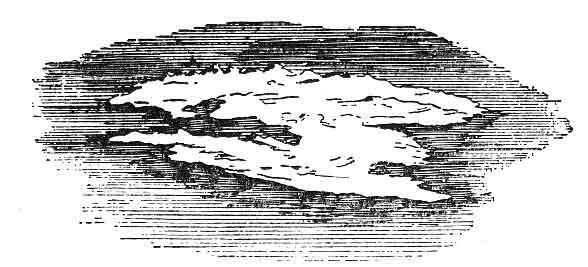
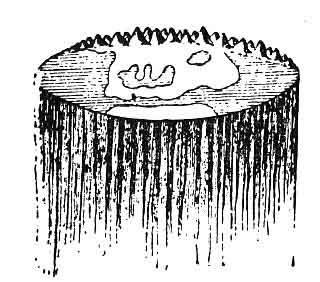
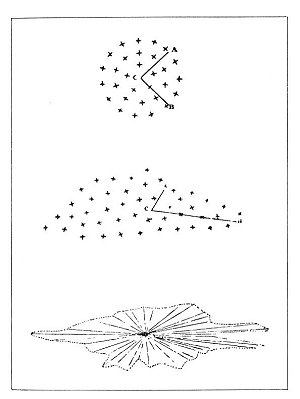
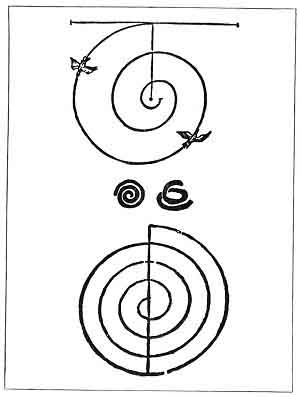
Let us extract several of these primitive world-pictures from the Walam Olumand set them side by side for comparison. Quite apart from any meaning attached to them in the legend of the Lenape, these three signs illustrate very well indeed what were probably the first two world-concepts of man; either that the Earth was an island in a watery waste on whose waves the sky rested as best it might, or that it was a vast plain overarched by the solid vault of heaven and tightly enclosed within it. The first of the three needs only a writhing sea serpent inscribed beneath it to illustrate that heavy fear of primitive man, that portentous monsters, slipping through the deepest depth of the ocean, might creep under the edge of the firmament to work evil on Earth.
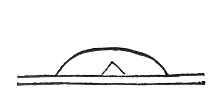
FIGURE 27.FIGURE 27.

FIGURE 28.FIGURE 28.

FIGURE 29.FIGURE 29.

So little has ever been done with these Lenape pictographs, as Dr. Brinton himself admits, that it is impossible to speak with certainty about the real meaning of any of them; and it is only a hazardous guess to suggest that Fig. 29 , the last "sign" of the Deluge story--"The water ran off, the earth dried, the lakes were at rest, all was silent, and the mighty snake departed"--may represent the ocean surrounding the Earth as barred, perhaps forever, against the "mighty snake" which had wrought such desolation. The oblique lines would serve here, instead of an Earth-surrounding mountain wall, or a circular continental ring beyond the "River Ocean," to guard the Earth against invasion from without. In any case, here are primitive representations of "mountains of the world"--the "first Earth" before and the "first Earth" after the Deluge--and of that other "first" concept of the Earth as a vast plain, overarched by the solid vault of heaven.

There is another Creation story that we might glance at here, because it contains so many notions of the beginnings of things that are extraordinarily similar to other ideas we shall meet later on. It is the Creation story of the Maidus, an Indian tribe of northern California.

"When this world was filled with water," so Dixon translates the tradition, 1 Earth-Maker floated upon it, kept floating about. Nowhere in the world could he see even a tiny bit of earth. No persons of any kind flew about. He went about in this world, the world itself being invisible, transparent like the sky.

"He was troubled. 'I wonder how, I wonder where, I wonder in what place, in what country, we shall find a world!' he said. You are a very strong man, to be thinking of this world,' said Coyote. 'I am guessing in what direction the world is, then to that distant land let us float!' said Earth-Maker.

"In this world they kept floating along, kept floating along, hungry, having nothing to eat. You will die of hunger,' said Coyote. Then he thought. No, I cannot think of anything,' he said. 'Well,' said Earth-Maker, the world is large, a great world. If somewhere I find a tiny world, I can fix it up.'
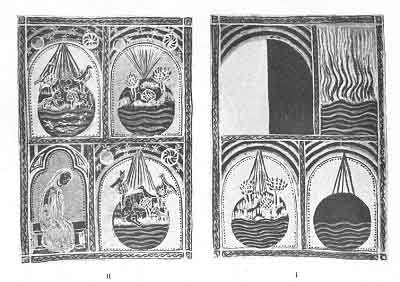
Plate I: STAGES OF CREATION<br> <i>From right to left: I. Chaos: Division of Light from Darkness: Separation of Earth and Water. Vegetation. II. Sun, Moon, and Stars: Fishes and Birds: Animals and Man; Sabbath Rest</i>.<br> (From <i>Haggadah von Sarajevo</i> of the 14th century)
Plate I: STAGES OF CREATION
From right to left: I. Chaos: Division of Light from Darkness: Separation of Earth and Water. Vegetation. II. Sun, Moon, and Stars: Fishes and Birds: Animals and Man; Sabbath Rest.
(From Haggadah von Sarajevoof the 14th century)
"Then he sang, 'Where, little world, art thou?' It is said he sang, kept singing, sang all the time. 'Enough!' he said, and stopped singing. Well, I don't know many songs (?),' he said. Then Coyote sang again, kept singing, asking for the world, singing, 'Where, O world, art thou?' He sang, kept singing; then 'Enough!' he said. 'I am tired. You try again.'

"So Earth-Maker sang. 'Where are you, my great mountains, my world mountains?' he said. He sang, and all the time kept saying, 'Where are you?' He stopped singing. 'Enough!' he said. 'You try also.' Coyote tried, kept singing. 'My foggy mountains, where one goes about,' he said. 'Well, we shall see nothing at all. I guess there never was a world anywhere,' said he. 'I think, if we find a little world, I can fix it very well,' said Earth-Maker.

"As they floated along, they saw something like a bird's nest. 'Well, that is very small,' said Earth-Maker. 'It is small. If it were larger I could fix it. But it is too small,' he said. 'I wonder how I can stretch it a little.' He kept saying, 'What is the best way! How shall I make it larger!' So saying, he prepared it. He extended a rope to the east, to the south he extended a rope, to the west, to the northwest, and to the north he extended ropes.

"When all were stretched, he said, 'Well, sing, you who were the finder of this earth, this mud! "In the long, long ago, Robin-Man made the world, stuck earth together, making this world." Thus mortal man shall say of you, in myth-telling.' Then Robin sang, and his world-making song sounded sweet. After the ropes were all stretched, he kept singing; then, after a time, he ceased.

"Then Earth-Maker spoke to Coyote also. 'Do you sing, too,' he said. So he sang, singing, 'My world where one travels by the valley-edge; my world of many foggy mountains; my world where one goes zigzagging hither and thither; range after range,' he said, 'I sing of the country I shall travel in. In such a world I shall wander,' he said.

"Then Earth-Maker sang--sang of the world he had made, kept singing, until by and by he ceased. 'Now,' he said, it would be well if the world were a little larger. Let us stretch it.'--'Stop!' said Coyote. 'I speak wisely. This world ought to be painted with something so that it may look pretty. What do ye two think?'

"Then Robin-Man said, 'I am one who knows nothing. Ye two are clever men, making this world, talking it over; if ye find anything evil, ye will make it good.' 'Very well,' said Coyote, 'I will paint it with blood. There shall be blood in the world; and people shall be born there, having blood. There shall be birds born who shall have blood. Everything--deer, all kinds of game, all sorts of men without any exception--all things shall have blood that are to be created in this world. And in another place, making it red, there shall be red rocks. It will be as if blood were mixed up with the world, and thus the world will be beautiful,' he said. 'What do you think about it?' Your words are good,' he said, 'I know nothing.' So Robin-Man went off. As he went, he said, 'I shall be a person who travels only in this way,' and he flew away."

Only after all this was accomplished did Earth-Maker, commanding Coyote to lie down on his face, begin to stretch the world. With his foot he extended it to the east, to the south, to the west, to the northwest, and to the north. And yet again, saying to Coyote, "Do not look up. You must not," he stretched it again, as far as it would go in the five directions. Then Coyote, rising, began to walk to the eastward side, and Earth-Maker, after describing the entire circuit of the world, returned to the spot from whence he had set out, and began to prepare things. He made men, of different colours, two of each kind only, and as he made them in pairs, he counted them. "Then he counted all the countries, and, as he counted them, assigned them, gave them to the countries. 'You are a country having this name, you shall have this people,' he said. This sort of people, naming you, shall own the country. These people shall grow, shall keep on growing through many winters, through many dawns. They shall continue to grow until, their appointed winters being past, their dawns being over, this people having finished growing, shall be born,' he said."

So Earth-Maker created, to each country a name and a people with a name and speech, each different; until he arrived at the middle of the world, where he made two others and left them, saying, "'Ye here, growing steadily, when so many winters shall have passed, very many winters, many days, ye shall be fully grown,' he said. 'Then ye shall be mortal men, ye shall be born full grown. . . . Ye shall not be born soon,' he said."

Continuing on his way to the uttermost limit where mortal men were to live, he stopped, and created, first two, whom he laid down, and two more, and still another pair. "'Ye shall remain here,' he said, 'and your country shall have a name. Although living in a small country, in one that is not large, it shall be sufficient for you. This I leave; and growing continually . . . ye, being fully grown, shall be born,' he said. 'Then your food will grow--different sorts of food, all kinds of food; and ye, being born with sufficient intelligence, will survive,' said he. Then he pushed them down under a gopher-hill.

"He spoke again. 'Ye, too, shall possess a small country. "Come now, leave this country!" (this ye must not say to others wishing to take this land). Ye shall be people who will not drive others away, driving them off to another country. Ye shall be different, ye shall name your country.'"

To still another pair he spoke, saying, "'Ye shall have children, and when your children shall have grown larger, then, looking all over this country, ye must tell them about it, teach them about it, naming the country and places, showing them and naming them to your children. "That is such and such a place, and that is such and such a mountain." So when ye have caused them to learn this, teaching them, they shall understand even as ye do yourselves.' Then, placing them between his thumb and finger, he snapped them away.

"And when he had given countries thus to all that he had counted out, there was one pair left. 'Ye, also, ye shall be a people speaking differently. There will be a little too many of you for you to have the same sort of a country also. So ye shall have that kind of a country, a great country,' he said.

"'Now, wherever I have passed along, there shall never be a lack of anything,' he said, and made motions in all directions. 'The country where I have been shall be one where nothing is ever lacking. I have finished talking to you, and I say to you that ye shall remain where ye are to be born. Ye are the last people; and while ye are to remain where ye are created, I shall return and stay there. When this world becomes bad, I will make it over again; and after I make it, ye shall be born,' he said. Long ago Coyote suspected this, they say.

"'This world will shake,' he said. 'This world is spread out flat, the world is not stable. After this world is all made, by and by, after a long time, I will pull this rope a little, then the world shall be firm. I, pulling on my rope, shall make it shake. And now,' he said, 'there shall be songs, they shall not be lacking, ye shall have them.' And he sang, and kept on singing until he ceased singing. 'Ye mortal men shall have this song,' he said, and then he sang another; and singing many different songs, he walked along, kept walking until he reached the middle of the world; and there, sitting down over across from it, he remained.

"But in making the world, Robin-Man sang that which was pleasant to hear. He, they say, was the first created person--a man whose song passed across the valleys, a man who found the world, a man who in the olden time sang very beautifully--sounding songs. And Earth-Maker, going along, and having passed by the middle of the world, made a house for himself, and remained there. That is as far as he went. That is all, they say."


Footnotes

26:1 This Creation and Deluge story of the Lenape or Delaware Indians is taken from Dr. Daniel G. Brinton's The Lenape and Their Legends(The Library of Aboriginal American Literature, Vol. V, 1885). Since "walam" means "painted," particularly "painted red," and "olum" signifies the scores or marks or notches or figures used on tally-sticks or record-boards, the sense of Walam Olumis variously rendered by "Red Score" (Dr. Brinton's choice), "Painted-engraved Tradition" (the translation left by Constantine Rafinesque, original copyist of these Algonkin pictographs), or "Painted Bark-Record." The pictographs or glyphs or signs were "notches" designed to keep the long chant in memory. The very beautiful translation is Dr. Brinton's.
32:1 Maidu Texts: Roland B. Dixon. Leyden, 1912.

Upholders of the World

THE BOOK OF EARTHS

By

EDNA KENTON

New York: William Morrow & Company

[1928, No renewal]


Upholders of the World

FLAMMARION'S OLD DRAWING of The Earth Floatingis a peculiarly desolate rendering of the ancient idea that the Earth was nothing more than an island in a sea. This idea would of course have its probable origin among races living near great seas or oceans whose other side they had tried in vain to reach.
FIGURE 30. <i>The Earth Floating</i>.<br> (From <i>Flammarion's Astronomical Myths</i>, 1877.)
FIGURE 30. The Earth Floating.
(From Flammarion's Astronomical Myths, 1877.)The mind of men likes symmetry; if water stretching endlessly away bounded one side of their "island," even though that island were a continent whose other edge they did not know, water must lie also on its other sides. If the Sun rose from their eastern waters, say, at dawn, it must sink in some unknown western waves at night, if for no other reason than, by swimming through them, to arrive again by the next dawn, in the eastern sky. We may smile at this childish notion if we will, but it may very well be that no great "system" of the harmonious orbits of Sun and Moon and Earth explainthe mystery of the "rising and the setting of the Sun" any more or any better than the primitive idea that darkness came when the Sun was submerged in the sea, and that light came when the Sun sprang out of the sea. Perhaps all that we know to-day--really know--is that in the hour of dawn the Sun appears, and in the hour of twilight the Sun has vanished.

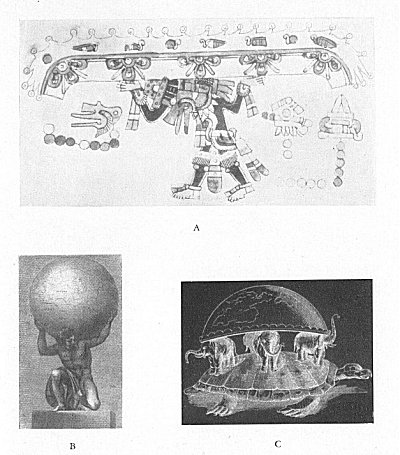
PLATE II: SUSTAINERS OF THE EARTH
 
A. Quetzalcoatl upholding the Heavens. From an original Mexican painting preserved in the Imperial Library at Vienna.
(From Kingsborough's Mexican Antiquities. 1831, Vol. II)
B. Atlas upholding the Earth.
(From Engravings after Stoddard: a collection in The New York Public Library)
C. A Hindu Earth.
(From Flammarion's Astronomical Myths, 1877)

The precise nature of the element in which the Earth-island floated came to be a matter of concern and much speculation. At first it was assumed to be simply water; later it was defined as "water or some other liquid," and finally it was believed to be a liquid not unlike the composition of the waters directly under the firmament or lower heaven, which were supposed to be a crystalline, congealed water, specially combined to resist the flame of the Sun, Moon, and galaxy of stars, to be itself full of fire, and yet not to burn. It was water, yet not water, air yet not air, fire, yet not fire. Probably this was an attempt to describe the medium in which the Island Moon floated, all sustaining, yet clear.

Doubtless too the roundness of the Sun and Moon, their discs so broad, yet thin enough to float in space, or aethereal waters, had as much to do with giving men the idea that the Earth's shape might also be flat and round, as the circular defining line of the horizon. Again, if the Moon was like a leaf, floating in the heavenly water, the Earth, like a leaf, floated on the world water, and like a leaf in water would develop roots. Ages ago, as we have already noted (p. 14 ), the ancient world, India, China, Egypt, made the lotus the water-flower that symbolises Earth and Heaven and all that lies between. For as a tree, rooted in the Earth, is a part of it, so Earth, rooted in the universal waters, must be a part of the universe from which it derives life and nourishment. And again, though the roots of an Earth-island might not be as firm as the roots of a great Earth-tree might, that is, be as supple and flexible as those of water plants, nevertheless it was an anchorage of the Earth to something outside itself.
FIGURE 31. <i>The Earth with Roots</i>.<br> (From <i>Flammarion's Astronomical Myths</i>, 1877.)
FIGURE 31. The Earth with Roots.
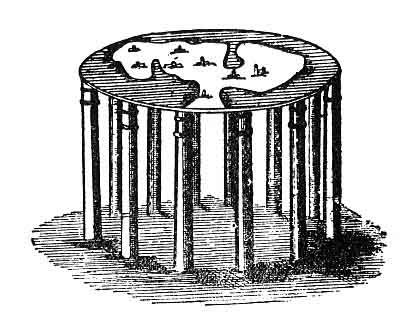
(From Flammarion's Astronomical Myths, 1877.)Naturally evolving from this would rise an Earth set on solid pillars, an established, firmly founded disc. Fig. 32 is an old picture of just such an Earth--"the Earth of the Vedic priests." Its upper side is its only habitable side; its under side rests on twelve columns, these columns resting in turn on the Twelve Great Sacrifices of the Virtuous,--the aimful deeds, that is, of men aware of duty. Without this subterranean foundation, said the ancient priests, the pillars of the Earth would dry up, and the Earth would fall down. These pillars, says Flammarion, accounted more reasonably for the rising and the setting of the Sun, than the rather lazy guess that it swam through water from west to east every night; though there was another speculation that it might reach the eastern heavens by traversing a complicated system of tunnels, like great connecting caves, which pierced the Earth-disc from occident to orient.
FIGURE 32. <i>The Earth of the Vedic Priests</i>.<br> (From <i>Flammarion's Astronomical Myths</i>, 1877.)
FIGURE 32. The Earth of the Vedic Priests.
(From Flammarion's Astronomical Myths, 1877.)But the twelve pillars, quite as little as the roots of the Earth-island leaf, failed to satisfy man's wonderings over the problem of what supported the Earth, or on what the Earth rested. One of the old familiar figures of Earth is that hemispherical Earth of the Hindus (Plate II, C ) supported on the backs of four elephants, which stand on the hemispherical shell of a gigantic tortoise floating on the surface of the world-waters. Sometimes, in addition to these three supports, there is a fourth, the coiled ring of the great world-serpent on which the tortoise rests--four foundations for Earth, and five for Heaven which must rest on the Earth.

But the elephant, the tortoise and the serpent are only three of the great animals which folk-lore and tradition say may support this planet. The Altaic people of Northern Siberia affirm that their mighty Ulgen created the Earth on the waters, and placed under its disc, to support it, three great fish, one in the centre and one on either side. The head of the middle fish being placed towards the north, floods occur there when it presses its head down; and, should it ever sink too low, the whole Earth will be deluged again. They believe that these fish are attached to heaven by a rope through their gills, whereby their heads can be lowered or raised, and that at the three posts of heaven to which these ropes are tied, the Bodhisatta Mandishire, or guardian of Earth, always watches. According to another tradition, only one great fish supports the Earth; when he changes his position earthquakes occur. In Hebrew myths, this mighty animal is the "fish-shaped Leviathan." Where the turtle or the tortoise is unknown, as in far northern lands, the "world-supporting Frog" will take its place; if its finger ever moves, the Earth shivers. Among Tartars and many of the tribes of Asia-Europe, the Earth is believed to be supported by a great bull; sometimes the Earth rests on its back, sometimes it is held aloft on the horns. Or, another variation, in the world-ocean there is a great fish, and, upon the fish, a bull which bears the Earth. Or again, in the world-ocean there is a giant-crab which gives support to the Earth-bearing bull. Some say that the terrible weight of the Earth has already broken one of the great horns, and that when the other breaks the world will come to an end. Another of the Tartar tribes says that after the Great Mammoth was created, it was found that the Earth was not strong enough to bear its weight, and so, to avoid a waste of creation in the universe, the Great Ruler solved the difficulty by commanding the Great Mammoth to bear the Earth.

PLATE III. ATLAS SUPPORTING THE UNIVERSE<br> (From Margarita Philosophica, 1517)
PLATE III. ATLAS SUPPORTING THE UNIVERSE
(From Margarita Philosophica, 1517)
On what did the Earth rest? Not only on literal water, and great beasts. On a whirlwind, said Empedocles; on roots rooted in the Infinite, said Xenophanes; on a Soul of the World, said Plato and his school; on Twelve Pillars, said the Vedic priests, which must have for their foundation the "sacrifices of the virtuous." Earth, that is, depended ultimately on man for its support. And sooner or later, in all cosmologies and mythologies, we come upon some lurking or developed concept that the burden of supporting both Earth and Heaven rests on the shoulders of man. In countries as widely separated by race and by oceans as Greece and Mexico, we find an "Atlas of the World," a sustainer of the universe (Plate II , A and B). In Greece it is Atlas the "Endurer," brother of Prometheus the rebel bringer-of-fire, who supports the globe. Son of Poseidon, he knew the depths of the whole Ocean-world; it was his task to guard the pillars which held Heaven and Earth apart. According to one story, it was because he had attempted to storm the heavens that he was condemned to carry its vault on his head and hands. According to another version, it was only after the loss of his great Island realm Atlantis, that he was forced to become the sustainer of the sky.

Mexico appears to have had four--at least--heaven-bearing gods, and each of these appears to have exercised a number of functions other than the sufficiently onerous one of supporting the universe. Quetzalcoatl, although a Sun god and an earthquake god, was also, like Atlas, a water god. If Atlas, interpreted, means the Endurer, Quetzalcoatl, interpreted, means Heart of the Sea. God of the Sun, of the earthquake, and the water, he also up-held the heavens of the Mexicans. In the eastern world and in the western, thousands of years ago, these different races believed alike that some great force never to be understood and never to be overcome had wrenched the heavens from the Earth, but that, at the same time it separated them, it united them by another force, which each race represented by a human figure, a great man-god. Explain it as we will, call it nae or arrogant, it expressed one of man's few entirely admirable qualities, his lonely necessity to share, or to believe that he shared in the work of carrying on the universe. And it found expression in countless ways.

A curious old drawing of the Middle Ages (Plate III ) shows how the Atlas-myth persisted even into modern time. The Earth still occupies the centre of the universe, with all the other heavenly bodies revolving about it. From pole to pole of the firmament--his head marking the "Polus Arctic" and his two feet the "Polus Antarctic," stretches Atlas, or the Macrocosm, or the Great Man, or Adam Kadmon, whichever you will. To medial Europe Atlas represented the Macrocosm, or the long great world, in contrast to the Microcosm or man--little, but the epitome of all that had combined to produce him. Very often, in such circular designs, the two lower corners will be filled each with a toiling figure, the burden-bearer man, with his shoulders bent to the wheel. Only by his microcosmic, microscopic effort, they seem to say over and over again, may the Wheel of Life be kept revolving. Not only does the Earth--the pillared Earth of the Vedic priests--rest on the sacrifices of man, but, since Heaven itself leans on the Earth, without man's aid the whole universe must collapse.

It is easy to see how this ancient image of the Great Man rose before the eyes of the "little men" of the Earth. This was a being infinitely stronger, infinitely better, almost yet not quite a god because he was Man, who somehow stood or moved between the two worlds and kept them in touch with one another. He came to be called by many names, to be pictured under many disguises. He was the Being praised in the Creation chant of the Mahabharata; he was the "manitou to men and their grandfather" of the Lenape Creation story. He was the cosmic Pan Ku of the Chinese, who came into being "in the midst of the cosmic egg," whose very name Pan means "the shell of an egg," and who was hatched out of the cosmos. He created in the middle, out of the pure elements, Heaven; out of the mixed elements, Earth. Every day Heaven grew ten feet higher, Earth ten feet deeper and he ten feet taller, for 18,000 years. When he died, his breath became wind, his voice thunder, his four limbs the four directions, his five extremities the five sacred mountains, his left eye the sun, his right eye the moon, his blood the rivers, his beard the stars, his hair the trees and plants, his flesh the soil, his teeth metals, his bones rocks, his marrow precious stones, his perspiration rain, and his parasites men. The old Chaldeans drew a Great Man across the sky in such a way that the signs of their zodiac corresponded to the parts of his body. And, proof once again that the ancient peoples separated by the Earth's diameter from each other were inexplicably one in many of their fancies, the Tewa Indians regarded Opa--the world, the universe--as a living being, and worshipped it as the "Universal Man," whose backbone, they said, is the Milky Way. And the old Norse sagas have in their giant Ymir almost the facsimile--or it may be the original, who may say?--of the Chinese Pan Ku; for from Ymir's body was made the world, from his flesh the Earth, from his blood the rivers and oceans, from his bones the mountains, from his eyebrows the "encompassing" of Mitgard the Earth. From his skull was shaped Heaven, and his brains were changed into floating clouds and fogs.

PLATE IV. <i>A very clear demonstration of the three kinds of vision in the Microcosm</i> (<i>or soul of Man</i>) <i>of the location of their objects, and of the manner of discerning them</i>.<br> (From <i>Microcosmi Historia</i>; Robert Fludd, 1619)
PLATE IV. A very clear demonstration of the three kinds of vision in the Microcosm(or soul of Man) of the location of their objects, and of the manner of discerning them.
(From Microcosmi Historia; Robert Fludd, 1619)What is interesting about all this is the fact that primitive man arrived without the aid of science at the tremendous idea that definite figureis an attribute of the heavens. It was the idea that so fascinated Herschel, discoverer of Uranus, and curious inquirer into the mysteries of the Milky Way. He was possessed by the "guess" that not only is our galaxy a stratum or confined bed of stars, but that this stratum is measurable, and that by comparison of his gauging or sounding lines, he might actually draw a chart of it. He "guessed" again that in the main--and this guess was wrong--the stars are scattered equably throughout our immediate Space, which would mean that, seeing as far in one direction as another, the figure of the heavens would tend towards a circular form. In an old book of 1848, Thoughts on Some Important Points Relating to the System of the World, by John Nichol, there is a very odd "Figure of the Universe," based on Herschel's gauging system, which illustrates as well as any other the method employed (Fig. 33 )

If, says Nichol, we were in the centre of a circular group, it would mean that whether we looked through the line C A or the line C B, the number of stars that could be counted would be the same. But if the group were an irregular one, the number of stars in the direction of C A would be much less than that along the line C B, and the proportions of their numbers would give the pro-portions of the two lines C A and C B. Supposing S (lower figure) the place of our Sun, "or," says Nichol, "what is the same thing, of the Earth, on which the observations are recorded," let a number of lines be drawn answering in direction to the position of Herschel's telescope, and in length to the number of stars revealed in that direction.

FIGURE 33. <i>A Figure of the Universe</i>.<br> (From <i>The System of the World</i>; John Nichol, 1848.)
FIGURE 33. A Figure of the Universe.
(From The System of the World; John Nichol, 1848.)

Then, if the extremities of these lines were joined, the result would be "a figure which, however strange, must approximate to a sectionof our vast and dazzling vault." He goes on to imagine one with the power to depart from Earth, proceeding through Space towards the Milky Way, leaving behind the constellations which we know, coming upon new configurations, passing even through the Milky Way, until, looking back, he sees this universe so dwindled away as to present the appearance of nothing but a speck in Space, shining with a faint, irregularly diffused illumination corresponding in its rays to the outlined figure.

NATURALLY MOST OF THE EARLY STORIES of the "Great Man" of the heavens are odd mixtures of perception and fancy, of clumsy literalness and real imagination. All too often this OpaBeing was more earthly than heavenly, much more man than god, but, whatever his guise or disguise, he was always much more than man, and in some of his incarnations he was very close to divine. As Adam Kadmon he has meant not only the First Man created in the true image of God, but something more, "the divine man-forming power" capable of transforming a questioning little man cut off from wisdom into a divining Great Man who could know. Precisely such a conception of Adam Kadmon has been lying in Robert Fludd's Microcosmi Historiasince 1619 (), "A very clear demonstration of the three kinds of vision in the Microcosm (or soul of man); of the location of their objects, and of the manner of discerning them." Surely no figure of "Earth" was ever drawn before or since so lightly poised, so aethereally supported.

Unless it is the tiny figure of Earth as the end and the beginning of the Spiral World (Plate V ) which immediately follows in the Microcosmi Historia: "Another demonstration showing how the soul rises in a spiral ascent from the sensible things of the world to unity, through twenty-two stages, beginning with the Earth, and ascending upwards to God; that is, from multiplicity to unity." This is drawn in twenty-two whorls or "grades," beginning, by numbers, with "Terra" and ending with "Deus." Or, by the order of the Hebrew alphabet, beginning with "Deus" and ending in "Terra." These spiral grades or stages have each four signs to mark them; first, the letters of the Hebrew alphabet, beginning with the outer whorl and winding continuously inward to the centre. (The Hebrew alphabet, according to the Kabbala, is based on the primitive alphabet in which Gods were Letters, Letters were Ideas, Ideas were Numbers, and Numbers were perfect Signs.) Second, the names of the procession of grades, from the first manifestation of the Godhead, Mens or Mind, to its final expression in Terra or Earth. Third, numbers, from 1 to 22. Fourth, the tiny winged heads common to each completed whorl. The spiral, reaching from Heaven to Earth, is shown here as lying in a flat coil, like a spring. But it may be re-imaged as the winding line described about a sphere that tapers irresistibly out to a point. It is just that line, says this figure, described by a point moving in space, beginning in Heaven and ending in Earth, which at once separates and unites them.

PLATE V. <i>Another demonstration showing how the soul rises in a spiral ascent from the sensible things of the world to Unity</i>.<br> (From <i>Microcosmi Historia</i>: Robert Fludd, 1619)
PLATE V. Another demonstration showing how the soul rises in a spiral ascent from the sensible things of the world to Unity.
(From Microcosmi Historia: Robert Fludd, 1619)

Beyond Earth there is nothing. But in Earth there is everything--even the power to make the descending spiral an ascending one. It can be re-imaged as an ascending vine, climbing back by way of the great World-tree. For life, said the ancients, flows never in one way. Rooted in Heaven, it descends to Earth, and rooted in Earth it may ascend to Heaven.


Figures

THE BOOK OF EARTHS

By

EDNA KENTON

New York: William Morrow & Company

[1928, No renewal]


FIGURES

Figure


Page

1.

The Stupa. From Ramusat's translation of Fa-heen's Foe koue ki. 1848.

6

2.

The Tetrahedron. From an old print.

7

3.

The Octahedron. From an old print.

7

4.

The Icosahedron. From an old print.

8

5.

The Cube. From an old print.

8

6.

The Dodecahedron. From an old print.

9

7.

A "rygge forme" or three-sided tablet. From Recorde's The Castle of Knowledge. 1556.

10

8.

The five-sided tablet. From an old print.

10

9.

The Cone. From an old print.

10

10.

The three-sided pyramid. From an old print.

10

11.

The four-sided pyramid. From an old print.

10

12.
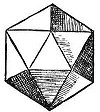
The Sphere. From Physiologia Kircheriana Experimentalis. 1680.

10

13.

The Cylinder. From an old print.

10

14.

Spiral forms. From old prints.

12

15.

"Halfe a Sphaere." From Recorde's The Castle of Knowledge. 1556.

14

16.

"Hollow lyke a bolle." From Recorde's. The Castle of Knowledge. 1556.

14

17.

"A playne Flatte." From Recorde's The Castle of Knowledge. 1556.

15

18.

"Square like a box." From an old print.

16

19.

Squares, or "stages," within circles. From an old print.

17

20.

The six-faced Tetrahedron. From Green's Vestiges of the Molten Globe. 1875.

18

21.

The Oval, or "The Mundane Egg." From an old print.

19

22.
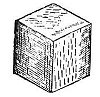
"Circles within the Oval." From an old print.
19

23.

"Parallel Circles." From an old print.

19

24.

"A whole circle," "A portion of a circle." From an old print.

20

25.

"Convex, concave." From an old print.

20

26.

"Right, Crooked, Mixt." From an old print.

21

27.

Glyph 8 from The Walam Olum of the Lenape.

31

28.

Glyph 7 from The Walam Olum of the Lenape.

31

29.

Glyph 16 from The Walam Olum of the Lenape, Part II.

31

30.

The Earth Floating. From Flammarion's Astronomical Myths. 1877.

38

31.

The Earth with Roots. From Flammarion's Astronomical Myths. 1877.

40

32.

The Earth of the Vedic Priests. From Flammarion's Astronomical Myths. 1877.

41

33.

A Figure of the Universe. From Nichol's The System of the World. 1848.

48

34.

The Primal Earth, with its Zones or greater Climates, and the general order and tracts of its Rivers. From Burnet's The Theory of the Earth. 1697.

52

34A.

Zones or Climates of the Earth, with the Zodiac. From Sacro Bosco's Spha emendata, 1601.

53

35.

Babylonian "Mappa Mundi." From Cuneiform Texts from Babylonian Tablets etc. in the British Museum, Pt. 036 II, Plate 48. 1906.

59

36.

Lunar and Solar Eclipses. From Sacro Bosco's Spha Mundi. 1482.

67

37.

The Figure of the Dragon: the Lunar Nodes. From Blundeville His Exercises. 1606.

68

38.

"When the Moone is betwixt the Sunne and the Earth." From Blundeville His Exercises. 1606.

68

39.

The first drawing of the Moon, by Galileo, 1610. From Wilkins's The Discovery of a World in the Moone. 1638.

70

40.

Frontispiece and Title-page of "The Discovery of a World in the Moone"; John Wilkins, 1638. From the original.

71

41.

The Comet of 1680 and the marvellous Egg. From Manestrier's Lettre dun gentil-homme de province une dame de qualitsur le sujet de la Comete. 1681.

78

42.

Outline map showing the locality of Pan, the submerged continent. From Newbrough's Oahspe, A New Bible in the Words of Jehovih. 1891.

85

43.

The geographical position of Mu. From Churchward's The Lost Continent of Mu. 1926.

86

44.

Yggdrasil, the Cosmic Ash. From Philpot's The Sacred Tree. 1897.

94

45.

Diagram of the Nine Worlds, supported by the World Tree Yggdrasil. From Litchfield's The Nine Worlds. 1890.

96

46.

Diagram of the Scandinavian Cosmos. From Litchfield's The Nine Worlds. 1890.

97

47.

Sketch of the World, by a Thompson River Indian. From Memoirs of the American Museum of Natural History, Vol. II. 1900.

100

48.

The Tree of Judas. From Maundevile's Voiage and Travailes. 1839 reprint.

105

49.

Osage Chart of the Universe, drawn by Red Corn. From Mallery's Picture-Writing of the American Indians. 1894.

106

50.

Our First Parents. From the Codex Cortesianus. Reproduced from Brinton's A Primer of Mayan Hieroglyphics. 1894.

112

51.

The "Tree of Life." From the Codex Peresianus. Reproduced front Brinton's A Primer of Mayan Hieroglyphics. 1894.

113

52.

The Sacred Tree of the Egyptians. From Sharpe's Egyptian Mythology and Egyptian Christianity. 1863.

114

53.

The Antipodal Polar Mountains. From Warren's Paradise Found. 1885.

122

54.

The Theory of Two Centres. Spherical Earth with no Antipodes. (After Rainaud.) From Mill's The Siege of the South Pole. 1905.

124

55.

"Feet to Feet." From Physiologia Kircheriana Experimentalis. 1680.

126

56.

A Kalmuck World-picture. From Mythology of All Races, Vol. IV. 1927.

131

57.

Mount Su-Meru of the Chinese. From Du Bose's Dragon, Image and Demon. 1887.

133

58.

An ancient Arabic Celestial Sphere. Northern Hemisphere. From Transactions of the Royal Asiatic Society of Great Britain and Ireland. 1830.

136

59.

An ancient Arabic Celestial Sphere. Southern Hemisphere. From Transactions of the Royal Asiatic Society of Great Britain and Ireland. 1830.

137

60.

Key to the Tibetan Wheel of Life. From Waddell's The Buddhism of Tibet, or Lamaism. 1899.

139

61.

The Great Monad. From Du Bose's Dragon, Image and Demon. 1887.

146

62.

The Mitsu Tomoe of the Japanese. From Internationales Archiv f Ethnographie, Bd. IX, S. 265. 1896.

147

63.

Chinese Conception of the Creation. From MClatchie's Confucian Cosmogony. 1874.

149

64.

The Chinese Zodiac. From a Mirror of the Tang Dynasty. Reproduced from Journal of the Royal Asiatic Society of Great Britain and Ireland. 1835.

151

65.

Gnostic Diagram of the Universe. 2nd cen. A.D. From Matter's Histoire critique du Gnosticisme, Vol. III. 1826.

159

66.

The Systems of the Universe. From Kircher's Iter exstaticum coeleste. 1660.

162

67.

The Universe according to Anaximander. 6th cen. B.C. From Evershed's Dante and the Early Astronomers. 1913.

163

68.

The Universe of Leucippus. 5th cen. B.C. From Evershed's Dante and the Early Astronomers. 1913.

165

69.

The Universe of Democritus. 5th cen. B.C. From Evershed's Dante and the Early Astronomers. 1913.

166

70.

The Universe of Pythagoras. 6th cen. B.C. From Evershed's Dante and the Early Astronomers. 1913.

168

71.

The Five Great Elements. From Orantius Fineus's Spha Mundi. 1542.

170

72.

"A Figure of the Whole World." From Blundeville His Exercises. 1606.

171

73.

System of the diverse spheres. From Apianus's Cosmographia. 1660.

172 .

74.

The System of Philolaus. From Evershed's Dante and the Early Astronomers. 1913.

175

75.

Pomponius Mela's Map of the World, with Antichthones. 1st cen. A.D. From Pomponius Mela's De situ Orbis. 1536.

177

76.

World Map of Claudius Ptolemy. and cen. A.D. From Margarita philosophica. 1503.

178

77.

The Square Earth of Cosmas Indicopleustes. 6th cen. A.D. From Flammarion's Astronomical Myths. 1877.

180

78.

The Square Earth. Its habitable plane. From Flammarion's Astronomical Myths. 1877.

181

79.

World-picture of the ancient Peruvians. In "Relacion de antiguedades desta Reyno del Piru," by Juan de Santa Cruz Pachacuti Yamqui Salcamayha (c. 1620), a manuscript in the Biblioteca National de Madrid.


From a transcript of the original manuscript in the MSS. Division of the New York Public Library.

186

80.

Painted Tartar and Mongol drums. From Mallery, Picture-Writing of the American Indians. 1894.

194

81.

Painted Tartar and Mongol drums. From Mallery's Picture-Writing of the American Indians. 1894.

196

82.

Painted Tartar and Mongol drums. From Mallery's Picture-Writing of the American Indians. 1894.

198

83.

Monsters of the Antipodes. From Margarita philosophica. 1517.

200

84.

A T-O map of the XIIth century. In "Imago Mundi." Reproduced from Santarem's Atlas. 1849.

201

85.

The Turin Beatus World-map, c. 1150. Reproduced from Santarem's Atlas. 1849.

202

86.

The World-map of Marco Polo. From one of his manuscripts in the Library at Stockholm. Reproduced from Santarem's Atlas. 1849.

204

87.

Title-page of "Globus Mundi," originally printed at Strassburg, 1509, showing a trace of the Americas. From the Milan reprint, n.d.

205

88.

"This device Evidences the Earth to be a Globe." From Apianus's Cosmographia. 1640.

207

89.

The pear-shaped Earth of Columbus. From Warren's Paradise Found. 1885.

208

90.

The Earth of Dante. From Warren's Paradise Found. 1885.

211

91.

Dante's Scheme of the Universe. Slightly modified from Caetani's diagram. Reproduced from Studies in the History and Method of Science, edited by Charles Singer, Vol. I. 1917.

212

92.

Hildegard's first scheme of the Universe. Slightly simplified from the Wiesbaden Codex B, folio 14 r. Reproduced from The Scientific Views and Visions of Saint Hildegard, by Charles Singer. (In Studies in the History and Method of Science, edited by Charles Singer, Vol. I. 1917.)

219

93.

The excentric sphere of Mahmud ibn Muhammed ibn Omar al Jagmini, c. 13th cen. A.D. From Dreyer's The History of the Planetary Systems from Thales to Kepler. 1906.

229

94.

The "Guiding Spheres" of Nasir-Eddin Atti, 13th cen. A.D. From Dreyer's The History of the Planetary Systems from Thales to Kepler. 1906.

230

95.

The movement described by Mars, 1580-1596. From Kepler's Astronomia Nova. 1609.

231

96.

Theory of three centres and the movement of Venus. From Peurbach's TheoricNov 1581.

232

97.

The relation of the harmony of the Microcosmos to the Macrocosmos. From Fludd's Microcosmi Historia. 1621.

233

98.

The Balance. From Kircher's Mundus Subterraneus. 1678.

234

99.

"All things shew great through vapoures or myste." From Recorde's The Castle of Knowledge. 1556.

247

100.

Diagram showing the Earth as a hollow sphere with its polar openings and central Sun. From Gardner's A Journey to the Earth's Interior. 1920.

253


Figures of Earth

THE BOOK OF EARTHS

By

EDNA KENTON

New York: William Morrow & Company

[1928, No renewal]


Figures of Earth

THE BELIEF THAT THE UNIVERSE is composed of five Great Elements is untraceably old. Even the savage knows very well four of these elements, Water, Air, Fire, and Earth, and has a vague sense of the fifth, Ether, or Space. From varying combinations of these five elemental substances, the ancients believed, all of the phenomena of Nature were formed. Earth itself was composed, in the last analysis, of these five. Man also, they believed, was a unique compound of these elements, and was, at death, resolved back into them. Each of these great "Creatures," as they were called, was symbolised by a certain shape, and the total figure of the five different forms, superimposed on one another in a regular order, is the stupaof China and India, the sotobaor go-rinof Japan, the "Five-circle" or "Five-zone" or "Five-blossom" funeral stone to be found everywhere in the Orient. The cube represents the Earth or stable foundation on which all builds; the sphere represents water; the pyramid or triangular tongue, fire or the elements in motion; the crescent or inverted vault of the sky, air or wind; the acuminated sphere or body-pyri-form, ether tapering into Space.
FIGURE I. <i>The Stupa</i>. (From <i>Foe koue ki</i>, by Fa-heen.)
FIGURE I. The Stupa. (From Foe koue ki, by Fa-heen.)Of course the old philosophers assigned particular places or grades to these five elements. Plato gave the first place to fire, the second to ether, then followed air, water, and lastly Earth. But Aristotle placed ether first, "as that which is impassable, it being a kind of fifth body," and after it he placed those elements "that are passable," in the order of fire, air, water, and Earth.

Sit down with pencil and paper, or, as the first mathematicians did, sit down on the sea shore and draw with a shell on the sands the simple or the complex geometrical figures, whatever you will. It will be a rather remarkable accident if you happen to put down a single figure that his not at some time represented either the figure of Earth directly, or a direct relation of the Earth to the universe.
FIGURE 2. <i>The Tetrahedron</i>.
FIGURE 2. The Tetrahedron.Take the five regular solids, for instance: the tetrahedron, the octahedron, the icosahedron, the cube, and the dodecahedron. The Earth has been a tetrahedron, and it has been, many, many times, a cube. It has been conceived of as an eight-sided figure--one of the Siberian tribes believes to-day that the octahedron is the true figure of Earth. It was by way of the "five regular solids," "the five mathematical bodies," that Kepler, as we shall see later on, sought to solve the mystery of "distances" in the heavens.
FIGURE 3. <i>The Octahedron</i>.
FIGURE 3. The Octahedron.Seeking for some fixed relation of distances between the six planets and the Sun, he found, or believed he found, that the five regular solids fitted between the six spheres in a very curious order, and he elaborated on the nature of these solids and their relation to our solar system all of his life. The "nature" of the tetrahedron was of fire. The nature of the octahedron was of "flying birds." The nature of the icosahedron was of water. The nature of the cube was of Earth, even though it fitted into place between Saturn and Jupiter, and the nature of the dodecahedron was that of the celestial vault, or ether.
FIGURE 4. <i>The Icosahedron</i>.
FIGURE 4. The Icosahedron.

FIGURE 5. <i>The Cube</i>.
FIGURE 5. The Cube.

FIGURE 6. <i>The Dodecahedron</i>.
FIGURE 6. The Dodecahedron.Earth has been given, also, at one time or another and in one way or another, all of the pyramidal forms. It has been figured as a three-sided and as a four-sided pyramid, and likewise as a cone. It has been a cylinder, filled with compressed air and balanced in the centre of the universe. It has been, at one time, a "rygge forme,"--"a three-cornered forme," says Recorde's The Castle of Knowledge(1556), "like the rygge of an house where one syde lyeth flatte, and the other two leane a slope. And thys forme they judged better for twoo causes. Firste they thought that it was more steddy than a cube forme, because it hath a broader foote, and a lesser toppe; and secondly for that they thought it a more apte forme to walke on and more agreeable to the nature of the earthe, where sometimes there risyth highe hill, and sometimes again men may see greate vales descendyng. . . . Againe they thinke this Rygge forme meetest for the standing of the sea and for the running of rivers, for in the first forme [a cube] if the sea should rest on the outermost plaine, then wolde it over runne all that plaine, and so flow over all the earthe; where as in this seconde forme it mighter reste about the foote of the earthe, and yet the slope risyng wyll not permit it to over run all the earthe. And so for rivers if there is no slopenes (as in a cube there is none) then cannot the rivers runne well."

Figures 7 through 13

FIGURE 7. A "rygge forme" or three-sided tablet.

FIGURE 8. Five-sided tablet.

FIGURE 11. Four-sided pyramid.

FIGURE 9. Cone.

FIGURE 12. Sphere.

FIGURE 10. Three-sided pyramid.

FIGURE 13. Cylinder.

Already in these dozen geometrical figures we have collected two groups, one of which, the five regular solids, has been noted. The other one is that group from which all the known crystalline mineral forms--except radium and helium--can be constructed--"the eight basic elemental geometrical magnitudes," with eight definite bounding surfaces that compose a perfect series.

The first is the sphere with its one and only surface.

The second is the cone with its two surfaces.

The third is the cylinder with its three surfaces.

The fourth is the tetrahedron with its four surfaces.

The fifth is the three-sided tablet with its five surfaces.

The sixth is the cube with its six surfaces.

The seventh is the five-sided tablet with its seven surfaces.

The eighth is the octahedron with its eight surfaces.

And then again the Earth has been represented by a figure quite outside the angular figures. The sphere, for instance, as a figure of Earth, appears to be as old as any of the others, and, like all the others, has undergone the test of recurrence. But an even more curious form has been ascribed to this still mysterious planet of ours--a spiral. The beginning, or the end, that is, of a spiral form, like the vine, or like a watch-spring, which, stretched, or sprung, may reach from Earth to Heaven, along which all that lives in the universe may descend and ascend--a sort of Jacob's ladder without rungs. Before man had the watch-spring, his own creation, he had before him the vine--Nature's handiwork, and he used it to symbolise that for which he was always seeking, the connecting link, the path of communication between Earth and Heaven.

FIGURE 14. <i>Spiral forms</i>.
FIGURE 14. Spiral forms.
Of the spiral forms given in Fig. 14 the two small ones in the centre are modern drawings of radium and helium atoms, but their duplicates are to be found in the oldest, crudest pictographs of the cosmos--man's attempt to represent by a line either Earth's creative power and strength and energy, or the mysterious, potent force of Nature itself. The lower spiral is the ordinary right-handed (or dextral) curve found everywhere in Nature. The upper left-handed (or sinistral) spiral with its flying birds in opposition is a curious little drawing taken from Physiologia Kircheriana Experimentalis(1680), perhaps suggested by Leonardo da Vinci's Notebook on "The Flight of Birds," written nearly two centuries earlier, while he was making his marvellous studies of spiral formations.

For the great struggle of one element against another, suggested in this sinistral spiral, was itself to Leonardo the very secret of the mysterious force which shapes the structure of waves, of reeds, of animals, of man, of shells and horns and flowers and climbing vines. The force itself he could not define, but its movement he could trace; and its path was not a line or a closed circle but a spiral "twist," which might take the right-handed or the rarer left-handed way. There came to him what might be called a revelation of spirality; and he found the coil of a worm, the curve of the humblest shell, the wreathing smoke of a candle, the tiny whirl of street dust, the budding of a fern or a cyclamen, of an onion or a rose, just as significant as the spiral-like flight of birds or the spiral formations of water. But thousands of years before him, ancient temples and tombs and sacred rocks had been engraved with significant "studies" in spiral forms--many of those of the Eastern world based beyond all doubt on the struggle of the lotus with the elements and on the analogy of the lotus to the Earth--even to the cosmos itself. The ancient Stupa(Fig. 1 ) was not only a symbol of the five great elements, but it was also, for the Orient, an almost literal drawing of the lotus plant, rooted in Earth, climbing through water, by grace of its inner fire, to air, lifting there its acuminated spherical bud, and blossoming with a spiral twist into Space. To the ancient mind the secret path of Nature's immortal force was always most significantly symbolised by a spiral line, and it was suggested in a thousand ways.

FIGURE 15. ''<i>Halfe a Sphaere</i>.''FIGURE 15. ''Halfe a Sphaere.''

FIGURE 16. ''<i>Hollow lyke a bone</i>.''FIGURE 16. ''Hollow lyke a bone.''
A sphere or a hemisphere may be a solid body, or it may be merely a shell--and Earth has been again many times imagined as a half shell, swimming like an upturned basket or boat, on the surface of limitless waters, not sinking because its concavity was filled with air which, pressing on the water, balanced the hollow shell. Or, again, Earth has been, and is still to-day believed by some to be, "a playne Flatte." "They fantasied," wrote old Recorde, "that it wold reste most steddily, and so it was very easy to walke on. We are," he adds, "more beholdynge to those men, for devising our easy walkynge, than we are bound to them for their wise doctrine. The fourthe secte, fearyng least by this opinion they should loose the sea and all other waters, imagined the forme of the earthe more apte to hold water, and devised it hollow lyke a bolle."
FIGURE 17. ''<i>A playne Flatte</i>.''
FIGURE 17. ''A playne Flatte.''It was always a problem for the early designers of the figure of Earth to account for the support of the heavens, and this idea of the habitable Earth "hollow lyke a bolle," was much more clearly and generally expressed by figurmg the Earth as a flat disc or plain surrounded by a continuous mountain wall on which the heavens rested. Only fourteen hundred years ago, with the theory of the spherical Earth the prevailing scientific one, but with all its vexing by-problems unsolved--not only that of an un-supported sky, but of men forced to walk like flies on the opposite ceiling of the Earth, one cosmogonist, Cosmas Indicopleustes, disposed of the whole matter by simply enclosing the entire visible universe in a hollow rectangular box and shutting down the lid. Man lived inside his box, like a squirrel in a cage.
FIGURE 18. ''<i>Square like a box</i>.''
FIGURE 18. ''Square like a box.''The Cosmasian idea was a simpler scheme of world-making than the model offered in Fig. 19 , but it happens that this simple geometric figure is very similar to the Babylonian conception of the universe--Earth as a series of "stages" or steps, pyramidal in structure, enclosed within a series of concentric spheres. For the idea that Heaven is round and that Earth is square is very old, as old perhaps as the square and the circle--the foundation of measure. "Heaven is round like an opened umbrella," say the Chinese; "Earth is square like a chessboard." Or, "Earth is square like a box; heaven is round like the awning of a carriage."

FIGURE 19. <i>Squares, or ''stages,'' within circles</i>.
FIGURE 19. Squares, or ''stages,'' within circles.Yet on what, if the Earth is square, may the dome of Heaven rest, not only that it may have firm support, but also that it may be tightly joined to the Earth? For the ancients greatly feared that Heaven, illy supported, might collapse and destroy its foundation; they feared also that, if Heaven and Earth were not hermetically cemented or glued together, untold horrors might creep into this universe from some fabulous "outside." For instance, the circular edge of the heavenly dome might find support firm enough by resting on the four quarters of the square Earth, in spite of the intervening arcs of water it must span. But there would be the open quarters; and un-known and unimaginable monsters might succeed in swimming through the depths of water under Heaven's unguarded edge, and so insinuate themselves into the Earth-waters, with the very probable result of the destruction of the world. Therefore, said some, Heaven's edge might very well begin as a square joined tightly to the Earth-square, and then melt insensibly into the rounded firmament. But, said others, Heaven is immeasurably high, Earth immeasurably deep; each covers the other, and both fit tightly together. Whether square or round, both must be one or the other.
FIGURE 20. <i>The six-faced tetrahedron</i>.<br> (From <i>Vestiges of the Molten Globe</i>; William Lowthian Green, 1875, Plate I.)
FIGURE 20. The six-faced tetrahedron.
(From Vestiges of the Molten Globe; William Lowthian Green, 1875, Plate I.)A "six-faced tetrahedron," a solid giving the maximum of surface for the minimum of volume, represents, according to one theory, the figure of Earth. This particular theory--a theory, by the way, of the latter nineteenth century--would seem to argue for the existence of an "economical" universe, with the Earth modelled on a plan designed to produce the greatest possible surface from the least possible substance.

Figures 21 through 23
FIGURE 23. "Parallel Circles."
FIGURE 22. "Circles within the Oval."
FIGURE 21. The Oval, or "The Mundane Egg."

And Earth is also the Mundane Egg, or an Oval form.

"There is another thing in Antiquity," wrote Thomas Burnet in his The Theory of the Earth(1697), "relating to the form and construction of the Earth, which is very remarkable, and hath obtained throughout all learned Nations and Ages. And that is the comparison or resemblence of the Earth to an Egg. . . this notion of the Mundane Egg, or that the World was Oviform, hath been the sence and Language of all Antiquity, Latins, Greeks, Persians, Egyptians, and others."
FIGURE 24.
FIGURE 24.Burnet did not overstate his case, for this was his theory also. The concept of the Earth as the Mundane Egg or of the universe as the Cosmic Egg is one of the ancient of ancient figures of Earth. It appears everywhere, in the mythologies, cosmogonies, traditions, and folklore of all races and of all times. Heaven encloses the Earth from without as the shell encloses the yolk. Or the Earth's
FIGURE 25. ''<i>Convex, concave</i>.''
FIGURE 25. ''Convex, concave.''crust is the shell of the Mundane Egg; Burnet's whole theory of the Earth was built on this idea. There is no end to the analogy between the egg and the universe, or to the concept of the Earth as the Egg of the World.
FIGURE 26. ''<i>Right, Crooked, Mixt</i>.''
FIGURE 26. ''Right, Crooked, Mixt.''These are some of the geometrical figures by which the Earth and the universe have been represented. But "shapes" also have been used to describe it. Shapes are irregular things compared with geometrical figures, but they may be accurate nevertheless. "Pear-shaped," for instance, is for descriptive purposes just as exact as "triangular" or "round." And so the Earth has been described and drawn, not only as "pear-shaped," but as "boat-shaped," as "heart-shaped," as "egg-shaped," as "tomato-shaped," as "turnip-shaped," "gourd-shaped," "onion-shaped," "lotus-shaped," "rose-shaped." It has been--many times--a tree; a great island-leaf with roots; a flower; a mountain; an octave in the cosmic series, or a note in the cosmic scale; or the living body of the "God of Heaven," the "Universal Man," spanning the space between the highest heaven and the lowest Earth.

And for the last few hundred years it has been an "oblate spheroid."

But ask science to-day, What is the figure of Earth? and science will reply not with the geometrical figure of an oblate spheroid, nor with any definite "shape" drawn for the eye to see, but with a word:

Earth is a geoid.

Ask, What is a geoid? and science will reply:

An Earth-shaped body.

Ask, What is an Earth-shaped body? and science will answer:

A geoid. A shape, that is, expressed by a word, but not yet by an image. The mysterious figure of the Earth, the shape peculiar to itself, has not yet been determined, with all of man's questionings and guesses.


Man's Quest in Space

THE BOOK OF EARTHS

By

EDNA KENTON

New York: William Morrow & Company

[1928, No renewal]


 boe05

THE BOOK OF EARTHS

Man's Quest in Space

THIS BOOK OF EARTHS began years ago, with a single little figure of Earth taken from what old book I do not know. For a long time it lay by itself; then another, come upon by chance, was laid beside it; and still others as I happened on them, always by chance. Old odd maps joined the casual collection--maps of the Earth, the Moon, the heavens. It was never a collection in the usual sense of the word, because it was so casual; but, such as it was, it is the origin of this book. For it occurred to me, not long ago, that it would be "fun" to put them all together, and many others with them, chosen to fill in the gaps of the original group.

Luckily for the fun of it, the search about to begin would not be limited to what we know about the Earth, else it would have ended before it began; for we live in a universe of which we know little, and on a planet of which we know perhaps less. It would include not only what we know, or think to-day we know, but also any-thing that has been believed or felt or no more than "guessed" to be the picture of the Earth and its place in the universe. It would include not only science, modern and ancient, but tradition, the older the better; diagrams or pictures based on little more than folk-lore; cosmogonies of religions great and small; cosmogonies of philosophers, of poets, and of savages. It would gather together pictured theories, guesses, hypotheses, or merely flights of pure imagination, whether "true" or "false" to-day; since history teaches us nothing if it does not teach us that one century's false doctrine is another century's truth, and that the mistakes of any age or race are quite as illuminating as any "truth" by which it lived.

This collection of pictures, therefore, would not be "scientific," not "selected" to Evidence one thing or to disEvidence another, not prejudged by any standard but that of a record told in pictures and diagrams of what man has guessed this Earth to be ever since he first began to wonder what the figure of the body was on which he lived. It would be free play through sources, once those sources were discovered; play unhampered by any necessity for judgment or criticism, since what was sought was the record only.

And so the search began, and the story of the search is personally as interesting as what it uncovered. It would be endless--that was clear from the beginning, and so it must be made deliberately brief. It could not include everything, even if "everything" came promptly to the surface. But there were high lights in the record, and these began to show dimly from the first. The rest was a matter of blazing an unpathed trail that would lead to the goal--the record; but that must allow for twists and turns, by-paths, now and then blind alleys in which often, as it Evidenced, lurked the "tip" that had been lacking when one turned into them.

More and more, as the search went on, and one figure of Earth was added to another, it seemed worth while to bring a large number of them together. Inevitably, in such a collection of man's attempts to draw the planet on which we live and its relations to the heavenly bodies by which it is surrounded, there would be surprising similitudes, identifications, recognitions, even a queer unity. There would be, too, in such a collection, enormous differences, opportunity for endless comparison and endless wondering over the figures imaged by those supremely courageous men, the questioners of Space.

They are the men--anywhere, at any time--who have looked up at the unanswering heavens, and asked, "What and whence and why are those lights in the sky?" who have looked down at the unanswering Earth, and asked, "What is this land that forever gives everything--even to me my life, and forever takes everything--even from me my life? What are these waters around it that sustain its life and mine? this fire within it that pours through its mountain tops and heats its boiling springs, whose spark lies still within the rock and wood from which my father's fathers first struck out their own first fire? What is this air I breathe that is around the Earth and within it, in its secret caves? What is Earth? And what am I?"

They are the men who have questioned not idly but unceasingly; knowing all the while that to the tiny questioner below there is no great Answerer above; that any answer to the questions born of the speck in space that is man, must be born in its turn of just his questions; nothing more--but nothing less. There is no equipment for this lonely quest; there is only man the questioner and the universe--the Great Question; the answer lies within man himself. If ever we once realise this, we can never call them anything but supreme adventurers--those men curious enough to wonder enough to question enough to guess at last boldly enough to say, "Perhaps it is like this," and set down the image, even though it is no more than a small triangular peak of land rising from a watery waste, with the arch of the heavens above it, and between it and heaven the Sun and Moon and stars.

For guesswork is the beginning and the end of knowledge--man's own answers to his own questions. They may be right or wrong, but they are his. To-day we give scientific "guesses" a statelier title; we call them hypotheses; they are nothing more than guesses shot into still un-answering Space. The "hypothesis," for instance, that the Earth is an island, plain, mountain, or whatever, was first advanced when the first man of the first race drew the first figure of Earth. The "guess"--only that--that the figure of Earth is an oblate spheroid is of our own era. Our hypotheses are continually changing; one supplants another, and is in its turn discarded for a new--or an old--one; and this has been the history of knowledge ever since that remote and notable day when the first brain, by sheer pressure of questioning, focused in a point that exploded into a "guess." It is the process of induced thinking that has carried man on; the heavens and the Earth have continued to revolve whether his answers are right or wrong.

Man could not equip himself for this quest in Space. But he had been equipped, after a fashion. He had a few resources, a few means.

First of all, long before science told him that he had within his body vestiges of all the life-strata of the world, he had a vague knowledge that he is an integral part of the universe. And, because he is a part of the universe, he had a vague knowledge of truth, or of segments of truth. He had numbers, he had signs, he had characters, he had symbols, all of these drawn in the heavens before he drew them on Earth. He had words. He had the capacity to be curious, the capacity to wonder, the capacity to draw analogies between seemingly unrelated things. From this scant handful of means, his faculty for guesswork developed. This is the whole story of all his perceptions of the universe and of his planet. For he has continuously dared the great adventure, and has returned sometimes with pure gold.
 boe05


Subscribe to this RSS feed

Log in or create an account