log in
The Book of Earths

The Book of Earths (36)

The Book of Earths

This is a compendium of theories of the shape of the Earth, along with a great deal of 'Earth Mystery' lore. Richly illustrated, the Book of Earths includes many unusual theories, including Columbus' idea that the Earth is literally pear-shaped, modern theories that the Earth was originally tetrahedral, and so on. Kenton also covers many traditional theories including the ancient Babylonians and Egyptians, Hindu and Buddhist cosmology, and those of the Peruvians, Aztecs and Mongols.


The Square Earth of Cosmos

THE BOOK OF EARTHS

By

EDNA KENTON

New York: William Morrow & Company

[1928, No renewal]


The Square Earth of Cosmas Indicopleutes

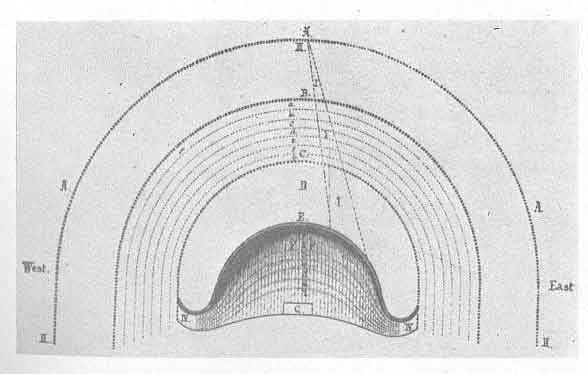
ONE OF THE STRANGEST OF WORLDS is the Square Earth of Cosmas Indicopleustes, an Egyptian monk of the sixth century A.D., who expended an astonishing ingenuity upon the development of a theory of the universe that would eliminate the increasingly popular notion that the Earth was a sphere. He was filled with a holy hatred of the heresy of the "spherists" and the antipodists, and he evolved at last a figure of the universe modelled upon the design of the Tabernacle built by Moses in the wilderness, which, he pointed out, Moses himself had declared to be constructed upon the pattern of the visible world. His own explanation of it may be read in his Christian Topography.

FIGURE 77. <i>The Square Earth of Cosmas Indicopleustes</i> (<i>6th century A.D.</i>)<br> (From <i>Flammarion's Astronomical Myths</i>, 1877.)
FIGURE 77. The Square Earth of Cosmas Indicopleustes(6th century A.D.)
(From Flammarion's Astronomical Myths, 1877.)Cosmas says that the Earth is a rectangular plane surface, whose long sides are twice the shorter ones. These are the measurements of the Tabernacle, and of the Table of Shew-bread. This Earth-table is divided into three parts: the habitable Earth, in the middle, the ocean which everywhere surrounds it, and beyond the ocean another surrounding continent, which is now altogether inaccessible to man, but which was once the seat of Paradise and the home of the human race up to the time of the Deluge, when the flood swept the Ark with its few saved men across to the "other Earth." It is true, says Cosmas, that after the Fall Paradise itself had been closed to Adam, but until the Deluge he and his descendants had dwelt on the coast edges of the First Continent of man.

Upon the edges of this outer inaccessible continent rest the four walls of heaven--four perpendicular planes joined hermetically to the edges of the trans-oceanic Earth, and cemented at the top by an enclosing roof, in form like half a cylinder. Its ends rest on the eastern and western sides of the world, and its sides on the north and south. These directions are determined by the Tabernacle Table, which was placed lengthwise from east to west. Here is a bit from Cosmas himself:

FIGURE 78. <i>The Square Earth. Its habitable plane</i>.<br> (From <i>Flammarion's Astronomical Myths</i>, 1877.)
FIGURE 78. The Square Earth. Its habitable plane.
(From Flammarion's Astronomical Myths, 1877.)"The Deity accordingly having founded the Earth, which is oblong, upon its own stability, bound together the extremities of the heaven with the extremities of the Earth, making the nether extremities of the heaven rest upon the four extremities of the Earth, while on high he formed it into a most lofty vault over-spanning the length of the Earth. Along the breadth again of the Earth he built a wall from the nethermost extremities of the heavens upwards to the summit, and having enclosed the place, made a house, as one might call it, of enormous size, like an oblong vapour bath. For, saith the Prophet Isaiah (xlix, 22), He who established heaven as a vault. With regard moreover to the glueing together of the heaven and the Earth, we find this written in Job: He has inclined heaven to earth, and it has been poured out as the dust of the earth. I have welded it as a square block of stone." 1

The interior of this "oblong vaulted vapour bath" consists, like the Tabernacle, of two parts, the outer and the inner--the veil of the Tabernacle corresponding to the firmament which divides the universe into two parts, and which is the floor of the upper and the ceiling of the lower story. The first story reaches from the Earth-plane, "the footstool of the Lord," to the firmament, and is the abode of men and angels. The presence of angels is necessary in man's world, not only for the sake of their beneficent effect on him, but also because the Sun, Moon, and stars are carried in their courses, not by the firmament which is motionless, but by angels appointed to this work until the last day.

On the Earth-plane rises a high cone-shaped mountain, which makes possible, in this world-system, the rising and the setting of the Sun, day and night, climates, seasons, etc.

With the universe enclosed within a square box, it was no longer possible for the Sun to sink in western waters, swim under the Earth, and emerge again from the eastern sea. But forever circling the conical mountain of the world, in the arms of its carrying angel, it is hidden from a part of the world all of the time, and thus comes day and night. The length of the days and nights varies, says Cosmas, according as the Sun is close to or far from its mountain screen, and from this cause spring summer and winter, storms, eclipses, heat and cold, and such phenomena. "All the stars are created," he says, "to regulate the days and nights, the months and the years, and they move, not at all by the motion of the heaven itself, but by the action of certain divine Beings, or lampadophores. God made the angels for his service, and He has charged some of them with the motion of the air, others with that of the Sun, or the Moon, or the other stars, and others again with the collecting of clouds, and preparing the rain." Cosmas also says that men are mistaken when they say that the Sun is much larger than the Earth; that it is, in reality, very much smaller; and, by measuring its shadows at the different "climates" of Ptolemy, he concludes that the sun has the size of "two climates."

Above the firmament and beneath the upper vault live the Blessed. Along the outer side of this vault which terminates the world, rest the heavenly waters. The Mosaic account of the Tabernacle and its enclosed Ark, says Cosmas, gives all the measurements and hence all the secrets of the world, and by it alone man may reconstruct the universe within himself and look down upon it, as the Creator surveys his handiwork from the vaulted roof of Cosmas's "vapour bath."

Here are some of the correspondences which Cosmas drew between the pattern of the Tabernacle and that of the visible world.

In the first Tabernacle, "Moses placed in the south of it the candlesticks, with seven lamps, after the number of days in the week--these lamps being typical of the celestial luminaries--and shining on the table placed in the north of the Earth. On this table again he ordered to be placed daily twelve loaves of shew-bread, to typify the three months between each of the four tropics. He commanded also to be wreathed all around the rim of the table a waved moulding, to represent a multitude of waters, that is, the ocean; and further, in the circuit of the waved work, a crown to be set of the circumference of the palm of the hand, to represent the land beyond the ocean, and encircling it, where in the east lies Paradise, and where also the extremities of the heaven are bound to the extremities of the Earth. And from this description we not only learn concerning the luminaries and the stars that most of them, when they rise, run their course through the south, but from the same source we are taught that the Earth is surrounded by the ocean, and further that beyond the ocean there is another Earth by which the ocean is surrounded."


Footnotes

182:1 Christian Topography of Cosmas Indicopleustes: Hakluyt Soc. Pub. 1897, p. 30.

Systems of the Universe

THE BOOK OF EARTHS

By

EDNA KENTON

New York: William Morrow & Company

[1928, No renewal]


Systems of the Universe

WHEN THE GREEKS IN THE SIXTH CENTURY B.C. took up the study of the universe, its systems multiplied. The order of the orbits of the heavenly bodies, above all, their disorder, fascinated the Greek mind. Eclipses occurred, but how? A Comet fled through the sky, and did not collide with a sister body--why? How were the Earth, Sun, Moon, and all the stars supported in space? What are the relative distances of the spaces between them? Which were the larger bodies? the smaller? What were the divisions of Space? What were the major combinations of the great elements? How were these combinations effected--and a hundred other questions.

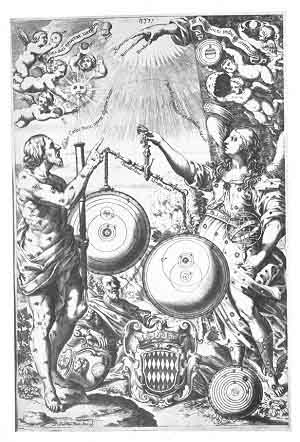
PLATE XXXII. (Frontispiece to <i>Almagestum Novum</i>; Ioannes Riccioli, 1561)
PLATE XXXII. (Frontispiece to Almagestum Novum; Ioannes Riccioli, 1561)
Homer was the first poet of the Greek universe, but Thales was its first philosopher (640-572 B.C.). He believed the Earth was a disc floating "like a piece of wood or something of that kind," on the waters which were the origin of all things, including fire and air as well as Earth; and his interest in eclipses led him into a protracted study of the movements of the Sun and the Moon and their relation to the Earth.

Anaximander (c. 611-545 B.C.) was his contemporary. He gave up the idea that the water was the origin of everything, any more than any other substance known to man. Everything originated "from the nature of the infinite," and to it returned. Hence it followed that this world was not eternal, but merely one of a procession of worlds. He described the figure of Earth as either flat or convex on the surface, but much more like a cylinder or stone column than the thin disc of Thales. Eventually he called it cylindrical, with a height equal to one-third of its breadth. This cylinder, being in the centre of the universe, was stable, in equilibrium, since it had the same relation to every part of- the universe.

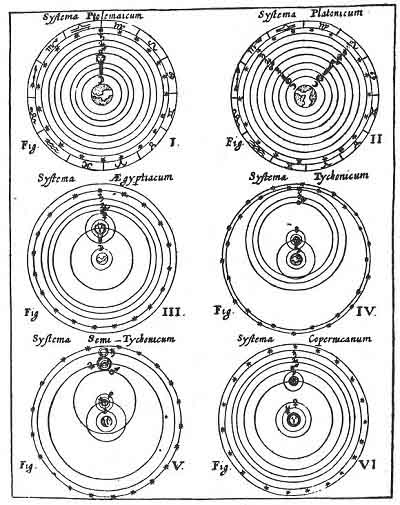
FIGURE 66. <i>The Systems of the Universe</i>.<br> (From <i>Iter exstaticum ceste</i>; Athanasius Kircher, 1660, Plate II.)
FIGURE 66. The Systems of the Universe.
(From Iter exstaticum ceste; Athanasius Kircher, 1660, Plate II.)
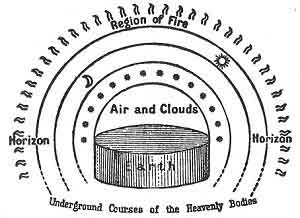
Above it were a series of heavens, the first of air, the second of all the stars, the third of the Moon, above that the heaven of the Sun and above all the heaven of the heavenly fire. He had an extremely complicated theory to account for a motionless heaven and moving bodies; he appears to have imagined the Sun, for instance, to be an enormous wheel filled with fire, its rim pierced by a single hole the size of the Earth.
FIGURE 67. <i>The Universe according to Anaximander</i><br> (<i>c. 611-545 B.C.</i>)<br> (From <i>Dante and the Early Astronomers</i>; M. A. Orr (Mrs. John Evershed), 1913.)
FIGURE 67. The Universe according to Anaximander
(c. 611-545 B.C.)
(From Dante and the Early Astronomers; M. A. Orr (Mrs. John Evershed), 1913.)So, too, the Moon and stars rolled through their heavens; eclipses came from the holes in the Sun-wheel's rim and that of the Moon being partially or wholly stopped up. Quite exactly, his Sun and Moon were vessels filled with fire.

Of course only the upper surface of Anaximander's Earth was habitable; below it the heavenly bodies had their underworld course; for the rest, the horizon marked the limits of the known and the knowable.

He seems to have held too the curious idea that the series of worlds which come out of the infinite and go back into it may be also called gods, since, like gods, they are created, they live, they die, and are again created.

For a hundred years following Anaximander's death, the Greeks were still asking how the Earth was held in balance, and why the heavenly bodies did not fall from their places in the sky and destroy the Earth. Empedocles and Anaxagoras offered this explanation--that a great whirl-wind swept continuously round the Earth, serving the double end of holding the heavenly bodies aloft and of driving them across the sky. Anaxagoras believed that this same whirlwind was responsible for the stars themselves; that they were fragments of the Earth, torn off by the violence of the whirlwind, and that their light came from no more than the heat produced by friction. He also believed that the "heaven of the stars" was far beyond that of the Sun.

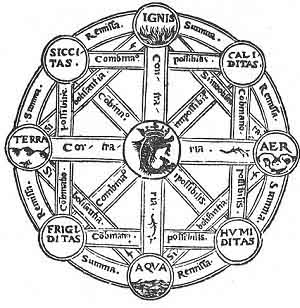
As for Empedocles, he re-asserted that everything consists of the four elements, Earth, air, fire, and water, either in a pure, or a combined, or a mixed state merely; and he said further that all these combinations and mixings were brought about by two forces alone, one attracting, and one repulsing, one Harmony, the other Disharmony, one Cord, the other Discord. He had also a very individual idea of the Moon and the Sun; the Moon is air rolled together with fire--it is flat like a disc and gets its light from the Sun. But the Sun, he said, is a reflection of the fire surrounding the Earth; it is not itself of a fiery nature, but merely a reflection of fire, "like that which is produced in water."
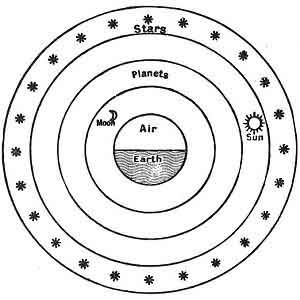
FIGURE 68. <i>The Universe of Leucippus</i> (<i>c. 450 B.C.</i>)<br> (From <i>Dante and the Early Astronomers</i>; M. A. Orr (Mrs. John Evershed), 1913.)
FIGURE 68. The Universe of Leucippus(c. 450 B.C.)
(From Dante and the Early Astronomers; M. A. Orr (Mrs. John Evershed), 1913.)Leucippus (c. 450 B.C.) changed Anaximander's figure of the universe considerably. He still held that the Earth's flat upper surface was its only habitable area, but he gave the whole mass of the Earth the shape of a tympanum or kettle drum, flat, with a slightly raised rim--according to this idea man was living on the flat top of the southern hemisphere. Above the hemisphere of Earth was the hemisphere of air, the two surrounded by the crystal sphere which held the Moon. Above the Moon's sphere was the planetary sphere; above this the sphere of the Sun, with the star-zone last, "perhaps outside." He accounted for the inclination of the axis to the horizon by saying that the Earth had sunk towards the south, which is merely the other half of the ancient saying that the Earth is raised towards the north.
FIGURE 69. <i>The Universe of Democritus</i> (<i>c. 430 B.C.</i>)<br> (From <i>Dante and the Early Astronomers</i>; M. A. Orr (Mrs. John Evershed), 1913.)
FIGURE 69. The Universe of Democritus(c. 430 B.C.)
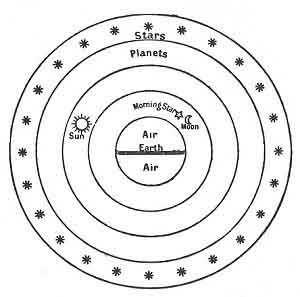
(From Dante and the Early Astronomers; M. A. Orr (Mrs. John Evershed), 1913.)Leucippus had a disciple, Democritus (c. 430 B.C.), who retained the thin Earth-disc of Thales, but added to it the surrounding rim of his master's Earth-drum. He changed Leucippus's Air-Earth sphere into a sphere of Air, divided horizontally through its centre by the Earth-disc. Thus, like the cylindrical Earth of Anaximander,

it rested on nothing but air. Next the Air sphere he placed the Moon and the Morning Star, then the spheres of the Sun, the planets and the fixed stars.

The Sun, he said, was ignited stone or iron, and the Sun and Moon, each a large solid mass, were none the less smaller than the Earth. Originally, he said, the Sun and the Moon had been two Earths, like this of ours, and each of them, like ours, at the core and centre of a world. But these two worlds had encountered our world, which had absorbed them both, and had taken possession of the "Earth" of each. Comets, he said, are caused by two planets approaching each other closely. The Moon was not only a solid body, but, having once been the "Earth" of another world, it still has mountains and plains and chasms, which cause the markings on its face. Anaxagoras however had said this before him, and had also asserted that the Moon was still inhabited. Democritus also taught that the light of the Milky Way was caused by a great multitude of very faint stars. Later it was said that the Milky Way was a former path of the Sun, which for some obscure reason had changed its course.

It was Pythagoras who numbered and measured and named for the Greeks the five great planets of our system, and who gave them places in the heavens equal in importance to the greater heavenly bodies. And it was Pythagoras who taught that the Earth was a perfect sphere, hanging, if not moving, freely in space, with its whole surface habitable, and with men moving freely on all its sides. For the Earth, he said, balanced in the centre of the world, cannot fall, nor can it let anything which belongs to any part of it fall. There is no below, there is no above, for our North is South to the men of the antipodes; there is nothing but the Centre, where we are, and it is illusion to believe otherwise.
FIGURE 70. <i>The Universe of Pythagoras</i> (<i>c. 540 B.C.</i>)<br> (From <i>Dante and the Early Astronomers</i>; M. A. Orr (Mrs. John Evershed), 1913.)
FIGURE 70. The Universe of Pythagoras(c. 540 B.C.)
(From Dante and the Early Astronomers; M. A. Orr (Mrs. John Evershed), 1913.)Number played the principal part in the universe of the Pythagoreans, for, said they, everything in nature is governed by number, since number is the beginning and the end of all relations. There are cosmic principles, they declared, and these cosmic principles are mathematical principles, which are living principles; numbers are the essence of the universe, the very substance of things, the cause and effect of all that is in nature.

Pythagoras separated the planets and affirmed that their distances are in exact proportion to the intervals between musical notes. Combined with the Sun and Moon into a running scale, they make up the sacred number seven, and these seven notes of the cosmic scale constitute, with the mysterious star-sphere, the cosmic octave. As each of the heavenly bodies moves in its path, different to, yet harmonious with all the others, it sounds its own individual note in the great octave that is "the music of the spheres." This music, said the Pythagoreans, is all about us and has been since our infancy, but we live beside it "as one lives beside the cataracts of the Nile"--we never know we hear it.

According to Aristotle, the Pythagorean universe was divided thus:

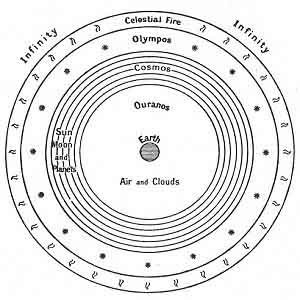
The Earth was, first of all, a sphere situated in the centre of the universe, and was surrounded by many spheres.

Ouranos or Sky stretched between the Earth and the Moon. It was the region of illusion and change, always filled with whorls of air and shifting clouds.

Cosmos was the region of "the celestial octave," the appointed place for the Sun, the Moon, and the planets. It consisted of seven concentric rings or spheres, in which these heavenly bodies, or "divine beings," lived their conscious, joyous lives.

Olympos was the Star-sphere, the pure-elemental region which completed the cosmic octave.

Beyond Olympos stretched the region of celestial fire.

Beyond the region of celestial fire was Apeiron, Infinite Air, Infinite Space, from which and into which the Cosmos breathes, and through which and by which only it lives.

FIGURE 75. <i>The Five Great Elements</i>.<br> (From <i>Spha Mundi</i>; Orantius Fineus, 1542.)
FIGURE 75. The Five Great Elements.
(From Spha Mundi; Orantius Fineus, 1542.)The Pythagoreans did not fail to take into account the five great elements, from which they believed all things were fashioned. They fitted these five "Causal Beings" into the five regular solids (Figs. 2-6 and ), to whose forms, they said, the component particles of the different elements correspond. The component particle of Earth, for instance, corresponds to the cube; of water, to the icosahedron; of air, to the octahedron; of fire, to the tetrahedron; of ether, to the dodecahedron--the form which had been God's model for the whole universe.

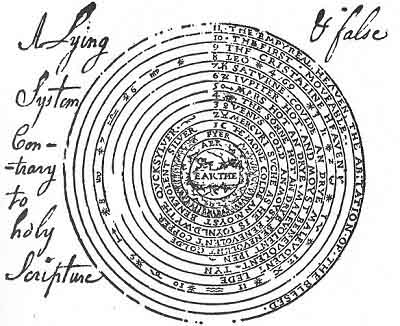
FIGURE 72. ''<i>A Figure of the whole world, wherein are set forth the two essentiall Parts, the eleven heavens, and the foure Elements</i>.
FIGURE 72. ''A Figure of the whole world, wherein are set forth the two essentiall Parts, the eleven heavens, and the foure Elements."A Figure of the Whole World" (Fig. 72 ) is the Pythagorean-Ptolemaic system, much elaborated. It begins by taking into account the "foure Elements," but it extends the number of the imaginable heavens beyond the "cristaline" to two--this was an invention of the medial astronomers. These two additional heavens were the Primum Mobile, or the "First Movable," and "The empyreal heaven, the habitation of the blesed."

FIGURE 73. <i>System of the diverse spheres</i>.<br> (From <i>Cosmographia</i>; Petrus Apianus, 1660.)
Click to enlarge

FIGURE 73. System of the diverse spheres.
(From Cosmographia; Petrus Apianus, 1660.)

This last was the Heaven of Heavens, motionless, incorruptible, the place of the eternal mysteries. None of these spheres consisted, of course, of any materially palpable substance; they were great spherical zones of aethereal space, arranged one within the other, which circled about the motionless Earth at differing rates of speed. Perhaps, instead of "spheres," or "shells," or "zones," these moving regions are better expressed by the term "velocities."

Fig. 73 represents again the same system, even more elaborately inscribed with "correspondences." By aid of these two guides through the "two essentiall Parts" of the whole world--that is to say the eleven heavens and the four elements, the six systems of the universe shown in Fig. 66 can be more or less easily followed.

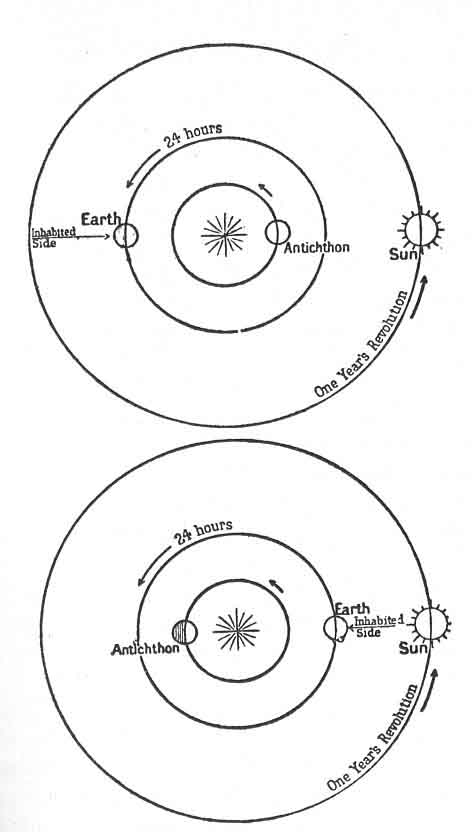
ONE DEVELOPMENT OF THE PYTHAGOREAN SYSTEM might be mentioned here--the attempt of an otherwise unknown astronomer, Philolaus, to remove the motionless Earth from its place in the centre of the universe and give it an orbit of its own. His reasons, except that he hoped by this to account better for the seemingly contrary movements of the heavens, do not concern us here. But it is a transition-picture. For by moving the Earth from the centre and letting her move in Space, he may have solved one problem, but he raised two new ones. He had left the sacred place, the Centre of the World, empty, and he had disturbed the cosmic octave by adding to it another moving body. Heretofore the Earth had been mute because it was motionless; now movement gave it its own note in a disturbed scale. So in the sacred place he put the purest of the elements, Fire, forerunner of the Central Sun. Then, more to restore the harmony of number, quite likely, than to explain Night and Day, he created another moving heavenly body, the planet Antichthon, or Counter-Earth, and gave it an orbit between the Earth and the Central Fire with one of its faces turned always to the Fire. This gave nine moving bodies, and with the star-sphere as another, the number was increased from the sacred number seven to the sacred number ten. The Earth revolved with one face turned always away from the centre; Antichthon, the new planet, was therefore always invisible. After this rearrangement was completed, explanations purporting to reconcile a geocentric with an ignicentric system were invented plenteously, some of them very interesting ones. "Those who partook of a greater knowledge," wrote Simplicius, "called the fire in the middle the creating power, which from the middle gives life to the whole Earth and again warms that which has been cooled. . . . But they called the Earth a star because it also is an instrument of time, for it is the cause of days and nights, for it makes day to the part illumined by the Sun, but night to the part which is in the cone of the shadow." And he ends by saying that the moon was called the antichthon, because it is "an aethereal Earth."

Some modern students of this confusion have suggested that the Earth and the Counter-Earth or Antichthon might have been intended to be the two halves of a single sphere, cut through a meridian and separated very slightly, with the flat sides toward each other, but with the convex side of Antichthon turned always towards the Central Fire, and the convex side of the Earth turned always away from it. This may be so, but no one knows. For the Pythagorean teachings were at the best obscure, and the Pythagorean text that has come down is scanty and corrupt.

FIGURE 74. <i>The System of Philolaus</i>.<br> (From <i>Dante and the Early Astronomers</i>; M. A. Orr (Mrs. John Evershed), 1913.)
FIGURE 74. The System of Philolaus.
(From Dante and the Early Astronomers; M. A. Orr (Mrs. John Evershed), 1913.)Upper figure: Night on Earth. Only the side turned away from the centre is inhabited; consequently the Central Fire and Antichthon are invisible.

Lower figure: Twelve hours later; Day on Earth. Earth has made half a revolution, and her outer side is now lighted by the sun, which has only moved about half a degree forward in its yearly orbit. Antichthon has also made half a revolution, therefore remains invisible.One Pythagorean, Hicatus of Syracuse, is said to have believed and taught that the heavens, the Sun, Moon, stars, and all the heavenly bodies are standing still, and that nothing in the universe is moving except the Earth, which, while it turns and twists itself with the greatest velocity round its axis, produces all the same phenomena as if the heavens were moving and the Earth were standing still."

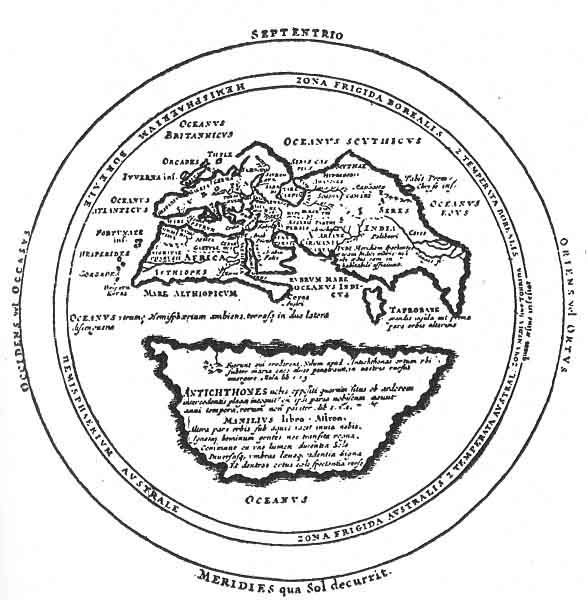
As above, so below! Philolaus placed the planet Antichthon or Counter-Earth in the heavens, perhaps five hundred years before the Christian era. In the first century A.D. Pomponius Mela, a Latin cosmographer, convinced that a spherical Earth must have a more or less balanced distribution of land and water, drew the first map on which the mysterious continent of Earth appears in the unknown half of Earth--our antipodes. This continent he inscribed with the name Antichthones, the Unknown. His pen had leaped over the impassable equatorial zone, and had drawn below it a solid, bowl-shaped mass of land which no man had seen, and which no man might ever see. And yet it must be there! It had been long known through travellers that from Greece or from Italy the eastwardly land stretched much farther than the land to the west, and it was therefore quite possible, with no proof of the existence of a great western ocean, that the northern continent of Europe-Asia-Africa might wrap around the sphere until its eastern edge touched the western shore of the known Atlantic. But it was implicitly believed that the known land stopped at the equator; the balancing continent must be therefore at the antipodes.

FIGURE 75. <i>Pomponius Mela's Map of the World, with Antichthones </i>(<i>1st century A.D.</i>)<br> (From <i>De situ Orbis</i>; Pomponius Mela, 1536.)
FIGURE 75. Pomponius Mela's Map of the World, with Antichthones (1st century A.D.)
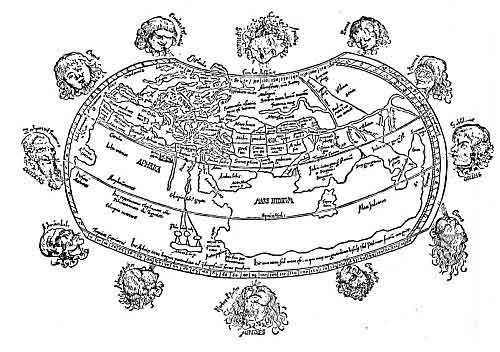
(From De situ Orbis; Pomponius Mela, 1536.)When Pomponius Mela dropped his second continent to the south, he was a mistaken man, but his Antichthones lingered in the imagination of men--lingered for nearly fifteen hundred years, until Columbus, sailing west--to India--came upon the West Indies and the Americas. The great astronomer and geographer, Claudius Ptolemy, lived in the century after Pomponius Mela. There is a legend that he was a descendant of the Egyptian kings, and knew their secret science of the heavens; certainly he brought about a revival of mathematical geography that had not been in the world since the great Alexandrian period, and he drew his maps upon a form that was to be the model of the Earth up to and through the Middle Ages.

boe20

Ptolemy believed the Earth to be a globular body, but the form on which his maps were modelled was one slightly depressed at the north, and sharply cut off a little below the equatorial line by a supposedly continuous Southern Ocean which circled the equator and flowed below it. His historians do not seem to doubt that his knowledge of the regions of the Earth extended as far as the equator, and that he himself knew this fabled zone of fire was both habitable and inhabited. But he confined himself to a map-form that included neither the unknown Polar regions nor the hemisphere of Antichthones.


Next: The Square Earth of Cosmas Indicopleutes

The Mundane Egg

THE BOOK OF EARTHS

By

EDNA KENTON

New York: William Morrow & Company

[1928, No renewal]


Earth The Mundane Egg

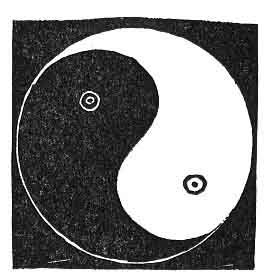
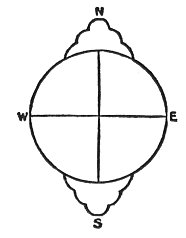
THE GREAT MONAD, or the Great Beginning, or the Great Extreme, or the Great Vacuum, or Yin and Yang, or "Heaven," is one of the old, mysterious figures of Earth. It represents all the pairs of opposites that we know--Light and Darkness, life and death, death and re-birth, heat and cold, good and evil, subtle and gross, male-female in Nature, or the great principles Yin and Yang. It is One yet All Things, the great hermaphrodite--"the indivisible monad, of itself generating itself, and out of this were formed all things." It looks like a shell, it looks like an ear; it looks like a tadpole, an embryo, a whirlpool, a claw, a comma, two eyes, strange Moon upon the Sun. It looks perhaps like the Universe itself before the creation of Heaven and Earth. It is the epitome of all the "egg-shaped" figures of Earth. It is animated Chaos, primordial Air dividing into two Airs to generate a multiplied cosmos, for they have the power to make and transmute all things. It is the Ovum Mundi--Egg of the World.
FIGURE 61. The Great Monad.<br> (From Dragon, Image and Demon; H. C. Du Bose, 1887.)
FIGURE 61. The Great Monad.
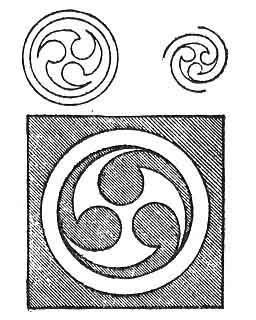
(From Dragon, Image and Demon; H. C. Du Bose, 1887.)It is never a life or a birth symbol merely; it is always associated with the idea of primal causal cosmic energy. The Japanese mitsu tomoeis a variation of the Great Monad of the Chinese; instead of the two-comma-shaped figure, its "commas" are three.

"The Great Extreme," says the Chinese philosopher Choo-tzse, writing of this ancient symbol, "moved and generated the Light; having moved to the utmost, it rested, and resting, generated the Darkness. . . .
FIGURE 62. <i>The Mitsu Tomoe of the Japanese</i>.<br> (From <i>Internationales Archiv f Ethnographie</i>; Bd. IX (1896), S. 265.)
FIGURE 62. The Mitsu Tomoe of the Japanese.
(From Internationales Archiv f Ethnographie; Bd. IX (1896), S. 265.)"The Great Extreme resembles a root which sprouts upwards, and divides into branches, and which also divides and produces blossoms and leaves, generating unceasingly. When the fruit is formed, then, it contains inside, the seed of endless generations, which generates and springs forth. This is the Infinite Great Extreme, which never ceases altogether, but only when the fruit is perfected it ceases to generate for a while. . . .

"In the beginning Heaven and Earth were just Light and Dark Air. This one Air revolved grinding round and round. When it ground quickly much sediment was compressed, which, having no means of exit, coagulated and formed the Earth in the centre. The subtle portion of the Air then became Heaven, and the Sun, Moon, and Stars which unceasingly revolve on the outside. The Earth is in the centre, and is motionless, it is not below the centre.

The Earth is the sediment of the Air; and hence it is said that the light and pure Air became Heaven; the heavy and muddy Air became Earth." 1

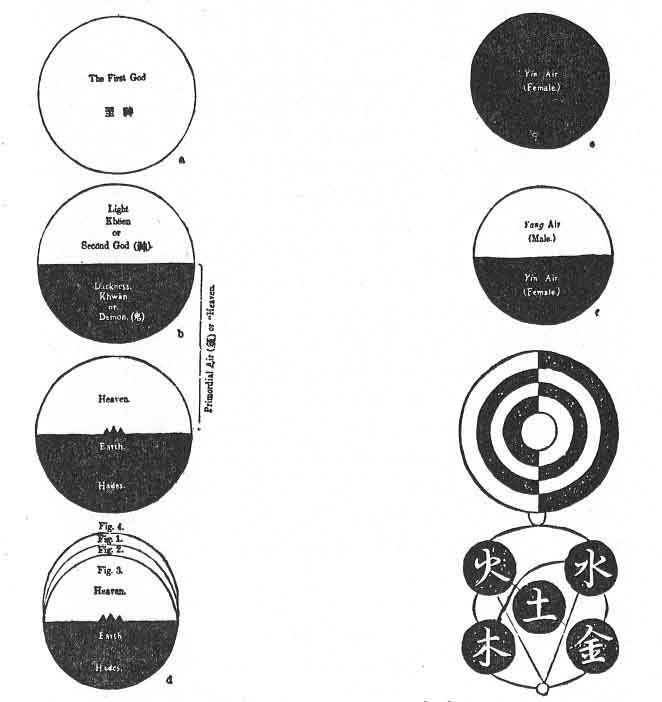
Here is a series of Chinese diagrams (Fig. 63 ) illustrating the process of the Creation of the universe from the beginning--the whole infinite mass of Primordial Air when in Chaos. This is represented by the black disc (e), the Ovum Mundior "Mind" of the universe, inherent in which, even in its mingled state, is the Divine Reason. In (f) is shown the separation of the Primordial Air into two Airs, the division of Subtile from Gross, of Light from Darkness. This is the beginning of all things, from which sprang the First God, All Light (a), called Reason, Fate, the Immovable Mover, or the Infinite. From this First God came the Second God, or Light, and the Demon-god or Darkness (b), which, say the Chinese, represent Mind or the two-fold Soul, contained within the body of the visible world (c). To represent the complete being of the animated cosmos the three circles or globes are placed like three bodies, one within the other (d); this is sometimes called the Three-fold Air. The Great Extreme is represented in another form in the upper half of the lower right-hand figure, whose inner circle represents the First God inherent in all things, with the Light and Dark Airs alternating unceasingly. From this ceaseless alternation are generated the Five Elements whose Chinese terms differ considerably from those we have been using--namely, earth, water, fire, air, and ether. For the first one, they say, is termed water, and by some is called black.

FIGURE 63. <i>Chinese Conception of the Creation</i>.<br> (From <i>Confucian Cosmogony</i>; Thomas MClatchie, Shanghai, 1874.)
FIGURE 63. Chinese Conception of the Creation.
(From Confucian Cosmogony; Thomas MClatchie, Shanghai, 1874.)The second is fire, and by some is termed red. The third is called wood and is therefore termed green. The fourth is called metal and is white. The fifth is called earth, and is presumed to be yellow.

Besides the Great Monad and its associated diagrams, the Chinese had yet another series of diagrams by which, they asserted, it was possible to account for all the changes and transmutations within the forces of Nature. These are the Eight Diagrams of Fuh-he, which, according to him and his disciples, manifest the Mind of Heaven and Earth, whose only purpose is to generate--that is, to change and to transmute. "That which proceeds gradually," they said, "is transmutation [like the growth of a tree]. That which is united in one and is incomprehensible is God. Transmutation is each thing succeeding in order." They tried to explain this further by saying: "That which when at Rest cannot Move, and when in Motion cannot Rest is Matter;. that which Moves yet moves not, Rests yet rests not, is God." They said, too, that the "thirty-six palaces"--the number of units that make up the Eight Diagrams--are no more than merely the strokes of the Light and the Darkness.

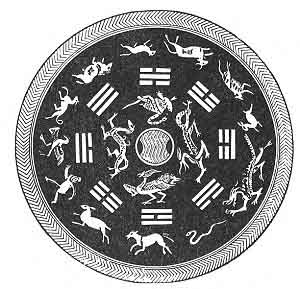
Each set of three lines (Fig. 64 ) represents the three powers, Heaven, Earth, and Man, and represents also the exact force exerted by each one in each of the eight combinations. The three undivided lines, for instance, indicate the tireless strength of Heaven, the three divided lines, the divided Earth. Beginning at the top and going to the left, the triads are supposed to read: river or running water, Heaven, wind, Earth, Sun, lake or dormant water, mountain, thunder. The centre of this mirror is said to represent the Sun, surrounded by four constellations, which are in turn encircled by the Eight Diagrams, and these again by the Chinese Zodiac, or Yellow Path of the Sun, with its twelve animal signs--the Mouse, Cow, Tiger, Rabbit, Dragon, Serpent, Horse, Ram, Ape, Hen, Dog, and Pig.

FIGURE 64. <i>The Chinese Zodiac. From a Mirror of the Tang Dynasty</i>.<br> (From <i>Journal of the Royal Asiatic Society of Great Britain and Ireland</i>, 1835, Vol. II.)
FIGURE 64. The Chinese Zodiac. From a Mirror of the Tang Dynasty.
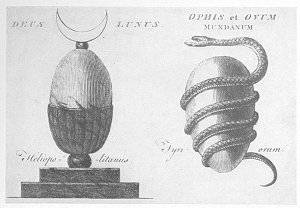
(From Journal of the Royal Asiatic Society of Great Britain and Ireland, 1835, Vol. II.)THE FIVE FIGURES OF EARTH as the Mundane Egg, given in Plates XXIX , pl30 , and XXXI , are all of them different, yet all of them the same, and they range in time and region from ancient Egypt to seventeenth-century England. The idea of the "Ophis et Ovum Mundanum" (PlateXXIX, B ) is not to be traced to its source; it is found everywhere, in the open or secret traditions of all races--this concept of the great World Serpent warming, guarding, hatching, sometimes feasting on the Earth Egg. The "Deus Luna" () is one of the old attempts, in varying forms and with more interpretations, to link the great triad of heavenly bodies, Sun, Moon, and Earth, into a figure symbolic of the whole universe. Here the Mundane Egg is held in its fiery vase very much as an acorn is held in its cup. It is guarded by the Moon, which, as a "great white bird," was supposed to rest at night upon the Earth; "like a goose," said the Egyptians, "brooding over her egg."

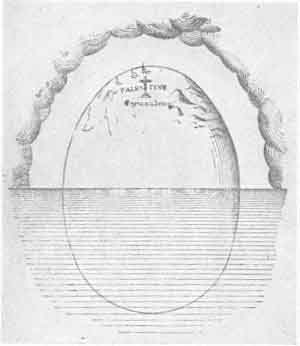
The third figure (Plate XXIX, C ), as much a World Mountain as a World Egg, is asserted by Flammarion to represent the world-concept of Edrisi, an Arabian geographer of the eleventh century, "who, with many others, considered the Earth to be like an egg with one-half plunged into the water." This is identical with the figure illustrating the "Theory of Two Centres" (Fig. 54 ).

PLATE XXIX. A. <i>Deus Lunus</i>. B. <i>Ophis et Ovum Mundanum</i>.<br> (From <i>Ancient Mythology</i>; Jacob Bryant, 1774, Vol. Il)
PLATE XXIX. A. Deus Lunus. B. Ophis et Ovum Mundanum.
(From Ancient Mythology; Jacob Bryant, 1774, Vol. Il)

PLATE XXIX. C. Earth as a floating Egg.<br> (From Flammarion's <i>Astronomical Myths</i>. 1877)
PLATE XXIX. C. Earth as a floating Egg.
(From Flammarion's Astronomical Myths. 1877)
It is also a modern religious rendering of the Northern hemisphere, with Jerusalem and Palestine at the apex of the world.

The last two figures bring us back again to Thomas Burnet and his Theory of the Earth, which emphatically was the theory that it is almost literally, certainly by every analogy, the Mundane Egg.

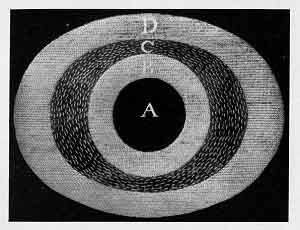
"There is another thing in Antiquity," said this great English Platonist, "relating to the form and construction of the Earth, which is very remarkable, and hath obtained throughout all learned Nations and Ages. And that is the comparison or resemblance of the Earth to an Egg. And this is not so much for its external figure, though that be true too, as for the inward composition of it; consisting of several Orbs, one including another, and in that order, as to answer the several elementary Regions on which the new-made Earth was constituted. For if we admit for the Yolka Central fire . . . and suppose the Figure of the Earth Oval, and a little extended towards the Poles . . . those two bodies do very naturally represent one another, as in this Scheme, which represents the interiour faces of both, a divided Egg, or Earth. Where, as the two inmost Regions (A. B.) represent the Yolk and the Membrane that lies next above it; so the Exteriour Region of the Earth (D.) is as the Shell of the Egg, and the Abysse (C.) under it as the White that lies under the Shell. And considering that this notion of the Mundane Egg, or that the World was Oviform, hath been the sence and language of all Antiquity, Latins, Greeks, Persians, Egyptians, and others, I thought it worthy our notice in this place."

The unknown author of De Imago Mundihad, it happens, compared not the Earth but the Universe itself to a ball, or an Egg. In his scheme, the shell corresponded to the upper heavens; the white to the upper air; the yolk to the lower air; and the pinguidinis gutta, or drop of grease in the centre, to the Earth. And, even earlier than these, the Venerable Bede had written (in the sixth century A.D.): "The Earth is an element placed in the middle of the world, as the yolk in the middle of an egg; around it is the water, like the white surrounding the yolk; outside that is the air, like the membrane of the egg; and around all is the fire, which closes it in as the shell does. . . . The ocean, which surrounds it by its waves as far as the horizon, divides it into two parts, the upper of which is inhabited by us, while the lower is inhabited by our antipodes; although not one of them can come to us, nor one of us to them." These three analogies are developed differently, but Burnet's figure of the "divided egg" will serve to illustrate all of them (Plate XXX ).

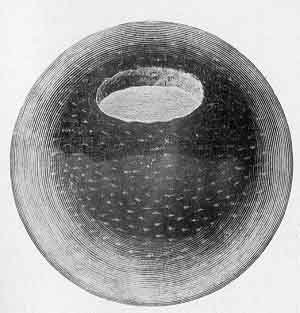
Having divided his Earth-egg to show the order of arrangement of its inner parts, Burnet then closed it up, to represent it entire, with only a reminder of the great abyss under it (Plate XXXI ), on which his whole theory of the Deluge and the dissolution of the Earth rested. Either the great abyss opened (which he doubted), "or the frame of the Earth broke and fell down into the Great Abysse." In the latter case, there would be two effects. This "smooth Earth" in which were the first scenes of the world and the first generations of mankind, which had the beauty of youth and not a wrinkle, scar or fracture in all its body, no Rocks or Mountains, no hollow Caves nor gaping Chanels," would be first submerged during the agitation of the abyss by the violent fall of the Earth into it.

PLATE XXX. ''A DIVIDED EGG, OR EARTH.''<br> (From The Theory of the Earth; Thomas Burnet, 1697)
PLATE XXX. ''A DIVIDED EGG, OR EARTH.''
(From The Theory of the Earth; Thomas Burnet, 1697)

Then, when the flood had subsided, "you would see," said he, "the true image of the present Earth in the ruines of the first" (Fig. 34 and Plate XIV ). He compared his "smooth" or primal Earth to an lipileor hollow sphere filled with water, which the heat of fire rarefies and turns into vapours and winds. "The Sun here is as the Fire," he said, "and the exteriour Earth is as the Shell of the lipile, and the Abysse as the Water within it. . . . So we see all Vapours and Exhalations enclosd within the Earth, and agitated there, strive to break out, and often shake the ground with their attempts to get loose. And in the comparison we used of an lipile, if the mouth of it be stopt that gives the vent, the Water rarefied will burst the Vessel with its force. And the resemblance of the Earth to an Egg, which we used before, holds also in this respect, for when it heats before the Fire, the moisture and Air within being rarefied, makes it often burst the Shell. And I do the more willingly mention this last comparison, because I observe that some of the Ancients, when they speak of the doctrine of the MundaneEgg, say that after a certain period of time it was broken."

Another cosmogony worked out along this same analogy is that of the Gnostics, a group that flourished during the first two centuries of the Christian era, who are said to be the descendants in wisdom of other groups far removed. But the Gnostic group was really an aggregation of groups who combined the Christian teachings with a gnosis or higher knowledge through which the inner meaning of Christianity was revealed. Their doctrines were akin to those of Pythagoras, the higher Egyptian, Indian and Chinese teachers, and to those of the Essenes who for centuries before the Christian era had dwelt apart on the shores of the Dead Sea. They strove after the knowledge of God; wisdom was their goal, and the life of man on Earth their study. For gnosis, in the words of Theodotus, is the knowledge of what we were, what we have become, where we were, into what place we have been thrown; whither we are hastening, whence we are redeemed; what is birth, and what is re-birth." Their scheme of the universe has come down to us through "the diagram of Celsus," who called it the diagram of the Ophites, a sect of the Gnostics, with whose beliefs he was most familiar.

In the beginning, said the Gnostics, was the Trinity, Light, Spirit, and Darkness, all intermingled; and from the striving of the Darkness to retain the Light and Spirit, and so to imprison life sparks in matter, and from the striving of Light and Spirit against the power of Darkness, the first great form was produced, Heaven and Earth, symbolised by the World Egg in the womb of the universe. This World Egg was represented as a circle with a serpent twined several times around it, signifying the mysterious force which first set into separating, light-producing motion the mingled Light and Darkness of the Great Monad. The great serpent, they believed, was not the Great Tempter, but the form through which Divine Will and Divine Reason incessantly moved and manifested.

PLATE XXXI. ''THE WHOLE EARTH IS AN EGG''<br> (From <i>The Theory of the Earth</i>; Thomas Burnet, 1697)
PLATE XXXI. ''THE WHOLE EARTH IS AN EGG''
(From The Theory of the Earth; Thomas Burnet, 1697)
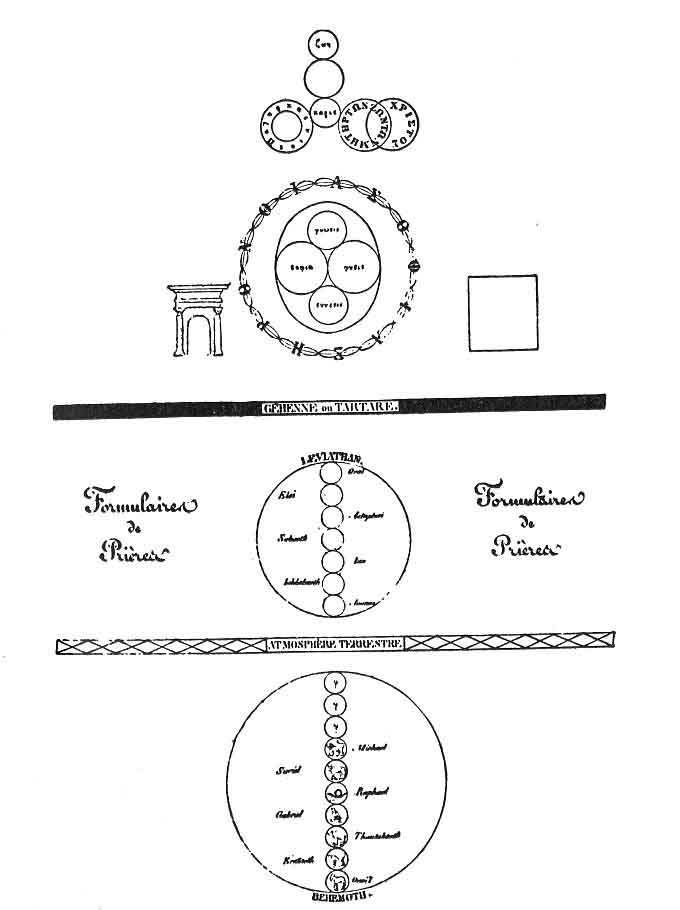
The diagram itself is divided into two great regions, the upper and the lower, separated from each other by the thick black line called Gehennaor Tartarus. The upper region belonged to the supreme Intelligences; it was the world of the ns, or the Pleroma of the Gnostics--the World of Light. Here was perfect harmony, the state of ideal fulness or perfection.

The lower region is divided into two groups, one of ten, the other of seven, spheres, each group of spheres being enclosed within a sphere, and the two separated from each other by the band of Lower Air. The circle enclosing the seven spheres is labelled Leviathan, and represents the Soul of the World, as the body represents the spirit that dwells in it. For it chanced that, one day, the Universal Mother, brooding over the Waters, let a "Drop of Light" fall downwards into chaotic matter, and this was called Sophia, or Wisdom, the WorldMother. The waters of the her being then set in motion, formed a body for Sophia, called the Heaven-sphere. Whereupon Sophia, freeing herself, rose upwards to the Middle Region, below her Mother who was herself the bounding line of the Ideal Universe. Sophia had herself produced Ialdabaoth (child of Chaos, and also identified with Saturn), who in his turn produced a son, and so on, until there were seven in all, the Formative powers of the phenomenal world.

The second group of spheres within a sphere is labelled Behemoth--it is the terrestrial world. Its lower seven spheres carry within them the signatures of seven great animals, and, without, the names of seven angels. The higher three spheres bear only interrogation marks, but they are supposed to belong to Ialdabaoth, the ruler of terrestrial affairs, or perhaps to Sophia herself.

Concerning the signatures of animals inscribed within the seven lower spheres and their relation to the seven angels named outside, Celsus says that the first, a goat, "was shaped like a lion," and was a part of Michael the Lion-like. The second in descending order was a bull--or Suriel, the Bull-like; the third was "an amphibious sort of animal and one that hissed frightfully"--Raphael the Serpent-like; the fourth had the form of an eagle--Gabriel, the Eagle-like; the fifth had the countenance of a bear--Thauthabaoth, the Bear-like; the sixth had the face of, a dog--or Erataoth; "the seventh had the countenance of an ass and was named Thaphabaoth or Onoel."

Might any soul succeed in escaping through these seven spheres and the three empty globes or circles, he must then pass "the fence of wickedness," or "gates" subjected to the world of ruling spirits called Leviathan. Beginning with the lowest, he passed to what was called Ialdabaoth, then to Iao, to Sabaoth, to Astaphs ruler of the third gate, to Alus governor of the second, and to Hors, keeper of the first. Celsus calls this world of Leviathan "circles upon circles."

The Gnostics are famous for their strange symbolic figures. They believed in a Watcher of the World, a Mind that perceived, and they often represented this See-er of the World as a human body pierced with eyes. The extraordinary frontispiece to Riccioli's Almagestum Novum(Plate XXXII ) is by no means a Gnostic picture, but its left-hand figure is a perfect delineation of the myriad-eyed Watcher of the universe.

FIGURE 65. <i>Gnostic Diagram of the Universe</i>.<br> (From <i>Histoire critique du Gnosticisme</i>; Jacques Matter, 1826, Vol. III, Plate I, D.)
FIGURE 65. Gnostic Diagram of the Universe.
(From Histoire critique du Gnosticisme; Jacques Matter, 1826, Vol. III, Plate I, D.)

Almagestum Novumappeared at just the time when the whole universe had been turned, so to say, inside out half inside out, at least. For the Ptolemaic system of the universe, by which we know that theory which places the Earth at the centre, with the rest of the heavenly bodies revolving about it, had but lately fallen. Copernicus, after many years of hesitancy, had at last dared, in 1543, to publish his De revolutionibus, which declared the Sun to be at the centre of our world. Eighteen years later Riccioli's Almagestum Novumwas published; and this little time-scheme lends even more interest to its remarkable frontispiece. For between the "'Watcher of the World" and the "Starry One," the two great systems of the universe hang in the balance, one with the Earth, the other with the Sun, in the centre of Space. The first disc is inscribed with the new Copernican system; the second with the ancient Egyptian. At the goddess's feet lies the system known as Ptolemy's. In one hand she holds the Balance, in the other an armillary sphere. In the upper left-hand corner winged beings float, bearing orbs associated with Light; in the upper right-hand corner move the bearers of those heavenly bodies which bring Light into Darkness--the Moon, Saturn, Jupiter, and the flying serpent of the skies.


Footnotes

148:1 Confucian Cosmogony. Thomas MClatchie, Shanghai, 1874.

The Wheel of Life

THE BOOK OF EARTHS

By

EDNA KENTON

New York: William Morrow & Company

[1928, No renewal]


The Wheel of Life

CLOSELY ASSOCIATED with the World Mountains are the many Wheels of Life, by which the ancients sought to picture the relations of parts of the universe to each other and to the whole. There is a hint of this in the Tibetan world-picture, with Mount Meru the axis or hub of the world about which are placed like spokes in a wheel the four quarters of the Earth, with their three islands each, making the sum of twelve radii from the centre. The Wheel of the Zodiac was of course the great original for all such figures, particularly for the Wheels of Life. For uncounted centuries man knew the geography of the heavens better than the geography of the Earth, and whatever life on Earth meant to him, the unfailing procession of the great star-groups of the Zodiac meant certainty, law, order. There were zones written in the heavens long before man stretched his imaginary lines of the terrestrial zones over the Earth--"The circle called the Zodiac," said Plutarch, "is placed under the three that are in the midst, and lies obliquely, gently touching them all." And it is not hard to see how this great circle came to seem to man a mirror of the Earth, a storehouse of its history, its constant Watcher in the sky, and the unerring prophet of its future. The Greeks named this oblique ring of star-groups just behind the Sun when it sets or just before it when it rises, the Zodiac or Path of Animals, because the names and configurations of the groups were mostly those of animals, and by that name we know it. But no one knows how long before the days of the Greeks far earlier astronomers first linked the single groups of stars into the twelve great signs of the Star-bearing Circle.

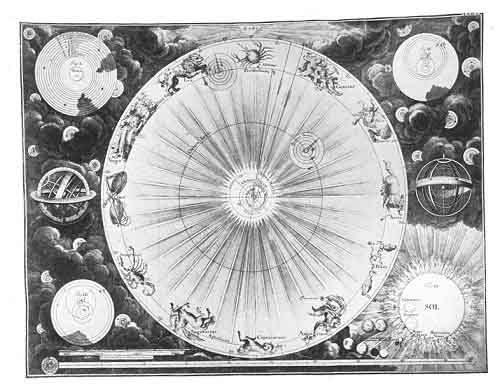
PLATE XXVI. CREATIO UNIVERSI<br> (From Physica Sacra; Johann Jacob Scheuchzer, 1731, Vol. q, Plate I).
PLATE XXVI. CREATIO UNIVERSI
(From Physica Sacra; Johann Jacob Scheuchzer, 1731, Vol. q, Plate I).Physica Sacrais an early eighteenth-century Bible illustrated almost text for text, and Plate XXVI is its first illustration, for the first verse of the first chapter of the first book: "In the beginning God created the heaven and the Earth." Outside the Zodiacal Wheel are clouds upon clouds bearing a multitude of spheres, and, in addition, seven numbered diagrams. Fig. I in this Plate illustrates the system of the "eleven heavens," with the Earth the centre of the universe. Fig. II is the Tychonian system; Fig. III, what is known as the semi-Tychonian system; Fig IV, the blazing and effulgent Sun, containing within himself his seven children, Earth and Moon and the five great planets; Fig. V, a group of the heavenly bodies; Fig. VI, an armillary sphere; Fig. VII, an Astrolabe, which is almost to say, "the handle of the stars," and which was called by the old astronomers "the Mathematical jewel."

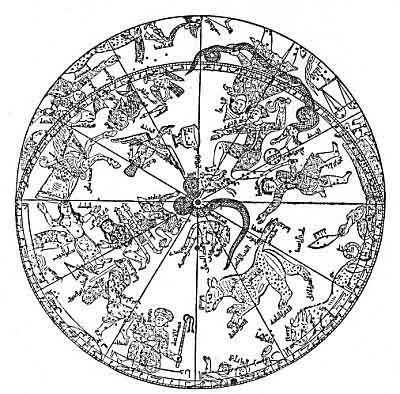
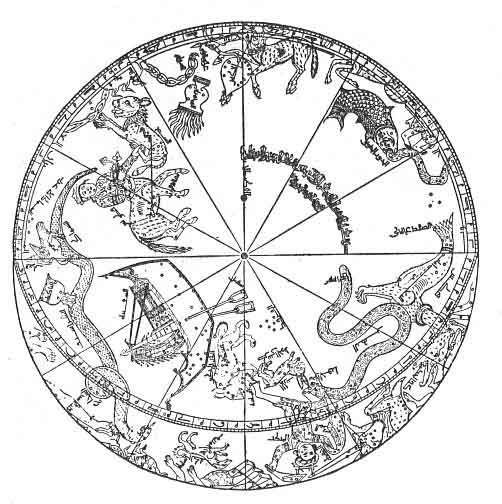
The Northern and Southern hemispheres of the heavens (Figs. 58 and 59 ) are merely supplementary to Scheuchzer's Creatio Universi. They are taken from an Arabic celestial globe, made of brass, in 1275 A.D., which was deposited in the Museum of the Royal Asiatic Society of Great Britain and Ireland. Near the South Pole is an inscription in Cufic characters, stating that it was "Made by the most humble in the supreme God, Mohammed ben Helah, the astronomer of Monsul, in the year of the Hegira." The Zodiac was known to the Arabs, not as The Path of Animals," but as The Girdle of the Castles," and contained, with one or two variations in name, the same signs we have to-day: Aries, Taurus and Gemini, Cancer, Leo, Virgo (this the Arabs called the Ear), Balance or Libra, Scorpio, Sagittarius, Capricornus, Aquarius, and Pisces.

FIGURE 58. <i>An ancient Arabic Celestial Sphere. Northern Hemisphere</i>.<br> (From <i>Transactions of the Royal Asiatic Society of Great Britain and Ireland</i>, 1830, Vol. II, Plate A.)
FIGURE 58. An ancient Arabic Celestial Sphere. Northern Hemisphere.
(From Transactions of the Royal Asiatic Society of Great Britain and Ireland, 1830, Vol. II, Plate A.)There are altogether, including the signs of the Zodiac, forty-seven constellations on these Arabic celestial hemi-pheres. The ones inscribed on the Northern hemisphere are: Little Bear; Greater Bear; The Dragon; Cepheus; Boes; the Northern Crown; The Kneeling Hercules; The Lyre; The Hen, or Swan; The Lady in her Chair, or Cassiopeia; The Bearer of Medusa's Head, i.e., Perseus; The Charioteer; The Charmer of Serpents, or Serpentarius; The Arrow, or Sagittarius; The Flying Eagle, or Aquila; The Dolphin; Part of the Horse (the horse's head); The Greater Horse, Pegasus; The Chain, or Andromeda; The Triangle.

FIGURE 59. <i>An ancient Arabic Celestial Sphere. Southern Hemisphere</i>.<br> (From <i>Transactions of the Royal Asiatic Society of Great Britain and Ireland</i>, 1830, Vol. II, Plate B.)
FIGURE 59. An ancient Arabic Celestial Sphere. Southern Hemisphere.
(From Transactions of the Royal Asiatic Society of Great Britain and Ireland, 1830, Vol. II, Plate B.)The constellations inscribed on the Southern hemisphere are: Ketos, the Whale; The Giant, or Orion; The River, or Acarnar; The Hare, or Lepus; the Greater Dog, or Canis; The Dog, or Procyon; The Ship, or Argo; The Hydra; The Flaggon, or Crater; The Crow, or Corvus; The Centaur, or Centaurus; The Beast, or Fera; The Censer; The Southern Crown; The Southern Fish.

OF THE TWO WHEELS OF LIFE (or Fate or Law) to be given here, we begin with the one that seems the simpler. This Chinese Wheel (Plate XXVII ) is almost a Zodiac or "path of animals," of itself. (The Chinese Zodiac, or "Yellow Path of the Sun," differed materially in its signs from the Greek-Arabic one just given; it contained twelve animals: the Mouse, the Cow, the Tiger, the Rabbit, the Dragon, the Serpent, the Horse, the Ram, the Ape, the Hen, the Dog, and the Pig.) Six of the twelve divisions are separating paths or currents, through or over which the traveller passes to the next stage. Four of the remaining divisions are the abodes of beasts, of insects, of fish, and of birds. The other two, separated from each other by one of the spiral-like rivers, are inhabited by Poor Men and Rich Men, or by Mandarins and Tillers of the Soil.

PLATE XXVII. THE WHEEL OF LIFE<br> (From <i>Dragon, Image, and Demon</i>; H. C. Du Bose, 1887)
PLATE XXVII. THE WHEEL OF LIFE
(From Dragon, Image, and Demon; H. C. Du Bose, 1887)

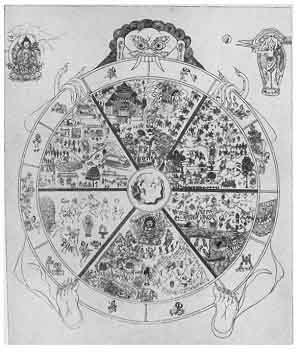
The second of these wheels is the one elaborately developed in the Tibetan Wheel of Life (Plate XXVIII) to which is an almost necessary Key. It is a Tibetan version of an Indian painting in one of the abandoned cave-temples of Ajanta, which L. Austine Waddell holds to be "a complete authentic account of human life from the absolute standpoint of the earliest Buddhist philosophy."

FIGURE 60. <i>Key to the Tibetan Wheel of Life</i>.<br> (From <i>The Buddhism of Tibet, or Lamaism</i>; L. Austine Waddell, 1899.)
FIGURE 60. Key to the Tibetan Wheel of Life.
(From The Buddhism of Tibet, or Lamaism; L. Austine Waddell, 1899.)

The Lamas of Tibet say that Buddha himself originated the Wheel of Life, forming it on the Earth with grains of rice from a "rice-field school room." According to the old story, while tarrying for a while at the Squirrels' Feeding Ground in the Venuvana forest near Rajagriha, Buddha instructed his disciple Ananda, to make a Wheel, for the sake of illustrating what another disciple had seen when he visited other spheres. This Wheel was to have five spokes, between which were to be shown the several hells, animals, ghosts, gods and men. In the middle a dove, a serpent, and a hog were to symbolise lust, hatred, and ignorance. Around the outer rim was to wind "the twelve-fold circle of causation," in regular and inverse order. Beings were to be shown "as being born in a supernatural way as by the machinery of a water-wheel falling from one state and being produced in another." Buddha himself, as an "Enlightened One," liberated from the fate of recurrence on the Wheel, was to be outside of it--one who had escaped. This diagram, made first of rice-grains, was later filled in (second century A.D.) with pictures by the Indian monk Nagarjuna, but these pictures are said to be not his own inventions, but the visual images of Buddha's own parables and allegories.

The Key to the Tibetan Wheel of Life will be found an aid in following the interpretation of it, which is Waddell's, and is given here much abridged. 1

The disc, symbolising the endless cycle of life, is held in the grasp of a monster who represents the horrors of Attachment, the wretchedness of Clinging-to-Life.

The broad tire of the Wheel is filled with the twelve-linked closed chain called the Causal Nexus, or "the twelve-fold circle of causation," i.e., the causes of life and of misery. At the centre or nave lie the three vices or delusions, "the Daughters of Desire," symbolising lust, ill-will, and stupidity, which lie at the core of re-birth, and are here given in the forms of a dove, a serpent, and a pig, coloured respectively red, green, and black. The body of the Wheel, filled with varied pictures, is supposed to be constantly revolving, thereby producing "The Whirling on the Wheel" of Life.

The way of escape is indicated by the twelve "links," and the first link is the connecting link between the old life and the new. It might be denominated Unconscious Will to escape. The links in the causal chain are:

I. A blind she-camel (ignorant unconscious will) led by a driver (Karma). In this picture, however, the first link is represented by a blind old woman led by a man, with its meaning the same. II. A potter modelling clay on his wheel (Conformations and impressions of and on formless clay). III. A monkey (the beginning of Consciousness; the new man is approaching to the human, but is still an unreasoning automaton). IV. A man being ferried across an Ocean (Self-consciousness--the Individual crossing the Ocean of Life). V. An empty house (Understanding achieved through "the empty house of the senses"). VI. The Kiss (or contact with the outside world). VII. An arrow entering a man's eye (Feeling or perception). VIII. A man drinking wine (Desire--or thirst). IX. A man gathering fruit and storing it in baskets (Greed, or the satisfying of Desire). X. A married woman--wife of him whose life is here traced (fuller life, Being, Becoming, even Re-birth and the continuance of Being for another existence). XI. Parent and child (Birth--of an heir). XII. A corpse being carried off to burial (Decay and Death), which leads to I, Unconscious Will for re-birth--and the cycle of the Wheel is begun again.

The ways of "life" or "re-birth" are, from highest to lowest, 1. Gods--the Sura. 2. Titans--the Asura. 3. Man--Nara, or Mi. 4. Beasts--the Du-door "best goers." 5. Tantalised Ghosts--Pretas. 6. Hell--Narakaor Nal-kam.

To live in the first three worlds is superior; to live in the last three is inferior--the highest world being Heaven, and the lowest Hell.

In Heaven, above the Titans, on the aethereal summit of Mount Meru, dwell the gods (Plate XXV ). In the lowest regions of the heavens dwell the "guardian kings of the four quarters"; Dritarashtra, the white guardian of the East; Virudhaka, the green guardian of the South; Virupaksha, the red guardian of the West; and Vaisravana, the yellow guardian of the North.

In the upper right-hand section of the Wheel of Life the Titans (the Asuraor not-gods) have their abode. Since their chief characteristic is pride, this is the world of re-birth for the "proud." The Titans correspond to Satan and his hosts, having been, like Satan, and for like cause, cast out from Heaven.

PLATE XXVIII. THE WHEEL OF LIFE<br> (From <i>The Buddhism of Tibet, or, Lamaism</i>; L. Austine Waddell, 1899)
PLATE XXVIII. THE WHEEL OF LIFE
(From The Buddhism of Tibet, or, Lamaism; L. Austine Waddell, 1899)

THE WHEEL OF LIFE<br> (From <i>The Buddhism of Tibet, or, Lamaism</i>; L. Austine Waddell, 1899), p. 108
THE WHEEL OF LIFE
(From The Buddhism of Tibet, or, Lamaism; L. Austine Waddell, 1899), p. 108

Living at the foot of Mount Meru, they hover forever between Heaven and Earth. The life of the Titans is much longer than the life of men; but it is the fate of every Titan to die warring against the gods for the fruits of the heavenly Parijatatree, whose branches are in Heaven, but whose roots are in their country--"the tree of the concentrated essence of Earth's products." The Jambu tree is, in reality, according to this reading, the "climber" which encircles the aethereal tree, and through it the quintessence of Jambudvip, or the Jambu continent" of Earth is instilled into the ParijataTree.

Man--Naraor Mi--lives in the upper left-hand region, constantly confronting the eight miseries--birth, old age, sickness, death, ungratified wishes and struggle for existence, misfortune and punishment for law-breaking, separation from relatives and cherished objects, offensive objects and sensations. Of all these and other phases of ordinary existence pictures abound within the Wheel--birth in a cottage; children at play; village scenes--people drinking wine under a tree; a flute player; women spinning and weaving; a borrower; two traders; a drunken man; workers tilling a field or gathering fuel in a forest or bent under heavy loads; the accidents of life--a man and a horse falling into a river; crime--two men fighting--another on trial--another suffering punishment; government--a king and his ministers; old age, disease--a doctor feeling a sick man's pulse; death--a corpse and funeral ceremonies; religion--a temple placed above all the other objects within the Wheel--that is, Indra's Palace.

Beasts--lower right-hand quarter--are more miserable than man. They are shown consuming each other and being consumed; hunted by men, overburdened with loads, and filled with fear. Far beneath the waters of this animal world is the region of the Nagasor Mermen (great snakes), their home preyed upon by Garuda, Lord of birds, seeking here the serpents of the deep for food.

The region of the Tantalised Ghosts--lower left-hand quarter, is situated above Hell, and hunger and thirst torture the inhabitants. Always before their eyes there are food and drink and jewels in abundance, but the Pretashave mouths no larger than the size of a needle's eye, throats no wider than a hair's diameter, and through these openings they can never satisfy their huge bodily appetites. Add to this that, when food is taken, it is changed into knives or molten metal, and their hunger and thirst can be realised as incessant and never to be appeased. The little pictures within the Wheel show flames pouring from their mouths--if they touch water, it changes to liquid fire. The great Maudgalyayanaonce descended to the Tibetan purgatory to relieve his mother's distress, but even he could not aid her, and the rice he offered her turned to fiery ashes as she touched it.

Hell, the lowest region, is "situated in the bowels of the human Earth," and is ruled over by Yama, king and judge of the dead, who must himself every day swallow molten metal. His domain is divided into many compartments, each with its special form of punishment for the expiation of different sins. In the upper part of Hell sits Yamawith his good and evil angels, ghosts of the dead, the Weigher, and the Prisoner. Below are the Hot Hells, and the Cold Hells, to each of which the damned are assigned according to their sins. The Hot Hells are sunk in the Earth, beginning at a depth of 11,900 miles, and they reach to a depth of 40,000 miles. They are of deepest black, although each is surrounded by a wall of fire. The Cold Hells are at the very edge of the Universe, circled by icy mountains and supplied with glacier water in which the victims are constantly immersed, until chilblains appear and become great sores and ulcers.

There is an exit from Hell, through a sort of borderland Hell called "the near (to re-birth) cycle." This has four divisions; the first filled with hot ashes and dead bodies and offal; the second a quagmire or "sinking sands," beyond which is a forest of spears, which must be crossed--like the razor-bridge of Mohammed, the Bi-frost of Yggdrasil, the slippery fir-tree of the American Indians, or the wide river of The Pilgrim's Progress. After--if--the bridge is crossed, there comes a river of freezing water whose farther shore is thickly set with tree stumps bearing three spiked leaves which impale the pilgrim. What is left to man after this pilgrimage is called "The Surviving Thing."


Footnotes

140:1 Buddhism, or The Lamas of Tibet; L. Austine Waddell, pp. 105-121.

Mountains of the World

THE BOOK OF EARTHS

By

EDNA KENTON

New York: William Morrow & Company

[1928, No renewal]


Mountains of the World

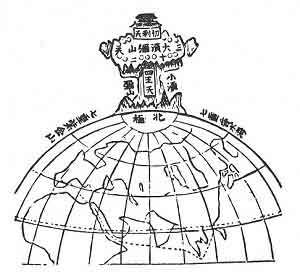
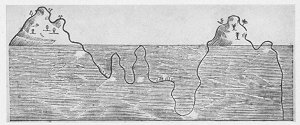
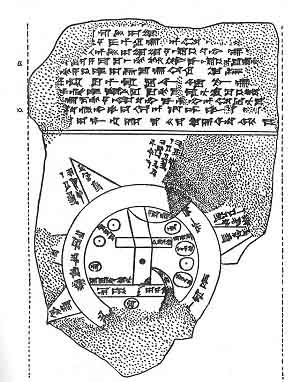
IN MANY OF THESE WORLD TREE PICTURES we have seem World Mountains as well, but northern ones mostly. Yet the concept of the antipodal polar mountains of Earth is very old. They stand opposed to each other in the Babylonian Universe (Plate VIII ). They are inherent in the very idea of an Underworld to this Over-world, whether the idea is carried to its logical conclusion or not. As above, so below. If the World Mountain of the North was the abode of gods, the abode of demons was--the World Mountain of the South. Fig. 53 illustrates not only the antipodal mountains of a spherical Earth, but also the "four quarters of the Earth," the abode of gods, of living men, of dead men, and of demons, beginning with the northern mountain and descending to the south.
FIGURE 53. <i>The Antipodal Polar Mountains</i>.<br> (From <i>Paradise Found</i>; William Fairfield Warren, 1885.)
FIGURE 53. The Antipodal Polar Mountains.
(From Paradise Found; William Fairfield Warren, 1885.)


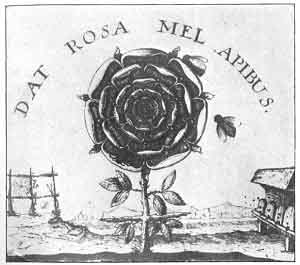
PLATE XXIV. THE ROSE TREE OF THE ROSICRUCIANS<br> (Frontispiece, <i>Summum Bonum</i>; Robert Fludd, 1629)
PLATE XXIV. THE ROSE TREE OF THE ROSICRUCIANS
(Frontispiece, Summum Bonum; Robert Fludd, 1629)

It may be it is only because the popular concept of the figure of Earth swung more or less uniformly to that of a sphere after the western world was discovered, and all the continents of the Earth were mapped out, that we are apt to think the spherical concept is a modern one. As a matter of historical fact the Greeks established it in the minds of philosophers by at least 500 B.C., and it is certain that the idea did not originate with them. Its origin, like the origin of most of these concepts, is trackless, if for no other reason than that the concept of Earth as the Mundane Egg--a spheroid form--goes back into untraceable antiquity. More and more it seems that, in order to explain any of these recurrences, we must take almost literally Fechner's conception of a great reservoir in which lie pooled the memories of all of the Earth's vanished inhabitants, which now and then "opens," to let a little spill out into the minds of a few living men. For more and more it begins to appear as if always, somewhere on the Earth, all of these figures of Earth have existed in the minds of some of its people. Perhaps it may mean that the Earth has been all of these things, at different stages of its development, that it is constantly changing, never the same; that its changes are its life, and that, far from being a disintegrating, dying planet, it is a continuously evolving one, always undergoing the mysterious process of creation. But this is only a guess.

Certainly, thanks to the symmetrical speculations of the Pythagorean and Platonian Greeks, the theory of the antipodal region and the antipodal race of beings was so much a part of the science of the day, that it seemed necessary to St. Augustine, a thousand years later (fifth century A.D.) to establish some sort of a theory of the figure of the Earth, which, although retaining its supposed spherical form, should nevertheless cast the theory of the antipodes into everlasting disrepute.
FIGURE 54. <i>The Theory of Two Centres. Spherical Earth with no Antipodes.</i> (<i>After Rainaud</i>.)<br> (From <i>The Siege of the South Pole</i>; H. R. Mill, 1905.)
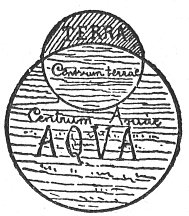
FIGURE 54. The Theory of Two Centres. Spherical Earth with no Antipodes.(After Rainaud.)
(From The Siege of the South Pole; H. R. Mill, 1905.)The theory of two centres," or the theory that the Earth was composed of two spheres, one of land, and one of water, contained one within the other, but not concentric, solved the problem exactly of retaining the sphere and rejecting the antipodes. The terrestrial globe rose a little from the watery sphere, and it was, of course, the northern part of the Earth which so rose. When it was objected to, by some, on the ground that only lighter elements rise to the surface of water, and the denser irresistibly sink, the two-centre theorists promptly replied that the terrestrial sphere rose only a little from the water, as an egg, plunged into a water-filled basin, would rise a little to the surface; and they asserted farther that these two spheres signified the true meaning of the "separation" of land from water. But Strabo, several hundred years before, facing the problem of the density of the elements, accounted for it much more simply. It was true, he said, that by nature the water was higher in situation than the Earth, and in the beginning of things compassed it all about like a sphere. But since Providence designed to create animals and chiefly man, a creature not belonging to the water, God therefore "raised the Earth," and caused it to dwell in diverse places; and in others he sunk it and made it hollow, that the waters might lie hid, and that dry land might appear over it and thus afford a seat for man and other animals of the land.

What made the Early Church combat the idea of a southern habitable hemisphere was not so much the difficulty of explaining how men could stand "feet to feet," as the difficulty of explaining why races of men, all sons of Adam, should be utterly cut off and separated from each other by the impassable belt of fire that circled the Earth. There seemed no reason or purpose in this that could be called divine; this was the heresy. But it was also true that the literal mechanics of an inhabited antipodal region, without the convenient theory of gravitation to explain everything, was too much for reasonable man to accept without an admirable struggle.
FIGURE 55. ''<i>Feet to Feet</i>.''<br> (From <i>Physiologia Kircheriana Experimentalis</i>, 1680.)
FIGURE 55. ''Feet to Feet.''
(From Physiologia Kircheriana Experimentalis, 1680.)"What are they," said Lactantius, a fourth-century Father of the African Church, "that think there are Antipodes, such as walk with their Feet against ours? do they speak with any likelihood; or is there any one so foolish as to believe that there are Men whose Heels are higher than their Heads? that things which with us do lie on the Ground, do hang there? that the Plants and Trees grow downwards, that the Hail, and Rain, and Snow fall upwards to the Earth? and do we admire the hanging Orchards among the Seven Wonders; whereas here the Philosophers have made the Fields and Seas, the Cities and Mountains hanging? What shall we think, that Men do cling to that Place like Worms, or hang by their Claws as Cats? or if we suppose a Man a little beyond the Center, to be digging with a Spade, is it likely (as it must be according to this Opinion) that the Earth which he loosened, should of itself ascend upwards? Or else suppose two Men with their Middles about the Center, the Feet of one being placed where the Head of the other is, and so two other Men cross them, yet all these Men thus situated, according to this Opinion should stand upright; and many other gross Consequences would follow, which a false Imagination is not able to fancy as possible."

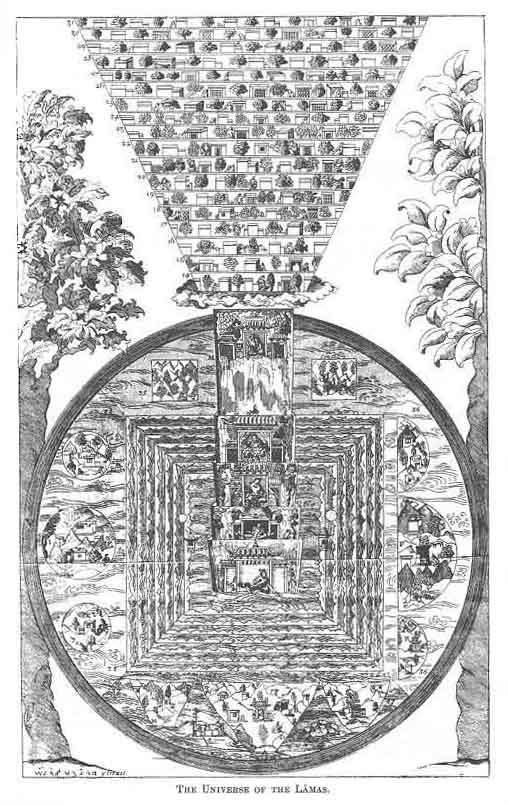
IN THE Universe of the Lamas(Plate XXV ) we come upon the very greatest of the Mountains of the World, Mount Meru, the universal hub, the support of all the worlds. Meru is also the "Garden of the Tree of Life," for the Jambu or Rose Apple World Tree springs from it. This Tibetan Universe is not only a beautiful but a complex universe as well, and it is going to be difficult to describe its many divisions simply and directly. 1

But first of all, say the Lamas of Tibet, this world of ours is merely one of a series, which all together form a universe or Chiliocosm of which again there are many. Each universe is set like a jewel in illimitable space, upon a warp or woof of "blue air" or wind. Crossed thunder-bolts are the symbols of this "blue air," which is hard and indestructible, like a diamond. Upon this "warp" or "woof" is set "the body of the waters," and upon this is a foundation of pure gold, on which is set the Earth. From the Earth's axis soars Mount Meru, crown of the world, which rises to a height of 84,000 miles before it is surrounded by the heavens. It is likened to "the handle of a millstone," and half way up its southern side is the Jambu, or Rose Apple Tree, the object of combat between the gods and the Titans. From its root four inexhaustible rivers take their source. It bears an immortal fruit, like gold, which falls into the rivers, and from its scattered pips comes the golden seed which is carried down to the sea, and is, sometimes, washed up again on its shores.

In the ocean about Mount Meru lie the four continents, each with two attending "satellites," and all with bases of solid gold in the form of a tortoise. But the continents are separated from the sacred Meru by seven "stages" or golden mountains, between which flow seven oceans of seven substances: fragrant milk which is churned by the gods, curds, butter, blood or sugar-cane juice, poisons or wine, fresh water, and salt water. Encircling all these divisions is a double iron wall which shuts off the light of the Sun and the Moon of each universe from all the space which intervenes between it and the succeeding universe. No ray of light illumines the void between the "thousand-thousand" universes. This is the "outer darkness."

The orbit of the Sun or "glazed fire," and of the Moon or "glazed water," is the summit of the innermost ring of mountains, called "The Yoke." Between these two heavenly bodies hang the jewelled umbrella of the kings and the banner of Victory--these are shown in the figure. In their realm of air, on this same plane, live the eight angelic "mothers."

PLATE XXV. THE UNIVERSE OF THE LAMAS<br> (From <i>The Buddhism of Tibet, or. Lamaism</i>; L. Austine Waddell, 1899)
PLATE XXV. THE UNIVERSE OF THE LAMAS
(From The Buddhism of Tibet, or. Lamaism; L. Austine Waddell, 1899)

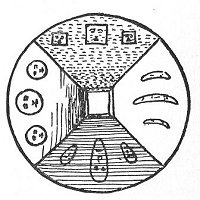
The "four continents" are placed exactly in each of the four directions, and they are of four different shapes, corresponding to the four forms of the four elements (Fig. 1 ). To the north lies the cube or earth-shaped body; to the west the sphere or water-shaped body; to the south the triangle or fire-shaped body, and to the east the crescent or air-shaped body. Of the four continents, they say that all except Jambudvipa (F) are fabulous, but they are described as follows:

THE UNIVERSE OF THE LAMAS<br> (From <i>The Buddhism of Tibet, or. Lamaism</i>; L. Austine Waddell, 1899, p.78)
THE UNIVERSE OF THE LAMAS
(From The Buddhism of Tibet, or. Lamaism; L. Austine Waddell, 1899, p.78)

"On the Eastis Videha, or 'vast body' (P). This is shaped like the crescent moon, and is white in colour. It is 9,000 miles in diameter, and the inhabitants are described as tranquil and mild, and of excellent conduct, and with faces of the same shape as this continent, i.e., crescentic, like the moon.

"On the Southis Jambudvipa(F), or our own world, and its centre is the Bodhi-tree at Budh Gaya. It is shaped like the shoulder-blade of a sheep . . . is blue in colour; and it is the smallest of all, being only 7,000 miles in diameter. Here abound riches and sin as well as virtue. The inhabitants have faces of similar shape to that of their continent, i.e., somewhat triangular.

"On the Westis Godhanya, or 'wealth of oxen' (I), which in shape is like the sun and red in colour. It is 8,000 miles in diameter. Its inhabitants are extremely powerful and (as the name literally means cow + ox + action) they are believed to be specially addicted to eating cattle, and their faces are round like the sun.

"On the Northis Uttara-Kuru, or 'northern Kuru'--tribe (M), of square shape and green in colour, and the largest of all the continents, being 10,000 miles in diameter. Its inhabitants are extremely fierce and noisy. They have square faces like horses; and live on trees, which supply all their wants. They become tree-spirits on their death; and these trees afterwards emit 'bad sounds.'

"The satellite continents resemble their parent continent in shape, and each is half its size. The left satellite of Jambudvip, namely, 'The ox-tail-whisk continent,' is the fabulous continent of the Rakshas, to which Padmasambhava is believed to have gone and to be still reigning there. And each of the latter presents towards Mount Meru one of the following divine objects respectively, viz., on the east (? south) the mountain of jewels, named Amolikha, shaped like an elephant's head, and on the south, the wish-granting tree, on the west the wish-granting cow, and on the north the self-sprung crops."

As for Mount Meru--some say that these four gifts of the left satellites are situated on the sides of Meru itself--which has square sides of gold and of jewels. Its eastern face is crystal or silver, like the colour of the eastern continent. The southern face is sapphire or lapis lazuli. The west side is of ruby, and the north side is gold. Mount Meru is always covered with fragrant flowers and herbs.

It has four lower compartments under the heavens. The lowest is inhabited by the Yaksha genii holding wooden plates. Above live the "wreath-holders." Above these dwell the "Eternally exalted ones," and above them the Titans, the race of beings who contend always with the gods for the Jambu or Rose Apple Tree. Originally gods, the Titans were, like Satan, thrown out of heaven, and their place in the Tibetan system is intermediate between heaven and Earth.

Above the Titans, at a distance of 168,000 miles, are the realms of the gods. In the lowest compartment are the "four great guardian kings of the quarters," the white guardian of the East, the green guardian of the South, the red guardian of the West, and the yellow guardian of the North, who forever guard the heavens against attacks of outer demons. The eight great classes of supernatural beings are subjects of these kings, and these guardians of the four quarters are aided by the ten Lokpalswho watch the ten directions, that is, the eight points of the compass, and above, and below.
FIGURE 56. <i>A Kalmuck World-picture</i>.<br> (From <i>Mythology of All Races</i>, Vol. IV, 1927.)
FIGURE 56. A Kalmuck World-picture.
(From Mythology of All Races, Vol. IV, 1927.)A Kalmuck World-picture (Fig. 56 ) is quite worth comparing with this. Universe of the Lamas, for the Kalmucks, now of Russia, primitively inhabited China. They arrived on the shores of the Caspian Sea about 1600, but they brought with them their own conception of the world, with its colours and shapes. This drawing shows Mount Su-meru in the centre of the world, through whose centre the World Tree springs. Sometimes they will say that each of the four mountain sides bears a tree. Su-meru is shaped, they believe, like a truncated pyramid, and around it are seven mountains and seven seas not represented in this drawing. The nearer a mountain ring is to the central mountain, the higher it is, they believe; and the higher the mountain rings, the farther they are from each other. The Kalmucks say also that the distance of each from the central mountain is the same as its height.

The colours of the four sides of the truncated Su-meru are like those of the Tibetan Meru, and the Kalmucks also place four continents in the four quarters, each of a different shape, and each accompanied by two smaller "islands" of like shape; so that again the total number of islands surrounding the centre of the world is the zodiacal twelve. The Tibetan Jambudvip--the southern continent--which was "shaped like the shoulder-blade of a sheep," and whose inhabitants had faces shaped similarly, "somewhat triangular," is slightly modified in the Kalmuck picture to an oval continent inhabited by an oval or "egg-faced" race. But it is almost the same; an "oval" such as this is hardly more than an expanded or expanding triangle and the egg-shaped islands and faces may be called with a fair accuracy "somewhat triangular."

No claim for particular beauty and certainly no claim for any antiquity is made for the Chinese hemisphere shown in Fig. 57 , drawn, says Dr. Du Bose, by a monk in Soochow, who perceived that times were changing, that the new geography was of a spherical Earth and not of a "World Mountain," but who realised that the North Pole is permanent--if anything is. He therefore drew a conventional modern hemisphere with its lines of latitude and longitude, over which he traced Europe-Asia-Africa; and then, upon the top of the world, raised his World Mountain, peerless Su-meru, spine and marrow of "the thirty-three heavens," and situated in the very centre of the world.
FIGURE 57. <i>Mount Su-Meru of the Chinese</i>.<br> (From <i>Dragon, Image and Demon</i>; H. C. Du Bose, 1887.)
FIGURE 57. Mount Su-Meru of the Chinese.
(From Dragon, Image and Demon; H. C. Du Bose, 1887.)

Its shape is ordinarily that of an inverted cone, whose medial line is cut by the Earth's surface, whose base is above, and whose apex penetrates the Earth to a distance equalling the distance of its base from the Earth. Or, as the Chinese explain it, "Its depth in the sea is equal to its altitude (in the air)." In the undersea division are the countless hells. The unknown monk of Soochow made his Sacred Mountain resemble a pagoda more than a cone when he compromised with a new age, but a simple projection of the pagoda lines will result in a figure quite cone-like.


Footnotes

127:1 L. Austine Waddell's reading of this picture is followed here, as given in his Buddhism, or The Lamas of Tibet, pp. 77-121.

Trees of the World

THE BOOK OF EARTHS

By

EDNA KENTON

New York: William Morrow & Company

[1928, No renewal]


Trees of the World

THERE ARE TWO UNIVERSAL WORLD-FIGURES, found everywhere, among all races--the World Tree, and the World Mountain. For man could draw analogies--his traditions Evidence it almost better than his written records. He knew that he had been born, that he was living, that he must die; yet of birth he remembered nothing, and death he would not know until too late. But in the animal world--above all in the vegetable world, he could watch the recurrent miracles of life and death, rebirth and growth, sleeping and waking states more easily than he could note the same miracles in his own sphere. And so he came very early and easily to see a correspondence between humanity, greatest of the animal world, and the Tree, mightiest of its kingdom. It is true that in every great cosmological system and in great and lesser cosmogonies, there stands the figure of the World Tree, with its seed, its roots, its trunk, its resting perches, its knitting knots, its pith, its main branch, its leaves, its flowers and their sweet smell, its refreshing shade, its immortal sap, and the spot where it grows, all brought into close and exquisite analogy with man and his universe.

"Without doubt," sings one of the greatest of the Vedic poets, "though possessed of density, trees have space within them. The putting forth of flowers and fruits is always taking place in them. They have heat within them in consequence of which leaf, bark, fruit and flower are seen to droop. They sicken and dry up. That shows they have perception of touch. Through sound of wind and fire and thunder, their fruits and flowers drop down. Sound is perceived through the ear. Trees have, therefore, ears, and do hear. A creeper winds round a tree and goes all about its sides. A blind thing cannot find its way. For this reason it is evident that trees have vision. Then again trees recover vigour and put forth flowers in consequence of odours good and bad, of the sacred perfume of various kinds of dhupas. It is plain that trees have scent. They drink water by their roots. They catch diseases of divers kinds. Those diseases again are cured by different operations. From this it is evident that trees have perception of taste. As one can suck up water through a bent lotus stalk, trees also, with the aid of the wind, drink through their roots. They are susceptible of pleasure or pain, and grow when cut or lopped off. From these circumstances I see that trees have life. They are not inanimate. Fire and wind cause the water thus sucked up to be digested. Accordingly again, to the quantity of water taken up, the tree advances in growth and becomes humid. In the bodies of all subtile things the five elements occur. In each the proportions are different."

According again to the races of men, the type of the World Tree varied. The Date-palm was the sacred Asherah of the Assyrians. To the Greeks, and to the Norsemen, the cosmic Ash was the World Tree. But also to the Greeks, and to the Germans, the Oak was the life-giver and the life-sustainer. And the Greeks made the vine the "sacred tree" of Dionysos. Persian legends centre about the haoma tree, and the Egyptians had a mythical golden gem-bearing tree of the heavens, where the Sky goddess Nut had her abode. The Japanese believed that a great metal-pine grew far to the north at the centre of the world, and the Russians have a legend of an Iron Tree whose root "is the power of God," and whose head sustains the three worlds--the heavenly ocean of air, the Earth, and Hell with its burning fire. To the branches of the Jambu or Rose Apple tree, the Hindu dead clung and climbed to immortality. India has also her incredible banyan tree, declared to be more like man than man himself. Unlike plants, man can move at will over the surface of the Earth, but this sacred Indian Fig Tree bears the name of the Tree of Many Feet, because its seed, rarely rooting in the ground, ordinarily sends down its hanging garden of roots from its nest in the crown of palms, where it has been deposited by birds. These aerial roots, touching the Earth, sink into it, glide through it and from it spring upward again to send down other drooping branches that root themselves, and so, over and over, until the prodigious grove--myriad parts of a single tree sprung from one air-nested seed--eventually destroys the Palm that cradled it.

Countless books have been written about the origin of the myth of the Cosmic Tree, but the gist of them all can be stated very briefly. First of all, Heaven and Earth are separated. They must be, therefore, at one and the same time held apart--lest the heavens fall down and crush the Earth--and they must be also united by some subtle path of communication, some bridge over the monstrous interval. If a mushroom, delicate as a butterfly, can work a miracle in a night and raise a rock, a tree rooted in the Earth may support the sky. But no tree of Earth could reach to heaven unless it were itself divine, born somehow of the gods; and so we find a host of literal "parent trees," said to be produced from the body moisture of deities, and capable therefore, in their turn, of producing man. In its more developed form, this parent tree became the Tree of Life, the Tree of Knowledge, offering men immortality and the wisdom of the gods. There is a Tibetan tree called Tarayanaor the Way of Safety which grows by the side of the great river separating the worlds, and only by grace of its overhanging branches may men pass from the mortal to the immortal bank.
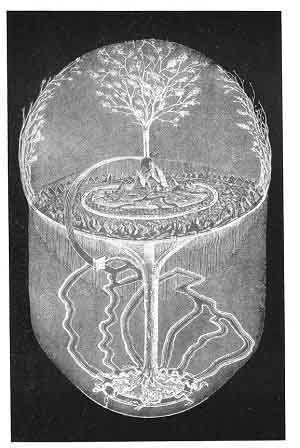
PLATE XVIII. <i>Yggdrasil, the World Tree of the Norsemen</i>. <i>After Finn Magnusen's</i>
PLATE XVIII. Yggdrasil, the World Tree of the Norsemen. After Finn Magnusen's

The oldest World Tree? who shall say? When in search of the "oldest" we always think of the ancient East; but no one can assert--and Evidence--that Yggdrasil, the Cosmic Ash, the World Tree of the Norsemen, had its origin in the Orient, however remarkably its ideas coincide with the sacred trees of Asia. Let us begin for a change with the Occident and Yggdrasil.

"The chief and most holy seat of the gods," say the Eddas, "is by the Ash Yggdrasil. There the gods meet in council every day. It is the greatest and best of all trees. Its branches spread over the world and reach above heaven. Three roots sustain the tree and stand wide apart; one is with Asa; the second is with the Frost giants; the third reaches into Niflheim, and under it is Hvergelmar, where Nidhug gnaws the roots from below. But under the second root, which extends to the Frost giants, is the well of Mimir, wherein knowledge and wisdom are concealed. The third root of the Ash is in Heaven, and beneath it is the most sacred fountain of Urd. Here the gods have their doomstead. The Asa ride thither every day over the Bi-frost, which is also called Asa-bridge. There stands a beautiful hall near the fountain beneath the Ash. Out of it come three maids. These maids shape the lives of men, and we call them the Norns. On the boughs of the Ash sits an eagle, who knows many things. Between his eyes, sits the hawk, called Vedfolner. A squirrel, by name Ratatk, springs up and down the tree and bears words of hate between the eagle and Nidhug. Four stags leap about in the branches of the Ash and bite the buds. The Norns that dwell by the fountain of Urd every day take water from the fountain, and clay that lies around the fountain, and sprinkle therewith the Ash, in order that its branches may not wither or decay." 1
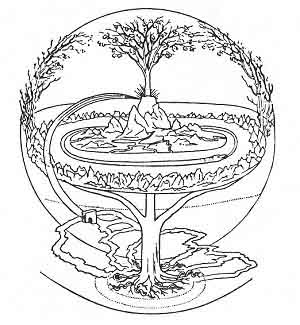
FIGURE 44. <i>Yggdrasil, the Cosmic Ash</i> (<i>From Finn Magnusen's</i> ''<i>Eddalen</i>.'')<br> (From <i>The Sacred Tree, or The Tree in Religion and Myth</i>; Mrs. J. H. Philpot, 1897.)
FIGURE 44. Yggdrasil, the Cosmic Ash(From Finn Magnusen's''Eddalen.'')
(From The Sacred Tree, or The Tree in Religion and Myth; Mrs. J. H. Philpot, 1897.)There are a number of interesting things to note here, because of their constant recurrence in other world-concepts widely separated in time and race. One is the close association of the World Tree with the World Mountain; one springs from the other, take them in what order we will. Another is the division of the Universe into nine worlds. Another, for the sake of comparison with a Mayan World Tree farther on, is the squirrel Ratatk. Another is the Bi-frost or Asa-bridge.

In the beginning of all things, says the Norse story of the Creation, there were two worlds, Niflheim, the world of ice in the north, and Muspelheim, the world of fire in the south, with all the space between an empty abyss, called Ginungagap. The fierce flames in Muspelheim blew constantly over into the abyss many sparks which confronted only nothingness, until, from the ice-bound Niflheim, a great spring opened and sent down twelve rivers, some of which flowed into the abyss and formed great layers of frozen vapour. At last the sparks of fire met the frozen air, and Ymir the giant was created, and then, in turn,

From Ymir's flesh
the earth was formed,
and from his bones the hills,
the heaven from the skull
of that ice-cold giant
and from his blood the sea.

Of the nine worlds Asgard was the highest and was the world of the gods. Below it was Mitgard or Earth, the world of men, a flat disc surrounded by the River Ocean.

Beyond the River Ocean, but surrounding Mitgard, was Junheim, the upper giant world, and, beneath the Earth plane, was the great underworld divided into four worlds. In the North was the lower giant world of Niflheim; at the South Urd and her two sisters ruled over the kingdom of the dead, and between North and South was Mimir's land, where dwelt the wisest of the gods, and, with him, Day, Night, Dawn and the Sun and Moon. Below Niflheim again was the world of torture, and below Urd's realm of the dead, the land of subterranean fire.
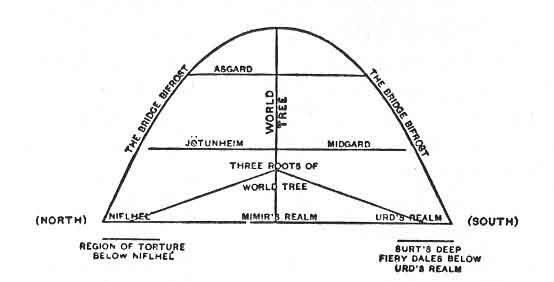
FIGURE 45. <i>Diagram of the Nine Worlds, supported by the World Tree Yggdrasil</i>.<br> (From <i>The Nine Worlds</i>; Mary Elizabeth Litchfield, 1890.)
FIGURE 45. Diagram of the Nine Worlds, supported by the World Tree Yggdrasil.
(From The Nine Worlds; Mary Elizabeth Litchfield, 1890.)Just two things bound these worlds together, the tree Yggdrasil, and the Asa-bridge, or Bi-frost. And a third--the spirit of heaven, the great Energiser, passing ever to and fro, guiding, controlling all the universe, from the first world to the ninth; at home everywhere, abiding no-where, stirless when moving and moving when still; that without which there would be nothing--here shown as merely a tiny timid nimble squirrel.
FIGURE 46. Diagram of the Scandinavian Cosmos.
FIGURE 46. Diagram of the Scandinavian Cosmos.1 Spring Hvergelmir, in Niflhel or Niflheim, under Yggdrasil's northern root.
2 Well of Wisdom in Mimir's Realm, under Yggdrasil's middle root.
3 Urd's Well in her Realm, under Yggdrasil's southern root.
4 Home of the Vanir.
5 Home of the Elves in Mimir's Realm.
6 Castle where Baldur dwelt with the Asmir.
7 Northern End of Bifrt, guarded by Heimdall.
8 Southern End of Bifrt, near Urd's Well.
(From The Nine Worlds; Mary Elizabeth Litchfield, 1890.)

But what was the binding and the separating bridge, the Bi-frost?

Again, who knows? Its arch was over Asgard, world of the gods; its northern tip resting upon the mountains of the ice-girt Niflheim; its southern end in the realm of the dead, where Urd and her sisters ruled. Some say the Milky Way is the original of Bi-frost or the Trembling Bridge, as some say the Milky Way is the very trunk of the Celestial Tree. Others believe that the Rainbow is the prototype for Bi-frost and all the "bridges of the world." For the World bridges are as universal as the "trees" and "mountains" of the world. Earth was cut off from Heaven--yet somewhere, if man could only find it, there was a path that might lead back home. The Bi-frost at its northern end was inviolately guarded by the great Heimdall, "World-Judge" or "World-Divider," "whose ears were so good that he could hear the grass pushing up through the ground, and the wool growing on the backs of sheep, and he needed less sleep than a bird." The gods crossed it every day on their way to the judgment hall in the realm of Urd, but the way was barred against all others, lest some thief in the night should find his way into Heaven. Yet it was the bridge also on which the souls of all the dead began their passage to the land of Urd.

The Persians had their Chinvat bridge, which is to say also, the Bridge of the Judge, over which all souls, good and evil, passed--"that bridge," says one of their sacred books, "like a beam of many sides, of whose edges there are some which are broad, and there are some which are thin and sharp; its broad sides are so large that its width is of twenty-seven reeds, and its sharp sides are so contracted that in thinness it is just like the edge of a razor." Mohammed too placed a way over the middle of hell, "which is sharper than a sword and finer than a hair, over which all must pass."

Certainly the North American Indians considered the Milky Way to be the "bridge" to the Land of Souls--a great village situated "where the Sun sets." "They call the milky way Tchipai meskenau, the path of souls, because they think that the souls raise themselves through this way in going to that great village," wrote Paul Le Jeune in 1634 of the Montagnais. One hundred years later Pierre Aulneau wrote of the Crees of upper Lake Superior, that they believed in a paradise of feasts and great hunts for the immortalsouls of the dead. "But, before reaching it, there is a spot of extreme peril--the souls have to cross a wide ditch. One side of the way it is full of muddy water, offensive to the smell and covered with scum; while on the other the pit is filled with fire, which rises in fierce tongues of flame. The only means of crossing it is on a fir tree, the ends of which rest. on either bank. Its bark is ever freshly moistened and besmeared with a substance which makes it as slippery as ice. If the souls who wish to cross to the enchanting plains have the misfortune to fall at this dangerous passage, there is no help left; they are doomed forever to drink of the foul stagnant water or to burn in the flames, according to the side on which they fall." Sometimes the "bridge-building fiend" made the bridging spar a snake or a swinging log.

A "Sketch of the World," by a Thompson River Indian, illustrates this exactly. They believe that the Earth is square, level in the centre and rising towards the north from whence comes the cold, that it rises also in great mountain ranges about its borders, and that these mountains or lands are topped by mountains of air--the clouds and mists rising from the encircling lake of the world. All the rivers of the world rise in the north and flow south.
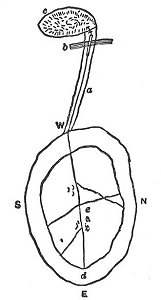
FIGURE 47. <i>Sketch of the World, by a Thompson River Indian</i>.
FIGURE 47. Sketch of the World, by a Thompson River Indian.
a. Trail leading from the earth to the land of the ghosts, with tracks of the souls; b. River and log on which the souls cross; c. Land of the ghosts and dancing souls; d. Lake surrounding the earth; e. Earth, with rivers and villages; N. S. E. W. points of the compass.
(From Memoirs of the American Museum of Natural History, Vol. II, 1900, p. 343.)

This trail to the soul-world has been minutely described by James Teit in his The Thompson River Indians of British Columbia. 1 According to him, the country of souls is underneath us, towards the sunset, and its path is one of perils, storms, narrow bridges, and gaping chasms. The trail leads through a dim twilight; along it are always visible the tracks of the people who last went over it, and also the tracks of their dogs, if they had any with them. It winds along until it meets another road, which the shamans, or medicine-men (their nearest approach to priests) use as a short cut when trying to intercept a soul. From here on, the trail is much smoother and straighter, and is painted red with ochre. Farther on it winds to the westward, descends a long gentle slope, and ends at a wide shallow stream of very clear mirror-like water. This stream is spanned by a long slender log, on which the tracks of souls may be seen again. After crossing the "bridge," if the traveller is fortunate enough to hold his footing on the slippery edge between the worlds, he finds himself again on the trail, which is now an ascending one. At a certain height is heaped a great pile of clothes; this marks the spot on the journey where the souls must leave behind them all that they have brought from the other world. And from here on the trail not only seems level, but little by little the dimness and twilight confusion disappear.

Three guardians are stationed along the trail of the souls--one on each side of the river that must be crossed, and the third at the very end of the trail of the ghosts.

The first of these, on the hither side of the stream, has built for himself a sweat house where he spends most of his time. It is the duty of all three to send back to the land of the living any soul not yet ready to enter the land of the dead, even though he may have by some miracle of accident crossed the bridge. For sometimes it happens that a soul succeeds in passing the first two guardians, only to be turned back by the third, who is the chief of the three, and who now and then, being a great orator, sends back messages to the world of the living through the medium of souls who, having survived all other tests of courage and merit, fail in the final test of being judged worthy by the guardian of the gate of life to pass through.

But, having been permitted by him to pass, the soul at last reaches a large lodge at the end of the trail. It is made of a hard white material, like limestone or white clay. It extends a long distance from east to west, and is much shorter from north to south. Its top is "like a round mound or ant-hill." The doors to this white lodge are at the east and west, and the trail leads up to the eastern door, which is very small, barely large enough to let a soul pass through. But the western door, through which the soul passes to the land of ghosts, is much higher and wider. Through the entire length of the lodge there is a double row of fires, for when the deceased friends of a person expect his soul to arrive, they go in a body to this lodge to talk about his death and prepare to welcome him. As the newly arrived soul reaches the entrance to the lodge of the dead, he finds some one standing at the door to greet him and call him by name, while others sing, dance, and beat upon drums. The air is always pleasant and still, and it is always light and warm. There are sweet smells of flowers, an abundance of grass, and berry-bushes laden with ripe fruit. The rest is hunting, feasting, and dancing through eternity, for the dancing, or immortal, souls.

The Wakwak Tree is a fabulous tree growing on a fabulous island somewhere in the Southern Ocean--or somewhere near Japan, or near the western (or the eastern) coast of Africa--it all depends on the traveller who tells the legend. It appears to have had nothing to do with America or the American Indians; yet here is a curious bit of Sioux lore, which, in connection with one of the legends of the lost continent of the Pacific, has an odd interest here.

The Sioux Indians have a special reverence for what they call the waka dacedar. Waka da, according to W. J. McGee, 1 who has made a special study of the word in his The Siouan Indians, is a very curious word indeed. It has, he says, as many connotations as the Sanscrit word Karma, and, like Karma, is not to be translated by any single English word. The Sun, for instance, is not "the" or "a" waka da, but simply waka da. So is thunder, so is lightning, the stars, the winds, and especially waka dacedar, by which they mean precisely the state of being which makes a cedar human and more than human. Even a man might be waka da. The term, he says, may be translated by "mystery" more satisfactorily than by any other single English word; nevertheless, with its vague implications of "power," "sacred," "ancient," "grandeur," "animate," "immortal," "not even an English sentence of ordinary length could quite convey the sum total of the aboriginal idea expressed by the term waka da." Perhaps all its meaning is conveyed when, applied to the cedar, they say it is that state of being which makes a cedar human and more than human.

Now of the Wakwak tree which bore human fruit, Turkey, Arabia, Persia, and India all had a tradition; that in the Southern Ocean--or some other unexplored waste of waters--was an island called Wakwak--or a great mountain called Wakwak--because on it grew a tree which produced fruit with a human head, or fruit in the form of a human body, or even in the form of animals, and these beings, at dawn and at sunset, cried aloud, so that all might know the passage of the Sun, "Wak! wak!" The island and the mountain are mentioned in The Thousand and One Nights--Hasan al-Basri went there to find his wife and children. The tree is described without being named by Friar Odorico of Pordenone who in the fourteenth century left Italy to make the grand tour of the East. Arrived at Malabar, he wrote thus: "And here I heard tell that there be trees which bear men and women like fruit upon them. They are about a cubit in measurement, and are fixed in the tree up to the navel, and there they be; and when the wind blows they be fresh, but when it does not blow they are all dried up. This I saw not in sooth, but I heard it told by people who had seen it." Plate XIX gives a drawing of the Wakwak tree, taken from an old Turkish History of Western India and Its Wonders, published at Constantinople in 1729. It represents the fruit of this fabulous tree not by human heads but by seven pendent bodies. The two great birds at the foot of the tree are as fabulous as the rest of it.
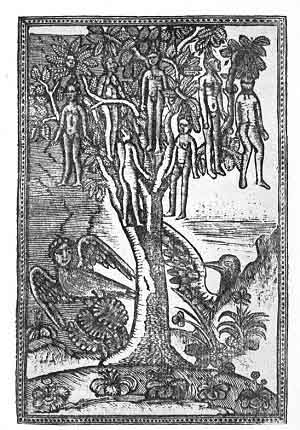
PLATE XIX. THE WAKWAK TREE<br> (From <i>Tarikh</i> al-Hind al-Gharbi. Constantinople, 1729)
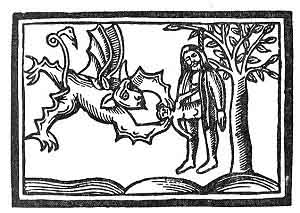
PLATE XIX. THE WAKWAK TREE
(From Tarikhal-Hind al-Gharbi. Constantinople, 1729)
FIGURE 48. <i>The Tree of Judas</i>.<br> (From <i>Maundevile's Voiage and Travailes</i>, 1839 reprint.)
FIGURE 48. The Tree of Judas.
(From Maundevile's Voiage and Travailes, 1839 reprint.)Sometimes these souls were imagined as suspended with their heads downwards, alive, but clinging and climbing on a reversed path back to heaven. In an old Hindu legend it is related that Garuda, lord of all birds, coursing one day towards a gigantic banyan tree, with the fleetness of the mind, to sit thereon and "eat the elephant and the tortoise," in alighting broke one of the branches. As it broke he caught it and saw to his wonder that a tribe of Rishis called Valikhilyas were hanging from it head downwards, engaged in "ascetic penances." And gathering together all of his strength, the lord of birds soared high into the heavens with his burden of hanging men, and saved them. Sometimes, when the air is quiet, trees will move and their leaves rustle--this very common phenomenon had for the ancients a mystic meaning; at such times the invisible souls were talking to each other of their trials and triumphs on the journey back to heaven.
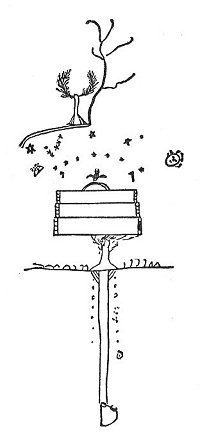
FIGURE 49. <i>Osage Chart of the Universe, drawn by Red Corn</i>.<br> (From <i>Picture-Writing of the American Indians</i>; Garrick Mallery, 1894, p. 251.)
FIGURE 49. Osage Chart of the Universe, drawn by Red Corn.
(From Picture-Writing of the American Indians; Garrick Mallery, 1894, p. 251.)
In their "Sketch of the World," the Thompson River Indians incorporated one form of the World Tree, in the bridge between the worlds, literally, "the path of life." The Osage Indians, in their chart of the universe, have another. Few world-pictures can be found more simply and beautifully drawn than this by Red Corn, with its Earth plane, its "stages" or heavens, and its Tree of Life. Like the Lenape pictograph, it is the "score" of a tradition chanted by members of a secret society of his tribe. It is explained by J. Owen Dorsey as follows: 1

The tree at the top represents the tree of life. By this flows a river. The tree and the river are described later in the degrees. When a woman is initiated, she is required by the head of her gens to take four sips of water (symbolising the river), then he rubs cedar on the palms of his hands, with which he rubs her from head to foot. If she belongs to a gens on the left side of a tribal circle, her chief begins on the left side of her head, making three passes, and pronouncing the sacred name three times. Then he repeats the process from her forehead down; then on the right side of her head; then at the back of her head; four times three times, or twelve passes in all.

Beneath the river are the following objects: The Watse tuka, male slaying animal (?), or morning star, which is a red star. 2. Six stars called the "Elm rod" by the white people in the Indian Territory. 3. The evening star. 4. The little star. Beneath this are the moon, seven stars, and sun. Under the seven stars are the peace pipe and war hatchet; the latter is close to the sun, and the former and the moon are on the same side of the chart. Four parallel lines extending across the chart represent four heavens or upper worlds through which the ancestors of the Tsicu people passed before they came to this earth. The lowest heaven rests on an oak tree; the ends of the others appear to be supported by pillars or ladders. The tradition begins below the lowest heaven, on the left side of the chart, under the peace pipe. Each space on the pillar corresponds with a line of the chant; and each stanza (at the opening of the tradition) contains four lines. The first stanza precedes the arrival of the first heaven, pointing to a time when the children of the "former end" of the race were without human bodies as well as human souls. The bird hovering over the arch denotes an advance in the condition of the people; then they had human souls in the bodies of birds. Then followed the progress from the fourth to the first heaven, followed by the descent to earth. The ascent to our heaven, and the descent to three, makes up the number seven.

When they alighted, it was on a beautiful day, when the earth was covered with luxuriant vegetation. From that time the paths of the Osages separated; some marched to the right, being the war gentes, while those on the left were peace gentes, including the Tsicu whose chart this is.

Then the Tsicu met the black bear, called in the tradition Ke-wsan' (Crow-bone-white), in the distance. He offered to become their messenger, so they sent him to the different stars for aid. According to the chart, he went to them in the following order: Morning star, sun, moon, seven stars, evening star, little star.

Then the black bear went to the Wacia-cutse, a female red bird sitting on her nest. This grandmother granted his request. She gave them human bodies, making them out of her own body.

The earth-lodge at the end of the chart denotes the village of Haa utakantsi, who were a very war-like people. Buffalo skulls were on the tops of the lodges, and the bones of the animals on which they subsisted whitened on the ground. The very air was rendered offensive by the decaying bodies and offal.

The whole of the chart was used mnemonically. Parts of it, such as the four heavens, and the four ladders, were tattooed on the throat and chest of the men belonging to the order.Another Siouan tribe, the Sia Indians of New Mexico, believe that in each of the six regions of the world--they name these as the four quarters, zenith and nadir--there was a giant mountain bearing a giant tree, at whose foot was a spring, in which dwelt one of the "cloud-rulers," each attended by one of the six primal priestesses of the Sia, who interceded constantly with the six cloud rulers to send rain to the Sia. The six varieties of their World Trees were the spruce, the pine, the aspen, the cedar, and two varieties of the oak.

It would be a brave, not to say a reckless scientist, who would say to-day how young or how old the Mayan civilisation is. Thirty years ago, answers would have come easily enough; but that was before the excavations of the great buried cities in Central America began, which may very well result in the uncovering of records which ante-date the oldest we have. Already we know that America, youngest of the continents historically, is older prehistorically than we yet dare to say. And, although we never knew more than a little about the Mayas and their beliefs, we know to-day how fragmentary and isolated those bits of knowledge are, and how untrustworthy the conclusions we have drawn from them.

Nevertheless, under the date of 1640, there has come down to us a picture of the Mayan Universe, copied by Father Cogolludo from the central design of the Chilam Balam, or Sacred Book, of Mani, and inserted in his Historia de Yucathan, written at the end of twenty-one years spent among the Mayas (Plate XX ).

At the bottom of the "universe" lies a cube, which has long been recognised as representing in the Mayan cosmogony the Earth. Above the Earth cube, resting on four legs which rest in turn on the four quarters of the Earth, is the heavenly vase, Cum, which holds the celestial waters--the treasures of the snow and of the hail, of the rains and the showers, on which all life, vegetable, animal and human, depends. Above this vase hang the rain clouds, and within it grows the Yax che, the Green Tree or the Tree of Life, its upper branches bearing on their tips the flowers or fruits of life on Earth, olor yol; that is to say, the soul or immortal principle of man. Under the Green Tree Yax che, the souls who have passed through Mitnaor the underworld, dwell in happiness, while the others sink into a region where they suffer eternal cold and hunger. In Brinton's Primer of Mayan Hieroglyphics, the inner figure of the cube, the vase, the clouds and the tree, is reproduced, lettered according to readings from other of the Sacred Books. The Earth cube in that picture is not lettered IUM, Earth, but tem, the Altar. "The Earth signifies the great Altar of the gods, and the offering upon it is Life."
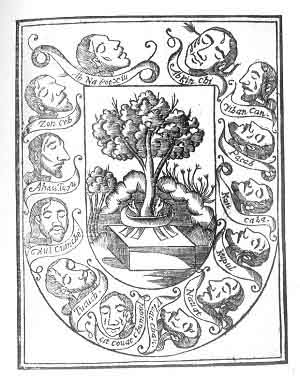
PLATE XX. THE WORLD TREE OF THE MAYAS<br> (From <i>Historia de Yucathan</i>; Diez Lopez Cogolludo, 1640)
PLATE XX. THE WORLD TREE OF THE MAYAS
(From Historia de Yucathan; Diez Lopez Cogolludo, 1640)The thirteen heads surrounding the World Tree signify, according to Brinton, the thirteen ahau katuna, or greater cycles of years. They also may signify the thirteen possible directions of Space. That is, the complete terrestrial globe is symbolised by the four cardinal points, zenith, and nadir, with man in the centre making the seventh, and the complete celestial sphere is symbolised by adding the six directions, with man, the focal point, remaining the same. "The border therefore," says Brinton, "expresses the totality of Time and Space, and the design itself symbolises Life within Time and Space."

Another Mayan world-picture is shown in Fig. 50 , which is the central design of the Tableau of the Bacabs. Instead of the thirteen ahau katunaor greater cycles of years, this design is surrounded by "the signs of the twenty days," which extend in the original design, beyond the figure here given, to the four cardinal points and to the gods and time-cycles connected with them. "Again," says Brinton, "it is Life within Time and Space."

Here, sitting beneath the shade of the Green Tree, at its root, are the divine First Pair, Cuculcan, the feathered or winged serpent god, and Xmucanehis spouse,--"the Creator and the Former," says the Popol Vuh, "Grandfather and Grandmother of the race . . . two-fold grand-mother, two-fold grandfather . . . the Maker, the Former, the Ruler, the Serpent clothed in feathers, they who beget, they who impart life, they rest upon the waters like a glowing light, they are clothed in colour green and blue, therefore their name is Gucumatz, 'Feathered Serpent.'"
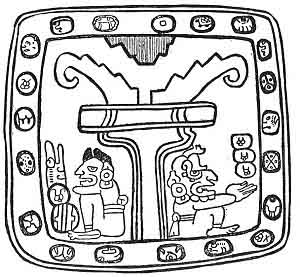
FIGURE 50. <i>Our First Parents</i>. <i>From the Codex Cortesianus</i>.<br> (From <i>A Primer of Mayan Hieroglyphics</i>; Daniel G. Brinton, 1894.)
FIGURE 50. Our First Parents. From the Codex Cortesianus.
(From A Primer of Mayan Hieroglyphics; Daniel G. Brinton, 1894.)

The resemblances between the divisions of this Mayan tree and the Norse tree Yggdrasil are obvious, but here is a correspondence in ideas that is very curious. Between the nine Norse worlds, it will be recalled, from the roots of the tree to its topmost branch, ran Ratatk, scamperer between men and gods, matter and spirit, Space and Time--the great Energiser under the guise of a tiny squirrel. It is rather interesting to discover that under the green cosmic tree Yax cheof Yucatan sits a figure whose name, Cuculcan, is derived from a Mayan verb, cucul, meaning to "revolve," "to move round and round," as they moved their great calendar wheels to accomplish the rotation of time; and that this rotation itself is called cuceb, "the squirrel," derived directly from the same verb cucul, "to revolve, to move round and round."
FIGURE 51. The

One more Mayan Tree of Life, too beautiful not to be included in any group of "Cosmic Trees," particularly as it shows the mystery of metamorphosis almost in the act of transmutation from one form to another is given in Fig. 51 . In the original drawing the god of the north star rests upon it, as it rises from the heavenly vase that holds the heavenly waters. And, to show that Egypt and Yucatan were not separated in fancy at least by oceans]Atlantic or Pacific, here is a little drawing of the Sacred Tree of the Egyptians, with Heaven, or the Sky goddess Nut, bestowing knowledge on man and his soul.
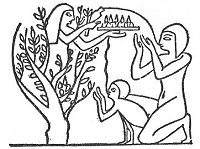
FIGURE 52. <i>Sacred Tree of the Egyptians</i>.<br> (From <i>Egyptian Mythology and Egyptian Christianity</i>; Samuel Sharpe, 1863.)
FIGURE 52. Sacred Tree of the Egyptians.
(From Egyptian Mythology and Egyptian Christianity; Samuel Sharpe, 1863.)"THE WHOLE WORLD," says an old Hebrew writing, "is like a gigantic tree full of branches and leaves, the root of which is the spiritual world of the Sphroth; or it is like a firmly united chain the last link of which is attached to the upper world; or like an immense sea, which is constantly filled by a spring, everlastingly gushing forth its streams."

When we take up the Kabbala, to interpret anything in it, we touch a book on which literally thousands of interpretative books have been written. The Arber Sephirothecais perhaps its keystone figure, and the interpretations of the relation and meaning of the ten Sephiroth which compose the "tree" differ so that any summary of them is not only hopeless but useless here. It is possible, however, to sketch largely and with no detail, a general explanation of this Hebrew World Tree.
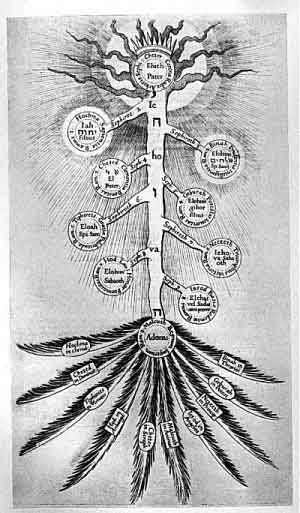
PLATE XXI. ARBER SEPHIROTHECA<br> (From <i>Utriusque Cosmi</i>; Robert Fludd, 1621. Vol. II)
PLATE XXI. ARBER SEPHIROTHECA
(From Utriusque Cosmi; Robert Fludd, 1621. Vol. II)

First of all, what are the ten Sephiroth? First of all then, they are indicated by the first ten letters of the primitive alphabet in which, as we have noted before, Gods were Letters, Letters were Ideas, Ideas were Numbers, and Numbers were perfect Signs. They may mean either "to count" (that is, they may mean "numbers"), or "brilliance" or "spheres." Or they may mean "qualities," standing for the several grades or stages of wisdom. Or they may mean "emanations."

The Arber Sephirotheca(Plate XXI ) shows the Hebrew scheme of Creation--the esoteric side of the Genesis story, beginning with the assumption that Creation began, not from the act of God, but from the emanation of God, due to his voluntary self-withdrawal in order that the universe might be created. "When the Holy Aged, the concealed of all concealed," says the Zohar, "assumed a form, he produced everything in the form of male and female, for Wisdom expanded, and Intelligence, the third Sephirah, proceeded from it, and thus were obtained male and female, viz., Wisdom the father, and Intelligence the mother, from whose union other pairs of Sephiroth successively emanated." The first Triad, then, which is represented, is Hochma or Wisdom, Binah, or Intelligence, and Cheter the Crown or the equilibrising force. These three in one are the Balance of forces, otherwise the Reason of the Universe. This Reason is not represented separately. It is held to be inherent in the relation existing between and in the first group of three.

Then, from this first group of three forces, or its result, Reason, came the second group of three, Chesed or Mercy, the father, Geburah or Justice, the mother, which together produce Tipherets, or Beauty. This sixth again represents Balance or equilibrium in forms about to be materialised, the mediator between the Crown or Creator and the Kingdom or Creation.

The third triad consists of Netzeth or Victory, the father (explained sometimes as the eternal triumph of Intelligence and Justice, the two mothers), Hod or Glory, the mother, from which two springs Iesod, the Foundation, the Absolute.

The three triads, three forms each of the intellectual, the spiritual, and the material qualities, combine to form the tenth Sephirah, Malcuth or the Kingdom--or Sovereignty over the Kingdom or universe, manifested in the ten branching leaves. These branching leaves manifest, in turn, the direct relation existing between the ten Sephiroth and Adam Kadmon, the primordial, heavenly, incorruptible man, created in this way only "in the image of God." Adam Kadmon is the branching fruit of the Tree of Knowledge, and holds the middle place between the En Soph or All in All and the ten emanations; holds, that is, the point of Balance or equilibrium. In this sense Adam Kadmon here, as in Plate IV , is regarded as the supporter and upholder of the universe. Nothing could be at first sight more unlike than these two images of the three worlds, but there are enormous likenesses between them.

Another way of expressing this interrelation between the ten emanations is that the first Sephirah, by virtue of its equilibrising power, unites the second and third--Wisdom and Intelligence; that the sixth Sephirah, Beauty, by the same virtue, unites the fourth and fifth--Mercy and Justice; that the ninth Sephirah, Foundation or Absolute, unites the seventh and eighth--Victory and Glory, and by union with all, sends forth the tenth Sephirah, the Kingdom or the Universe. Again, the first three Sephiroth form the world of Reason; the second three, the world of Spirit; the last four, the world of the Body.

A tree must have a soil in which to grow; soul and spirit must have a body; moving energy must take a form. And a very beautiful and subtle interpretation of the World Tree myth may be found in an old black-figured kylix by Exekias, dating from the sixth century B.C. It is called "Dionysos in the Ship," and its reading depends entirely on an understanding of what the story of Dionysos meant to the Greeks and all the peoples who came under their influence (Plate XXII ).

The story of Dionysos is always the story of Dionysos-and-Apollo. There is not such a thing as even half of this story; one without the other does not exist. It veiled one of the greatest of the Greek mysteries, this conflict between these two gods, and the final reconciling of their struggle. It symbolised the conflict between light and darkness, between spirit and form--quite literally, the conflict between spirit and body. It was a mythological drama based on the old cry of man, "I feel two natures struggling within me." The first impulse of antagonism is to defeat, even to destroy; it seldom occurs to two opponents that there is a middle point, an equilibrium or balance, where peace abides. The story of Dionysos-Apollo is not one of destruction, but of final reconcilement between two opposing forces. Neither was to be rightly judged on the basis of "good" or of "evil," but on the basis of incompleteness only. Each needed the complementary force of the other; without the other neither was whole. It was not Dionysos alone, nor Apollo alone, but the two reconciled and united that solved the struggle. In this kylix, Dionysos-Apollo floats on the aethereal ocean. The body or boat--a great fish--carries the unified god. The two are one, and from them united spring two great vines laden with fruit and leaves. About the living boat seven dolphins, "spies of the sea," keep guard to forecast storms and to warn the pilot. In this Dionysian vine picture the myth-cycle of the World Tree rounds upon itself. The Tree, given by the gods to mortal man, is itself re-born through man reconciled and made immortal, and is given back to heaven as a celestial vine. Dionysos-Apollo had escaped the Wheel of Fate, and could forever mediate between the remnants of man still bound to it, and the Olympian gods.

The mystery of the relation between Darkness and Light, which is the mystery of Dionysos-Apollo, had another representation in the seventeenth century, when Robert Fludd based the whole scheme of Creation upon it (Plate XXIII ). It will be interesting to compare this drawing with some Chinese conceptions of the primal causal cosmic struggle between Light and Darkness (pp. 147 -150).
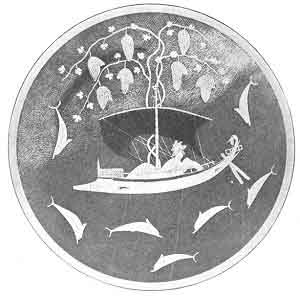
PLATE XXII. DIONYSOS IN THE SHIP<br> <i>A black-figured kylix by Exekias</i> (<i>6th cen. B.C.</i>). <i>in Munich</i> (<i>Furtwgler-Reichhold; Griechische Vasenmalerei, No. 42</i>).<br> (From <i>Mythology of All Races</i>, 1927. Vol. I, Plate XLIX)
PLATE XXII. DIONYSOS IN THE SHIP
A black-figured kylix by Exekias(6th cen. B.C.). in Munich(Furtwgler-Reichhold; Griechische Vasenmalerei, No. 42).
(From Mythology of All Races, 1927. Vol. I, Plate XLIX)

"At the top of the figure," says Fludd, "is expressed the Head, or the Root, of all things, both in the simplicity of His unity and the duality of His universal attributes, namely, One God, One Supreme Being, One Essence or Divine Mind, whether willing or non-willing. In the negative aspect it withdraws within itself, and refrains from sending Itself forth from Itself.

"B. is the effect of the divine potency, or non-willing, in which state all things were formless and in potency only, before the beginning of the world. B., in other words, is a hieroglyphic Image of God thus far altogether non-willing; in which stage God is in His true Essence, shining within Himself, but not sending Himself forth from Himself. Such was the primal Chaos, from the bowels of which the materials of the Universe were originally drawn forth.

"Just as B. was the hieroglyph of the latent God, so C. is the representation of His glorious Emanation for the Creation of the World. This Emanation is the Word of God.

"From the union of these two comes one World [D. E.] in the Image of One Who participates in it both in His positive and negative aspects. That is to say, from the two opposites the World is born in the Image of its Creator. The World is in God, which means that the World is partly created and partly uncreated. Created, if we consider the material World, but uncreated if we consider its Maker.

"According to the mystical theology of Orpheus, Hesiod, Euripides, and chylus (who involved the divine mysteries in allegory), the Sun is taken in Archetype, as that divine source from which all ornament and beauty, embracing a multiple harmony of life, is derived. In His right hand is pity and benevolence, in His left, severity and punishment [F. G.]."

One aspect of this divine mystery of the Sun visible and the Sun invisible, they concealed, he says, under the name of Apollo, god of Day and of Light, the other under the name of Dionysos, god of Night and of Darkness. Each was but half of the other; only the two are one; yet each one, though separate, had within him the seeds of Darkness and Light. Hence, they argued that God is both destruction and creation, corruption and generation, author and actor; that "just as he composes by the number 7, so he destroys by the number 7, for the sacred number 7 is attributed to the God of life." Night in its darkness, or Dionysos, symbolised God in His negative aspect of withdrawal within Himself, and Day in its light, or Apollo, symbolised God in his positive aspect of giving forth by emanation from himself.
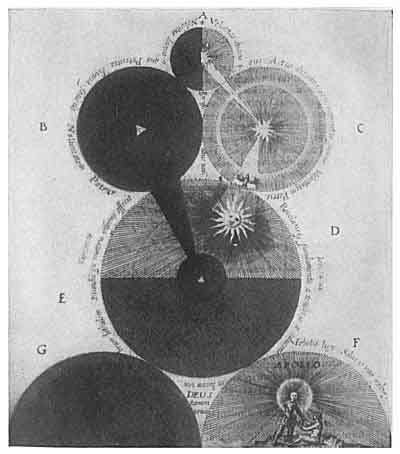
PLATE XXIII. ''<i>And God said, Let there be Light, and there was Light</i>.''<br> (From <i>Medicina Catholica</i>; Robert Fludd, 1629)
PLATE XXIII. ''And God said, Let there be Light, and there was Light.''
(From Medicina Catholica; Robert Fludd, 1629)

THE FAMOUS ROSE TREE of the Rosicrucians has a Dionysian connection, for the Rose as well as the Vine was sacred to this god. It has also a Peruvian connection; the Peruvian Eve--there is a native drawing of her later on--sinned not by eating the apple, but by picking roses, which were, in the Peruvian tradition, the fruit of the Tree." The bee is almost as much a part of this drawing (Plate XXIV ) as the Rose Tree--here are a few odd myths of this marvellous being. According to Porphyrios, the Moon was called a bee; according to Virgil, the bee alone of all animate things descended from Paradise, is a part of the mind of God, never perishes, and alone of all animate things, ascends alive into heaven. Dionysos is sometimes identified with the Moon, and is said in some traditions to have been born again as a bee. Again, the wax of bees produces light, hence bees are those that feed on fire. As for the rose, its bud resembles the acuminated or pointed sphere that symbolises ether in the ancient Stupa (Fig. 1 ), and the opened rose, to the Rosicrucians, symbolised the Universe spread out like a book, which he who could might read.

This representation of the universe by a rose appears to be a later development of a very ancient figuration of the universe by an onion--also a plant sacred to the old gods. Rather, the universe was represented by the layers of the onion--the Egyptians and the Hebrews and the Tibetans have used this over and over again. The core, to which the layers cling, may be the axis of the world, or the polar mountain of the world. In the Tibetan universe the onion's core is Mount Meru, surrounded by fifteen opaque, semi-transparent layers of oceans and mountains and oceans again until the outer skin is reached, which is the wall of iron about the universe. And all the heavens are one above the other, like the layers of an onion," says the Kabbala. ". . . And our companions who live in the South, have seen in the First Book and in the Book of Adam, that all these earths which are Below, are like the firmaments Above, that upon that, and this upon this, and between each earth, a heaven (firmament) is spread out between each other (like the fine skin of the layers on the onion)."


Footnotes

94:1 The Prose of Younger Edda, translated by G. W. Dasent, p. 16.
101:1 Memoirs of the American Museum of Natural History, Vol. II, 1900, pp. 342-43.
103:1 U.S. Bur. Ethnol. Rep., 1893-94, p. 182."
107:1 Picture Writing of the American Indians: Garrick Mallery, 1894, pp. 251-252.

Lost Land of the West

THE BOOK OF EARTHS

By

EDNA KENTON

New York: William Morrow & Company

[1928, No renewal]


Lost Land of the West

But there is another obscure tradition of a fifth catastrophe which seems to have antedated the sinking of Atlantis. This concerns another lost continent in the Pacific Ocean, a great catastrophe in the western waters. Old records are riddled with allusions to vanished "Lands--and peoples--of the West." Old Aztec and Mayan records, that is; the Asiatic records speak of the vanished lands and peoples "of the East." This old tradition appeared first in modern times through the assumption of Sclater, an Englishman seeking for some "lost links," that long, long ago a great southern continent lay stretched about the South Pole very much as the continental land to-day surrounds the arctic zone. He named this continent Lemuria, to fix more firmly thereby his supposition that on such a continent animals of the Lemuroid type must have been developed. It is a curious instance in scientific history that when Ernst Haeckel, most material of materialistic scientists, came upon this Lemurian hypothesis, he promptly incorporated it into his own working scheme, and in his The History of Creationand The Evolution of Manhe speaks of Lemurian creatures and Lemurian traces as if the existence of such a land had been already scientifically Evidenced. His explanation, which failed to satisfy all scientists, was that the Lemurian time-cycle was the only supposable thing that explained certain otherwise inexplicable gaps in the evolutionary theory.

This prehistoric, pre-Atlantean continent, existing--if it existed--hundreds of thousands of years ago, has also been called the Continent of Pan. In Oahspe, A New Bible in the Words of Jehovih, published by John Ballou Newbrough in 1882, there is a world-map showing the location of this lost Pan in the Pacific Ocean. Oahspemakes its sinking coincident with the Deluge. The sacred people of Pan, the Ihins--otherwise the Algonkins--had been warned of the coming flood, and were building ships in which to escape--138 Arks of the Deluge set out from this Continent of Pan. ". . . in the same day the gates of heaven and Earth were opened.

THE SUBTERRANEAN BRIDGE<br> (From <i>Mundus Subterraneus</i>; Athanasius Kircher, 1678).
THE SUBTERRANEAN BRIDGE
(From Mundus Subterraneus; Athanasius Kircher, 1678).

FIGURE 42. <i>Outline map showing the locality of Pan, the submerged continent</i>.<br> (From <i>Oahspe, A New Bible in the Words of Jehovih</i>; John Ballou Newbrough, 1891, Plate 62.)
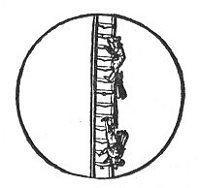
FIGURE 42. Outline map showing the locality of Pan, the submerged continent.
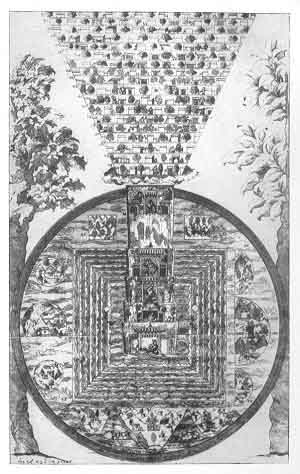
(From Oahspe, A New Bible in the Words of Jehovih; John Ballou Newbrough, 1891, Plate 62.)

And the Earth rocked to and fro, as a ship at sea, and the rains fell in torrents, and loud thunderings came up from beneath the floor of the world. . . . And the vortex of the Earth closed in from the extreme, and lo, the Earth was broken! A mighty continent was cut loose from its fastenings, and the fires of the Earth came forth in flames and clouds with loud roarings. And the land rocked to and fro like a ship at sea. And again the vortex of the Earth closed in about on all sides, and by the pressure the land sank down beneath the water, to rise no more." The Algonkins, oddly enough, have a fascinating word with a fascinating meaning for just such shadowy fables as these. "It is only Nitatahakau," they say; which is to say, "I relate a fable. I am telling an old story invented for amusement."

FIGURE 43. <i>The geographical position of Mu</i>.<br> (From <i>The Lost Continent of Mu</i>; James Churchward, 1926.)
FIGURE 43. The geographical position of Mu.
(From The Lost Continent of Mu; James Churchward, 1926.)This dim continent has also been called the Continent of Mu. And by "this dim continent" I do not mean to say that Lemuria and Pan and Mu, or even that conjectural "western crust" of the Earth from which the Moon hypothetically sprang, are identical except in this way; that they all hang together on the same thread of tradition, that something at some far distant time happened in the centre of the space that is now called the Pacific basin. We have already seen that a serious modern scientific theory assigns the origin of the Moon to this planet, and that a supplementary theory suggests the Pacific basin as the place of the split. We have seen too that a southern continent, antipodal to Atlantis, has been assumed by evolutionists because something like it had to be assumed. Col. James Churchward's recent book on The Lost Continent of Muis a unique and serious study of this traditional catastrophe in the western waters, carried on over a period of fifty years, during which time he collected all the collectable evidence on this theme, that once upon a time in the western ocean a great continent went down to rise no more.

His material is very interesting. Long-forgotten sacred tablets of India describe, he says, among other things, the creation of man in the land of Mu, the mother country of humanity--which land was not the land of Asia. Records of later date describe the destruction of the land, "when the earth's crust was broken up by earthquakes, and then sank into a fiery abyss. Then the waters of the Pacific rolled in over her, leaving only water where a mighty civilisation had existed." He finds the land of Mu mentioned by Plato; he finds "the Land of Mu," or "Lands of the West" in the Troano Manuscript, an ancient Mayan book, and in the Codex Cortesianus, another Mayan book; he finds it in the Lhasa record, and in hundreds of other writings in all parts of the world, including India, Egypt, Greece, Central America, and Mexico.

He says that this continent was a vast one, extending from the north of Hawaii down towards the south. A line between Easter Island--with its massive sculptured stones for which no man has ever accounted--and the Fijis formed its southern boundary. It measured over 5,000 miles from east to west, and over 3,000 miles from north to south. The continent consisted of threeareas of land, separated from each other by narrow seas or channels, and on it dwelt 64,000,000 people divided into "ten tribes" or "peoples." It was called the "Empire of the Sun," and it was the centre of the whole Earth's civilisation, of its learning, its art, and its commerce. Its great cities were seven, and its people, being skilled navigators, had sent out colonists to all parts of the Earth.

But the final one of a series of earthquakes came to Mu, and Col. Churchward quotes from old records: "'The whole continentheaved and rolled like the ocean's waves. The land trembled and shook like the leaves of a tree in a storm. Temples and palaces came crashing to the ground and monuments and statues were overturned. The cities became heaps of ruins.' As the land rose and fell, quivered and shook, the fires of the underneath burst forth, piercing the clouds in roaring flames three miles in diameter. There they were met by lightning shafts which filled the heavens. A thick black pall of smoke overshadowed the land. 'Huge cataclysmic waves rolled in over the shores and extended themselves over the plains.' Cities and all things living went down to destruction before them. 'Agonizing cries of the multitude filled the air. The people sought refuge in their temples and citadels only to be driven out by fire and smoke, and the women and the men in their shining garments and precious stones cried: "Mu, save us!"' . . . 'During the night' the land was torn asunder and rent to pieces.

PLATE XVII. <i>A Conjectural Geography of the Translation of the Earth after the Deluge</i>.<br> (From <i>Arca Nolt;/i>, Athanasius Kircher, 1665).
PLATE XVII. A Conjectural Geography of the Translation of the Earth after the Deluge.
(From Arca No Athanasius Kircher, 1665).

With thunderous roarings the doomed land sank. Down, down, down she went, into the mouth of hell, 'a tank of fire.' As the broken land fell into that great abyss of fire, 'flames shot up around and enveloped her.' The fires claimed their victim. 'Mu and her 64,000,000 people were sacrificed.'" 1

These are the five great traditional catastrophes of the Earth. After each one of them, according to tradition, the generation of man began again. Again he began to rebuild his world; again began the quest for the knowledge--even for the crafts--that he had lost. Almost like the first men of Earth, he questioned the silent heavens, with no knowledge or wisdom of his own to aid him in his questions or their answers--nothing but vague old tales of something that had happened in a recordless past which had robbed his fathers of a heritage, and had put him where he was, ignorant and alone. What? and how? and why?


Footnotes

83:1 The Story of Atlantis and the Lost Lemuria: W. Scott-Elliot. 1925.
89:1 The Lost Continent of Mu: James Churchward, 1926, pp. 29-30.

The Lost Atlantis

THE BOOK OF EARTHS

By

EDNA KENTON

New York: William Morrow & Company

[1928, No renewal]


The Lost Atlantis

The fourth--or the third--catastrophe of the world-tradition is the sinking of Atlantis, the great prehistoric continent. A generation ago scientists would have smiled at the idea of taking this particular tradition seriously. But they do not smile to-day; they give the theory the Scotch verdict--"not Evidencen." Even that conservative storehouse of factual knowledge, the Encyclopia Britannica, says of this tradition, "It is impossible to decide how far this legend is due to Plato's invention, and how far it is based on facts of which no record remains." Fortunately for us, however, world-pictures are not based on Evidencen facts, or they would never have been drawn, and Plato's story of the lost Atlantis, even if eventually Evidenced "true," will always remain one of the most charming of fantasies. If you have not read it, in the Timaeusand the Critias, read it--his story of a golden world, when men were sons of gods and had not lost their heritage; of a civilisation that soared to heights of knowledge ours has never known--and sank. A few escaped this continental Deluge--Atlas escaped, says the old story, to support Heaven and Earth, in order that the Universe might not sink also.

Every one has seen somewhere Kircher's drawing of the Island of Atlantis--this was the last remnant of the continent, which tradition says sank 12,000 years ago--but it is doubtful that any one has ever seen it reproduced as it appeared in his Mundus Subterraneusof 1678 (Plate XV ).

It is always reversed, relettered, and made to conform to the right geography. The ship in the upper right-hand corner is turned bottom side up, and made to lie at anchor in the lower left-hand corner. Let the old mistake stand, if mistake it was--and mistake it was surely. Turning it upside down will put everything into right relation with modern geography. Only the ship will be wrong, like a mirage in the waters. Plate XVI is Kircher's accompanying illustration of "Ocean mountains," whose highest peaks may be island remnants of sunken continents, a little ground plan of the ocean floor.

Kircher, whose bold "guesses" on things he could not Evidence brought him less fame than blame, guessed again on the combined problems of the Deluge and lost continents, and in his Arca No 1665, presented, in a world-map, a "conjectural geography of the Earth's translation after the Flood, from the opinions of various geographers, to which the author subscribes" (Plate XVII ). This is a very odd map, by the way, and one evidently little known to modern geographers. Imagine a little German scholar, sitting in Rome under the shadow of St. Peter's during the Thirty Years' War, and guessing simply, not only at the form and extent of the then discovered but by no means explored Americas, and not only at the form and extent of the still unknown Arctic and Antarctic "continents," but also at the conformation and extent of the "ocean-mountains," and of the sunken antediluvian continents. To say he guessed wrong is to say a little less than nothing.

PLATE XV <i>Situation of the Island of Atlantis, according to the ideas of the ancient Egyptians and the description of Plato</i>.<br> (From <i>Mundus Subterraneus</i>; Athanasius Kircher, 1678)
PLATE XV Situation of the Island of Atlantis, according to the ideas of the ancient Egyptians and the description of Plato.
(From Mundus Subterraneus; Athanasius Kircher, 1678)
This map represents more clearly than his little drawing of Atlantis, his then novel theory that the Lost Island had been situated west of Gibraltar, and that the Canaries and the Azores are to-day its only remnants. But what it really does, of course, is to send the conjectural Atlantean continent straight west into the Americas, and almost across them. Who knows? We are still guessing, and the Mayan excavations are furnishing golden material for further guesses. It may very well be that half a century from now this old "guess-map" of Kircher's will be even more interesting than it is to-day.

According to the beautiful maps of W. Scott-Elliot --Kircher's map may serve as a guide for Scott-Elliot's slightly different theory--the Atlantean continent extended from a point a few degrees east of Iceland to, approximately, the site of Rio de Janeiro in South America, and across the ocean to the African Gold Coast. It took in Texas, and the Gulf of Mexico, the southern and eastern States of America up to and including Labrador, and stretched across the Atlantic to the British Isles, embracing Scotland, Ireland, and part of northern England. Atlantis is, by this assumption, the parent land of America--a great continent surrounded by water at a time so far away as that in which the Sahara Desert was an ocean floor.


The Deluge

THE BOOK OF EARTHS

By

EDNA KENTON

New York: William Morrow & Company

[1928, No renewal]


The Deluge

The third and fourth catastrophes of the Earth are the Deluge, and the sinking of Atlantis--Atlantis the fabulous continent, not the little Island remnant. Their time sequence in the old traditions is a little mixed, not that it matters. Suppose we take first the Deluge.

The Comet, that blazing terror of the skies, that erratic wanderer of the heavens, has always been given more than its probable share of blame for terrestrial bad luck. It has been called the cause of the birth of the Moon; it has also been held responsible for the universal Deluge. This is another of those untraceably old traditions, but we begin with the Comet of 1680, and the remarkable egg laid at Rome on December 4 of the Comet-year; because this Comet and this egg are responsible for two "Theories of Earth" written within the next twenty years, both by Englishmen. William Whiston worked out a complete theory of a deluged, because Comet-riven, Earth, and Thomas Burnet developed his theory of Earth as the Mundane Egg whose broken shell unlocked the "waters of the deep."

PLATE XIII. <i>One of the oldest drawings of the Moon. by Pere Capucin Marie de Rheita</i> (<i>1645</i>). <i>At the top Tycho is seen in full view, with its diverging rays</i>.<br> (From <i>Iter Exstaticum Coeleste</i>; Athanasius Kircher, 1660)
PLATE XIII. One of the oldest drawings of the Moon. by Pere Capucin Marie de Rheita(1645). At the top Tycho is seen in full view, with its diverging rays.
(From Iter Exstaticum Coeleste; Athanasius Kircher, 1660)

The evidence in the case is at hand in the shape of the elaborate frontispiece to Lettre dun gentil-homme de province une dame de qualitsur le sujet de la Comete, a brief little labour of informative love published anonymously in 1681, but known now to have been written by Claude Franis Manestrier. "An extraordinary freak of nature," it reads, "occurred in Rome, at the time of the appearance of the Comet, in the Palace of the Maximi, which was seen by His Holiness, by the Queen of Sweden, and by all persons of the first rank in Rome. The design of it was sent to Paris, as an entirely new thing, by a per-son greatly interested and worthy of confidence. On the 4th of December, 1680, in the Palace of the Maximi, a hen laid an egg, on which could be discerned the figure of the Comet, accompanied by other markings such as are here represented. All the most skilled naturalists of Rome saw and examined it, and found it to be a freak of nature unique and unparalleled. It is left to the curious gentlemen of Paris to make profitable use of it and to seek the cause."

FIGURE 41. The Comet of 1680 and the marvellous Egg.<br> (Frontispiece of <i>Lettre dun gentil-homme de province une dame de qualitsur le sujet de la Comete</i>; Claude Franis Manestrier, 1681.)
FIGURE 41. The Comet of 1680 and the marvellous Egg.
(Frontispiece of Lettre dun gentil-homme de province une dame de qualit sur le sujet de la Comete; Claude Franis Manestrier, 1681.)
Now it has always been extremely difficult for the extremely exact among the theorists to account for the sources of waters great enough to bring about a universal Deluge. No rains of forty days and nights explain it, even when these rains from heaven are united with all the external waters of the Earth. There were, to be sure, the "fountains of the great deep," but how were they to be broken up! And it is said that the Comet-Egg of this Comet-year gave good Will Whiston the idea he needed for solving the mystery of the Deluge. He published, in 1690, A New Theory of Earth, in which he set forth "the other main Cause of the Deluge, the breaking up of the fountains of the great deep," by the deadly weight of the waters in the tail of a Comet active in the heavens while Noah was building the Ark. "For when the near approach of the Comet to the Earth had rendered the Shape of that internal dense Fluid, on which its upper Crust rested, so very oblong and oval, and its Surface so much larger than before, as to occasion the opening of its perpendicular Fissures, which are visible at this day, . . . the vast weight of the additional Waters from the Comet would attempt to press this upper Earth deeper into the dense Fluid below . . . and so join the subterraneous to the cometical waters, for the supply of a Quantity sufficient for so vast a Purpose as that of a universal Deluge."

Whiston went even farther in his "cometical" theory; he supposed the Earth to have been originally a Comet; to have had a lop-sided form without beauty or proportion; subject to all the misfortunes of Comets, "sometimes a thousand times hotter than melted iron; at other times a thousand times colder than ice." These alternations of hot and cold were "Chaos," a dense though fluid atmosphere which surrounded the solid contents of the Earth, and which was in a state of continuous agitation and shock from its unharmoniously mingled substances. It was the Comet's atmosphere or tail, filled with water, which "struck" the Earth and broke its surface; and Whiston describes minutely just how the antediluvian Comet involved the antediluvian Earth in its tail, until all of Earth, even the mountain of the world, was submerged.

Burnet's theory of the Earth as the Mundane Egg will come farther on, but no better place could be found in this collection of world-pictures than just here, for one of his beautiful drawings of the Deluge, the second Chaos, when, "upon this Chaos rid the distrest Ark that bore the small remains of Mankind," a ship whose cargo was no less than a whole world (Plate XIV ). It is at once a picture of the Deluge after the dove was sent forth from the Ark, and a "Roughe Globe"; a delicate tracery of the broken Earth seen through water, as one looks down into a clear lake. There are vague glinting hints of lost or sunken continents that never emerged when the Earth dried and the waters ran off; a misty figuration of the new Earth, its pattern defined long before the Ark of Noah came to rest on Ararat; with some lost Lemuria, some sunk Atlantis, some shattered Pan or Mu still lingering along the declining edges of the continents about to be. Many of the modern "maps" of the Atlantean and Lemurian lands resemble very much this drawing of Burnet's, where continent seems to overlay continent until the oceans seem little more than spring floods in mountain valleys. Burnet speaks of Plato, who "supposeth his Atlantis to have been greater than Asia and Africa together, and yet to have sunk all into the Sea," and he concludes that great alterations in the face of the land and the sea would take place for a long time after the Deluge; that many of the fragments of land would change their posture, and that there would be a succession of sinkings and eruptions and lesser floods until all became poised and settled once again.

PLATE XIV ''AND AGAIN HE SENT FORTH THE DOVE OUT OF THE ARK''<br> (From <i>The Theory of the Earth</i>; Thomas Burnet, 1697)
PLATE XIV ''AND AGAIN HE SENT FORTH THE DOVE OUT OF THE ARK''
(From The Theory of the Earth; Thomas Burnet, 1697)


Earth-Moon Catastrophe

THE BOOK OF EARTHS

By

EDNA KENTON

New York: William Morrow & Company

[1928, No renewal]


Earth-Moon Catastrophe

The second catastrophe to afflict the Earth in the beginning of things was the Earth-Moon catastrophe; and this, by the way, is not only one of the most ancient of traditions, but it is also a modern theory of causes with which science has been flirting for half a century. So difficult is it to find anything new, even a new theory, which cannot be traced back along some old tangled thread of folk-lore. It is difficult, however, to find anything older in man's consciousness than the riddle of the Moon. What is it, that changeless, ever-changing, flat-faced disc in the sky, forever turning about the Earth, yet never turning

PLATE X. A. <i>The Heavenly Goose</i>.<br> (From Ancient Mythology: Jacob Bryant, 1774, Vol. II)
PLATE X. A. The Heavenly Goose.
(From Ancient Mythology: Jacob Bryant, 1774, Vol. II)

PLATE X. B. <i>The Sky Goddess Nut represented double</i>.<br> (From <i>The Dawn of Astronomy</i>; J. Norman Lockyer, 1894)
PLATE X. B. The Sky Goddess Nut represented double.
(From The Dawn of Astronomy; J. Norman Lockyer, 1894)


FIGURE 36. <i>Lunar and Solar Eclipses</i>.<br> (From <i>Spha Mundi</i>; Joannes Sacro Bosco, Venice, 1482.)
Click to enlarge
FIGURE 36. Lunar and Solar Eclipses.
(From Spha Mundi; Joannes Sacro Bosco, Venice, 1482.)
FIGURE 37. <i>The Figure of the Dragon: the Lunar Nodes</i>.<br> (From <i>Blundeville His Exercises</i>; London, 1606.)
FIGURE 37. The Figure of the Dragon: the Lunar Nodes.
(From Blundeville His Exercises; London, 1606.)

FIGURE 38. ''<i>When the Moone is betwixt the Sunne and the Earth</i>.''<br> (From <i>Blundeville His Exercises</i>; London, 1606.)
FIGURE 38. ''When the Moone is betwixt the Sunne and the Earth.''
(From Blundeville His Exercises; London, 1606.)its other face to the Earth? What mysterious other-world, under-world, over-world, dead or alive, lies on its secret side? What is the relation of the Moon to the Earth and to man? what the relation of the hidden life of the Earth and of man to the Moon? Tradition had doubled these two bodies as a pair acted upon by the Sun, long before astronomers had given us the image of Earth-Moon as a beautiful double planet moving among the stars; long before mathematicians had constructed from the interrelated "pull" of Sun and Moon and Earth the baffling "problem of three bodies," before which many a wise man has fallen.

Here is the ancient story of the genesis of the Moon.

Long after the separation of Heaven and Earth, and while Earth was still in process of being made ready for human life, but before man had been yet created, it chanced that the line of its course in the heavens was crossed by that of a great Comet, and that by some heavenly accident, the two enormous bodies collided. The terrific impact resulted in the cracking of the Earth's hard shell, and a huge fragment--some traditions say two--was torn away as violently as Nut was torn, in the Egyptian myth, from the body of Seb. This fragment of Earth promptly went into space, and became known as the Moon; and ever since that time Earth and Moon, Mother and Daughter, have been following each other through the heavens. As to which is the pursued, which the pursuer, old accounts vary. But there is always the stable myth of Ceres and Proserpina to fall back on.

Very soon after Galileo made the first drawing of the Moon, in 1610, John Wilkins, Lord Bishop of Chester, devised a highly curious little book, entitled The Discovery of a New World in the Moone, or, A Discourse tending to Evidence that tis probable there may be another habitable World in that Planet. Wilkins bulwarks his "guess" with similar ones of the ancients: "Pythagoreans in general did affirm," he says, "that the Moone also was Terrestrial, and that she was inhabited as this lower World.

FIGURE 39. <i>The first drawing of the Moon</i>, by Galileo, 1610.<br> (From <i>The Discovery of a World in the Moone</i>; John Wilkins, 1638.)
FIGURE 39. The first drawing of the Moon, by Galileo, 1610.
(From The Discovery of a World in the Moone; John Wilkins, 1638.)

To this opinion of Pythagoras did Plato also assent . . . we may read often in him and his followers of an hera terraand a lunares populi--an hereal Earth and Inhabitants in the Moone." As their world is our Moon, so our world is their Moon, he declares, and quotes others of antiquity, whose Heavens and Elysian Fields were there, where the air is most quiet and pure. In the frontispiece to his book, he attempts to show just this relation between them. He goes back to the old Greek myth of the Earth, and calls the two Ceres and Proserpina. "By the fable of Ceres," he says, "continually wandering in search of her daughter Proserpina, it meant nothing else but the longing desire of Men, who live upon Ceres, Earth, to attain a Place in Proserpina, the Moon or Heaven," and he held that "tis possible for some of our Posterity to find out a Conveyance to this other World; and, if there be inhabitants there, to have Commerce with them."

PLATE XI.<br> OMNIA PER IPSUM FACTA SUNT<br> <i>Matter in motion, figure, rest: adde Grade.<br> This is the very somme of All God made:<br> Att first of nought bys power in six dayes space.<br> Now nature acts it's part; here after Grace</i>.<br> (From <i>Bybel Printen</i>; Matthaeus Merian, 1650)
PLATE XI.
OMNIA PER IPSUM FACTA SUNT
Matter in motion, figure, rest: adde Grade.
This is the very somme of All God made:
Att first of nought bys power in six dayes space.
Now nature acts it's part; here after Grace.
(From Bybel Printen; Matthaeus Merian, 1650)

FIGURE 40. <i>Frontispiece and Title-page of </i>''<i>The Discovery of a World in the Moone</i>''; <i>John Wilkins</i>, <i>1638</i>.
FIGURE 40. Frontispiece and Title-page of ''The Discovery of a World in the Moone''; John Wilkins, 1638.

Buffon seems to have been the first of modern scientists to voice the modern theory of the genesis of the Moon from this then moonless planet. He followed the push of tradition and made a Comet responsible for the split. This was in the eighteenth century. But in 1879, George H. Darwin lifted tradition to the dignity of an hypothetical guess, and suggested, as a part of his theory of Tidal Evolutions, that the Moon was formerly a part of the Earth; that it was originally much nearer the Earth than it is at present, and is now slowly receding from it; that at the time of the separation of the Earth into Earth and Moon, the planet was hardly larger than it is to-day; that it was hot, solid, ellipsoidical, with an interior more or less liquid, revolving on its axis once every four or five hours, its density increasing and its volume diminishing as it cooled; that, as its volume lessened, its speed of rotation increased, until by centrifugal force, the Moon was born, carrying with it, in its flight into Space, three-quarters of the Earth's crust.

A good deal of interesting discussion followed this new type of Darwinian theory, and a number of scientists began to speculate on the precise place of the origin of the Moon, granted that Darwin was right. Of course--and here again tradition guided them--or had at least preceded them--they chose the Pacific Ocean basin that holds apart the scarred coast lines of western North and South America, and eastern Asia, the East Indies, New Zealand, and the Antarctics. One of these speculators amused himself to good purpose: Plate XII, shows George D. Swazey's extraordinarily imaginative "quarter Earth" which remained after the Moon had flown, cracked by great lines of cleavage that were to slowly split the plastic floating crust into two major continental masses.

PLATE XII. THE EARTH AFTER THE EARTH-MOON CATASTROPHE<br> (Drawn by George D. Swazey for <i>Popular Astronomy</i>, Aug.-Sept., 1907.)
PLATE XII. THE EARTH AFTER THE EARTH-MOON CATASTROPHE
(Drawn by George D. Swazey for Popular Astronomy, Aug.-Sept., 1907.)

Among the old drawings of the Moon, it is difficult to choose--they are all so beautiful. One drawing, however, must always stand for an example of the miracles man has wrought in this quest of his--the first drawing of the Moon (Fig. 39 ), made in 1610 by Galileo through his "Glasse." That tiny lens, compared to the gigantic telescopes of to-day, amounted to considerably less than a child's toy. But it magnified a surface three times, and with it Galileo essayed to Evidence or disEvidence Aristotle's theory that "the form and images of the Ocean appear in the Moon as in a Mirror." "Leaving aside these terrestrial things," he said, "I have directed my researches towards the. heavens, beginning with the Moon." He decided very quickly that the Moon had no mirror-like surface, for he discovered mountains, circular hollows, and many bright spots which he compared to the eyes in a peacock's tail. Before he died, he had succeeded in making a glass which magnified surfaces thirty-two times, and it was not long before the surface of the Moon was mapped out and named. It was a world so similar in many of its formations to those of the Earth, that its first map-maker, Hevelius, simply transferred to the Moon the names of the cities and seas and mountains of the Earth. But Riccioli, in 1651, renamed its mountains and craters and supposed lakes and seas, not after places of the Earth, but after the learned men of the Earth, choosing rather to place their names in the sky. Instead of lunar Alps or Apennines, there arose on the Moon great mountain ranges, or plains, or craters bearing the names of Plato, Ptolemy, Copernicus, Kepler, Tycho; instead of lunar seas called Caspian, Mediterranean, and the like, there were instead the Seas of Storms, of Clouds, of Rains: the Seas of Tranquillity, of Serenity, and the Lake of Dreams--enchanting names which linger to this day.


Subscribe to this RSS feed

Log in or create an account