log in
The Book of Earths

The Book of Earths (36)

The Book of Earths

This is a compendium of theories of the shape of the Earth, along with a great deal of 'Earth Mystery' lore. Richly illustrated, the Book of Earths includes many unusual theories, including Columbus' idea that the Earth is literally pear-shaped, modern theories that the Earth was originally tetrahedral, and so on. Kenton also covers many traditional theories including the ancient Babylonians and Egyptians, Hindu and Buddhist cosmology, and those of the Peruvians, Aztecs and Mongols.


Upholders of the World

THE BOOK OF EARTHS

By

EDNA KENTON

New York: William Morrow & Company

[1928, No renewal]


Upholders of the World

FLAMMARION'S OLD DRAWING of The Earth Floatingis a peculiarly desolate rendering of the ancient idea that the Earth was nothing more than an island in a sea. This idea would of course have its probable origin among races living near great seas or oceans whose other side they had tried in vain to reach.
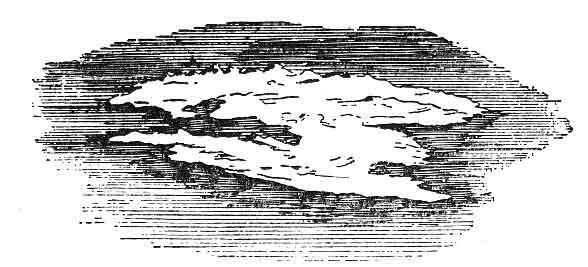
FIGURE 30. <i>The Earth Floating</i>.<br> (From <i>Flammarion's Astronomical Myths</i>, 1877.)
FIGURE 30. The Earth Floating.
(From Flammarion's Astronomical Myths, 1877.)The mind of men likes symmetry; if water stretching endlessly away bounded one side of their "island," even though that island were a continent whose other edge they did not know, water must lie also on its other sides. If the Sun rose from their eastern waters, say, at dawn, it must sink in some unknown western waves at night, if for no other reason than, by swimming through them, to arrive again by the next dawn, in the eastern sky. We may smile at this childish notion if we will, but it may very well be that no great "system" of the harmonious orbits of Sun and Moon and Earth explainthe mystery of the "rising and the setting of the Sun" any more or any better than the primitive idea that darkness came when the Sun was submerged in the sea, and that light came when the Sun sprang out of the sea. Perhaps all that we know to-day--really know--is that in the hour of dawn the Sun appears, and in the hour of twilight the Sun has vanished.
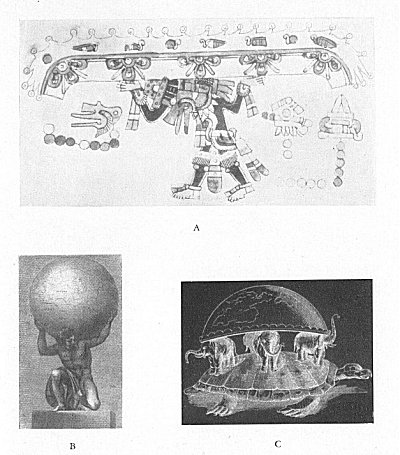
PLATE II: SUSTAINERS OF THE EARTH
 
A. Quetzalcoatl upholding the Heavens. From an original Mexican painting preserved in the Imperial Library at Vienna.
(From Kingsborough's Mexican Antiquities. 1831, Vol. II)
B. Atlas upholding the Earth.
(From Engravings after Stoddard: a collection in The New York Public Library)
C. A Hindu Earth.
(From Flammarion's Astronomical Myths, 1877)

The precise nature of the element in which the Earth-island floated came to be a matter of concern and much speculation. At first it was assumed to be simply water; later it was defined as "water or some other liquid," and finally it was believed to be a liquid not unlike the composition of the waters directly under the firmament or lower heaven, which were supposed to be a crystalline, congealed water, specially combined to resist the flame of the Sun, Moon, and galaxy of stars, to be itself full of fire, and yet not to burn. It was water, yet not water, air yet not air, fire, yet not fire. Probably this was an attempt to describe the medium in which the Island Moon floated, all sustaining, yet clear.

Doubtless too the roundness of the Sun and Moon, their discs so broad, yet thin enough to float in space, or aethereal waters, had as much to do with giving men the idea that the Earth's shape might also be flat and round, as the circular defining line of the horizon. Again, if the Moon was like a leaf, floating in the heavenly water, the Earth, like a leaf, floated on the world water, and like a leaf in water would develop roots. Ages ago, as we have already noted (p. 14 ), the ancient world, India, China, Egypt, made the lotus the water-flower that symbolises Earth and Heaven and all that lies between. For as a tree, rooted in the Earth, is a part of it, so Earth, rooted in the universal waters, must be a part of the universe from which it derives life and nourishment. And again, though the roots of an Earth-island might not be as firm as the roots of a great Earth-tree might, that is, be as supple and flexible as those of water plants, nevertheless it was an anchorage of the Earth to something outside itself.
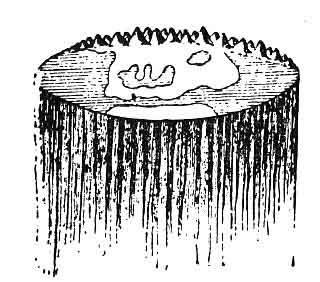
FIGURE 31. <i>The Earth with Roots</i>.<br> (From <i>Flammarion's Astronomical Myths</i>, 1877.)
FIGURE 31. The Earth with Roots.
(From Flammarion's Astronomical Myths, 1877.)Naturally evolving from this would rise an Earth set on solid pillars, an established, firmly founded disc. Fig. 32 is an old picture of just such an Earth--"the Earth of the Vedic priests." Its upper side is its only habitable side; its under side rests on twelve columns, these columns resting in turn on the Twelve Great Sacrifices of the Virtuous,--the aimful deeds, that is, of men aware of duty. Without this subterranean foundation, said the ancient priests, the pillars of the Earth would dry up, and the Earth would fall down. These pillars, says Flammarion, accounted more reasonably for the rising and the setting of the Sun, than the rather lazy guess that it swam through water from west to east every night; though there was another speculation that it might reach the eastern heavens by traversing a complicated system of tunnels, like great connecting caves, which pierced the Earth-disc from occident to orient.
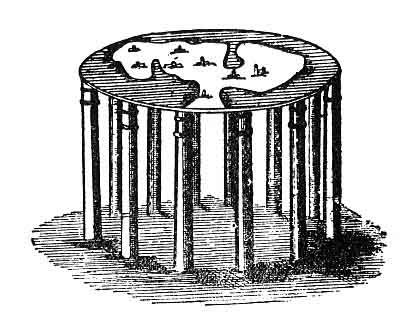
FIGURE 32. <i>The Earth of the Vedic Priests</i>.<br> (From <i>Flammarion's Astronomical Myths</i>, 1877.)
FIGURE 32. The Earth of the Vedic Priests.
(From Flammarion's Astronomical Myths, 1877.)But the twelve pillars, quite as little as the roots of the Earth-island leaf, failed to satisfy man's wonderings over the problem of what supported the Earth, or on what the Earth rested. One of the old familiar figures of Earth is that hemispherical Earth of the Hindus (Plate II, C ) supported on the backs of four elephants, which stand on the hemispherical shell of a gigantic tortoise floating on the surface of the world-waters. Sometimes, in addition to these three supports, there is a fourth, the coiled ring of the great world-serpent on which the tortoise rests--four foundations for Earth, and five for Heaven which must rest on the Earth.

But the elephant, the tortoise and the serpent are only three of the great animals which folk-lore and tradition say may support this planet. The Altaic people of Northern Siberia affirm that their mighty Ulgen created the Earth on the waters, and placed under its disc, to support it, three great fish, one in the centre and one on either side. The head of the middle fish being placed towards the north, floods occur there when it presses its head down; and, should it ever sink too low, the whole Earth will be deluged again. They believe that these fish are attached to heaven by a rope through their gills, whereby their heads can be lowered or raised, and that at the three posts of heaven to which these ropes are tied, the Bodhisatta Mandishire, or guardian of Earth, always watches. According to another tradition, only one great fish supports the Earth; when he changes his position earthquakes occur. In Hebrew myths, this mighty animal is the "fish-shaped Leviathan." Where the turtle or the tortoise is unknown, as in far northern lands, the "world-supporting Frog" will take its place; if its finger ever moves, the Earth shivers. Among Tartars and many of the tribes of Asia-Europe, the Earth is believed to be supported by a great bull; sometimes the Earth rests on its back, sometimes it is held aloft on the horns. Or, another variation, in the world-ocean there is a great fish, and, upon the fish, a bull which bears the Earth. Or again, in the world-ocean there is a giant-crab which gives support to the Earth-bearing bull. Some say that the terrible weight of the Earth has already broken one of the great horns, and that when the other breaks the world will come to an end. Another of the Tartar tribes says that after the Great Mammoth was created, it was found that the Earth was not strong enough to bear its weight, and so, to avoid a waste of creation in the universe, the Great Ruler solved the difficulty by commanding the Great Mammoth to bear the Earth.
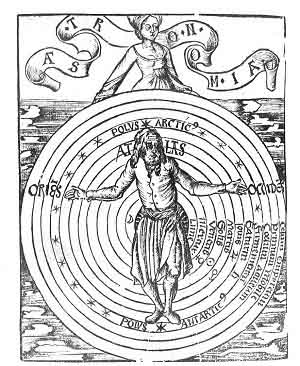
PLATE III. ATLAS SUPPORTING THE UNIVERSE<br> (From Margarita Philosophica, 1517)
PLATE III. ATLAS SUPPORTING THE UNIVERSE
(From Margarita Philosophica, 1517)
On what did the Earth rest? Not only on literal water, and great beasts. On a whirlwind, said Empedocles; on roots rooted in the Infinite, said Xenophanes; on a Soul of the World, said Plato and his school; on Twelve Pillars, said the Vedic priests, which must have for their foundation the "sacrifices of the virtuous." Earth, that is, depended ultimately on man for its support. And sooner or later, in all cosmologies and mythologies, we come upon some lurking or developed concept that the burden of supporting both Earth and Heaven rests on the shoulders of man. In countries as widely separated by race and by oceans as Greece and Mexico, we find an "Atlas of the World," a sustainer of the universe (Plate II , A and B). In Greece it is Atlas the "Endurer," brother of Prometheus the rebel bringer-of-fire, who supports the globe. Son of Poseidon, he knew the depths of the whole Ocean-world; it was his task to guard the pillars which held Heaven and Earth apart. According to one story, it was because he had attempted to storm the heavens that he was condemned to carry its vault on his head and hands. According to another version, it was only after the loss of his great Island realm Atlantis, that he was forced to become the sustainer of the sky.

Mexico appears to have had four--at least--heaven-bearing gods, and each of these appears to have exercised a number of functions other than the sufficiently onerous one of supporting the universe. Quetzalcoatl, although a Sun god and an earthquake god, was also, like Atlas, a water god. If Atlas, interpreted, means the Endurer, Quetzalcoatl, interpreted, means Heart of the Sea. God of the Sun, of the earthquake, and the water, he also up-held the heavens of the Mexicans. In the eastern world and in the western, thousands of years ago, these different races believed alike that some great force never to be understood and never to be overcome had wrenched the heavens from the Earth, but that, at the same time it separated them, it united them by another force, which each race represented by a human figure, a great man-god. Explain it as we will, call it nae or arrogant, it expressed one of man's few entirely admirable qualities, his lonely necessity to share, or to believe that he shared in the work of carrying on the universe. And it found expression in countless ways.

A curious old drawing of the Middle Ages (Plate III ) shows how the Atlas-myth persisted even into modern time. The Earth still occupies the centre of the universe, with all the other heavenly bodies revolving about it. From pole to pole of the firmament--his head marking the "Polus Arctic" and his two feet the "Polus Antarctic," stretches Atlas, or the Macrocosm, or the Great Man, or Adam Kadmon, whichever you will. To medial Europe Atlas represented the Macrocosm, or the long great world, in contrast to the Microcosm or man--little, but the epitome of all that had combined to produce him. Very often, in such circular designs, the two lower corners will be filled each with a toiling figure, the burden-bearer man, with his shoulders bent to the wheel. Only by his microcosmic, microscopic effort, they seem to say over and over again, may the Wheel of Life be kept revolving. Not only does the Earth--the pillared Earth of the Vedic priests--rest on the sacrifices of man, but, since Heaven itself leans on the Earth, without man's aid the whole universe must collapse.

It is easy to see how this ancient image of the Great Man rose before the eyes of the "little men" of the Earth. This was a being infinitely stronger, infinitely better, almost yet not quite a god because he was Man, who somehow stood or moved between the two worlds and kept them in touch with one another. He came to be called by many names, to be pictured under many disguises. He was the Being praised in the Creation chant of the Mahabharata; he was the "manitou to men and their grandfather" of the Lenape Creation story. He was the cosmic Pan Ku of the Chinese, who came into being "in the midst of the cosmic egg," whose very name Pan means "the shell of an egg," and who was hatched out of the cosmos. He created in the middle, out of the pure elements, Heaven; out of the mixed elements, Earth. Every day Heaven grew ten feet higher, Earth ten feet deeper and he ten feet taller, for 18,000 years. When he died, his breath became wind, his voice thunder, his four limbs the four directions, his five extremities the five sacred mountains, his left eye the sun, his right eye the moon, his blood the rivers, his beard the stars, his hair the trees and plants, his flesh the soil, his teeth metals, his bones rocks, his marrow precious stones, his perspiration rain, and his parasites men. The old Chaldeans drew a Great Man across the sky in such a way that the signs of their zodiac corresponded to the parts of his body. And, proof once again that the ancient peoples separated by the Earth's diameter from each other were inexplicably one in many of their fancies, the Tewa Indians regarded Opa--the world, the universe--as a living being, and worshipped it as the "Universal Man," whose backbone, they said, is the Milky Way. And the old Norse sagas have in their giant Ymir almost the facsimile--or it may be the original, who may say?--of the Chinese Pan Ku; for from Ymir's body was made the world, from his flesh the Earth, from his blood the rivers and oceans, from his bones the mountains, from his eyebrows the "encompassing" of Mitgard the Earth. From his skull was shaped Heaven, and his brains were changed into floating clouds and fogs.
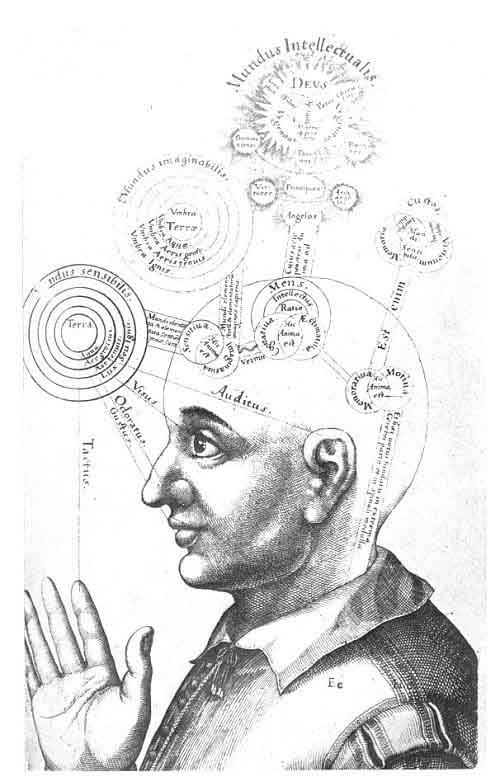
PLATE IV. <i>A very clear demonstration of the three kinds of vision in the Microcosm</i> (<i>or soul of Man</i>) <i>of the location of their objects, and of the manner of discerning them</i>.<br> (From <i>Microcosmi Historia</i>; Robert Fludd, 1619)
PLATE IV. A very clear demonstration of the three kinds of vision in the Microcosm(or soul of Man) of the location of their objects, and of the manner of discerning them.
(From Microcosmi Historia; Robert Fludd, 1619)What is interesting about all this is the fact that primitive man arrived without the aid of science at the tremendous idea that definite figureis an attribute of the heavens. It was the idea that so fascinated Herschel, discoverer of Uranus, and curious inquirer into the mysteries of the Milky Way. He was possessed by the "guess" that not only is our galaxy a stratum or confined bed of stars, but that this stratum is measurable, and that by comparison of his gauging or sounding lines, he might actually draw a chart of it. He "guessed" again that in the main--and this guess was wrong--the stars are scattered equably throughout our immediate Space, which would mean that, seeing as far in one direction as another, the figure of the heavens would tend towards a circular form. In an old book of 1848, Thoughts on Some Important Points Relating to the System of the World, by John Nichol, there is a very odd "Figure of the Universe," based on Herschel's gauging system, which illustrates as well as any other the method employed (Fig. 33 )

If, says Nichol, we were in the centre of a circular group, it would mean that whether we looked through the line C A or the line C B, the number of stars that could be counted would be the same. But if the group were an irregular one, the number of stars in the direction of C A would be much less than that along the line C B, and the proportions of their numbers would give the pro-portions of the two lines C A and C B. Supposing S (lower figure) the place of our Sun, "or," says Nichol, "what is the same thing, of the Earth, on which the observations are recorded," let a number of lines be drawn answering in direction to the position of Herschel's telescope, and in length to the number of stars revealed in that direction.
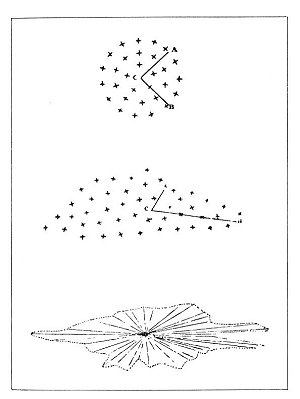
FIGURE 33. <i>A Figure of the Universe</i>.<br> (From <i>The System of the World</i>; John Nichol, 1848.)
FIGURE 33. A Figure of the Universe.
(From The System of the World; John Nichol, 1848.)

Then, if the extremities of these lines were joined, the result would be "a figure which, however strange, must approximate to a sectionof our vast and dazzling vault." He goes on to imagine one with the power to depart from Earth, proceeding through Space towards the Milky Way, leaving behind the constellations which we know, coming upon new configurations, passing even through the Milky Way, until, looking back, he sees this universe so dwindled away as to present the appearance of nothing but a speck in Space, shining with a faint, irregularly diffused illumination corresponding in its rays to the outlined figure.

NATURALLY MOST OF THE EARLY STORIES of the "Great Man" of the heavens are odd mixtures of perception and fancy, of clumsy literalness and real imagination. All too often this OpaBeing was more earthly than heavenly, much more man than god, but, whatever his guise or disguise, he was always much more than man, and in some of his incarnations he was very close to divine. As Adam Kadmon he has meant not only the First Man created in the true image of God, but something more, "the divine man-forming power" capable of transforming a questioning little man cut off from wisdom into a divining Great Man who could know. Precisely such a conception of Adam Kadmon has been lying in Robert Fludd's Microcosmi Historiasince 1619 (), "A very clear demonstration of the three kinds of vision in the Microcosm (or soul of man); of the location of their objects, and of the manner of discerning them." Surely no figure of "Earth" was ever drawn before or since so lightly poised, so aethereally supported.

Unless it is the tiny figure of Earth as the end and the beginning of the Spiral World (Plate V ) which immediately follows in the Microcosmi Historia: "Another demonstration showing how the soul rises in a spiral ascent from the sensible things of the world to unity, through twenty-two stages, beginning with the Earth, and ascending upwards to God; that is, from multiplicity to unity." This is drawn in twenty-two whorls or "grades," beginning, by numbers, with "Terra" and ending with "Deus." Or, by the order of the Hebrew alphabet, beginning with "Deus" and ending in "Terra." These spiral grades or stages have each four signs to mark them; first, the letters of the Hebrew alphabet, beginning with the outer whorl and winding continuously inward to the centre. (The Hebrew alphabet, according to the Kabbala, is based on the primitive alphabet in which Gods were Letters, Letters were Ideas, Ideas were Numbers, and Numbers were perfect Signs.) Second, the names of the procession of grades, from the first manifestation of the Godhead, Mens or Mind, to its final expression in Terra or Earth. Third, numbers, from 1 to 22. Fourth, the tiny winged heads common to each completed whorl. The spiral, reaching from Heaven to Earth, is shown here as lying in a flat coil, like a spring. But it may be re-imaged as the winding line described about a sphere that tapers irresistibly out to a point. It is just that line, says this figure, described by a point moving in space, beginning in Heaven and ending in Earth, which at once separates and unites them.
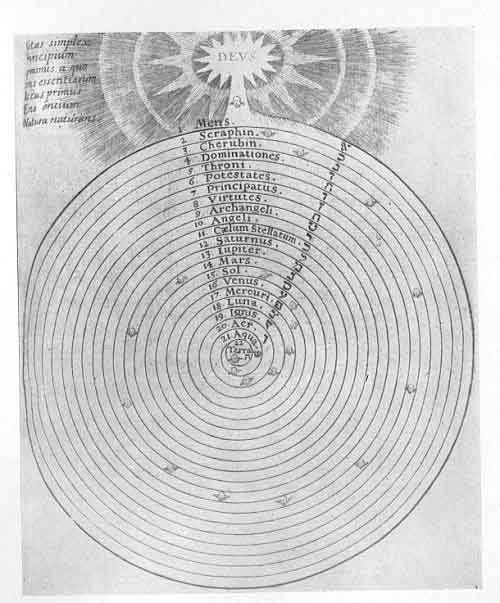
PLATE V. <i>Another demonstration showing how the soul rises in a spiral ascent from the sensible things of the world to Unity</i>.<br> (From <i>Microcosmi Historia</i>: Robert Fludd, 1619)
PLATE V. Another demonstration showing how the soul rises in a spiral ascent from the sensible things of the world to Unity.
(From Microcosmi Historia: Robert Fludd, 1619)

Beyond Earth there is nothing. But in Earth there is everything--even the power to make the descending spiral an ascending one. It can be re-imaged as an ascending vine, climbing back by way of the great World-tree. For life, said the ancients, flows never in one way. Rooted in Heaven, it descends to Earth, and rooted in Earth it may ascend to Heaven.


Figures

THE BOOK OF EARTHS

By

EDNA KENTON

New York: William Morrow & Company

[1928, No renewal]


FIGURES

Figure


Page

1.

The Stupa. From Ramusat's translation of Fa-heen's Foe koue ki. 1848.

6

2.

The Tetrahedron. From an old print.

7

3.

The Octahedron. From an old print.

7

4.

The Icosahedron. From an old print.

8

5.

The Cube. From an old print.

8

6.

The Dodecahedron. From an old print.

9

7.

A "rygge forme" or three-sided tablet. From Recorde's The Castle of Knowledge. 1556.

10

8.

The five-sided tablet. From an old print.

10

9.

The Cone. From an old print.

10

10.

The three-sided pyramid. From an old print.

10

11.

The four-sided pyramid. From an old print.

10

12.

The Sphere. From Physiologia Kircheriana Experimentalis. 1680.

10

13.

The Cylinder. From an old print.

10

14.

Spiral forms. From old prints.

12

15.

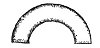
"Halfe a Sphaere." From Recorde's The Castle of Knowledge. 1556.

14

16.

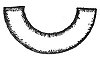
"Hollow lyke a bolle." From Recorde's. The Castle of Knowledge. 1556.

14

17.

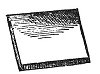
"A playne Flatte." From Recorde's The Castle of Knowledge. 1556.

15

18.

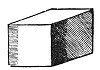
"Square like a box." From an old print.

16

19.

Squares, or "stages," within circles. From an old print.

17

20.

The six-faced Tetrahedron. From Green's Vestiges of the Molten Globe. 1875.

18

21.

The Oval, or "The Mundane Egg." From an old print.

19

22.

"Circles within the Oval." From an old print.

19

23.

"Parallel Circles." From an old print.

19

24.

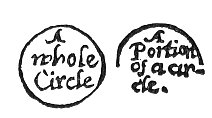
"A whole circle," "A portion of a circle." From an old print.

20

25.

"Convex, concave." From an old print.

20

26.

"Right, Crooked, Mixt." From an old print.

21

27.

Glyph 8 from The Walam Olum of the Lenape.

31

28.

Glyph 7 from The Walam Olum of the Lenape.

31

29.

Glyph 16 from The Walam Olum of the Lenape, Part II.

31

30.

The Earth Floating. From Flammarion's Astronomical Myths. 1877.

38

31.

The Earth with Roots. From Flammarion's Astronomical Myths. 1877.

40

32.

The Earth of the Vedic Priests. From Flammarion's Astronomical Myths. 1877.

41

33.

A Figure of the Universe. From Nichol's The System of the World. 1848.

48

34.

The Primal Earth, with its Zones or greater Climates, and the general order and tracts of its Rivers. From Burnet's The Theory of the Earth. 1697.

52

34A.

Zones or Climates of the Earth, with the Zodiac. From Sacro Bosco's Spha emendata, 1601.

53

35.

Babylonian "Mappa Mundi." From Cuneiform Texts from Babylonian Tablets etc. in the British Museum, Pt. 036 II, Plate 48. 1906.

59

36.

Lunar and Solar Eclipses. From Sacro Bosco's Spha Mundi. 1482.

67

37.

The Figure of the Dragon: the Lunar Nodes. From Blundeville His Exercises. 1606.

68

38.

"When the Moone is betwixt the Sunne and the Earth." From Blundeville His Exercises. 1606.

68

39.

The first drawing of the Moon, by Galileo, 1610. From Wilkins's The Discovery of a World in the Moone. 1638.

70

40.

Frontispiece and Title-page of "The Discovery of a World in the Moone"; John Wilkins, 1638. From the original.

71

41.

The Comet of 1680 and the marvellous Egg. From Manestrier's Lettre dun gentil-homme de province une dame de qualitsur le sujet de la Comete. 1681.

78

42.

Outline map showing the locality of Pan, the submerged continent. From Newbrough's Oahspe, A New Bible in the Words of Jehovih. 1891.

85

43.

The geographical position of Mu. From Churchward's The Lost Continent of Mu. 1926.

86

44.

Yggdrasil, the Cosmic Ash. From Philpot's The Sacred Tree. 1897.

94

45.

Diagram of the Nine Worlds, supported by the World Tree Yggdrasil. From Litchfield's The Nine Worlds. 1890.

96

46.

Diagram of the Scandinavian Cosmos. From Litchfield's The Nine Worlds. 1890.

97

47.

Sketch of the World, by a Thompson River Indian. From Memoirs of the American Museum of Natural History, Vol. II. 1900.

100

48.

The Tree of Judas. From Maundevile's Voiage and Travailes. 1839 reprint.

105

49.

Osage Chart of the Universe, drawn by Red Corn. From Mallery's Picture-Writing of the American Indians. 1894.

106

50.

Our First Parents. From the Codex Cortesianus. Reproduced from Brinton's A Primer of Mayan Hieroglyphics. 1894.

112

51.

The "Tree of Life." From the Codex Peresianus. Reproduced front Brinton's A Primer of Mayan Hieroglyphics. 1894.

113

52.

The Sacred Tree of the Egyptians. From Sharpe's Egyptian Mythology and Egyptian Christianity. 1863.

114

53.

The Antipodal Polar Mountains. From Warren's Paradise Found. 1885.

122

54.

The Theory of Two Centres. Spherical Earth with no Antipodes. (After Rainaud.) From Mill's The Siege of the South Pole. 1905.

124

55.

"Feet to Feet." From Physiologia Kircheriana Experimentalis. 1680.

126

56.

A Kalmuck World-picture. From Mythology of All Races, Vol. IV. 1927.

131

57.

Mount Su-Meru of the Chinese. From Du Bose's Dragon, Image and Demon. 1887.

133

58.

An ancient Arabic Celestial Sphere. Northern Hemisphere. From Transactions of the Royal Asiatic Society of Great Britain and Ireland. 1830.

136

59.

An ancient Arabic Celestial Sphere. Southern Hemisphere. From Transactions of the Royal Asiatic Society of Great Britain and Ireland. 1830.

137

60.

Key to the Tibetan Wheel of Life. From Waddell's The Buddhism of Tibet, or Lamaism. 1899.

139

61.

The Great Monad. From Du Bose's Dragon, Image and Demon. 1887.

146

62.

The Mitsu Tomoe of the Japanese. From Internationales Archiv f Ethnographie, Bd. IX, S. 265. 1896.

147

63.

Chinese Conception of the Creation. From MClatchie's Confucian Cosmogony. 1874.

149

64.

The Chinese Zodiac. From a Mirror of the Tang Dynasty. Reproduced from Journal of the Royal Asiatic Society of Great Britain and Ireland. 1835.

151

65.

Gnostic Diagram of the Universe. 2nd cen. A.D. From Matter's Histoire critique du Gnosticisme, Vol. III. 1826.

159

66.

The Systems of the Universe. From Kircher's Iter exstaticum coeleste. 1660.

162

67.

The Universe according to Anaximander. 6th cen. B.C. From Evershed's Dante and the Early Astronomers. 1913.

163

68.

The Universe of Leucippus. 5th cen. B.C. From Evershed's Dante and the Early Astronomers. 1913.

165

69.

The Universe of Democritus. 5th cen. B.C. From Evershed's Dante and the Early Astronomers. 1913.

166

70.

The Universe of Pythagoras. 6th cen. B.C. From Evershed's Dante and the Early Astronomers. 1913.

168

71.

The Five Great Elements. From Orantius Fineus's Spha Mundi. 1542.

170

72.

"A Figure of the Whole World." From Blundeville His Exercises. 1606.

171

73.

System of the diverse spheres. From Apianus's Cosmographia. 1660.

172 .

74.

The System of Philolaus. From Evershed's Dante and the Early Astronomers. 1913.

175

75.

Pomponius Mela's Map of the World, with Antichthones. 1st cen. A.D. From Pomponius Mela's De situ Orbis. 1536.

177

76.

World Map of Claudius Ptolemy. and cen. A.D. From Margarita philosophica. 1503.

178

77.

The Square Earth of Cosmas Indicopleustes. 6th cen. A.D. From Flammarion's Astronomical Myths. 1877.

180

78.

The Square Earth. Its habitable plane. From Flammarion's Astronomical Myths. 1877.

181

79.

World-picture of the ancient Peruvians. In "Relacion de antiguedades desta Reyno del Piru," by Juan de Santa Cruz Pachacuti Yamqui Salcamayha (c. 1620), a manuscript in the Biblioteca National de Madrid.


From a transcript of the original manuscript in the MSS. Division of the New York Public Library.

186

80.

Painted Tartar and Mongol drums. From Mallery, Picture-Writing of the American Indians. 1894.

194

81.

Painted Tartar and Mongol drums. From Mallery's Picture-Writing of the American Indians. 1894.

196

82.

Painted Tartar and Mongol drums. From Mallery's Picture-Writing of the American Indians. 1894.

198

83.

Monsters of the Antipodes. From Margarita philosophica. 1517.

200

84.

A T-O map of the XIIth century. In "Imago Mundi." Reproduced from Santarem's Atlas. 1849.

201

85.

The Turin Beatus World-map, c. 1150. Reproduced from Santarem's Atlas. 1849.

202

86.

The World-map of Marco Polo. From one of his manuscripts in the Library at Stockholm. Reproduced from Santarem's Atlas. 1849.

204

87.

Title-page of "Globus Mundi," originally printed at Strassburg, 1509, showing a trace of the Americas. From the Milan reprint, n.d.

205

88.

"This device Evidences the Earth to be a Globe." From Apianus's Cosmographia. 1640.

207

89.

The pear-shaped Earth of Columbus. From Warren's Paradise Found. 1885.

208

90.

The Earth of Dante. From Warren's Paradise Found. 1885.

211

91.

Dante's Scheme of the Universe. Slightly modified from Caetani's diagram. Reproduced from Studies in the History and Method of Science, edited by Charles Singer, Vol. I. 1917.

212

92.

Hildegard's first scheme of the Universe. Slightly simplified from the Wiesbaden Codex B, folio 14 r. Reproduced from The Scientific Views and Visions of Saint Hildegard, by Charles Singer. (In Studies in the History and Method of Science, edited by Charles Singer, Vol. I. 1917.)

219

93.

The excentric sphere of Mahmud ibn Muhammed ibn Omar al Jagmini, c. 13th cen. A.D. From Dreyer's The History of the Planetary Systems from Thales to Kepler. 1906.

229

94.

The "Guiding Spheres" of Nasir-Eddin Atti, 13th cen. A.D. From Dreyer's The History of the Planetary Systems from Thales to Kepler. 1906.

230

95.

The movement described by Mars, 1580-1596. From Kepler's Astronomia Nova. 1609.

231

96.

Theory of three centres and the movement of Venus. From Peurbach's TheoricNov 1581.

232

97.

The relation of the harmony of the Microcosmos to the Macrocosmos. From Fludd's Microcosmi Historia. 1621.

233

98.

The Balance. From Kircher's Mundus Subterraneus. 1678.

234

99.

"All things shew great through vapoures or myste." From Recorde's The Castle of Knowledge. 1556.

247

100.

Diagram showing the Earth as a hollow sphere with its polar openings and central Sun. From Gardner's A Journey to the Earth's Interior. 1920.

253


Figures of Earth

THE BOOK OF EARTHS

By

EDNA KENTON

New York: William Morrow & Company

[1928, No renewal]


Figures of Earth

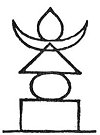
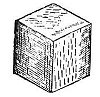
THE BELIEF THAT THE UNIVERSE is composed of five Great Elements is untraceably old. Even the savage knows very well four of these elements, Water, Air, Fire, and Earth, and has a vague sense of the fifth, Ether, or Space. From varying combinations of these five elemental substances, the ancients believed, all of the phenomena of Nature were formed. Earth itself was composed, in the last analysis, of these five. Man also, they believed, was a unique compound of these elements, and was, at death, resolved back into them. Each of these great "Creatures," as they were called, was symbolised by a certain shape, and the total figure of the five different forms, superimposed on one another in a regular order, is the stupaof China and India, the sotobaor go-rinof Japan, the "Five-circle" or "Five-zone" or "Five-blossom" funeral stone to be found everywhere in the Orient. The cube represents the Earth or stable foundation on which all builds; the sphere represents water; the pyramid or triangular tongue, fire or the elements in motion; the crescent or inverted vault of the sky, air or wind; the acuminated sphere or body-pyri-form, ether tapering into Space.
FIGURE I. <i>The Stupa</i>. (From <i>Foe koue ki</i>, by Fa-heen.)
FIGURE I. The Stupa. (From Foe koue ki, by Fa-heen.)Of course the old philosophers assigned particular places or grades to these five elements. Plato gave the first place to fire, the second to ether, then followed air, water, and lastly Earth. But Aristotle placed ether first, "as that which is impassable, it being a kind of fifth body," and after it he placed those elements "that are passable," in the order of fire, air, water, and Earth.

Sit down with pencil and paper, or, as the first mathematicians did, sit down on the sea shore and draw with a shell on the sands the simple or the complex geometrical figures, whatever you will. It will be a rather remarkable accident if you happen to put down a single figure that his not at some time represented either the figure of Earth directly, or a direct relation of the Earth to the universe.
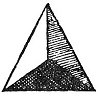
FIGURE 2. <i>The Tetrahedron</i>.
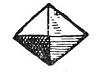
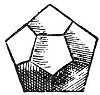
FIGURE 2. The Tetrahedron.Take the five regular solids, for instance: the tetrahedron, the octahedron, the icosahedron, the cube, and the dodecahedron. The Earth has been a tetrahedron, and it has been, many, many times, a cube. It has been conceived of as an eight-sided figure--one of the Siberian tribes believes to-day that the octahedron is the true figure of Earth. It was by way of the "five regular solids," "the five mathematical bodies," that Kepler, as we shall see later on, sought to solve the mystery of "distances" in the heavens.
FIGURE 3. <i>The Octahedron</i>.
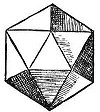
FIGURE 3. The Octahedron.Seeking for some fixed relation of distances between the six planets and the Sun, he found, or believed he found, that the five regular solids fitted between the six spheres in a very curious order, and he elaborated on the nature of these solids and their relation to our solar system all of his life. The "nature" of the tetrahedron was of fire. The nature of the octahedron was of "flying birds." The nature of the icosahedron was of water. The nature of the cube was of Earth, even though it fitted into place between Saturn and Jupiter, and the nature of the dodecahedron was that of the celestial vault, or ether.
FIGURE 4. <i>The Icosahedron</i>.
FIGURE 4. The Icosahedron.

FIGURE 5. <i>The Cube</i>.
FIGURE 5. The Cube.

FIGURE 6. <i>The Dodecahedron</i>.
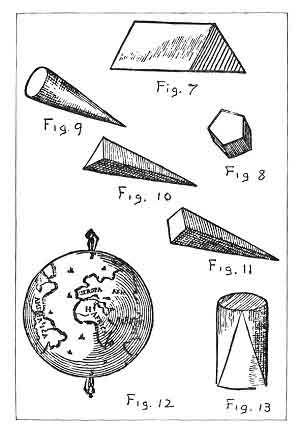
FIGURE 6. The Dodecahedron.Earth has been given, also, at one time or another and in one way or another, all of the pyramidal forms. It has been figured as a three-sided and as a four-sided pyramid, and likewise as a cone. It has been a cylinder, filled with compressed air and balanced in the centre of the universe. It has been, at one time, a "rygge forme,"--"a three-cornered forme," says Recorde's The Castle of Knowledge(1556), "like the rygge of an house where one syde lyeth flatte, and the other two leane a slope. And thys forme they judged better for twoo causes. Firste they thought that it was more steddy than a cube forme, because it hath a broader foote, and a lesser toppe; and secondly for that they thought it a more apte forme to walke on and more agreeable to the nature of the earthe, where sometimes there risyth highe hill, and sometimes again men may see greate vales descendyng. . . . Againe they thinke this Rygge forme meetest for the standing of the sea and for the running of rivers, for in the first forme [a cube] if the sea should rest on the outermost plaine, then wolde it over runne all that plaine, and so flow over all the earthe; where as in this seconde forme it mighter reste about the foote of the earthe, and yet the slope risyng wyll not permit it to over run all the earthe. And so for rivers if there is no slopenes (as in a cube there is none) then cannot the rivers runne well."

Figures 7 through 13

FIGURE 7. A "rygge forme" or three-sided tablet.

FIGURE 8. Five-sided tablet.

FIGURE 11. Four-sided pyramid.

FIGURE 9. Cone.

FIGURE 12. Sphere.

FIGURE 10. Three-sided pyramid.

FIGURE 13. Cylinder.

Already in these dozen geometrical figures we have collected two groups, one of which, the five regular solids, has been noted. The other one is that group from which all the known crystalline mineral forms--except radium and helium--can be constructed--"the eight basic elemental geometrical magnitudes," with eight definite bounding surfaces that compose a perfect series.

The first is the sphere with its one and only surface.

The second is the cone with its two surfaces.

The third is the cylinder with its three surfaces.

The fourth is the tetrahedron with its four surfaces.

The fifth is the three-sided tablet with its five surfaces.

The sixth is the cube with its six surfaces.

The seventh is the five-sided tablet with its seven surfaces.

The eighth is the octahedron with its eight surfaces.

And then again the Earth has been represented by a figure quite outside the angular figures. The sphere, for instance, as a figure of Earth, appears to be as old as any of the others, and, like all the others, has undergone the test of recurrence. But an even more curious form has been ascribed to this still mysterious planet of ours--a spiral. The beginning, or the end, that is, of a spiral form, like the vine, or like a watch-spring, which, stretched, or sprung, may reach from Earth to Heaven, along which all that lives in the universe may descend and ascend--a sort of Jacob's ladder without rungs. Before man had the watch-spring, his own creation, he had before him the vine--Nature's handiwork, and he used it to symbolise that for which he was always seeking, the connecting link, the path of communication between Earth and Heaven.

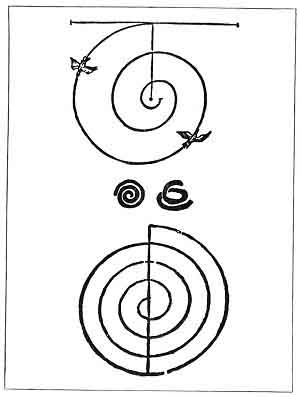
FIGURE 14. <i>Spiral forms</i>.
FIGURE 14. Spiral forms.
Of the spiral forms given in Fig. 14 the two small ones in the centre are modern drawings of radium and helium atoms, but their duplicates are to be found in the oldest, crudest pictographs of the cosmos--man's attempt to represent by a line either Earth's creative power and strength and energy, or the mysterious, potent force of Nature itself. The lower spiral is the ordinary right-handed (or dextral) curve found everywhere in Nature. The upper left-handed (or sinistral) spiral with its flying birds in opposition is a curious little drawing taken from Physiologia Kircheriana Experimentalis(1680), perhaps suggested by Leonardo da Vinci's Notebook on "The Flight of Birds," written nearly two centuries earlier, while he was making his marvellous studies of spiral formations.

For the great struggle of one element against another, suggested in this sinistral spiral, was itself to Leonardo the very secret of the mysterious force which shapes the structure of waves, of reeds, of animals, of man, of shells and horns and flowers and climbing vines. The force itself he could not define, but its movement he could trace; and its path was not a line or a closed circle but a spiral "twist," which might take the right-handed or the rarer left-handed way. There came to him what might be called a revelation of spirality; and he found the coil of a worm, the curve of the humblest shell, the wreathing smoke of a candle, the tiny whirl of street dust, the budding of a fern or a cyclamen, of an onion or a rose, just as significant as the spiral-like flight of birds or the spiral formations of water. But thousands of years before him, ancient temples and tombs and sacred rocks had been engraved with significant "studies" in spiral forms--many of those of the Eastern world based beyond all doubt on the struggle of the lotus with the elements and on the analogy of the lotus to the Earth--even to the cosmos itself. The ancient Stupa(Fig. 1 ) was not only a symbol of the five great elements, but it was also, for the Orient, an almost literal drawing of the lotus plant, rooted in Earth, climbing through water, by grace of its inner fire, to air, lifting there its acuminated spherical bud, and blossoming with a spiral twist into Space. To the ancient mind the secret path of Nature's immortal force was always most significantly symbolised by a spiral line, and it was suggested in a thousand ways.

FIGURE 15. ''<i>Halfe a Sphaere</i>.''FIGURE 15. ''Halfe a Sphaere.''

FIGURE 16. ''<i>Hollow lyke a bone</i>.''FIGURE 16. ''Hollow lyke a bone.''
A sphere or a hemisphere may be a solid body, or it may be merely a shell--and Earth has been again many times imagined as a half shell, swimming like an upturned basket or boat, on the surface of limitless waters, not sinking because its concavity was filled with air which, pressing on the water, balanced the hollow shell. Or, again, Earth has been, and is still to-day believed by some to be, "a playne Flatte." "They fantasied," wrote old Recorde, "that it wold reste most steddily, and so it was very easy to walke on. We are," he adds, "more beholdynge to those men, for devising our easy walkynge, than we are bound to them for their wise doctrine. The fourthe secte, fearyng least by this opinion they should loose the sea and all other waters, imagined the forme of the earthe more apte to hold water, and devised it hollow lyke a bolle."
FIGURE 17. ''<i>A playne Flatte</i>.''
FIGURE 17. ''A playne Flatte.''It was always a problem for the early designers of the figure of Earth to account for the support of the heavens, and this idea of the habitable Earth "hollow lyke a bolle," was much more clearly and generally expressed by figurmg the Earth as a flat disc or plain surrounded by a continuous mountain wall on which the heavens rested. Only fourteen hundred years ago, with the theory of the spherical Earth the prevailing scientific one, but with all its vexing by-problems unsolved--not only that of an un-supported sky, but of men forced to walk like flies on the opposite ceiling of the Earth, one cosmogonist, Cosmas Indicopleustes, disposed of the whole matter by simply enclosing the entire visible universe in a hollow rectangular box and shutting down the lid. Man lived inside his box, like a squirrel in a cage.
FIGURE 18. ''<i>Square like a box</i>.''
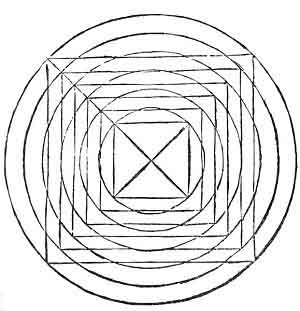
FIGURE 18. ''Square like a box.''The Cosmasian idea was a simpler scheme of world-making than the model offered in Fig. 19 , but it happens that this simple geometric figure is very similar to the Babylonian conception of the universe--Earth as a series of "stages" or steps, pyramidal in structure, enclosed within a series of concentric spheres. For the idea that Heaven is round and that Earth is square is very old, as old perhaps as the square and the circle--the foundation of measure. "Heaven is round like an opened umbrella," say the Chinese; "Earth is square like a chessboard." Or, "Earth is square like a box; heaven is round like the awning of a carriage."

FIGURE 19. <i>Squares, or ''stages,'' within circles</i>.
FIGURE 19. Squares, or ''stages,'' within circles.Yet on what, if the Earth is square, may the dome of Heaven rest, not only that it may have firm support, but also that it may be tightly joined to the Earth? For the ancients greatly feared that Heaven, illy supported, might collapse and destroy its foundation; they feared also that, if Heaven and Earth were not hermetically cemented or glued together, untold horrors might creep into this universe from some fabulous "outside." For instance, the circular edge of the heavenly dome might find support firm enough by resting on the four quarters of the square Earth, in spite of the intervening arcs of water it must span. But there would be the open quarters; and un-known and unimaginable monsters might succeed in swimming through the depths of water under Heaven's unguarded edge, and so insinuate themselves into the Earth-waters, with the very probable result of the destruction of the world. Therefore, said some, Heaven's edge might very well begin as a square joined tightly to the Earth-square, and then melt insensibly into the rounded firmament. But, said others, Heaven is immeasurably high, Earth immeasurably deep; each covers the other, and both fit tightly together. Whether square or round, both must be one or the other.
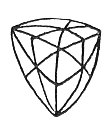
FIGURE 20. <i>The six-faced tetrahedron</i>.<br> (From <i>Vestiges of the Molten Globe</i>; William Lowthian Green, 1875, Plate I.)
FIGURE 20. The six-faced tetrahedron.
(From Vestiges of the Molten Globe; William Lowthian Green, 1875, Plate I.)A "six-faced tetrahedron," a solid giving the maximum of surface for the minimum of volume, represents, according to one theory, the figure of Earth. This particular theory--a theory, by the way, of the latter nineteenth century--would seem to argue for the existence of an "economical" universe, with the Earth modelled on a plan designed to produce the greatest possible surface from the least possible substance.

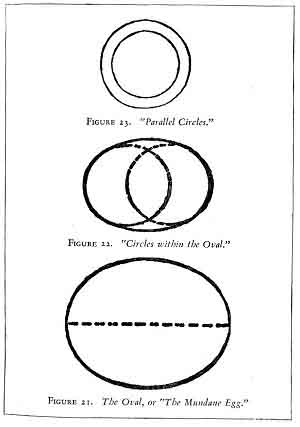
Figures 21 through 23
FIGURE 23. "Parallel Circles."
FIGURE 22. "Circles within the Oval."
FIGURE 21. The Oval, or "The Mundane Egg."

And Earth is also the Mundane Egg, or an Oval form.

"There is another thing in Antiquity," wrote Thomas Burnet in his The Theory of the Earth(1697), "relating to the form and construction of the Earth, which is very remarkable, and hath obtained throughout all learned Nations and Ages. And that is the comparison or resemblence of the Earth to an Egg. . . this notion of the Mundane Egg, or that the World was Oviform, hath been the sence and Language of all Antiquity, Latins, Greeks, Persians, Egyptians, and others."
FIGURE 24.
FIGURE 24.Burnet did not overstate his case, for this was his theory also. The concept of the Earth as the Mundane Egg or of the universe as the Cosmic Egg is one of the ancient of ancient figures of Earth. It appears everywhere, in the mythologies, cosmogonies, traditions, and folklore of all races and of all times. Heaven encloses the Earth from without as the shell encloses the yolk. Or the Earth's
FIGURE 25. ''<i>Convex, concave</i>.''
FIGURE 25. ''Convex, concave.''crust is the shell of the Mundane Egg; Burnet's whole theory of the Earth was built on this idea. There is no end to the analogy between the egg and the universe, or to the concept of the Earth as the Egg of the World.
FIGURE 26. ''<i>Right, Crooked, Mixt</i>.''
FIGURE 26. ''Right, Crooked, Mixt.''These are some of the geometrical figures by which the Earth and the universe have been represented. But "shapes" also have been used to describe it. Shapes are irregular things compared with geometrical figures, but they may be accurate nevertheless. "Pear-shaped," for instance, is for descriptive purposes just as exact as "triangular" or "round." And so the Earth has been described and drawn, not only as "pear-shaped," but as "boat-shaped," as "heart-shaped," as "egg-shaped," as "tomato-shaped," as "turnip-shaped," "gourd-shaped," "onion-shaped," "lotus-shaped," "rose-shaped." It has been--many times--a tree; a great island-leaf with roots; a flower; a mountain; an octave in the cosmic series, or a note in the cosmic scale; or the living body of the "God of Heaven," the "Universal Man," spanning the space between the highest heaven and the lowest Earth.

And for the last few hundred years it has been an "oblate spheroid."

But ask science to-day, What is the figure of Earth? and science will reply not with the geometrical figure of an oblate spheroid, nor with any definite "shape" drawn for the eye to see, but with a word:

Earth is a geoid.

Ask, What is a geoid? and science will reply:

An Earth-shaped body.

Ask, What is an Earth-shaped body? and science will answer:

A geoid. A shape, that is, expressed by a word, but not yet by an image. The mysterious figure of the Earth, the shape peculiar to itself, has not yet been determined, with all of man's questionings and guesses.


Man's Quest in Space

THE BOOK OF EARTHS

By

EDNA KENTON

New York: William Morrow & Company

[1928, No renewal]


 boe05

THE BOOK OF EARTHS

Man's Quest in Space

THIS BOOK OF EARTHS began years ago, with a single little figure of Earth taken from what old book I do not know. For a long time it lay by itself; then another, come upon by chance, was laid beside it; and still others as I happened on them, always by chance. Old odd maps joined the casual collection--maps of the Earth, the Moon, the heavens. It was never a collection in the usual sense of the word, because it was so casual; but, such as it was, it is the origin of this book. For it occurred to me, not long ago, that it would be "fun" to put them all together, and many others with them, chosen to fill in the gaps of the original group.

Luckily for the fun of it, the search about to begin would not be limited to what we know about the Earth, else it would have ended before it began; for we live in a universe of which we know little, and on a planet of which we know perhaps less. It would include not only what we know, or think to-day we know, but also any-thing that has been believed or felt or no more than "guessed" to be the picture of the Earth and its place in the universe. It would include not only science, modern and ancient, but tradition, the older the better; diagrams or pictures based on little more than folk-lore; cosmogonies of religions great and small; cosmogonies of philosophers, of poets, and of savages. It would gather together pictured theories, guesses, hypotheses, or merely flights of pure imagination, whether "true" or "false" to-day; since history teaches us nothing if it does not teach us that one century's false doctrine is another century's truth, and that the mistakes of any age or race are quite as illuminating as any "truth" by which it lived.

This collection of pictures, therefore, would not be "scientific," not "selected" to Evidence one thing or to disEvidence another, not prejudged by any standard but that of a record told in pictures and diagrams of what man has guessed this Earth to be ever since he first began to wonder what the figure of the body was on which he lived. It would be free play through sources, once those sources were discovered; play unhampered by any necessity for judgment or criticism, since what was sought was the record only.

And so the search began, and the story of the search is personally as interesting as what it uncovered. It would be endless--that was clear from the beginning, and so it must be made deliberately brief. It could not include everything, even if "everything" came promptly to the surface. But there were high lights in the record, and these began to show dimly from the first. The rest was a matter of blazing an unpathed trail that would lead to the goal--the record; but that must allow for twists and turns, by-paths, now and then blind alleys in which often, as it Evidenced, lurked the "tip" that had been lacking when one turned into them.

More and more, as the search went on, and one figure of Earth was added to another, it seemed worth while to bring a large number of them together. Inevitably, in such a collection of man's attempts to draw the planet on which we live and its relations to the heavenly bodies by which it is surrounded, there would be surprising similitudes, identifications, recognitions, even a queer unity. There would be, too, in such a collection, enormous differences, opportunity for endless comparison and endless wondering over the figures imaged by those supremely courageous men, the questioners of Space.

They are the men--anywhere, at any time--who have looked up at the unanswering heavens, and asked, "What and whence and why are those lights in the sky?" who have looked down at the unanswering Earth, and asked, "What is this land that forever gives everything--even to me my life, and forever takes everything--even from me my life? What are these waters around it that sustain its life and mine? this fire within it that pours through its mountain tops and heats its boiling springs, whose spark lies still within the rock and wood from which my father's fathers first struck out their own first fire? What is this air I breathe that is around the Earth and within it, in its secret caves? What is Earth? And what am I?"

They are the men who have questioned not idly but unceasingly; knowing all the while that to the tiny questioner below there is no great Answerer above; that any answer to the questions born of the speck in space that is man, must be born in its turn of just his questions; nothing more--but nothing less. There is no equipment for this lonely quest; there is only man the questioner and the universe--the Great Question; the answer lies within man himself. If ever we once realise this, we can never call them anything but supreme adventurers--those men curious enough to wonder enough to question enough to guess at last boldly enough to say, "Perhaps it is like this," and set down the image, even though it is no more than a small triangular peak of land rising from a watery waste, with the arch of the heavens above it, and between it and heaven the Sun and Moon and stars.

For guesswork is the beginning and the end of knowledge--man's own answers to his own questions. They may be right or wrong, but they are his. To-day we give scientific "guesses" a statelier title; we call them hypotheses; they are nothing more than guesses shot into still un-answering Space. The "hypothesis," for instance, that the Earth is an island, plain, mountain, or whatever, was first advanced when the first man of the first race drew the first figure of Earth. The "guess"--only that--that the figure of Earth is an oblate spheroid is of our own era. Our hypotheses are continually changing; one supplants another, and is in its turn discarded for a new--or an old--one; and this has been the history of knowledge ever since that remote and notable day when the first brain, by sheer pressure of questioning, focused in a point that exploded into a "guess." It is the process of induced thinking that has carried man on; the heavens and the Earth have continued to revolve whether his answers are right or wrong.

Man could not equip himself for this quest in Space. But he had been equipped, after a fashion. He had a few resources, a few means.

First of all, long before science told him that he had within his body vestiges of all the life-strata of the world, he had a vague knowledge that he is an integral part of the universe. And, because he is a part of the universe, he had a vague knowledge of truth, or of segments of truth. He had numbers, he had signs, he had characters, he had symbols, all of these drawn in the heavens before he drew them on Earth. He had words. He had the capacity to be curious, the capacity to wonder, the capacity to draw analogies between seemingly unrelated things. From this scant handful of means, his faculty for guesswork developed. This is the whole story of all his perceptions of the universe and of his planet. For he has continuously dared the great adventure, and has returned sometimes with pure gold.
 boe05


Illustrations

THE BOOK OF EARTHS

By

EDNA KENTON

New York: William Morrow & Company

[1928, No renewal]


ILLUSTRATIONS

PLATES

Plate


Facing page

I

Stages of Creation. From Haggadah von Sarajevo. Fourteenth century.

32

II

Sustainers of the Earth.


A. Quetzalcoatl Upholding the Heavens. From an original Mexican painting preserved in the Imperial Library at Vienna. Reproduced from Kingsborough's Antiquities of Mexico, Vol. II, 1831.


B. Atlas Upholding the Earth. From Engravings after Stothard; a collection in the New York Public Library.


C. A Hindu Earth. From Flammarion's Astronomical Myths. 1877.

38

III

Atlas Supporting the Universe. From Margarita philosophica. 1517.

42

IV

A very clear demonstration of the three kinds of vision in the Microcosm (or soul of Man), of the location of their objects, and of the manner of discerning them. From Fludd's Microcosmi Historia. 1619.

46

V

Another demonstration showing how the soul rises in a spiral ascent from the sensible things of the world to Unity. From Fludd's Microcosmi Historia. 1619.

50

VI

The Primordial Earth and Sea. From Muenster's Cosmographia Universalis. 1559.

54

VII

A. A kufa laden with stones and manned by a crew of four men. Drawn by Faucher-Gudin from a bas-relief at Koyunjik. From Maspero's The Dawn of Civilization. 1894.

58


B. Construction of the Akkadian, Chaldean and Babylonian Universe. From Myer's Qabbalah. 1888.

58

VIII

The Babylonian Universe. From Warren's The Universe as Pictured in Milton's Paradise Lost. 1915.

62

IX

The Sky Goddess Nut Bending over the Earth. From the Sarcophagus of Uresh-Nofer, Priest of the Goddess Mut(XXXth dynasty, 378-341 B.C.). In the Metropolitan Museum of the City of New York.

64

X

A. The Heavenly Goose. From Bryant's Ancient Mythology, Vol. II. 1774.

66


B. The Sky Goddess Nut represented double. From Lockyer's The Dawn of Astronomy. 1894.

66

XI

Omnia Per Ipsum Facta Sunt. From Merian's Bybel Printen. 1650.

70

XII

The Earth after the Earth-Moon Catastrophe. Drawn by George D. Swazey for Popular Astronomy, Aug.-Sept., 1907.

72

XIII

One of the oldest drawings of the Moon, by PerCapucin Marie de Rheita (1645). From Kircher's Iter exstaticum coeleste. 1660.

76

XIV

"And Again He Sent Forth the Dove Out of the Ark." From Burnet's The Theory of the Earth. 1697.

80

XV

Situation of the Island of Atlantis, according to the ideas of the ancient Egyptians and the description of Plato. From Kircher's Mundus Subterraneus. 1678.

82

XVI

The Subterranean Bridge. From Kircher's Mundus Subterraneus. 1678.

84

XVII

A Conjectural Geography of the Translation of the Earth after the Deluge. From Kircher's Arca No 1665.

88

XVIII

Yggdrasil, the World Tree of the Norsemen. After Finn Magnusen's "Eddalen." From Folkard's Plant Lore, Legends and Lyrics. 1884.

92

XIX

The WakWak Tree. From Tarikh al-Hind al-Gharbi. Constantinople. 1729.

104

XX

The World Tree of the Mayas. From Cogolludo's Historia de Yucathan. 1640.

110

XXI

Arber Sephirotheca. From Fludd's Utriusque Cosmi. Vol. II. 1621.

114

XXII

Dionysos in the Ship. A black-figured kylix by Exekias (6th cen. B.C.), in Munich (Furtwangler-Reichhold, Griechische Vasenmalerei, No. 42). From Mythology of All Races, Vol. I, Plate XLIX. 1916.

118

XXIII

"And God said, Let there be Light, and there was Light." From Fludd's Medicina Catholica. 1629.

120

XXIV

The Rose Tree of the Rosicrucians. From Fludd's Summum Bonum. 1629.

122

XXV

The Universe of the Lamas. From Waddell's The Buddhism of Tibet, or Lamaism. 1899.

128

XXVI

Creatio Universi. From Scheuchzer's Physica Sacra. Vol. I. 1731.

134

XXVII

The Wheel of Life. From Du Bose's Dragon, Image and Demon. 1887.

138

XXVIII

The Wheel of Life. From Waddell's The Buddhism of Tibet, or Lamaism. 1899.

142

XXIX

A. Deus Lunus.

152


B. Ophis et Ovum Mundanum. From Bryant's Ancient Mythology. Vol. II. 1774.

152


C. Earth as a floating Egg. From Flammarion's Astronomical Myths. 1877.

152

XXX

"A Divided Egg, or Earth." From Burnet's The Theory of the Earth. 1697.

154

XXXI

"The Whole Earth is an Egg." From Burnet's The Theory of the Earth. 1697.

156

XXXII

Frontispiece to "Almagestum Novum"; Ioannes Riccioli, 1561. From the original.

160

XXXIII

A World-Picture of the Aztecs. First page of the Codex Ferjvy-Mayer, representing the five regions of the world, and their tutelary deities. Reproduced from Mythology of All Races. Vol. XI, Plate VI. 1920.

190

XXXIV

The Osma Beatus World-Map, 1203. From Miller's Mappa Mundi: Die testen Weltkarten, Vol. I. 1895.

200

XXXV

The Earth of the Mystics--The Heart of God. From Pordage's Theologica Mystica, or The Archetypous Globe. 1683.

214

XXXVI

Map of the World, by Petrus Apianus, printed 1530. From the original in the British Museum. Reproduced from Nordenskid's Periplus, Plate XLIV. 1897.

Frontispiece

XXXVII

Nous pervaded by the Godhead embracing the Macrocosm with the Microcosm. From The Scientific Views and Visions of Saint Hildegard, by Charles Singer. In Studies in the History and Method of Science, edited by Charles Singer. Vol. I. 1917.

220

XXXVIII

IntegrNaturSpeculum Artisque imago. From Fludd's Utriusque Cosmi. Vol. I. 1621.

224

XXXIX

Kepler's diagram of "The Law connecting the relative distances of the planets." From Kepler's Harmonices Mundi. 1619.

228

XL

The Mundane Monochord. From Fludd's Utriusque Cosmi. Vol. I. 1621.

234

XLI

Man the World Octave. From Fludd's Utriusque Cosmi. Vol. I. 1621.

236

XLII

The Three World Octaves. From Fludd's Utriusque Cosmi. Vol. I. 1621.

238

XLIII

The Symmes Theory of Concentric Spheres. From the cover design of The Symmes Theory of Concentric Spheres, compiled by Americus Symmes. 1878.

240

XLIV

Gardner's Diagram of Symmes's Earth. From Gardner's A Journey to the Earth's Interior. 1920.

242

XLV

Chart of the Koreshan Cosmogony. From Teed's The Cellular Cosmogony. 1905.

246

XLVI

The Earth according to Gardner. From Gardner's A Journey to the Earth's Interior. 1920.

250

XLVII

Tetrahedral Collapse of the Earth's Crust in the Southern Hemisphere. From Green's Vestiges of the Molten Globe. 1875.

256

XLVIII

The Tetrahedral Earth. From the Sunday Magazine, New York. "World," Oct. 24, 1926.

260


Acknowledgements

THE BOOK OF EARTHS

By

EDNA KENTON

New York: William Morrow & Company

[1928, No renewal]


ACKNOWLEDGMENTS

WITHOUT THE ROUSED INTEREST and cordial co-operation of many people this collection of representations of the Earth and its relation to the Universe would have been impossible. For permission to use copyright material I am indebted to D. Appleton and Company, the Clarendon Press, the Cambridge University Press, Cassell & Co., Ltd., Gall and Inglis, the Guiding Star Publishing House, the Kosmon Press, Luzac & Co., Marshall Jones Company, Macmillan & Co., Ltd., Popular Astronomy, Frederick A. Stokes Company, Edward Stanford, Ltd., and the New York World; and also to Col. James Churchward, Dr. E. A. Wallis Budge, Dr. William Fairfield Warren, Mr. Marshall B. Gardner, Miss Mary Elizabeth Litchfield, Mrs. Richard Folkard, and Mrs. Daniel G. Brinton. For assistance in tracing material I owe thanks to various members of the staffs of the Metropolitan Museum, the Museum of the American Indian, Heye Foundation, the Museum of the Hispanic Society of America, the Museum of the University of Pennsylvania, the American Geographical Society, the Swedenborg Library of the Church of the New Jerusalem, Brooklyn, the New York Society Library, and the New York Public Library. In various translations I was aided by Dr. Arthur Livingston of Columbia University, and by an unknown member of the staff of the Biblioteca Nacional de Habana. Mr. Andrew Dasberg gave valuable suggestions in the choice and arrangement of various figures and plates. Special thanks are due Mrs. Mabel Reber without whose researches through numberless volumes this book would have lacked many of the representations it contains. Special thanks are also due many members of the staff of the New York Public Library in which most of these figures of Earth and the Universe were collected.

EDNA KENTON

September, 1928
New York


Contents

THE BOOK OF EARTHS

By

EDNA KENTON

New York: William Morrow & Company

[1928, No renewal]


CONTENTS

Man's Quest in Space,

1

Figures of Earth,

6

The Creation of the World,

22

Upholders of the World,

38

The Primal Earth,

51

The Babylonian Universe,

54

The Egyptian Universe,

63

The Earth Moon Catastrophe,

66

The Deluge,

77

The Lost Atlantis,

80

The Lost Land of the West,

83

Trees of the World,

89

Mountains of the World,

122

The Wheel of Life,

134

Earth the Mundane Egg,

145

Systems of the Universe,

160

The Square Earth of Cosmas Indicopleutes,

179

The Peruvian Universe,

185

The Aztec Universe,

189

Tartar-Mongol Worlds,

193

Maps of the Earth,

199

The Earth of Columbus,

208

Dante's Universe,

211

Earth the Heart of the Cosmos,

214

Saint Hildegard's Universe,

217

The Earths in the Universe,

226

Wheels upon Wheels,

228

The World Octaves,

234

Earth a Hollow Sphere,

238

The Tetrahedral Earth,

256

Bibliography,

263

Index,

269


The Book of Earths

THE BOOK OF EARTHS


boe00

By

EDNA KENTON

New York: William Morrow & Company

[1928, No renewal]

NOTICE
This text is posted for research purposes only, as this book is still under a formal copyright in the United States. If you are the copyright holder and wish it to be removed please contact this site and we will comply promptly. Do not reproduce this material commercially.


PLATE XXXVI. Map of the World, by Petrus Apianus. printed 1530. From the original in the British Museum. (From Periplus; A. E. Nordenskid, 1897, Plate XLIV)PLATE XXXVI. Map of the World, by Petrus Apianus. printed 1530. From the original in the British Museum. (From Periplus; A. E. Nordenskid, 1897, Plate XLIV)


Subscribe to this RSS feed

Log in or create an account