log in
From Goddess to King

From Goddess to King (30)

FROM GODDESS TO KING

A History of Ancient Europe from the

OERA LINDA BOOK

By Anthony Radford

1997 Ojai, California

With thanks to Anthony Radford for his permission to publish his book

©1997 Anthony Radford, all rights reserved.


From Goddess to King, Chapter 13, FRANA AND THE LOSS OF DENMARK

FROM GODDESS TO KING

A History of Ancient Europe from the

OERA LINDA BOOK

By Anthony Radford

CHAPTER 13

FRANA AND THE LOSS OF DENMARK

TheBook continues after nearly six hundred years of unrecorded history with the story of Frana. Frana was the Earth Mother at Texland in 591 BC (1602 - 2193 = -591). At the time of this recording, she was considered the last Mother but as we read on, we find the story of another one, two and a half centuries later. The Magy (a title not a name), leader of the Finns, apparently conquered Denmark after failing in his efforts at the time of Wodin. In the interim of fourteen hundred years of unrecorded history, Denmark was probably invaded several times so we can only guess the details.

Again, the loss is blamed on disregarding Fryas council as the Frisians over time had traded away their iron weapons for gold; and thereby, according to their history, so undermined their morals that defeat would be inevitable. This process took a hundred years. With todays rapid tempo in all aspects of our culture it is hard for us to understand a society that assessed its temperament over thousands of years. Prior to the loss of Atland they didnt even count the years "because one was like another," however the sinking was such a profound event that it dated the calendar for the next two thousand years. There has been so little of that age coming down to us in writing and yet it has been the major source of our Western mythology.

First we are given a sermon about why they lost Denmark, then we are told the details of how the Magy took that peninsula. He next attacked Texland, captured and killed Frana, the Earth Mother. He tried to bribe her into recognizing himself as the lawful king over all the country but was denied an opportunity to coerce her into any concessions. He had captured the sacred lamp of the capital city and all its surviving maidens, but this did not permit him to become the overlord in succession to Frana. The passage ends as many others do with "Watch, watch, watch"; be vigilant, be vigilant.

This is Inscribed in all of our Citadels, How our Denmark was lost to us 1,602 years after the submersion of Atland:

Through the mad wantonness of Wodin, Magy had become master of the east part of Scandinavia. They dare not come over the hills and over the sea. The Mother would not prevent it. She said, "I see no danger in their weapons, but much in taking the Scandinavians back again, because they are so degenerate and spoiled".

The general assembly were of the same opinion. Therefore it was left to them. A good hundred years ago Denmark began to trade; they gave their iron weapons in exchange for gold ornaments, as well as for copper and iron-ore. The Mother sent messengers to advise them to have nothing to do with this trade. There was danger to their morals in it, and if they lost their morals they would soon lose their liberty. But the Denmarkers paid no attention to her. They did not believe that they could lose their morals, therefore they would not listen to her. At last they were at a loss themselves for weapons and necessaries, and this difficulty was their punishment. Their bodies were brilliantly adorned, but their cupboards and their sheds were empty.

Just one hundred years after the first ship with provisions sailed from the coast, poverty and want made their appearance, hunger spread her wings all over the country, dissension marched proudly about the streets and into the houses, charity found no place, and unity departed. The child asked its mother for food; she had no food to give, only jewels. The women applied to the counts; the counts had nothing to give, or if they had, they hid it away. Now the jewels must be sold, but while the sailors were away for that purpose, the frost came and laid a plank upon the sea and the strait. When the frost had made the bridge, vigilance ceased in the land, and treachery took its place. Instead of watching on the shores, they put their horses in their sledges and drove off to Scandinavia. Then the Scandinavians, who hungered after the land of their forefathers, came to Denmark. One bright night they all came. "Now", they said, "we have a right to the land of our fathers; and while they were fighting about it, the Finns came to the defenseless villages and ran away with the children. As they had no weapons, they lost the battle, and with it their freedom, and Magy became master."

All this was the consequence of their not reading Fryas Tex, and neglecting her counsels. There are some who think that they were betrayed by the counts, and that the maidens had long suspected it; but if any one attempted to speak about it, his mouth was shut up by golden chains.

We can express no opinion about it, we can only say to you, "Do not trust too much to the wisdom of your princes or of your maidens but if you wish to keep things straight, everybody must watch over his own passions, as well as the general welfare."

Two years afterwards Magy himself came with a fleet of light boats to steal the lamp from the Mother of Texland. This wicked deed he accomplished one stormy night, while the wind roared and the hail rattled against the windows. The watchman on the tower hearing the noise, lighted his torch. As soon as the light from the tower fell upon the bastion, he saw that already armed men had gotten over the wall.

He immediately gave the alarm, but it was too late. Before the guard was ready, there were two thousand people battering the gate. The struggle did not last long. As the guard had not kept a good watch, they were overwhelmed. While the fight was going on, a rascally Finn stole into the chamber of the Mother, and would have done her violence. She resisted him, and threw him down against the wall. When he got up, he ran his sword through her: "If you will not have me, you shall have my sword."

A Danish soldier came behind him and cleaved his head in two. There came from it a stream of black blood and a wreath of blue flame.

The Magy had the Mother nursed on his own ship. As soon as she was well enough to speak clearly, the Magy told her that she must sail with him, but that she should keep her lamp and her maidens, and should hold a station higher than she had ever done before. Moreover, he said that he should ask her, in presence of all his chief men, if he would become the ruler of all the country and people of Frya; that she must declare and affirm this, or he would let her die a painful death.

Then, when he had gathered all his chiefs around her bed, he asked, in a loud voice, "Frana, since you are a prophet, shall I become ruler over all the lands and people of Frya?"

Frana did as if she took no notice of him; but at last she opened her lips, and said: "My eyes are dim, but the other light dawns upon my soul. Yes, I see it. Hear Irtha, and rejoice with me. At the time of the submersion of Atland, the first spoke of the Jule stood at the top. After that it went down, and our freedom with it. When two spokes, or two thousand years, shall have rolled down, the sons shall arise who have been bred of the fornication of the princes and priests with the people, and shall witness against their fathers. They shall all fall by murder, but what they have proclaimed shall endure, and shall bear fruit in the bosoms of able men, like good seed which is laid in thy lap. Yet a thousand years shall the spoke descend, and sink deeper in darkness, and in the blood shed over you by the wickedness of the princes and priests. After that, the dawn shall begin to glow. When they perceive this, the false princes and priests will strive and wrestle against freedom; but freedom, love, and unity will take the people under their protection, and rise out of the vile pool. The light which at first only glimmered shall gradually become a flame. The blood of the bad shall flow over your surface, but you must not absorb it. At last the poisoned animals shall eat it, and die of it. All the stories that have been written in praise of the princes and priests shall be committed to the flames. Thenceforth your children shall live in peace."

When she had finished speaking she sank down. The Magy, who had not understood her, shrieked out, "I have asked you if I should become master of all the lands and people of Frya, and now you have been speaking to another."

Frana raised herself up, stared at him, and said, "Before seven days have passed your soul shall haunt the tombs with the night birds, and your body shall be at the bottom of the sea."

"Very good," said the Magy, swelling with rage; "say that I am coming." Then he said to his executioners, "Throw this woman overboard."

This was the end of the last of the mothers. We do not ask for revenge. Time will provide that; but a thousand, thousand times we will call with Frya, Watch! watch! watch!

The Magy then sought to install another maiden in the position of Earth Mother. Politics in those days was little different from today where a symbol of legitimacy is needed to get ones way over others. He still needed the Mother but was defeated by the flaming arrows of the defending seamen. He was killed together with most of the Finns when his Danish sailors remembered their own heritage.

A reference is made to the great fleet being away at the time and to Jon, the sea-king at that time, obviously a namesake for the Jon of a thousand years earlier. The Joniers are still known to them and become very important at the time of the last Earth Mother.

How It Fared Afterwards With the Magy:

After the murder of the Mother, he brought the lamp and the maidens into his own ship, together with all the booty that he chose. Afterwards he went up the Flymeer because he wished to take the Maiden of Medesblik or Stavern and install her as Mother; but there they were on their guard. The seafaring men of Stavern and Alderga would gladly have gone to Jon, but the great fleet was out on a distant voyage; so they proceeded in their small fleet to Medesblik, and kept themselves concealed in a sheltered place behind trees.

The Magy approached Medesblik in broad daylight; nevertheless, his men boldly stormed the citadel. But as they landed from the boats, our people sallied forth from the creek, and shot their arrows with balls of burning turpentine upon the fleet. They were so well aimed that many of the ships were instantly set on fire. Those left to guard the ships shot at us, but they could not reach us. When at last a burning ship drifted towards the ship of the Magy, he ordered the man at the helm to sheer off, but this man was the Dane who had cleft the head of the Finn.

He said, "You sent our Earth Mother to the bottom of the sea to say that you were coming; In the bustle of the fight you might forget it; now I will take care that you keep your word."

The Magy tried to push him off, but the sailor, a real Frisian and strong as an ox, clutched his head with both hands, and pitched him into the surging billows. Then he hoisted up his brown shield and sailed straight to our fleet. Thus the maidens came unhurt to us; but the lamp was extinguished, and no one knew how that had happened.

When those on the uninjured ships heard that the Magy was drowned, they sailed away, because their crews were Danes. When the fleet was far enough off, our sailors turned and shot their burning arrows at the Finns. When the Finns saw that, and found that they were betrayed, they fell into confusion and lost all discipline and order. At this moment the garrison sallied forth from the citadel. Those who resisted were killed, and those who fled found their death in the marshes of the Krylinger wood.

From Goddess to King, Chapter 12, TALES OF HOMER

FROM GODDESS TO KING

A History of Ancient Europe from the

OERA LINDA BOOK

By Anthony Radford

CHAPTER 12

TALES OF HOMER

radford-chapter-12 Odyseus tied to the mast, defies the lure of the Sirens

Thetwo best known epic poems of ancient Greece are the Iliad and the Odyssey. It is presumed that they were written or at least recorded by Homer, an eighth century BC blind Ionian poet. There is a difference in the writing styles but that could be because of the long oral tradition that preceded the recording of these tales. Their chief value has been the poetic inspiration to Western literature having being translated and quoted innumerable times. Since Heinrich Schlieman discovered the site of Troy and Arthur Evans excavated Knossos on Crete, legends, which are recorded myths, have been taken more seriously.

The Iliad is regarded as the first example of Hellenic unity. The story concerns the wrath of Achilles who had been slighted by Agamemnon, the commander in chief of the Greek army that invaded Troy in Asia Minor. Ulysses is the King of the contingent from Ithaca during the ten year Trojan War.

The Odyssey is the story of the difficulties that Ulysses encounters on his return voyage to his home in Ithaca, a series of adventures that took an additional ten years. The beginning of the return voyage has been traced on maps and duplicated by several modern sailing craft through islands of north Africa, possibly Malta and back to Ithaca or actually a neighboring island, more likely to have been his ancient home. There is still the unknown nine years of the tale in which Ulysses is supposed to have been on the island of Ogygia and under the enchantment of the priestess Calypso. According to Homer he escaped from her charms but was shipwrecked being the sole, naked survivor. Ogygia was known as a name for Egypt in Byzantium times but in more ancient times could have been the name for Pharos Island. This island near Alexandria was a large and important port of the "Peoples of the Sea" according to ancient Egyptian recordings but that tiny, largely man-made island hardly fits the story of Homer.

In our ancient account Odysseus, or Ulysses as they knew him, is mentioned but a different view of this famous hero of old is given. Some light is shed on that missing nine years and even the Trojan War can be dated. Elsewhere, the Book makes mention of survivors from Troy (Etruscans) settling in Italy and founding the city of Rome, that fact being a known but not proven tradition.

Trade between the Rhine and the Mediterranean must have been an annual event with Frisian and Phoenician ships accounting for most of the traffic. Here we read how Greek ships, which probably included Italian, Cretan and Ionian vessels as well, had not arrived in the port where "all men" could trade for twelve years. Could this have been because of the Trojan War? We also notice some spelling changes in the proper names. Old Frisian was becoming Germanized.

Again we have a reference to Italians where they plainly meant Greeks. The year is 1188 BC (1005 - 2193 = -1188) and we are introduced to their version of the story of Ulysses. This odyssey shows the adventurer trying to get a sacred lamp from the Earth Mother in order to fulfill a prophecy that he would become king of Greece. Failing that he moved to the Frisian Island of Walhallagara (modern Walcheren) and was indeed enchanted by Kalip, the maiden there, even if her lip did jut out like a ships prow. After years he gets a lamp but loses it in a shipwreck, being the sole naked survivor. The real life story is not as glamorous as Homers tale but a good story always improves in the telling.

In the Year One Thousand and Five After Atland was Submerged this was Inscribed on the Eastern Wall of Fryasburgt:

After twelve years had elapsed without our seeing any Italians in Almanland, there came three ships, finer than any that we possessed or had ever seen.

On the largest of them was a king of the Jonischen Islands, whose name was Ulysses, the fame of whose wisdom was great. To him a priestess had prophesied that he should become the king of all Italy provided he could obtain a lamp that had been lighted at the lamp in Texland. For this purpose he had brought great treasures with him, above all jewels for women more beautiful than had ever been seen before. They were from Troy, a town that the Greeks had taken. All these treasures he offered to the mother, but the mother would have nothing to do with him.

At last, when he found that there was nothing to be obtained from her, he went to Walhallagara. There was established a burgtmaid whose name was Kaat, but who was commonly called Kalip, because her lower lip stuck out like a masthead. Here he tarried for years, to the scandal of all that knew it. According to the report of the maidens, he obtained a lamp from her; but it did him no good, because when he got to sea his ship was lost, and he was taken up naked and destitute by another ship.

Ulysses had a shipmate who related the following account of what happened to Athens after the Geertmen left. The Egyptian Cecrops continued to rule with high respect for Frisian customs but that attitude did not outlast him.

This tale is typical of the theme of the Oera Linda Book; the loss of Fryas ways and their replacement with what they termed was Findas selfish extravagance. We have had Puritanism and in our own time, even Communism, both trying to limit extravagance and promote the sharing of resources for the common good but unfortunately we witness them succumbing to the natural greed or selfish survival instincts of human nature. It was no different then. It is simply a persistent fact that inhabitants of colder climates have had to cooperate to survive while those of more temperate climes have had the leisure to be able to express themselves in colorful arts and activities that were regarded as sinful by the northerners such as clothes that could become a decoration, not just a necessity for keeping warm.

There was left behind this king (Ulysses) a writer of pure Fryas blood, born in the new harbor of Athens, who wrote for us what follows about Athens, from which may be seen how truly the Mother Hellicht spoke when she said that the customs of Frya could never take firm hold in Athens.

From the other Greeks you will have heard a great deal of bad about Cecrops, because he was not in good repute; but I dare affirm that he was an enlightened man, very renowned both among the inhabitants and among us, for he was against oppression, unlike the other priests, and was virtuous, and knew how to value the wisdom of distant nations. Knowing that, he permitted us to live according to our own Asegaboek. There was story current that he was favorable to us because he was the son of a Frisian girl and an Egyptian priest: the reason of this was that he had blue eyes, and that many of our girls had been stolen and sold to Egypt, but he never confirmed this. However it may have been, certain it is that he showed us more friendship than all the other priests together.

When he died, his successors soon began to tear up our charters, and gradually to enact so many unsuitable statues that at long last nothing remained of liberty but the shadow and the name. Besides, they would not allow the laws to be written so that the knowledge of them was hidden from us. Formerly all the cases in Athens were pleaded in our language, but afterwards in both languages, and at last in the native tongue only. At first the men of Athens only married women of our own race, but the young men as they grew up with the girls of the country took them to wife. The bastard children of this connection were the most handsome and cleverest in the world; but they were likewise the wickedest, wavering between the two parties, paying no regard to laws or customs except where they suited their own interests.

As long as a ray of Fryas spirit existed, all the building materials were for common use, and no one might build a house larger or better than his neighbors; but when some degenerate townspeople got rich by sea-voyages and by the silver that their slaves got in the silver countries, they went to live out on the hills or in the valleys. There, behind high enclosures of trees or walls, they built palaces with costly furniture, and in order to remain in good order with the nasty priests, they placed there likenesses of false gods and unchaste statues.

Sometimes the dirty priests and princes wished for the boys rather than the girls, and often led them astray from the paths of virtue by rich presents or by force. Because riches were more valued by this lost and degenerate race than virtue or honor, one sometimes saw boys dressed in splendid flowing robes, to the disgrace of their parents and maidens, and to the shame of their own sex. If our simple parents came to a general assembly at Athens and made complaints, a cry was raised, Hear, hear! there is a sea-monster going to speak. Such is Athens become, like a morass in a tropical country full of leeches, toads, and poisonous snakes, in which no man of decent habits can set his foot.

From Goddess to King, Chapter 11, THE SETTLEMENT OF THE PUNJAB

FROM GODDESS TO KING

A History of Ancient Europe from the

OERA LINDA BOOK

By Anthony Radford

CHAPTER 11

THE SETTLEMENT OF THE PUNJAB

Thenext section contains some startling information about Europes awareness of India. It has long been suspected that each country had some knowledge of the other but not in the detail here related. It has been the theme of this book to show how the Oera Linda Book can revise our present understanding of ancient history but in this chapter it is, in the main, new information. The most significant revision is one of giving us a greater appreciation for the capabilities of our Western ancestors.

It was the sea-king Jon who brought Minerva to the Mediterranean after her encounter with Kalta (Sijred). If Jon settled the islands and was using them for pirating about 1615 BC, then we have to surmise that Minerva had died and was succeeded by Geert as the new Mother in the region of Attica. A date of between 1600 and 1580 BC can therefore be assigned to a new earthquake here recorded. This quake closed the ancient predecessor of the Suez Canal or possibly a tributary of the Nile that ran into the Red Sea and permitted navigation beyond the Mediterranean. Both a canal and a tributary were known in ancient times but it is difficult to date them. It is not likely this quake was the Mt. Thera explosion but it could have been related to the disturbances that are known to have happened in that age. In Greece, Crete and Egypt there were many large quakes over several hundred years remembered in history. The Thera quake, for all its notoriety was probably very local with its effect felt mostly through fallout and possibly a tsunami. It is now assumed to have been before the date of the fire and destruction of Cretes city of Knossos, the end of the Late Minoan-A period. But the latest dating methods are themselves subject to changes of interpretation not to mention the very suspect Egyptian calendar used to relate all local events. This question is explored in Chapter 23, entitled, "The Atlantis Question".

This story, assumed to be from Minnos writings, mentions Egypt for the first time in 400 years since Teunis considered hiring his services to the Pharaoh about 2000 BC. This more recent age was about the era when Egyptian influence had reached and maintained for a dynasty its most northerly boundary in conjunction with the Hittite Empire. A land army behind Tyre and Sidon would have had much influence as it is recorded that the Egyptian priest Cecrops could sway the Thyriers to invade Athens, which was under siege from Attica. The Thyriers who were descendants of the settlers of Teunis, were obviously no allies of the Joniers but nevertheless still respected Frisian beliefs and did not want their wild mountain soldiers to pillage and rape their distant cousins.

Greece was not ready at that time for freedom or democracy. It would take another thousand years and then only the slave owning minority of citizens would be briefly free, but it can be surmised that Minerva had sown the seeds for democracy. After the death of Minerva the priests did not want another mother, but the settlers chose Geert anyway, a daughter of a respectable Frisian. A rebellion was incited resulting in the evacuation of Athens.

In reading on, we learn that the Frisians of Attica and Tyre joined once again to sail 115 ships through the Red Sea and settle in far off India with their women and children. They took with them the Mother Geert and her maidens. That they reached India and made a successful settlement there probably shows they had knowledge of that geography, the legacy of the sea-kings who had traded that far in the past. Over a thousand years later in the fourth century BC, this group enters standard recorded history with the coming of Alexander to India (327 BC). Europe had forgotten them but they had not forgotten Europe and had maintained their Frisian ways.

When Nyhellenia died, we wished to choose another mother, and some of us wished to go to Texland to look for her; but the priests, who were all powerful among their own people, would not permit it, and accused us before the people of being unholy.

This is About the Geertmen:

When Hellenia or Minerva died, the priests pretended to be with us, and in order to make it appear so, they deified Hellenia. They refused to have any other mother chosen, saying that they feared there was no one among her maidens whom they could trust as they had trusted Minerva, surnamed Nyhellenia.

But we would not recognize Minerva as a goddess, because she herself had told us that no one could be perfectly good except the spirit of Wr-Alda. Therefore we chose Geert Pyres daughter for our mother. When the priests saw that they could not fry their herrings on our fire (have everything their own way), they left Athens, and said that we refused to acknowledge Minerva as a goddess out of envy, because she had shown so much affection to the natives. Thereupon they gave the people statues of her, declaring that they might ask of them whatever they liked, as long as they were obedient to her. By these kinds of tales the stupid people were estranged from us, and at last they attacked us; but as we had built our stone city wall with two horns down to the sea, they could not get at us. Then, lo and behold! an Egyptian high priest, bright of eye, clear of brain, and enlightened of mind, whose name was Cecrops, came to give them advice.

When he saw that with his people he could not storm our wall, he sent messengers to Tyre. Thereupon there arrived three hundred ships full of wild mountain soldiers, which sailed unexpectedly into our haven while we were defending the walls. When they had taken our harbor, the wild soldiers wanted to plunder the village and our ships - one had already ravished a girl - but Cecrops would not permit it; and the Thyrian sailors, who still had Frisian blood in their veins, said, "If you do that we will burn our ships, and you shall never see your mountains again."

Cecrops, who had no inclination towards murder or devastation, sent messengers to Geert, requiring her to give up the citadel, offering her free exit with all her live and dead property, and her followers the same. The wisest of the citizens, seeing that they could not hold the citadel, advised Geert to accept at once, before Cecrops became furious and changed his mind. Three months afterwards Geert departed with the best of Fryas sons, and seven times twelve ships. Soon after they had left the harbor they fell in with at least thirty ships coming from Tyre with women and children. They were on their way to Athens, but when they heard how things stood there they went with Geert.

The sea-king of the Thyriers brought them altogether through the strait which at that time ran into the Red Sea. At last they landed at the Punjab, called in our language the Five Rivers, because five rivers flow together to the sea. Here they settled, and called it Geertmania.

The King of Tyre afterwards, seeing that all his best sailors were gone, sent all his ships with his wild soldiers to catch them, dead or alive. When they arrived at the strait, both the sea and the earth trembled. The land was up-heaved so that all the water ran out of the strait, and the muddy shores were raised up like a rampart. This happened on account of the virtues of the Geertmen, as every one can plainly understand.

That they reached India is well recorded in the Book. We now include the following description of the land at the mouth of the Indus River where they settled and also of the neighboring regions. It is not in the correct historical sequence because the description comes from a time twelve hundred years later when ships from that region returned to Friesland bringing Liudgert, the king of the descendants of those settlers. Liudgert the Geertman settled in Western Europe and wrote the following account of the Punjab.

He asserts how the mythic origins of the Indian people correspond to Frisian beliefs about inception, but that in the same stories from time immemorial in all cultures, priests corrupted these early beliefs into power tools by using fear. They defended their power by denunciation and indoctrination until they totally controlled the populace.

These priests "who came from another country" could be a reference to the Aryan invasion of India that is generally credited to about 1500 BC, the same time as the arrival of the Geertmen. They were not the same people, but tradition links them to the Iranians and their fire culture. This became a culture of sacrifice and elaborate rituals that were codified in the early Vedic texts defining the ever more complicated sacrifices, temple and home procedures; obviously a priestly device.

We are told that back in Iran, the sacred fire tradition now associated with Zoroaster of a thousand years more recent had been very pure and personal whereas the version that had taken root in India was corrupted by priests. These priests exiled groups of opponents, to the west, while other people simply fled to avoid the rituals and monstrous graven images. Those who fled gave the name Hindu to those that stayed behind because they were as submissive before their princes as "hinds before wolves". This Germanic word further links the Persians with the Europeans.

The flat lands, between the Indus and the Ganges, were all forest and fields, very fertile, but that did not prevent famines from occurring as a result of oppressive taxation. Wild animals are then described in detail, mostly recognizable with todays names and many fruits and nuts are also described. Some of these would appear like tall tales back in Texland but we now know what was being described.

Among my fathers papers I found a letter from Liudgert the Geertman. Omitting some passages which only concern my father, I proceed to relate the rest:

Punjab, that is five rivers, and by which we travel, is a river of extraordinary beauty, and is called Five Rivers, because four other streams flow into the sea by its mouth. Far away to the eastward is another large river, the Holy or Sacred Ganges. Between these two rivers is the land of the Hindus. Both rivers run from the high mountains to the plains. The mountains in which their sources lie are so high that they reach the heavens and therefore these mountains are called Himalayas.

Among the Hindus and others of these countries there are people who meet together secretly. They believe that they are pure children of Finda, and that Finda was born in the Himalayan mountains, whence she went with her children to the lowlands. Some of them believe that she, with her children, floated down upon the foam of the Ganges, and that is the reason why the river is called the Sacred Ganges. But the priests, who came from another country, traced out these people, and had them burnt, so that they do not dare to declare openly their creed.

In this country all the priests are fat and rich. In their churches there are all kinds of monstrous images, many of them of gold. To the west of the Punjab are the Yren, or morose, the Gedrosten, or runaways, and the Urgetten, or forgotten. These names are given by the priests out of spite, because they fled from their customs and religion.

On their arrival our forefathers likewise established themselves to the east of the Punjab, but on account of the priests they likewise went to the west. In that way we learned to know the Yren and other people. The Yren are not savages, but good people, who neither pray to nor tolerate images; neither will they suffer priests or churches; but as we adhere to the light of Fasta, so they everywhere maintain fire in their houses.

Coming still further westward, we arrive at the Gedrosten. Regarding the Gedrosten: They have been mixed with other people, and speak a variety of languages. These people are really savage murderers, who always wander about the country on horseback hunting and robbing, and hire themselves as soldiers to the surrounding princes, at whose command they destroy whatever they can reach.

The country between the Punjab and the Ganges is as flat as Friesland near the sea, and consists of forests and fields, fertile in every part, but this does not prevent the people from dying by thousands of hunger. The famines, however, must not be attributed to Wr-Alda or Irtha, but to the princes and priests. The Hindus are timid and submissive before their princes, like hinds before wolves. Therefore the Yren and others have called them Hindus, which means hinds. But their timidity is frightfully abused.

If strangers come to purchase corn, everything is turned into money, and this is not prevented by the priests, because they, being more crafty and rapacious than all the princes put together, know very well that all the money will come into their pockets. Besides what the people suffer from their princes, they suffer a great deal from poisonous and wild beasts. There are great elephants that sometimes go about in whole herds and trample down corn-fields and whole villages. There are great black and white cats which are called tigers. They are as large as calves, and they devour both men and beasts.

Besides other creeping animals there are snakes from the size of a worm to the size of a tree. The largest can swallow a cow, but the smallest are the most deadly. They conceal themselves among the fruits and flowers, and surprise the people who come to gather them. Any one who is bitten by them is sure to die, as Irtha has given no antidote to their poison, because the people have so given themselves up to idolatry. There are, besides, all sorts of lizards, tortoises and crocodiles.

All these reptiles, like the snakes, vary from the size of a worm to the trunk of a tree. According to their size and fierceness, they have names which I cannot recollect, but the largest are called alligators, because they eat as greedily the putrid cattle that float down the stream as they do the living animals that they seize.

On the west of the Punjab where we come from, and where I was born, the same fruits and crops grow as on the east side. Formerly there existed also the same crawling animals, but our forefathers burnt all the underwood, and so diligently hunted all the wild animals, that there are scarcely any left. To the extreme west of the Punjab there is found rich clay land as well as barren heaths, which seem endless, occasionally varied lovely spots on which the eye rests enchanted.

Among the fruits there are many that I have not found here. Among the various kinds of corn some is as yellow as gold. There are also golden apples, of which some are as sweet as honey, and others as sour as vinegar. In our country there are nuts as large as a childs head. They contain cheese and milk. When they are old oil is made from them. Of the husks ropes are made, and of the shells cups and other household utensils are made. I have found in the woods here bramble and holly berries. In my country we have trees bearing berries, as large as your limetrees, the berries of which are much sweeter and three times as large as your gooseberries.

When the days are at the longest, and the sun is in the zenith, a mans body has no shadow. If you sail very far to the south and look to the east at midday, the sun shines on your left side as it does in other countries on the right side. With this I will finish. It will be easy for you, by means of what I have written, to distinguish between false accounts and true descriptions.

Your Liudgert.

The above section was written in the fourth century BC. It attests to a southern expedition to Ceylon by the Geertmen that was done at the bidding of Alexander the Great. The reader will recognize the description of oranges, lemons, coconuts and mango trees.

From Goddess to King, Chapter 10, MINNO AND THE STORY OF CRETE

FROM GODDESS TO KING

A History of Ancient Europe from the

OERA LINDA BOOK

By Anthony Radford

CHAPTER 10

MINNO AND THE STORY OF CRETE

TheBronze Age of the Aegean civilization has been divided into three periods on Crete; Early Minoan (c. 3300-2150 BC), Middle Minoan (c. 2150-1750 BC), and Late Minoan (c. 1750-1200 BC). The Late Minoan is itself divided into LM.A and LM.B to distinguish between two distinct styles of pottery that have been found with a layer of volcanic ash in between. This dates a natural catastrophe that does not denote the end of the Minoan civilization as it continued for another hundred years and fell by war, not eruption. The dates for these periods are themselves open to question as that ash has been dated by two distinct processes to be about 1650 BC. The first process is that of ice-core drillings in which volcanic ash alters the acidity of the frozen water. The second is by carbon-14 dating of wood from the period. The values given here reflect the latest date estimates and are different from standard texts that may use values up to two hundred years more recent. Even so, it is difficult to pinpoint these times with the dates quoted in the Oera Linda Book unless the name Minos became a dynastic title like Pharaoh in Egypt with at least two Minoss, one being the grandson of the other known in the time of Theseus. That was the mythical time of the Minotaur, the bull of Minos, and a critical period in history at the end of the Middle Minoan and the beginning of the Classical Greek eras. It was the end of the mythical age, a time before the legendary age of Homer.

The excavation of Knossos, the site of the capital city of Crete and of other sites on the Cyclades has given us most of what we know about this period. According to Thucydides in his "Peloponnesian Wars" he states that Minos was the first person known to them to establish a navy. He made himself master of the Hellenic sea. From the mythical tradition we are told that Minos was the son of Zeus, the king of the gods and Europa representing all Europe. Europa married King Asterios of Crete who adopted her children. Poseidon, the god of the sea and earthquakes helped Minos to succeed Asterios as king and distinguished himself as both a lawgiver to Crete and the overlord of most of the Aegean including Athens. When his son was killed in Greece, he extracted the awesome tribute of seven youths and seven maidens to feed the Minotaur.

To reconcile this tradition needs careful analyses because Minno, a sea-king in the Book, mentions Athens as an existing city and contributes to the story of Minerva. He therefore must have been after the sea-king Jon, but perhaps before the Theseus era. In the Appendix, Dr. Ottema relates Minno to an earlier mythological personage who also had a law giving tradition and it does fit with the rather simple government that Minno discovered at Crete, which was not the great seafaring tradition of King Minos.

Minno was a sea-king who after a very adventurous life trading in the Mediterranean lands, retired back to his homeland in the town of Lindahelm on the Rhine and recorded not just his exploits and adventures in Crete but the history of Fryas people in Greece. His exploits and the laws he gave to Crete were also recorded on the walls of Lindahelm, which included copies of the laws that were engraved at Texland. Minno was a king but from his laws it is obvious that no concept of the divine right of kings existed in their culture. There was never to be an overall king or a hereditary office.

From the writings of Minno, recorded in the Book over a thousand years later and edited in Christian times, we get an idea of a community based indoctrination rather than one with laws conceding to free enterprise. These laws show the nature of crime and punishment where justice consisted of either compensation for violence, actually retribution or payment in kind, or exile to the iron or tin mines. The tin mines were in Westland in the area that eventually became known as Cornwall. The population of Westland or Britain must have been quite small at the time with a populace of exiles, mostly men. This imbalance eventually was exploited by the founder of the Celtic regime in cooperation with the Golen or Druids to make Britain independent of Texland but not of the continent.

The laws pertained to international relations and trade and are listed in the Appendix so we can get on with the adventure. It is hard to interpret the word "neighbor" as being more than the family next door from the nature of these writings but Minno makes it clear that he is writing about foreign markets as well. It appears that the elders of the town, the aldermen, promoted these merchant fleets for community profit. Seamen and merchants were working for "The Company" much like today and not as individuals. They shared in one third of the profits and both the disabled and the families of the deceased were cared for. The best provisions had to be provided for the fleet as apparently women and children could accompany the navigators on the long voyages to the Mediterranean and beyond. The Book continues.

Minno was an ancient sea-king. He was a seer and a philosopher, and he gave laws to the Cretans. He was born at Lindaoord, and after all his wanderings he had the happiness to die at Lindahelm.

From the Writings of Minno:

If our neighbors have a piece of land or water which it would be advantageous for us to possess, it is proper that we should offer to buy it. If they refuse to sell it, we must let them keep it. This is Fryas Tex, and it would be unjust to act contrary to it.

If any of our neighbors quarrel and fight about any matter except land, and they request us to arbitrate, our best course will be to decline; but if they insist upon it, it must be done honorably and justly.

If any one comes and says, I am at war, you must help me; or another comes and says, My son is an infant and incompetent, and I am old, so I wish you to be his guardian, and to take charge of my property until he is of age, it is proper to refuse in order that we may not come into disputes about matters foreign to our free customs.

Whenever a foreign trader comes to the open markets at Wyringen and Almanland, if he cheats, he must immediately be fined, and it must be published by the maidens throughout the country. If he should come back, no one must deal with him. He must return as he came.

Whenever traders are chosen to go to trading stations, or to sail with the fleets, they must be well known and of good reputation with the maidens.

If, however, a bad man should by chance be chosen and should try to cheat, the others are bound to remove him. If he should have committed a cheat, it must be made good, and the culprit must be banished from the land in order that our name may be everywhere held in honor.

If we should be ill-treated in a foreign market, whether distant or near, we must immediately attack them; for though we desire to be at peace, we must not let our neighbors underrate us or think that we are afraid.

Before we tell of the exploits of these people it is important to understand how their laws were so binding on them. The laws were designed for fairness and safety in the community, but as time went on there were many complaints about their strictness; a fact exploited by some unscrupulous burgtmaidens themselves. Minnos writings continue.

If any one should be so wicked as to commit robbery, murder, arson, rape, or any other crime, upon a neighboring state, and our people wish to inflict punishment, the culprit shall be put to death in the presence of the offended, in order that no war may arise, and the innocent suffer for the guilty. If the offended will spare his life and forgo their revenge, it may be permitted. If the Culprit should be a king, Grevetman, or other person in authority, we must make good his fault, but he must be punished.

If he bears on his shield the honorable name of his forefathers, his kinsmen shall no longer wear it, in order that every man may look after the conduct of his relatives.

These laws are from the Minno writings and are of a civil nature. Let us not forget that no statute became law until it was approved by the burgtmaid and inscribed on the walls of the citadel. The Mother approved national laws according to the principles of Frya.

The laws appear harsh, even cruel by modern standards, but they date from the seventeenth century BCbefore the Old Testament was codifiedand reflect some of the same sort of thinking. Apparently the pillory was used to shame some offenders. That such thinking is slow to change is evidenced in the use of stocks and pillory up to and including our own colonial times.

These Rules Are Made For Angry People:

If a man in a passion or out of ill-will breaks the limb of another or puts out an eye or a tooth, he must pay whatever the injured man demands. If he cannot pay, he must suffer the same injury as he has done to the other. If he refuses this, he must appeal to the burgtmaid in order to be sent to work in the iron or tin mines until he has expiated his crime under the general law.

If a man is so wicked as to kill a Frisian, he must forfeit his own life; but if the burgtmaid can send him to the tin mines for his life before he is taken, she may do so.

If the prisoner can prove by proper witnesses that the death was accidental, he may go free; but if it happens a second time, he must go to the tin mines, in order to avoid any unseemly hatred or vengeance.

These Are The Rules Concerning Bastards:

If any man sets fire to the house of another, he is no Frisian, he is a bastard. If he is caught in the act, he must be thrown into the fire; and wherever he may flee he shall never be secure from the avenging justice.

No true Frisian shall speak ill of the faults of his neighbors. If any man injures himself, but does no harm to others, he must be his own judge; but if he becomes so bad that he is dangerous to others, they must bring it before the count. But if instead of going to the count a man accuses another behind his back, he must be put on the pillory in the marketplace, and then sent out of the country, but not to the tin mines, because even there a backbiter is to be feared.

If any man should prove a traitor and show to our enemies the paths leading to our places of refuge, or creep into them by night, he must be the offspring of Finda; he must be burnt. The sailors must take his mother and all his relations to a desolate island, and there scatter his ashes, in order that no poisonous herbs may spring from them. The maidens must curse his name in all the states, in order that no child may be called by his name, and that his ancestors may repudiate him.

Minno continues, obviously back home in old age, about the rightness of Fryas laws, in spite of their strictness. The word "Alvader" does sound very much like the present age "Our Father". He uses it to mean God and then complains about Findas people as "being too stupid to obey their own laws." His descriptions of the laws made by Findas people bear a striking resemblance to the work of our present day lawmakers. Here it appears there is little new. A strong case can be made for the fact that this attitude that he complained about appears to be prevalent today; but now and then it is also true that our conscience or "Eva" within us still tells us what is right and honorable.

The origin of the word "Eva" is explained and he gives a beautiful piece straight from the wisdom of his years and cautions for both justice for all and vigilance at home. One may wonder about the roots of the newer words "evil" and "devil" because of the connotations given them.

In my youth I often grumbled at the strictness of the laws, but afterwards I learned to thank Frya for her Tex and our forefathers for the laws which they established upon it. Wr-Alda or Alvader has given me many years, and I have traveled over many lands and seas, and after all that I have seen, I am convinced that we alone are chosen by Alvader to have laws. Lydias people can neither make laws nor obey them, they are too stupid and uncivilized. Many are like Finda. They are clever enough, but they are too rapacious, haughty, false, immoral, and bloodthirsty.

The toad blows himself out, but he can only crawl. The frog cries "Work, work"; but he can do nothing but hop and make himself ridiculous. The raven cries "Spare, spare"; but he steals and wastes everything that he gets into his beak.

Findas people are just like these. They say a great deal about making good laws, and every one wishes to make regulations against misconduct, but does not wish to submit to them himself. Whoever is the most crafty crows over others, and tries to make them submit to him, till another comes who drives him off his perch.

The word `Eva is too sacred for common use, therefore men have learned to say `Evin.

`Eva means that sentiment which is implanted in the breast of every man in order that he may know what is right and what is wrong, and by which he is able to judge his own deeds and those of others; that is, if he has been well and properly brought up. `Eva has also another meaning; that is, tranquil, smooth, like water that is not stirred by a breath of wind. If the water is disturbed it becomes troubled, uneven, but it always has a tendency to return to its tranquil condition. That is its nature, just as the inclination towards justice and freedom exists in Fryas children. We derive this disposition from the spirit of our father, Wr-Alda, which speaks strongly in Fryas children, and will eternally remain so. Eternity is another symbol of Wr-Alda, who remains always just and unchangeable.

Eternal and unalterable are the signs of wisdom and rectitude, which must be sought after by all pious people, and must be possessed by all judges. If, therefore, it is desired to make laws and regulations which shall be permanent, they must be equal for all men. The judges must pronounce their decisions according to these laws. If any crime is committed respecting which no law has been made, a general assembly of the people shall be called, where judgment shall be pronounced in accordance with the inspiration of Wr-Aldas spirit. If we act thus, our judgment will never fail to be right.

If instead of doing right, men will commit wrong, there will arise quarrels and differences among people and states. Thence arise civil wars, and everything is thrown into confusion and destroyed; and, O foolish people! while you are injuring each other the spiteful Findas people with their false priests come and attack your ports, ravish your daughters, corrupt your morals and at last throw the bonds of slavery over every Freemans neck.

The word "navigator" meant a seaman who made foreign voyages. People who lived by means of the small boats were called stuurlieden, a word that meant a navigator in the modern sense. It must have been the dream of every boy to make a foreign voyage. Those who were not fit enough to make the voyages had to stay home and herd the cows, hence our name coward; not the best for a prideful youth. Minno himself was a splendid example of a navigator and sea-king who returned home to an honorable old age after much adventure. It is easy to understand how his tales and those of other navigators would inspire Fryas sons and enable the continuity of their seagoing way of life.

Minno took a fleet from Athens, to Crete, the Land of Criers and purchased a harbor and some land there. Apparently he intended to settle there permanently and eventually he became known as the lawgiver to Crete. However, his efforts to free the inhabitants were frustrated by the devious princes and priests again so Minno quietly returned to the Rhine, leaving his comrades in their settlement. He may have been a king but that was never a permanent position among the free people at that time.

When I came away from Athenia with my followers, we arrived at an island named by my crew Kreta, because of the cries that the inhabitants raised on our arrival. When they really saw that we did not come to make war, they were quiet, so that at last I was able to buy a harbor and a piece of land in exchange for a boat and some iron implements. When we had been settled there a short time, and they discovered that we had no slaves, they were very much astonished; and when I explained to them that we had laws which made everybody equal, they wished to have the same; but they had hardly established them before the whole land was in confusion.

The priests and the princes declared that we had excited their subjects to rebellion, and the people appealed to us for aid and protection. When the princes saw that they were about to lose their kingdom, they gave freedom to their people, and came to me to establish a code of laws. The people, however, got no freedom, and the princes remained masters, acting according to their own pleasure.

When this storm had passed, they began to sow divisions among us. They told my people that I had invoked their assistance to make myself permanent king. Once I found poison in my food. So when a ship from Flyland sailed past, I quietly took my departure. Leaving alone, then, my own adventures, I will conclude this history by saying that we must not have anything to do with Findas people, wherever it may be, because they are full of false tricks, fully as much to be feared as their sweet wine with deadly poison.

Next come the laws that Minno wrote for the settlements in Crete. He was to settle there a long time and influence the inhabitants to such an extent that the local princes used his name and prestige after his departure for home to augment their own power, but not in the spirit of Minno. Perhaps he gave his name to the title of King Minos but no connection between the names can be derived from the Book. The term "Minoan Civilization" of a later date, and the names of Minos and the Minotaur are not found any earlier than 1000 BC in Greek mythology. That however does not stop the use of the word "Minoan" to describe pottery, relics and rituals in Crete from as early as 1900 BC.

In those days they had the same type of crimes we have today. Minnos solution was to exile the bad seeds of society, and in order to reduce the transgression of rape, he would have every young man married. He assumed that the normal high-minded person would be too proud to accept charity but declared it was their duty to help the poor anyway. This value was true here less than a century ago. Minno stated that these laws are for Crete but they read more like laws for Frisians.

Here are recorded the words of Minno. They were eventually inscribed on the walls of Lindahelm and reflect a later life back in Flyland after he had time to contemplate his life. Additional recordings by Minno are given in the Appendix.

Minnos laws for Crete:

These Are The Three Principles On Which These Laws Are Founded

Everybody knows that he requires the necessaries of life, and if he cannot obtain them he does not know how to preserve his life.

All men have a natural desire to have children, and if it is not satisfied they are not aware what evil may spring from it.

Every man knows that he wishes to live free and undisturbed, and that others wish the same thing.

To secure this, these laws and regulations are made. The people of Finda have also their rules and regulations, but these are not made according to what is just - only for the advantage of priests and princes - therefore their states are full of disputes and murder.

If any man falls into a state of destitution, his case must be brought before the count by the maidens, because a high-minded Frisian cannot bear to do that himself.

If any man becomes poor because he will not work, he must be sent out of the country, because the cowardly and lazy are troublesome and ill-disposed, therefore they ought to be got rid of.

Every young man ought to seek a bride and to be married at five-and twenty.

If a young man is not married at five and twenty, he must be driven from his home, and the younger men must avoid him. If he will not marry, he must be declared dead, and leave the country, so that he may not give offense.

If a man is impotent, he must openly declare that no one has anything to fear from him, then he may come or go where he likes.

If after that he commits any act of incontinence, then he must flee away; if he does not, he may be given over to the vengeance of those whom he has offended, and no one may aid him.

Any one who commits a theft shall restore it threefold. For a second offense he shall be sent to the tin mines. The person robbed may forgive him if he pleases, but for a third offense no one shall protect him.

From Goddess to King, Chapter 9, MINERVA AND THE STORY OF GREECE

FROM GODDESS TO KING

A History of Ancient Europe from the

OERA LINDA BOOK

By Anthony Radford

CHAPTER 9

MINERVA AND THE STORY OF GREECE

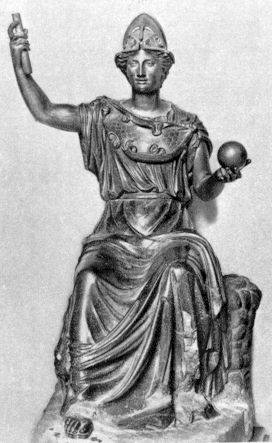
radford-chapter-09 A Roman representation of Minerva.

Minervawas the Roman goddess of handicrafts, arts, professionals and later, that of war. She is commonly identified with the Greek goddess, Athene, the city protectress, goddess of war and handicrafts, an urbanized pre-Hellenic goddess taken over by the Greeks. She dwelled on the Acropolis of Athens, a virgin with no consort hence the term "Pallas Athena" which originally simply meant a maiden but came to mean a lusty youth. Tradition, and also in the writing of Plato, has it that Athena was foreign born, that she was from the sea, coming fully grown out of the head of Zeus and born on a seashell. Other myths put her birth in Libya near Lake Triton, which in ancient times was very large. The book says that Nyhellenia Minerva did stop at Libya when the ships of the sea-kings Jon and Inka were divided.

An inspiration to the heroes of Homers Iliad, she also epitomized wisdom for the early city occupants. Born fully armed out of the head of Zeus and that is how it must have appeared to the inhabitants of Attica when she moved there with all her Frisian soldiers. No derivation of the name "Athens" is satisfactorily given but if we read on we will see what the Oera Linda Book has to say.

The traditional beginnings of Athens recall the "unification" of the city in the reign of Theseus attesting to existing settlements at that time. This date, according to legend that is, is at the end of the high profile, Minoan period, the time of the destruction of the palace at Knossos, the end of the third tribute of youths shipped to Crete and independence for the mainland Greeks.

The story of Minerva is next found in the writings of Minno, a sea-king who spent many years in the Mediterranean and returned to record his exploits. Jon and Minerva had separated, she staying in Crete where her following had built a citadel for her and her maidens.

Minnos writings tell of Minerva established as a Mother in Crete. It reads as though Crete and Attica was one country with Attica much less developed and paying tribute to a superior power but not necessarily to Crete. The priests and princes sought her advice that encouraged the commoners to accept the spirit of freedom she so eloquently elucidates. They did not oppose her doctrines but corrupted them into a vehicle for their own use. No wonder Minno as we will later read believed it impossible to teach the spirit of Frya to Findas people or to the original Greeks.

Here is explained the process by which the function and duties of the priestesses (virgins) were corrupted into political tools of the priests. The priestesses were originally set up to nurse the needy, teach the young to read, and advise according to Fryas doctrine or Tex. They were celibate while in office but went about the people as needed. The priests turned them into institutional prisoners to give themselves legitimacy, asked for the advise to be given in an ambiguous and mysterious way like the various oracular prophesies so that they could interpret them to their own advantage. The process is recorded here for Greece, which has given us so many stories from this period concerning the machinations of the priestesses. In Roman times the Vestal Virgins became a state regulated institution of highly ritualistic authority with only a remnant of the original services such as keeping the will of the emperor or other secret state documents.

When Nyhellenia, whose real name was Minerva, was well established, and the Cretans loved her as well as our own people did, there came some princes and priests to her citadel and asked Minerva where her possessions lay.

Hellenia answered, "I carry my possessions in my own bosom. What I have inherited is the love of wisdom, justice and freedom. If I lose these I shall become as the least of your slaves; now I give advice for nothing, but then I should sell it."

The gentlemen went away laughing and saying, "Your humble servants, wise Hellenia". But they missed their object, for the people took up this name as a name of honor. When they saw that their shot had been missed they began to defame her, and to say that she had bewitched the people; but our people and the good Cretans understood at once that it was defamation.

She was once asked, "If you are not a witch, what is the use of the eggs that you always carry with you?"

Minerva answered, "These eggs are the symbols of Fryas counsels, in which our future and that of the whole human race lies concealed. Time will hatch them, and we must watch that no harm happens to them.

The priests said, "Well answered; but what is the use of the dog on your right hand?"

Hellenia replied, "Does not the shepherd have a sheep dog to keep his flock together? What the dog is to the shepherd I am in Fryas service. I must watch over Fryas flocks.

"We understand that very well," said the priests; "but tell us what means the owl that always sits upon your head, is that light-shunning animal a sign of your clear vision?"

"No", answered Hellenia; "he reminds me that there are people on earth who, like him, have their homes in churches and holes, who go about in the twilight, not, like him, to deliver us from mice and other plagues, but to invent tricks to steal away the knowledge of other people, in order to take advantage of them, to make slaves of them, and to suck their blood like leeches."

Another time they came with a whole troop of people, when the plague was in the country and said: "We are all making offerings to the gods that they may take away the plague. Will you not help to turn away their anger, or have you yourself brought the plague into the land with all your arts?"

"No", said Minerva; "I know no gods that do evil, therefore I cannot ask them to do better. I only know one good spirit, that is Wr-Aldas; and as he is good he never does evil."

"Where, then, does evil come from?" asked the priests.

"All the evil comes from you and from the stupidity of the people who let themselves be deceived by you."

"If, then, your god is so exceedingly good, why does he not turn away from the bad?" asked the priests.

Hellenia answered: "Frya has placed us here, and the Carrier, that is, Time, must do the rest. For all calamities there is counsel and remedy to be found, but Wr-Alda wills that we should search it out ourselves, in order that we may become strong and wise. If we will not do that, he leaves us to our own devices, in order that we may experience the results of wise or foolish conduct."

Then a prince said, "I should think it best to submit."

"Very possibly," answered Hellenia; "for then men would be like sheep, and you and the priests would take care of them, shearing and leading them to the shambles. This is what our god does not desire, he desires that we should help one another, but that all should be free and wise. That is also our desire, and therefore our people choose their princes, counts, councilors, chiefs, and masters among the wisest of the good men, in order that every man shall do his best to be wise and good. Thus doing, we learn ourselves and teach the people that being wise and acting wisely can alone lead to holiness."

"That seems very good judgment," said the priests; "but if you mean that the plague is caused by our stupidity, then Nyhellenia will perhaps be so good as to bestow upon us a little of that new light of which she is so proud."

"Yes", said Hellenia, "but ravens and other birds of prey feed only on dead carrion, whereas the plague feeds not only on carrion but on bad laws and customs and wicked passions. If you wish the plague to depart from you and not return, you must put away your bad passions and become pure within and without."

"We admit that the advice is good," said the priests, "but how shall we induce all the people under our rule to agree to it?"

Then Hellenia stood up and said: "The sparrows follow the sower, and the people their good princes, therefore it becomes you to begin by rendering yourselves pure, so that you may look within and without, and not be ashamed of your own conduct. Now, instead of purifying the people, you have invented foul festivals, in which they have so long reveled that they wallow like swine in the mire to atone for your evil passions."

The people began to mock and to jeer, so that she did not dare to pursue the subject; and one would have thought that they would have called all the people together to drive us out of the land; but no, in place of abusing her they went all about from the heathen Crete to the Alps, proclaiming that it had pleased the Almighty God to send his clever daughter, Minerva, surnamed Nyhellenia, over the sea in a cloud to give people good counsel, and that all who listened to her should become rich and happy, and in the end governors of all the kingdoms of the earth. They erected statues to her on all their altars, they announced and sold to the simple people advice that she had never given, and related miracles that she had never performed.

They cunningly made themselves masters of our laws and customs, and by craft and subtlety were able to explain and spread them around. They appointed priestesses under their own care, who were apparently under the protection of Fasta, our first Earth Mother, to watch over the holy lamp; but that lamp they lit themselves, and instead of imbuing the priestesses with wisdom, and then sending them to watch the sick and educate the young, they made them stupid and ignorant, and never allowed them to come out. They were employed as advisers, but the advice which seemed to come from them was but the repetition of the bidding of the priests.

Minerva received a delegation of common people from Greece who were subject to foreign domination, paying tribute to a power that some historians suggest were the Iolians in Asia Minor, from where their overlords most likely originated. The local masters were not against independence as that would leave more for themselves.

The people wanted her to come to Greece and help them with her wisdom but more practically, to have the help of the fighting skills of her Frisian seamen. Minerva did not stay in Crete but moved to Greece apparently at the invitation of the people from Attica with whom the settlers were trading. When there she was not convinced that they were ready for her teachings but predicted it would take another 5000 years.

When they had finished their story they asked respectfully for iron weapons; for, said they, "Our foes are powerful, but if we have good arms we can withstand them." When this had been agreed to, the people asked if Fryas customs would flourish in Athens and in other parts of Greece.

The Mother answered, "If the distant Greeks belong to the direct descent of Frya, then they will flourish; but if they do not descend from Frya, then there will be a long contention about it, because the Carrier must make five thousand revolutions of his Jule before Findas people will be ripe for liberty."

In Attica, Minerva built a new citadel at Athens, naming it the City of Friends where in classical Greek times, the principal temple of the goddess Pallas Athena was the Parthenon on the Acropolis at Athens. She failed to get the local gentry to free their slaves, as Classical Greece was a collection of slave states with citizenship reserved for the free estate-owning male minority. That this system should have become a model for democracy and is generally credited with inventing democratic methods falls so far short of the more noble principles that they failed to embrace.

When Minerva had examined the country which is called by the inhabitants Attica, she saw that the people were all goatherds, and that they lived on meat, wild roots, herbs and honey. They were clothed in skins, and had their dwellings on the slopes of the hills, wherefore they were called Hellingers. At first they ran away, but when they found out that we did not attack them, they came back and showed great friendship.

Minerva asked if we might settle there peaceably. This was agreed to on the condition that we should help them to fight against their neighbors, who came continually to carry away their children and to rob their dwellings. Then we built a citadel at an hours distance from the harbor. By the advice of Minerva, it was called Athens, because, she said, "Those who come after us ought to know that we are not here by cunning or violence, but were received as friends."

While we were building the citadel the principal personages came to see us, and when they saw that we had no slaves it did not please them, and they gave her to understand it, as they thought that she was a princess.

But Minerva said, "How did you get your slaves?"

They answered, "We bought some and took others in war."

Minerva replied, "If nobody would buy slaves they would not steal your children, and you would have no wars about it. If you wish to remain our allies, you will free your slaves."

The chiefs did not like this, and wanted to drive us away; but the most enlightened of the people came and helped us to build our citadel, which was built of stone.

In a later extract, their city is described as having been fortified with a wall having "two stone horns down to the sea". This is how Piraeus, the port of Athens, is now known to have been protected and therefore could date its construction to the sixteenth century BC.

From Goddess to King, Chapter 8, THE ORIGINS OF IONIA

FROM GODDESS TO KING

A History of Ancient Europe from the

OERA LINDA BOOK

By Anthony Radford

CHAPTER 8

THE ORIGINS OF IONIA

It has been the intention of the author to first present the historically believed information and then show how this new source changes those beliefs but in this case it is impossible because who else has written about Jon, our most common name? They say it means "Given" and so it was given to an adventurous sea-king from the Rhine 3640 years ago.

The sea-king Jon had fitted out a fleet of 127 ships when Kaltas followers destroyed the citadel at Walhallagara. He was to have taken on paper there but instead took his men to avenge their anger by attacking Kalta at her own citadel of Flyburgt. They set fire to it but saved the maidens and the sacred lamp while Kalta, herself escaping, openly declared war on the whole community.

The Earth Mother Rosamond had responded and defeated the rebels, exiling them to Britain but that did not stop Kalta who eventually rallied the exiles with the help of the Druids into virtually another independent nation or the new Celtic Motherdom. In the meantime, Rosamond sought justice for Jon and his seamen who had taken the law into their own hands but they were not to hang around and be exiled to the tin mines. They chose their own exile together with women and children, most of the maidens from two citadels, two sacred lamps and the priestess Minerva. This mighty fleet, like the fleet of Teunis sailed south to the Mediterranean for another historical drama.

Kalta must have been quite a force for in one year she became mistress of all the Thyriers or Phoenician-Frisian settlers. Many names of existing places have some connection to the Thyriers and to Kalta or her new citadel Kaltasburgh. There is a mountainous region north of Paris called Thierache and at a guess Kaltasburgh or Kerenak may now be known as Dunkerque, a part of the lands of the Britons or possible Carnac in Brittany. At this coastal site there are 2934 menhirs or giant stones arranged in roes. They have been carbon-dated to the same age as Stonehenge, or 4500 years old, long before Kalta. Amber ornaments have been found there which connects the site with that ancient trading commodity mentioned in the Book. Later writings place Kerenak, an alternative name for the same citadel, in Scotland but it does not survive there under a similar name. We are however told that Kalta ruled as a queen, not a true earth mother, an exploit that eventually led to the priests and princes taking over those lands.

We Now Come to the History of Jon:

Jon, John, Jhon, Jan, are all the same name, though the pronunciation varies, as the seamen like to shorten everything to be able to make it easier to call. Jon - that is, "Given" - was a sea-king, born at Alberga, who sailed from the Flymeer with a fleet of 127 ships fitted out for a long voyage, and laden with amber, tin, copper, cloth, linen, felt, otter-skins, beaver and rabbit skins.

He would also have taken paper from here, but when he saw how Kalta had destroyed the citadel he became so angry that he went off with his people to Flyburgt, and out of revenge set fire to it. His admiral and some of his people saved the lamp and the maidens, but they could not catch Sijred (or Kalta). She climbed up on the furthest battlement, and they thought she must be killed in the flames; but what happened? While all her people stood transfixed with horror, she appeared on her steed more beautiful than ever, calling to them, "To Kalta!" Then the other Schelda people poured out towards her. When the seamen saw that, they shouted, "We are for Minerva!" from which arose a war in which thousands were killed.

At this time Rosamond the Mother, who had done all in her power by gentle means to preserve peace, when she saw how bad it was, made short work of it. Immediately she sent messengers throughout all the districts to call a general levy, which brought together all the defenders of the country. The landsmen who were fighting were all caught, but Jon with his seamen took refuge on board his fleet, taking with him the two lamps, as well as Minerva and the maidens of both the citadels. Helprik, the chief summoned him to appear; but while all the soldiers were on the other side of the Scheldt, Jon sailed back to the Flymeer, and then straight to our islands. His fighting men and many of our people took women and children on board, and when Jon saw that he and his people would be punished for their misdeeds, he secretly took his departure. He did well, for all our islanders and the other Scheldt people who had been fighting were transported to Britain. This step was a mistake, for now came the beginning of the end. Kalta, who people said, could go as easily on the water as on the land, went to the mainland and on to Missellia. Then came the Gauls out of the Mediterranean Sea with their ships to Cadiz, and along all our coasts, and fell upon Britain; but they could not make any good footing there, because the government was powerful and the exiles were still Frisians.

But now came Kalta and said: "You were born free, and for small offenses have been sent away, not for your own improvement, but to get tin by your labor. If you wish to be free again, and take my advice, and live under my care, come away. I will provide you with arms, and will watch over you."

The news flew through the land like lightning, and before the Carriers wheel had made one revolution she was mistress of all the Thyriers, in all our southern states as far as the Seine. She built herself a citadel on the high land to the north, and called it Kaltasburgh. It still exists under the name of Kerenak. From this castle she ruled as a true mother, against their will, not for her followers, but over them, who were thenceforth called Kelts. The Gauls gradually obtained dominion over the whole of Britain, partly because they no longer had any citadel; secondly, because they had there no burgtmaid; and thirdly, because they had no real lamps. From all these causes the people could not learn anything. They were stupid and foolish, and having allowed the Gauls to rob them of their arms, they were led about like a bull with a ring in his nose.

About 1620 BC another mighty fleet of Frisians went permanently to the Mediterranean led by the then outlawed sea-king Jon. He found the Mothers influence in western Italy too strong for his own formidable military force or perhaps he was still too much of a true Frisian to impose his own way on that faithful community. They must have had a good communication system, possibly by means of overland couriers as they were already informed that his forces were wanted renegades. That area of Italy was the pre-Roman countryside probably even pre-Etruscan. Those settlers are now considered to have come from Troy and our story has not yet shown that region to be a maritime power although Troy is very old. The Germanic languages may have been greatly influenced by Latin in the last two thousand years but for the preceding pastoral age, Latin was the child of the Germanic or Old Frisian root tongue. This is not in keeping with conventional theory but it fits in well with the story of the migrations that the Book relates. It must have been a time of low population where a city may not have been much more than a manor house with its domestic support. There were still plenty of open lands and safe harbors about.

Minerva was the Mother of Walhallagara at Flymeer the citadel that was burnt by the incensed followers of Kalta who had been jealous of her relationship with the Mother Rosamond. Jon and his seamen rescued her, her maidens and their lamp, but when he heard how it fared with the land forces that had taken revenge on Kaltas actions, he escaped with the fleet and also Kaltas maidens with her lamp. He eventually took Minerva and all these maidens to the Mediterranean but when there they separated with Jon taking Kaltas lamp and virgins to his own islands, leaving Minerva at Crete.

The story continues with Jon and Minerva splitting up, each keeping a maiden system and a sacred lamp in traditional Frisian style. Minerva settled in Crete, a poor land while Jon settled in the islands of the Aegean Sea where his exploits gave them the name of the "Islands of Pirates" or what is now known as the Ionian Islands. No encyclopedia explains the origin of the word "Ionian" but here we are told it meant "Jons Islands" from where he made pirate raids with his young adventurers against the Phoenicians. Robert Graves in The White Goddess states that the name comes from the Cow goddess, IO, on the mainland (Asia Minor) from which the islanders would have come. Incidentally, the name "Aegean" which came from Aegeus, king of Athens and father of the legendary Theseus is from the goat-tribe of Attica. The Aegis or breastplate of Zeus was a goatskin.

The narrator of the next extract either confuses Italy with Greece and Anatolia or the word "Italians" had a different meaning then, reflecting a future migration to Italy of Trojans. The Joniers or Ionians figure again in the story twelve hundred years later at the time of Alexander the Great. Here is the beginning of a nation that has given us many stories.

Now We Shall Write How it Fared with Jon. It is Inscribed at Texland:

Ten years after Jon went away, there arrived three ships in the Flymeer; the people cried "Huzza!" (what a blessing!) and from their accounts the Mother had this written.

When Jon reached the Mediterranean Sea, the reports of the Gauls had preceded him, so that on the nearest Italian coast he was nowhere safe. Therefore he went with his fleet straight over to Libya. There the black men wanted to catch them and eat them. At last they came to Tyre, but Minerva said, "Keep clear, for here the air has long been poisoned by the priests."

The king was a descendant of Teunis, as we were afterwards informed; but as the priests wished to have a king, who, according to their ideas, was of long descent, they deified Teunis, to the vexation of his followers. After they had passed Tyre, the Thyriers seized one of the rearmost ships, and as the ship was too far behind us, we could not take it back again; but Jon swore to be revenged for it. When night came, Jon bent his course towards distant Crete. At last they arrived at a country that looked very barren, but they found a harbor there. Here, said Minerva, we need not perhaps have any fear of princes or priests, as they always look out for rich fat lands. When they entered the harbor, there was not room for all the ships, and yet most of the people were too cowardly to go any further. Then Jon, who wished to get away, went with his spear and banner, calling to the young people, to know who would volunteer to share his adventures. Minerva did the same thing, but she wished to remain there. The greater part stopped with Minerva, but the young sailors went with Jon. Jon took the lamp of Kalta and her maidens with him. Minerva retained her lamp and her own maidens.

Between the near and the distant coasts of Italy, Jon found some islands, which he thought desirable. Upon the largest he built a city in the wood between the mountains. From the smaller islands he made expeditions for vengeance on the Thyriers, and plundered their ships and their lands. Therefore these islands were called Insulae Piratarum, as well as Johannis Insulae.

From Goddess to King, Chapter 7, KALTA AND THE ORIGINS OF THE CELTS

FROM GODDESS TO KING

A History of Ancient Europe from the

OERA LINDA BOOK

By Anthony Radford

CHAPTER 7

KALTA AND THE ORIGINS OF THE CELTS

Thischapter is the story of Rosamond, Kalta and the early years of Minerva however standard history has very little to say about these historical personages. Their influence on the course of Europe and the Mediterranean was enormous, affecting everything that has followed for thousands of years. Of Rosamond nothing is known except for a namesake, Fair Rosamond, the mistress of King Henry II who has been endowed with many legends and dubious stories beyond her station. Kalta is not remembered but the Celts who were named after her have various "historical" descriptions. The Celtic language is divided into the Gaulish or continental version, that was largely supplanted and Latinized by the Roman occupation, and the various branches that are still spoken in parts of the British Isles; Irish, Gaelic, Welsh, Cornish and Breton. The Celtic religion was presided over by the Druids and reflects an ancient Indian culture, strengthening the belief in the Indo-European connection. Their origins have been variously placed somewhere in the east, through ancient German invasions as though a politically important people who rose to common language and power against the Romans, who are our only historical source, have to have a migratory, tribal beginning rather than an indigenous one.

One could then question that indigenous land in the east, but the truth is as in most cases, a blend of the various theories. The theories are not wrong but neither can they be applied to all peoples. The examiners of the archaeological evidence assume that ancient peoples did not know of, or trade with each other, shared little development and were more tribal than regional. There are many descriptions of these various peoples toward the end of the Book but now comes very early information about some beginnings lost in time.

In this account we have the second correlation between the way Fryas people recorded dates and the Christian chronology. Given an accurate rather than an approximate date, the sinking of Atland would then be set as 2163 BC (1600 + 563 = 2163). This transcribing was obviously done in Christian times. To be able to date the foundation of Greek independence from their overlords in either Asia Minor or Crete to 1600 BC is momentous. It is a time before Homer and Minos of the latter Greek myths. There were no Greeks at this time but what we now know of as Greece, was inhabited by "cliffhangers" (Hellingers) and agriculturists. It was a time before the geological disturbances in the Mediterranean that permitted Aegean independence from Crete and the destruction of Thera, another maritime trading city. When a major geological event occurred in mans early-civilized history, it was not recorded like even a minor military campaign because the destruction removed the potentates who built the monuments. Mythology has many references to catastrophes but proud monuments have few.

When the old Earth Mother died she named Rosamond as her successor but she also named Minerva, a well liked priestess of Walhallagara on the Rhine, as next in line and Sijred, the Burgtmaid of Flyburgt as next or third choice. Minerva was also called Nyhellenia, a first name of respect that has become Helen, a Greek name. We shall see how Hellas, the Greek name for Greece, and Minerva, the Roman name for Pallas Athena, the goddess of wisdom, handicrafts and arts, later war, are from the same Rhine maiden. There is an account of the seamen naming the Greeks, Hellingers because they clung to the cliffs like goats and there is also the Germanic derivation of the word "Greek" as being related to the same root as our word "agriculture."

The other maiden Sijred was given the name Kalta by the seamen because of her devious ways. Land dwellers took it as a title and eventually she gave us the Celtic name and heritage. She wanted to be Earth Mother and was such a poor looser that by her treachery, Gaul and Britain were lost to the Mother. She was driven out of the Rhine but founded a new citadel in Britain and even managed to win Cadiz in Spain to her influence with the help of the Golen.

When the principles of Frya were being violated Rosamond had both the compassion of a true earth mother and the strength to act decisively. She would not tolerate a popular sea-king taking independent action even if he thought it was justified at the time. Apparently the sea-king Jon had a hotter blood and was too quick too act for the fair Rosamond and the consequences were enormous; the Celts, the Ionians and much of history was seeded at this time including the eventual fall of the unifying force of the Earth Mother.

Commerce is again stressed as important enough to cause wars, this time the agricultural production of flax and the subsequent manufacture of paper or writing linen. This was the primary foreign trade item of the Scheldt region but ships were required to carry it and bring back the products of distant countries. In the Rhine mouth region a way had been found to process pumpkin leaves into paper that apparently satisfied the shipping needs at that time. Conflict resulted with far reaching consequences that has now turned up side down our present representation of the history of this region. We are discovering remnants of a primitive Celtic civilization in Western Europe little realizing that they were the renegade offshoots of a longer established mature civilization.

Now We Will Write About the War Between the Burgtmaid Kalta and Minerva And how we thereby lost all our southern lands and Britain to the Gauls:

Near the southern mouth of the Rhine and the Scheldt there are seven islands, named after Fryas seven virgins of the week. In the middle of one island is the city of Walhallagara and on the walls of this city the following history is inscribed. Above it are the words, "Read, learn, and watch."

Five hundred and sixty-three years after the submersion of Atland - that is, 1,600 years before Christ - a wise town priestess presided here, whose name was Minerva - called by the sailors Nyhellenia. This name was well chosen, for her counsels were new and clear above all others.

On the other side of the Scheldt, at Flyburgt, Sijred presided. This maiden was full of tricks. Her face was beautiful, and her tongue was nimble; but the advice that she gave was always conveyed in mysterious terms. Therefore the mariners called her Kalta, and the landsmen thought it was a title. In the last will of the dead Mother, Rosamond was named first, Minerva second, and Sijred third in succession. Minerva did not mind that, but Sijred was very much offended. Like a foreign princess, she wished to be honored, feared, and worshipped; but Minerva only desired to be loved. At last all the sailors, even from Denmark and Flymeer, did homage to her.

This hurt Sijred, because she wanted to excel Minerva. In order to give an impression of her great watchfulness, she had a cock put on her banner. So then Minerva went and put a sheep dog and an owl on her banner. "The dog," she said, "guards his master and his flock, and the owl watches that the mice shall not devastate the fields; but the cock in his lewdness and his pride is only fit to murder his nearest relations."

When Kalta found that her scheme had failed she was still more vexed, so she secretly sent for the Magyars to teach her conjuring. When she had had enough of this she threw herself into the hands of the Gauls; but all her bad practices did not improve her position.

When she saw that the sailors kept more and more aloof from her, she tried to win them back by fear. At the full moon, when the sea was stormy, she ran over the wild waves, calling to the sailors that they would all be lost if they did not worship her. Then she blinded their eyes, so that they mistook land for water and water for land, and in this way many a good ship was totally lost. At the first war-feast, when all her countrymen were armed, she brought casks of beer, which she had drugged. When they were all drunk, she mounted her war-horse, leaning her head upon her spear. Sunrise could not be more beautiful. When she saw that the eyes of all were fixed upon her, she opened her lips and said:

"Sons and daughters of Frya, you know that in these last times we have suffered much loss and misery because the sailors no longer come to buy our paper, but you do not know what the reason of it is. I have long kept silence about it, but can do so no longer. Listen, then, my friends, that you may know on which side to show your teeth. On the other side of the Scheldt, where from time to time there come ships from all parts, they make now paper from pumpkin leaves, by which they save flax and outdo us. Now, as the making of paper was always our principal industry, the Mother willed that people should learn it from us; but Minerva has bewitched all the people - yes, bewitched, my friends - as well as all our cattle that died lately. I must come out with it. If I were not Burgtmaid, I should know what to do. I should burn the witch in her nest."

As soon as she had uttered these words she sped away to her citadel; but the drunken people were so excited that they did not stop to weigh what they had heard. In mad haste they hurried over the Sandval, and as night came on they burst into the citadel. However, Kalta again missed her aim; for Minerva, her maidens, and her lamp were all saved by the alertness of the seamen.

Here included in the Book is an anecdote the ancient writer felt like including. It is a measure of the character of these people.

War had come to an end, but famine came in its place. There were three men who each stole a sack of corn from different owners, but they were all caught. The first owner brought his thief to the judge, and the maidens said everywhere that he done right. The second owner took the corn away from his thief and let him go in peace. The maidens said he has done well. The third owner went to the house of the thief, and when he saw what misery was there, he went and brought a wagon load of necessaries to relieve their distress. Fryas maidens came around him and wrote his deed in the eternal book, and wiped out all his sins. This was reported to the Earth Mother, and she had it made known over the whole country.

Welsh history-mythology records the invasion of the southern plains of Britain by the iron age Belgi whose god Odin had emancipated himself from the White Goddess Freya for a more warlike patronage of kings and priests with the old priesthood being driven north; an alternative version of these ancient histories.

From Goddess to King, Chapter 6, MINNA AND THE NORTHERN CAMPAIGN

FROM GODDESS TO KING

A History of Ancient Europe from the

OERA LINDA BOOK

By Anthony Radford

CHAPTER 6

MINNA AND THE NORTHERN CAMPAIGN

radford-chapter-06 A modern statue of the god Odin who was once the general Wodin.

Thecatastrophe that beset Europe and possibly the world at the beginning of the twenty-second century BC was immediately accompanied by nomadic invasions in the north and also in the south following the thinning of the Great Forest. What civilization had established could not survive the following generations without resorting to organized military campaigns. The modern countries of Finland and Hungary were then sparsely populated and soon became settled by the yellow race. The Black Forest still divided them in the middle but they shared a language and a political system with the Magy as their priest-king. This system is here described and according to the tone of the writer who is unknown, it was not liked at all; it was feared; freedom had to be protected by strict adherence to Fryas laws or else the consequences were annihilation.

Lack of vigilance had cost them their northern territories, and the Earth Mother Minna called a national levy to gain back their Schoonland, the present day Scandinavia not including Denmark. The long campaign that was the outcome of this was destined to let down its vigilance and another saga began the saga of Wodin and eventually the historical story of Neptune and the origins of the Phoenicians. We do not know when the following inscription was first made at Aldgamude, but that port apparently was a trading center dating from the beginning of the age or even earlier.

This is Inscribed on the Waraburgt by the Aldgamude:

The Waraburgt is not a maidens city, but the place where all the foreign articles brought by sailors were stored. It lies three hours south from Medesblik.

This is the Preface:

Hill, bow your heads; weep, ye streams and clouds. Yes, Scandinavia blushes, an enslaved people tramples on your garment, O Frya.

This is the History:

One hundred and one years after the submersion of Aldland, a people came out of the East. That people was driven by another. Behind us, in Germany, they fell into disputes, divided into two parties, and each went its own way. Of the one no account has come to us, but the other came in the back of our Scandinavia, which was thinly inhabited, particularly the upper part. Therefore they were able to take possession of it without contest, and as they did no other harm, we would not make war about it. Now that we have learned to know them, we will describe their customs, and after that how matters went between us. They were not wild people, like most of Findas race; but, like the Egyptians, they have priests and also statues in their churches.

The priests are the only rulers; they call themselves Magyars, and their headman the Magy. He is high priest and king in one. The rest of the people are of no account, and in subjection to them. This people have not even a name; but we call them Finns, because although all the festivals are melancholy and bloody, they are so formal that we are inferior to them in that respect. But still they are not to be envied, because they are slaves to their priests, and still more to their creeds. They believe that evil spirits abound everywhere, and enter into men and beasts, but of Wr-Aldas spirit they know nothing. They have weapons of stone, the Magyars, of copper. The Magyars affirm that they can exorcise and recall the evil spirits, and this frightens the people, so that you never see a cheerful face.

When they were well established, the Magyars sought our friendship, they praised our language and customs, our cattle and iron weapons, which they would willingly have exchanged for their gold and silver ornaments, and they always kept their people within their own boundaries, and that outwitted our watchfulness.

Eighty years afterwards, (101+80-2193 = 2012 BC) just at the time of the Julefest, they overran our country like a snowstorm driven by the wind. All who could not flee away were killed. Frya was appealed to, but the Scandinavians had neglected her advice. Then all the forces were assembled, and three hours from Godasburgt they were withstood, but war continued. Kat or Katerine was the name of the priestess who was Burgtmaid of Godasburgt. Kat was proud and haughty, and would neither seek counsel not aid from the Mother; but when the Burgers knew this, they themselves sent messengers to Texland to the Earth Mother. Minna - this was the name of the Mother - summoned all the sailors and the young men from Ostflyland and Denmark. From this expedition the history of Wodin sprang, which is inscribed on the citadels and is here copied.

The great Norse god Wotan or Odin was the God of War and because his day was identified with Wednesday or Mercredi which is from the Roman Mercury, he was believed to be connected to the classical pantheon. Here we have a more personal story of a great warrior who freed the North from the power of the Magi but he was not wise enough to keep hold of the peace. Norse tradition says that Odin swapped one of his eyes for wisdom; perhaps he needed to do that.

A description of military command is given wherein the elected king was the leader of the campaign, the "witkoning" or sea-king led the marines and the admiral commanded the ships or navy. The navy whether military or merchant, often employed foreign rowers. The Viking fleets three thousand years later were smaller and rowed by the fighting force when sails were not employable, but here it is presumed that the military men would also lend a hand as necessary. This custom was not part of either Greek or Roman tradition but was mentioned by Homer. Both types of ships were built of wood but no evidence as to the style of a vessel that ancient has been found, only some outlines of artifacts or cargo located near Rhodes a few years ago, a simple vessel carrying amphorae. Ancient Egyptians pictured their own boats with oars while northern ships were shown without them but with high, decorated prows and sterns. This style is also reproduced in very old rock carvings found in Sweden. Unfortunately, timber does not last that long in the ocean but if it does survive the worms then it disintegrates immediately on contact with the air. Julius Caesar describes the Celtic ships of Gaul with much admiration for their size and strength and recently such a ship has been found in the English Channel that validates Caesars writing which as usual were subject to disbelief. It was heavily built of oak and strictly a freighter carrying pitch that had caught on fire. The time of Caesar is at the end of the Age of Aries. A ship that is two thousand years older is yet to be found.

Wood was getting less common in the Eastern Mediterranean and very scarce in the Fertile Crescent. True there were giant cedars and reed craft of considerable size but to maintain a maritime tradition like that of the sea-kings required European timber and a riverside building legacy. This fact does not favor a Phoenician navy yet they were a maritime nation and sold much cedar timber including finished ships to ancient Egypt.

The three nephews of the old sea-king Sterik were Wodin, the eldest, and the brothers Teunis and Inka. The campaign of approximately 2010 BC lasted long enough for many Finns to appreciate what freedom from the Magy was like and also for Wodin and some supporters to be corrupted by privilege. The clever Magy regained his power using his daughter in marriage, flattery and "magic herbs" to stupefy the old king. After his death, the Magy deified Wodin and proclaimed his young grandson by Wodin the new king with himself as regent. This disgusted the remaining seamen who took to the ships with many Finnish rowers who had tasted the free life-style of the campaigners. Led by Teunis and Inka, they intended to return to Flyland.

At Aldgamude there lived an old sea-king whose name was Sterik, and whose deeds were famous. This old fellow had three nephews. Wodin, the eldest, lived at Lumkamakia, near the Eremude, in Ostflyland, with his parents. He had once commanded troops. Teunis and Inka were naval warriors, and were just then staying with their father at Aldgamude. When the young warriors had assembled together, they chose Wodin to be their leader or king, and the naval force chose Teunis for their sea-king and Inka for their admiral. The navy then sailed to Denmark, where they took on board Wodin and his valiant host.

The wind was fair, so they arrived immediately in Scandinavia. When the northern brothers met together, Wodin divided his powerful army into three bodies. Frya was their way-cry, and they drove back the Finns and Magyars like children. When the Magy heard how his forces had been utterly defeated, he sent messengers with truncheon and crown, who said to Wodin:

"Oh almighty king, we are guilty but all that we have done was from necessity. You think that we attacked your brothers out of ill will, but we were driven out by our enemies, who are still at our heels. We have often asked your burgtmaid for help, but she took no notice of us. The Magy says that if we kill half our numbers in fighting with each other, then the wild shepherds will come and kill all the rest. The Magy possesses great riches, but he has seen that Frya is much more powerful than all our spirits together. He will lay down his head in her lap. You are the most warlike king on the earth, and your people are of iron. Become our king, and we will all be your slaves. What glory it would be for you if you could drive back the savages! Our trumpets would resound with your praises, and the fame of your deeds would precede you everywhere."

Wodin was strong, fierce, and warlike, but he was not clear-sighted, therefore he was taken in their toils, and crowned by the Magy. Very many of the sailors and soldiers to whom this proceeding was displeasing went away secretly, taking Kat with them. But Kat, who did not wish to appear before either the Mother or the general assembly, jumped overboard. Then a storm arose and drove the ships upon the banks of Denmark, with the total destruction of their crews. This strait was afterwards called the Kattegat.

When Wodin was crowned, he attacked the savages, who were all horsemen. They fell upon Wodins troops like a hailstorm; but like a whirlwind they were turned back and did not dare to appear again. When Wodin returned Magy gave him his daughter to wife, whereupon he was incensed with herbs; but they were magic herbs, and by degrees he became so audacious that he dared to disavow and ridicule the spirits of Frya and Wr-Alda, while he bent his free head before the false and deceitful images. His reign lasted seven years, and then he disappeared. The Magy said that he was taken up by their gods and still reigned over us, but our people laughed at what they said.

When Wodin had disappeared some time, disputes arose. We wished to choose another king, but the Magy would not permit it. He asserted that it was his right given him by his idols. But besides this dispute there was one between the Magyars and Finns, who would honor neither Frya nor Wodin; but the Magy did just as he pleased, because his daughter had a son by Wodin, and he would have it that this son was of high descent. While all were disputing and quarreling, he crowned the boy as king, and set up himself as guardian and counselor. Those who cared more for themselves than for justice let him work his own way, but the good men took their departure. Many Magyars fled back with their troops, and the sea-people took ship, accompanied by a body of stalwart Finns as rowers.

The saga continued with the fleet trying to return home to Flyland in Texland, approximately twelve years after the northern campaign began. This is a very interesting story of the real life hero Neef Teunis who became deified as Neptune like his older cousin Wodin. The northern campaign had stayed away too long and had been contaminated according to the Earth Mother. They could not come home and bring the ways of the Magi with them, nor could they bring their Finn wives or rowers into Fryas land. They had won the war but lost the peace and apparently the Mother was willing to sacrifice Scandinavia.

Whether Minna was still the Mother at this time is not made clear but sacrifice for principles was a commanding force. The Burgtmaid Kat had killed herself rather than accept defeat or matronage from an ally and the Earth Mother was willing to sacrifice their northern territories to prevent a "contaminated" fleet from returning. They still had Denmark and were strong enough to turn back this formidable fleet of their own kind of fighting men and their families.

Fasta had advised a policy of waiting and education of the foreigners that apparently had worked very well but perhaps not in the way they would have liked. The fleet, being denied the opportunity to return to the Rhine, continued south towards the Mediterranean landing near present day Cadiz in Spain. There, Inka and Teunis divided the fleet with, surprisingly, more foreign rowers than Friends (one of the names for the Children of Frya) being willing to follow Neef Inka into the unknown Atlantic rather than face the prospects of serving another Finda king. The disreputable fleet that was led by Teunis had best find a new and free home and not subject to an Eastern king.

Teunis, who had no desire to loose his command by returning to Texland, went on to found Tyre near older Sidon, a city of Phonisia, or palm land, a place with which they had previously traded. Tyre was named after a god of the Finnish rowers that we now know of as Thor (as in Thursday) and of course Phonisia became Phoenicia. Modern Lebanon in 2000 BC became his new home but not for long as his further exploits became legend. The book tells more than once how descendants of Frisian traders, Finns and black men from Libya became the Phoenician traders of antiquity and that they became influenced by the Golan or priests of Sidon into Findas idolatrous ways.

They had the language and writing; they were familiar with the countries of the west and they knew seafaring more than any Mediterranean nation. In addition Teunis had been to the East before the northern campaign. Such a sea-king would not have been satisfied to stay home and that Tunisia is named for him is testimony to that. Tunisia became simply "Africa" in many references, a place where the Thyriers would one day (814 BC) found Carthage which meant "new town" in Phoenician.

The activity of these traders of Teunis became too dominating or actually too influential for the Mother who limited the number of ships that they would allow to visit Texland each year to trade. Their ways were no longer those of Frya since they now included many Finnish customs such as Magyar idolatry and the ways of the Golen. With two generations of foreign wives and new families it would have been impossible for them to maintain the original customs of the men in other than vocational ways, the skills of the sea and trade. For the first time the sea-kings of Texland had competition worthy of them.

Apparently nearly two hundred years after the loss of Atland, the Mediterranean area was still suffering hardships. Crete had been part of the European Mother system but had been lost because of this disaster. We are getting a picture of a pre-submergence united Europe under a protective matriarchal political and social regime that survived in a resemblance of its former self as a western federation which was still perhaps the most formidable nation of the time. The sea-kings with their iron weapons and oak ships dominated the foreign commerce and were not necessarily united Frisians but rather independent city states such as Thera, the east Mediterranean island nation, Tyre in modern Lebanon, Malta and Pharos at the mouth of the Nile. There are many more sites that are candidates for these independent trading city states in the Mediterranean. At this time Egypt had recovered and was considered wealthy but not free.

All This is Inscribed Not Only on the Waraburgt, But Also on the Burgt Stavia, Which Lies Behind the Port of Starve:

When Teunis wished to return home, he went first towards Denmark; but he might not land there, for so the Mother had ordered, nor was he to land at Flyland, nor anywhere about there. In this way he would have lost all his people by want and hardship, so he landed at night to steal and sailed on by day. Thus coasting along, he at length arrived at the colony of Kadik, (present day Cadiz in Spain) so called because it was built with a stone quay. Here they bought all kinds of stores, but Tuntia, the burgtmaid, would not allow them to settle there. When they were ready they began to disagree.

Teunis wished to sail through the straits to the Mediterranean Sea, and enter the service of the rich Egyptian king, as he had done before, but Inka said he had had enough of all those Findas people. Inka thought that perchance some high-lying part of Atland might remain as an island, where he and his people might live in peace. As the two cousins could not agree, Teunis planted a red flag on the shore, and Inka a blue flag. Every man should choose which he pleased, and to their astonishment, the greater part of the Finns and Magyars followed Inka, who had objected to serve the kings of Findas people. When they had counted the people and divided the ships accordingly, the fleet separated. We shall hear of Teunis afterwards, but nothing more of Inka.

Neef Teunis coasted through the straits to the Mediterranean Sea. When Atland was submerged there was much suffering also on the shores of the Mediterranean, on which account many of Findas people, Cretans, and people from Lydas land, came to us. On the other hand, many of our people went to Lydas land. The result of all this was that the Cretans far and wide were lost to the superintendence of the Mother. Teunis had reckoned on this, and had therefore wished to find there a good haven from which he might go and serve under the rich princes; but as his fleet and his people had such a shattered appearance, the inhabitants on the coasts thought that they were pirates, and drove them away. At last they arrived at the Phoenician coast, one hundred and ninety-three years after Atland was submerged (2000 BC). Near the coast they found an island with two deep bays, so that there appeared to be three islands. In the middle one they established themselves, and afterwards built a city wall round the place. Then they wanted to give it a name, but disagreed about it. Some wanted to call it Fryasburgt, others Neeftunia; but the Magyars and Finns begged that it might be called Thyrhisburgt.

Thyr was the name of one of their idols, and it was upon his feast-day that they had landed there; and in return they offered to recognize Teunis as their perpetual king. Teunis let himself be persuaded and the others would not make much quarrel about it. When they were well established, they sent some old seamen and Magyars on an expedition as far as the town of Sidon; but at first the inhabitants of the coast would have nothing to do with them, saying, "You are only foreign adventurers whom we do not respect." But when we sold them some of our iron weapons, everything went well. They also wished to buy our amber, and their inquiries about it were incessant. But Teunis, who was farseeing, pretended that he had no more iron weapons or amber. Then merchants came and begged him to let them have twenty vessels, which they would freight with the finest goods, and they would provide as many people to row as he would require. Twelve ships were then laden with wine, honey, tanned leather, and saddles and bridles mounted in gold, such as had never been seen before.

Teunis sailed to the Flymeer (the mouth of the Fly river in Texland) with all this treasure, which so enchanted the Grevetman of Westflyland that he induced Teunis to build a warehouse at the Flymeer. Afterwards this place was called Almanland, and the market where they traded at Wyringen was called Toelaatmarkt. The mother advised that they should sell everything except iron weapons, but no attention was paid to what she said. As the Thyriers had thus free play, they came from far and near to take away our goods, to the loss of our seafaring people. Therefore it was resolved in a general assembly to allow only seven Thyrian ships and no more in a year.

Tunisia in northern Africa and named after Neef Teunis, became an important intermediate country to the Phoenicians on their trades with the Rhine areas and with the tin producing region of Cornwall in Westland, the old name for Britain. These enterprising traders soon needed additional bases. They had ports in Tunisia and in Spain but needed to open up France, sparsely settled at the time, to their growing influence.

Sidon and Tyre had become a united Phoenicia with the priests of Sidon assuming a dominant role. Little of Fryas teachings or her bloodline had survived. Remember that only men went on the campaign of the Mother and they returned to the Mediterranean with many Finish wives and rowers. Trading through Tunisia in Africa must have added the blood of Lydas children to this nation. In other words, they became typical of the eventual racial blend that became the present day European with darker and lighter areas of skin colors mostly dependent on geography.

In this section we see the origins of Gaul, or modern France, beginning as a trading island in the south at Marseilles and spreading northwards. We also see how the priests from the Golen Heights in Phoenicia, the Golen or Druids gave their name to the country. The old Welsh word derwydd or oak-seer is credited with giving us the word druid but these people tell a different story or perhaps the Welsh got their word from the older ancient Frisian. In another part of the book the origin of the German name Frank is explained, a name that was to replace Gaul after the time of Caesar. The Druids were brought to Britain by the same ships, a place ripe for foreign influence because these exiles wanted more women and freedom to run their own affairs. The Mothers influence was naturally being lost in the sparsely populated Westland.

Recent research on Crete and some Greek islands such as Thera show an early commercial city civilization. Tyre, Sidon and Carthage were not monarchies but merchant and priestly oligarchies with their wealth based on maritime trade, not agriculture. These communities apparently descended from the early sea-kings adopting and developing the distant voyaging skills and record-keeping requirements of that profession. Fastas early principles of fair trade and sharing did not survive mans natural competitive and selfish nature. Mercenary he became but many of the stories of their adventures have given us a rich mythology from that time.

What The Consequence of This Was:

In the northernmost part of the Mediterranean there lies an island close to the coast. They (the Golen led Phoenicians) now came and asked to buy that, on which a general council was held.

The mothers advice was asked, and she wished to see them at some distance, so she saw no harm in it; but as we afterwards saw what a mistake we had made, we called the island Missellia (Marseilles, miss-sell). Hereafter will be seen what reason we had. The Golen, as the missionary priests of Sidon were called, had observed that the land there was thinly peopled, and was far from the mother. In order to make a favorable impression, they had themselves called in our language followers of the truth; but they had better have been called abstainers from the truth, or, in short, "Triuwenden," (Druids) as our seafaring people afterwards called them. When they were well established, their merchants exchanged their beautiful copper weapons and all sorts of jewels for our iron weapons and hides of wild beasts, which were abundant in our southern countries; but the Golen celebrated all sorts of vile and monstrous festivals, which the inhabitants of the coast promoted with their wanton women and sweet poisonous wine. If any of our people had so conducted himself that his life was in danger, the Golen afforded him a refuge, and sent him to Phoenicia, that is, Palmland. When he was settled there, they made him write to his family, friends and connections that the country was so good and the people so happy that no one could form any idea of it. In Britain there were plenty of men, but few women. When the Golen knew this, they carried off girls everywhere and gave them to the Britons for nothing. So all these girls served their purpose to steal children from Wr-Alda in order to give them false gods.

From Goddess to King, Chapter 5, FASTA, THE FIRST EARTH MOTHER

FROM GODDESS TO KING

A History of Ancient Europe from the

OERA LINDA BOOK

By Anthony Radford

CHAPTER 5

FASTA, THE FIRST EARTH MOTHER

radford-chapter-05 The Temple of Vesta in Rome

Fasta became the first of a very long line of earth mothers in the twenty-second century BC. She established the rules for the Matriarchal Age, how society would be organized and defended in the post-deluvial organization of Europe. Each district was to build a citadel in its principal town, housing the maidens that would protect the "constitution" of the nation by preserving and expanding the art of writing. They were home to the `seven virgins of the week who would also maintain the sacred lamp, lit from the one at Texland. This lamp became a symbol of legitimacy and power that featured prominently in the struggles with the Magy, the leader of the people of Finda, the mother of the yellow race, or that group of them that was forever moving westward. This tells us that they counted the week as seven days.

Fasta established the observance of a weekly day of worship to celebrate Frya and cautioned against working on that day. "Frya" or the Norse spelling "Frigg" has given us "Friday" and it is supposed that this became the day of rest although rest was not necessarily intended. There is reference to the seventh day being Sunday because the sun was symbolic of Wr-Alda, their term for God. In any case Sunday has become the "Lords Day"; probably because the early Christians found it easier to adopt existing customs than trying to change them. Throughout the Book their is constant reference to the number seven from the `Seven Islands of Frya to the `Seven Virgins of... making it a special number for them and even today seven has a charm about it.

Fasta also instigated the custom of inscribing the new laws on the walls of the citadels, thus making them permanent laws. The following passage was taken from the walls at a much later date in the sixth century BC and represents the words of Fasta. Note how a system of electing officials and choosing or voting for, not so much representatives, but task performers is instituted. These people did not have slaves and public tasks still had to be done. Trade by sea was considered more important and a more honorable profession than working the land even though what they traded in, originated as a direct result of working the local land. Remember that these laws date from the twenty-second century BC.

This Has Fasta Spoken:

All the regulations which have existed a century, that is, a hundred years, may by the advice of the Earth Mother, with the consent of the community, be inscribed upon the walls of the citadel, and when inscribed on the walls they become laws, and it is our duty to respect them all. If by force or necessity any regulations should be imposed upon us at variance with our laws and customs, we must always return to our own again. That is Fryas will, and must be that of all her children.

Fasta said, "Anything that any man commences, whatever it may be, on the day appointed for Fryas worship shall eternally fail," for time has proved that she was right; and it is become a law that no man shall, except from absolute necessity, keep that day otherwise than as a joyful feast.

Following that description of the mechanics of the Executive, Supreme Court and Constitutional Law for local and national government we have a section entitled "Universal Law" in which social rights concerning marriage, property, and the market are spelled out. These sections have been reproduced in full in the Appendix. The land was to be held in common with private use for each family during their lifetime only. Normally these rights could not be made hereditary. There was common ground for grazing and wood-cutting but any ostentatious show of private property usage was frowned upon. The community was encouraged to help one another in providing a house for a newly married couple for example, just as such cooperation was part of our own pioneering days.

The market provided tax revenue but the moneylenders and vendors with poor quality merchandise were to be expelled on discovery. The system is effectively the same today but we do it with inheritance taxes, zoning regulations, building permits and disability disbursements. Nobody owns their land today anymore than they did then. Only the intervening two thousand years of privatization based on might as right can be called free-held, a meaning that is now very different from that meant by the application of Fastas laws. She meant to develop a sense of obligation to ones community instead of the booty of individualism that followed.

Fastas laws over the next few earth mothers grew to be the code of Europe and were inscribed on every citadel. The final grouping of this section follows but has a curious introduction because the homeland of the Finda people is also called Aldland . We are told that the seafarers shortened the word "ald" to "at" meaning of course "old", so that it is not unreasonable for each mobile group to have a homeland. Among the Pacific Islanders, the name Hawaiki refers to the old land for many different islands. It has made the work of historical anthropologists more difficult.

This section was instituted as a war manual for the defense of the country. There are strict rules to prevent a king from succeeding himself or his children from doing so. A king could not bear arms although he was the general of a campaign. His contribution was to be his wisdom in council, not his personal skill at arms. This meaning of the word "king" is so different from what it subsequently became at the end of the Age of Aries XE " Age of Aries" when hereditary offices became the norm that it shows the fears they had even at that time. The fact that they were able to hang on to a remnant of these precautions for nearly two thousand years is remarkable. Even today subjects like nepotism and venality have a strong negative connotation for the free world but, in ancient times, that did not stop them from practicing propaganda even though they feared its influence on their own community. It is not explicitly stated here but these sentiments became identified with racial discrimination based on hair color although they were not above teaching representatives of their enemies the advantages of their own society as they perceived them.

In early times almost all the Finns lived together in their native land, which was called Aldland, and is now submerged. They were thus far away, and we had no wars. When they were driven here, and appeared as robbers, then arose the necessity of defending ourselves, and we had armies, kings and wars.

For all this there were established regulations, and out of the regulations came fixed laws.

Here Follow The Laws Which Were Thus Established:

Every Frisian must resist the assailants with such weapons as he can procure, invent, and use.

When a boy is twelve years old he must devote one day in seven to learning how to use his weapons.

As soon as he is perfect in the use of them they are to be given to him, and he is to be admitted as a warrior.

After serving as a warrior three years, he may become a citizen, and may have a vote in the election of the headman.

When he has been seven years as a voter then he may have a vote for the chief or king, and may be himself elected.

Every year he must be re-elected.

Except the king, all other officials are re-eligible who act according to Fryas laws.

No king may be in office more than three years, in order that the office may not be permanent.

After an interval of seven years he may be elected again.

If the king is killed by the enemy, his nearest relative may be a candidate to succeed him.

If he dies a natural death, or if his period of service has expired, he shall not be succeeded by any blood relation nearer than the fourth degree.

Those who fight with arms are not men of counsel, therefore no king must bear arms. His wisdom must be his weapon, and the love of his warriors his shield.

These Are The Rights of the Mothers and the Kings:

If war breaks out, the Mother sends her messengers to the king, who sends messengers to the Grevetmen to call the citizens to arms.

The Grevetmen call all the citizens together and decide how many men shall be sent.

All the resolutions must immediately be sent to the Mother by messengers and witnesses.

The Mother considers all the resolutions and decides upon them, and with this the king as well as the people must be satisfied.

When in the field, the king consults only his superior officers, but three citizens of the mother must be present, without any voice. These citizens must send daily reports to the Mother, that they may be sure nothing is done contrary to the counsels of Frya.

If the king wishes to do anything which his council opposed, he may not persist in it.

If an enemy appears unexpectedly, then the kings orders must be obeyed.

If the king is not present, the next to him takes command, and so on in succession according to rank.

If there is no leader present, one must be chosen.

If there is no time to choose, any one may come forward who feels himself capable of leading.

If a king has conquered a dangerous enemy, his successors may take his name after their own. The king may, if he wishes, choose an open piece of ground for a house and ground; the ground shall be seven hundred steps to the boundary in all directions from the house.

His youngest son may inherit this, and that sons youngest son after him; then it shall return to the community.

Here Are The Rules Established For The Security of all Frisians:

Whenever new laws are made or new regulations established, they must be for the common good, and not for individual advantage.

Whenever in time of war either ship or houses are destroyed, either by the enemy or as a matter of precautions, a general levy shall be assessed on the people to make it good again, so that no one may neglect the general welfare to preserve his own interest.

At the conclusion of a war, if any men are so severely wounded as to be unable to work, they shall be maintained at the public expense, and shall have the best seats at festivals, in order that the young may learn to honor them.

If there are widows and orphans, they shall likewise be maintained at the public expense; and the sons may inscribe the names of their fathers on their shields for the honor of their families.

If any who have been taken prisoners should return, they must be kept separate from the camp, because they may have obtained their liberty by making treacherous promises, and thus they may avoid keeping their promises without forfeiting their honor.

If any enemies be taken prisoners, they must be sent to the interior of the country, that they may learn our free customs.

If they are afterwards set free, it must be done with kindness by the maidens, in order that we may make them comrades and friends, instead of haters and enemies.

The following section was copied from the walls in the sixth century BC. It tells of Fasta about 2140 BC on the occasion of opening a new citadel at Medesblik by lighting the lamp, during which Frya XE " Frya" spoke to Fasta and the tradition of recording their history was begun.

The Earth Mother lived in Texland at Fryasburgt where Fasta XE " Fasta", the first of her line, originally built her citadel of stone; subsequent citadels were mostly built of wood. Only the tiny island namesake of Texel remains today, the southern most of the Frisian Islands and the Fly river; was it the northern mouth of the Rhine in those times as they do mention `the southern mouth of the Rhine? The modern Vlie River is not a major river but it does have namesakes in the towns of Flyessen and Vlieland. Modern Holland has changed its coastline much even without the events of cataclysmic earthquakes. It is unlikely any stone works built on mud would have survived but if they did then they would have been used for subsequent constructions.

We are given a description of these works around a citadel when the book gets to Apollonia, a burgtmaid after the last Earth Mother but for now here is told a story that was 1500 years old at the time it was put into the book.

This was inscribed upon the walls of Fryasburgt in Texland as well as at Stavia and Medesblik:

It was Fryas day, and seven times seven years had elapsed since Fasta was appointed Earth Mother by the desire of Frya. The citadel of Medesblik was ready, and a Burgtmaid was chosen. Fasta was about to light her new lamp, and when she had done so in the presence of all the people, Frya called from her watch-star, so that every one could hear it: "Fasta, take your style and write the things, that I may not speak." Fasta did as she was bid and thus we became Fryas children, and our earliest history began.

The following tale is an example of the attitude instilled in their communities to cooperate and share. It was not compulsory to be a communal citizen as at that time of low population, open lands and forest anyone could set himself up away from the rest. Some must have done so because we have childrens stories of individuals living in the forest, often scary ones but the teaching was that Wr-Alda would not help you if you turn your back on your neighbor.

The burgtmaidens acted as social and religious councilors as well as legal arbitrators. They recognized that a trained woman could use her special aptitudes, that may be more valuable than those of a man, to serve the various communities even as they recognized a mans special abilities for such callings such as defense and commerce.

This is Written on Parchment - (Skrivfilt"), Speech and Answer to Other Maidens as an Example:

An unsociable, avaricious man came to complain to Troost, who was the Maiden of Stavia. He said that a thunderstorm had destroyed his house. He had prayed to Wr-Alda, but Wr-Alda had given him no help.

"Are you a true Frisian?" Troost asked.

"From father to forefather." replied the man.

Then she said, "I will sow something in your conscience, in confidence that it will take root, grow, and bear fruit."

She continued, "When Frya was born, our mother stood naked and bare, unprotected from the rays of the sun. She could ask no one, and there was no one who could give her any help. Then Wr-Alda wrought in her conscience inclination and love, anxiety and fright. She looked around her, and her inclination chose the best. She sought a hiding place under the sheltering lime trees, but the rain came, and the difficulty was that she got wet. She had seen how the water ran down the pendant leaves; so she made a roof of leaves fastened with sticks, but the wind blew the rain under it. She observed that the stem would afford protection. She then built a wall of sods, first on one side, and then all round. The wind grew stronger and blew away the roof, but she made no complaint upon it. Having found how hard it is to toil alone, she showed her children how and why she had done it. They acted and thought as she did. This is the way in which we became possessed of houses and porches, a street, and lime trees to protect us from the rays of the sun. At last we have built a citadel, and all the rest. If your house is not strong enough, then you must try and make another."

"My house was strong enough," he said, "but the flood and the wind destroyed it."

"Where did your house stand?" Troost asked.

"On the bank of the Rhine." he answered.

"Did it not stand on a knoll?" Troost asked.

"No," said the man, "my house stood alone on the bank. I built it alone, but I could not alone make a hillock."

"I knew it," Troost answered, "the maidens told me. All your life you have avoided your neighbors, fearing that you might have to give or do something for them; but one cannot get on in the world in that way, for Wr-Alda, who is kind, turns away from the niggardly. Fasta has advised us, and it is engraved in stone all over the doors. If you are selfish, distrustful towards your neighbors, teach your neighbors, help your neighbors, and they will return the same to you. If this advice is not good enough for you, I can give you no better." The man blushed for shame, and slunk away.

From Goddess to King, Chapter 4, FRYA AND THE LAND THAT WAS HOME

FROM GODDESS TO KING

A History of Ancient Europe from the

OERA LINDA BOOK

By Anthony Radford

CHAPTER 4

FRYA AND THE LAND THAT WAS HOME

radford-chapter-04

The first translation of the first letter into modern Frisian.

Theopening lines of the Oera Linda Book are by Hiddo Over de Linda. He was the last to copy it in the year 1256 AD. His only additional contribution is this opening letter in which he entreats his descendants to keep the book safe so that it may never be lost. Very significantly, he dates all the older times by referring them to the number of years since the submergence of Atland, the Old Land or the original home of these pre-Christian Europeans. The date is given as 3449 less 1256 or 2193 BC and marks the beginning of the continental post submergence calendar that is referred to several times in the Oera Linda Book. Here we have the tone of the Book set in the first letter; protection from power sources that cannot tolerate free expression and the gift of exciting historical facts. That original date is even confirmed again from a different source as we read on.

The actual writings from the Book are listed in type with serifs after the authors commentary. The translation is modern but retains much of the original style that these ancient narrators, members of a Frisian family, used when compiling a collection of history and sociology near the end of a very long and proud age.

The book begins:

Okke My Son

You must preserve these books with body and soul. They contain the history of all our people, as well as of our forefathers. Last year I saved them from the flood, as well as you and your mother; but they got wet and therefore began to perish. In order not to lose them, I copied them on foreign paper.

In case you inherit them, you must copy them likewise, and your children must do so too, so that they never may be lost.

Written at Liudwert, in the three thousand four hundred and forty-ninth year after Atland was submerged - that is according to the Christian reckoning, the year 1256.

Hiddo, surnamed Over de Linda - Watch.

The second letter is by Liko Over de Linda who added it to the Book that he probably copied from an older unknown edition in the year 803 AD. Hiddo Over De Linda in his edition reproduced it, the work that is most likely to be the actual Oera Linda Book which was introduced to the modern world in 1871.

Liko makes his earlier entreaty to keep the book out of the hands of the Christian monks who "Conspire with foreign kings to destroy all that we derive from our forefathers."

Beloved successors, for the sake of our dear forefathers, and of our dear liberty, I entreat you a thousand times never let the eye of a monk look on these writings. They are very insinuating, but they destroy in an underhand manner all that relates to us Frisians. In order to gain rich benefices, they conspire with foreign kings, who know that we are their greatest enemies, because we dare to speak to their people of liberty, rights and duties of princes. Therefore they seek to destroy all that we derive from our forefathers, and all that is left of our customs.

Ah, my beloved ones! I have visited their courts! If Wr-Alda permits it, and we do not show ourselves strong to resist, they will altogether exterminate us.

Liko, Surnamed Over de Linda.

Written at Liudwert,

Anno Domini 803.

The next passage reproduced here does not occur in this sequence in the Oera Linda Book as it was apparently added about 530 BC by Apollonia, the daughter of Adela. Adela was an important defender of the Free Land but refused to become the new Earth Mother because she wanted to marry and have a family. Apollonia became a Burgtmaid of Liudgaard and added the passage because it was missing from the collection at that time. It was taken from a much older inscription on the outside wall of the tower of the Citadel of Liudgaard. An important town of the time near the Rhine, or where that river may have been in ancient times as the rivers and islands of modern Holland are very different from the geography of thousands of years ago.

Creation is ascribed to Wr-Alda who is essentially their name for God. Neither male nor female, Wr-Alda is the formless concept of a monotheistic belief older than the biblical references to the originally plural translation of the word "Elohim". However recent research shows that even the ancient Sumerians had a concept of a singular creative force or entity behind their many references to different gods. Like the monotheistic teachings of the Pharaoh Akhenaton of Egypt in the fourteenth century BC, the symbolism of the sun to represent one god was also used by these people. This could be the oldest written record of the concept of monotheism.

They show a good working definition of "wickedness", not the popular dualistic interpretation that implies something morally bad or evil but one that is related to "heaviness, carelessness and stupidity" or the Hindu term "Tamas" and ignorance. Such dichotomies for example, wicked-saintly, or good-evil, et cetera may contribute to a cultures inability to respond to change. If transgressors are branded by society, then what is the point in teaching them new values? All this hundreds of years before the Vedas were written was lost because Europe did not develop or was unable to maintain a mystic tradition like India. Even the word mystic attests to a need for protection from censure in the East as well as the West.

In the oldest passages, Wr-Alda is referred to in the feminine. Later sections refer to the Oldest One in the masculine. Apparently they had the same lack of general pronouns as we do today. It is disrespectful to refer to God as "It" and "They" is very confusing. This gender change is an example how the Matriarchal Age changed to the patriarchal. The early Christian editors of the Bible completed it in the first three centuries AD.

The old legend which is written on the outside wall of the city tower is not written in The Book of Adelas Followers. Why this has been neglected I do not know; but this book is my own, so I will put it out of regard to my relations.

The Oldest Doctrine:

Hail to all the well-intentioned children of Frya! Through them the earth shall become holy. Learn and announce to the people Wr-Alda is the ancient of ancients, for he created all things. Wr-Alda is all in all, for he is eternal and everlasting. Wr-Alda is omnipresent but invisible, and therefore is called a spirit. All that we can see of him are the created beings who come to life through him and go again, because from Wr-Alda all things proceed and return to him. Wr-Alda is the beginning and the end. Wr-Alda is the only almighty being, because from him all other strength comes, and returns to him. Therefore he alone is the creator, and nothing exists without him. Wr-Alda established eternal principles, upon which the laws of creation were founded and no good laws could stand on any other foundation. But although everything is derived from Wr-Alda, the wickedness of men does not come from him. Wickedness comes from heaviness, carelessness, and stupidity; therefore they may well be injurious to men, but never to Wr-Alda. Wr-Alda is wisdom, and the laws that he has made are the books from which we learn, nor is any wisdom to be found or gathered but in them. Men may see a great deal, but Wr-Alda sees everything. Men can learn a great deal, but Wr-Alda knows everything. Men can discover much, but to Wr-Alda everything is open. Mankind are male and female, but Wr-Alda created both. Mankind love and hate, but Wr-Alda alone is just. Therefore Wr-Alda is good, and there is no good without him. In the progress of time all creation alters and changes, but goodness alone is unalterable; and since Wr-Alda is good, he cannot change. As he endures, he alone exists; everything else is show.

All peoples have their myth of the original creation of mankind. In most of Europe today, the Biblical book of Genesis that has been borrowed from the Hebrew, Akkadian and Sumerian myths serves this purpose. Every child knows about Adam and Eve. Much of Asia shares a common but different story and in more remote islands and tribes, these stories can be very individual and specific for that culture. Here is recorded the early European version of creation in which Irtha or Mother Earth created the mothers of mankind twelve years after the earth was created by God. It is also very specific and written from the point of view of the "Children of Frya" or the Friends of Europe. It is recorded as fact just as is the story of Genesis.

Most importantly this "Oldest Doctrine" shows the basis of the entire attitude of these people. They were taught as children to never trust the yellow invaders of the country, Findas people. They were taught to respect the `Tex that was engraved in stone on the first citadel at Texland. From this word we have our modern words "text and textbook." They were introduced to a moral code and a political one for the preservation of their independence. They were reminded of the earliest beginnings that were drastically interrupted by a natural disaster but they were not left alone by their Mother Goddess when at that time she "ascended to heaven," from Texland.

This is our earliest history:

Wr-Alda, who alone is eternal and good, made the beginning. Then commenced time. Time wrought all things, even the earth. The earth bore grass, herbs, and trees, all useful and all noxious animals. All that is good and useful she brought forth by day, and all that is bad and injurious by night.

After the twelfth Julefest she brought forth three maidens:

Lyda out of fierce heat.

Finda out of strong heat.

Frya out of moderate heat.

When the last came into existence, Wr-Alda breathed his spirit upon her in order that men might be bound to him. As soon as they were full grown they took pleasure and delight in the visions of Wr-Alda.

Hatred found its way among them. They each bore twelve sons and twelve daughters - at every Jule-time a couple. Thence come all mankind.

Lyda was black, with hair curled like a lambs; her eyes shone like stars, and shot out glances like those of a bird of prey.

Lyda was acute. She could hear a snake glide, and could smell a fish in the water.

Lyda was strong and nimble. She could bend a large tree, yet when she walked she did not bruise a flowers stalk.

Lyda was violent. Her voice was loud, and when she screamed in anger every creature quailed.

Wonderful Lyda! She had no regard for laws; her actions were governed by her passions. To help the weak she would kill the strong, and when she had done it she would weep by their bodies.

Poor Lyda! She turned gray by her mad behavior, and at last she died heartbroken by the wickedness of her children. Foolish children! They accused each other of their mothers death. They howled and fought like wolves, and while they did this the birds devoured the corpse. Who can refrain from tears at such a recital?

Finda was yellow, and her hair was like the mane of a horse. She could not bend a tree, but where Lyda killed one lion she killed ten.

Finda was seductive. Her voice was sweeter than any birds. Her eyes were alluring and enticing, but whoever looked upon them became her slave.

Finda was unreasonable. She wrote thousands of laws, but she never obeyed one. She despised the frankness of the good, and gave herself up to flatters.

That was her misfortune. Her head was too full, but her heart was too vain. She loved nobody but herself, and she wished that all should love her.

False Finda! Honey-sweet were her words, but those who trusted them found sorrow at hand.

Selfish Finda! She wished to rule everybody, and her sons were like her. They made their sisters serve them, and they slew each other for the mastery.

Treacherous Finda! She died in the bloom of her age, and the mode of her death is unknown.

Hypocritical children! Her corpse was buried under a costly stone, pompous inscriptions were written on it, and loud lamentations were heard at it, but in private not a tear was shed.

Despicable people! The laws that Finda established were written on golden tablets, but the object for which they were made was never attained. The good laws were abolished, and selfishness instituted bad ones in their place. O Finda! Then the earth overflowed with blood, and your children were mown down like grass. Yes Finda! Those were the fruits of your vanity. Look down from your watch-star and weep.

Frya was white like the snow at sunrise, and the blue of her eyes vied with the rainbow.

Beautiful Frya! Like the rays of the sun shone the locks of her hair, which were as fine as spiders webs.

Clever Frya! At the glance of her eye the lion lay down at her feet and the adder withheld his poison.

Pure Frya! Her food was honey, and her beverage was dew gathered from the cups of the flowers.

Sensible Frya! The first lesson that she taught her children was self-control, and the second was the lover of virtue; and when they were grown she taught them the value of liberty; for she said, "Without liberty all other virtues serve to make you slaves, and to disgrace your origin."

Generous Frya! She never allowed metal to be dug from the earth for her own benefit, but when she did it, it was for the general use.

Most happy Frya! Like the starry host in the firmament, her children clustered around her.

Wise Frya! When she had seen her children reach the seventh generation, she summoned them all to Flyland, and there gave them her Tex, saying, "Let this be your guide, and it can never go ill with you."

Exalted Frya! When she had thus spoken the earth shook like the sea of Wr-Alda. The ground of Flyland sunk beneath her feet, the air was dimmed by tears, and when they looked for their mother she was already risen to her watching star; then at length thunder burst from the clouds, and the lightning wrote upon the firmament: "Watch!"

Farseeing Frya! The land from which she had risen was now a stream, and except her Tex all that was in it was overwhelmed.

Obedient children! When they came to themselves again, they made this high mound and built this citadel upon it, and on the walls they wrote the Tex, and that every one should be able to find it they called the land about it Texland. Therefore it shall remain as long as the earth shall be the earth.

We continue with Apollonias additions to the "Book of Adela" from the "Oldest Doctrine" to show what was recorded about their homeland or Atland (Aldland or Old Land) as the sailors referred to it. They remembered it fondly, but it was more than a Garden of Eden because it was the cultural center for a very diverse and ancient people who were spread from the Atlantic to the Ural Mountains where the Slavonic and Scythian races were once remembered as Fryas people.

In reading the description of the geography of Atland, it is difficult to place it with any certainty upon a modern map. It does not necessarily show it to be a separate island or subcontinent that descriptions of Atlantis usually conjure up in the mind. It could have been no more than a western extension of present day Europe in the North sea like a huge Helgoland, a North Sea bank or the lost alluvial lands built up at the mouths of the major rivers. If the account is true, then there is no question that the catastrophe referred to was of major, global proportions. The directions of the compass, or more correctly, the directions of the rising and setting of the sun so described, are difficult to correlate to todays geography. It is possible that an imbalance in the masses of the earths crust could suddenly shift whole continents so that the earth looks like it has flipped or shifted its poles. It is impossible that such a huge momentum inherent in the spin of the earth itself could have changed in any recorded time.

Temples have been dated in Egypt and South America to an age probably older than 2193 BC. These edifices show a north-south or even a specific star alignment that is very accurate according to todays positions. The star alignments have to take into account the precession of the earth, a fact that has been used to date them but it makes it all very unlikely that any global shift has occurred in recorded times. A shift of exactly ninety degrees is possible but highly improbable, but it is intriguing as the following description does locate Aldland at ninety degrees to common understanding.

Nevertheless, all cultures have stories of floods and disasters. It would be very interesting if some of these different stories could be specifically dated to 2193 BC. We have to bear in mind that this was not the popular understanding of the Atlantis of Plato or the Flood of Genesis. These events, should they have occurred, would have predated Atland by seven to nine thousand years.

This Stands Inscribed Upon All Citadels:

Before the bad time came our country was the most beautiful in the world. The sun rose higher, and there was seldom frost. The trees and shrubs produced various fruits, which are now lost. In the fields we had not only barley, oats and rye, but wheat which shone like gold, and which could be baked in the suns rays. The years were not counted, for one was as happy as another.

On one side we were bounded by Wr-Aldas Sea, on which no one but us might or could sail; on the other side we were hedged in by the broad German land through which the Finda people dared not come on account of the thick forests and the wild beasts.

Eastward our boundary went to the extremity of the East Sea (Black Sea), and westward to the Mediterranean Sea; so that besides the small rivers we had twelve large rivers given us by Wr-Alda to keep our land moist, and to show our seafaring men the way to His sea.

The banks of these rivers were at one time entirely inhabited by our people as well as the banks of the Rhine from one end to the other. Opposite Denmark and Jutland we had colonies and a burgtmaid. Thence we obtained copper and iron, as well as tar and pitch, and some other necessaries. Opposite to us we had Britain, formerly Westland, with her tin mines. Britain was the land of the exiles, who with the help of their burgtmaid had gone away to save their lives; but in order that they might not come back they were tattooed with a "B" on the forehead, the banished with a red dye, the other criminals with blue.

Moreover, our sailors and merchants had many factories among the distant Cretans and in Lydia (Libya). In Lydia the people are black. As our country was so great and extensive, we had many different names. Those who were settled to the east of Denmark were called Jutten, because often they did nothing else than look for jutten (amber) on the shore. Those who lived in the islands were called Letten, because they lived an isolated life. All those who lived between Denmark and the Sandval, now the Scheldt, were called Stuurlieden, Zeecampers and Angelaren (boatmen, shore-dwellers and fishermen). The Angelaren were men who fished in the sea, and were so named because they used lines and hooks instead of nets. From there to the nearest part of Crete the inhabitants were called Kadhemers, because they never went to sea but remained ashore.

Those who were settled in the higher marches bounded by Germany - were called Saxons, because they were always armed against the wild beasts and the savage Britons. Besides these we had Marsaten, and Woud or Hout Zaten (marsh-dwellers and woodsmen).

From the section called The Book of Adelas Followers, there is the only description of the disaster. It is entitled How the Bad Time Came. It tells of a psychological warning of how people felt before the event that apparently extended over three years. If there were warnings of a physical nature it could have been in the form of subsonic rumblings. It is widely believed that animals can detect some earthquake warning phenomena then so must humans if we could tune into it.

The description of some lands rising while others sank would be consistent with a balanced geological disturbance. The forest fires could have been caused by either lightning strikes or by volcanic eruptions or even both. The purpose of this book is not to speculate with a series of "What if"s or to try to verify the material of the Oera Linda Book. The purpose is simply to present this information in a readable form. We are all curious about these phenomena, especially today when there is much talk of earthquakes, new ages et cetera. Be that as it may, the material is very entertaining, but a serious advocate must consult the original material and relate it to what modern open-minded research can find.

In the remoter regions of the continental nation, the thinning of the forest barriers permitted Findas people to move westwards and settle onto some of the devastated or deserted regions while the Slavonic communities were lost to freedom and gave the word "slave" to our vocabulary. A new era began as the Age of Taurus gave way to the Age of Aries.

How The Bad Time Came:

During the whole summer the sun had been hid behind the clouds, as if unwilling to look upon the earth. There was perpetual calm, and the damp mist hung like a wet sail over the houses and the marshes. The air was heavy and oppressive, and in hearts of men was neither joy nor cheerfulness. In the midst of this stillness the earth began to tremble as if she was dying. The mountains opened to vomit forth fire and flames. Some sank into the bosom of the earth, and in other places mountains rose out of the plain. Aldland, called by the seafaring people Atland, disappeared, and the wild waves rose so high over hill and dale that everything was buried in the sea. Many people were swallowed up by the earth, and others who had escaped the fire perished in the water.

It was not only in Findas land that the earth vomited fire, but also in Germany. Whole forests were burned one after the other, and when the wind blew from that quarter, our land was covered with ashes. Rivers changed their course, and at their mouths new islands were formed of sand and drift.

During three years this continued, but at length it ceased, and forests became visible. Many countries were submerged, and in other places land rose above the sea, and the wood was destroyed throughout half of Germany. Troops of Findas people came and settled in the empty places. Our dispersed people were exterminated or made slaves. Then watchfulness was doubly impressed upon us, and time taught us that union is force.

After the disaster, Frya, the Mother Goddess of Europe leaves her abode at the mouth of the Fly river, and "ascends to heaven," but before disappearing she leaves her Tex with her children and recognizes her Maiden Fasta as her earthly successor. Her Tex was her counsel. It is not so much the basis of the temporal laws that followed but a social and spiritual code. She hints of an afterlife, she acknowledges that Wr-Alda is also the protector of the peoples of Lyda and Finda but strongly cautions her children to protect their freedoms from the other two races with which relations are strictly regulated. Even the law of karma is expressed as being beyond any secular justification. Her Tex has given us the word "Textbook" and after her time Fryasburgt became the capital of Texland where the greatest citadel in all Europe was built. The Tex is given in the Appendix.

A comment is needed at this point on the language and alphabet used to record these laws and events. The Oera Linda Book may have been copied in 1256 AD by Hiddo Over de Linda, but it specifically refers to the wall inscriptions that were themselves copied in the six century BC onto paper or skrivfilt. They in turn refer to wall inscriptions that were recorded as early as 2000 BC. It makes reference to their written language being with little change until the influences at the end of the fourth century BC.

It is generally recognized that writing began in the land of Sumer in hieroglyphic form about six thousand years ago. It may have been much earlier as references to pre-Deluvian texts are made in Sumer and that could make writing at least thirteen thousand years old. Hieroglyphics gave way to cuneiform or wedge marks in soft clay as a more convenient and faster way of recording events and contracts. The cuneiform symbols were like scripted styles of the original hieroglyphics. They were not a new or phonetic code, the symbols represented whole root words, the meaning of which was very dependent on the context. This in turn became Akkadian cuneiform, which represented consonants only, vowels were missing, and then it evolved into other Semitic alphabets used in Egypt and the Fertile Crescent.

The sea-trading nation of Phoenicia is credited with the first phonetic alphabet coming out of the North Semitic one about the eleventh century BC. It has given its name to our alphabet and in turn was supposed to have influenced the Greek alphabet, which through Rome gave our current West European versions. It was an alphabet of twenty-two characters, writing consonants only, from right-to-left and continued to evolve for another thousand years. Does this appear to be the forerunner of what you are now reading? The Greek alphabet has Phoenicians characters but Semitic names and writes from left-to-right. The Oera Linda Book tells a different story. Frya deliberately constructed a phonetic alphabet out of segments of a six-spoked wheel or jule, symbolic for the sun sign, a day or a year. The alphabet consisted of thirty-three characters. (See Plate I). This was taught to Fasta and the tradition of literacy was institutionalized in the citadels with very little changes from twenty-three hundred BC to twelve hundred AD when the book was last copied into Old Frisian.

Isidore of Seville wrote in the early seventh century that the alphabet was invented by the Goddess herself but locates her in Greece. He attributes the ordinary Greek alphabet to the Phoenicians. Soon after the "standing" invention, a freehand alphabet was developed called "running" which has given us the runic characters although within the next two thousand years that form became straightened out again because of its use in carvings where curves are harder to accomplish. Very early on, decimal numbers were added by a sea-king named Godfried; they were no doubt a commercial necessity. There are many references to Phoenician traders, both their coming to the Atlantic nations and the Rhine fleets going to the Mediterranean so they did interact, trade and compete. The Book relates how the Phoenician people came from a mixture of Rhinelanders and Finns with no doubt a portion of Lydas people from Tunisia, mixing with the inhabitants of Sidon.

It is known that languages and alphabets travel via trade, not migrations of people. The American version of English is an example of that, being used by the majority of citizens whose ancestors never spoke English.

Commerce cannot be accomplished without a number system and here again we miss-give the credit to the Arabs. They write from right to left like in the East but record numbers from left to right like in the West. Just look at arabic numbers. The important invention of the zero that was not part of the cumbersome Roman system is dated to the Middle Ages in Europe. Our symbol for zero in Arabic represents their number five and besides we have here, recorded in this book, numerical dates and quantities millennia before any Arab civilization. Most Semitic based languages solved the number problem by assigning a numerical value to each letter in their particular alphabetical sequence. The hieroglyphic languages on both the Old and the New world used a weighted building block system to count in numerical quantities such as six, ten, twenty, sixty and higher.

Because of the connections between Minno, a sixteenth century BC sea-king from the Rhine, and Crete the alphabets found on Crete should be mentioned. Dating from 1700 BC, clay tablets using a cipher referred to as Linear A have been found throughout Crete. It replaced an earlier hieroglyphic form, is written from left to right and was apparently used mainly for inventories, not literature. The language inscribed with the characters of Linear A is unknown but is presumed to be Minoan. These syllabic glyphs are believed to be forerunners of Linear B which was deciphered in 1952 and found to be early or Mycenaean Greek used from 1400 to 1150 BC only in Knossos. Throughout the long period of heroic history and into classical times, the alphabets made many changes, particularly to meet the needs of different languages that had "borrowed" their alphabets. This process does not appear to have happened until much later in the countries of origin or west Europe until the fourth century BC when many nations splintered off the motherland. The names of Classical Greek characters come from Hebrew or perhaps the related Hittite but the language and the symbols do not.

Again it is not the intention to prove or disprove this information but only to present it for what can be very interesting discussions. Here follows a section concerning the alphabet that comes from the "Writings of Minno" an ancient sea-king and was taken from the walls of an important sea-trading center. The date of the original inscriptions was probably the sixteenth century BC.

What Is Written Hereunder Is Inscribed On The Walls of Waraburgt:

What appears at the top is the signs of the Jule - that is, the first symbol of Wr-Alda, also of the origin or beginning from which Time is derived; this is the Kroder, which must always go round with the Jule. According to this model Frya formed the set hand which she used to write her Tex. When Fasta was Earth Mother she made a running hand out of it. The Witkoning - that is, the Sea-king Godfried the Old - made separate numbers for the set hand and for the runic hand. It is therefore not too much that we celebrate it once a year. We may be eternally thankful to Wr-Alda that he allowed his spirit to exercise such an influence over our forefathers.

In her time Finda also invented a mode of writing, but that was so high-flown and full of flourishes that her descendants have soon lost the meaning of it.

Afterwards they learned our writing - that is, the Finns, the Thyriers, (seamen of Tyre) and the Cretans - but they did not know that it was taken from the Jule, and must therefore always be written round like the sun. Furthermore, they wished that their writing should be illegible by other people, because they always had matters to conceal. In doing this they acted very unwisely, because their children could only with great difficulty read the writings of their predecessors, whereas our most ancient writings are as easy to read as those that were written yesterday.

When Christianity was struggling to replace the pagan religions of Western Europe, it is known that some propaganda devices were used to dissuade adherence to the old ways. One of these was the invention of the unlucky number, "thirteen," and in particular, "Friday the thirteenth." Friday was Fryas day and thirteen represented the number of twenty-eight day months in a year. (13 x 28 = 364).

Apparently a thirteen-month calendar was in use before the old Roman calendar that dated from the founding of Rome. The early Vedic calendar did use a twenty-eight day month with a leap-month every sixty months but most Hindu reckonings since then have used lunar calendars. The Egyptians had standardized on a thirty day month and the Greeks had adopted this system which probably influenced that early calendar, reformed by Tarquinius Priscius (616-579 BC), the fifth king of Rome. Prior to his time, the calendar had six months of thirty days and four of thirty-one days giving a total of only 304 days that were counted. After each winter break, it was restarted in March. One ancient vestige of the Teutons does survive and that is, the custom of counting nights instead of days. We have the fortnight or fourteen-night system, which is half of a twenty-eight day month.

Because the priests and senators of Rome had manipulated the calendar for political purposes, Julius Caesar felt the need to reform it, leaving us essentially the system used by the early Christians for 550 years. In the sixth century AD, it was proposed that the calendar be dated from the birth of Christ. They knew He had been born in the 28thyear of the reign of the emperor Augustus but forgot that he had already ruled for four years as Octavius before the senate conferred that august title on him, thus our modern calendar should have been dated from 4 BC.

The Julian Calendar had a total of 365 days and did contain one twenty-eight day month (with no weeks) that was relegated to the minor gods. In recent times, the International Fixed Calendar has been proposed in which the year is divided into thirteen months of twenty-eight days with an extra day at the end. Perhaps men are no longer feeling intimidated by the magic of the twenty-eight day menstrual cycle, a cycle close to but more easily facilitated than multiples of the lunar month of approximately 29 days. The concept however is not very original for such a calendar was in common use until the eighteenth century in spite of church influence. A twenty-eight day period was known as the ancient common month. Have we not all heard of the phrase, "a year and a day" and are there not many different references to the number thirteen?

Subscribe to this RSS feed

Log in or create an account