log in
The Book of Jubilees

The Book of Jubilees (1030)

The Book of Jubilees

From The Apocrypha and Pseudepigrapha of the Old Testament

by R.H. Charles, Oxford: Clarendon Press,

1913.

Scanned and Edited by Joshua Williams, Northwest Nazarene College.


A page of the Book of Jubilees

jubilees-main

A page of the Ethiopic version of the apocryphal work known to ecclesiastical writers as the "Lesser Genesis," and the "Apocalypse of Moses" (British Museum MS. Orient. No. 485, Fol. 83b). Because each of the periods of time described in the book contains forty-nine to fifty years, the Ethiopians called it MAZHAFA K i.e. the "Book of Jubilees." The passage here reproducted describes the tale of Joseph in the 17th year of his age, his going down to Egypt, and his life in that country.


 See the video about Jubilees in 20 parts:


Children categories

The Book of Earths

The Book of Earths (36)

The Book of Earths

This is a compendium of theories of the shape of the Earth, along with a great deal of 'Earth Mystery' lore. Richly illustrated, the Book of Earths includes many unusual theories, including Columbus' idea that the Earth is literally pear-shaped, modern theories that the Earth was originally tetrahedral, and so on. Kenton also covers many traditional theories including the ancient Babylonians and Egyptians, Hindu and Buddhist cosmology, and those of the Peruvians, Aztecs and Mongols.


View items...
Compendium of World History

Compendium of World History (92)

COMPENDIUM OF WORLD HISTORY

by Dr. Herman L. Hoeh

A Dissertation Presented to The Faculty of the Ambassador College Graduate School of Education In Partial Fulfillment of the Requirements for the Degree Doctor of Philosophy

1963 1966, 1969 Edition

Note : I have published this book for educational purposes only. This publication will be removed on first request of the rightful owner's of the copyright. L.C.Geerts, earth-history.com


View items...
The Lost Lemuria

The Lost Lemuria (507)

THE LOST LEMURIA

BY W. SCOTT-ELLIOT

THE THEOSOPHICAL PUBLISHING HOUSE, LTD.; LONDON

[1904]

Scanned at sacred-texts.com, March 2004. John Bruno Hare, redactor. This text is in the public domain in the United States. These files may be used for any non-commercial purpose, provided this notice of attribution is left intact.

View items...
The Sacred theory of the Earth

The Sacred theory of the Earth (191)

THE SACRED THEORY OF THE EARTH

Containing an Account
OF THE
Original of the Earth
AND OF ALL THE

GENERAL CHANGES

Which it hath already undergone

OR

IS TO UNDERGO

Till the CONSUMMATION of all Things

by Thomas Burnet

The Second Edition,

LONDON

Printed by R. Norton, for Walter Kettilby, at the Biƒhops-Head in St. Paul's Church-Yard

[1691]

Thomas Burnet, born 1635 deceased 1715

NOTICE OF ATTRIBUTION

Scanned at sacred-texts.com, July 2005. Proofed and formatted by John Bruno Hare. This text is in the public domain worldwide. These files may be used for any non-commercial purpose provided this notice of attribution accompanies all copies.

Frontispiece
Click to enlarge
Frontispiece

Title Page
Click to enlarge
Title Page


View items...
The Syrian Goddess

The Syrian Goddess (153)

Astarte Syriaca (1875-1877), by Dante Gabriel Rossetti (Public Domain Image)

Click to enlarge)

The Syrian Goddess

De Dea Syria, by Lucian of Samosata

by Herbert A. Strong and John Garstang

[1913]


View items...

Processes of Reproduction

THE LOST LEMURIA

BY W. SCOTT-ELLIOT

THE THEOSOPHICAL PUBLISHING HOUSE, LTD.; LONDON

[1904]


Processes of Reproduction.

After instancing the simplest processes of propagation by self-division, and by the formation of buds (Gernmatio), Haeckel proceeds, "A third mode of non-sexual propagation, that of the formation of germ-buds (Polysporogonia) is intimately connected with the formation of buds. In the case of the lower, imperfect organisms, among animals, especially in the case of the plant-like animals and worms, we very frequently find that in the interior of an individual composed of many cells, a small group of cells separates itself from those surrounding it, and that this small isolated group gradually develops itself into an individual, which becomes like the parent and sooner or later comes out of it . . . . . . . The formation of germ buds is evidently but little different from real budding. But, on the other hand, it is connected with a fourth kind of non-sexual propagation, which almost forms a transition to sexual reproduction, namely, the formation of germ cells (Monosporogonia). In this case it is no longer a group of cells but a single cell, which separates itself from the surrounding cells in the interior of the producing organism, and which becomes further developed after it has come out of its parent.

Sexual or amphigonic propagation (Amphigonia) is the usual method of propagation among all higher animals and plants. It is evident that it has only developed at a very late period of the earth's history, from non-sexual propagation, and apparently in the first instance from the method of propagation by germ-cells . . . . . . In all the chief forms of non-sexual propagation mentioned above--in fission, in the formation of buds, germ-buds, and germ-cells--the separated cell or group of cells was able by itself to develop into a new individual, but in the case of sexual propagation, the cell must first be fructified by another generative substance. The fructifying sperm must first mix with the germ-cell (the egg) before the latter can develop into a new individual. These two generative substances, the sperm and the egg, are either produced by one and the same individual hermaphrodite (Hermaphroditismus) or by two different individuals (sexual-separation).

"The simpler and more ancient form of sexual propagation is through double-sexed individuals. It occurs in the great majority of plants, but only in a minority of animals, for example, in the garden snails, leeches, earth-worms, and many other worms. Every single individual among hermaphrodites produces within itself materials of both sexes--eggs and sperm. In most of the higher plants every blossom contains both the male organ (stamens and anther) and the female organ (style and germ). Every garden snail produces in one part of its sexual gland eggs, and in another part sperm. Many hermaphrodites can fructify themselves; in others, however, reciprocal fructification of both hermaphrodites is necessary for causing the development of the eggs. This latter case is evidently a transition to sexual separation.

"Sexual separation, which characterises the more complicated of the two kinds of sexual reproduction, has evidently been developed from the condition of hermaphroditism at a late period of the organic history of the world. It is at present the universal method of propagation of the higher animals . . . . . . The so-called virginal reproduction (Parthenogenesis) offers an interesting form of transition from sexual reproduction to the non-sexual formation of germ-cells which most resembles it. . . . In this case germ-cells which otherwise appear and are formed exactly like egg-cells, become capable of developing themselves into new individuals without requiring the fructifying seed. The most remarkable and the most instructive of the different parthenogenetic phenomena are furnished by those cases in which the same germ-cells, according as they are fructified or not, produce different kinds of individuals. Among our common honey bees, a male individual (a drone) arises out of the eggs of the queen, if the egg has not been fructified; a female (a queen, or working bee) if the egg has been fructified. It is evident from this, that in reality there exists no wide chasm between sexual and non-sexual reproduction, but that both modes of reproduction are directly connected." 1

Now, the interesting fact in connection with the evolution of Third Race man on Lemuria, is that his mode of reproduction ran through phases which were closely analogous with some of the processes above described. Sweat-born, egg-born and Androgyne are the terms used in the Secret Doctrine.

"Almost sexless, in its early beginnings, it became bisexual or androgynous; very gradually, of course. The passage from the former to the latter transformation required numberless generations, during which the simple cell that issued from the earliest parent (the two in one), first developed into a bisexual being; and then the cell, becoming a regular egg, gave forth a unisexual creature. The Third Race mankind is the most mysterious of all the hitherto developed five Races. The mystery of the "How" of the generation of the distinct sexes must, of course, be very obscure here, as it is the business of an embryologist and a specialist, the present work giving only faint outlines of the process. But it is evident that the units of the Third Race humanity began to separate in their pre-natal shells, or eggs, and to issue out of them as distinct male and female babes, ages after the appearance of its early progenitors. And, as time rolled on its geological periods, the newly born sub-races began to lose their natal capacities. Toward the end of the fourth sub-race, the babe lost its faculty of walking as soon as liberated from its shell, and by the end of the fifth, mankind was born under the same conditions and by the same identical process as our historical generations. This required, of course, millions of years." 1


Footnotes

27:1 Ernst Haeckel's " The History of Creation," 2nd ed., Vol. I., pp. 193-8.
28:1 "The Secret Doctrine," Vol. ii., p. 197.


Description of Lemurian Man

THE LOST LEMURIA

BY W. SCOTT-ELLIOT

THE THEOSOPHICAL PUBLISHING HOUSE, LTD.; LONDON

[1904]


Description of Lemurian Man.

The following is a description of a man who belonged to one of the later sub-races-probably the fifth. "His stature was gigantic, somewhere between twelve and fifteen feet. His skin was very dark, being of a yellowish brown colour. He had a long lower jaw, a strangely flattened face, eyes small but piercing and set curiously far apart, so that he could see sideways as well as in front, while the eye at the back of the head--on which part of the head no hair, of course, grew--enabled him to see in that direction also. He had no forehead, but there seemed to be a roll of flesh where it should have been. The head sloped backwards and upwards in a rather curious way. The arms and legs (especially the former) were longer in proportion than ours, and could not be perfectly straightened either at elbows or knees; the hands and feet were enormous, and the heels projected backwards in an ungainly way. The figure was draped in a loose robe of skin, something like rhinoceros hide, but more scaly, probably the skin of some animal of which we now know only through its fossil remains. Round his head, on which the hair was quite short, was twisted another piece of skin to which were attached tassels of bright red, blue and other colours. In his left hand he held a sharpened staff, which was doubtless used for defence or attack. It was about the height of his own body, viz., twelve to fifteen feet. In his right hand was twisted the end of a long rope made of some sort of creeping plant, by which he led a huge and hideous reptile, somewhat resembling the Plesiosaurus. The Lemurians actually domesticated these creatures, and trained them to employ their strength in hunting other animals. The appearance of the man gave an unpleasant sensation, but he was not entirely uncivilised, being an average common-place specimen of his day."

Many were even less human in appearance than the individual here described, but the seventh sub-race developed a superior type, though very unlike any living men of the present time. While retaining the projecting lower jaw, the thick heavy lips, the flattened face, and the uncanny looking eyes, they had by this time developed something which might be called a forehead, while the curious projection of the heel had been considerably reduced. In one branch of this seventh sub-race, the head might be described as almost egg-shaped--the small end of the egg being uppermost, with the eyes wide apart and very near the top. The stature had perceptibly decreased, and the appearance of the hands, feet and limbs generally had become more like those of the negroes of to-day. These people developed an important and long-lasting civilisation, and for thousands of years dominated most of the other tribes who dwelt on the vast Lemurian continent, and even at the end, when racial decay seemed to be overtaking them, they secured another long lease of life and power by inter-marriage with the Rmoahals--the first sub-race of the Atlanteans. The progeny, while retaining many Third Race characteristics, of course, really belonged to the Fourth Race, and thus naturally acquired fresh power of development. Their general appearance now became not unlike that of some American Indians, except that their skin had a curious bluish tinge not now to be seen.

But surprising as were the changes in the size, consistency, and appearance of man's body during this period, the alterations in the process of reproduction are still more astounding. A reference to the systems which now obtain among the lower kingdoms of nature may help us in the consideration of the subject.


Organs of Vision

THE LOST LEMURIA

BY W. SCOTT-ELLIOT

THE THEOSOPHICAL PUBLISHING HOUSE, LTD.; LONDON

[1904]


Organs of Vision.

The organs of vision of these creatures before they developed bones were of a rudimentary nature, at least such was the condition of the two eyes in front with which they sought for their food upon the ground. But there was a third eye at the back of the head, the atrophied remnant of which is now known as the pineal gland. This, as we know, is now a centre solely of astral vision, but at the epoch of which we are speaking it was the chief centre not only of astral but of physical sight. Referring to reptiles which had become extinct, Professor Ray Lankester, in a recent lecture at the Royal Institution, is reported to have drawn special attention "to the size of the parietal foramen in the skull which showed that in the ichthyosaurs the parietal or pineal eye on the top of the head must have been very large." In this respect he went on to say mankind were inferior to these big sea lizards, "for we had lost the third eye which might be studied in the common lizard, or better in the great blue lizard of the South of France." 1

Somewhat before the middle of the Lemurian period, probably during the evolution of the third sub-race, the gigantic gelatinous body began slowly to solidify and the soft-boned limbs developed into a bony structure. These primitive creatures were now able to stand upright, and the two eyes in the face gradually became the chief organs of physical sight, though the third eye still remained to some extent an organ of physical sight also, and this it did till the very end of the Lemurian epoch. It, of course, remained an actual organ, as it still is a potential focus, of psychic vision. This psychic vision continued to be an attribute of the race not only throughout the whole Lemurian period, but well into the days of Atlantis.

A curious fact to note is that when the race first attained the power of standing and moving in an upright position, they could walk backwards with almost as great ease as forwards. This may be accounted for not only by the capacity for vision possessed by the third eye, but doubtless also by the curious projection at the heels which will presently be referred to.


Footnotes

22:1 The "Standard," 8th Jan., 1904.


Size and Consistency of Man's Body

THE LOST LEMURIA

BY W. SCOTT-ELLIOT

THE THEOSOPHICAL PUBLISHING HOUSE, LTD.; LONDON

[1904]


Size and Consistency of Man's Body.

The evolution of this Lemurian race, therefore, constitutes one of the most obscure, as well as one of the most interesting, chapters of man's development, for during this period not only did he reach true humanity, but his body underwent the greatest physical changes, while the processes of reproduction were twice altered.

In explanation of the surprising statements which will have to be made in regard to the size and consistency of man's body at this early period it must be remembered that while the animal, vegetable and mineral kingdoms pursued the normal course, on this the fourth globe, during the Fourth Round of this Manvantara, it was ordained that humanity should run over in rapid succession the various stages through which its evolution had passed during the previous rounds of the present Manvantara. Thus the bodies of the First Root Race in which these almost mindless beings were destined to gain experience, would have appeared to us as gigantic phantoms--if indeed we could have seen them at all, for their bodies were formed of astral matter. The astral forms of the First Root Race were then gradually enveloped in a more physical casing. But though the Second Root Race may be called physical--their bodies being composed of ether--they would have been equally invisible to eyesight as it at present exists.

It was, we are told, in order that the Mann, and the Beings who aided him, might take means for improving the physical type of humanity that this epitome of the process of evolution was ordained. The highest development which the type had so far reached was the huge ape-like creature which had existed on the three physical planets, Mars, the Earth and Mercury in the Third Round. On the arrival of the human life-wave on the Earth in this the Fourth Round, a certain number, naturally, of these apelike creatures were found in occupation--the residuum left on the planet during its period of obscuration. These, of course, joined the in-coming human stream as soon as the race became fully physical. Their bodies may not then have been absolutely discarded; they may have been utilized for purposes of reincarnation for the most backward entities, but it was an imEvidencement on this type which was required, and this was most easily achieved by the Manu, through working out on the astral plane in the first instance, the architype originally formed in the mind of the Logos.

From the Etheric Second Race, then, was evolved the Third--the Lemurian. Their bodies had become material, being composed of the gases, liquids and solids which constitute the three lowest sub-divisions of the physical plane, but the gases and liquids still predominated, for as yet their vertebrate structure had not solidified into bones such as ours, and they could not, therefore, stand erect. Their bones in fact were pliable as the bones of young infants now are. It was not until the middle of the Lemurian period that man developed a solid bony structure.

To explain the possibility of the process by which the etheric form evolved into a more physical form, and the soft-boned physical form ultimately developed into a structure such as man possesses to-day, it is only necessary to refer to the permanent physical atom. 1 Containing as it does the essence of all the forms through which man has passed on the physical plane, it contained consequently the potentiality of a hard-boned physical structure such as had been attained during the course of the Third Round, as well as the potentiality of an etheric form and all the phases which lie between, for it must be remembered that the physical plane consists of four grades of ether as well as the gases, liquids and solids which so many are apt to regard as alone constituting the physical. Thus, every stage of the development was a natural process, for it was a process which had been accomplished in ages long past, and all that was needed was for the Manu and the Beings who aided him, to gather round the permanent atom the appropriate kind of matter.


Footnotes

21:1 For a further account of the permanent atoms on all the planes, and the potentialities contained in them with reference to the processes of death and re-birth, see "Man's Place in Universe." pp. 76-80.


The Human Kingdom

THE LOST LEMURIA

BY W. SCOTT-ELLIOT

THE THEOSOPHICAL PUBLISHING HOUSE, LTD.; LONDON

[1904]


The Human Kingdom.

Before making any reference to what must, even at this early date, be called the human kingdom, it must be stated that none of those who, at the present day, can lay claim to even a moderate amount of mental or spiritual culture canhave lived in these ages. It was only with the advent of the last three sub-races of this Third Root Race that the least progressed of the first group of the Lunar Pitris began to return to incarnation, while the most advanced among them did not take birth till the early sub-races of the Atlantean period.

Indeed, Lemurian man, during at least the first half of the race, must be regarded rather as an animal destined to reach humanity than as human according to our understanding of the term; for though the second and third groups of Pitris, who constituted the inhabitants of Lemuria during its first four sub-races, had achieved sufficient self-consciousness in the Lunar Manvantara to differentiate them from the animal kingdom, they had not yet received the Divine Spark which should endow them with mind and individuality--in other words, make them truly human.


Reptiles and Pine Forests

THE LOST LEMURIA

BY W. SCOTT-ELLIOT

THE THEOSOPHICAL PUBLISHING HOUSE, LTD.; LONDON

[1904]


Reptiles and Pine Forests.

From this statement it will be seen that Lemurian man lived in the age of Reptiles and Pine Forests. The amphibious monsters and the gigantic tree-ferns of the Permian age still flourished in the warm damp climates. Plesiosauri and Icthyosauri swarmed in the tepid marshes of the Mesolithic epoch, but, with the drying up of many of the inland seas, the Dinosauria--the monstrous land reptiles--gradually became the dominant type, while the Pterodactyls--the Saurians which developed bat-like wings-not only crawled on the earth, but flew through the air. The smallest of these latter were about the size of a sparrow; the largest, however, with a breadth of wing of more than sixteen feet, exceeding the largest of our living birds of to-day; while most of the Dinosauria-the Dragons-were terrible beasts of prey, colossal reptiles which attained a length of from forty to fifty feet. 1 Subsequent excavations have laid bare skeletons of an even larger size. Professor Ray Lankester, at a meeting of the Royal Institution On 7th January, 1904, is reported to have referred to a brontosaurus skeleton of sixty-five feet long, which had been discovered in the Oolite deposit in the southern part of the United States of America.

As it is written in the stanzas of the archaic Book of Dzyan, "Animals with bones, dragons of the deep, and flying sarpas were added to the creeping things. They that creep on the ground got wings. They of the long necks in the water became the progenitors of the fowls of the air." Modem science records her endorsement. "The class of birds as already remarked is so closely allied to Reptiles in internal structure and by embryonal development that they undoubtedly originated out of a branch of this class . . . . . The derivation of birds from reptiles first took place in the Mesolithic epoch, and this moreover probably during the Trias." 1

In the vegetable kingdom this epoch also saw the pine and the palm-tree gradually displace the giant tree ferns. In the later days of the Mesolithic epoch, mammals for the first time came into existence, but the fossil remains of the mammoth and mastodon, which were their earliest representatives, are chiefly found in the subsequent strata of the Eocene and Miocene times.


Footnotes

17:1 Ernst Haeckel's "History of Creation," Vol. ii., pp. 22-56.
19:1 Ernst Haeckel's " History of Creation," vol. ii., pp. 226-7.

The Maps

THE LOST LEMURIA

BY W. SCOTT-ELLIOT

THE THEOSOPHICAL PUBLISHING HOUSE, LTD.; LONDON

[1904]


The Maps

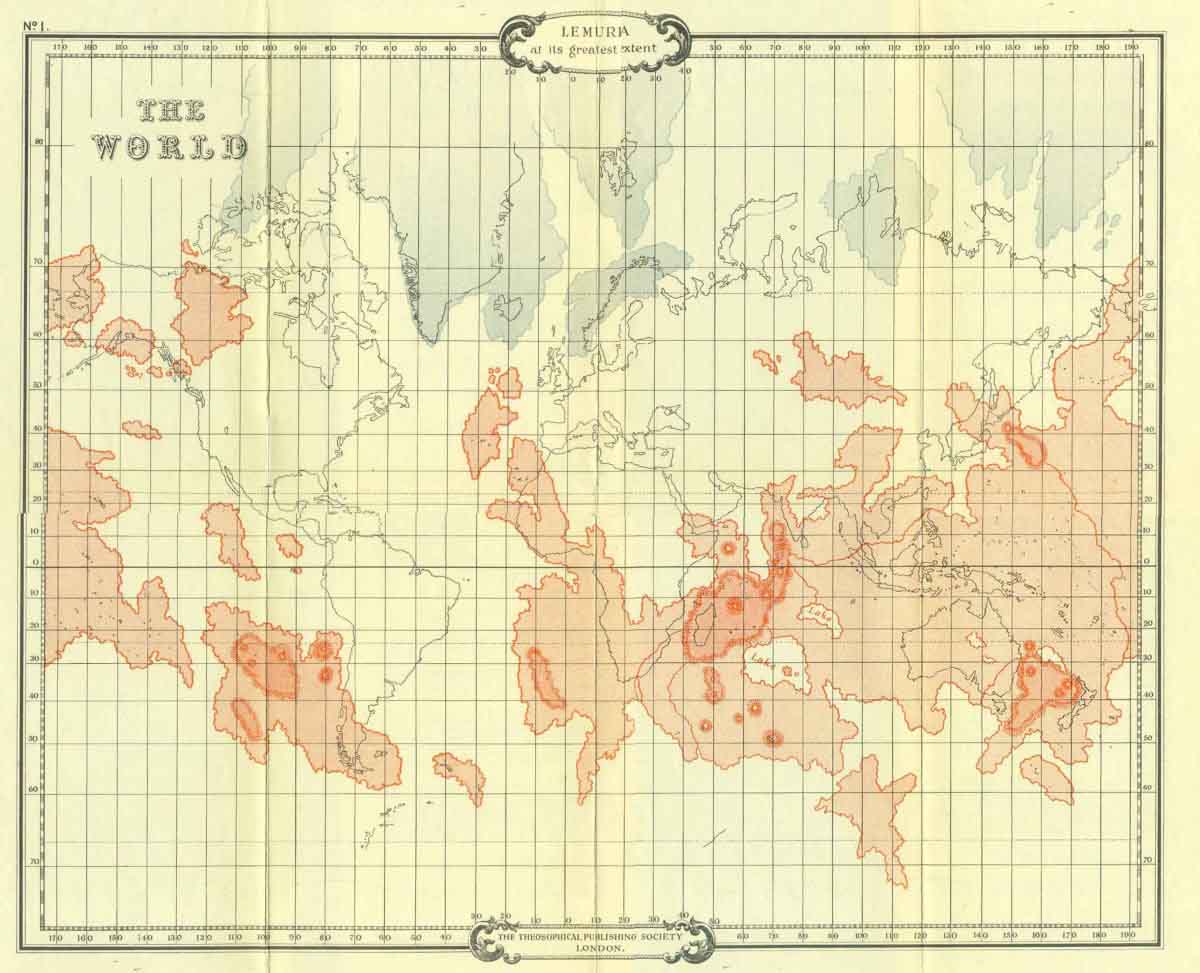
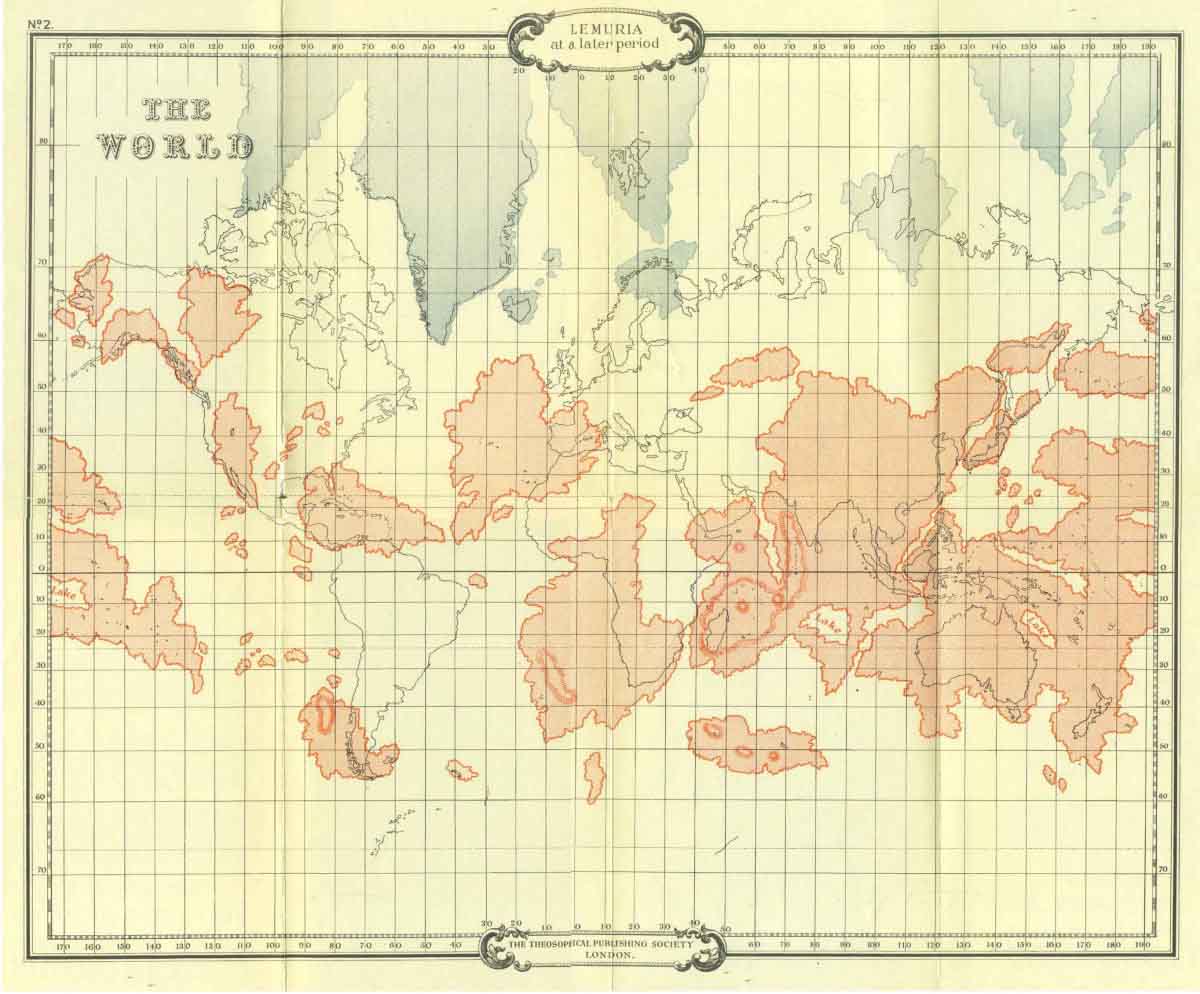
But not even geological epochs, it will be observed, are assigned to the maps. If, however, an inference may be drawn from all the evidence before us, it would seem probable that the older of the two Lemurian maps represented the earth's configuration from the Permian, through the Triassic and into the Jurassic epoch, while the second map probably represents the earth's configuration through the Cretaceous and into the Eocene period.

From the older of the two maps it may be seen that the equatorial continent of Lemuria at the time of its greatest expansion nearly girdled the globe, extending as it then did from the site of the present Cape Verd Islands a few miles from the coast of Sierra Leone, in a south-easterly direction through Africa, Australia, the Society Islands and all the intervening seas, to a point but a few miles distant from a great island continent (about the size of the present South America) which spread over the remainder of the Pacific Ocean, and included Cape Horn and parts of Patagonia.

A remarkable feature in the second map of Lemuria is the great length, and at parts the extreme narrowness, of the straits which separated the two great blocks of land into which the continent had by this time been split, and it will be observed that the straits at present existing between the islands of Bali and Lomboc coincide with a portion of the straits which then divided these two continents. It will also be seen that these straits continued in a northerly direction by the west, not by the east coast of Borneo, as conjectured by Ernst Haeckel.

With reference to the distribution of fauna and flora, and the existence of so many types common to India and Africa alike, pointed out by Mr. Blandford, it will be observed that between parts of India and great tracts of Africa there was direct land communication during the first map period, and that similar communication was partially maintained in the second map period also; while a comparison of the maps of Atlantis with those of Lemuria will demonstrate that continuous land communication existed, now at one epoch, and now at another, between so many different parts of the earth's surface, at present separated by sea, that the existing distribution of fauna and flora in the two Americas, in Europe and in Eastern lands, which has been such a puzzle to naturalists, may with perfect ease be accounted for.

The island indicated in the earlier Lemurian map as existing to the north-west of the extreme promontory of that continent, and due west of the present coast of Spain, was probably a centre from which proceeded, during long ages, the distribution of fauna and flora above referred to. For--and this is a most interesting fact--it will be seen that this island must have been the nucleus, from first to last, of the subsequent great continent of Atlantis. It existed, as we see, in these earliest Lemurian times. It was joined in the second map period to land which had previously formed part of the great Lemurian continent; and indeed, so many accretions of territory had it by this time received that it might more appropriately be called a continent than an island. It was the great mountainous region of Atlantis at its prime, when Atlantis embraced great tracts of land which have now become North and South America. It remained the mountainous region of Atlantis in its decadence, and of Ruta in the Ruta and Daitya epoch, and it practically constituted the island of Poseidonis--the last remnant of the continent of Atlantis--the final submergence of which took place in the year 9564 B.C.

A comparison of the two maps here given, along with the four maps of Atlantis, will also show that Australia and New Zealand, Madagascar, parts of Somaliland, the south of Africa, and the extreme southern portion of Patagonia are lands which have probablyexisted through all the intervening catastrophes since the early days of the Lemurian period. The same may be said of the southern parts of India and Ceylon, with the exception in the case of Ceylon, of a temporary submergence in the Ruta and Daitya epoch.

It is true there are also remains still existing of the even earlier Hyperborean continent, and they of course are the oldest known lands on the face of the earth. These are Greenland, Iceland, Spitzbergen, the most northerly parts of Norway and Sweden, and the extreme north cape of Siberia.

Japan is shown by the maps to have been above water, whether as an island, or as part of a continent, since the date of the second Lemurian map. Spain, too, has doubtless existed since that time. Spain is, therefore, with the exception of the most northerly parts of Norway and Sweden, probablythe oldest land in Europe.

The indeterminate character of the statements just made is rendered necessary by our knowledge that there didoccur subsidences and upheavals of different portions of the earth's surface during the ages which lay between the periods represented by the maps.

For example, soon after the date of the second Lemurian map we are informed that the whole Malay Peninsula was submerged and remained so for a long time, but a subsequent upheaval of that region must have taken place before the date of the first Atlantean map, for, what is now the Malay Peninsula is there exhibited as part of a great continent. Similarly there have been repeated minor subsidences and upheavals nearer home in more recent times, and Haeckel is perfectly correct in saying that England--he might with greater accuracy have said the islands of Great Britain and Ireland, which were then joined together "has repeatedly been connected with the European continent, and been repeatedly separated from it."

In order to bring the subject more clearly before the mind, a tabular statement is here annexed which supplies a condensed history of the animal and plant life on our globe, bracketed--according to Haeckel--with the contemporary rock strata. Two other columns give the contemporary races of man, and such of the great cataclysms as are known to occult students.


Duration of Lemuria

THE LOST LEMURIA

BY W. SCOTT-ELLIOT

THE THEOSOPHICAL PUBLISHING HOUSE, LTD.; LONDON

[1904]


Probable Duration of the Continent of Lemuria.

A period--speaking roughly--of between four and five million years probably represents the life of the continent of Atlantis, for it is about that time since the Rmoahals, the first sub-race of the Fourth Root Race who inhabited Atlantis, arose on a portion of the Lemurian Continent which at that time still existed. Remembering that in the evolutionary process the figure four invariably represents not only the nadir of the cycle, but the period of shortest duration, whether in the case of a Manvantara or of a race, it may be assumed that the number of millions of years assignable as the life-limit of the continent of Lemuria must be very much greater than that representing the life of Atlantis, the continent of the Fourth Root Race. But in the case of Lemuria no dates can be stated with even approximate accuracy. Geological epochs, so far as they are known to modern science, will be a better medium for contemporary reference, and they alone will be dealt with.


Evidence from Archaic Records

THE LOST LEMURIA

BY W. SCOTT-ELLIOT

THE THEOSOPHICAL PUBLISHING HOUSE, LTD.; LONDON

[1904]


Evidence obtained from Archaic Records.

The further evidence we have with regard to Lemuria and its inhabitants has been obtained from the same source and in the same manner as that which resulted in the writing of the Story of Atlantis. In this case also the author has been privileged to obtain copies of two maps, one representing Lemuria (and the adjoining lands) during the period of that continent's greatest expansion, the other exhibiting its outlines after its dismemberment by great catastrophes, but long before its final destruction.

It was never professed that the maps of Atlantis were correct to a single degreeof latitude, or longitude, but, with the far greater difficulty of obtaining the information in the present case, it must be stated that still less must these maps of Lemuria be taken as absolutely accurate. In the former case there was a globe, a good bas-relief in terra-cotta, and a well-preserved map on parchment, or skin of some sort, to copy from. In the present case there was only a broken terra-cotta model and a very badly preserved and crumpled map, so that the difficulty of carrying back the remembrance of all the details, and consequently of reproducing exact copies, has been far greater.

We were told that it was by mighty Adepts in the days of Atlantis that the Atlantean maps were produced, but we are not aware whether the Lemurian maps were fashioned by some of the divine instructors in the days when Lemuria still existed, or in still later days of the Atlantean epoch.

But while guarding against over-confidence in the absolute accuracy of the maps in question, the transcriber of the archaic originals believes that they may in all important particulars, e taken as approximately correct.


Footnotes

12:1 Dr. G. Hartlaub "On the Avifauna of Madagascar and the Mascarene Islands," see "The Ibis," a Quarterly journal of Ornithology. Fourth Series, Vol. i., 1877, p. 334.


The Lost Lemuria: The Lost Lemuria: Evidence supplied by Geology and by the relative distribution of living and extinct Animals and Plants.

THE LOST LEMURIA

BY W. SCOTT-ELLIOT

THE THEOSOPHICAL PUBLISHING HOUSE, LTD.; LONDON

[1904]


Evidence supplied by Geology and by the relative distribution of living and extinct Animals and Plants.

It is generally recognised by science that what is now dry land, on the surface of our globe, was once the ocean floor, and that what is now the ocean floor was once dry land. Geologists have in some cases been able to specify the exact portions of the earth's surface where these subsidences and upheavals have taken place, and although the lost continent of Atlantis has so far received scant recognition from the world of science, the general concensus of opinion has for long pointed to the existence, at some prehistoric time, of a vast southern continent to which the name of Lemuria has been assigned.

"The history of the earth's development shows us that the distribution of land and water on its surface is ever and continually changing. In consequence of geological changes of the earth's crust, elevationsand depressionsof the ground take place everywhere, sometimes more strongly marked in one place, sometimes in another. Even if they happen so slowly that in the course of centuries the seashore rises or sinks only a few inches, or even only a few lines, still they nevertheless effect great results in the course of long periods of time. And long--immeasurably long--periods of time have not been wanting in the earth's history. During the course of many millions of years, ever since organic life existed on the earth, land and water have perpetually struggled for supremacy. Continents and islands have sunk into the sea, and new ones have arisen out of its bosom. Lakes and seas have been slowly raised and dried up, and new water basins have arisen by the sinking of the ground. Peninsulas have become islands by the narrow neck of land which connected them with the mainland sinking into the water. The islands of an archipelago have become the peaks of a continuous chain of mountains by the whole floor of their sea being considerably raised.

"Thus the Mediterranean at one time was an inland sea, when in the place of the Straits of Gibraltar, an isthmus connected Africa with Spain. England even during the more recent history of the earth, when man already existed, has repeatedly been connected with the European continent and been repeatedly separated from it. Nay, even Europe and North America have been directly connected. The South Sea at one time formed a large Pacific Continent, and the numerous little islands which now lie scattered in it were simply the highest peaks of the mountains covering that continent. The Indian Ocean formed a continent which extended from the Sunda Islands along the southern coast of Asia to the east coast of Africa. This large continent of former times Sclater, an Englishman, has called Lemuria, from the monkey-like animals which inhabited it, and it is at the same time of great importance from being the probable cradle of the human race, which in all likelihood here first developed out of anthropoid apes. 1 The important proof which Alfred Wallace has furnished, by the help of chorological facts, that the present Malayan Archipelago consists in reality of two completely different divisions, is particularly interesting. The western division, the Indo-Malayan Archipelago, comprising the large islands of Borneo, Java and Sumatra, was formerly connected by Malacca with the Asiatic continent, and probably also with the Lemurian continent just mentioned. The eastern division on the other hand, the Austro-Malayan Archipelago, comprising Celebes, the Moluccas, New Guinea, Solomon's Islands, etc., was formerly directly connected with Australia. Both divisions were formerly two continents separated by a strait, but they have now for the most part sunk below the level of the sea. Wallace, solely on the ground of his accurate chorological observations, has been able in the most accurate manner to determine the position of this former strait, the south end of which passes between Balij and Lombok.

"Thus, ever since liquid water existed on the earth, the boundaries of water and land have eternally changed, and we may assert that the outlines of continents and islands have never remained for an hour, nay, even for a minute, exactly the same. For the waves eternally and perpetually break on the edge of the coast, and whatever the land in these places loses in extent, it gains in other places by the accumulation of mud, which condenses into solid stone and again rises above the level of the sea as new land. Nothing can be more erroneous than the idea of a firm and unchangeable outline of our continents, such as is impressed upon us in early youth by defective lessons on geography, which are devoid of a geological basis." 1

The name Lemuria, as above stated, was originally adopted by Mr. Sclater in recognition of the fact that it was probably on this continent that animals of the Lemuroid type were developed.

"This," writes A. R. Wallace, "is undoubtedly a legitimate and highly probable supposition, and it is an example of the way in which a study of the geographical distribution of animals may enable us to reconstruct the geography of a bygone age. . . .

It [this continent] represents what was probably a primary zoological region in some past geological epoch; but what that epoch was and what were the limits of the region in question, we are quite unable to say. If we are to suppose that it comprised the whole area now inhabited by Lemuroid animals, we must make it extend from West Africa to Burmah, South China and Celebes, an area which it possibly did once occupy." 1

"We have already had occasion," he elsewhere writes, "to refer to an ancient connection between this sub-region (the Ethiopian) and Madagascar, in order to explain the distribution of the Lemurine type, and some other curious affinities between the two countries. This view is supported by the geology of India, which shows us Ceylon and South India consisting mainly of granite and old-metamorphic rocks, while the greater part of the peninsula is of tertiary formation, with a few isolated patches of secondary rocks. It is evident, therefore, that during much of the tertiary period, 2 Ceylon and South India were bounded on the north by a considerable extent of sea, and probably formed part of an extensive Southern Continent or great island. The very numerous and remarkable cases of affinity with Malaya, require, however, some closer approximation with these islands, which probably occurred at a later period. When, still later, the great plains and tablelands of Hindostan were formed, and a permanent land communication effected with the rich and highly developed Himalo-Chinese fauna, a rapid immigration of new types took place, and many of the less specialised forms of mammalia and birds became extinct. Among reptiles and insects the competition was less severe, or the older forms were too well adapted to local conditions to be expelled; so that it is among these groups alone that we find any considerable number of what are probably the remains of the ancient fauna of a now submerged Southern Continent." 1

After stating that during the whole of the tertiary and perhaps during much of the secondary periods, the great land masses of the earth were probably situated in the Northern Hemisphere, Wallace proceeds, "In the Southern Hemisphere there appear to have been three considerable and very ancient land masses, varying in extent from time to time, but always keeping distinct from each other, and represented more or less completely by Australia, South Africa and South America of our time. Into these flowed successive waves of life as they each in turn became temporarily united with some part of the Northern land." 2

Although, apparently in vindication of some conclusions of his which had been criticised by Dr. Hartlaub, Wallace subsequently denied the necessity of postulating the existence of such a continent, his general recognition of the facts of subsidences and upheavals of great portions of the earth's surface, as well as the inferences which he draws from the acknowledged relations of living and extinct faunas as above stated, remain of course unaltered.

The following extracts from Mr. H. F. Blandford's most interesting paper read before a meeting of the Geological Society deals with the subject in still greater detail 3 :-- "The affinities between the fossils of both animals and plants of the Beaufort group of Africa and those of the Indian Panchets and Kathmis are such as to suggest the former existence of a land connexion between the two areas. But the resemblance of the African and Indian fossil faunas does not cease with Permian and Triassic times. The plant beds of the Uitenhage group have furnished eleven forms of plants, two of which Mr. Tate has identified with Indian Rájmahál plants. The Indian Jurassic fossils have yet to be described (with a few exceptions), but it has been stated that Dr. Stoliezka was much struck with the affinities of certain of the Cutch fossils to African forms; and Dr. Stoliezka and Mr. Griesbach have shown that of the Cretaceous fossils of the Umtafuni river in Natal, the majority (22 out of 35 described forms) are identical with species from Southern India. Now the plant-bearing series of India and the Karoo and part of the Uitenhage formation of Africa are in all probability of fresh-water origin, both indicating the existence of a large land area around, from the waste of which these deposits are derived. Was this land continuous between the two regions? And is there anything in the present physical geography of the Indian Ocean which would suggest its probable position? Further, what was the connexion between this land and Australia which we must equally assume to have existed in Permian times? And, lastly, are there any peculiarities in the existing fauna and flora of India, Africa and the intervening islands which would lend support to the idea of a former connexion more direct than that which now exists between Africa and South India and the Malay peninsula? The speculation here put forward is no new one. It has long been a subject of thought in the minds of some Indian and European naturalists, among the former of whom I may mention my brother [Mr. Blandford] and Dr. Stoliezka, their speculations being grounded on the relationship and partial density of the faunas and floras of past times, not less than on that existing community of forms which has led Mr. Andrew Murray, Mr. Searles, V. Wood, jun., and Professor Huxley to infer the existence of a Miocene continent occupying a part of the Indian Ocean. Indeed, all that I can pretend to aim at in this paper is to endeavour to give some additional definition and extension to the conception of its geological aspect.

"With regard to the geographical evidence, a glance at the map will show that from the neighbourhood of the West Coast of India to that of the Seychelles, Madagascar, and the Mauritius, extends a line of coral atolls and banks, including Adas bank, the Laccadives, Maldives, the Chagos group and the Sava de Mulha, all indicating the existence of a submerged mountain range or ranges. The Seychelles, too, are mentioned by Mr. Darwin as rising from an extensive and tolerably level bank having a depth of between 30 and 40 fathoms; so that, although now partly encircled by fringing reefs, they may be regarded as a virtual extension of the same submerged axis. Further west the Cosmoledo and Comoro Islands consist of atolls and islands surrounded by barrier reefs; and these bring us pretty close to the present shores of Africa and Madagascar. It seems at least probable that in this chain of atolls, banks, and barrier reefs we have indicated the position of an ancient mountain chain, which possibly formed the back-bone of a tract of later Palæozoic Mesozoic, and early Tertiary land, being related to it much as the Alpine and Himálayan system is to the Europæo-Asiatic continent, and the Rocky Mountains and Andes to the two Americas. As it is desirable to designate this Mesozoic land by a name, I would propose that of Indo-Oceana. [The name given to it by Mr. Sclater, viz., Lemuria, is, however, the one which has been most generally adopted.] Professor Huxley has suggested on palæontological grounds that a land connexion existed in this region (or rather between Abyssinia and India) during the Miocene epoch. From what has been said above it will be seen that I infer its existence from a far earlier date. 1 With regard to its depression, the only present evidence relates to its northern extremity, and shows that it was in this region, later than the great trap-flows of the Dakhan. These enormous sheets of volcanic rock are remarkably horizontal to the east of the Gháts and the Sakyádri range, but to the west of this they begin to dip seawards, so that the island of Bombay is composed of the higher parts of the formation. This indicates only that the depression to the westward has taken place in Tertiary times; and to that extent Professor Huxley's inference, that it was after the Miocene period, is quite consistent with the geological evidence."

After proceeding at some length to instance the close relationship of many of the fauna in the lands under consideration (Lion, Hyæna, Jackal, Leopard, Antelope, Gazelle, Sand-grouse, Indian Bustard, many Land Molusca, and notably the Lemur and the Scaly Anteater) the writer proceeds as follows:--

"Palæontology, physical geography and geology, equally with the ascertained distribution of living animals and plants, offer thus their concurrent testimony to the former close connexion of Africa and India, including the tropical islands of the Indian Ocean. This Indo-Oceanic land appears to have existed from at least early Permian times, probably (as Professor Huxley has pointed out) up to the close of the Miocene epoch; 2 and South Africa and Peninsular India are the existing remnants of that ancient land. It may not have been absolutely continuous during the whole of this long period. Indeed, the Cretaceous rocks of Southern India and Southern Africa, and the marine Jurassic beds of the same regions, Evidence that some portions of it were, for longer or shorter periods, invaded by the sea; but any break of continuity was probably not prolonged; for Mr. Wallace's investigations in the Eastern Archipelago have shown how narrow a sea may offer an insuperable barrier to the migration of land animals. In Palæozoic times this land must have been connected with Australia, and in Tertiary times with Malayana, since the Malayan forms with African alliances are in several cases distinct from those of India. We know as yet too little of the geology of the eastern peninsula to say from what epoch dates its connexion with Indo-Oceanic land. Mr. Theobald has ascertained the existence of Triassic, Cretaceous, and Nummulitic rocks in the Arabian coast range; and Carboniferous limestone is known to occur from Moulmein southward, while the range east of the Irrawadi is formed of younger Tertiary rocks. From this it would appear that a considerable part of the Malay peninsula must have been occupied by the sea during the greater part of the Mesozoic and Eocene periods. Plant-bearing rocks of Rániganj age have been identified as forming the outer spurs of the Sikkim Himálaya; the ancient land must therefore have extended some distance to the north of the present Gangetic delta. Coal both of Cretaceous and Tertiary age occurs in the Khasi hills, and also in Upper Assam, but in both cases associated with marine beds; so that it would appear that in this region the boundaries of land and sea oscillated somewhat during Cretaceous and Eocene times. To the north-west of India the existence of great formations of Cretaceous and Nummulitic age, stretching far through Baluchistán and Persia, and entering into the structure of the north-west Himálaya, Evidence that in the later Mesozoic and Eocene ages India had no direct communication with western Asia; while the Jurassic rocks of Cutch, the Salt range, and the northern Himálaya, show that in the preceding period the sea covered a large part of the present Indus basin; and the Triassic, Carboniferous, and still more recent marine formations of the Himálaya, indicate that from very early times till the upheaval of that great chain, much of its present site was for ages covered by the sea.

"To sum up the views advanced in this paper.

"1st. The plant-bearing series of India ranges from early Permian to the latest Jurassic times, indicating (except in a few cases and locally) the uninterrupted continuity of land and fresh water conditions. These may have prevailed from much earlier times.

"2nd. In the early Permian, as in the Postpliocene age, a cold climate prevailed down to low latitudes, and I am inclined to believe in both hemispheres simultaneously. With the decrease of cold the flora and reptilian fauna of Permian times were diffused to Africa, India, and possibly Australia; or the flora may have existed in Australia somewhat earlier, and have been diffused thence.

"3rd. India, South Africa and Australia were connected by an Indo-Oceanic Continent in the Permian epoch; and the two former countries remained connected (with at the utmost only short interruptions) up to the end of the Miocene period. During the latter part of the time this land was also connected with Malayana.

"4th. In common with some previous writers, I consider that the position of this land was defined by the range of coral reefs and banks that now exist between the Arabian sea and East Africa.

"5th. Up to the end of the Nummulitic epoch no direct connexion (except possibly for short periods) existed between India and Western Asia."

In the discussion which followed the reading of the paper, Professor Ramsay "agreed with the author in the belief in the junction of Africa with India and Australia in geological times."

Mr. Woodward "was pleased to find that the author had added further evidence, derived from the fossil flora of the mesozoic series of India, in corroboration of the views of Huxley, Sclater and others as to the former existence of an old submerged continent ('Lemuria') which Darwin's researches on coral reefs had long since foreshadowed."

"Of the five now existing continents," writes Ernst Haeckel, in his great work "The History of Creation," 1 "neither Australia, nor America, nor Europe can have been this primæval home [of man], or the so-called 'Paradise,' the 'cradle of the human race.' Most circumstances indicate Southern Asia as the locality in question. Besides Southern Asia, the only other of the now existing continents which might be viewed in this light is Africa. But there are a number of circumstances (especially chorological facts) which suggest that the primeval home of man was a continent now sunk below the surface of the Indian Ocean, which extended along the south of Asia, as it is at present (and probably in direct connection with it), towards the east, as far as Further India and the Sunda Islands; towards the west, as far as Madagascar and the south-eastern shores of Africa. We have already mentioned that many facts in animal and vegetable geography render the former existence of such a South Indian continent very probable. Sclater has given this continent the name of Lemuria, from the semi-apes which were characteristic of it. By assuming this Lemuria to have been man's primæval home, we greatly facilitate the explanation of the geographical distribution of the human species by migration."

In a subsequent work, "The Pedigree of Man," Haeckel asserts the existence of Lemuria at some early epoch of the earth's history as an acknowledged fact.

The following quotation from Dr. Hartlaub's writings may bring to a close this portion of the evidence in favour of the existence of the lost Lemuria 1 :--

"Five and thirty years ago, Isidore Geoffroy St. Hilaire remarked that, if one had to classify the Island of Madagascar exclusively on zoological considerations, and without reference to its geographical situation, it could be shown to be neither Asiatic nor African, but quite different from either, and almost a fourth continent. And this fourth continent could be further Evidenced to be, as regards its fauna, much more different from Africa, which lies so near to it, than from India which is so far away. With these words the correctness and pregnancy of which later investigations tend to bring into their full light, the French naturalist first stated the interesting problem for the solution of which an hypothesis based on scientific knowledge has recently been propounded, for this fourth continent of Isidore Geoffroy is Sclater's 'Lemuria'--that sunken land which, containing parts of Africa, must have extended far eastwards over Southern India and Ceylon, and the highest points of which we recognise in the volcanic peaks of Bourbon and Mauritius, and in the central range of Madagascar itself-the last resorts of the almost extinct Lemurine race which formerly peopled it."


Footnotes

2:1 Haeckel is correct enough in his surmise that Lemuria was the cradle of the human race as it now exists, but it was not out of Anthropoid apes that mankind developed. A reference will be made later on to the position in nature which the Anthropoid apes really occupy.
3:1 Ernst Haeckel's "Hist. of Creation," 2nd ed., 1876, Vol. I., pp. 360-62.
4:1 Alfred Russell Wallace's "The Geographical Distribution of Animals--with a study of the relations of living and extinct Faunas as elucidating the past changes of the Earth's Surface." London: Macmillan & Co., 1876. Vol. I., pp. 76-7.
4:2 Ceylon and South India, it is true, have been bounded on the north by a considerable extent of sea, but that was at a much earlier date than the Tertiary period.
5:1 Wallace's "Geographical Distribution, etc." Vol. I, pp. 328-9.
5:2 Wallace's "Geographical Distribution, etc.," Vol. ii., p. 155.
5:3 H. F. Blandford "On the age and correlations of the Plant-bearing series of India and the former existence of an Indo-Oceanic Continent," see Quarterly journal of the Geological Society, Vol. xxxi., 1875, pp. 534-540.
8:1 A reference to the maps will show that Mr. Blandford's estimate of date is the more correct of the two.
8:2 Parts of the continent of course endured, but the dismemberment of Lemuria is said to have taken place before the beginning of the Eocene Age.
11:1 Vol. ii., pp. 325-6.


Subscribe to this RSS feed

Log in or create an account