log in
LC Geerts

LC Geerts

Website URL:

Teutonic Myth and Legend: Chapter 40 Virginal, Queen of the Mountains

TEUTONIC MYTH AND LEGEND

by DONALD A. MACKENZIE

An Introduction to the Eddas & Sagas, Beowulf, The Nibelungenlied, etc.

London, Gresham Publications 1912

CHAPTER 40

Virginal, Queen of the Mountains

The Maid--devouring Giant--Hildebrand slays Orkise--Dietrich and the Giants--Night Battle--The Black Horseman--Slaughter of Monsters--Castle Muter--Prince taken Prisoner--The Rescue--Janibas surrounds Virginal's Castle--Magic Tablet--The Avalanches--A Peerless Queen--Dietrich wins his Bride.

TIDINGS came unto Dietrich at Bern that Virginal, Queen of the Mountains, was in sore distress because that a giant wasted her land and had perforce to obtain as tribute, at each new moon, a fair maiden, whom he did devour.

The prince set forth with old Hildebrand to give aid to the queen, who had great beauty, and ruled over those dwarfs and giants in the Tyrolese mountains that never sought to do injury unto mankind. Her oppressor was named Orkise, whose son was Janibas, an evil magician.

As the two heroes rode through the forest there came unto them a dwarf whose name was Bibung. He guided them towards Jeraspunt, where the queen had her dwelling, but when night came he vanished. Snow fell next morning, and the knights were parted one from another. Ere long Hildebrand heard bitter cries, and he beheld a fair maiden who had been taken to the forest so that the giant might obtain her for tribute. Fairest was she of Queen Virginal's maidens. The knight proffered his protection and vowed to rescue her, whereat her heart was filled with gratitude and her eyes with joy tears.

Soon the forest was shaken with dread clamour, for the giant was coming nigh with his dogs to possess himself of his prey. Hildebrand drew his sword; not slow was he to enter the conflict, and ere long he slew the giant and put to flight his evil son Janibas.

The maiden returned with glad heart unto the queen, and gave tidings of how the giant Orkise had been slain. There was great rejoicing in the castle, and eagerly did Virginal and all her people await the coming of the heroes.

Meanwhile Dietrich fought with many of the giant's followers. The clamour of battle resounded far and near, and when Hildebrand hastened to his aid the horde was overcome; many were slain and many made escape.

Together did they then go upon their way towards the palace of Jeraspunt. Darkness came on, and they rode to the gate of the castle of Orkise, deeming it theirs by right of conquest. But small hospitality were they shown. No sooner did they demand entrance than fierce giants issued forth against them. Heavy clubs they bore, and they smote fiercely, but soon they were overcome by the valorous heroes. Then appeared a black horseman. He spake in a strange tongue, and giants sprang up out of the earth to continue the fight. As they were cut down others took their place, and when all the giants were slain, hissing snakes and nameless reptiles issued forth against Dietrich and Hildebrand, so that they had to fight constantly throughout the night. The black horseman entered not the fray, and when dawn broke he vanished from sight. Then did the heroes enter the castle and set at liberty three of Queen Virginal's maidens whom they found there.

Now, during the night the heroes slew a fierce dragon. It carried in its jaws a brave knight whose name was Rentwin, and with him did Dietrich and Hildebrand journey towards his father's castle. There did they remain until their wounds were healed.

Thereafter the prince and his veteran companion set forth with Rentwin and his sire towards Jeraspunt. Eager was Dietrich to behold the fair maiden queen Virginal. He spurred his steed; he rode in front, and ere long he was lost to his fellow knights. 'Twas ill for him that he waited not for them, because the way was strange and wild, and he wandered from the straight path. So it chanced that he came unto the castle of Duke Nitger, called Muter.

Now the duke had many giants, and when one of them issued forth, Dietrich asked of him to be guided unto the palace of Queen Virginal. Answer was given him according to his desire; but when he turned to ride away the giant smote the hero with his club so that he fell from his horse. Then was brave Dietrich seized and bound and thrown into a dark dungeon. The duke's sister treated him with kindness. But for her protection the prince would have been put to death.

When Hildebrand reached the palace of Virginal he received tidings that the prince had been taken captive. So he hastened back unto Bern, and rode forth with many brave knights, among whom were Wolfhart and Witege and Heime. They laid siege to Castle Muter and fought against twelve giants. While the battle waged fiercely, Dietrich made escape and entered the fray. Victory was then with the heroes of Bern, and all the giants were slain.

The knights sought to put Duke Nitger to death, but his sister pleaded for him, and his life was spared by Dietrich.

Then did they all set forth towards Jeraspunt, On their way they beheld a dwarf riding towards them. Unto Dietrich spake the little man, and he told that fierce Janibas had surrounded the palace of Queen Virginal with a great army, an made demand of all her maidens and the magic jewel in her crown which gave her power to rule over all her subjects.

So the heroes pressed onward. They climbed the mountains over ice and snow, and soon they heard the fierce clamour of battle. The howling of the great black dogs of Janibas was like the howling of wintry tempests; strange monsters fought there, and the queen's defenders were in sore straits. The voices of the giants were loud as thunder peals.

In the midst of the battle Dietrich saw the black horseman. He knew him to be Janibas. An iron tablet he held in his hand and wrought spells upon it. The prince sprang upon him. His sword flashed fire. He broke in pieces the iron tablet and slew the dread worker of evil. Then pealed the loud thunder amidst the Tyrolese mountains; the glaciers were sundered, and avalanches fell upon the evil army of Janibas, which suddenly vanished from sight. Soon was there silence and peace, and an end to that dread conflict.

Queen Virginal sat alone, high throned in her mountain palace, unmoved and beautiful; brightly gleamed the jewel in her crown. A glistening silver veil was drawn round her body, and her maidens crouched trembling at her feet.

When the battle was ended, Dietrich made approach, and she called him "hero", and greeted him with love.

"No longer can I reign here in Elfland," she spake. "Thy great deeds have I beheld, and for thy sake I shall leave my home and my kingdom, and henceforth live among men; for I shall be thy bride, and love thee so long as life may last."

Then were Dietrich and Queen Virginal wedded there with pomp and ceremony, and elves and heroes feasted within the mountain palace, and drank wine and made merry. Ere long Dietrich and his bride and the brave knights journeyed together to Bern, where they were received with acclamations by the people.

Dietrich and Queen Virginal lived happily together, and when King Dietmar died, the prince reigned in his place. Then was there peace within the kingdom; but evil was being wrought in another land, and it was fated that King Dietrich must become a fugitive among men ere he could triumph completely over his evil foemen.

Teutonic Myth and Legend: Chapter 39 The Wonderful Rose Garden

TEUTONIC MYTH AND LEGEND

by DONALD A. MACKENZIE

An Introduction to the Eddas & Sagas, Beowulf, The Nibelungenlied, etc.

London, Gresham Publications 1912

CHAPTER 39

The Wonderful Rose Garden

Dietleib the Dane--How he became a Knight--Kunhild stolen by the Dwarf King--Knights to the Rescue--The Garden laid waste--Laurin's Vengeance--Witege overcome--Combat with Prince--The Invisible Combatant--Laurin is spared--Visit to Mountain Dwelling--The Banquet--Knights made Prisoners--Dietrich's Fiery Breath--Battle with Dwarfs and Giants--The End of Strife.

FIRST be it told of the lady Kunhild's brother, Dietleib the Dane. He had fame in his own land for strength and prowess, and great and glorious were the deeds of his sire, the brave Yarl Biterolf. It chanced that when the three journeyed towards Bern they were set upon by Heime and his robber band in the midst of a forest. Boldly fought the Danes, and the robbers were all killed, save Heime alone, whom Dietleib, with his sword Welsung, wounded on the forehead and put to flight.

Thereafter the young Dane became a servant unto Dietrich, making pretence that his name was Ilmenrik. It chanced that the prince paid visit to the Court of Ermenrich, and there was his Danish servant taunted by Walter of Wasgenstein. Dietleib was wroth, and he challenged the arrogant knight, wagering life against life, to prevail against him in performing feats of strength. All the Court assembled to behold the sport, and the knight was boastful and proud. But great was the might of Dietleib the Dane. He could putt the stone and throw the hammer so that men marvelled to behold, nor could Walter of Wasgenstein prevail against him.

Then did King Ermenrich pay life ransom in money for the boastful knight, and the Dane gave a great feast to which his master did invite many valorous war men.

Proud was Dietrich of his servant, and he made him a knight. Heime, who had returned, was present at the feast, and Dietleib sat beside him, and ere long he spake, saying:

"On thy forehead is an evil scar, Heime. How came thou by it?"

Heime made answer: "I shall tell thee in secret, Ilmenrik. Wounded was I in combat with Dietleib the Dane. I shall rest not until my shame be wiped out with his life blood."

"Know then," the new knight whispered, "that I am he whom thou didst attack with thy robber band. Look in my face. . . . I am no other than Dietleib. Fast was thy horse, else thou hadst not escaped me. But I seek not now to denounce thee before Dietrich. Let this secret be kept between us."

It chanced upon a day thereafter that fair Kunhild, Dietleib's sister, danced with her maids upon a green meadow. She went towards a linden tree; then suddenly she vanished from sight. The King of Dwarfs, whose name was Laurin, had long loved her for her beauty, and desired to have her for his bride. So he came secretly towards the maiden, and below the linden tree he cast over her his Cloak of Obscurity; then did he carry fair Kunhild away towards his castle among the Tyrolese mountains.

The heart of Dietleib was filled with sorrow, because that he loved his sister very dearly. He hastened unto Hildebrand, who dwelt in his castle at Garda, and besought his aid, saying:

"The castle of Laurin is in the midst of a Tyrol mountain, and in front of it he hath a wondrous Rose garden."

Many a life may be lost ere Kunhild is rescued,

Hildebrand said; "but let us unto Dietrich and his knights, so that we may take counsel with them."

When that the knights came to know that Kunhild was taken away by the dwarf king, Wolfhart spake boldly, as was his wont, and said:

"Alone shall I ride forth and rescue this fair maid."

Dietrich heard the boast, nor made answer. He spake to wise old Hildebrand, saying: "Knowest thou aught of Laurin's Rose garden?"

"'Tis told," Hildebrand said, "that it hath four gates of gold. But no wall shields it. Round the Rose garden is drawn a silken thread, and he who breaks it shall have his right hand and left foot cut off. Laurin, King of Dwarfs, ever keeps watch o'er his wondrous garden, which is of exceeding great beauty."

Witege spake: "Laurin can punish not an offender who entereth his garden until he doth prevail against him in single combat."

"Then shall we fare forth," Dietrich said. "We seek but Kunhild, and need not despoil the Rose garden."

So the Prince rode towards the Tyrol mountain in which Laurin, King of Dwarfs, had his dwelling. With him went Hildebrand, Heribrand's son; Witege, Wieland's son; Dietleib the Dane, and Wolfhart, Hildebrand's kinsman.

Dietrich and Witege rode in front, because that Hildebrand had taunted the prince, as was his wont, for he had been his master. "Were I not with thee," he said, "thou couldst not overcome the dwarf."

So it fell that Dietrich and Wieland's son were first to reach the wondrous Rose garden. Witege broke to pieces a golden gate, and they entered together. Fair were the roses, and of sweet and refreshing fragrance; their beauty gladdened Dietrich's eyes, and he was loath to despoil them. But Witege sought to defy the dwarf, and he rode through the blossoming shrubs, trampling them ruthlessly underfoot. Soon was the fair garden made desolate as a wilderness.

Wroth was Laurin, King of the Dwarfs. He rode forth on his steed, clad in full armour; his spear was in his hand. But three spans high was he, yet had he wondrous strength and skill in conflict.

"What evil have I done thee that thou shouldst thus destroy my roses?" he cried bitterly. "Thy right hand and thy left foot I now demand, and must needs obtain."

Witege defied the dwarf with laughter and scorn. He deemed not that he was endowed with magical power. Diamonds sparkled upon Laurin's armour; these made it swordproof and spearproof. He also wore a girdle which gave him the strength of twelve men. On his head was a shining crown, and therein was his weakness. Golden birds sang forth from it as if they were alive.

Witege lowered his spear. Laurin charged fiercely, and at the first thrust swept him from the saddle. In great peril was Wieland's son, for the dwarf bound him; but Dietrich made offer of gold to atone the evil he had done.

"Thy roses," he told Laurin, "will bloom again in May."

The dwarf made answer that he possessed already gold in abundance, but that his roses could not be restored unto him.

Witege taunted Dietrich. "Fearest thou to tilt with him?" he said; "must I die because thou dost shrink from Laurin?"

The prince was wroth, and he challenged the dwarf king forthwith to single combat, taking upon himself the blame for the evil which his knight had accomplished.

'Twas well for Dietrich that old Hildebrand then rode up with Wolfhart, his kinsman, and Dietleib the Dane. The old warrior counselled the prince to tilt not with the dwarf. "Rather shouldst thou fight him on foot with sword against sword," he said. "His armour thou canst not pierce, for by reason of the diamonds it is charmed against all weapons. Smite thou him upon the head."

As Hildebrand counselled, so did Dietrich do. He leapt from the saddle and challenged Laurin to combat with swords. Fierce was the conflict. The prince smote upon the dwarf's head blow after blow, so that he was made faint. But Laurin drew round him his Cloak of Obscurity and fought then unbeholden by the Prince of Bern.

Many wounds did Dietrich receive; but he waxed in battle fury and suddenly took the unseen dwarf in his arms and wrestled with him. From the prince's mouth issued forth flames of fire, but without avail; he could not injure Laurin.

"Snatch off his waist girdle," Hildebrand cried.

Ere long Dietrich possessed himself of the magic girdle, which gave to the dwarf his great strength. Then the prince had him in his power. He cast the little king on the ground and tore off the Cloak of Obscurity.

Laurin feared that he would be put to death, so he called upon Dietleib, Kunhild's brother, who pleaded for his life, for the young Dane desired most of all to discover where his fair sister was held in captivity. Thus did the dwarf king escape the vengeance of Dietrich. He gave thanks unto Dietleib, and when he had sworn oaths of brotherhood with him, he invited the prince and all his knights into his mountain castle.

They went together over a pleasant plain, and through a fair forest. A great linden tree was there, and many fruit trees whose odours were sweet. Birds sang merrily in the branches, and Dietrich was glad of heart. He began to make answer to the birds; but old Hildebrand warned him not to whistle until he had left the wood. All the knights were lighthearted save Witege. He had bitter memory of how the dwarf had prevailed against him, and suspected treachery. Wolfhart taunted him, but Wieland's son rode in front. He was first to reach the castle entrance. He saw there a bright golden horn suspended on a chain. He blew a loud blast upon it. When he did that the door opened wide and they all went within. An iron door was opened; it closed behind them. Then through a door of shining gold they went; it was shut fast like to the other.

Soon Dietrich and his knights found themselves in a bright and spacious hall. Hundreds of dwarfs were there. They made merry; they danced and they held tournaments. Delicious wine was given unto the strangers, and even Witege forgot to be suspicious, and made merry with the others. Then did Laurin begin to work his evil designs. He cast a spell upon Dietrich and his knights, so that they could behold not one another. They saw but the merry dwarfs and the glories of the mountain dwelling.

At length fair Kunhild appeared. She had been made Laurin's queen, and wore a gleaming crown. Many maidens came with her, but she was fairest of them all. Dwarfs playing harps, and dancing and performing strange feats, skipped before her and around. In her crown shone a bright jewel. It dispelled the magic mist, and the warriors beheld one another again.

Then was a great feast held. Kunhild sat with Laurin, and Dietleib, whom she embraced tenderly, she took beside her. They spoke in low voices one to another. Great was her desire to leave all the splendour and wealth that was there, and return once again to her own kin.

The dwarf persuaded all the knights to lay down their arms. So merry were they that they did so without fear.

Evening came on, and Laurin led Dietleib to a chamber apart, where he made offer to him of rich treasure if he would desert Dietrich and his knights. But the young Dane refused resolutely to be a traitor, whereat the dwarf vanished and the door was locked securely. Dietleib was made blind.

Then were the strangers given wine, which caused them all to fall into a deep sleep. The vengeful king Laurin thus had them in his power. He caused them to be bound, and they were all cast together into a deep dungeon, so that vengeance might be wreaked upon them, because that the Rose garden had been despoiled. There they lay helpless and blind.

Kunhild wept for them. When the dwarfs were all asleep she stole in secret to her brother's chamber and gave to him a golden ring which dispelled his magic blindness. Then did the young Dane secure possession of his weapons and those of his fellow knights.

Meanwhile Dietrich woke up. Wroth was he when he found that he was fettered. The dwarf's girdle restored his sight, and flames issued from his mouth, which melted his bonds of iron, so that he rose up. He went towards each of his companions and set them free one by one.

Dietleib then came with all their weapons, and with the prince he fought fiercely against the dwarfs. At length Dietrich wrenched from one of them a golden ring. He gave it unto Hildebrand, and his sight was restored. Then did the old warrior enter the conflict. The dwarfs fell fast before them. Thousands were put to death, for there was none in Laurin's castle who could prevail against the three great warriors.

At length Laurin rushed without. He blew a great blast upon his horn, and five giants armed with clubs came to his aid.

Wolfhart and Witege were still blind, but they could rest not while the clamour of battle raged about them, so they rushed into the fray and fought bravely. Then gave Kunhild unto them jewelled rings, and their blindness was dispelled.

The five giants fought against the five knights, and long and terrible was the struggle which ensued; but one by one the monsters were slain, and Dietrich and his knights were triumphant. The heroes waded knee deep in blood, so great was the slaughter which they accomplished in the kingdom of Laurin.

Then was the dwarf king made prisoner and Kunhild set free. Dietrich and his knights possessed themselves of much treasure, and they returned unto Bern, taking with them Laurin and Dietleib's fair sister.

Laurin was laughed at and put to shame, and he brooded over his evil lot, desiring greatly to be avenged upon Dietrich and his victorious knights. So he sent a secret message unto his uncle, Walberan, who was king over the giants and dwarfs in the eastern Caucasus, and besought him to come to his rescue.

He spoke secretly thereanent unto Kunhild, whereat she made promise that if he swore oaths of friendship with Dietrich, she would return with him to his mountain dwelling and be his queen once again.

So she prevailed upon Laurin to do her will. "My Rose garden", he said, "I shall plant again that the roses may bloom fair and fragrant in the sunshine of May."

The dwarf king drank wine with the prince of Bern and made peace, vowing to be his lifelong comrade and helper.

As they sat together at the feast, a message was borne unto Dietrich from King Walberan, demanding all the treasure and all the weapons that were in Bern, and the right hand and left foot of every knight who had wrought destruction in the Rose garden. Defiantly did the prince make answer and prepared for battle.

Dietrich and Walberan challenged each other to single combat, and they fought with great fierceness. Numerous were their wounds, nor could one prevail over the other. It seemed as if they would both be slain.

Then did Laurin ride forth, and, embracing his uncle, he prevailed upon him to make peace. Hildebrand pleaded likewise with Dietrich, and the combat was brought to an end. Together they then sat down to feast and drink wine, and they vowed oaths of friendship, so that there might be lasting peace between them.

Kunhild returned with Laurin unto his mountain dwelling. The Rose garden was planted once again, and it bloomed fair in the sunshine of May.

Herdsmen among the hills, and huntsmen who wend thither, have been wont to tell that they could behold on moonlight nights Laurin and fair Kunhild dancing together in the green forests and in the valleys below the Tyrolese mountains. Dietleib's sister hath still her dwelling in the bright castle as in other days. She is Queen of the Dwarfs and can never die.

The Rose garden blooms ever fair, but unbeholden by men, in the sunshine of May, and many have sought to find it in vain.

Teutonic Myth and Legend: Chapter 38 The Land of Giants

TEUTONIC MYTH AND LEGEND

by DONALD A. MACKENZIE

An Introduction to the Eddas & Sagas, Beowulf, The Nibelungenlied, etc.

London, Gresham Publications 1912

CHAPTER 38

The Land of Giants

Maidens of Jochgrimm--The Storm Giant Ecke--His Search for Dietrich--Combat in Dark Forest--Giant slain--The Well Nymph--Maiden in Flight --Ecke's Brother Fasold--Overcome by the Prince--The Beast--Arrival at Castle--Giant's Treachery--The Knights who quarrelled--Heime becomes a Robber.

DIETRICH rode along through the forest in thick darkness. He journeyed towards Jochgrimm mountain, where dwelt the beauteous princesses who had heard of his fame and desired greatly to behold him. The prince dreamed not of their treachery, or of the perils that he must needs pass through.

Now there were three young giants who wooed the maidens. They were brothers, and their names were Ecke and Fasold and Ebenrot. Ecke, which signifies "The Terrifier", was but eighteen years old. He had already won fame as a warrior in single combat; but having slain one foeman he could find not another who dared to contend against him. Oft had he heard of Dietrich's valour and great deeds, and he vowed that he would lay him low. Unto Ecke was promise made in the land of giants that if he slew Dietrich he should have for wife Seburg, the fairest of the three princesses in Jochgrimm.

Ecke had wondrous strength. Twice seven days and twice seven nights he could fast and travel onwards, nor ever feel faint; from hill to hill he could leap like a leopard. He required no steed, nor was there one that could carry him.

When the strong giant came to know that Dietrich was to ride forth from Bern, he prepared to go against him. . . . The Princess Seburg clad her lover in bright armour and wished him well. He made swift departure. . . . When he entered the forest the birds fled terrified before him; branches were bowed down and rudely shaken as he passed; trees swayed and groaned, and those that he smote crashed down and were uprooted. . . . So rushed Ecke upon his way until he reached Bern, where he was told that Dietrich had gone towards Jochgrimm by another way.

Without pause the giant followed after the valorous prince. So swift was his pace that he came nigh to him ere night fell. He beheld four knights lying on the ground. But one alone was alive, and he was grievously wounded.

"Seek not the Knight of Bern," the wounded man said; "like to lightning is his sword stroke."

Ecke went onward; raging furiously he went. He feared not Dietrich; his heart's desire was to combat against the arrogant hero. Night fell as he went through the trees.

In the blackness he heard a horseman coming nigh.

Who art thou, he cried, "that rideth through the darkened forest?"

A deep strong voice made answer: "Dietrich of Bern."

"Thou shalt fight with me," Ecke cried, for he was impatient to win renown.

But Dietrich desired not to combat with any foeman in the darkness, and rode on.

Ecke strode beside the Knight of Bern, and made boast of his armour.

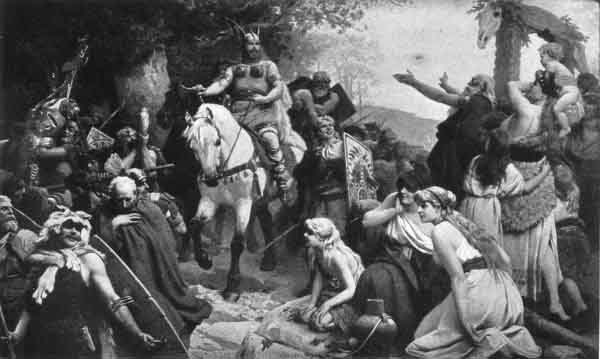
RETURN OF VICTORIOUS TEUTONS<BR> <I>From the painting by P. Thumann. By permission of Franz Hanfstaengl</I> RETURN OF VICTORIOUS TEUTONS
From the painting by P. Thumann. By permission of Franz Hanfstaengl

"By Wieland, the wonder smith, was it fashioned," Ecke said; "nor can thy blade Naglering cleave it. Bright and sharp is mine own sword Ecke-sax. 'Twas forged by him who made Naglering; of gold is the hilt, and it is inlaid with gold. Of fine gold is my girdle also. Much booty will be thine if thou canst overcome me."

But Dietrich could not be tempted to fight for sword nor treasure in the forest blackness.

Ecke was made angry. "Thee shall I proclaim as a coward," he cried, "because thou art afraid. . . ."

"When day breaks," Dietrich said, "I shall combat with thee. Here in the darkness we can behold not one another."

But Ecke, confronting him, refused to wait. "Thou shalt have the Princess Seburg for thy bride if thou art ready now for combat. Fairest is she of all maidens upon earth."

Dietrich leapt from his horse. "By the gods," he cried, "I shall fight thee now, not for thy treasure nor even thy sword, but for Seburg the fair one!"

On stones did they strike their swords. . . . The firesparks flashed bright, and they beheld one another in the blaze and began to fight. Nor was there darkness then, for their swords glowed like flames as they smote together and flashed in the blackness. The clamour of battle roared like thunder through the forest; the heavens heard the clash of their shields. . . . The night was filled with terror; the trees were scorched about them; the grass was trodden under the ground by their feet.

Long they fought, nor did one wound the other. Then Ecke bounded against the prince with all his strength; their shields were interlocked, and Dietrich stumbled and fell. Ecke held him down and said:

"If thou wilt permit me to bind thee, thy life shall I spare. Fain would I deliver thee thus unto Seburg with thine armour and thy steed."

"Death is better than shame," Dietrich made answer.

So they wrestled one with another in the darkness. In vain did Ecke strive to overcome the Knight of Bern, who at length clutched the giant's great throat, and sought to roll over him. Long and terrible was that fierce struggle. Nor would one make peace with the other although they were of equal strength.

In vain did the prince beseech Ecke to swear oaths of fellowship with him.

Dietrich's steed at length broke free. It heard his cries and ran towards him in the night. Falke was its name, and it loved the prince better than life. Now it came to his aid, and, rearing high, the bold steed leapt upon the body of Ecke and broke his back.

Dietrich leapt to his feet, and seizing the giant's great sword he struck fire, and in the sudden blaze he smote off his foeman's head. Then was there silence in the forest.

When dawn broke through the trees Dietrich clad himself in the giant's shining armour; he girded on the mighty sword Ecke-sax, then rode on his way with the head of Ecke dangling from his saddle bow.

He had no great joy in his victory, because he feared that he would be accused of killing Ecke in his sleep. 1

Dietrich rode on until he came to a forest spring and beheld a water nymph lying beside it wrapped in soft slumber. He laid hands on her, and she awoke. Then did the nymph heal the prince's wounds, and he became strong again. She pointed out to him the path which led unto Jochgrimm mountain, and gave warning of the dangers which would beset him. Then did Dietrich mount his steed again and ride towards the land of the giants.

As he went through the forest a beauteous maid came running towards him. Swift were her steps, and her face was pale and terror-stricken, because that she was pursued by the giant Fasold, Ecke's brother, and his fierce hounds. 2

Dietrich gave the maiden his protection, and went against the giant who pursued her. When Fasold beheld the prince clad in Ecke's armour, he cried:

"Art thou my brother Ecke riding hither on a steed?"

Dietrich made answer: "I am not thy brother; him have I slain."

"Thou dog of death," bellowed Fasold, "thou hast murdered Ecke whilst he lay in sleep, else would he never have been overcome."

"I fling thee back thy falsehood," Dietrich answered. "Thy brother challenged me to fight in darkness for the sake of fair Seburg. Had I known he was of such great strength I should ne'er have crossed swords with him."

Wroth was Fasold, and he rushed against Dietrich. Stronger was he than Ecke. In combat he scorned to strike more than one blow; never before was a second required. Fiercely he smote his brother's slayer, and Dietrich fell from his horse and lay in a swoon. The giant then turned away and went towards the castle. He deemed that the prince was slain.

Dietrich lay not long upon the ground. His strength returned to him; he rose up; he leapt upon his horse; he hastened after the giant, for he desired to be avenged.

Now Fasold had vowed never to combat with any foeman who survived his first blow, but Dietrich taunted him, saying: "Thou art afraid to stand against me. A coward is Fasold, else would he combat with his brother's slayer."

The giant turned fiercely, for no longer could he endure the prince's words. Swiftly were their swords drawn, and hot but not brief was the conflict. Thrice was Dietrich wounded, but five times had he wounded with Ecke-sax the giant Fasold, who at length cried out for mercy.

"If thou wilt but spare my life," Fasold said, "thee shall I serve, and ever be thy faithful henchman."

"Had I not slain thy brother," answered Dietrich, "I would have thee gladly for my knight; but I can claim not the service of one whose kin I have wronged. Yet shall I take oaths of fellowship with thee. Let us pledge ourselves now to help one another in time of need, and be like unto brothers before all men."

So they swore oaths of knightly brotherhood, and went together towards Jochgrimm mountain.

A great beast came out against them, and men say that it was like unto an elephant. Fasold would fain have let it pass, but Dietrich dismounted and made fierce attack with Ecke-sax. Yet, although he gave the monster many wounds, he could not slay it. The beast came nigh to treading him underfoot, but once again did. his steed Falke come to his rescue; it broke free; it leapt against and kicked the monster, which turned from the prince a while. Then Dietrich crouched under its stomach and stabbed there with the keen sword Ecke, making nimble escape as the beast fell to die. 3

Then Dietrich and Fasold went on their way. They next beheld a great dragon flying towards them. It was flying very low, and in its jaws it carried a knight, who called loudly for help.

Dietrich struck at the monster, but even Ecke-sax could not pierce it. Whereat the knight said: "By my sword alone can the dragon be slain, but it lies within the monster's mouth."

The Prince of Bern thrust his hand between the dragon's jaws. He pulled forth the sword.

"Wound me not when thou dost strike," the knight cried.

Dietrich smote the monster with the keen-edged sword and slew it, and the captive knight was drawn forth.

"Thy name and lineage?" the prince demanded of him.

"My name is Sintram," answered the knight, "and kinsman am I to Hildebrand at Bern. I was journeying towards Bern, so that I might become a follower of Prince Dietrich. The dragon came upon me while I slept, else would it not have carried me away."

Dietrich's heart was made glad, and he restored unto Sintram his wondrous sword, saying: "I am he whom you seek to serve, even Dietrich, Prince of Bern."

So they went together on their way with Fasold. Then, as they drew nigh unto Jochgrimm mountain, the giant forgot his vows, and sought to take flight. But Dietrich would not have him go free until he reached the castle in which the princesses had their dwelling.

Ere long they reached a great castle. Two giant statues stood on each side of the door, and Fasold led him in. But when the prince came between the statues their arms fell, and had he not made swift escape he would have been slain by their stone clubs.

Dietrich was made wroth. He turned upon Fasold forthwith, and slew him because of his treachery. Then he entered the hall, and the three princesses and their mother, the queen, came towards him, for they deemed he was Ecke.

"'Twas your desire," the prince said, "to behold Dietrich of Bern. He now greets thee thus."

So saying, he flung at their feet the head of the giant Ecke, and then turned from them. . . . He hastened without, and, mounting his steed, rode with Sintram towards Bern.

Heime came forth to meet Dietrich and greeted him with such warmth that Dietrich gave unto him the sword Naglering, which Alberich 4 had forged for the giant Grim. Ecke-sax he did keep for himself.

Witege was ill-pleased because that his fellow knight was thus honoured.

"I forget not," he said unto Heime, "that when I was beset by robbers thy sword remained in its sheath."

"Evil is thy tongue, thou self-sufficient man. Fain would I have it silenced," Heime said.

Both knights drew their swords to combat one against the other. Dietrich was wroth and stepped between them. Then he spake to Heime saying:

"Rash knight, thou shalt now go hence. 'Twas unseemly that thou didst not aid thy fellow when robbers came against him. . . . When by thy deeds thou hast proved thyself a hero, thou mayest return again unto Bern."

"With the sword thou hast given me," Heime said, I shall win more than any man can take away."

He went forth alone. He waged war against the robbers and slew them, and became chief of a robber band. Many a wayfarer fell by his sword, and he was dreaded by valiant knights. He re, turned not unto Dietrich again until he was possessed of much treasure by his evil doings.

Against many giants did the prince combat, but never was he in greater peril than when Laurin, the dwarf, had power over him and his knights and held them all in captivity.

Footnotes

1 This story was originally a storm myth, in which Dietrich was Thunor (Thor), and Ecke a tempest. The three princesses are the giant maids of a Tyrolese folk tale, who brew storms on Jochgrimm mountain. A Highland hag is also a storm-brewer. She is associated with the first week of April which is called "Cailleach". At Cromarty an April hag causes the south-westerly gales and, according to a local saying, still current, "harries the crooks" (empties the pots) of the fisher-folk who can't go to sea.
2 Another nature myth. So do the maidens of the Boyne, Tay, Ness, and other rivers flee before the outraged well demon, who may be a giant, a dragon, or a kelpic, because they had neglected, when drawing water, a ceremonial observance, or had committed a theft. Probably the Severn story, as related by Geoffrey of Monmouth, was originally of similar character. There are also Greek parallels.
3 So was the dragon in Beowulf and the Fafner dragon, which Sigurd stabbed, put to death. The underpart only can be mortally wounded.
4 Alberich was called in French legend Auberon. Spenser introduced him to this country as Oberon. Alberich signifies "elf King".

Teutonic Myth and Legend: Chapter 37 Dietrich of Bern

TEUTONIC MYTH AND LEGEND

by DONALD A. MACKENZIE

An Introduction to the Eddas & Sagas, Beowulf, The Nibelungenlied, etc.

London, Gresham Publications 1912

CHAPTER 37

Dietrich of Bern

Hildebrand's Pupil--Alberich the Dwarf--Grim and Hilde--The Magic Sword--Conflict in the Cavern--Giant and Hag are slain--Great Sigenot--Dietrich taken Prisoner--In the Dragon's Lair--Hildebrand put to Shame--Giant overcome--Heime's Challenge--Wieland's son Witege--Fierce Combat --Dietrich in Peril--Peace Terms.

DIETRICH was the son of great Dietmar, King of Bern, whose brother was the fierce King Ermenrich. He was but seven years old when there came to his father's Court the battle hero, Hildebrand, far famed for valorous deeds. Unto that great warrior was given the care of the young prince, so that he might gain manly wisdom and skill in feats of arms. Fast friends they became ere long, and faithful were they one to another in after years, until death did thrust them apart.

It chanced that when the lad grew strong, and had desire for daring adventure, a giant and a giantess, whose names were Grim and Hilde, ravaged the land with fire, and did slaughter many goodly subjects. Dietmar raised a mighty army and went out against them, but he could discover not the hiding place of the monsters, who ever came forth unawares to work their evil designs.

Now Dietrich had great desire to combat with the giant and giantess, for he was brave as he was strong, and he sought most of all to win a warrior's renown.

With Hildebrand he hunted one fair morning in a deep forest. They came to a green and open space, when suddenly a dwarf started up and ran to escape them. The lad gave speedy chase, and soon he had the little man in his power. His name was Alberich, and he had fame as a cunning robber and a wonder smith. Dietrich desired to slay him, but the dwarf cried out:

"Kill me not, O Prince of Bern, and thou shalt have for thyself the great sword which I forged for Grim and Hilde. It is called Naglering, nor is its equal to be found in the world. I shall also guide thee unto a cavern where much treasure lies hidden."

Dietrich promised to spare the life of the dwarf if his promise were fulfilled, and Alberich said: "Thou must needs combat with Grim, who hath the strength of twelve men, and also with Hilde, who is even more to be feared, ere thou canst possess thyself of the treasure."

Binding vows were then taken by Alberich, who promised to return at eventide with the wondrous sword. As the dwarf promised so did he do. He met Dietrich and Hildebrand close to a great mountain cliff, and delivered up the shining sword, Naglering. Proud was the lad of that wondrous weapon, which brought him, as it befell, great fame in after years.

The dwarf then vanished, and Hildebrand and Dietrich went towards the cliff. Ere long they found the secret door and opened it. The sunlight streamed within, and they beheld, lying beside a fire, gaunt Grim and Hilde, who both at once sprang up angrily and desired vengeful combat. The giant sought for his Naglering, but found it not. Cunningly indeed had the robber dwarf taken it from him.

The giant then seized a burning log and leapt at Dietrich. Fast and ferocious were his blows, and the lad would full surely have been slain but for the sword he wielded.

Hilde sprang at Hildebrand and wrestled with him. Long and fierce was the struggle, because the warrior had great strength, but the giantess held him tightly round the neck, until, gasping for breath, Hildebrand fell to the ground. So was he completely overcome, and the end of his days seemed to be very nigh.

In vain the old warrior called upon Dietrich, who waged desperate conflict with the giant. But at length the lad prevailed. Leaping aside to escape a mighty blow, he smote Grim with Naglering and cut off his head. So perished the ferocious giant, who had laid desolate a great part of the kingdom of Dietmar.

Hildebrand was meanwhile in sore distress. Hilde began to bind him, so that he might be put to death by torture, but Dietrich smote her so great a blow that he clave her body in twain. But she relaxed not thereat her ferocious embrace of the swooning warrior. Such was her power that she united her severed parts before the lad's eyes, and caused herself to be made whole again. So Dietrich smote her the second time right through the middle, and yet again she was joined together as before.

Hildebrand cried faintly: "Leap thou between the Hag's severed body when thou dost strike next, and turn thine eyes from her."

As the warrior bade, so did Dietrich do. He cut Hilde in twain, and immediately separated her body with his own, nor did he look round.

That was the end of Hilde. 1 No longer could she work her evil will. So she cried:

"If Grim had fought with Dietrich as well as I have fought with Hildebrand, we should ne'er have been overcome.

Then life went from her, and Hildebrand was set free. The old warrior embraced the prince, praising his valour and skill, and the glory of battle gleamed in the eyes of Dietrich.

Great was the treasure which was concealed in the cavern. Dietrich took for himself a wondrous shining helmet. It was named Hildegrim, after the giant and the giantess, and it gave more than a mortal's strength to the hero who wore it.

The prince put the helmet on his head. He triumphed in the power it gave him. Then with Hildebrand he returned unto his sire, King Dietmar, who rejoiced greatly because of the valorous deeds of his son, and he made him a full knight before all the people.

There lived among the mountains to the west a great giant whose name was Sigenot, and he vowed to be avenged upon Dietrich because that he slew Grim, his uncle, and Hilde, his aunt, and possessed himself of their treasure, and especially the helmet Hildegrim. One day Dietrich rode forth alone to hunt in the deep forest, and in the midst of it he found Sigenot lying fast asleep. Proud was the lad of his strength, and overconfident withal, and he desired greatly to combat with the giant. So he dismounted and went fearlessly towards him and kicked his body. Sigenot leapt up in anger.

"At last thou art come," he cried. "Long have I waited for thee, Prince of Bern, so that I might take vengeance for the slaying of my kinsman Grim.

The giant seized his great spear, and Dietrich drew his sword Naglering. But unequal was the combat.

The giant smote but a single blow with the spearhaft and felled the prince, whom he speedily bound. Then he bore Dietrich through the forest, and cast him into a dark, underground cavern, which was a dragon's lair. Snakes crept about and hissed in the darkness; the prince had need to combat with them.

Meanwhile Hildebrand went through the forest searching for the prince. He wondered because he could not hear his huntsman's horn, and when he found his horse bound to a tree, he feared greatly that Dietrich had been slain. Great was the grief of Hildebrand. . . .

Suddenly he heard heavy footsteps coming through the trees, and ere long the great Sigenot confronted him.

"Who art thou, and whom dost thou seek?" the giant bellowed.

"Hildebrand is my name," answered the bold warrior, "and I seek for Dietrich, Prince of Bern."

The giant thrust his spear at him, but Hildebrand fought fiercely with his sword. Ere long, despite his valour, the warrior was disarmed, and Sigenot caught him by the beard, and dragged him through the forest, bellowing the while:

"Follow me, Longbeard, follow me; now are Grim and Hilde avenged. Soon shalt thou find thy Prince of Bern."

Now never before had a foeman dared to lay hands upon Hildebrand's beard, and for that reason he was more wroth with than afraid of the giant. As the warrior was being thus ignobly dragged to the cave in which Dietrich lay bound, he saw the sword Naglering lying on the ground. Nimbly he clutched it ere his captor was aware, and, striking fiercely, he wounded the giant, who suddenly relaxed his hold so that the warrior leapt free.
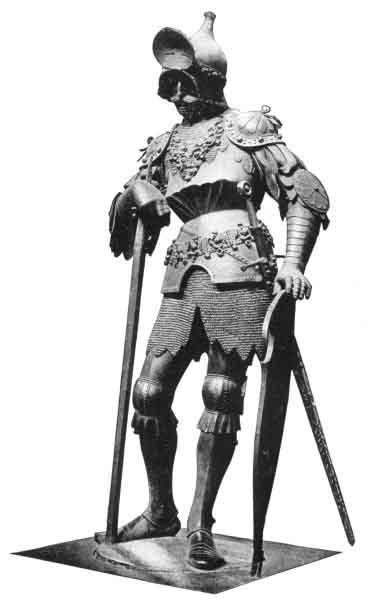
DIETRICH<BR> <I>From the statue in the Church of the Franciscans at Innsbruck</I> DIETRICH
From the statue in the Church of the Franciscans at Innsbruck

Then did fearless Hildebrand smite Sigenot and slay him with a single blow. So perished the kinsman of Grim when he deemed proudly that his vengeance was complete.

Deep was the underground cavern in which Dietrich was kept captive. The prince heard the voice of Hildebrand calling to him, and entreated him to make haste.

"Many vipers still remain alive," he said, "although not a few have I slain and devoured."

Hildebrand cast off his clothing, and each garment did he tear in shreds; then he made a rope which he lowered into the dark, snake-infested cavern, so that the prince might have release from his torture and unceasing conflict.

Dietrich seized the rope; but when Hildebrand began to pull him up, it snapped asunder.

'Twas then that the dwarf Eggerich came nigh, rejoicing because that Sigenot was slain. He speedily procured a rope ladder, and it was lowered to Dietrich, who was thus given escape from the dragon's cave and the hissing snakes that swarmed there.

The prince embraced his rescuer, but Hildebrand did chide him much because that he had ventured forth in the forest alone.

Then they took leave of the dwarf Eggerich, and returned together unto Bern. When the people came to know that the giant Sigenot was slain, they rejoiced greatly, and acclaimed Hildebrand and the fearless son of Dietmar.

Now there was not in all the kingdom a young warrior who was Dietrich's equal. His fame went far and wide, and bold knights came riding to Bern so that they might win his favour with challenge to feats of arms. Those who were worthy and of high birth did the prince choose to be his followers. In time he had thus command of many valorous knights. Among these were Witege and Heime, who had great fierceness and daring, and were so gloomy and cruel of heart that in peace as in war they were dreaded and shunned. Men they smote and women they hated and scorned; many young warriors they slew in conflict. Churls were they both, and how they came to be honoured by Dietrich must now be told.

Heime came first unto Bern. Dwarfish was he in stature, but his heart was full of valour, and he had strength beyond his years. He feared not the prince, despite his mighty fame. Unto him did his sire Studas, who was a breeder of war steeds amidst the mountains, give a swift grey horse, which was named Rispa, and the sword Blutgang.

When he rode boldly into the courtyard of the castle at Bern, Heime challenged Dietrich to single combat. The prince was made angry thereat. Hastily did he put his armour on and the shining helmet Hildegrim; then with his spear in one hand, and in the other his great red shield on which was pictured a golden lion, he charged the bold and low-born stranger. Terrible was the shock. Heime's shield was pierced through, but Dietrich's horse stumbled so that he came nigh to being thrown. Both their spears were broken in twain.

Then did the young warriors, leaping to the ground, cast aside their spearshafts and draw their shining swords. Fiercely did they combat one against the other. But Blutgang rang faintly against Naglering. Heime had skill and valour, but ere long his sword was cloven and shattered so that he was placed at Dietrich's mercy. But the prince was drawn towards him by reason of his prowess, and slew him not. He honoured, in generous mood, the surly stranger, and gave him place among his knight followers.

Ere many days passed another young warrior, seeking adventure, challenged the son of Dietmar to combat. His name was Witege, and he did hie from Denmark. The prince was moved with wrath against him, for he grew weary of the conflicts with each bold stranger who sought to put his skill and valour to test. But in that fierce Dane he met a knight who was more than his equal.

Now Witege was the son of Wieland, the wonder smith, a cunning and far-famed worker in iron. Skilful was the lad with bow and arrows, as was Eigel, his uncle.

He scorned to work at the forge, and desired to seek adventures, so that he might win renown as a warrior. Of the fame of Dietrich he heard one day, and he resolved to challenge him to single combat.

Wieland could not prevail upon him to remain at home, so he fashioned for Witege a suit of shining armour, a great helmet, dragon-mounted, a spear of much strength, and a white shield on which was painted a hammer and tongs. Unto the lad he also gave a wonder sword of great sharpness, named Mimung, which he had aforetime forged by compulsion for a tyrant king.

Witege then set out to journey towards Bern in the land of the Amelungs. On his way he met Hildebrand and Heime, who were also riding to Dietmar's Court with a stranger knight. Witege waited them not, for they sought to rest awhile.

Soon he drew nigh to a strong castle in which twelve robbers had their dwelling. These, when they did behold the young knight coming towards them, spake one to another, saying--"His shining armour shall we take from him, and his right hand shall we cut off, and then send him homeward."

So they sallied forth against Wieland's strong son. Two rode in front and bade the lad surrender; but Witege drew the sword Mimung and slew them right speedily. The others charged against him and waged fierce and unequal conflict.

'Twas then that Hildebrand and Heime and the strange knight came nigh. Hildebrand urged his companions to hasten to Witege's aid, but Heime said: "Help him not; his pride is great; now let his valour be put to proof."

But the old warrior would suffer not that the robbers should slay the youthful hero; so he rode forward and the others followed him. Against the fierce band did they all battle together, save Heime, who looked on, and ere long seven lay dead on the ground, and the others were making swift escape.

Witege gave thanks unto Hildebrand, and together they took vows of knightly fellowship to be ever brotherly and true in after-time.

"Whither goest thou, valorous youth?" asked the elder warrior.

"I ride towards Bern," the son of Wieland made answer, "for it is my desire to meet with Dietrich in single combat."

Hildebrand cared not to hear speech so bold from that valiant young hero. Indeed he feared for Dietrich's safety. So when night fell, and the Dane lay fast asleep, he drew from the lad's scabbard the sword Mimung and placed in it his own.

At morningtide Witege called upon Dietrich to display his valour. As the tale has been told, Dietmar's son waxed wroth, because that the Dane was of lowly birth, being, indeed, but the son of a smith. In vain did Hildebrand warn him of the youth's prowess and skill at arms.

"The time is at hand," Dietrich said, "when peace must prevail in the kingdom. I shall allow no churlish stranger to challenge me to conflict. Heavily shall he pay for his boldness."

"It may be," Hildebrand said, "that thou shalt not prevail against this valorous youth."

"Him shall I have this day hanged outside the gates of Bern," answered the prince.

"Ere thou art able to accomplish that," Hildebrand said, "thou hast a fierce battle to fight. I bid thee success, but not without fear."

Never before did Dietrich meet a doughtier war-man. Strong and rapid were the blows which Witege gave. He smote the prince heavily on the head, but the helmet Hildegrim resisted the edge of Hildebrand's sword, and the Dane cursed his sire Wieland because that his sword was of so little avail.

"Had I but a sword worthy my strength," he cried, "victory would speedily be mine."

Dietrich pressed him hard. With both hands he grasped the sword Naglering, and made daring onslaught with purpose to smite off the head of Wieland's son. But Hildebrand went between the warrior youths and called a truce.

"Spare thou his life," he cried to Dietrich, "and thou shalt have still yet another brave knight amidst thy followers."

"The dog shall die this day," the prince made angry retort; "stand thou aside, so that his life may have end." The old knight was angry. He drew from his scabbard the sword which Wieland fashioned, and gave it unto Witege, saying:

"Thine own sword Mimung I return unto thee. Now defend thyself as befits thy valour."

Glad thereat was the heart of Wieland's son. "Alas," he cried, "that I did curse my sire! Behold, O Dietrich, the sword Mimung; now have I as great desire for battle as a thirsty man hath for drink and a hungry dog for its food."

'Twas then the swords sang loud. Mimung clove armour and shield as they were but cloth. The son of Wieland indeed struck mighty blows, and in time he wounded Dietrich, Indeed, five wounds did he give unto the prince, so that he was forced to call upon Hildebrand to put end to the fray. But the old warrior was wroth with Dietrich, and did heed him not.

King Dietmar then called upon Wieland's son to cease fighting, and promised him great gifts and a noble bride; but Witege waxed in battle fury, and sought for naught else but the death of that arrogant prince. Blow after blow he gave, until at length he split asunder the helmet Hildegrim, so that Dietrich's golden hair appeared.

Hildebrand desired not the prince's death. His wrath was melted when he perceived he was in peril, and he leapt forward and ended the fray. Then besought he Witege, because of the vows they had taken one with another, to swear fellowship with Dietrich and become his knight.

As the old warrior desired him, so did Witege do. He sheathed his sword and took oath of service to the prince, and they became fast friends. Together they went into the castle and drank wine.

But ill-pleased was Dietrich because that he was not the victor as aforetime, and he made resolve to go forth to seek further daring adventure, so that his fame might not be sullied in the land of the Amelungs.

Footnotes

1 When Hercules fought with the nine-headed Hydra, each head, save one, which could not be hurt, grew again as fast as it was cut off. Then his nephew assisted him by searing the wounds with a torch. See Classic Myth and Legend, page 103.

Subscribe to this RSS feed

Log in or create an account