log in
LC Geerts

LC Geerts

Website URL:

Teutonic Myth and Legend: Chapter 36 The Nibelungen Tragedy

TEUTONIC MYTH AND LEGEND

by DONALD A. MACKENZIE

An Introduction to the Eddas & Sagas, Beowulf, The Nibelungenlied, etc.

London, Gresham Publications 1912

CHAPTER 36

The Nibelungen Tragedy

Kriemhild weds Etzel--Her Desire for Vengeance--The Festival--Invitation to Gunther and his Knights--Hagen's Bravery--The Doom journey--Dietrich and Hildebrand--How the Guests were received--Treachery of the Queen--Scene at Banquet--Its Tragic Ending--Dietrich intervenes--Hall in Flames--Unconquered Heroes--Gunther and Hagen overcome--Gladness ends in Grief.

IT fell that thirteen years after Siegfried's death Queen Helche of the Huns died, and King Etzel 1 , who was a heathen, sought another bride. Rudiger, the rich margrave, surnamed "The Good", was sent as envoy to Worms to win Kriemhild; whereat Gunther was made glad, because Etzel was a mighty monarch, but grim Hagen grew angry, fearing that the widow of Siegfried would stir up enmity against them. Kriemhild ceased not to grieve for him whom she had loved, but her brothers and Queen Ute urged her to be wed to the mighty monarch of the Huns, and at length she gave her consent. Then sent she to Hagen for the Nibelung treasure, which she desired to distribute among the Hun warriors; but he refused to give it up saying: "She shall not give it unto those who are my foemen."

Kriemhild was made wroth thereat. Yet had she a portion of the treasure left, and she gave great gifts to the knights who came with Rudiger.

The widowed bride had lost not her great beauty despite her long and deep sorrow, and when she came to the Court of Etzel, the courtiers vowed that she was even more fair than was Queen Helche. She kissed the king, and when she was wed she was kissed by twelve noble knights, among whom was Bldel, the brother of Etzel, and the great warrior king, Dietrich of Bern, who had taken refuge at Etzel's Court when his uncle, Ermenrich, had by treacherous doings possessed himself of the kingdom of the Amelungs. So it came that Kriemhild had friendship and service from many strong war-men. Great was her power. All the treasure that Hagen had left her she gave to the knights, and at length she said unto herself:

"Now am I made powerful, and can strike against the enemies of Siegfried, for whom my heart still calleth."

As the days went past, and the years, her desire for vengeance grew stronger. There was not a Hun knight who would not do her willing service. Yet none did conceive of her fierce intent.

A son was born to King Etzel, and his name was Ortlieb. Like was he in countenance to fair Kriemhild, and the king loved her more dearly because of her child. So at length when she craved of him a boon he said that he would grant it willingly; and the queen besought him that he should send envoys to Worms and invite, unto a festival at his Court, Gunther and all his knights. As she desired, so was it done. Kriemhild spoke in secret to the envoys and bade them not to leave Hagen behind.

Gunther received the message gladly, nor suspected aught of Kriemhild's evil desire; but Hagen warned the king in counsel with his knights, saying: "We dare not go from here unto the Court of Etzel. Our lives ane in peril, for Kriemhild forgets not who slew her husband Siegfried. . . . Her memory is long."

Thereupon Gunther's brothers taunted Hagen. "Thou knowest thine own guilt," one said; "therefore thou hast need to protect thyself well. 'Twere better thou didst remain at Worms, while those who fear not sojourn among the Huns."

Hagen was made wroth. "No man among you feareth less to venture forth than I do, and with thee shall I go if ye are determined to visit the Court of Etzel."

So it was arranged that they should set out forthwith, and Hagen spake after that of their journey as "the death ride".

Queen Ute had great desire that her sons should tarry in the kingdom. "I have dreamt an evil dream," she said. "Methought that all the birds in fair Burgundy were slain."

"He who is led by dreams," said Hagen, "is without honour and no hero. Let us unto the festival of Kriemhild."

Many women wept when they set forth. With Gunther rode a thousand and sixty knights, and his army did number full nine thousand men. When they reached the Danube River they found it to be high and running swift. Hagen sought for the ferryman, who desired not to take them across unless he were given rich reward. While searching, he saw bathing in a brook certain water fairies. He went stealthily towards them and possessed himself of their vestments. They had need, therefore, to make known to the fierce knight how he and all who were with him would fare upon their journey. One did promise that they would prosper and win great honour, but another said: "Twere better to turn back. . . . Ye are all doomed. Who rideth unto the Court of Etzel rideth to death. Nor shall one return again unto Worms save the priest."

Then Hagen met with the ferryman and slew him for his boldness. He seized the boat, and, returning unto Gunther, he ferried across the knights and all their followers. As he crossed with the last company of men he beheld the priest among them, and remembering the prophecy of the water fairy, he seized him there and flung him overboard. But, although the man could not swim, he was driven over the waves and reached the shore in safety. When Hagen saw that the priest could return unto Burgundy, he knew that the foretelling of the water fairy was true, and said unto himself: "These, our warriors, are all dead men."

When they landed, Hagen splintered the boat in pieces. He was resolute indeed, and made certain that no man should turn back. The Bavarians came against them to avenge the ferryman's death, but they were beaten back, and Gunther and his war-men marched forward until they came unto Bechlaren, where Rudiger the Good gave them generous and hospitable entertainment and many gifts.

Tidings of their approach were borne unto Kriemhild. "The day of reckoning is at hand," she said unto herself. "Fain would I now slay the man who did destroy my happiness. . . . He shall pay dearly because that he hath made me to sorrow."

Aged Hildebrand spake unto Dietrich of Bern of the coming of the Burgundians, and counselled that he should ride forth to greet them. Hagen was a dear war friend to Dietrich aforetime, and there was good will. betwixt them. So the fierce knight of Burgundy gave his friend warm greetings.

Dietrich was made glad, yet did he inwardly grieve, when he beheld the warriors from Worms.

"Know ye not," he said, "that Kriemhild hath ceased not to sorrow for Siegfried? . . . This very day I did hear her lamenting because that he was dead."

Gunther reasoned that Etzel had bidden them thither with right royal welcome, and that Kriemhild had also sent warm greetings, but Hagen knew well that sorrow awaited them.

The Hun king knew not that his queen plotted against his guests, and his welcome was hearty and frank; but Kriemhild was haughty and cold. She kissed but her brother Giselher, who had no part in Siegfried's death. Unto Hagen she spake, saying:

"Hast thou brought hither the hoard of the Nibelungs which thou didst rob from me?"

Hagen answered: "I have touched it not. It is hidden below the Rhine waters. There shall it lie until the Day of Judgment."

"So thou hast brought it not," she said coldly. "Many a day have I grieved for it, and for the noble knight whose possession it was."

"I have brought but my weapons and my armour," said Hagen defiantly.

"I need not gold," Kriemhild sighed; "but I would fain have recompense for murder and robbery."

Then were the Burgundians, at the queen's desire, asked to lay down their arms; but Hagen made refusal for himself and the others, saying that it was the custom of the Burgundians to be fully armed on the first three days of a festival.

It chanced that soon afterwards Kriemhild urged certain of her knights to slay Hagen; but they forbore, fearing as they did his dark brows and quick-flashing eyes.

When night fell the guests were conducted to their dwelling. Grim Hagen and Volker, the minstrel, fearing the treachery of Kriemhild, sought not to take rest.

They clad themselves in their bright armour. Then they took their swords and shields and stood outside the door to guard their companions. After a time Volker took his fiddle, and, sitting upon a stone within the porch, he played merry airs which gladdened the hearts of those who were within, and they forgot their anxieties. Then he gave them soothing music and sweet, so that they were lulled to sleep. Thereafter he took up his shield again and stood beside Hagen at the door to guard the Burgundians against Kriemhild's war-men.

In the midst of the night the fierce Huns made stealthy approach; but when they beheld the knights keeping guard they turned away. Volker desired to challenge them to combat, but Hagen forbade him, and Volker cried out to the followers of Kriemhild: "Cowards, would ye venture hither to slay men in their sleep?" They answered him not. Kriemhild grieved because that her plan had failed, but she ceased not to plot against the guests.

A tournament was held in Etzel's courtyard, and Volker slew a Hun warrior. But for the king, vengeance would have been taken for that cause. "He hath been slain without intent," Etzel said; "let my guests go forth unharmed."

Kriemhild then spake to Dietrich of Bern and old Hildebrand, beseeching their aid to encompass the death of Hagen.

Hildebrand answered: "One man is not sufficient to overcome him." And Dietrich, answering her, said: "Speak not of this again, O Queen, I pray thee. These, thy kinsmen, have never done aught against me. 'Twill bring thee shame if thou dost any hurt to them, because they are now thy guests. It is not for me to avenge the death of Siegfried."

Thereafter did Kriemhild plead with Bldel, King Etzel's brother, making him promise of rich reward, and he promised to achieve her purpose. He went forth to attack Gunther's men with a thousand of his followers. Dankwart was in command when Bldel fell upon them without warning, and fierce was the conflict.

Meanwhile Gunther and Hagen and other knights sat at feast with King Etzel. Kriemhild caused her son Ortlieb to enter and sit nigh to Hagen, and the king said: "Lo! here cometh my only son to be among his kinsmen."

Hagen loved not the lad. "He hath a weak face," he said. "I could never be a guest at his Court."

Suddenly Dankwart rushed into the feasting hall. He alone of all the war-men had escaped the sword of Bldel, whom he slew; his body was red with the blood of foemen. "Why dost thou tarry thus, brother Hagen?" he cried; "our men are slaughtered in their dwelling."

"Guard the door," cried Hagen, and seizing his sword be smote off the head of Prince Ortlieb before his father's eyes. Then he slew the lad's tutor and cut off the right hand of a minstrel who had borne Kriemhild's message unto Worms. Volker drew his blade also and made slaughter. In vain did the three kings, Etzel and Gunther and Dietrich, make endeavour to subdue the fray. Many Hun knights were slain, for the Burgundians were seized with battle fury and sought dire vengeance. They cut their way up and down the hall, and there was none who could stand against them.

Then did Kriemhild plead with Dietrich of Bern, beseeching his aid, what time he watched, standing upon a bench, the doughty deeds of his old war comrade Hagen.

"Save me and King Etzel from this our dire peril," cried the queen.

"I can but try," Dietrich answered. "Not for many years have I beheld such fierce fighting."

Then he uttered forth a great shout, and his voice was like to the blast of a war horn. Gunther heard him, and called upon his men to pause in the fray. "Mayhap," he said, "we have slain knights of Dietrich."

"No harm have ye done me or mine," Dietrich said, "but I ask of thee that I and those with me may have thy permission to go forth in safety."

"Thy wish is granted," answered Gunther.

Then did Dietrich clasp the fainting Queen Kriemhild with one arm and took King Etzel's with the other. Thus did he leave the hall with six hundred of his knights. Rudiger went also with five hundred. Neither sought to take part in the fray.

Thereafter was the conflict waged again with great fury, nor did it pause until not a Hun was left alive in the hall.

The Burgundians rested awhile; then they threw out the bodies of their foemen. Kinsmen of the slain mourned greatly.

King Etzel seized his shield and desired them to combat against the stranger at the head of his men; but Kriemhild warned him that he could not withstand the blows of fierce Hagen. But his knights had to hold him back by force, and, seeing this, Hagen taunted the king.

"The darling of Siegfried and her new husband are faint-hearted," he cried. "Ha, Etzel! Siegfried had thy lady to wife before thee. I slew him. Why, then, shouldst thou be angry with me?"

Kriemhild heard with anger. "Much gold shall I give, and castles and land," said the queen, "unto the knight who shall slay Hagen."

Volker shouted defiantly: "Never before beheld I so many timorous knights. Cowards all! ye have taken of the king's substance and in his hour of trial ye desert him. I cry shame upon ye all."

Many bold warriors rushed against the knights of Burgundy. Stranger knights who were there fought also. The nimble Iring of Denmark struck mighty blows, and in the end he wounded Hagen. Queen Kriemhild praised him when he returned weary from the fray, and prompted him to return again. When he renewed the conflict, however, Hagen slew him.

So fell many brave men, and the long summer day ended and darkness fell. The tumult ceased.

Then the Burgundians besought King Etzel that they should be permitted to leave the hall and fight in battle, but Kriemhild forbade it.

Her brother Giselher spake to the vengeful queen saying: "I deserve not death at thy hands. I was ever faithful unto thee. I came hither because that I did bear thee love and thou didst invite me. Thou must needs now show mercy unto us."

"Can I show mercy who hath never received it?" she answered him. "The vile Hagen slew my child, so those who stand by him must suffer with him. But this I shall promise thee--if Hagen be now delivered up a truce will be granted forthwith."

Gernot answered: "Never shall thy wish be granted. Rather would we die than ransom our lives with a single knight."

"Then must we die indeed like to brave men, Giselher said.

"My brother Hagen is not without friends," cried Dankwart; "ye who have refused quarter shall not receive it. Not at our hands."

In the midst of the night Kriemhild bade her, followers to set fire to the hall. That they did right gladly. The flames raged furiously, and one of them within cried: "Woe is me! we are doomed to die. Rather would I have fallen in battle."

Great was the heat, and the knights were tortured with thirst. Then did Hagen bid one of them to drink the blood of the slain war-men. One who suffered much knelt beside a corpse and drank the blood. The draught made him strong again. "Better is it than wine," he said.

The others did likewise, and were all refreshed so that they were able to endure their sufferings amidst the flames. Burning faggots fell upon them, but they protected themselves with their shields. Terrible was the heat. Never again shall heroes suffer as did these that night.

"Stand close to the walls," Hagen commanded; "your armour shall protect ye; let the blood quench the flaming brands."

When morning broke, the Huns wondered greatly to behold Hagen and Volker again standing on guard at the hall door.

Fierce attack was again made by the Huns, but they were beaten back. Nor did the conflict have pause until the last of Etzel's great knights was slain.

Then did Kriemhild and the king make appeal to Rudiger to aid them, but he desired not to attack the brave Burgundians.

"Shall I slay those whom I did entertain in my own house?" he exclaimed. "I forget not past friendship."

Yet was he constrained to fight, and he mourned his lot with the Burgundians.

"Would that I had a strong shield like thee," Hagen said; "mine own is hewn and battered sore."
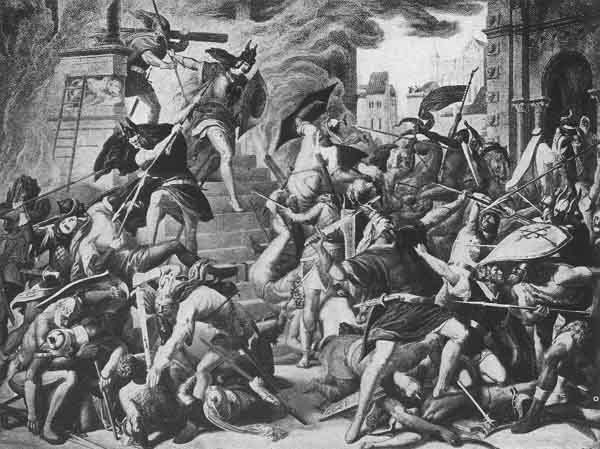
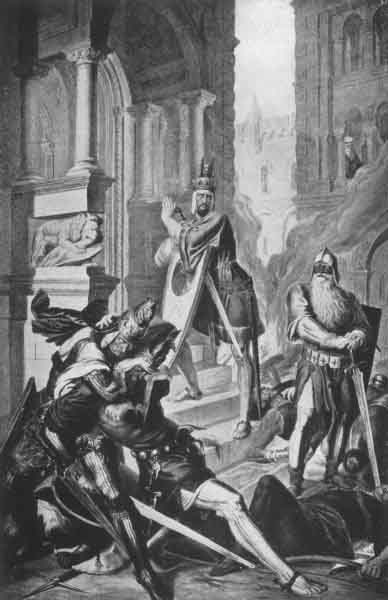
THE FIGHT ON THE STAIRS OF ETZEL'S PALACE<BR> <I>From the painting by Schnorr von Carolsfeld</I> THE FIGHT ON THE STAIRS OF ETZEL'S PALACE
From the painting by Schnorr von Carolsfeld

Rudiger gave Hagen his own shield ere he fought at Etzel's command with those whom he loved. Fierce was the conflict and long, and in the end Gernot and Rudiger slew one another.

Then did Wolfhart, the bold knight of Bern, lead on the followers of Dietrich to avenge the death of Rudiger. One by one they were cut down by Gunther's heroes, save Hildebrand, who slew Volker. But Hagen made vengeful attack and wounded him. The old warrior fled. He hastened unto Dietrich, and cried: "All our men are slain, and of the Burgundians but Gunther and Hagen remain alive."

Dietrich was wroth. He sorrowed for his brave knights. No longer could he withhold from the fray. So he put on his armour and went unto the Hall. He first bade Gunther and Hagen to surrender; but they defied him.

Dietrich drew his sword and fell upon Hagen, whom he speedily wounded.

"Battle-weary art thou," Dietrich cried; "I shall slay thee not."

As he spake thus he caught Hagen in his arms and overpowered him. So was the valiant hero taken captive.

Dietrich led him bound before Queen Kriemhild, and her heart rejoiced. "Now is all my sorrow requited," she said "thee, Dietrich, shall I thank until my life hath end."

The Prince of Bern said: "Slay him not. He may yet serve thee, and thus make good the evil he hath done."

Hagen was cast into a dark dungeon, there to await his doom.

Dietrich then fought against Gunther, who. was more fierce than Hagen had been. Indeed he came nigh to slaying Dietrich. But he was at length borne down, and taken prisoner and bound.

When the King of Burgundy was taken before Kriemhild, she said: "I welcome thee, O Gunther."

He answered her: "If thy welcome were made with love, I would thank ye, but I know well that thou dost mock."

Dietrich pleaded with the queen that Gunther and Hagen should be spared, but his words fell upon ears that heard not.

Kriemhild went unto Hagen and demanded that he should return unto her the treasure he had stolen.

The knight answered her: "Vows I took not to reveal where the hoard is hidden so long as my king liveth."

Then did the queen command that her brother should be slain. With her own white hand she held high by the hair before Hagen the dripping head of Gunther.

"Now all thy brothers are dead," Hagen cried. "Where the treasure is concealed is known but to God and myself alone. . . . Thou devil, thou shalt never possess it!"

So wroth was Kriemhild that she seized a sword and smote off the head of Hagen.

"Alas," cried King Etzel, "the boldest knight who ever fought in battle hath fallen by a woman's hand!"

Old Hildebrand, recking not what would happen him, drew his sword and smote the queen. A loud cry broke from her lips, and ere long Kriemhild died.

So ended the festival of King Etzel, as gladness must ever end in grief.
DEITRICH OVERCOMES HAGEN<BR> <I>From the painting by Schnorr von Carolsfeld</I> DEITRICH OVERCOMES HAGEN
From the painting by Schnorr von Carolsfeld

What befell thereafter I can tell not. Knights and soldiers, wives and maids, were seen weeping, and heard lamenting for their friends.

So ends the Nibelungenlied.

. . . . . .

Minstrels, singing the sorrowful lay of the death of Siegfried, and the fall of the Nibelungs, have told that Queen Brunhild and Queen Ute sat side by side embroidering on tapestry the death of Balder.

Again and again did Brunhild say to the mother of Gunther: "Each time I picture Balder, his face grows like unto that of Siegfried."

Soon tidings were brought to them of the death of Gunther and all his men. Brunhild wept not. She went out into the darkness, nor ever returned again.

When search was made, she was found lying dead in the grave mound of Siegfried, whom she had loved.

Footnotes

1 Attila, "the scourge of God".

Teutonic Myth and Legend: Chapter 35 Betrayal of Siegfried

TEUTONIC MYTH AND LEGEND

by DONALD A. MACKENZIE

An Introduction to the Eddas & Sagas, Beowulf, The Nibelungenlied, etc.

London, Gresham Publications 1912

CHAPTER 35

The Betrayal of Siegfried

The Rival Queens--Their Quarrel--Brunhild plots against Siegfried--Hagen's Vow--The Tragic Hunt--How Siegfried was deceived--The Death Wound--Last Words--A Sad Homecoming--Kriemhild's Sorrow--Scene in Church--Blood Testimony--Gunther pleads for Forgiveness--Treasure taken to Worms--Where Hagen concealed it.

SIEGFRIED and Kriemhild went riding with a gay company towards Worms. There was joy in every heart, but it was fated to end in heavy grief. Prince Gunther journeyed not with them; never again did he behold his sire or his mother.

The aged King Siegmund rode forth with his son; he had desire to meet with Gunther and his knights, but had he known what sorrow was in store for him he would have fared not from the Netherlands.

Gunther gave to all of them right hearty welcome. The queens greeted one another with affection, but from that hour Brunhild could forbear not watching Kriemhild with jealous eyes. . . . When she beheld the twelve hundred knights of Siegfried, she said: "Never was there a subject king who had greater wealth." . . . The queen, however, gave meet entertainment to her guests; but ere long jealousy overcame love; the heart of Brunhild grieved because that Siegfried and his queen were so rich and powerful.

It fell that on a day when the knights tilted in the courtyard Kriemhild lauded her husband's prowess.

"Siegfried," she said, "excelleth every other knight as the moon doth the diminishing stars. For good reason take I pride in him."

"Valiant he may be," answered Brunhild, "yet thy brother Gunther surpasseth him, for he is the greatest of all kings."

"My brother is indeed a noble knight," Kriemhild said, "yet is my husband his equal."

Said Brunhild: "Did not the king surpass me in feats of strength in Isenland, what time Siegfried remained in the ship? He is but my husband's vassal. From his own lips I heard him confess it."

"Were Siegfried but a vassal," Kriemhild retorted, "thinkest thou that my brother would have given me unto him for wife? I pray thee to repeat not what thou hast said."

"That indeed I shall, said Brunhild. "Siegfried is our subject, and his knights await to do us service when called upon."

Angry was Kriemhild. "No service canst thou claim," she said. "My husband is greater than thine. If he were not he would have to pay tribute, and never hath he done so. I pray thee to cease thine annoyance.

"Boast not with empty pride," Brunhild cried angrily; "I am honoured far above thee."

"Know now," retorted Siegfried's queen, "that my husband is no vassal to thine, and is indeed a greater monarch. The kingdom of the Nibelungs he won by his strong right arm, and he hath inherited the Netherlands from his sire. To no man doth he owe allegiance. I am indeed a free and a mighty queen. Dare not to chide me. Thou shalt see when I enter church in thy company that I shall not walk behind."

"If thou art not my subject, then shalt thou go by thyself, nor walk in my train," Brunhild said.

In anger did Kriemhild leave the Queen of Burgundy, and she bade her maidens to put on their richest attire.

Many wondered to behold the queens walking apart. . . . It was doomed that many should sorrow because of that in aftertime.

When they met before the church Kriemhild went forward to enter first, and Brunhild forbade her. "Thou art my vassal," she said; "walk not before me."

"'Twere better that thou shouldst hold thy peace," retorted Kriemhild; "how can a vassal's paramour walk before a queen?"

"What dost thou mean?" Brunhild asked angrily. "Whom dost thou call a paramour?"

"None other than thee," answered Kriemhild. "Did not my husband win thee for thine? Thou didst prefer him thou now callest a vassal, forsooth. . . . Speak not to me any longer. Thou knowest the truth now."

Then Kriemhild entered the church, and Brunhild followed her, weeping sore. There was deadly hate betwixt them, and for that reason many a goodly knight went to his grave.

When the service was over, Brunhild confronted Kriemhild, saying: "Thou didst call me a paramour. I demand thee now to prove thy words."

"'Twere easy to prove them," retorted Kriemhild proudly, showing her rival the ring and the girdle which Siegfried had taken from her.

"A paramour to Siegfried thou wert indeed," she said.

Brunhild bowed her head with shame, weeping bitterly; and when Gunther asked her why she sorrowed she told him what Kriemhild had said.

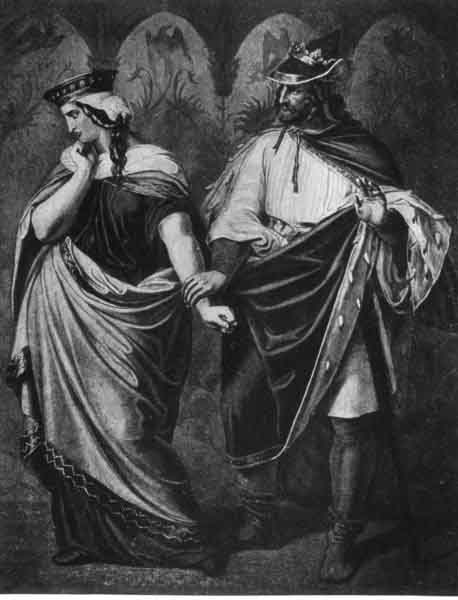
KING GUNTHER AND BRUNHILD<BR> <I>From the painting by Schnorr von Carolsfeld</I> KING GUNTHER AND BRUNHILD
From the painting by Schnorr von Carolsfeld

Then was Siegfried brought before Gunther, and in Brunhild's presence he swore that he had never uttered what Kriemhild had boasted of.

"I grieve that my wife hath made Brunhild to sorrow," he said.

The knights who were there spake one to another. "Would that women might cease their gossip," said one. "Forbid your wives to boast about ye, else there will be strife and shame among us all."

But Brunhild was not comforted. It chanced that Hagen came nigh to her and found her weeping. He asked her why she did grieve so, and when she told him what Kriemhild had said, he waxed wroth because he had sworn allegiance unto Brunhild and served her faithfully, guarding her honour and her life.

"For this insult," he said fiercely, "Siegfried shall pay with his heart's blood. I shall avenge thee, O queen, or die."

Hagen spake to Gunther and the other knights in like manner, and he roused them all to enmity against Siegfried, who reeked not of their secret plotting.

Hagen first contrived that certain knights should visit Worms, making pretence that they came as envoys from King Ludgast declaring war against King Gunther. Siegfried made offer of his service, and Kriemhild was proud thereat, yet did she fear that ill would befall him because that he was reckless and overdaring in battle.

Hagen spake with her treacherously, and she told him that when her husband bathed his body in the dragon's blood a leaf covered, a spot betwixt his shoulders, and that if he were wounded there he would surely die. Brunhild's knight rejoiced in secret, but he promised to defend Siegfried, and counselled Kriemhild, that she should mark the spot by sewing a small red cross upon his clothing, so that he might know where to defend her loved one.

Then Hagen spake to the king, and Gunther arranged that they should go through the forest on a great hunt which would last many days.

Go not forth, Kriemhild pleaded with her husband. "I dreamt that thou wert given chase by two wild boars, and I saw the forest flowers made red with blood."

"Fear not for me, my heart's love," Siegfried said; "I go not a-hunting with foemen, but with thine own kin."

Kriemhild wept bitterly. "Alas! I fear for thy life," she cried. "But yesternight I did dream that thou wert caught betwixt two hills, which fell upon thee, and thou wert lost to my sight. . . . Stay with me here, Siegfried, else I shall sorrow without end."

Siegfried kissed and embraced her with tenderness, and then hastened to join the hunt.

She watched him through her tears as he went from her. Never again did she behold her dear one in life.

There was none like to Siegfried at the hunt. Many wild animals he slew, and he caught a bear alive and bound it, and when he set it free they all gave chase, but it would have escaped but for his valour.

They afterwards sat down to feast together. Food there was in plenty but no wine. Siegfried made complaint thereat, for he was grievously athirst, and he vowed he would never again hunt with them. Little did he dream that a plot was laid to accomplish his death.

Hagen said that there was a clear spring near by, from which they could take refreshment, and he challenged Siegfried to race with him thither for a wager.

Hagen stripped off his clothing, but Siegfried ran in full armour, carrying his shield and spear and his bow and quiver, and yet he reached the spring first. But the hero drank not. He cast off his armour, and laid his weapons on the grass to await the coming of Gunther, the king, so that he might have refreshment before any other.

Dearly did he pay for his courtesy. When the king had taken his fill, and Siegfried stooped down to drink, Hagen drew away stealthily the sword and the bow, and then plunged the spear through the hero's back at the spot where Kriemhild had embroidered the cross. He drew not forth the weapon, but made hurried escape. Never before did he run so swiftly from any man. Siegfried sprang up in anger, the spear sticking fast in his back, and sought for bow or sword to take vengeance on Hagen. But he found his shield only, and flung it after the traitor. It smote him to the ground, and the forest echoed the blow. Had Siegfried but his sword, in that hour Hagen would have been slain.

Snow-white grew the cheeks of that sore-wounded man, the lordly guest of Gunther: he sank to the ground; his strength went from him; death was in his face. Alas! many a fair woman wept tears for him in aftertime.

Among the flowers lay Kriemhild's noble husband, and they were made red with his life blood.

He spake faintly, bitterly reproaching those who had plotted treacherously against him. He called them cowards all. "I have served ye well," he said, "and thus am I repaid. The children yet unborn shall suffer for this foul deed."

Gunther wept. "Weep not for treachery, thou from whom treachery hast come," Siegfried said.

"Now is all danger past," cried Hagen; "I rejoice that he is brought low."

"Boast not, murderous man," Siegfried warned him; "in fair conflict I had naught to fear from thee. . . . Oh, Kriemhild, Kriemhild, my deepest grief is for thee! . . . Would that our son had never been born, because he must bear from his enemies the bitter reproach that his kinsmen are murderers and traitors."

Gunther he reproached for his ingratitude. "I have saved thy life," he said; "I have been the guardian of thine honour. This foul deed is my payment . . . . If thou hast any honour left, protect my wife, thy sister . . . ."

He groaned, for his wound afflicted him sore. Again he spake saying: "In days to come ye shall suffer for this monstrous deed; yourselves have you slain when ye slew me."

He spake no more. Among the blood-steeped flowers he struggled with death. . . .

They laid his corpse upon a golden shield and bore it towards Worms, and in the darkness they left it at the door of Kriemhild's dwelling.

In the morning, when the fair queen was going forth to prayers, she saw the dead body of Siegfried.

"My husband is dead," she cried. "Brunhild hath desired that he should be slain, and by Hagen was he murdered." Heavy was her heart with grief unutterable, nor could she be comforted.

Old King Siegmund embraced his dead son and wept bitterly.

Tenderly was Siegfried's body lifted and borne within; his wounds were washed; in grave robes was he dressed and laid upon a bier.

After three days of mourning the body was borne to the church, and many assembled there to gaze with sorrow upon the dead hero.

Gunther came and said that Siegfried had been slain by robbers. "I sorrow because that he is dead," he told Kriemhild.

"If there was sorrow in thine heart, she answered him, "my husband would not now be laid in death. Would I were dead and he were still alive!"

When Hagen approached the body of Siegfried the spear wound bled afresh. Thus was it proved to all who were there that he was indeed the murderer.

Great was the mourning on the day of Siegfried's funeral. Many wept in the streets. Kriemhild went to the grave, and or ever the coffin was covered over she besought to gaze once again upon the face of her husband. Her desire was granted her, and she lifted up that fair head in her white hands and kissed the death-cold lips of Siegfried. Then fell she in a swoon, nor did she open her eyes again until next morning.

Siegmund departed soon afterwards and journeyed to his own land. But Kriemhild would not return with him, because she desired to be avenged for her husband's death. She was ever mourning, but Brunhild cared not in her pride.

At length Gunther sought her forgiveness, deeming that she had mourned overlong. Kriemhild said: "I shall forgive him with my lips but never with my heart." Yet was she at length constrained to pardon all who had plotted the death of Siegfried, save Hagen, whom she could not suffer to look upon.

Hagen spake to Gunther of the Nibelung treasure, which he could not but think over, and the king contrived that Kriemhild should send for it. So came it to pass that a strong army was sent unto Siegfried's kingdom.

The dwarf Alberich lamented the loss of the Cloak of Obscurity; yet did he deliver up the vast treasure, in the midst of which was a magic rod which would give to the one who possessed it anything that might be wished for. But none knew its virtues.

Thus was all the wealth of the Nibelungs brought unto Kriemhild. She distributed gold to rich and poor, and many adventurous knights paid visit to Worms to share of her bounty. Wages she gave to a great number, so that ere long she had a strong force of war-men at her service.

Hagen was greatly alarmed thereat, and spoke unto the king of Kriemhild's doings. He counselled that the treasure should be taken from her; but Gunther refused to do any harm unto his sister because of the vows he had sworn. Then did Hagen seize the hoard by force, and carried it away. He sank it in the Rhine at Lochheim, with hope to enrich himself in after-time.

So was Kriemhild's immediate hope of vengeance cut off. She took her departure from Worms and went to dwell with her mother at Lorsch. There she embroidered tapestry with pictures of Balder, who had by his brother been slain.

There she tarried for many years, biding the hour of vengeance. Tidings at length came from beyond the Rhine which brought nearer the fulfilment of Siegfried's dying words: "Yourselves have ye slain when ye slew me."

THE DEATH OF SIEGFRIED<BR> <I>From the painting by F. Leeke. By Permission of Franz Hanfstaengl</I> THE DEATH OF SIEGFRIED
From the painting by F. Leeke. By Permission of Franz Hanfstaengl

Teutonic Myth and Legend: Chapter 34 How Brunhild and Kriemhild were won

TEUTONIC MYTH AND LEGEND

by DONALD A. MACKENZIE

An Introduction to the Eddas & Sagas, Beowulf, The Nibelungenlied, etc.

London, Gresham Publications 1912

CHAPTER 34

How Brunhild and Kriemhild were won

Brunhild's Domain--The King and his Vassal--Wooing the Amazon--Her Challenge--Misgivings--Siegfried aids Gunther--Spear and Boulder Contests--Brunhild is won--Fears of Treachery--Siegfried's Secret Mission--Adventure in Nibelung--The Army--Return to Burgundy--Wedding Feast--Brunhild's jealousy--Struggle in Darkness--Invitation to Worms.

FOR the space of twelve days the ship voyaged across the sea, and then drew nigh to a strange shore. Siegfried had beheld it aforetime, and knew that it was Isenland, but Gunther and his knights gazed with wonder on the green lands and the many castles towering upon the headlands.

"He who did cause these strongholds to be built," the king said, "must indeed be a mighty monarch."

"Thou dost now behold the many towers and the fair domain of Queen Brunhild, "said Siegfried. "Yonder is the great castle of Isenland."

The ship was steered into a safe haven, and the prince warned his fellows to have care of their doings in presence of the queen. "Thou shalt say," he counselled them, "that I am but a vassal to King Gunther."

They went ashore and mounted their steeds. Siegfried held the stirrup to the king; the twain were clad in snow-white silken raiment which glittered with bright jewels. Hagen and Dankwart were apparelled in black.

Tidings of their approach were borne unto Queen Brunhild. A courtier spake unto her, saying:

"There cometh hither, O queen, four goodly knights, and one is like unto Siegfried. With him is one of less noble seeming, but he rideth in front, and must therefore be a mighty king indeed. The other two resemble not one another. The first is black-browed and sullen, and fierce are his eyes; his fellow is fair to look upon and is yet of fearless bearing."

A force of knights bade the strangers to deliver up their arms. Unwilling was Hagen to do so, but Siegfried said that such was the custom of the country. Ill at ease were Gunther and Hagen and Dankwart when they beheld the queen and all her maidens coming towards them in midst of five hundred knights with drawn swords.

Brunhild spake to Siegfried only. She bade him welcome to her kingdom.

Then she asked of him: "Why dost thou come hither now with these goodly knights?"

Siegfried made answer: "I thank thee, O Queen, for thy greeting. This noble knight whom I serve is King Gunther. I have followed him because such is his will, else I should not have come hither. He desireth with all his heart to have thee for his bride."

"If such is his desire," Brunhild answered coldly, "the king must needs contend against me in the lists. If he proves to be the stronger, I shall be his bride; but if he fails, then must he and those who are with him be put to death."

Hagen said: "The king shall for certain prevail, because he doth so greatly desire to wed thee."

Brunhild answered him, saying: "Then must he cast the stone and leap to the spot where it falls, as I shall do, and he must also contend with me at spear-throwing. Be not too certain of his success. Consider well my challenge."

Siegfried whispered to Gunther, saying: "Fear not, for I shall give thee mine aid."

Then the king spake boldly unto Brunhild. "For thy dear sake," he said, "I shall risk my life, contending against thee even as thou dost desire."

Brunhild was made angry, and so fierce was she of aspect when her armour was put on, that Hagen and Dankwart feared for the life of the king.

Meanwhile Siegfried had hastened towards the ship. He donned the Cloak of Obscurity, which gave to him the strength of twelve men. Then he returned to the lists unseen by any who were there.

A ring was made, and Brunhild's seven hundred knights stood round it fully armed with naked swords.

Then the great queen came forth. Four men carried her shield, and when Hagen beheld that he cried: "Alas! King Gunther, she is the devil's bride. We shall surely be slain."

Three men carried Brunhild's mighty spear. Gunther began to be afraid, and wished that he were back again in Burgundy.

"Not even the devil could escape her," said he.

Dankwart lamented that their arms were taken from them. "Had Hagen and I but our swords," he said, "Brunhild's war-men would be less arrogant." Hagen spake likewise, and the queen, who heard what was said, bade that their armour and weapons be returned to them.

Then was a boulder carried towards the queen by twelve knights. . . . The men of Burgundy were stricken with fear . . . . . "Would indeed that the devil had her," groaned Hagen.

Brunhild made ready to cast the stone. Gunther watched her with mute amaze. His heart sunk within him. Then it was that Siegfried, wrapped in the Cloak of Obscurity, stole to his side and touched his arm. . . .

The king started. He looked behind him, but saw no man. "Who laid his hand upon my arm?" he asked hoarsely.

"Hush!" whispered Siegfried. "I have come to help thee; so be not afraid."

First Brunhild flung her great spear against Gunther. He would have perished then, but Siegfried warded off the blow, yet not without hurt to himself.

Without delay the prince hurled back the spear, so that the haft struck the queen, for he desired not to slay her. She was felled to the ground. . . . Angrily she arose, but she praised the king for this prowess.

Thereafter Brunhild seized the mighty boulder with both hands, and, having flung it a great distance, she leapt beyond the place where it fell.

Gunther then went towards the boulder with the invisible prince. By the king did it seem to be lifted and thrown, but the mighty deed was accomplished by Siegfried, who cast the stone farther than Brunhild, and leapt farther with Gunther in his arms. 1

Wroth was the queen because that her feats were surpassed, but she spake to her knights, saying:

"Now is Gunther made king over ye all."

Her, face was flushed; her heart thirsted for vengeance.

The warriors of Isenland came towards the King of Burgundy and laid their weapons at his feet. They deemed not that it was Siegfried who had accomplished the mighty deeds and saved Gunther's life.

Meanwhile the prince hastened from the field and returned to the ship, in which he concealed the Cloak of Obscurity. Thereafter he came towards the castle and spake to Gunther, asking him when the trial of feats would begin. So did he deceive Brunhild and her people.

The queen delayed her departure from Isenland, and began to assemble a mighty army. Fearing that she meant ill towards them, Siegfried spake to Gunther and said that he must needs hasten to the kingdom of the Nibelungs and bring back with him a thousand knights, who would be their sure defence. The king was made glad thereat.

Once again did Siegfried assume the Cloak of Obscurity. Then he entered a boat and made it sail swiftly over the waves. Many gazed seaward with wonder, thinking that the boat was driven by wind and tide, for they saw not the prince.

Night had fallen black when Siegfried reached the Nibelung kingdom. He went towards the door of the great mountain in which the treasure hoard was concealed. He knocked loudly, demanding admittance as a weary traveller. In a strange voice he spoke, and the giant porter, who was moved to anger, seizing his shield, opened the door.

"Darest thou with thine evil clamour to awake our people?" the porter growled, and then struck a savage blow. Siegfried parried, but the giant smote again. He came nigh to overcoming the prince, who was greatly alarmed, and yet at heart proud of his strong servant.

For a time they fought hard together, but at length Siegfried threw down the giant and bound him.

Then came against him Alberich, the dwarf, clad in full armour; he fought with a mace which had seven balls on chains. The prince was for a time in great peril, but he overcame the dwarf also, and bound him.

Alberich then cried: "Had I not already vowed to serve another knight, thy slave would I be. Who art thou?"

Said the prince: "My name is Siegfried. Knowest thou me not?"

"Glad am I it is thee and no other," the dwarf said. "Worthy indeed art thou to be King of the Nibelungs."

Then Siegfried unbound the dwarf and the giant, and gave order that a thousand knights be brought forth to do him service. Alberich awakened the heroes who were within, and thirty thousand hastened to obey the ruler. He chose from among them a thousand, and they all sailed forth together in many fair ships towards Isenland, where Brunhild reigned as queen, and Gunther and Hagen and Dankwart awaited their coming.

When three days had passed, Brunhild and her maidens saw, looking from the castle windows, the white sails of many fair ships coming over the sea towards Isenland. The queen was stricken with alarm, fearing a sudden invasion, but Gunther told her that the vessels bore his vassal Siegfried and certain of his own warriors whom he had left behind.

Brunhild went to the beach, and the first she greeted as aforetime was Siegfried. He was clad in gorgeous raiment, and noble was his bearing. . . . Thus was Gunther rescued from peril once again by the Prince of the Netherlands.

The queen then realized she must needs depart from Isenland, and, having chosen her mother's brother to be chief ruler, she sailed towards Burgundy with Gunther and his knights. But she refused to be wed until she had reached the palace at Worms.

A swift and easy voyage was made, and when they were nigh to home Siegfried was sent ahead as envoy to Worms, so that Queen Ute and the Princess Kriemhild might know how the king had prospered.

Giselher beheld first the prince's approach, and he told his mother and fair sister that Siegfried was nigh. . . . Their hearts were filled with dark forebodings, but soon did the prince make them to rejoice with his glad tidings.

Siegfried sat by Kriemhild's side. Her face was rose-red with love, and it was her heart's desire to kiss him. . . .

"Gunther entreats thee to come to the shore, the prince said, "so that thou mayest welcome Brunhild hither."

Kriemhild went gladly with all her maidens, and Giselher led forth a great force of war-men. Brunhild was well pleased because that Gunther was a mighty ruler, and Kriemhild and she kissed one another with love. Together then they all made their way towards the stately palace at Worms.

A great banquet was held, and Gunther and Brunhild were wed. Thereafter in secret did Siegfried speak unto the king, saying:

"Hast thou no memory of thy vow? Thou didst swear that when Brunhild came hither I would be given Kriemhild for wife. . . . Well have I served thee."

Gunther said: "I forswear not my oath. What I can do that shall I do now."

So the king called Kriemhild before him and said: "Thee did I promise unto Siegfried, and if thou wilt have him now my heart's desire will be fulfilled."

BRUNHILD'S ARRIVAL AT WORMS<BR> <I>From the painting by Schnorr von Carolsfeld</I> BRUNHILD'S ARRIVAL AT WORMS
From the painting by Schnorr von Carolsfeld

The princess answered: "Him I shall wed with great joy."

Then were the oaths sworn betwixt them. Proud and happy was the noble prince; maidenly and demure was the beauteous princess.

They all sat down to feast together. Brunhild was at Gunther's side. Her face was pale and cold, and when she beheld Siegfried and Kriemhild together she began to weep bitterly.

The king spake to her and asked: "Why dost thou sorrow? 'Twere more seemly to make merry, for thou art now Queen of Burgundy."

"I weep," Brunhild said, "because that thy sister hath been wedded to thy vassal. . . . Great is my shame thereat."

Gunther told his queen then that Siegfried had lands and castles that were his own. "Great riches hath he," said Gunther, "and therefore am I glad that Kriemhild hath wedded with him."

But Brunhild still sorrowed, and refused to be comforted.

When the feast was over they all returned to their chambers, but Brunhild said she would not be as a wife to the king until he told her all concerning Siegfried and Kriemhild. Gunther was wroth, and answered not, seeking to appease her with caresses, but she laid hands upon him so that he was overpowered. Then, binding the king with her waist girdle, she hung him on the wall.

Next morning Gunther told Siegfried what had happened, and the prince promised once again to be his aid. So, when night fell, he assumed the Cloak of Obscurity and entered Gunther's bedchamber, where he wrestled with the queen. A fierce conflict it was, and Brunhild deemed that her opponent was none other than her husband. In the end Siegfried prevailed, and he took from her the silken waist girdle which she wore, and drew from her finger unawares a ring of fine gold. 2

Thus was Brunhild subdued; after that hour she had but the strength of other women.

Siegfried gave unto Kriemhild the girdle and the ring which had caused many knights to die in the lists at the castle of Isenland.

When the rejoicings came to an end the guests went their ways. Siegfried returned unto his own land, and Siegmund and Sieglind kissed and embraced him and his beauteous bride.

"Henceforward," Siegmund said, "my son shall reign as king." So spake he unto his people, and they rejoiced because that Siegfried was a mighty warrior.

Ten years went past, and a son was born to Kriemhild. He was named Gunther. At the same time Brunhild had a child, and he was called Siegfried.

All went well until Brunhild, who thought of Kriemhild with jealous heart, prevailed upon Gunther to invite Siegfried and his queen to a feast at Worms.

Gary went forth with the king's message, and was received with gladness by Siegfried and Kriemhild, and they bade him tell unto Gunther that they would both attend the feast.

When Gary returned to Worms, Brunhild asked of him: "Is Kriemhild still as fair as she was aforetime?"

The envoy answered her "Yea," and she brooded over it.

Brunhild still regarded Siegfried as a vassal to King Gunther, and she was angry because that he did not make payment of yearly tribute nor visit Worms to do homage, as befitted a subject ruler.

Footnotes

1 The stone-throwing contest is reminiscent of the duels of Scottish bill giants and giantesses, who contend one against the other from height to height. Sometimes a battleaxe and sometimes a stone hammer, but most often a boulder, is thrown. In Wales a mountain giant flings a quoit. In Ross-shire a giantess contends against a giant and wounds him on the forehead. Giantesses are often island dwellers like Brunhild, whose northern origin is not disputed, even by German folklorists. The Queen of Isenland was evidently a Hag heroine of a people among whom Matriarchy lingered as late as it did in the Pictish areas of Scotland. The wooing of Scathach by Cuchulainn is of similar character to the wooing of Brunhild. In the subsequent duel between Cuchulainn and his son, the latter throws his spear blunt end foremost.
2 Evidently her strength was due to the magic girdle. The dwarf Laurin, in Der Kleine Rosingarten, has a girdle which gives him the strength of twelve men. When Dietrich of Bern, wrestling with him, snatches it off, he has the dwarf in his power.

Teutonic Myth and Legend: Chapter 33 The Promise of Kriemhild

TEUTONIC MYTH AND LEGEND

by DONALD A. MACKENZIE

An Introduction to the Eddas & Sagas, Beowulf, The Nibelungenlied, etc.

London, Gresham Publications 1912

CHAPTER 33

The Promise of Kriemhild

The Fair Princess--Her Dream and her Desire--Arrival of her Lover--Hagen's Warning--The Year of Waiting--War declared--Siegfried's Great Deeds--Two Kings taken captive--Lovers meet--A Vision of Beauty--The Worthy Knight--The Kiss and the Vow--Gunther desires Brunhild--Siegfried's Reward.

THE Princess Kriemhild was of great beauty, nor could her equal be found in any land. Many a gallant knight came to death seeking to win her. When her sire, the King of Burgundy died, she was guarded by her three brothers, Gunther and Gernot and Giselher. The queen mother, who was named Ute, had much wealth, and dwelt with her three brave sons and fair daughter in a splendid and stately palace at Worms.

Now it chanced that, ere Siegfried came, Kriemhild dreamt a strange dream, and in the morning she spake regarding it to her mother, saying:

"Methought that I did possess a falcon which was strong and of noble seeming. It was faithful to my will, but there came two fierce eagles and slew it before my eyes. I wept; never did I endure greater sorrow."

The wise old queen said: "I can read thy dream, my child. Thou shalt have a strong and noble husband, but early shall he be taken from thee."

"Dear mother mine," pleaded the princess, "speak not to me of a husband. I desire not the love of any man. My heart's wish is to be ever fair, and to live with thee as I live now until death comes. I seek not the sorrow that love doth surely bring."

"If ever thou shalt have surpassing joy in this life," Ute said, "it shall be given thee by a husband's love. Ah, Kriemhild, thou wouldst indeed be a comely bride! May God send hither a knight who is worthy thee."

Kriemhild blushed. "Speak not again in such wise, mother mine," she said softly. "Full oft is it found by women that their bliss but leads to great sorrow. Neither shall I seek, so that I may avoid all misfortune."

But although the fair princess was long thus minded, the time came when she knew the love of a noble knight, to whom in the end she was wedded. But even as the falcon of her dream was slain, so was her husband. He fell by the hands of her own kinsmen, and so great was her desire for vengeance that many found death ere it was fulfilled.

Siegfried and his knights came riding towards the palace at Worms. Many marvelled greatly to behold them, so noble were they and so richly apparelled. Their raiment flashed with gold, and gold-decked were their bridles. In shining armour they came; high were their helms, and their shields were new and bright. On proudly stepping steeds they rode their stately way, with clink of sword and spear and clang of armour. Siegfried led them on. Nor ever was beheld a fairer knight; on his shield a crown was painted, and he wore the great and matchless blade Balmung, which men gazed upon with wonder.

Tidings were borne to the palace of the prince's approach. King Gunther wondered who he might be, so he bade Hagen to survey him from a window.

Hagen did so and said: "Never have I gazed upon Siegfried, but methinks this noble knight is him and no other. Surely he cometh hither to seek some new enterprise. . . It was this same prince who overcame the Nibelungs and possessed himself of their treasure. For he fought against giants and slew them, and wrested from the dwarf Alberich the Cloak of Obscurity. Never was there a greater hero. He killed the dragon of the forest and bathed himself in its blood, so that no weapon can wound him. Let Siegfried be given welcome, O king. Worthy is he indeed of the friendship of brave men."

The king went forth from the palace. He welcomed the prince. Then he spoke to him saying:

"Why hast thou come hither unto Worms?"

Siegfried made bold answer. "The fame of thy brave knights," he said, "hath gone abroad. I would fain combat with them and with thee for all thy lands and thy strongholds."

But the king spoke words of peace, and sought to have the prince for his ally. In the end his will prevailed, and Siegfried and the knights drank wine together with Gunther.

Thereafter they held games, and Siegfried outshone all others by reason of his strength and skill, for there were none who could throw boulders or shoot arrows like to him. When the knights tilted in the courtyard the eyes of many fair maidens were turned upon the stranger knight.

Fair Kriemhild peered forth from a palace window. She was well content to watch the noble prince. Siegfried beheld her not, but he knew that his loved one was gazing upon him. Yet at heart was he sad, and he wondered how he could win her.

KING GUNTHER WELCOMES SIEGFRIED<BR> <I>From the painting by Schnorr von Carolsfeld</I> KING GUNTHER WELCOMES SIEGFRIED
From the painting by Schnorr von Carolsfeld

Next day the king and all his men went forth to hunt. Siegfried went with them, and Kriemhild fretted alone. Heavy, too, was the heart of the prince.

The weeks went past and the months; the knights hunted oft and vied one with another at sports, but the lovers met not. Nor did Siegfried ever once behold the fair lady he sought for his bride. So was a long year of waiting endured by the twain.

Now it chanced that two kings, who were brothers, desired to war against Gunther and invade his kingdom. Namely were they Ludger of the Saxons, and Ludgast of the Danes. They sent envoys to Worms to make demand of the tribute which was paid aforetime; but Gunther, having taken counsel of Siegfried and his knights, answered them "Nay", and called forth his war-men and made ready for conflict.

Ere long the armies met in battle array. The Danes and Saxons were in number forty thousand, and the strength of the Burgundians was not nigh so great. But great were the deeds of Siegfried, and on the field there was not his equal.

Ere the battle began the prince challenged King Ludgast to single combat, and fiercely did they fight one against the other. Hard were the blows that Siegfried dealt with his sword, Balmung, and in the end the king yielded and was taken prisoner. Ludgast's knights sought to rescue him, but the prince slew thirty, so that but one escaped.

Hagen guarded the royal prisoner, and Gernot rushed into the fray with but a thousand men. Bravely fought the Burgundians. But Siegfried was their strong arm that day. Thrice he drave through the mass of foemen, and the blood of slain men ran behind him like to the Rhine waters. At length he came nigh to Ludger, whom he sought. The Saxon king knew well that his brother of Denmark had been taken captive, and he was wroth thereat. He deemed that Gernot had done the deed. But soon he discovered the truth. Not long did he combat with the heroic prince when he beheld upon his shield a shining crown.

"Cease fighting," the king cried to his men, "for the devil hath sent against me bold Siegfried, the son of Siegmund."

So the Saxon banner was lowered, and King Ludger was Siegfried's prisoner. Five hundred valiant knights were taken captive also, and were led to Worms by Hagen and Gernot.

Now a trusty messenger bore unto Kriemhild secret tidings of the battle, and when she heard of Siegfried's mighty deeds her face reddened like to the rose, and her heart rejoiced not only because he had won great renown, but for reason that he had suffered no hurt in battle.

The two captive kings were brought before Gunther, and they made offer of much gold for life ransom.

Then did Gunther speak nobly. "Thou shalt go free," he said, "but first let there be a peace treaty betwixt us."

Readily did the royal prisoners pledge themselves, and they were honoured as guests. The wounded knights were tended with care, and those who sought not to depart from Worms ere they were healed, remained as friends. The war was ended and there was peace, and Siegfried prepared to return to the Netherlands; but Gunther pleaded with him to tarry yet awhile. That the prince consented to do because of the love he bore for Kriemhild.

A great banquet was held thereafter. From far and near brave knights assembled to rejoice because that victory was given to their arms. All the high-born ladies were bidden as guests, and Queen Ute came with a hundred maidens. Many knights awaited the coming of that fair company, hoping that their eyes would be gladdened by sight of the beauteous princess. Siegfried hoped and waited also.

Then appeared the fairest of the fair. Like to the rose-red dawn beaming amidst murky clouds she came before them all. . . .

Ended was then the trouble of one who had long brooded over her; at last did he behold his heart's desire in all her beauty. Many gems were sparkling on her garments. Her cheeks were rose red and shining with love. . . . None who was there did ever before gaze upon such beauty. As the cloud-girt moon excelleth the stars, so did Kriemhild surpass in splendour all the women who were about her. . . . Gallant knights and gay were stirred with reckless desire to display their prowess before that fair lady.

The chamberlains made clear a path before her, yet did the love-lorn war-men press eagerly to gaze upon Kriemhild.

Siegfried was gladdened and made sorrowful. "How, ah, how can I win thee!" he sighed. "Alas, my hope is vain! I dare not draw nigh to thee. . . . Would I were dead."

His cheeks by turns were red and white. . . . Peerless he stood apart, the great son of Siegmund; noble was his bearing, and as fair was he to look upon as if he were, painted upon parchment by a cunning master. Truly was it said that eye did never behold a lordlier warrior.

The busy chamberlains bade the knights to stand aback, and they gazed with gladness upon the fair ladies, richly robed, who came following Queen Ute.

Then Gernot besought King Gunther that Siegfried be presented unto fair Kriemhild, and the prince was brought before his heart's desire, so that she might greet him. His sadness was swept from him, like dew before sunlight.

Modestly did the maiden greet the brave prince, and her cheeks reddened when he was nigh to her.

"Sir Siegfried, I bid thee welcome," she said; "a valiant and noble knight art thou."

His heart rejoiced thereat; he no longer despaired when he heard her voice, and, bowing low, he kissed her white hand. Then met their eyes, which were filled with secret love. The prince pressed her hand softly, and their hearts did beat together.

Never again had Siegfried such gladness of soul as at that sweet moment, when he turned to walk by her side. . . . All eyes were upon them, and one to the other said that never was there a knight worthier such a prize.

They went before the king, who bade Kriemhild to kiss the noble prince. . . . Nor did Siegfried conceive ere then that life had such joy in store for him.

King Gunther said: "Thus is Siegfried greeted because that many valiant men have fallen by his sword. . . . God grant that he shall never take leave of us."

So was the ceremony ended ere the banquet began. Kriemhild parted a little while from her lover. She went forth in radiant beauty amidst all her fair maidens; there were none like to her--none.

Ere long the lovers met again. The prince waited not for mass; he sought his heart's desire. So they spoke one to another, and she praised him sweetly, thanking God the while for his valour in battle.

SIEGFRIED AND KRIEMHILD<BR> <I>From the painting by Schnorr von Carolsfeld</I> SIEGFRIED AND KRIEMHILD
From the painting by Schnorr von Carolsfeld

Siegfried bowed low and said: "Thee shall I serve all my days, because that I love thee so."

For twelve days did the rejoicings continue, and each day the prince walked beside Kriemhild. . So was royal honour bestowed upon him. The guests made merry; they tilted in the courtyard, they feasted and drank wine together; but at length the time came for them to depart.

One by one they took leave of Ute and Kriemhild, as did also Siegfried, who was plunged thereat in despair.

"Never can I win her," he sighed. . . .

He went forth and called his men; his steed was quickly saddled, and he turned to ride homeward.

But Gunther, hearing of his sudden purpose, sent Giselher to plead with him to remain, saying: "Here thou canst ever see the fair maidens at will."

"Unsaddle the seeds," the prince commanded. "I thought to go forth but Giselher hath prevailed upon me to tarry yet a time."

Because of his love he remained there; nor could he have been happier elsewhere, for he spake to Kriemhild each day. . . . So time passed, but heavy was his heart with love. For love he tarried but to sorrow, and in the end he died for love.

Now it chanced that King Gunther desired greatly to have Brunhild for his bride. He spake with Siegfried thereanent. It was told that Brunhild had vowed to woo not any man who surpassed her not in feats. Great was her strength. First she flung a spear, and her wooer must needs excel her with his. Then cast she a stone, and leapt as far. The knight who failed in either trial was speedily slain. Many sought to woo her, and many died because of their boldness.

Gunther boasted that never was there a woman born whom he could not vanquish. But Siegfried warned him, saying:

"Thou knowest not Brunhild, who hath the strength of four men. Go not unto her if thou dost prize thy life."

"So great is her beauty," the king said, "that I must needs try to win her."

Hagen counselled that he should take Siegfried with him; whereat the king offered the prince reward of honour and service if he would aid him to win Brunhild.

Siegfried said: "If thou shalt give me Kriemhild for wife, thee shall I serve in this thy enterprise. Nor other reward do I seek."

Gunther said: "Thine shall Kriemhild be when I return unto my kingdom with Brunhild for wife."

So they took vows together, and made plans for their journey. The king desired to have an army with him, but the prince prevailed upon him to go forth with only the brothers Hagen and Dankwart and himself. Then Siegfried said that he would take with him the Cloak of Obscurity, which he had won from the dwarf Alberich.

To Kriemhild went Gunther and the prince, and besought her to have fashioned for the four knights raiment both rich and goodly, and the king said they must needs have three changes for four days.

The fair princess set her maids to work, and she herself did cut out each garment. Snow-white silk from Araby and Zazamanc, and silk, green as clover, did the princess bring forth, and silks also from Libya and Morocco. With rare gems was the rich attire adorned, and wrought also with embroideries of gleaming gold. The black-spotted ermine was spared not, and linings were made of bright fishes' skins.

When the king and his three brave knights were all apparelled, each one vowed that their equals were never before beheld.

Kriemhild pleaded with Gunther to go not forth upon his perilous enterprise, but he would not be changed in his intent. The princess wept when farewells were spoken, and to Siegfried she said:

"To thy care do I commend my brother, King Gunther."

Siegfried answered her: "Sorrow not, nor have any fear. If I die not, I shall bring him back again in safety to the Rhineland."

Kriemhild gave him thanks, and was comforted.

Then were their shields of gold and bright weapons and armour carried to the shore. They went aboard--Gunther, the king; Siegfried, Prince of the Netherlands, and the valiant brothers, Hagen and Dankwart.

The white sail was spread; a fair wind filled it, and the ship went down the Rhine.

Many fair maidens watched from windows. Kriemhild wept as the ship fared on.

Subscribe to this RSS feed

Log in or create an account