log in
LC Geerts

LC Geerts

Website URL:

Teutonic Myth and Legend: Chapter 32 Siegfried and the Nibelungs

TEUTONIC MYTH AND LEGEND

by DONALD A. MACKENZIE

An Introduction to the Eddas & Sagas, Beowulf, The Nibelungenlied, etc.

London, Gresham Publications 1912

CHAPTER 32

Siegfried and the Nibelungs

The Hero's Youth--His Service with Mimer--Wieland overcome--Forging the Sword--The Dragon Regin--The Combat--How Siegfried became invulnerable--Language of Birds--Mimer is slain--Prince journeys to Isenland--Queen Brunhild--Combat with Giants--The Dwarf Alberich--Cloak of Obscurity--The Nibelung Hoard--Quest of Kriemhild.

SIEGFRIED 1 was a great and noble prince whose fame, by reason of his mighty deeds, hath endurance through the Ages. His sire was King Siegmund of the Netherlands and his mother was named Sigelinde. Ere yet he had reached the years that are mellowed by wisdom, Siegfried was of proud and haughty spirit and brooked not restraint. Great was his strength, and if his playfellows obeyed not his will in all things, he smote them harshly, so that they hated as much as they feared him. Wild and wilful was the prince as a lad may be.

Of Siegfried's doings complaint was made unto the king, who resolved to set him to work among strong and skilful men. Accordingly the prince was sent unto Mimer, the wonder smith, who dwelt in a deep forest, so that he might acquire such knowledge of how weapons were made as would serve him well in aftertime.
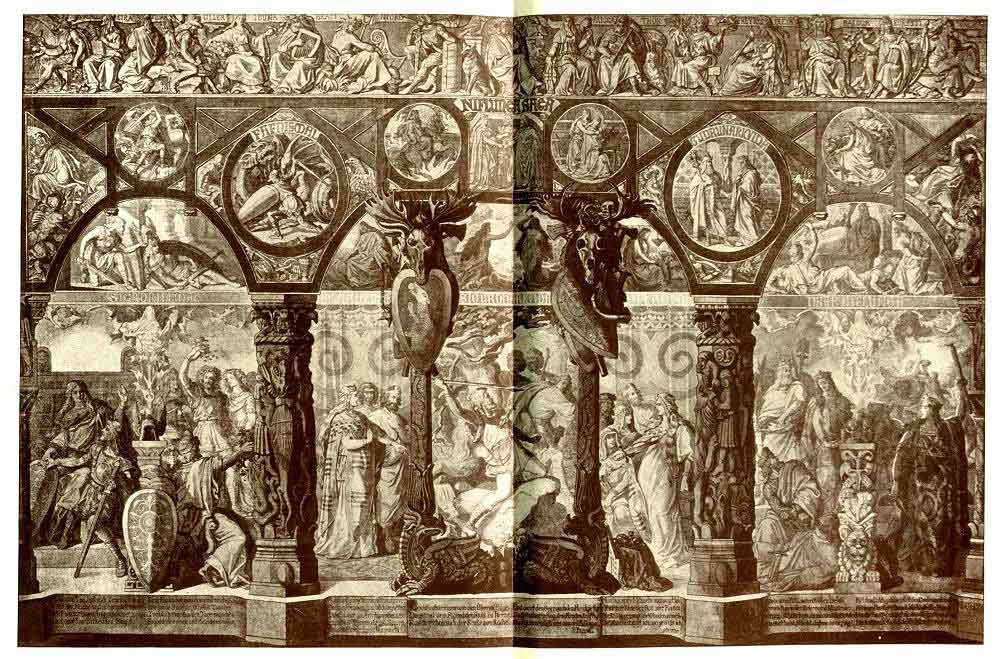
THE NIBELUNGENLIED<BR> <I>From the fresco by Professor E. Ille</I> THE NIBELUNGENLIED
From the fresco by Professor E. Ille

Mimer gave the lad heavy tasks to perform, and kept him working at anvil and bellows from morn till even. Skilful in time he became, and his strength increased beyond knowledge.

The years went past, and the lad endured the burden of servitude and the blows of his elders with humility. But one day he fell upon Wieland, the strongest and most cunning smith that was in Mimer's service, and dragged him by the locks through the smithy. Mimer was wroth, but Siegfried had discovered the full measure of his might and he commanded haughtily, as befits a prince, that a strong sword should be forged for him. The master smith realized that he must needs obey, however unwilling he might be; so he drew from the furnace a bar of glowing iron, and bade the lad to beat out for himself a worthy blade.

Siegfried swung high the great hammer and struck a blow which shook the smithy. The iron was splintered to pieces, the hammer snapped asunder, and the anvil was driven deep into the ground.

Mimer spake with anger, but Siegfried smote him heavily, and the other assistant he smote also.

Then the lad demanded to be given a sword equal to his strength. Mimer made promise to forge it for him. But in his heart he vowed to be avenged. First he went through the forest to the place where dwelt his brother Regin, who had been, by reason of his evil doings, transformed into a dragon. Mimer roused the monster to anger and bade him lie in wait for Siegfried. Thereafter he returned to the smithy and asked the lad to hasten through the forest unto the dwelling of the charcoal-burner, so that be might procure sufficient good fuel with which to forge the promised sword.

Siegfried seized his club and went forth. He came to a forest swamp which swarmed with venomous snakes and great lind-worms and toads; but he had more loathing than terror. When he reached the charcoal-burner he besought him for fire, so that be might destroy the reptiles.

"Alas, for thee!" the charcoal-burner exclaimed; "for if thou dost return again by the way thou didst come the dragon Regin will come forth to devour thee."

The prince scorned to be afraid, and snatching a fiery brand he returned through the forest and set in flames the trees and shrubbage of the swamp, so that all the loathsome reptiles were destroyed.

Then came forth the great dragon, bellowing loud and spouting venom. The earth trembled as he came. But Siegfried was not afraid. Thrice he smote the monster with his club and thus slew it. 2

Perceiving that the dragon was dead, the prince cut it up, and a deep stream of blood issued forth. He dipped his finger into it, and marvelled to find that the skin had become hard as horn.

Now shall I render myself invulnerable against battle wounds, he said.

So he cast off his clothing and plunged into the hot stream. His whole body was then made horn-hard, save a single spot between his shoulders, to which a gummy leaf had adhered.

Siegfried was well pleased. He clad himself and cooked pieces of the dragon's flesh, so that he might receive a meed of its strength. As he watched the flesh broiling, he tasted a portion to discover if it were ready. When he did that the forest was filled with magic voices, for he could understand the language of birds.

Marvelling greatly, he listened to the birds as they sang:

If Siegfried knew what we know,
What we know this day,
He would seek, O, he would seek
The wonder smith to slay;
For Mimer sent him to the wood
To be the Dragon's prey.

Let Siegfried know what we know,
And ponder o'er our song . . .
The wonder smith would fain, O fain,
Avenge his brother's wrong
Smite to live, or wait his blow
And live not long.

Siegfried heard with understanding, and his heart was hardened against the wonder smith. He cut off the dragon's head, and, hastening unto the smithy, he flung the trophy at Mimer's feet, bidding him to eat thereof. Wieland and his fellow fled, fearing greatly the prince's wrath, but Mimer sought to appease him with flattering words, and at length made offer, for life ransom, of the steed Grane, which was of Sleipner's race.

Siegfried accepted the gift, and then, remembering what the birds had sung, he smote Mimer with his club and slew him.

Then returned the young hero unto his sire, King Siegmund, who reproved him for killing the master smith, but he took pride in the lad because that he had slain the dragon.

Soon afterwards Siegfried was given arms and armour, and became a complete warrior. A banquet was held, and beakers were drained, when, with loud acclamations, the prince was hailed as heir to the kingdom of the Netherlands.

Thereafter Siegmund's strong son went forth to will renown in distant lands, and northward he bent his way towards Isenland. On the shore of the Netherlands a ship awaited him. A great gale blew, and the master mariner feared to go forth. But Siegfried would brook not delay, and crossed the stormy seas without fear, despite the peril he endured.

He landed in safety and journeyed towards the castle of Queen Brunhild. The gates were shut and bolted, but he broke them open. Then did the knights who were on guard rush against him, and they began to fight. But Brunhild came forth and bade that the combat should cease, and she gave the prince right courtly welcome.

Now Brunhild was very fair, and was a battle maiden of wondrous strength and prowess. Many wooed her, but no knight came nigh who was worthy her skill; those who encountered her were slain one by one. Maid attendants she had, too, and they were clad in armour and bravely were they wont to fight for their queen.

Siegfried saw that Brunhild had great beauty, but he had no desire to win her by combat against her knights or by vying with her in feats of strength.

"She whom I shall have for wife," he said, "must be gentle and womanly. I love not the battle maiden."

Yet he departed not without display of prowess, for he seized a boulder and flung it so great a distance that all who saw the feat performed wondered greatly. 3

The prince then went on his way until he came to the land of the Nibelungs. It chanced that the king had died, and his two sons, Nibelung and Schilbung, disputed over the treasure hoard. Unto Siegfried they made offer of a wondrous sword, which had been forged by the dwarfs, if he would make just division of their father's riches. He did as they desired, but they sought to repay him with treachery. For when he was given the sword, which was named Balmung, they said that he had kept back part of the treasure for himself. A quarrel was stirred up, and it waxed fierce. Then the king's sons called forth twelve giants, so that the prince might be overcome and bound, and thereafterwards imprisoned in the treasure cavern of the mountain.

But Siegfried feared not any foe. He fought bravely against the giants.

Then spells were wrought, and a thick mist gathered in the place of conflict; but the sword Balmung was wielded by Siegfried to such good purpose that he prevailed. A thunderstorm raged; 4 the mountains resounded with dread clamour and the earth trembled. Yet did the prince fight on, until he had slain giant after giant and none remained alive.

Thereafter the dwarf Alberich came forth against him, seeking to be avenged. A cunning foeman was he, and not easy to combat against, for he had power to become invisible. He possessed a cloak of obscurity, and when he put it on Siegfried must needs combat with menacing nothingness. Long they fought, and in the end the prince had the dwarf in his power. 5

Although Siegfried put to death the two sons of the king, he spared Alberich, from whom he won the Cloak of Obscurity, which could, when he wore it, render him invisible. For he followed the dwarf as he fled towards the mountain cavern in which the treasure was concealed. Then did the masterful hero possess himself of the hoard, and he made Alberich the keeper of it when he vowed to obey his commands.

The Nibelung people acclaimed Siegfried as their king, but he tarried not long in their midst. He took with him twelve bold war-men, and set sail again for the Netherlands. His fame went speedily abroad, and his deeds were sung of by gleemen in many a hall.

A right valiant and noble prince did Siegfried become; all men honoured him, and by women was he loved. Many a fair maiden sighed because he sought not to win one or another. But he rejoiced in warlike feats and in games, and his heart was moved not with desire for any damsel.

There came a time, however, when gleemen sang of the beauty and grace of the Princess Kriemhild, the daughter of the King of Burgundy. In the wide world there was none fairer, and Siegfried loved her in secret ere yet he beheld her, for he knew that she was his heart's desire, and he resolved that he would woo her right speedily.

He spake to his knights thereanent, and they told both king and queen of Siegfried's bold intent. Siegmund and Sigelinde sought to repress his desire, but the prince would not be restrained.

The king warned his son that the warriors of Burgundy were fierce in war, and among them were Gunther and strong and vengeful Hagen.

"What I shall obtain not by fair request," Siegfried said, "I may win in battle."
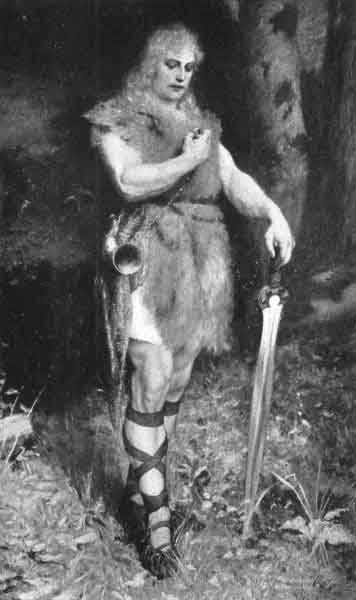
SIEGFRIED<BR> <I>From the Painting by F. Leeke. By permission of Franz Hanfstaengl</I>SIEGFRIED
From the Painting by F. Leeke. By permission of Franz Hanfstaengl

His sire made offer of a great army, but the prince said he would go forth as one of twelve knights. He scorned to win Kriemhild by force, and vowed he would woo her by reason of brave deeds.

Then were preparations made for the journey, and the queen caused rich and gorgeous apparel to be fashioned for Siegfried and his men, and when they rode forth they were indeed of noble seeming.

Siegmund and Sigelinde sorrowed greatly when their son kissed them farewell.

"Grieve not," Siegfried said, "for no evil shall come nigh me."

Then rode he away, the noble prince, to share his meed of joy and meet his doom.

Footnotes

1 Siegfried is the hero of the Nibelungenlied, the great Upper German poetic romance (see Introduction). He is identical with the northern Sigurd of the Eddic poems and Volsunga saga. The various versions of the popular tale developed from an older legend. The Nibelungenlied is here introduced by a summary from Thidrek saga, a Norse poem composed about the middle of the thirteenth century, which was based on the Lower German version of the legend and the Dietrich poems. Our introduction gives a consecutive narrative. The Nibelungenlied opens abruptly by introducing Kriemhild, who takes the place of the Norse Gudrun. Siegfried's early exploits are afterwards referred to briefly.
2 The necessity for more than one blow recalls Thor's conflicts with the Midgard serpent in Hymer's boat and at the Ragnarok battle.
3 He resembles the boulder-flinging mountain giants.
4 Thor is suggested here.
5 There is a curious Banffshire story of two mountain fairies who fought for the love of a fairy lady. One was dark and the other was white. The former had power to render himself invisible, but when he did so in the duel a red spot remained. The white fairy saw the red spot floating in the air, and shot an arrow through it. The dark fairy was slain because the red spot was his heart. This story is not of a common type, and is evidently very old. The fairies occupied opposing hills, as if they were the usual Scottish mountain giants. Of course, giants and fairies have much in common.

Teutonic Myth and Legend: Chapter 31 Gudrun's Vengeance

TEUTONIC MYTH AND LEGEND

by DONALD A. MACKENZIE

An Introduction to the Eddas & Sagas, Beowulf, The Nibelungenlied, etc.

London, Gresham Publications 1912

CHAPTER 31

Gudrun's Vengeance

Gudrun's Flight--Grimhild follows her--The Reconciliation--Wooed by King Atle--Doom Dreams--The Fafner Hoard--Coveted by Atle--Invitation to Gudrun's Brothers--Fateful Journey--Treachery--A Fierce Conflict--How Hogne died--Gunnar among Vipers----Queen slays Atle--Becomes Bride of Jonaker--Her Sons--Svanhild is avenged.

WHEN Sigurd and his son were burned with Brynhild on the pyre, Gudrun refused to be comforted, nor could she abide to remain in the Hall of Giuki among the oath-breakers, her brothers, who had brought her husband to his death. So she went forth alone to wander in the forest with desire that wolves should devour her. Five days she journeyed in her sorrow, knowing not whither she went, until she came to the Hall of King Alv. There was she received with pity and tenderness, and she had for companion Thora, daughter of Hakon, King of Denmark. She was well loved, and with Thora she sat and embroidered on fair tapestry the deeds of Sigurd and Sigmund.

Three summers went past and four winters ere Queen Grimhild came to know where Gudrun had her dwelling. She desired that her daughter should return again, because King Atle the Mighty, the brother of Brynhild, sought her for his bride. So Grimhild gave much treasure to her sons, and went forth with them to appease Gudrun with gifts of gold, so that the blood feud might have end. Five hundred war-men rode with Grimhild and Gunnar and Hogne, and they greeted Gudrun and made offer to her of the treasure which they bore with them. Then did Gunnar give to Gudrun a golden goblet filled with the drink of forgetfulness, which Grimhild had brewed, so that she might put past old sorrows and hate. Gudrun drank and her grief faded.

Thereafter Grimhild told her daughter that King Atle desired her for wife, and said that she would be given more treasure when she was wed to him.

"I desire not another husband," Gudrun said; "nor could I live happily with the brother of Brynhild."

"If thou wilt wed Atle," said Grimhild, "thou shalt have sons, and it shall seem to thee that Sigurd and Sigmund are: again in life."

"I seek not nor hope for gladness any more while I live," Gudrun answered.

But her mother pleaded: "Atle is foremost among kings. A nobler husband thou canst not find. May thou never he wed to any man," she added, "if thou shalt spurn this mighty ruler."

"Alas!" sighed Gudrun; "bid me not wed the brother of Brynhild, for he will bring great evil upon our kin, and be the death-bane of Hogne and Gunnar. By my own hand must he fall in the end if I become his bride."

Grimhild wept, nor listened to what Gudrun said. "I shall give thee lands and many war-men," she told her daughter, "if thou wilt take Atle to be thy husband. Thou shalt have joy with him until thy life's end. Besides, by marrying him thou wilt bring great honour unto thy kin."

"Alas! I must then be wed to him," said Gudrun, "although my heart desireth him not. But there is no gladness in store for me, for he will be a bane to my kin."

Grimhild rejoiced because that she at length worked her will, and soon a great company set forth towards the kingdom of Atle the Mighty. They travelled for seven days by land, and then for seven days they voyaged over the sea, and thereafter they travelled by land again for seven days 'ere they came unto the Hall of the King. A great banquet was held, and King Atle and Gudrun were wed. But the bride's heart was sad within her, nor did she ever have joy in the Hall of Brynhild's brother.

One morning when Atle woke from sleep he was greatly troubled because of the dreams he had dreamed. He spoke to Gudrun, saying: "It seemed that thou didst thrust a sword through my breast."

"To dream of iron," the queen said, "is to dream of fire."

"And I dreamt also," continued the king, "that two water-reeds grew up in my hall. By the roots were they pulled up, and they dripped red blood; of them was I asked to partake. . . . Then it seemed that two hungry hawks flew from my wrist, and they went to Hela. Hearts had they steeped in honey, and I ate them. . . . Thereafter I dreamt that two cubs gambolled at my feet; of these did I also partake."

"Thy dreams forebode much ill," Gudrun said; "verily, thy sons are nigh unto life's end. Black grief is at hand."

Weeks passed and then years, and the doom dreams faded from the king's memory. Yet was there more unhappiness between the ill-mated pair.

Then a time came when Atle spoke much of the accursed treasure which Sigurd had found when he slew Fafner. Well he knew that Gunnar and Hogne had kept from Gudrun the greater part, so that they could boast of immense riches. In his heart Atle coveted the hoard, and desired it for himself; so he took counsel with his nobles, and decided to invite Gunnar and Hogne to visit his Hall. A trusted messenger, whose name was Vinge, was sent forth with a company of war-men to make promises to the brothers and induce them to journey to Hunaland. Gudrun knew well that there was evil intent in her husband's heart, so she carved runes of warning upon a gold ring and gave it to Vinge as her gift to Hogne. But Atle's messenger changed the runes so that they seemed to convey a speedy welcome from the queen.

When Vinge reached the Hall of Giuki he made his mission known. The brothers consulted one with another, suspecting treachery and Atle's lust for gold; but Gudrun's ring reassured them, and after they had drunk mead with the messengers, they promised to go forth with them.

But Hogne's wife, Kostbera, made keen scrutiny of Gudrun's ring in her bedchamber, and she saw that the runes had been altered from warning to welcome. To her husband she spoke thereanent. She had also dreamt an ominous dream, in which she saw the Hall overthrown by a rising flood.

But Hogne chided her for thinking ill of Atle. He had given his promise to Vinge to fare forth with him, and scorned to break it.

Gunnar's wife had also dreams of warning. She saw her husband pierced by a sword, while wolves howled about him.

"Little dogs will bark at us," Gunnar said.

"Methought I also saw," his wife continued, "a battle maiden of sad visage entering the hall. She seemed to be a valkyrie."

"A man must die at his appointed hour," Gunnar said; "besides, it is not good to live over long."

Now Gunnar, who was king, for Giuki had departed hence, was well loved by his people, and in the morning they clamoured about him, beseeching that he should not leave them.

But he bade them to feast with him. "We may never again drink mead together," he said, "but no man can escape his fate."

Gunnar's wife spake unto Vinge. "Methinks," she said, "that ill fortune will come to our kind from this journey."

But Vinge swore many oaths, saying that no evil was intended. "May I be hanged," he said, "if a sign of treachery is shown against Gunnar and Hogne in the kingdom of Atle."

There were tears and lamentations when the warrior sons of Giuki went forth never again to return to the kingdom of their sires, although great glory would be theirs by reason of valorous deeds and unflinching courage.

Gunnar's wife embraced her king, and Kostbera embraced Hogne, saying: "May days of gladness be thine."

"Forget not to make merry," Hogne said, "no matter what befalls us on our journey."

When they had voyaged over the sea, there were dumb foretellings of their doom. So swiftly and hard did the oarsmen ply their blades that rowing pins snapped and half the ship's keel was shorn off upon the beach. They leapt ashore and feared not. Gunnar and Hogne went inland towards Atle's stronghold with armour and full war gear and all their men. Two sons of Hogne were with, them, and valorous Orkning, the brother of Kostbera, who had fame for mighty deeds.

They rode together through a dark wood, and when they approached the stronghold of Atle they perceived that the gate was closed against them. A great army was assembling to receive the guests.

Hogne raised his battleaxe and smote the gate asunder, for he must needs enter with dignity becoming his rank.

"Thou hast done wrong," Vinge snarled; "'twere more fitting that thou shouldst wait until I bring the gallows on which ye shall all hang. By smooth words have I induced ye all to come hither; ere long shall ye die together."

"Thy boasts affright me not," answered Hogne; "we shrink not from conflict, if conflict there must be. Yet hast thou wrought us ill, so take thy reward."

As he spake, Hogne swung his battleaxe and slew Vinge with a single blow.

Boldly rode the sons of Giuki until they came to the Hall of Atle. There was a strong army drawn up in line of battle.

King Atle came forth, and spake to the brothers.

"I bid ye welcome," he said, "but unto me must be now given up the great treasure which Sigurd won when he slew Fafner, and is now mine by right of Gudrun."

So fell the treasure curse upon them all in that hour of doom.

Gunnar spake. "Thou shalt never possess our riches," he said, "and if thou dost battle against us, we shall make of thee and thy kin a feast for the eagle and the wolf."

"Long have I desired," said Atle, "to punish ye for the slaying of Sigurd. That indeed was a shameful doing, for his equal was found not among men."

Hogne spake boldly: "Long then hast thou brooded over that matter. A wonder it is that thou didst not sooner set thyself to the task."

Then began the battle, and against one another they cast their spears.

Tidings were borne unto Gudrun of hard fighting, and she hastened forth in great anger. She cast from her the royal robe, and rushing into the midst of the fray embraced her brothers and kissed them.

But in vain did she intervene. The time for peace was past, so she armed herself and fought beside Gunnar and Hogne against the war-men of Atle.

Bravely fought the brothers. The king's three brothers were slain, and Atle cried:

"Now am I the last of my kin, and by thee was Brynhild slain."

"Thou shalt have thy faring in time," answered Hogne; "the gods have decreed thy punishment."

Fiercer grew the conflict, for Atle rallied his war-men and urged them to battle. But he was driven back into his Hall, which soon streamed with blood. Great were the deeds of the valorous Giukings.

But at length Gunnar and Hogne were pressed hard and overpowered. Then were they bound in fetters.

Atle was wroth when he perceived that so many of his war-men were cut down, and he scowled upon Hogne.

"He hath cut down a host of my heroes," he said; "so let his heart be cut out."

"Do thy will," answered Hogne, "for I fear not. So grievously am I wounded that I may as well die."

But the king delayed taking vengeance. He desired first to know where the Fafner treasure was concealed, so he had the brothers cast into separate dungeons.

Gunnar was first brought before him. "Thy life shall be spared," Atle said, "if thou wilt reveal where the treasure lies hidden."

Gunnar answered him. "Ere I speak," he said, "Hogne's heart must be brought unto me."

Then did Atle seek to practise deceit with much cunning. He had a thrall seized, so that his heart might be held up before Gunnar. The man screamed with anguish ere yet the knife touched him, for he desired not to miss constant fare and good, nor leave his well-loved swine.

The coward heart was cut out, and it trembled before Gunnar.

"That is not the valorous heart of my brother," he said, "but the heart of a thrall."

So Hogne had to be slain. He laughed when his enemies fell upon him, and they marvelled at his valour.

Then was, the hero's heart plucked forth, and when Gunnar saw it he said:

"That indeed is the heart of great Hogne. See how it still beats without fear. I wavered while my brother was yet alive, but now can I die well satisfied, Atle, for thou shalt never know where the treasure lies hid. Yet thou, O King, shall escape not thy doom, and the Rhine river shall keep the secret of the gold."

Atle was wroth; his brow darkened and his eyes burned fire.

"Take hence the prisoner," he growled, and as he bade his men so did they do. 1

Gunnar was bound and thrust into a loathsome dungeon which swarmed with vipers. But Gudrun sent unto him a harp, and he played upon it with his toes, making such sweet music that all the vipers were charmed into a magic sleep save one, which gnawed his breast until it reached his heart to suck his life's blood. Great torture did Gunnar suffer ere he died.

Men have told that the viper which killed the hero was the mother of Atle, who was a sorceress.

The king boasted before Gudrun, because that he had triumphed over her brothers.

"Gunnar and Hogne are indeed no more," the queen said, "and unto me is given a heritage of vengeance."

Atle liked not her speech, so he said: "Let peace be made between us. Thee shall I give much treasure as atonement for the loss of thy kin."

Gudrun would accept not of blood payment, but she desired that a funeral feast be held for Gunnar and Hogne.

The king gave ready consent, and then was the dread work of vengeance begun. Gudrun slew her two sons. Of their skulls she made drinking cups, and she had their hearts cooked in honey for the king. In his wine she mixed their blood.

When the feast was over, Atle desired that his sons should be brought before him.

"Thou hast given me dark sorrow," Gudrun said, "by slaying my brothers. Now hast thou thy reward. Thou didst eat the hearts of thy sons, and their blood hast thou drunken in thy wine from these their skull cups.

"Vengeful woman," cried Atle, "a great cruelty thou hast done by slaying thine own children."

"There shall be still greater cruelty yet," she answered him.

"Thou shalt be burned alive for this," Atle cried fiercely.

"Thine own death thou dost foretell," she said, "as well as mine."

Now a son of Hogne was left alive. He was a Niblung. 2 With him did Gudrun conspire. When Atle had drunken deep, and slumbered, his wife went with Hogne's son to his bedchamber, and she thrust a sword through him.

Atle woke up and cried: "Who hath given me my deathwound?"

Gudrun made known herself, and said she had taken vengeance for her kin.

Atle pleaded that he would have stately burial, and the queen promised him a great pyre. When he died she set fire to the hall, and all that were within it were burned. In the darkness the war-men sprang one upon the other, and many fell fighting ere the end came.

Gudrun made escape, but she desired not to live any more. She hastened towards the shore and cast herself into the waves, so that her days might have end.

There are those who tell that she died thus, but others say that the waves bore her over the sea and cast her upon the beach nigh to the stronghold of King Jonaker.

A strong warrior was he. When he saw the queen's beauty he desired to have her for bride, and when she was nourished and comforted the twain were married and they dwelt happily together.

Gudrun had three sons, and they were named Hamder, Sorle, and Erp. It is told that when they became full warriors she sent them forth against King Jormunrek to avenge the death of Svanhild. But Erp, it was deemed, was unwilling to go forth, so his brothers slew him.

Then Hamder and Sorle set forth. Their mother charmed their bodies against steel, and when they reached Jormunrek, Hamder cut off his hands and Sorle smote off his feet.

"If Erp were here," one said to the other, "he would have taken the king's head."

Many strong and well-skilled warriors fought against the sons of Gudrun, but without avail, for they could not wound them.

Then in the midst of the fray appeared a wise old man who had but one eye. He was Odin, but they knew it not. He counselled that the warriors should cast stones against the twain, who were protected by spells. As he advised, so was it done. Many stones were flung at Hamder and Sorle, and they were speedily slain.

So endeth the northern tale of the Volsungs and the Giukings.

Footnotes

1 A similar legend regarding a secret is current in the Highlands. Neil Munro gives a spirited version in his picturesque tale "The Secret of the Heather Ale" in The Lost Pibroch.
2 The Giukings were originally the Nibelungs (Hniflungs) who possessed the hoard guarded by Andvari (Alberich). That is why Hogne's son is called a "Niblung". The reference is a survival from one of the older versions of the legend. In the next chapter the Nibelungs are dwarfs (elves) and the Giukings are the Burgundians. How myth and history commingled in endless variations is illustrated by the Dietrich stories. Similarly, myths which had a common and remote origin, and developed separately in various districts, were also fused by wandering minstrels.

Teutonic Myth and Legend: Chapter 30 The Last of the Volsungs

TEUTONIC MYTH AND LEGEND

by DONALD A. MACKENZIE

An Introduction to the Eddas & Sagas, Beowulf, The Nibelungenlied, etc.

London, Gresham Publications 1912

CHAPTER 30

The Last of the Volsungs

Brynhild's Daughter--Escape to Norway--Her Protector murdered--Why she was called Krake--The Princess Thora--Her Dragon--like Serpents--How Ragnar won his Bride--The Northern Cinderella--Wooed by the Viking--The Slave becomes a Queen--Story of Svanhild--Wife of Jormunrek (Ermenrich)--Bikki (Sibech) the Accuser--Fate of Gudrun's Daughter.

Now when Brynhild died, Heimer feared that Giuki's vengeful sons would slay Aslog because that she was the last of the Volsungs, and might rear up a son who would come against them. So he prepared to take flight. He made a harp, in which he concealed Brynhild's child with certain of her treasures, and voyaged to Norway, where he made pretence to be a minstrel. He went to a house in Spangerejd and dwelt in it. He revealed not there the secret of the child's concealment. But one day the housewife perceived that there was treasure in the harp, for the door of Aslog's harp-chamber was not closed, and a portion of rich cloth protruded from it. Then was Heimer murdered in his sleep, and Aslog was taken forth with the treasure that was hers.

The child grew up in the strange household, and her foster-parents were not only poor but cruel and harsh; the high-born girl was made a slave, and was set to work at menial tasks. As the years passed by her beauty shone forth, and her captors, fearing that blame would fall upon them for doing evil, kept her clad in rags, and smeared her face with soot and tar, so that no eye might gaze upon her with wonder. Then was she nicknamed Krake, which signifies "the crow".

Thus did Aslog abide with harsh and strange folk until the coming of the great viking Ragnar Lodbrog, who had fame not only on the high seas for deeds of valour, but also because he had slain the venomous serpents which were the bane of King Heroth's kingdom.

It chanced that the king had gone hunting in the woods, where he found two young snakes; these he bore home with him to his daughter Thora, by whom they were fed until they grew so large that she dreaded to approach them. Each then began to devour an ox daily; and they both became so powerful that they laid waste the countryside, and killed men and beasts with their venomous breath.

King Heroth feared to contend against the serpents, but he offered his daughter in marriage to the man who would slay them. Now Thora was fair to behold, and many heroes went forth to fight the monsters; but they suffered death one after another, and the affliction grew greater, so that all people were in constant fear and peril.

The day came when Ragnar heard of Thora, whom he desired for wife, being set up as a reward for serpent-slaying, and he resolved to win her by mighty deeds. So he bade that a mantle and breeches of wool be fashioned for him, and when they were ready he gave King Heroth to know that he would make attack on the serpents.

It was the season of winter, and he dipped his woollen attire in a stream and it was soon frozen hard. Clad thus, he was protected against the venom, so he girt on his sword and took a spear in his right hand and a shield in his left and went forth to fight, so that Thora might be his bride.

A great serpent came against him, but he feared not, and prepared to combat with it. Then another great serpent hastened to the aid of the first, and he was soon in dire peril. They spouted venom upon Ragnar, but his frost-bound clothing protected him; and they smote him with their tails, but he stood firm. Terrible was the conflict which was waged, and the king and all who were with him were filled with alarm, and sought high and narrow hiding places, fearing that Ragnar would be overcome.

The serpents were enraged, and they made ferocious attack with monstrous jaws agape, but Ragnar raised his shield against them each time they sought to bite. He was indeed sore pressed and greatly wearied; but at length he cast his spear at them and it went through their hearts, so that they were both slain.

A great shout was raised by those who were in hiding, and the king came forth to honour Ragnar. He laughed to see the strange attire of the hero, and nicknamed him "Lodbrog", which signifies "shaggy-breeches".

Then was a great banquet given. Ragnar was attired ill splendour, and he was given Thora for wife. But when she had borne him two sons she died, although young and fair, and her husband mourned for her.

Ragnar then plundered on the high seas and raided Scotland and Pictland. He set a new king over the Orkneys, and went against Norway.

It chanced that he came one day to Spangerejd, and there he sent men ashore to procure bread. When they returned with the food he was made angry because that it was burned. The men told him that they had gone to a house in which there was a beautiful maiden: they could refrain not from gazing upon her, and so the bread was burned.

Now Ragnar bethought him to have such a maiden for his bride, so that he might forget his grief for Thora. He sent to her a message bidding her to come unto him. Desiring to put her wisdom to test, he told his messengers to ask her to come not on foot nor yet driving; not attired and yet not naked; not feasting and yet not fasting; not with anyone and yet not alone.

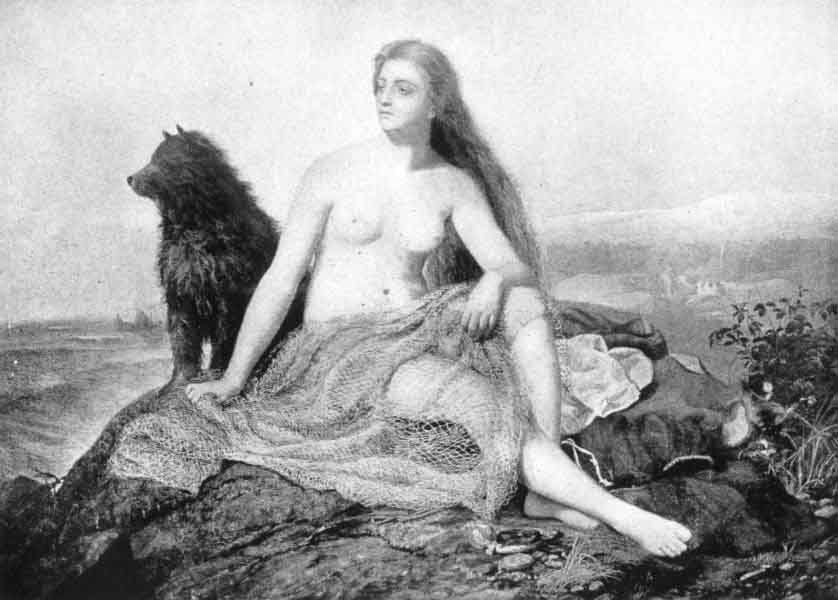
Aslog, who was named Krake in her poor dwelling, came towards the great sea king neither driving nor on foot but riding upon a goat with her feet trailing upon the ground; she came without attire, but yet not naked, because her hair was so long and bountiful that it covered her body, and she drew a net about her; she came not feasting nor yet fasting, because she held an onion to her lips and tasted of it; she was not alone, because her dog walked by her side. 1

Ragnar, who was now a great king, took beauteous Aslog, the daughter of Sigurd and Brynhild, for his bride, and their sons were named Ingvar and Ubbe. 2

After Sigurd's death Gudrun had a daughter who was named Svanhild. She was given for wife to Jormunrek, 3 King of the Gauts. Like to a sunbeam was she in the hall of Giuki, and there was great sorrow when she went forth with her bondmaids. Much treasure was she given, but the curse of Andvari's gold followed her. It fell that she was falsely accused by Bikki of unfaithfulness with a prince, and so greatly enraged did the king become that he ordered that she should be put to death by being trampled under the hoofs of horses.

Then was Svanhild bound and left lying on a plain; but although the horses ran over her they injured her not, some say because of her surpassing beauty, and others because of the brightness of her Volsung eyes.

The king deemed that his fair bride was innocent, because she had escaped injury, but Bikki, her accuser, poisoned the king's ear, and persuaded him to command that Svanhild should be laid upon the ground with her face downward. Then were the horses driven over her again, and she was trodden deep down into the earth by the multitudinous hoofs. So perished Svanhild, daughter of Gudrun, while Aslog, daughter of Brynhild, reigned as Ragnar's queen in a northern land. In Norway, s royal line alone doth the blood of the Volsungs flow.

The young prince, who was Jormunrek's son, was condemned to death by his sire and was hanged. 4

KRAKE<BR> <I>From the painting by M. E. Winge</I> KRAKE
From the painting by M. E. Winge

Footnotes

1 So did Grainne come to Diarmid in the Highland Fian tale. Grimm also gives a version of the story with numerous references to similar tales in other languages than Gaelic and German. In Saxo (Book 9) there is a more sordid account of Ragnar's wooing of "a certain young woman" who became the mother of Ubbe. Like Odin, when he wooed Rhine, Ragnar made use of female attire. Our version is from Ragnar's saga. The Volsunga saga drops Aslog at the point where she became Krake.
2 Here we meet history. By one authority Ingvar and Ubbe are said to be the northmen who murdered King Eadmund of England. Others identify them as the avenging sons who carved an eagle on the back of King Ella in Yorkshire, because he had driven their half-brother Ivar from the throne. Krake is a northern Cinderella, sung of in Norway and Denmark. She was a link between Odin and the Norse kings, who prided themselves in their descent from the Asa-god.
3 Ermenrich (Hermanric) of the Ostrogoths.
4 Saxo gives an account of a sham execution, but in the Dietrich story he is actually put to death. Bikki is Sibech.

Teutonic Myth and Legend: Chapter 29 Brynhild and Gudrun

TEUTONIC MYTH AND LEGEND

by DONALD A. MACKENZIE

An Introduction to the Eddas & Sagas, Beowulf, The Nibelungenlied, etc.

London, Gresham Publications 1912

CHAPTER 29

Brynhild and Gudrun

Brynhild's Magic Sleep--Awakened by Sigurd--Lovers pledge their Troth--The Draught of Forgetfulness --Gudrun wins Sigurd--Gunnar's Wooing--How Brynhild was deceived--Quarrel with Gudrun--Sigurd is murdered--Gudrun's Sorrow--Brynhild dies on Sigurd's Pyre--Ride to Hela.

WHEN Sigurd came nigh to Hindarfell, in the land of the Franks, he beheld a blaze of light on the hill. Then he perceived that a stately castle was girt round with magic fire. Its roof was of shining gold. A banner on the highest tower floated in the wind.

He rode towards the castle. He went through the flames on the back of Grane. He dismounted and went within. There he beheld a beauteous battle maiden wrapped in magic sleep; golden was her hair, and she was clad in armour. . . . He went towards her and took off her gleaming helm, and her locks fell free. Yet her eyes opened not, so strong was the sleep spell that was upon her. . . . He drew his magic sword and cut through her armour so that it fell to pieces, whereat the maiden awoke. . . . Her wondrous eyes glowed upon him; her pale cheeks reddened and her lips opened.

"How long hast thou lain asleep?" asked Sigurd.

"Who art thou," the maiden sighed, "that hast shorn my armour asunder, and hath power to break the runes of sleep? . . . Art thou indeed Sigurd, the son of great Sigmund? Hast thou come at last with the helmet of darkness and the sword which slew Fafner?"

Sigurd answered. "I am even Sigurd, the son of Sigmund, and my sword hath shorn thine armour asunder."

"None but a Volsung could have done the deed," cried Brynhild, for indeed it was she--the beauteous valkyrie whom Odin had punished by laying her in a magic sleep because that she had caused to fall in battle those whom he favoured.

"A Volsung am I," Sigurd answered, "and I have come to thee because thou art so fair and full of wisdom. Fain would I learn of thee."

Then Brynhild smiled. She threw back her golden hair, and gazed forth upon the world once more. She saw the bright sun and the fresh green ways, and like a dawn-awakened bird she raised her voice in song.

Long was my sleep, long was my sleep,
Darkling 't was lone and dreamless and deep
Long as the evils that mankind endure,
As long and as sure;
Helpless in sunshine and starshine I've lain,
Wrapped by the runes that bind like a chain
Helpless ye found me:
Odin had bound me
Bound me in sleep where I lay. . . .
Hail to the day!
Hail to the sons of the light!
All hail to the night!
Hail and O hear, beholding us twain,
And give what we hope now to gain. . . .
Hail ye gods and ye goddesses dear,
And Earth, the mother of all!
Give us of wisdom and tenderness here,
Hands that shall heal and hearts without fear
Till death shall at length on us call. . . .

Then Brynhild told Sigurd how Odin had touched her with the sleep thorn, and said that never again would she be a chooser of the slain, but would lie in slumber until a lover came.

"But I vowed a vow," she said, "that I would never wed a man who knew what it was to be afraid."

Sigurd said: "Fain would I hear of thy wisdom, for which thou art famed."

"With gratitude can I speak to thee," said Brynhild, "but let us first drink mead together. May thou profit by what I shall teach thee, and may thou in after time remember what I now speak unto thee."

She filled a golden goblet and gave to Sigurd to drink.

"The mead," she said, "is mixed with renown and songs merry and sad, and with wise thoughts and tender heart thoughts and valorous speech. . . . Thou shalt grave war runes on thy blade, and twice shall Tyr be named. Runes of ocean shalt thou carve on stern and rudder and oar; thou shalt have peaceful sea-ways. . . . Runes thou shalt learn to ward off blood vengeance and doom. . . . Runes thou shalt learn to call fairy help when a son cometh, and runes for wound healing which thou shalt carve on trees whose branches are bending towards the east. . . . I shall teach thee runes of high-heartedness and valour--the runes of the gods, the runes of the elves, and the runes of the wise Vans. . . . I shall give thee runes that shall aid thee in all things until life ends. . . . Now thou shalt choose what thou dost desire to be and to have.

Sigurd spake: "I was born to be without fear. I shall forget thee never, and in my heart shall I treasure what thou givest unto me."

Then Brynhild gave runes to Sigurd, and she counselled him to give friendship for friendship, and to have forbearance so that he might win fame among men.

"Take close account of what is evil," she said; "from a maiden's love and a man's own wife wrong may come. Give little heed to those who speak more harshly of others than they deem they do; take not advice from men of poor judgment. Ever be watchful of danger wherever thou farest; let not a woman enchant thee in the feasting hall. Heed not the unwise speech of a man who hath drunken deep. Keep the oaths thou dost swear. Trust not him whose kin thou hast slain. . . . I can read not of thy future right well, nor perceive clearly what shall befall thee, but may evil come not from thy wife's kindred."

Sigurd said: "None other but thee shall I have for my bride."

Brynhild made answer: "If it were given me to make choice among all the sons of men, thee alone would I desire to be mine."

Sigurd gave to the gold-haired maiden the magic ring which was in Fafner's hoard.

Then did they swear binding oaths together, vowing that they would ever be faithful one to another until life's last loop was spun.

Thereafter went Sigurd on his way, for he must needs travel unto the hall of King Giuki. Loving Brynhild, he went, but it was doomed that he should break his binding vows, and spurn the golden-haired maiden whom he had rescued from magic sleep. It was indeed fated that he should drink the draught of forgetfulness, so that new love might enter his heart, for he must needs suffer because of the treachery of another.

A warrior of noble seeming was Sigurd, and wondering eyes beheld him as he drew nigh to the dwelling of Giuki. Great was his height, and he had the shoulder-breadth of two men. Young was he, and very fair.

His eyes were blue, and of such brightness that men quailed before him; his nose was high-ridged, and bent like to an eagle's beak; broad was his face from cheek bone to cheek bone. His hair was copper-brown, and hung over his shoulder gleaming in sunshine, and his beard was short and fair. All beholders gazed with mute wonder upon his great sword Gram.

He was withal fearless and high-hearted, one who loved his friends and was unafraid of any foe. Ever ready was he to give aid to kinsmen and allies. Such eloquence of speech was his that men were drawn towards him.

Those who played games round Giuki's hall ceased when Sigurd came nigh. King Giuki greeted him with welcome to his dwelling, and the treasure chests were taken from Grane's back and borne within.

The king had for wife the crafty Grimhild, who was a sorceress, and they had a beauteous daughter who was named Gudrun. Their three sons were Gunnar, Hogne, and Guttorm.

Now, when Grimhild beheld Sigurd, she was taken with desire that he should have her daughter for his bride, and ill-pleased was she when she found that his heart was filled with love for Brynhild.

It chanced that the two maidens dreamed dreams. Brynhild had a vision of Gudrun coming towards her, and on the day that followed Gudrun indeed came in a gold-decked chariot with all her maidens, for Gudrun had also dreamt a dream and desired that the wise Brynhild should solve it.

Brynhild, who was King Budle's daughter, dwelt betimes at her castle, and betimes at the Hall of Heimar, who had for wife her sister Bkhild. Her brother was King Atle the Mighty.

It was at Heimar's hall that Giuki's daughter found the fair battle maiden on that fateful day.

Gudrun told Brynhild of her dream. "It seemed," she said, "that we were together in a forest and saw a noble stag. Copper-coloured was its hair, and we both desired to possess it. But no one save myself alone could reach the stag, and I possessed it, and was made glad. Then thou didst come, Brynhild, and thou didst slay my stag, and I wept bitterly. Thereafter thou didst give me a young wolf which was red with the blood of my kin."

"Alas!" Brynhild sighed; "I can read thy dream. Thou shalt marry Sigurd, whom I desire for my lover. A magic drink he shall receive, and he shall turn from me. Then shall there be a feud, and he shall be slain, and thou shalt thereafter marry my brother King Atle the Mighty, whom thou shalt slay in the end."

Gudrun wept. "Terrible indeed it is," she said, "to have knowledge of these things."

So she left Brynhild and returned with her maidens to the hall of King Giuki, her sire.

Three years passed, and Sigurd remained with the king who had given him welcome. With Gunnar and Hogne he took oaths of fellowship, and they hunted together and made merry.

Ever did Queen Grimhild desire that Sigurd should take Gudrun for his bride, and at length she brewed a magic drink which would make him forget the battle maiden whom he had chosen for his bride.

A night came when they sat together in the feasting hall, and the queen rose and filled the drinking horn with the magic drink and gave it unto Sigurd, saying:

"It hath pleasured us to have thee abiding with us here. Thou shalt receive from us all thou dost desire. Drink thou from this horn the mead which I have prepared for thee."

Sigurd drank as she desired, and he forgot Brynhild and the binding vows he had sworn with her. The love he had for her passed away, and he saw that Gudrun was very fair.

Then the queen said: "King Giuki shall be to thee a sire, and his sons are thy brethren."

To the king in secret Grimhild spake, as she embraced him: "Give thou our daughter for wife unto Sigurd. Great is his wealth, and it would be well that he should ever be with us."

Giuki disdained to offer his daughter even unto Sigurd, but the queen constrained her son Gunnar to counsel the young hero to have the beauteous maid for his bride.

So it fell that Sigurd and Gudrun were wed in the Hall, and they dwelt happily together. They had a son, and his name was Sigmund.

Queen Grimhild next desired that her son Gunnar should have Brynhild for wife, and she said: "Go thou and woo the battle maiden, and Sigurd shall go with thee."

"That will I do right willingly," Gunnar made answer, "for I would fain have golden-haired Brynhild for my bride."

Then he rode forth towards the hall of Heimar, and with him went Sigurd. Grimhild had wrought a spell so that Brynhild would know not her former lover.

Gunnar besought of Heimar that he should have the battle maiden for wife, but Heimar said: "Brynhild shall only wed him whom she herself doth choose. To her thou must go. She dwelleth in a castle beyond, which is girt about with magic fire, and thou must needs ride through the flames to win nigh unto her."

Then Gunnar rode towards the dwelling of Brynhild, and Sigurd went with him. But when they came nigh to the fire-girt castle Gunnar's steed would go no farther, for it feared the flames.

Sigurd said: "To thee shall I give Grane, on whom to ride through the fire."

So he dismounted; but when Gunnar sat upon the back of Grane, the steed refused to move forward. None save Sigurd could go unto Brynhild; none could ride through the flames save Sigmund's noble son.

Then took Sigurd the semblance of Gunnar, and Gunnar the semblance of Sigurd, as Queen Grimhild had given each of them power to do, and Sigurd leapt upon Grane's back and rode through the magic fire.

Brynhild saw Sigurd coming towards her and said: "Who art thou who hast come through the magic fire?"

Sigurd answered: "My name is Gunnar, son of Giuki. Thee shall I have for my bride, because that thou didst vow to marry him who would reach thee through the flames."

"Thee shall I wed, Brynhild said, "if thou shalt promise to slay those who also desire to have me for wife."

"That shall I promise thee," answered Sigurd, and the battle maiden was well pleased.

Three nights he abode with Brynhild in the castle, and ere he left her she gave to him the ring that was once Andvari's, and had been taken by Sigurd from the hoard of Fafner--the ring of doom which was a bane to them both.

Through the flames once more went Sigmund's great son. With Gunnar he again changed shapes, and together they returned unto the hall of Giuki.

In time fair Brynhild left her fire-girt castle and went unto the dwelling of Heimar, to whom she told how fate had served her.

"Fain was I," she said, "that it had happened as aforetime--that Sigurd had come through the flames towards me instead of Gunnar."

"As it hath chanced," said Heimar, "so must it be."

Now Brynhild had a daughter, whose name was Aslog. A Volsung was she by birth, for her sire was Sigurd, and it was fated that she would be the last of her race. The battle maiden gave the child to Heimar, so that she might be nourished and fostered and kept free from harm.

When Brynhild did that she went with King Budle, her father, to the hall of Giuki. There was a feast of splendour held, and Gunnar and the battle maiden were wed. They drank mead together and made merry.

But if joy came to the heart of Brynhild, it speedily vanished when she beheld Sigurd with another bride. In secret she bewailed her fate, because that her first love who had awakened her from magic sleep had been taken from her by treachery and sorcery. Nor could such sorrow have long endurance. The treasure curse was upon them all; the shadow of doom was already darkening their days.

Ere long the pent-up grief storm broke forth in lamentation and feud; ere long there was shedding of blood and the heart call of vengeance.

It chanced that Brynhild and Gudrun bathed together in the river, and the battle maiden perceived that Andvari's doom ring was worn by Sigurd's bride. They fell to quarrelling one with another. Thereafter Brynhild went home; pale was her face and anger burned in her eyes: her heart was in torment.

On the morn that followed Gudrun besought Brynhild to sorrow not.

"Thy heart is evil," the battle maiden said; "it giveth thee joy to see me grieve. But thou shalt escape not thy due, for no longer can I endure to see thee with Sigurd."

"Thou hast Gunnar, my brother," said Gudrun; "a worthier lord is he than thou dost deserve. Well mayest thou take joy in him."

"Happy would I indeed be with one more noble," Brynhild answered.

Then Gudrun taunted her, and told how Sigurd had gone through the flames in the guise of Gunnar so that she might be beguiled.

There was no joy in the heart of Brynhild thereafter. Her days and nights she spent in lamentations, so that she was heard by all. Nor would she speak unto anyone, not even her husband; for when she wailed not, she lay like to one who was dead; alone in her chamber she lay; her face was white as winter's snow, and ice-hard and cold.

At length Gunnar besought Sigurd to go unto her, for to none had she spoken for many days, nor had she eaten or drunken aught.

But Sigurd feared that he could quench not the flames of her grief, and knew well that she fostered ill against him with dire intent. Yet was he constrained to speak to her. So Sigurd entered her chamber.

"Arise, O Brynhild," he cried, "for lo! the sun is bright; grieve no more, and make merry in our midst."

Brynhild opened her eyes, as aforetime she had done when Sigurd awakened her from magic sleep.

So," she spake, "thou art so bold as to come hither thou who hast among all the others been most treacherous unto me."

"Speak not thus," said Sigurd for what reason dost thou sorrow so deeply?"

"Because the sword is not red with thy heart's blood," Brynhild answered.

Then was Sigurd moved to grief also. To Brynhild he spake tenderly and low. "Thee did I love better than mine own life, he said; "but alas! I was given to drink of the mead of forgetfulness, so that a spell was cast over me and I knew thee not. Yet did I sorrow when I came to know that thou, my heart's desire, wert wife to another. . . . Now be my doom fulfilled, for I desire not to live any more."

"Too late! . . . too late!" cried Brynhild. "It is too late to speak of thy sorrow. Now will greater scorn be turned against me than heretofore. . . . Women shall mock; none shall pity me."

Then Sigurd said he would put away Gudrun and nave her for wife, but Brynhild would hearken not.

"All things have changed," said the woman of sorrow, "and I would fain die. . . . I have been deceived. I desire thee not, and I desire no other."

In sore grief did Sigurd leave her; his head was bowed, his eyes were dimmed, and never again was there joy in his heart.

"I would fain die," Brynhild wailed. "I have been deceived. . . . Sigurd hath deceived me and death is his due. . . . I will not have him live with her who taunts me with scorn. Even now he telleth her of what hath passed, and she mocketh me."

When Gunnar entered Brynhild's chamber she spake:

"Thou shalt live not another night if thou dost not slay Sigurd.

Nor aught else would she say unto him.

That was indeed a grievous speech to the ears of Gunnar--to be asked to slay one with whom he had taken binding vows. Yet did he love Brynhild more than Sigurd. So he went unto his brother Hogne and told him what had come to pass.

"If Sigurd is slain," Hogne said, "a noble warrior indeed shall be cut off, and doom and shame may be our dower."

So together they went unto Guttorm, who was young and had not sworn oaths with Sigurd, and he consented to do the will of Brynhild.

In the morning Guttorm entered the bedchamber where Sigurd and Gudrun lay fast asleep. He drew his sword. He thrust it through Sigurd's body and gave him his deathwound. Then he turned to make hasty escape.

Sigurd woke in his agony, and, seizing his sword Gram, he flung it at Guttorm and slew him.

Then Gudrun, who lay with her arms about her loved one, awoke to her sorrow; her body was wet with the blood that streamed from Sigurd's deathwound. Bitterly she moaned and wept.

"Grieve not too much," her husband sighed: "as the norns have decreed, so has it come to pass; my doom was hidden from me, and it has now fallen. . . . The hand of Brynhild is in this foul deed: she who loves me above all other men desireth that I should die. . . . Ah! had I not been stricken while I slept, many great men would have fallen ere I could be overcome . . . ."

Then Sigurd died. . . . Even while he spake he was taken from Gudrun, and she gave forth a loud and bitter cry that was heard throughout the Hall.

Brynhild laughed. . . .

Said Gunnar: "Thou dost not laugh for joy, O monstrous woman, for thy cheeks have grown grim and death-white. . . . How wouldst thou feel now if thine own brother Atle were slain before thine eyes?"

"Vain is thy threat against Atle," Brynhild answered; "there shall yet be much bloodshed, but thou thyself must fall ere he shall die."

Gudrun cried: "Sigurd is dead; my kinsmen have slain him."

Nor other moan she made.

Brynhild sighed in secret: "One I loved, and no other, and he is laid in death."

All through the moonless night that followed the death day, Gudrun sat beside her husband's body. Her tears were dried; her cheeks were pale; she smote not her hands nor uttered any cry. Many sought to comfort her, but her heart was cold.

At length her sister came and drew the white sheet from off Sigurd's body, and said:

"Gudrun, turn thine eyes upon him thou lovest. Kiss his lips. Take him in thine arms as if he were still alive."

Gudrun looked in Sigurd's face. . . . His eyes were glazed in death; his lips were cold; pale were his cheeks, and his hair was red with blood.

She lay down beside Sigurd; she kissed his lips and wept.

Then spake her sister: "Never knew I of love like to the love that Gudrun beareth for Sigurd."

Gudrun said: "Like to a sword-lily among grass blades was Sigurd among the sons of Giuki, my brothers.

I whom he raised up am now but a leaf cast to the winds. . . . Never more by day or by night shall I hear his voice most sweet. . . . Upon me have my brothers wrought this sorrow; my brothers have made me grieve with bitterness. Their oaths are broken, and they are brought to shame, and their kingdom shall be laid waste. Never shall they have joy in the treasure which they desire; it shall be their bane and drag them down to death."

Brynhild came and saw Sigurd's body. She stood apart and spake not, but her eyes burned with grief fire.

Then went she unto Gunnar and cursed him and all his kin, because that the vows of friendship were broken and he and they had conspired against Sigurd and her heart's desire.

"Together we plighted our troth," she cried, "and to the grave shall I follow him."

Gunnar desired not that Brynhild should die, but Hogne said: "She hath ever been a bane to us. 'Twere better that she died now."

Ere yet Brynhild sought death, she caused to be slain Sigmund, the son of Gudrun. But Gudrun could find not greater deeps of sorrow than she had already reached.

A great pyre was built, and on it-were laid the bodies of Sigurd and his son. When it was set ablaze, Brynhild rode towards it upon her white steed, and cried:

"Gudrun would have died with Sigurd had she a soul like to mine."

Then she leapt amidst the flames, and was burned with him she loved so well.

So Brynhild passed from the world of men, an she rode the darksome ways towards Hela to search for Sigurd.

At Hela bridge the giant maid, who keeps watch, stood before her and said:

"Thou shalt pass not by this way. O gold-haired maiden, thy hands are red with the blood of heroes. . . . On Giuki's hall thou hast brought sorrow and scaith."

"Blame me not Brynhild answered; "my life was robbed of love; my vows were despised; by treachery was this evil done upon me, and I was mocked at and put to shame. . . . Sigurd was betrayed, and I was betrayed by Sigurd, whom I love, and now seek in death."

Then golden-haired Brynhild sang, swan-like and sweet, her death song on Hela bridge.

Ah! but for battle never ending
Are mortals made alive,
Ah! but to live o'er long to sorrow
To sorrow and to strive;
Yet Sigurd and I shall live in Hela,
As fain we'd lived before
Our fame shall echo through the Ages
Ever and evermore.

Spurring her white steed she cried: "Sink down, O giant maid!" and rode on to Hela's glittering plains.

BRYNHILD<BR> From the statue by Bissen<BR> Photograph by Vilhelm Tryde BRYNHILD
From the statue by Bissen
Photograph by Vilhelm Tryde

"Gudrun's Sorrow" 1

Home they brought her warrior dead:
She nor swooned, nor utter'd cry;
All her maidens, watching, said,
"She must weep or she will die."

Then they praised him, soft and low,
Call'd him worthy to be loved,
Truest friend and noblest foe;
Yet she neither spoke nor moved.

Stole a maiden from her place,
Lightly to the warrior stept,
Took the face-cloth from the face;
Yet she neither moved nor wept.

Rose a nurse of ninety years
Sat his child upon her knee
Like summer tempest came her tears
"Sweet my child, I live for thee.

Tennyson.

Footnotes

1 Although the Volsunga saga version of Sigurd's death is followed, a fragment of song pictures the tragedy in a grove from which the warrior's body was carried to Gudrun. Clerk Saunders was slain in bed also, and this ballad suggests the existence of an early version of the Volsung story ere the Helgi lays were introduced. Tennyson's beautiful poem appears to have been suggested by a version of the Gudrun story.

Subscribe to this RSS feed

Log in or create an account