log in
LC Geerts

LC Geerts

Website URL:

Teutonic Myth and Legend: Chapter 24 Land of the Not-dead and many Marvels

TEUTONIC MYTH AND LEGEND

by DONALD A. MACKENZIE

An Introduction to the Eddas & Sagas, Beowulf, The Nibelungenlied, etc.

London, Gresham Publications 1912

CHAPTER 24

Land of the Not-dead and many Marvels

King Gorm and Thorkill--Voyage of Exploration--Isle of Giants--Adventures in Geirrod's Land--City of Dreadful Night--Giants in Torture--The Treasures--Battle with Demons--Thorkill's Second Voyage--Loke bound--Erik in Odainsaker--The Magic Tower--Helge Thoreson--His Demon Bride --Spells, Blessings, and Prayers--Why Helge was made blind--Hadding in the Underworld--The Flowers of Hela.

THERE was a King in Denmark whose name was Gorm, and he had more desire to obtain knowledge than to win great glory in battle. He had royal courage, which he sought to prove in searching out the profound mysteries of the dread Unknown rather than by engaging in bloody conflict with his fellow men.

Now, Gorm came to hear of a lone, undiscovered land in the distant north, where vast treasure was concealed in caves. The giant Geirrod dwelt there, and although the way to his abode was full of peril for mortals, Gorm. was consumed with desire to explore it. Many travellers who had ventured forth to discover the giant's country never again returned; they had to pay the dues of death.

To reach the abode of Geirrod ships must needs cross the vast tempestuous ocean that encircles the earth, and voyage on through horrors undreamt of, until the sunway is passed and the stars vanish from sight. For in that dread land there is no light, nor warmth of summer; winter endures without end, and there is ever eternal darkness unbroken and deep.

But Gorm was without fear. No peril daunted him, nor could fear of suffering hold him back. He sought not wealth, although treasure abounded in the land of night; he desired rather the glory of achievement in searching out marvels unbeholden by living men.

So it came that the king made known his purpose to the people, and three hundred of his choicest war-men clamoured to share his renown. There was among them one braver than the rest, and it was he who had brought intelligence to Gorm of the dark undiscovered land. His name was Thorkill; he had coasted the perilous shores and knew well the path of ocean thither, so he was chosen to be leader of the exploring band.

Thorkill counselled that there should be built three strong and commodious ships, covered with thick ox hides to afford shelter from tempest spray, for vast food stores must needs be taken in them. As Thorkill advised, so did Gorm of Denmark do. He had the vessels built, they were covered with skins, and well laden with provisions and arms. In due season the voyage was begun. Northward sailed the billow-cleaving galleys, wind-driven through seething foam, and in each there were a hundred chosen men.

Ere long they came to Halogaland, and they had favoured progress on pleasant waters; but then the waves grew fierce, and the winds opposed them so that the galleys were tossed and stayed on perilous seas, driven hither and thither. and turned divers ways from their proper course. So they suffered delay, and their voyage was prolonged until their food stores were all but consumed, and hunger menaced them with death. In dire straits they made meagre pottage and fed sparingly thus on scanty fare for many days.

But at length their sufferings had end. One night in thick darkness they heard, booming hard on the wind, the breaking surf of shoreland billows. To the masthead at dawn a youth climbed nimbly, and in the distance he saw, hazed by spray, the high beetling cliffs of a rocky isle. Towards it were the galleys steered, and with glad eyes the wasted men gazed upon the welcoming land, rough and desolate as it was. Against wind and tide they made their way, until at length they reached a haven of refuge. Then they went ashore, scrambling over broken rocks, and climbed by slippery paths the stern precipitous heights of the island until they reached the level ground.

On a green place nigh to a deep forest they beheld great herds of browsing cattle. They were easy prey, for they feared not men, whom they had never before beheld; indeed the beasts assembled together to gaze with wonder on the sea-roving band.

Thorkill had knowledge of the island perils, and he counselled the men to slay not more of the cattle than were needful for a single repast, lest the giants who kept watch there might be angered, and should seek to prevent their departure. But the men heeded him not So great was their greed that they slew many cattle and filled the galleys with their flesh. Heavily they feasted and were made glad, but there were those of them who paid dearly for their rashness.

When night fell black, there were threats of dire vengeance. The forest resounded with loud bellowing, and from the rocky beach dread monsters dashed through the surf and beset the galleys. One, greater and fiercer than the others, strode knee-deep in the sea, swinging angrily a tree-like club. He rated the seafarers because they had slaughtered the cattle, and demanded to be given a man from each galley because of the loss which the island had suffered. There was no choice but to accept of the monster's terms; the few must oft be sacrificed so that the many may escape. So Thorkill cast lots. and three men were thus chosen and delivered unto the monsters who guarded the island herds.

Thereafter a favourable wind sprang up; the sails were set, and the ships drave onwards. Swiftly they voyaged and far. The days grew shorter and dimmer, until at length the sun was left behind and the stars vanished. . . . So traversing seas unknown they came nigh to Outer Bjarmaland. It was a dreary land, ice-cold and dark; the snows never melt there, and eternal night prevails.

Blacker than all else, the men saw dimly deep pathless forests through which ever roam strange ferocious beasts, unseen elsewhere. Many rivers were foaming seaward over sharp and treacherous reefs.

Thorkill at length found the haven he sought, and the ships were drawn high on the beach. Then were the tents pitched.

"From here" said Thorkill, "the journey to Geirrod's dwelling is short. . . . Now unto all give I timely warning. Let no man open his mouth unto any monster that comes nigh, lest words should be spoken which would give them power to injure you. None save one who knows the customs of this land can converse safely with its strange people."

Soon there came towards the seafarers a giant who called each seafarer by his name and spoke freely. The men were stricken with terror, and answered him not. Thorkill told them that the giant was Geirrod's brother. and was named Gudmund 1 he was guardian of that weird land, and protected from peril all men who sojourned there.

Gudmund spoke unto Thorkill and asked him why the men answered him not, and the wily seafarer answered that they had little knowledge of his language, and were ashamed to speak it.

Then the giant bade them all to a feast, and led the way along the banks of a river. Soon the travellers came to a golden bridge, and they desired to cross it, so fair did it seem, but Gudmund warned them that the river which they gazed upon divided the land of mortals from the land of horrid sights, and that the opposite bank was by sacred decree declared unlawful for mortals to tread. 2 So they went onward by the road they had taken, until they came to the dwelling place of Gudmund.

Privily did Thorkill then speak unto his companions, and warned them to eat not of the food placed before them, or drink of the liquor, or touch any man who was there.

As he commanded them so did they do, and at the feast they partook of their own viands only.

The feasting hall was ablaze with splendour. With Gudmund were his twelve stately sons and twelve beauteous daughters, and they made merry. But when the host perceived that King Gorm partook not of the food or the wine placed before him, and that the others likewise refused the fare, he spake to Thorkill, protesting that his hospitality was despised. But that wily seafarer said that his companions had long been unaccustomed to such rich fare, and feared to eat of the dainties lest they should be sickened.

Gudmund was ill-pleased, because the food was prepared with spells so that the guests might be made forgetful of the past and compelled to remain for ever ill the dismal shade among creatures non--human and weird.

So the giant sought to tempt them further. To the king he offered his daughter for wife, and unto the others he would fain give brides also. But Thorkill prevailed upon them to make refusal. All save four of the men obeyed him, and these were made insane. 3

Then Gudmund invited the king to visit his garden, so that he might partake of its wondrous fruits; but Gorm was warned by Thorkill and refused to be lured thither. So the host perceived that he was baffled; and consented to guide them to the dwelling of Geirrod. He then conducted the travellers over the river, and promised to await their return.

They entered a dismal land which was fraught with peril and full of terrors. Not long did Thorkill and his companions travel when they beheld a strange city which seemed to be composed of vapour. Dismal and gloomy it was, and covered with dust and slime as if it were neglected and deserted. Yet was it thickly peopled by sorrowing folk. The not-dead inhabited it amidst horrors and illusions.

Lofty were the battlements that surrounded the city, and surmounting them on stakes were the heads of fallen war-men. The gates were situated so high that they could not be reached save by ladders, and fierce hel-hounds kept watch before them. Thorkill went first, and climbed towards the entrance, which is ever open. To the hounds he flung a horn smeared with fat, and they licked it greedily and were appeased. Then his companions followed him, and together they entered the gloomy city of the not-dead.

Horrible were the shades that hastened past them with faces fixed aghast, and ever screaming woefully. They came and went beholding naught--

A great stream
Of people there was hurrying to and fro,
Numerous as gnats upon the evening gleam,

All hastening onward, yet none seemed to know
Whither he went, or whence he came, or why
He made one of the multitude, and so

Was borne amid the crowd, as through the sky
One of the million leaves of summer's bier;
Old age and youth, manhood and infancy

Mixed in one mighty torrent did appear,
Some flying from the thing they feared, and some
Seeking the object of another's fear.

Shelley

The streets were misty and loathsome; putrid scum and miry filth

Stifled the air till the dead wind stank.

Every sense was offended; every man was repulsed. The reeking foulness and nameless horrors froze Gorm and his followers with agonized loathing.

Then they came to Geirrod's mountain lair. The door opened on the ledge of a black precipice, but they faltered with icy dread before it; they shrank back lest they might be overcome. But Thorkill. spake words of encouragement and bade them fear not, but he warned them not to touch aught which might tempt them--gems, or gold, or any treasure--nor to be terrified by what was horrible and weird. If a hand were laid upon anything within, he told them, it could never be withdrawn; it would be bound; it would be knotted up. Then he bade them all to enter in companies of four. Broder and Buchi, the skilful archers. with Thorkill and the king went first; the others followed in order.

The doorposts were black with soot, which was centuries old and very deep; filth lay everywhere. Gaunt monster sentinels were on guard; they were numerous. noisy, restless, and menacing. Some leapt about with maniac-like frenzy, playing a strange repulsive game.

No man spoke. Half-stunned by belching filth reek from within they entered falteringly. The dwelling was wellnigh a ruin; the walls were dark and loathsome in the faint twilight; horrors loomed through the shadows. A roof of arrowy stings was above them, and the floors were made of venomous snakes steeped in foulness. Thorkill's companions were quaking with. terror, and they could scarcely endure the violent and suffocating fumes. Yet they could not forbear gazing about them, confused with horror and mute with alarm. Vast giants were stretched as if dead upon benches of iron; in silent agony they lay as if carved from stone. Others wallowed in torture.

Thorkill led the strangers through a rocky fissure, and they beheld, sitting on a high ledge, the old giant Geirrod. His body was transfixed to the cliff by a javelin. Three giant maids with broken spines lay squirming beside him. These were the monsters whom Thor had thus punished because that they sought to overcome him with treachery. 4

From the halls of torture the bold seafarers passed to a chamber of treasures, where the air was sweet. Fair indeed was the spectacle they beheld. Tankards of mead stood around them; these were encircled with fine gold and decorated with rings of silver. Among the treasures were a gleaming ivory tusk, circled with gold, a golden armlet, and a great drinking-horn, graven with pictures and set with sparkling gems.

Three men with covetous hearts could resist not their desire to be possessed of these rare treasures, and seized them greedily. Then did they pay life's cost for their boldness. The tusk became a sword which pierced the heart of him who laid hands upon it, the armlet became a venomous snake which stung to death the man who held it, and the great horn was transformed into a fiery dragon which devoured the robbers. 5

The other men were stricken anew with terror in that dread land, and they, all feared they would share the fate of their companions. But they passed in safety to another chamber, which had greater splendour than that which they left. It was filled with shining armour and bright weapons, and rich apparel radiant with silver and gold and ablaze with jewels. Fairest of all were a great king's robe, with his splendid headgear and his graven gem-decked waistbelt.

Thorkill. who had warned others, could not resist his desire to possess some of the rare treasure, so, impulsively he seized the royal mantle. . . . Then did dire disaster threaten them. The chamber tottered as if shaken by earthquake; women's screams were heard, and wailing voices asked if these despoilers were to be endured any longer.... The whole dwelling was stirred with noisy alarm. Monstrous beings who seemed to lie dead sprang suddenly to their feet, menacing and horrible, and with hordes of wail and shadowy furies made fierce attack upon the strangers, who were begirt with awesome peril. It was well for Thorkill and the others that the skilled archers, Broder and Buchi, were with them, for they bent their bows and shot magic arrows against the assailing horde. Spears were also cast and deadly missiles were flung from ready slings. So were the Furies beaten back. although many men fell, to be torn asunder by monsters. Those who survived made speedy escape from Geirrod's dwelling, and from the city of the not-dead, and returned to Gudmund. who waited for them, as he had promised. Then did the giant ferry them over the river and take them unto his own dwelling.

Again they were feasted and again did they resist the temptation to partake of the food and wine, and have for brides the demon maids that were offered to them. But Buchi, the archer, was stricken with love for a daughter of Gudmund, and he was driven insane in her embrace. He who contended against the monsters in Geirrod's dwelling was overcome by a maiden of gentle seeming, and he never again returned to his native land, for when Thorkill and the king took their departure he followed them towards the shore, but he was caught in a river and dashed to death.

The king and Thorkill, mourning for those who had fallen, and especially Buchi, made haste to leave the land of terror. But their voyage homeward was beset with perils; the seas wallowed in tempest, and the galleys were driven hither and thither by contrary winds, so that they suffered great delay. The food stores were at length exhausted and many died of hunger. Prayers were made to divers gods without avail, but at length the king made vows and offerings to Utgard-Loke, whereat the seas were calmed, and a favourable wind drove the vessels towards the haven of home. Of the three hundred men who had set forth to visit the land of the not-dead, but twenty returned to Denmark.

The king sought not further adventures over perilous seas towards distant lands. He lived at peace after sore travail, and he engaged in meditation regarding the mysteries of life and death. Certain teachers convinced him that to men's souls immortal life is given, and Gorm wondered whether the gods would cause him to suffer torture or reward him with bliss, because that he had spent his days in adoration and had given peace offerings.

Now the god whom the king favoured most was Utgard-Loke, and his friends counselled him that he should send Thorkill to appease that deity in the land of night. They also made grave accusations of treachery against the brave seafarer, who waxed wroth and demanded that these evil advisers of the king should accompany him on his fearsome voyage. Gorm forced the men to sail with Thorkill, and unwillingly they went forth to face the perils of the Unknown.

Great were the sufferings of the men who went towards the dwelling of Utgard-Loke. Many died from starvation ere they came to the land of eternal darkness. At length they reached a rocky shore on which there was a black tremendous precipice. Thorkill and his companions went ashore, and they came to the narrow entrance of a vast cavern. Iron benches were seen within by the light of the torches carried, and they perceived that the floor swarmed with venomous snakes. They went inward on a rocky ledge, and passed a warm and foul river, and afterwards entered a chamber which reeked with loathsome vapour and was strewn with slime. Then did they behold Utgard-Loke. 6 He was bound to the rock with great fetters. So long had he lain there that his hair and his beard had grown hard as elk horns. Desiring to return homeward with proof of his achievement, Thorkill snatched out a single hair of Utgard-Loke's beard, whereat a foul stench came forth. Then flying serpents made attack upon the strangers, spouting venom which caused limbs to wither and heads to be struck off, so that but few men escaped to the galleys.

When Thorkill returned to Denmark he was so greatly disfigured by the venom that his friends hardly knew him. He went to the king and related all he had seen and what had happened to him, and he showed the horn-like hair of Loke's beard from which deadly fumes escaped and suffocated several who were nigh. Gorm was terror-stricken when he came to know of the horrors of the foul dwelling of his favoured god, Loke, and he fell back dead ere Thorkill had finished his tale.

Beyond the realms of torture are "the Glittering Plains", where good men and women who have died upon earth live ever in bliss and amidst scenes of beauty. This part of the Other-world is also called Odainsaker, "the acre of the not-dead", and Jord lifanda manna, "the earth of living men".

Erik, a prince of Denmark, made a vow that he would go thither, and another prince from Norway, who was named Erik also, set forth with him and their followers towards the east, and they journeyed a great distance beyond India, until they reached a dark forest, in a land where the sun never shone and the stars were beholden by day. Onward they went through perilous places until there was light again. They came at length to a river, which was spanned by a bridge of stone, and on the other side was a green and level plain. A great dragon stood upon the bridge, keeping constant guard, and its jaws gaped wide, issuing forth flame and smoke. Erik of Denmark feared to go farther, and said they must needs return; but Erik of Norway drew his sword, and seizing the right hand of one of his followers rushed forward with him. In horror and anguish the others beheld the two men vanishing in the dragon's jaws, so they mourned for them greatly and returned home by the way they had come.

Many years passed by, and at length Erik of Norway and his companion appeared in their native land. They told that when they went nigh to the dragon they were blinded by smoke, but they pressed on. Soon the air was cleared, and they found that they had crossed the bridge and were travelling over a glittering plain which was covered with gleaming flowers that gave forth sweet odours. It was ever summer there and ever bright and warm, but there were no shadows cast by flowers or trees or living beings. They journeyed on until they saw a beauteous tower suspended in mid-air. A ladder hung from it, and they climbed towards the door. Fair was the room they entered. The carpet was of hushing velvet, and on a gleaming table, which was laden with rich dainties, stood dishes of silver and wine goblets of graven gold. Sumptuous beds were in the tower also, and the air was filled with faint perfume. Erik and his companion were made glad, because they deemed that they had at length come unto Odainsaker.

Now while Erik lay in soft slumber there appeared before him a shining youth, who was his guardian spirit, 7 and he asked the prince if he desired to remain there forever. But Erik said that it was his desire to return, so that he might relate the wonders he had beheld. Then the spirit told him he had reached not Odainsaker, which lay beyond, and was so very fair that the tower and the land over which it was suspended seemed dreary and unlovely in comparison. But no man who ever went thither could return again. It was the prince's choice, however, to seek his fatherland; and when he returned and told of the wondrous things he had beheld he was called Erik the Far-travelled.

Helge Thoreson also visited the Glittering Plains. In a great forest he met Gudmund and his twelve daughters, who were clad in scarlet robes, and rode upon stately steeds harnessed with gold. Ingeborg, the fairest of the maids, was moved with love towards Helge, who remained with her for three days. A great tent was erected and a feast prepared; rich were the dainties, and the dishes were of silver and gold. When Helge took his departure he received much treasure from Gudmund, and he returned with it to his sire, nor were men ever told whence it was obtained.

There came a great tempest on Yule-night, and in the midst of it two strange men entered the dwelling of Helge's sire, and took the young man away.

When a year had gone past Helge appeared again with the two men, and stood before King Olav Trygveson in his feasting hall. The strangers gave to the monarch .two great drinking horns, which were decorated with gold, and said that they were sent to him by Gudmund. These were then filled with mead, and the bishop blessed them, 8 but when the horns were handed to the strangers they threw them away. Then the fire went out; every light was extinguished; there was clamour and confusion in the feasting hall and the guests were terror-stricken. Afterwards it was found that Helge and the strangers had vanished. Then were prayers offered up for Helge's return.

At next Yuletide the strangers came back with Helge unto the king, and immediately went away, leaving behind them the young man, who was stricken with blindness. He told that he had spent happy days with Gudmund, but he was forced to return because of the prayers which were offered up. Ere he parted from his spirit bride she made him blind, lest his eyes should ever gaze with love upon the daughters of men.

Now after Hadding, son of Halfdan, had slain the sea dragon 9 he had strange adventures. He rescued, from a great giant Ragnhild, the fair daughter of the King of Nitheri, and she became his bride. One evening, in midwinter, while they feasted together, a spirit woman rose up, and she bore with her a bunch of white cowbanes, freshly plucked, and she asked Hadding, who wondered greatly to see summer flowers at such a time, if be had desire to behold the place where they grew. The young king answered her that he would fain see it, whereat she flung her mantle over him and together they disappeared.

'Twas thus it came that Hadding set forth to journey towards Hela. He went through a dark land, and black were the mists about him, while the air was ice-cold. Then he came to a road which was daily trod by many feet, and he walked on until he reached a swiftly flowing river which was filled with sharp and pointed weapons. With his guide Hadding crossed the bridge, and came to a plain where two great armies contended in battle. Thus did many men who were sword-slain upon earth choose to live in Hela, where they performed again their deeds of might and fell without fear.
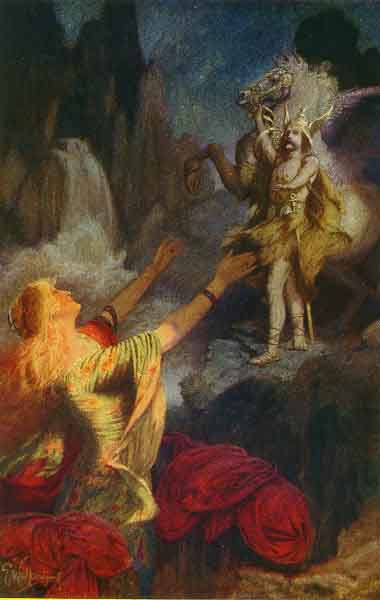
HUNDINGSBANE'S RETURN TO VALHAL<BR> <I>From the painting by E. Wallcousins</I> HUNDINGSBANE'S RETURN TO VALHAL
From the painting by E. Wallcousins

At length the woman took Hadding towards a place which was surrounded by a high wall. He had already gazed from afar off, as he descended the hills, upon the beauties of the enclosure, where grew the flowers which were plucked in midwinter and stately beings in robes of purple had blissful dwelling.

The old woman tried to leap over the wall, but was unable to do so. She, however, showed Hadding that the place within was indeed the land of life. She seized a fowl which she carried with her, and flung its head, which he wrung off, over the wall. The head was speedily restored again, and the bird crowed loudly.

Hadding thereafter returned again unto his own land, and he endured many perils upon the way.

Spenser's Mimer

Guyon finds Mammon in a delve
Sunning his treasure hoar,
Is by him tempted and led down
To see his secret store.

At last he came upon a gloomy glade,
Covered with boughs and shrubs from heaven's light,
Whereas he sitting found in secret shade
An uncouth, savage and uncivil wight, 10
Of grisly hue and foul ill-favoured sight;
His face with smoke was tann'd and eyes were bleared,
His head and beard with soot were ill bedight,
His coal-black hands did seem to have been seared
In smith's fire-spitting forge, and nails like claws appeared.

His iron coat, all overgrown with rust,
Was underneath envelop with gold
Whose glittering gloss, darkened with filthy dust,
Well yet appear to have been of old
A work of rich entail and curious mould,
Woven with antiques and wild imag'ry:
And in his lap a mass of coin he told
And turn upside down, to feed his eye
And covetous desire with his huge treasury

. . . . . .

And round about him lay on every side
Great heaps of gold that never could be spent;
Of which some were rude ore, not purified
Of Mulciber's devouring element;
Some others were new driven, and distent
Into great ingots and to wedges square;
Some in round plates withouten moniment 11
But most were stampt, and in their metal bare
The antique shapes of Kings and Kesars strong and rare

. . . . . .

"What secret place," quoth he, 12 "can safely hold
So huge a mass, and hide from heaven's eye?
Or where hast thou thy wonne 13 that so much gold
Thou canst preserve from wrong and robbery?"
"Come thou," quoth he, "and see." So by and by
Through that thick covert he him led, and found
A darksome way, which no man could descry,
That deep descended through the hollow ground,
And was with dread and horror compass around.

So soon as Mammon there 14 arrived, the door
To him did open and afforded way:
Him followed eke Sir Guyon evermore,
Ne darkness him ne danger might dismay.
Soon as he entered was, the door straightway
Did shut, and from behind it forth there leapt
An ugly fiend, more foul than dismal day;
The which with monstrous stalk behind him stept;
And ever as he went due watch upon him kept.

. . . . . .

Both roof, and floor, and walls, were all of gold,
But overgrown with dust and old decay,
And hid in darkness, that none could behold
The hue thereof; for view of cheerful day
Did never in that house itself display,
But a faint shadow of uncertain light,
Such as a lamp, whose life does fade away;
Or as the moon, cloath with cloudy night,
Does shew to him that walks in fear and sad affright.

In all that room was nothing to be seen
But huge great iron chests, and coffers strong,
All barr'd with double bends, that none could weene
Them to enforce with violence or wrong;
On every side they plac were along,
But all the ground with skulls was scatter
And dead men's bones, which round about were flung
Whose lives, it seem, whilome there were shed,
And their vile carcases now left unburi

They forward pass; ne Guyon yet spoke word,
Till that they came unto an iron door
Which to them opened of its own accord,
And showed of riches such exceeding store,
As eye of man did never see before,
Ne ever could within one place be found,
Though all the wealth, which is or was of yore,
Could gathered be through all the world around,
And that above were added to that underground.

The charge thereof unto a covetous spright
Commanded was, who thereby did attend,
And warily awaited day and night,
From other covetous fiends it to defend,
Who it to rob and ransack did intend.
Then Mammon, turning to that warrior, said:
"Lo, here the world bless! lo, here the end
To which all men do aim, rich to be made!
Such grace now to be happy is before thee laid."

He brought him, through a darksome narrow strayt 15 ,
To a broad gate all built of beaten gold:
The gate was open; but therein did wait
A sturdy villain, striding stiff and bold,
As if the Highest God defy he would:
In his right hand an iron club he held
But he himself was all of golden mould,
Yet had both life and sense, and well could weld
That cursed weapon, when his cruel foes he quell'd.

. . . . . .

He brought him in. The room was large and wide,
As it some guild or solemn temple were;
Many great golden pillars did up-bear
The massy roof, and riches huge sustain;
And every pillar decked was full dear
With crowns and diadems, and titles vain,
Which mortal princes wore while they on earth did reign.

A route of people there assembled were,
Of every sort and nation under sky
Which with great uproar pressed to draw near
To th' upper part, where was advanced high
A stately siege 16 of sovran majesty;
And thereon sat a woman gorgeous gay,
And richly clad in robes of royalty,
That never earthly prince in such array
His glory did enhance, and pompous pride display.
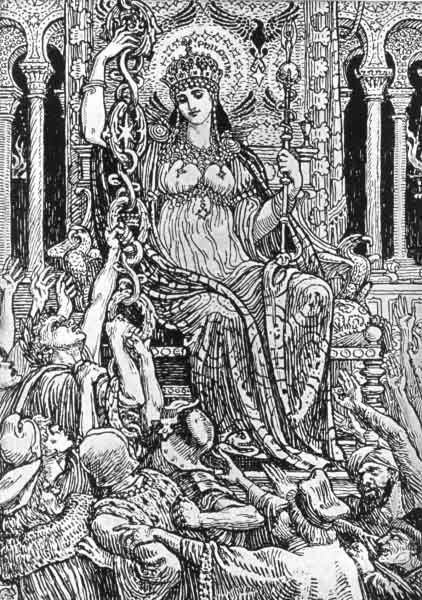
'And all that press did round about her swell<BR> To catchen hold of that long chain, thereby<BR> To climb aloft, and others to excell:<BR> That was Ambition, rash desire to sty,<BR> And every link thereof a step of dignity.''<BR> <I>After the drawing by Walter Crane. By permission of Messrs. George Allen & Co</I>. And all that press did round about her swell
To catchen hold of that long chain, thereby
To climb aloft, and others to excell:
That was Ambition, rash desire to sty,
And every link thereof a step of dignity.''
After the drawing by Walter Crane. By permission of Messrs. George Allen & Co.

Her face right wondrous fair did seem to be,
That her broad beauties beam great brightness threw
Through the dim shade, that all men might it see;
Yet was not that same her own native hue
But wrought by art and counterfeited shew,
Thereby more lovers unto her to call;
Natheless most heavenly fair in deed and view
She by creation was, till she did fall;
Thenceforth she sought for helps to cloak her crime withal.

There, as in glist'ring glory she did sit,
She held a great gold chain y-link well,
Whose upper end to highest heaven was knit,
And lower part did reach to lowest hell;
And all that press did round about her swell
To catchen hold of that long chain, thereby
To climb aloft, and others to excell:
That was Ambition, rash desire to sty 17 ,
And every link thereof a step of dignity.

Which whenas Guyon saw, he gan enquire,
What meant that press about that lady's throne,
And what she was that did so high aspire?
Him Mammon answer: "That goodly one
Whom all that folk with such contention
Do flock about, my dear, my daughter is; 18
Honour and dignity from her alone
Deriv are, and all this world bliss,
For which ye men do strive; few get, but many miss.

From"The Faerie Queene", Book II, Canto VII.

The Garden of Hela

Him forth thence led
Through grisly shadows by a beaten path
Into a garden goodly garnish
With herbs and fruits, whose kinds mote not be redd 19
Not such as earth out of her fruitful womb
Throws forth to men, sweet and well savour,
But direful deadly black, both leaf and bloom,
Fit to adorn the dead and deck the dreary tomb.

. . . . . .

The garden of Prerpina 20 this hight:
And in the midst thereof a silver seat,
With a thick arbour goodly over dight,
In which she often used from open heat
Herself to shroud, and pleasures to entreat:
Next thereunto did grow a goodly tree
With branches broad dispread and body great,
Cloath with leaves, that none the wood might see
And laden all with fruit as thick as it might be.

Their fruit were golden apples glist'ring bright
That goodly was their glory to behold;
On earth like never grew, no living wight
Like ever saw, but they from hence were sold. . . .

. . . . . .

The war-like elf much wondered at this tree 21
So fair and great, that shadowed all the ground;
And his broad branches laden with rich fee
Did stretch themselves, without the utmost bound
Of this great garden, compassed with a mound. . . .

The River of Torture

Which to behold he clomb up to the bank;
And, looking down, saw many damn wights
In those sad waves, which direful deadly stank,
Plong continually of cruel sprites,
That with their piteous cries and yelling shrightes 22
They made the further shore resounden wide:
Amongst the rest of those same rueful sights
One curs creature he by chance espied
That drench lay full deep under the garden side.

Deep was he drench to the upmost chin,
Yet gap still as coveting to drink
Of the cold liquor which he waded in;
And, stretching forth his hand, did often think
To reach the fruit which grew upon the brink;
But both the fruit from land, and flood from mouth,
Did fly a-back, and made him vainly swink;
The whiles he starved with hunger, and with drouth
He daily died, yet never throughly dyen couth 23 .

He looked a little further and espied
Another wretch, whose carcas deep was drent 24
Within the river which the same did hide.
But both his hands most filthy feculent 25
Above the water were on high extent,
And feigned to wash themselves incessantly.
Yet nothing clearer were for such intent,
But rather fouler seem to the eye;
So lost his labour vain and idle industry.

The Fruit of Forgetfulness

Infinite more tormented in like pain
He there beheld, too long here to be told;
Ne Mammon would there let him long remain,
For terror of the tortures manifold,
In which the damn souls he did behold,
But roughly him bespake, "Thou fearful fool
Why takest not of that same fruit of gold?
Ne sittest down on that same silver stool,
To rest thy weary person in the shadow cool?"

All which he did to do him deadly fall
In frail intemperance through sinful bait
To which if he inclined had at all
That dreadful fiend, which did behind him wait,
Would him have rent in thousand pieces straight;
But he was wary wise in all his way
And well perceiv his deceitful sleight,
Ne suffered lust his safety to betray;
So goodly did beguile the guiler of his prey.

And now he was so long remain there
That vital powers gan wax both weak and wan
For want of food and sleep, which two up-bear
Like mighty pillars, this frail life of man,
That none without the same enduren can:
For now three days of men were overwrought,
Since be this hardy enterprise began:
Forthy 26 great Mammon fairly he besought
Into the world to guide him back as he him brought.

The god, though loth, yet was constrained t' obey;
For longer time than that no living wight
Below the earth might suffered be to stay:
So back again him brought to living light.
But all so soon as his enfeebled spright
Gan suck this vital air into his breast,
As overcome with too exceeding might,
The life did flit away out of her nest,
And all his senses were with deadly fit oppressed.

Hela in the Border Ballads

The Three Roads

True Thomas lay on Huntlie bank;
A ferlie he spied wi' his ee;
And there he saw a ladye bright,
Come riding doon by the Eildon Tree.

. . . . . .

"Harp and carp, Thomas," she said;
"Harp and carp along wi' me;
And if ye dare to kiss my lips,
Sure of your bodie I will be."

Betide me weal, betide me woe,
That weird 27 shall never daunton me."
Syne he has kissed her rosy lips,
All underneath the Eildon Tree.

. . . . . .

She's mounted on her milk-white steed;
She's taen true Thomas up behind:
And aye, whene'er her bridle rung,
The steed flew swifter than the wind.

O they rade on, and farther on;
The steed gaed swifter than the wind;
Until they reach'd a desert wide,
And living land was left behind.

Light down, light down, now, true Thomas,
And lean your head upon my knee;
Abide and rest a little space
And I will shew you ferlies three.

O see ye not yon narrow road
So thick beset with thorns and briers?
That is the path of righteousness,
Though after it but few enquires.

And see ye not that braid, braid road,
That lies across that lily leven?
That is the path of wickedness,
Though some call it the road to heaven.

"And see not ye that bonny road,
That winds aboot the fernie brae?
That is the road to fair Elfland,
Where thou and I this night maun gae.

"But, Thomas, ye maun hold your tongue,
Whatever ye may hear or see;
For, if you speak word in Elfyn land,
Ye 'll ne'er get back to your ain countrie."

O they rade on, and farther on,
And they waded through rivers aboon the knee,
And they saw neither sun nor moon,
But they heard the roaring o' the sea.

It was mirk, mirk night, and there was nae starn light,
And they waded through red blood to the knee;
For a' the blood that 's shed on earth
Rins through the springs o' that countrie.

Sync they came on to a garden green,
And she pu'd an apple frae a tree
"Take this for thy wages, true Thomas;
It will gie thee the tongue that can never lee."

Thomas The Rhymer.

The Mountains

"O where have you been, my long, long love,
This long seven years and more?"
"O I'm come to seek my former vows
Ye granted me before."

. . . . . .

She has taken up her two little babes,
Kissed them baith cheek and chin;
"O fare ye weel, my ain two babes,
For I'll ne'er see you again."

. . . . . .

She had not sailed a league, a league,
A league but barely three,
When dismal grew his countenance,
And drumlie grew his ee.

The masts that were like the beaten gold,
Bent not on the heaving seas;
But the sails, that were o' the taffetie,
Fill'd not in the east land breeze.

They had not sailed a league, a league,
A league but barely three,
Until she espied his cloven foot,
And she wept right bitterlie.

O hold your tongue of your weeping," says he,
"Of your weeping now let it be;
I will show you how the lilies grow
On the banks of Italy."

"O what hills are yon, yon pleasant hills,
That the sun shines sweetly on?"
"O yon are the hills of heaven," he said,
"Where you will never win."

"O whaten a mountain is yon," she said,
"All so dreary wi' frost and snow?"
"O yon is the mountain of hell," he cried,
"Where you and I will go."

The Demon Lover.

Demon Vengeance

Up then spake the Queen o' Fairies
Out o' a bush o' broom--
"She that has borrowed young Tamlane
Has gotten a stately groom."

Up then spake the Queen o' Fairies
Out o' a bush o' rye
"She's taen awa' the bonniest Knight
In a' my companie.

"But had I kenn'd, Tamlane," she says,
"A lady wad borrowed thee,
I wad ta'en out thy twa grey een,
Put in twa een o' tree.

Had I kenn'd, Tamlane," she says,
"Before ye came frae hame
I wad ta'en out your heart o' flesh,
Put in a heart o' stane."

"Had I but had the wit yestreen
That I hae coft the day
I'd paid my kane seven times to hell
Ere you'd been won away."

The Young Tamlane.

The Birk o' Paradise

There lived a wife at Usher's Well,
And a wealthy wife was she,
She had three stout and stalwart sons,
And sent them o'er the sea.

They hadna been a week from her,
A week but barely ane,
When word came to the carline wife
That her three sons were gane.

They hadna been a week from her,
A week but barely three,
When word came to the carline wife,
That her sons she 'd never see.

"I wish the wind may never cease,
Nor fishes in the flood,
Till my three sons come hame to me,
In earthly flesh and blood." 28

It fell about the Martinmas,
When nights are lang and mirk,
The carline wife's three sons came hame,
And their hats were o' the birk.

It neither grew in syke or ditch,
Nor yet in ony sheugh;
But at the gates of Paradise
That birk grew fair eneugh.

Gilly Flowers

The fields aboot this city fair
Were a' wi' roses set,
Gilly flowers and carnations rare
Which canker could not fret."

Clerk Saunders

The Garden Fruit

She led him intil a fair herbere,
There fruit groand was gret plent
Pears and apples, both ripe they were,
The date and eke the damsyn tree,
The fig and eke the wineberry.

. . . . . .

He pressed to pull the fruit with his hand,
As man for food was nyhonde faint,
She said, "Thomas let that stand,
Or else the fiend will thee attent.

"If thou pull them, sooth to say,
Thy soul goes to the fire of Hell
It comes not out till Domisday
And there ever in pain to dwell."

Thomas The Rhymer.

Footnotes

1 Mimer.
2 Saxo's words are: "Cujus transeundi cupidos revocavit, docens, eo alveo humana a monstrosis rerum secrevisse naturam, nec mortalibus ultra fas esse vestigiis."
3 In Highland lore these unions are followed by speedy death. The demon brides crush their lovers.
4 See chapter "Thor in Peril".
5 Thjasse-Volund's Sword of Victory and multiplying ring. Here we have the treasure which was cursed, and the dragon guardian of Beowulf, Volsunga saga, &c. The horn is Gjallar-horn which Heimdal is to blow at Ragnarok.
6 This is evidently Loke, not the Utgard-Loki in the chapter "The City of Enchantments ". Loke's place of torture was situated in the utmost part of Nifel hel.
7 His Hamingje.
8 The blessing counteracts the evil influence of a spell. In the Highlands a child should be blessed ere its name is asked, and strangers should bless a house on entering it. The blessing is not only a proof of friendly intentions, but a preventive, for he who blesses is unable to practise black magic for the time being.
9 See Chapter "The Gods Reconciled".
10 This is Spenser's Mammon. He resembles very closely Gudmund-Mimer, the chief of elfin smiths who in Norse mythology produce the vast stores of treasure accursed.
11 Superscription, image.
12 The Knight Guyon.
13 Dwelling.
14 The gate of hell.
15 Street, narrow passage.
16 Throne.
17 Ascend.
18 Urd, goddess of fate, is Mimer's daughter.
19 Must not be declared.
20 In Saxo she is Urd.
21 Like Ygdrasil.
22 Shrieks.
23 Could.
24 Drenched.
25 Muddy, foul.
26 Therefore.
27 Urd--destiny.
28 She had evidently power to work a spell and secure her wish. Belief in wishing power is not yet quite extinct in Scotland.

Teutonic Myth and Legend: Chapter 23 Hamlet's Storm-mill

TEUTONIC MYTH AND LEGEND

by DONALD A. MACKENZIE

An Introduction to the Eddas & Sagas, Beowulf, The Nibelungenlied, etc.

London, Gresham Publications 1912

CHAPTER 23

Hamlet's Storm-mill

When Frode was King--What the Mill ground forth--The Giant Maids --Their Ceaseless Labour--Desire for Vengeance--Sea Rovers plunder the Kingdom--The Maelstrom--Tale of Two Brothers--A Deal with the Devil --Wonderful Quern Stones--The Covetous Brother--Flood of Broth--The House by the Sea--A Skipper's Bargain--Why the Sea is salt.

"AMLODE'S mealbin", 1 which the Prince of Denmark called the "Mill of Storms ", Was also named by skalds "Frode's Mill". 2

King Frode was a wise and just king, and there was peace when he reigned in Denmark. Harvests were abundant, so that there was no lack of food, and treasure was never concealed, because there were no robbers. Strangers who visited the kingdom were received with hospitality and allowed to depart in peace.

The king had two wonderful quern stones, which ground at Frode's will whatever he desired of them. When he wanted gold he named it. Then the stones were turned round and the shining grist was poured forth. Silver and gleaming gems were produced in like manner. The wondrous mill could also grind peace and goodwill, and thus it was that there was great prosperity when Frode reigned over the land.

Once upon a time the millstones gave forth naught, because there were no servants in the kingdom who had sufficient strength to turn the handle. In vain did Frode make search for strong workers, and at length he came to know that the King of Sweden had two slave women of great stature and strength. With a gift of gold Frode purchased them. Their names were Menja and Ferja; eight feet in height were they, and broader than the doughtiest war man; their muscles were as hard as iron.

They were set to grind the mill, and they cried: "What shall we grind?"

The king said: "Grind gold, so that I may have great wealth."

So they ground gold in plenty, and King Frode was soon the possessor of much treasure. Then they ground for him peace and plenty, and the harvests were rich, the streams flowed ever, and ships made prosperous voyages. By day and by night the giant maids ground, and they were weary, so they beseeched the king that they should have rest.

"Thou shalt pause no longer than the cuckoo is silent in the springtime," the king said.

"Rarely is the cuckoo silent in spring," they made answer; "permit that we may have longer rest."

"Thou mayest rest," the king said, "as long as the verse of a song is sung."

Frode obtained more and more wealth from the mill, but he was never satisfied. Then the maidens grew angry, and vowed vengeance upon him. One to another they said: "Are we not the daughters of mountain giants; are our kindred not greater than Frode's. We have beheld the quern in other days. In the home of giants we whirled it round, so that the earth trembled and thunder bellowed in the caves. 3 Frode hath not done wisely."

Thus did they complain, weary of grinding, and Fenja at length counselled that they should no longer grind good for him who gave them no rest and was never satisfied.

Then Menja sang a weird incantation, which brought a band of warriors over the sea to work disaster with fire and sword.

Fenja called upon Frode, warning him of approaching peril, but he slept and heard her not. The warriors came to the shore; they laid waste the land, they burned the town, and scattered before them the warriors of Frode. The king was wounded grievously, so that he died.

Thus came Mysinger, the sea rover, and plundered the land, which he robbed of its vast treasures. The ships were heavily loaded thereafter, and Mysinger took with him the wondrous mill and the giant maids who turned it.

Then the sea rover set the slaves to grind salt, because there was none in the ships. As he bade them, so did they do. When night fell they asked him if they had ground sufficient for his needs; but he was no wiser than Frode, and commanded them to cease not their labours. So Fenja and Menja ground on until the ship was so full of salt that it sank into the deep.

From that day the giant maids have continued to grind the mill, for there is no one to bid them to take rest. On the sea bottom are they ever turning the stones. At the spot where they work is the great Maelstrom, a name which signifies "the grinding stream".

It is said that Fenja and Menja still work as Mysinger commanded them, and that is why the sea is salt. But there is another tale that minstrels were wont to tell regarding a wondrous mill which sank below the waves.

There were once two brothers, and one was rich while the other was poor. On a Christmas Eve the brother who was in need went unto the other and asked him in God's name for food, because that he had naught to eat.

The rich brother said: "A flitch of bacon shall I give thee if thou wilt do as I desire."

Readily did the starving man agree to his brother's terms. He took the flitch of bacon, and then he was told: "Hasten thou straight to hell with what I have given thee."

The poor brother must needs carry out the compact, so he set forth by a long and weary road. He travelled until darkness fell, and then he saw a light and went towards it. Soon he reached a dwelling. Standing outside it was an old man with a long grey beard, who hewed wood for his Christmas fire.

"Whither art thou going at this late hour?" asked the old man.

I am journeying to hell," the other made answer, but I know not the way."

"Thou hast no need to go any farther," the old man said, "because this dwelling is hell. When thou goest within thou shalt find not a few who will readily purchase the flitch of bacon from thee. But sell it not to any man unless thou art given the quern which is behind the door. When thou dost receive it, carry it without, and I shall show thee how to turn the handle. The quern can grind forth anything thou desirest."

The poor man knocked at the door, and it was opened. . . . All the demons swarmed towards him, begging for the flitch, and one did outbid the other with desire to purchase it.

"I shall sell it," the man said, "for the old quern which is behind the door."

The devil at first refused to barter the quern, but soon he relented, and it was given to the man for the flitch of bacon.

When the grey-bearded woodcutter taught the poor brother how to use the quern, he set out with it towards his home.

He found his wife waiting for him, and she complained bitterly because that there was no food in the house, nor fuel to light a fire. When she ceased scolding him, the husband said:

"I had to travel a long way, first for one thing and then for another, but now we shall see what we shall see."

He put the quern on the table, and he bade it grind forth fuel and food and ale, and soon they had a warm fire and Christmas fare in plenty. The old dame was made happy indeed, and she said: "Where didst thou get this wonderful quern?"

"Ask me not," answered her husband; "here is the quern, and indeed it is an excellent one. The millstream never freezes. That is enough."

Then the man made the quern to grind much food and ale, and he gave a feast to all his friends. His rich brother came, and when he saw that the larder was full he grew angry because that he wished not his brother to have anything.

"On Christmas Eve," he said, "thou didst come to me to beg for a little food in God's name. From whence have you received all this wealth?"

The brother who had been poor answered: "I obtained it from behind the door."

Nor would he say aught else at that time.

But ere the evening was spent the rich brother saw that the other had drunk deep, and he asked him again regarding the quern. So the man who had sold a flitch of bacon to the devil told him all. His brother pleaded for the quern, which he coveted greatly, and offered for purchase three hundred pieces of gold. The other said he would get it for that sum at the hay harvest.

Next day the man who had been poor set the quern to work, and he kept it grinding until he had enough food and drink to last him for the rest of his days. Then gave he the quern to his brother, but he told him not how to work it.

It was the beginning of the hay harvest, and the rich brother, who was a farmer, told his wife, when he carried the quern home, to go out to the field with the workers while he prepared the midday meal. Then he set the quern upon the kitchen table, and he bade it to grind forth herrings and broth in plenty.

The quern set to work, and the herrings and the broth were poured from it in abundance. First all the dishes in the house were filled, and then all the tubs, and still the food poured forth until the kitchen floor was covered over. In vain did the farmer seek to stop the supply. He seized the handle of the quern roughly, and twisted it this way and that, but without avail. The herrings were heaped high and the broth flooded the kitchen. In terror the man fled to the parlour, but the broth followed him, and he had to struggle towards the door, half-smothered in the food stream. to escape being drowned.

When the door was opened he ran down the road, and the flood of broth and herrings went after him, roaring like a mountain waterfall and spreading all over the farm.

The farmer's wife wondered greatly that she and the workers were not called home for dinner, and she said: "Although we have not yet been bidden, we may as well return. Perhaps the master finds it harder than he expected to cook our meal, and has much need of my help."

So the dame and the workers left the hayfield and went towards the farmhouse. Ere long they beheld a strange spectacle. Pell-mell the farmer came running towards them, escaping from a torrent of herrings and broth. As he came nigh he shouted: "I would that each of ye had a hundred throats. . . . Beware, lest you are drowned in the broth!"

He ran on and hastened to his brother, and besought of him to take back the quern. But this the man who got it from the devil refused to do, unless he were paid another three hundred pieces of gold.

"If it goes on grinding for another hour," the farmer declared, "the whole parish will be covered with herrings and broth."

So he gladly paid the money demanded by his brother, who thus got back the quern again, and a goodly sum of money as well.

Then did the man who gave the flitch to the devil set the stones grinding without delay. He got all he desired from them. Before long he had a fine farmhouse, which was larger and more commodious than his brother's, and he had so much gold produced by the mill that he covered his new dwelling with plates of gold. It stood upon the shore, and far out at sea it was beheld shining in beauty. Sailors cast anchor when they came nigh to that shore, so that they might land to see the golden house and the rich man who inhabited it. They were one after another shown the wonderful quern, and its fame was spread far and near.

One day a sea captain called at the golden house, and when he saw the quern he asked if it could grind salt. The man who purchased it from the devil said that it gave forth anything that was desired.

Now the captain was accustomed to go long voyages for salt, and he offered to buy the quern. At first the owner would not consent to sell it, but at length he agreed to do so if he received a thousand pieces of gold. The skipper paid that sum, and went off with the quern, but he was not instructed how to work it. He hastened on board his ship and sailed away. When he was far out at sea he thought he would set the quern a-working, so he commanded it to grind salt in plenty, and as speedily as could be.

The quern set to work. It ground salt in plenty, and ground very fast. Soon the hold was full, and the skipper, feeling satisfied, sought to stop the quern. But that he was unable to do. It ground and ground until the decks were covered over, and at length the immense load of salt weighed down the ship, so that it sank below the waves.

On the floor of ocean lies the quern, and by day and by night it grinds on as the skipper bade it to do. . . . That is why the sea is salt.

Footnotes

1 The following is an extract from a tenth-century Icelandic saga which makes reference to Hamlet: "'Tis said that far out, off yonder headland, the nine maids of the Island-mill stir amain the host-cruel skerry-quern--they who in ages past ground Amlode's (Hamlet's) meal".
2 Frode is the god Frey humanized. His crops were ground on the World-mill. According to an Eddic poem his servant Bygver divided food among men. This elf is of the mill-brownie type so familiar in folktales.
3 See chapter "The Winter War".

Teutonic Myth and Legend: Chapter 22 The Traditional Hamlet

TEUTONIC MYTH AND LEGEND

by DONALD A. MACKENZIE

An Introduction to the Eddas & Sagas, Beowulf, The Nibelungenlied, etc.

London, Gresham Publications 1912

CHAPTER 22

The Traditional Hamlet

Horwendil slays King Koll--Birth of Amleth--Horwendil slain by Feng--The Prince feigns Madness--His Witty Sayings--Polonius is slain--Amleth scolds his Mother--His Uncle's Treachery--Visit to Britain--His Return--How he won the Crown--Second Visit to Britain--Mission to Scotland--The Lovesick Queen--Amleth's Victory--Over-king claims his Kingdom--His Death--An Unfaithful Queen.

KING RORIK, son of Hother. made joint governors of Jutland two brothers whose names were Horwendil 1 and Feng. Their father, Gerwendil, was governor before them. Horwendil was chief ruler, but he sought for glory as a sea rover. King Koll, of Norway, was also ambitious for ocean renown, and he longed to battle with the ships of Horwendil. The rivals met together at an island in the midst of the sea, which they each desired to possess, and young Horwendil challenged Koll to fight a duel. Thus it came that the two men contended one against the other on a portion of spring-green sward.

Horwendil was the bolder and more daring of the two. He flung aside his shield and grasped his sword with both hands. Furious attack did he make upon the King of Norway, whose shield he split in twain. Then he inflicted wounds, and smote off Koll's foot so that he sank in death before the valorous young hero. But Horwendil honoured the sea king with stately burial, and caused to be erected a great grave mound so that his memory might endure forever.

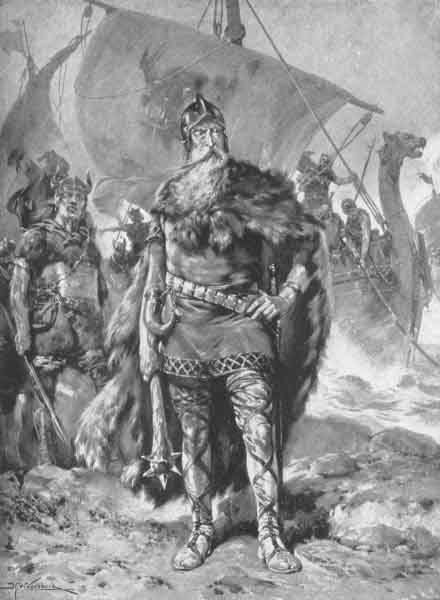
KING RORIK<BR> From the painting by H. W. Koekkoek KING RORIK
From the painting by H. W. Koekkoek

Many triumphs did Horwendil afterwards achieve, and to his king he gave gifts of the spoils of battle. So became he a hero in the kingdom. Rorik, who exalted Horwendil with honours, and made him King of Jutland, gave his daughter, the princess Gerutha 2 , to that renowned sea rover to be his wife. To them was a son born whose name was Amleth.

Now, Feng was stricken with jealousy because of his brother's fortune and renown, and he resolved to accomplish his death. His fell purpose he achieved with treachery, and to the crime of slaying his kin he added another, for he took Horwendil's widow to be his bride. Unto men did Feng declare that he had slain his brother because that he had shown cruelty unto Gerutha, whom he had rescued when in danger. In this he was believed.

But Amleth 3 was not deluded. He perceived the evil purpose of Feng's heart, and, fearing his own safety, he, feigned madness with great cunning so that he might live to slay the usurper. He went about with mire on his face. Often would he sit brooding over the fire, cutting twigs and pointing them with barbs; and when asked why he did so, he said he was preparing to avenge his father's death.

There were those who suspected that his madness was a pretence, and he was cunningly put to test, but his foster-brother 4 went about with him and gave him timely warning.

A horse was brought to Amleth, and he mounted it with his back to its neck, seeking to drive it by the tail. As he rode in this grotesque manner a wolf passed him, and those who were with him called it "a colt", whereupon Amleth said that there were too few colts of that kind in his uncle's stable.

On the shore lay a ship's rudder, and the men called it "a knife", whereupon Amleth said, pointing to the sea, that it was of appropriate size to cut such a huge ham.

To the sand dunes they then pointed, and said: "Behold the meal", and Amleth, speaking of the sand, declared that it was well-ground meal from the Mill of Storms. 5

A maiden was sent forth to waylay Amleth, but with her he had a secret understanding. Thus were those who sought to expose the prince as one who shammed thwarted in their purposes.

A courtier 6 , one of Feng's friends, who had more self-assurance than good tact, contrived a plot with purpose to make certain of knowing whether Amleth were weak-minded or a cunning pretender. He counselled Feng to leave Amleth alone with the queen, so that he might speak freely, for a son was never slow to trust his mother. Then the courtier, having convinced Feng that his proposal was a shrewd one, concealed himself under a heap of straw in the room where the queen and her soil would hold converse together.

But Amleth was too cunning to be waylaid thus. When he found, on entering the room, that the king had left on the excuse that he had business to attend to elsewhere, the prince, ere he addressed his mother, behaved with seeming madness; he crowed like a cock, and imitated the bird's wing-clapping with his hands. On the heap of straw he leapt, and then stamped about upon it. Feeling something hard below his feet, he drew his sword and drove it through the man who sought to be an eavesdropper. Then the prince hauled the body forth, cut it to pieces, and scalded it with hot water. He flung the hacked flesh to the swine.

Amleth afterwards returned to the queen, who wept and lamented her son's Madness. The prince heard what his mother said, and her he addressed with great seriousness, saying:

"O, shameless woman! seek not by dissembling sorrow to conceal thy terrible guilt--thou wanton embracer of thy husband's murderer, thou harlot who took in vile wedlock the slayer of thy son's father! Thou hast mated like the brute, and with brute nature forgotten thy first husband. . . . Ask not of me why I feign madness and speak foolishly; fear I not that he who slew his brother may also do further evil unto his kindred? Although I seem to be bereft of sense, and guard myself with pretended craziness, yet am I resolute ill my consuming desire to avenge my father's death, waiting patiently fit opportunity and the favourable moment. Against so foul a schemer I must needs exercise great cunning. . . . Now, canst thou--oh! thou who shouldst be wailing over thy dark shame--realize that it is needless for thee to lament my seeming madness. Better were it for thy soul if thou didst shed tears for the frailty of thine own heart, and not for the weak ness of another's. . . . Thou hast heard me. . . . I counsel thee to speak not of this."

So did Amleth upbraid his mother, and reawaken in her heart, with bitterness, the memory of her murdered husband.

Soon after was the courtier, whom Amleth had slain, sought for by Feng, but of his whereabouts no man had knowledge, and the prince was laughed at when he said that he beheld him falling through a sewer to be devoured by swine. But it was ere long discovered that the courtier had indeed perished as the prince had said.

Feng would fain have put Amleth to death, but he feared the wrath of King Rorik and of his wife, so he sent the prince forth to pay visit to the King of Britain that he might be put to death by him. Ere the prince took his departure, he counselled his mother in secret to sorrow for him in a year's time as if he were dead, and to drape the walls with knitted curtains of mourning.

Two courtiers did Feng send with Amleth on his pretended mission, and he gave them a missive inscribed upon wood, beseeching the King of Britain to slay the prince. One night, while the men slept, Amleth read the missive and shaved it off the wood, inscribing in its stead a request that the courtiers should be hanged, and that he who accompanied them should be given a princess for his bride.

When they reached Britain the king read the letter, nor revealed its contents, but entertained the two messengers and the prince at a feast. Amleth made all who sat round the board wonder greatly because that he ate not of the food nor drank the wine. So, being curious to know what his guests thought of his fare, the king sent a servant to listen to their conversation after they had gone to their sleeping chamber.

Amleth's companions reproached him because of his conduct at the feast, but the prince said that the flesh smelt like human carcass, and that there was blood in the bread, and iron rust in the liquor. The king he also reviled, saying that he had the eyes of a slave, while the queen had acted like one who was low born.

It seemed to his companions that he spoke crazily, but when the king was told what Amleth had said, he sent for his chief servant and asked where the corn of which the bread was made had been grown. The servant answered him that a plenteous crop had been grown upon an old battlefield.

The monarch then asked regarding the swine, and was told that they had strayed and fed upon the body of a robber who had been slain. The liquor, he learned, was made from meal and from water taken from a certain well. The king had this well dug out, and rusted swords were found which contaminated the water.

So the king did thus prove that Amleth had spoken with knowledge. But he was not yet satisfied, and he spoke in secret to his mother, who confessed that she had been a slave.

Next day the king spoke to Amleth, whom he admired greatly because of his wisdom, and he besought of him why he had said that the queen had acted like one who was low born.

The prince gave three reasons for what he had said--she had drawn her mantle over her head like a bond servant; she had lifted her gown to walk; and she had with a small splint picked her teeth, and then chewed the shreds of food from between them.

The monarch was so enamoured of Amleth that he gave him his daughter for wife. He also had Feng's two messengers hanged, and the prince pretended to be angry thereat, so the king gave him their price in gold. Amleth had the gold melted and poured into two sticks, hollowed out for that purpose.

A year passed ere Amleth returned home, leaving his wife, the princess, in her sire's castle. When he came to Jutland he smudged his face and dressed grotesquely and went towards Feng's hall, carrying nothing save the two sticks filled with gold. There he found that the people sorrowed for him as one who was dead, and when he entered the feasting chamber he saw it was hung with mourning drapery. At first the guests were stricken with terror, because they believed him to be a ghost; but soon they made merry and cast gibes one at another because that they had been fooled.

When Amleth was asked where the king's messengers were, he lifted up the sticks saying: "This is one and that is another;" nor did they realize that he spoke truly.

The prince was in gay mood, and he poured forth plenitude of wine to the guests. They all drank freely. Once or twice Amleth drew his sword, and cut his fingers with it, so they took the weapon from him and nailed it across the scabbard upon the wall.

More wine did Amleth pour forth to the guests, because he had laid a deep plot, and soon they were all made so drunken that they could not walk. They lay down to sleep on the benches and on the floor. Then the prince tore down the mourning drapery which his mother had knitted and threw it over the slumbering lords. Each of these, by aid of the sticks, he entangled in the network, so that none of them could rise up. Thereafterwards he set fire to the building, which was consumed. All who slumbered there perished in the flames.

Amleth, meantime, made haste to Feng's sleeping chamber, and first he snatched the sword that was hanging from the king's bed and put his own in its place. He shook his uncle from sleep and said that his courtiers were being burned alive.

"Withal I am here now, carrying my sticks," the prince cried, "with purpose to avenge my father's death."

Feng leapt from his bed and seized the mutilated sword; but while he tried vainly to draw it, Amleth slew him.

Thus did the prince put to death the man who had murdered and supplanted his sire, and all the nobles who had supported him.

Amleth then fled and concealed himself, so that he might know how the people regarded his deed. Soon he came to know that they were not greatly grieved, while a portion rejoiced that the tyrant had been overthrown. Whereupon he left his place of concealment, and gathered together his father's friends, whom he addressed.

"Ye who sorrowed for Horvendil," he said, "need sorrow not now any longer. Behold the corpse of a murderer of his kin I The hand that slew my sire made you all bondsmen.

Then Amleth revealed to the people that he had feigned madness, so that he might accomplish the ruin of Feng and his supporters. He told them how he had suffered in secret, hounded to death by his wicked uncle, disdained by his own mother, and spat upon by the nobles. "Who among ye", he cried, "is so hard of heart, that he is not moved towards me with sympathy and compassion?"

Thus he pleaded with them, and beseeched that they should honour him as their prince, and reward him with smiles of kindness.

"I have blotted out my country's shame," he said; I have ended my mother's shame; I have stamped out tyranny. I have avenged myself on the murderer of my sire, and overcome the evil designs of my wicked uncle. I have restored what you lost; your glory have I revived. The tyrant is thrown down and the butcher is slain. . . . What I have done is done, and for your sakes was it accomplished. My reward I now beg from you.

Thus did Amleth win the hearts of the people, and they declared him their king. His reward was his father's crown.

When the country was settled and well organized King Amleth crossed the seas to Britain, taking with him his choicest warriors. He had had a great shield made on which all his exploits were depicted, and it was of rare craftsmanship. The shields of his followers were covered over with gold.

When the King of Britain received him, he asked regarding Feng's welfare, and Amleth related unto him all that had happened. The king heard him with sorrow, because he had sworn a secret compact with Feng that one of them should avenge the death of the other. Nor could he consider the blood ties of his house above the sacredness of his oath. He cared not to accomplish the death of his daughter's husband with his own hands, so he contrived a plot whereby Amleth would fall by the hands of another. His queen had died, and he made request of his son-in-law to become his envoy to a queen in Scotland whom he desired to wed.

Now the King of Britain knew full well that this Scottish ruler was a lady of great chastity, who scorned to be loved, and put to death those who sought to woo her. But Amleth, although he knew the mission was begirt with peril, disdained to refuse the king's request, and, taking with him his armed followers and a few of the British war men, he went north to execute his mission.

When he drew nigh to the dwelling of the Scottish queen he went into a green dell to rest his horses, and by the side of a stream he fell asleep. Over his head he put his shield to shade him from the sun's rays.

The queen heard of his coming. She sent forth spies, who found Amleth lying fast asleep. They took away his shield and the missive which he bore from the King of Britain. Thus did the Scottish queen come to know of Amleth's great deed, because on the shield which he had made she saw depicted how he had slain his father's murderer. She read the missive and rubbed out the writing, and substituted a message from the King of Britain, expressing his desire that she should wed the bearer of it.

Amleth woke up ere the spies returned, but pretended still to sleep. When one of them was about to place the king's missive from where he had taken it, Amleth sprang up, seized him, and had him bound. Then went he to the queen's dwelling. Her name was Hermutrude. She read the altered missive, and she praised the bearer, because that he had avenged his father's death and possessed himself of the crown. She also expressed her surprise that he should have wed a slave's daughter. So noble a prince, she said, should wed one of high birth, for rank was of more account than beauty. But there was one nobly born, who was worthy of him. She herself was worthy of him, because that his kingdom and his ancestors were not greater than hers. She offered him her love and her possessions with it, and pleaded with him to set aside his marriage and have her for wife. 7

Then the queen rose and embraced Amleth, kissing him, and he with joy embraced and kissed her in turn. A great feast was held, and they were married with ceremony and in great pomp.

Accompanied by a band of Scottish war men, Amleth then set out to return to the King of Britain; but his first wife met him and warned him against her sire. She made bitter complaint that he had slighted her, but said that her love for him was stronger than her hate of his adultery. A son was born to her, she told Amleth, who might grow up to hate the Scottish queen, but she herself. would love her rival.

Then came nigh the King of Britain, and he embraced Amleth, but afterwards sought to slay him. Amleth would have fallen by the sword, which was thrust treacherously at him from behind, had he not been protected by a shirt of mail.

So it came that war broke out between them. The British king and his war men fell upon Amleth's forces and put them to flight, killing many. On the next day. the young warrior found himself closely pressed, but he had resort to a cunning stratagem. He collected together all the slain war men, and set them up tied to stakes as if they were alive; on horseback even were many made fast. Thus he seemed to command an imposing array of battle warriors.

When the King of Britain's army came against Amleth, and beheld the apparent strength of his force, the soldiers were terrified, and they broke and fled in confusion. The Danes charged, and they slew the king ere he could escape. Then Amleth ravaged the land and possessed himself of much treasure. Soon afterwards he returned to Denmark with his two wives.

It chanced that King Rorik died. His son, Wiglek, regarded Amleth as a usurper, and claimed the throne of Jutland. A war was thereupon declared, and Amleth was slain. Ere he entered the fateful battle he had foreknowledge of his fate, and he sought to choose a second husband for Hermutrude; but she vowed that she would share his fate on the field, saying that a woman who feared to die with her husband was an abomination. But when Amleth fell, the queen kept not her promise; she made offer of herself to Wiglek and became his bride.

Amleth was buried on a plain in Jutland which still bears his name. 8

Hamlet and his Mother

Queen. What have I done, that thou dar'st wag thy tongue
In noise so rude against me?
Ham. Such an act
That blurs the grace and blush of modesty;
Calls virtue hypocrite; takes off the rose
From the fair forehead of an innocent love,
And sets a blister there; makes marriage vows
As false as dicers' oaths: O, such a deed
As from the body of contraction plucks
The very soul, and sweet religion makes
A rhapsody of words!--heaven's face doth glow;
Yea, this solidity and compound mass,
With tristful visage, as against the doom,
Is thought-sick at the act.
Queen. Ah me, what act,
That roars so loud, and thunders in the index?
Ham. Look here, upon this picture, and on this
The counterfeit presentment of two brothers.
See what a grace was seated on this brow;
Hyperion's curls; the front of Jove himself;
An eye like Mars, to threaten and command;
A station like the herald Mercury
New-lighted on a heaven-kissing hill;
A combination and a form, indeed,
Where every god did seem to set his seal,
To give the world assurance of a man:
This was your husband. Look you now, what follows:
Here is your husband; like a mildew'd ear,
Blasting his wholesome brother. Have you eyes?
Could you on this fair mountain leave to feed,
And batten on this moor? Ha! have you eyes?
You cannot call it love; for at your age
The heydey in the blood is tame, it's humble,
And waits upon the judgment: and what judgment
Would step from this to this? Sense, sure, you have,
Else could you not have motion: but, sure, that sense
Is apoplex'd: for madness would not err;
Nor sense to ecstasy was ne'er so thrall'd
But it reserv'd some quantity of choice,
To serve in such a difference. What devil was't,
That thus hath cozen'd you at hoodman-blind,
Eyes without feeling, feeling without sight,
Ears without hands or eyes, smelling sans all,
Or but a sickly part of one true sense
Could not so mope.
O shame! where is thy blush? Rebellious hell,
If thou canst mutine in a matron's bones,
To flaming youth let virtue be as wax,
And melt in her own fire: proclaim no shame,
When the compulsive ardour gives the charge,
Since frost itself as actively doth burn,
And reason panders will.
Queen. O Hamlet, speak no more:
Thou turn'st mine eyes into my very soul;
And there I see such black and grained spots,
As will not leave their tinct.
Ham. Nay, but to live
Stew'd in corruption
Queen. O, speak to me no more;
These words, like daggers, enter in mine ears;
No more, sweet Hamlet!
Ham. A murderer and a villain;
A slave, that is not twentieth part the tithe
Of your precedent lord;-a vice of kings:
A cutpurse of the empire and the rule,
That from a shelf the precious diadem stole,
And put it in his pocket!
Queen. No more!
Ham. A king of shreds and patches
. . . . . .
My Pulse, as yours, doth temperately keep time,
And makes as healthful music: it is not madness
That I have utter'd: bring me to the test,
And I the matter will re-word; which madness
Would gambol from. Mother, for love of grace,
Lay not that flattering unction to your soul,
That not your trespass, but my madness, speaks:
It will but skin and film the ulcerous place,
Whilst rank corruption, mining all within,
Infects unseen. Confess yourself to heaven;
Repent what's past; avoid what is to come;
And do not spread the compost on the weeds,
To make them ranker. Forgive me this, my virtue;
For in the fatness of these pursy times,
Virtue itself of vice must pardon beg;
Yea, curb and woo, for leave to do him good.
Queen. O Hamlet, thou hast cleft my heart in twain.
Ham. O, throw away the worser part of it,
And live the purer with the other half.

Shakespeare.

Footnotes

1 Rydberg identifies Horwendil with Orvandil, Svipdag's father, and holds that there are memories of the Svipdag myth in the Hamlet story as related by Saxo, Halfdan being the original of Feng, and Groa of Gerutha (Gertrude).
2 Gertrude.
3 Amleth means "insane".
4 Shakespeare's Horatio.
5 The World-mill. In an old saga, reference is made to the Island-mill beyond the world's edge, which is worked by nine maidens. It is called "Amlode's mealbin". Thus, in the tenth century, we have an Icelandic reference to a mythical "Hamlet" who is connected with the mill. When Orvandil and the other sons of Ivalde declare war against the gods (see chapter "The Winter War") two giant maids who are relatives of Orvandil jerk the mill handle violently, and put it out of order. Here then is another link between Svipdag, the avenger, son of Orvandil, and Amleth, the avenger, son of Horvendil. Before Svipdag journeys to Hela, he is protected by Groa's incantations against the storms caused by the World-mill. In vague traditions we do not expect exact references, but rather suggestive associations. The chief actor in a popular tale absorbs all else as he develops independently through the ages.
6 Shakespeare's Polonius.
7 Evidently a memory of Pictish marriage customs. The Irish Cuchullin has a similar experience in Scotland.
8 Muller says there are two localities named "Amelhede"

Teutonic Myth and Legend: Chapter 21 Hother and Balder

TEUTONIC MYTH AND LEGEND

by DONALD A. MACKENZIE

An Introduction to the Eddas & Sagas, Beowulf, The Nibelungenlied, etc.

London, Gresham Publications 1912

CHAPTER 21

Hother and Balder

Hother's Accomplishments--His Love for Nanna--Balder becomes his Rival--The Valkyries' Warning--The Sword of Victory--Where it was concealed--Hother's journey to the Other-world--Miming is overcome--Helgi and Thora--War between Gods and Mortals--Hother overcomes Thor--Love-sick Balder--Hother in Solitude--The Great Battle--How Balder was slain--Odin woos Rinda--Balder's Death is avenged.

HOTHER was but a lad when his father Hodbrodd was slain, and him did King Gewar take to his castle to be reared as his own son. Strong and nimble he became, and very comely to behold. He could perform mightier feats than any of his foster-brothers: he could swim deftly and far like to a sea bird, he was a skilled archer, and he could box well with the gloves. Great gifts of mind had Hother also. He was a singer of songs, and a sweet musician. With rare skill he fingered the harp, and played the lute, and such power had he with stringed instruments that he could at will make his hearers merry or sad; he could fill their hearts with pleasure, or stir them with strange terror.

Pleasing indeed was this fair youth, unto beauteous Nanna, his foster-sister, the daughter of King Gewar. Her heart was moved with love towards him, and no less passionately did he love her also. Dear unto Nanna were the fond embraces of Hother.

Now there came a fateful day when Balder, son of Odin, saw Nanna while she bathed. The vision held him spellbound, and he was consumed with burning love by reason of the splendour and beauty of her comely body. When she vanished, the day was made dim, and Balder sighed full oft as he thought with tenderness of the beautiful maid; but when he remembered his rival he was moved to anger, for full well he knew that Hother would be the chief obstacle between him and his heart's desire. In the end he resolved to slay the young hero.

Hother soon came to know of Balder's burning love, and his fierce and bloody purpose. One day he went hunting alone in a deep wood. A deep mist drave over the land and enveloped the trees, so that he knew not whither he was wandering. In time he came to the dwelling of wood maidens. They called him "Hother", and he marvelled greatly thereat. When he asked them who they were, they told him that it was their lot to decide the issue of battle conflicts 1 invisible they fought in the fray, assisting those whom they favoured so that victory might be achieved. Hother wondered to hear. Then they told him that Balder had gazed with eyes of love upon Nanna while she bathed, and was possessed with burning desire to have her for his bride. Hother did they warn not to combat with his rival, because that he was a demigod whose body was charmed against wounds. But to Hother they gave a sword-proof coat of mail, so that he might have protection like unto Balder. They made promise to aid him in battle.

Then the maidens vanished, and their dwelling also, vanished from before the eyes of the young hero, and he found himself standing alone upon a barren plain, where there was not tree nor any shelter whatsoever. The mist was driven before the wind.

The youth thereafter returned quickly unto King Gewar, to whom he related what he had seen, and what had been told unto him concerning Balder. He also made request that Nanna should be his bride.

Gewar was willing indeed that his daughter should wed Hother, but he said that he feared greatly the wrath of Balder, if he came seeking for Nanna and were refused.

"No weapon," Gewar said, "can do hurt to Balder save a certain sword 2 which is guarded in a cave by Miming, the wood satyr. A wondrous ring doth he also possess, which hath power to increase the wealth of him who owns it. . . . But long and dangerous is the road which leads unto the satyr's lair," the king added; "it is wintry cold, indeed, and hardly to be endured."

Hother, however, was resolved to win the sword with which to combat against Balder, and Gewar counselled him to yoke reindeer to his car so that he might be able to traverse the region of extreme and bitter cold with great swiftness.

"When thou dost reach the cave of Miming," Gewar said, "thou must set up thy tent so that its shadow may not fall upon the satyr, for if that should happen he would remain within. Thou must needs wait until the satyr goes out, when the sword and the ring will await for thee."

As Gewar advised, so did Hother do. He went swiftly with his reindeer over the bleak wintry way until he came unto Miming's cave, where he pitched his tent. But long he waited ere the wood satyr came forth. Sad and dreary were the days, and restless and anxious the nights, Then, after waiting through a night of long darkness, Miming came forth, and his shadow fell upon Hother's tent. The youth sprang to his feet, and struck down the satyr with his spear, and then bound him securely. Terrible were the threats of Hother, who vowed that he would slay Miming if he gave not unto him the sword and the bracelet. The satyr held life more dearly than wealth, and gave Hother the ransom which he demanded. In triumph did the young hero return unto the kingdom of Gewar, and his fame was mooted abroad.

Then Gelder, King of Saxony, came to know that Miming had been robbed, and he urged his war-men to go against Hother, so great was his desire to become possessed of the treasure. But Gewar, who had magical powers, divined Gelder's purpose, and he counselled Hother to meet him with his band, and receive the shower of his javelins until there was none left, and then to fall upon the bold invaders.

So Hother went to meet the men from Saxony; he awaited them on the seashore. Eager were Gelder's heroes to make onslaught, and fast and furious did they cast their spears and javelins. But Hother had bidden his trained war-men to resist the missiles with shields interlocked, and not to cast a weapon. When the men of Saxony saw that, they were all the more eager to attack, and soon they flung away all their spears and javelins. Then Hother's men began to hurtle the weapons against the enemy, driving them back in confusion, whereat Gelder) in great alarm, hoisted up, on the mast of his ship, a crimson shield to make known that he desired to surrender, so that his life might be spared. But Hother showed nor anger nor vengeance against him; he approached the king with smiling face and offered his friendship. Thus became he victor by reason of his kindliness as well as his might.

A strong friend to Hother was Helgi, King of Halogaland, who loved Thora, daughter of Cuse, the ruler of the Finns and the Bjarmians. The monarch had a blemish of tongue, so that he stuttered greatly, and was unable to utter with eloquence the sweet speeches of love. Indeed, he not only shrank from addressing strangers, but rarely spoke in his own household. He sent messengers unto Cuse, pleading for his daughter's hand, but they were rejected with disdain, for the king said that the man who could not urge his own suit was unworthy of love's prize.

Then did Helgi seek the aid of Hother, who could speak with fluency and charm, and promised him his lifelong service if he would win for him the heart of Thora. A great fleet did Hother fit out, and he voyaged to Norway, fully resolved to take, by reason of his strength, the maid whom words would conquer not. To Cuse he spake first with eloquent tongue, and the king said that his daughter must first be heard, for he deemed it not right that he should prevail against her wishes, or decide before her will was made known. So Thora was ushered in, and when she heard what Hother said, she gave consent to be Helgi's queen.

But while Hother was thus engaged, Balder invaded the kingdom of Gewar with an armed band, and demanded that he should have Nanna for his bride. The king said that he must needs make request of the maiden, and before her did Balder plead his cause with choice speech and flattering address. But she said that a humble maiden could not be wooed by one of divine birth, and that the pledges of the gods were often broken. Thus did the maiden reject the love of him who sought her.

When Hother returned, Gewar told him of what had happened, and the young hero was filled with wrath because of Balder's presumption. With Helgi he took counsel and together they debated how they could inflict punishment upon the god. They had no recourse save to battle-blows, and Hother fitted out his fleet and went against his rival. Helgi gave him strong aid, as did also Gelder.

Then broke out a war in which the gods fought against mortals. With Balder fought Odin and Thor, clad in full armour, and when the opposing fleets met at sea a great conflict was waged. Hother in sword-proof mail attacked the gods with fury. Now Thor was swinging his great club, and while he urged those about him to press forward, he called upon his foemen to attack. The black-browed god dealt furious blows; he struck down his enemies' shields; he broke through their ranks; for long none could withstand him. Terrible, indeed, was the slaughter, and to the gods it seemed that victory was being given. But Hother went against Thor with Miming's sword. He feared him not, and struck at the great club, which he severed in twain with his keen-edged sword. . . . Then the gods took flight before Hother, and the ships that remained were destroyed by the victors.

Hother rejoiced in his triumph, but he sorrowed greatly because that Gelder had been slain. A great pyre he caused to be built with the wreckage of Balder's warships, and the corpses of the oarsmen were placed there in a heap. Then above these was laid with reverence the body of the dead king. Torches were applied and the flames rose high and bright. The ashes of King Gelder were afterwards laid in a great mound which was erected to his memory, and there was much mourning for him.

Then did Hother return to Gewar, and Nanna and he were wed with great ceremony, while the people rejoiced. To Helgi and Thora, who were also united in their joy, did the young hero give gifts of treasure. Then Hother ruled over Zeeland and Sweden.

As greatly as was Hother praised by men, Balder was mocked because that he had fled.

But the strife came not to an end. In a land battle did Balder contend against his rival, and drove him from the field. For fickle indeed are the fortunes of war. Hother took refuge with Gewar; he who had achieved victory as a subject, was defeated when a king.

Balder's army was afflicted by a water famine, but the divine one dug wells and water streamed forth, so that his parched soldiers were able to slake their thirst. To this day is a spring called Balder's-brynd.

Even by night was Balder made unhappy in his sleep, because he was tormented by dreams of Nanna. His love consumed him like fire, and he grew melancholy and thin and careworn. At length he could no longer walk, and he was taken about in his chariot. He took no pleasure in his victory, because that he had not won Nanna. There was a magical food prepared for Balder, so that he might not be brought unto death.

At this time Frey, who ruled for the gods, took up his abode nigh to Upsala, and revived the abhorrent rites of human sacrifice.

To Sweden did Hother take flight, and Balder possessed himself of Zeeland, where he received the willing service of the Danes, who before had reverenced. his rival. In due season Hother, having fitted out a fleet, again engaged in war with Balder, but was defeated and put to flight. He took refuge in Jutland, in a town which to this day bears the name of Horsens; then he returned to Sweden.

Sad at heart was Hother 3 ; he was weary of life and refused to be comforted, and he took farewell of all, and wandered alone through solitary places and trackless forests, for solitude is dear to the sick at heart. The people were angry with him because that he had concealed himself in a place apart.

One day Hother, as he wandered through the deep forest, came to a cave in a lonely place in which dwelt the maidens who had given to him the sword-proof coat of mail. They received him with eyes of wonder, and they asked why he paid visit to them. Whereupon Hother bewailed his fate and with sorrow spake of the afflictions he endured. The maidens did he also reproach because that they had not helped him as they had promised. But they told him that he had inflicted greater disasters than he deemed of, and promised him ultimate triumph.

"Victory will assuredly be thine," they said, if thou shalt but find the magical food with which Balder is nourished so that his strength may have increase. Possess thyself of it and he shall certainly die."

Then once again did Hother, encouraged by what the maidens had said, raise a great army to wage war against Balder. A fierce and long conflict was fought, and when night fell the issue was undecided, because that the forces were of equal strength.

Hother could not sleep, for he was afflicted with anxiety, and he went forth to reconnoitre the opposing camp. . . . He beheld three maidens who prepared the magical food for Balder, and followed their footprints through the dewy grass when they fled from him, so that he reached their dwelling and entered therein.

The maidens asked him who he was, for they perceived that he was an enemy, and he said that he was a musician. Then gave they to him a lyre, and he played sweetly thereon, so that their ears were charmed.

He saw them prepare the food for Balder. They had three serpents and their venom dropped into the mixture. One of the maidens offered Hother a portion, but the elder one said that to do so would be treason, because it would increase the strength of one of their foes. But in the end Hother was given to eat, and the maidens also conferred upon him a shining girdle which had power to assure him of victory in conflict.

Then did Hother leave the dwelling to return to his camp. But he had not gone far when he met Balder. Drawing his sword he thrust it in his foe's side so that he fell wounded nigh unto death.

There was great rejoicing in Hother's camp when he returned and told how he had stricken his rival; in Balder's camp there were loud lamentations.

Next day, when the battle was renewed, Balder bade his men to carry him into the midst of the fray upon a stretcher, so that he might not meet with death in his tent.

When night again fell Balder saw standing beside him the vision of Proserpine 4 , and she told him that on the morrow she would have him for her guest. At the time appointed Balder died, and he was buried in a great grave mound with pomp and deep mourning.

In after days Harold 5 and other men sought to rob Balder's mound of its treasure, but when they pierced it a great flood of water burst forth 6 and they fled in confusion. So was terror implanted in the minds of youths there, so that they feared to disturb the mound again.

Hother again ruled over his kingdom, but he had great sorrow when Gewar was attacked and burned in his castle by Gunno, a jarl who served him. He took speedy vengeance, and burned Gunno alive upon a pyre.

When Odin came to know of Balder's death, he went unto prophets to divine how he could be avenged, and he came to know that a son would be born to him of Rinda; his name would be Boe, and he would slay Hother.

Now Rinda was a daughter of the king of the Ruthenians, and Odin went forth disguised and entered the service of that monarch. He became the captain of a band and won a distinguished victory; then he fought singlehanded against a host and achieved renown above all other men. There was great wonder thereat. Great gifts were given unto him, and he was honoured in the royal household. Then he secretly told the king of his love for Rinda, and his suit was favoured, but he must needs woo the fair princess and win her heart ere he would have her for his bride.

Not easily was Rinda wooed, because when Odin sought to kiss her, she smote him with anger. A year passed by, and then he went to the Court in foreign guise and said he was a wonder-smith. With bronze did he fashion many fair ornaments, for which he received much gold. To Rinda he made offer of a rare bracelet and rings, but again she smote him when he sought to woo her. Although her sire remonstrated with her, she scorned to wed a man of many years, especially as she was herself of tender age. A third time went Odin to woo the maid. He was disguised as a young warrior, but again he was repulsed. Then had he recourse to magic arts. He had with him a piece of bark on which runes were graven, and with that he touched her, so that she was seized with madness.

Odin returned next in the guise of a woman who was a skilled physician, and offered to cure Rinda, who was prostrate with sickness. In the end he prevailed and won the maiden for himself, and she became the mother of Boe.

At this time the gods ruled at Byzantium, and they were moved to wrath against Odin because that he had practised magic arts; so they deprived him of his high honours and drove him into exile. Oller ruled in his stead. Not until ten years had passed was Odin recalled to the throne, and then Oller fled to Sweden, where he was slain by certain Danes. It is said of Oller that he possessed a bone, graven with fearsome spells, with which he could cross the ocean as if it were a ship.

Odin reigned with greater dignity and power than before, and his renown was spread far among men. Then found he Boe, his son by Rinda, and him he constrained to go forth to avenge the death of Balder.

Thus it came that Hother was slain by Rinda's son in a fierce battle, but Boe 7 was wounded unto death, so that he was borne from the field upon his shield. Next day he died, and the Ruthenian soldiers buried him in a stately mound, so that his memory might not perish in after days, but ever have renown among men.

After Hother's death his son Rorik became king.

Footnotes

1 Valkyries.
2 The Sword of Victory concealed in Mimer's realm. Hother resembles Svipdag very closely. Gewar is the moon-god of the Ivalde myth.
3 Like King Hrethel in Beowulf.
4 Urd.
5 Believed to be a historical personage who lived in the twelfth century.
6 Balder is associated with well worship. Wells sprang from his horse's hoofmarks, and he found water for his soldiers. Water defends his mound.
7 Vale, who in mythology is the slayer of the wolf, is thus Boe (Beowulf) in Saxo's Danish legend. He receives his deathwound when he slays Hother, who, as Svipdag, was a dragon guarding beneath a grey rock great treasure, which shone like fire in the flood. At the same time Hother is confused with Hoder, Balder's blind brother. One of Svipdag's names was Odur. So do the divine and heroic elements of a passing mythology intermix in tradition. Each age, each race, and each bard leaves in turn impresses upon a persistent legend. The memory of the mythical hero may survive, or his deeds may become associated with the traditions of a national hero. Mythological incidents which appeal to the popular imagination not infrequently develop into independent narratives.
Subscribe to this RSS feed

Log in or create an account