log in
LC Geerts

LC Geerts

Website URL:

Teutonic Myth and Legend: Chapter 20 Beowulf and the Dragon

TEUTONIC MYTH AND LEGEND

by DONALD A. MACKENZIE

An Introduction to the Eddas & Sagas, Beowulf, The Nibelungenlied, etc.

London, Gresham Publications 1912

CHAPTER 20

Beowulf and the Dragon

Beowulf in Battle--He becomes King of the Geats--A Slave's Discovery --Theft of Treasure--The Dragon devastates the Kingdom --Beowulf is angered--He sets forth to slay the Monster--Address to his Followers--The Dragon comes forth--The Great Conflict--Flight of Followers--The single Faithful Knight--He helps the King--Dragon slain--The Treasure--Beowulf's Death--Wiglaf reproaches the Battle Laggards--How the People sorrowed.

BEOWULF gave faithful service to Hygelac. In peace he was his wise counsellor, and in war his right-hand battle man. Then did the king fall fighting against the Frisians and Hugs. His death was avenged by Beowulf on the field, for he seized Dghrefn, the hero of the Hugs, and slew him, not with his sword. "I grasped him," the hero could boast; "his beating heart I stilled. I crushed his bones." Then swam Beowulf away towards home, escaping unscathed, and bearing with him the armour of thirty warriors.

Queen Hygd mourned the king's death, and to Beowulf made offer of the kingdom, but he chose to be faithful to Hygelac, and protected his young son, Heardred, until he grew to years of wisdom and strength. But the young king was slain by Eanmund, and Beowulf was given the throne. He avenged the death of Heardred by slaying his murderer's brother, Eadgils.

For fifty winters did Beowulf reign wisely and well. Then a great dragon began to ravage his country with fire. Alone did the monarch combat against it, and in the end was the victor. But he paid life's cost for his triumph.

Now the dragon had its dwelling in a secret cavern beneath a grey rock, on the shoreland of a lonely, upland moor. No man knew the path thither. It chanced then that a slave who had been sorely beaten by his master fled towards the untrodden solitudes, and he came to the dragon's lair while yet the monster slept. Quaking with fear, he beheld it there guarding rich treasure which had been hidden in ancient days by a prince, the last of his race. All his people had fallen in a great war, and he wandered about alone mourning for his friends. Then he hid the treasures of the tribe where the slave found them. Armour and great swords were there, a banner of gold that lit up the cavern, golden cups, and many gems and. ornaments, collars and brooches, the work of giants in ancient times.

The ancient dragon which went forth by night wrapped in fiery flame found the treasure unprotected, and from that hour became the guardian of it.

Now the slave who discovered the monster's lair had more greed than fear in his heart as he gazed upon the hoard. So he went lightly past the dragon's head and seized a rich golden cup, and fled away over the rocks. To his master he carried the treasure, and thus secured his pardon and goodwill.

The dragon soon afterwards awoke. He smelt along the rocks; he saw the footprints of the man on the ground, and searched for him angrily. Round about the monster went, but saw no one in that dismal solitude. Hot was the dragon's heart with desire for conflict. Then he returned to the cavern and found that the treasure had been rifled. Great was his wrath thereat, and he panted to be avenged. So waited he for nightfall, when he could go forth against mankind.

In the thick darkness the great dragon flew over the land. He vomited coals of fire over many a fair home. The flames made lurid blaze against the sky, and men were terror-stricken. It seemed that the night flyer was resolved not to leave aught alive, for far and near the countryside blazed before him. Great harm, indeed, did he accomplish in his fierce hate for the people of Geatland.

All night long the raging flames swept the land, and far and near they wrought disaster. Not until it was very nigh unto dawn did the dragon cease his vengeful work and take swift departure to its lair. Great faith had he in the security of his hiding place, but his faith proved to be futile.

To Beowulf the grievous tidings of the night horrors were sent quickly. His own country dwelling, the gift of the Geats, was smouldering in fire. Sorrow-stricken, indeed was the brave old king; no greater grief could have befallen him. In deep gloom he sat alone, who was wont to be cheerful, wondering by what offence he had made angry the Almighty, the Everlasting Lord.

The fire drake had burned up the people's stronghold; the sea-skirting land was devastated. Waves washed inland. . . . Beowulf was filled with anger against the monster, and resolved to be avenged. So he began to make ready for the combat. He bade that a shield of iron be made for him, for a wooden shield would be of no avail against raging fire. . . . Alas! the valiant hero was doomed to come ere long to life's sad end, as was also the serpent fiend who had for so long kept guard over the secret hoard. . . .

Beowulf scorned to attack the flying monster with a host of war men; he had no fear of going forth alone, no dread of single combat, nor did he hold the battle powers of the dragon as of high account. Many conflicts and many war-fights he had survived unscathed since he, the hero of many frays, had cleansed Heorot and wrestled in combat with Grendel, the hated fiend.

Twelve valiant and true war men he selected to go with him against the fire drake. And as he had come to know how its dread vengeance had been stirred up against his people, he took with him also the slave who had rifled the treasure, so that he might be a guide to lead them unto the monster's den. A sorrowful heart was in that poor man; abject and trembling he showed the way, much against his will, to the mound in which was the treasure, while underneath the dragon kept guard. It was on a rocky shoreland where the waves bellowed in unceasing strife.

Beowulf sat on the grey cliff looking over the sea. His hearth comrades were about him, and he spoke to them words of farewell, for he knew that Wyrd had tied fast the life thread of his web. His soul was sad and restless, and he was ready to go hence. Not long after that his spirit departed the flesh.

Of his whole life the king spake, recounting the long service he had accomplished since that he was but seven years old, when King Hrethel took him from his father and gave him, food and pay, mindful of his kinship. Of his deeds of valour he spoke, and life's afflictions, and touchingly he told of a father's sorrow when his son was taken from him. Such an one in his old age remembered every morn the lost lad. For another he had no desire. With sorrow he beheld his son's empty home, with deserted wine hall that heard but the moaning winds, for the horseman and hero slept in the grave, and no longer was heard the harp's music and the voices of men making merry.

'Twas thus he spake of Hrethel, the king who sorrowed when his son was slain and avenged not; abandoning the world the stricken monarch sought a solitary place in which to end his days.

Then spake Beowulf of Hygelac, whom he served and did avenge, and his son whom he avenged also.

"When yet young," the hero said, "I fought many battles, and now when I am old I seek fame in combat with the dragon, if he but come from his underground dwelling."

He must needs, Beowulf told his followers, wear his armour in that last fray. Naked he fought with Grendel, but now he must stand against consuming flame.

"I shall draw not back a foot's space," he said boldly and with calm demeanour, "nor shall I flee before the watcher of treasure; before the rock it shall be as Wyrd 1 decrees--Wyrd who measures out a man's life. . . . Ready am I, and I boast not before the dragon. . . . Ye warriors in armour, watch ye from the mound, so that ye may perceive which of us is best able to survive the strife after deadly attack. . . It is not for one of you to fight as I must fight; the adventure is for me only. . . . Gold shall I win for triumph, and death is my due if I fail. . . ."

Then fully armoured under his strong helmet, his shield on his left arm, his sword by his side, the valorous hero of the Geats went down the cliff path towards the dragon's cavern. . . . He saw the stream which flowed from the stone ramparts steaming hot with deadly fire; nigh to the hoard he could not endure long the flame of the dragon.

But filled was his great heart with battle fury. A storm-like shout he gave--a strong battlecry that went under the grey stone. . . . In wrath the monster heard him; he knew the voice of man. . . . Nor was there time then to seek peace. Fiery flame issued forth first: it was the dragon's battle breath. . . . The earth shook. . . . Beowulf stood waiting, his iron shield upraised. . . . The monster curled itself to spring; Beowulf waited in his armour. . . .

Then forth came the wriggling monster--swiftly to his fate he came. The shield gave that strong hero good defence against the flame. His sword was drawn, and it was an ancient heritage, keen-edged and sure. . . . Both the king and the dragon were bent on slaughter; each feared the other.

Beowulf swung his great sword, and smote the dragon's head, but the blade glanced from the bone, for Wyrd did not decree otherwise. Then the hero was enveloped in fire, for in wrath at the blow the monster spouted flame far and wide. Greatly did the brave one suffer. . . . His followers standing on the mound were terror-stricken; to the wood they fled, fearing for their lives.

But one remained; he alone sorrowed and sought to help the king. He was named Wiglaf, a shield warrior, a well-loved lord of Scyldings. He remembered the honours and the gifts which Beowulf had bestowed upon him. . . . He could not hold back; he grasped his wooden shield and drew his ancient sword--a giant's sword which Onela gave him. To his comrades he cried: "Promised we not to help our lord in time of need when with him we drank in the mead-hall? Rather would I perish in fire with our gold-giver than that we should return again with shields unscathed. . . . Advance then.

Give help to our lord. . . Together shall we stand side by side behind the same defence."

So speaking, that young hero plunged through the death smoke, hastening to Beowulf's aid. Never before had Wiglaf fought at his chief's side.

"Beloved hero," Wiglaf spake, "do thy utmost as of yore. Let not thy honour fail. Put forth thy full strength and I shall help thee."

Then came the dragon to attack a second time. Brightly flamed the fire against his hated human foes. The young hero's wooden shield was burnt up, and behind Beowulf's he shielded himself.

Again Beowulf smote the dragon, but his grey sword, Naegling, snapped in twain, whereat the monster leapt on the lord of the Geats, and took that hero's neck in his horrible jaws, so that the king's life blood streamed over his armour. But Wiglaf smote low, and his sword pierced the dragon, so that the fire abated.

Beowulf drew his death dagger, and striking fiercely he cut the monster in twain. So was the dragon slain; so did the heroes achieve great victory and renown.

But the king was wounded unto death. The dragon's venom boiled in his blood, and he knew well that his end was nigh. Faint and heart-weary he went and sat down, gazing on the rocky arches of the dragon's lair, which giants had made. . . . Wiglaf came and washed the bloodstained king, who was weary after the conflict, and unloosed his helmet and took it off. Tenderly he ministered unto Beowulf in his last hour. Well knew the king that he was nigh unto death.

"It is now my desire," Beowulf said faintly, "to give unto my son, if it had been granted to me to have one, this my war armour. . . . For fifty winters I have ruled over my people, nor was there a king who dared come against me in battle.
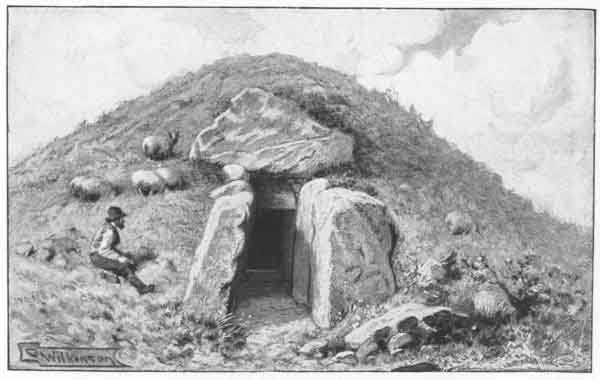
ENTRANCE TO PASSAGE-GRAVE AT UBY, DENMARK<BR> The hiding place of Grendel--the dragon's den--was almost certainly a forgotten passage-grave, the treasure being the original gifts to the dead chieftain buried there ENTRANCE TO PASSAGE-GRAVE AT UBY, DENMARK
The hiding place of Grendel--the dragon's den--was almost certainly a forgotten passage-grave, the treasure being the original gifts to the dead chieftain buried there

At home I waited my fateful hour, never seeking to make strife, nor ever breaking a pledged oath; so now when I am sick unto death I have comfort because the Ruler of all mankind can charge me not with murderous doings when I die."

Then he bade Wiglaf to bring forth the treasure from the dragon's lair, so that he might behold the riches he had won ere life was spent. The young hero did as was asked of him. He brought forth ancient armour, and vases of gold, rich ornaments and gems and many an armlet of rare design. A banner of gold which lit up the cavern he also bore to the king, in haste lest the last breath should be drawn ere he returned. . . . He found Beowulf gasping faintly, so once again he laved the king's face with cold water until he spake, gazing on the treasure, with thankfulness.

"To the Lord of glory I give thanks," he said, "because that he hath permitted me, ere I died, to win such great treasure for my own folk. . . . Give thou the gifts unto my people according to their needs. . . . I have paid life's cost for them. . . . No longer can I remain."

Then the king made request that on the cliff top overlooking the sea there should be raised his burial mound, and that it should be made bright with fire. He desired also that it should be built on Hronesness, as a memorial, so that seafarers, whose ships are driven through spray mist, might call it "Beowulf's Grave".

To Wiglaf the dying hero then gave his golden neck ring, his helmet adorned with gold, and his strong armour, which Weland had fashioned, bidding him to make ever good use of the gifts.

"The last of our race, the Wmundings, art thou, O Wiglaf," Beowulf said faintly, as life ebbed low. "Wyrd took one by one away, each at his appointed hour; the nobles in their strength went to their doom. . . . Now must I follow them . . . ...

These were Beowulf's last words. His soul went forth from his body, to the doom of good men. . . . Wiglaf sat alone, mourning him.

Then came the battle laggards from the wood and approached Wiglaf, who spoke angrily to them, because that they had fled their lord in his hour of need. Nevermore, he vowed, would they receive gifts or lands; each one would, when the lords were told of their cowardice, be deprived of their possessions.

"For a noble warrior, Wiglaf cried, "death is better than a life of shame."

When the people heard that Beowulf was dead, they feared that their enemies would renew the blood feuds and come against them. The messenger whom Wiglaf sent to bear the sad tidings spake of wars to be, when many a maiden would be taken away to exile and many a warrior slain. Then would their ghosts lift up their spears; the harp would be heard not as it awakened warriors, but instead the blood-fed raven would ask how fared it with the eagle as it fought with the wolf to devour the slain.

In sadness and sharp grief the people went towards the dragon's lair, and they saw the dread monster that had been slain. In length it measured fifty feet; horrible it was and blackened with its own fire. Round the dead king they gathered, weeping sorrowfully, and Wiglaf spake, telling them of Beowulf's last words, and his desire that he should be buried in a high barrow at the place of the bale fire.

Then, while the bier was being made ready, Wiglaf led seven men into the cave, and what treasure remained they brought forth. The dragon was thrown into the sea, and the body of grey old Beowulf was borne to the headland which is called Hronesness.

A great pyre was built, and it was hung with armour and battle shields and bright helms. Reverently they laid the great king thereon--the well-loved lord for whom they mourned. . . . Never before was so large a pyre seen by men. Torches set it aflame, and soon the smoke rose thick and black above it; the roaring of flames mingled with the wailing of the mourners while the body of Beowulf was consumed. . . .

A doleful dirge sang the old queen, and again and again she said that oft had she dreaded the coming of conflict and much slaughter. She feared for her own shame and captivity.

Heaven swallowed the smoke. . . . The people then raised a grave mound of great height. For ten days they laboured constructing a wall which encircled the ashes. Much treasure did they lay in the mound--all that was in the hoard--and there the riches lie now of as little use to men as ever they were.

Twelve horsemen rode round the great mound on Hronesness 2 lamenting for their lord. All the people sorrowed together, and they said that Beowulf was of all the world's kings and of men the mildest and most gracious, the kindest unto his people and the keenest for their praise.

The Curse of Gold

The antique world, in his first flow'ring youth,
Found no defect in his Creator's grace;
But with glad thanks, and unreproved truth,
The gifts of sovran bounty did embrace:
Like angel's life was then men's happy case;
But later ages Pride, like corn-fed steed,
Abused her plenty and fat-swoll'n increase
To all licentious lust, and gan exceed
The measure of her mean and natural first need.
Then gan a cursed hand the quiet womb
Of his great grandmother with steel to wound,
And the hid treasures in her sacred tomb
With sacrilege to dig; therein he found
Fountains of gold and silver to abound,
Of which the matter of his huge desire
And pompous pride eftsoons he did compound;
Then Avarice gan through his veins inspire
His greedy flames, and kindled life-devouring fire.
"Son," said he 3 then, "let be thy bitter scorn,
And leave the rudeness of that antique age
To them, that lived therein in state forlorn.
Thou, that doest live in later times must wage
Thy works for wealth, and life for gold engage."

From Spenser's"Faerie Queene".

Footnotes

1 Urd.
2 Hronesness is translated "Whales' Ness" by some: others incline to the mythological rendering, Ran's Ness. Rydberg in this connection shows that Rhind's son, Vale, the wolf slayer, is called, by Saxo, Bous, the Latinized form for Beowulf. Stopford Brooke shows that Hronesness is next to Earnaness, Eagle's Ness, and considers that "the unmythological explanation is plainly right"."
3 Mammon (Mimer) to the knight Guyon.

Teutonic Myth and Legend: Chapter 19 Conflict with Demons

TEUTONIC MYTH AND LEGEND

by DONALD A. MACKENZIE

An Introduction to the Eddas & Sagas, Beowulf, The Nibelungenlied, etc.

London, Gresham Publications 1912

CHAPTER 19

Conflict with Demons

Grendel enters the Hall--A Warrior devoured--Struggle with Beowulf--Terror-stricken Danes--The Hero Triumphant--Flight of the Demon--The Great Feast--Beowulf honoured--Grendel's Mother takes her Revenge--The Hero follows her--His Great Dive--Fight in the Cave--The Ancient Giant-sword--The She Demon slain--How Beowulf became a Prince.

OVER the moor in the black mist Grendel came stalking. The wrath of God was upon him. He saw the high hall and hungered for human flesh. . . . Stealthily he strode below the dark clouds, so that he might peer into the feasting chamber, which was decorated with gold and shining with ornaments. . . . It was not the first time he had entered it, but never before did he meet therein with a mightier warrior and braver watchmen.

So came that accursed fiend towards the Hall. The door was shut and strongly barred with iron bands; but he smote it with his great hands and it flew open. The demon was bent upon evil and swollen with fury as he tore through the entrance. With swift footsteps he strode his silent way over the finely paved floor. . . . He raged inwardly, and in the darkness awesome lights, like to fire, burned in his eyes. . . . He surveyed the hall; he saw warriors asleep on the benches and his heart exulted as he resolved to devour each one separately ere the night was spent. . . . But he had come to his last feast of human flesh.

Beowulf lay watching Grendel. Soon the hero beheld how suddenly the fiend snatched up his prey. Without delay that grim monster clutched a sleeping warrior, tore him asunder, chewed his flesh, and drank his blood, swallowing great mouthfuls quickly, until he completely devoured the man, and even his hands and feet.

Then Grendel came nearer; his claws darted out to wards Beowulf as he lay in bed. But the hero divined the demon's purpose, and he clutched the monstrous arm and threw his weight upon it. . . . Never before did Grendel feel a stronger hand-grip, and he was suddenly stricken with terror and sought to escape. . . . In vain he struggled to break free, so that he might take flight into the blackness of night-back again to the demons of his gang.

But Beowulf was mindful of his evening boast; he leapt from bed; he stood erect; tightly he grasped the monster; his fingers burst. . . . Grendel twisted and swayed; backward he sprawled towards the door, but the hero went with him, nor relaxed his grip. The wily fiend sought to slip without, if it were possible, and then flee to the darksome fen. He realized what strength there was in Beowulf's hands. . . . A luckless visit indeed had the monster made to Heorot.

Loud rang the clamour in the hall. Terror seized upon the Danes in their safe dwellings without; there was panic among them. . . . Beowulf and Grendel raged with fury; the building resounded as they struggled and crashed round and about. . . . It was a wonder that the feasting-hall was not shattered, and that it ever survived the savage conflict; it might well have fallen to the ground, but the timbers were bound together by well-forged iron bands. . . . Never could it be destroyed by hands, although the flames might devour it.

Then arose a loud and awesome scream. . . . The Danes were stricken with terrible dread, because they heard the demon's cries of despair--his screeching song lamenting for his wound.

Beowulf held fast; he would not suffer the man-eating fiend to escape alive. . . . Of little account was Grendel's life to the world of men. . . .

The battle heroes in the hall sought to help their lord. They fell upon the monster without fear, and smote him with their war swords, but without avail, for Grendel's body was charmed against weapon wounds, and they could do him no hurt.

But miserable was to be the life ending of the fiend; his alien spirit was fated to travel afar to be bound by devils. The crime worker, the devourer of men, the enemy of God, realized that his body would endure not or give him help and sure defence. Brave Beowulf had him in his power; each loathed the other with fierce hate.

In agony was Grendel. . . . A wound gaped on his shoulder; it was torn wider and wider; the sinews snapped; the flesh burst . . . . The glory of battle was given to great Beowulf . . . . Sick unto death Grendel must indeed escape to his joyless lair below the darksome fen: he knew that his life days were spun to an end. . . . So tearing away, he left his arm and shoulder in Beowulf's hands.

Thus was the desire of the Danes achieved, and the boast of the great hero fulfilled. The high hall was cleansed of Grendel. That indeed did the people who were stricken and put to shame realize when they entered Heorot, for from the great roof had Beowulf suspended the arm of the night demon with its iron-strong hand and clutching claws.

In the safety of morning the warriors hastened to the Hall from far and near the people gathered to gaze with wonder on the traces of the conflict. The blood tracks of the monster were on the ground. The warriors followed his trail on horseback until they came to the water of sea demons, which they beheld weltering with blood; the waves surged red and hot with gore. The death-doomed Grendel had laid his life down in his lair--his heathen soul. There Hela 1 snatched him away.

Then the mounted warriors rode back and proclaimed the tidings and the glory of Beowulf, of whom they said that no other warrior between the seas and the world ever was his equal or worthier of a kingdom.

Then was great rejoicing. Warriors held races on horses, one with another, and a minstrel thane sang of Beowulf's deed, and of Sigemund, the Volsung, who slew the dragon. To the Hall went many retainers to behold the arm of Grendel. The king went to view it with his nobles, and the queen went with her maidens.

Hrothgar gave thanksgiving to God because that the dread of Grendel was ended, and, addressing Beowulf, whom he called "the valiant hero", he vowed that henceforth he would love him as a son. "Thy fame," he said, "shall endure for ever."

Beowulf spake in answer, and said he had done the deed with great goodwill. "Would", he said, "that thou hadst witnessed the conflict. I thought to hold down the fiend on his deathbed until he died, but I could not prevent his going away."

The warriors were silent about him: they looked on the arm suspended from the roof; they saw the finger-claws which were like steel. Then they said that no weapon could have cut off that bloody battlehand of the demon.

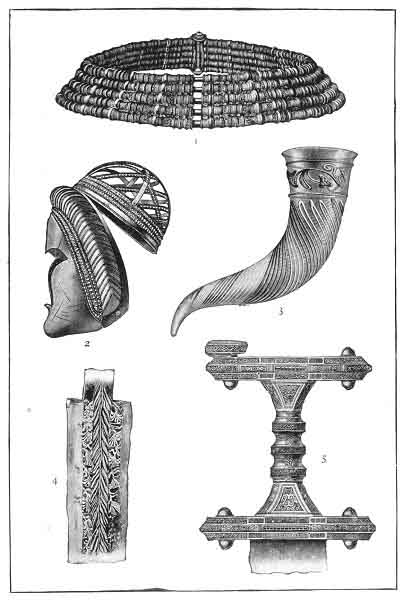
VIKING RELICS<BR> 1. Gold Collar from Oland. 2. Masked Helmet from Thorsbjerg Moss. 3. Drinking-horn. 4. Portion of a Damascened Sword from Nydam. 5. Bronze Sword Grip decorated with gold and garnets.<BR> 1. 3, <I>and</I> 5 <I>reproduced by permission from</I> ''<I>Kulturgeshichte Schwedens</I>'' <I>by Oscar Montelius</I> VIKING RELICS
1. Gold Collar from Oland. 2. Masked Helmet from Thorsbjerg Moss. 3. Drinking-horn. 4. Portion of a Damascened Sword from Nydam. 5. Bronze Sword Grip decorated with gold and garnets.
1. 3, and5 reproduced by permission from''Kulturgeshichte Schwedens'' by Oscar Montelius

A great feast was given in Heorot in Beowulf's honour. Hrothgar gave unto the hero as gifts a golden banner, a helm and war armour and richly jewelled sward. Eight battle steeds gave he also, and on one was the king's war saddle, adorned with embroidery and gems. To each of the hero's followers was given a sword, and blood money was paid for the warrior whom Grendel had devoured.

At the feast a minstrel sang of the deeds of King Finn 2 and of Hengest, Hnaef, and Hildeburgh--how Finn married Hildeburgh, the sister of Hnaef, who was afterwards slain and burned at the king's hall, and how Hengest went against Finn and slew him, returning to the fatherland with Hildeburgh.

When the song was ended, Hrothgar's queen, Wealtitheow, gave the golden cup to the king, and then bore it to Beowulf, to whom she also gave two golden armlets, a mantle, and a jewelled collar which was as precious as the collar of the Brisings, 3 which Hama took from Eormanric. The wondrous collar did Beowulf afterwards gift to his king, Hygelac, who wore it when, in after days, he fell fighting against the Frisians, when to them it passed.

The feast was then spread; men drank wine. They knew not stem Wyrd 4 Destiny as had many of the nobles before them there. And when evening came, Hrothgar rose and left the hall, and Beowulf went also to sleep in an outer dwelling. The benches were cleared and laid out as sleeping couches. . . . One among the revellers was doomed that night to die. . . . Each of the warriors hung his armour and weapons on the wall at his head, ready for sudden alarm and night attack. Brave men were they!

Now demon vengeance was brooding against the warriors because that Grendel was slain. His mother, a female demon, was filled with woe in her dwelling amidst awesome waters and cold streams. Ravenous and wrathful she resolved to go forth to avenge her son's death.

In the darkness she made her sorrowful way, and came to Heorot while the warriors slept on the benches. When she broke in there was again terror in the hall, which was just as much less than before as is a woman's strength unto a man's on the battlefield.

Swords were drawn hastily: there was no time to don armour. The she demon, perceiving that she was discovered, made haste to depart, but she had seized in her grim claws a sleeping noble, and she carried him off towards the fen. He was Hrothgar's comrade warrior and shield bearer, chere, who was famed between the two seas and well beloved. . . . A wailing arose in Heorot; the demon had taken life for life.

The old king was sorrow-stricken when he knew that his chief warrior was slain. He summoned Beowulf to a council, and the hero went with his followers. Along the floor strode the war-famed hero, while the timbers resounded his steps. He asked of the king if he had passed, according to his desire, an easeful night.

"Ask not of my welfare!" the king cried. "Sorrow has again fallen upon the Danes. chere is dead--my right-hand man, my councillor, my teacher. The death demon is his murderer. By her is her son's death avenged. My comrade she hath slain because thou didst kill Grendel, who for long slaughtered my people. So is the feud continued against us ... . . .

Then did the king tell Beowulf that ofttimes he heard that two dread stalkers held the moors by night. One of them had a woman's seeming; the other was Grendel. None knew if there was a sire in times past. Their lair was under the cliffs where a stream fell downward--in an underworld flood below a tree-girt mere. Nightly was a wonder beheld there--fire in the flood! No man knew how deep was the mere. The hart when close pursued will die rather than enter the water. An awesome place it is!

Thence do the waves surge to the clouds when the wind stirs up fearsome storms, the air is filled with mist, and the heavens weep. 5

Then said the king unto Beowulf: "Once more do we look to thee for aid. Thou knowest not yet the demon lair, the perilous retreat, where the monster may be found. Seek it if thou art unafraid! Then shall I reward as heretofore with gifts of gold if thou shalt survive."

Beowulf was, indeed, without fear. He besought the king to sorrow not. "Better it is," he said, "to avenge a comrade than to grieve without end." So he counselled that they should go forth quickly and follow the demon's blood trail to her den. Bravely he spoke thus:--

"Not in earth's bosom, in mountain wood, or in the sea depths, go where she may, shall the kin of Grendel escape me! . . . Be patient in thy grief this day, O king, as I expect of thee."

With joy the king leapt up, hearing the words that Beowulf spake. He called for his horse, and, followed by his men, went forth with Beowulf and his warriors.

They followed the track of the demon over the moor, and came to the stony places and the cliffs and the homes of sea-monsters. They reached the grey rock 6 overhung by trees, and below they beheld the mere surging and red with blood. On a cliff top they found chere's head.

In the water they beheld serpents and awesome sea dragons. On a ledge were sea monsters that go down the ocean paths. When the horn gave out a battle-lay they rushed seaward, and one did Beowulf wound unto death with an arrow so that he swam slowly in the water. The war-men thrust barbed boar spears at it and dragged it ashore. With wonder they gazed on their awesome guest.

Beowulf then girded on his armour, and on his head put his battle helmet. Then gave Hrothgar's spokesman, Unferth, unto him the strong blade which was named Hrunting. Of iron was it made, and tempered with blood of battle; it had been forged with twig venom and never had it failed in battle.

Then Beowulf addressed Hrothgar and besought him to be guardian of his comrades should he himself survive not, and to send unto Hygelac the treasures he had received.

"I shall achieve fame with Hrunting," Beowulf cried, "or death shall take me."

He awaited no answer and plunged; the surging waters received him. Downward he sank a day's space ere he found the bottom. . . . Soon the demon discovered that an alien being came against her, and she clutched Beowulf in her finger claws, but by reason of his strong armour she could do him no hurt. Sea monsters attacked him with sharp tusks, 7 so that he could not use his sword, and they followed as the demon drew him into her lair. Then did Beowulf perceive that he was dragged into a hall beyond the sea's reach. The glow of fire-like light was shining bright, and Beowulf perceived that the mere wife had taken him. He smote her with his sword--a great free blow he gave, and the blade rang on her head. But no wound could he inflict. Never before had the sword failed in conflict! Then did the hero fling down the blade. He would have his strength of arm for sure defence. So, desperate-minded, does a battle man fight when he hopes for fame and recks not of life. . . . The shoulder of Grendel's mother he seized and in great fury wrestled and flung the demon down. . . .

But fiercely she clutched at him. In her claws she held him securely. They struggled together thus until the battle hero, heart-weary, at length was overthrown. On the ground he fell and the she demon sat upon him. ... She drew swiftly her broad and bloodstained dagger to avenge her only son. . . . Then would the hero have died there, but over his shoulder lay his chain armour and that saved him. . . . To his feet he leapt again.

Beowulf suddenly beheld among the armour in the demon's lair an ancient giant-sword. It was a blade without an equal. No other living man could wield it, for it was the choice of splendid weapons, and giants had made it. The hero seized it and wielded it.

Strong was Beowulf, and in battle fury he swung the giant-sword and smote the demon a fierce blow, cleaving her at the neck and shattering her bone-rings. Right through her body went the blade, and she sank in death.... Blood-wet indeed was the sword, and Beowulf gloried in his deed.

Then light flashed through the hall, as when heaven's candle gleams from on high. . . . The hero gazed about him. . . . He saw Grendel lying maimed and dead on his resting place, and in vengeance for the evil that monster had done, Beowulf smote his body so that it was split open. Then the head he struck off.

On the cliff top the warriors waited, watching the angry waters. . . . In time, Hrothgar beheld the waves rising red with blood. Old and grey-haired war men spoke one to another about the brave one; nor did they expect to see him return again in triumph, for they deemed that the wolf demon had torn him asunder. . . . So they spoke and waited, until in the ninth hour the Scylding heroes turned away. Hrothgar went with them to his home. . . . Nor did the Geats expect ever to behold Beowulf again; yet they waited, gazing at the blood-red waters.

Meanwhile, in the demon's wave-protected hall, the giant sword which the hero had wielded began to waste away in the bloodstream. A strange thing was that! Like ice it melted, as when the Father unties the frost chains and the flood flows free.

Beowulf took not any of the other arms that were on the wall, but he kept the gold and graven swordhilt of which the blade was burnt up by reason of the fiend's hot and poisonous blood. Then, seizing the monstrous head of Grendel, he entered the waters and soon again he was swimming--he who survived fearsome strife, for by this time were the waters purged of blood and he rose quickly. He came to shore, and his war men rejoiced, as did also the brave hero, for he was proud of his mighty load of sea spoil.

Quickly did his men unloose his armour, and with glad hearts they went inland with him. Heavy was the burden of Grendel's head, which was carried to the hall on a spear shaft, the warriors marching in triumph.

Into the feasting-chamber they strode, where people sat drinking, and dragged Grendel's head along the floor. . . . An awesome sight was that to the nobles and the queen who sat with them. In silence the warriors gazed upon the monstrous head, wondering greatly.

Then did Beowulf address the king, telling him of the dread peril he endured ere yet he slew the demon. "But now," the hero said, "thou canst sleep in Heorot among thy warriors as heretofore, nor fear murderous attacks in the darkness."

To Hrothgar gave Beowulf the sword-hilt rich in victory, the work of a wonder-smith. It was a heritage of the past, and upon it was engraved that primeval war when the surging sea engulfed the race of giants 8 . Terribly were they punished--that people who were alien to the Eternal Lord; the Supreme Ruler gave them their final deserts in the flood. A gold plate upon the hilt had engraved in runes the name of him for whom that choicest of weapons was first made with decorated hilt and serpent ornament. 9

There was silence in the hall when Hrothgar, son of Halfdane, spoke of Beowulf's deed. Well may he say, an aged guardian who promotes truth and right among the people and remembers all from the far past, "that this nobleman is of high birth. Beowulf, my friend, thy renown is raised above all people, far and wide. With modesty and prudence thou dost bear thyself. My friendship thou shalt have, as I promised thee. Thou shalt ever be a strength to thy people and an aid to war men.

Not so was Heremod 10 to the children of Ecgwela, the renowned Scyldings. Not for their happiness did he flourish, but to bring cruelty and slaughter to the Danes. God had given him power and strength greater than any other man, but he had a fierce heart; he gave not money rings; he was without joy, and he endured grief because of his savagery and never-ending enmity with his people. Follow not that example. Have manly virtue. Many winters have made me wise, and for thee I have told this tale."

Further did the king give wise counsel to Beowulf, advising him to distribute gifts to his people, so that he might ever have their support, and to avoid vaunting pride, because the day would come when his strength would depart, and in the end death would take him.

A great feast was held in the Hall, and there was much rejoicing, and Beowulf slept there until the raven, with blithe heart, proclaimed the joy of dawn.

Then did the hero bid Hrothgar farewell. An alliance of peace was formed between the Scyldings and the Geats. The old king kissed the hero and shed tears.

To the coast guardian Beowulf gifted a gold-hilted sword. Then with his followers he went aboard the ship in which were the treasures and armour and horses which Hrothgar had given.

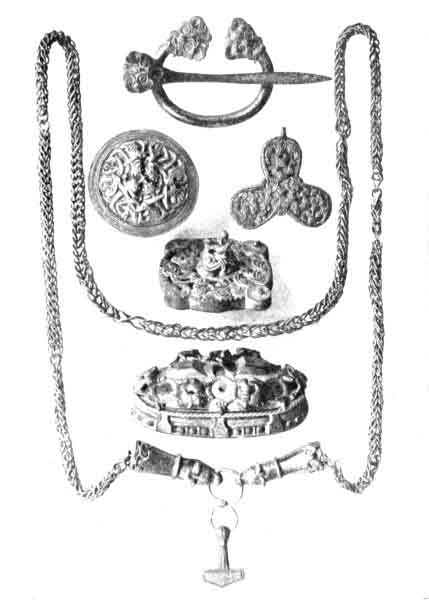
VIKING ORNAMENTS<BR> 1. Pin-brooch; 2, 3, 4, 5, Bronze Buckles; 6, Gold Neck-chain with Hammer of Thor hanging at bottom VIKING ORNAMENTS
1. Pin-brooch; 2, 3, 4, 5, Bronze Buckles; 6, Gold Neck-chain with Hammer of Thor hanging at bottom

The good ship clove the sea waters; the sail swallowed the wind; the timbers creaked; necked with white foam the ocean traverser, with curved stem, sailed away. Favourable were the winds until they saw the Geatish headlands and the keel grated on the shore.

To King Hygelac did Beowulf relate his adventures, and then he distributed the gifts he had received, giving that monarch a coat of mail and four horses, and to the queen, Hygd, the beauteous collar and three horses. Hygelac awarded the hero a gold-headed sword, much money, a country seat, and the rank of a prince.

Footnotes

1 Urd, Queen of Hela.
2 One of several heroic poems founded on the Ivalde moon-myth.
3 Probably a legend founded on the fight between Heimdal and Loke, when the latter tries to steal Brisingamen, Freyja's necklace. Hama is Heimdal.
4 Urd, Queen of Fate (as chief Norn) and of Death.
5 Ironwood and the Hag are suggested. Hati-managarm, Angerboda's son, is also a maneater like Grendel.
6 The Svipdag-dragon is also under a grey rock. The treasures he guards, and especially Freyja's necklace, also shine like fire in the water.
7 Walruses?
8 The sons of Ymer.
9 The traditional Sword of Victory, made by Thjasse-Volund, which was in the keeping of the Hag of Ironwood and her shepherd, Gymer. The runes, the smith's name, and the serpent charm suggest its magical qualities. It was evidently intended to achieve as great a disaster as did the Ymer deluge.
10 A reference to an older heroic tale. Hermod, the son of Odin, who visited Balder in Hades, has some connection with the Svipdag myth. Indeed, Rydberg identifies him with Svipdag. Beowulf is a hero of similar cast. Each has the attributes of the age in which their deeds were sung, and reflect the ideals of the people who celebrated them. Older savage conceptions, preserved by tradition, were condemned when compared with the new and nobler.

Teutonic Myth and Legend: Chapter 18 The Coming of Beowulf

TEUTONIC MYTH AND LEGEND

by DONALD A. MACKENZIE

An Introduction to the Eddas & Sagas, Beowulf, The Nibelungenlied, etc.

London, Gresham Publications 1912

CHAPTER 18

The Coming of Beowulf

The First Parents--Heimdal's Mission--A Wise Ruler--Passing of Scyld--Hrothgar builds Heorot--The Demon Grendel--Warriors devoured by Night--Reign of Terror--Beowulf of the Geats--He sets forth to fight the Demon--The Voyage--Challenged by the Shore Guardian--The King's Welcome--Beowulf asks a Boon--Waiting for Grendel--Beowulf keeps Watch.

To Ask and Embla, the first man and the first woman, did the gods impart divine attributes when they had but tree life, and were of little might and without destiny. Naked they stood before Odin at the seaway end. Perceiving their conscious shame, he gave unto them divine garments, and in these they took pride. In Midgard they dwelt, on the shore edge of Western waters, and their children multiplied, and their children's children. The lives of mortals were long in those days; they were yet innocent, and dwelt together in peace. The Golden Age prevailed in Asgard, nor had the Evil One of Ironwood corrupted the gods.

In after days Heimdal, son of Odin and of the nine Vana-mothers who were daughters of sea-dwelling Ran, was given from out of Gjallarhorn a wisdom draught of Mimer's mead. Then became he a child in human guise. In a fair ring-stemmed ship was he laid, wrapped in soft slumber and his pillow was a golden grain sheaf, the gift of Frey, god of harvest. Around him were heaped great treasures war glaives and full armour, weapons and tools, which the gods had made in Asgard. The sacred fire-borer took Heimdal also with him--he who was called Stigande, the journey-maker.

There came a sunbright morn when men, looking westward from Scedeland's high shore, saw drifting towards them over the blue sea a fair ship, and on the stem shone golden rings. Nigh it came, and it found a safe harbour and lay therein. With wonder the people beheld on the deck a man-child wrapped in soft slumber; his pillow was a golden grain sheaf, and they named him Scyld 1 of the Sheaf. Him they took unto their chief's home, and there he was nourished and fostered tenderly. The treasures that were in the ship gave great riches and power unto the tribe, and they received knowledge to grow grain and to use the sacred fire. When the child reached to wise manhood, he became a ruler among men, and long were his years.

Of Heimdal have skalds sung that thrice were sons born to him of earth mothers. The first was Thrall, from whom thralls are descended; the second was Churl, sire of freemen; and the third Jarl, from whom all nobles have sprung.

So when warriors assembled to feast together and drink mead, and ere the song was raised, have skalds spoken thus:--

"Give ear all ye divine races, great and small, sons of Heimdal".

Scyld of the Sheaf achieved great renown. He who was received as a helpless child became a great and good king. He drove invaders from the shores, he scattered ravaging bands, and among the tribes he was regarded with awe, Indeed he waxed so powerful that tribute was paid to him by the people who dwell beyond the seaway of whales.

A man-child was born unto Scyld. He was named Beowulf 2 , and when he came to years of strength and knowledge he won fair repute. Among the followers of his sire he distributed many money gifts, so that he won their favour; ready were they indeed to serve him in wartime.

When Scyld was of great age, he departed at his fateful hour to go into the keeping of the Lord. According to his dying request his faithful subjects carried him down to the seabeach. There in the small harbour lay the ship in which as a child he had come over the waves. Ready to go seaward, the vessel waited him in wondrous wintry beauty, glistening with hoar frost and ice. By the mast, on the broad bosom of the ship, the mourners laid down their well-beloved lord, the generous giver of golden money rings. Great treasures they heaped around him-graven ornaments from distant lands, armour and weapons of war and bright swords--and on his breast they put many gems. As rich and numerous were the gifts they gave as were those they had received with the child in other years.

Over the dead king they hoisted a banner of gold. . . . Then was the boat let loose . . . . The tide bore it away to the heaving ocean . . . . Thus in deep sadness was the king given unto the sea, while his people sorrowed for him, watching from the shore. . . . No man can tell who received that fair ship's burden

Beowulf then reigned over the Scyldings, and was honoured and well loved. His son Healfdene 3 , who followed him, was famed afar as a warrior, and when he waxed old he was yet fierce in battle. Four children he had--Herogar, a captain of war men; Hrothgar, who became king; Halga the Good; and Elan, the queen of a Swedish chieftain.

Hrothgar was a strong leader, and won many great battles. He received willing service, and under him the young war-men increased in numbers, until he commanded a mighty army. Then bethought he to have a great Hall built, with a larger feasting room than was ever heard of among men. For that purpose were workers from many tribes put in service, and in due season was erected the high, horn-gabled building which was called Heorot, and it awaited the devouring flames.

There was much feasting and merriment in the great Hall. A fierce man-eating monster, which dwelt in darkness, was made angry by the revelry, the music of harps, and the cheerful songs of skalds. One 4 was in the hall, too, who told how the Almighty did create man and the earth in the midst of the encircling sea, and did set the sun and moon in the heavens to give light and cover the land with branches and leaves.

Thus did war-men live happily indeed in the Hall, until the Hell-fiend began to work evil. Grendel was his name, and he hovered by night on the marches and held moorland and fen. By the Creator were he and his kind banished to their dark lairs, because they were the kindred of Cain, the slayer of Abel, whose evil progeny were monsters and elves and sea-demons, as well as the giants who fought with God, for which he paid them their reward.

Now it happened that in the midst of the night the demon Grendel entered the silenced hall to discover who were lodged there after beer-drinking. He beheld a band of high war-men who had feasted, and were wrapped in deep slumber; they had forgotten sorrow, that woeful heritage of men.

With fury was the demon possessed, and thirty of the war-men he carried off while they slept, hastening with exulting heart to his lair with that fill of slaughter.

At daybreak there was grief and loud wailing in the Hall. The great and honoured prince sat moodily, stricken with great sorrow, and gazed at the blood track of the fierce demon. His distress was long-lasting, and deep.

On the next night the demon Grendel returned, and did more murderous deeds. Nor had he any regret thereat, so much was he steeped in crime. Then was it easy indeed to find men who sought inner chambers by night. He alone who found farthest retreat escaped the fierce fiend. 5

Then became Grendel the master indeed. For the space of twelve long winters Hrothgar endured because of the demon great sorrow and deep loss. Minstrels went abroad making known in song the ceaseless outrages and fierce strife. No offering would Grendel take, nor could the greatest war-man who was seized expect to escape his doom. He entrapped young and old; on the mist-dark moorlands he seized his victims night after night. In vain did Hrothgar lament and make offerings unto idols, and pray that the soul destroyer would give them release from the demon. So did the heathen, as was their custom, remember hell, for they knew not the Creator, the Judge of Deeds, the Lord God, nor could they praise the Lord of Glory.

Then did Beowulf, a thane among the Geats, come to hear in his fatherland of the deeds of Grendel. In his time he was the strongest among living men, and he was noble as he was indeed mighty.

"Get ready my good wave-traverser," he said. "I shall go unto Hrothgar over the swan-way; he hath need of men."

The prudent, who depended on his aid, sought not to hold Beowulf back; they urged on the stout-hearted hero, and looked eagerly for favourable omens.

Beowulf selected fourteen of the finest war men to go with him, and took also a sea-skilled mariner, who knew the landmarks along the path of Ocean. Then to the ship they all went together: it lay beached below a sheltering headland. The warriors, bearing their arms, walked on to the stem. while the sea waves were washed against the sand. The armour and ornaments were placed on board, and then the willing heroes pushed into deep water the strong timber-braced ship. Like to a bird was that swift floater, necked with white foam, driven by favourable winds over the sea waves. All night they sailed on, and next day they beheld high and shining cliffs, steep mountains, and bold sea-nesses. So came they to the seaway end; the voyage was over and past.

The heroes leapt speedily from the ship and made it fast to the shore. Their armour clinked as they turned inland, while they thanked God that the seaway had been made easy to them.

Then there came towards them the Coast Guardian of the Scyldings, riding upon his horse along the shore. He shook his strong spear shaft as he drew nigh, and he spake, saying:

"Who are ye who in a high ship have come over the seaway, well -armed and bearing weapons? Know ye that I keep watch over the shore so that sea plunderers may not do harm to Denmark.

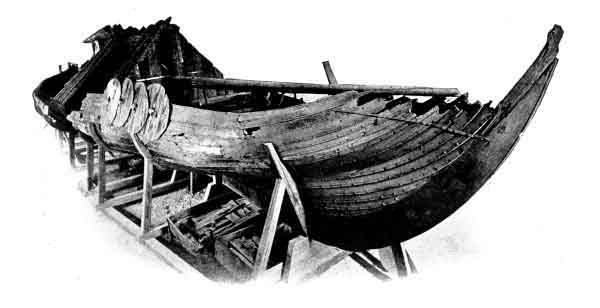
VIKING SHIP FROM GOKSTAD<BR> <I>Now in the University, Christiana</I> VIKING SHIP FROM GOKSTAD
Now in the University, Christiana

Never have I beheld armed men landing more openly; nor know ye the password of friends. Nor ever have I beheld a greater earl than this one among you. Unless his looks belle him, he is no home-stayer. Noble is his air. . . . Ere you advance farther to spy out the land, I must know who ye are. Now, listen to me, sea travellers from afar, my frank advice is that ye reveal at once from whence ye come."

That shore guardian did Beowulf answer thus: "We are Geats, the hearth friends of Hygelac. My sire Ecgtheow, the noble leader, was renowned among the people; he is remembered by every wise man. Now know that we come seeking thy king, the son of Healfdene, protector of the people. Be thou our guide. A great mission is ours, nor need its purpose be concealed. To us; hath it been told, and thou knowest if it is true, that a malignant foeman works evil by night among the Scyldings. I can council Hrothgar how the fiend may be overcome and his misery have end."

On his horse sitting, the fearless shore guardian spake in answer, saying: "A shield war man shall judge well between your words and deeds. Friendly are you, I hear, to the ruler of the Scyldings. Then pass onward in armour carrying your weapons. I shall guide ye. My comrades shall guard thy ship, so that the well-loved man, thy leader, may return over the sea tides to the borders of the Weders. To him it is assured that he shall come unscathed through the battle crush."

Together they went on their way until they came to the high and gold-decked Hall of Hrothgar. The shore-guardian pointed towards it and said: "Now must I take my departure. May the Almighty protect you all in your adventure. To the seashore I must hasten to keep watch against hostile bands."

Beowulf and his heroes reached the Hall. Sea-weary they all were, and they placed their shields and armour against the wall; they put their spears together and rested on benches.

A warrior, who was Hrothgar's messenger, asked them whence they came. "Never," said he, "have I seen bolder strangers. It would seem that ye have come to seek Hrothgar, not because of exile, but because of your bravery and noblemindedness."

Then did Beowulf reveal who he was and seek audience with the king, and his message did Wulfgar bear unto Hrothgar, who sat, grey-headed and old, among his peers.

"As a youth I knew Beowulf," the aged ruler said. "He comes to a sure friend. Of him have I heard that his hand hath the strength of thirty men. The holy God hath sent him hither as a help against the dreaded Grendel."

So he bade the messenger welcome Beowulf and his men and usher them to his presence.

When Beowulf entered he hailed Hrothgar, the kinsman of Hygelac, standing before him in shining armour.

"In my youth," he said, "I have undertaken great exploits. In my fatherland heard I of the evil deeds of Grendel, and my people counselled me, knowing my great strength, that I should come hither. For they know well that I avenged the sorrow of the Weders, bound five of their foes, slew a brood of giants, and killed sea monsters by night. . . . Alone shall I go now against this demon, this giant Grendel!"

Then asked Beowulf as a boon that he alone with his warriors should be left to cleanse the hall of the monster. Having heard that Grendel had no fear of weapons, he also made known his desire to contend with him unarmed.

"With the fiend," he said, "I shall wrestle for life, foe against foe."

Hrothgar accepted Beowulf's offer with gladness, and granted him the boon he sought. Then was a bench cleared for the noble heroes. They sat there in pride and drank of bright liquor. Songs were sung by a clear-voiced minstrel. There was much joy in the hall among the Danes and the Weders, who were no small company.

When they had feasted, and the queen bore the cup round the heroes, young and old, she greeted Beowulf, who, when he had drunk, said he had vowed to slay Grendel or perish in his clutches.

The old queen was much pleased to hear the words which the great hero spake.

Loud revelry was heard in the hall once more until Hrothgar desired to go to his couch. Well he knew that the night-haunting monster would attack the hall when the sun's radiance was dimmed and shadows fell, and dusky shapes were stalking under the clouds.

Then the whole company arose and greeted the heroes. Hrothgar greeted Beowulf and wished him success and power in the hall.

"Be mindful of thy renown," the king said, "make known thy great might, be watchful against the foe. . . . Thou shalt lack naught that thou dost desire if thou shalt survive this conflict."

Whereupon Hrothgar went forth with all his warriors, leaving the hall to Beowulf and his men.

When he was thus left alone with his heroes, the chief of Geats took off his armour, and gave his decorated sword to his thane. Ere he lay down in bed he said

"No less in fighting strength than Grendel do I account myself. I shall not slay him with my sword as I well might. He knows not the noble art to strike back, splitting my shield, although he hath courage and strength in evildoing. No weapons shall we use if he dares combat without them. . . . May the wise God, the holy Lord, give victory to the side which may seem meet to Him.

On his pillow Beowulf then laid his head. Around him on beds lay his warriors, nor did one of them expect ever again to return to his home; for each of them had heard how, in times past, the Danish warriors were taken from the Hall in bloody death.

In the blackness of night Grendel, the shadow-goer, came striding towards the Hall. . . . The warriors, sea-weary and spent, lay wrapt in deep slumber, nor kept watch--all save one. He alone was defiantly awake, awaiting the issue of the conflict with increasing wrath.

Footnotes

1 As in Beowulf. Elsewhere Scyld is called son of Sheaf.
2 The elder Beowulf; not the hero of the poem.
3 Halfdan.
4 Evidently an interpolation by a Christian copyist. Further on offerings are made to idols.
5 Grendel could enter the hall only: other dwellings were "taboo".

Teutonic Myth and Legend: Chapter 17 The Dusk of the Gods

TEUTONIC MYTH AND LEGEND

by DONALD A. MACKENZIE

An Introduction to the Eddas & Sagas, Beowulf, The Nibelungenlied, etc.

London, Gresham Publications 1912

CHAPTER 17

The Dusk of the Gods

The Vala's Song--Signs of Ragnarok--Evil among Men--Fimbul Winter--Goldcomb's Warning--Giants assail Bif-rost--Heimdal's Horn is blown--The Quaking of Ygdrasil--Loke and the Monsters freed--Ship of Death--Fear in Hela--Harper of Ironwood--The Midgard Serpent rises--Coming of Monsters--The Last Scene--Gods in Battle: their Doom--Odin avenged--Sun and Moon devoured--The End of All--World's New Age--Balder's Return--The Regenerating Race--All-father's Decrees.

THERE was a Vala who sang of the end of all things, of the doom of gods and men, of the last dread battle and Odin's death, and of the coming of Surtur, whose flames shall consume the world. In mid-air she sang, and at high noon. Odin, sitting in his throne of gold, was silent, and listening he understood, for from the beginning he had foreknowledge of the end. Yet was he not afraid. He awaited Ragnarok, "the Dusk of the Gods", as in youth he had waited, and now he was grown old.

. . . . . .

It was thus the Vala sang:

"The Age of Evil hath come upon earth--the Knife Age, the Axe Age, and the Age of Cloven Shields. The violent fall upon the peaceful; brothers slay brothers, and the children of sisters are shedding one another's blood. Great luxuries do men seek, and sensual sin prevails. The world is doomed, yet is it hard and cruel and full of sin. Thick-pressed in Hela's heavy streams doth Urd behold wading confusedly perjurers and murderers and evildoers without number. . . .

"Follows the Age of Northern Winds. Sword blasts are cleaving the darkened skies. Fierce beasts from forests and mountains and barren wilds seek their prey among men. None spares his neighbour, nor lifts a hand to save. . . .

"Fimbul Winter is now come. Heavy snows are driven and fall from the world's four corners; the murder frost prevails. The sun is darkened at noon; it sheds no gladness; devouring tempests bellow and never end. In vain do men await the coming of summer. Thrice winter follows winter over a world which is snow-smitten, frost-fettered, and chained in ice. . . . Yet wars are waged, blood is shed, and evil grows greater. . . .

"Suddenly Goldcomb crows loud in Asgard; from Hela's depths the Red Fire-Cock makes answer. On a hilltop in Ironwood the Storm-Eagle flaps heavily its wings, and tempests bellow over ocean and land. . . .

"The giants have gathered to assail Asgard. To Bif-rost they hasten: at the north end are Frost-giants and Mountain-giants; at the south end are the dread sons of Suttung. Heimdal beholds them. In his hand is the Gjallar-horn, which has long been hidden in the deepest shade of Ygdrasil, and from it he blows a thunder blast which awakens the nine worlds. . . . Mimer's seven sons start from sleep in Hela's golden hall, and arm themselves for conflict. . . . Odin talks with Mimer's head; he divines the end of all things, and unafraid he plans his battle array in the last conflict.

"With clamour and speed the giants ascend Bif-rost, and the sublime bridge breaks with the weight of riders, whereat Ygdrasil quakes--the old ash, deep-rooted and strong-rooted, trembles standing, so that the worlds are shaken and the bonds of fettered giants are broken. Loud barks Garm on the rocky isle of the Gulf of Black Grief, for the wolf Fenrer escapes and Loke is set free, Snapped are the cords that bind Naglefar, the great Ship of Death; it breaks loose. . . .

"The gods are unafraid; they sit in counsel in their High Thingstead. But Njord leaves Asgard and returns to the wise Vans, for the war is waged against the Asa-gods, and Suttung seeks to be avenged upon Odin. . . .

"The elves tremble, and the dwarfs shudder in dim-discovered caverns; they hide behind their rocky walls. In Jotun-heim there is loud bellowing and defiance, and terror spreads among men in Midgard. White fear passes over Hela, for the uncertain conflict is at hand. The sons of Mimer guard the gate: their long swords are in their hands. . . .

"In gloomy Ironwood the ice-cold heart of Angerboda is made glad. Gymer sits upon a mound alone, playing a harp; he is merry because of what is at hand. Long hath he awaited the hour of doom. To him comes Fjalar-Suttung, creator of illusions, in the guise of Hela's red cock, and he seeks the Sword of Victory which Gymer hath guarded--the sword which Thjasse-Volund forged with spells to wreak vengeance upon the gods, which Mimer captured and Svipdag found, the sword which Frey should wield in the last battle, and he yet gave to Angerboda for love of Gerd. To Fjalar-Suttung is the Sword of Victory given up, and he hastens to Surtur. . . .

"Now from the east drives Hrym; a buckler covers him, and his hordes follow. The Midgard serpent is shaken with giant rage, for its hour hath come; it writhes and wallows on Ocean's slimy floor, so that billows are raised and driven over Midgard high as the mountains; it rears its shaggy head out of the sea; venom-spotted is its body, and fire fumes it sends forth.

In Ironwood the storm eagle rises with beating wings. It snaps its sharp beak; it hungers for dead men's flesh. . . .

"The Ship of Death is sailing over the sea. On board are the sons of Muspel, who were bound; the stricken Jotuns, freed from bonds; Garm, the watch-dog; and the unfettered wolf Fenrer. Monsters gaunt and grim are in the ship, and Hel is there also. Loke is the pilot and holds the rudder. To Ironwood he steers over it his host he shall lead to the plain of Vigrid. . . .

"From the south comes black Surtur. In his hand flames the Sword of Victory, which he hath received from Suttung. Seething fire gleams from the sunbright blade, and his bleak avengers follow him. . . .

Mountains are shaken and the rocks tremble. The giant maids are stricken with fear. Mortals n Midgard are strewn in death, and their shades crowd the path to Hela. Heaven yawns; it is rent in twain because that Surtur issues forth. . . .

"On the plains of Vigrid is the last battle fought, A hundred miles it stretches in length, and a hundred miles in width, enclosing the wood of Vidar the Silent, where Odin is doomed to die. . . . The hosts of evil come against the hosts of Asgard. Frey leads the heroes of Valhal in the fray. He goes against black Surtur, unarmed and without fear, and by the Sword of Victory he is slain.

"Against strong Tyr leaps Garm, the fierce wolf-dog, and in dread conflict they engage; and one by the other is wounded, so that both fall dead.

"Loke battles with Heimdal, but against the shining hero the Evil One cannot prevail. Terrible is Loke's aspect after long torture, for his beard and hair have grown like horns. With his bright sword the watchman of Bif-rost takes his head. But even after death is the Evil One avenged, for his head strikes the body of Heimdal, who is grievously wounded thereby and brought to life's end.

"There is no longer fear in Hela; the sons of Mimer rejoice because that Loke is dead.

"Thor is engaged in fierce combat with the Midgard serpent. Long is the strife and uncertain. The serpent is coiled and uncoiled; it writhes before Thor; it avoids his hammer blows, and over him it pours floods of venom. Terrible is the wrath of the thunder-god, and fain would he smite his enemy, dreading that he will be overcome. But at length he prevails. Thunder bellows loud and Mjolner flashes fire as Thor smites the deathblow, and the monster is stretched dying upon the plain. Great renown, indeed, hath the God of Thunder gained, yet pays he life's cost for the victory. With its last fierce breath the serpent sends forth suffocating venom fumes, and Thor staggers back nine paces. Then with a thunder groan the victor falls dead. . . .

"How fares Odin in this dread hour? He combats with the ravenous wolf Fenrer, the avenging monster which broke free from its bonds. From earth to heaven its jaws gape. Fiery flames dart from its nostrils and from its eyes. Odin fights with his spear Gungner, and violent are his blows. He rides on Sleipner; on his head gleams his helmet of gold; his blue robe streams behind. Fearless is Odin and proud, and his form is stately in this his hour of doom. Naught can avail him in the great combat. He is stricken down in his splendour, and by the wolf is he devoured.

"Yet short-lived is the triumph of Fenrer. Strong Vidar the Silent advances speedily to avenge his sire's death. His iron-shod foot is stamped on the monster's under jaw. He struggles fiercely with the terrible wolf, for he is stronger and must prevail. In the end he tears asunder the great jaws, and plunges his spear in Fenrer's heart through that throat of fire. Thus Odin is avenged. . . .

"How fares the Asa-hosts when Odin and Thor fall, and Tyr and Frey lie dead? The heroes of Valhal are scattered, hordes of giants are killed, and the field is wet with blood. The black dragon Nidhog is soaring through the air with rustling wings. It flies towards the plain of battle and swallows the bodies of the dead. . . . Surtur alone prevails.

"In Heaven there is disaster. Closer and closer hath the giant wolf Skoll crept towards the sun, and now he swallows it. By Hati-Managarm is the moon devoured.

"So is the sun darkened at high noon, the heavens and the earth are turned red with blood, the seats of the mighty gods drip gore. So is the moon lost in blackness, while the stars vanish from the skies.

"Now Surtur completes creation's doom. He casts his firebrands against the scattered Asa-hosts, and those who remain are burned up, save Vale and Vidar, sons of Odin, and Modi and Magni, sons of Thor. Midgard is swept by flame; the smoke curls round mountain tops; all things are burned up; nothing with life remains. Asgard is scorched, and fire envelops the withering trunk of Ygdrasil. Even Nidhog is destroyed in its flight. . . . Earth, smouldering and black, sinks into Ocean; the billows cover it. . . .

"Now there is naught but thick blackness and silence unbroken. The end hath come-Ragnarok, 'the Dusk of the Gods'!"

. . . . . .

Silent was then the voice of the Vala in mid-air and at high noon. Odin sat in his throne of gold listening through the stillness, unafraid, waiting for Ragnarok and his own doom. Waited he also for the song's end and the promise of Time's new morning, when evil would cease to be and Balder would come back.

The skylark soars till its song falls weakly; at morn is its singing fresh and sweet. Sweet, too, and fresh was the song of the Vala when Odin heard, sitting in his throne, her voice falling through the stillness, afar off but clear.

. . . . . .

"In Hela's realms there is sure defence. None goeth thither to conquer, and the long swords are unstained with blood. The fire hath reached not the Underworld. Mimer's seven sons, who have awakened, sleep not again. The roots of Ygdrasil are watered once more from Mimer's well; fire has destroyed not the tree save those branches which had withered; it grows green again.

"The World's New Age hath dawned. The sun is bright in heaven, for Balder hath returned. Earth rises a second time, from the deep sea; it rises clad with green verdure. The sound of falling waters fills the morning air. High soars the eagle; from the mountain ridge he espies the fish. . . .

"Asgard is again made fair. The young gods arrive. Balder is there, and Hodur, his brother; Vale and Vidar are there also, and Mode and Magne, who bear with them Mjolner, the hammer of Thor. Honer, who reads the future, is in their midst; he is able to choose his part.

"Of the evils and perils of past time do the gods converse. Midgard's serpent they call to mind and the wolf Fenrer. They forget not the judgments of the gods and the antique mysteries. They remember the sacred runes of mighty Odin. On the grass they find the tablets of gold with which in the Golden Age was played the game of the gods. So did the Asa clan find them on Time's fair morning ere yet by the Hag was Asgard corrupted.

"The world is decked in beauty. Fields yield produce without being sown. Evil is ended and every ill hath ceased. Balder hath indeed returned, and with Hodur he dwells in the holy halls of Odin.

"The sons of the two brothers are in the vast abode of the winds, the wide free hall of the cloud drift. In the sun chariot is Sol's daughter, who is more beautiful than was Sol, and she drives in brightness over a heaven of blue.

"Lifthraser and Lif and their descendants, who are the regenerating race, have come from Mimer's realm to inhabit Midgard. Pure are they and without stain. Honey-dew is their food in Time's new morning: their children shall overspread the earth.

"The new race shall dwell, when life ends, in their hall which is named Gimle. Brighter it shines than the sun, and its roof is of gold, and it stands in high heaven. There indeed shall the holy ones dwell in peace and eternal joy for evermore.

"Northward on Nida mountains is a golden hall. The sons of Mimer and Sindre's race have dwelling within it. In heaven there is also the hall Brimer, where mead drinkers sit round the board amidst plenty and in peace.

"The evil ones who have fallen from their high state dwell in Naastrand. A vast hall it is, and of great height. Its doors are open to the north. With serpents was it built; they are entwined so that their backs are outward and their heads are within. Venom drops from their jaws; it burns the sinners on the benches beneath; they wade through venom floods in the hall. . .

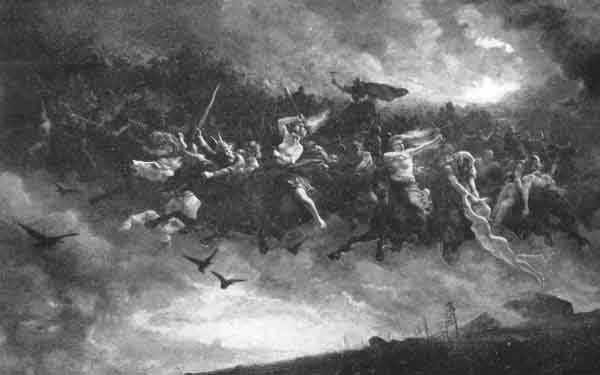
THE DUSK OF THE GODS<BR> <I>From the painting by P. N. Arbo</I>
THE DUSK OF THE GODS
From the painting by P. N. Arbo

"Odin returns not again, nor Heimdal. Another comes who is more mighty. Him I dare not name, for he is All-father. He comes to the great judgment; he utters decrees. He governeth all realms, by him are all things swayed. He settles strife; he makes war to cease. He ordains sacred laws which are inviolable and shall flourish for ever."

. . . . . .

The Vala's song was ended, and Odin sat in his golden throne, pondering in silence.

Regeneration

Far to the south, beyond the blue, there spreads
Another Heaven, the boundless--no one yet
Hath reach'd it; there hereafter shall arise
The second Asgard, with another name.
Thither, when o'er this present earth and Heavens
The tempest of the latter days hath swept,
And they from sight have disappear'd, and sunk,
Shall a small remnant of the Gods repair;
Hoder and I shall join them from the grave.
There re-assembling we shall see emerge
From the bright Ocean at our feet an earth
More fresh, more verdant than the last, with fruits
Self-springing, and a seed of man preserved,
Who then shall live in 'peace, as now in war.
But we in Heaven shall find again with joy
The ruin'd palaces of Odin, seats
Familiar, halls where we have supp'd of old;
Re-enter them with wonder, never fill
Our eyes with gazing, and rebuild with tears.
And we shall tread once more the well-known plain
Of Ida, and among the grass shall find
The golden dice wherewith we play'd of yore;
And that will bring to mind the former life
And pastime of the Gods, the wise discourse
Of Odin, the delights of other days.

From "Balder Dead", by Matthew Arnold.

Subscribe to this RSS feed

Log in or create an account