log in
LC Geerts

LC Geerts

Website URL:

Teutonic Myth and Legend: Chapter 15 Balder the Beautiful

TEUTONIC MYTH AND LEGEND

by DONALD A. MACKENZIE

An Introduction to the Eddas & Sagas, Beowulf, The Nibelungenlied, etc.

London, Gresham Publications 1912

CHAPTER 15

Balder the Beautiful

The Summer Sun-god--Blind Hodur--Nanna the Brave--The Light Battles--A Dread Omen--Balder's Dreams--Frigg's Alarm--World Vows taken--Odin descends to Hela--The Vala invoked--Her Prophecies--Loke's Evil Design--The Mistletoe Arrow of Pain--Balder is killed--Hermod's Mission--The Funeral of the God--Odin whispers--Hermod in Hela--Urd's Decree--World Tears--Hag seals Balder's Fate.

BALDER THE BEAUTIFUL was the most noble and pious of the gods in Asgard. The whitest flower upon earth is called Balder's brow, because the countenance of the god was snow-white and shining. Like fine gold was his hair, and his eyes were radiant and blue. He was well loved by all the gods, save evil Loke, who cunningly devised his death.

Balder, the summer sun-god, was Odin's fairest son; his mother was Frigg, goddess of fruitful earth and sister of Njord. His brother was blind Hodur. On Balder's tongue were runes graven, so that he had great eloquence. He rode a brightly shining horse, and his ships, which men called "billow falcons", were the sunbeams that sailed through the drifting cloudways. For wife he was given Nanna, the moon maid, the brave one who fought with him the light battles. On a bright horse she rode also, and tender was she and very fair.

There came a time when Odin and Balder went forth to journey through a wood. A dread omen forewarned them of disaster, because the leg was sprained of Balder's horse, the horse from whose hoofmarks bubbled forth clear wells. Charms were sung over the sun-god by Nanna and by her fair sister Sunna, the sun maid. Frigg also sang, and then Fulla her sister. Odin uttered magic runes to protect him from evil.

But soon after Balder began to languish. The light went from his eyes, care sat on his forehead, and melancholy were his lips. To him came the gods beseeching to know what ailed him, and he told that nightly he dreamed fearsome dreams which boded ill, and revealed to him, alas! that his life was in dire peril.

Now Frigg, who had fore-knowledge of all things save Balder's fate, sent forth her maid-servants to take oaths from all creatures living, from plants and metals, and from stones, not to do any hurt unto the god Balder. To her, in due time, the maidens returned, and she received from them the compacts and vows that were given. All things promised to spare him, save the mistletoe, slender and harmless, from which no vow was asked, for it clung, as was its need, to a strong tree for protection. Then was Frigg's heart filled with comfort, and no longer did she fear the fate of her noble son.

But the heart of Odin was filled with foreboding. He mounted his horse Sleipner, and went over Bif-rost towards the north, and descended unto darksome Nifelhel, where dwelt the spirits of the great giants who were crushed in the World-mill. On the borders of Hela, as he rode speedily, a great and fierce hel-dog came after him. There was blood on its breast, and in the darkness it barked loudly. When it could go no farther, it howled long with gaping jaws.

Over a long green plain went Odin, while the hoofs of Sleipner rang fast and cleat-, until he came to a high dwelling, the name of which is Heljar-ran, of which the keeper is Delling, the Red Elf of Dawn. Therein have their Hela-home the fair Asmegir--Lif and Lifthraser and their descendants who shall come at Time's new dawn that shall follow Ragnarok to regenerate the world of men.

To the eastern gate went Odin, where he knew there was the grave of a Vala (prophetess). Dismounting from Sleipner, he chanted over her death chamber strange magic songs. He looked towards the north; he uttered runes; he pronounced a spell, and demanded sure response. Then rose the Vala, and from the grave chamber her ghostly voice spake forth and said:

"What unknown man cometh to disturb my rest? Snow has covered me in its deeps; by cold rains have I been beaten and by many dews made wet. . . . Long indeed have I lain dead."

Odin answered: "My name is Vegtam and my sire was Valtam. Tell me, O Vala," he cried, "for whom are the benches of Delling's hall strewn with rings, and for whom are the rooms decked with fine gold?"

The Vala answered and said: "Here stands for Balder mead prepared, pure drink indeed. Over the cup shields are laid. Impatiently do the Asmegir await him and to make merry . . . . Alas! by compulsion hast thou made me to speak . . . . Now must I be silent."

Odin said: "Silent thou must not be until I know who shall slay Balder--who shall bereave Odin's son of life."

The Vala answered: "Hodur shall send his brother hither, for Balder shall he slay, and Odin's son bereave of life. . . . Alas! by compulsion hast thou made me speak. . . . Now must I be silent."

Odin said: "Silent thou must not be until I know who shall avenge the deed on Hodur, who shall raise Balder's slayer on the funeral pyre."

The Vala answered: "A son, Vale, shall Rhind bear in the halls of Winter. He shall not wash his hands nor comb his hair until to the funeral pyre he beareth Balder's foe. Alas! by compulsion hast thou made me to speak. Now must I be silent."

Odin said: "Silent thou shalt not be until I know who are the maidens that sorrow and throw high their veils with grief. Sleep not until thou dost answer."

The Vala spake and said: "Thou art not Vegtam, as I deemed, but Odin, ruler of all."

Odin said: "No Vala art thou, but the mother of three giants."

Then cried the Vala: "Return, O Odin, unto Asgard. Never again shall I be called upon until Loke escapes from bonds and the world-devastating Dusk of the Gods is at hand."

To Asgard did Odin return; but there was no sorrow there nor foreboding, because of the vows which Frigg had taken from all creatures and all things that are, so that no harm might be done unto her fair son. And of this had the gods full proof. Balder they made to stand amidst a rain of javelins that harmed him not. Some flung at him stones, others smote him with their swords; yet was he not injured. Of Balder were they all proud because he was charmed against wounds. To honour him did they make fruitless attack on his fair body.

Evil there war, in the heart of Loke, and in woman's guise he went unto Frigg, who spake and said: "Why do the gods thus assail my fair son Balder?"

Loke answered: "It is in sport they fling at him javelins and stones and strike him with swords, because they know full well that they can do him no hurt."

Frigg said: "By neither metal, nor wood, nor stone, can he be injured because of the world-vows which I have received."

"Have all things indeed sworn to protect Balder?" Loke asked with downcast eyes.

"All things save the mistletoe," answered Frigg, "and so slender and weak is the mistletoe that from it no vow was demanded."

Then Loke went from Frigg and plucked a mistletoe sprig, which he carried to a cunning elf-smith named Hlebard, whom he robbed of his understanding. With the mistletoe twig the smith shaped a magic arrow--a deadly arrow of pain. . . . Loke made haste with it to Asgard, and he went to the green place where the gods assailed Balder and made merry. He saw blind Hodur standing apart, and to him he went and spake thus:

"Why, O Hodur, dost thou not join the game and cast a missile at Balder also?"

"Alas!" cried Hodur; "am I not blind? I can see not my fair brother, nor have I aught which I can throw."

"Come and do honour unto Balder like the others '

Loke urged him. "I shall give thee an arrow for thy bow, and hold thine arm so that thou mayest know where he stands."

Hodur then took from Loke the magic arrow which the elf-smith had made and placed it in his bow. Then raised he his left arm, while evil Loke took certain aim.

"Thou canst now share in the sport," said the Evil One unto the blind god, and went to a place apart.

The gods beheld Hodur standing with bent bow, and paused in their game. . . . Then did the arrow dart forth. . . . It struck Balder; it pierced his fair body, and he fell dead upon the sward.

In horror, and frozen with silence, the gods stood around. . . . Where there had been joy and merrymaking, dumb grief prevailed. . . . Alone stood Hodur wondering and in mute amaze.

But ere long angry cries broke forth, and the gods sought to slay Death's blind archer; but the sward on which they stood was consecrated to peace, and unwillingly were their hands withheld.

Then a loud voice cried through Asgard: "Balder is dead! . . . . Balder the Beautiful is dead! . . . ."

Every voice was hushed and every face turned pale because of the disaster which had befallen the gods in that black hour.

Thereafter arose the sound of loud lamentations, and a tempest of grief swept over the Celestial City. Frigg wept in silence and alone. Odin grieved inwardly, and more than the rest he realized the great disaster which Balder's death would bring unto the Asa-gods.

The spirit of Balder descended to the Lower World and crossed the golden bridge over the River Gjoll.

The Asmegir in their gold-decked hall awaited him, for they desired that he should be their ruler until the dawn of the world's new age.

But Frigg would not suffer that Balder should remain in Hela. She went forth when the gods ceased to cry aloud in their sorrow and said:

"Who among thee hath longing to win my gratitude and my love? For such shall be given unto him who rideth to Hela to find Balder. It is my heart's desire, in this my hour of grief, that a great ransom be offered unto Urd, Queen of Death, so that she may permit my fair son to return unto me again."

Forth stepped Heimdal the Young. He was a messenger of the gods and a son of Odin. He spake forth and said: "Unto Hela shall I go, O Queen of Asgard, as thou desirest, to find Balder and to offer great ransom unto Urd, so that she may permit him to return unto thee once again."

Then was Sleipner taken forth for Hermod, who leapt nimbly into the saddle. Swift as the wind he went over the gate bridge, and through the air and across the seas he sped and descended unto Nifel-hel towards the north to search for Balder.

The gods bore Balder's body unto the bleak shore of Ocean, where lay his great ship, Hringhorn. On its deck they built a pyre covered with much treasure, and then they sought to launch it.

But that they were unable to do, because the keel stuck fast in the sand and would not be moved seaward. So they sent unto Jotun-heim for the storm-giantess, Hyrrokin, who was Angerboda, that ancient-cold Vala of the east, who sweeps wind-tossed ships into the very jaws of er. On a great wolf she came and the bridle was a writhing snake. She leapt on the beach and with disdain regarded the gods. To four giants were given the keeping of the wolf. Then went she to the ship and thrust it speedily into the sea. Fire blazed from the rollers and the earth shook.

Angry was Thor when he beheld the Hag, and he swung his hammer to strike her down; but him did the gods restrain, for they sought not bloodshed in that hour.

Then was Balder's body carried to the ship and laid upon the pyre, and his steed beside him. Beautiful was he in death. In white robes was Balder clad, and round his head lay a wreath of radiant flowers.

On the shore were gathered the gods and goddesses of Asgard. Odin was there, and he went first.
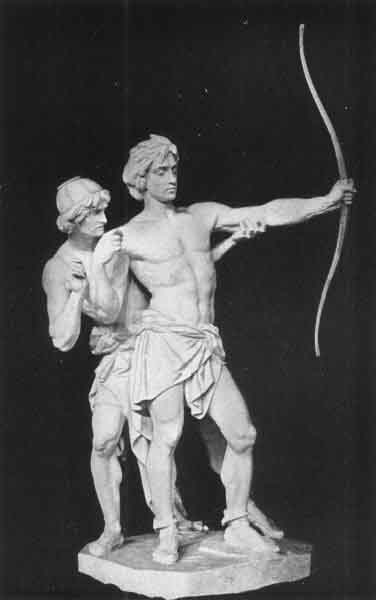
LOKE AND HODUR<BR> <I>From the sculpture by C. G. Qvarnstr</I> LOKE AND HODUR
From the sculpture by C. G. Qvarnstr

His ravens hovered over the ship, and his wolf-dogs wailed. Beside him was wise Frigg, who was wont to spin golden cloud-threads from her jewelled wheel. Queen of Asgard was she and goddess of Maternal Love. She was robed in black who was erstwhile attired in cloudy whiteness; on her golden head were the heron plumes of silence; a golden girdle clasped her waist and on her feet were golden shoes. Tall was she and stately and surpassing fair.

Dark-browed Thor was nigh to Odin, and Brage and Tyr also. Njord, black-bearded, and clad in green, strode his stately way. With his golden-bristled boar came Frey, and Heimdal, horsed on Gulltop, shone fair as sunshine. Beauteous Freyja, veiled in tears, rode her chariot drawn by great cats, and fair Idun was there also, and Sith with harvest hair. Loke stood apart with tearless eyes.

The valkyries leaned on their spears. Frigg's maids were nigh the Queen of Asgard, and these were Fulla, her sister, Hlin, who carries to Frigg the prayers of mortals; Gna, the speedy messenger who passes to and fro over the earth, beholding and remembering: Lofn, guardian of lovers, in whose name vows are made; Vjofr, the peacemaker, who unites lovers, and husbands and wives who have quarrelled; Syn, the wise doorkeeper; and Gefjon, guardian of maids who shall never wed.

White elves were assembled on that sad shore to sorrow, and even black elves were there. Many Frost-giants and Mountain-giants gathered around, for there was sadness everywhere because Balder was dead.

But none mourned more than Nanna, Balder's wife. Silent was she; her heart wept, and fire burned in her eyes.

Then Odin mounted the pyre. On Balder's breast

he laid the gold ring Draupner, and bending low he whispered in Balder's ear. . . .

From that hour have gods and men wondered what said Odin in his son's ear.

When Odin whispered
In Balder's ear,
Nor god nor man
Was nigh to hear.

What Odin whispered,
Bending low,
No man knoweth
Or e'er shall know.

In silence Odin returned to the shore, and then Thor consecrated the pyre with his hammer. A dwarf named Littur, who ran past him, he kicked into the boat, where he was burned with Balder.

So ended the ceremony of grief, and the torch was placed to the pyre. High as heaven leapt the flames, and the faces of the gods were made ruddy in the glow. . . . Nanna cried aloud in grief, and her heart burst within her, and she fell dead upon the cold sea strand.

Seaward swept the burning ship. . . . The whole world sorrowed for Balder. . . .

Meanwhile Hermod made his darksome way through Nifel-hel towards Hela's glittering plains. Nine days and nine nights he rode on Sleipner through misty blackness and in bitter cold over high mountains and along ridges where chasms yawn vast and bottomless. On Hela's borders the terrible wolf dog of the giant Offotes followed him, barking in the black mist. . . . Then Hermod reached the rivers. Over Slid, full of daggers, he went, and over Kormet and Ormet, and the two rivers Kerlogar, through which Thor wades when he goes to the Lower Thingstead of the gods. He crossed shining Leipter, by whose holy waters men swear oaths that bind. At length he came to the River Gjoll and its golden bridge.

Modgud, the elf maid who watches the bridge, cried aloud: "Whence cometh thou who hath not yet died?"

Of her did Hermod ask who had crossed before him. Impatient was he to brook delay.

"But five days since," she said, "there passed five troops of warriors who rode over with valkyries, yet made they less noise than thee alone. . . . Whom seekest thou?"

Hermod answered and said: "Balder, my brother, son of Odin and Frigg, do I seek. If thou hast seen him, speak forth and tell me whither he hath gone."

In silence did Modgud point towards the north, whereat Hermod spurred Sleipner and went on. . . . Soon he came to Hela's great stone gate. Strongly barred it was and very high, and guarded by a great armed sentinel. To none was given entry save the dead who are brought to judgment.

Hermod leapt to the ground. He tightened the girths of Sleipner. He remounted again. Then he spurred Odin's horse towards the gate, and with a great bound it leapt over, nor ceased to go onward when it came down. . . . Swiftly rode Hermod until he came to the palace in which Balder dwelt with the Asmegir.

From the saddle he leapt and went within. . . . There in a golden hall he saw Balder seated on a throne of gold. Wan was his face and careworn, for the gloom of death had not yet passed from him. On his brow was a wreath of faded flowers, and on his breast the ring Draupner. He sat listening, as if he still heard the voice of Odin whispering in his ear. Before him stood a goblet of mead, which he had touched not. Nanna sat by his side, and her cheeks were pale.

Hermod beheld nigh unto them Urd, the queen of Hela. In cold grandeur she stood, silent and alone. Deathly white was her face, and hard and stern, and she looked downward. On her dark robe gleamed great diamonds and ornaments of fine gold. . . .

To Balder spoke Hermod, and said: "For thee have I been sent hither, O my brother. In Asgard there is deep mourning for thee, and thy queen mother beseecheth thy speedy return."

Sadly did Balder shake his head, and to Nanna he pointed. But she leaned towards him and whispered: "Love is stronger than death, nor can the grave destroy it. . . . With thee, O Balder, shall I ever remain . . . ...

They would have wept, but in Hela there are no tears.

Throughout the night did Hermod hold converse with the twain, and when morning came he besought Urd to release Balder from death's bonds.

With eyes still looking downwards she heard him speak.

"In Asgard," Hermod said, "the gods sorrow for Balder, and on earth is he also mourned. All who have being and all things with life weep for Balder, and beseech thee that he may return again."

Urd made answer coldly: "If all who have being and all things with life weep for Balder and beseech his return, then must he be restored again. . . . But if one eye is without tears, then must he remain in Hela forever."

Hermod bowed himself before Urd in silence, and turned again to Balder and to Nanna, who went with him to the door. . . . Ere their sad farewells were spoken, Balder gave Hermod the ring Draupner to carry back unto Odin, for in Hela the ring was without fertility. Her veil Nanna did send unto Frigg, and a bride's gold ring she gave for Fulla.

To Asgard did Hermod make speedy return, bearing the gifts of Balder and of Nanna, and unto gods and goddesses assembled together he made known the stern decree of Hela's queen.

Over all the world did Frigg then send messengers to beseech all who have being and all things with life to weep for Balder, so that he might be restored again. Then did sorrow indeed prevail. The frost of grief was broken, and the sound of weeping was heard like to falling streams. Men wept, as did also every animal, peaceful and wild. Stones had tears, and metals were made wet. On trees and plants and on every grass blade were dewdrops of mourning for Balder.

But as the messengers of Frigg were returning to Asgard, they came to a deep dark cavern in which sat Gulveig-Hoder, the Hag of Ironwood, in the guise of Thok (darkness). Her they besought to weep, so that Balder might return. She spake coldly and said:

"Thok shall weep tears of fire only because Balder is dead. No joy hath he ever given unto me living or dead. . . . Let Hela's queen hold what is her own."

Great was the sorrow in Asgard because that the Hag would weep not and free Balder from death's bonds. Upon Loke was laid the blame, because he never ceased to work evil among the gods. But not afar off was the day of his doom.

The Passing of Balder

I heard a voice, that cried,
"Balder the Beautiful
Is dead, is dead!"
And through the misty air
Passed like the mournful cry
Of sunward-sailing cranes.

I saw the pallid corpse
Of the dead sun
Borne through the Northern sky.
Blasts from Nifel-heim
Lifted the sheeted mists
Around him as he passed.

And the voice for ever cried,
"Balder the Beautiful
Is dead, is dead!"
And died away
Through the dreary night,
In accents of despair.

Balder the Beautiful,
God of the summer sun,
Fairest of all the Gods!
Light from his forehead beamed,
Runes were upon his tongue,
As on the warrior's sword.

All things in earth and air
Bound were by magic spell
Never to do him harm,
Even the plants and stones:
All save the mistletoe,
The sacred mistletoe!

Hoder, the blind old god,
Whose feet are shod with silence,
Pierced through that gentle breast
With his sharp spear, by fraud
Made of the mistletoe,
The accursed mistletoe!

They laid him in his ship,
With horse and harness,
As on a funeral pyre.
Odin placed
A ring upon his finger,
And whispered in his ear.

They launched the burning ship!
It floated far away
Over the misty sea,
Till like the sun it seemed,
Sinking beneath the waves.
Balder returned no more!

Longfellow.

The Descent of Odin

Uprose the King of men with speed,
And saddled strait his coal-black steed;
Down the yawning steep he rode,
That leads to Hela's drear abode.
Him the Dog of Darkness spied,
His shaggy throat he opened wide,
While from his jaws, with carnage filled,
Foam and human gore distilled;

Hoarse he bays with hideous din,
Eyes that glow, and fangs that grin;
And long pursues, with fruitless yell,
The father of the powerful spell.
Onward still his way he takes,
(The groaning earth beneath him shakes,)
Till full before his fearless eyes
The portals nine of hell arise.

Right against the eastern gate,
By the moss-grown pile he sate;
Where long of yore to sleep was laid
The dust of the prophetic Maid.
Facing to the northern clime,
Thrice he traced the runic rhyme;
Thrice pronounced, in accents dread,
The thrilling verse that wakes the dead;
Till from out the hollow ground
Slowly breathed a sullen sound.

Prophetess

What call unknown, what charms presume,
To break the quiet of the tomb?
Who thus afflicts my troubled sprite
And drags me from the realms of night?
Long on these mould'ring bones have beat
The winter's snow, the summer's heat,
The drenching dews, and driving rain!
Let me, let me sleep again.
Who is he, with voice unblest,
That calls me from the bed of rest?

Odin

A Traveller, to the unknown,
Is he that calls, a Warrior's son.
Thou the deeds of light shalt know;
Tell me what is done below,
For whom yon glitt'ring board is spread,
Drest for whom yon golden bed.

Prophetess

Mantling in the goblet see
The pure beverage of the bee,
O'er it hangs the shield of gold;
'T is the drink of Balder bold;
Balder's head to death is given.
Pain can reach the sons of Heaven!
Unwilling I my lips unclose;
Leave me, leave me to repose.

Odin

Once again my call obey.
Prophetess, arise and say,
What dangers Odin's child await,
Who the Author of his fate.

Prophetess

In Hoder's hand the Hero's doom;
His brother sends him to the tomb.
Now my weary lips I close;
Leave me, leave me to repose.

Odin

Prophetess, my spell obey,
Once again arise, and say,
Who th' Avenger of his guilt.
By whom shall Hoder's blood be spilt.

Prophetess

In the caverns of the west,
By Odin's fierce embrace comprest,
A wondrous Boy shall Rinda bear,
Who ne'er shall comb his raven hair,
Nor wash his visage in the stream,
Nor see the sun's departing beam,
Till he on Hoder's corpse shall smile
Flaming on the fun'ral pile.
Now my weary lips I close;
Leave me, leave me to repose.

Odin

Yet a while my call obey.
Prophetess, awake, and say,
What Virgins these in speechless woe,
That bend to earth their solemn brow,
That their flaxen tresses tear,
And snowy veils, that float in air.
Tell me whence their sorrows rose;
Then I leave thee to repose.

Prophetess

Ha! no Traveller art thou,
King of Men, I know thee now
Mightiest of a mighty line

Odin

No boding Maid of skill divine
Art thou, nor Prophetess of good;
But mother of the giant brood!

Prophetess

Hie thee hence, and boast at home,
That never shall enquirer come
To break my iron sleep again;
Till Lok has burst his tenfold chain.
Never, till substantial Night
Has reassumed her ancient right;
Till wrapped in flames, in ruin hurled,
Sinks the fabric of the world.

Gray

The World's Tears

Odin . . . thus addressed the Gods:
"Go quickly forth through all the world, and pray
All living and unliving things to weep
Balder, if haply he may thus be won."
When the Gods heard, they straight arose, and took
Their horses, and rode forth through all the world;
North, south, east, west, they struck, and roam'd the world,
Entreating all things to weep Balder's death.
And all that lived, and all without life, wept.
And as in winter, when the frost breaks up,
At winter's end, before the spring begins,
And a warm west-wind blows, and thaw sets in
After an hour a dripping sound is heard
In all the forests, and the soft-strewn snow
Under the trees is dibbled thick with holes,
And from the boughs the snowloads shuffle down;
And, in fields sloping to the south, dark plots
Of grass peep out amid surrounding snow,
And widen, and the peasant's heart is glad--
So through the world was heard a dripping noise
Of all things weeping to bring Balder back;
And there fell joy upon the Gods to hear.
But Hermod rode with Niord, whom he took
To show him spits and beaches of the sea
Far off, where some unwarri'd might fail to weep
Niord, the God of storms, whom fishers know;
Not born in Heaven; he was in Vanheim rear'd,
With men, but lives a hostage with the Gods;
He knows each frith, and every rocky creek
Fringed with dark pines, and sands where seafowl scream
They two scour'd every coast, and all things wept.
And they rode home together, through the wood
Of Jarnvid, which to east of Midgard lies
Bordering the giants, where the trees are iron
There in the wood before a cave they came,
Where sate, in the cave's mouth, a skinny hag,
Toothless and old; she gibes the passers by.
Thok is she called, but now Loke wore her shape;
She greeted them the first, and laugh'd, and said
"Ye Gods, good lack, is it so dull in Heaven,
That ye come pleasuring to Thok's iron wood?
Lovers of change ye are, fastidious sprites.
Look, as in some boor's yard a sweet-breath'd cow,
Whose manger is stuffed full of good fresh hay,
Snuffs at it daintily, and stoops her head
To chew the straw, her litter, at her feet--
So ye grow squeamish, Gods, and sniff at Heaven!"
She spake; but Hermod answer'd her and said
Thok, not for gibes we come, we come for tears.
Balder is dead, and Hela holds her prey,
But will restore, if all things give him tears.
Begrudge not thine! to all was Balder dear."
Then, with a louder laugh, the hag replied
"Is Balder dead? and do ye come for tears?
Thok with dry eyes will weep o'er Balder's pyre.
Weep him all other things, if weep they will
I weep him not! let Hela keep her prey."

From "Balder Dead", by Matthew Arnold.

Teutonic Myth and Legend: Chapter 16 The Binding of Loke

TEUTONIC MYTH AND LEGEND

by DONALD A. MACKENZIE

An Introduction to the Eddas & Sagas, Beowulf, The Nibelungenlied, etc.

London, Gresham Publications 1912

CHAPTER 16

The Binding of Loke

Balder's Avenger--Odin woos Rhind--Winter's Cold-hearted Queen--The Coming of Vale--At Valhal's Feast--The Sword-slain Warriors--Hodur is killed--Odin and the Riddle-Giant--The Unanswered Question--er's Feast--Loke reviles the Gods--His Confession and Flight--His Salmon Guise--Caught in his Net--The Evil One is bound--Skade's Revenge--Faithful Sigyn.

As the Vala had foretold, a son was born to Odin, who took vengeance upon Hodur because that he slew Balder. His mother was Rhind, Earth's Winter Queen, whom Odin wooed in the time of ice. Cold-hearted was she, although of great beauty, and long she withheld her love. Her sire was Billing, the Elf of Twilight, whose dwelling was in the west. Guardian was he of the forest of the Varns) whither fled the deities of sun and moon to find safety from the pursuing wolves of Ironwood. Strong-armed were the Varns, and when Sol sank into her golden bed, their chosen warriors, who guarded her, kept watch with burning brands. By day they slept, but when Sol again drave her chariot towards Billing's gate 1 they lit their torches, which flamed with red fire and gold.

When Odin went unto Billing he revealed his love for Rhind, but the stern maid spurned with scorn the Ruler of Asgard. Displeased with himself was Odin.

Nor, as the skald hath sung, is there "a worse disease to afflict a wise man". Among the reeds sat Odin all alone, awaiting Rhind, yet she would favour him not. Her heart was frozen and cold.

A second time Odin went towards Billing's dwelling. He bore with him a bracelet and rings of fine gold and radiant flower-gems, and these gifts of golden summer he offered to Rhind. But she refused them with bitterness, for her heart was indeed cold. Her lover she despised.

A third time did Odin seek to woo the stern daughter of Billing. He went unto her attired as a young warrior, his helmet on his head and his sword by his side. Stately was he as is a viking who plunders on summer seas. But the warriors of Varn stood nigh unto Rhind. Their torches were in their hands, and she slept. Sun-bright she lay upon her golden couch. . . . At morn when all the household slumbered a hungry wolf-dog guarded her. Odin she again rejected. Contumely she heaped upon him, nor could he hope to gain her love.

At length Odin went unto Rhind in Hag guise. Earth's Winter Queen languished in sickness, and he promised to cure her. Over her then Odin muttered spells, so that she was moved to tempest madness. Then was she bound with ice chains. Thereafter did Odin reveal himself to her. He took off the spell. He released her from ice bonds. Whereupon her heart melted towards him and she became his bride.

Meanwhile in Asgard the gods sought to be avenged on silent-footed Hodur for slaying Balder. But him they could not discover. All day he hid in a deep forest, and in nighttime only was he abroad. A magic shield he bore, and a magic sword, and none would dare go nigh to him when darkness fell. Ever did he move restlessly and without sound through the forest, fearing that the avenger would come; ever did he seek to make escape, for of his fate he had full foreknowledge.

There came a day of brightness, and it was the May day of Vale's coming. In the night was he born in full strength, and towards Asgard he went speedily and entered therein. He had the face of a child and a warrior's body. Straight to Valhal strode Vale, and the watchman sought to hold him back, because his hands were unwashed and his hair uncombed. A strong bow he carried and three arrows.

Vale spurned the watchman and entered the warrior's hall. At feast sat Odin and the rest of the gods, and about them were the fearless heroes, the sword-slain warmen whom the valkyries had chosen.

Odin received Vale with pride, and to gods and heroes he announced: "Behold it is Vale, son of Rhind, who shall avenge the death of Balder."

The gods spake one to another and said: "How can this tender youth overcome night-haunting Hodur and escape his magic sword?"

Vale answered them saying: "But one night old am I, yet shall I avenge Balder, my brother."

Then sat Odin's new-born son at the feast. With the sword-slain warriors he shared the joys of Valhal, and ate of the boar Saehrimnir which was devoured daily and became whole again each night.

Odin sate in his high chair. But he partook not of the food, for he had no need of it. His portion he flung to his dogs Gere and Freke, and drank only of the mead which nourished him forever.

For drink the heroes had the mead milk of the goat Heidrun, which ate the leaves of Laerath, the tree which overshadows Valhal.

When the warriors had feasted with Vale in their midst, they issued forth in vast numbers from Valhal's doors, which numbered five hundred and forty. From each door eight hundred warriors came out, as they shall do at Ragnarok, to combat against the hordes of Surtur.

Thus daily do the warriors go forth as on the morn of Vale's coming. On a great field they fight battles, and one another they cut to pieces. On steeds they ride and the steeds fall. On foot they rush into battle to be slain. 2 Yet are they ever restored again.

Vale beheld the heroes in conflict. He saw them slay one another. He saw them rising to return unto Valhal.

When night fell, and Sol was laid on her golden couch in Billing's hall, Vale went forth to seek silent-footed Hodur. Through the wood of blackness he went, for he had knowledge of where the blind god was hidden. Then heard he a voice which cried:

"The avenger cometh, O slayer of Balder."

Hodur held high his magic shield. His sword he drew, and went in silence towards the sound of Vale's footsteps.

The bow of Vale was bent. He shot an arrow towards Hodur and it went past him. A second he cast and it struck the magic shield. The third arrow pierced the heart of Hodur and he fell dead.

Thus was the death of Balder avenged by Vale, son of Odin and Rhind, the young May-god with a child's face and the body of a strong warrior.

A pyre was built and the body of Hodur was burned thereon. The gods rejoiced that he was dead, but Balder awaited him in Hela. Loke was yet unpunished; his day of doom was drawing nigh.

Ere that time came, Odin went forth from Asgard and journeyed unto Jotun-heim. There he sought the dwelling of the ancient giant, Vafthrudner, to hear from him the secrets of the past. He was the strongest of the giants and the most cunning. He was also a maker of riddles, and those who could answer them not he put to death. His head he wagered that none equalled him in wisdom.

Odin went towards the giant's dwelling in the guise of a mortal named Gangraad.

"Why comest thou hither?" Vafthrudner asked. His sword was in his hand.

Odin answered: "I come hither to know whether thou art so wise and all-remembering as men say."

The giant was wroth, and to Odin he said: "If thou art not wiser than I am, and if thy knowledge is less than mine, thy head shall speedily be struck from thy shoulders. If thou art proved the wiser, mine own head is forfeit."

First the giant asked Odin if he had knowledge of who drave the chariots of night and of day, and if he could name the world-dividing rivers. Odin answered him.

Then the giant asked where the last battle would be fought, and Odin gave ready response. "On Virgrid Plain," he said.

Much did the giant marvel. He besought Odin to sit by his side. When Odin was seated, he in turn put questions to Vafthrudner. He asked of the old giant how far back he remembered, and Vafthrudner said that he had beheld Ymer's son, Bergelmer, who escaped the blood deluge, when he was laid on the World-mill to be ground.

Of the beginning of things Odin did ask him, and of the end. The giant made answer with great wisdom. There was naught of which he could not speak with full knowledge.

Then did Odin rise from his seat and say: "One last question shall I put thee, O Vafthrudner, and if thou canst not answer it, thy head is forfeit."

The giant was without fear. He listened, fully assured that he could make ready response.

But Odin spake and said: "Tell me if thou canst, O maker of riddles, what did Odin whisper into Balder's ear?"

Then was the giant stricken with great fear, because he perceived that the stranger was none other than Odin himself. With trembling voice he confessed that he was vanquished. So he who sought to slay the stranger was himself slain. By Odin was his head struck off.

By the gods was Odin called Jalk 3 when he slew the great giant.

But although Odin brought judgment upon the tyrant Vafthrudner, as he was wont to do unto all evildoers, it was long ere he meted out just punishment to him who had in secret devised the death of Balder. But his hour was very nigh. His place beside Fenrer awaited him.

Shunned was Loke in Asgard, and rarely he went thither; for Balder he mourned not nor shared the grief of the gods, by whom he was suspect.

The time came when er sent messengers to the high Celestial city to invite the dwellers there to the harvest-end feast of the autumnal equinox. Thither they journeyed, robed in state, to drink of er's mead.

Now, while they sat round the board, Loke, who was not bidden to the feast, entered with stealthy steps. Funafeng, the guardian of the door, sought to hold him back.

"No seat awaits thee here," he said. "Thou hadst better haste to Ironwood and feast with Angerboda, mother of the Fenrer wolf."

Wroth was Loke with er's servant, and more wroth was he when he heard the gods praising Funafeng because of the words he had spoken. So he turned on the bold guardian of the door and slew him.

The gods rose in anger, and seized their weapons to be avenged, but Loke fled forth in the darkness and concealed himself in a deep forest at the sea bottom.

Then was the feast resumed. Mead flowed plenteously from er's vessels, for, like the horn of Utgard-Loki, they could never be emptied, and they were ever full.

Again Loke returned. Eldir guarded the door. The Evil One spake freely to him and said: "Of what do the gods speak as they drink their mead?"

"They speak of thee," Eldir answered, "and the evil deeds thou hast done."

"Then shall I enter," said Loke. "I shall revile them one after another until they are covered with shame."

Silent in their anger were the gods when they beheld Loke in their midst once again. But he demanded a seat at the board.

"Am I not an Asa-god?" he cried. "The golden mead I claim as my due."

Brage, god of music and song, spake fiercely and said: "Thou shalt never again be an equal of the gods. For thy villainy art thou become an outcast. For thee is now prepared a drink of revenge."

To Odin did Loke make stern appeal, saying: "Promised we not each to the other in olden days, when our blood we mixed together, never to drink mead that was offered not unto both?"

When Loke spake thus, Odin consented that he should sit at the board, for indeed he had spoken truly. His claim was just according to ancient vows.

A goblet of mead did Loke receive, and he cried: "Hail to all who are here save Brage, who refused me hospitality."

When he drank from the goblet he taunted Brage with scorn, and the Song-god challenged him to combat; but Loke heeded him not. He heard him with silent scorn.

To Njord then turned Loke and flouted him because that he was but a hostage of the Vans.

Njord answered and said that he was father of Frey, who was hated by none, whereat the Evil One heaped abuse upon the harvest-god. But Tyr said that Njord's fair son was the best of all chiefs among the gods, and that his doings were ever benevolent, so that by mortals was he well loved.

Loke cried: "Silence, O Tyr. Thou hast but one hand since the Fenrer wolf seized thee."

Tyr answered: "Better to lose a hand than a good reputation, for that thou hast not, Loke."

Frey in wrath then said: "If thou art not silent, with thy wolf son shalt thou be bound."

Then did Loke taunt Frey because he had given to Gymer the Sword of Victory with which to buy Gerd.

Shame fell upon Frey and on all the gods whom Loke reviled in that hour. Then Frigg spoke angrily to the Evil One and said:

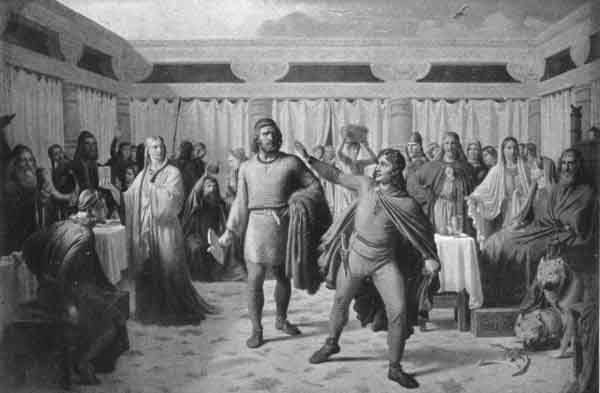
LOKE AT ER'S FEAST<BR> <I>From the painting by Constantin Hansen</I> LOKE AT ER'S FEAST
From the painting by Constantin Hansen

"If I had here in er's hall a son like to Balder, who is dead, thou wouldst never go from hither, for in wrath thou wouldst be slain."

"Ha!" cried Loke, leaping to his feet; "is it thy will, O Frigg, that I should speak further? Now hear and know that I am the cause of Balder's death. To Hela was he sent by me, for to Hodur did I give the mistletoe arrow that struck thy son down."

The gods seized their weapons to attack their evil reviler, when suddenly thunder pealed in the hall, and Thor stood there in their midst.

Now Loke knew well that the gods sought not to defile the dwelling of er by shedding blood. So he went and stood before Thor, whom he addressed, saying: "Dost thou remember, O Asa-Thor, when thou didst hide with fear in the thumb space of Skrymer's glove?"

"Silence, thou evil one," roared Thor, "or else with my hammer shall I strike thy head off and end thy life!

Then did Loke answer humbly. "Silent indeed I shall be now, O Thor, for I know well thou shalt strike."

So saying he left the hall. But the gods rose to pursue him, so greatly angered were they because that he had caused Balder's death. But Loke assumed the guise of a salmon and escaped through the sea, and in vain they sought him. Never again could he enter Asgard.

The gods took counsel together and decreed that Loke should be bound because of the many evils he had done, and especially because he devised the death of Balder. They searched for him in Midgard and in Jotun-heim, but found him not, for a cunning retreat had Loke discovered. In a cliff he dwelt behind a great waterfall. Four doors there were in his cavern, and they were ever kept open, so that he might make quick and sure escape. There he devised plots to overcome the Asa-gods.

But wearily passed the days of his solitude. One morning he took flax and yarn and fashioned a net with which to capture fish, and in the manner which he made it have fishermen ever since fashioned theirs. He took pride in his cunning work, but for what end he devised it no man knoweth.

Meanwhile the gods sought greatly after him. Then Odin mounted his golden throne and looked over the nine worlds, searching for the place in which Loke was hidden. He saw the cavern behind the waterfall. He perceived Loke sitting within. Then he called the gods and told them where the Evil One could be found.

Then set they forth and made cunning approach to the cavern. They divided to enter all the four doors.

Loke perceived them, but not until they were very nigh to him. Then he flung his net upon the fire, and in salmon guise leapt into the pool which was below the waterfall. There he concealed himself betwixt two stones.

When the gods entered the cavern they knew that the Evil-worker whom they sought was not far distant, for the fire still smouldered. Kvasir, son of Njord, who was keen-eyed as Heimdal, at once beheld on the white embers the ashes of the net which Loke had made. So the gods sat down and speedily they wove another of like kind. When it was finished they threw it into the stream, knowing that he whom they sought was there. But the net went over Loke.

Then did the gods take the net a second time, and weighted it with stones so that it could be dragged along the stream's bed. Loke divined their purpose and leapt over the net into the waterfall.

But the gods espied him, and Thor went into midstream so that he might not escape. On either bank did the avengers drag the net towards the pool.

Loke perceived that there were but two means of escape left to him. One was to again leap over the net; the other was to swim out to the sea and brave the perils that are there. He chose to leap. But he escaped not, for Thor grasped him in his hand. In vain Loke sought to wriggle free, but Thor closed his strong fingers over his tail. That is why the salmon's tail has been narrow since that day.

When Loke found he could not escape, he assumed his wonted shape. Then did the gods do as Frey had threatened at er's feast. Him they bore unto the place where his son the wolf Fenrer was already bound on the geyser-sprayed island in the gulf of Black Grief.

Loke's two sons, Vali and Narvi, followed him, as did also gentle Sigyn, his wife, whom he had despised and wronged. Incantations were sung over Vali, and he became a fierce wolf. Upon his brother Narvi he sprang and tore him to pieces.

Then did the gods lay Loke on three sharp-edged rocks next to the Fenrer wolf. With the sinews of Narvi (the binder) they made chains which were like iron, and with these they bound the Evil One securely.

Skade came from her mountain home rejoicing because that he who had caused the death of her father, Thjasse, was at length overcome. She bore with her a poisonous snake, and bound it on the rock above Loke's head. From its jaws dropped burning venom, which tortured the Evil One with great agony.

Then took the avengers their departure, leaving Loke in torment.... His faithful wife Sigyn remained behind. Over Loke's head she is ever holding a goblet to receive the dripping venom. So does she constantly guard her evil husband. But when the vessel is filled to the brim she must needs bring it down, so that it may be emptied. Then do venom drops fall upon Loke's face, burning him fiercely. . . . When that happens he struggles madly with his bonds, and the rocks shake and Midgard trembles to its foundations. . . . It is thus that earthquakes are caused.

On the island of the Gulf of Black Grief must Loke and the Fenrer wolf remain until Ragnarok. The wolf dog Garm shall bark aloud when they escape from their bonds.

Footnotes

1 According to Geoffrey of Monmouth, the mythical Belinus, King of Britain, made in London a gate of marvellous workmanship "which the citizens do still in these! days call Billingsgate".
2 "They went forth to the war, but they always fell."--Macpherson's Ossian. The reference is to Scandinavian invaders. Matthew Arnold applied the quotation to the Celts.
3 Jack the Giant-killer.

Teutonic Myth and Legend: Chapter 14 The Great Stone Giant

TEUTONIC MYTH AND LEGEND

by DONALD A. MACKENZIE

An Introduction to the Eddas & Sagas, Beowulf, The Nibelungenlied, etc.

London, Gresham Publications 1912

CHAPTER 14

The Great Stone Giant

Odin in Jotunheim--Two Swift Steeds--Race to Asgard--The Boastful Giant--His Challenge to Thor--An Island Duel--The Clay Giant--A Lightning Conflict--Thor is wounded--His Son Magni rescues Him--Groa's Incantation--Story of Orvandel's Rescue--The Spell is broken--Odin as the Ferryman--How he taunted Thor--A Divine Comedy.

THOR was in the east battling against the Trolls when Odin went forth from Asgard towards the dwelling of Hrungner, the great Stone giant of Jotun-heim.

Hrungner watched him coming through the air in splendour and beauty, and he cried: "Who cometh towards me? On his head is a helmet of gleaming gold. He rides over ocean and high upon the air. Swift indeed is his mighty steed."

Ere the giant was silent the ruler of Asgard was nigh to him, and he spake proudly. "In all Jotun-heim," Odin said, "there is not a horse that is Sleipner's equal."

Then twitching the reins, he turned Sleipner back towards Asgard, and he rode swifter than the wind.

"Thy steed is fast indeed," the giant bellowed, but my nimble-footed Goldfax (gold mane) hath greater stride."

As he spake, Hrungner leapt upon his horse's back and set out in swift pursuit of the Asa-god. But although he urged Goldfax to hasten, he could not win nigh unto Odin. Yet would the giant pause not in his speedy flight, for his heart was afire with ambition to prevail over the rider of Sleipner. Swiftly indeed he rode, and ere he was aware he found himself entering the gates of Asgard over the gate-bridge which had been set down for Odin.

By the gods was he received with hospitality as he demanded. They took him to the great feasting hall, and there he drank ancient mead and sweet. The bowls from which Thor was wont to refresh himself were placed before him, and Freyja filled them. Each of the bowls the giant emptied in turn at a single draught. Indeed, so much did he drink that the mead surged in his veins and his eyes rolled with redness, for he was made drunk. Then was his tongue unloosened, and he gave forth loud boastings.

"Valhal," he cried, "shall be mine. . . . The warrior's hall must I carry away with me to Jotun-heim."

More mead did Freyja pour out to him, filling the bowls of Thor.

Then Hrungner boasted that he would bring utter ruin to Asgard, and cast down its wall and palaces.

"The gods," he cried, "and all that are within the city shall I slay save Freyja and Sif."

As Freyja filled the bowls he said: "Ha! all the mead in Asgard I must consume this day. None shall I leave for the gods."

Weary grew the gods of the braggart giant and his vain boastings, and Thor they named. . . . Immediately Thor was in their midst. Black were the brows of the thunder-god when he beheld Hrungner; white were his knuckles as he clutched his great hammer.

"Who hath permitted this Jotun," Thor roared, "to drink the mead of Asgard? Why doth Freyja pour it forth to him as if she were honouring a feast of gods?"

Evil was in Hrungner's eyes as he scowled at Thor, "By Odin's wish am I here," he sneered, "and under his protection I remain."

"When thou dost seek to go forth," Thor growled sullenly, "thou mayest regret the invitation."

"Unarmed have I come," Hrungner protested with sudden alarm, "and of little honour would it be to thee, O Asa-Thor, if thou didst slay me now. If thou wouldst fain put thy valour to proof, thee I dare to contend against me on the borders of my kingdom."

Thor cast at him defiant eyes, and the giant was troubled. "Alas!" he cried; "I have done foolishly to come hither, leaving my stone shield and my flint weapon in Jotun-heim. Were I armed, we might well fight. This shall I say unto thee, O Asa-Thor: I would brand thee as a coward if thou didst seek to slay me undefended. . . . I challenge thee to contend with me in an island duel."

Now never before had Thor been challenged thus. For the island duel (Holmgang) which Hrungner desired was fought by dealing blow for blow, and the Asa-god would have the right to strike first because he was challenged by the other. In the contest each would have a shieldbearer. His consent did Thor give to the giant's terms, and in silence they parted.

Through Jotun-heim the duel challenge was gravely debated by the giants, and keen was their desire that Thor should be worsted, because Hrungner was their strongest and greatest warrior, and they feared that if he fell the thunder-god would do them more injury than heretofore.

On an island on the borders of rocky Grjottungard, where Hrungner had his dwelling, the Jotuns made a giant of clay who was in height nine miles, and three in breadth between the shoulders. Him they called Mokker-kalfi (Mist-wader), and they gave him a mare's heart. He was shieldbearer to Thor's enemy.

Now Hrungner had a heart of stone; his head was of stone also. Broad and thick was his stone shield, and in his right hand he grasped his great flint weapon, which he swung over his shoulder. A terrible combatant was Hrungner.

To the island duel did Thor set forth. His shieldbearer was his faithful Thjalfe, son of Orvandel, who ran swiftly to the place of combat. To Hrungner he cried:

"Although thy shield is held in front, thou dost stand unprotected, for Thor cometh to attack thee from the earth beneath."

Then did Hrungner cause his shield to be cast down, Defiantly he stood upon it, while with both hands he grasped his great flint weapon.

In fear and trembling was Mokker-kalfi. His mare's heart quaked within him because Thor was coming, and sweat ran from his body in torrents.

Thunder broke forth and lightning flashed before Hrungner. Then he beheld rushing swiftly towards him the black-browed thunder-god, who swung his hammer to strike. Nor did Hrungner wait till he was nigh. He raised his great flint weapon and flung it with might against Mjolner, which Thor, divining his purpose, hurtled simultaneously. In mid-air the weapons met and flashed forking fire that rent the heavens and covered the ocean with flame. The flint was utterly shattered. On the ground fell a portion, and there to this day are the flint hills, and a great splinter pierced the forehead of the Asa-god, so that he was thrown down.

Meanwhile the sublime hammer smote Hrungner and crushed his skull, and he fell also. The giant's foot struck Thor and lay heavily upon his neck, so that he could not rise to his feet.

On the affrighted Mokker-kalfi had Thjalfe flung himself, and him he overcame right speedily. Then ran he to help Thor, but in vain he strove to lift Hrungner's foot from his neck. . . . He named the Asa-gods, and they hastened from Asgard to the place of combat. When they found that Thor was cast down, they put forth their strength to free him, but unable were they to lift the giant's foot.

Then came Thor's son, Magni, whose mother was Jarnsaxa, the iron-crusher of the World-mill. He was but three nights old, but had already exceeding great strength. The giant's foot he seized and flung it from his sire's neck, saying:

"Alas! I should have come sooner. Hrungner's head would I have broken with my fist!"

Thor leapt up, and his arms he threw about his son, embracing him with great love.

"To thee, O Magni," he said, "I shall give Goldfax, Hrungner's great steed."

But Odin was ill-pleased with Thor, and to him he said: "Thou hast done wrong to give unto a Hag's son the speedy horse of the giant. 'Twere better if thou hadst gifted it to thy sire."

In wrath he turned away with the gods of his clan, and went towards Asgard.

Now the day of the great island duel was long ere the time when the sons of Ivalde waged the winter war against the Asa-gods. As Thor returned towards Orvandel's dwelling, his resting place on the borders of Jotun-heim, where he was wont to leave his swift, strong goats and his sublime car, he met with Orvandel, who was in great peril, The elfin archer had gone forth to fight against the Frost-giants, but with ill success as it proved, for they pressed nigh to him and sought to take him captive.

Thor rescued his friend speedily, and placed him in the meat basket, which he carried on his shoulders, as he waded through deep Elivagar. Orvandel thrust a toe through a hole, and a spell was put upon it by the giants, so that it was frozen. Then did Thor snap it off and fling it high in the heavens, where it became a bright star, which unto this day is called "Orvandel's Toe". Thus it was that the elfin archer (Avo) became a star hero.

When he parted with Orvandel, Thor yoked his goats, and in his sublime car he hastened towards his dwelling in Thrud-Varg. In grievous pain was he because of the wound which Hrungner had given him. Deep in his forehead was the flint flake embedded. In vain did Sith seek to alleviate his sufferings.

Now gentle Groa, Orvandel's wife, was dwelling in Thor's stronghold, as was her wont when her husband went forth against the Frost-giants. She had the power to work magic spells. She who was the "elf of growth" could make rocks to move, and she had power to arrest the turbulent floods. It was Groa who restored to strength those whom the Frost-giants had wounded, and it was she who gave beauty again to the places which they laid waste.

Unto Thor she came to heal his wound, and take from his forehead the splintered flint which stuck fast there. Incantations she sang over him. First she charmed away the pain which afflicted the god. Then the stone quivered and grew loose.

The heart of Thor leapt within him when he perceived that Groa would give him healing, and he was consumed with desire to reward her, and to gladden her heart without delay. So ere she sang further, he spake and she was silenced,

Of Orvandel's peril Thor gave Groa tidings, and of how he had rescued the elf from the power of the Frost-giants who encompassed him about. With joy was Groa's heart filled, but the spell she wrought was broken, and the memory of the magic song passed away. Thus was she unable to take from Thor's forehead the splintered flint, and there it ever remained because of his impatience to give premature reward.

So there was ever after weakness in Thor. Nor must mortal fling across his dwelling a flint weapon, lest the stone in the Asa-god's forehead be shaken, for then he would have suffering, and be moved to wrath against an offender.

Great were the deeds of Thor, which brought security to gods and men, for by him were the giants driven back and their power suppressed. Unto him, therefore, was willing service at all times rendered.

But there fell a day when Odin went forth from Asgard and towards the east. He saw Thor coming out of Jotun-heim, and sought to mock him so that he might have mirth.

Elivagar ran deep, and Odin waited on the opposite shore in the guise of Greybeard, the ferryman. Thor called upon him, but Odin refused to cross, whereat there rose a dispute between them. The valour of Thor did Odin question, and his feats belittle. With scornful laughter, too, did he receive the angry threatenings of the thunder-god.

"Nimble is thy tongue," cried Thor, "but it would help thee little if I waded across to thee. Louder than the wolf thou wouldst howl if I struck at thee with Mjolner."

"Better wouldst thou be engaged," Odin answered, "if thou didst hasten home; because there is one there whom Sif loves better than thee."

Thor was wroth. "Well dost thou know," he cried, "that thy cruel words sting me. A coward art thou who speakest what is untrue."

Odin answered: "Truly I speak indeed. . . . Thou art tardy in returning. Why art thou lingering on thy way? 'Twere better if thou hadst set forth on thy journey at early morn."

"'Tis thou who delayest me, villain," Thor answered wrothfully.

Odin smiled. "Can one of so little account as I am", he said, "delay the journey of the great Asa-god Thor?"

"Cease thy bantering," cried Thor; "hasten hither with thy boat, and thou shalt have the friendship of the sire of Magni."

"Begone!" cried Odin. "I shall not cross thee."

Then said Thor, with pleading voice: "Show me the ford then, since thou wilt not come over."

Odin wagged his head. "That is easy to refuse," he said. "The way is long. Thou canst go a little way this direction, and a little way in that; then thou canst turn to thy left till thou dost reach No-man's-land. There wilt thou meet thy mother, who shall guide thee unto Odin's land."

"Can I go thither to-day?" Thor asked.

Odin answered: "By sunrise, if thou dost travel quickly, thou mayest get there."

"Mocker," exclaimed Thor, "our talk is ended! Thou hast denied me crossing this day, but by the holy waters of Leipter, I swear that I shall reward thee indeed when next we meet."

Odin smiled: "Begone!" he cried; "and may demons seize thee."

Then took Thor his departure in great wrath, nor did he ever discover again the ferryman Greybeard who had mocked him and put him to shame.

Teutonic Myth and Legend: Chapter 13 Thor in Peril

TEUTONIC MYTH AND LEGEND

by DONALD A. MACKENZIE

An Introduction to the Eddas & Sagas, Beowulf, The Nibelungenlied, etc.

London, Gresham Publications 1912

CHAPTER 13

Thor in Peril

The Theft of Mjolner--Loke's Mission--Thrym demands Freyja--The Wrath of the Goddess--Thor disguised--Giant Bridegroom's Amaze--A Hungry Bride--The Hammer recovered --Vengeance of Thor--Loke in Geirrod's Castle--Plot to capture Thor--Grid intervenes--Vidar the Silent--Crossing Elivagar--The High Flood--Giant Maid is punished--Geirrod's Flaming Javelin--Thunder-god's Victory

Now there was a king of giants whose name was Thrym, and he desired to have Freyja, the beauteous Asa-goddess, for his bride. A deep plot he laid, nor did the gods become aware of it until a grievous misfortune befell Thor. He was returning with Loke from Jotun-heim, and together they lay down to sleep. In great wrath was the thunder-god when he awoke because he could find not his hammer, Mjolner. He grasped his red beard and shook it, and fear crept over him as he searched around and about, because without his hammer he was powerless to contend against the giants.

When the other awoke, Thor spoke to him, saying: "Listen to me, and I shall tell thee what is known not in heaven nor upon earth--Mjolner is stolen!"

Speedily they took flight towards high Asgard, and to the dwelling of Freyja went they. Thor spake abruptly, and said: "Wilt thou lend thy falcon-guise to me, for my hammer hath been stolen, and I would fain find it."'

"Gladly shall I give it thee, O Thor," Freyja answered, "even although it were made of silver; yea, if it were of fine gold thou wouldst have it without delay."

To Loke gave Thor the falcon-guise, and he flew speedily from Asgard to the northern coasts of distant Jotun-heim. Nor did he pause or stay until he reached a high mountain on which sat Thrym, king of giants, twisting bands of gold for his dogs, and anon smoothing the gold mane of his horse.

When he beheld Loke in falcon-guise he said: "How fare the gods, and how fare the elves? Why dost thou come alone unto these shores?"

Loke answered: "Ill fares it with gods and ill fares it with the elves. Hast thou hidden the hammer of Thor? "'

Thrym. answered boldly and with gladness: "I have indeed done so. Nine miles below the ground have I buried Mjolner. Nor shall it ever be recovered or returned unto Thor until I am given the goddess Freyja for my bride."

Having spoken thus he smoothed leisurely the golden mane of his fleet-footed steed, and Loke flew back towards Asgard.

Thor awaited him on the battlements, and when the falcon drew nigh he cried: "Hast thou indeed performed thy mission, O Loke? Tell me what thou knowest ere thou dost descend. What is spoken by one who sits is often of small worth. He who reclines is prone to utter what is untrue."

Loke answered and said: "I have discovered all that needs be known. Thy hammer hath been stolen by Thrym, King of Jotuns, and he hath buried it nine miles down below the mountains. Nor will he deliver it to thee again until Freyja is given him to be his bride."

Then Thor and Loke went unto Freyja and told her what the giant had said. Impatient, indeed, was the thunder-god, for he feared that if it became known to the Frost-giants that his hammer was lost they would fall upon Asgard and overcome the gods.

"Right speedily thou must don thy bridal attire, O Freyja," Thor exclaimed, "and together shall we hasten unto Jotun-heim."

Freyja was filled with anger, and as she raged she broke her flashing necklace that gave her great beauty. "A love-sick maid, indeed, I would be," she exclaimed, "ere I would hasten to King Thrym."

To the high Thingstead of Asgard went Thor, and the gods assembled there to hold counsel one with another and decide how the hammer should be recovered. To the hall Vingolf went the goddesses, to consult regarding the fate of Freyja.

In the Thingstead, Heimdal, the wise Van, the shining god, spake with foreknowledge and cunning, and thus he advised: "Let Thor be dressed in the bridal robes of Freyja, and let him also don her sparkling necklace, which gives its wearer great beauty. In a woman's dress let Thor go forth, with keys jingling at his waist. His hair must be pleated, and on his breast must be fixed great brooches."

But Thor made protest, and declared that the gods would mock him if he were attired in woman's dress. Ill-pleased was he with Heimdal's words. "Be silent, Thor," Loke exclaimed; "thou knowest well that if thy hammer is found not the Frost-giants will come speedily hither and build over Asgard a dome of ice."

The other gods spake likewise, and Thor consented to be attired as a bride. When this was done, Loke was dressed, at his own desire, as a maid attendant, and together they went forth from Asgard in Thor's sublime car. The mountains thundered and fire swept from the heavens over Midgard as Thor journeyed to Jotun-heim.

Thrym was sitting on the mountain top, and to the Jotuns about him he spoke, when he beheld Thor in female-guise coming nigh, saying: "Arise, O giants! let the feast be spread, for Freyja comes hither to be my bride."

Then were driven before him into his yard his red cows with golden horns, and his great black oxen.

"I have great wealth indeed," the king exclaimed; "all that I desire is mine. I lack naught save Freyja."

The feast was made ready, and at the board sat Thor, whom Thrym deemed to be Freyja, and Loke, who was "maid attendant".

Thor had great hunger, and he ate an ox, eight salmon, and all the sweets which had been made ready for the giantesses. Then he drank three great barrels of ancient mead.

Wondering, Thrym sat and watched him. Then he cried: "Hath anyone ever beheld a bride so hungry? Never have I known a maid who ate as Freyja hath eaten, or a woman who ever drank so great a quantity of mead."

Loke, the cunning one, fearing that Thor would be discovered, said: "For eight days hath Freyja fasted, so greatly did she long to come unto Jotun-heim."

Thrym was well pleased to hear what Loke said, and he rose and went towards Thor. He lifted the veil he wore and sought to kiss, but he shrank back suddenly. Indeed he retreated to the hall end, where he cried: "Why are the eyes of Freyja so bright and so fierce? They seem to glow like hot embers."

Then spake cunning Loke again, and said: "Alas! O Thrym, for eight nights Freyja hath slept not, for she longed to be here with thee in Jotun-heim. Thus are her eyes a-fire."

Thrym's sister then entered, and she went towards Thor humbly and with due respect, and asked to be given golden bridal rings from his fingers.

"Thou shalt gift them to me," she said, "if thou desirest to have my friendship and my love."

But naught did she receive from the angry and impatient god of thunder.

Thrym then desired that the wedding ceremony should be held, but Loke asked that as proof of his friendship, and to complete the bargain the giant had made, Thor's hammer should be laid upon the maiden's lap.

Then did Thrym order that Mjolner be lifted from its hiding place deep in the bowels of the earth.

In Thor's heart there was great laughter when Thrym spoke thus, yet was his mind solemn, and he waited anxiously until Mjolner was laid upon his knees.

A servant came forward with it, and Thor clutched the handle right eagerly. Then he tore off the bridal veil from his face and the woman's dress from about his knees, and sprang upon King Thrym, whom he killed with a single blow. Around the feasting board he went, slaying the guests, nor one would he permit to escape from the hall, so fierce was he with long-restrained wrath.

Thrym's sister, who had begged from Thor the bridal rings, he slew with the others. A blow she received from the hammer instead of golden treasure.

Cunning Loke watched with pleasure the devastation accomplished by the fierce thunder-god as he raged round the hall and through the castle, wreaking his fierce vengeance on the whole clan of Thrym.

Then together hastened they to where the goats were bound at the home of Orvandel, nor did they pause to rest. Across the heavens was speedily driven the black sublime car. Swiftly o'er mountain and sea it went, blotting out the sparkling stars. Mountains thundered and the wide ocean trembled with fear as the car rolled on. The earth was filled with fire.

Thus did Thor return in triumph unto Asgard, because Mjolner was recovered and the King of Mountain Giants was slain.

But although Loke had served Thor well when his hammer was stolen by Thrym, there came a time when he brought the god of thunder nigh to great misfortune. It was in the days ere the winter war was waged between the Asa-gods and the sons of Ivalde, and the cunning artisans were yet friendly with the dwellers in Asgard.

Loke had gone forth in the falcon-guise of Freyja to pry round Jotun-heim, and especially the castle of King Geirrod, whose daughter he desired for a bride. He flew towards a window, and sat in it while he listened to the words that were being spoken, and surveyed the guests who were there. A servant beheld him with curious eyes, and perceived that he was not a real falcon. So, making cautious approach, he seized Loke and brought him before the king. The eyes of the falcon were still the cunning eyes of Loke, and he was recognized by Geirrod, who demanded ransom ere he would release him. In vain did Loke endeavour to escape. He flapped his wings, he pecked with his beak, but the servant held his claws securely.

Silent was he before Geirrod, and no answer would he make when he was addressed. So to punish him the giant locked him in a chest, in which he was kept for three months. Then was Loke taken forth, and ready indeed was he to speak. To Geirrod he confessed who he was, and the giant constrained him to promise, by swearing a binding oath, that he would bring Thor to Jotun-heim and unto that strong castle without his hammer or his belt or his iron gloves. For greatly sought the giant to have the thunder-god in his power.

Loke then flew back to Asgard, and with great cunning he addressed Thor, so that he secured his consent to visit the castle of Geirrod without taking with him his hammer and gloves and his strong belt. For Loke assured Thor that the castle stood on a green and level plain, and that they were invited to attend together a feast of friends.

Thor set forth, and Loke went with him. All day they travelled on their way until they came to the borders of Elivagar in Alf-heim, where dwelt the sons of Ivalde.

There dwelt also in that realm and in the midst of a deep wood a giantess who was friendly towards the gods. Her name was Grid. She was the mother of Odin's son Vidar, the Silent One, whose strength was so mighty that none save Thor was his equal. A great shoe he had; its sole was hard as iron, for it was formed of the cast-off leather scraps of every shoe that was ever made. This son of Grid was born to avenge his father's death. When Odin is slain at Ragnarok, then shall Vidar combat with the wolf Fenrer and tear its jaws asunder. Nor shall Surtur destroy him with his firebrands, for the wood-god perishes never in Nature's deep solitudes.

Now Grid, mother of Vidar, had power to work magic spells, and she possessed a magic rowan wand which was named Gridarvold. When she beheld Thor going unarmed towards Geirrod's castle, she warned him that the giant was as cunning and treacherous as a wolf-dog, and dangerous to meet without weapons. So to Thor she gave her magic staff, her belt of strength, and her iron gloves, and when he set out he took with him the sons of Ivalde. Together they travelled in safety until they came to Vimur, which is the greatest of the rivers Elivagar. The clouds drove heavily above them, and hailstones fell around. Wild and mountainous was the country which Loke had said was green and level. There were swift and treacherous eddies in the swollen waters.

But Thor put on the belt of strength which Grid had given him, and in his hand he took her magic staff. Rapidly did the river rise as he entered it with his men. From the mountains icy torrents poured down with increasing strength, and the sons of Ivalde were soon in great peril. They thrust their spears into the shingle as they tried to ford the river, and the clinking of the steel mingled with the sharp screams of the waters. When they were but halfway across a high wave burst out from a great mountain torrent, and the waters rose to Thor's shoulder. The others were swept down towards him; for, perceiving their peril and desiring to be a protection to them, he had chosen the deepest part through which to wade. Orvandel leapt upon Thor's shoulder, and there stood, bending his bow. Loke and the others clung to the belt of Grid, which was about Thor's body. Towards the bank the thunder-god laboured, and when he came nigh to it he beheld, at the torrent's source a daughter of Geirrod, whose name was Gjalp. It was she who, standing high on the hillside, caused the river to increase so that Thor and his followers might be drowned. The angry god seized a boulder and flung it towards her. Sure was his aim, for it struck her heavily, so that her back was broken. Thus was the Hag overcome and the torrent stayed.

Then did Thor seize a rowan-tree branch which overhung the river, and with its aid he pulled himself up the bank. Thus had its origin the ancient proverb: "Thor's salvation, the rowan".

Up the steep mountain did the thunder-god climb with all his men. Against them came the giants who sought to destroy Ygdrasil, "the World-tree". Bravely fought Thor, and the arrows of Orvandel sped fast until the horde of giants were put to flight. Speedily did the heroes follow them. They pressed onward and reached Geirrod's castle amidst the clamour and the howling of the storm-giants and the giants that dwell within the caves of the mountains.

When Thor entered Geirrod's hall the giant king cast at him a red-hot flaming javelin from behind a great pillar of wood. But with Grid's iron gloves Thor caught it, and past Orvandel's head he flung it back, so that it went through the pillar and through Geirrod, who was slain; and it passed through the wall of his castle ere it sank deep into the earth.

Then loudly thundered the din of battle in Geirrod's hall, which was shaken to its foundations. With slings and boulders did the giants contend, but from Thor and his men they received their deathblows.

Thus was Geirrod and his clan overcome in dread conflict; but no less terrible was the battle which Thor waged against Hrungner, the stone-giant, the tale of which now follows.

Thor

I am the god Thor,
I am the war god,
I am the Thunderer!
Here in my Northland,
My fastness and fortress,
Reign I forever!

Here amid icebergs
Rule I the nations;
This is my hammer,
Mjolner, the mighty
Giants and sorcerers
Cannot withstand it!

These are the gauntlets
Wherewith I wield it
And hurl it afar off;
This is my girdle,
Whenever I brace it
Strength is redoubled!

The light thou beholdest
Stream through the heavens,
In flashes of crimson,
Is but my red beard
Blown by the night-wind,
Affrighting the nations.

Jove is my brother;
Mine eyes are the lightning;
The wheels of my chariot
Roll in the thunder,
The blows of my hammer
Ring in the earthquake!

Force rules the world still,
Has ruled it, shall rule it;
Meekness is weakness,
Strength is triumphant;
Over the whole earth
Still is Thor's-day!

Longfellow

Subscribe to this RSS feed

Log in or create an account