log in
LC Geerts

LC Geerts

Website URL:

Teutonic Myth and Legend: Chapter 12 City of Enchantments

TEUTONIC MYTH AND LEGEND

by DONALD A. MACKENZIE

An Introduction to the Eddas & Sagas, Beowulf, The Nibelungenlied, etc.

London, Gresham Publications 1912

CHAPTER 12

The City of Enchantments

Loke flatters the Thunder-god--The Feast of Goats--Loke's Evil Design--Journey in Jotun-heim--Terror of the Night--The Great Giant Skrymer--How Thor was thwarted--The Three Blows with Mjolner--Utgard-Loke's Castle--The Giant's Challenge--Loke and Thjalfe are beaten--Thor and the Drinking Horn--The Great Cat--Thor wrestles with the Hag--He is put to Shame--Utgard--Loke's Revelation--The Ocean, the Midgard Serpent, and Old Age--Wrath of the Thunder-god.

THE Frost-giants were sending forth from Jotun-heim ice-cold blasts which blighted Midgard's fields and arrested all growth. Thor, the friend of man, was made Wroth thereat, and he caused his swift goats to be yoked to his sublime chariot, for he was resolved to punish the Jotuns for their presumption and evil workings. To him came Loke and made flattering address, praising the thunder-god for his valour and good intentions. Thor took Loke with him because he had knowledge of the northern wastes they must needs traverse.

All day they journeyed from Asgard, and at nightfall they came to the dwelling of Orvandel-Egil on the batiks of Elivagar, and fronting the mountains that fortalice icebound Jotun-heim. The fare which Orvandel set before them was meagre because of the plunder accomplished by the giants, so Thor slew his two goats, and when they were skinned he placed their flesh in a kettle.

The feast that was thus prepared was abundant, and Thor invited Orvandel and his family to eat with Loke and himself, requesting them to throw each flesh-stripped bone into the skins of the goats.

It was Loke's desire to stir up enmity between Thor and Orvandel, who were fast friends, because at the house of the skilful archer did the thunder-god ever rest on his journeyings to and from Jotun-heim. The Evil One made Orvandel's son, Thjalfe, the instrument of his designs. To him Loke whispered at the feast that the marrow of the bones was of exceeding sweetness, and he constrained upon the lad to break open the thigh bone of a goat's hind leg.

Next morning Thor arose and took his hammer, Mjolner, which he waved over the skins filled with loose bones. Then did the great animals spring to life again, but one limped because a hind leg was broken. Thor was moved to immense wrath, and with black brows, and with knuckles that grew white as he clutched the handle of his hammer, he turned upon Orvandel, who was stricken with much fear. The house shook because of Thor's anger. But the evil designs of Loke were put to naught, for Thor consented to take for ransom-servants, Orvandel's son, Thjalfe, the swift runner, and his beauteous daughter, Roskva, the vivacious, and his love for them made stronger the bond of friendship between the thunder-god and Orvandel.

Leaving his chariot and goats behind, Thor went on his journey with Loke and Thjalfe and Roskva. Soon they came to a great mountain forest, and through its immense depths they wandered until night came on. Fleet-footed Thjalfe carried Thor's meat sack, but it was wellnigh empty because it was difficult to hunt the deer in that confusing forest.

In the darkness they all sought a dwelling in which to rest, and ere long they found one, The door was exceedingly large, for it opened up the whole side of the house. Within there was a vast hall. Beyond were five long rooms like to mountain caves; but they entered them not. In the outer hall they prepared their couches and lay down to sleep.

In the middle of the night a great earthquake made the forest tremble, so that the house shook with much violence.

Then Thor arose and sought for his affrighted servants a place of greater safety. So they entered together the widest of the cave chambers in the vast house. Thor stood at the door on guard, with his great hammer in his hand, ready to strike down any fierce giant who would dare to enter. The others crept to the farthest end of the chamber, and, trembling greatly, again sought their couches.

Then was heard a rumbling and a roaring that continued long and then ceased awhile, but began again, It was a night of blackness and great terror.

At early dawn Thor went forth, for the clamour had not yet ended. He walked through the forest and found that a great giant lay sleeping on the ground. He snored as loudly as roars the outer sea, and his breath burst forth like wild gusts of tempest. Then did the Asa-gods realize from whence came the clamour which had filled the night with terror.

Around his waist Thor tightened his magic belt so that his great strength was increased, but as he grasped his hammer to strike, the mighty giant awoke, and rose hastily to his feet. High above Thor he towered, so that the thunder-god was filled with amaze at his great bulk and forgot to wield his hammer.

"What is thy name, O giant?" Thor asked.

"My name is Skrymer," was his answer, and he said: "Thine I need not ask, for I perceive thou art Asa-Thor."

Then the giant looked about him, and sneered: "But what hast thou done with my glove?"

Skrymer stretched forth his hand, and in the midst of the trees he found his glove and picked it up. Then with amazement did Thor perceive that it was the great dwelling in which, with his companions, he had found shelter for the night. The broad cave chamber into which they had crept was the thumb of the giant's glove.

Skrymer besought Thor to take him for his travelling companion through that vast country, and when the Asa-god gave his consent, the giant opened his meat sack and began to munch his morning feast. Thor and his companions did likewise in a place apart.

Now when they had finished their meals and were satisfied, Skrymer said they should put their food together. Thor was willing that such should be done, and the giant thrust all the provisions into his own meat sack, which he threw over his back.

All day long they travelled eastward with great speed, because of the rapid pace of the giant, and when darkness began to fall they rested under the branches of a vast and lofty oak tree. Skrymer said he was weary and must needs sleep, so he flung his meat sack to Thor, and bade him feast with his companions. But Thor found that the sack was bound so securely that he could not untie it. Each knot defied him; not one could he unloose; and struggle as he might, he was unable to slacken any portion of the cord.

Great wrath possessed the Asa-god because of the deceit which had been practised upon him; so, casting the sack from him, he sprang up and seized his hammer. He went swiftly towards the giant as he lay snoring heavily, and on his skull struck a mighty blow.

Skrymer awoke, and, rubbing his eyes, asked if a leaf had fallen down from the great oak. On Thor he gazed, and asked him if he had eaten his supper, and was ready for sleep.

Thor made answer gruffly that he was about to lie down, and went towards another tree. But there be found that it was not possible to get sleep, for Skrymer snored so loudly that the woods were shaken with tempest clamour.

Angrily rose the Asa-god, and hastening towards the giant he swung his great hammer and struck him flat on the forehead. So great was the blow that Mjolner sank down to the heft.

Skrymer awoke suddenly and growled: "What hath happened now to disturb my slumber? Did an acorn fall down from the branches? Is that thee, Thor, standing nigh me? How fares it with thee?"

"I have just awakened," was Thor's answer, as he turned, wondering greatly, and again lay down beneath his oak. But he sought not to sleep. He was resolved to be avenged on the giant for his deceit, and because his own rest was broken. As Thor lay there he was convinced that if he dealt but one more blow on the giant's skull he would kill him. So he remained watching and waiting until Skrymer would again fall to sleep. Ere dawn broke his opportunity came, for the giant's loud snoring once more made fearsome clamour in the forest.

Thor arose and tightened his strength-giving belt. His iron gloves he put upon his hands, and seized his mighty hammer. Then he went towards the giant and struck so great a blow that Mjolner was buried in one of his temples.

Skrymer sat up, rubbing his eyes. Then he stroked his chin in vacant wonder, and, seeing Thor beside him, said--"Do birds sit above me in the oak branches? Methinks that some moss from a bird's nest fell upon my forehead as I awoke. . . . So thou art also awake, O Thor. . . . The dawn has broken, and it is time to set forth upon your way, for a long journey lies before thee ere thou shalt reach the castle which is called Utgard (outer-ward). Whispers I have heard between thee and thy companions that ye regard me as one of no mean stature, but larger men shalt thou find when thou dost reach Utgard. . . . Wilt thou take from me good advice? When thou comest to Utgard, do not boast overmuch. The courtiers of Utgard-Loke, will not permit of boasting from such insignificant beings as are thou and thy companions. . . . If my advice is not pleasant to thee, O Thor, thou hadst better turn back; and, indeed, that is what thou shouldst do. . . . But if thou wouldst go farther, thy way lies eastward; mine is to the north, towards yonder high mountains. Fare thee well!"

When he had spoken thus, Skrymer flung his meat sack over his shoulder and vanished amidst the trees. Nor was it ever known whether or not Thor desired to meet with him again.

Thor and Loke went eastward upon their way, and with them went Thjalfe and Roskva. They journeyed until midday, when they came to a city in the midst of which was a great ice castle. So lofty were its towers that Thor and those with him had need to bend back their heads to survey it aright. They saw no one nigh to the castle, and its ponderous gate was shut and securely locked. In vain did Thor attempt to open it; but being anxious to gain admittance he crept between the bars. The others followed him. They then perceived that the palace door was wide open, and they entered together.

Round the hall many giants of immense stature were seated upon benches. No word was spoken nor greeting given, but Thor and his companions went past, and entering a wide room they stood before King Utgard-Loke in his high throne, and to him they made obeisance. A cold look gave the monarch, nor did he return their salutations. After a long pause he spake with a voice of keen scorn, saying:

"It would be wearisome to have tidings of your long journey. If I be not mistaken the greatest of the striplings who stand before me is the Asa-god Thor."

Upon Thor he gazed intently, and then addressing him, said: "It may be that thou art stronger than thou dost seem. What feats art thou able to perform? Thou must know that no one can remain here who cannot perform deeds which excel those of all other living beings."

Wroth was Thor and made no answer. But Loke spoke and said: "I know a great feat, and am ready to perform it. I can eat quicker than anyone else, and I am now an-hungered and ready to give proof of that against him who may be chosen to contend with me."

"If thou shalt do as thou sayest," Utgard-Loke said, "thou shalt perform a great feat indeed. Let us have trial of it without delay."

The king ordered Loge, one of his men, to come forward to compete with Asa-Loke.

A great trough of meat was prepared, and the two were seated-Loke at one end and Loge at the other.

Then they began to eat with great speed, nor did they falter until they met at the middle. To neither seemed the victory, until it was found that Loge had consumed the bones as well as the flesh, and the trough also, while Loke had eaten but the flesh. So the Asa-god was accounted beaten.

Utgard-Loke then addressed Thjalfe, and asked him what feat he was able to perform, and the young man answered that he was a swift runner. He offered to run a race with anyone whom the monarch would select.

"If thou dost win," Utgard-Loke said, "thou shalt indeed perform a wondrous feat. But come without, for thine opponent awaiteth thee."

The king left his throne, and together they all went to a fine racecourse that lay nigh to the castle walls.

A dwarf named Huge was called forth by Utgard-Loke. Thrice did he run with Thjalfe. At the first contest the dwarf ran so fast that he met the other as he turned back.

"Thou canst run well," the king said to Thjalfe, "but thou must needs be more nimble-legged if thou art to win this contest, for there is no swifter runner than Huge."

At the second trial Thjalfe went speedier, but he was a bowshot space behind the dwarf when that swift runner made pause.

"Indeed thou must needs have greater speed if thou wouldst win the race," said the king to Orvandel's son; "but another chance awaiteth thee. The third trial shall decide the contest."

Again the race was started; but if Thjalfe went swiftly there was more speed in the dwarf, for he reached the goal ere yet his opponent was halfway.

So was Thjalfe vanquished and put to shame.

Together they all returned to the hall, and the king, turning to Thor, asked him if he could perform any wonderful feats that day. The Asa-god made prompt answer and said: "I shall hold a drinking contest with anyone thou mayest select."

"First," said the king, "thy power must be tested."

To this condition Thor gave his ready consent.

Then came a cupbearer carrying an immense drinking horn, which he gave unto the Asa-god.

"He who trespasseth the laws of this place when at feast," the king said, "must needs drink from that horn. He who is a good drinker can empty it at a single draught. Some men, however, must make two attempts, but it is only the weakest who cannot exhaust it at the third trial."

Now Thor was tortured with exceeding great thirst after his long journey, and at first he deemed the horn not to be too large, although it had great length indeed. To his mouth he raised it, and drank deep, until his thirst was quenched; and he continued drinking until he was forced to cease and lower the horn. With great wonder he then perceived that the liquor seemed not to have diminished at all.

"Thou hast drunken well," the king said, "yet there is naught of which boast can be made. Had I been told that Thor would drink no more when in thirst I would not have believed it. But perhaps it is thy resolve to surpass thyself when thou shalt take the second draught."

Again did the Asa-god raise the horn with firm resolve to empty it. Ill-pleased was he with himself because he deemed he had drunk less than before. But that was not so, for when he had done his utmost the horn could be carried without spilling.

"Thou dost spare thyself indeed," the king exclaimed; "but if thou art resolved to empty the horn thou must pull with greater strength at thy third trial. If more skill at this feat is not shown by thee, methinks," the king added with scorn, "thou shalt be accounted a lesser man here than thou seemest to be among the gods in Asgard."

Angry was Thor because of the words which Utgard-Loke spake, and a third time he seized the horn and put forth all his power to empty it; but long and deep as he drank, be seemed not to exhaust it any.

He laid it down, and then he perceived that the liquor was slightly lower than before.

"No further trial shall I make," he said, as he thrust the horn back to the cupbearer.

"Ha! thou'rt of less strength than we deemed thee to be," exclaimed Utgard-Loke, smiling grimly at the thwarted Asa-god. "Yet, mayhap, thou wouldst try another feat to prove thy power, although I am assured that thou shalt have no better success."

But Thor was ready for any other trial. "I shall contend with whom thou wilt," he said. "Although I have failed with the horn, yet can I assure thee that the draughts which I have taken would not be counted meagre in Asgard."

"There is a trivial game which we play betimes," the king said, "but I would not have asked thee to perform it, because among us here it is only an exercise for children. Yet as thou art, it seems, not of so great power as we deemed heretofore, thou hadst better try it. The game is merely to lift my cat from the floor."

As he spake, a big grey cat leapt forward and sat before the throne. Thor at once went towards it, and grasped it firmly, placing his hands under its body. Then he attempted to lift the cat, but it bent its great back, and although he put forth all his strength Thor could lift but one paw from the floor.

Knowing well that he could not do better, he made no farther attempt.

"Thou hast failed, as I foresaw thou wouldst," the king said. "The cat is too large for Thor, who is weakly and small compared with the men of my race.

"Say what thou wilt," cried Thor, whose wrath was great because of the shame put upon him, "but I now challenge anyone here to wrestle with me whom ye call weakly and small."

Utgard-Loke looked calmly about him, and answered with chilling voice: "I see no one nigh me who would not deem it an unworthy thing to wrestle with Thor. . . . But let the old woman, my nurse, whose name is Elle, be called, and if Thor would perforce wrestle, let him try his strength against hers. Many a stronger man than he hath Elle thrown down."

Then came into the hall an aged woman, who was toothless and heavily wrinkled. Her back was bent, and she walked slowly. Utgard-Loke bade her wrestle with Thor.

There is little to tell. The firmer Thor clutched her the mightier she became; the stronger his grip, the more securely did she stand. The struggle was long and violent, and although Thor realized ere long that he could. not overcome the Hag, his endeavour was to prevent her from casting him down. Yet was he at length unable to keep his footing, and he was brought to his knee.

Then did Utgard-Loke bid the wrestlers to cease, and walking forward he placed himself between them. To Thor he said: "Thou canst not ask now to wrestle with anyone else in the hall, for the hour is late and darkness is falling."

Nor did he seem to be eager that Thor should have further trial of skill.

At dawn of next day Thor and his companions arose and prepared to take their departure from the castle. Food and drink in plenty were placed before them, and they made hearty feast. Then went they to take leave of the king, and Utgard-Loke walked with them until they were without the gate of the city. Ere they bade one another farewell, the king asked Thor if he was satisfied with his journey and the results thereof, and whether there were any others among the Asa-gods who were stronger than he.

"I cannot deny," Thor said, "that great shame has been put upon me. But what pains me most is that thou shouldst call me a man of little account."

"Be not mistaken," the king said, "for we hold thee in greater account than thou dost deem. Now must the truth be told, seeing thou art no longer in the city which, if my will shall prevail, thou must never enter again. This I swear: if I had known that thy strength was so mighty thou shouldst never have been allowed to come through the castle gate. Nigh, indeed, didst thou bring me unto a great disaster.

"Thou mayest now know," the king continued, "that I have all along deceived thee greatly with my illusions."

Thor stared with much amaze at Utgard-Loke, who spake thus:

"First, it was I whom thou didst meet with in the forest. My meat sack thou couldst not unloose because I had bound it securely with a rope of iron, and thou couldst not discover how the cunning knots were devised.

"Thrice thou didst strike me with thy great hammer.

From any of these blows of thine I would have received speedy death, but thee I deceived by creating an illusion and placing betwixt thee and me a great rocky mountain, which thou didst cleave with thy blows. On thy way back thou shalt see it, and the three broad valleys thou didst make, for thrice thou didst cut it asunder.

"In my palace I did also deceive thee with illusions. Asa-Loke, like hunger, devoured speedily all that was placed before him; but his opponent Loge, who is Fire, consumed not only the food, but the bones also, and the trough.

"Huge the dwarf, with whom Thjalfe ran, is Thought. Swift indeed must the runner be who is more speedy than Thought.

"Then came thine own feats, O mighty Thor. When thou didst attempt to drain the horn, thou didst perform a feat so wonderful, that if I had not beheld it with mine own eyes I should ne'er have believed it to be possible. For the horn was long, and one end reached out to the sea, which thou didst not perceive, and the sea filled it. When thou dost come to the shore thou shalt realize how much thou hast made the sea to shrink, for thy great draughts have caused what men shall henceforward call the ebb.

"No less marvellous was thy struggle with the great cat. Much fear possessed us when we saw thee lift but a single paw from the floor, because the cat was no other than the Midgard serpent, which encircles the earth. So high didst thou lift him that his head reached unto heaven.

"Great indeed was thy feat also when thou didst contend against the old woman, my nurse. No man ever before prevailed so wrestling, nor shall any man ever again do as thou hast done, for Elle is Old Age, and sooner or later she lays low all who await her coming.

Still was Thor silent, for he was filled with great wonder by reason of the things of which Utgard-Loke spake to him.

"Now, O Thor," the king said, "we are about to part. This must I say unto you. It were better that we two should never again meet; but if thou shouldst come against me any more I must needs defend myself with illusions as I have already done, so that thou shalt never seem to thyself to prevail."

When the king spake thus he vanished from before the eyes of Thor and his companions.

Then was the thunder-god moved to great wrath, because he had been deceived, and seizing his mighty hammer he turned towards the city again to wreak his vengeance upon Utgard-Loke and his people. But he found that city and castle had vanished, and he beheld nothing save a broad level plain.

So with his companions Thor then went gloomily on his way, and pondering over what had happened he resolved to combat with the Midgard serpent from Hymer's boat. And of this adventure the tale has been told, but of how Thor lost his great hammer and the strange adventure that ensued, the story follows.

Teutonic Myth and Legend: Chapter 11 Thor's Great Fishing

TEUTONIC MYTH AND LEGEND

by DONALD A. MACKENZIE

An Introduction to the Eddas & Sagas, Beowulf, The Nibelungenlied, etc.

London, Gresham Publications 1912

CHAPTER 11

Thor's Great Fishing

The Ocean Storm-god--His Hall--The Brewing Kettle--Ran and her Net--Her Nine Daughters--Thor and Tyr seek Hymer's Kettle--The Friendly Giantess--The Fisher of Whales--A Great Feast--Giant marvels at Thor--The Midgard Serpent--A Dread Conflict--Hymer's Terror--How Thor was baffled--The Broken Goblet--Hymer's Kettle captured--Flight of Thor and Tyr--A Running Battle--Mead for the Feast.

IR, the Ocean Storm-god, had long heard of the fame and wisdom of Odin and his Asa clan, and there fell a day when he went to visit them. Thus it came that vows of lasting friendship were sworn between them. The gods were in due season invited to a harvest-end feast in the dwelling of the storm-god in the midst of the Western Sea, and thither they journeyed together. It was from ir's hall that Thor and Tyr set forth to do valiant deeds in the realm of the giant Hymer.

The kingdom of ir is beyond Noatun, the safe ship haven of the god Njord, which ever had peace save when it was visited by Skade, "the stormy one". A fierce and aged giant is ir, with long and foam-white beard, and black is his helmet. When he rises in the midst of Ocean, cold-hearted and turbulent, he shatters fair vessels in his wrath. Many ships has Angerboda, Hag of Ironwood, driven by her wild easterly winds into the very jaws of ir.

In ir's hall gold is used for fire, and his brewing kettles seethe and boll like stormy seas. His wife is Ran, the fair traitress. She is possessed of a great net, in which she catches seafarers when their ships are broken. So are men "drowned to Ran". At the sea bottom is her home, which gleams phosphorescent and golden; its roof is of silver and sun-gemmed azure. Nigh is it unto the House of Death. Eager is Ran to make captives, and those who would win her favour must needs, when they are drawn down to her, take with them offerings of gold, for she loves treasure, and her hoard is great. To those whom she receives without anger she offers a seat and a bed.

Nine giant maids are the chief daughters of Ran, and these are the mothers of Heimdal, the shining sentinel of beauteous Bif-rost. In gowns of blue they go forth. They have foam-white veils, and their locks are pale as sea froth. The sea maidens are ever at ir's command, and by him are they sent abroad to be ship-tossing billows. Great rocks they love to scatter and throw down, and the shoreland they devour.

These giant maids at the beginning ground Ymer's body on the World-mill. And ever do they turn the great mill at the sea bottom. Angeyja and Eyrgjafa grind mould; Jarnsaxa is the crusher of the iron which comes from clay and the sea; Imder, Gjalp, and Greip are fire maids, for from the World-mill is fire sparked forth, and there is fire in the sea; Eistla, Eyrgjafa, and Ulfrun are also at work like the others. The sire of Gjalp and Greip was Geirrod, the fire-giant.

Now when ir went to Asgard he was received by Odin and the other gods with pomp and in state. Together they drank mead, ancient and sweet, in spacious Valhal, which was adorned with burnished shields and made bright by shining swords. High sat the gods in their doom seats, and in full grandeur. By Bragi's side was ir, and the sweet-voiced divine poet sang of Idun and her apples of immortal youth, and of Thjasse's death, and of how Odin took from Suttung's dwelling the skaldic-mead which Ivalde had stolen. Pleasant were the tales to ir, and the gods, as we have told, he besought to visit him in his Ocean kingdom.

Thither at autumn equinox went Odin and his Asa clan to drink mead and hear ancient tales and the singing of skalds. But of mead there was not sufficient, because ir was in need of a brewing kettle large enough to give due hospitality to the gods. He besought Thor to fetch the greatest kettle in the nine worlds; but nor Asa nor Vana-gods knew where it could be found until Tyr spake and said:

"Hymer, the dog-headed, my foster-father, hath the great kettle, which is exceedingly strong and a mile in depth. His dwelling is beyond the Rivers Elivagar, nigh to the borders of Nifel-heim."

"Thinkest thou that the kettle can be captured?" asked Thor.

"Yes," Tyr answered, "by stratagem it may be procured."

Then took Thor and Tyr the guise of young men, and they set forth in the thunder-god's chariot drawn by the two goats Tanngnjoster and Tanngrisner over ocean and through air. Nearly all day did they travel thus until they came unto the dwelling of Orvandel-Egil. There did Thor leave the horn-strong goats and his sublime car.

Across Elivagar they went, and past the vast fishing ground of Hymer, where he is wont to catch whales on great hooks. Then a great distance journeyed the gods on foot towards Hymer's dwelling through dense mountain woods and past dismal rocky caverns where dwell the fierce giants and monsters of Hymer's clan.

When they came to their journey's end, they entered the king giant's great stronghold, and there Tyr saw his grandmother--a giantess with numerous heads, who was fierce and awesome to behold. But his mother, who had great beauty, brought them mead to drink. When they were refreshed and strong again, she bade them hide behind a great post at the gable end, and beneath the Kettles of Hymer; because, as she warned them, the giant was wont to give ill treatment to strangers who came nigh to his dwelling.

At nightfall Thor and Tyr heard a mighty shout which was raised by the giant's servants. Whereat Hymer entered, carrying the whales he had caught. His long beard was white with hoar frost.

"Welcome art thou, indeed, O Hymer," his wife said. "My son, for whom I have long waited, has come to thy hall, and with him is one who is. an enemy of the giants and a friend of men. Behind yonder gable post have they with cunning concealed themselves."

Hymer was ill-pleased, and he turned fiercely towards the post, which suddenly went to pieces before his piercing gaze. Thereat the beam above it broke, and the Kettles fell down. Seven of them were thus broken, but one was so large and so strong that it was left whole, although it sank deep in the floor.

Forth then came Tyr and Thor. The giant had no pleasure in receiving them, but he bade them be seated at his table.

A great feast did he cause to be prepared. Three oxen were slain and roasted, and placed before the giant and the gods. Two of these did Thor eat, for he sought great strength. If the giant was angry before, he was still more angry when the meal was ended, for it was his purpose to slay his guests, as was his wont, if they failed to eat an equal share with him; but in this he was indeed thwarted.

Extravagant is our fare," Hymer growled n his displeasure; "on the morrow we must eat of fish."

Then to bed went they all, and sound was their sleep throughout the night.

At dawn Thor rose, and from the window he perceived that the giant was making ready his boat to go fishing. Hastily did the Asa-god dress himself. He placed his great hammer in his belt. He went towards the shore, and then he besought the giant to allow him to row with him in the great boat.

Hymer looked down upon him with contempt, and said: "Too small and frail art thou to be of help to me; besides, I row so far and stay at sea so long, that thou wouldst be chilled to death."

Thor answered: "I shall row as far as thou hast need of me, as far from land as is thy desire. Nor am I certain which of us twain would wish to return first."

The thunder-god was filled with wrath against the ice-giant because of his presumption, and was minded to strike him down with his hammer; but he remembered that he had need of all his strength elsewhere, and must not do aught to lessen it.

"What bait hast thou for me?" asked Thor.

Hymer answered with surly voice: "If thou wouldst fish, find thine own bait."

That Thor did with impatience. He hastened towards the giant's herd of great cattle, and seizing the largest bull, named Himinbrjoter, which signified "sky-cleaver", he snatched off its head and carried it towards the shore. Hymer watched him and received him in silence, and together they entered the boat and put to sea.

Both then seized the great billow-raising oars. At the bow rowed Hymer, and Thor was aft. So strongly did the Asa-god pull that the boat went through the water with great swiftness, whereat the giant was amazed. Endeavour as he might, putting forth his utmost strength, Hymer could not pull with half the strength of the Asa-god, who was still in youthful guise.

The giant at length grew weary, and when they reached the grounds where he was wont to catch flat fish, he bade his companion cease rowing. But that Thor refused to do.

"We have not yet," he said, "gone far enough to sea.

Soon they came to the grounds where whales are caught, and again the giant bade Thor to take rest, but he would not consent to do so.

"We must needs, Thor said, go much farther yet."

Farther and farther out to sea they rowed with exceeding great speed. Then was the cold heart of Hymer filled with sharp alarm.

"If we stop not now," he cried, "we shall be in danger of the dread Midgard serpent."

But Thor refused to pause, and rowed stronger and faster than before. Not once nor twice did Hymer, resting wearily on his oars, remonstrate with him, but in vain. Far out to sea the boat still sped, and rapid and strong were the oarsweeps of Thor. Nor did he pause until they were a great distance from land.

Then began the fishing. Hymer baited his hooks, and cast his line in the deep waters. Ere long he caught two great whales, and hauled them aboard. His eyes were bright with pleasure, and he turned towards Thor and challenged him to do as well.

Then did the great thunder-god get ready his fishing tackle, which was of great strength. An immense hook he baited with the head of Hymer's bull. Into the deep waters he flung his line, which, as it splashed, raised big billows, and he ran it out until the bait was dragged along the floor of the ocean.

Now right below the giant's boat lay the Midgard serpent, all slimy and horrible, on the sea bottom, with its mouth clutching the tail of its world-encircling body. When that great monster beheld the bait it was deceived, not perceiving that Thor's hook was within. Greedily it seized the bull's head and sought to devour it. Then did the great hook sink deep into its throat and stick there. Tortured was the serpent with terrible agony, and it began to writhe violently to be free; but its struggle was without avail. So the line it tugged fiercely to draw angler and boat beneath the waves.

But greater than the serpent's was the strength of Thor. With both hands the god grasped the line, and against the side of the boat he placed his feet and began to pull, twisting the line round the oar pins as he did so, and now and again making it fast. Violently rocked the boat, and the waves rose high, as the great Midgard serpent struggled with the thunder-god.

But Thor put forth his entire divine strength and he grew in stature as he pulled the line. At length his feet went through the boat's side, as it tilted over, and they reached to the ocean floor. Harder and harder he pulled, and unwillingly the serpent, stung with fierce pain, was hauled through the deep, until its monstrous head came in sight.

Awesome was the spectacle to Hymer, nor can words picture it. With fierce wrath did the thunder-god dart fiery looks at the serpent, while the great monster tossed on high its terrible head and spouted floods of venom upon him.

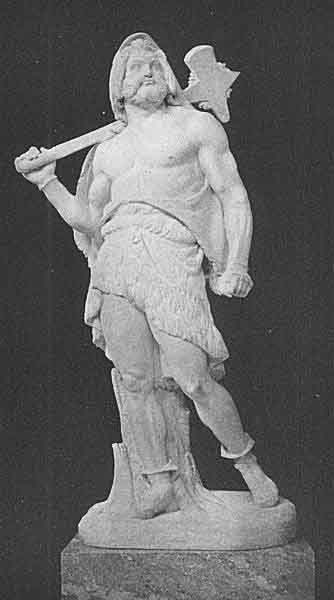
THOR<BR> From the statue by B. E. Fogelberg THOR
From the statue by B. E. Fogelberg

Hymer trembled with fear; his face was white as mountain snow. Scarce could he look upon the ferocious serpent, for ghastly it was, and bearded and venom-spotted. Great waves washed over the gunwale, and the giant feared that the boat would be swamped.

Still Thor struggled with the fierce monster until he dragged its head close to the edge of the boat. Then, twisting the line round the oar pin, he seized his great hammer and struck a mighty blow on the serpent's head.

The mountains shook with thunder, the caves howled loud, the ocean trembled with violence, and the whole world shrank together, but the Midgard serpent was not yet killed.

Thor prepared to strike another great blow, but Hymer in his fear cut the line, whereat the writhing monster sank back into the deep. The waves tossed high and the boat plunged with them.

Angrily Thor turned upon Hymer, and with his great right fist struck him a resounding blow. Headlong plunged the giant into the sea, but speedily and in great fear he scrambled back again into the boat. Yet if his fear of the serpent was great, no less was his fear of Thor.

Then set they to row back, and the boat went speedily. Thor spake not; he sat in sullen silence. Deep indeed was his wrath because he had slain not the serpent which ever threatened the gods in Asgard.

When the shore was reached the giant leapt out. Proudly he flung the two whales over his shoulder. But Thor carried the great boat, and went with it to the giant's stronghold.

They entered the castle. They sat down with Tyr beside them. Ill at ease was the giant because of Thor's great deeds, and him did he challenge to perform another feat of strength. He brought forth a goblet, and asked him to break it. Without rising from his seat, Thor flung it violently against a post, which was shattered in pieces; but the goblet remained whole, and it was brought back to the giant, who smiled well content.

Then Tyr's mother, whispering to Thor, bade him fling the goblet at Hymer's forehead, which was harder than aught else there. Thor did that right speedily. He seized the goblet, and struck the giant with it midway between his eyes. Nor broken was the giant's head, although the goblet fell shivered into small pieces on the table before him.

"A great treasure have I lost," Hymer cried. "Hot was the drink that came from my strong goblet."

The giant's heart was filled with anger against Thor, and him he would fain put to shame. So he challenged the Asa-god once again.

"One feat of strength remains for thee yet to do, thou boastful one," cried Hymer. "Seize yonder great kettle and carry it forth from my dwelling."

Tyr rose eagerly and ran to lift the kettle, which the gods waited for in ir's hall; but in vain did he try to lift it. Twice he made endeavour without avail.

Then did Thor seize the kettle. He grasped it at the edge and shook it violently. Then he began to lift it. So heavy was it, and so great was the strength of Thor, that his feet went through the floor.

Hymer watched him with angry eyes, fearing he would take with him the great treasure. That was what Thor did, for he lifted the kettle first upon his shoulder and then upon his head, while the rings fell round his feet.

Then he darted outside, and Tyr went with him.

Nor did they stay to await the giant, but right speedily they hastened on their way. Thor took also with him Hymer's great boat.

A great distance did the gods journey through the wooded mountain recesses, and then behind them there rose a great clamour. Hymer was hastening in pursuit. From the rocky caverns his foul and strange-headed clan were issuing forth, and following fast as well. They bellowed like winter tempests, and from hill to hill cliff their voices rang. Trees groaned and were bowed down, and the earth shook.

Thor looked back, and when he beheld the host pursuing him he put down the boat and the kettle, and seized his hammer, Mjolner. That murderous weapon did he fling against the giants, and they were mowed down by it as oat straw is by a scythe. Not until he had slain all those who fled not did Thor swing high the boat and the kettle upon his shoulders, and with Tyr again pursue his way.

Elivagar they could not have crossed in safety had they not had Hymer's boat, for the waves ran high because of the violent writhings of the Midgard serpent as it lay wounded by hook and hammer on the rumbling floor of Ocean.

In due time did Thor reach the hall of ir with the great kettle of Hymer. Then was brewed sufficient ale for the feast of harvest-end, and host and guests were made merry.

But Thor rejoiced most because of the blow he had struck the great Midgard serpent. For thus was he avenged upon it for causing his shame in the dwelling of the giant Utgard-Loke, who had so cunningly deceived him. Of that, his most strange adventure, the tale must next be told.

Thor's Fishing

On the dark bottom of the great salt lake
Imprisoned lay the giant snake,
With naught his sullen sleep to break.

Huge whales disported amorous o'er his neck;
Little their sports the worm did reck,
Nor his dark, vengeful thoughts would check.

To move his iron fins he has no power,
Nor yet to harm the trembling shore,
With scaly rings he is covered o'er.

His head he seeks 'mid coral rocks to hide,
Nor e'er hath man his eye espied,
Nor could its deadly glare abide.

His eyelids half in drowsy stupor close,
But short and troubled his repose,
As his quick heavy breathing shows.

Muscles and crabs, and all the shelly race,
In spacious banks still crowd for place,
A grisly beard, around his face.

When Midgard's worm his fetters strives to break,
Riseth the sea, the mountains quake;
The fiends in Naastrand merry make.

Rejoicing flames from Hecla's caldron flash,
Huge molten stones with deafening crash
Fly out,--its scathed sides fire-streams wash.

The affrighted sons of Ask do feel the shock,
As the worm doth lie and rock,
And sullen waiteth Ragnarok.

To his foul craving maw naught e'er came ill;
It never he doth cease to fill;
Nath' more his hungry pain can still.

Upward by chance he turns his sleepy eye,
And, over him suspended nigh,
The gory head he doth espy.

The serpent taken with his own deceit,
Suspecting naught the daring cheat,
Ravenous gulps down the bait.

His leathern jaws the barbed steel compress,
His ponderous head must leave the abyss;
Dire was Jormungander's hiss.

In giant coils he writhes his length about,
Poisonous streams he speweth out,
But his struggles help him naught.

The mighty Thor knoweth no peer in fight,
The loathsome worm, his strength despite,
Now o'ermatched must yield the fight.

His grisly head Thor heaveth o'er the tide,
No mortal eye the sight may bide,
The scared waves haste i' th' sands to hide.

As when accursed Naastrand yawns and burns,
His impious throat 'gainst heaven he turns
And with his tail the ocean spurns.

The parched sky droops, darkness enwraps the sun;
Now the matchless strength is shown
Of the god whom warriors own.

Around his loins he draws his girdle tight,
His eye with triumph flashes bright,
The frail boat splits aneath his weight;

The frail boat splits,--but on the ocean's ground
Thor again hath footing found;
Within his arms the worm is bound.

Hymer, who in the strife no part had took,
But like a trembling aspen shook,
Rouseth him to avert the stroke.

In the last night, the vala hath decreed
Thor, in Odin's utmost need,
To the worm shall bow the head.

Thus, in sunk voice, the craven giant spoke,
Whilst from his belt a knife he took,
Forged by dwarfs aneath the rock.

Upon the magic belt straight 'gan to file;
Thor in bitter scorn to smile;
Mjolner swang in air the while.

In the worm's front full two-score leagues it fell;
From Gimle to the realms of hell
Echoed Jormungander's yell.

The ocean yawned; Thor's lightnings rent the sky;
Through the storm, the great sun's eye
Looked out on the fight from high.

Bif-rost i' th' east shone forth in brightest green
On its top, in snow-white sheen,
Heimdal at his post was seen.

On the charmed belt the dagger hath no power;
The star of Jotun-heim 'gan to lour;
But now, in Asgard's evil hour,

When all his efforts foiled tall Hymer saw,
Wading to the serpent's maw,
On the kedge he 'gan to saw.

The sun dismayed, hastened in clouds to hide,
Heimdal turned his head aside;
Thor was humbled in his pride.

The knife prevails, far down beneath the main,
The serpent, spent with toil and pain,
To the bottom sank again.

The giant fled, his head 'mid rocks to save,
Fearfully the god did rave,
With his lightnings tore the wave.

To madness stung, to think his conquest vain,
His ire no longer could contain,
Dared the worm to rise again.

His radiant form to its full height he drew,
And Mjolner through the billows blue
Swifter than the fire-bolt flew.

Hoped, yet, the worm had fallen beneath the stroke,
But the wily child of Loke
Waits her turn of Ragnarok.

Teutonic Myth and Legend: Chapter 10 Loke's Evil Progeny

TEUTONIC MYTH AND LEGEND

by DONALD A. MACKENZIE

An Introduction to the Eddas & Sagas, Beowulf, The Nibelungenlied, etc.

London, Gresham Publications 1912

CHAPTER 10

Loke's Evil Progeny

Ironwood Brood--The Midgard-Serpent, Hel, and the Wolf--Odin's Acts of Vengeance--The Binding of Fenrer--Its Silk-like Chain--The Gulf of Black Grief--Its Island--How Tyr lost his Hand--Wolf-River Von--The Great Watchdog--Loke's Taunts--His Doom foretold--Human Sacrifices--The Runes of Tyr--Warriors' Sword Charm--Commander of the Valkyries.

Now by divination did Odin come to know that in Ironwood the Hag, Angerboda (Gulveig-Hoder) was rearing the dread progeny of Loke with purpose to bring disaster to the gods. Three monster children there were-Fenrer, the wolf; Jormungand, the Midgard serpent; and Hel. From these the Trolls are sprung.

Together the gods took counsel, and a Vala revealed dimly the fate that would be theirs if these monsters were not overcome, for the wolf, it was foretold, would slay Odin, Thor would fall in combat with the serpent, and Hel would come with the hosts of destruction against the gods and men.

So it was deemed of great import that the foul children of Loke and Angerboda should be brought to Asgard, and by Odin was Hermod sent to Ironwood to take them captive. That he did right speedily, bringing them one by one.

When Odin beheld the foul serpent, which was yet young, but of great length and very fierce, he seized it in his wrath and flung it far over the walls of Asgard.

Yet by reason of its terrible weight it did not pass beyond the world's edge, but fell into the depths of Ocean, where in after-days it grew and grew until it encircled the world of men. There on the sea bottom it lies, holding its tail in its mouth. When it shakes itself the waves rise in great fury and surge high upon the world's shores.

Next came Hel, and foul was she of aspect, for one-half of her body was of hue like to raw flesh, while the other was livid and horrible. In wrath did Odin seize her also, and he flung her afar. Beyond the edge of Ocean she went, falling through space, until she reached the black depths of Nifel-hel. There in the realms of torture became she a queen.

High are the walls and strongly barred the gates of her habitation, which is named Hel-heim and also Elvidner, the Place of Storm. The doomed have terror of her fearsome countenance, and of the place where she sits. About her are her servants, who do her will. Delay is her man servant and Slowness her maid servant; Hunger waits at her table, and her knife is Starvation. The threshold of Hel's home is Precipice, her bed is Care, while Burning Anguish forms the hangings of her apartment.

Unto Elvidner, as it hath been told, went the doomed ere they were committed to the realms of torture. By Hel were their punishments ordered according to the judgments passed upon them. And especially to her came trembling, warmen who died without valour and were unworthy, as did also those who were traitors in the hour of trial.

Now when the wolf Fenrer was brought to Odin, he sought not to destroy it. Indeed it was reared by the gods in Asgard; but when it grew large, it became so fierce that none save brave Tyr had courage to feed it. The day fell when Odin perceived that the wolf must needs be overcome, or else it would devour him. So prodigiously did it increase that there was terror in Asgard.

Then the gods caused to be made an iron chain which was named Leding. Tyr bore it to Fenrer, who knew well its purpose. Without resistance was it bound, and when that was done the gods were well pleased. Then rose Fenrer to struggle with the chain, which it snapped right speedily. So the wolf again went free, and grew more ferocious than ever.

Another chain, which was named Dromi, was thereafterwards made by the artisans of the gods. It had double the strength of Leding. Then went Tyr to the fierce wolf, and constrained it to be bound.

"If this chain by thee is burst," Tyr said, "then will thy mighty strength be proved indeed."

Well did the wolf know that the second chain was more powerful than the first, and that it could not easily be snapped. But much had Fenrer grown in bulk and in strength after Leding was broken. So the monster lay down, and, although somewhat afraid, allowed Tyr to fetter its legs. . . . The gods stood nigh and deemed the wolf secure forever. . . . They saw it rise and struggle fiercely without avail. Then it rolled upon the ground in monstrous strife, until at length the chain burst asunder and Fenrer was again free. More fierce than ever, and more terrible did the wolf become.

Thus had origin the proverb that men use in dire straits when they know that wondrous efforts must needs be made: "I must now get loose from Leding, and burst free out of Dromi".

In despair were the gods when they saw Fenrer again at liberty, and they feared he would never be bound.

Then did Odin give to Hermod his horse Sleipner, and him did the wise god send unto the Underworld, so that he might prevail upon the dark artisans of the gods to fashion the cord Gleipner, "the devourer".

Readily indeed did the cunning workers give Odin their service. Soft as silk was the cord they made, and light as air. When it was cast down it made no noise. Of six things was it made:

A mountain's root,
A bear's sinews,
The breath of fish,
A cat's footfall,
A woman's beard,
The spittle of birds.

"Of all these things thou mayest not have heard before," a skald has said, "yet a mountain hath no roots, fish breathe not, and cats make no noise when they run. Women have no beards, as thou hast seen.

Soft and smooth was the cord indeed but yet of exceeding great strength. Hermod bore it to Asgard with great speed, and by Odin was he thanked for his service.

Then did the gods challenge Fenrer to a supreme trial of strength. To the depths of Nifel-hel they went, and to the Gulf Amsvartner, which means "black grief". In the gulf is an island, and on the island a misty grove, with trees shaped from jets of water sent forth by boiling springs.

To the island did the gods take Fenrer, and they showed him there the cord Gleipner. Each of them in turn tried its strength but could not snap it.

"None but thee, O Fenrer, can break cord," Odin said.

The wolf answered: "Methinks no great fame can come to me from breaking such a cord, so light and slender does it seem."

Then with fierce eyes it spake thus: "If the cord is made with magic cunning, although it seems slender, never shall I permit it to bind my feet."

The gods answered, and said: "Surely Fenrer can burst asunder a cord both silken and light, when it hath already severed chains of iron."

The wolf made no answer, watching them sullenly with fiery eyes.

"If thou canst break this cord," Odin said, "then shall the gods know that they have no cause to fear thee, and then may well set thee at liberty."

The wolf answered sullenly, and said: "Much I fear that if I am fettered, and cannot free myself, thou shalt not haste to unloose me. Loath indeed am I to be bound with this cord. But I am not without courage. Know now that I shall give consent to be bound if a god but place his hand in my mouth, as a sure undertaking that ye practise no deceit towards me."

At one another the gods looked in silence. No choice had they between two evils, and they knew that the wolf must needs be bound.

Then stepped forth brave Tyr, the valiant god without fear, and between the fierce jaws of the monster wolf he placed his strong right hand. Thereupon the gods bound Fenrer with the soft silk-like cord of magic power. Securely they tied him; his legs they fettered so that he could not rise.

Holding Tyr's right hand in its jaws, the wolf then began to struggle with purpose to break free from the magic bonds. Great wrath possessed its heart because its efforts were vain. No loop could be displaced, nor knot unloosed. On its back and on its side it struggled in vain, for the more it sought to be free, the tighter became the cords. Blood streamed from Tyr's hand, and in the end Fenrer gnawed it off at the wrist.

When the gods perceived that the wolf was bound indeed, all of them save Tyr shook with great laughter.

A gallow-chain, named Gelgja, was then fixed to the cord, and the gods drew it through a black rock named Gjoll, which was sunk deep in the earth. The other end of the cord they tied to Thviti, a great boulder, which was buried still deeper. The wolf was then so well secured that it could not move. Yet it snapped its jaws, endeavouring to sever chains and cord; and, perceiving this, the gods thrust in its evil mouth a great sword. It pierced the under jaw up to the very hilt, and the point touched the monster's palate.

Then did the wolf's struggles come to an end, and horribly did it howl. Foam streamed from its mouth, and a roaring cascade began to fall, which ever after fed the great and turbulent River Von.

To guard the island of the Gulf of Black Grief the gods bound there, nigh to Loke's monster son, the great watchdog Garm, which is greater than Hate-Managarm, the moon devourer, so that it might bark with loud alarm if Fenrer broke free. There, too, beside the fettered wolf, was Loke bound in after days.

Now when Loke fell to dispute with Tyr he said: "Thy two hands thou canst not use, since thy right one was taken from thee by the wolf."

To him did Tyr make answer: "A hand I lack, but thou, O Loke, dost lack a good reputation. That is indeed a great defect. But the wolf fares not well.

On the island of the Gulf of Black Grief it shall pine, in fetters until the world's end."

Loke was angered and spoke bitterly. "Thy wife", he said, "loves me."

Frey cried: "Silence, thou mischief maker! I see Fenrer, thy offspring, lying fettered at the source of Von, where it shall remain until the gods perish and all things have end. If thy tongue is not silent, then shalt thou be bound also."

It was then that Loke taunted Frey for giving unto the giant Gymer the Sword of Victory as a gift for Gerd.

Wroth was Bygver, who served Frey, when he heard the words that Loke uttered. He it was who ground the barley for those who give honour to his master, the god of harvests.

"Were I the honoured Frey," he said unto Loke, "I would grind thee finer than sand, thou evil crow! I would crush thee limb by limb."

But Loke turned, with wrinkling lips and cold disdain, and said: "What child is this? What parasite starts up before me? Ever in Frey's hearing he clatters from under the millstone."

"My name is Bygver," the servant answered, "and by gods and men am I called nimble."

Loke answered: "Be silent, Bygver! never couldst thou divide fairly food between men. Ugly indeed is thy slave wife Beyla, who is ever filthy with dust and dirt."

Valiant was Tyr, whose sire was Odin and whose mother was a beauteous giantess of the deep. Brave men honoured him, and by Saxons was he called Saxnot. With Odin did heroes name him ere they entered battle, and when they were victorious they offered up to Tyr burnt sacrifices of war prisoners. On earth his temple symbol was the sun-flashing sword which he wielded, and on the swords of warriors were his runes graven. Thus hath a skald sung:

The runes of Tyr give victory
And these we needs must lilt
When on the guard a sword we rist,
Or on the blazing hilt.
When we the magic words engrave,
Twice name we Tyr, the wise, the brave.

Tyr was commander of Odin's wish maidens, the Valkyries, who bore to Valhal the sword-slain battle warriors.

With great Thor did Tyr go forth when he contended against the giant Hymer and the Midgard serpent. Of that great enterprise the story must now be told.

Teutonic Myth and Legend: Chapter 9 The Gods Reconciled

TEUTONIC MYTH AND LEGEND

by DONALD A. MACKENZIE

An Introduction to the Eddas & Sagas, Beowulf, The Nibelungenlied, etc.

London, Gresham Publications 1912

CHAPTER 9

The Gods Reconciled

Svipdag leaves Asgard--Hadding's Strategy--Fleet sunk by Odin--Fate of Svipdag--Freyja's Sorrowful Quest--The Sea-Dragon--Slain by Hadding--The Curse of Freyja--Loke and Heimdal's Ocean Fight--Hadding's Peril--The Gods and the Last Battle--Death of Svipdag's Son--His Faithful Queen--Giants threaten Asgard--Odin's Warning--Thor wins Ull's Favour--Asa-Gods return to Asgard--The Decrees of Odin--The Seven Sleepers--St. Swithin's-Day Myth.

SVIPDAG descended out of Asgard and urged his tribe to help the Danes in their campaign against Hadding. Ing was he called by his people. They were ruled over by his son, Asmund, who had chosen to live among men.

The fame of Hadding had already gone forth because of mighty deeds he had done. He had conquered King Hadvanus, although the city in which he was besieged was protected by strong battlements. The cunning warrior desired the speedy surrender of his foemen. He caused birds that nested within to be caught, and to their feathers slow-burning lights were attached, so that when they flew over the battlements they set the roofs aflame. The people hastened to quench the great fires that raged about them; soldiers left the fortresses, and the guards ran from the gates. Then did Hadding make sudden and fierce assault and capture the town. Not until he gave payment of much gold was the stricken king ransomed and saved from death.

A great fleet sailed eastward with Svipdag's warriors.

In one ship, the name of which was Gnod, went three thousand men. But Odin sank it, and all on board perished in the waves.

'There are some who tell that Svipdag was drowned with his warriors, and there are others who hold that he was punished by enchantments, for by reason of Groa's incantations the sea could not harm him, and none there were who had power over him save the Asa-gods. Indeed he had reason to fear them greatly, for they were stirred with wrath against him because he would not permit the war to have end. He was Odur, the one "endowed with spirit".

It is told that enchantments were put upon Svipdag by the Asa-gods, and that he was transformed into a great sea-dragon which dwelt beneath a grey rock guarding much treasure.

The heart of Freyja was sad because that Svipdag came not nigh to her with loving words and shining face. Deeply she yearned for him in Asgard, wondering what evil had befallen The Shining One.

Then came she to know that he had suffered because of Odin's wrath, and forth she went to search for him. Tears fell from her eyes, and they became drops of pure gold, and those that showered into the sea were changed to amber.

Through Midgard she went searching for Svipdag, and she roamed over hills and plains and over rivers and lakes enquiring of whom she met if her lost one had gone this way or that. And without ceasing she wept, so that her tears of gold may be found in all lands, and her tears of amber on the shores of wide seas. Faithful was she to Svipdag, and ever did she sorrow as she went because she found him not.

At length she came to the shore of the sea where her husband sorrowed also in dragon-guise. Horrible was he to behold and of haggard seeming.

She was neither repulsed nor was her love turned cold, for the eyes of the dragon were still the eyes of Svipdag, without change or lack of beauty.

Then endeavoured she to comfort him, and wept more tears of gold. Great indeed did the dragon's treasure become, for great was the sorrow of Freyja. But break the spell she could not, for who can remove the curse of Odin?

Long she stayed nigh to Svipdag, nor sought to return unto Asgard. And when she entered the sea to comfort him her great necklace glittered through the waves, and in darkness fire flashed from it. Beneath the grey stone she left the necklace on the day when lasting sorrow was her dower.

There came on that day to bathe in the sea Hadding, the vengeful son of Halfdan. But he wondered because his body was scorched with great heat and the waves boiled all around. Then suddenly he beheld the dragon coming against him. With haste he seized his sword and made fierce attack. Great was the might of Hadding, and by Odin was he given power to prevail. With many strong blows he slew the monster, and he bade his men to carry it to his camp.

Now, as he went thither, a lady came towards him. She was of such great beauty that he was made silent before her. Golden was her hair, and gleaming and blue were her eyes as the radiant, sun-kissed sea. But Hadding knew not that it was the goddess Freyja who stood before him.

When she beheld the dragon she was stirred to divine wrath. Hadding she cursed upon sea and upon land. "Suffer shalt thou," she cried, "the vengeance of the gods in Asgard.

FREYJA AND THE NECKLACE<BR> <I>From the painting by J. Doyle Penrose, R.H.A. By permission of the artist</I> FREYJA AND THE NECKLACE
From the painting by J. Doyle Penrose, R.H.A. By permission of the artist

On battlefield and empty plain shall their wrath attend thee. On seas eternal tempests shall thee follow. Wherever thou dost wander thou shalt be accursed. Bitter cold shall follow thee to thy dwelling; at its fire thou shalt be oppressed. Thy flocks shall die. All men shall shun thee, for through the world thou shalt go as foul and as hated as is the plague. Such is the wrath of the gods against thee, for with sacrilegious hands thou hast slain a dweller in Asgard who was enchanted in a form that was not his own. O slayer of the god I loved! when thou art cast into the deep the wrath of demons shall fall upon thee. Ever will you be under our curse until with prayers and sacrifice to the Vana-gods our wrath is appeased."

All things that Freyja said came to pass. Stricken was Hadding by a tempest and cast into the raging sea. Despised was he by strangers when he was washed ashore, and shunned was he as if he were plague-smitten and foul. Many disasters, indeed, fell upon him, until he offered up dusky men in sacrifice to the god Frey. Then was the wrath of the Vana-gods melted and the curse removed.

Each year did Hadding ever afterwards give Frey great offerings, as did also his sons and their sons for generations.

Now Loke had watched the conflict between Hadding and the dragon while yet afar off. When he perceived that Svipdag was slain, he hastened to secure the treasure, and especially the necklace of Freyja, from below the grey rock. In seal guise did he enter the sea, and he saw gleaming through the dark waters the jewels of the divine Lover of Ornaments. But Heimdal, the keen-eyed, followed him, and in seal guise was he also. Thus did Loke and he meet in the sea's dim depths. By their eyes did each know the other, and fiercely they fought on the grey rock to be possessed of the jewels.

Heimdal, son of the waves, was victorious. He drave off Loke, and possessed himself of Freyja's necklace, which he kept secure until he returned to Asgard with the Asa-gods.

Then came the day of great battle between Hadding and the tribes that were combined against him. Ere it began, he slew Henry, son of Asmund, son of Svipdag. Then was Asmund filled with great wrath, and he vowed to slay the warrior who had killed his sire and his son also.

But Odin was with Hadding, and the great god caused his favoured warrior to marshal his army in wedge shape, so as to pierce and scatter the foe. For long years after did the descendants of Hadding enter battle in this manner.

Now when the conflict was at its height, Hadding was sore pressed because of the strength of Asmund's arm which was made greater by his exceeding great wrath and desire for vengeance. Odin perceived his peril, and hastened from the battle to bring him aid.

The Vana-gods gave help to Asmund, and over Hadding's army there passed a fierce rainstorm and wreaths of mist that caused confusion. Then came Thor on a black thundercloud which drave back the rain-clouds over the hills, and the sun broke forth in clear splendour.

Hadding's wedge-shaped army pressed forward, until Asmund was nigh to his enemy, whose death he sought above all else. Then did Hadding call upon the Asa-gods in his sore need. Asmund had flung his shield over his back, and with both hands grasping the hilt, he wielded his great sword so fiercely that he mowed down his enemies before him. Nigh to Hadding came he indeed, when Odin returned on his horse Sleipner, bearing with him the giant Vagnhofde. By Hadding's side was the giant placed in the guise of a warrior bearing a crooked sword.

When Asmund saw the weapon which the giant wielded he cried: "Thou mayest fight with a crooked sword, but my short sword and my javelin shall be thy doom this day. And thou, Hadding, holding thy shield against me, art foul with crimes. Thy bold lance shall I bear down, and thee shall I cover with shame."

But the giant engaged Asmund, and Hadding flung his lance, which pierced Asmund's body so that he fell dying of his fierce wound. Yet was he not without strength to strike a last blow, for he grasped his javelin and flung it at Hadding, whose foot he pierced. Then died Asmund unrevenged, but ever afterwards did the slayer of his sire and his son limp with the wound he gave him in his last hour.

When Asmund fell, Hadding became victorious, and his foemen he drave in confusion from the field.

The body of Asmund was buried with pomp and state. Bitter was the grief of his queen Gunnhild, who desired not to live after him. With Asmund's sword she slew herself, and with him was she laid in the tomb. She loved him more than life, and with her arms around his body was she laid to rest in his tomb. The whole tribe mourned them, sorrowing greatly for many days.

Now the Frost-giants and the giants of the mountains plotted together to conquer Asgard, and in Surtur's deep dales and in Iarnvid there was promise and offer of help. Weak were the Vana-gods to resist the disaster which impended, nor did they know a-tight of the evil plans of their dread foes. But to Odin came full knowledge in his exile. Well he knew that disaster irretrievable would befall both gods and mortals if the high celestial city fell before the giants.

Sleipner he mounted, and towards Asgard sped he, bearing the tidings of dread import. Then it was that the Vana-gods knew they had exceeding great need of his wise and constant counsel. Deeply moved were they towards the leader they had dethroned and driven into exile, because he had forewarned them of the giants' plans.

To Thor went Ull, who sat in Odin's throne, and together they conferred. With eloquent words did the Thunder-god fill the heart of Ull with friendship towards the Asa-gods, so that he returned to Asgard to plead their cause. Nor long did he speak when the Vana-gods sent speedily unto Odin to beseech him to become once again their great chief ruler.

So were the Asas and Vans reconciled, but on the day of Ragnarok, when Suttung comes forth to wreak vengeance, the wise Vans shall depart from Asgard.

Soon after Odin had returned to sit supreme again upon his throne, the giants made vain attempt to overcome the gods, but great punishment was meted out to them for their presumption. Many were slain, and those that survived were driven back to Jotun-heim. Then peace unbroken reigned in Asgard. In Midgard, too, was peace restored, and men laid down their arms, weary with fighting.

Odin then, remembering the evil wrought by the Hag of Iarnvid, issued decrees which condemned magic and the practice of black sorcery. The great sacrifices made by evil men did he also condemn, and he made known that not only by the quantity of offerings would the gods be appeased or the wicked recommended before the Thingstead of the Lower World. Those of his chosen warriors who were borne by the Valkyries to his place of exile were brought unto Asgard to share the joys of Valhal.

So ended the first great war in the world. But the dread effects of Loke's evil had not yet their end.

When Mimer was slain, the fount of wisdom was without a watchman, and Ygdrasil, the World-tree, ceased to draw sustenance therefrom so that it began to wither. Many leaves faded, and its branches knew swift decay.

The seven sons of Mimer, who were guardians of the seven months of change, 1 fell into deep stupor in their golden hall, which was heaped with great treasure. Clad in splendid robes, they lay upon the floor wrapped in magic sleep. Sindre-Dvalin was there in the midst; his brothers were about him. Mortals who have penetrated Hela and reached Mimer's realm have beheld them lying asleep beside their treasure, but they feared to enter; for if anyone touched the robes, or sought to be possessed of the gold, his hand and his arm would wither.

The Seven Sleepers shall awake not, as mortals have been told, until Ragnarok, "the Dusk of the Gods". When Heimdal blows a thunder blast from Gjallarhorn on the day of the Last Battle, the sons of Mimer shall start from sleep. They shall then arm themselves and issue forth. On the wall have mortals beheld suspended and bright, seven long swords which none save the sons of Mimer can wield.

Footnotes

1 These are St. Swithin's mythical predecessors. The ancient belief was that if it rained on "the day of the Seven Sleepers" there would be rain for seven weeks thereafter.

Subscribe to this RSS feed

Log in or create an account