log in
LC Geerts

LC Geerts

Website URL:

From Goddess to King, Chapter 10, MINNO AND THE STORY OF CRETE

FROM GODDESS TO KING

A History of Ancient Europe from the

OERA LINDA BOOK

By Anthony Radford

CHAPTER 10

MINNO AND THE STORY OF CRETE

TheBronze Age of the Aegean civilization has been divided into three periods on Crete; Early Minoan (c. 3300-2150 BC), Middle Minoan (c. 2150-1750 BC), and Late Minoan (c. 1750-1200 BC). The Late Minoan is itself divided into LM.A and LM.B to distinguish between two distinct styles of pottery that have been found with a layer of volcanic ash in between. This dates a natural catastrophe that does not denote the end of the Minoan civilization as it continued for another hundred years and fell by war, not eruption. The dates for these periods are themselves open to question as that ash has been dated by two distinct processes to be about 1650 BC. The first process is that of ice-core drillings in which volcanic ash alters the acidity of the frozen water. The second is by carbon-14 dating of wood from the period. The values given here reflect the latest date estimates and are different from standard texts that may use values up to two hundred years more recent. Even so, it is difficult to pinpoint these times with the dates quoted in the Oera Linda Book unless the name Minos became a dynastic title like Pharaoh in Egypt with at least two Minoss, one being the grandson of the other known in the time of Theseus. That was the mythical time of the Minotaur, the bull of Minos, and a critical period in history at the end of the Middle Minoan and the beginning of the Classical Greek eras. It was the end of the mythical age, a time before the legendary age of Homer.

The excavation of Knossos, the site of the capital city of Crete and of other sites on the Cyclades has given us most of what we know about this period. According to Thucydides in his "Peloponnesian Wars" he states that Minos was the first person known to them to establish a navy. He made himself master of the Hellenic sea. From the mythical tradition we are told that Minos was the son of Zeus, the king of the gods and Europa representing all Europe. Europa married King Asterios of Crete who adopted her children. Poseidon, the god of the sea and earthquakes helped Minos to succeed Asterios as king and distinguished himself as both a lawgiver to Crete and the overlord of most of the Aegean including Athens. When his son was killed in Greece, he extracted the awesome tribute of seven youths and seven maidens to feed the Minotaur.

To reconcile this tradition needs careful analyses because Minno, a sea-king in the Book, mentions Athens as an existing city and contributes to the story of Minerva. He therefore must have been after the sea-king Jon, but perhaps before the Theseus era. In the Appendix, Dr. Ottema relates Minno to an earlier mythological personage who also had a law giving tradition and it does fit with the rather simple government that Minno discovered at Crete, which was not the great seafaring tradition of King Minos.

Minno was a sea-king who after a very adventurous life trading in the Mediterranean lands, retired back to his homeland in the town of Lindahelm on the Rhine and recorded not just his exploits and adventures in Crete but the history of Fryas people in Greece. His exploits and the laws he gave to Crete were also recorded on the walls of Lindahelm, which included copies of the laws that were engraved at Texland. Minno was a king but from his laws it is obvious that no concept of the divine right of kings existed in their culture. There was never to be an overall king or a hereditary office.

From the writings of Minno, recorded in the Book over a thousand years later and edited in Christian times, we get an idea of a community based indoctrination rather than one with laws conceding to free enterprise. These laws show the nature of crime and punishment where justice consisted of either compensation for violence, actually retribution or payment in kind, or exile to the iron or tin mines. The tin mines were in Westland in the area that eventually became known as Cornwall. The population of Westland or Britain must have been quite small at the time with a populace of exiles, mostly men. This imbalance eventually was exploited by the founder of the Celtic regime in cooperation with the Golen or Druids to make Britain independent of Texland but not of the continent.

The laws pertained to international relations and trade and are listed in the Appendix so we can get on with the adventure. It is hard to interpret the word "neighbor" as being more than the family next door from the nature of these writings but Minno makes it clear that he is writing about foreign markets as well. It appears that the elders of the town, the aldermen, promoted these merchant fleets for community profit. Seamen and merchants were working for "The Company" much like today and not as individuals. They shared in one third of the profits and both the disabled and the families of the deceased were cared for. The best provisions had to be provided for the fleet as apparently women and children could accompany the navigators on the long voyages to the Mediterranean and beyond. The Book continues.

Minno was an ancient sea-king. He was a seer and a philosopher, and he gave laws to the Cretans. He was born at Lindaoord, and after all his wanderings he had the happiness to die at Lindahelm.

From the Writings of Minno:

If our neighbors have a piece of land or water which it would be advantageous for us to possess, it is proper that we should offer to buy it. If they refuse to sell it, we must let them keep it. This is Fryas Tex, and it would be unjust to act contrary to it.

If any of our neighbors quarrel and fight about any matter except land, and they request us to arbitrate, our best course will be to decline; but if they insist upon it, it must be done honorably and justly.

If any one comes and says, I am at war, you must help me; or another comes and says, My son is an infant and incompetent, and I am old, so I wish you to be his guardian, and to take charge of my property until he is of age, it is proper to refuse in order that we may not come into disputes about matters foreign to our free customs.

Whenever a foreign trader comes to the open markets at Wyringen and Almanland, if he cheats, he must immediately be fined, and it must be published by the maidens throughout the country. If he should come back, no one must deal with him. He must return as he came.

Whenever traders are chosen to go to trading stations, or to sail with the fleets, they must be well known and of good reputation with the maidens.

If, however, a bad man should by chance be chosen and should try to cheat, the others are bound to remove him. If he should have committed a cheat, it must be made good, and the culprit must be banished from the land in order that our name may be everywhere held in honor.

If we should be ill-treated in a foreign market, whether distant or near, we must immediately attack them; for though we desire to be at peace, we must not let our neighbors underrate us or think that we are afraid.

Before we tell of the exploits of these people it is important to understand how their laws were so binding on them. The laws were designed for fairness and safety in the community, but as time went on there were many complaints about their strictness; a fact exploited by some unscrupulous burgtmaidens themselves. Minnos writings continue.

If any one should be so wicked as to commit robbery, murder, arson, rape, or any other crime, upon a neighboring state, and our people wish to inflict punishment, the culprit shall be put to death in the presence of the offended, in order that no war may arise, and the innocent suffer for the guilty. If the offended will spare his life and forgo their revenge, it may be permitted. If the Culprit should be a king, Grevetman, or other person in authority, we must make good his fault, but he must be punished.

If he bears on his shield the honorable name of his forefathers, his kinsmen shall no longer wear it, in order that every man may look after the conduct of his relatives.

These laws are from the Minno writings and are of a civil nature. Let us not forget that no statute became law until it was approved by the burgtmaid and inscribed on the walls of the citadel. The Mother approved national laws according to the principles of Frya.

The laws appear harsh, even cruel by modern standards, but they date from the seventeenth century BCbefore the Old Testament was codifiedand reflect some of the same sort of thinking. Apparently the pillory was used to shame some offenders. That such thinking is slow to change is evidenced in the use of stocks and pillory up to and including our own colonial times.

These Rules Are Made For Angry People:

If a man in a passion or out of ill-will breaks the limb of another or puts out an eye or a tooth, he must pay whatever the injured man demands. If he cannot pay, he must suffer the same injury as he has done to the other. If he refuses this, he must appeal to the burgtmaid in order to be sent to work in the iron or tin mines until he has expiated his crime under the general law.

If a man is so wicked as to kill a Frisian, he must forfeit his own life; but if the burgtmaid can send him to the tin mines for his life before he is taken, she may do so.

If the prisoner can prove by proper witnesses that the death was accidental, he may go free; but if it happens a second time, he must go to the tin mines, in order to avoid any unseemly hatred or vengeance.

These Are The Rules Concerning Bastards:

If any man sets fire to the house of another, he is no Frisian, he is a bastard. If he is caught in the act, he must be thrown into the fire; and wherever he may flee he shall never be secure from the avenging justice.

No true Frisian shall speak ill of the faults of his neighbors. If any man injures himself, but does no harm to others, he must be his own judge; but if he becomes so bad that he is dangerous to others, they must bring it before the count. But if instead of going to the count a man accuses another behind his back, he must be put on the pillory in the marketplace, and then sent out of the country, but not to the tin mines, because even there a backbiter is to be feared.

If any man should prove a traitor and show to our enemies the paths leading to our places of refuge, or creep into them by night, he must be the offspring of Finda; he must be burnt. The sailors must take his mother and all his relations to a desolate island, and there scatter his ashes, in order that no poisonous herbs may spring from them. The maidens must curse his name in all the states, in order that no child may be called by his name, and that his ancestors may repudiate him.

Minno continues, obviously back home in old age, about the rightness of Fryas laws, in spite of their strictness. The word "Alvader" does sound very much like the present age "Our Father". He uses it to mean God and then complains about Findas people as "being too stupid to obey their own laws." His descriptions of the laws made by Findas people bear a striking resemblance to the work of our present day lawmakers. Here it appears there is little new. A strong case can be made for the fact that this attitude that he complained about appears to be prevalent today; but now and then it is also true that our conscience or "Eva" within us still tells us what is right and honorable.

The origin of the word "Eva" is explained and he gives a beautiful piece straight from the wisdom of his years and cautions for both justice for all and vigilance at home. One may wonder about the roots of the newer words "evil" and "devil" because of the connotations given them.

In my youth I often grumbled at the strictness of the laws, but afterwards I learned to thank Frya for her Tex and our forefathers for the laws which they established upon it. Wr-Alda or Alvader has given me many years, and I have traveled over many lands and seas, and after all that I have seen, I am convinced that we alone are chosen by Alvader to have laws. Lydias people can neither make laws nor obey them, they are too stupid and uncivilized. Many are like Finda. They are clever enough, but they are too rapacious, haughty, false, immoral, and bloodthirsty.

The toad blows himself out, but he can only crawl. The frog cries "Work, work"; but he can do nothing but hop and make himself ridiculous. The raven cries "Spare, spare"; but he steals and wastes everything that he gets into his beak.

Findas people are just like these. They say a great deal about making good laws, and every one wishes to make regulations against misconduct, but does not wish to submit to them himself. Whoever is the most crafty crows over others, and tries to make them submit to him, till another comes who drives him off his perch.

The word `Eva is too sacred for common use, therefore men have learned to say `Evin.

`Eva means that sentiment which is implanted in the breast of every man in order that he may know what is right and what is wrong, and by which he is able to judge his own deeds and those of others; that is, if he has been well and properly brought up. `Eva has also another meaning; that is, tranquil, smooth, like water that is not stirred by a breath of wind. If the water is disturbed it becomes troubled, uneven, but it always has a tendency to return to its tranquil condition. That is its nature, just as the inclination towards justice and freedom exists in Fryas children. We derive this disposition from the spirit of our father, Wr-Alda, which speaks strongly in Fryas children, and will eternally remain so. Eternity is another symbol of Wr-Alda, who remains always just and unchangeable.

Eternal and unalterable are the signs of wisdom and rectitude, which must be sought after by all pious people, and must be possessed by all judges. If, therefore, it is desired to make laws and regulations which shall be permanent, they must be equal for all men. The judges must pronounce their decisions according to these laws. If any crime is committed respecting which no law has been made, a general assembly of the people shall be called, where judgment shall be pronounced in accordance with the inspiration of Wr-Aldas spirit. If we act thus, our judgment will never fail to be right.

If instead of doing right, men will commit wrong, there will arise quarrels and differences among people and states. Thence arise civil wars, and everything is thrown into confusion and destroyed; and, O foolish people! while you are injuring each other the spiteful Findas people with their false priests come and attack your ports, ravish your daughters, corrupt your morals and at last throw the bonds of slavery over every Freemans neck.

The word "navigator" meant a seaman who made foreign voyages. People who lived by means of the small boats were called stuurlieden, a word that meant a navigator in the modern sense. It must have been the dream of every boy to make a foreign voyage. Those who were not fit enough to make the voyages had to stay home and herd the cows, hence our name coward; not the best for a prideful youth. Minno himself was a splendid example of a navigator and sea-king who returned home to an honorable old age after much adventure. It is easy to understand how his tales and those of other navigators would inspire Fryas sons and enable the continuity of their seagoing way of life.

Minno took a fleet from Athens, to Crete, the Land of Criers and purchased a harbor and some land there. Apparently he intended to settle there permanently and eventually he became known as the lawgiver to Crete. However, his efforts to free the inhabitants were frustrated by the devious princes and priests again so Minno quietly returned to the Rhine, leaving his comrades in their settlement. He may have been a king but that was never a permanent position among the free people at that time.

When I came away from Athenia with my followers, we arrived at an island named by my crew Kreta, because of the cries that the inhabitants raised on our arrival. When they really saw that we did not come to make war, they were quiet, so that at last I was able to buy a harbor and a piece of land in exchange for a boat and some iron implements. When we had been settled there a short time, and they discovered that we had no slaves, they were very much astonished; and when I explained to them that we had laws which made everybody equal, they wished to have the same; but they had hardly established them before the whole land was in confusion.

The priests and the princes declared that we had excited their subjects to rebellion, and the people appealed to us for aid and protection. When the princes saw that they were about to lose their kingdom, they gave freedom to their people, and came to me to establish a code of laws. The people, however, got no freedom, and the princes remained masters, acting according to their own pleasure.

When this storm had passed, they began to sow divisions among us. They told my people that I had invoked their assistance to make myself permanent king. Once I found poison in my food. So when a ship from Flyland sailed past, I quietly took my departure. Leaving alone, then, my own adventures, I will conclude this history by saying that we must not have anything to do with Findas people, wherever it may be, because they are full of false tricks, fully as much to be feared as their sweet wine with deadly poison.

Next come the laws that Minno wrote for the settlements in Crete. He was to settle there a long time and influence the inhabitants to such an extent that the local princes used his name and prestige after his departure for home to augment their own power, but not in the spirit of Minno. Perhaps he gave his name to the title of King Minos but no connection between the names can be derived from the Book. The term "Minoan Civilization" of a later date, and the names of Minos and the Minotaur are not found any earlier than 1000 BC in Greek mythology. That however does not stop the use of the word "Minoan" to describe pottery, relics and rituals in Crete from as early as 1900 BC.

In those days they had the same type of crimes we have today. Minnos solution was to exile the bad seeds of society, and in order to reduce the transgression of rape, he would have every young man married. He assumed that the normal high-minded person would be too proud to accept charity but declared it was their duty to help the poor anyway. This value was true here less than a century ago. Minno stated that these laws are for Crete but they read more like laws for Frisians.

Here are recorded the words of Minno. They were eventually inscribed on the walls of Lindahelm and reflect a later life back in Flyland after he had time to contemplate his life. Additional recordings by Minno are given in the Appendix.

Minnos laws for Crete:

These Are The Three Principles On Which These Laws Are Founded

Everybody knows that he requires the necessaries of life, and if he cannot obtain them he does not know how to preserve his life.

All men have a natural desire to have children, and if it is not satisfied they are not aware what evil may spring from it.

Every man knows that he wishes to live free and undisturbed, and that others wish the same thing.

To secure this, these laws and regulations are made. The people of Finda have also their rules and regulations, but these are not made according to what is just - only for the advantage of priests and princes - therefore their states are full of disputes and murder.

If any man falls into a state of destitution, his case must be brought before the count by the maidens, because a high-minded Frisian cannot bear to do that himself.

If any man becomes poor because he will not work, he must be sent out of the country, because the cowardly and lazy are troublesome and ill-disposed, therefore they ought to be got rid of.

Every young man ought to seek a bride and to be married at five-and twenty.

If a young man is not married at five and twenty, he must be driven from his home, and the younger men must avoid him. If he will not marry, he must be declared dead, and leave the country, so that he may not give offense.

If a man is impotent, he must openly declare that no one has anything to fear from him, then he may come or go where he likes.

If after that he commits any act of incontinence, then he must flee away; if he does not, he may be given over to the vengeance of those whom he has offended, and no one may aid him.

Any one who commits a theft shall restore it threefold. For a second offense he shall be sent to the tin mines. The person robbed may forgive him if he pleases, but for a third offense no one shall protect him.

From Goddess to King, Chapter 9, MINERVA AND THE STORY OF GREECE

FROM GODDESS TO KING

A History of Ancient Europe from the

OERA LINDA BOOK

By Anthony Radford

CHAPTER 9

MINERVA AND THE STORY OF GREECE

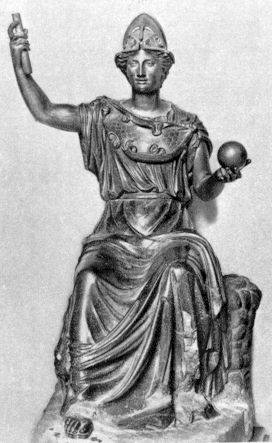
radford-chapter-09 A Roman representation of Minerva.

Minervawas the Roman goddess of handicrafts, arts, professionals and later, that of war. She is commonly identified with the Greek goddess, Athene, the city protectress, goddess of war and handicrafts, an urbanized pre-Hellenic goddess taken over by the Greeks. She dwelled on the Acropolis of Athens, a virgin with no consort hence the term "Pallas Athena" which originally simply meant a maiden but came to mean a lusty youth. Tradition, and also in the writing of Plato, has it that Athena was foreign born, that she was from the sea, coming fully grown out of the head of Zeus and born on a seashell. Other myths put her birth in Libya near Lake Triton, which in ancient times was very large. The book says that Nyhellenia Minerva did stop at Libya when the ships of the sea-kings Jon and Inka were divided.

An inspiration to the heroes of Homers Iliad, she also epitomized wisdom for the early city occupants. Born fully armed out of the head of Zeus and that is how it must have appeared to the inhabitants of Attica when she moved there with all her Frisian soldiers. No derivation of the name "Athens" is satisfactorily given but if we read on we will see what the Oera Linda Book has to say.

The traditional beginnings of Athens recall the "unification" of the city in the reign of Theseus attesting to existing settlements at that time. This date, according to legend that is, is at the end of the high profile, Minoan period, the time of the destruction of the palace at Knossos, the end of the third tribute of youths shipped to Crete and independence for the mainland Greeks.

The story of Minerva is next found in the writings of Minno, a sea-king who spent many years in the Mediterranean and returned to record his exploits. Jon and Minerva had separated, she staying in Crete where her following had built a citadel for her and her maidens.

Minnos writings tell of Minerva established as a Mother in Crete. It reads as though Crete and Attica was one country with Attica much less developed and paying tribute to a superior power but not necessarily to Crete. The priests and princes sought her advice that encouraged the commoners to accept the spirit of freedom she so eloquently elucidates. They did not oppose her doctrines but corrupted them into a vehicle for their own use. No wonder Minno as we will later read believed it impossible to teach the spirit of Frya to Findas people or to the original Greeks.

Here is explained the process by which the function and duties of the priestesses (virgins) were corrupted into political tools of the priests. The priestesses were originally set up to nurse the needy, teach the young to read, and advise according to Fryas doctrine or Tex. They were celibate while in office but went about the people as needed. The priests turned them into institutional prisoners to give themselves legitimacy, asked for the advise to be given in an ambiguous and mysterious way like the various oracular prophesies so that they could interpret them to their own advantage. The process is recorded here for Greece, which has given us so many stories from this period concerning the machinations of the priestesses. In Roman times the Vestal Virgins became a state regulated institution of highly ritualistic authority with only a remnant of the original services such as keeping the will of the emperor or other secret state documents.

When Nyhellenia, whose real name was Minerva, was well established, and the Cretans loved her as well as our own people did, there came some princes and priests to her citadel and asked Minerva where her possessions lay.

Hellenia answered, "I carry my possessions in my own bosom. What I have inherited is the love of wisdom, justice and freedom. If I lose these I shall become as the least of your slaves; now I give advice for nothing, but then I should sell it."

The gentlemen went away laughing and saying, "Your humble servants, wise Hellenia". But they missed their object, for the people took up this name as a name of honor. When they saw that their shot had been missed they began to defame her, and to say that she had bewitched the people; but our people and the good Cretans understood at once that it was defamation.

She was once asked, "If you are not a witch, what is the use of the eggs that you always carry with you?"

Minerva answered, "These eggs are the symbols of Fryas counsels, in which our future and that of the whole human race lies concealed. Time will hatch them, and we must watch that no harm happens to them.

The priests said, "Well answered; but what is the use of the dog on your right hand?"

Hellenia replied, "Does not the shepherd have a sheep dog to keep his flock together? What the dog is to the shepherd I am in Fryas service. I must watch over Fryas flocks.

"We understand that very well," said the priests; "but tell us what means the owl that always sits upon your head, is that light-shunning animal a sign of your clear vision?"

"No", answered Hellenia; "he reminds me that there are people on earth who, like him, have their homes in churches and holes, who go about in the twilight, not, like him, to deliver us from mice and other plagues, but to invent tricks to steal away the knowledge of other people, in order to take advantage of them, to make slaves of them, and to suck their blood like leeches."

Another time they came with a whole troop of people, when the plague was in the country and said: "We are all making offerings to the gods that they may take away the plague. Will you not help to turn away their anger, or have you yourself brought the plague into the land with all your arts?"

"No", said Minerva; "I know no gods that do evil, therefore I cannot ask them to do better. I only know one good spirit, that is Wr-Aldas; and as he is good he never does evil."

"Where, then, does evil come from?" asked the priests.

"All the evil comes from you and from the stupidity of the people who let themselves be deceived by you."

"If, then, your god is so exceedingly good, why does he not turn away from the bad?" asked the priests.

Hellenia answered: "Frya has placed us here, and the Carrier, that is, Time, must do the rest. For all calamities there is counsel and remedy to be found, but Wr-Alda wills that we should search it out ourselves, in order that we may become strong and wise. If we will not do that, he leaves us to our own devices, in order that we may experience the results of wise or foolish conduct."

Then a prince said, "I should think it best to submit."

"Very possibly," answered Hellenia; "for then men would be like sheep, and you and the priests would take care of them, shearing and leading them to the shambles. This is what our god does not desire, he desires that we should help one another, but that all should be free and wise. That is also our desire, and therefore our people choose their princes, counts, councilors, chiefs, and masters among the wisest of the good men, in order that every man shall do his best to be wise and good. Thus doing, we learn ourselves and teach the people that being wise and acting wisely can alone lead to holiness."

"That seems very good judgment," said the priests; "but if you mean that the plague is caused by our stupidity, then Nyhellenia will perhaps be so good as to bestow upon us a little of that new light of which she is so proud."

"Yes", said Hellenia, "but ravens and other birds of prey feed only on dead carrion, whereas the plague feeds not only on carrion but on bad laws and customs and wicked passions. If you wish the plague to depart from you and not return, you must put away your bad passions and become pure within and without."

"We admit that the advice is good," said the priests, "but how shall we induce all the people under our rule to agree to it?"

Then Hellenia stood up and said: "The sparrows follow the sower, and the people their good princes, therefore it becomes you to begin by rendering yourselves pure, so that you may look within and without, and not be ashamed of your own conduct. Now, instead of purifying the people, you have invented foul festivals, in which they have so long reveled that they wallow like swine in the mire to atone for your evil passions."

The people began to mock and to jeer, so that she did not dare to pursue the subject; and one would have thought that they would have called all the people together to drive us out of the land; but no, in place of abusing her they went all about from the heathen Crete to the Alps, proclaiming that it had pleased the Almighty God to send his clever daughter, Minerva, surnamed Nyhellenia, over the sea in a cloud to give people good counsel, and that all who listened to her should become rich and happy, and in the end governors of all the kingdoms of the earth. They erected statues to her on all their altars, they announced and sold to the simple people advice that she had never given, and related miracles that she had never performed.

They cunningly made themselves masters of our laws and customs, and by craft and subtlety were able to explain and spread them around. They appointed priestesses under their own care, who were apparently under the protection of Fasta, our first Earth Mother, to watch over the holy lamp; but that lamp they lit themselves, and instead of imbuing the priestesses with wisdom, and then sending them to watch the sick and educate the young, they made them stupid and ignorant, and never allowed them to come out. They were employed as advisers, but the advice which seemed to come from them was but the repetition of the bidding of the priests.

Minerva received a delegation of common people from Greece who were subject to foreign domination, paying tribute to a power that some historians suggest were the Iolians in Asia Minor, from where their overlords most likely originated. The local masters were not against independence as that would leave more for themselves.

The people wanted her to come to Greece and help them with her wisdom but more practically, to have the help of the fighting skills of her Frisian seamen. Minerva did not stay in Crete but moved to Greece apparently at the invitation of the people from Attica with whom the settlers were trading. When there she was not convinced that they were ready for her teachings but predicted it would take another 5000 years.

When they had finished their story they asked respectfully for iron weapons; for, said they, "Our foes are powerful, but if we have good arms we can withstand them." When this had been agreed to, the people asked if Fryas customs would flourish in Athens and in other parts of Greece.

The Mother answered, "If the distant Greeks belong to the direct descent of Frya, then they will flourish; but if they do not descend from Frya, then there will be a long contention about it, because the Carrier must make five thousand revolutions of his Jule before Findas people will be ripe for liberty."

In Attica, Minerva built a new citadel at Athens, naming it the City of Friends where in classical Greek times, the principal temple of the goddess Pallas Athena was the Parthenon on the Acropolis at Athens. She failed to get the local gentry to free their slaves, as Classical Greece was a collection of slave states with citizenship reserved for the free estate-owning male minority. That this system should have become a model for democracy and is generally credited with inventing democratic methods falls so far short of the more noble principles that they failed to embrace.

When Minerva had examined the country which is called by the inhabitants Attica, she saw that the people were all goatherds, and that they lived on meat, wild roots, herbs and honey. They were clothed in skins, and had their dwellings on the slopes of the hills, wherefore they were called Hellingers. At first they ran away, but when they found out that we did not attack them, they came back and showed great friendship.

Minerva asked if we might settle there peaceably. This was agreed to on the condition that we should help them to fight against their neighbors, who came continually to carry away their children and to rob their dwellings. Then we built a citadel at an hours distance from the harbor. By the advice of Minerva, it was called Athens, because, she said, "Those who come after us ought to know that we are not here by cunning or violence, but were received as friends."

While we were building the citadel the principal personages came to see us, and when they saw that we had no slaves it did not please them, and they gave her to understand it, as they thought that she was a princess.

But Minerva said, "How did you get your slaves?"

They answered, "We bought some and took others in war."

Minerva replied, "If nobody would buy slaves they would not steal your children, and you would have no wars about it. If you wish to remain our allies, you will free your slaves."

The chiefs did not like this, and wanted to drive us away; but the most enlightened of the people came and helped us to build our citadel, which was built of stone.

In a later extract, their city is described as having been fortified with a wall having "two stone horns down to the sea". This is how Piraeus, the port of Athens, is now known to have been protected and therefore could date its construction to the sixteenth century BC.

From Goddess to King, Chapter 8, THE ORIGINS OF IONIA

FROM GODDESS TO KING

A History of Ancient Europe from the

OERA LINDA BOOK

By Anthony Radford

CHAPTER 8

THE ORIGINS OF IONIA

It has been the intention of the author to first present the historically believed information and then show how this new source changes those beliefs but in this case it is impossible because who else has written about Jon, our most common name? They say it means "Given" and so it was given to an adventurous sea-king from the Rhine 3640 years ago.

The sea-king Jon had fitted out a fleet of 127 ships when Kaltas followers destroyed the citadel at Walhallagara. He was to have taken on paper there but instead took his men to avenge their anger by attacking Kalta at her own citadel of Flyburgt. They set fire to it but saved the maidens and the sacred lamp while Kalta, herself escaping, openly declared war on the whole community.

The Earth Mother Rosamond had responded and defeated the rebels, exiling them to Britain but that did not stop Kalta who eventually rallied the exiles with the help of the Druids into virtually another independent nation or the new Celtic Motherdom. In the meantime, Rosamond sought justice for Jon and his seamen who had taken the law into their own hands but they were not to hang around and be exiled to the tin mines. They chose their own exile together with women and children, most of the maidens from two citadels, two sacred lamps and the priestess Minerva. This mighty fleet, like the fleet of Teunis sailed south to the Mediterranean for another historical drama.

Kalta must have been quite a force for in one year she became mistress of all the Thyriers or Phoenician-Frisian settlers. Many names of existing places have some connection to the Thyriers and to Kalta or her new citadel Kaltasburgh. There is a mountainous region north of Paris called Thierache and at a guess Kaltasburgh or Kerenak may now be known as Dunkerque, a part of the lands of the Britons or possible Carnac in Brittany. At this coastal site there are 2934 menhirs or giant stones arranged in roes. They have been carbon-dated to the same age as Stonehenge, or 4500 years old, long before Kalta. Amber ornaments have been found there which connects the site with that ancient trading commodity mentioned in the Book. Later writings place Kerenak, an alternative name for the same citadel, in Scotland but it does not survive there under a similar name. We are however told that Kalta ruled as a queen, not a true earth mother, an exploit that eventually led to the priests and princes taking over those lands.

We Now Come to the History of Jon:

Jon, John, Jhon, Jan, are all the same name, though the pronunciation varies, as the seamen like to shorten everything to be able to make it easier to call. Jon - that is, "Given" - was a sea-king, born at Alberga, who sailed from the Flymeer with a fleet of 127 ships fitted out for a long voyage, and laden with amber, tin, copper, cloth, linen, felt, otter-skins, beaver and rabbit skins.

He would also have taken paper from here, but when he saw how Kalta had destroyed the citadel he became so angry that he went off with his people to Flyburgt, and out of revenge set fire to it. His admiral and some of his people saved the lamp and the maidens, but they could not catch Sijred (or Kalta). She climbed up on the furthest battlement, and they thought she must be killed in the flames; but what happened? While all her people stood transfixed with horror, she appeared on her steed more beautiful than ever, calling to them, "To Kalta!" Then the other Schelda people poured out towards her. When the seamen saw that, they shouted, "We are for Minerva!" from which arose a war in which thousands were killed.

At this time Rosamond the Mother, who had done all in her power by gentle means to preserve peace, when she saw how bad it was, made short work of it. Immediately she sent messengers throughout all the districts to call a general levy, which brought together all the defenders of the country. The landsmen who were fighting were all caught, but Jon with his seamen took refuge on board his fleet, taking with him the two lamps, as well as Minerva and the maidens of both the citadels. Helprik, the chief summoned him to appear; but while all the soldiers were on the other side of the Scheldt, Jon sailed back to the Flymeer, and then straight to our islands. His fighting men and many of our people took women and children on board, and when Jon saw that he and his people would be punished for their misdeeds, he secretly took his departure. He did well, for all our islanders and the other Scheldt people who had been fighting were transported to Britain. This step was a mistake, for now came the beginning of the end. Kalta, who people said, could go as easily on the water as on the land, went to the mainland and on to Missellia. Then came the Gauls out of the Mediterranean Sea with their ships to Cadiz, and along all our coasts, and fell upon Britain; but they could not make any good footing there, because the government was powerful and the exiles were still Frisians.

But now came Kalta and said: "You were born free, and for small offenses have been sent away, not for your own improvement, but to get tin by your labor. If you wish to be free again, and take my advice, and live under my care, come away. I will provide you with arms, and will watch over you."

The news flew through the land like lightning, and before the Carriers wheel had made one revolution she was mistress of all the Thyriers, in all our southern states as far as the Seine. She built herself a citadel on the high land to the north, and called it Kaltasburgh. It still exists under the name of Kerenak. From this castle she ruled as a true mother, against their will, not for her followers, but over them, who were thenceforth called Kelts. The Gauls gradually obtained dominion over the whole of Britain, partly because they no longer had any citadel; secondly, because they had there no burgtmaid; and thirdly, because they had no real lamps. From all these causes the people could not learn anything. They were stupid and foolish, and having allowed the Gauls to rob them of their arms, they were led about like a bull with a ring in his nose.

About 1620 BC another mighty fleet of Frisians went permanently to the Mediterranean led by the then outlawed sea-king Jon. He found the Mothers influence in western Italy too strong for his own formidable military force or perhaps he was still too much of a true Frisian to impose his own way on that faithful community. They must have had a good communication system, possibly by means of overland couriers as they were already informed that his forces were wanted renegades. That area of Italy was the pre-Roman countryside probably even pre-Etruscan. Those settlers are now considered to have come from Troy and our story has not yet shown that region to be a maritime power although Troy is very old. The Germanic languages may have been greatly influenced by Latin in the last two thousand years but for the preceding pastoral age, Latin was the child of the Germanic or Old Frisian root tongue. This is not in keeping with conventional theory but it fits in well with the story of the migrations that the Book relates. It must have been a time of low population where a city may not have been much more than a manor house with its domestic support. There were still plenty of open lands and safe harbors about.

Minerva was the Mother of Walhallagara at Flymeer the citadel that was burnt by the incensed followers of Kalta who had been jealous of her relationship with the Mother Rosamond. Jon and his seamen rescued her, her maidens and their lamp, but when he heard how it fared with the land forces that had taken revenge on Kaltas actions, he escaped with the fleet and also Kaltas maidens with her lamp. He eventually took Minerva and all these maidens to the Mediterranean but when there they separated with Jon taking Kaltas lamp and virgins to his own islands, leaving Minerva at Crete.

The story continues with Jon and Minerva splitting up, each keeping a maiden system and a sacred lamp in traditional Frisian style. Minerva settled in Crete, a poor land while Jon settled in the islands of the Aegean Sea where his exploits gave them the name of the "Islands of Pirates" or what is now known as the Ionian Islands. No encyclopedia explains the origin of the word "Ionian" but here we are told it meant "Jons Islands" from where he made pirate raids with his young adventurers against the Phoenicians. Robert Graves in The White Goddess states that the name comes from the Cow goddess, IO, on the mainland (Asia Minor) from which the islanders would have come. Incidentally, the name "Aegean" which came from Aegeus, king of Athens and father of the legendary Theseus is from the goat-tribe of Attica. The Aegis or breastplate of Zeus was a goatskin.

The narrator of the next extract either confuses Italy with Greece and Anatolia or the word "Italians" had a different meaning then, reflecting a future migration to Italy of Trojans. The Joniers or Ionians figure again in the story twelve hundred years later at the time of Alexander the Great. Here is the beginning of a nation that has given us many stories.

Now We Shall Write How it Fared with Jon. It is Inscribed at Texland:

Ten years after Jon went away, there arrived three ships in the Flymeer; the people cried "Huzza!" (what a blessing!) and from their accounts the Mother had this written.

When Jon reached the Mediterranean Sea, the reports of the Gauls had preceded him, so that on the nearest Italian coast he was nowhere safe. Therefore he went with his fleet straight over to Libya. There the black men wanted to catch them and eat them. At last they came to Tyre, but Minerva said, "Keep clear, for here the air has long been poisoned by the priests."

The king was a descendant of Teunis, as we were afterwards informed; but as the priests wished to have a king, who, according to their ideas, was of long descent, they deified Teunis, to the vexation of his followers. After they had passed Tyre, the Thyriers seized one of the rearmost ships, and as the ship was too far behind us, we could not take it back again; but Jon swore to be revenged for it. When night came, Jon bent his course towards distant Crete. At last they arrived at a country that looked very barren, but they found a harbor there. Here, said Minerva, we need not perhaps have any fear of princes or priests, as they always look out for rich fat lands. When they entered the harbor, there was not room for all the ships, and yet most of the people were too cowardly to go any further. Then Jon, who wished to get away, went with his spear and banner, calling to the young people, to know who would volunteer to share his adventures. Minerva did the same thing, but she wished to remain there. The greater part stopped with Minerva, but the young sailors went with Jon. Jon took the lamp of Kalta and her maidens with him. Minerva retained her lamp and her own maidens.

Between the near and the distant coasts of Italy, Jon found some islands, which he thought desirable. Upon the largest he built a city in the wood between the mountains. From the smaller islands he made expeditions for vengeance on the Thyriers, and plundered their ships and their lands. Therefore these islands were called Insulae Piratarum, as well as Johannis Insulae.

From Goddess to King, Chapter 7, KALTA AND THE ORIGINS OF THE CELTS

FROM GODDESS TO KING

A History of Ancient Europe from the

OERA LINDA BOOK

By Anthony Radford

CHAPTER 7

KALTA AND THE ORIGINS OF THE CELTS

Thischapter is the story of Rosamond, Kalta and the early years of Minerva however standard history has very little to say about these historical personages. Their influence on the course of Europe and the Mediterranean was enormous, affecting everything that has followed for thousands of years. Of Rosamond nothing is known except for a namesake, Fair Rosamond, the mistress of King Henry II who has been endowed with many legends and dubious stories beyond her station. Kalta is not remembered but the Celts who were named after her have various "historical" descriptions. The Celtic language is divided into the Gaulish or continental version, that was largely supplanted and Latinized by the Roman occupation, and the various branches that are still spoken in parts of the British Isles; Irish, Gaelic, Welsh, Cornish and Breton. The Celtic religion was presided over by the Druids and reflects an ancient Indian culture, strengthening the belief in the Indo-European connection. Their origins have been variously placed somewhere in the east, through ancient German invasions as though a politically important people who rose to common language and power against the Romans, who are our only historical source, have to have a migratory, tribal beginning rather than an indigenous one.

One could then question that indigenous land in the east, but the truth is as in most cases, a blend of the various theories. The theories are not wrong but neither can they be applied to all peoples. The examiners of the archaeological evidence assume that ancient peoples did not know of, or trade with each other, shared little development and were more tribal than regional. There are many descriptions of these various peoples toward the end of the Book but now comes very early information about some beginnings lost in time.

In this account we have the second correlation between the way Fryas people recorded dates and the Christian chronology. Given an accurate rather than an approximate date, the sinking of Atland would then be set as 2163 BC (1600 + 563 = 2163). This transcribing was obviously done in Christian times. To be able to date the foundation of Greek independence from their overlords in either Asia Minor or Crete to 1600 BC is momentous. It is a time before Homer and Minos of the latter Greek myths. There were no Greeks at this time but what we now know of as Greece, was inhabited by "cliffhangers" (Hellingers) and agriculturists. It was a time before the geological disturbances in the Mediterranean that permitted Aegean independence from Crete and the destruction of Thera, another maritime trading city. When a major geological event occurred in mans early-civilized history, it was not recorded like even a minor military campaign because the destruction removed the potentates who built the monuments. Mythology has many references to catastrophes but proud monuments have few.

When the old Earth Mother died she named Rosamond as her successor but she also named Minerva, a well liked priestess of Walhallagara on the Rhine, as next in line and Sijred, the Burgtmaid of Flyburgt as next or third choice. Minerva was also called Nyhellenia, a first name of respect that has become Helen, a Greek name. We shall see how Hellas, the Greek name for Greece, and Minerva, the Roman name for Pallas Athena, the goddess of wisdom, handicrafts and arts, later war, are from the same Rhine maiden. There is an account of the seamen naming the Greeks, Hellingers because they clung to the cliffs like goats and there is also the Germanic derivation of the word "Greek" as being related to the same root as our word "agriculture."

The other maiden Sijred was given the name Kalta by the seamen because of her devious ways. Land dwellers took it as a title and eventually she gave us the Celtic name and heritage. She wanted to be Earth Mother and was such a poor looser that by her treachery, Gaul and Britain were lost to the Mother. She was driven out of the Rhine but founded a new citadel in Britain and even managed to win Cadiz in Spain to her influence with the help of the Golen.

When the principles of Frya were being violated Rosamond had both the compassion of a true earth mother and the strength to act decisively. She would not tolerate a popular sea-king taking independent action even if he thought it was justified at the time. Apparently the sea-king Jon had a hotter blood and was too quick too act for the fair Rosamond and the consequences were enormous; the Celts, the Ionians and much of history was seeded at this time including the eventual fall of the unifying force of the Earth Mother.

Commerce is again stressed as important enough to cause wars, this time the agricultural production of flax and the subsequent manufacture of paper or writing linen. This was the primary foreign trade item of the Scheldt region but ships were required to carry it and bring back the products of distant countries. In the Rhine mouth region a way had been found to process pumpkin leaves into paper that apparently satisfied the shipping needs at that time. Conflict resulted with far reaching consequences that has now turned up side down our present representation of the history of this region. We are discovering remnants of a primitive Celtic civilization in Western Europe little realizing that they were the renegade offshoots of a longer established mature civilization.

Now We Will Write About the War Between the Burgtmaid Kalta and Minerva And how we thereby lost all our southern lands and Britain to the Gauls:

Near the southern mouth of the Rhine and the Scheldt there are seven islands, named after Fryas seven virgins of the week. In the middle of one island is the city of Walhallagara and on the walls of this city the following history is inscribed. Above it are the words, "Read, learn, and watch."

Five hundred and sixty-three years after the submersion of Atland - that is, 1,600 years before Christ - a wise town priestess presided here, whose name was Minerva - called by the sailors Nyhellenia. This name was well chosen, for her counsels were new and clear above all others.

On the other side of the Scheldt, at Flyburgt, Sijred presided. This maiden was full of tricks. Her face was beautiful, and her tongue was nimble; but the advice that she gave was always conveyed in mysterious terms. Therefore the mariners called her Kalta, and the landsmen thought it was a title. In the last will of the dead Mother, Rosamond was named first, Minerva second, and Sijred third in succession. Minerva did not mind that, but Sijred was very much offended. Like a foreign princess, she wished to be honored, feared, and worshipped; but Minerva only desired to be loved. At last all the sailors, even from Denmark and Flymeer, did homage to her.

This hurt Sijred, because she wanted to excel Minerva. In order to give an impression of her great watchfulness, she had a cock put on her banner. So then Minerva went and put a sheep dog and an owl on her banner. "The dog," she said, "guards his master and his flock, and the owl watches that the mice shall not devastate the fields; but the cock in his lewdness and his pride is only fit to murder his nearest relations."

When Kalta found that her scheme had failed she was still more vexed, so she secretly sent for the Magyars to teach her conjuring. When she had had enough of this she threw herself into the hands of the Gauls; but all her bad practices did not improve her position.

When she saw that the sailors kept more and more aloof from her, she tried to win them back by fear. At the full moon, when the sea was stormy, she ran over the wild waves, calling to the sailors that they would all be lost if they did not worship her. Then she blinded their eyes, so that they mistook land for water and water for land, and in this way many a good ship was totally lost. At the first war-feast, when all her countrymen were armed, she brought casks of beer, which she had drugged. When they were all drunk, she mounted her war-horse, leaning her head upon her spear. Sunrise could not be more beautiful. When she saw that the eyes of all were fixed upon her, she opened her lips and said:

"Sons and daughters of Frya, you know that in these last times we have suffered much loss and misery because the sailors no longer come to buy our paper, but you do not know what the reason of it is. I have long kept silence about it, but can do so no longer. Listen, then, my friends, that you may know on which side to show your teeth. On the other side of the Scheldt, where from time to time there come ships from all parts, they make now paper from pumpkin leaves, by which they save flax and outdo us. Now, as the making of paper was always our principal industry, the Mother willed that people should learn it from us; but Minerva has bewitched all the people - yes, bewitched, my friends - as well as all our cattle that died lately. I must come out with it. If I were not Burgtmaid, I should know what to do. I should burn the witch in her nest."

As soon as she had uttered these words she sped away to her citadel; but the drunken people were so excited that they did not stop to weigh what they had heard. In mad haste they hurried over the Sandval, and as night came on they burst into the citadel. However, Kalta again missed her aim; for Minerva, her maidens, and her lamp were all saved by the alertness of the seamen.

Here included in the Book is an anecdote the ancient writer felt like including. It is a measure of the character of these people.

War had come to an end, but famine came in its place. There were three men who each stole a sack of corn from different owners, but they were all caught. The first owner brought his thief to the judge, and the maidens said everywhere that he done right. The second owner took the corn away from his thief and let him go in peace. The maidens said he has done well. The third owner went to the house of the thief, and when he saw what misery was there, he went and brought a wagon load of necessaries to relieve their distress. Fryas maidens came around him and wrote his deed in the eternal book, and wiped out all his sins. This was reported to the Earth Mother, and she had it made known over the whole country.

Welsh history-mythology records the invasion of the southern plains of Britain by the iron age Belgi whose god Odin had emancipated himself from the White Goddess Freya for a more warlike patronage of kings and priests with the old priesthood being driven north; an alternative version of these ancient histories.

Subscribe to this RSS feed

Log in or create an account