log in
LC Geerts

LC Geerts

Website URL:

Famous Men of the Middle Ages: Marco Polo, Lived from 1254-1324

MARCO POLO

LIVED FROM 1254-1324

I

SOME years before St. Louis led his last Crusade there was born in Venice a boy named Marco Polo. His father was a wealthy merchant who often went on trading journeys to distant lands.

In 1271, when Marco was seventeen years old, he accompanied his father and uncle on a journey through the Holy Land, Persia and Tartary, and at length to the Empire of China--then called Cathay.  It took the travelers three years to reach Cathay.

The emperor of Cathay was a monarch named Kublai Khan, who lived in Peking.

Marco's father and uncle had been in Cathay once before and had entertained Kublai Khan by telling him about the manners and customs of Europe.

So when the two Venetian merchants again appeared in Peking, Kublai Khan was glad to see them. He was also greatly pleased with the young Marco, whom he invited to the palace.

Important positions at the Chinese court were given to Marco's father and uncle, and so they and Marco lived in the country for some years. Marco studied the Chinese language, and it was not very long before he could speak it.

When he was about twenty-one Kublai Khan sent him on very important business to a distant part of China. He did the work well and from that time was often employed as an envoy of the Chinese monarch. His travels were sometimes in lands never before visited by Europeans and he had many strange adventures among the almost unknown tribes of Asia. Step by step he was promoted. For several years he was governor of a great Chinese city.

Finally he and his father and uncle desired to return to Venice. They had all served Kublai Khan faithfully and he had appreciated it and given them rich rewards; but he did not wish to let them go.

While the matter was being talked over an embassy arrived in Peking from the king of Persia. This monarch desired to marry the daughter of Kublai Khan, the Princess Cocachin, and he had sent to ask her father for her hand. Consent was given, and Kublai Khan fitted out a fleet of fourteen ships to carry the wedding party to Persia.

fmma28

The Princess Cocachin was a great friend of Marco Polo, and urged her father to allow him to go with the party. Finally Kublai Khan gave his consent. Marco's father and uncle were also allowed to go, and the three Venetians left China.

The fleet with the wedding party on board sailed southward on the China Sea. It was a long and perilous voyage. Stops were made at Borneo, Sumatra, Ceylon and other places, until the ships entered the Persian Gulf and the princess was safely landed. After they reached the capital of Persia the party, including the three Venetians, was entertained by the Persians for weeks in a magnificent manner and costly presents were given to all.

At last the Venetians left their friends, went to the Black Sea and took ship for Venice.

They had been away so long and were so much changed in appearance that none of their relations and old friends knew them when they arrived in Venice. As they were dressed in Tatar costume and sometimes spoke the Chinese language to one another, they found it hard to convince people that they were members of the Polo family.

At length, on order to show that they were the men that they declared themselves to be, they gave a dinner to all their relations and old friends. When the guests arrived they were greeted by the travelers, arrayed in gorgeous Chinese robes of crimson satin. After the first course they appeared in crimson damask; after the second, they changed their costumes to crimson velvet; while at the end of the dinner they appeared in the usual garb of wealthy Venetians.

"Now, my friends," said Marco, "I will show you something that will please you." He then brought into the room the rough Tatar coats which he and his father and uncle had worn when they reached Venice. Cutting open the seams, he took from inside the lining packets filled with rubies, emeralds and diamonds. It was the finest collection of jewels ever seen in Venice.

The guests were now persuaded that their hosts were indeed what they claimed to be.

II

EIGHT hundred years before Marco Polo's birth, some of the people of North Italy had fled before the Attila to the muddy islands of the Adriatic and founded Venice upon them. Since then the little settlement had become the most wealthy and powerful city of Europe. Venice was the queen of the Adriatic and her merchants were princes. They had vessels to bring the costly wares of the East to their wharves; they had warships to protect their rich cargoes from the pirates of the Mediterranean; they carried on wars. At the time when Marco Polo returned from Cathay they were at war with Genoa.

The two cities were fighting for the trade of the world. In a great naval battle the Venetians were completely defeated. Marco Polo was in the battle and with many of his countrymen was captured by the enemy. For a year he was confined in a Genoese prison. One of his fellow-prisoners was a skillful penman and Marco dictated to him an account of his experiences in China, Japan, and other Eastern countries. This account was carefully written out. Copies of the manuscript exist to this day. One of these is in a library in Paris. It was carried into France in the year 1307.  Another copy is preserved in the city of Berne. It is said that the book was translated into many languages, so that people in all parts of Europe learned about Marco's adventures. About a hundred and seventy-five years after the book was written, the famous Genoese, Christopher Columbus, planned his voyage across the Atlantic. It is believed that he had read Marco's description of Java, Sumatra and other East India Islands, which he thought he had reached when he discovered Haiti and Cuba. So Marco Polo may have suggested to Columbus the voyage which led to the discovery of America.

Famous Men of the Middle Ages: Robert Bruce, King from 1306-1329

ROBERT BRUCE

KING FROM 1306-1329

THE most famous king that Scotland ever had was Robert Bruce. He lived in the days when Edward I, Edward II, and Edward III were kings of England.

During the reign of Edward I the king of Scotland died and thirteen men claimed the throne. Instead of fighting to decide which of them should be king they asked Edward to settle the question. When he met the Scottish nobles and the rivals, each of whom thought that next day he would be wearing the crown, Edward told them that he would himself be their king. Just then an English army marched up. What could the nobles do but kneel at the feet of Edward and promise to be his vassals? This they did; and so Scotland became a part of Edward's kingdom and Baliol, one of the rivals who claimed the Scottish throne, was made the vassal king.

Some time after this Edward ordered Baliol to raise an army and help him fight the French. Baliol refused to do this, so Edward marched with an army into Scotland and took him prisoner. He was determined that the Scotch should have no more kings of their own. So he carried away the sacred stone of Scone, on which all kings of Scotland had to sit when they were crowned, and put it in Westminster Abbey in London, and there it is to this day. It is underneath the chair on which the sovereigns of England always sit when the crown of England, Scotland, and Ireland is placed upon their heads. It is said to have been the very stone that Jacob used for a pillow on the night that he saw, in his dream, angels ascending and descending on the ladder that reached from earth to heaven.

Edward now supposed, as he had this sacred stone and had put King Baliol in prison, that Scotland was conquered.

But the men whom he appointed to govern the Scotch ruled unwisely and nearly all the people were discontented. Suddenly an army of Scots was raised. It was led by Sir William Wallace, a knight who was almost a giant in size. Wallace's men drove the English out of the country and Wallace was made the "Guardian of the Realm."

Edward then led a great army against him. The Scottish soldiers were nearly all on foot. Wallace arranged them in hollow squares--spearmen on the outside, bowmen within. The English horsemen dashed vainly against the walls of spear-points. But King Edward now brought his archers to the front. Thousands of arrows flew from their bows and thousands of Wallace's men fell dead. The spears were broken and the Scotch were defeated. Wallace barely escaped with his life. He was afterwards betrayed to Edward, who cruelly put him to death.

II

BUT the Scotch had learned what they could do and they still went on fighting for freedom, under two leaders named Robert Bruce and John Comyn. Edward marched against them with another large army. He won a great victory, and the nobles once more swore to obey him.

But in spite of this oath, Bruce meant to free Scotland if he could, and win the crown. He was privately crowned king of Scotland in the Abbey of Scone in 1306.

He said to his wife, "Henceforth you are the queen and I am the king of our country."

"I fear," said his wife, "that we are only playing at being king and queen, like children in their games."

"Nay, I shall be king in earnest," said Bruce.

The news that Bruce had been crowned roused all Scotland and the people took up arms to fight under him against the English. But again King Edward defeated the Scotch and Bruce himself fled to the Grampian Hills.

For two months he was closely pursued by the English who used bloodhounds to track him. He and his followers had many narrow escapes. Once he had to scramble barefoot up some steep rocks, and another time all the party would have been captured had not Bruce awakened just in time to hear the approach of the enemy. He and his men lived by hunting and fishing.

However, many brave patriots joined them, until after a while Bruce had a small army. Five times he attacked the English, and five times he was beaten. After his last defeat he fled from Scotland and took refuge in a wretched hut on an island off the north coast of Ireland. Here he stayed all alone during one winter.

III

IT is said that one day, while he was very down-hearted, he saw a spider trying to spin a web between two beams of his hut. The little creature tried to throw a thread from one beam to another, but failed. Not discouraged, it tried four times more without success.

fmma27

"Five times has the spider failed," said Bruce. "That is just the number of times the English have defeated me. If the spider has courage to try again, I also will try to free Scotland!"

He watched the spider. It rested for a while as if to gain strength, and then threw its slender thread toward the beam. This time it succeeded.

"I thank God!" exclaimed Bruce. "The spider has taught me a lesson. No more will I be discouraged."

About this time Edward I died and his son, Edward II, succeeded to the throne of England. For about two years the new king paid little attention to Scotland.

Meantime Bruce captured nearly all the Scotch castles that were held by the English, and the nobles and chiefs throughout the country acknowledged him as their king.

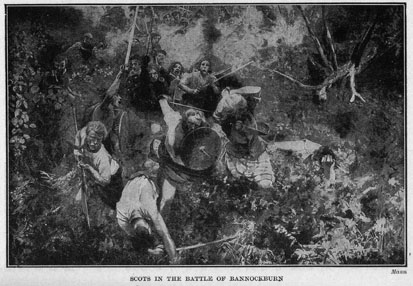
At last Edward II marched into Scotland at the head of a hundred thousand men. Bruce met him at Bannockburn on June 24, 1314, with thirty thousand soldiers.

Before the battle began Bruce rode along the front of his army to encourage his men. Suddenly an English knight, Henry de Bohun, galloped across the field and tried to strike him down with a spear. Bruce saw his danger in time and with a quick stroke of his battle-axe cleft the knight's skull.

The Scotch army shouted again and again at this feat of their commander, and they went into the battle feeling sure that the victory would be theirs. They rushed upon the English with fury and although outnumbered three to one, completely defeated them. Thousands of the English were slain and a great number captured.

In spite of this terrible blow Edward never gave up his claim to the Scottish crown. But his son Edward III, in 1328, recognized Scotland's independence and acknowledged Bruce as her king.

Famous Men of the Middle Ages: Louis The Ninth. King From 1226-1270

LOUIS THE NINTH

KING FROM 1226-1270

I

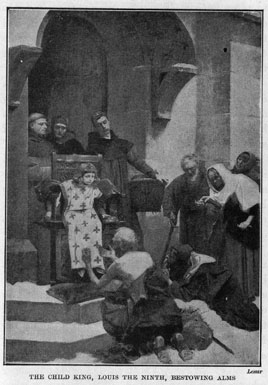
AFTER the time of Barbarossa and Richard Coeur de Lion lived another great Crusading king. This was a grandson of Philip II, named Louis IX, who became sovereign of France in 1226. He was then only eleven years old, so for some years his mother ruled the kingdom.

A few years after he had begun to reign Louis decided to make his brother Alphonse the governor of a certain part of France. The nobles of the region refused to have Alphonse as governor and invited Henry III of England to help them in a revolt.

Henry crossed to France with an army to support the rebellious nobles. He was duke of Aquitaine and Gascony; so that although he was the king in England he had to do homage to the king of France for his possessions in that country, and fight for him if called upon to do so.

fmma26

Louis gathered an army and hastened to meet the English troops. He drove Henry from place to place, until at last he forced him to make terms of peace. The rebellious nobles who had invited the English king to France soon after swore allegiance to Louis and afterwards he had little trouble in his kingdom.

Once Louis was dangerously ill and his life was despaired of. Finally he was believed to be dying and his wife and chief officials gathered round his bed to await the end. Suddenly he roused himself and said in a feeble voice, "The cross! The cross!"

They laid the cross upon his heart and he clasped it fervently. For a while he slumbered. When he awoke he appeared much better. In a day or two he was entirely well. He then made a solemn vow that in thankfulness for his restoration he would go on a Crusade to the Holy Land.

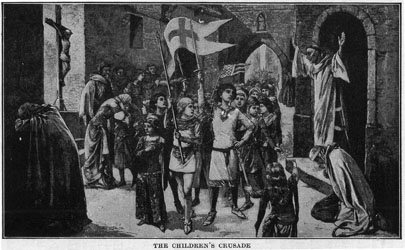
Louis lived at a time when everybody was full of the Crusading spirit. A few years before he was born even the children in France and Germany started out upon a Crusade of their own. It is called in history the "Children's Crusade." Several thousand left their homes and marched toward the Mediterranean. They thought that God would open a pathway to the Holy Land for them through its waters. A number of them died of cold and hunger when trying to cross the Alps. Some reached Rome, and when the Pope saw them he told them to return home and not think of going on a Crusade until they were grown up.

fmma26

It is easy to understand how in such an age people flocked to Louis' banner when he asked for volunteers to go with him on another Crusade.

In a few months forty thousand Crusaders assembled at a French port on the Mediterranean Sea. On a bright day in August, 1248, they went on board the fleet which was ready to sail. The king called to the Crusaders, "Sing in the name of God. Shout forth his praises as we sail away." Then quickly, on ship after ship, shouts of praise burst from the lips of thousands and amid the grand chorus the fleet began its voyage.

The Crusaders went to Damietta, in Egypt. Louis was so eager to land that he jumped into water up to his waist and waded ashore. He captured the city without striking a blow.

He had resolved to make war on the Moslems in Egypt rather than in the Holy Land, so when he left Damietta he marched southward.

He supposed there would be no strong force to stop his progress. However, he was mistaken, for he had not marched forty miles toward Cairo when he was attacked by a Moslem army led by the sultan of Egypt.

A great battle was fought. The Crusaders were commanded by King Louis and throughout the battle showed the utmost bravery, but they were outnumbered. Thousands were slain and the survivors retreated toward Damietta.

The Moslems pursued them and the Crusaders were obliged to surrender. Out of the forty thousand men who had left France only about six thousand now remained. Many had died of disease as well as in battle.

King Louis was among the prisoners, and the sultan of Egypt agreed to release him only upon the payment of a large ransom.

When the ransom had been paid a truce was made for ten years between Louis and the sultan, and the good king left Egypt. He then went to the Holy Land, and for four years worked to deliver Crusaders who were in Moslem prisons.

II

DURING the time that Louis was in the Holy Land his mother ruled France as regent. When she died he returned immediately to his kingdom and devoted himself to governing it.

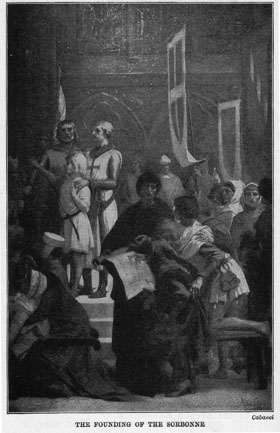
In 1252 he took part in the founding of the Sorbonne, the most famous theological college of Europe from the days of St. Louis down to the time of the French Revolution.

fmma26

He ruled his people so wisely and justly that it is hard to find any better king or even one equally as good in the whole line of French kings. He never wronged any man himself, or knowingly allowed any man to be wronged by others.

Near his palace there was a grand oak with wide-spreading branches, under which he used to sit on pleasant days in summer. There he received all persons who had complaints to make, rich and poor alike. Every one who came was allowed to tell his story without hindrance.

For hours Louis would listen patiently to all the tales of wrong-doing, of hardships and misery that were told him, and he would do what he could to right the wrongs of those who suffered.

When news came of some more dreadful persecutions of Christians by the Moslems in Palestine, Louis again raised an army of Crusaders and started with them for Tunis, although he was sick and feeble--so sick, indeed, that he had to be carried on a litter. Upon his arrival at Tunis he was attacked by fever and died in a few days.

He is better known to the world as Saint Louis than as Louis IX, because some years after his death Pope Boniface VIII canonized him on account of his pious life and his efforts to rescue the Holy Land from the Turks.

Famous Men of the Middle Ages: Henry The Second 1154-1189, and His Sons 1189-1216

HENRY THE SECOND 1154-1189

AND

HIS SONS 1189-1216

I

IN 1154, while Barbarossa was reigning in Germany, Henry II, one of England's greatest monarchs, came to the throne.

Henry was the son of Geoffrey Plantagenet, Count of Anjou in France, and Matilda, daughter of King Henry I and granddaughter of William the Conqueror. Count Geoffrey used to wear in his hat a sprig of the broom plant, which is called in Latin "planta genista." From this he adopted the name Plantagenet, and the kings who descended from him and ruled England for more than three hundred years are called the Plantagenets.

Henry II inherited a vast domain in France and managing this in addition England kept him very busy. One who knew him well said, "He never sits down; he is on his feet from morning till night."

His chief assistant in the management of public affairs was Thomas Becket, whom he made chancellor of the kingdom. Becket was fond of pomp and luxury, and lived in a more magnificent manner than even the king himself.

The clergy had at this time become almost independent of the king. To bring them under his authority Henry made Becket Archbishop of Canterbury, thus putting him at the head of the Church in England. The king expected that Becket would carry out all his wishes.

Becket, however, refused to do that which the king most desired and a quarrel arose between them. At last, to escape the king's anger, Becket fled to France and remained there for six years.

At the end of this time Henry invited him to come back to England. Not long after, however, the old quarrel began again. One day while Henry was sojourning in France, he cried out in a moment of passion, while surrounded by a group of knights, "Is there no one who will rid me of this turbulent priest?"

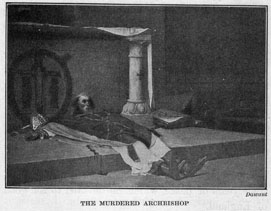
Four knights who heard him understood from this angry speech that he desired the death of Becket, and they went to England to murder the Archbishop. When they met Becket they first demanded that he should do as the king wished, but he firmly refused. At dusk that same day they entered Canterbury Cathedral, again seeking for him. "Where is the traitor, Thomas Becket?" one of them cried.

Becket boldly answered, "Here am I--no traitor, but a priest of god."

As he finished speaking the knights rushed upon him and killed him.

fmma25

The people of England were horrified by this brutal murder. Becket was called a martyr and his tomb became a place of pious pilgrimage. The Pope canonized him and for years he was the most venerated of English saints.

King Henry was in Normandy when the murder occurred. He declared that he had had nothing whatever to do with it and he punished the murderers.

But from this time Henry had many troubles. His own sons rebelled against him, his barons were unfriendly, and conspiracies were formed. Henry thought that God was punishing him for the murder of Becket and so determined to do penance at the tomb of the saint.

For some distance before he reached Canterbury Cathedral where Becket was buried he walked over the road with bare head and feet. After his arrival he fasted and prayed a day and a night. The next day he put scourges into the hands of the cathedral monks and said, "Scourge me as I kneel at the tomb of the saint." The monks did as he bade them and he patiently bore the pain.

Henry finally triumphed over his enemies and had some years of peace, which he devoted to the good of England.

In the last year of his life, however, he had trouble again. The king of France and Henry's son Richard took up arms against him. Henry was defeated and was forced to grant what they wished. When he saw a list of the barons who had joined the French king he found among them the name of his favorite son John, and his heart was broken. He died a few days later.

II

HENRY'S eldest surviving son, Richard, was crowned at Westminster Abbey in 1190.  He took the title of Richard I but is better known as "Coeur de Lion" ("the lion-hearted"), a name which was given him on account of his bravery. He had wonderful strength and his brave deeds were talked about all over the land.

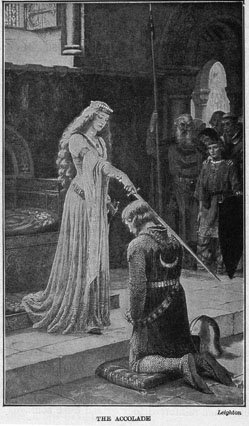
With such a man for their king, the English people became devoted to chivalry, and on every field of battle brave men vied with another in brave deeds. Knighthood was often the reward of valor. Then, as now, knighthood was usually conferred upon a man by his king or queen.  A part of the ceremony consisted in the sovereign's touching the kneeling subject's soldier with the flat of a sword and saying, "Arise, Sir Knight." This was called "the accolade."

Richard did not stay long in England after his coronation. In 1191 he went with Philip of France on a Crusade.

The French and English Crusaders together numbered more than one hundred thousand men. They sailed to the Holy Land and joined an army of Christian soldiers encamped before the city of Acre. The besiegers had despaired of taking the city but when reinforced they gained fresh courage.

fmma25

Coeur de Lion now performed deeds of valor which gave him fame throughout Europe. He was the terror of the Saracens. In every attack on Acre he led the Christians and when the city was captured he planted his banner in triumph on its walls.

So great was the terror inspired everywhere in the Holy Land by the name of Richard that Moslem mothers are said to have made their children quiet by threatening to send for the English king.

Every night when the Crusaders encamped, the heralds blew their trumpets, and cried three times, "Save the Holy Sepulchre!" And the Crusaders knelt and said, "Amen!"

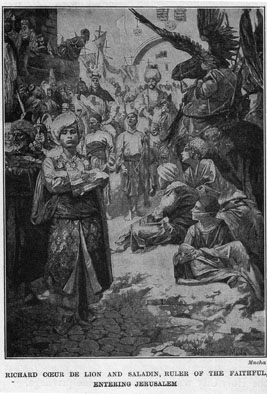
The great leader of the Saracens was Saladin. He was a model of heroism and the two leaders, one the champion of the Christians and the other the champion of the Mohammedans, vied with each other in knightly deeds.

Just before one battle Richard rode down the Saracen line and boldly called for any one to step forth and fight him alone. No one responded to the challenge, for the most valiant of the Saracens did not dare to meet the lion-hearted king.

After the capture of Acre Richard took Ascalon. Then he made a truce with Saladin, by which the Christians acquired the right for three years to visit the Holy City without paying for the privilege.

fmma25

III

RICHARD now set out on his voyage home. He was wrecked, however, on the Adriatic Sea near Trieste. To get to England he was obliged to go through the lands of Leopold, duke of Austria, one of his bitterest enemies. So he disguised himself as a poor pilgrim returning from the Holy Land.

But he was recognized by a costly ring that he wore and was taken prisoner at Vienna by Duke Leopold. His people in England anxiously awaited his return, and when after a long time he did not appear they were sadly distressed. There is a legend that a faithful squire named Blondel went in search of him, as a wandering minstrel traveled for months over central Europe, vainly seeking for news of his master.

At last one day, while singing one of Richard's favorite songs near the walls of the castle where the king was confined, he heard the song repeated from a window. He recognized the voice of Richard. From the window Richard told him to let the English people and the people of Europe know where he was confined, and the minstrel immediately went upon his mission.

Soon Europe was astounded to learn that brave Richard of England, the great champion of Christendom, was imprisoned. The story of Blondel is probably not true, but what is true is that England offered to ransom Richard; that the Pope interceded for him; and that finally it was agreed that he should be given up on the payment of a very large sum of money. The English people quickly paid the ransom and Richard was freed.

The king of France had little love for Richard, and Richard's own brother John had less. Both were sorry that Coeur de Lion was at liberty.

John had taken charge of the kingdom during his brother's absence, and hoped that Richard might pass the rest of his days in the prison castle of Leopold.

As soon as Richard was released, the French king sent word to John, "The devil is loose again." And a very disappointed man was John when all England rang with rejoicing at Richard's return.

IV

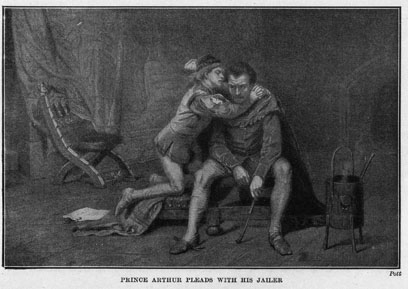
UPON the death of Richard, in 1199, Arthur, the son of his elder brother Geoffrey, was the rightful heir to the throne. John, however, seized the throne himself and cast Arthur into prison. There is a legend that he ordered Arthur's eyes to be put out with red hot irons. The jailor, however, was touched by the boy's prayer for mercy and spared him. But Arthur was not to escape his uncle long. It is said that one night the king took him out upon the Seine in a little boat, murdered him and cast his body into the river.

fmma25

Besides being a king of England, John was duke of Normandy, and Philip, king of France, now summoned him to France to answer for the crime of murdering Arthur. John would not answer the summons and this gave the king of France an excuse for taking possession of Normandy. He did so, and thus this great province was lost forever to England. Nothing in France was left to John except Aquitaine, which had come to him through his mother.

John's government was unjust and tyrannical, and the bishops and barons determined to preserve their rights and the rights of the people. They met on a plain called Runnymeade, and there forced John to sign the famous "Magna Carta" ("Great Charter").

Magna Carta is the most valuable charter ever granted by any sovereign to his people. In it King John names all the rights which belong to the citizens under a just government, and he promises that no one of these rights shall ever be taken away from any subjects of the English king. For violating this promise one English king lost his life and another lost the American colonies.

fmma25

Magna Carta was signed in 1215. A year after he signed it the king died. His son, Henry III, succeeded him.

Subscribe to this RSS feed

Log in or create an account