log in
LC Geerts

LC Geerts

Website URL:

Famous Men of the Middle Ages: Henry V, King from 1413-1422

HENRY V

KING FROM 1413-1422

I

OF all the kings that England ever had Henry V was perhaps the greatest favorite among the people. They liked him because he was handsome and brave and, above all, because he conquered France.

In his youth, Prince Hal, as the people called him, had a number of merry companions who sometimes got themselves into trouble by their pranks. Once one of them was arrested and brought before the chief justice of the kingdom.

Prince Hal was not pleased because sentence was given against his companion and he drew his sword, threatening the judge. Upon this the judge bravely ordered the prince to be arrested and put into prison.

Prince Hal submitted to his punishment with good grace and his father is reported to have said, "Happy is the monarch who has so just a judge, and a son so willing to obey the law."

One of Prince Hal's companions was a fat old knight named Sir John Falstaff. Once Falstaff was boasting that he and three men had beaten and almost killed two men in buckram suits who had attacked and tried to rob them. The prince led him on and gave him a chance to brag as much as he wanted to, until finally Falstaff swore that there were at least a hundred robbers and that he himself fought with fifty. Then Prince Hal told their companions that only two men had attacked Falstaff and his friends, and that he and another man who was present were those two. And he said that Falstaff, instead of fighting, had run as fast as his legs could carry him.

There was real goodness as well as merriment in Prince Hal. And so the people found; for when he became king on the death of his father he told his wild companions that the days of his wildness were over; and he advised them to lead better lives in future.

As Henry V, Prince Hal made himself famous in English history by his war with France.

Normandy, you remember, had belonged to Henry's ancestor, William the Conqueror. It had been taken from King John of England by the French king, Philip Augustus, in 1203.

Soon after his coronation Henry sent a demand to the French king that Normandy should be restored, and he made the claim which his great-grandfather, Edward III, had made that he was by right the king of France.

Of course, the king of France would not acknowledge this. Henry therefore raised an army of thirty thousand men and invaded France.

Before he began to attack the French he gave strict orders to his men that they were to harm no one who was not a soldier and to take nothing from the houses or farms of any persons who were not fighting.

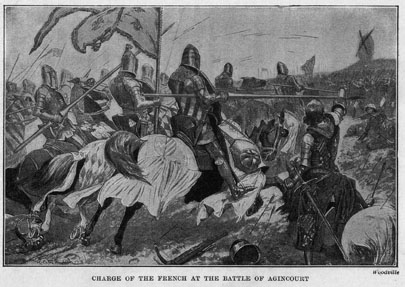
Sickness broke out among Henry's troops after they landed, so that their number was reduced to about fifteen thousand. Fifty or sixty thousand Frenchmen were encamped on the field of Agincourt to oppose this little army.

The odds were greatly against Henry. The night before the battle one of his officers said he wished that the many thousand brave soldiers who were quietly sleeping in their beds in England were with the king.

"I would not have a single man more," said Henry. "If god give us victory, it will be plain we owe it to His grace. If not, the fewer we are the less loss for England."
fmma32

The men drew courage from their king. The English archers poured arrows into the ranks of their opponents; and although the French fought bravely, they were completely routed. Eleven thousand Frenchmen fell. Among the slain were more than a hundred of the nobles of the land.

II

AGINCOURT was not the last of Henry's victories. He brought a second army of forty thousand men over to France. Town after town was captured, and at last Henry and his victorious troops laid siege to Rouen, which was then the largest and richest city in France.

The fortifications were so strong that Henry could not storm them, so he determined to take the place by starving the garrison. He said, "War has three handmaidens--fire, blood, and famine. I have chosen the meekest of the three."

He had trenches dug round the town and placed soldiers in them to prevent citizens from going out of the city for supplies, and to prevent the country people from taking provisions in.

A great number of the country people had left their homes when they heard that the English army was marching towards Rouen, and had taken refuge within the city walls. After the siege had gone on for six months there was so little food left in the place that the commander of the garrison ordered these poor people to go back to their homes.

Twelve thousand were put outside the gates, but Henry would not allow them to pass through his lines; so they starved to death between the walls of the French and the trenches of the English.

As winter came on the suffering of the citizens was terrible. At last they determined to set fire to the city, open their gates, and make a last desperate attack on the English.

Henry wished to preserve the city and offered such generous terms of surrender that the people accepted them. Not only Rouen but the whole of Normandy, which the French had held for two hundred years, was now forced to submit to Henry.

The war continued for about two years more, and the English gained possession of such a large part of France that at Christmas Henry entered Paris itself in triumph.

But, strange to say, the king against whom he had been fighting and over whom he was triumphing sat by his side as he rode through the streets. What did this mean? It meant that the French were so terrified by the many victories of Henry that all--king and people--were willing to give him whatever he asked. A treaty was made that as the king was feeble Henry should be regent of the kingdom and that when the king died Henry should succeed him as king of France.

In the treaty the French king also agreed to give to Henry his daughter, the Princess Katherine, in marriage. She became the mother of the English King, Henry VI.

The arrangement that an English sovereign should be king of France was never put into effect; for in less than two years after the treaty was signed the reign of the great conqueror came to an end. Henry died.

In the reign of his son all his work in gaining French territory was undone. By the time that Henry VI was twenty years old England, as you will read in the story of Joan of Arc, had nothing left of all that had been won by so many years of war except the single town of Calais.

Famous Men of the Middle Ages: Tamerlane, Lived from 1333-1405

TAMERLANE

LIVED FROM 1333-1405

I

TAMERLANE was the son of the chief of a Mongolian tribe in Central Asia. His real name was Timour, but as he was lamed in battle when a youth he was generally called Timour the Lame, and this name was gradually changed to Tamerlane.  He was born in 1333, so that he lived in the time of the English king, Edward III, when the Black Prince was winning his victories over the French. He was a descendant of a celebrated Tatar soldier, Genghis Khan, who conquered Persia, China, and other countries of Asia. When twenty-four years old Tamerlane became the head of his tribe, and in a few years he made himself the leader of the whole Mongolian race.

He was a tall, stern-looking man, of great strength, and, although lame in his right leg, could ride a spirited horse at full gallop and do all the work of an active soldier. He was as brave as a lion--and as cruel.

fmma31

He chose the ancient city of Samarcand, in Turkistan, for his capital; and here he built a beautiful marble palace, where he lived in the greatest luxury.

After he had enjoyed for some time the honors which fell to him as chief ruler of the Mongolians, he began to desire further conquests. He determined to make himself master of all the countries of Central Asia.

"As there is but one God in heaven," he said, "there ought to be but one ruler on the earth."

So he gathered an immense army from all parts of his dominion, and for weeks his subjects were busy making preparations for war. At length he started for Persia in command of a splendid army. After gaining some brilliant victories he forced the Persian king to flee from his capital.

All the rich country belonging to Persia, from the Tigris to the Euphrates, submitted to the Mongolian conqueror.

Tamerlane celebrated his Persian conquest by magnificent festivities which continued for a week. Then orders were given to march into the great Tatar empire of the North. Here Tamerlane was victorious over the principal chiefs and made them his vassals. In pursuing the Tatars he entered Russia and sacked and burned some of the Russian cities. He did not, however, continue his invasion of this country, but turned in the direction of India.

At last his army stood before the city of Delhi, and after a fierce assault forced it to surrender. Other cities of India were taken and the authority of Tamerlane was established over a large extent of the country.

II

BAJAZET, sultan of Turkey, now determined to stop Tamerlane's eastward march.

News of this reached the conqueror's ears. Leaving India, he marched to meet the sultan. Bajazet was a famous warrior. He was so rapid in his movements in war that he was called "the lightning."

Tamerlane entered the sultan's dominions and devastated them. He stormed Bagdad, and after capturing the place killed thousands of the inhabitants.

At length the rivals and their armies faced each other. A great battle followed. It raged four or five hours and then the Turks were totally defeated. Bajazet was captured.

Tamerlane then ordered a great iron cage to be made and forced the sultan to enter it. The prisoner was chained to the iron bars of the cage and was thus exhibited to the Mongol soldiers, who taunted him as he was carried along the lines.

As the army marched from place to place the sultan in his cage was shown to the people. How long the fallen monarch had to bear this humiliating punishment is not known.

Tamerlane's dominions now embraced a large part of Asia. He retired to his palace at Samarcand and for several weeks indulged in festivities.

He could not, however, long be content away from the field of battle. So he made up his mind to invade the Empire of China. At the head of a great army of two hundred thousand soldiers he marched from the city of Samarcand towards China. He had gone about three hundred miles on the way when, in February, 1405, he was taken sick and died. His army was disbanded and all thought of invading China was given up.

Thus passed away one of the greatest conquerors of the Middle Ages. He was a soldier of genius but he cannot be called a truly great man. His vast empire speedily fell to pieces after his death. Since his day there has been no leader like him in that part of Asia.

Famous Men of the Middle Ages: William Tell and Arnold Von Winkelried

WILLIAM TELL AND ARNOLD VON WINKELRIED

I

FAR up among the Alps, in the very heart of Switzerland, are three districts, or cantons, as they are called, which are known as the Forest Cantons and are famous in the world's history. About two thousand years ago the Romans found in these cantons a hardy race of mountaineers, who, although poor, were free men and proud of their independence. They became the friends and allies of Rome, and the cantons were for many years a part of the Roman Empire, but the people always had the right to elect their own officers and to govern themselves.

When Goths and the Vandals and the Huns from beyond the Rhine and the Danube overran the Roman Empire, these three cantons were not disturbed. The land was too poor and rocky to attract men who were fighting for possession of the rich plains and valleys of Europe, and so it happened that for century after century, the mountaineers of these cantons lived on in their old, simple way, undisturbed by the rest of the world.

In a canton in the valley of the Rhine lived the Hapsburg family, whose leaders in time grew to be very rich and powerful. They became dukes of Austria and some of them were elected emperors. One of the Hapsburgs, Albert I, claimed that the land of the Forest Cantons belonged to him. He sent a governor and a band of soldiers to those cantons and made the people submit to his authority.

In one of the Forest Cantons at this time lived a famous mountaineer named William Tell. He was tall and strong. In all Switzerland no man had a foot so sure as his on the mountains or a hand so skilled in the use of a bow. He was determined to resist the Austrians.

Secret meetings of the mountaineers were held and all took a solemn oath to stand by each other and fight for their freedom; but they had no arms and were simple shepherds who had never been trained as soldiers. The first thing to be done was to get arms without attracting the attention of the Austrians. It took nearly a year to secure spears, swords, and battle-axes and distribute them among the mountains. Finally this was done, and everything was ready. All were waiting for a signal to rise.

fmma30

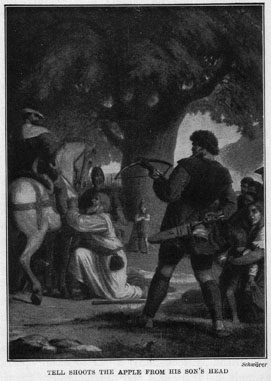
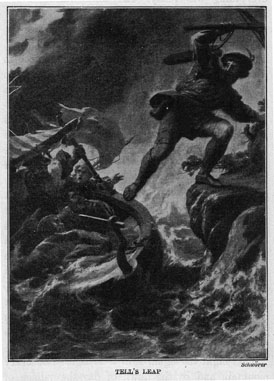
The story tells us that just at this time Gessler, the Austrian governor, who was a cruel tyrant, hung a cap on a high pole in the market-place in the village of Altorf, and forced everyone who passed to bow before it. Tell accompanied by his little son, happened to pass through the marketplace. He refused to bow before the cap and was arrested. Gessler offered to release him if he would shoot an apple from the head of his son. The governor hated Tell and made this offer hoping that the mountaineer's hand would tremble and that he would kill his own son. It is said that Tell shot the apple from his son's head but that Gessler still refused to release him. That night as Tell was being carried across the lake to prison a storm came up. In the midst of the storm he sprang from the boat to an over-hanging rock and made his escape. It is said that he killed the tyrant. Some people do not believe this story, but the Swiss do, and if you go to Lake Lucerne some day they will show you the very rock upon which Tell stepped when he sprang from the boat.

That night the signal fires were lighted on every mountain and by the dawn of day the village of Altorf was filled with hardy mountaineers, armed and ready to fight for their liberty. A battle followed and the Austrians were defeated and driven from Altorf. This victory was followed by others.

fmma30

A few years later, the duke himself came with a large army, determined to conquer the mountaineers. He had to march through a narrow pass, with mountains rising abruptly on either side. The Swiss were expecting him and hid along the heights above the pass, as soon as the Austrians appeared in the pass, rocks and trunks of trees were hurled down upon them. Many were killed and wounded. Their army was defeated, and the duke was forced to recognize the independence of the Forest Cantons.

This was the beginning of the Republic of Switzerland. In time five other cantons joined them in a compact for liberty.

II

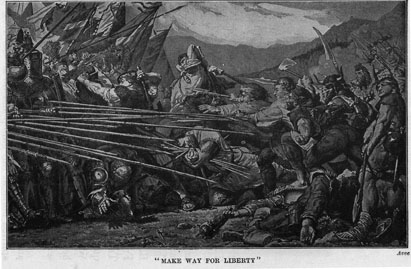
ABOUT seventy years later the Austrians made another attempt to conquer the patriots. They collected a splendid army and marched into the mountains. The Swiss at once armed themselves and met the Austrians at a place called Sempach. In those times powder had not been invented, and men fought with spears, swords, and battle-axes. The Austrian soldiers stood shoulder to shoulder, each grasping a long spear whose point projected far in front of him. The Swiss were armed with short swords and spears and it was impossible for them to get to the Austrians. For a while their cause looked hopeless, but among the ranks of the Swiss was a brave man from one of the Forest Cantons. His name was Arnold von Winkelried. As he looked upon the bristling points of the Austrian spears, he saw that his comrades had no chance to win unless an opening could be made in that line. He determined to make such an opening even at the cost of his life. Extending his arms as far as he could, he rushed toward the Austrian line and gathered within his arms as many spears as he could grasp.
"Make way for liberty!" he cried--
Then ran, with arms extended wide,
As if his dearest friend to clasp;
Ten spears he swept within his grasp.
"Make way for liberty!" he cried--
Their keen points met from side to side.
He bowed among them like a tree,
And thus made way for liberty.

Pierced through and through Winkelried fell dead, but he had made a gap in the Austrian line, and into this gap rushed the Swiss patriots. Victory was theirs and the Cantons were free.

fmma30

Famous Men of the Middle Ages: Edward The Black Prince. Lived From 1330-1376

EDWARD THE BLACK PRINCE

LIVED FROM 1330-1376

I

ONE of the most famous warriors of the Middle Ages was Edward the Black Prince. He was so called because he wore black armor in battle.

The Black Prince was the son of Edward III who reigned over England from 1327 to 1377. He won his fame as a soldier in the wars which his father carried on against France.

You remember that the early kings of England, from the time of William the Conqueror, had possessions in France. Henry II, William's grandson, was the duke of Normandy and lord of Brittany and other provinces, and when he married Eleanor of Aquitaine she brought him that province also.

Henry's son John lost all the French possessions of the English crown except a part of Aquitaine, and Edward III inherited this. So when Philip of Valois became king of France, about a year after Edward had become king of England, Edward had to do homage to Philip.

To be king of England and yet to do homage to the king of France--to bend the knee before Philip and kiss his foot--was something Edward did not like.  He thought it was quite beneath his dignity, as his ancestor Rollo had thought when told that he must kiss the foot of King Charles.

So Edward tried to persuade the nobles of France that he himself ought by right to be the king of France instead of being only a vassal. Philip of Valois was only a cousin of the late French King Charles IV. Edward was the son of his sister. But there was a curious old law in France, called the Salic Law, which forbade that daughters should inherit lands. This law barred the claim of Edward, because his claim came through his mother. Still he determined to win the French throne by force of arms.

A chance came to quarrel with Philip. Another of Philip's vassals rebelled against him, and Edward helped the rebel. He hoped by doing so to weaken Philip and more easily overpower him.

Philip at once declared that Edward's possessions in France were forfeited.

Then Edward raised an army of thirty thousand men, and with it invaded France.

The Black Prince was now only about sixteen years of age, but he had already shown himself brave in battle, and his father put him in command of one of the divisions of the army.

Thousands of French troops led by King Philip were hurried from Paris to meet the advance of the English; and on the 26th of August, 1346, the two armies fought a hard battle at the village of Crecy.

During the battle the division of the English army commanded by the Black Prince had to bear the attack of the whole French force. The prince fought so bravely and managed his men so well that King Edward, who was overlooking the field of battle from a windmill on the top of a hill, sent him words of praise for his gallant work.

Again and again the prince's men drove back the French in splendid style. But at last they seemed about to give way before a very fierce charge, and the earl of Warwick hastened to Edward to advise him to send the prince aid.

"Is my son dead or unhorsed or so wounded that he cannot help himself?" asked the king.

"No, Sire," was the reply; "but he is hard pressed."

"Return to your post, and come not to me again for aid so long as my son lives," said the king. "Let the boy prove himself a true knight and win his spurs."

fmma29

The earl went to the prince and told him what his father had said. "I will prove myself a true knight," exclaimed the prince. "My father is right. I need no aid. My men will hold their post as long as they have strength to stand."

Then he rode where the battle was still furiously raging, and encouraged his men. The king of France led his force a number of times against the prince's line, but could not break it and was at last compelled to retire.

The battle now went steadily against the French, although they far outnumbered the English. Finally, forty thousand of Philip's soldiers lay dead upon the field and nearly all the remainder of his army was captured. Philip gave up the struggle and fled. Among those who fought on the side of the French at Crecy was the blind king of Bohemia, who always wore three white feathers in his helmet. When the battle was at its height the blind king had his followers lead him into the thick of the fight, and he dealt heavy blows upon his unseen foes until he fell mortally wounded. The three white feathers were taken from his helmet by the Black Prince, who ever after wore them himself.

As soon as he could King Edward rode over the field to meet his son. "Prince," he said, as he greeted him, "you are the conqueror of the French." Turning to the soldiers, who had gathered around him, the king shouted, "Cheer, cheer for the Black Prince! Cheer for the hero of Crecy!"

What cheering then rose on the battle-field! The air rang with the name of the Black Prince.

Soon after the battle of Crecy King Edward laid siege to Calais; but the city resisted his attack for twelve months. During the siege the Black Prince aided his father greatly.

After the capture of Calais, it was agreed to stop fighting for seven years, and Edward's army embarked for England.

II

IN 1355 Edward again declared war against the French. The Black Prince invaded France with an army of sixty thousand men. He captured rich towns and gathered a great deal of booty. While he was preparing to move on Paris, the king of France raised a great army and marched against him.

The Black Prince had lost so many men by sickness that he had only about ten thousand when he reached the city of Poitiers. Suddenly, near the city, he was met by the French force of about fifty-five thousand, splendidly armed and commanded by the king himself.

"God help us!" exclaimed the prince, when he looked at the long lines of the French as they marched on a plain before him.

Early on the morning of September 14, 1356, the battle began. The English were few in number, but they were determined to contest every inch of the ground and not surrender while a hundred of them remained to fight.  For hours they withstood the onset of the French. At last a body of English horsemen charged furiously on one part of the French line, while the Black Prince attacked another part.

This sudden movement caused confusion among the French. Many of them fled from the field. When the Black Prince saw this he shouted to his men, "Advance, English banners, in the name of God and St. George!" His army rushed forward and the French were defeated. Thousands of prisoners were taken, including the king of France and many of his nobles.

The king was sent to England, where he was treated with the greatest kindness. When, some time afterwards there was a splendid procession in London to celebrate the victory of Poitiers, he was allowed to ride in the procession on a beautiful white horse, while the Black Prince rode on a pony at his side.

The Black Prince died in 1376. He was sincerely mourned by the English people. They felt that they had lost a prince who would have made a great and good king.

Subscribe to this RSS feed

Log in or create an account