log in
LC Geerts

LC Geerts

Website URL:

From Goddess to King, Appendix A, EXTRACTS FROM THE OERA LINDA BOOK

FROM GODDESS TO KING

A History of Ancient Europe from the

OERA LINDA BOOK

By Anthony Radford

APPENDIX A

EXTRACTS FROM THE BOOK

Frys Tex That was Inscribed on the Walls of all Citadels.

Fryas Tex:

Prosperity awaits the free. At last they shall see me again. Though him only can I recognize as free who is neither a slave to another nor to himself. This is my counsel: When in dire distress, and when mental and physical energy avail nothing, then have recourse to the spirit of Wr-Alda; but do not appeal to him before you have tried all other means, for I tell you beforehand, and time will prove its truth, that those who give way to discouragement sink under their burdens. To Wr-Aldas spirit only shall you bend the knee in gratitude - threefold - for what you have received, for what you do receive, and for the hope of aid in time of need. You have seen how speedily I have come to your assistance. Do likewise to your neighbor, but wait not for his entreaties. The suffering would curse you, my maidens would erase your name from the book, and I would regard you as a stranger. Let not your neighbor express his thanks to you on bent knee, which is only due to Wr-Aldas spirit. Envy would assail you, Wisdom would ridicule you, and my maidens would accuse you of irreverence. Four things are given for your enjoyment - air, water, land, and fire - but Wr-Alda is the sole possessor of them. Therefore, my counsel to you is, choose upright men who will fairly divide the labor and the fruits; so that no man shall be exempt from work or from the duty of defense. If ever it should happen that one of your people should sell his freedom, he is not of you, he is a bastard. I counsel you to expel him and his mother from the land. Repeat this to your children morning, noon, and night, till they think of it in their dreams. If any man should deprive another, even his debtor, of his liberty, let him be to you as a vile slave; and I advise you to burn his body and that of his mother in an open place, and bury them fifty feet below the ground, so that no grass shall grow upon them. It would poison your cattle. Meddle not with the people of Lyda, nor of Finda, because Wr-Alda would help them, and any injury that you inflicted on them would recoil upon your heads. If it should happen that they come to you for advice or assistance, then it behooves you to help them; but if they should rob you, then fall upon them with fire and sword. If any of them should seek a daughter of yours to wife, and she is willing, explain to her her folly; but if she will follow her lover, let her go in peace. If your son wishes for a daughter of theirs, do the same as to your daughter; but let not either one or the other ever return among you, for they would introduce foreign morals and customs, and if these were accepted by you, I could not longer watch over you. Upon my servant Fasta I have placed all my hopes. Therefore you must chose her for Earth Mother. Follow my advice, then she will hereafter remain my servant as well as all the sacred maidens who succeed her. Then shall the lamp which I have lighted for you never be extinguished. Its brightness shall always illuminate your intellect, and you shall always remain as free from foreign domination as your fresh river-water is distinct from the sea.

Fastas Laws Established before 2100 BC.

These Are The Laws Established For The Government of Citadels:

When a citadel is built, the lamp belonging to it must be lighted at the original lamp in Texland, and that can only be done by the Mother. Every Mother shall appoint her own maidens. She may even choose those who are mothers in other towns. The Mother of Texland may appoint her own successor, but should she die without having done so, the election shall take place at a general assembly of the whole nation. The Mother of Texland may have twenty-one maidens and seven assistants, so that there may always be seven to attend the lamp day and night. She may have the same number of maidens who are mothers in other towns. If a maiden wishes to marry, she must announce it to the Mother, and immediately resign her office, before her passion shall have polluted the light. For the service of the Mother and of each of the burgtmaidens there shall be appointed twenty-one townsmen: seven civilians of mature years, seven warriors of mature years, and seven seamen of mature years. Out of the seven three shall retire every year, and shall not be replaced by members of their own family nearer than the fourth degree. Each may have three hundred young townsmen as defenders. For this service they must study Fryas Tex and the laws. From the sages they must learn wisdom, from the warriors the art of war, and from the sea-kings the skill required for distant voyages. Every year one hundred of the defenders shall return to their homes, and those that may have been wounded shall remain in the citadels. At the election of the defenders no burgher or Grevetman, or other person of distinction, shall vote, but only the people. The Mother at Texland shall have three times seven active messengers, and three times twelve speedy horses. In the other citadels each maiden shall have three messengers and seven horses. Every citadel shall have fifty farm workers chosen by the people, but only those may be chosen who are not strong enough to go to war or to go to sea. Every citadel must provide for its own sustenance, and must maintain its own defense, and look after its share of the general contributions. If a man is chosen to fill any office and refuses to serve, he can never become a burgher, nor have any vote. And if he is already a burgher, he shall cease to be so. If any man wishes to consult the Mother of a burgtmaid, he must apply to the secretary, who will take him to the burgtmaster. He will then be examined by a surgeon to see if he is in good health. If he is passed, he shall lay aside his arms, and seven warriors shall present him to the Mother. If the affair concerns only one district, he must bring forward not less than three witnesses; but if it affects the whole of Friesland, he must have twenty-one additional witnesses, in order to guard against any deceptions. Under all circumstances the Mother must take care that her children, that is, Fryas people, shall remain as temperate as possible. This is her most important duty. If she is called upon to decide any judicial question between a Grevetman and the community, she must incline towards the side of the community in order to maintain peace, and because it is better that one man should suffer than many. If any one comes to the Mother for advice, and she is prepared to give it, she must do it immediately. If she does not know what to advise, he must remain waiting seven days; and if she then is unable to advise, he must go away without complaining, for it is better to have no advice at all than bad advice. If a mother shall have given bad advice out of ill-will, she must be killed or driven out of the land, deprived of everything. If her Burgers are accomplices, they are to be treated in a similar manner. If her guilt is doubtful or only suspected, it must be considered and debated, if necessary, for twenty-one weeks. If half the votes are against her, she must be declared innocent. If two-thirds are against her, she must wait a whole year. If the votes are then the same, she must be considered guilty, but may not be put to death. If any one of the one-third who have voted for her wish to go away with her, they may depart with all their live and dead stock, and shall not be the less considered, since the majority may be wrong as well as the minority.

The Universal Laws that were Begun by Fasta.

Universal Law:

All freeborn men are equal, wherefore they must all have equal rights on sea and land, and on all that Wr-Alda has given. Every man may seek the wife of his choice, and every woman may bestow her hand on him whom she loves. When a man takes a wife, a house and yard must be given to him. If there is none, one must be built for him. If he has taken a wife in another village, and wishes to remain, they must give him a house there, and likewise the free use of the common. To every man must be given a piece of land behind his house. No man shall have land in front of his house, still less an enclosure, unless he has performed some public service. In such a case it may be given, and the youngest son may inherit it, but after him it returns to the community. Every village shall possess a common for the general good, and the chief of the village shall take care that it is kept in good order, so that posterity shall find it uninjured. Every village shall have a marketplace. All the rest of the land shall be for tillage and forest. No one shall fell trees without the consent of the community, or without the knowledge of the forester; the forests are general property, and no man can appropriate them. The market charges shall not exceed one-twelfth of the value of the goods either to native or strangers. The portion taken for the charges shall not be sold before the other goods. All the market receipts must be divided yearly into a hundred parts, three days before the Jule-day. The Grevetman and his council shall take twenty parts; the keeper of the market ten, and his assistants five, the Earth Mother one, the midwife four, the village ten, and the poor and infirm shall have fifty parts. There shall be no usurers in the market. If any should come, it will be the duty of the maidens to make it known through the whole land, in order that such people may not be chosen for any office, because they are hardhearted. For the sake of money they would betray everybody - the people, the mother, their nearest relations, and even their own selves. If any man should attempt to sell diseased cattle or damaged goods for sound, the market keeper shall expel him, and the maidens shall proclaim him throughout the country.

The Final Section of the Laws of Minno.

Laws For The Navigators:

All Fryas sons have equal rights, and every stalwart youth may offer himself as a navigator to the Alderman, who may not refuse him as long as there is any vacancy. The navigators may choose their own masters. The traders must be chosen and named by the community to which they belong, and the navigators have no voice in their election. If during a voyage it is found that the king is bad or incompetent, another may be put in his place, and on the return home he may make his complaint to the Alderman. If the fleet returns with profits, the sailors may divide one-third among themselves in the following manner: The king twelve portions, the admiral seven, the boatswains each two portions; the captains three, and the rest of the crew each one part; the youngest boys each one-third of a portion, the second boys half a portion each, and the eldest boys two-thirds of a portion each. If any have been disabled, they must be maintained at the public expense, and honored in the same way as the soldiers. If any have died on the voyage, their nearest relatives inherit their portion. Their widows and orphans must be maintained at the public expense; and if they were killed in a sea-fight, their sons may bear the names of their fathers on their shields. If a topsailsman is lost, his heirs shall receive a whole portion. If he was betrothed, his bride may claim seven portions in order to erect a monument to her bridegroom, but then she must remain a widow all her life. If the community is fitting out a fleet, the purveyors must provide the best provisions for the voyage, and for the women and children. If a sailor is worn out and poor, and has no house or patrimony, one must be given to him. If he does not wish for a house, his friends may take him home; and the community must bear the expense, unless his friends decline to receive it.

Famous Men of the Middle Ages: Warwick The Kingmaker. Lived From 1428-1471

WARWICK THE KINGMAKER

LIVED FROM 1428-1471

I

THE earl of Warwick, known as the "kingmaker," was the most famous man in England for many years after the death of Henry V. He lived in a great castle with two towers higher than most church spires. It is one of the handsomest dwellings in the world and is visited every year by thousands of people. The kingmaker had a guard of six hundred men. At his house in London meals were served to so many people that six fat oxen were eaten at breakfast alone. He had a hundred and ten estates in different parts of England and no less than 30,000 persons were fed daily at his board.  He owned the whole city of Worcester, and besides this and three islands, Jersey, Guernsey and Alderney, so famed in our time for their cattle, belonged to him.

He had a cousin of whom he was as fond as if he were a brother. This was Richard, duke of York, who was also own cousin to King Henry VI, the son of Henry V.

One evening as the sun was setting, and the warders were going to close the gates of the city of York for the night, a loud blast of a horn was heard. It was made by the sentry on the wall near the southern gate. An armed troop was approaching. When they drew near the gate their scarlet coats embroidered with the figure of a boar proved them to be the men of the earl of Warwick. The earl himself was behind them. The gate was opened.

Passing through it and on to the castle, the earl and his company were soon within its strong stone walls.

"Cousin," said the earl of Warwick to the duke of York as they sat talking before a huge log fire in the great room of the castle, "England will not long endure the misrule of a king who is half the time out of his mind."

The earl spoke the truth. Every now and then Henry VI lost his reason, and the duke of York, or some other nobleman, had to govern the kingdom for him.

The earl of Warwick added: "You are the rightful heir to the throne. The claim of Henry VI comes through Lancaster, the fourth son of Edward III--yours through Lionel, the second. His claim comes through his father only--yours through both your father and mother.  It is a better claim and it is a double claim."

"That is true, my cousin of Warwick," replied the duke of York, "but we must not plunge England into war."

"Surely not if we can help it," replied the earl. "Let us first ask for reform. If the king heeds our petition, well and good. If not I am determined, cousin of York, that you shall sit on the throne of England instead of our insane sovereign."

A petition was soon drawn up and signed and presented to Henry. It asked that Henry would do something which would make the people contented.

The king paid no attention to it. Then a war began.  It was the longest and most terrible that ever took place in England. It lasted for thirty years.

Those who fought on the king's side were called Lancastrians, because Henry's ancestor, John of Gaunt, was the duke of Lancaster. The friends of Richard were called Yorkists, because he was duke of York. The Lancastrians took a red rose for their badge; the Yorkists a white one. For this reason the long struggle has always been called the "War of the Roses."

In the first great battle the Red Rose party was defeated and the king himself was taken prisoner.

The victors now thought that the duke of York ought to be made king at once. However, a parliament was called to decide the question, and it was agreed that Henry should be king as long as he lived, but that at his death the crown should pass to the duke of York.

II

MOST people though this was a wise arrangement; but Queen Margaret, Henry's wife, did not like it at all, because it took from her son the right to reign after his father's death. So she went to Scotland and the North of England, where she had many friends, and raised an army.

She was a brave woman and led her men in a battle in which she gained the victory. The duke of York was killed, and the queen ordered some of her men to cut off his head, put upon it a paper crown in mockery, and fix it over one of the gates of the city of York.

Warwick attacked the queen again as soon as he could; but again she was victorious and captured from Warwick her husband, the king, whom the earl had held prisoner for some time past.

This was a great triumph for Margaret, for Henry became king once more.

fmma35

But the people were still discontented. The York party was determined that Edward, the son of the old duke of York, should be made king. So thousands flocked to the White Rose standard and Warwick marched to London at their head.

The queen saw that her only safety was in flight. She left London and the kingmaker entered the city in triumph.

The citizens had been very fond of the old duke of York, and when his party proclaimed his handsome young son King Edward IV, the city resounded with the cry "God save King Edward."

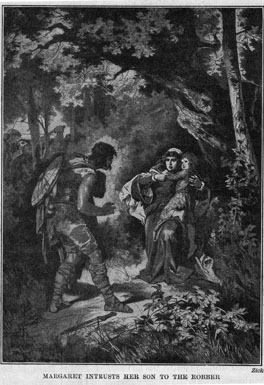
Brave Queen Margaret was completey defeated in another battle. The story is told that after this she fled into a forest with her young son. A robber met them, but Margaret, with wonderful courage, said to him, "I am your queen and this is your prince. I entrust him to your care."

The man was pleased with the confidence that she showed. He took her and the young prince to a safe hiding place, and helped them to escape from England in a sailing vessel.

III

EDWARD IV now seemed to be seated securely upon the throne. But trouble was near. Warwick wished him to follow his advice. Edward thought he could manage without any advice. Then the king and the kingmaker quarreled, and at last became open enemies and fought one another on the field of battle. The end of it was that Warwick was defeated, and driven out of the country. He sailed across the channel and sought refuge in France.

There whom should he meet but his old enemy, Queen Margaret. She had beaten him in battle, and had beheaded his cousin Richard, duke of York; he had beaten her and driven her from her kingdom; and twice he had made her husband prisoner and taken from him his crown. In spite of all this the two now became fast friends, and the kingmaker agreed to make war upon Edward and restore Henry to the throne.

He asked assistance from Louis XI, king of France, who supplied him with men and money. So with an army of Frenchmen the kingmaker landed on the shores of England. Thousands of Englishmen who were tired of Edward flocked to Warwick's standard, and when he reached London he had an army of sixty thousand men.

Edward fled without waiting for a battle and escaped to the Netherlands in a sailing-vessel. The kingmaker had now no one to resist him. The gates of London were opened to him, and the citizens heartily welcomed him. Marching to the Tower, he brought out the old king and placed him once more upon the throne.

But though Edward had fled, he was not discouraged. He followed the example of the kingmaker and asked aid from foreign friends. The duke of Burgundy supplied him with money and soldiers, and he was soon back in England.

His army grew larger and larger every day. People had been very much dissatisfied with Edward and had rejoiced to get rid of him and have Henry for king, because if Henry was not clever he was good. But in a short time they had found out that England needed a king who was not only good but capable.

So when Edward and his French soldiers landed most people in England welcomed them. The kingmaker was now on the wrong side.

Edward met him in battle at a place called Barnet, and completely defeated him. Warwick was killed and Henry once more became prisoner.

In another battle both Margaret and her son were made prisoners. The son was brutally murdered in the presence of King Edward. Margaret was placed in the Tower, and King Henry, who died soon after the battle of Tewksbury, was probably poisoned by order of Edward.

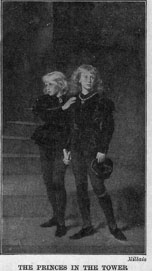
In 1438, after a reign of twenty-two years, Edward died, leaving two sons. Both were boys, so Edward's brother, Richard, duke of Gloucester, was made regent until young Edward V, the older of the two, should come of age.

But Richard was determined to make himself king. So he put both the young princes in the Tower. He than hired ruffians to murder them. One night, when the little princes were asleep, the murderers smothered them with pillows and buried their bodies at the foot of a stairway in the Tower, and there, after many years, their bones were found.

fmma35

After Richard had murdered his two nephews, he was crowned king, as Richard III, much pleased that his plans had succeeded so well. He thought that now nobody could lay claim to the throne. But he was mistaken. One person did claim it. This was Henry Tudor, earl of Richmond.

Henry's father, Edmund Tudor, was only a Welsh gentleman, but was the half-brother of Henry VI through their mother Queen Katherine. Henry's mother was descended from John of Gaunt, fourth son of Edward III, and thus through his mother he was of royal blood and a Lancastrian.

When Richard III by his wickedness and cruelty had made all England hate him, the Red Rose party gathered about Henry Tudor, raised an army, and fought against the king in the battle of Bosworth.

Richard was a bad man, but he was brave, and he fought like a lion. However, it was all in vain. He was defeated and killed. His body was thrown on the back of a horse, carried to a church near the field of battle and buried.

The battered crown which Richard had worn was picked up and placed on Henry's head and the whole Lancastrian army shouted, "Long live King Henry!"

Parliament now voted that Henry Tudor and his heirs should be kings of England. Not long afterwards Henry married the heiress of the house of York, and thus both the Red Roses and the White were satisfied, as the king was a Lancastrian and the queen a Yorkist. So the long and terrible Wars of the Roses came to an end.

THE END

Famous Men of the Middle Ages: Gutenberg, Lived from 1400-1468

GUTENBERG

LIVED FROM 1400-1468

I

WHILE Joan of Arc was busy rescuing France from the English, another wonderful worker was busy in Germany. This was John Gutenberg, who was born in Mainz.

The Germans--and most other people--think that he was the inventor of the art of printing with movable types. And so in the cities of Dresden and Mainz his countrymen have put up statues in his memory.

Gutenberg's father was a man of good family. Very likely the boy was taught to read. But the books from which he learned were not like ours; they were written by hand. A better name for them than books is "manuscripts," which means "hand-writings."

While Gutenberg was growing up a new way of making books came into use, which was a great deal better than copying by hand. It was what is called block-printing. The printer first cut a block of hard wood the size of the page that he was going to print. Then he cut out every word of the written page upon the smooth face of his block. This had to be very carefully done. When it was finished the printer had to cut away the wood from the sides of every letter. This left the letters raised, as the letters are in books now printed for the blind.

The block was now ready to be used. The letters were inked, paper was laid upon them and pressed down.

With blocks the printer could make copies of a book a great deal faster than a man could write them by hand. But the making of the blocks took a long time, and each block would print only one page.

Gutenberg enjoyed reading the manuscripts and block books that his parents and their wealthy friends had; and he often said it was a pity that only rich people could own books. Finally he determined to contrive some easy and quick way of printing.

He did a great deal of his work in secret, for he thought it was much better that his neighbors should know nothing of what he was doing.

So he looked for a workshop where no one would be likely to find him. He was now living in Strasburg, and there was in that city a ruined old building where, long before his time, a number of monks had lived. There was one room of the building which needed only a little repairing to make it fit to be used. So Gutenberg got the right to repair that room and use it as his workshop.

All his neighbors wondered what became of him when he left home in the early morning, and where he had been when they saw him coming back late in the twilight. Some felt sure that he must be a wizard, and that he had meetings somewhere with the devil, and that the devil was helping him to do some strange business.

Gutenberg did not care much what people had to say, and in his quiet room he patiently tried one experiment after another, often feeling very sad and discouraged day after day because his experiments did not succeed.

At last the time came when he had no money left. He went back to his old home, Mainz, and there met a rich goldsmith named Fust (or Faust).

fmma34

Gutenberg told him how hard he had tried in Strasburg to find some way of making books cheaply, and how he had now no more money to carry on his experiments. Fust became greatly interested and gave Gutenberg what money he needed. But as the experiments did not at first succeed Fust lost patience. He quarreled with Gutenberg and said that he was doing nothing but spending money.  At last he brought suit against him in the court, and the judge decided in favor of Fust. So everything in the world that Gutenberg had, even the tools with which he worked, came into Fust's possession.

II

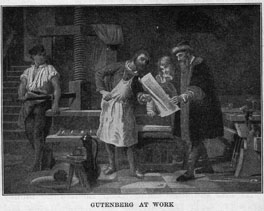
BUT though he had lost his tools, Gutenberg had not lost his courage. And he had not lost all his friends. One of them had money, and he bought Gutenberg a new set of tools and hired a workshop for him. And now at last Gutenberg's hopes were fulfilled.  First of all it is thought that he made types of hard wood. Each type was a little block with a single letter at one end. Such types were a great deal better than block letters. The block letters were fixed. They could not be taken out of the words of which they were parts. The new types were movable so they could be set up to print one page, then taken apart and set up again and again to print any number of pages.

But type made of wood did not always print the letters clearly and distinctly, so Gutenberg gave up wood types and tried metal types. Soon a Latin Bible was printed. It was in two volumes, each of which had three hundred pages, while each of the pages had forty-two lines. The letters were sharp and clear. They had been printed from movable types of metal.

III

THE Dutch claim that Lorenz Coster, a native of Harlem, in the Netherlands, was the first person who printed with movable type. They say that Coster was one day taking a walk in a beech forest not far from Harlem, and that he cut bark from one of the trees and shaped it with his knife into letters.

Not long after this the Dutch say Coster had made movable types and was printing and selling books in Harlem.

The news that books were being printed in Mainz by Gutenberg went all over Europe, and before he died printing-presses like his were at work making books in all the great cities of the continent.

About twenty years after his death, when Venice was the richest of European cities, a man named Aldus Manutius established there the most famous printing house of that time. He was at work printing books two years before Columbus sailed on his first voyage. The descendents of Aldus continued the business after his death for about one hundred years. The books published by them were called "Aldine," from Aldus. They were the most beautiful that had ever come from the press. They are admired and valued to this day.

Famous Men of the Middle Ages: Joan of Arc, Lived from 1412-1431

JOAN OF ARC

LIVED FROM 1412-1431

I

IN the long wars between the French and English not even the Black Prince or King Henry V gained such fame as did a young French peasant girl, Joan of Arc.

She was born in the little village of Domremy. Her father had often told her of the sad condition of France--how the country was largely in the possession of England, and how the French king did not dare to be crowned.

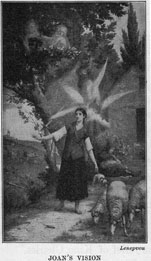
And so the thought came to be ever in her mind, "How I pity my country!" She brooded over the matter so much that by and by she began to have visions of angels and heard strange voices, which said to her, "Joan, you can deliver the land from the English. Go to the relief of King Charles."

At last these strange visions and voices made the young girl believe that she had a mission from God, and she determined to try to save France.

When she told her father and mother of her purpose, they tried to persuade her that the visions of angels and the voices telling her of the divine mission were but dreams. "I tell thee, Joan," said her father, "it is thy fancy. Thou hadst better have a kind husband to take care of thee, and do some work to employ thy mind."

fmma33

"Father, I must do what God has willed, for this is no work of my choosing," she replied. "Mother, I would far rather sit and spin by your side than take part in war. My mission is no dream. I know that I have been chosen by the Lord to fulfill His purpose and nothing can prevent me from going where He purposes to send me."

The village priest, her young companions, even the governor of the town, all tried to stop her, but it was in vain.

To the governor she said, "I must do the work my Lord has laid out for me."

Little by little people began to believe in her mission. At last all stopped trying to discourage her and some who were wealthy helped her to make the journey to the town of Chinon, where the French king, Charles the Seventh, was living.

II

WHEN Joan arrived at Chinon, a force of French soldiers was preparing to go to the south of France to relieve the city of Orleans which the English were besieging.

King Charles received Joan kindly and listened to what she had to say with deep attention. The girl spoke modestly, but with a calm belief that she was right.

"Gracious King," she said, "my name is Joan. God has sent me to deliver France from her enemies. You shall shortly be crowned in the cathedral of Rheims (remz). I am to lead the soldiers you are about to send for the relief of Orleans. So God has directed and under my guidance victory will be theirs."

The king and his nobles talked the matter over and finally it was decided to allow Joan to lead an army of about five thousand men against the English at Orleans.

When she left Chinon at the head of her soldiers, in April, 1429, she was in her eighteenth year. Mounted on a fine war-horse and clad in white armor from head to foot, she rode along past the cheering multitude, "seeming rather," it has been said, "of heaven than earth." In one hand she carried an ancient sword that she had found near the tomb of a saint, and in the other a white banner embroidered with lilies.

The rough soldiers who were near her left off their oaths and coarse manners, and carefully guarded her. She inspired the whole army with courage and faith as she talked about her visions.

When she arrived at the besieged city of Orleans she fearlessly rode round its walls, while the English soldiers looked on in astonishment. She was able to enter Orleans, despite the efforts of the besiegers to prevent her.

She aroused the city by her cheerful, confident words and then led her soldiers forth to give battle to the English. Their success was amazing.  One after another the English forts were taken.

fmma33

When only the strongest remained and Joan was leading the attacking force, she received a slight wound and was carried out of the battle to be attended by a surgeon.  Her soldiers began to retreat. "Wait," she commanded, "eat and drink and rest; for as soon as I recover I will touch the walls with my banner and you shall enter the fort." In a few minutes she mounted her horse again and riding rapidly up to the fort, touched it with her banner. Her soldier almost instantly carried it. The very next day the enemy's troops were forced to withdraw from before the city and the siege was at end.

The French soldiers were jubilant at the victory and called Joan the "Maid of Orleans."  By this name she is known in history. Her fame spread everywhere, and the English as well as the French thought she had more than human power.

She led the French in several other battles, and again and again her troops were victorious.

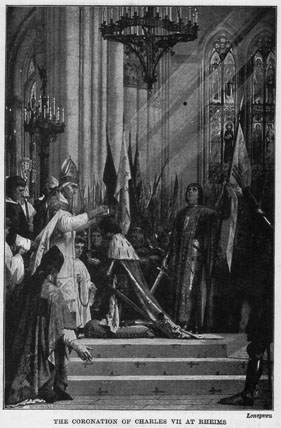
At last the English were driven far to the north of France. Then Charles, urged by Joan, went to Rheims with twelve thousand soldiers, and there, with splendid ceremonies, was crowned king. Joan holding her white banner, stood near Charles during the coronation.

When the ceremony was finished, she knelt at his feet and said, "O King, the will of God is done and my mission is over! Let me now go home to my parents."

But the king urged her to stay a while longer, as France was not entirely freed from the English. Joan consented, but she said, "I hear the heavenly voices no more and I am afraid."

fmma33

However she took part in an attack upon the army of the Duke of Burgundy, but was taken prisoner by him. For a large sum of money the duke delivered her into the hands of the English, who put her in prison in Rouen. She lay in prison for a year, and finally was charged with sorcery and brought to trial. It was said that she was under the influence of the Evil One. She declared to her judges her innocence of the charge and said, "God has always been my guide in all that I have done. The devil has never had power over me."

Her trial was long and tiresome. At its close she was doomed to be burned at the stake.

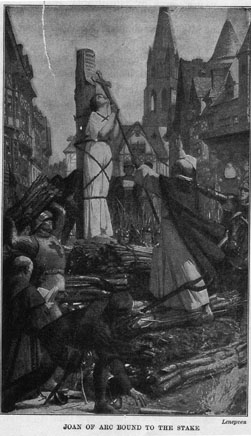
So in the market-place at Rouen the English soldiers fastened her to a stake surrounded by a great pile of fagots.

A soldier put into her hands a rough cross, which he had made from a stick that he held.  She thanked him and pressed it to her bosom. Then a good priest, standing near the stake, read to her the prayers for the dying, and another mounted the fagots and held towards her a crucifix, which she clasped with both hands and kissed. When the cruel flames burst out around her, the noble girl uttered the word "Jesus," and expired.

fmma33

A statue of her now stands on the spot where she suffered.

Among all the men of her time none did nobler work than Joan.  And hence it is that we put the story of her life among the stories of the lives of the great men of the Middle Ages, although she was only a simple peasant girl.

Subscribe to this RSS feed

Log in or create an account