log in
LC Geerts

LC Geerts

Website URL:

From Goddess to King, Chapter 2, THE GEOLOGICAL DISASTERS

FROM GODDESS TO KING

A History of Ancient Europe from the

OERA LINDA BOOK

By Anthony Radford

CHAPTER 2

THE GEOLOGICAL DISASTERS

Mankindhas traditionally divided his ancient past into ages such as those that the eighth century BC poet Hesiod from Greece described. They were, according to him, four in number and symbolized by gold, silver, bronze, and iron during which mans consciousness declined. If this were so then our early ancestors were not bestial primitives but noble heroes. That thought might be aroused in reading the source of this material but it would be more advantageous to find the similarities we still possess, to be more watchful of our communities and the true motivation and capabilities of our officers.

Today there is a lot of interest in the coming Age of Aquarius, one of the ways that we divide our history on a long time basis. Still in use today are the twelve names of the zodiac, which are related to a Great Year of 25,920 Earth years, first recorded in ancient Sumer. Astronomers say this is not the rotation of our Milky Way galaxy which has a period of 250,000 years but a wobble in the axis of the Earth plus a spin or precession of a local arm of our galaxy where our own Solar system is located. It represents an apparent rotation of the stars as seen from Earth, an apparent direction relative to our own galaxy but not to any larger order of the universe. Still that is a very big concept for this tiny portion of the universe wherein all directions are relative anyway. Dividing this Great Year by twelve, we get 2,160 or one Zodiacal Year. This is a period related to the constellations that are seen and named in the sky. This list of zodiacal ages shows the time period of the Book.

A table of these ages can be shown thus:

  • Age of Aquarius 23,820 BC to 21,660 BC
  • Age of Capricorn 21,660 BC to 19,500 BC
  • Age of Sagittarius 19,500 BC to 17,340 BC
  • Age of Scorpion 17,340 BC to 15,180 BC
  • Age of Virgo 13,020 BC to 10,860 BC
  • Age of Leo 10,860 BC to 8,700 BC
  • Age of Cancer 8,700 BC to 6,540 BC
  • Age of Gemini 6,540 BC to 4,380 BC
  • Age of Taurus 4,380 BC to 2,220 BC
  • Age of Aries 2,220 BC to 60 BC
  • Age of Pisces 60 BC to 2,100 AD
  • Age of Aquarius 2,100 AD to 4,260 AD

These ages also represent a change in consciousness, not just astronomical directions and are therefore not limited to an exact period. Many people now feel the speed of todays events and are already celebrating the new age of the Water Carrier without having to wait another hundred years. There is also a sense that the change of an age should be accompanied by something dramatic like the birth of a savior or perhaps a natural disaster of continental proportions. Maybe this is why stories are current about the loss of California into the Pacific Ocean.

This sense may be reinforced by our own history as the first geological disaster described and dated in the Oera Linda Book occurred in 2,193 BC. This was just twenty-seven years after the astronomical date for the end of the Age of the Bull and the beginning of the Age of the Ram. The description tells of three years of prior rumbling or heaviness in the air followed by one to two hundred years of "bad times" when total reconstruction of society was obligatory. At this time invaders swept in from the east and occupied the devastated lands, the barrier forests of which the Black Forest is a tiny remnant, were penetrated by the Finns and the Magyars, and at night the foe rested in the foe-rest.

The Cimbrian Flood has been dated from the same time period but is more likely to be much later because it gets its name from the Cimbri, a Germanic tribe that is remembered for their incursion into Roman Italy in 101 BC. and for other victories over the Romans. In alliance with the Teutons they fought in 113, 109, and 107 BC. The tradition is that they were forced out of Denmark by the encroaching sea and migrated southwards until they felt the expansion of Rome They numbered half a million by then. The Oera Linda Book mentions another flood in the region of Denmark in 305 BC which could be that disturbance remembered in their tribal story. It is interesting to note that the Cimbri are also referred to in very ancient Welsh ballads. They were the name of the people who sought to return to Wales (in Westland) from Crimea after their ancestors were forced out by a flood. The Briti (hence Britain) were another of their tribes. At this time it is appropriate to explain the use of the word "German". Its first mention is in the time of Caesar when the Germani were described as those tribesmen who crossed over the Rhine into Roman territory. Those already under occupation were called the Galli, a distinction that has divided Germans from Celts ever since. The ancient name for Germany was Twiskland with the people east of the Rhine being called Twiskars but these people did not have a common name for themselves. The Oera Linda Book has much to say on the origins of many various peoples, more mixed than previously supposed. The author uses the term Germanic to represent all West European language groups particularly those that predate Latin and as a more generic word than in the modern sense.

The prodigious events of the twenty-second century BC must have been felt around the world but few societies have records, which go back that far. The geologists will have to explore this further but the event should have been recorded in ancient Egypt and indeed it was. The events were stupendous enough to have been not recorded as no pharaoh survived to erect a monument for two hundred years. About 2,200 BC Egypts First Intermediary Period began after the first ten contiguous dynasties abruptly ended. The religious center at Heliopolis and the capital of Memphis (Greek names for Egyptian cities) were destroyed. The country was overrun, repeatedly ravaged and pillaged by barbarian horsemen from what is now believed to be the east or the land of Arabia. Eventually order was restored in Upper Egypt with a new capital at Thebes under the Eleventh Dynasty. After two hundred years, the Twelfth Dynasty reunited the country with much rebuilding of the temples and Ra, the premier god of old Egypt was renamed Amon; a new age began with very little reference to why this all occurred. Who survived to record the events?

The Old Testament tells the story of Sodom and Gomorra, two Cities of the Plain which are thought to have been the result of a geological disturbance about 2000 BC. However there are no young volcanic rocks in the area of the Dead Sea if that area is an accurate assessment of the site. The numerous asphalt deposits in the fault plagued region do suggest a different type of disturbance could have caused the events reported in Genesis; even the occurrence of natural gas fires. That there is a connection with the disturbance in northwest Europe at the time would be pure speculation.

The next great disaster of mythology is that one which has been dated presumably at the end of the Minoan civilization and the beginning of the classical Greek one, but is now known to have occurred a hundred years earlier. It is one of the last stories of the Greek myths, the story of Theseus and the Minotaur, of Daedalus and Icarus. About 1650 BC, the destruction of Knossos on Crete and the city of Aquatilia on Thera, an island north of Crete, have strengthened the contention that Crete was the site of Atlantis of a much older time. That there was earthquake and fire has been determined but the date remains approximate. When was this event? New research shows it to be as early as 1650 BC but others give a date as late as 1050 BC. Nobody knows for sure as the disasters mentioned in any one area could have been very devastating but actually local to that area.

This disturbance is not mentioned directly in the Oera Linda Book but an earthquake is recorded in Egypt and land disturbances in Persia that can be dated to the beginning of the sixteenth century BC. Also there are many centuries of history that have been lost to us in this one surviving record. Eastern Mediterranean quakes may not have been known in the north and west of Europe just as there is little datable evidence for the European quakes of 305 BC that are detailed in the Book in the history of the Mediterranean and the Near East. This disaster is more extensively described than the first one, even though it could not have been as devastating as the 2193 BC events, because it occurred at a time when they were deliberately writing down their history. The warning signs should be of vital interest now that there is much current speculation on the possibility of a major quake in our time. The signs at that time included three years of volcanic fires with little sun and an ominous feeling perhaps from subsonic rumblings. Exceptional weather and seismic events can be easily measured today but we are still surprised when something happens.

In order to relate geological events to historical and mythical ones, a brief chronological table of significant events mentioned in the Oera Linda Book is here included. Dates are approximated when not specifically known. So many stories are told over such a long period in history that it is difficult to write an overview until the story itself is read but there are messages for us as well as adventures to excite and capture our imagination. Why do we find a fascination with stories from the past and why do only some of us want to vicariously share particular adventures? Perhaps we have lived them ourselves; been a pirate or a lonely farm wife waiting for her man to come home and wondering what tales he would bring.

Here is the list:

  • BC
  • 2193 Sinking of Atland.
  • 2163 Alternative calculation for the sinking.
  • 2150 The end of the Early Minoan period.
  • 2140 Fasta opens a citadel at Medesblik.
  • 2092 Finns settle in Finland.
  • 2012 Minna, Earth Mother. Finns overran Schoonland.
  • 2011 Wodin leads campaign to free Schoonland.
  • 2000 Teunis founds Tyre, south of Sidon.
  • 1750 The end of the Middle Minoan period.
  • 1650 The eruption of Mt. Thera.
  • 1650 The end of Late Minoan-A.
  • 1620 Jon goes to the Mediterranean.
  • 1615 Possible time Minerva founded Athens.
  • 1600 Kalta founds the Celtic Empire.
  • 1600 Minno and the beginnings of classical Crete.
  • 1590 Burgtmaid Geert of Athens.
  • 1555 Destruction of Knossos, end of Minoan civilization.
  • 1550 Geertmen settle in the Punjab.
  • 1500 Aryan invasion of India.
  • 1400 Date of the Vedas.
  • 1200 - 1190 The Trojan war.
  • 1188 Story of Ulysses.
  • 591 Earth Mother Frana at Texland.
  • 586 Invasion of Texland and murder of Frana.
  • 560 Adela acting as un-elected Earth Mother.
  • 558 The first book of the Book of Adela written.
  • 557 Further invasions and murder of Adela.
  • 540 Apollonia writes of previous generation.
  • 325 Geertmen leave Punjab with Nearchus.
  • 323 Death of Alexander.
  • 305 Second geological disaster
  • 305 Demetrius sieges Rhodes.
  • 304 Gosa Makonta elected Earth Mother.
  • 303 Return of the Geertmen.
  • 290 Time of Frethorik and Wiljo, contributors to the Book.
  • 265 The death of Friso.
  • 250 Adel becomes chief count with his bride Ifkja.
  • 250 Rebuilding projects described by Konered.
  • 70 Approximate time of King Askar
  • 50 Caesar annexes Gaul to Rome.
  • 10 Beeden contributes to the Book.
  • AD
  • 803 Liko Over de Linda saves the Book from a flood.
  • 1256 Hiddo Over de Linda recopies the Book on new paper.
  • 1848 Cornelius Over de Linden receives the Book from his aunt.
  • 1867 Dr. Verwijs translates the Book.
  • 1871 Dutch translation of the Book.
  • 1876 English language publication of the Oera Linda Book.

Todays archaeologist uses many modern techniques to make archaeology closer to an exact science. Carbon dating, microspore analysis, metallurgical analysis and clay or stone identification has moved the speculative side to unexamined sites. The problem of finding evidence to support or disprove the Book is that few discoveries have been made or examined in the northern oceans. Many harbors and cities have been found all around the Mediterranean that have been submerged, but the North has colder waters of shifting sands and kelp beds, where it is not as rewarding or convenient for the undersea explorer to work in sunless weeds. In Helgoland, a North Frisian island that is now part of Germany again, underwater walls and foundations using six-foot stones have been found. They measure five hundred feet long and surround a hill containing the remains of more structures. This was once a citadel or castle fortified by several concentric walls, now under water.

We know that the oceans are rising at about three or four inches every century because of the melting of the ice caps but the studies done in the Mediterranean do not give any regular dating of flooded cities in proportion to how deep they are submerged. The Greek City of Helike abruptly sank in the fourth century BC that relates to the second disaster in the Book but shows that no smooth theory can be applied. Some areas go up as others go down. This is particularly true in Scandinavia where the removal of the ice has permitted the peninsula to rise 1500 feet in the last 10,000 years with a present rate of three feet each century. This elevation of one area would permit the submergence of another and it is so told in the Book, not as a slow change every century but as an abrupt disaster in 2193 BC.

It is also known that for more than a thousand years the sea did not rise in the Mediterranean so that averages over long periods have little meaning for any century; sudden changes or earthquakes being more likely to occur. The archaeologist is being forced to join with the geologist, the oceanographer and the new scientists studying gravimetric data from space satellites to discover the ancient coastlines of countries and archaeological sites.

Disasters will always happen but the world continues to spin. It is quite encouraging to read of the social recovery of the various peoples described as life goes on with a combination of the old and the new writing another chapter of history. The Book describes how new harbors or mooring were made, citadels rebuilt and of various peoples settling and reclaiming lost land. With our reliance on highways, pipelines and power-lines it makes one wonder if modern man can survive such an ordeal as easily as can a simple rural society. We are told how the black rowers, all men, took to the ships and survived. They found willing white women whose menfolk did not survive at sea and the races blended again. Social distrust of the new mixed settlers occurred just as it still does today but then, the last Earth Mother, Gosa counseled acceptance of this new social order from the only citadel that was not destroyed.

If ones tries to find similarities in facts and beliefs in pre-Christian mythology to support the authenticity of the Oera Linda Book then it is not an exact science; it merely shows various similarities of references that prove nothing but they do kindle the imagination. For example, what can be found in the earliest Irish and Welsh stories which have survived Christian influence? There are many such stories relating to fire, flood and conquest and parallels can be drawn to the disasters mentioned but as there is no way to verify the dates referred to, then only a feeling of familiarity can be ascertained from them. The traditional date for the first people of Ireland is 145 years after that of the disaster they recorded as 2193 BC.

Celtic mythology for Ireland is considered the least influenced or distorted but it was recorded during Christian times, as early as the eighth century AD and as late as the fourteenth. Their earliest story tells of the origin of the first known peoples, the first race having perished in the biblical flood. The next race to invade Ireland about 2048 BC was a group of twenty-four males and twenty-four females led by Partholon, a male father figure. They found only a treeless landscape of lakes and rivers but for five hundred years they multiplied and had to fight against the Fomorians, a race of demons who used supernatural powers and were reputed to have come from Africa. African settlers in Europe are mentioned several times in the Book and contributed their genes to the European mixture almost as prolifically as the migrations from Asia but to return to the Irish story... The Partholon were decimated by a pestilence which was followed a generation later by natural disasters that cleared newly grown forests and formed new lakes. At that time (1718 BC) the country was invaded by the Nemed who also had to fight the Fomorians and were eventually defeated and driven from Ireland.

The only references that can be taken from this is the prestidigitatious number of twenty-four males and females, which is similar to the story of Lyda, Finda and Frya, the three mother goddesses of the human race according to the most ancient mythology of the Book. They each bore twelve couples per year for twelve years. But twelve and twenty-four are magic numbers in ancient myths. Perhaps the Fomorians could be linked to a branch of the Finns whose Magi or priest king used magic in battle. The two disasters hinted at were approximately five or six hundred years apart and they do not relate to the twenty-third, sixteenth and fourth century BC natural disasters. Even the dates taken from other sources make it very difficult to even speculate on a correspondence between myths. Geological disasters were most likely to be local and if global or continental in magnitude, then not recorded by the struggling survivors.

From Goddess to King, Chapter 1, MODERN DISCOVERY

FROM GODDESS TO KING

A History of Ancient Europe from the

OERA LINDA BOOK

By Anthony Radford

CHAPTER 1

MODERN DISCOVERY

radford-chapter-01

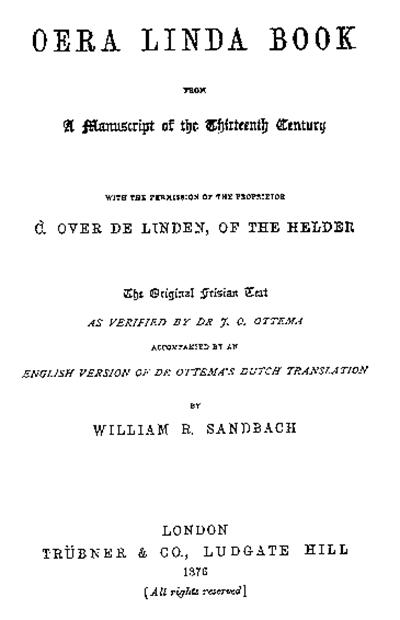
Frontpage of the first English translation of the Oera Linda Book.

InApril of 1820, at the small town of Enkhuizen opposite the West Frisian Island of Texel in the Netherlands, Den Heer Andries Over de Linden died. Among his effects was found a very old manuscript that no one could read. He was sixty-one years old and his daughter, then Mrs. Aafjie Meylhoff, knew how a long and sacred tradition had always existed in their family concerning this book. For countless generations since before anyone could remember, it had been kept in the Over de Linden family, being handed down from father to son, with very strict instructions to preserve and protect it from the authorities, and that meant the Church. The next heir at that time was her nephew, Cornelius Over de Linden, who was only ten years of age, his father having died several years before the grandfather. His aunt, Aafjie, kept the book in safekeeping awaiting the time when the next custodian would be of age.

Cornelius grew up in the same area where his ancestors had always lived, and became a master shipwright of the Royal Netherlands Dockyards at the Helder, but it was not until 1848, that Mrs. Meylhoff handed over the manuscript with all the traditional instructions to her nephew. Always he had been curious about the story the book told, the story he could not read, but still he waited an additional nineteen years before taking the initiative, in 1867, to find someone who could translate the manuscript. He approached the Provincial Library at Leeuwarden in Friesland where the librarian, Dr. Verwijs, on hearing about the manuscript asked to see it. He immediately recognized it as very ancient Frisian, perhaps the oldest example of it he had yet encountered. His first impression was that the book was some kind of hoax, but on examination, he was convinced of its extreme age. Consequently, with much excitement, he persuaded Cornelius Over de Linden to let him make a careful copy of the whole book for the benefit of the Friesland Society.

Dr. Verwijs then sought financial backing from the Society that was devoted to research of the Frisian language and history but was met with immediate skepticism. Perhaps he was too revealing of some opening fragments he had already translated. The Society thought it was a forgery from the beginning, even before being able to consult it, setting a tone that has haunted the Oera Linda Book ever since. Dr. Verwijs was, however, successful in receiving a commission from a deputy states alderman of Friesland to edit a copy. This meant his library facilities could sanction the work while funding was being sought.

The work continued for another three years revealing startling and fantastic information that initially confirmed Dr. Verwijs first suspicions of forgery, but as he continued to translate, more and more stories supported known historical and mythological data and won the complete confidence of the translator. That is to say, so far as the history it contained was related, for the book contained its own mythology which could be recognized as such just as the well known Greek and Old Testament stories were not always taken literally. Eventually, financial assistance did come in the person of Dr. J. G. Ottema, who enthusiastically supported the expenses of the translation, printing and publishing the first copy in modern Frisian under the title of "Thet Oera Linda Bok".

In February, 1871, a paper was presented to the Friesland Society that summarized these origins and mentioned a few of the startling statements found in its contents, causing instant controversy. Why that was so is perhaps not surprising if we look at these statements but first the reader must magnify the attachments of the present time to the long cherished beliefs of a church or temple dominated heritage, to understand the attitudes of the time. Science was replacing theology in history and anthropology. The discovery and subsequent translation of the Rosetta Stone had occurred only fifty years earlier, giving birth to the modern concepts of ancient history based on the Egyptian calendar, right or wrong.

We have since discovered the much older civilization of Sumer and yet most text books still give this honor to Egypt. Heinrich Schlieman had not yet published his discoveries concerning the actual historical site of Troy, a town mentioned and even datable in the Book. Legends were still considered fairy tales without any factual content as indeed many consider them today. More importantly, we have a long standing tradition of the classical scholars surviving in Europe, through the translations of the Church and verified with several hundred years of second sourcing through Arabic in Spain of the same Greek originals. First come ideas are very hard to challenge.

The Frisian language version was immediately followed by a Dutch language translation of the same name and it was the Dutch version that was translated into English in 1876. This edition shows the original Frisian text printed on the left page in Roman characters with the English translation on the right. It created quite a stir when published but was soon forgotten in academic circles; too controversial or perhaps it meant too much effort to rethink our traditional ideas.

The original manuscript uses what are now called phonetic characters with arabic numerals but with its own form of construction. These phonetic characters are selected from a circle, the sun sign, with a vertical "I" and an "X" crossing it giving surprisingly, a character set or context in which most letters of the alphabet and numbers are easily recognized by modern Europeans and Americans. They were recorded by Hiddo, surnamed Over de Linda in the year 1256 AD. He copied his originals onto the new arabic paper, very desirable in Europe at the time, which was made from basic Egyptian cotton without watermark. He called it foreign paper and used a carbon ink without iron. This was fortunate because the more popular iron based inks were used at a later date and are easily recognizable by their discoloration, giving us one more piece of evidence to support the Books authenticity. The opening page by Hiddo, is a letter to his son Okke with instructions to "Preserve these books with body and soul."

How many of the works of the original eight or more authors were copied or else translated into Hiddos language of the time is not known. Did he use the characters current in his land or did he painstakingly transcribe his damaged source material? We know that some terms modern to him were used and we also know that the style and variant spelling of the original writers were preserved. No evidence of anything more modern than the thirteenth century has been found, but even some place names created by the Roman occupation in the time of Julius Caesar were not used in the text.

Challenges there were, revealed by the Oera Linda Book. Did European civilization come out of Asia in the East or was there a western source as well and what was that? No claim is being made about the origins of civilized communities in the world but the Book claims a western source for its own system of government, community and moral code for Europe. There are even descriptions of a much more ancient community across the north Atlantic, the Old Land, their ancient home, that are given in nostalgic terms as the good times before the bad.

Did our concepts of common law and democracy come from Asia through classical Greece and Rome? We will read about a democratic system of government using the endowments of both men and women for their respective advantages. The world would have to wait until late in the nineteenth century for a similar equality, both domestic and also at the highest government level, to be found again in Europe. The Matriarchal Age as described in the Book was one of cooperation, not dominance by any sex or monarch but this however, was a heritage lost to the corruption that power always engenders. Our Eastern heritage has always been dominated by male autocrats but this book describes a time before the democracies or oligarchies of the Greek city states whose own fervor fall very short of the ideals expressed. There are many sections recorded for the explicit purpose of protecting these democratic rights and freedoms.

Is the generally understood concept of the evolution of European languages correct? Both Latin and Greek are younger languages than the precursors of the West German group and have received many root words from the latter, and even the Persian language has more Germanic root words than any other source. If you open your dictionary to the familiar page of the family tree of European languages you see that the invented Indo-European gives rise to Indian, Iranian, Armenian, Albanian, Balto-Slavic, Germanic, Hellenic, Italic and Keltic, a convenient way of showing that the scholars do not know this story. A distinction has to be made between the form of the alphabet characters used, the names of the alphabet letters, their sequence and the number system in use. Each of these characteristics can evolve separately and be taken from very different sources.

The Book describes the settlement of familiar peoples like the Finns, Phoenicians, Tunisians, Gauls, Britons, Celts, Cretans, Greeks, Ionians, Danes, Franks and Scots. Many more are named in India and the countries to the west of the Punjab. It tells of extensive trade between nations, which is more important for the adoption of languages than the actual settlement of peoples. It even describes how different peoples were corrupting the "mother tongue".

On the language tree commonly found in dictionaries, Old Frisian is a "generation" or two younger than the classical languages but this book is written in and laments its own language deterioration of a time before Latin, before Greek. Was this Indo-European? They write of trade and settlement in India in 1550 BC by the sea-kings of the Rhine. They even tell the story of the settlement of Phoenicia five hundred years before that and how their written language which is clearly related to what we use today, was adopted by the Phoenician traders. This was probably the origin of the Greek alphabet, the symbols that is, and not necessarily their names which is of a much more modern construction.

In the beginnings of recorded history, a number system, a means of recording the quantities of trades or taxes began in the East with clay representations of the items, pressed or represented as many times as the quantity transacted. Then variant symbols were used to represent larger packages or groupings of these items. It can be understood how impossible this would soon become to a maritime nation dealing with the diverse products of foreign nations and so a new system was worked out in the West.

In the East the order of the particular alphabets was used at that time to represent a weighted number system but clearly it has its limitations with international trade where different alphabets or sequence of letters were in use. These arguments imply that records would have to be shared in order to trade or barter and particularly if any contracts for future delivery were to be made and this is one reason why languages follow trade rather than the migrations of peoples.

The story of the sea-kings is the commercial history of Europe for we are told how important these huge organized expeditions were to the life-styles of the Europeans even to those as remote as Switzerland who traded in items destined to fill the bottoms of the ships. The sea-king or "Witkoning" was elected to command these well-armed trading expeditions. The Book tells us of one old sea-king of about four thousand years ago, who devised a weighted-number system of symbols that were deliberately constructed not long after the invention of the phonetic alphabet and in the same style. This is essentially what we are using today and calling it arabic but if it were also called phonetic it would not be a contradiction of this cherished belief. This is because the Phoenicians began their history at this time as a direct result of the actions of a sea-king from the Rhine. They were a racially mixed group from Western Europe that founded Tyre or Thyrhisburgt, a city south of older Sidon. Their maritime skills and tribal groups did not directly come from the East the priests of Sidon were soon to influenced their religious and political systems.

Some of the heroes of Homer and gods and goddesses of ancient Greece are described as real historical personages such as Hestia, Neptune, Minerva, Calypso and Ulysses. Then we read of the European gods, Wodin and Frya, (Odin and Freya) of mythological names such as the Magi, Celtics, and dozens of place names and how they came to be so named. This book is an etymologists delight. Word origins of the Druids, Gaul, the Vestal Virgins, even Calypso and magic are mentioned.

With these challenges to established ideas, there is no question the new translations were very sensational to the academic community who on the whole assured everyone that it was a hoax. European newspapers were quick to print defamatory letters and articles from persons who had not studied the contents of the translations and obviously not the original.

Following the English language translation from the Dutch, London newspapers gave the book a brief notoriety but there was little serious study and even less of its ideas and information entering the history books. It was basically forgotten. In the nineteen-twenties a few articles and some books were published but most of them defamatory. It is now time to take a new look at what this remarkable history of a nearly forgotten people actually says because it is our story too.

These challenges to established beliefs were hard enough to take but when their own mythology, recorded by them in the same style as their history was revealed, it was too much for the new scientific scholars to stand. They forgot our own myths and how some have been shown to tell of real personages. We have the stories of the Flood and Atlantis. They had stories of geological catastrophes and of Atland, the "Old Land". They are not to be confused with those stories which are believed to be describing a time of possibly eleven thousand years ago such as Platos Atlantis but it is most likely that some of these stories have been incorporated into the writings of Plato. Their events were quite precisely dated and recorded by them as fact and cover a time span of from 2193 BC to 70 BC.

We have inherited traditional zodiacal terminology from Sumer and they are still used by modern astronomers. Using these names we put the Age of Aries at from 2220 BC to 60 BC so that this book is really a European story of the Age of Aries. There were other books referred to in the text, books that came about as a deliberate attempt to record their history before it was lost. These were written on instructions by one of the last of the earth mothers; one who herself was never elected to that office, but unfortunately they have not survived.

This is really the story of the decline and fall of the Matriarchal Age of Europe and the relentless pressure of the invasion of the original white peoples of Europe by the yellow peoples of Asia. Only some of the more isolated populations of Holland and Scandinavia show surviving examples of this blood line today.

Apparently much of Europe had once enjoyed a citadel system for their society and government. Each diverse community had their councils of Aldermen to make their economic laws that filled their defensive and land-use requirements but these decisions had to meet the strict guidelines of the sacred `Tex or constitution to ensure justice and freedom for all. The citadels housed the maidens, with a copy of the "Tex" inscribed on the walls together with proud moments from their histories. The priestesses by their scholarship determined appeals much as our own Supreme Court does now. The head maiden or virgin was called a mother and was in correspondence with the mothers of other cities.

The Earth Mother was elected from candidates that were often recommended from the various citadels by the previous Earth Mother in her will. She resided at the most important and largest citadel that was located at Fryasburgt in Texland near the northern mouth of the Rhine that they called Flymeer or the mouth of the Fly River. Her duties were exemplary for the protection of the ethical welfare of the continent but she was also able to call a national levy for the defense of the whole confederation.

There is no European race or color characteristic corresponding to that which can be identified in most other places of the globe. The straight black hair and brown eyes of the yellow skinned Asiatic invaders have interbred with the fine straight yellow hair, blue eyes of the tall white indigenous race to create the mixed hair and eye coloring found in individual families today of so-called Europeans. Varying degrees of crinkly-haired black people from Africa were also bred into the mix depending on location and on the journeys of the sea-kings that often used foreign rowers. When the black blood mixed directly with the original white blood the result could be red, that new human coloring with wavy hair, white skin and freckles, not really one that could have survived a million years of natural selection without the protections that civilized communities afford. Even today when some Melanesians form blood families with a genetic survivor of the white race the result can be piebald, and take generations to blend into normal freckles.

These European peoples whose only common name was "friends" or the "Children of Frya" wanted to protect their culture and freedom from the priests and princes of the invaders. Their laws show a strong educational and even propaganda aspect designed to save their democratic system based on their constitution that protected the rights of individuals. It also cared for the less fortunate members of society instilling a moral code of self-reliance and cooperation. Our present country in North America was founded with these concepts and in its young days of settlement and expansion, families did more than just barn-raising for their communities. Many of these basic feelings of community are now buried too deep as individual profit is placed above community service.

Who were the contributors to the Book? The Book and apparently others that have not survived were written at the direct request of Adela, described herein as the un-elected Earth Mother about 560 BC. She was afraid their long history and customs would be lost with the invasions of the Magyars and Finns that were causing such devastation at the time. They had already invaded and killed the Earth Mother at their federal capital of Fryasburgt in Texland and were within striking distance of Adelas own family compound. They were soon to kill both Adela and her husband Apol but this was not to be the end of the Frisians as a resurgence occurred that took another four hundred years to be lost again. This time it was lost to cultural changes, not conquest as the ways of freedom gave way to the ways of the royal tyrants that even in modern times have inspired an undeserved loyalty or dependence.

The writers of the Book (see plate 8), were for the most part descendants of Adela in the Oera Linda family. At first they copied down the inscriptions from the walls of the citadels and great trading ports that were originally inscribed fifteen hundred years earlier. This has given us a precious insight into history before the age of the classical myths, an insight showing real historical personages that in some cases were deified for political advantage and in other cases because the social conditions had deteriorated to the level of superstition and witchcraft.

After recording their own history, the various writers wrote of their own times. Those sections have information that came more closely to direct observation and they are rich in personal stories of this family and their countrymen in times of triumph and the struggles of defeat, defeat of their principles. We are given an observation into the final process of the deposition of the cooperative matriarchal age by the dominating patriarchal one, an age that we have only now begun to question in this century.

There are stories told that are as exciting as any romantic novel or panoramic screen, telling us how little changed we are after thousands of years. How our desires and ambitions are forever wrestling with our social conscience and how the virtuous get little reward beyond their own virtue in the real world. But in spite of the over all, very long term demise of this way of life, it has left its mark upon us in many ways. It has marked the conscience of the whole world, not just a racially protective group in Western Europe. Seen with cosmic eyes over millennia who is to say the world took a backward step? Who is to say that the final outcome will not be at a higher level of consciousness for all concerned? We are still playing this drama and the last characters have not yet come onto stage.

In this publication a modern language rendition of the Oera Linda Book is given in serif typeface, with new place name spellings whenever it is more readable and wherever they are known. The author summarizes and comments on the story recorded in the Book after relating the generally believed version if known. Following this is the actual translation and how it may change our own concepts of history except where the information is totally new. If a reader has an interest in continuing the controversy or validating any feature, he or she is invited to study the original.

From Goddess to King, Biblography

FROM GODDESS TO KING

A History of Ancient Europe from the

OERA LINDA BOOK

By Anthony Radford

BIBLIOGRAPHY

  • A. G. Gallanopoulos & Edward Bacon Atlantis, The Truth Behind the Legend, Indianapolis: Bobbs-Merrill.
  • Barbara Hand Clow Signet of Atlantis, Bear & Co. Santa Fe, New Mexico.
  • Carolyn McVickar Edwards The Storyteller's Goddess, Harper Collins, San Francisco.
  • Chester S. Chard Man in Prehistory Mcgraw-hill Book Co. New York.
  • Cyril Aldred Egypt to the End of the Old Kingdom. Thames and Hudson Ltd, London.
  • Dorothy B. Vitaliano Legends of the Earth The Citadel Press, Secaucus, New Jersey.
  • Ernestene L. Green In Search of Man Little, Brown & Co., Boston.
  • Frances E. Sabin Classical Myths that Live Today Silver Burdett Co. New York.
  • Herbert Wendt In Search of Adam Houghton Mifflin Co. Boston.
  • Homer, T. A. Buckley translation Charles E. Merrill Co.
  • Immanuel Velikovsky Ages in Chaos Doubleday & Company, Inc. New York.
  • James G. Frazer The New Golden Bough Criterion Books, New York.
  • John E. Pfeiffer The Emergence of Man Harper & Row, New York.
  • Jurgen Spanuth Atlantis - The Mystery Unravelled Arco Publishers Limited, London.
  • L. Sprague de Camp Lost Continents Dover Publications, Inc. New York.
  • Larousse Encyclopaedia of Mythology Auge, Gillon,
  • Hollier-Larouse, Moreau et Cie.
  • M.S. Miller, J. L. Miller Harper's Bible Dictionary Harper & Brothers, New York.
  • Norbert Guterman Russian Fairy Tales Pantheon Books Inc, New York.
  • Philippe Diole 4,000 Years Under the Sea, Sidwick & Jackson Ltd. London.
  • Robert Graves The Greek Myths, The White Goddess
  • George Braziller, Inc. New York.
  • Robert Scrutton The Other Atlantis Sphere Books, London.
  • The New Encyclopaedia Britannica Benton, Publisher, Chicago.
  • Thor Heyerdahl The Tigris Expedition Doubleday & Company, Inc. New York.
  • William R. Sandbach Oera Linda Book 1876
  • Thet Oera Linda Bok, Dr. J. G. Ottema, Friesland, 1872. English translation.
  • Zecharia Sitchin The Stairway to Heaven Avon Books, New York.

From Goddess to King, Appendix B, ADDRESS TO THE FRIESLAND SOCIETY, 1871

FROM GODDESS TO KING

A History of Ancient Europe from the

OERA LINDA BOOK

By Anthony Radford

APPENDIX B

ADDRESS TO THE FRIESLAND SOCIETY, 1871

The preface of Dr. Ottemas original modern publication of the Oera Linda Book that was read at a meeting of the Friesland Society, February, 1871.

Over de Linden, Chief Superintendent of the Royal Dockyard at the Helder, possesses a very ancient manuscript which has been inherited and preserved in his family from time immemorial, without anyone knowing whence it came or what it contained, owing to both the language and the writing being unknown.

All that was known was that a tradition contained in it had from generation to generation been recommended to careful preservation. It appeared that the tradition rests upon the contents of two letters, with which the manuscript begins, from Hiddo oera Linda, anno 1256, and from Liko Oera Linda, anno 803. It came to C. over de Linden by the directions of his grandfather, Den Heer Andries over de Linden, who lived at Enkhuizen, and died there on the 15thof April 1820, aged sixty-one. As the grandson was at that time barely ten years old, the manuscript was taken care of for him by his aunt, Aafjie Meylhoff, born Over de Linden, living at Enkhuizen, who in August 1848 delivered it to the present possessor.

Dr. E. Verwijs having heard of this, requested permission to examine the manuscript, and immediately recognized it as very ancient Fries. He obtained at the same time permission to make a copy of it for the benefit of the Friesland Society, and was of the opinion that it might be of great importance, provided it was not suppositious, and invented for some deceptive object, which he feared. The manuscript being placed in my hands, I also felt very doubtful, though I could not understand what object any one could have in inventing a false composition only to keep it a secret. This doubt remained until I had examined carefully executed facsimiles of two fragments, and afterwards of the whole manuscript - the first sight of which convinced me of the great age of the document.

Immediately occurred to me Caesars remark upon the writings of the Gauls and the Helvetians in his `Bello Gallico (i. 29, and vi. 14), `Graecis utuntur literis, though it appears in v. 48 that they were not entirely Greek letters. Caesar thus points out not only a resemblance - and a very true one - as the writing, which does not altogether correspond with any known form of letters, resembles the most, on a cursory view, the Greek writing, such as is found on monuments and the oldest lapidary. Besides, I formed the opinion afterwards that the writer of the latter part of the book had been a contemporary of Caesar.

The form and the origin of the writing is so minutely and fully described in the first part of the book, as it could not be in any other language. It is very complete, and consists of thirty-four letters, among which are three separate forms of a and u, and two of e, i, y, and o, besides four pairs of double constants - ng, th, ks, and gs. The ng, which as a nasal sound has no particular mark in any western language, is an indivisible conjunction; the th is soft, as in English, and is sometimes replaced by d; the gs is seldom met with - I believe only in the word segse, to say, in modern Fries sidse, pronounced sisze.

The paper, of large quarto size, is made of cotton, not very thick, without watermark or makers mark, made upon a frame or wire-web, with not very broad perpendicular lines.

An introductory letter gives the year 1256 as that in which this manuscript was written by Hiddo overa Linda on foreign paper. Consequently it must have come from Spain, where Arabs brought into the market paper manufactured from cotton.

On this subject, W. Wattenbach writes in his `Das Schriftwesen im Mittelalter (Leipzig, 1871), s. 93:

`The manufacture of paper from cotton must have been in use among the Chinese from very remote times, and must have become known to the Arabs by the conquest of Samarkand about the year 704. In Damascus this manufacture was an important branch of industry, for which reason it was called Charta Damascena. By the Arabians this art was brought to the Greeks. It is asserted that Greek manuscripts of the tenth century written upon cotton paper exist, and that in the thirteenth century it was much more used than parchment. To distinguish it from Egyptian paper it was called Charta bombicina, gossypina, cuttunea, xylina. A distinction from linen paper was not necessary. In the manufacture of cotton paper raw cotton was originally used. We first find paper from rags mentioned by Petrus Clusiacensis (1122-50).

`The Spaniards and the Italians learned the manufacture of this paper from the Arabians. The most celebrated factories were at Jativa, Valencia, Toledo, besides Fabriano in the March of Ancona.

In Germany the use of this material did not become very extended, whether it came from Italy or Spain. Therefore the further this preparation spread from the East and the adjoining countries, the more the necessity there was that linen should take the place of cotton. A document of Kaubeuren on linen paper of the year 1318 is of very doubtful genuineness. Bodman considers the oldest pure linen paper to be of the year 1324, but up to 1350 much mixed paper was used. All carefully written manuscripts of great antiquity show by the regularity of their lines that they must have been ruled, even though no traces of the ruled lines can be distinguished. To make the lines they used a thin piece of lead, a ruler, and a pair of compasses to mark the distances.

In old writings the ink is very black or brown; but while there has been more writing since the thirteenth century, the color of the ink is often gray or yellowish, and sometimes quite pale, showing that it contains iron. All this affords convincing proof that the manuscript before us belongs to the middle of the thirteenth century, written with clear black letters between fine lines carefully traced with lead. The color of the ink shows decidedly that it does not contain iron. By these evidences the date given, 1256, is satisfactorily proved, and it is impossible to assign any later date. Therefore all suspicion of modern deception vanishes.

The language is very old Fries, still older and purer than the Fries Rjuchtboek or old Fries laws, differing from that both in form and spelling, so that it appears to be an entirely distinct dialect, and shows that the locality of the language must have been (as it was spoken) between the Vlie and the Scheldt.

The style is extremely simple, concise, and unembarrassed, resembling that of ordinary conversation, and free in the choice of words. The spelling is also simple and easy, so that the reading of it does not involve the least difficulty, and yet with all its regularity, so unrestricted, that each of the separate writers who have worked at the book has his own peculiarities, arising from the changes in pronunciation in a long course of years, which naturally must have happened, as the last part of the work is written five centuries after the first.

As a specimen of antiquity in language and writing, I believe I may venture to say that this book is unique of its kind.

The writing suggests an observation, which may be of great importance.

The Greeks know and acknowledge that their writing was not their own invention. They attribute the introduction of it to Kadmus, a Phoenician. The names of their oldest letters, from Alpha to Tau, agree so exactly with the names of the letters in the Hebrew alphabet, with which the Phoenician will have been nearly connected, that we cannot doubt that the Hebrew was the origin of the Phoenician. But the form of their letters differs so entirely from that of the Phoenician and Hebrew writing, that in that particular no connection can be thought of between them. Whence, then, have the Greeks derived the form of their letters?

From `thet bok tha Adela folstar (`The Book of Adelas Followers we learn that in the time when Kadmus is said to have lived, about sixteen centuries before Christ, a brisk trade existed between the Frisians and the Phoenicians, whom they named Kadhemer, or dwellers on the coast.

The name Kadmus comes too near the word Kadhemer for us not to believe that Kadmus simple meant a Phoenician.

Further on we learn that about the same time a priestess of the castle in the island of Walcheren, Min-erva, also called Nyhellenia, had settled in Attica at the head of a Frisian colony, and had founded a castle at Athens. Also, from the accounts written on the walls of Waraburgt, that the Finns likewise had a writing of their own - a very troublesome and difficult one to read - and that, therefore, the Tyrians and the Greeks had learned the writing of Frya. By this representation the whole thing explains itself, and it becomes clear whence comes the exterior resemblance between the Greek and the old Fries writing, which Caesar also remarked among the Gauls; as likewise in what manner the Greeks acquired and retained the names of the Finn and the forms of the Fries writing.

Equally remarkable are the forms of their figures. We usually call our figures Arabian, although they have not the least resemblance to those used by the Arabs. The Arabians did not bring their ciphers from the East, because the Semitic nations used the whole alphabet in writing numbers. The manner of expressing all numbers by ten signs the Arabs learned in the West, though the form was in some measure corresponding with their writing, and was written from left to right, after the Western fashion. Our ciphers seem here to have sprung from the Fries ciphers (siffar), which form had the same origin as the handwriting and is derived from the lines of the Juul?

The book as it lies before us consists of two parts, differing widely from each other, and of dates very far apart. The writer of the first part calls herself Adela, wife of Apol, chief man of the Linda country. This is continued by her son Adelbrost, and her daughter Apollonia. The first book, running from page 1 to 88, is written by Adela. The following part, from 88 to 94, is begun by Adelbrost and continued by Apollonia. The second book, running from page 94 to 114, is written by Apollonia. Much later, perhaps two hundred and fifty years, a third book is written, from page 114 to 134, by Frethorik; then follows from page 134 to 143, written by his widow, Wiljo; after that from page 144 to 169, by their son, Konered; and then from page 169 to 192 by their grandson, Beeden (a doubtful assumption). Pages 193 and 194, with which the last part must have begun, are wanting, therefore the writer is unknown. He must have been a son of Beeden.

On page 134, Wiljo makes mention of another writing of Adela. These she names `thet bok tha sanga (theta boek) tha tellinga, and `thet Hellia bok; and afterwards `tha skrifta fon Adela jeftha Hellia.

To fix a date we must start from the year 1256 of our era, when Hiddo overa Linda made a copy, in which he says that it was 3449 years after Atland was sunk. This disappearance of the old land (aldland, atland) was known by the Greeks, for Plato mentions in his `Timaeus, 24, the disappearance of Atlantis, the position of which was only known as somewhere far beyond the Pillars of Hercules. From this writing it appears that the land stretching far out to the west of Jutland, of which Helgoland and the islands of North Friesland are the last barren remnants. This event, which occasioned a great dispersion of the Frisian race, became the commencement of a chronological reckoning corresponding with 2193 before Christ, and is known by geologists as the Cimbrian flood.

On page 80 begins an account in the year 1602, after the disappearance of Atland, and thus in the year 591 before Christ; and on page 82 is the account of the murder of Frana, `Eeremoeder, of Texland, two years later - that is, in 589. When, therefore, Adela commences her writing with her own coming forward in an assembly of the people thirty years after the murder of the Eeremoeder, that must have been the year 559 before Christ. In the part written by her daughter Apollonia, we find that fifteen months after the assembly Adela was killed by the Finns in an attack by surprise of Texland. This must accordingly have happened 557 years before Christ. Hence it follows that the first book, written by Adela, was of the year 558 before Christ. The second book, by Apollonia, we may assign to the year 530 before Christ. The later part contains the history of the known kings of Friesland, Friso, Adel (Ubbo), and Asega Askar, called Black Adel. Of the third king, Ubbo, nothing is said, or rather that part is lost, as the pages 169 to 188 are missing. Frethorik, the first writer, who appears now, was a contemporary of the occurrences, which he relates, namely, the arrival of Friso. He was a friend of Liudgert den Geertman, who, as rear admiral of the fleet of Wichhirte, the sea-king, had come with Friso in the year 303 before Christ, 1,890 years after the disappearance of Atland. He has borrowed most of his information from the logbook of Liudgert.

The last writer gives himself out most clearly as a contemporary of Black Adel or Askar, about the middle of his reign, which Furmerius states to have been from 70 before Christ to 11 after the Birth of Christ, the same period as Julius Caesar and Augustus. He therefore wrote in the middle of the last century before Christ, and knew of the conquest of Gaul by the Romans. It is thus evident that there elapsed fully two centuries between the two parts of the work.

Of the Gauls we read on page 84 that they were called the `Missionaries of Sidon. And on page 124 `that the Gauls are Druids. The Gauls, then, were Druids and the name Galli, used for the whole nation, was really only the name of an order of priesthood brought from the East, just as among the Romans the Galli were priests of Cybele.

The whole contents of the book are in all respects new. That is to say, there is nothing in it that we were acquainted with before. What we here read of Friso, Adel, and Askar, differs entirely from what is related by our own chroniclers, or rather presents it in quite another light. For instance, they all relate that Friso came from India, and that thus the Frisians were of Indian descent; and yet they add that Friso was a German, and belonged to a Persian race which Herodotus called Germans. Accordingly to the statement in this book, Friso did come from India and with the fleet of Nearchus; but he is not therefore Indian. He is of Frisian origin, of Fryas people. He belongs, in fact to a Frisian colony, which after the death of Nyhellenia, fifteen and a half centuries before Christ, under the guidance of a priestess Geert, settled in the Punjab, and took the name of Geertmen. The Geertmen were known by only one of the Greek writers, Strabo, who mentions them as being entirely different from Phoenicians (slightly edited) in manners, language and religion.

The historians of Alexanders expeditions do not speak of Frisians or Geertmen, though they mention Indo-scythians, thereby describing a people who lived in India, but whose origin is in the distant, unknown North.

In the accounts of Liudgert no names are given of places where the Frieslanders lived in India. We only know that they first established themselves to the east of the Punjab, and afterwards moved to the west of those rivers. It is mentioned, moreover, as a striking fact, that in summer the sun at midday was straight above their heads. They therefore lived within the tropics. We find in Ptolemy, exactly 24N. on the west side of the Indus, the name Minnagara; and about six degrees east of that, in 22N., another Minnagara. This name is pure Fries, the same as Walhallagara, Foolsgara, and comes from Minna, the name of an Eeremoeder, in whose time the voyages of Teunis and his nephew Inca took place.

The coincidence is too remarkable to be accidental, and not to prove that Minnagara was the headquarters of the Frisian Colony. The establishment of the colonists in the Punjab in 1551 before Christ, and their journey thither, we find fully described in Adels book; and with the mention of one most remarkable circumstance, namely, that the Frisian mariners sailed through the strait in whose times still ran into the Red Sea.

In Strabo, book i. pages 38 and 50, it appears that Eratosthenes was acquainted with the existence of the strait, of which the later geographers make no mention. It existed still in the time of Moses (Exodus xiv. 2) for he encamped at Piha-chiroht, `the mouth of the strait. Moreover, Strabo mentions that Sesostris made an attempt to cut through the isthmus, but that he was not able to accomplish it. That in very remote times the sea did flow through is proved by the result of the geological investigations on the isthmus made by the Suez Canal Commission, of which Mr. Renaud presented a report to the Academy of Sciences on the 19thJune 1856. In that report, among other things, appears the following: `Une question fort controvers est celle de savoir, si Loque oles Hebreux fuyaient de lEgypte sous la conduite de Moe, les lacs amers faisaient encore partie de la merrouge. Cette dernie hypothes accorderait mieux qu lhypothe contraire avec le texte des livres sacres, mais alors il faudrait admettre que depuis loque de Moe le seuil de Suez serait sorti des eaux.

With regard to this question, it is certainly of importance to fall in with an account in this Frisian manuscript, from which it seems that in the sixteenth century before Christ the connection between the Bitter Lakes and the Red Sea still existed, and that the strait was still navigable. The manuscript further states that soon after the passage of the Geertmen there was an earthquake; that the land rose so high that all the water ran out, and all the shallows and alluvial lands rose up like a wall. This must have happened after the time of Moses, so that at the date of the Exodus (1564 BC) the track between Suez and Bitter Lakes was still navigable, but could be forded dry-foot at low water.

This point, then, is the commencement of the isthmus, after the forming of which, the northern inlet was certainly soon filled up as far as the Gulf of Pelusium.

The map by Louis Figuier, in the `Ann scientifique et industrielle (premie ann), Paris, Hachette, 1857, gives a distinct illustration of the formation of this land.

Another statement that occurs only in Strabo, finds also here a conformation. Strabo alone of all the Greek writers relates that Nearchus, after he had landed his troops in the Persian Gulf, at the mouth of the Pasitigris, sailed out of the Persian Gulf, by Alexanders command, and steered round Arabia through the Arabian Gulf. As the account stands, it is not clear what Nearchus had to do there, and what the object of the further voyage was. If, as Strabo seems to think, it was only for geographical discovery, he need not have taken the whole fleet. One or two ships would have sufficed. We do not read that he returned. Where, then, did he remain with the fleet?

The answer to this question is to found in the Frisian version of the story. Alexander had bought the ships on the Indus, or had had them built by descendants of the Frisians who had settled there - the Geertmen - and had taken into his service sailors from among them, and at the head of them was Friso. Alexander having accomplished his voyage and the transport of his troops, had no further use for the ships in the Persian Gulf, but wished to employ them in the Mediterranean. He had taken that idea into his head, and it must be carried into effect. He wished to do what no one had done before him. For this purpose Nearchus was to sail up the Red Sea, and on his arrival at Suez was to find 200 elephants, 1,000 camels, workmen and materials, timber and ropes in order to haul the ships by hand over the isthmus. This work was carried on and accomplished with so much zeal and energy that after three months labor the fleet was launched in the Mediterranean. That the fleet really came to the Mediterranean appears in Plutarchs Life of Alexander; but he makes Nearchus bring the fleet round Africa, and sail through the pillars of Hercules.

After the defeat at Actium, Cleopatra, in imitation of this example, tried to take her fleet over the isthmus in order to escape to India, but was prevented by the inhabitants of Arabia Petraea, who burnt her ships. (See Plutarchs Life of Antony). When Alexander shortly afterwards died, Friso remained in the service of Antigonus and Demetrius, until, having been grievously insulted by the latter, he resolved to seek out with his sailors their fatherland, Friesland. To India he could not, indeed, return.

Thus these accounts chime in with and clear up each other, and in that way afford a mutual confirmation of the events.

Such simple narratives and surprising results led me to conclude that we had to do here with more than mere Saga and Legends.

Since the last twenty years attention has been directed to the remains of the dwellings on piles, first observed in the Swiss lakes, and afterwards in other parts of Europe. (See Dr. E. Rkert, Die Pfahlbauten; Wurzburg, 1869. Dr. T. C. Winkler, in the Volksalmanak, t.N.v.A.1867). When they were found, endeavors were made to discover, by the existing fragments of arms, tools and household articles, by whom and when these dwelling had been inhabited. There are no accounts of them in historical writers, beyond what Herodotus writes in book v. chapter 16, of the Paeonen. The only trace that has been found in one of the panels of Trajans Pillar, in which the destruction of a pile village in Dacia is represented.

Doubly important, therefore, is it to learn from the writing of Apollonia that she, as `Burgtmaagd (chief of the virgins), about 540 years before Christ, made a journey up the Rhine to Switzerland, and there became acquainted with the Lake Dwellers (marsaten). She describes their dwellings built upon piles - the people themselves - their manners and customs. She relates that they lived by fishing and hunting, and that they prepared the skins of animals with the bark of the birch-tree in order to sell the furs to the Rhine boatmen, who brought them into commerce. This account of the pile dwellings of the Swiss lakes can only have been written in the time when these dwellings still existed and were still lived in. In the second part of the writing, Konered oera Linda relates that Adel, the son of Friso (approximately 250 years before Christ), visited the pile dwellings in Switzerland with his wife Ifkja.

Later than this account there is no mention by any writer whatever of the pile dwellings, and the subject has remained for twenty centuries utterly unknown until 1853, when an extraordinary low state of the water led to the discovery of these dwellings. Therefore no one could have invented this account in the intervening period. Although a great portion of the first part of the work - the book of Adela - belongs to the mythological period before the Trojan war, there is a striking difference between it and the Greek myths. The Myths have no dates, much less any chronology, nor any internal coherence of successive events. The untrammeled fancy develops itself in every poem separately and independently. The mythological stories contradict each other on every point. `Les Mythes ne se tiennent pas, is the only key to the Greek Mythology.

Here, on the contrary, we meet with a regular succession of dates starting from a fixed period - the destruction of Atland, 2193 before Christ. The accounts are natural and simple, often naive, never contradict each other, and are always consistent with each other in time and place. As, for instance, the arrival and sojourn of Ulysses with the Burgtmaagd Kalip at Walhallagara (Walcheren), which is the most mythical portion of all, is here said to be 1,005 years after the disappearance of Atland, which coincides with 1188 years before Christ, and thus agrees very nearly with the time at which the Greeks say the Trojan war took place. The story of Ulysses was not brought here for the first time by the Romans. Tacitus found it already in Lower Germany (see `Germania, chap. 3), and says that at Asciburgium there was an alter on which the names of Ulysses and his father Laes were inscribed.

Another remarkable difference consists in this, that the Myths knew no origin, do not name either writers or relaters of their stories, and therefore never can bring forward any authority. Whereas in Adelas book, for every statement is given a notice where it was found or whence it was taken. For instance, `This comes from Minnos writings - this is written on the walls of Waraburgt - this in the town of Frya - this at Stavia - this at Walhallagara.

There is also this further. Laws, regular legislative enactments, such as are found in great numbers in Adelas book, are utterly unknown in Mythology, and indeed are irreconcilable with its existence. Even when the Myth attributes to Minos the introduction of lawgiving in Crete, it does not give the least account of what the legislation consisted. Also among the Gods of Mythology there existed no system of laws. The only law was unchangeable Destiny and the will of the supreme Zeus.

With regard to Mythology, this writing, which bears no mythical character, is not less remarkable than with regard to history. Notwithstanding the frequent and various relations with Denmark, Sweden, and Norway, we do not find any traces of acquaintance with the Northern or Scandinavian Mythology. Only Wodin appears in the person of Wodan, a chief of the Frisians, who became the son-in-law of one Magy, King of the Finns, and after his death was deified.

The Frisian religion is extremely simple and pure Monotheism. Wr-Alda or Wr-Aldas spirit is the only eternal, unchangeable, perfect and almighty being. Wr-Alda created everything. Out of him proceeds everything - first the beginning, then time, and afterwards Irtha, the Earth. Irtha bore three daughters - Lyda, Finda and Frya - the mothers of the three distinct races, black, yellow and white - Africa, Asia and Europe. As such, Frya is the mother of Fryas people, the Frieslanders. She is the representative of Wr-Alda, and is reverenced accordingly. Frya has established her `Tex, the first law, and has established the religion of the eternal light. The worship consists of the maintenance of a perpetually burning lamp, foddik, by priestesses, virgins. At the head of the virgins in every town was a Burgtmaagd, and the chief of the Burgtmaagden was the Eeremoeder of the Fryasburgt of Texland. The Eeremoeder governs the whole country. The kings can do nothing, nor can anything happen without her advice and approval. The first Eeremoeder was appointed by Frya herself, and was called Fasta. In fact, we find her the prototype of the Roman Vestal Virgins.

We are reminded here of Velleda (Welda) and `Aurinia in Tacitus (`Germania, 8.Hist., iv. 61, 65; v. 22,24. `Annals i. 54), and of Gauna, the successor of Velleda, in Dio Cassius (Fragments, 49). Tacitus speaks of the town of Velleda as `edita turris, page 146. It was the town of Mannagarda forda (Munster).

In the country of the Marsians he speaks of the temple Tanfane (Tanfanc), so called from the sign of the Juul.

The last of these towns was Fastaburgt in Ameland, temple Fost, destroyed, according to Occa Scarlensis, in 806.

If we find among the Frisians a belief in a Godhead and ideas of religion entirely different from the Mythology of other nations, we are the more surprised to find in some points the closest connections with the Greek and Roman Mythology, and even of the origins of the two deities of the highest rank, Min-erva and Neptune. Min-erva (Athene) was originally a Burgtmaagd, priestess of Frya, at the town of Walhallagara, Middelburg, or Domburg, in Walcheren. And this Min-erva is at the same time the mysterious enigmatical goddess of whose worship scarcely any traces beyond the votive stones of Domburg, in Walcheren, Nyhellenia, of whom no mythology knows anything more than the name, which etymology has used for all sorts of fantastical derivations.

The other, Neptune, called by the Etrurians Nethunus, the God of the Mediterranean Sea, appears here to have been, when living, a Friesland Viking, or sea-king, whose home was Alderga (Ouddorp, not far from Alkmaar). His name was Teunis, or Cousin Teunis, who had chosen the Mediterranean as the destination of his expeditions, and must have been deified by the Tyrians at the time when the Phoenician navigators began to extend their voyages so remarkably, sailing to Friesland in order to obtain British tin, northern iron, and amber from the Baltic, about 2,000 years before Christ.

Besides these two we meet with a third mythological person - Minos, the lawgiver of Crete, who likewise appears to have been a Friesland sea-king, Minno, born at Lindaoord, between Wieringen and Kreyl, who imparted to the Cretans an `Asegaboek. He is that Minos who, with his brother Rhadamanthus and Aeacus, presided as judges over the fates of the ghosts in Hades, and must not be confounded with the late Minos, the contemporary of Aegeus and Theseus, who appears in the Athenian Fables.

The reader may perhaps be inclined to laugh at these statements, and apply to me the words that I myself lately used, fantastic and improbable. Indeed at first I could not believe my own eyes, and yet after further considerations I arrived at the discovery of extraordinary conformities which render the case much less improbable than the birth of Minerva from the head of Jupiter by a blow from the axe of Hephaestus, for instance.

In the Greek Mythology all the gods and goddesses have a youthful period. Pallas alone has no youth. She is no otherwise than adult. Min-erva appears in Attica as high priestess from a foreign country, a country unknown to the Greeks. Pallas is a virgin goddess, Min-erva is a Burgtmaagd. The fair, blue-eyed Pallas, differing thus in type from the rest of the gods and goddesses, evidently belonged to Fryas people. The character for wisdom and emblematical attributes, especially the owl, are the same for both. Pallas gives to the new town her own name, Athenai, which has no meaning in Greek. Min-erva gives to the town built by her the name Athene, which has an important meaning in Fries, namely that they came there as friends - `Athen.

Min-erva came to Athens about 1600 years before Christ, the period at which the Grecian Mythology was beginning to be formed. Min-erva landed with the fleet of Jon at the head of a colony in Attica. In later times we find her on the Roman votive stones in Walcheren, under the name of Nyhellenia, worshipped as a goddess of navigation; and Pallas is worshipped by the Athenians as the protecting goddess of shipbuilding and navigation.

Time is the carrier who must eternally turn the `Jol (wheel) and carry the sun along his course through the firmament from winter to winter, thus forming the year, every turn of the wheel being a day. In winter the `Jolfeest is celebrated on Frys day. Then cakes are baked in the form of the suns wheel, because with the Jol Frya formed the letters when she wrote her `Tex. The Jolfeest is therefore also in honor of Frya as inventor of writing.

Just as this Jolfeest has been changed by Christianity into Christmas throughout Denmark and Germany, and into St. Nicholas Day in Holland; so, certainly, our St. Nicholas dolls - the lover and his sweetheart - are a memorial of Frya, and the St. Nicholas letters a memorial of Fryas invention of letters formed from the wheel.

I cannot analyze the whole contents of this writing, and must content myself with the remarks that I have made. They will give an idea of the richness and importance of the contents. If some of it is fabulous, it must have an interest for us, since so little of the traditions of our forefathers remains to us.

An internal evidence of the antiquity of these writings may be found in the fact that the name Batavians had not yet been used. The inhabitants of the whole country as far as the Scheldt are Fryas people - Frieslanders. The Batavians are not a separate people. The name Batavi is of Roman origin. The Romans gave it to the inhabitants of the banks of the Waal, which river bears the name Patabus in the `Tabula Pentingeriana. The name Batavi does not appear earlier than Tacitus and Pliny, and is interpolated in Caesars `Bello Gallico, iv. 10. (See my treatise on the course of the rivers through the countries of the Frisians and Batavians, p. 49, in `DeVrije Fries. 4thvol. 1stpart, 1845).

I will conclude with one more remark regarding the language. Those who have been able to take only a superficial view of the manuscripts have been struck by the polish of the language, and its conformity with the present Friesland language and Dutch. In this they seem to find grounds for doubting the antiquity of the manuscript.

But, I ask, is, then, the language of Homer much less polished than that of Plato or Demosthenes? And does not the greatest portion of Homers vocabulary exist in the Greek of our day?

It is true that language alters with time, and is continually subject to slight variations, owing to which language is found to be different at different epochs. This change in the language in this manuscript accordingly gives ground for important observations to philologists. It is not only that of the eight writers who have successively worked at the book, each is recognizable by slight peculiarities in style, language and spelling; but more particularly between the two parts of the book, between which an interval of more than two centuries occurs, a striking difference of the language is visible, which shows what a slowly progressive regulation it has undergone in that period of time. As a result of these considerations, I arrive at the conclusion that I cannot find any reason to doubt the authenticity of these writings. They cannot be forgeries. In the first place, the copy of 1256 cannot be. Who could have at that time forged anything of that kind? Certainly no one. Still less any one at an earlier date. At a later date a forgery is equally impossible, for the simple reason that no one was acquainted with the language. Except Grimm, Richthofen and Hettema, no one can be named sufficiently versed in that branch of philology, or who had studied the language so as to be able to write in it. And if one could have done so, there would have been no more extensive vocabulary at his service than that which the East Frisian laws afford. Therefore, in the centuries lately elapsed, the preparation of this writing was impossible. Whoever doubts this let him begin by showing where, when, by whom, and with what object such a forgery could be committed, and let him show in modern times the fellow of this paper, this writing, and this language.

Moreover, that the manuscript of 1256 is not original, but is a copy, is proved by the numerous faults in the writing, as well as by some explanations of words which already in the time of the copyist had become obsolete and little known, as, for instance, in pages 82 (114), `to thera flete jefta bedrum; page 151 (204), `bargum jefta tonnum fon tha besta bjar.

A still stronger proof is that between pages 157 and 158 one or more pages are missing, which cannot have been lost out of the manuscript because the pages 157 and 158 are on the front and the back of the same leaf.

Page 157 finishes thus: `Three months afterwards Adel sent messengers to all the friends that he had gained, and requested them to send him intelligent people in the month of May. When we turn over the leaf, the other side begins, `his wife, he said, who had been Maid of Texland, had got a copy of it.

There is no connection between these two. There is wanting, at least, the arrival of the invited, and an account of what passed at their meeting. It is clear, therefore, that the copyist must have turned over two pages of the original instead of one.

There certainly existed then an earlier manuscript, and that was doubtless written by Liko oera Linda in the year 803.

We may thus accept that we possess in this manuscript, of which the first part was composed in the sixth century before our era, the oldest production, after Homer and Hesiod, of European literature. And here we find in our fatherland a very ancient people in possession of development, civilization, industry, commerce, literature, and pure elevated ideas of religion, whose existence we had never conjectured. Hitherto we have believed that the historical records of our people reach no farther back than the arrival of Friso the presumptive founder of the Frisians, whereas here we become aware that these records mount up to more than 2,000 years before Christ, surpassing the antiquity of Hellas and equaling that of Israel.

This appendix was taken from the Introduction to the Oera Linda Book by W. R. Sandbach, published in London by Trubner & Co., in 1876. It is an English translation of Dr. J. G. Ottemas Dutch Translation of the original Frisian text, published in Friesland, in 1872 under the title Thet Oera Linda Bok. The London edition contains the Frisian text on the left and English on the right and was verified by Dr. Ottema.

Subscribe to this RSS feed

Log in or create an account