The Epic of Gilgamesh
Translated by Maureen Gallery Kovacs
Electronic Edition by Wolf Carnahan, I998
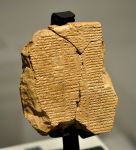
The Epic of Gilgamesh is, perhaps, the oldest written story on Earth. It comes to us from Ancient Sumeria, and was originally written on 12 clay tablets in cunieform script. It is about the adventures of the historical King of Uruk (somewhere between 2750 and 2500 BC).
The translator chose to eliminate Tablet XII for personal reasons, with support from many literary, archaeological, and linguistic experts because it appears to be more of a sequel to the first 11 tablets, containing a story about Enkidu volunteering to retrieve some objects that Gilgamesh dropped into the Netherworld.
This translation is based on the "standard" Akkadian "edition", but is filled in with excerpts from the Old Babylonian where necessary.
Tablet I
He who has seen everything, I will make known (?) to the lands.
I will teach (?) about him who experienced all things,... alike, Anu granted him the totality of knowledge of all.
He saw the Secret, discovered the Hidden, he brought information of (the time) before the Flood.
He went on a distant journey, pushing himself to exhaustion, but then was brought to peace.
He carved on a stone stela all of his toils, and built the wall of Uruk-Haven, the wall of the sacred Eanna Temple, the holy sanctuary.
Look at its wall which gleams like copper(?), inspect its inner wall, the likes of which no one can equal!
Take hold of the threshold stone--it dates from ancient times!
Go close to the Eanna Temple, the residence of Ishtar, such as no later king or man ever equaled!
Go up on the wall of Uruk and walk around, examine its foundation, inspect its brickwork thoroughly.
Is not (even the core of) the brick structure made of kiln-fired brick, and did not the Seven Sages themselves lay out its plans?
One league city, one league palm gardens, one league lowlands, the open area(?) of the Ishtar Temple, three leagues and the open area(?) of Uruk it (the wall) encloses.
Find the copper tablet box, open the ... of its lock of bronze, undo the fastening of its secret opening.
Take and read out from the lapis lazuli tablet how Gilgamesh went through every hardship.
Supreme over other kings, lordly in appearance, he is the hero, born of Uruk, the goring wild bull.
He walks out in front, the leader, and walks at the rear, trusted by his companions.
Mighty net, protector of his people, raging flood-wave who destroys even walls of stone!
Offspring of Lugalbanda, Gilgamesh is strong to perfection, son of the august cow, Rimat-Ninsun;... Gilgamesh is awesome to perfection.
It was he who opened the mountain passes, who dug wells on the flank of the mountain.
It was he who crossed the ocean, the vast seas, to the rising sun, who explored the world regions, seeking life.
It was he who reached by his own sheer strength Utanapishtim, the Faraway, who restored the sanctuaries (or: cities) that the Flood had destroyed!
... for teeming mankind.
Who can compare with him in kingliness?
Who can say like Gilgamesh: "I am King!"?
Whose name, from the day of his birth, was called "Gilgamesh"?
Two-thirds of him is god, one-third of him is human.
The Great Goddess [Aruru] designed(?) the model for his body, she prepared his form ...
... beautiful, handsomest of men, ... perfect
...
He walks around in the enclosure of Uruk, Like a wild bull he makes himself mighty, head raised (over others).
There is no rival who can raise his weapon against him.
His fellows stand (at the alert), attentive to his (orders ?), and the men of Uruk become anxious in ...
Gilgamesh does not leave a son to his father, day and night he arrogant[y(?) ...
[The following lines are interpreted as rhetorical, perhaps spoken by the oppressed citizens of Uruk.]
Is Gilgamesh the shepherd of Uruk-Haven, is he the shepherd. ...
bold, eminent, knowing, and wise!
Gilgamesh does not leave a girl to her mother(?)
The daughter of the warrior, the bride of the young man, the gods kept hearing their complaints, so
the gods of the heavens implored the Lord of Uruk [Anu]
"You have indeed brought into being a mighty wild bull, head raised!
"There is no rival who can raise a weapon against him.
"His fellows stand (at the alert), attentive to his (orders !), "Gilgamesh does not leave a son to his father, "day and night he arrogantly ...
"Is he the shepherd of Uruk-Haven, "is he their shepherd...
"bold, eminent, knowing, and wise, "Gilgamesh does not leave a girl to her mother(?)!"
The daughter of the warrior, the bride of the young man, Anu listened to their complaints, and (the gods) called out to Aruru:
"it was you, Aruru, who created mankind(?), now create a zikru to it/him.
Let him be equal to his (Gilgamesh's) stormy heart, let them be a match for each other so that Uruk may find peace!"
When Aruru heard this she created within herself the zikru of Anu.
Aruru washed her hands, she pinched off some clay, and threw it into the wilderness.
In the wildness(?) she created valiant Enkidu, born of Silence, endowed with strength by Ninurta.
His whole body was shaggy with hair, he had a full head of hair like a woman, his locks billowed in profusion like Ashnan.
He knew neither people nor settled living, but wore a garment like Sumukan."
He ate grasses with the gazelles, and jostled at the watering hole with the animals; as with animals, his thirst was slaked with (mere) water.
A notorious trapper came face-to-face with him opposite the watering hole.
A first, a second, and a third day he came face-to-face with him opposite the watering hole.
On seeing him the trapper's face went stark with fear, and he (Enkidu?) and his animals drew back home.
He was rigid with fear; though stock-still his heart pounded and his face drained of color.
He was miserable to the core, and his face looked like one who had made a long journey.
The trapper addressed his father saying:"
"Father, a certain fellow has come from the mountains.
He is the mightiest in the land, his strength is as mighty as the meteorite(?) of Anu!
He continually goes over the mountains, he continually jostles at the watering place with the animals, he continually plants his feet opposite the watering place.
I was afraid, so I did not go up to him.
He filled in the pits that I had dug, wrenched out my traps that I had spread, released from my grasp the wild animals.
He does not let me make my rounds in the wilderness!"
The trapper's father spoke to him saying:
"My son, there lives in Uruk a certain Gilgamesh.
There is no one stronger than he, he is as strong as the meteorite(?) of Anu.
Go, set off to Uruk, tell Gilgamesh of this Man of Might.
He will give you the harlot Shamhat, take her with you.
The woman will overcome the fellow (?) as if she were strong.
When the animals are drinking at the watering place have her take off her robe and expose her sex.
When he sees her he will draw near to her, and his animals, who grew up in his wilderness, will be alien to him."
He heeded his father's advice.
The trapper went off to Uruk, he made the journey, stood inside of Uruk, and declared to ... Gilgamesh:
"There is a certain fellow who has come from the mountains he is the mightiest in the land, his strength is as mighty as the meteorite(?) of Anu!
He continually goes over the mountains, he continually jostles at the watering place with the animals, he continually plants his feet opposite the watering place.
I was afraid, so I did not go up to him.
He filled in the pits that I had dug, wrenched out my traps that I had spread, released from my grasp the wild animals.
He does not let me make my rounds in the wilderness!"
Gilgamesh said to the trapper:
"Go, trapper, bring the harlot, Shamhat, with you.
When the animals are drinking at the watering place have her take off her robe and expose her sex.
When he sees her he will draw near to her, and his animals, who grew up in his wilderness, will be alien to him."
The trapper went, bringing the harlot, Shamhat, with him.
They set off on the journey, making direct way.
On the third day they arrived at the appointed place, and the trapper and the harlot sat down at their posts(?).
A first day and a second they sat opposite the watering hole.
The animals arrived and drank at the watering hole, the wild beasts arrived and slaked their thirst with water.
Then he, Enkidu, offspring of the mountains, who eats grasses with the gazelles, came to drink at the watering hole with the animals, with the wild beasts he slaked his thirst with water.
Then Shamhat saw him--a primitive, a savage fellow from the depths of the wilderness!
"That is he, Shamhat! Release your clenched arms, expose your sex so he can take in your voluptuousness.
Do not be restrained--take his energy!
When he sees you he will draw near to you.
Spread out your robe so he can lie upon you, and perform for this primitive the task of womankind!
His animals, who grew up in his wilderness, will become alien to him, and his lust will groan over you."
Shamhat unclutched her bosom, exposed her sex, and he took in her voluptuousness.
She was not restrained, but took his energy.
She spread out her robe and he lay upon her, she performed for the primitive the task of womankind.
His lust groaned over her; for six days and seven nights Enkidu stayed aroused, and had intercourse with the harlot until he was sated with her charms.
But when he turned his attention to his animals, the gazelles saw Enkidu and darted off, the wild animals distanced themselves from his body.
Enkidu ... his utterly depleted(?) body, his knees that wanted to go off with his animals went rigid;
Enkidu was diminished, his running was not as before.
But then he drew himself up, for his understanding had broadened.
Turning around, he sat down at the harlot's feet, gazing into her face, his ears attentive as the harlot spoke.
The harlot said to Enkidu:
"You are beautiful," Enkidu, you are become like a god.
Why do you gallop around the wilderness with the wild beasts?
Come, let me bring you into Uruk-Haven, to the Holy Temple, the residence of Anu and Ishtar, the place of Gilgamesh, who is wise to perfection, but who struts his power over the people like a wild bull."
What she kept saying found favor with him.
Becoming aware of himself, he sought a friend.
Enkidu spoke to the harlot:
"Come, Shamhat, take me away with you to the sacred Holy Temple, the residence of Anu and Ishtar, the place of Gilgamesh, who is wise to perfection, but who struts his power over the people like a wild bull.
I will challenge him ...
Let me shout out in Uruk: I am the mighty one!'
Lead me in and I will change the order of things; he whose strength is mightiest is the one born in the wilderness!"
[Shamhat to Enkidu:]
"Come, let us go, so he may see your face.
I will lead you to Gilgamesh--I know where he will be.
Look about, Enkidu, inside Uruk-Haven, where the people show off in skirted finery, where every day is a day for some festival, where the lyre(?) and drum play continually, where harlots stand about prettily, exuding voluptuousness, full of laughter and on the couch of night the sheets are spread (!)."
Enkidu, you who do not know, how to live, I will show you Gilgamesh, a man of extreme feelings (!).
Look at him, gaze at his face he is a handsome youth, with freshness(!), his entire body exudes voluptuousness
He has mightier strength than you, without sleeping day or night!
Enkidu, it is your wrong thoughts you must change!
It is Gilgamesh whom Shamhat loves, and Anu, Enlil, and La have enlarged his mind."
Even before you came from the mountain
Gilgamesh in Uruk had dreams about you.""
Gilgamesh got up and revealed the dream, saying to his mother:
"Mother, I had a dream last night.
Stars of the sky appeared, and some kind of meteorite(?) of Anu fell next to me.
I tried to lift it but it was too mighty for me, I tried to turn it over but I could not budge it.
The Land of Uruk was standing around it, the whole land had assembled about it, the populace was thronging around it, the Men clustered about it, and kissed its feet as if it were a little baby (!).
I loved it and embraced it as a wife.
I laid it down at your feet, and you made it compete with me."
The mother of Gilgamesh, the wise, all-knowing, said to her Lord;
Rimat-Ninsun, the wise, all-knowing, said to Gilgamesh:
"As for the stars of the sky that appeared and the meteorite(?) of Anu which fell next to you, you tried to lift but it was too mighty for you, you tried to turn it over but were unable to budge it, you laid it down at my feet, and I made it compete with you, and you loved and embraced it as a wife."
"There will come to you a mighty man, a comrade who saves his friend he is the mightiest in the land, he is strongest, his strength is mighty as the meteorite(!) of Anu!
You loved him and embraced him as a wife; and it is he who will repeatedly save you.
Your dream is good and propitious!"
A second time Gilgamesh said to his mother: "Mother, I have had another dream:
"At the gate of my marital chamber there lay an axe, "and people had collected about it.
"The Land of Uruk was standing around it, "the whole land had assembled about it, "the populace was thronging around it.
"I laid it down at your feet, "I loved it and embraced it as a wife, "and you made it compete with me."
The mother of Gilgamesh, the wise, all-knowing, said to her son;
Rimat-Ninsun, the wise, all-knowing, said to Gilgamesh:
""The axe that you saw (is) a man. "... (that) you love him and embrace as a wife, "but (that) I have compete with you."
"" There will come to you a mighty man, "" a comrade who saves his friend "he is the mightiest in the land, he is strongest, "he is as mighty as the meteorite(!) of Anu!"
Gilgamesh spoke to his mother saying:
""By the command of Enlil, the Great Counselor, so may it to pass!
"May I have a friend and adviser, a friend and adviser may I have!
"You have interpreted for me the dreams about him!"
After the harlot recounted the dreams of Gilgamesh to Enkidu the two of them made love.
Tablet II
[The next 30 lines are missing; some of the fragmentary lines from 35 on are restored from parallels in the Old Babylonian.]
"Why ..."(?)
His own counsel ...
At his instruction ...
Who knows his heart...
Shamhat pulled off her clothing, and clothed him with one piece while she clothed herself with a second.
She took hold of him as the gods do' and brought him to the hut of the shepherds.
The shepherds gathered all around about him, they marveled to themselves:
"How the youth resembles Gilgamesh tall in stature, towering up to the battlements over the wall!
Surely he was born in the mountains; his strength is as mighty as the meteorite(!) of Anu!"
They placed food in front of him, they placed beer in front of him;
Enkidu knew nothing about eating bread for food, and of drinking beer he had not been taught.
The harlot spoke to Enkidu, saying:
"Eat the food, Enkidu, it ii the way one lives.
Drink the beer, as is the custom of the land."
Enkidu ate the food until he was sated, he drank the beer-seven jugs!-- and became expansive and sang with joy!
He was elated and his face glowed.
He splashed his shaggy body with water, and rubbed himself with oil, and turned into a human.
He put on some clothing and became like a warrior(!).
He took up his weapon and chased lions so that the shepherds could eat
He routed the wolves, and chased the lions.
With Enkidu as their guard, the herders could lie down.
A wakeful man, a singular youth, he was twice as tall (?) (as normal men
[The next 33 lines are missing in the Standard Version; lines 57-86 are taken from the Old Babylonian.]
Then he raised his eyes and saw a man.
He said to the harlot:
"Shamhat, have that man go away!
Why has he come'? I will call out his name!"
The harlot called out to the man and went over to him and spoke with him.
"Young man, where are you hurrying!
Why this arduous pace!"
The young man spoke, saying to Enkidu:
"They have invited me to a wedding, as is the custom of the people.
... the selection(!) of brides(!) ..
I have heaped up tasty delights for the wedding on the ceremonial(!) platter.
For the King of Broad-Marted Uruk, open is the veil(!) of the people for choosing (a girl).
For Gilgamesh, the King of Broad-Marted Uruk, open is the veil(?) of the people for choosing.
He will have intercourse with the 'destined wife,' he first, the husband afterward.
This is ordered by the counsel of Anu, from the severing of his umbilical cord it has been destined for him."
At the young man's speech his (Enkidu's) face flushed (with anger).
[Several lines are missing.]
Enkidu walked in front, and Shamhat after him.
[The Standard Version resumes.]
He (Enkidu) walked down the street of Uruk-Haven, ... mighty...
He blocked the way through Uruk the Sheepfold.
The land of Uruk stood around him, the whole land assembled about him, the populace was thronging around him, the men were clustered about him, and kissed his feet as if he were a little baby(!).
Suddenly a handsome young man ...
For Ishara the bed of night(?)/marriage(?) is ready, for Gilgamesh as for a god a counterpart(!) is set up.
Enkidu blocked the entry to the marital chamber, and would not allow Gilgamreh to be brought in.
They grappled with each other at the entry to the marital chamber, in the street they attacked each other, the public square of the land.
The doorposts trembled and the wall shook,
[About 42 lines are missing from the Standard Version; lines 103-129 are taken from the Old Babylonian version.]
Gilgamesh bent his knees, with his other foot on the ground, his anger abated and he turned his chest away.
After he turned his chest Enkidu said to Gilgamesh:
"Your mother bore you ever unique(!), the Wild Cow of the Enclosure, Ninsun, your head is elevated over (other) men, Enlil has destined for you the kingship over the people."
[19 lines are missing here.]
They kissed each other and became friends.
[The Old Babylonian becomes fragmentary. The Standard Version resumes]
"His strength is the mightiest in the land!
His strength is as mighty as the meteorite(?) of Anu, The mother of Gilgamesh spoke to Gilgamesh, saying;
Rimat-Ninsun said to her son:
"(I!), Rimar-Ninsun...
My son...
Plaintively ...
She went up into his (Shamash's) gateway, plaintively she implored ...:
"Enkidu has no father or mother, his shaggy hair no one cuts.
He was born in the wilderness, no one raised him."
Enkidu was standing there, and heard the speech.
He ... and sat down and wept, his eyes filled with tears, his arms felt limp, his strength weakened.
They took each other by the hand, and.., their hands like ...
Enkidu made a declaration to (Gilgamesh').
[32 lines are missing here.]
"in order to protect the Cedar Forest
Enlil assigned (Humbaba) as a terror to human beings, Humbaba's roar is a Flood, his mouth is Fire, and his breath is Death!
He can hear 100 leagues away any rustling(?) in his forest!
Who would go down into his forest!
Enlil assigned him as a terror to human beings, and whoever goes down into his forest paralysis(?) will strike!"
Gilgamesh spoke to Enkidu saying:
"What you say .. ."
[About 42 lines are missing here in the Standard Version; lines 228-249 are taken from the Old Babylonian.]
"Who, my Friend, can ascend to the heavens!"
(Only) the gods can dwell forever with Shamash.
As for human beings, their days are numbered, and whatever they keep trying to achieve is but wind!
Now you are afraid of death what has become of your bold strength!
I will go in front of you, and your mouth can call out: 'Go on closer, do not be afraid!'
Should I fall, I will have established my fame.
(They will say:)'It was Gilgamesh who locked in battle with Humbaba the Terrible!'
You were born and raised in the wilderness, a lion leaped up on you, so you have experienced it all!'
[5 lines are fragmentary]
I will undertake it and I will cut down the Cedar. It is I who will establish fame for eternity!
Come, my friend, I will go over to the forge and have them cast the weapons in our presence!"
Holding each other by the hand they went over to the forge.
[The Standard Version resumes at this point.]
The craftsmen sat and discussed with one another.
"We should fashion the axe...
The hatchet should he one talent in weight ...
Their swords should be one talent...
Their armor one talent, their armor ..."
Gilgamesh said to the men of Uruk:
"Listen to me, men...
[5 lines are missing here].
You, men of Uruk, who know ...
I want to make myself more mighty, and will go on a distant(!) journey!
I will face fighting such as I have never known, I will set out on a road I have never traveled!
Give me your blessings! ...
I will enter the city gate of Uruk ...
I will devote(?) myself to the New Year's Festival.
I will perform the New Year's (ceremonies) in...
The New Year's Festival will take place, celebrations ...
They will keep shouting 'Hurrah!' in...""
Enkidu spoke to the Elders:
"What the men of Uruk...
Say to him that he must nor go to the Cedar Forest the journey is not to be made!
A man who...
The Guardian of the Cedar Forest ...
The Noble Counselors of Uruk arose and delivered their advice to Gilgamesh:
"You are young, Gilgamesh, your heart carries you off you do not know what you are talking about!
...gave birth to you.
Humbaba's roar is a Flood, his mouth is Fire, his breath Death!
He can hear any rustling(!) in his forest 100 leagues away!
Who would go down into his forest!
Who among (even!) the Igigi gods can confront him?
In order to keep the Cedar safe, Enlil assigned him as a terror to human beings."
Gilgamesh listened to the statement of his Noble Counselors.
[About 5 lines are missing to the end of Tablet II.]
Tablet III
The Elders spoke to Gilgamesh, saying: "Gilgamesh, do not put your trust in (just) your vast strength, but keep a sharp eye out, make each blow strike in mark!
'The one who goes on ahead saves the comrade."
'The one who knows the route protects his friend.'
Let Enkidu go ahead of you; he knows the road to the Cedar Forest, he has seen fighting, has experienced battle.
Enkidu will protect the friend, will keep the comrade safe.
Let his body urge him back to the wives ())."
"in our Assembly we have entrusted the King to you (Enkidu), and on your return you must entrust the King back to us!"
Gilgamesh spoke to Enkidu, raying: "Come on, my friend, let us go to the Egalmah Temple, to Ninsun, the Great Queen;
Ninsun is wise, all-knowing.
She will put the advisable path at our feet."
Taking each other by the hand, Gilgamesh and Enkidu walked to the Egalmah ("Great Palace"), to Ninsun, the Great Queen.
Gilgamesh arose and went to her.
"Ninsun, (even though) I am extraordinarily strong (!)...
I must now travel a long way to where Humbaba is, I must face fighting such as I have not known, and I must travel on a road that I do not know!
Until the time that I go and return, until I reach the Cedar Forest, until I kill Humbaba the Terrible, and eradicate from the land something baneful that Shamash hates, intercede with Shamash on my behalf' (!)
If I kill Humbaba and cut his Cedarlet there be rejoicing all over the land , and I will erect a monument of the victory (?) before you!"
The... words of Gilgamesh, her son, grieving, Queen Ninsun heard over and over.
Ninsun went into her living quarters.
She washed herself with the purity plant, she donned a robe worthy of her body, she donned jewels worthy of her chest, she donned her sash, and put on her crown.
She sprinkled water from a bowl onto the ground.
She... and went up to the roof.
She went up to the roof and set incense in front of Shamash, .I she offered fragrant cuttings, and raised her arms to Shamash.
"Why have you imposed--nay, inflicted!--a restless heart on my son, Gilgamesh!
Now you have touched him so that he wants to travel a long way to where Humbaba is!
He will face fighting such as he has not known, and will travel on a road that he does not know!
Until he goes away and returns, until he reaches the Cedar Forest, until he kills Humbaba the Terrible, and eradicates from the land something baneful that you hate, on the day that you see him on the road(?) may Aja, the Bride, without fear remind you, and command also the Watchmen of the Night, the stars, and at night your father, Sin."
She banked up the incense and uttered the ritual words.'
She called to Enkidu and would give him instructions:
"Enkidu the Mighty, you are not of my womb, but now I speak to you along with the sacred votaries of Gilgamesh, the high priestesses, the holy women, the temple servers."
She laid a pendant(?) on Enkidu's neck, the high-priestesses took... and the "daughters-of-the-gods" ...
"I have taken ... Enkidu...
Enkidu to... Gilgamesh I have taken."
"Until he goes and returns, until he reaches the Cedar Forest, be it a month ... be it a year.. ."
[About 11 lines are missing here, and the placement of the following fragment is uncertain.]
... the gate of cedar...
Enkidu ... in the Temple of Shamash, (and) Gilgamesh in the Egalmah.
He made an offering of cuttings ...
... the sons of the king(!) ...
[Perhaps some 60 lines are missing here.]
"Enkidu will protect the friend, will keep the comrade safe, Let his body urge him back to the wives (?).
In our Assembly we have entrusted the King to you, and on your return you must entrust the King back to us!"
Enkidu spoke to Gilgamesh saying:
"My Friend, turn back!...
The road..."
[The last lines are missing.]
Tablet IV
At twenty leagues they broke for some food, at thirty leagues they stopped for the night, walking Fifty leagues in a whole day, a walk of a month and a half.
On the third day they drew near to the Lebanon.
They dug a well facing Shamash (the setting sun), Gilgamesh climbed up a mountain peak, made a libation of flour, and said:
"Mountain, bring me a dream, a favorable message from Shamash."
Enkidu prepared a sleeping place for him for the night; a violent wind passed through so he attached a covering.
He made him lie down, and... in a circle.
they... like grain from the mountain...
While Gilgamesh rested his chin on his knees, sleep that pours over mankind overtook him.
In the middle of the night his sleep came to an end, so he got up and said to his friend:
"My friend, did you not call out to me? Why did I wake up?
Did you not touch me? Why am I so disturbed?
Did a god pass by? Why are my muscles trembling?
Enkidu, my friend, I have had a dream and the dream I had was deeply disturbing(?) in the mountain gorges... the mountain fell down on me (us?) ...
Wet(?)... like flies(?)...
He who was born in the wilderness,
Enkidu, interpreted the dream for his friend:
"My friend, your dream is favorable.
The dream is extremely important.
My friend, the mountain which you saw in the dream is
Humbaba.
"It means we will capture Humbaba, and kill him and throw his corpse into the wasteland.
In the morning there will be a favorable message from Shamash.
At twenty leagues they broke for some food, at thirty leagues they stopped for the night, walking fifty leagues in a whole day, a walk of a month and a half.
They dug a well facing Shamash
Gilgamesh climbed up a mountain peak, made a libation of flour, and said, "Mountain, bring me a dream, a favorable message from
Shamash."
Enkidu prepared a sleeping place for him for the night; a violent wind passed through so he attached a covering.
He made him lie down, and... in a circle.
They ... like grain from the mountain...
While Gilgamesh rested his chin on his knees, sleep that pours over mankind overtook him.
,, in the middle of the night his sleep came to an end, so he got up and said to his friend:
My friend, did you not call out to me? Why did I wake up?
Did you not touch me? Why am I so disturbed?
Did a god pass by? Why are my muscles trembling?
Enkidu, my friend, I have had a dream, besides my first dream, a second.
And the dream I had--so striking, so...,so disturbing!' I was grappling with a wild bull of the wilderness, with his bellow he split the ground, a cloud of dust...to the sky.
I sank to my knees in front of him.
He holds... that encircled(?) my arm.
(My?) tongue(?) hung out(?) ...
My temples throbbed(?) ...
He gave me water to drink from his waterskin."
"My friend, the god to whom we go is not the wild bull? He is totally different?
The wild bull that you saw is Shamash, the protector, in difficulties he holds our hand.
The one who gave you water to drink from his waterskin is your personal) god, who brings honor to you, Lugalbanda.
We should join together and do one thing, a deed such as has never (before) been done in the land."
At twenty leagues they broke for some food, at thirty leagues they stopped for the night, walking fifty leagues in a whole day, a walk of a month and a half.
They dug a well facing Shamash, Gilgamesh climbed up a mountain peak, made a libation of flour, and said:
"Mountain, bring me a dream, a favorable message from
Shamash."
Enkidu prepared a sleeping place for him for the night; a violent wind passed through so he attached a covering.
He made him lie down, and... in a circle.
They... like grain from the mountain...
While Gilgamesh rested his chin on his knees, sleep that pours over mankind overtook him.
In the middle of the night his sleep came to an end, so he got up and said to his friend:
"My friend, did you nor call out to me? Why did I wake up?
Did you not touch me? Why am I so disturbed?
Did a god pass by) Why are my muscles trembling?
Enkidu, my friend, I have had a third dream, and the dream I had was deeply disturbing.
,, The heavens roared and the earth rumbled; (then) it became deathly still, and darkness loomed.
A bolt of lightning cracked and a fire broke out, and where(?) it kept thickening, there rained death.
Then the white-hot name dimmed, and the fire went out, and everything that had been falling around turned to ash.
Let us go down into the plain so we can talk it over."
,,, Enkidu heard the dream that he had presented and said to Gilgamesh
(About 40 lines are missing here.)
At twenty leagues they broke for some food, at thirty leagues they stopped for the night, walking fifty leagues in a whole day, a walk of a month and a half.
They dug a well facing Shamash, Gilgamesh climbed up a mountain peak, made a libation of flour, and said:
"Mountain, bring me a dream, a favorable message from
Shamash."
Enkidu prepared a sleeping place for him for the night; a violent wind passed through so he attached a covering.
He made him lie down, and... in a circle.
They... like grain from the mountain...
While Gilgamesh rested his chin on his knees, sleep that pours over mankind overtook him.
In the middle of the night his sleep came to an end, so he got up and said to his friend:
"My friend, did you not call out to me? Why did I wake up?
Did you nor touch me? Why am I so disturbed?
Did a god pass by? Why are my muscles trembling)
Enkidu, my friend, I have had a fourth dream, and the dream I had was deeply disturbing (?).
(About 11 lines are missing)
"He was... cubits tall...
... Gilgamesh
Enkidu listened to his dream
"The dream that you had is favorable, it is extremely important? My friend, this...
Humbaba Eke...
Before it becomes light...
We will achieve (victory?) over him, Humbaba, against whom we rage, we will.., and triumph over him.
In the morning there will be a favorable message from Shamash.
At twenty leagues they broke for some food, at thirty leagues they stopped for the night, walking fifty leagues in a whole day, a walk of a month and a half.
They dug a well facing Shamash, Gilgamesh climbed up a mountain peak, made a libation of flour, and said:
"Mountain, bring me a dream, a favorable message from Shamash."
Enkidu prepared a sleeping place for him for the night; a violent wind passed through so he attached a covering.
He made him lie down, and... in a circle. They... like grain from the mountain ...
While Gilgamerh rested his chin on his knees, sleep that pours over mankind overtook him.
In the middle of the night his sleep came to an end, so he got up and said to his friend:
"My friend, did you not call out to me? Why did I wake up? Did you not touch me? Why am I so disturbed?
Did a god pass by? Why are my muscles trembling?
Enkidu, my friend, I had a fifth(?) dream, and the dream I had was deeply disturbing (?).
...His tears were running in the presence of Shamash. 'What you said in Uruk..., be mindful of it, stand by me... ?"
Gilgamesh, the offspring of Uruk-Haven, Shamash heard what issued from his mouth, and suddenly there resounded a warning sound from the sky.
"Hurry, stand by him so that he (Humbaba) does nor enter the forest, and does not go down into the thickets and hide (?)
He has not put on his seven coats of armor(?) he is wearing only one, but has taken off six."
,,, They(Gilgamesh and Enkidu ')...
They lunge at each other like raging wild bulls...
One name he bellowed full of...
The Guardian of the Forest bellowed ...Humbaha like...
..."'One alone cannot
'Strangers ...
'A slippery path is not feared by two people who help each other.'
'Twice three times...
'A three-ply rope cannot be cut.'
'The mighty lioness cubs can roll him over."'
Enkidu spoke to Gilgamesh, saying:
"As soon as we have gone down into the Cedar Forest, let us split open the tree (?) and strip off its branches(?)."
Gilgamesh spoke to Enkidu, saying:
"Why, my friend, we...so wretchedly (?)
We have crossed over all the mountarns together, in front of us, before we have cut down the Cedar.
My friend, you who are so experienced in battle, who... fighting, you...' and (need) not fear death.
Let your voice bellow forth like the kettledrum, let the stiffness in your arms depart, let the paralysis in your legs go away.
Take my hand, my friend, we will go on together.
Your heart should burn to do battle pay no heed to death, do not lose heart!
The one who watches from the side is a careful man, but the one who walks in front protects himself and saves his comrade, and through their fighting they establish fame'"
As the two of them reached the evergreen forest they cut off their talk, and stood still.
Tablet V
... They stood at the forest's edge, gazing at the top of the Cedar Tree, gazing at the entrance to the forest.
Where Humbaba would walk there was a trail, the roads led straight on, the path was excellent.
Then they saw the Cedar Mountain, the Dwelling of the Gods, the throne dais of Imini.
Across the face of the mountain the Cedar brought forth luxurious foliage, its shade was good, extremely pleasant.
The thornbushes were matted together, the woods(?) were a thicket ... among the Cedars,... the boxwood, the forest was surrounded by a ravine two leagues long, ... and again for two-thirds (of that distance), ...Suddenly the swords..., and after the sheaths ..., the axes were smeared... dagger and sword... alone ...
Humbaba spoke to Gilgamesh saying:"He does not come (?) ... ...
Enlil.. ."
Enkidu spoke to Humbaba, saying:
"Humbaba...'One alone..
'Strangers ...
'A slippery path is not feared by two people who help each other.
'Twice three times...
'A three-ply rope cannot be cut.
'The mighty lion--two cubs can roll him over."' ...
Humbaba spoke to Gilgamesh, saying:
..An idiot' and a moron should give advice to each other, but you, Gilgamesh, why have you come to me!
Give advice, Enkidu, you 'son of a fish,' who does not even know his own father, to the large and small turtles which do not suck their mother's milk!
When you were still young I saw you but did not go over to you; ... you,... in my belly.
...,you have brought Gilgamesh into my presence, ... you stand.., an enemy, a stranger.
... Gilgamesh, throat and neck, I would feed your flesh to the screeching vulture, the eagle, and the vulture!"
Gilgamerh spoke to Enkidu, saying: "My Friend, Humbaba's face keeps changing!
Enkidu spoke to Gilgamesh, saying:'
"Why, my friend, are you whining so pitiably, hiding behind your whimpering?
Now there, my friend,... in the coppersmith's channel ..., again to blow (the bellows) for an hour, the glowing (metal)(?) ...for an hour.
To send the Flood, to crack the Whip."
Do not snatch your feet away, do not turn your back, ... strike even harder!" ... may they be expelled.... head fell ... and it/he confronted him...
The ground split open with the heels of their feet, as they whirled around in circles Mt. Hermon and Lebanon split.
The white clouds darkened, death rained down on them like fog.
Shamash raised up against Humbaba mighty tempests' Southwind, Northwind, Eastwind, Westwind, Whistling Wind, Piercing Wind, Blizzard, Bad Wind, Wind of Simurru, Demon Wind, Ice Wind, Storm, Sandstorm thirteen winds rose up against him and covered Humbaba's face.
He could nor butt through the front, and could not scramble out the back, so that Gilgamesh'a weapons were in reach of Humbaba.
Humbaba begged for his life, saying to Gilgamesh:
"You are young yet, Gilgamesh, your mother gave birth to you, and you are the offspring of Rimnt-Nlnsun (?) ...
(It was) at the word of Shamash, Lord of the Mountain, that you were roused (to this expedition).
O scion of the heart of Uruk, King Gilgamesh!
... Gilgamesh...
Gilgamesh, let me go (?), I will dwell with you as your servant (?)
As many trees as you command me I will cut down for you, I will guard for you myrtle wood..., wood fine enough for your palace!"
Enkidu addressed Gilgamesh, saying:
"My friend, do not listen to Humbaba, [io lines are misring Apparently Humbaba sees thar Gilgamrsh is influenced by Enkidu, and moves to dissuade Enkidu.]
"You understand the rules of my forest, the rules..., further, you are aware of all the things so ordered (by Enlil)."
I should have carried you up, and killed you at the very entrance to the branches of my forest.
I should have fed your flesh to the screeching vulture, the eagle, and the vulture.
So now, Enkidu, clemency is up to you.
Speak to Gilgamesh to spare my life!"
Enkidu addressed Gilgamesh, saying:
My friend, Humbaba, Guardian of the Cedar Forest, grind up, kill, pulverize(?), and destroy him!
Humbaba, Guardian of the Forest, grind up, kill, pulverize(?), and destroy him!
Before the Preeminent God Enlil hears... and the ...gods be filled with rage against us.
Enlil is in Nippur, Shamash is in Sippar.
Erect an eternal monument proclaiming... how Gilgamesh killed(?) Humbaba."
When Humbaba heard...
[About l0 lines are missing.]
... the forest. and denunciations(?) have been made.
But you are sitting there like a shepherd... and like a 'hireling of his mouth.'
Now, Enkidu, clemency is up to you.
Speak to Gilgamesh that he spare my life!"
Enkidu spoke to Gilgamesh, saying:
"My friend, Humbaba, Guardian of the Forest, grind up, kill, pulverize(?), and destroy him!
Before the Preeminent God Enlil hears, and the ... gods are full of rage at us.
Enlil is in Nippur, Shamash is in Sippar.
Erect an eternal monument proclaiming... how Gilgamesh killed(?) Humbaba." Humbaba heard ...
[About 10 lines are missing.]
"May he not live the longer of the two, may Enkidu not have any 'share'(?) more than his friend Gilgamesh!"
Enkidu spoke to Gilgamesh, saying:
"My friend, 1 have been talking to you but you have not been listening to me,"
You have been listening to the curse of Humbaba!" ... his friend ... by his side .. they pulled out his insides including his tongue. ... he jumped(?
...abundance fell over the mountain, ...abundance fell over the mountain.
They cut through the Cedar, While Gilgamesh cuts down the trees, Enkidu searches through the urmazallu.
Enkidu addressed Gilgamesh, saying:
"My friend, we have cut down the towering Cedar whose top scrapes the sky.
Make from it a door 72 cubits high, 24 cubits wide, one cubit thick, its fixture, its lower and upper pivots will be out of one piece.
Let them carry it to Nippur, the Euphrates will carry it down, Nippur will rejoice. ..."
They tied together a raft... Enkidu steered it... while Gilgamesh held the head of Humbaba.
Tablet VI
He washed out his marred hair and cleaned up his equipment(?), shaking out his locks down over his back, throwing off his dirty clothes and putting on clean ones.
He wrapped himself in regal garments and fastened the sash.
When Gilgamesh placed his crown on his head, a princess Ishtar raised her eyes to the beauty of Gilgamesh.
"Come along, Gilgamesh, be you my husband, to me grant your lusciousness.'
Be you my husband, and I will be your wife.
I will have harnessed for you a chariot of lapis lazuli and gold, with wheels of gold and 'horns' of electrum(?).
It will he harnessed with great storming mountain mules!
Come into our house, with the fragrance of cedar.
And when you come into our house the doorpost(?) and throne dais(?)'will kiss your feet.
Bowed down beneath you will be kings, lords, and princes.
The Lullubu people' will bring you the produce of the mountains and countryside as tribute.
Your she-goats will bear triplets, your ewes twins, your donkey under burden will overtake the mule, your steed at the chariot will be bristling to gallop, your ax at the yoke will have no match."
Gilgamesh addressed Princess Ishtar saying:
"What would I have to give you if I married you!
Do you need oil or garments for your body! Do you lack anything for food or drink!
I would gladly feed you food fit for a god, I would gladly give you wine fit for a king, ... may the street(?) be your home(?), may you be clothed in a garment, and may any lusting man (?) marry you!
...an oven who... ice, a half-door that keeps out neither breeze nor blast, a palace that crushes down valiant warriors, an elephant who devours its own covering, pitch that blackens the hands of its bearer, a waterskin that soaks its bearer through, limestone that buckles out the stone wall, a battering ram that attracts the enemy land, a shoe that bites its owner's feet!
Where are your bridegrooms that you keep forever'
Where is your 'Little Shepherd' bird that went up over you!
See here now, I will recite the list of your lovers.
Of the shoulder (?) ... his hand, Tammuz, the lover of your earliest youth, for him you have ordained lamentations year upon year!
You loved the colorful 'Little Shepherd' bird and then hit him, breaking his wing, so now he stands in the forest crying 'My Wing'!
You loved the supremely mighty lion, yet you dug for him seven and again seven pits.
You loved the stallion, famed in battle, yet you ordained for him the whip, the goad, and the lash, ordained for him to gallop for seven and seven hours, ordained for him drinking from muddled waters,' you ordained far his mother Silili to wail continually.
You loved the Shepherd, the Master Herder, who continually presented you with bread baked in embers, and who daily slaughtered for you a kid.
Yet you struck him, and turned him into a wolf, so his own shepherds now chase him and his own dogs snap at his shins.
You loved Ishullanu, your father's date gardener, who continually brought you baskets of dates, and brightened your table daily.
You raised your eyes to him, and you went to him:
'Oh my Ishullanu, let us taste of your strength, stretch out your hand to me, and touch our vulva.
Ishullanu said to you:
'Me! What is it you want from me!
Has my mother not baked, and have I not eaten that I should now eat food under contempt and curses and that alfalfa grass should be my only cover against the cold?
As you listened to these his words you struck him, turning him into a dwarf(?), and made him live in the middle of his (garden of) labors, where the mihhu do not go up, nor the bucket of dates (?) down.
And now me! It is me you love, and you will ordain for me as for them!"
When Ishtar heard this, in a fury she went up to the heavens, going to Anu, her father, and crying, going to Anrum, her mother, and weeping:
"Father, Gilgamesh has insulted me over and over, Gilgamesh has recounted despicable deeds about me, despicable deeds and curses!"
Anu addressed Princess Ishtar, saying: "What is the matter?
Was it not you who provoked King Gilgamesh?
So Gilgamesh recounted despicable deeds about you, despicable deeds and curses!"
Ishtar spoke to her father, Anu, saying:
"Father, give me the Bull of Heaven, so he can kill Gilgamesh in his dwelling.
If you do not give me the Bull of Heaven, I will knock down the Gates of the Netherworld, I will smash the door posts, and leave the doors flat down, and will let the dead go up to eat the living!
And the dead will outnumber the living!"
Anu addressed princess Ishtar, saying:
"If you demand the Bull of Heaven from me, there will be seven years of empty husks for the land of Uruk.
Have you collected grain for the people!
Have you made grasses grow for the animals?"
Ishtar addressed Anu, her father, saying:
"I have heaped grain in the granaries for the people, I made grasses grow for the animals, in order that they might eat in the seven years of empty husks.
I have collected grain for the people, I have made grasses grow for the animals."
When Anu heard her words, he placed the noserope of the Bull of Heaven in her hand.
Ishtar led the Bull of Heaven down to the earth.
When it reached Uruk It climbed down to the Euphrates...
At the snort of the Bull of Heaven a huge pit opened up, and 100 Young Men of Uruk fell in.
At his second snort a huge pit opened up, and 200 Young Men of Uruk fell in.
At his third snort a huge pit opened up, and Enkidu fell in up to his waist.
Then Enkidu jumped out and seized the Bull of Heaven by its horns.
the Bull spewed his spittle in front of him, with his thick tail he flung his dung behind him (?).
Enkidu addressed Gilgamesh, saying:
"My friend, we can be bold(?) ...
How shall we respond...
My friend, I saw...
And my strength...
I will rip out...
I and you, we must share (?)
I shall grasp the Bull
I will fill my hands (?) ..
In front...
... between the nape, the horns, and... thrust your sword."
Enkidu stalked and hunted down the Bull of Heaven.
He grasped it by the thick of its tail and held onto it with both his hands (?), while Gilgamesh, like an expert butcher, boldly and surely approached the Bull of Heaven.
Between the nape, the horns, and... he thrust his sword.
After they had killed the Bull of Heaven, they ripped out its heart and presented it to Shamash.
They withdrew bowing down humbly to Shamash.
Then the brothers sat down together.
Ishtar went up onto the top of the Wall of Uruk-Haven, cast herself into the pose of mourning, and hurled her woeful curse:
"Woe unto Gilgamesh who slandered me and killed the Bull of Heaven!"
When Enkidu heard this pronouncement of Ishtar, he wrenched off the Bull's hindquarter and flung it in her face:
"If I could only get at you I would do the same to you!
I would drape his innards over your arms!"
Ishtar assembled the (cultic women) of lovely-locks, joy-girls, and harlots, and set them to mourning over the hindquarter of the Bull.
Gilgamesh summoned all the artisans and craftsmen.
(All) the artisans admired the thickness of its horns, each fashioned from 30 minas of lapis lazuli!
Two fingers thick is their casing(?).
Six vats of oil the contents of the two he gave as ointment to his (personal) god Lugalbanda.
He brought the horns in and hung them in the bedroom of the family head (Lugalbanda?).
They washed their hands in the Euphrates, and proceeded hand in hand, striding through the streets of Uruk.
The men of Uruk gathered together, staring at them.
Gilgamesh said to the palace retainers:
"Who is the bravest of the men)
Who is the boldest of the males!
Gilgamesh is the bravest of the men, the boldest of the males!
She at whom we flung the hindquarter of the Bull of Heaven in anger, Ishtar has no one that pleases her... in the street (?)
Gilgamesh held a celebration in his palace.
The Young Men dozed off, sleeping on the couches of the night.
Enkidu was sleeping, and had a dream.
He woke up and revealed his dream to his friend.
Tablet VII
"My friend, why are the Great Gods in conference?
(In my dream) Anu, Enlil, and Shamash held a council, and Anu spoke to Enlil:
'Because they killed the Bull of Heaven and have also slain
Humbaba, the one of them who pulled up the Cedar of the Mountain must die!'
Enlil said:'Let Enkidu die, but Gilgamesh must not die!'
Bur the Sun God of Heavenl replied to valiant Enlil:
'Was it not at my command that they killed the Bull of
Heaven and Humbaba!
Should now innocent Enkidu die!'
Then Enlil became angry at Shamash, saying:
'it is you who are responsible because you traveled daily with them as their friend!"'
Enkidu was lying (sick) in front of Gilgamesh.
His tears flowing like canals, he (Gilgamesh) said:
"O brother, dear brother, why are they absolving me instead of my brother)"
Then Enkidu said:) "So now must 1 become a ghost, to sit with the ghosts of the dead, to see my dear brother nevermore!"
In the Cedar Forest where the Great (Gods dwell, I did not kill the Cedar."
Enkidu addressed Gilgamesh, saying to Gilgamesh, his Friend:
"Come, Friend,...
The door...
Enkidu raised his eyes,...and spoke to the door as if it were human:
"You stupid wooden door, with no ability to understand... !
Already at 10 leagues I selected the wood for you, until I saw the towering Cedar ...
Your wood was without compare in my eyes.
Seventy-two cubits was your height, 14 cubits your width, one cubit your thickness, your door post, pivot stone, and post cap ...
I fashioned you, and I carried you; to Nippur...
Had I known, O door, that this would he your gratitude
and this your gratitude..., I would have taken an axe and chopped you up, and lashed your planks into... in its ... I erected the... and in Uruk...they heard
But yet, O door, I fashioned you, and I carried you to Nippur!
May a king who comes after me reject you, may the god... may he remove my name and set his own name there!"
He ripped out.., threw down.
He (Gilgamesh) kept listening to his words, and retorted quickly, Gilgamesh listened to the words of Enkidu, his Friend, and his tears flowed.
Gilgamesh addressed Enkidu, raying:
'Friend, the gods have given you a mind broad and ...
Though it behooves you to be sensible, you keep uttering improper things!
Why, my Friend, does your mind utter improper things?
The dream is important but very frightening, your lips are buzzing like flies.
Though there is much fear, the dream is very important.
To the living they (the gods) leave sorrow, to the living the dream leaves pain.
I will pray, and beseech the Great Gods, I will seek..., and appeal to your god.
... Enlil, the Father of the Gods, ...Enlil the Counselor...you.
I will fashion a statue of you of gold without measure, do nor worry..., gold...
What Enlil says is not...
What he has said cannot go back, cannot ..., What... he has laid down cannot go back, cannot...
My friend,... of fate goes to mankind."
Just as dawn began to glow, Enkidu raised his head and cried out to Shamash, at the (first) gleam of the sun his tears poured forth.
"I appeal to you, O Shamash, on behalf of my precious life (?), because of that notorious trapper who did not let me attain the same as my friend
May the trapper not get enough to feed himself .
May his profit be slashed, and his wages decrease, may... be his share before you, may he not enter ... but go out of it like vapor(?)!"
After he had cursed the trapper to his satisfaction, his heart prompted him to curse the Harlot.
"Come now, Harlot, I am going to decree your fate, a fate that will never come to an end for eternity!
I will curse you with a Great Curse, may my curses overwhelm you suddenly, in an instant!
May you not be able to make a household, and not be able to love a child of your own (?)!
May you not dwell in the ... of girls, may dregs of beer (?) stain your beautiful lap, may a drunk soil your festal robe with vomit(?), ... the beautiful (?) ... of the potter.
May you never acquire anything of bright alabaster, may the judge. .. may shining silver(?), man's delight, not be cast into your house, may a gateway be where you rake your pleasure,' may a crossroad be your home may a wasteland be your sleeping place, may the shadow of the city wall be your place to stand, may the thorns and briars skin your feet, may both the drunk and the dry slap you on the cheek, ... in your city's streets (?), may owls nest in the cracks of your walls! may no parties take place... ... present(?).
and your filthy "lap" ... may.., be his(?)
Because of me... while I, blameless, you have... against me.
When Shamash heard what his mouth had uttered, he suddenly called out to him from the sky:
"Enkidu, why are you cursing the harlot, Shamhat, she who fed you bread fit for a god, she who gave you wine fit for a king, she who dressed you in grand garments, and she who allowed you to make beautiful Gilgamesh your comrade!
Now Gilgamesh is your beloved brother-friend!
He will have you lie on a grand couch, will have you lie on a couch of honor.
He will seat you in the seat of ease, the seat at his left, so that the princes of the world kiss your feet.
He will have the people of Uruk go into mourning and moaning over you, will fill the happy people with woe over you.
And after you he will let his body bear a filthy mat of hair, will don the skin of a lion and roam the wilderness."
As soon as Enkidu heard the words of valiant Shamash, his agitated heart grew calm, his anger abated.
Enkidu spoke to the harlot, saying:
"Come, Shamhat, I will decree your fate for you.
Let my mouth which has cursed you, now turn to bless you!
May governors and nobles love you, May he who is one league away bite his lip (in anticipation of you), may he who is two leagues away shake our his locks (in preparation)!
May the soldier not refuse you, but undo his buckle for you, may he give you rock crystal(!), lapis lazuli, and gold, may his gift to you be earrings of filigree(?).
May... his supplies be heaped up.
May he bring you into the ... of the gods.
May the wife, the mother of seven (children), be abandoned because of you!"
Enkidu's innards were churning, lying there so alone.
He spoke everything he felt, saying to his friend:
"Listen, my friend, to the dream that I had last night.
The heavens cried out and the earth replied, and I was standing between them.
There appeared a man of dark visage his face resembled the Anzu," his hands were the paws of a lion, his nails the talons of an eagle! he seized me by my hair and overpowered me.
I struck him a blow, but he skipped about like a jump rope, and then he struck me and capsizcd me like a raft, and trampled on me like a wild bull.
He encircled my whole body in a clamp.
'Help me, my friend" (I cried), but you did not rescue me, you were afraid and did not.. ."
"Then he... and turned me into a dove, so that my arms were feathered like a bird.
Seizing me, he led me down to the House of Darkness, the dwelling of Irkalla, to the house where those who enter do not come out, along the road of no return, to the house where those who dwell, do without light, where dirt is their drink, their food is of clay, where, like a bird, they wear garments of feathers, and light cannot be seen, they dwell in the dark, and upon the door and bolt, there lies dust.
On entering the House of Dust, everywhere I looked there were royal crowns gathered in heaps, everywhere I listened, it was the bearers of crowns, who, in the past, had ruled the land, but who now served Anu and Enlil cooked meats, served confections, and poured cool water from waterskins.
In the house of Dust that I entered there sat the high priest and acolyte, there sat the purification priest and ecstatic, there sat the anointed priests of the Great Gods.
There sat Etana, there sat Sumukan, there sat Ereshkigal, the Queen of the Netherworld.
Beletseri, the Scribe of the Netherworld, knelt before her, she was holding the tablet and was reading it out to her Ereshkigal.
She raised her head when she saw me-- 'Who has taken this man?'
[50 lines are missing here]
...I (?) who went through every difficulty, remember me and forget(?) not all that I went through with you.
"My friend has had a dream that bodes ill?"
The day he had the dream ... came to an end.
Enkidu lies down a first day, a second day, that Enkidu ... in his bed;
a third day and fourth day, that Enkidu ... in his bed;
a fifth, a sixth, and seventh, that Enkidu ... in his bed;
an eighth, a ninth, a tenth, that Enkidu ... in his bed.
Enkidu's illness grew ever worse.
Enkidu drew up from his bed, and called out to Gilgamesh ...:
"My friend hates me ... while he talked with me in Uruk as I was afraid of the battle he encouraged me.
My friend who saved me in battle has now abandoned me!
I and you ...
[About 20 lines are missing]
At his noises Gilgamesh was roused ...
Like a dove he moaned ...
"May he not be held, in death ...
O preeminent among men ..."
To his friend ...
"I will mourn him (?)
I at his side ..."
Tablet VIII
Just as day began to dawn
Gilgamesh addressed his friend, saying:
"Enkidu, your mother, the gazelle, and your father, the wild donkey, engendered you, four wild asses raised you on their milk, and the herds taught you all the grazing lands.
May the Roads of Enkidu to the Cedar Forest mourn you and not fall silent night or day.
May the Elders of the broad city of Uruk-Haven mourn you.
May the peoples who gave their blessing after us mourn you.
May the men of the mountains and hills mourn you.
May the...
May the pasture lands shriek in mourning as if it were your mother.
May the ..., the cypress, and the cedar which we destroyed (?) in our anger mourn you.
May the bear, hyena, panther, tiger, water buffalo(?), jackal, lion, wild bull, stag, ibex, all the creatures of the plains mourn you.
May the holy River Ulaja, along whose banks we grandly used to stroll, mourn you.
May the pure Euphrates, to which we would libate water from our waterskins, mourn you.
May the men of Uruk-Haven, whom we saw in our battle when
we killed the Bull of Heaven, mourn you.
May the farmer ...,who extols your name in his sweet work song, mourn you.
May the ... of the broad city, who ... exalted your name, mourn you.
May the herder ..., who prepared butter and light beer for your mouth, mourn you.
May ..., who put ointments on your back, mourn you.
May ..., who prepared fine beer for your mouth, mourn you.
May the harlot, ... you rubbed yourself with oil and felt good, mourn you.
May ...,... of the wife placed(!) a ring on you ..., mourn you
May the brothers go into mourning over you like sisters;
... the lamentation priests, may their hair be shorn off on your behalf.
Enkidu, your mother and your father are in the wastelands, I mourn you ..."
"Hear me, O Elders of Uruk, hear me, O men!
I mourn for Enkidu, my friend, I shriek in anguish like a mourner.
You, axe at my side, so trusty at my hand you, sword at my waist, shield in front of me, you, my festal garment, a sash over my loins an evil demon!) appeared and took him away from me!
My friend, the swift mule, fleet wild ass of the mountain, panther of the wilderness, Enkidu, my friend, the swift mule, fleet wild ass of the mountain, panther of the wilderness, after we joined together and went up into the mountain, fought the Bull of Heaven and killed it, and overwhelmed Humbaba, who lived in the Cedar Forest, now what is this sleep which has seized you?
You have turned dark and do not hear me!"
But his (Enkidu's) eyes do not move, he touched his heart, but it beat no longer.
He covered his friend's face like a bride, swooping down over him like an eagle, and like a lioness deprived of her cubs he keeps pacing to and fro.
He shears off his curls and heaps them onto the ground, ripping off his finery and casting it away as an abomination.
Just as day began to dawn, Gilgamesh ... and issued a call to the land:
"You, blacksmith! You, lapidary! You, coppersmith!
You, goldsmith! You, jeweler!
Create 'My Friend,' fashion a statue of him.
... he fashioned a statue of his friend.
His features ...
...,your chest will be of lapis lazuli, your skin will be of gold."
[10 lines are missing here.']
"I had you recline on the great couch, indeed, on the couch of honor I let you recline, 1 had you sit in the position of ease, the seat at the left, so the princes of the world kissed your feet.
I had the people of Uruk mourn and moan for you, I filled happy people with woe over you, and after you (died) I let a filthy mat of hair grow over my body, and donned the skin of a lion and roamed the wilderness."
Just as day began to dawn, he undid his straps ...
I... carnelian,
[85 lines are missing here.']
...to my friend.
... your dagger
to Bibbi ..."
[40 lines are missing here.]
" ... the judge of the Anunnaki."
When Gilgamesh heard this the zikru of the river(!) he created'...
Just as day began to dawn Gilgamesh opened(!) ... and brought out a big table of sissoo wood.
A carnelian bowl he filled with honey, a lapis lazuli bowl he filled with butter.
He provided ... and displayed it before Shamash.
[All of the last column, some 40-50 lines, is missing.]
Tablet IX
Over his friend, Enkidu, Gilgamesh cried bitterly, roaming the wilderness.
"I am going to die!--am I not like Enkidu?!
Deep sadness penetrates my core, I fear death, and now roam the wilderness I will set out to the region of Utanapishtim, son of Ubartutu, and will go with utmost dispatch!
When I arrived at mountain passes at nightfall,'
I saw lions, and I was terrified!
I raised my head in prayer to Sin, to ... the Great Lady of the gods my supplications poured forth, 'Save me from... !"'
He was sleeping in the night, but awoke with a start with a dream:
A warrior(!) enjoyed his life he raised his axe in his hand, drew the dagger from his sheath, and fell into their midst like an arrow.
He struck ... and he scattered them, The name of the former ...
The name of the second ...
(26 lines are missing here, telling of the beginning of his quest.]
The Scorpion-Beings
The mountain is called Mashu.
Then he reached Mount Mashu, which daily guards the rising and setting of the Sun, above which only the dome of the heavens reaches, and whose flank reaches as far as the Netherworld below, there were Scorpion-beings watching over its gate.
Trembling terror they inspire, the sight of them is death, their frightening aura sweeps over the mountains.
At the rising and setting they watch over the Sun.
When Gilgamesh saw them, trembling terror blanketed his face, but he pulled himself together and drew near to them.
The scorpion-being called out to his female:
"He who comes to us, his body is the flesh of gods!"
The scorpion-being, his female, answered him:
"(Only) two-thirds of him is a god, one-third is human."
The male scorpion-being called out, saying to the offspring of the gods:
"Why have you traveled so distant a journey?
Why have you come here to me, over rivers whose crossing is treacherous!
I want to learn your ...
I want to learn ..."
[16 lines are missing here. When the text resumes Gilgamesh is speaking.]
"I have come on account of my ancestor Utanapishtim, who joined the Assembly of the Gods, and was given eternal life.
About Death and Life I must ask him!"
The scorpion-being spoke to Gilgamesh ..., saying:
"Never has there been, Gilgamesh, a mortal man who could do that(?).
No one has crossed through the mountains, for twelve leagues it is darkness throughout dense is the darkness, and light there is none.
To the rising of the sun ...
To the setting of the sun ...
To the setting of the sun ...
They caused to go out..."
[67 lines are missing, in which Gilgamesh convinces the scorpion-being to allow him passage.]
"Though it be in deep sadness and pain, in cold or heat ... gasping after breath ... I will go on!
Now! Open the Gate!"
The scorpion-being spoke to Gilgamesh, saying:
"Go on, Gilgamesh, fear not!
The Mashu mountains I give to you freely (!), the mountains, the ranges, you may traverse ...
In safety may your feet carry you.
The gate of the mountain ..."
To the rising of the sun ...
To the setting of the sun ...
To the setting of the sun ...
They caused to go out..."
[67 lines are missing, in which Gilgamesh convinces the scorpion-being to allow him passage.]
"Though it be in deep sadness and pain, in cold or heat ... gasping after breath ... I will go on!
Now! Open the Gate!"
The scorpion-being spoke to Gilgamesh, saying:
"Go on, Gilgamesh, fear not!
The Mashu mountains I give to you freely (!), the mountains, the ranges, you may traverse ...
In safety may your feet carry you.
The gate of the mountain ..."
As soon as Gilgamesh heard this he heeded the utterances of the scorpion-being.
Along the Road of the Sun L he journeyed one league he traveled ..., dense was the darkness, light there was none.
Neither what lies ahead nor behind does it allow him to see.
Two leagues he traveled ..., dense was the darkness, light there was none, neither what lies ahead nor behind does it allow him to see.
[22 lines are missing here.]
Four leagues he traveled ..., dense was the darkness, light there was none, neither what lies ahead nor behind does it allow him to see.
Five leagues he traveled ..., dense was the darkness, light there was none, neither what lies ahead nor behind does it allow him to see.
Six leagues he traveled ..., dense was the darkness, light there was none, neither what lies ahead nor behind does it allow him to see.
Seven leagues he traveled .. dense was the darkness, light there was none, neither what lies ahead nor behind does it allow him to see.
Eight leagues he traveled and cried out (!), dense was the darkness, light there was none, neither what lies ahead nor behind does it allow him to see.
Nine leagues he traveled ... the North Wind.
It licked at his face, dense was the darkness, light there was none, neither what lies ahead nor behind does it allow him to see.
Ten leagues he traveled ... ... is near, ... four leagues.
Eleven leagues he traveled and came out before the sun(rise).
Twelve leagues he traveled and it grew brilliant.
...it bears lapis lazuli as foliage, bearing fruit, a delight to look upon.
(25 lines are missing here, describing the garden in detail.]
... cedar
... agate
... of the sea ... lapis lazuli, like thorns and briars ... carnelian, rubies, hematite,...
like... emeralds (!)
... of the sea, Gilgamesh ... on walking onward, raised his eyes and saw ...
Tablet X
The tavern-keeper Siduri who lives by the seashore, she lives...
the pot-stand was made for her, the golden fermenting vat was made for her.
She is covered with a veil ...
Gilgamesh was roving about...
wearing a skin,...
having the flesh of the gods in his body, but sadness deep within him, looking like one who has been traveling a long distance.
The tavern-keeper was gazing off into the distance, puzzling to herself, she said, wondering to herself:
"That fellow is surely a murderer(!)!
Where is he heading! ..."
As soon as the tavern-keeper saw him, she bolted her door, bolted her gate, bolted the lock.
But at her noise Gilgamesh pricked up his ears, lifted his chin (to look about) and then laid his eyes on her.
Gilgamesh spoke to the tavern-keeper, saying:
"Tavern-keeper, what have you seen that made you bolt your door, bolt your gate, bolt the lock!
if you do not let me in I will break your door, and smash the lock!
... the wilderness."
... Gilgamesh
The tavern-keeper Siduri who lives by the seashore, she lives...
the pot-stand was made for her, the golden fermenting vat was made for her.
She is covered with a veil ...
Gilgamesh was roving about...
wearing a skin,...
having the flesh of the gods in his body, but sadness deep within him, looking like one who has been traveling a long distance.
The tavern-keeper was gazing off into the distance, puzzling to herself, she said, wondering to herself:
"That fellow is surely a murderer(!)!
Where is he heading! ..."
As soon as the tavern-keeper saw him, she bolted her door, bolted her gate, bolted the lock.
But at her noise Gilgamesh pricked up his ears, lifted his chin (to look about) and then laid his eyes on her.
Gilgamesh spoke to the tavern-keeper, saying:
"Tavern-keeper, what have you seen that made you bolt your door, bolt your gate, bolt the lock!
if you do not let me in I will break your door, and smash
the lock!
... the wilderness."
... Gilgamesh
... gate
Gilgamesh said to the tavern-keeper:
"I am Gilgamesh, I killed the Guardian!
I destroyed Humbaba who lived in the Cedar Forest, I slew lions in the mountain passes!
I grappled with the Bull that came down from heaven, and killed him."
The tavern-keeper spoke to Gilgamesh, saying:
"lf you are Gilgamesh, who killed the Guardian, who destroyed Humbaba who lived in the Cedar Forest, who slew lions in the mountain passes, who grappled with the Bull that came down from heaven, and killed him, why are your cheeks emaciated, your expression desolate!
Why is your heart so wretched, your features so haggard!
Why is there such sadness deep within you!
Why do you look like one who has been traveling a long distance so that ice and heat have seared your face!
... you roam the wilderness!"
Gilgamesh spoke to her, to the tavern-keeper he said:
"Tavern-keeper, should not my cheeks be emaciated?
Should my heart not be wretched, my features not haggard?
Should there not be sadness deep within me!
Should I not look like one who has been traveling a long distance, and should ice and heat not have seared my face!
..., should I not roam the wilderness?
My friend, the wild ass who chased the wild donkey, panther of the wilderness, Enkidu, the wild ass who chased the wild donkey, panther of the wilderness, we joined together, and went up into the mountain.
We grappled with and killed the Bull of Heaven, we destroyed Humbaba who lived in the Cedar Forest, we slew lions in the mountain passes!
My friend, whom I love deeply, who went through every hardship with me, Enkidu, whom I love deeply, who went through every hardship with me, the fate of mankind has overtaken him.
Six days and seven nights I mourned over him and would not allow him to be buried until a maggot fell out of his nose.
I was terrified by his appearance(!), I began to fear death, and so roam the wilderness.
The issue of my friend oppresses me, so I have been roaming long trails through the wilderness.
The issue of Enkidu, my friend, oppresses me, so I have been roaming long roads through the wilderness.
How can I stay silent, how can 1 be still!
My friend whom I love has turned to clay.
Am I not like him? Will I lie down, never to get up again?"'
Gilgamesh spoke to the tavern-keeper, saying:
"So now, tavern-keeper, what is the way to Utanapishtim!
What are its markers Give them to me! Give me the markers!
If possible, I will cross the sea; if not, I will roam through the wilderness."
The tavern-keeper spoke to Gilgamesh, saying:
"There has never been, Gilgamesh, any passage whatever, there has never been anyone since days of yore who crossed the sea.
The (only) one who crosses the sea is valiant Shamash, except for him who can cross!
The crossing is difficult, its ways are treacherous and in between are the Waters of Death that bar its approaches!
And even if, Gilgamesh, you should cross the sea, when you reach the Waters of Death what would you do!
Gilgamesh, over there is Urshanabi, the ferryman of Utanapishtim.
'The stone things' L are with him, he is in the woods picking mint( !).
Go on, let him see your face. If possible, cross with him; if not, you should turn back."
When Gilgamesh heard this he raised the axe in his hand, drew the dagger from his belt, and slipped stealthily away after them.
Like an arrow he fell among them ("the stone things").
From the middle of the woods their noise could be heard.
Urshanabi, the sharp-eyed, saw...
When he heard the axe, he ran toward it.
He struck his head ... Gilgamesh.'
He clapped his hands and ... his chest, while "the stone things" ... the boat
... Waters of Death
... broad sea
in the Waters of Death ...
... to the river
... the boat
... on the shore.
Gilgamesh spoke to Urshanabi (?), the ferryman, ... you."
Urshanabi spoke to Gilgamesh, saying:'
"Why are your cheeks emaciated, your expression desolate!
Why is your heart so wretched, your features so haggard?
Why is there such sadness deep within you!
Why do you look like one who has been traveling a long distance so that ice and heat have seared your face!
Why ... you roam the wilderness!"
Gilgamesh spoke to Urshanabi, saying:
"Urshanabi, should not my cheeks be emaciated, my expression desolate!
Should my heart not be wretched, my features not haggard
Should there not be sadness deep within me?
Should I not look like one who has been traveling a long distance, and should ice and heat not have seared my face!
... should I not roam the wilderness?
My friend who chased wild asses in the mountain, the panther
of the wilderness, Enkidu, my friend, who chased wild asses in the mountain, the panther of the wilderness, we joined together, and went up into the mountain.
We grappled with and killed the Bull of Heaven, we destroyed Humbaba who dwelled in the Cedar Forest, we slew lions in the mountain passes!
My friend, whom I love deeply, who went through every hardship with me, Enkidu, my friend, whom I love deeply, who went through every hardship with me, the fate of mankind has overtaken him.
Six days and seven nights I mourned over him and would not allow him to be buried until a maggot fell out of his nose.
I was terrified by his appearance(!), I began to fear death, and so roam the wilderness.
The issue of my friend oppresses me, so I have been roaming long trails through the wilderness.
The issue of Enkidu, my friend, oppresses me, so 1 have been roaming long roads through the wilderness.
How can I stay silent, how can I be still!
My friend whom I love has turned to clay;
Enkidu, my friend whom I love, has turned to clay!
Am I not like him! Will I lie down, never to get up again!"
Gilgamesh spoke to Urshanabi, saying:
"Now, Urshanabi! What is the way to Utanapishtim?
What are its markers! Give them to me! Give me the markers!
If possible, I will cross the sea; if not, I will roam through the wilderness!"
Urshanabi spoke to Gilgamesh, saying:
"It is your hands, Gilgamesh, that prevent the crossing!
You have smashed the stone things,' you have pulled out their retaining ropes (?).
'The stone things' have been smashed, their retaining ropes (!) pulled out!
Gilgamesh, take the axe in your hand, go down into the woods, and cut down 300 punting poles each 60 cubits in length.
Strip them, attach caps(?), and bring them to the boat!"
When Gilgamesh heard this he took up the axe in his hand, drew the dagger from his belt, and went down into the woods, and cut 300 punting poles each 60 cubits in length.
He stripped them and attached caps(!), and brought them to the boat.
Gilgamesh and Urshanabi bearded the boat, Gilgamesh launched the magillu-boat' and they sailed away.
By the third day they had traveled a stretch of a month and a half, and Urshanabi arrived at the Waters of Death.
Urshanabi said to Gilgamesh:
"Hold back, Gilgamesh, take a punting pole, but your hand must not pass over the Waters of Death ... !
Take a second, Gilgamesh, a third, and a fourth pole, take a fifth, Gilgamesh, a sixth, and a seventh pole, take an eighth, Gilgamesh, a ninth, and a tenth pole, take an eleventh, Gilgamesh, and a twelfth pole!"
In twice 60 rods Gilgamesh had used up the punting poles.
Then he loosened his waist-cloth(?) for...
Gilgamesh stripped off his garment and held it up on the mast(!) with his arms.
Utanapishtim was gazing off into the distance, puzzling to himself he said, wondering to himself:
"Why are 'the stone things' of the boat smashed to pieces!
And why is someone not its master sailing on it?
The one who is coming is not a man of mine, ...
I keep looking but not...
I keep looking but not ...
I keep looking..."
lines are missing here.]
Utanapishtim said to Gilgamesh:
"Why are your cheeks emaciated, your expression desolate!
Why is your heart so wretched, your features so haggard!
Why is there such sadness deep within you!
Why do you look like one who has been traveling a long distance so that ice and heat have seared your face!
... you roam the wilderness!"
Gilgamesh spoke to Utanapishtim saying:
"Should not my cheeks be emaciated, my expression desolate!
Should my heart not be wretched, my features not haggard!
Should there not be sadness deep within me!
Should I not look like one who has been traveling a long distance, and should ice and heat not have seared my face!
... should I not roam the wilderness)
My friend who chased wild asses in the mountain, the panther of the wilderness, Enkidu, my friend, who chased wild asses in the mountain, the panther of the wilderness, we joined together, and went up into the mountain.
We grappled with and killed the Bull of Heaven, we destroyed Humbaba who dwelled in the Cedar Forest, we slew lions in the mountain passes!
My friend, whom I love deeply, who went through every hardship with me Enkidu, my friend, whom I love deeply, who went through every hardship with me, the fate of mankind has overtaken him.
Six days and seven nights I mourned over him and would not allow him to be buried until a maggot fell out of his nose.
I was terrified by his appearance(!), I began to fear death, and so roam the wilderness.
The issue of my friend oppresses me, so I have been roaming long trails through the wilderness.
The issue of Enkidu, my friend, oppresses me, so I have been roaming long roads through the wilderness.
How can I stay silent, how can I be still!
My friend whom I love has turned to clay;
Enkidu, my friend whom I love, has turned to clay!
Am I not like him! Will I lie down never to get up again!"
Gilgamesh spoke to Utanapishtim, saying:
"That is why (?) I must go on, to see Utanapishtim whom they call 'The Faraway.'"
I went circling through all the mountains, I traversed treacherous mountains, and crossed all the seas that is why (!) sweet sleep has not mellowed my face, through sleepless striving I am strained, my muscles are filled with pain.
I had not yet reached the tavern-keeper's area before my clothing gave out.
I killed bear, hyena, lion, panther, tiger, stag, red-stag, and beasts of the wilderness; I ate their meat and wrapped their skins around me.'
The gate of grief must be bolted shut, sealed with pitch and bitumen !
As for me, dancing...
For me unfortunate(!) it(?) will root out..."
Utanapishtim spoke to Gilgamesh, saying:
"Why, Gilgamesh, do you ... sadness?
You who were created (!) from the flesh of gods and mankind who made ... like your father and mother?
Have you ever... Gilgamesh ... to the fool ...
They placed a chair in the Assembly, ...
But to the fool they gave beer dregs instead of butter, bran and cheap flour which like ...
Clothed with a loincloth (!) like ...
And ... in place of a sash, because he does not have ... does not have words of counsel ...
Take care about it, Gilgamesh, ... their master...
... Sin... ... eclipse of the moon ...
The gods are sleepless ...
They are troubled, restless(!) ...
Long ago it has been established...
You trouble yourself... ... your help ...
If Gilgamesh ... the temple of the gods
... the temple of the holy gods, ... the gods ...
... mankind, they took ... for his fate.
You have toiled without cease, and what have you got!
Through toil you wear yourself out, you fill your body with grief, your long lifetime you are bringing near (to a premature end)!
Mankind, whose offshoot is snapped off like a reed in a
canebreak, the fine youth and lovely girl ... death.
No one can see death, no one can see the face of death, no one can hear the voice of death, yet there is savage death that snaps off mankind.
For how long do we build a household?
For how long do we seal a document!
For how long do brothers share the inheritance?
For how long is there to be jealousy in the land(!)!
For how long has the river risen and brought the overflowing waters, so that dragonflies drift down the river!'
The face that could gaze upon the face of the Sun has never existed ever.
How alike are the sleeping(!) and the dead.
The image of Death cannot be depicted.
(Yes, you are a) human being, a man (?)!
After Enlil had pronounced the blessing,'" the Anunnaki, the Great Gods, assembled.
Mammetum, she who forms destiny, determined destiny with them.
They established Death and Life, but they did not make known 'the days of death'".
Tablet XI
The Story of the Flood
Gilgamesh spoke to Utanapishtim, the Faraway:
"I have been looking at you, but your appearance is not strange--you are like me!
You yourself are not different--you are like me!
My mind was resolved to fight with you, (but instead?) my arm lies useless over you.
Tell me, how is it that you stand in the Assembly of the Gods, and have found life!"
Utanapishtim spoke to Gilgamesh, saying:
"I will reveal to you, Gilgamesh, a thing that is hidden, a secret of the gods I will tell you!
Shuruppak, a city that you surely know, situated on the banks of the Euphrates, that city was very old, and there were gods inside it.
The hearts of the Great Gods moved them to inflict the Flood.
Their Father Anu uttered the oath (of secrecy), Valiant Enlil was their Adviser, Ninurta was their Chamberlain, Ennugi was their Minister of Canals.
Ea, the Clever Prince(?), was under oath with them so he repeated their talk to the reed house:
'Reed house, reed house! Wall, wall!
O man of Shuruppak, son of Ubartutu:
Tear down the house and build a boat!
Abandon wealth and seek living beings!
Spurn possessions and keep alive living beings!
Make all living beings go up into the boat.
The boat which you are to build, its dimensions must measure equal to each other:
its length must correspond to its width.
Roof it over like the Apsu.
I understood and spoke to my lord, Ea:
'My lord, thus is the command which you have uttered I will heed and will do it.
But what shall I answer the city, the populace, and the Elders!'
Ea spoke, commanding me, his servant:
'You, well then, this is what you must say to them:
"It appears that Enlil is rejecting me so I cannot reside in your city (?), nor set foot on Enlil's earth.
I will go down to the Apsu to live with my lord, Ea, and upon you he will rain down abundance, a profusion of fowl, myriad(!) fishes.
He will bring to you a harvest of wealth, in the morning he will let loaves of bread shower down, and in the evening a rain of wheat!"'
Just as dawn began to glow the land assembled around me the carpenter carried his hatchet, the reed worker carried his (flattening) stone, ... the men ...
The child carried the pitch, the weak brought whatever else was needed.
On the fifth day I laid out her exterior.
It was a field in area, its walls were each 10 times 12 cubits in height, the sides of its top were of equal length, 10 times 12 cubits each.
I laid out its (interior) structure and drew a picture of it (?).
I provided it with six decks, thus dividing it into seven (levels).
The inside of it I divided into nine (compartments).
I drove plugs (to keep out) water in its middle part.
I saw to the punting poles and laid in what was necessary.
Three times 3,600 (units) of raw bitumen I poured into the
bitumen kiln, three times 3,600 (units of) pitch ...into it, there were three times 3,600 porters of casks who carried (vege-
table) oil, apart from the 3,600 (units of) oil which they consumed (!)
and two times 3,600 (units of) oil which the boatman stored away.
I butchered oxen for the meat(!), and day upon day I slaughtered sheep.
I gave the workmen(?) ale, beer, oil, and wine, as if it were river water, so they could make a party like the New Year's Festival.
... and I set my hand to the oiling(!).
The boat was finished by sunset.
The launching was very difficult.
They had to keep carrying a runway of poles front to back, until two-thirds of it had gone into the water(?).
Whatever I had I loaded on it: whatever silver I had 1 loaded on it, whatever gold I had I loaded on it.
All the living beings that I had I loaded on it, I had all my kith and kin go up into the boat, all the beasts and animals of the field and the craftsmen I had go up.
Shamash had set a stated time:
'In the morning I will let loaves of bread shower down, and in the evening a rain of wheat!
Go inside the boat, seal the entry!'
That stated time had arrived.
In the morning he let loaves of bread shower down, and in the evening a rain of wheat.
I watched the appearance of the weather the weather was frightful to behold!
I went into the boat and sealed the entry.
For the caulking of the boat, to Puzuramurri, the boatman, I gave the palace together with its contents.
Just as dawn began to glow
there arose from the horizon a black cloud.
Adad rumbled inside of it, before him went Shullat and Hanish, heralds going over mountain and land.
Erragal pulled out the mooring poles, forth went Ninurta and made the dikes overflow.
The Anunnaki lifted up the torches, setting the land ablaze with their flare.
Stunned shock over Adad's deeds overtook the heavens, and turned to blackness all that had been light.
The... land shattered like a... pot.
All day long the South Wind blew ..., blowing fast, submerging the mountain in water, overwhelming the people like an attack.
No one could see his fellow, they could not recognize each other in the torrent.
The gods were frightened by the Flood, and retreated, ascending to the heaven of Anu.
The gods were cowering like dogs, crouching by the outer wall.
Ishtar shrieked like a woman in childbirth, the sweet-voiced Mistress of the Gods wailed:
'The olden days have alas turned to clay, because I said evil things in the Assembly of the Gods!
How could I say evil things in the Assembly of the Gods, ordering a catastrophe to destroy my people!!
No sooner have I given birth to my dear people than they fill the sea like so many fish!'
The gods--those of the Anunnaki--were weeping with her, the gods humbly sat weeping, sobbing with grief(?), their lips burning, parched with thirst.
Six days and seven nights came the wind and flood, the storm flattening the land.
When the seventh day arrived, the storm was pounding, the flood was a war--struggling with itself like a woman writhing (in labor).
The sea calmed, fell still, the whirlwind (and) flood stopped up.
I looked around all day long--quiet had set in and all the human beings had turned to clay!
The terrain was as flat as a roof.
I opened a vent and fresh air (daylight!) fell upon the side of my nose.
I fell to my knees and sat weeping, tears streaming down the side of my nose.
I looked around for coastlines in the expanse of the sea, and at twelve leagues there emerged a region (of land).
On Mt. Nimush the boat lodged firm, Mt. Nimush held the boat, allowing no sway.
One day and a second Mt. Nimush held the boat, allowing no sway.
A third day, a fourth, Mt. Nimush held the boat, allowing no sway.
A fifth day, a sixth, Mt. Nimush held the boat, allowing no sway.
When a seventh day arrived
I sent forth a dove and released it.
The dove went off, but came back to me;
no perch was visible so it circled back to me.
I sent forth a swallow and released it.
The swallow went off, but came back to me;
no perch was visible so it circled back to me.
I sent forth a raven and released it.
The raven went off, and saw the waters slither back.
It eats, it scratches, it bobs, but does not circle back to me.
Then I sent out everything in all directions and sacrificed
(a sheep).
I offered incense in front of the mountain-ziggurat.
Seven and seven cult vessels I put in place, and (into the fire) underneath (or: into their bowls) I poured reeds, cedar, and myrtle.
The gods smelled the savor, the gods smelled the sweet savor, and collected like flies over a (sheep) sacrifice.
Just then Beletili arrived.
She lifted up the large flies (beads) which Anu had made for his enjoyment(!):
'You gods, as surely as I shall not forget this lapis lazuli
around my neck, may I be mindful of these days, and never forget them!
The gods may come to the incense offering, but Enlil may not come to the incense offering, because without considering he brought about the Flood
and consigned my people to annihilation.'
Just then Enlil arrived.
He saw the boat and became furious, he was filled with rage at the Igigi gods:
'Where did a living being escape?
No man was to survive the annihilation!'
Ninurta spoke to Valiant Enlil, saying:
'Who else but Ea could devise such a thing?
It is Ea who knows every machination!'
La spoke to Valiant Enlil, saying:
'It is yours, O Valiant One, who is the Sage of the Gods.
How, how could you bring about a Flood without consideration
Charge the violation to the violator, charge the offense to the offender, but be compassionate lest (mankind) be cut off, be patient lest they be killed.
Instead of your bringing on the Flood, would that a lion had appeared to diminish the people!
Instead of your bringing on the Flood, would that a wolf had appeared to diminish the people!
Instead of your bringing on the Flood, would that famine had occurred to slay the land!
Instead of your bringing on the Flood, would that (Pestilent) Erra had appeared to ravage the land!
It was not I who revealed the secret of the Great Gods, I (only) made a dream appear to Atrahasis, and (thus) he heard the secret of the gods.
Now then! The deliberation should be about him!'
Enlil went up inside the boat and, grasping my hand, made me go up.
He had my wife go up and kneel by my side.
He touched our forehead and, standing between us, he blessed us:
'Previously Utanapishtim was a human being.
But now let Utanapishtim and his wife become like us, the gods!
Let Utanapishtim reside far away, at the Mouth of the Rivers.'
They took us far away and settled us at the Mouth of the Rivers."
"Now then, who will convene the gods on your behalf, that you may find the life that you are seeking!
Wait! You must not lie down for six days and seven nights."
soon as he sat down (with his head) between his legs sleep, like a fog, blew upon him.
Utanapishtim said to his wife:
"Look there! The man, the youth who wanted (eternal) life!
Sleep, like a fog, blew over him."
his wife said to Utanapishtim the Faraway:
"Touch him, let the man awaken.
Let him return safely by the way he came.
Let him return to his land by the gate through which he left."
Utanapishtim said to his wife:
"Mankind is deceptive, and will deceive you.
Come, bake leaves for him and keep setting them by his head
and draw on the wall each day that he lay down."
She baked his leaves and placed them by his head
and marked on the wall the day that he lay down.
The first loaf was dessicated, the second stale, the third moist(?), the fourth turned white, its ..., the fifth sprouted gray (mold), the sixth is still fresh.
the seventh--suddenly he touched him and the man awoke.
Gilgamesh said to Utanapishtim:
"The very moment sleep was pouring over me you touched me and alerted me!"
Utanapishtim spoke to Gilgamesh, saying:
"Look over here, Gilgamesh, count your loaves!
You should be aware of what is marked on the wall!
Your first loaf is dessicated, the second stale, the third moist, your fourth turned white, its ...
the fifth sprouted gray (mold), the sixth is still fresh.
The seventh--suddenly he touched him and the man awoke.
Gilgamesh said to Utanapishtim:
"The very moment sleep was pouring over me you touched me and alerted me!"
Utanapishtim spoke to Gilgamesh, saying:
"Look over here, Gilgamesh, count your leaves!
You should be aware of what is marked on the wall!
Your first loaf is dessicated, the second stale, the third moist, your fourth turned white, its ...
the fifth sprouted gray (mold), the sixth is still fresh.
The seventh--at that instant you awoke!"
Gilgamesh said to Utanapishtim the Faraway:
"O woe! What shall I do, Utanapishtim, where shall I go!
The Snatcher has taken hold of my flesh, in my bedroom Death dwells, and wherever I set foot there too is Death!"
Home Empty-Handed
Utanapishtim said to Urshanabi, the ferryman:
"May the harbor reject you, may the ferry landing reject you!
May you who used to walk its shores be denied its shores!
The man in front of whom you walk, matted hair chains his body, animal skins have ruined his beautiful skin.
Take him away, Urshanabi, bring him to the washing place.
Let him wash his matted hair in water like ellu.
Let him cast away his animal skin and have the sea carry it off, let his body be moistened with fine oil, let the wrap around his head be made new, let him wear royal robes worthy of him!
Until he goes off to his city, until he sets off on his way, let his royal robe not become spotted, let it be perfectly new!"
Urshanabi took him away and brought him to the washing place.
He washed his matted hair with water like ellu.
He cast off his animal skin and the sea carried it oh.
He moistened his body with fine oil, and made a new wrap for his head.
He put on a royal robe worthy of him.
Until he went away to his city, until he set off on his way, his royal robe remained unspotted, it was perfectly clean.
Gilgamesh and Urshanabi bearded the boat, they cast off the magillu-boat, and sailed away.
The wife of Utanapishtim the Faraway said to him:
"Gilgamesh came here exhausted and worn out.
What can you give him so that he can return to his land (with honor) !"
Then Gilgamesh raised a punting pole and drew the boat to shore.
Utanapishtim spoke to Gilgamesh, saying:
"Gilgamesh, you came here exhausted and worn out.
What can I give you so you can return to your land?
I will disclose to you a thing that is hidden, Gilgamesh, a... I will tell you.
There is a plant... like a boxthorn, whose thorns will prick your hand like a rose.
If your hands reach that plant you will become a young man again."
Hearing this, Gilgamesh opened a conduit(!) (to the Apsu) and attached heavy stones to his feet.
They dragged him down, to the Apsu they pulled him.
He took the plant, though it pricked his hand, and cut the heavy stones from his feet, letting the waves(?) throw him onto its shores.
Gilgamesh spoke to Urshanabi, the ferryman, saying:
"Urshanabi, this plant is a plant against decay(!)
by which a man can attain his survival(!).
I will bring it to Uruk-Haven, and have an old man eat the plant to test it.
The plant's name is 'The Old Man Becomes a Young Man.'"
Then I will eat it and return to the condition of my youth."
At twenty leagues they broke for some food, at thirty leagues they stopped for the night.
Seeing a spring and how cool its waters were, Gilgamesh went down and was bathing in the water.
A snake smelled the fragrance of the plant, silently came up and carried off the plant.
While going back it sloughed off its casing.'
At that point Gilgamesh sat down, weeping, his tears streaming over the side of his nose.
"Counsel me, O ferryman Urshanabi!
For whom have my arms labored, Urshanabi!
For whom has my heart's blood roiled!
I have not secured any good deed for myself, but done a good deed for the 'lion of the ground'!"
Now the high waters are coursing twenty leagues distant,'
as I was opening the conduit(?) I turned my equipment over into it (!).
What can I find (to serve) as a marker(?) for me!
I will turn back (from the journey by sea) and leave the boat by the shore!"
At twenty leagues they broke for some food, at thirty leagues they stopped for the night.
They arrived in Uruk-Haven.
Gilgamesh said to Urshanabi, the ferryman:
"Go up, Urshanabi, onto the wall of Uruk and walk around.
Examine its foundation, inspect its brickwork thoroughly is not (even the core of) the brick structure of kiln-fired brick, and did not the Seven Sages themselves lay out its plan!
One league city, one league palm gardens, one league lowlands, the open area(?) of the Ishtar Temple, three leagues and the open area(?) of Uruk it encloses.