log in
Website Items

Website Items (1257)

Children categories

The Book of the Bee

The Book of the Bee (19)

THE BOOK OF THE BEE

THE SYRIAC TEXT

EDITED FROM THE MANUSCRIPTS IN LONDON, OXFORD, AND MUNICH

WITH AN ENGLISH TRANSLATION

BY ERNEST A. WALLIS BUDGE, M.A.

LATE SCHOLAR OF CHRIST'S COLLEGE, CAMBRIDGE, AND TYRWHITT SCHOLAR ASSISTANT IN THE DEPARTMENT OF EGYPTIAN AND ASSYRIAN ANTIQUITIES, BRITISH MUSEUM

OXFORD AT THE CLARENDON PRESS 1886.


View items...
The Book of the Cave of Treasures

The Book of the Cave of Treasures (32)

THE BOOK OF THE CAVE OF TREASURES

A HISTORY OF THE PATRIARCHS AND THE KINGS
THEIR SUCCESSORS FROM THE CREATION
TO THE CRUCIFIXION OF CHRIST

TRANSLATED FROM THE SYRIAC TEXT OF THE
BRITISH MUSEUM MS. ADD. 25875

BY

SIR E. A. WALLIS BUDGE, KT.

M.A., LITT.D. (CAMBRIDGE), M.A., D.LITT. (OXFORD),
D.LIT. (DURHAM), F.S.A.
SOMETIME KEEPER OF EGYPTIAN AND ASSYIRIAN ANTIQUITIES, BRITISH MUSEUM;
CORRESPONDING MEMBER OF THE ACADEMY OF SCIENCES, LISBON; AND
CORRESPONDING MEMBER OF THE PHILOSOPHICAL SOCIETY OF AMERICA
With 16 plates and 8 illustrations in the text

LONDON
THE RELIGIOUS TRACT SOCIETY

MANCHESTER, MADRID, LISBON, BUDAPEST

1927


Front piece

Imdugud, in Imgig, the lion-headed eagle of Ningirsu, the great god of Lagash

cave-00-front

Sumerian relief in copper on wood representing Imdugud, or Imgig, the lion-headed eagle of Ningirsu, the great god of Lagash, grasping two stags by their tails. It is probable that it was originally placed over the door of the temple of Nin-khursag or Damgalnun at the head of the stairway leading on to the temple platform. This remarkable monument was made about 3100 B.C., and was discovered by Dr. H. R. Hall in 1919 at Tall al-`Ub, a sanctuary at "Ur of the Chaldees" in Lower Babylonia. It is now in the British Museum (No. 114308).


View items...
The Book of Enoch

The Book of Enoch (6)

The Book of Enoch

 A page of the Book of Enoch

enoch-index

A page of the Ethiopic text of the "Book of Enoch" (British Museum MS. Orient. No. 485, Fol. 83b) containing a description of one of Enoch's visits to heaven, and how the archangel Michael took him by the hand and showed him the mysteries of heaven.


From The Apocrypha and Pseudepigrapha of the Old Testament R.H. Charles Oxford: The Clarendon Press


View items...
The Forgotten Books of Eden

The Forgotten Books of Eden (34)

THE FORGOTTEN BOOKS OF EDEN

 Translated in the late 1800's

by

Dr. S. C. Malan and Dr. E. Trumpp.

Translated into King James English from both the Arabic version and the Ethiopic version which was then published in The Forgotten Books of Eden in 1927 by The World Publishing Company.

In 1995, the text was extracted from a copy of The Forgotten Books of Eden and converted to electronic form by Dennis Hawkins.


View items...
The Book of Jasher

The Book of Jasher (93)

The Book of Jasher

Referred to in Joshua and Second Samuel

Faithfully Translated

FROM THE ORIGINAL HEBREW INTO ENGLISH

SALT LAKE CITY: PUBLISHED BY J.H. PARRY & COMPANY 1887.


NOTE : According to some sources, this book was once the original start of the Bible. Originally translated from Hebrew in A.D. 800, "The Book of Jasher" was suppressed, then rediscovered in 1829 when it was once again suppressed. Reemerged again, in his preface Alcuin writes the reference to Jasher in 2 Samuel authenticates this book .

The root of the first book of Jasher must be written BEFORE the time of Joshua and Samuel in the Bible because both books refers to the book of Jasher.

"Is not this written in the Book of Jasher?"--Joshua, 10,13.

"Behold it is written in the Book of Jasher."--II. Samuel, 1,18


View items...
The Book of Jubilees

The Book of Jubilees (1030)

The Book of Jubilees

From The Apocrypha and Pseudepigrapha of the Old Testament

by R.H. Charles, Oxford: Clarendon Press,

1913.

Scanned and Edited by Joshua Williams, Northwest Nazarene College.


A page of the Book of Jubilees

jubilees-main

A page of the Ethiopic version of the apocryphal work known to ecclesiastical writers as the "Lesser Genesis," and the "Apocalypse of Moses" (British Museum MS. Orient. No. 485, Fol. 83b). Because each of the periods of time described in the book contains forty-nine to fifty years, the Ethiopians called it MAZHAFA K i.e. the "Book of Jubilees." The passage here reproducted describes the tale of Joseph in the 17th year of his age, his going down to Egypt, and his life in that country.


 See the video about Jubilees in 20 parts:

{youtube}Kq_0-D5UnxM{/youtube}
View items...
The Kebra Nagast

The Kebra Nagast (25)

The QUEEN of SHEBA
AND HER ONLY SON
MENYELEK

being

THE 'BOOK OF THE GLORY OF KINGS'

(KEBRA NAGAST)

A WORK WHICH IS ALIKE THE TRADITIONAL HISTORY OF THE ESTABLISH- MENT OF THE RELIGION OF THE HEBREWS IN ETHIOPIA, AND THE PATENT OF SOVEREIGNTY WHICH IS NOW UNIVERSALLY ACCEPTED IN ABYSSINIA AS THE SYMBOL OF THE DIVINE AUTHORITY TO RULE WHICH THE KINGS OF THE SOLOMONIC LINE CLAIMED TO HAVE RECEIVED THROUGH THEIR DESCENT FROM THE HOUSE OF DAVID

Translated from the Ethiopic

by SIR E. A. WALLIS BUDGE M.A., LITT.D., D.LITT., LIT.D. F.S.A.

Sometime Scholar of Christ's College, Cambridge Tyrwhitt Hebrew Scholar, and Keeper of the Department of Egyptian and Assyrian Antiqui- ties in the British Museum.

WITH THIRTY-TWO PLATES

MCMXXXII

OXFORD UNIVERSITY PRESS LONDON : HUMPHREY MILFORD

{Reduced to HTML by Christopher M. Weimer, September 2002}

 
View items...
The Book of Abraham

The Book of Abraham (10)

THE BOOK OF ABRAHAM

ITS AUTHENTICITY ESTABLISHED AS A DIVINE AND ANCIENT RECORD

WITH COPIOUS REFERENCES TO ANCIENT AND MODERN AUTHORITIES

BY ELDER GEO. REYNOLDS.

1879 SALT LAKE CITY, UTAH

DESERET NEWS PRINTING AND PUBLISHING ESTABLISHMENT.


View items...
The Writings of Abraham

The Writings of Abraham (2)

The Writings of Abraham

from the papyri found in Egypt 1831


View items...

The Book of the Dead, Plate 4

THE BOOK OF THE DEAD

The Papyrus of Ani

by

E. A. WALLIS BUDGE

Late keeper of Assyrian and Egyptian Antiquities
in the British Museum

[1895]

PLATE IV.

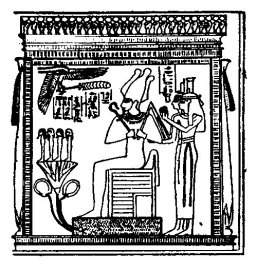
Vignette: Ani, found just, is led into the presence of Osiris. On the left the hawk-headed god Horus, the son of Isis, wearing the double crown of the North and the South, takes Ani by the hand and leads him forward towards "Osiris, the lord of eternity" Ausar neb t'etta, who is enthroned on the right within a shrine in the form of a funereal chest. The god wears the atef crown with plumes; a menat (see p. 245, note 2) hangs from the back of his neck; and he holds in his hands the crook, sceptre, and flail, emblems of sovereignty and dominion. He is wrapped in bandages ornamented with scale work. The side of his throne is painted to resemble the doors of the tomb. Behind him stand Nephthys on his right hand and Isis on his left. Facing him, and standing on a lotus flower, are the four "children of Horus (or Osiris)," or gods of the cardinal points. The first, Mestha, has the head of a man; the second, Hapi, the head of an ape; the third, Tuamautef, the head of a jackal; and the fourth, Qebhsennuf, the head of a hawk. Suspended near the lotus is an object which is usually called a panther's skin, but is more probably a bullock's hide.

The roof of the shrine is supported on pillars with lotus capitals, and is surmounted by a figure of Horus-Sept or Horus-Seker and rows of ur.

In the centre Ani kneels before the god upon a reed mat, raising his right hand in adoration, and holding in his left hand the kherp sceptre. He wears a whitened wig surmounted by a "cone," the signification of which is unknown. Round his neck is a deep collar of precious stones. Near him stands a table of offerings of meat, fruit, flowers, etc., and in the compartments above are a number of vessels for wine, beer, oil, wax, etc., together with bread, cakes, ducks, a wreath, and single flowers.

Appendix: The shrine is in some instances represented in the shape of a pylon, the cornice of which is ornamented either with ur, or with the disk of the sun and feathers, emblematic of Maat. It usually rests upon a base made in the shape of a cubit, The throne upon which Osiris sits is placed upon reed mats (British Museum papyrus No. 10,471), or upon the cubit-shaped base, or in a pool of water, from which springs a lotus flower with buds and having the four gods of the cardinal points (see British Museum papyrus No. 9901) standing upon it. In some of the oldest papyri the body of Osiris is painted white, and he stands upright. Isis is described as "great lady, divine mother," and Nephthys as "the mistress of the underworld." In British Museum papyrus No. 10471 the scene of the presentation of the deceased to Osiris is unusual and of interest. On the right the scribe Nekht and his wife Thuau stand with both hands raised in adoration of Osiris. Behind them, upon a cubit-shaped base, is a house with four windows in its upper half, and upon the roof two triangular projections similar to those which admit air into modern houses in the East. Before the door are a sycamore (?) tree and a palm tree, with clusters of fruit; on the left is the god Osiris on his throne, and behind him stands "Maat, mistress of the two countries, daughter of Ra," above whom are two outstretched female arms proceeding from a mountain and holding a disk between the hands. In the centre, between Osiris and the deceased, is a pool of water with three sycamore (?) trees on each side, and at each corner a palm tree bearing clusters of dates; and from it there springs a vine laden with bunches of grapes.

bodead-plate04

In British Museum papyrus No. 10,472 the god seated in the shrine wears the crown of the god Tanen, and is called "Ptah-Seker-Ausar, within the hidden place, great god, lord of Ta-sert, king of eternity, prince of the everlasting."

Text: Saith Horus, the son of Isis: "I have come unto thee, O Unnefer, and I have brought the Osiris Ani unto thee. His heart is [found] righteous coming forth from the balance, and it hath not sinned against god or goddess. Thoth hath weighed it according to the decree uttered unto him by the company {p. 261} of the gods; and it is very true and righteous. Grant him cakes and ale; and let him enter into the presence of Osiris; and may he be like unto the followers of Horus for ever."

Behold, Osiris Ani saith: "O Lord of Amentet (the underworld), I am in thy presence. There is no sin in me, I have not lied wittingly, nor have I done aught with a false heart. Grant that I may be like unto those favoured ones who are round about thee, and that I may be an Osiris, greatly favoured of the beautiful god and beloved of the lord of the world, the royal scribe indeed, who loveth him Ani, triumphant before the god Osiris."

Appendix: The usual title of this chapter [XXXB.] is, "Chapter of not allowing the heart of [the deceased] to be driven away from him in the underworld." it is an address by the deceased to his own heart, which he calls his ka or "double" within his body. It should be accompanied by a vignette of the trial of the heart in which the heart is weighed against the dead man himself, as in the ancient Nebseni papyrus. In the Ani papyrus, however, it will be observed that the heart is being weighed against the feather of the Law, Maat, a scene which often accompanies Chapter CXXV.

bodead-plate04

Interesting variants of the vignettes of Chapter XXXB. are given by Naville (Todtenbuch, Bd. I., Bl. 43), where we find the deceased addressing either his heart placed on a stand, or a beetle, or a heart to which are attached the antennof a beetle. In certain papyri this chapter is followed by a rubric:--"[This chapter is] to be said over a scarab of green stone encircled with smu metal, and [having] a ring of silver, which is to be placed upon the neck of the dead. This chapter was found in Khemennu.

Written upon a slab of steel of the South, in the writing of the god himself, under the feet of the majesty of the god, in the time of the majesty of Men-kau-Ra, the king of the North and of the South, triumphant, by the royal son Heru-tata-f who found it while he was journeying to inspect the temples."

The scarabs which are found in the mummies, or lying upon the breast just above the position of the heart, form an interesting section of every large Egyptian collection. In the British Museum series every important type of the funereal scarab is represented. They are made of green basalt, green granite (Nos. 7894 and 15,497), white limestone (Nos. 7917, 7927, 15,508), light green marble (No. 7905), black stone (Nos. 7907, 7909, 7913), blue paste (Nos. 7904, 14,549), blue glass (No. 22,872), and purple, blue, or green glazed fance (Nos. 7868, 7869). They vary in size from 5 inches to 2 inches in length. On the hard stone examples the text of the Chapter of the Heart, more or less complete, is usually cut on the base in outline; but it is sometimes traced in red ink (No. 7915), or in gold (No. 15,518). Incuse hieroglyphics are sometimes filled with gold (No. 7881). The name of the person with whom the scarab was buried usually precedes the text of the Chapter of the Heart; but in many instances blank spaces are found left without insertion of the name--a proof that i, these amulets were bought ready-made. The base however is often quite plan (Nos. 7965, 7966), or figures of Osiris, Isis, and Nephthys occupy the place of the usual inscription (Nos. 15,500, 15,507). The backs of scarabs are generally quite plain, but we find examples inscribed with figures of the boat of the Sun Osiris, with flail and crook the bennu bird, and the u'tat (No. 7883), Ra and Osiris (No. 15,507), and the bennu bird with the inscription neteri ab en Ra, "the mighty heart of Ra" (No. 7878). A finehard, green stone scarab of the Greek or Roman period has upon the back the figures of four Greek deities (No. 7966). In rare instances, the beetles have a human face (Nos. 7876, 15,516) or head (No. 7999). Carefully made scarabs have usually a band of gold across and down the back where the wings join: an example of the late period (No. 7977) has the whole of the back gilded. The scarab was set in a gold oval ring, at one end of which was a smaller ring for suspension from the neck or for attachment to the bandages of the mummy (No. 15,504). The green glazed fance scarab of Thothmes III. (No. 18,190) was suspended by a gold chain from a bronze torque. A thick gold wire to fit the neck is attached to No. 24,401. The base of the scarab is sometimes in the form of a heart (Nos. 7917, 7925). A remarkable example of this variety is No. 7925, in which are the emblems of "life," "stability," and "protection," engraved on the upper part of the base. Across the back of this scarab is -- ###; On the right wing:-- ### and on the left ###. A highly polished, fine green basalt scarab with human face (No. 7876) is set in a gold base, upon the face and edges of which are cut part of the Chapter of the Heart. At a period subsequent to the XXIInd dynasty inscribed funereal scarabs in marble, paste, etc., were set in pylon-shaped pectorals made of Egyptian porcelain, glazed blue, green, or yellow, which were sewed to the mummy bandages over the heart. On such pectorals the boat of the Sun is either traced in colours or worked in relief, and the scarab is placed so as to appear to be carried in the boat; on the left stands Isis, and on the right Nephthys (Nos. 7857, 7864, 7866).

The Book of the Dead, Plate 3

THE BOOK OF THE DEAD

The Papyrus of Ani

by

E. A. WALLIS BUDGE

Late keeper of Assyrian and Egyptian Antiquities
in the British Museum

[1895]

PLATE III.

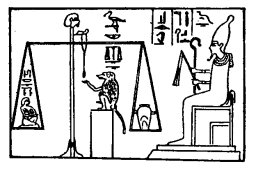
Vignette: Scene of the weighing of the Heart of the Dead. Ani and his wife enter the Hall of Double Law or Truth, wherein the heart, emblematical of the conscience, is to be weighed in the balance against the feather, emblematical of law. Above, twelve gods, each holding a sceptre are seated upon thrones before a table of offerings of fruit, flowers, etc. Their names are: Harmachis, "the great god within his boat"; Tmu; Shu; Tefnut, "lady of heaven"; Seb; Nut, "lady of Heaven" Isis; Nephthys; Horus, "the great god"; Hathor, "lady of Amenta"; and Sa. Upon the beam of the scales sits the dog-headed ape which was associated with Thoth, the scribe of the gods. The god Anubis, jackal-headed, tests the tongue of the balance, the suspending bracket of which is in the form of the feather The inscription above the head of Anubis reads:--"He who is in the tomb saith, pray thee, O weigher of righteousness, to guide (?) the balance that it may be stablished.'" On the left of the balance, facing Anubis, stands Ani's "Luck" or "Destiny," Shai and above is the object called mesxen which has been described as "a cubit with human head," and which is supposed to be connected with the place of birth. Behind these stand the goddesses Meskhenet and Renenet: Meskhenet presiding over the birth-chamber, and Renenet probably superintending the rearing of children. Behind the meskhen is the soul of Ani in the form of a human-headed bird standing on a pylon. On the right of the balance, behind Anubis, stands Thoth, the scribe of the gods, with his reed-pen and palette containing black and red ink, with which to record the result of the trial. Behind Thoth stands the female monster Amam, the "Devourer," or Am-mit, the eater of the Dead."

bodead-plate03

bodead-plate03

Text: [Chapter XXXB.] Osiris, the scribe Ani, saith: "My heart my mother, my heart my mother, my heart my coming into being! May there be nothing to resist me at [my] judgment; may there be no opposition to me from the Tchatcha; may there be no parting of thee from me in the presence of him who keepeth the scales! Thou art my ka within my body [which] knitteth and strengtheneth my limbs. Mayest thou come forth to the place of happiness to which I am advancing. "May the Shenit not cause my name to stink, and may no lies be spoken against me in the presence of the god! Good is it for thee to hear." . . . . . . .

Thoth, the righteous judge of the great company of the gods who are in the presence of the god Osiris, saith: "Hear ye this judgment. The heart of Osiris hath in very truth been weighed, and his soul hath stood as a witness for him; it hath been found true by trial in the Great Balance. There hath not been found any wickedness in him; he hath not wasted the offerings in the temples; he hath not done harm by his deeds; and he uttered no evil reports while he was upon earth."

The great company of the gods reply to Thoth dwelling in Khemennu: "That which cometh forth from thy mouth hath been ordained. Osiris, the scribe Ani, triumphant, is holy and righteous. He hath not sinned, neither hath he done evil against us. Let it not be given to the devourer Amemet to prevail over him. Meat-offerings and entrance into the presence of the god Osiris shall be granted unto him, together with a homestead for ever in Sekhet-hetepu, as unto the followers of Horus."

The Book of the Dead, Plate 2

THE BOOK OF THE DEAD

The Papyrus of Ani

by

E. A. WALLIS BUDGE

Late keeper of Assyrian and Egyptian Antiquities
in the British Museum

[1895]

PLATE II.

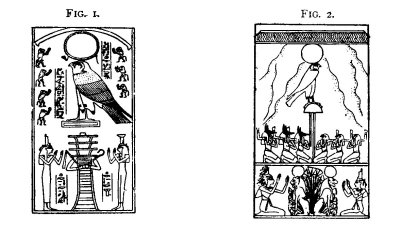
Vignette I.: The disk of the Sun, supported by a pair of arms proceeding from the ankh, the sign of life, which in turn is supported by a tet the emblem of the East and of the god Osiris. The tet stands upon the horizon. On each side of the disk are three dog-headed apes, spirits of the Dawn, their arms raised in adoration of the disk. On the right hand side of the tet is the goddess Nephthys and on the left is Isis each goddess raising her hands in adoration of the tet, and kneeling upon the emblem aat, or hemisphere. Above is the sky. This vignette belongs properly to the hymn to the rising sun.

bodead-plate02

Text: (1) [HYMN TO OSIRIS.] "Glory be to Osiris Un-nefer, the great god within Abydos, king of eternity, lord of the everlasting, who passeth through millions of years in his existence. Eldest son of the womb of Nut, engendered by Seb the Erpat, lord of the crowns of the North and South, lord of the lofty white crown. As Prince of gods and of men he hath received the crook and the flail and the dignity of his divine fathers. Let thy heart which is in the mountain of Amenta be content, for thy son Horus is stablished upon thy throne. Thou art crowned lord of Tattu and ruler in Abtu. Through thee the world waxeth green in triumph before the might of Neb-er-tcher. He leadeth in his train that which is and that which is not yet, in his name Ta-her-seta-nef; he toweth along the earth in triumph in his name Seker. He is exceeding mighty and most terrible in his name Osiris. He endureth for ever and for ever in his name Un-nefer. Homage to thee, King of kings, Lord of lords, Prince of princes, who from the womb of Nut hast possessed the world and hast ruled all lands and Akert. Thy body is of gold, thy head is of azure, and emerald light encircleth thee. O An of millions of years, all-pervading with thy body and beautiful in countenance in Ta-sert. Grant thou to the ka of Osiris, the scribe Ani, splendour in heaven and might upon earth and triumph in Neter-khert; and that I may sail down to Tattu like a living soul and up to Abtu like a bennu (phnix); and that I may go in and come out without repulse at the pylons of the Tuat. May there be given unto me loaves of bread in the house of coolness, and offerings of food in Annu, and a homestead for ever in Sekhet-Aru with wheat and barley therefor."

The Book of the Dead, Plate 1

THE BOOK OF THE DEAD

The Papyrus of Ani

by

E. A. WALLIS BUDGE

Late keeper of Assyrian and Egyptian Antiquities
in the British Museum

[1895]

Translation

PLATE I.

Vignette: The scribe Ani, standing with hands raised in adoration before a table of offerings consisting of haunches of beef, loaves of bread and cake, vases of wine and oil, fruits, lotus, and other flowers. He wears a fringed white and saffron-coloured linen garment; and has a wig, necklace, and bracelets. Behind him stands his wife "Osiris, the lady of the house, the lady of the choir of Amen, Thuthu," similarly robed and holding a sistrum and a vine (?)-branch in her right hand, and a menat in her left.

Text: [Chapter XV.] (1) [1] A HYMN OF PRAISE TO RA WHEN HE RISETH IN THE EASTERN PART OF HEAVEN. Behold Osiris Ani the scribe who recordeth the holy offerings of all the gods, who saith: "Homage to thee, O thou who hast come as Khepera, Khepera, the creator of the gods. Thou risest, thou shinest, making bright thy mother [Nut], crowned king of the gods. [Thy] mother Nut doeth homage unto thee with both her hands. The land of Manu receiveth thee with content, and the goddess Maat embraceth thee at the two seasons. May he give splendour, and power, and triumph, and a coming-forth [i.e., resurrection] as a living soul to see Horus of the two horizons to the ka of Osiris, the scribe Ani, triumphant before Osiris, who saith: Hail all ye gods of the Temple of the Soul, who weigh heaven and earth in the balance, and who provide food and abundance of meat. Hail Tatunen, One, creator of mankind and of the substance of the gods of the south and of the north, of the west and of the east. Ascribe [ye] praise unto Ra, the lord of heaven, the Prince, Life, Health, and Strength, the Creator of the gods, and adore ye him in his beautiful Presence as he riseth in the atet boat. They who dwell in the heights and they who dwell in the depths worship thee. Thoth and Maat both are thy recorders. Thine enemy is given to the fire, the evil one hath fallen; his arms are bound, and his legs hath Ra taken from him. The children of impotent revolt shall never rise up again.

The House of the Prince keepeth festival, and the sound of those who rejoice is in the mighty dwelling. The gods are glad [when] they see Ra in his rising; his beams flood the world with light.The majesty of the god, who is to be feared, setteth forth and cometh unto the land of Manu; he maketh bright the earth at his birth each day; he cometh unto the place where he was yesterday. O mayest thou be at peace with me; may I behold thy beauties; may I advance upon the earth; may I smite the Ass; may I crush the evil one; may I destroy Apep in his hour; may I see the abtu fish at the time of his creation, and the ant fish in his creation, and the ant boat in its lake. May I see Horus in charge of the rudder, with Thoth and Maat beside him; may I grasp the bows of the seket boat, and the stern of the atet boat. May he grant unto the ka of Osiris Ani to behold the disk of the Sun and to see the Moon-god without ceasing, every day; and may my soul come forth and walk hither and thither and whithersoever it pleaseth. May my name be proclaimed when it is found upon the board of the table of offerings; may offerings be made unto me in my presence, even as they are made unto the followers of Horus; may there be prepared for me a seat in the boat of the Sun on the day of the going forth of the god; and may I be received into the presence of Osiris in the land of triumph!

bodead-plate01

Appendix

The following versions of this chapter are taken from: I. Naville, Todtenbuch, Bd. I., Pl. xiv. II. Naville, Todtenbuch, Bd. I., Pl. xv.; III. British Museum Papyrus No. 9901 and IV. British Museum Papyrus No. 10,471.

I. A HYMN OF PRAISE TO RA WHEN HE RISETH IN THE EASTERN PART OF HEAVEN. Behold Osiris, Qenna the merchant, who saith: "Homage to thee, in thy rising thou Tmu in thy crowns of beauty. Thou risest, thou risest, thou Ra shinest, thou shinest, at dawn of day. Thou art crowned like unto the king of the gods, and the goddess Shuti doeth homage unto thee. The company of the gods praise thee from the double-dwelling. Thou goest forth over the upper air and thy heart is filled with gladness. The sektet boat draweth onward as [Ra] cometh to the haven in the atet boat with fair winds. Ra rejoiceth, Ra rejoiceth. Thy father is Nu, thy mother is Nut, and thou art crowned as Ra-Harmachis. Thy sacred boat advanceth in peace. Thy foe hath been cast down and his head hath been cut off; the heart of the Lady of life rejoiceth in that the enemy of her lord hath been overthrown. The mariners of Ra have content of heart and Annu rejoiceth."

The merchant Qenna saith: "I have come to thee, O Lord of the gods, Tmu-Harmachis, who passest over the earth . . . . . . . I know that by which thou dost live. Grant that I may be like unto one of those who are thy favoured ones [among the followers] of the great god. May my name be proclaimed, may it be found, may it be lastingly renewed with . . . . . . . The oars are lifted into the sektet boat, and the sacred boat cometh in peace. May I see Ra when he appeareth in the sky at dawn, and when his enemies have fallen at the block. May I behold [Horns] guiding the rudder and steering with [his] two hands. May I see the abtu fish at the moment of his creation; and may I see the ant fish when he maketh himself manifest at creation, and the ant boat upon its lake. O thou Only One, O thou Mighty One, thou Growing One, who dost never wax faint, and from whom power cannot be taken. . . . . . . . . . . . . . the devoted servant of "the lord of Abtu."

"The merchant Qenna saith: "Homage to thee Heru-Khuti-Tmu, Heru-Khepera, mighty hawk, who dost cause the body [of man] to make merry, beautiful of face by reason of thy two great plumes. Thou wakest up in beauty at the dawn, when the company of the gods and mortals sing songs of joy unto thee; hymns of praise are offered unto thee at eventide. The starry deities also adore thee. O thou firstborn, who dost lie without movement, arise; thy mother showeth loving kindness unto thee every day. Ra liveth and the fiend Nak is dead; thou dost endure for ever, and the fiend hath fallen.

"Thou sailest over the sky with life and strength. The goddess Nehebka is in the atet boat; the sacred boat rejoiceth. Thy heart is glad and thy brow is wreathed with the twin serpents."

II. (I) A HYMN OF PRAISE TO RA WHEN HE RISETH IN THE EASTERN PART OF HEAVEN. Behold Osiris, Qenna the merchant, triumphant, who saith: "Homage to thee, O thou who risest in Nu, and who at thy birth dost make the world bright with light; all the company of the gods sing hymns of praise unto thee. The beings who minister unto Osiris cherish him as King of the North and of the South, the beautiful and beloved man-child. When he riseth, mortals live. The nations rejoice in him, and the Spirits of Annu sing unto him songs of joy. The Spirits of the towns of Pe and Nekhen exalt him, the apes of dawn adore him, and all beasts and cattle praise him with one accord. The goddess Seba overthroweth thine enemies, therefore rejoice within thy boat; and thy mariners are content thereat. Thou hast arrived in the atet boat, and thy heart swelleth with joy. O Lord of the gods, when thou dost create them, they ascribe praises unto thee. The azure goddess Nut doth compass thee on every side, and the god Nu floodeth thee with his rays of light. O cast thou thy light upon me and let me see thy beauties, me, the Osiris Qenna the merchant, triumphant! When thou goest forth over the earth I will sing praises unto thy fair face. Thou risest in the horizon of heaven, and [thy] disk is adored [when] it resteth upon the mountain to give life unto the world."

Saith Qenna the merchant, triumphant: "Thou risest, thou risest, coming forth from the god Nu. Thou dost become young again and art the same as thou wert yesterday, O mighty youth who hast created thyself. Not . . . . . . . my hand. Thou hast come with thy splendours, and thou hast made heaven and earth bright with thy rays of pure emerald light. The land of Punt is established for the perfumes which thou smellest with thy nostrils. Thou risest, O thou marvellous Being, in heaven, the twin serpents are placed upon thy brow, and thou art lord of the world and the inhabitants thereof; [the company] of the gods and Qenna the merchant, triumphant, adore thee."

III. (1, 2) A HYMN OF PRAISE TO RA WHEN HE RISETH IN THE EASTERN PART OF HEAVEN. Behold Osiris Hunefer, triumphant, who saith: "Homage to thee, O thou who art Ra when thou risest and Tmu when thou settest. Thou risest, thou risest; thou shinest, thou shinest, thou who art crowned king of the {p. 251} gods. Thou art the lord of heaven, [thou art] the lord of earth, [thou art] the creator of those who dwell in the heights and of those who dwell in the depths. [Thou art] the One god who came into being in the beginning of time. Thou didst create the earth, thou didst fashion man, thou didst make the watery abyss of the sky, thou didst form Hapi [the Nile], and thou art the maker of streams and of the great deep, and thou givest life to all that is therein. Thou hast knit together the mountains, thou has made mankind and the beasts of the field, thou hast created the heavens and the earth. Worshipped be thou whom the goddess Maat embraceth at morn and at eve. Thou dost travel across the sky with heart swelling with joy; the Lake of Testes is at peace. The fiend Nak hath fallen and his two arms are cut off. The sektet boat receiveth fair winds, and the heart of him that is in his shrine rejoiceth. Thou art crowned with a heavenly form, the Only one, provided [with all things]. Ra cometh forth from Nu in triumph. O thou mighty youth, thou everlasting son, self-begotten, who didst give thyself birth, O thou mighty One, of myriad forms and aspects, king of the world, Prince of Annu, lord of eternity and ruler of the everlasting, the company of the gods rejoice when thou risest and when thou sailest across the sky, O thou who art exalted in the sektet boat. Homage to thee, O Amen-Ra, thou who dost rest upon Maat, thou who passest over the heaven, and every face seeth thee. Thou dost wax great as thy Majesty doth advance, and thy rays are upon all faces. Thou art unknown and canst not be searched out . . . . . . . . his fellow except thyself; thou art the Only One . . . . . . [Men] praise thee in thy name [Ra], and they swear by thee, for thou art lord over them. Thou hast heard with thine ears and thou hast seen with thine eyes. Millions of years have gone over the world; I cannot tell the number of them, through which thou hast passed. Thy heart hath decreed a day of happiness in thy name [of Ra]. Thou dost pass over and travellest through untold spaces of millions and hundreds of thousands of years; thou settest out in peace, and thou steerest thy way across the watery abyss to the place which thou lovest; this thou doest in one little moment of time, and thou dost sink down and makest an end of the hours."

Osiris, the governor of the palace of the lord of the two lands (i.e., Seti I.), Hunefer, triumphant, saith: Hail my lord, thou that passest through eternity and whose being is everlasting. Hail thou Disk, lord of beams of light, thou risest and thou makest all mankind to live. Grant thou that I may behold thee at dawn each day."

IV. A HYMN OF PRAISE TO RA by Nekht, the royal scribe, captain of soldiers, who saith: "Homage to thee, O thou glorious Being, thou who art provided [with all things]. O Tmu-Heru-khuti, when thou risest in the horizon of heaven, a cry of joy cometh out of the mouth of all peoples. O thou beautiful Being, thou dost renew thyself in thy season in the form of the Disk within thy mother Hathor; therefore in every place every heart swelleth with joy at thy rising, for ever. The eastern and the western parts of heaven come to thee with homage, and give forth sounds of joy at thy rising. O Ra, thou who art Heru-khuti (Harmachis), the mighty man-child, the heir of eternity, self-begotten and self-born, king of earth, prince of the netherworld, governor of the mountains of Aukert (i.e., the netherworld), thou dost rise in the horizon of heaven and sheddest upon the world beams of emerald light; thou art born from the {p. 252} water, thou art sprung from Nu, who fostereth thee and ordereth thy members. O thou who art crowned king of the gods, god of life, lord of love, all the nations live when thou dost shine. The goddess Nut doeth homage unto thee, and the goddess Maat embraceth thee at all times. They who are in thy following sing unto thee with joy and bow down to the earth when they meet thee, the god of heaven, the lord of earth, the king of right and truth, the god of eternity, the everlasting ruler, the prince of all the gods, the god of life, the creator of eternity, the maker of heaven by whom is established all that therein is. The company of the gods rejoice at thy rising, the earth is glad when it beholdeth thy rays; the peoples that have been long dead come forth with cries of joy to see thy beauties. Thou goest forth over heaven and earth, made strong each day by thy mother Nut. Thou passest through the uppermost heaven, thy heart swelleth with joy; and the Lake of Testes is content thereat. The Enemy hath fallen, his arms are hewn off, the knife hath cut asunder his joints. Ra liveth in Maa the beautiful. The sektet boat draweth on and cometh into port; the south, the north, the west and the east turn to praise thee, O thou unformed substance of the earth, who didst create thyself. Isis and Nephthys salute thee, they sing unto thee in thy boat hymns of joy, they shield thee with their hands. The souls of the East follow thee, the souls of the West praise thee. Thou art the ruler of all gods and thou hast joy of heart within thy shrine; for the Serpent Nak is condemned to the fire, and thy heart shall be joyful for ever. Thy mother Nut is adjudged to thy father Nu."

The Book of the Dead, Index

THE BOOK OF THE DEAD

The Papyrus of Ani

IN THE BRITISH MUSEUM.

THE EGYPTIAN TEXT WITH INTERLINEAR

TRANSLITERATION AND TRANSLATION,

A RUNNING TRANSLATION, INTRODUCTION, ETC.

by

E. A. WALLIS BUDGE

Late keeper of Assyrian and Egyptian Antiquities
in the British Museum

[1895]

Because of the substantial amount of hieroglypics interspersed in the original text, I have omitted the ### 'glyph' placeholder where context permits, for readability. Only actual illustations have been inserted into the file. Due to space considerations the interlinear translation, which is primarily of interest to students of Ancient Egyptian, will not be posted. This should not be a hardship, since the Dover reprint edition is still in print and widely available.

The file above, which appears at on the Internet at Sacred-Texts for the first time is a faithful e-text of the 1895 edition of the E.A. Wallace Budge translation of the Egyptian Book of the Dead.

In November of 2000 I inventoried my library and found that I was missing Budge's Book of the Dead. So when a copy of the Dover reprint came up at the local used bookstore, I purchased it. To my dismay, the version of the text widely posted on the Internet did not seem to match the Dover reprint of the 1895 version.

According to John Mark Ockerbloom, the proprietor of the excellent Online Books Page, the version circulating on the Internet is a highly edited version of Budge from a much later date (1913). He writes:

"I did a little legwork, and it appears that the "mystery text" is in fact from the Medici Society edition of 1913. According to a 1960 reprint by University Books, for this edition "The translation was rewritten... [and the] greater part of the Introduction was also rewritten by Sir Wallis, who concluded a preface to it with the pleased words, 'and the entire work thus becomes truly a "New Edition"'". It's unclear whether Budge himself did the rewrite of the translation, but it's clear that he at least claims responsibility for it,. and it does appear to draw fairly heavily on his earlier translation."

Thanks to Mr. Ockerbloom for clearing up this mystery.

In any case, the version now at sacred-texts is a completely new e-text, which I believe to be a much better version of this text.

NOTE : Because the original e-text is not readable for "unschooled" readers, due to a mass of refers to other scripts, I removed most of them to make this book a little readable for my readers.

The original full text including all comments, you can find at Sacred Texts: Ancient Egypt.

The Book of the Dead, The Papyrus of Ani

THE BOOK OF THE DEAD

The Papyrus of Ani

by

E. A. WALLIS BUDGE

Late keeper of Assyrian and Egyptian Antiquities
in the British Museum

[1895]

THE PAPYRUS OF ANI.

General Description

The papyrus of Ani, was found at Thebes, and was purchased by the Trustees of the British Museum in 1888. It measures 78 feet by 1 foot 3 inches, and is the longest known papyrus of the Theban period. It is made up of six distinct lengths of papyrus, which vary in length from 26 feet 9 inches to 5 feet 7 inches. The material is composed of three layers of papyrus supplied by plants which measured in the stalks about 41 inches in diameter. The several lengths have been joined together with great neatness, and the repairs and insertion of new pieces (see plates 25, 26) have been dexterously made. When first found, the papyrus was of a light colour, similar to that of the papyrus of Hunefer (B. M. No. 9901), but it became darker after it had been unrolled, and certain sections of it have shrunk somewhat.

It contains a number of chapters of the Book of the Dead, nearly all of which are accompanied by vignettes; and at top and bottom is a border of two colours-red and yellow. At the beginning and end of the papyrus spaces of six and eleven inches respectively have been left blank. The inscribed portion is complete, and the loss of the few characters which were damaged in unrolling does not interrupt the text. It was written by three or more scribes; but the uniformity of the execution of the vignettes suggests that fewer artists were employed on the illustrations. The titles of the chapters, rubrics, catchwords, etc., are in red. In some instances the artist has occupied so much space that the scribe has been obliged to crowd the text (e.g., in plate 11) and at times he has written it on the border (see plates 14, 17). This proves that the vignettes were drawn before the text was written.

All the different sections of the papyrus were not originally written for Ani, for his name has been added in several places' by a later hand. As however such additions do not occur in the first section, which measures 16 feet 4 inches in length, it must be concluded that that section was written expressly for him, and that the others were some of those ready-written copies in which blank spaces were left for the insertion of the names of the deceased persons for whom they were purchased. The scribe who filled in Ani's name in these spaces wrote hurriedly, for in Chapter XXXB., line 2 (pl. 15), he left himself no space to write the word "Osiris" in the phrase, "Ani victorious before Osiris" (compare pl. 1, line 5); in Chapter XLIII., lines 1, 2 (pl. 17), he has written it twice; in Chapter IX., l. 1 (pl. 18), he has omitted the determinative in Chapter XV., line 2 (pl. 20) he meant to write "Ani, victorious in peace (pl. 19), but wrote "Ani in triumph" in Chapter CXXV., line 18 (pl. 30), the word ### is written twice, probably, however, with the view of filling up the line; in Chapter CLI. (Pl. 34) the name is written crookedly, and the determinative is omitted; and in Chapters XVIII. (Introduction, pl. 12) and CXXXIV. (pl. 22). the scribe has, in two spaces, omitted to write the name. It seems tolerably certain that all the sections of the papyrus were written about the same time, and that they are the work of scribes of the same school; the variations in the depth of the space occupied by the text and the difference in the colours of the border only show that even the best scribes did not tie themselves to any one plan or method in preparing a copy of the Book of the Dead. The text has many serious errors: by some extraordinary oversight it includes two copies of the XVIII th Chapter, one with an unusual introduction and the other without introduction; and a large section of the XVIIth Chapter, one of the most important in the whole work, has been entirely omitted. Such mistakes and omissions, however, occur in papyri older than that of Ani, for in the papyrus of Nebseni (B.M., No. 9900), which was written at Memphis early in the XVIIIth dynasty, of Chapters L., LVI., LXIV., CLXXX., two copies each, of Chapters C. and CVI., three copies, and of Chapter XVII. two extracts are given in different parts of the papyrus.

Ani's rank.

The papyrus of Ani is undated, and no facts are given in it concerning the life of Ani, whereby it would be possible to fix its exact place in the series of the illustrated papyri of the Theban period to which it belongs. His full titles are:-- suten in maa an hesb hetep neter en neteru nebu Royal scribe veritable, scribe and accountant of the divine offerings (i.e., revenues) of all the gods. mer tenti en nebu Abtu an hetep neter en The governor of the granary of the lords of Abydos, scribe of the divine offerings (i.e., revenues) of nebu Uast. the lords of Thebes; and he is said to be "beloved of the lord of the North and South" and to "love him". The name of the king thus referred to cannot be stated. That Ani's rank of "royal scribe" was not titular only is shown by the addition of the word "veritable," and his office of scribe and accountant of all the gods was probably one of the highest which a scribe could hold. His other offices of "governor of the granary of the lords of Abydos," and "scribe of the sacred property of the lords of Thebes," further prove his rank and importance, for Abydos and Thebes were the most ancient and sacred cities of Egypt.

Ani's wife.

Ani's wife Thuthu is described as "the lady of the house, the qematet of Amen". What the title "lady of the house means has not yet been decided, but qemat is the title applied to the noble ladies who sang or played on an instrument in the temple of a god. The lady Thuthu belonged to the number of the priestesses of the god Amen-Ra at Thebes, and she always carries in her hands the sistrum. and the instrument menat, the emblems of her office. Thus Ani and his wife were high ecclesiastical dignitaries connected with the famous confraternity of the priests of Amen.

Copies of the Book of the Dead in the Theban period.
Age of the papyrus.

An examination of the papyri of the Theban period preserved in the British Museum shows that two distinct classes of Book of the Dead papyri existed in the XVIIIth dynasty. In the first both text and vignettes are traced in black outline, the rubrics, catchwords, etc., alone being in red colour; in the second the text only is black, the rubrics, etc., being red, and the vignettes beautifully painted in a number of bright colours. To the latter class the papyrus of Ani belongs, but, if the text and vignettes be compared with those found in any other early Theban papyri, it will be seen that it occupies an independent position in all respects. Though agreeing in the main with the papyri of the XVIIIth dynasty in respect of textual readings, the papyrus of Ani has peculiarities in spelling, etc., which are not found in any of them. The handwriting of the first section at least suggests the best period of the XVIIIth dynasty; but as the scribe forms some of the characters in a way peculiarly his own, the palgraphic evidence on this point is not decisive. That the papyrus belongs to the period which produced such documents as the papyrus of Neb-qet, and the papyrus of Qenna, i.e., to some period of the XVIIIth dynasty, is tolerably certain; and we may assume that it is older than the papyrus of Hunefer, which was written during the reign of Seti I.; for, though belonging to the same class of highly decorated papyri, the execution of the vignettes is finer and more careful, and the free, bold forms of the hieroglyphics in the better written sections more closely resemble those of the texts inscribed in stone under the greatest kings of the XVIIIth dynasty. The "lord of the two lands," i.e., of Upper and Lower Egypt, or the North and South, mentioned in pl. 4, is probably one of the Thothmes or Amenhetep kings, and accordingly we may place the period of our papyrus between 1500 and 1400 years B.C.

The text.

The text may be divided into two parts. The first part contains unusual versions of two hymns to Ra and Osiris, the vignette of the sunrise (Chapter XVIA.), and the judgment Scene accompanied by texts, some of which occur in no other papyrus. The second part comprises about sixty-two Chapters of the Theban edition of the Book, in the following order:--I., XXII. LXXII., rubric, XVII., CXLVII., CXLVI., XVIII., XXIII., XXIV., XXVI. XXXB., LXI., LIV., XXIX., XXVII., LVIII., LIX., XLIV., XLV., XLVI., L., XCIII., XLIII., LXXXIX., XCI., XCII., LXXIV., VIII., II., IX., CXXXII., X., [XLVIII.], XV., CXXXIII., CXXXIV., XVIII., CXXIV., LXXXVI., LXXVII., LXXVIII., LXXXVII., LXXXVIII., LXXXII., LXXXV., LXXXIII., LXXXIV., LXXXIA., LXXX., CLXXV., CXXV. Introduction and Negative Confession, XLII., CXXV., Rubric, CLV., CLVI., XXIXB., CLXVI., CLI., VI., CX., CXLVIII., CLXXXV., and CLXXXVI. The titles of these Chapters arranged according to the numeration introduced by Lepsius are as follows :--

List of Chapters.

Chapter I. "Here begin the chapters of 'coming forth by day,' and of the songs of praise and of glorifying, and of coming forth from and of going into the glorious Neter-khert in the beautiful Amenta; to be said on the day of the burial going in after coming forth." (See pp. 19, 270 and pll. 5, 6.)

The papyri belonging to the early part of the XVIIth dynasty call this Chapter the "Chapter of going in to the divine chiefs of Osiris," ###. The large numbers of the men attending the bier and of the weeping women are peculiar to the Ani papyrus.

Chapter II. "The Chapter of coming forth by day and of living after death." (See pp. 120, 321, and pl. 18.)

This Chapter is found only in one other papyrus of the Theban period (British Museum, No. 9964). Another copy of it is inscribed upon a mummy bandage preserved in the Louvre, No. 3097.'

Chapter VI.--[See Chapter CLI., of which it forms a part, pp. 233, 362, and pl. 32.] In the papyrus of Nebseni (British Museum, No. 9900) this Chapter stands by itself, and is entitled "Chapter of making the ushabti figures to perform work for a man in the Neter-khert,"

Chapter VIII. "The Chapter of passing through Amenta, and of coming forth by day." (See pp. 119, 320, and pl. 18.)

As a separate composition, this Chapter is found in only two other papyri of the XVIIIth dynasty.

Chapter IX. "The Chapter of coming forth by day, having passed through the tomb." (See pp. 120, 321, and pl. 18.)

The vignette in the papyrus of Ani is similar to that which stands at the head of Chapters VIII. and IX. in other papyri of this period.

Chapter X. [See Chapter XLVIII., pp. 123, 321, and pl. 18.]

Chapter XV. 1. "A hymn of praise to Ra when he riseth in the eastern sky." (See pp. 1, 236, and pl. I.)

This version is found in no other papyrus.

Chapter XV. 2. "A hymn of praise to Osiris Unnefer, the great god in Abydos,"[2] etc. (See pp. 8, 253, and pl. 2.)

Chapter XV. 3. "A hymn of praise to Ra when he riseth in the eastern sky, and when he setteth in the [land of] life." (See pp. 123, 322, and pl. 18-21.)

The Litany to Osiris (pl. 19) and the hymn to Ra (pll. 24, 25) which follow are variants of the XVth Chapter, similar to those published by M. Naville.

Chapter XVIA. consists of a vignette only. (See p. 252, and pl. 2.) Strictly speaking, it should form the vignette of the XVth Chapter, or of that part of it which refers to the rising sun. Like many other ancient papyri, the papyrus of Ani has no vignette referring to the sunset.

Chapter XVII. "Here begin the praises and glorifyings of coming out from and of going into the glorious Neter-khert in the beautiful Amenta, of coming forth by day in all the transformations which please him, of playing at draughts, and of sitting in the Sekh hall, and of coming forth as a living soul." (See pp. 27, 280, and Pll. 7-10.)

This is one of the oldest and most important of all the Chapters in the Book of the Dead, and it contains the most complete statements concerning the Egyptian cosmogony as formulated by the college of priests of Heliopolis. The scribe seems to have accidentally omitted a large section.

Chapter XVIII. This Chapter has no title.

The papyrus of Ani contains two copies of this Chapter. In the first the gods of the localities are grouped separately, and it is preceded by a very rare introduction, in which the An-mut-f and Sa-mer-f priests introduce Ani to the gods, whom he addresses in two speeches. (See p. 71, 301, and pll. 12-14.) In the second the text is not divided into distinct sections, and the gods are not grouped. (See p. 330, and pll. 23-24.)

Chapter XXII., "The Chapter of giving a mouth to Osiris Ani, the scribe It and teller of the holy offerings of all the gods." (See pp. 25, 274, and pl. 6.)

The ceremony of giving a mouth to the deceased was, according to the vignette in the papyrus of Nebseni, performed by the "Guardian of the Balance ". In the papyrus of Ani there is no vignette, and it is remarkable that this Chapter follows immediately after Chapter 1.

Chapter XXIII. "The Chapter of opening the mouth of Osiris, the scribe Ani." (See pp. 84, 306, and pl. 15.)

Chapter XXIV. "The Chapter of bringing charms unto Osiris Ani in Neter-khert." (See pp. 85, 306, and pl. 15.)

As with other ancient Theban papyri, the papyrus of Ani gives no Vignette.

Chapter XXVI. "The Chapter of giving a heart unto Osiris Ani in Neter-khert." (See pp. 88, 308, and pl. 15.)

The vignette is probably unique.

Chapter XXVII. "The Chapter of not letting the heart of a man be taken away from him in Neter-khert." (See pp. 100, 312, and pl. 15.)

The vignette is unusual.

Chapter XXIX. "The Chapter of not letting the heart of a man be taken away from him in Neter-khert." (See pp. 97, 311, and pl. 15.)

No other copy of this Chapter is at present known.

Chapter XXIXB. "The Chapter of a heart of carnelian." (See pp. 228, 359, and pl. 33.)

Chapter XXXB. "The Chapter of not letting the heart of Osiris Ani be driven away from him in Neter-khert." (See pp. I 1, 90, 258, 309, and pl. 15-)

Chapter XLII. This Chapter is without title (see pp. 213, 353, and pl. 32), but in other ancient papyri it is called "Repulsing of slaughter in Suten-henen."

Chapter XLIII. "The Chapter of not letting the head of a man be cut off from him in Neter-khert." (See pp. 111, 317, and pl. 17.)

As in other ancient Theban papyri, this Chapter is without vignette.

Chapter XLIV. "The Chapter of not dying a second time in Neter-khert." (See pp. 105, 315, and pl. 16.)

The vignette is peculiar to the papyrus of Ani.

Chapter XLV. "The Chapter of not suffering corruption in Neter-khert." (See pp. 106, 315, and pl. 16.)

Only one other copy of the text of this Chapter is known.[1] Among Theban papyri the vignette is peculiar to the papyrus of Ani.

Chapter XLVI. "The Chapter of not perishing and of becoming alive in Neter-khert." (See pp. 107, 316, and pl. 16.)

Only one other copy of the text of this Chapter is known (B.M. No. 9900). Among Theban papyri the vignette is peculiar to the papyrus of Ani.

Chapter XLVIII. "Another Chapter of one who cometh forth by day against his foes in Neter-khert." (See pp. 123, 321, and pl. 18.)

Only one other copy of the text of this Chapter is known (B.M. No. 9900). Among Theban papyri the vignette is peculiar to the papyrus of Ani.

Chapter L. "The Chapter of not entering in unto the block." (See pp. 108, 315, and pl. 16.)

The text of this Chapter agrees rather with the second version in the papyrus of Nebseni than with that in B.M. papyrus No. 9964. As the Ani papyrus is of Theban origin this was to be expected.

Chapter LIV. "The Chapter of giving breath in Neter-khert." (See pp. 94, 310, and pl. 15.)

Only one other copy of this Chapter is known, and it is without vignette.

Chapter LVIII. " The Chapter of breathing the air, and of having power over the water in Neter-khert." (See pp. 103, 314, and pl. 16.)

No other copy of this Chapter is known.

Chapter LIX. "The Chapter of breathing the air, and of having power over the water in Neter-khert." (See pp. 104, 315, and pl. 16.)

Only one other copy of this Chapter is known.

Chapter LXI. "The Chapter of not letting the soul of a man be taken away from him in Neter-khert." (See pp. 91, 309, and pl. 15.)

The vignette is similar to that in the papyrus of Sutimes, which M. Naville believes to be no older than the XIXth dynasty.

Chapter LXXII.--Rubric. (See pp. 26, 275, and pl. 6.)

Chapter LXXIV. "The Chapter of walking with the legs and of coming forth upon earth." (See pp. 118, 320, and pl. 18.)

Chapter LXXVII. " The Chapter of changing into a golden hawk ." (See pp. 152, 332, and pl. 25.)

Chapter LXXVIII. "The Chapter of changing into a divine hawk." (See pp. 154, 333, and pl. 25, 26.)

Chapter LXXX. "The Chapter of changing into the god who giveth light in the darkness." (See pp. 182, 341, and pl. 28.)

Chapter LXXXIA. "The Chapter of changing into a lotus." (See pp. 181, 340, and pl. 28.)

The pool of water in the vignette is uncommon.

Chapter LXXXII. "The Chapter of changing into Ptah." (See pp. 170, 337, and pl. 27.)

As in other XVIIIth dynasty papyri, this Chapter has a vignette.

Chapter LXXXIII. "The Chapter of changing into a bennu bird" (phnix?). (See pp. 176, 339, and pl. 27.)

Like other XVIIIth dynasty papyri, this Chapter lacks the addition which is found in the papyrus of Sutimes.

Chapter LXXXIV. "The Chapter of changing into a heron." (See pp. 178, 339, and pl. 28.)

Chapter LXXXV. " The Chapter of changing into the soul of Tmu." (See pp. 172, 338, and pl. 27.)

The vignette to this Chapter is similar to that of the papyrus of Tura, surnamed Nefer-uben-f, of the XVIIIth dynasty.'

Chapter LXXXVI. "The Chapter of changing into a swallow." (See pp. 250, 331, and pl. 25.)

Chapter LXXXVII. "The Chapter of changing into Seta." (See pp. 169, 337, and pl. 27.)

Chapter LXXXVIII. "The Chapter of changing into a crocodile." (See pp. 170, 337, and pl. 27.)

Chapter LXXXIX. "The Chapter of causing the soul to be united to its body in Neter-khert." (See pp. 112, 318, and pl. 17.)

The two incense burners which stand, one at the head and one at the foot of the bier, are peculiar to the papyrus of Ani.

Chapter XCI. "The Chapter of not letting the soul of a man be captive in Neter-khert." (See pp. 114, 319, and pl. 17.)

Chapter XCII. "The Chapter of opening the tomb to the soul and the shadow, of coming forth by day, and of getting power over the legs." (See pp. 115, 319, and pl. 17.)

The vignette of this Chapter is unusual and of great interest, for in it Ani's soul accompanies his shadow.

Chapter XCIII. "The Chapter of not letting a man pass over to the east in Neter-khert." (See pp. 109, 317, and pl. 17-)

The vignette as here given is peculiar to the papyrus of Ani.

Chapter XCIIIA. "Another Chapter." (See pp. 110, 317, and pl. 17.)

Chapter CX. "Here begin the Chapters of the Sekhet-hetepu, and the Chapters of coming forth by day, and of going into and coming out from Neter-khert, and of arriving in the Sekhet-Aanru, and of being in peace in the great city wherein are fresh breezes." (See pp. 236, 362, and pl. 34.)

The text is here incomplete.

Chapter CXXIV. "The Chapter of going unto the divine chiefs of Osiris." (See pp. 146, 330, and pl. 24.)

In the vignette we should expect four, instead of three, gods.

Chapter CXXV. "The Chapter of entering into the Hall of double Right and Truth: a hymn of praise to Osiris." (See pp. 189, 344, and pl. 30.)

The Introduction to this Chapter as found in the papyrus of Ani is not met with elsewhere; the text which usually follows the "Negative Confession" is however omitted. The vignette as here given is peculiar to the papyrus of Ani.

Chapter CXXXII. "The Chapter of making a man to return to see again his home upon earth." (See pp. 121, 321, and pl. 18.)

Chapter CXXX III. "[A Chapter] to be said on the day of the month." (See pp. 138, 327, and pl. 21.)

Chapter CXXXIII.--Rubric. (See pp. 142, 328, and pl. 22.)

Chapter CXXXIV. "A hymn of praise to Ra on the day of the month wherein he saileth in the boat." (See pp. 142, 329, and pl. 22.)

Chapter CXLVI. "The Chapter of renewing the pylons in the House of Osiris which is in the Sekhet-Aanru." (See pp. 63, 295, and pll. 11, 12.)

Chapter CXLVII. "A Chapter to be said when Ani cometh to the first Aril." (See pp. 56, 291, and pll. 11, 12.)

Chapter CXLVIII. Without title. See pp. 239, 366, and pl. 35.)

Chapter CLI. Scene in the mummy chamber. (See pp. 229, 360, and Pll. 33, 34.)

Chapter CLV. "The Chapter of a Tet of gold." (See pp. 225, 357, and pl. 33.)

Chapter CLVI. "The Chapter of a Buckle of carnelian." (See pp. 227, 359, and pl. 33.)

Chapter CLXVI. "The Chapter of the Pillow which is placed under the head." (See pp. 228, 359, and pl. 33.)

Chapter CLXXV. " The Chapter of not dying a second time." (See pp. 184, 341, and pl. 29.)

Only one other much mutilated copy of this most important Chapter is known. In it it is declared that neither men nor gods can conceive what great glory has been laid up for Ani in his existence in the next world, and that his life therein shall be for "millions of millions of years."

Chapter CLXXXV. "A Hymn of Praise to Osiris, the dweller in Amenta, Un-nefer within Abtu (Abydos)." (See pp. 241, 367, and pl. 36.)

Chapter CLXXXVI. "A Hymn of praise to Hathor." (See pp. 242, 368. and pl. 37.)

The Book of the Dead, Funeral Ceremonies

THE BOOK OF THE DEAD

The Papyrus of Ani

by

E. A. WALLIS BUDGE

Late keeper of Assyrian and Egyptian Antiquities
in the British Museum

[1895]

FUNERAL CEREMONIES.

In illustration of the ceremonies which accompanied the burial of the dead the reader will find extracts from different texts printed in the Appendix on p. 264 ff. To these may be added an extract from the curious ritual which was in vogue in the Vth and VIth dynasties, and which commemorated the ceremonies which were performed for the god Osiris. It is to be noticed how closely the deceased is identified with Osiris, the type of incorruptibility. Osiris takes upon himself "all that is hateful" in the dead : that is, he adopts the burden of his sins; and the dead is purified by the typical sprinkling of water. While the gods are only accompanied by their ka's, the deceased, in right of his identification with a higher power, is accompanied by his Tet also, that is, by his Osiris.

Throughout the ceremony, the Eye of Horus, which is represented by various substances, plays a prominent part, for it is that which gives vigour to the heart of the dead and leads him to the god. That portion of the ceremony which was believed to procure the unlocking of the jaws and the opening of the mouth of the deceased, or of the statue which sometimes represented him, was performed after the purification by water and incense had been effected; and hereby was he enabled to partake of the meat and drink offerings, wherein the friends and relatives also participated, in order that they might cement and seal their mystic unity with the dead and with the god with whom he was identified.

Certain formulae were directed to be repeated four times: a direction which takes us back to the time when the Egyptians first divided the world into four parts, each corresponding to one of the four pillars which held up the sky, that is to say, to one of the four cardinal points, East, South, West, and North, presided over by a special god. The deceased sought to obtain the assistance of each of the four gods of the cardinal points, and to have the right to roam about in his district; hence the formula was repeated four times. Originally four animals or four geese were sacrificed, one to each god, but subsequently East and North, and West and South were paired, and two bulls (or birds) only were sacrificed, one of which was called the Bull of the North,[*] and the other the Bull of the South. The custom of four-fold repetition continued to the Ptolema times[+] and even later.

The priest whose official title was kher heb, recited the prayers, and the sem or setem priest presented the prescribed offerings. The rubrical directions are given on the margin for the sake of clearness.

"O Osiris,[++] all that is hateful in Unas hath been brought unto thee, and all the evil words which have been spoken in his name. Come, O Thoth, and take them unto Osiris, bring all the evil words which have been spoken and place them in the hollow of thy hand; thou shalt not escape therefrom, thou shalt not escape therefrom. Whosoever marcheth, marcheth with his ka. Horus marcheth with his ka, Set marcheth with his ka, Thoth marcheth with his ka, Sep marcheth with his ka, Osiris marcheth with his ka, Khent-maati marcheth with his ka; and thy tet shall march with thy ka. Hail, Unas, the hand of thy ka is before thee. Hail, Unas, the hand of thy ka is behind thee. Hail, Unas, the leg of thy ka is before thee. Hail, Unas, the leg of thy ka is behind thee. Osiris Unas, I have given unto thee the Eye of Horus, and thy face is filled therewith, and the perfume thereof spreadeth over thee. The libations which are poured out by thy son, which are poured out by Horus, are for thee, O Osiris, and they are for thee O Unas. I have come, and I have brought unto thee the Eye of Horus that thou mayest refresh thy heart therewith, I have placed it beneath thy feet, and I give unto thee whatsoever hath come forth from thy body that thy heart may not cease to beat through [the want] thereof. Thy voice shall never depart from thee, thy voice shall never depart from thee.

"[Here is] unguent, [here is] unguent. Open thy mouth, O Unas, and taste the taste of the scent which is in the holy habitations. This scent is that which distilleth from Horus, this scent is that which distilleth from Set, and it is that which stablisheth the hearts of the two Horus gods. Thou purifiest thyself with the Heru-shesu;[*] thou art purified with natron, and Horus is purified with natron; thou art purified with natron, and Set is purified with natron; thou art purified with natron, and Thoth is purified with natron; thou art purified with natron, and Sep is purified with natron; thou art purified with natron, and art established among them, and thy mouth is [as pure] as the mouth of a sucking calf on the day of its birth. Thou art purified with natron, and Horus is purified with natron; thou art purified with natron, and Set is purified with natron; [thou art purified with natron] and Thoth is purified with natron; thou art purified with natron, and Sep is purified with natron; thy ka is purified with natron, and thou art pure, thou art pure, thou art pure, thou art pure. Thou art stablished among the gods thy brethren, thy head is purified for thee with natron, thy bones are washed clean with water, and thou thyself art made perfect with all that belongeth unto thee. O Osiris, I have given unto thee the Eye of Horus, thy face is filled therewith, and the perfume thereof spreadeth over thee.

"Hail, Unas, thy two jaws are unlocked. Hail, Unas, the two gods have opened thy mouth. O Unas, the Eye of Horus hath been given unto thee, and Horus cometh thereunto; it is brought unto thee, and placed in thy mouth. Hail, Unas, the nipples of the bosom of Horus have been given unto thee, and thou hast taken in thy mouth the breast of thy sister Isis, and the milk which floweth from thy mother is poured into thy mouth.

"Thou hast gotten possession of the two eyes of Horus, the white and the black, thou hast taken them unto thyself and they illumine thy face. The day hath made an offering unto thee in heaven, and the East and the West are at peace with thee; the night hath made an offering unto thee, and the North and the South are at peace with thee. These are the offerings which are brought unto thee, the offerings which thou seest, the offerings which thou hearest, the offerings which are before thee, the offerings which are behind thee, the offerings which are with thee. O Osiris Unas, the white teeth of Horus are given unto thee that thou mayest fill thy mouth therewith. A royal offering to the ka of Unas.. O Osiris Unas, the Eye of Horus hath been given unto thee, and thou livest, and a thou art. O Osiris Unas, the Eye of Horus which strove with Set hath been given unto thee, and thou hast lifted it to thy lips, and thy mouth is opened thereby. O Osiris Unas, thy mouth is opened by that with which thou art filled. O Osiris Unas, that which hath distilled from thee hath been given unto thee. O Ra, may all the praise which thou receivest in heaven be in praise of Unas, and may all that belongeth unto thy body belong unto the ka of Unas, and may all that belongeth unto his body belong unto thee. O Unas, the Eye of Horus hath been given unto thee, that thou mayest be able to taste, and that thou mayest illumine the night. O Unas, the Eye of Horus hath been given to thee that it may embrace thee. O Unas, the Eye of Horus which strove with Set hath been, given unto thee, in order that the opening of thy mouth may be caused thereby. O Unas, that which flowed from Osiris hath been given unto thee. O Unas, the Eye of Horus hath been given unto thee, in order that without the help of iron thy mouth may be set free. O Unas, the Eye of Horus hath been given unto thee, in order that thy face may be adorned therewith. O Osiris Unas, the Eye of Horus hath sprinkled oil upon thee. O Osiris Unas, that which hath been pressed out of thy face hath been given unto thee. O Osiris Unas, the Eye of Horus hath been given unto thee, in order that it may shave (?) thee. O Osiris Unas, the Eye of Horus hath been given unto thee, in order that it may anoint thee. O Osiris Unas, the Eye of Horus hath been given unto thee, in order that it may lead thee unto the gods. O all ye unguents, be ye laid out before your Horus, and make ye him strong. Cause him to gain the mastery over his body, and make his eyes to be opened. May all the shining beings see him, may they hear his name, for the Eye of Horus hath been brought, in order that it may be placed before Osiris Unas. O Osiris Unas, the two Eyes of Horus have been laid like paint upon thy face.

"O clothe thyself in peace! Put thou on thy apparel in peace! May Tatet put on apparel in peace! Hail, Eye of Horus, in Tep, in peace! Hail, Eye of Horus, in the houses of Nit, in peace. Receive thou white apparel. O grant that the two lands which rejoiced to do homage unto Horus may do homage unto Set; and grant that the two lands which stood in awe of Set may stand in awe of Unas. Dwell thou with Unas as his god, open thou a path for him among the, shining ones, and stablish thou him among them."

The Principal Geographical And Mythological Places In The Book Of The Dead.

THE BOOK OF THE DEAD

The Papyrus of Ani

by

E. A. WALLIS BUDGE

Late keeper of Assyrian and Egyptian Antiquities
in the British Museum

[1895]

THE PRINCIPAL GEOGRAPHICAL AND MYTHOLOGICAL PLACES IN THE BOOK OF THE DEAD.

Abtu, the Abydos of the Greeks (Strabo, XVII., i., 42), the capital of the eighth nome of Upper Egypt. It was the seat of the worship of Osiris, and from this fact was called Per-Ausar or Busiris, "the house of Osiris "; the Copts gave it the name ### Egyptian tradition made the sun to end his daily course at Abydos, and to enter into the Tuat at this place through a "gap" in the mountains called in Egyptian peq. These mountains lay near to the town; and in the XIIth dynasty it was believed that the souls of the dead made their way into the other world by the valley which led through them to the great Oasis, where some placed the Elysian Fields.

Amenta or Amentet, or was originally the place where the sun set, but subsequently the name was applied to the cemeteries and tombs which were usually built or hewn in the stony plateaus and mountains on the western bank of the Nile. Some believe that Amenta was, at first, the name of a small district, without either funereal or mythological signification. The Christian Egyptians or Copts used the word Amend to translate the Greek word Hades, to which they attributed all the ideas which their heathen ancestors had associated with the Amenta of the Book of the Dead.

Annu, the Heliopolis of the Greeks (Herodotus, II., 3, 7, 8, 9, 59, 93; Strabo, XVII., I, 27 ff ), and the capital of the thirteenth nome of Lower Egypt.

The Hebrews called it On (Genesis xli., 45, 50; xlvi., 20), Aven (Ezekiel xxx., 17), and Bh-Shemesh (Jeremiah xliii., 13); this last name is an exact translation of the Egyptian per Ra, "house of the sun," which was also a designation of Annu. The Copts have preserved the oldest name of the city under the form ###. A Coptic bishop of this place was present at the Council of Ephesus. The city of Annu seems to have become associated with the worship of the sun in prehistoric times. Already in the Vth dynasty its priesthood had succeeded in gaining supremacy for their religious views and beliefs throughout Egypt, and from first to last it maintained its position as the chief seat of theological learning in Egypt. The body of the Aged One, a name of Osiris, reposed in Annu, and there dwelt the Eye of Osiris. The deceased made his way to Annu, where souls were joined unto bodies in thousands, and where the blessed dead lived on celestial food for ever.

An-rutf or Naarutf, is a section or door of the Tuat which lies to the north of Re-stau; the meaning of the word is "it never sprouteth."

An-tes(?) (see within, p. 323), an unknown locality where a light tower (?), was adored.

Apu, the Panopolis of the Greeks ({Greek Panw^n po'lis}, Strabo, XVII., i., 41), the metropolis of the ninth nome of Upper Egypt, and the seat of the worship of the god ###, whose name is variously read Amsu, Khem, and Min. In ancient days it was famous as the centre for stone cutting and linen weaving, and the latter industry still survives among the modern Coptic population, who, following their ancestors, call their city ###, which the Arabs have rendered by Akhm.

Aqert, a common name for the abode of the dead.

Bast, more fully Pa-Bast or Per-Bast, the Bubastis of the Greek writers (Herodotus, II., 59, 137, 156, 166; Strabo, XVII., 1, 27), the metropolis of the eighteenth nome of Lower Egypt, and the seat of the worship of Bast, a goddess who was identified with the soul of Isis, ba en Auset. The city is mentioned in the Bible under the form ### (Ezekiel xxx., 17), Pi-beseth, which the Copts have preserved in their name for the city, ###; the Arabs call the place Tell Basta.

Het-benbent, the name given to many sun-shrines in Egypt, and also to one of the places in the other world where the deceased dwelt.

Het-Ptah-ka, the sacred name of the city of Memphis, the metropolis of the first nome of Lower Egypt; it means the "House of the ka of Ptah," and was probably in use in the period of the Ist dynasty. Other names for Memphis were Aneb-het'et, "the city of the white wall", Men-nefer and Kha-nefert.

Kem-ur a name given to the district of the fourth and fifth nomes of Upper Egypt.

Khemennu, i.e., the city of the eight great cosmic gods, the Hermopolis of the Greek writers ({Greek E?'rmopolitikh` fulakh`}, Strabo, XVII., I, 41), and the metropolis of the fifteenth nome of Upper Egypt. The old Egyptian name for the city is preserved in its Coptic and Arabic names, ### and Eshm.

Kher-aba, a very ancient city which was situated on the right bank of the Nile, a little to the south of Annu, near the site of which the "Babylon of Egypt" (the {Greek Babulw'n, frou'rion e?rumno'n} of Strabo, XVII., I, 30), was built.

Manu is the name given to the region where the sun sets, which was believed to be exactly opposite to the district of Bekha, where he rose in the east; Manu is a synonym of west, just as Bekha is a synonym of east.

Nekhen, the name of the shrine of the goddess Nekhebet, which is supposed to have been near to Nekheb, the capital of the third nome of Upper Egypt and the Eileithyiapolis of the Greeks.

Neter-khertet, a common name for the abode of the dead; it means the "divine subterranean place."

Pe, a district of the town of Per-Uatchet, the Buto of the Greeks ({Greek Bou^tos}, Strabo, XVII., i., 18), which was situated in the Delta.

Punt, the tropical district which lay to the south and east of Egypt, and which included probably a part of the Arabian peninsula and the eastern coast of Africa along and south of Somali land.

Re-stau, or a name given to the passages in the tomb which lead from this to the other world; originally it designated the cemetery of Abydos only, and its god was Osiris.

Sa, the Sa of the Greeks ({Greek Sa'}, Strabo, XVII. i., 23), the metropolis of the fifth nome of Lower Egypt, and the seat of the worship of the goddess Neith.

Sekhem, the Letopolis of the Greeks, and capital of the Letopolites nome (Strabo, XVII., i., 30); it was the seat of the worship of Heru-ur, "Horus the elder," and one of the most important religious centres in Egypt.

Sekhet-Aanru, the "Field of the Aanru plants," was a name originally given to the islands in the Delta where the souls of the dead were supposed to live. Here was the abode of the god Osiris, who bestowed estates in it upon those who had been his followers, and here the beatified dead led a new existence and regaled themselves upon food of every kind, which was given to them in abundance. According to the vignette of the CXth Chapter of the Book of the Dead, the Sekhet-Aanru is the third division of the Sekhet-hetepu, or "Fields of Peace," which have been compared with the Elysian Fields of the Greeks.

Set Amentet, i.e., "the mountain of the underworld," a common name of the cemetery, which was usually situated in the mountains or desert on the western bank of the Nile.

Suten-henen, more correctly Henen-su, the metropolis of the twentieth nome of Upper Egypt, called by the Greeks Heracleopolis Magna (Strabo, XVI I., i., 35). The Hebrews mention the city (###, Isaiah xxx., 4) Hanes as the representative of Upper Egypt, and in Coptic times it was still of considerable size and importance; the Copts and Arabs have preserved the ancient name of the city under the forms ### and ###. Ahnas.

Tanenet, a district sacred to the gods Osiris and Ptah; it was probably situated near Memphis.

Ta-sert, or Ta-tchesertet, a common name for the tomb.

Tep, a district of the town Per-Uatchet, the Buto of the Greeks (Strabo, XVII., i., 18), which was situated in the Delta.

Tettet, a name given both to the metropolis[1] of the ninth nome and to the chief city[2] of the sixteenth nome of Lower Egypt.

Tuat, a common name for the abode of the departed.

The Book of the Dead, The Gods of the Book of Dead

THE BOOK OF THE DEAD

The Papyrus of Ani

by

E. A. WALLIS BUDGE

Late keeper of Assyrian and Egyptian Antiquities
in the British Museum

[1895]

THE GODS OF THE BOOK OF THE DEAD.

The following are the principal gods and goddesses mentioned in the pyramid texts and in the later versions of the Book of the Dead:--

Nu represents the primeval watery mass from which all the gods were evolved, and upon which floats the bark of "millions of years" containing the sun. This god's chief titles are " Father of the gods," and begetter of the great company of the gods,". He is depicted in the form of a seated deity having upon his head disk and plumes.

Nut the female principle of Nu; she is depicted with the head of a snake surmounted by a disk, or with the head of a cat.

Ptah was associated with the god Khnemu in carrying out at the Creation the mandates of Thoth the divine intelligence; his name means the "opener," and he was identified by the Greeks with {Greek H!'faistos}, and by the Latins with Vulcan.

He was worshipped at a very early date in Memphis, which is called in Egyptian texts "The House of the Ka of Ptah,", and according to Herodotus his temple there was founded by Mena or Menes. He is called the "exceedingly great god, the beginning of being," "the father of fathers and power of powers," and "he created his form, and gave birth to his body, and established unending and unvarying right and truth upon the earth." As a solar god he is called "Ptah, the Disk of heaven, who illumineth the world by the fire of his eyes,"; and in the Book of the Dead he is said to have "opened" the mouth of the deceased with the tool with which he opened the mouths of the gods. He is depicted in the form of a mummy standing upon maat and in his hands he holds a sceptre on the top of which are the emblems of power, life, and stability; from the back of his neck hangs the menat (see p. 1, note 2). Ptah formed at Memphis the chief member of the triad Ptah-Sekhet and Nefer-Tmu.

In many texts the god Ptah is often joined to the god Seker whose individual attributes it is not easy to describe; Seker is the Egyptian name of the incarnation of the Apis bull at Memphis. That Seker was a solar god is quite clear, but whether he "closed" the day or the night is not certain. Originally his festival was celebrated in the evening, wherefrom it appears that he represented some form of the night sun; but in later times the ceremony of drawing the image of the god Seker in the hennu boat round the sanctuary was performed in the morning at dawn, and thus, united with Ptah, he became the closer of the night and the opener of the day. He is depicted as a mummied body with the head of a hawk, and he sometimes holds in his hands emblems of power, sovereignty, and rule.

Another form of Ptah was Ptah-Seker-Ausar wherein the creator of the world, the sun, and Osiris as the god of the dead, were represented. A large number of fance figures of this triune god are found in graves, and specimens exist in all museums. He is represented as a dwarf standing upon a crocodile, and having a scarabs upon his head; the scarab is the emblem of the new life into which the deceased is about to break, the crocodile is the emblem of the darkness of death which has been overcome. According to some the element of Ptah in the triad is the personification of the period of incubation which follows death and precedes the entry into eternal life, and the symbols with which he is accompanied explain the character attributed to this god.

The god Ptah is also united with the gods Hapi, Nu and Tanen when he represents various phases of primeval matter.

Khnemu worked with Ptah in carrying out the work of creation ordered by Thoth, and is therefore one of the oldest divinities of Egypt; his name means, "to mould," "to model." His connexion with the primeval water caused him to be regarded as the chief god of the inundation and lord of the cataract at Elephantine. He dwelt in Annu, but he was lord of Elephantine, and "the builder of men, the maker of the gods, and the father from the beginning."

Elsewhere he is said to be ari enti-s qemam unenet sa xeperu tef Maker of things which are, creator of what shall be, the beginning of beings, father tefu ma ma of fathers, and mother of mothers.

He supported the heaven upon its four pillars in the beginning, and earth, air, sea, and sky are his handiwork. He is depicted in the form of a man having a ram's head and horns surmounted by plumes, ur with disks, etc.; in one hand be holds the sceptre and in the other the emblem of life. Occasionally he is hawk-headed, and in one representation he holds the emblem of water, in each hand. On a late bas-relief at Philwe find him seated at a potter's table upon which stands a human being whom he has just fashioned.

Khepera was a form of the rising sun, and was both a type of matter which is on the point of passing from inertness into life, and also of the dead body which is about to burst forth into a new life in a glorified form. He is depicted in the form of a man having a beetle for a head, and this insect was his type and emblem among ancient nations, because it was believed to be self-begotten and self-produced; to this notion we owe the myriads of beetles or scarabs which are found in tombs of all ages in Egypt, and also in the Greek islands and settlements in the Mediterranean, and in Phnicia, Syria, and elsewhere. The seat of the god Khepera was in the boat of the sun, and the pictures which present us with this fact only illustrate an idea which is as old, at least, as the pyramid of Unas, for in this monument it is said of the king:- ap-f em apt xenen-f em xeper em nest sut He flieth like a bird, he alighteth like a beetle upon the empty throne amt uaa-k Ra in thy boat, O Ra.

In the XVIIIth dynasty Queen Hatshepset declared herself to be "the creator of things which came into being like Khepera", and in later times the scribes were exceedingly fond of playing upon the word used as a noun, adjective, verb and proper name.

Tum or Atemu i.e., "the closer," was the great god of Annu, and the head of the great company of the gods of that place. It would seem that he usurped the position of Ra in Egyptian mythology, or at any rate that the priests of Annu succeeded in causing their local god, either separately or joined with Ra, to be accepted as the leader of the divine group. He represented the evening or night sun, and as such he is called in the XVth chapter of the Book of the Dead "divine god," "self-created," "maker of the gods," "creator of men," who stretched out the heavens," "the lightener of the tuat with his two eyes," etc.'

The "cool breezes of the north wind," for which every dead man prayed, were supposed to proceed from him. He is, as M. Lefure has pointed out, always depicted in the form of a man; he wears the crowns and holds both the sceptre and emblem of life On a mummy case at Turin he is depicted in the boat of the Sun, in company with the god Khepera; between them are the beetle and sun's disk In later times the Egyptians called the feminine form of Tmu Temt.

Ra was the name given to the sun by the Egyptians in a remote antiquity, but the meaning of the word, or the attribute which they ascribed to the sun by it, is unknown. Ra was the invisible emblem of God, and was regarded as the god of this earth, to whom offerings and sacrifices were made daily; and when he appeared above the horizon at the creation, time began. In the pyramid texts the soul of the deceased makes its way to where Ra is in heaven, and Ra is entreated to give it a place in the "bark of millions of years" wherein he sails over the sky. The Egyptians attributed to the sun a morning and an evening boat, and in these the god sat accompanied by Khepera and Tmu, his own forms in the morning and evening respectively. In his daily course he vanquished night and darkness, and mist and cloud disappeared from before his rays; subsequently the Egyptians invented the moral conception of the sun, representing the victory of right over wrong and of truth over falsehood. From a natural point of view the sun was synonymous with movement, and hence typified the life of man; and the setting of the one typified the death of the other. Usually Ra is depicted in human form, sometimes with the head of a hawk, and sometimes without, As early as the time of the pyramid texts we find Ra united with Tmu to form the chief god of Annu, and at the same period a female counterpart Rat was assigned to him.

Shu, the second member of the company of the gods of Annu, was the firstborn son of Ra, Ra-Tmu, or Tum, by the goddess Hathor, the sky, and was the twin brother of Tefnut. He typified the light, he lifted up the sky, Nut, from the earth, Seb, and placed it upon the steps which were in Khemennu.

He is usually depicted in the form of a man, who wears upon his head a feather or feathers and holds in his hand the sceptre. At other times he appears in the form of a man with upraised arms; on his head he has the emblem ###, and he is often accompanied by the four pillars of heaven, i.e., the cardinal points. Among the many fance amulets which are found in tombs are two which have reference to Shu: the little models of steps typify the steps upon which Shu rested the sky in Khemennu; and the crouching figure of a god supporting the sun's disk symbolizes his act of raising the sun's disk into the space between sky and earth at the time when he separated Nut from Seb.

Tefnut, the third member of the company of the gods of Annu, was the daughter of Ra, Ra-Tmu, or Tmu, and twin-sister of Shu; she represented in one form moisture, and in another aspect she seems to personify the power of sunlight. She is depicted in the form of a woman, usually with the head of a lioness surmounted by a disk or urs, or both; in fance, however, the twin brother and sister have each a lion's head. In the pyramid texts they play a curious part, Shu being supposed to carry away hunger from the deceased, and Tefnut his thirst.

Seb or Qeb, the fourth member of the company of the gods of Annu, was the son of Shu, husband of Nut, and by her father of Osiris, Isis, Set, and Nephthys. Originally he was the god of the earth, and is called both the father of the gods, and the "erpa (i.e., the tribal, hereditary head) of the gods." He is depicted in human form, sometimes with a crown upon his head and sceptre I in his right hand; and sometimes he has upon his head a goose, which bird was sacred to him. In many places he is called the "great cackler" and he was supposed to have laid the egg from which the world sprang. Already in the pyramid texts he has become a god of the dead by virtue of representing the earth wherein the deceased was laid.

Ausar or Osiris, the sixth member of the company of the gods of Annu, was the son of Seb and Nut, and the husband of his sister Isis, the father of "Horus, the son of Isis," and the brother of Set and Nephthys. The version of his sufferings and death by Plutarch has been already described (see p. xlviii.). Whatever may have been the foundation of the legend, it is pretty certain that his character as a god of the dead was well defined long before the versions of the pyramid texts known to us were written, and the only important change which took place in the views of the Egyptians concerning him in later days was the ascription to him of the attributes which in the early dynasties were regarded as belonging only to Ra or to Ra-Tmu. Originally Osiris was a form of the sun-god, and, speaking generally, he may be said to have represented the sun after he had set, and as such was the emblem of the motionless dead; later texts identify him with the moon. The Egyptians asserted that he was the father of the gods who had given him birth, and, as he was the god both of yesterday and of to-day, he became the type of eternal existence and the symbol of immortality; as such he usurped not only the attributes of Ra, but those of every other god, and at length he was both the god of the dead and the god of the living. As judge of the dead he was believed to exercise functions similar to those attributed to God. Alone among all the many gods of Egypt, Osiris was chosen as the type of what the deceased hoped to become when, his body having been mummified in the prescribed way, and ceremonies proper to the occasion having been performed and the prayers said, his glorified body should enter into his presence in heaven; to him as "lord of eternity," by which title as judge of the dead he was commonly addressed, the deceased appealed to make his flesh to germinate and to save his body from decay. The various forms in which Osiris is depicted are too numerous to be described here, but generally speaking he is represented in the form of a mummy wearing a crown and holding in his hands the emblems of sovereignty and power. A very complete series of illustrations of the forms of Osiris is given by Lanzone in his Dizionario, tavv. 258-299. The ceremonies connected with the celebration of the events of the sufferings, the death and the resurrection of Osiris occupied a very prominent part in the religious observances of the Egyptians, and it seems as if in the month of Choiak a representation of them took place in various temples in Egypt; the text of a minute description of them has been published by M. Loret in Recueil de Travaux, tom. iii., p. 43 ff, and succeeding volumes. A perusal of this work explains the signification of many of the ceremonies connected with the burial of the dead, the use of amulets, and certain parts of the funeral ritual; and the work in this form being of a late date proves that the doctrine of immortality, gained through the god who was "lord of the heavens and of the earth, of the underworld and of the waters, of the mountains, and of all which the sun goeth round in his course," had remained unchanged for at least four thousand years of its existence.

Auset or Isis, the seventh member of the company of the gods of Annu, was the wife of Osiris and the mother of Horus; her woes have been described both by Egyptian and Greek writers. Her commonest names are "the great goddess, the divine mother, the mistress of charms or enchantments"; in later times she is called the "mother of the gods," and the "living one." She is usually depicted in the form of a woman, with a head-dress in the shape of a seat, the hieroglyphic for which forms her name. The animal sacred to her was the cow, hence she sometimes wears upon her head the horns of that animal accompanied by plumes and feathers. In one aspect she is identified with the goddess Selk or Serq, and she then has upon her head a scorpion, the emblem of that goddess; in another aspect she is united to the star Sothis, and then a star is added to her crown. She is, however, most commonly represented as the mother suckling her child Horus, and figures of her in this aspect, in bronze and fance, exist in thousands. As a nature goddess she is seen standing in the boat of the sun, and she was probably the deity of the dawn.

Heru or Horus, the sun-god, was originally a totally distinct god from Horus, the son of Osiris and Isis, but from the earliest times it seems that the two gods were confounded, and that the attributes of the one were ascribed to the other; the fight which Horus the sun-god waged against night and darkness was also at a very early period identified with the combat between Horus, the son of Isis, and his brother Set. The visible emblem of the sun-god was at a very early date the hawk is, which was probably the first living thing worshipped by the early Egyptians; already in the pyramid texts the hawk on a standard is used indiscriminately with ### to represent the word "god." The principal forms of Horus the sun-god, which probably represent the sun at various periods of the day and night, are:--Heru-ur ({Greek A?rwh`rei), "Horus the Great"; Heru-merti, "Horus of the two eyes," i.e., of the sun and moon; Heru-nub, "the golden Horus"; Heru-khent-khat; Heru-khent-an-maa, "Horus dwelling in blindness"; Heru-khuti, "Horus of the two horizons," the type of which on earth was the Sphinx; Heru-sam-taui, "Horus the uniter of the north and south"; Heru-hekenu, " Horus of Heken"; and Heru-behutet, "Horus of Behutet." The cippi of Horus, which became so common at a late period in Egypt, seem to unite the idea of the physical and moral conceptions of Horus the sun-god and of Horus the son of Osiris and Isis.

Horus, the son of Osiris and Isis, appears in Egyptian texts usually as Heru-p-khart, " Horus the child," who afterwards became the "avenger of his father Osiris," and occupied his throne, as we are told in many places in the Book of the Dead. In the pyramid texts the deceased is identified with Heru-p-khart, and a reference is made to the fact that the god is always represented with a finger in his mouth. The curious legend which Plutarch relates concerning Harpocrates and the cause of his lameness' is probably based upon the passage in the history of Osiris and Isis given in a hymn to Osiris of the XVIIIth dynasty.

Set or Sutekh the eighth member of the company of the gods of Annu, was the son of Seb and Nut, and the husband of his sister Nephthys. The worship of this god is exceedingly old, and in the pyramid texts we find that be is often mentioned with Horus and the other gods of the Heliopolitan company in terms of reverence. He was also believed to perform friendly offices for the deceased, and to be a god of the Sekhet-Aaru, or abode of the blessed dead. He is usually depicted in human form with the head of an animal which has not yet been identified; in later times the head of the ass was confounded with it, but the figures of the god in bronze which are preserved in the British Museum and elsewhere prove beyond a doubt that the head of Set is that of an animal unknown to us. In the early dynasties he was a beneficent god, and one whose favour was sought after by the living and by the dead, and so late as the XIXth dynasty kings delighted to call themselves "beloved of Set." About the XXIInd dynasty, however, it became the fashion to regard the god as the origin of all evil, and his statues and images were so effectually destroyed that only a few which escaped by accident have come down to us. Originally Set, or Sut, represented the natural night and was the opposite of Horus; that Horus and Set were opposite aspects or forms of the same god is proved by the figure given by Lanzone (Dizionario, tav. 37, No. 2), where we see the head of Set and the head of Horus upon one body. The natural opposition of the day and night was at an early period confounded with the battle which took place between Horus, the son of Isis, and Set, wherein Isis intervened, and it seems that the moral idea of the battle of right against wrong became attached to the latter combat, which was undertaken by Horus to avenge his father's murder by Set.

Nebt-het or Nephthys the last member of the company of the gods of Annu, was the daughter of Seb and Nut, the sister of Osiris and Isis, and the sister and wife of Set. When the sun rose at the creation out of the primeval waters, Nephthys occupied a place in his boat with Isis and other deities; as a nature goddess she either represents the day before sunrise or after sunset, but no portion of the night. She is depicted in the form of a woman, having upon her head the hieroglyphics which form her name, "lady of the house". A legend preserved by Plutarch makes her the mother of Anpu or Anubis by Osiris. In Egyptian texts Anpu is called the son of Ra. In religious texts Nephthys is made to be the companion of Isis in all her troubles, and her grief for her brother's death is as great as that of his wife.

Anpu, or Anubis, the son of Osiris or Ra, sometimes by Isis and sometimes by Nephthys, seems to represent as a nature god either the darkest part of the twilight or the earliest dawn. He is depicted either in human form with a jackal's head, or as a jackal. In the legend of Osiris and Isis, Anubis played a prominent part in connexion with the dead body of Osiris, and in papyri we see him standing as a guard and protector of the deceased lying upon the bier; in the judgment scene he is found as the guard of the balance, the pointer of which he watches with great diligence. He became the recognized god of the sepulchral chamber, and eventually presided over the whole of the "funeral Mountain." He is always regarded as the messenger of Osiris.

Another form of Anubis was the god Ap-uat, the ### of the pyramid texts, or "Opener of the ways," who also was depicted in the form of a jackal; and the two gods are often confounded. On sepulchral steland other monuments two jackals are frequently depicted; one of these represents Anubis, and the other Ap-uat, and they probably have some connexion with the northern and southern parts of the funereal world. According to M. Maspero, the god Anubis led the souls of the dead to the Elysian Fields in the Great Oasis.

Among the primeval gods are two, Hu and Saa who are seen in the boat of the sun at the creation. They are the children of Tmu or Tmu-Ra, but the exact part which they play as nature gods has not yet, it seems, been satisfactorily made out. The first mention of them in the pyramid texts records their subjugation by the deceased, but in the Theban Book of the Dead they appear among the company of the gods who are present when the soul of the deceased is being weighed in the balance.

Tehuti or Thoth represented the divine intelligence which at creation uttered the words that were carried into effect by Ptah and Khnemu. He was self produced, and was the great god of the earth, air, sea and sky; and he united in himself the attributes of many gods. He was the scribe of the gods, and, as such, he was regarded as the inventor of all the arts and sciences known to the Egyptians; some of his titles are "lord of writing," "master of papyrus," "maker of the palette and the ink-jar," "the mighty speaker," "the sweet tongued"; and the words and compositions which he recited on behalf of the deceased preserved the latter from the influence of hostile powers and made him invincible in the "other world." He was the god of right and truth, wherein he lived, and whereby he established the world and all that is in it. As the chronologer of heaven and earth, he became the god of the moon; and as the reckoner of time, he obtained his name Tehuti, i.e., "the measurer"; in these capacities he had the power to grant life for millions of years to the deceased. When the great combat took place between Horus, the son of Isis, and Set, Thoth was present as judge, and he gave to Isis the cow's head in the place of her own which was cut off by Horus in his rage at her interference; having reference to this fact he is called Ap-rehui, "The judge of the two combatants." One of the Egyptian names for the ibis was Tekh, and the similarity of the sound of this word to that of Tehu, the name of the moon as a measurer of time, probably led the Egyptians to depict the god in the form of an ibis, notwithstanding the fact that the dog-headed ape was generally considered to be the animal sacred to him. It has been thought that there were two gods called Thoth, one being a form of Shu; but the attributes belonging to each have not yet been satisfactorily defined. In the monuments and papyri Thoth appears in the form of a man with the head of an ibis, which is sometimes surmounted by the crown ###, or ###, or ###, or by disk and horns ###, or ###, and he holds in his left hand the sceptre ### and in the right {the ankh} ###; sometimes he is depicted holding his ink-jar and the crescent moon, and sometimes he appears in the form of an ape holding a palette full of writing-reeds.' Thoth is mentioned in the pyramid texts as the brother of Osiris, but whether he is the same Thoth who is called the "Lord of Khemennu" and the "Scribe of the gods" is doubtful.

Maat, the wife of Thoth, was the daughter of Ra, and a very ancient goddess; she seems to have assisted Ptah and Khnemu in carrying out rightly the work of creation ordered by Thoth. There is no one word which will exactly describe the Egyptian conception of Maat both from a physical and from a moral point of view; but the fundamental idea of the word is " straight," and from the Egyptian texts it is clear that maat meant right, true, truth, real, genuine, upright, righteous, just, steadfast, unalterable, etc. Thus already in the Prisse papyrus it is said, "Great is maat, the mighty and unalterable, and it hath never been broken since the time of Osiris," and Ptah-hetep counsels his listener to "make maat, or right and truth, to germinate." The just, upright, and straight man is maat and in a book of moral precepts it is said, "God will judge the right (maa) ###. Maat, the goddess of the unalterable laws of heaven, and the daughter of Ra, is depicted in female form, with the feather emblematic of maat, on her head, or with the feather alone for a head, and the sceptre in one hand, and {an ankh} in the other. In the judgment scene two Maat goddesses appear; one probably is the personification of physical law, and the other of moral rectitude.

Het-heru, or Hathor the "house of Horus," was the goddess of the sky wherein Horus the sun-god rose and set. Subsequently a great number of goddesses of the same name were developed from her, and these were identified with Isis, Neith, Iusaset, and many other goddesses whose attributes they absorbed. A group of seven Hathors is also mentioned, and these appear to have partaken of the nature of good fairies. In one form Hathor was the goddess of love, beauty, happiness; and the Greeks identified her with their own Aphrodite. She is often depicted in the form of a woman having disk and horns upon her head, and at times she has the head of a lion surmounted by a urs. Often she has the form of a cow--the animal sacred to her--and in this form she appears as the goddess of the tomb or Ta-sertet, and she provides meat and drink for the deceased.

Meht-urt is the personification of that part of the sky wherein the sun rises, and also of that part of it in which he takes his daily course; she is depicted in the form of a cow, along the body of which the two barks of the sun are seen sailing. Already in the pyramid texts we find the attribute of judge ascribed to Meh-urt, and down to a very late date the judgment of the deceased in the hall of double Maat in the presence of Thoth and the other gods was believed to take place in the abode of Meh-urt.

Net or Neith, "the divine mother, the lady of heaven, the mistress of the gods," was one of the most ancient deities of Egypt, and in the pyramid texts she appears as the mother of Sebek. Like Meh-urt she personifies the place in the sky where the sun rises. In one form she was the goddess of the loom and shuttle, and also of the chase; in this aspect she was identified by the Greeks with Athene. She is depicted in the form of a woman, having upon her head the shuttle or arrows, or she wears the crown and holds arrows, a bow, and a sceptre in her left hand; she also appears in the form of a cow.

Sekhet was in Memphis the wife of Ptah, and the mother of Nefer-Tmu and of I-em-hetep. She was the personification of the burning heat of the sun, and as such was the destroyer of the enemies of Ra and Osiris. When Ra determined to punish mankind with death, because they scoffed at him, he sent Sekhet, his "eye," to perform the work of vengeance; illustrative of this aspect of her is a figure wherein she is depicted with the sun's eye for a head. Usually she has the head of a lion surmounted by the sun's disk, round which is a urs; and she generally holds a sceptre, but sometimes a knife.

Bast, according to one legend, was the mother of Nefer-Tmu. She was the personification of the gentle and fructifying heat of the sun, as opposed to that personified by Sekhet. The cat was sacred to Bast, and the goddess is usually depicted cat-headed. The most famous seat of her worship was the city of Bubastis, the modern Tell Basta, in the Delta.

Nefer-Tmu was the son either of Sekhet or Bast, and he personified some form of the sun's heat. He is usually depicted in the form of a man, with a cluster of lotus flowers upon his head, but sometimes he has the head of a lion; in the little fance figures of him which are so common, he stands upon the back of a lion. He no doubt represents the sun-god in the legend which made him to burst forth from a lotus, for in the pyramid of Unas the king is said to xaa em, Nefer-Tmu em sessen er sert Ra Rise like Nefer-Tmu from the lotus (lily) to the nostrils of Ra," and to "come forth on the horizon every day."

Neheb-ka is the name of a goddess who is usually represented with the head of a serpent, and with whom the deceased identifies himself.

Sebak a form of Horus the sun-god, must be distinguished from Sebak the companion of Set, the opponent of Osiris; of each of these gods the crocodile was the sacred animal, and for this reason probably the gods themselves were confounded. Sebak-Ra, the lord of Ombos, is usually depicted in human form with the head of a crocodile, surmounted by ###, ###, or ###, or ###.

Amsu or Amsi is one of the most ancient gods of Egypt. He personified the power of generation, or the reproductive force of nature; he was the "father of his own mother," and was identified with "Horus the mighty," or with Horus the avenger of his father Un-nefer or Osiris. The Greeks identified him with the god Pan, and called the chief city where his worship was celebrated Khenimis, after one of his names. He is depicted usually in the form of a man standing upon; and he has upon his head the plumes and holds the flail in his right hand, which is raised above his shoulder.

Neb-er-tcher, a name which originally implied the "god of the universe," but which was subsequently given to Osiris, and indicated the god after the completed reconstruction of his body, which had been hacked to pieces by Set.

Un-nefer a name of Osiris in his capacity of god and judge of the dead in the underworld. Some make these words to mean the "good being," and others the "beautiful hare."

Astennu a name given to the god Thoth.

Mert or Mer-sekert the lover of silence," is a name of Isis or Hathor as goddess of the underworld. She is depicted in the form of a woman, having a disk and horns upon her head.

Serq or Selk is a form of the goddess Isis. She is usually depicted in the form of a woman, with a scorpion upon her head; occasionally she appears as a scorpion with a woman's head surmounted by disk and horns.

Ta-urt, the Thoueris of the Greeks, was identified as the wife of Set or Typhon; she is also known under the names Apt and Sheput. Her common titles are "mistress of the gods and "bearer of the gods". She is depicted in the form of a hippopotamus standing on her hind legs, with distended paunch and hanging breasts, and one of her forefeet rests upon ###; sometimes she has the head of a woman, but she always wears the disk, horns, and plumes.

Uatchit was a form of Hathor, and was identified with the appearance of the sky in the north when the sun rose. She is either depicted in the form of a woman, having upon her head the crown of the north and a sceptre, around which a serpent is twined, or as a winged urs wearing the crown of the north.

Beb, Bebti, Baba, or Babu, mentioned three times in the Book of the Dead, is the "firstborn son of Osiris," and seems to be one of the gods of generation.

Hapi is the name of the great god of the Nile who was worshipped in Egypt under two forms, i.e., "Hapi of the South," and "Hapi of the North,"; the papyrus was the emblem of the one, and the lotus of the other. From the earliest times the Nile was regarded by the Egyptians as the source of all the prosperity of Egypt, and it was honoured as being the type of the life-giving waters out of the midst of which sprang the gods and all created things. In turn it was identified with all the gods of Egypt, new or old, and its influence was so great upon the minds of the Egyptians that from the earliest days they depicted to themselves a material heaven wherein the Isles of the Blest were laved by the waters of the Nile, and the approach to which was by the way of its stream as it flowed to the north. Others again lived in imagination on the banks of the heavenly Nile, whereon they built cities; and it seems as if the Egyptians never succeeded in conceiving a heaven without a Nile and canals. The Nile is depicted in the form of a man, who wears upon his head a clump of papyrus or lotus flowers; his breasts are those of a woman, indicating fertility. Lanzone reproduces an interesting scene in which the north and south Nile gods are tying a papyrus and a lotus stalk around the emblem of union to indicate the unity of Upper and Lower Egypt, and this emblem is found cut upon the thrones of the kings of Egypt to indicate their sovereignty over the regions traversed by the South and North Niles. It has already been said that Hapi was identified with all the gods in turn, and it follows as a matter of course that the attributes of each were ascribed to him; in one respect, however he is different from them all, for of him it is written an mehu en aner tut her uah set sexet aarat He cannot be sculptured in stone; in the images on which men place crowns and ur an qemuh entuf an baka an xerpu tuf an he is not made manifest; service cannot be rendered nor offerings made to him; not [1. Dizionario, tav. 198.] seset-tu em setau an rex-tu bu entuf an can he be drawn from [his] mystery; not can be known the place where he is; not qem tephet anu. is he found in the painted shrine.

Here the scribe gave to the Nile the attributes of the great and unknown God its Maker.

In the pyramid texts we find a group of four gods with whom the deceased is closely connected in the "other world"; these are the four "children of Horus" whose names are given in the following order:--Hapi, Tua-mautef, Amset and Qebhsennuf. The deceased is called their "father." His two arms were identified with Hapi and Tuamautef, and his two legs with Amset and Qebhsennuf; and when he entered into the Sekhet-Aaru they accompanied him as guides, and went in with him two on each side. They took away all hunger and thirst from him, they gave him life in heaven and protected it when given, and they brought to him from the Lake of Khemta the boat of the Eye of Khnemu. In one passage they are called the "four Khu's of Horus", and originally they represented the four pillars which supported the sky or Horus. Each was supposed to be lord of one of the quarters of the world, and finally became the god of one of the cardinal points. Hapi represented the north, Tuamautef the east, Amset the south, and Qebhsennuf the west. In the XVIIIth dynasty the Egyptians originated the custom of embalming the intestines of the body separately, and they placed them in four jars, each of which was devoted to the protection of one of the children of Horus, i.e., to the care of one of the gods of the four cardinal points. The god of the north protected the small viscer the god of the east the heart and lungs, the god of the south the stomach and large intestines, and the god of the west the liver and gall-bladder. With these four gods four goddesses were associated, viz., Nephthys, Neith, Isis, and Selk or Serq.

Connected with the god Horus are a number of mythological beings called Heru shesu (or shemsu, as some read it), who appear already in the pyramid of Unas in connection with Horus and Set in the ceremony of purifying and "opening the mouth"; and in the pyramid of Pepi I. it is they who wash the king and who recite for him the "Chapter of those who come forth," and the "[Chapter of] those who ascend."

In the judgment scene in the Book of the Dead, grouped round the pan of the balance which contains the heart of the deceased (see Plate III.), are three beings in human form, who bear the names Shai, Renenet, and Meskhenet.

Shai is the personification of destiny, and Renenet fortune; these names are usually found coupled. Shai and Renenet are said to be in the hands of Thoth, the divine intelligence of the gods; and Rameses II. boasts that he himself is "lord of Shai and creator of Renenet." Shai was originally the deity who "decreed" what should happen to a man, and Renenet, as may be seen from the pyramid texts, was the goddess of plenty, good fortune, and the like; subsequently no distinction was made between these deities and the abstract ideas which they represented. In the papyrus of Ani, Shai stands by himself near the pillar of the Balance, and Renenet is accompanied by Meskhenet, who appears to be the personification of all the conceptions underlying Shai and Renenet and something else besides. In the story of the children of Ra, as related in the Westcar papyrus, we find the goddess Meskhenet mentioned with Isis, Nephthys, Heqet, and the god Khnemu as assisting at the birth of children.

Disguised in female forms, the four goddesses go to the house of Ra-user, and, professing to have a knowledge of the art of midwifery, they are admitted to the chamber where the child is about to be born; Isis stands before the woman, Nephthys behind her, and Heqet accelerates the birth. When the child is born Meskhenet comes and looking upon him says, "A king; he shall rule throughout this land. May Khnemu give health and strength to his body." The word meskhenet is as old as the pyramid times, and seems then to have had the meaning of luck, destiny, etc.

The god Amen, his wife Mut and their associate Khonsu have nothing whatever to do with the Book of the Dead; but Amen, the first member of this great Theban triad, must be mentioned with the other gods, because he was usually identified with one or more of them. The name Amen means the "hidden one," and the founding of the first shrine of the god recorded in history took place at Thebes during the XIIth dynasty; from that time until the close of the XVIIth dynasty, Amen was the chief god of Thebes and nothing more. When, however, the last kings of the XVIIth dynasty had succeeded in expelling the so-called Hyksos and had delivered the country from the yoke of the foreigner, their god assumed an importance hitherto unknown, and his priests endeavoured to make his worship the first in the land. But Amen was never regarded throughout the entire country as its chief god, although his votaries called him the king of the gods. The conception which the Thebans had of their god as a god of the underworld was modified when they identified him with Ra and called him "Amen-Ra"; and, speaking generally, in the time of the XVIIIth dynasty and onwards the god became the personification of the mysterious creating and sustaining power of the universe, which in a material form was typified by the sun. By degrees all the attributes of the old gods of Egypt were ascribed to him, and the titles which among western nations are given to God were added to those pantheistic epithets which Amen had usurped. The following extracts from a fine hymn[3] will set forth the views of the priesthood of Amen-Ra concerning their god.

"Adoration to thee, O Amen-Ra, the bull in Annu, the ruler of all the gods, the beautiful and beloved god who givest life by means of every kind of food and fine cattle.

"Hail to thee, O Amen-Ra, lord of the world's throne, thou dweller in Thebes, thou bull of thy mother that livest in thy field, that extendest thy journeys in the land of the south, thou lord of those who dwell in the west, thou governor of Punt, thou king of heaven and sovereign of the earth, thou lord of things that exist, thou stablisher of creation, thou supporter of the universe. Thou art one in thine attributes among the gods, thou beautiful bull of the company of the gods, thou chief of all the gods, lord of Maat, father of the gods, creator of men, maker of beasts and cattle, lord of all that existeth, maker of the staff of life, creator of the herbs which give life to beasts and cattle . . . . . . . . Thou art the creator of things celestial and terrestrial, thou illuminest the universe . . . . . . . The gods cast themselves at thy feet when they perceive thee . . . . . Hymns of praise to thee, O father of the gods, who hast spread out the heavens and laid down the earth . . . . . thou master of eternity and of everlastingness. . . . . . . . Hail to thee, O Ra, lord of Maat, thou who -art hidden in thy shrine, lord of the gods. Thou art Khepera in thy bark, and when thou sendest forth the word the gods come into being. Thou art Tmu, the maker of beings which have reason, and, however many be their forms, thou givest them life, and thou dost distinguish the shape and stature of each from his neighbour. Thou hearest the prayer of the afflicted, and thou art gracious unto him that crieth unto thee; thou deliverest the feeble one from the oppressor, and thou judgest between the strong and the weak . . . . . The Nile riseth at thy will. . . . Thou only form, the maker of all that is, One only, the creator of all that shall be. Mankind hath come forth from thine eyes, the gods have come into being at thy word, thou makest the herbs for the use of beasts and cattle, and the staff of life for the need of man. Thou givest life to the fish of the stream and to the fowl of the air, and breath unto the germ in the egg; thou givest life unto the grasshopper, and thou makest to live the wild fowl and things that creep and things that fly and everything that belongeth thereunto. Thou providest food for the rats in the holes and for the birds that sit among the branches . . . . . . thou One, thou only One whose arms are many. All men and all creatures adore thee, and praises come unto thee from the height of heaven, from earth's widest space, and from the deepest depths of the sea . . . . . . . . thou One, thou only One who hast no second . . . . . .whose names are manifold and innumerable."

We have seen above that among other titles the god Amen was called the "only One", but the addition of the words "who hast no second" is remarkable as showing that the Egyptians had already conceived the existence of a god who had no like or equal, which they hesitated not to proclaim side by side with their descriptions of his manifestations. Looking at the Egyptian words in their simple meaning, it is pretty certain that when the Egyptians declared that their god was One and that he had no second, they had the same ideas as the Jews and Muhammadans when they proclaimed their God to be "One" and alone. It has been urged that the Egyptians never advanced to pure monotheism because they never succeeded in freeing themselves from the belief in the existence of other gods, but when they say that a god has "no second," even though they mention other "gods," it is quite evident that like the Jews, they conceived him to be an entirely different being from the existences which, for the want of a better word, or because these possessed superhuman attributes, they named "gods."

The powers of darkness or evil.

The gods above enumerated represent the powers who were the guides and protectors and givers of life and happiness to the deceased in the new life, but from the earliest times it is clear that the Egyptians imagined the existence of other powers who offered opposition to the dead, and who are called in many places his "enemies." Like so many of the ancient gods, these powers were originally certain forces of nature, which were believed to be opposed to those which were regarded as beneficient to man, as for example darkness to light, and night to day; with darkness and night were also associated the powers which contributed in any way to obscure the light of the sun or to prevent his shining. But since the deceased was identified with Horus, or Ra, and his accompanying gods, the enemies of the one became the enemies of the other, and the welfare of the one was the welfare of the other. When the Egyptians personified the beneficent powers of nature, that is say, their gods, they usually gave to them human forms and conceived them in their own images; but when they personified the opposing powers they gave to them the shapes of noxious animals and reptiles, such as snakes and scorpions. As time went on, the moral ideas of good and right were attributed to the former, and evil and wickedness to the latter. The first personifications of light and darkness were Horus and Set, and in the combat--the prototype of the subsequent legends of Marduk and Tiamat, Bel and the Dragon, St. George and the Dragon, and many others--which took place between them, the former was always the victor. But, though the deceased was identified with Horus or Ra, the victory which the god gained over Set only benefited the spiritual body which dwelt in heaven, and did not preserve the natural body which lay in the tomb. The principal enemy of the natural body was the worm, and from the earliest times it seems that a huge worm or serpent was chosen by the Egyptians as the type of the powers which were hostile to the dead and also of the foe against whom the Sun-god fought. Already in the pyramid of Unas a long section of the text contains nothing but formul the recital of which was intended to protect the deceased from various kinds of snakes and worms. These are exceedingly ancient, indeed, they may safely be said to form one of the oldest parts of the funeral literature of the Egyptians, and we find from the later editions of the Book of the Dead and certain Coptic works that the dread of the serpent as the emblem of physical and moral evil existed among the Egyptians in all generations, and that, as will be seen later, the belief in a limbo filled with snakes swayed their minds long after they had been converted to Christianity.

The charms against serpents in the pyramid texts of the Vth and VIth dynasties have their equivalents in the XXXIst and XXXIIIrd Chapters of the Book of the Dead, which are found on coffins of the XIth and XIIth dynasties; and in the XVIIIth dynasty we find vignettes in which the deceased is depicted in the act of spearing a crocodile and of slaughtering serpents. In the Theban and Sae versions are several small chapters the recital of which drove away reptiles; and of these the most important is the XXXIXth Chapter, which preserved the deceased from the attack of the great serpent Apef or Apep, who is depicted with knives stuck in his folds. In the period of the later dynasties a service was performed daily in the temple of Amen-Ra at Thebes to deliver the Sun-god from the assault of this fiend and on each occasion it was accompanied by a ceremony in which a waxen figure of Apep was burnt in the fire; as the wax melted, so the power of Apep was destroyed. Another name of Apep was Nak, who was pierced by the lance of th eye of Horus and made to vomit what he had swallowed.

The Devourer of the Dead

The judgment scene in the Theban edition of the Book of the Dead reveal the belief in the existence of a tri-formed monster, part crocodile, part lion, and part hippopotamus, whom the Egyptians called Am-mit, i.e., "the eater of the Dead," and who lived in Amenta; her place is by the side of the scales wherein the heart is weighed, and it is clear that such hearts as failed to balance the feather of Maat were devoured by her. In one papyrus she is depicted crouching by the side of a lake. Other types of evil were the insect Apshai, confounded in later times with the tortoise, which dies as Ra lives; the crocodile Sebak, who afterwards became identified with Ra; the hippopotamus, the ass, etc.

The devils of the underworld.

The pyramid texts afford scanty information about the fiends and devils with which the later Egyptians peopled certain parts of the Tuat, wherein the night sun pursued his course, and where the souls of the dead dwelt; for this we must turn to the composition entitled the " Book of what is in the Tuat," several copies of which have come down to us inscribed upon tombs, coffins, and papyri of the XVIIIth and following dynasties. The Tuat was divided into twelve parts, corresponding to the twelve hours of the night; and this Book professed to afford to the deceased the means whereby he might pass through them successfully. In one of these divisions, which was under the rule of the god Seker, the entrance was guarded by a serpent on four legs with a human head, and within were a serpent with three heads, scorpions, vipers, and winged monsters of terrifying aspect; a vast desert place was their abode, and seemingly the darkness was so thick there that it might be felt. In other divisions we find serpents spitting fire, lions, crocodile-headed gods, a serpent that devours the dead, a huge crocodile, and many other reptiles of divers shapes and forms.

From the descriptions which accompany the scenes, it is evident that the Tuat was regarded by the Egyptians of the XVIIIth dynasty from a moral as well as from a physical point of view. Apep, the emblem of evil, was here punished and overcome, and here dwelt the souls of the wicked and the righteous, who received their punishments or rewards, meted out to them by the decree of Ra and his company of gods. The chief instruments of punishment employed by the gods were fire and beasts which devoured the souls and bodies of the enemies of Ra; and we may see from the literature of the Copts, or Egyptians who had embraced Christianity, how long the belief in a hell of fire and torturing fiends survived. Thus in the Life of Abba Shenuti, a man is told that the " executioners of Amenti will not show compassion upon thy wretched sol," and in the history of Pisentios, a Bishop of Coptos in the seventh century of our era, we have a series of details which reflect the Tuat of the ancient Egyptians in a remarkable manner. The bishop having taken up his abode in a tomb filled with mummies, causes one of them to tell his history. After saying that his parents were Greeks who worshipped Poseidon, he states that when he was dying already the avenging angels came about him with iron knives and goads as sharp as spears, which they thrust into his sides, while they gnashed their teeth at him; when he opened his eyes, he saw death in all its manifold forms round about him; and at that moment angels without mercy came and dragged his wretched soul from his body, and tying it to the form of a black horse they bore it away to Amenta. Next, he was delivered over to merciless tormentors, who tortured him in a place where there were multitudes of savage beasts; and, when he had been cast into the place of outer darkness, he saw a ditch more than two hundred feet deep filled with reptiles, each of which had seven heads, and all their bodies were covered as it were with scorpions. Here also were serpents, the very sight of which terrified the beholder, and to one of them which had teeth like iron stakes was the wretched man given to be devoured; for five days in each week the serpent crushed him with his teeth, but on the Saturday and Sunday there was respite. Another picture of the torments of Hades is given in the Martyrdom of Macarius of Antioch, wherein the saint, having restored to life a man who had been dead six hours, learned that when he was about to die he was surrounded by fiends, some of whom had the faces of dragons, others of lions, others of crocodiles, and others of bears. They tore his soul from his body with great violence, and they fled with it over a mighty river of fire, in which they plunged it to a depth of four hundred cubits; then they took it out and set it before the judge of Truth. After hearing the sentence of the judge the fiends took it to a place of outer darkness where no light came, and they cast it into the cold where there was gnashing of teeth. There it beheld a snake which never slept, with a head like that of a crocodile, and which was surrounded by reptiles which cast souls before it to be devoured, when the snake's mouth was full it allowed the other reptiles to eat, and though they rent the soul in pieces it did not die. After this the soul was carried into Amenta for ever. The martyr Macarius suffered in the reign of Diocletian, and the MS. from which the above extract is taken was copied in the year of the Martyrs 634 = A.D. 918. Thus, the old heathen ideas of the Egyptian Tuat were applied to the construction of the Coptic Hell.

The Book of the Dead, Abode of the Blessed

THE BOOK OF THE DEAD

The Papyrus of Ani

by

E. A. WALLIS BUDGE

Late keeper of Assyrian and Egyptian Antiquities
in the British Museum

[1895]

THE ABODE OF THE BLESSED.

The Egyptian heaven.

The gods of the Egyptians dwelt in a heaven with their ka's, and khu's, and shadows, and there they received the blessed dead to dwell with them. This heaven was situated in the sky, which the Egyptians believed to be like an iron ceiling, either flat or vaulted, and to correspond in extent and shape with the earth beneath it. This ceiling was rectangular, and was supported at each corner by a pillar; in this idea, we have, as M. Maspero has observed, a survival of the roof-tree of very primitive nations. At a very early date the four pillars were identified with "the four ancient khu's who dwell in the hair of Horus," who are also said to be "the four gods who stand by the pillar-sceptres of heaven." These four gods are "children of Horus," and their names are Amset, Hapi, Tuamautef, and Qebhsennuf. They were supposed to preside over the four quarters of the world, and subsequently were acknowledged to be the gods of the cardinal points. The Egyptians named the sky or heaven pet. A less primitive view made the heavens in the form of the goddess Nut who was represented as a woman with bowed body whose hands and feet rest on the earth. In this case the two arms and the two legs form the four pillars upon which the heavens are supported. Nut, the sky goddess, was the wife of Seb, the earth god, from whose embrace she was separated by Shu, the god of the air; when this separation was effected, earth, air, and sky came into being. Signor Lanzone has collected a number of illustrations of this event from papyri and other documents, wherein we have Seb lying on the ground, and Shu uplifting Nut with his outstretched hands. The feet of the goddess rested on the east, and her hands on the west this is shown by the scene wherein Shu is accompanied by two females who have on their heads "east" and, "west" respectively. The child of the union of Seb and Nut was the Sun, who was born in the east in the morning, and who made his course along his mother's body, until he set in the west in the evening. The moon followed the sun's course along his mother's body, but sometimes a second female is represented bowed beneath Nut [1] (Fig. 2), and this is believed to signify the night sky across which the moon travels. In an interesting picture which M. Juier has published the goddess is depicted lying flat with her arms stretched out at full length above her head; on her breast is the disk of the sun, and on her stomach the moon. Those who believed that the sky was an iron plane imagined that the stars were a numbers of lamps which were hung out therefrom, and those who pictured the sky as a goddess studded her body with stars. One scene makes the morning and evening boats of Ra to sail along the back of Nut; another depicts Shu holding up the boat of the sun wherein is the disk on the horizon. A third from the sarcophagus of Seti I. represents Nu the god of the primeval water holding up the boat of the sun, wherein we see the beetle with the solar disk facing it accompanied by Isis and Nephthys, who stand one on each side; behind Isis stand the gods Seb, Shu, Hek, Hu, and Sa, and behind Nephthys are three deities who represent the doors through which the god Tmu has made his way to the world.

The Tuat, or abode of the dead.

Within the two bowed female figures which represent the day and the night sky, and which have been referred to above (Fig. 2), is a third figure which is bent round in a circle; the space enclosed by it represents according to Dr. Brugsch the Tuat or Egyptian underworld, wherein dwelt the gods of the dead and the departed souls. This view is supported by the scene from the sarcophagus of Seti I. (Fig. 1). In the watery space above the bark is the figure of the god bent round in a circle with his toes touching his head, and upon his head stands the goddess Nut with outstretched hands receiving the disk of the sun. In the space enclosed by the body of the god is the legend, "This is Osiris; his circuit is the Tuat." Though nearly all Egyptologists agree about the meaning of the word being "the place of departed souls," yet it has been translated in various ways, different scholars locating the Tuat in different parts of creation. Dr. Brugsch and others place it under the earth, others have supposed it to be the space which exists between the arms of Shu and the body of Nut, but the most recent theory put forth is that it was situated neither above nor below the earth, but beyond Egypt to the north, from which it was separated by the mountain range which, as the Egyptians thought, supported the sky. The region of the Tuat was a long, mountainous, narrow valley with a river running along it; starting from the east it made its way to the north, and then taking a circular direction it came back to the east. In the Tuat lived all manner of fearful monsters and beasts, and here was the country through which the sun passed during the twelve hours of the night; according to one view he traversed this region in splendour, and according to another he died and became subject to Osiris the king, god and judge of the kingdom of the departed.

The Fields of Aaru and Hetep.

The souls of the dead made their way to their abode in the "other world" by a ladder, according to a very ancient view, or through a gap in the mountains of Abydos called Peka according to another; but, by whichever way they passed from earth, their destination was a region in the Tuat which is called in the pyramid and later texts Sekhet-Aaru, which was situated in the Sekhet-Hetep,[l] and was supposed to lie to the north of Egypt. Here dwell Horus and Set, for the fields of Aaru and Hetep are their domains, and here enters the deceased with two of the children of Horus on one side of him, and two on the other, and the "two great chiefs who preside over the throne of the great god proclaim eternal life and power for him." Here like the supreme God he is declared to be "one," and the four children of Horus proclaim his name to Ra. Having gone to the north of the Aaru Field he makes his way to the eastern portion of the tuat, where according to one legend he becomes like the morning star, near his sister Sothis. Here he lived in the form of the star Sothis, and "the great and little companies of the gods purify him in the Great Bear." The Egyptian theologians, who conceived that a ladder was necessary to enable the soul to ascend to the next world, provided it also with an address which it was to utter when it reached the top. As given in the pyramid of Unas it reads as follows':--"Hail to thee, O daughter of Amenta, mistress of Peteru(?) of heaven, thou gift of Thoth, thou mistress of the two sides of the ladder, open a way to Unas, let Unas pass. Hail to thee, O Nau, who art [seated] upon the brink of the Lake of Kha, open thou a way to Unas, let Unas pass. Hail to thee, O thou bull of four horns, thou who hast one horn to the west, and one to the east, and one to the north, and one to the south, . . . . . . let Unas pass, for he is a being from the purified Amenta, who goeth forth from the country of Baqta. Hail to thee, O Sekhet-Hetep, hail to thee, and to the fields which are in thee, the fields of Unas are in thee, for pure offerings are in thee."

Power of the gods of Annu.

The souls of the dead could also be commended to the care of the gods above by the gods of Annu, and thus we find it said in the pyramid of Unas: "O gods of the west, O gods of the east, O gods of the south, O gods of the north, ye four [orders of gods] who embrace the four holy ends of the universe, and who granted to Osiris to come forth to heaven, and to sail over the celestial waters thereof with his son Horus by his side to protect him and to make him to rise like a great god from the celestial deep, say ye to Unas, 'Behold Horus, the son of Osiris, behold Unas, the god of the aged gods, the son of Hathor, behold the seed of Seb, for Osiris hath commanded that Unas shall rise like the second of Horus, and the four khu's who are in Annu have written this command to the great gods who are in the celestial waters.'" And again, "When men are buried and receive their thousands of cakes and thousands of vases of ale upon the table of him that ruleth in Amenta, that being is in sore straits who hath not a written decree: now the decree of Unas is under the greatest, and not under the little seal."

The plan of the Sekhet-Hetep which we find in the Book of the Dead during the Theban period will be described below, and it is therefore sufficient to say here that the ideas of the happy life which the deceased led had their origin in the pyramid texts, as may be seen from the following passage:--"Unas hath offered incense unto the great and little companies of the gods, and his mouth is pure, and the tongue which is therein is pure. O ye judges, ye have taken Unas unto yourselves, let him eat that which ye eat, let him drink that which ye drink, let him live upon that which ye live upon, let your seat be his seat, let his power be your power, let the boat wherein he shall sail be your boat, let him net birds in Aaru, let him possess running streams in Sekhet-Hetep, and may he obtain his meat and his drink from you, O ye gods. May the water of Unas be of the wine which is of Ra, may he revolve in the sky like Ra, and may he pass over the sky like Thoth."

Of the condition of those who failed to secure a life of beatitude with the gods in the Sekhet-Aaru of the Tuat, the pyramid texts say nothing, and it seems as if the doctrine of punishment of the wicked and of the judgment which took place after death is a development characteristic of a later period.

Subscribe to this RSS feed

Log in or create an account