log in
The Syrian Goddess

The Syrian Goddess (153)

Astarte Syriaca (1875-1877), by Dante Gabriel Rossetti (Public Domain Image)

Click to enlarge)

The Syrian Goddess

De Dea Syria, by Lucian of Samosata

by Herbert A. Strong and John Garstang

[1913]


Children categories

The Book of Dead

The Book of Dead (42)

THE BOOK OF THE DEAD
The Papyrus of Ani
IN THE BRITISH MUSEUM. THE EGYPTIAN TEXT WITH INTERLINEAR TRANSLITERATION AND TRANSLATION, A RUNNING TRANSLATION, INTRODUCTION, ETC.
by E. A. WALLIS BUDGE Late keeper of Assyrian and Egyptian Antiquities in the British Museum [1895]


The Book of the Dead is the modern name of an ancient Egyptian funerary text, used from the beginning of the New Kingdom (around 1550 BC) to around 50 BC.

The original Egyptian name for the text, transliterated rw nw prt m hrw is translated as "Book of Coming Forth by Day".

Another translation would be "Book of emerging forth into the Light". The text consists of a number of magic spells intended to assist a dead person's journey through the Duat, or underworld, and into the afterlife.

The Book of the Dead was part of a tradition of funerary texts which includes the earlier Pyramid Texts and Coffin Texts. Some of the spells included were drawn from these older works and date to the 3rd millennium BC. Other spells were composed later in Egyptian history, dating to the Third Intermediate Period (11th to 7th centuries BC).


View items...
Legends of the Gods

Legends of the Gods (36)

gods-02legends-index

Legends of the Gods

The Egyptian Texts, edited with Translations

by E. A. Wallis Budge

London: Kegan Paul, Trench and Trner & Co. Ltd.

[1912]

Scanned at sacred-texts.com 1999 and 2003. J.B. Hare, redactor. This text is in the public domain. These files may be used for any non-commercial purpose provided this notice of attribution is left intact.

 
View items...
Egyptian Myth and Legend

Egyptian Myth and Legend (40)

EGYPTIAN MYTH AND LEGEND

eml-index

With Historical Narrative, Notes on Race Problems, Comparative Beliefs, etc.
by

Donald Mackenzie

Gresham Publishing Co., London

[1907]

This highly readable book covers Egyptian religion, history, and culture through its entire civilization. We are accustomed to history measured in decades or centuries. Egypt requires thinking in terms of millenia. There was not one monolithic Egyptian belief system; it went through profound changes over time; this book describes this evolution in great detail. Mackenzie includes many extracts from religious texts, folk tales, and historical documents.

Scanned at sacred-texts.com, April 2002, J. B. Hare, Redactor

 
View items...
Tutankhamen

Tutankhamen (12)

TUTANKHAMEN

AMENISM, ATENISM AND EGYPTIAN MONOTHEISM

WITH HIEROGLYPHIC TEXTS OF HYMNS TO AMEN AND ATEN, TRANSLATIONS AND ILLUSTRATIONS BY
SIR ERNEST A. WALLIS BUDGE, LITT. D., D. LITT.
KEEPER OF THE EGYPTIAN AND ASSYRIAN ANTIQUITIES IN THE BRITISH MUSEUM

New York: Dodd, Mead & Co.

[1923]

budge-tut00

Frontispiece

PAINTED LIMESTONE HEAD OF A QUEEN IN THE MUSEUM AT BERLIN.

It is supposed to represent Queen Nefertiti, wife of Amenhetep IV.

TO

THE MEMORY OF

GEORGE EDWARD STANHOPE MOLYNEUX HERBERT

EARL OF CARNARVON


View items...
The Wisdom of the Egyptians

The Wisdom of the Egyptians (10)

The Wisdom of the Egyptians

The Story of the Egyptians, the Religion of the Ancient Egyptians, the Ptah-Hotep and the Ke'gemini, the "Book of the Dead," the Wisdom of Hermes Trismegistus, Egyptian Magic, the Book of Thoth

Edited, and with an Introduction

By Brian Brown

New York: Brentano's

[1923]

This book is in the public domain because it was never registered or renewed at the US Copyright Office.
Scanned at sacred-texts.com March 2003, J. B. Hare, redactor. This text is in the public domain. These files may be reproduced for any non-commercial purpose provided this notice of attribution is left intact.

woe-title

OSIRIS KHENTI AMENTI, the Great God, seated in his shrine of fire. In front of Osiris is the Eye of Horus and behind him stand the Godesses ISIS and NEPHTHYS.

From the Papyrus of Hunefer in the British Museum


View items...

Egyptian Myth and Legend, Plate 2

EGYPTIAN MYTH AND LEGEND

With Historical Narrative, Notes on Race Problems, Comparative Beliefs, etc.
by

Donald Mackenzie

Gresham Publishing Co., London

[1907]

PLATE II

emlp2

THE FARMER PLUNDERS THE PEASANT

From the painting by Maurice Greiffenghagen

Egyptian Myth and Legend, Plate 1

EGYPTIAN MYTH AND LEGEND

With Historical Narrative, Notes on Race Problems, Comparative Beliefs, etc.
by

Donald Mackenzie

Gresham Publishing Co., London

[1907]

PLATE I

emlp1

THE GIRL WIFE AND THE BATA BULL

From the painting by Maurice Greiffenghagen

Egyptian Myth and Legend, Intro

EGYPTIAN MYTH AND LEGEND

With Historical Narrative, Notes on Race Problems, Comparative Beliefs, etc.
by

Donald Mackenzie

Gresham Publishing Co., London

[1907]

INTRODUCTION

"CLEOPATRA'S NEEDLE", on the Thames Embankment, affords us an introduction to ancient Egypt, "the land of marvels" and of strange and numerous deities. This obelisk was shaped from a single block of red granite quarried at Assouan by order of one of the old Pharaohs; it is 68 feet 5, inches high, and weighs 186 tons. Like one of our own megalithic monuments, it is an interesting relic of stone worship. Primitive man believed that stones were inhabited by spirits which had to be propitiated with sacrifices and offerings, and, long after higher conceptions obtained, their crude beliefs survived among their descendants. This particular monument was erected as a habitation for one of the spirits of the sun god; in ancient Egypt the gods were believed to have had many spirits.

The "Needle" was presented to the British Government in 1820, and in 1877-8 was transported hither by Sir Erasmus Wilson at a cost of 10,000. For about eighteen centuries it had been a familiar object at Alexandria. Its connection with the famous Queen Cleopatra is uncertain; she may have ordered it to be removed from its original site on account of its archlogical interest, for it was already old in her day. It was first erected at Heliopolis thirty-two centuries ago. But even then Egypt was a land of ancient memories; the great Pyramids, near Cairo, were aged about 500 years, and the Calendar had been in existence for over fourteen centuries.

Heliopolis, "the city of the sun", is called On in the Bible. It was there that Moses was educated, and became "mighty in word and in deed". Joseph had previously married, at On, Asenath, the daughter of Potiphera, a priest of the sun temple, the site of which, at modern Matarieh, is marked by an erect obelisk of greater antiquity even than the "Needle". Near by are a holy well and a holy tree, long invested with great sanctity by local tradition. Coptic Christians and native Mohammedans still relate that when Joseph and Mary fled with the infant Christ into Egypt, to escape the fierce King Herod, they rested under the tree, and that Mary washed in the well the swaddling clothes of the holy child.

When "Cleopatra's Needle" was erected at On, which is also called Beth-shemesh 1 , "the house of the sun god", in the Hebrew Scriptures, the priests taught classes of students in the temple colleges. For about thirty centuries the city was the Oxford of Egypt. Eudoxus and Plato, in the course of their travels, visited the priestly professors and heard them lecture. As ancient tradition has credited Egypt with the origin of geometry, Euclid, the distinguished mathematician, who belonged to the brilliant Alexandria school, no doubt also paid a pilgrimage to the ancient seat of learning. When he was a student he must have been familiar with our "Needle"; perhaps he puzzled over it as much as some of us have puzzled over his problems.

At On the Egyptian students were instructed, among other things, to read and fashion those strange pictorial signs which appear on the four sides of the "Needle". These are called hieroglyphics, a term derived from the Greek words hieros, "sacred", and glypho, "I engrave", and first applied by the Greeks because they believed that picture writing was used only by Egyptian priests for religious purposes. Much of what we know regarding the myths, legends, and history of the land of the Pharaohs has been accumulated since modern linguists acquired the art of reading those pictorial inscriptions. The ancient system had passed out of human use and knowledge for many long centuries when the fortunate discovery was made of a slab of black basalt on which had been inscribed a decree in Greek and Egyptian. It is called the "Rosetta Stone", because it was dug up at Rosetta by a French officer of engineers In 1799, when Napoleon, who had invaded Egypt, ordered a fort to be rebuilt. It was afterwards seized by the British, along with other antiquities collected by the French, and was presented by George III to the British Museum in 1802.

Copies of the Rosetta Stone inscriptions were distributed by Napoleon, and subsequently by British scholars, to various centres of learning throughout Europe. It was found that the Greek section recorded a decree, issued by the native priests to celebrate the first anniversary of Pharaoh Ptolemy V in 195 B.C. The mysterious Egyptian section was rendered in hieroglyphics and also in Demotic, a late form of the cursive system of writing called Hieratic. In 1814 two distinguished linguists--Dr. Thomas Young in Britain, and Professor Champollion in France--engaged in studying the quaint pictorial signs. The credit of having first discovered the method of reading them is claimed for both these scholars, and a heated controversy waged for long years over the matter. Modern opinion inclines to the view that Young and Champollion solved the secret simultaneously and independently of each other. The translation of other Egyptian texts followed in course; and of late years so great has been the skill attained by scholars that they are able to detect blunders made by ancient scribes. Much uncertainty exists, however, and must ever exist) regarding the proper pronunciation of the language.

Another source of knowledge regarding the civilization of Egypt is the history of Manetho, a native priest, who lived at the beginning of the third century before Christ. His books perished when Alexander the Great conquered Egypt, but epitomes survive in the writings of Julius Africanus, Eusebius, and George the Syncellus, while fragments are quoted by Josephus. Manetho divided the history of his country into thirty dynasties, and his system constitutes the framework upon which our knowledge of the great Egyptian past has accumulated.

Divergent views exist regarding the value of Manetho's history, and these are invariably expressed with point and vigour. Professor Breasted, the distinguished American Egyptologist, for instance, characterizes the chronology of the priestly historian as "a late, careless, and uncritical compilation", and he holds that it "can be proven wrong from the contemporary monuments in the vast majority of cases". "Manetho's dynastic totals", he says, "are so absurdly high throughout that they are not worthy of a moment's credence, being often nearly or quite double the maximum drawn from contemporary monuments. Their accuracy is now maintained only by a small and constantly decreasing number of modern scholars." Breasted goes even further than that by adding: "The compilation of puerile folk tales by Manetho is hardly worthy of the name history".

Professor Flinders Petrie, whose work as an excavator has been epochmaking, is inclined, on the other band, to attach much weight to the history of the native priest. "Unfortunately," he says, "much confusion has been caused by scholars not being content to accept Manetho as being substantially correct in the main, though with many small corruptions and errors. Nearly every historian has made large and arbitrary assumptions and changes, with a view to reducing the length of time stated. But recent discoveries seem to prove that we must accept the lists of kings as having been, correct, however they may have suffered in detail. . . . Every accurate test that we can apply shows the general trustworthiness of Manetho apart from minor corruptions."

Breasted, supported by other leading Egyptologists, accepts what is known as the "Berlin system of Egyptian chronology". The following tables illustrate how greatly he differs from Petrie:

Breasted.

Petrie.

Mena's Conquest

3400 B.C.

5550 B.C.

Twelfth Dynasty

2000 B.C.

3400 B.C.

Eighteenth Dynasty

1580 B.C.

1580 B.C.

The Hyksos invasion took place, according to Manetho, at the beginning of the Fifteenth Dynasty, and he calculated that the Asiatic rulers were in Egypt for 511 years. Breasted's minimum is 100 years. King and Hall, like Newberry and Garstang, allow the Hyksos a little more than 200 years, while Hawes, the Cretan explorer, whose dating comes very close to that of Dr. Evans, says that "there is a growing conviction that Cretan evidence, especially in the eastern part of the island, favours the minimum (Berlin) system of Egyptian chronology". Breasted, it will be seen, allows 420 years for the period between the Twelfth and Eighteenth Dynasties, while Petrie gives 1820--a difference of 1400 years.

From 1580 B.C., onward, the authorities are in practical agreement; prior to that date the chronology is uncertain.

This confusion has been partly caused by the Egyptians having ignored the leap year addition of one day. Their calendar Of 365 days lost about a quarter of a day each twelvemonth and about a whole day every four years. New Year's Day began with the rising of the star Sirius (Sothos) on 17 June, and it coincided with the beginning of the Nile inundation. But in a cycle of 1461 years Sirius rose in every alternate month of the Egyptian year. When, therefore, we find in the Egyptian records a reference, at a particular period, to their first month (the month of Thoth), we are left to discover whether it was our April or October; and in dating back we must allow for the "wanderings of Sirius". Much controversial literature has accumulated regarding what is known as the Egyptian "Sothic Cycle".

Throughout this volume the dates are given in accordance with the minimum system, on account of the important evidence afforded by the Cretan discoveries. But we may agree to differ from Professor Petrie on chronological matters and yet continue to admire his genius and acknowledge the incalculable debt we owe him as one who has reconstructed some of the most obscure periods of Egyptian history. The light he has thrown upon early Dynastic and pre-Dynastic times, especially, has assured him an undying reputation, and he has set an example to all who have followed by the thoroughness and painstaking character of his work of research.

It is chiefly by modern-day excavators in Egypt, and in those countries which traded with the Nilotic kingdom in ancient times, that the past has been conjured up before us;. We know more about ancient Egypt now chan did the Greeks or the Romans, and more about pre-Dynastic times and the early Dynasties than even those Egyptian scholars who took degrees in the Heliopolitan colleges when "Cleopatra's Needle" was first erected. But our knowledge is withal fragmentary. We can but trace the outlines of Egyptian history; we cannot command that unfailing supply of documentary material which is available, for instance, in dealing with the history of a European nation. Fragments of pottery, a few weapons, strings of beads, some rude drawings, and tomb remains are all we have at our disposal in dealing with some periods; others are made articulate by inscriptions, but even after civilization had attained a high level we occasionally find it impossible to deal with those great movements which were shaping the destinies of the ancient people. Obscure periods recur all through Egyptian history, and some, indeed, are almost quite blank.

When "Cleopatra's Needle" was erected by Thothmes III, the Conqueror, and the forerunner of Alexander the Great and Napoleon, Egyptian civilization had attained its highest level. Although occasionally interrupted by internal revolt or invasions from north and south, it had gradually increased in splendour until Thothmes III extended the empire to the borders of Asia Minor. The Mediterranean Sea then became an "Egyptian lake". Peace offerings were sent to Thothmes from Crete and Cyprus, the Phoenicians owed him allegiance, and his favours were courted by the Babylonians and Assyrians: the "Needle" records the gifts which were made by the humbled King of the Hittites.

After the passing of Thothmes, who flourished in the Eighteenth Dynasty, decline set in, and, although lost ground was recovered after a time, the power of Egypt gradually grew less and less. "Cleopatra's Needle" may be regarded as marking the "halfway house" of Egyptian civilization. It was erected at the beginning of the Age of Empire. The chief periods before that are known as the Pre-Dynastic, the Archaic Age, the Old Kingdom, the Middle Kingdom, and the Hyksos Age; after the fall of empire, in the Twentieth Dynasty, we have the periods of Libyan, Ethiopian, and Assyrian supremacy. Then came "The Restoration", or Saite period, which ended with the Persian Conquest. Subsequently the Greeks possessed the kingdom, which was afterwards seized by the Romans. Arabs and Turks followed, and to-day we witness a second Restoration under British rule. But not since the day when Ezekiel declared, in the Saite period: "There shall be no more a prince of the land of Egypt" (Ezek., xxx, 13) has a ruler of the old Egyptian race sat upon the throne of the Pharaohs.

The mythology of Egypt was formulated prior to the erection of the "Needle". Indeed, in tracing its beginnings we must go back to the pre-Dynastic times, when the beliefs of the various peoples who mingled in the ancient land were fused and developed under Egyptian influences.

We are confronted by a vast multitude of gods and goddesses. Attempts to enumerate them result, as a rule, in compilations resembling census returns. One of the Pharaohs, who lived about 4000 years ago, undertook the formidable task of accommodating them all under one roof, and caused to be erected for that purpose a great building which Greek writers called "The Labyrinth"; he had separate apartments dedicated to the various deities, and of these it was found necessary to construct no fewer than 3000, The ancient Egyptians lived in a world which swarmed with spirits, "numerous as gnats upon the evening beam". They symbolized everything; they gave concrete form to every abstract idea; they had deities which represented every phase and function of life, every act and incident of import, and every hour and every month; they had nature gods, animal gods and human gods, and gods of the living and gods of the dead. And, as if they had not a sufficient number of their own, they imported gods and goddesses from other countries.

In the midst of this mythological multitude, which a witty French Egyptologist calls "the rabble of deities", a few, comparatively speaking, loom vast and great. But some of these are but differentiated forms of a single god or goddess, whose various attributes were symbolized, so that deities budded from deities; others underwent separate development in different localities and assumed various names. If we gather those linking deities together in groups) the task of grappling with Egyptian mythology will be greatly simplified.

An interesting example of the separating process is afforded by Thoth of Hermopolis. That god of quaint and arresting aspect is most usually depicted with a man's body and the head of an ibis, surmounted by a lunar disk and crescent. As the divine lawyer and recorder, he checked the balance in the Judgment Hall of the Dead when the human heart was weighed before Osiris; as a rate, he measured out at birth the span of human life on a rod with serrated edge; he was also a patron of architects) a god of religious literature who was invoked by scribes, and a god of medicine. Originally he was a lunar deity, and was therefore of great antiquity, for, as Mr. Payne has emphasized in his History of the New World, a connection is traced between the lunar phenomena and the food supply in an earlier stage of civilization than that in which a connection is traced between the food supply and the solar phenomena.

The worship of the moon preceded in Egypt, as in many other countries, the worship of the sun. It still survives in Central Africa, and among primitive peoples elsewhere throughout the world. Even in highly civilized Europe we can still trace lingering evidences of belief in the benevolence of the lunar spirit, the ancient guide and protector of mankind.

The moon was believed to exercise a direct influence upon Nature as a generative agency; agriculturists were of opinion that seeds sown during its period of increase had more prolific growth than those sown when it was on the wane. Pliny said that "the blood of men grows and diminishes with the light of the moon, while leaves and herbage also feel the same influence". Crops were supposed to receive greater benefit in moonlight than in sunshine. In one of the Egyptian temple chants, the corn god is entreated to "give fecundity in the nighttime". The "harvest moon" was "the ripening moon", and many poets have in all ages sung its praises. It was followed in Scotland, where archaic Mediterranean beliefs appear to have tardy survival, by "the badger's moon", which marked the period for laying in winter stores, and then by "the hunter's moon", an indication that lunar worship prevailed in the archlogical "hunting period". Indeed the moon bulks as largely in European as in ancient Egyptian folklore: it is still believed in certain localities to cure diseases and to inspire love; until a comparatively recent date quaint ceremonies were performed in Scotland during its first phase by women who visited sculptured stones to pray for offspring.

Although the strictly lunar character of the Egyptian god Thoth is not apparent at first sight, it can be traced through his association with kindred deities. At Hermopolis and Edfu he was fused with Khonsu (or Khensu), who had developed from Ah, the lunar representative of the male principle, which was also "the fighting principle". Khonsu was depicted as a handsome youth, and he symbolized, in the Theban group of gods, certain specialized influences of the moon. He was the love god, the Egyptian Cupid, and the divine physician; he was also an explorer (the root khens signifies "to traverse") and the messenger and hunter of the gods. Special offerings were made to him at the Ploughing Festival, just before the seed was sown, and at the Harvest Festival, after the grain was reaped; and he was worshipped as the increaser of flocks and herds and human families. Like Thoth, he was a "measurer", and inspirer of architects, because the moon measures time. But in this direction Thoth had fuller development; he was a "lawyer" because the orderly changes of the moon suggested the observance of well-defined laws, and a "checker" and "scribe" because human transactions were checked and recorded in association with lunar movements. Time was first measured by the lunar month.

Moon gods were also corn gods, but Thoth had no pronounced association with agricultural rites. That phase of his character may have been suppressed as a result of the specializing process; it is also possible that he was differentiated in the pastoral and hunting period when the lunar spirit was especially credited with causing the growth of trees. In the Nineteenth Dynasty Thoth was shown recording the name of a Pharaoh on the sacred sycamore. He must have been, therefore, at one time a tree spirit, like Osiris. Tree spirits, as well as corn spirits, were manifestations of the moon god.

Thoth also links with Osiris, and this association is of special interest. Osiris was originally an ancient king of Egypt who taught the Egyptians how to rear crops and cultivate fruit trees. He was regarded as a human incarnation of the moon spirit. As a living ruler he displayed his lunar qualities by establishing laws for the regulation of human affairs and by promoting agriculture and gardening; when he died, like the moon, he similarly regulated the affairs of departed souls in the agricultural Paradise of the Egyptians; he was the great Judge of the Dead, and in the Hall of Judgment Thoth was his recorder.

Like Thoth, Osiris was identified with the tree spirit. His dead body was enclosed in a tree which grew round the coffin, and Isis voyaged alone over the sea to recover it. Isis was also the herald of the Nile inundation; she was, indeed, the flood. The myth, as will be seen, is reminiscent of archaic tree and well worship, which survives at Heliopolis, where the sacred well and tree are still venerated in association with the Christian legend. In Ireland the tree and corn god Dagda has similarly for wife a water goddess; she is called Boann, and personifies Boyne River.

Osiris had many manifestations, or, rather, he was the manifestation of many gods. But he never lost his early association with the moon. In one of the Isis temple chants, which details his various attributes and evolutionary phases, he is hailed as the god--

Who cometh to us as a babe each month.

He is thus the moon child, a manifestation of the ever-young, and ever-renewing moon god. The babe Osiris is cared for by Thoth--

He lays thy soul in the Maadit boat

By the magic of thy name of Ah (moon god).

Thoth utters the magic "password" to obtain for Osiris his seat in the boat, which will carry him over the heavens. This reference explains the line in the complex hymn to Osiris-Sokar:--

Hail, living soul of Osiris, crowning him with the moon. 2

We have now reached a point where Thoth, Osiris, Khonsu, and Ah are one; they are but various forms of the archaic moon spirit which was worshipped by primitive hunters and agriculturists as the begetter and guardian of life.

According to Dr. Budge, whose works on Egyptian mythology are as full of carefully compiled facts as were Joseph's great storehouses of grain, the ancient Egyptians, despite their crowded labyrinth, "believed in the existence of one great God, self-produced, self-existent, almighty, and eternal, who created the 'gods', the heavens, and the sun, moon and stars in them, and the earth and everything on it, including man and beast, bird, fish) and reptile. . . . Of this god", Dr. Budge believes, "they never attempted to make any figure, form, likeness, or similitude, for they thought that no man could depict or describe Him, and that all His attributes were quite beyond man's comprehension. On the rare occasions in which He is mentioned in their writings, He is always called 'Neter', i.e. God, and besides this He has no name. The exact meaning of the word 'Neter' is unknown." 3

Dr. Budge explains the multiplication of Nilotic deities by saying that the behests of "God Almighty . . . were performed by a number of gods, or, as we might say, emanations or angels", which were "of African rather than Asiatic origin". He prefers to elucidate Egyptian mythology by studying surviving African beliefs "in the great forests and on the Nile, Congo, Niger, and other great rivers", and shows that in these districts the moon god is still regarded as the creator.

A distinction is drawn by Dr. Budge between the Libyan deities and those of Upper Egypt, and his theory of one God has forcible application when confined to the archaic lunar deity. He refers to the period prior to the minglings of peoples and the introduction of Asiatic beliefs. But in dealing with historic Egyptian mythology we must distinguish between the African moon spirit, which is still identified by savage peoples with the creator god, and the representative Egyptian lunar deity, which symbolized the male principle, and was not the "first cause", but the son of a self-produced creating goddess. The difference between the two conceptions is of fundamental character.

It is apparent that some of the great Egyptian deities, and especially those of Delta origin, or Delta characterization, evolved from primitive groups of Nature spirits. At Heliopolis, where archaic Nilotic and other beliefs were preserved like flies in amber, because the Asiatic sun worshippers sought to include all existing forms of tribal religion in their own, a creation myth makes reference to the one God of the primordial deep. But associated with him, it is significant to note, were "the Fathers and the Mothers".

The "Mothers" appear to be represented by the seven Egyptian Fates who presided at birth. These were called "the seven Hathors", but their association with the Asiatic Hathor, who was Ishtar, was evidently arbitrary. The Mediterranean people, who formed the basis of the Egyptian race, were evidently worshippers of the "Mothers". In southern and western Europe, which they peopled n early times, various groups of "Mothers" were venerated. These included "Proxim(the kinswomen), Dervonn (the oak spirits), Niskai (the water spirits), Mair Matron Matres or Matr (the mothers), Quadrivi(the goddesses of crossroads). The Matres, Matr and Matronare often qualified by some local name. Deities of this type appear to have been popular in Britain, in the neighbourhood of Cologne, and in Provence. "In some cases it is uncertain", comments Professor Anwyl, from whose Celtic Religion in Pre-Christian Times we quote, "whether some of these grouped goddesses are Celtic or Teutonic." They were probably pre-Celtic and pre-Teutonic. "It is an interesting parallel", he adds, "to the existence of these grouped goddesses, when we find that in some parts of Wales 'Y Mamau.' (the mothers) is the name for the fairies. These grouped goddesses take us back to one of the most interesting stages in the early Celtic religion, when the earth spirits or the corn spirits had not yet been completely individualized." 4

Representatives of the groups of Egyptian spirits called "the Fathers" are found at Memphis, where Ptah, assisted by eight earth gnomes called Khnumu, was believed to have made the universe with his hammer by beating out the copper sky and shaping the hills and valleys. This group of dwarfs resemble closely the European elves, or male earth spirits, who dwelt inside mountains as the Khnumu dwelt underground.

In the process of time the various groups of male and female spirits were individualized. Some disappeared, leaving the chief spirit alone and supreme. When Ptah became a great god, the other earth gnomes vanished from the Memphis creation myth. Other members of groups remained and were developed separately. This evolutionary process can be traced, we think, in the suggestive association of the two sister goddesses Isis and Nepthys. In one of the temple chants both are declared to be the mothers of Osiris, who is called--

The bull, begotten of the two cows, Isis and Nepthys . . .
He, the progeny of the two cows, Isis and Nepthys,
The child surpassingly beautiful! 5

At the same time he is son of "his mother Nut". Osiris has thus three mothers. The conception may be difficult to grasp, but we must remember that we are dealing with vague beliefs regarding ancient mythological beings. Heimdal, the Norse god, had nine mothers, "the daughters of sea-dwelling Ran". 6 The Norse god, Tyr's grandmother, 7 was a giantess with nine hundred heads. If we reduce that number to nine, it might be suggested that she represented nine primitive earth spirits, which were multiplied and individualized by the tellers of wonder tales of mythological origin. The Egyptian Great Mother deities had sons, and practically all of these were identified with Osiris. It is not improbable, therefore, that the Mediterranean moon spirit, whom Osiris represented, had originally as many mothers as he had attributes. The "mothers" afterwards became "sisters" of the young god. Nepthys sings to Osiris:

All thy sister goddesses are at thy side
And behind thy couch.

The Heliopolitan reference to "the Fathers" and the "Mothers" indicates that fundamental beliefs of divergent origin were fused by the unscientific but diplomatic priestly theorists of the sun cult. It is evident that the people who believed in "Father spirits" were not identical with the people who believed in "Mother spirits".

We may divide into two classes the primitive symbolists who attempted to solve the riddle of the universe:

1. Those who conceived that life and natural phenomena had a female origin;

2. Those who conceived that life and natural phenomena had a male origin.

Both "schools of thought" were represented in Egypt from the earliest times of which we have any definite knowledge; but it may be inferred that the two rival conceptions were influenced by primitive tribal customs and habits of life.

It is possible that the theory of the female origin of life evolved in settled communities among large tribal units. These communities could not have come into existence, or continued to grow, without laws. As much may be taken for granted. Now, the earliest laws were evidently those which removed the prime cause of rivalries and outbreaks in tribal communities by affording protection to women. As primitive laws and primitive religions were inseparable, women must have been honoured on religious grounds. In such communities the growth of religious ideas would tend in the direction of exalting goddesses or mother spirits, rather than gods or father spirits. The men of the tribe would be regarded as the sons of an ancestress, and the gods as the sons of a goddess. The Irish tribe known as "Tuatha de Danann", for instance, were "the children of Danu", the mother of the Danann gods.

The theory of the male origin of life, on the other hand, may have grown up among smaller tribal units of wandering or mountain peoples, whose existence depended more on the prowess and activities of the males than on the influence exercised by their females, whom they usually captured or lured away. Such nomads, with their family groups over which the fathers exercised supreme authority, would naturally exalt the male and worship tribal ancestors and regard gods as greater than goddesses.

In Egypt the "mother-worshipping" peoples and the "father-worshipping" peoples were mingled, as we have indicated, long before the dawn of history. Nomadic peoples from desert lands and mountainous districts entered the Delta region of the Mediterranean race many centuries ere yet the Dynastic Egyptians made appearance in Upper Egypt. The illuminating researches of Professor Flinders Petrie prove conclusively that three or four distinct racial types were fused in pre-Dynastic times in Lower Egypt.

The evidence obtained from the comparative study of European mythologies tends to suggest that the "mother" spirits and the Great Mother deities were worshipped by the Mediterranean peoples, who multiplied rapidly in their North African area of characterization, and spread into Asia Minor and Europe and up the Nile valley as far as Nubia, where Thoth, the lunar god, was the son of Tefnut, one of the Great Mothers. But that matriarchal conception did not extend, as we have seen, into Central Africa. The evidence accumulated by explorers shows that the nomadic natives believe, as they have believed from time immemorial, in a Creator (god) rather than a Creatrix (goddess). Mungo Park found that the "one god" was worshipped only "at the appearance of the new moon". 8 In Arabia, the "mothers" were also prominent, and certain ethnologists have detected the Mediterranean type in that country. But, of course, all peoples who worshipped "mother spirits" were not of Mediterranean origin. In this respect, however, the Mediterraneans, like other races which multiplied into large settled communities, attained early a comparatively high degree of civilization on account of their reverence for motherhood and all it entailed.

The Great Mother deity was believed to be self-created and self-sustaining. In the Isis chants addressed to Osiris we read--

Thy mother Nut cometh to thee in peace;
She hath built up life from her own body.

There cometh unto thee Isis, lady of the horizon,
Who hath begotten herself alone. 9

According to the Greeks, the Great Mother Neith declared to her worshippers--

I am what has been,
What is,
And what shall be.

A hymn to Neith, of which Dr. Budge gives a scholarly and literal translation, contains the following lines:--

Hail! Great Mother, not hath been uncovered thy birth;
Hail! Great Goddess, within the underworld doubly hidden;
Thou unknown one--
Hail! thou divine one,
Not hath been unloosed thy garment.

The typical Great Mother was a virgin goddess who represented the female principle, and she had a fatherless son who represented the male principle. Like the Celtic Danu, she was the mother of the gods, from whom mankind were descended. But the characteristics of the several mother deities varied in different localities, as a result of the separating and specializing process which we have illustrated in dealing with some of the lunar gods. One Great Mother was an earth spirit, another was a water spirit, and a third was an atmosphere or sky spirit.

The popular Isis ultimately combined the attributes of all the Great Mothers, who were regarded as different manifestations of her, but it is evident that each underwent, for prolonged periods, separate development, and that their particular attributes were emphasized by local and tribal beliefs. An agricultural people, for instance, could not fail, in Egypt, to associate their Great Mother with the Nile food; a pastoral people, like the Libyans, on the other hand, might be expected to depict her as an earth spirit who caused the growth of grass.

As a goddess of maternity the Great Mother was given different forms. Isis was a woman, the Egyptianized Hathor was a cow, Apet of Thebes was a hippopotamus, Bast was a cat, Tefnut was a lioness, Uazit was a serpent, Hekt was a frog, and so on. All the sacred animals and reptiles were in time associated with Isis.

In Asia Minor the Great Mother was associated with the lioness, in Cyprus she was "My Lady of Trees and Doves", in Crete she was the serpent goddess; in Rome, Bona Dea was an earth goddess, and the Norse Freyja was, like the Egyptian Bast, a feline goddess--her car was drawn by cats.

One of the least known, but not the least important, of Great Mothers of Europe is found in the Highlands of Scotland, where, according to the ethnologists, the Mediterranean element bulks considerably among the racial types. She is called Cailleach Bheur, and is evidently a representative survival of great antiquity. In Ireland she degenerated, as did other old gigantic deities, into a historical personage. An interesting Highland folk tale states that she existed "from the long eternity of the world". She is described as "a great big old wife". Her face was "blue black". 10 and she had a single watery eye on her forehead, but "the sight of it" was "as swift as the mackerel of the ocean".

Like the Egyptian Ptah, this Scottish hag engaged herself in making the world. She carried upon her back a great creel filled with rocks and earth.. In various parts of northern Scotland small hills are said to have been formed by the spillings of her creel. She let loose the rivers and formed lochs. At night she rested on a mountain top beside a spring of fresh water. Like the Libyan Neith she was evidently the deity of a pastoral and hunting people, for she had herds of deer, goats, and sheep, over which she kept watch.

In the springtime the Cailleach, or hag, was associated with the tempests. When she sneezed, she was heard for many miles. But her stormy wrath, during the period in spring called in Gaelic "Cailleach", was especially roused because her son fled away on a white horse with a beautiful bride. The hag pursued him on a steed which leapt ravines as nimbly as the giant Arthur's' horse leapt over the Bristol Channel. But the son would not give up the bride, who had, it seems, great dread of the terrible old woman. The hag, however, managed to keep the couple apart by raising storm after storm. Her desire was to prevent the coming of summer. She carried in her hand a magic wand, or, as some stories have it, a hammer, which she waved over the earth to prevent the grass growing. But she could not baffle Nature. She, however, made a final attempt to keep apart her son and the young bride, who was evidently the spirit of summer, by raising her last great storm, which brought snow and floods, and was intended to destroy all life. Then her son fought against her and put her to flight. So "the old winter went past", as a Gaelic tale has it.

One of the many versions of the Scottish Hag story makes her the chief of eight "big old women" or witches. This group of nine suggests Ptah and his eight earth gnomes, the nine mothers of Heimdal the Norse god, and the Ennead of Heliopolis.

An Egyptian Great Mother, who was as much dreaded as the Scottish Hag, was Sekhet, the lioness-headed deity, who was the wife of Ptah. In a Twelfth-Dynasty story she is referred to as the terrible goddess of plagues. All the feline goddesses "represented", says Wiedemann, "the variable power of the sun, from genial warmth to scorching heat. Thus a Philtext states in reference to Isis-Hathor, who there personified all goddesses in one: 'Kindly is she as Bast, terrible is she as Sekhet'. As the conqueror of the enemies of the Egyptian gods, Sekhet carried a knife in her hand, for she it was who, under the name of the 'Eye of Ra', entered upon the task of destroying mankind. Other texts represent her as ancestress of part of the human race." 11

The oldest deities were evidently those of most savage character. 12 Sekhet must, therefore, have been a primitive conception of the Great Mother who rejoiced in slaughter and had to be propitiated. The kindly Bast and the lovable Isis, on the other hand, seem to be representative of a people who, having grown more humane, invested their deities with their own qualities. But the worship of mother goddesses was ever attended by rites which to us are revolting. Herodotus indicates the obscene character of those which prevailed in the Delta region. Female worshippers were unmoral (rather than immoral). In Asia Minor the festivals of the Great Mother and her son, who symbolized the generative agency in nature, were the scenes of terrible practices. Men mutilated their bodies and women became the "sacred wives" of the god. There are also indications that children were sacrificed. In Palestine large numbers of infants' skeletons have been found among prehistoric remains, and although doubt has been thrown on the belief that babies were sacrificed, we cannot overlook in this connection the evidence of Isaiah, who was an eyewitness of many terrible rites of Semitic and pre-Semitic origin.

"Against whom", cried the Hebrew prophet, "do ye sport yourselves? against whom make ye a wide mouth and draw out the tongue? are ye not children of transgression, a seed of falsehood, enflaming yourselves with idols under every green tree, slaying the children in the valleys under the clifts of the rocks" (Isaiah, lvii, 4 and 5).

In Ireland similar rites obtained "before the coming of Patrick of Macha", when the corn god, the son of the Great Mother, was dreaded and propitiated. He was called Cromm Cruaich, and was probably the archaic Dagda, son of Danu.

To him without glory
They would kill their piteous, wretched offspring
With much wailing and peril,
To pour their blood around Cromm Cruaich.

Milk and corn
They would ask from him speedily
In return for one-third of their healthy issue
Great was the horror and the scare of him.

--Celtic Myth and Legend.

Neith, the Libyan Great Mother, was an earth goddess. Nut, on the other hand, was a sky goddess, and associated with her was an earth god called Seb. Sometimes she is depicted with Seb alone, and sometimes a third deity, the atmosphere god, Shu, is added. Shu separates the heavens from the earth, and is shown as "the uplifter", supporting Nut, as Atlas supports the world. Nut is also pictured with another goddess drawn inside her entire form; within the second goddess a god is similarly depicted. This triad suggests Osiris and his two mothers. A mummy drawing of Nut, with symbols figured upon her body, indicates that she was the Great Mother of the sun disk and lunar disk and crescent. In one of the myths of the sun cult, Ra, the solar god, is said to be "born of Nut" each morning.

The most representative Egyptian Great Father was Ptah in his giant form and in his union with Tanen, the earth god. He was self-created; "no father begot thee", sang a priestly poet, "and no mother gave thee birth"; he built up his own body and shaped his limbs. Then he found "his seat" like a typical mountain giant; his head supported the sky and his feet rested upon the earth. Osiris, who also developed into a Great Father deity, was fused with Ptah at Memphis, and, according to the Pyramid texts, his name signifies "the seat maker". The sun and the moon were the eyes of the Great Father, the air issued from his nostrils and the Nile from his mouth. Other deities who link with Ptah include Khnumu, Hershef, and the great god of Mendes. These are dealt with in detail in Chapter XIV.

It is possible that Ptah was imported into Egypt by an invading tribe in pre-Dynastic times. He was an artisan god and his seat of worship was at Memphis, the home of the architects and the builders of the Pyramids and limestone mastabas. According to tradition, Egypt's first temple was erected to Ptah by King Mena.

The skilled working of limestone, with which Memphis was closely associated, made such spontaneous appearance in Egypt as to suggest that the art was developed elsewhere. It is of interest to find, therefore, that in Palestine a tall, pre-Semitic blonde race constructed wonderful artificial caves. These were "hewn out of the soft limestone", says Professor Macalister, "with great care and exactness. . . . They vary greatly in size and complexity; one cave was found by the writer that contained no less than sixty chambers. This was quite exceptional; but caves with five, ten, or even twenty chambers large and small are not uncommon. The passages sometimes are so narrow as to make their exploration difficult; and the chambers are sometimes so large that it requires a bright light such as that of magnesium wire to illuminate them sufficiently for examination. One chamber, now fallen in, was found to have been 400 feet long and 80 feet high. To have excavated these gigantic catacombs required the steady work of a long-settled population." They are "immense engineering works". The hewers of the artificial caves "possessed the use of metal tools, as the pick marks testify".

These caves, with their chambers and narrow passages, suggest the interiors of the Pyramids. A people who had attained such great skill in limestone working were equal to the task of erecting mountains of masonry in the Nile valley if, as seems possible, they effected settlement there in very early times. As they were of mountain characterization, these ancient artisans may have been Ptah worshippers.

The Pyramids evolved from mastabas. 13 Now in Palestine there are. to the north of Jerusalem, "remarkable prehistoric monuments". These, Professor Macalister says, "consist of long, broad walls in one of which a chamber and shaft have been made, happily compared by Pe Vincent to an Egyptian mastaba". 14

Legends regarding this tall people make reference to giants, and it is possible that with other mountain folk their hilltop deities, with whom they would be identified, were reputed to be of gigantic stature and bulk. They are also referred to in the Bible. When certain of the spies returned to Moses from southern Canaan "they brought up an evil report of the land which they had searched". They said: "It is a land that eateth up the inhabitants thereof; and all the people that we saw in it are men of great stature. And there we saw the giants, the sons of Anak, which come of the giants" (Numbers, xiii, 32-33). In other words, they were "sons of their gods".

It is evident that this tall, cave-hewing people had attained a high degree of civilization, with a well-organized system of government, ere they undertook engineering works on such a vast scale. Although they had established themselves in such close proximity to the Delta region, no reference is made to them in any surviving Egyptian records, so that they must have flourished at a remote period. They preceded the Semites in southern Palestine, and the Semites appeared in Egypt in pre-Dynastic times. Professor Macalister considers that they may be "roughly assigned to 3000 B.C.". A long period must be allowed for the growth of their art of skilled stone working.15

When the mysterious cave-dwellers were at the height of their power, they must have multiplied rapidly, and it is not improbable that some of their surplus stock poured into the Delta region. Their mode of life must have peculiarly fitted them for residence in towns, and it may be that the distinctive character of the mythology of Memphis was due to their presence in no inconsiderable numbers in that cosmopolitan city.

There is no indication that the Dynastic Egyptians, who first made their appearance in the upper part of the Nile valley, utilized the quarries prior to their conquest of Lower Egypt. They were a brick-making people, and their early tombs at Abydos were constructed of brick and wood. But after King Mena had united the two kingdoms by force of arms, stone working was introduced into Upper Egypt. A granite floor was laid in the tomb of King Usephais of the First Dynasty. This sudden transition from brick making to granite working is very remarkable. It Is interesting to note, however, that the father of Usephais is recorded to have erected a stone temple at Hierakonpolis. Probably it was constructed of limestone. As much is suggested by the finish displayed in the limestone chamber of the brick tomb of King Khasekhemui of the Second Dynasty. Brick, however, continued in use until King Zoser of the Third Dynasty, which began about 2930 B.C., had constructed of stone, for his tomb, the earliest Egyptian pyramid near Memphis.

It is highly probable that it was the experienced limestone workers of the north, and not the brickmakers of Upper Egypt, who first utilized granite. The Pharaohs of the First Dynasty may have drafted southward large numbers of the skilled workers who were settled at Memphis, or in its vicinity. We seem to trace the presence of a northern colony in Upper Egypt by the mythological beliefs which obtained in the vicinity of the granite quarries at Assouan. The chief god of the First Cataract was Khnumu, who bears a close resemblance to Ptah, the artisan god of Memphis. (See Chapter XIV.)

We have now dealt with two distinct kinds of supreme deities-the Great Father, and the Great Mother with her son. It is apparent that they were conceived of and developed by peoples of divergent origin and different habits of life, who mingled in Egypt under the influence of a centralized government. The ultimate result was a fusion of religious beliefs and the formulation of a highly complex mythology which was never thoroughly systematized at any period. The Great Father then became the husband of the Great Mother, or the son god was exalted as "husband of his mother". Thus Ptah was given for wife Sekhet, the fierce lioness-headed mother, who resembles Tefnut and other feline goddesses. Osiris, the son of Isis and Nepthys, on the other hand, became "husband of his mother", or mothers; he was recognized as the father of Horus, son of Isis, and of Anubis, son of Nepthys. Another myth makes him displace the old earth god Seb, son of Nut. Osiris was also a son of Nut, an earlier form of Isis. So was Seb, who became "husband of his mother". That Seb and Osiris were fused is evident in one of the temple chants, in which Isis, addressing Osiris, says: "Thy soul possesseth the earth".

In Asia Minor, where the broad-headed patriarchal Alpine hill people blended with the long-headed matriarchal Mediterranean people, the Pappas 16 god (Attis, Adon) became likewise the husband of the Ma goddess (Nana). A mythological scene sculptured upon a cliff at Ibreez in Cappadocia is supposed to represent the marriage of the two Great Father and Mother deities, and. it is significant to find that the son accompanies the self-created bride. As in Egypt, the father and the son were fused and at times are indistinguishable in the legends.

It now remains with us to deal with the worship of the solar disk. This religion was unknown to the early Mediterranean people who spread through Europe and reached the British Isles and Ireland. Nor did it rise into prominence in the land of the Pharaohs until after the erection of the Great Pyramids near Cairo. The kings did not become "sons of the sun" until the Fifth Dynasty.

There is general agreement among Egyptologists, that sun worship was imported from Asia and probably from Babylonia. It achieved fullest development on Egyptian lines at Heliopolis, "the city of the sun". There Ra, the solar deity, was first exalted as the Great Father who created the universe and all the gods and goddesses, from whom men and animals and fish and reptiles were descended. But the religion of the sun cult never achieved the popularity of the older faiths. It was embraced chiefly by the Pharaohs, the upper classes, and the foreign sections of the trading communities. The great masses of the people continued to worship the gods of the moon, earth, atmosphere, and water until Egyptian civilization perished of old age. Osiris was ever the deity of the agriculturists, and associated with him, of course, were Isis and Nepthys. Set, the red-haired god of prehistoric invaders, who slew Osiris, became the Egyptian Satan, and he was depicted as a black serpent, a black pig, a red mythical monster, or simply as a red-haired man; he was also given half-animal and half-human form.

As we have indicated, the policy adopted by the priests of the sun was to absorb every existing religious cult in Egypt. They permitted the worship of any deity, or group of deities, so long as Ra was regarded as the Great Father. No belief was too contradictory in tendency, and no myth was of too trivial a character, to be embraced in their complex theological system. As a result we find embedded, like fossils, in the religious literature of Heliopolis, many old myths which would have perished but for the acquisitiveness, of the diplomatic priests of the sun.

The oldest sun god was Tum, and he absorbed a primitive myth about Khepera, the beetle god. After Ra was introduced into Egypt the solar deity was called Ra-Tum. A triad was also formed by making Ra the noonday sun, Tum the evening sun, and Khepera the sun at dawn.

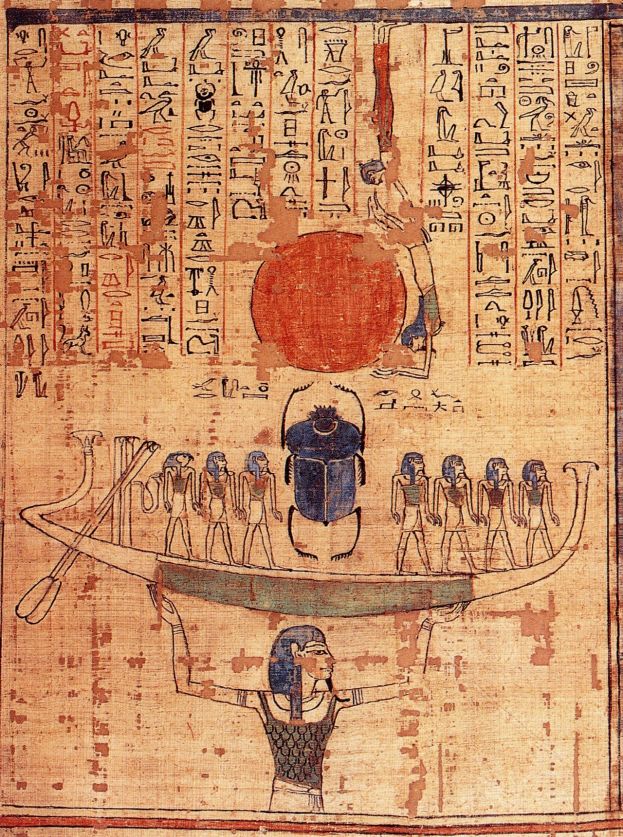
Khepera is depicted in beetle form, holding the sun disk between his two fore legs. To the primitive Egyptians the winged beetle was a sacred insect. Its association with the resurrected sun is explained by Wiedemann as follows: "The female (Ateuchus sacer) lays her eggs in a cake of dung, rolls this in the dust and makes it smooth and round so that it will keep moist and serve as food for her young; and finally she deposits it in a hole which she has scooped out in the ground; and covers it with earth. This habit had not escaped the observation of the Egyptians, although they failed to understand it, for scientific knowledge of natural history was very slight among all peoples of antiquity. The Egyptians supposed the Scarabs to be male, and that it was itself born anew from the egg which it alone had made, and thus lived an eternal life. . . ." 17

The Scarabs became a symbol of the resurrection and the rising sun. The dawn god raised up the solar disk as the beetle raised up the ball containing its eggs ere it set it a-rolling. Similarly souls were raised from death to life eternal.

Another myth represented the new-born sun as the child Horus rising from a lotus bloom which expanded its leaves on the breast of the primordial deep. Less poetic, but more popular, apparently, was the comedy about the chaos goose which was called "Great Cackler", because at the beginning she cackled loudly to the chaos gander and laid an egg, which was the sun. Ra was identified with the historical egg', but at Heliopolis the priests claimed that it was shaped by Ptah on his potter's wheel; Khn the other artisan god, was similarly credited with the work. The gander was identified with Seb, the earth god, and in the end Amon-Ra, the combined deity of Thebes, was represented as the great chaos goose and gander in one. The "beautiful goose" was also sacred to Isis.

Of foreign origin, probably, was the myth that the sun was a wild ass, which was ever chased by the Night serpent, Haiu, as it ran round the slopes of the mountains supporting the sky. These are probably the world-encircling mountains, which, according to the modern Egyptians, are peopled by giants (genii). Belief in mountain giants survive among the hillmen of Arabia, Syria, Asia Minor, and Europe. The most popular old Egyptian idea was that the earth was surrounded by the ocean; the same opinion obtained in Greece. The wild ass, as we have seen, was also Set, the Nilotic Satan.

A similar myth represents the sun as a great cat, which was originally a female, but was identified with Ra as a male. It fought with the Night serpent, Apep, below the sacred tree at Heliopolis, and killed it at dawn. In this myth Set is identified with the serpent.

The cat and the wild ass enjoyed considerable popularity at Heliopolis. In the Book of the Dead it is declared: "I have heard the word of power (the magic word) which the ass spake to the cat in the house of Hapt-ra", but the "password" which was used by the souls of the dead is not given.

Another belief regarding the sun had its origin apparently among the moon worshippers. It can be traced in one of the Nut pictures. Shu, the atmosphere god, stands beneath the curving body of the Great Mother and receives in one of his hands a white pool of milk, which is the sun. In the mummy picture, already referred to, the sun disk is drawn between the breasts of the sky goddess.

Nut is sometimes called the "mother of Ra", but in a creation myth she is his wife, and her secret lover is Seb, the earth god.

It was emphasized at Heliopolis that Ra, as the Great Father, called Nut, Seb, and Shu into being. Those deities which he did not create were either his children or their descendants.

The creation story in which the priests of Heliopolis fused the old myths will be found in Chapter I. It familiarizes the reader with Egyptian beliefs in their earliest and latest aspects.

The second chapter is devoted to the Osiris and Isis legends, which shows that these deities have both a tribal and seasonal significance. In the chapters which follow, special attention is devoted to the periods in which the religious myths were formulated and the greater gods came into prominence 18 , while light is thrown on the beliefs and customs of the ancient people of Egypt by popular renderings of representative folk tales and metrical versions of selected songs and poems.

Footnotes

1 The Babylonian form is "shamash".
2 The Burden of Isis, Dennis, p. 54.
3 Osiris-Sokar is also "the mysterious one, he who is unknown to mankind", and the "hidden god" (The Burden of Isis, Dennis, pp. 53, 54).
4 Herodotus says: "The Pelasgians did not distinguish the gods by name or surname. . . . They called them gods, which by its etymology means 'disposers'" (fates).
5 The Burden of Isis (Wisdom of the East), James Teackle Dennis.
6 See Teutonic Myth and Legend.
7 There is no trace in Egypt of a "grandmother" or of a "great grandmother" like "Edda" of Iceland. With "the mother", however, these may represent a triad of nature spirits. A basis of Mediterranean beliefs is traceable in Norse mythology.
8 The Accadians also believed that the moon had prior existence to the sun.
9 The Burden of Isis, Dennis.
10 The Egyptians would have said "true lapis lazuli". The face of the Libyan goddess Neith was green. Isis was "the green one whose greenness is like the greenness of earth" (Brugsch).
11 Arthur of "the round table" was originally a giant, and, like other giants, became associated with the fairies. "Arthur's Seat", Edinburgh, is reminiscent of his xxxviii giant form. If there was once a king named Arthur, who was a popular hero, his name may have been given to a giant god originally nameless. The Eildon Hills giant was called Wallace.
12 Religion of the Ancient Egyptians, A. Wiedemann. In old Arabia the sun deity was female, and there are traces of a sun goddess among the earlier Hittites (H. Winckler, Mitteilungen der Deutschen Orient-Gesellschaft; Berlin, 1907).
13 Ra, in one of the Isis temple chants, "hath produced calamity after the desire of thy (Osiris's) heart," and Osiris-Sokar is "the lord of fear who causeth himself to come into being". Sokar, who fused with Ra and Osiris, is one of the oldest Egyptian deities.
14 Oblong platform tombs which were constructed of limestone. The body was concealed in a secret chamber. See chapter VIII.
15 A History of Civilization in Palestine, R. A. S. Macalister.
16 'The Phrygian name of the father deity, also called "Bagaios" (Slav, bogu god). The roots "pa", "ap", "da", "ad", "ta", and "at" signify "father", while "ma", "am", "na", and "an" signify "mother".
17 The "soul and egg" myth is dealt with in Chapter V.
18 Aten worship is dealt with fully in its relation to primitive Egyptian myths in Chapter XXVI.

Egyptian Myth and Legend, Contents

EGYPTIAN MYTH AND LEGEND

With Historical Narrative, Notes on Race Problems, Comparative Beliefs, etc.
by

Donald Mackenzie

Gresham Publishing Co., London

[1907]

CONTENTS

CHAP.


INTRODUCTION

I.

CREATION LEGEND OF SUN WORSHIPPERS

II.

THE TRAGEDY OF OSIRIS

III.

DAWN OF CIVILIZATION

IV.

THE PEASANT WHO BECAME KING

V.

RACIAL MYTHS IN EGYPT AND EUROPE

VI.

THE CITY OF THE ELF GOD

VII.

DEATH AND THE JUDGMENT

VIII.

THE RELIGION OF THE STONE WORKERS

IX.

A DAY IN OLD MEMPHIS

X.

THE GREAT PYRAMID KINGS

XI.

FOLK TALES OF FIFTY CENTURIES

XII.

TRIUMPH OF THE SUN GOD

XIII.

FALL OF THE OLD KINGDOM

XIV.

FATHER GODS AND MOTHER GODDESSES

XV.

THE RISE OF AMON

XVI.

TALE OF THE FUGITIVE PRINCE

XVII.

EGYPT'S GOLDEN AGE

XVIII.

MYTHS AND LAYS OF THE MIDDLE KINGDOM

XIX.

THE ISLAND OF ENCHANTMENT

XX.

THE HYKSOS AND THEIR STRANGE GOD

XXI.

JOSEPH AND THE EXODUS

XXII.

AMON, THE GOD OF EMPIRE

XXIII.

TALK OF THE DOOMED PRINCE

XXIV.

CHANGES IN SOCIAL AND RELIGIOUS LIFE

XXV.

AMENHOTEP THE MAGNIFICENT AND QUEEN TIY

XXVI.

THE RELIGIOUS REVOLT OF THE POET KING

XXVII.

THE EMPIRE OF RAMESES AND THE HOMERIC AGE

XXVIII.

EGYPT AND THE HEBREW MONARCHY

XXIX.

THE RESTORATION AND THE END

PLATES IN COLOR

PLATE I

THE GIRL WIFE AND THE BATA BULL

From the painting by Maurice Greiffenghagen

PLATE II

THE FARMER PLUNDERS THE PEASANT

From the painting by Maurice Greiffenghagen

PLATE III

SENUHET SLAYS THE WARRIOR OF TONU

From the painting by Maurice Greiffenghagen

PLATE IV

QUEEN AHMES (WIFE OF THOTHMES I),
MOTHER OF THE FAMOUS QUEEN HATSHEPSUT

From a plaster cast of the relief on the wall of the Temple at Der-al Bahari (By courtesy of Mr. William Waldorf Astor)

PLATE V

LURING THE DOOM SERPENT

From the painting by Maurice Greiffenghagen

PLATE VI

FOWLING SCENE

(Fresco from tomb at Thebes, XVIII Dynasty, about B.C. 1580-1350; now in British Museum)

PLATE VII

FARM SCENE: THE COUNTING AND INSPECTION OF THE GEESE.

(Fresco from tomb at Thebes, XVIII Dynasty, about B.C. 1580-1350; now in British Museum)

PLATE VIII

PASTIME IN ANCIENT EGYPT THREE THOUSAND YEARS AGO

After the painting by Sir Lawrence Alma-Tadema, R.A., in Preston Art Gallery

PLATES IN MONOCHROME

placed within the chapters

LUNAR, SOLAR, AND EARTH GODS (THOTH, OSIRIS-AH, PTAH, RA, AND SET)

OSIRIS, ISIS, AND HORUS

SACRED ANIMALS

FIGURE OF THE APIS BULL, WITH A KING MAKING OFFERING

THE STEP PYRAMID OF SAKKARA

JUDGMENT SCENE: WEIGHING THE HEART

SERVITORS BRINGING THEIR OFFERINGS

"USHEBTIU" FIGURES OF VARIOUS PERIODS

A SEATED SCRIBE

AN OLD KINGDOM OFFICIAL ("SHEIKH-EL-BELED")

THE GREAT PYRAMID OF KHUFU (CHEOPS)

KING KHAFRA (IV DYNASTY)

NEFERT, A ROYAL PRINCESS OF THE OLD KINGDOM PERIOD

THREE TYPICAL "GREAT MOTHER" DEITIES (ISIS, BAST, AND SEKHET)

COURTYARD OF AN EGYPTIAN TEMPLE (RESTORED)

LOCAL GODS WITH ADDED SOLAR AND OTHER AT TRIBUTES (KHN SEBEK, MIN, BES, ANUBIS)

EGYPTIAN CHARIOT (FLORENCE MUSEUM)

EGYPTIAN KING (SETI I) MOUNTED ON CHARIOT

A PLATOON (TROOP) OF EGYPTIAN SPEARMEN

DEITIES OF THE EMPIRE PERIOD (AMON-RA, MUT, AND HAPI)

RUINS OF THE TEMPLE OF DER-EL-BAHARI, THEBES

AMENHOTEP III

AMENHOTEP IV (AKHENATON)

AKHENATON, HIS QUEEN, AND THEIR CHILDREN

MUMMY HEADS OF NOTABLE PHARAOHS (THOTHMES II, RAMESES II. RAMESES III, SETI I)

GREAT SEA AND LAND RAID: PHILISTINE PRISONERS

AMON PRESENTING TO SHESHONK LIST OF CITIES CAPTURED IN ISRAEL AND JUDAH

RESTORATION PERIOD DEITIES (PTAH -SOKAR -OSIRIS, IMHOTEP)

MUMMY CASES

Egyptian Myth and Legend Chapter 29, The Restoration and the End

EGYPTIAN MYTH AND LEGEND

With Historical Narrative, Notes on Race Problems, Comparative Beliefs, etc.
by

Donald Mackenzie

Gresham Publishing Co., London

[1907]

CHAPTER XXIX

The Restoration and the End

The God of the People--Egypt yearns for the Past--Rise of Saite Kings --Osiris as Great Father--Christianized Horus Legend--Scythians and Cimmerians--End of Assyrian Empire--Jeremiah and Pharaoh Necho--Surrender of Jerusalem--Early Explorers--Zedekiah and Pharaoh Hophra--Jerusalem sacked--Babylonian Captivity--Amasis and the Greeks--Coming of King Cyrus--Fall of Babylon--Persian Conquest of Egypt--Life in the Latter Days --Homely Letters--Cry of a Lost Soul.

THE civilization of ancient Egypt began with Osiris and ended with Osiris. Although the deified king had been thrust into the background for long centuries by the noble and great, he remained the god of the common people. "The dull crowd", as Plutarch called them, associated the ideas about their gods, "with changes of atmosphere according to the seasons, or with the generation of corn and sowings and ploughings, and in saying that Osiris is buried when the sown corn is hidden by the earth, and comes to life and shows himself again when it begins to sprout. . . . They love to hear these things, and believe them, drawing conviction from things immediately at hand and customary." The peasant lived and died believing in Osiris. "As Osiris lives, so shall he also live; as Osiris died not, so shall he also not die; as Osiris perished not, so shall he also not perish." 1 Egypt was made prosperous by Osiris: he gave it the corn which brought all its wealth and power. The greatest Pharaohs were those who, reverencing Osiris, cut new irrigating canals, and boasted like Amenemhet I:

I loved the corn god . . . I have grown the grain
In every golden valley where the Nile
Entreated me. . . .

Egypt's Bata-like peasants constituted the strongest army commanded by the Pharaohs; they won golden spoils from Nature, which were of more account than the spoils from Syrian battlefields and the tribute of subject kings. Those constant toilers, who were innately conservative in their methods and customs and beliefs, bulk largely in the background of ancient Egyptian history; they were little affected by the changes which passed over the country century after century; once a political storm died down, they settled back into their own habits of life; they were "the nails that held the world (of Egypt) together".

We have seen the Pharaohs and their nobles going after strange gods, marrying alien wives, and adopting new manners and customs, forgetting those traditions which are the inspiration of national life and the essence of true patriotism. When Egypt fell and was ground under the heel of the Assyrian it was from the steadfast, although unlettered, peasants that the strength of the restoration was derived; they remembered the days that were, and they remembered Osiris. "Those Egyptians who live in the cultivated parts of the country", wrote Herodotus, "are of all I have seen the most ingenious, being attentive to the improvement of memory beyond the rest of mankind."

The Assyrian conquest stirred Egypt to its depths. When Thebes was sacked, and Amon-ra cast down from his high place, the worshippers of Osiris were reviving the beliefs and customs of the Old Kingdom, for they had never gone wholeheartedly after Ra and Amon or Sutekh and Astarte. When Ashur-banipal shattered the power of the Asiatic nobles of Egypt and drove out the Ethiopians, he also rescued the Egyptian people from their oppressors and strengthened the restoration movement which had begun under the Ethiopian kings.

Ashur-banipal was unable to retain for long his hold upon the land of the Pharaohs. Persistent revolts occupied his attention at the very heart of his empire. His brother, the subject king of Babylon, had secured the co-operation of the Elamites, the Aramns, the Chaldeans, and the Arabians, and a fierce struggle ensued, until in the end Babylon was besieged and captured and Elam was devastated. Meanwhile Cimmerians were invading Asia Minor and the Aryan Medes were pressing into Elam. When peace was at length restored Assyria, although triumphant, was weakened as a result of its terrible struggles, and the empire began to go to pieces.

Assyria's misfortunes gave Psamtek his opportunity. About two years after his rival, Tanut-amon, was driven out of Thebes, he had come to an understanding with King Gyges of Lydia, who, having driven off the first attack of Cimmerians, was able to send him Ionian and Carian mercenaries. Psamtek then ceased to pay tribute to Ashur-banipal, and was proclaimed Pharaoh of United Egypt. As he had married a daughter of Taharka, the Ethiopian, his succession to the throne was legalized according to the "unwritten law" of Egypt. The Assyrian officials and soldiers were driven across the Delta frontier.

Herodotus relates an interesting folktale regarding the rise of Psamtek. He was informed that the Egyptians chose twelve kings to reign over them, and these "connected themselves with intermarriages, and engaged to promote the common interest", chiefly because an oracle had declared that the one among them who offered a libation to Ptah in a brazen vessel should become the Pharaoh. One day in the labyrinth eleven of the kings made offerings in golden cups, but the priest had brought out no cup for Psamtek, who used his brazen helmet. The future Pharaoh was promptly exiled to a limited area in the Delta. He visited the oracle of the serpent goddess at Buto, and was informed that his cause would prosper when the sea produced brazen figures of men. Soon afterwards he heard that a body of Ionians and Carians, clad in brazen armour, had come oversea and were plundering on the Egyptian coast. He immediately entered into an alliance with them, promising rich rewards, vanquished his rivals in battle, and thus became sole sovereign of Egypt.

Sais was then the capital, and its presiding deity, the goddess Neith, assumed great importance; but by the mass of the people she was regarded as a form of Isis. The great city of Memphis, however, was the real centre of the social and religious life of the new Egypt which was the old. Thebes had ceased to have any political significance. No attempt was made to restore its dilapidated temples, from which many of the gods had been deported to Assyria, where they remained until the Persian age. Amon had fallen from his high estate, and his cult was presided over by a high priestess, a sister of Psamtek's queen, the "wife" of the god. With this lady was afterwards associated one of Psamtek's daughters, so that the remnant of the Amon endowments might come under the control of the royal house. Ra of Heliopolis shrank to the position of a local deity. The conservative Egyptians, as a whole, had never been converted to sun worship.

Osiris was restored as the national god in his Old Kingdom association with Ptah, the Great Father, the world deity, who had his origin upon the earth; his right eye was the sun and his left eye was the moon. But although the sun was "the eye of Osiris", the ancient deity was no more a sun god than Ra was an earth god. As Osiris-ra he absorbed certain attributes of the solar deity, but as Ra had similarly absorbed almost every other god, the process was not one of change so much as adjustment. 2 Ra ceased to be recognized as the Great Father of the Egyptian Pantheon. "Behold, thou (Osiris) art upon the seat of Ra." Osiris was essentially a god of vegetation and the material world; he was the soul of Ra, but his own soul was the soul of Seb, the earth god, which was hidden now in a tree, now in all animal, now in an egg: the wind was the breath and spirit of Osiris., and his eyes gave light. He was not born from the sun egg like Ra. Seb, the earth giant, in his bird form was before the egg, and Osiris absorbed Seb. Osiris became "the Great Egg", which was "the only egg", for the Ra "egg" had been appropriated from the earth worshippers. He was both Seb and the "egg"--"thou egg who becometh as one renewed". The father of Ra was Nu (water); the father of Osiris was Tanen (earth). 3

But although he fused with Ptah-Tanen and became the Great Father, Osiris was not divested of his ancient lunar attributes. He was worshipped as the Apis bull; his soul was in the bull, and it had come from the moon as a ray of light. Here then we have a fusion of myths of divergent origin. Osiris was still the old lunar god, son of the Great Mother, but he had become "husband of his mother" or mothers, and also his own father, because he was the moon which gave origin to the sacred bull. He was also the world giant whose soul was hidden. The Egyptian theologians of the restoration clung to all the old myths of their mingled tribal ancestors and attached them to Osiris.

So Osiris absorbed and outlived all the gods. In early Christian times the Serapeum, the earthly dwelling place of Serapis (Osiris-Apis), was the haunt of society Hadrian, writing to the consul Servian, said that the Alexandrians "have one god, Serapis, who is worshipped by Christians, Jews, and Gentiles". The half-Christianized Egyptians identified Christ with Horus, son of Osiris, and spoke of the Saviour as the young avenger in the "Legend of the Winged Disk", who swept down the Nile valley driving the devil (Set) out of Egypt. As early Gaelic converts said: "Christ is my Druid", those of the land of the Pharaohs appear to have declared similarly: "Christ is my Horus".

Horus and his mother, Isis, came into prominence with Osiris. Set, as Sutekh, was banished from Egypt, and was once again regarded as the devil. The cult of Isis ultimately spread into Europe. 4

But not only were the beliefs of the Old Kingdom revived; even its language was imitated in the literature and inscriptions of the Saite period, and officials were given the titles of their predecessors who served Zoser and Khufu. Art revived, drawing its inspiration from the remote past, and once again the tomb scenes assumed a rural character and all the mannerisms of those depicted in Old Kingdom times. Egypt yearned for the glories of other days, and became an imitator of itself. Everything that was old became sacred; antiquarian knowledge was regarded as the essence of wisdom. Hieroglyphic writing was gradually displaced by Demotic, and when the Greeks found that the learned priests alone were able to decipher the ancient inscriptions, they concluded that picture writing was a sacred art; hence the name "hieroglyphics", derived from hieros, sacred, and glypho, I engrave.

The excess of zeal displayed by the revivalists is illustrated in their deification of Imhotep, the learned architect of King Zoser of the Third Dynasty (see Chapter VIII). His memory had long been revered by the scribes; now he was exalted to a position not inferior to that held by Thoth in the time of Empire. As the son of Ptah, he was depicted as a young man wearing a tight-fitting cap, sitting with an open scroll upon his knees. He was reputed to cure diseases by the power of spells, and was a patron of learning, and he was a guide or priest of the dead, whom he cared for until they reached the Osirian Paradise. In Greek times he was called Imhes, and identified with Asklepios.

Animal worship was also carried to excess. Instead of regarding as sacred the representative of a particular species, the whole species was adored. Cats and rams, cows and birds, and fishes and reptiles were worshipped wholesale and mummified. The old animal deities were given new forms; Khn for instance, was depicted as a ram-headed hawk, Bast as a cat-headed hawk, and Anubis as a sparrow with the head of a jackal.

Psamtek reigned for over fifty-four years, and Egypt prospered. At Memphis he extended the temple of Ptah and built the Serapeum, in which the sacred bull was worshipped. He waged a long war in Philistia and captured Ashdod, and had to beat back from his frontier hordes of Scythians and Cimmerians, peoples of Aryan speech, who had overrun Asia Minor and were pressing down through Syria like the ancient Hittites; during their reign of terror King Gyges of Lydia was defeated and slain.

The Greeks were encouraged to settle in Egypt, and their folklays became current in the Delta region. Herodotus related a version of the tale of Troy which was told to him by the priests. It was to the effect that Paris fled to Egypt when Menelaus began military operations to recover Helen, and that he was refused the hospitality of the Pharaoh. In the Odyssey Menelaus says to Telemachus:

Long on the Egyptian coast by calms confined,
Heaven to my fleet refused a prosperous wind,
No vows had we preferred, nor victim slain,
For this the gods each favouring gale restrain.

Od., iv, 473.

When Psamtek's son, Necho, came to the throne the Assyrian empire was going to pieces. Nahum was warning Nineveh:

Behold, I am against thee, saith the Lord of hosts. . . . I will shew the nations thy nakedness and the kingdoms thy shame. . . . The gates of thy land shall be set wide open unto thine enemies; the fire shall devour thy bars. . . . Thy shepherds slumber, O King of Assyria: thy nobles shall dwell in the dust: thy people is scattered upon the mountains, and no man gathereth them. There is no healing of thy bruise; thy wound is grievous: all that hear the bruit of thee shall clap the hands over thee (Nahum, iii).

After Ashur-banipal had devastated Elam it was occupied by the Aryan Medes. About 607 B.C. Cyaxares, the Median king, who had allied himself with the revolting Babylonians, besieged Nineveh, which was captured and ruthlessly plundered. The last Assyrian king, Sin-shar-ishkun, the second son of Ashur-banipal, is identified with the Sardanapalus of legend who set fire to his palace and perished in its flames so that he might not fall into the hands of his enemies. Tradition attached to his memory the achievements of his father.

Pharaoh Necho took advantage of Assyria's downfall by seizing Palestine. King Josiah of Judah went against him at Megiddo and was defeated and slain. "And his servants carried him in a chariot dead from Megiddo and brought him to Jerusalem" (2 Kings, xxiii, 30). Jehoahaz was selected as Josiah's successor, but Necho deposed him and made him a prisoner, and, having fixed Judah's tribute at "an hundred talents of silver and a talent of gold", he "Made Eliakim, the son of Josiah, king . . . and turned his name to Jehoiakim" (2 Kings, xxiii, 34). But although Necho had been strong enough to capture Kadesh, his triumph was shortlived. Less than four years later Nebuchadrezzar, King of Babylon, who claimed Syria, routed Necho's army at Carchemish, and the Egyptians were forced to hasten back to their own land. "This is the day of the Lord of hosts, a day of vengeance", cried Jeremiah. . . . "Come up ye horses; and rage ye chariots; and let the mighty men come forth: the Ethiopians and the Libyans, that handle the shield; and the Lydians (mercenaries) that handle and bend the bow. . . . The sword shall devour. . . . Let not the swift flee away, nor the mighty man escape. . . . The nations have heard of thy shame", cried the Hebrew prophet to the escaping Egyptians (Jeremiah, xlvi). "And the King of Egypt came not again any more out of his land: for the King of Babylon had taken from the river of Egypt unto the River Euphrates all that pertained to the King of Egypt (2 Kings, xxiv, 7).

Necho had come to an understanding with Nebuchadrezzar, and interfered no more in Palestine. A few years later Jehoiakim rebelled against the King of Babylon, expecting that Necho would support him, despite the warnings of Jeremiah, and Jerusalem was besieged and forced to surrender. Jehoiakim had died in the interval, and his son, Jehoiachin, and a large number of "the mighty of the land" were deported to Babylon (2 Kings, xxiv). Mattaniah, son of Josiah, was selected to rule over Jerusalem, his name being changed to Zedekiah.

Necho, according to Herodotus, had undertaken the construction of a canal between the Mediterranean and the Red Sea, hut desisted after a time on account of a warning received from an oracle. He then devoted himself to building a large fleet. His father was reputed to have endeavoured to discover the source of the Nile, and it was probably with desire to have the problem solved that Necho sent an expedition of Phnicians to circumnavigate Africa. When the vessels, which started from the Red Sea, returned three years later by the Straits of Morocco, the belief was confirmed that the world was surrounded by the "Great Circle"--the ocean.

Apries, the second king after Necho, is the Pharaoh Hophra of the Bible. He had dreams of conquest in Syria, and formed an alliance which included unfortunate Judah, so that "Zedekiah rebelled against the King of Babylon" (Jeremiah, lii, 3). Nebuchadrezzar took swift and terrible vengeance against Josiah's unstable son. Jerusalem was captured after a two years' siege and laid in ruins (about 586 B.C.). Zedekiah fled, but was captured, "And the King of Babylon slew the sons of Zedekiah before his eyes. . . . Then he put out the eyes of Zedekiah; and the King of Babylon bound him in chains and carried him to Babylon, and put him in prison till the day of his death" (Jeremiah, lii, 10, 11). The majority of the Jews were deported; a number fled with Jeremiah to Egypt. So ended the kingdom of Judah.

Oh! weep for those that wept by Babel's stream,
Whose shrines are desolate, whose land a dream.
Tribes of the wandering foot and weary breast,
How shall ye flee away and be at rest!

Byron.

Jeremiah proclaimed the doom of Judah's tempter, crying: "Thus saith the Lord; Behold I will give Pharaoh-hophra, King of Egypt, into the hand of his enemies, and into the hand of them that seek his life; as I gave Zedekiah, King of Judah, into the hand of Nebuchadrezzar, King of Babylon, his enemy, and that sought his life" (Jeremiah, xliv, 30).

Apries fell about 568 B.C. According to Herodotus, the Egyptians revolted against him, apparently because of his partiality to the Greeks; his army of Ionian and Carian mercenaries was defeated by a native force under Amasis (Ahmes II), whose mother was a daughter of Psamtek II. A mutilated inscription at Babylon is believed to indicate that Nebuchadnezzar invaded Egypt about this time, but it is not confirmed by any surviving Nilotic record. Apries was kept a prisoner by the new king, but the Egyptians demanded his death, and he was strangled.

Amasis reigned for over forty years. He was well known to the Greeks. Herodotus says that he regulated his time in this manner: from dawn until the city square was crowded he gave audience to whoever required it; the rest of the day he spent making merry with friends of not very high morals. Some of his nobles remonstrated with him because of his "excessive and unbecoming levities", and said he should conduct himself so as to increase the dignity of his name and the veneration of his subjects. Amasis answered: "Those who have a bow bend it only when they require to; it is relaxed when not in use. And if it were not, it would break and be of no service in time of need. It is just the same with a man; if he continually engaged in serious pursuits, and allowed no time for diversion, he would suffer gradual loss of mental and physical vigour."

Amasis "was very partial to the Greeks, and favoured them at every opportunity", Herodotus says. He encouraged them to settle at Naucratis, 5 where the temple called Hellenium was erected and Greek deities were worshipped. Amasis erected a magnificent portico to Neith at Sais, had placed in front of Ptah's temple at Memphis a colossal recumbent figure 75 feet long, and two erect figures 20 feet high, and caused to be built in the same city a magnificent new temple to Isis. To the Gro-Libyan city of Cyrene, with which he cultivated friendly relations, he gifted "a golden statue of Minerva". He married a princess of the Cyrenians. Herodotus relates that during the wedding celebrations Amasis "found himself afflicted with an imbecility which he experienced under no other circumstances"; probably he had been drinking heavily, as he was too prone to do. His cure was attributed to Venus, who was honoured with a statue for reward.

Amasis was not over popular with the Egyptians. Not only did he favour the Greeks, but promulgated a law to compel every citizen to make known once a year the source of his earnings.

eml29 eml29

Painted and Gilded Figure of Ptah-Seker-Asar (Ptah-Sokar-Osiris) on a stand with a cavity containing a small portion of a body

the architect of the first Pyramid, who became a god in the Restoration Period and "son of Ptah or Ptah Osiris"

Imhotep (Imuthes)
(British Museum)

RESTORATION PERIOD DEITIES

eml29 eml29

1. Fine example of Restoration Period Coffin for priest of Amon and Bast.

2. Characteristic Gro-Roman Coffin with painted portrait.

MUMMY CASES

It is not surprising to find that he had to send Greek soldiers to Memphis to overawe the offended natives, who began to whisper treasonable sayings one to another.

His foreign policy was characterized by instability. Although he cultivated friendly relations for the purpose of mutual protection, he gave no assistance in opposing the Persian advance westward.

About the middle of the reign of Amasis a new power arose in the East which was destined to shatter the crumbling edifices of old-world civilization and usher in a new age. "Cyrus, the Achenian, King of Kings", who was really a Persian, overthrew King Astyages (B.C. 550) of the Medes and founded the great Aryan Medo-Persian empire and pressed westward to Asia Minor. Amasis formed alliances with the kings of Babylon, Sparta, and Lydia, and occupied Cyprus, which he evacuated when the Persians overthrew the Lydian power. Egypt had become "a shadow" indeed. Cyrus next turned his attention to Babylonia, besieging and capturing city after city. The regent, Belshazzar, ruled as king in Babylon, which, in 539 B.C., was completely invested. On the last night of his life, deeming himself secure, "Belshazzar the king made a great feast to a thousand of his lords, and drank wine before the thousand" (Daniel, v, i).

In that same hour and hall,
The fingers of a hand
Came forth against the wall,
And wrote as if on sand:
The fingers of a man;--
A solitary hand
Along the letters ran,
And traced them like a wand.
. . . . . .

"Belshazzar's grave is made,
His kingdom passed away,
He, in the balance weighed,
Is light and worthless clay;
The shroud his robe of state,
His canopy the stone;
The Mede is at his gate!
The Persian on his throne!"

Byron.

So Babylon fell. Cyrus, who was proclaimed its king, allowed the Jews to return home, and the first lot saw the hills of Judah in 538 B.C., nearly half a century after Zedekiah was put to shame.

Cambyses, a man of ungovernable temper and subject to epileptic fits, succeeded Cyrus in 530 B.C. Nine months after the death of Amasis, the ineffectual intriguer (525 B.C.), he moved westward with a strong army and conquered Egypt. Psamtek III, after the defeat of his army of mercenaries at Pelusium, on the east of the Delta, retreated to Memphis. Soon afterwards a Persian herald sailed up the Nile to offer terms, but the Egyptians slew him and his attendants and destroyed the boat. Cambyses took speedy revenge. He invested Memphis, which ere long surrendered. According to Herodotus, he committed gross barbarities. Pharaoh's daughter and the daughters of noblemen were compelled to fetch water like slaves, nude and disgraced before the people, and Pharaoh's son and two thousand Egyptian youths, with ropes round their necks, were marched in procession to be cut to pieces as the herald of Cambyses had been, and even Pharaoh was executed. On his return from Nubia, where he conducted a fruitless campaign, Cambyses is said to have slain a newly found Apis bull, perhaps because Amasis had "loved Apis more than any other king". At Sais the vengeful Persian, according to Egyptian tradition, had the mummy of Amasis torn to pieces and burned.

With the conquest by Persia the history of ancient Egypt may be brought to an end. Before the coming of Alexander the Great, in B.C. 332, the shortlived and weak Dynasties Twenty-eight to Thirty flickered like the last flames of smouldering embers. Then followed the Ptolemaic age, which continued until 30 B.C., when, with the death of the famous Cleopatra, Egypt became "the granary of Rome".

Under the Ptolemies there was another restoration. It was modelled on the civilization of the latter half of the Eighteenth Dynasty, and Amenhotep, son of Hapi, the architect and magician who had been honoured by Queen Tiy's royal husband, was elevated to the rank of a god. A large proportion of the foreign population embraced Egyptian religion, and the dead were given gorgeous mummy cases with finely carved or painted portraits.

Vivid glimpses of life in Egypt from the second to the fourth century A.D.,--are afforded by the papyri discovered at Oxyrhynchus, chiefly by Messrs. Grenfell and Hunt. Wealthy and populous Alexandria had its brilliant and luxury-loving social groups. Invitations to dinner were sent out in much the same form as at the present day. The following is dated second century A.D.:

Cbemon requests your company at dinner at the table of the lord of Serapis in the Serapeum to-morrow, the 15th, at 9 o'clock.

The worship of Apis was fashionable. A lady wrote to a friend about the beginning of the fourth century:

Greeting, my dear Serenia, from Petosiris. Be sure, dear, to come up on the 20th for the birthday festival of the god, and let me know whether you are coming by boat or by donkey in order that we may send for you accordingly. Take care not to forget. I pray for your continued health.

There were spoiled and petted boys even in the third century. One wrote to his indulgent father:

Theon to father Theon, greeting. It was a fine thing of you not to take me with you to the city. If you won't take me with you to Alexandria I won't write you a letter, or speak to you, or say goodbye to you, and if you go to Alexandria I won't take your hand or ever greet you again. This is what will happen if you won't take me. Mother said to Archelaus: "It quite upsets me to be left behind". It was good of you to send me presents. . . . Send me a lyre I implore you. If you don't, I won't eat, I won't drink--there now!

Alexandria was always a hotbed of sedition. A youthful citizen in good circumstances wrote to his brother:

I learned from some fishermen that Secundus's house has been searched and my house has been searched. I shall therefore be obliged if you will write me an answer on this matter so that I may myself present a petition to the Prefect. . . . Let me hear about our bald friend, how his hair is growing again on the top; be sure and do.

Marriage engagements were dissolved when prospective sons-in-law were found to be concerned in lawless actions; prisoners were bailed out; improvident people begged for loans from friends to take valuables and clothing out of pawn; country folk complained that merchants sent large cheeses when they ordered small ones. Young men were expected to write home regularly. The following is a father's letter:--

I have been much surprised, my son, at not receiving hitherto a letter from you to tell me how you are. Nevertheless, sir, answer me with all speed, for I am quite distressed at having heard nothing from you.

So the social life of an interesting age is made articulate for us, and we find that human nature has not changed much through the centuries. 6

In the Ptolemaic age a papyrus was made eloquent with the lamentation of a girl wife in her tomb. At fourteen she was married to the high priest of Ptah, and after giving birth to three daughters in succession she prayed for a son, and a son was born. Four brief years went past and then she died. Her husband heard her crying from the tomb, entreating him to eat and drink and be merry, because the land of the dead was a land of slumber and blackness and great weariness . . . . . "The dead are without power to move . . . sire and mother they know not, nor do they long for their children, husbands, or wives. . . . Ah, woe is me! would I could drink of stream water, would I could feel the cool north wind on the river bank, so that my mind might have sweetness and its sorrow an end."

It is as if the soul of ancient Egypt, disillusioned in the grave, were crying to us in the darkness "down the corridors of time".

Footnotes

1 Erman, Handbuch.
2 The various gods became manifestations of Osiris. In the Osirian hymns, which were added to from time to time, Osiris is addressed: "Thou art Tum, the forerunner of Ra . . . the soul of Ra . . . the pupil of the eye that beholdest Tum . . . lord of fear, who causeth himself to come into being" (The Burden of Isis, Dennis).
3 The Burden of Isis; the egg, pp. 39, 45, 55; the sun, pp. 23, 24, 41, 49, 53; Tatenen (Tanen), p. 49; Seb, pp. 32, 47.
4 An image of Isis was found on the site of a Roman camp in Yorkshire.
5 "Mighty in ships."
6 The translations are from Oxyrhynchus Papyri (Egyptian Fund) Parts 2 and 3.

Egyptian Myth and Legend Chapter 28, Egypt and the Hebrew Monarchy

EGYPTIAN MYTH AND LEGEND

With Historical Narrative, Notes on Race Problems, Comparative Beliefs, etc.
by

Donald Mackenzie

Gresham Publishing Co., London

[1907]

CHAPTER XXVIII

Egypt and the Hebrew Monarchy

Isaiah foretells Egypt's Fall--The Priest Kings--Rise of the Libyans--Philistines and Hebrews--A "Corner" in Iron--Saul and David--Solomon's Alliance with Pharaoh Sheshonk (Shisak)--Jeroboam's Revolt--Israel Worships the "Lady of Heaven"--The Ethiopian Kings--Assyria's Great Empire--The "Ten Lost Tribes"--Pharaoh Taharka and Hezekiah--Assyrian Army destroyed--Isaiah a Great Statesman--Assyrian Conquest of Egypt--Sack of Thebes.

"THE burden of Egypt. Behold, the Lord rideth upon a swift cloud, and shall come into Egypt: and the idols of Egypt shall be moved at his presence, and the heart of Egypt shall melt in the midst of it. And I will set the Egyptians against the Egyptians: and they shall fight every one against his brother, and every one against his neighbour; city against city, and kingdom against kingdom. And the spirit of Egypt shall fail in the midst thereof. . . . The brooks of defence shall be emptied and dried up; the reeds and flags shall wither. The paper reeds 1 by the brooks, by the mouth of the brooks, and everything sown by the brooks, shall wither, be driven away, and be no more. The fishers also shall mourn, and all they that cast angle into the brooks shall lament, and they that spread nets upon the waters shall languish. Moreover, they that work in fine flax, and they, that weave networks, shall be confounded. And they shall be broken in the purposes thereof, all that make sluices and ponds for fish" (Isaiah, xix).

From the death of Rameses III to the period of Isaiah, the great Hebrew prophet and politician, we must pass in review about five centuries of turbulence and change. The last great Pharaoh of the Nineteenth Dynasty was followed by nine weak rulers bearing the name of Rameses. Little is known, or is worth knowing, regarding them. They were but puppets in the hands of the powerful priests of Amon-ra, who had become the commanders of the army, the chief treasurers, grand viziers, and high judges of Egypt. The Oracle of Amon-ra confirmed all their doings. In the end the great Theban god became the rival of Osiris as Judge of the Dead, and the high priest, Herihor, thrust aside Rameses XII and seized the crown. Another priest king reigned at Tanis (Zoan) in the Delta.

Egypt was thrown into confusion under ecclesiastical rule, and land fell rapidly in value. Robbery on the highways and especially in tombs became a recognized profession, and corrupt officials shared in the spoils; the mummies of great Pharaohs, including Sed I and Rameses II, had to be taken by pious worshippers from the sepulchral chambers and concealed from the plunderers. No buildings were erected, and many great temples, including the Ramesseum, fell into disrepair.

After the passing of an obscure and inglorious century we find that the mingled tribes of Libyans and their western neighbours and conquerors, the Meshwesh, had poured into the Delta in increasing numbers, and penetrated as far south as Heracleopolis. Egypt was powerless in Palestine. The Philistines had moved southward, and for a period were overlords of the Hebrews. They had introduced iron) and restricted its use among their neighbours, as is made evident in the Bible.

Now there was no smith found throughout all the land of Israel: for the Philistines said, Lest the Hebrews make them swords or spears; but all the Israelites went down to the Philistines, to sharpen every man his share, and his coulter, and his axe, and his mattock. Yet they had a file for the mattocks, and for the coulters, and for the forks, and for the axes, And to sharpen the goads. So it came to pass in the day of battle, that there was neither sword nor spear found in the hand of any of the people that were with Saul and Jonathan; but with Saul and with Jonathan his son was there found (1 Samuel, xiii, 19-22).

Thus the Hebrews at the very beginning of their history as a nation had experience of a commercial "corner", which developed their business instincts, no doubt. Their teachers were Europeans who represented one of the world's oldest civilizations. 2 The oppression which they endured welded together the various tribes, and under Saul the Hebrews made common cause against the Philistines. When handsome, red-cheeked David, 3 who had probably a foreign strain in his blood, had consolidated Judah and Israel, the dominance of the Cretan settlers came to an end; they were restricted to the sea coast, and they ceased to have a monopoly of iron. Solomon, the chosen of the priests, was supported by a strong army, which included mercenaries, and became a great and powerful monarch, who emulated the splendour of the Pharaohs of the Eighteenth Dynasty. His supremacy in southern Syria was secured by an alliance with Egypt.

And Solomon made affinity with Pharaoh king of Egypt, and took Pharaoh's daughter, and brought her into the city of David, until he had made an end of building his own house, and the house of the Lord, and the wall of Jerusalem round about (1 Kings, iii, 1).

The Pharaoh with whom Solomon had come to an understanding was Sheshonk (Shishak), a vigorous ruler and successful military leader, who established peace in his kingdom. He secured his Delta frontier from attack by laying a firm hand on the territory between Egypt and the "buffer state" of the Hebrews. In time we read that he had "taken Gezer" (an independent city state) "and burnt it with fire, and slain the Canaanites that dwelt in the city, and given it for a present unto his daughter, Solomon's wife" (1 Kings, ix, 16).

Sheshonk was the first king of the Libyan (Twenty-Second) Dynasty, which lasted for about two centuries. He was the descendant of a Meshwesh-Libyan mercenary who had become high priest of Her-shef at Heracleopolis and the commander of the local troops. Under this foreign nobleman and his descendants the nome flourished and became so powerful that Sheshonk was able to control the Delta region, where he allied himself with other Libyan military lords. In the end he married the daughter of the last weak priest king of Tanis, and was proclaimed Pharaoh of Egypt. He made Bubastis his capital, and the local goddess, the cat-headed Bast, became the official deity of the kingdom. Amon was still recognized, but at the expense of other Delta deities who shared in the ascendancy of "the kindly Bast". Sheshonk held nominal sway over Thebes, and appointed his son high priest of Anion-ra, and he was able to extract tribute from Nubia.

Sheshonk's chief need was money, for he had to maintain a strong standing army of mercenaries. He must have cast envious eyes on the wealth which had accumulated in Solomon's kingdom, and, as it proved, was not slow to interfere in its internal affairs when opportunity offered. He extended his hospitality to Jeroboam, the leader of the Israelites who desired to be relieved of the heavy taxes imposed by Solomon. "Solomon sought therefore to kill Jeroboam" (1 Kings, xi, 40). When Rehoboam came to the throne, Jeroboam pleaded on behalf of the oppressed ten tribes of the north, but the new king was advised to say: "My little finger shall be thicker than my father's loins". A revolt ensued, and Jeroboam became king of the north, supported, evidently, by Shishak. The golden calf was then worshipped by Jeroboam's subjects; it was probably the symbol of the Hathor-like "Lady of Heaven", whose worship was revived even in Jerusalem, when Jeremiah said: "The children gather wood, and the fathers kindle the fire, and the women knead their dough, to make cakes to the queen of heaven, and to pour out drink offerings unto other gods" (Jeremiah, vii, 18). The religious organization, based upon the worship of the God of Israel, which had been promoted by David, was thus broken up; "there was war between Rehoboam and Jeroboam all their days" (1 Kings, xiv, 30).

The opportunity afforded for invasion was quickly seized by Sheshonk. According to his own annals, he swept through Palestine, securing great spoils; indeed he claims that his mercenaries penetrated as far north as the River Orontes. It is stated in the Bible that he plundered Jerusalem, and "took away the treasures of the house of the Lord, and the treasures of the king's house; he even took away all; and he took away all the shields of gold which Solomon had made" (1 Kings, xiv, 25-6).

About a century after the death of Sheshonk the power of the royal house is found to have declined; the various hereditary Libyan lords showed but nominal allegiance to the Crown. A rival kingdom had also arisen in the south. When the priest kings were driven from Thebes they founded a theocracy in the Nubian colony, which became known as Ethiopia, and there the Oracle of Amon controlled the affairs of State.

eml28

GREAT SEA AND LAND RAID: PHILISTINE PRISONERS

From the bas-relief on the gate of the temple of Rameses III at Medinet Habu

eml28

AMON PRESENTING TO SHESHONK LIST OF CITIES CAPTURED IN ISRAEL AND JUDAH

From the bas-relief on the great Temple at Karnak

In time the Ethiopian kingdom became strong enough to control a large part of Upper Egypt, and Thebes was occupied. Then Plankhy, the most capable of all the Ethiopian rulers, extended his conquests until he forced the princes of the north to acknowledge his supremacy.

Piankhy's most serious rival was Tefnekht, prince of Sais, who assembled an army of allies and fought his way southward as far as Thebes. He was driven back by Plankhy, who ultimately swept in triumph to Sais and compelled the submission of Tefnekht and his allies. He did not, however, effect the permanent occupation of Lower Egypt.

Shabaka, the first Pharaoh of the Ethiopian (Twenty-Fifth) Dynasty, ruled over all Egypt, having secured by force of arms the allegiance of the princes, or petty kings, of the north. He is believed to be the Biblical "So, King of Egypt" (2 Kings, xvii, 4). Syria and Palestine had become dependencies of the great Empire of Assyria, which included Babylonia and Mesopotamia and extended into Asia Minor. Shabaka had either dreams of acquiring territory in southern Syria, or desired to have buffer states to protect Egypt against Assyrian invasion, for he entered into an alliance with some of the petty kings. These included King Hoshea of Israel, who, trusting to Egypt's support, "brought no present (tribute) to the King of Assyria as he had done year by year" (2 Kings, xvii, 4). Sargon II of Assyria anticipated the rising, and speedily stamped it out. He had Ilu-bi'-di of Hamath flayed alive; he defeated a weak Egyptian force; and took Hanno, Prince of Gaza, and King Hoshea prisoners. Then he distributed, as he has re-recorded, 27,290 Israelites--"the ten lost tribes"-- between Mesopotamia and the Median highlands. 4 Large numbers of troublesome peoples were drafted from Babylonia into Samaria, where they mingled with the remnants of the tribes which remained. Thus came to an end the kingdom of the northern Hebrews; that of Judah--the kingdom of the Jews--remained in existence for another century and a half.

Taharka, the third and last Ethiopian Pharaoh, whose mother was a negress, is referred to in the Bible as Tirhakah (Isaiah, xxxvii, 9). Like Shabaka, he took an active part in Asian politics, and allied himself with, among others, Lull, King of Tyre, and Hezekiah, King of Judah. Sargon "the later", as he called himself, had been assassinated, and his son, Sennacherib, had to deal with several revolts during the early years of his reign. Ionians had invaded Cilicia, and had to be subdued; many of the prisoners were afterwards sent to Nineveh. Trouble was constantly brewing in Babylonia, where the supremacy of Assyria was being threatened by a confederacy of Chaldeans, Elamites, and Aramns; a pretender even arose in Babylon, and Sennacherib's brother, the governor, was murdered, and the city had to be besieged and captured. This "pretender", Merodach-Baladan, 5 had been concerned in the Egypto-Syrian alliance, and Sennacherib found it necessary to push westward, as soon as he had overrun Chaldea, to deal with the great revolt. He conquered Phnicia, with the exception of Tyre, but King Luli had taken refuge in Cyprus. Hastening southward he scattered an army of allies, which included Pharaoh Taharka's troops, and, having captured a number of cities in Judah, he laid siege to Jerusalem. Hezekiah held out, but, according to the Assyrian account, made terms of peace with the emperor, and afterwards sent great gifts to Nineveh. A later expedition appears to have been regarded as necessary, however, and, according to the Biblical account, it ended disastrously, for Sennacherib's army was destroyed by a pestilence. Isaiah, who was in Jerusalem at the time, said: "Thus saith the Lord . . . Behold I will send a blast upon him, and he shall hear a rumour and shall return to his own land, and I will cause him to fall by the sword in his own land" (2 Kings, xix, 7).

And it came to pass that night, that the angel of the Lord went out, and smote in the camp of the Assyrians an hundred and four score and five thousand. . . . So Sennacherib, King of Assyria, departed (2 Kings, xix, 35, 36).

The Assyrian came down like the wolf on the fold,
And his cohorts were gleaming in purple and gold;
And the sheen of their spears was like stars on the sea,
When the blue wave rolls nightly on deep Galilee.

Like the leaves of the forest when summer is green,
That host with their banners at sunset was seen:
Like the leaves of the forest when autumn hath blown,
That host on the morrow lay withered and strown.

For the angel of death spread his wings on the blast,
And breathed in the face of the foe as he passed;
And the eyes of the sleepers waxed deadly and chill,
And their hearts but once heaved--and for ever grew still!

And there lay the steed with his nostril all wide,
But through it there rolled not the breath of his pride;
And the foam of his gasping lay white on the turf,
And cold as the spray of the rock-beating surf.

And there lay the rider distorted and pale,
With the dew on his brow, and the rust on his mail:
And the tents were all silent--the banners alone--
The lances unlifted--the trumpet unblown.

Arid the widows of Ashur are loud in their wail,
And the idols are broke in the temple of Baal;
And the might of the Gentle, unsmote by the sword,
Hath melted like snow in the glance of the Lord.

Byron.

Isaiah, statesman and scholar, had been no party to the alliance between Egypt and Judah and the other Powers who trusted in the Babylonian Pretender; in fact, he had denounced it at the very outset. He entertained great contempt for the Egyptians. "Lo, thou trustest in the staff of this broken reed, on Egypt; whereon if a man lean, it will go into his hand and pierce it" (Isaiah, xxxvi, 6) . . . . "The princes of Zoan" (Tanis), he said, "are become fools, and the princes of Noph (Memphis 6 ) are deceived" (Isaiah, xix, 13). He foretold the fall of Tyre and the subjection of Egypt, and admonished the pro-Egyptians of Judah, saying: "Woe to the rebellious children . . . that walk into Egypt . . . to strengthen themselves in the strength of Pharaoh, and to trust in the shadow of Egypt" (Isaiah, xxx, 1, 2). "For the Egyptians", he warned Hezekiah, "shall help in vain and to no purpose . . . their strength is to sit still . . . write it before them in a tablet", he added, "and note it in a book" (Isaiah, xxx, 7, 8). He had summed up the situation with characteristic sagacity.

Sennacherib's campaigns paralysed the kingdom of the Jews. Thousands of prisoners were deported, and when peace again prevailed Hezekiah had left only "the remnant that is escaped of the house of Judah" (2 Kings, xix, 30).

After Sennacherib was murdered, as the result of a revolt which disturbed Babylon, his son, Assar-haddon, 7 had to deal with another western rising fomented by that scheming Ethiopian Pharaoh Taharka, who was riding speedily on the road to ruin.

About 674 B.C. the young Assyrian emperor conducted a vigorous campaign in Syria, and struck at the root of his imperial troubles by invading Egypt, which he conquered, and divided up between some twenty princes, the chief of whom was the half-Libyan Neche of Sais. Taharka endeavoured to reconquer his kingdom, and Assar-haddon set out with a strong army to deal with him, but died on the march.

A few years later Ashur-banipal, the new Assyrian emperor, defeated Taharka at Memphis. Necho of Sais, who had been intriguing with the Ethiopian king, was pardoned, and appointed chief agent of the emperor in Egypt, which had become an Assyrian province.

Taharka gave no further trouble. When he died, however, his successor, Tanut-amon, King of Ethiopia, endeavoured to wrest Upper and Lower Egypt from the Assyrians. Necho marched southward with a force of Assyrian troops, but was defeated and slain at Memphis. But the triumph of Tanut-amon was shortlived. Ashur-banipal once again entered Egypt and stamped out the last spark of Ethiopian power in that unhappy country. Thebes was captured and plundered, the images of the great gods were carried away to Nineveh, and the temples were despoiled of all their treasure. Half a century later, when Nahum, the Hebrew prophet, foretold the fall of Nineveh, "the bloody city . . . full of lies and robbery . . . the noise of the whip, and the noise of the rattling of the wheels, and of the prancing horses, and of the jumping chariots" . . . he referred in his own graphic manner to the disaster which fell upon Thebes at the hands of the vengeful Assyrians.

"Art thou better than populous No (Thebes) that was situate among the rivers", cried the prophet, "that had the waters round about it . . . Ethiopia and Egypt were her strength and it was infinite. . . . Yet was she carried away, she went into captivity: her young children also were dashed in pieces at the top of all the streets; and they cast lots for her honourable men, and all her great men were bound in chains" (Nahum, iii, 8-10).

So the glory departed from Thebes, never again to return. Amon was cast down from his high place, the priesthood was broken up, and the political schemers who escaped the Assyrians found refuge in Ethiopia, where the kings submitted to their rule and became "as clay in the hands of the potter", with the result that the civilization of the Nubian power gradually faded away. Psamtek, who, according to Herodotus, had fled to Syria on the death of his father Necho, became Assyrian governor (Shaknu) in Egypt, and the country was left to settle down in its shame to produce the wherewithal demanded in tribute year by year by the mighty Emperor Ashur-banipal of Assyria.

Footnotes

1 Papyri.
2 "The remnant of the country of Caphtor" (Crete).--Jeremiah, xlvii, 4.
3 "A youth and ruddy and of a fair countenance" (1 Samuel xvii, 42).
4 These tribes were worshippers of the "golden calf". There is no proof that they were not absorbed by the peoples among whom they settled. A good story is told of a well-known archlogist. He was approached by a lady who supports the view that the British are descended from the "ten lost tribes". "I am not an Anglo-Israelite," he said; "I am afraid I am an Anglo-Philistine".
5 He "sent letters and a present to Hezekiah" (Isaiah, xxxix, 1). The shadow of the sundial of Ahaz had gone "ten degrees backward". According to an astronomical calculation there was a partial eclipse of the sun-of the upper part--which was visible at Jerusalem on 11 January, 689, B.C., about 11-30 a.m. (See also a Chronicles, xxxii.)
6 Or Napata, in Ethiopia.
7 Or Esarhaddon

Egyptian Myth and Legend Chapter 27, The Empire of Rameses and the Homeric Age

EGYPTIAN MYTH AND LEGEND

With Historical Narrative, Notes on Race Problems, Comparative Beliefs, etc.
by

Donald Mackenzie

Gresham Publishing Co., London

[1907]

CHAPTER XXVII

The Empire of Rameses and the Homeric Age

Sectarian Rivalries--Struggles for Political Ascendancy--New Theology--The Dragon Slayer--Links between Sutekh, Horus, Sigurd, Siegfried, Finn-mac-Coul, Dietrich, and Hercules--Rameses I and the Hittites--Break-up of Mitanni Empire--Seti's Conquests--Wars of Rameses II--Treaty with the Hittites--Pharaoh's Sublime Vanity--Sea Raids by Europeans on Egypt--The Last Strong Pharaoh--The Great Trojan War.

THE Nineteenth Dynasty opens with Rameses I, but no record survives to throw light on his origin, or the political movement which brought him to the throne. He was an elderly man, and does not appear to have been related to Horemheb. When he had reigned for about two years his son Seti was appointed co-regent.

But although history is silent regarding the intrigues of this period, its silence is eloquent. As the king's throne name indicates, he was attached to the cult of Ra, and it is of significance to note that among his other names there is no recognition of Amon.

The history of Egypt is the history of its religion. Its destinies were controlled by its religious cults and by the sects within the cults. Although Ra was fused with Amon, there are indications that rivalries existed not only between Heliopolis and Thebes, but also between the sects in Thebes, where several temples were dedicated to the national god. The theological system which evolved from the beliefs associated with Amon, the old as lunar deity, must have presented many points of difference to those which emanated from Heliopolis, the home of scholars and speculative thinkers. During the Eighteenth Dynasty the priesthood was divided into two great parties: one supported the claims of Queen Hatshepsut, while the other espoused the cause of Thothmes III. It may be that the queen was favoured by the Ra section of the Amon-ra cult, and that her rival was the chosen of the Amon section. The Thothmes III party retained its political ascendancy until Thothmes IV, who worshipped Ra Harmachis, was placed upon the throne, although not the crown prince. It is possible that the situation created by the feuds which appear to have been waged between the rival sects in the priesthood facilitated the religious revolt of Akhenaton, which, it may be inferred, could have been stamped out if the rival sects had presented a united front and made common cause against him.

With the accession of Rameses I we appear to be confronted with the political ascendancy of the Ra section. It is evident that the priests effected the change in the succession to the throne, for the erection was at once undertaken of the great colonnaded hall at Karnak, which was completed by Rameses II. The old Amon party must have been broken up, for the solar attributes of Amon-ra became more and more pronounced as time went on, while lunar worship was associated mainly with Khonsu and the imported moon goddesses of the type of Astarte and the "strange Aphrodite". To this political and religious revolution may be attributed the traditional prejudice against Thothmes III.

The new political party, as its "new theology" suggests, derived its support not only from Heliopolis, but also from half-foreign Tanis in the Delta. Influences from without were evidently at work. Once again, as in the latter half of the Twelfth Dynasty and in Hyksos times, the god Set or Sutekh came into prominence in Egypt. The son of Rameses I, Seti, was a worshipper of Set--not the old Egyptianized devil Set, but the Set who slew the Apep serpent, and was identified with Horus.

The Set of Rameses II, son of Seti I, 1 wore a conical hat like a typical Hittite deity, arid from it was suspended a long rope or pigtail; he was also winged like the Horus sun disk. On a small plaque of glazed steatite this "wonderful deity" is depicted "piercing a serpent with a large spear". The serpent is evidently the storm demon of one of the Corycian caves in Asia Minor--the Typhon of the Greeks, which was slain by the deity identified now with Zeus and now with Hercules. The Greek writers who have dealt with Egyptian religion referred to "the roaring Set" as Typhon also. The god Sutekh of Tanis combined the attributes of the Hittite dragon slayer with those of Horus and Ra.

It is possible that to the fusion of Horus with the dragon slayer of Asia Minor may be traced the origin of Horus as Harpocrates (Her-pe-khred), the child god who touches his lips with an extended finger. The Greeks called him "the god of silence"; Egyptian literature throws no light on his original character. From what we know of Horus of the Osirian legends there is no reason why he should have considered. it necessary to preserve eternal silence.

In a particular type of the dragon-slaying stories of Europe, which may have gone north from Asia Minor with the worshippers of Tarku (Thor or Thunor), the hero--a humanized deity--places his finger in his mouth for a significant reason. After Siegfried killed the dragon he roasted its heart, and when he tasted it he immediately understood the language of birds. Sigurd, the Norse dragon slayer, is depicted with his thumb in his mouth after slaying Fafher. 2 The Highland Finn, the slayer of Black Arky, discovered that he had a tooth of knowledge when he roasted a salmon, and similarly thrust his burnt finger into his mouth. 3 In the Nineteenth-Dynasty fragmentary Egyptian folktale, "Setna and the Magic Book", which has been partially reconstructed by Professor Petrie, 4 Ahura relates: "He gave the book into my hands; and when I read a page of the spells in it, I also enchanted heaven and earth, the mountains and the sea; I also knew what the birds of the sky, the fishes of the deep, and the beasts of the hill all said". The prototype of Ahura in this "wonder tale" may have been Horus as Harpocrates. Ahura, like Sigurd and Siegfried, slays a "dragon" ere he becomes acquainted with the language of birds; it is called "a deathless snake". "He went to the deathless snake, and fought with him, and killed him; but he came to life again, and took a new form. He then fought again with him a second time; but he came to life again, and took a third form. He then cut him in two parts, and put sand between the parts, that he should not appear again" (Petrie). Dietrich von Bern experienced a similar difficulty in slaying Hilde, the giantess, so as to rescue Hildebrand from her clutches, 5 and Hercules was unable to put an end to the Hydra until Iolaus came to his assistance with a torch to prevent the growth of heads after decapitation. 6 Hercules buried the last head in the ground, thus imitating Ahura, who "put sand between the parts" of the "deathless snake". All these versions of a well-developed tale appear to be offshoots of the great Cilician legend of "The War of the Gods". Attached to an insignificant hill cave at Cromarty, in the Scottish Highlands, is the story of the wonders of Typhon's cavern in Sheitandere (Devil's Glen), Western Cilicia. Whether it was imported from Greece, or taken north by the Alpine people, is a problem which does not concern us here.

At the close of the Eighteenth Dynasty the Hittites were pressing southward through Palestine and were even threatening the Egyptian frontier. Indeed, large numbers of their colonists appear to have effected settlement at Tanis, where Sutekh and Astarte had become prominent deities. Rameses I arranged a peace treaty 7 with their king, Sapalul (Shubiluliuma), although he never fought a battle, which suggests that the two men were on friendly terms. The mother of Seti may have been a Hittite or Mitanni princess, the daughter or grandchild of one of the several Egyptian princesses who were given as brides to foreign rulers during the Eighteenth Dynasty. That the kings of the Nineteenth Dynasty were supported by the foreign element in Egypt is suggested by their close association with Tanis, which had become a city of great political importance and the chief residence of the Pharaohs. Thebes tended to become more and more an ecclesiastical capital only.

Seti I was a tall, handsome man of slim build with sharp features and a vigorous and intelligent face. His ostentatious piety had, no doubt, a political motive; all over Egypt his name appears on shrines, and he restored many monuments which suffered during Akhenaton's reign. At Abydos he built a great sanctuary to Osiris, which shows that the god Set whom he worshipped was not the enemy of the ancient deified king, and he had temples erected at Memphis and Heliopolis, while he carried on the work at the great Theban colonnaded hall. He called himself "the sun of Egypt and the moon of all other lands", an indication of the supremacy achieved by the sun cult.

Seti was a dashing and successful soldier. He conducted campaigns against the Libyans on the north and the Nubians in the south, but his notable military successes were achieved in Syria.

A new Hittite king had arisen who either knew not the Pharaoh or regarded him as too powerful a rival; at any rate, the peace was broken. The Hittite overlord was fomenting disturbances in North Syria, and probably also in Palestine, where the rival Semitic tribes were engaged in constant and exhausting conflicts. He had allied himself with the Aramns, who were in possession of great tracts of Mesopotamia, and with invaders from Europe of Aryan speech in the north-west of Asia Minor.

The Hittite Empire had been broken up. In the height of its glory its kings had been overlords of Assyria. Tushratta's great-grandfather had sacked Ashur, and although Tushratta owed allegiance to Egypt he was able to send to Amenhotep III the Nineveh image of Ishtar, a sure indication of his supremacy over that famous city. When the Mitanni power was shattered, the Assyrians, Hittites, and Aramns divided between them the lands held by Tushratta and his Aryan ancestors.

Shubiluliuma was king of the Hittites when Seti scattered hordes of desert robbers who threatened his frontier. He then pressed through war-vexed Palestine with all the vigour and success of Thothmes III. In the Orontes valley he met and defeated an army of Hittites, made a demonstration before Kadesh, and returned in triumph. to Egypt. Seti died in 1292, having reigned for over twenty years.

His son Rameses II, called "The Great" (by his own command), found it necessary to devote the first fifteen of the sixty-seven years of his reign to conducting strenuous military operations chiefly against the Hittites and their allies. A new situation had arisen in Syria, which was being colonized by the surplus population of Asia Minor. The Hittite army followed the Hittite settlers, so that it was no longer possible for the Egyptians to. effect a military occupation of the North Syrian territory, held by Thothmes III and his successors, without waging constant warfare against their powerful northern rival. Rameses II appears, however, to have considered himself strong enough to reconquer the lost sphere of influence for Egypt. As soon as his ambition was realized by Mutallu, the Hittite king, a great army of allies, including Aramns and European raiders, was collected to await the ambitious Pharaoh.

Rameses had operated on the coast in his fourth year, and early in his fifth he advanced through Palestine to the valley of the Orontes. The Hittites and their allies were massed at Kadesh, but the Pharaoh, who trusted the story of two natives whom he captured, believed that they had retreated northward beyond Tunip. This seemed highly probable, because the Egyptian scouts were unable to get into touch with the enemy. But the overconfident Pharaoh was being led into a trap.

The Egyptian army was in four divisions, named Amon, Ra, Ptah, and Sutekh. Rameses was in haste to invest Kadesh, and pressed on with the Amon regiment, followed closely by the Ra regiment. The other two were, when he reached the city, at least a day's march in the rear.

Mutallu, the Hittite king, allowed Rameses to move round Kadesh on the western side with the Amon regiment and take up a position on the north. Meanwhile he sent round the eastern side of the city a force of 2500 charioteers, which fell upon the Ra regiment and cut through it, driving the greater part of it into the camp of Amon. Ere long Rameses found himself surrounded) with only a fragment of his army remaining, for the greater part of the Amon regiment had broken into flight with that of Ra and were scattered towards the north.

It was a desperate situation. But although Rameses was not a great general, he was a brave man, and fortune favoured him. Instead of pressing the attack from the west, the Hittites began to plunder the Egyptian camp. Their eastern wing was weak and was divided by the river from the infantry. Rameses led a strong force of charioteers, and drove this part of the Hittite army into the river. Meanwhile some reinforcements came up and fell upon the Asiatics in the Egyptian camp, slaying them almost to a man. Rameses was then able to collect some of his scattered forces, and he fought desperately against the western wing of the Hittite army until the Ptah regiment came up and drove the enemies of Egypt into the city.

Rameses had achieved a victory, but at a terrible cost. He returned to Egypt without accomplishing the capture of Kadesh, and created for himself a great military reputation by recording his feats of personal valour on temple walls and monuments. A poet who sang his praises declared that when the Pharaoh found himself surrounded, and, of course, "alone", he called upon Ra, whereupon the sun god appeared before him and said: "Alone thou art not, for I, thy father, am beside thee, and my hand is more to thee than hundreds of thousands. I who love the brave am the giver of victory." In one of his inscriptions the Pharaoh compared himself to Baal, god of battle.

Rameses delayed but he did not prevent the ultimate advance of the Hittites. In his subsequent campaigns he was less impetuous, but although he occasionally penetrated far northward, he secured no permanent hold over the territory which Thothmes III and Amenhotep "had won for Egypt. In the end he had to content himself with the overlordship of Palestine and part of Phnicia. Mutalla, the Hittite king, had to deal with a revolt among his allies, especially the Aramns, and was killed, and his brother Khattusil II, 8 who succeeded him, entered into an offensive and defensive alliance with Rameses, probably against Assyria, which had grown powerful and aggressive. The treaty, which was drawn up in 1271 B.C., made reference to previous agreements, but these, unfortunately, have perished; it was signed by the two monarchs, and witnessed by a thousand Egyptian gods and a thousand Hittite gods.

Several years afterwards Khattusil visited Egypt to attend the celebration of the marriage of his daughter to Rameses. He was accompanied by a strong force and brought many gifts. By the great mass of the Egyptians he was regarded as a vassal of the Pharaoh; he is believed to be the prince referred to in the folktale which relates that the image of the god Khonsu was sent from Egypt to cure his afflicted daughter (see Chapter XV).

Rameses was a man of inordinate ambition and sublime vanity. He desired to be known to posterity as the greatest Pharaoh who ever sat upon the throne of Egypt. So he covered the land with his monuments and boastful inscriptions, appropriated the works of his predecessors, and even demolished temples to obtain building material. In Nubia, which had become thoroughly Egyptianized, he erected temples to Amon, Ras and Ptah. The greatest of these is the sublime rock temple at Abu Simbel, which he dedicated to Amon and himself. Beside it is a small temple to Hathor and his queen Nefertari, "whom he loves", as an inscription sets forth. Fronting the Amon temple four gigantic colossi were erected. One of Rameses remains complete; he sits, hands upon knees, gazing contentedly over the desert sands; that of his wife has suffered from falling debris, but survives in a wonderful state of preservation.

At Thebes the Pharaoh erected a large and beautiful temple of victory to Amon-ra, which is known as the Ramesseum, and he completed the great colonnaded hall at Karnak, the vastest structure of its kind the world has ever seen. On the walls of the Ramesseum is the well-known Kadesh battle scene, sculptured in low relief. Rameses is depicted like a giant bending his bow as he drives in his chariot, scattering before him into the River Orontes hordes of Lilliputian Hittites.

But although the name of' Rameses II dominates the Nile from Wady Halfa down to the Delta, we know now that there were greater Pharaohs than he, and, in fact, that he was a man of average ability. His mummy lies in the Cairo museum; he has a haughty aristocratic face and a high curved nose which suggests that he was partly of Hittite descent. He lived until he was nearly a century old. A worshipper of voluptuous Asiatic goddesses, he kept a crowded harem and boasted that he had a hundred sons and a large although uncertain number of daughters.

His successor was Seti Mene-ptah. Apparently Ptah, as well as Set, had risen into prominence, for Rameses had made his favourite son, who predeceased him, the high priest of Memphis. The new king was well up in years when he came to the throne in 1243 B.C. and hastened to establish his fame by despoiling existing temples as his father had done before him. During his reign of ten years Egypt was threatened by a new peril. Europe was in a state of unrest, and hordes of men from "the isles" were pouring into the Delta and allying themselves with the Libyans with purpose to effect conquests and permanent settlement in the land of the Pharaohs. About the same time the Phrygian occupation of the north-western part of Asia Minor was in progress. The Hittite Empire was doomed; it was soon to be broken up into petty states.

The Egyptian raiders appear to have been a confederacy of the old Cretan mariners, who had turned pirates, and the kinsfolk of the peoples who had over run the island kingdom.

eml27

eml27

AKHENATON, HIS QUEEN, AND THEIR CHILDREN

(The upper panel shows Aton, the solar disk, sustaining and protecting royalty.
The rays terminate in hands, some of which hold the ankh symbols.)

From bas-reliefs in the Berlin Museum

eml27 eml27

Thothmes II

Rameses II

eml27 eml27

Rameses III

Seti I

MUMMY HEADS OF NOTABLE PHARAOHS

Included among them were the Shardana 9 and Danauna (? the "Danaoi" of Homer) who were represented among the mercenaries of Pharaoh's army, the Akhaivasha, the Shakalsha, and the Tursha. It is believed that the Akhaivasha were the Achns, the big, blonde, grey-eyed warriors identified with the "Keltoi" of the ancients, who according to the ethnologists were partly of Alpine and partly of Northern descent. It is possible that the Shakalsha were the people who gave their name to Sicily, and that they and the Tursha were kinsmen of the Lycians.

Pharaoh Mene-ptah was thoroughly alarmed, for the invaders penetrated as far as Heliopolis. But the god Ptah appeared to him in a dream and promised victory. Supported by his Shardana and Danauna mercenaries, who had no scruples about attacking their kinsmen, he routed the army of allies, slaying about 9000 men and taking as many prisoners.

A stele at Thebes makes reference to a campaign waged by Mene-ptah in Palestine, where the peoples subdued included the children of Israel.

Although the son of the great Rameses II boasted that he had "united and pacified all lands", Egypt was plunged in anarchy after his death, which occurred in 1215 B.C. Three claimants to the throne followed in succession in ten years, and then a Syrian usurper became the Pharaoh. Once again the feudal lords asserted themselves, and Egypt suffered from famine and constant disorders.

The second king of the Twentieth Dynasty, Rameses III, was the last great Pharaoh of Egypt. In the eighth year of his reign a second strong sea raid occurred; it is dated between 1200 and 1190 B.C. On this occasion the invading allies were reinforced by tribes from Asia Minor and North Syria, which included the Tikkarai, the Muski (? Moschoi of the Greeks), and the Pulishta or Pilesti who were known among Solomon's guards as the Peleshtem. The Pulishta are identified as the Philistines from Crete who gave their name to Palestine, which they occupied along the seaboard from Carmel to Ashdod and as far inland as Beth-shan below the plain of Jezreel.

It is evident that the great raid was well organized and under the supreme command of an experienced leader. A land force moved down the coast of Palestine to co-operate with the fleet, and with it came the raiders' wives and children and their goods and chattels conveyed in wheel carts. 10 Rameses III was prepared for the invasion. A land force guarded his Delta frontier and his fleet awaited the coming of the sea raiders. The first naval battle in history was fought within sight of the Egyptian coast, and the Pharaoh had the stirring spectacle sculptured in low relief on the north wall of his Amon-ra temple at Medinet Habu, on the western plain of Thebes. The Egyptian vessels were crowded with archers who poured deadly fusillades into the enemies' ships. An overwhelming victory was achieved by the Pharaoh; the sea power of the raiders was completely shattered.

Rameses then marched his army northwards through Palestine to meet the land raiders, whom he defeated somewhere in southern Phnicia.

The great Trojan war began shortly after this great attack upon Egypt. According to the Greeks it was waged between 1194 and 1184 B.C. Homer's Troy, the sixth city of the archeologists, had been built by the Phrygians. Priam was their king, and he had two sons, Hector, the crown prince, and Paris. Menelaus had secured the throne of Sparta by marrying Helen, the royal heiress. When, as it chanced, he went from home--perhaps to command the sea raid upon Egypt--Paris carried off his queen and thus became, apparently, the claimant of the Spartan throne. On his return home Menelaus assembled an army of allies, set sail in a fleet of sixty ships, and besieged the city of Troy. This war of succession became the subject of Homer's great epic, the Iliad, which deals with a civilization of the "Chalkosideric" period--the interval between the Bronze and Iron Ages. 11

Meanwhile Egypt had rest from its enemies. Rameses reigned for over thirty years. He had curbed the Libyans and the Nubians as well as the sea and land raiders, and held sway over a part of Palestine. But the great days of Egypt had come to an end. It was weakened by internal dissension, which was only held in check and not stamped out by an army of foreign mercenaries, including Libyans as well as Europeans. The national spirit flickered low among the half-foreign Egyptians of the ruling class. When Rameses III was laid in his tomb the decline of the power of the Pharaohs, which he had arrested for a time, proceeded apace. The destinies of Egypt were then shaped from without rather than from within.

Footnotes

1 Griffiths in Proceedings of the Society of Biblical Archlogy, Volume XVI, pp. 88-9.
2 One must distinguish between the various kinds of mythical monsters slumped as "dragons". The "fiery flying serpent" may resemble the "fire drake", but both 341 differ from the "cave dragon" which does not spout fire and the "beast" of Celtic story associated with rivers, lakes, and the sea. The latter is found in Japan and China, as well as in Scotland and Ireland. In "Beowulf", Grendel and his mother belong to the water "beast" order; the dragon which causes the hero's death is a "fire drake". Egypt has also its flood and fire monsters. Thor slew the Midgard serpent at the battle of the "Dusk of the Gods".
3 Teutonic Myth and Legend.
4 Finn and his Warrior Band. The salmon is associated with the water "dragon"; the "essence", or soul, of the demon was in the fish, as the "essence" of Osiris was in Amon. It would appear that the various forms of the monster had to be slain to complete its destruction. This conception is allied to the belief in transmigration of souls.
5 Teutonic Myth and Legend. In Swedish and Gaelic stories similar incidents occur.
6 Classic Myth and Legend. The colourless character of the Egyptian legend suggests that it was imported, like Sutekh; its significance evidently faded in the new geographical setting.
7 It is referred to in the subsequent treaty between Rameses II and the Hittite king.
8 Known to the Egyptians as Khetasar.
9 The old Cretans, the "Keftiu", are not referred to by the Egyptians after the reign of Amenhotep III. These newcomers were evidently the destroyers of the great palace at Knossos.
10 When the Philistines were advised by their priests to return the ark to the Israelites it was commanded: "Now, therefore make a new cart and take two milch kine and tie the kine to the cart".--(1 Samuel vi, 7).
11 The Cuchullin saga of Ireland belongs to the same archlogical period; bronze and iron weapons were used. Cuchullin is the Celtic Achilles; to both heroes were attached the attributes of some old tribal god. The spot on the heel of Achilles is shared by the more primitive Diarmid of the Ossianic saga.

Egyptian Myth and Legend Chapter 26, The Religious Revolt of the Poet King

EGYPTIAN MYTH AND LEGEND

With Historical Narrative, Notes on Race Problems, Comparative Beliefs, etc.
by

Donald Mackenzie

Gresham Publishing Co., London

[1907]

CHAPTER XXVI

The Religious Revolt of the Poet King

The Shelley of Egypt--King as a Prophet--The Need of the Empire--Disturbing Race Movements--Fall of Cretan Kingdom--Hittites press Southward--Khabri advance on Palestine--Akhenaton's War on Amon--The New Capital--A Poet's Dream--Empire going to Ruin--Aton the "First Cause"--A Grand Theology--Origin of the New Deity--Shu in the Sun--The Soul in the Egg--The Air of Life--A Jealous God--The Future Life--Paradise or Transmigration of Souls--Death of Akhenaton--Close of a Brilliant Dynasty.

HERODOTUS was informed by the sages of Egypt that the Souls of the dead passed through "every species of terrestrial, aquatic, and winged creatures", and, after a lapse of about three thousand years, "entered a second time into human bodies". If that belief were as prevalent at present in these islands as it was in early Celtic times, we might be at pains to convince the world that Shelley was a reincarnation of Akhenaton. The English poet was born about 3150 years after the death of Egypt's "heretic King", and both men had much in common; they were idealists and reformers at war with the world, and "beautiful but ineffectual angels". With equal force these lines by William Watson may be applied to the one as to the other:--

Impatient of the world's fixed way,
He ne'er could suffer God's delay,
But all the future in a day
Would build divine. . . .

Shelley's reference to himself in "Adonais" is admirably suited for Akhenaton.

Mid others of less note, came one frail form,
A phantom among men; companionless
As the last cloud of an expiring storm,
Whose thunder is its knell; he, as I guess,
Had gazed on Nature's naked loveliness,
Actn-like, and now he fled astray
With feeble steps o'er the world's wilderness.

A pard-like spirit beautiful and swift--
A Love in desolation masked;--a Power
Girt round with weakness; it can scarce uplift
The weight of the superincumbent hour;
It is a dying lamp, a failing shower,
A breaking billow;-even whilst we speak
Is it not broken? . . .

Like Shelley, too, Akhenaton appears to have resolved, while yet a boy, to fight against "the selfish and the strong", whom he identified particularly with the priests of Amon, for these were prone indeed to "tyrannize without reproach and check". The Egyptian prince, like the young English gentleman, began to "heap knowledge from forbidden mines of lore", and "from that secret store wrought linked armour for his soul"; he embraced and developed the theological beliefs of the obscure Aton cult, and set forth to convince an unheeding world that--

The One remains, the many change and pass,
Heaven's light forever shines, Earth's shadows fly.

From the point of view of the Egyptian Imperialists the reign of Akhenaton, like that of Queen Hatshepsut, was a distinct misfortune. As it happened, the dreamer king ascended the throne with the noble desire to make all men "wise, and just, and free, and mild", just when the Empire was in need of another ruler like Thothmes III to conduct strenuous military campaigns against hordes of invaders and accomplish the subjection of the rebellious Syrian princes.

eml26

AMENHOTEP II

From the colossal granite bust in the British Museum

eml26

AMENHOTEP IV (AKHENATON)

From the statuette in the Louvre, Paris

Once again, as in the Twelfth Dynasty, the civilized world was being disturbed by the outpourings from mountainous districts of pastoral peoples in quest of "fresh woods and pastures new". Crete had been invaded during the reign of Amenhotep III; the "sack of Knossos" was already a thing of the past; the great civilization of the island kingdom had received its extinguishing blow, and thousands of the "Kheftiu" were seeking permanent homes in the ean, Asia Minor, Phnicia, and Egypt. Ere Akhenaton's father had died, Thebes received ominous intelligence of the southward pressure of the Hittites and also of the advance on Palestine of the Khabri (? Hebrews)--the first "wave" of the third great Semitic migration from eastern Arabia, known as the "Aramn". The days of the half-Iranian, half-Egyptian Tushratta were numbered; the civilization of Mitanni was doomed to vanish like that of Crete.

Akhenaton began to reign as Amenhotep IV. With purpose, apparently, to effect the immediate conversion of Thebes, he began the erection of a temple to Aton (or Aten) in close proximity to that of Amon. Ere long an open rupture between the priesthood and the Pharaoh became the chief topic of political interest. Amon's high priests had been wont to occupy high and influential positions at Court; under Amenhotep III one had been chief treasurer and another grand vizier. Akhenaton was threatening the cult with complete political extinction. Then something was done, or attempted to be done, by the priestly party, which roused the ire of the strong-minded young king, for he suddenly commenced to wage a war of bitter persecution against Amon. Everywhere the god's name was chipped from the monuments; the tombs were entered, and the young Pharaoh did not spare even the name of his father. It was at this time that he himself became known officially as Akhen-aton, "the spirit of Aton" 1 --the human incarnation of the strange god. Then he decided to desert Thebes, and at Tell-el-Amarna, about 300 miles farther south, he caused to be laid out a "garden city", in which were built a gorgeous palace which surpassed that of his father, and a great temple dedicated to "the one and only god". Aton temples were also erected in Nubia, near the third cataract, and in Syria at a point which has not beet, located.

When he entered his new capital, which was called "Horizon of Aton", the young king resolved never to leave it again. There, dwelling apart from the unconverted world, and associating with believers only, he dedicated his life to the service of Aton, and the propagation of those beliefs which, he was convinced, would make the world a Paradise if, and when, mankind accepted them.

Meanwhile more and more alarming news poured in from Syria. "Let not the king overlook the killing of a deputy", wrote one subject prince . . . . .. If help does not come, Bikhura will be unable to hold Kumidi." * * * In a later communication the same prince "begs for troops"; but he begged in vain. "If the king does not send troops," he next informed Akhenaton, "all the king's lands, as far as Egypt, will fall into the hands of the Khabri." Another faithful ally wrote: "Let troops be sent, for the king has no longer any territory; the Khabri have wasted all". To this communication was added a footnote addressed to the royal scribe, which reads: "Bring aloud before my lord, the king, the words, 'The whole territory of my lord, the king, is going to ruin'." 2

In the stately temple at Tell-el-Amarna, made beautiful by sculptor and painter, and strewn daily with bright and perfumed flowers, the dreamer king, oblivious to approaching disaster, continued to adore Aton with all the abandon and sustaining faith of a cloistered medieval monk.

"Thou hast made me wise in thy designs and by thy might", he prayed to the god . . . . . "The world is in thy hand."

Akhenaton accounted it sinful to shed blood or to take away the life which Aton gave. No sacrifices were offered up in his temple; the fruits of the earth alone were laid on the altars. He had already beaten the sword into a ploughshare. When his allies and his garrison commanders in Syria appealed for troops, he had little else to send them but a religious poem or a prayer addressed to Aton.

Hard things are often said about Akhenaton. One writer dismisses him as an "thetic trifler", others regard him as "a half-mad king"; but we must recognize that he was a profoundly serious man with a great mission, a high-souled prophet if an impractical Pharaoh. He preached the gospel of culture and universal brotherhood, and his message to mankind is the only vital thing which survives to us in Egypt amidst the relics of the past.

'T is naught
That ages, empires, and religions there
Lie buried in the ravage they have wrought;
For such as he can lend,--they borrow not

Glory from those who made the world their prey;
And he is gathered to the kings of thought
Who waged contention with their time's decay,
And of the past are all that cannot pass away.

He remains to us as one of "the inheritors of unfulfilled renown",

Whose names on earth are dark
But whose transmitted effluence cannot die
So long as fire outlives the parent spark. . . .

He believed in the "one and only god", Aton, whose power was manifested in the beneficent sun; the great deity was Father of all mankind, and provided for their needs and fixed the length of their days. Aton was revealed in beauty, and his worshippers were required to live beautiful lives--the cultured mind abhorred all that was evil, and sought after "the things which are most excellent"; it shrank from the shedding of blood; it promoted the idea of universal brotherhood, and conceived of a beautiful world pervaded by universal peace.

No statues of Aton were ever made; Akhenaton forbade idolatrous customs. Although Aton was a sun god, he was not the material sun; he was the First Cause manifested by the sun, "from which all things came, and from which ever issued forth the life-giving and life-sustaining influence symbolized by rays ending in hands that support and nourish human beings". "No such grand theology had ever appeared in the world before, so far as we know," says Professor Flinders Petrie, "and it is the forerunner of the later monotheist religions, while it is even more abstract and impersonal, and may well rank as scientific theism." 3 The same writer says: "If this were a new religion, invented to satisfy our modern scientific conceptions, we could not find a flaw in the correctness of its view of the energy of the solar system. How much Akhenaton understood we cannot say, but he had certainly bounded forward in his views and symbolism to a position which we cannot logically improve upon at the present day. No rag of superstition or of falsity can be found clinging to this new worship evolved out of the old Aton of Heliopolis, the sole lord or Adon of the Universe". 4

The chief source of our knowledge of Akhenaton's religion is his great hymn, one of the finest surviving versions of which has been found in the tomb of a royal official at Tell-el-Amarna. It was first published by Bouriant, and has since been edited by Breasted, whose version is the recognized standard for all translations. 5

The development of Aton religion may have been advanced by Yuaa, Queen Tiy's father, during the reign of Amenhotep III, when it appears to have been introduced in Court circles, but it reached its ultimate splendour as a result of the philosophical teachings of the young genius Akhenaton. It has its crude beginnings in the mythological beliefs of those nature worshippers of Egypt and other countries who conceived that life and the universe were of male origin. We can trace it back even to the tribal conception that the soul of the world-shaping giant was in the chaos egg. In the Theban Recension of the Book of the Dead Ra is addressed:

O thou art in thine Egg, who shinest from thy Aton.

O thou beautiful being, thou dost renew thyself, and make thyself young again under the form of Aton. . . .

Hail Aton, thou lord of beams of light; thou shinest and all faces (i.e. everybody) live. 6

There was an Aton cult at Heliopolis which taught that the creator Ra was "Shu in his Aton". Aton is the solar disk and Shu is the air god, the source of "the air of life". the Great Father who is the soul of the universe. Like "the Baal", Shu is also associated with the sun; the atmospheric god is manifested by lightning and fire as well as by tempest. Shu is thus not only "air which is in the sun", but also, according to Akhenaton's religion, "heat which is in Aton". In the Tell-el-Amarna poem, Aton, who creates all things, "makest the son to live in the body of his mother". Then follows a reference to "the egg":

When the chick is in the egg and is making a sound within the shell,
Thou givest it air inside it so that it may keep alive.

Budge's trans.

The small bird in the egg, sounding within the shell,
Thou givest to it breath within the egg
To give life to that which thou makest.

Griffith's trans.

When the chicklet crieth in the egg-shell,
Thou givest him breath therein, to preserve him alive. 7

--Breasted's trans.

When Akhenaton and his queen were depicted worshipping Aton, the rays which stretched out from the sun and ended in hands not only supported their bodies but pressed towards their nostrils and lips the "ankh", the "symbol of life". The air of life was the sun-heated air; life was warmth and breath. 8 Why the "ankh" touched the lips is clearly indicated in the great hymn. When the child is born, Aton--

Openest his mouth that he may speak.

Aton was thus, like certain other Egyptian gods, "the opener", 9 who gave power of speech and life to a child at birth or to the mummy of the dead. In this connection Wiedemann says that Ptah "bore a name which is probably derived from the root pth, "to open", especially as used in the ritual term "opening of the mouth". Porphyrius, 10 "who was well informed in Egyptian matters", tells us that the god (Ptah) came forth from an egg which had issued from the mouth of Kneph (a word signifying "air breath", and "spirit Kneph is Khnin his character as an atmosphere god.

Some authorities identify Aton with the old Syrian god Adon. The root "ad" or "dad" signifies "father". As "ad" becomes at "in" Attis it may be that, as a result of habitual phonetic conditions, Adon became Aton. But Akhenaton's Aton was a greater conception than Adon.

The marked difference between the various Egyptian and Asiatic "Great Fathers" and the god of Akhenaton consists in this--Aton was not the chief of a Pantheon: he was the one and only god. "The Aton", says Professor Petrie, "was the only instance of a 'jealous god' in Egypt, and this worship was exclusive of all others, and claims universality." 11 Had Akhenaton's religion been the same as that of the Aton cult at Heliopolis we might expect to find him receiving direct support from that quarter. To the priests of Ra he was as great a "heretic" as he was to the priests of Amon, or Amon-Ra, at Thebes.

Akhenaton's conception of the material universe did not differ from that which generally obtained in. his day in Egypt. There was a Nile in heaven and a Nile in the underworld. In rainless Upper Egypt he believed that--

The Nile in heaven is for the strange people. . . .
Thou (Aton) placest a Nile in heaven that it may rain upon them.

Griffiths.

The Nile of the underworld was "for the land of Egypt".

When thou hast made the Nile beneath the earth
Thou bringest it according to thy will to make the people live. . . .
That it may nourish every field.

Griffiths.

Aton also made the firmament in which to rise:

Rising in thy forms as the living Aton,
Shining afar off and returning . . .
All eyes see thee before them.

Griffiths.

We do not obtain from the hymn any clear idea of Akhenaton's conception of evil. There is no reference to the devil serpent, or to the war waged against the sun god in Heliopolitan myth. But it appears that as light was associated with life, goodness, and beauty, darkness was similarly filled with death and evil. At night men lie down to sleep and "their nostrils are stopped", or "their breath is shut up". Then creatures of evil are abroad; "every lion cometh from his den and serpents of every kind bite" (Budge). Nor is there any reference to the after life. "When thou (Aton) settest in the western horizon the earth is in darkness, and is like a being that is dead" (Budge) or "like the dead" (Breasted and Griffiths). Akhenaton appears to have believed in the immortality of the soul-the bodies of Queen Tiy, his mother, and of his daughter and himself were embalmed--but it is not certain whether he thought that souls passed to Paradise, to which there is no reference in the poem, or passed from egg, or flower, to trees, animals, , until they once again entered human bodies, as in the Anpu-Bata story and others resembling it which survive in the folktales of various ages and various countries.

Akhenaton's hymn to Aton is believed to have been his own composition. Its beauty is indicated in the following extracts from Prof. Breasted's poetic translation:--

When thou risest in the eastern horizon of heaven,
Thou fillest every land with thy beauty.

When thou settest in the western horizon of heaven,
The world is in darkness like the dead.

Bright is the earth when thou risest in the horizon,
When thou shinest as Aton by day.
The darkness is banished, when thou sendest forth thy rays.

How manifold are all thy works,
They are hidden from before us,
O thou sole god, whose powers no other possesseth,
Thou didst create the earth according to thy desire
While thou wast alone.

The world is in thy hand,
Even as thou hast made them.
When thou hast risen, they live.
When thou settest, they die.
For thou art duration, beyond thy mere limbs.
By thee man liveth,
And their eyes look upon thy beauty
Until thou settest.

Thou makest the beauty of form. . . .
Thou art in my heart.

The revolution in art which was inaugurated under Amenhotep III is a marked feature of Akhenaton's reign. When sculptors and painters depicted the king he posed naturally, leaning on his staff with crossed legs, or accompanied by his queen and children. Some of the decorative work at Tell-el-Amarna will stand comparison with the finest productions of to-day.

The records which survive to us of the Akhenaton period are very scanty, for when the priests of the old faith again came to power they were at pains to obliterate them. Queen Tiy does not appear to have taken a prominent part in the new movement, which had developed beyond her expectations; and although she occasionally visited the city of Aton, her preference for Thebes, the scene of her social triumphs, remained to the end. Akhenaton's wife was a queen consort, as Tiy had been, and the royal couple delighted to appear among the people accompanied by their children.

The fall of the Amon party was complete. For several years the eight temples of Amon at Thebes lay empty and silent; their endowments had been confiscated for Aton, to whom new temples were erected in the Fayum and at Memphis, Heliopolis, Hermonthis, and Hermopolis.

An endeavour was made to enforce the worship of Aton by royal decree all over Egypt, with the result that the great mass of the people, who appear to have shown little concern regarding the fall of the tyrannical Amon party, were aroused to oppose with feelings of resentment an uncalled-for interference with the immemorial folk customs and beliefs which were so closely associated with their habits of life. But still the power of the "heretic king" remained supreme. The army remained loyal, although it had shrunk to an insignificant force, and when Akhenaton placed in command Horemheb it appears to have effectively controlled the disturbed areas.

Akhenaton died while still a young man, and left no son to succeed him. Semenkh-ka-ra, who had married a princess, became the next Pharaoh, but he appears to have been deposed by another son-in-law of the "heretic", named Tutenk-aton, who returned to Thebes, allied himself with the priests, and called himself Tutenkamon, "Image of Amon". He was followed in turn by Ai (Eye), who called himself "Divine Father" and then a military revolt, instigated by the priests, brought to the throne, after a brief period of anarchy, Horemheb, who secured his position by marrying a princess of the royal line. He popularized himself with the worshippers of the ancient cults by ruthlessly persecuting the adherents of the religion of Akhenaton, erasing the name of Aton everywhere. He appears to have re-established the power of Egypt over a part of Palestine, and he restored order in the kingdom. So the Eighteenth Dynasty came to an end about two and a half centuries after the expulsion of the Hyksos.

Footnotes

1 Or, "Aton is satisfied" (Sethe).
2 "Tell-el-Amarna Letters" in Professor Flinders Petrie's History of Egypt, Vol. II.
3 The Religion of Egypt, London, 1908.
4 A History of Egypt, Vol. II, London.
5 The most important of these appear in the following publications: Breasted's A History of Egypt, Petrie's A History of Egypt (version by Griffiths), Budge's Gods of the Egyptians, and Wiedemann's Religion of the Ancient Egyptians. In Naville's The Old Egyptian Faith (English translation by Rev. C. Campbell) the view is urged that Akhenaton's religious revolt was political in origin.
6 Budge's Gods of the Egyptians and Book of the Dead.
7 Amon-ra also "giveth breath to that which is in the egg" (Religion of the Ancient Egyptians, Wiedemann, p. 115).
8 A ray of light from the moon gave origin to the Apis bull. See Chapter V.
9 Osiris Sokar is "the opener of the mouth of the four great gods who are in the underworld" (The Burden of Isis, p. 54).
10 Eusebius, Praratio Evangelica, III, 11; Wiedemann, Religion of the Ancient Egyptians.
11 The Religion of Ancient Egypt, p. 54.

Egyptian Myth and Legend Chapter 25, Amenhotep the Magnificent and Queen Tiy

EGYPTIAN MYTH AND LEGEND

With Historical Narrative, Notes on Race Problems, Comparative Beliefs, etc.
by

Donald Mackenzie

Gresham Publishing Co., London

[1907]

CHAPTER XXV

Amenhotep the Magnificent and Queen Tiy

Prejudice against Thothmes III--Religion of Amenhotep II--Human Sacrifices in his Tomb--Thothmes IV and the Sphinx--Amenhotep III half a Foreigner--Queen Tiy's Father and Mother--A Royal Love Match--Recreations of the King--Tiy's Influence upon Art--A Stately Palace--The Queen's Pleasure Lake--Royalty no longer exclusive--The "Vocal Memnon"--King stricken with a Malady--Tiy's Powerful Influence--Relations with the Priests of Amon--Akhenaton's Boyhood.

FOR some unexplained reason the memory of Thothmes III was not revered by the priests, although he had once been a priest himself, and never failed, on returning from his victorious campaigns, to make generous gifts to Amon's temple at Karnak. No folktales about his tyranny and impiety survive, as in the case of the great Khufu, the Pyramid builder. He has suffered more from a conspiracy of silence. The prejudice against him remained even until Roman times, when an elderly priest translated to Germanicus the annals of Egypt's greatest emperor and coolly ascribed them to Rameses II. This intentional confusion of historical events may have given origin to the legends recorded by Greek writers regarding the mythical Pharaoh Sesostris, to whom was credited, with exaggerations, not only the achievements of Thothmes III and Rameses II, but also those of Senusert III the first Pharaoh who invaded Syria. Herodotus believed that one of the sculptured representations of the Hittite Great Father deity in Lydia was a memorial of Sesostris.

It may be that Thothmes III and Hatshepsut were supported by rival sects of the Theban priesthood, and that the disposal of Senmut and his friends, who were probably executed, was never forgiven. The obliteration of the great queen's name from the monuments, as we have suggested, may have been associated with a revolt which was afterwards regarded as heretical. We know little regarding the religious beliefs of Thothmes, but those of his son, Amenhotep II, were certainly peculiar, if not reactionary. He adored, besides Amon, Khn Ptah, and Osiris, the crocodile god Sebek, and the voluptuous goddess Astarte (Ashtoreth), Bast and Sekhet the feline deities, and Uazit the virgin serpent, and two of the Hathors. In his tomb there are evidences that he revived human sacrifice, which was associated with sun worship in the Fifth Dynasty; the body of a man with a cleft in his skull was found bound to a boat, and the mummies of a woman and child in an inner chamber suggest that he desired the company in the Osirian Paradise of his favourites in the royal household. Although he reigned for twenty years we know little regarding him. Possibly some of his greater monuments were either destroyed or appropriated by his successors. He conducted a campaign in Syria soon after he ascended the throne, and returned in triumph with the bodies of seven revolting princes suspended, heads downward, at the prow of the royal barge; six of these were afterwards exposed on the walls of Thebes, and one was sent to Napata in Nubia. He also conducted a military expedition as far south as Khartoum.

Another mysterious revolt, which may mark the return to power of the anti-Thothmes party, brought to the throne the next king, the juvenile Thothmes IV, who was not, apparently, the prince selected as heir by Amenhotep II. The names of the half-dozen brothers of the new Pharaoh were erased in the tomb of the royal tutor, and they themselves disappear from history. According to a folktale, Thothmes IV was the chosen of the sun god--a clear indication of priestly intervention--who was identified for the first time, as Ra Harmachis, with the great Sphinx at Gizeh. Thothmes had been out hunting, and lay to rest at noonday in the shadow of the Sphinx. He dreamt that the sun god appeared before him and desired that the sand should be cleared away from about his body. This was done, and a temple erected between the paws, which was soon afterwards covered over by the sand drift.

Thothmes IV was evidently favoured by the priests. His distinctly foreign face indicates that his mother was an Asiatic beauty; it is handsome but somewhat effeminate. He died when he was about thirty, after a reign of from eight to ten years. His royal wife was a daughter of Artatama I, the Aryan king of Mitanni; she was the mother of Amenhotep III, and grandmother of Akhenaton. The third Amenhotep had a distinctly non-Egyptian face, but of somewhat different type to that of his father; the cheeks are long, the nose curves upwards, arid he has the pointed chin and slim neck which distinguished his favourite wife Queen Tiy and their son Akenaton.

Much controversy has been waged over the racial origin of Queen Tiy, who was one of Egypt's most notable women. While some authorities regard her as an Asiatic--either Semite, Hittite, or Aryan--others believe her to be either an Egyptian or Libyan. It is impossible to confirm either of the conflicting views that she was a fair-haired, rosy-cheeked beauty with blue eyes, or that she was dark, with lustrous eyes and a creamy complexion; but there can be no doubt that she was a lady of great personal charm and intellectual power. One of her portraits, sculptured in low relief, is a delicately cut profile. Her expression combines sweetness with strength of will, and there is a disdainful pout in her refined and sensitive mouth; her upper lip is short, and her chin is shapely and protruding. Whether she was born in Egypt or not, there can be little doubt that she had alien blood in her veins. Her father, Yuaa, appears to have been one of those Asiatic noblemen who was educated in Egypt and settled there. He held the honorary, but probably lucrative, position of superintendent of Amon's sacred cattle. His mummy shows him to have been a handsome, lofty-browed man with a Tennysonian nose of Armenoid rather than Semitic type; he had also the short upper lip and chin of his daughter. Tiy's mother appears to have been an Egyptian lady. The marriage of the King Amenhotep III to Tiy had no political significance; the boy and girl--they could not have been much more than sixteen--had evidently fallen in love with one another. The union proved to be a happy one; their mutual devotion continued all through life. Tiy was no mere harem favourite; although not of royal birth she was exalted to the position of queen consort, and her name was coupled with that of her husband on official documents.

Amenhotep's reign of thirty-six years (1411 to 1375 B.C.) was peaceful and brilliant, and he earned his title "The Magnificent" rather by his wealth and love of splendour than by his qualities as a statesman. The Asiatic dependencies gave no trouble; the grandsons of the martial princes whom Thothmes III subdued by force of arms had been educated at Thebes and thoroughly Egyptianized. Amenhotep would have, no doubt, distinguished himself as a warrior had occasion offered, for on the single campaign of his reign, which he conducted into Nubia, he displayed the soldierly qualities of his ancestors. He was a lover of outdoor life and a keen sportsman. During the first ten years of his life he slew 102 lions, as he has recorded, and large numbers of wild cattle.

Queen Tiy, on the other hand, was a lady of intellectual attainments and artistic temperament. No doubt she was strongly influenced by her father. When we gaze on Yuaa's profound and cultured face we cannot help concluding that he was "the power behind the throne". The palace favourites included not only highborn nobles and ladies, but the scholars and speculative thinkers to whom the crude beliefs and superstitious conventionalities associated with the worship of Amon and the practices of the worldly minded priests had become distasteful and obsolete; architects and artists and musicians also basked in royal favour. The influence of Queen Tiy on the art of the age was as pronounced as it was beneficial; she encouraged the artists to shake off the stiff mannerisms of the schools, to study nature and appreciate its beauties of form and colour, to draw "with their eyes on the object". And so Egypt had not only its "revolution of artistic methods", but its "renascence of wonder". No doubt the movement was stimulated by the wonderful art which had reached so high a degree of perfection in Crete. Egypt at the time was the most powerful state in the civilized world, and was pulsating with foreign influences; the old giant, shackled by ancient customs and traditions, was aspiring to achieve intellectual freedom.

The new movement was accompanied by a growing love of luxury and display of Oriental splendour which appealed to the young king. To please his winsome bride he caused to be erected a stately palace on the western bank of the Nile at Thebes. It was constructed of brick and rare woods; the stucco-covered walls and ceilings of its commodious apartments were decorated with paintings, which included nature studies, scenes of Egyptian life, and glimpses of Paradise, exquisitely drawn and vividly coloured; here and there were suspended those beautiful woven tapestries which were not surpassed by the finest European productions of later times, and there was a wealth of beautiful vases in coloured glass, porcelain, and silver and gold. The throne room, in which Queen Tiy held her brilliant Courts, was 130 feet long and 40 feet wide. Papyri and lotus-bud pillars of haunting design supported the roof and blossomed against a sky-blue ceiling, with its flocks of pigeons and golden ravens in flight. The floor was richly carpeted and painted with marsh and river scenes, snarers capturing the "birds of Araby", huntsmen slaying wild animals, and fish gaping wide-eyed in clear waters. Amidst the carved and inlaid furniture in this scene of beauty the eye was taken by the raised golden thrones of the king and queen, over which the great gleaming pinions of the royal vulture were displayed in noble proportions.

A shady balcony protruded from the outer decorated walls; it was radiant with greenery and brilliant flowers from Asia, covered with coloured rugs, and provided with cushioned seats. When the invigorating wind from the north blew cool and dry over the desert, Queen Tiy and her artistic friends, lingering on the balcony, must have found much inspiration in the prospect unfolded before them. The grounds within the palace walls, basking in the warm sunlight, were agleam with Asian and Egyptian trees, shrubs, and many-coloured flowers. On the west rose in light and shadow the wonderful Theban hills of every changing hue; eastward between the blue, palm-fringed Nile, with its green banks and background of purple hills, lay a great mile-long artificial lake, sparkling in sunshine and surrounded by clumps of trees and mounds ablaze with strange and splendid blossoms. On this cool stretch of restful water the king and queen were wont to be rowed in their gorgeous barge of purple and gold named Beauties of Aton, while girl voices rose bird-like in song, and sweet music came from many-stringed harps and lyres, and from guitars, and lutes, and warbling double pipes. On nights of festival, religious mysteries were enacted on the illuminated waters, which reflected the radiance of many-coloured lights, the brilliant stars, and the silver crescent of the moon.

In the vicinity of the palace were the luxurious villas and beautiful gardens, with bathing pools and summer houses, of the brilliant lords and ladies who attended the state banquets and entertainments organized by Queen Tiy.

Egypt's king and queen no longer held themselves aloof from the people with the Chinese-like exclusiveness of the Old and Middle Kingdoms. They were the leaders of social life; their everyday doings were familiar to the gossipers. No air of mystery and idolatrous superstition pervaded the Court; domestic life in its finest aspects was held up as an ideal to the people. Public functions were invested with great splendour, royalty drove out in chariots of silver and gold, brilliantly costumed, and attended by richly attired lords and ladies and royal attendants and guards. The king was invariably accompanied by the queen.

Amenhotep vied with his predecessors in erecting magnificent temples. His favourite architect was Amenhotep, son of Hapi, a remarkable man whose memory was long venerated; by the common people he was regarded as a great magician. It must have been he who appealed to the vanity of the king by designing the two colossal royal statues which were erected on the western plain of Thebes; they were afterwards known as the "vocal Memnon", because they were reputed to utter sounds at sunrise, caused, no doubt, by some ingenious device. These representations of Amenhotep III rose to a height of seventy feet, and still dominate the landscape in mutilated condition; they guarded the entrance of the royal mortuary temple which was demolished in the following Dynasty. Amenhotep was worshipped in his temple at Memphis, while Queen Tiy was similarly honoured in Nubia.

Great wealth accumulated in Egypt during this period. Tushratta, the subject king of Mitanni, writing to Amenhotep, declared, when he asked for gold "in great quantity" that "in the land of my brother gold is as plentiful as dust". The Pharaoh had added to his harem a sister of Tushratta's, his Asian cousin, named Gilu-khipa, l and she arrived with over three hundred ladies and attendants, but she did not displace Queen Tiy.

Much light has been thrown on the relations between Egypt and other countries by the Tell-el-Amarna letters--a number of clay tablets inscribed in Babylonian script which were discovered a few years ago. Babylonian was at the time the language of diplomacy. In these we find rulers writing in affectionate terms to one another and playing the game of politics with astuteness and Oriental duplicity.

In the beautiful Theban palace was born to Queen Tiy, in the twentieth year of her husband's reign, the distinguished Akhenaton, who was to become the most remarkable Pharaoh who ever sat on the throne of Egypt. He was the only son; several princesses had preceded him. The young heir of the favourite wife was called Amenhotep, and when his father died he ascended the throne as Amenhotep IV. He was then about fourteen years of age, but had already married Nerfertiti, an Asiatic princess, apparently a daughter of Tushratta.

The last half-dozen years of the life of Amenhotep III were clouded in gloom. He was laid aside by some disease--either paralysis or insanity--which Tushratta of Mitanni sought to cure by sending on two occasions images of the goddess Ishtar. 2 Queen Tiy appears to have governed the kingdom in the interval, and it is possible that she inaugurated the religious revolt, which became so closely associated with the name of her son, to counteract not only the retrogressive tendencies of the priests of Amon, but also, perhaps, to curb their political power; for, no doubt, they did their utmost to exercise a direct influence on the affairs of state. The existence of strained relations between the Amon temple and the royal palace during the boyhood of the future Pharaoh may well have infused his mind with that bitterness against the great religious cult of Thebes which he afterwards did his utmost to give practical expression to by doctrinal teachings and open persecution.

Footnotes

1 Her father was King Sutarna, whose sister was the wife of Thothmes IV. Sutarna's father was Artatama I, a contemporary of Thothmes III.
2 The goddess of Nineveh. Tushratta must therefore have held sway over part of Assyria. The Mitanni King Saushatar, great-grandfather of Tushratta, captured and plundered Ashur.

Egyptian Myth and Legend Chapter 24, Changes in Social and Religious Life

EGYPTIAN MYTH AND LEGEND

With Historical Narrative, Notes on Race Problems, Comparative Beliefs, etc.
by

Donald Mackenzie

Gresham Publishing Co., London

[1907]

CHAPTER XXIV

Changes in Social and Religious Life

Wealth and Luxury--Gaiety of Town Life--Social Functions--Ancient Temperance Lectures--The Judges--Mercenary Soldiers--Foreign Brides and their Influence--Important Deities worshipped--Sutekh and Baal--The Air God--The Phoenician Thor--Voluptuous Goddesses--Ashtoreth of the Bible--References to Saul and Solomon--The Strange God Bes--Magic and Ethics--New Ideas of the judgment--Use and Significance of Amulets--Jacob's Example--New Burial Customs.

IN less than a century after the expulsion of the Hyksos a great change passed over the social conditions of Egypt. The kingdom was thoroughly organized under the supreme control of the Court. Every inch of land which the Pharaohs reconquered was vested in the Crown; the estates of the old nobility who had disappeared under the regime of Joseph were administered by officials; all the peasants became serfs of the king and paid a proportion of their produce in rent and taxation. The law was firmly administered, and the natural resources of the country were developed to the utmost.

When the arms of the Pharaoh secured settled conditions in Syria, the trade routes were reopened and the merchant class increased and prospered. There was no lack of employment. Temple building nursed the various industries into prosperity, and careers were opened for capable men in the civil service and the army. When the wealth of Asia poured into Egypt not only through the ordinary channels of commerce, but also in tribute from the dependencies, the nation assumed that air of comfort and prosperity which we find reflected in the artistic productions of the time. The tomb scenes no longer reveal a plain-living, scantily attired people or dignified and barefooted noblemen and Pharaohs amidst scenes of rural simplicity. Egypt of the Eighteenth Dynasty has a setting of Oriental splendour. Its people are gaily attired and richly bejewelled, and the luxurious homes of the wealthy resound with music and song and the clatter of wine cups.

When the Egyptian nobles of the Old and Middle Kingdoms had carved in their tombs the scenes of everyday life which they desired to be repeated in Paradise, they were content to have ploughmen and builders and domestic servants to provide them with the simple necessaries of life: the leisured classes of the Empire sought more after amusements; they could not be happy without their society functions, their merry feasts and rich attire, their troops of singers and dancers, their luxurious villas with elaborate furnishings, and their horses and chariots and grooms.

Town life was full of gaiety under the Empire. Wealthy people had large and commodious houses and delighted to entertain their friends, who drove up in chariots, attended by servants, and clad in many-coloured and embroidered garments. As the guests gathered and gossiped in these ancient days the hired musicians played harps and lyres, guitars, flutes, and double pipes; the lords and ladies seated themselves on single and double chairs, and wine and fruits were brought in by slaves, who also provided garlands and bouquets of scented flowers, perfumes, and oil for anointment. The drinking cups were of artistic shape, and might be either of glass or porcelain, or of silver or gold, finely engraved, and perhaps studded with precious stones. Joseph's cup was of silver (Genesis, xliv, 2).

The dinner consisted of many courses. These Eighteenth-Dynasty guests ate the flesh of the ox, the wild goat, or the gazelle, and certain fish, but never the tabooed eel, and they partook of geese and ducks and other birds in season; pork and mutton were rigidly excluded. 1 A variety of vegetables, and fruit and pastries., were included in the menu. In fact all classes feasted well. It is not surprising to find that when the Israelites were starving in the deserts of Arabia they sighed for the food of Egypt, and said: "Who shall give us flesh to eat? We remember the fish which we did eat in Egypt freely; the cucumbers, and the melons, and the leeks, and the onions, and the garlick" (Numbers, xi, 4 and 5). They also longed for Egyptian bread (Exodus, xvi, 3).

The society guests of Egypt were served at little tables, or as they sat in rows according to rank, by the nude or scantily attired servants, who handed round the dishes and napkins. All the guests ate with their fingers; they used knives for cutting and spoons for liquids; they washed before and after meals.

Ere wine drinking was resumed, the model of a mummy, or perhaps a real mummy, was drawn round the feasting hall, while the musicians chanted "The Lay of the Harper". (Chapter XVIII.) Then came a round of amusements. Jugglers and acrobats performed feats, nude girls danced, and songs were sung; again and again the drinking cups were replenished with wine. Many drank heavily. It was no uncommon thing in ancient Egypt to see intoxicated people. Even in the Middle Kingdom tombs at Beni Hassan there are evidences that the priestly exhortations to live temperate lives were necessitated by the habits of the time; servants are depicted carrying home their masters in various stages of intoxication. Nor were the women guiltless in this respect. In the Empire tomb scenes at Thebes tipsy ladies are seen supported by servants or attended with bowls when they turn sick and their embroidered robes slip from their shoulders. 2.

A temperance advocate in ancient Egypt, who lamented the customs of his age, addressed his friends as follows: "Do not drink beer to excess. . . . When you are intoxicated you say things which you are unable to recall; you may trip and break your limbs, but no one goes to your assistance, and your friends who continue to drink despise you and call out: 'Put this fellow away; he is drunk!' If, perchance, someone desires to ask your advice when you are intoxicated, you are found lying in the dust like a senseless child."

A teacher once wrote to his pupil, saying: "I am told that you are neglecting your studies, and that you are giving yourself up to enjoyment. It is said that you wander about through the streets of an evening smelling of wine. The smell of wine will make men avoid you. Wine will destroy your soul; you will become like a broken oar which cannot steer on either side; like a temple in which there is no god, or like a house without bread. Wine is an abomination."

In sharp contrast to the merrymakers of the Empire period are the stern and just administrators of the law.

Judges were expected to make no distinction between rich and poor, and exemplary punishments were meted out to those who, by showing favour or accepting bribes, were found to be unworthy stewards. Daily courts were held, at which the evidence was taken down by scribes; cases were debated, the forty law rolls were always referred to and consulted, and decisions were enforced by the officers of the court. The king boasted not only of the victories he achieved on foreign campaigns; he desired also to have his memory revered as "the establisher of law"; when ineffectual appeal was made to him as the supreme judge, he "spoke not; the law remained".

But although Egypt was being governed by men of high ideals, influences were at work which were sapping the vitality of the nation. The accumulation of wealth and the increasing love of luxury made men less prone to undertake severe and exacting duties. It was ultimately found impossible to recruit a large army in Egypt. The pleasure-loving gentlemen preferred the excitement of the chase to the perils of the battlefield, and the pleasures of cities to the monotony of the garrison life and the long and arduous marches on foreign campaigns. "Soldiers of fortune" were accordingly enlisted, so that a strong standing army might be maintained. The archers known as the "Nine-bow Barbarians" came from Nubia, and from Europe were obtained the fierce "Shardana", the Mycenn people who gave their name to Sardinia. Ultimately Libyans, and even Asiatics, were recruited; one of the regiments which followed Rameses II in his Syrian campaign was named after the alien god Sutekh. The foreign section of the Egyptian army was acknowledged to be the best. Its loyalty, however, depended on the condition of the Imperial exchequer, and it ultimately became a menace instead of a support to the empire.

Foreign traders were also being attracted to Egypt, while the kings and the noblemen showed such a decided preference for handsome alien wives that a new type of face appeared in society, as may be seen in the pictures and statuary of the times. Instead of the severe and energetic faces of the Old and Middle Kingdoms, we find among the upper classes effeminate-looking noblemen with somewhat languid expressions, and refined ladies with delicately cut features, languorous eyes, and sensitive lips. Occasionally, however, a non-Egyptian face is at once cultured and vigorous.

The foreign elements in society exercised a marked influence on the religious beliefs of the age. Strange gods were imported, and the voluptuous worship of the goddesses of love and war became increasingly popular; the former included Baal, Sutekh, and Reshep, and the latter Astarte, Anath, and Kadesh. Ere we deal with the changes which were effected by foreign influence in the Egyptian religion, we will pass these deities briefly under review.

Baal signifies "the god the lord", or "the owner and was a term applied to the chief or ruler of one of the primitive groups of nameless deities 3 ; his spouse was called "Baalath", "the lady". The Baal of Tyre was Melkarth; the Baal of Harran was Sin, the moon god; the Baal of Tarsus was an atmospheric or wind god; the Baal of Heaven was the sun god. 4 There were as many Baals in Asia as there were Horuses in Egypt.

Sutekh and Baal were generic terms. As we have indicated, Sutekh was the prototype of the Egyptianized Set, the terminal "kh" signifying "majesty". Indeed Set and Sutekh were identified in the Nineteenth Dynasty. The "roaring Set" was the atmospheric or storm god Sutekh, the "Baal" or "lord" of all other deities. Possibly the Egyptian "Neter" was similarly a term applied originally to the nameless chief god of primitive conception.

Baal and Sutekh were, like Ptah and Khn the Great Father deities of the tribes who conceived that life and the world were of male origin. Some people identified the Great Father with the earth or water., as others identified him with the sun or the moon. The Baal and Sutekh worshippers, on the other hand, believed that the "air god" was the originator of life; he was the "soul" of the world. Like the Egyptian Shu, he was "the uplifter". According to Wiedemann, the root "shu" signifies "to uplift oneself". As the "Uplifter" of himself and the heavens, Shu was "the Baal". Primitive peoples all over the world have identified "air" and "'breath" with "spirit". As we have shown (Chapter XIV), Khn#39;s name "Kneph" signifies "wind" and "spirit"--the "air of life". The Aryan root "an", "to blow" or "breathe", is found in the Latin "anima", "air" and "breath"; the Gaelic "anal"; the Greek "anemos"; and in English words like "animate", The significance of Baal and Sutekh as atmospheric or wind gods is thus quite apparent; they were the sources of "the air of life".

As "the creator god" was the originator of both good and evil, he was worshipped as the giver of food, the nourisher of crops, and the generative principle in nature, and also propitiated as a destroying and blighting and avenging influence. His wrath was made manifest in the storm; he was then "the roaring Set", or the thunder god, like the Norse Thor. In the Bible the God of Israel is contrasted with "the Baal" when Elijah, after exposing and slaying Baal's false prophets (1 Kings, xviii), took refuge in a cave.

Behold, the Lord passed by, and a great and strong wind rent the mountains and brake in pieces the rocks before the Lord; but the Lord was not in the wind; and after the wind an earthquake; but the Lord was not in the earthquake; and after the earthquake a fire; but the Lord was not in the fire; and after the fire a still small voice (1 Kings, xix, 11-12).

Baal was thus "the lord" of wind, earthquake, and fire. "In Egypt", says Wiedemann, 5 "Baal was regarded as a god of the sky--a conception which fairly corresponds to his original nature--and as a great but essentially a destructive deity." He was "a personification", says Budge, 6 "of the burning and destroying sun heat and the blazing desert wind". Similarly Shu, "the uplifter", was identified with the hot desert winds, while his consort Tefnut symbolized the blazing sunlight, and was the bringer of the pestilence; she was also "the spitter" who sent the rain.

Baal was worshipped in Egypt at Tanis (Zoan); a temple was also erected to him at Memphis. Rameses II boasted that he was a warrior lord like Baal, and showed much respect for the imported deity.

Sutekh, "lord of heaven", was the "Sutekh of Kheta" (the Hittites), the god of the North Syrian allies of the Hittites) the god of the Hyksos, and the god of the early invaders who attacked the Osirian people of pre-Dynastic Egypt. As we have seen (Chapter XVIII), Sutekh came into prominence as a great god during the Twelfth Dynasty, in connection with the worship of the crocodile. Seti I, father of Rameses II, was named after Sutekh, and a temple was erected for his worship by Rameses III at Thebes.

Sutekh is shown on a scarab with wings and a horned cap, standing upon the back of a lion. He was respected by the Egyptians because he represented the Hittite power; he was the giver of victory and territory. 7 As Set he was despised in Egypt during the period that he represented a repulsed and powerless enemy.

Another Asiatic deity who was honoured in Egypt was Reshep (or Reshpu), the Resef of the Phnicians. He was another form of Baal, a "heaven lord", "lord of eternity", "governor of the gods", His name signifies "lightning", or "he who shoots out fire". As the thunder god he was the god of battle. The Egyptians depicted him as a bearded man with Semitic profile, carrying a club and spear, or a spear and the symbol of life (ankh). From his helmet projects the head and neck of a gazelle, one of the holy animals associated with Astarte. A triad was formed in Egypt of Min, Reshep, and Kadesh.

Astarte was the most popular of the imported deities. Her worship became widespread during the later dynasties. At Memphis she was adored with the moon god Ah, and when Herodotus visited the city he found a small temple dedicated to "the strange Aphrodite" (Venus). She was the goddess of the eastern part of Tanis (Zoan). Astarte is the goddess of ill repute referred to in the Bible as Ashtaroth and Ashtoreth "of the Zidonians". Solomon "went after Ashtoreth" (1 Kings, xi, 5). The Israelites were condemned when "they forsook the Lord and served Baal and Ashtaroth" (Judges, ii, 13). Samuel commanded: "Put away the strange gods and Ashtaroth from among ye". This goddess was worshipped both by the Phnicians and the Philistines, and when the latter slew Saul they hung his armour in her temple (i Samuel, xxxi, 10). Temples were erected to her in Cyprus and at Carthage. As Aphrodite she was the spouse of Adonis, and at Apacha in Syria she was identified with the planet Venus as the morning and evening star; she fell as a meteor from Mount Lebanon into the River Adonis. As a goddess of love and maternity she links with Isis, Hathor, Ishtar, "Mother Ida", Mylitta, and Baalath. Among the mountains this Mother Goddess had herds of deer and other animals like the Scottish hag "Cailleach Bheur".

Astarte was worshipped in Egypt early in the Eighteenth Dynasty, and was a lunar deity and goddess of war. She appears to have been introduced into the Nile valley with the horse. Like Tefnut, and other Egyptian feline goddesses, she was depicted with the head of a lioness. As the "Lady of Horses" she stands in a chariot driving four horses over a fallen foe.

There were many local types of this Great Mother deity in Asia. Another who was honoured in Egypt was Anthat (Anta), who was associated in ancient Arabia with the moon god Sin, and in Cappadocia, Asia Minor, with Ashir (Ashur). Several towns in northern and southern Syria bear her name. Thothmes III erected a shrine to her at Thebes, and in a treaty between Rameses II and the Hittites she and Astarte are coupled like Isis and Nepthys. Anthat is also the spouse of Sutekh. She is depicted on the Egyptian monuments as a goddess of battle, holding a spear in one hand and swinging a battleaxe in the other, seated on a throne or armed with shield and club riding on a horse in her Aasith form, favoured by Seti I. Rameses III named a favourite daughter Banth-anth, "daughter of Anthat".

Kadesh (Quedesh) "the holy one", was another form of Astarte. As the "mistress of all the gods", and the patroness of the "unmoral" women connected with her temples, she emphasized the licentious phase of the character of Ashtoreth which was so warmly denounced by the Hebrew prophets. The Egyptians depicted her as a moon goddess, standing nude on the back of a lioness, which indicated that she was imported from the Hittites; in one hand she carries lotus flowers and what appears to be a mirror, and in the other two serpents. As "the eye of Ra" she links with Hathor and Sekhet.

The grotesque god Bes also came into prominence during the Eighteenth Dynasty; it is possible that he was introduced as early as the Twelfth. Although his worship spread into Syria he appears to have been of African origin and may have been imported from Somaliland. Like the Deng, he was a dwarf with long arms and crooked legs; his nose was broad and flat, his ears projected like those of a cat, he had bushy hair and eyebrows and a beard, his lips were thick and gross. Over his back he wore the skin of a wild animal, the tail trailing behind. He was always drawn full face, like Kadesh and unlike typical Egyptian deities. He was a war god, a god of music playing a harp, and a love god. The oldest surviving representation of Bes is found in the Der el Bahari temple of Amon, where he attends at the birth of Hatshepsut. As late as Roman times he was known by his oracle at Abydos. Absorbed by the sun worshippers, he became the nurse of Harpokrates (Horus) whom he nourished and amused. He also guarded the child god against the attacks of serpents, which he tore to pieces between his teeth. As Sepd he was given a handsome body and a leonine face.

The luxury-loving and voluptuous worshippers of the Empire period found the ethical principles of the Ptah-Osirian creed little to their taste. They appear to have argued that if men and women were to be judged by the King of the Dead, according to the deeds they committed upon earth, there was little hope of the rich ever entering Paradise. Apparently belief in the heaven of the sun worshippers had faded away; it was incomprehensible, especially to the foreign element, that generations of Ra believers could be accommodated in the sun bark, to which entry was obtained by uttering "magic passwords".

The priests of Amon-Ra, who combined the worship and conceptions of the sun and moon cults, solved the problem of securing admission to the happy fields of Osiris, in Nether Egypt, by the use of charms and formul It was unnecessary for worshippers who believed the priests either to live moral lives or to commit to memory the "confession of faith" which they must repeat before Osiris; the necessary formulwere inscribed on the rolls of papyri which form the Book of the Dead, and when one of these was purchased, to be laid beside the mummy, the name of the dead was written in the spaces left blank for that purpose. But another difficulty had to be surmounted. When the heart was weighed before Osiris it made confession, according to the conception of the Old Kingdom, of the sins of which it was guilty. The priests effectually silenced the heart by using as a charm the scarabs, the symbol of resurrection, on which was inscribed: "Oh, my heart, confess not against me as a witness!" These words were believed to have magical potency, and the, scarabs and other amulets became increasingly popular during the Empire period. The "tet" amulet was a symbol of the blood of Isis and protected the dead against the demons; the "dad" amulet, a fourfold altar, symbolized the backbone of Osiris and gave strength to the body and secured entrance to Paradise; the "ankh", a symbol of life, renewed vitality; the oval shaped "cartouche", which gave magical protection to the names of monarchs on their monuments, was also used as an amulet-evidently to prevent the demons from devouring the name of the dead.

Among the numerous charms were the "Horus eyes", 8 which were ever vigilant to detect evil influences. The right eye was the sun and the left the moon, so that protection was secured by day and by night.

Charms were in use from the earliest times, but the elaborate use of them in connection with burials begins with the Eighteenth Dynasty. They are, of course, relics of stone worship. Young and old in primitive times wore "luck stones" to protect themselves against the "evil eye", to prevent and cure diseases, and to secure good fortune. Indeed all personal ornaments appear to have had origin as charms. That they were recognized by the Hebrews as having idolatrous significance is clearly indicated in the Bible. After Jacob had met Esau, and slain the Hivites who desired to marry his daughters and female followers, he commanded his household to "put away the strange gods that are among you"; then we read: "And they gave unto Jacob all the strange gods which were in their hand, and all their ear-rings which were in their ears; and Jacob hid them under the oak which was by Shechem" (Genesis, xxxv, 3, 4). Evidently the ear-rings were connected with pagan worship and were as unworthy of Israel as the idols.

The changes which passed over the religious beliefs of the Egyptians during the Empire period were accompanied by new burial customs. Instead of constructing pyramids and mastabas, the Pharaohs and his lords had tomb chambers excavated among the hills. The cliffs opposite Thebes are honeycombed with the graves of the nobility; behind them lies the lonely "Valley of the Kings' Tombs". Some of the royal tombs are of elaborate structure, with many chambers and long narrow passages, but none surpass the greatest of the mysterious artificial caves of southern Palestine, on which they may have been modelled.

The splendour and wealth of this age is reflected in the elaborate furnishing of the tombs and the expensive adornment of mummies. Even among the middle and lower classes comparatively large sums were expended in performing the last material services to the departed.

Footnotes

1 Sheep and pigs were "taboo" because they were sacred animals which were eaten sacrificially only. Shepherds appear to have been shunned like swineherds. Joseph informed his brethren that "every shepherd is an abomination unto the Egyptians" (Genesis. xlvi, 34). (See Chapter V.)
2 Hebrew women were also addicted to drinking. "Now Hannah, she spake in her heart; only her lips moved, but her voice was not heard; therefore Eli thought she had been drunken." Eli said: "Put away thy wine from thee" (1 Samuel, i, 13-14).
3 Nameless deities are the oldest.
4 Philo of Byblius.
5 Religion of the Ancient Egyptians.
6 Gods of the Egyptians.
7 This belief is emphasized in Judges, xi, 24: "Wilt not thou possess that which Chemosh thy god giveth thee to possess?" Chemosh was the god of the Moabitus.
8 These are still on sale in the East.
Subscribe to this RSS feed

Log in or create an account