log in
The Syrian Goddess

The Syrian Goddess (153)

Astarte Syriaca (1875-1877), by Dante Gabriel Rossetti (Public Domain Image)

Click to enlarge)

The Syrian Goddess

De Dea Syria, by Lucian of Samosata

by Herbert A. Strong and John Garstang

[1913]


Children categories

The Book of Dead

The Book of Dead (42)

THE BOOK OF THE DEAD
The Papyrus of Ani
IN THE BRITISH MUSEUM. THE EGYPTIAN TEXT WITH INTERLINEAR TRANSLITERATION AND TRANSLATION, A RUNNING TRANSLATION, INTRODUCTION, ETC.
by E. A. WALLIS BUDGE Late keeper of Assyrian and Egyptian Antiquities in the British Museum [1895]


The Book of the Dead is the modern name of an ancient Egyptian funerary text, used from the beginning of the New Kingdom (around 1550 BC) to around 50 BC.

The original Egyptian name for the text, transliterated rw nw prt m hrw is translated as "Book of Coming Forth by Day".

Another translation would be "Book of emerging forth into the Light". The text consists of a number of magic spells intended to assist a dead person's journey through the Duat, or underworld, and into the afterlife.

The Book of the Dead was part of a tradition of funerary texts which includes the earlier Pyramid Texts and Coffin Texts. Some of the spells included were drawn from these older works and date to the 3rd millennium BC. Other spells were composed later in Egyptian history, dating to the Third Intermediate Period (11th to 7th centuries BC).


View items...
Legends of the Gods

Legends of the Gods (36)

gods-02legends-index

Legends of the Gods

The Egyptian Texts, edited with Translations

by E. A. Wallis Budge

London: Kegan Paul, Trench and Trner & Co. Ltd.

[1912]

Scanned at sacred-texts.com 1999 and 2003. J.B. Hare, redactor. This text is in the public domain. These files may be used for any non-commercial purpose provided this notice of attribution is left intact.

 
View items...
Egyptian Myth and Legend

Egyptian Myth and Legend (40)

EGYPTIAN MYTH AND LEGEND

eml-index

With Historical Narrative, Notes on Race Problems, Comparative Beliefs, etc.
by

Donald Mackenzie

Gresham Publishing Co., London

[1907]

This highly readable book covers Egyptian religion, history, and culture through its entire civilization. We are accustomed to history measured in decades or centuries. Egypt requires thinking in terms of millenia. There was not one monolithic Egyptian belief system; it went through profound changes over time; this book describes this evolution in great detail. Mackenzie includes many extracts from religious texts, folk tales, and historical documents.

Scanned at sacred-texts.com, April 2002, J. B. Hare, Redactor

 
View items...
Tutankhamen

Tutankhamen (12)

TUTANKHAMEN

AMENISM, ATENISM AND EGYPTIAN MONOTHEISM

WITH HIEROGLYPHIC TEXTS OF HYMNS TO AMEN AND ATEN, TRANSLATIONS AND ILLUSTRATIONS BY
SIR ERNEST A. WALLIS BUDGE, LITT. D., D. LITT.
KEEPER OF THE EGYPTIAN AND ASSYRIAN ANTIQUITIES IN THE BRITISH MUSEUM

New York: Dodd, Mead & Co.

[1923]

budge-tut00

Frontispiece

PAINTED LIMESTONE HEAD OF A QUEEN IN THE MUSEUM AT BERLIN.

It is supposed to represent Queen Nefertiti, wife of Amenhetep IV.

TO

THE MEMORY OF

GEORGE EDWARD STANHOPE MOLYNEUX HERBERT

EARL OF CARNARVON


View items...
The Wisdom of the Egyptians

The Wisdom of the Egyptians (10)

The Wisdom of the Egyptians

The Story of the Egyptians, the Religion of the Ancient Egyptians, the Ptah-Hotep and the Ke'gemini, the "Book of the Dead," the Wisdom of Hermes Trismegistus, Egyptian Magic, the Book of Thoth

Edited, and with an Introduction

By Brian Brown

New York: Brentano's

[1923]

This book is in the public domain because it was never registered or renewed at the US Copyright Office.
Scanned at sacred-texts.com March 2003, J. B. Hare, redactor. This text is in the public domain. These files may be reproduced for any non-commercial purpose provided this notice of attribution is left intact.

woe-title

OSIRIS KHENTI AMENTI, the Great God, seated in his shrine of fire. In front of Osiris is the Eye of Horus and behind him stand the Godesses ISIS and NEPHTHYS.

From the Papyrus of Hunefer in the British Museum


View items...

Egyptian Myth and Legend Chapter 19, The Island of Enchantment

EGYPTIAN MYTH AND LEGEND

With Historical Narrative, Notes on Race Problems, Comparative Beliefs, etc.
by

Donald Mackenzie

Gresham Publishing Co., London

[1907]

CHAPTER XIX

The Island of Enchantment

A Sailor's Story--Shipwrecked--The Sole Survivor--A Lonely Island--A Voice like Thunder--The Giant Serpent God--A Threat--Sailor given Protection--Sacrifice of Asses--Rescued by a Ship--The Parting--A Man of Wisdom.

ONCE upon a time a ship set forth on a voyage to the mines of Sinai, and it was swamped in a storm. All the sailors were drowned save one, who swam to the Isle of Enchantment, which was inhabited by the "manes"--serpent gods who have heads and arms like to human beings and are able to hold converse in speech.

When this man returned to Egypt he related his wonderful story unto his lord, saying: "Now, be well satisfied that I have come back although alone. Your ship on which I have returned is safe, and no men are missing. I was rescued by it, and I had no other means of escape. When you have cleansed your limbs, I pray you to inform the Pharaoh of the things which have befallen me."

The master said: "So you persist in repeating this tale of yours. But speak on. I will hear you to the end, and, perchance, your words will betray the truth. But lower your voice and say what you have to say without excitement."

The sailor said: "I will begin at the beginning, and relate what happened to myself. I voyaged towards the mines in your great ship, in which were 150 of the finest sailors in Egypt. They were all stout-hearted men. Now, some said that the wind would be unfavourable, and others said that there would be no wind at all. As it chanced., a great storm arose, and the ship was tossed about in the midst of high billows so that it was swamped. When I found myself in the angry waters., I clung to a floating spar. All the others were drowned. In time I was cast ashore, and I found myself on a lonely island, where I lay helplessly for three days and three nights. Then I began to revive. I was faint with hunger and thirst, and went to search for food, and I found fruit and birds and fishes, and ate thereof. I gave thanks to the god because that I was alive, and offered up a sacrifice.

"No sooner had I given thanks in this manner than I heard a loud noise like to thunder, and the earth trembled beneath me and the trees were stricken as with tempest. I hid my face with terror, and after I had lain a time on the ground I looked up and beheld a giant serpent god with human face and arms. He wore a long beard, and his body was golden and blue.

"I prostrated myself before him, and he spake, saying: 'Speak and tell, little fellow, speak and tell why you have come hither. If you do not speak without delay, I will cause your life to end. If you do not tell me what I have not heard and what I do not know, 1 I will cause you to pass out of existence like a flame which has been extinguished.'

"Ere I answered him he carried me inland and set me down without injury, whereupon I said that I had come from the land of Egypt in a great ship which perished in the storm, and that I had clung to a spar and was washed ashore.

"The serpent god heard, and said: 'Do not be terrified, little fellow, do not be terrified, and be cheerful of countenance, for it is the god who sent you hither to me. Here you may dwell until four moons wax and wane; then a ship will come, and you will depart in it and return once again to the land of Egypt. . . . It is pleasant to hold converse. Know, then, that I dwell here with my kind, and I have children, and there is also a girl who perished by accident in a fire. I will take you to my home, and you will return to yours again in time.'

"When the giant serpent god had spoken thus I prostrated myself before him, and I said: 'To the King of Egypt I will relate the things I have seen. I will laud your name, and offerings of oil and perfumes will be made to you. Asses 2 and birds will I sacrifice to you, and the king will send you rich offerings because you are a benefactor of mankind.'

"'I need not your perfumes,' answered the serpent god. 'I am a ruler of Punt, and these I possess in abundance, but I have no oil of Egypt here. But know that when you go away this island will never again be seen by any man; it will vanish in the midst of the sea.'

"When four moons had waxed and waned, a ship appeared as the serpent god had foretold. I knelt down and bade farewell to the inhabitants of the island of enchantment, and the great god gave me gifts of perfumes and ivory and much treasure, and he gave me also rare woods and baboons. I took my leave with grateful heart, and I thanked the god because of my deliverance. Then I went to the shore and hailed the ship, and was taken aboard it.

These are the things which happened unto me, my lord and master. Now conduct me, I pray you, before His Majesty that I may present him with the gifts of the serpent god. . . . Look upon me, for I have returned to tell of the wonders I did behold with mine eyes. . . . In my youth I was instructed to acquire wisdom so that I might be highly esteemed. Now I have become a wise man indeed."

Apparently "the master" was convinced by this wonderful story, which was duly recorded by a scribe of the temple of Amon.

Footnotes

1 The Norse giant Vafthrudner similarly puts to death those who cannot tell him something he does not know.
2 The reference is unique. Set is associated with the wild ass, but except in this tale there is no indication that asses were sacrificed in Egypt. The Aryans sacrificed the horse.

Egyptian Myth and Legend Chapter 18, Myths and Lays of the Middle Kingdom

EGYPTIAN MYTH AND LEGEND

With Historical Narrative, Notes on Race Problems, Comparative Beliefs, etc.
by

Donald Mackenzie

Gresham Publishing Co., London

[1907]

CHAPTER XVIII

Myths and Lays of the Middle Kingdom

Foreign Brides--Succession by Male and Female Lines--New Religious Belief--Sebek the Crocodile God--Identified with Set and Sutekh--The Crocodile of the Sun--The Friend and Foe of the Dead--Sebek Kings--The Tame Crocodile--Usert, the Earth Goddess--Resemblance to Isis and Neith --Sutekh and Baal--Significance of Dashur Jewellery--The Great Sphinx--Literary Activity--Egyptian Folksongs--Dialogue of a Man with his Soul--"To be or not to be"--Sun Cult Doctrines--"The Lay of the Harper".

DURING the Twelfth Dynasty Babylon fell and Crete was invaded. Egypt alone among the older kingdoms successfully withstood the waves of aggression which were passing over the civilized world. It was not immune, however to foreign influence. A controlling power in Syria had evidently to be reckoned with, for raiding bands were constantly hovering on the frontier. It has been suggested that agreements were concluded, but no records of any survive. There are indications, however, that diplomatic marriages took place, and these may have been arranged for purposes of conciliation. At any rate foreign brides were entering the royal harem, and the exclusive traditions of Egypt were being set at defiance.

Senusert II had a favourite wife called Nefert, "the beautiful", who appears to have been a Hittite. Her son, Senusert III, and her grandson, Amenemhet III, have been referred to as "new types". 1 Their faces, as is shown plainly in the statuary, have distinct non-Egyptian and non-Semitic characteristics; they are long and angular--the third Senusert's seems quite Mongoloid--with narrow eyes and high cheek bones. There can be no doubt about the foreign strain.

It is apparent that Senusert III ascended the throne as the son of his father. This fact is of special interest, because, during the Twelfth Dynasty, succession by the female line was generally recognized in Egypt. Evidently Senusert II elevated to the rank of Crown Prince the son of his foreign wife. Amenemhet III appears to have been similarly an arbitrary selection. No doubt the queens and dowager queens were making their presence felt, and were responsible for innovations of far-reaching character, which must have aroused considerable opposition. It may be that a legitimist party had become a disturbing element. The high rate of mortality in the royal house during the latter years of the Dynasty suggests the existence of a plot to remove undesirable heirs by methods not unfamiliar in Oriental Courts.

Along with the new royal faces new religious beliefs also came into prominence. The rise of Sebek, the crocodile god, may have been due to the tendency shown by certain of the Pharaohs to reside in the Fayum. The town of Crocodilopolis was the chief centre of the hitherto obscure Sebek cult. It is noteworthy, however, that the reptile deity was associated with the worship of Set-not the familiar Egyptian Set, but rather his prototype, Sutekh of the Hittites. Apparently an old tribal religion was revived in new and developed form.

In the texts of Unas, Sebek is referred to as the son of Neith, the Libyan "Earth Mother", who personified the female principle, and was believed to be self-sustaining, as she had been self-produced. She was "the unknown one" and "the hidden one", whose veil had never been uplifted. Like other virgin goddesses, she had a fatherless son, the "husband of his mother", who may have been identified with Sebek as a result of early tribal fusion.

It is suggested that in his crocodile form Sebek was worshipped as the snake was worshipped, on account of the dread he inspired. But, according to Diodorus, crocodiles were also regarded as protectors of Egypt, because, although they devoured the natives occasionally, they prevented robbers from swimming over the Nile. Opinions, however, differed as to the influence exercised by the crocodile on the destinies of Egypt. Some Indian tribes of the present day worship snakes, and do everything they can to protect even the most deadly specimens. In Egypt the crocodile was similarly protected in particular localities, while in others it was hunted down by sportsmen. 2 We also find that in religious literature the reptile is now referred to as the friend and now as the enemy of the good Osiris. He brings ashore the dead body of the god to Isis in one legend, 3 and in another he is identified with his murderers. In the "Winged Disk" story the followers of Set are crocodiles and hippopotami, and are slain by Horus because they are "the enemies of Ra". Yet Sebek was in the revolutionary Sixth Dynasty identified with the sun god, and in the Book of the Dead there is a symbolic reference to his dwelling on Sunrise Hill, where he was associated with Hathor and Horus--the Great Mother and son.

Sebek-Tum-Ra ultimately became the crocodile of the sun, as Mentu became "bull of the sun", and he symbolized the power and heat of the orb of day. In this form he was the "radiant green disk"-"the creator", who rose from Nu "in many shapes and in many colours".

At Ombos, Sebek was a form of Seb, the earth giant, the son of Nut, and "husband of his mother". He was called the "father of the gods" and "chief of the Nine Bow Barbarians".

In his Set form, Sebek was regarded in some parts as an enemy and devourer of the dead. But his worshippers believed that he would lead souls by "short cuts" and byways to the Egyptian paradise. In the Pyramid Texts he has the attributes of the elfin Khn whose dwarfish images were placed in tombs to prevent decay, for he renews the eyes of the dead, touches their tongues so that they can speak, and restores the power of motion to their heads.

The recognition which Sebek received at Thebes may have been due to the influence of the late kings of the Twelfth Dynasty, and those of the Thirteenth who had Sebek names. The god is depicted as a man with a crocodile's head, and he sometimes wears Amon plumes with the sun disk; he is also shown simply as a crocodile. He was familiar to the Greeks as Sukhos. Strabo, who visited Egypt in the Roman period, relates that he saw a sacred crocodile in an artificial lake at Crocodilopolis in the Fayum. It was quite tame 4 and was decorated with gold ear-rings, set with crystal, and wore bracelets on its fore paws. The priests opened its jaws and fed it with cakes, flesh, and honey wine. When the animal leapt into the water and came up at the other side, the priests followed it and gave it a fresh offering. Herodotus tells that the fore feet of the sacred crocodile which he saw were secured by a chain. It was fed not only with choice food, but with "the flesh of sacred victims". When the reptile died its body was embalmed, and, having been deposited in a sacred chest, was laid in one of the lower chambers of the Labyrinth. These subterranean cells were reputed to be of great sanctity, and Herodotus was not permitted to enter them.

The deity Usert, whose name is associated with the kings Senusert (also rendered Usertesen), was an earth goddess. She is identified with Isis, and closely resembles Neith-the Great Mother with a son whose human incarnation is the Pharaoh. Usert worship may have been closely associated, therefore, with Sebek worship, because Sebek was the son of an earth goddess. He rose from Nu, the primordial deep, as the crocodile rose from Lake Mris, the waters of which nourished the "earth mother", and caused green verdure to spring up where formerly there was but sandy desert. 5 Sebek was thus in a new sense a form of Ra, and a "radiant green sun disk". His association with Set was probably due to Asiatic influence, and the foreign strain in the royal house may have come from a district where Set was worshipped as Sutekh. The Egyptian Set developed from an early conception of a tribal Sutekh as a result of Asiatic settlement in the eastern Delta in pre-Dynastic times. The Hittite Sutekh was a sun god and a weather god. But there were many Sutekhs as there were many Baals. Baal signifies "lord" or "chief god", and in Egypt was identified with Set and with Mentu, the bull of war. At Tanis he was "lord of the heaven". Sutekh, also a "baal" or "lord", appears to have been similarly adaptable in tendency. If it was due to his influence that the crocodile god of the Fayum became a solar deity, the foreign ladies in the Pharaoh's harem must have been Hittites, whose religious beliefs influenced those of their royal sons.

eml18

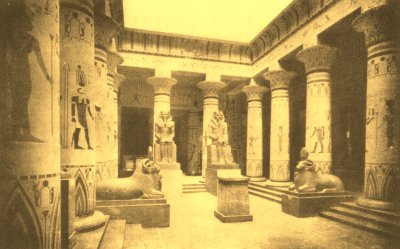
COURTYARD OF AN EGYPTIAN TEMPLE (RESTORED)

eml18 eml18 eml18

Khn(ram-headed)

Sebek, Crocodile God

Min

eml18   eml18

Bes


Anubis

LOCAL GODS WITH ADDED SOLAR AND OTHER ATTRIBUTES

Exquisite jewellery has been found at Dashur, where Amenemhet II and his grandson Senusert III resided and erected their pyramids--two diadems of princesses of the royal house, the daughters of the second Senusert's foreign wife, at Dashur. One is a mass of little gold flowers connected by gold wires, which recall the reference, in Exodus, xxxlx, 3, to the artisans who "did beat the gold into thin plates, and cut it into wires". The design is strengthened by large "Maltese crosses" set with gems. 6 Other pieces of Twelfth-Dynasty jewellery are similarly "innovations", and of the character which, long centuries afterwards, became known as Etruscan. But they could not have come from Europe at this period. They resemble the work for which the Hittites were famous.

The great sphinx may have also owed its origin to the influence exercised by the Hittites, whose emblem of power was a lion. Certain Egyptologists 7 are quite convinced that it was sculptured during the reign of Amenemhet III, whose face they consider it resembles. Nilotic gods had animal heads with human bodies. The sphinx, therefore, could not have been a god of Egypt. Scarab beetle seals were also introduced during the Twelfth Dynasty. The Dynastic civilization of Egypt began with the use of the Babylonian seal cylinder.

The "Golden Age" is distinguished not only for its material progress, but also for its literary activity. In this respect it may be referred to as the "Elizabethan Age" of Ancient Egypt. The compositions appear to have been numerous, and many were of high quality. During the great Dynasty the kingdom was "a nest of singing birds", and the home of storytellers. There are snatches of song even in the tomb inscriptions, and rolls of papyri have been found in mummy coffins containing love ditties, philosophic poems, and wonder tales, which were provided for the entertainment of the dead in the next world.

It is exceedingly difficult for us to enter into the spirit of some of these compositions. We meet with baffling allusions to unfamiliar beliefs and customs, while our ignorance of the correct pronunciation of the language make some ditties seem absolutely nonsensical, although they may have been regarded as gems of wit; such quaint turns of phrase, puns, and odd mannerisms as are recognizable are entirely lost when attempts are made to translate them. The Egyptian poets liked to play upon words. In a Fifth-Dynasty tomb inscription this tendency is apparent. A shepherd drives his flock over the wet land to tramp down the seed, and he sings a humorous ditty to the sheep. We gather that he considers himself to be in a grotesque situation, for he "salutes the pike", and is like a shepherd among the dead, who converses with strange beings as he converses with fish. "Salutes" and "pike" are represented by the same word, and it is as if we said in English that a fisherman "flounders like flounders" or that joiners "box the box".

A translation is therefore exceedingly bald.

The shepherd is in the water with the fish;
He converses with the sheath fish;
He salutes the pike;
From the West--the shepherd is a shepherd from the West.

"The West" is, of course, the land of the dead.

Some of the Twelfth-Dynasty "minor poems" are, however, of universal interest because their meaning is as clear as their appeal is direct. The two which follow are close renderings of the originals.

THE WOODCARVER

The carver grows more weary
Than he who hoes all day,
As up and down his field of wood
His chisel ploughs away.
No rest takes he at even,
Because he lights a light;
He toils until his arms drop down
Exhausted, in the night.

THE SMITH

A smith is no ambassador--
His style is to abuse;
I never met a goldsmith yet
Able to give one news.
Oh, I have seen a smith at work,
Before his fire aglow--
His "claws" are like a crocodile;
He smells like fish's roe.

The Egyptian peasants were great talkers. Life was not worth living if there was nothing to gossip about. A man became exceedingly dejected when he had to work in solitude; he might even die from sheer ennui. So we can understand the ditty which tells that a brickmaker is puddling all alone in the clay at the time of inundation; he has to talk to the fish. "He is now a brickmaker in the West." In other words, the lonely task has been the death of him.

This horror of isolation from sympathetic companionship pervades the wonderful composition which has been called "The Dialogue of a Man with his Soul". The opening part of the papyrus is lost, and it is uncertain whether the lonely Egyptian was about to commit suicide or was contemplating with feelings of horror the melancholy fate which awaited him when he would be laid in the tomb. He appears to have suffered some great wrong; his brothers have deserted him, his friends have proved untrue, and--terrible fate!--he has nobody to speak to. Life is, therefore, not worth living, but he dreads to die because of the darkness and solitude of the tomb which awaits him. The fragment opens at the conclusion of a speech made by the soul. Apparently it has refused to accompany the man, so that he is faced with the prospect of not having even his soul to converse with.

"In the day of my sorrow", the man declares, "you should be my companion and my sympathetic friend. Why scold me because I am weary of life? Do not compel me to die, because I take no delight in the prospect of death; do not tell me that there is joy in the 'aftertime'. It is a sorrowful thing that this life cannot be lived over again, for in the next world the gods will consider with great severity the deeds we have done here."

He calls himself a "kindly and sympathetic man", but the soul thinks otherwise and is impatient with him. "You poor fool," it says, "you dread to die as if you were one of these rich men."

But the Egyptian continues to lament his fate; he has no belief in joy after death. The soul warns him, therefore, that if he broods over the future in such a spirit of despondency he will be punished by being left forever in his dark solitary tomb. The inference appears to be that those who lack faith will never enter Paradise.

"The thought of death", says the soul, "is sorrow in itself, it makes men weep; it makes them leave their homes and throw themselves in the dust."

Men who display their unbelief, never enjoy, after death, the light of the sun. Statues of granite may be carved for them, their friends may erect pyramids which display great skill of workmanship, but their fate is like that of "the miserable men who died of hunger at the riverside, or the peasant ruined by drought or by the flood--a poor beggar who has lost everything and has none to talk to except the fishes".

The soul counsels the man to enjoy life and to banish care and despondency. He is a foolish fellow who contemplates death with sorrow because he has grown weary of living; the one who has cause to grieve is he whose life is suddenly cut short by disaster. Such appears to be the conclusion which should be drawn from the soul's references to some everyday happenings of which the following is an example:--

"A peasant has gathered in his harvest; the sheaves are in his boat; he sails on the Nile, and his heart is filled with the prospect of making merry. Suddenly a storm comes on. He is compelled to remain beside his boat, guarding his harvest. But his wife and his children suffer a melancholy fate. They were coming to meet him, but they lost their way in the storm, and the crocodiles devoured them. The poor peasant has good cause to lament aloud. He cries out, saying:

"'I do not sorrow for my beloved wife, who has gone hence and will never return, so much as for the little children who, in the dawn of life, met the crocodile and perished.'"

The man is evidently much impressed by the soul's reasoning. He changes his mind, and praises the tomb as a safe retreat and resting place for one who, like himself, cannot any longer enjoy life. Why he feels so utterly dejected we cannot tell; the reason may have been given in the lost portion of the old papyrus. There is evidently no prospect of enjoyment before him. His name has become hateful among men; he has been wronged; the world is full of evil as he is full of sorrow.

At this point the composition becomes metrical in construction:

Hateful my name! . . . more hateful is it now
Than the rank smell of ravens in the heat;
Than rotting peaches, or the meadows high
Where geese are wont to feed; than fishermen
Who wade from stinking marshes with their fish,
Or the foul odour of the crocodile;
More hateful than a husband deems his spouse
When she is slandered, or his gallant son
Falsely accused; more hateful than a town
Which harbours rebels who are sought in vain.

Whom can I speak to? . . . Brothers turn away;
I have no friend to love me as of yore;
Hearts have turned cold and cruel; might is right;
The strong are spoilers, and the weakly fall,
Stricken and plundered. . . . Whom can I speak to?

The faithful man gets sorrow for reward--
His brother turns his foe--the good he does,
How swiftly 'tis undone, for thankless hearts
Have no remembrance of the day gone past.
Whom can I speak to? I am full of grief--
There is not left alive one faithful man;
The world is full of evil without end.

Death is before me like a draught prepared
To banish sickness; or as fresh, cool air
To one who, after fever, walks abroad.
Death is before me sweet as scented myrrh;
Like soft repose below a shelt'ring sail
In raging tempest. . . . Death before me is
Like perfumed lotus; like a restful couch
Spread in the Land of Plenty; or like home
For which the captive yearns, and warriors greet
When they return. . . . Ah! death before me is
Like to a fair blue heaven after storm--
A channel for a stream--an unknown land
The huntsman long has sought and finds at last.

He who goes Yonder rises like a god
That spurns the sinner; lo! his seat is sure
Within the sun bark, who hath offered up
Choice victims in the temples of the gods;
He who goes Yonder is a learn man,
Whom no one hinders when he calls to Ra.

The soul is now satisfied, because the man has professed his faith in the sun god. It promises, therefore, not to desert him. "Your body will lie in the earth," it says, "but I will keep you company when you are given rest. Let us remain beside one another."

It is possible that this composition was intended to make converts for the sun cult. The man appears to dread the judgment before Osiris, the King of the Dead, who reckons up the sins committed by men in this world. His soul approves of his faith in Ra, of giving offerings in the temples, and of becoming a "learned man"--one who has acquired knowledge of the magic formulwhich enables him to enter the sun bark. This soul appears to be the man's Conscience. It is difficult to grasp the Egyptian ideas regarding the soul which enters Paradise, the soul which hovers over the mummy, and the conscious life of the body in the tomb. These were as vague as they appear to have been varied.

One of the most popular Egyptian poems is called "The Lay of the Harper". It was chanted at the banquets given by wealthy men. "Ere the company rises," wrote Herodotus, "a small coffin which contains a perfect model of the human body is carried round, and is shown to each guest in rotation. He who bears it exclaims: 'Look at this figure. . . . After death you will be like it. Drink, therefore, and be merry.'" The "lay" in its earliest form was of great antiquity. Probably a real mummy was originally hauled through the banquet hall.

LAY OF THE HARPER

'Tis well with this good prince; his day is done,
His happy fate fulfilled. . . . So one goes forth
While others, as in days of old, remain.
The old kings slumber in their pyramids,
Likewise the noble and the learned, but some
Who builded tombs have now no place of rest,
Although their deeds were great. . . .
Lo! I have heard The words Imhotep and Hordadaf spake--
Their maxims men repeat. . . . Where are their tombs?--
Long fallen . . . e'en their places are unknown,
And they are now as though they ne'er had been.

No soul comes back to tell us how he fares--
To soothe and comfort us ere we depart
Whither he went betimes. . . . But let our minds
Forget of this and dwell on better things. . . .
Revel in pleasure while your life endures
And deck your head with myrrh. Be richly clad
In white and perfumed linen; like the gods
Anointed be; and never weary grow
In eager quest of what your heart desires--
Do as it prompts you . . . until that sad day

Of lamentation comes, when hearts at rest
Hear not the cry of mourners at the tomb,
Which have no meaning to the silent dead.
Then celebrate this festal time, nor pause--
For no man takes his riches to the grave;
Yea, none returns again when he goes hence.

Footnotes

1 Newberry and Garstang, and Petrie.
2 Herodotus says: "Those who live near Thebes, and the Lake Mris, hold the crocodile in religious veneration. . . . Those who live in or near Elephantine make the beasts an article of food."
3 This is of special interest, because Hittite gods appear upon the backs of animals.
4 The god was not feared. It had been propitiated and became the friend of man.
5 When the Nile rises it runs, for a period, green and foul, after running red with clay. The crocodile may have been associated with the green water also.
6 The Maltese cross is believed to be of Elamite origin. It is first met with in Babylon on seals of the Kassite period. It appears on the neolithic pottery of Susa.
7 Newberry and Garstang.

Egyptian Myth and Legend Chapter 17, Egypt's Golden Age

EGYPTIAN MYTH AND LEGEND

With Historical Narrative, Notes on Race Problems, Comparative Beliefs, etc.
by

Donald Mackenzie

Gresham Publishing Co., London

[1907]

CHAPTER XVII

Egypt's Golden Age

A Leader of Men--Gloomy Prophecy--Agriculture flourishing--The Chief Treasurer and his Auditors--Great Irrigation Scheme--Lake Mris formed--Military Expeditions--A Murdered King--Disturbing Race Movements--First Mention of Hittites--Abraham in Egypt--Syria invaded--The Labyrinth--Like Mazy Cretan Palaces--Fall of Knossos--Bronze in Egypt--Copper and Iron--Trade in Tin--The British Mines--Spiral Ornament in Egypt and Europe.

THE Twelfth Dynasty, which embraces about two centuries, was a period of industrial and intellectual activity, and is appropriately called "The Golden Age of Egypt". It was ushered in, as we have seen, by Amenemhet I, whose name signifies "Amon leads". The king was, in a true sense, a leader of men; he displayed great military and administrative genius, and proved to be a saviour of the people. He rose to power at a time when a great crisis was approaching. The kingdom had grown weak as a result of prolonged internal dissensions, and its very existence as a separate power was being threatened by invaders on the northern and southern frontiers. The hour had come, and with it the man.

Amenemhet subdued the Nubians, who were as warlike and aggressive as the modern Sudanese; he cleared the eastern Delta of hordes of Asiatics, attracted thither by the prospects of plunder and the acquisition of desirable territory, and he reduced by shattering blows the growing power of the Libyans. His administrative reforms were beneficial to the great mass of the people, for the establishment of a strong central government protected them from brigandage and periodic visitations of devastating famines. Agriculture was promoted, and the revival of trade ensured a more equitable distribution of wealth. As the influence of the feudal lords declined, it became possible for capable men of humble rank to attain high official positions.

In a striking literary production of the age, a prophetic scribe, named Apura, stands before his king, uttering grave warnings of approaching national disaster. He pictures Egypt in the throes of revolution; brothers contend against brothers; men cease to till the soil. The prophet exclaims:

In vain will the Nile rise in flood, for the land will lie barren. Men who were wont to plough will say: "What is the good of it? We know what is coming." No children will be born in Egypt. Poor people will seize upon treasure. A man hitherto unable to purchase sandals will obtain possession of much grain. Diseases will decimate all classes; a terrible plague will smite the land; there will be war and much shedding of blood. Rich men will sorrow and poor men will laugh. All the cities will desire to throw off the yoke of their rulers. . . . Slaves will plunder their masters, and their wives will be decked with fine jewellery. Royal ladies will be driven from their homes; they will sit in the dust, wailing: "Oh! that we had bread to eat."

Thus, he declared, Egypt would suffer from the Conquest of Evil. But a more terrible conquest would immediately follow. Suddenly foreigners would enter the land to set up barbarous rule. Then all classes of Egyptians would endure great afflictions.

Having drawn this dark and terrible picture, the prophet foretells that a great deliverer is to arise. He will "cool the fire of oppression" and will be called "The Shepherd of his People". He will gather together his wandering flocks; he will smite the wrongdoer; he will stir up enthusiasm in the hearts of the men of Egypt and become their leader. "May he indeed be their deliverer!" exclaims the scribe. "Where is he to be found? Is he already here, waiting among the people?"

It is possible that at this period contemporary historical events were narrated in the prophetic manner, and that the scribe was eulogizing the reigning Pharaoh and justifying his reforms. In the "Instruction of Amenemhet" the old king reflects with astonishment that those he set free should rise up against him. A more literal rendering of his remark is: "He struggles for an ox that is bound who hath no memory of yesterday". Amenemhet had set the people free, and those who had received benefits showed that they failed to appreciate them by espousing the cause of their old oppressors. Was it their desire to become serfs again?

The condition of the past is reflected in the tomb inscription of one of the nome lords whose family owed its rise to its loyalty to the monarch. He boasts that every available piece of land under his jurisdiction was thoroughly cultivated. He protected the lives of the people. None starved, for he saw that all received food. A widow was treated in the same manner as a woman whose husband was alive, and when relief was given the poor received the same treatment as the powerful. Lord Kitchener has recently commented upon the financial embarrassments of the present-day fellahin of Egypt. Apparently the problem is one of long standing, for this governor--Ameni of the Gazelle nome--states that when the river rose high, and there was an abundance of produce, he "did not oppress the peasant because of his arrears".

It was the duty of the Chief Treasurer to see that the various nomes were administered in such a manner that they yielded adequate surpluses. A "sinking fund" was instituted for bad years, and relief was given in those localities where harvests were insufficient. The problem of irrigation received constant attention, and it became customary to measure the rise of the Nile on the rocks of the second cataract. The statistics thus obtained made possible the calculation of the probable yield of grain, so that the assessments might be fixed in the early part of each year. The royal auditors were constantly engaged throughout the land "taking stock" and checking the transactions of those who collected taxes "in kind", and references are made to their operations in tomb inscriptions. Their returns were lodged in the office of the Chief Treasurer at Memphis, who was ever in a position to advise the Pharaoh regarding the development of a particular district, and, in times of distress, to know where to find supplies to relieve the needy.

During the reign of Amenemhet Ill, the sixth monarch of the Dynasty, a great water storage and irrigation scheme was successfully carried out. The possibilities of the swampy Fayum had been recognized by certain rulers. King Den, of the First Dynasty, began the work of reclamation there, and some of his successors continued to deal with the problem. Amenemhet's operations were conducted on a grand scale. The famous Lake Mris was formed by the erection of a reclaiming wall which extended for nearly thirty miles. It was connected with the Nile by a broad canal, and its largest circumference was 150 miles, while its area was about 750 square miles. It served the same purpose as the Assouan dam of the present day, but of course benefited only the province of the Fayum and the district below it. Strabo, writing long centuries after it was constructed, said: "The Lake Mris, by magnitude and depth, is able to sustain the superabundance of water which flows into it when the river rises, without overflowing the inhabited and cultivated parts of the country. When the river falls the lake distributes the excess of water through its canal, and both the lake and the canal retain a remainder which is used for irrigation. . . . There are locks on both mouths of the canal, and the engineers use these to store up and distribute the water."

When the scheme was completed the area of land reclaimed embraced., according to Major R. H. Brown, R.E., about 27,000 acres. He has calculated that a sufficient quantity of water was conserved to double the flow of the Nile during the period between April and July, when it is very low. The extension of the cultivatable area increased greatly the drawings of the Chief Treasurer. Pharaoh, in a generous moment, being, no doubt, well pleased with the success of the scheme. made over the revenue from the fishing rights of the lake to his queen, so that she might provide luxurious attire and jewellery for herself and her train.

Senusert I, the friend of Sentihet, was an able and vigorous ruler. During his reign of about forty years he appears to have engaged himself mainly in carrying out the policy inaugurated by his father. The results were eminently satisfactory. Peace was maintained with a firm hand on the northern frontier, and the Libyans were kept at bay. He found it necessary, however, to lead in person a strong army into Nubia. There does not appear to have been much fighting, for in the tomb of his general, the favoured Ameni, it is recorded that the losses were insignificant. Apparently the most notable event of the campaign was the capture of an elephant. Other expeditions followed, the last being in the year before the king's death. The Nubians never ceased to give trouble.

Senusert restricted at every opportunity the powers of the feudal lords, and pursued the diplomatic policy of conciliating the various religious cults. He erected a great temple at Heliopolis, and its site is marked today by a stately obelisk which bears his name. He also repaired or extended temples at Coptos, Abydos, Hierakonpolis, and Karnak, and his monuments were judiciously distributed throughout the land.

Two years before his death Senusert appointed as regent his son, who became the second Amenemhet. After reigning for thirty years, Amenemhet II lost his life, according to Manetho, in a palace revolution. Senusert II, who followed, appears to have resided chiefly at Illahun, a town which is of special interest to us, because a plan of it was discovered by Petrie in the royal tomb. We are not impressed by the accommodation provided for the great mass of the inhabitants. The workers resided in narrow slums. Many of the living rooms in the blocks run one into another, so that there could not have been either great comfort or much privacy.

A new type of face begins to appear in the royal house, as is shown by the smaller sculpture work of the time. This matter will be dealt with in the next chapter. Nomadic tribes were also settling in Egypt. In the well-known Beni-hassan tomb of the loyal nome governor Khnotep ("the god Khnis satisfied") appears an interesting and significant wall painting of a company of Semites, who are presenting gifts of perfumes to the Pharaoh. They are accompanied by their wives and families, as if they desired to become faithful subjects in the land of prosperity and good government.

Syria at this period was in a state of constant unrest. Great race movements were in progress over a considerable area in Asia and Europe. These were caused by one of those periodic waves of migration from Arabia, the southward and westward pressure of hill tribes in middle Asia, and by the aggressive tendencies of the Hittites. The earliest mention of the latter is made in the reign of Amenemhet I. Their seat of power was at Boghaz-Kol in Asia Minor, and they were raiding Mesopotamia and gradually pressing down through northern Syria. The smaller tribes were displaced by the larger, and migrations by propulsion were, in consequence, frequent and general. Many privations were endured by the scattered people, and of course agricultural operations must have been completely suspended in some districts.

About this time Abraham sojourned in Egypt, because "the famine was grievous in the land" (Canaan). After he returned he purchased from Ephron, the Hittite, the cave of Machpelah, in which to bury his dead. This landowner was evidently a pioneer settler from Asia Minor. He was friendly to the patriarch, whom he addressed as "a mighty prince among us". The Hittites may have penetrated Canaan as far south as Jerusalem.

Owing to the unrest on his northern frontier Senusert III found it necessary to invade Syria. A stela of his has been found at Gezer. It is recorded at Abydos that a battle was fought in which the Asiatics were defeated, and Sebek-khu, an Egyptian dignitary, to whom we are indebted for this scrap of interesting history, boasts of the gifts he received from the Pharaoh for his bravery on the field. Nubia was also giving trouble again during this reign. A vigorous campaign against the restless warriors resulted in the extension of the Egyptian frontier to the third cataract. Two great forts were afterwards erected and garrisoned. It was also decreed that no negroes with cattle or merchandise should pass northward by land or water beyond a certain point. Traders were followed by colonists, and then fighting men desired to take forcible possession of territory. A second campaign was conducted against the dusky tribes eight years after the first, and three years later there was another. The flesh pots of Egypt were attracting all sorts and conditions of peoples.

The interests of the next king, Amenemhet III, were centred chiefly in the Fayum, where he saw completed the great Lake Mris scheme. His reign, which lasted for nearly half a century, was peaceful and prosperous. He was one of the great Pharaohs of Egypt. Under his jurisdiction the country developed rapidly, commerce increased, and the industries were fostered. Instead of sending periodic expeditions to Sinai for copper and turquoise, as had been the custom hitherto, he established a colony there. A reservoir was constructed and a temple built to the goddess Hathor. The colonists suffered greatly from the heat during the summer months. A nobleman recorded on a stela the hardships endured by a pioneer expedition which visited the mines at an earlier date than usual, before permanent settlement was effected in that tropical land. "The mountains are hot," he says, "and the rocks brand the body." He endured his hardships with exemplary fortitude, and expressed the hope that others would similarly show their readiness to obey royal commands.

It was a building age, and Amenemhet honoured the gods and at the same time humoured the growing communities of priests by erecting and enlarging temples. He gave special recognition to Osiris at sacred Abydos, where many Egyptians of all ranks continued to seek sepulture; to Amon, the family deity at Karnak; and to Her-shef at Heracleopolis. Ptah, the god of the artisans, appears to have been neglected, which seems to indicate that he had absorbed, or was absorbed by, Her-shef, whom he so closely resembles.

This Amenemhet is credited with having erected the great Labyrinth in the vicinity of Lake Mris. The mosque-building Arabs must have used it as a quarry, for no trace of it remains. It appears to have been an immense temple, with apartments for each of the Egyptian gods. "All the works of Greece", declared Herodotus, "are inferior to it, both in regard to workmanship and cost." The Greek historian was of opinion that it surpassed even the Pyramids. There were twelve covered courts with entrances opposite to each other--six to the north and six to the south, and the whole was enclosed by a wall. Of the three thousand apartments half were underground. "The numerous winding passages through the various courts", Herodotus wrote, "aroused my warmest admiration. I passed from small apartments to spacious halls, and from these to magnificent courts, almost without end. Walls and ceilings were of marble, the former being sculptured and painted, and pillars of polished marble surrounded the courts." At the end of the labyrinth stood Pharaoh's Pyramid, with figures of animals carved upon its casement. "No stranger", Strabo informs us, "could find his way in or out of this building without a guide." The brick pyramids of the Twelfth Dynasty were also constructed with winding passages to baffle the tomb robbers; but they were "jerry built", compared with those of the Khufu type, and survive to us in various stages of decay.

The idea of a labyrinth may have come from Crete. The palaces of the island kingdom were of mazy character, and the earliest at Knossos and Phaestos were erected in the First Middle Minoan period, which is parallel with the Eleventh Egyptian Dynasty. Their fame must have reached the Nile valley, for the influence of the island kingdom's architecture is traceable in the construction of Mentuhotep's complicated temple at Der el Bahari. A people who appear to have been "broad-headed" mountaineers invaded Crete at the close of its Second Middle Minoan period, which is parallel with the Twelfth Egyptian Dynasty. Their success culminated in the destruction of the earlier palace of Knossos. At a later age, when a similar invasion occurred, large numbers of Cretans fled to Asia Minor, and it is possible that in the time of Amenemhet III many of the island refugees settled in the Nile valley. If these included architects and skilled artisans, they must have received most hospitable welcome.

Egypt, we know, was at this period in close touch with Crete. The numerous relics of the Twelfth Dynasty which have been found in the palace ruins of the island show how free and continuous was the sea trade between the two kingdoms. No doubt it was greatly stimulated by the Egyptian demand for tin. We find that bronze came into more general use during the Twelfth Dynasty than had previously been the case. In Old-Kingdom times tools were made chiefly of copper, and occasionally of iron. The latter was called "The Metal of Heaven", and is referred to in the Pyramid texts of King Unas. If it was obtained originally from meteorites, as has been suggested, we can understand why, in Egypt as elsewhere, it was supposed to possess magical qualities. It does not seem to have been excavated in great quantities by the early Egyptians; the difficulty of smelting it must have been great, owing to the scarcity of timber.

Copper was used in the late pre-Dynastic period, when expeditions from the southern kingdom began to visit the mines of the Sinaitic peninsula. The Delta people may have also obtained it from Cyprus, where the earliest weapons and pottery resemble Egyptian forms. At the close of the Third Dynasty bronze was introduced or manufactured; the bronze "rod of Medum" was found deeply embedded in the fillings of a mastaba associated with the pyramid of King Sneferu. A bronze socketed hoe of the Sixth Dynasty bears resemblances to examples from Cyprus and South Russia preserved in the British Museum. Trade with the copper island did not assume any dimensions, however, until the Eighteenth Dynasty, and the Cypriote weapons which were imported into the Nile valley before that period may have come along the trade route through Syria, if they were not captured in frontier conflicts with Asiatic invaders.

Egypt manufactured its own bronze, and the suggestion of W. M. Muller, that certain figures on a Sixth-Dynasty relief are "eans bringing tin into Egypt" is therefore of special interest. If such a trade existed, it must have been hampered greatly, if not entirely cut off, during the disturbed period prior to the rise of Amenemhet I.

Whence were the liberal supplies of bronze obtained by the Egyptians in the Twelfth Dynasty? The unrest in Asia must have interrupted trade along the great caravan routes to the ancient tin mines of Khorassan in Persia, from which Babylonia received supplies. The Phnician mariners had scarcely yet begun to appear in the Mediterranean. Tin must have come mainly through Crete therefore; indeed the island traders could not have had anything more valuable to offer in exchange for the corn of Egypt.

Crete had long been familiar with bronze. The First Early Minoan period, which marks the transition from stone, began in Egypt's Third Dynasty, or slightly earlier. Was its tin obtained from Central Europe or Brittany? Dr. Duncan Mackenzie, the distinguished archlogist, says in this connection: "By the beginning of the Bronze Age (in Crete) the valley of the Rhone must have played a dominant re of communication between the great world of the Mediterranean and the north; by that time it was probably the high continental trade route towards the tin mines of Britain". If so, the tin-mining industry of Cornwall and the Scilly islands must have been increased greatly by the demand created by the tin-importing and temple-building Pharaohs of the Twelfth Dynasty, who flourished long before Joseph appeared in the land of Egypt.

Another link between ancient Britain and the Nile valley is the spiral ornament, which appears in "degenerate form" on the so-called "spectacle stones" of Scotland. The spiral is common on Egyptian scarabs of the Twelfth Dynasty. We find that it passed to Crete, and then along the Danube trade route to Denmark, where the ornaments on which it appeared were possibly given in exchange for the much-sought-for Baltic amber. It spread in time through Scandinavia. The spiral must also have followed the Rhone-valley route, for it was passed on from France to the British Isles, through which it was widely diffused in the Bronze Age. In Ireland it was carved on the stones of the famous New Grange barrow, County Meath.

The brilliant Twelfth Dynasty came to an end soon after the death of the great Amenemhet III. His closing years were shadowed by domestic grief, for his favourite son, Ewib-ra, predeceased him. A wooden statue of the prince is preserved in the Cairo museum, and is that of a handsome and dignified youth. The next king, Amenemhet IV, ruled for about nine years. He left no son, and was succeeded by Queen Sebeknefru-ra, a daughter of Amenemhet III, and the last of her "line", who sat on the throne for four years. With her passed away the glory and grandeur of the "Golden Age", the latter half of which had special features of much interest. These are dealt with in the next chapter.

Egyptian Myth and Legend Chapter 16, Tale of the Fugitive Prince

EGYPTIAN MYTH AND LEGEND

With Historical Narrative, Notes on Race Problems, Comparative Beliefs, etc.
by

Donald Mackenzie

Gresham Publishing Co., London

[1907]

CHAPTER XVI

Tale of the Fugitive Prince

A Libyan Campaign--Death of King Amenemhet--The Prince's Flight --Among the Bedouins--An Inquisitive Chief--The Prince is honoured--A Rival Hero--Challenge to Single Combat--Senuhet victorious--Egyptian Love of Country--Appeal to Pharaoh--Prince returns Home--Welcome at the Court--A Golden Friend--An Old Man made Happy.

SENUHET, "son of the sycamore", was a hereditary prince of Egypt. When war was waged against the Libyans he accompanied the royal army, which was commanded by Senusert, the chosen heir of the great Amenemhet. As it fell, the old king died suddenly on the seventh day of the second month of Shait. Like the Horus hawk he flew towards the sun. Then there was great mourning in the palace; the gates were shut and sealed and noblemen prostrated themselves outside; silence fell upon the city.

The campaign was being conducted with much success. Many prisoners were taken and large herds of cattle were captured. The enemy were scattered in flight.

Now the nobles who were in possession of the palace took counsel together, and they dispatched a trusted messenger to Prince Senusert, so that he might be secretly informed of the death of his royal father. All the king's sons were with the army, but none of them were called when the messenger arrived. The messenger spoke unto no man of what had befallen save Senusert alone.

Now it chanced that Senuhet was concealed nigh to the new king when the secret tidings were brought to him. He heard the words which the messenger spoke, and immediately he was stricken with fear; his heart shook and his limbs trembled. But he retained his presence of mind. His first thought was for his own safety; so he crept softly away until he found a safe hiding place. He waited until the new king and the messenger walked on together, and they passed very close to him as he lay concealed in a thicket. 1

No sooner had they gone out of hearing than Senuhet hastened to escape from the land of Egypt. He made his way southward, wondering greatly as he went if civil war had broken out. When night was far spent he lay down in an open field and slept there. In the morning he hastened along the highway and overtook a man who showed signs of fear. The day passed, and at eventide he crossed the river on a raft to a place where there were quarries. He was then in the region of the goddess Hirit of the Red Mountains, and he turned northward. On reaching a frontier fortress, which had been built to repel the raiding Bedouin archers, he concealed himself lest he should be observed by the sentinels.

As soon as it grew dark he continued his journey. He travelled all night long, and when dawn broke he reached the Qumor valley. . . . His strength was well-nigh spent. He was tortured by thirst; his tongue was parched and his throat was swollen. Greatly he suffered, and he moaned to himself: "Now I begin to taste of death". Yet he struggled on in his despair, and suddenly his heart was cheered by the sound of a man's voice and the sweet lowing of cows.

He had arrived among the Bedouins. One of them spoke to him kindly, and first gave him water to drink and then some boiled milk. The man was a chief, and he perceived that Senuhet was an Egyptian of high rank. He showed him much kindness, and when the fugitive was able to resume his journey the Bedouin gave him safe conduct to the next camp. So from camp to camp Senuhet made his way until he reached the land of the Edomites, and then he felt safe there.

About a year went past, and then Amuanishi, chief of Upper Tonu, sent a messenger to Senuhet, saying: "Come and reside with me and hear the language of Egypt spoken."

There were other Egyptians in the land of Edom, and they had praised the prince highly, so that the chief desired greatly to see him.

Amuanishi spoke to Senuhet, saying: "Now tell me frankly why you have fled to these parts. Is it because someone has died in the royal palace? Something appears to have happened of which I am not aware."

Senuhet made evasive answer: "I certainly fled hither from the country of the Libyans, but not because I did anything wrong. I never spoke or acted treasonably, nor have I listened to treason. No magistrate has received information regarding me. I really can give no explanation why I came here. It seems as if I obeyed the will of King Amenemhet, whom I served faithfully and well."

The Bedouin chief praised the great king of Egypt, and said that his name was dreaded as greatly as that of Sekhet, the lioness goddess, in the time of famine.

Senuhet again spoke, saying: "Know now that the son of Amenemhet sits on the throne. He is a just and tactful prince, an excellent swordsman, and a brave warrior who has never yet met his equal. He sweeps the barbarians from his path; he hurls himself upon robbers; he crushes heads and strikes down those who oppose him, for he is indeed a valiant hero without fear. He is also a swift runner when pursuing his foes, and he smites them with the claws of a lion, for they cannot escape him. Senusert rejoices in the midst of the fray, and none can withstand him. To his friends he is the essence of courtesy, and he is much loved throughout the land; all his subjects obey him gladly. Although he extends his southern frontier he has no desire to invade the land of the Bedouins. If it happens, however, that he should come hither, tell him that I dwell amongst ye."

The chief heard, and then said: "My desire is that Egypt may flourish and have peace. As for yourself, you will receive my hospitality so long as you please to reside here."

Then Senuhet was given for wife the eldest daughter of the chief of Upper Tonu. He was also allowed to select for himself a portion of land in that excellent country which is called Aia. There was abundance of grapes and figs; wine was more plentiful than water; the land flowed with milk and honey; olives were numerous and there were large supplies of corn and wheat, and many cattle of every kind.

The chief honoured Senuhet greatly and made him a prince in the land so that he was a ruler of a tribe. Each day the Egyptian fared sumptuously on cooked flesh and roasted fowl and on the game he caught, or which was brought to him, or was captured by his dogs, and he ever had bread and wine. His servants made butter and gave him boiled milk of every kind as he desired.

Many years went past. Children were born to him and they grew strong, and, in time, each ruled over a tribe. When travellers were going past, they turned aside to visit Senuhet, because he showed great hospitality; he gave refreshment to those who were weary; and if it chanced that a stranger was plundered, he chastised the wrongdoers; he restored the stolen goods and gave the man safe conduct.

Senuhet commanded the Bedouins who fought against invaders, for the chief of Upper Tonu had made him general of the army. Many and great were the successes he achieved. He captured prisoners and cattle and returned with large numbers of slaves. In battle he fought with much courage with his sword and his bow; he displayed great cunning on the march and in the manner in which he arranged the plan of battle The chief of Tonu loved him dearly when he perceived how powerful he had become, and elevated Senuhet to still higher rank.

There was a mighty hero in Tonu who had achieved much renown, and he was jealous of the Egyptian. The man had no other rival in the land; he had slain all who dared to stand up against him. He was brave and he was bold, and he said: "I must needs combat with Senuhet. He has not yet met me."

The warrior desired to slay the Egyptian and win for himself the land and cattle which he possessed.

When the challenge was received, the chief of Tonu was much concerned, and spoke to Senuhet, who said:

"I know not this fellow. He is not of my rank and I do not associate with his kind. Nor have I ever done him any wrong. If he is a thief who desires to obtain my goods, he had better be careful of how he behaves himself. Does he think I am a steer and that he is the bull of war? If he desires to fight with me, let him have the opportunity. As it is his will, so let it be. Will the god forget me? Whatever happens will happen as the god desires."

Having spoken thus, Senuhet retired to his tent and rested himself. Then he prepared his bow and made ready his arrows, and he saw that his arms were polished.

When dawn came, the people assembled round the place of combat. They were there in large numbers; many had travelled from remote parts to watch the duel. All the subjects of the chief of Tonu desired greatly that Senuhet should be the victor. But they feared for him. Women cried "Ah!" when they saw the challenging hero, and the men said one to another: "Can any man prevail over this warrior? See, he carries a shield and a lance and a battleaxe, and he has many javelins."

Senuhet came forth. He pretended to attack, and his adversary first threw the javelins; but the Egyptian turned them aside with his shield, and they fell harmlessly to the ground. The warrior then swung his battleaxe; but Senuhet drew his bow and shot a swift arrow. His aim was sure, for it pierced his opponent's neck so that he gave forth a loud cry and fell forward upon his face. Senuhet seized the lance, and, having thrust it through the warrior's body, he raised the shout of victory.

Then all the people rejoiced together, and Senuhet gave thanks to Mentu, the war god of Thebes, as did also the followers of the slain hero, for he had oppressed them greatly. The Chief Ruler of Tonu embraced the victorious prince with glad heart.

Senuhet took possession of all the goods and cattle which the boastful warrior had owned, and destroyed his house. So he grew richer as time went on. But old age was coming over him. In his heart he desired greatly to return to Egypt again and to be buried there. His thoughts dwelt on this matter and he resolved to make appeal unto King Senusert. Then he drew up a petition and dispatched it in the care of a trusted messenger to the royal palace. Addressing His Majesty, "the servant of Horus" and "Son of the Sun" Senuhet wrote:--

I have reposed my faith in the god, and lo! he has not failed me. . . . Although I fled away from Egypt my name is still of good repute in the palace. I was hungry when I fled and now I supply food unto others; I was naked when I fled and now I am clad in fine linen; I was a wanderer and now I have many followers; I had no riches when I fled and now possess land and a dwelling. . . . I entreat of Your Majesty to permit me to sojourn once again in the place of my birth which I love dearly so that when I die my body may be embalmed and laid in a tomb in my native land. I, who am a fugitive, entreat you now to permit me to return home. . . . Unto the god I have given offerings so that my desire may be fulfilled, for my heart is full of regret--I who took flight to a foreign country.

May Your Majesty grant my request to visit once again my native land so that I may be your favoured subject. I humbly salute the queen. It is my desire to see her once again and also the children so that life may be renewed in my blood. Alas! I am growing old, my strength is diminishing; mine eyes are dim; I totter when I walk and my heart is feeble. Well, I know that death is at hand. The day of my burial is not far off. . . . Ere I die, may I gaze upon the queen and bear her talk about her children so that my heart may be made happy until the end.

King Senusert read the petition which Senuhet had sent unto him and was graciously pleased to grant his request. He sent presents to his fugitive subject, and messages from the princes, his royal sons, accompanied His Majesty's letter, which declared:

These are the words of the King. . . . What did you do, or what has been done against you, that you fled away to a foreign country? What went wrong? I know that you never calumniated me, but although your words may have been misrepresented, you did not speak next time in the gathering of the lords even when called upon. . . . Do not let this matter be remembered any longer. See, too, that you do not change your mind again. . . . As for the queen, she is well and receives everything she desires. She is in the midst of her children. . . .

Leave all your possessions, and when you return here you may reside in the palace. You will be my closest friend. Do not forget that you are growing older each day now; that the strength of your body is diminishing and that your thoughts dwell upon the tomb. You will be given seemly burial; you will be embalmed; mourners will wail at your funeral; you will be given a gilded mummy case which will be covered with a cypress canopy and drawn by oxen; the funeral hymn will be sung and the funeral dance will be danced; mourners will kneel at your tomb crying with a loud voice so that offerings may be given unto you. Lo! all shall be as I promise. Sacrifices will be made at the door of your tomb; a pyramid will be erected and you will lie among princes. . . . You must not die in a foreign country. You are not to be buried by Bedouins in a sheepskin. The mourners of your own country will smite the ground and mourn for you when you are laid in your pyramid.

When Senuhet received this gracious message he was overcome with joy and wept; he threw himself upon the sand and lay there. Then he leapt up and cried out: "Is it possible that such good fortune has befallen an unfaithful subject who fled from his native land unto a hostile country? Great mercy is shown unto me this day. I am delivered from the fear of death."

Senuhet sent an answer unto the king saying:

Thou mighty god, what am I that you should favour me thus? . . . If Your Majesty will summon two princes who know what occurred they will relate all that came to pass . . . . It was not my desire to flee from Egypt. I fled as in a dream . . . . I was not followed. I had not heard of any rebellious movement, nor did any magistrate receive my name . . . . I fled as if I had been ordered to flee by His Majesty . . . . As you have commanded, I will leave my riches behind me, and those who are my heirs here will inherit them. . . . May Your Majesty have eternal life.

When he had written this to His Majesty, Senuhet gave a great feast and he divided his wealth among his children. His eldest son became the leader of the tribe, and he received the land and the corn fields, the cattle and the fruit trees, in that pleasant place. Then Senuhet turned his face towards the land of Egypt. He was met on the frontier by the officer who commanded the fort, who sent tidings to the palace of Senuhet's approach. A boat laden with presents went to meet him, and the fugitive spoke to all the men who were in it as if he were of their own rank, for his heart was glad.

A night went past, and when the land grew bright again he drew nigh to the palace. Four men came forth to conduct him, and the children waited his coming in the courtyard as did also the nobles who led him before the king.

His Majesty sat upon his high throne in the great hall which is adorned with silver and gold. Senuhet prostrated himself. The king did not at first recognize him, yet he spoke kindly words; but the poor fugitive was unable to make answer; he grew faint; his eyes were blinded and his limbs were without strength; it seemed as if he were about to die.

The king said: "Help him to rise up so that we may converse one with another."

The courtiers lifted Senuhet, and His Majesty said: "So you have returned again. I perceive that in skulking about in foreign lands and playing the fugitive in the desert you have worn yourself out. You have grown old, Senuhet. . . . But why do you not speak? Have you become deceitful like the Bedouin. Declare your name. What causes you to feel afraid?"

Senuhet found his tongue and said: "I am unnerved, Your Majesty. I have naught to answer for. I have not done that which deserves the punishment of the god. . . . I am faint, and my heart has grown weak, as when I fled. . . . Once again I stand before Your Majesty; my life is in your hands; do with me according to your will."

As he spoke, the royal children entered the great hall, and His Majesty said to the queen:

"This is Senuhet. Look at him. He has come like a desert dweller in the attire of a Bedouin."

The queen uttered a cry of astonishment, and the children laughed, saying: "Surely it is not him, Your Majesty?"

The king said: "Yes, it is Senuhet."

Then the royal children decked themselves with jewels and sang before the king, each tinkling a sweet sistrum. They praised His Majesty and called upon the gods to give him health and strength and prosperity, and they pleaded for Senuhet, so that royal favours might be conferred upon him.

Mighty thy words and swift thy will!
Then bless thy servant in thy sight--
With air of life his nostrils fill,
Who from his native land took flight.
Thy presence fills the land with fear;
Then marvel not he fled away--
All cheeks grow pale when thou art near;
All eyes are stricken with dismay.

The king said: "Senuhet must not tremble in my presence, for he will be a golden friend and chief among the courtiers. Take him hence that he may be attired as befits his rank."

Then Senuhet was conducted to the inner chamber, and the children shook hands with him. He was given apartments in the house of a prince, the son of the king, in which he obtained dainties to eat. There he could sit in a cool chamber; there he could eat refreshing fruit; there he could attire himself in royal garments and anoint his body with perfumes; and there courtiers waited to converse with him and servants to obey his will.

He grew young again. His beard was shaved off, and his baldness was covered with a wig. The smell of the desert left him when his rustic garments were thrown away, and he was dressed in linen garments and anointed with perfumed oil. Once again he lay upon a bed--he who had left the sandy desert to those accustomed to it.

In time Senuhet was provided with a house in which a courtier had dwelt, when it had been repaired and decorated. He was happy there, and his heart was made glad by the children who visited him. The royal children were continually about his house.

King Senusert caused a pyramid to be erected for Senuhet; his statue was also carved at His Majesty's command, and it was decorated with gold.

"It was for no ordinary man," adds the scribe, who tells us that he copied the story faithfully, "that the king did all these things. Senuhet was honoured greatly by His Majesty until the day of his death."

The Instruction of Amenemhet

Be thou in splendour like the god, my son . . .
Hearken and hear my words, if thou wouldst reign
In Egypt and be ruler of the world,
Excelling in thy greatness. . . . Live apart
In stern seclusion, for the people heed
The man who makes them tremble; mingle not
Alone among them; have no bosom friend,
Nor intimate, nor favourite in thy train--
These serve no goodly purpose.

Ere to sleep
Thou liest down, prepare to guard thy life--
A man is friendless in the hour of trial. . . .
I to the needy gave, the orphan nourished,
Esteemed alike the lowly and the great;
But he who ate my bread made insurrection,
And those my hands raised up, occasion seized
Rebellion to create. . . . They went about
All uniformed in garments that I gave
And deemed me but a shadow. . . . Those who shared
My perfumes for anointment, rose betimes
And broke into my harem.

Through the land
Beholden are my statues, and men laud
The deeds I have accomplished . . . yet I made
A tale heroic that hath ne'er been told,
And triumphed in a conflict no man saw.

Surely these yearned for bondage when they smote
The king who set them free. . . . Methinks, my son,
Of no avail is liberty to men
Grown blind to their good fortune.

I had dined
At eve and darkness fell. I sought to rest
For I was weary. On my bed I lay
And gave my thoughts release, and so I slept . . .
The rebels 'gan to whisper and take arms
With treacherous intent . . . I woke and heard
And like the desert serpent waited there
All motionless but watchful.

Then I sprang
To fight and I alone. . . . A warrior fell,
And lo! he was the captain of my guard.
Ah! had I but his weapons in that hour
I should have scattered all the rebel band--
Mighty my blows and swift! . . . but he, alas!
Was like a coward there . . . . Nor in the dark,
And unprepared, could I achieve renown.

Hateful their purpose! . . . I was put to shame.
Thou wert not nigh to save. . . . Announced I then
That thou didst reign, and I had left the throne.
And gave commands according to thy will. . . .
Ah! as they feared me not, 't was well to speak
With courtesy before them. . . . Would I could
Forget the weakness of my underlings!

My son, Senusert, say--Are women wont
To plot against their lords? Lo! mine have reared
a brood of traitors, and assembled round
a rebel band forsworn. They did deceive
My servants with command to pierce the ground
For speedy entry.

Yet to me from birth
Misfortune hath a stranger been. I ne'er
Have met mine equal among valiant men.
Lo! I have set in order all the land.
From Elephantinadown the Nile
I swept in triumph: so my feet have trod
The outposts of my kingdom. . . . Mighty deeds
Must now be measured by the deeds I've done.

I loved the corn god. . . . I have grown the grain
In every golden valley where the Nile
Entreated me; none hungered in my day,
None thirsted, and all men were well content--
They praised me, saying: "Wise are his commands".

I fought the lion and the crocodile,
I smote the dusky Nubians, and put
The Asian dogs to flight.

Mine house I built.
Gold-decked with azure ceilings, and its walls
Have deep foundations; doors of copper are,
The bolts of bronze. . . . It shall endure all time.
Eternity regards it with dismay!
I know each measurement, O Lord of All!

Men came to see its beauties, and I heard
In silence while they praised it. No man knew
The treasure that it lacked. . . . I wanted thee,
My son, Senusert. . . . Health and strength be thine!
I lean upon thee, O my heart's delight;
For thee I look on all things. . . . Spirits sang
In that glad hour when thou wert born to me.

All things I've done, now know, were done for thee;
For thee must I complete what I began
Until the end draws nigh. . . . O be my heart
The isle of thy desire. . . . The white crown now
Is given thee, O wise son of the god--
I'll hymn thy praises in the bark of Ra. . . .
Thy kingdom at Creation was. 'T is thine
As it was mine--how mighty were my deeds!
Rear thou thy statues and adorn thy tomb. . . .
I struck thy rival down . . . . . 'T would not be wise
To leave him nigh thee . . . . Health and strength be thine!

Footnotes

1 No reason is given in the story for Senuhet's sudden alarm.

Egyptian Myth and Legend Chapter 15, The Rise of Amon

EGYPTIAN MYTH AND LEGEND

With Historical Narrative, Notes on Race Problems, Comparative Beliefs, etc.
by

Donald Mackenzie

Gresham Publishing Co., London

[1907]

CHAPTER XV

The Rise of Amon

The Theban Rulers--Need for Centralized Government--Temple Building--The first Amon King--Various Forms of Amon--The Oracle--Mentu the War God--Mut, Queen of the Gods--The Egyptian Cupid--Story of the Possessed Princess--God casts out an Evil Spirit--A Prince's Dream--The God of Spring--Amenemhet's Achievements--Feudal Lords held in Check--The Kingdom United--A Palace Conspiracy--Selection of Senusert--The first Personality in History.

ANTEF, the feudal lord of the valley of Thebes, was the next Pharaoh of Egypt. With him begins the Eleventh Dynasty, which covers a period of over a century and a half. His power was confined chiefly to the south, but he exercised considerable influence over the whole land by gaining possession of sacred Abydos. The custodians of the "holy sepulchre" were assured of the allegiance of the great mass of the people at this period of transition and unrest.

The new royal line included several King Antefs and King Mentuhoteps, but little is known regarding the majority of them. Antef I, who was descended from a superintendent of the frontier, had probably royal blood in his veins, and a remote claim to the throne. He reigned for fifty years, and appears to have consolidated the power of his house. Mentuhotep II, the fifth king, was able to impose his will upon the various feudal lords, and secured their allegiance partly, no doubt, by force of arms, but mainly, it would appear, because the prosperity of the country depended upon the establishment of a strong central government, which would secure the distribution of water for agricultural purposes. Famine may have accomplished what the sword was unable to do. Besides, the road to sacred Abydos had to be kept open. The political influence of the Osirian cult must therefore have been pronounced for a considerable time.

Under Mentuhotep II the country was so well settled that a military expedition was dispatched to quell the Nubian warriors. Commerce had revived, and the arts and industries had begun to flourish again. Temples were built under this and the two succeeding monarchs of the line. The last Mentuhotep was able to organize a quarrying expedition of ten thousand men.

Meantime the power of the ruling house was being securely established throughout the land. The Pharaoh's vizier was Amenemhet, and he made vigorous attacks upon the feudal lords who pursued a policy of aggression against their neighbours. Some were deposed, and their places were filled by loyal supporters of the Pharaoh. After a long struggle between the petty "kings" of the nomes and the royal house, Amenemhet I founded the Twelfth Dynasty, under which Egypt became once again a powerful and united kingdom. He was probably a grandson of the vizier of the same name.

A new god--the chief god of Thebes--has now risen into prominence. His name is Amon, or Amen. The earliest reference to him appears in the Pyramid of the famous King Unas of the Fifth Dynasty, where he and his consort are included among the primeval gods associated with Nu--"the fathers and mothers" who were in "the deep" at the beginning. We cannot, however, attach much importance to the theorizing of the priests of Unas's time, for they were busily engaged in absorbing every religious myth in the land. Amon is evidently a strictly local god, who passed through so many stages of development that it is impossible to grasp the original tribal conception, which may, perhaps, have been crude and vague enough. His name is believed to signify "The Hidden One"--he concealed his "soul" and his "name", like the giant who hid his soul in an egg. 1 Sokar of Memphis was also a "hidden" god, and was associated with the land of the dead. Amon may have been likewise a deity of Hades, for he links with Osiris as a lunar deity (Chapter XXII). In fact, as Amon Ra he displaced Osiris for a time as judge of the dead.

Amon is represented in various forms: As an ape; 2 as a lion resting with head erect, like the primitive earth lion Aker; as a frog-headed man accompanied by Ament, his serpent-headed female counterpart; as a serpent-headed man, while his consort is cat-headed; 3 as a man god with the royal sceptre in one hand and the symbol of life (ankh) in the other; as a ram-headed man.

In the Twelfth Dynasty a small temple was erected to Amon in the northern part of the city which was called Apet, after the mother goddess of that name who ultimately was fused with Hathor. "Thebes" is believed to have been derived from her name, the female article "T", being placed before "Ape"; Tap or Tape was pronounced Thebai by the Greeks, who had a town of that name. 4 The sacred name of the city was Nu or Nu-Amon. "Art thou better than populous No?" cried the Hebrew prophet, denouncing Nineveh; "Ethiopia and Egypt were her strength and it was infinite."

Amon, the ram god, was the most famous oracle in Egypt. Other oracles included the Apis bull; Sebek, the crocodile; Uazit, the serpent goddess of Buto; and Bes, the grotesque god who comes into prominence later. Revelations were made by oracles in dreams, and when Thutmose IV slept in the shadow of the Sphinx it expressed its desire to him that the sand should be cleared from about its body. Worshippers in a state of religious ecstasy were also given power to prophesy.

The oracle of Amon achieved great renown. The god was consulted by warriors, who were duly promised victory and great spoils. Wrongdoers were identified by the god, and he was even consulted regarding the affairs of State. Ultimately his priests achieved great influence owing to their reputation as foretellers of future events, who made known the will of the god. A good deal of trickery was evidently indulged in, for we gather that the god signified his assent to an expressed wish by nodding his head, or selected a suitable leader of men by extending his arm.

Amon was fused with several deities as his various animal forms indicate. The ram's head comes, of course, from Min, and it is possible that the frog's head was from Hekt. His cult also appropriated the war god Mentu, who is depicted as a bull. Mentu, however, continued to have a separate existence, owing to his fusion with Horus. He appears in human form wearing a bull's tall with the head of a hawk, which is surmounted by a sun disk between Amon's double plumes; he is also depicted as a hawk-headed sphinx. As a bull-headed man he carries bow and arrows, a club, and a knife.

In his Horus form Mentu stands on the prow of the sun bark on the nightly journey through Duat, and slays the demons with his lance. He was appropriated, of course, by the priests of Heliopolis, and became the "soul of Ra" and "Bull of Heaven". A temple was erected to him near Karnak, and in late times he overshadowed Amon as Mentu-ra.

Amon was linked with the great sun god in the Eleventh Dynasty, and as Amon-ra he ultimately rose to the supreme position of national god, while his cult became the most powerful in Egypt. In this form he will be dealt with in a later chapter.

Amon's wife was Mut, whose name signifies "the mother", and she may be identical with Apet. She was "queen of the gods" and "lady of the sky". Like Nut, Isis, Neith, and others, she was the "Great Mother" who gave birth to all that exists. She is represented as a vulture and also as a lioness. The vulture is Nekhebet, "the mother", and the lioness, like the cat, symbolizes maternity. Mut wears the double crown of Egypt, which indicates that she absorbed all the "Great Mother" goddesses in the land. Her name, in fact, is linked with Isis, with the female Tum, with Hathor, the Buto serpent, In the Book of the Dead she is associated with a pair of dwarfs who have each the face of a hawk and the face of a man. It was to Mut that Amenhotep III, the father of Akenaton, erected the magnificent temple at Karnak with its great avenue of ram-headed sphinxes. Queen Tiy's lake in its vicinity was associated with the worship of this "Great Mother".

The moon god Khonsu was at Thebes regarded as the son of Amon and Mut. At Hermopolis and Edfu he was linked with Thoth. In the Unas hymn he is sent forth by Orion to drive in and slaughter the souls of gods and men--a myth which explains why stars vanish before the moon. His name means "the traveller".

As a lunar deity Khonsu caused the crops to spring up and ripen. He was also the Egyptian Cupid, who touched the hearts of lads and girls with love. The Oracle of Khonsu was consulted by those who prayed for offspring. Agriculturists lauded the deity for increasing their flocks and herds.

This popular god also gave "the air of life" to the newly born, arid was thus a wind god like Her-shef and Khn As ward of the atmosphere he exercised control over the evil spirits which caused the various diseases and took possession of human beings, rendering them epileptic or insane. Patients were cured by Khonsu, "giver of oracles", whose fame extended beyond the bounds of Egypt.

An interesting papyrus of the Ramessid period relates the story of a wonderful cure effected by Khonsu. It happened that the Pharaoh, "the Horus, he who resembles Tum, the son of the sun, the mighty with scimitars, the smiter of the nine-bow barbarians", , was collecting the annual tribute from the subject kings of Syria. The Prince of Bakhten, 5 who brought many gifts, "placed in front of these his eldest daughter". She was very beautiful, arid the Pharaoh immediately fell in love with her, arid she became his "royal wife".

Some time afterwards the Prince of Bakhten appeared at Uas (Thebes) with an envoy. He brought presents to his daughter, and, having prostrated himself before the "Son of the Sun", announced:

"I have travelled hither to plead with Your Majesty for the sake of Bent-rash, the younger sister of your royal wife; she is stricken with a grievous malady which causes her limbs to twitch violently. I entreat Your Majesty to send a learned magician to see her, so that he may give her aid in her sore distress."

Pharaoh said: "Let a great magician who is learned in the mysteries be brought before me."

As he desired, so was it done. A scribe of the House of Life appeared before him, and His Majesty said: "It is my will that you should travel to Bakhten to see the younger daughter of the royal wife."

The magician travelled with the envoy, and when he arrived at his journey's end he saw the Princess Bentrash, whom he found to be possessed of a hostile demon of great power. But he was unable to draw it forth.

Then the Prince of Bakhten appeared at Uas a second time, and addressing the Pharaoh said: "O King, my lord, let a god be sent to cure my daughter's malady!"

His Majesty was compassionate, and he went to the temple of Khonsu and said to the god: "Once again I have come on account of the little daughter of the Prince of Bakhten. Let your image be sent to cure her."

Khonsu, "giver of oracles" and "expeller of evil spirits", nodded his head, assenting to the prayer of the king, and caused his fourfold divine nature to be imparted to the image.

So it happened that the statue of Khonsu was placed in an ark, which was carried on poles by twelve priests while two chanted prayers. When it was borne from the temple, Pharaoh offered up burning incense, and five boats set forth with the ark arid the priests, accompanied by soldiers, a chariot, and two horses.

The Prince of Bakhten came forth from his city to meet the god, accompanied by many soldiers, and prostrated himself.

"So you have indeed come," he cried. "You are not hostile to us; the goodwill of the Pharaoh has caused you to come hither."

Khonsu was then carried into the presence of the Princess Bent-rash, who was immediately cured of her malady. The evil demon was cast out, and it stood before the god and said: "Peace be with you, O mighty god. The land of Bakhten is your possession, and its people are your slaves. I am your slave also. As you desire, I will return again to the place whence I came. But first let the Prince of Bakhten hold a great feast that I may partake thereof."

Khonsu then instructed a priest, saying: "Command the Prince of Bakhten to offer up a great sacrifice to the evil spirit whom I have expelled from his daughter."

Great dread fell upon the prince and the army and all the people when the sacrifice was offered up to the demon by the soldiers. Then amidst great rejoicings that spirit of evil took its departure and went to the place whence it came, according to the desire of Khonsu, "the giver of oracles".

Then the Prince of Bakhten was joyful of heart, and he desired that Khonsu should remain in the land. As it happened, he kept the image of the god for over three years.

One day the prince lay asleep upon his couch, and a vision came to him in a dream. He saw the god rising high in the air like a hawk of gold and taking flight towards the land of Egypt. He awoke suddenly, trembling with great fear, and he said: "Surely the god is angry with us. Let him be placed in the ark and carried back to Uas."

The prince caused many rich presents to be laid in the temple of the god when his image was returned.

One of Khonsu's popular names was "The Beautiful One at Rest". He was depicted, like the Celtic love god Angus, "the ever-young", as a handsome youth. The upper part of a particularly striking statue of this comely deity was found in the ruins of his temple at Karnak.

As a nature god Khonsu was a hawk-headed man, crowned with a crescent moon and the solar disk; he was a sun god in spring. Like Thoth, he was also an architect, "a deviser of plans", and a "measurer", for he measured the months. Both the lunar deities are evidently of great antiquity. The mother-goddess-and-son conception is associated with the early belief in the female origin of the world and of life. The "Great Mother" was self-begotten as the "Great Father" was self-begotten, and the strange Egyptian idea that a god became "husband of his mother" arose from the fusion of the conflicting ideas regarding creation.

Amenemhet I, the first great ruler who promoted the worship of Amon, was also assiduous in doing honour to the other influential deities. From Tanis in the Delta, southward into the heart of Nubia, he has left traces of his religious fervour, which had, of course, a diplomatic motive. He erected a red granite altar to Osiris at sacred Abydos, a temple to Ptah at Memphis; he honoured the goddess Bast with monuments at Bubastis, and duly adored Amon, of course, at Thebes. His Ka statues were distributed throughout the land, for he was the "son of Ra", and had therefore to be worshipped as the god"--the human incarnation of the solar deity.

Amenemhet was an active military ruler. Not only did he smite the Syrians and the Nubians, but also punished the rebellious feudal lords who did not bend to his will. New and far-reaching changes were introduced into the system of local, as well as central government. The powers of nome governors were restricted. When one was forcibly deposed an official took his place, and the appointment of town rulers and headmen of villages became once again vested in the Crown. This policy was followed by Amenemhet's successors, until ultimately the feudal system, which for centuries had been a constant menace to the stability of the throne, was finally extinguished. The priestly allies of the provincial nobles were won to the Crown by formal recognition and generous gifts, and all the chief gods, with the exception of Ptah, were included in the "family" of Amon-ra.

Amenemhet gathered about him the most capable men in the kingdom. Once again it was possible for humble officials to rise to the highest rank. The industries of the country were fostered, and agriculture received special attention, so that harvests became plentiful again and there was abundance of food in Egypt.

When the king was growing old he selected his son Senusert to succeed him. Apparently the choice was not pleasing to some of the influential members of the royal house. In the "Instruction of Amenemhet", a metrical version of which is given at the end of the next chapter, we learn that a harem conspiracy was organized to promote the claims of a rival to the throne. A band of conspirators gained access to the palace through a tunnel which had been constructed secretly, and burst upon the old monarch as he lay resting after he had partaken of his evening meal. He "showed fight", although unarmed, and in the parley which ensued was evidently successful. It appears. to have been accepted that the succession of Senusert was inevitable.

How the conspirators were dealt with we have no means of knowing. It is possible that the majority of them were pardoned. So long as Amenemhet remained alive they were safe; but they must have feared the vengeance of Senusert, who was a vigorous and warlike prince, and eminently worthy to succeed his father. The papyrus story of "The Flight of Senuhet" is evidently no mere folktale, but a genuine fragment of history. It is possible that Senuhet was one of the sons of Amenemhet; at any rate he appears to have been compromised in the abortive palace conspiracy. When the old king died at Memphis, where he appears to have resided oftenest, a messenger was hurriedly dispatched to Senusert, who was engaged leading an army against the troublesome Libyans. None of the other princes was informed, and Senuhet, who overheard the messenger informing the new king of his father's death, immediately fled towards Syria. He found that other Egyptians had taken refuge there.

After many years had elapsed his whereabouts were revealed to King Senusert, who was evidently convinced of his innocence. Senuhet was invited to return to Egypt, and was welcomed at the palace by his royal kinsman.

The narrative is of homely and graceful character, and affords us more intimate knowledge of the life of the period than can be obtained from tomb inscriptions and royal monuments. Senuhet is one of the earliest personalities in history. We catch but fleeting glimpses of the man Amenemhet in his half-cynical "Instruction" with its vague references to a palace revolt. In the simple and direct narrative of the fugitive prince, however, we are confronted by a human being whose emotions we share, and with whom we are able to enter into close sympathy. The latter part of the story has some of the happiest touches. Our old friend rejoices because he is privileged once again to sleep in a comfortable bed after lying for long years in the desert sand; he throws away his foul rustic clothing and attires himself in perfumed linen, and feels young when his beard is shaved off and his baldness is covered by a wig. He is provided with a mansion which is decorated anew, but what pleases him most is the presence of the children who come to visit him. He was fond of children. . . . Our interest abides with a man who was buried. as he desired to be, after long years of wandering, in the land of his birth, some forty centuries ago!

Footnotes

1 Osiris Sokar "dost hide his essence in the great shrine of Amon".--The Burden of Isis, p. 54.
2 Osiris Sokar is addressed: "Hail, thou who growest like unto the ape of Tehuti" (Thoth). The Thoth-ape appears to be a dawn god.
3 Seb is depicted with a serpent's head. The cat goddess is Bast, who links with other Great Mothers.
4 Budge's Gods of the Egyptians.
5 identified with the King of the Hittites who became the ally of Ramesis II.

Egyptian Myth and Legend Chapter 14, Father Gods and Mother Goddesses

EGYPTIAN MYTH AND LEGEND

With Historical Narrative, Notes on Race Problems, Comparative Beliefs, etc.
by

Donald Mackenzie

Gresham Publishing Co., London

[1907]

CHAPTER XIV

Father Gods and Mother Goddesses

An Obscure Period--Popularity of Osiris Worship--A Mythical Region--The Lake of Fire--Her-shef, who resembles Ptah--Links with Khn-A Wind God and Earth God--Giants and Elves--The God of Mendes--The Ram a Corn Spirit--Deities fused with Osiris--Feline Goddesses--Flying Serpents--The Mother of Mendes--Abydos, the Egyptian Mecca--Foreign Invaders--A Buffer State--North and South in Revolt.

WE have entered upon an obscure and disturbed period which extends over an interval of about three hundred years. The petty states of Egypt continued to wage sporadic wars of conquest one against another, and a prolonged struggle was in progress for supreme power. In time the political units grew less numerous, and several federated tribes were ruled over by powerful feudal lords. The chief centres of government in Upper Egypt were established at Thebes, Siut, and Heracleopolis. Memphis was for a time the capital of a group of allied nomes in Middle Egypt, and at Sais in the north there was a reigning family of whom we know nothing except from casual references in later times. The eastern Delta lay open to the invader, and it is believed that foreign settlements were effected there. Ultimately Egypt was divided into two great states. The southern group of allies was governed by the Theban power, and the northern by the Heracleopolitan. Then history repeated itself, and the kingdom was once again united by a conqueror who pressed northward from Upper Egypt.

The Eighth-Dynasty kings claimed to be descended from those of the Sixth. But, although they reigned at Memphis, their control of the disordered kingdom was so slight that they were unable to erect any monuments. No royal inscriptions survive at the quarries. After a quarter of a century of weak Memphite rule, the powerful nome governor of Heracleopolis Magna seized the throne and established the Ninth Dynasty. The kings of the Tenth Dynasty are believed to have been also his descendants.

Manetho calls the new king Akhthoes, and his name in the hieroglyphs is usually rendered as Kheti. He is also known as Ab-meri-ra. Like Khufu, he was reputed in the traditions of later times to have been a great tyrant, who in the end went mad, and was devoured by a crocodile. He seems to have held in check for a period the ambitious feudal nobles whose rivalries so seriously retarded the agricultural prosperity of the kingdom. No doubt famines were common.

Each nome promoted its own theological system, and that of Heracleopolis Magna now assumes special interest because of its association with the monarchy. The political influence of the priests of Heliopolis had passed away, but the impress of their culture remained. Osiris worship continued to be popular oil account of its close association with agriculture. A Horus temple had existed at Heracleopolis from early Dynastic times, but the identity of the god does not appear to have survived the theological changes of the intervening period.

Heracleopolis Magna, which the Egyptians called Khenen-su is of special mythological interest. It came to be recognized as the scene of the great creation myth of the sun worshippers. There Ra, at the beginning, rose from the primeval deep in the form of the sun egg, or the lotus flower--

He that openeth and he that closeth the door;
He who said: "I am but One".
Ra, who was produced by himself;
Whose various names make up the group of gods;
He who is Yesterday (Osiris) and the Morrow (Ra).

Khenen-su district was the scene of the "war of the gods", who contended against one another at Ra's command--a myth which suggests the everlasting struggle between the forces of nature, which began at Creation's dawn, and is ever controlled by the sun. Somewhere in the nome were situated the two mythical lakes, "the lake of natron" and "the lake of truth", in which Ra cleansed himself, and there, too, at the height of their great struggle--symbolized as the struggle between good and evil--Set flung filth in the face of Horus, and Horus mutilated Set. The ultimate victory was due to Ra, who, in the form of the Great Cat that haunted the Persea tree at Heliopolis, fought with the Apep serpent and overcame it. "On that day", according to The Book of the Dead, "the enemies of the inviolable god (Osiris) were slain."

In the vicinity of Khenen-su was the fiery region. At its entrance crouched the demon who had human skin and the head of a greyhound. He was concealed by the door, and pounced unexpectedly upon "the damned"; he tore out their hearts, which he devoured, and he swallowed their spirits. So the faithful sun worshippers were wont to pray:

O Ra-tum give me deliverance from the demon who devoureth those who are condemned--he who waits at the door of the fiery place and is not seen. . . . Save me from him who clutcheth souls, and eateth all filth and rottenness by day and by night. Those who dread him are helpless.

At Khenen-su lived the Phoenix 1 --the "Great Bennu". It resembled an eagle, and had feathers of red and golden colour. Some authorities identify this mythical bird with the planet Venus, which, as the morning star, was "the guide of the sun god".

The religion of Heracleopolis Magna was, no doubt, strongly tinged by the theology of the sun worshippers. It seems also to have been influenced by Memphite beliefs. The chief god was Her-shef, who bears a stronger resemblance to Ptah Tanen than to Horus. He was a self-created Great Father, whose head was in the heavens while his feet rested upon the earth. His right eye was the sun and his left the moon, while his soul was the light that he shed over the world. He breathed from his nostrils the north wind, which gave life to every living being.

"Wind" and "breath" and "spirit" were believed by many primitive peoples to be identical. Her-shef was therefore the source of universal life. As a "wind god" he resembles the southern deity Khn who was also called Knef (the Kneph of the Greeks). The Egyptian knef means "wind", "breath", and "spirit"--"the air of life". In Hebrew nephesh ruach, and in Arabic ruh and nefs have similar significance.

Ptah Tanen, Khn and Her-shef, therefore, combined not only the attributes of the earth giant Seb, but also those of Shu, the wind god, whose lightness is symbolized by the ostrich feather, but who had such great strength that he was the "uplifter" of the heavens.

At a later date it was located in Arabia. "Spirit" is derived from spiro, "I breathe". The Aryan root "an" also signifies "wind" and "spirit", and survives in words like "animal", "animate", Both Seb and Shu are referred to as self-created deities.

It has been suggested that the elfin Khn of whom Ptah was the chief, had a tribal origin, and were imported into Egypt. In European lore, dwarfs and giants are closely associated, and are at times indistinguishable. The fusion of the dwarf Ptah with the giant Tanen is thus a familiar process, and in the conception we may trace the intellectual life of a mountain people whose giants, or genii, according to present-day Arabian folk belief, dwell in the chain of world-encircling hills named "Kaf".

In what we call "Teutonic" lore, which has pronounced Asiatic elements, the giant is the "Great Father", and in what we call "Celtic", in which the Mediterranean influence predominates, the giantess is the "Great Mother". The Delta Mediterranean people had "Great Mother" goddesses like Isis, Neith, the virgin deity of Buto, and Bast. At Mendes there was a "Great Father" deity who links with Ptah, Her-shef, and Khn He is called Ba-neb-tettu, the ram god, and "lord of Tettu", and he became, in the all-embracing theology of Heliopolis, "the breath (life) of Ra". In the Book of the Dead there is a reference to Ra as "the Lord of Air who giveth life to all mortals".

The god of Mendes was reputed to have made "the wind of life" for all men, and was called "chief of the gods", "ruler of the sky" and "monarch of all deities". The earth was made fertile by his influence, and he was the origin of the passion of love; he caused the fertilizing Nile flood. Like Ptah Tanen, from whose mouth issued forth the waters, and like Ptah, Khn and Shu) he was the pillar (dad) of the sky. Osiris is also associated with the sky prop or props. All these deities appear to have had their origin in crude conceptions which survive in various stages of development in European lore. 1

Like Ba-neb-tettu, the Mendes "Great Father", Hershef of Heracleopolis was also a ram god, symbolizing the male principle; so was Khnof the First Cataract district. In some representations of Ptah the ram's horns appear on his head. The ram was the primitive Min, who was worshipped throughout Egypt, and was absorbed by all the Great Father deities, including Ra. Min was honoured at harvest festivals, and was therefore a corn god, a character assumed by the deified King Osiris.

One of the figures of Her-shef of Heracleopolis is almost as complex as that of Sokar, the Memphite god of the dead. He is shown with four heads-a ram's head, a bull's head, and two heads of hawks. The bull was Mentu, who, like Min, represented the male principle, and was also a war god, the epitome of strength and bravery.

All the Great Fathers--Her-shef, Ptah, Khn and Ba-neb-tettu--were fused with Osiris. Ptah united with Osiris as ruler of the dead, Khnbecame a form of Osiris at Heliopolis, Ba-neb-tettu of Mendes was also Ba-neb-ded, another name for Osiris, and Her-shef of Heracleopolis was "he on the sand", a form of Osiris, who is called "the god on the sand".

Her-shef is usually represented as a ram-headed man, wearing the white crown with plumes, surmounted by two disks (sun and moon) and two serpents with disks on their heads. Plutarch regarded him as the symbol of "strength and valour", a conception which accords with the military reputation of at least some of the kings of Heracleopolis who lived in stormy times.

eml14

NEFERT, A ROYAL PRINCESS OF THE OLD KINGDOM PERIOD

From the limestone statue in the Cairo Museum

eml14 eml14 eml14

Isis and the Child Horus
(British Museum)

Bast, the Cat Goddess, holding a Hathor-headed sistrum and an is
(British Museum)

Sekhet, Lion-headed Goddess, Wife of Ptah ("Sekhet, the Destroyer")
(British Museum)

THREE TYPICAL "GREAT MOTHER" DEITIES

The goddess associated with Her-shef was Atet, who was also call Mersekhnet, a "Great Mother" deity similar to Hathor, Isis, Neith, and others. She was a cat goddess, and in her cat form was called Maau, an appropriate name. She slew the Apep serpent--a myth which, as we have seen, was absorbed by Ra. Other feline deities are Bast of Bubastis, Sekhet, wife of Ptah, and Tefnut. 2

At Heracleopolis there was a shrine to Neheb-Kau, who, like the virgin deity of Buto in the Delta, was a serpent goddess, symbolizing the female principle. She is represented as a flying serpent, 3 a reptile which Herodotus heard much about in Egypt but searched for in vain; she also appears as a serpent with human head, arms, and legs. She was worshipped at the Ploughing Festival before the seed was sown. Like the sycamore goddess, she was believed to take a special interest in the souls of the dead, whom she supplied with celestial food and drink.

Another Heracleopolitan deity was the vine god Heneb, who suggests an Egyptian Bacchus; he was probably a form of Osiris.

The female counterpart of the northern god, Baneb-tettu, was Heru-pa-Kaut, "Mother of Mendes", who was represented as a woman with a fish upon her head.

She was in time displaced by Isis, as her son was by Horus. The ceremonies associated with all the "mother goddesses" were as elaborate as they were indecent.

Osiris worship flourished at Abydos, which became an Egyptian Mecca with its holy sepulchre. The tomb of King Zer, of the First Dynasty, was reputed to be that of the more ancient deified monarch Osiris, and it was visited by pious pilgrims and heaped with offerings. Elaborate religious pageants, performed by priests, illustrated the Osiris-Isis story. Set, the fearful red demon god, was execrated, and the good Osiris revered and glorified. Isis, mother of the god Horus, was a popular figure. "I who let fall my hair, which hangs loosely over my forehead, I am Isis when she is hidden in her long tresses."

Pious worshippers sought burial at Abydos, and its cemetery was crowded with the graves of all classes. Nome governors, however, were interred in their own stately tombs, like those at Beni Hassan and elsewhere, but their mummies were often carried first to Abydos, where "the Judgment of the Dead" was enacted. The Pharaohs appear to have clung to the belief in the Ra bark, which they entered, as of old, by uttering the powerful magic formul The victory of the early faith was, however, complete among the masses of the people. With the exception of the Ra believers the worshippers of every other deity in Egypt reposed their faith in Osiris, the god of the dead.

Some Egyptologists regard the Heracleopolitans as foreign invaders. Their theology suggests that they were a mountain people of similar origin to the Memphite worshippers of Ptah. But no records survive to afford us definite information on this point. The new monarchs were evidently kept fully engaged by their military operations, and not until nearly the close of the Tenth Dynasty do we obtain definite information regarding the conditions which prevailed during the obscure period. There then came into prominence a powerful nome family at Siut which remained faithful to the royal house and kept at bay the aggressive Thebans. In their cliff tombs we read inscriptions which indicate that for a period, at least, the Pharaohs were able to maintain peace and order in the kingdom. One of these records that the royal officials performed their duties effectively, and that war had ceased. Children were no longer slain in their mother's arms, nor were men cut down beside their wives. The rebels were suppressed, and people could sleep out of doors in perfect safety, because the king's soldiers were the terror of all doers of evil. Further, we learn that canals were constructed, and that there were excellent harvests--a sure indication that a degree of order had been restored. A standing army was in existence, and could be dispatched at short notice to a disturbed area. The Siut nobles appear to have been Pharaoh's generals. They enjoyed intimate relations with the ruling house. One, who was named Kheti, was educated with the Pharaoh's family, and learned to swim with them, and his widowed mother governed the nome during his minority. He married a princess. His son, Tefaba, reduced the south by military force, and won a great naval battle on the Nile. The younger Kheti, Tefaba's son, was also a vigorous governor, and stamped out another southern rebellion, and made a great display with his fleet, which stretched for miles. But although southern Egypt was temporarily pacified, a rebellion broke out in the north, and the Pharaoh Meri-ka-ra was suddenly driven from Heracleopolis. He took refuge with Kheti, who pressed northward and won a decisive victory. Meri-ka-ra was again placed on the throne. But his reign was brief, and he was the last king of the Tenth Dynasty.

The Delta was now in a state of aggressive revolt, and the power of the Theban house was growing in Upper Egypt. Ultimately the Siut house fell before the southern forces, and a new official god and a new royal family appeared in the kingdom.

Footnotes

1 In Scottish archaic lore the mountains are shaped by the wind hag, who is the mother of giants. The Irish Ann or Danu, associated with the "Paps of Anu", has the attributes of a wind goddess and is the mother of deities the Irish hag Morrigu and her two sisters are storm hags and war hags. On Jochgrimm Mountain in Tyrol three hags brew the breezes. The Norse Angerboda is an east-wind hag, and she is the enemy of the gods of Asgard. The gods who are wind deities include Zeus and Odin, "the Wild Huntsman in the Raging Host". The Teutonic hags are evidently of pre-Teutonic origin; they are what the old Irish mythologists called in Gaelic "non gods".
2 The Norse Freyja, goddess of love, is also a cat goddess. In the Empire period Astarte was added to the Egyptian collection of feline deities.
3 Isaiah refers to Egypt as "the land of trouble and anguish, from whence come the young lion and old lion, the viper and fiery flying serpent" (Isaiah, xxx, 6; see also Isaiah, xiv, 29).

Egyptian Myth and Legend Chapter 13, Fall of the Old Kingdom

EGYPTIAN MYTH AND LEGEND

With Historical Narrative, Notes on Race Problems, Comparative Beliefs, etc.
by

Donald Mackenzie

Gresham Publishing Co., London

[1907]

CHAPTER XIII

Fall of the Old Kingdom

Nobles become Little Pharaohs--The Growth of Culture--Temple Building--Maxims of Ptah--hotep--Homely Superstitions--Charms to protect Children--Fear of the Evil Eye--Set and Red--haired Babes--Gruesome Ghosts--Feudal Lords assert Themselves--A Strong Monarch--Military Expeditions--The Promotion of Uni--Coming of the Deng--A Queen's Vengeance--Revolt of Feudal Lords--Pyramids raided.

DURING the Fifth Dynasty the power of the nobles gradually increased until they became little Pharaohs in their own provinces. Even at the Court they could make their influence felt, and when they set out on expeditions their successes received personal acknowledgment and were not recorded to the credit of an overshadowing monarch. They recognized the official religion, but fostered the local religious cult, and in their tombs related the stories of their own lives, boasting of their achievements and asserting the ethical principles which justified them before Osiris. The age thus became articulate. Education was spreading, and the accumulation of wealth promoted culture. The historic spirit had birth, and the scribes began to record the events of the past and compile lists of kings. Among the tomb pictures of everyday life were inscribed fragments of folksong, and it is evident that music was cultivated, for we find groups of harpers and flautists and singers.

The religious energies of the Pharaohs were devoted more to the building of temples than to the erection of tombs. Ra worship introduced elaborate ceremonials, and large numbers of priests were engaged at Heliopolis. At a later period we learn that over 12,000 persons were directly connected with the temples there. The Pharaohs continued to reside in the vicinity of Memphis, and the Court was maintained with great splendour; their tombs were erected at Abusir, farther south than those of the Khufu line of kings.

No wars of any consequence occurred during the Fifth Dynasty, but exploring expeditions were fitted out, and in the time of Sahura, the second monarch, the coast of Somaliland, which was called Punt, was visited, and there were large imports of gum and resins for incense in the temples, and of wood and precious metals.

The quarries in Sinai continued to be worked, and the name of Isi, the eighth monarch, is associated with the working of black granite at Wadi Hammamat. We know little or nothing regarding the personalities of the kings. They appear to have reigned with discretion and ability, for the age was one of political progress and extending culture.

In the reign of King Dedka Ra Isi--to give him his full name--that famous collection of maxims, "The Instruction of Ptah-hotep", was compiled. This production survives in the Prisse Papyrus, which was called after the French archlogist who purchased it from a native in 1847. The author was Isi's grand vizier, and he was evidently of Memphite birth and a Ptah worshipper, for his name signifies "Ptah is well pleased". He lived over a thousand years before Hammurabi, the wise king of Babylon, and long ages ere Solomon collected his Proverbs at Jerusalem.

The maxims of Ptah-hotep were for centuries copied by boys in the schools of ancient Egypt. In their papyrus "copybooks" they were wont to inscribe the following phrases:--

It is excellent for a son to obey his father.
He that obeys shall become one who is obeyed.
Carelessness to-day becomes disobedience to-morrow.
He that is greedy for pleasure will have an empty stomach.
A loose tongue causes strife.
He that rouses strife will inherit sorrow.
Good deeds are remembered after death.

The maxims afford us interesting glimpses of the life and culture of the times. Old Ptah-hotep is full of worldly wisdom, and his motto is: "Do your duty and you will be happy". He advises his son to acquire knowledge and to practise the virtues of right conduct and right living. His precepts are such as we would expect to find among a people who conceived of an Osirian Judgment Hall in the next world.

The "Instruction" is dedicated to King Isi. The vizier feels the burden of years, and laments his fate. He opens in this manner:

O King, my lord, I draw nigh to life's end,
To me the frailties of life have come
And second childhood. . . . Ah! the old lie down
Each day in suffering; the vision fails,
Ears become deaf and strength declines apace,
The mind is ill at case. . . . An old man's tongue
Has naught to say because his thoughts have fled,
And he forgets the day that has gone past. . . .
Meanwhile his body aches in every bone;
The sweet seems bitter, for all taste is lost--
Ah! such are the afflictions of old age,
Which work for evil. . . . Fitful and weak
His breath becomes, standing or lying down.

Ptah-hotep then proceeds to petition the king to be released of his duties, so that his son may succeed him. He desires to address to the young man the words of wisdom uttered by sages of old who listened when the gods spake to them.

His Majesty at once gives his consent, and expresses the hope that Ptah-hotep's son will hearken with understanding and become an example to princes. "Speak to him", adds the king, "without making him feel weary."

The "Instruction" is fairly long--over 4000 words--so that it was necessary to have it copied out. We select a few of the most representative maxims.

Do not be vain although you are well educated; speak to an illiterate man as you would to a wise one. After all, there is a limit to cleverness; no worker is perfect. Courteous speech is more uncommon than the emeralds which girl slaves find among the stones.

If you speak with an argumentative man who really knows more than you do yourself, listen respectfully to him, and do not lose your temper if he differs from you.

If, however, an argumentative man knows less than you do, correct him and show him that you are the wiser of the two; others will approve of you and give you an excellent reputation.

If a man of low rank argues without knowledge, be silent. Do not speak angrily to him. It is not very creditable to put such an one to shame.

When you become a leader, be courteous and see that your conduct is exemplary. . . . Do not tyrannize over men. . . . It is he who gives to those who are in need that prospers; not the man who makes others afraid. . . . Listen graciously to one who appeals to you. Let him speak frankly, and be ever ready to put an end to a grievance. If a man is not inclined to tell everything he knows, it is because he to whom he speaks has the reputation of not dealing fairly. A mind that is well controlled is always ready to consider. . . . See that your employees are adequately rewarded, as is proper on the part of one to whom the god has given much. It is well known that it is no easy thing to satisfy employees. One says to-day: "He is generous; I may get much", and to-morrow: "He is a mean, exacting man". There is never peace in a town where workers arc in miserable circumstances.

That man is never happy who is always engaged reckoning his accounts, but the man whose chief concern is to amuse himself does not provide for his household. . . . If you become rich after having been poor, do not bind your heart with your wealth; because you are the administrator of what the god has given you. Remember that you are not the last, and that others will become as great as you. . . . Enjoy your life, and do not occupy the entire day at your work. Wealth is no use to a worn-out man.

Love your wife; feed her and clothe her well; make her happy; do not deal sternly with her; kindness makes her more obedient than harshness; if she yearns for something which pleasures her eye, see that she gets it. . . . Do not be jealous, or despondent, or cross if you have no children. Remember that a father has his own sorrows, and that a mother has more troubles than a childless woman. . . . How beautiful is the obedience of a faithful son. The god loves obedience; he hates disobedience. A father rejoices in a son's obedience and honours him. A son who hearkens to counsel guards his tongue and conducts himself well. A disobedient son is foolish and never prospers. He blunders continually. . . . In the end he is avoided because he is a failure. . . . A father should teach wisdom to his sons and daughters, so that they may be of good repute. When others find them faithful and just, they will say: "That father has trained them well". . . . A good son is a treasure given by the god.

Ptah-hotep reminds his son that when he goes to dine with a great man he should take what is given to him. A nobleman gives the daintiest portions to those he likes best. He must not keep staring at his host, or speak until he is spoken to; then he should answer readily. . . . When he is sent with a message from one nobleman to another he should take care not to say anything which will cause strife between them. He should not repeat what a nobleman said when in a temper

"Let your heart be more generous than your speech," advises Ptah-hotep as he draws his "Instruction" to a close. He hopes that his son will prosper as well as he himself has prospered, and that he will satisfy the king by his actions. "I have lived", he adds, "for a hundred and ten years, and have received more honours from His Majesty than did any of my ancestors, because I have been just and honourable all through life."

Such was the ethical. but there was also a superstitious element in Egyptian domestic life. The people believed that the world swarmed with spirits which were continually desiring to inflict injuries upon living beings, and were abroad by day as well as by night. An amulet on which was depicted a human hand was considered to be efficacious, and the Egyptian mother suspended it from a cord which was put round the baby's neck. She tied a knot in the morning and another in the evening until there were seven knots in all. On each occasion she repeated a formula over a knot, which was to the following effect: "Isis has twisted the cord; Nepthys has smoothed it; and it will guard you, my bonnie bairn, and you will become strong and prosper. The gods and the goddesses will be good to you, and the evil ones will be thwarted, the mouths of those who utter spells against you will be closed. . . . I know all their names, and may those, whose names I know not, suffer also, and that quickly." 1

Erman, the German Egyptologist, has translated an interesting papyrus by an unknown scribe, which contains the formulused to protect children. Some children were more liable to be attacked by evil spirits than others. In Europe pretty children require special protection against the evil eye. Red-haired youngsters were disliked because the wicked god Set was red-haired) and was likely to carry them away. Their mothers, therefore, had to exercise special care with them, and there was a particular charm for their use. In Russia red-haired people are believed to have more knowledge of magic than others, and are disliked on that account.

The Egyptian ghosts, the enemies of the living, like the archaic deities, were of repulsive aspect. They came from tombs in mummy bandages with cheeks of decaying flesh, flat noses, and eyes of horror, and entered a room with averted faces, 2 which were suddenly turned on children, who at once died of fright. They killed sleeping babies by sucking their breath 3 when they kissed, or rather smelled, them, and if children were found crying they rocked them to sleep--the sleep of death.

When an infant was being hushed to sleep the Egyptian mother sang a ditty to scare away the ghosts of dead men, and then made a protecting charm with lettuce, garlic, tow, bones, and honey. The following is a rendering of one of the old "sleepy songs":--

Oh, avaunt! ye ghosts of night,
Nor do my baby harm;
Ye may come with steps so light,
But I'll thwart you with my charm.

For my babe you must not kiss,
Nor rock if she should cry--
Oh! if you did aught amiss,
My own, my dear, would die.

O ye dead men, come not near--
Now I have made the charm--
There's lettuce to prick you here,
Garlic with smell to harm;

There 's tow to bind like a spell,
The magic bones are spread;
There's honey the living love well--
'T is poison to the dead.

According to tradition, the Sixth-Dynasty kings were not descendants of Mena. Teta, the first king, may have come to the throne as a result of a harem conspiracy. He was a Ra worshipper, and probably a powerful nobleman, supported by a well-organized military force, which held the balance of power. The kingdom was in a state of political unrest. In every nome the hereditary chieftains clamoured for concessions from the royal house, and occasionally their requests were couched in the form of demands. Pepi 1, the third king of the line, who was a strong monarch, appears to have secured the stability of the throne by promoting a policy of military aggression which kept the ambitious nobles fully engaged on the northern and southern frontiers. Nubia was invaded with success, and expeditions visited the land of Punt.

The Egyptians had imagined that the edge of the world was somewhere a little beyond the first cataract, and that the intervening space was peopled by demigods, called "Manes". Now the horizon was considerably widened. The heavenly Nile was believed to descend in a cascade much farther south than had hitherto been supposed, and the region of mystery was located beyond the area occupied by the too-human and ever-aggressive Nubians.

Pepi selected capable officials of proved loyalty to hold the noblemen in check and secure the equitable distribution of water throughout the kingdom. These were liberally rewarded, and were privileged to erect elaborate tombs, like the nome governors, and in these they had their biographies inscribed.

On an Abydos tomb wall we have recorded the achievements of Uni, who rose from humble official rank to be Pharaoh's intimate confidant and counsellor. He was, he says, Pepi's "guardian of heart", and he "knew everything that happened and every secret affair". Although he was only "superintendent of irrigated lands", he exercised more influence over the kingdom than any other dignitary. Royal journeys were arranged by him and at Court ceremonies he marshalled the nobles, which was, no doubt, a delicate task. The perils which continually beset the throne are indicated in his reference to a harem conspiracy. "When one visited the palace to give secret information against the great royal wife Ametsi, His Majesty selected me to enter the harem to listen to business. No scribe was called, nor any other except me alone. I was selected because of my probity and discretion. I recorded everything."

He was only, he repeats, "superintendent of irrigated lands". It was the first occasion on which a man of his rank had listened to harem secrets. Uni tells us no more. We do not even know what fate befell the plotting queen.

When military campaigns were carried out, Uni was placed in command of the army. He tells that there were generals in it, mamelouks from Lower Egypt, friends of the king, and princes from the north and south, besides a host of officials of high rank. But they had all to obey the man who was only the superintendent of irrigated lands. Evidently the commissariat arrangements were of a simple character. Each man carried his own supply of bread. The inhabitants of the towns they passed through had to supply the soldiers with beer and "small animals".

Several campaigns were successfully conducted by Uni, and on each occasion large numbers of the enemy were slain, while "fig trees were cut down and houses burned". So firmly was peace established in the south that Merenra, the next monarch, was able to visit the first cataract, where he received the homage of the nobles.

After Uni's death, the chief of a warlike tribe at Elephantine, who was a veritable Rob Roy, came into royal favour. He made several raids into Nubia, and brought back ivory and ebony and gold. On one occasion he returned with a pygmy or "Deng". It was a great triumph, for "Dengs" belonged to the land of the "Manes" (demigods), and were able to charm even the sulky ferryman who transported the dead over the river of Hades. King Merenra had just died, and his successor, Pepi II, a young man, was greatly excited over the coming of the "Deng". Orders were sent to guard the pygmy carefully; and those who slept beside him in the boat were changed ten times each night. The little fellow was welcomed like royalty at Memphis, and he delighted the Pharaoh with his strange antics, boisterous manners, and war dances. It was the desire of everyone who watched him to be transformed into a "Deng" after death, so that the ferryman of Hades might come to the bank at once to transport the waiting soul to the other side.

These military expeditions taught the Nubians to respect the power of Egypt, and they subsequently became subjects of the Pharaohs.

The Sixth Dynasty, however, was doomed. Conspiring nobles regarded one another with suspicion, and cast ambitious eyes upon the throne. Local religious cults also gathered strength, and the political influence exercised by the priests of Heliopolis suffered decline. For about three centuries Ra had remained supreme; now his power was being suppressed. Serious revolts occurred. Merenra II--the successor of Pepi II, who is credited with a reign of over ninety years--was deposed twelve months after he ascended the throne. According to Herodotus, who is supported in this connection by Manetho, his queen immediately seized the reins of power. The Egyptian priests informed the Greek historian that Merenra was murdered, and that the queen Nitocris avenged his death in the following manner. She caused a large subterranean hall to be made for the purpose of celebrating festivals, as she pretended, and invited a number of noblemen to visit it. As the conspirators sat feasting, the waters of the Nile flooded the artificial cave through a secretly constructed canal, and the guests were all drowned. Great indignation was aroused throughout the kingdom, and the queen committed suicide by suffocation in an apartment filled with the fumes of burning wood. The story appears to be more mythical than historical.

At the close of the Sixth Dynasty the kingdom was plunged in anarchy. The nobles attempted to establish a government in which they were to hold power in rotation. It was impossible for such an arrangement to succeed, because the interests of each feudal lord were centred in his own particular nome. The Seventh Dynasty was brief. According to tradition there were "seventy kings in seventy days". Egypt was then divided into a number of small separated states, which were administrated by the hereditary owners of the soil, and we find one of them declaring, significantly enough, in his tomb inscription that he had "freed his city in a time of war from the oppression of the king".

Thus came to an end the Old Kingdom, which had existed for about 1700 years from the time of Mena. A great civilization had evolved during that period. It had grown rich in art and architecture. Indeed, the artistic achievements of the Old Kingdom were never afterwards surpassed either in technique or naturalism; the grandeur of its architectural triumphs is emphasized by the enduring Pyramids, and especially Khufu's great tomb with its finely wrought stonework, which remains unequalled to the present day.

The people, too, had prospered and made great progress. Refined and cultured faces appear in the surviving statuary; indeed many of the men and women look much like those of the present day. Agriculture flourished, the industries developed, and commerce made the people prosperous. Education appears to have been thorough within its limits, and had gradually become more widespread.

Although the power of the monarchy declined, the people as a whole did not lapse back into a state of semi-savagery. The nomes were well governed by the nobles, but a system of detached local administration was foredoomed to failure on account of the physical conditions of the country. Egypt required then, as now, a strong central government to promote the welfare of the entire country. A noble might continue to cut canals, but there was no guarantee that he would receive an equitable and regular supply of water. In an irrigated country water laws must be strictly observed, otherwise the many will suffer because of the heedlessness or selfishness of the few. When the power of the Pharaoh was shattered, the natural resources of Egypt declined, and a great proportion of the people were threatened with periodic famines.

The demands of the Court when at the height of its power may have seemed oppressive to the feudal lords. Pharaoh required a proportion of their crops and of their live stock, much free labour, and many fighting men, because he gave them water and protected them against the inroads of invaders. He had also private ambitions, and desired to erect a great tomb for himself. Yet he governed Egypt for the good of the greater number, and the conflicts between the Court and the feudal lords were really conflicts between national and local interests. The country as a whole suffered from the effects of extreme governmental decentralization- a policy inaugurated by priestly Pharaohs, who were, perhaps, too greatly concerned about promoting a national religion based upon sun worship.

The ascendancy of the nobles was impossible so long as the Pharaohs were, in a practical sense, the chief priests of each particular cult. Diplomatic rulers honoured local gods and attended to the erection and endowment of temples. They wedged themselves in between the hereditary chieftains and the priests who exercised so powerful an influence over the people. When, however, the nobles became the sole patrons of their nome cults, they were able to openly defy the Court.

So, when the throne tottered, a plague of anarchy fell upon Egypt, and the forces of reaction were let loose. Nome warred against nome and the strong prevailed over the weak. Temples were ruthlessly pillaged, and tombs were raided by robber bands; the mummies of hated kings were torn from the Pyramids; statuary was shattered and inscriptions were destroyed. Only in those provinces where good government was maintained did the old order of things remain. But Egypt was so thoroughly disorganized as a whole that several centuries had to elapse before the central government could be once again firmly established in the interests of progress and the welfare of the great mass of the people.

Occasionally a strong Pharaoh arose to compel the rival lords to make truce one with another, but such successes were only temporary. The feudal system was deeply rooted, and all a king could do was to organize a group of nobles to deal with those who threatened to grow too powerful. He could not raise or maintain a standing army, for each lord commanded all the fighting men in his own nome, and they owed allegiance to him alone; nor could the Pharaoh employ mercenaries, because the resources of the royal treasury were strictly limited.

Footnotes

1 The knotted cord was in general use throughout Europe. It is not yet uncommon in the Highlands of Scotland, where red neck cords protect children against the evil eye, while sprains. , are cured by knotted cords, a charm being repeated as each knot is tied.
2 Like Turnface in the boat of the dead.
3 Cats are credited in Europe with taking away life by sucking children's breath as they lie asleep.

Egyptian Myth and Legend Chapter 12, Triumph of the Sun God

EGYPTIAN MYTH AND LEGEND

With Historical Narrative, Notes on Race Problems, Comparative Beliefs, etc.
by

Donald Mackenzie

Gresham Publishing Co., London

[1907]

CHAPTER XII

Triumph of the Sun God

Rival Cults--Ptah as a Giant--His Mountain "Seat--Paradise of Osiris--Paradise of Sun Worshippers--Ideas of Hades--The Devil Serpent--The Great Worm of the Bible--The Nine Gods of Heliopolis--Stone and Sun Worship--The Horus Cult--Various Conceptions of the God--Union with other Deities--Legend of the Winged Disk--Ra's Enemies slain--Set as the "Roaring Serpent"----Sun Worshippers as Kings--Ptah Worshippers as Grand Viziers--Unas the Eater of Gods--The Egyptian Orion.

THE rise of the sun god had both theological and political significance. Ra was elevated as the Great Father of a group of cosmic and human deities, and his high priest, who was evidently of royal descent, sat upon the throne of united Egypt. The folk tale about the prophecy of Dedi and the birth of three children who were to become kings appears to have been invented in later times to give divine origin to the revolution which abruptly terminated the succession of Khufu's descendants.

An interesting contrast is afforded by the two great rival religions of this period of transition. While the theology of Heliopolis was based upon sun worship, that of Memphis was based upon earth worship. Ptah, the creation elf of the latter city, had been united with Tanen (or Taten), the earth giant, 1 who resembles Seb. The dwarfish deity then assumed gigantic proportions, and became a "world god" or Great Father. A hymn addressed to Ptah Tanen declares that his head is in the heavens while his feet are on the earth or in Duat, the underworld. "The wind", declared the priestly poet, "issues from thy nostrils and the waters from thy mouth. Upon thy back grows the grain. The sun and the moon are thine eyes. When thou dost sleep it is dark, and when thou dost open thine eyes it is bright again."

Ptah Tanen was lauded as "a perfect god" who came forth "perfect in all his parts". At the beginning he was all alone. He built up his body and shaped his limbs ere the sky was fashioned and the world was set in order, and ere the waters issued forth. Unlike Ra, he did not rise from the primordial deep. "Thou didst discover thyself", sang the Memphite poet, "in the circumstance of one who made for himself a seat and shaped the Two Lands" (Upper and Lower Egypt). The suggestion is that, therefore, of a mountain giant with his 'seat' or 'chair' upon some lofty peak, an idea which only a hill folk could have imported.

"No father begot thee and no mother gave thee birth," the poet declared; "thou didst fashion thyself without the aid of any other being."

The further union of Ptah with Osiris is reflected in the conception of a material Paradise) where the souls of the dead were employed in much the same manner as the workers in Egypt. Ethical beliefs pervaded this religious system, as we have seen; men were judged after death; their future happiness was the reward of right conduct and good living. Thus we find men declaring in tomb inscriptions:

"I have constructed this tomb by honest means. I have never stolen from another . . . . I have never seized by force what belonged to another . . . . I was never scourged before an official (for law breaking) since I was born. My conduct was admired by all men. . . . I gave food to those who hungered, and those who were destitute I did clothe. . . . No man ever cried out to the god complaining against me as an oppressor."

Men died believing that Osiris would justify their actions. "I shall live like Osiris. He perished not when he died, neither shall I perish when I die."

These professions continued to be recorded after the rise of the sun god. The new religion was embraced mainly by the royal and aristocratic families and the Asiatic element in the population. It was infused by magical rather than ethical beliefs; a man's future happiness depended wholly on his knowledge of magical formulae and his devotion to religious rites.

The Paradise of the sun worshippers was of more spiritual character than that believed in by the cult of Ptah-Osiris. Their great hope was to find a place in the sun bark of Ra. The chosen among the dead became shining spirits, who accompanied their god on his safe journey through the perils of darkness, and they partook of his celestial food and shared his celestial drink; they became one with Ra, and yet did not suffer loss of identity.

It was taught by the priests of Heliopolis that after death the souls of mankind travelled towards the west and entered the first hour-division of the dark underworld Duat. There, in Amenti, "the hidden region", they awaited the coming of the bark of Ra. Those who could repeat the necessary magical "passwords" were permitted to enter, and they journeyed onward in the brightness diffused by the god until they reached the eastern horizon at dawn. Then they ascended the heavens and passed through happy fields. They could even visit old friends and old haunts upon earth, but they had to return to the sun bark in the evening, because evil spirits would devour them in the darkness. So they sailed each night through the underworld. They lived in eternal light.

Less fortunate souls resided in the various hour-divisions of Duat. Some were left in the first; others were allowed to enter the sun bark until they reached the particular divisions to which the power of their magical formulextended. These remained in darkness, faintly lit up by the fire which serpents spat out and the flames of the torture pools, except for one of the four-and-twenty hours, when the sun bark appeared. Then they enjoyed the blessings of sunlight and the special benefits conferred by Ra. Assembling on the river banks they adored the passing deity, and when he departed their voices were raised in lamentation. They enjoyed the privilege of having food supplied without labour.

The supernatural enemies of Ra were slain nightly by spears, which were sun rays, and knives, which were flames of fire, as well as by powerful magic spells. When the god passed on, all the demons came to life again. Ra's human enemies were those apparently who had not worshipped him upon earth. Such were consigned to torture in lakes of everlasting fire. Later Egyptian beliefs retained the memory of this ancient conception. The Copts peopled hell with demons who had the heads of serpents, crocodiles, lions, and even bears. After death these "avengers" seized the doomed man and wrenched the soul from the body with much violence. Then they stabbed and hacked it with knives, and thrust goads into its sides, and carried it to a river of fire and plunged it in. Afterwards the tortured soul was cast into outer darkness, where it gnashed its teeth in the bitter cold. It might also be consigned to a place of horror which swarmed with poisonous reptiles. But although it could be wounded and hacked to pieces it did not perish. In time the soul passed to the first hour-division of Duat. Egypt swarmed with serpents in early times, and they were greatly dreaded by the people. Even Ra feared them. He was bitten by the serpent which Isis created, and when he left the earth and ascended to heaven, after reigning over men, he spoke of them as his enemies, and provided magical spells so that they might be overcome. Serpent charmers have not yet disappeared in the land of Egypt. They had great repute in ancient days. Symbolic reference is made to their powers in the Bible. "Their poison", declared the Psalmist, "is like the poison of a serpent; they are like the deaf adder that stopped her ear, which will not hearken to the voice of charmers" (Psalm lviii, 4-5). In Jeremiah, viii, 17, we read: "I will send serpents, cockatrices, among you which will not be charmed, and they shall bite you"; and in Ecclesiastes, xii: "Surely the serpent will bite without enchantment". Those who have watched the genuine serpent charmers at work in Egypt have testified to the efficacy of their wonderful powers. 2

In ancient Egypt serpents were believed, especially by the sun worshippers, to be incarnations of evil spirits. 3 Darkness, the enemy of light, was symbolized as the Apep serpent, which is also referred to as the Great Worm. It rose up each night in the realms of Duat to destroy the sun bark and devour Ra. Occasionally it issued forth in daylight, and appeared in darkening thunder clouds, when a dread battle was waged and lightning spears were hurled against it. At dreaded eclipse it seemed to achieve temporary triumph. In this respect the Apep serpent resembled the Chinese dragon.

When Ra was in peril the priests chanted powerful spells to assist him, and the people assembled and shouted together to scare away the monster of darkness and evil. The ordinary ritual of the sun worshippers provided magical formul which were recited to render service to the god at regular intervals. Written spells were also considered to be efficacious, and these were inscribed with green ink upon new papyrus, which was burned. Belief in sympathetic magic is reflected in the ceremony of making and destroying a green wax figure of the great serpent. At midnight, when Ra began his return journey, and the power of evil was strongest, the wax figure was placed in a fire and spat upon. As it melted, the pious worshippers of the sun god believed that the Apep serpent suffered loss of power. The ashes of the figure and of the papyrus were afterwards mixed with filth and committed to the flames a second time. It was also customary to make wax models of the serpent fiends which assisted Apep, and they were given the heads of black and white cats crocodiles, and ducks. 4 Stone knives were stuck in their backs, and they were thrown in the dust and kicked with the left foot. 5

Symbolic references are also made in the Bible to the great Egyptian serpent. In Isaiah, lxvi, 24, we read: "Their worm shall not die, neither shall their fire be quenched, and they shall be an abhorring to all flesh"; and also: "The worm shall eat them like wool" (li, 8). In Coptic literature the Apep serpent is a monster which lies in outer darkness encircling the world and clutching its tail between its jaws, like the Midgard serpent of Norse mythology. From its mouth issues forth "All ice, 6 dust, cold, disease, and sickness" (Pistis Sophia).

The idea that the sun was an incarnation of the Creator was imported from Asia, but the conception of Duat, with its lakes of fire, is of Egyptian origin. In the Babylonian Hades, to which Istar descended, eternal darkness prevailed, and doomed souls partook of filthy food and drank unclean waters; they were not tortured by flames, but by pestilent odours and by diseases.'

Ra theology developed upon Egyptian lines, and was fused with pre-existing local beliefs. The sun bark, which was called "Bark of Millions of Years", sailed upon an underworld Nile by night and a celestial Nile by day, and the seasonal changes of its course over the heavens were accounted for by the celestial inundation. Ra occupied the Maadit bark in the forenoon, and the Sekti bark in the afternoon. The change was effected at noon, when special magical formulwere chanted. 7

As the theology of the sun worshippers developed at Heliopolis, other gods, which were imported or had their origin in Egypt, were included in the divine family. The number three and its multiple had evidently magical significance. Ra, Khepera, and Tum formed the sun triad. The sun god and his children and descendants: Nut, the heavens, Shu, the air, Seb, the earth, with the lioness-headed Tefnut, "the spitter", Osiris, the deified king and corn spirit, Isis, the Delta "Great Mother", and her sister Nepthys, and the Semitic Set, formed the Ennead of Heliopolis. The group of Nine Gods varied at different periods. In one Horus displaces Set, and in another Osiris is absent and his place is occupied by Khepera, the beetle god. The inclusion of Horus probably marks the union of the Horite creed with that of Ra. Attempts were frequently made by kings and priests to absorb the Osiran cult at Heliopolis, but they were never successful. A compromise was evidently effected in time, for in Duat a "division" was allocated to Osiris, and there he judged his followers. Ultimately the two ideas of Paradise were confused rather than fused, and in the end the earlier faith achieved the victory after centuries of repression. We have already noted that Ptah was rigidly excluded from the Ennead of the sun worshippers. 8

Archaic religious beliefs also received recognition at Heliopolis. The priests of the sun were evidently prepared to recognize any god so long as Ra was acknowledged as the Great Father. They not only tolerated but perpetuated the worship of trees and wells, and of stones and sacred mounds. Reverence is still shown for the well in which Ra was wont to wash his face daily, and it is called by the Arabs "the spring of the sun". A sycamore near it is also regarded with veneration. Sacrifices were offered up on a holy sand mound, and the custom prevailed at funeral services in tombs of setting up the mummy case in erect position on a heap of sand. One of the spirits 9 of the sun god was believed to inhabit a great block of stone. Indeed On, the Egyptian name of the sacred "city of the sun", signifies "stone pillar". In the Fifth Dynasty the Ra kings erected roofless temples in which there towered great broad obelisks surmounting mastaba-like square platforms. One of these stone idols at Abusir measured 138 feet at the base, and was 111 feet high. Outside the temple was a brick sun bark over 90 feet in length.

This form of temple was discontinued after the Sixth Dynasty, when the political power of the Ra priests was undermined. The tradition of stone worship survived, however, in the custom of erecting in front of temples those shapely obelisks similar to the familiar "Cleopatra's needle" on the Thames Embankment. One still remains erect at Matarieh (Heliopolis) to mark the site of a vanished temple. It bears the name of King Senusert I of the Twelfth Dynasty.

The religion of the Horite sun worshippers, which was introduced by the Dynastic Egyptians who pressed northwards and conquered the whole land, appears to have differed from that of the Ra cult. It is not possible now to distinguish the original form of the tribal god, or to discover what particular religious rites were associated with him. There are several forms of Horus. The most familiar is the hawk, which symbolized the spirit of the sun. It protected the early kings, who were "the priests or descendants of Horus"--a royal title which continued ever afterwards in use. Like the Ra cult, the cult of Horus absorbed Egyptian beliefs, and the conception of the hawk god varied accordingly in different districts.

The two outstanding Horuses arc the elder and the younger--the Horus who was the brother of Osiris an-d the Horus child who was the son of Osiris and Isis.

Horus of Letopolis, near Memphis, was a hawk-headed man and the son of Hathor, the sky goddess. In Upper Egypt he was similarly represented, or simply as a hawk. At Edfu in particular he has the attributes of a sky god, and at Shedenu, a city in Lower Egypt, he was "Horus of the Two Eyes", the sun being one and the moon another, thus resembling the conception of Ptah Tanen. He was also Harmachis, "Horus of the Two Horizons", and in this character became one of the chief forms of Ra. As the "golden Horus" he was a dawn god, and in this character received the dead in the Judgment Hall of Osiris. The planet Saturn was "Horus the Bull", Mars was "Red Horus", and Jupiter "Horus, revealer of secrets". At Letopolis a temple was erected to "Horus of Not Seeing". In this form he is supposed to have represented the sun at solar eclipse, but he may have simply represented the firmament at night. It is possible that Hathor, as the chaos cow, was originally the Great Mother; and that the sky, sun, moon, and stars were the various forms assumed by her son Horus, or her various Horus sons.

When the child Horus became the son of Isis there may have been simply a change of mother. Isis and Hathor are similar conceptions, indeed the deities were ultimately confused. Both also resemble Nut as Great Mothers, but Nut represented Mother Heaven and Isis Mother Earth, while Hathor was the World Cow, representing fertility in that form. Nut was also represented as a cat. In her human form she gave birth to the sun daily, and the moon every month, and in another conception the sun and moon were her eyes. Ere Ra became the "Great Father" he was born of Nut.

The tribal aspect of the Osiris, Isis, and Horus myth is dealt with in a previous chapter. There is abundant evidence in Egyptian mythology that the union of deities signified the union of the tribes which worshipped them. The multiplicity of deities was due to the fact that an original conception remained in its old tribal form, and was perpetuated alongside the new conception. Two gods might be fused into one, but Egypt retained not only the new deity, but the two old deities as well, and thus instead of one god we have three. We need not be surprised, therefore, to find more than one Horus. The name alone may survive in some cases, for the process of blending varied in districts and at various periods. Egyptian religion is made up of many forms of faith.

Horus was united with Ra as Harmachis, and the sun god of Heliopolis became Ra Harmachis. The hawk god was thus symbolized as the winged sun disk. The legend which was invented to account for the change may here be summarized.

When Ra reigned as king over Egypt he sailed up the Nile towards Nubia, because his enemies were plotting against him. At Edfu Horus entered the bark of the great god and hailed him as father. Ra greeted the hawk god and entreated him to slay the rebels of Nubia. Then Horus flew up to the sun as a great winged disk, and he was afterwards called "the great god, the lord of the sky". He perceived the enemies of Ra, and went against them as a winged disk. Their eyes were blinded by his brightness, and their ears were made deaf, and in the confusion they slew one another. Not a single conspirator remained alive.

Horus returned to the bark of Ra, and from that day he became Horus, god of Edfu, in the form of a winged sun disk. Ka embraced him and said: "Thou hast made the water wine-red with blood, and my heart is glad."

Ra afterwards visited the battlefield, and, when he saw the dead bodies of his foes, he said: "Life is pleasant." The name of the place thus became Horbehti, which means "Pleasant Life".

The slain men were covered by water (at inundation) and became crocodiles and hippopotami. Then they attacked Horus as he sailed past; but his servants slew them with iron lances. Thoth rejoiced with glad heart when he beheld the enemies of Ra lying dead.

The legend continues in this strain, and relates that Horus pursued the enemies of the god Ra downstream. Apparently Egypt was full of them. We then learn that they were the followers of Set, who was driven towards the frontier. He was afterwards taken prisoner, and with manacled hands and a spear stuck in his neck he was brought before Ra. Then we find that there are two Horuses. The elder Horus is commanded by the sun god to deliver Set to Horus, son of Isis. The younger Horus cuts off the head of Set, and the slayer of Osiris becomes a roaring serpent which seeks refuge in a hole and is commanded to remain there.

Osiris is not mentioned in the legend, and Ra refers to the younger Horus as his own son. Apparently the theorists of Heliopolis desired Ra to supplant Osiris. Place names are played upon so that their origin may be ascribed to something said by the sun god, and grammatical construction is occasionally ignored with this end in view.

Horus worship never became popular in Egypt. It was absorbed by the various cults, so that, as we have indicated, its original form is confused. The religion of the sun cult at Heliopolis, which was imported by the Asiatic settlers, was the religion which received prominence at the beginning of the Fifth Dynasty. A new title was given to the Pharaoh. He became the "Son of the Sun" as well as "Priest of Horus", "Priest of Set", "lord of the north and south".

The rise of the sun god involved far-reaching political issues. Although the high priest of Ra sat upon the throne, he did not become a tyrannical dictator like a Fourth-Dynasty king. A compromise had to be effected with the powerful faction at Memphis, and the high priest of Ptah became the vizier, a post previously held by the Pharaoh's chosen successor. Nome governors were also given extended powers as administrators, as a reward probably for the share they had taken in the revolution, or at any rate to conciliate them and secure their allegiance. This decentralizing process weakened the ruling power, but Egypt appears to have prospered as a whole, and the peaceful conditions which prevailed imparted activity to its intellectual life, as we shall see. Small and roughly constructed pyramid tombs were erected by the monarchs, who could no longer command an unlimited supply of labour.

The Fifth Dynasty lasted for about a century and a quarter. It began with Userkaf, the first babe mentioned in the Dedi folk tale, and he was succeeded in turn by the other two, who were not, however, his brothers. The ninth and last king of the Dynasty was Unas. In the so-called "Pyramid Texts", in his own tomb and that of Teta, the first king of the Sixth Dynasty, the monarch was deified as a star god, and has been identified with the constellation of Orion. The conception is a remarkable one. It smacks of absolute savagery, and we seem to be confronted with a symbolic revival of pre-Dynastic cannibalistic rites which are suggested, according to Maspero, by the gnawed and disconnected bones found in certain early graves. At the original Sed festival the tribal king, as Professor Petrie suggests, appears to have been sacrificed and devoured, so that his people might derive from his flesh and blood the power and virtues which made him great. The practice was based on belief in contagious magic. Bulls and boars were eaten to give men strength and courage, deer to give fleetness of foot, and serpents to give cunning. The blood of wounded warriors was drunk so that their skill and bravery might be imparted to the drinkers. 10 King Unas similarly feasts after death on "the spirits" known at Heliopolis as "the fathers and the mothers", and on the bodies of men and gods. He swallows their spirits, souls, and names, which are contained in their hearts, livers, and entrails, and consequently becomes great and all-powerful. 11 The resemblance to the man-eating giants of Europe is very striking.

The rendering which follows of the remarkable Unas hymn is fairly close. It is cast in metrical form with endeavour to reproduce the spirit of the original.

ORION IN EGYPT 12

Now heaven rains, and trembles every star
With terror; bowmen scamper to escape;
And quakes old Aker, lion of the earth,
While all his worshippers betake to flight,
For Unas rises and in heaven appears
Like to a god who lived upon his sires
And on his mothers fed.

Unas the lord
Of wisdom is; the secret of his Name
Not e'en his mother knows. . . . His rank is high
In heaven above; his power is like to Tum's,
His sire divine. . . . Greater than Tum is he.

His shadowy doubles follow him behind
As he comes forth. The urs on his brow
Uprears; the royal serpent guides him on;
He sees his Ba 13 a flame of living fire.

The strength of Unas shields him. . . He is now
The Bull of Heaven, doing as he wills,
Feeding on what gives life unto the gods--
Their food he eats who would their bellies fill
With words of power from the pools of flame.

Against the spirits shielded by his might,
Unas arises now to take his meal--
Men he devours; he feasts upon the gods
This lord who reckons offerings: he who makes
Each one to bow his forehead, bending low.

Amkenhuu is snarer; Herthertu
Hath bound them well; and Khonsu killer is
Who cuts the throats and tears the entrails out--
'Twas he whom Unas sent to drive them in . . .
Divided by Shesemu, now behold
The portions cooking in the fiery pots.

Unas is feasting on their secret Names;
Unas devours their spirits and their souls--
At morn he eats the largest, and at eve
The ones of middle girth, the small at night:
Old bodies are the faggots for his fire.

Lo! mighty Unas makes the flames to leap
With thighs of ag ones, and into pots
Are legs of women flung that he may feast.

Unas, the Power, is the Power of Powers!
Unas, the mighty god, is god of gods!
Voraciously he feeds on what he finds,
And he is given protection more assured
Than all the mummies 'neath the western sky.

Unas is now the eldest over all--
Thousands he ate and hundreds he did burn;
He rules o'er Paradise. . . .Among the gods
His soul is rising up in highest heaven--
The Crown is he as the horizon lord.

He reckoned livers as he reckoned knots;
The hearts of gods he ate and they are his;
He swallowed up the White Crown and the Red,
And fat of entrails gulped; the secret Names
Are in his belly and he prospers well--
Lo! he devoured the mind of every god,
And so shall live for ever and endure
Eternally, to do as he desires.

The souls of gods are now in his great soul;
Their spirits in his spirit; he obtains
Food in abundance greater than the gods--
His fire has seized their bones, and lo! their souls
Are Unas's; their shades are with their forms.

Unas ascends. . . . Unas ascends with these--
Unas is hidden, is hidden 14 . . . . An One
For him hath ploughed . . . . The seat of every heart Is
Unas's among all living men.

Footnotes

1 The lion Aker was another earth god.
2 See Lane's Manners and Customs the Modern Egyptians. (Chapters xi and xx).
3 See Chapter V.
4 The duck-headed serpent recalls the fire drake of the Beowulf poem. Giants with cats' heads and dogs' heads are found in Celtic folklore.
5 King James in his Donology (Book II, Chap. v) says: "The devil teacheth how to make pictures of wax or clay, that by roasting thereof, the persons that they beat the name of may be continually melted or dried away by continual sickness."
6 In the Reign of Rameses II, Khattusil, the Hittite king, visited Egypt. An inscription at Abu Simbel expresses the hope that on his journey homeward he will not be delayed by snow and ice on the mountains. Isaiah makes symbolic reference to the serpent: "In that day the Lord with his sore and great and strong sword shall punish leviathan the piercing (or stiff) serpent, even leviathan that crooked serpent; and he shall slay the dragon that is in the sea" (Isaiah, xxvii, 1).
7 As in the Nifel-hel of Teutonic mythology.
8 The Mohammedan noonday prayer is probably a survival of the sun worshippers' custom.
9 Gods and Pharaohs had several Kas. Ra had fourteen, and he had also seven Bas (souls).
10 In the Nibelungenlied the Burgundians drink the blood of fallen heroes and are refreshed and strengthened. See Teutonic Myth and Legend.
11 Dr. Budge is of opinion that human beings were sacrificed to the sun god. The practice was "of vital importance". Referring to the Ra obelisk in the early sun temples, he says that "the size and number of conduits to carry away blood bears evidence of the magnitude of the slaughterings" (Osiris and the Egyptian Resurrection and Gods of the Egyptians).
12 Osiris, in his fusion with Ra, is addressed as "thou first great sun god", and Isis says: "There proceedeth from thee the strong Orion in heaven at evening, at the resting of every day."--The Burden of Isis ("Wisdom of the East" Series) trans. by Dennis, p. 24.
13 Soul
14 Hail, thou hidden god, Osiris in the underworld."--The Burden of Isis, p. 54.

Egyptian Myth and Legend Chapter 11, Folk Tales of Fifty Centuries

EGYPTIAN MYTH AND LEGEND

With Historical Narrative, Notes on Race Problems, Comparative Beliefs, etc.
by

Donald Mackenzie

Gresham Publishing Co., London

[1907]

CHAPTER XI

Folk Tales of Fifty Centuries

A Faithless Lady--The Wax Crocodile--Pharaoh's Decree--Story of the Green Jewel--A Sad-hearted King--Boating on the Lake--How the Waters were divided--Dedi the Magician--His Magical Feats--A Prophecy --Khufu's Line must fall--Birth of the Future Kings--Goddesses as Dancing Girls--Ghostly Music and Song--Tale of a King's Treasure--Fearless Thieves--A Brother's Bravery--Pharaoh's Soldiers are tricked--How a Robber became a Prince--King visits the Underworld.

KING KHUFU sat to hear tales told by his sons regarding the wonders of other days and the doings of magicians. The Prince Khafra stood before him and related the ancient story of the wax crocodile.

Once upon a time a Pharaoh went towards the temple of the god Ptah. His counsellers and servants accompanied him. It chanced that he paid a visit to the villa of the chief scribe, behind which there was a garden with a stately summer house and a broad artificial lake. Among those who followed Pharaoh was a handsome youth, and the scribe's wife beheld him with love. Soon afterwards she sent gifts unto him, and they had secret meetings. They spent a day in the summer house, and feasted there, and in the evening the youth bathed in the lake. The chief butler then went to his master and informed him what had come to pass.

The scribe bade the servant to bring a certain magic box, and when he received it he made a small wax crocodile, over which he muttered a spell. He placed it in the hands of the butler, saying: "Cast this image into the lake behind the youth when next he bathes himself "

On another day, when the scribe dwelt with Pharaoh, the lovers were together in the summer house, and at eventide the youth went into the lake. The butler stole through the garden, and stealthily he cast into the water the wax image, which was immediately given life. It became a great crocodile that seized the youth suddenly and took him away.

Seven days passed, and then the scribe spoke to the Pharaoh regarding the wonder which had been done, and made request that His Majesty should accompany him to his villa. The Pharaoh did so, and when they both stood beside the lake in the garden the scribe spoke magic words, bidding the crocodile to appear. As he commanded, so did it do. The great reptile came out of the water carrying the youth in its jaws.

The scribe said: "Lo! it shall do whatever I command to be done."

Said the Pharaoh: "Bid the crocodile to return at once to the lake."

Ere he did that, the scribe touched it, and immediately it became a small image of wax again. The Pharaoh was filled with wonder, and the scribe related unto him all that had happened, while the youth stood waiting.

Said His Majesty unto the crocodile: "Seize the wrongdoer." The wax image was again given life, and, clutching the youth, leaped into the lake and disappeared. Nor was it ever seen after that.

Then Pharaoh gave command that the wife of the scribe should be seized. On the north side of the house she was bound to a stake and burned alive, and what remained of her was thrown into the Nile.

Such was the tale told by Khafra. Khufu was well pleased, and caused offerings of food and refreshment to be placed in the tombs of the Pharaoh and his wise servant.

Prince Khafra stood before His Majesty, and said: "I will relate a marvel which happened in the days of King Sneferu, thy father." Then he told the story of the green jewel.

Sneferu was one day disconsolate and weary. He wandered about the palace with desire to be cheered, nor was there aught to take the gloom from his mind. He caused his chief scribe to be brought before him, and said: "I would fain have entertainment, but cannot find any in this place."

The scribe said: "Thy Majesty should go boating on the lake, and let the rowers be the prettiest girls in your harem. It will delight your heart to see them splashing the water where the birds dive and to gaze upon the green shores and the flowers and trees. I myself will go with you."

The king consented, and twenty virgins who were fair to behold went into the boat, and they rowed with oars of ebony which were decorated with gold. His Majesty took pleasure in the outing, and the gloom passed from his heart as the boat went hither and thither, and the girls sang together with sweet voices.

It chanced, as they were turning round, an oar handle brushed against the hair of the girl who was steering, and shook from it a green jewel, which fell into the water. She lifted up her oar and stopped singing, and the others grew silent and ceased rowing.

Said Sneferu: "Do not pause; let us go on still farther."

The girls said: "She who steers has lifted her oar."

Said Sneferu to her: "Why have you lifted your oar?"

"Alas, I have lost my green jewel she said it has fallen into the lake."

Sneferu said: "I will give you another; let us go on."

The girl pouted and made answer: "I would rather have my own green jewel again than any other."

His Majesty said to the chief scribe: "I am given great enjoyment by this novelty; indeed my mind is much refreshed as the girls row me up and down the lake. Now one of them has lost her green jewel, which has dropped into the water, and she wants it back again and will not have another to replace it."

The chief scribe at once muttered a spell. Then by reason of his magic words the waters of the lake were divided like a lane. He went down and found the green jewel which the girl had lost, and came back with it to her. When he did that, he again uttered words of power, and the waters came together as they were before.

The king was well pleased, and when he had full enjoyment with the rowing upon the lake he returned to the palace. He gave gifts to the chief scribe, and everyone wondered at the marvel which he had accomplished.

Such was Khafra's tale of the green jewel, and King Khufu commanded that offerings should be laid in the tombs of Sneferu and his chief scribe, who was a great magician.

Next Prince Hordadef stood before the king, and he said: "Your Majesty has heard tales regarding the wonders performed by magicians in other days, but I can bring forth a worker of marvels who now lives in the kingdom."

King Khufu said: "And who is he, my son?"

"His name is Dedi," answered Prince Hordadef. "He is a very old man, for his years are a hundred and ten. Each day he eats a joint of beef and five hundred loaves of bread, and drinks a hundred jugs of beer. He can smite off the head of a living creature and restore it again; he can make a lion follow him; and he knows the secrets of the habitation of the god Thoth, which Your Majesty has desired to know so that you may design the chambers of your pyramid."

King Khufu said: "Go now and find this man for me, Hordadef."

The prince went down to the Nile, boarded a boat, and sailed southward until he reached the town called Dedsnefru, where Dedi had his dwelling. He went ashore, and was carried in his chair of state towards the magician, who was found lying at his door. When Dedi was awakened, the king's son saluted him and bade him not to rise up because of his years. The prince said: "My royal father desires to honour you, and will provide for you a tomb among your people."

Dedi blessed the prince and the king with thankfulness, and he said to Hordadef: "Greatness be thine; may your Ka have victory over the powers of evil, and may your Khu follow the path which leads to Paradise."

Hordadef assisted Dedi to rise up, and took his arm to help him towards the ship. He sailed away with the prince, and in another ship were his assistants and his magic books.

"Health and strength and plenty be thine," said Hordadef, when he again stood before his royal father King Khufu. "I have come down stream with Dedi, the great magician."

His Majesty was well pleased, and said: "Let the man be brought into my presence."

Dedi came and saluted the king, who said: "Why have I not seen you before?"

"He that is called cometh," answered the old man; "you have sent for me and I am here."

"It is told," King Khufu said, "that you can restore the head that is taken from a live creature." 1

"I can indeed, Your Majesty," answered Dedi.

The king said: "Then let a prisoner be brought forth and decapitated."

"I would rather it were not a man," said Dedi; "I do not deal even with cattle in such a manner."

A duck was brought forth and its head was cut off, and the head was thrown to the right and the body to the left. Dedi spoke magic words. Then the head and the body came together, and the duck rose up and quacked loudly. The same was done with a goose.

King Khufu then caused a cow to be brought in, and its head was cut off. Dedi restored the animal to life again, and caused it to follow him.

His Majesty then spoke to the magician and said: "It is told that you possess the secrets of the dwelling of the god Thoth."

Dedi answered: "I do not possess them, but I know where they are concealed, and that is within a temple chamber at Heliopolis. There the plans are kept in a box, but it is no insignificant person who shall bring them to Your Majesty."

"I would fain know who will deliver them unto me," King Khufu said.

Dedi prophesied that three sons would be born to Rud-dedit, wife of the chief priest of Ra. The eldest would become chief priest at Heliopolis and would possess the plans. He and his brothers would one day sit upon the throne and rule over all the land.

King Khufu's heart was filled with gloom and alarm when he heard the prophetic words of the great magician.

Dedi then said: "What are your thoughts, O King? Behold your son will reign after you, and then his son. But next one of these children will follow."

King Khufu was silent. Then he spoke and asked: "When shall these children be born?"

Dedi informed His Majesty, who said: "I will visit the temple of Ra at that time."

Dedi was honoured by His Majesty, and thereafterwards dwelt in the house of the Prince Hordadef. He was given daily for his portion an ox, a thousand loaves of bread, a hundred jugs of beer, and a hundred bunches of onions.

The day came when the sons of the woman Rud-dedit were to be born. Then the high priest of Ra, her husband, prayed unto the goddess Isis and her sister Nepthys; to Meskhent, goddess of birth; and to the frog goddess Hekt; and to the creator god Khn who gives the breath of life. These he entreated to have care of the three babes who were to become three kings of Egypt, one after the other. 2

The deities heard him. Then came the goddesses as dancing girls, who went about the land, and the god Khnfollowed them as their burden bearer. When they reached the door of the high priest's dwelling they danced before him. He entreated them to enter, and they did according to his desire, and shut themselves in the room with the woman Rud-dedit.

Isis called the first child who was born Userkaf, and said: "Let no evil be done by him". The goddess Meskhent prophesied that he would become King of Egypt. Khn the creator god, gave the child strength.

The second babe was named Sahura by the goddess Isis. Meskhent prophesied that he also would become a king. Khngave him his strength.

The third was called Kaka. Meskhent said: "He shall also be a king", and Khn gave him strength.

Ere the dancing girls took their departure the high priest gave a measure of barley to their burden bearer, and Khncarried it away upon his shoulders.

They all went upon their way, and Isis said: "Now let us work a wonder on behalf of these children, so that their father may know who hath sent us unto his house.

Royal crowns were fashioned and concealed in the measure of barley which had been given them. Then the deities caused a great storm to arise, and in the midst of it they returned to the dwelling of the high priest, and they put the barley in a cellar, and sealed it, saying they would return again and take it away.

It came to pass that after fourteen days Rud-dedit bade her servant to bring barley from the cellar so that beer might be made.

The girl said: "There is none left save the measure which was given unto the dancing girls."

"Bring that then," said Rud-dedit, "and when the dancing girls return I will give them its value."

When the servant entered the cellar she heard the low sounds of sweet music and dancing and song. She went and told her mistress of this wonder, and Rud-dedit entered the cellar, and at first could not discover whence the mysterious sounds issued forth. At length she placed her ear against the sack which contained the barley given to the dancing girls, and found that the music was within it. She at once placed the sack in a chest and locked it, and then told her husband, and they rejoiced together.

Now it happened that one day Rud-dedit was angry with her servant, and smote her heavily. The girl vowed that she would be avenged and said: "Her three children will become kings. I will inform King Khufu of this matter."

So the servant went away and visited her uncle, who was her mother's eldest brother. Unto him she told all that had happened and all she knew regarding the children of her mistress.

He was angry with her and spoke, saying: "Why come to me with this secret? I cannot consent to make it known as you desire."

Then he struck the girl, who went afterwards to draw water from the Nile. On the bank a crocodile seized her, and she was devoured.

The man then went towards the dwelling of Rud-dedit and he found her mourning with her head upon her knees. He spoke, saying: "Why is your heart full of gloom?"

Rud-dedit answered him: "Because my servant girl went away to reveal my secret."

The man bowed and said: "Behold! she came unto me and told me all things. But I struck her, and she went towards the river and was seized by a crocodile."'

So was the danger averted. Nor did King Khufu ever discover the babes regarding whom Dedi had prophesied. In time they sat upon the throne of Egypt.

A folk tale regarding the king who reigned in Egypt before Khufu was related by a priest to Herodotus, the Greek historian.

The monarch was called Rhampsinitus. He built the western portion of the temple of Ptah. He also erected two statues--one to Summer, which faced the north, and was worshipped; and the other to Winter, which faced the south, but was never honoured. The king possessed great wealth, and he caused to be constructed beside the palace a strong stone chamber in which he kept his riches. One of the builders, however, contrived to place a stone in such a manner that it could be removed from the outside.

It chanced that, after the king had deposited his treasure in the chamber, this builder was stricken with illness and knew his end was nigh. He had two sons, and he told them his secret regarding the stone, and gave them the measurements, so that they might locate it.

After the man died the sons went forth in the darkness of night, and when they found the stone they removed it. Then they entered the chamber, and carried away much treasure, and ere they departed they closed up the wall again.

The king marvelled greatly when he discovered that his riches had been plundered, for the seals of the door were unbroken, and he knew not whom to suspect. Again and again the robbers returned, and the treasure diminished greatly. At length the king caused traps to be laid in the chamber, for his guards, who kept watch at the entrances, were unable to prevent the mysterious robberies.

Soon after the brothers returned. They removed the stone, and one of them entered stealthily. He went towards the treasure, as was his custom, but was suddenly caught in a trap. In a moment he realized that escape was impossible, and he reflected that he would be put to death on the morrow, while his brother would be seized and similarly punished. So he said to himself: "I alone will die."

When he had thus resolved to save his brother, he called to him softly in the darkness, bidding him to enter cautiously. He made known his great misfortune, and said: "I cannot escape, nor dare you tarry long lest you be discovered, When they find me here I will be recognized, and they will seize you and put you to death. Cut off my head at once, so that they may not know who I am, and thus save your own life."

With a sad heart the brother did as he was desired, and carried away the head. Ere he escaped in the darkness he replaced the stone, and no man saw him.

When morning came the king was more astounded than ever to find a headless body entrapped in the treasure chamber, for the door had not been opened, and yet two men had entered and one had escaped. He commanded that the corpse should be hung on the palace wall, and stationed guards at the place, bidding them to keep strict watch, so that they might discover if anyone came to sorrow for the dead man. But no one came nigh.

Meanwhile the mother grieved in secret. Her heart was filled with anger because the body was exposed in such a manner, and she threatened to inform the king regarding all that had happened if her other son would not contrive to carry away the corpse. The young man attempted to dissuade her, but she only repeated her threat, and that firmly. He therefore made preparations to obtain possession of the corpse.

He hired several asses, and on their backs he put many skins of wine. In the evening he drove them towards the palace. When he drew near to the guards who kept watch over his brother's body he removed the stoppers of some of the skins. The wine ran forth upon the highway, and he began to lament aloud, and beat his head as if he were in sore distress. The soldiers ran towards the asses and seized them, and caught the wine in vessels, claiming it for themselves. At first the brother pretended to be angry, and abused the men; but when they had pacified him, as they thought, he spoke to them pleasantly and began to make secure the stoppers of all the skins.

In a short time he was chatting with the guards, and pretended to be much amused when they bantered him over the accident. Then he invited them to drink, and they filled their flasks readily. So they began, and the young man poured out wine until they were all made very drunk. When they fell asleep, the cunning fellow took down his brother's body, and laid it upon the back of one of the asses. Ere he went away he shaved the right cheeks of the soldiers. His mother welcomed him on his return in the darkness and was well pleased.

The king was very angry when he discovered how the robber had tricked the guards, but he was still determined to have him taken. He sent forth his daughter in disguise, and she waited for the criminal. She spoke to several men, and at length she found him, because he came to know that he was sought and desired to deal cunningly with her. So he addressed her, and she offered to be his bride if he would tell her the most artful thing and also the most wicked thing he had ever done.

He answered readily: "The most wicked thing I ever did was to cut off my brother's head when he was caught in a trap in the royal treasure chamber, and the most artful was to deceive the king's guards and carry away the body."

The princess tried to seize him, but he thrust forth his brother's arm, which he carried under his robe, and when she clutched it he made speedy escape.

Great was then the astonishment of the king at the cunning and daring of the robber. He caused a proclamation to be made, offering him a free pardon and a generous reward if he would appear at the palace before him. The man went readily, and His Majesty was so delighted with his speeches and great ingenuity that he gave him his daughter in marriage. There is no more artful people than the Egyptians, but this man had not his equal in the land.

It was told that this same king journeyed to the land of Death, where he played dice with the goddess Isis 3 and now won and now lost. She gave to him a napkin embroidered with gold, and on his return a great festival was held, and it was repeated every year thereafter. On such occasions it was customary to blindfold a priest and lead him to the temple of Isis, where he was left alone. It was believed that two wolves met him and conducted him back to the spot where he was found. The Egyptians esteemed Isis and Osiris 4 as the greatest deities of the underworld.

Footnotes

1 This trick is still performed by Egyptian conjurors.
2 The manuscript, which is part of the "Westcar Papyrus", ends here. It was purchased in Egypt by a Miss Westcar, and is now preserved in the Berlin museum. The beginning and end had been torn off. The children referred to became the first three kings of the Fifth Dynasty, which marks the political ascendancy of the Ra cult.
3 Herodotus gives Demeter (Ceres).
4 Ceres and Bacchus.

Egyptian Myth and Legend Chapter 10, The Great Pyramid Kings

EGYPTIAN MYTH AND LEGEND

With Historical Narrative, Notes on Race Problems, Comparative Beliefs, etc.
by

Donald Mackenzie

Gresham Publishing Co., London

[1907]

CHAPTER X

The Great Pyramid Kings

Zoser and Sneferu--Their Great Tombs--Sneferu's Battles with Invaders--Mastabas of Officials--The Grand Vizier--A New Dynasty--Khufu the Tyrant King--His Great Pyramid--The World's Greatest Stone Structure--An Army of Workers--How the Pyramids were built--Rocking Machines--A Religious Revolution--The Gods of the Sun Cult--Ptah excluded--King Khafra--Menkaura the just King--The Sacred Heifer--Khufu's Line overthrown.

WHEN the great pyramids were being erected Egypt was already a land of ancient memories. Some of the royal tombs at Abydos were a thousand years old. Folk tales had gathered round the memories of notable kings; their order was confused and not a few were quite forgotten.

Zoser and Sneferu of the Third Dynasty are really the first Egyptian monarchs of whom we obtain any accurate idea. They were forceful personalities. We trace Zoser's activities in Sinai, where he continued to work the copper mines from which several of his predecessors had obtained supplies of indispensable metal. He waged war on the southern frontier, which he extended below the First Cataract, and he imposed his rule firmly over the north. That peace prevailed all over the kingdom is evident; otherwise he could not have devoted so much time to the erection of his great tomb, at which a great army of workmen were kept continuously employed.

Sneferu, whose very name suggests swiftness of decision and unswerving purpose, impressed himself on the imagination of the Egyptians for many generations. When a great national achievement was accomplished it became customary to remark that no such success had been attained "since the days of Sneferu". He battled against Asian hordes who invaded the Delta region, and erected forts, like a chain of blockhouses, across the frontier, and these were associated with his name for over ten centuries. In Sinai there was trouble regarding the copper mines. Other people had begun to work them and disputed right of possession with the Egyptians. Sneferu conducted a vigorous and successful campaign, and so firmly established his power in that region that his spirit was worshipped generations afterwards as the protecting god of the mines. His ambitions were not confined to land, for he caused great ships to be built and he traded with Crete and the Syrian coast. The cedars of Lebanon were then cut and drifted to the Nile by Egyptian mariners. In the south Nubia was dealt with firmly. We gather that thousands of prisoners were captured and taken north as slaves to be employed, apparently, at the building of temples and tombs. Two pyramids are attributed to Sneferu, the greatest of which is situated at Medum.

The power and wealth of the officials had increased greatly. Their mastabas, which surround the royal tombs, are of greater and more elaborate construction. Pharaoh was no longer hampered with the details of government. A Grand Vizier controlled the various departments of State, and he was the supreme judge to whom final appeals were made by the Courts. There were also a "Chancellor of the Exchequer" and officials who controlled the canals and secured an equitable distribution of water. There were governors of nomes and towns, and even villages had their "chief men". To secure the effective control of the frontier, always threatened by raids from Nubia, a local vizier was appointed to quell outbreaks, and troops were placed at his disposal. These high offices were usually held by princes and noblemen, but apparently it was possible for men of humble rank to attain distinction and be promoted, like Joseph, to positions of influence and responsibility. In mastaba chapels there are proud records of promotion acquired by capable and successful officials who began life as scribes and were governors ere they died.

The Fourth Dynasty begins with Khufu the Great, the Cheops of the Greeks, who erected the largest pyramid in Egypt. His relationship to Sneferu. is uncertain. He was born in the Beni Hassan district, and was probably the son of a nobleman of royal birth. Sneferu may have left no direct heir or one who was a weakling. There is no record or tradition of a revolution, and it may be that Khufu was already a prominent figure at the Court when he seized the crown. In his harem was a lady who enjoyed the confidence of his predecessor, and it is possible that matters were arranged in his interests in that quarter.

No statues of Khufu survive. These were probably destroyed when, a few centuries after his death, his tomb was raided and his mummy torn to pieces, for he was remembered as a great tyrant. So much was he hated that Herodotus was informed by the priests that he "degenerated into the extremest profligacy of conduct". He barred the avenues to every temple and forbade the Egyptians to offer sacrifices. He proceeded next to make them labour as slaves for himself. Some he compelled to hew stones n the quarries of the Arabian mountains and drag them to the banks of the Nile; others were selected to load vessels. . . . A hundred thousand men were employed." But the memory of ancient wrongs was perpetuated by the priests not merely in sympathy for the workers and those who had to bear the burdens of taxation. A religious revolution was imminent. The sun worshippers at Heliopolis were increasing in numbers and power, and even in Khufu's day their political influence was being felt. In fact, their ultimate ascendancy may have been due to the public revolt against the selfish and tyrannical policy of the pyramid-building kings.

We enjoy a privilege not shared by Greeks or Romans, who heard the Egyptian traditions regarding the masterful monarch. Petrie discovered an ivory statue of Khufu, which is a minute and beautiful piece of work. The features occupy only a quarter of an inch, and are yet animate with life and expression. Khufu's face suggests that of the Duke of Wellington. The nose is large and curved like an eagle's beak; the eyes have a hard and piercing look; the cheek bones are high, the cheeks drawn down to knotted jaws; the chin is firmly cut and the hard mouth has an uncompromising pout; the brows are lowering. The face is that of a thinker and man of action--an idealist and an iron-willed ruler of men--

whose frown
And wrinkled lip and sneer of cold command
Tell that the sculptor well those passions read
Which still survive

stamped on the statuette of the greatest of the pyramid builders. There is withal an air of self-consciousness, and we seem to hear, "My name is Khufu"--

. . . King of Kings;
Look on my works, ye mighty, and despair.

Petrie, the great Egyptian archlogist, calculates that Khufu's vast pyramid is composed of some 2,003,000 blocks of limestone averaging about 2 tons each. It occupies an area of 13 acres. Each side of the square base originally measured 768 feet, but the removal of the coating which left the sides smooth caused a shrinkage of about 18 feet. The height is now roughly 450 feet, 30 ft. less than when it was completed.

This pyramid is the greatest pile of masonry ever erected by man. Not only is it a monument to a mighty ruler and his great architects and builders, but also to the stone workers of Memphis. Many of the great stones have been cut and dressed with amazing skill and accuracy, and so closely are they placed together that the seams have to be marked with charcoal to be traced in a photograph. Blocks of limestone weighing tons are finished with almost microscopic accuracy, "equal", says Petrie, "to optician's work of the present day".

Volumes have been written to advance theories regarding the purpose of this and other pyramids. The orientation theory has especially been keenly debated. But it no longer obtains among prominent Egyptologists. A pyramid has no astronomical significance whatsoever; the Egyptians were not star worshippers. It is simply a vast burial cairn, and an architectural development of the mastaba, which had been growing higher and higher until Zoser's architect conceived the idea of superimposing one upon the other until an effect was obtained which satisfied his sense of proportion. Geometricians decided its final shape rather than theologians.

There are several chambers in the interior of Khufu's pyramid, whose mummy reposed in a granite sarcophagus in the largest, which is 19 feet high, 34 feet in length, and 17 feet in breadth. The entrance is from the north.

Herodotus was informed by the Egyptian priests that 100,000 workers were employed, and were relieved every three months. The limestone was quarried on the eastern side of the Nile, below Cairo, and drifted on rafts across the river. The low ground was flooded, so that the high ground was made an island. We are informed that ten years were spent in constructing a causeway up which the blocks were hauled. A considerable time was also spent in preparing the rocky foundations. The pyramid itself was the work of twenty years.

When the base was completed, the same writer explains, the stones were raised by the aid of "machines" made of "short pieces of wood". Models have been found in tombs of wooden "cradles"--flat on the top and rounded off so that they could be rocked--on which boulders were evidently poised and then slewed into position by haulage and leverage. The "cradles" were raised by wedges. When the block was lifted high enough, it could be tilted and made to slide down skids into position. Herodotus says that according to one account the stones were elevated by the numerous "machines" from step to step, and to another they were lifted into position by one great contrivance. This process was continued until the summit was reached. Then a granite casing was constructed downward to the base, and it was covered over with hieroglyphics which recorded the various sums of money expended for food supplied to the workers. "Cheops (Khufu) exhausted his wealth", adds Herodotus.

The royal exchequer does not appear to have been depleted, because Khufu also erected three smaller pyramids for members of his family, and his successor afterwards undertook the construction of a vast tomb also.

Apart from his pyramid work we know little or nothing regarding the events of Khufu's reign. Sneferu's military activities had secured peace on the frontiers, and neither dusky Nubian nor bearded Asiatic dared enter the land to plunder or despoil. That the administration was firm and perfectly organized under the iron-willed monarch may be taken for granted.

But a great change was impending which could not be controlled by the will of a single man. Prolonged peace had promoted culture, and the minds of men were centred on the great problems of life and death. Among the educated classes a religious revolution was imminent. Apparently Khufu was raised to power on an early wave of insurrection. It was a period of transition. The downfall of the Ptah cult as a supreme political force was in progress, and the rival cult of Ra, at Heliopolis, was coming into prominence. Already in Sneferu's reign a sun worshipper, one Ra-hotep, occupied the influential position of Superintendent of the South. It remained for the priests of the sun to secure converts among the members of the royal family, so as to obtain political and religious ascendancy, and it can be understood that those who were educated at their temple college were likely to embrace their beliefs. If they failed in that direction, the combined influence of priests and nobles was sufficient to threaten the stability of the throne. A strong ruler might delay, but he could not thwart, the progress of the new movement.

The king's name, as we have stated, was KhnKhufu, which means: "I am guarded by the god Khnquot;. That "modeller" of the universe may have closely resembled Ptah, but the doctrines of the two sects developed separately, being subjected to different racial influences. Khnwas ultimately merged with the sun god, and his ram became "the living soul of Ra". Khnwas regarded at Heliopolis as an incarnation of Osiris, whose close association with agricultural rites perpetuated his worship among the great mass of the people. In the theological system of the sun cult, Osiris became a member of the Ra family, and succeeded to the throne of the "first king" who ruled over Egypt. But Ptah, significantly enough, was never included among the sun god's companions, and the idea that he created Ra was confined to Memphis, and evolved at a later date. The rivalry between the two powerful cults must have been bitter and pronounced.

If Ptolemaic tradition is to be relied upon, Khufu constructed a temple to the goddess Hathor, who, as we have seen, was merged with the frog goddess Hekt, the spouse of Khn Indeed Hekt came to be regarded as a form of Hathor. Sati, Khn#39;s other spouse, was also a sky and cow goddess, so that she links with Nut, and with Hathor, who displaced Nut.

King Khufu's son and successor must have come under the influence of the Ra cult, for his name, Khaf-ra, signifies "Ra is my glory" or "My brightness is Ra". The sun cult had received their first great concession from the royal house. But not until the following Dynasty did the priests of Heliopolis obtain supreme power, and compel the Pharaoh to call himself "son of the sun", a title which ever afterwards remained in use. Sun worship then became the official religion of Egypt--gradually coloured every other cult. When the Osirian religion was revived, under the Libyan monarchs, the old deified king, who was an incarnation of the corn god, was also identified with the sun.

King Khafra did not, it would appear, satisfy the ambitions of the Ra worshippers, who desired more than formal recognition. A legend which survives only in fragmentary form relates that "the gods turned away from Khufu and his house".

eml10

THE GREAT PYRAMID OF KHUFU (CHEOPS)

The two insets show front and side views of the small ivory statue of Khufu, which is now in the Cairo Museum.

eml10

KING KHAFRA (IV DYNASTY)

Who built the second Great Pyramid

From the statue in Cairo Museum

The powerful cult became impatient, and "hope deferred" made them rebels. A political revolution was fostered, and Khufu's Dynasty was doomed.

Khafra, the Chephren of Herodotus, who says Khufu was his brother, erected the second great pyramid, which is only about 30 feet lower than the other. The remains of his temple still survive. It is built of granite, and although the workmanship is less exact, as if the work were more hastily performed than in Khufu's day, the architecture is austerely sublime. Immense square pillars support massive blocks; there are great open spaces, and one is impressed by the simplicity and grandeur of the scheme.

Seven statues of Khafra were discovered by Mariette, so that his "Ka" was well provided for. The great diorite statue preserved in the Cairo museum is one of the enduring triumphs of Egyptian art. The conception is at once grand and imposing. His Majesty is seated on the throne, but he wears the wig of the great ruling judge. At the back of his head is the figure of the protecting Horus hawk. His face is calmer than Khufu's--resolution is combined with dignity and patience. He seems to be imbued with the spirit of Old Kingdom greatness.

Although cut from so hard a material as diorite, there is much muscular detail in the figure, which is that of a strong and vigorous man. His throne is straight-backed, but the stately floral design of the sides, and the lions' heads and fore paws in front are in keeping with the naked majesty of the whole statue, which was originally covered with a soft material.

Again the reign is a blank. The priests informed Herodotus that Khafra's conduct was similar to that of Khufu. "The Egyptians had to endure every species of oppression and calamity, and so greatly do they hate the memories of the two monarchs that they are unwilling to mention their names. Instead they called their pyramids by the name of the shepherd Philitis, who grazed his cattle near them."

The great Sphinx was long associated with Khafra, whose name was carved upon it during the Eighteenth Dynasty, but it is believed to be of much later date. It is fashioned out of the rock, and is over 60 feet in height. The body is a lion's, and the face was a portrait of a Pharaoh, but it has been so much disfigured by Mohammedans that it cannot be identified with certainty. Nor is there complete agreement as to the significance of the Sphinx. Centuries after its construction the Egyptians regarded it as a figure of the sun god, but more probably it was simply a symbol of royal power and greatness.

There were kindlier memories of Menkaura, the Mycernius of Herodotus, who said that this king was a son of Khufu. He erected the third great pyramid, which is but 218 feet high, and three small ones for his family. He was reputed, however, to have eased the burden of the Egyptians, and especially to have allowed the temples to be reopened, so that the people might offer sacrifices to the gods. As a just monarch he excelled all his predecessors, and his memory was long revered. Not only did he deliver equitable judgments, but was ever ready to hear appeals when complaints were made against officials, and willing to remove and redress wrongs. His statue shows us a less handsome man than either Khufu or Khafra, and the expression of the face accords with his traditional character. Indeed, it is not only unaffected, but melancholy.

A story was told to Herodotus that the king was greatly stricken by the death of his daughter. He had her body enclosed in a heifer made of wood, which was covered over with gold. It was not buried, but placed in a palace hall at Sais. Incense was burned before it daily, and at night it was illuminated. The heifer reclined on its knees. A purple robe covered the body, and between the gilded horns blazed a great golden star. Once a year, in accordance with the request of the dying princess, the image was carried outside so that she might behold the sun. The occasion was an Osirian festival, and the heifer, it is believed, represented Isis.

We know definitely that a daughter of Menkaura was given in marriage to Ptah-shepses, a high official, who became the priest of three obelisks. The appointment is full of significance, because these obelisks were erected to Ra. Sun worship was evidently gaining ground.

The mummy of the king was enclosed in a great sarcophagus of basalt, but was destroyed with the others. Mention is also made of a Fourth-Dynasty monarch named Radadef, but he cannot be placed with certainty. Khufu's line flourished for about a century and a half, and then was overthrown. A new family of kings, who were definitely Ra worshippers, sat on the throne of United Egypt. In the folk tales which follow are interesting glimpses of the life and beliefs of the times.

Subscribe to this RSS feed

Log in or create an account