log in
Teutonic Myth and Legend

Teutonic Myth and Legend (47)

Freyja [Public domain image]

TEUTONIC MYTH

AND LEGEND

by Donald A. Mackenzie

An Introduction to the Eddas & Sagas, Beowulf, The Nibelungenlied, etc.

[1912?]

This is Donald Mackenzie's able retelling of the Northern mythological cycle. He weaves a coherent narrative from the Eddas, the Niebelunglied, the Volsung Saga, Beowulf, the primordial Hamlet myths, and Medieval German tales of chivalry. MacKenzie also wrote Egyptian Myth and Legend and Myths of Crete and Pre-Hellenic Europe.


Teutonic Myth and Legend: Preface

TEUTONIC MYTH AND LEGEND

by DONALD A. MACKENZIE

An Introduction to the Eddas & Sagas, Beowulf, The Nibelungenlied, etc.

London, Gresham Publications 1912

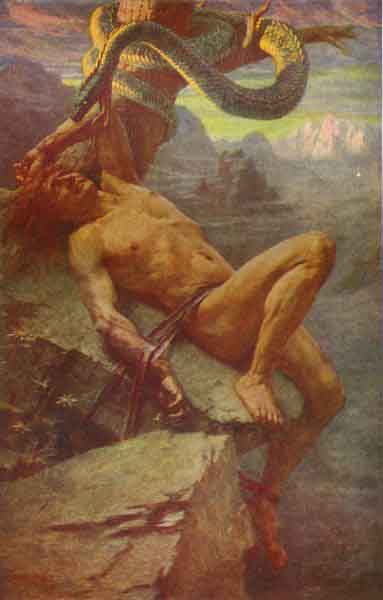
THE PUNISHMENT OF LOKE<BR> From the painting by J. Doyle Penrose, R.H.A., By permission of the artist.
Click to enlarge
THE PUNISHMENT OF LOKE
From the painting by J. Doyle Penrose, R.H.A., By permission of the artist.

Title Page Colophon
Click to enlarge
Title Page Colophon

Scanned at sacred-texts.com, October 2003. J. B. Hare, redactor. This text is in the public domain. These files may be used for any non-commercial purpose, provided this notice of attribution is left intact.

PREFACE

This volume deals with the myths and legends of the Teutonic peoples--Norsemen, Goths, Vandals, Burgundians, Franks, Angles, Saxons, and all the other Germanic tribes whose descendants now occupy England, Northern France, Switzerland, Belgium, Holland, Germany, Denmark, Sweden, Norway and Iceland. The volume might have been called Northern European Myth and Legend. It is the body of folk tales, epics and religious beliefs which all Anglo-Saxons have inherited directly from their ancestors, and find most deeply embedded in every-day words and thoughts such as names for the days of the week, names recalling the gods and goddesses of our forefathers.

In France and Switzerland--after the Roman conquest--the folk lays were influenced by the higher and milder civilization which prevailed. Where the Roman influence extended the tribal songs were welded into detailed narratives, and each had for a central figure a popular hero like Dietrich of Bern.

A similar process subsequently prevailed in the north. Thus originated the "saga cycles," distributed over a wide area by wandering minstrels, who altered and adapted them to meet the requirements of time and locality. The highest literary development occurred when educated poets made still freer use of the subject matter of tribal lays and produced epic narratives which were not sung, but recited before cultured audiences. These were later revised and committed to manuscripts for reading. To this class belong two of outstanding merit--the German Nibelungenliedand the distinctive Anglo-Saxon Beowulf.

In the following pages our readers are afforded a comprehensive survey of the divine and heroic literature of Northern Europe. The drama of Norse myth has been reconstructed, so far as possible, in continuous narrative form, with the inclusion of the old Svipdag myth, which exercised so marked an influence on Middle Age romance. We have grouped together the various adventurous journeys made by heroes to Hela, so that our readers may be familiarized with our ancestors' conceptions of the Other World. The prose renderings of heroic narratives include the Beowulf epic, the Balder-Hother romance, the Hamlet legend, the saga of the Volsungs, and the less familiar Dietrich legends, in which the deeds of the primitive Thor are attached to the memory of the Gothic Emperor of Rome.

The folk tales and folk beliefs of Northern Europe have not a few points of contact with those of Scotland, Wales, Ireland and Brittany. We have therefore dealt in our Introduction with the archaic giant lore of Scotland, which links with that of Cornwall, and drawn attention to the "Seven Sleepers" legends of the Highlands which have hitherto been overlooked. Some of the striking resemblances must be traced to remoter influences than those prevailing in the Viking Age. Both Celts and Teutons were blends of the same ancient races--the Alpine "broad heads" and the Northern "long heads." They had therefore a common heritage of beliefs. But Teutonic lore is mainly "father-kin" in character, while Celtic is mainly "mother-kin." The deities of the north are controlled by a Great Father and their elves by a King. The deities of the Celts are children of a Great Mother and their fairies are ruled over by a Queen.

In the Anglo-Saxon epic, Beowulf, the story regarding Grendel and his mother is of special interest in this connection because it is "mother-kin" lore of Celtic character. The inference is that the poet who gave the epic its final shape in England had a Celtic mother, or at any rate, came under the influence of Celtic ideas. Like Shakespeare, who utilized old plays, he may have re-fashioned an earlier Anglian poem, appropriated its geographical setting and infused the whole with the fire of his genius.

Teutonic Myth and Legend: Plates In Monochrome

TEUTONIC MYTH AND LEGEND

by DONALD A. MACKENZIE

An Introduction to the Eddas & Sagas, Beowulf, The Nibelungenlied, etc.

London, Gresham Publications 1912

PLATES IN MONOCHROME

ODIN From the design by Sir E. Burne-Jones

ODIN From the statue by B. E. Fogelberg

THOR AND THE GIANTS From the painting by M. E. Winge

A VALKYRIE From the sculpture by Sinding

FREYJA From the painting by N. J. O. Blomm

FREY From the design by Sir E. Burne-Jones

THOR From the statue by B. E. Fogelberg

LOKE AND HODUR From the sculpture by C. G. Qvarnstr

LOKE AT ER'S FEAST From the painting by Constantin Hansen

THE DUSK OF THE GODS From the painting by P. N. Arbo

VIKING SHIP FROM GOKSTAD Now in the University, Christiania

VIKING RELICS

VIKING ORNAMENTS

ENTRANCE TO PASSAGE-GRAVE AT UBY, DENMARK

RORIK From the painting by H. W. Koekkoek

"AND ALL THAT PRESS DID ROUND ABOUT HER SWELL" After the drawing by Walter Crane

WOOD PORTALS FROM A CHURCH AT HILLESTAD, NORWAY Carved with scenes from the Volsung Saga

SIGURD THE DRAGON SLAYER From the painting by E. Nielsen

BRYNHILD From the statue by Bissen

KRAKE From the painting by M. E. Winge

THE NIBELUNGENLIED From the fresco by Professor E. Ille

SIEGFRIED From the painting by F. Leeke

KING GUNTHER WELCOMES SIEGFRIED From the painting by Schnorr von Carolsfeld

SIEGFRIED AND KRIEMHILD From the painting by Schnorr von Carolsfeld

BRUNHILD'S ARRIVAL AT WORMS From the painting by Schnorr von Carolsfeld

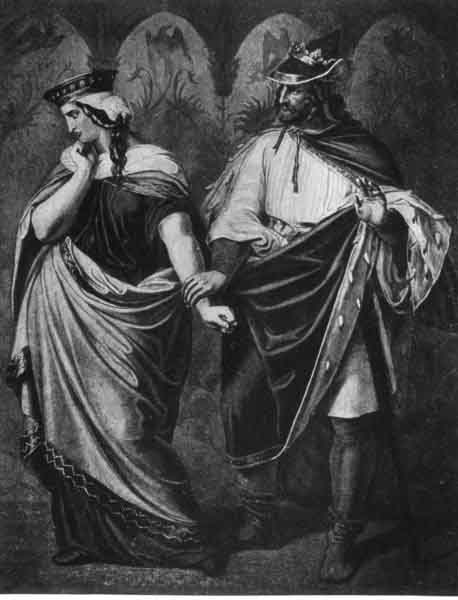
KING GUNTHER AND BRUNHILD From the painting by Schnorr von Carolsfeld

THE DEATH OF SIEGFRIED From the painting by F. Leeke

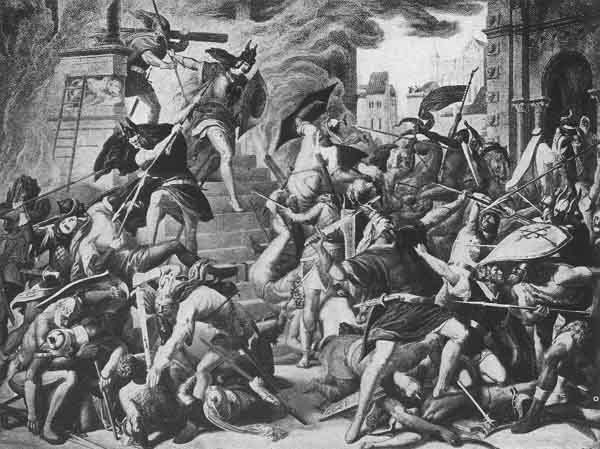
THE FIGHT ON THE STAIRS OF ETZEL'S PALACE From the painting by Schnorr von Carolsfeld

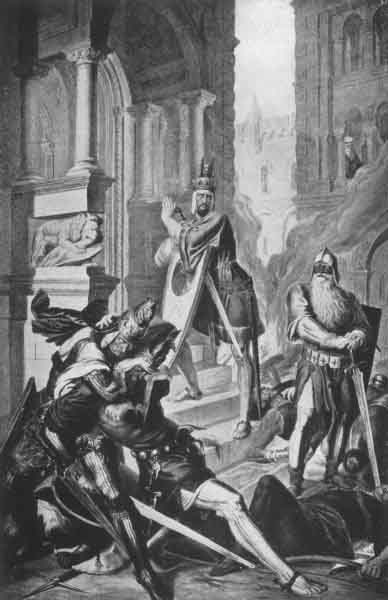
DIETRICH OVERCOMES HAGEN From the painting by Schnorr von Carolsfeld

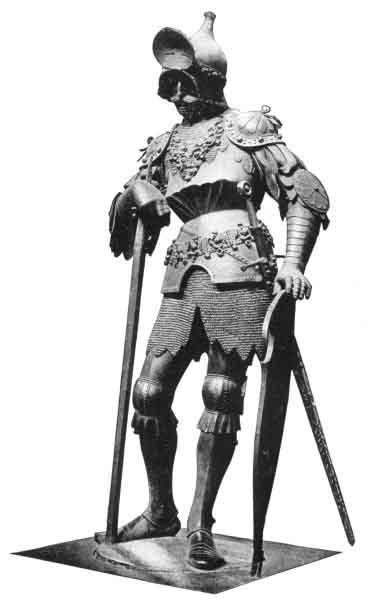
DIETRICH From the statue in the Church of the Franciscans at Innsbruck

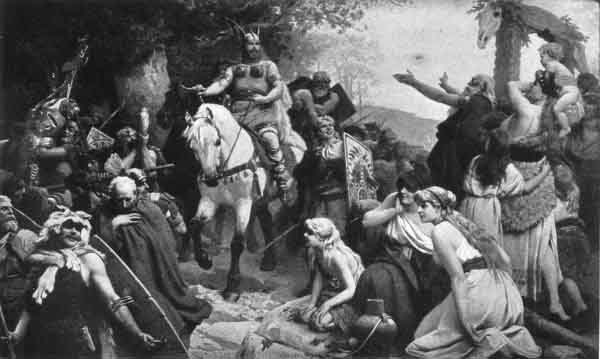
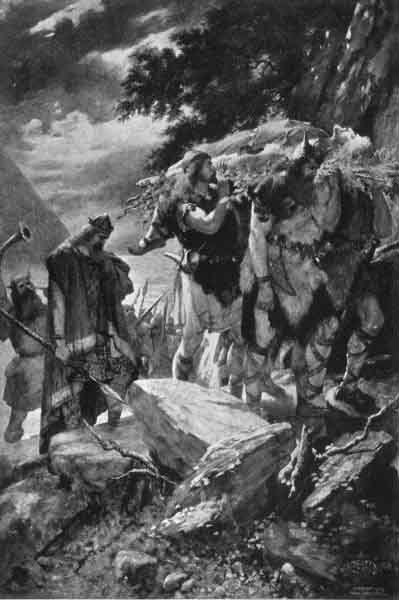
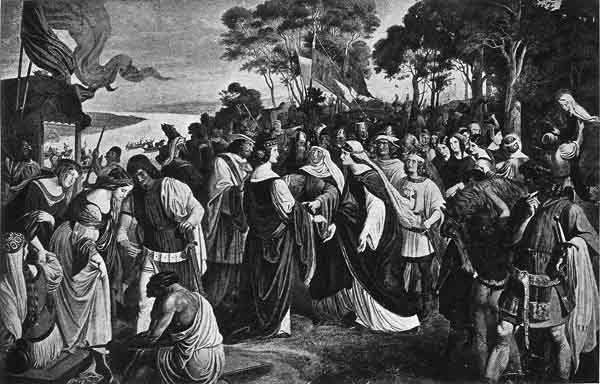
RETURN OF VICTORIOUS TEUTONS From the painting by P. Thumann

Teutonic Myth and Legend: Introduction

TEUTONIC MYTH AND LEGEND

by DONALD A. MACKENZIE

An Introduction to the Eddas & Sagas, Beowulf, The Nibelungenlied, etc.

London, Gresham Publications 1912

INTRODUCTION

"Teutonic Myth and Legend" applies to the ancient religious conceptions and traditional tales of the "non-Celtic" northern peoples, whom Continental scholars prefer to call "Germanic" in the widest sense of the term. The myths varied in different districts and at different periods. It is doubtful if there ever was in any particular age complete uniformity of religious belief over a wide area of separated States. In fact, there are indications that sects and creeds were at least as numerous among Teutonic peoples in early times as at the present day. Stories repeated orally were also subject to change; they were influenced by popular taste, and rendered more effective by the introduction of local colouring.

Teutonic Mythology survives in its most concrete form in Scandinavian literature. On that account it has to be considered from the northern point of view, although much of it is clearly not of northern origin. Our principal sources of knowledge of this great Pagan religious system are the two Eddas of Iceland.

These Eddas are collections of mythical and heroic poems and stories. One is called the Elder or Poetic Edda; the other, Snorri's or the Prose Edda. The latter was discovered first; it came into the possession of appreciative scholars in the seventeenth century, by whom it was studied and carefully preserved.

The Prose Edda is a synopsis of Northern Mythology, with poetic quotations from lost poems and references to an earlier work. It was partly written and partly compiled by the great Icelandic scholar, Snorri Sturlason. He was born some time between 1179 and 1181, and was the son of a chief. Adopted by the learned Jon Loptsson, grandson of Saemund the Wise, he passed his early years at Oddi, where his literary tendencies were fostered and cultivated. He married a wealthy heiress, and settled in 1206 at Reykjaholt, where he lived in comparative luxury. Nominally a Christian, he was in reality an educated Pagan. He was a poet and historian, a lawyer and a politician; he combined great ambition with want of courage, and avarice with "aversion from effort"; he was also of loose morals. In 1215 he became President of Iceland, and afterwards resided for a time in Norway, where he was a Court poet. In 1222 he was again President of his native island. He held office for about ten years, and exercised his influence at every opportunity to enrich himself. He obtained a divorce from his wife, after living with her for twenty-five years, and married an heiress. It is not surprising, therefore, to find him involved in serious quarrels with his kinsmen. There were also political complications which had a tragic sequel. He was murdered by his son-in-law in 1241, at the instigation of the King of Norway.

In addition to the Prose Edda, Snorri's works included Heimskringla, or Sagas of Norse Kings, which opens with Ynglinga Saga, and the History of Olaf.

The discovery of Snorri's Edda in the seventeenth century caused a search to be made for the older collection to which it referred. Happily the quest was fruitful, and the lost manuscript came into the hands of an Icelandic bishop, who called it for the first time the "Edda of Saemund".

Saemund was a scion of the royal house of Norway, who was born in 1056 and died in 1133. He studied in France and Germany, and was afterwards parish priest of Oddi in Iceland. According to tradition, he was the author of a prose work on mythology which unfortunately perished. It is probable, however, that Snorri was acquainted with the lost manuscript while resident at Oddi, and he may have used it when compiling the Prose Edda. At any rate, scholars are now agreed that Saemund was neither the author nor compiler of the particular Edda which was long associated with his name.

The Elder Edda is a collection of mythical and heroic poems--lays of the gods and lays of the Volsung and other heroes--by various unknown authors. They are valuable treasures of antiquity, for they throw great light on northern beliefs and manners and customs. Some survive in fragments; others are fairly complete, and are introduced by brief prose summaries. A portion of them were evidently of pre-Christian origin.

As literary productions they are of unequal merit. They are all ear-poems, composed to be sung or recited, and therefore melodious, musically vowelled, and clear, as compared with the eye-poems of many modern authors, which have more harmony than melody, and are composed for the reader. A particular group of these Eddic poems are more dramatic and imaginative than the others, and certain critics are inclined to hold that their high development was caused by Celtic influence. Iceland was peopled not only from Norway, but also from the Hebrides, where the Vikings mingled with the people and married the island maidens. Many settlers were also of mixed Irish descent. Nor was the old English element absent, as certain borrowed words show clearly. But, when these facts are given adequate consideration, it must be borne in mind that literature, and especially poetry, owes usually more to the individual than to the race. If we knew as little of Keats as we do of the author of Beowulf, it might be held that he was a son of Greek parents who settled in England.

The survival of these Pagan Eddic poems in Christian times is suggestive of the slow extinction of old beliefs. Christianity was adopted in Iceland in 1000, a century after it had spread throughout Norway, and two hundred years before the people of Sweden can be said to have abandoned their ancient religion. It must not be inferred, however, that the Icelanders were exemplary Christians in Saemund's day or even in Snorri's. The bulk of them were, no doubt, half-Pagan, like those Ross-shire Highlanders in the vicinity of Loch Maree, who, as late as the seventeenth century, offered up sacrifices of bulls and performed other heathenish rites, to the horror of the Presbytery of Dingwall. The Icelanders must have clung, long after the introduction of Christianity, to the Pagan beliefs and practices of the great sea kings. They continued, we know, to chant the lays and recite the old traditional tales about the gods and ocean heroes of the mother country. The collectors may, indeed, have had more than a literary appreciation of oral song and haunting tradition.

When Snorri was a boy, a Danish priest named Saxo was engaged writing a history of his native land. The first nine books are like the Histories of the Kings of Britainby Geoffrey of Monmouth, for they are founded on the traditional poems and tales of the time. Saxo Grammaticus ("the Lettered") writes of Odin and the other gods as if they were men, and when he refers to them as "gods" he takes occasion to scorn the hollowness of the claim, rarely failing to comment on the absurdity of the beliefs entertained by ignorant people. His history is a quarry of folklore and romance. To it we owe our Shakespeare's Hamlet, for the story which is retold in these pages from the Danish priest's immortal work, was the original source of our great poet's inspiration.

This "history" is indispensable to students of Scandinavian religion. Rydberg, the poet and folklorist of Sweden, is the author of a monumental work on Teutonic Mythology,1 in which he made exhaustive and critical examination of the tales embedded in Saxo's works, showing their relation to the Eddas and Sagas and existing oral poems of the north, and making masterly endeavour by their aid to reconstruct the great mythological drama of the northern peoples. He has not escaped criticism, but his reputation has withstood much of it. On every point he has raised he cannot be regarded as conclusive, but no scholar before or since has shown greater aptitude for restoring form from mythological chaos. His intimate knowledge of his native lore gave him special equipment for his work. Not infrequently scholars, by a process of detached reasoning, miss the mark when dealing with folklore, because their early years, unlike Rydberg's, were not passed in its strange atmosphere. The theorist is never as reliable as he who was aforetime a faithful believer in giants and elves, spirit voices and awesome omens.

"No one," wrote Frederick York Powell, 2 "has commented upon Saxo's mythology with such brilliancy, such minute consideration, and such success as the Swedish scholar, Victor Rydberg. . . . Sometimes he stumbles badly, but he has placed the whole subject on a fresh footing, and much that is to follow will be drawn from his Teutonic Mythology."

To Rydberg the writer owns his indebtedness in the present work, a portion of which is constructed according to his conclusions.

Edda is a word of uncertain origin. In a twelfth-century poem it is used to mean "great grandmother", and it is suggested that late sceptical compilers applied it to signify "old wives' tales". The theory has a somewhat modern note, for in legends, especially those of Scotland, the "old wife" is either feared or respected. The Hag, who is the terrible mother of giants, is called Cailleach Mor, "the big old wife", and the wise witch who imparts secrets and powers to men is simply "old wife".

Edda became associated in Iceland with the technical rules of verse. "Never to have seen Edda" signified a complete ignorance of poetic art, so it may be that among a mingled people the "great grandmother" was an imported Muse of a Matriarchal tribe. Saga, we know, was individualized as a maiden, and was wooed by Odin. A recent theory 3 is that Edda is derived from "Oddi", the place where Saemund preached and Snorri studied.

The Eddas are, of course, the collected folk-songs and folk-tales of the northern peoples. In addition we have also available, for purposes of study, other old manuscripts and a considerable mass of valuable lore gleaned in recent years from oral sources, as well as the renowned surviving Sagas and minor poems of the skalds (song-smiths), which abound with mythological references.

Some folk-tales are fragments of forgotten mythologies; others are part of the floating material from which mythologies were made. The two classes should therefore be studied together for purposes of elucidation, while consideration must ever be given to folk-customs which also enshrine ancient religious beliefs. The gods evolved from beliefs, and these loomed vast and vague on man's mental horizon ere they were given definite and symbolic expression. Indeed, detached stories of gods, especially Nature-gods, must have existed for indefinite periods ere they were subjected to a unifying process and embraced in a complete philosophy of life. A Mythology, therefore, must not be regarded as a spontaneous creation of a particular Age, but rather as a growth which had of necessity a history like, for instance, the Art of a finely sculptured stone, or that of the shapely and decorated Celtic bronze shield found embedded in Thames mud.

Matthew Arnold regarded poetry as a "criticism of life". That definition may, in a restricted sense, be applied to a Mythology, especially one of highly developed and complicated construction. We can conclude that it evolved from a school of thought which made critical selection of existing material when the work was undertaken of systematizing religious beliefs to suit the needs of a particular Age. As religion and law had in ancient times most intimate association, an official religion was ever a necessity in a well-organized State, and especially in one composed of mingled peoples. A Mythology, therefore, was probably the product of a national movement, and closely connected with the process of adjusting laws and uniting tribes under a central government. In the union and classification of gods we have suggested the union of peoples and the probable political relations of one tribe with another. No deity could be overlooked, if the interests of all sections were to be embraced, because the destinies of each were controlled by a particular god or group of gods of immemorial import. The gods of subject peoples would, of course, become subject to those of their rulers.

A Mythology was therefore not only a criticism; it was also a compromise. The lesser gods were accepted by those who imposed the greater, and new tales had to be invented to adjust their relationships one to another. Contradictory elements were thus introduced. The gods differed greatly. Some had evolved from natural phenomena; others were deified heroes. A seaside tribe showed reverence to gods which had origin in their own particular experiences and ideals, which differed to a marked degree from those, for instance, of an inland, forest-dwelling people. Settled communities and nomadic peoples professed beliefs in accordance with their particular modes of life. Between the various classes of a single social organization, even, there would exist religious conceptions which were fundamentally opposed. Invaders who formed a military aristocracy would import and perpetuate their own particular beliefs and rites, while those of the conquered people continued as aforetime. Indeed, archlogical remains demonstrate to the full that different burial customs were practised simultaneously in the same district, although each had origin in religious conceptions of divergent character. Two examples may be cited--(1) the crouched burial with food vessel, associated with the belief that the spirits of the dead haunted the place of interment and had to be propitiated, and (2) the cremation burial which ensured that the spirit, like that of Patroklos, would never again return from Hades when it had received its meed of fire (Iliadxxiii. 75). In our northern tales there are evidences of various burial customs. Balder is cremated in Asgard, but he is interred in a barrow in the heroic story from Saxo. Beowulf and Sigurd are burned, Helgi is given sepulture in a mound, and Sigmund and his son are enclosed in a chambered grave when buried alive.

But while peoples who were mingled together practised different religious rites, invaders ever showed reverence, as did the Romans, to local gods and local beliefs. In the process of time one section would be influenced by the other. A fusion of religions would result from a fusion of peoples, but every district and every community would not be similarly affected. The clash of ideas would also be productive of speculative thought, and each Age would contribute something new from its accumulated ideas and experiences. Yet in the midst of the mass of floating lore there would ever survive beliefs of remote conception, for a folk-religion is conservative in essence. A people's inherited superstitions are not readily eradicated. The past endures in the present. Even in our own day folk-beliefs and folk-customs of Pagan origin have tardy survival after many long centuries of Christian influence.

When, therefore, the thinkers and teachers of Scandinavia framed their great Mythological system, they had to select and compromise; they were not only critics but diplomatists as well. New tales had to be invented, and old tales adjusted, to instruct and convert and unite all sections. Social relationships were given a religious bearing; the gods of the common people were shown to be subject to those of their rulers. All outstanding popular beliefs had to be accounted for, with the result that heroic tales were mingled with Nature myths, and the whole was infused with ethical and political purpose. The Mythology was thus coloured by the thought of the times and the conditions and character of the people, while it was given, of course, appropriate setting amidst local scenery.

Northern Teutonic Mythology must have had gradual growth. It appears to have attained its highest development in the Viking Age, when a united and masterful people, stirred, no doubt by well-organized political conditions, to a great awakening, spread far and wide to impose their rule and their culture upon alien peoples. When earlier migrations took place, amidst the battle storms of violent tribal fusion, the new religious system was in process of formation. The Angles and Saxons, for instance, were not greatly influenced by the Odin cult when they reached these island shores. Their deified tribal heroes were still predominant. That has been made abundantly clear by Stopford Brooke in his masterly study, History of Early English Literature.

So far as we are able to reconstruct the Mythology--nor can we expect complete agreement among the experts in this regard--it appears to have been highly developed and adjusted to the minutest detail. The official religion, of course, may not have been accepted in its completeness by all classes; sections may have still clung to favoured deities, while they recognized others unknown to their ancestors. Odin, we know, was esteemed more highly by scholarly skalds than by fighting men, who continued to exalt and worship Thor as chief or most influential god, and to repose their trust in the magical influence exercised in battle by the shadowy but ancient war-god Tyr. No doubt the teachers remained the while serenely confident that ultimately the spirit-god would be held in greater regard by thinking men than gods of physical might. But the growth of this great Pagan mythology was arrested by the gradual advance of Christianity, and it is given popular reconstruction in these pages as it possibly existed, especially ill the north, when the influence of the new and greater religion coloured the Balder story, and the idea was interpolated of a greater All-father than Odin. The Saxo stories are drawn upon to fill gaps, although gaps may have ever existed. We may add that we call the Mythology Northern Teutonic in preference to "Germanic", because of its geographical setting, and for the pregnant reason that it has survived mainly in the form given to it by the mingled peoples of the North.

The local character of this particular mythological system is strongly emphasized in "the story of creation". Only a Northern people living in close proximity to Arctic ice-fields could have conceived of a chaos-gulf bounded on the north by a cold and darksome Nifelheim, and on the south by a warm and bright Muspelheim. Life begins to be when and where the ice-blocks are thawed. The gods and their doings are also coloured by their Scandinavian environment. "Light -battles" and fierce Nature-wars are emphasized in a land of pronounced seasonal changes. No matter whence certain deities; were imported, here in the land of long winter nights they are acclimatized and naturalized. They contend against indigenous frost-giants; they fight and then become the allies of indigenous Vana-gods; they visit a sea-folk's terrible storm-god er in his hall at the sea bottom; they acquire northern temperaments and become fatalists like all seafarers, ancient and modern.

Teutonic gloom overspreads Teutonic Mythology. Odin and his Asa clan live ever under the shadow of Ragnarok, "The Dusk of the gods". This gloom hangs heavily as northern storm-clouds over early "Teutonic" literature. It haunts the Eddas and Sagas; it permeates Anglo-Saxon poetry. Dr. Clark Hall says of Beowulf, "There is undoubtedly less colour about the second part than the first, and more gloom. The habit of foreboding which is noticeable in Part I is so prominent in Part II as to give a general tone of fatalistic hopelessness to it. Sunshine and shadow no longer alternate shadow is over all." The same comment might be applied with equal force to the Nibelungenlied. Although "gloomy" and "Celtic" have become synonymous terms of late years, yet Celtic (Irish) Mythology and old Gaelic literature both in Scotland and in Ireland strike, in comparison with what is termed Teutonic, a brighter and more cheerful note. It may be that the gloom is aboriginal--pre-Celtic and pre-Teutonic--a shadow of primitive but persistent mental habits.

In Teutonic Mythology, as in Greek, there are evidences of remote race-memories. The Asiatic "broad-heads" who crossed Europe in "waves", which began to arrive in the vast periods of the late Stone Age, must have imported not only new customs and new weapons, but also fragments of immemorial myths. Superstitions survive longer than stone monuments, and they pass through language to language, and from land to land, with the buoyancy of American timber which drifts across the Atlantic to Hebridean shores. An instance may be noted in the northern "Story of Creation". The body of Ymer, the chaos-giant, is cut to pieces; his flesh and bones become soil and rocks; his skull is the sky dome; his progeny is engulfed in his blood, which is the sea. Babylonian tablets relate a similar story. In the beginning Bel-Merodach slew the chaos-giantess Tiawath; he cut up her body, and with one part he framed the earth and with the other the heavens. Her blood was forced to flow southward by a strong north wind--it became the river which filled the sea.

Comparisons may also be drawn between Teutonic and Greek Mythologies. But these will be found to be of slighter character. Those elements, common to both, which are not Asiatic may be of early Mediterranean origin, for as ancient cities lie below ancient cities) so do ancient mythologies rest upon the wrecks of others of still greater antiquity. As Jubainville has shown in Le Cycle Mythologique Irlandais et la Mythologie Celtique, Greek and Celtic are closely related and mainly of common origin. They are children of one mother; but Scandinavian Mythology cannot be regarded as other than a distant relation.

In all three Mythologies there is a central Nature-myth tragedy. In Greek it is the slaying of Night by Dawn. Hermes, surnamed Argeiphontes, in his character as Dawn-god, slays Argus, the many-eyed, who is Night, with a round stone, which is the Sun. In Celtic (Irish) Mythology the Dawn-god, Lugh, kills Balor of the Evil-eye, who is Night, with the same round sun-stone. The myth also applies to the slaying of Winter by Summer and of Evil by Good. The tragedy of Scandinavian Mythology, on the other hand, is the slaying of Day (or Summer) by Night (or Winter). Blind Hoder shoots Balder (in his Edda character as Summer Sun-god) with the wintry mistletoe-arrow. He is prompted by Loke, the Scandinavian Mephistopheles, who plots to hasten the downfall of the gods. Light is thus overcome by Darkness, Summer by Winter, and Good by Evil.

Another broad and fundamental contrast is afforded by the conceptions of Night in the Northern and other European Mythologies. Instead of the tyrannical Balor of Ireland, or the monstrous Argus of Greece, we have the beneficent northern Night-goddess Nat, daughter of Mimer (Wisdom) and sister of Urd (Fate). She brings to mankind refreshment and inspiration. Her lover is Delling, the red elf of dawn, and their son is Dag (Day).

Nat is evidently of eastern origin. In the Rig-veda the goddess of night (dark daughter of day) is, like Nat, both noble of aspect and character; she "increases riches". In the tenth Mandala she is thus addressed:--

Kind goddess, be propitious to thy servants
Who at thy coming straightway seek repose.
. . . . . .
Drive thou away from us, O Night, the wolf,
Drive thou away the thief, and bear us safely
Across thy borders. . . .

In Teutonic Mythology, Evil is not necessarily associated with Darkness. The tempter and plotter is handsome Loke in his character as a fire-god; he is evidently an ally of Surtur, who burns up the world at Ragnarok. Loke is corrupted by the Hag of Ironwood, the "Mother of Evil", whose evil progeny includes the fierce wolves--one of which swallows the moon, while the other devours Odin--the great Midgard Serpent, and the repulsive, torture-loving Hel. Her Babylonian counterpart is Tiawath, among whose offspring are immense serpents, fiery dragons, raging hounds, fish-men, &c. The Northern Hag's husband, Gymer, is keeper of her flock, as is also the husband, Kingu, of Tiawath's.

The World, according to northern belief, is supported by a great tree which is ever green. This conception is not peculiar to Scandinavia, but nowhere else is an ash-tree similarly exalted in dignity. At its roots are three wells, and in one is a gnawing dragon or serpent. The gods dwell under its branches; they sit in judgment upon the dead beneath the ash in the Underworld. It trembles when Ragnarok is at hand; it is the oracle. Evidently the worship of trees and wells was so prevalent in the north, that no more popular idea could be conceived than that of a tree-supported universe. Even in our own day the superstitious reverence shown for "wishing-wells" is not uncommon, and the trees connected with them still flutter with prayer-rags. In Celtic Mythology, Dagda, the oak-god, has for wife Boann, the River Boyne. The well at the river source is one of the many celebrated in dragon-myth story. Finn Magnusen would have us regard "the world-tree" as the symbol of universal nature, but it was more probably a concession to popular belief, and dignified to accord with the general mythological scheme.

Odin would appear to have been originally an isolated tribal god--a deified martial chief, who became associated with a Nature Myth. He is a war-god and a magician; he controls battles and is the inventor of runes; he hangs on the world-ash, which bears one of his names, "Ygg's gallows" (Ygdrasil), as if he were, as he probably was, a king who was sacrificed. Yet his universal character is emphasized by his sky-dome hat and sky cloak flecked with cloud-spots. He is a one-eyed giant, a Cyclops; his lost eye sinks in Mimer's well as the sun sinks in the sea. He is also the wind-god--the Wild Huntsman in the Raging Host. As wind-god he is the "spirit-god" in accordance with the widespread association of "wind" and "breath" and "soul" (spirit, for in stance, is derived from spiro, I breathe). He gives "soul" to the logs of ash and alder which become the first man and the first woman. He is All-father, the framer of the world. Odin was probably exalted, because he was the spirit-god, by the wise men of Scandinavia, and made chief ruler in their Asgard, but his connection with the other gods is slight and arbitrary. Thor, his son, was originally an oak-god, and, like Jupiter, is wielder of the thunderbolt. It is, however, in keeping with the sublime character of Northern Teutonic Mythology that the "spirit-god" should be supreme, and the constant friend of his kinsman Mimer (Wisdom), whose daughter is Urd (Fate).

The giant stories were constructed on a lower plane of thought. A single exception is Thor's adventure in the palace of Utgard-Loki, where he wrestles in vain with the Hag, who is Old Age, and endeavours to drink up the ocean. The mythical interpretations of the others cannot be pressed too closely, lest more be read into them than was ever intended. It is evident that the reciter's imagination was allowed to run riot, and that the narratives assumed their extended form as popular wonder-tales.

When the tribal heroes of northern peoples were glorified by story-tellers, they were invariably depicted as giant-killers. In the half-mythical history of Geoffrey of Monmouth, Corineus contended successfully against the giants of Cornwall--he slew them in dozens--and after wrestling with the greatest, Goemagot, he cast him over a cliff. Siegfried, in the Nibelungenlied, and Dietrich, in his Thunor (Thor) character, are also slayers of giants. In Highland giant-lore there are several similar heroes who, like Thor, are friends of the agricultural people. The hunting-folks had their own hunting-giants, like the Highland Finn and his warrior band, who are not militiamen as in Ireland.

It has been remarked that the Northern Teutonic frost-giants are indigenous. But there is another class of giants who are as widely scattered as the drinking-cup urns of the ancient and mysterious people that settled in the fertile districts of these islands and of Scandinavia, and have been traced through mid-Europe. These are the Mountain -giants. In the neglected archaic lore of Scotland they are called Fomors 4 , but they are not the Fomors of Ireland, nor have they a necessary connection with the sea or with darkness. As river-goddesses in flight are personifications of rivers, so do these Fomors personify the hills they inhabit. Scottish mountain-giants never leave their mountains. They fight continuously one against the other, tossing boulders over wide valleys or arms of the sea. To each is allowed one throw daily: A flings his boulder against B on Monday; B retaliates on Tuesday, and so on. The Holmgang duel would therefore appear to be of hallowed antiquity. These giants sleep at night and share men's terrors in darkness. Three friendly Inverness giants throw from one to the other, each morning, a stone hammer to signify that all is well. Greater than the males are their mothers, the Hags 5 , who also fight with boulders, but have power to change their shapes. There are also Thunder-cloud hags who throw fireballs, tempest-hags, firebrand-hags, sea-hags, &c. They invariably wrestle with human beings like the giants of Cornwall.

Another class of Scottish giants inhabit caves, and some of them are many-headed. They hoard and guard treasure. Heroes who fight against them are invariably assisted by dogs (dogs "which have their day"), and they are instructed by indispensable wise women 6 who possess magic wands. What appears to be the oldest Thor story belongs to this class. When Thor sets out to visit Geirrod he has neither hammer nor belt of strength. The Hag Grid, like the Scottish "wise-woman", warns and instructs him, and gives him her belt and magic wand. In this story Thor flings a boulder and breaks the back of a giantess. He may have wielded thunder-boulders ere his iron hammer was invented.

Scottish giants, therefore, are more like the Scandinavian than the Irish variety. If it is held that they were imported by the Vikings, it might be asked why Thor was forgotten, and why the Asa-gods and the Vans were left behind? If they are classed as Irish, it should be noted that the Danann gods, who overcame the Fomors in Erin, are not found in Scotland. Call it be maintained that the Irish brought over their "gods of Night" and left behind their "gods of Day"? In Wales and Cornwall there are also giants of the Scottish type. Geoffrey of Monmouth, in fact, tells us that giants were the sole inhabitants of ancient Britain when Brute and the first men arrived.

Beyond the realms of Gaul, beneath the sunset
Lieth an island, girt about by ocean,
Guarded by ocean--erst the haunt of giants. 7
S. Evans's Trans.

It would appear that archaic giant-lore is pre-Celtic and pre-Teutonic, and therefore a common inheritance. In the wars of the Olympians and Titans, of the Irish Danann gods and the Fomors, and of the Asa-gods and the Jotuns, we may have echoes of ancient racial conflicts. The old tribal peoples attributed their successes to their gods, and remembered their battles as the battles of rival gods. For these giants are also gods of archaic conception. In Scotland certain of them are associated with the fortunes of families and tribes. On the other hand, gods are but exalted giants; the boisterous Olympians find their counterpart in the boisterous Scandinavian Jotuns rather than in the more refined Asa-gods and Vans.

With these giants are associated the elves. In Teutonic lore, which is not necessarily wholly of Teutonic origin, the male elves predominate. In Scotland, as in Greece, elves are mainly females, who are ruled over by a queen. There are also Scottish fairy-smiths, but they are one-eyed and Cyclopean, and not always distinguishable from giants. In fact, the Fian-giants are confused with fairies in ail Inverness mound, and Thomas the Rhymer is added in the character of one of the "Seven Sleepers". Danann gods and fairies are similarly mingled in Ireland. It should be noted in this connection that Teutonic elf-smiths are allies of the giants, and they are sometimes stronger than them. When Siegfried overcame the giant doorkeeper of Nibelung, he found that the dwarf was a still more powerful opponent. Thor is friendly with the elves, but Svipdag, son of Egil, the elf, destroys the thunder-god's hammer with the "Sword of Victory".

The other class of elves--the "Light-elves"--are vaguely defined in Northern Teutonic Mythology. Frey was their ruler in his youth, which suggests that he is himself an elf exalted to a god. The wise Vans are also elfin in character, and were probably the spirit-folk of ail early seafaring people. The story of the unhappy marriage of Njord and Skade may contain a germ of historic fact-the uncongenial association of a tribe of seafarers with a tribe of huntsmen.

The female elves of the commoner type become valkyries; they are also swan-maidens who have tragic liaisons with mankind. Brynhild is a swan-maiden and a valkyrie; she is also in the Nibelungenlied a boulder throwing hag. The Balder story, regarding which much has been written, is not, therefore, the only one that underwent radical changes in the process of Mythology-making. According to Professor Frazer in the Golden Bough, Balder was originally a tree-god whose soul was in the mistletoe. The theory is as weighty as is the reputation of that Darwin of folklore.

But perhaps the most interesting class of elves are the sons of Ivalde--Volund and his brothers. They display the attributes now of dwarfs, now of giants, and anon of star deities. It would appear that they absorbed more than one ancient personality in an older Mythology than that in which the Odin cult predominates. Rydberg shows that Volund (Wieland) and the giant Thjasse are indistinguishable. A close study of northern folklore supports that view, and an intimate acquaintance with the mental habits of fairy-and-giant-believing people assists one to appreciate it fully. Thjasse is the only giant who is winged like Volund, as Loke and Freyja are the only members of the Asa-clan who can assume bird guise. Thjasse and Volund are also symbolized as mountain wolves; they are both star deities; they are more like one another than the two Balders, and appear to be products of the same ancient welded lore of an earlier mythological system.

In the Northern "Story of Creation" these elves, or black dwarfs, are, it is evident, intentionally belittled. They have their origin, like maggots, in Ymer's flesh. Yet they provide the gods with indispensable gifts--Odin with his spear, Thor with his hammer, and Frey with his boar and wondrous ship. In Thjasse's flight to Asgard we may have a story invented purposely to account for his fall, because, like Odin, he is a spirit-god. His other names, Byrr and Gustr, signify wind and gale. It is not possible now to reconstruct what appears to be a pre-Odin-cult Mythology, in which Ivalde and his sons predominate. The "Milky Way" is "Irmin's Way", and Irmin, invoked by old Hildebrand in the Dietrich story, is "the ruling god It is also Bil's way (Bil is Ivalde's daughter), and as "Bil-rost", according to Rydberg, is the original of Bif-rost. The Anglo-Saxons called the "Milky Way" "Watling Street". 8

Volund's brother Egil, the archer, is associated with the clouds and the sea. Sleet and rain are his arrows; his arrows are also "herrings that leap from the hands of Egil", and herrings are "arrows of the sea". 9 Egil's son, the Iceland Hamlet, is the guardian of the World-Mill; his son Svipdag, with shining sword, resembles a light-hero.

In the older moon-myth Gevar, the Gewar of the Hother-Balder story, is the ward of the moon-ship, and it is attacked and burned by Ivalde. The myth is obscure but suggestive; it survives in fragments only. The swan-maids are wooed by Ivalde's three sons, and Ivalde and Gevar have quarrelled violently as rival lovers.

This group are hunters, skee-runners, and musicians. They are also connected with an early form of the Balder story. Svipdag, as Hotherus, is the wooer of Gevar's daughter Nanna, and Balder, his rival, falls a victim to his "magic sword" in the heroic story in Saxo. If Balder, as a tree-god, was associated with the tree-well, he may have wooed Nanna of the moon by reflecting her image. In this connection it may be noted that wells sprang up in the hoof marks of Balder's horse, and in Saxo's story he provides wells for his thirsting soldiers. His rival would thus be the light-hero Svipdag, with his shining summer sword, which was concealed for a season in the Underworld cave where lie the Seasonal "Seven Sleepers". In Northern Teutonic Mythology the popular Balder becomes the Summer Sun-god. instead of Svipdag, and the only husband of Nanna. If the original story was thus transformed by displacing or changing a hero, the process is a familiar one. The shadowy Hoder may be the original rival lover altered to fit into the new mythological system.

It is to this group of ancient tales of rival lovers and swan-maids and moon-maids that we owe the treasures of Middle Age popular romance. The Volsunga-saga and the Nibelungenlied and the Balder heroic story were developed from what Rydberg calls the "Ivalde myth". Svipdag, too, is the original of Siegfried and Sigurd. In his character as a wronged son he suggests Hamlet and Finn-mac-Coul. The latter has a hammer (Ord na Feinne) which links him with Thor, as Thor links with the other giant-killers-Sigurd, Siegfried, and Dietrich. A tribal hero invariably absorbs the attributes of his predecessors, and develops and changes to suit the tastes of audiences and minstrels in various ages and in various countries. In Scandinavia, when the Asa-gods were threatened by the advance of Christianity, Svipdag, as Eric, was exalted as a rival to Christ, and suffered the fate of being associated with the Devil, who was afterwards called "old Erik". Odin was similarly treated; as Nik he became "the old Nick" of Perdition. Finn-mac-Coul was also pictured by early Christian missionaries as an inhabitant of "the lower regions."

The Beowulf story is an interesting link between the heroic lore of the northern Continental peoples and that of the early Britons. Beowulf, like Dietrich, may have been a historical personage, but in the poem he is a hero of the Svipdag order, yet not necessarily a "light-hero". He slays the warrior-devouring Grendel. Dietrich, in one of the poems of his cycle, also rids the neighbourhood of Attila's court of a man-eating monster. In the next part of Beowulf, which is evidently an addition, whether by the same author or another it matters not here, the hero slays Grendel's mother. Although the poet suggests that she is less formidable than her son, she proves to be a more ferocious opponent. Only by the familiar "magic sword" can she be slain. In this respect she resembles Hilde, the wife of Grim, in the Dietrich story; but she bears a closer resemblance to the British Hag, the mother of the giants. Finn-mac-Coul, when in "The Kingdom of Big Men," had similarly, after slaying sea-giants, to contend against the terrible Sea-Hag-mother. There are several similar stories in Highland giant-lore, and no doubt they were prevalent at one time throughout Britain, especially among members or descendants of the Matriarchal tribes referred to by Car.

Stopford Brooke, in his History of Early English Literature, "wonders if the Grendel tale may not be a Celtic story which in very ancient times became Teutonic," and quotes the close Icelandic parallel, the Glam story. "It is a curious question," he says, "how it came to pass that the story of Beowulf and Grendel did not, like the other Sagas of the north, become a part of the north German cycle of romance. . . . I have sometimes thought that the Angles alone threw the myths and tales of it into lays, and that when the whole body of them emigrated to our island, they left the Continent naked of the tale. . . . I conjecture that something broke the literary connection on the Continent, or that the story was developed only when the Angles got into Britain." The latter supposition, considered in the light of existing Scottish giant-lore, which was evidently at one time general in ancient Britain, is the more convincing of the two. The theory of a complete and wholesale Anglian migration is as improbable as the theory of a complete and wholesale extermination of the early Britons, which, although still surviving, has really no reliable basis. Dr. Clark Hall, the scholarly translator and editor of Beowulf, accepts the hero as "a thoroughly historical character". So was Dietrich as the Emperor Theodoric. But while, like Stopford Brooke and other rationalistic critics, he dismisses the solar-myth theory, he errs, we think, in the opposite direction. He says: "Is it not possible that besides performing many heroic deeds in war against ordinary mortals, our hero (Beowulf) had two or three mysterious encounters with wild beasts, which grew into our Grendel and dragon stories by the process of exaggeration. . . . I have myself heard, in the nineteenth century, from the lips of an ancient mariner, a passably truthful and not very imaginative man, an amazing yarn about a sea serpent which I have no doubt had some foundation in fact." 10

To the audiences who heard the Beowulfpoem sung, Grendel was as real as the hero; and no doubt there were, in those ancient days, many similar tales which perished because no great poet enshrined them in enduring verse.

It is believed by scholars that Beowulfwas composed in the early part of the eighth century. Whether it was the work of one man or of several is a disputed point. There appears, however, to be general agreement that it is of Pagan origin, and that the Christian references are interpolations. The only surviving manuscript, which is in the handwriting of two copyists, is preserved in the British Museum. "There are clear indications," says Dr. Clark Hall, "that the poem was originally composed in the Anglian (probably Mercian) dialect, but it has come down to us in West Saxon, with some Kentish forms, in the part copied by the second scribe."

Scattered through the poem are older stories told by the minstrels, including the myths of Scyld and Hermod and the ancient Sigmund story, which found its highest artistic development in the Volsunga-saga and Nibelungenlied. Reference has already been made to the theory that certain lays of the Elder Edda show traces of British influence. Those students who desire to have fuller knowledge of the literature, mythology, and history of our mingled ancestors may examine with profit the conjectures of the various scholars, including Schwartz, Frazer, Bugge, Stopford Brooke, York Powell, Vigfusson, and others.

The Nibelungenlied, or "Lay of the Nibelung", dates in its united form from the latter part of the twelfth century, and is supposed to be, as a poem, of Austrian or Tyrolese origin; but on this point there is no generally accepted opinion. The versification is in Middle High German. There is a large number of existing old manuscripts. The three most important were made by copyists in the thirteenth century. When the oldest of these was discovered in 1755, it was published by a Swiss scholar. Other manuscripts were subsequently brought to light, but the first complete published edition did not attract much attention. In fact, Frederick the Great, to whom it was dedicated, refused to have it in his library, and said it was hardly worth a charge of powder. To-day it is the pride of the Fatherland.

It is evident that the Sigurd and Siegfried stories had a common origin in an ancient nature myth of which the Svipdag legend is an early form. The stories developed as popular stories; their mythological significance was forgotten, and, in course of time, historical personages were identified with certain of the characters. Other legends, like those of Helgi in the Norse version, and of Dietrich in the German, were also attached to the original plot. Both great Sagas were coloured by the civilizations in which they developed.

How floating myths and legends gathered round the memory of a popular hero is clearly shown in the lays of the Dietrich cycle. Dietrich Von Bern is Theoderic the Great. 11 Although he was born two years after the death of Attila, Emperor of the Huns, he is found at his Court in the Nibelungenlied. Ermenerich (Hermanric) was Emperor of the Ostrogoths, and, when an old man, his dominions were overrun by fiery and savage Huns from Asia. He is believed to have died on the battlefield, where his power was shattered (about 374 A.D.). The Ostrogoths were subject to the Huns until Attila's death in 453 A.D. King Walamer defeated them in a great battle in 454 A.D., and once again the Ostrogoths were made independent. The king's two brothers were Theudemir, father of Theoderic (Dietrich) and Widemer, and they were subsidized from Rome for protecting the frontiers of the Eastern Empire. When payment was suddenly discontinued, Illyria was successfully invaded by Widemer, with the result that the treat), was renewed. Theoderic was taken as a peace hostage to Constantinople, where he resided for ten years and received a Roman education. Theudemir succeeded his brother, and when he died, Theoderic ruled the wandering Ostrogoths.

In 480 A.D. Odoacer, a German captain of mercenaries, deposed Romulus Augustulus, the last of the Western Emperors, who was but a boy of seventeen. Eight years later Zeno, the Eastern Emperor, commissioned Theoderic to invade Italy. Odoacer was overthrown, and our Dietrich of the legends became a great and powerful king in Rome, owing nominal allegiance to the Eastern Emperor. He died in 526, and was buried in a great marble tomb at Ravenna. A fine statue of him, clad in full armour, may be seen in the church of the Franciscans at Innsbruck.

In the Dietrich story Ermenerich is confused with Odoacer, and the hero is depicted as an exile, and thus identified with his father. A mass of floating legends attached to the memory of Dietrich, including the Hildebrand story, which originated in the ancient and world-wide father-and-son conflict theme, and the myths of Thunor (Thor) the thunder-god, the slayer of giants and dwarfs. But even Thor has his human side. He may have been originally a tribal hero who was identified both with an oak-deity and the central figure of a Nature-myth. 12 He remains "the friend of man" even when elevated to Asgard. All the heroes of the minstrels of Europe link one with another as the fictional descendants of an ancient deified personage, or a humanized deity, of a remoter and simpler mythology than that in which Odin is the chief ruler.

One of the most interesting problems associated with Teutonic Mythology refers to the story of the "Seven Sleepers". Mimer's seven sons lie in magic sleep in the Underworld, awaiting the blast of the horn at Ragnarok. This horn hangs in a cave. Thorkill, who visited Geirrod's domains with King Gorm and his company, saw the suspended horn which turned into a dragon when a man seized it greedily.

Rydberg argued that the various "Seven Sleepers" legends in Europe and North Africa originated in Scandinavia, and were distributed by the northern warriors who overran Italy, Greece, Asia Minor, and Egypt. His main argument rests on one very remarkable coincidence. The "Seven Sleepers" of Ephesus were Christians who were condemned to death by the Emperor Decius. They were given time to renounce their faith, but concealed themselves in a cave, where they lay wrapped in sleep "for 360 years". 13 During the reign of Theodosius, the Roman Emperor, a shepherd entered the cave, and the sleepers were awakened. Rydberg notes that Decius fell in battle with the Goths "who a few years later invaded Asia Minor and captured Ephesus among other places".

Seven men, who were attired like Romans, lay asleep in a cave in Western Germany. An eighth-century legend relates that a man who discovered them attempted to disrobe one, and his arm withered. In the vicinity dwelt a tribe of Skritobians (Skridfinns).

In Arabia a dog lies with "the sleepers". Mahomet made them foretell his coming, and the dog, named Kratim, is one of the ten animals which will enter Paradise.

If the legend originated in Scandinavia, it is a curious fact that this dog should be found also in the Highland stories, with which Rydberg and others who have dealt with the legend were unfortunately unacquainted. The sleepers are found in Craig-a-howe, Black Isle; Ossian's Cave, Glencoe; and Smith's Rock, in Skye. In each case they are Fians (Fingalians), and beside Finn-mac-Coul lies his dog Bran. 14 In Tomnahurich, Inverness, the chief steeper is Thomas the Rhymer, who also reposes under the Eildon hills.

In the Scottish caves a horn hangs from the roof When it is blown three times, the sleepers will issue forth. A shepherd found the cave (it is always a shepherd) and blew two blasts on the horn. But he was so terrified by the ferocious appearance of the warriors and by a voice which cried, "If the horn is blown once again the world will be upset altogether", that he fled, leaving the warriors resting on their elbows. The Fians cried, "Alas! you have left us worse than you found us". The shepherd locked the door and threw the key into the sea. At Inverness there is a Gaelic saying, "When the horn is blown, True Thomas shall come forth".

If this Highland story was imported by the Norsemen, why should the Arabian dog be a "sleeper" also? It is possible that in Arabia and in the Highlands the tale is found in its most archaic form, and that it is part of the floating material from which Teutonic Mythology was constructed. 15

What appears to be a very old version of the legend is found in South Uist. It was taken down from a minister thirty years ago by an Inspector of Schools, who related it to the writer as follows:--

The Fians (Fnne) were lying in a cave, each resting on his elbow, chin upon hand, self-absorbed, not asleep.

They heard the falling waters, and the storms went over them unheeded. . . . Thousands of years went past.

They were still resting there, musing, when one of them moved his elbow and said:--

"Och! och! 's mi tha sgith." (Och! och! it's me that's tired.)

Thousands of years went past. . . . They heard the falling waters, and the storms went over them unheeded.

Then a great Fian said sharply, "Mur a' sguir sibh dhe 'n chonnspoid seo, theid mi mach 's fagaidh mi an uaimh agaibh fhein." (If you do not stop this wrangling I'll go out, and leave the cave to yourselves.)

Thousands of years went past. . . . They heard the falling waters, and the storms went over them unheeded.

In various legends the movements of the "sleepers" (who do not sleep in Uist) were associated with sorrow and disaster or seasonal changes. Edward the Confessor had a vision, while sitting at a banquet in his palace at Westminster, in which he saw the Ephesian sleepers turning round. A messenger was sent to Ephesus, and it was found that they had turned from their right sides to their left. This was taken as a sign of approaching disaster, and was, in fact, associated with the miseries that Christendom endured from the Saracens. The seasonal reference survives in the St. Swithin's day belief.

Various heroes lie asleep, including Charlemagne, Frederick of Barbarossa, William Tell in Switzerland, Brian Boroimhe in Ireland, and Arthur in Wales. The warning that when the sleepers leave the cave "the world will be upset" was transformed into the popular belief that certain heroes would issue forth in the hour of their country's direst need. The French peasants believed in the coming of Napoleon, as the Swiss did in the return of William Tell. During the Russo-Japanese war the peasantry of Russia were confident that General Skobeleff would hasten to Manchuria to lead the armies to victory. To this day there are many Highlanders who remain convinced that General Sir Hector Macdonald is not dead, but is waiting his hour of return. A similar belief attached to James IV, who fell at Flodden. So do "immemorial modes of thought" survive in the twentieth century from, perhaps, that remote Stone Age period when the fair-haired and blue-eyed "long-heads" spread from North Africa over the undivided lands of ancient Europe to mingle with earlier inhabitants and later "broad-heads" from Asia.

Footnotes

1 An English translation by R. B. Anderson was published in London in 1889, but is out of print.
2 Introduction to English translation of Saxo Grammaticus.--Nutt.
3 Eirikr Magnusson's.
4 In Scottish Gaelic, Fomhair and Famhair, pronounced "foo-ar" and "faa-har". The Fomorib (men of the sea) theory has long been abandoned by Prof. Rhys.
5 In Gaelic, Cailleach Mor.
6 In pre-Christian times witches were the friends of man, and helped him to combat against hags and giants.
7 In Old English the giants are "eotens".
8 In Ireland the "Milky Way" is "Lugh's chain". Lugh is the dawn-god, and grandson of the night-god.
9 Saga Library, Morris and Magnusson, Vol. I, 339.
10 Beowulf, Clark Hall, Introduction, lix-lx.
11 Dietrich is the High German equivalent of Theoderic. Bern is Verona.
12 The western Hittites had a storm-god, named Tarku, at the head of their pantheon. The eastern Hittites called him Teshup. This god is a warrior who holds in one hand a hammer, and in the other three wriggling flashes of lightning. The hammer is the symbol of fertility. Thor brings his goats back to life by waving his hammer over them.
13 This calculation is according to the legends.
14 See Finn and His Warrior Band.
15 The dog also figures in a "Seven Sleepers" legend in North Afghanistan.

Teutonic Myth and Legend: Plates In Color

TEUTONIC MYTH AND LEGEND

by DONALD A. MACKENZIE

An Introduction to the Eddas & Sagas, Beowulf, The Nibelungenlied, etc.

London, Gresham Publications 1912

PLATES IN COLOR

THE PUNISHMENT OF LOKE From the painting by J. Doyle Penrose, R.H.A.

IDUN AND THE APPLES From the painting by J. Doyle Penrose, R.H.A.

FREYJA AND THE NECKLACE From the painting by J. Doyle Penrose, R.H.A.

HUNDINGSBANE'S RETURN TO VALHAL From the painting by E. Wallcousins

Teutonic Myth and Legend: Contents

TEUTONIC MYTH AND LEGEND

by DONALD A. MACKENZIE

An Introduction to the Eddas & Sagas, Beowulf, The Nibelungenlied, etc.

London, Gresham Publications 1912

CONTENTS

CHAP.


INTRODUCTION

1

STORY OF CREATION

2

THE NINE WORLDS

3

THE DEEDS OF ODIN

4

HOW EVIL ENTERED ASGARD

5

THE WINTER WAR

6

TRIUMPH OF LOVE

7

THE LOST SWORD OF VICTORY

8

FALL OF ASGARD

9

THE GODS RECONCILED

10

LOKE'S EVIL PROGENY

11

THOR'S GREAT FISHING

12

THE CITY OF ENCHANTMENTS

13

THOR IN PERIL

14

THE GREAT STONE GIANT

15

BALDER THE BEAUTIFUL

16

THE BINDING OF LORE

17

THE DUSK OF THE GODS

18

THE COMING OF BEOWULF

19.

CONFLICT WITH DEMONS

20

BEOWULF AND THE DRAGON

21

HOTHER AND BALDER

22

THE TRADITIONAL HAMLET

23

HAMLET'S STORM-MILL

24

LAND OF THE NOT-DEAD AND MANY MARVELS

25

THE DOOM OF THE VOLSUNGS

26

HOW SIGMUND WAS AVENGED

27

HELGI HUNDINGSBANE

28.

SIGURD THE DRAGON SLAYER

29

BRYNHILD AND GUDRUN

30

THE LAST OF THE VOLSUNGS

31

GUDRUN'S VENGEANCE

32

SIEGFRIED AND THE NIBELUNGS

33

THE PROMISE OF KRIEMHILD

34

HOW BRUNHILD AND KRIEMHILD WERE WON

35

THE BETRAYAL OF SIEGFRIED

36

THE NIBELUNGEN TRAGEDY

37

DIETRICH OF BERN

38

THE LAND OF GIANTS

39

THE WONDERFUL ROSE GARDEN

40

VIRGINAL, QUEEN OF THE MOUNTAINS

41

DIETRICH IN EXILE

42

THE KING'S HOMECOMING


INDEX

Teutonic Myth and Legend: Chapter 42 The King's Homecoming

TEUTONIC MYTH AND LEGEND

by DONALD A. MACKENZIE

An Introduction to the Eddas & Sagas, Beowulf, The Nibelungenlied, etc.

London, Gresham Publications 1912

CHAPTER 42

The King's Homecoming

The Army of Huns--Hildebrand and Hadubrand--The Challenge--Hildebrand identifies his Son--Hadubrand suspects Treachery--The Combat --Tragic Ending--Dietrich's Victory--Triumphant Return to Bern--Sibeche slain--The Aged King--A Deathless Hero--The Wild Huntsman.

Now the length of time which Dietrich passed in exile was thirty and two years. He had never ceased to long to return again unto Bern. Hildebrand, who shared with him his sorrow, shared also his hope. He had waxed aged, and men tell that he had grown a century old, yet was he fierce in conflict as of yore, and wise as he was brave.

When Dietrich, leading his army of Huns towards Bern, drew nigh to the northern frontier of the land of the Amelungs, Hadubrand came forth against him with a strong band. Then were the opposing forces drawn up in battle array. And it was fated that Dietrich should return alone unto Bern.

Ere the battle began two brave knights rode forth from either army, challenging one another to single combat. Fearless and of noble seeming were they both. One was old Hildebrand; the other was Hadubrand, his own son, who was but a babe when his father fared forth with Dietrich from Bern. Long had they been parted; now, at last, were they met, but to fight as foemen.

Son and father had adjusted their armour with care; they were clad in coats of mail; their swords were girded over their armour when they rode into the fight.

Hildebrand, Heribrand's son, spoke first when they drew nigh one to another. He was the older and the wiser man. Few were his words, but he asked:

"Who among men was thy sire? . . . Which generation's child art thou? If thou wilt give me the name of but one of thy kinsmen, I shall know the others; all the nobles of the kingdom are known unto me."

Hadubrand answered: "Wise old men who died long ago were wont to tell me that my sire's name was Hildebrand. . . . Mine own name is Hadubrand. In years past Hildebrand fled eastward with Dietrich and many of his men. He left behind him, helpless and alone, his wife and his child; he left his own people behind. Dietrich had lost his sire; he had become a friendless man, and my sire hated Ermenrich-that worthy hero! . . . Hildebrand was wont to be with Dietrich a leader of the people; he loved warfare; well known was he indeed unto valiant men. . . . I do not believe that ne is still alive."

Hildebrand was deeply moved, and he spake, saying: "Now do I call to witness Irmin, 1 the god of my people, that I dare not combat with thee, because that thou art so near of kin."

As he spake the old hero took from his arm the twisted armlet of fine gold which Dietrich had given him. He held it towards his son, saying: "This do I give unto thee for love's sake, Hadubrand."

The son advanced not to accept his father's proffered gift. He suspected treachery, so he spake, saying: "A warrior must receive gifts with his spear--when lance is against lance. . . . Thou art an old and cunning hero. Fain wouldst thou entice me now with gentle speech. . . . Thou wilt throw thy spear at me betimes. . . . So old art thou grown and so cunning, that thou art become a hardened deceiver."

Mournfully did Hildebrand shake his head.

"Seafarers have told me, his son protested, "that they heard from the east of warfare above the Wendel-sea. 2 'Twas told them: 'Hildebrand, Heribrand's son, is dead.'"

"O ruling god! What fate is ours?" cried Hildebrand. . . . "For thirty summers and thirty winters have I wandered as a fugitive. Ever went I into battle against the bowmen, nor would one of them give me my death. . . . Now my own child will hew me with his sword or throw me down with his spear. or else I shall be his murderer. . . ."

In silence he gazed a moment upon his son; he regarded the noble form with sorrow and pride.

"Thou mayest easily win the fight with so old a man as I am he said, "if thy strength is great. If thou dost triumph, thou shalt have my treasure for booty."

Hadubrand made answer with softer voice, for he had spoken harshly: "I can see from thine armour," he said, "that thou hast a good master; and methinks thou didst never become a fugitive by compulsion."

Pleasant were the words of Hadubrand in the ears of his sire. Hildebrand loved his son because that he was fearless and bold and thirsted for the fray. He could delay not meeting him any longer, lest he should be called a coward by friends and foemen alike. So he spake, saying: "He who would deny thee combat now would be the worst of eastern men. Greatly dost thou covet glory! By common right of war this conflict should show forth to-day which of us can make boast among men."

Then began they to fight. They tilted with their spears one against the other, but the heavy thrusts were parried by their shields. . . . Ere long they drew their swords--their hard-edged splitters--and fearfully they hewed until, at length, their white shields were splintered and battered. . . . They cast aside their broken bucklers. . . . They fought then with their swords alone.

Silence fell upon the opposing armies. No man spake. Every eye was turned upon the brave warriors in fierce conflict. . . . Neither side was confident of the issue. . . . Never before was Hildebrand so well matched; never did Hadubrand combat against so powerful a foeman.

Long they fought, so that it seemed the conflict would never end. . . . Then fell the last swordstroke. Sudden was its fall like lightning, and as sure, and Hadubrand sank upon the ground, bleeding from his deathwound.

Hildebrand flung his blade from him. He knelt beside the fallen hero. The stern old warrior wept bitter tears.

"Alas," he cried, "I have slain mine own son!"

Hadubrand, enduring sharp agony, looked up with death-bright eyes.

"Thou art, indeed, my sire," he said; "no man save Hildebrand could have prevailed against me."

Hildebrand wound his arms about the dying hero. Deathly white was his face like that of his son. Fate had stricken him sore. . . . The battle began to be waged nigh unto him and went past. . . . He spake not to the nobles who came near at eventide.... The eyes of the fallen warrior were then glazed by death; his lips were cold; his armour was reddened by blood; Hadubrand had died of his wounds. Hildebrand, Heribrand's son, had died of grief. . . .

Victory was won by Dietrich. His enemies were scattered before him, and those who were not slain fled unto their homes.

But sad was Dietrich's heart when he rode in triumph into Bern because that old Hildebrand was dead. By the people he was received with great rejoicings; he went unto his palace; there did the nobles greet him and do him homage, laying at his feet gifts of gold and many gems. So was he acclaimed the rightful king.

Sibeche sought in vain to stem the tide of victory which thereafter fell to Dietrich's arms. He marched against the king with a great army; he fought but a single battle. By a brave knight was he challenged to single combat, and after fierce and prolonged fighting he was cleft in twain. Thereafter was his army defeated, and those who survived the vengeance of Dietrich laid down their arms and did him homage. Then was Dietmar's great son exalted among men, for he was crowned king over all the dominions which Ermenrich had held. When Etzel died he was made king of the Huns also. Thus did he become the greatest monarch of his time--he who had long been an exile from his own land.

Long was the reign of King Dietrich, and there was peace over all the wide dominions which he ruled, for it was given unto him to be wise as he was powerful.

To a great old age did he live. And minstrels, wandering from land to land to sing in the halls of heroes, have told that he never died. For it chanced that he went forth one day to hunt in a deep forest. Among the huntsmen there was none who was his equal even although he was burdened with years. He bathed himself, after the chase was ended, in a small lake. A dwarf came nigh and cried out:

"O King, the greatest stag which man hath ever looked upon is rushing past; it escapeth the huntsmen."

Dietrich left the water; he wrapped a rug about himself and called for his horse, but he was not heard.

Then there burst through the trees a noble and high-stepping black steed. No man rode it. Dietrich sprang into the saddle; he urged it on, and the black steed ran faster than the wind.

The dwarf rode behind him: "Swiftly indeed thou dost ride," he cried; "when wilt thou return, O King?"

Dietrich made answer: "I can hold not back this evil steed, nor can I dismount from it. Nor can I return again until it is the will of God and the Holy Mary."

So Dietrich vanished from sight. And nevermore was he seen among men. Yet when the wind is high, and the world is tempest-stricken, the sound of hoofs are heard in mid-air, and men know then that Dietrich, seated on his black steed, is pursuing the stag as of old across the heavens. 3

Footnotes

1 Irmin's Way is the "Milky Way".
2 The Mediterranean.
3 Like Odin, Charlemagne, King Arthur, &c, he is the Wild Huntsman in the Raging Host.

Teutonic Myth and Legend: Chapter 41 Dietrich in Exile

TEUTONIC MYTH AND LEGEND

by DONALD A. MACKENZIE

An Introduction to the Eddas & Sagas, Beowulf, The Nibelungenlied, etc.

London, Gresham Publications 1912

CHAPTER 41

Dietrich in Exile

Ermenrich and Sibeche--Fate of the King's Sons--The Harlungs--Quarrel with Dietrich--Battle between Kinsmen--Convoy captured--Knights ransomed--Dietrich surrenders his Kingdom--At the Court of Etzel--Campaign against Ermenrich--Boy Warriors slain--Witege and the Mermaid--Sorrow in Hunaland--The Nibelung Tragedy--Vengeance of Hagen's Son--End of Exile.

KING ERMENRICH was a mighty monarch, and all the rulers of the Southland owned him as overlord, and paid yearly tribute. His nephew, Dietrich, helped in his wars, and gave to him at length his fierce knights Witege and Heime.

Now it chanced that Ermenrich had an evil counsellor. His name was Sibeche, 1 and his wife had been wronged by the king. Sibeche first thought to slay Ermenrich, but chose rather to cause the great monarch to murder his own children and wage war against his own kin. Terrible was the vengeance of Sibeche; by reason of it many brave knights went to their death, and for long years bitter warfare was waged.

Ermenrich had three sons. Sibeche bore false witness against one and the king's second bride, Svanhild. The prince was hanged and Gudrun's daughter was trodden to death by many steeds. Another was sent to Britain as an envoy in a leaky ship and was drowned. The third, by Sibeche's advice, journeyed to Norway to demand tribute, and there was he slain. Evil charges were then made, reviling the king's nephews, the Harlungs; war was waged against them, and they were overcome and slaughtered in their Rhine-land stronghold.

Nor was Dietrich spared. Sibeche poisoned the mind of Ermenrich against the valiant King of the Amelungs.

"Thy nephew's kingdom grows greater year by year," said Sibeche to the jealous king; "ere long he shall wrest thine own from thee. Thou shouldst demand of him payment of yearly tribute."

Then was the knight Randolt sent unto Bern to demand tribute, but Dietrich gave scornful refusal, whereat Ermenrich was made wroth, so that he vowed he would have his nephew hanged as a traitor.

In vain did Witege and Heime plead with the king. He gave ear to Sibeche, and marched against Bern with a great army. Dietrich went forth and met his sire's brother in battle array, and in a fierce night attack achieved an overwhelming victory, so that Ermenrich was beaten back.

It chanced, however, that Dietrich lacked sufficient treasure to continue the war, and old Hildebrand made offer of all the gold he possessed, as did also Bertram of Pola. So the knights set forth with Wolfhart, Dietleib the Dane, and other heroes to guard a convoy of five hundred horses bearing treasure unto Bern. Ermenrich came to know of their mission, so he had the convoy taken in ambush. Thus were the bravest knights of Dietrich made prisoners and his war treasure captured. Dietleib alone escaped. He carried the mournful tidings of disaster unto his king.

Dietrich sent envoys unto Ermenrich and offered exchange of prisoners, so that his knights might be set free; but the fierce monarch made answer that he would have them all hanged unless Dietrich ransomed them with his kingdom.

Noble-hearted was Dietmar's great son. He could suffer not to reign as king if his faithful followers were put to death. His soul was sad, because that Queen Virginal had sickened and died, and he sent a message to Ermenrich saying that he would depart from the kingdom if the lives of Hildebrand and Wolfhart and his other knights were spared.

Then Ermenrich came unto Bern with his army, and Dietrich bade farewell to his own land amidst the lamentation of the people, who loved him well. His brother, Diether, who was but a child, went with him. Old Hildebrand left behind his wife Ute and his babe Hadubrand, and followed his king, as did also the other knights for whose sake he had given up his kingdom.

Dietrich took refuge in the Court of Etzel 2 , King of the Huns. He was made welcome there and greatly honoured. He fought with Etzel against the King of Wilkina-land 3 , and against the King of Russia and Poland, and achieved great conquests. Grateful was Etzel for the help which Dietrich and his knights gave him.

But ever did Dietrich mourn for his lost kingdom. Queen Helche pitied him, because that he was sorrowing continually, and gave him for wife her niece, the gentle Princess Herrad. Soon afterwards King Etzel made promise that he would raise for Dietrich in early spring a great army, so that he might wage war against Ermenrich, and win back the kingdom of the Amelungs.

Years had passed since Dietmar's son rode forth from Bern. His brother Diether had grown into early manhood; a brave and bold young knight he was. Well loved was he by Etzel's sons, Erp and Ortwin, and when the great army assembled, the three young friends must needs go forth to battle together, for they desired greatly to win renown as valiant war-men.

Etzel's queen would fain have held them back. She had dreamed in an evil dream that a dragon had entered the castle, carried away the lads, and devoured them while she looked on. But they pleaded with the king, and he gave them their desire. Dietrich vowed that they would have sure protection from danger, and Etzel sent forth with them the Margrave Rudiger and his fearless knights. With Dietrich went Diether, and old Hildebrand, Wolfhart, and Dietleib the Dane, and the other heroes who shared with their king exile in the land of Huns.

Sibeche commanded the army of Ermenrich, who was stricken with sickness, and he waited for the invading army on the southern bank of the river, at Ravenna, nigh to the frontier of the kingdom of the Amelungs.

Dietrich pushed towards Bern, but when he reached the city of Istria he left his brother Diether and Etzel's sons, Erp and Ortwin, in the care of old Elsan, so that they might suffer no harm. He deemed them too young to risk the perils of war against battle-hardened heroes.

Ill-pleased were the lads with their lot. They made resolve to follow the army, and having deceived old Elsan they stole forth from the city and rode swiftly to the front. They rode to their doom.

On the night before the battle Dietrich's forces were drawn up on the north bank of the river, and old Hildebrand went out to scout. A knight came from the foemen's camp with similar intent. They met but fought not, for the knight was Reinald. They sorrowed together that friends were divided by war, and ere they parted they embraced and kissed one another.

In the morning Dietrich led his knights across the river at a ford which Hildebrand had found. They fell upon Sibeche's division of the army and put it to flight.

Witege was with Sibeche, but he fled not. He rode on; he slew Dietrich's standard-bearer, but the tide of battle went past him, and soon he found himself alone.

'Twas then that Diether and Etzel's two sons reached the front. They saw Witege and called him a traitor. Ortwin went against him, but ere long he was cut down. Then did Erp seek vengeance; he rushed against the ferocious knight. In vain did Witege warn him to hold back lest he would share his brother's fate; but Erp, was without fear-a great warrior would he have been had he lived. Brief was the conflict, for Witege drew his sword Mimung and smote the prince so that his head was taken off.

Diether sorrowed and was made wroth. He drew his sword and rode against Witege.

Wieland's son watched him drawing nigh, and he spake to the lad, saying:

"Say if thou art Diether, brother of Dietrich; if thou art, I desire pot to combat with thee."

Diether said: "The brother of Dietrich I am indeed, as thou shalt know to thy loss ere long."

"Then combat against another," Witege said; "seek battle glory elsewhere. I desire not to be thy slayer."

"Thou hast slain both Erp and Ortwin," cried Diether, "but me thou shalt not escape. Thou dog and traitor, I would die rather than not slay thee."

Bold attack made he forthwith, but Witege feared him not. He but parried his blows. But at length Diether smote off his horse's head, and he had perforce to leap to the ground.

"I call to witness the god Irmin," Witege cried, "that I fight now but to defend myself."

When he said that he smote at Diether with his sword Mimung and cut the young hero in twain.

Witege wept. Sad at heart was he because that he had slain the lad, and greatly, too, did he fear the wrath of Dietrich.

Elsan, who had followed the lads from Istria, had meanwhile found Dietrich, and he gave him tidings of their fate. Dietrich smote off his head, and hastened towards the place of sorrow. He found the dead bodies of the young heroes; he wept over them.

"Alas," he cried, "what grief is mine! What sin have I committed that I should be punished thus? My body bears not a battle scar. I have triumphed in the field, and yet is my brother taken from me, and the sons of Etzel laid n death. Never again can I return unto the land of the Huns."

He looked around him. He beheld Witege taking flight on Diether's horse across the heath, and his heart burned to be avenged. Oil his steed Falke he leapt at a bound and rode after the traitor knight. Flames issued from his mouth, so great was his fury.

As he drew nigh to Witege, he called: "Flee not before me, thou hell-hound! If thou art not as great a coward as thou art a traitor, stand now that I may avenge my brother's death."

Witege paused not. He cried in answer: "I had to fight for my life against Diether. 'Twas not my desire to combat against him."

Swiftly rode Witege until he came to the shore of the lake at the river mouth. Dietrich pressed on close behind him; his spear was in his hand; he hurled it against the traitor. . . .

But Witege paused not; he rode into the water, and his wrathful pursuer was but a horse-length behind him. . . .

Then suddenly there rose out of the lake the mermaid Waghild, his grandsire's mother. She seized Witege and his steed and drew them beneath the waves. . . . Dietrich rode out until his horse had to swim, but he sought in vain for his brother's slayer. . . . Never again was Witege beheld by human eyes, for the mermaid bore him unto her cave under the waters and guarded him there.

Dietrich returned to the battlefield, and the remnants of Sibeche's army were put to flight. But Dietmar's great son had no joy in the victory, nor could he press on farther with the army of Huns, because that Etzel's two sons were slain. He could hope not for aught save the vengeance of him who had given him help to win back his kingdom.

He mourned for Diether and for Erp and Ortwin, and when they were given burial he bade Rudiger to lead back the army unto the land of the Huns. So did the margrave do: he returned unto Etzel with his heroes; he stood before the king; he gave unto him the mournful tidings of the loss of the two princes.

The queen lamented aloud, but the king, whose heart was sorrow-stricken also, spake saying:

"So hath it happened as it ever doth in the fortunes of war. Each man must die at his appointed time."

Then asked he of Rudiger: "Where is Dietrich and Hildebrand? Why come they not into my presence?'

"They mourn apart," answered the Margrave; "loath are they to approach thee because that Erp and Ortwin have been cut off."

Then sent Etzel two knights unto Dietrich, but he refused to go with them before the king; whereat the queen, who at first was wroth against him, rose up and did herself go unto the hero.

She spake to him, saying: "How fought my sons Erp and Ortwin? Were they fearless and bold in battle and worthy their kin?"

"Because they feared not," Dietrich answered, "they fought and fell one after another; nor would they be parted, so great was their love."

The queen kissed him while she wept, and then led him before King Etzel.

Then did Dietrich cast himself at the feet of his great ally, and made offer of his life because that the princes were slain. But Etzel raised him up; Dietrich he kissed, and they sat down together. So was their friendship made more enduring.

When two summers went past the queen died. But ere life was taken from her she warned the king to wed not a wife from the land of the Nibelungs. "Else," she said, "thou and the children she may have shall suffer evil beyond concept."

But the good queen's words were forgotten when Etzel sent envoys unto King Gunther, so that he might have Kriemhild for his bride.

Now Dietrich and old Hildebrand had aforetime been friends of King Gunther and Hagen, and when the conflict was waged at Etzel's Court, by reason of Kriemhild's evil doings, they did hold aloof, until impetuous Wolfhart was drawn into the fray. Then was old Hildebrand wounded, and all the knights of Dietrich were slain.

'Twas then, as hath been told, that Dietmar's great son took arms against Hagen and Gunther and overcame them. But when they were put to death, Hildebrand slew Kriemhild, whom he called "a devil".

Etzel said: "A devil she hath been indeed. But for her many a noble knight would still be alive."

Now be it told of how King Etzel passed from before men. Aldrian, Hagen's son, vowed to avenge his sire's death. So he paid visit unto Etzel and spake to him regarding the Nibelung treasure.

"If thou wilt accompany me," he said, "I shall reveal to thee alone where the gold lies hidden."

Etzel went forth. Hagen's son led him to a secret cave which is below the Rhine water. There he beheld vast treasure and his eyes were gladdened. But Aldrian stepped back suddenly and said:

"Now mayest thou have full enjoyment of the gold which thou didst desire, and I shall have vengeance for my sire's death."

When he spake thus, Aldrian shut the door of the cave, and Etzel perished of hunger in that concealed and secure prison n the midst of all the treasure which he desired to obtain.

So time went past, and then tidings came to Dietrich that Ermenrich had been slain by two princes, who avenged the death of Svanhild, and that Sibeche desired to sit upon the throne. He raised an army to march into his own kingdom, and old Hildebrand went with him.

"Rather would I die in Bern," Dietrich said, "than remain any longer in exile even among the Huns."

Footnotes

1 Bikki of the Volsung tale. Ermenrich is Jormunrek.
2 Attila.
3 Norway and Sweden.

Teutonic Myth and Legend: Chapter 40 Virginal, Queen of the Mountains

TEUTONIC MYTH AND LEGEND

by DONALD A. MACKENZIE

An Introduction to the Eddas & Sagas, Beowulf, The Nibelungenlied, etc.

London, Gresham Publications 1912

CHAPTER 40

Virginal, Queen of the Mountains

The Maid--devouring Giant--Hildebrand slays Orkise--Dietrich and the Giants--Night Battle--The Black Horseman--Slaughter of Monsters--Castle Muter--Prince taken Prisoner--The Rescue--Janibas surrounds Virginal's Castle--Magic Tablet--The Avalanches--A Peerless Queen--Dietrich wins his Bride.

TIDINGS came unto Dietrich at Bern that Virginal, Queen of the Mountains, was in sore distress because that a giant wasted her land and had perforce to obtain as tribute, at each new moon, a fair maiden, whom he did devour.

The prince set forth with old Hildebrand to give aid to the queen, who had great beauty, and ruled over those dwarfs and giants in the Tyrolese mountains that never sought to do injury unto mankind. Her oppressor was named Orkise, whose son was Janibas, an evil magician.

As the two heroes rode through the forest there came unto them a dwarf whose name was Bibung. He guided them towards Jeraspunt, where the queen had her dwelling, but when night came he vanished. Snow fell next morning, and the knights were parted one from another. Ere long Hildebrand heard bitter cries, and he beheld a fair maiden who had been taken to the forest so that the giant might obtain her for tribute. Fairest was she of Queen Virginal's maidens. The knight proffered his protection and vowed to rescue her, whereat her heart was filled with gratitude and her eyes with joy tears.

Soon the forest was shaken with dread clamour, for the giant was coming nigh with his dogs to possess himself of his prey. Hildebrand drew his sword; not slow was he to enter the conflict, and ere long he slew the giant and put to flight his evil son Janibas.

The maiden returned with glad heart unto the queen, and gave tidings of how the giant Orkise had been slain. There was great rejoicing in the castle, and eagerly did Virginal and all her people await the coming of the heroes.

Meanwhile Dietrich fought with many of the giant's followers. The clamour of battle resounded far and near, and when Hildebrand hastened to his aid the horde was overcome; many were slain and many made escape.

Together did they then go upon their way towards the palace of Jeraspunt. Darkness came on, and they rode to the gate of the castle of Orkise, deeming it theirs by right of conquest. But small hospitality were they shown. No sooner did they demand entrance than fierce giants issued forth against them. Heavy clubs they bore, and they smote fiercely, but soon they were overcome by the valorous heroes. Then appeared a black horseman. He spake in a strange tongue, and giants sprang up out of the earth to continue the fight. As they were cut down others took their place, and when all the giants were slain, hissing snakes and nameless reptiles issued forth against Dietrich and Hildebrand, so that they had to fight constantly throughout the night. The black horseman entered not the fray, and when dawn broke he vanished from sight. Then did the heroes enter the castle and set at liberty three of Queen Virginal's maidens whom they found there.

Now, during the night the heroes slew a fierce dragon. It carried in its jaws a brave knight whose name was Rentwin, and with him did Dietrich and Hildebrand journey towards his father's castle. There did they remain until their wounds were healed.

Thereafter the prince and his veteran companion set forth with Rentwin and his sire towards Jeraspunt. Eager was Dietrich to behold the fair maiden queen Virginal. He spurred his steed; he rode in front, and ere long he was lost to his fellow knights. 'Twas ill for him that he waited not for them, because the way was strange and wild, and he wandered from the straight path. So it chanced that he came unto the castle of Duke Nitger, called Muter.

Now the duke had many giants, and when one of them issued forth, Dietrich asked of him to be guided unto the palace of Queen Virginal. Answer was given him according to his desire; but when he turned to ride away the giant smote the hero with his club so that he fell from his horse. Then was brave Dietrich seized and bound and thrown into a dark dungeon. The duke's sister treated him with kindness. But for her protection the prince would have been put to death.

When Hildebrand reached the palace of Virginal he received tidings that the prince had been taken captive. So he hastened back unto Bern, and rode forth with many brave knights, among whom were Wolfhart and Witege and Heime. They laid siege to Castle Muter and fought against twelve giants. While the battle waged fiercely, Dietrich made escape and entered the fray. Victory was then with the heroes of Bern, and all the giants were slain.

The knights sought to put Duke Nitger to death, but his sister pleaded for him, and his life was spared by Dietrich.

Then did they all set forth towards Jeraspunt, On their way they beheld a dwarf riding towards them. Unto Dietrich spake the little man, and he told that fierce Janibas had surrounded the palace of Queen Virginal with a great army, an made demand of all her maidens and the magic jewel in her crown which gave her power to rule over all her subjects.

So the heroes pressed onward. They climbed the mountains over ice and snow, and soon they heard the fierce clamour of battle. The howling of the great black dogs of Janibas was like the howling of wintry tempests; strange monsters fought there, and the queen's defenders were in sore straits. The voices of the giants were loud as thunder peals.

In the midst of the battle Dietrich saw the black horseman. He knew him to be Janibas. An iron tablet he held in his hand and wrought spells upon it. The prince sprang upon him. His sword flashed fire. He broke in pieces the iron tablet and slew the dread worker of evil. Then pealed the loud thunder amidst the Tyrolese mountains; the glaciers were sundered, and avalanches fell upon the evil army of Janibas, which suddenly vanished from sight. Soon was there silence and peace, and an end to that dread conflict.

Queen Virginal sat alone, high throned in her mountain palace, unmoved and beautiful; brightly gleamed the jewel in her crown. A glistening silver veil was drawn round her body, and her maidens crouched trembling at her feet.

When the battle was ended, Dietrich made approach, and she called him "hero", and greeted him with love.

"No longer can I reign here in Elfland," she spake. "Thy great deeds have I beheld, and for thy sake I shall leave my home and my kingdom, and henceforth live among men; for I shall be thy bride, and love thee so long as life may last."

Then were Dietrich and Queen Virginal wedded there with pomp and ceremony, and elves and heroes feasted within the mountain palace, and drank wine and made merry. Ere long Dietrich and his bride and the brave knights journeyed together to Bern, where they were received with acclamations by the people.

Dietrich and Queen Virginal lived happily together, and when King Dietmar died, the prince reigned in his place. Then was there peace within the kingdom; but evil was being wrought in another land, and it was fated that King Dietrich must become a fugitive among men ere he could triumph completely over his evil foemen.

Teutonic Myth and Legend: Chapter 39 The Wonderful Rose Garden

TEUTONIC MYTH AND LEGEND

by DONALD A. MACKENZIE

An Introduction to the Eddas & Sagas, Beowulf, The Nibelungenlied, etc.

London, Gresham Publications 1912

CHAPTER 39

The Wonderful Rose Garden

Dietleib the Dane--How he became a Knight--Kunhild stolen by the Dwarf King--Knights to the Rescue--The Garden laid waste--Laurin's Vengeance--Witege overcome--Combat with Prince--The Invisible Combatant--Laurin is spared--Visit to Mountain Dwelling--The Banquet--Knights made Prisoners--Dietrich's Fiery Breath--Battle with Dwarfs and Giants--The End of Strife.

FIRST be it told of the lady Kunhild's brother, Dietleib the Dane. He had fame in his own land for strength and prowess, and great and glorious were the deeds of his sire, the brave Yarl Biterolf. It chanced that when the three journeyed towards Bern they were set upon by Heime and his robber band in the midst of a forest. Boldly fought the Danes, and the robbers were all killed, save Heime alone, whom Dietleib, with his sword Welsung, wounded on the forehead and put to flight.

Thereafter the young Dane became a servant unto Dietrich, making pretence that his name was Ilmenrik. It chanced that the prince paid visit to the Court of Ermenrich, and there was his Danish servant taunted by Walter of Wasgenstein. Dietleib was wroth, and he challenged the arrogant knight, wagering life against life, to prevail against him in performing feats of strength. All the Court assembled to behold the sport, and the knight was boastful and proud. But great was the might of Dietleib the Dane. He could putt the stone and throw the hammer so that men marvelled to behold, nor could Walter of Wasgenstein prevail against him.

Then did King Ermenrich pay life ransom in money for the boastful knight, and the Dane gave a great feast to which his master did invite many valorous war men.

Proud was Dietrich of his servant, and he made him a knight. Heime, who had returned, was present at the feast, and Dietleib sat beside him, and ere long he spake, saying:

"On thy forehead is an evil scar, Heime. How came thou by it?"

Heime made answer: "I shall tell thee in secret, Ilmenrik. Wounded was I in combat with Dietleib the Dane. I shall rest not until my shame be wiped out with his life blood."

"Know then," the new knight whispered, "that I am he whom thou didst attack with thy robber band. Look in my face. . . . I am no other than Dietleib. Fast was thy horse, else thou hadst not escaped me. But I seek not now to denounce thee before Dietrich. Let this secret be kept between us."

It chanced upon a day thereafter that fair Kunhild, Dietleib's sister, danced with her maids upon a green meadow. She went towards a linden tree; then suddenly she vanished from sight. The King of Dwarfs, whose name was Laurin, had long loved her for her beauty, and desired to have her for his bride. So he came secretly towards the maiden, and below the linden tree he cast over her his Cloak of Obscurity; then did he carry fair Kunhild away towards his castle among the Tyrolese mountains.

The heart of Dietleib was filled with sorrow, because that he loved his sister very dearly. He hastened unto Hildebrand, who dwelt in his castle at Garda, and besought his aid, saying:

"The castle of Laurin is in the midst of a Tyrol mountain, and in front of it he hath a wondrous Rose garden."

Many a life may be lost ere Kunhild is rescued,

Hildebrand said; "but let us unto Dietrich and his knights, so that we may take counsel with them."

When that the knights came to know that Kunhild was taken away by the dwarf king, Wolfhart spake boldly, as was his wont, and said:

"Alone shall I ride forth and rescue this fair maid."

Dietrich heard the boast, nor made answer. He spake to wise old Hildebrand, saying: "Knowest thou aught of Laurin's Rose garden?"

"'Tis told," Hildebrand said, "that it hath four gates of gold. But no wall shields it. Round the Rose garden is drawn a silken thread, and he who breaks it shall have his right hand and left foot cut off. Laurin, King of Dwarfs, ever keeps watch o'er his wondrous garden, which is of exceeding great beauty."

Witege spake: "Laurin can punish not an offender who entereth his garden until he doth prevail against him in single combat."

"Then shall we fare forth," Dietrich said. "We seek but Kunhild, and need not despoil the Rose garden."

So the Prince rode towards the Tyrol mountain in which Laurin, King of Dwarfs, had his dwelling. With him went Hildebrand, Heribrand's son; Witege, Wieland's son; Dietleib the Dane, and Wolfhart, Hildebrand's kinsman.

Dietrich and Witege rode in front, because that Hildebrand had taunted the prince, as was his wont, for he had been his master. "Were I not with thee," he said, "thou couldst not overcome the dwarf."

So it fell that Dietrich and Wieland's son were first to reach the wondrous Rose garden. Witege broke to pieces a golden gate, and they entered together. Fair were the roses, and of sweet and refreshing fragrance; their beauty gladdened Dietrich's eyes, and he was loath to despoil them. But Witege sought to defy the dwarf, and he rode through the blossoming shrubs, trampling them ruthlessly underfoot. Soon was the fair garden made desolate as a wilderness.

Wroth was Laurin, King of the Dwarfs. He rode forth on his steed, clad in full armour; his spear was in his hand. But three spans high was he, yet had he wondrous strength and skill in conflict.

"What evil have I done thee that thou shouldst thus destroy my roses?" he cried bitterly. "Thy right hand and thy left foot I now demand, and must needs obtain."

Witege defied the dwarf with laughter and scorn. He deemed not that he was endowed with magical power. Diamonds sparkled upon Laurin's armour; these made it swordproof and spearproof. He also wore a girdle which gave him the strength of twelve men. On his head was a shining crown, and therein was his weakness. Golden birds sang forth from it as if they were alive.

Witege lowered his spear. Laurin charged fiercely, and at the first thrust swept him from the saddle. In great peril was Wieland's son, for the dwarf bound him; but Dietrich made offer of gold to atone the evil he had done.

"Thy roses," he told Laurin, "will bloom again in May."

The dwarf made answer that he possessed already gold in abundance, but that his roses could not be restored unto him.

Witege taunted Dietrich. "Fearest thou to tilt with him?" he said; "must I die because thou dost shrink from Laurin?"

The prince was wroth, and he challenged the dwarf king forthwith to single combat, taking upon himself the blame for the evil which his knight had accomplished.

'Twas well for Dietrich that old Hildebrand then rode up with Wolfhart, his kinsman, and Dietleib the Dane. The old warrior counselled the prince to tilt not with the dwarf. "Rather shouldst thou fight him on foot with sword against sword," he said. "His armour thou canst not pierce, for by reason of the diamonds it is charmed against all weapons. Smite thou him upon the head."

As Hildebrand counselled, so did Dietrich do. He leapt from the saddle and challenged Laurin to combat with swords. Fierce was the conflict. The prince smote upon the dwarf's head blow after blow, so that he was made faint. But Laurin drew round him his Cloak of Obscurity and fought then unbeholden by the Prince of Bern.

Many wounds did Dietrich receive; but he waxed in battle fury and suddenly took the unseen dwarf in his arms and wrestled with him. From the prince's mouth issued forth flames of fire, but without avail; he could not injure Laurin.

"Snatch off his waist girdle," Hildebrand cried.

Ere long Dietrich possessed himself of the magic girdle, which gave to the dwarf his great strength. Then the prince had him in his power. He cast the little king on the ground and tore off the Cloak of Obscurity.

Laurin feared that he would be put to death, so he called upon Dietleib, Kunhild's brother, who pleaded for his life, for the young Dane desired most of all to discover where his fair sister was held in captivity. Thus did the dwarf king escape the vengeance of Dietrich. He gave thanks unto Dietleib, and when he had sworn oaths of brotherhood with him, he invited the prince and all his knights into his mountain castle.

They went together over a pleasant plain, and through a fair forest. A great linden tree was there, and many fruit trees whose odours were sweet. Birds sang merrily in the branches, and Dietrich was glad of heart. He began to make answer to the birds; but old Hildebrand warned him not to whistle until he had left the wood. All the knights were lighthearted save Witege. He had bitter memory of how the dwarf had prevailed against him, and suspected treachery. Wolfhart taunted him, but Wieland's son rode in front. He was first to reach the castle entrance. He saw there a bright golden horn suspended on a chain. He blew a loud blast upon it. When he did that the door opened wide and they all went within. An iron door was opened; it closed behind them. Then through a door of shining gold they went; it was shut fast like to the other.

Soon Dietrich and his knights found themselves in a bright and spacious hall. Hundreds of dwarfs were there. They made merry; they danced and they held tournaments. Delicious wine was given unto the strangers, and even Witege forgot to be suspicious, and made merry with the others. Then did Laurin begin to work his evil designs. He cast a spell upon Dietrich and his knights, so that they could behold not one another. They saw but the merry dwarfs and the glories of the mountain dwelling.

At length fair Kunhild appeared. She had been made Laurin's queen, and wore a gleaming crown. Many maidens came with her, but she was fairest of them all. Dwarfs playing harps, and dancing and performing strange feats, skipped before her and around. In her crown shone a bright jewel. It dispelled the magic mist, and the warriors beheld one another again.

Then was a great feast held. Kunhild sat with Laurin, and Dietleib, whom she embraced tenderly, she took beside her. They spoke in low voices one to another. Great was her desire to leave all the splendour and wealth that was there, and return once again to her own kin.

The dwarf persuaded all the knights to lay down their arms. So merry were they that they did so without fear.

Evening came on, and Laurin led Dietleib to a chamber apart, where he made offer to him of rich treasure if he would desert Dietrich and his knights. But the young Dane refused resolutely to be a traitor, whereat the dwarf vanished and the door was locked securely. Dietleib was made blind.

Then were the strangers given wine, which caused them all to fall into a deep sleep. The vengeful king Laurin thus had them in his power. He caused them to be bound, and they were all cast together into a deep dungeon, so that vengeance might be wreaked upon them, because that the Rose garden had been despoiled. There they lay helpless and blind.

Kunhild wept for them. When the dwarfs were all asleep she stole in secret to her brother's chamber and gave to him a golden ring which dispelled his magic blindness. Then did the young Dane secure possession of his weapons and those of his fellow knights.

Meanwhile Dietrich woke up. Wroth was he when he found that he was fettered. The dwarf's girdle restored his sight, and flames issued from his mouth, which melted his bonds of iron, so that he rose up. He went towards each of his companions and set them free one by one.

Dietleib then came with all their weapons, and with the prince he fought fiercely against the dwarfs. At length Dietrich wrenched from one of them a golden ring. He gave it unto Hildebrand, and his sight was restored. Then did the old warrior enter the conflict. The dwarfs fell fast before them. Thousands were put to death, for there was none in Laurin's castle who could prevail against the three great warriors.

At length Laurin rushed without. He blew a great blast upon his horn, and five giants armed with clubs came to his aid.

Wolfhart and Witege were still blind, but they could rest not while the clamour of battle raged about them, so they rushed into the fray and fought bravely. Then gave Kunhild unto them jewelled rings, and their blindness was dispelled.

The five giants fought against the five knights, and long and terrible was the struggle which ensued; but one by one the monsters were slain, and Dietrich and his knights were triumphant. The heroes waded knee deep in blood, so great was the slaughter which they accomplished in the kingdom of Laurin.

Then was the dwarf king made prisoner and Kunhild set free. Dietrich and his knights possessed themselves of much treasure, and they returned unto Bern, taking with them Laurin and Dietleib's fair sister.

Laurin was laughed at and put to shame, and he brooded over his evil lot, desiring greatly to be avenged upon Dietrich and his victorious knights. So he sent a secret message unto his uncle, Walberan, who was king over the giants and dwarfs in the eastern Caucasus, and besought him to come to his rescue.

He spoke secretly thereanent unto Kunhild, whereat she made promise that if he swore oaths of friendship with Dietrich, she would return with him to his mountain dwelling and be his queen once again.

So she prevailed upon Laurin to do her will. "My Rose garden", he said, "I shall plant again that the roses may bloom fair and fragrant in the sunshine of May."

The dwarf king drank wine with the prince of Bern and made peace, vowing to be his lifelong comrade and helper.

As they sat together at the feast, a message was borne unto Dietrich from King Walberan, demanding all the treasure and all the weapons that were in Bern, and the right hand and left foot of every knight who had wrought destruction in the Rose garden. Defiantly did the prince make answer and prepared for battle.

Dietrich and Walberan challenged each other to single combat, and they fought with great fierceness. Numerous were their wounds, nor could one prevail over the other. It seemed as if they would both be slain.

Then did Laurin ride forth, and, embracing his uncle, he prevailed upon him to make peace. Hildebrand pleaded likewise with Dietrich, and the combat was brought to an end. Together they then sat down to feast and drink wine, and they vowed oaths of friendship, so that there might be lasting peace between them.

Kunhild returned with Laurin unto his mountain dwelling. The Rose garden was planted once again, and it bloomed fair in the sunshine of May.

Herdsmen among the hills, and huntsmen who wend thither, have been wont to tell that they could behold on moonlight nights Laurin and fair Kunhild dancing together in the green forests and in the valleys below the Tyrolese mountains. Dietleib's sister hath still her dwelling in the bright castle as in other days. She is Queen of the Dwarfs and can never die.

The Rose garden blooms ever fair, but unbeholden by men, in the sunshine of May, and many have sought to find it in vain.

Teutonic Myth and Legend: Chapter 38 The Land of Giants

TEUTONIC MYTH AND LEGEND

by DONALD A. MACKENZIE

An Introduction to the Eddas & Sagas, Beowulf, The Nibelungenlied, etc.

London, Gresham Publications 1912

CHAPTER 38

The Land of Giants

Maidens of Jochgrimm--The Storm Giant Ecke--His Search for Dietrich--Combat in Dark Forest--Giant slain--The Well Nymph--Maiden in Flight --Ecke's Brother Fasold--Overcome by the Prince--The Beast--Arrival at Castle--Giant's Treachery--The Knights who quarrelled--Heime becomes a Robber.

DIETRICH rode along through the forest in thick darkness. He journeyed towards Jochgrimm mountain, where dwelt the beauteous princesses who had heard of his fame and desired greatly to behold him. The prince dreamed not of their treachery, or of the perils that he must needs pass through.

Now there were three young giants who wooed the maidens. They were brothers, and their names were Ecke and Fasold and Ebenrot. Ecke, which signifies "The Terrifier", was but eighteen years old. He had already won fame as a warrior in single combat; but having slain one foeman he could find not another who dared to contend against him. Oft had he heard of Dietrich's valour and great deeds, and he vowed that he would lay him low. Unto Ecke was promise made in the land of giants that if he slew Dietrich he should have for wife Seburg, the fairest of the three princesses in Jochgrimm.

Ecke had wondrous strength. Twice seven days and twice seven nights he could fast and travel onwards, nor ever feel faint; from hill to hill he could leap like a leopard. He required no steed, nor was there one that could carry him.

When the strong giant came to know that Dietrich was to ride forth from Bern, he prepared to go against him. . . . The Princess Seburg clad her lover in bright armour and wished him well. He made swift departure. . . . When he entered the forest the birds fled terrified before him; branches were bowed down and rudely shaken as he passed; trees swayed and groaned, and those that he smote crashed down and were uprooted. . . . So rushed Ecke upon his way until he reached Bern, where he was told that Dietrich had gone towards Jochgrimm by another way.

Without pause the giant followed after the valorous prince. So swift was his pace that he came nigh to him ere night fell. He beheld four knights lying on the ground. But one alone was alive, and he was grievously wounded.

"Seek not the Knight of Bern," the wounded man said; "like to lightning is his sword stroke."

Ecke went onward; raging furiously he went. He feared not Dietrich; his heart's desire was to combat against the arrogant hero. Night fell as he went through the trees.

In the blackness he heard a horseman coming nigh.

Who art thou, he cried, "that rideth through the darkened forest?"

A deep strong voice made answer: "Dietrich of Bern."

"Thou shalt fight with me," Ecke cried, for he was impatient to win renown.

But Dietrich desired not to combat with any foeman in the darkness, and rode on.

Ecke strode beside the Knight of Bern, and made boast of his armour.

RETURN OF VICTORIOUS TEUTONS<BR> <I>From the painting by P. Thumann. By permission of Franz Hanfstaengl</I> RETURN OF VICTORIOUS TEUTONS
From the painting by P. Thumann. By permission of Franz Hanfstaengl

"By Wieland, the wonder smith, was it fashioned," Ecke said; "nor can thy blade Naglering cleave it. Bright and sharp is mine own sword Ecke-sax. 'Twas forged by him who made Naglering; of gold is the hilt, and it is inlaid with gold. Of fine gold is my girdle also. Much booty will be thine if thou canst overcome me."

But Dietrich could not be tempted to fight for sword nor treasure in the forest blackness.

Ecke was made angry. "Thee shall I proclaim as a coward," he cried, "because thou art afraid. . . ."

"When day breaks," Dietrich said, "I shall combat with thee. Here in the darkness we can behold not one another."

But Ecke, confronting him, refused to wait. "Thou shalt have the Princess Seburg for thy bride if thou art ready now for combat. Fairest is she of all maidens upon earth."

Dietrich leapt from his horse. "By the gods," he cried, "I shall fight thee now, not for thy treasure nor even thy sword, but for Seburg the fair one!"

On stones did they strike their swords. . . . The firesparks flashed bright, and they beheld one another in the blaze and began to fight. Nor was there darkness then, for their swords glowed like flames as they smote together and flashed in the blackness. The clamour of battle roared like thunder through the forest; the heavens heard the clash of their shields. . . . The night was filled with terror; the trees were scorched about them; the grass was trodden under the ground by their feet.

Long they fought, nor did one wound the other. Then Ecke bounded against the prince with all his strength; their shields were interlocked, and Dietrich stumbled and fell. Ecke held him down and said:

"If thou wilt permit me to bind thee, thy life shall I spare. Fain would I deliver thee thus unto Seburg with thine armour and thy steed."

"Death is better than shame," Dietrich made answer.

So they wrestled one with another in the darkness. In vain did Ecke strive to overcome the Knight of Bern, who at length clutched the giant's great throat, and sought to roll over him. Long and terrible was that fierce struggle. Nor would one make peace with the other although they were of equal strength.

In vain did the prince beseech Ecke to swear oaths of fellowship with him.

Dietrich's steed at length broke free. It heard his cries and ran towards him in the night. Falke was its name, and it loved the prince better than life. Now it came to his aid, and, rearing high, the bold steed leapt upon the body of Ecke and broke his back.

Dietrich leapt to his feet, and seizing the giant's great sword he struck fire, and in the sudden blaze he smote off his foeman's head. Then was there silence in the forest.

When dawn broke through the trees Dietrich clad himself in the giant's shining armour; he girded on the mighty sword Ecke-sax, then rode on his way with the head of Ecke dangling from his saddle bow.

He had no great joy in his victory, because he feared that he would be accused of killing Ecke in his sleep. 1

Dietrich rode on until he came to a forest spring and beheld a water nymph lying beside it wrapped in soft slumber. He laid hands on her, and she awoke. Then did the nymph heal the prince's wounds, and he became strong again. She pointed out to him the path which led unto Jochgrimm mountain, and gave warning of the dangers which would beset him. Then did Dietrich mount his steed again and ride towards the land of the giants.

As he went through the forest a beauteous maid came running towards him. Swift were her steps, and her face was pale and terror-stricken, because that she was pursued by the giant Fasold, Ecke's brother, and his fierce hounds. 2

Dietrich gave the maiden his protection, and went against the giant who pursued her. When Fasold beheld the prince clad in Ecke's armour, he cried:

"Art thou my brother Ecke riding hither on a steed?"

Dietrich made answer: "I am not thy brother; him have I slain."

"Thou dog of death," bellowed Fasold, "thou hast murdered Ecke whilst he lay in sleep, else would he never have been overcome."

"I fling thee back thy falsehood," Dietrich answered. "Thy brother challenged me to fight in darkness for the sake of fair Seburg. Had I known he was of such great strength I should ne'er have crossed swords with him."

Wroth was Fasold, and he rushed against Dietrich. Stronger was he than Ecke. In combat he scorned to strike more than one blow; never before was a second required. Fiercely he smote his brother's slayer, and Dietrich fell from his horse and lay in a swoon. The giant then turned away and went towards the castle. He deemed that the prince was slain.

Dietrich lay not long upon the ground. His strength returned to him; he rose up; he leapt upon his horse; he hastened after the giant, for he desired to be avenged.

Now Fasold had vowed never to combat with any foeman who survived his first blow, but Dietrich taunted him, saying: "Thou art afraid to stand against me. A coward is Fasold, else would he combat with his brother's slayer."

The giant turned fiercely, for no longer could he endure the prince's words. Swiftly were their swords drawn, and hot but not brief was the conflict. Thrice was Dietrich wounded, but five times had he wounded with Ecke-sax the giant Fasold, who at length cried out for mercy.

"If thou wilt but spare my life," Fasold said, "thee shall I serve, and ever be thy faithful henchman."

"Had I not slain thy brother," answered Dietrich, "I would have thee gladly for my knight; but I can claim not the service of one whose kin I have wronged. Yet shall I take oaths of fellowship with thee. Let us pledge ourselves now to help one another in time of need, and be like unto brothers before all men."

So they swore oaths of knightly brotherhood, and went together towards Jochgrimm mountain.

A great beast came out against them, and men say that it was like unto an elephant. Fasold would fain have let it pass, but Dietrich dismounted and made fierce attack with Ecke-sax. Yet, although he gave the monster many wounds, he could not slay it. The beast came nigh to treading him underfoot, but once again did. his steed Falke come to his rescue; it broke free; it leapt against and kicked the monster, which turned from the prince a while. Then Dietrich crouched under its stomach and stabbed there with the keen sword Ecke, making nimble escape as the beast fell to die. 3

Then Dietrich and Fasold went on their way. They next beheld a great dragon flying towards them. It was flying very low, and in its jaws it carried a knight, who called loudly for help.

Dietrich struck at the monster, but even Ecke-sax could not pierce it. Whereat the knight said: "By my sword alone can the dragon be slain, but it lies within the monster's mouth."

The Prince of Bern thrust his hand between the dragon's jaws. He pulled forth the sword.

"Wound me not when thou dost strike," the knight cried.

Dietrich smote the monster with the keen-edged sword and slew it, and the captive knight was drawn forth.

"Thy name and lineage?" the prince demanded of him.

"My name is Sintram," answered the knight, "and kinsman am I to Hildebrand at Bern. I was journeying towards Bern, so that I might become a follower of Prince Dietrich. The dragon came upon me while I slept, else would it not have carried me away."

Dietrich's heart was made glad, and he restored unto Sintram his wondrous sword, saying: "I am he whom you seek to serve, even Dietrich, Prince of Bern."

So they went together on their way with Fasold. Then, as they drew nigh unto Jochgrimm mountain, the giant forgot his vows, and sought to take flight. But Dietrich would not have him go free until he reached the castle in which the princesses had their dwelling.

Ere long they reached a great castle. Two giant statues stood on each side of the door, and Fasold led him in. But when the prince came between the statues their arms fell, and had he not made swift escape he would have been slain by their stone clubs.

Dietrich was made wroth. He turned upon Fasold forthwith, and slew him because of his treachery. Then he entered the hall, and the three princesses and their mother, the queen, came towards him, for they deemed he was Ecke.

"'Twas your desire," the prince said, "to behold Dietrich of Bern. He now greets thee thus."

So saying, he flung at their feet the head of the giant Ecke, and then turned from them. . . . He hastened without, and, mounting his steed, rode with Sintram towards Bern.

Heime came forth to meet Dietrich and greeted him with such warmth that Dietrich gave unto him the sword Naglering, which Alberich 4 had forged for the giant Grim. Ecke-sax he did keep for himself.

Witege was ill-pleased because that his fellow knight was thus honoured.

"I forget not," he said unto Heime, "that when I was beset by robbers thy sword remained in its sheath."

"Evil is thy tongue, thou self-sufficient man. Fain would I have it silenced," Heime said.

Both knights drew their swords to combat one against the other. Dietrich was wroth and stepped between them. Then he spake to Heime saying:

"Rash knight, thou shalt now go hence. 'Twas unseemly that thou didst not aid thy fellow when robbers came against him. . . . When by thy deeds thou hast proved thyself a hero, thou mayest return again unto Bern."

"With the sword thou hast given me," Heime said, I shall win more than any man can take away."

He went forth alone. He waged war against the robbers and slew them, and became chief of a robber band. Many a wayfarer fell by his sword, and he was dreaded by valiant knights. He re, turned not unto Dietrich again until he was possessed of much treasure by his evil doings.

Against many giants did the prince combat, but never was he in greater peril than when Laurin, the dwarf, had power over him and his knights and held them all in captivity.

Footnotes

1 This story was originally a storm myth, in which Dietrich was Thunor (Thor), and Ecke a tempest. The three princesses are the giant maids of a Tyrolese folk tale, who brew storms on Jochgrimm mountain. A Highland hag is also a storm-brewer. She is associated with the first week of April which is called "Cailleach". At Cromarty an April hag causes the south-westerly gales and, according to a local saying, still current, "harries the crooks" (empties the pots) of the fisher-folk who can't go to sea.
2 Another nature myth. So do the maidens of the Boyne, Tay, Ness, and other rivers flee before the outraged well demon, who may be a giant, a dragon, or a kelpic, because they had neglected, when drawing water, a ceremonial observance, or had committed a theft. Probably the Severn story, as related by Geoffrey of Monmouth, was originally of similar character. There are also Greek parallels.
3 So was the dragon in Beowulf and the Fafner dragon, which Sigurd stabbed, put to death. The underpart only can be mortally wounded.
4 Alberich was called in French legend Auberon. Spenser introduced him to this country as Oberon. Alberich signifies "elf King".

Subscribe to this RSS feed

Log in or create an account