log in
Teutonic Myth and Legend

Teutonic Myth and Legend (47)

Freyja [Public domain image]

TEUTONIC MYTH

AND LEGEND

by Donald A. Mackenzie

An Introduction to the Eddas & Sagas, Beowulf, The Nibelungenlied, etc.

[1912?]

This is Donald Mackenzie's able retelling of the Northern mythological cycle. He weaves a coherent narrative from the Eddas, the Niebelunglied, the Volsung Saga, Beowulf, the primordial Hamlet myths, and Medieval German tales of chivalry. MacKenzie also wrote Egyptian Myth and Legend and Myths of Crete and Pre-Hellenic Europe.


Teutonic Myth and Legend: Chapter 33 The Promise of Kriemhild

TEUTONIC MYTH AND LEGEND

by DONALD A. MACKENZIE

An Introduction to the Eddas & Sagas, Beowulf, The Nibelungenlied, etc.

London, Gresham Publications 1912

CHAPTER 33

The Promise of Kriemhild

The Fair Princess--Her Dream and her Desire--Arrival of her Lover--Hagen's Warning--The Year of Waiting--War declared--Siegfried's Great Deeds--Two Kings taken captive--Lovers meet--A Vision of Beauty--The Worthy Knight--The Kiss and the Vow--Gunther desires Brunhild--Siegfried's Reward.

THE Princess Kriemhild was of great beauty, nor could her equal be found in any land. Many a gallant knight came to death seeking to win her. When her sire, the King of Burgundy died, she was guarded by her three brothers, Gunther and Gernot and Giselher. The queen mother, who was named Ute, had much wealth, and dwelt with her three brave sons and fair daughter in a splendid and stately palace at Worms.

Now it chanced that, ere Siegfried came, Kriemhild dreamt a strange dream, and in the morning she spake regarding it to her mother, saying:

"Methought that I did possess a falcon which was strong and of noble seeming. It was faithful to my will, but there came two fierce eagles and slew it before my eyes. I wept; never did I endure greater sorrow."

The wise old queen said: "I can read thy dream, my child. Thou shalt have a strong and noble husband, but early shall he be taken from thee."

"Dear mother mine," pleaded the princess, "speak not to me of a husband. I desire not the love of any man. My heart's wish is to be ever fair, and to live with thee as I live now until death comes. I seek not the sorrow that love doth surely bring."

"If ever thou shalt have surpassing joy in this life," Ute said, "it shall be given thee by a husband's love. Ah, Kriemhild, thou wouldst indeed be a comely bride! May God send hither a knight who is worthy thee."

Kriemhild blushed. "Speak not again in such wise, mother mine," she said softly. "Full oft is it found by women that their bliss but leads to great sorrow. Neither shall I seek, so that I may avoid all misfortune."

But although the fair princess was long thus minded, the time came when she knew the love of a noble knight, to whom in the end she was wedded. But even as the falcon of her dream was slain, so was her husband. He fell by the hands of her own kinsmen, and so great was her desire for vengeance that many found death ere it was fulfilled.

Siegfried and his knights came riding towards the palace at Worms. Many marvelled greatly to behold them, so noble were they and so richly apparelled. Their raiment flashed with gold, and gold-decked were their bridles. In shining armour they came; high were their helms, and their shields were new and bright. On proudly stepping steeds they rode their stately way, with clink of sword and spear and clang of armour. Siegfried led them on. Nor ever was beheld a fairer knight; on his shield a crown was painted, and he wore the great and matchless blade Balmung, which men gazed upon with wonder.

Tidings were borne to the palace of the prince's approach. King Gunther wondered who he might be, so he bade Hagen to survey him from a window.

Hagen did so and said: "Never have I gazed upon Siegfried, but methinks this noble knight is him and no other. Surely he cometh hither to seek some new enterprise. . . It was this same prince who overcame the Nibelungs and possessed himself of their treasure. For he fought against giants and slew them, and wrested from the dwarf Alberich the Cloak of Obscurity. Never was there a greater hero. He killed the dragon of the forest and bathed himself in its blood, so that no weapon can wound him. Let Siegfried be given welcome, O king. Worthy is he indeed of the friendship of brave men."

The king went forth from the palace. He welcomed the prince. Then he spoke to him saying:

"Why hast thou come hither unto Worms?"

Siegfried made bold answer. "The fame of thy brave knights," he said, "hath gone abroad. I would fain combat with them and with thee for all thy lands and thy strongholds."

But the king spoke words of peace, and sought to have the prince for his ally. In the end his will prevailed, and Siegfried and the knights drank wine together with Gunther.

Thereafter they held games, and Siegfried outshone all others by reason of his strength and skill, for there were none who could throw boulders or shoot arrows like to him. When the knights tilted in the courtyard the eyes of many fair maidens were turned upon the stranger knight.

Fair Kriemhild peered forth from a palace window. She was well content to watch the noble prince. Siegfried beheld her not, but he knew that his loved one was gazing upon him. Yet at heart was he sad, and he wondered how he could win her.

KING GUNTHER WELCOMES SIEGFRIED<BR> <I>From the painting by Schnorr von Carolsfeld</I> KING GUNTHER WELCOMES SIEGFRIED
From the painting by Schnorr von Carolsfeld

Next day the king and all his men went forth to hunt. Siegfried went with them, and Kriemhild fretted alone. Heavy, too, was the heart of the prince.

The weeks went past and the months; the knights hunted oft and vied one with another at sports, but the lovers met not. Nor did Siegfried ever once behold the fair lady he sought for his bride. So was a long year of waiting endured by the twain.

Now it chanced that two kings, who were brothers, desired to war against Gunther and invade his kingdom. Namely were they Ludger of the Saxons, and Ludgast of the Danes. They sent envoys to Worms to make demand of the tribute which was paid aforetime; but Gunther, having taken counsel of Siegfried and his knights, answered them "Nay", and called forth his war-men and made ready for conflict.

Ere long the armies met in battle array. The Danes and Saxons were in number forty thousand, and the strength of the Burgundians was not nigh so great. But great were the deeds of Siegfried, and on the field there was not his equal.

Ere the battle began the prince challenged King Ludgast to single combat, and fiercely did they fight one against the other. Hard were the blows that Siegfried dealt with his sword, Balmung, and in the end the king yielded and was taken prisoner. Ludgast's knights sought to rescue him, but the prince slew thirty, so that but one escaped.

Hagen guarded the royal prisoner, and Gernot rushed into the fray with but a thousand men. Bravely fought the Burgundians. But Siegfried was their strong arm that day. Thrice he drave through the mass of foemen, and the blood of slain men ran behind him like to the Rhine waters. At length he came nigh to Ludger, whom he sought. The Saxon king knew well that his brother of Denmark had been taken captive, and he was wroth thereat. He deemed that Gernot had done the deed. But soon he discovered the truth. Not long did he combat with the heroic prince when he beheld upon his shield a shining crown.

"Cease fighting," the king cried to his men, "for the devil hath sent against me bold Siegfried, the son of Siegmund."

So the Saxon banner was lowered, and King Ludger was Siegfried's prisoner. Five hundred valiant knights were taken captive also, and were led to Worms by Hagen and Gernot.

Now a trusty messenger bore unto Kriemhild secret tidings of the battle, and when she heard of Siegfried's mighty deeds her face reddened like to the rose, and her heart rejoiced not only because he had won great renown, but for reason that he had suffered no hurt in battle.

The two captive kings were brought before Gunther, and they made offer of much gold for life ransom.

Then did Gunther speak nobly. "Thou shalt go free," he said, "but first let there be a peace treaty betwixt us."

Readily did the royal prisoners pledge themselves, and they were honoured as guests. The wounded knights were tended with care, and those who sought not to depart from Worms ere they were healed, remained as friends. The war was ended and there was peace, and Siegfried prepared to return to the Netherlands; but Gunther pleaded with him to tarry yet awhile. That the prince consented to do because of the love he bore for Kriemhild.

A great banquet was held thereafter. From far and near brave knights assembled to rejoice because that victory was given to their arms. All the high-born ladies were bidden as guests, and Queen Ute came with a hundred maidens. Many knights awaited the coming of that fair company, hoping that their eyes would be gladdened by sight of the beauteous princess. Siegfried hoped and waited also.

Then appeared the fairest of the fair. Like to the rose-red dawn beaming amidst murky clouds she came before them all. . . .

Ended was then the trouble of one who had long brooded over her; at last did he behold his heart's desire in all her beauty. Many gems were sparkling on her garments. Her cheeks were rose red and shining with love. . . . None who was there did ever before gaze upon such beauty. As the cloud-girt moon excelleth the stars, so did Kriemhild surpass in splendour all the women who were about her. . . . Gallant knights and gay were stirred with reckless desire to display their prowess before that fair lady.

The chamberlains made clear a path before her, yet did the love-lorn war-men press eagerly to gaze upon Kriemhild.

Siegfried was gladdened and made sorrowful. "How, ah, how can I win thee!" he sighed. "Alas, my hope is vain! I dare not draw nigh to thee. . . . Would I were dead."

His cheeks by turns were red and white. . . . Peerless he stood apart, the great son of Siegmund; noble was his bearing, and as fair was he to look upon as if he were, painted upon parchment by a cunning master. Truly was it said that eye did never behold a lordlier warrior.

The busy chamberlains bade the knights to stand aback, and they gazed with gladness upon the fair ladies, richly robed, who came following Queen Ute.

Then Gernot besought King Gunther that Siegfried be presented unto fair Kriemhild, and the prince was brought before his heart's desire, so that she might greet him. His sadness was swept from him, like dew before sunlight.

Modestly did the maiden greet the brave prince, and her cheeks reddened when he was nigh to her.

"Sir Siegfried, I bid thee welcome," she said; "a valiant and noble knight art thou."

His heart rejoiced thereat; he no longer despaired when he heard her voice, and, bowing low, he kissed her white hand. Then met their eyes, which were filled with secret love. The prince pressed her hand softly, and their hearts did beat together.

Never again had Siegfried such gladness of soul as at that sweet moment, when he turned to walk by her side. . . . All eyes were upon them, and one to the other said that never was there a knight worthier such a prize.

They went before the king, who bade Kriemhild to kiss the noble prince. . . . Nor did Siegfried conceive ere then that life had such joy in store for him.

King Gunther said: "Thus is Siegfried greeted because that many valiant men have fallen by his sword. . . . God grant that he shall never take leave of us."

So was the ceremony ended ere the banquet began. Kriemhild parted a little while from her lover. She went forth in radiant beauty amidst all her fair maidens; there were none like to her--none.

Ere long the lovers met again. The prince waited not for mass; he sought his heart's desire. So they spoke one to another, and she praised him sweetly, thanking God the while for his valour in battle.

SIEGFRIED AND KRIEMHILD<BR> <I>From the painting by Schnorr von Carolsfeld</I> SIEGFRIED AND KRIEMHILD
From the painting by Schnorr von Carolsfeld

Siegfried bowed low and said: "Thee shall I serve all my days, because that I love thee so."

For twelve days did the rejoicings continue, and each day the prince walked beside Kriemhild. . So was royal honour bestowed upon him. The guests made merry; they tilted in the courtyard, they feasted and drank wine together; but at length the time came for them to depart.

One by one they took leave of Ute and Kriemhild, as did also Siegfried, who was plunged thereat in despair.

"Never can I win her," he sighed. . . .

He went forth and called his men; his steed was quickly saddled, and he turned to ride homeward.

But Gunther, hearing of his sudden purpose, sent Giselher to plead with him to remain, saying: "Here thou canst ever see the fair maidens at will."

"Unsaddle the seeds," the prince commanded. "I thought to go forth but Giselher hath prevailed upon me to tarry yet a time."

Because of his love he remained there; nor could he have been happier elsewhere, for he spake to Kriemhild each day. . . . So time passed, but heavy was his heart with love. For love he tarried but to sorrow, and in the end he died for love.

Now it chanced that King Gunther desired greatly to have Brunhild for his bride. He spake with Siegfried thereanent. It was told that Brunhild had vowed to woo not any man who surpassed her not in feats. Great was her strength. First she flung a spear, and her wooer must needs excel her with his. Then cast she a stone, and leapt as far. The knight who failed in either trial was speedily slain. Many sought to woo her, and many died because of their boldness.

Gunther boasted that never was there a woman born whom he could not vanquish. But Siegfried warned him, saying:

"Thou knowest not Brunhild, who hath the strength of four men. Go not unto her if thou dost prize thy life."

"So great is her beauty," the king said, "that I must needs try to win her."

Hagen counselled that he should take Siegfried with him; whereat the king offered the prince reward of honour and service if he would aid him to win Brunhild.

Siegfried said: "If thou shalt give me Kriemhild for wife, thee shall I serve in this thy enterprise. Nor other reward do I seek."

Gunther said: "Thine shall Kriemhild be when I return unto my kingdom with Brunhild for wife."

So they took vows together, and made plans for their journey. The king desired to have an army with him, but the prince prevailed upon him to go forth with only the brothers Hagen and Dankwart and himself. Then Siegfried said that he would take with him the Cloak of Obscurity, which he had won from the dwarf Alberich.

To Kriemhild went Gunther and the prince, and besought her to have fashioned for the four knights raiment both rich and goodly, and the king said they must needs have three changes for four days.

The fair princess set her maids to work, and she herself did cut out each garment. Snow-white silk from Araby and Zazamanc, and silk, green as clover, did the princess bring forth, and silks also from Libya and Morocco. With rare gems was the rich attire adorned, and wrought also with embroideries of gleaming gold. The black-spotted ermine was spared not, and linings were made of bright fishes' skins.

When the king and his three brave knights were all apparelled, each one vowed that their equals were never before beheld.

Kriemhild pleaded with Gunther to go not forth upon his perilous enterprise, but he would not be changed in his intent. The princess wept when farewells were spoken, and to Siegfried she said:

"To thy care do I commend my brother, King Gunther."

Siegfried answered her: "Sorrow not, nor have any fear. If I die not, I shall bring him back again in safety to the Rhineland."

Kriemhild gave him thanks, and was comforted.

Then were their shields of gold and bright weapons and armour carried to the shore. They went aboard--Gunther, the king; Siegfried, Prince of the Netherlands, and the valiant brothers, Hagen and Dankwart.

The white sail was spread; a fair wind filled it, and the ship went down the Rhine.

Many fair maidens watched from windows. Kriemhild wept as the ship fared on.

Teutonic Myth and Legend: Chapter 32 Siegfried and the Nibelungs

TEUTONIC MYTH AND LEGEND

by DONALD A. MACKENZIE

An Introduction to the Eddas & Sagas, Beowulf, The Nibelungenlied, etc.

London, Gresham Publications 1912

CHAPTER 32

Siegfried and the Nibelungs

The Hero's Youth--His Service with Mimer--Wieland overcome--Forging the Sword--The Dragon Regin--The Combat--How Siegfried became invulnerable--Language of Birds--Mimer is slain--Prince journeys to Isenland--Queen Brunhild--Combat with Giants--The Dwarf Alberich--Cloak of Obscurity--The Nibelung Hoard--Quest of Kriemhild.

SIEGFRIED 1 was a great and noble prince whose fame, by reason of his mighty deeds, hath endurance through the Ages. His sire was King Siegmund of the Netherlands and his mother was named Sigelinde. Ere yet he had reached the years that are mellowed by wisdom, Siegfried was of proud and haughty spirit and brooked not restraint. Great was his strength, and if his playfellows obeyed not his will in all things, he smote them harshly, so that they hated as much as they feared him. Wild and wilful was the prince as a lad may be.

Of Siegfried's doings complaint was made unto the king, who resolved to set him to work among strong and skilful men. Accordingly the prince was sent unto Mimer, the wonder smith, who dwelt in a deep forest, so that he might acquire such knowledge of how weapons were made as would serve him well in aftertime.

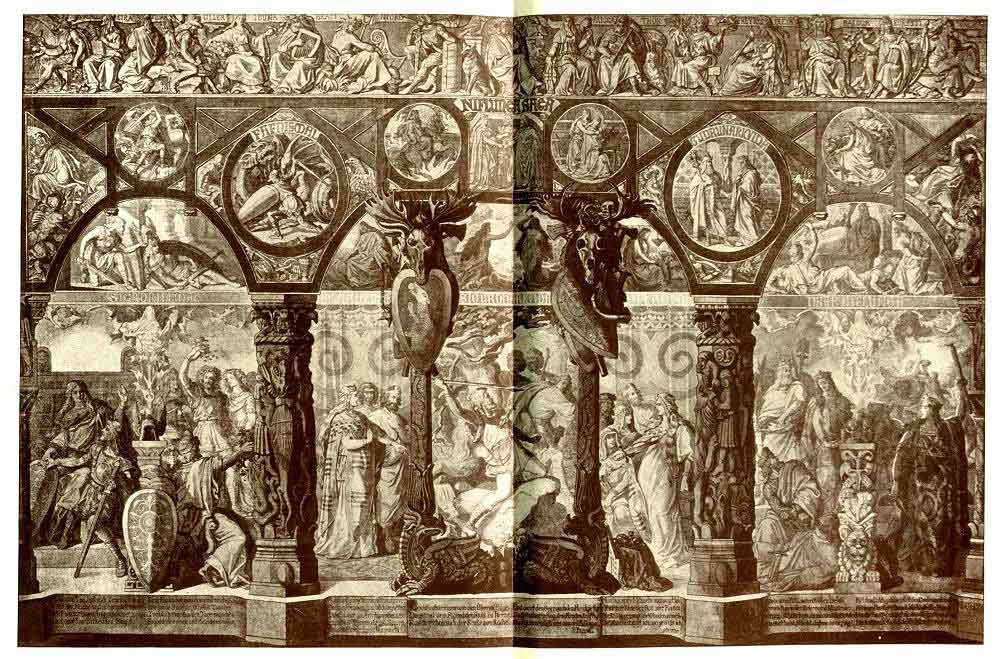
THE NIBELUNGENLIED<BR> <I>From the fresco by Professor E. Ille</I> THE NIBELUNGENLIED
From the fresco by Professor E. Ille

Mimer gave the lad heavy tasks to perform, and kept him working at anvil and bellows from morn till even. Skilful in time he became, and his strength increased beyond knowledge.

The years went past, and the lad endured the burden of servitude and the blows of his elders with humility. But one day he fell upon Wieland, the strongest and most cunning smith that was in Mimer's service, and dragged him by the locks through the smithy. Mimer was wroth, but Siegfried had discovered the full measure of his might and he commanded haughtily, as befits a prince, that a strong sword should be forged for him. The master smith realized that he must needs obey, however unwilling he might be; so he drew from the furnace a bar of glowing iron, and bade the lad to beat out for himself a worthy blade.

Siegfried swung high the great hammer and struck a blow which shook the smithy. The iron was splintered to pieces, the hammer snapped asunder, and the anvil was driven deep into the ground.

Mimer spake with anger, but Siegfried smote him heavily, and the other assistant he smote also.

Then the lad demanded to be given a sword equal to his strength. Mimer made promise to forge it for him. But in his heart he vowed to be avenged. First he went through the forest to the place where dwelt his brother Regin, who had been, by reason of his evil doings, transformed into a dragon. Mimer roused the monster to anger and bade him lie in wait for Siegfried. Thereafter he returned to the smithy and asked the lad to hasten through the forest unto the dwelling of the charcoal-burner, so that be might procure sufficient good fuel with which to forge the promised sword.

Siegfried seized his club and went forth. He came to a forest swamp which swarmed with venomous snakes and great lind-worms and toads; but he had more loathing than terror. When he reached the charcoal-burner he besought him for fire, so that be might destroy the reptiles.

"Alas, for thee!" the charcoal-burner exclaimed; "for if thou dost return again by the way thou didst come the dragon Regin will come forth to devour thee."

The prince scorned to be afraid, and snatching a fiery brand he returned through the forest and set in flames the trees and shrubbage of the swamp, so that all the loathsome reptiles were destroyed.

Then came forth the great dragon, bellowing loud and spouting venom. The earth trembled as he came. But Siegfried was not afraid. Thrice he smote the monster with his club and thus slew it. 2

Perceiving that the dragon was dead, the prince cut it up, and a deep stream of blood issued forth. He dipped his finger into it, and marvelled to find that the skin had become hard as horn.

Now shall I render myself invulnerable against battle wounds, he said.

So he cast off his clothing and plunged into the hot stream. His whole body was then made horn-hard, save a single spot between his shoulders, to which a gummy leaf had adhered.

Siegfried was well pleased. He clad himself and cooked pieces of the dragon's flesh, so that he might receive a meed of its strength. As he watched the flesh broiling, he tasted a portion to discover if it were ready. When he did that the forest was filled with magic voices, for he could understand the language of birds.

Marvelling greatly, he listened to the birds as they sang:

If Siegfried knew what we know,
What we know this day,
He would seek, O, he would seek
The wonder smith to slay;
For Mimer sent him to the wood
To be the Dragon's prey.

Let Siegfried know what we know,
And ponder o'er our song . . .
The wonder smith would fain, O fain,
Avenge his brother's wrong
Smite to live, or wait his blow
And live not long.

Siegfried heard with understanding, and his heart was hardened against the wonder smith. He cut off the dragon's head, and, hastening unto the smithy, he flung the trophy at Mimer's feet, bidding him to eat thereof. Wieland and his fellow fled, fearing greatly the prince's wrath, but Mimer sought to appease him with flattering words, and at length made offer, for life ransom, of the steed Grane, which was of Sleipner's race.

Siegfried accepted the gift, and then, remembering what the birds had sung, he smote Mimer with his club and slew him.

Then returned the young hero unto his sire, King Siegmund, who reproved him for killing the master smith, but he took pride in the lad because that he had slain the dragon.

Soon afterwards Siegfried was given arms and armour, and became a complete warrior. A banquet was held, and beakers were drained, when, with loud acclamations, the prince was hailed as heir to the kingdom of the Netherlands.

Thereafter Siegmund's strong son went forth to will renown in distant lands, and northward he bent his way towards Isenland. On the shore of the Netherlands a ship awaited him. A great gale blew, and the master mariner feared to go forth. But Siegfried would brook not delay, and crossed the stormy seas without fear, despite the peril he endured.

He landed in safety and journeyed towards the castle of Queen Brunhild. The gates were shut and bolted, but he broke them open. Then did the knights who were on guard rush against him, and they began to fight. But Brunhild came forth and bade that the combat should cease, and she gave the prince right courtly welcome.

Now Brunhild was very fair, and was a battle maiden of wondrous strength and prowess. Many wooed her, but no knight came nigh who was worthy her skill; those who encountered her were slain one by one. Maid attendants she had, too, and they were clad in armour and bravely were they wont to fight for their queen.

Siegfried saw that Brunhild had great beauty, but he had no desire to win her by combat against her knights or by vying with her in feats of strength.

"She whom I shall have for wife," he said, "must be gentle and womanly. I love not the battle maiden."

Yet he departed not without display of prowess, for he seized a boulder and flung it so great a distance that all who saw the feat performed wondered greatly. 3

The prince then went on his way until he came to the land of the Nibelungs. It chanced that the king had died, and his two sons, Nibelung and Schilbung, disputed over the treasure hoard. Unto Siegfried they made offer of a wondrous sword, which had been forged by the dwarfs, if he would make just division of their father's riches. He did as they desired, but they sought to repay him with treachery. For when he was given the sword, which was named Balmung, they said that he had kept back part of the treasure for himself. A quarrel was stirred up, and it waxed fierce. Then the king's sons called forth twelve giants, so that the prince might be overcome and bound, and thereafterwards imprisoned in the treasure cavern of the mountain.

But Siegfried feared not any foe. He fought bravely against the giants.

Then spells were wrought, and a thick mist gathered in the place of conflict; but the sword Balmung was wielded by Siegfried to such good purpose that he prevailed. A thunderstorm raged; 4 the mountains resounded with dread clamour and the earth trembled. Yet did the prince fight on, until he had slain giant after giant and none remained alive.

Thereafter the dwarf Alberich came forth against him, seeking to be avenged. A cunning foeman was he, and not easy to combat against, for he had power to become invisible. He possessed a cloak of obscurity, and when he put it on Siegfried must needs combat with menacing nothingness. Long they fought, and in the end the prince had the dwarf in his power. 5

Although Siegfried put to death the two sons of the king, he spared Alberich, from whom he won the Cloak of Obscurity, which could, when he wore it, render him invisible. For he followed the dwarf as he fled towards the mountain cavern in which the treasure was concealed. Then did the masterful hero possess himself of the hoard, and he made Alberich the keeper of it when he vowed to obey his commands.

The Nibelung people acclaimed Siegfried as their king, but he tarried not long in their midst. He took with him twelve bold war-men, and set sail again for the Netherlands. His fame went speedily abroad, and his deeds were sung of by gleemen in many a hall.

A right valiant and noble prince did Siegfried become; all men honoured him, and by women was he loved. Many a fair maiden sighed because he sought not to win one or another. But he rejoiced in warlike feats and in games, and his heart was moved not with desire for any damsel.

There came a time, however, when gleemen sang of the beauty and grace of the Princess Kriemhild, the daughter of the King of Burgundy. In the wide world there was none fairer, and Siegfried loved her in secret ere yet he beheld her, for he knew that she was his heart's desire, and he resolved that he would woo her right speedily.

He spake to his knights thereanent, and they told both king and queen of Siegfried's bold intent. Siegmund and Sigelinde sought to repress his desire, but the prince would not be restrained.

The king warned his son that the warriors of Burgundy were fierce in war, and among them were Gunther and strong and vengeful Hagen.

"What I shall obtain not by fair request," Siegfried said, "I may win in battle."

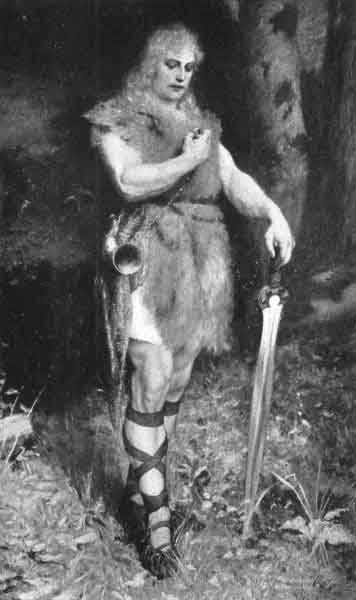
SIEGFRIED<BR> <I>From the Painting by F. Leeke. By permission of Franz Hanfstaengl</I>SIEGFRIED
From the Painting by F. Leeke. By permission of Franz Hanfstaengl

His sire made offer of a great army, but the prince said he would go forth as one of twelve knights. He scorned to win Kriemhild by force, and vowed he would woo her by reason of brave deeds.

Then were preparations made for the journey, and the queen caused rich and gorgeous apparel to be fashioned for Siegfried and his men, and when they rode forth they were indeed of noble seeming.

Siegmund and Sigelinde sorrowed greatly when their son kissed them farewell.

"Grieve not," Siegfried said, "for no evil shall come nigh me."

Then rode he away, the noble prince, to share his meed of joy and meet his doom.

Footnotes

1 Siegfried is the hero of the Nibelungenlied, the great Upper German poetic romance (see Introduction). He is identical with the northern Sigurd of the Eddic poems and Volsunga saga. The various versions of the popular tale developed from an older legend. The Nibelungenlied is here introduced by a summary from Thidrek saga, a Norse poem composed about the middle of the thirteenth century, which was based on the Lower German version of the legend and the Dietrich poems. Our introduction gives a consecutive narrative. The Nibelungenlied opens abruptly by introducing Kriemhild, who takes the place of the Norse Gudrun. Siegfried's early exploits are afterwards referred to briefly.
2 The necessity for more than one blow recalls Thor's conflicts with the Midgard serpent in Hymer's boat and at the Ragnarok battle.
3 He resembles the boulder-flinging mountain giants.
4 Thor is suggested here.
5 There is a curious Banffshire story of two mountain fairies who fought for the love of a fairy lady. One was dark and the other was white. The former had power to render himself invisible, but when he did so in the duel a red spot remained. The white fairy saw the red spot floating in the air, and shot an arrow through it. The dark fairy was slain because the red spot was his heart. This story is not of a common type, and is evidently very old. The fairies occupied opposing hills, as if they were the usual Scottish mountain giants. Of course, giants and fairies have much in common.

Teutonic Myth and Legend: Chapter 31 Gudrun's Vengeance

TEUTONIC MYTH AND LEGEND

by DONALD A. MACKENZIE

An Introduction to the Eddas & Sagas, Beowulf, The Nibelungenlied, etc.

London, Gresham Publications 1912

CHAPTER 31

Gudrun's Vengeance

Gudrun's Flight--Grimhild follows her--The Reconciliation--Wooed by King Atle--Doom Dreams--The Fafner Hoard--Coveted by Atle--Invitation to Gudrun's Brothers--Fateful Journey--Treachery--A Fierce Conflict--How Hogne died--Gunnar among Vipers----Queen slays Atle--Becomes Bride of Jonaker--Her Sons--Svanhild is avenged.

WHEN Sigurd and his son were burned with Brynhild on the pyre, Gudrun refused to be comforted, nor could she abide to remain in the Hall of Giuki among the oath-breakers, her brothers, who had brought her husband to his death. So she went forth alone to wander in the forest with desire that wolves should devour her. Five days she journeyed in her sorrow, knowing not whither she went, until she came to the Hall of King Alv. There was she received with pity and tenderness, and she had for companion Thora, daughter of Hakon, King of Denmark. She was well loved, and with Thora she sat and embroidered on fair tapestry the deeds of Sigurd and Sigmund.

Three summers went past and four winters ere Queen Grimhild came to know where Gudrun had her dwelling. She desired that her daughter should return again, because King Atle the Mighty, the brother of Brynhild, sought her for his bride. So Grimhild gave much treasure to her sons, and went forth with them to appease Gudrun with gifts of gold, so that the blood feud might have end. Five hundred war-men rode with Grimhild and Gunnar and Hogne, and they greeted Gudrun and made offer to her of the treasure which they bore with them. Then did Gunnar give to Gudrun a golden goblet filled with the drink of forgetfulness, which Grimhild had brewed, so that she might put past old sorrows and hate. Gudrun drank and her grief faded.

Thereafter Grimhild told her daughter that King Atle desired her for wife, and said that she would be given more treasure when she was wed to him.

"I desire not another husband," Gudrun said; "nor could I live happily with the brother of Brynhild."

"If thou wilt wed Atle," said Grimhild, "thou shalt have sons, and it shall seem to thee that Sigurd and Sigmund are: again in life."

"I seek not nor hope for gladness any more while I live," Gudrun answered.

But her mother pleaded: "Atle is foremost among kings. A nobler husband thou canst not find. May thou never he wed to any man," she added, "if thou shalt spurn this mighty ruler."

"Alas!" sighed Gudrun; "bid me not wed the brother of Brynhild, for he will bring great evil upon our kin, and be the death-bane of Hogne and Gunnar. By my own hand must he fall in the end if I become his bride."

Grimhild wept, nor listened to what Gudrun said. "I shall give thee lands and many war-men," she told her daughter, "if thou wilt take Atle to be thy husband. Thou shalt have joy with him until thy life's end. Besides, by marrying him thou wilt bring great honour unto thy kin."

"Alas! I must then be wed to him," said Gudrun, "although my heart desireth him not. But there is no gladness in store for me, for he will be a bane to my kin."

Grimhild rejoiced because that she at length worked her will, and soon a great company set forth towards the kingdom of Atle the Mighty. They travelled for seven days by land, and then for seven days they voyaged over the sea, and thereafter they travelled by land again for seven days 'ere they came unto the Hall of the King. A great banquet was held, and King Atle and Gudrun were wed. But the bride's heart was sad within her, nor did she ever have joy in the Hall of Brynhild's brother.

One morning when Atle woke from sleep he was greatly troubled because of the dreams he had dreamed. He spoke to Gudrun, saying: "It seemed that thou didst thrust a sword through my breast."

"To dream of iron," the queen said, "is to dream of fire."

"And I dreamt also," continued the king, "that two water-reeds grew up in my hall. By the roots were they pulled up, and they dripped red blood; of them was I asked to partake. . . . Then it seemed that two hungry hawks flew from my wrist, and they went to Hela. Hearts had they steeped in honey, and I ate them. . . . Thereafter I dreamt that two cubs gambolled at my feet; of these did I also partake."

"Thy dreams forebode much ill," Gudrun said; "verily, thy sons are nigh unto life's end. Black grief is at hand."

Weeks passed and then years, and the doom dreams faded from the king's memory. Yet was there more unhappiness between the ill-mated pair.

Then a time came when Atle spoke much of the accursed treasure which Sigurd had found when he slew Fafner. Well he knew that Gunnar and Hogne had kept from Gudrun the greater part, so that they could boast of immense riches. In his heart Atle coveted the hoard, and desired it for himself; so he took counsel with his nobles, and decided to invite Gunnar and Hogne to visit his Hall. A trusted messenger, whose name was Vinge, was sent forth with a company of war-men to make promises to the brothers and induce them to journey to Hunaland. Gudrun knew well that there was evil intent in her husband's heart, so she carved runes of warning upon a gold ring and gave it to Vinge as her gift to Hogne. But Atle's messenger changed the runes so that they seemed to convey a speedy welcome from the queen.

When Vinge reached the Hall of Giuki he made his mission known. The brothers consulted one with another, suspecting treachery and Atle's lust for gold; but Gudrun's ring reassured them, and after they had drunk mead with the messengers, they promised to go forth with them.

But Hogne's wife, Kostbera, made keen scrutiny of Gudrun's ring in her bedchamber, and she saw that the runes had been altered from warning to welcome. To her husband she spoke thereanent. She had also dreamt an ominous dream, in which she saw the Hall overthrown by a rising flood.

But Hogne chided her for thinking ill of Atle. He had given his promise to Vinge to fare forth with him, and scorned to break it.

Gunnar's wife had also dreams of warning. She saw her husband pierced by a sword, while wolves howled about him.

"Little dogs will bark at us," Gunnar said.

"Methought I also saw," his wife continued, "a battle maiden of sad visage entering the hall. She seemed to be a valkyrie."

"A man must die at his appointed hour," Gunnar said; "besides, it is not good to live over long."

Now Gunnar, who was king, for Giuki had departed hence, was well loved by his people, and in the morning they clamoured about him, beseeching that he should not leave them.

But he bade them to feast with him. "We may never again drink mead together," he said, "but no man can escape his fate."

Gunnar's wife spake unto Vinge. "Methinks," she said, "that ill fortune will come to our kind from this journey."

But Vinge swore many oaths, saying that no evil was intended. "May I be hanged," he said, "if a sign of treachery is shown against Gunnar and Hogne in the kingdom of Atle."

There were tears and lamentations when the warrior sons of Giuki went forth never again to return to the kingdom of their sires, although great glory would be theirs by reason of valorous deeds and unflinching courage.

Gunnar's wife embraced her king, and Kostbera embraced Hogne, saying: "May days of gladness be thine."

"Forget not to make merry," Hogne said, "no matter what befalls us on our journey."

When they had voyaged over the sea, there were dumb foretellings of their doom. So swiftly and hard did the oarsmen ply their blades that rowing pins snapped and half the ship's keel was shorn off upon the beach. They leapt ashore and feared not. Gunnar and Hogne went inland towards Atle's stronghold with armour and full war gear and all their men. Two sons of Hogne were with, them, and valorous Orkning, the brother of Kostbera, who had fame for mighty deeds.

They rode together through a dark wood, and when they approached the stronghold of Atle they perceived that the gate was closed against them. A great army was assembling to receive the guests.

Hogne raised his battleaxe and smote the gate asunder, for he must needs enter with dignity becoming his rank.

"Thou hast done wrong," Vinge snarled; "'twere more fitting that thou shouldst wait until I bring the gallows on which ye shall all hang. By smooth words have I induced ye all to come hither; ere long shall ye die together."

"Thy boasts affright me not," answered Hogne; "we shrink not from conflict, if conflict there must be. Yet hast thou wrought us ill, so take thy reward."

As he spake, Hogne swung his battleaxe and slew Vinge with a single blow.

Boldly rode the sons of Giuki until they came to the Hall of Atle. There was a strong army drawn up in line of battle.

King Atle came forth, and spake to the brothers.

"I bid ye welcome," he said, "but unto me must be now given up the great treasure which Sigurd won when he slew Fafner, and is now mine by right of Gudrun."

So fell the treasure curse upon them all in that hour of doom.

Gunnar spake. "Thou shalt never possess our riches," he said, "and if thou dost battle against us, we shall make of thee and thy kin a feast for the eagle and the wolf."

"Long have I desired," said Atle, "to punish ye for the slaying of Sigurd. That indeed was a shameful doing, for his equal was found not among men."

Hogne spake boldly: "Long then hast thou brooded over that matter. A wonder it is that thou didst not sooner set thyself to the task."

Then began the battle, and against one another they cast their spears.

Tidings were borne unto Gudrun of hard fighting, and she hastened forth in great anger. She cast from her the royal robe, and rushing into the midst of the fray embraced her brothers and kissed them.

But in vain did she intervene. The time for peace was past, so she armed herself and fought beside Gunnar and Hogne against the war-men of Atle.

Bravely fought the brothers. The king's three brothers were slain, and Atle cried:

"Now am I the last of my kin, and by thee was Brynhild slain."

"Thou shalt have thy faring in time," answered Hogne; "the gods have decreed thy punishment."

Fiercer grew the conflict, for Atle rallied his war-men and urged them to battle. But he was driven back into his Hall, which soon streamed with blood. Great were the deeds of the valorous Giukings.

But at length Gunnar and Hogne were pressed hard and overpowered. Then were they bound in fetters.

Atle was wroth when he perceived that so many of his war-men were cut down, and he scowled upon Hogne.

"He hath cut down a host of my heroes," he said; "so let his heart be cut out."

"Do thy will," answered Hogne, "for I fear not. So grievously am I wounded that I may as well die."

But the king delayed taking vengeance. He desired first to know where the Fafner treasure was concealed, so he had the brothers cast into separate dungeons.

Gunnar was first brought before him. "Thy life shall be spared," Atle said, "if thou wilt reveal where the treasure lies hidden."

Gunnar answered him. "Ere I speak," he said, "Hogne's heart must be brought unto me."

Then did Atle seek to practise deceit with much cunning. He had a thrall seized, so that his heart might be held up before Gunnar. The man screamed with anguish ere yet the knife touched him, for he desired not to miss constant fare and good, nor leave his well-loved swine.

The coward heart was cut out, and it trembled before Gunnar.

"That is not the valorous heart of my brother," he said, "but the heart of a thrall."

So Hogne had to be slain. He laughed when his enemies fell upon him, and they marvelled at his valour.

Then was, the hero's heart plucked forth, and when Gunnar saw it he said:

"That indeed is the heart of great Hogne. See how it still beats without fear. I wavered while my brother was yet alive, but now can I die well satisfied, Atle, for thou shalt never know where the treasure lies hid. Yet thou, O King, shall escape not thy doom, and the Rhine river shall keep the secret of the gold."

Atle was wroth; his brow darkened and his eyes burned fire.

"Take hence the prisoner," he growled, and as he bade his men so did they do. 1

Gunnar was bound and thrust into a loathsome dungeon which swarmed with vipers. But Gudrun sent unto him a harp, and he played upon it with his toes, making such sweet music that all the vipers were charmed into a magic sleep save one, which gnawed his breast until it reached his heart to suck his life's blood. Great torture did Gunnar suffer ere he died.

Men have told that the viper which killed the hero was the mother of Atle, who was a sorceress.

The king boasted before Gudrun, because that he had triumphed over her brothers.

"Gunnar and Hogne are indeed no more," the queen said, "and unto me is given a heritage of vengeance."

Atle liked not her speech, so he said: "Let peace be made between us. Thee shall I give much treasure as atonement for the loss of thy kin."

Gudrun would accept not of blood payment, but she desired that a funeral feast be held for Gunnar and Hogne.

The king gave ready consent, and then was the dread work of vengeance begun. Gudrun slew her two sons. Of their skulls she made drinking cups, and she had their hearts cooked in honey for the king. In his wine she mixed their blood.

When the feast was over, Atle desired that his sons should be brought before him.

"Thou hast given me dark sorrow," Gudrun said, "by slaying my brothers. Now hast thou thy reward. Thou didst eat the hearts of thy sons, and their blood hast thou drunken in thy wine from these their skull cups.

"Vengeful woman," cried Atle, "a great cruelty thou hast done by slaying thine own children."

"There shall be still greater cruelty yet," she answered him.

"Thou shalt be burned alive for this," Atle cried fiercely.

"Thine own death thou dost foretell," she said, "as well as mine."

Now a son of Hogne was left alive. He was a Niblung. 2 With him did Gudrun conspire. When Atle had drunken deep, and slumbered, his wife went with Hogne's son to his bedchamber, and she thrust a sword through him.

Atle woke up and cried: "Who hath given me my deathwound?"

Gudrun made known herself, and said she had taken vengeance for her kin.

Atle pleaded that he would have stately burial, and the queen promised him a great pyre. When he died she set fire to the hall, and all that were within it were burned. In the darkness the war-men sprang one upon the other, and many fell fighting ere the end came.

Gudrun made escape, but she desired not to live any more. She hastened towards the shore and cast herself into the waves, so that her days might have end.

There are those who tell that she died thus, but others say that the waves bore her over the sea and cast her upon the beach nigh to the stronghold of King Jonaker.

A strong warrior was he. When he saw the queen's beauty he desired to have her for bride, and when she was nourished and comforted the twain were married and they dwelt happily together.

Gudrun had three sons, and they were named Hamder, Sorle, and Erp. It is told that when they became full warriors she sent them forth against King Jormunrek to avenge the death of Svanhild. But Erp, it was deemed, was unwilling to go forth, so his brothers slew him.

Then Hamder and Sorle set forth. Their mother charmed their bodies against steel, and when they reached Jormunrek, Hamder cut off his hands and Sorle smote off his feet.

"If Erp were here," one said to the other, "he would have taken the king's head."

Many strong and well-skilled warriors fought against the sons of Gudrun, but without avail, for they could not wound them.

Then in the midst of the fray appeared a wise old man who had but one eye. He was Odin, but they knew it not. He counselled that the warriors should cast stones against the twain, who were protected by spells. As he advised, so was it done. Many stones were flung at Hamder and Sorle, and they were speedily slain.

So endeth the northern tale of the Volsungs and the Giukings.

Footnotes

1 A similar legend regarding a secret is current in the Highlands. Neil Munro gives a spirited version in his picturesque tale "The Secret of the Heather Ale" in The Lost Pibroch.
2 The Giukings were originally the Nibelungs (Hniflungs) who possessed the hoard guarded by Andvari (Alberich). That is why Hogne's son is called a "Niblung". The reference is a survival from one of the older versions of the legend. In the next chapter the Nibelungs are dwarfs (elves) and the Giukings are the Burgundians. How myth and history commingled in endless variations is illustrated by the Dietrich stories. Similarly, myths which had a common and remote origin, and developed separately in various districts, were also fused by wandering minstrels.

Teutonic Myth and Legend: Chapter 30 The Last of the Volsungs

TEUTONIC MYTH AND LEGEND

by DONALD A. MACKENZIE

An Introduction to the Eddas & Sagas, Beowulf, The Nibelungenlied, etc.

London, Gresham Publications 1912

CHAPTER 30

The Last of the Volsungs

Brynhild's Daughter--Escape to Norway--Her Protector murdered--Why she was called Krake--The Princess Thora--Her Dragon--like Serpents--How Ragnar won his Bride--The Northern Cinderella--Wooed by the Viking--The Slave becomes a Queen--Story of Svanhild--Wife of Jormunrek (Ermenrich)--Bikki (Sibech) the Accuser--Fate of Gudrun's Daughter.

Now when Brynhild died, Heimer feared that Giuki's vengeful sons would slay Aslog because that she was the last of the Volsungs, and might rear up a son who would come against them. So he prepared to take flight. He made a harp, in which he concealed Brynhild's child with certain of her treasures, and voyaged to Norway, where he made pretence to be a minstrel. He went to a house in Spangerejd and dwelt in it. He revealed not there the secret of the child's concealment. But one day the housewife perceived that there was treasure in the harp, for the door of Aslog's harp-chamber was not closed, and a portion of rich cloth protruded from it. Then was Heimer murdered in his sleep, and Aslog was taken forth with the treasure that was hers.

The child grew up in the strange household, and her foster-parents were not only poor but cruel and harsh; the high-born girl was made a slave, and was set to work at menial tasks. As the years passed by her beauty shone forth, and her captors, fearing that blame would fall upon them for doing evil, kept her clad in rags, and smeared her face with soot and tar, so that no eye might gaze upon her with wonder. Then was she nicknamed Krake, which signifies "the crow".

Thus did Aslog abide with harsh and strange folk until the coming of the great viking Ragnar Lodbrog, who had fame not only on the high seas for deeds of valour, but also because he had slain the venomous serpents which were the bane of King Heroth's kingdom.

It chanced that the king had gone hunting in the woods, where he found two young snakes; these he bore home with him to his daughter Thora, by whom they were fed until they grew so large that she dreaded to approach them. Each then began to devour an ox daily; and they both became so powerful that they laid waste the countryside, and killed men and beasts with their venomous breath.

King Heroth feared to contend against the serpents, but he offered his daughter in marriage to the man who would slay them. Now Thora was fair to behold, and many heroes went forth to fight the monsters; but they suffered death one after another, and the affliction grew greater, so that all people were in constant fear and peril.

The day came when Ragnar heard of Thora, whom he desired for wife, being set up as a reward for serpent-slaying, and he resolved to win her by mighty deeds. So he bade that a mantle and breeches of wool be fashioned for him, and when they were ready he gave King Heroth to know that he would make attack on the serpents.

It was the season of winter, and he dipped his woollen attire in a stream and it was soon frozen hard. Clad thus, he was protected against the venom, so he girt on his sword and took a spear in his right hand and a shield in his left and went forth to fight, so that Thora might be his bride.

A great serpent came against him, but he feared not, and prepared to combat with it. Then another great serpent hastened to the aid of the first, and he was soon in dire peril. They spouted venom upon Ragnar, but his frost-bound clothing protected him; and they smote him with their tails, but he stood firm. Terrible was the conflict which was waged, and the king and all who were with him were filled with alarm, and sought high and narrow hiding places, fearing that Ragnar would be overcome.

The serpents were enraged, and they made ferocious attack with monstrous jaws agape, but Ragnar raised his shield against them each time they sought to bite. He was indeed sore pressed and greatly wearied; but at length he cast his spear at them and it went through their hearts, so that they were both slain.

A great shout was raised by those who were in hiding, and the king came forth to honour Ragnar. He laughed to see the strange attire of the hero, and nicknamed him "Lodbrog", which signifies "shaggy-breeches".

Then was a great banquet given. Ragnar was attired ill splendour, and he was given Thora for wife. But when she had borne him two sons she died, although young and fair, and her husband mourned for her.

Ragnar then plundered on the high seas and raided Scotland and Pictland. He set a new king over the Orkneys, and went against Norway.

It chanced that he came one day to Spangerejd, and there he sent men ashore to procure bread. When they returned with the food he was made angry because that it was burned. The men told him that they had gone to a house in which there was a beautiful maiden: they could refrain not from gazing upon her, and so the bread was burned.

Now Ragnar bethought him to have such a maiden for his bride, so that he might forget his grief for Thora. He sent to her a message bidding her to come unto him. Desiring to put her wisdom to test, he told his messengers to ask her to come not on foot nor yet driving; not attired and yet not naked; not feasting and yet not fasting; not with anyone and yet not alone.

Aslog, who was named Krake in her poor dwelling, came towards the great sea king neither driving nor on foot but riding upon a goat with her feet trailing upon the ground; she came without attire, but yet not naked, because her hair was so long and bountiful that it covered her body, and she drew a net about her; she came not feasting nor yet fasting, because she held an onion to her lips and tasted of it; she was not alone, because her dog walked by her side. 1

Ragnar, who was now a great king, took beauteous Aslog, the daughter of Sigurd and Brynhild, for his bride, and their sons were named Ingvar and Ubbe. 2

After Sigurd's death Gudrun had a daughter who was named Svanhild. She was given for wife to Jormunrek, 3 King of the Gauts. Like to a sunbeam was she in the hall of Giuki, and there was great sorrow when she went forth with her bondmaids. Much treasure was she given, but the curse of Andvari's gold followed her. It fell that she was falsely accused by Bikki of unfaithfulness with a prince, and so greatly enraged did the king become that he ordered that she should be put to death by being trampled under the hoofs of horses.

Then was Svanhild bound and left lying on a plain; but although the horses ran over her they injured her not, some say because of her surpassing beauty, and others because of the brightness of her Volsung eyes.

The king deemed that his fair bride was innocent, because she had escaped injury, but Bikki, her accuser, poisoned the king's ear, and persuaded him to command that Svanhild should be laid upon the ground with her face downward. Then were the horses driven over her again, and she was trodden deep down into the earth by the multitudinous hoofs. So perished Svanhild, daughter of Gudrun, while Aslog, daughter of Brynhild, reigned as Ragnar's queen in a northern land. In Norway, s royal line alone doth the blood of the Volsungs flow.

The young prince, who was Jormunrek's son, was condemned to death by his sire and was hanged. 4

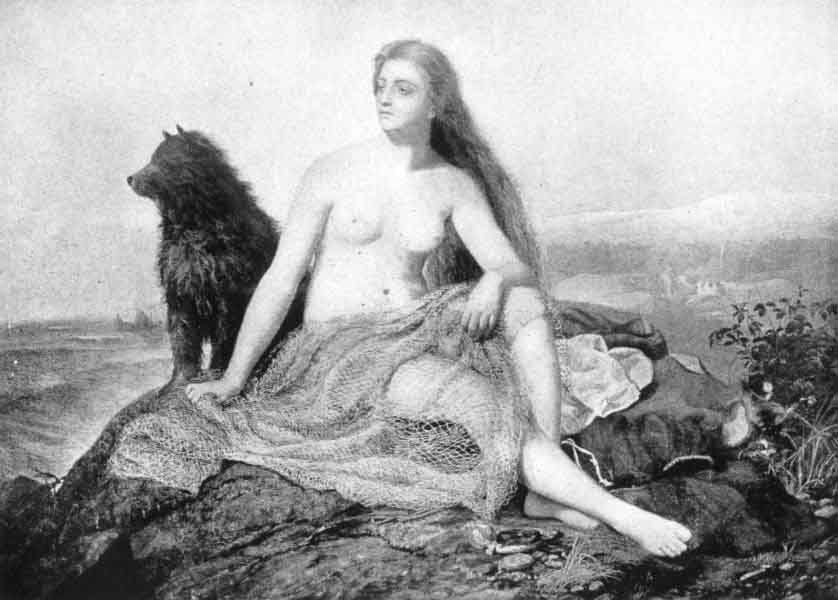
KRAKE<BR> <I>From the painting by M. E. Winge</I> KRAKE
From the painting by M. E. Winge

Footnotes

1 So did Grainne come to Diarmid in the Highland Fian tale. Grimm also gives a version of the story with numerous references to similar tales in other languages than Gaelic and German. In Saxo (Book 9) there is a more sordid account of Ragnar's wooing of "a certain young woman" who became the mother of Ubbe. Like Odin, when he wooed Rhine, Ragnar made use of female attire. Our version is from Ragnar's saga. The Volsunga saga drops Aslog at the point where she became Krake.
2 Here we meet history. By one authority Ingvar and Ubbe are said to be the northmen who murdered King Eadmund of England. Others identify them as the avenging sons who carved an eagle on the back of King Ella in Yorkshire, because he had driven their half-brother Ivar from the throne. Krake is a northern Cinderella, sung of in Norway and Denmark. She was a link between Odin and the Norse kings, who prided themselves in their descent from the Asa-god.
3 Ermenrich (Hermanric) of the Ostrogoths.
4 Saxo gives an account of a sham execution, but in the Dietrich story he is actually put to death. Bikki is Sibech.

Teutonic Myth and Legend: Chapter 29 Brynhild and Gudrun

TEUTONIC MYTH AND LEGEND

by DONALD A. MACKENZIE

An Introduction to the Eddas & Sagas, Beowulf, The Nibelungenlied, etc.

London, Gresham Publications 1912

CHAPTER 29

Brynhild and Gudrun

Brynhild's Magic Sleep--Awakened by Sigurd--Lovers pledge their Troth--The Draught of Forgetfulness --Gudrun wins Sigurd--Gunnar's Wooing--How Brynhild was deceived--Quarrel with Gudrun--Sigurd is murdered--Gudrun's Sorrow--Brynhild dies on Sigurd's Pyre--Ride to Hela.

WHEN Sigurd came nigh to Hindarfell, in the land of the Franks, he beheld a blaze of light on the hill. Then he perceived that a stately castle was girt round with magic fire. Its roof was of shining gold. A banner on the highest tower floated in the wind.

He rode towards the castle. He went through the flames on the back of Grane. He dismounted and went within. There he beheld a beauteous battle maiden wrapped in magic sleep; golden was her hair, and she was clad in armour. . . . He went towards her and took off her gleaming helm, and her locks fell free. Yet her eyes opened not, so strong was the sleep spell that was upon her. . . . He drew his magic sword and cut through her armour so that it fell to pieces, whereat the maiden awoke. . . . Her wondrous eyes glowed upon him; her pale cheeks reddened and her lips opened.

"How long hast thou lain asleep?" asked Sigurd.

"Who art thou," the maiden sighed, "that hast shorn my armour asunder, and hath power to break the runes of sleep? . . . Art thou indeed Sigurd, the son of great Sigmund? Hast thou come at last with the helmet of darkness and the sword which slew Fafner?"

Sigurd answered. "I am even Sigurd, the son of Sigmund, and my sword hath shorn thine armour asunder."

"None but a Volsung could have done the deed," cried Brynhild, for indeed it was she--the beauteous valkyrie whom Odin had punished by laying her in a magic sleep because that she had caused to fall in battle those whom he favoured.

"A Volsung am I," Sigurd answered, "and I have come to thee because thou art so fair and full of wisdom. Fain would I learn of thee."

Then Brynhild smiled. She threw back her golden hair, and gazed forth upon the world once more. She saw the bright sun and the fresh green ways, and like a dawn-awakened bird she raised her voice in song.

Long was my sleep, long was my sleep,
Darkling 't was lone and dreamless and deep
Long as the evils that mankind endure,
As long and as sure;
Helpless in sunshine and starshine I've lain,
Wrapped by the runes that bind like a chain
Helpless ye found me:
Odin had bound me
Bound me in sleep where I lay. . . .
Hail to the day!
Hail to the sons of the light!
All hail to the night!
Hail and O hear, beholding us twain,
And give what we hope now to gain. . . .
Hail ye gods and ye goddesses dear,
And Earth, the mother of all!
Give us of wisdom and tenderness here,
Hands that shall heal and hearts without fear
Till death shall at length on us call. . . .

Then Brynhild told Sigurd how Odin had touched her with the sleep thorn, and said that never again would she be a chooser of the slain, but would lie in slumber until a lover came.

"But I vowed a vow," she said, "that I would never wed a man who knew what it was to be afraid."

Sigurd said: "Fain would I hear of thy wisdom, for which thou art famed."

"With gratitude can I speak to thee," said Brynhild, "but let us first drink mead together. May thou profit by what I shall teach thee, and may thou in after time remember what I now speak unto thee."

She filled a golden goblet and gave to Sigurd to drink.

"The mead," she said, "is mixed with renown and songs merry and sad, and with wise thoughts and tender heart thoughts and valorous speech. . . . Thou shalt grave war runes on thy blade, and twice shall Tyr be named. Runes of ocean shalt thou carve on stern and rudder and oar; thou shalt have peaceful sea-ways. . . . Runes thou shalt learn to ward off blood vengeance and doom. . . . Runes thou shalt learn to call fairy help when a son cometh, and runes for wound healing which thou shalt carve on trees whose branches are bending towards the east. . . . I shall teach thee runes of high-heartedness and valour--the runes of the gods, the runes of the elves, and the runes of the wise Vans. . . . I shall give thee runes that shall aid thee in all things until life ends. . . . Now thou shalt choose what thou dost desire to be and to have.

Sigurd spake: "I was born to be without fear. I shall forget thee never, and in my heart shall I treasure what thou givest unto me."

Then Brynhild gave runes to Sigurd, and she counselled him to give friendship for friendship, and to have forbearance so that he might win fame among men.

"Take close account of what is evil," she said; "from a maiden's love and a man's own wife wrong may come. Give little heed to those who speak more harshly of others than they deem they do; take not advice from men of poor judgment. Ever be watchful of danger wherever thou farest; let not a woman enchant thee in the feasting hall. Heed not the unwise speech of a man who hath drunken deep. Keep the oaths thou dost swear. Trust not him whose kin thou hast slain. . . . I can read not of thy future right well, nor perceive clearly what shall befall thee, but may evil come not from thy wife's kindred."

Sigurd said: "None other but thee shall I have for my bride."

Brynhild made answer: "If it were given me to make choice among all the sons of men, thee alone would I desire to be mine."

Sigurd gave to the gold-haired maiden the magic ring which was in Fafner's hoard.

Then did they swear binding oaths together, vowing that they would ever be faithful one to another until life's last loop was spun.

Thereafter went Sigurd on his way, for he must needs travel unto the hall of King Giuki. Loving Brynhild, he went, but it was doomed that he should break his binding vows, and spurn the golden-haired maiden whom he had rescued from magic sleep. It was indeed fated that he should drink the draught of forgetfulness, so that new love might enter his heart, for he must needs suffer because of the treachery of another.

A warrior of noble seeming was Sigurd, and wondering eyes beheld him as he drew nigh to the dwelling of Giuki. Great was his height, and he had the shoulder-breadth of two men. Young was he, and very fair.

His eyes were blue, and of such brightness that men quailed before him; his nose was high-ridged, and bent like to an eagle's beak; broad was his face from cheek bone to cheek bone. His hair was copper-brown, and hung over his shoulder gleaming in sunshine, and his beard was short and fair. All beholders gazed with mute wonder upon his great sword Gram.

He was withal fearless and high-hearted, one who loved his friends and was unafraid of any foe. Ever ready was he to give aid to kinsmen and allies. Such eloquence of speech was his that men were drawn towards him.

Those who played games round Giuki's hall ceased when Sigurd came nigh. King Giuki greeted him with welcome to his dwelling, and the treasure chests were taken from Grane's back and borne within.

The king had for wife the crafty Grimhild, who was a sorceress, and they had a beauteous daughter who was named Gudrun. Their three sons were Gunnar, Hogne, and Guttorm.

Now, when Grimhild beheld Sigurd, she was taken with desire that he should have her daughter for his bride, and ill-pleased was she when she found that his heart was filled with love for Brynhild.

It chanced that the two maidens dreamed dreams. Brynhild had a vision of Gudrun coming towards her, and on the day that followed Gudrun indeed came in a gold-decked chariot with all her maidens, for Gudrun had also dreamt a dream and desired that the wise Brynhild should solve it.

Brynhild, who was King Budle's daughter, dwelt betimes at her castle, and betimes at the Hall of Heimar, who had for wife her sister Bkhild. Her brother was King Atle the Mighty.

It was at Heimar's hall that Giuki's daughter found the fair battle maiden on that fateful day.

Gudrun told Brynhild of her dream. "It seemed," she said, "that we were together in a forest and saw a noble stag. Copper-coloured was its hair, and we both desired to possess it. But no one save myself alone could reach the stag, and I possessed it, and was made glad. Then thou didst come, Brynhild, and thou didst slay my stag, and I wept bitterly. Thereafter thou didst give me a young wolf which was red with the blood of my kin."

"Alas!" Brynhild sighed; "I can read thy dream. Thou shalt marry Sigurd, whom I desire for my lover. A magic drink he shall receive, and he shall turn from me. Then shall there be a feud, and he shall be slain, and thou shalt thereafter marry my brother King Atle the Mighty, whom thou shalt slay in the end."

Gudrun wept. "Terrible indeed it is," she said, "to have knowledge of these things."

So she left Brynhild and returned with her maidens to the hall of King Giuki, her sire.

Three years passed, and Sigurd remained with the king who had given him welcome. With Gunnar and Hogne he took oaths of fellowship, and they hunted together and made merry.

Ever did Queen Grimhild desire that Sigurd should take Gudrun for his bride, and at length she brewed a magic drink which would make him forget the battle maiden whom he had chosen for his bride.

A night came when they sat together in the feasting hall, and the queen rose and filled the drinking horn with the magic drink and gave it unto Sigurd, saying:

"It hath pleasured us to have thee abiding with us here. Thou shalt receive from us all thou dost desire. Drink thou from this horn the mead which I have prepared for thee."

Sigurd drank as she desired, and he forgot Brynhild and the binding vows he had sworn with her. The love he had for her passed away, and he saw that Gudrun was very fair.

Then the queen said: "King Giuki shall be to thee a sire, and his sons are thy brethren."

To the king in secret Grimhild spake, as she embraced him: "Give thou our daughter for wife unto Sigurd. Great is his wealth, and it would be well that he should ever be with us."

Giuki disdained to offer his daughter even unto Sigurd, but the queen constrained her son Gunnar to counsel the young hero to have the beauteous maid for his bride.

So it fell that Sigurd and Gudrun were wed in the Hall, and they dwelt happily together. They had a son, and his name was Sigmund.

Queen Grimhild next desired that her son Gunnar should have Brynhild for wife, and she said: "Go thou and woo the battle maiden, and Sigurd shall go with thee."

"That will I do right willingly," Gunnar made answer, "for I would fain have golden-haired Brynhild for my bride."

Then he rode forth towards the hall of Heimar, and with him went Sigurd. Grimhild had wrought a spell so that Brynhild would know not her former lover.

Gunnar besought of Heimar that he should have the battle maiden for wife, but Heimar said: "Brynhild shall only wed him whom she herself doth choose. To her thou must go. She dwelleth in a castle beyond, which is girt about with magic fire, and thou must needs ride through the flames to win nigh unto her."

Then Gunnar rode towards the dwelling of Brynhild, and Sigurd went with him. But when they came nigh to the fire-girt castle Gunnar's steed would go no farther, for it feared the flames.

Sigurd said: "To thee shall I give Grane, on whom to ride through the fire."

So he dismounted; but when Gunnar sat upon the back of Grane, the steed refused to move forward. None save Sigurd could go unto Brynhild; none could ride through the flames save Sigmund's noble son.

Then took Sigurd the semblance of Gunnar, and Gunnar the semblance of Sigurd, as Queen Grimhild had given each of them power to do, and Sigurd leapt upon Grane's back and rode through the magic fire.

Brynhild saw Sigurd coming towards her and said: "Who art thou who hast come through the magic fire?"

Sigurd answered: "My name is Gunnar, son of Giuki. Thee shall I have for my bride, because that thou didst vow to marry him who would reach thee through the flames."

"Thee shall I wed, Brynhild said, "if thou shalt promise to slay those who also desire to have me for wife."

"That shall I promise thee," answered Sigurd, and the battle maiden was well pleased.

Three nights he abode with Brynhild in the castle, and ere he left her she gave to him the ring that was once Andvari's, and had been taken by Sigurd from the hoard of Fafner--the ring of doom which was a bane to them both.

Through the flames once more went Sigmund's great son. With Gunnar he again changed shapes, and together they returned unto the hall of Giuki.

In time fair Brynhild left her fire-girt castle and went unto the dwelling of Heimar, to whom she told how fate had served her.

"Fain was I," she said, "that it had happened as aforetime--that Sigurd had come through the flames towards me instead of Gunnar."

"As it hath chanced," said Heimar, "so must it be."

Now Brynhild had a daughter, whose name was Aslog. A Volsung was she by birth, for her sire was Sigurd, and it was fated that she would be the last of her race. The battle maiden gave the child to Heimar, so that she might be nourished and fostered and kept free from harm.

When Brynhild did that she went with King Budle, her father, to the hall of Giuki. There was a feast of splendour held, and Gunnar and the battle maiden were wed. They drank mead together and made merry.

But if joy came to the heart of Brynhild, it speedily vanished when she beheld Sigurd with another bride. In secret she bewailed her fate, because that her first love who had awakened her from magic sleep had been taken from her by treachery and sorcery. Nor could such sorrow have long endurance. The treasure curse was upon them all; the shadow of doom was already darkening their days.

Ere long the pent-up grief storm broke forth in lamentation and feud; ere long there was shedding of blood and the heart call of vengeance.

It chanced that Brynhild and Gudrun bathed together in the river, and the battle maiden perceived that Andvari's doom ring was worn by Sigurd's bride. They fell to quarrelling one with another. Thereafter Brynhild went home; pale was her face and anger burned in her eyes: her heart was in torment.

On the morn that followed Gudrun besought Brynhild to sorrow not.

"Thy heart is evil," the battle maiden said; "it giveth thee joy to see me grieve. But thou shalt escape not thy due, for no longer can I endure to see thee with Sigurd."

"Thou hast Gunnar, my brother," said Gudrun; "a worthier lord is he than thou dost deserve. Well mayest thou take joy in him."

"Happy would I indeed be with one more noble," Brynhild answered.

Then Gudrun taunted her, and told how Sigurd had gone through the flames in the guise of Gunnar so that she might be beguiled.

There was no joy in the heart of Brynhild thereafter. Her days and nights she spent in lamentations, so that she was heard by all. Nor would she speak unto anyone, not even her husband; for when she wailed not, she lay like to one who was dead; alone in her chamber she lay; her face was white as winter's snow, and ice-hard and cold.

At length Gunnar besought Sigurd to go unto her, for to none had she spoken for many days, nor had she eaten or drunken aught.

But Sigurd feared that he could quench not the flames of her grief, and knew well that she fostered ill against him with dire intent. Yet was he constrained to speak to her. So Sigurd entered her chamber.

"Arise, O Brynhild," he cried, "for lo! the sun is bright; grieve no more, and make merry in our midst."

Brynhild opened her eyes, as aforetime she had done when Sigurd awakened her from magic sleep.

So," she spake, "thou art so bold as to come hither thou who hast among all the others been most treacherous unto me."

"Speak not thus," said Sigurd for what reason dost thou sorrow so deeply?"

"Because the sword is not red with thy heart's blood," Brynhild answered.

Then was Sigurd moved to grief also. To Brynhild he spake tenderly and low. "Thee did I love better than mine own life, he said; "but alas! I was given to drink of the mead of forgetfulness, so that a spell was cast over me and I knew thee not. Yet did I sorrow when I came to know that thou, my heart's desire, wert wife to another. . . . Now be my doom fulfilled, for I desire not to live any more."

"Too late! . . . too late!" cried Brynhild. "It is too late to speak of thy sorrow. Now will greater scorn be turned against me than heretofore. . . . Women shall mock; none shall pity me."

Then Sigurd said he would put away Gudrun and nave her for wife, but Brynhild would hearken not.

"All things have changed," said the woman of sorrow, "and I would fain die. . . . I have been deceived. I desire thee not, and I desire no other."

In sore grief did Sigurd leave her; his head was bowed, his eyes were dimmed, and never again was there joy in his heart.

"I would fain die," Brynhild wailed. "I have been deceived. . . . Sigurd hath deceived me and death is his due. . . . I will not have him live with her who taunts me with scorn. Even now he telleth her of what hath passed, and she mocketh me."

When Gunnar entered Brynhild's chamber she spake:

"Thou shalt live not another night if thou dost not slay Sigurd.

Nor aught else would she say unto him.

That was indeed a grievous speech to the ears of Gunnar--to be asked to slay one with whom he had taken binding vows. Yet did he love Brynhild more than Sigurd. So he went unto his brother Hogne and told him what had come to pass.

"If Sigurd is slain," Hogne said, "a noble warrior indeed shall be cut off, and doom and shame may be our dower."

So together they went unto Guttorm, who was young and had not sworn oaths with Sigurd, and he consented to do the will of Brynhild.

In the morning Guttorm entered the bedchamber where Sigurd and Gudrun lay fast asleep. He drew his sword. He thrust it through Sigurd's body and gave him his deathwound. Then he turned to make hasty escape.

Sigurd woke in his agony, and, seizing his sword Gram, he flung it at Guttorm and slew him.

Then Gudrun, who lay with her arms about her loved one, awoke to her sorrow; her body was wet with the blood that streamed from Sigurd's deathwound. Bitterly she moaned and wept.

"Grieve not too much," her husband sighed: "as the norns have decreed, so has it come to pass; my doom was hidden from me, and it has now fallen. . . . The hand of Brynhild is in this foul deed: she who loves me above all other men desireth that I should die. . . . Ah! had I not been stricken while I slept, many great men would have fallen ere I could be overcome . . . ."

Then Sigurd died. . . . Even while he spake he was taken from Gudrun, and she gave forth a loud and bitter cry that was heard throughout the Hall.

Brynhild laughed. . . .

Said Gunnar: "Thou dost not laugh for joy, O monstrous woman, for thy cheeks have grown grim and death-white. . . . How wouldst thou feel now if thine own brother Atle were slain before thine eyes?"

"Vain is thy threat against Atle," Brynhild answered; "there shall yet be much bloodshed, but thou thyself must fall ere he shall die."

Gudrun cried: "Sigurd is dead; my kinsmen have slain him."

Nor other moan she made.

Brynhild sighed in secret: "One I loved, and no other, and he is laid in death."

All through the moonless night that followed the death day, Gudrun sat beside her husband's body. Her tears were dried; her cheeks were pale; she smote not her hands nor uttered any cry. Many sought to comfort her, but her heart was cold.

At length her sister came and drew the white sheet from off Sigurd's body, and said:

"Gudrun, turn thine eyes upon him thou lovest. Kiss his lips. Take him in thine arms as if he were still alive."

Gudrun looked in Sigurd's face. . . . His eyes were glazed in death; his lips were cold; pale were his cheeks, and his hair was red with blood.

She lay down beside Sigurd; she kissed his lips and wept.

Then spake her sister: "Never knew I of love like to the love that Gudrun beareth for Sigurd."

Gudrun said: "Like to a sword-lily among grass blades was Sigurd among the sons of Giuki, my brothers.

I whom he raised up am now but a leaf cast to the winds. . . . Never more by day or by night shall I hear his voice most sweet. . . . Upon me have my brothers wrought this sorrow; my brothers have made me grieve with bitterness. Their oaths are broken, and they are brought to shame, and their kingdom shall be laid waste. Never shall they have joy in the treasure which they desire; it shall be their bane and drag them down to death."

Brynhild came and saw Sigurd's body. She stood apart and spake not, but her eyes burned with grief fire.

Then went she unto Gunnar and cursed him and all his kin, because that the vows of friendship were broken and he and they had conspired against Sigurd and her heart's desire.

"Together we plighted our troth," she cried, "and to the grave shall I follow him."

Gunnar desired not that Brynhild should die, but Hogne said: "She hath ever been a bane to us. 'Twere better that she died now."

Ere yet Brynhild sought death, she caused to be slain Sigmund, the son of Gudrun. But Gudrun could find not greater deeps of sorrow than she had already reached.

A great pyre was built, and on it-were laid the bodies of Sigurd and his son. When it was set ablaze, Brynhild rode towards it upon her white steed, and cried:

"Gudrun would have died with Sigurd had she a soul like to mine."

Then she leapt amidst the flames, and was burned with him she loved so well.

So Brynhild passed from the world of men, an she rode the darksome ways towards Hela to search for Sigurd.

At Hela bridge the giant maid, who keeps watch, stood before her and said:

"Thou shalt pass not by this way. O gold-haired maiden, thy hands are red with the blood of heroes. . . . On Giuki's hall thou hast brought sorrow and scaith."

"Blame me not Brynhild answered; "my life was robbed of love; my vows were despised; by treachery was this evil done upon me, and I was mocked at and put to shame. . . . Sigurd was betrayed, and I was betrayed by Sigurd, whom I love, and now seek in death."

Then golden-haired Brynhild sang, swan-like and sweet, her death song on Hela bridge.

Ah! but for battle never ending
Are mortals made alive,
Ah! but to live o'er long to sorrow
To sorrow and to strive;
Yet Sigurd and I shall live in Hela,
As fain we'd lived before
Our fame shall echo through the Ages
Ever and evermore.

Spurring her white steed she cried: "Sink down, O giant maid!" and rode on to Hela's glittering plains.

BRYNHILD<BR> From the statue by Bissen<BR> Photograph by Vilhelm Tryde BRYNHILD
From the statue by Bissen
Photograph by Vilhelm Tryde

"Gudrun's Sorrow" 1

Home they brought her warrior dead:
She nor swooned, nor utter'd cry;
All her maidens, watching, said,
"She must weep or she will die."

Then they praised him, soft and low,
Call'd him worthy to be loved,
Truest friend and noblest foe;
Yet she neither spoke nor moved.

Stole a maiden from her place,
Lightly to the warrior stept,
Took the face-cloth from the face;
Yet she neither moved nor wept.

Rose a nurse of ninety years
Sat his child upon her knee
Like summer tempest came her tears
"Sweet my child, I live for thee.

Tennyson.

Footnotes

1 Although the Volsunga saga version of Sigurd's death is followed, a fragment of song pictures the tragedy in a grove from which the warrior's body was carried to Gudrun. Clerk Saunders was slain in bed also, and this ballad suggests the existence of an early version of the Volsung story ere the Helgi lays were introduced. Tennyson's beautiful poem appears to have been suggested by a version of the Gudrun story.

Teutonic Myth and Legend: Chapter 28 Sigurd the Dragon Slayer

TEUTONIC MYTH AND LEGEND

by DONALD A. MACKENZIE

An Introduction to the Eddas & Sagas, Beowulf, The Nibelungenlied, etc.

London, Gresham Publications 1912

CHAPTER 28

Sigurd the Dragon Slayer

Fate of Sinfjotle--Poisoned by the Queen--The Grey Ferryman--Sigmund woos Hjordis--Battle with King Lynge--Odin intervenes--The Heroes' Last Hours--How the Queen was rescued--Birth of Sigurd--Regin's Story--Sigurd avenges Sigmund's Death--Combat with the Dragon--The Language of Birds--Regin is slain.

WHEN Helgi won his kingdom and his bride, Sinfjotle returned again unto Hunaland. Thereafter he set to warring in distant realms, and he achieved widespread renown and won much treasure. Now it chanced that his eyes fell with love upon an alien maid of exceeding great beauty, and he sought to have her for himself. But she was also desired by the brother of Borghild, Sigmund's queen. So the two fought together, and Sinfjotle slew his rival and laid waste and plundered his land. Thereafter he returned home and brought tidings of his deeds.

Wrothful was Borghild, and she sought to drive her brother's slayer from the kingdom; but Sigmund would brook not such an evil doing. So he made offer of blood treasure to his queen, and she made pretence to be appeased, knowing well she could prevail not against the king's will. Yet in her secret heart she brooded over her brother's death and resolved to be avenged upon Sinfjotle. So she held a funeral feast, and went round with the mead horn among the war men who had gathered in the hall. When she asked Sinfjotle to drink, he feared to partake, and Sigmund seized the horn and emptied it. A second time was the horn filled by Borghild, and a second time Sigmund took it from his son. But the third time Sinfjotle must needs drain the horn himself, and when he did that he fell down and died, because the drink was poisoned. Thus did Borghild take vengeance on her brother's slayer.

Great was the grief of Sigmund when Sinfjotle was dead. The war-men in the hall feared that his sorrow would kill him. Loud mourning was heard there then at the funeral feast, and Sigmund, who had grown old, lamented long for his son. Then tenderly he took Signy's offspring in his arms--that Volsung of Volsungs--and bore him through the evening dusk towards the firth's grey beach with purpose to take him to the opposing shore.

He perceived a small boat. In it was a tall, old man, grave of aspect, grey bearded, and having but one eye. A round hat was drawn low on his forehead, and he wore a dim blue cloak mottled with grey. Men tell it was Odin, but Sigmund knew not who it was.

Unto him the grey ferryman spake, bidding him lay Sinfjotle's body in the boat; but he said there was no room for Sigmund, who must needs go round the firth end if he would reach the opposing shore. So Sigmund parted with him and hastened over the beach. Ere long he turned round to gaze upon the boat as it went over the waters. . . . Suddenly it vanished from his sight. . . . So passed Sinfjotle, son of Sigmund and Signy, whose grandsire was mighty Volsung of Odin's kin.

Sigmund turned homeward. He entered the hall sorrowing. He drave forth Borghild, remembering how Sinfjotle died, and she became an outcast, so that ere long she perished.

Then Sigmund sought another bride. Hjordis, daughter of King Eylime, was comely in his eyes, and he sent messengers to her sire beseeching her for wife. Now King Lynge, son of King Hunding whom Helgi had slain, desired also to have the fair princess. Her sire would favour neither Sigmund nor Lynge, and gave the maid her choice; and she vowed she would wed the Volsung. 'Twas thus it befell, and a great marriage feast was held. Then Sigmund returned to Hunaland with his bride, and King Eylime went with them.

Wroth was King Lynge. Tidings he sent unto Sigmund that he would war against him and shatter the power of the Volsungs. So he assembled a great army and set forth to wreak his vengeance and capture Hjordis.

Sigmund feared the issue of battle, for the stronger force was with Lynge. But his courage faltered not. Great treasures have warriors gained, but Odin gave Sigmund a sword. Although he had grown old, his faith in Gram was strong. Yet he deemed it best that Hjordis should be concealed, and with a bondmaid, and bearing much treasure, the queen was given safe retreat in a deep forest.

A great shore battle was fought. Sigmund contended fiercely against overwhelming odds. None could stand against him, and for a time it seemed that Lynge could not prevail. Sigmund's arms were red with blood of his foeman, nor got he a single wound.

Then entered the field through Lynge's war-men an old and one-eyed man. He wore a blue cloak, and his round hat was drawn low on his brow. In his hand was a great spear, and he went against Sigmund.

That was the Volsung's fateful hour. Odin desired his death.. The god shook his great spear, and when Sigmund smote it the sword Gram broke in twain. There upon Lynge's war-men fell upon the hero and gave him his deathwound. King Eylime, who fought by Sigmund's side, was slain, and the Volsung army was scattered in flight. The shoreland was red with heroes' blood numerous as dead leaves were the bodies of the slain.

King Lynge waited not on the battleground. He pressed onward with his army towards Sigmund's hall; but when he reached it he could find not Hjordis nor any treasure. So search was made through all the kingdom, and although Lynge found not the bride he sought, he was made glad because that the Volsung power was ended and the. last of the line was slain. But he recked not of a hero unborn, and although he set an alien ruler over Hunaland the glory of the Volsungs was fated to return again in greater splendour.

Now when night fell, Hjordis went towards the battleground and found Sigmund where he lay grievously wounded and awaiting death.

She sought to give him healing, so that he might avenge her sire; but Sigmund told her that his wounds could heal not, for Odin desired his death, and his sword Gram was shattered.

"I have fought while Odin willed it," he said, "and now 'tis his desire that I should die."

Then he counselled Hjordis to keep the broken sword, so that it might be welded for her son unborn, and he foretold that the babe would grow up to achieve renown which would live through the ages.

"Now," said Sigmund faintly, "I am death-weary, and must go hence to be with my kin."

All night long Hjordis sat beside the dying king. She soothed him; she watched him tenderly, and when dawn was breaking golden in the east she dosed his eyes in death, and wept over him.

WOOD PORTALS FROM A CHURCH AT HILLESTAD, NORWAY<BR> Carved with scenes from the Volsung Saga. Sigurd is shown with his thumb in his mouth at the bottom of the left portal WOOD PORTALS FROM A CHURCH AT HILLESTAD, NORWAY
Carved with scenes from the Volsung Saga. Sigurd is shown with his thumb in his mouth at the bottom of the left portal

Then seaward she gazed and beheld a fleet of viking ships coming nigh to the shore. Hastily she bade her bondmaid change raiment with her, saying: "Henceforth thou shalt say that thy name is Hjordis."

The leader of the viking horde was Alv, son of King Hjaalprek of Denmark. He came ashore with his warmen. He spoke to Hjordis and her maid, and was told of the hidden treasure, and that he took speedily on board a war ship. The queen he took also and her bondmaid.

Then Alv returned to Denmark, and ever he deemed that the bondmaid was Sigmund's queen, but Hjaalprek's spouse, when she beheld the two women, suspected that the bondmaid was the nobler of the two.

To the king she spoke secretly thereanent, and Hjaalprek fell to questioning the pair. First he addressed her who pretended to be queen, and said:

"How knowest thou the hour of rising in wintertime when the stars are clouded over?"

The bondmaid answered him, saying: "It hath been my wont to drink heavily at dawn, and I awake athirst."

"A strange custom for a king's daughter," the king remarked.

Then Hjaalprek asked of Hjordis how she could tell when the hour of rising came, and she answered thus:

"My sire gifted me a magic gold ring, and it turns ice-cold on my finger when the hour cometh to rise in the wintertime."

The king laughed. "No bondmaid's sire giveth gold rings. A king's daughter art thou. Of this thou shouldst have told us heretofore."

Then Hjordis made confession that she was indeed Sigmund's queen, and thereafter she was honoured and well loved in the Hall of Hjaalprek.

When her son was born, the name he received was Sigurd. A Volsung was he indeed. Bright were his eyes, and his face was kingly, and Hjaalprek took pride in him. He grew up to be strong and fearless; a warman's skill had he ever and Volsung pride, and he had great wisdom, and was eloquent of speech.

His foster father was Regin, the wonder, Smith, brother of the dragon Fafner, and he gave the lad instruction in many arts, and in the mystery of runes, and taught him many languages.

One day Regin asked the lad if he knew that his father had left great treasure, and that Hjaalprek guarded it; and Sigurd said it was guarded for him and he had faith in the king. Then Regin urged him to ask a horse from Hjaalprek, and when the lad did that the king bade him select the one he desired.

An old, grey-bearded man, with one eye, came to Sigurd, who knew not that he was Odin, and he chose for the lad a steed which was of Sleipner's race. Sigurd called it Grane because it was grey, nor was its equal to be found in the world.

Now Alv took Hjordis for wife, and they lived happily together.

Then a day came when Regin, perceiving that the lad grew to manhood's strength and wisdom while he was yet young, bethought to tell him of the treasure over which the dragon Fafner kept constant guard. He urged Sigurd to slay the monster.

"I am scarce more than a child yet," Sigurd said; "why dost thou urge me to do this mighty deed?"

Then Regin told the story of the treasure, and how Loke had taken it from the dwarf Andvari; how it was given to his own sire, whom his brother Fafner slew so that he might have all the gold for himself.

Sigurd heard him in silence, and when Regin said: "If thou shalt go forth to slay Fafner I shall forge a mighty sword for thee."

So the lad said: "Forge then a sword for me which shall be without an equal, for fain would I do mighty deeds."

Then Regin went to his smithy and made a sword; but the lad smote it on the anvil and it flew in pieces. A second sword he splintered also. 1

Thereafter Sigurd went to his mother and asked for the broken pieces of his sire's great sword Gram. Then he bade Regin forge it anew, and the Smith did that, although unwillingly. When it was made, the lad put the blade to test and clove the anvil in twain. Next he cut wool with it in the river, so keen was its edge. He was well pleased with Gram.

Regin then bade him promise to slay Fafner, and Sigurd said: "As I promised thee, so shall I do, but first I must set forth to avenge the death of my sire."

Stronger grew the lad, and he was of great stature 2 and skilled in feats of arms. Ere he set forth to do deeds of valour he paid visit to Griper, his mother's brother, who had power to foretell what would come to pass. Sigurd desired to know what the norns had decreed regarding him, and although Griper was at first unwilling to tell him, he at last unfolded to the lad his whole future life.

Thereafter Sigurd went to the king and besought that he should get ships and war-men to go forth against the tribe of Hunding, and avenge upon King Lynge the death of Sigmund. Hjaalprek gave him according to his desire. A great storm broke forth as he crossed the seas, and as the ships came nigh a headland a man beckoned to Sigurd and desired to be taken aboard. The young hero commanded that this should be done. His name was Fjorner 3 , and he carried out the behests of Urd. He sang strange runes regarding the battle that was to be. As he did so the storm passed away, and they drew nigh to the kingdom of King Lynge. Then Fjorner vanished.

Sigurd laid waste the country, and tidings were borne to King Lynge that fierce foemen had invaded the kingdom. A great army was collected to oppose them, but Sigurd was given victory, and he slew Lynge, and thus avenged his sire's death. With the sword Gram he clove the king in twain, and all the sons of Hunding who were there he slew also. So did Sigurd achieve great renown, and with the treasure he had captured he returned unto Hjaalprek.

Ere long Regin spake to him in secret, calling to mind his promise to slay the dragon Fafner.

"As I have promised," Sigurd said, "so shall I do."

Regin went forth towards the Glittering Heath with the young hero, whom he counselled to make a pit so that he might slay the dragon from beneath when it came out to drink.

"If the dragon's blood fills up the pit, how will it fare with me?" Sigurd exclaimed.

"Thou seem'st to be afraid," Regin said. "'Unlike thy kin art thou."

Sigurd went towards the dragon's dwelling, but Regin waited at a distance. Then to the young hero came an old and grey-bearded man with one eye, and he gave counsel that he should dig many pits, so that the blood of the dragon might not drown him. 4 Sigurd knew not that the man was Odin, but he did as he was advised: he dug many pits, and in one of them he concealed himself and waited for the dragon to come forth.

In time Fafner crawled from his lair, roaring and spouting venom. The earth shook, and Regin trembled in his hiding place. But Sigurd was not afraid. He waited until the monster was over the pit in which he stood, then he plunged his sword Gram through the dragon right up to the hilt. He drew it forth again, and the blood reddened his arms, and ran into the pits.

Fafner tossed in fury, and destroyed all things that were nigh him, but soon he knew well that he was wounded unto death. As he lay helpless and weak he beheld Sigurd coming forth.

Fafner spake and asked him: "Who art thou that feared me not? What is thy name, and what is thy sire's name?"

Sigurd answered: "My folk are strangers among men. My name is Lordly Beast. I have nor sire nor mother, and hither came I alone." 5

Fafner said: "Wilt thou lie to me in my hour of death) by saying that thou hast nor sire nor mother or other name than Lordly Beast?"

Sigurd thereupon said: "My name is Sigurd, and I am Sigmund's son."

"Brave was thy sire," said the dragon, "but didst thou never hear that I was feared among men? Name thou him who urged thee to slay me."

Sigurd told not of Regin, and the dragon warned him that the gold would be a curse to him.

But the young hero said: "We can but keep our gold till life's end, and a man dieth once only."

Fafner then said: "By Regin was I betrayed. Thee too would he betray; he desires my death and thine."

Soon afterwards the dragon died, whereupon Regin came forth from his hiding place. He came humbly towards the young hero and spake words of flattery to him. Then he said: "But, alas! thou hast slain my brother, nor am I myself without blame."

Sigurd said angrily: "When I performed this great deed thou didst crouch like a coward in a bush."

"It was I who forged the sword with which thou didst slay Fafner," said Regin.

Then Sigurd answered: "Better in battle is a brave heart than a strong sword."

Again Regin said: "Alas! thou hast slain my brother, nor am I myself without blame."

Sigurd cut out the dragon's heart, and Regin drank the blood. Then the wonder smith bade the young hero to roast the heart for him while he lay down to sleep. The lad thrust a rod through it and roasted it over a fire. When the heart frizzled he laid his finger on the spot, lest the blood should come forth, and then he thrust his finger in his mouth. When he did that he at once understood the language of birds. 6

One bird sang: "Why dost thou sit roasting the dragon's heart for another when thou shouldst eat it thyself and obtain great wisdom?"

Another sang: "Regin lies there with purpose in his heart to betray Sigurd."

A third sang: "Sigurd should slay Regin and possess all the treasure for himself."

The first bird sang: "Regin hath drunk of the dragon's blood and will become a wolf. Sigurd would be wise if he thought of his own safety. He who hath a wolf's ears will soon have the teeth of a wolf."

Another bird sang: "Sigurd will be less wise than I deem him to be if he spares the man who desired his -own brother's death."

Sigurd leapt up. "The day hath not come when Regin shall slay me," he said, and at once cut off the head of the wonder smith.

Then the young hero ate a portion of Fafner's heart, 7 and took the rest with him. Thereafter he went to the dragon's lair and took forth the treasure--the rings, the awesome helmet, the sword Hrotte, gold armour, and many ornaments. In two chests he placed the treasure, and these he put upon the back of his strong steed Grane.

The birds sang to him.

"There is a maid most fair if thou couldst possess her.

"Green roads twine to the hall of Giuki, and thither is Sigurd led. The king hath a daughter and thou hast gold for her. . . ."

"On Hindarfell there is a high and gold-decked hall; it is girt around with fire. . . .

"There sleepeth on the fell a maid of war, a chosen of heroes; flames flash round her. Odin hath given her long and unbroken sleep, for she hath stricken down those whom he favoured. Brynhild's sleep is sure and lasting; thus have the norns decreed."

So Sigurd rode on. The birds sang to him and he heard with wonder. Nor rested he on the green-girt way until he came to Hindarfell, where Brynhild lay wrapped in a magic sleep.

SIGURD THE DRAGON SLAYER<BR> From the painting by E. Nielsen SIGURD THE DRAGON SLAYER
From the painting by E. Nielsen

The Sleeping Beauty

Year after year unto her feet,
She lying on a couch alone,
Across the purple coverlet,
The maiden's jet-black hair has grown
On either side her tranc form
Forth streaming from a braid of pearl;
The slumbrous light is rich and warm,
And moves not on the rounded curl.

The silk star-broidered coverlid
Unto her limbs itself doth mould
Languidly ever; and, amid
Her full black ringlets downward roll'd,
Glows forth each softly shadow'd arm
With bracelets of the diamond bright;
Her constant beauty doth inform
Stillness with love, and day with light.

She sleeps: her breathings are not heard
In palace chambers far apart.
The fragrant tresses are not stirr'd
That lie upon her charmed heart.
She sleeps on either hand upswells
The gold-fringed pillow lightly prest:
She sleeps, nor dreams, but ever dwells
A perfect form in perfect rest.

. . . . . .

He comes, scarce knowing what he seeks:
He breaks the hedge: he enters there:
The colour flies into his cheeks:
He trusts to light on something fair:
For all his life the charm did talk
About his path, and hover near
With words of promise in his walk,
And whispered voices at his ear.

Tennyson.

Footnotes

1 A similar story is told in the Highlands of Finn (Fingal), who shook sword after sword to pieces until the smith forged a matchless blade Which had to be tempered with the blood of the first living thing that entered the smithy in the morning. Finn slew the smith. Both stories are probably of common origin.
2 The Highland Finn was 60 feet high, and Garry was a dwarf because he was but 40 feet in height. Sigurd did not attain such godlike stature, but he was, according to Saga statistics, nearly 20 feet high; for when his sword was girt on, the end of it touched the ears of growing rye. The sword was seven spans in length. Finn also avenged his father's death, but he never slew a dragon nor sought great treasure. His ambitions were those of a huntsman.
3 One of Odin's names.
4 It would appear that in making imperfect swords and advising the construction of only one pit, Regin desired to be rid of Sigurd when he had served his purpose.
5 The reluctance shown by Sigurd is evidence of his belief in the magical power of names. He feared that the dragon could, by using his name, exercise an evil influence over him. Even at the present day certain peoples in these islands are charged with lack of courtesy because they refuse to give their names to strangers.
6 Here again we have strong resemblance to the story of Finn. Black Arky, who slew Finn's father, Coul, caught a certain salmon and asked the lad to roast it without raising a blister. Then he went to sleep. A blister rose, and Finn pressed it down, and having burnt his finger he thrust it into his mouth. He touched a tooth, and it became his "Tooth of Knowledge". He then knew who Arky was and slew him. In some Gaelic stories Finn bites his thumb when he desires to know anything. There are no birds in the Finn story.
7 Because of the cannibalistic belief that by eating an enemy he would obtain from flesh and blood whatever strength or wisdom the other possessed in life.

Teutonic Myth and Legend: Chapter 27 Helgi Hundingsbane

TEUTONIC MYTH AND LEGEND

by DONALD A. MACKENZIE

An Introduction to the Eddas & Sagas, Beowulf, The Nibelungenlied, etc.

London, Gresham Publications 1912

CHAPTER 27

Helgi Hundingsbane

Helgi's Youth--Hunding slain in Battle--Wooing of the Valkyrie Maid--Hodbrod, the Rival--How Sigrun was won--Dag's Vengeance--Helgi is slain--Sigrun's Curse--She sorrows for her Husband--Helgi's Ghost--Meeting with Sigrun--The Love Song at the Grave--Lovers born again.

SIGMUND became a mighty ruler, and he made Borghild his queen. In happiness they dwelt together, and they had two sons who were named Helgi and Hamund. At Helgi's birth norns came and foretold that he would achieve great renown, as indeed he did, for while, he was yet a youth he became a far-famed warrior, strong-armed and fierce, in battle prowness surpassing even his sire.

In time, Helgi was chosen to be chief leader of the army, and so fiercely did he fight against King Hunding that he was surnamed Hundingsbane.

Now Helgi in his boyhood had gone in disguise to Hunding's hall, where he was reared and trained in feats of strength. The day came when he was ready to wield arms against his country's foe, so he took his departure. As he left the Hall, he sent a message to King Hunding, making known whom he had fostered. The king was wroth, and he sent out warriors to slay the lad. But Helgi disguised himself as a bondmaid, and when his pursuers entered the house in which he had taken refuge they saw a woman grinding corn.

"The bondmaid hath fierce eyes," they said. "She is not the daughter of a peasant. Her hands are more fitted for the sword."

So strong was Helgi, and so swiftly did he work, that the millstones were broken. It is not a warrior's task to grind corn.

In the war that followed a great battle was fought, and Helgi slew Hunding. Several of the king's sons fell by his sword in another battle, and those who survived vowed blood vengeance against him.

As Helgi left the battlefield he clad himself in a wolfskin, and in a forest he met a fair princess who was named Sigrun. She rode on a white horse and her maidens rode behind her. King Hogni, against whom Helgi had fought, was her sire, and she was a valkyrie and a swan maid.

The young warrior was heart-stricken with love for the fair princess, and he besought her to be his bride. But she told him that her sire had already promised her to Hodbrod, son of King Granmar; whereat Helgi vowed that he would go against his rival in battle. Then did Sigrun promise to be his bride when he had slain the hated Hodbrod.

So it fell that Helgi Hundingsbane warred against Hodbrod and his allies, the kinsfolk of Sigrun. He crossed the seas with Sinfjotle and a strong army; but a great tempest broke forth, and the ships would have been foundered had not the valkyrie maid come to protect them. After enduring great tribulation Helgi reached the kingdom of Granmar, where he fought a great battle. Sigrun hovered in mid-air, and gave her lover sure protection, and he prevailed over Hodbrod and slew him. Then was Hogni slain also, and all his sons fell with him save Dag.

Sigrun hailed her lover and gave him praise because that he had slain the mighty Hodbrod, yet did she mourn for her sire and her brothers.

Helgi comforted her, saying: "The norns have not given thee good fortune in all things. I have slain thy kindred. Thou couldst not choose otherwise, because it was thy doom from birth to be the cause of great bloodshed. For thy sake have warriors striven. Weep not, Sigrun; heroes must die at their appointed time."

Sigrun embraced her lover and said: "Although those who have fallen were still alive, I would love but Helgi."

Then Helgi reigned over the land which he had conquered, and Sigrun was his queen. With Dag he took vows of fellowship and spared his life; but Hogni's son deemed that the call of blood vengeance was stronger than the oaths he had taken, even although he had sworn by Hela's holy river, and he resolved in his heart to take Helgi's life.

Now it fell that Odin intervened. He gave to Dag his great spear Gungner, and as the youth went with the king through a forest grove, he drave the spear through Helgi's back, so that he fell dying upon the green sward. Thus was Hogni avenged.

But great was Sigrun's grief when Dag came to her with tidings that he had slain the world's best king. On his head she heaped curses, nor could she be consoled.

"May thine oaths smite thee," she cried: "all the oaths thou didst swear with Helgi by Hela's shining stream. May thy ship sink with thee, although fair winds prevail. May thy horse stumble when thou art pursued by thy foes. May thy sword in battle wound none but thyself. The death of Helgi must be avenged against thee, and thou shalt be a wolf in the forest. . . .

Be thy life empty of all thou dost desire. May thy food be the flesh of dead men."

"Wouldst thou call down such ill upon thy brother?" Dag pleaded with her. "The hand of Odin hath been laid heavily on Helgi. I shall give to thee golden rings, and half of the kingdom for thyself and thy sons."

But Sigrun wailed in her grief: "Oh! never again can I be glad, neither by day nor by night. I love not life any more, for I shall ne'er behold my shining hero who was blithe in the hall and valorous in battle. High was Helgi above all other men as the ash tree is high above shrubs. . . . Never again can I see him alive."

A grave mound was raised over Helgi's body, and his spirit went to Valhal. Odin made him chief ruler, and he gave Hunding a bondsman's tasks, for he set him to hew wood, to leash the hounds, and groom the horses, and ere he went to sleep to give mash to the swine.

But Helgi could not be happy even in Valhal, because that Sigrun cried ever for him; as bitterly and oft as her tears fell his wounds bled afresh. By nighttime he rode to the grave mound with many followers. There was no rest for Helgi among the dead.

Sigrun's bondmaid beheld the ghastly warriors riding round the mound, and she cried to them: "Why ride ye forth, ye dead men? Can slain warriors return home again? Or hath the world's end come at length?"

"The world's end hath come not yet," the slain warmen made answer, "but dead heroes would fain return home. . . . The wounds of Helgi bleed afresh because of Sigrun's sorrow. Bid her come hither to stay the unceasing flow of anguish."

Then did the bondmaid go unto Sigrun. "Hasten thee to the grave mound," she cried. "Dead men are abroad, and thou mayest behold the king once more. Helgi is there; his wounds bleed ever because of thy tears, and he would fain that thou wouldst give him healing."

Sigrun's tears ceased falling awhile. "Glad am I to go forth even in darkness unto Helgi," she cried, "and may the dews never shine to the dawn. His cold lips shall I kiss; I shall embrace my dead hero."

So she hastened unto the grave mound, and there she beheld her lord. Wan and pale was he indeed, and sorrow-stricken and cold. Sigrun kissed him and embraced him, and cried:

"O Helgi, thy hair is white with rime; thou art drenched with the dews of death. Cold, cold are thy hands; they are dripping blood. How shall I heal thee, O my hero?

Helgi made answer: "Bright flower of the south, thy tears have made me wet; thy sorrow hath drenched me with the dews of death. Ere thou dost sleep, O gold-decked maid. thou dost ever weep most bitter tears, and they fall upon my breast; as drops of blood they fall: they are cold and they pierce me: heavy are they and sharp as is thine anguish. . . . Grieve not although life and kingdom be lost; sing not the dirge of mourning although my wounds are deep, for know that dead men have brides and kings' dead daughters are with them."

Sigrun spread out a smooth grave bed for Helgi, and said to him, speaking low:

"A bed without pain I have made for thee, Helgi in comfort thou shalt rest upon it, O son of the Volsungs. O my king, O my love, I shall lie in thy bosom. I shall take thee in mine arms as if thou wert still alive."

"White maid whom I loved," spake Helgi, "strange would it indeed be if the high-born daughter of King Hogni were laid while yet alive in a dead man's arms. . . . Now forth must I ride on the dawn-red road. I must climb, on my steed, the bridge of the gods, ere the shining cock of Asgard awakens the heroes in Valhal."

So they parted there at the grave mound, and Helgi, mounting on his steed, vanished in mid-air.

But when the day passed, and the night fell, Sigrun again returned to the grave mound of Helgi. She wept no tears and waited, but her hero came not nigh. All through the hours of darkness she waited, until the dawn broke faintly through the trees. Sitting there by her husband's grave mound, the love-lorn lady sang:

Ah! would that he came
For fain would I greet him;
He would come if he knew
That I wait here to meet him;
He'd come were he hearing--
Heart-hearing my call,
The son of great Sigmund,

From Odin's high hall.

O Helgi, mine own,
My fair one, my rare one
Helgi, mine own.

Now waneth my hope
Of Helgi's returning,
For the eagles awake
And the dawn fires are burning;
My love hath not heard me,
He comes not to-night. . . .
All the elf folk and death folk
To Dreamland take flight.

O Helgi, mine own,
My white one, my bright one
Helgi, mine own.

The bondswoman soothed Sigrun, and 'twas thus she sang to her:--

Oh! hush thee. Oh! hush . . . who maketh thy moan,
White Queen of the Southland,
Fair Sigrun who waiteth in darkness alone,
O loved one of Helgi;
Thy heart should be filled, not with hope, but with dread
'T is well that dawn cometh and black night hath fled
More fearsome and fierce are the warriors dead
In darkness than day-shine.

But Sigrun would not be comforted, and she died of sorrow, Sad minstrels, singing to harp music in the feasting hall, have told that Helgi and Sigrun were born to life again.

Clerk Saunders

Clerk Saunders and May Margaret
Walked ower yon garden green;
And sad and heavy was the love
That fell thir twa between.

. . . . . .

It was about the midnight hour,
When they asleep were laid,
When in came her seven brothers
Wi' torches burning red.

. . . . . .

Then up and gat the seventh o' them,
And never a word spake he;
But he has striped his bright brown brand
Out through Clerk Saunders' fair bodye.

Clerk Saunders he started and Margaret she turned
Into his arms as asleep she lay;
And sad and silent was the night
That was atween thir twae.

. . . . . .

The clinking bell gaed through the town,
To carry the dead corpse to the clay;
And Clerk Saunders stood at May Margaret's window
I wot, an hour before the day.

"Are ye sleeping, Margaret?" he says,
"Or are ye waking presentlie?
Give me my faith and troth again,
I wot, true love, I gied to thee."

"Your faith and troth ye sall never get,
Nor our true love sall never twin,
Until ye come within my bower
And kiss me cheek and chin."

"My mouth it is full cold, Margaret,
It smells now o' the ground;
And if I kiss thy comely mouth
Thy days o' life will no' be lang.

"O, cocks are crowing a merry midnight,
I wot the wild fowls are boding day;
Give me my faith and troth again,
And let me fare me on my way."

"Thy faith and troth thou sall na get,
And our true love shall never twin,
Until ye tell what comes o' women,
I wot, who die in strong traivelling?"

"Their beds are made in heaven high,
Down at the foot of our good Lord's knee,
Weel set about wi' gilly flowers;
I wot sweet company for to see.

"O, cocks are crowing at merry midnight,
I wot the wild fowl are boding day;
The psalms of heaven will soon be sung,
And I, ere now, will be miss'd away.

Then she has ta'en a crystal wand,
And she has stroken her troth thereon;
She has given it him out at the shot-window,
Wi' mony a sad sigh, and heavy groan.

"I thank ye, Marg'ret; I thank ye, Margaret;
And aye I thank ye heartilie;
Gin ever the dead come for the quick,
Be sure, Marg'ret, I'll come for thee."

It 's hosen and shoon, and gown alone,
She climb'd the wall, and followed him,
Until she came to the green forest,
And there she lost the sight o' him.

"Is there ony room at your head, Saunders?
Is there ony room at your feet ,
Or ony room at your side, Saunders,
Where fain, fain I would sleep?"

"There's nae room at my bead, Marg'ret,
There's nae room at my feet;
My bed it is full lowly now:
Amang the hungry worms I sleep.

"Cauld mould is my covering now,
But and my winding-sheet;
The dew it falls nae sooner down
Than my resting-place is weet.

"But plait a wand o' bonny birk,
And lay it on my breast;
And shed a tear upon my grave,
And wish my soul gude rest.

"And fair Marg'ret and rare Marg'ret,
And Marg'ret o' veritie,
Gin e'er ye love another man,
Ne'er love him as ye did me."

Then up and crew the milk-white cock,
And up and crew the grey;
Her lover vanish'd in the air,
And she gaed weeping away,

Scottish Border Ballad

Teutonic Myth and Legend: Chapter 26 Sigmund was Avenged

TEUTONIC MYTH AND LEGEND

by DONALD A. MACKENZIE

An Introduction to the Eddas & Sagas, Beowulf, The Nibelungenlied, etc.

London, Gresham Publications 1912

CHAPTER 26

How Sigmund was Avenged

The Forest Hut--Waiting the Day of Vengeance--Signy's Sons--Why they were slain--Sinfjotle, the Volsung--The Were-wolves--Attack on King Siggeir's Hall--Avengers buried alive--Their Escape--Siggeir's Fate--Signy's Tragic Farewell--Sigmund returns to his Kingdom--Usurper overthrown.

FOR long years, through summer's heat and winter cold, did Sigmund dwell in his forest hut, biding his time. Signy had two sons, and it was her heart's hope that their Volsung blood would stir them up to avenge her sire's death. She set at length to proving their worth. On their hands she put winter gloves, which she sewed through their flesh. But they cried out thereat, and she feared that they had more of Siggeir's nature than that of her kin.

When the eldest was ten years old she sent him unto Sigmund, so that it might be found whether he was fit to give service n the work of blood vengeance. Sigmund greeted the lad and took him within his hut. Then secretly he placed a venomous serpent in the meal sack, and having bidden Signy's son to bake bread, he went through the forest to gather firewood.

In time he returned, and he found that no bread had been baked, so he asked why it was not ready.

"I feared to place my hand in the meal sack," said the lad, "because something darted quickly in it."

Sigmund knew then that the lad lacked courage, and when he met with Signy he said her son was unworthy to be a Volsung.

"Then he is unworthy to live," his mother cried angrily. So Sigmund slew him.

Another winter came, and Signy sent her second son unto her brother; but he proved to be timorous like the first, and was put to death also.

Signy next conspired with a witch, and they changed shapes. The witch lived in Siggeir's hall as his queen. and Signy went through the forest towards Sigmund's secret dwelling. She begged for food and shelter, nor did her brother have knowledge of who she was. For three nights she dwelt in the underground hut and then returned to her home, where she again changed shapes with the witch.

In time Signy's third son was born, and he was indeed of Volsung blood. The name he received was Sinfjotle, and he grew up to pleasure his mother's heart, fair as her kin and strong and without fear. In secret she told him of her sire, and of how he died through Siggeir's treachery, and she told him of the wolf which devoured her fettered brothers. She filled his heart with the glory of the Volsungs and he took pride in their fame. One day she set to proving him, and she sewed gloves on his hands and wrists, piercing his flesh with the needle. But he twitched not a muscle, and her heart was gladdened. Then she tore off the gloves, and the raw flesh was laid bare.

"I have given thee sufficient pain," she said.

But the youth smiled. "Volsung", said he, "would shrink not from wounds so slight."

Soon afterwards Sinfjotle was sent by his mother unto Sigmund, and he was received as were the others, and set to bake bread. A venomous serpent was again placed in the meal sack.

When Sigmund returned with firewood, he found that the bread was made ready.

"Found ye aught in the sack?" he asked the lad.

"Something darted quickly through the meal," Sinfjotle answered, "but I paused not to discover what it was, and it is baked in the bread."

Volsung's great son was well pleased with the lad, but he warned him not to partake of the bread, because he could resist not the poison. But Sigmund ate of it himself, because he was of such great strength that the venom could harm him not.

Signy's son remained with Sigmund, who trained him in feats of strength. Together they robbed and murdered men in the forest, and the lad proved his worth and grew speedily to full strength. Sigmund thought sure he was a son of Siggeir, and he ever prompted him to avenge the death of Volsung, for he feared that the lad was but a Gaut at heart. So he regarded the lad with suspicion, and was watchful lest he might prove treacherous like to Siggeir.

It chanced that on a darksome night they came together to a house in which robbers lay asleep. There they found two wolfskins, which gave those who wore them power to change their shapes. These they took away, and when they put them on, Sigmund and Sinfjotle were transformed into were-wolves. Then were they fierce indeed. Between them they made a compact that one would call upon the other if confronted by seven men, and then they parted to prowl for their prey in the deep forest.

Ere long Sigmund had to fight against seven men. He set up the loud wolf howl, and Sinfjotle hastened to his aid, and between them they slew all the band. After that they parted, and then Sinfjotle had to contend against eleven men. But Signy's wolf son uttered no cry. He fought fiercely and alone, and slaughtered all his opponents. Then wearily he lay down to rest.

Sigmund came towards him soon afterwards, and when he found that Sinfjotle had surpassed him in valour he sprang upon the youth with wolf anger and did him grievous injury. But he speedily repented what he had done, and carried his companion to the underground dwelling, where he lay nigh unto death. In sore distress was Sigmund, and he vowed never again to go forth as a wolf. Then it chanced that he saw two weasels who fought together. One seized the other as he had done to Signy's son, but it ran speedily to find a herb which restored its companion to full strength again. He sought to find the healing herb, and a raven 1 flew towards him bearing a leaf in its beak, which it let fall at his feet. Perceiving that it was of the herb he desired to find, Sigmund hastened to his hut and laid the leaf upon Sinfjotle's wounds. The youth was at once healed and the affliction passed.

Together the heroes waited until they could regain their wonted shape again. Then they destroyed the wolfskins, lest the one should slay the other.

Sigmund perceived that the lad was his equal in strength, and deemed that the time had come when they could wreak Volsung vengeance against Siggeir, King of the Gauts. So they armed themselves and went forth. When they reached the hall they concealed themselves among the mead casks which stood along the entrance way. But ere night fell two of Siggeir's children, who played with a golden ball, cried out because that they saw two grim warriors in shining armour crouching behind the casks. Sinfjotle sought to slay them, but Sigmund disdained to shed their blood. So the alarm was raised and Siggeir and his war-men issued forth to contend against the intruders. The avengers sprang up with drawn swords. They feared not the overwhelming force that clamoured for their blood. Sinfjotle first slew Siggeir's two children and then the fight raged fierce and fast. Many warriors fell. Sigmund and his companion made great slaughter, but their foemen were so numerous that in the end they were taken captive and bound.

Then did Siggeir and his nobles take counsel together to devise how the twain might be given the most cruel death, and it was decreed that they should be buried alive.

In the morning two stone grave chambers were made, one beside the other, and in these were Sigmund and Sinfjotle laid. Ere the slab and earth were placed over them, Signy came forth with flesh wrapped in straw and flung it into the graves. There was it allowed to remain, so that their torture might be prolonged. Then the barrows were covered over.

The buried heroes spake out one to another in the darkness, and Sigmund bethought him at length to partake of the flesh. So he cast aside the straw, and when he had done that he discovered that a sword was thrust through the flesh. He knew by the hilt that it was Gram, and his heart leapt within him.

With the wondrous sword the two men sawed through the great slab which covered the grave chambers, and when darkness fell they came forth.

It was the night of Volsung vengeance, long desired, long waited for. Sigmund and Sinfjotle hewed logs with Gram, and heaped the wood splinters round the hall. Then they put fire to them, and soon the dwelling of King Siggeir was wrapped in flames.

The king woke up, and through the smoke he cried in anguish: "Who hath come against me with fire? Now death assaileth me!"

Sigmund heard him, and in triumph he answered: "Now dost thou know, O treacherous man, that a son of Volsung remains alive. I am Sigmund, and Sinfjotle, son of Signy, is here with me."

The flames spread. Death encompassed all that were in the hall. None could escape, because the avengers guarded the door. But Sigmund was loath that Signy should perish, and he called to her to make escape with all the treasure she could seize. The queen heard her brother's voice amidst the roar of flames, and she came to the door with empty hands.

"Full well thou knowest," she said unto Sigmund, "that I never forgot how Siggeir killed King Volsung. My very children I had slain because they were too weakly to avenge my sire's death. But behold! Sinfjotle is a mighty warrior indeed, for he is not only mine own son, but a son of a son of King Volsung also. For vengeance have I striven through long years, so that Siggeir might have his deathdue in the end. Now my labour is finished and my purpose is achieved. I have no need of longer days, nor do I desire to live now. By compulsion was my life spent with Siggeir; now that I have free choice I shall die gladly with him. . . . Fare thee well."

So saying she kissed Sigmund and Sinfjotle, and hastening back to her husband she perished with him in the flames. . . . Thus was the death of King Volsung avenged.

Sigmund was now free to return to his own land, and with his son he crossed the sea. A usurper sat upon Volsung's throne, but he was speedily overcome by the avenging heroes, and the glory that had departed from Hunaland was restored once again.

Footnotes

1 One of Odin's ravens.

Teutonic Myth and Legend: Chapter 25 Doom of the Volsungs

TEUTONIC MYTH AND LEGEND

by DONALD A. MACKENZIE

An Introduction to the Eddas & Sagas, Beowulf, The Nibelungenlied, etc.

London, Gresham Publications 1912

CHAPTER 25

The Doom of the Volsungs

The Swan Maidens--Weland Legend----Asa-god's Adventure--The Treasure Curse--Fafner becomes a Dragon--Regin the Wonder Smith--The Volsung Family--Odin brings the Magic Sword--Marriage of Signy--King Siggeir's Treachery--Volsung and his Sons are slain--The Survivor, Sigmund--Desire for Vengeance.

ERE the sons of Ivalde warred against the gods, they loved three swan maidens, whose songs in summer were sweet to hear. One morning the snow-white birds flew towards a lake in Wolfdales. The brothers followed them, and. they beheld sitting on the shore three beauteous valkyries, who were singing and spinning flax. Beside them lay their swan coverings, and these the brothers captured. Then had they the swan maids in their power, and they took them to be their brides. Egil-Orvandel had Obrun, Slagfin-Gjuki had Swan-white, and Thjasse-Volund had All-white.

For seven years they all lived happily together. But in the eighth year the swan maids were seized with longing, and in the ninth they flew away in search of conflicts. Nor did they ever again return. In vain did Orvandel-Egil make swift pursuit on his skees, and in vain did Slagfin-Gjuki search for his lost bride. But Thjasse-Volund remained behind, and when the Winter War began to be waged, he retired to a deep mountain recess where he concealed his treasure, which he cursed with spells.

Then did Thjasse-Volund erect a smithy where he forged the magic Sword of Victory, so that he might wreak his vengeance upon the gods, and become chief ruler in Asgard. A wondrous serpent ring did he also fashion. It was given power to multiply without end, and when Mimer came suddenly upon the cunning artificer and bound him, he found within the smithy a chain of seven hundred rings which could fetter the wind.

In ancient England minstrels were wont to sing to Angles and Saxons of Volund, the wonder Smith, whom they called Weland. 1 He was a prince of the fairies. In other lands and in other tongues was the "Lay of Volund" sung also. Mimer was named Nithud, and called "King of Sweden".

Now King Nithud desired greatly to possess the treasures of Weland. So he sent mounted warriors to Wolfdales to take the elf prince captive. In bright moonlight the men rode forth clad in shining armour. When they reached Weland's hall, they entered it boldly, for the Smith, who was a skilled archer, was hunting afar. They beheld, hanging on the wall, a chain of seven hundred rings; they took it down, and one ring they kept. Then the men concealed themselves. In time Weland returned from the chase. Keen-eyed was he indeed, for he at once seized the rings and sat down on a bear's skin to count them. He found that one was missing, and he deemed fondly that his fairy wife had returned, because for her he had forged the ring. Musing thus a long time, he fell fast asleep. In sorrow he awoke; his hands were chained and his feet were fettered.

Then his captors bore him away, and they put him on an island to forge weapons and ornaments for the king. The heart of Weland was filled with wrath.

"On Nithud's belt," he cried, "I behold the sword which I fashioned with all my skill. I have lost for ever my shining blade. Bodvild, the queen, hath now the ring of my fairy bride. I shall ne'er be appeased."

In his secret heart Weland vowed to be avenged. He took no rest; he sat not by day nor slept at night. He kept striking with his hammer.

One day two young sons of the king entered the smithy. He slew them, and of their skulls made drinking-cups which he sent unto the king. Then unto him came also Bodvild, the queen, and she loved him because that she wore the magic ring. So by the wonder smith was she beguiled.

Weland ceased not to work until he had fashioned for himself eagle pinions. Then he flew away, leaving the queen to grieve bitterly for him because of the spell that was upon her, while Nithud lamented for his sons.

When Thjasse-Volund perished in Asgard, whither he had flown, and the other sons of Ivalde passed also, the curse remained upon the treasure, which was then guarded by a dwarf, or, as some tell, by a fiery dragon. In after days the curse fell upon each man who became possessed of the doomed hoard of the sons of Ivalde. And ever did the rings continue to multiply, and the chain to grow, ring following ring and linking one to the other, and each one like to the first that was forged by the wonder smith. The rings came down the Ages and the chain extended from land to land.

So grew also, link by link, the wondrous story chain of Ivalde's sons and of the swan maidens whom they loved and lost. Their fame can never end nor, their sorrows, nor can the doom of the treasure curse pass away while ring follows ring and the chain grows on.

Old is the ring tale of the Volsung's doom. By Iceland's skalds was it sung to harp music in other days, and warriors loved to hear it in the feasting hall as they drank mead, while the log fire reddened their faces and the night wind bellowed through the gloom.

For it was told that there was once a dwarf king named Hreidmar who possessed much treasure. He had three sons and three daughters. The first son was named Fafner, the second Ottar, and the third Regin. Fafner had great strength, and was fierce as he was surly: he claimed the possessions of the others for himself. Ottar was wont to fish in otter guise, and caught salmon in the river, which he laid out on the bank. Regin had neither the might of Fafner nor the cunning of Ottar, but he had skilful hands, and he became a wonder smith who shaped weapons of iron and ornaments of silver and gold.

One day Odin and Honer and Loke journeyed together, and it chanced that they drew nigh to the dwelling of Hreidmar. On the river bank they saw the otter: he had devoured a salmon and lay fast asleep. Loke, who was ever working evil, flung a sharp stone which smote the dwarf's son and killed him, and when he had done that, he took off the skin. Then the gods went towards the dwelling of Hreidmar and entered it.

Wroth indeed was the dwarf when he beheld the otter's skin, and he seized the gods and demanded ransom. So Loke had to go forth alone to obtain sufficient gold, while Odin and Honer were kept secure.

Now Loke knew that a great treasure hoard lay hidden in a dark mountain cavern; it was guarded by a dwarf named Andvari, who had taken the guise of a pike, and ever concealed himself in a deep pool below a waterfall. Loke resolved to possess the gold, so that the gods might be set free. So he went to Ran, the sea-goddess, and when he had told her of the plight of the gods, he borrowed her wondrous net. Then he hastened to the pool below the waterfall and fished up Andvari the pike.

"What fish art thou?" he said. "Thou dost lack cunning to be thus taken unawares. Of thee I demand life ransom in water gold."

The pike answered: "My name is Andvari, and my sire is Oinn. By a Norn of evil fortune was I doomed to pass my days in cold waters."

But Andvari could deceive not Loke, and was forced to pay life ransom, unwilling as he might be. So changing his shape, he went to the mountain cavern to yield up the treasure of which he was guardian. In vain Andvari sought to keep back a single gold ring which had power to multiply. But Loke demanded it with the rest. Then was the dwarf moved to great anger.

"My treasure is accursed," he cried. "It shall bring death to two brothers, and cause strife among eight kings. No man shall ever be made glad by my gold."

Now Hreidmar had demanded of the gods that ne should receive as ransom for his son's death as much gold as would cover the otter skin. Loke laid upon the skin all the treasure he had obtained save the ring, which he sought to keep for himself. But Hreidmar perceived that a single whisker hair of the otter stood bare, and he demanded that it should be covered. Unwillingly did Loke lay the ring upon it. Then were the gods ransomed and set free.

Loke was angry as the dwarf had been, because he had perforce to part with the magic ring, and ere he went his way he spoke fiercely to Hreidmar, saying:

"Thou hast received gold enough now, and my head is safe. But thou shalt never prosper, nor shall thy sons prosper after thee. Take thou with the gold the curse that follows it."

Then Fafner arose and demanded the entire treasure for himself. He fought with his sire, to whom he gave his deathwound.

Ere he died, Hreidmar besought his daughters to avenge him. But one, who was named Lyngheid, said that a sister could slay not her brother, whereat her sire foretold that she would have a daughter whose son would be his strong avenger.

Fafner drave forth his sisters and his brother Regin, and possessed himself of all the treasure. Heavily indeed did the curse fall upon him, and there was never again any joy in his heart. He went unto a lonely place, which was called "Glittering Heath", to be guardian of his ill-gotten gold, and he brooded over it there with anger and suspicion, until he became a wingless dragon which was feared and hated by all men.

Regin was thus made poor, and he went to a king whose wonder smith he became. He shaped strong weapons and many ornaments of gold and silver, for which he received great praise and royal honours. But in his heart he grieved because that he had been robbed by his brother of his just share of the treasure. Great was his desire that the dragon should be slain, so that he himself might become possessed of the wealth. But many years passed ere the avenger had birth, as Hreidmar had foretold, and Fafner was killed. The avenger was Sigurd, and his sire was Sigmund, son of Volsung. Noble was he and of great strength and battle power, like all his kin. Bright, too, were his days until the curse of the treasure fell upon him.

Now the sire of Volsung was Rerir, who was the, son of Sige. The sire of Sige was Odin. It chanced that Sige went forth to hunt in wintertime through a snow-wreathed forest. With him went Brede, who was a servant to Skadi, and was skilful in the chase. At the day's end Sige was enraged because Brede had taken more game than him; so he slew the man and concealed his body in a snow wreath. But the crime was discovered and Sige was banished from the land of his folk.

Then did Odin come to his son's aid, and gave him war vessels and a force of brave war-men. Many victories were won by Sige. His fame in battle was spread far and near, and he conquered and ruled the land of the Huns. He achieved great glory in his prime, but his life's end was clouded by dissensions in the kingdom. Even the queen's brothers conspired against him. Then a great battle was fought and Sige was slain. His son Rerir reigned after him. His kinsmen he slew and put their army to flight. Thus did he avenge the death of his sire.

Rerir became a greater monarch than Sige. He took for wife a noble lady, but as the years went on they fell to mourning, because that no child was born to them. So they prayed to the gods, and Freyja heard them with compassion. Then was one of her maids, who was a daughter of the giant, Hrimner 2 , sent to earth in crow guise bearing an apple for the queen. Thus was the queen's desire fulfilled. But soon afterwards the king sickened and died. The child was not born until he was seven years old, and he was named Volsung.

Now Volsung became the most powerful king of his time. He was far famed as a warrior, and he ruled his people justly and well. A great house did he cause to be built. In the midst of it grew a mighty oak which was named Branstock, and its branches overhung the roof. It was told that Volsung had for wife the giant's daughter, Ljod, whom gentle Freyja had sent with the magic apple to his queen mother. They had two sons and one daughter, and the first-born were Sigmund and his twin sister, Signy. The lad was as strong and brave as the girl was comely and fair.

At that time Siggeir was King of the Gauts, and he sought to have Signy for his bride. So it came that they were wed in Volsung's hall. A great feast was given and the warriors of the Gauts were there, and they made merry with Volsung's nobles and his two sons.

When the feast was over, a tall, old man entered the hall. He wore a blue cloak, mottled with grey, a round hat which was drawn down over his face, and tight breeches of linen. He had but one eye, and his feet were bare. In his hand he carried a gleaming sword, and he plunged it into Branstock right up to the hilt. None spoke, but they all watched him with mute amaze. Then he spake gravely unto them.

"I gift this sword", he said, "unto the man who can draw it from Branstock. He shall find it a goodly blade indeed, for it hath no equal."

Then he vanished from before them. . . . He was Odin, but no man knew him.

Now the chief warriors who were there laid hands, one after the other, upon the sword. But in vain did they endeavour to draw it forth. It stuck deep in the tree, defying them as it tempted them. But at length Sigmund grasped the hilt in his strong right hand, and pulled out the blade, which he thus had for himself as a gift from Odin.

Ill pleased was King Siggeir, for he sought greatly to possess the shining blade for himself, and he made offer to purchase it with much treasure; but Sigmund refused to deliver it up even though the King of the Gauts gave unto him all the gold he possessed.

Siggeir answered not. He sat moodily apart, for he deemed that the young warrior had spoken scornfully. With anger in his heart he devised a treacherous scheme with purpose to gain his desire and to wreak vengeance upon the kinsfolk of his queen. So next morning he made ready to depart, although the wedding celebrations were not ended, and he invited Volsung and his sons to visit him after the space of three months. Volsung gave his word to do so, and took leave of Siggeir and Signy. Unwilling indeed was the fair bride to leave the land of her people, and she would have parted with her husband had her father permitted her.

When three moons had waxed and waned, Volsung and his sons with their followers voyaged in three ships to Gautland. Fair winds favoured them and they made speedy passage, and on a fragrant evening they reached a haven and went ashore. Then came Signy to them in secret to persuade them to return, because that her husband had collected together a great army to accomplish their fall. But Volsung disdained to go back.

"A hundred battles I have fought," he said, "and I was ever victorious. In my youth I feared not my foemen, and in my old age I shall flee not before them. A man can die but once, and he can escape not death at his appointed time. So we shall fare onward nor fear aught, and no man shall tell that Volsung ever fled from danger or sued for peace." Signy desired to remain with her kin, but Volsung bade her return to Siggeir and stay with him.

Next morning brave Volsung and his two sons with all their followers went fully armed towards the hall of Siggeir. But a strong force came out against them, and after fierce and long fighting Volsung was slain with all his followers, and his two sons were taken captive. Siggeir then became possessed of Sigmund's sword, which was named Gram.

Earnestly did Signy entreat that her brothers should not be put to death, and although the cruel Gaut king relented somewhat, he caused them to be bound together to a felled tree in a deep forest. In the midst of the night a fierce she wolf came and devoured one of them. Secret messengers bore the sad tidings unto Signy and she grieved piteously. On the second night another son of Volsung was devoured; and so night after night one perished by the wolf until Sigmund alone remained alive.

Then Signy sent her messengers to smear Sigmund's body with honey, and they did according to her desire. In the darkness of night the wolf came to devour him. But when the monster smelt the sweet savour, she began to lick the young hero's face. At length she thrust her tongue into his mouth, and Sigmund seized it between his teeth and bit it off. As he struggled, he burst his fetters and the monster was slain.

Now the wolf was none other than King Siggeir's mother, who was skilled in witchcraft and had power to change her shape.

Sigmund found a safe retreat in the wood, where he made for himself a subterranean dwelling. In time Signy came to know that it fared well with him, but Siggeir knew not that Sigmund remained alive and awaited the hour of vengeance.

Footnotes

1 Beowulf had armour made by Weland. In Scott's Kenilworth, chap. xiii, he appears as "Wayland Smith ", whose fame "haunts the Vale of the Whitehorse" in Berkshire. The legend is associated with the burial place of a Danish chief. "Wayland", like the Highland fairy, performs during the night work left for him to do. His fee is sixpence. This fairy smith was also known in France.
2 Angerboda, the Hag of Ironwood, when she was a maid attendant to Freyja.

Teutonic Myth and Legend: Chapter 24 Land of the Not-dead and many Marvels

TEUTONIC MYTH AND LEGEND

by DONALD A. MACKENZIE

An Introduction to the Eddas & Sagas, Beowulf, The Nibelungenlied, etc.

London, Gresham Publications 1912

CHAPTER 24

Land of the Not-dead and many Marvels

King Gorm and Thorkill--Voyage of Exploration--Isle of Giants--Adventures in Geirrod's Land--City of Dreadful Night--Giants in Torture--The Treasures--Battle with Demons--Thorkill's Second Voyage--Loke bound--Erik in Odainsaker--The Magic Tower--Helge Thoreson--His Demon Bride --Spells, Blessings, and Prayers--Why Helge was made blind--Hadding in the Underworld--The Flowers of Hela.

THERE was a King in Denmark whose name was Gorm, and he had more desire to obtain knowledge than to win great glory in battle. He had royal courage, which he sought to prove in searching out the profound mysteries of the dread Unknown rather than by engaging in bloody conflict with his fellow men.

Now, Gorm came to hear of a lone, undiscovered land in the distant north, where vast treasure was concealed in caves. The giant Geirrod dwelt there, and although the way to his abode was full of peril for mortals, Gorm. was consumed with desire to explore it. Many travellers who had ventured forth to discover the giant's country never again returned; they had to pay the dues of death.

To reach the abode of Geirrod ships must needs cross the vast tempestuous ocean that encircles the earth, and voyage on through horrors undreamt of, until the sunway is passed and the stars vanish from sight. For in that dread land there is no light, nor warmth of summer; winter endures without end, and there is ever eternal darkness unbroken and deep.

But Gorm was without fear. No peril daunted him, nor could fear of suffering hold him back. He sought not wealth, although treasure abounded in the land of night; he desired rather the glory of achievement in searching out marvels unbeholden by living men.

So it came that the king made known his purpose to the people, and three hundred of his choicest war-men clamoured to share his renown. There was among them one braver than the rest, and it was he who had brought intelligence to Gorm of the dark undiscovered land. His name was Thorkill; he had coasted the perilous shores and knew well the path of ocean thither, so he was chosen to be leader of the exploring band.

Thorkill counselled that there should be built three strong and commodious ships, covered with thick ox hides to afford shelter from tempest spray, for vast food stores must needs be taken in them. As Thorkill advised, so did Gorm of Denmark do. He had the vessels built, they were covered with skins, and well laden with provisions and arms. In due season the voyage was begun. Northward sailed the billow-cleaving galleys, wind-driven through seething foam, and in each there were a hundred chosen men.

Ere long they came to Halogaland, and they had favoured progress on pleasant waters; but then the waves grew fierce, and the winds opposed them so that the galleys were tossed and stayed on perilous seas, driven hither and thither. and turned divers ways from their proper course. So they suffered delay, and their voyage was prolonged until their food stores were all but consumed, and hunger menaced them with death. In dire straits they made meagre pottage and fed sparingly thus on scanty fare for many days.

But at length their sufferings had end. One night in thick darkness they heard, booming hard on the wind, the breaking surf of shoreland billows. To the masthead at dawn a youth climbed nimbly, and in the distance he saw, hazed by spray, the high beetling cliffs of a rocky isle. Towards it were the galleys steered, and with glad eyes the wasted men gazed upon the welcoming land, rough and desolate as it was. Against wind and tide they made their way, until at length they reached a haven of refuge. Then they went ashore, scrambling over broken rocks, and climbed by slippery paths the stern precipitous heights of the island until they reached the level ground.

On a green place nigh to a deep forest they beheld great herds of browsing cattle. They were easy prey, for they feared not men, whom they had never before beheld; indeed the beasts assembled together to gaze with wonder on the sea-roving band.

Thorkill had knowledge of the island perils, and he counselled the men to slay not more of the cattle than were needful for a single repast, lest the giants who kept watch there might be angered, and should seek to prevent their departure. But the men heeded him not So great was their greed that they slew many cattle and filled the galleys with their flesh. Heavily they feasted and were made glad, but there were those of them who paid dearly for their rashness.

When night fell black, there were threats of dire vengeance. The forest resounded with loud bellowing, and from the rocky beach dread monsters dashed through the surf and beset the galleys. One, greater and fiercer than the others, strode knee-deep in the sea, swinging angrily a tree-like club. He rated the seafarers because they had slaughtered the cattle, and demanded to be given a man from each galley because of the loss which the island had suffered. There was no choice but to accept of the monster's terms; the few must oft be sacrificed so that the many may escape. So Thorkill cast lots. and three men were thus chosen and delivered unto the monsters who guarded the island herds.

Thereafter a favourable wind sprang up; the sails were set, and the ships drave onwards. Swiftly they voyaged and far. The days grew shorter and dimmer, until at length the sun was left behind and the stars vanished. . . . So traversing seas unknown they came nigh to Outer Bjarmaland. It was a dreary land, ice-cold and dark; the snows never melt there, and eternal night prevails.

Blacker than all else, the men saw dimly deep pathless forests through which ever roam strange ferocious beasts, unseen elsewhere. Many rivers were foaming seaward over sharp and treacherous reefs.

Thorkill at length found the haven he sought, and the ships were drawn high on the beach. Then were the tents pitched.

"From here" said Thorkill, "the journey to Geirrod's dwelling is short. . . . Now unto all give I timely warning. Let no man open his mouth unto any monster that comes nigh, lest words should be spoken which would give them power to injure you. None save one who knows the customs of this land can converse safely with its strange people."

Soon there came towards the seafarers a giant who called each seafarer by his name and spoke freely. The men were stricken with terror, and answered him not. Thorkill told them that the giant was Geirrod's brother. and was named Gudmund 1 he was guardian of that weird land, and protected from peril all men who sojourned there.

Gudmund spoke unto Thorkill and asked him why the men answered him not, and the wily seafarer answered that they had little knowledge of his language, and were ashamed to speak it.

Then the giant bade them all to a feast, and led the way along the banks of a river. Soon the travellers came to a golden bridge, and they desired to cross it, so fair did it seem, but Gudmund warned them that the river which they gazed upon divided the land of mortals from the land of horrid sights, and that the opposite bank was by sacred decree declared unlawful for mortals to tread. 2 So they went onward by the road they had taken, until they came to the dwelling place of Gudmund.

Privily did Thorkill then speak unto his companions, and warned them to eat not of the food placed before them, or drink of the liquor, or touch any man who was there.

As he commanded them so did they do, and at the feast they partook of their own viands only.

The feasting hall was ablaze with splendour. With Gudmund were his twelve stately sons and twelve beauteous daughters, and they made merry. But when the host perceived that King Gorm partook not of the food or the wine placed before him, and that the others likewise refused the fare, he spake to Thorkill, protesting that his hospitality was despised. But that wily seafarer said that his companions had long been unaccustomed to such rich fare, and feared to eat of the dainties lest they should be sickened.

Gudmund was ill-pleased, because the food was prepared with spells so that the guests might be made forgetful of the past and compelled to remain for ever ill the dismal shade among creatures non--human and weird.

So the giant sought to tempt them further. To the king he offered his daughter for wife, and unto the others he would fain give brides also. But Thorkill prevailed upon them to make refusal. All save four of the men obeyed him, and these were made insane. 3

Then Gudmund invited the king to visit his garden, so that he might partake of its wondrous fruits; but Gorm was warned by Thorkill and refused to be lured thither. So the host perceived that he was baffled; and consented to guide them to the dwelling of Geirrod. He then conducted the travellers over the river, and promised to await their return.

They entered a dismal land which was fraught with peril and full of terrors. Not long did Thorkill and his companions travel when they beheld a strange city which seemed to be composed of vapour. Dismal and gloomy it was, and covered with dust and slime as if it were neglected and deserted. Yet was it thickly peopled by sorrowing folk. The not-dead inhabited it amidst horrors and illusions.

Lofty were the battlements that surrounded the city, and surmounting them on stakes were the heads of fallen war-men. The gates were situated so high that they could not be reached save by ladders, and fierce hel-hounds kept watch before them. Thorkill went first, and climbed towards the entrance, which is ever open. To the hounds he flung a horn smeared with fat, and they licked it greedily and were appeased. Then his companions followed him, and together they entered the gloomy city of the not-dead.

Horrible were the shades that hastened past them with faces fixed aghast, and ever screaming woefully. They came and went beholding naught--

A great stream
Of people there was hurrying to and fro,
Numerous as gnats upon the evening gleam,

All hastening onward, yet none seemed to know
Whither he went, or whence he came, or why
He made one of the multitude, and so

Was borne amid the crowd, as through the sky
One of the million leaves of summer's bier;
Old age and youth, manhood and infancy

Mixed in one mighty torrent did appear,
Some flying from the thing they feared, and some
Seeking the object of another's fear.

Shelley

The streets were misty and loathsome; putrid scum and miry filth

Stifled the air till the dead wind stank.

Every sense was offended; every man was repulsed. The reeking foulness and nameless horrors froze Gorm and his followers with agonized loathing.

Then they came to Geirrod's mountain lair. The door opened on the ledge of a black precipice, but they faltered with icy dread before it; they shrank back lest they might be overcome. But Thorkill. spake words of encouragement and bade them fear not, but he warned them not to touch aught which might tempt them--gems, or gold, or any treasure--nor to be terrified by what was horrible and weird. If a hand were laid upon anything within, he told them, it could never be withdrawn; it would be bound; it would be knotted up. Then he bade them all to enter in companies of four. Broder and Buchi, the skilful archers. with Thorkill and the king went first; the others followed in order.

The doorposts were black with soot, which was centuries old and very deep; filth lay everywhere. Gaunt monster sentinels were on guard; they were numerous. noisy, restless, and menacing. Some leapt about with maniac-like frenzy, playing a strange repulsive game.

No man spoke. Half-stunned by belching filth reek from within they entered falteringly. The dwelling was wellnigh a ruin; the walls were dark and loathsome in the faint twilight; horrors loomed through the shadows. A roof of arrowy stings was above them, and the floors were made of venomous snakes steeped in foulness. Thorkill's companions were quaking with. terror, and they could scarcely endure the violent and suffocating fumes. Yet they could not forbear gazing about them, confused with horror and mute with alarm. Vast giants were stretched as if dead upon benches of iron; in silent agony they lay as if carved from stone. Others wallowed in torture.

Thorkill led the strangers through a rocky fissure, and they beheld, sitting on a high ledge, the old giant Geirrod. His body was transfixed to the cliff by a javelin. Three giant maids with broken spines lay squirming beside him. These were the monsters whom Thor had thus punished because that they sought to overcome him with treachery. 4

From the halls of torture the bold seafarers passed to a chamber of treasures, where the air was sweet. Fair indeed was the spectacle they beheld. Tankards of mead stood around them; these were encircled with fine gold and decorated with rings of silver. Among the treasures were a gleaming ivory tusk, circled with gold, a golden armlet, and a great drinking-horn, graven with pictures and set with sparkling gems.

Three men with covetous hearts could resist not their desire to be possessed of these rare treasures, and seized them greedily. Then did they pay life's cost for their boldness. The tusk became a sword which pierced the heart of him who laid hands upon it, the armlet became a venomous snake which stung to death the man who held it, and the great horn was transformed into a fiery dragon which devoured the robbers. 5

The other men were stricken anew with terror in that dread land, and they, all feared they would share the fate of their companions. But they passed in safety to another chamber, which had greater splendour than that which they left. It was filled with shining armour and bright weapons, and rich apparel radiant with silver and gold and ablaze with jewels. Fairest of all were a great king's robe, with his splendid headgear and his graven gem-decked waistbelt.

Thorkill. who had warned others, could not resist his desire to possess some of the rare treasure, so, impulsively he seized the royal mantle. . . . Then did dire disaster threaten them. The chamber tottered as if shaken by earthquake; women's screams were heard, and wailing voices asked if these despoilers were to be endured any longer.... The whole dwelling was stirred with noisy alarm. Monstrous beings who seemed to lie dead sprang suddenly to their feet, menacing and horrible, and with hordes of wail and shadowy furies made fierce attack upon the strangers, who were begirt with awesome peril. It was well for Thorkill and the others that the skilled archers, Broder and Buchi, were with them, for they bent their bows and shot magic arrows against the assailing horde. Spears were also cast and deadly missiles were flung from ready slings. So were the Furies beaten back. although many men fell, to be torn asunder by monsters. Those who survived made speedy escape from Geirrod's dwelling, and from the city of the not-dead, and returned to Gudmund. who waited for them, as he had promised. Then did the giant ferry them over the river and take them unto his own dwelling.

Again they were feasted and again did they resist the temptation to partake of the food and wine, and have for brides the demon maids that were offered to them. But Buchi, the archer, was stricken with love for a daughter of Gudmund, and he was driven insane in her embrace. He who contended against the monsters in Geirrod's dwelling was overcome by a maiden of gentle seeming, and he never again returned to his native land, for when Thorkill and the king took their departure he followed them towards the shore, but he was caught in a river and dashed to death.

The king and Thorkill, mourning for those who had fallen, and especially Buchi, made haste to leave the land of terror. But their voyage homeward was beset with perils; the seas wallowed in tempest, and the galleys were driven hither and thither by contrary winds, so that they suffered great delay. The food stores were at length exhausted and many died of hunger. Prayers were made to divers gods without avail, but at length the king made vows and offerings to Utgard-Loke, whereat the seas were calmed, and a favourable wind drove the vessels towards the haven of home. Of the three hundred men who had set forth to visit the land of the not-dead, but twenty returned to Denmark.

The king sought not further adventures over perilous seas towards distant lands. He lived at peace after sore travail, and he engaged in meditation regarding the mysteries of life and death. Certain teachers convinced him that to men's souls immortal life is given, and Gorm wondered whether the gods would cause him to suffer torture or reward him with bliss, because that he had spent his days in adoration and had given peace offerings.

Now the god whom the king favoured most was Utgard-Loke, and his friends counselled him that he should send Thorkill to appease that deity in the land of night. They also made grave accusations of treachery against the brave seafarer, who waxed wroth and demanded that these evil advisers of the king should accompany him on his fearsome voyage. Gorm forced the men to sail with Thorkill, and unwillingly they went forth to face the perils of the Unknown.

Great were the sufferings of the men who went towards the dwelling of Utgard-Loke. Many died from starvation ere they came to the land of eternal darkness. At length they reached a rocky shore on which there was a black tremendous precipice. Thorkill and his companions went ashore, and they came to the narrow entrance of a vast cavern. Iron benches were seen within by the light of the torches carried, and they perceived that the floor swarmed with venomous snakes. They went inward on a rocky ledge, and passed a warm and foul river, and afterwards entered a chamber which reeked with loathsome vapour and was strewn with slime. Then did they behold Utgard-Loke. 6 He was bound to the rock with great fetters. So long had he lain there that his hair and his beard had grown hard as elk horns. Desiring to return homeward with proof of his achievement, Thorkill snatched out a single hair of Utgard-Loke's beard, whereat a foul stench came forth. Then flying serpents made attack upon the strangers, spouting venom which caused limbs to wither and heads to be struck off, so that but few men escaped to the galleys.

When Thorkill returned to Denmark he was so greatly disfigured by the venom that his friends hardly knew him. He went to the king and related all he had seen and what had happened to him, and he showed the horn-like hair of Loke's beard from which deadly fumes escaped and suffocated several who were nigh. Gorm was terror-stricken when he came to know of the horrors of the foul dwelling of his favoured god, Loke, and he fell back dead ere Thorkill had finished his tale.

Beyond the realms of torture are "the Glittering Plains", where good men and women who have died upon earth live ever in bliss and amidst scenes of beauty. This part of the Other-world is also called Odainsaker, "the acre of the not-dead", and Jord lifanda manna, "the earth of living men".

Erik, a prince of Denmark, made a vow that he would go thither, and another prince from Norway, who was named Erik also, set forth with him and their followers towards the east, and they journeyed a great distance beyond India, until they reached a dark forest, in a land where the sun never shone and the stars were beholden by day. Onward they went through perilous places until there was light again. They came at length to a river, which was spanned by a bridge of stone, and on the other side was a green and level plain. A great dragon stood upon the bridge, keeping constant guard, and its jaws gaped wide, issuing forth flame and smoke. Erik of Denmark feared to go farther, and said they must needs return; but Erik of Norway drew his sword, and seizing the right hand of one of his followers rushed forward with him. In horror and anguish the others beheld the two men vanishing in the dragon's jaws, so they mourned for them greatly and returned home by the way they had come.

Many years passed by, and at length Erik of Norway and his companion appeared in their native land. They told that when they went nigh to the dragon they were blinded by smoke, but they pressed on. Soon the air was cleared, and they found that they had crossed the bridge and were travelling over a glittering plain which was covered with gleaming flowers that gave forth sweet odours. It was ever summer there and ever bright and warm, but there were no shadows cast by flowers or trees or living beings. They journeyed on until they saw a beauteous tower suspended in mid-air. A ladder hung from it, and they climbed towards the door. Fair was the room they entered. The carpet was of hushing velvet, and on a gleaming table, which was laden with rich dainties, stood dishes of silver and wine goblets of graven gold. Sumptuous beds were in the tower also, and the air was filled with faint perfume. Erik and his companion were made glad, because they deemed that they had at length come unto Odainsaker.

Now while Erik lay in soft slumber there appeared before him a shining youth, who was his guardian spirit, 7 and he asked the prince if he desired to remain there forever. But Erik said that it was his desire to return, so that he might relate the wonders he had beheld. Then the spirit told him he had reached not Odainsaker, which lay beyond, and was so very fair that the tower and the land over which it was suspended seemed dreary and unlovely in comparison. But no man who ever went thither could return again. It was the prince's choice, however, to seek his fatherland; and when he returned and told of the wondrous things he had beheld he was called Erik the Far-travelled.

Helge Thoreson also visited the Glittering Plains. In a great forest he met Gudmund and his twelve daughters, who were clad in scarlet robes, and rode upon stately steeds harnessed with gold. Ingeborg, the fairest of the maids, was moved with love towards Helge, who remained with her for three days. A great tent was erected and a feast prepared; rich were the dainties, and the dishes were of silver and gold. When Helge took his departure he received much treasure from Gudmund, and he returned with it to his sire, nor were men ever told whence it was obtained.

There came a great tempest on Yule-night, and in the midst of it two strange men entered the dwelling of Helge's sire, and took the young man away.

When a year had gone past Helge appeared again with the two men, and stood before King Olav Trygveson in his feasting hall. The strangers gave to the monarch .two great drinking horns, which were decorated with gold, and said that they were sent to him by Gudmund. These were then filled with mead, and the bishop blessed them, 8 but when the horns were handed to the strangers they threw them away. Then the fire went out; every light was extinguished; there was clamour and confusion in the feasting hall and the guests were terror-stricken. Afterwards it was found that Helge and the strangers had vanished. Then were prayers offered up for Helge's return.

At next Yuletide the strangers came back with Helge unto the king, and immediately went away, leaving behind them the young man, who was stricken with blindness. He told that he had spent happy days with Gudmund, but he was forced to return because of the prayers which were offered up. Ere he parted from his spirit bride she made him blind, lest his eyes should ever gaze with love upon the daughters of men.

Now after Hadding, son of Halfdan, had slain the sea dragon 9 he had strange adventures. He rescued, from a great giant Ragnhild, the fair daughter of the King of Nitheri, and she became his bride. One evening, in midwinter, while they feasted together, a spirit woman rose up, and she bore with her a bunch of white cowbanes, freshly plucked, and she asked Hadding, who wondered greatly to see summer flowers at such a time, if be had desire to behold the place where they grew. The young king answered her that he would fain see it, whereat she flung her mantle over him and together they disappeared.

'Twas thus it came that Hadding set forth to journey towards Hela. He went through a dark land, and black were the mists about him, while the air was ice-cold. Then he came to a road which was daily trod by many feet, and he walked on until he reached a swiftly flowing river which was filled with sharp and pointed weapons. With his guide Hadding crossed the bridge, and came to a plain where two great armies contended in battle. Thus did many men who were sword-slain upon earth choose to live in Hela, where they performed again their deeds of might and fell without fear.
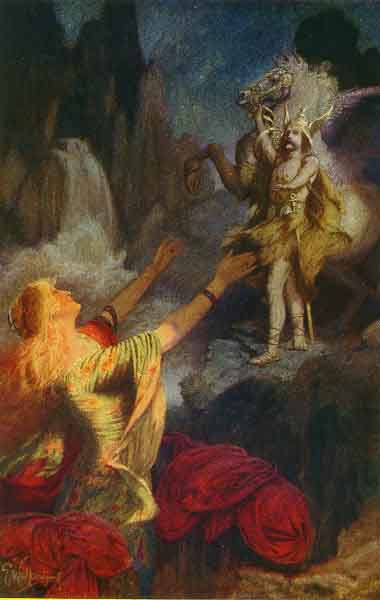
HUNDINGSBANE'S RETURN TO VALHAL<BR> <I>From the painting by E. Wallcousins</I> HUNDINGSBANE'S RETURN TO VALHAL
From the painting by E. Wallcousins

At length the woman took Hadding towards a place which was surrounded by a high wall. He had already gazed from afar off, as he descended the hills, upon the beauties of the enclosure, where grew the flowers which were plucked in midwinter and stately beings in robes of purple had blissful dwelling.

The old woman tried to leap over the wall, but was unable to do so. She, however, showed Hadding that the place within was indeed the land of life. She seized a fowl which she carried with her, and flung its head, which he wrung off, over the wall. The head was speedily restored again, and the bird crowed loudly.

Hadding thereafter returned again unto his own land, and he endured many perils upon the way.

Spenser's Mimer

Guyon finds Mammon in a delve
Sunning his treasure hoar,
Is by him tempted and led down
To see his secret store.

At last he came upon a gloomy glade,
Covered with boughs and shrubs from heaven's light,
Whereas he sitting found in secret shade
An uncouth, savage and uncivil wight, 10
Of grisly hue and foul ill-favoured sight;
His face with smoke was tann'd and eyes were bleared,
His head and beard with soot were ill bedight,
His coal-black hands did seem to have been seared
In smith's fire-spitting forge, and nails like claws appeared.

His iron coat, all overgrown with rust,
Was underneath envelop with gold
Whose glittering gloss, darkened with filthy dust,
Well yet appear to have been of old
A work of rich entail and curious mould,
Woven with antiques and wild imag'ry:
And in his lap a mass of coin he told
And turn upside down, to feed his eye
And covetous desire with his huge treasury

. . . . . .

And round about him lay on every side
Great heaps of gold that never could be spent;
Of which some were rude ore, not purified
Of Mulciber's devouring element;
Some others were new driven, and distent
Into great ingots and to wedges square;
Some in round plates withouten moniment 11
But most were stampt, and in their metal bare
The antique shapes of Kings and Kesars strong and rare

. . . . . .

"What secret place," quoth he, 12 "can safely hold
So huge a mass, and hide from heaven's eye?
Or where hast thou thy wonne 13 that so much gold
Thou canst preserve from wrong and robbery?"
"Come thou," quoth he, "and see." So by and by
Through that thick covert he him led, and found
A darksome way, which no man could descry,
That deep descended through the hollow ground,
And was with dread and horror compass around.

So soon as Mammon there 14 arrived, the door
To him did open and afforded way:
Him followed eke Sir Guyon evermore,
Ne darkness him ne danger might dismay.
Soon as he entered was, the door straightway
Did shut, and from behind it forth there leapt
An ugly fiend, more foul than dismal day;
The which with monstrous stalk behind him stept;
And ever as he went due watch upon him kept.

. . . . . .

Both roof, and floor, and walls, were all of gold,
But overgrown with dust and old decay,
And hid in darkness, that none could behold
The hue thereof; for view of cheerful day
Did never in that house itself display,
But a faint shadow of uncertain light,
Such as a lamp, whose life does fade away;
Or as the moon, cloath with cloudy night,
Does shew to him that walks in fear and sad affright.

In all that room was nothing to be seen
But huge great iron chests, and coffers strong,
All barr'd with double bends, that none could weene
Them to enforce with violence or wrong;
On every side they plac were along,
But all the ground with skulls was scatter
And dead men's bones, which round about were flung
Whose lives, it seem, whilome there were shed,
And their vile carcases now left unburi

They forward pass; ne Guyon yet spoke word,
Till that they came unto an iron door
Which to them opened of its own accord,
And showed of riches such exceeding store,
As eye of man did never see before,
Ne ever could within one place be found,
Though all the wealth, which is or was of yore,
Could gathered be through all the world around,
And that above were added to that underground.

The charge thereof unto a covetous spright
Commanded was, who thereby did attend,
And warily awaited day and night,
From other covetous fiends it to defend,
Who it to rob and ransack did intend.
Then Mammon, turning to that warrior, said:
"Lo, here the world bless! lo, here the end
To which all men do aim, rich to be made!
Such grace now to be happy is before thee laid."

He brought him, through a darksome narrow strayt 15 ,
To a broad gate all built of beaten gold:
The gate was open; but therein did wait
A sturdy villain, striding stiff and bold,
As if the Highest God defy he would:
In his right hand an iron club he held
But he himself was all of golden mould,
Yet had both life and sense, and well could weld
That cursed weapon, when his cruel foes he quell'd.

. . . . . .

He brought him in. The room was large and wide,
As it some guild or solemn temple were;
Many great golden pillars did up-bear
The massy roof, and riches huge sustain;
And every pillar decked was full dear
With crowns and diadems, and titles vain,
Which mortal princes wore while they on earth did reign.

A route of people there assembled were,
Of every sort and nation under sky
Which with great uproar pressed to draw near
To th' upper part, where was advanced high
A stately siege 16 of sovran majesty;
And thereon sat a woman gorgeous gay,
And richly clad in robes of royalty,
That never earthly prince in such array
His glory did enhance, and pompous pride display.
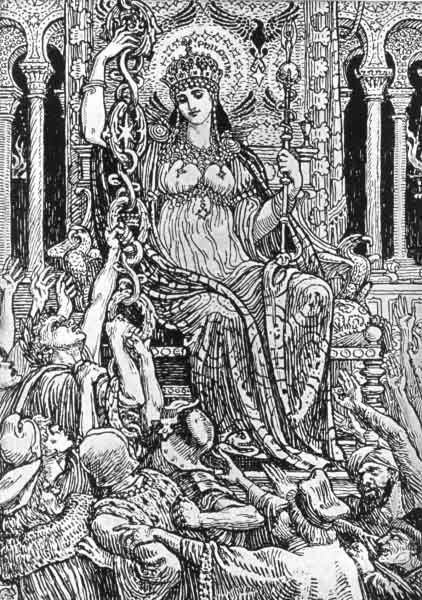
'And all that press did round about her swell<BR> To catchen hold of that long chain, thereby<BR> To climb aloft, and others to excell:<BR> That was Ambition, rash desire to sty,<BR> And every link thereof a step of dignity.''<BR> <I>After the drawing by Walter Crane. By permission of Messrs. George Allen & Co</I>. And all that press did round about her swell
To catchen hold of that long chain, thereby
To climb aloft, and others to excell:
That was Ambition, rash desire to sty,
And every link thereof a step of dignity.''
After the drawing by Walter Crane. By permission of Messrs. George Allen & Co.

Her face right wondrous fair did seem to be,
That her broad beauties beam great brightness threw
Through the dim shade, that all men might it see;
Yet was not that same her own native hue
But wrought by art and counterfeited shew,
Thereby more lovers unto her to call;
Natheless most heavenly fair in deed and view
She by creation was, till she did fall;
Thenceforth she sought for helps to cloak her crime withal.

There, as in glist'ring glory she did sit,
She held a great gold chain y-link well,
Whose upper end to highest heaven was knit,
And lower part did reach to lowest hell;
And all that press did round about her swell
To catchen hold of that long chain, thereby
To climb aloft, and others to excell:
That was Ambition, rash desire to sty 17 ,
And every link thereof a step of dignity.

Which whenas Guyon saw, he gan enquire,
What meant that press about that lady's throne,
And what she was that did so high aspire?
Him Mammon answer: "That goodly one
Whom all that folk with such contention
Do flock about, my dear, my daughter is; 18
Honour and dignity from her alone
Deriv are, and all this world bliss,
For which ye men do strive; few get, but many miss.

From"The Faerie Queene", Book II, Canto VII.

The Garden of Hela

Him forth thence led
Through grisly shadows by a beaten path
Into a garden goodly garnish
With herbs and fruits, whose kinds mote not be redd 19
Not such as earth out of her fruitful womb
Throws forth to men, sweet and well savour,
But direful deadly black, both leaf and bloom,
Fit to adorn the dead and deck the dreary tomb.

. . . . . .

The garden of Prerpina 20 this hight:
And in the midst thereof a silver seat,
With a thick arbour goodly over dight,
In which she often used from open heat
Herself to shroud, and pleasures to entreat:
Next thereunto did grow a goodly tree
With branches broad dispread and body great,
Cloath with leaves, that none the wood might see
And laden all with fruit as thick as it might be.

Their fruit were golden apples glist'ring bright
That goodly was their glory to behold;
On earth like never grew, no living wight
Like ever saw, but they from hence were sold. . . .

. . . . . .

The war-like elf much wondered at this tree 21
So fair and great, that shadowed all the ground;
And his broad branches laden with rich fee
Did stretch themselves, without the utmost bound
Of this great garden, compassed with a mound. . . .

The River of Torture

Which to behold he clomb up to the bank;
And, looking down, saw many damn wights
In those sad waves, which direful deadly stank,
Plong continually of cruel sprites,
That with their piteous cries and yelling shrightes 22
They made the further shore resounden wide:
Amongst the rest of those same rueful sights
One curs creature he by chance espied
That drench lay full deep under the garden side.

Deep was he drench to the upmost chin,
Yet gap still as coveting to drink
Of the cold liquor which he waded in;
And, stretching forth his hand, did often think
To reach the fruit which grew upon the brink;
But both the fruit from land, and flood from mouth,
Did fly a-back, and made him vainly swink;
The whiles he starved with hunger, and with drouth
He daily died, yet never throughly dyen couth 23 .

He looked a little further and espied
Another wretch, whose carcas deep was drent 24
Within the river which the same did hide.
But both his hands most filthy feculent 25
Above the water were on high extent,
And feigned to wash themselves incessantly.
Yet nothing clearer were for such intent,
But rather fouler seem to the eye;
So lost his labour vain and idle industry.

The Fruit of Forgetfulness

Infinite more tormented in like pain
He there beheld, too long here to be told;
Ne Mammon would there let him long remain,
For terror of the tortures manifold,
In which the damn souls he did behold,
But roughly him bespake, "Thou fearful fool
Why takest not of that same fruit of gold?
Ne sittest down on that same silver stool,
To rest thy weary person in the shadow cool?"

All which he did to do him deadly fall
In frail intemperance through sinful bait
To which if he inclined had at all
That dreadful fiend, which did behind him wait,
Would him have rent in thousand pieces straight;
But he was wary wise in all his way
And well perceiv his deceitful sleight,
Ne suffered lust his safety to betray;
So goodly did beguile the guiler of his prey.

And now he was so long remain there
That vital powers gan wax both weak and wan
For want of food and sleep, which two up-bear
Like mighty pillars, this frail life of man,
That none without the same enduren can:
For now three days of men were overwrought,
Since be this hardy enterprise began:
Forthy 26 great Mammon fairly he besought
Into the world to guide him back as he him brought.

The god, though loth, yet was constrained t' obey;
For longer time than that no living wight
Below the earth might suffered be to stay:
So back again him brought to living light.
But all so soon as his enfeebled spright
Gan suck this vital air into his breast,
As overcome with too exceeding might,
The life did flit away out of her nest,
And all his senses were with deadly fit oppressed.

Hela in the Border Ballads

The Three Roads

True Thomas lay on Huntlie bank;
A ferlie he spied wi' his ee;
And there he saw a ladye bright,
Come riding doon by the Eildon Tree.

. . . . . .

"Harp and carp, Thomas," she said;
"Harp and carp along wi' me;
And if ye dare to kiss my lips,
Sure of your bodie I will be."

Betide me weal, betide me woe,
That weird 27 shall never daunton me."
Syne he has kissed her rosy lips,
All underneath the Eildon Tree.

. . . . . .

She's mounted on her milk-white steed;
She's taen true Thomas up behind:
And aye, whene'er her bridle rung,
The steed flew swifter than the wind.

O they rade on, and farther on;
The steed gaed swifter than the wind;
Until they reach'd a desert wide,
And living land was left behind.

Light down, light down, now, true Thomas,
And lean your head upon my knee;
Abide and rest a little space
And I will shew you ferlies three.

O see ye not yon narrow road
So thick beset with thorns and briers?
That is the path of righteousness,
Though after it but few enquires.

And see ye not that braid, braid road,
That lies across that lily leven?
That is the path of wickedness,
Though some call it the road to heaven.

"And see not ye that bonny road,
That winds aboot the fernie brae?
That is the road to fair Elfland,
Where thou and I this night maun gae.

"But, Thomas, ye maun hold your tongue,
Whatever ye may hear or see;
For, if you speak word in Elfyn land,
Ye 'll ne'er get back to your ain countrie."

O they rade on, and farther on,
And they waded through rivers aboon the knee,
And they saw neither sun nor moon,
But they heard the roaring o' the sea.

It was mirk, mirk night, and there was nae starn light,
And they waded through red blood to the knee;
For a' the blood that 's shed on earth
Rins through the springs o' that countrie.

Sync they came on to a garden green,
And she pu'd an apple frae a tree
"Take this for thy wages, true Thomas;
It will gie thee the tongue that can never lee."

Thomas The Rhymer.

The Mountains

"O where have you been, my long, long love,
This long seven years and more?"
"O I'm come to seek my former vows
Ye granted me before."

. . . . . .

She has taken up her two little babes,
Kissed them baith cheek and chin;
"O fare ye weel, my ain two babes,
For I'll ne'er see you again."

. . . . . .

She had not sailed a league, a league,
A league but barely three,
When dismal grew his countenance,
And drumlie grew his ee.

The masts that were like the beaten gold,
Bent not on the heaving seas;
But the sails, that were o' the taffetie,
Fill'd not in the east land breeze.

They had not sailed a league, a league,
A league but barely three,
Until she espied his cloven foot,
And she wept right bitterlie.

O hold your tongue of your weeping," says he,
"Of your weeping now let it be;
I will show you how the lilies grow
On the banks of Italy."

"O what hills are yon, yon pleasant hills,
That the sun shines sweetly on?"
"O yon are the hills of heaven," he said,
"Where you will never win."

"O whaten a mountain is yon," she said,
"All so dreary wi' frost and snow?"
"O yon is the mountain of hell," he cried,
"Where you and I will go."

The Demon Lover.

Demon Vengeance

Up then spake the Queen o' Fairies
Out o' a bush o' broom--
"She that has borrowed young Tamlane
Has gotten a stately groom."

Up then spake the Queen o' Fairies
Out o' a bush o' rye
"She's taen awa' the bonniest Knight
In a' my companie.

"But had I kenn'd, Tamlane," she says,
"A lady wad borrowed thee,
I wad ta'en out thy twa grey een,
Put in twa een o' tree.

Had I kenn'd, Tamlane," she says,
"Before ye came frae hame
I wad ta'en out your heart o' flesh,
Put in a heart o' stane."

"Had I but had the wit yestreen
That I hae coft the day
I'd paid my kane seven times to hell
Ere you'd been won away."

The Young Tamlane.

The Birk o' Paradise

There lived a wife at Usher's Well,
And a wealthy wife was she,
She had three stout and stalwart sons,
And sent them o'er the sea.

They hadna been a week from her,
A week but barely ane,
When word came to the carline wife
That her three sons were gane.

They hadna been a week from her,
A week but barely three,
When word came to the carline wife,
That her sons she 'd never see.

"I wish the wind may never cease,
Nor fishes in the flood,
Till my three sons come hame to me,
In earthly flesh and blood." 28

It fell about the Martinmas,
When nights are lang and mirk,
The carline wife's three sons came hame,
And their hats were o' the birk.

It neither grew in syke or ditch,
Nor yet in ony sheugh;
But at the gates of Paradise
That birk grew fair eneugh.

Gilly Flowers

The fields aboot this city fair
Were a' wi' roses set,
Gilly flowers and carnations rare
Which canker could not fret."

Clerk Saunders

The Garden Fruit

She led him intil a fair herbere,
There fruit groand was gret plent
Pears and apples, both ripe they were,
The date and eke the damsyn tree,
The fig and eke the wineberry.

. . . . . .

He pressed to pull the fruit with his hand,
As man for food was nyhonde faint,
She said, "Thomas let that stand,
Or else the fiend will thee attent.

"If thou pull them, sooth to say,
Thy soul goes to the fire of Hell
It comes not out till Domisday
And there ever in pain to dwell."

Thomas The Rhymer.

Footnotes

1 Mimer.
2 Saxo's words are: "Cujus transeundi cupidos revocavit, docens, eo alveo humana a monstrosis rerum secrevisse naturam, nec mortalibus ultra fas esse vestigiis."
3 In Highland lore these unions are followed by speedy death. The demon brides crush their lovers.
4 See chapter "Thor in Peril".
5 Thjasse-Volund's Sword of Victory and multiplying ring. Here we have the treasure which was cursed, and the dragon guardian of Beowulf, Volsunga saga, &c. The horn is Gjallar-horn which Heimdal is to blow at Ragnarok.
6 This is evidently Loke, not the Utgard-Loki in the chapter "The City of Enchantments ". Loke's place of torture was situated in the utmost part of Nifel hel.
7 His Hamingje.
8 The blessing counteracts the evil influence of a spell. In the Highlands a child should be blessed ere its name is asked, and strangers should bless a house on entering it. The blessing is not only a proof of friendly intentions, but a preventive, for he who blesses is unable to practise black magic for the time being.
9 See Chapter "The Gods Reconciled".
10 This is Spenser's Mammon. He resembles very closely Gudmund-Mimer, the chief of elfin smiths who in Norse mythology produce the vast stores of treasure accursed.
11 Superscription, image.
12 The Knight Guyon.
13 Dwelling.
14 The gate of hell.
15 Street, narrow passage.
16 Throne.
17 Ascend.
18 Urd, goddess of fate, is Mimer's daughter.
19 Must not be declared.
20 In Saxo she is Urd.
21 Like Ygdrasil.
22 Shrieks.
23 Could.
24 Drenched.
25 Muddy, foul.
26 Therefore.
27 Urd--destiny.
28 She had evidently power to work a spell and secure her wish. Belief in wishing power is not yet quite extinct in Scotland.

Subscribe to this RSS feed

Log in or create an account