log in
Teutonic Myth and Legend

Teutonic Myth and Legend (47)

Freyja [Public domain image]

TEUTONIC MYTH

AND LEGEND

by Donald A. Mackenzie

An Introduction to the Eddas & Sagas, Beowulf, The Nibelungenlied, etc.

[1912?]

This is Donald Mackenzie's able retelling of the Northern mythological cycle. He weaves a coherent narrative from the Eddas, the Niebelunglied, the Volsung Saga, Beowulf, the primordial Hamlet myths, and Medieval German tales of chivalry. MacKenzie also wrote Egyptian Myth and Legend and Myths of Crete and Pre-Hellenic Europe.


Teutonic Myth and Legend: Chapter 5 The Winter War

TEUTONIC MYTH AND LEGEND

by DONALD A. MACKENZIE

An Introduction to the Eddas & Sagas, Beowulf, The Nibelungenlied, etc.

London, Gresham Publications 1912

CHAPTER 5

The Winter War

The Great Earthquake--Frost--giants swarm South ward--Njord intervenes--Frey in Power of Giants--Asgard's Archer put to Shame--Peacemakers baffled--Vengeance of Thjasse--Volund--"Sword of Victory" forged --Mimer intervenes--Sword captured and Thjasse bound--Coming of Halfdan--Omens at his Birth--The Swords Accursed--Marriage, and Hadding's Birth--Conflicts with Giants--Groa taken Captive--Orvandel--Egil's Trial--The Mythical "William Tell"--Birth of Gudhorm--Groa's Promise to Svipdag--Her Incantations--Ull's Boyhood--Svipdag overcome by Halfdan--Visit to Hela--"Sword of Victory" recaptured--Svipdag's Great Victory--Thor put to Flight--Halfdan's Death.

A GREAT earthquake shook the nine worlds when the winter war was proclaimed. Midgar trembled and the heavens were disturbed. In Asgard the gods heard the dread clamour and the strong walls shivered as with fear. And it was thus that the earthquake was caused. When the sons of Ivalde withdrew their services from the gods, and made compact with their enemies, the terrible Frost-giants, the two giant-maids, Fenja and Menja, seized the handle of the great World-mill and turned it so violently that it went out of order, and disaster was threatened to the Universe. Then southward swarmed the Frost-giants to make war with the gods and their allies.

Now the Vana-god Njord sought to make peace between the gods and the sons of Ivalde, because at that time his son, the sunshine-god, Frey, was with them in northern Alf-heim, where he reigned as a king. He was still but a youth, and the sons of Ivalde had power to do him harm.

With Njord went Bjorno-Hoder, the fair god Balder's brother, the famous archer, who had not yet grown blind. Forsete, Balder's son, was also an envoy, for, like his father, he was a just judge and settler of disputes. Gifted he was with persuasive speech and manners which could subdue the most stubborn disputants. But they discovered that Frey had been given to Beli, "the howler", the great giant with enormous body who held him in thrall.

Bjorno-Hoder waxed wroth, and he drew his bow to slay Volund-Thjasse and Egil-Orvandel, Ivalde's sons. But Egil-Orvandel was also a great archer, for which he was named Avo. Ere Hoder could shoot, Orvandel's arrow severed his bowstring. Then the god tied the string, and Orvandel's second arrow passed through his fingers without hurting them. Ignoring this dread warning, Balder's brother still persisted, and his third arrow was struck from the bowstring by Orvandel just as he was pulling the string. Thus was Hoder put to shame.

Then the peacemakers turned to take their departure, and Ivalde's sons continued their journey to the north.

Thjasse-Volund, son of Ivalde, was filled with boundless vengeance against the gods, and went to his smithy, where he forged the great Sword of Victory. Never was there such a weapon since the beginning of time. It shone like the sun in heaven, and there was no substance that it would not cleave. More terrible was it than Thor's hammer, which the sons of Sindre had made, for he who wielded the sword could prevail over the Thunder-god. Thjasse-Volund was resolved to subdue the gods and conquer Asgard. He also made a ring which multiplied till it became a chain to bind the wind.

But grave Mimer-Nidhad, who is also called Narve, "the binder", came to know of the dread sword which his rebellious subject had constructed, and he still remained the faithful friend of the gods. He knew well the power possessed by the sword, and feared the disaster which it would cause. So he went to Wolfdales, in Nifel-heim, where Thjasse-Volund had built his, great smithy, and seized the elf-smith, whom he bound with chains. Then The Binder took with him the sword, and also the magic ring from among seven hundred other rings, which it had produced. These he bore unto river-girdled Hela, where he concealed them in his deep cave, heaped with treasure, over which his son was guard. There the sword and the ring were kept until they were recaptured by The Shining One, who prevailed over Thor and became a god in Asgard--Svipdag the Brave, the hero of heroes. But ere that day came many great battles were fought, and mighty warriors perished in their pride.

The great hero who fought against the giants and Ivalde's sons in the winter war was Halfdan, son of Thor, who by tellers of old tales has also been called Mannus.

At his birth there were dread omens which foretold his glory and his doom. Eagles screeched, the clamour of thunder was heard, and the shadow of Thor fell over the house. Norns came and twisted the threads of fate. Of gold they made the warp of the web and fastened it under the moon; the ends were hid in the east and the west. One fateful thread was drawn northward towards Jotun-heim, the giants' home, and Urd decreed that it should hold there forever.

Hungry ravens cawed one to another, and welcomed the wolf-eyed child who would cause them to thrive with blood and the flesh of slaughtered men. They rejoiced that the battle-feast would soon be spread for them.

Halfdan's mother heard the ravens' song and dreaded his fate. Two swords there were in her home and they were accursed. She buried them deep in the earth, so that the child, when he grew strong, would not find them. But Halfdan soon displayed his warrior strength. When yet a youth he wrestled with a giant-bear and slew it.

Then came a day when Halfdan found a hidden sword, and in a conflict he slew with it his half-brother, nor did he know it was he. Thus was the sword accursed indeed.

Halfdan had knowledge from his father of sacred runes, and he knew the speech of birds, which gave him advantage over his enemies, for he was warned when danger was at hand.

When he grew years of knowledge and strength, he went forth to seek his fortunes. One day he met Signe-Alveig, which means "nourishing drink", and her he loved and married. She was the fair swan-maiden whose sister Groa was wed to Egil-Orvandel, son of Ivalde, and their son was Hadding. But although Halfdan lived for long at peace with Ivalde's clan, he fought against them when they leagued themselves with the Frost-giants to combat with the gods and their allies.

A strenuous campaign did Thor's son wage against the Frost-giants on the borders of Midgard, which they sought to possess and put under thrall. The giant Froste was their leader, and with him was Fjalar-Suttung, the fire-giant from Surtur's deep dales. Their march southward Halfdan stayed, and to the bleak north he drave them in confusion. A great battle he fought at Svarin's mound, where he slew Sigbrygg, the sire of his wife and Groa, her sister. Groa he took captive, and he put shame upon her, and with her he took her son Svipdag.

With Halfdan on his triumphant march northward went Odin's victorious Valkyries, and nightly the heavens flamed with their splendour, by men called "The Northern Lights".

On the borders of Jotun-heim Halfdan overcame Orvandel-Egil, the great archer, whose house he surrounded in the night.

Then it came about that Halfdan caused Orvandel to make trial of his skill, for hearing he had boasted that he could with the first arrow from his bow hit a small apple placed upon a stick at a great distance, he ordered Svipdag to stand with an apple upon his head. 1 Then he commanded Orvandel to perform the deed of which he had boasted on penalty of his life, but promised him his freedom if he achieved success.

Svipdag was led forth. To him his sire spoke words of encouragement and good counsel, so that he might bear the trial with courage and unflinchingly, and also lest he should move and thus cause the arrow to miss its mark. Svipdag he made to stand with his back turned so that he might not behold the drawing of the bow.

Three arrows did Orvandel take from his quiver. Then one he aimed at the apple upon his son's head. Careful aim he took and shot it from the bow, and he clove the apple in twain nor harmed his son.

Then did Halfdan ask him why he had taken three arrows from his quiver, and Orvandel-Egil bade him know that it was his purpose, had his son fallen, to slay the man who had compelled the sore trial of skill.

But the risk was not avenged upon Halfdan until the, day of Svipdag's triumph

.A VALKYRIE<BR> From the sculpture by Sinding<BR> Photographed by Vilhelm Tryde A VALKYRIE
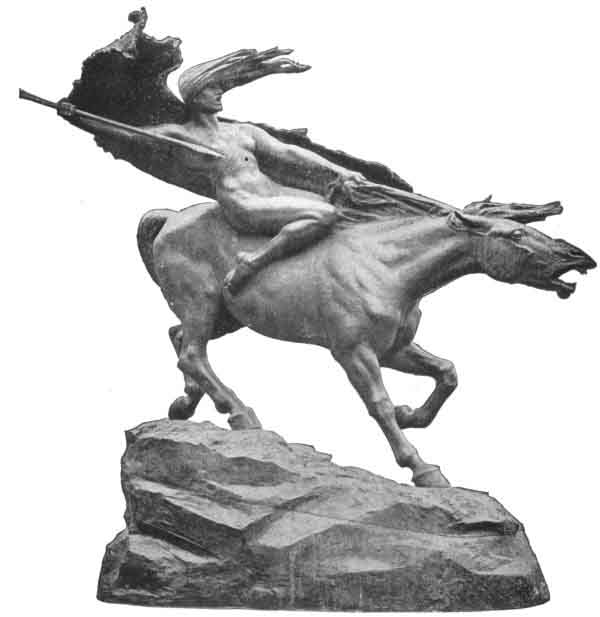
From the sculpture by Sinding
Photographed by Vilhelm Tryde

In sorrow did Groa pass weary days with Halfdan, to whom she bore a son who was named Gudhorm. Then was Groa rejected with deeper shame. When she, with her son, Svipdag, returned to Orvandel, she was heartbroken and had come nigh to life's end. Svipdag she called to her side and told him she must soon die with the sorrow she bore for the death of her sire and the shame that Halfdan had put upon her. Then she told him that he must needs endure great troubles and much strife, and be ofttimes in death-shadowing peril. "If mine aid you need at any time," she said, "come to my grave chamber and invoke my spirit, and I shall rise to help you." Soon after she spake thus Groa died, and Svipdag wept for her.

Then Orvandel took for wife the beauteous Sith. Their son was Ull, and he grew up to be a strong young warrior like his half-brother.

Svipdag was overcome with desire to be avenged upon Halfdan, and sought to wage war against him. But Sith prevailed upon him to promise that he would go towards the mountains of Jotun-heim, and rescue the goddess Freyja and the god Frey from the giant who kept them imprisoned in his strong castle.

But Svipdag deemed Sith to be moved with cunning intentions, and he feared that if he went forth upon such an enterprise he would never return. He had need of counsel and of help, and in the darkness of night he went to the stone grave-chamber of his mother and called upon her.

"Awake," he cried, "as thou didst promise me, and come to me, O mother, in my sore straits!"

The spirit of Groa rose out of Hela, where she heard her son's voice calling upon her, and from the grave-chamber she spoke. She told him that he must indeed go on a long journey and meet many perils ere yet he would find Freyja, but she bade him remember that his Norn of fate would be his guide.

Then sang she incantations over Svipdag to protect him from danger and to heal his wounds, to give him courage and set him free from prisons. She also sang incantations to protect him against raging rivers he must needs cross, and against ocean's perils and the perils of vast and high mountains over which he must climb.

Nine incantations did Groa utter, and the last gave him security to traverse Nifel-hel and enter Mimer's grove.

Whereupon Groa's voice was silent, and her spirit returned to the Underworld.

Satisfied he would be indeed safe from all danger, Svipdag went northward towards the battleground of the giants. It was his desire to first avenge his grandsire's death and his mother's shame ere yet he would search to find Freyja. So he set himself to lead a giant host against the army of Halfdan, and a dread conflict was fought.

Svipdag was in the midst of the battle, and with Halfdan he waged a duel, but he was overcome and taken prisoner. Then made the giants hurried flight towards the north.

Deep was Halfdan's admiration for the prowess of the young hero, and he offered him his friendship if he would become his ally and help him to continue the campaign against the giants with whom Ivalde's sons were in league. But Svipdag scorned his friendship with defiance, and Halfdan in his wrath caused him to be bound to a tree in the midst of a thick forest, so that he might become the prey of wild beasts.

Groa's son, when he was alone, bethought him of the incantations which his mother had uttered, and one he repeated till the chains that bound him flew away and he was set free. Hither and thither he wandered disconsolately, nor giant nor foeman could he see, nor could he discover which way he should go.

Then came he to the moon-god ere he rose on his path through the heavens, and by him was Svipdag told where he would find the Sword of Victory which Thjasse-Volund had forged.

"In Mimer's cave," the moon-god said, "it is concealed, and thou must needs overcome the Keeper of Hela's gate to obtain it."

Towards the trackless regions that lead by Hvergelmer's mountain did Svipdag then journey, and over the caves in which giants guard their accursed hoards of treasure. Intense and bitter cold prevailed as he traversed over frostbound ways and wreaths of blocking snow. Now he had need to climb great precipices, and ofttimes he found himself on dizzy mountain ridges, while dread chasms yawned below him. Through many places of horror and peril did Svipdag traverse until he reached the borders of Hela. There he beheld a fair land that gleamed before him, full of flowers of rich fragrance.

He crossed a dark valley, and a hel-hound pursued him, barking loudly. Then came he to the River of Blades, which was spanned by a bridge of gold, and beyond there was a stone door in Hela's wall, guarded by a strong watchman. With him Svipdag fought and was victorious, and he entered the land of spirits where dwells Mimer and the regenerating race unborn.

Protected by the enchantment of Groa, Svipdag went towards the cave in which the treasures of Mimer are concealed, nor did he let his shadow fall upon it lest Mimer's son Mimingus, who kept watch, should take fear and shrink back into the mountain.

Mimingus lay asleep, and Svipdag overcame him and bound him where he lay. He took from the wall the glittering Sword of Victory and the great Arm-ring which Thjasse-Volund had forged, and then hastened to return by the way he had come. So traversing again the mountains of snow and misty blackness, and escaping the dread perils about him, Svipdag returned with his treasures from the Underworld.

Then without delay did the vengeance-seeking son of Groa open a new campaign against Halfdan. In Asgard it was known that he had secured the dreaded sword which Thjasse-Volund had made so that he might overcome the gods. Mighty Thor seized his iron hammer and went forth to help his son.

Great was the battle which was waged. Svipdag mowed down his enemies before him, and Halfdan was sorely wounded by an arrow shot from the bow of Orvandel-Egil. Then did Thor press into the midst of the fray, fighting fiercely against the giants, who fell before him until he came against Svipdag. But the hammer which Sindre had made was of no avail against, the young hero, for with the Sword of Victory it was struck by The Shining One and severed from the handle.

When Thor was repulsed he fled from the field, and Halfdan went with him.

Thus did victory come to Svipdag, and thus was the judgment of the gods defied, for they had placed the workmanship of Sindre's kinsman above that of the sons of Ivalde.

Halfdan died of his wounds, and Thor made haste to Asgard, where the gods awaited the coming of Svipdag with the Sword of Victory, which had been forged so that they might be utterly overcome and Asgard laid waste.

Footnotes

1 Saga version of William Tell myth.

Teutonic Myth and Legend: Chapter 4 How Evil entered Asgard

TEUTONIC MYTH AND LEGEND

by DONALD A. MACKENZIE

An Introduction to the Eddas & Sagas, Beowulf, The Nibelungenlied, etc.

London, Gresham Publications 1912

CHAPTER 4

How Evil entered Asgard

Odin and his Brothers--Gifts to First Man and Woman--Loke's Fall--"The Mother of Evil"--Plot to capture Freyja--How Asgard's Wall was built--Loke's Evil Counsel--World-disaster averted--Odin's Horse--Rape of Sif's Locks--Loke threatened--Visits to Elf--Smiths--Wonder Works--The Gods appeased--Rivalry of Elf-Smiths--Loke's Wager lost--Demand for his Head--Elf-Smith outwitted--Loke's Plot causes Winter War--Children of Ivalde--Idun and the Swan Maids--Thjasse--Volund and his Brothers--The Giantess Greip--Fenja and Menja--Freyja lured from Asgard.

IF Odin sought after wisdom and loved justice his brother Loke had the desire to do evil and work wrong, and he became the instrument of dissension among gods and men. In the Golden Age, when there was peace and concord in Asgard, he was yet innocent and of good repute. He was fair o countenance and his form was stately, and pleasant indeed were his converse and his ways.

With Odin and Honer, his brethren, he endowed with their various attributes the first man and the first woman. But the gifts of the gods were of unequal account. Odin gave Spirit which yearns for what is good and inspires courage and veracity, and the love of mercy and justice. Honer imparted understanding and memory and will, and by Loke, who is also called Loder, the man and the woman were given the semblance of the gods, and endowed with passions and desires and longings which ever tend to work evil and bring weakness and distress. Thus the gifts of Loke are continually at strife with those of Odin and Honer.

But not until the Golden Age was ended did Loke fail and man turn to evil ways. The innocence of gods and men passed from them when from Jotun-heim, as the Skalds have told, came three giant maids, who brought corruption. These three were combined in one form, which was outwardly fair and seemingly good. For the giants had plotted to accomplish the downfall of the gods, and one, whose name was Grep, desired to possess beauteous Freyja, the goddess of Fertility, who sat with her maids beneath the fruitful bough of the World-tree Ygdrasil.

The thrice-born maid whom the giants sent from Jotun-heim was Gulveig-Hoder, whose other name is Aurboda, Hag of Iarnvid and "The Mother of Evil", who assumed the guise of one both fair and young. A maid attendant was she among others to Freyja in the fairest grove of Asgard. She was loved by Loke and became his bride. She fostered his ambition to be chief ruler of the gods, and imparted to him her evil nature and her cunning, while she herself constantly sought to lure Freyja from her secure abode. There came a day when her desire was fulfilled, and war followed war because of her evil doings.

Loke was the chief instrument of her designs. She spread unrest throughout Asgard and set Asa-gods and Vana-gods at enmity, while Loke also plotted with the evil giants to bring ruin to his kindred.

The great wall of Asgard was not yet constructed, and by Loke's secret desire there came before the gods in the guise of a dwarf a Frost-giant who was a cunning artificer. He offered to build a residence so well fortified that it would be ever secure against the attacks of the Frost-giants and the giants of the mountains. This vast work he undertook to complete in the space of a single winter.

The gods were willing that the fortification should be made, and enquired of the artificer what reward he sought for his service. His answer was that his demand would be possession of the goddess Freyja, together with the sun and moon. But if the work were not completed in the time allowed him, he would receive no reward whatsoever.

His words were not pleasant to the gods, and they took counsel among themselves. There were those among them who desired to reject his offer, and others who were in sore doubt. Yet all of them desired that the fortification should be built.

Then Loke counselled that the offer which the artificer made should be accepted, provided that he would do the work alone and within the time allotted to him. "For," said Loke, "the dwarf can finish not the building in time, and we shall have it for ourselves without payment of any reward."

So the gods agreed as Loke counselled them, but when their will was made known to the artificer he stipulated that he should be allowed to use his horse, named Svadilfare, in performing the work. By the advice of Loke this condition was granted to the cunning artificer. The bargain was sealed and confirmed by solemn oaths.

The work was then begun without further delay. On the first day of winter the giant in dwarf-guise prepared for the laying of the foundations, and during the night his horse drew the stones towards Asgard. When day broke the gods were amazed at the prodigious size of the boulders which were gathered together, and they perceived that the greater part of the work was performed by the great steed Svadilfare. All winter did the heavy work proceed, and rapidly did the great and vast walls rise around the habitation of the gods.

When the summer drew nigh, the work was far advanced, and the gods perceived that the artificer was certain to finish it before his allotted time was completed. The buildings were already so strong and so high as to be impregnable, and when only three days had to pass, before summer came, the gateway alone remained to be completed.

Wroth were the gods because of the disaster which threatened them, and they sat in council together and asked one of another who had given advice that the terms of the artificer should be accepted and that Freyja should be given away to Jotun-heim, and the sun and moon taken out of the heavens. They agreed that it was Loke and no other who had brought this danger with his evil designs. Him they condemned as the worker of evil, and they said they would put him to death if he did not contrive some means to prevent the artificer from finishing the work and receiving the reward which he had demanded.

The gods immediately seized Loke, who was stricken with great fear. He saw that he would be put to death if he did not cause hindrance to the giant, so he swore a solemn oath that, no matter what disaster might befall him, he would prevent the giant from accomplishing the disaster which was threatened.

In the darkness of night Loke went forth to outwit the artificer. When the great steed Svadilfare was being driven towards the last boulders which were to complete the gateway, a mare ran forth from a deep forest and neighed loudly. Svadilfare leapt with excitement and turned to follow, and the artificer sought in vain to hold him in restraint. But the steed broke free and ran after the mare, which took flight through the forest, and the great builder made search for him in vain. Thus a whole night was lost, and in the morning the artificer perceived that the work could not be completed in time. He was filled with exceeding great anger, knowing well that a plot had been laid against him. In his wrath he was moved to be revenged, and he assumed his giant form again and rose against the gods. Then it was perceived that he was a fierce and terrible Frost-giant.

Finding themselves deceived, the gods no longer observed their oaths, which had been sworn with one so treacherous. Odin called upon Thor, who seized his great stone hammer and went forth to combat. For him the giant was no match, and the great thunder-god paid him his wages, not with Freyja and the sun and moon, but with death, for the first blow he struck shattered to pieces the great giant's skull. Then the gods seized the body and flung it into the lowest depths of Nifel-hel, the place of sorrow and eternal torture.

The mare which Svadilfare followed brought forth a cloud-grey foal with eight legs. It grew up to be the swiftest steed in the nine worlds, and the name it bore was Sleipner.

To Odin was Sleipner given for his own especial use. On its teeth were graven sacred runes, and it was on the back of Sleipner that Odin ever went forth on his great hunt across the heavens and over the "Milky Way" when the winds were loud and the stars burned in splendour. The great steed he also rode daily to the lower Thingstead of the gods on the bridge which is called Bif-rost.

Thus among men was the riddle propounded: Who are these two who ride forth to the Thingstead? They have in all ten feet, three eyes, and but one tail.

The answer is Odin and Sleipner, for Odin has but one eye; the horse has eight feet and Odin two; and the horse alone has a tall.

Sleipner is not only Odin's steed of war and of the hunt, he is also the steed on which poets rise to divine heights, as Odin, who is the first and greatest of poets, was raised also.

Now Loke and his wife, although frustrated in their desire to work evil against the gods, were still filled with resolve to achieve their wicked ends. There came a season when a new disaster befel. the dwellers in Asgard, and caused great dissension throughout the worlds. Sif, the harvest goddess, who was Thor's ward, was beauteous to behold, and her beauty and her power were in her rich and plenteous growth of shining golden hair.

Her harvest locks did the fierce Hag in maid's guise desire to possess, and while Sif slept Loke seized a sharp sword and cut them off and took them away.

Then was Thor filled with wrath, as were also Odin and the rest of the gods, for in Sif's locks there was abundance and prosperity.

Loke was again seized, and, fearing he would be put to death, he promised to restore Sif's harvest hair and bring gifts of appeasement to the greater gods. Oaths were laid upon him to fulfil his promise, and Loke departed from Asgard to visit the underworld, where gold and treasures were concealed in abundance. But even while he feared punishment, the desire to work evil did not leave his heart, and he sought, while he fulfilled his promise, to work great and lasting dissension.

To the elf-smiths, who are subject to wise Mimer, did Loke proceed, and their services he besought with cunning and evil intent.

Now there were two families of elves who were accomplished artificers and workers in fine metals, and these were the sons of Ivalde and the sons of Sindre, in whose golden halls in Mimer's realm there were great treasures. They lived at peace with the gods, whom they rendered ofttimes great service by providing ornaments and embellishing the palaces of Asgard with their beauteous work.

Loke plotted to work enmity not only between the families of elf-smiths, but also to estrange them against the gods.

First he went to the sons of Ivalde and besought them to make golden locks for the goddess Sif which would grow like other hair. They set to work and accomplished his desire, and they also made at his request a great spear for Odin, which was named Gungner. There was made for Frey, the god of golden sunshine, a wondrous ship, named Skidbladner, which could hold all the warriors of Asgard, and was ever accompanied by soft and favourable winds. Yet, great as the vessel was, it could be folded into small space like a napkin.

The gods were reconciled to Loke when the golden hair of Sif was restored. The spear was given to Odin and the great ship to Frey.

Then Loke went with evil in his heart to the kinsmen of Sindre, and them he challenged to produce works as wondrous and finely executed as those of the sons of Ivalde. Brok, who was Sindre's brother, protested the greater skill of his fellows, and Loke wagered his own head that such treasures as were already made could not be surpassed. The wager was readily accepted. Sindre made a great smithy, and he and his kinsmen set to work. Loke assumed the guise of a great blood-drinking fly, to harass them while at work.

Sindre first put a pigskin into the smithy fire. Then he bade Brok to blow the bellows without ceasing until the work was finished. That he did with great activity. But a great fly set itself upon his hand, stinging him sorely and drinking blood. He would have fain ceased his labours because of the fly, but if he did so the charm would be broken and the work rendered utterly without avail. So, suffering as he did, he persisted at the bellows handle, and at length Sindre drew out a wondrous boar with golden bristles, which was a thing to marvel at.

Then Sindre put much precious gold into the furnace, and Brok again blew the bellows. But the great fly attacked his neck, and drew more blood, nor could he smite it or drive it away. At times it seemed as if he must cease to labour, but he prevailed over his sufferings until Sindre drew out a magic ring, which was named Draupner, "the dropper".

A mass of iron did Sindre next place in the furnace, and when Brok began to blow the bellows the great fly became more ferocious than ever, and it stung him between the eyes, so that blood flowed down and nearly blinded him. Brok laboured heavily, and only once did he pause to drive the fly away. Then Sindre drew from the furnace a great hammer, which none save Thor could wield.

"These works, said Sindre, no son of Ivalde can equal."

Brok carried the gifts to Asgard, and Loke went with him.

Then sat the high gods in council to decide whose treasures were of greatest account. They appointed, as judges, Odin and Thor and Frey, and the various works they considered together.

Between the sons of Ivalde and Sindre's kinsmen there was ever keen rivalry, and Loke knew well that the clan which was given the award would win the hatred of the other, and that the gods would be despised by those who were not favoured.

Each of the gifts received the praises of the gods. But those of Sindre were to them of greatest account. The ring Daupner was a charm for fruitfulness and fertility; every ninth night eight gold rings of equal size dropped from it. It was a ring that grew to a chain without end. To Odin was it given, and the high god had it with the spear Gungner, which the sons of Ivalde had made. Oaths were sworn on the point of the great spear, which, when Odin throws it, gleams brightly as it falls through the stars. Upon great warriors is conferred the power of Odin's spear.

To Frey was given the golden boar on which to ride over the heavens or over the sea. Faster it could run than any steed save Sleipner, and in thick darkness it shone in splendour. When Frey went forth at morning or evening the rays of the golden bristles gleamed high in the heavens.

But the greatest gift of all was the mighty iron hammer, Mjolner, which was given to Thor. It had but one defect, and that was the shortness of the handle, for Brok had ceased to blow when the fly blinded him momentarily. So with the great gift came the defect which Loke had caused. The hammer had power to return to Thor each time it was thrown.

The sons of Ivalde were deeply incensed against the gods because they awarded chief praise to the kinsmen of Sindre, and they departed vowing fierce vengeance. Thus was the end of Loke achieved.

Brok, who thirsted for revenge, demanded his prize for the hammer, and that was Loke's head, which he had wagered. Loke offered to redeem it, but the elf-smith would have naught else.

Now Loke had shoes of swiftness, and could speed swiftly through the air and over the sea. Crying to Brok: "Then take me," he vanished from sight.

But the angered elf-smith appealed to Thor to seize Loke, and that great irresistible god set forth and returned with him.

"Thy head is mine," exclaimed Brok, who prepared to cut it off.

"Thine indeed is the head, answered Loke, "but not the neck." 1

Brok appealed to the gods, and they gave judgment that favoured Loke. They told Brok that he might take the head, but the neck he must not injure.

Then was Brok possessed with great wrath, and he demanded to sew the lips from which evil counsel came. Loke's head being his by right of wager, none could gainsay him. He took his knife to pierce the evil god's lips, but it was not of sufficient sharpness. So he cried: "Would I had my brother's awl." When he said that, the awl was immediately beside him, and he took it and sewed up the mouth of Loke, and left him there confused with silence.

In great wrath did Brok leave Asgard. Thus was Loke's end doubly achieved, for Sindre's kinsmen were also incensed against the gods because of the judgment they had given when the wager was claimed.

The sons of Ivalde rose in revolt and leagued themselves with the Frost-giants to wage war against the Asa-gods and bring disaster to Asgard.

Let it be told that twice wedded was Ivalde, the rebel watchman of Hvergelmer and the rivers Elivagar. His first wife was Sol, the sun-goddess, and their daughters were Idun, who became wife to Brage, and also the swan maids who sang on the borders of the western realm of Njord. Then had Ivalde for wife the giantess Greip, and they had three sons who were elf-smiths--Thjasse-Volund, Orvandel-Egil, the great archer, and Ide, whose other names are Hyuki, Hengest, and Gelder, "the Gelding".

Greip, the mother of these sons of Ivalde, had afterwards, with marriage to a giant, two sons whose daughters were Fenja and Menja.

So, as has been told, it came about that through Loke's evil workings a winter war was proclaimed against the gods by the sons of Ivalde and the Frost-giants.

At this time too was the goddess Freyja lured secretly from Asgard by Gulveig-Hoder, the Hag in maiden guise, and was caught in ambush by the great giant Beli, father of Grep, who fled with the goddess to Jotun-heim and concealed her in his strong castle. A double disaster thus fell upon the gods.

The Dwarfs

Loke sat and thought, till his dark eyes gleam
With joy at the deed he'd done;
When Sif looked into the crystal stream,
Her courage was wellnigh gone.

For never again her soft amber hair
Shall she braid with her hands of snow;
From the hateful image she turned in despair,
And hot tears began to flow.

In a cavern's mouth, like a crafty fox,
Loke sat 'neath the tall pine's shade,
When sudden a thundering was heard in the rocks,
And fearfully trembled the glade.

Then he knew that the noise good boded him naught,
He knew that 't was Thor who was coming;
He changed himself straight to a salmon trout,
And leaped in a fright in the Glommen.

But Thor changed too, to a huge seagull,
And the salmon trout seized in his beak;
He cried: Thou, traitor, I know thee well,
And dear shalt thou pay thy freak!

Thy caitiff's bones to a meal I'll pound,
As a millstone crusheth the grain.
When Loke that naught booted his magic found,
He took straight his own form again.

And what if thou scatter'st my limbs in air?
He spake, will it mend thy case?
Will it gain back for Sif a single hair?
Thou 'lt still a bald spouse embrace.

But if now thou 'lt pardon my heedless joke,
For malice sure meant I none,
I swear to thee here, by root, billow and rock,
By the moss on the Beata-stone,

By Mimer's well, and by Odin's eye,
And by Mjolmer, greatest of all,
That straight to the secret caves I'll hie,
To the dwarfs, my kinsmen small;

And thence for Sif new tresses I'll bring
Of gold ere the daylight's gone,
So that she will liken a field in spring,
With its yellow-flowered garment on.

. . . . . .

Loke promised so well with his glozing tongue
That the Asas at length let him go,
And he sank in the earth, the dark rocks among,
Near the cold-fountain, far below.

He crept on his belly, as supple as eel,
The cracks in the hard granite through,
Till he came where the dwarfs stood hammering steel,
By the light of a furnace blue.

I trow 't was a goodly sight to see
The dwarfs, with their aprons on,
A-hammering and smelting so busily
Pure gold from the rough brown stone.

Rock crystals from sand and hard flint they made,
Which, tinged with the rosebud's dye,
They cast into rubies and carbuncles red,
And hid them in cracks hard by.

They took them fresh violets all dripping with dew,
Dwarf women had plucked them, the morn,
And stained with their juice the clear sapphires blue,
King Dan in his crown since hath worn.

Then for emeralds they searched out the brightest green
Which the young spring meadow wears,
And dropped round pearls, without flaw or stain,
From widows' and maidens' tears.

. . . . . .

When Loke to the dwarfs had his errand made known,
In a trice for the work they were ready;
Quoth Dvalin: O Lopter, it now shall be shown
That dwarfs in their friendship are steady.

We both trace our line from the selfsame stock;
What you ask shall be furnished with speed,
For it ne'er shall be said that the sons of the rock
Turned their backs on a kinsman in need.

They took them the skin of a large wild-boar,
The largest that they could find,
And the bellows they blew till the furnace 'gan roar,
And the fire flamed on high for the wind.

And they struck with their sledge-hammers stroke on stroke,
That the sparks from the skin flew on high,
But never a word good or bad spoke Loke,
Though foul malice lurked in his eye.

The thunderer far distant, with sorrow he thought
On all he'd engaged to obtain,
And, as summer-breeze fickle, now anxiously sought
To render the dwarf's labour vain.

Whilst the bellows plied Brok, and Sindre the hammer,
And Thor, that the sparks flew on high,
And the slides of the vaulted cave rang with the clamour,
Loke changed to a huge forest-fly.

And he sat him all swelling with venom and spite,
On Brok, the wrist just below;
But the dwarf's skin was thick, and he recked not the bite,
Nor once ceased the bellows to blow.

And now, strange to say, from the roaring fire
Came the golden-haired Gullinburste,
To serve as a charger the sun-god Frey,
Sure, of all wild-boars this the first.

They took them pure gold from their secret store.
The piece 't was but small in size,
But ere 't had been long n the furnace roar,
'T was a jewel beyond all prize.

A broad red ring all of wroughten gold,
As a snake with its tail in its head,
And a garland of gems did the rim enfold,
Together with rare art laid.

'T was solid and heavy, and wrought with care,
Thrice it passed through the white flames' glow;
A ring to produce, fit for Odin to wear,
No labour they spared, I trow.

They worked it and turned it with wondrous skill,
Till they gave it the virtue rare,
That each thrice third night from its rim there fell
Eight rings, as their parent fair.

. . . . . .

Next they laid on the anvil a steel-bar cold,
They needed nor fire nor file;
But their sledge-hammers, following, like thunder rolled,
And Sindre sang runes the while.

When Loke now marked how the steel gat power,
And how warily out 't was beat
'T was to make a new hammer for Ake-Thor,
He'd recourse once more to deceit.

In a trice, of a hornet the semblance he took,
Whilst in cadence fell blow on blow,
In the leading dwarf's forehead his barbed sting he stuck,
That the blood in a stream down did flow.

Then the dwarf raised his hand to his brow for the smart,
Ere the iron well out was beat,
And they found that the haft by an inch was too short,
But to alter it then 't was too late.

. . . . . .

His object attained, Loke no longer remained
'Neath the earth, but straight hied him to Thor,
Who owned than the hair ne'er, sure, aught more fair
His eyes had e'er looked on before.

The boar Frey bestrode, and away proudly rode,
And Thor took the ringlets and hammer;
To Valhal they hied, where the Asas reside,
'Mid of tilting and wassail the clamour.

At a full solemn ting, Thor gave Odin the ring,
And Loke his foul treachery pardoned;
But the pardon was vain, for his crimes soon again
Must do penance the arch-sinner hardened.

Longfellow.

Footnotes

1 In like manner was Shylock thwarted when he demanded his pound of flesh.

Teutonic Myth and Legend: Chapter 3 The Deeds of Odin

TEUTONIC MYTH AND LEGEND

by DONALD A. MACKENZIE

An Introduction to the Eddas & Sagas, Beowulf, The Nibelungenlied, etc.

London, Gresham Publications 1912

CHAPTER 3

The Deeds of Odin

The Brooding God--Mimer's Well--Draught of Wisdom--The Eye Sacrifice--Revolt of Ivalde--Murder of Moon--god--Combat with Hyuki--The Stolen Song--Mead--Odin seeks to Recapture it--Descent to Surtur's Deep Dales--The Giant Suttung--Odin's Bridegroom--Guise--"The Champion Drinker"--Marriage with Gunlad--Ivalde's Fate--Odin's Escape--"The Man in the Moon"--Hyuki is Slagfin and Hengest--Odin's Apparel--His Ravens and Wolf Dogs--Odin the First Poet--Saga--Secret Runes--Thor and other Gods--Odin's Wives.

ODIN was the chief ruler of the gods. He was tall and old, and his aspect was wise and reverend. White was his beard and long, and he seemed ever to brood deeply over the mysteries of life and death. He had but one eye, because the other he sacrificed so that he might be dowered with great wisdom. Indeed he had In his youth drunk deeply of the magic mead of Mimer's well.

Every morning grave Mimer drank a draught with the Gjallar-horn, and Odin when he was yet young had deep desire to receive the wisdom and strength which the egg-white mead alone can give. He entreated Mimer to give him a draught, and the price he paid was an eye, which was cast into the well. From that hour when he drained Gjallar-horn he became worthy to rule over gods and men. 'Twas thus he sang in after-time of the powers which the mead imparted to him:

Then began I to bloom,
To be wise,
To grow and to thrive;
Word came to me
From word,
Deed came to me
From deed.

Thus Odin taught to all men that in youth there must needs be self-sacrifice of great account so that wisdom and power may be obtained.

From the moon-car in heaven did Odin also drink of the song-mead which was in the pitcher that Hyuki and Bil had carried from the secret well on the mountain, and Mani, the moon-god, captured. But wroth was Vidfinner at his loss, and he mourned more for the mead than for his children. Vidfinner is also called Ivalde, the sworn watchman of Hvergelmer and the Rivers Elivagar, and another of his names is Svigdur, "the champion drinker". There came a day when he broke his oath of fealty to the gods and fled from his post. Then raging heavenwards he attacked the moon-god, whom he slew and burned. His son Hyuki fought against him without avail, and suffered a fierce wound--as a maker of poems has sung--"clean to the thigh bone". For this dread crime Ivalde-Svigdur was condemned, but he fled towards Surtur's deep dales and unto the dwelling of Suttung, son of Surtur, the giant sentinel of Muspelheim. For Surtur and his clan were at enmity with Mimer and the Vana-gods, and also with the gods of Asgard since the creation of Asgard and the dividing of the worlds. To Suttung Ivalde gave the previous skaldic mead, and for reward he was promised for wife Gunlad, the giant's daughter.

Odin, seeing all that happened as he sat in his high throne, resolved to recapture the mead by cunning. So he set out to visit the hall of Suttung, "the mead wolf".

Now the realm of Surtur is difficult to reach, and full of peril for the gods. It lies in the dark underworld which is lower than and beyond Hela. Suttung's hall is within a mountain to which, in a deep abyss, there is but one entry, and it is guarded by a fierce dwarf sentinel.

But Odin secured the confidence of the dwarf, who promised to aid him so that his enterprise might be crowned with success. Heimdal, the sentinel of Bif-rost, also gave his service. His other name is Rati, "the traveller", and he bored through the mountain a narrow tunnel through which Odin might escape in eagle-guise. Thus, having completed his designs, Odin went towards the door of the dwelling of the great fire-giant Suttung, who is also called Fjalar.

A great feast was held within, and the evil frost-giants were as guests there to welcome Svigdur, the wooer of the giant--maid Gunlad. Odin assumed the form of Svigdur, and like him he spoke also, lest he should by uttering words of wisdom and weight be suspected and put to death. Thus he prevailed against the sons of Surtur with their own methods, for they were given to creating illusions and travelling forth in disguise to work evil and destruction.

A high seat of gold awaited the expected wedding-guest, and when Odin entered in the form of Svigdur, "the champion drinker", he was welcomed with ardour. And well he played the part, for he was given to drink of the nectar of the giants, and partook to the full, so that he was made drunk. Yet he observed great caution, that he might not be discovered.

As he sat at the feast, Gunlad came forward and gave him a draught of the stolen mead. Then was the marriage celebrated with solemnity and in state. The holy ring was placed upon the finger of the giant-maid, and she swore to be faithful to him who wooed her.

Meantime Ivalde-Svigdur, the real lover, reached the door of Suttung's hall, and came to know that Odin was within. He was filled with wrath, and he sought to denounce the high god so that he might be slain by the giants. But the dwarf sentinel accomplished Ivalde-Svigdur's destruction. He created an illusion, and opened a door on the side of the mountain which showed a lighted hall within and the wedding guests as they sat round Suttung's board. Gunlad was at Odin's side. Ivalde-Svigdur leapt towards the vision of the high god of Asgard, and thus dashed himself against the rock. The door was shut behind, and the mountain swallowed him.

Ere the wedding feast was ended Odin had spoken words which caused the giants to suspect him. But he retired with Gunlad to the bridal chamber, and there he found the precious mead which Ivalde-Svigdur had robbed from the moon-god. Then Gunlad came to know that her lover was Odin, but she helped him to make his escape in eagle-guise. So Odin flew through the tunnel which Heimdal-Rati had made, and reached Asgard in safety with the precious mead.

In the morning the giants went towards the bridal chamber, remembering the words that their guest had spoken, and when they found he had escaped they called him Bolverkin, "the evildoer".

But although Odin conferred great good upon gods and men by capturing the mead, the consequences of the evil he wrought towards that end were doomed to bring disaster in after-time, when Surtur, issuing forth to avenge the wrong done to Gunlad, set the world aflame. For good cannot follow evil, even although it is accomplished for the sake of good.

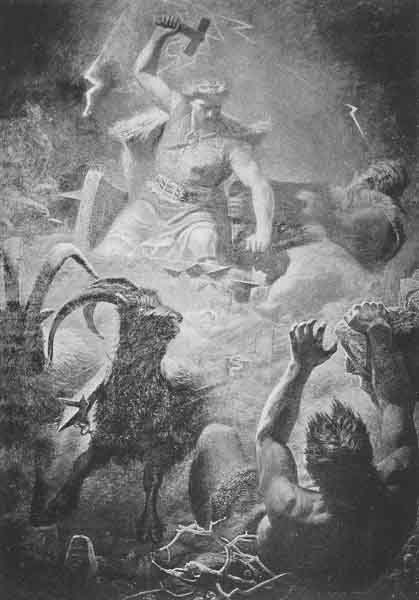
THOR AND THE GIANTS<BR> <I>From the painting by M. E. Winge</I>THOR AND THE GIANTS
From the painting by M. E. Winge

Odin's joy was great when he returned in triumph to Asgard, but he spoke words of pity for the giant-maid whom he had betrayed, and who wept because he left her.

Ivalde-Svigdur, who perished in the mountain, was refused an abode among the blessed dead in Hela's glittering plains. Him the gods condemned to dwell forever in the moon. There he suffers eternal punishment for his evildoings, for he is ever drunk with the stolen mead, which is venom to him, and is ever beaten with the rod of thorns by the god he slew and to whom life was again given. Ivalde's son, Hyuki, is revered among men. Another name he bears is Slagfin, and by Saxon warriors he is called Hengest. He is also Gelder, and his symbol is the gelding. Among skee-runners he is the chief upon land and on the sea.

Many names have the gods, and for Odin there are nine-and-forty. And the reason is, as skalds have told, that people speaking different tongues must needs call the gods by different names, while the gods have also been given names according to their various attributes and the great deeds they have done.

Thus Odin was called All-father, like the Mighty One who was at "time's first dawn", because he was father of the gods; and Val-father, the father of the brave who dwell in Valhal in high Asgard.

When Odin sat in his high golden throne, he wore a cloak which was striped with many colours of sunset splendour and summer radiance. Its hood was blue as is the sky, and speckled with grey like clouds. His hat was blue also, and its broad brims curved downward like the heavens. When he left Asgard to travel over the worlds he wore a burnished helmet, and sometimes he went among men wearing a hat which was tilted to conceal the hollow of his lost eye.

As Odin sat brooding and listening in Asgard two ravens perched on his shoulder. Their names are Hugin, which is "reflection", and Munin, which means "memory". When day dawned Odin sent them forth, and they returned at eve to whisper in his ears all the doings of men. Thus was he called Rafnagud, the "raven-god". He had also two wolf dogs, and they are named Gere, "the greedy", and Freke, "the voracious". These Odin fed with the food which was placed before him at the feast of heroes, for he ate not and for nourishment drank nectar.

When Odin drank of the song-mead he composed poems which for sweetness and grandeur have never been surpassed. He was the first poet, and knew well the magic of the mead. For the source of it was secret, and was discovered only by Ivalde, the watchman of the primeval fount from which life first came and by which life is ever sustained. Then was it carried to the beauteous car of the moon, and from thence to the regions of fire. There it was won by love mixed with wrong, and when the high god who descended to the deeps drank of it, he soared as an eagle to heaven, which he filled with song. From heaven has song descended upon earth, and in song are all the sufferings which were begotten over the mead.

Odin is also the friend and companion of the goddess Saga, whose dwelling in Asgard is Sokvabek, "the deep stream". Precious thoughts well up from the fountain source and flow along as words of gold. They tell of things that were, and Odin ponders. Day after day and night after night the high god sits with the goddess listening to the flowing stream, which grows deeper and wider as it wends its way onward, and their minds are refreshed by the glories of the past.

Secret runes, which have magical influence, did Odin also invent. For nine whole nights he hung on the high branches of Ygdrasil, pondering and searching out the secrets of the mind and of the Universe. For the power of runes was before the beginning of man. They are mixed with fate, and their potency did Odin discover when he drank from Mimer's well. They have also power over death and the world beyond. Runes there are to ward off strife and care, to charm away sickness and disease, to blunt the foeman's sword, to break fetters that bind, to still the storms, to ward off the attacks of demons, to make the dead to speak, to win the love of a maid, and to turn away love that is not desired. And many more there be also.

When runes are carved in mystic symbols the powers they convey are given to the weapons, or to the men that bear them, for they govern all things and impart power to conquer and power to subdue. He who has a certain desire shall achieve it if he but knows the rune which can compel its fulfilment, for the runes come from Odin, the chief ruler of the Universe, the god most wise. His power and great knowledge are enshrined in them.

Next to Odin the mightiest of the gods was his son Thor, whose mother was Jord, "the earth". In Asgard was built for him a great mansion called Bilskirnir, with five hundred and forty halls and a roof of shining silver. He drave forth in a car which was drawn by two goats. Three precious things were his possessions: the great hammer Mjolnir, which struck fire from the mountains and has slain many frost giants; the belt of prowess, which gave him threefold strength; and his mighty iron gauntlets, which he put on ere he could wield his hammer.

Another of Odin's sons was Balder the Beautiful, whose mother was Frigg, queen of goddesses, daughter of Nat and sister of Njord. Fair and comely was Balder, with silver hair that shone like sunshine. He was full of wisdom and was exceedingly mild and had great eloquence. In Asgard and Midgard there was no god more greatly loved than Balder.

Njord of the Vans was in Asgard as hostage to the Asa-gods. He was father of the god Frey and the beautiful Freyja, who was next to Frigg among the goddesses. Honer, Odin's brother, was sent to Vanaheim, where he was made ruler over the Vana-gods. He chose not his part and his judgments were weak.

Great was Tyr, the war-god, who gave valour to warriors and by whom he was invoked.

Brage, god of music and poetry, had for wife Idun, Ivalde's daughter, who was keeper of the apples of immortal youth.

Teutonic Myth and Legend: Chapter 1 Story of Creation

TEUTONIC MYTH AND LEGEND

by DONALD A. MACKENZIE

An Introduction to the Eddas & Sagas, Beowulf, The Nibelungenlied, etc.

London, Gresham Publications 1912

CHAPTER 1

Story of Creation

The Beginning--Ginnunga-gap--All-father--Nifel-heim and Muspel-heim--How Life began--Ymer, the Clay Giant--Audhumla, the Cow--Vana-gods, Giants, and Asa-gods--War in Space--Ymer--deluge.--The Great World-mill--How the Earth was made--Moon-god and Sun-goddess--Hyuki and Bil--The Pail of Song Mead--Wolf Giants pursue Sun and Moon--Mimer and Nat, "Mother of Gods"--The Day-god--The Eagle of Winds--First Man and Woman.

IN the Ages, when naught else was, there yawned in space a vast and empty gulf called Ginnunga-gap. Length it had, and breadth immeasurable, and there was depth beyond comprehension. No shore was there, nor cooling wave; for there was yet no sea, and the earth was not made nor the heavens above.

There in the gulf was the beginning of things. There time first dawned. And in the perpetual twilight was All-father, who governs every realm and sways all things both great and small.

First of all there was formed, northward of the gulf, Nifel-heim, the immense home of misty darkness and freezing cold, and to the south, Muspel-heim, the luminous home of warmth and of light.

In the midst of Nifel-heim burst forth the great fountain from whence all waters flow, and to which all waters return. It is named Hvergelmer, "the roaring cauldron", and from it surged, at the beginning, twelve tremendous rivers called Elivagar, that washed southward towards the gulf. A vast distance they traversed from their source, and then the venom that was swept with them began to harden, as does dross pouring from a surface, until they congealed and became ice. Whereupon the rivers grew silent and ceased to move, and gigantic blocks of ice stood still. Vapour arose from the ice-venom and was frozen to rime; layer upon layer heaped up in fantastic forms one above another.

That part of the gulf which lay northward was a region of horror and of strife. Heavy masses of black vapour enveloped the ice, and within were screaming whirlwinds that never ceased, and dismal banks of fleeting mist. But southward, Muspel-heim glowed with intense radiance, and sprayed forth beauteous flakes and sparks of shining fire. The intervening space between the region of tempest and gloom and the region of warmth and light was a peaceful twilight, serene and still as is windless air.

Now when the sparks from Muspel-heim fell through the frozen vapour, and the heat was sent thither by the might of the All-father, drops of moisture began to fall from the ice. It was then and there that life began to be. The drops were quickened and a formless mass took human shape. Thus came into being the great lumbering clay-giant who was named Ymer.

Rough and ungainly was Ymer, and as he stretched himself and began to move about he was tortured by the pangs of immense hunger. So he went forth ravenously to search for food; but there was yet no substance of which he could partake. The whirlwinds went past him and over, and the dark mists enveloped him like a shroud.

More drops fell through the gloomy vapours, and next there was formed a gigantic cow, which was named Audhumla, "void darkness". Ymer beheld it standing in the gloom beside blocks of ice, and groped weakly towards it. Wondering, he found that milk ran from its teats in four white streams, and greedily he drank and drank until he was filled with the seeds of life and was satisfied.

Then a great heaviness came over Ymer, and he lay down and fell into deep and dreamless slumber. Warmth and strength possessed him, and sweat gathered in the pit of his left arm, from which, by the might of All-father, were formed a son named Mimer and a daughter named Bestla. From Mimer were descended the Vana-gods. Under the feet of Ymer arose a monstrous six-headed son, who was the ancestor of the evil frost giants, the dreaded Hrimthursar. Then Ymer awoke.

For Audhumla, the great cow, there was no verdure upon which to feed. She stood on the verge of gloom, and found sustenance by licking constantly the huge boulders that were encrusted by salt and rime. For the space of a day she fed in this manner, until the hair of a great head appeared. On the second day the cow returned to the boulder, and ere she had ceased to lick, a head of human semblance was laid bare. On the third day a noble form leapt forth. He was endowed with great beauty, and was nimble and powerful. The name he received was Bure, and he was the first of the Asa-gods.

There followed in time more beings--noble giants and wicked giants, and gods. Mimer, who is Mind and Memory, had daughters, the chief of whom was Urd, Goddess of Fate and Queen of Life and Death. Bure had a son named Bor, who took for his wife Bestla, the sister of wise Mimer. Three sons were born to them, and the first was called Odin (spirit), the second Ve whose other name is Honer, and the third Vile, whose other names are Lodur and Loke. Odin became the chief ruler of the Asa-gods, and Honer was chief of the Vans until Loke, the usurper, became their ruler.

Now Ymer and his evil sons were moved with wrath and enmity against the family of gods, and soon warfare broke out between them. To neither side was there early victory, and the fierce conflicts were waged through the long ages ere yet the earth was formed. But, at length, the sons of Bor prevailed over their enemies and drove them back. In time there followed great slaughter, which diminished the army of evil giants until one alone remained.

It was thus that the gods achieved their triumph. Ymer was stricken down, and the victors leapt upon him and then slit open the bulging veins of his neck. A great deluge of blood gushed forth, and the whole race of giants was drowned save Bergelmer, "The Mountain-old", who with his wife took refuge on the timbers of the great World-mill, and remained there. From these are descended the Jotuns, who for ever harboured enmity against the gods.

The great World-mill of the gods was under care of Mundilfore (Lodur-Loke). Nine giant maids turned it with much violence, and the grinding of the stones made such fearsome clamour that the loudest tempests could not be heard. The great mill is larger than is the whole world, for out of it the mould of earth was ground.

When Ymer was dead, the gods took counsel among themselves, and set forth to frame the world. They laid the body of the clay-giant on the mill, and the maids ground it. The stones were smeared with blood, and the dark flesh came out as mould. Thus was earth produced, and the gods shaped it to their desire. From Ymer's bones were made the rocks and the mountains; his teeth and jaws were broken asunder, and as they went round at their labour the giant maids flung the fragments hither and thither, and these are the pebbles and boulders. The ice-cold blood of the giant became the waters of the vast engulfing sea.

Nor did the giant maids cease their labours when the body of Ymer was completely ground, and the earth was framed and set in order by the gods. The body of giant after giant was laid upon the mill, which stands beneath the floor of Ocean, and the flesh-grist is the sand which is ever washed up round the shores of the world. Where the waters are sucked through the whirling eye of the millstone is a fearsome maelstrom, and the sea ebbs and flows as it is drawn down to Hvergelmer, "the roaring cauldron", in Nifel-heim and thrown forth again. The very heavens are made to swing by the great World-mill, round Veraldar Nagli, "the world spike", which is the Polar Star.

Now when the gods had shaped the earth they set Ymer's skull over it to be the heavens. At each of the four corners they put as sentinels the strong dwarfs East and West and North and South. The skull of Ymer rests upon their broad shoulders.

As yet the sun knew not her home, nor the moon her power, and the stars had no fixed dwelling place.

Now the stars are bright fire-sparks sprayed from Muspel-heim over the great gulf, and these the gods fixed in the heavens to give light to the world and to shine over the sea. To these and to every wandering fire-flake they assigned due order and motion, so that each has its set place and time and season.

The sun and the moon were also regulated in their courses, for these are the greater fire-disks that were sprayed from Muspel-heim, and to bear them over the paths of the heavens the gods caused the elf-smiths, the sons of Ivalde and the kinsmen of Sindre, to fashion chariots of fine gold.

Mundilfore, who has care of the World-mill, aspired to rival Odin. He had two beautiful children, and one he called Mani (moon), and the other Sol (sun). The gods were filled with anger because of Mundilfore's presumption, and to punish him they took from him his two children, of whom he was exceedingly boastful, to drive the heavenly chariots and count the Years for men. Fair Sol they set to drive the sun-chariot. Her steeds are Arvak, which is "Early Dawn", and Alsvid, which signifies "scorching heat". Under their withers were placed skins of ice-chilled air for coolness and refreshment. They enter the eastern heaven at Hela-gate, through which the souls of dead men pass to the world beneath.

Then the gods set Mani, the handsome youth, to drive the chariot of the moon. With him are two fair children whom he carried away from earth--a boy who was called Hyuki, and a girl whose name is Bil. 1 They had been sent out in the darkness of night by Vidfinner, their father, to draw song-mead from the mountain spring Byrger, "the hidden", which broke forth from the source of Mimer's fount; and they filled their pail Saegr to the brink, so that the precious mead spilled over as they raised it on the pole Simul. When they began to descend the mountain, Mani seized them and took them away. The spots that are ever seen by night on the fair-faced moon are Hyuki and Bil, and beauteous Bil do skalds invoke, so that hearing them she may sprinkle from the moon the magic song-mead upon their lips.

In Mani's keeping is a bundle of thorns from which evildoers among met, must needs suffer the punishment of piercing pains.

The sun is ever in flight, and so also is the moon. They are pursued by bloodthirsty enemies, who seek to compass their destruction ere they reach the sheltering forest of the Varns, behind the western horizon. These are two fierce and gigantic wolves. The one whose name is Skoll, "the adherer", chases the sun, whom one day it will devour; the other is Hati, "the hater", who races in front of "the bright maiden of heaven", in ceaseless pursuit of the moon.

Skoll and Hati are giants in wolf-guise. They were sent forth by the Mother of Evil, the dark and fearsome Hag, Gulveig-Hoder, whose children they are. She dwells in the Iarnvid, the black forest of iron trees, on the world's edge, which is the habitation of a witch family dreaded both by gods and by men. Of the Hag's wolf-sons the most terrible is Hati, who is also called Managarm, "the moon devourer". He feeds on the blood of dying men. The seers have foretold that when he comes to swallow the moon, the heavens and the earth shall turn red with blood. Then, too, must the seats of the mighty gods be reddened with gore, and the sunshine of summer made dim, while great storms burst in fury to rage across the world.

Again and again, at dreaded eclipse, would these giant wolves have swallowed now the sun and now the moon, had not their evil designs been thwarted by spells which were wrought against them, and the clamour of affrighted men.

Now Nat, which is Night, is the swarthy daughter of the Vana-giant Narve, "the Binder", whose other name is Mimer. Dark is her hair like all her race, and her eyes are soft and benevolent. She brings rest to the toiler, and refreshment to the weary, and sleep and dreams unto all. To the warrior she gives strength so that he may win victory, and care and sorrow she loves to take away. Nat is the beneficent mother of gods. Three times was she wed. Her first husband was Nagelfare of the stars, and their son was Aud of bounteous riches. Her second husband was Annar, "Water", and their daughter, Jd, the earth-goddess, was Odin's wife and the mother of Thor. Her third husband was Delling, the red elf of dawn, and their son was Dagr, which is Day.

To mother Nat and her son Dagr were given jewelled chariots to drive across the world, one after the other, in the space of twelve hours. Nat is first to set forth. Her steed is called Hrim Faxi, "frosted mane". Swiftly it gallops over the heavens, and every morn the sweet foam from its bit falls as dewdrops upon the earth beneath. Dagr's fair steed is called Skin Faxi, "shining mane". From its golden neck is shed radiance and beauty upon the heavens and over all the world. Of all coursers that are, he is praised most by faring men.

There are two seasons, and these are Winter and Summer. Vindsval, son of gloomy Vasud, "the ice wind", was father of grim Winter, and the mild and beneficent Svasud was the sire of fair Summer, beloved by all.

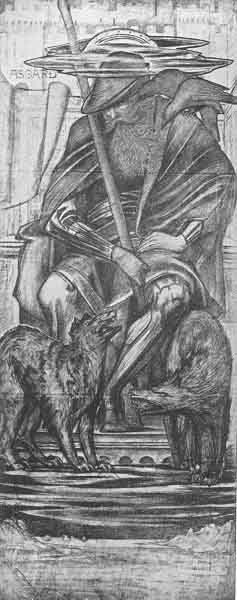
ODINFrom the design by Sir E. Burne-Jones.
Photograph by Frederich Hollyer

The wonder of men is whence comes the wind that shakes the ocean with fear, that fans the low spark into bright flame, and that no eye can behold. At the northern summit of heaven there sits in eagle-guise a great giant called Hraesvelgur, "the swallower of dead men's flesh". When his wide pinions are spread for flight the winds are stirred beneath them and rush down upon the earth. When coming or going, or travelling hither and thither across the heavens, the winds are driven from his wings.

As yet there were no men who had their dwelling upon the earth, although the sun and moon were set in their courses, and the days and seasons were marked out in due order. There came a time, however, when the sons of Bor were walking on the world's shores, and they beheld two logs of wood. They were grown from Ymer's hair, which sprang up as thick forests and verdure abundant from the mould of his -body, which is the earth. One log was of an ash tree, and from it the gods shaped a man; and the other, which was an alder tree, they made into a fair woman. They had but life like a tree which grows until the gods gave them mind and will and desire. Then was the man named Ask and the woman Embla, and from them are descended the entire human race, whose habitation is called Midgard, "middle ward", and Mana-heim, "home of men".

Round Midgard is the embracing sea, and beyond, on the outward shores, is Jotun-heim, the home of giants. Against these the gods raised an ice bulwark shaped from the eyebrows of turbulent Ymer, whose brains they cast high in heaven, where they became heavy masses of scattered cloud, tossing hither and thither.

Address to Odin

In the beginning, ere the gods were born,
Before the Heavens were builded, thou didst slay
The giant Ymir, whom the abyss brought forth,
Thou and thy brethren fierce, the sons of Bor,
And cast his trunk to choke the abysmal void.
But of his flesh and members thou didst build
The earth and Ocean, and above them Heaven.
And from the flaming world, where Muspel reigns,
Thou sent'st and fetched'st fire, and madest lights,
Sun, moon, and stars, which thou hast hung in Heaven,
Dividing clear the paths of night and day.
And Asgard thou didst build, and Midgard fort;
Then me thou mad'st; of us the Gods were born.
Last, walking by the sea, thou foundest spars
Of wood, and framed'st men, who till the earth,
Or on the sea, the field of pirates, sail.
And all the race of Ymir thou didst drown,
Save one, Bergelmer;--he on shipboard fled
Thy deluge, and from him the giants sprang.
But all that brood thou hast removed far off,
And set by Ocean's utmost marge to dwell;
But Hela into Nifelheim thou threw'st,
And gav'st her nine unlighted worlds to rule,
A queen, and empire over all the dead.

From "Balder Dead", by Matthew Arnold.

Footnotes

1 The Jack and Jill of the nursery rhyme.

Teutonic Myth and Legend: Chapter 2 The Nine Worlds

TEUTONIC MYTH AND LEGEND

by DONALD A. MACKENZIE

An Introduction to the Eddas & Sagas, Beowulf, The Nibelungenlied, etc.

London, Gresham Publications 1912

CHAPTER 2

The Nine Worlds

Asgard--River and Vafer-Flame--High Thing-stead of the Gods--Odin's Throne--"Abode of Friends"--The Golden Age--Dwarfs--Ygdrasil, "the Tree of Existence"--Roots in the Underworld--The Three Fountains--Eagle and Hawk--"The Cock of the North"--The Biting Deer--The Dragon Nidhog--The Squirrel Gossip--Norns, Hamingjes, and Giptes--Lower Thing-stead of the Gods--Bif-rost--The Sentinel Heimdal--Judgment of the Dead--The Last journey--Bliss of the Just--Doom of the Condemned--Regions of Torture--Valhal--Divisions of the Universe--Night Path of Day and Day Path of Night.

THE Asa-gods built for themselves Asgard, the celestial city, which is set high above the heavens. It stands there in beauty and in glory upon a holy island in the midst of a dark broad river flowing from the thunder-vapours that rise through the great World-tree from Hvergelmer, "the roaring cauldron", the mother of waters. The river is ever troubled with eddies and fierce currents, and above it hover darkly thick banks of kindling mist called "Black Terror Gleam", from which leap everlastingly tongues of vafer-flame, (lightning) filling the air and darting like white froth from whirling billows.

Round Asgard is a dark and lofty wall, and the great boiling river breaks angrily at its base. There is no entry-way save by Odin's mighty gate. And if anyone who is unworthy, be he god or giant or mortal, should cross the river unscathed by the vafer-flames, and seek to open the gate of Asgard, he would be caught suddenly by a chain which springs from the lock of strange mechanism, and crushed and utterly destroyed.

In the middle of Asgard was built stately Idavoll, the Court of Judgment, the High Thingstead of the Gods, in which their own divine affairs are discussed and arranged. The beauty of the great hall is unequalled in the nine worlds, for its roof is of shining silver and it is resplendent without and within with burnished and graven gold. Therein was set the great golden throne of Odin, the chief ruler of Asgard, and around it were placed twelve golden seats for the gods who sit with him in judgment, and to whom the All-father gave power to rule and to issue decrees.

When Odin sits on his high golden throne he looks over the homes of giants and elves and mortals and sees all things. He is silent and he listens.

Another fair and stately structure did the gods cause to be made as a sanctuary for the goddesses, and by singers of skalds who echo its praises it is called Vingolf, "the abode of friends".

In Asgard was shaped a smithy which was furnished with anvils and hammers and tongs. With these the gods had made for them, by the cunning elf-smiths, Ivalde's sons and Sindre's kinsmen, every instrument they had need of. They worked in fine metals, and so great was the treasure of gold that all movables were made of it.

On a green place in the celestial city were found the golden tablets with which was played the Game of the Gods. This was in the Golden Age, which lasted until there came from Jotun-heim three giant maids, who brought corruption.

To the gods in ages past it became known that there dwelt in Midgard a race of dwarfs. In the deep, dark mould of Ymer's body they swarmed as do maggots in rotted flesh, and they went hither and thither with no purpose or knowledge. All the gods assembled in their high Thingstead, with Odin seated on his golden throne, and there took counsel one with another. To the dwarfs they gave human shape, but their hue was the blackness of earth in which they had being. Over them the gods set Modsognir, who is Mimer, to be king. In the mounds of the earth dwell one tribe of these earth-black elves, within rocks another, and a third have their habitation inside high and precipitous mountains. Besides these are the Trolls, who fly hither and thither carrying bundles of sticks, and have power to change their shape. Now the wonder of the Universe, which was set in order by the will of All-father, is the great ash tree, Ygdrasil, the Tree of Existence, which nourishes and sustains all spiritual and physical life. Its roots are spread through the divisions of the worlds that fill the yawning gulf, and its boughs are above the high celestial city of the gods. It grows out of the past, it lives in the present, and it reaches towards the future.

The World-ash has three great roots. In the realms below Midgard is one root, which receives warmth and life in Hela's glittering plains from the deep fountain of Urd, the goddess of fate and of death; another root reaches the egg-white well of Mimer, who is Wisdom and Memory; and the last root is in gloomy Nifel-heim, where it finds hardening sustenance in Hvergelmer, "the roaring cauldron", the fount of primeval waters, ice-cold and everlasting, which springs up on Hvergelmer mountain.

In the realm of Urd, which is Hela, the souls of good men be. Nigh to it, in the underworld, is Mimer's well in Mimer's grove, where dwells the race which will regenerate the world of men. Below cold and darksome Nifel-heim are the nine divisions of torture in which the souls of the wicked are punished. At Hvergelmer the watchman of the root of Ygdrasil is Ivalde, who with his sons contend against the storm-giants who threaten Hela.

The roots of the great World-tree suck up the waters of the three eternal fountains, and these mixed together give imperishable life. In the well of wise Mimer the fibres are made white with the holy mead which gives wisdom to men, and poetry also, and is the very elixir of life eternal.

On the high branches of Ygdrasil, which overshadow Asgard, sits a wise eagle, and between its eyes is perched a hawk named Vedfolner. On the topmost bough is Goldcomb, the "cock of the north", which awakens the gods from sleep and puts the demons to flight. From Hela answers the red cock, whose fire purifies what is good and destroys what is evil.

But the great World-tree bears a more painful burden than mortals can conceive. In the well of Hvergelmer, in the black realm of Nifel-heim, is the corpse-eating dragon Nidhog, "the lower one", which chews constantly at the root; above, four giant harts are ever biting its buds and its leaves; on its side, Age rots it; and many serpents gnaw its tender fibres in the dark underworld. For there never was good to which evil came not, nor growth which has known not decay and the wasting of time.

The Norns of Hela sprinkle the great ash-tree each morning with precious mead from Urd's fount of life, so that its leaves may ever be green. Thence comes the honey-dew, which drips upon the world and is stored by the bees. And in Urd's fountain are the two mystic swans which are the ancestors of the swan race in Midgard.

Up and down the World-tree runs constantly the squirrel Ratatosk, which bears gossip between the eagle on the highest branches and the dragon Nidhog at the root, and is thus ever the cause of strife. Greatly dreaded is Nidhog, who flies to the rocks and cliffs of the lower world with the bodies of dead men beneath its wings.

The three Fates, who are called Norns, are Urd and her two sisters--Urd, "present"; Verdande, "past"; and Skuld, "future". By them are spun at will the fates of men and women. There are also Dises, who are maids of Urd, unto whom various duties are assigned. The Hamingjes are those Dises who are guardians of men through their lives, and appear to them in dreams to give warnings and noble counsel, and he whom the holy elf deserts for wrongdoing is indeed lost. The decrees of Urd are executed by the Giptes, and men who are favoured are suddenly awarded good fortune and treasure; other Dises attend upon families and even upon tribes. There are also the sweet elf-maids who have care of babes unborn in the fair realms of Urd, and find them kindly mothers in the world of men; and there are maids who conduct the souls of the dead to Hela's glittering plain.

Now in Hela is the lower-world Thingstead of the gods, where the souls of the dead are judged, and rewards and punishments are meted out by Odin. There is but one road thither from Asgard for all the gods save Thor, and that is over the curved bridge Bif-rost, "the rainbow", which has its foundation beyond the edge of the world of men. The southern span reaches to the fount of Urd in the realms of green verdure that never. know decay.

Bif-rost is built of air and water, and is protected by red fire flaming on its edge. Frost giants and mountain giants ever seek to capture the bridge, so that they may ascend to Asgard and overcome the gods; but its sentinel, Heimdal, is constantly on guard against them.

The gods set Heimdal, son of the waves, to protect the bridge forever against the enemy. He is clad in silvern armour, and on his head is a burnished helmet with ram's horns. Horsed on his swift steed, Gull-top, he now watches at the highest point of Bif-rost from his fortified citadel, Himinbjorg, "the ward of heaven", where his hall is supplied with precious mead. Anon he crosses over from side to side of the bridge. His sight is so keen that he can see by night as well as by day the length of a hundred leagues, and he listens so keenly that he can hear the grass growing. He sleeps as little and as lightly as a bird. When the giants and monsters come to assail the gods at Ragnarok, Heimdal shall blow a thunderblast on Gjallar-horn which is hidden in the deepest shade of the World-tree. With his great sword he shall combat with the Evil One in the Last Battle.

Heimdal is loved both by gods and by men, and he is also called Gullintani because his teeth are of gold. There was a time when he went unto Midgard as a child; he grew up to be a teacher among men, and was named Scef.

Every day the horses of the gods thunder over Bif-rost as they descend to and return from the lower-world Thingstead. Thor, the thunder god, cannot travel thus because the fire of his thunder chariot might set the bridge aflame and destroy it. He must needs wade across the four great girdling rivers in the underworld to reach Hela's glittering plains.

ODIN<BR> <I>From the statue by B. E. Fogelberg</I> ODIN
From the statue by B. E. Fogelberg

When the gods come unto Hela they leap from their horses and take their seats in the Thingstead. The dead are then brought before them.

A weary way and long these dead men and women have travelled. Down the valley of thorns they came, and those who were given hel-shoes in their graves, because they had shown mercy to others while they lived, suffered indeed little; but the feet of the wicked were torn and bleeding. Then they crossed a river full of weapons. The just walked over on boards, but the unjust waded, and were sorely wounded and covered with scars, so that their bodies dripped blood.

To the Thingstead come men and women in full attire, with the jewels and ornaments which those who loved them placed on their bodies ere they were laid in grave-chambers. Warriors carry their weapons, and all are clad so that they may be recommended to the gods as the well-beloved among men. But silent are the dead, save the happy ones under whose tongues were placed, ere yet they were laid in their graves, magic runes, so that they might make answer when accused, and give reasons to justify their deeds. But the Hamingjes can also speak for the dead, and those who have not Hamingjes to speak for them are known to have done evil and to be deserted by their Dises in sorrow and wrath. Those who are justified pass to the eternal realms of Hela, where joy prevails, because they have lived upright lives, and have been honourable and full of pity and have helped others; because they were brave and feared not to die; and also because they worshipped the gods and gave offerings in the temples.

But those who are condemned are sent to Nifel-hel, the region of torture. They are judged to be unworthy if they injured others by falsehoods or wicked deeds, if they were adulterers, or murderers, or despoilers of graves, or cowards, or were traitors, and profaners of the temples.

Those who are to share eternal joy are given to drink from the horn of Urd, which imparts to them enduring strength. In it are mixed the three meads from the wells which sustain Ygdrasil, the World-ash. But the doomed are given a draught of burning venom which changes them to monsters. Their tongues are then for ever bereft of speech and they can moan only.

The happy dead disport themselves on the green plains of Hela, where they meet lost friends and ancestors from the earliest years of the world. And many beauteous ways they travel, and wonderful tales they hear. The children are cared for in the realm of Mimer, "memory", where joy is theirs forever and their food is honey-dew.

The doomed are fettered and are driven towards Nifel-hel by black elves, who carry thorny rods with which they lash those who falter or seek to turn back. Their first punishment is received when they must needs pass through the regions of eternal bliss, and behold with grief unutterable the joy of the blessed. Then they cross the rivers which girdle Hela, and climb towards the dark mountains of Nifel-hel. The wolf dog barks at them in the shadowy valley where it guards the borders of Hela, and there is blood on its breast. And as they climb tortuous paths and tread the narrow path on the edge of dizzy precipices they hear the barking of the terrible watchdogs at Nifel-hel's gates. The dreaded dragon, Nidhog, hovers near them, and ferocious birds of prey sit on the rocks.

Then they enter the Na-gates and die the second death. Punishment is given in the nine realms of torture according to the sins that were committed. Some are seized by the dragon and some by the birds of prey, according to their deserts. Others are tempted for ever by illusions of sinful things they sought in life, and there are those who are torn to pieces by the great wolf.

In the Venom-dale is a river called Slid, and it is full of daggers and sharp spears. Through it must wade the perjurers and murderers and adulterers, who are continually suffering new and fierce wounds. Others sit together on benches of iron, while venom drips on them, within a hall which is full of stench unbearable. Traitors are hung on trees, and cowards are drowned in pools of foulness. Eternal night broods over all.

Naglefar, the "ship of death", lies in the Gulf of Black Grief, in the outer regions of Nifel-hel, made fast to a dark island with chains that shall not sever until Ragnarok, "the dusk of the gods". It is constructed of the parings of dead men's nails--the wicked men, hated by their kind because of their evil deeds, whose bodies were cleansed not at life's end, and whose nails were not pared ere they were laid in grave-chambers. When Naglefar breaks loose the avenging hosts shall sail in it to battle against the gods.

The warriors who are slain in battle, or drowned at sea, are borne to Valhal in Asgard by the maids of Urd, who are called Valkyries. They are horsed on swift steeds, and first they pass to Hela, where the gods give judgment and reject the unworthy. Then they are carried by the Valkyries over Bif-rost, and the hoofs of their steeds resound in Asgard. In great Valhal the heroes feast with Odin in eternal triumph and happiness.

Now these are the divisions of the Universe. In the midst is the earth, Midgard, which is encircled by the ocean. On high, and above all else, is Asgard, and below it is the realm of white elves, who flit between the branches of the great World-tree. Then Vana-heim, the home of the Vana-gods, is in the air and in the sea; and in the depths of the western sea is the hall of er, god of Ocean. Alf-heim, the home of elves, is to the east. In the lower world, below Nifel-heim, are the Nifel-hel regions of torture, and under Midgard are the Hela realms of Mimer and of Urd. Far below the path of the gods towards Hela's fields of bliss are Surtur's deep dales on the borders of Muspel-heim, where the great giant Surtur, the swarthy sentinel, keeps watch with his flaming sword. Jotun-heim is to the north and the east, beyond the world's edge.

Billing is the elf-guardian of the western heaven, and when the cars of Day and of Night and of the Sun and of the Moon enter the forest of the Varns, "the protectors", they pass through the lower-world realms of Mimer and of Urd towards the gates of Delling, the elf of dawn, in the east. When Nat reaches Hela, where she must rest, darkness falls around her, and the blessed are given sleep, and light comes again with Dagr, as Nat covers the earth above with shadow and deep slumber.

The Descent of the Gods

. . . the Gods arose,
And took their horses, and set forth to ride
O'er the bridge Bifrost, where is Heimdall's watch,
To the ash Ygdrasil, and Ida's plain;
Thor came on foot, the rest on horseback rode.
And they found Mimir sitting by his fount
Of wisdom, which beneath the ash-tree springs;
And saw the Nornies watering the roots
Of that world-shadowing tree with honey-dew.
There came the Gods, and sate them down on stones.

From "Balder Dead", by Matthew Arnold.

Subscribe to this RSS feed

Log in or create an account