log in
LC Geerts

LC Geerts

Website URL:

From Goddess to King, Chapter 22, HISTORICAL EVIDENCE - LEGENDARY SUPPORT

FROM GODDESS TO KING

A History of Ancient Europe from the

OERA LINDA BOOK

By Anthony Radford

CHAPTER 22

HISTORICAL EVIDENCE - LEGENDARY SUPPORT

Thereare very few written accounts about Europe for the period dating before the first recordings of classical Greece. There are many writings from the Near East, the most prolific being Egyptian followed by the Hittite, Arcadian, Hebrew and Assyrian texts of the Fertile Crescent. But this is not our story. Are there any stories relating to old Europe that can support the surviving records of the ancient Frisians? The evidence is going to have to be from geological and archaeological findings with an interpretive approach to surviving historical accounts, which have taken the form of undated legends.

Of the period before our story that is referred to as the "good times before the bad" very little is known. It is referred to as the Age of Taurus the Bull, possibly indicating a religious connecting with bulls as is believed to be the case in Crete two thousand years later and still is a sport today in the Mediterranean. It is also depicted as the Megalith or Pillar Culture with Stonehenge being the best known of many hundred sites. Its construction has been attributed to Romans, Druids and Mycenaeans. Archaeologists and historians could not conceive that such a structure could have been built without Middle-Eastern help so they dated megaliths as being older in the south from where the northern structures learned that skill. Carbon dating has now shown them to date from 2700 to 3500 BC with the stones being older, the farther north one goes, and with those on the Orcades (Orkneys or pig islands) being the oldest.

We are told that the sacred Tex was written on stone at Texland and reproduced in all citadels. Ancient Egyptians referred to the Pillars of Atlas (Hercules) as beyond Gibraltar in the North while later day Greeks put Atlas in North Africa, supporting the world, and moved the pillars to Gibraltar, the end of the known world, to where they are now commonly referred.

The origins of the Near East settlement of Phoenicia are told of a time that predates the Old Testament. One significant reference that lends support to the story is the description of the Philistines. We know that they could be tall like the giant of David but they were also a sophisticated, (compared to rural Israel) seacoast city people who did not speak a Hebrew related language. They are traditionally believed to have come out of the Hittite empire in 1100 BC but our book tells of the mixed Frisian, Finnish, and African racial mix of the Phoenicians; perhaps a much earlier origin of the Philistines. The Old Testament describes them as being descendants of Japhet or Japhetos of Greek mythology who not only came from the north but from the ends of the Earth. In those days the Earth ended with the great encircling ocean (Oceanos) that girdled the known world centered roundabout the Mediterranean. The Egyptians referred to the northern countries at the end of the world. They have numerous reproductions both wall illustrations and petroglyphs from 3000 to 1200 BC of battles with northern seafaring warriors, always being defeated of course. In these murals, the "peoples of the islands of the north", are depicted as white-skinned, blond-haired and blue-eyed. They are usually distinguished from other enemy soldiers by their round shields (like latter day Vikings) and by reed headdresses. The Oera Linda Book has so many missing centuries that little correlation can be made to them.

Herodotus dates the founding of Tyre at 2755 BC by mythical Hercules at a time when Sidon already existed. Our book dates the origin to approximately 2000 BC by Teunis. To Greek historians and also as shown in Caesars writings, the North Africans or Libyans were largely blond-haired and blue-eyed. They were referred to as Northerners or at least believed allied with those who lived beyond the Mediterranean in the West. The ancient Egyptians made the same references. Today we still have the blue-eyed Berbers in North Africa that have been linked to Ireland by some historians, no doubt unable to appreciate the distribution of blue eyes. They are very common in Sicily and have an ancient known tradition in the Holy Land.

Legends also support the sun cult of the northerners, a symbol of monotheism but most myths of unknown places also ascribe diabolical religious ritual worship to the embellished tales just as todays archaeologists usually label anything unknown as a religious artifact. The origin of the name of the island of Helgoland is "Holy Land" and Frisian myths tell how it finally perished beneath the waves in 1216 AD. Very ancient circular fortifications have been discovered on the island and in the surrounding shallows that lend some credence to the concentric moats that surrounded the capital city of the Atlanteans. According to the writings of Plato we read that most citadels had a circular moat. Helgoland was not Fryasburgt on Texland but a neighboring state and possibly a remnant of the original Fryas land before the first recorded disaster.

Archaeology is continually pushing back the clock on the achievements of mankind just as it is still verifying many of our ancient stories once considered to be only fables. Our history is much older than first assessed by the new historians that followed the rudimentary research of the early nineteenth century. These early modern attitudes have assumed that foreigners and especially native cultures that are closer to the earth were inherently inferior. We now know that this is not true, there is much to be learned from all activities of man but it is still surprising when evidence of ancient activity is unearthed that show how similar we still are.

The Kalevala is a Finnish national epic that dates from pre-Christian times. Its oldest form is on runes and depicts a time when the Magyars and Finns were one people, a fact mentioned in the Book. It describes a time of a great natural disaster when shadows covered the earth and the wise men of the North could not determine the dawn or the noon because the moon and the sun were not in season.

There are Western versions of the story of Noah and the Flood as well as Eastern and worldwide versions. Principal among these for our purpose is a collection of three ancient Welsh ballads that tell of disaster and destruction coming from the sky out of which only one family survived at sea. They sailed to the Crimea and hundreds of years later, having greatly increased their numbers returned home to Westland or the White Island of Britain. Even the word Britain and Brittany are explained as the name of one of the returning tribes. This tale does support the far ranging maritime capabilities of very long ago.

The next Western source for information of three thousand years ago is Homer and particularly the "Odyssey". Minerva, whom the Book describes as a Rhine maiden, is depicted as "blue eyed, white armed, fair haired Minerva". She is tall and strong as though these were desirable traits of the gods while Ulysses himself is described as being very large of thigh and very strong with a red beard, "much enduring, divine Jove born son of Laertes, much contriving, city sacker Ulysses." The date of the epics is generally construed to be older than the eighth century BC, but the Oera Linda Book specifically dates the encounter with Calypso as 1188 BC. This would put the ten year Trojan War at 1200BC with the fall of Troy at 1190 BC if the shipping information can be believed. The Book states that twelve years had elapsed without them seeing any Italians in Almanland, and then there came Ulysses, a king from the Ionian Islands, in the largest of three ships. The ancient Greeks believed the fall of Troy to be equivalent to 1183 BC and conventional archeology puts it as 1230 BC. Which is closer?

From Homer we can get an idea of the nature of the Mediterranean population of the time. This is not the unified political and social system described by the Book for the early period but definitely a later one of independent maritime city-states. They spoke a common tongue, were of mixed blood and had kings that were not necessarily regarded as royal. Some were still elected as, after all, Ulysses father, Laertes, who was still alive when he returned twenty years later was a simple farm worker, not a king. It is known that the assembly of older men or agora was the court of supreme authority and was able to overrule the king just as the Laws of Frya depict. Ulysses son, Telemachus did not have royal authority but was more concerned about his own property rights. Many Mediterranean kingdoms at that time used a maternal succession rule in which the son of the old kings youngest daughter or his younger sister would inherit.

Homer does not support even the cherished concepts we have about the polytheistic religion of the time. Homer mentions the monotheistic word God on many occasions, which corresponds to the earlier concepts of the Frisians, and he makes reference to an underlying moral code or at least a sense of right and wrong. That the heroes of the time were of mixed heritage, having the superstitions of Findas people and also Libyan blood, is evident from their mixed coloring as well as from descriptions of Phoenician, Ionian and Cretan settlements in the Book.

Homers use of the word "Phaecians" (literally, black drivers) could have been referring to the Phocaeans, of an eighth century BC Ionian city in Asia Minor who are traditionally believed to have foundered the city of Marseilles in the days of the Ligurians, two centuries later. Egyptians believed them to be a colony of the North people and this could be so if the Ionians can be referred to, as being from the north as originally was the case. More likely it is a reference to the black ships and black sails described by Homer and his own word for them. Jurgen Spanuth (see bibliography) makes a case for the "black drivers" being a reference to the funeral customs of the ancient Northmen that are described in the visit to the souls of the dead companions of Ulysses by Homer. The Vikings in their funeral rituals continued these customs a thousand years ago.

Homers hero, Odysseus (Ulysses), reached the Phaecians by sailing northeast from his sojourn with Calypso on her island. He was impressed with their country, the land of the linen plant, he liked the fine woven cloak that they gave him and noted their sailing skills so they could have been Frya people from the mainland located at the mouth of a European river. This is particularly important because no Mediterranean rivers have the backwash or reverse tides as described by Homer.

These were independent states sharing a common heritage. They were in the Bronze Age but knew of steel as a precious commodity like gold. Although it was a period after the Golden Age of Fryas peoples, perhaps there is enough evidence to suggest that Frisian principles prepared the way for the classical age to come, with all its frailty and humanness. The Greek concept of Agape, or brotherly love, began as an extension of legal rights to neighboring states, an exchange of convenience, and other abstractions developed in the centuries to come that are still valued in our present age. Some Frisian concepts were there, but self sacrifice for community and rights for all did not yet exist in this collection of slave states. Even in the lands at the mouth of the Rhine, long years of selfish struggle had so eroded memories of their origins that Atland had been reduced to a mythical country beyond the north wind.

In the centuries following Homer up to the recorded era of Greek philosophers and historians, Carthage gained in dominance of the western Mediterranean Sea. They were probably the seafarers referred to as Phoenician in the latter part of the Book and they strategically guarded the route to the Cassiterites, or tin islands, Cornwall in Britain and some of the Channel Islands that made them so wealthy. Anything west of the Pillars of Heracles was shrouded in mystery and deceit so that Ancient Greece knew little about the Atlantic. They did hear about Tartessos or Taphos which was the kingdom of Cadiz in southern Atlantic Spain, a Celtic spin-off where originally the burgtmaid had tried to keep a neutral path between the Mother and the Gauls in Kaltas time. It became a very wealthy exporter of Spanish silver and maintained a regular trade with Ireland according to Irish history. It was a classical link to the Atlantic. Others have put Taphos, as one of the pirate islands of the Ionian Sea but Homers mention of Kernie is interesting. Could that have been the mysterious city of Kerenak (Keeren Herne)? These two very tenuous names could be construed to show that Ulysses made it to the Atlantic.

Ancient Europe and India were not strangers to each other as the Book interestingly notes but what is the evidence? Buddhists were known in Alexandria in the third century BC, and there is much evidence of Greek presence or at least their artifacts in India. The Ionians have even been credited with being the first to give the sage, Buddha, a human form in art or effigies. From Herodotus we have reference to the Red Sea or Erythn as the name of the sea that extended all the way to India and included the Persian Gulf while the ancient Arabians referred to the Mediterranean as the White Sea.

Many French cities of the Mediterranean, have traditions, or early stories, of their founding by Greek or Ionian settlers from the sea just as Spanish towns give this credit to the Phoenicians or Carthaginians, the rivals of the Ionians. It is well known that the Romans did not like the sea, preferring land engagements, but hired both Greek and Phoenician seafarers to conquer the Mediterranean.

There are many terms in Latin for seasickness but only one in Greek, an indication of the limited Roman seafaring tradition. Romans invented a plank that plunged a huge spike into an enemy vessel as it was being rammed, locking them together so that Roman foot soldiers could board and fight as on land.

There is a romance to the sea that captures our imagination and has created legends of lost cities sunk beneath the waves with columns of marble, seaweed lined streets and statues of gold. Such a legend is that of Atlantis and also of the city of Ys. Faith in these enchanting tales has created four different locations or separate cities by the name of Ys on the Atlantic coast of Europe, but this has nothing to do with archaeology. An earthquake destroys the city and then it may submerge it, leaving a site that thousands of years later is nothing like what the imagination might construct.

Still, we are made of dreams and like to be entertained by them so not every conclusion has to be utilitarian and scientific or we would wonder if beauty had a purpose. Is not beauty as necessary as daydreaming and as essential for inspiring our creativity?

Other more reliable evidence can be found in the ancient land route to the north, the great north-south highway that ran up the Rhone and the Sae to the Seine valleys. This road carried yellow amber from the Frisian Islands and the Baltic to the south and Mediterranean (Red Sea) coral to the north. This ties in with the jutten trade mentioned in the Book and also the selling of the island of Marseilles to the Phoenicians for trade. Although the road existed since times ancient in the Roman era, the items of trade were more perishable than the relics which archaeologists can still find in the earth. A list of these commodities is given in the Book with respect to sea trade and includes paper (parchment) as a valuable export from the North long before the Classical age, but it is not something that would still be found. There is no question that amber was a valuable item of trade. It is found only in the north and was probably the "orichalc" mentioned by Homer and once thought to be a special alloy of gold. The original meaning of the word "glass" was amber, a translucent material that can generate an electric charge when rubbed on a dry cloth. Our word electricity is derived from the Greek word for amber.

That the ancient world was ignorant of the North is no more true than claiming that they knew nothing of India. When discoveries are made, they usually set back the date when man was first known to have achieved some prowess of civilization such as writing or seamanship and commerce. The North does not have dry deserts and undisturbed sites buried in the sands of time. Vegetation is continually growing there so a pristine discovery, like the city of the Persians, Persepolis that is mentioned by Greek historians does not excite the explorer in the busy North. The East does not have exclusive rights to the beginnings of civilization. Modern dating techniques now show, for example, that copper mines along the great rivers of Europe had been worked out and new ones opened in a west to east direction over time. This shows that very ancient occupants of the continent exploited the minerals long before the classical Bronze Age of southeastern Europe.

Julius Caesar wrote about his campaigns in the North and discovered a formidable enemy who would rather die, then become slaves of Rome. He killed a million of them and remarked how few rituals and sacrifices they observed in their religious life. He just didnt understand them and as is typical of human judgments, he tended to denigrate what he did not understand or that which was simply different.

For those who support the forgery theory for the Oera Linda Book, one would have to ask why, and also question the choice of a language older than any known version. What was to be gained by keeping it unpublished for so long? Perhaps, more significantly, one could ask what ego construct is being challenged in the doubters.

With so much of national character being attributed to the challenges of a seafaring life, it is appropriate to examine the type of ships, which were used in ancient times. There is much historical literature on the Roman ships of a later time but really very little surviving physical evidence that even permits an understanding of their construction or manipulation of multiple banks of oars. Go back two thousand years before Rome and there is no evidence but it does not mean man was incapable of sailing the ocean. It does not mean that all man knew about boats were reed crafts found depicted on seals of the time in Sumer. It simply means that the evidence has not survived.

What were the ships of old like? From recorded history there were reed ships, sometimes coated with tar, in both Egypt and Sumeria before 3000 BC. They have been typically judged as not seaworthy enough for ocean voyages. This has been disproved in the case of Sumer for Sumerians carried on significant trade with Dilmun (Bahrain) from the mouth of the Tigris and even sailed to India, (the Indus River) and around the Arabian peninsular to the Egyptian Red Sea. From about 2900 BC there are some hieroglyphics that tell of forty armed ships that were dispatched from the Nile to Byblos, in Lebanon, to buy cedar-wood for ship building. These ships had both oars and a square sail supported by a double mast in the shape of an inverted "vee". They carried twenty oars per side and had two long steering oars thus there is evidence of ocean going ships in recorded history, hundreds of years before the Book records the early voyages of the sea-kings.

Both Egypt and Sumeria lacked forested areas so it is likely that other ancient civilizations were building wooden ships long before them. Then there is the story of Noah, which must date from an earlier time, and in some versions of the legend, considerable distances are described such as from Wales to Crimea. Noah had to have had a good-sized vessel but we cannot use myth to validate myth.

By 2000 BC Crete had an alliance with Egypt to use its navy to control the Eastern Mediterranean and keep the pirates in check so Jons followers did not invent piracy. By the sixteenth century BC, Crete had separate merchant and military designs for ships, both large and small. The Mediterranean had evolved beamy ships for trade, one hundred and twenty feet long and thirty-six feet wide long before the tale of Minerva. Later on in classical Greek times, a combination armed merchant craft was in use that was smaller and faster; were times getting more complicated for trade, with Phoenician, Carthaginian, Roman, Ionian and Greek ships competing for profitable territories? The older times that described huge fleets of Frisian armed merchants had ended, as the might of numbers no longer commanded respect on the commercial front. The peace of Rome had not yet developed and whether it was ever a maritime peace is open to debate.

Early vessels usually lowered the whole sail and mast assembly when oars took over. They carried several anchors, sometimes a round stone with a hole in the middle but some of these that have been found could have been used to support the base of the mast. Twin steering oars gave way to a single one on a side and the central tiller was in use by Ionian settlers in Asia Minor in the forth century BC. The steering mechanism of the Frisians is not known, but Homer gives us a few clues for the time of the Odyssey. He tells of a single steering oar, the lowering of the mast when beached, and of rowers benches under which cargo or personal effects were stored. The high prow was colored for identification purposes, a custom that led to carvings and statue-like figureheads depicting gods or the like. While six men could manage his ship, Odysseus probably needed forty to fill the benches.

Later in the eighth century BC the Greeks used biremes, which, according to Herodotus were double the standard complement of twenty-five oars on a side; so a total of 100 rowers would be needed but some larger ships would have used two rowers for each oar. These eighty feet long by ten feet wide ships were built for speed and were equipped with a battering ram to sink the enemy. Triremes, triple size, rowed vessels, were in standard military use by the fifth century BC so that naval warfare mandated at least 150 rowers per vessel and slaves were the motoring forces. The ships all had single masts with square sails, which could be lowered in time of battle or foul weather.

There can be no question that Europeans have come out of a goddess culture. In the religious preoccupation, the Virgin Mary had taken the place of the Mother who for centuries was ranked above the male concept of God with Jesus being identified with a sacrificial young king. To extrapolate these concepts that were believed in countries influenced by the Mediterranean to all of Europe is as incorrect as doing that to all of Asia. This story is older than those beliefs and shows a simple version of from where some of these ideas have come and where the inevitable power struggle of priests, kings and politicians have taken us.

From Goddess to King, Chapter 21, FRYA, THE FORGOTTEN GODDESS

FROM GODDESS TO KING

A History of Ancient Europe from the

OERA LINDA BOOK

By Anthony Radford

CHAPTER 21

FRYA, THE FORGOTTEN GODDESS

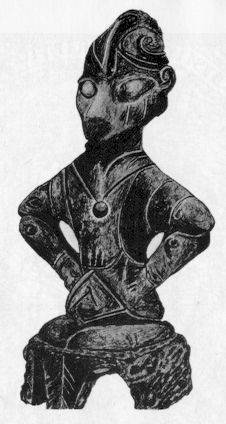
radford-chapter-21 A 6000 year old statue found in Yugoslavia that is believed to be of the Mother Goddess Frya.

Tothe Frisians, Frya was their Great Mother, the mother of the white race. She was teacher and lawgiver, so wise, so beautiful, the perfect creation of the Oldest One, Wr-Alda or God. She gave birth to their ancestors, twenty-four at a time, twelve men and twelve women every year. This was the third experiment in the creation of human life after Lyda, the mother of the black race and Finda, the mother of the yellow race. They claim that on the third try, the Mother was given a conscience which prevented some of the deceit and domination they liked to characterize in the priests and princes of the other two races but in particular, the yellow race. They claim that all the races of mankind are descended from combinations of these three basic root races. There is at least evidence of this so far as Europe is concerned in its racial makeup.

Her laws were given to her children after the great geological disaster that destroyed the old land, Atland, or their ancient home. They were designed to protect a new society, which would no longer have direct access to their mother. They would use an Earth Mother and local maidens to answer their questions of justice, to be the conscience of their many different states that encompassed the entire continent of Europe. Frya was leaving. After giving her sacred Tex to Fasta, her first Earth Mother, she ascended heavenward to her watch-star where she continued to watch over her children. Again, we have a very common aspect of the myths of divinity. The gods do not die, they have celestial homes to where they can retreat.

For the next two thousand years Frya was openly and officially acknowledged as the Great Mother next to Wr-Alda or God and Irtha or Mother Earth herself. Her followers grew less and less numerous, occupying a smaller and smaller Fryasland until the whole system of matriarchal maidens and their virgin helpers tending the sacred lamps first lit by Frya had become no more than a power tool in the hands of ambitious male kings. If it is put in perspective, however, a two-thousand-year-old nation based upon both the principles of individual freedom and community service for male and female citizens is unique.

The peoples of North and Western Europe did not easily forget Frya even after the deliberate suppression of her following by Christian monks. Like all enlightened entities or personages, she never wanted to be worshipped. A follower or disciple is one who has the discipline to follow the teachings, which are for the benefit of those followers themselves not the praise of the goddess. This too, eventually became corrupted into goddess worship and prayer for benefactions, to satisfy desires and alleviate hardships. The teachings in The Oera Linda Book tell us of few direct boons from Frya and her earth mothers. Instead they teach how self-reliance and cooperation with others together yield favorable results for whoever is willing to work. There is no distinction here for her children, as the same laws apply to the children of Lyda and Finda, all children of Wr-Alda.

What do the published records tell us about Frya? Starting with the popular encyclopedias, we find that Frya is not mentioned but that she had many names and many spellings, such as Frigg, Friia, Mardoll, Horn, Gefin and Syr, mostly developed during early Christian times when pagan beliefs were hard to eradicate. Freya is mentioned in the Encyclopaedia Britannica as the sister and female counterpart of Freyr or Frey, a son of the fertility god Njord. She is the most renowned goddess of Norse mythology in charge of love, fertility, battle and death. Pigs were sacred to her and she rode a sow with golden whiskers and drove a chariot drawn by cats.

She chose half of the heroes slain in battle for her great hall of Folkvanger while Odin or Wodin got the rest for Valhalla. One story we recognize while the feminine version is little known. Freya is accused of teaching witchcraft to the Aesir tribe of gods, where she was known as Frigg, the wife of Odin, even the mother of Thor, perhaps part of the campaign to discredit her. Another story has her searching the world for her lost husband, the father of her children Hnoss and Gersemi and weeping tears of gold.

Frigg is remembered in Iceland as the mother of Balder who died despite her efforts to save him. She was depicted as a loving mother and also as a person of loose morals. In Germany there is Frija and Frea the warrior wife of Godan or Wodin. All these stories with their various permutations date from a time two to three thousand years after the actual recorded presence of Frya in Europe, and have projected on them many of the very human frailties and much of the sorcery that the Magi used for political control. Freya is remembered in Sweden and Iceland, but has little presence in her home land of Friesland, although throughout Europe there are many place-names and family names derived from Frya. Perhaps the English words of "free" and "friend" are the best known of these.

Most of us like to hear a good story, and many of these stories were part of an oral tradition that embellished them. Just as todays soap operas do not represent an average family but dramatize elements of anguish and frailty, so too has mythology emphasized the suffering of the heroes. Such embroidering brings heroes down to a human level as well as up to a god level, but the more mundane or nobler truths surrounding their origins in history are put at risk.

A way to discover Frya is to research Fasta, the chosen first Earth Mother who had the divine connection with Frya. In Greece Hestia was the goddess of the hearth and one of the twelve Olympian deities. She presided over all sacrifices, something that Fasta would not have appreciated, and was also celibate. In Rome, six Vestal Virgins were attached to the temple of the goddess Vesta. They served for thirty years beginning at an age between six and nine and were chosen from patrician families by the pontificus maximus (head priest). They previously served a shorter time but were subject to many rules and traditions that were already ancient in the time of Rome. Besides annual fertility festivals and cleansing rituals for the city, they tended the sacred fire that was symbolic of the need for fire in the hearth of every home. The fire was probably in the form of a lamp, or else embers of charcoal, but the symbolism had survived.

The earlier kings of Rome bore the title: "King of the Sacred Rites" which may be indicative of Finda origins and the fact that a man was in charge and chose the virgins demonstrates this as well. Politics, not religion, was the dominating force, and all this is 2000 years after Fasta, a remarkable if distorted lineage.

Fastas laws were a divine prototype from Frya. Man had to grow up and take charge of his own life, a theme reflected in most ancient myths as well as in individual lives, but it was not without help from above. Both Holy Scriptures and new age writings suggest that our transformations and developments are said to be inspired or breathed into us from something greater than ourselves. Fryas sacred Tex is more of a social and moral code than a contract of civil law but a practical Fasta produced a code complete for the new society of the time. It may well have established our present elements of contracts, welfare and the parliamentary system as well as the concept of legal precedence. Fastas code also molded their society for millennia to come, something that cannot be claimed for Hammurabi who lived four hundred years later in Babylon and has been credited with being the first law codifier.

Western civilization traces much of its very earliest culture to Mesopotamia, such as astronomy, geometry and the Biblical stories of Genesis which originate from the very beginning of recorded times, much older than the Hebrew versions with which we are familiar. That influence may even have been of a global nature. If Frya was a goddess or an omniscient, omnipotent being, she would have known of the ancient East, even been a part of it. Proponents of space theories of the gods, will be intrigued by very early statues reputed to be of Frya showing her in flight gear. They are older than the earth mothers, The most famous of these is a seven-inch idol found in Yugoslavia and reputed to be 6000 years old. It portrays an "outfit" which cannot be called ordinary clothing; a helmet with facemask and goggles, pressure bands on the suit and a pendant that looks like an instrument. Then there are numerous statues, both earlier and later, of pregnant women or "Venuses" that have been lumped together as fertility goddesses. These have been found from Russia to Bulgaria to France. According to the Book, the whole of Europe was once Fryas land before the first disaster of the twenty-second century BC. Could these figurines represent Frya, the literal mother figure of their mythology?

Gods and goddesses have changed their sex throughout the ages. Women priestesses have worn false beards, and male priests and kings have worn false breasts. Could it be possible that the Nordic god Frey was once the goddess Frya? In Swedish mythology he has been called the consort of Freya while other traditions say that Frey or Freyr is just a form of address like lord. Could the Indian god Indira once have been the goddess Finda? The storytellers have never missed an opportunity to embellish or change a tale if it improves its acceptance anymore than the businessmen priests could resist the solidification of a power.

By the time of the early Christian Church in Europe, the pagan religion was no longer the original simple belief system that Frya inspired, but one corrupted by thousands of years of superstition and magical rites. Some of our own surviving festivals such as May Day, Halloween, even Easter and Christmas are adaptations of earlier superstitious yearly events but neither Fryas land nor the modern age can give the "religious experience" that the Magy could deliver. Early Christianity was impinged on the populous by some idealistic kings that saw a more pure connection in the new religion than those beliefs that were current at the time, however, the zeal of the enforcers suppressed the very knowledge of the origins of the pagan cultures. Neither the old ways nor the new viewpoints were serving a feminine side to be experienced by the psychological need of the people. Western man was being forced into a patriarchal age isolated from his soul.

From Goddess to King, Chapter 20, A ROYAL KING AT THE END OF AN AGE

FROM GODDESS TO KING

A History of Ancient Europe from the

OERA LINDA BOOK

By Anthony Radford

CHAPTER 20

A ROYAL KING AT THE END OF AN AGE

Frieslandis now divided between the Netherlands, Denmark and Germany with about 500,000 people in North Holland. The language, recognized as being the closest to English of the Germanic tongues, is giving way to Dutch and German. History recalls them as being settled by a nomadic Germanic tribe with many subsequent occupations including one by the Holy Roman Emperor Charlemagne who converted them to Christianity.

Local tradition recalls some early kings including Friso, Ubbo (Adel) and Askar but except for some anecdotes, little is known. Here the Book begins to enter pages of western history, giving details of how elected leaders, that is, task performers, continued their efforts at making their positions and privileges permanent and hereditary.

The beginning of the next entry has been lost. The author is not known but may have been a family member of Beeden, the previous writer. He tells the story of Black Adel, the fourth king after Friso, who cemented on the royal yoke ever more firmly. He did it in an amicable way by appealing to the poor for support, putting the blame for their hardships on the rich, and also placing the burden of state expenses on those who could most easily afford it. The poor rallied to him, as he grew richer. He was the first king to keep the lucrative position of chief count, or Askar, thus consolidating the government even further.

Black Adel or King Askar as he was called, appealed to nationalistic pride to promote military might at the expense of education. Addressing a general assembly of the burgers in a town he visited, he went out of his way to placate them in the presence of the powerful poor. It is beginning to sound like Rome with its plebeians and patricians but was by no means as stratified as it was in the Roman State where wealth grew wealth and poverty grew poverty.

It does sound familiar, as our own present day politics appears to have nothing new in it. Even the fact that the tall man usually wins a modern election was an advantage in Askars time; he was seven feet tall and well liked by the community.

That these westerners had a reputation for being tall, even giants in old myths has often been stated but was a foot equal to twelve modern inches or 30.48 centimeters? We know that the Egyptians had a royal cubit that was standardized in stone at 20.62 inches long and divided into 28 digits. For a thousand years of Mediterranean commerce, the Greeks used a foot of 30.88 centimeters was that was divided into 12 fingers, one being about three percent larger than the Egyptian digit or only two percent larger than the same proportion of the Babylonian cubit. The Romans adapted the Greek system but divided the foot into 12 unciae or inches. These measures were more accurate than the attempts made in the Middle Ages to standardize the royal foot or arm with grains of barley made necessary because of commercial cheating. It has also been found that a Roman foot shrank to about eleven inches, no doubt for the same reason, but it can be assumed that the ancient measure of these tall peoples was apparently not a small foot, but very close to the foot of today.

King Asker started the games that became the sport of jousting as training for the youth. His military ambitions were directed to recovering the whole of Gaul, those old southern lands lost to their "degenerate brothers", the Celts. But his plans which would soon founder in the rising tide of Roman power were taken up by the Cimbri, a German nation that was to give much trouble to Rome.

Of interest is the fitting of naval ships with twin prows to support steel crossbows. Iron weapons had already been in use for two thousand years by the Frisians, but spring steel requires very high temperatures and a skill in tempering. Carbon was added directly to wrought iron, which is essentially pure iron, by successive hammering while red hot and folding until it looks like flaky pastry. Charcoal furnaces and bellows-driven air were necessary to achieve the critical temperature. The manuscript continues with copying errors and water damage from previous versions.

...therefore, I will first write about Black Adel. Black Adel was the fourth king after Friso. In his youth he studied first at Texland, and then at Stavern, and afterwards traveled through all the states. When he was twenty-four years old his father had him elected Askar. As soon as he became Askar he always took the part of the poor.

"The rich", he said, "do enough of wrong by means of their wealth, therefore we ought to take care that the poor look up to us." By arguments of this kind he became the friend of the poor and the terror of the rich. It was carried so far that his father looked up to him.

When his father died he succeeded, and then he wished to retain his office as well, as the kings of the East used to do. The rich would not suffer this, so all the people rose up, and the rich were glad to get out of the assembly with whole skins. From that time there was no more talk of equality. He oppressed the rich and flattered the poor, by whose assistance he succeeded in all his wishes.

King Askar, as he was always called, was seven feet high, and his strength was as remarkable as his height. He had a clear intellect, so that he understood all that was talked about, but in his actions he did not display much wisdom. He had a handsome countenance and a smooth tongue, but his soul was blacker than his hair.

When he had been king for a year, he obliged all the young men in the state to come once a year to the camp to have a sham fight. At first he had some trouble with it, but at last it became such a habit that old and young came from all sides to ask if they might take part in it. When he had brought it to this point, he established military schools. The rich complained that their children no longer learned to read and write.

Askar paid no attention to it; but shortly afterwards when a sham fight was held, he mounted a throne and spoke aloud:

"The rich have come to complain to me that their boys do not learn to read and write. I answered nothing; but I will now declare my opinion, and let the general assembly decide."

While they all regarded him with curiosity, he said further: "According to my idea, we ought to leave reading and writing at present to the maidens and wise people. I do not wish to speak ill of our forefathers; I will only say that in the times so vaunted by some, the burgtmaidens introduced disputes into our country, which the Mothers were unable, either first or last, to put an end to.

"Worse still, while they talked and chattered about useless customs the Gauls came and seized all our beautiful southern country. Even at this very time our degenerate brothers and their soldiers have already come over the Scheldt. It therefore remains for us to choose whether we will carry a yoke or a sword. If we wish to be and to remain free, it behooves our young men to leave reading and writing alone for a time; and instead of playing games of swinging and wrestling, they must learn to play with sword and spear.

"When we are completely prepared, and the boys are big enough to carry helmet and shield and to use their weapons, then, with your help, I will attack the enemy. The Gauls may then record the defeat of their helpers and soldiers upon our fields with the blood that flows from their wounds. When we have once expelled the enemy, then we must follow it up till there are no more Gauls, Slaves or Tartars to be driven out of Fryas inheritance."

"That is right," the majority shouted, and the rich did not dare to open their mouths. He must certainly have thought over this address and had it written out, for on the evening of the same day there were copies in at least twenty different hands, and they all sounded the same. Afterwards he ordered the ship people to make double prows, upon which steel crossbows could be fixed. Those who were backward in doing this were fined, and if they swore that they had no means, the rich men of the village were obliged to pay.

The ancient and unknown author next tells about the peoples of Scotland who were under the dominion of the Gauls. They were poorly armed but did have some surviving iron pieces, and the importance of iron weapons in ancient times has been repeatedly stated. The Frisians had the secret of iron smelting from charcoal. Iron was produced in the forested mountains where the ore was found but weapon forging and steel making was a classified citadel industry and is perhaps the hitherto unknown source of such stories in our own mythology as the tale of Vulcans forge. Remember his wife was the beautiful Venus.

The storyteller uses the terms "Far Cretans" for Greeks and "Near Cretans" for Italians. The story of the Greek sacking of Troy is related and also of the Trojan settlement of Rome. He then delineates the expansion of Rome over the Phoenicians and Carthage as well as over the Gauls as far north as Southern Britain. This lets us date these writings to the time of the Julian Emperors (first century AD) but an estimate of the time of king Askar would be before the turn of the millennium when "barbarians" were causing Italy problems. The Romans campaigned in Gaul and eventually Caesar annexed Gaul as a province between 59 and 52 BC. He stopped at the Rhine and neither he nor Augustus was able to occupy the Frisian held lands north of the river.

The Roman occupation drove the head priest of the Gauls into Scotland where Kerenak is clearly defined on a cape near some islands. Kerenak meaning "chosen corner" was known as Kaltasburgh, or the citadel of the renegade mother, Kalta, who gave her name to the Celtics some 1500 years earlier. King Askar who had traveled there before with trading ships took the castle with Saxon mercenaries and plundered the Gauls horde of gold. That this was a place from where raids on Phoenician ships and towns could be made is confusing. It does show however that the Phoenician or perhaps more accurately, the Carthaginian navy was very active on the side of the Celts and in opposition to Rome until its destruction in 146 BC. After the fall of Carthage surviving ships found an ally with the remaining Gauls in the north. Some hundreds of years later in Britain the Romans were to build two long walls to help defend the north of Britain from what must have been an intractable enemy.

Now we shall see what resulted from all this bustle. In the north part of Britain there exists a Scotch people - the most of them spring from Fryas blood - some of them are descended from the followers of Kalta, and for the rest, from Britons and fugitives who gradually, in the course of time, took refuge there from the tin mines. Those who come from the tin mines have wives, either altogether foreign or of foreign descent.

They are all under the dominion of the Gauls. Their arms are wooden bows and arrows pointed with stags horn or flint. Their houses are of turf and straw, and some of them live in caves in the mountains. Sheep that they have stolen form their only wealth. Some of the descendants of Kaltas followers still have iron weapons, which they have inherited from their forefathers.

In order to make myself well understood, I must let alone for a while my account of the Scotch people, and write something about the near Cretans. The Cretans formerly belonged to us only, but from time immemorial descendants of Lyda and Finda have established themselves there. Of these last there came in the end a whole troop from Troy. Troy is the name of a town that the far Cretans had taken and destroyed.

When the Trojans had nestled themselves among the near Cretans, with time and industry they built a strong town with walls and citadels named Rome, that is, Spacious. When this was done, the people by craft and force made themselves masters of the whole land.

The people who live on the south side of the Mediterranean Sea, come for the most part from Phoenicia. The Phoenicians (Puniers or Carthaginians) are a bastard race of the Blood of Frya, Finda, and Lyda. The Lyda people were there as slaves, but by the unchastity of the women these black people have degenerated the other people and dyed them brown.

These people and the Romans are constantly struggling for the supremacy over the Mediterranean Sea. The Romans, moreover, live at enmity with the Phoenicians; and their priests, who wish to assume the sole government of the world, cannot bear the sight of the Gauls. First they took from the Phoenicians Marseilles - then all the countries lying to the south, the west, and the north, as well as the southern part of Britain - and they have always driven away the Phoenician priests, that is the Gauls, of whom thousands have sought refuge in North Britain.

A short time ago the chief of the Gauls was established in the citadel, which is called Kerenak, that is the corner, whence he issued his commands to the Gauls. All their gold was likewise collected there. Keeren Herne (chosen corner), or Kerenak, is a stone citadel which did belong to Kalta. Therefore the maidens of the descendants of Kaltas followers wished to have the citadel again. Thus through the enmity of the maidens and the Gauls, hatred and quarreling spread over the mountain country with fire and sword.

Our sea people often came there to get wool, which they paid for with prepared hides and linen. Askar had often gone with them, and had secretly made friendship with the maidens and some princes, and bound himself to drive the Gauls out of Kerenak. When he came back there again he gave to the princes and the fighting men iron helmets and steel bows.

War had come with him, and soon blood was streaming down the slopes of the mountains. When Askar thought a favorable opportunity occurred, he went with forty ships and took Kerenak and the chief of the Gauls, with all his gold. The people with whom he fought against the soldiers of the Gauls, he had enticed out of Saxony by promises of much booty and plunder. Thus nothing was left to the Gauls. After that he took two islands for stations for his ships, from which he used later to sally forth and plunder all the Phoenician ships and towns that he could reach.

When he returned he brought nearly six hundred of the finest youths of the Scotch mountaineers with him. He said that they had been given him as hostages, that he might be sure that the parents would remain faithful to him; but this was untrue. He kept them as a bodyguard at his court, where they had daily lessons in riding and in the use of all kinds of arms. The Denmarkers, who proudly considered themselves sea-warriors above all the other sea-people, no sooner heard of the glorious deeds of Askar, than they became jealous of him to such a degree, that they would bring war over the sea and over his lands. See here, then, how he was able to avoid a war.

Maidens still aspired to be Mothers and one such was the Burgtmaid of Stavia. She wanted Askar to rebuild her citadel and offered him her assistance in uniting the peoples on both sides of the Rhine. To this end she devoted two years on a grand tour, campaigning at every stop. Her propaganda was not much different from that previously employed by the Magy in taking the land and previously related in the Book.

Some of the Germans are described here, where after a few hundred years of priestly rule and much intermarriage, matriarchal customs still were observed. There were maidens who taught the young and advised the old. It shows us that the customs of the people can be stronger and more tenacious than those imposed by conquest. While subjugation by ideology or race may upset the temporal power, it may not prevail against many long-standing practices.

This account describes some of the diverse peoples and customs that were then becoming the European mix as we now know it from recorded history, particularly from the Roman campaigns.

Among the ruins of the destroyed citadel of Stavia there was still established a clever Burgtmaid, with a few maidens. Her name was Reintja, and she was famed for her wisdom. This Maiden offered her assistance to Askar, on condition that he should afterwards rebuild the citadel of Stavia. When he had bound himself to do this, Reintja went with three maidens to Hals.

She traveled by night, and by day she made speeches in all the markets and in all the assemblies. Wr-Alda, she said, had told her by his thunder that all the Fryas people must become friends, and united as brothers and sisters, otherwise Findas people would come and sweep them off the face of the earth.

After the thunder Fryas seven watch-maidens appeared to her in a dream seven nights in succession. They had said, that-

"Disaster hovers over Fryas land with yoke and chains; therefore all the people who have sprung from Fryas blood must do away with their surnames, and only call themselves Fryas children, or Fryas people. They must all rise up and drive Findas people out of Fryas inheritance. If you will not do that, you will bring the slave-chains around your necks, and the foreign chiefs will ill-treat your children and flog them till the blood streams into your graves. Then shall the spirits of your forefathers appear to you, and reproach your cowardice and thoughtlessness."

The stupid people who, by the acts of the Magyars, were already so much accustomed to folly, believed all that she said, and the mothers clasped their children to their bosoms. When Reintja had brought the king of Hals and the others to an agreement, she sent messengers to Askar, and went herself along the Baltic Sea. From there she went to the Lithauers, so-called because they always strike at their enemys face.

The Lithauers are fugitives and banished people of our own race who wander about in Germany. Their wives have been mostly stolen from the Tartars. The Tartars are a branch of Findas race, and are thus named by the German landers because they will never be at peace, but provoke people to fight.

She proceeded on beyond Saxony, crossing through the other German lands in order always to repeat the same thing. After two years had passed, she came along the Rhine home. Among the German landers she gave herself out for a Mother, and said that they might return as free and true people; but then they must go over the Rhine and drive the Gauls out of Fryas south lands. If they did that, then her King Askar would go over the Scheldt and win back the land.

Among the German landers many bad customs of the Tartars and Magyars have crept in, but likewise many of our laws have remained. Therefore they still have maidens, who teach the children and advise the old. In the beginning they were opposed to Reintja, but at last she was followed, obeyed, and praised by them where it was useful or necessary.

The narrative about King Askar continues and is probably the work of a descendent of Beeden who, it appears, was the count of Lindwerd and possibly Grenega, a neighboring state.

Askar allies himself with the King of Hals by marrying his daughter who was following pagan ways. The good husband was subsequently accused of idolatry, by Prontlik, the Mother at Texland. Now Gosa had been named as the last elected Earth Mother so it is likely that the Burgtmaid at Texland, the last surviving citadel, would assume this title in a disunited Friesland. Anyway, Askar did not keep his promise to Reintja, his Burgtmaid, to rebuild the citadel. No doubt he wanted his own castle to be the only authority in his state of Stavia.

Here we have an attitude about the "pagans" that was to be one day used against themselves by Christian monks who in turn used the very methods they condemned. Even the word "propaganda" here used in a translation and implying the tactics of the Magi contains the word "pagan" while the word "barbarian" was a Roman way of distinguishing themselves from foreigners because it was the Roman custom to shave. As so much of our understanding of history has come through the Roman tradition, it has given many adverse connotations to words that simply describe differences.

Reintja complained of Askars non-Frisian habits to Prontlik who sent a message throughout the lands in the manner of the Earth Mother. The result was contrary to what was expected, as hereditary kings were now quick to support their own kind. The King of Hals attacked Texland and burnt the last citadel to the ground.

Prontlik and Reintja with their maidens sought refuge with the narrator. Worried that Askar might attack his state, he devised a ploy whereby they would be safe in a wooded area protected by the rumors of ghosts and magic in the style of the magi.

As soon as Askar heard from Reintjas messengers how the Jutlanders were disposed, he immediately, on his side, sent messengers to the King of Hals. The ship in which the messengers went was laden with womens ornaments, and took also a golden shield on which Askars portrait was artistically represented.

These messengers were to ask the Kings daughter, Frethogunsta, in marriage for Askar. Frethogunsta came a year after that to Stavern. Among her followers was a Magy, for the Jutlanders had been long ago corrupted. Soon after Askar had married Frethogunsta, a church was built at Stavern. In the church were placed monstrous images bedecked with gold-woven dresses. It is also said that Askar, by night, and at unseasonable times, kneeled to them with Frethogunsta; but one thing is certain, the citadel of Stavia was never rebuilt.

Reintja was already come back, and went angrily to Prontlik the Mother, at Texland, to complain. Prontlik sent out messengers in all directions, who proclaimed that Askar is gone over to Idolatry. Askar took no notice of this, but unexpectedly a fleet arrived from Hals. In the night the maidens were driven out of the citadel, and in the mourning there was nothing to be seen of the citadel but a glowing heap of rubbish. Prontlik and Reintja came to me for shelter.

When I reflected upon it, I thought that it might prove bad for my state. Therefore, we hit upon a plan which might serve us all. This is the way we went to work. In the middle of the Krijlwood, to the east of Liudwert, lies our place of refuge, which can only be reached by a concealed path. A long time ago I had established a garrison of men who all hated Askar, and kept away all other people.

Now it was come to such a pitch among us, that many women, and even men, talked about ghosts, white women and gnomes, just like the Denmarkers. Askar had made use of all of these follies for his own advantage, and we wished to do the same. One dark night I brought the Maiden to the citadel, and afterwards they went with their serving-maids dressed in white along the path, so that nobody dare go there any more.

During this final part of the Oera Linda Book, we are told how King Askar dealt with many foreigners and used their ways whenever it suited him. Also how the fleet was used more for piracy on the Phoenician trading ships of the Gauls than in legitimate trade as before, and what the consequence of this was.

According to the Book, there is always a consequence when the laws of Frya are violated for too long and this particular complaint is about Askars non-Frisian habits. The writer of this piece shows his prejudices against foreigners and it is not so different from attitudes still prevalent in todays society. In the time of Askar, the consequences were a plague. The easy booty of their pirate activities had weakened their own productivity and they were compelled to use slaves, forbidden by Wr-Alda, and continue the spoliation.

Disaster came when they plundered a whole fleet complete with many foreign rowers and infected crewmen. Even the goods carried the infection, probably an early version of the bubonic plague. The last narrator kept foreigners and the pillaged goods out of his country thereby avoiding the plague, which killed a thousand times as many people as the number of slaves, that Askar had brought into his territories.

The plague must have had far reaching effects, for many Germans were freed by it but were not welcomed into Askars land. He then describes the origin of the "All-men" tribe and the Franks. In his scheming ways, Askar had the warring Germans elect his nephew as duke or overlord to prevent local conflicts and then invaded them himself, thinking that they would welcome him as their overlord. Instead, the Franks, who did not accept the new duke, captured Askar but not recognizing him, he was traded by the Franks for an important Celtic captive.

Here ends the book with neither Askar nor the remaining burgtmaidens succeeding in any attempt to reunite Fryas people and taking back their lost lands.

When Askar thought he had his hands free, he let the Magyars travel through his states under all kinds of names, and except in my state, they were not turned away anywhere. After that Askar had become so connected with the Jutlanders and the Denmarkers, they all went roving together; but it produced no real good to them. They brought all sorts of foreign treasures home, and just for that reason the young men would learn no trades, nor work in the fields; so at last he was obliged to take slaves; but that was altogether contrary to Wr-Aldas wish and to Fryas counsel.

Therefore the punishment was sure to follow it. This is the way in which the punishment came. They had all together taken a whole fleet that came out of the Mediterranean Sea. This fleet was laden with purple cloths and other valuables that came from Phoenicia. The weak people of the fleet were put ashore south of the Seine, but the strong people were kept to serve as slaves. The most handsome were retained ashore, and the ugly and black were kept on board ship as rowers.

In the Fly the plunder was divided, but, without their knowing it, they divided the punishment too. Of those who were placed in the foreign ships six died of colic. It was thought that the food and drink were poisoned, so it was all thrown overboard, but the colic remained all the same. Wherever the slaves or the goods came, there it came too. The Saxmen took it over to their marshes. The Jutlanders brought it to Scandinavia and along the coasts of the Baltic Sea, and with Askars mariners it was taken to Britain.

We and the people of Grenega did not allow either the people or the goods to come over our boundaries, and therefore we remained free from it. How many people were carried off by this disease I cannot tell; but Prontlik, who heard it afterwards from the maidens, told me that Askar had helped out of his states a thousand times more free-men than he had brought dirty slaves in.

When the pest had ceased, the German landers who had become free came to the Rhine, but Askar would not put himself on an equality with the princes of that vile degenerate race. He would not suffer them to call themselves Fryas children, as Reintja had offered them, but he forgot then that he himself had black hair. Among the German landers there were two tribes who did not call themselves German landers.

One came from the far southeast, and called themselves Allemannen. They had given themselves this name when they had no women among them, and were wandering as exiles in the forests. Later on they stole women from the slave people like the Lithauers, but they kept their name.

The other tribe, that wandered about in the neighborhood, called themselves Franks, not because they were free, but the name of their first king was Frank, who, by the help of the degenerate maidens, had had himself made hereditary king over his people. The people nearest to him called themselves Thioth - his sons, that is, sons of the people. They had remained free, because they never would acknowledge any king, or prince, or master except those chosen by general consent in a general assembly.

Askar had already learned from Reintja that the German princes were almost always at war with each other. He proposed to them that they should choose a duke from his people, because, as he said, he was afraid that they would quarrel among themselves for the supremacy. He said also that his princes could speak with the Gauls. This, he said, was also the opinion of the Mother.

Then the princes of the German landers came together, and after twenty-one days they chose Alrik as duke. Alrik was Askars nephew. He gave him two hundred Scotch and one hundred of the greatest Saxmen to go with him as a bodyguard. The princes were to send twenty-one of their sons as hostages for their fidelity. Thus far all had gone according to his wishes; but when they were to go over the Rhine, the king of the Franks would not be under Alriks command. Thereupon all was confusion.

Askar, who thought that all was going on well, landed with his ships on the other side of the Scheldt; but there they were already aware of his coming, and were on their guard. He had to flee as quickly as he had come, and was himself taken prisoner. The Gauls did not know whom they had taken, so he was afterwards exchanged for a noble Gaul whom Askars people had taken with them.

While all this was going on, the Magyars went about audaciously over the lands of our neighbors. Near Egmuda, where formerly the citadel Forana had stood, they built a church larger and richer than that which Askar had built at Stavern. They said afterwards that Askar had lost the battle against the Gauls, because the people did not believe that Woden could help them, and therefore they would not pray to him. They went about stealing young children, whom they kept and brought up in the mysteries of their abominable doctrines. Were there people who...

(here abruptly ends the Oera Linda Book)

And so the Oera Linda Book ends in mid-sentence. Are there any pieces of those other books mentioned, anywhere yet to be found? Will we discover a wall of one of the many ancient citadels with inscriptions on it in Ancient Frisian? Will soundings in the North Sea show evidence of mans occupation of those flooded regions? All these are intriguing questions perhaps never to be answered, but the sole surviving copy brought forward by Cornelius Over de Linden has related a fascinating tale that has to be told.

From Goddess to King, Chapter 19, LETTERS FROM THE PAST

FROM GODDESS TO KING

A History of Ancient Europe from the

OERA LINDA BOOK

By Anthony Radford

CHAPTER 19

LETTERS FROM THE PAST

Koneredrecorded these writings from the last earth mother who tells an ancient tale that is similar to that of the Bible when all mankind spoke the same language; of course Old Frisian was Gods own tongue. But if for instance, the old Magyar language were also the same, then that would also have been the Divine language. She contends that when the original tongue is spoken, ones conscience will always give one away if deceit is practiced because of blushing and stammering. She writes how after the Tower of Babel, so to speak, deceitful priests and princes invented new languages to hide their schemes and by Gosas time, every state was speaking its own dialect. Perhaps she is implying that if the language had been preserved then the troubles might never have happened and wars might not have been.

Here is the Writing With Gosas Advice:

When Wr-Alda gave children to the mothers of mankind, he gave one language to every tongue and to all lips. This gift Wr-Alda had bestowed upon men in order that by its means they might make known to each other what must be avoided and what must be followed to find salvation, and to hold salvation to all eternity. Wr-Alda is wise and good, and all-foreseeing. As he knew that happiness and holiness would flee from the earth when wickedness would overcome virtue, he has attached to the language an equitable property.

This property consists in this, that men can neither lie nor use deceitful words without stammering or blushing, by which means the innately bad are easily known.

As thus our language opens the way to happiness and blessedness, and thus helps to guard against evil inclinations, it is rightly named the language of the gods, and all those by whom it is held in honor derive honor from it. But what has happened?

As soon as among our half brothers and sisters deceivers arose, who gave themselves out as servants of the good, it soon became otherwise. The deceitful priests and the malignant princes, who always clung together, wished to live according to their own inclinations, without regard to the laws of right. In their wickedness they went so far as to invent other languages, so that they might speak secretly in anybodys presence of their wicked and unworthy affairs without betraying themselves by stammering, and without showing a blush upon their countenances.

But what has that produced? Just as the seed of good herbs which has been sown by good men in the open day springs up from the ground, so time brings to light the evil seed which has been sown by wicked men in secret and in darkness.

The wanton girls and effeminate youths who consorted with the immoral priests and princes, taught the new language to their companions, and thus spread it among the people till Gods language was clean forgotten. Would you know what came of all this? How that stammering and blushing no longer betrayed their evil doings; - virtue passed away, wisdom and liberty followed; unity was lost, and quarreling took its place; love flew away, and unchastity and envy met round their tables; and where justice previously reigned, now it is the sword.

All are slaves - the subjects of their masters, envy, bad passions and covetousness. If they had only invented one language things might possibly have still gone on well; but they invented as many languages as there are states, so that one people can no more understand another people than a cow, a dog, or a wolf, a sheep. The mariners can bear witness to this. From all this it results that all the slave people look upon each other as strangers; and that as a punishment of their inconsiderateness and presumption, they must quarrel and fight till they are all destroyed.

The language theme of Gosa continues with a plea to establish schools so that the young of the remaining states will keep the pure language of Texland. She says that the reason the citadel at Fryasburgt was not damaged in the bad times was because the original tongue was still spoken in Texland.

Here Is My Counsel:

If you wish that you alone should inherit the earth, you must never allow any language but Gods language to pass your lips, and take care that your own language remains free from outlandish sounds. If you wish that some of Lydas children and some of Findas children remain, you must do the same. The language of the East Scandinavians has been perverted by the vile Magyars, and the language of the followers of Kalta has been spoiled by the dirty Gauls.

Now, we have been weak enough to admit among us the returned followers of Hellenia, but I anxiously fear that they will reward our weakness by debasing our pure language. Many things have happened to us, but among all the citadels that have been disturbed and destroyed in the bad time, Irtha has preserved Fryasburgt uninjured; and I may remark that Fryas or Gods language has always remained here untainted.

Here in Texland, therefore, schools should be established; and from all the states that have kept to the old customs the young people should be sent here, and afterwards those whose education is complete can help those who remain at home. If foreigners come to buy ironware from you, and want to talk and bargain, they must come back to Gods language. If they learn Gods language, then the words, "to be free," and "to have justice," will come to them, and glimmer and glitter in their brains to a perfect light, and that flame will destroy all bad princes and hypocritical dirty priests.

Adel and Ifkja established schools in the manner counseled by the late Earth Mother because no one else had followed her advice. They solicited friendship between the formerly united states but the surviving or independent maidens suspected that they were simply playing politics. There was little climate left to encourage a new union or even cooperation.

The native and foreign messengers were pleased with that writing, but no schools came from it. Then Adel established schools himself. Every year Adel and Ifkja went to inspect the schools. If they found a friendly feeling existing between the natives and foreigners, they were extremely pleased. If there were any who had sworn friendship together, they assembled the people, and with great ceremony let them inscribe their names in a book which was called the Book of Friendship, and afterwards a festival was held.

All these customs were kept up in order to bring together the separate branches of Fryas race; but the maidens who were opposed to Adel and Ifkja said that they did it for no other reason than to make a name for themselves, and to bring all the other states under their subjection.

The rest of the book is fragmentary in its presentation. Here, from the beginning of the first century, is a brief inclusion that tells us that the kings had won. Adel III, who has gone down in history as Ubbo I, the oldest known king of the Netherlands, approved of Beeden succeeding his uncle as count provided he acknowledged Adel as his master. Parts of the Book must have been lost here, but Beeden was obviously of the Oera Linda family, a grandson of a Frethorik but not the father of Konered.

The Writing of Beeden:

My name is Beeden, son of Hachgana. My uncle, not having married, left no children. I was elected in his place. Adel, the third king of that name, approved of the choice, provided I should acknowledge him as master. In addition to the entire inheritance of my uncle, he gave me some land which joined my inheritance, on condition that I would settle people there who should never (missing words) his people (lost ending).

There are some more missing pages here in the Book but the narrative continues. The Old Maiden Rika addressed the descendants and supporters of Friso at the New Year feast, the time of the shortest day of the year, the "yule-tide", that day of the yearly wheel when ebb becomes flow. This occasion was celebrated in Rome as the feast of Saturnicus and was eventually taken over by the Christians as the celebration of Christmas.

Rika chastises them for the usurpation of titles from the nobles and from the gods. We still do it today by putting the word "Ladies" on rest rooms but here she explains the origin of the words "father" and "mother" as well as the usage of "maiden". Father meant "feeder", but she says that only God is the feeder or provider. She then describes how princes like to think of themselves as "fathers of the people" in the hope of receiving the credit for the productivity of the land. Perhaps without their taxes it would have been easier for the peasant to work the earth. A mother meant a nourisher and a maiden was always attached to a citadel.

....therefor I will allow it a place here.

Letter of Rika the Oldmaiden, Read at Stavern at the Jule Feast:

My greeting to all of you whose forefathers came here with Friso. According to what you say, you are not guilty of idolatry. I will not speak of that now, but will at once mention a failing which is very little better. You know, or you do not know, how many titles Wr-Alda has; but you all know that he is named universal provider, because that everything comes and proceeds from him for the sustenance of his creatures.

It is true that Irtha is named sometimes the feeder of all, because she brings forth all the fruits and grains on which men and beasts are fed; but she would not bear any fruit or grain unless Wr-Alda gave her the power. Women who nourish their children at their breasts are called nurses, but if Wr-Alda did not give them milk the children would find no advantage; so that, in short, Wr-Alda really is the nourisher.

That Irtha should be called the universal nourisher, and that a mother should be called a feeder, one can understand, figuratively speaking; but that a father should be called a feeder, because he is a father, goes against all reason. Now I know whence all this folly comes. Listen to me. It comes from our enemies; and if this is followed up you will become slaves, to the sorrow of Frya and to the punishment of your pride. I will tell you what happened to the slave people; from that you may take warning.

The foreign kings, who follow their own will, place Wr-Alda below the crown. From envy that Wr-Alda is called the universal father, they wish also to be called fathers of the people. Now, everybody knows that kings do not regulate the productiveness of the earth; and that they have their sustenance by means of the people, but still they will persist in their arrogance.

In order to attain their object they were not satisfied from the beginning with free gifts, but imposed a tax upon the people. With the tax thus raised they hired foreign soldiers, whom they retained about their courts. Afterwards they took as many wives as they pleased, and the smaller princes and gentry did the same.

When, in consequence, quarrels and disputes arose in the households, and complaints were made about it, they said every man is the father (feeder) of his household, therefore he shall be master and judge over it. Thus arose arbitrariness, and as the men rule over their households the kings would do over their people. When the kings had accomplished that, they should be called fathers of the people, they had statues of themselves made, and erected in the churches beside the statues of the idols, and those who would not bow down to them were either killed or put in chains.

Your forefathers and the German landers had intercourse with the kings, and learned these follies from them. But it is not only that some of your men have been guilty of stealing titles, I have also much to complain of against your wives. If there are men among you who wish to put themselves on a level with Wr-Alda, there are also women who wish to consider themselves equals of Frya.

Because they have borne children, they call themselves mothers; but they forget that Frya bore children without having intercourse with a man. Yes, they not only have desired to rob Frya and the earth mothers of their honorable title (with whom they cannot put themselves upon an equality), but they do the same with the honorable titles of their fellow-creatures.

There are women who allow themselves to be called ladies, although they know that only belongs to the wives of princes. They also let their daughters be called maiden, although they know that no young girls are so called unless they belong to a citadel. You all fancy that you are better for this name- stealing, but you forget that jealousy clings to it, and that every wrong sows the seed of its own rod. If you do not alter your course, in time it will grow so strong that you cannot see what will be the end. Your descendants will be flogged by it, and will not know whence the stripes come.

But although you do not build citadels for the maidens and leave them to their fate, there will still remain some who will come out of woods and caves, and will prove to your descendants that you have by your disorderliness been the cause of it. Then you will be damned. Your ghosts will rise frightened, out of their graves. They will call upon Wr-Alda, Frya, and her maidens, but they shall receive no succor before the Jule shall enter upon a new circuit, and that will only be three thousand years after this century.

(here ends Rikas letter)

It is the character of these peoples that have made western values more so than the translations of Greek literary works by scholars and privileged readers. The pagan values survived in the conscience of the population, in spite of so much jockeying for power at the top. The ideas may have come from imagining ideals of Greek and Roman civilization when the American Constitution was written, for one example, but it was still an imposition from the able founding fathers. The genuine "patriotism of the rebels" came from that ancient conscience although the word "patriot" can only be from the last two thousand years. Here we have tales of something more intrinsic, the values of the conscience that have withstood thousands of years.

Subscribe to this RSS feed

Log in or create an account