log in
LC Geerts

LC Geerts

Website URL:

The Book of the Dead, Plate 1

THE BOOK OF THE DEAD

The Papyrus of Ani

by

E. A. WALLIS BUDGE

Late keeper of Assyrian and Egyptian Antiquities
in the British Museum

[1895]

Translation

PLATE I.

Vignette: The scribe Ani, standing with hands raised in adoration before a table of offerings consisting of haunches of beef, loaves of bread and cake, vases of wine and oil, fruits, lotus, and other flowers. He wears a fringed white and saffron-coloured linen garment; and has a wig, necklace, and bracelets. Behind him stands his wife "Osiris, the lady of the house, the lady of the choir of Amen, Thuthu," similarly robed and holding a sistrum and a vine (?)-branch in her right hand, and a menat in her left.

Text: [Chapter XV.] (1) [1] A HYMN OF PRAISE TO RA WHEN HE RISETH IN THE EASTERN PART OF HEAVEN. Behold Osiris Ani the scribe who recordeth the holy offerings of all the gods, who saith: "Homage to thee, O thou who hast come as Khepera, Khepera, the creator of the gods. Thou risest, thou shinest, making bright thy mother [Nut], crowned king of the gods. [Thy] mother Nut doeth homage unto thee with both her hands. The land of Manu receiveth thee with content, and the goddess Maat embraceth thee at the two seasons. May he give splendour, and power, and triumph, and a coming-forth [i.e., resurrection] as a living soul to see Horus of the two horizons to the ka of Osiris, the scribe Ani, triumphant before Osiris, who saith: Hail all ye gods of the Temple of the Soul, who weigh heaven and earth in the balance, and who provide food and abundance of meat. Hail Tatunen, One, creator of mankind and of the substance of the gods of the south and of the north, of the west and of the east. Ascribe [ye] praise unto Ra, the lord of heaven, the Prince, Life, Health, and Strength, the Creator of the gods, and adore ye him in his beautiful Presence as he riseth in the atet boat. They who dwell in the heights and they who dwell in the depths worship thee. Thoth and Maat both are thy recorders. Thine enemy is given to the fire, the evil one hath fallen; his arms are bound, and his legs hath Ra taken from him. The children of impotent revolt shall never rise up again.

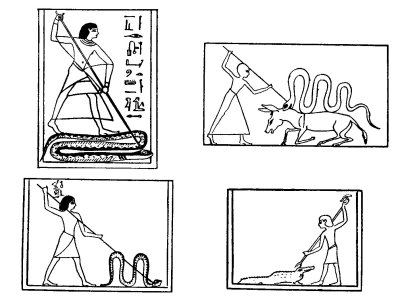
The House of the Prince keepeth festival, and the sound of those who rejoice is in the mighty dwelling. The gods are glad [when] they see Ra in his rising; his beams flood the world with light.The majesty of the god, who is to be feared, setteth forth and cometh unto the land of Manu; he maketh bright the earth at his birth each day; he cometh unto the place where he was yesterday. O mayest thou be at peace with me; may I behold thy beauties; may I advance upon the earth; may I smite the Ass; may I crush the evil one; may I destroy Apep in his hour; may I see the abtu fish at the time of his creation, and the ant fish in his creation, and the ant boat in its lake. May I see Horus in charge of the rudder, with Thoth and Maat beside him; may I grasp the bows of the seket boat, and the stern of the atet boat. May he grant unto the ka of Osiris Ani to behold the disk of the Sun and to see the Moon-god without ceasing, every day; and may my soul come forth and walk hither and thither and whithersoever it pleaseth. May my name be proclaimed when it is found upon the board of the table of offerings; may offerings be made unto me in my presence, even as they are made unto the followers of Horus; may there be prepared for me a seat in the boat of the Sun on the day of the going forth of the god; and may I be received into the presence of Osiris in the land of triumph!
bodead-plate01

Appendix

The following versions of this chapter are taken from: I. Naville, Todtenbuch, Bd. I., Pl. xiv. II. Naville, Todtenbuch, Bd. I., Pl. xv.; III. British Museum Papyrus No. 9901 and IV. British Museum Papyrus No. 10,471.

I. A HYMN OF PRAISE TO RA WHEN HE RISETH IN THE EASTERN PART OF HEAVEN. Behold Osiris, Qenna the merchant, who saith: "Homage to thee, in thy rising thou Tmu in thy crowns of beauty. Thou risest, thou risest, thou Ra shinest, thou shinest, at dawn of day. Thou art crowned like unto the king of the gods, and the goddess Shuti doeth homage unto thee. The company of the gods praise thee from the double-dwelling. Thou goest forth over the upper air and thy heart is filled with gladness. The sektet boat draweth onward as [Ra] cometh to the haven in the atet boat with fair winds. Ra rejoiceth, Ra rejoiceth. Thy father is Nu, thy mother is Nut, and thou art crowned as Ra-Harmachis. Thy sacred boat advanceth in peace. Thy foe hath been cast down and his head hath been cut off; the heart of the Lady of life rejoiceth in that the enemy of her lord hath been overthrown. The mariners of Ra have content of heart and Annu rejoiceth."

The merchant Qenna saith: "I have come to thee, O Lord of the gods, Tmu-Harmachis, who passest over the earth . . . . . . . I know that by which thou dost live. Grant that I may be like unto one of those who are thy favoured ones [among the followers] of the great god. May my name be proclaimed, may it be found, may it be lastingly renewed with . . . . . . . The oars are lifted into the sektet boat, and the sacred boat cometh in peace. May I see Ra when he appeareth in the sky at dawn, and when his enemies have fallen at the block. May I behold [Horns] guiding the rudder and steering with [his] two hands. May I see the abtu fish at the moment of his creation; and may I see the ant fish when he maketh himself manifest at creation, and the ant boat upon its lake. O thou Only One, O thou Mighty One, thou Growing One, who dost never wax faint, and from whom power cannot be taken. . . . . . . . . . . . . . the devoted servant of "the lord of Abtu."

"The merchant Qenna saith: "Homage to thee Heru-Khuti-Tmu, Heru-Khepera, mighty hawk, who dost cause the body [of man] to make merry, beautiful of face by reason of thy two great plumes. Thou wakest up in beauty at the dawn, when the company of the gods and mortals sing songs of joy unto thee; hymns of praise are offered unto thee at eventide. The starry deities also adore thee. O thou firstborn, who dost lie without movement, arise; thy mother showeth loving kindness unto thee every day. Ra liveth and the fiend Nak is dead; thou dost endure for ever, and the fiend hath fallen.

"Thou sailest over the sky with life and strength. The goddess Nehebka is in the atet boat; the sacred boat rejoiceth. Thy heart is glad and thy brow is wreathed with the twin serpents."

II. (I) A HYMN OF PRAISE TO RA WHEN HE RISETH IN THE EASTERN PART OF HEAVEN. Behold Osiris, Qenna the merchant, triumphant, who saith: "Homage to thee, O thou who risest in Nu, and who at thy birth dost make the world bright with light; all the company of the gods sing hymns of praise unto thee. The beings who minister unto Osiris cherish him as King of the North and of the South, the beautiful and beloved man-child. When he riseth, mortals live. The nations rejoice in him, and the Spirits of Annu sing unto him songs of joy. The Spirits of the towns of Pe and Nekhen exalt him, the apes of dawn adore him, and all beasts and cattle praise him with one accord. The goddess Seba overthroweth thine enemies, therefore rejoice within thy boat; and thy mariners are content thereat. Thou hast arrived in the atet boat, and thy heart swelleth with joy. O Lord of the gods, when thou dost create them, they ascribe praises unto thee. The azure goddess Nut doth compass thee on every side, and the god Nu floodeth thee with his rays of light. O cast thou thy light upon me and let me see thy beauties, me, the Osiris Qenna the merchant, triumphant! When thou goest forth over the earth I will sing praises unto thy fair face. Thou risest in the horizon of heaven, and [thy] disk is adored [when] it resteth upon the mountain to give life unto the world."

Saith Qenna the merchant, triumphant: "Thou risest, thou risest, coming forth from the god Nu. Thou dost become young again and art the same as thou wert yesterday, O mighty youth who hast created thyself. Not . . . . . . . my hand. Thou hast come with thy splendours, and thou hast made heaven and earth bright with thy rays of pure emerald light. The land of Punt is established for the perfumes which thou smellest with thy nostrils. Thou risest, O thou marvellous Being, in heaven, the twin serpents are placed upon thy brow, and thou art lord of the world and the inhabitants thereof; [the company] of the gods and Qenna the merchant, triumphant, adore thee."

III. (1, 2) A HYMN OF PRAISE TO RA WHEN HE RISETH IN THE EASTERN PART OF HEAVEN. Behold Osiris Hunefer, triumphant, who saith: "Homage to thee, O thou who art Ra when thou risest and Tmu when thou settest. Thou risest, thou risest; thou shinest, thou shinest, thou who art crowned king of the {p. 251} gods. Thou art the lord of heaven, [thou art] the lord of earth, [thou art] the creator of those who dwell in the heights and of those who dwell in the depths. [Thou art] the One god who came into being in the beginning of time. Thou didst create the earth, thou didst fashion man, thou didst make the watery abyss of the sky, thou didst form Hapi [the Nile], and thou art the maker of streams and of the great deep, and thou givest life to all that is therein. Thou hast knit together the mountains, thou has made mankind and the beasts of the field, thou hast created the heavens and the earth. Worshipped be thou whom the goddess Maat embraceth at morn and at eve. Thou dost travel across the sky with heart swelling with joy; the Lake of Testes is at peace. The fiend Nak hath fallen and his two arms are cut off. The sektet boat receiveth fair winds, and the heart of him that is in his shrine rejoiceth. Thou art crowned with a heavenly form, the Only one, provided [with all things]. Ra cometh forth from Nu in triumph. O thou mighty youth, thou everlasting son, self-begotten, who didst give thyself birth, O thou mighty One, of myriad forms and aspects, king of the world, Prince of Annu, lord of eternity and ruler of the everlasting, the company of the gods rejoice when thou risest and when thou sailest across the sky, O thou who art exalted in the sektet boat. Homage to thee, O Amen-Ra, thou who dost rest upon Maat, thou who passest over the heaven, and every face seeth thee. Thou dost wax great as thy Majesty doth advance, and thy rays are upon all faces. Thou art unknown and canst not be searched out . . . . . . . . his fellow except thyself; thou art the Only One . . . . . . [Men] praise thee in thy name [Ra], and they swear by thee, for thou art lord over them. Thou hast heard with thine ears and thou hast seen with thine eyes. Millions of years have gone over the world; I cannot tell the number of them, through which thou hast passed. Thy heart hath decreed a day of happiness in thy name [of Ra]. Thou dost pass over and travellest through untold spaces of millions and hundreds of thousands of years; thou settest out in peace, and thou steerest thy way across the watery abyss to the place which thou lovest; this thou doest in one little moment of time, and thou dost sink down and makest an end of the hours."

Osiris, the governor of the palace of the lord of the two lands (i.e., Seti I.), Hunefer, triumphant, saith: Hail my lord, thou that passest through eternity and whose being is everlasting. Hail thou Disk, lord of beams of light, thou risest and thou makest all mankind to live. Grant thou that I may behold thee at dawn each day."

IV. A HYMN OF PRAISE TO RA by Nekht, the royal scribe, captain of soldiers, who saith: "Homage to thee, O thou glorious Being, thou who art provided [with all things]. O Tmu-Heru-khuti, when thou risest in the horizon of heaven, a cry of joy cometh out of the mouth of all peoples. O thou beautiful Being, thou dost renew thyself in thy season in the form of the Disk within thy mother Hathor; therefore in every place every heart swelleth with joy at thy rising, for ever. The eastern and the western parts of heaven come to thee with homage, and give forth sounds of joy at thy rising. O Ra, thou who art Heru-khuti (Harmachis), the mighty man-child, the heir of eternity, self-begotten and self-born, king of earth, prince of the netherworld, governor of the mountains of Aukert (i.e., the netherworld), thou dost rise in the horizon of heaven and sheddest upon the world beams of emerald light; thou art born from the {p. 252} water, thou art sprung from Nu, who fostereth thee and ordereth thy members. O thou who art crowned king of the gods, god of life, lord of love, all the nations live when thou dost shine. The goddess Nut doeth homage unto thee, and the goddess Maat embraceth thee at all times. They who are in thy following sing unto thee with joy and bow down to the earth when they meet thee, the god of heaven, the lord of earth, the king of right and truth, the god of eternity, the everlasting ruler, the prince of all the gods, the god of life, the creator of eternity, the maker of heaven by whom is established all that therein is. The company of the gods rejoice at thy rising, the earth is glad when it beholdeth thy rays; the peoples that have been long dead come forth with cries of joy to see thy beauties. Thou goest forth over heaven and earth, made strong each day by thy mother Nut. Thou passest through the uppermost heaven, thy heart swelleth with joy; and the Lake of Testes is content thereat. The Enemy hath fallen, his arms are hewn off, the knife hath cut asunder his joints. Ra liveth in Maa the beautiful. The sektet boat draweth on and cometh into port; the south, the north, the west and the east turn to praise thee, O thou unformed substance of the earth, who didst create thyself. Isis and Nephthys salute thee, they sing unto thee in thy boat hymns of joy, they shield thee with their hands. The souls of the East follow thee, the souls of the West praise thee. Thou art the ruler of all gods and thou hast joy of heart within thy shrine; for the Serpent Nak is condemned to the fire, and thy heart shall be joyful for ever. Thy mother Nut is adjudged to thy father Nu."

The Book of the Dead, Index

THE BOOK OF THE DEAD

The Papyrus of Ani

IN THE BRITISH MUSEUM.

THE EGYPTIAN TEXT WITH INTERLINEAR

TRANSLITERATION AND TRANSLATION,

A RUNNING TRANSLATION, INTRODUCTION, ETC.

by

E. A. WALLIS BUDGE

Late keeper of Assyrian and Egyptian Antiquities
in the British Museum

[1895]

Because of the substantial amount of hieroglypics interspersed in the original text, I have omitted the ### 'glyph' placeholder where context permits, for readability. Only actual illustations have been inserted into the file. Due to space considerations the interlinear translation, which is primarily of interest to students of Ancient Egyptian, will not be posted. This should not be a hardship, since the Dover reprint edition is still in print and widely available.

The file above, which appears at on the Internet at Sacred-Texts for the first time is a faithful e-text of the 1895 edition of the E.A. Wallace Budge translation of the Egyptian Book of the Dead.

In November of 2000 I inventoried my library and found that I was missing Budge's Book of the Dead. So when a copy of the Dover reprint came up at the local used bookstore, I purchased it. To my dismay, the version of the text widely posted on the Internet did not seem to match the Dover reprint of the 1895 version.

According to John Mark Ockerbloom, the proprietor of the excellent Online Books Page, the version circulating on the Internet is a highly edited version of Budge from a much later date (1913). He writes:

"I did a little legwork, and it appears that the "mystery text" is in fact from the Medici Society edition of 1913. According to a 1960 reprint by University Books, for this edition "The translation was rewritten... [and the] greater part of the Introduction was also rewritten by Sir Wallis, who concluded a preface to it with the pleased words, 'and the entire work thus becomes truly a "New Edition"'". It's unclear whether Budge himself did the rewrite of the translation, but it's clear that he at least claims responsibility for it,. and it does appear to draw fairly heavily on his earlier translation."

Thanks to Mr. Ockerbloom for clearing up this mystery.

In any case, the version now at sacred-texts is a completely new e-text, which I believe to be a much better version of this text.

NOTE : Because the original e-text is not readable for "unschooled" readers, due to a mass of refers to other scripts, I removed most of them to make this book a little readable for my readers.

The original full text including all comments, you can find at Sacred Texts: Ancient Egypt.

The Book of the Dead, The Papyrus of Ani

THE BOOK OF THE DEAD

The Papyrus of Ani

by

E. A. WALLIS BUDGE

Late keeper of Assyrian and Egyptian Antiquities
in the British Museum

[1895]

THE PAPYRUS OF ANI.

General Description

The papyrus of Ani, was found at Thebes, and was purchased by the Trustees of the British Museum in 1888. It measures 78 feet by 1 foot 3 inches, and is the longest known papyrus of the Theban period. It is made up of six distinct lengths of papyrus, which vary in length from 26 feet 9 inches to 5 feet 7 inches. The material is composed of three layers of papyrus supplied by plants which measured in the stalks about 41 inches in diameter. The several lengths have been joined together with great neatness, and the repairs and insertion of new pieces (see plates 25, 26) have been dexterously made. When first found, the papyrus was of a light colour, similar to that of the papyrus of Hunefer (B. M. No. 9901), but it became darker after it had been unrolled, and certain sections of it have shrunk somewhat.

It contains a number of chapters of the Book of the Dead, nearly all of which are accompanied by vignettes; and at top and bottom is a border of two colours-red and yellow. At the beginning and end of the papyrus spaces of six and eleven inches respectively have been left blank. The inscribed portion is complete, and the loss of the few characters which were damaged in unrolling does not interrupt the text. It was written by three or more scribes; but the uniformity of the execution of the vignettes suggests that fewer artists were employed on the illustrations. The titles of the chapters, rubrics, catchwords, etc., are in red. In some instances the artist has occupied so much space that the scribe has been obliged to crowd the text (e.g., in plate 11) and at times he has written it on the border (see plates 14, 17). This proves that the vignettes were drawn before the text was written.

All the different sections of the papyrus were not originally written for Ani, for his name has been added in several places' by a later hand. As however such additions do not occur in the first section, which measures 16 feet 4 inches in length, it must be concluded that that section was written expressly for him, and that the others were some of those ready-written copies in which blank spaces were left for the insertion of the names of the deceased persons for whom they were purchased. The scribe who filled in Ani's name in these spaces wrote hurriedly, for in Chapter XXXB., line 2 (pl. 15), he left himself no space to write the word "Osiris" in the phrase, "Ani victorious before Osiris" (compare pl. 1, line 5); in Chapter XLIII., lines 1, 2 (pl. 17), he has written it twice; in Chapter IX., l. 1 (pl. 18), he has omitted the determinative in Chapter XV., line 2 (pl. 20) he meant to write "Ani, victorious in peace (pl. 19), but wrote "Ani in triumph" in Chapter CXXV., line 18 (pl. 30), the word ### is written twice, probably, however, with the view of filling up the line; in Chapter CLI. (Pl. 34) the name is written crookedly, and the determinative is omitted; and in Chapters XVIII. (Introduction, pl. 12) and CXXXIV. (pl. 22). the scribe has, in two spaces, omitted to write the name. It seems tolerably certain that all the sections of the papyrus were written about the same time, and that they are the work of scribes of the same school; the variations in the depth of the space occupied by the text and the difference in the colours of the border only show that even the best scribes did not tie themselves to any one plan or method in preparing a copy of the Book of the Dead. The text has many serious errors: by some extraordinary oversight it includes two copies of the XVIII th Chapter, one with an unusual introduction and the other without introduction; and a large section of the XVIIth Chapter, one of the most important in the whole work, has been entirely omitted. Such mistakes and omissions, however, occur in papyri older than that of Ani, for in the papyrus of Nebseni (B.M., No. 9900), which was written at Memphis early in the XVIIIth dynasty, of Chapters L., LVI., LXIV., CLXXX., two copies each, of Chapters C. and CVI., three copies, and of Chapter XVII. two extracts are given in different parts of the papyrus.

Ani's rank.

The papyrus of Ani is undated, and no facts are given in it concerning the life of Ani, whereby it would be possible to fix its exact place in the series of the illustrated papyri of the Theban period to which it belongs. His full titles are:-- suten in maa an hesb hetep neter en neteru nebu Royal scribe veritable, scribe and accountant of the divine offerings (i.e., revenues) of all the gods. mer tenti en nebu Abtu an hetep neter en The governor of the granary of the lords of Abydos, scribe of the divine offerings (i.e., revenues) of nebu Uast. the lords of Thebes; and he is said to be "beloved of the lord of the North and South" and to "love him". The name of the king thus referred to cannot be stated. That Ani's rank of "royal scribe" was not titular only is shown by the addition of the word "veritable," and his office of scribe and accountant of all the gods was probably one of the highest which a scribe could hold. His other offices of "governor of the granary of the lords of Abydos," and "scribe of the sacred property of the lords of Thebes," further prove his rank and importance, for Abydos and Thebes were the most ancient and sacred cities of Egypt.

Ani's wife.

Ani's wife Thuthu is described as "the lady of the house, the qematet of Amen". What the title "lady of the house means has not yet been decided, but qemat is the title applied to the noble ladies who sang or played on an instrument in the temple of a god. The lady Thuthu belonged to the number of the priestesses of the god Amen-Ra at Thebes, and she always carries in her hands the sistrum. and the instrument menat, the emblems of her office. Thus Ani and his wife were high ecclesiastical dignitaries connected with the famous confraternity of the priests of Amen.

Copies of the Book of the Dead in the Theban period.
Age of the papyrus.

An examination of the papyri of the Theban period preserved in the British Museum shows that two distinct classes of Book of the Dead papyri existed in the XVIIIth dynasty. In the first both text and vignettes are traced in black outline, the rubrics, catchwords, etc., alone being in red colour; in the second the text only is black, the rubrics, etc., being red, and the vignettes beautifully painted in a number of bright colours. To the latter class the papyrus of Ani belongs, but, if the text and vignettes be compared with those found in any other early Theban papyri, it will be seen that it occupies an independent position in all respects. Though agreeing in the main with the papyri of the XVIIIth dynasty in respect of textual readings, the papyrus of Ani has peculiarities in spelling, etc., which are not found in any of them. The handwriting of the first section at least suggests the best period of the XVIIIth dynasty; but as the scribe forms some of the characters in a way peculiarly his own, the palgraphic evidence on this point is not decisive. That the papyrus belongs to the period which produced such documents as the papyrus of Neb-qet, and the papyrus of Qenna, i.e., to some period of the XVIIIth dynasty, is tolerably certain; and we may assume that it is older than the papyrus of Hunefer, which was written during the reign of Seti I.; for, though belonging to the same class of highly decorated papyri, the execution of the vignettes is finer and more careful, and the free, bold forms of the hieroglyphics in the better written sections more closely resemble those of the texts inscribed in stone under the greatest kings of the XVIIIth dynasty. The "lord of the two lands," i.e., of Upper and Lower Egypt, or the North and South, mentioned in pl. 4, is probably one of the Thothmes or Amenhetep kings, and accordingly we may place the period of our papyrus between 1500 and 1400 years B.C.

The text.

The text may be divided into two parts. The first part contains unusual versions of two hymns to Ra and Osiris, the vignette of the sunrise (Chapter XVIA.), and the judgment Scene accompanied by texts, some of which occur in no other papyrus. The second part comprises about sixty-two Chapters of the Theban edition of the Book, in the following order:--I., XXII. LXXII., rubric, XVII., CXLVII., CXLVI., XVIII., XXIII., XXIV., XXVI. XXXB., LXI., LIV., XXIX., XXVII., LVIII., LIX., XLIV., XLV., XLVI., L., XCIII., XLIII., LXXXIX., XCI., XCII., LXXIV., VIII., II., IX., CXXXII., X., [XLVIII.], XV., CXXXIII., CXXXIV., XVIII., CXXIV., LXXXVI., LXXVII., LXXVIII., LXXXVII., LXXXVIII., LXXXII., LXXXV., LXXXIII., LXXXIV., LXXXIA., LXXX., CLXXV., CXXV. Introduction and Negative Confession, XLII., CXXV., Rubric, CLV., CLVI., XXIXB., CLXVI., CLI., VI., CX., CXLVIII., CLXXXV., and CLXXXVI. The titles of these Chapters arranged according to the numeration introduced by Lepsius are as follows :--

List of Chapters.

Chapter I. "Here begin the chapters of 'coming forth by day,' and of the songs of praise and of glorifying, and of coming forth from and of going into the glorious Neter-khert in the beautiful Amenta; to be said on the day of the burial going in after coming forth." (See pp. 19, 270 and pll. 5, 6.)

The papyri belonging to the early part of the XVIIth dynasty call this Chapter the "Chapter of going in to the divine chiefs of Osiris," ###. The large numbers of the men attending the bier and of the weeping women are peculiar to the Ani papyrus.

Chapter II. "The Chapter of coming forth by day and of living after death." (See pp. 120, 321, and pl. 18.)

This Chapter is found only in one other papyrus of the Theban period (British Museum, No. 9964). Another copy of it is inscribed upon a mummy bandage preserved in the Louvre, No. 3097.'

Chapter VI.--[See Chapter CLI., of which it forms a part, pp. 233, 362, and pl. 32.] In the papyrus of Nebseni (British Museum, No. 9900) this Chapter stands by itself, and is entitled "Chapter of making the ushabti figures to perform work for a man in the Neter-khert,"

Chapter VIII. "The Chapter of passing through Amenta, and of coming forth by day." (See pp. 119, 320, and pl. 18.)

As a separate composition, this Chapter is found in only two other papyri of the XVIIIth dynasty.

Chapter IX. "The Chapter of coming forth by day, having passed through the tomb." (See pp. 120, 321, and pl. 18.)

The vignette in the papyrus of Ani is similar to that which stands at the head of Chapters VIII. and IX. in other papyri of this period.

Chapter X. [See Chapter XLVIII., pp. 123, 321, and pl. 18.]

Chapter XV. 1. "A hymn of praise to Ra when he riseth in the eastern sky." (See pp. 1, 236, and pl. I.)

This version is found in no other papyrus.

Chapter XV. 2. "A hymn of praise to Osiris Unnefer, the great god in Abydos,"[2] etc. (See pp. 8, 253, and pl. 2.)

Chapter XV. 3. "A hymn of praise to Ra when he riseth in the eastern sky, and when he setteth in the [land of] life." (See pp. 123, 322, and pl. 18-21.)

The Litany to Osiris (pl. 19) and the hymn to Ra (pll. 24, 25) which follow are variants of the XVth Chapter, similar to those published by M. Naville.

Chapter XVIA. consists of a vignette only. (See p. 252, and pl. 2.) Strictly speaking, it should form the vignette of the XVth Chapter, or of that part of it which refers to the rising sun. Like many other ancient papyri, the papyrus of Ani has no vignette referring to the sunset.

Chapter XVII. "Here begin the praises and glorifyings of coming out from and of going into the glorious Neter-khert in the beautiful Amenta, of coming forth by day in all the transformations which please him, of playing at draughts, and of sitting in the Sekh hall, and of coming forth as a living soul." (See pp. 27, 280, and Pll. 7-10.)

This is one of the oldest and most important of all the Chapters in the Book of the Dead, and it contains the most complete statements concerning the Egyptian cosmogony as formulated by the college of priests of Heliopolis. The scribe seems to have accidentally omitted a large section.

Chapter XVIII. This Chapter has no title.

The papyrus of Ani contains two copies of this Chapter. In the first the gods of the localities are grouped separately, and it is preceded by a very rare introduction, in which the An-mut-f and Sa-mer-f priests introduce Ani to the gods, whom he addresses in two speeches. (See p. 71, 301, and pll. 12-14.) In the second the text is not divided into distinct sections, and the gods are not grouped. (See p. 330, and pll. 23-24.)

Chapter XXII., "The Chapter of giving a mouth to Osiris Ani, the scribe It and teller of the holy offerings of all the gods." (See pp. 25, 274, and pl. 6.)

The ceremony of giving a mouth to the deceased was, according to the vignette in the papyrus of Nebseni, performed by the "Guardian of the Balance ". In the papyrus of Ani there is no vignette, and it is remarkable that this Chapter follows immediately after Chapter 1.

Chapter XXIII. "The Chapter of opening the mouth of Osiris, the scribe Ani." (See pp. 84, 306, and pl. 15.)

Chapter XXIV. "The Chapter of bringing charms unto Osiris Ani in Neter-khert." (See pp. 85, 306, and pl. 15.)

As with other ancient Theban papyri, the papyrus of Ani gives no Vignette.

Chapter XXVI. "The Chapter of giving a heart unto Osiris Ani in Neter-khert." (See pp. 88, 308, and pl. 15.)

The vignette is probably unique.

Chapter XXVII. "The Chapter of not letting the heart of a man be taken away from him in Neter-khert." (See pp. 100, 312, and pl. 15.)

The vignette is unusual.

Chapter XXIX. "The Chapter of not letting the heart of a man be taken away from him in Neter-khert." (See pp. 97, 311, and pl. 15.)

No other copy of this Chapter is at present known.

Chapter XXIXB. "The Chapter of a heart of carnelian." (See pp. 228, 359, and pl. 33.)

Chapter XXXB. "The Chapter of not letting the heart of Osiris Ani be driven away from him in Neter-khert." (See pp. I 1, 90, 258, 309, and pl. 15-)

Chapter XLII. This Chapter is without title (see pp. 213, 353, and pl. 32), but in other ancient papyri it is called "Repulsing of slaughter in Suten-henen."

Chapter XLIII. "The Chapter of not letting the head of a man be cut off from him in Neter-khert." (See pp. 111, 317, and pl. 17.)

As in other ancient Theban papyri, this Chapter is without vignette.

Chapter XLIV. "The Chapter of not dying a second time in Neter-khert." (See pp. 105, 315, and pl. 16.)

The vignette is peculiar to the papyrus of Ani.

Chapter XLV. "The Chapter of not suffering corruption in Neter-khert." (See pp. 106, 315, and pl. 16.)

Only one other copy of the text of this Chapter is known.[1] Among Theban papyri the vignette is peculiar to the papyrus of Ani.

Chapter XLVI. "The Chapter of not perishing and of becoming alive in Neter-khert." (See pp. 107, 316, and pl. 16.)

Only one other copy of the text of this Chapter is known (B.M. No. 9900). Among Theban papyri the vignette is peculiar to the papyrus of Ani.

Chapter XLVIII. "Another Chapter of one who cometh forth by day against his foes in Neter-khert." (See pp. 123, 321, and pl. 18.)

Only one other copy of the text of this Chapter is known (B.M. No. 9900). Among Theban papyri the vignette is peculiar to the papyrus of Ani.

Chapter L. "The Chapter of not entering in unto the block." (See pp. 108, 315, and pl. 16.)

The text of this Chapter agrees rather with the second version in the papyrus of Nebseni than with that in B.M. papyrus No. 9964. As the Ani papyrus is of Theban origin this was to be expected.

Chapter LIV. "The Chapter of giving breath in Neter-khert." (See pp. 94, 310, and pl. 15.)

Only one other copy of this Chapter is known, and it is without vignette.

Chapter LVIII. " The Chapter of breathing the air, and of having power over the water in Neter-khert." (See pp. 103, 314, and pl. 16.)

No other copy of this Chapter is known.

Chapter LIX. "The Chapter of breathing the air, and of having power over the water in Neter-khert." (See pp. 104, 315, and pl. 16.)

Only one other copy of this Chapter is known.

Chapter LXI. "The Chapter of not letting the soul of a man be taken away from him in Neter-khert." (See pp. 91, 309, and pl. 15.)

The vignette is similar to that in the papyrus of Sutimes, which M. Naville believes to be no older than the XIXth dynasty.

Chapter LXXII.--Rubric. (See pp. 26, 275, and pl. 6.)

Chapter LXXIV. "The Chapter of walking with the legs and of coming forth upon earth." (See pp. 118, 320, and pl. 18.)

Chapter LXXVII. " The Chapter of changing into a golden hawk ." (See pp. 152, 332, and pl. 25.)

Chapter LXXVIII. "The Chapter of changing into a divine hawk." (See pp. 154, 333, and pl. 25, 26.)

Chapter LXXX. "The Chapter of changing into the god who giveth light in the darkness." (See pp. 182, 341, and pl. 28.)

Chapter LXXXIA. "The Chapter of changing into a lotus." (See pp. 181, 340, and pl. 28.)

The pool of water in the vignette is uncommon.

Chapter LXXXII. "The Chapter of changing into Ptah." (See pp. 170, 337, and pl. 27.)

As in other XVIIIth dynasty papyri, this Chapter has a vignette.

Chapter LXXXIII. "The Chapter of changing into a bennu bird" (phnix?). (See pp. 176, 339, and pl. 27.)

Like other XVIIIth dynasty papyri, this Chapter lacks the addition which is found in the papyrus of Sutimes.

Chapter LXXXIV. "The Chapter of changing into a heron." (See pp. 178, 339, and pl. 28.)

Chapter LXXXV. " The Chapter of changing into the soul of Tmu." (See pp. 172, 338, and pl. 27.)

The vignette to this Chapter is similar to that of the papyrus of Tura, surnamed Nefer-uben-f, of the XVIIIth dynasty.'

Chapter LXXXVI. "The Chapter of changing into a swallow." (See pp. 250, 331, and pl. 25.)

Chapter LXXXVII. "The Chapter of changing into Seta." (See pp. 169, 337, and pl. 27.)

Chapter LXXXVIII. "The Chapter of changing into a crocodile." (See pp. 170, 337, and pl. 27.)

Chapter LXXXIX. "The Chapter of causing the soul to be united to its body in Neter-khert." (See pp. 112, 318, and pl. 17.)

The two incense burners which stand, one at the head and one at the foot of the bier, are peculiar to the papyrus of Ani.

Chapter XCI. "The Chapter of not letting the soul of a man be captive in Neter-khert." (See pp. 114, 319, and pl. 17.)

Chapter XCII. "The Chapter of opening the tomb to the soul and the shadow, of coming forth by day, and of getting power over the legs." (See pp. 115, 319, and pl. 17.)

The vignette of this Chapter is unusual and of great interest, for in it Ani's soul accompanies his shadow.

Chapter XCIII. "The Chapter of not letting a man pass over to the east in Neter-khert." (See pp. 109, 317, and pl. 17-)

The vignette as here given is peculiar to the papyrus of Ani.

Chapter XCIIIA. "Another Chapter." (See pp. 110, 317, and pl. 17.)

Chapter CX. "Here begin the Chapters of the Sekhet-hetepu, and the Chapters of coming forth by day, and of going into and coming out from Neter-khert, and of arriving in the Sekhet-Aanru, and of being in peace in the great city wherein are fresh breezes." (See pp. 236, 362, and pl. 34.)

The text is here incomplete.

Chapter CXXIV. "The Chapter of going unto the divine chiefs of Osiris." (See pp. 146, 330, and pl. 24.)

In the vignette we should expect four, instead of three, gods.

Chapter CXXV. "The Chapter of entering into the Hall of double Right and Truth: a hymn of praise to Osiris." (See pp. 189, 344, and pl. 30.)

The Introduction to this Chapter as found in the papyrus of Ani is not met with elsewhere; the text which usually follows the "Negative Confession" is however omitted. The vignette as here given is peculiar to the papyrus of Ani.

Chapter CXXXII. "The Chapter of making a man to return to see again his home upon earth." (See pp. 121, 321, and pl. 18.)

Chapter CXXX III. "[A Chapter] to be said on the day of the month." (See pp. 138, 327, and pl. 21.)

Chapter CXXXIII.--Rubric. (See pp. 142, 328, and pl. 22.)

Chapter CXXXIV. "A hymn of praise to Ra on the day of the month wherein he saileth in the boat." (See pp. 142, 329, and pl. 22.)

Chapter CXLVI. "The Chapter of renewing the pylons in the House of Osiris which is in the Sekhet-Aanru." (See pp. 63, 295, and pll. 11, 12.)

Chapter CXLVII. "A Chapter to be said when Ani cometh to the first Aril." (See pp. 56, 291, and pll. 11, 12.)

Chapter CXLVIII. Without title. See pp. 239, 366, and pl. 35.)

Chapter CLI. Scene in the mummy chamber. (See pp. 229, 360, and Pll. 33, 34.)

Chapter CLV. "The Chapter of a Tet of gold." (See pp. 225, 357, and pl. 33.)

Chapter CLVI. "The Chapter of a Buckle of carnelian." (See pp. 227, 359, and pl. 33.)

Chapter CLXVI. "The Chapter of the Pillow which is placed under the head." (See pp. 228, 359, and pl. 33.)

Chapter CLXXV. " The Chapter of not dying a second time." (See pp. 184, 341, and pl. 29.)

Only one other much mutilated copy of this most important Chapter is known. In it it is declared that neither men nor gods can conceive what great glory has been laid up for Ani in his existence in the next world, and that his life therein shall be for "millions of millions of years."

Chapter CLXXXV. "A Hymn of Praise to Osiris, the dweller in Amenta, Un-nefer within Abtu (Abydos)." (See pp. 241, 367, and pl. 36.)

Chapter CLXXXVI. "A Hymn of praise to Hathor." (See pp. 242, 368. and pl. 37.)

The Book of the Dead, Funeral Ceremonies

THE BOOK OF THE DEAD

The Papyrus of Ani

by

E. A. WALLIS BUDGE

Late keeper of Assyrian and Egyptian Antiquities
in the British Museum

[1895]

FUNERAL CEREMONIES.

In illustration of the ceremonies which accompanied the burial of the dead the reader will find extracts from different texts printed in the Appendix on p. 264 ff. To these may be added an extract from the curious ritual which was in vogue in the Vth and VIth dynasties, and which commemorated the ceremonies which were performed for the god Osiris. It is to be noticed how closely the deceased is identified with Osiris, the type of incorruptibility. Osiris takes upon himself "all that is hateful" in the dead : that is, he adopts the burden of his sins; and the dead is purified by the typical sprinkling of water. While the gods are only accompanied by their ka's, the deceased, in right of his identification with a higher power, is accompanied by his Tet also, that is, by his Osiris.

Throughout the ceremony, the Eye of Horus, which is represented by various substances, plays a prominent part, for it is that which gives vigour to the heart of the dead and leads him to the god. That portion of the ceremony which was believed to procure the unlocking of the jaws and the opening of the mouth of the deceased, or of the statue which sometimes represented him, was performed after the purification by water and incense had been effected; and hereby was he enabled to partake of the meat and drink offerings, wherein the friends and relatives also participated, in order that they might cement and seal their mystic unity with the dead and with the god with whom he was identified.

Certain formulae were directed to be repeated four times: a direction which takes us back to the time when the Egyptians first divided the world into four parts, each corresponding to one of the four pillars which held up the sky, that is to say, to one of the four cardinal points, East, South, West, and North, presided over by a special god. The deceased sought to obtain the assistance of each of the four gods of the cardinal points, and to have the right to roam about in his district; hence the formula was repeated four times. Originally four animals or four geese were sacrificed, one to each god, but subsequently East and North, and West and South were paired, and two bulls (or birds) only were sacrificed, one of which was called the Bull of the North,[*] and the other the Bull of the South. The custom of four-fold repetition continued to the Ptolema times[+] and even later.

The priest whose official title was kher heb, recited the prayers, and the sem or setem priest presented the prescribed offerings. The rubrical directions are given on the margin for the sake of clearness.

"O Osiris,[++] all that is hateful in Unas hath been brought unto thee, and all the evil words which have been spoken in his name. Come, O Thoth, and take them unto Osiris, bring all the evil words which have been spoken and place them in the hollow of thy hand; thou shalt not escape therefrom, thou shalt not escape therefrom. Whosoever marcheth, marcheth with his ka. Horus marcheth with his ka, Set marcheth with his ka, Thoth marcheth with his ka, Sep marcheth with his ka, Osiris marcheth with his ka, Khent-maati marcheth with his ka; and thy tet shall march with thy ka. Hail, Unas, the hand of thy ka is before thee. Hail, Unas, the hand of thy ka is behind thee. Hail, Unas, the leg of thy ka is before thee. Hail, Unas, the leg of thy ka is behind thee. Osiris Unas, I have given unto thee the Eye of Horus, and thy face is filled therewith, and the perfume thereof spreadeth over thee. The libations which are poured out by thy son, which are poured out by Horus, are for thee, O Osiris, and they are for thee O Unas. I have come, and I have brought unto thee the Eye of Horus that thou mayest refresh thy heart therewith, I have placed it beneath thy feet, and I give unto thee whatsoever hath come forth from thy body that thy heart may not cease to beat through [the want] thereof. Thy voice shall never depart from thee, thy voice shall never depart from thee.

"[Here is] unguent, [here is] unguent. Open thy mouth, O Unas, and taste the taste of the scent which is in the holy habitations. This scent is that which distilleth from Horus, this scent is that which distilleth from Set, and it is that which stablisheth the hearts of the two Horus gods. Thou purifiest thyself with the Heru-shesu;[*] thou art purified with natron, and Horus is purified with natron; thou art purified with natron, and Set is purified with natron; thou art purified with natron, and Thoth is purified with natron; thou art purified with natron, and Sep is purified with natron; thou art purified with natron, and art established among them, and thy mouth is [as pure] as the mouth of a sucking calf on the day of its birth. Thou art purified with natron, and Horus is purified with natron; thou art purified with natron, and Set is purified with natron; [thou art purified with natron] and Thoth is purified with natron; thou art purified with natron, and Sep is purified with natron; thy ka is purified with natron, and thou art pure, thou art pure, thou art pure, thou art pure. Thou art stablished among the gods thy brethren, thy head is purified for thee with natron, thy bones are washed clean with water, and thou thyself art made perfect with all that belongeth unto thee. O Osiris, I have given unto thee the Eye of Horus, thy face is filled therewith, and the perfume thereof spreadeth over thee.

"Hail, Unas, thy two jaws are unlocked. Hail, Unas, the two gods have opened thy mouth. O Unas, the Eye of Horus hath been given unto thee, and Horus cometh thereunto; it is brought unto thee, and placed in thy mouth. Hail, Unas, the nipples of the bosom of Horus have been given unto thee, and thou hast taken in thy mouth the breast of thy sister Isis, and the milk which floweth from thy mother is poured into thy mouth.

"Thou hast gotten possession of the two eyes of Horus, the white and the black, thou hast taken them unto thyself and they illumine thy face. The day hath made an offering unto thee in heaven, and the East and the West are at peace with thee; the night hath made an offering unto thee, and the North and the South are at peace with thee. These are the offerings which are brought unto thee, the offerings which thou seest, the offerings which thou hearest, the offerings which are before thee, the offerings which are behind thee, the offerings which are with thee. O Osiris Unas, the white teeth of Horus are given unto thee that thou mayest fill thy mouth therewith. A royal offering to the ka of Unas.. O Osiris Unas, the Eye of Horus hath been given unto thee, and thou livest, and a thou art. O Osiris Unas, the Eye of Horus which strove with Set hath been given unto thee, and thou hast lifted it to thy lips, and thy mouth is opened thereby. O Osiris Unas, thy mouth is opened by that with which thou art filled. O Osiris Unas, that which hath distilled from thee hath been given unto thee. O Ra, may all the praise which thou receivest in heaven be in praise of Unas, and may all that belongeth unto thy body belong unto the ka of Unas, and may all that belongeth unto his body belong unto thee. O Unas, the Eye of Horus hath been given unto thee, that thou mayest be able to taste, and that thou mayest illumine the night. O Unas, the Eye of Horus hath been given to thee that it may embrace thee. O Unas, the Eye of Horus which strove with Set hath been, given unto thee, in order that the opening of thy mouth may be caused thereby. O Unas, that which flowed from Osiris hath been given unto thee. O Unas, the Eye of Horus hath been given unto thee, in order that without the help of iron thy mouth may be set free. O Unas, the Eye of Horus hath been given unto thee, in order that thy face may be adorned therewith. O Osiris Unas, the Eye of Horus hath sprinkled oil upon thee. O Osiris Unas, that which hath been pressed out of thy face hath been given unto thee. O Osiris Unas, the Eye of Horus hath been given unto thee, in order that it may shave (?) thee. O Osiris Unas, the Eye of Horus hath been given unto thee, in order that it may anoint thee. O Osiris Unas, the Eye of Horus hath been given unto thee, in order that it may lead thee unto the gods. O all ye unguents, be ye laid out before your Horus, and make ye him strong. Cause him to gain the mastery over his body, and make his eyes to be opened. May all the shining beings see him, may they hear his name, for the Eye of Horus hath been brought, in order that it may be placed before Osiris Unas. O Osiris Unas, the two Eyes of Horus have been laid like paint upon thy face.

"O clothe thyself in peace! Put thou on thy apparel in peace! May Tatet put on apparel in peace! Hail, Eye of Horus, in Tep, in peace! Hail, Eye of Horus, in the houses of Nit, in peace. Receive thou white apparel. O grant that the two lands which rejoiced to do homage unto Horus may do homage unto Set; and grant that the two lands which stood in awe of Set may stand in awe of Unas. Dwell thou with Unas as his god, open thou a path for him among the, shining ones, and stablish thou him among them."

Subscribe to this RSS feed

Log in or create an account